 filings.tools
Eli Lilly 10-K 2021-12-31
Filed 2022-02-23. 23 sections, 529K characters. Original on sec.gov · Markdown · JSON
Cover and table of contents
United States
Securities and Exchange Commission
Washington, D.C. 20549
Form 10-K
Annual report pursuant to Section 13 or 15(d) of the Securities Exchange Act of 1934
for the fiscal year ended December 31, 2021
Commission file number 001-06351
ELI LILLY AND COMPANY
(Exact name of Registrant as specified in its charter)
| Indiana | 35-0470950 | |||||||||||||||||||
| (State or other jurisdiction of | (I.R.S. Employer | |||||||||||||||||||
| incorporation or organization) | Identification No.) |
Lilly Corporate Center, Indianapolis, Indiana 46285
(Address and zip code of principal executive offices)
Registrant's telephone number, including area code (317) 276-2000
Securities registered pursuant to Section 12(b) of the Exchange Act:
| Title of Each Class | Trading Symbol(s) | Name of Each Exchange On Which Registered | ||||||
| Common Stock (no par value) | LLY | New York Stock Exchange | ||||||
| 1.000% Notes due 2022 | LLY22 | New York Stock Exchange | ||||||
| 7 1/8% Notes due 2025 | LLY25 | New York Stock Exchange | ||||||
| 1.625% Notes due 2026 | LLY26 | New York Stock Exchange | ||||||
| 2.125% Notes due 2030 | LLY30 | New York Stock Exchange | ||||||
| 0.625% Notes due 2031 | LLY31 | New York Stock Exchange | ||||||
| 0.500% Notes due 2033 | LLY33 | New York Stock Exchange | ||||||
| 6.77% Notes due 2036 | LLY36 | New York Stock Exchange | ||||||
| 1.625% Notes due 2043 | LLY43 | New York Stock Exchange | ||||||
| 1.700% Notes due 2049 | LLY49A | New York Stock Exchange | ||||||
| 1.125% Notes due 2051 | LLY51 | New York Stock Exchange | ||||||
| 1.375% Notes due 2061 | LLY61 | New York Stock Exchange |
Securities registered pursuant to Section 12(g) of the Exchange Act: None
Indicate by check mark if the Registrant is a well-known seasoned issuer, as defined in Rule 405 of the Securities Act. Yes ☒ No ☐
Indicate by check mark if the Registrant is not required to file reports pursuant to Section 13 or 15(d) of the Exchange Act. Yes ☐ No ☒
Indicate by check mark whether the Registrant (1) has filed all reports required to be filed by Section 13 or 15(d) of the Exchange Act during the preceding 12 months (or for such shorter period that the Registrant was required to file such reports) and (2) has been subject to such filing requirements for the past 90 days. Yes ☒ No ☐
Indicate by check mark whether the Registrant has submitted electronically every Interactive Data File required to be submitted pursuant to Rule 405 of Regulation S-T (§ 232.405 of this chapter) during the preceding 12 months (or for such shorter period that the Registrant was required to submit such files).
Yes ☒ No ☐
Indicate by check mark whether the Registrant is a large accelerated filer, an accelerated filer, a non-accelerated filer, a smaller reporting company, or an emerging growth company. See the definitions of "large accelerated filer," "accelerated filer," "smaller reporting company," and "emerging growth company" in Rule 12b-2 of the Exchange Act.
| Large accelerated filer | ☒ | Accelerated filer | ☐ | ||||||||||||||||||||
| Non-accelerated filer | ☐ | Smaller reporting company | ☐ | ||||||||||||||||||||
| Emerging growth company | ☐ |
If an emerging growth company, indicate by check mark if the Registrant has elected not to use the extended transition period for complying with any new or revised financial accounting standards provided pursuant to Section 13(a) of the Exchange Act. ☐
Indicate by check mark whether the Registrant has filed a report on and attestation to its management's assessment of the effectiveness of its internal control over financial reporting under Section 404(b) of the Sarbanes-Oxley Act (15 U.S.C. 7262(b)) by the registered public accounting firm that prepared or issued its audit report. ☒
Indicate by check mark whether the Registrant is a shell company (as defined in Rule 12b-2 of the Exchange Act):
Yes ☐ No ☒
Aggregate market value of the common equity held by non-affiliates computed by reference to the price at which the common equity was last sold as of the last business day of the Registrant's most recently completed second fiscal quarter: approximately $193,649,000,000.
Number of shares of common stock outstanding as of February 18, 2022: 952,347,126
Portions of the Registrant's Proxy Statement for the 2022 Annual Meeting of Shareholders have been incorporated by reference into Part III of this report.
1
Eli Lilly and Company
Form 10-K
For the Year Ended December 31, 2021
Table of Contents
2
Forward-Looking Statements
This Annual Report on Form 10-K and our other publicly available documents include forward-looking statements within the meaning of Section 27A of the Securities Act of 1933 and Section 21E of the Securities Exchange Act of 1934 (Exchange Act), and are subject to the safe harbor created thereby under the Private Securities Litigation Reform Act of 1995. In particular, information appearing under "Business," "Risk Factors," and "Management's Discussion and Analysis of Results of Operations and Financial Condition" includes forward-looking statements. Forward-looking statements include all statements that do not relate solely to historical or current facts, and generally can be identified by the use of words such as "may," "believe," "will," "expect," "project," "estimate," "intend," "anticipate," "plan," "continue," or similar expressions or future or conditional verbs.
Forward-looking statements inherently involve many risks and uncertainties that could cause actual results to differ materially from those expressed in forward-looking statements. Where, in any forward-looking statement, we express an expectation or belief as to future results or events, it is based on management's current plans and expectations, expressed in good faith and believed to have a reasonable basis. However, we can give no assurance that any such expectation or belief will result or will be achieved or accomplished. Investors therefore should not place undue reliance on forward-looking statements. The following include some but not all of the factors that could cause actual results or events to differ materially from those anticipated:
-
the impact of the evolving COVID-19 pandemic or any future pandemic, epidemic, or similar public health threat and the global response thereto;
-
uncertainties related to our efforts to develop, manufacture, and distribute potential treatments for COVID-19;
-
the significant costs and uncertainties in the pharmaceutical research and development process, including with respect to the timing and process of obtaining regulatory approvals;
-
the impact and outcome of acquisitions and business development transactions and related integration costs;
-
the expiration of intellectual property protection for certain of our products and competition from generic and/or biosimilar products;
-
our ability to protect and enforce patents and other intellectual property;
-
changes in patent law or regulations related to data package exclusivity;
-
competitive developments affecting current products and our pipeline;
-
market uptake of recently launched products;
-
information technology system inadequacies, breaches, or operating failures;
-
unauthorized access, disclosure, misappropriation, or compromise of confidential information or other data stored in our information technology systems, networks, and facilities, or those of third parties with whom we share our data;
-
unexpected safety or efficacy concerns associated with our products;
-
litigation, investigations, or other similar proceedings involving past, current, or future products or commercial activities as we are largely self-insured;
-
issues with product supply and regulatory approvals stemming from manufacturing difficulties, disruptions, or shortages, including as a result of demand, labor shortages, third-party performance, or regulatory actions relating to our facilities;
-
reliance on third-party relationships and outsourcing arrangements;
-
regulatory changes or other developments;
-
regulatory actions regarding currently marketed products;
-
continued pricing pressures and the impact of actions of governmental and private payers affecting pricing of, reimbursement for, and access to pharmaceuticals;
-
devaluations in foreign currency exchange rates, changes in interest rates, and inflation;
-
changes in tax law, tax rates, or events that differ from our assumptions related to tax positions;
-
asset impairments and restructuring charges;
3
-
the impact of global macroeconomic conditions, trade disruptions, global disputes, unrest, war, or other costs, uncertainties and risks related to engaging in business in foreign jurisdictions;
-
changes in accounting and reporting standards promulgated by the Financial Accounting Standards Board and the Securities and Exchange Commission (SEC); and
-
regulatory compliance problems or government investigations.
Investors should also carefully read the factors described under Item 1A, "Risk Factors" in this Annual Report on Form 10-K for a description of certain risks that could, among other things, cause our actual results to differ from those expressed in forward-looking statements. Investors should understand that it is not possible to predict or identify all such factors and should not consider the risks described above and under Item 1A, "Risk Factors" to be a complete statement of all potential risks and uncertainties.
All forward-looking statements speak only as of the date of this Annual Report and are expressly qualified in their entirety by the risk factors and cautionary statements included in this Annual Report. Except as is required by law, we expressly disclaim any obligation to publicly release any revisions to forward-looking statements to reflect events after the date of this Annual Report.
4
Part I
Item 1. Business
Eli Lilly and Company (referred to as the company, Lilly, we, or us) was incorporated in 1901 in Indiana to succeed to the drug manufacturing business founded in Indianapolis, Indiana, in 1876 by Colonel Eli Lilly. We discover, develop, manufacture, and market products in a single business segment—human pharmaceutical products.
Our purpose is to unite caring with discovery to create medicines that make life better for people around the world. Most of the products we sell today were discovered or developed by our own scientists, and our long-term success depends on our ability to continually discover or acquire, develop, and commercialize innovative new medicines.
We manufacture and distribute our products through facilities in the United States (U.S.), including Puerto Rico, and 7 other countries. Our products are sold in approximately 120 countries.
Products
Our products include:
Diabetes products, including:
•Basaglar®, in collaboration with Boehringer Ingelheim, a long-acting human insulin analog for the treatment of diabetes.
-
Humalog®, Humalog Mix 75/25, Humalog U-100, Humalog U-200, Humalog Mix 50/50, insulin lispro, insulin lispro protamine, and insulin lispro mix 75/25, human insulin analogs for the treatment of diabetes.
-
Humulin®, Humulin 70/30, Humulin N, Humulin R, and Humulin U-500, human insulins of recombinant DNA origin for the treatment of diabetes.
-
Jardiance®, in collaboration with Boehringer Ingelheim, for the treatment of type 2 diabetes; to reduce the risk of cardiovascular death in adult patients with type 2 diabetes and established cardiovascular disease; and to reduce the risk of cardiovascular death and hospitalizations for heart failure in adults with heart failure and reduced ejection fraction.
-
Trajenta®, in collaboration with Boehringer Ingelheim, for the treatment of type 2 diabetes.
-
Trulicity®, for the treatment of type 2 diabetes and to reduce the risk of major adverse cardiovascular events in adult patients with type 2 diabetes and established cardiovascular disease or multiple cardiovascular risk factors.
Oncology products, including:
-
Alimta®, for the first-line treatment, in combination with two other agents, of advanced non-small cell lung cancer (NSCLC) for patients with non-squamous cell histology and no epidermal growth factor receptor or anaplastic lymphoma kinase genomic tumor aberrations; for the first-line treatment, in combination with another agent, of advanced non-squamous NSCLC; for the second-line treatment of advanced non-squamous NSCLC; as monotherapy for the maintenance treatment of advanced non-squamous NSCLC in patients whose disease has not progressed immediately following chemotherapy treatment; and in combination with another agent for the treatment of malignant pleural mesothelioma.
-
Cyramza®, for use as monotherapy or in combination with another agent as a second-line treatment of advanced or metastatic gastric cancer or gastro-esophageal junction adenocarcinoma; in combination with another agent as a second-line treatment of metastatic NSCLC; in combination with another agent as a second-line treatment of metastatic colorectal cancer; as a monotherapy as a second-line treatment of hepatocellular carcinoma; and in combination with another agent as a first-line treatment of adult patients with metastatic NSCLC with activating epidermal growth factor receptor mutations.
-
Erbitux®, indicated both as monotherapy and in combination with another agent for the treatment of certain types of colorectal cancers; and as monotherapy, in combination with chemotherapy, or in combination with radiation therapy for the treatment of certain types of head and neck cancers.
5
-
Retevmo®, for the treatment of metastatic NSCLC in adult patients; for the treatment of advanced metastatic medullary thyroid cancer who require systemic therapy in adult and pediatric patients; and for the treatment of advanced metastatic thyroid cancer in adult and pediatric patients who require systemic therapy and are radioactive iodin-refractory.
-
Tyvyt®, in collaboration with Innovent Biologics, Inc., for the treatment of relapsed or refractory classic Hodgkin's lymphoma and for the first-line treatment of non-squamous NSCLC in combination with Alimta and another agent in China.
-
Verzenio®, for use as monotherapy or in combination with endocrine therapy for the treatment of HR+, HER2- metastatic breast cancer and in combination with endocrine therapy for treatment of HR+, HER2-, node positive, early breast cancer at high risk of recurrence and a Ki-67 score at least 20%, as determined by a U.S. Food and Drug Administration (FDA) approved test.
Immunology products, including:
-
Olumiant®, in collaboration with Incyte Corporation, for the treatment of adults with moderately-to-severely active rheumatoid arthritis and for moderate to severe atopic dermatitis.
-
Baricitinib was granted Emergency Use Authorization (EUA) in 2021 for the treatment of COVID-19 in hospitalized adults and pediatric patients 2 years of age or older requiring supplemental oxygen, non-invasive or invasive mechanical ventilation, or extracorporeal membrane oxygenation.
-
Taltz®, for the treatment of adults and pediatric patients aged 6 years or older with moderate-to-severe plaque psoriasis, adults with active psoriatic arthritis, adults with ankylosing spondylitis, and adults with active non-radiographic axial spondyloarthritis.
Neuroscience products, including:
-
Cymbalta®, for the treatment of major depressive disorder, diabetic peripheral neuropathic pain, generalized anxiety disorder, fibromyalgia, and chronic musculoskeletal pain due to chronic low back pain or chronic pain due to osteoarthritis.
-
Emgality*®*, for migraine prevention and the treatment of episodic cluster headache in adults.
-
Zyprexa*®*, for the treatment of schizophrenia, acute mixed or manic episodes associated with bipolar I disorder, and bipolar maintenance.
Other therapies, including:
- Bamlanivimab and etesevimab, administered together, for the treatment of mild-to-moderate COVID-19 in adults and pediatric patients from birth to 12 years old with positive results of direct SARS-CoV-2 viral testing and who are at high risk for progression to severe COVID-19, including hospitalization or death (EUA granted in 2021). In January 2022, the FDA revised the EUA for bamlanivimab and etesevimab administered together to limit their use to only when the patient is likely to have been infected with or exposed to a variant that is susceptible to this combination treatment.
*•*Bebtelovimab, for the treatment of mild-to-moderate COVID-19 in adults and pediatric patients (12 years of age and older and weighing at least 40 kilograms) with positive results of direct SARS-CoV-2 viral testing, and who are at high risk for progression to severe COVID-19, including hospitalization or death, and for whom alternative COVID-19 treatment options approved or authorized by the FDA are not accessible or clinically appropriate (EUA granted in 2022).
*•*Cialis®, for the treatment of erectile dysfunction and benign prostatic hyperplasia.
- Forteo®, for the treatment of osteoporosis in postmenopausal women and men at high risk for fracture and for glucocorticoid-induced osteoporosis in men and postmenopausal women.
Marketing and Distribution
We sell most of our products worldwide. We adapt our marketing methods and product emphasis in various countries to meet local customer needs and comply with local regulations.
6
U.S.
We promote our major products in the U.S. through sales representatives who engage with physicians and other health care professionals. We also educate healthcare providers about our products in various other ways, including promoting in online health care channels, distributing literature and samples of certain products to physicians, and e
Showing the first 8K of 82K characters. Open the full section
Item 1A. Risk Factors
In addition to the other information contained in this Annual Report on Form 10-K, the following risk factors should be considered carefully in evaluating our company. It is possible that our business, financial condition, liquidity, cash flows, or results of operations could be materially adversely affected by any of these risks. Certain of these risks could also adversely affect the company's reputation. Additional risks and uncertainties not presently known to us or that we currently believe to be immaterial could also adversely affect our business and reputation.
Risks Related to Our Business
- The COVID-19 pandemic has adversely impacted and may continue to adversely impact our business and operations. We are currently unable to predict the full extent to which the COVID-19 pandemic or any future pandemic, epidemic, or similar public health threat will adversely impact our business and operations in the future.
The COVID-19 pandemic continues to burden healthcare systems worldwide. The focus of resources on COVID-19, widespread protective measures implemented to control the spread of COVID-19, and the resulting strain on global transportation, manufacturing, and labor markets have negatively impacted development, manufacturing, supply, distribution, and sales of our medicines.
Although in-person interactions with healthcare professionals have largely resumed, we continue to see a lack of "normal" access and fewer in-person interactions by patients and our employees with healthcare professionals. As the COVID-19 pandemic continues to develop, we may decide to halt such in-person interactions in the future and, in those cases, expect to resume such interactions as it is safe to do so and in compliance with applicable guidance and requirements.
The strain on global transportation, logistics, and labor markets caused by the COVID-19 pandemic and an increase in overall demand in our industry for certain materials resulting in changed buying patterns and constrained supply have had, and may continue to have, a number of impacts on our business, including increased costs to provide a consistent supply of our medicines where they are needed and disruptions and shortages in the supply of our medicines. These factors may negatively affect our results of operations.
We also face risks and uncertainties related to our COVID-19 therapies, including heightened regulatory scrutiny of our manufacturing practices, quality assurance, and similar regulations, restrictions on administration that limit widespread and timely access to our therapies, and risks related to handling, return, and/or refund of product after delivery by us. In addition, expedited authorization processes have allowed restricted distribution of products with less than typical safety and efficacy data, and additional data that become available may call into question the safety or effectiveness of our COVID-19 therapies. The availability of superior or competitive therapies, including therapies that can be administered more easily, or preventative measures such as vaccines, coupled with the unpredictable nature of pandemics, have and could further negatively impact or eliminate demand for our COVID-19 therapies. We also expect that additional revenue from the sale of bamlanivimab and etesevimab after the first quarter of 2022 will be limited. Mutations or the spread of other variants of the coronavirus have in some cases impacted the effectiveness of our COVID-19 therapies, and may further render our therapies more or less effective or ineffective. Furthermore, the FDA has revised, and may in the future revise, any EUA for our COVID-19 therapies in response to the prevalence of variants against which our therapies have varying degrees of efficacy. These and other risks related to COVID-19 could affect other aspects of our business or intensify other risks inherent in our business, including potentially resulting in delays or denials in the approval or launch of other products or indications.
It remains difficult to reasonably assess or predict the full extent of the ongoing impact of the COVID-19 pandemic on us. The degree to which the COVID-19 pandemic continues to affect us will depend on developments that are highly uncertain and beyond our knowledge or control, including, but not limited to, the duration and severity of the pandemic, the actions taken to reduce its transmission, including widespread availability and efficacy of vaccines, the introduction and spread of new variants of the coronavirus that may be resistant to currently approved vaccines, the continuation of existing or implementation of new government restrictions and the speed with which, and extent to which, more stable economic and operating conditions resume. Should the COVID-19 pandemic, or any future pandemic, epidemic, or similar public health threat, and any associated supply chain disruption, labor
23
market impact, recession, or depression continue for a prolonged period, these risks could be exacerbated, causing further impact on our business and operations in the future.
- Pharmaceutical research and development is very costly and highly uncertain; we may not succeed in developing, licensing, or acquiring commercially successful products sufficient in number or value to replace revenues of products that have lost or will soon lose intellectual property protection or are displaced by competing products or therapies.
There are many difficulties and uncertainties inherent in pharmaceutical research and development, the introduction of new products, and business development activities to enhance our product pipeline.
There is a high rate of failure inherent in new drug discovery and development. To bring a drug from the discovery phase to market can take over a decade and often costs in excess of $2 billion. Failure can occur at any point in the process, including in later stages after substantial investment. As a result, most funds invested in research programs will not generate financial returns. New product candidates that appear promising in development may fail to reach the market or may have only limited commercial success because of efficacy or safety concerns, inability to obtain or maintain necessary regulatory approvals or payer reimbursement or coverage, limited scope of approved uses, label changes, changes in the relevant treatment standards or the availability of new or better competitive products, difficulty or excessive costs to manufacture, or infringement of the patents or intellectual property rights of others. Regulatory agencies establish high hurdles for the efficacy and safety of new products and indications. Delays and uncertainties in drug approval processes can result in delays in product launches and lost market opportunity. In addition, it can be very difficult to predict revenue growth rates of new products and indications.
We cannot state with certainty when or whether our products now under development will be approved or launched; whether, if initially granted, such approval will be maintained; whether we will be able to develop, license, or otherwise acquire additional product candidates or products; or whether our products, once launched, will be commercially successful.
We must maintain a continuous flow of successful new products and successful new indications or brand extensions for existing products, both through our internal efforts and our business development activities, sufficient both to cover our substantial research and development costs and to replace revenues that are lost as profitable products lose intellectual property exclusivity or are displaced by competing products or therapies. Failure to do so in the short-term or long-term would have a material adverse effect on our business, results of operations, cash flows, and financial position.
We engage in various forms of business development activities to enhance our product pipeline, including licensing arrangements, co-development agreements, co-promotion arrangements, joint ventures, acquisitions, and equity investments. There are substantial risks associated with identifying successful business development targets and consummating related transactions. Increased focus on business combinations in our industry, including by the Federal Trade Commission, and heightened competition for attractive targets has and could continue to delay, jeopardize or increase the costs of our business development activities. In addition, failures or difficulties in integrating or retaining new personnel or the operations of the businesses, products, or assets we acquire (including related technology, commercial operations, compliance programs, manufacturing, distribution, and general business operations and procedures) may affect our ability to realize the expected benefits of business development transactions and may result in our incurrence of substantial asset impairment or restructuring charges. We also may fail to generate the expected revenue and pipeline enhancement from business development activities due to developments outside our control, including unsuccessful clinical trials, issues related to the quality, integrity, or broad applicability of data, regulatory impediments, and commercialization challenges. Accordingly, business development transactions may not be completed in a timely manner (if at all), may not result in successful commercialization of any product, and may give rise to legal proceedings or regulatory scrutiny.
See Item 1, "Business - Research and Development - Phases of New Drug Development" and Item 7, "Management's Discussion and Analysis - Results of Operations - Executive Overview - Late-Stage Pipeline," for more details about our current product pipeline.
24
- We depend on products with intellectual property protection for most of our revenues, cash flows, and earnings; we have lost or soon will lose effective intellectual property protection for a number of our products, which has resulted and is likely to continue to result in rapid and severe declines in revenues.
A number of our products, including Alimta and Forteo, have recently lost, or soon will lose, significant patent protection and/or data protection in the U.S. as well as in key jurisdictions outside the U.S. We have faced, and remain exposed to, generic competition following the loss of such intellectual property protection. In particular, we expect that the entry of generic competition for Alimta in the U.S. following the loss of patent exclusivity will cause a rapid and severe decline in revenue for the product and have a material adverse effect on our consolidated results of operations and cash flows.
Certain other significant products no longer have effective exclusivity through patent protection or data protection. For non-biologic products, loss of exclusivity (whether by expiration of legal rights or by termination thereof as a consequence of litigation) typically results in the entry of one or more generic competitors, leading to a rapid and severe decline in revenues, especially in the U.S. For biologics (such as Humalog, Humulin, Erbitux, Cyramza, Trulicity, Taltz, and Emgality), loss of exclusivity may or may not result in the near-term entry of competitor versions (i.e., biosimilars) due to many factors, including development timelines, manufacturing challenges, and/or uncertainties regarding the regulatory pathways for approval of the competitor versions. Generic pharmaceutical companies could also introduce a generic product before resolution of any related patent litigation.
There is no assurance that the patents we are seeking will be granted or that the patents we hold will be found valid and enforceable if challenged. Moreover, patents relating to particular products, uses, formulations, or processes do not preclude other manufacturers from employing alternative processes or marketing alternative products or formulations that compete with our patented products. In addition, competitors or other third parties may assert claims that our activities infringe patents or other intellectual property rights held by them, or allege a third-party right of ownership in our existing intellectual property. See Item 7, "Management's Discussion and Analysis - Results of Operations - Executive Overview - Other Matters - Patent Matters," and Item 1, "Business - Patents, Trademarks, and Other Intellectual Property Rights," for more details.
- Our long-term success depends on intellectual property protection; if our intellectual property rights are invalidated, circumvented, or weakened, our business will be adversely affected.
Our long-term success depends on our ability to continually discover or acquire, develop, and commercialize innovative new medicines. Without strong intellectual property protection, we would be unable to generate the returns necessary to support our significant investments in research and development, as well as the other expenditures required to bring new drugs to the market. Intellectual property protection varies throughout the world and is subject to change over time, depending on local laws and regulations. Changes to such laws and regulations could reduce protections for our innovative products. In the U.S., in addition to the process for challenging patents set forth in the BPCIA, which applies to biologic products, the Hatch-Waxman Act provides generic companies substantial incentives to seek to invalidate our patents covering pharmaceutical products. As a result, we expect that our U.S. patents on major pharmaceutical products, including biologics, will continue to be routinely challenged in litigation and may not be upheld. In addition, a separate IPR process currently allows competitors to seek invalidation of patents at the USPTO without the protections of the BPCIA or Hatch-Waxman Act. The use of IPR proceedings after the institution of litigation pursuant to the BPCIA or Hatch-Waxman Act is currently a topic of debate among legislators and the future ability of our competitors to use IPR proceedings as an alternative to Hatch-Waxman Act or BPCIA litigation procedures to challenge our patents remains uncertain. However, if our patents are challenged through this expedited review process, even if we prevail in demonstrating the validity of our patent, our win provides limited precedential value at the PTAB and no precedential value in federal district court, meaning the same patent can be challenged by other competitors. We face many generic manufacturer challenges to our patents outside the U.S. as well. The entry of generic competitors typically results in rapid and severe declines in revenues. In addition, competitors or other third parties may claim that our activities infringe patents or other intellectual property rights held by them. If successful, such claims could result in our being unable to market a product in a particular territory or being required to pay significant damages for past infringement or royalties on future sales. In addition, intellectual property protection in certain jurisdictions outside the U.S. is weak and we face additional risks to our intellectual property rights, including competition with generic or counterfeit versions of our products relatively shortly after launch. See Item 1, "Business -
25
Patents, Trademarks, and Other Intellectual Property Rights," and Item 8, "Financial Statements and Supplementary Data - Note 16: Contingencies," for more details.
- We and our products face intense competition from multinational pharmaceutical companies, biotechnology companies, and lower-cost generic and biosimilar manufacturers, and such competition could have a material adverse effect on our business.**
We compete with a large number of multinational pharmaceutical companies, biotechnology companies, and generic pharmaceutical companies and, in many cases, our products compete against the leading products of one or more of our competitors. To compete successfully, we must continue to deliver to the market innovative, cost-effective products that meet important medical needs. Our product revenues can be adversely affected by the introduction by competitors of branded products that are perceived as superior by the marketplace, by generic or biosimilar versions of our branded products, and by generic or biosimilar versions of other products in the same therapeutic class as our branded products. Our revenues can also be adversely affected by treatment innovations that eliminate or minimize the need for treatment with our drugs.
Regulation of generic and biosimilar products varies around the world and such regulation is complex and subject to ongoing interpretation and implementation by regulatory agencies and courts. Particularly for biosimilars, recent health authority guidelines and legislative proposals could make it less burdensome for competitor products to enter the market and further incentivize uptake of biosimilars. In the U.S., the FDA has begun issuing "interchangeability" designations for biosimilar products, which could – subject to state law requirements – enable pharmacies to substitute biosimilars for innovator biological products. Given the importance of biologic products to our clinical-stage pipeline, such regulation could have a material adverse effect on our business. See Item 1, "Business - Competition" and "Business - Research and Development," for more details.
In addition, we rely on our ability to attract, engage, and retain highly qualified and skilled personnel in order to compete effectively. To continue to commercialize our products, and advance the research, development, and commercialization of additional modalities and product candidates, we may need to expand our workforce, including in the areas of manufacturing, clinical trials management, regulatory affairs, and sales and marketing, both in and outside the U.S. We continue to face intense competition for qualified individuals from numerous multinational pharmaceutical companies, biotechnology companies, academic and other research institutions, as well as employers near our manufacturing and other facilities, which has and may continue to increase our labor costs. Our ability to attract and retain talent in our increasingly competitive environment may be further complicated by evolving employment trends arising from the COVID-19 pandemic, including vaccination mandates, increased preferences for remote, alternative, or flexible work arrangements, and other factors. Our failure to compete effectively for talent could negatively affect sales of our current and any future approved products, and could result in material financial, legal, commercial, or reputational harm to our business.
- Failure, inadequacy, breach of, or unauthorized access to, our IT systems or those of our third-party service providers, unauthorized access to our confidential information, or violations of data protection laws, could each result in material harm to our business and reputation.
A great deal of confidential information owned by us or our business partners or other third parties is stored in our information systems, networks, and facilities or those of third parties. This includes valuable trade secrets and intellectual property, clinical trial information, corporate strategic plans, marketing plans, customer information, and personally identifiable information, such as employee and patient information (collectively, confidential information). We also rely, to a large extent, on the efficient and uninterrupted operation of complex information technology systems, infrastructure, and hardware (together, IT systems), some of which are within our control and some of which are within the control of third parties, to accumulate, process, store, and transmit large amounts of confidential information and other data. We are subject to a variety of continuously evolving and developing laws and regulations around the world related to privacy, data protection, and data security. Maintaining the security, confidentiality, integrity and availability of our IT systems and confidential information is vital to our business. Our failure, or the failure of our third party service providers, to protect and maintain the security, confidentiality, integrity, and availability of our (or their) IT systems and our confidential information and other data could significantly harm our reputation as well as result in significant costs, including those related to fines, litigation, and obligations to comply with applicable data breach laws.
26
IT systems are vulnerable to system inadequacies, operating failures, service interruptions or failures, security breaches, malicious intrusions, or cyber-attacks from a variety of sources. Cyber-attacks are growing in their frequency, sophistication, and intensity, and are becoming increasingly difficult to detect, mitigate, or prevent. Cyber-attacks come in many forms, including the deployment of harmful malware, exploitation of vulnerabilities (including those of third-party software or systems), denial-of-service attacks, the use of social engineering, and other means to compromise the confidentiality, integrity and availability of our IT systems, confidential information, and other data. Breaches resulting in the compromise, disruption, degradation, manipulation, loss, theft, destruction, or unauthorized disclosure or use of confidential information, or the unauthorized access to, disruption of, or interference with our IT systems, products and services, can occur in a variety of ways, including but not limited to, negligent or wrongful conduct by employees or others with permitted access to our systems and information, or wrongful conduct by hackers, competitors, certain governments or nation-states, or other current or former company personnel. Our third-party partners, including third-party providers of data hosting or cloud services, as well as suppliers, distributors, alliances, and other third parties with whom we may share data, face similar risks, which could affect us directly or indirectly. The healthcare industry has been and continues to be a target for cyber-attacks, and the number of threats has only increased over time. Numerous federal agencies that monitor and regulate internet and cyber-crime have issued guidance, alerts and directives warning of software vulnerabilities that require immediate patching, malicious actors targeting healthcare related systems and nation-state sponsored hacking designed to steal valuable information.
The failure, inadequacy, or breach of our IT systems or business processes, the compromise, disruption, degradation, manipulation, loss, theft, destruction, or unauthorized access to, disclosure or use of, confidential information, or the unauthorized access to, disruption of, or interference with our products and services that rely on IT systems or business processes, could impair our ability to secure and maintain intellectual property rights; result in a product manufacturing interruption or failure, or in the interruption or failure of products or services that rely on IT systems or business processes; damage our operations, customer relationships, or reputation; result in unfavorable clinical trial results by virtue of incorrect or unreliable data; and/or cause us to lose trade secrets or other competitive advantages. Unauthorized disclosure of personally identifiable information could expose us to significant sanctions for violations of data privacy laws and regulations around the world and could damage public trust in our company. In addition, IT system security in jurisdictions outside the U.S. is weaker and may result in additional costs, uncertainties, and risks.
To date, system inadequacies, operating failures, unauthorized access, service interruptions or failures, security breaches, malicious intrusions, cyber-attacks, and the compromise, disruption, degradation, manipulation, loss, theft, destruction, or unauthorized disclosure or use of confidential information have not had a material impact on our consolidated results of operations. We maintain cyber liability insurance; however, this insurance may not be sufficient to cover the financial, legal, business, or reputational losses that may result from an interruption or breach of our IT systems. We continue to implement measures in an effort to protect, detect, respond to, and minimize or prevent these risks and to enhance the resiliency of our IT systems; however, these measures may not be successful and we may fail to detect or remediate security breaches, malicious intrusions, cyber-attacks, or other compromises of our systems. Any of these events could result in material financial, legal, commercial, or reputational harm to our business.
- Significant economic downturns or international trade and other global disruptions or disputes could adversely affect our business and operating results.
While pharmaceuticals have generally been less sensitive to overall economic cycles, prolonged economic slowdowns could lead to decreased utilization of our products, affecting our sales volume. Declining tax revenues attributable to economic downturns increase the pressure on governments to reduce health care spending, leading to increasing government efforts to control drug prices and utilization. Additionally, some customers, including governments or other entities reliant upon government funding, may be unable to pay for our products in a timely manner. Also, if our customers, suppliers, or collaboration partners experience financial difficulties, we could experience slower customer collections, greater bad debt expense, and performance defaults by suppliers or collaboration partners. Similarly, in the event of a significant economic downturn, we could have difficulty accessing credit markets.
27
Significant portions of our business are conducted in Europe, including the United Kingdom, in Asia, including China, and in other international geographies. Trade and other global disputes and interruptions in international relationships, including related to tariffs, trade protection measures, import or export licensing requirements, the imposition of trade sanctions or similar restrictions by the U.S. or other governments, unrest or war, as well as pandemic diseases, such as COVID-19, affect our ability to do business. For example, tensions between the U.S. and China have led to a series of tariffs and sanctions being imposed by the U.S. on imports from China mainland, as well as other business restrictions. These and similar events could adversely affect us, or our business partners or customers.
- Pharmaceutical products can develop unexpected safety or efficacy concerns, which could have a material adverse effect on our revenues, income, and reputation.**
Pharmaceutical products receive regulatory approval based on data obtained in controlled clinical trials of limited duration. After approval, the products are used for longer periods of time by much larger numbers of patients. Accordingly, we and others (including regulatory agencies and private payers) collect extensive information on the efficacy and safety of our marketed products by continuously monitoring the use of our products in the marketplace. In addition, we or others may conduct post-marketing clinical studies on efficacy and safety of our marketed products. New safety or efficacy data from both market surveillance and post-marketing clinical studies may result in product label changes or other measures that could reduce the product's market acceptance and result in declining sales. Serious safety or efficacy issues that arise after product approval have, and could in the future, result in voluntary or mandatory product recalls or withdrawals from the market. Safety issues have, and could in the future, result in costly product liability claims. See also " - The COVID-19 pandemic has adversely impacted and may continue to adversely impact our business and operations. We are currently unable to predict the full extent to which the COVID-19 pandemic or any future pandemic, epidemic, or similar public health threat will adversely impact our business and operations in the future."
- We face litigation and investigations related to our products, how we price our products, and how we commercialize our products; we could face large numbers of claims in the future, which could adversely affect our business, and we are self-insured for such matters.
We are subject to a substantial number of product liability claims involving various current and historical products, litigation and investigations related to how we commercialize and/or how we price our products, including relating to our 340B drug pricing program, as well as contractual disputes. See Item 8, "Financial Statements and Supplementary Data - Note 16, Contingencies" for more information on our current product liability litigation, as well as pricing litigation, investigations, and inquiries. Because of the nature of pharmaceutical products, we are and could in the future become subject to large numbers of product liability claims for our previous, current, or future products, or to further litigation or investigations, including related to pricing or other commercial practices. Such matters could affect our results of operations or require us to recognize substantial charges to resolve and, if involving marketed products, could adversely affect sales of the product. Due to a very restrictive market for liability insurance, we are self-insured for litigation liability losses for all our currently marketed products, as well as for litigation or investigations related to our pricing practices or other similar matters.
- Manufacturing and supply chain difficulties, disruptions, or shortages could lead to product supply problems.
Pharmaceutical manufacturing is complex and highly regulated. Manufacturing or quality assurance difficulties at our facilities or contracted facilities, the failure or refusal of a supplier or contract manufacturer to supply contracted quantities, or increases in demand on a supplier could result in delays and disruptions in the manufacturing, distribution, and sale of our products and/or product shortages, leading to lost revenue. Further, global transportation and logistics challenges, as well as tight labor markets, have caused, and in the future may cause, delays in, and/or increase costs related to, distribution of our medicines, the construction or other acquisition of manufacturing capacity, procurement activity, and supplier or contract manufacturer arrangements. Such difficulties, disruptions, or challenges could result from quality, oversight, or regulatory compliance problems; natural disasters or pandemic disease; equipment, mechanical, data, or information technology system vulnerabilities, such as system inadequacies, inadequate controls or procedures, operating failures, service interruptions or failures, security breaches, malicious intrusions, or cyber-attacks from a variety of sources; labor shortages; contractual disputes with our suppliers and contract manufacturers; or inability to obtain single-source or other raw or intermediate materials. In addition, difficulties in predicting or variability in demand for our
28
products and indications and the very long lead times necessary for the expansion and regulatory qualification of pharmaceutical manufacturing capacity from time to time result in difficulty meeting demand for, or disruptions, shortages, and higher costs in the supply of, our products. See Item 1, "Business - Raw Materials and Product Supply," for more details.
- Reliance on third-party relationships and outsourcing arrangements could adversely affect our business.
We rely on third parties, including suppliers, distributors, alliances, and collaborations with other pharmaceutical and biotechnology companies, and third-party service providers, for selected aspects of product and clinical development, manufacturing, commercialization, hosting of, and support for, information technology systems, product distribution, and certain financial transactional processes. As examples, we outsource the day-to-day management and oversight of some of our clinical trials to contract research organizations and the distribution of our products through logistics providers. Outsourcing these functions involves the risk that the third parties may not perform to our standards or legal requirements; may not produce reliable results; may not perform in a timely manner; may not maintain the confidentiality, integrity, and availability of confidential and proprietary information relating to us, our clinical trial subjects, or patients; may experience disruption or fail to perform due to information technology system vulnerabilities, breaches, cyber-attacks, or inadequate controls or procedures; may be unable to satisfy their commitments to us in which case we may not be able to achieve acceptable alternative sourcing; or may fail to perform at all. The foregoing risks may be heightened in jurisdictions outside the U.S., where we may face additional costs, uncertainties, and risks. Failure of these third parties to meet their contractual, regulatory, confidentiality, privacy, security, or other obligations to us, our clinical trial subjects, and our patients could have a material adverse effect on our business.
Risks Related to Government Regulation
- Our business is subject to increasing government price controls and other public and private restrictions on pricing, reimbursement, and access for our drugs, which could have a material adverse effect on our reputation or business.
Public and private payers continue to take aggressive steps to control their expenditures for pharmaceuticals by placing restrictions on pricing and reimbursement for, and patient access to, our medicines. These pressures could continue to negatively affect our future revenues and net income. Governments and private payers worldwide have intensified their scrutiny of, and actions intended to address, pricing, reimbursement, and access to pharmaceutical products. Additional policies, regulations, legislation, or enforcement, including as a result of the regulatory priorities of the current U.S. presidential administration and other regulatory authorities worldwide, could adversely impact our business and revenue. For example, pending legislation in the U.S. could result in government negotiation of the price of some of our medicines, including insulin. Furthermore, restrictive or unfavorable pricing, coverage, or reimbursement determinations for our medicines or product candidates by governments, regulatory agencies, or private payers, such as the recently proposed Alzheimer’s Monoclonal Antibody NCD, may adversely impact our business and financial results. However, we cannot predict the likelihood, nature, or extent of current and future health care reform efforts. We also may continue to experience potential additional pricing pressures resulting from the financial strain of the COVID-19 pandemic on government-funded healthcare systems around the world.
For more details, see Item 1, "Business - Regulations and Private Payer Actions Affecting Pharmaceutical Pricing, Reimbursement, and Access," Item 7, "Management's Discussion and Analysis - Results of Operations - Executive Overview - Other Matters - Trends Affecting Pharmaceutical Pricing, Reimbursement, and Access," and Item 8, "Financial Statements and Supplementary Data - Note 16: Contingencies."
- Changes in foreign currency rates, interest rate risks, or inflation could materially affect our results of operations.
As a global company, we face foreign currency risk exposure from fluctuating currency exchange rates, interest rate risk from our exposure to floating and variable interest rates, and inflation risk from existing and expected rates of inflation in the U.S. and other jurisdictions. While we seek to manage a portion of these exposures through hedging and other risk management techniques, significant fluctuations in currency rates, interest rates, and inflation can have a material impact, either positive or negative, on our
29
results of operations. Further, in the event of an extreme devaluation of local currency, the price of our products could become unsustainable in the relevant market. In addition, the discontinuation, modification, or other reform of the London Interbank Offered Rate (LIBOR), or the replacement of LIBOR with a different reference rate, could increase our interest expense, decrease our cash flows, and/or require us to amend certain of our existing agreements. See Item 7, "Management's Discussion and Analysis - Financial Condition and Liquidity" and Item 8, "Financial Statements and Supplementary Data - Note 1: Summary of Significant Accounting Policies and Implementation of New Financial Accounting Standard" for more details.
- Changes in tax laws or exposure to additional tax liabilities could increase our income taxes and decrease our net income.
We are subject to income taxes in the U.S. and numerous foreign jurisdictions, and in the course of our business, we make judgments about the expected tax treatment of various transactions and events. Changes in tax laws, regulations, administrative practices, principles, and interpretations, as well as events that differ from our expectations, have affected and may adversely affect our effective tax rates, cash flows, and/or and results of operations. For example, in December 2017, the U.S. enacted tax reform legislation significantly revising U.S. tax laws, and a number of other countries are also actively considering or enacting tax changes. Significant uncertainty currently exists regarding proposed tax policies of the current U.S. presidential administration and Congress, including modifications to certain aspects of the 2017 tax law. In addition, tax authorities in the U.S. and other jurisdictions in which we do business routinely examine our tax returns and are intensifying their scrutiny and examinations of profit allocations among jurisdictions, which could unfavorably impact our results of operations. Further, actions taken with respect to tax-related matters by associations such as the Organisation for Economic Cooperation and Development and the European Commission could influence tax laws in countries in which we operate. Modifications to key elements of the current U.S. or international tax framework could have a significant impact on our effective tax rate, results of operations, and cash flows. See Item 7, "Management's Discussion and Analysis - Results of Operations - Executive Overview - Other Matters - Tax Matters" and Item 8, "Financial Statements and Supplementary Data - Note 14: Income Taxes," for more details.
- Regulatory compliance problems could be damaging to the company.
The marketing, promotional, and pricing practices of pharmaceutical manufacturers, as well as the manner in which manufacturers interact with purchasers, prescribers, and patients, are subject to extensive regulation. Many companies, including us, have been subject to claims related to these practices asserted by federal, state, and foreign governmental authorities, private payers, and consumers. These claims have resulted in substantial expense and other significant consequences to us. We are and could in the future become subject to such investigations, the outcomes of which could include criminal charges and fines, penalties, or other monetary or non-monetary remedies, including exclusion from U.S. federal and other health care programs. Such investigations have intensified and may continue to intensify as a result of the regulatory priorities of the current U.S. presidential administration and other regulatory authorities worldwide. In addition, regulatory issues concerning compliance with cGMP, quality assurance, and similar regulations (and comparable foreign regulations) for our products can lead to regulatory and legal actions, product recalls and seizures, fines and penalties, interruption of production leading to product shortages, import bans or denials of import certifications, delays or denials in the approvals of new products or supplemental approvals of current products pending resolution of the issues, and reputational harm, any of which would adversely affect our business. Regulatory compliance and processes in jurisdictions outside the U.S. may also be less predictable and result in additional costs, uncertainties, and risks. See Item 1, "Business - Government Regulation of Our Operations," for more details.
30
Item 1B. Unresolved Staff Comments
None.
Item 2. Properties
Our principal domestic and international executive offices are located in Indianapolis. At December 31, 2021, we owned 9 production and distribution sites in the United States (U.S.), including Puerto Rico. Together with the corporate administrative offices, these facilities contain an aggregate of approximately 8.1 million square feet of floor area dedicated to production, distribution, and administration. Major production sites include Indianapolis, Indiana; Carolina, Puerto Rico; and Branchburg, New Jersey.
We own production and distribution sites in 7 countries outside the U.S., containing an aggregate of approximately 4.7 million square feet of floor area. Major production sites include facilities in Ireland, France, Spain, Italy, and China.
In the U.S., our research and development facilities contain an aggregate of approximately 4.4 million square feet of floor area, primarily consisting of owned facilities located in Indianapolis and smaller leased sites primarily in San Diego, California; San Francisco, California; and New York, New York. Outside the U.S., we own a small research and development facility in Spain and lease a small site in Singapore.
We believe that none of our properties is subject to any encumbrance, easement, or other restriction that would detract materially from its value or impair its use in the operation of the business. The buildings we own are of varying ages and in good condition.
Item 3. Legal Proceedings
We are a party to various currently pending legal actions, government investigations, and environmental proceedings. Information pertaining to legal proceedings is described in Item 8, "Financial Statements and Supplementary Data - Note 16: Contingencies," and incorporated by reference herein.
Item 4. Mine Safety Disclosures
Not applicable.
31
Part II
Item 5. Market for the Registrant's Common Equity, Related Stockholder Matters, and Issuer Purchases of Equity Securities
Information relating to the principal market for our common stock and related stockholder matters is described in Item 7, "Management's Discussion and Analysis of Results of Operations and Financial Condition" and Item 12, "Security Ownership of Certain Beneficial Owners and Management and Related Stockholder Matters." This information is incorporated herein by reference.
As of February 18, 2022, there were approximately 20,641 holders of record of our common stock based on information provided by EQ Shareowner Services, our transfer agent. Our common stock is listed under the ticker symbol LLY on the New York Stock Exchange (NYSE).
The following table summarizes the activity related to repurchases of our equity securities during the fourth quarter ended December 31, 2021:
| Period | Total Number of Shares Purchased (in thousands) | Average Price Paid per Share | Total Number of Shares Purchased as Part of Publicly Announced Plans or Programs (in thousands) | Approximate Dollar Value of Shares that May Yet Be Purchased Under the Plans or Programs (dollars in millions) | ||||||||||
| October 2021 | 2,398 | $ | 254.70 | 2,398 | $ | 4,889.1 | ||||||||
| November 2021 | — | — | — | 4,889.1 | ||||||||||
| December 2021 | 546 | 254.70 | 546 | 4,750.0 | ||||||||||
| Total | 2,944 | 254.70 | 2,944 |
During the three months ended December 31, 2021, we repurchased the remaining $500.0 million of shares available under the $8.00 billion share repurchase program authorized in June 2018 and $250.0 million of shares available under the $5.00 billion share repurchase program authorized in May 2021.
32
PERFORMANCE GRAPH
The following graph compares the return on Lilly stock with that of the Standard & Poor's (S&P) 500 Stock Index and our peer group for the years 2017 through 2021. The graph assumes that, on the last business day of 2016, a person invested $100 each in Lilly stock, the S&P 500 Stock Index, and the peer group's collective common stock. The graph measures total shareholder return, which takes into account both stock price and dividends. It assumes that dividends paid by a company are immediately reinvested in that company's stock.
Value of $100 Invested on Last Business Day of 2016 Comparison of Five-Year Cumulative Total Shareholder Return Among Lilly, S&P 500 Stock Index, and Peer Group**(1)**
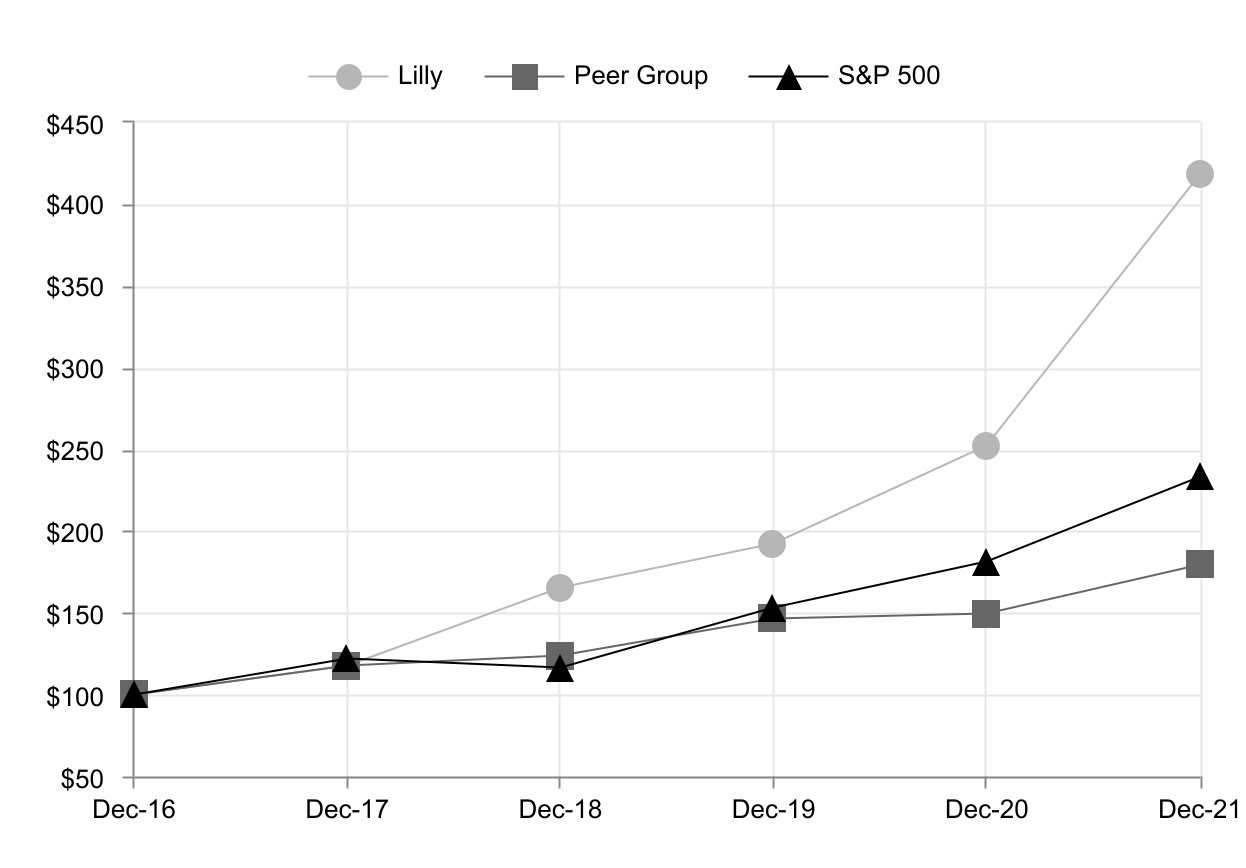
| Lilly | Peer Group | S&P 500 | ||||||||||||||||||||||||
| Dec-16 | $ | 100.00 | $ | 100.00 | $ | 100.00 | ||||||||||||||||||||
| Dec-17 | 117.83 | 117.86 | 121.83 | |||||||||||||||||||||||
| Dec-18 | 165.50 | 123.85 | 116.49 | |||||||||||||||||||||||
| Dec-19 | 192.23 | 146.23 | 153.17 | |||||||||||||||||||||||
| Dec-20 | 251.93 | 149.47 | 181.35 | |||||||||||||||||||||||
| Dec-21 | 418.40 | 179.16 | 233.41 |
(1) We constructed the peer group as the industry index for this graph. It is comprised of the following companies in the pharmaceutical and biotechnology industries: AbbVie Inc.; Amgen Inc.; AstraZeneca PLC; Biogen Inc.; Bristol-Myers Squibb Company; Gilead Sciences Inc.; GlaxoSmithKline plc; Johnson & Johnson; Merck & Co., Inc.; Novartis AG.; Novo Nordisk A/S; Pfizer Inc.; Roche Holding AG; Sanofi S.A.; and Takeda Pharmaceutical Company Limited. The peer group used for performance benchmarking aligns with the peer group used for executive compensation purposes for 2021 other than our peer group for performance benchmarking excludes Allergan plc, Celgene Corporation, and Shire plc as they were acquired in 2020, 2019 and 2019, respectively.
33
Item 6. [Reserved]
Item 7. Management's Discussion and Analysis of Results of Operations and Financial Condition
RESULTS OF OPERATIONS
(Tables present dollars in millions, except per-share data)
General
Management's discussion and analysis of results of operations and financial condition is intended to assist the reader in understanding and assessing significant changes and trends related to the results of operations and financial position of our consolidated company. This discussion and analysis should be read in conjunction with Item 8, "Financial Statements and Supplementary Data." Certain statements in this Item 7 constitute forward-looking statements. Various risks and uncertainties, including those discussed in "Forward-Looking Statements" and Item 1A, "Risk Factors," may cause our actual results, financial position, and cash generated from operations to differ materially from these forward-looking statements.
Executive Overview
This section provides an overview of our financial results, recent product and late-stage pipeline developments, and other matters affecting our company and the pharmaceutical industry. Earnings per share (EPS) data are presented on a diluted basis.
COVID-19 Pandemic
In response to the COVID-19 pandemic, we have focused on maintaining a supply of our medicines; reducing the strain on the medical system; developing treatments for COVID-19; protecting the health, safety, and well-being of our employees; supporting our communities; and ensuring affordability of and access to our medicines, particularly insulin. As part of our response to the COVID-19 pandemic, and at the request of the United States (U.S.) and international governments, we invested in large-scale manufacturing of COVID-19 antibodies at risk, in order to ensure rapid access to patients around the world.
The U.S. Food and Drug Administration (FDA) granted Emergency Use Authorizations (EUA) for bamlanivimab and etesevimab administered together for higher-risk patients who have been recently diagnosed with mild-to-moderate COVID-19 and for baricitinib for treatment with or without remdesivir in hospitalized COVID-19 patients. In the third quarter of 2021, the FDA expanded the EUA for bamlanivimab and etesevimab administered together to include post-exposure prophylaxis in certain individuals for the prevention of SARS-CoV-2 infection. We expect that additional revenue from the sale of bamlanivimab and etesevimab after the first quarter of 2022 will be limited. In February 2022, the FDA granted an EUA for bebtelovimab for certain high-risk patients who have been recently diagnosed with mild-to-moderate COVID-19. We have agreed with the U.S. government to supply up to 600,000 doses of bebtelovimab no later than March 31, 2022 for at least $720 million with an option of 500,000 additional doses no later than July 31, 2022. The FDA has revised, and may in the future revise, any EUA for our COVID-19 therapies in response to the prevalence of variants against which our therapies have varying degrees of efficacy.
The COVID-19 pandemic has, and may continue to, adversely impact our business and operations. The focus of resources on COVID-19, widespread protective measures implemented to control the spread of COVID-19, and the resulting strain on global transportation, manufacturing, and labor markets have negatively impacted development, manufacturing, supply, distribution, and sales of our medicines. In addition to decreases in new prescriptions, changes in payer segment mix, and the increased use of patient affordability programs in the U.S., we have experienced, and may continue to experience if the COVID-19 pandemic undergoes resurgent or more severe waves, decreased demand as a result of lack of "normal" access and fewer in-person interactions by patients and our employees with healthcare professionals.
34
We also face risks and uncertainties related to our COVID-19 therapies, including heightened regulatory scrutiny of our manufacturing practices, quality assurance, and similar regulations, restrictions on administration that limit widespread and timely access to our therapies, and risks related to handling, return, and/or refund of product after delivery by us. The availability of superior or competitive therapies, including therapies that can be administered more easily, or preventative measures such as vaccines, coupled with the unpredictable nature of pandemics, have and could further negatively impact or eliminate demand for our COVID-19 therapies. Mutations or the spread of other variants of the coronavirus have in some cases impacted the effectiveness of our COVID-19 therapies, and may further render our therapies more or less effective or ineffective.
The strain on global transportation, logistics, and labor markets caused by the COVID-19 pandemic and an increase in overall demand in our industry for certain materials resulting in changed buying patterns and constrained supply have had, and may continue to have, a number of impacts on our business, including increased costs to provide a consistent supply of our medicines where they are needed and potential disruptions in the supply of our medications. These factors may negatively affect our results of operations.
It remains difficult to reasonably assess or predict the full extent of the ongoing impact of the COVID-19 pandemic on us. The degree to which the COVID-19 pandemic continues to affect us will depend on developments that are highly uncertain and beyond our knowledge or control. We are currently unable to predict the full extent to which the COVID-19 pandemic or any future pandemic, epidemic or similar public health threat will adversely impact our business and operations in the future.
See Item 1A, "Risk Factors" for additional information on risk factors that could impact our business and operations.
Financial Results
The following table summarizes our key operating results:
| Year Ended December 31 | Percent Change | ||||||||||||||||
| 2021 | 2020 | ||||||||||||||||
| Revenue | $ | 28,318.4 | $ | 24,539.8 | 15 | ||||||||||||
| Gross margin | 21,005.6 | 19,056.5 | 10 | ||||||||||||||
| Gross margin as a percent of revenue | 74.2 | % | 77.7 | % | |||||||||||||
| Operating expenses | $ | 13,457.5 | $ | 12,206.9 | 10 | ||||||||||||
| Acquired in-process research and development | 874.9 | 660.4 | 32 | ||||||||||||||
| Asset impairment, restructuring, and other special charges | 316.1 | 131.2 | NM | ||||||||||||||
| Other—net, (income) expense | 201.6 | (1,171.9) | NM | ||||||||||||||
| Income before income taxes | 6,155.5 | 7,229.9 | (15) | ||||||||||||||
| Income taxes | 573.8 | 1,036.2 | (45) | ||||||||||||||
| Net income | 5,581.7 | 6,193.7 | (10) | ||||||||||||||
| EPS | 6.12 | 6.79 | (10) |
NM - not meaningful
Revenue increased in 2021 driven by increased volume and, to a lesser extent, the favorable impact of foreign exchange rates, partially offset by lower realized prices. Operating expenses, defined as the sum of research and development and marketing, selling, and administrative expenses, increased in 2021, driven primarily by higher development expenses for late-stage assets. The decreases in net income and EPS in 2021 were driven primarily by
Showing the first 8K of 78K characters. Open the full section
Item 7A. Quantitative and Qualitative Disclosures About Market Risk
You can find quantitative and qualitative disclosures about market risk (e.g., interest rate risk) at Item 7, "Management's Discussion and Analysis - Financial Condition and Liquidity." That information is incorporated by reference herein.
54
Item 8. Financial Statements and Supplementary Data
Consolidated Statements of Operations
| ELI LILLY AND COMPANY AND SUBSIDIARIES (Dollars in millions and shares in thousands, except per-share data) | Year Ended December 31 | 2021 | 2020 | 2019 | ||||||||||||||||||||||
| Revenue (Note 2) | $ | 28,318.4 | $ | 24,539.8 | $ | 22,319.5 | ||||||||||||||||||||
| Costs, expenses, and other: | ||||||||||||||||||||||||||
| Cost of sales | 7,312.8 | 5,483.3 | 4,721.2 | |||||||||||||||||||||||
| Research and development | 7,025.9 | 6,085.7 | 5,595.0 | |||||||||||||||||||||||
| Marketing, selling, and administrative | 6,431.6 | 6,121.2 | 6,213.8 | |||||||||||||||||||||||
| Acquired in-process research and development (Note 3) | 874.9 | 660.4 | 239.6 | |||||||||||||||||||||||
| Asset impairment, restructuring, and other special charges (Note 5) | 316.1 | 131.2 | 575.6 | |||||||||||||||||||||||
| Other—net, (income) expense (Note 18) | 201.6 | (1,171.9) | (291.6) | |||||||||||||||||||||||
| 22,162.9 | 17,309.9 | 17,053.6 | ||||||||||||||||||||||||
| Income before income taxes | 6,155.5 | 7,229.9 | 5,265.9 | |||||||||||||||||||||||
| Income taxes (Note 14) | 573.8 | 1,036.2 | 628.0 | |||||||||||||||||||||||
| Net income from continuing operations | 5,581.7 | 6,193.7 | 4,637.9 | |||||||||||||||||||||||
| Net income from discontinued operations (Note 19) | — | — | 3,680.5 | |||||||||||||||||||||||
| Net income | $ | 5,581.7 | $ | 6,193.7 | $ | 8,318.4 | ||||||||||||||||||||
| Earnings per share: | ||||||||||||||||||||||||||
| Earnings from continuing operations - basic | $ | 6.15 | $ | 6.82 | $ | 4.98 | ||||||||||||||||||||
| Earnings from discontinued operations - basic | — | — | 3.95 | |||||||||||||||||||||||
| Earnings per share - basic | $ | 6.15 | $ | 6.82 | $ | 8.93 | ||||||||||||||||||||
| Earnings from continuing operations - diluted | $ | 6.12 | $ | 6.79 | $ | 4.96 | ||||||||||||||||||||
| Earnings from discontinued operations - diluted | — | — | 3.93 | |||||||||||||||||||||||
| Earnings per share - diluted | $ | 6.12 | $ | 6.79 | $ | 8.89 | ||||||||||||||||||||
| Shares used in calculation of earnings per share: | ||||||||||||||||||||||||||
| Basic | 906,963 | 907,634 | 931,059 | |||||||||||||||||||||||
| Diluted | 911,681 | 912,505 | 935,684 |
See notes to consolidated financial statements.
55
Consolidated Statements of Comprehensive Income (Loss)
| ELI LILLY AND COMPANY AND SUBSIDIARIES (Dollars in millions) | Year Ended December 31 | 2021 | 2020 | 2019 | ||||||||||||||||||||||
| Net income | $ | 5,581.7 | $ | 6,193.7 | $ | 8,318.4 | ||||||||||||||||||||
| Other comprehensive income (loss) from continuing operations: | ||||||||||||||||||||||||||
| Change in foreign currency translation gains (losses) | 13.5 | 122.1 | (89.9) | |||||||||||||||||||||||
| Change in net unrealized gains (losses) on securities | (15.9) | 14.2 | 34.4 | |||||||||||||||||||||||
| Change in defined benefit pension and retiree health benefit plans (Note 15) | 2,699.4 | (157.1) | (970.0) | |||||||||||||||||||||||
| Change in effective portion of cash flow hedges | 151.6 | (152.9) | 34.3 | |||||||||||||||||||||||
| Other comprehensive income (loss) from continuing operations before income taxes | 2,848.6 | (173.7) | (991.2) | |||||||||||||||||||||||
| Benefit (provision) for income taxes related to other comprehensive income (loss) from continuing operations | (695.3) | 200.9 | 151.0 | |||||||||||||||||||||||
| Other comprehensive income (loss) from continuing operations, net of tax (Note 17) | 2,153.3 | 27.2 | (840.2) | |||||||||||||||||||||||
| Other comprehensive income from discontinued operations, net of tax (Note 17) | — | — | 56.8 | |||||||||||||||||||||||
| Other comprehensive income (loss), net of tax (Note 17) | 2,153.3 | 27.2 | (783.4) | |||||||||||||||||||||||
| Comprehensive income | $ | 7,735.0 | $ | 6,220.9 | $ | 7,535.0 |
See notes to consolidated financial statements.
56
Consolidated Balance Sheets
| ELI LILLY AND COMPANY AND SUBSIDIARIES (Dollars in millions, shares in thousands) | December 31 | 2021 | 2020 | |||||||||||||||||
| Assets | ||||||||||||||||||||
| Current Assets | ||||||||||||||||||||
| Cash and cash equivalents (Note 7) | $ | 3,818.5 | $ | 3,657.1 | ||||||||||||||||
| Short-term investments (Note 7) | 90.1 | 24.2 | ||||||||||||||||||
| Accounts receivable, net of allowances of $22.5 (2021) and $25.9 (2020) | 6,672.8 | 5,875.3 | ||||||||||||||||||
| Other receivables | 1,454.4 | 1,053.7 | ||||||||||||||||||
| Inventories (Note 6) | 3,886.0 | 3,980.3 | ||||||||||||||||||
| Prepaid expenses and other | 2,530.6 | 2,871.5 | ||||||||||||||||||
| Total current assets | 18,452.4 | 17,462.1 |
Showing the first 8K of 273K characters. Open the full section
Item 9. Changes in and Disagreements with Accountants on Accounting and Financial Disclosure
None.
Item 9A. Controls and Procedures
Evaluation of Disclosure Controls and Procedures
Under applicable Securities and Exchange Commission (SEC) regulations, management of a reporting company, with the participation of the principal executive officer and principal financial officer, must periodically evaluate the company's "disclosure controls and procedures," which are defined generally as controls and other procedures designed to ensure that information required to be disclosed by the reporting company in its periodic reports filed with the SEC (such as this Form 10-K) is recorded, processed, summarized, and reported on a timely basis.
Our management, with the participation of David A. Ricks, president and chief executive officer, and Anat Ashkenazi, senior vice president and chief financial officer, evaluated our disclosure controls and procedures (as such term is defined in Rules 13a-15(e) and 15d-15(e) under the Securities Exchange Act of 1934) as of December 31, 2021, and concluded that they were effective.
Management's Report on Internal Control over Financial Reporting
Mr. Ricks and Ms. Ashkenazi provided a report on behalf of management on our internal control over financial reporting, in which management concluded that the company's internal control over financial reporting is effective at December 31, 2021 based on the framework in "Internal Control—Integrated Framework" (2013) issued by the Committee of Sponsoring Organizations of the Treadway Commission. Our internal control over financial reporting is designed to provide reasonable assurance regarding the reliability of financial reporting and the preparation of financial statements for external purposes in accordance with generally accepted accounting principles in the United States. Due to the inherent limitations, no evaluation over internal control can provide absolute assurance that no material misstatements or fraud exist.
In addition, Ernst & Young LLP, the company's independent registered public accounting firm, issued an attestation report on the company's internal control over financial reporting as of December 31, 2021.
You can find the full text of management's report and Ernst & Young's attestation report in Item 8.
Changes in Internal Control over Financial Reporting
During the fourth quarter of 2021, there were no changes in our internal control over financial reporting that materially affected, or are reasonably likely to materially affect, our internal control over financial reporting.
Item 9B. Other Information
None.
Item 9C. Disclosure Regarding Foreign Jurisdictions that Prevent Inspections
Not applicable.
118
Part III
Item 10. Directors, Executive Officers, and Corporate Governance
Directors and Executive Officers
Information relating to our board of directors is found in our Definitive Proxy Statement, to be dated on or about March 18, 2022 (Proxy Statement), under "Governance - Board Operations and Governance" and is incorporated in this Annual Report on Form 10-K by reference.
Information relating to our executive officers is found at Item 1, "Business - Executive Officers of the Company" and is incorporated by reference herein.
Code of Ethics
Information relating to our code of ethics is found in our Proxy Statement under "Governance - Board Oversight of Strategy, Compliance, and Risk Management - Code of Ethics" and is incorporated in this Annual Report on Form 10-K by reference.
Corporate Governance
Information about the procedures by which shareholders can recommend nominees to our board of directors is found in our Proxy Statement under "Shareholder Engagement on Governance Issues - Shareholder Recommendations and Nominations for Director Candidates" and is incorporated in this Annual Report on Form 10-K by reference.
The board of directors has appointed an audit committee consisting entirely of independent directors in accordance with applicable Securities and Exchange Commission and New York Stock Exchange requirements for audit committees. Information about our audit committee is found in our Proxy Statement under "Governance - Membership and Meetings of the Board and Its Committees - Audit Committee" and is incorporated in this Annual Report on Form 10-K by reference.
Item 11. Executive Compensation
Information on director compensation, executive compensation, and compensation committee matters can be found in the Proxy Statement under "Governance - Director Compensation," "- Membership and Meetings of the Board and Its Committees - Compensation Committee," "Compensation - Compensation Discussion and Analysis," and "- Executive Compensation." Such information is incorporated in this Annual Report on Form 10-K by reference.
119
Item 12. Security Ownership of Certain Beneficial Owners and Management and Related Stockholder Matters
Security Ownership of Certain Beneficial Owners and Management
Information relating to ownership of the company's common stock by management and by persons known by the company to be the beneficial owners of more than five percent of the outstanding shares of common stock is found in the Proxy Statement under "Ownership of Company Stock" and incorporated in this Annual Report on Form 10-K by reference.
Securities Authorized for Issuance Under Equity Compensation Plans
The following table presents information as of December 31, 2021 regarding the company's compensation plans under which shares of the company's common stock have been authorized for issuance.
| Plan category | (a) Number of securities to be issued upon exercise of outstanding options, warrants, and rights (1) | (b) Weighted-average exercise price of outstanding options, warrants, and rights | (c) Number of securities remaining available for future issuance under equity compensation plans (excluding securities reflected in column (a)) | ||||||||
| Equity compensation plans approved by security holders | — | $ | — | 50,646,706 | |||||||
| Equity compensation plan not approved by security holders | — | — | — | ||||||||
| Total | — | — | 50,646,706 |
(1) 5,605,694 shares are underlying outstanding equity awards other than options.
Item 13. Certain Relationships and Related Transactions, and Director Independence
Related Person Transactions
Information relating to the policies and procedures for approval of related person transactions by our board of directors can be found in the Proxy Statement under "Governance - Highlights of the Company's Corporate Governance - Conflicts of Interest and Transactions with Related Persons." Such information is incorporated in this Annual Report on Form 10-K by reference.
Director Independence
Information relating to director independence can be found in the Proxy Statement under "Governance - Director Independence" and is incorporated in this Annual Report on Form 10-K by reference.
Item 14. Principal Accountant Fees and Services
Information related to the fees and services of our principal independent accountants, Ernst & Young LLP, can be found in the Proxy Statement under "Audit Matters - Item 3. Ratification of the Appointment of the Independent Auditor - Audit Committee Report - Services Performed by the Independent Auditor" and "- Independent Auditor Fees." Such information is incorporated in this Annual Report on Form 10-K by reference.
120
Item 15. Exhibits and Financial Statement Schedules
(a)1. Financial Statements
The following consolidated financial statements of the company and its subsidiaries are found at Item 8:
-
Consolidated Statements of Operations—Years Ended December 31, 2021, 2020, and 2019
-
Consolidated Statements of Comprehensive Income (Loss)—Years Ended December 31, 2021, 2020, and 2019
-
Consolidated Balance Sheets—December 31, 2021 and 2020
-
Consolidated Statements of Shareholders' Equity—Years Ended December 31, 2021, 2020, and 2019
-
Consolidated Statements of Cash Flows—Years Ended December 31, 2021, 2020, and 2019
-
Notes to Consolidated Financial Statements
(a)2. Financial Statement Schedules
The consolidated financial statement schedules of the company and its subsidiaries have been omitted because they are not required, are inapplicable, or are adequately explained in the financial statements.
Financial statements of interests of 50 percent or less, which are accounted for by the equity method, have been omitted because they do not, considered in the aggregate as a single subsidiary, constitute a significant subsidiary.
(a)3. Exhibits
The following documents are filed as part of this report:
121
122
(1) Indicates management contract or compensatory plan.
Item 16. Form 10-K Summary
Not applicable.
123
Signatures
Pursuant to the requirements of Section 13 or 15(d) of the Securities Exchange Act of 1934, the Registrant has duly caused this report to be signed on its behalf by the undersigned thereunto duly authorized.
Eli Lilly and Company
| By | /s/ David A. Ricks | |||||||
| David A. Ricks | ||||||||
| Chair, President, and Chief Executive Officer |
February 23, 2022
124
Pursuant to the requirements of the Securities Exchange Act of 1934, this report has been signed below on February 23, 2022 by the following persons on behalf of the Registrant and in the capacities indicated.
| Signature | Title | |||||||
| /s/ David A. Ricks | Chair, President, and Chief Executive Officer (principal executive officer) | |||||||
| DAVID A. RICKS | ||||||||
| /s/ Anat Ashkenazi | Senior Vice President and Chief Financial Officer (principal financial officer) | |||||||
| ANAT ASHKENAZI | ||||||||
| /s/ Donald A. Zakrowski | Vice President, Finance, and Chief Accounting Officer (principal accounting officer) | |||||||
| DONALD A. ZAKROWSKI | ||||||||
| /s/ Ralph Alvarez | Director | |||||||
| RALPH ALVAREZ | ||||||||
| /s/ Katherine Baicker, Ph.D. | Director | |||||||
| KATHERINE BAICKER, Ph.D. | ||||||||
| /s/ Michael L. Eskew | Director | |||||||
| MICHAEL L. ESKEW | ||||||||
| /s/ J. Erik Fyrwald | Director | |||||||
| J. ERIK FYRWALD | ||||||||
| /s/ Jamere Jackson | Director | |||||||
| JAMERE JACKSON | ||||||||
| /s/ Kimberly H. Johnson | Director | |||||||
| KIMBERLY H. JOHNSON | ||||||||
| /s/ William G. Kaelin, Jr., M.D. | Director | |||||||
| WILLIAM G. KAELIN, JR., M.D. | ||||||||
| /s/ Juan R. Luciano | Director | |||||||
| JUAN R. LUCIANO | ||||||||
| /s/ Marschall S. Runge, M.D., Ph.D. | Director | |||||||
| MARSCHALL S. RUNGE, M.D., Ph.D. | ||||||||
| /s/ Gabrielle Sulzberger | Director | |||||||
| GABRIELLE SULZBERGER | ||||||||
| /s/ Jackson P. Tai | Director | |||||||
| JACKSON P. TAI | ||||||||
| /s/ Karen Walker | Director | |||||||
| KAREN WALKER |
125
Trademarks Used In This Report
Trademarks or service marks owned by Eli Lilly and Company or its affiliates, when first used in each item of this report, appear with an initial capital and are followed by the symbol ® or ™, as applicable. In subsequent uses of the marks in the item, the symbols may be omitted.
Actos*®* is a trademark of Takeda Pharmaceutical Company Limited.
Byetta® is a trademark of Amylin Pharmaceuticals, Inc.
Glyxambi®, Jardiance®, Jentadueto®, Synjardy®, Trajenta®, and Trijardy® are trademarks of Boehringer Ingelheim International GmbH.
Tyvyt® is a trademark of Innovent Biologics (Suzhou) Co., Ltd.
Viagra*®* is a trademark of G.D. Searle LLC, a Viatris Company.
126