 filings.tools
Southwest Airlines 10-K 2021-12-31
Filed 2022-02-07. 22 sections, 613K characters. Original on sec.gov · Markdown · JSON
Cover and table of contents
UNITED STATES
SECURITIES AND EXCHANGE COMMISSION
Washington, D.C. 20549
FORM 10-K
(Mark One)
| ☒ | ANNUAL REPORT PURSUANT TO SECTION 13 OR 15(d) OF THE SECURITIES EXCHANGE ACT OF 1934 |
For the fiscal year ended December 31, 2021
| or |
| ☐ | TRANSITION REPORT PURSUANT TO SECTION 13 OR 15(d) OF THE SECURITIES EXCHANGE ACT OF 1934 |
| For the transition period from ________ to ________ |
Commission File No. 1-7259
SOUTHWEST AIRLINES CO.
(Exact name of registrant as specified in its charter)
| Texas | 74-1563240 | |||||||
| (State or other jurisdiction of | (IRS Employer | |||||||
| incorporation or organization) | Identification No.) | |||||||
| P.O. Box 36611 | ||||||||
| Dallas, | Texas | 75235-1611 | ||||||
| (Address of principal executive offices) | (Zip Code) |
Registrant's telephone number, including area code: (214) 792-4000
Securities registered pursuant to Section 12(b) of the Act:
| Title of each class | Trading Symbol | Name of each exchange on which registered | ||||||
| Common Stock ($1.00 par value) | LUV | New York Stock Exchange |
Securities registered pursuant to Section 12(g) of the Act:
None
Indicate by check mark if the registrant is a well-known seasoned issuer, as defined in Rule 405 of the Securities Act. Yes x No o
Indicate by check mark if the registrant is not required to file reports pursuant to Section 13 or Section 15(d) of the Act. Yes o No x
Indicate by check mark whether the registrant (1) has filed all reports required to be filed by Section 13 or 15(d) of the Securities Exchange Act of 1934 during the preceding 12 months (or for such shorter period that the registrant was required to file such reports), and (2) has been subject to such filing requirements for the past 90 days. Yes x No o
Indicate by check mark whether the registrant has submitted electronically every Interactive Data File required to be submitted pursuant to Rule 405 of Regulation S-T during the preceding 12 months (or for such shorter period that the registrant was required to submit such files). Yes x No o
Indicate by check mark whether the registrant is a large accelerated filer, an accelerated filer, a non-accelerated filer, a smaller reporting company, or an emerging growth company. See the definitions of "large accelerated filer," "accelerated filer," "smaller reporting company," and "emerging growth company" in Rule 12b-2 of the Exchange Act.
| Large accelerated filer | x | Accelerated filer | ☐ | ||||||||
| Non-accelerated filer | ☐ | Smaller reporting company | ☐ | ||||||||
| Emerging growth company | ☐ |
If an emerging growth company, indicate by check mark if the registrant has elected not to use the extended transition period for complying with any new or revised financial accounting standards provided pursuant to Section 13(a) of the Exchange Act. ¨
Indicate by check mark whether the registrant has filed a report on and attestation to its management's assessment of the effectiveness of its internal control over financial reporting under Section 404(b) of the Sarbanes-Oxley Act (15 U.S.C. 7262(b)) by the registered public accounting firm that prepared or issued its audit report. x
Indicate by check mark whether the registrant is a shell company (as defined in Rule 12b-2 of the Act). Yes ☐ No x
The aggregate market value of the common stock held by non-affiliates of the registrant was approximately $31,305,364,914 computed by reference to the closing sale price of the common stock on the New York Stock Exchange on June 30, 2021, the last trading day of the registrant’s most recently completed second fiscal quarter.
Number of shares of common stock outstanding as of the close of business on February 2, 2022: 592,341,878 shares
DOCUMENTS INCORPORATED BY REFERENCE
Portions of the Definitive Proxy Statement for the Company’s Annual Meeting of Shareholders to be held May 18, 2022, are incorporated into Part III of this Annual Report on Form 10-K.
TABLE OF CONTENTS
-PART I-
Item 1. Business
Company Overview
Southwest Airlines Co. (the "Company" or "Southwest") operates Southwest Airlines, a major passenger airline that provides scheduled air transportation in the United States and near-international markets. Southwest commenced service on June 18, 1971, with three Boeing 737 aircraft serving three Texas cities: Dallas, Houston, and San Antonio. At December 31, 2021, Southwest had a total of 728 Boeing 737 aircraft in its fleet and 121 destinations in 42 states, the District of Columbia, the Commonwealth of Puerto Rico, and ten near-international countries: Mexico, Jamaica, The Bahamas, Aruba, Dominican Republic, Costa Rica, Belize, Cuba, the Cayman Islands, and Turks and Caicos.
During 2021, the Company began service to 14 new destinations including Chicago (O'Hare), Illinois; Houston (Bush), Texas; Jackson, Mississippi; Colorado Springs, Colorado; Savannah, Georgia/Hilton Head, South Carolina; Sarasota, Florida; Santa Barbara, California; Fresno, California; Destin, Florida; Bozeman, Montana; Myrtle Beach, South Carolina; Eugene, Oregon; Bellingham, Washington; and Syracuse, New York.
Worldwide Pandemic
In March 2020, the World Health Organization classified the novel coronavirus, COVID-19, as a pandemic. The speed with which the effects of the COVID-19 pandemic changed the U.S. economic landscape, outlook, and in particular the travel industry, was swift and unexpected and resulted in a significant negative impact on travel demand, revenues, and bookings throughout 2020. The Company responded by cancelling a significant portion of its scheduled flights, grounding a significant portion of its fleet, significantly reducing planned capital spending, and significantly reducing its previously scheduled capacity. Further, the Company substantially enhanced its cash holdings by obtaining significant financing in the capital markets, through payroll funding support ("Payroll Support") with the U.S. Department of Treasury ("Treasury"), and elsewhere. In addition, the Company offered voluntary separation and extended time-off programs for its Employees, which significantly reduced the Company's active headcount.
The Company continued to experience negative and unpredictable fluctuating pandemic-related impacts to passenger demand and bookings in 2021. Modest improvements in leisure bookings began in mid-February 2021 and further improved in March 2021. Travel demand and bookings accelerated during second quarter 2021 as a result of declining reported COVID-19 cases throughout the United States, the easing of travel restrictions, and an increase in the number of individuals vaccinated. Despite some softness in bookings and elevated trip cancellations due to surging COVID-19 cases in August and September as a result of the Delta variant, and in December as a result of the Omicron variant, third quarter and fourth quarter 2021 domestic leisure demand was also strong and a dramatic improvement from 2020.
The unpredictable fluctuating extent of the travel demand improvement over the course of 2021, combined with the reduction in the Company's available workforce, contributed to operational challenges and resulting declines in the Company's operational performance as the Company struggled to return to the staffing levels necessary for operational demands. In response, the Company continued its efforts to correspondingly adjust capacity throughout 2021 and into first quarter 2022. In addition, the Company aggressively hired new Employees in third and fourth quarter 2021, and is continuing these efforts in 2022, to balance its schedule with its crew and ground operations resources.
For further information on risks related to COVID-19, as well as the significant impacts of COVID-19 on the Company's operations, financial performance, and liquidity, see "Risk Factors," "Management’s Discussion and Analysis of Financial Condition and Results of Operations," and Notes 2, 7, and 9 to the Consolidated Financial Statements.
Industry
As discussed above under "Business – Worldwide Pandemic," the travel industry was adversely impacted in 2020 and 2021 by the COVID-19 pandemic, including the recent Delta and Omicron variants. Like the Company, other U.S. airlines experienced significant negative impacts to passenger demand and revenues; however the impact of the COVID-19 pandemic on some of these airlines was particularly severe because of the percentage of their operations that had historically been dependent on business and international travel, each of which suffered particular harm as a result of the pandemic. Demand for business travel declined significantly due to companies tightening or even suspending corporate travel. This not only reduced overall demand for air travel, but also resulted in a decrease in the percentage of full-fare purchases. Demand for international travel was significantly harmed by the imposition of international travel restrictions. Like the Company, these other airlines responded with adjustments to their flight schedules, capacity, operating costs and capital expenditures, and fleet plans. Unlike the Company, certain other airlines also furloughed employees and/or ceased service in certain markets.
Like the Company, other U.S. airlines began to mitigate cash losses and recover from the COVID-19 pandemic in 2021, while facing challenges such as the Delta and Omicron variants, lower passenger revenue yields (i.e., pricing), higher fuel prices and other cost inflation, and surges in leisure travel demand against constrained personnel resources resulting in operational challenges. Overall, the U.S. airline industry saw a strong recovery of domestic leisure travel demand during peak travel periods in 2021 as a result of declining reported COVID-19 cases throughout the United States, the easing of travel restrictions, and an increase in the number of individuals vaccinated against COVID-19. However, business travel remained at a significantly reduced level throughout 2021, as compared with pre-pandemic levels.
The airline industry has historically been an extremely volatile industry subject to numerous other challenges. Among other things, it has been cyclical, energy intensive, labor intensive, capital intensive, technology intensive, highly regulated, heavily taxed, and extremely competitive. The airline industry has also been particularly susceptible to detrimental events such as economic recessions, jet fuel price volatility, unscheduled maintenance disruptions, U.S. government shutdowns, acts of terrorism, poor weather, and natural disasters.
Historically, airline industry results have been particularly susceptible to fuel price volatility. In 2021, the industry experienced a very challenging fuel environment, as compared with recent years, with year-over-year fuel prices significantly higher throughout most of 2021.
Company Operations
Route Structure
Southwest has historically principally provided point-to-point service, rather than the "hub-and-spoke" service provided by most major U.S. airlines. The hub-and-spoke system concentrates most of an airline's operations at a limited number of central hub cities and serves most other destinations in the system by providing one-stop or connecting service through a hub. By not concentrating operations through one or more central transfer points, Southwest's point-to-point route structure has allowed for more direct nonstop routing than hub-and-spoke service. However, in response to the effects of the COVID-19 pandemic, the Company placed greater reliance in 2020 and 2021 on connecting traffic in an effort to capture Customer demand. Approximately 73 percent of the Company's Customers flew nonstop during 2021, compared with 72 percent during 2020, and compared with 77 percent during 2019, and, as of December 31, 2021, Southwest served 788 nonstop city pairs, compared with 667 as of December 31, 2020, and compared with 720 as of December 31, 2019. For 202
Showing the first 8K of 109K characters. Open the full section
Item 1A. Risk Factors
COVID-19 Risks
The COVID-19 pandemic, including associated variants, has materially and adversely affected, and could continue to materially and adversely affect, the Company’s results of operations, financial position, and liquidity.
The COVID-19 pandemic, including associated variants, has materially and adversely affected passenger demand and bookings for both business and leisure travel, thereby materially and adversely affecting operating income and cash flows from operations. The extent of the continued impact of the COVID-19 pandemic on the Company’s business and its financial and operational performance will depend on future developments, including (i) the duration, spread, severity, or any recurrence of the COVID-19 pandemic, including through any new variant strains of the underlying virus; (ii) the effectiveness, availability, and usage of vaccines; (iii) the duration and scope of governmental orders and restrictions related to the COVID-19 pandemic; (iv) the extent of the impact of the COVID-19 pandemic on overall demand for air travel and the Company's related business plans and decisions; (v) the impact of the COVID-19 pandemic on the Company's ability to retain Employees; and (vi) the impact of the COVID-19 pandemic on the Company’s access to capital, all of which are highly uncertain and cannot be predicted.
The COVID-19 pandemic has caused public health officials to recommend precautions to mitigate the spread of the virus. Since the onset of the COVID-19 pandemic, federal, state, and local authorities have at various times instituted measures such as imposing testing and self-quarantine requirements, issuing directives forcing businesses to reduce operations or temporarily close, restricting international air travel, and issuing shelter-in-place and similar orders limiting the movement of individuals. Additionally, businesses have restricted non-essential travel for their employees. Such measures have depressed demand for air travel, disrupted the Company’s operations, and materially adversely affected the Company’s business. The Company will continue to be adversely affected if businesses continue to restrict travel for their employees.
Moreover, the ability to attract and retain passengers depends, in part, upon the perception and reputation of the Company and the public’s concerns regarding the health and safety of travel generally, especially regarding airline travel. Actual or perceived risk of infection on Company flights could have a material adverse effect on the public's
comfort with air travel, which could harm the Company's reputation and business. The Company expects it will continue to incur COVID-19 related costs as it continues to take other actions to limit infection among its Employees and passengers. In addition, the industry may be subject to further health and hygiene requirements designed to counteract future outbreaks, which requirements may be costly and take a significant amount of time to implement.
The COVID-19 pandemic may also materially and adversely affect the Company’s supply chain. For example, the Company is dependent on Boeing as its sole supplier for many of its aircraft parts. The Company is also dependent on (i) sole or limited suppliers for aircraft engines and certain other aircraft parts, equipment, and services; (ii) third party vendors; and (iii) service providers. The COVID-19 pandemic has resulted, and could continue to result, in delays and other performance issues, ceased operations, or even bankruptcies among these suppliers, third party vendors, and service providers. Further failures of suppliers, third party vendors, or service providers to timely provide adequate products or support for their products, or otherwise fulfill their commitments to the Company, could materially adversely affect the Company’s operations.
The effects of the COVID-19 pandemic on the financial markets may materially and adversely affect the Company’s access to capital and cost of capital, including its ability to raise funds through equity or debt financings. For example, as a result of the economic effects of the COVID-19 pandemic, in the first half of 2020, Moody’s, S&P Global, and Fitch downgraded the Company’s senior unsecured debt ratings and issuer ratings. If the Company’s credit ratings were to be further downgraded, or general market conditions were to ascribe higher risk to the Company’s rating levels, the airline industry, or the Company, the Company’s access to capital and the cost of any debt financing would be negatively affected. The terms of future debt agreements could include more restrictive covenants or require incremental collateral, which could further restrict the Company’s business operations. There is no guarantee that debt or equity financings will be available in the future to fund the Company’s obligations, or that they will be available on terms consistent with the Company’s expectations.
Even once the pandemic and fears of travel subside, demand for air travel may remain weak for a significant period of time. In particular, consumer behavior related to traveling may be negatively impacted by adverse changes in business travel patterns or adverse changes in the perceived or actual economic climate, including declines in income levels and/or loss of wealth resulting from the impact of the COVID-19 pandemic. The COVID-19 pandemic continues to evolve. The ultimate impact of the COVID-19 pandemic is highly uncertain and subject to change.
In response to the COVID-19 pandemic, federal, state, and local agencies have issued laws, regulations, and orders relating to health and occupational safety. Laws, regulations, orders, or other government actions requiring that employees be vaccinated could materially adversely affect the Company's operations.
In September 2021, the President of the United States issued an Executive Order establishing a vaccination requirement for employees of covered federal contractors. The federal government required that federal contractors have their workforce vaccinated (or request an accommodation) by December 8, 2021. The deadline was later extended to January 4, 2022. The Company started an active campaign to notify Employees of the need to submit proof of COVID-19 vaccination, or apply for an accommodation, by January 4, 2022. On December 3, 2021, the company announced that 93 percent of its Employees were vaccinated, or had requested an accommodation. Due to legal challenges to the vaccine mandate, the Company announced on December 20, 2021, that it is no longer targeting a January 4, 2022, deadline for compliance. However, if the vaccine mandate is revived, the Company expects to resume efforts to work with Employees who have not yet either submitted proof of vaccination or requested an accommodation.
The extent to which the Company's Employees choose not to get vaccinated or do not qualify for an accommodation could result in a negative impact to the Company's operations. Furthermore, the Company’s ability to effectively hire and retain new Employees could be negatively impacted if potential candidates are unable or unwilling to comply with the vaccination requirement. Federal agencies employing personnel critical to the Company’s operations, such as air traffic control, security, and customs staffing, could be similarly impacted by the Executive
Order requiring the vaccination of federal employees. A reduction in the number of federal employees available to support the Company's operations could materially adversely affect the Company's operations.
The Company is also dependent on third party vendors and service providers to support its operations. To the extent third party vendors or service providers are subject to vaccination laws, regulations, orders, or other government actions and they or their employees are unable or unwilling to comply with applicable requirements, the Company’s arrangements with those vendors or pro
Showing the first 8K of 65K characters. Open the full section
Item 1B. Unresolved Staff Comments
None.
Item 2. Properties
Aircraft
Southwest operated a total of 728 Boeing 737 aircraft as of December 31, 2021, of which 59 and 70 were under operating and finance leases, respectively. The following table details information on the 728 aircraft as of December 31, 2021:
| Type | Seats | Average Age (Yrs) | Number of Aircraft | Number Owned (a) | Number Leased (b) | |||||||||||||||||||||||||||
| 737-700 | 143 | 17 | 452 | 369 | 83 | |||||||||||||||||||||||||||
| 737-800 | 175 | 6 | 207 | 190 | 17 | |||||||||||||||||||||||||||
| 737 MAX 8 | 175 | 2 | 69 | 40 | 29 | |||||||||||||||||||||||||||
| Totals | 13 | 728 | 599 | 129 |
(a)As discussed further in Note 7 to the Consolidated Financial Statements, 89 of the Company's aircraft were pledged as collateral as of December 31, 2021, for secured borrowings.
(b)During 2021, the Company had 7 leased Boeing 737-700 aircraft, for which the lease expired and the aircraft was subsequently purchased from the lessor, and thus the aircraft is now represented as owned.
The delivery schedule below reflects contractual commitments, although the timing of future deliveries is uncertain. The delivery schedule for the -7 is dependent on the FAA issuing required certifications and approvals to Boeing and the Company. The FAA will ultimately determine the timing of the -7 certification and entry into service, and the Company therefore offers no assurances that current estimations and timelines are correct. As of December 31, 2021, the Company had firm deliveries and options for Boeing 737 MAX 7 and 737 MAX 8 aircraft as follows:
| The Boeing Company | ||||||||||||||||||||||||||||||||
| -7 Firm Orders | -8 Firm Orders | -7 or -8 Options | Total | |||||||||||||||||||||||||||||
| 2022 | 72 | — | 42 | 114 | ||||||||||||||||||||||||||||
| 2023 | 52 | — | 38 | 90 | ||||||||||||||||||||||||||||
| 2024 | 30 | — | 56 | 86 | ||||||||||||||||||||||||||||
| 2025 | 30 | — | 56 | 86 | ||||||||||||||||||||||||||||
| 2026 | 15 | 15 | 40 | 70 | ||||||||||||||||||||||||||||
| 2027 | 15 | 15 | 6 | 36 | ||||||||||||||||||||||||||||
| 2028 | 15 | 15 | — | 30 | ||||||||||||||||||||||||||||
| 2029 | 20 | 30 | — | 50 | ||||||||||||||||||||||||||||
| 2030 | 15 | 45 | — | 60 | ||||||||||||||||||||||||||||
| 2031 | — | 10 | — | 10 | ||||||||||||||||||||||||||||
| 264 | 130 | (a) | 238 | (b) | 632 |
(a) The Company has flexibility to designate firm orders or options as -7s or -8s, upon written advance notification as stated in the contract.
(b) Subsequent to December 31, 2021, and through February 3, 2022, the Company has exercised 12 -8 options for delivery in 2022 and 12 -7 options for delivery in 2023.
Ground Facilities and Services
Southwest either leases or pays a usage fee for terminal passenger service facilities at each of the airports it serves, to which various leasehold improvements have been made. The Company leases the land and/or structures on a long-term basis for its aircraft maintenance centers (located at Dallas Love Field, Houston Hobby, Phoenix Sky Harbor, Chicago Midway, Hartsfield-Jackson Atlanta International Airport, and Orlando International Airport) and its main corporate headquarters building, also located near Dallas Love Field. The Company also leases a
warehouse and engine repair facility in Atlanta. The Company has announced its intent to build a new aircraft maintenance facility, scheduled to be completed in first quarter 2022, at Denver International Airport. The Company has also announced its intent to build a new aircraft maintenance facility, expected to be completed in 2025, at Baltimore-Washington International Airport.
The Company has commitments associated with various airport improvement projects, including construction at Los Angeles International Airport. These projects include the construction of new facilities and the rebuilding or modernization of existing facilities. Additional information regarding these projects is provided below under "Management’s Discussion and Analysis of Financial Condition and Results of Operations" and in Note 5 to the Consolidated Financial Statements.
The Company owns two additional headquarters buildings, located across the street from the Company's main headquarters building, on land owned by the Company including (a) an energy-efficient, modern building, called TOPS, which houses certain operational and training functions, including the Company's 24-hour operations and (b) the Wings Complex, consisting of a Leadership Education and Aircrew Development (LEAD) Center (housing the Company's 23 Boeing 737 flight simulators and classroom space for Pilot training), an additional office building, and a parking garage. Construction has been completed on an expansion of the LEAD Center, and the LEAD Center has overall space for a total of 26 Boeing 737 flight simulators.
As of December 31, 2021, the Company operated seven Customer Support and Services call centers. The centers located in Atlanta, San Antonio, Chicago, Albuquerque, and Oklahoma City occupy leased space. The Company owns its Houston and Phoenix centers.
The Company performs substantially all line maintenance on its aircraft and provides ground support services at most of the airports it serves. However, the Company has arrangements with certain aircraft maintenance providers for major component inspections and repairs for its airframes and engines, which comprise the majority of the Company's annual aircraft maintenance costs.
Item 3. Legal Proceedings
On June 30, 2015, the U.S. Department of Justice ("DOJ") issued a Civil Investigative Demand ("CID") to the Company. The CID sought information and documents about the Company’s capacity from January 2010 to the date of the CID, including public statements and communications with third parties about capacity. In June 2015, the Company also received a letter from the Connecticut Attorney General requesting information about capacity. The Company is cooperating fully with the DOJ CID and the state inquiry.
Further, on July 1, 2015, a complaint was filed in the United States District Court for the Southern District of New York on behalf of putative classes of consumers alleging collusion among the Company, American Airlines, Delta Air Lines, and United Airlines to limit capacity and maintain higher fares in violation of Section 1 of the Sherman Act. Since then, a number of similar class action complaints were filed in the United States District Courts for the Central District of California, the Northern District of California, the District of Columbia, the Middle District of Florida, the Southern District of Florida, the Northern District of Georgia, the Northern District of Illinois, the Southern District of Indiana, the Eastern District of Louisiana, the District of Minnesota, the District of New Jersey, the Eastern District of New York, the Southern District of New York, the Middle District of North Carolina, the District of Oklahoma, the Eastern District of Pennsylvania, the Northern District of Texas, the District of Vermont, and the Eastern District of Wisconsin. On October 13, 2015, the Judicial Panel on Multi-District Litigation centralized the cases to the United States District Court in the District of Columbia. On March 25, 2016, the plaintiffs filed a Consolidated Amended Complaint in the consolidated cases alleging that the defendants conspired to restrict capacity from 2009 to present. The plaintiffs seek to bring their claims on behalf of a class of persons who purchased tickets for domestic airline travel on the defendants' airlines from July 1, 2011 to present. They seek treble damages, injunctive relief, and attorneys' fees and expenses. On May 11, 2016, the defendants moved to dismiss the Consolidated Amended Complaint, which the Court denied on October 28, 2016. On December 20,
2017, the Company reached an agreement to settle these cases with a proposed class of all persons who purchased domestic airline transportation services from July 1, 2011, to the date of the settlement. The Company agreed to pay $15 million and to provide certain cooperation with the plaintiffs as set forth in the settlement agreement. After notice was provided to the proposed settlement class and the Court held a fairness hearing, the Court issued an order granting final approval of the settlement on May 9, 2019. On June 10, 2019, certain objectors filed notices of appeal to the United States Court of Appeals for the District of Columbia Circuit, which the Court dismissed on July 9, 2021, for lack of jurisdiction because the district court's order approving the settlements was not a final appealable order. The case is continuing as to the remaining defendants. The Company denies all allegations of wrongdoing.
On July 11, 2019, a complaint alleging violations of federal and state laws and seeking certification as a class action was filed against Boeing and the Company in the United States District Court for the Eastern District of Texas in Sherman. The complaint alleges that Boeing and the Company colluded to conceal defects with the Boeing 737 MAX ("MAX") aircraft in violation of the Racketeer Influenced and Corrupt Organization Act ("RICO") and also asserts related state law claims based upon the same alleged facts. The complaint seeks damages on behalf of putative classes of customers who purchased tickets for air travel from either the Company or American Airlines between August 29, 2017, and March 13, 2019. The complaint generally seeks money damages, equitable monetary relief, injunctive relief, declaratory relief, and attorneys’ fees and other costs. On September 13, 2019, the Company filed a motion to dismiss the complaint and to strike certain class allegations. Boeing also moved to dismiss. On February 14, 2020, the trial court issued a ruling that granted in part and denied in part the motions to dismiss the complaint. The trial court order, among other things: (i) dismissed without prejudice various state law claims that the plaintiffs abandoned in response to the motions, (ii) dismissed with prejudice the remaining state law claims, including fraud by concealment, fraud by misrepresentation, and negligent misrepresentation on the grounds that federal law preempts those claims, and (iii) found that plaintiffs lack Article III standing to pursue one of the plaintiffs’ theories of RICO injury. The order denied the motion to dismiss with respect to two RICO claims premised upon a second theory of RICO injury and denied the motion to strike the class allegations at the pleadings stage. On September 3, 2021, the trial court issued an order under Rule 23(a) and 23(b)(3) certifying four classes of persons associated with ticket purchases for flights during the period of August 29, 2017, through March 13, 2019, comprised of (i) those who purchased tickets (without being reimbursed) for flights on Southwest Airlines during the class period, except for those whose flights were solely on routes where, at the time of the ticket purchase(s), a MAX plane was not scheduled for use (or actually used) and had not previously been used, (ii) those who reimbursed a Southwest Airlines ticket purchaser and thus bore the economic burden for a Southwest Airlines ticket for a flight meeting the preceding criteria set forth in (i) above, (iii) those who purchased tickets (without being reimbursed) for flights on American Airlines during the class period, except for those whose flights were solely on routes where, at the time of ticket purchase(s), a MAX plane was not scheduled for use (or actually used) and had not previously been used, and (iv) those who reimbursed an American Airlines ticket purchaser and thus bore the economic burden for an American Airlines ticket for a flight meeting the preceding criteria set forth in (iii) above. On September 17, 2021, the Company filed a petition for permission immediately to appeal the class certification ruling to the Fifth Circuit Court of Appeals. Boeing also filed such a petition. Plaintiffs filed their oppositions to the petitions on September 27, 2021. On September 30, 2021, the Fifth Circuit Court of Appeals granted the Company (and Boeing) permission to appeal the class certification ruling. On December 22, 2021, in response to a motion to stay the trial court proceedings filed by the Company and Boeing, the Fifth Circuit stayed all proceedings, including the pursuit of any discovery, in the trial court pending disposition of the class certification appeal by the Fifth Circuit. The Company intends to strenuously pursue the appeal. On January 7, 2022, the Company and Boeing each filed briefs in support of the appeal. The plaintiffs have a deadline of March 9, 2022, to file response briefs. The Company further denies all allegations of wrongdoing, including those in the complaint that were not originally dismissed. The Company believes the plaintiffs' positions are without merit and intends to vigorously defend itself in all respects.
On February 19, 2020, a complaint alleging violations of federal securities laws and seeking certification as a class action was filed against the Company and certain of its officers in the United States District Court for the Northern District of Texas in Dallas. A lead plaintiff has been appointed in the case, and an amended complaint was filed on July 2, 2020. The amended complaint seeks damages on behalf of a putative class of persons who purchased the Company’s common stock between February 7, 2017, and January 29, 2020. The amended complaint asserts claims
under Sections 10(b) and 20 of the Securities Exchange Act and alleges that the Company made material misstatements to investors regarding the Company’s safety and maintenance practices and its compliance with federal regulations and requirements. The amended complaint generally seeks money damages, pre-judgment and post-judgment interest, and attorneys’ fees and other costs. On August 17, 2020, the Company and the individual defendants filed a motion to dismiss. On October 1, 2020, the lead plaintiff filed a response in opposition to the motion to dismiss. The Company filed a reply on or about October 21, 2020, such that the motion is now fully briefed, although the parties have each supplemented their prior briefing with regard to more recent case holdings in other matters. The Company denies all allegations of wrongdoing, including those in the amended complaint. The Company believes the plaintiffs' positions are without merit and intends to vigorously defend itself.
On June 22, 2020, a derivative action for breach of fiduciary duty was filed in the United States District Court for the Northern District of Texas naming the members of the Company's Board of Directors as defendants and the Company as a nominal defendant (the "Derivative Action"). The plaintiff alleges unspecified damage to Company’s reputation, goodwill, and standing in the community, as well as damage from exposure to civil and regulatory liability and defense costs. According to the lawsuit, these damages arise from the Company’s alleged failure to comply with safety and record maintenance regulations and false statements in public filings regarding the Company’s safety practices. The plaintiff alleges the Board, in the absence of good faith, exhibited reckless disregard for its duties of oversight. On October 7, 2020, the Court entered an order staying and administratively closing the Derivative Action. The plaintiff in the Derivative Action shall have the right to reopen the action following the resolution of the Company's motion to dismiss in the ongoing litigation brought under the federal securities laws or upon the occurrence of certain other conditions. The Board and Company deny all allegations of wrongdoing made in the Derivative Action.
On August 26, 2021, a complaint alleging breach of contract and seeking certification as a class action was filed against the Company in the United States District Court for the Western District of Texas in Waco. The complaint alleges that the Company breached its Contract of Carriage and other alleged agreements in connection with its use of the allegedly defective 737 MAX aircraft manufactured by The Boeing Company. The complaint seeks damages on behalf of putative classes of customers who provided valuable consideration, whether in money or other form (e.g., voucher, miles/points, etc.), in exchange for a ticket for air transportation with the Company, which transportation took place between August 29, 2017, and March 13, 2019. The complaint generally seeks money damages, declaratory relief, and attorneys’ fees and other costs. On October 27, 2021, the Company filed a multi-faceted motion challenging the complaint, including seeking a stay or transfer of the case based upon prior pending litigation, dismissal of the Complaint based upon lack of subject matter jurisdiction, improper venue, and failure to state a claim, and seeking to have the complaint’s class contentions stricken. That motion was fully briefed by both parties as of December 22, 2021, and is now awaiting determination by the court. The Company denies all allegations of wrongdoing and believes the plaintiffs' positions are without merit and intends to vigorously defend itself in all respects.
The Company is from time to time subject to various legal proceedings and claims arising in the ordinary course of business, including, but not limited to, examinations by the Internal Revenue Service.
The Company’s management does not expect that the outcome in any of its currently ongoing legal proceedings or the outcome of any proposed adjustments presented to date by the Internal Revenue Service, individually or collectively, will have a material adverse effect on the Company’s financial condition, results of operations, or cash flow.
Item 4. Mine Safety Disclosures
Not applicable.
INFORMATION ABOUT OUR EXECUTIVE OFFICERS
The following information regarding the Company’s executive officers is as of February 3, 2022.
| Name | Position | Age | ||||||
| Gary C. Kelly | Executive Chairman of the Board | 66 | ||||||
| Robert E. Jordan | Chief Executive Officer | 61 | ||||||
| Michael G. Van de Ven | President & Chief Operating Officer | 60 | ||||||
| Tammy Romo | Executive Vice President & Chief Financial Officer | 59 | ||||||
| Linda B. Rutherford | Executive Vice President People & Communications | 55 | ||||||
| Mark R. Shaw | Executive Vice President & Chief Legal & Regulatory Officer | 59 | ||||||
| Andrew M. Watterson | Executive Vice President & Chief Commercial Officer | 55 |
Set forth below is a description of the background of each of the Company’s executive officers.
Gary C. Kelly has served as the Company's Executive Chairman of the Board since February 2022 and has served as the Company's Chairman of the Board since May 2008. Mr. Kelly also served as Chief Executive Officer from July 2004 to February 2022, President from July 2008 to January 2017, Executive Vice President & Chief Financial Officer from June 2001 to July 2004, and Vice President Finance & Chief Financial Officer from 1989 to 2001. Mr. Kelly joined the Company in 1986 as its Controller.
Robert E. Jordan has served as the Company's Chief Executive Officer since February 2022 and has been a member of the Company's Board of Directors since February 2022. Mr. Jordan also served as Executive Vice President & Incoming Chief Executive Officer from June 2021 to February 2022, Executive Vice President Corporate Services from July 2017 to June 2021, Executive Vice President & Chief Commercial Officer from September 2011 to July 2017, Executive Vice President Strategy & Planning from May 2008 to September 2011, Executive Vice President Strategy & Technology from September 2006 to May 2008, Senior Vice President Enterprise Spend Management from August 2004 to September 2006, Vice President Technology from 2002 to 2004, Vice President Purchasing from 2001 to 2002, Controller from 1997 to 2001, Director Revenue Accounting from 1994 to 1997, and Manager Sales Accounting from 1990 to 1994. Mr. Jordan joined the Company in 1988 as a programmer.
Michael G. Van de Ven has served as the Company's President since September 2021 and as its Chief Operating Officer since May 2008. Mr. Van de Ven also served as Executive Vice President & Chief Operating Officer from May 2008 to January 2017, Chief of Operations from September 2006 to May 2008, Executive Vice President Aircraft Operations from November 2005 through August 2006, Senior Vice President Planning from August 2004 to November 2005, Vice President Financial Planning & Analysis from 2001 to 2004, Senior Director Financial Planning & Analysis from 2000 to 2001, and Director Financial Planning & Analysis from 1997 to 2000. Mr. Van de Ven joined the Company in 1993 as its Director Internal Audit.
Tammy Romo has served as the Company's Executive Vice President & Chief Financial Officer since July 2015. Ms. Romo also served as Senior Vice President Finance & Chief Financial Officer from September 2012 to July 2015, Senior Vice President of Planning from February 2010 to September 2012, Vice President of Financial Planning from September 2008 to February 2010, Vice President Controller from February 2006 to August 2008, Vice President Treasurer from September 2004 to February 2006, Senior Director of Investor Relations from March 2002 to September 2004, Director of Investor Relations from December 1994 to March 2002, Manager of Investor Relations from September 1994 to December 1994, and Manager of Financial Reporting from September 1991 to September 1994.
Linda B. Rutherford has served as the Company’s Executive Vice President People & Communications since June 2021. Ms. Rutherford also served as Senior Vice President & Chief Communications Officer from October 2017 to June 2021, Vice President & Chief Communications Officer from January 2016 to October 2017, Vice President Communications & Strategic Outreach from April 2007 to January 2016, Vice President Public Relations & Community Affairs from December 2005 to April 2007, Director Public Relations from May 2001 to December
2005, Senior Manager Public Relations from February 1999 to May 2001, and Manager Public Relations from February 1997 to February 1999. Ms. Rutherford joined the Company in 1992 as a Public Relations Coordinator.
Mark R. Shaw has served as the Company's Executive Vice President & Chief Legal & Regulatory Officer since November 2018. Mr. Shaw also served as Executive Vice President, Chief Legal & Regulatory Officer, & Corporate Secretary from August 2018 to November 2018, Senior Vice President, General Counsel, & Corporate Secretary from July 2015 to August 2018, Vice President, General Counsel, & Corporate Secretary from February 2013 to July 2015, and as Associate General Counsel - Corporate & Transactions from February 2008 to February 2013. Mr. Shaw joined the Company in 2000 as an Attorney in the General Counsel Department.
Andrew M. Watterson has served as the Company's Executive Vice President & Chief Commercial Officer since January 2020. Mr. Watterson also served as Executive Vice President & Chief Revenue Officer from July 2017 to January 2020, Senior Vice President & Chief Revenue Officer from January 2017 to July 2017, Senior Vice President of Network & Revenue from January 2016 to January 2017, and as Vice President of Network Planning & Performance from October 2013 to January 2016.
PART II
Item 5. Market for Registrant’s Common Equity, Related Stockholder Matters, and Issuer Purchases of Equity Securities
The Company’s common stock is listed on the New York Stock Exchange ("NYSE") and is traded under the symbol "LUV." Although the Company has a history of declaring dividends on a quarterly basis, the Company has not paid a dividend since its 174th consecutive quarterly dividend which was declared and paid in first quarter 2020. Pursuant to the "PSP1 Payroll Support Program" under the Coronavirus Aid, Relief, and Economic Security Act ("CARES Act"), as supplemented by the "PSP2 Payroll Support Program” under the Consolidated Appropriations Act, 2021, and the "PSP3 Payroll Support Program" under the American Rescue Plan Act of 2021, the Company is prohibited from paying dividends with respect to its common stock through September 30, 2022. Following the expiration of these restrictions, the Company’s Board of Directors will have sole discretion regarding the timing, amount, and payment of dividends on the basis of operational results, financial condition, cash requirements, future prospects, and other factors deemed relevant by the Board. As of February 2, 2022, there were approximately 11,553 holders of record of the Company’s common stock.
Stock Performance Graph
The following Performance Graph and related information shall not be deemed "soliciting material" or "filed" with the Securities and Exchange Commission, nor shall such information be incorporated by reference into any future filing under the Securities Act of 1933 or Securities Exchange Act of 1934.
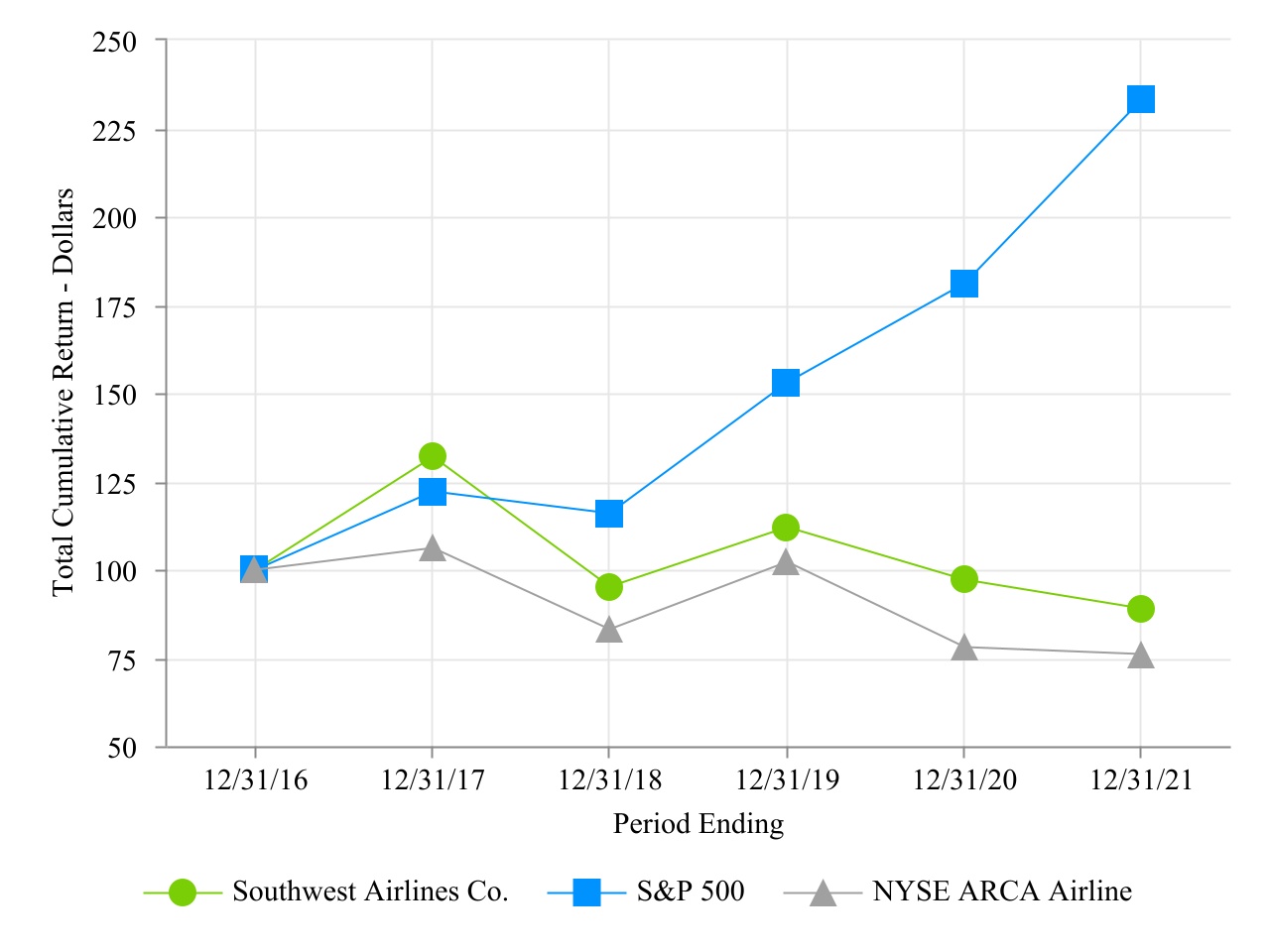
The following graph compares the cumulative total shareholder return on the Company’s common stock over the five-year period ended December 31, 2021, with the cumulative total return during such period of the Standard and Poor’s 500 Stock Index and the NYSE ARCA Airline Index. The comparison assumes $100 was invested on December 31, 2016, in the Company’s common stock and in each of the foregoing indices and assumes reinvestment of dividends. The stock performance shown on the graph below represents historical stock performance and is not necessarily indicative of future stock price performance.
COMPARISON OF FIVE YEAR CUMULATIVE TOTAL RETURN AMONG SOUTHWEST AIRLINES CO., S&P 500 INDEX, AND NYSE ARCA AIRLINE INDEX
| 12/31/2016 | 12/31/2017 | 12/31/2018 | 12/31/2019 | 12/31/2020 | 12/31/2021 | |||||||||||||||||||||||||||||||||
| Southwest Airlines Co. | $ | 100 | $ | 132 | $ | 95 | $ | 112 | $ | 97 | $ | 89 | ||||||||||||||||||||||||||
| S&P 500 | $ | 100 | $ | 122 | $ | 116 | $ | 153 | $ | 181 | $ | 233 | ||||||||||||||||||||||||||
| NYSE ARCA Airline | $ | 100 | $ | 106 | $ | 83 | $ | 102 | $ | 78 | $ | 76 |
Issuer Repurchases
On May 15, 2019, the Company’s Board of Directors authorized the repurchase of up to $2.0 billion of the Company’s common stock. Subject to certain conditions, including restrictions on the Company pursuant to the PSP3 Payroll Support Program through September 30, 2022, repurchases may be made in accordance with applicable securities laws in open market or private, including accelerated, repurchase transactions from time to time, depending on market conditions. The Company has announced it has suspended further share repurchase activity until further notice. The Company has approximately $899 million remaining under its current share repurchase authorization.
Item 7. . Management's Discussion and Analysis of Financial Condition and Results of Operations
YEAR IN REVIEW
In late February 2020, the Company began to see a negative impact from the COVID-19 pandemic, which quickly accelerated during first quarter 2020 and continued throughout 2021. While the pandemic has continued to negatively impact results, the Company saw steady improvement as the year progressed, with intermittent periods of decelerated demand that coincided with COVID-19 surges. The Company's financial results in both years, on both a GAAP and Non-GAAP basis, were significantly impacted by the pandemic and the resulting effect on demand and passenger bookings.
The Company recorded GAAP and non-GAAP results for 2021 and 2020 as noted in the following tables. See Note Regarding Use of Non-GAAP Financial Measures and the Reconciliation of Reported Amounts to Non-GAAP Financial Measures for additional detail regarding non-GAAP financial measures.
| Year ended | ||||||||||||||||||||
| (in millions, except per share amounts) | December 31, | |||||||||||||||||||
| GAAP | 2021 | 2020 | Percent Change | |||||||||||||||||
| Operating income (loss) | $ | 1,721 | $ | (3,816) | n.m. | |||||||||||||||
| Net income (loss) | $ | 977 | $ | (3,074) | n.m. | |||||||||||||||
| Net income (loss) per share, diluted | $ | 1.61 | $ | (5.44) | n.m. | |||||||||||||||
| Non-GAAP | ||||||||||||||||||||
| Operating loss | $ | (1,281) | $ | (5,032) | (74.5) | |||||||||||||||
| Net loss | $ | (1,271) | $ | (3,512) | (63.8) | |||||||||||||||
| Net loss per share, diluted | $ | (2.15) | $ | (6.22) | (65.4) |
The significant improvement in both GAAP Net income (loss) and Operating income (loss), year-over-year, was primarily due to the rebound in domestic leisure demand and bookings in 2021 as impacts from the COVID-19 pandemic eased. This resulted in a 74.5 percent increase in Operating revenues in 2021 versus 2020, although 2021 Operating revenues were still well below 2019 levels. Further, the Company received $2.7 billion in grant allocations of payroll funding support ("Payroll Support") from the United States Department of Treasury ("Treasury") in 2021, compared with $2.3 billion received in 2020, which the Company utilized in both years to offset a portion of salaries, wages, and benefits. See below and Note 2 to the Consolidated Financial Statements for further information.
On a quarterly basis, demand for air travel improved each period of 2021. Although the Company's GAAP financial results benefited from the impact of Payroll Support recognized during the first three quarters of the year, the Company was able to generate a profit during fourth quarter 2021 despite having no further allocation of Payroll Support.
Operating Statistics
The Company provides the operating data below for the three years ended December 31, 2021, because these statistics are commonly used in the airline industry and, therefore, allow readers to compare the Company’s performance against its results for prior periods, as well as against the performance of the Company’s peers.
| Year ended December 31, | ||||||||||||||||||||||||||||||||||||||
| 2021 | 2020 | 2021 Change to 2020 | 2019 | 2020 Change to 2019 | 2021 Change to 2019**(l)** | |||||||||||||||||||||||||||||||||
| Operating Data: | ||||||||||||||||||||||||||||||||||||||
| Revenue passengers carried (000s) | 99,111 | 54,088 | 83.2 | % | 134,056 | (59.7) | % | (26.1) | % | |||||||||||||||||||||||||||||
| Enplaned passengers (000s) | 123,264 | 67,785 | 81.8 | % | 162,681 | (58.3) | % | (24.2) | % | |||||||||||||||||||||||||||||
| Revenue passenger miles (RPMs) (in millions)(a) | 103,562 | 54,221 | 91.0 | % | 131,345 | (58.7) | % | (21.2) | % | |||||||||||||||||||||||||||||
| Available seat miles (ASMs) (in millions)(b) | 132,006 | 103,456 | 27.6 | % | 157,254 | (34.2) | % | (16.1) | % | |||||||||||||||||||||||||||||
| Load factor(c) | 78.5 | % | 52.4 | % | 26.1 pts. | 83.5 | % | (31.1) pts. | (5.0) pts. | |||||||||||||||||||||||||||||
| Average length of passenger haul (miles) | 1,045 | 1,002 | 4.3 | % | 980 | 2.2 | % | 6.6 | % | |||||||||||||||||||||||||||||
| Average aircraft stage length (miles) | 790 | 743 | 6.3 | % | 748 | (0.7) | % | 5.6 | % | |||||||||||||||||||||||||||||
| Trips flown | 1,066,934 | 897,540 | 18.9 | % | 1,367,727 | (34.4) | % | (22.0) | % | |||||||||||||||||||||||||||||
| Seats flown (000s)(d) | 165,580 | 137,405 | 20.5 | % | 206,390 | (33.4) | % | (19.8) | % | |||||||||||||||||||||||||||||
| Seats per trip(e) | 155.2 | 153.1 | 1.4 | % | 150.9 | 1.5 | % | 2.8 | % | |||||||||||||||||||||||||||||
| Average passenger fare | $ | 141.92 | $ | 141.72 | 0.1 | % | $ | 154.98 | (8.6) | % | (8.4) | % | ||||||||||||||||||||||||||
| Passenger revenue yield per RPM (cents)(f) | 13.58 | 14.14 | (4.0) | % | 15.82 | (10.6) | % | (14.2) | % | |||||||||||||||||||||||||||||
| Operating revenues per ASM (cents)(g)(j) | 11.96 | 8.75 | 36.7 | % | 14.26 | (38.6) | % | (16.1) | % | |||||||||||||||||||||||||||||
| Passenger revenue per ASM (cents)(h) | 10.66 | 7.41 | 43.9 | % | 13.21 | (43.9) | % | (19.3) | % | |||||||||||||||||||||||||||||
| Operating expenses per ASM (cents)(i) | 10.66 | 12.43 | (14.2) | % | 12.38 | 0.4 | % | (13.9) | % | |||||||||||||||||||||||||||||
| Operating expenses per ASM, excluding fuel (cents) | 8.15 | 10.65 | (23.5) | % | 9.62 | 10.7 | % | (15.3) | % | |||||||||||||||||||||||||||||
| Operating expenses per ASM, excluding fuel and profitsharing (cents) | 7.98 | 10.65 | (25.1) | % | 9.19 | 15.9 | % | (13.2) | % | |||||||||||||||||||||||||||||
| Fuel costs per gallon, including fuel tax | $ | 1.98 | $ | 1.45 | 36.6 | % | $ | 2.09 | (30.6) | % | (5.3) | % | ||||||||||||||||||||||||||
| Fuel costs per gallon, including fuel tax, economic | $ | 2.01 | $ | 1.49 |
Showing the first 8K of 105K characters. Open the full section
Item 7A. Quantitative and Qualitative Disclosures About Market Risk
The Company has interest rate risk in its floating-rate debt obligations and interest rate swaps, commodity price risk in jet fuel required to operate its aircraft fleet, and market risk in the derivatives used to manage its fuel hedging program and in the form of fixed-rate debt instruments. As of December 31, 2021, the Company operated a total of 129 aircraft under operating and finance leases. However, except for a small number of aircraft that have lease payments that fluctuate based in part on changes in market interest rates, the remainder of the leases are not considered market sensitive financial instruments and, therefore, are not included in the interest rate sensitivity analysis below. The Company also has 14 aircraft under operating leases that have been subleased to another carrier. Further information about these leases is disclosed in Note 8 to the Consolidated Financial Statements. The Company does not purchase or hold any derivative financial instruments for trading purposes. See Note 11 to the Consolidated Financial Statements for information on the Company’s accounting for its hedging program and for further details on the Company’s financial derivative instruments.
Hedging
The Company purchases jet fuel at prevailing market prices, but seeks to manage market risk through execution of a documented hedging strategy. The Company utilizes financial derivative instruments, on both a short-term and a long-term basis, as a form of insurance against the potential for significant increases in fuel prices. The Company believes there can be significant risk in not hedging against the possibility of such fuel price increases, especially in energy markets in which prices are high and/or rising. The Company expects to consume approximately 1.9 billion gallons of jet fuel in 2022. Based on this anticipated usage, a change in jet fuel prices of just one cent per gallon would impact the Company’s Fuel and oil expense by approximately $19 million for 2022, excluding any impact associated with fuel derivative instruments held.
As of December 31, 2021, the Company held a net position of fuel derivative instruments that represented a hedge for a portion of its anticipated jet fuel purchases for future periods. See Note 11 to the Consolidated Financial Statements for further information. The Company may increase or decrease the volume of fuel hedged based on its expectation of future market prices and its forecasted fuel consumption levels, while considering the significant cost that can be associated with different types of hedging strategies. The gross fair value of outstanding financial derivative instruments related to the Company’s jet fuel market price risk at December 31, 2021, was an asset of $696 million. In addition, $175 million in cash collateral deposits were held by the Company in connection with these instruments based on their fair value as of December 31, 2021. The fair values of the derivative instruments, depending on the type of instrument, were determined by use of present value methods or standard option value models with assumptions about commodity prices based on those observed in underlying markets. An immediate 10 percent increase or decrease in underlying fuel-related commodity prices from the December 31, 2021, prices would correspondingly change the fair value of the commodity derivative instruments in place by approximately $185 million. Fluctuations in the related commodity derivative instrument cash flows may change by more or less than this amount based upon further fluctuations in futures prices, as well as related income tax effects. In addition, this does not consider changes in cash or letters of credit utilized as collateral provided to or by counterparties, which would fluctuate in an amount equal to or less than this amount, depending on the type of collateral arrangement in place with each counterparty. This sensitivity analysis uses industry standard valuation models and holds all inputs constant at December 31, 2021, levels, except underlying futures prices.
The Company’s credit exposure related to fuel derivative instruments is represented by the fair value of contracts that are in an asset position to the Company. At such times, these outstanding instruments expose the Company to credit loss in the event of nonperformance by the counterparties to the agreements. As of December 31, 2021, the Company had nine counterparties for which the derivatives held were an asset. To manage credit risk, the Company selects and periodically reviews counterparties based on credit ratings, limits its exposure with respect to each counterparty, and monitors the market position of the fuel hedging program and its relative market position with each counterparty. However, if one or more of these counterparties were in a liability position to the Company and were unable to meet their obligations, any open derivative contracts with the counterparty could be subject to early termination, which could result in substantial losses for the Company. At December 31, 2021, the Company had
agreements with all of its active counterparties containing early termination rights and/or bilateral collateral provisions whereby security is required if market risk exposure exceeds a specified threshold amount based on the counterparty’s credit rating. The Company also had agreements with counterparties in which cash deposits and/or letters of credit are required to be posted as collateral whenever the net fair value of derivatives associated with those counterparties exceeds specific thresholds. Refer to the counterparty credit risk and collateral table provided in Note 11 to the Consolidated Financial Statements for the fair values of fuel derivatives, amounts held as collateral, and applicable collateral posting threshold amounts as of December 31, 2021, at which such postings are triggered.
The Company is also subject to the risk that the fuel derivatives it uses to hedge against fuel price volatility do not provide adequate protection. The Company has found that financial derivative instruments in commodities, such as WTI crude oil, Brent crude oil, and refined products, such as heating oil and unleaded gasoline, can be useful in decreasing its exposure to jet fuel price volatility. In addition, to add further protection, the Company may periodically enter into jet fuel derivatives for short-term timeframes. Jet fuel is not widely traded on an organized futures exchange and, therefore, there are limited opportunities to hedge directly in jet fuel for time horizons longer than approximately 24 months into the future.
The Company also has agreements with each of its counterparties associated with its outstanding interest rate swap agreements in which cash collateral may be required based on the fair value of outstanding derivative instruments, as well as the Company’s and its counterparty’s credit ratings. As of December 31, 2021, no cash collateral deposits were provided by or held by the Company based on its outstanding interest rate swap agreements.
Due to the significance of the Company’s fuel hedging program and the emphasis that the Company places on utilizing fuel derivatives to reduce its fuel price risk, the Company has created a system of governance and management oversight and has put in place a number of internal controls designed so that procedures are properly followed and accountability is present at the appropriate levels. For example, the Company has put in place controls designed to: (i) create and maintain a comprehensive risk management policy; (ii) provide for proper authorization by the appropriate levels of management; (iii) provide for proper segregation of duties; (iv) maintain an appropriate level of knowledge regarding the execution of and the accounting for derivative instruments; and (v) have key performance indicators in place in order to adequately measure the performance of its hedging activities. The Company believes the governance structure that it has in place is adequate given the size and sophistication of its hedging program.
Financial Market Risk
The vast majority of the Company’s tangible assets are aircraft, which are long-lived. The Company’s strategy is to maintain a conservative balance sheet and grow capacity steadily and profitably under the right conditions. While the Company uses financial leverage, it strives to maintain a strong balance sheet and has a "BBB+" rating with Fitch, a "BBB" rating with Standard & Poor’s, and a "Baa1" credit rating with Moody’s as of December 31, 2021, all of which are considered "investment grade." See Note 7 to the Consolidated Financial Statements for more information on the material terms of the Company’s short-term and long-term debt.
The following table presents the Company's fixed-rate senior unsecured notes outstanding as of December 31, 2021:
| (in millions) | December 31, 2021 | |||||||
| 2.75% Notes due 2022 | $ | 300 | ||||||
| 4.75% Notes due 2023 | 1,250 | |||||||
| 5.25% Notes due 2025 | 1,550 | |||||||
| 3.00% Notes due 2026 | 300 | |||||||
| 3.45% Notes due 2027 | 300 | |||||||
| 5.125% Notes due 2027 | 2,000 | |||||||
| 7.375% Debentures due 2027 | 100 | |||||||
| 2.625% Notes due 2030 | 500 |
The $100 million 7.375% debentures due 2027 had at one point been converted to a floating rate, but the Company subsequently terminated the fixed-to-floating interest rate swap agreements related to it. The effect of this termination was that the interest associated with this debt prospectively reverted back to its original fixed rate. As a result of the gain realized on this transaction, which is being amortized over the remaining term of the corresponding notes, and based on projected interest rates at the date of termination, the Company does not believe its future interest expense, based on projected future interest rates at the date of termination, associated with these notes will significantly differ from the expense it would have recorded had the notes remained at floating rates.
The Company's total debt divided by total assets was 29.5 percent as of December 31, 2021.
The Company also has some risk associated with changing interest rates due to the short-term nature of its invested cash, which totaled $12.5 billion, and short-term investments, which totaled $3.0 billion at December 31, 2021. See Notes 1 and 12 to the Consolidated Financial Statements for further information. The Company currently invests available cash in certificates of deposit, highly rated money market instruments, investment grade commercial paper, treasury securities, U.S. government agency securities, and other highly rated financial instruments, depending on market conditions and operating cash requirements. Because of the short-term nature of these investments, the returns earned parallel closely with short-term floating interest rates. The Company has not undertaken any additional actions to cover interest rate market risk and is not a party to any other material market interest rate risk management activities.
A hypothetical 10 percent change in market interest rates as of December 31, 2021, would have resulted in an approximate $37 million change in the fair value of the Company’s fixed-rate debt instruments. See Note 12 to the Consolidated Financial Statements for further information on the fair value of financial instruments. A change in market interest rates could, however, have a corresponding effect on earnings and cash flows associated with the Company’s invested cash (excluding cash collateral deposits held, if applicable) and short-term investments because of the floating-rate nature of these items. Assuming floating market rates in effect as of December 31, 2021 were held constant throughout a 12-month period, a hypothetical 10 percent change in those rates would have an immaterial impact on the Company’s net earnings and cash flows. Utilizing these assumptions and considering the Company’s cash balance (excluding the impact of cash collateral deposits held from or provided to counterparties, if applicable) and short-term investments outstanding at December 31, 2021, an increase in rates would have a net positive effect on the Company’s earnings and cash flows, while a decrease in rates would have a net negative effect on the Company’s earnings and cash flows. However, a 10 percent change in market rates would not impact the Company’s earnings or cash flow associated with the Company’s publicly traded fixed-rate debt.
The Company is also subject to a financial covenant included in its Amended A&R Credit Agreement, and is subject to credit rating triggers related to its credit card transaction processing agreements, the pricing related to any funds drawn under its Amended A&R Credit Agreement, and some of its hedging counterparty agreements. Certain covenants include the maintenance of minimum credit ratings and/or triggers that are based on changes in these ratings. The Company’s Amended A&R Credit Agreement contains a financial covenant to maintain total liquidity,
as defined therein, of $1.5 billion at all times. As of December 31, 2021, the Company was in compliance with this covenant and there were no amounts outstanding under the Amended A&R Credit Agreement. However, if conditions change and the Company fails to meet the minimum standards set forth in the Amended A&R Credit Agreement, there could be a reduction in the availability of cash under the facility, or an increase in the costs to keep the facility intact as written. The Company’s hedging counterparty agreements contain ratings triggers in which cash collateral could be required to be posted with the counterparty if the Company’s credit rating were to fall below investment grade by two of the three major rating agencies, and if the Company were in a net liability position with the counterparty. See Note 11 to the Consolidated Financial Statements for further information.
The Company currently has agreements with organizations that process credit card transactions arising from purchases of air travel tickets by its Customers utilizing American Express, Discover, and MasterCard/VISA. Credit card processors have financial risk associated with tickets purchased for travel because the processor generally forwards the cash related to the purchase to the Company soon after the purchase is completed, but the air travel generally occurs after that time; therefore, the processor will have liability if the Company does not ultimately provide the air travel. Under these processing agreements, and based on specified conditions, increasing amounts of cash reserves could be required to be posted with the counterparty. There was no cash reserved for this purpose as of December 31, 2021.
A majority of the Company’s sales transactions are processed by Chase Paymentech. Should chargebacks processed by Chase Paymentech reach a certain level, proceeds from advance ticket sales could be held back and used to establish a reserve account to cover such chargebacks and any other disputed charges that might occur. Additionally, cash reserves are required to be established if the Company’s credit rating falls to specified levels below investment grade. Cash reserve requirements are based on the Company’s public debt rating and a corresponding percentage of the Company’s Air traffic liability. As of December 31, 2021, no holdbacks were in place.
As of December 31, 2021, the Company was in compliance with all credit card processing agreements. The inability to enter into credit card processing agreements would have a material adverse effect on the business of the Company. The Company believes that it will be able to continue to renew its existing credit card processing agreements or will be able to enter into new credit card processing agreements with other processors in the future.
Item 8. Financial Statements and Supplementary Data
Southwest Airlines Co.
Consolidated Balance Sheet
(in millions, except share data)
| December 31, 2021 | December 31, 2020 | ||||||||||
| ASSETS | |||||||||||
| Current assets: | |||||||||||
| Cash and cash equivalents | $ | 12,480 | $ | 11,063 | |||||||
| Short-term investments | 3,024 | 2,271 | |||||||||
| Accounts and other receivables | 1,357 | 1,130 | |||||||||
| Inventories of parts and supplies, at cost | 537 | 414 | |||||||||
| Prepaid expenses and other current assets | 638 | 295 | |||||||||
| Total current assets | 18,036 | 15,173 | |||||||||
| Property and equipment, at cost: | |||||||||||
| Flight equipment | 21,226 | 20,877 | |||||||||
| Ground property and equipment | 6,342 | 6,083 | |||||||||
| Deposits on flight equipment purchase contracts | — | 305 | |||||||||
| Assets constructed for others | 6 | 309 | |||||||||
| 27,574 | 27,574 | ||||||||||
| Less allowance for depreciation and amortization | 12,732 | 11,743 | |||||||||
| 14,842 | 15,831 | ||||||||||
| Goodwill | 970 | 970 | |||||||||
| Operating lease right-of-use assets | 1,590 | 1,892 | |||||||||
| Other assets | 882 | 722 | |||||||||
| $ | 36,320 | $ | 34,588 | ||||||||
| LIABILITIES AND STOCKHOLDERS' EQUITY | |||||||||||
| Current liabilities: | |||||||||||
| Accounts payable | $ | 1,282 | $ | 931 | |||||||
| Accrued liabilities | 1,624 | 2,259 | |||||||||
| Current operating lease liabilities | 239 | 306 | |||||||||
| Air traffic liability | 5,566 | 3,790 | |||||||||
| Current maturities of long-term debt | 453 | 220 | |||||||||
| Total current liabilities | 9,164 | 7,506 | |||||||||
| Long-term debt less current maturities | 10,274 | 10,111 | |||||||||
| Air traffic liability - noncurrent | 2,159 | 3,343 | |||||||||
| Deferred income taxes | 1,770 | 1,634 | |||||||||
| Construction obligation | — | 309 | |||||||||
| Noncurrent operating lease liabilities | 1,315 | 1,562 | |||||||||
| Other noncurrent liabilities | 1,224 | 1,247 | |||||||||
| Stockholders' equity: | |||||||||||
| Common stock, $1.00 par value: 2,000,000,000 shares authorized; 888,111,634 shares issued in 2021 and 2020 | 888 | 888 | |||||||||
| Capital in excess of par value | 4,224 | 4,191 | |||||||||
| Retained earnings | 15,774 | 14,777 | |||||||||
| Accumulated other comprehensive income (loss) | 388 | (105) | |||||||||
| Treasury stock, at cost: 295,991,525 and 297,637,297 shares in 2021 and 2020, respectively | (10,860) | (10,875) | |||||||||
| Total stockholders' equity | 10,414 | 8,876 | |||||||||
| $ | 36,320 | $ | 34,588 |
See accompanying notes.
Southwest Airlines Co.
Consolidated Statement of Income (Loss)
(in millions, except per share amounts)
| Year ended December 31, | |||||||||||||||||||||||||||||
| 2021 | 2020 | 2019 | |||||||||||||||||||||||||||
| OPERATING REVENUES: | |||||||||||||||||||||||||||||
| Passenger | $ | 14,066 | $ | 7,665 | $ | 20,776 | |||||||||||||||||||||||
| Freight | 187 | 161 | 172 | ||||||||||||||||||||||||||
| Other | 1,537 | 1,222 | 1,480 | ||||||||||||||||||||||||||
| Total operating revenues | 15,790 | 9,048 | 22,428 | ||||||||||||||||||||||||||
| OPERATING EXPENSES, NET: | |||||||||||||||||||||||||||||
| Salaries, wages, and benefits | 7,743 | 6,811 | 8,293 | ||||||||||||||||||||||||||
| Payroll support and voluntary Employee programs, net | (2,960) | (967) | — | ||||||||||||||||||||||||||
| Fuel and oil | 3,310 | 1,849 | 4,347 | ||||||||||||||||||||||||||
| Maintenance materials and repairs | 854 | 750 | 1,223 | ||||||||||||||||||||||||||
| Landing fees and airport rentals | 1,456 | 1,240 | 1,363 | ||||||||||||||||||||||||||
| Depreciation and amortization | 1,272 | 1,255 | 1,219 | ||||||||||||||||||||||||||
| Other operating expenses | 2,394 | 1,926 | 3,026 | ||||||||||||||||||||||||||
| Total operating expenses, net | 14,069 | 12,864 | 19,471 | ||||||||||||||||||||||||||
| OPERATING INCOME (LOSS) | 1,721 | (3,816) | 2,957 | ||||||||||||||||||||||||||
| OTHER EXPENSES (INCOME): | |||||||||||||||||||||||||||||
| Interest expense | 467 | 349 | 118 | ||||||||||||||||||||||||||
| Capitalized interest | (36) | (35) | (36) | ||||||||||||||||||||||||||
| Interest income | (13) | (32) | (90) | ||||||||||||||||||||||||||
| Other (gains) losses, net | (22) | 158 | 8 | ||||||||||||||||||||||||||
| Total other expenses (income) | 396 | 440 | — | ||||||||||||||||||||||||||
| INCOME (LOSS) BEFORE INCOME TAXES | 1,325 | (4,256) | 2,957 | ||||||||||||||||||||||||||
| PROVISION (BENEFIT) FOR INCOME TAXES | 348 | (1,182) | 657 | ||||||||||||||||||||||||||
| NET INCOME (LOSS) | $ | 977 | $ | (3,074) | $ | 2,300 | |||||||||||||||||||||||
| NET INCOME (LOSS) PER SHARE, BASIC | $ | 1.65 | $ | (5.44) | $ | 4.28 | |||||||||||||||||||||||
| NET INCOME (LOSS) PER SHARE, DILUTED | $ | 1.61 | $ | (5.44) | $ | 4.27 |
See accompanying notes.
Southwest Airlines Co.
**Consoli
Showing the first 8K of 238K characters. Open the full section
Item 9. Changes in and Disagreements With Accountants on Accounting and Financial Disclosure
None.
Item 9A. Controls and Procedures
Evaluation of Disclosure Controls and Procedures. The Company maintains disclosure controls and procedures (as defined in Rule 13a-15(e) of the Securities Exchange Act (the “Exchange Act”)) designed to provide reasonable assurance that the information required to be disclosed by the Company in the reports that it files or submits under the Exchange Act is recorded, processed, summarized, and reported within the time periods specified in the SEC’s rules and forms. These include controls and procedures designed to ensure that this information is accumulated and communicated to the Company’s management, including its Chief Executive Officer and Chief Financial Officer, as appropriate to allow timely decisions regarding required disclosure. Management, with the participation of the Company’s Chief Executive Officer and Chief Financial Officer, evaluated the effectiveness of the Company’s disclosure controls and procedures as of December 31, 2021. Based on this evaluation, the Company’s Chief Executive Officer and Chief Financial Officer have concluded that the Company’s disclosure controls and procedures were effective as of December 31, 2021, at the reasonable assurance level.
Management’s Annual Report on Internal Control over Financial Reporting. Management of the Company is responsible for establishing and maintaining adequate internal control over financial reporting (as defined in Rule 13a-15(f) of the Exchange Act). The Company’s internal control over financial reporting is a process, under the supervision of the Company’s Chief Executive Officer and Chief Financial Officer, designed to provide reasonable assurance regarding the reliability of financial reporting and the preparation of financial statements for external purposes in accordance with accounting principles generally accepted in the United States.
Because of its inherent limitations, internal control over financial reporting may not prevent or detect misstatements. Therefore, even those systems determined to be effective can provide only reasonable assurance of achieving their control objectives.
Management, with the participation of the Company’s Chief Executive Officer and Chief Financial Officer, evaluated the effectiveness of the Company’s internal control over financial reporting as of December 31, 2021. In making this assessment, management used the criteria set forth by the Committee of Sponsoring Organizations of the Treadway Commission (COSO) in Internal Control - Integrated Framework (2013 Framework). Based on this evaluation, management, with the participation of the Company’s Chief Executive Officer and Chief Financial Officer, concluded that, as of December 31, 2021, the Company’s internal control over financial reporting was effective.
Ernst & Young, LLP, the independent registered public accounting firm who audited the Company’s Consolidated Financial Statements included in this Form 10-K, has issued an attestation report on the Company’s internal control over financial reporting, which is included herein.
Changes in Internal Control over Financial Reporting. There were no changes in the Company’s internal control over financial reporting (as defined in Rule 13a-15(f) of the Exchange Act) during the quarter ended December 31, 2021, that have materially affected, or are reasonably likely to materially affect, the Company’s internal control over financial reporting.
Item 9B. Other Information
None.
Item 9C. Disclosure Regarding Foreign Jurisdictions that Prevent Inspections
Not applicable.
PART III
Item 10. Directors, Executive Officers, and Corporate Governance
Directors and Executive Officers
The information required by this Item 10 regarding the Company’s directors will be set forth under the heading “Proposal 1 - Election of Directors” in the Proxy Statement for the Company’s 2022 Annual Meeting of Shareholders and is incorporated herein by reference. The information required by this Item 10 regarding the Company’s executive officers is set forth under the heading “Information about our Executive Officers” in Part I of this Form 10-K and is incorporated herein by reference.
Section 16(a) Compliance
If applicable, the information required by this Item 10 regarding compliance with Section 16(a) of the Exchange Act will be set forth under the heading “Delinquent Section 16(a) Reports” in the Proxy Statement for the Company’s 2022 Annual Meeting of Shareholders and is incorporated herein by reference.
Corporate Governance
Except as set forth in the following paragraph, the remaining information required by this Item 10 will be set forth under the heading “Corporate Governance” in the Proxy Statement for the Company’s 2022 Annual Meeting of Shareholders and is incorporated herein by reference.
The Company has adopted a Code of Ethics that applies to its principal executive officer, principal financial officer, and principal accounting officer or controller. The Company’s Code of Ethics, as well as its Corporate Governance Guidelines and the charters of its Audit, Compensation, and Nominating and Corporate Governance Committees, are available on the Company’s website, www.southwest.com. Copies of these documents are also available upon request to Investor Relations, Southwest Airlines Co., P.O. Box 36611, Dallas, TX 75235. The Company intends to disclose any amendments to, or waivers from, its Code of Ethics that apply to the Company’s principal executive officer, principal financial officer, and principal accounting officer or controller on the Company’s website, www.southwest.com, under the “About Southwest” caption, promptly following the date of any such amendment or waiver.
Item 11. Executive Compensation
The information required by this Item 11 will be set forth under the headings “Compensation of Executive Officers” and “Compensation of Directors” in the Proxy Statement for the Company’s 2022 Annual Meeting of Shareholders and is incorporated herein by reference.
Item 12. Security Ownership of Certain Beneficial Owners and Management and Related Stockholder Matters
Except as set forth below regarding securities authorized for issuance under equity compensation plans, the information required by this Item 12 will be set forth under the heading “Voting Securities and Principal Shareholders” in the Proxy Statement for the Company’s 2022 Annual Meeting of Shareholders and is incorporated herein by reference.
Securities Authorized for Issuance under Equity Compensation Plans
The following table provides information as of December 31, 2021, regarding compensation plans under which equity securities of the Company are authorized for issuance.
Equity Compensation Plan Information
| Plan Category | Number of Securities to be Issued Upon Exercise of Outstanding Options, Warrants, and Rights (a) | Weighted-Average Exercise Price of Outstanding Options, Warrants, and Rights (b) | Number of Securities Remaining Available for Future Issuance Under Equity Compensation Plans (Excluding Securities Reflected in Column (a)) (c) | ||||||||||||||||||||||||||
| Equity Compensation Plans Approved by Security Holders | 2,561,384 | (1) | $ | — | (2) | 22,036,227 | (3) | ||||||||||||||||||||||
| Equity Compensation Plans not Approved by Security Holders | — | $ | — | — | |||||||||||||||||||||||||
| Total | 2,561,384 | $ | — | (2) | 22,036,227 |
(1)Restricted share units settleable in shares of the Company’s common stock.
(2)Restricted share units discussed in footnote (1) above do not have a weighted average exercise price because the restricted share units do not have an exercise price upon vesting.
(3) Of these shares, (i) 4,879,534 shares remained available for issuance under the Company’s tax-qualified employee stock purchase plan; and (ii) 17,156,693 shares remained available for issuance under the Company’s 2007 Equity Incentive Plan in connection with the exercise of stock options and stock appreciation rights, the settlement of awards of restricted stock, restricted stock units, and phantom shares, and the grant of unrestricted shares of common stock; however, no more than 1,071,969 shares remain available for grant in connection with awards of unrestricted shares of common stock, stock-settled phantom shares, and awards to non-Employee members of the Board. These shares are in addition to the shares reserved for issuance pursuant to outstanding awards included in column (a).
See Note 10 to the Consolidated Financial Statements for information regarding the material features of the above plans. Each of the above plans provides that the number of shares with respect to which options may be granted, the number of shares of common stock subject to an outstanding option, and the number of restricted share units granted shall be proportionately adjusted in the event of a subdivision or consolidation of shares or the payment of a stock dividend on common stock, and the purchase price per share of outstanding options shall be proportionately revised.
Item 13. Certain Relationships and Related Transactions, and Director Independence
The information required by this Item 13 will be set forth under the heading “Certain Relationships and Related Transactions, and Director Independence” in the Proxy Statement for the Company’s 2022 Annual Meeting of Shareholders and is incorporated herein by reference.
Item 14. Principal Accounting Fees and Services
The Company's independent registered public accounting firm is Ernst & Young, LLP, Dallas, TX, Auditor Firm ID: 42.
The information required by this Item 14 will be set forth under the heading “Relationship with Independent Auditors” in the Proxy Statement for the Company’s 2022 Annual Meeting of Shareholders and is incorporated herein by reference.
PART IV
Item 15. Exhibits and Financial Statement Schedules
(a) 1. Financial Statements:
The financial statements included in Item 8. Financial Statements and Supplementary Data above are filed as part of this annual report.
- Financial Statement Schedules:
There are no financial statement schedules filed as part of this annual report, since the required information is included in the Consolidated Financial Statements, including the notes thereto, or the circumstances requiring inclusion of such schedules are not present.
- Exhibits:
| 21 | Subsidiaries of the Company. | |||||||
| 23 | Consent of Ernst & Young LLP, Independent Registered Public Accounting Firm. | |||||||
| 31.1 | Rule 13a-14(a) Certification of Chief Executive Officer. | |||||||
| 31.2 | Rule 13a-14(a) Certification of Chief Financial Officer. | |||||||
| 32 | Section 1350 Certification of Chief Executive Officer and Chief Financial Officer. (3) | |||||||
| 101.INS | XBRL Instance Document - The instance document does not appear in the Interactive Data File because its XBRL tags are embedded within the Inline XBRL document. | |||||||
| 101.SCH | Inline XBRL Taxonomy Extension Schema Document. | |||||||
| 101.CAL | Inline XBRL Taxonomy Extension Calculation Linkbase Document. | |||||||
| 101.DEF | Inline XBRL Taxonomy Extension Definition Linkbase Document. | |||||||
| 101.LAB | Inline XBRL Taxonomy Extension Label Linkbase Document. | |||||||
| 101.PRE | Inline XBRL Taxonomy Extension Presentation Linkbase Document. | |||||||
| 104 | Cover Page Interactive Data File (formatted as Inline XBRL and contained in Exhibit 101). |
(1)Certain confidential information contained in this agreement has been omitted because it is both not material and is of the type that the registrant treats as private or confidential.
(2)Management contract or compensatory plan or arrangement.
(3)This exhibit is being furnished rather than filed and shall not be deemed incorporated by reference into any filing, in accordance with Item 601 of Regulation S-K.
A copy of each exhibit may be obtained at a price of 15 cents per page, $10.00 minimum order, by writing to: Investor Relations, Southwest Airlines Co., P.O. Box 36611, Dallas, Texas 75235-1611.
Item 16. 10-K Summary
None.
SIGNATURES
Pursuant to the requirements of Section 13 or 15(d) of the Securities Exchange Act of 1934, the Registrant has duly caused this report to be signed on its behalf by the undersigned thereunto duly authorized.
| SOUTHWEST AIRLINES CO. | ||||||||
| February 4, 2022 | By | /s/ Tammy Romo | ||||||
| Tammy Romo | ||||||||
| Executive Vice President & Chief Financial Officer | ||||||||
| (On behalf of the Registrant and in | ||||||||
| her capacity as Principal Financial | ||||||||
| & Accounting Officer) |
Pursuant to the requirements of the Securities Exchange Act of 1934, this report has been signed below by the following persons on February 4, 2022, on behalf of the registrant and in the capacities indicated.
| Signature | Title | |||||||
| /s/ ROBERT E. JORDAN | Chief Executive Officer and Director (Principal Executive Officer) | |||||||
| Robert E. Jordan | ||||||||
| /s/ TAMMY ROMO | Executive Vice President & Chief Financial Officer (Principal Financial & Accounting Officer) | |||||||
| Tammy Romo | ||||||||
| /s/ GARY C. KELLY | Executive Chairman of the Board | |||||||
| Gary C. Kelly | ||||||||
| /s/ RON RICKS | Vice Chairman of the Board | |||||||
| Ron Ricks | ||||||||
| /s/ DAVID W. BIEGLER | Director | |||||||
| David W. Biegler | ||||||||
| /s/ J. VERONICA BIGGINS | Director | |||||||
| J. Veronica Biggins | ||||||||
| /s/ DOUGLAS H. BROOKS | Director | |||||||
| Douglas H. Brooks | ||||||||
| /s/ WILLIAM H. CUNNINGHAM | Director | |||||||
| William H. Cunningham | ||||||||
| /s/ JOHN G. DENISON | Director | |||||||
| John G. Denison | ||||||||
| /s/ THOMAS W. GILLIGAN | Director | |||||||
| Thomas W. Gilligan | ||||||||
| /s/ DAVID P. HESS | Director | |||||||
| David P. Hess | ||||||||
| /s/ GRACE D. LIEBLEIN | Director | |||||||
| Grace D. Lieblein | ||||||||
| /s/ NANCY B. LOEFFLER | Director | |||||||
| Nancy B. Loeffler | ||||||||
| /s/ JOHN T. MONTFORD | Director | |||||||
| John T. Montford |