 filings.tools
Cover and table of contents
65K characters. Original on sec.gov · Markdown
Cover and table of contents
| UNITED STATES SECURITIES AND EXCHANGE COMMISSION | |||||
| Washington, D.C. 20549 | |||||
| Form | 10-K | ||||
| ☒ | ANNUAL REPORT PURSUANT TO SECTION 13 OR 15(d) OF THE SECURITIES EXCHANGE ACT OF 1934 |
For the fiscal year ended December 31, 2019
| Or | |
| ☐ | TRANSITION REPORT PURSUANT TO SECTION 13 OR 15(d) OF THE SECURITIES EXCHANGE ACT OF 1934 |
| For the transition period from to |
Commission file number: 001-32877
 | ||||||
| Mastercard Incorporated | ||||||
| (Exact name of registrant as specified in its charter) | ||||||
| Delaware | 13-4172551 | |||||
| (State or other jurisdiction of incorporation or organization) | (IRS Employer Identification Number) | |||||
| 2000 Purchase Street | ||||||
| Purchase, | NY | 10577 | ||||
| (Address of principal executive offices) | (Zip Code) |
(914) 249-2000
(Registrant’s telephone number, including area code)
| Securities registered pursuant to Section 12(b) of the Act: | ||||
| Title of each class | Trading Symbol | Name of each exchange of which registered | ||
| Class A Common Stock, par value $0.0001 per share | MA | New York Stock Exchange | ||
| 1.100% Notes due 2022 | MA22 | New York Stock Exchange | ||
| 2.100% Notes due 2027 | MA27 | New York Stock Exchange | ||
| 2.500% Notes due 2030 | MA30 | New York Stock Exchange |
| Securities registered pursuant to Section 12(g) of the Act: | ||||||
| Class B common stock, par value $0.0001 per share |
| Indicate by check mark if the registrant is a well-known seasoned issuer, as defined in Rule 405 of the Securities Act. | Yes | ☒ | No | ☐ | |||
| Indicate by check mark if the registrant is not required to file reports pursuant to Section 13 or Section 15(d) of the Act. | Yes | ☐ | No | ☒ | |||
| Indicate by check mark whether the registrant (1) has filed all reports required to be filed by Section 13 or 15(d) of the Securities Exchange Act of 1934 during the preceding 12 months (or for such shorter period that the registrant was required to file such reports), and (2) has been subject to such filing requirements for the past 90 days. | Yes | ☒ | No | ☐ | |||
| Indicate by check mark whether the registrant has submitted electronically every Interactive Data File required to be submitted pursuant to Rule 405 of Regulation S-T (§232.405 of this chapter) during the preceding 12 months (or for such shorter period that the registrant was required to submit such files) | Yes | ☒ | No | ☐ |
| Indicate by check mark whether the registrant is a large accelerated filer, an accelerated filer, a non-accelerated filer, a smaller reporting company, or an emerging growth company. See the definitions of “large accelerated filer,” “accelerated filer,” “smaller reporting company,” and “emerging growth company” in Rule 12b-2 of the Exchange Act. (Check One): | |||||||
| Large accelerated filer | ☒ | Accelerated filer | ☐ | ||||
| Non-accelerated filer | ☐ | (do not check if a smaller reporting company) | Smaller reporting company | ☐ | |||
| Emerging growth company | ☐ | ||||||
| If an emerging growth company, indicate by check mark if the registrant has elected not to use the extended transition period for complying with any new or revised financial accounting standards provided pursuant to Section 13 (a) of the Exchange Act. | ☐ | ||||||
| Indicate by check mark whether the registrant is a shell company (as defined in Rule 12b-2 of the Act). | Yes | ☐ | No | ☒ |
The aggregate market value of the registrant’s Class A common stock, par value $0.0001 per share, held by non-affiliates (using the New York Stock Exchange closing price as of June 28, 2019, the last business day of the registrant’s most recently completed second fiscal quarter) was approximately $235.9 billion. There is currently no established public trading market for the registrant’s Class B common stock, par value $0.0001 per share. As of February 11, 2020, there were 994,281,310 shares outstanding of the registrant’s Class A common stock, par value $0.0001 per share and 10,827,654 shares outstanding of the registrant’s Class B common stock, par value $0.0001 per share.
| Portions of the registrant’s definitive proxy statement for the 2020 Annual Meeting of Stockholders are incorporated by reference into Part III hereof. |

MASTERCARD INCORPORATED FISCAL YEAR 2019 FORM 10-K ANNUAL REPORT
TABLE OF CONTENTS
MASTERCARD 2019 FORM 10-K 3
In this Report on Form 10-K (“Report”), references to the “Company,” “Mastercard,” “we,” “us” or “our” refer to the business conducted by Mastercard Incorporated and its consolidated subsidiaries, including our operating subsidiary, Mastercard International Incorporated, and to the Mastercard brand.
Forward-Looking Statements
This Report contains forward-looking statements pursuant to the safe harbor provisions of the Private Securities Litigation Reform Act of 1995. All statements other than statements of historical facts may be forward-looking statements. When used in this Report, the words “believe”, “expect”, “could”, “may”, “would”, “will”, “trend” and similar words are intended to identify forward-looking statements. Examples of forward-looking statements include, but are not limited to, statements that relate to the Company’s future prospects, developments and business strategies.
Many factors and uncertainties relating to our operations and business environment, all of which are difficult to predict and many of which are outside of our control, influence whether any forward-looking statements can or will be achieved. Any one of those factors could cause our actual results to differ materially from those expressed or implied in writing in any forward-looking statements made by Mastercard or on its behalf, including, but not limited to, the following factors:
| • | regulation directly related to the payments industry (including regulatory, legislative and litigation activity with respect to interchange rates and surcharging) |
| • | the impact of preferential or protective government actions |
| • | regulation of privacy, data, security and the digital economy |
| • | regulation that directly or indirectly applies to us based on our participation in the global payments industry (including anti-money laundering, counter terrorist financing, economic sanctions and anti-corruption; account-based payment systems; and issuer practice regulation) |
| • | the impact of changes in tax laws, as well as regulations and interpretations of such laws or challenges to our tax positions |
| • | potential or incurred liability and limitations on business related to any litigation or litigation settlements |
| • | the impact of competition in the global payments industry (including disintermediation and pricing pressure) |
| • | the challenges relating to rapid technological developments and changes |
| • | the challenges relating to operating a real-time account-based payment system and to working with new customers and end users |
| • | the impact of information security incidents, account data breaches or service disruptions |
| • | issues related to our relationships with our financial institution customers (including loss of substantial business from significant customers, competitor relationships with our customers and banking industry consolidation), merchants and governments |
| • | exposure to loss or illiquidity due to our role as guarantor and other contractual obligations |
| • | the impact of global economic, political, financial and societal events and conditions |
| • | reputational impact, including impact related to brand perception and lack of visibility of our brands in products and services |
| • | the inability to attract, hire and retain a highly qualified and diverse workforce, or maintain our corporate culture |
| • | issues related to acquisition integration, strategic investments and entry into new businesses |
| • | issues related to our Class A common stock and corporate governance structure |
Please see “Risk Factors” in Part I, Item 1A for a complete discussion of these risk factors. We caution you that the important factors referenced above may not contain all of the factors that are important to you. Our forward-looking statements speak only as of the date of this Report or as of the date they are made, and we undertake no obligation to update our forward-looking statements.
4 MASTERCARD 2019 FORM 10-K
| PART I | |||||
| Item 1. Business | |||||
| Item 1A. Risk factors | |||||
| Item 1B. Unresolved staff comments | |||||
| Item 2. Properties | |||||
| Item 3. Legal proceedings | |||||
| Item 4. Mine safety disclosures | |||||
| Information about our executive officers | |||||
PART I
ITEM 1. BUSINESS
Item 1. Business
Overview
Mastercard is a technology company in the global payments industry that connects consumers, financial institutions, merchants, governments, digital partners, businesses and other organizations worldwide, enabling them to use electronic forms of payment instead of cash and checks. We make payments easier and more efficient by providing a wide range of payment solutions and services using our family of well-known brands, including Mastercard®, Maestro® and Cirrus®. We are a multi-rail network that offers customers one partner to turn to for their domestic and cross-border payment needs. Through our unique and proprietary global payments network, which we refer to as our core network, we switch (authorize, clear and settle) payment transactions and deliver related products and services. We have additional payment capabilities that include automated clearing house (“ACH”) transactions (both batch and real-time account-based payments). We also provide integrated value-added offerings such as cyber and intelligence products, information and analytics services, consulting, loyalty and reward programs and processing. Our payment solutions offer customers choice and flexibility and are designed to ensure safety and security for the global payments system.
A typical transaction on our core network involves four participants in addition to us: account holder (a person or entity who holds a card or uses another device enabled for payment), issuer (the account holder’s financial institution), merchant and acquirer (the merchant’s financial institution). We do not issue cards, extend credit, determine or receive revenue from interest rates or other fees charged to account holders by issuers, or establish the rates charged by acquirers in connection with merchants’ acceptance of our products. In most cases, account holder relationships belong to, and are managed by, our financial institution customers.
We generate revenues from assessing our customers based on the gross dollar volume (“GDV”) of activity on the products that carry our brands, from the fees we charge to our customers for providing transaction switching and from other payment-related products and services.
For a full discussion of our business, please see page 8.
Our Performance
The following are our key financial and operational highlights for 2019, including growth rates over the prior year:
| GAAP | |||||||||
| Net revenue | Net income | Diluted EPS | |||||||
| $16.9B | $8.1B | $7.94 | |||||||
| up 13% | up 39% | up 42% | |||||||
| NON-GAAP 1 (currency-neutral) | |||||||||
| Net revenue | Adjusted net income | Adjusted diluted EPS | |||||||
| $16.9B | $7.9B | $7.77 | |||||||
| up 16% | up 20% | up 23% | |||||||
| $7.8B | $6.5B | Repurchased shares | $8.2B | ||||||
| in capital returnedto stockholders | $1.3B | Dividends paid | cash flowsfrom operations | ||||||
 | Gross dollar volume (growth on a local currency basis) |  | Cross-border volume growth on a local currency basis 2 |  | Switched transactions 2 | ||||
| $6.5T | up 16% | 87.3B | |||||||
| up 13% | up 19% | ||||||||
| 1 | Non-GAAP results exclude the impact of gains and losses on equity investments, Special Items and/or foreign currency. See “Management’s Discussion and Analysis of Financial Condition and Results of Operations - Financial Results Overview” in Part II, Item 7 for the reconciliation to the most direct comparable GAAP financial measures. |
| 2 | Growth rates normalized to eliminate the effects of differing switching and carryover days between periods. Carryover days are those where transactions and volumes from days where the company does not clear and settle are processed. |
6 MASTERCARD 2019 FORM 10-K
PART I
ITEM 1. BUSINESS
Our Strategy
We grow, diversify and build our business through a combination of organic and inorganic strategic initiatives. Our ability to grow our business is influenced by:
| • | personal consumption expenditure (“PCE”) growth |
| • | driving cash and check transactions toward electronic forms of payment |
| • | increasing our share in the payments space |
Growing our business also includes supplementing our core network by providing integrated value-added products and services and enhanced payment capabilities to capture new payment flows, such as business to business (“B2B”), person to person (“P2P”), business to consumer (“B2C”) and government payments.
 |  |  | ||
| GROW | DIVERSIFY | BUILD | ||
| CORE | CUSTOMERS AND GEOGRAPHIES | NEW AREAS | ||
| Credit Debit Commercial Prepaid Digital-Physical Convergence Acceptance | Financial Inclusion New Markets Businesses Governments Merchants Digital Players Local Schemes/Switches | Data Analytics Consulting Marketing Services Loyalty Cyber and Intelligence Processing New Payment Flows | ||
| ENABLED BY BRAND, DATA, TECHNOLOGY AND PEOPLE |
Grow. We focus on growing our core business globally, including growing our consumer and commercial products and solutions, as well as increasing the number of payment transactions we switch. We also look to provide effective and efficient payments solutions that cater to the evolving ways people interact and transact in the growing digital economy. This includes expanding merchant access to electronic payments through new technologies in an effort to deliver a better consumer experience, while creating greater efficiencies and security.
Diversify. We diversify our business by:
| • | working with new customers, including governments, merchants, financial technology companies, digital players, mobile providers and other corporate businesses |
| • | scaling our capabilities and business into new geographies, including growing acceptance in markets with limited electronic payments acceptance today |
| • | broadening financial inclusion for the unbanked and underbanked |
Build. We build our business by:
| • | creating and acquiring differentiated products to provide unique, innovative solutions that we bring to market to support new payment flows and related applications, such as real-time account-based payments and the Mastercard Track™ suite of products |
| • | providing services across data analytics, consulting, marketing services, loyalty, cyber and intelligence, and processing |
Strategic Partners. We work with a variety of stakeholders. We provide financial institutions with solutions to help them increase revenue by driving preference for our products. We help merchants, financial institutions and other organizations by delivering data-driven insights and other services that help them grow and create simple and secure customer experiences. We partner with technology companies such as digital players and mobile providers to deliver digital payment solutions powered by our technology, expertise and security protocols. We help national and local governments drive increased financial inclusion and efficiency, reduce costs, increase transparency to reduce crime and corruption and advance social programs. For consumers, we provide faster, safer and more convenient ways to pay and transfer funds.
MASTERCARD 2019 FORM 10-K 7
PART I
ITEM 1. BUSINESS
Talent and Culture. Our success is driven by the skills, experience, integrity and mindset of the talent we hire. We attract and retain top talent from diverse backgrounds and industries by building a world-class culture based on decency, respect and inclusion in which people have opportunities to do purpose-driven work that impacts customers, communities and co-workers on a global scale. The diversity and skill sets of our people underpin everything we do.
Our Business
Our Operations and Network
Our core network links issuers and acquirers around the globe to facilitate the switching of transactions, permitting account holders to use a Mastercard product at millions of acceptance locations worldwide. Our core network facilitates an efficient and secure means for receiving payments, a convenient, quick and secure payment method for consumers to access their funds and a channel for businesses to receive insight through information that is derived from our network. We enable transactions for our customers through our core network in more than 150 currencies and in more than 210 countries and territories. Our range of payment capabilities extend beyond our core network into real-time account-based payments.
Typical Transaction. Our core network supports what is often referred to as a “four-party” payments network. The following diagram depicts a typical transaction on our core network, and our role in that transaction:

In a typical transaction, an account holder purchases goods or services from a merchant using one of our payment products. After the transaction is authorized by the issuer, the issuer pays the acquirer an amount equal to the value of the transaction, minus the interchange fee (described below), and then posts the transaction to the account holder’s account. The acquirer pays the amount of the purchase, net of a discount (referred to as the “merchant discount” rate), to the merchant.
| • | Interchange Fees. Interchange fees reflect the value merchants receive from accepting our products and play a key role in balancing the costs and benefits that consumers and merchants derive. We do not earn revenues from interchange fees. Generally, interchange fees are collected from acquirers and paid to issuers to reimburse the issuers for a portion of the costs incurred. These costs are incurred by issuers in providing services that benefit all participants in the system, including acquirers and merchants, whose participation in the network enables increased sales to their existing and new customers, efficiencies in the delivery of existing and new products, guaranteed payments and improved experience for their customers. We (or, alternatively, financial institutions) establish “default interchange fees” that apply when there are no other established settlement terms in place between an issuer and an acquirer. We administer the collection and remittance of interchange fees through the settlement process. |
| • | Additional Four-Party System Fees. The merchant discount rate is established by the acquirer to cover its costs of both participating in the four-party system and providing services to merchants. The rate takes into consideration the amount of the interchange fee which the acquirer generally pays to the issuer. Additionally, acquirers may charge merchants processing and related fees in addition to the merchant discount rate, and issuers may also charge account holders fees for the transaction, including, for example, fees for extending revolving credit. |
8 MASTERCARD 2019 FORM 10-K
PART I
ITEM 1. BUSINESS
Switched Transactions
| • | Authorization, Clearing and Settlement. Through our core network, we enable the routing of a transaction to the issuer for its approval, facilitate the exchange of financial transaction information between issuers and acquirers after a successfully conducted transaction, and help to settle the transaction by facilitating the exchange of funds between parties via settlement banks chosen by us and our customers. |
| • | Cross-Border and Domestic. Our core network switches transactions throughout the world when the merchant country and country of issuance are different (“cross-border transactions”), providing account holders with the ability to use, and merchants to accept, our products and services across country borders. We also provide switched transaction services to customers where the merchant country and the country of issuance are the same (“domestic transactions”). We switch more than half of all transactions for Mastercard and Maestro-branded cards, including nearly all cross-border transactions. We switch the majority of Mastercard and Maestro-branded domestic transactions in the United States, United Kingdom, Canada, Brazil and a select number of other countries. Outside of these countries, most domestic transactions on our products are switched without our involvement. |
Core Network Architecture. Our core network features a globally integrated structure that provides scale for our issuers, enabling them to expand into regional and global markets. It is based largely on a distributed (peer-to-peer) architecture with an intelligent edge that enables the network to adapt to the needs of each transaction. Our core network accomplishes this by performing intelligent routing and applying multiple value-added services (such as fraud scoring, tokenization services, etc.) to appropriate transactions in real time. Our core network’s architecture enables us to connect all parties regardless of where or how the transaction is occurring. It has 24-hour a day availability and world-class response time.
Real-time Account-based Payment Infrastructure and Applications. Augmenting our core network, we offer real-time account-based payment capabilities, enabling payments between bank accounts in near real-time in countries in which it has been deployed.
Payments System Security. Our payment solutions and products are designed to ensure safety and security for the global payments system. The core network and additional platforms incorporate multiple layers of protection, both for continuity purposes and to provide best-in-class security protection. We engage in many efforts to mitigate information security challenges, including maintaining an information security program, a business continuity program and insurance coverage, as well as regularly testing our systems to address potential vulnerabilities.
As part of our multi-layered approach to protect the global payments system, we also work with issuers, acquirers, merchants, governments and payments industry associations to help develop and put in place standards (e.g., EMV) for safe and secure transactions.
Digital Payments. Our network supports and enables our digital payment platforms, products and solutions, reflecting the growing digital economy where consumers are increasingly seeking to use their payment accounts to pay when, where and how they want.
Customer Risk. We guarantee the settlement of many of the transactions from issuers to acquirers to ensure the integrity of our core network. We refer to the amount of this guarantee as our settlement exposure. We do not, however, guarantee payments to merchants by their acquirers, or the availability of unspent prepaid account holder account balances.
MASTERCARD 2019 FORM 10-K 9
PART I
ITEM 1. BUSINESS
Our Products and Services
We provide a wide variety of integrated products and services that support payment products that customers can offer to their account holders. These offerings facilitate transactions on our core network among account holders, merchants, financial institutions, businesses, governments and other organizations in markets globally.
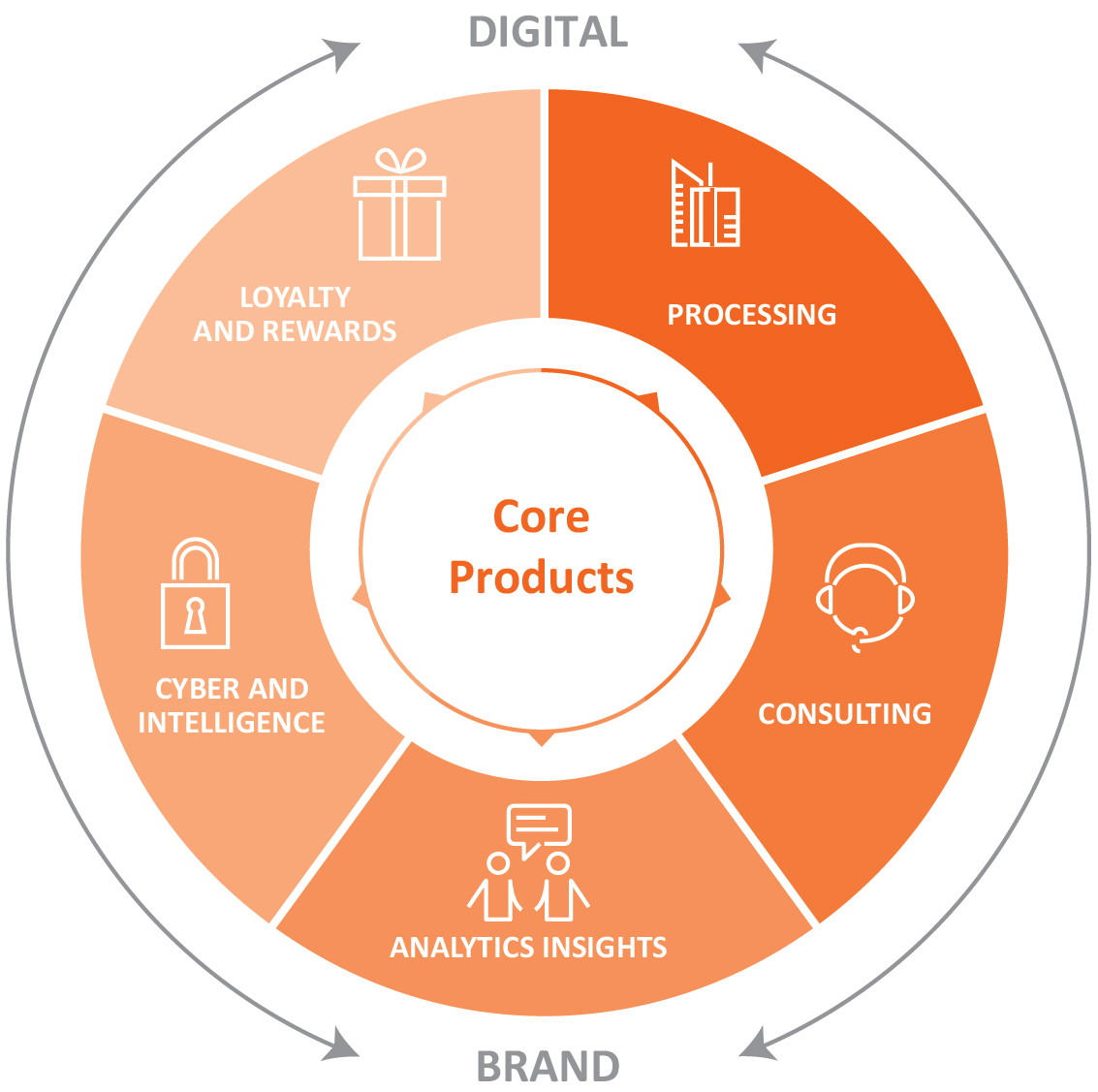
Core Products
Consumer Credit. We offer a number of programs that enable issuers to provide consumers with credit that allow them to defer payment. These programs are designed to meet the needs of our customers around the world and address standard, premium and affluent consumer segments.
Consumer Debit. We support a range of payment products and solutions that allow our customers to provide consumers with convenient access to funds in deposit and other accounts. Our debit and deposit access programs can be used to make purchases and to obtain cash in bank branches, at ATMs and, in some cases, at the point of sale. Our branded debit programs consist of Mastercard (including standard, premium and affluent offerings), Maestro (the only PIN-based solution that operates globally) and Cirrus (our primary global cash access solution).
Prepaid. Prepaid accounts are a type of electronic payment that enables consumers to pay in advance whether or not they previously have had a bank account or a credit history. These accounts can be tailored to meet specific program, customer or consumer needs, such as paying bills, sending person-to-person payments or withdrawing cash from an ATM. Our focus ranges from digital accounts (such as fintech and gig economy platforms) to business programs such as employee payroll, health savings accounts and solutions for small business owners. Our prepaid programs also offer opportunities in the private and public sector to drive financial inclusion of previously unbanked individuals through social security payments, unemployment benefits and salary cards.
We also provide prepaid program management services, primarily outside of the United States, that provide processing and end-to-end services on behalf of issuers or distributor partners such as airlines, foreign exchange bureaus and travel agents.
Commercial. We offer commercial payment products and solutions that help large corporations, midsize companies, small businesses and government entities. Our solutions streamline procurement and payment processes, manage information and expenses (such as travel and entertainment) and reduce administrative costs. Our card offerings include travel, small business (debit and credit), purchasing and fleet cards. Our SmartData platform provides expense management and reporting capabilities. Our Mastercard In Control™ platform generates virtual account numbers which provide businesses with enhanced controls, more security and better data.
10 MASTERCARD 2019 FORM 10-K
PART I
ITEM 1. BUSINESS
The following chart provides GDV and number of cards featuring our brands in 2019 for select programs and solutions:
| Year Ended December 31, 2019 | As of December 31, 2019 | |||||||||||||||
| GDV | Cards | |||||||||||||||
| (in billions) | Growth (Local) | % of Total GDV | (in millions) | Percentage Increase from December 31, 2018 | ||||||||||||
| Mastercard-branded Programs1,2 | ||||||||||||||||
| Consumer Credit | $ | 2,670 | 10 | % | 41 | % | 882 | 8 | % | |||||||
| Consumer Debit and Prepaid | 3,059 | 16 | % | 48 | % | 1,207 | 9 | % | ||||||||
| Commercial Credit and Debit | 732 | 14 | % | 11 | % | 85 | 15 | % |
| 1 | Excludes Maestro and Cirrus cards and volume generated by those cards. |
| 2 | Prepaid includes both consumer and commercial prepaid. |
Additional Platforms. In addition to the switching capabilities of our core network, we offer additional platforms with payment capabilities that extend to new payment flows:
| • | We offer commercial payment products and solutions aimed at improving the way businesses pay and get paid by providing a single connection enabling access to multiple payment types, greater control and richer data to optimize B2B transactions for both buyers and suppliers. |
| • | We offer real-time account-based payments for ACH transactions. This platform enables payments between bank accounts in real time and provides enhanced data and messaging capabilities. |
| • | We offer a platform that makes it easier for consumers to view, manage and pay their bills either with cards or real-time and batch ACH payments from their bank accounts. |
| • | We offer a platform that enables consumers, businesses, governments and merchants to send and receive money beyond borders with greater speed and ease. |
Value-Added Products and Services
Cyber and Intelligence. We offer integrated products and services to prevent, detect and respond to fraud and cyber-attacks and to ensure the safety of transactions made using Mastercard products. We do this using a multi-layered safety and security strategy:
| • | The “Prevent” layer protects infrastructure, devices and data from attacks. We have continued to grow global usage of EMV chip and contactless security technology, helping to reduce fraud. Greater usage of this technology has increased the number of EMV cards issued and the transaction volume on EMV cards. |
| • | The “Identify” layer allows us to help banks and merchants verify the authenticity of consumers during the payment process using various biometric technologies, including fingerprint, face and iris scanning technology to verify online purchases on mobile devices, as well as a card with biometric technology built in. |
| • | The “Detect” layer spots fraudulent behavior and cyber-attacks and takes action to stop these activities once detected. Our offerings in this space include alerts when accounts are exposed to data breaches or security incidents, fraud scoring technology that scans billions of dollars of money flows each day while increasing approvals and reducing false declines, and network-level monitoring on a global scale to help identify the occurrence of widespread fraud attacks when the customer (or their processor) may be unable to detect or defend against them. |
| • | The “Experience” layer improves the security experience for our stakeholders in areas from the speed of transactions, enhancing approvals for online and card-on-file payments, to the ability to differentiate legitimate consumers from fraudulent ones. Our offerings in this space include solutions for consumer alerts and controls and a suite of digital token services. We also have acquired an e-commerce fraud and dispute management network that enables merchants to stop delivery when a fraudulent or disputed transaction is identified, and issuers to refund the cardholder to avoid the chargeback process. |
We have also worked with our financial institution customers to provide products to consumers globally with increased confidence through the benefit of “zero liability”, or no responsibility for counterfeit or lost card losses in the event of fraud.
Loyalty and Rewards. We have built a scalable rewards platform that enables financial institutions to provide consumers with a variety of benefits and services, such as personalized offers and rewards, access to a global airline lounge network, concierge services, insurance services, emergency card replacement, emergency cash advances and a 24-hour account holder service center. For merchants, we provide campaigns with targeted offers and rewards, management services for publishing offers, and accelerated points programs for co-brand and rewards program members. We also have acquired a loyalty platform that enables stronger relationships with retailers,
MASTERCARD 2019 FORM 10-K 11
PART I
ITEM 1. BUSINESS
restaurants, airlines and consumer packaged goods companies by creating experiences that drive loyalty and impactful consumer engagement.
Processing. We extend our processing capabilities in the payments value chain in various regions and across the globe with an expanded suite of offerings, including:
| • | Issuer solutions designed to provide customers with a complete processing solution to help them create differentiated products and services and allow quick deployment of payments portfolios across banking channels. |
| • | Payment gateways that offer a single interface to provide e-commerce merchants with the ability to process secure online and in-app payments and offer value-added solutions, including outsourced electronic payments, fraud prevention and alternative payment options. |
| • | Mobile gateways that facilitate transaction routing and processing for mobile-initiated transactions. |
Data Analytics and Consulting. We provide proprietary analysis, data-driven consulting and marketing services solutions to help clients optimize, streamline and grow their businesses, as well as deliver value to consumers.
Our capabilities incorporate payments expertise and analytical and executional skills to create end-to-end solutions which are increasingly delivered via platforms embedded in our customers’ day-to-day operations. By observing patterns of payments behavior based on billions of transactions switched globally, we leverage anonymized and aggregated information and a consultative approach to help our customers make better business decisions. Our executional skills such as marketing, digital implementation and staff augmentation allow us to assist clients to implement actions based on these insights.
Increasingly, we have been helping financial institutions, retailers and governments innovate. Drawing on rapid prototyping methodologies from our global innovation and development arm, Mastercard Labs, we offer “Launchpad,” a five day app prototyping workshop. Through our Applied Predictive Technology business, a software as a service platform, we can help our customers conduct disciplined business experiments for in-market tests.
Digital Enablement
Our innovation capabilities enable broader reach to scale digital payment services beyond cards to multiple channels, including mobile devices:
| • | Delivering better digital experiences everywhere. We are using our technologies and security protocols to develop solutions to make digital shopping and selling experiences, such as on smartphones and other connected devices, simpler, faster and safer for both consumers and merchants. We also offer products that make it easier for merchants to accept payments and expand their customer base and are developing products and practices to facilitate acceptance via mobile devices. The successful implementation of our loyalty and reward programs is an important part of enabling these digital purchasing experiences. |
| • | Securing more transactions. We are leveraging tokenization, biometrics and machine learning technologies in our push to secure every transaction. These efforts include driving EMV-level security and benefits through all our payment channels. |
| • | Digitizing personal and business payments. We provide solutions that enable our customers to offer consumers the ability to send and receive money quickly and securely domestically and around the world. These solutions allow our customers to address new payment flows from any funding source, such as cash, card, bank account or mobile money account, to any destination globally, securely and in real time. |
| • | Simplifying access to, and integration of, our digital assets. Our Mastercard Developer platform makes it easy for customers and partners to leverage our many digital assets and services. By providing a single access point with tools and capabilities to find what we believe are some of the best-in-class Application Program Interfaces (“APIs”) across a broad range of Mastercard services, we enable easy integration of our services into new and existing solutions. |
| • | Identifying and experimenting with future technologies, start-ups and trends. Through Mastercard Labs, our global innovation and development arm, we continue to bring customers and partners access to thought leadership, innovation methodologies, new technologies and relevant early-stage fintech players. |
12 MASTERCARD 2019 FORM 10-K
PART I
ITEM 1. BUSINESS
Brand

Our family of well-known brands includes Mastercard, Maestro and Cirrus. We manage and promote our brands and brand identities (including our sonic brand identity) through advertising, promotions and sponsorships, as well as digital, mobile and social media initiatives, in order to increase people’s preference for our brands and usage of our products. We sponsor a variety of sporting, entertainment and charity-related marketing properties to align with consumer segments important to us and our customers. Our advertising plays an important role in building brand visibility, usage and overall preference among account holders globally. Our “Priceless®” advertising campaign, which has run in 52 languages in 123 countries worldwide, promotes Mastercard usage benefits and acceptance, markets Mastercard payment products and solutions and provides Mastercard with a consistent, recognizable message that supports our brand around the globe.
Recent Developments
 | Consumer |
Our products are designed to address needs of consumers with a focus on reducing complexity and delivering on experience. While technology has increasingly changed the way people get information, interact, shop and make purchases, consumers continue to expect a seamless experience where their payment is simple and secure. Our teams are creating innovative solutions that meet the needs of consumers and merchants in a digital environment by applying emerging technologies. In 2019, we:
| • | delivered “click to pay”, our activation of the EMV Secure Remote Commerce industry standard that enables a faster, more secure checkout experience across web and mobile sites, mobile apps and connected devices. This checkout experience is designed to provide consumers the same convenience and security in a digital environment that they have when paying in a store, make it easier for merchants to implement secure digital payments and provide issuers with improved fraud detection and prevention capability. |
| • | reinforced our support for contactless payments across all markets, including launching tap-and-go payments for transit systems in multiple cities globally (including New York City, Miami, Portland and Mexico City), which is creating the foundations for increased adoption of this technology to deliver a faster in-person payment experience. |
 | Commercial and B2B |
Building on our corporate T&E, fleet, purchasing card and small business capabilities, we have been increasingly focused on developing solutions to address other ways that businesses move money. In 2019, we:
| • | announced Mastercard Track, our B2B payment ecosystem which represents a collection of products and services aimed at improving the way businesses pay and get paid. The Track suite of products aims to introduce Mastercard Track Business Payment Service™, an open-loop commercial service built to simplify and automate payments between suppliers and buyers. |
| • | extended our support for commercial cards by adding new partners to our virtual card program, with a focus on helping to make virtual cards a preferred tool with straight-through (automated) acceptance and processing. |
MASTERCARD 2019 FORM 10-K 13
PART I
ITEM 1. BUSINESS
 | New payment flows |
In order to help grow our business and offer more electronic payment options to consumers, businesses and governments, Mastercard has developed and enhanced solutions beyond the principal switching capabilities available on our core network. We believe this will allow us to capture more payment flows, including B2B, P2P, B2C and government disbursements. In 2019, we:
| • | signed new agreements to bring our real-time payments infrastructure to more markets, including our relationship with P27 Nordic Payments Platform that will help deliver one real-time and batch payments solution across the Nordic markets. This solution uses the same technology that powers the ability for consumers and businesses in the U.S. to send and receive immediate payments through the Clearing House platform. We were also selected to enhance the InstaPay real-time retail payment system in the Philippines, including operating the infrastructure for and providing anti-money laundering tools to the national clearing switch in the Philippines. |
| • | positioned ourselves to add to our real-time payments solutions, including our pending acquisition of the majority of the Corporate Services business of Nets Denmark A/S. The pending acquisition primarily comprises the clearing and instant payment services, and e-billing solutions of the business. |
| • | enhanced Mastercard Bill Pay Exchange™ with the acquisition of Transactis, a platform that makes it easier for consumers to view, manage and pay their bills either with cards or real-time and batch ACH payments from their bank accounts. |
| • | acquired Transfast, enabling us to continue servicing the growing needs of consumers and businesses, as well as governments and merchants, to send and receive money beyond borders with greater speed and ease. When combined with our proprietary Mastercard Send™ assets, we have greatly extended our network reach. |
| • | drove blockchain initiatives, with an initial focus on the cross-border B2B payments space and proof of provenance solutions for supply chains. |
 | Services |
We provide services including data analytics, consulting, loyalty, cyber and intelligence, and processing that meet evolving requirements and the expectations of our stakeholders. We recently:
| • | extended our investments in Artificial Intelligence (“AI”) by: |
| ◦ | launching Mastercard ThreatScan, an AI-powered solution that helps banks proactively identify potential vulnerabilities in their authorization systems. The service works alongside an issuer’s existing fraud tools, imitating known criminal transaction behavior to identify potential weaknesses and prompt action before fraud potentially occurs. |
| ◦ | scaling Decision Intelligence™, our fraud scoring technology, to score billions of transactions in real time every day while increasing approvals and reducing false declines. |
| • | acquired Ethoca, an e-commerce fraud and dispute management network that enables the sharing of intelligence between merchants and issuers, sending near real-time information to merchants to stop delivery when a fraudulent or disputed transaction is identified, and refund the cardholder to avoid the chargeback process. |
| • | acquired RiskRecon, a provider of AI and data analytics with cyber risk assessment capabilities that are designed to help financial institutions, merchants, corporations and governments secure their digital assets. |
| • | acquired Session M, a loyalty platform that enables stronger relationships with retailers, restaurants, airlines and consumer packaged goods companies by creating experiences that drive loyalty and impactful consumer engagement. |
| • | enhanced the services we are able to offer to customers based on account-to-account flows, including data insights we are providing U.K. and U.S. customers to help them with anti-money laundering compliance and identification and prevention of other financial crimes. |
 | Other Initiatives |
| • | In 2019, we continued to implement our shift to a symbol brand by dropping our name from our logo, and debuted our sonic brand identity, comprised of a comprehensive sound architecture featuring a distinctive melody that will be employed in physical, digital and voice environments where consumers engage with Mastercard across the globe. |
14 MASTERCARD 2019 FORM 10-K
PART I
ITEM 1. BUSINESS
| • | In 2019, we contributed an additional $100 million towards initiatives that focus on inclusive growth for a total of $200 million contributed through December 31, 2019. These contributions are part of our previously announced $500 million commitment to support inclusive growth efforts, such as financial inclusion, economic development, the future of work and data science for social impact. |
Revenue Sources
We generate revenue primarily from assessing our customers based on GDV on the products that carry our brands, from the fees we charge to our customers for providing transaction processing and from other payment-related products and services. Our net revenues are classified into five categories: domestic assessments, cross-border volume fees, transaction processing, other revenues and rebates and incentives (contra-revenue).
See “Management’s Discussion and Analysis of Financial Condition and Results of Operations - Revenue” in Part II, Item 7 and Note 3, Revenue for more detail about our revenue, GDV, processed transactions and our other payment-related products and services.
Intellectual Property
We own a number of valuable trademarks that are essential to our business, including Mastercard, Maestro and Cirrus, through one or more affiliates. We also own numerous other trademarks covering various brands, programs and services offered by us to support our payment programs. Trademark and service mark registrations are generally valid indefinitely as long as they are used and/or properly maintained. Through license agreements with our customers, we authorize the use of our trademarks on a royalty-free basis in connection with our customers’ issuing and merchant acquiring businesses. In addition, we own a number of patents and patent applications relating to payment solutions, transaction processing, smart cards, contactless, mobile, biometrics, AI, security systems, blockchain and other matters, many of which are important to our business operations. Patents are of varying duration depending on the jurisdiction and filing date.
Competition
We compete in the global payments industry against all forms of payment including:
| • | cash and checks |
| • | card-based payments, including credit, charge, debit, ATM and prepaid products, as well as limited-use products such as private label |
| • | contactless, mobile and e-commerce payments, as well as cryptocurrency |
| • | other electronic payments, including ACH payments and wire transfers |
We face a number of competitors both within and outside of the global payments industry:
| • | Cash, Check and Legacy ACH. Cash and checks continue to represent one of the most widely used forms of payment. However, an even larger share of payments on a U.S. dollar volume basis are made via legacy, or “slow,” ACH platforms. |
| • | General Purpose Payment Networks. We compete worldwide with payment networks such as Visa, American Express, JCB, China UnionPay and Discover, among others. Some competitors have more market share than we do in certain jurisdictions. Some also have different business models that may provide an advantage in pricing, regulatory compliance burdens or otherwise. In addition, several governments are promoting, or considering promoting, local networks for domestic switching. See “Risk Factors” in Part I, Item 1A for a more detailed discussion of the risks related to payments system regulation and government actions that may prevent us from competing effectively. |
| • | Debit and Local Networks. We compete with ATM and point-of-sale debit networks in various countries. In addition, in many countries outside of the United States, local debit brands serve as the main domestic brands, while our brands are used mostly to enable cross-border transactions (typically representing a small portion of overall transaction volume). Certain jurisdictions have also created domestic card schemes focused mostly on debit. |
| • | Competition for Customer Business. We compete intensely with other payments companies for customer business. Globally, financial institutions typically issue both Mastercard and Visa-branded payment products, and we compete with Visa for business on the basis of individual portfolios or programs. In addition, a number of our customers issue American Express and/or Discover-branded payment cards in a manner consistent with a four-party system. We continue to face intense competitive pressure on the prices we charge our issuers and acquirers, and we seek to enter into business agreements with them through which we offer incentives and other support to issue and promote our payment products. We also compete for business from merchants, governments and mobile providers. |
MASTERCARD 2019 FORM 10-K 15
PART I
ITEM 1. BUSINESS
| • | Real-time Account-based Payment Systems. We face competition in the real-time account-based payment space from other companies that provide these payment solutions. In addition, real-time account-based payments face competition from other payment methods, such as cash and checks, cards, electronic, mobile and e-commerce payment platforms, cryptocurrencies and other payments networks. |
| • | Alternative Payments Systems and New Entrants. As the global payments industry becomes more complex, we face increasing competition from alternative payment systems and emerging payment providers. Many of these providers, who in many circumstances can also be our partners or customers, have developed payments systems focused on online activity in e-commerce and mobile channels (in some cases, expanding to other channels), and may process payments using in-house account transfers, real-time account-based payment networks or global or local networks. Examples include digital wallet providers (such as Paytm, PayPal, Alipay and Amazon), mobile operator services, mobile phone-based money transfer and microfinancing services (such as mPesa), handset manufacturers and cryptocurrencies. |
| • | Value-Added Products and Services. We face competition from companies that provide alternatives to our value-added products and services, including information services and consulting firms that provide consulting services and insights to financial institutions, as well as companies that compete against us as providers of loyalty and program management solutions. In addition, our integrated products and services offerings face competition and potential displacement from transaction processors throughout the world, which are seeking to enhance their networks that link issuers directly with point-of-sale devices for payment transaction authorization and processing services. Regulatory initiatives could also lead to increased competition in this space. |
Our competitive advantages include our:
| • | globally recognized brands |
| • | highly adaptable global acceptance network built over 50 years which can reach a variety of parties enabling payments |
| • | global payments network with world-class operating performance |
| • | expertise in real-time account-based payments |
| • | adoption of innovative products and digital solutions |
| • | safety and security solutions embedded in our networks |
| • | analytics insights and consulting services dedicated solely to the payments industry |
| • | ability to serve a broad array of participants in global payments due to our expanded on-soil presence in individual markets and a heightened focus on working with governments |
| • | world class talent |
Government Regulation
General. Government regulation impacts key aspects of our business. We are subject to regulations that affect the payments industry in the many countries in which our integrated products and services are used. See “Risk Factors” in Part I, Item 1A for more detail and examples.
Payments Oversight and Regulation. Central banks and other regulators in several jurisdictions around the world either have, or are seeking to establish, formal oversight over the payments industry, as well as authority to regulate certain aspects of the payment systems in their countries. In addition to oversight and regulation from established regulatory bodies, several jurisdictions have created or granted authority to create new regulatory bodies that either have or would have the authority to regulate payment systems, including the United Kingdom’s PSR (Vocalink and Mastercard are both participants in the payments system and are therefore subject to the PSR’s duties and powers), the National Bank of Belgium, India (which has also designated us as a payments system subject to regulation), and regulators in Brazil, Hong Kong, Mexico and Russia. Such authority has resulted in regulation of various aspects of our business. In the European Union, legislation requires us to separate our scheme activities (brand, products, franchise and licensing) from our switching activities and other processing in terms of how we go to market, make decisions and organize our structure. Mastercard also could be subject to new regulation, supervisions and examination requirements. For example, in the U.K., the Bank of England has expanded its oversight of systemically important payment systems to include service providers.
Interchange Fees. Interchange fees associated with four-party payments systems like ours are being reviewed or challenged in various jurisdictions around the world via legislation to regulate interchange fees, competition-related regulatory proceedings, central bank regulation and litigation. Examples include statutes in the United States that cap debit interchange for certain regulated activities, our settlement with the European Commission resolving its investigation into our interregional interchange fees and the European Union legislation capping consumer credit and debit interchange fees on payments issued and acquired within the European Economic Area (the “EEA”). For more detail, see “Risk Factors - Other Regulation” in Part I, Item 1A and Note 21 (Legal and Regulatory Proceedings) to the consolidated financial statements included in Part II, Item 8.
16 MASTERCARD 2019 FORM 10-K
PART I