 filings.tools
Mid-America Apartment Communities (MAA) 10-K risk factor changes: FY2020 vs FY2019
The 2020-12-31 10-K against the 2019-12-31 one, compared heading by heading and sentence by sentence.
Item 1A52 rewritten62 added49 removed375 unchanged
All filing items1,041 rewritten648 added568 removed1,694 unchanged
Summary
counted, not written
- Item 1A lists 4 risk factor headings: 3 new, 0 reworded and 1 unchanged since FY2019. 2 headings from FY2019 no longer appear.
- Sentence by sentence, 648 added, 568 removed, 1,041 rewritten and 1,694 unchanged across 18 items that differ.
New Item 1A headings (3)
- Failure to generate sufficient cash flow could limit our ability to make payments on our debt and to make distributions.
- Legal proceedings that we become involved in from time to time could adversely affect our business.
- Legislative or regulatory income tax changes related to REITs could materially and adversely affect us.
Removed Item 1A headings (2)
- Compliance or failure to comply with laws and regulations, including those requiring access to our properties by disabled persons, could have an adverse effect on our operations.
- The form, timing and amount of dividend distributions in future periods may vary and be impacted by economic and other considerations.
A heading is new when no FY2019 heading matches it after ignoring case and punctuation, and reworded when it shares at least 60 percent of its words with one that went away. All current risk factor headings.
Sentences by item
22 items, with every count and a link to each item that changed
Underlined words on a shaded ground are new in FY2020; struck-through words were in FY2019. Sentences that are wholly new or wholly gone are labelled rather than marked.
Item 1A. Risk Factors.
52 rewritten, 62 added, 49 removed, 375 unchanged
Additional risks [added: that are] not presently known to [removed: us or] [added: us,] that we currently believe are immaterial [added: or that could apply generically to any company] may also significantly impact our business operations.
If any of these risks occur, our business prospects, financial condition or results of operations could suffer, the market price of our [removed: capital] stock and the trading price of our debt securities could decline and you could lose all or part of your investment in our [removed: capital] stock or debt securities.
Unfavorable market [added: and economic] conditions in the areas in which we operate [removed: and unfavorable economic conditions] may significantly affect our occupancy levels, our rental rates and collections, the value of [removed: the] [added: our] properties and our ability to acquire or dispose of apartment communities on economically favorable terms.
Factors that may affect our occupancy levels, our rental [removed: revenues,] [added: revenues] and/or the value of our apartment communities include the following, among others:
[removed: Failure] [added: Failure] to generate sufficient cash flow could limit our ability to make payments on our debt and to make [removed: distributions.][added: distributions.]
| | • | overbuilding of new apartments or oversupply of available apartments [added: or alternative housing options (i.e. condominiums or single-family houses for rent or sale)] in our markets, which might adversely affect occupancy or rental rates and/or require rent concessions in order to lease apartments; |
| | • | weakness in the [removed: overall] [added: general] economy, which lowers job growth and the associated demand for apartment housing; |
| | • | [added: other] changes in [removed: laws] [added: laws,] including, but not limited to, tax laws and housing [removed: laws including the enactment of rent control laws or other laws regulating multifamily housing;] [added: laws;] |
| | • | an uninsured loss, including those resulting from a catastrophic storm, [removed: earthquake,] [added: earthquake] or act of terrorism; |
| | • | changes in interest rate levels and the availability of financing, borrower credit [removed: standards,] [added: standards] and down-payment requirements which could lead renters to purchase homes (if interest rates decrease and home loans are more readily [added: available) or increase our acquisition and operating costs (if interest rates increase and financing is less readily available); and] |
As of December 31, [removed: 2019,] [added: 2020,] substantially all of our investments are concentrated in the multifamily sector.
As of December 31, [removed: 2019,] [added: 2020,] approximately [removed: 39.9%] [added: 40.1%] of our portfolio [removed: is] [added: was] located in our top five markets: Atlanta, Georgia; Dallas, Texas; Austin, Texas; Charlotte, North Carolina; and Orlando, Florida.
Substantial competition among apartment communities and real estate companies may adversely affect our revenues and [removed: development and] acquisition [added: and development] opportunities.
There are numerous other apartment communities and real estate companies, some of which may have greater financial and other resources than we have, within the market area of each of our communities that compete with us for residents and [removed: development and] acquisition [added: and development] opportunities.
The number of competitive apartment communities and real estate companies in these areas could have a material effect on (1) our ability to rent our apartments and generate revenues, and (2) [removed: development and] acquisition [added: and development] opportunities.
[removed: The activities of these competitors could cause us to pay a higher price for a new property than we otherwise would have] paid or may prevent us from purchasing [removed: a] desired [removed: property] [added: properties] at all, which could have a material adverse effect on us and our ability to make payments on our debt and to make distributions.
In addition, we engage third party service providers that may collect and hold personally identifiable information of our residents, prospective residents and employees in connection with providing business services to us, including web hosting, property management, leasing, [removed: accounting and] [added: accounting,] payroll [added: and benefit] services.
[removed: | | • |] [added: In addition, with respect to acquisitions,] we may be unable to quickly and efficiently integrate acquired apartment communities and new personnel into our existing operations, and the failure to successfully integrate [removed: such] [added: those] apartment communities or personnel [removed: will] [added: would] result in inefficiencies that could adversely affect our expected return on our [removed: investments and our overall profitability; and |][added: investments.]
[removed: | | • |] [added: Likewise,] we may acquire properties that are subject to liabilities or that have problems relating to environmental condition, state of title, physical condition or [removed: compliance with zoning laws, building codes or other legal requirements and in each case, |]
[removed: | | |] [added: compliance with zoning laws, building codes or other legal requirements and in each case,] our acquisition may be without any, or with only limited, recourse with respect to unknown liabilities or conditions and we may be obligated to pay substantial sums to settle or cure it, which could adversely affect our cash flow and operating results. [removed: |]
[removed: | | • |] [added: Likewise,] federal tax laws applicable to REITs limit our ability to profit on the sale of [removed: communities,] [added: properties,] and this limitation [removed: may] [added: could] prevent us from selling [removed: communities] [added: properties] when market conditions are favorable. [removed: |]
Certain environmental laws impose liability for the release of asbestos-containing materials into the air, and third parties may also seek recovery from owners or operators of real property for personal injury associated with [removed: asbestos-][added: asbestos-containing materials and other hazardous or toxic substances.]
Extreme weather or natural disasters may cause [removed: property] [added: significant] damage [removed: or disrupt business, which could harm] [added: to] our [removed: business] [added: properties] and [removed: results of operations.][added: losses from catastrophes could exceed our insurance coverage.]
[removed: We have] [added: Many of our] apartment communities [added: are] located in areas that may be subject to extreme weather and natural disasters, [removed: including, but not limited to, earthquakes, winds,] [added: such as] floods, hurricanes and [removed: fires,] [added: earthquakes,] the likelihood or frequency of which events could increase in part based on the [removed: potential] impact of climate change.
Such [removed: conditions] [added: events] may [added: cause significant] damage [added: to] our properties, disrupt our operations and adversely impact our [removed: tenants.][added: residents.]
We carry [removed: comprehensive liability and] property insurance on our apartment communities and intend to obtain similar coverage for apartment communities we acquire in the future.
[removed: Some] [added: However, some] losses, generally of a catastrophic nature, such as losses from floods, hurricanes or earthquakes, are subject to limitations, and [removed: thus] [added: therefore] may be uninsured.
We exercise our discretion in determining amounts, coverage limits and deductibility provisions of insurance, with a view to maintaining [added: what we believe is] appropriate insurance on our investments at a reasonable cost and on suitable terms.
[removed: Compliance] [added: Compliance] or failure to comply with [removed: laws and regulations, including those requiring access to our properties by disabled persons, could have] [added: laws and regulations could have] an adverse effect on our [removed: operations.][added: operations and the values of our properties.]
Changes in laws and regulations could require us to make significant unanticipated [removed: expenditures,] [added: expenditures and limit our ability to recover increases in operating expenses,] impose limitations on our ability to [removed: raise] [added: increase] rents or charge certain [removed: fees] [added: fees, impose limitations on our ability to enforce remedies for the failure to pay rent] or otherwise adversely impact our operations.
For example, we [removed: generally] have seen [removed: growing activism from tenant advocacy groups, which often urge] [added: an increase in] state and local governments [added: implementing, considering or being urged by tenant advocacy groups] to consider [removed: enacting] rent control or rent stabilization laws and regulations as well as tenants’ rights laws and regulations.
[removed: Legal] [added: Legal] proceedings that we become involved in from time to time could adversely affect our [removed: business.][added: business.]
[added: For example, as described] in [removed: “Legal Proceedings” and] [added: more detail in] Note 11 to the consolidated financial statements included [removed: elsewhere] in this Annual Report on Form 10-K, we are currently a defendant in two class action lawsuits relating to tenant late fee policies at our Texas apartment communities.
As of December 31, [removed: 2019,] [added: 2020,] the amount of our total debt was [removed: approximately $4.5] [added: $4.6] billion.
The [removed: uncertainty regarding the potential] phase-out of LIBOR could adversely impact our results of operations and cash flows.
LIBOR is the interest rate benchmark used as a reference rate on our [removed: variable][added: unsecured revolving credit facility, although we had no borrowings under our unsecured revolving credit facility as of December 31, 2020.]
[removed: At this time, no consensus exists as to what rate or rates will become accepted alternatives to LIBOR, although the] [added: The] U.S. Federal Reserve, in connection with the Alternative Reference Rates Committee, a steering committee comprised of large U.S. financial institutions, [removed: is considering] [added: has endorsed] replacing [removed: U.S. dollar] [added: USD] LIBOR with the Secured Overnight Financing Rate, or SOFR.
As of December 31, [removed: 2019,] [added: 2020,] we had outstanding borrowings of [removed: approximately $4.5] [added: $4.6] billion.
[removed: Our ability to comply with these financial covenants may be affected by] changes in our operating and financial performance, changes in general business and economic conditions, adverse regulatory developments or other events adversely impacting us.
Should the capital and credit markets experience volatility and the availability of funds again becomes limited, or be available only on unattractive terms, we will incur increased costs [added: associated with issuing debt instruments.]
Risks Related to the COVID-19 Pandemic
The COVID-19 pandemic and mitigation efforts to control the spread of the disease have materially impacted and are expected to continue to materially impact our business, and our financial condition, results of operations and cash flows could be materially adversely affected by factors relating to COVID-19.
In March 2020, the World Health Organization characterized COVID-19 as a pandemic, and the President of the United States proclaimed that the COVID-19 outbreak in the United States constituted a national emergency.
Extraordinary actions were taken by federal, state and local governmental authorities to combat the spread of COVID-19, including issuance of “stay-at-home” directives and similar mandates for many individuals to substantially restrict daily activities and for many businesses to curtail or cease normal operations.
These measures, while intended to protect human life, led to significantly reduced economic activity and a surge in unemployment throughout the United States, including the markets where our properties are located.
In April 2020, the national unemployment rate reached its highest level since the Great Depression, and in June 2020, the National Bureau of Economic Research officially declared that the United States had fallen into a recession.
Although some economists believe that the United States economy is now no longer in a recession, the economy remains vulnerable.
A surge in new COVID-19 cases linked by public officials to increased travel and socializing over the holiday season seems to have begun to recede, but tens of thousands of new cases are still being reported daily nationwide.
COVID-19 vaccines have received emergency use authorization from the United States government, but vaccine distribution has been slower than public officials hoped and multiple variants of the virus that causes COVID-19 have been documented in the United States.
Many jurisdictions continue to enforce orders restricting businesses’ normal operations, and reinstatement of broader “stay-at-home” directives and mandates remains a possibility.
Our ability to lease our apartments and collect rental revenues is dependent upon national, regional and local economic conditions, particularly unemployment levels and personal income levels.
As unemployment rises and incomes fall, fewer people, including both current and prospective residents, may be able to afford our apartment communities, and it may be difficult for some of our residents to make timely rental payments to us under their leases.
The ongoing COVID-19 pandemic and restrictions intended to prevent its spread could have significant adverse impacts on our business, financial condition, results of operations and cash flows that are difficult to predict.
Such adverse impacts will depend on, among other factors:
| | • | our residents’ ability or willingness to pay rent in full on a timely basis; |
| | • | federal, state, local and industry-initiated efforts that may adversely affect the ability of landlords, including us, to collect rent and customary fees, adjust rental rates and enforce remedies for the failure to pay rent, such as the order issued by the CDC to temporarily halt residential evictions to prevent further spread of COVID-19; |
| | • | our ability to renew leases or relet units on favorable terms or at all, including as a result of unfavorable economic and market conditions in those markets where our apartment communities are located; |
| | • | our ability to lease or relet units due to social distancing or other restrictions intended to prevent the spread of COVID-19 that may frustrate our leasing activities; |
| | • | our ability to successfully complete the lease up of properties in our lease up portfolio and attain expected rental and occupancy rates on the originally anticipated schedule due to social distancing or other restrictions intended to prevent the spread of COVID-19 that may frustrate our leasing activities; |
| | • | our ability to complete the construction of properties in our development portfolio due to social distancing or other restrictions intended to prevent the spread of COVID-19 that may slow down or temporarily halt our construction activities; |
| | • | our ability to continue our apartment unit redevelopment programs and attain increased rental rates for renovated or upgraded units due to social distancing or other restrictions intended to prevent the spread of COVID-19; |
| | • | the possibility that one or more of our apartment communities could become a cluster site for COVID-19 infections, which could negatively impact our reputation and occupancy levels and result in operational losses due to reduced rental demand; |
| | • | severe and prolonged disruption and instability in the financial markets, including the debt and equity capital markets, which have already experienced and may continue to experience significant volatility, or deteriorations in credit and financing conditions (or a refusal or failure of one or more lenders under our unsecured revolving credit facility to fund their respective financing commitment to us), which may affect our ability to access capital necessary to fund our business operations or refinance maturing debt on a timely basis, on attractive terms or at all, which would adversely affect our ability to meet liquidity and capital expenditure requirements; |
| | • | sustained stock market volatility that negatively affects the market price of our securities, including market conditions unrelated to our operating performance or prospects; and |
| | • | our ability to manage our business to the extent our management or personnel are impacted in significant numbers by the COVID-19 pandemic and are not willing, available or allowed to conduct work. |
The ongoing COVID-19 pandemic and the current economic, financial and capital markets environment present material risks and uncertainties for us.
However, the fluidity of the situation precludes any prediction as to the ultimate impact COVID-19 will have on our business, financial condition, results of operation and cash flows, which will depend largely on future developments directly or indirectly relating to the duration and scope of the COVID-19 pandemic in the United States.
To the extent the COVID-19 pandemic adversely affects our business, financial condition, results of operation and cash flows, it may also have the effect of heightening many of the other risks described in this Annual Report on Form 10-K.
| | • | the enactment of rent control or rent stabilization laws in the areas in which we operate or other laws regulating multifamily housing; |
The activities of these competitors could cause us to pay higher prices for new properties than we otherwise would have
Operations from new acquisitions, development projects and redevelopment activities may fail to perform as expected.
We intend to acquire, develop and redevelop apartment communities as part of our business strategy.
Newly acquired, developed or renovated properties may not perform as we expect.
We may also overestimate the revenue (or underestimate the expenses) that a new or repositioned property may generate.
The occupancy rates and rents at these properties may fail to meet our expectations underlying our investment.
We plan to sell apartment communities that no longer meet our long-term strategy.
However, adverse market conditions could limit our ability to sell properties when we want and to change our portfolio promptly to meet our strategic objectives.
From time to time, we may dispose of properties in transactions intended to qualify as “like-kind exchanges” under Section 1031 of the Code.
If a transaction intended to qualify as a Section 1031 exchange is later determined to be taxable, we may face adverse consequences, and if the laws applicable to such transactions are amended or repealed, we may not be able to dispose of real properties on a tax deferred basis.
As of December 31, 2020, we had eight development communities under construction representing 2,607 units once complete.
| | • | conversion of condominiums and single family houses to rental use or the increase in the number of condominiums and single family homes available for sale; |
| | • | failure of development communities to be completed within budget and on a timely basis, if at all, or to lease-up as anticipated; |
| | | available) or increase our acquisition and operating costs (if interest rates increase and financing is less readily available); and |
Acquisitions of apartment communities involve various risks and may fail to meet expectations.
We have acquired in the past, and if presented with attractive opportunities we intend to acquire in the future, apartment communities that meet our investment criteria.
Our acquisition activities and their success are subject to the following risks:
| | • | we may be unable to obtain financing for acquisitions on favorable terms or at all; |
| | • | even if we are able to finance the acquisition, cash flow from the acquisition may be insufficient to meet our required principal and interest payments on the acquisition; |
| | • | even if we enter into an acquisition agreement for an apartment community, we may be unable to complete the acquisition after incurring certain acquisition-related costs; |
| | • | we may incur significant costs and divert management's attention in connection with the evaluation and negotiation of potential acquisitions, including potential acquisitions that we are subsequently unable to complete; |
| | • | when we acquire an apartment community, we may invest additional amounts in it with the intention of increasing revenues and profitability, and these additional investments may not produce the anticipated improvements in revenues or profitability; |
We periodically dispose of apartment communities that no longer meet our strategic objectives, but adverse market conditions may make it difficult to sell apartment communities like the ones we own.
We cannot predict whether we will be able to sell any property for the price or on the terms we set, or whether any price or other terms offered by a prospective purchaser would be acceptable to us.
We also cannot predict the length of time needed to find a willing purchaser and to close the sale of a property.
Furthermore, we may be required to expend funds to correct defects or to make improvements before a property can be sold.
These conditions may limit our ability to dispose of properties and to change our portfolio promptly in order to meet our strategic objectives, which may in turn have a material adverse effect on our financial condition and the market value of our securities.
We are also subject to the following risks in connection with sales of our apartment communities:
| | • | a significant portion of the proceeds from our overall property sales may be held by intermediaries in order for some sales to qualify as like-kind exchanges under Section 1031 of the Code, so that any related capital gain can be deferred for federal income tax purposes. As a result, we may not have immediate access to all of the cash proceeds generated from our property sales. In addition, if a transaction intended to qualify as a Section 1031 exchange is later determined to be taxable, we may face adverse consequences, and if the laws applicable to such transactions are amended or repealed, we may not be able to dispose of properties on a tax deferred basis. Intermediary agents of Section 1031 exchange transactions typically handle large sums of money in trusts. Misappropriation of funds by one of these agents could have a material negative impact on our results of operations. Additionally, misappropriation of funds could result in the disposal of the property not qualifying for a tax deferred basis and adversely affect our financial condition. It is also possible the qualification of a transaction as a Section 1031 exchange could be successfully challenged and determined to be currently taxable. In such case, our taxable income and earnings and profits would increase, which could increase the dividend income to our shareholders by reducing any return of capital they received. In some circumstances, we may be required to pay additional dividends or, in lieu of additional dividends, corporate income tax, possibly including interest and penalties. As a result, we may be required to borrow funds in order to pay additional dividends or taxes and the payment of such taxes could cause us to have less cash available to distribute to our shareholders. In addition, if a Section 1031 exchange were later to be determined to be taxable, we may be required to amend our tax returns for the applicable year in question, including any information reports sent to our shareholders; and |
Property ownership through joint ventures could limit our ability to act exclusively in our interest.
From time to time, we may acquire and/or develop properties in joint ventures with other persons or entities when we believe circumstances warrant the use of such structures.
In that case, we could become engaged in a dispute with one or more of our partners which might affect our ability to operate a jointly-owned property.
Moreover, our partners could have business, economic or other objectives that are inconsistent with our objectives, including objectives that relate to the appropriate timing and terms of any sale or refinancing of a property.
In some instances, our partners could have competing interests in our markets that could create conflicts of interest.
Also, our partners might refuse to make capital contributions when due and we may be responsible to our partners for indemnifiable losses.
In general, we and our partners could each have the right to trigger a buy-sell arrangement, which could cause us to sell our interest, or acquire our partners' interest, at a time when we otherwise would not have initiated such a transaction and may result in the valuation of our interest in the joint venture (if we are the seller) or of our partners' interest in the joint venture (if we are the buyer) at levels which may not be representative of the valuation that would result from an arm's length marketing process.
Other potential risks of a jointly-owned property include (i) a deadlock if we and our partners are unable to agree upon certain major and other decisions, (ii) a limitation of our ability to liquidate our position in the partnership or joint venture without the consent of the other partners and (iii) a requirement to provide guarantees in favor of lenders with respect to the indebtedness of the joint venture.
containing materials and other hazardous or toxic substances.
Losses from catastrophes may exceed our insurance coverage, which may negatively impact our results of operations and reduce the value of our properties.
As of December 31, 2019, we had seven development communities under construction totaling 2,108 units.
For example, as described in more detail
rate debt, including our unsecured revolving credit facility.
LIBOR is expected to be phased out after 2021, when private-sector banks are no longer required to report the information used to set the rate.
Without this data, LIBOR may no longer be published, or the lack of quality and quantity of data may cause the rate to no longer be representative of the market.
Failure to hedge effectively against interest rates may adversely affect our results of operations.
From time to time, we may seek to manage our exposure to interest rate volatility by using interest rate hedging arrangements, such as interest rate swap agreements.
These agreements involve risks, such as the risk that the counterparties may fail to honor their obligations under these arrangements, that these arrangements may not be effective in reducing our exposure to interest rate changes and that a court could rule that such an agreement is not legally enforceable.
Hedging may reduce overall returns on our investments.
Failure to hedge effectively against interest rate changes could have a material adverse effect on us and our ability to make payments on our debt and to make distributions.
associated with issuing debt instruments.
The market price of shares of common stock of a REIT may be affected by the distribution rate on those shares, as a percentage of the price of the shares, relative to market interest rates.
An excerpt. Shown here: 40 of 52 rewritten, 40 of 62 added and 40 of 49 removed. The counts are complete. For every sentence, read Item 1A. Risk Factors. in the FY2020 filing and the FY2019 filing.
Item 7. Management’s Discussion and Analysis of Financial Condition and Results of Operations.
119 rewritten, 117 added, 89 removed, 112 unchanged
The following discussion analyzes the financial condition and results of operations of both MAA and the Operating Partnership, of which MAA is the sole general partner and in which MAA owned a 96.6% interest as of December 31, [removed: 2019.][added: 2020.]
This discussion should be read in conjunction with the consolidated financial statements and notes thereto included [removed: elsewhere] in this Annual Report on Form 10-K.
As of December 31, [removed: 2019,] [added: 2020,] we owned and operated 299 apartment communities through the Operating Partnership and its subsidiaries, and we had an ownership interest in one apartment community through an unconsolidated real estate joint venture and had [removed: seven] [added: eight] development communities under construction.
In addition, as of December 31, [removed: 2019, we owned four commercial properties, and] [added: 2020,] 32 of our apartment communities included retail components.
Our apartment communities [removed: and commercial properties are] [added: were] located across 16 states and the District of [removed: Columbia.][added: Columbia as of December 31, 2020.]
Our Non-Same Store and Other segment includes recently acquired communities, communities being developed or in lease-up, communities undergoing extensive renovations, communities identified for [removed: disposition and] [added: disposition,] communities that have incurred a significant casualty [removed: loss.][added: loss and stabilized communities that do not meet the requirements to be Same Store communities.]
Additional information regarding the composition of our segments is included in Note 13 to the consolidated financial statements included [removed: elsewhere] in this Annual Report on Form 10-K.
For the year ended December 31, [removed: 2019,] [added: 2020,] net income available for MAA common shareholders was [removed: $350.1] [added: $251.3] million as compared to [removed: $219.2] [added: $350.1] million for the year ended December 31, [removed: 2018.][added: 2019.]
Results for the year ended December 31, 2019 included $17.9 million of [added: non-cash] income related to the [removed: fair value adjustment of the] embedded derivative in the MAA Series I preferred shares and $93.0 million of gains related to the sale of real estate assets.
Revenues for the year ended December 31, [removed: 2019] [added: 2020] increased [removed: 4.4%] [added: 2.3%] as compared to the year ended December 31, [removed: 2018,] [added: 2019,] driven by a [removed: 3.4%] [added: 2.5%] increase in our Same Store [removed: segment and an 18.5% increase in our Non-Same Store and Other] segment.
Property operating expenses, excluding depreciation and amortization, for the year ended December 31, [removed: 2019] [added: 2020] increased by [removed: 3.1%] [added: 4.5%] as compared to the year ended December 31, [removed: 2018,] [added: 2019,] driven by a [removed: 2.9%] [added: 4.9%] increase in our Same Store [removed: segment and a 5.5% increase in our Non-Same Store and Other] segment.
The drivers of these [removed: increases] [added: changes] are discussed below in the “Results of Operations” section.
[removed: Average] [added: The average] effective rent per unit for [removed: the] [added: our] Same Store portfolio continued to [removed: increase,] [added: increase from the prior year,] up [removed: 3.6%] [added: 2.6%] for the year ended December 31, [removed: 2019] [added: 2020] as compared to the year ended December 31, [removed: 2018.][added: 2019.]
[removed: Average daily] [added: This growth was partially offset by a slightly lower average] physical occupancy for our Same Store portfolio [removed: was 95.9% for the year ended December 31, 2019] [added: of 95.6%,] as compared [removed: with] [added: to] the average [removed: daily] physical occupancy of [removed: 96.1%] [added: 95.9%] achieved during the [added: more normal operating conditions for the] year ended December 31, [removed: 2018.][added: 2019.]
We believe that a well-balanced portfolio, including [removed: inner loop, suburban] [added: both urban] and [removed: downtown/central business district] [added: suburban] locations, with [removed: various] [added: a broad range of] monthly rent price points, will perform well in “up” cycles as well as [added: better] weather “down” [removed: cycles better.][added: cycles.]
Through our investment in 36 defined markets, we are diversified across markets, urban and suburban submarkets and a variety of product types and monthly rent [removed: pricing] [added: price] points.
[removed: Though overall demand continues to be strong, the current] [added: Current] elevated supply levels [removed: are impacting] [added: could further affect] rent growth for our portfolio, particularly for apartment communities located in urban submarkets.
Properties in suburban submarkets [removed: have been impacted] [added: continue to be] somewhat less [added: impacted] by supply, primarily because [removed: less] new development has [removed: occurred] [added: been less prevalent] in those submarkets.
Demand for [removed: our] apartments is primarily driven by general economic conditions in our [removed: markets.][added: markets and is particularly correlated to job growth.]
As noted above, average [removed: daily] physical occupancy for our Same Store portfolio for the year ended December 31, [removed: 2019] [added: 2020] was [removed: 95.9%.][added: 95.6%, which we believe positions us well to manage through the current environment and as we continue through the typically slower winter leasing season.]
[removed: Results] [added: Results] of [removed: Operations][added: Operations]
For the year ended December 31, [removed: 2019,] [added: 2020,] we achieved net income available for MAA common shareholders of [removed: $350.1] [added: $251.3] million, a [removed: 59.7% increase] [added: 28.2% decrease] as compared to the year ended December 31, [removed: 2018,] [added: 2019,] and total revenue growth of [removed: $69.7] [added: $37.0] million, representing a [removed: 4.4%] [added: 2.3%] increase in property revenues as compared to the year ended December 31, [removed: 2018.][added: 2019.]
The following discussion describes the primary drivers of the [removed: increase] [added: decrease] in net income available for MAA common shareholders for the year ended December 31, [removed: 2019,] [added: 2020,] as compared to the year ended December 31, [removed: 2018.][added: 2019.]
A discussion of the results of operations for the year ended December 31, [removed: 2017] [added: 2019 as compared to the year ended December 31, 2018] is found in Item 7 of Part II of our Annual Report on Form 10-K for the year ended December 31, [removed: 2018,] [added: 2019,] filed with the SEC on February [removed: 21, 2019,] [added: 20, 2020,] which is available free of charge on the SEC’s website at www.sec.gov and on our website at https://www.maac.com, on the “For Investors” page under “Filings and Financials—Annual Reports”.
The following table reflects our property revenues by segment for the years ended December 31, [removed: 2019] [added: 2020] and [removed: December 31, 2018] [added: 2019] (dollars in thousands):
| | | December 31, [removed: 2019] [added: 2020] | | | | December 31, [removed: 2018] [added: 2019] | | | | Increase [added: (Decrease)] | | | | % [removed: Increase] [added: Change] | | |
The increase in property revenues for our Same Store segment for the year ended December 31, [removed: 2019] [added: 2020] as compared to the year ended December 31, [removed: 2018] [added: 2019] was the primary driver of total property revenue growth.
The Same Store segment generated a [removed: 3.4%] [added: 2.5%] increase in revenues for the year ended December 31, [removed: 2019,] [added: 2020,] primarily a result of average effective rent per unit growth of [removed: 3.6%] [added: 2.6%] as compared to the year ended December 31, [removed: 2018.][added: 2019.]
The following table reflects our property operating expenses by segment for the years ended December 31, [removed: 2019] [added: 2020] and [removed: December 31, 2018] [added: 2019] (dollars in thousands):
The increase in property operating expenses for our Same Store segment for the year ended December 31, [removed: 2019] [added: 2020] as compared to the year ended December 31, [removed: 2018] [added: 2019] was primarily driven by [removed: an increase] [added: increases] in real estate tax expense of [removed: $10.0] [added: $9.8 million, utilities expense of $5.4 million, insurance expense of $4.9 million and marketing expense of $3.5] million.
Depreciation and amortization expense for the year ended December 31, [removed: 2019] [added: 2020] was [removed: $496.8] [added: $510.8] million, an increase of [removed: $7.1] [added: $14.0] million as compared to the year ended December 31, [removed: 2018.][added: 2019.]
The increase was primarily driven by the recognition of depreciation expense associated with our development and redevelopment activities made in the normal course of business during the year ended December 31, [removed: 2019.][added: 2020.]
Property management expenses for the year ended December 31, [removed: 2019] [added: 2020] were [removed: $55.0] [added: $52.3] million, [removed: an increase] [added: a decrease] of [removed: $7.4] [added: $2.7] million as compared to the year ended December 31, [removed: 2018.][added: 2019.]
General and administrative expenses for the year ended December 31, [removed: 2019] [added: 2020] were [removed: $46.1] [added: $46.9] million, an increase of [removed: $11.3] [added: $3.0] million as compared to the year ended December 31, [removed: 2018, primarily due to increases in personnel and legal costs.][added: 2019.]
Interest expense for the year ended December 31, [removed: 2019] [added: 2020] was [removed: $179.8] [added: $167.6] million, [removed: an increase] [added: a decrease] of [removed: $6.3] [added: $12.3] million as compared to the year ended December 31, [removed: 2018.][added: 2019.]
We did not dispose of any apartment communities during the year ended December 31, [removed: 2018.][added: 2020.]
Other non-operating income for the year ended December 31, [removed: 2019] [added: 2020] was [removed: $25.3 million, an increase of $19.8] [added: $4.9] million [added: of income,] as compared to [added: $23.0 million of income for] the year ended December 31, [removed: 2018.][added: 2019.]
The [removed: increase] [added: decrease] was primarily [removed: due to] [added: driven by] the recognition of [removed: $17.9] [added: $2.6] million of [added: non-cash] income related to the fair value adjustment of the embedded derivative in the MAA Series I preferred shares during the year ended December 31, [removed: 2019 as] [added: 2020,] compared to the recognition of [removed: $2.6] [added: $17.9] million of [removed: expense] [added: non-cash income] related to the adjustment of the embedded derivative during the year ended December 31, [removed: 2018.][added: 2019.]
[removed: Funds] [added: Funds] from [removed: Operations][added: Operations and Core Funds from Operations]
FFO should not be considered as an alternative to net income available for MAA common stockholders or any other GAAP measurement, as an indicator of operating performance or as an alternative to cash flow from operating, [removed: investing,] [added: investing] and financing activities as a measure of liquidity.
Results for the year ended December 31, 2020 included $2.6 million of non-cash income related to the fair value adjustment of the embedded derivative in the MAA Series I preferred shares and $1.0 million of gains related to the sale of real estate assets.
COVID-19 Developments
We believe the best way we can help our residents is to work with those who have lost wages or compensation due to the COVID-19 pandemic so that they can remain in their homes.
During 2020, we supported our impacted residents in need of assistance by:
| | • | Providing interest-free rent deferral (assisting over 8,000 households); |
| --- | --- | --- |
| | • | Waiving late payment fees; |
| --- | --- | --- |
| | • | Waiving lease termination fees; and |
| --- | --- | --- |
| | • | Posting local and governmental assistance programs and resources on our website. |
| --- | --- | --- |
Our on-site leasing offices have remained open throughout the COVID-19 pandemic while adhering to orders and directives issued by state and local governments.
Since May 2020, we have conducted normal operations at our on-site leasing offices, permitting public access and walk-in traffic, subject to social distancing restrictions.
Further, since May 2020, property amenities have been open as permitted by governmental orders, directives and guidelines.
We have supported our associates with enhanced leave and sick time policies, enhanced flextime arrangements and additional COVID-19 paid time off, among other benefits.
We continue to monitor and comply with the various federal, state and local laws, orders and directives issued in response to the COVID-19 pandemic that affect apartment owners and operators.
During the year ended December 31, 2020, revenue growth for our Same Store portfolio continued to be favorably impacted by in-place rents and the contribution of average effective rent per unit growth.
Average effective rent per unit represents the average of gross rent amounts, after the effect of leasing
concessions, for occupied apartment units plus prevalent market rates asked for unoccupied apartment units, divided by the total number of units.
Leasing concessions represent discounts to the current market rate.
We believe average effective rent per unit is a helpful measurement in evaluating average pricing; however, it does not represent actual rental revenue collected per unit.
Average physical occupancy is a measurement of the total number of our apartment units that are occupied by residents, and it represents the average of the daily physical occupancy for the period.
The COVID-19 pandemic continues to disrupt the United States economy and we cannot predict when a full economic recovery will occur.
Government restrictions implemented in response to the pandemic continue to drive high unemployment and limit the number of people looking to change their current living situation.
While our rent collections during the second half of the year ended December 31, 2020 increased as compared to the rent collections during the initial stages of the pandemic, for the full year, collections were lower than the year ended December 31, 2019.
The current environment could contribute to lower than normal rent collections in 2021 and continue to suppress demand for apartments, likely driving rent growth on new leases and renewals lower than it would be in a more normal economic environment.
Markets throughout the country have been impacted differently by the pandemic.
The individual market economies continue to be at various stages of reopening and we expect them to stay this way for some period.
Further, as new COVID-19 infections continue to occur in most areas of the country, including the markets where we operate, we are unable to predict if economies will continue to remain open or if they will be disrupted again in the near future.
As we move through this uncertain time, we believe that our portfolio strategy of maintaining a diversity of markets, submarkets, product types and price points will serve the company better in this environment than a more concentrated portfolio profile.
Our focus during this challenging time has been on working with residents who have been financially impacted by the pandemic on rent payment flexibility.
At a portfolio level, we have focused on using our pricing system to maintain strong occupancy.
While access to the financial markets was initially disrupted by the COVID-19 pandemic, access has returned, particularly for high credit borrowers.
With our successful bond issuance in the third quarter of 2020, we demonstrated our ability to efficiently raise capital through the debt market and believe we could do the same in the equity market as necessary.
However, a prolonged disruption of the markets or a decline in credit and financing conditions could negatively affect our ability to access capital necessary to fund our operations or refinance our limited near-term maturing debt.
| Same Store | | $ | 1,577,451 | | | $ | 1,538,275 | | | $ | 39,176 | | | | 2.5 | % |
| Non-Same Store and Other | | | 100,533 | | | | 102,742 | | | | (2,209 | ) | | | (2.2 | )% |
| Total | | $ | 1,677,984 | | | $ | 1,641,017 | | | $ | 36,967 | | | | 2.3 | % |
The rollout of the new high-speed bulk cable internet package contributed 0.6% in Same Store segment revenue growth.
Results for the year ended December 31, 2018 included $2.6 million of
expense related to the adjustment of the embedded derivative and $4.5 million of gains related to the sale of real estate assets.
Over the past three years, our growth has partially been driven by our acquisition and development strategy to invest in growing markets in the Southeast, Southwest and Mid-Atlantic regions of the United States.
We acquired one apartment community in 2019, one in 2018, and two in 2017.
Five apartment communities were disposed in 2019 and five apartment communities were disposed in 2017.
No apartment communities were disposed in 2018.
Two multifamily development projects were completed in 2019, three in 2018 and seven in 2017.
During the year ended December 31, 2019, we were favorably impacted by rent pricing growth throughout the year.
Multifamily permitting is typically a leading indicator of future supply levels.
Multifamily permitting across our markets was up in 2018 as compared to 2017, and the U.S. Census Bureau's data for 2019 suggested multifamily permitting across our markets was up as compared to 2018.
It is difficult to project supply levels based on this data because not all permitted projects are ultimately built.
However, given the current supply level and the 2019 permitting data, we believe that supply in some of our markets could remain elevated over the next couple of years.
In particular, job growth relative to new supply is a critical factor in our ability to maintain occupancy and increase rents.
To the extent that economic conditions continue to support increased job growth, we believe that we may be able to maintain solid occupancy and more effectively increase rents.
We also believe that the existing disciplined credit terms for residential mortgages should continue to favor rental demand at multifamily apartment communities.
Furthermore, rental competition from single family homes has not historically been a major competitive factor impacting our portfolio.
We have seen significant rental competition from single family homes in only a few of our submarkets.
For the year ended December 31, 2019, total move outs attributable to single family home rentals for our combined portfolio represented less than 6% of total move outs, down from approximately 7% for the year ended December 31, 2018.
Long term, we expect demographic trends (including the growth of prime age groups for rentals and immigration and population movement to the Southeast, Southwest and Mid-Atlantic regions) will continue to support apartment rental demand in our markets.
Changing interest rates may have a significant impact on our business and results of operations.
As of December 31, 2019, we had approximately $4.5 billion of debt, of which 2% had variable rate interest and 98% had fixed or hedged interest rates.
To the extent interest rates rise, our net interest expense on variable rate debt will increase as will potentially our net interest expense on any debt refinancing.
The opposite is true should interest rates decrease.
Given the short-term nature of our leases, to the extent interest rates rise due to general economic growth, we would expect increases in interest expense to be somewhat offset by positive leasing trends.
Our focus is on maintaining strong physical occupancy while increasing pricing where possible through our revenue management system.
As we continue through the typically slower winter leasing season, we believe that the current level of physical occupancy and continued strong job growth in our markets position us well for this period and sets us up to achieve continued pricing growth in 2020.
| --- | --- | --- | --- | --- | --- | --- | --- | --- | --- | --- | --- | --- | --- | --- | --- | --- |
| Same Store | | $ | 1,517,875 | | | $ | 1,467,460 | | | $ | 50,415 | | | | 3.4 | % |
| Non-Same Store and Other | | | 123,142 | | | | 103,886 | | | | 19,256 | | | | 18.5 | % |
| Total | | $ | 1,641,017 | | | $ | 1,571,346 | | | $ | 69,671 | | | | 4.4 | % |
The increase in property revenues from the Non-Same Store and Other segment for the year ended December 31, 2019 as compared to year ended December 31, 2018 was primarily the result of continued lease-up of our development communities.
| Same Store | | $ | 561,800 | | | $ | 546,220 | | | $ | 15,580 | | | | 2.9 | % |
| Non-Same Store and Other | | | 51,045 | | | | 48,368 | | | | 2,677 | | | | 5.5 | % |
| Total | | $ | 612,845 | | | $ | 594,588 | | | $ | 18,257 | | | | 3.1 | % |
The increase in property operating expenses from our Non-Same Store and Other segment was driven by an increase in real estate tax expense, primarily due to the recent completion of apartment communities previously in our development pipeline.
The increase was primarily due to increases in personnel and technology costs.
No merger and integration expenses were incurred during the year ended December 31, 2019, which represented a decrease of $9.1 million as compared to the year ended December 31, 2018.
The increase was primarily due to an increase of approximately 14 basis points in our effective
interest rate during the year ended December 31, 2019 as compared to the year ended December 31, 2018.
The increase in the effective interest rate was primarily due to the recent maturity of debt we assumed in previous corporate acquisitions.
An excerpt. Shown here: 40 of 119 rewritten, 40 of 117 added and 40 of 89 removed. The counts are complete. For every sentence, read Item 7. Management’s Discussion and Analysis of Financial Condition and Results of Operations. in the FY2020 filing and the FY2019 filing.
Item 7A. Quantitative and Qualitative Disclosures About Market Risk.
7 rewritten, 2 added, 5 removed, 9 unchanged
As of December 31, [removed: 2019, 22.2%] [added: 2020, 23.3%] of our total market capitalization consisted of debt borrowings.
To achieve this objective, we manage our exposure to fluctuations in market interest rates for borrowings through the use of fixed rate debt instruments and interest rate swaps, which mitigate our interest rate risk on a related financial instrument and effectively fix the interest rate on [removed: a portion of our variable debt or on] [added: anticipated] future [removed: refinancings.][added: debt transactions.]
Weighted average variable rates are based on rates in effect as of December 31, [removed: 2019] [added: 2020] (dollars in thousands).
| [removed: | | 2020 | |] [added: Long-term debt] | | 2021 | | | | 2022 | | | | 2023 | | | | 2024 | | | | [added: 2025 | | | |] Total Thereafter | | | | Total | | | | Fair Value Liability | | |
| Fixed rate | | $ | [removed: 141,108] [added: 192,903] | | | $ | [removed: 192,903] [added: 368,401] | | | $ | [removed: 368,401] [added: 363,731] | | | $ | [removed: 363,731] [added: 421,566] | | | $ | [removed: 421,566] [added: 400,815] | | | $ | [removed: 2,614,108] [added: 2,663,293] | | | $ | [removed: 4,101,817] [added: 4,410,709] | | | $ | [removed: 4,457,784] [added: 4,885,909] | |
| Variable rate [removed: (1)] | | $ | [removed: 70,000] [added: 172,000] | | | $ | — | | | $ | [removed: 300,000] [added: —] | | | $ | — | | | $ | — | | | $ | — | | | $ | [removed: 370,000] [added: 172,000] | | | $ | [removed: 370,814] [added: 172,000] | |
| Average interest rate | | | [removed: 2.05] [added: 0.3] | % | | | — | % | | | [removed: 2.64] [added: —] | % | | | — | % | | | — | % | | | — | % | | | [removed: 2.53] [added: 0.3] | % | | | | |
As of December 31, 2020, 96.2% of our outstanding debt was subject to fixed rates.
| Average interest rate | | | 5.2 | % | | | 3.6 | % | | | 4.2 | % | | | 4.0 | % | | | 4.2 | % | | | 3.5 | % | | | 3.7 | % | | | | |
As of December 31, 2019, 98.4% of our outstanding debt was subject to fixed rates after considering related derivative instruments.
| Long-term debt | | | | | | | | | | | | | | | | | | | | | | | | | | | | | | | | |
| Average interest rate | | | 3.97 | % | | | 5.20 | % | | | 3.60 | % | | | 4.20 | % | | | 4.00 | % | | | 3.90 | % | | | 4.00 | % | | | | |
| (1) | As of December 31, 2019, we maintained one unsecured term loan totaling $300.0 million that matures in March 2022. The term loan bears interest at a rate of LIBOR plus a spread of 0.90% to 1.75% based on the credit ratings of our unsecured debt. As of December 31, 2019, the loan was bearing interest at a rate of one month LIBOR plus 0.95%. The interest rate of the unsecured term loan was fixed at 2.32% with interest rate swaps that mature in January 2020. The fair value asset of the interest rate derivative contracts designated as hedging instruments was $0.1 million as of December 31, 2019. |
| --- | --- |
Item 1. Business.
53 rewritten, 99 added, 30 removed, 96 unchanged
As of December 31, [removed: 2019,] [added: 2020,] we maintained full or partial ownership of apartment communities [removed: and commercial properties] across 16 states and the District of Columbia, summarized as follows:
| Multifamily | | Communities [added: (1)] | | | | Units | | |
| Consolidated | | | 299 | | | | [removed: 99,762] [added: 100,221] | |
| Total | | | 300 | | | | [removed: 100,031] [added: 100,490] | |
MAA is the sole general partner of the Operating Partnership, holding [removed: 114,246,393] [added: 114,373,727] OP Units, comprising a 96.6% partnership interest in the Operating Partnership as of December 31, [removed: 2019.][added: 2020.]
[removed: Business Objectives][added: Business Objectives]
Our primary business objectives are to [removed: protect and grow existing property values, to maintain] [added: generate] a [added: sustainable,] stable and increasing cash flow that will fund our dividends and distributions through all parts of the real estate investment [removed: cycle, and to create shareholder value by growing in a disciplined manner.][added: cycle.]
| | • | effectively [removed: and efficiently] operate our existing properties with an intense property and asset management [removed: focus and a decentralized structure;] [added: focus;] |
| | • | [removed: manage real estate investment cycles by taking] [added: take] an opportunistic approach to buying, selling, developing and renovating apartment communities; |
| | • | diversify [removed: investment capital] [added: our portfolio] across [removed: markets] [added: markets, submarkets and price points] in [added: the geographical areas in] which we operate to [removed: achieve a balanced portfolio and] minimize [removed: volatile] operating [removed: performance; and] [added: performance volatility;] |
[removed: Operations][added: Operations]
| | • | improving the “curb [removed: appeal”] [added: appeal”, amenities and common areas] of the apartment communities through [removed: extensive] [added: environmentally-thoughtful] landscaping and exterior improvements, and repositioning apartment communities from time to time to enhance or maintain market positions; |
| | • | managing lease expirations to align with peak leasing traffic patterns and to maximize productivity of property staffing; [added: and] |
| | • | allocating additional capital, including capital for selective interior and exterior [removed: improvements; and] [added: improvements.] |
We believe that our decentralized operating structure capitalizes on specific market [removed: knowledge,] [added: knowledge and] provides greater [removed: personal] accountability than [removed: a] [added: an entirely] centralized [removed: structure and is beneficial in the acquisition and redevelopment processes.][added: structure.]
To support [removed: this decentralized] [added: our] operational structure, senior management, along with various asset management functions, are proactively involved in supporting and reviewing property management [added: performance] through extensive reporting processes and [removed: frequent] on-site visits.
The system contains property and accounting modules that allow for operating efficiencies and continued expense control, provide for various expanded revenue management [removed: practices,] [added: practices] and improve the support provided to on-site property operations.
Investment in technology continues to drive operating efficiencies in our business and [removed: help] [added: helps] us to better meet the changing needs of our residents.
Our residents have the ability to conduct business with us 24 hours a day, 7 days a week and complete online leasing applications, [removed: contracts] [added: leases] and renewals [removed: via the use of] [added: through] our web-based resident [removed: Internet] portal.
[removed: One of our growth strategies is to acquire] [added: | | • | Operating] apartment communities [removed: that are located] in [removed: various] [added: a variety of] markets [removed: throughout] [added: across] the Southeast, [removed: Southwest] [added: Southwest,] and Mid-Atlantic regions of the United [removed: States.][added: States |]
[removed: Acquisitions,] [added: Acquisitions and development,] along with dispositions, help us achieve and maintain our desired product mix, geographic diversification and asset allocation.
We have extensive experience in the acquisition [added: and development] of apartment communities.
We acquired the following properties during the year ended December 31, [removed: 2019:][added: 2020:]
| [removed: Multifamily] [added: Land] Acquisitions | | Market | | [removed: Units | |] [added: Acres] | | Date Acquired |
| (1) | This pre-purchase multifamily community development is being developed through a joint venture with a local developer. We own [removed: 95%] [added: 80%] of the joint venture that owns this property. |
We are then able to redeploy the net proceeds from our dispositions in lieu of raising additional [added: equity or debt] capital.
Development activities may be conducted through [removed: wholly-owned affiliated companies or] [added: entities we wholly-own,] through joint ventures [added: or] with [removed: unaffiliated parties.][added: our pre-purchase transaction partners.]
During the year ended December 31, [removed: 2019,] [added: 2020,] we incurred [removed: $112.9] [added: $201.4] million in development costs and completed [removed: 2] [added: one] development [removed: projects.][added: project.]
The following multifamily projects were under development as of December 31, [removed: 2019] [added: 2020] (dollars in thousands):
| MAA Frisco Bridges II | | Dallas, TX | | | 348 | | | | [removed: —] [added: 325] | | | [added: $] | [removed: 40,930] [added: 64,355] | | | [added: $] | 69,000 | | | [added: $] | 198 | | | [removed: 3rd] [added: 1st] Quarter [removed: 2020] [added: 2021] |
| Novel Midtown (1) | | Phoenix, AZ | | | 345 | | | [removed: |] — | | | | [removed: 30,116] | [added: 72,303] | | | [added: |] 82,000 | | | | 238 | | | 2nd Quarter 2021 |
| Westglenn | | Denver, CO | | | 306 | | | [removed: |] — | | | | [removed: 16,926] | [added: 44,241] | | | [added: |] 84,500 | | | | 276 | | | 4th Quarter 2021 |
| [removed: 336 N Orange] [added: The Robinson] | | Orlando, FL | | | 369 | | | [removed: |] — | | | | [removed: 11,574] | [added: 64,650] | | | [added: |] 99,000 | | | | 268 | | | 4th Quarter 2021 |
| Long Point | | Houston, TX | | | 308 | | | [removed: |] — | | | | [removed: 10,468] | [added: 28,933] | | | [added: |] 57,000 | | | | 185 | | | 1st Quarter 2022 |
| [removed: Jefferson] Sand Lake (2) | | Orlando, FL | | | 264 | | | [removed: |] — | | | | [removed: 15,400] | [added: 38,859] | | | [added: |] 68,000 | | | | 258 | | | 4th Quarter 2021 |
We focus on both interior unit upgrades and [removed: exterior amenities] [added: property amenity and common area upgrades] above and beyond routine capital upkeep on [removed: existing] [added: our] apartment communities [removed: across our portfolio] that we believe have the ability to support additional rent growth.
[added: During the year ended] December 31, [removed: 2019,] [added: 2020,] we renovated [removed: 8,329] [added: the kitchen and bathroom of 4,211 apartment] units at an average cost of [removed: $5,876] [added: $6,201] per [added: apartment] unit, achieving average rental rate increases of [removed: 9.8%] [added: 9.5%] above the normal market rate for similar but non-renovated [added: apartment] units.
As of December 31, [removed: 2019, 22.2%] [added: 2020, 23.3%] of our total market capitalization consisted of debt borrowings, including [removed: 19.1%] [added: 20.9%] under unsecured borrowings and [removed: 3.1%] [added: 2.4%] under secured borrowings.
As of December 31, [removed: 2019,] [added: 2020,] our total debt was approximately [removed: 31.4%] [added: 31.2%] of our adjusted total assets.
Some competing apartment communities offer features that our apartment communities do not [removed: have.][added: have or may be deemed to be in a more desirable location within the market.]
(1)As of December 31, 2020, thirty-two of the Company’s apartment communities included retail components.
| | • | create value for our shareholders, residents, associates and the communities in which our properties are located; |
| | • | utilize technology to provide services desired by our residents and generate efficiency in our operations; |
| | • | offer attractive work environments, compensation and incentive packages and career development opportunities to attract and retain required talent; and |
| | • | actively manage our balance sheet and capital structure. |
| | • | effectively utilizing search engine optimization, internet leasing solutions and other internet tools to generate leasing traffic; |
During 2020, our resident portal also provided a safer way to transact business during the COVID-19 pandemic.
During 2020, we additionally invested in technology to enable potential residents to examine their future homes both online (virtual touring) or by self-guided tour (self-touring) in addition to the more traditional guided tour.
Acquisitions and Development
Our external growth strategy is to acquire existing apartment communities, utilize our internal development team to develop our own apartment communities and partner with local developers to develop apartment communities that we will own completely after stabilization, which we refer to as a pre-purchase transaction.
| --- | --- | --- | --- | --- | --- | --- |
| MAA Windmill Hill | | Austin, TX | | 22 | | January 2020 |
| MAA Central Park | | Denver, CO | | 27 | | November 2020 |
| Novel Val Vista (1) | | Phoenix, AZ | | 13 | | December 2020 |
| MAA Windmill Hill | | Austin, TX | | | 350 | | | — | | | | | 9,279 | | | | 63,000 | | | | 180 | | | 3rd Quarter 2022 |
| Novel Val Vista (1) | | Phoenix, AZ | | | 317 | | | — | | | | | 12,954 | | | | 72,500 | | | | 229 | | | 1st Quarter 2023 |
| | | | | | 2,607 | | | | 325 | | | $ | 335,574 | | | $ | 595,000 | | | | | | | |
During the year ended December 31, 2020, we disposed of one land parcel totaling approximately 27 acres.
We did not dispose of any apartment communities during the year ended December 31, 2020.
Property Redevelopment and Repositioning Activity
During the first quarter of 2020, we began installing SmartHome technology (mobile control of lights, thermostat and security, as well as leak monitoring) in some of our apartment units.
During the year ended December 31, 2020, we installed smart devices in 23,950 apartment units at an average cost of $1,376 per apartment unit, achieving an average rent increase of $25 per apartment unit.
Also during the first quarter of 2020, we initiated a program to upgrade and reposition the amenity and common areas at select properties.
The program includes targeted plans to move all apartment units at the properties to higher rents.
For the year ended December 31, 2020, we spent $13.0 million on this program at eight properties.
Portfolio Strategy
Our goal is to maintain a diversified, balanced portfolio that we believe provides the optimal path to maximizing operating performance over the full economic cycle.
Maintaining a diverse portfolio includes:
| | • | Operating apartment communities in a variety of submarkets within our markets (urban, suburban, inner loop, etc.) |
| | • | Operating apartment communities of different product types such as high-rise, mid-rise and garden style |
| --- | --- | --- |
| | • | Offering a variety of different rent price points within a market or submarket |
| --- | --- | --- |
We believe a diverse portfolio performs well during economic up cycles and weathers economic down cycles better than a more homogenous portfolio.
Human Capital
As of December 31, 2020, we employed 2,530 associates.
Our associates’ time, energy, creativity and passion are essential to our continued success as a company.
With respect to our workforce, we focus on driving diversity and inclusion, providing market-competitive pay and benefits to support our associates’ well-being, encouraging our associates’ growth and development, fostering associate engagement and protecting our associates’ health and safety during this time of the COVID-19 pandemic.
We respect the privilege of providing value to those whose lives we touch.
We call this outlook our “Brighter View.” To achieve these objectives, we use our Core Values to guide the way we interact with each other and conduct business by:
| --- | --- | --- | --- | --- | --- | --- | --- | --- |
| | | | | | | | | |
| Commercial | | Properties | | | | Sq. Ft. (1) | | |
| Consolidated | | | 4 | | | | 260,000 | |
(1)Excludes commercial space located at our multifamily apartment communities, which totals approximately 630,000 square feet of gross leasable space.
As of December 31, 2019, we had 2,476 full-time employees and 37 part-time employees.
| | • | actively manage our capital structure to enhance predictability of earnings to fund our dividends and distributions. |
| | • | maintaining a hands-on management style and “flat” organizational structure that emphasizes property level decision making coupled with asset management and senior management's monitoring. |
Acquisitions
| The Greene | | Greenville, SC | | 271 | | | | November 2019 |
| Jefferson Sand Lake (1) | | Orlando, FL | | 264 | | | | October 2019 |
| Novel Midtown (2) | | Phoenix, AZ | | 345 | | | | February 2019 |
| Commercial Acquisition | | Market | | Sq Ft | | | | Date Acquired |
| 220 Riverside Retail (3) | | Jacksonville, FL | | | 14,941 | | | August 2019 |
| Land Acquisitions | | Market | | Acres | | | | Date Acquired |
| North Orange Avenue – Outparcel | | Orlando, FL | | 2 | | | | April 2019 |
| --- | --- |
| (2) | This pre-purchase multifamily community development is being developed through a joint venture with a local developer. We own 80% of the joint venture that owns this property. |
(3)We acquired the ground floor retail portion of one of our existing multifamily apartment communities.
During the year ended December 31, 2019, we disposed of five multifamily communities totaling 1,368 units, our former corporate office and four land parcels totaling approximately 83 acres.
Development
As another part of our growth strategy, we invest in a limited number of development projects.
We typically manage the leasing portion of the project as units become available for lease.
While we seek opportunistic new development investments offering attractive long-term investment returns, we intend to maintain a total development commitment that we consider modest in relation to our total balance sheet and investment portfolio.
| Copper Ridge II | | Fort Worth, TX | | | 168 | | | | 35 | | | $ | 18,533 | | | $ | 30,000 | | | $ | 179 | | | 2nd Quarter 2020 |
| | | | | | 2,108 | | | | 35 | | | $ | 143,947 | | | $ | 489,500 | | | | | | | |
Redevelopment
During the year ended
Competition
contamination at the site and to assess the status of environmental regulatory compliance.
An excerpt. Shown here: 40 of 53 rewritten, 40 of 99 added and all 30 removed. The counts are complete. For every sentence, read Item 1. Business. in the FY2020 filing and the FY2019 filing.
Item 3. Legal Proceedings.
0 rewritten, 1 added, 19 removed, 0 unchanged
As disclosed in Note 11 to the consolidated financial statements included in this Annual Report on Form 10-K, we are engaged in certain legal proceedings, and the disclosure set forth in Note 11 relating to legal proceedings is incorporated herein by reference.
In June 2016, plaintiffs Cathi Cleven and Tara Cleven, on behalf of a purported class of plaintiffs, filed a complaint against MAA and the Operating Partnership in the United States District Court for the Western District of Texas, Austin Division.
In January 2017, Areli Arellano and Joe L.
Martinez joined the lawsuit as additional plaintiffs.
The lawsuit alleges that we (but not Post Properties (see the description of the Brown class action lawsuit below)) charged late fees at our Texas properties that violate Section 92.019 of the Texas Property Code, or Section 92.019, which provides that a landlord may not charge a tenant a late fee for failing to pay rent unless, among other things, the fee is a reasonable estimate of uncertain damages to the landlord that are incapable of precise calculation and result from the late payment of rent.
The plaintiffs are seeking monetary damages and attorneys' fees and costs.
In September 2018, the District Court certified a class proposed by the plaintiffs.
Additionally, in September 2018, the District Court denied our motion for summary judgment and granted the plaintiffs’ motion for partial summary judgment.
Because the District Court certified a class prior to granting the plaintiffs’ motion for partial summary judgment, the District Court’s ruling applies to the entire class.
In October 2018, the Fifth Circuit Court of Appeals accepted our petition to review the District Court’s order granting class certification.
In September 2019, the Fifth Circuit Court of Appeals heard our oral arguments.
We intend to appeal the District Court’s order granting plaintiff’s motion for summary judgment to the Fifth Circuit Court of Appeals if permission to appeal is granted.
We will continue to vigorously defend the action and pursue such appeals.
In April 2017, plaintiff Nathaniel Brown, on behalf of a purported class of plaintiffs, filed a complaint against the Operating Partnership, as the successor by merger to Post Properties' primary operating partnership, and MAA in the United States District Court for the Western District of Texas, Austin Division.
The lawsuit alleges that Post Properties (and, following the Post Properties merger in December 2016, the Operating Partnership) charged late fees at its Texas properties that violate Section 92.019.
In September 2018, the District Court certified a class proposed by the plaintiff.
Additionally, in September 2018, the District Court denied our motion for summary judgment and granted the plaintiff’s motion for partial summary judgment.
Because the District Court certified a class prior to granting the plaintiff’s motion for partial summary judgment, the District Court’s ruling applies to the entire class.
In addition, we are subject to various other legal proceedings arising in the course of our business operations.
While no assurances can be given, we do not currently believe that any of these other outstanding matters will have a material adverse effect on our financial condition, results of operations or cash flows in the event of a negative outcome.
Cover and table of contents
36 rewritten, 11 added, 13 removed, 165 unchanged
| | | For the fiscal year ended December 31, [removed: 2019] [added: 2020] |
Indicate by check mark whether the registrant (1) has filed all reports required to be filed by Section 13 or 15(d) of the Securities Exchange Act of 1934 during the preceding [added: 12 months (or for such shorter period that the registrant was required to file such reports), and (2) has been subject to such filing requirements for the past 90 days.]
Indicate by check mark whether the registrant has submitted electronically every Interactive Data File required to be submitted pursuant to Rule 405 of Regulation S-T (§232.405 of this chapter) [added: during the preceding 12 months (or for such shorter period that the registrant was required to submit such files).]
[added: See the] definitions of “large accelerated filer,” “accelerated filer,” “smaller reporting company,” and “emerging growth company” in Rule 12b-2 of the Exchange Act.
Indicate by check mark whether the registrant is a shell company (as defined in Rule 12b-2 of the [removed: Exchange] Act).
The aggregate market value of the [removed: 78,109,854] [added: 79,152,084] shares of common stock of Mid-America Apartment Communities, Inc. held by non-affiliates was approximately [removed: $9.2] [added: $9.1] billion based on the closing price of [removed: $117.76] [added: $114.67] as reported on the New York Stock Exchange on June [removed: 28, 2019.][added: 30, 2020.]
As of February [removed: 17, 2020] [added: 15, 2021] there were [removed: 114,271,414] [added: 114,389,362] shares of Mid-America Apartment Communities, Inc. common stock outstanding.
Portions of the proxy statement for the annual shareholders meeting of Mid-America Apartment Communities, Inc. to be held on May [removed: 19, 2020] [added: 18, 2021] are incorporated by reference into Part III of this report.
We expect to file our proxy statement within 120 days after December 31, [removed: 2019.][added: 2020.]
| 1A. | [Risk Factors.](#ITEM_1A_RISK_FACTORS) | [removed: 8] [added: 9] |
| 1B. | [Unresolved Staff Comments.](#ITEM_1B_UNRESOLVED_STAFF_COMMENTS) | [removed: 20] [added: 22] |
| 2. | [Properties.](#ITEM_2_PROPERTIES) | [removed: 21] [added: 23] |
| 3. | [Legal Proceedings.](#ITEM_3_LEGAL_PROCEEDINGS) | [removed: 22] [added: 24] |
| 4. | [Mine Safety Disclosures.](#ITEM_4_MINE_SAFETY_DISCLOSURES) | [removed: 22] [added: 24] |
| 5. | [Market for Registrant’s Common Equity, Related Stockholder Matters and Issuer Purchases of Equity Securities.](#ITEM_5_MARKET_FOR_REGISTRANTS_COMMON_EQU) | [removed: 22] [added: 24] |
| 12. | [Security Ownership of Certain Beneficial Owners and Management and Related Stockholder Matters.](#ITEM_12_SECURITY_OWNERSHIP_CERTAIN_BENEF) | [removed: 37] [added: 38] |
| 13. | [Certain Relationships and Related Transactions, and Director Independence.](#ITEM_13_CERTAIN_RELATIONSHIPS_RELATED_TR) | [removed: 37] [added: 38] |
| 14. | [Principal Accounting Fees and Services.](#ITEM_14_PRINCIPAL_ACCOUNTING_FEES_SERVIC) | [removed: 37] [added: 38] |
| 16. | [Form 10-K [removed: Summary](#ITEM_16_FORM_10K_SUMMARY)] [added: Summary](#ITEM_16_FORM_10K_SUMMARY).] | 42 |
This report combines the Annual Reports on Form 10-K for the year ended December 31, [removed: 2019] [added: 2020] of Mid-America Apartment Communities, Inc., a Tennessee corporation, and Mid-America Apartments, L.P., a Tennessee limited partnership, of which Mid-America Apartment Communities, Inc. is the sole general partner.
As of December 31, [removed: 2019,] [added: 2020,] MAA owned [removed: 114,246,393] [added: 114,373,727] OP Units (96.6% of the total number of OP Units).
[removed: MAA's shareholders'] [added: MAA’s shareholders’] equity may include shares of preferred stock, shares of common stock, additional paid-in capital, cumulative earnings, cumulative distributions, noncontrolling [removed: interest,] [added: interests,] treasury shares, accumulated other comprehensive [removed: income] [added: loss] and redeemable common stock.
The Operating [removed: Partnership's] [added: Partnership’s] capital may include common capital and preferred capital of the general partner (MAA), limited [removed: partners'] [added: partners’] common capital and preferred capital, noncontrolling [removed: interest,] [added: interests,] accumulated other comprehensive [removed: income] [added: loss] and redeemable common units.
| | • | certain accompanying notes to the consolidated financial statements, including Note 2 - Earnings per Common Share of MAA and Note 3 - Earnings per OP Unit of MAALP; [added: and] Note 8 - [removed: Shareholders'] [added: Shareholders’] Equity of MAA and Note 9 - [removed: Partners'] [added: Partners’] Capital of MAALP; [removed: and Note 15 - Selected Quarterly Financial Information of MAA (Unaudited) and Note 16 - Selected Quarterly Financial Information of MAALP (Unaudited);] |
Such forward-looking statements include, without limitation, statements [removed: concerning forecasted] [added: regarding the potential impact of the ongoing COVID-19 pandemic on our business, statements regarding expected] operating performance and results, property [removed: acquisitions] [added: stabilizations, property acquisition] and [removed: dispositions,] [added: disposition activity,] joint venture activity, development and renovation activity [removed: as well as] [added: and] other capital expenditures, [added: and] capital raising [removed: activities, rent] and [added: financing activity, as well as lease pricing, revenue and] expense growth, occupancy, [removed: financing activities, and] interest rate and other economic expectations.
Words such as “expects,” “anticipates,” “intends,” “plans,” “believes,” “seeks,” “estimates,” [added: “forecasts,” “projects,” “assumes,” “will,” “may,” “could,” “should,” “budget,” “target,” “outlook,” “guidance”] and variations of such words and similar expressions are intended to identify such forward-looking statements.
| | • | inability to generate sufficient cash flows due to [added: unfavorable economic and] market conditions, changes in supply and/or demand, competition, uninsured losses, changes in tax and housing [removed: laws,] [added: laws] or other factors; |
| | • | [removed: exposure, as a multifamily focused REIT,] [added: exposure] to risks inherent in investments in a single industry and sector; |
| | • | adverse changes in real estate markets, including, but not limited to, the extent of future demand for multifamily units in our significant markets, barriers of entry into new markets which we may seek to enter in the future, limitations on our ability to increase [added: or collect] rental rates, competition, our ability to identify and consummate attractive acquisitions or development projects on favorable terms, our ability to consummate any planned dispositions in a timely manner on acceptable terms, and our ability to reinvest sale proceeds in a manner that generates favorable returns; |
| | • | [added: material] changes in operating costs, including real estate taxes, utilities and insurance costs; |
| | • | ability to obtain financing at favorable rates, if at all, [removed: and] [added: or] refinance existing debt as it matures; |
| | • | significant change in the mortgage financing market [added: or other factors] that would cause single-family [removed: housing,] [added: housing or other alternative housing options,] either as an owned or rental product, to become a more significant competitive product; |
| | • | our ability to continue to satisfy complex rules in order to maintain our status as a REIT for federal income tax purposes, the ability of the Operating Partnership to satisfy the rules to maintain its status as a partnership for federal income tax purposes, the ability of our taxable REIT subsidiaries to maintain their status as such for federal income tax [removed: purposes,] [added: purposes] and our ability and the ability of our subsidiaries to operate effectively within the limitations imposed by these rules; |
| | • | cyber liability or potential liability for breaches of our or our service providers’ information technology [removed: systems,] [added: systems] or business operations disruptions; |
| | • | adverse legislative or regulatory [removed: tax changes;] [added: developments;] |
| | • | other risks identified in this Annual Report on Form [removed: 10-K] [added: 10-K,] including under the caption “Item 1A. Risk [removed: Factors” and, from time to time,] [added: Factors,” and] in other reports we file with the Securities and Exchange Commission, or the SEC, or in other documents that we publicly disseminate. |
Indicate by check mark whether the registrant has filed a report on and attestation to its management’s assessment of the effectiveness of its internal control over financial reporting under Section 404(b) of the Sarbanes-Oxley Act (15 U.S.C. 7262(b)) by the registered public accounting firm that prepared or issued its audit report.
| Mid-America Apartment Communities, Inc. ☒ | | | |
| Mid-America Apartments, L.P. ☐ | | | |
| | | | |
| --- | --- | --- | --- |
| 6. | [\[Reserved\].](#ITEM_6) | 25 |
| | • | the COVID-19 pandemic and measures taken or that may be taken by federal, state and local governmental authorities to combat the spread of the disease; |
| | • | extreme weather, natural disasters, disease outbreak and other public health events; |
| | • | legal proceedings or class action lawsuits; |
| | • | impact of reputational harm caused by negative press of MAA’s actions or policies, whether or not warranted; |
| | • | compliance costs associated with numerous federal, state and local laws and regulations; and |
| --- | --- | --- |
12 months (or for such shorter period that the registrant was required to file such reports), and (2) has been subject to such filing requirements for the past 90 days.
during the preceding 12 months (or for such shorter period that the registrant was required to submit such files).
See the
| 6. | [Selected Financial Data.](#ITEM_6_SELECTED_FINANCIAL_DATA) | 25 |
| | • | the selected financial data in Item 6 of this report; |
| | • | failure of new acquisitions to achieve anticipated results or be efficiently integrated; |
| | • | loss of hedge accounting treatment for interest rate swaps; |
| | • | the continuation of the good credit of our interest rate swap providers; |
| | • | price volatility, dislocations and liquidity disruptions in the financial markets and the resulting impact on financing; |
| | • | significant decline in market value of real estate serving as collateral for mortgage obligations; |
| | • | legal proceedings relating to various issues, which, among other things, could result in a class action lawsuit; |
| | • | compliance costs associated with laws requiring access for disabled persons or similar regulatory requirements; and |
Item 2. Properties.
45 rewritten, 9 added, 13 removed, 7 unchanged
We [removed: seek to] [added: own, operate,] acquire [removed: newer] [added: and selectively develop] apartment communities [removed: and those with opportunities for repositioning through capital additions and management improvement] [added: primarily] located in the Southeast, Southwest and Mid-Atlantic regions of the United States with the potential for above average growth and return on investment.
The following table summarizes our apartment community portfolio and occupancy levels by location, as of December 31, [removed: 2019:][added: 2020:]
| | | Number of Communities | | | | Number of Units (1) | | | | Average [removed: Unit Size (Sq. Ft.) | | | | Average] Occupancy (2) | | |
| Charlotte, NC | | | 21 | | | | 6,149 | | | | [removed: 965 | | | | 96.2] [added: 96.1] | % |
| Orlando, FL | | | 13 | | | | 5,274 | | | | [removed: 1,024 | | | | 96.7] [added: 94.6] | % |
| Tampa, FL | | | 14 | | | | 5,220 | | | | [removed: 1,016 | | | | 96.5] [added: 96.0] | % |
| Houston, TX | | | 15 | | | | 4,867 | | | | [removed: 881 | | | | 96.1] [added: 94.3] | % |
| Raleigh / Durham, NC | | | 14 | | | | 4,397 | | | | [removed: 1,017 | | | | 98.7] [added: 96.2] | % |
| Fort Worth, TX | | | 11 | | | | 4,249 | | | | [removed: 903 | | | | 95.8] [added: 95.3] | % |
| Washington, DC | | | 10 | | | | 4,080 | | | | [removed: 926 | | | | 96.5] [added: 96.3] | % |
| Jacksonville, FL | | | 10 | | | | 3,496 | | | | [removed: 964 | | | | 96.2] [added: 96.4] | % |
| Charleston, SC | | | 10 | | | | 2,726 | | | | [removed: 957 | | | |] 95.9 | % |
| Phoenix, AZ | | | 8 | | | | 2,623 | | | | [removed: 971 | | | | 98.7] [added: 96.3] | % |
| Savannah, GA | | | 9 | | | | 2,219 | | | | [removed: 1,021 | | | | 95.4] [added: 96.2] | % |
| Greenville, SC | | | 9 | | | | 2,084 | | | | [removed: 923 | | | | 95.7] [added: 95.6] | % |
| Richmond, VA | | | 7 | | | | 2,004 | | | | [removed: 884 | | | | 96.6] [added: 96.7] | % |
| Memphis, TN | | | 4 | | | | 1,811 | | | | [removed: 974 | | | | 95.7] [added: 96.8] | % |
| San Antonio, TX | | | 4 | | | | 1,504 | | | | [removed: 910 | | | | 96.3] [added: 96.2] | % |
| Birmingham, AL | | | 5 | | | | 1,462 | | | | [removed: 1,055 | | | | 95.9] [added: 96.6] | % |
| Jackson, MS | | | 4 | | | | 1,241 | | | | [removed: 970 | | | |] 97.6 | % |
| Huntsville, AL | | | 3 | | | | 1,228 | | | | [removed: 1,090 | | | | 97.6] [added: 97.1] | % |
| Chattanooga, TN | | | 4 | | | | 943 | | | | [removed: 906 | | | | 96.2] [added: 95.6] | % |
| Lexington, KY | | | 4 | | | | 924 | | | | [removed: 914 | | | | 96.1] [added: 96.3] | % |
| Norfolk / Hampton / Virginia Beach, VA | | | 3 | | | | 788 | | | | [removed: 925 | | | | 96.7] [added: 97.5] | % |
| Las Vegas, NV | | | 2 | | | | 721 | | | | [removed: 954 | | | | 96.8] [added: 95.9] | % |
| Tallahassee, FL | | | 2 | | | | 604 | | | | [removed: 1,111 | | | | 96.5] [added: 95.9] | % |
| Columbia, SC | | | 2 | | | | 576 | | | | [removed: 1,029 | | | | 95.8] [added: 94.1] | % |
| South Florida, FL | | | 1 | | | | 480 | | | | [removed: 1,189 | | | | 95.4] [added: 95.3] | % |
| Gainesville, FL | | | 2 | | | | 468 | | | | [removed: 1,138 | | | | 96.6] [added: 95.8] | % |
| Louisville, KY | | | 1 | | | | 384 | | | | [removed: 846 | | | | 94.9] [added: 95.6] | % |
| Gulf Shores, AL | | | 1 | | | | 324 | | | | [removed: 993 | | | | 96.1] [added: 97.4] | % |
| Panama City, FL | | | 1 | | | | 254 | | | | [removed: 1,118 | | | | 98.7] [added: 97.4] | % |
| Charlottesville, VA | | | 1 | | | | 251 | | | | [removed: 944 | | | | 96.2] [added: 95.7] | % |
| Raleigh, NC | | | 1 | | | | 953 | | | | [removed: 875 | | | | 96.7] [added: 95.9] | % |
| Denver, CO | | | 2 | | | | 812 | | | | [removed: 869 | | | | 90.4] [added: 92.9] | % |
| Charleston, SC | | | 1 | | | | 442 | | | | [removed: 939 | | | | 91.9] [added: 93.6] | % |
| Greenville, SC | | | 1 | | | | 271 | | | | [removed: 938 | | | | 82.3] [added: 96.7] | % |
| Gulf Shores, AL | | | 1 | | | | 96 | | | | [removed: 2,146 | | | | 96.2] [added: 97.0] | % |
| Non-Same Store and Other (3) | | | [removed: 13 | | | | 5,210] [added: 12] | | | | [removed: 909] [added: 5,108] | | | | [removed: 93.1] [added: 92.5] | % |
| Total | | | 299 | | | | [removed: 99,762 | | | |] [added: 100,221] | | | | | |
| --- | --- | --- | --- | --- | --- | --- | --- | --- | --- | --- | --- | --- |
| Atlanta, GA | | | 29 | | | | 10,996 | | | | 95.0 | % |
| Dallas, TX | | | 29 | | | | 9,405 | | | | 95.2 | % |
| Austin, TX | | | 22 | | | | 7,117 | | | | 95.4 | % |
| Nashville, TN | | | 12 | | | | 4,375 | | | | 95.0 | % |
| Kansas City, MO / KS | | | 4 | | | | 1,110 | | | | 95.3 | % |
| Same Store | | | 287 | | | | 95,113 | | | | 95.6 | % |
| Atlanta, GA | | | 1 | | | | 438 | | | | 95.4 | % |
| Dallas, TX | | | 1 | | | | 855 | | | | 77.1 | % |
| --- | --- | --- | --- | --- | --- | --- | --- | --- | --- | --- | --- | --- | --- | --- | --- | --- |
| Atlanta, GA | | | 28 | | | | 10,664 | | | | 1,041 | | | | 95.6 | % |
| Dallas, TX | | | 29 | | | | 9,404 | | | | 884 | | | | 95.8 | % |
| Austin, TX | | | 21 | | | | 6,475 | | | | 936 | | | | 95.9 | % |
| Nashville, TN | | | 11 | | | | 4,055 | | | | 1,008 | | | | 95.7 | % |
| Kansas City, MO / KS | | | 2 | | | | 603 | | | | 966 | | | | 95.7 | % |
| Same Store | | | 286 | | | | 94,552 | | | | 968 | | | | 95.9 | % |
| Atlanta, GA | | | 2 | | | | 770 | | | | 859 | | | | 90.2 | % |
| Austin, TX | | | 1 | | | | 642 | | | | 810 | | | | 94.6 | % |
| Kansas City, MO | | | 2 | | | | 507 | | | | 1,008 | | | | 95.9 | % |
| Dallas, TX | | | 1 | | | | 397 | | | | 957 | | | | 95.3 | % |
| Nashville, TN | | | 1 | | | | 320 | | | | 780 | | | | 96.9 | % |
We also owned four commercial properties totaling approximately 260,000 square feet of combined gross leasable space as of December 31, 2019.
An excerpt. Shown here: 40 of 45 rewritten, all 9 added and all 13 removed. The counts are complete. For every sentence, read Item 2. Properties. in the FY2020 filing and the FY2019 filing.
Item 5. Market for Registrant’s Common Equity, Related Stockholder Matters and Issuer Purchases of Equity Securities.
19 rewritten, 4 added, 5 removed, 30 unchanged
On February [removed: 17, 2020,] [added: 15, 2021,] there were approximately 2,500 holders of record of the common stock.
The DRSPP also allows for the optional purchase of MAA common stock of at least $250, but not more than $5,000 in any given [added: month, free of brokerage commissions and charges.]
During the years ended December 31, [removed: 2019, 2018] [added: 2020, 2019] and [removed: 2017,] [added: 2018,] we had issuances with no discounts through our DRSPP of [removed: 16,219] [added: 8,259] shares, [removed: 9,721] [added: 16,219] shares and [removed: 9,568] [added: 9,721] shares, respectively.
As of December 31, [removed: 2019,] [added: 2020,] there were [removed: 118,313,567] [added: 118,431,384] OP Units outstanding in the Operating Partnership, of which [removed: 114,246,393] [added: 114,373,727] OP Units, or 96.6%, were owned by MAA and [removed: 4,067,174] [added: 4,057,657] OP Units, or 3.4%, were owned by limited partners.
During the year ended December 31, [removed: 2019,] [added: 2020,] MAA issued a total of [removed: 44,127] [added: 9,516] shares of common stock upon redemption of OP Units.
During the year ended December 31, 2019, MAA sold 146,301 shares of common stock for net and gross proceeds of $19.6 million and $19.9 million, respectively, through its ATM [removed: program, all of which shares were sold during the three months ended December 31, 2019.][added: program.]
During the years ended December 31, [removed: 2018] [added: 2020] and [removed: 2017,] [added: 2018,] MAA did not sell any shares of common stock under its ATM program.
As of December 31, [removed: 2019,] [added: 2020,] there were 3.9 million shares remaining under the ATM program.
[removed: Stock] [added: Stock] Repurchase [removed: Plan][added: Plan]
As of December 31, [removed: 2019,] [added: 2020,] no shares have been repurchased under the authorization.
The following table reflects repurchases of shares of [removed: MAA's] [added: MAA’s] common stock during the three months ended December 31, [removed: 2019:][added: 2020:]
| October 1, [removed: 2019] [added: 2020] - October 31, [removed: 2019] [added: 2020] | | | — | | | $ | — | | | | — | | | | 4,000,000 | |
| November 1, [removed: 2019] [added: 2020] - November 30, [removed: 2019] [added: 2020] | | | — | | | $ | — | | | | — | | | | 4,000,000 | |
| December 1, [removed: 2019] [added: 2020] - December 31, [removed: 2019] [added: 2020] | | | — | | | $ | — | | | | — | | | | 4,000,000 | |
[removed: Comparison] [added: Comparison] of Five-year Cumulative Total [removed: Returns][added: Returns]
The following graph compares the cumulative total returns of the shareholders of MAA since December 31, [removed: 2014] [added: 2015] with the S&P 500 Index and the FTSE NAREIT Equity REIT Index.
[removed: ][added: 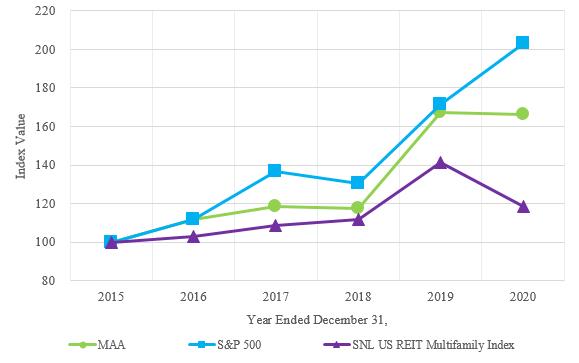]
| | | Year Ended December 31, | | | | | | | | | | | | | | | | | | | | | | | [added: |]
| | | [removed: 2014 | | | |] 2015 | | | | 2016 | | | | 2017 | | | | 2018 | | | | 2019 | | | [added: | 2020 | | | |]
| --- | --- | --- | --- | --- | --- | --- | --- | --- | --- | --- | --- | --- | --- | --- | --- | --- | --- | --- | --- | --- | --- | --- | --- | --- | --- |
| Mid-America Apartment Communities, Inc. | | $ | 100.00 | | | $ | 111.59 | | | $ | 118.59 | | | $ | 117.35 | | | $ | 167.23 | | | $ | 166.10 | | |
| S&P 500 Index | | | 100.00 | | | | 111.96 | | | | 136.40 | | | | 130.42 | | | | 171.49 | | | | 203.04 | | |
| FTSE NAREIT Equity REIT Index | | | 100.00 | | | | 102.84 | | | | 108.54 | | | | 111.60 | | | | 141.50 | | | | 118.29 | | |
month, free of brokerage commissions and charges.
| --- | --- | --- | --- | --- | --- | --- | --- | --- | --- | --- | --- | --- | --- | --- | --- | --- | --- | --- | --- | --- | --- | --- | --- | --- |
| Mid-America Apartment Communities, Inc. | | $ | 100.00 | | | $ | 126.46 | | | $ | 141.12 | | | $ | 149.97 | | | $ | 148.40 | | | $ | 211.48 | |
| S&P 500 Index | | | 100.00 | | | | 101.38 | | | | 113.51 | | | | 138.29 | | | | 132.23 | | | | 173.86 | |
| FTSE NAREIT Equity REIT Index | | | 100.00 | | | | 103.20 | | | | 111.99 | | | | 117.84 | | | | 112.39 | | | | 141.61 | |
Item 6. [Reserved]
0 rewritten, 0 added, 64 removed, 0 unchanged
The following tables set forth selected financial data on a historical basis for MAA and the Operating Partnership.
This data should be read in conjunction with the consolidated financial statements and notes thereto and “Management's Discussion and Analysis of Financial Condition and Results of Operations” included elsewhere in this Annual Report on Form 10-K.
Mid-America Apartment Communities, Inc.
Selected Financial Data
(In thousands, except per share data)
| | | Year Ended December 31, | | | | | | | | | | | | | | | | | | |
| --- | --- | --- | --- | --- | --- | --- | --- | --- | --- | --- | --- | --- | --- | --- | --- | --- | --- | --- | --- | --- |
| | | 2019 | | | | 2018 | | | | 2017 | | | | 2016 | | | | 2015 | | |
| Operating Data: | | | | | | | | | | | | | | | | | | | | |
| Rental and other property revenues | | $ | 1,641,017 | | | $ | 1,571,346 | | | $ | 1,528,987 | | | $ | 1,125,348 | | | $ | 1,042,779 | |
| | | | | | | | | | | | | | | | | | | | | |
| Net income | | | 366,618 | | | | 231,022 | | | | 340,536 | | | | 224,402 | | | | 350,745 | |
| Net income attributable to noncontrolling interests | | | 12,807 | | | | 8,123 | | | | 12,157 | | | | 12,180 | | | | 18,458 | |
| Dividends to MAA Series I preferred shareholders | | | 3,688 | | | | 3,688 | | | | 3,688 | | | | 307 | | | | — | |
| Net income available for MAA common shareholders | | $ | 350,123 | | | $ | 219,211 | | | $ | 324,691 | | | $ | 211,915 | | | $ | 332,287 | |
| Per Common Share Data: | | | | | | | | | | | | | | | | | | | | |
| Weighted average shares outstanding: | | | | | | | | | | | | | | | | | | | | |
| Basic | | | 113,854 | | | | 113,638 | | | | 113,407 | | | | 78,502 | | | | 75,176 | |
| Effect of dilutive securities (1) | | | 259 | | | | 198 | | | | 280 | | | | 298 | | | | — | |
| Diluted | | | 114,113 | | | | 113,836 | | | | 113,687 | | | | 78,800 | | | | 75,176 | |
| Per share: | | | | | | | | | | | | | | | | | | | | |
| Earnings per common share - basic | | $ | 3.07 | | | $ | 1.93 | | | $ | 2.86 | | | $ | 2.69 | | | $ | 4.41 | |
| Earnings per common share - diluted | | | 3.07 | | | | 1.93 | | | | 2.86 | | | | 2.69 | | | | 4.41 | |
| Dividends declared per common share (2) | | $ | 3.8800 | | | $ | 3.7275 | | | $ | 3.5325 | | | $ | 3.3300 | | | $ | 3.1300 | |
| Balance Sheet Data: | | | | | | | | | | | | | | | | | | | | |
| Real estate owned, at cost | | $ | 13,942,381 | | | $ | 13,700,988 | | | $ | 13,336,995 | | | $ | 13,016,663 | | | $ | 8,217,579 | |
| Real estate assets, net | | | 10,987,128 | | | | 11,151,701 | | | | 11,261,924 | | | | 11,341,862 | | | | 6,718,366 | |
| Total assets | | | 11,230,450 | | | | 11,323,781 | | | | 11,491,919 | | | | 11,604,491 | | | | 6,847,781 | |
| Total debt | | | 4,454,598 | | | | 4,528,328 | | | | 4,502,057 | | | | 4,499,712 | | | | 3,427,568 | |
| Noncontrolling interest | | | 220,894 | | | | 222,349 | | | | 233,982 | | | | 238,282 | | | | 165,726 | |
| Total MAA shareholders' equity and redeemable stock | | | 6,082,696 | | | | 6,159,254 | | | | 6,350,320 | | | | 6,413,892 | | | | 3,000,347 | |
| Other Data (at end of period): | | | | | | | | | | | | | | | | | | | | |
| Funds from operations (3) | | | | | | | | | | | | | | | | | | | | |
| Depreciation and amortization of real estate assets | | | 490,632 | | | | 484,722 | | | | 489,503 | | | | 319,528 | | | | 291,572 | |
| (Gain) loss on sale of depreciable real estate assets | | | (80,988 | ) | | | 39 | | | | (127,386 | ) | | | (80,397 | ) | | | (189,958 | ) |
| Loss on disposition within unconsolidated entities | | | — | | | | — | | | | — | | | | 98 | | | | (12 | ) |
| Depreciation and amortization of real estate assets of real estate joint venture | | | 618 | | | | 595 | | | | 596 | | | | 61 | | | | 25 | |
| Funds from operations attributable to the Company | | $ | 773,192 | | | $ | 712,690 | | | $ | 699,561 | | | $ | 463,385 | | | $ | 452,372 | |
| Market capitalization (shares and units) (4) | | $ | 15,600,827 | | | $ | 11,288,348 | | | $ | 11,849,463 | | | $ | 11,528,965 | | | $ | 7,225,894 | |
| Ratio of total debt to total capitalization (5) | | | 22.2 | % | | | 28.6 | % | | | 27.5 | % | | | 28.1 | % | | | 32.2 | % |
An excerpt. Shown here: all 0 rewritten, all 0 added and 40 of 64 removed. The counts are complete. For every sentence, read Item 6. [Reserved] in the FY2020 filing and the FY2019 filing.
Item 8. Financial Statements and Supplementary Data.
1 rewritten, 0 added, 0 removed, 0 unchanged
The consolidated financial statements and related financial information required to be filed are set forth on pages F-1 to [removed: F-42] [added: F-40] of this Annual Report on Form 10-K.
Item 9A. Controls and Procedures.
12 rewritten, 0 added, 1 removed, 16 unchanged
[removed: MAA's] [added: MAA’s] management, with the participation of MAA’s Chief Executive Officer and Chief Financial Officer, carried out an evaluation of the effectiveness of [removed: MAA's] [added: MAA’s] disclosure controls and procedures as of December 31, [removed: 2019.][added: 2020.]
Based on that evaluation, MAA’s Chief Executive Officer and Chief Financial Officer concluded that the disclosure controls and procedures were effective as of December 31, [removed: 2019] [added: 2020] to ensure that information required to be disclosed by MAA in its Exchange Act filings is accurately recorded, processed, summarized and reported within the time periods specified in the SEC’s rules and forms and is accumulated and communicated to [removed: MAA's] [added: MAA’s] management, including the Chief Executive Officer and Chief Financial Officer, as appropriate to allow timely decisions regarding required disclosure.
[removed: MAA's] [added: MAA’s] management, with the participation of [removed: MAA's] [added: MAA’s] Chief Executive Officer and Chief Financial Officer, conducted an evaluation of the effectiveness of [removed: MAA's] [added: MAA’s] internal control over financial reporting as of December 31, [removed: 2019] [added: 2020] based on the framework specified in Internal Control - Integrated Framework (2013) published by the Committee of Sponsoring Organizations of the Treadway Commission.
Based on such evaluation, [removed: MAA's] [added: MAA’s] management concluded that [removed: MAA's] [added: MAA’s] internal control over financial reporting was effective as of December 31, [removed: 2019.][added: 2020.]
Ernst & Young LLP, the independent registered public accounting firm that has audited the consolidated financial statements included [removed: elsewhere] in this Annual Report on Form 10-K, has issued an attestation report on MAA’s internal control over financial reporting, which is included herein.
There was no change to MAA’s internal control over financial reporting, within the meaning of Exchange Act Rules 13a-15 and 15d-15, that occurred during the quarter ended December 31, [removed: 2019] [added: 2020] that has materially affected, or is reasonably likely to materially affect, MAA’s internal control over financial reporting.
[removed: Mid-America] [added: Mid-America] Apartments, [removed: L.P.][added: L.P.]
Management of the Operating Partnership, with the participation of the Chief Executive Officer and Chief Financial Officer of MAA, as the general partner of the Operating Partnership, carried out an evaluation of the effectiveness of the Operating [removed: Partnership's] [added: Partnership’s] disclosure controls and procedures as of December 31, [removed: 2019.][added: 2020.]
Based on that evaluation, the Chief Executive Officer and Chief Financial Officer of MAA, as the general partner of the Operating Partnership, concluded that the disclosure controls and procedures were effective as of December 31, [removed: 2019] [added: 2020] to ensure that information required to be disclosed by the Operating Partnership in its in Exchange Act filings is accurately recorded, processed, summarized and reported within the time periods specified in the SEC’s rules and forms and is accumulated and communicated to the Operating [removed: Partnership's] [added: Partnership’s] management, including the Chief Executive Officer and Chief Financial Officer of MAA, as the general partner of the Operating Partnership, as appropriate to allow timely decisions regarding required disclosure.
[added: Management of the Operating Partnership, with the] participation of the Chief Executive Officer and Chief Financial Officer of MAA, as the general partner of the Operating Partnership, conducted an evaluation of the effectiveness of the Operating Partnership’s internal control over financial reporting as of December 31, [removed: 2019] [added: 2020] based on the framework specified in Internal Control - Integrated Framework (2013) published by the Committee of Sponsoring Organizations of the Treadway Commission.
Based on such evaluation, management of the Operating Partnership has concluded that the Operating [removed: Partnership's] [added: Partnership’s] internal control over financial reporting was effective as of December 31, [removed: 2019.][added: 2020.]
There was no change to the Operating Partnership’s internal control over financial reporting, within the meaning of Exchange Act Rules 13a-15 and 15d-15, that occurred during the quarter ended December 31, [removed: 2019] [added: 2020] that has materially affected, or is reasonably likely to materially affect, the Operating Partnership’s internal control over financial reporting.
Management of the Operating Partnership, with the
Item 10. Directors, Executive Officers and Corporate Governance.
2 rewritten, 0 added, 0 removed, 3 unchanged
The information contained in [removed: MAA's 2020] [added: MAA’s 2021] Proxy Statement in the sections entitled “Current Board Composition”, “Director Nominees for Election” and “Executive Officers of the Registrant” is incorporated herein by reference in response to this Item 10.
Our Board of Directors has adopted a Code of Conduct applicable to all officers, directors and employees, including the CEO, [removed: CFO,] [added: CFO] and principal accounting officer, which can be found on our website at https://www.maac.com, on the “For Investors” page in the “Corporate Documents” section under “Overview—Corporate Governance”.
Item 11. Executive Compensation.
1 rewritten, 0 added, 0 removed, 0 unchanged
The information contained in [removed: MAA's 2020] [added: MAA’s 2021] Proxy Statement in the sections entitled “Executive Compensation Tables”, “Director Compensation Table”, “Compensation Committee Interlocks and Insider Participation”, “Compensation Committee Report” and “Compensation Discussion and Analysis” is incorporated herein by reference in response to this Item 11.
Item 12. Security Ownership of Certain Beneficial Owners and Management and Related Stockholder Matters.
1 rewritten, 0 added, 0 removed, 0 unchanged
The information contained in [removed: MAA's 2020] [added: MAA’s 2021] Proxy Statement in the sections entitled “Security Ownership of Management”, “Security Ownership of Certain Beneficial Owners” and “Securities Authorized for Issuance Under Equity Compensation Plans” is incorporated herein by reference in response to this Item 12.
Item 13. Certain Relationships and Related Transactions, and Director Independence.
1 rewritten, 0 added, 0 removed, 0 unchanged
The information contained in [removed: MAA's 2020] [added: MAA’s 2021] Proxy Statement in the sections entitled “Certain Relationships and Related Transactions” and “Indebtedness of Management” is incorporated herein by reference in response to this Item 13.
Item 14. Principal Accounting Fees and Services.
1 rewritten, 0 added, 0 removed, 1 unchanged
The information contained in [removed: MAA's 2020] [added: MAA’s 2021] Proxy Statement in the section entitled “Audit and Non-Audit Fees” is incorporated herein by reference in response to this Item 14.
Item 15. Exhibits, Financial Statement Schedules.
25 rewritten, 3 added, 2 removed, 127 unchanged
| | [Consolidated Balance Sheets as of December 31, [removed: 2019] [added: 2020] and [removed: 2018](#CONSOLIDATED_BALANCE_SHEETS)] [added: 2019](#CONSOLIDATED_BALANCE_SHEETS)] | [removed: F-5] [added: F-6] |
| | [Consolidated Statements of Operations for the years ended December 31, [removed: 2019, 2018] [added: 2020, 2019] and [removed: 2017](#CONSOLIDATED_STATEMENTS_OPERATIONS)] [added: 2018](#CONSOLIDATED_STATEMENTS_OPERATIONS)] | [removed: F-6] [added: F-7] |
| | [Consolidated Statements of Comprehensive Income for the years ended December 31, [removed: 2019, 2018] [added: 2020, 2019] and [removed: 2017](#CONSOLIDATED_STATEMENTS_COMPREHENSIVE_IN)] [added: 2018](#CONSOLIDATED_STATEMENTS_COMPREHENSIVE_IN)] | [removed: F-7] [added: F-8] |
| | [Consolidated Statements of Equity for the years ended December 31, [removed: 2019, 2018] [added: 2020, 2019] and [removed: 2017](#CONSOLIDATED_STATEMENTS_EQUITY)] [added: 2018](#CONSOLIDATED_STATEMENTS_EQUITY)] | [removed: F-8] [added: F-9] |
| | [Consolidated Statements of Cash Flows for the years ended December 31, [removed: 2019, 2018] [added: 2020, 2019] and [removed: 2017](#CONSOLIDATED_STATEMENTS_CASH_FLOWS)] [added: 2018](#CONSOLIDATED_STATEMENTS_CASH_FLOWS)] | [removed: F-9] [added: F-10] |
| | [Consolidated Balance Sheets as of December 31, [removed: 2019] [added: 2020] and [removed: 2018](#CONSOLIDATED_BALANCE_SHEETS2)] [added: 2019](#CONSOLIDATED_BALANCE_SHEETS2)] | [removed: F-10] [added: F-11] |
| | [Consolidated Statements of Operations for the years ended December 31, [removed: 2019, 2018] [added: 2020, 2019] and [removed: 2017](#CONSOLIDATED_STATEMENTS_OPERATIONS2)] [added: 2018](#CONSOLIDATED_STATEMENTS_OPERATIONS2)] | [removed: F-11] [added: F-12] |
| | [Consolidated Statements of Comprehensive Income for the years ended December 31, [removed: 2019, 2018] [added: 2020, 2019] and [removed: 2017](#COMPREHENSIVE_IN2)] [added: 2018](#COMPREHENSIVE_IN2)] | [removed: F-12] [added: F-13] |
| | [Consolidated Statements of Changes in Capital for the years ended December 31, [removed: 2019, 2018] [added: 2020, 2019] and [removed: 2017](#CONSOLIDATED_STATEMENTS_CHANGES_IN_CAPIT)] [added: 2018](#CONSOLIDATED_STATEMENTS_CHANGES_IN_CAPIT)] | [removed: F-13] [added: F-14] |
| | [Consolidated Statements of Cash Flows for the years ended December 31, [removed: 2019, 2018] [added: 2020, 2019] and [removed: 2017](#CONSOLIDATED_STATEMENTS_CASH_FLOWS2)] [added: 2018](#CONSOLIDATED_STATEMENTS_CASH_FLOWS2)] | [removed: F-14] [added: F-15] |
| | [Notes to Consolidated Financial Statements for the years ended December 31, [removed: 2019, 2018] [added: 2020, 2019] and [removed: 2017](#NOTES_TO_CONSOLIDATED_FINANCIAL_STATEMEN)] [added: 2018](#NOTES_TO_CONSOLIDATED_FINANCIAL_STATEMEN)] | [removed: F-15] [added: F-16] |
| | [Schedule III [removed: -] [added: –] Real Estate and Accumulated Depreciation as of December 31, [removed: 2019](#SCHEDULE_III_REAL_ESTATE_ACCUMULATED_DEP)] [added: 2020](#SCHEDULE_III_REAL_ESTATE_ACCUMULATED_DEP)] | [removed: F-37] [added: F-35] |
| 4.1 | | | [Form of Common Share [removed: Certificate](https://www.sec.gov/Archives/edgar/data/912595/000156459020005582/maa-ex41_2098.htm).] [added: Certificate](https://www.sec.gov/Archives/edgar/data/912595/000156459021006666/maa-ex41_9.htm).] |
| 21.1 | | | [List of [removed: Subsidiaries.](https://www.sec.gov/Archives/edgar/data/912595/000156459020005582/maa-ex211_1618.htm)] [added: Subsidiaries.](https://www.sec.gov/Archives/edgar/data/912595/000156459021006666/maa-ex211_14.htm)] |
| 23.1 | | | [Consent of Independent Registered Public Accounting Firm, Ernst & Young LLP for [removed: MAA.](https://www.sec.gov/Archives/edgar/data/912595/000156459020005582/maa-ex231_15.htm)] [added: MAA.](https://www.sec.gov/Archives/edgar/data/912595/000156459021006666/maa-ex231_13.htm)] |
| 23.2 | | | [Consent of Independent Registered Public Accounting Firm, Ernst & Young LLP for [removed: MAALP.](https://www.sec.gov/Archives/edgar/data/912595/000156459020005582/maa-ex232_14.htm)] [added: MAALP.](https://www.sec.gov/Archives/edgar/data/912595/000156459021006666/maa-ex232_18.htm)] |
| 31.1 | | | [MAA Certification of Chief Executive Officer Pursuant to Section 302 of the Sarbanes-Oxley Act of [removed: 2002.](https://www.sec.gov/Archives/edgar/data/912595/000156459020005582/maa-ex311_12.htm)] [added: 2002.](https://www.sec.gov/Archives/edgar/data/912595/000156459021006666/maa-ex311_7.htm)] |
| 31.2 | | | [MAA Certification of Chief Financial Officer Pursuant to Section 302 of the Sarbanes-Oxley Act of [removed: 2002.](https://www.sec.gov/Archives/edgar/data/912595/000156459020005582/maa-ex312_13.htm)] [added: 2002.](https://www.sec.gov/Archives/edgar/data/912595/000156459021006666/maa-ex312_10.htm)] |
| 31.3 | | | [MAALP Certification of Chief Executive Officer Pursuant to Section 302 of the Sarbanes-Oxley Act of [removed: 2002.](https://www.sec.gov/Archives/edgar/data/912595/000156459020005582/maa-ex313_11.htm)] [added: 2002.](https://www.sec.gov/Archives/edgar/data/912595/000156459021006666/maa-ex313_11.htm)] |
| 31.4 | | | [MAALP Certification of Chief Financial Officer Pursuant to Section 302 of the Sarbanes-Oxley Act of [removed: 2002.](https://www.sec.gov/Archives/edgar/data/912595/000156459020005582/maa-ex314_10.htm)] [added: 2002.](https://www.sec.gov/Archives/edgar/data/912595/000156459021006666/maa-ex314_15.htm)] |
| 32.1* | | | [MAA Certification of Chief Executive Officer Pursuant to 18 U.S.C. Section 1350, as Adopted Pursuant to Section 906 of the Sarbanes-Oxley Act of [removed: 2002.](https://www.sec.gov/Archives/edgar/data/912595/000156459020005582/maa-ex321_9.htm)] [added: 2002.](https://www.sec.gov/Archives/edgar/data/912595/000156459021006666/maa-ex321_8.htm)] |
| 32.2* | | | [MAA Certification of Chief Financial Officer Pursuant to 18 U.S.C. Section 1350, as Adopted Pursuant to Section 906 of the Sarbanes-Oxley Act of [removed: 2002.](https://www.sec.gov/Archives/edgar/data/912595/000156459020005582/maa-ex322_8.htm)] [added: 2002.](https://www.sec.gov/Archives/edgar/data/912595/000156459021006666/maa-ex322_17.htm)] |
| 32.3* | | | [MAALP Certification of Chief Executive Officer Pursuant to 18 U.S.C. Section 1350, as Adopted Pursuant to Section 906 of the Sarbanes-Oxley Act of [removed: 2002.](https://www.sec.gov/Archives/edgar/data/912595/000156459020005582/maa-ex323_7.htm)] [added: 2002.](https://www.sec.gov/Archives/edgar/data/912595/000156459021006666/maa-ex323_6.htm)] |
| 32.4* | | | [MAALP Certification of Chief Financial Officer Pursuant to 18 U.S.C. Section 1350, as Adopted Pursuant to Section 906 of the Sarbanes-Oxley Act of [removed: 2002.](https://www.sec.gov/Archives/edgar/data/912595/000156459020005582/maa-ex324_6.htm)] [added: 2002.](https://www.sec.gov/Archives/edgar/data/912595/000156459021006666/maa-ex324_16.htm)] |
| 101 | | | The following financial information from Mid-America Apartment Communities, Inc.’s and Mid-America Apartments, [removed: L.P.'s] [added: L.P.’s] Annual Report on Form 10-K for the period ended December 31, [removed: 2019,] [added: 2020,] filed with the SEC on February [removed: 20, 2020,] [added: 18, 2021,] formatted in iXBRL (Inline Extensible Business Reporting Language): (i) the Consolidated Balance Sheets as of December 31, [removed: 2019] [added: 2020] and December 31, [removed: 2018;] [added: 2019;] (ii) the Consolidated Statements of Operations for the years ended December 31, [removed: 2019, 2018] [added: 2020, 2019] and [removed: 2017;] [added: 2018;] (iii) the Consolidated Statements of Comprehensive Income for the years ended December 31, [removed: 2019, 2018] [added: 2020, 2019] and [removed: 2017;] [added: 2018;] (iv) the Consolidated Statements of Equity/Changes in Capital for the years ended December 31, [removed: 2019, 2018] [added: 2020, 2019] and [removed: 2017;] [added: 2018;] (v) the Consolidated Statements of Cash Flows for the years ended December 31, [removed: 2019, 2018] [added: 2020, 2019] and [removed: 2017;] [added: 2018;] (vi) Notes to Consolidated Financial Statements; and (vii) Schedule III - Real Estate and Accumulated Depreciation as of December 31, [removed: 2019.] [added: 2020.] |
| 4.15 | | | [Fifth Supplemental Indenture, dated as of August 12, 2020, by and between Mid-America Apartments, L.P. and U.S. Bank National Association (Filed as Exhibit 4.2 to the Registrant’s Current Report on Form 8-K filed on August 12, 2020 and incorporated herein by reference).](http://www.sec.gov/Archives/edgar/data/912595/000119312520217636/d22080dex42.htm) |
| 4.16 | | | [Description of Securities (Filed as Exhibit 4.15 to the Registrant’s Annual Report on Form 10-K filed on February 20, 2020 and incorporated herein by reference).](http://www.sec.gov/Archives/edgar/data/912595/000156459020005582/maa-ex415_1341.htm) |
| | | | |
| | | |
| 4.15 | | | [Description of Securities.](https://www.sec.gov/Archives/edgar/data/912595/000156459020005582/maa-ex415_1341.htm) |
Item 16. Form 10-K Summary.
666 rewritten, 340 added, 278 removed, 747 unchanged
| Date: | February [removed: 20, 2020] [added: 18, 2021] | /s/ H. Eric Bolton, Jr. |
| Date: | February [removed: 20, 2020] [added: 18, 2021] | /s/ Albert M. Campbell, III |
| Date: | February [removed: 20, 2020] [added: 18, 2021] | /s/ A. Clay Holder |
| Date: | February [removed: 20, 2020] [added: 18, 2021] | /s/ Russell R. French |
| Date: | February [removed: 20, 2020] [added: 18, 2021] | /s/ Alan B. Graf, Jr. |
| Date: | February [removed: 20, 2020] [added: 18, 2021] | /s/ Toni Jennings |
| Date: | February [removed: 20, 2020] [added: 18, 2021] | /s/ James K. Lowder |
| Date: | February [removed: 20, 2020] [added: 18, 2021] | /s/ Thomas H. Lowder |
| Date: | February [removed: 20, 2020] [added: 18, 2021] | /s/ Monica McGurk |
| Date: | February [removed: 20, 2020] [added: 18, 2021] | /s/ Claude B. Nielsen |
| Date: | February [removed: 20, 2020] [added: 18, 2021] | /s/ Philip W. Norwood |
| Date: | February [removed: 20, 2020] [added: 18, 2021] | /s/ W. Reid Sanders |
| Date: | February [removed: 20, 2020] [added: 18, 2021] | /s/ Gary Shorb |
| Date: | February [removed: 20, 2020] [added: 18, 2021] | /s/ David P. Stockert |
We have audited the accompanying consolidated balance sheets of Mid-America Apartment Communities, Inc. (the Company) as of December 31, [removed: 2019] [added: 2020] and [removed: 2018,] [added: 2019,] the related consolidated statements of operations, comprehensive income, equity, and cash flows for each of the three years in the period ended December 31, [removed: 2019,] [added: 2020,] and the related notes and financial statement schedule listed in the Index at Item 15(a)(2) (collectively referred to as the “consolidated financial statements”).
In our opinion, the consolidated financial statements present fairly, in all material respects, the financial position of the Company at December 31, [removed: 2019] [added: 2020] and [removed: 2018,] [added: 2019,] and the results of its operations and its cash flows for each of the three years in the period ended December 31, [removed: 2019,] [added: 2020,] in conformity with U.S. generally accepted accounting principles.
We also have audited, in accordance with the standards of the Public Company Accounting Oversight Board (United States) (PCAOB), the Company’s internal control over financial reporting as of December 31, [removed: 2019,] [added: 2020,] based on criteria established in Internal Control-Integrated Framework issued by the Committee of Sponsoring Organizations of the Treadway Commission (2013 framework) and our report dated February [removed: 20, 2020] [added: 18, 2021] expressed an unqualified opinion thereon.
| Description of the Matter | | As discussed in Note 11 to the consolidated financial statements, two separate class action lawsuits were filed against the Company in 2016 and 2017. The lawsuits both relate to purported [removed: late-fee] violations [added: of a late-fee statute] in the state of Texas. In 2018, the plaintiffs’ [removed: motion] [added: motions] for partial summary judgment [removed: was] [added: and class certification were] granted. [added: The Company appealed the class certification to the Fifth Circuit Court of Appeals.] Given the class certification and summary judgment ruling, management estimates that the Company’s maximum exposure in the lawsuits is $63.0 million. Auditing management’s evaluation of an accrual for, and disclosure of, loss contingencies related to the class action lawsuits was especially challenging because management’s evaluation of the likelihood and amount of loss and range of potential loss is highly subjective and requires significant judgment. In particular, management’s evaluation considers, among other factors, the nature of the claim, the asserted or possible damages, the progress of the matter, existing law and precedent, the opinions or views of legal counsel and other advisors, the Company’s experience in similar matters, the facts available at the time of the assessment, and how the Company intends to respond, or has responded, to the claim, which involves a series of complex judgments about future events. |
| *How We Addressed the Matter in Our Audit* | | We obtained an understanding, evaluated the design and tested the operating effectiveness of controls over the evaluation of the class action lawsuits, including controls related to the Company’s assessment and measurement of its [removed: best] estimate of maximum exposure. For example, we tested controls over management’s review and approval of the legal reserves and related disclosures. To test the Company’s assessment of the probability of incurrence of a loss and whether the loss was reasonably estimable, our audit procedures included, among others, reading summaries of the proceedings and related lawsuit correspondence, requesting and receiving written responses to our inquiries of internal and external legal counsel and meeting with internal and external legal counsel to discuss developments related to the legal matters and case progression. To test the measurement of management’s estimate of maximum exposure, among other procedures, we evaluated the method of measuring the maximum exposure and related assumptions, tested the accuracy and completeness of the data, and reviewed correspondence received from internal and external counsel used to determine the estimate of maximum exposure that was disclosed. |
| Description of the Matter | | As disclosed in Notes 6 and 8 to the consolidated financial statements, the Series I Preferred Stock shares (“preferred shares”) include a redemption feature which represents an embedded call option exercisable at the Company’s option beginning on October 1, 2026 at the redemption price of $50 per share. The embedded call option has been bifurcated as a separate asset and is valued at fair value each reporting period with changes in its fair value reported in earnings. At each reporting date, management performs an analysis which compares the perpetual value of the preferred shares to the value of the preferred shares assuming the call option is exercised, with the value of the bifurcated call option as the difference between the two values. At December 31, [removed: 2019,] [added: 2020,] the fair value of the Company’s embedded derivative asset was [removed: $36.5] [added: $39.0] million. Auditing the Company’s valuation of this bifurcated embedded derivative was challenging as the Company uses a complex valuation methodology that incorporates various inputs, including trading data available on the preferred shares, treasury rates and coupon yields on preferred stock issuances from REITs with similar credit ratings, and includes significant assumptions about economic and market conditions with uncertain future outcomes. |
We have audited the accompanying consolidated balance sheets of Mid-America Apartments, L.P. (the [added: Operating] Partnership) as of December 31, [removed: 2019] [added: 2020] and [removed: 2018,] [added: 2019,] the related consolidated statements of operations, comprehensive income, changes in capital, and cash flows for each of the three years in the period ended December 31, [removed: 2019,] [added: 2020,] and the related notes and financial statement schedule listed in the Index at Item 15(a)(2) (collectively referred to as the “consolidated financial statements”).
In our opinion, the consolidated financial statements present fairly, in all material respects, the financial position of the [added: Operating] Partnership at December 31, [removed: 2019] [added: 2020] and [removed: 2018,] [added: 2019,] and the results of its operations and its cash flows for each of the three years in the period ended December 31, [removed: 2019,] [added: 2020,] in conformity with U.S. generally accepted accounting principles.
These financial statements are the responsibility of the [added: Operating] Partnership’s management.
Our responsibility is to express an opinion on the [removed: Partnership's] [added: Operating Partnership’s] financial statements based on our audits.
We are a public accounting firm registered with the Public Company Accounting Oversight Board (United States) (PCAOB) and are required to be independent with respect to the [added: Operating] Partnership in accordance with the U.S. federal securities laws and the applicable rules and regulations of the Securities and Exchange Commission and the PCAOB.
The [added: Operating] Partnership is not required to have, nor were we engaged to perform, an audit of its internal control over financial reporting.
As part of our audits we are required to obtain an understanding of internal control over financial reporting but not for the purpose of expressing an opinion on the effectiveness of the [added: Operating] Partnership’s internal control over financial reporting.
We have served as the [removed: Partnership's] [added: Operating Partnership’s] auditor since 2012.
We have audited Mid-America Apartment Communities, Inc.’s internal control over financial reporting as of December 31, [removed: 2019,] [added: 2020,] based on criteria established in Internal Control-Integrated Framework issued by the Committee of Sponsoring Organizations of the Treadway Commission (2013 framework) (the COSO criteria).
In our opinion, Mid-America Apartment Communities, Inc. (the Company) maintained, in all material respects, effective internal control over financial reporting as of December 31, [removed: 2019,] [added: 2020,] based on the COSO criteria.
We also have audited, in accordance with the standards of the Public Company Accounting Oversight Board (United States) (PCAOB), the consolidated balance sheets of the Company as of December 31, [removed: 2019] [added: 2020] and [removed: 2018,] [added: 2019,] the related consolidated statements of operations, comprehensive income, equity, and cash flows for each of the three years in the period ended December 31, [removed: 2019,] [added: 2020,] and the related notes and financial statement schedule listed in the Index at Item 15(a)(2) and our report dated February [removed: 20, 2020] [added: 18, 2021] expressed an unqualified opinion thereon.
December 31, [removed: 2019] [added: 2020] and [removed: 2018][added: 2019]
| | | December 31, [removed: 2019] [added: 2020] | | | | December 31, [removed: 2018] [added: 2019] | | |
| Land | | $ | [removed: 1,905,757] [added: 1,929,181] | | | $ | [removed: 1,868,828] [added: 1,905,757] | |
| Buildings and improvements and other | | | [removed: 11,841,978] [added: 12,065,244] | | | | [removed: 11,670,216] [added: 11,841,978] | |
| Development and capital improvements in progress | | | [removed: 116,424] [added: 283,477] | | | | [removed: 59,506] [added: 116,424] | |
| Less: Accumulated depreciation | | | [removed: (2,955,253] [added: (3,415,105] | ) | | | [removed: (2,549,287] [added: (2,955,253] | ) |
| Undeveloped land | | | [removed: 34,548] [added: 60,993] | | | | [removed: 58,257] [added: 34,548] | |
| Investment in real estate joint venture | | | [removed: 43,674] [added: 43,325] | | | | [removed: 44,181] [added: 43,674] | |
| Real estate assets, net | | | [removed: 10,987,128] [added: 10,967,115] | | | | [removed: 11,151,701] [added: 10,987,128] | |
| Date: | February 18, 2021 | /s/ H. Eric Bolton, Jr. |
| Date: | February 18, 2021 | /s/ Edith Kelly-Green |
| | | Edith Kelly-Green Director |
| Date: | February 18, 2021 | /s/ H. Eric Bolton, Jr. |
| Date: | February 18, 2021 | /s/ H. Eric Bolton, Jr. |
| Date: | February 18, 2021 | /s/ Albert M. Campbell, III |
| Date: | February 18, 2021 | /s/ A. Clay Holder |
| Date: | February 18, 2021 | /s/ Russell R. French |
| Date: | February 18, 2021 | /s/ Alan B. Graf, Jr. |
| Date: | February 18, 2021 | /s/ Edith Kelly-Green |
| | | Edith Kelly-Green Director |
| Date: | February 18, 2021 | /s/ Toni Jennings |
| Date: | February 18, 2021 | /s/ James K. Lowder |
| Date: | February 18, 2021 | /s/ Thomas H. Lowder |
| Date: | February 18, 2021 | /s/ Monica McGurk |
| Date: | February 18, 2021 | /s/ Claude B. Nielsen |
| Date: | February 18, 2021 | /s/ Philip W. Norwood |
| Date: | February 18, 2021 | /s/ W. Reid Sanders |
| Date: | February 18, 2021 | /s/ Gary Shorb |
| Date: | February 18, 2021 | /s/ David P. Stockert |
| | | |
| | | |
| | | |
February 18, 2021
Critical Audit Matters
The critical audit matters communicated below are matters arising from the current period audit of the financial statements that were communicated or required to be communicated to the audit committee and that: (1) relate to accounts or disclosures that are material to the financial statements and (2) involved our especially challenging, subjective or complex judgments.
The communication of critical audit matters does not alter in any way our opinion on the consolidated financial statements, taken as a whole, and we are not, by communicating the critical audit matters below, providing separate opinions on the critical audit matters or on the accounts or disclosures to which they relate.
| | | |
| | | Loss Contingencies |
| Description of the Matter | | As discussed in Note 11 to the consolidated financial statements, two separate class action lawsuits were filed against Mid-America Apartment Communities, Inc. (MAA) and the Operating Partnership in 2016 and 2017. The lawsuits both relate to purported violations of a late-fee statute in the state of Texas. In 2018, the plaintiffs’ motions for partial summary judgment and class certification were granted. MAA and the Operating Partnership appealed the class certification to the Fifth Circuit Court of Appeals. Given the class certification and summary judgment ruling, management estimates that MAA’s and the Operating Partnership’s maximum exposure in the lawsuits is $63.0 million. Auditing management’s evaluation of an accrual for, and disclosure of, loss contingencies related to the class action lawsuits was especially challenging because management’s evaluation of the likelihood and amount of loss and range of potential loss is highly subjective and requires significant judgment. In particular, management’s evaluation considers, among other factors, the nature of the claim, the asserted or possible damages, the progress of the matter, existing law and precedent, the opinions or views of legal counsel and other advisors, MAA’s and the Operating Partnership’s experience in similar matters, the facts available at the time of the assessment, and how MAA and the Operating Partnership intends to respond, or has responded, to the claim, which involves a series of complex judgments about future events. |
| | | |
| *How We Addressed the Matter in Our Audit* | | We obtained an understanding, evaluated the design and tested the operating effectiveness of controls over the evaluation of the class action lawsuits, including controls related to the Operating Partnership’s assessment and measurement of its estimate of maximum exposure. For example, we tested controls over management’s review and approval of the legal reserves and related disclosures. To test the Operating Partnership’s assessment of the probability of incurrence of a loss and whether the loss was reasonably estimable, our audit procedures included, among others, reading summaries of the proceedings and related lawsuit correspondence, requesting and receiving written responses to our inquiries of internal and external legal counsel and meeting with internal and external legal counsel to discuss developments related to the legal matters and case progression. To test the measurement of management’s estimate of maximum exposure, among other procedures, we evaluated the method of measuring the maximum exposure and related assumptions, tested the accuracy and completeness of the data, and reviewed correspondence received from internal and external counsel used to determine the estimate of maximum exposure that was disclosed. |
| | | Valuation of Embedded Derivative |
| Description of the Matter | | As disclosed in Notes 6 and 9 to the consolidated financial statements, the MAALP Series I Preferred Units (“preferred units”) have the same characteristics as the MAA Series I Preferred Stock shares (“preferred shares”), and thus include a redemption feature which represents an embedded call option exercisable at the Operating Partnership’s option beginning on October 1, 2026 at the redemption price of $50 per share. The embedded call option has been bifurcated as a separate asset and is valued at fair value each reporting period with changes in its fair value reported in earnings. At each reporting date, management performs an analysis which compares the perpetual value of the preferred units to the value of the preferred units assuming the call option is exercised, with the value of the bifurcated call option as the difference between the two values. At December 31, 2020, the fair value of the Operating Partnership’s embedded derivative asset was $39.0 million. Auditing the Operating Partnership’s valuation of this bifurcated embedded derivative was challenging as the Operating Partnership uses a complex valuation methodology that incorporates various inputs, including trading data available on the respective MAA preferred shares, treasury rates and coupon yields on preferred stock issuances from REITs with similar credit ratings, and includes significant assumptions about economic and market conditions with uncertain future outcomes. |
| How We Addressed the Matter in Our Audit | | We obtained an understanding, evaluated the design and tested the operating effectiveness of the Operating Partnership’s controls over the risks of material misstatement relating to the valuation of the bifurcated embedded derivative asset. For example, we tested controls over management’s review of the valuation model and the underlying inputs and assumptions noted above. To test the valuation of the embedded derivative asset, our audit procedures included, among others, assessing the methodology used in the valuation model and testing the significant assumptions discussed above. For example, we evaluated management’s assumptions by comparing the coupon rate that was used to discount future dividend payments from the preferred units to observable market data. We also assessed the completeness and accuracy of the underlying data used by the Operating Partnership in its valuation. In addition, we involved our valuation specialists to assist in our evaluation of the methodology used by the Operating Partnership and the underlying inputs and assumptions noted above. |
February 18, 2021
February 18, 2021
| | | | 14,277,902 | | | | 13,864,159 | |
| | | | 10,862,797 | | | | 10,908,906 | |
| Cash and cash equivalents | | | 25,198 | | | | 20,476 | |
February 20, 2020
| --- | --- | --- | --- | --- | --- | --- | --- | --- |
| | | | 13,864,159 | | | | 13,598,550 | |
| | | | 10,908,906 | | | | 11,049,263 | |
| | | | | | | | | |
| --- | --- |
| Revenues: | | | | | | | | | | | | |
| EQUITY BALANCE DECEMBER 31, 2016 | | | 868 | | | $ | 9 | | | | 113,415 | | | $ | 1,133 | | | $ | 7,109,012 | | | $ | (707,479 | ) | | $ | 1,144 | | | $ | 235,976 | | | $ | 2,306 | | | $ | 6,642,101 | | | | $ | 10,073 | |
| Net income | | | — | | | | — | | | | — | | | | — | | | | — | | | | 328,379 | | | | — | | | | 12,157 | | | | — | | | | 340,536 | | | | | — | |
| Issuance and registration of common shares | | | — | | | | — | | | | 137 | | | | 1 | | | | 615 | | | | — | | | | — | | | | — | | | | — | | | | 616 | | | | | 1,588 | |
| Issuance and registration of preferred shares | | | — | | | | — | | | | — | | | | — | | | | 2,007 | | | | — | | | | — | | | | — | | | | — | | | | 2,007 | | | | | — | |
| Shares issued in exchange for redeemable stock | | | — | | | | — | | | | — | | | | — | | | | 1,482 | | | | — | | | | — | | | | — | | | | — | | | | 1,482 | | | | | (1,482 | ) |
| Mark-to-market adjustment on derivative instruments | | | 19,578 | | | | (6,436 | ) | | | 17,806 | |
| CAPITAL BALANCE DECEMBER 31, 2016 | | $ | 235,976 | | | $ | 6,337,721 | | | $ | 64,833 | | | $ | 1,246 | | | $ | 2,306 | | | $ | 6,642,082 | | | | $ | 10,073 | |
| Net income | | | 12,157 | | | | 324,691 | | | | 3,688 | | | | — | | | | — | | | | 340,536 | | | | | — | |
| Issuance of units | | | — | | | | 616 | | | | 2,007 | | | | — | | | | — | | | | 2,623 | | | | | 1,588 | |
| Units issued in exchange for redeemable units | | | — | | | | 1,482 | | | | — | | | | — | | | | — | | | | 1,482 | | | | | (1,482 | ) |
| Distributions to common unitholders ($3.5325 per unit) | | | (14,849 | ) | | | (401,369 | ) | | | — | | | | — | | | | — | | | | (416,218 | ) | | | | — | |
which $143.9 million had been incurred through December 31, 2019.
The Company expects to complete one development in the first half of 2020, one development in the second half of 2020, one development in the first half of 2021, three developments in the second half of 2021, and one development in the first half of 2022.
Thirty-two of the Company's apartment communities include retail components with approximately 630,000 square feet of gross leasable space.
The Company also has four commercial properties with approximately 260,000 square feet of combined gross leasable area.
Changes in Presentation
In order to simplify the Company's presentation of cash flows from financing activities within the Consolidated Statements of Cash Flows, the Company combined “Repurchase of common stock / units”; “Debt prepayment and extinguishment costs”; “Proceeds from issuances of common shares / units”; and “Exercise of stock / unit options” into one line, “Net change in other financing activities” within the cash flows from financing activities section.
No presentation changes were made to the cash flows from operating or investing activities sections of the Consolidated Statements of Cash Flows.
These changes in presentation had no effect on the Company's ending cash, cash equivalents and restricted cash balances and did not impact the classification of cash flows between operating, investing and financing activities.
During the year ended December 31,
2019, the Company acquired a partial ownership interest in two consolidated real estate entities and acquired the noncontrolling interest of one consolidated real estate entity for cash proceeds of $10.9 million.
loss contingencies of $8.6 million and $8.7 million as of December 31, 2019 and 2018, respectively; security deposits of $19.4 million and $18.7 million as of December 31, 2019 and 2018, respectively; and accrued interest payable of $21.4 million and $15.1 million as of December 31, 2019 and 2018, respectively.
In 2016, the Financial Accounting Standards Board, or FASB, issued Accounting Standard Update, or ASU, 2016-02, *Leases* (Topic 842), which established new principles, presentation and disclosure requirements for lease accounting for both the lessee and lessor.
On January 1, 2019, management adopted ASU 2016-02 using the modified retrospective transition approach with an effective date as of the adoption date and elected certain practical expedients allowed by the new standard.
Under the new standard, lessors are generally required to account for leases in a similar manner as previous lease accounting guidance; however, certain aspects of the new standard are aligned with the recently adopted revenue recognition standard.
Lessees are required to record most leases on the balance sheet and recognize lease expense in the income statement in a manner similar to previous practice.
Expenses related to leases determined to be operating leases are recognized on a straight-line basis, while expenses related to leases determined to be financing leases are recognized based on an effective interest method in which interest and amortization are presented separately in the income statement.
Comparative periods presented in this Annual Report on Form 10-K continue to apply guidance in ASC Topic 840, *Leases,* and have not been recast as the Company adopted the new standard using the modified retrospective transition approach effective as of January 1, 2019.
The adoption of the new lease standard has not resulted in a significant change in the accounting for the Company’s rental
revenues as the Company's residential, retail and commercial leases, where it is the lessor, will continue to be accounted for as operating leases.
Management has elected available practical expedients that provide lessors an option not to separate lease and non-lease components when certain criteria are met, and instead, allow for those components to be accounted for as a single lease component.
Based on its election of the package of practical expedients provided in ASU 2016-02, the Company did not reassess the classification of existing leases with its adoption of ASC Topic 842.
The Company’s existing leases as of January 1, 2019 have continued to be accounted for as operating leases; however, if contracts are modified subsequent to the adoption of the new standard, the Company is required to reassess the contracts using guidance provided under ASC Topic 842.
An excerpt. Shown here: 40 of 666 rewritten, 40 of 340 added and 40 of 278 removed. The counts are complete. For every sentence, read Item 16. Form 10-K Summary. in the FY2020 filing and the FY2019 filing.