 filings.tools
Microchip Technology 10-K 2020-03-31
Filed 2020-05-22. 22 sections, 516K characters. Original on sec.gov · Markdown · JSON
Cover and table of contents
UNITED STATES
SECURITIES AND EXCHANGE COMMISSION
Washington, D.C. 20549
FORM 10-K
(Mark One)
☒Annual Report pursuant to Section 13 or 15(d) of the Securities Exchange Act of 1934
For the fiscal year ended March 31, 2020
OR
☐Transition report pursuant to Section 13 or 15(d) of the Securities Exchange Act of 1934
For the transition period from _________ to __________
Commission File Number: 0-21184

MICROCHIP TECHNOLOGY INCORPORATED
(Exact Name of Registrant as Specified in Its Charter)
| Delaware | 86-0629024 | |
| (State or Other Jurisdiction of Incorporation or Organization) | (IRS Employer Identification No.) |
2355 W. Chandler Blvd.****, Chandler**,** AZ 85224-6199
(Address of Principal Executive Offices, Including Zip Code)
(480) 792-7200
(Registrant's Telephone Number, Including Area Code)
Securities registered pursuant to Section 12(b) of the Act:
| Title of Each Class | Trading Symbol | Name of Each Exchange on Which Registered | |
| Common Stock, $0.001 Par Value Per Share | MCHP | NASDAQ | Stock Market LLC |
| (Nasdaq Global Select Market) |
Securities registered pursuant to Section 12(g) of the Act: None
Indicate by check mark if the Registrant is a well-known seasoned issuer, as defined in Rule 405 of the Securities Act. ☒ Yes ☐ No
Indicate by check mark if the Registrant is not required to file reports pursuant to Section 13 or Section 15(d) of the Act. ☐ Yes ☒ No
Indicate by check mark whether the Registrant: (1) has filed all reports required to be filed by Section 13 or 15(d) of the Securities Exchange Act of 1934 during the preceding 12 months (or for such shorter period that the registrant was required to file such reports), and (2) has been subject to such filing requirements for the past 90 days. ☒ Yes ☐ No
Indicate by check mark whether the registrant has submitted electronically every Interactive Data File required to be submitted pursuant to Rule 405 of Regulation S-T (§229.405 of this chapter) during the preceding 12 months (or for such shorter period that the registrant was required to submit such files). ☒ Yes ☐ No
Indicate by check mark whether the registrant is a large accelerated filer, an accelerated filer, a non-accelerated filer, a smaller reporting company, or an emerging growth company. See definitions of "large accelerated filer," "accelerated filer," "smaller reporting company," and "emerging growth company" in Rule 12b-2 of the Exchange Act:
| Large accelerated filer | ☒ | Accelerated filer | ☐ | Non-accelerated filer | ☐ | Smaller reporting company | ☐ |
| Emerging growth company | ☐ |
If an emerging growth company, indicate by check mark if the registrant has elected not to use the extended transition period for complying with any new or revised financial accounting standards provided pursuant to Section 13(a) of the Exchange Act. ☐
Indicate by check mark whether the registrant has filed a report on and attestation to its management's assessment of the effectiveness of its internal control over financial reporting under Section 404(b) of the Sarbanes-Oxley Act (15 U.S.C. 7262(b)) by the registered public accounting firm that prepared or issued its audit report. ☒
Indicate by check mark whether the registrant is a shell company (as defined in Rule 12b-2 of the Exchange Act). ☐ Yes ☒ No
Aggregate market value of the voting and non-voting common equity held by non-affiliates as of September 30, 2019 based upon the closing price of the common stock as reported by the NASDAQ Global Market on such date was approximately $21,697,205,962.
Number of shares of Common Stock, $0.001 par value, outstanding as of May 14, 2020: 245,332,497 shares
| Documents Incorporated by Reference | ||
| Document | Part of Form 10-K | |
| Annual Report on Form 10-K for the fiscal year ended March 31, 2019 | II | |
| Proxy Statement for the 2020 Annual Meeting of Stockholders | III |
MICROCHIP TECHNOLOGY INCORPORATED AND SUBSIDIARIES
FORM 10-K
TABLE OF CONTENTS
PART I
This Form 10-K contains certain forward-looking statements that involve risks and uncertainties, including statements regarding our strategy and future financial performance and those statements identified under "Item 7 – Management's Discussion and Analysis of Financial Condition and Results of Operations – Note Regarding Forward-looking Statements." Our actual results could differ materially from the results described in these forward-looking statements as a result of certain factors including those set forth under "Item 1A – Risk Factors," beginning below at page 12, and elsewhere in this Form 10-K. Although we believe that the matters reflected in the forward-looking statements are reasonable, we cannot guarantee future results, levels of activity, performance or achievements. You should not place undue reliance on these forward-looking statements. We disclaim any obligation to update information contained in any forward-looking statement. In this Form 10-K, "we," "us," "our," and "Microchip" each refers to Microchip Technology Incorporated and its subsidiaries.
Item 1. Business
We develop, manufacture and sell specialized semiconductor products used by our customers for a wide variety of embedded control applications. Our product portfolio comprises general purpose and specialized 8-bit, 16-bit, and 32-bit microcontrollers, 32-bit microprocessors, field-programmable gate array (FPGA) products, a broad spectrum of high-performance linear, mixed-signal, power management, thermal management, discrete diodes and Metal Oxide Semiconductor Field Effect Transistors (MOSFETS), radio frequency (RF), timing, timing systems, safety, security, wired connectivity and wireless connectivity devices, as well as Serial Electrically Erasable Programmable Read Only Memory (EEPROM), Serial Flash memories, Parallel Flash memories, Serial Electrically Erasable Random Access Memory (EERAM) and Serial Static Random Access Memory (SRAM). We also license Flash-IP solutions that are incorporated in a broad range of products. Our synergistic product portfolio targets thousands of applications worldwide and a strong demand for high-performance designs in the automotive, aerospace, defense, space, communications, computing, consumer and industrial control markets. We comply with several quality systems, including: ISO9001 (2015 version), IATF16949 (2016 version), AS9100 (2016 version), and TL9000.
Microchip Technology Incorporated was incorporated in Delaware in 1989. Our executive offices are located at 2355 West Chandler Boulevard, Chandler, Arizona 85224-6199 and our telephone number is (480) 792-7200.
Our Internet address is www.microchip.com. We post the following filings on our website as soon as reasonably practicable after they are electronically filed with or furnished to the Securities and Exchange Commission:
| • | our annual report on Form 10-K |
| • | our quarterly reports on Form 10-Q |
| • | our current reports on Form 8-K |
| • | our proxy statement |
| • | any amendments to the above-listed reports filed or furnished pursuant to Sections 13(a) or 15(d) of the Securities Exchange Act of 1934 |
All of our SEC filings on our website are available free of charge. The information on our website is not incorporated into this Form 10-K.
Acquisition of Microsemi
On May 29, 2018, we completed our acquisition of Microsemi Corporation (Microsemi), a publicly traded company headquartered in Aliso Viejo, California. We paid an aggregate of approximately $8.19 billion in cash to the stockholders of Microsemi. The total consideration transferred in the acquisition, including approximately $53.9 million of non-cash consideration for the exchange of certain share-based payment awards of Microsemi for stock awards of Microchip, was approximately $8.24 billion. In addition to the consideration transferred, we recognized in our consolidated financial statements $3.23 billion in liabilities of Microsemi consisting of debt, taxes payable and deferred, pension obligations, restructuring, and contingent and other liabilities of which $2.06 billion of existing debt was paid off. We financed the purchase price using approximately $8.10 billion of borrowings consisting of $3.10 billion of loans under our revolving line of credit (the "Revolving Credit Facility"), $3.00 billion of term loans ("Term Loan Facility") provided under our amended and restated Credit Agreement, and $2.00 billion in newly issued senior secured notes. We incurred $22.0 million in costs related to the acquisition. As a result of the acquisition, Microsemi became a wholly owned subsidiary of Microchip. Microsemi offers a comprehensive portfolio of semiconductor and system solutions for aerospace and defense, communications, data center and industrial markets. Our primary reason for this acquisition was to expand our range of solutions, products and capabilities by extending our served available market.
Industry Background
Competitive pressures require original equipment manufacturers (OEM) of a wide variety of products to expand product functionality and provide differentiation while maintaining or reducing cost. To address these requirements, manufacturers often use integrated circuit-based embedded control systems that enable them to:
| • | differentiate their products |
| • | replace less efficient electromechanical control devices |
| • | reduce the number of components in their system |
| • | add product functionality |
| • | reduce the system level energy consumption |
| • | make systems safer to operate |
| • | add security to their products |
| • | decrease time to market for their products |
| • | significantly reduce product cost |
Embedded control systems have been incorporated into thousands of products and subassemblies in a wide variety of applications and markets worldwide, including:
| • | actuators |
| • | applications needing touch buttons, touch screens and graphical user interfaces |
| • | automotive access control |
| • | automotive comfort, safety, information and entertainment applications |
| • | avionics |
| • | building automation |
| • | communication infrastructure systems |
| • | consumer electronics |
| • | defense and military hardware |
| • | energy monitoring |
| • | handheld tools |
| • | industrial automation |
| • | large and small home appliances |
| • | medical devices |
| • | motor controls |
| • | portable computers and accessories |
| • | power supplies |
| • | remote control devices |
| • | robotics |
| • | routers and video surveillance systems |
| • | satellites |
| • | security systems |
| • | smoke and carbon monoxide detectors |
| • | storage and server systems |
| • | thermostats |
Embedded control systems typically incorporate a microcontroller as the principal active, and sometimes sole, component. A microcontroller is a self-contained computer-on-a-chip consisting of a central processing unit, often with on-board non-volatile program memory for program storage, random access memory for data storage and various analog and digital input/output peripheral capabilities. In addition to the microcontroller, a complete embedded control system often incorporates application-specific software, various analog, mixed-signal, timing, connectivity, security and non-volatile memory components such as EEPROMs and Flash memory.
The increasing demand for embedded control has made the market for microcontrollers a significant segment of the semiconductor market at $18 billion in calendar year 2019. Microcontrollers are primarily available in 8-bit through 32-bit architectures. 8-bit microcontrollers remain very cost-effective and easy to use for a wide range of high-volume embedded control applications and, as a result, continue to represent a significant portion of the overall microcontroller market. 16-bit and 32-bit microcontrollers provide higher performance and functionality, and are generally found in more complex embedded control applications. FPGAs are programmable integrated circuits that are used to implement complex logic functions and can
be re-programmed at any time, allowing for multiple implementations and revisions during or after the end customer system is manufactured. Some versions of FPGAs also include a microcontroller or microprocessor core to provide additional system on chip functionality for compute intensive tasks. The analog and mixed-signal segment of the semiconductor market was $56 billion in calendar year 2019, and this market is fragmented into a large number of sub segments.
Our Products
Our strategic focus is on embedded control solutions, including:
| • | general purpose and specialized microcontrollers and microprocessors |
| • | wired and wireless connectivity products |
| • | development tools and related software |
| • | analog, interface, mixed signal, timing, timing systems and security products |
| • | discrete diodes and MOSFETS |
| • | FPGA products |
| • | memory products |
| • | technology licensing |
We provide cost-effective embedded control solutions that also offer the advantages of small size, high performance, extreme low power usage, wide voltage range operation, mixed signal integration, and ease of development, thus enabling timely and cost-effective integration of our solutions by our customers in their end products.
Microcontrollers
We offer a broad family of proprietary general purpose microcontroller products marketed under multiple brand names. We believe that our microcontroller product families provide leading function and performance characteristics in the worldwide microcontroller market. With over 3,950 microcontrollers in our product portfolio, we target the 8-bit, 16-bit, and 32-bit microcontroller and 32-bit embedded microprocessor markets. We have shipped more than 27.2 billion microcontrollers to customers worldwide since 1990. We also offer specialized microcontrollers for automotive, industrial, computing, communications, lighting, power supplies, motor control, human machine interface, security, wired connectivity and wireless connectivity applications.
We leverage our circuit design, process technologies, development tools, applications knowledge, and manufacturing experiences to enable our customers to implement various embedded control functions in their end systems with our microcontrollers.
Development Tools
We offer a comprehensive set of low-cost and easy-to-learn application development tools. These tools enable system designers to quickly and easily program our microcontroller products for specific applications and, we believe, they are an important factor for facilitating design wins.
Our family of development tools for our microcontroller products range from entry-level systems, which include an assembler or a compiler and programmer or in-circuit debugging hardware, to fully configured systems that provide in-circuit emulation capability. We also offer a complete suite of compilers, software code configurators and simulators. Customers moving from entry-level designs to those requiring real-time emulation are able to preserve their investment in learning and tools as they migrate to future microcontroller devices in our portfolio.
Many independent companies also develop and market application development tools that support our microcontroller product architectures, including an extensive amount of third-party tool suppliers whose products support our microcontroller architectures.
We believe that familiarity with and adoption of development tools from Microchip as well as third-party development tool partners by an increasing number of product designers will be an important factor in the future selection of our embedded control products. These development tools allow design engineers to develop thousands of application-specific products from our standard microcontrollers.
Analog, Power, Interface, Mixed Signal and Timing Products
Our analog, power, interface, mixed signal and timing products consist of several families with over 8,900 power management, linear, mixed-signal, high voltage, thermal management, discrete diodes and MOSFETS, RF, drivers, safety, security, timing, USB, ethernet, wireless and other interface products.
We market and sell our analog, power, interface, mixed signal and timing products into our microcontroller, microprocessor and FPGA customer base, and to customers who use microcontrollers and FPGA products from other suppliers and to customers who use other products that may not fit our traditional microcontroller, FPGA and memory products customer base.
Field-Programmable Gate Array (FPGA) Products
Our FPGA product line was primarily acquired as a part of our acquisition of Microsemi. Our portfolio of non-volatile FPGAs range in densities from 100 to 481,000 logic elements and are recognized for their low power, high security and extended reliability. We market and sell our FPGA products and related solutions into a broad range of applications within the industrial, defense, aviation, space and communications markets.
We offer a comprehensive set of development tools for our FPGA products. These tools enable system designers to visualize, implement, simulate and program complex logic functions in the FPGA. Our development tool suite manages the entire design flow from design entry, simulation, synthesis, through place-and-route, timing, and power analysis. We also provide C/C++ development and debugging environment to support our FPGAs that implement embedded microcontrollers or microprocessor cores.
Licensing, Memory and Other (LMO)
Our LMO product line includes royalties associated with licenses for the use of our SuperFlash and other technologies, sales of our intellectual property, fees for engineering services, memory products, timing systems, manufacturing services (wafer foundry and assembly and test subcontracting), legacy application specific integrated circuits, and products for aerospace applications.
Our technology licensing business generates license fees and royalties associated with technology licenses for the use of our SuperFlash® embedded flash and Smartbits® one time programmable NVM technologies. We also generate fees for engineering services related to these technologies. We license our NVM technologies to foundries, integrated device manufacturers and design partners throughout the world for use in the manufacture of their advanced microcontroller products, gate array, RF, analog and neuromorphic compute products that require embedded non-volatile memory.
Our memory products consist of EEPROMs, Serial Flash memories, Parallel Flash memories, Serial SRAM memories and EERAM. Serial EEPROMs, Serial Flash memories, Serial SRAMs and EERAM have a very low I/O pin requirement, permitting production of very small footprint devices. We sell our memory products primarily into the embedded control
market, complementing our microcontroller offerings.
Manufacturing
Our manufacturing operations include wafer fabrication, wafer probe, assembly and test. The ownership of a substantial portion of our manufacturing resources is an important component of our business strategy, enabling us to maintain a high level of manufacturing control, resulting in us being one of the lowest cost producers in the embedded control industry. By owning wafer fabrication facilities and our assembly and test operations, and by employing statistical techniques (statistical process control, designed experiments and wafer level monitoring), we have been able to achieve and maintain high production yields. Direct control over manufacturing resources allows us to shorten our design and production cycles. This control also allows us to capture a portion of the wafer manufacturing and assembly and testing profit margin. We do outsource a significant portion of our manufacturing requirements to third parties and the amount of our outsourced manufacturing has increased in recent years due to our acquisitions of Microsemi and other companies that outsource all or substantial portions of their manufacturing.
Our manufacturing facilities are located in:
| • | United States |
| ◦ | Chandler, Arizona (wafer probe) |
| ◦ | Tempe, Arizona (Fab 2) |
| ◦ | Gresham, Oregon (Fab 4) |
| ◦ | Colorado Springs, Colorado (Fab 5) |
| ◦ | Garden Grove, California (manufacturing, R&D and administrative) |
| ◦ | San Jose, California (manufacturing, R&D, and administrative) |
| ◦ | Simsbury, Connecticut (manufacturing, R&D and administrative) |
| ◦ | Beverly, Massachusetts (manufacturing) |
| ◦ | Lawrence, Massachusetts (manufacturing and administrative) |
| ◦ | Lowell, Massachusetts (wafer fabrication, assembly and test, R&D, warehousing and administrative) |
| ◦ | Mt. Holly Springs, Pennsylvania (manufacturing, R&D and administrative) |
| • | Thailand |
| ◦ | Chacherngsao (wafer probe, assembly and test) |
| • | Philippines |
| ◦ | Calamba, Laguna (wafer probe and test) |
| • | France |
| ◦ | Nantes, Loire-Atlantique (design, engineering, test, probe, administrative and warehousing) |
| • | Ireland |
| ◦ | Ennis, County Clare (manufacturing) |
| • | Germany |
| ◦ | Neckarbischofsheim, Baden-Württemberg (manufacturing and administrative) |
| ◦ | Teltow, Brandenburg (wafer fabrication, assembly and test, wafer probe, R&D, warehousing and administrative) |
Wafer Fabrication
Fab 2 currently produces 8-inch wafers and supports various manufacturing process technologies, but predominantly utilizes our 0.5 microns to 1.0 microns processes. During fiscal 2020, we increased Fab 2's capacity to support more advanced technologies by making process improvements, upgrading existing equipment, and adding equipment.
Fab 4 currently produces 8-inch wafers using predominantly 0.13 microns to 0.5 microns manufacturing processes. During fiscal 2020, we increased Fab 4's capacity to support more advanced technologies by making process improvements, upgrading existing equipment, and adding equipment. A significant amount of additional clean room capacity in Fab 4 can be brought on line in the future to support incremental wafer fabrication capacity needs.
Fab 5 is a 6-inch wafer fabrication facility that currently utilizes processes from 0.25 microns to 1.0 microns. During fiscal 2020, we announced our intention to re-purpose Fab 5 to manufacture discrete and specialty products in addition to a lower volume of a diversified set of standard products. In connection with these efforts, we reduced the clean room footprint and transferred certain higher volume products to our 8-inch wafer fabrication facilities in Arizona and Oregon. We anticipate that these actions will result in significant cost savings over the next several years.
We believe the combined capacity of Fab 2, Fab 4, and Fab 5 will provide sufficient capacity to allow us to respond to increases in future demand over the next several years with modest incremental capital expenditures.
As a result of our acquisition of Microsemi, we acquired several smaller wafer fabrication facilities, which utilize older technologies that are appropriate for the discrete products they manufacture. We plan to operate these fabrication facilities with modest investment to keep them operational with the exception of the facility in Bend, Oregon, which discontinued production in March 2019, and the facility in Santa Clara, California, which we plan to close by March 2021.
We continue to transition products to more advanced process technologies to reduce future manufacturing costs. We believe that our ability to successfully transition to more advanced process technologies is important for us to remain competitive.
We augment our internal manufacturing capabilities by outsourcing a significant portion of our wafer production requirements to third-party wafer foundries. As a result of our acquisitions in recent years, we have become more reliant on outside wafer foundries for our wafer fabrication requirements. In fiscal 2020, approximately 61% of our sales came from products that were produced at outside wafer foundries.
Assembly and Test
We perform product assembly and test at various facilities located around the world. During fiscal 2020, we increased capacity at our Thailand and Philippines facilities to support more technologies by making process improvements, upgrading
existing equipment, and adding equipment. During fiscal 2020, approximately 45% of our assembly requirements were being performed in our internal facilities and approximately 54% of our test requirements were performed in internal facilities. We use third-party assembly and test contractors for the balance of our assembly and test requirements. Over time, we intend to continue to migrate a portion of the outsourced assembly and test activities to our internal facilities.
General Matters Impacting Our Manufacturing Operations
Due to the high fixed costs inherent in semiconductor manufacturing, consistently high manufacturing yields have significant positive effects on our gross profit and overall operating results. Our continuous focus on manufacturing productivity has allowed us to maintain excellent manufacturing yields at our facilities. Our manufacturing yields are primarily driven by a comprehensive implementation of statistical process control, extensive employee training and effective use of our manufacturing facilities and equipment. Maintenance of manufacturing productivity and yields are important factors in the achievement of our operating results. The manufacture of integrated circuits, particularly non-volatile, erasable complementary metal-oxide semiconductor (CMOS) memory and logic devices, such as those that we produce, are complex processes. These processes are sensitive to a wide variety of factors, including the level of contaminants in the manufacturing environment, impurities in the materials used and the performance of our manufacturing personnel and equipment. As is typical in the semiconductor industry, we have from time to time experienced lower than anticipated manufacturing yields. Our operating results will suffer if we are unable to maintain yields at or above approximately the current levels.
Historically, we have relied on our ability to respond quickly to customer orders as part of our competitive strategy, resulting in customers placing orders with relatively short delivery schedules. In order to respond to such requirements, we have historically maintained a significant work-in-process and finished goods inventory.
The following table summarizes our long-lived assets (consisting of property, plant and equipment and right-of-use assets) by geography at the end of fiscal 2020, fiscal 2019 and fiscal 2018 (in millions).
| March 31, | |||||||||||
| 2020 | 2019 | 2018 | |||||||||
| United States | $ | 515.0 | $ | 521.1 | $ | 393.3 | |||||
| Thailand | 174.4 | 209.3 | 215.5 | ||||||||
| Various other countries | 306.2 | 266.3 | 159.1 | ||||||||
| Total long-lived assets(1) | $ | 995.6 | $ | 996.7 | $ | 767.9 |
(1) The amounts presented for March 31, 2020 include right-of-use assets of $119.5 million due to the adoption of Accounting Standards Codification Topic 842, Leases, under the retrospective cumulative effect adjustment transition method. The disclosures are not applicable for the fiscal years ended March 31, 2019 and March 31, 2018 (see Note 11, Leases, for further information).
We have many suppliers of raw materials and subcontractors which provide our various materials and service needs. We generally seek to have multiple sources of supply for our raw materials and services, but, in some cases, we may rely on a single or limited number of suppliers.
Sales and Distribution
General
We market and sell our products worldwide primarily through a network of direct sales personnel and distributors.
Our direct sales force focuses on a wide variety of strategic accounts in three geographical markets: the Americas, Europe and Asia. We currently maintain sales and technical support centers in major metropolitan areas in all three geographic markets. We believe that a strong technical service presence is essential to the continued development of the embedded control market. Many of our client engagement managers, embedded solutions engineers (ESEs), and sales management have technical degrees or backgrounds and have been previously employed in high technology environments. We believe that the technical and business knowledge of our sales force is a key competitive advantage in the sale of our products. The primary mission of our ESE team is to provide technical assistance to customers and to conduct periodic training sessions for the balance of our sales team. ESEs also frequently conduct technical seminars and workshops in major cities around the world or through online webcasts.
Our licensing division has dedicated sales, technology, design, product, test and reliability personnel that support the requirements of our licensees.
For information regarding our revenue, results of operations, and total assets for each of our last three fiscal years, refer to our financial statements included in this Form 10-K.
Distribution
Our distributors focus primarily on servicing the product requirements of a broad base of diverse customers. We believe that distributors provide an effective means of reaching this broad and diverse customer base. We believe that customers recognize us for our products and brand name and use distributors as an effective supply channel.
In fiscal 2020, we derived 50% of our net sales through distributors and 50% of our net sales from customers serviced directly by us. In fiscal 2019, we derived 51% of our net sales through distributors and 49% of our net sales from customers serviced directly by us. In fiscal 2018, we derived 54% of our net sales through distributors and 46% of our net sales from customers serviced directly by us. With the exception of Arrow Electronics, our largest distributor, which made up 10% of our net sales in fiscal 2020 and fiscal 2019, no other distributor or end customer accounted for more than 10% of our net sales. In fiscal 2018, no distributor or end customer accounted for more than 10% of our net sales.
We do not have long-term purchase commitments from our distributors and we, or our distributors, may each terminate our relationship with little or no advanced notice. The loss of, or the disruption in the operations of, one or more of our distributors could reduce our future net sales in a given quarter and could result in an increase in inventory returns.
Backlog
As of March 31, 2020, our backlog was approximately $2.42 billion, compared to $2.20 billion as of March 31, 2019. Our backlog includes all purchase orders scheduled for delivery within the subsequent 12 months.
We primarily produce standard products that can be shipped from inventory within a relatively short time after we receive an order. Our business and, to a large extent, that of the entire semiconductor industry, is characterized by short-term orders and shipment schedules. Orders constituting our current backlog are subject to changes in delivery schedules, or to cancellation at the customer's option without significant penalty. Thus, while backlog is useful for scheduling production, backlog as of any particular date may not be a reliable measure of our sales for any future period.
Competition
The semiconductor industry is intensely competitive and has been characterized by price erosion and rapid technological change. We compete with major domestic and international semiconductor companies, some of which have greater market recognition and greater financial, technical, marketing, distribution and other resources than we have with which to pursue engineering, manufacturing, marketing and distribution of their products. We also compete with a number of companies that we believe have copied, cloned, pirated or reverse engineered our proprietary product lines in such countries as China and Taiwan. We are continuing to take actions to vigorously and aggressively defend and protect our intellectual property on a worldwide basis.
We currently compete principally on the basis of the technical innovation and performance of our embedded control products, including the following product characteristics:
| • | performance |
| • | analog, digital and mixed signal functionality and level of functional integration |
| • | field programmability |
| • | memory density |
| • | low power consumption |
| • | extended voltage ranges |
| • | reliability |
| • | packaging alternatives |
| • | completeness of development tool line |
We believe that other important competitive factors in the embedded control market include:
| • | ease of use |
| • | functionality of application development systems |
| • | dependable delivery, quality and availability |
| • | technical and innovative service and support |
| • | time to market |
| • | price |
We believe that we compete favorably with other companies on all of these factors, but we may be unable to compete successfully in the future, which could harm our business.
Patents, Licenses and Trademarks
We maintain a portfolio of U.S. and foreign patents, expiring on various dates through 2039. We also have numerous additional U.S. and foreign patent applications pending. We do not expect that the expiration of any particular patent will have a material impact on our business. While our intention is to continue to patent our technology and manufacturing processes, we believe that our continued success depends primarily on the technological skills and innovative capabilities of our personnel and our ability to rapidly commercialize new and enhanced products. As with any operating company, the scope and strength of our intellectual property assets, including our pending and existing patents, trademarks, copyrights, and other intellectual property rights may be insufficient to provide meaningful protection or commercial advantage. Moreover, pursuing violations of intellectual property rights on a worldwide basis is a complex challenge involving multinational patent, trademark, copyright and trade secret laws. Further, the laws of particular foreign countries often fail to protect our intellectual property rights to the same extent as the laws of the U.S.
We have also entered into certain intellectual property licenses and cross-licenses with other companies and those licenses relate to semiconductor products and manufacturing processes. As is typical in the semiconductor industry, we and our customers from time to time receive, and may continue to receive, demand letters from third parties asserting infringement of patent and other intellectual property rights. We diligently investigate all such notices and respond as we believe appropriate. In most cases we believe that we can obtain necessary licenses on commercially reasonable terms, however, we cannot be certain that this would be the case, or that litigation or damages for any past infringement could be avoided. Litigation, which could result in substantial costs and require significant attention from management, may be necessary to enforce our intellectual property rights, or to defend against claimed infringement of the rights of others. The failure to obtain necessary licenses, or the necessity of engaging in defensive litigation, could harm our business.
Environmental Regulation
We must comply with many different federal, state, local and foreign governmental regulations related to the use, storage, discharge and disposal of certain chemicals and gases used in our manufacturing processes. Our facilities have been designed to comply with these regulations and we believe that our activities are conducted in material compliance with such regulations. Any changes in such regulations or in their enforcement could require us to acquire costly equipment or to incur other significant expenses to comply with environmental regulations. Any failure by us to adequately control the storage, use, discharge and disposal of regulated substances could result in significant future liabilities.
Increasing public attention has been focused on the environmental impact of electronic manufacturing operations. While we have not experienced any materially adverse effects on our operations from recently adopted environmental regulations, our business and results of operations could suffer if for any reason we fail to control the storage or use of, or to adequately restrict the discharge or disposal of, hazardous substances under present or future environmental regulations.
Employees
As of March 31, 2020, we had approximately 18,000 employees. We have never had a work stoppage and believe that our employee relations are good.
Executive Officers of the Registrant
The following sets forth certain information regarding our executive officers as of April 30, 2020:
| Name | Age | Position | ||
| Steve Sanghi | 64 | Chief Executive Officer and Chairman of the Board | ||
| Ganesh Moorthy | 60 | President and Chief Operating Officer | ||
| J. Eric Bjornholt | 49 | Senior Vice President, Chief Financial Officer | ||
| Stephen V. Drehobl | 58 | Senior Vice President, MCU8 and MCU16 Business Units | ||
| Mitchell R. Little | 68 | Senior Vice President, Worldwide Client Engagement | ||
| Richard J. Simoncic | 56 | Senior Vice President, Analog Power and Interface Business Units |
Mr. Sanghi has served as Chief Executive Officer since October 1991, and as Chairman of the Board since October 1993. He served as President from August 1990 to February 2016 and has served as a director since August 1990. Mr. Sanghi holds an M.S. degree in Electrical and Computer Engineering from the University of Massachusetts and a B.S. degree in Electronics and Communication from Punjab University. Mr. Sanghi served on the Board of Directors of Myomo, Inc., a publicly traded commercial stage medical robotics company that offers expanded mobility for those suffering from neurological disorders and upper-limb paralysis, from November 2016 through October 2019. Mr. Sanghi served on the board of Mellanox Technologies Ltd., a publicly traded supplier of end-to-end Ethernet and InfiniBand intelligent interconnect solutions and services for servers, storage, and hyper-converged infrastructure, from February 2018 through April 2020.
Mr. Moorthy has served as President since February 2016 and as Chief Operating Officer since June 2009. He also served as Executive Vice President from October 2006 to August 2012 and as a Vice President in various roles since he joined Microchip in 2001. Prior to this time, he served in various executive capacities with other semiconductor companies. Mr. Moorthy holds an M.B.A. in Marketing from National University, a B.S. degree in Electrical Engineering from the University of Washington and a B.S. degree in Physics from the University of Mumbai, India. Mr. Moorthy was elected to the Board of Directors of Rogers Corporation in July 2013 and serves on the Audit Committee of the Board and as the Nominating and Governance Committee Chairperson.
Mr. Bjornholt was promoted to Senior Vice President in 2019 and has served as Vice President of Finance since 2008 and as Chief Financial Officer since January 2009. He has served in various financial management capacities since he joined Microchip in 1995. Mr. Bjornholt holds a Master's degree in Taxation from Arizona State University and a B.S. degree in Accounting from the University of Arizona.
Mr. Drehobl was promoted to Senior Vice President in 2019 and has served as Vice President of the MCU8 business unit and various other divisions and business units since July 2001. He has been employed by Microchip since August 1989 and has served as a Vice President in various roles since February 1997. Mr. Drehobl holds a Bachelor of Technology degree from the University of Dayton.
Mr. Little was promoted to Senior Vice President in 2019 and has served as Vice President of Worldwide Sales since July 2000. He has been employed by Microchip since 1989 and has served as a Vice President in various roles since September 1993. Mr. Little holds a B.S. degree in Engineering Technology from United Electronics Institute.
Mr. Simoncic was promoted to Senior Vice President in 2019 and has served as Vice President, Analog Power and Interface Business Units since September 1999. From October 1995 to September 1999, he served as Vice President in various roles. Since joining Microchip in 1990, Mr. Simoncic held various roles in Design, Device/Yield Engineering and Quality Systems. Mr. Simoncic holds a B.S. degree in Electrical Engineering Technology from DeVry Institute of Technology.
Item 1A. Risk Factors
When evaluating Microchip and its business, you should give careful consideration to the factors listed below, in addition to the information provided elsewhere in this Form 10-K and in other documents that we file with the Securities and Exchange Commission.
Our operating results are impacted by global economic conditions and may fluctuate in the future due to a number of factors that could reduce our net sales and profitability.
Our operating results are affected by a wide variety of factors that could reduce our net sales and profitability, many of which are beyond our control. Some of the factors that may affect our operating results include:
| • | general economic, industry, public health or political conditions in the U.S. or internationally, including ongoing uncertainty surrounding the COVID-19 virus and its implications; |
| • | disruptions in our business, our supply chain or our customers' businesses due to public health concerns (including viral outbreaks such as the COVID-19 virus), cybersecurity incidents, terrorist activity, armed conflict, war, worldwide oil prices and supply, fires, natural disasters or disruptions in the transportation system; |
| • | constrained availability from other electronic suppliers impacting our customers' ability to ship their products, which in turn may adversely impact our sales to those customers; |
| • | changes in demand or market acceptance of our products and products of our customers, and market fluctuations in the industries into which such products are sold; |
| • | the level of order cancellations or push-outs due to the impact of the COVID-19 virus or other factors; |
| • | trade restrictions and changes in tariffs, including those impacting business in China, as well as those focused on specific companies; |
| • | the mix of inventory we hold and our ability to satisfy orders from our inventory; |
| • | our ability to continue to realize the expected benefits of our past or future acquisitions; |
| • | our ability to adjust our factory capacity to respond to changes in customer demand; |
| • | changes in utilization of our manufacturing capacity and fluctuations in manufacturing yields; |
| • | our ability to secure sufficient wafer foundry, assembly and testing capacity; |
| • | changes or fluctuations in customer order patterns and seasonality; |
| • | changes in tax regulations and policies in the U.S. and other countries in which we do business including the impact of the Tax Cuts and Jobs Act of 2017 (the Act); |
| • | new accounting pronouncements or changes in existing accounting standards and practices; |
| • | levels of inventories held by our customers; |
| • | risk of excess and obsolete inventories; |
| • | competitive developments including pricing pressures; |
| • | unauthorized copying of our products resulting in pricing pressure and loss of sales; |
| • | availability of raw materials, supplies and equipment; |
| • | our ability to successfully transition products to more advanced process technologies to reduce manufacturing costs; |
| • | the level of orders that are received and can be shipped in a quarter, including the impact of product lead times; |
| • | the level of sell-through of our products through distribution; |
| • | fluctuations in our mix of product sales; |
| • | announcements of other significant acquisitions by us or our competitors; |
| • | costs and outcomes of any current or future tax audits or any litigation, investigation or claims involving intellectual property, our Microsemi acquisition, customers or other issues; |
| • | fluctuations in commodity or energy prices; and |
| • | property damage or other losses, whether or not covered by insurance. |
We believe that period-to-period comparisons of our operating results are not necessarily meaningful and that you should not rely upon any such comparisons as indications of our future performance. In future periods, our operating results may fall below our public guidance or the expectations of public market analysts and investors, which would likely have a negative effect on the price of our common stock. Uncertain global economic and public health conditions, such as the COVID-19 virus, have caused or may cause our operating results to fluctuate significantly and make comparability between periods less meaningful.
Our operating results may be adversely impacted if economic conditions impact the financial viability of our licensees, customers, distributors, or suppliers.
We regularly review the financial performance of our licensees, customers, distributors and suppliers. However, any downturn in global economic conditions, as a result of the COVID-19 virus or otherwise, may adversely impact the financial viability of our licensees, customers, distributors or suppliers. The financial failure of a large licensee, customer or distributor, an important supplier, or a group thereof, could have an adverse impact on our operating results and could result in our not being able to collect our accounts receivable balances, higher reserves for doubtful accounts, write-offs for accounts receivable, and higher operating costs as a percentage of net sales.
The future trading price of our common stock could be subject to wide fluctuations in response to a variety of factors.
The market price of our common stock has fluctuated significantly in the recent past and is likely to fluctuate in the future. The future trading price of our common stock could be subject to wide fluctuations in response to a variety of factors, many of which are beyond our control, including, but not limited to:
| • | global economic and financial uncertainty due to the COVID-19 virus or other factors; |
| • | quarterly variations in our operating results or the operating results of other technology companies; |
| • | changes in our financial guidance or our failure to meet such guidance; |
| • | changes in analysts' estimates of our financial performance or buy/sell recommendations; |
| • | general conditions in the semiconductor industry; |
| • | our ability to realize the expected benefits of our completed or future acquisitions; and |
| • | actual or anticipated announcements of technical innovations or new products by us or our competitors. |
In addition, the stock market has recently and from time to time in the past experienced significant price and volume fluctuations that have affected the market prices for many companies and that often have been unrelated to the operating performance of such companies. These broad market fluctuations and other factors have harmed and may harm the market price of our common stock. Some or all of the foregoing factors could also cause the market price of our convertible debentures to decline or fluctuate substantially.
We may not fully realize the anticipated benefits of our completed or future acquisitions or divestitures including our acquisition of Microsemi.
We have acquired, and expect in the future to acquire, additional businesses that we believe will complement or augment our existing businesses. In May 2018, we completed our acquisition of M
Showing the first 8K of 99K characters. Open the full section
Item 1B. Unresolved Staff Comments
None.
Item 2. Properties
At March 31, 2020, we owned and used the facilities described below:
| Location | Approximate Total Sq. Ft. | Uses | ||
| Gresham, Oregon | 826,500 | Wafer Fabrication (Fab 4); R&D Center; Administrative Offices; and Warehousing | ||
| Chandler, Arizona | 687,000 | Executive and Administrative Offices; Wafer Probe; R&D Center; Sales and Marketing; and Computer and Service Functions | ||
| Chacherngsao, Thailand | 489,000 | Assembly and Test; Wafer Probe; Sample Center; Warehousing; and Administrative Offices | ||
| Colorado Springs, Colorado | 480,000 | Manufacturing, Test, Research and Development, Computer and Service Functions, Design and Engineering | ||
| Calamba, Philippines | 460,000 | Wafer Probe, Test, Warehousing and Administrative Offices | ||
| Tempe, Arizona | 457,000 | Wafer Fabrication (Fab 2); R&D Center; Administrative Offices; and Warehousing | ||
| Bangalore, India | 294,000 | Design and Development; Sales and Marketing Support, and Administrative Offices | ||
| Chacherngsao, Thailand | 215,000 | Assembly and Test; Warehousing; and Administrative Offices | ||
| Chennai, India | 187,000 | Design and Development | ||
| Rousset, France | 170,000 | Design, Engineering, Test and Administrative | ||
| Lawrence, Massachusetts | 160,000 | Manufacturing and Administrative offices | ||
| Mount Holly Springs, Pennsylvania | 100,000 | Manufacturing, R&D and Administrative offices | ||
| Garden Grove, California | 98,100 | Manufacturing, R&D and Administrative offices | ||
| San Jose, California | 98,000 | Design, Engineering, and Administrative | ||
| Neckarbischofsheim, Germany | 80,000 | Manufacturing and Administrative offices | ||
| Nantes, France | 77,000 | Design, Engineering, Test and Probe, Administrative and Warehousing | ||
| San Jose, California | 71,000 | Design, Engineering, and Administrative | ||
| San Jose, California | 57,000 | Design, Engineering, and Administrative | ||
| Beverly, Massachusetts | 52,103 | Manufacturing | ||
| Heilbronn, Germany | 46,000 | Design, Engineering and Administrative | ||
| Karlsruhe, Germany | 43,000 | Design, Engineering and Administrative | ||
| Ennis County, Ireland | 40,000 | Manufacturing | ||
| Simsbury, Connecticut | 32,500 | Manufacturing, R&D and Administrative offices | ||
| Shanghai, China | 21,000 | Research and Development; Marketing Support, and Administrative Offices | ||
| Hsinchu, Taiwan | 15,000 | Design, Engineering and Administrative |
In addition to the facilities we own, we lease several research and development facilities and sales offices in North America, Europe and Asia.
We currently believe that our existing facilities are suitable and will be adequate to meet our requirements for at least the next 12 months.
See page 46 for a discussion of the capacity utilization of our manufacturing facilities.
Item 3. Legal Proceedings
Refer to Note 12 to our consolidated financial statements for information regarding legal proceedings.
Item 4. . Mine Safety Disclosures
Item 5. Market for Registrant's Common Equity, Related Stockholder Matters and Issuer Purchases of Equity Securities
Our common stock is traded on the NASDAQ Global Market under the symbol "MCHP."
Stock Price Performance Graph
The following graph and table show a comparison of the five-year cumulative total stockholder return, calculated on a dividend reinvestment basis, for Microchip Technology Incorporated, the Standard & Poor's (S&P) 500 Stock Index, and the Philadelphia Semiconductor Index.
Comparison of 5 year Cumulative Total Return*
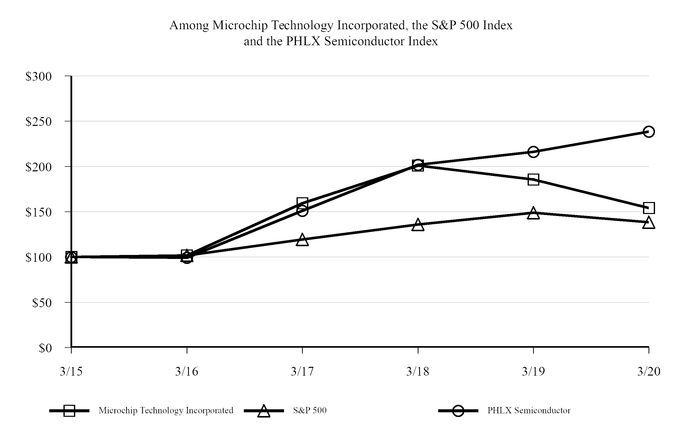
*$100 invested on March 31, 2015 in stock or index, including reinvestment of dividends
Fiscal year ending March 31.
Copyright © 2020 Standard & Poor's, a division of S&P Global. All rights reserved.
| Cumulative Total Return | ||||||||||||
| March 2015 | March 2016 | March 2017 | March 2018 | March 2019 | March 2020 | |||||||
| Microchip Technology Incorporated | 100.00 | 101.73 | 159.48 | 200.89 | 185.62 | 154.16 | ||||||
| S&P 500 Stock Index | 100.00 | 101.78 | 119.26 | 135.95 | 148.86 | 138.47 | ||||||
| Philadelphia Semiconductor Index | 100.00 | 99.27 | 151.06 | 201.80 | 216.14 | 238.58 |
Data acquired by Research Data Group, Inc. (www.researchdatagroup.com)
On May 14, 2020, there were approximately 568 holders of record of our common stock. This figure does not reflect beneficial ownership of shares held in nominee names.
For a description of our dividend policies, see Part II, Item 7, "Management's Discussion and Analysis of Financial Condition and Results of Operations - Liquidity and Capital Resources," included herein.
Refer to "Item 12 - Security Ownership Of Certain Beneficial Owners And Management And Related Stockholder Matters," at page 56 below, for the information required by Item 201(d) of Regulation S-K with respect to securities authorized for issuance under our equity compensation plans at March 31, 2020.
Issuer Purchases of Equity Securities
From time to time, our Board of Directors has authorized the repurchase of shares of our common stock in the open market or in privately negotiated transactions. Most recently, in January 2016, our Board of Directors authorized an increase in the then existing share repurchase program to 15.0 million shares of common stock. There were no repurchases of common stock during fiscal 2020. There is no expiration date associated with this repurchase program.
Item 6. Selected Financial Data
You should read the following selected consolidated financial data for the five-year period ended March 31, 2020 in conjunction with our consolidated financial statements and notes thereto and "Management's Discussion and Analysis of Financial Condition and Results of Operations" included in Items 7 and 8 of this Form 10-K. Our consolidated statements of income data for each of the years in the three-year period ended March 31, 2020, and the balance sheet data as of March 31, 2020 and 2019, are derived from our audited consolidated financial statements, included in Item 8 of this Form 10-K. The statement of income data for the years ended March 31, 2017 and 2016 and balance sheet data as of March 31, 2018, 2017 and 2016 have been derived from our audited consolidated financial statements not included herein (in the tables below all amounts are in millions, except per share data).
| Year ended March 31, | |||||||||||||||||||
| 2020 | 2019(1) | 2018 | 2017(1) | 2016 | |||||||||||||||
| Consolidated Statements of Income data: | |||||||||||||||||||
| Net sales | $ | 5,274.2 | $ | 5,349.5 | $ | 3,980.8 | $ | 3,407.8 | $ | 2,173.3 | |||||||||
| Special charges and other, net (2) | $ | 46.7 | $ | 33.7 | $ | 17.5 | $ | 98.6 | $ | 4.0 | |||||||||
| Loss on settlement of debt (3) | $ | (5.4 | ) | $ | (12.6 | ) | $ | (16.0 | ) | $ | (43.9 | ) | $ | — | |||||
| Net income from continuing operations | $ | 570.6 | $ | 355.9 | $ | 255.4 | $ | 170.6 | $ | 323.9 | |||||||||
| Basic net income per common share from continuing operations | $ | 2.39 | $ | 1.51 | $ | 1.10 | $ | 0.79 | $ | 1.59 | |||||||||
| Diluted net income per common share from continuing operations | $ | 2.23 | $ | 1.42 | $ | 1.03 | $ | 0.73 | $ | 1.49 | |||||||||
| Dividends declared per common share | $ | 1.465 | $ | 1.457 | $ | 1.449 | $ | 1.441 | $ | 1.433 | |||||||||
| Consolidated Balance Sheets data: | |||||||||||||||||||
| Total assets | $ | 17,426.1 | $ | 18,350.0 | $ | 8,257.2 | $ | 7,686.9 | $ | 5,537.9 | |||||||||
| Net long-term debt and capital lease obligations, less current maturities (3) | $ | 8,882.1 | $ | 8,956.0 | $ | 1,769.1 | $ | 2,912.1 | $ | 2,465.8 | |||||||||
| Stockholders' equity | $ | 5,585.5 | $ | 5,287.5 | $ | 3,279.8 | $ | 3,270.7 | $ | 2,150.9 |
| (1) | Refer to Note 2 to our consolidated financial statements for a discussion of our acquisition of Microsemi during fiscal 2019. During fiscal 2017, we completed our acquisition of Atmel. |
(2) Refer to Note 5 to our consolidated financial statements for a discussion of the special charges and other, net.
(3) Refer to Note 7, Debt, for further discussion.
Item 7. . Management's Discussion and Analysis of Financial Condition and Results of Operations
Note Regarding Forward-looking Statements
This report, including "Item 1 – Business," "Item 1A – Risk Factors," and "Item 7 – Management's Discussion and Analysis of Financial Condition and Results of Operations," contains certain forward-looking statements that involve risks and uncertainties, including statements regarding our strategy, financial performance and revenue sources. We use words such as "anticipate," "believe," "plan," "expect," "future," "continue," "intend" and similar expressions to identify forward-looking statements. Our actual results could differ materially from the results anticipated in these forward-looking statements as a result of certain factors including those set forth under "Risk Factors," beginning at page 12 and elsewhere in this Form 10-K. Although we believe that the expectations reflected in the forward-looking statements are reasonable, we cannot guarantee future results, levels of activity, performance or achievements. You should not place undue reliance on these forward-looking statements. We disclaim any obligation to update information contained in any forward-looking statement. These forward-looking statements include, without limitation, statements regarding the following:
| • | The impact of disruptions to our manufacturing and the distribution of our products, including disruptions due to the COVID-19 virus and related government responses; |
| • | That we have seen increased impacts since then which we expect to adversely impact our business in the fiscal quarter ended June 30, 2020; |
| • | That local governments could require us to temporarily reduce production further or cease operations at any of our facilities and we could experience constraints in fulfilling customer orders; |
| • | Our belief that our actions to combat the spread of the COVID-19 virus will help preserve the health of our team members, customers, suppliers, visitors to our facilities, people with whom we conduct business and our communities, and allow us to safely continue operations; |
| • | Our inability to predict how the COVID-19 virus outbreak, and actions taken by others in response to it, will affect our business; |
| • | The effects that uncertain global economic conditions and fluctuations in the global credit and equity markets may have on our financial condition and results of operations; |
| • | The effects and amount of competitive pricing pressure on our product lines and modest pricing declines in certain of our more mature proprietary product lines; |
| • | Our ability to moderate future average selling price declines; |
| • | The effect of product mix, capacity utilization, yields, fixed cost absorption, competition and economic conditions on gross margin; |
| • | The amount of, and changes in, demand for our products and those of our customers; |
| • | The impact of trade restrictions and changes in tariffs, including those impacting China; |
| • | Our expectation that in the future we will acquire additional businesses that we believe will complement our existing businesses; |
| • | Our expectation that in the future we will enter into joint development agreements or other business or strategic relationships with other companies; |
| • | The level of orders that will be received and shipped within a quarter, including the impact of our product lead times; |
| • | Our expectation that our June 2020 days of inventory levels will be down 6 days to up 8 days compared to the March 2020 levels. Our belief that our existing level of inventory will allow us to maintain competitive lead times and provide strong delivery performance to our customers; |
| • | The effect that distributor and customer inventory holding patterns will have on us; |
| • | Our belief that customers recognize our products and brand name and use distributors as an effective supply channel; |
| • | Anticipating increased customer requirements to meet voluntary criteria related to the reduction or elimination of substances in our products; |
| • | Our belief that our direct sales personnel combined with our distributors provide an effective means of reaching our customer base; |
| • | The accuracy of our estimates of the useful life and values of our property, assets and other liabilities; |
| • | Our ability to increase the proprietary portion of our analog, interface, mixed signal and timing product lines and the effect of such an increase; |
| • | Our belief that our processes afford us both cost-effective designs in existing and derivative products and greater functionality in new product designs; |
| • | The impact of any supply disruption we may experience; |
| • | Our ability to effectively utilize our facilities at appropriate capacity levels and anticipated costs; |
| • | That we adjust capacity utilization to respond to actual and anticipated business and industry-related conditions; |
| • | That manufacturing costs will be reduced by transition to advanced process technologies; |
| • | Our ability to maintain manufacturing yields; |
| • | Continuing our investments in new and enhanced products; |
| • | The cost effectiveness of using our own assembly and test operations; |
| • | Our plans for operation of our fabrication facilities, including our plan to close our facility in Santa Clara, California; |
| • | The cost savings from re-purposing Fab 5 for the manufacture of discrete and specialty products in addition to a lower volume of a diversified set of standard products and transferring the manufacture of certain higher volume products to other facilities; |
| • | Our anticipated level of capital expenditures; |
| • | Continuation and amount of quarterly cash dividends; |
| • | The sufficiency of our existing sources of liquidity to finance anticipated capital expenditures and otherwise meet our anticipated cash requirements, and the effects that our contractual obligations are expected to have on them; |
| • | The impact of seasonality on our business; |
| • | Our belief that our IT system compromise has not had a material adverse effect on our business or resulted in any material damage to us; |
| • | Our expectation that we will continue to be the target of attacks on our data, attempts to breach our security and attempts to introduce malicious software into our IT systems; |
| • | The accuracy of our estimates used in valuing employee equity awards; |
| • | That the resolution of legal actions will not have a material effect on our business, and the accuracy of our assessment of the probability of loss and range of potential loss; |
| • | The recoverability of our deferred tax assets; |
| • | The adequacy of our tax reserves to offset any potential tax liabilities, having the appropriate support for our income tax positions and the accuracy of our estimated tax rate; |
| • | Our belief that the expiration of any tax holidays will not have a material impact on our financial statements or effective tax rate; |
| | | |
Showing the first 8K of 96K characters. Open the full section
Item 7A. Quantitative and Qualitative Disclosures About Market Risk
As of March 31, 2020, our long-term debt totaled $10.59 billion. We have no interest rate exposure to rate changes on our fixed rate debt, which totaled $5.86 billion as of March 31, 2020. We do have interest rate exposure with respect to the $4.73 billion balance of our variable interest rate debt outstanding as of March 31, 2020. A 50 basis point increase in interest rates would impact our expected annual interest expense for the next 12 months by approximately $23.6 million.
Item 8. Financial Statements and Supplementary Data
The consolidated financial statements listed in the index appearing under Item 15(a)(1) hereof are filed as part of this Form 10-K. See also Index to Financial Statements below.
Item 9. Changes in and Disagreements with Accountants on Accounting and Financial Disclosure
None.
Item 9A. . Controls and Procedures
Evaluation of Disclosure Controls and Procedures
As of the end of the period covered by this Annual Report on Form 10-K, as required by paragraph (b) of Rule 13a-15 or Rule 15d-15 under the Securities Exchange Act of 1934, as amended (the "Exchange Act"), we evaluated under the supervision of our Chief Executive Officer and our Chief Financial Officer, the effectiveness of our disclosure controls and procedures (as defined in Rules 13a-15(e) or 15d-15(e) of the Exchange Act. Based on this evaluation, our Chief Executive Officer and our Chief Financial Officer have concluded that our disclosure controls and procedures were effective to ensure that information we are required to disclose in reports that we file or submit under the Exchange Act (i) is recorded, processed, summarized and reported within the time periods specified in Securities and Exchange Commission rules and forms, and (ii) is accumulated and communicated to our management, including our Chief Executive Officer and our Chief Financial Officer, as appropriate to allow timely decisions regarding required disclosure. Our disclosure controls and procedures are designed to provide reasonable assurance that such information is accumulated and communicated to our management. Our disclosure controls and
procedures include components of our internal control over financial reporting. Management's assessment of the effectiveness of our internal control over financial reporting is expressed at the level of reasonable assurance because a control system, no matter how well designed and operated, can provide only reasonable, but not absolute, assurance that the control system's objectives will be met.
Management Report on Internal Control Over Financial Reporting
Our management, including our principal executive officer and our principal financial officer, is responsible for establishing and maintaining adequate internal control over financial reporting to provide reasonable assurance regarding the reliability of our financial reporting and the preparation of financial statements for external purposes in accordance with generally accepted accounting principles. Internal control over financial reporting includes those policies and procedures that (i) pertain to the maintenance of records that in reasonable detail accurately and fairly reflect the transactions and dispositions of the assets of the company; (ii) provide reasonable assurance that transactions are recorded as necessary to permit preparation of financial statements in accordance with generally accepted accounting principles, and that receipts and expenditures of the company are being made only in accordance with authorizations of management and directors of the company; and (iii) provide reasonable assurance regarding prevention or timely detection of unauthorized acquisition, use or disposition of our assets that could have a material effect on our financial statements.
Management assessed our internal control over financial reporting as of March 31, 2020, the end of our fiscal year. Management based its assessment on criteria established in Internal Control – Integrated Framework (2013 framework) issued by the Committee of Sponsoring Organizations of the Treadway Commission. Management's assessment included an evaluation of such elements as the design and operating effectiveness of key financial reporting controls, process documentation, accounting policies, and our overall control environment. This assessment is supported by testing and monitoring performed by our finance organization.
Based on our assessment, management has concluded that our internal control over financial reporting was effective as of the end of the fiscal year to provide reasonable assurance regarding the reliability of financial reporting and the preparation of financial statements for external reporting purposes in accordance with generally accepted accounting principles. We reviewed the results of management's assessment with the Audit Committee of our Board of Directors.
Ernst & Young LLP, an independent registered public accounting firm, who audited our consolidated financial statements included in this Form 10-K has issued an attestation report on our internal control over financial reporting as of March 31, 2020, which is included on page F-5.
Changes in Internal Control over Financial Reporting
As previously described in Part II, Item 9A of our Annual Report on Form 10-K for the fiscal year ended March 31, 2019, we identified a material weakness in our internal controls related to accounting for income taxes and we also identified a material weakness in our internal controls related to IT system access. Both of these material weaknesses were remediated as of March 31, 2020. During the three months ended March 31, 2020, we transitioned certain of Microsemi's processes to our internal control processes and we expect to transition more of such processes throughout the remainder of calendar year 2020. Other than with respect to the remediation efforts and our transition of Microsemi to our systems and control environment as described above, during the three months ended March 31, 2020, there was no change in our internal control over financial reporting identified in connection with the evaluation required by paragraph (d) of Rule 13a-15 or Rule 15d-15 that has materially affected, or is reasonably likely to materially affect, our internal control over financial reporting.
Item 9B. Other Information
J. Eric Bjornholt, our Senior Vice President, Chief Financial Officer, Mitch Little, our Senior Vice President, Worldwide Client Engagement, Steve Drehobl, our Senior Vice President, MCU8 and MCU16 Business Units, and Rich Simoncic, our Senior Vice President, Analog Power and Interface Business Units, have entered into trading plans as contemplated by Rule 10b-5-1 under the Exchange Act and periodic sales of our common stock have occurred and are expected to occur under such plans.
The foregoing disclosure is being made on a voluntary basis and not pursuant to any specific requirement under Form 10‑K, Form 8‑K or otherwise.
PART III
Item 10. Directors, Executive Officers and Corporate Governance
Information on the members of our Board of Directors is incorporated herein by reference to our proxy statement for our 2020 annual meeting of stockholders under the captions "The Board of Directors," and "Proposal One – Election of Directors."
Information on the composition of our audit committee and the members of our audit committee, including information on our audit committee financial experts, is incorporated by reference to our proxy statement for our 2020 annual meeting of stockholders under the caption "The Board of Directors – Committees of the Board of Directors – Audit Committee."
Information on our executive officers is provided in Item 1, Part I of this Form 10-K under the caption "Executive Officers of the Registrant" at page 11, above.
Information with respect to our code of ethics that applies to our directors, executive officers (including our principal executive officer and our principal financial and accounting officer) and employees is incorporated by reference to our proxy statement for our 2020 annual meeting of stockholders under the caption "Code of Business Conduct and Ethics." A copy of our Code of Business Conduct and Ethics is available on our website at the Investor Relations section under Mission Statement/Corporate Governance on www.microchip.com.
Information regarding material changes, if any, to procedures by which security holders may recommend nominees to our Board of Directors is incorporated by reference to our proxy statement for the 2020 annual meeting of stockholders under the caption "Requirements, Including Deadlines, for Receipt of Stockholder Proposals for the 2020 Annual Meeting of Stockholders; Discretionary Authority to Vote on Stockholder Proposals."
Item 11. Executive Compensation
Information with respect to executive compensation is incorporated herein by reference to the information under the caption "Executive Compensation" in our proxy statement for our 2020 annual meeting of stockholders.
Information with respect to director compensation is incorporated herein by reference to the information under the caption "The Board of Directors – Director Compensation" in our proxy statement for our 2020 annual meeting of stockholders.
Information with respect to compensation committee interlocks and insider participation in compensation decisions is incorporated herein by reference to the information under the caption "The Board of Directors – Compensation Committee Interlocks and Insider Participation" in our proxy statement for our 2020 annual meeting of stockholders.
Our Board compensation committee report on executive compensation is incorporated herein by reference to the information under the caption "Executive Compensation – Compensation Committee Report on Executive Compensation" in our proxy statement for our 2020 annual meeting of stockholders.
Item 12. Security Ownership of Certain Beneficial Owners and Management and Related Stockholder Matters
Information with respect to securities authorized for issuance under our equity compensation plans is incorporated herein by reference to the information under the caption "Executive Compensation – Equity Compensation Plan Information" in our proxy statement for our 2020 annual meeting of stockholders.
Information with respect to security ownership of certain beneficial owners, members of our Board of Directors and management is incorporated herein by reference to the information under the caption "Security Ownership of Principal Stockholders, Directors and Executive Officers" in our proxy statement for our 2020 annual meeting of stockholders.
Item 13. Certain Relationships and Related Transactions, and Director Independence
The information required by this Item pursuant to Item 404 of Regulation S-K is incorporated by reference to the information under the caption "Certain Transactions" contained in our proxy statement for our 2020 annual meeting of stockholders.
The information required by this Item pursuant to Item 407(a) of Regulation S-K regarding the independence of our directors is incorporated by reference to the information under the caption "Meetings of the Board of Directors" contained in our proxy statement for our 2020 annual meeting of stockholders.
Item 14. Principal Accountant Fees and Services
The information required by this Item related to principal accountant fees and services as well as related pre-approval policies is incorporated by reference to the information under the caption "Independent Registered Public Accounting Firm" contained in our proxy statement for our 2020 annual meeting of stockholders.
PART IV
Item 15. Exhibits and Financial Statement Schedules
(a) The following documents are filed as part of this Form 10-K:
| Page No. | ||
| (1) | Financial Statements: | |
| Report of Independent Registered Public Accounting Firm | F-1 | |
| Report of Independent Registered Public Accounting Firm on Internal Control Over Financial Reporting | F-5 | |
| Consolidated Balance Sheets as of March 31, 2020 and 2019 | F-6 | |
| Consolidated Statements of Income for each of the three years in the period ended March 31, 2020 | F-7 | |
| Consolidated Statements of Comprehensive Income for each of the three years in the period ended March 31, 2020 | F-8 | |
| Consolidated Statements of Cash Flows for each of the three years in the period ended March 31, 2020 | F-9 | |
| Consolidated Statements of Changes in Equity for each of the three years in the period ended March 31, 2020 | F-11 | |
| Notes to Consolidated Financial Statements | F-13 | |
| (2) | Financial Statement Schedules | None |
| (3) | The Exhibits filed with this Form 10-K or incorporated herein by reference are set forth in the Exhibit Index beginning on page 60 hereof, which Exhibit Index is incorporated herein by this reference. |
(b) See Item 15(a)(3) above.
(c) See "Index to Financial Statements" included under Item 8 to this Form 10-K.
Item 16. Form 10-K Summary
Not applicable.
EXHIBIT INDEX
EXHIBIT INDEX
EXHIBIT INDEX
EXHIBIT INDEX
| Incorporated by Reference | ||||||||||||
| Exhibit Number | Exhibit Description | Form | File Number | Exhibit | Filing Date | Included Herewith | ||||||
| 21.1** | Subsidiaries of Registrant | X | ||||||||||
| 23.1** | Consent of Independent Registered Public Accounting Firm | X | ||||||||||
| 24.1** | Power of Attorney included on Page 65 of this Form 10-K | X | ||||||||||
| 31.1** | Certification of Chief Executive Officer Pursuant to Rule 13a-14(a) of the Securities Exchange Act of 1934, as amended (the Exchange Act) | X | ||||||||||
| 31.2** | Certification of Chief Financial Officer Pursuant to Rule 13a-14(a) of the Securities Exchange Act of 1934, as amended (the Exchange Act) | X | ||||||||||
| 32** | Certifications Pursuant to 18 U.S.C. Section 1350, as adopted pursuant to Section 906 of the Sarbanes-Oxley Act of 2002 | X | ||||||||||
| 101.INS | XBRL Instance Document - the instance document does not appear in the Interactive File because its XBRL tags are embedded within the Inline XBRL document | X | ||||||||||
| 101.SCH | XBRL Taxonomy Extension Schema Document | X | ||||||||||
| 101.CAL | Taxonomy Extension Calculation Linkbase Document | X | ||||||||||
| 101.DEF | XBRL Taxonomy Extension Definition Linkbase Document | X | ||||||||||
| 101.LAB | XBRL Taxonomy Extension Label Linkbase Document | X | ||||||||||
| 101.PRE | XBRL Taxonomy Presentation Linkbase Document | X | ||||||||||
| 104 | Cover Page Interactive Data File - the cover page XBRL tags are embedded within the Inline XBRL document. | X | ||||||||||
| *Compensation plans or arrangements in which directors or executive officers are eligible to participate | ||||||||||||
| ** Furnished herewith |
Signatures
Pursuant to the requirements of Section 13 or 15(d) of the Securities Exchange Act of 1934, the registrant has duly caused this report to be signed on its behalf by the undersigned, thereunto duly authorized.
| MICROCHIP TECHNOLOGY INCORPORATED | |
| (Registrant) | |
| May 21, 2020 | By: /s/ Steve Sanghi |
| Steve Sanghi | |
| Chief Executive Officer and Chairman of the Board |
Power of Attorney
KNOW ALL PERSONS BY THESE PRESENTS, that the undersigned officer or director of Microchip Technology Incorporated, a Delaware corporation (the "Company"), does hereby constitute and appoint each of STEVE SANGHI and J. ERIC BJORNHOLT, with full power to each of them to act alone, as the true and lawful attorneys and agents of the undersigned, with full power of substitution and resubstitution to each of said attorneys to execute, file or deliver any and all instruments and to do any and all acts and things which said attorneys and agents, or any of them, deem advisable to enable the Company to comply with the Securities Exchange Act of 1934, as amended, and any requirements of the Securities and Exchange Commission in respect thereto relating to this annual report on Form 10-K, including specifically, but without limitation of the general authority hereby granted, the power and authority to sign such person's name individually and on behalf of the Company as an officer or director (as indicated below opposite such person's signature) to the Company's annual report on Form 10-K or any amendments or supplements thereto; and each of the undersigned does hereby fully ratify and confirm all that said attorneys and agents or any of them, shall do or cause to be done by virtue hereof. This Power of Attorney revokes any and all previous powers of attorney granted by any of the undersigned which such power would have entitled said attorneys and agents, or any of them, to sign such person's name, individually or on behalf of the Company, to any Form 10-K.
IN WITNESS WHEREOF, each of the undersigned has executed the foregoing power of attorney on this 21st day of May, 2020.
Pursuant to the requirements of the Securities Exchange Act of 1934, this report has been signed below by the following persons on behalf of the registrant and in the capacities and on the dates indicated.
| Name and Signature | Title | Date | |||
| /s/ Steve Sanghi | Chief Executive Officer and Chairman of the Board | May 21, 2020 | |||
| Steve Sanghi | (Principal Executive Officer) | ||||
| /s/ Matthew W. Chapman | Director | May 21, 2020 | |||
| Matthew W. Chapman | |||||
| /s/ L.B. Day | Director | May 21, 2020 | |||
| L.B. Day | |||||
| /s/ Esther L. Johnson | Director | May 21, 2020 | |||
| Esther L. Johnson | |||||
| /s/ Wade F. Meyercord | Director | May 21, 2020 | |||
| Wade F. Meyercord | |||||
| /s/ J. Eric Bjornholt | Senior Vice President and Chief Financial Officer | May 21, 2020 | |||
| J. Eric Bjornholt | (Principal Financial and Accounting Officer) |
Annual Report on Form 10-K
Item 8. , Item 15(a)(1) and (2), (b) and (c)
INDEX TO FINANCIAL STATEMENTS
CONSOLIDATED FINANCIAL STATEMENTS
EXHIBITS
YEAR ENDED MARCH 31, 2020
MICROCHIP TECHNOLOGY INCORPORATED
AND SUBSIDIARIES
CHANDLER, ARIZONA
MICROCHIP TECHNOLOGY INCORPORATED AND SUBSIDIARIES
Index to Consolidated Financial Statements
| Page Number | |
| Report of Independent Registered Public Accounting Firm | F-1 |
| Report of Independent Registered Public Accounting Firm on Internal Control Over Financial Reporting | F-5 |
| Consolidated Balance Sheets as of March 31, 2020 and 2019 | F-6 |
| Consolidated Statements of Income for each of the three years in the period ended March 31, 2020 | F-7 |
| Consolidated Statements of Comprehensive Income for each of the three years in the period ended March 31, 2020 | F-8 |
| Consolidated Statements of Cash Flows for each of the three years in the period ended March 31, 2020 | F-9 |
| Consolidated Statements of Changes in Equity for each of the three years in the period ended March 31, 2020 | F-11 |
| Notes to Consolidated Financial Statements | F-13 |
i
Report of Independent Registered Public Accounting Firm
To the Shareholders and the Board of Directors of Microchip Technology Incorporated
Opinion on the Financial Statements
We have audited the accompanying consolidated balance sheets of Microchip Technology Incorporated (the Company) as of March 31, 2020 and 2019, the related consolidated statements of income, comprehensive income, changes in equity and cash flows for each of the three years in the period ended March 31, 2020, and the related notes (collectively referred to as the “consolidated financial statements”). In our opinion, the consolidated financial statements present fairly, in all material respects, the financial position of the Company at March 31, 2020 and 2019, and the results of its operations and its cash flows for each of the three years in the period ended March 31, 2020, in conformity with U.S. generally accepted accounting principles.
We also have audited, in accordance with the standards of the Public Company Accounting Oversight Board (United States) (PCAOB), the Company's internal control over financial reporting as of March 31, 2020, based on criteria established in Internal Control-Integrated Framework issued by the Committee of Sponsoring Organizations of the Treadway Commission (2013 framework), and our report dated May 21, 2020 expressed an unqualified opinion thereon.
Basis for Opinion
These financial statements are the responsibility of the Company's management. Our responsibility is to express an opinion on the Company’s financial statements based on our audits. We are a public accounting firm registered with the PCAOB and are required to be independent with respect to the Company in accordance with the U.S. federal securities laws and the applicable rules and regulations of the Securities and Exchange Commission and the PCAOB.
We conducted our audits in accordance with the standards of the PCAOB. Those standards require that we plan and perform the audit to obtain reasonable assurance about whether the financial statements are free of material misstatement, whether due to error or fraud. Our audits included performing procedures to assess the risks of material misstatement of the financial statements, whether due to error or fraud, and performing procedures that respond to those risks. Such procedures included examining, on a test basis, evidence regarding the amounts and disclosures in the financial statements. Our audits also included evaluating the accounting principles used and significant estimates made by management, as well as evaluating the overall presentation of the financial statements. We believe that our audits provide a reasonable basis for our opinion.
Critical Audit Matters
The critical audit matters communicated below are matters arising from the current period audit of the financial statements that were communicated or required to be communicated to the audit committee and that: (1) relate to accounts or disclosures that are material to the financial statements and (2) involved our especially challenging, subjective or complex judgments. The communication of critical audit matters does not alter in any way our opinion on the consolidated financial statements, taken as a whole, and we are not, by communicating the critical audit matters below, providing separate opinions on the critical audit matters or on the accounts or disclosures to which they relate.
F-1
Inventory Valuation
| Description of the Matter | The Company's inventories totaled $685.7 million as of March 31, 2020. As explained in Note 1 to the consolidated financial statements, the Company assesses the valuation of inventory each reporting period based on the lower of cost or net realizable value. The Company primarily reserves for obsolete and unmarketable inventory based on inventory on hand in excess of 12-month forecast demand. Estimated 12-month forecast demand is generally determined based on annualized sales using the prior three-month period. The Company uses the most recently developed sales forecast to refine the estimated demand to adjust for circumstances in which historical sales are not expected to be representative of future demand including new products with little or no historical demand, products being replaced or discontinued for which demand is expected to decrease, or other customer specific or economic factors. Auditing management's estimates for obsolete or unmarketable inventory involved subjective auditor judgment because the assumptions used to make the estimate require judgments about future market and economic conditions outside the Company's control. In particular, the adjustments to the obsolete or unmarketable inventory estimates are sensitive to significant assumptions impacting forecast demand, including changes in economic and market conditions such as the impacts of COVID-19. | |
| How We Addressed the Matter in Our Audit | We obtained an understanding, evaluated the design, and tested the operating effectiveness of internal controls over the Company's obsolete or unmarketable inventory estimation process, including management's assessment of the assumptions and data underlying the obsolete or unmarketable inventory reserves. Our substantive audit procedures included, among others, evaluating the significant assumptions stated above and the accuracy and completeness of the underlying data used in management's obsolete or unmarketable inventory assessment. We compared on-hand inventories to demand forecasts, assessed the reasonableness of management’s demand forecasts through testing historical sales quantities, and evaluated adjustments to demand forecasts for specific product considerations, such as specific customer demand. We also assessed the historical accuracy of management's estimates and the related assumptions by performing a retrospective review on the accuracy of prior period demand forecast estimates. |
F-2
Estimating Variable Consideration for Distributor Sales
| Description of the Matter | The Company's sales arrangements provide certain distributors with price concessions and product return rights, which results in variable consideration. During the year ended March 31, 2020, approximately $2,626.9 million of the Company's total $5,274.2 million in net sales represents sales to distributors, which has been adjusted for estimates of the price concessions and product return rights that are expected to be claimed. As explained in Note 1 to the consolidated financial statements, the Company estimates the amount of consideration to which it will be entitled using recent historical data and applying the expected value method. The Company records a reduction of the original sale amount for the estimated variable consideration resulting from price concessions and product returns. At March 31, 2020, such reserves totaled $353.0 million. Auditing management's estimates of variable consideration resulting from price concessions and product returns under the distributor contracts involved subjective auditor judgment because the estimates rely on a number of factors that are forward-looking and could be affected by future economic and market conditions including the impacts of COVID-19. The estimated concession and return rates are generally made using recent, observable experience from the prior quarter. The recent experience is evaluated to determine whether adjustments to the concession rates are needed for changing market or economic conditions. For example, estimated variable consideration resulting from price concessions and product returns included in the transaction price reflects management's evaluation of contractual terms, historical experience and assumptions about future economic conditions. Changes in those assumptions can have a material effect on the amount of variable consideration recognized. | |
| How We Addressed the Matter in Our Audit | We obtained an understanding, evaluated the design, and tested the operating effectiveness of internal controls over the Company's process to calculate the variable consideration resulting from price concessions and product returns, including management's assessment of the price concession and return rate assumptions and data underlying the estimate. Our substantive audit procedures included, among others, evaluating the significant assumptions and the accuracy and completeness of the underlying data used in management's estimate. This included comparing management’s accrual for future price concessions at a disaggregated level to historical results and testing value of the inventory held by distributors at the end of the period through a combination of inspection of source documentation for transactions executed during the period and confirmations with the distributors. We confirmed contractual terms and conditions directly with a selection of distributor customers. We evaluated whether recent return and concession experience from the prior quarter is a reasonable approximation for expected future concessions in consideration of the current market conditions. In addition, we assessed the historical accuracy of management's estimates for variable consideration resulting from price concessions and product returns and the related assumptions by performing a retrospective review on the accuracy of prior period estimates. |
F-3
Unrecognized Tax Benefits
| Description of the Matter | As more fully described in Note 13 to the consolidated financial statements, the Company operates in a number of tax jurisdictions and its income tax returns are subject to examination by tax authorities in those jurisdictions that may challenge any tax position on these returns. Because the matters challenged by authorities are typically complex and subject to interpretation, their ultimate outcome is uncertain. The Company uses significant judgment in (1) determining whether a tax position’s technical merits are more-likely-then-not to be sustained, and (2) measuring the amount of tax benefit that qualifies for recognition. As of March 31, 2020, the Company recognized accrued liabilities for unrecognized tax benefits associated with various tax positions totaling $757.3 million. Auditing the recognition and measurement of the Company's tax transactions (in particular, intra-group intellectual property right transfers) and positions was challenging because the conclusions regarding the recognition and measurement of the tax positions is complex and highly subjective judgments are made by management to evaluate the technical merits of each position, which are based on interpretations of complex tax laws as well as administrative and legal rulings. In certain cases, the Company’s conclusions involved valuation methodologies and subjective assumptions such as revenue growth rates, measures of profitability, terminal rates, and discount rates. | |
| How We Addressed the Matter in Our Audit | We evaluated the design and tested the operating effectiveness of internal controls over the Company’s process to assess the technical merits and measurement of unrecognized tax benefits. For example, we tested management’s review of the inputs into intellectual property valuations and management’s assessment of other third-party information used in the evaluation of the completeness and measurement of unrecognized tax benefits. Our audit procedures included, among others, evaluating the assumptions the Company used to develop its tax positions and related unrecognized income tax benefit amounts by jurisdiction and testing the completeness and accuracy of the underlying data used by the Company to calculate its uncertain tax positions. We involved our tax professionals to assist us with obtaining an understanding of the Company’s tax structure, assessing the Company’s compliance with tax laws, related developments in administrative rulings and court cases, identifying tax law changes in jurisdictions that may impact the Company’s unrecognized tax benefits and assessing the technical merits of the Company’s tax positions. This included assessing the Company’s correspondence with the relevant tax authorities and evaluating income tax opinions or other third-party advice obtained by the Company. We also used our knowledge of, and experience with, the application of international and local income tax laws to evaluate the Company’s accounting for its tax positions. For certain material tax positions related to intra-group transactions, we assessed the assumptions and pricing methods used in setting arm’s length prices and the documentation to support the pricing, and used our tax and valuation professionals to assist in testing certain significant assumptions and pricing methods. We have also evaluated the Company’s income tax disclosures included in Note 13 in relation to these matters. |
/s/ Ernst & Young LLP
We have served as the Company’s auditor since 2001.
Phoenix, Arizona
May 21, 2020
F-4
Report of Independent Registered Public Accounting Firm
To the Shareholders and the Board of Directors of Microchip Technology Incorporated
Opinion on Internal Control Over Financial Reporting
We have audited Microchip Technology Incorporated’s internal control over financial reporting as of March 31, 2020, based on criteria established in Internal Control-Integrated Framework issued by the Committee of Sponsoring Organizations of the Treadway Commission (2013 framework) (the COSO criteria). In our opinion, Microchip Technology Incorporated (the Company) maintained, in all material respects, effective internal control over financial reporting as of March 31, 2020, based on the COSO criteria.
We also have audited, in accordance with the standards of the Public Company Accounting Oversight Board (United States) (PCAOB), the consolidated balance sheets of the Company as of March 31, 2020 and 2019, the related consolidated statements of income, comprehensive income, changes in equity and cash flows for each of the three years in the period ended March 31, 2020, and the related notes and our report dated May 21, 2020 expressed an unqualified opinion thereon.
Basis for Opinion
The Company’s management is responsible for maintaining effective internal control over financial reporting and for its assessment of the effectiveness of internal control over financial reporting included in the accompanying Management Report on Internal Control over Financial Reporting. Our responsibility is to express an opinion on the Company’s internal control over financial reporting based on our audit. We are a public accounting firm registered with the PCAOB and are required to be independent with respect to the Company in accordance with the U.S. federal securities laws and the applicable rules and regulations of the Securities and Exchange Commission and the PCAOB.
We conducted our audit in accordance with the standards of the PCAOB. Those standards require that we plan and perform the audit to obtain reasonable assurance about whether effective internal control over financial reporting was maintained in all material respects.
Our audit included obtaining an understanding of internal control over financial reporting, assessing the risk that a material weakness exists, testing and evaluating the design and operating effectiveness of internal control based on the assessed risk, and performing such other procedures as we considered necessary in the circumstances. We believe that our audit provides a reasonable basis for our opinion.
Definition and Limitations of Internal Control Over Financial Reporting
A company’s internal control over financial reporting is a process designed to provide reasonable assurance regarding the reliability of financial reporting and the preparation of financial statements for external purposes in accordance with generally accepted accounting principles. A company’s internal control over financial reporting includes those policies and procedures that (1) pertain to the maintenance of records that, in reasonable detail, accurately and fairly reflect the transactions and dispositions of the assets of the company; (2) provide reasonable assurance that transactions are recorded as necessary to permit preparation of financial statements in accordance with generally accepted accounting principles, and that receipts and expenditures of the company are being made only in accordance with authorizations of management and directors of the company; and (3) provide reasonable assurance regarding prevention or timely detection of unauthorized acquisition, use, or disposition of the company’s assets that could have a material effect on the financial statements.
Because of its inherent limitations, internal control over financial reporting may not prevent or detect misstatements. Also, projections of any evaluation of effectiveness to future periods are subject to the risk that controls may become inadequate because of changes in conditions, or that the degree of compliance with the policies or procedures may deteriorate.
/s/ Ernst & Young LLP
Phoenix, Arizona
May 21, 2020
F-5
Item 1. . Financial Statements
MICROCHIP TECHNOLOGY INCORPORATED AND SUBSIDIARIES
CONSOLIDATED BALANCE SHEETS
(in millions, except share and per share amounts)
| ASSETS | |||||||
| March 31, | |||||||
| 2020 | 2019 | ||||||
| Cash and cash equivalents | $ | 401.0 | $ | 428.6 | |||
| Short-term investments | 2.0 | 2.3 | |||||
| Accounts receivable, net | 934.0 | 880.6 | |||||
| Inventories | 685.7 | 711.7 | |||||
| Other current assets | 194.5 | 191.6 | |||||
| Total current assets | 2,217.2 | 2,214.8 | |||||
| Property, plant and equipment, net | 876.1 | 996.7 | |||||
| Goodwill | 6,664.8 | 6,663.9 | |||||
| Intangible assets, net | 5,702.3 | 6,685.6 | |||||
| Long-term deferred tax assets | 1,748.5 | 1,677.2 | |||||
| Other assets | 217.2 | 111.8 | |||||
| Total assets | $ | 17,426.1 | $ | 18,350.0 | |||
| LIABILITIES AND STOCKHOLDERS' EQUITY | |||||||
| Accounts payable | $ | 246.8 | $ | 226.4 | |||
| Accrued liabilities | 781.8 | 787.3 | |||||
| Current portion of long-term debt | 608.8 | 1,360.8 | |||||
| Total current liabilities | 1,637.4 | 2,374.5 | |||||
| Long-term debt | 8,873.4 | 8,946.2 | |||||
| Long-term income tax payable | 668.4 | 756.2 | |||||
| Long-term deferred tax liability | 318.5 | 706.1 | |||||
| Other long-term liabilities | 342.9 | 279.5 | |||||
| Stockholders' equity: | |||||||
| Preferred stock, $0.001 par value; authorized 5,000,000 shares; no shares issued or outstanding | — | — | |||||
| Common stock, $0.001 par value; authorized 450,000,000 shares; 258,391,231 shares issued and 245,325,643 shares outstanding at March 31, 2020; 253,232,909 shares issued and 237,589,501 shares outstanding at March 31, 2019 | 0.2 | 0.2 | |||||
| Additional paid-in capital | 2,675.1 | 2,679.6 | |||||
| Common stock held in treasury: 13,065,588 shares at March 31, 2020; 15,643,408 shares at March 31, 2019 | (500.6 | ) | (582.2 | ) | |||
| Accumulated other comprehensive loss | (21.6 | ) | (20.7 | ) | |||
| Retained earnings | 3,432.4 | 3,210.6 | |||||
| Total stockholders' equity | 5,585.5 | 5,287.5 | |||||
| Total liabilities and stockholders' equity | $ | 17,426.1 | $ | 18,350.0 |
See accompanying notes to consolidated financial statements
F-6
MICROCHIP TECHNOLOGY INCORPORATED AND SUBSIDIARIES
CONSOLIDATED STATEMENTS OF INCOME
(in millions, except per share amounts)
| Year ended March 31, | |||||||||||
| 2020 | 2019 | 2018 | |||||||||
| Net sales | $ | 5,274.2 | $ | 5,349.5 | $ | 3,980.8 | |||||
| Cost of sales (1) | 2,032.1 | 2,418.2 | 1,560.1 | ||||||||
| Gross profit | 3,242.1 | 2,931.3 | 2,420.7 | ||||||||
| Research and development (1) | 877.8 | 826.3 | 529.3 | ||||||||
| Selling, general and administrative (1) | 676.6 | 682.9 | 452.1 | ||||||||
| Amortization of acquired intangible assets | 993.9 | 674.1 | 485.5 | ||||||||
| Special charges and other, net (1) | 46.7 | 33.7 | 17.5 | ||||||||
| Operating expenses | 2,595.0 | 2,217.0 | 1,484.4 | ||||||||
| Operating income | 647.1 | 714.3 | 936.3 | ||||||||
| Losses on equity method investments | — | (0.2 | ) | (0.2 | ) | ||||||
| Other income (expense): | |||||||||||
| Interest income | 2.8 | 8.1 | 22.0 | ||||||||
| Interest expense | (497.3 | ) | (502.9 | ) | (199.0 | ) | |||||
| Loss on settlement of debt | (5.4 | ) | (12.6 | ) | (16.0 | ) | |||||
| Other income (loss), net | 3.2 | (2.2 | ) | (5.8 | ) | ||||||
| Income before income taxes | 150.4 | 204.5 | 737.3 | ||||||||
| Income tax (benefit) provision | (420.2 | ) | (151.4 | ) | 481.9 | ||||||
| Net income | $ | 570.6 | $ | 355.9 | $ | 255.4 | |||||
| Basic net income per common share | $ | 2.39 | $ | 1.51 | $ | 1.10 | |||||
| Diluted net income per common share | $ | 2.23 | $ | 1.42 | $ | 1.03 | |||||
| Dividends declared per common share | $ | 1.465 | $ | 1.457 | $ | 1.449 | |||||
| Basic common shares outstanding | 238.9 | 236.2 | 232.9 | ||||||||
| Diluted common shares outstanding | 256.2 | 249.9 | 248.9 | ||||||||
| (1) Includes share-based compensation expense as follows: | |||||||||||
| Cost of sales | $ | 20.9 | $ | 14.9 | $ | 13.8 | |||||
| Research and development | $ | 82.9 | $ | 72.0 | $ | 42.5 | |||||
| Selling, general and administrative | $ | 66.4 | $ | 62.3 | $ | 36.9 | |||||
| Special charges and other, net | $ | — | $ | 17.2 | $ | — |
See accompanying notes to consolidated financial statements
F-7
MICROCHIP TECHNOLOGY INCORPORATED AND SUBSIDIARIES****CONSOLIDATED STATEMENTS OF COMPREHENSIVE INCOME
(in millions)
| Year Ended March 31, | |||||||||||
| 2020 | 2019 | 2018 | |||||||||
| Net income | $ | 570.6 | $ | 355.9 | $ | 255.4 | |||||
| Components of other comprehensive income (loss): | |||||||||||
| Available-for-sale securities: | |||||||||||
| Unrealized holding losses, net of tax effect | — | (5.6 | ) | (13.6 | ) | ||||||
| Reclassification of realized transactions, net of tax effect | — | 5.6 | 15.2 | ||||||||
| Defined benefit plans: | |||||||||||
| Actuarial gains (losses) related to defined benefit pension plans, net of tax (provision) benefit | 1.4 | 2.9 | (5.6 | ) | |||||||
| Reclassification of realized transactions, net of tax effect | 0.8 | 1.0 | 0.8 | ||||||||
| Change in net foreign currency translation adjustment | (1.8 | ) | (5.3 | ) | — | ||||||
| Other comprehensive income (loss), net of tax effect | 0.4 | (1.4 | ) | (3.2 | ) | ||||||
| Comprehensive income | $ | 571.0 | $ | 354.5 | $ | 252.2 |
See accompanying notes to consolidated financial statements
F-8
MICROCHIP TECHNOLOGY INCORPORATED AND SUBSIDIARIES
CONSOLIDATED STATEMENTS OF CASH FLOWS
(in millions)
| Year ended March 31, | |||||||||||
| 2020 | 2019 | 2018 | |||||||||
| Cash flows from operating activities: | |||||||||||
| Net income | $ | 570.6 | $ | 355.9 | $ | 255.4 | |||||
| Adjustments to reconcile net income to net cash provided by operating activities: | |||||||||||
| Depreciation and amortization | 1,215.6 | 876.4 | 615.9 | ||||||||
| Deferred income taxes | (490.3 | ) | (62.2 | ) | 51.2 | ||||||
| Share-based compensation expense related to equity incentive plans | 170.2 | 16 |
Showing the first 8K of 209K characters. Open the full section