 filings.tools
McKesson 10-K 2021-03-31
Filed 2021-05-12. 22 sections, 680K characters. Original on sec.gov · Markdown · JSON
Cover and table of contents
UNITED STATES
SECURITIES AND EXCHANGE COMMISSION
Washington, D.C. 20549
FORM 10-K
| ☒ | ANNUAL REPORT PURSUANT TO SECTION 13 OR 15(d) OF THE SECURITIES EXCHANGE ACT OF 1934 |
For the fiscal year ended March 31, 2021
OR
| ☐ | TRANSITION REPORT PURSUANT TO SECTION 13 OR 15(d) OF THE SECURITIES EXCHANGE ACT OF 1934 |
For the transition period from to
Commission File Number: 1-13252

McKESSON CORPORATION
(Exact name of registrant as specified in its charter)
| Delaware | 94-3207296 | |||||||
| (State or other jurisdiction of incorporation or organization) | (I.R.S. Employer Identification No.) | |||||||
6555 State Hwy 161,
Irving, TX 75039
(Address of principal executive offices, including zip code)
(972) 446-4800
(Registrant’s telephone number, including area code)
Securities registered pursuant to Section 12(b) of the Act:
| (Title of each class) | (Trading Symbol) | (Name of each exchange on which registered) | ||||||
| Common stock, $0.01 par value | MCK | New York Stock Exchange | ||||||
| 0.625% Notes due 2021 | MCK21A | New York Stock Exchange | ||||||
| 1.500% Notes due 2025 | MCK25 | New York Stock Exchange | ||||||
| 1.625% Notes due 2026 | MCK26 | New York Stock Exchange | ||||||
| 3.125% Notes due 2029 | MCK29 | New York Stock Exchange |
Securities registered pursuant to Section 12(g) of the Act: None
Indicate by check mark if the registrant is a well-known seasoned issuer, as defined in Rule 405 of the Securities Act. Yes ☒ No ☐
Indicate by check mark if the registrant is not required to file reports pursuant to Section 13 or 15(d) of the Act. Yes ☐ No ☒
Indicate by check mark whether the registrant (1) has filed all reports required to be filed by Section 13 or 15(d) of the Securities Exchange Act of 1934 during the preceding 12 months (or for such shorter period that the registrant was required to file such reports), and (2) has been subject to such filing requirements for the past 90 days. Yes ☒ No ☐
Indicate by check mark whether the registrant has submitted electronically, every Interactive Data File required to be submitted pursuant to Rule 405 of Regulation S-T (§232.405 of this chapter) during the preceding 12 months (or for such shorter period that the registrant was required to submit such files). Yes ☒ No ☐
Indicate by check mark whether the registrant is a large accelerated filer, an accelerated filer, a non-accelerated filer, a smaller reporting company, or an emerging growth company. See the definitions of “large accelerated filer,” “accelerated filer,” “smaller reporting company” and “emerging growth company” in Rule 12b-2 of the Exchange Act. (Check one):
| Large accelerated filer | ☒ | Accelerated filer | ☐ | |||||||||||||||||
| Non-accelerated filer | ☐ | Smaller reporting company | ☐ | |||||||||||||||||
| Emerging growth company | ☐ |
If an emerging growth company, indicate by check mark if the registrant has elected not to use the extended transition period for complying with any new or revised financial accounting standards provided pursuant to Section 13(a) of the Exchange Act. ☐
Indicate by check mark whether the registrant has filed a report on and attestation to its management’s assessment of the effectiveness of its internal control over financial reporting under Section 404(b) of the Sarbanes-Oxley Act (15 U.S.C. 7262(b)) by the registered public accounting firm that prepared or issued its audit report. ☒
Indicate by check mark whether the registrant is a shell company (as defined in Rule 12b-2 of the Act). Yes ☐ No ☒
The aggregate market value of the voting and non-voting common equity held by non-affiliates of the registrant, computed by reference to the closing price as of the last business day of the registrant’s most recently completed second fiscal quarter, September 30, 2020, was approximately $23.9 billion.
Number of shares of common stock outstanding on April 30, 2021: 158,186,277
DOCUMENTS INCORPORATED BY REFERENCE
Portions of the registrant’s Proxy Statement for its 2021 Annual Meeting of Stockholders are incorporated by reference into Part III of this Annual Report on Form 10-K.
McKESSON CORPORATION
TABLE OF CONTENTS
McKESSON CORPORATION
PART I
Item 1. Business.
General
McKesson Corporation (“McKesson,” the “Company,” or “we,” and other similar pronouns), originally founded in 1833, is a global leader in healthcare supply chain management solutions, retail pharmacy, community oncology and specialty care, and healthcare information solutions. McKesson partners with life sciences companies, manufacturers, providers, pharmacies, governments, and other healthcare organizations to help provide the right medicines, medical products, and healthcare services to the right patients at the right time, safely, and cost-effectively.
The Company’s fiscal year begins on April 1 and ends on March 31. Unless otherwise noted, all references in this document to a particular year shall mean the Company’s fiscal year. The Company was incorporated on July 7, 1994 in the State of Delaware.
Our Annual Report on Form 10-K, Quarterly Reports on Form 10-Q, Current Reports on Form 8-K and amendments to those reports filed or furnished pursuant to Section 13(a) or 15(d) of the Securities Exchange Act of 1934, as amended (the “Exchange Act,”) are available free of charge on the Company’s website (www.mckesson.com under the “Investors — Financials — SEC Filings” caption) as soon as reasonably practicable after such material is electronically filed with, or furnished to, the Securities and Exchange Commission (“SEC” or the “Commission”). The content on any website referred to in this Annual Report on Form 10-K is not incorporated by reference into this report, unless expressly noted otherwise. The SEC maintains a website that contains reports, proxy and information statements, and other information regarding issuers, including the Company, that file electronically with the SEC. The address of the website is www.sec.gov.
Business Segments
Commencing with the second quarter of 2021, the Company operates its business in four reportable segments: U.S. Pharmaceutical, International, Medical-Surgical Solutions, and Prescription Technology Solutions (“RxTS”). The Company’s equity method investment in Change Healthcare LLC (“Change Healthcare JV”), which was split-off from McKesson in the fourth quarter of 2020, has been included in Other for retrospective periods presented.
Our U.S. Pharmaceutical segment distributes branded, generic, specialty, biosimilar and over-the-counter (“OTC”) pharmaceutical drugs, and other healthcare-related products. This segment provides practice management, technology, clinical support, and business solutions to community-based oncology and other specialty practices. In addition, the segment sells financial, operational, and clinical solutions to pharmacies (retail, hospital, alternate site) and provides consulting, outsourcing, technological, and other services.
Our International segment provides distribution and services to wholesale, institutional, and retail customers in 13 European countries and Canada where we own, partner or franchise with retail pharmacies, and support better, safer patient care by delivering vital medicines, supplies, and information technology solutions.
Our Medical-Surgical Solutions segment provides medical-surgical supply distribution, logistics, and other services to healthcare providers, including physician offices, surgery centers, nursing homes, hospital reference labs, and home health care agencies. We offer more than 275,000 national brand medical-surgical products as well as McKesson’s own line of high-quality products through a network of distribution centers within the United States (“U.S.”).
Our RxTS segment brings together CoverMyMeds, RelayHealth, RxCrossroads, and McKesson Prescription Automation, including Multi-Client Central Fill as a Service, to serve our biopharma and life sciences partners and patients. Together, we work across the healthcare delivery system to connect pharmacies, providers, payers, and biopharma for next-generation patient access and adherence solutions that help people get the medicine they need to live healthier lives.
McKESSON CORPORATION
U.S. Pharmaceutical Segment:
Our U.S. Pharmaceutical segment provides distribution and logistics services for branded, generic, specialty, biosimilar, and OTC pharmaceutical drugs along with other healthcare-related products to customers. This business provides solutions and services to pharmacies, hospitals and other providers, pharmaceutical manufacturers, physicians, payers, and patients throughout the U.S. and Puerto Rico. We also source generic pharmaceutical drugs through our joint sourcing entity, ClarusONE Sourcing Services LLP (“ClarusONE”).
Our U.S. Pharmaceutical segment operates and serves customers through a network of 33 distribution centers, as well as a strategic redistribution center, a primary and a secondary redistribution center. We invest in technology and other systems at all of our distribution centers to enhance safety, reliability, and product availability. For example, we offer McKesson ConnectSM, an internet-based ordering system that provides item look-up and real-time inventory availability as well as ordering, purchasing, third-party reconciliation, and account management functionality. We make extensive use of technology as an enabler to ensure customers have the right products at the right time in the right place.
To maximize distribution efficiency and effectiveness, we follow the Six Sigma methodology, which is an analytical approach that emphasizes setting high-quality objectives, collecting data, and analyzing results to a fine degree in order to improve processes, reduce costs, and enhance service accuracy and safety. We provide solutions to our customers including supply management technology, world-class marketing programs, managed care, repackaging products, and services to help them meet their business and quality goals. We continue to implement information systems to help achieve greater consistency and accuracy both internally and for our customers.
We have four primary customer pharmaceutical distribution channels: (i) retail national accounts which include national and regional chains, food and drug combinations, mail order pharmacies, and mass merchandisers, (ii) independent, small, and medium chain retail pharmacies, (iii) institutional healthcare providers such as hospitals, health systems, integrated delivery networks, and long-term care providers, and (iv) provider solutions.
Retail National Accounts: We provide business solutions that help retail national account customers increase revenues and profitability. Solutions include:
-
Central FillSM - Prescription refill service that enables pharmacies to more quickly refill prescriptions remotely, more accurately, and at a lower cost, while reducing inventory levels and improving customer service.
-
Redistribution Centers - Three facilities totaling over 930,000 square feet that offer access to inventory for single source warehouse purchasing, including pharmaceuticals and biologics. These distribution centers also provide the foundation for a two-tiered distribution network that supports best-in-class direct store delivery.
-
McKesson SynerGx® - Generic pharmaceutical purchasing program and inventory management that helps pharmacies maximize their cost savings with a broad selection of generic drugs, competitive pricing, and one-stop shopping.
-
Inventory Management - An integrated solution comprising forecasting software and automated replenishment technologies that reduce inventory-carrying costs.
-
ExpressRx Track™ - Pharmacy automation solution featuring state-of-the-art robotics, upgraded imaging, and expanded vial capabilities, and industry-leading speed and accuracy in a small footprint.
Independent, Small and Medium Chain Retail Pharmacies: We provide managed care contracting, branding and advertising, merchandising, purchasing, operational efficiency, and automation that help independent pharmacists focus on patient care while improving profitability. Solutions include:
-
Health Mart® - Health Mart® is a national network of approximately 5,000 independently-owned pharmacies and is one of the industry’s most comprehensive pharmacy franchise programs. Health Mart® provides franchisees support for managed care contracting, branding and local marketing solutions, the Health Mart private label line of products, merchandising solutions, and programs for enhanced patient support.
-
Health Mart Atlas® - Comprehensive managed care and reconciliation assistance services that help independent pharmacies save time, access competitive reimbursement rates, and improve cash flow.
McKESSON CORPORATION
-
McKesson Reimbursement AdvantageSM (“MRA”) - MRA is one of the industry’s most comprehensive reimbursement optimization packages, comprising financial services (automated claim resubmission), analytic services, and customer care.
-
McKesson OneStop Generics® - Generic pharmaceutical purchasing program that helps pharmacies maximize their cost savings with a broad selection of generic drugs, competitive pricing, and one-stop shopping.
-
Sunmark® - Complete line of products that provide retail independent pharmacies with value-priced alternatives to national brands.
-
FrontEdge™ - Strategic planning, merchandising, and price maintenance program that helps independent pharmacies maximize store profitability.
-
McKesson Sponsored Clinical Services (“SCS”) Network - Access to patient-support services that allow pharmacists to earn service fees and to develop stronger patient relationships.
-
McKesson RxOwnership Program - Assist independent pharmacist owners with the opportunity to remain independent via succession planning and business operation loans.
Institutional Healthcare Providers: We provide electronic ordering/purchasing and supply chain management systems that help customers improve financial performance, increase operational efficiencies, and deliver better patient care. Solutions include:
-
Fulfill-RxSM - Ordering and inventory management system that empowers hospitals to optimize the often complicated processes related to unit-based cabinet replenishment and inventory management.
-
Asset Management - Award-winning inventory optimization and purchasing management program that helps institutional providers lower costs while ensuring product availability.
-
SKY Packaging - Blister, Unit of Use, and Unit dose packaging containing the most widely prescribed dosages and strengths in generic oral-solid and liquid medications. SKY Packaging enables acute care, long-term care, and institutional pharmacies to provide cost-effective, uniform packaging.
-
McKesson Plasma and Biologics - A full portfolio of plasma-derivatives and biologic products.
-
McKesson OneStop Generics® - Described above.
Provider Solutions:
The U.S. Pharmaceutical segment provides a range of solutions to oncology and other specialty practices and offers community specialists (oncologists, rheumatologists, ophthalmologists, urologists, neurologists, and other specialists) an extensive set of customizable products and services designed to strengthen core practice operations, enhance value-based care delivery, and expand their service offering to patients. Community-based physicians in this business have broad flexibility and discretion to select the products and commitment levels that best meet their practice needs. Services in provider solutions include specialty drug distribution, group purchasing organizations (“GPO”) like Onmark®, technology solutions, practice consulting services, and vaccine distribution, including our exclusive distributor relationship with the Centers for Disease Control and Prevention’s (“CDC”) Vaccines for Children program. Additionally, to support the U.S. efforts to fight the coronavirus disease 2019 (“COVID-19”) pandemic, this segment is distributing the COVID-19 vaccines manufactured by ModernaTX, Inc. and Janssen Biotech Inc., a Janssen pharmaceutical company of Johnson & Johnson, at the direction of the U.S. government.
This business provides a variety of solutions, including practice operations, healthcare information technology, revenue cycle management and managed care contracting solutions, evidence-based guidelines, and quality measurements to support U.S. Oncology Network (“USON”), one of the nation’s largest networks of physician-led, integrated, community-based oncology practices dedicated to advancing high-quality, evidence-based cancer care. We also support U.S. Oncology Research, one of the nation’s largest research networks, specializing in oncology clinical trials.
McKESSON CORPORATION
This segment includes our Ontada business, providing software to support the clinical, financial, and operational needs of our oncology practice partners. Ontada also partners with oncology providers and biopharma partners to perform real-world evidence studies, retrospective research, and to provide clinical data insights, advisory solutions and education opportunities.
This segment also offers solutions which enable its customers to drive greater efficiencies in their day to day operations, effectively managing their inventories and complying with complex government regulations. Solutions include McKesson Pharmacy Systems, MacroHelix and Supply Logix, all of which provide innovative software technology and services that support retail pharmacies and hospitals.
When we discuss specialty products or services, we consider the following factors: diseases requiring complex treatment regimens such as cancer and rheumatoid arthritis; plasma and biologics products; ongoing clinical monitoring requirements, high-cost, special handling, storage, and delivery requirements and, in some cases, exclusive distribution arrangements. Our use of the term “specialty” may not be comparable to that used by other industry participants, including our competitors.
International Segment:
Our International segment provides distribution and services to wholesale, institutional, and retail customers in 13 European countries where we own, partner, or franchise with retail pharmacies and operate through two businesses: Pharmaceutical Distribution and Retail Pharmacy. Our operations in Canada, including Rexall retail pharmacies, support better, safer patient care by delivering vital medicines, supplies, and information technology solutions throughout Canada.
Our European Pharmaceutical Distribution business delivers pharmaceutical and other healthcare-related products to pharmacies across Europe. This business functions as a vital link, using technology-enabled management systems at our regional wholesale branches to connect manufacturers to retail pharmacies, supplying medicines and other products sold in pharmacies.
Our European Retail Pharmacy business serves patients and consumers in European countries directly through approximately 2,100 of our own pharmacies and 5,500 participant pharmacies operating under brand partnership arrangements. In addition, this business includes outpatient dispensing, eCommerce and homecare arrangements mainly in the United Kingdom (“U.K.”), and provides traditional prescription pharmaceuticals, non-prescription products and medical services, and operates under the Lloyds pharmacy branding in Belgium, Ireland, Italy, Sweden, and the U.K. In addition, we partner with independent pharmacies under local banner programs.
McKesson Canada is one of the largest pharmaceutical wholesale and retail distributors in Canada. The wholesale business delivers products to retail pharmacies, hospitals, long-term care centers, clinics and institutions in Canada through a national network of distribution centers and provides logistics and distribution services for manufacturers.
Beyond wholesale pharmaceutical logistics and distribution, McKesson Canada provides automation and technology solutions to its retail and hospital customers. Additionally, McKesson Canada provides comprehensive specialty health services to Canadians, including a national network of specialty pharmacies, personalized patient care and support programs, and INVIVA, Canada’s first and largest accredited network of private infusion clinics.
The Canada retail business includes over 2,500 banner pharmacies under the IDA, Guardian, The Medicine Shoppe, Remedy’sRx, Proxim, and Uniprix banners, and more than 400 owned pharmacies under the Rexall brand where we provide patients with greater choice and access, integrated pharmacy care and industry-leading service levels. McKesson Canada also owns and operates Well.ca, a leading Canadian online health and wellness retailer.
McKESSON CORPORATION
Medical-Surgical Solutions Segment:
Our Medical-Surgical Solutions segment delivers medical-supply distribution, logistics, biomedical maintenance, and other services to healthcare providers across the alternate-site spectrum. Our more than 250,000 customers include physician offices, surgery centers, post-acute care facilities, hospital reference labs, and home health agencies. We distribute medical-surgical supplies (such as gloves, needles, syringes and wound care products), infusion pumps, laboratory equipment and pharmaceuticals. Through a network of distribution centers within the U.S., we offer more than 275,000 products from national brand manufacturers and McKesson’s own high-quality product line. Through the right mix of products and services, we help improve efficiencies, profitability and compliance. We also never lose focus on helping customers improve patient and business outcomes. We develop customized plans to address the product, operational, and clinical support needs of our customers, including tackling inventory management, reducing administrative burdens, and training and educating clinical staff. We deliver for our customers, so they can deliver and care for their patients. Additionally, under a contract with the Department of Health and Human Services (“HHS”), McKesson’s Medical-Surgical business leverages its expertise to manage the assembly of supply kits needed to administer COVID-19 vaccines, as well as some of the sourcing of those supplies. The kits are being produced and distributed at the direction of HHS to support the administration of all vaccines approved in the U.S.
Prescription Technology Solutions Segment:
Our Prescription Technology Solutions segment works across the healthcare delivery system to connect pharmacies, providers, payers, and biopharma for next generation patient access and adherence solutions and operates primarily through the following businesses:
-
CoverMyMeds – Provides solutions to help patients get the medications they need to live healthy lives by seamlessly connecting the healthcare network to improve medication access; thereby increasing speed to therapy and reducing prescription abandonment. By facilitating appropriate access to medications, the company can help its customers avoid millions of dollars each year in administrative waste and avoidable medical spending caused by prescription abandonment.
-
RelayHealth Pharmacy Solutions – Provides workflow solutions to connect key healthcare stakeholders with more than 50,000 U.S. retail pharmacies and processes more than 18 billion pharmacy transactions annually.
-
RxCrossroads – Uses deep insights and innovative technology to help biopharma manufacturers thrive throughout the product lifecycle and create flexible, connected solutions that increase access, adherence, and safe use conditions for therapies and interventions.
-
McKesson Prescription Automation (“MPA”) – Provides customized pharmacy automation technology that allows our partners to control costs, work faster, offer higher-quality products, and better serve patients.
-
Multi-Client Central Fill as a Service – McKesson-owned pharmacy that utilizes MPA dispensing automation to enable low-cost fulfillment of up to 50,000 prescriptions daily for retail and independent pharmacy customers, new digital pharmacies, and manufacturers.
Other:
Change Healthcare: Our equity ownership interest in Change Healthcare JV, a joint venture, has been accounted for using the equity method of accounting. Change Healthcare JV provided software and analytics, network solutions, and technology-enabled services that deliver wide-ranging financial, operational, and clinical benefits to payers, providers and consumers. On March 10, 2020, we completed the separation of our interest in the Change Healthcare JV through a split-off transaction. This transaction reduced our investment in the Change Healthcare JV to zero. Refer to Financial Note 2, “Investment in Change Healthcare Joint Venture,” to the consolidated financial statements appearing in this Annual Report on Form 10-K for additional information related to this transaction.
McKESSON CORPORATION
Restructuring, Business Combinations, Investments, and Divestitures
We have undertaken additional strategic initiatives in recent years designed to further focus on our core healthcare businesses and enhance our competitive position. These initiatives are detailed in Financial Notes 2, 3, 4, and 5, “Investment in Change Healthcare Joint Venture,” “Held for Sale,” “Restructuring, Impairment, and Related Charges,” and “Business Acquisitions and Divestitures,” to the consolidated financial statements appearing in this Annual Report on Form 10-K.
Competition
We face highly competitive global environments. Additionally, in recent years the healthcare industry has been subject to increasing consolidation. In the pharmaceutical distribution environment in which our U.S. Pharmaceutical and International segments operate, we face strong competition from international, national, regional and local full-line, short-line and specialty distributors, service merchandisers, self-warehousing chain drug stores, manufacturers engaged in direct distribution, third-party logistics companies, and large payer organizations. Our retail businesses, which primarily operate in our International segment, face competition from various global, national, regional, and local global retailers, including chain and independent pharmacies. We consider our largest competitors in distribution, wholesaling, and logistics to be AmerisourceBergen Corporation and Cardinal Health, Inc.
Our Medical-Surgical Solutions segment provides medical-surgical supply distribution, logistics, and other services to healthcare providers, including physician offices, surgery centers, nursing homes, hospital reference labs, home health care agencies, and alternative health sites with competition from a wide range of national and regional medical supply and equipment distributors throughout the U.S.
Our RxTS business experiences substantial competition from many companies, including other software services firms, consulting firms, shared service vendors, and internet-based companies with technology applicable to the healthcare industry. Competition in this business varies in size from large to small companies, in geographical coverage, and in scope and breadth of products and services offered.
In addition, we compete with other service providers, pharmaceutical and other healthcare manufacturers, as well as other potential customers of our businesses, which may from time to time decide to develop, for their own internal needs, supply management capabilities that might otherwise be provided by our businesses. We believe that our scale and diversity of product and service offerings are our primary competitive advantages. In all areas, key competitive factors include price, quality of service, breadth of product lines, innovation and, in some cases, convenience to the customer.
Patents, Trademarks, Copyrights, and Licenses
McKesson and its subsidiaries hold patents, copyrights, trademarks, and trade secrets related to McKesson products and services. We pursue patent protection for our innovations and obtain copyright protection for our original works of authorship, when such protection is advantageous. Through these efforts, we have developed a portfolio of patents and copyrights in the U.S. and worldwide. In addition, we have registered or applied to register certain trademarks and service marks in the U.S. and in foreign countries.
We believe that, in the aggregate, McKesson’s confidential information, patents, copyrights, trademarks, and intellectual property licenses are important to its operations and market position, but we do not consider any of our businesses to be dependent upon any one patent, copyright, trademark, or trade secret, or any family or families of the same. We cannot guarantee that our intellectual property portfolio will be sufficient to deter misappropriation, theft, or misuse of our technology, nor that we can successfully enjoin infringers. We periodically receive notices alleging that our products or services infringe on third party patents and other intellectual property rights. These claims may result in McKesson entering settlement agreements, paying damages, discontinuing use or sale of accused products, or ceasing other activities. While the outcome of any litigation or dispute is inherently uncertain, we do not believe that the resolution of any of these infringement notices would have a material adverse impact on our results of operation.
McKESSON CORPORATION
We hold inbound licenses for certain intellectual property that is used internally, and in some cases, utilized in McKesson’s products or services. While it may be necessary in the future to seek or renew licenses relating to various aspects of our products and services, we believe, based upon past experience and industry practice, such licenses generally can be obtained on commercially reasonable terms. We believe our operations and products and services are not materially dependent on any single license or other agreement with any third party.
Human Capital
Our vision for a healthier world begins with our employees, who strive to bring our mission to life every day. As a company, we deliver programs that focus on improving employee health and wellness, creating opportunities for growth and development, and providing an inclusive workplace where our employees can reach their full potential. At March 31, 2021, we had approximately 76,000 employees worldwide, including 17,000 part-time employees and 32,000 employees in the U.S.
Diversity, Equity, and Inclusion (“DEI”): At McKesson, we are committed to making DEI integral to everything we do, because we believe building a healthier future is everyone’s business. We build successful teams by recruiting, developing, and retaining diverse talent and we recognize our culture of inclusion as an important element that drives long-term shareholder value. During 2021, we appointed the newly created role of chief impact officer, who will drive our strategy and execution related to DEI as well as sustainability, environmental, social, and governance (“ESG”), and philanthropy.
At March 31, 2021, women and people of color represented the following:
| McKesson Overall | McKesson Leadership (2) | ||||||||||
| Metric (1) | |||||||||||
| Women (3) | 63 | % | 35 | % | |||||||
| People of Color (4) (5) | 45 | % | 21 | % |
(1)The data for our metrics is derived from our voluntary, self-identification process as of March 31, 2021 and therefore represents our best estimate at this time.
(2)Represents our leadership at the vice president level and above.
(3)Represents worldwide employees.
(4)Represents U.S. employees only as the data for Canada and Europe is not available.
(5)People of Color includes the following races and ethnicities: Hispanic or Latino, Black or African American, Asian, Native Hawaiian or Other Pacific Islander, American Indian or Alaska Native, or Two or More Races.
Culture and Leadership: What sets McKesson apart as an exceptional place is our people. Our employees understand that together, unified by our global I2CARE and ILEAD principles, we fulfill our mission of improving care in every setting. Our I2CARE values (Integrity, Inclusion, Customer-First, Accountability, Respect, Excellence) are foundational to all that we do, and who we are as a company. ILEAD (Inspire, Leverage, Execute, Advance, Develop) is our common definition and shared commitment to leadership. By embracing this commitment, we bring out the best in ourselves and position McKesson to continue to drive better health – for our company, our customers, and the patients they serve for years to come. We promote leadership behaviors through culture initiatives that offer practical tips on how to debate, decide, and commit, be open and candid, and maintain an enterprise-first mindset when navigating conversations affecting operations within and across our business segments. These values and behaviors help make McKesson unique.
McKESSON CORPORATION
Investment in Employees: To support employee growth, we provide regular feedback and training, and work to create and maintain inclusive work settings where everyone can bring their authentic self to work and feel welcomed and appreciated, and where their perspectives are sought out, heard, and considered. Through training, we encourage leaders to embrace diverse perspectives and lead inclusively. Employee development programs include training, coaching, and 360-degree assessments, which can support the careers of future leaders and their teams. We offer financial assistance programs for higher education opportunities that support employees’ career growth at the company. To provide compensation that is focused on attracting and retaining talent with the skills and experience necessary for a specific role, our compensation program is built on a set of quantifiable factors defined by our guiding principles of internal fairness, market competitiveness, and pay for performance. We operate in several countries and our benefits offerings vary accordingly. We offer health and wellness benefits to advance the physical, mental, and social well-being of our people, savings programs to help prepare them for retirement, and flexible work arrangements, among other benefits offerings, when possible. In response to the COVID-19 pandemic, we offered extended medical benefits covering COVID-19 related visits, treatment and testing, expanded telehealth options, emergency paid time off (“PTO”), and a platform for employees to donate their regular PTO to co-workers who were more impacted by COVID-19. We also seek employee feedback through an annual employee opinion survey, which assesses our employees’ levels of engagement, commitment, and overall satisfaction using industry benchmarks, and we then design action plans to improve those metrics.
Health and Safety: Our security and safety departments employ systems designed to continually monitor our facilities and work environment to help identify and prevent or mitigate any potential risks. This includes having procedures in place and investing in equipment for both physical and electronic security. We routinely assess facilities to monitor closely adherence to established security and safety standards. If we identify a vulnerability, it is documented, and the facility prepares an action plan. Our employees receive specialized training related to their role, work setting, and equipment used in their work environment. As our processes evolve, we update relevant safety training modules, which may include new employee training programs. In response to the COVID-19 pandemic, our priority has been, and continues to be, protecting the health and safety of our employees. The various responses we put in place to mitigate the impact of COVID-19 on our business operations, including telecommuting and work-from-home policies, restricted travel, and enhanced safety measures, are intended to limit employee exposure to the virus that causes COVID-19 as they perform their jobs while also providing employee support programs and a sense of belonging. For additional information on our response to COVID-19 in the workplace, refer to the COVID-19 section of “Trends and Uncertainties” in “Management’s Discussion and Analysis of Financial Condition and Results of Operations” in Item 7 of Part II included in this Annual Report on Form 10-K.
Government Regulation
McKesson, generally and in many of the highly regulated industries in which it operates, is subject to oversight by various federal, state, and local governmental entities. Failure to comply with laws, regulations, and guidance promulgated by those entities could have a material adverse impact to the Company’s business operations, reputation, results of operations, and financial position.
Controlled Substances: We are subject to the operating and security standards of the Drug Enforcement Administration (“DEA”), the U.S. Food and Drug Administration (“FDA”), various state boards of pharmacy, state health departments, HHS, the Centers for Medicare & Medicaid Services (“CMS”), and other comparable agencies. We have received monetary penalties and/or licensing sanctions pursuant to these requirements and future allegations of noncompliance could result in an inability to obtain, maintain or renew permits, licenses or other regulatory approvals needed for the operation of our businesses.
McKESSON CORPORATION
Additionally, the Company is a defendant in approximately 3,200 cases alleging claims related to the distribution of controlled substances (opioids), as described in Financial Note 19, “Commitments and Contingent Liabilities,” to the consolidated financial statements in this Annual Report on Form 10-K. The plaintiffs in those cases include governmental entities (such as states, provinces, counties and municipalities) as well as businesses, groups and individuals. As a result of ongoing, advanced discussions with state attorneys general and plaintiffs’ representatives regarding a framework to resolve the claims of governmental entities, and our assessment of certain other opioid-related claims, we have reached a stage at which a broad settlement of opioid claims by governmental entities is probable and recorded a charge of $8.1 billion for the year ended March 31, 2021 within “Claims and litigation charges, net” in our Consolidated Statement of Operations in this Annual Report on Form 10-K. Because of the many uncertainties associated with any potential settlement arrangement or other resolution of opioid-related litigation, including the uncertainty of the scope of participation by plaintiffs in any potential settlement, we are not able to reasonably estimate the upper or lower ends of the range of ultimate possible loss for all opioid-related litigation matters. The adverse outcome of legal proceedings might also involve significant expense, management time and distraction, and risk of loss that can be difficult to predict or quantify. In addition to this litigation, legislative or regulatory measures related to the distribution of controlled substances such as prescription opioids could affect our business in ways that we may not be able to predict. For example, some states have passed legislation that could require us to pay taxes or assessments on the distribution of opioid medications in those states and other states have considered similar legislation.
Government Contracts: Our contracts with government entities are subject to unique compliance risks and typically are subject to procurement laws that include socio-economic, employment practices, environmental protection, recordkeeping and accounting, and other requirements. We are subject to government audits, investigations and oversight proceedings. Government agencies routinely review and audit government contractors to determine whether they are complying with contractual and legal requirements. If we fail to comply with these requirements, or we fail an audit, we may be subject to various sanctions such as monetary damages, criminal and civil penalties, termination of contracts and suspension or debarment from government contract work. These requirements complicate our business and increase our compliance burden and material non-compliance could harm our reputation.
Local, state, and federal governments continue to strengthen their position and scrutiny over practices involving or allegedly involving fraud, waste, and abuse affecting Medicare, Medicaid, other government healthcare programs, and government contracts. Our relationships with pharmaceutical and medical surgical product manufacturers and healthcare providers, as well as our provision of products and services to government entities, subject our business to laws, regulation, and government guidance on fraud and abuse. Many of these laws are vague or indefinite and have not been interpreted by the courts and, as such, may be interpreted or applied by a prosecutorial, regulatory, or judicial authority in a manner that could require us to make changes in our operations. Failure to comply with applicable laws, regulations, and government guidance, including but not limited to those involving the regulation of controlled substances, the federal Anti-Kickback Statute, and others, could subject us to federal or state government investigations or qui tam actions, and to liability for damages and civil and criminal penalties, including the loss of licenses or our ability to participate in Medicare, Medicaid and other federal and state healthcare programs, or pursue government contracts.
Healthcare Regulation: In the U.S., the Patient Protection and Affordable Care Act (“ACA”) significantly expanded health insurance coverage to uninsured Americans and changed the way healthcare is financed by both governmental and private payers. There are also further efforts to broaden healthcare coverage. U.S. lawmakers also have explored proposals to reduce drug prices, including requiring price transparency and drug importation measures. Provincial governments in Canada that provide partial funding for the purchase of pharmaceuticals and independently regulate the sale and reimbursement of drugs have sought to reduce the costs of publicly funded health programs. For example, provincial governments have taken steps to reduce consumer prices for generic pharmaceuticals and, in some provinces, change professional allowances paid to pharmacists by generic manufacturers. Many European governments provide or subsidize healthcare to consumers and regulate pharmaceutical prices, patient eligibility and reimbursement levels in order to control government healthcare system costs. Some European governments have implemented or are considering austerity measures to reduce healthcare spending. These measures exert pressure on the pricing and reimbursement timelines for pharmaceuticals and may cause our customers to purchase fewer of our products and services or influence us to reduce prices. There is substantial uncertainty about the likelihood, timing and results of these health reform efforts.
McKESSON CORPORATION
Additionally, there have been increasing efforts by governments to regulate the pharmaceutical distribution system in order to prevent the introduction of counterfeit, adulterated and/or mislabeled drugs into the pharmaceutical distribution system, otherwise known as pedigree tracking. For example, the U.S. Drug Quality and Security Act of 2013 (“DQSA”) requires us to participate in a federal prescription drug track and trace system that preempts state drug pedigree requirements, and the U.S. Food and Drug Administration Amendments Act of 2007 requires the FDA to establish standards and identify and validate effective technologies, such as track and trace or authentication technologies, to secure the pharmaceutical supply chain against counterfeit drugs. We also have record-keeping and other obligations under the E.U. Falsified Medicines Directive. Pedigree tracking laws such as these increase our compliance burden and our pharmaceutical distribution costs.
Data Security and Privacy: We are subject to a variety of privacy and data protection laws that change frequently and have requirements that vary from jurisdiction to jurisdiction. For example, under the Health Insurance Portability and Accountability Act of 1996 (“HIPAA”) we must maintain administrative, physical and technological safeguards to protect individually identifiable health information (“protected health information”) and ensure the confidentiality, integrity, and availability of electronic protected health information. We are subject to significant compliance obligations under privacy laws such as the General Data Protection Regulation (“GDPR”) in the European Union, the Personal Information Protection and Electronic Documents Act (“PIPEDA”) in Canada, and the California Consumer Protection Act (“CCPA”). Some privacy laws prohibit the transfer of personal information to certain other jurisdictions. We are subject to privacy and data protection compliance audits or investigations by various government agencies. Failure to comply with these laws subjects us to potential regulatory enforcement activity, fines, private litigation including class actions, and other costs. We also have contractual obligations to customers that might be breached if we fail to comply with privacy laws. Our efforts to comply with privacy laws complicate our operations and add to our compliance costs.
We and our external service providers use technology and systems to perform our business operations, such as the secure electronic transmission, processing, storage and hosting of sensitive information, including protected health information and other types of personal information, confidential financial information, proprietary information, and other sensitive information relating to our customers, company and workforce. Despite physical, technical, and administrative security measures that we implement in order to, among other things, address regulatory requirements, our technology systems and operations may continue to be subject to cybersecurity incidents. The risk of cybersecurity incidents may be increased due to a variety of factors, both internal and external. A cybersecurity incident might involve a material data breach or other material impact to the integrity and operations of the technology systems and operations, which might result in litigation or regulatory action.
Environmental Regulation: We are subject to many environmental and hazardous materials regulations, including those relating to radiation-emitting equipment operated at U.S. Oncology Network practices. Additionally, our operations are subject to regulations under various federal, state, local and foreign laws concerning the environment, including laws addressing the discharge of pollutants into the air and water, the management and disposal of hazardous substances and wastes, and the cleanup of contaminated sites, as discussed in more detail below. We could incur substantial costs, including cleanup costs, fines and civil or criminal sanctions, and third-party damage or personal injury claims, if in the future we were to violate or become liable under environmental laws. We are committed to maintaining compliance with all environmental laws applicable to our operations, products and services and to reducing our environmental impact across all aspects of our business. We meet this commitment through an environmental strategy and sustainability program.
We sold our chemical distribution operations in 1987 and retained responsibility for certain environmental obligations. Agreements with the Environmental Protection Agency and certain states may require environmental assessments and cleanups at several closed sites. These matters are described further in Financial Note 19, “Commitments and Contingent Liabilities,” to the consolidated financial statements appearing in this Annual Report on Form 10-K.
The liability for environmental remediation and other environmental costs is accrued when the Company considers it probable and can reasonably estimate the costs. Environmental costs and accruals, including that related to our legacy chemical distribution operations, presently are not material to our operations or financial position. Although there is no assurance that existing or future environmental laws applicable to our operations or products will not have a material adverse impact on our operations or financial condition, we do not currently anticipate material capital expenditures for environmental matters. Other than the expected expenditures that may be required in connection with our legacy chemical distribution operations, we do not anticipate making substantial capital expenditures either for environmental issues or to comply with environmental laws, regulations, or government guidance in the future. The amount of our capital expenditures for environmental compliance was not material in 2021 and is not expected to be material in the next year.
McKESSON CORPORATION
Climate Change Regulation: Governments in the U.S. and abroad are considering new or expanded laws to address climate change. Such laws may include limitations on greenhouse gas (“GHG”) emissions, mandates that companies implement processes to monitor and disclose climate-related matters, additional taxes or offset charges on specified energy sources, and other requirements. Compliance with climate-related laws may be further complicated by disparate regulatory approaches in various jurisdictions. New or expanded climate-related laws could impose substantial costs on us. Until the timing and extent of climate-related laws are clarified, we cannot predict their potential effect on our capital expenditures or our results of operations.
Other Information about the Business
Customers: During 2021, sales to our ten largest customers, including group purchasing organizations (“GPOs”) accounted for approximately 51% of our total consolidated revenues. Sales to our largest customer, CVS Health Corporation (“CVS”), accounted for approximately 21% of our total consolidated revenues in 2021. In May 2019, we extended our pharmaceutical distribution relationship with CVS to June 2023. Our ten largest customers comprised approximately 32%, and CVS was approximately 19%, of total trade accounts receivable at March 31, 2021. We also have agreements with GPOs, each of which functions as a purchasing agent on behalf of member hospitals, pharmacies and other healthcare providers, as well as with government entities and agencies. The accounts receivable balances are with individual members of the GPOs, and therefore no significant concentration of credit risk exists. Substantially all of these revenues and accounts receivable are included in our U.S. Pharmaceutical segment.
Suppliers: We obtain pharmaceutical and other products from manufacturers, none of which accounted for more than 7% of our purchases in 2021. The loss of a supplier could adversely affect our business if alternate sources of supply are unavailable. We believe that our relationships with our suppliers are generally sound. The ten largest suppliers in 2021 accounted for approximately 50% of our purchases.
Some of our distribution arrangements with the manufacturers provides us compensation based on a percentage of our purchases. In addition, we have certain distribution arrangements with pharmaceutical manufacturers that include an inflation-based compensation component whereby we benefit when the manufacturers increase their prices as we sell our existing inventory at the new higher prices. For these manufacturers, a reduction in the frequency and magnitude of price increases, as well as restrictions in the amount of inventory available to us, could have an adverse impact on our gross profit margin.
Research and Development: Research and development (“R&D”) expenses were $74 million, $96 million, and $71 million during 2021, 2020, and 2019, respectively.
Financial Information About Foreign and Domestic Operations: Certain financial information relating to foreign and domestic operations is included in Financial Note 22, “Segments of Business,” to the consolidated financial statements appearing in this Annual Report on Form 10-K. See “Risk Factors” in Item 1A of Part I below for information regarding risks associated with our foreign operations.
Forward-Looking Statements
This Annual Report on Form 10-K, including “Management’s Discussion and Analysis of Financial Condition and Results of Operations” in Item 7 of Part II of this report and the “Risk Factors” in Item 1A of Part I of this report, contains forward-looking statements within the meaning of section 27A of the Securities Act of 1933 (“Securities Act”) and section 21E of the Securities Exchange Act of 1934, as amended. Some of these statements can be identified by use of forward-looking words such as “believes,” “expects,” “anticipates,” “may,” “will,” “should,” “seeks,” “approximately,” “intends,” “plans,” or “estimates,” or the negative of these words, or other comparable terminology. The discussion of financial trends, strategy, plans, or intentions may also include forward-looking statements. Forward-looking statements involve risks and uncertainties that could cause actual results to differ materially from those projected, anticipated, or implied. Although it is not possible to predict or identify all such risks and uncertainties, they include, but are not limited to, the factors discussed in Item 1A of Part I of this report under “Risk Factors” and in our publicly available SEC filings and press releases. Readers are cautioned not to place undue reliance on forward-looking statements, which speak only as of the date such statements were first made. Except to the extent required by federal securities laws, we undertake no obligation to publicly release the result of any revisions to any forward-looking statements to reflect events or circumstances after the date the statements are made, or to reflect the occurrence of unanticipated events.
McKESSON CORPORATION
Item 1A. Risk Factors
The discussion below identifies certain representative risks that might cause our actual business results to materially differ from our estimates. It is not practical to identify or describe all risks and uncertainties that might materially impact our business operations, reputation, financial position or results of operations. Our business could be materially affected by risks that we have not yet identified or that we currently consider to be immaterial. This is not a complete statement of all potential risks and uncertainties.
Litigation and Regulatory Risks
We experience costly and disruptive legal disputes.
We are routinely named as a defendant in litigation or regulatory proceedings and other legal disputes, which may include asserted class action litigation, such as those described in Financial Note 19, “Commitments and Contingent Liabilities,” to the consolidated financial statements in this report. Regulatory proceedings might involve allegations such as false claims, healthcare fraud and abuse, and antitrust violations. Civil litigation proceedings might involve commercial, employment, environmental, intellectual property, tort and other claims. Despite valid defenses that we assert, legal disputes are often costly, time-consuming, distracting to management and disruptive to normal business operations. The outcome of legal disputes is difficult to predict. Outcomes can occur that are not justified by the evidence or existing law. The uncertainty and expense associated with unresolved legal disputes might harm our business and reputation even if the matter is favorably resolved. Accordingly, any legal dispute might have a materially adverse impact on our reputation, our business operations and our financial position or results of operations.
We might experience losses not covered by insurance.
Our business exposes us to risks that are inherent in the distribution, manufacturing, dispensing and administration of pharmaceuticals and medical-surgical supplies, the provision of ancillary services, the conduct of our payer businesses and the provision of products that assist clinical decision-making and relate to patient medical histories and treatment plans. For example, pharmacy operations are exposed to risks such as improper filling of prescriptions, mislabeling of prescriptions, inadequacy of warnings, unintentional distribution of counterfeit drugs and expiration of drugs. Although we seek to maintain adequate insurance coverage, such as property insurance for inventory and professional and general liability insurance, coverages on acceptable terms might be unavailable, or coverages might not cover our losses. We generally seek to limit our contractual exposure, but limitations of liability or indemnity provisions in our contracts may not be enforceable or adequately protect us from liability. Uninsured losses might have a materially adverse impact on our business operations and our financial position or results of operations.
We experience costly legal disputes, government actions and adverse publicity regarding our role in distributing controlled substances such as opioids.
The Company is a defendant in approximately 3,200 cases alleging claims related to the distribution of controlled substances (opioids), as described in Financial Note 19, “Commitments and Contingent Liabilities,” to the consolidated financial statements in this report. We regularly are named as a defendant in similar, new cases. The plaintiffs in those cases include governmental entities (such as states, provinces, counties and municipalities) as well as businesses, groups and individuals. The cases allege violations of controlled substance laws and other laws, and they make common law claims such as negligence and public nuisance. Many of these cases raise novel theories of liability. Any proceedings can have unexpected outcomes that are not justified by evidence or existing law. All proceedings involve significant expense, management time and distraction, and risk of loss that can be difficult to predict or quantify. It is not uncommon for claims to be resolved over many years. Proceedings can result in monetary damages, penalties and fines, and injunctive or other relief. Although the Company has valid defenses and is vigorously defending itself, some proceedings have been and others may be resolved by negotiated outcome. Our reputation has been and may continue to be impacted by publicity regarding the litigation and related allegations. The adverse outcome of legal proceedings might have a materially adverse impact on our business operations and our financial position or results of operations.
McKESSON CORPORATION
We might experience increased costs to distribute controlled substances such as opioids.
Legislative, regulatory or industry measures related to the distribution of controlled substances such as prescription opioids could affect our business in ways that we may not be able to predict. For example, some states have passed legislation that could require us to pay taxes or assessments on the distribution of opioid medications in those states and other states have considered similar legislation. Liabilities for taxes or assessments or other costs of compliance under any such laws might have a materially adverse impact on our reputation, business operations, and our financial position or results of operations.
We are subject to extensive, complex and challenging healthcare and other laws.
Our industry is highly regulated, and further regulation of our distribution businesses and technology products and services could impose increased costs, negatively impact our profit margins and the profit margins of our customers, delay the introduction or implementation of our new products, or otherwise negatively impact our business and expose the Company to litigation and regulatory investigations. For example, we are subject to many environmental and hazardous materials regulations, including those relating to radiation-emitting equipment operated at U.S. Oncology Network practices. Additionally, we are subject to various routine agency (e.g., Drug Enforcement Administration (“DEA”), the U.S. Food and Drug Administration (“FDA”)) inspections to determine compliance with various federal regulations. Any noncompliance by us with applicable laws or the failure to maintain, renew or obtain necessary permits and licenses could lead to litigation and might have a materially adverse impact on our business operations and our financial position or results of operations.
We are subject to extensive and frequently changing local, state and federal laws and regulations relating to healthcare fraud, waste and abuse.
Local, state and federal governments continue to strengthen their position and scrutiny over practices involving or allegedly involving fraud, waste and abuse affecting Medicare, Medicaid and other government healthcare programs. Our relationships with pharmaceutical and medical surgical product manufacturers and healthcare providers, as well as our provision of products and services to government entities, subject our business to laws and regulations on fraud and abuse, which among other things: (1) prohibit persons from soliciting, offering, receiving or paying any remuneration in order to induce the referral of a patient for treatment or to induce the ordering or purchasing of items or services that are in any way paid for by Medicare, Medicaid or other government-sponsored healthcare programs; (2) impose many restrictions upon referring physicians and providers of designated health services under Medicare and Medicaid programs; and (3) prohibit the knowing submission of a false or fraudulent claim for payment to, and knowing retention of an overpayment by, a federal healthcare program such as Medicare and Medicaid. Many of these laws, regulations, and government guidance, including those relating to marketing incentives, are vague or indefinite and have not been interpreted by the courts. The laws may be interpreted or applied by a prosecutorial, regulatory, or judicial authority in a manner that could require us to make changes in our operations. Failures to comply with applicable laws subject us to federal or state government investigations or qui tam actions, and to liability for damages and civil and criminal penalties, including the loss of licenses or our ability to participate in Medicare, Medicaid and other federal and state healthcare programs. These sanctions might have a materially adverse impact on our business operations and our financial position or results of operations.
We might lose our ability to purchase, compound, store or distribute pharmaceuticals and controlled substances.
We are subject to the operating and security standards of the DEA, the FDA, various state boards of pharmacy, state health departments, Department of Health and Human Services (“HHS”), the Centers for Medicare & Medicaid Services (“CMS”) and other comparable agencies. Certain of our businesses may be required to register for permits and/or licenses with, and comply with operating and security standards of, the DEA, FDA, HHS, CMS, various state boards of pharmacy, state health departments and/or comparable state agencies as well as foreign agencies and certain accrediting bodies, depending upon the type of operations and location of product development, manufacture, distribution, and sale. For example, we are required to hold valid DEA and state-level registrations and licenses, meet various security and operating standards and comply with the Controlled Substances Act and its accompanying regulations governing the sale, marketing, packaging, holding, distribution, and disposal of controlled substances. Noncompliance with these requirements has resulted in monetary penalties and/or licensing sanctions. For example, under a January 2017 agreement with the DEA and Department of Justice we paid $150 million to settle potential administrative and civil claims about our practices for reporting suspicious orders of controlled substances and the DEA suspended, on a staggered basis for limited periods of time, our registrations to distribute certain controlled substances from four distribution centers. As of March 31, 2021, suspensions at the four distribution centers had all expired by their own terms. If we are not able to obtain, maintain or renew permits, licenses or other regulatory approvals needed for the operation of our businesses, it might have a materially adverse impact on our business operations and our financial position or results of operations.
McKESSON CORPORATION
Pedigree tracking laws increase our compliance burden and our pharmaceutical distribution costs.
There have been increasing efforts by governments to regulate the pharmaceutical distribution system in order to prevent the introduction of counterfeit, adulterated and/or mislabeled drugs into the pharmaceutical distribution system, otherwise known as pedigree tracking. For example, the U.S. Drug Quality and Security Act of 2013 (“DQSA”) requires us to participate in a federal prescription drug track and trace system that preempts state drug pedigree requirements, and the U.S. Food and Drug Administration Amendments Act of 2007 requires the FDA to establish standards and identify and validate effective technologies, such as track and trace or authentication technologies, to secure the pharmaceutical supply chain against counterfeit drugs. We also have record-keeping and other obligations under the E.U. Falsified Medicines Directive. Pedigree tracking laws such as these increase our compliance burden and our pharmaceutical distribution costs, and they might have a materially adverse impact on our business operations and our financial position or results of operations.
Privacy and data protection laws increase our compliance burden.
We are subject to a variety of privacy and data protection laws that change frequently and have requirements that vary from jurisdiction to jurisdiction. For example, under the Health Insurance Portability and Accountability Act of 1996 (“HIPAA”) we must maintain administrative, physical and technological safeguards to protect individually identifiable health information (“protected health information”) and ensure the confidentiality, integrity and availability of electronic protected health information. We are subject to significant compliance obligations under privacy laws such as the General Data Protection Regulation in the European Union (“GDPR”), the Personal Information Protection and Electronic Documents Act (“PIPEDA”) in Canada, and the California Consumer Protection Act (“CCPA”). Some privacy laws prohibit the transfer of personal information to certain other jurisdictions. We are subject to privacy and data protection compliance audits or investigations by various government agencies. Failure to comply with these laws subjects us to potential regulatory enforcement activity, fines, private litigation including class actions, and other costs. We also have contractual obligations to customers that might be breached if we fail to comply with privacy laws. Our efforts to comply with privacy laws complicates our operations and adds to our compliance costs. A significant privacy breach or failure to comply with privacy laws might have a materially adverse impact on our reputation, business operations and our financial position or results of operations.
Anti-bribery and anti-corruption laws increase our compliance burden.
We are subject to laws prohibiting improper payments and bribery, including the U.S. Foreign Corrupt Practices Act, the U.K. Bribery Act and similar regulations in foreign jurisdictions. The U.K. Bribery Act, for example, prohibits both domestic and international bribery, as well as bribery across both private and public sectors. An organization that fails to prevent bribery committed by anyone associated with the organization can be charged under the U.K. Bribery Act unless the organization can establish the defense of having implemented adequate procedures to prevent bribery. Our failure to comply with these laws might subject us to civil and criminal penalties that might have a materially adverse impact on our reputation, business operations and our financial position or results of operations.
McKESSON CORPORATION
Company and Operational Risks
We might record significant charges from impairment to goodwill, intangibles and other assets or investments.
We are required under U.S. Generally Accepted Accounting Principles (“GAAP”) to test our goodwill for impairment annually or more frequently if indicators for potential impairment exist. Indicators that are considered include significant changes in performance relative to expected operating results, significant changes in the use of the assets, significant negative industry or economic trends or a significant decline in the Company’s stock price and/or market capitalization for a sustained period of time. In addition, we periodically review our intangible and other long-lived assets for impairment when events or changes in circumstances, such as a divestiture, indicate the carrying value may not be recoverable. Factors that may be considered a change in circumstances indicating that the carrying value of our intangible and other long-lived assets may not be recoverable include slower growth rates, the loss of a significant customer, burdensome new laws or divestiture of a business or asset for less than its carrying value. There are inherent uncertainties in management’s estimates, judgments and assumptions used in assessing recoverability of goodwill, intangible and other long-lived assets. Any material changes in key assumptions, including failure to meet business plans, negative changes in government reimbursement rates, a deterioration in the U.S. and global financial markets, an increase in interest rate or an increase in the cost of equity financing by market participants within the industry or other unanticipated events and circumstances, may decrease the projected cash flows or increase the discount rates and could potentially result in an impairment charge. For example, the COVID-19 pandemic has disrupted the global economy and exacerbated uncertainties inherent in estimates, judgments and assumptions used in our forecasts and impairment assessments. We may be required to record a significant charge to earnings in our consolidated financial statements during the period in which any impairment of our goodwill or intangible and other long-lived assets is determined, which might have a materially adverse impact on our business operations and our financial position or results of operations.
We experience cybersecurity incidents that might significantly compromise our technology systems or might result in material data breaches.
We and our external service providers use technology and systems to perform our business operations, such as the secure electronic transmission, processing, storage and hosting of sensitive information, including protected health information and other types of personal information, confidential financial information, proprietary information, and other sensitive information relating to our customers, company and workforce. Despite physical, technical, and administrative security measures, our technology systems and operations have been, and likely will continue to be, subject to cyberattacks from sources beyond our control. Cybersecurity incidents include actual or attempted unauthorized access, tampering, malware insertion, ransomware attacks or other system integrity events. The risk of cyberattacks may be increased due to a variety of factors, both internal and external. A cybersecurity incident might involve a material data breach or other material impact to the integrity and operations of our technology systems, which might result in litigation or regulatory action, loss of customers or revenue, and increased expense, any of which might have a materially adverse impact on our business operations, reputation, and our financial position or results of operations.
We might experience significant problems with information systems or networks.
We rely on sophisticated information systems and networks to perform our business operations, such as to obtain, rapidly process, analyze and manage data that facilitate the purchase and distribution of thousands of inventory items from distribution centers. If those information systems suffer errors, interruptions, or become unavailable, there might be a materially adverse impact on our business operations, reputation, and our financial position or results of operations.
Our products or services might not conform to specifications or perform as we intend.
We sell and provide services involving complex software and technology that may contain errors, especially when first introduced to market. Healthcare professionals delivering patient care tend to have heightened sensitivity to system and software errors. If our software and technology services are alleged to have contributed to faulty clinical decisions or injury to patients, we might be subject to claims or litigation by users of our software or services or their patients. Errors or failures might damage our reputation and negatively affect future sales. A failure of a system or software to conform to specifications might constitute a breach of warranty that could result in repair costs, contract termination, refunds of amounts previously paid or claims for damages. Any of these types of errors or failures might have a materially adverse impact on our reputation, business operations and our financial position or results of operations.
McKESSON CORPORATION
We might be impeded in providing customers online services and data access.
We provide remote services that involve hosting customer data and operating software on our own or third party systems. Our customers rely on their ability to access the systems and their data as needed. The networks and hosting systems are vulnerable to interruption or damage from sources beyond our control, such as power loss, telecommunications failures, fire, natural disasters, software and hardware failures and cyberattacks. If the timely delivery of medical care or other customer business requirements are impaired by data access, network or systems problems, we could be exposed to significant claims and reputational harm. Any such problems might have a materially adverse impact on our business operations and our financial position or results of operations.
We might not realize expected benefits from business process initiatives.
We may implement restructuring, cost reduction or other business process initiatives that might result in extraordinary charges and expenses, failures to achieve our desired objectives, or unintended consequences such as distraction of our management and employees, business disruption, attrition beyond any planned reduction in workforce, inability to attract or retain key personnel and reduced employee productivity. Any of these risks might have a materially adverse impact on our business operations and our financial position or results of operations.
We might be unable to successfully complete or integrate acquisitions or other business combinations.
Our growth strategy includes consummating acquisitions or other business combinations that either expand or complement our business. To fund acquisitions, we may require financing that may not be available on acceptable terms. We may not receive regulatory approvals needed to complete proposed transactions, or such approvals may be subject to delays or conditions that reduce transaction benefits. Achieving the desired outcomes of business combinations involves significant risks including: diverting management’s attention from other business operations; challenges with assimilating the acquired businesses, such as integration of operations and systems; failure or delay in realizing operating synergies; difficulty retaining key acquired company personnel; unanticipated accounting or financial systems issues with the acquired business, which might affect our internal controls over financial reporting; unanticipated compliance issues in the acquired business; challenges retaining customers of the acquired business; unanticipated expenses or charges to earnings, including depreciation and amortization or potential impairment charges; and risks of known and unknown assumed liabilities in the acquired business. Any of these risks could adversely affect our ability to achieve the anticipated benefits of an acquisition and might have a materially adverse impact on our business operations and our financial position or results of operations.
Exclusive forum provisions in our Bylaws could limit our stockholders’ ability to choose their preferred judicial forum for disputes with us or our directors, officers or employees.
Our amended and restated bylaws provide that, unless the Corporation consents in writing to the selection of an alternative forum, the sole and exclusive forum for specified legal actions is the Court of Chancery of the State of Delaware or the United States District Court for the District of Delaware if the Court of Chancery does not have or declines to accept jurisdiction (collectively, “Delaware Courts”). Current and former stockholders are deemed to have consented to the personal jurisdiction of the Delaware Courts in connection with any action to enforce that exclusive forum provision and to service of process in any such action. These provisions of the bylaws are not a waiver of, and do not relieve anyone of duties to comply with, federal securities laws including those specifying the exclusive jurisdiction of federal courts under the Exchange Act and concurrent jurisdiction of federal and state courts under the Securities Act. To the extent that these provisions of the bylaws limit a current or former stockholder’s ability to select a judicial forum other than the Delaware Courts, they might discourage the specified legal actions, might cause current or former stockholders to incur additional litigation-related expenses and might result in outcomes unfavorable to current or former stockholders. A court might determine that these provisions of the bylaws are inapplicable or unenforceable in any particular action, in which case we may incur additional litigation related expenses in such action, and the action may result in outcomes unfavorable to us, which could have a materially adverse impact on our reputation, our business operations and our financial position or results of operations.
McKESSON CORPORATION
We might be adversely impacted by delays or other difficulties with divestitures.
When we decide to sell assets or a business, we may encounter difficulty in finding buyers or exit strategies on acceptable terms or in a timely manner, which could delay the achievement of our strategic objectives. After the disposition, we might experience greater dissynergies than expected, and the impact of the divestiture on our revenue or profit might be larger than we expected. We might have difficulties with pre-closing conditions such as regulatory and governmental approvals, which could delay or prevent the divestiture. We might have financial exposure in a divested business, such as through minority equity ownership, financial or performance guarantees, indemnities or other obligations, such that conditions outside of our control might negate the expected benefits of the disposition. Any of these risks could adversely affect our ability to achieve the anticipated benefits of a divestiture and might have a materially adverse impact on our business operations and our financial position or results of operations.
We might not realize the expected tax treatment from our split-off of Change Healthcare.
On March 10, 2020, the Company completed a separation of its interest in Change Healthcare LLC (“Change Healthcare JV”). The divestiture was effected through the split-off of PF2 SpinCo, Inc. (“SpinCo”), a wholly owned subsidiary of the Company that held all of the Company’s interest in the Change Healthcare JV, to certain of the Company’s stockholders through an exchange offer (the “Exchange Offer”), followed by a merger of SpinCo with and into Change Healthcare Inc. (“Change”), with Change surviving the merger (the “Merger” and, together with the Exchange Offer, the “Transactions”). The Company received an opinion from outside legal counsel to the effect that the Transactions qualified as generally tax-free transactions to the Company and its shareholders for U.S. federal income tax purposes. An opinion of legal counsel is not binding on the Internal Revenue Service (the “IRS”) or the courts, and the IRS or the courts may not agree with the intended tax-free treatment of the Transactions. In addition, the opinion could not be relied upon if certain assumptions, representations and undertakings upon which the opinion was based are materially inaccurate or incomplete, or are violated in any material respect. If the intended tax-free treatment of the Transactions is not sustained, the Company and its stockholders who participated in the Transactions may be required to pay substantial U.S. federal income taxes. In connection with the Transactions, the Company, SpinCo, Change and the Change Healthcare JV entered into the Tax Matters Agreement, which governs their respective rights, responsibilities and obligations with respect to tax liabilities and benefits, tax attributes, tax contests and other tax sharing regarding U.S. federal, state and local, and non-U.S. taxes, other tax matters and related tax returns. Under the Tax Matters Agreement, Change is required to indemnify the Company if the Transactions become taxable as a result of certain actions by Change or SpinCo, or as a result of certain changes in ownership of the stock of Change after the Merger. If Change does not honor its obligations to indemnify the Company, or if the Transactions fail to qualify for the intended tax-free treatment for reasons not related to a disqualifying action by Change or SpinCo, the resulting tax to the Company could have a significant adverse effect on our financial position or results of operations.
We might be adversely impacted by outsourcing or similar third-party relationships.
We rely on third parties to perform certain business and administrative functions for us. We might not adequately develop, implement and monitor these outsourced service providers, and we might not realize expected cost savings or other benefits. Third-party services providers might fail to perform as anticipated, or we might experience unanticipated operational difficulties, compliance requirements or increased costs related to outsourced services. For example, our ability to use outsourcing resources in certain jurisdictions might be limited by legislative action or customer contracts, with the result that the work must be performed at greater expense or we may be subject to sanctions for non-compliance. Any of these risks might have a materially adverse impact on our business operations and our financial position or results of operations.
We may be unsuccessful in retail pharmacy operations or maintaining profitability.
Our business strategy included expanding our retail pharmacy operations. Our retail pharmacy operations involve numerous risks, such as the following ones. We might encounter difficulties attracting and retaining customers to our retail locations due to their unfamiliarity with our brands or our inexperience with local market preferences. Competition from our retail pharmacy operations might strain relationships with our retail pharmacy customers. Consolidation of retail pharmacies with third party payers, expansion of large retail pharmacy networks, reductions in reimbursement rates, shifts in the mix of branded and generic pharmaceutical sales, and exclusion from preferred pharmacy networks can impair our retail pharmacy sales and profitability. Failure to maintain profitable retail pharmacy operations may result in significant costs, including those associated with site closures and reductions in workforce. If our retail pharmacy operations fail to achieve, or are unable to sustain, acceptable net sales and profitability levels, it might have a materially adverse impact on our business operations and our financial position or results of operations.
McKESSON CORPORATION
We might be harmed by large customer purchase reductions, payment defaults or contract non-renewal.
We derive a significant portion of our revenue from, and have a significant portion of our accounts receivable with, a small number of customers. At March 31, 2021, sales to our largest customer represented approximately 21% of our consolidated revenues and approximately 19% of our trade receivables, and those of our ten largest customers combined accounted for approximately 51% of our consolidated revenues and approximately 32% of our trade receivables. A material default in payment, reduction in purchases, or the loss of business from a large customer might have a materially adverse impact on our business operations and our financial position or results of operations.
Our contracts with government entities involve future funding and compliance risks.
Our contracts with government entities are subject to risks such as lack of funding and compliance with unique requirements. For example, government contract purchase obligations are typically subject to the availability of funding, which may be eliminated or reduced. In addition, the future volume of products or services purchased by a government customer is uncertain. Our government contracts might not be renewed or might be terminated for convenience with little or no prior notice. Government contracts typically expose us to higher potential liability than do other types of contracts. In addition, government contracts typically are subject to procurement laws that include socio-economic, employment practices, environmental protection, recordkeeping and accounting and other requirements. For example, our contracts with the U.S. government generally require us to comply with the Federal Acquisition Regulations, Procurement Integrity Act, Buy American Act, Trade Agreements Act, and other laws and regulations. We are subject to government audits, investigations and oversight proceedings. Government agencies routinely review and audit government contractors to determine whether they are complying with contractual and legal requirements. If we fail to comply with these requirements, or we fail an audit, we are subject to various sanctions such as monetary damages, criminal and civil penalties, termination of contracts and suspension or debarment from government contract work. These requirements complicate our business and increase our compliance burden. The occurrence of any of these risks could harm our reputation and might have a materially adverse impact on our business operations and our financial position or results of operations.
Our participation in vaccination distribution programs may materially affect our operating results, reputation, and business.
We participate as a distributor in government-sponsored vaccination programs, such as the U.S. government’s COVID-19 distribution program (“Federal COVID-19 Response”). We also provide supplies used for vaccine administration in the Federal COVID-19 Response. Our participation in such programs exposes us to various uncertainties. For example, the novel nature of the SARS-CoV‑2 virus and the broad scope of the ongoing COVID-19 vaccine distribution program introduce uncertainty about what volumes of products may become available for distribution by us, the effectiveness of vaccines, and the cost of distribution. Because of such uncertainties, our operating results may be subject to variability. Our participation in such programs also exposes us to various risks, including regulatory compliance, government oversight, dependence on government funding, contractual performance, litigation, security risks, and supply chain challenges. Any significant problems with our participation in such programs might have a materially adverse impact on our reputation and our business. Because of these risks and uncertainties our operating results may be materially higher or lower than our projections.
We might be harmed by changes in our relationships or contracts with suppliers.
We attempt to structure our pharmaceutical distribution agreements with manufacturers to ensure that we are appropriately and predictably compensated for the services we provide. Certain distribution agreements with manufacturers include pharmaceutical price inflation as a component of our compensation, and we cannot control the frequency or magnitude of pharmaceutical price changes. We might be unable to renew pharmaceutical distribution agreements with manufacturers in a timely and favorable manner. Any of these risks might have a materially adverse impact on our business operations and our financial position or results of operations.
McKESSON CORPORATION
We might infringe intellectual property rights or our intellectual property protections might be inadequate.
We believe that our products and services do not infringe the proprietary rights of third parties, but third parties have asserted infringement claims against us and may do so in the future. If a court were to hold that we infringed other’s rights, we might be required to pay substantial damages, develop non-infringing products or services, obtain a license, stop selling or using the infringing products or services, or incur other sanctions. We rely on trade secret, patent, copyright and trademark laws, nondisclosure obligations and other contractual provisions and technical measures to protect our proprietary rights in our products and solutions. We might initiate costly and time-consuming litigation to protect our trade secrets, to enforce our patent, copyright and trademark rights and to determine the scope and validity of the proprietary rights of others. Our intellectual property protection efforts might be inadequate to protect our rights. Our competitors might develop non-infringing products or services equivalent or superior to ours. Any of these risks might have a materially adverse impact on our business operations and our financial position or results of operations.
We might be unable to successfully recruit and retain qualified employees.
Our ability to attract, engage, develop and retain qualified and experienced employees, including key executives and other talent, is essential for us to meet our objectives. We compete with many other businesses to attract and retain employees. Competition among potential employers might result in increased salaries, benefits or other employee-related costs, or in our failure to recruit and retain employees. We may experience sudden loss of key personnel due to a variety of causes, such as illness, and must adequately plan for succession of key management roles. Employees might not successfully transition into new roles. Any of these risks might have a materially adverse impact on our business operations and our financial position or results of operations.
Industry and Economic Risks
We might be adversely impacted by healthcare reform such as changes in pricing and reimbursement models.
Many of our products and services are designed and intended to function within the structure of current healthcare financing and reimbursement systems. The healthcare industry and related government programs are changing. Some of these changes increase our risks and create uncertainties for our business.
For example, some changes in reimbursement methodologies (including government rates) for pharmaceuticals, medical treatments and related services reduce profit margins for us and our customers and impose new legal requirements on healthcare providers. Those changes have included cuts in Medicare and Medicaid reimbursement levels, changes in the basis for payments, shifting away from fee-for-service and towards value-based payments and risk-sharing models, and increases in the use of managed care.
In the U.S., the Patient Protection and Affordable Care Act (“ACA”) significantly expanded health insurance coverage to uninsured Americans and changed the way healthcare is financed by both governmental and private payers. There are continued efforts to challenge the ACA. There are also efforts to broaden healthcare coverage. U.S. lawmakers also have explored proposals to reduce drug prices, including requiring price transparency and drug importation measures. These proposals might result in significant changes in the pharmaceutical value chain as manufacturers, PBM, managed care organizations and other industry stakeholders look to implement new transactional flows and adapt their business models.
Provincial governments in Canada that provide partial funding for the purchase of pharmaceuticals and independently regulate the sale and reimbursement of drugs have sought to reduce the costs of publicly funded health programs. For example, provincial governments have taken steps to reduce consumer prices for generic pharmaceuticals and, in some provinces, change professional allowances paid to pharmacists by generic manufacturers.
Many European governments provide or subsidize healthcare to consumers and regulate pharmaceutical prices, patient eligibility and reimbursement levels in order to control government healthcare system costs. Some European governments have implemented or are considering austerity measures to reduce healthcare spending. These measures exert pressure on the pricing and reimbursement timelines for pharmaceuticals and may cause our customers to purchase fewer of our products and services or influence us to reduce prices.
McKESSON CORPORATION
Although there is substantial uncertainty about the likelihood, timing and results of these health reform efforts, their implementation might have a materially adverse impact on our business operations and our financial position or results of operations.
We might be adversely impacted by competition and industry consolidation.
Our businesses face a highly competitive global environment with strong competition from international, national, regional and local full-line, short-line and specialty distributors, service merchandisers, self-warehousing chain drug stores, manufacturers engaged in direct distribution, third-party logistics companies and large payer organizations. In addition, our businesses face competition from various other service providers and from pharmaceutical and other healthcare manufacturers as well as other potential customers, which may from time-to-time decide to develop, for their own internal needs, supply management capabilities that might otherwise be provided by our businesses. Due to consolidation, a few large suppliers control a significant share of the pharmaceuticals market. This concentration reduces our ability to negotiate favorable terms with suppliers and causes us to depend on a smaller number of suppliers. Many of our customers, including healthcare organizations, have consolidated and have greater power to negotiate favorable prices. Consolidation by our customers, suppliers and competitors might reduce the number of market participants and give the remaining enterprises greater bargaining power, which might lead to erosion in our profit margin. Consolidation might increase counter-party credit risk because credit purchases increase for fewer market participants. These competitive pressures and industry consolidation might have a materially adverse impact on our business operations and our financial position or results of operations.
We might be adversely impacted by changes or disruptions in product supply.
Our supply arrangements might be interrupted or adversely affected by a variety of causes over which we have no control, such as export controls or trade sanctions, labor disputes, unavailability of key manufacturing sites, inability to procure raw materials, quality control concerns, ethical sourcing issues, supplier’s financial distress, natural disasters, civil unrest or acts of war. Our inventory might be requisitioned, diverted or allocated by government order such as under emergency, disaster and civil defense declarations. For example, government actions in response to the COVID-19 pandemic affect our supply allocation, and those and our own allocation decisions can impact our customer relationships. Changes in the healthcare industry’s or our suppliers’ pricing, selling, inventory, distribution or supply policies or practices could significantly reduce our revenues and net income. We might experience disruptions in our supply of higher margin pharmaceuticals, including generic pharmaceuticals. Any of these changes or disruptions might have a materially adverse impact on our business operations and our financial position or results of operations.
We might be adversely impacted as a result of our distribution of generic pharmaceuticals.
Our generic pharmaceuticals distribution business is subject to pricing risks. We might be adversely impacted if our ClarusONE generic pharmaceutical sourcing joint venture with Walmart, Inc. is unsuccessful or experiences margins declines. Generic drug manufacturers often offer a generic version of branded pharmaceuticals while they challenge the validity or enforceability branded pharmaceutical patents. The patent holder might assert infringement claims against us for distributing those generic versions and the generic drug manufactures may not fully indemnify us against such claims. These risks, as well as changes in the availability, pricing volatility, reimbursement rates for generic drugs, or significant changes in the nature, frequency or magnitude of generic pharmaceutical launches, might have a materially adverse impact on our business operations and our financial position or results of operations.
We might be adversely impacted by an economic slowdown or recession.
An economic slowdown or recession affecting our businesses in one or more regions could reduce the prices our customers are able or willing to pay for our products and services and the volume of their purchases. This risk is increased by the COVID-19 pandemic. Any economic slowdown or recession might have a materially adverse impact on our business operations and our financial position or results of operations.
McKESSON CORPORATION
Disruption or other changes in capital and credit markets might impede access to credit and increase borrowing costs for us and our customers and suppliers and might impair the financial soundness of our customers and suppliers.
Volatility and disruption in global capital and credit markets, including the bankruptcy or restructuring of certain financial institutions, reduced lending activity by financial institutions, or decreased liquidity and increased costs in the commercial paper market, might adversely affect our borrowing ability and cost of borrowing. We generally sell our products and services under short-term unsecured credit arrangements. An adverse change in general economic conditions or access to capital might cause our customers to reduce their purchases from us, or delay or fail paying amounts owed to us. Suppliers might increase their prices, reduce their output or change their terms of sale due to limited availability of credit. Suppliers might be unable to make payments due to us for fees, returned products or incentives. These risks are increased by the COVID-19 pandemic. Interest rate increases or changes in capital market conditions might impede our or our customers’ or suppliers’ ability or cost to obtain credit. Any of these risks might have a material adverse impact on our business operations and our financial position or results of operations.
We may have difficulties in sourcing or selling products due to a variety of causes.
We might experience difficulties and delays in sourcing and selling products due to a variety of causes, such as: difficulties in complying with the legal requirements for export or import of pharmaceuticals or components; suppliers’ failure to satisfy production demand; manufacturing or supply problems such as inadequate resources; and real or perceived quality issues. Difficulties in product manufacturing or access to raw materials could result in supplier production shutdowns, product shortages and other supply disruptions. The FDA banned certain manufacturers from selling raw materials and drug ingredients in the U.S. due to quality issues. The COVID-19 pandemic adversely affects the availability of some products, resulting in product allocation and delivery delays. Any of these risks might have a materially adverse impact on our business operations and our financial position or results of operations.
We might be adversely impacted by tax legislation or challenges to our tax positions.
We are subject to the tax laws in the U.S. at the federal, state and local government levels and to the tax laws of many other jurisdictions in which we operate or sell products or services. Tax laws might change in ways that adversely affect our tax positions, effective tax rate and cash flow. The tax laws are extremely complex and subject to varying interpretations. We are subject to tax examinations in various jurisdictions that might assess additional tax liabilities against us. Our tax reporting positions might be challenged by relevant tax authorities, we might incur significant expense in our efforts to defend those challenges, and we might be unsuccessful in those efforts. Developments in examinations and challenges might materially change our provision for taxes in the affected periods and might differ materially from our historical tax accruals. Any of these risks might have a materially adverse impact on our business operations, our cash flows and our financial position or results of operations.
We might be adversely impacted by the Brexit withdrawal of the United Kingdom from the European Union.
We have operations in the U.K. and the European Union (“E.U.”) and face risks associated with the uncertainty and potential disruptions that might follow the U.K. withdrawing from the European Union (“Brexit”). Brexit could adversely affect political, regulatory, economic or market conditions and contribute to instability in global political institutions, regulatory agencies and financial markets. For example, we might experience volatility in exchange rates and interest rates and changes in laws regulating our U.K. operations. Customers might reduce purchases due to the uncertainty caused by Brexit. Any of these risks might have a materially adverse impact on our business operations and our financial position or results of operations.
We might be adversely impacted by fluctuations in foreign currency exchange rates.
We conduct our business in various currencies, including the U.S. dollar, euro, British pound sterling and Canadian dollar. Changes in foreign currency exchange rates could reduce our revenues, increase our costs or otherwise adversely affect our financial results reported in U.S. dollars. For example, we are exposed to transactional currency exchange risk due to our import and export of products that are purchased or sold in currencies other than the U.S. dollar. We also have currency exchange risk due to intercompany loans denominated in various currencies. The COVID-19 pandemic has affected and might increase currency exchange rate volatility. We may from time to time enter into foreign currency contracts, foreign currency borrowings or other techniques intended to hedge a portion of our foreign currency exchange rate risks. These hedging activities may not completely offset the adverse financial effects of unfavorable movements in foreign currency exchange rates during the time the hedges are in place. Any of these risks might have a materially adverse impact on our business operations and our financial position or results of operations.
McKESSON CORPORATION
General Risk Factors
We might be adversely impacted by events outside of our control, such as widespread public health issues, natural disasters, political events and other catastrophic events.
We might be adversely affected by events outside of our control, including: widespread public health issues, such as epidemic or pandemic infectious diseases; natural disasters such as earthquakes, floods or severe weather; political events such as terrorism, military conflicts and trade wars; and other catastrophic events. These events can disrupt operations for us, our suppliers, our vendors, and our customers. For example, in February 2021, a severe winter storm affecting the United States temporarily impacted our distribution business operations, primarily in Texas. They might affect consumer confidence levels and spending. In response to these events, we might suspend operations, implement extraordinary procedures, seek alternate sources for product supply, or suffer consequences that are unexpected and difficult to mitigate. In particular, the rapid and widespread transmission of the SARS-CoV-2 novel coronavirus beginning in late 2019 impacts us in significant ways. For example, to mitigate the spread of the COVID-19 disease caused by SARS-CoV-2, we implemented travel restrictions and remote working arrangements for most of our employees in order to minimize physical contact, and we implemented additional sanitation and personal protection measures in our warehouse, retail pharmacy and delivery operations. These measures might not fully mitigate COVID-19 risks to our workforce and we could experience unusual levels of absenteeism that might impair operations and delay delivery of products. The COVID-19 pandemic affects product manufacturing, supply and transport availability and cost. The pandemic reduces demand for some products due to delays or cancellations of elective medical procedures, consumer self-isolation and business closures, among other reasons. The COVID-19 pandemic influences shortages of some products, with product allocation resulting in delivery delays for customers. The ongoing impacts of the pandemic might cause a general economic slowdown or recession in one or more markets, disruptions and volatility in global capital markets and other broad and adverse effects on the economy, business conditions, commercial activity and the healthcare industry. The pandemic might impact our business operation, financial position and results of operation in unpredictable ways that depend on highly uncertain future developments, such as determining the effectiveness of current or future government actions to address the public health or economic impacts of the pandemic. Any of these risks might have a materially adverse impact on our business operations and our financial position or results of operations.
We may be adversely affected by global climate change or by legal, regulatory or market responses to such change.
The long-term effects of climate change are difficult to predict and may be widespread. The impacts may include physical risks (such as rising sea levels or frequency and severity of extreme weather conditions), social and human effects (such as population dislocations or harm to health and well-being), compliance costs and transition risks (such as regulatory or technology changes) and other adverse effects. The effects could impair, for example, the availability and cost of certain products, commodities and energy (including utilities), which in turn may impact our ability to procure goods or services required for the operation of our business at the quantities and levels we require. We bear losses incurred as a result of, for example, physical damage to or destruction of our facilities (such as distribution or fulfillment centers), loss or spoilage of inventory, and business interruption due to weather events that may be attributable to climate change. These events and impacts could materially adversely affect our business operations, financial position or results of operation.
We might be adversely impacted by changes in accounting standards.
Our consolidated financial statements are subject to the application of U.S. GAAP, which periodically is revised or reinterpreted. From time to time, we are required to adopt new or revised accounting standards issued by recognized authoritative bodies, including the Financial Accounting Standards Board (“FASB”) and the SEC. It is possible that future accounting standards may require changes to the accounting treatment in our consolidated financial statements and may require us to make significant changes to our financial systems. Such changes might have a materially adverse impact on our financial position or results of operations.
Item 1B. Unresolved Staff Comments.
Item 2. Properties.
Because of the nature of our principal businesses, our plant, warehousing, retail pharmacies, office and other facilities are operated in widely dispersed locations, primarily throughout North America and Europe. Retail pharmacies and most warehouses are typically owned or leased on a long-term basis. We consider our operating properties to be in satisfactory condition and adequate to meet our needs for the next several years without making capital expenditures materially higher than historical levels. Information as to material lease commitments is included in Financial Note 11, “Leases,” to the consolidated financial statements appearing in this Annual Report on Form 10-K.
Item 3. Legal Proceedings.
Certain legal proceedings in which we are involved are discussed in Financial Note 19, “Commitments and Contingent Liabilities,” to the consolidated financial statements appearing in this Annual Report on Form 10-K. Disclosure of an environmental proceeding where a governmental agency is a party generally is included only if we expect monetary sanctions in the proceeding to exceed $1 million, unless otherwise material.
Item 4. Mine Safety Disclosures.
Not applicable.
McKESSON CORPORATION
Information about our Executive Officers
The following table sets forth information regarding the executive officers of the Company, including their principal occupations during the past five years. The number of years of service with the Company includes service with predecessor companies.
There are no family relationships between any of the executive officers or directors of the Company. The executive officers are elected on an annual basis generally and their term expires at the first meeting of the Board of Directors (“Board”) following the annual meeting of stockholders, or until their successors are elected and have qualified, or until death, resignation, or removal, whichever is sooner.
| Name | Age | Position with Registrant and Business Experience | ||||||||||||
| Brian S. Tyler | 54 | Chief Executive Officer since April 2019; President and Chief Operating Officer from August 2018 to March 2019; Chairman of the Management Board of McKesson Europe AG from 2017 to 2018; President and Chief Operating Officer, McKesson Europe from 2016 to 2017; President of North America Distribution and Services from 2015 to 2016; Executive Vice President, Corporate Strategy and Business Development from 2012 to 2015; and a director since April 2019. Service with the Company - 24 years. | ||||||||||||
| Britt J. Vitalone | 52 | Executive Vice President and Chief Financial Officer since January 2018; Senior Vice President and Chief Financial Officer, U.S. Pharmaceutical from July 2014 to December 2017; Senior Vice President and Chief Financial Officer, U.S. Pharmaceutical and Specialty Health from October 2017 to December 2017; Senior Vice President of Corporate Finance and M&A Finance from March 2012 to June 2014. Service with the Company - 15 years. | ||||||||||||
| Tracy Faber | 51 | Executive Vice President and Chief Human Resources Officer since October 2019. Previously, Senior Vice President of Human Resources. Service with the Company - 10 years. | ||||||||||||
| Nancy Flores | 54 | Executive Vice President, Chief Information Officer and Chief Technology Officer since January 2020; Chief Information Officer, Johnson Controls from 2018 to July 2019. Corporate Officer and Vice President of Business and Technology Services, Abbott Laboratories from 1996 to 2018. Service with the Company - 1 year. | ||||||||||||
| Tom Rodgers | 50 | Executive Vice President, Chief Strategy Officer since June 2020. Previously Senior Vice President and Managing Director of McKesson Ventures from 2014-2020. Service with the Company - 7 years. | ||||||||||||
| Lori A. Schechter | 59 | Executive Vice President, Chief Legal Officer and General Counsel since June 2014; Associate General Counsel from January 2012 to June 2014; Litigation Partner, Morrison & Foerster LLP from 1995 to December 2011. Service with the Company - 9 years. |
McKESSON CORPORATION
PART II
Item 5. Market for the Registrant’s Common Equity, Related Stockholder Matters and Issuer Purchases of Equity Securities.
Market Information: The principal market on which our common stock is traded is the New York Stock Exchange (“NYSE”) under the trading symbol of “MCK.”
Holders: The number of record holders of our common stock at March 31, 2021 was approximately 4,841.
Dividends: In July 2020, our quarterly dividend was raised from $0.41 to $0.42 per common share for dividends declared on or after such date by the Board. We declared regular cash dividends of $1.67 and $1.62 per share in the years ended March 31, 2021 and 2020, respectively.
We anticipate that we will continue to pay quarterly cash dividends in the future. However, the payment and amount of future dividends remain within the discretion of the Board and will depend upon our future earnings, financial condition, capital requirements, and other factors.
Securities Authorized for Issuance under Equity Compensation Plans: Information relating to this item is provided under Part III, Item 12, to this Annual Report on Form 10-K.
Share Repurchase Plans: Stock repurchases may be made from time-to-time in open market transactions, privately negotiated transactions, through accelerated share repurchase (“ASR”) programs, or by combinations of such methods, any of which may use pre-arranged trading plans that are designed to meet the requirements of Rule 10b5-1(c) of the Securities Exchange Act of 1934. The timing of any repurchases and the actual number of shares repurchased will depend on a variety of factors, including the Company’s stock price, corporate and regulatory requirements, restrictions under the Company’s debt obligations, and other market and economic conditions.
During the last three years, our share repurchases were transacted through both open market transactions and ASR programs with third-party financial institutions.
McKESSON CORPORATION
| Share Repurchases (1) | ||||||||||||||||||||
| (In millions, except price per share data) | Total Number of Shares Purchased (2) | Average Price Paid Per Share | Approximate Dollar Value of Shares that May Yet Be Purchased Under the Programs | |||||||||||||||||
| Balance, March 31, 2018 | $ | 1,096 | ||||||||||||||||||
| Shares repurchase plans authorized in May 2018 | 4,000 | |||||||||||||||||||
| Shares repurchased - Open market | 10.4 | $ | 132.14 | (1,377) | ||||||||||||||||
| Shares repurchased - ASR | 2.1 | $ | 117.98 | (250) | ||||||||||||||||
| Balance, March 31, 2019 | 3,469 | |||||||||||||||||||
| Shares repurchased - Open market | 9.2 | $ | 144.68 | (1,334) | ||||||||||||||||
| Shares repurchased - ASR | 4.7 | $ | 127.68 | (600) | ||||||||||||||||
| Balance, March 31, 2020 | 1,535 | |||||||||||||||||||
| Shares repurchase plans authorized in January 2021 | 2,000 | |||||||||||||||||||
| Shares repurchased - Open market (3) | 4.7 | $ | 160.33 | (750) | ||||||||||||||||
| Balance, March 31, 2021 | $ | 2,785 |
(1)This table does not include the value of equity awards surrendered to satisfy tax withholding obligations. It also excludes shares related to our Split-off of the Change Healthcare JV as described in Financial Note 20, “Stockholders' Equity” to the accompanying consolidated financial statements included in this Annual Report on Form 10-K.
(2)The number of shares purchased reflects rounding adjustments.
(3)$8 million was accrued within “Other accrued liabilities” on our Consolidated Balance Sheet as of March 31, 2021 for share repurchases that were executed in late March and settled in early April.
In 2019, we retired 5.0 million or $542 million of our treasury shares previously repurchased. Under the applicable state law, these shares resume the status of authorized and unissued shares upon retirement. In accordance with our accounting policy, we allocate any excess of share repurchase price over par value between additional paid-in capital and retained earnings. Accordingly, our retained earnings and additional paid-in capital were reduced by $472 million and $70 million, respectively, during 2019.
The following table provides information on our share repurchases during the fourth quarter of 2021:
| Share Repurchases (1) | |||||||||||||||||||||||
| (In millions, except price per share) | Total Number of Shares Purchased | Average Price Paid per Share | Total Number of Shares Purchased as Part of Publicly Announced Programs | Approximate Dollar Value of Shares that May Yet Be Purchased Under the Programs | |||||||||||||||||||
| January 1, 2021 - January 31, 2021 | 0.4 | $ | 181.50 | 0.4 | $ | 2,958 | |||||||||||||||||
| February 1, 2021 - February 28, 2021 | 0.4 | 180.56 | 0.4 | 2,880 | |||||||||||||||||||
| March 1, 2021 - March 31, 2021 | 0.5 | 184.68 | 0.5 | 2,785 | |||||||||||||||||||
| Total | 1.3 | 1.3 |
(1)This table does not include the value of equity awards surrendered to satisfy tax withholding obligations.
McKESSON CORPORATION
Stock Price Performance Graph*: The following graph compares the cumulative total stockholder return on our common stock for the periods indicated with the Standard & Poor’s 500 Index and the S&P 500 Health Care Index. The S&P 500 Health Care Index was selected as a comparator because it is generally available to investors and broadly used by other companies in the same industry.
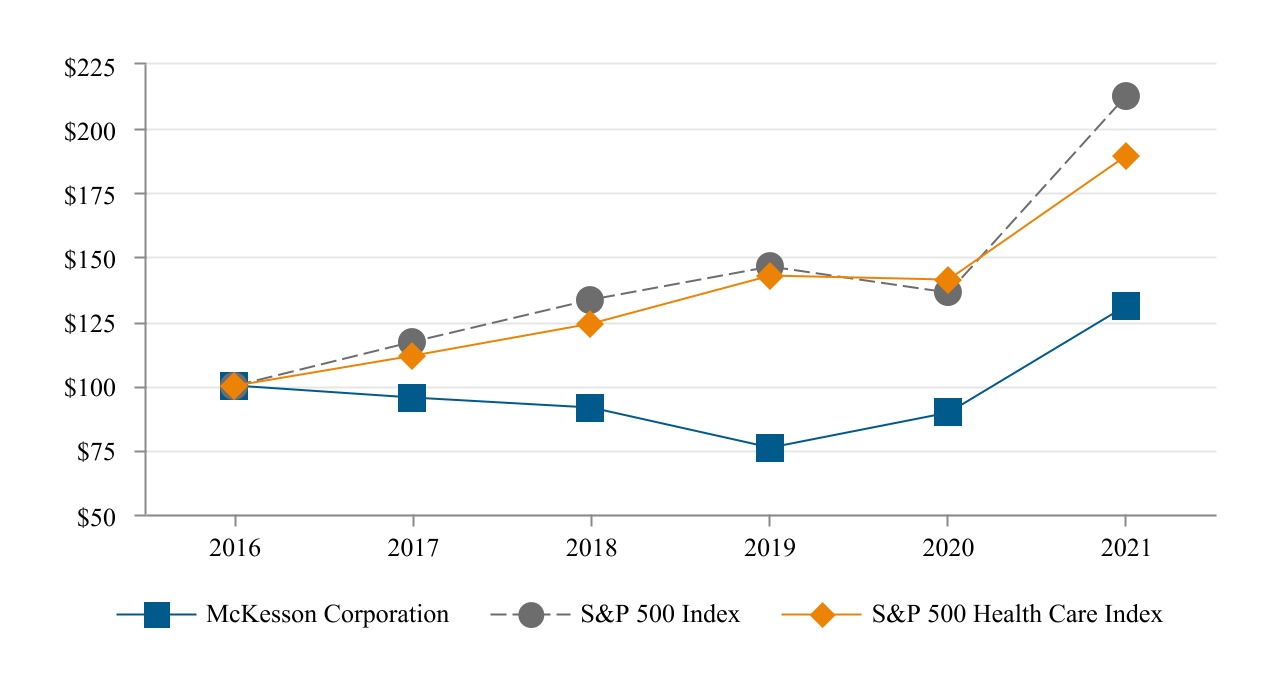
| March 31, | |||||||||||||||||||||||||||||||||||
| 2016 | 2017 | 2018 | 2019 | 2020 | 2021 | ||||||||||||||||||||||||||||||
| McKesson Corporation | $ | 100.00 | $ | 95.30 | $ | 91.37 | $ | 75.92 | $ | 89.37 | $ | 131.03 | |||||||||||||||||||||||
| S&P 500 Index | $ | 100.00 | $ | 117.17 | $ | 133.57 | $ | 146.25 | $ | 136.05 | $ | 212.71 | |||||||||||||||||||||||
| S&P 500 Health Care Index | $ | 100.00 | $ | 111.59 | $ | 124.17 | $ | 142.66 | $ | 141.21 | $ | 189.28 | |||||||||||||||||||||||
| * Assumes $100 invested in McKesson Common Stock and in each index on March 31, 2016 and that all dividends are reinvested. |
Item 6. Reserved.
Item 7. Management’s Discussion and Analysis of Financial Condition and Results of Operations.
GENERAL
Management’s discussion and analysis of financial condition and results of operations, referred to as the “Financial Review,” is intended to assist the reader in the understanding and assessment of significant changes and trends related to the results of operations and financial position of McKesson Corporation together with its subsidiaries (collectively, the “Company,” “McKesson,” “we,” “our,” or “us” and other similar pronouns). This discussion and analysis should be read in conjunction with the consolidated financial statements and accompanying financial notes in Item 8 of Part II of this Annual Report on Form 10-K.
Our fiscal year begins on April 1 and ends on March 31. Unless otherwise noted, all references to a particular year shall mean our fiscal year.
Certain statements in this report constitute forward-looking statements. See Item 1 - Business - Forward-Looking Statements in Part I of this Annual Report on Form 10-K for additional factors relating to these statements and Item 1A - Risk Factors in Part I of this Annual Report on Form 10-K for a list of certain risk factors applicable to our business, financial condition, and results of operations.
McKESSON CORPORATION
FINANCIAL REVIEW (Continued)
Overview of Our Business:
We are a global leader in healthcare supply chain management solutions, retail pharmacy, community oncology and specialty care, and healthcare information solutions. We partner with life sciences companies, manufacturers, providers, pharmacies, governments, and other healthcare organizations to help provide the right medicines, medical products, and healthcare services to the right patients at the right time, safely, and cost-effectively.
We implemented a new segment reporting structure commencing with the second quarter of 2021, which resulted in four reportable segments: U.S. Pharmaceutical, International, Medical-Surgical Solutions, and Prescription Technology Solutions (“RxTS”). Other, for retrospective periods presented, consists of our equity method investment in Change Healthcare LLC (“Change Healthcare JV”), which was split-off from McKesson in the fourth quarter of 2020. All prior segment information has been recast to reflect our new segment structure and current period presentation. Our organizational structure also includes Corporate, which consists of income and expenses associated with administrative functions and projects, and the results of certain investments. The factors for determining the reportable segments include the manner in which management evaluates the performance of the Company combined with the nature of individual business activities. We evaluate the performance of our operating segments on a number of measures, including revenues and operating profit before interest expense and income taxes.
The following summarizes our four reportable segments and the changes made to our reporting structure commencing in the second quarter of 2021. Refer to Financial Note 22, “Segments of Business,” to the accompanying consolidated financial statements included in this Annual Report on Form 10-K for further information regarding our reportable segments.
-
U.S. Pharmaceutical**, previously the U.S. Pharmaceutical and Specialty Solutions reportable segment, continues to distribute branded, generic, specialty, biosimilar, and over-the-counter pharmaceutical drugs and other healthcare-related products. This segment also provides practice management, technology, clinical support, and business solutions to community-based oncology and other specialty practices. In addition, the segment sells financial, operational, and clinical solutions to pharmacies (retail, hospital, alternate site) and provides consulting, outsourcing, technological, and other services.
-
International** is a new reportable segment that includes our operations in Europe and Canada, bringing together non-U.S.-based drug distribution services, specialty pharmacy, retail, and infusion care services. McKesson Europe was previously reflected as the European Pharmaceutical Solutions reportable segment and McKesson Canada was previously included in Other.
-
Medical-Surgical Solutions** provides medical-surgical supply distribution, logistics, and other services to healthcare providers in the United States (“U.S.”) and was unaffected by the segment realignment.
-
RxTS** is a new reportable segment that brings together existing businesses, including CoverMyMeds, RelayHealth, RxCrossroads, and McKesson Prescription Automation, including Multi-Client Central Fill as a Service, to serve our biopharma and life sciences partners and patients. RxCrossroads was previously included in our former U.S. Pharmaceutical and Specialty Solutions reportable segment and CoverMyMeds, RelayHealth, and McKesson Prescription Automation were previously included in Other.
McKESSON CORPORATION
FINANCIAL REVIEW (Continued)
Executive Summary:
The following summary provides highlights and key factors that impacted our business, operating results, financial condition, and liquidity for the year ended March 31, 2021.
-
Coronavirus disease 2019 (“COVID-19”) impacted our results of operations for the year ended March 31, 2021. Following the declaration of COVID-19 as a global pandemic by the World Health Organization (“WHO”) on March 11, 2020, there was a temporary increase in demand for pharmaceuticals across our businesses. Subsequently, pharmaceutical distribution volumes decreased during the first quarter as a result of the weakened and uncertain global economic environment and COVID-19 restrictions, including government shutdowns and shelter-in-place orders. The recovery from the COVID-19 pandemic continued to fluctuate throughout our fiscal year. We benefited from demand for COVID-19 tests, favorable contributions from our vaccine and related ancillary supply kit distribution programs as discussed further below, and savings from reduced travel and meetings throughout 2021;
-
We expanded our existing contractual relationship with the Centers for Disease Control and Prevention (“CDC”) through an amendment to our existing Vaccines for Children Program contract to support the U.S. government as a centralized distributor of COVID-19 vaccines and ancillary supplies needed to administer vaccines. We have also partnered with the Department of Health and Human Services (“HHS”) and Pfizer to manage the assembly and distribution of the ancillary supplies needed to administer COVID-19 vaccines;
-
In December 2020, we began distributing certain COVID-19 vaccines under the direction of the CDC. Through the end of the fiscal year, we had distributed approximately 100 million of COVID-19 vaccine doses. For a more in-depth discussion of how COVID-19 impacted our business, operations, and outlook, refer to the COVID-19 section of "Trends and Uncertainties" included below;
-
Revenues of $238.2 billion, reflects a 3% increase from the prior year primarily in our U.S. Pharmaceutical segment driven by market growth;
-
Gross profit increased 1% from the prior year primarily in our Medical-Surgical Solutions segment driven by sales of COVID-19 tests;
-
Total operating expenses in 2021 includes the following:
◦a charge of $8.1 billion related to our estimated liability for opioid-related claims as further described in the Opioid-Related Litigation and Claims section of “Trends and Uncertainties” included below; and
◦charges of $115 million to impair certain long-lived assets within our International segment; partially offset by
◦a net gain of $131 million recorded in connection with insurance proceeds received from the settlement of the shareholder derivative action related to our controlled substances monitoring program;
- Other income, net in 2021 includes net gains of $133 million related to our equity inv
Showing the first 8K of 149K characters. Open the full section
Item 7A. Quantitative and Qualitative Disclosures about Market Risk
Interest rate risk: Our long-term debt bears interest predominately at fixed rates, whereas our short-term borrowings are at variable interest rates.
Our cash and cash equivalents balances earn interest at variable rates. At March 31, 2021 and 2020, we had $6.3 billion and $4.0 billion, respectively, in cash and cash equivalents. The effect of a hypothetical 50 bp increase in the underlying interest rate on our cash and cash equivalents, net of short-term borrowings and variable rate debt, would have resulted in a favorable impact to earnings in 2021 and 2020 of approximately $17 million and $6 million, respectively.
McKESSON CORPORATION
FINANCIAL REVIEW (Concluded)
Foreign exchange risk: We conduct our business worldwide in U.S. dollars and the functional currencies of our foreign subsidiaries, including Euro, British pound sterling, and Canadian dollar. Changes in foreign currency exchange rates could have a material adverse impact on our financial results that are reported in U.S. dollars. We are also exposed to foreign exchange rate risk related to our foreign subsidiaries, including intercompany loans denominated in non-functional currencies.
We have certain foreign exchange rate risk programs that use foreign currency forward contracts and cross-currency swaps. The forward contracts and cross-currency swaps are intended to reduce the income statement effects from fluctuations in foreign exchange rates and have been designated as cash flow hedges. These programs reduce but do not entirely eliminate foreign exchange risk.
As of March 31, 2021 and 2020, the effect of a hypothetical adverse 10% change in the underlying foreign currency exchange rates would have impacted the fair value of our foreign exchange contracts by approximately $267 million and $435 million, respectively. However, our risk management programs are designed such that the potential loss in value of these risk management portfolios described above would be largely offset by changes in the value of the underlying exposure. Refer to Financial Note 16, “Hedging Activities,” for more information on our foreign currency forward contracts and cross-currency swaps.
The selected hypothetical change in interest rates and foreign currency exchange rates does not reflect what could be considered the best or worst case scenarios.
McKESSON CORPORATION
Item 8. Financial Statements and Supplementary Data.
INDEX TO CONSOLIDATED FINANCIAL INFORMATION
McKESSON CORPORATION
MANAGEMENT’S ANNUAL REPORT ON INTERNAL CONTROL OVER FINANCIAL REPORTING
The management of McKesson Corporation is responsible for establishing and maintaining an adequate system of internal control over financial reporting, as such term is defined in Exchange Act Rules 13a-15(f) and 15d-15(f). With the participation of the Chief Executive Officer and the Chief Financial Officer, our management conducted an assessment of the effectiveness of our internal control over financial reporting based on the framework and criteria established in Internal Control—Integrated Framework (2013), issued by the Committee of Sponsoring Organizations of the Treadway Commission. Based on this assessment, our management has concluded that our internal control over financial reporting was effective as of March 31, 2021.
Deloitte & Touche LLP, an independent registered public accounting firm, audited the financial statements included in this Annual Report on Form 10-K and has also audited the effectiveness of the Company’s internal control over financial reporting as of March 31, 2021. This audit report appears on the following page of this Annual Report on Form 10-K.
May 12, 2021
| /s/ Brian S. Tyler | ||
| Brian S. Tyler | ||
| Chief Executive Officer | ||
| (Principal Executive Officer) |
| /s/ Britt J. Vitalone | ||
| Britt J. Vitalone |
Showing the first 8K of 352K characters. Open the full section
Item 9. Changes in and Disagreements with Accountants on Accounting and Financial Disclosure.
None.
Item 9A. Controls and Procedures.
Disclosure Controls and Procedures
Our Chief Executive Officer and our Chief Financial Officer, with the participation of other members of the Company’s management, have evaluated the effectiveness of the Company’s “disclosure controls and procedures” (as such term is defined in Exchange Act Rules 13a-15(e) and 15d-15(e)) as of the end of the period covered by this report and have concluded that our disclosure controls and procedures are effective based on their evaluation of these controls and procedures as required by paragraph (b) of Exchange Act Rules 13a-15 or 15d-15.
Internal Control over Financial Reporting
Management’s report on the Company’s internal control over financial reporting (as such term is defined in Exchange Act Rules 13a-15(f) and 15d-15(f)) and the related report of our independent registered public accounting firm are included in this Annual Report on Form 10-K, under the headings, “Management’s Annual Report on Internal Control Over Financial Reporting” and “Report of Independent Registered Public Accounting Firm” and are incorporated herein by reference.
Changes in Internal Controls
There was no change in our internal control over financial reporting identified in connection with the evaluation required by paragraph (d) of Exchange Act Rules 13a-15 or 15d-15 that occurred during our fourth quarter of 2021 that has materially affected, or is reasonably likely to materially affect, our internal control over financial reporting.
Item 9B. Other Information.
None.
PART III
Item 10. Directors, Executive Officers and Corporate Governance.
Information about our Directors is incorporated by reference from the discussion under Item 1 of our Proxy Statement for the 2021 Annual Meeting of Stockholders (the “Proxy Statement”) under the heading “Election of Directors.” Information about our Executive Officers is incorporated by reference from the discussion in Part I of this report under the heading “Information about our Executive Officers.” Information about our Audit Committee, including the members of the committee and our Audit Committee Financial Expert, is incorporated by reference from the discussion under Item 1 of our Proxy Statement under the headings “The Board, Committees and Meetings,” and “Audit Committee Report.”
Information about the Code of Conduct applicable to all employees, officers and directors can be found on our website, www.mckesson.com, under the caption “Investors - Corporate Governance.” The Company’s Corporate Governance Guidelines and Charters for the Audit, Compensation and Governance Committees can also be found on our website under the same caption.
The Company intends to post on its website required information regarding any amendment to, or waiver from, the Code of Conduct that applies to our Chief Executive Officer, Chief Financial Officer, Controller and persons performing similar functions within four business days after any such amendment or waiver.
Item 11. Executive Compensation.
Information with respect to this item is incorporated by reference from the discussion under the heading “Executive Compensation” in our Proxy Statement.
McKESSON CORPORATION
Item 12. Security Ownership of Certain Beneficial Owners and Management and Related Stockholder Matters.
Information about security ownership of certain beneficial owners and management is incorporated by reference from the discussion under the heading “Principal Shareholders” in our Proxy Statement.
The following table sets forth information as of March 31, 2021 with respect to the plans under which the Company’s common stock is authorized for issuance:
| Plan Category (In millions, except per share amounts) | Number of securities to be issued upon exercise of outstanding options, warrants and rights | Weighted-average exercise price of outstanding options, warrants and rights (1) | Number of securities remaining available for future issuance under equity compensation plans (excluding securities reflected in the first column) | ||||||||||||||
| Equity compensation plans approved by security holders | 4.2 (2) | $ | 183.29 | 21.9 (3) | |||||||||||||
| Equity compensation plans not approved by security holders | — | $ | — | — |
(1) The weighted-average exercise price set forth in this column is calculated excluding outstanding restricted stock unit (“RSU”) awards, since recipients are not required to pay an exercise price to receive the shares subject to these awards.
(2) Represents option and RSU awards outstanding under the following plans: (i) 1997 Non-Employee Directors’ Equity Compensation and Deferral Plan; (ii) the 2005 Stock Plan; and (iii) the 2013 Stock Plan.
(3) Represents 2.23 million shares available for purchase under the 2000 Employee Stock Purchase Plan and 19.67 million shares available for grant under the 2013 Stock Plan.
The following are descriptions of equity plans that have been approved by the Company’s stockholders. The plans are administered by the Compensation Committee of the Board of Directors, except for the portion of the 2013 Stock Plan and 2005 Stock Plan related to non-employee directors, which is administered by the Board of Directors or its Governance Committee.
2013 Stock Plan: The 2013 Stock Plan was adopted by the Board of Directors on May 22, 2013 and approved by the Company’s stockholders on July 31, 2013. The 2013 Stock Plan permits the grant of awards in the form of stock options, stock appreciation rights, restricted stock (“RS”), restricted stock units (“RSUs”), performance-based restricted stock units (“PeRSUs”), performance shares, and other share-based awards. The number of shares reserved for issuance under the 2013 Stock Plan equals the sum of (i) 30.0 million shares, (ii) the number of shares reserved but unissued under the 2005 Stock Plan as of the effective date of the 2013 Stock Plan, and (iii) the number of shares that become available for reuse under the 2005 Stock Plan following the effective date of the 2013 Stock Plan. For any one share of common stock issued in connection with an RS, RSU, performance share or other full share award, three and one-half shares shall be deducted from the shares available for future grants. Shares of common stock not issued or delivered as a result of the net exercise of a stock option, including in respect of the payment of applicable taxes, or shares repurchased on the open market with proceeds from the exercise of options shall not be returned to the reserve of shares available for issuance under the 2013 Stock Plan. Shares withheld to satisfy tax obligations relating to the vesting of a full-share award shall be returned to the reserve of shares available for issuance under the 2013 Stock Plan.
Stock options are granted at no less than fair market value and those options granted under the 2013 Stock Plan generally have a contractual term of seven years. Options generally become exercisable in four equal annual installments beginning one year after the grant date. The vesting of RS or RSUs is determined by the Compensation Committee at the time of grant. Beginning with awards granted in fiscal year 2021, RS and RSUs generally vest over three years. RSUs granted under the PeRSU program vest three years following the end of the performance period. The Company’s executive officers and other members of senior management are annually granted performance awards called performance stock units (“PSUs”), which have a three-year performance period and are payable in shares without an additional vesting period.
Non-employee directors may be granted an award on the date of each annual meeting of the stockholders for up to 5,000 RSUs, as determined by the Board. Such non-employee director award is fully vested on the date of the grant.
McKESSON CORPORATION
2005 Stock Plan: The 2005 Stock Plan was adopted by the Board of Directors on May 25, 2005 and approved by the Company’s stockholders on July 27, 2005. The 2005 Stock Plan permits the granting of up to 42.5 million shares in the form of stock options, RS, RSUs, PeRSUs, performance shares and other share-based awards. For any one share of common stock issued in connection with an RS, RSU, performance share or other full-share award, two shares shall be deducted from the shares available for future grants. Shares of common stock not issued or delivered as a result of the net exercise of a stock option, shares withheld to satisfy tax obligations relating to the vesting of a full-share award or shares repurchased on the open market with proceeds from the exercise of options shall not be returned to the reserve of shares available for issuance under the 2005 Stock Plan. Stock options were granted at no less than fair market value and options granted under the 2005 Stock Plan generally have a contractual term of seven years.
Following the effectiveness of the 2013 Stock Plan, no further shares were made subject to award under the 2005 Stock Plan. Shares reserved but unissued under the 2005 Stock Plan as of the effective date of the 2013 Stock Plan, and shares that become available for reuse under the 2005 Stock Plan following the effectiveness of the 2013 Stock Plan, will be available for awards under the 2013 Stock Plan.
1997 Non-Employee Directors’ Equity Compensation and Deferral Plan: The 1997 Non-Employee Directors’ Equity Compensation and Deferral Plan was approved by the Company’s stockholders on July 30, 1997; however, stockholder approval of the 2005 Stock Plan on July 27, 2005 had the effect of terminating the 1997 Non-Employee Directors’ Equity Compensation and Deferral Plan such that no new awards would be granted under the 1997 Non-Employee Directors’ Equity Compensation and Deferral Plan.
2000 Employee Stock Purchase Plan (the “ESPP”): The ESPP is intended to qualify as an “employee stock purchase plan” within the meaning of Section 423 of the Internal Revenue Code. In March 2002, the Board amended the ESPP to allow for participation in the plan by employees of certain of the Company’s international and other subsidiaries. Currently, 21.1 million shares have been approved by stockholders for issuance under the ESPP.
The ESPP is implemented through a continuous series of three-month purchase periods (“Purchase Periods”) during which contributions can be made toward the purchase of common stock under the plan. Each eligible employee may elect to authorize regular payroll deductions during the next succeeding Purchase Period, the amount of which may not exceed 15% of a participant’s compensation. At the end of each Purchase Period, the funds withheld by each participant will be used to purchase shares of the Company’s common stock. The purchase price of each share of the Company’s common stock is 85% of the fair market value of each share on the last day of the applicable Purchase Period. In general, the maximum number of shares of common stock that may be purchased by a participant for each calendar year is determined by dividing $25,000 by the fair market value of one share of common stock on the offering date.
There currently are no equity awards outstanding that were granted under equity plans that were not submitted for approval by the Company’s stockholders.
Item 13. Certain Relationships and Related Transactions, and Director Independence.
Information with respect to certain transactions with directors and management is incorporated by reference from the Proxy Statement under the heading “Related Party Transactions Policy and Transactions with Related Persons.” Information regarding Director independence is incorporated by reference from the Proxy Statement under the heading “Director Independence.” Additional information regarding certain related party balances and transactions is included in the Financial Review section of this report and Financial Note 21, “Related Party Balances and Transactions” to the consolidated financial statements appearing in this report.
Item 14. Principal Accounting Fees and Services.
Information regarding principal accountant fees and services is set forth under the heading “Ratification of Appointment of Deloitte & Touche LLP as the Company’s Independent Registered Public Accounting Firm for Fiscal 2022” in our Proxy Statement and all such information is incorporated herein by reference.
McKESSON CORPORATION
PART IV
Item 15. Exhibits and Financial Statement Schedule.
McKESSON CORPORATION
SCHEDULE II
SUPPLEMENTARY CONSOLIDATED FINANCIAL STATEMENT SCHEDULE
VALUATION AND QUALIFYING ACCOUNTS
(In millions)
| Additions | |||||||||||||||||||||||||||||
| Description | Balance at Beginning of Year | Charged to Costs and Expenses | Charged to Other Accounts (3) | Deductions From Allowance Accounts (1) | Balance at End of Year (2) | ||||||||||||||||||||||||
| Year Ended March 31, 2021 | |||||||||||||||||||||||||||||
| Allowances for doubtful accounts | $ | 252 | $ | 4 | $ | 1 | $ | (46) | $ | 211 | |||||||||||||||||||
| Other allowances | 30 | 11 | 9 | — | 50 | ||||||||||||||||||||||||
| $ | 282 | $ | 15 | $ | 10 | $ | (46) | $ | 261 | ||||||||||||||||||||
| Year Ended March 31, 2020 | |||||||||||||||||||||||||||||
| Allowances for doubtful accounts | $ | 273 | $ | 91 | $ | (19) | $ | (93) | $ | 252 | |||||||||||||||||||
| Other allowances | 24 | — | — | 6 | 30 | ||||||||||||||||||||||||
| $ | 297 | $ | 91 | $ | (19) | $ | (87) | $ | 282 | ||||||||||||||||||||
| Year Ended March 31, 2019 | |||||||||||||||||||||||||||||
| Allowances for doubtful accounts | $ | 187 | $ | 132 | $ | (1) | $ | (45) | $ | 273 | |||||||||||||||||||
| Other allowances | 39 | — | (15) | — | 24 | ||||||||||||||||||||||||
| $ | 226 | $ | 132 | $ | (16) | $ | (45) | $ | 297 | ||||||||||||||||||||
| 2021 | 2020 | 2019 | |||||||||||||||||||||
| (1) | Deductions: | ||||||||||||||||||||||
| Written-off | $ | (40) | $ | (93) | $ | (45) | |||||||||||||||||
| Credited to other accounts and other | (6) | 6 | — | ||||||||||||||||||||
| Total | $ | (46) | $ | (87) | $ | (45) | |||||||||||||||||
| (2) | Amounts shown as deductions from current and non-current receivables (current allowances were $250 million, $265 million, and $279 million at March 31, 2021, 2020, and 2019, respectively) | $ | 261 | $ | 282 | $ | 297 | ||||||||||||||||
| (3) | Primarily represents reclassifications to other balance sheet accounts. |
McKESSON CORPORATION
EXHIBIT INDEX
The agreements included as exhibits to this report are included to provide information regarding their terms and not intended to provide any other factual or disclosure information about the Company or the other parties to the agreements. The agreements may contain representations and warranties by each of the parties to the applicable agreement that were made solely for the benefit of the other parties to the applicable agreement, and;
-
should not in all instances be treated as categorical statements of fact, but rather as a way of allocating the risk to one of the parties if those statements prove to be inaccurate;
-
may apply standards of materiality in a way that is different from what may be viewed as material to you or other investors; and
-
were made only as of the date of the applicable agreement or such other date or dates as may be specified in the agreement and are subject to more recent developments.
Accordingly, these representations and warranties may not describe the actual state of affairs as of the date they were made or at any other time.
Exhibits identified under “Incorporated by Reference” in the table below are on file with the Commission and are incorporated by reference as exhibits hereto.
McKESSON CORPORATION
McKESSON CORPORATION
McKESSON CORPORATION
________________
- Management contract or compensation plan or arrangement in which directors and/or executive officers are eligible to participate.
† Filed herewith.
†† Furnished herewith.
Registrant agrees to furnish to the Commission upon request a copy of each instrument defining the rights of security holders with respect to issues of long-term debt of the registrant, the authorized principal amount of which does not exceed 10% of the total assets of the registrant.
McKESSON CORPORATION
Item 16. Form 10-K Summary
None.
McKESSON CORPORATION
SIGNATURES
Pursuant to the requirements of Section 13 or 15(d) of the Securities Exchange Act of 1934, the registrant has duly caused this report to be signed on its behalf by the undersigned, thereunto duly authorized.
| MCKESSON CORPORATION | |||||||||||
| Date: May 12, 2021 | /s/ Britt J. Vitalone | ||||||||||
| Britt J. Vitalone | |||||||||||
| Executive Vice President and Chief Financial Officer |
Pursuant to the requirements of the Securities Exchange Act of 1934, this report has been signed below by the following persons on behalf of the Registrant and in the capacities and on the date indicated:
| /s/ Brian S. Tyler | /s/ Marie L. Knowles | |||||||
| Brian S. Tyler Chief Executive Officer and Director (Principal Executive Officer) | Marie L. Knowles, Director | |||||||
| /s/ Britt J. Vitalone | /s/ Bradley E. Lerman | |||||||
| Britt J. Vitalone Executive Vice President and Chief Financial Officer (Principal Financial Officer) | Bradley E. Lerman, Director | |||||||
| /s/ Sundeep G. Reddy | /s/ Linda Mantia | |||||||
| Sundeep G. Reddy Senior Vice President and Controller (Principal Accounting Officer) | Linda Mantia, Director | |||||||
| /s/ Dominic J. Caruso | /s/ Maria Martinez | |||||||
| Dominic J. Caruso, Director | Maria Martinez, Director | |||||||
| /s/ N. Anthony Coles | /s/ Edward A. Mueller | |||||||
| N. Anthony Coles, M.D., Director | Edward A. Mueller, Director | |||||||
| /s/ M. Christine Jacobs | /s/ Susan R. Salka | |||||||
| M. Christine Jacobs, Director | Susan R. Salka, Director | |||||||
| /s/ Donald R. Knauss | /s/ Kenneth E. Washington | |||||||
| Donald R. Knauss, Director | Kenneth E. Washington, Director | |||||||
| Date: May 12, 2021 |