 filings.tools
Moody's 10-K 2018-12-31
Filed 2019-02-25. 21 sections, 739K characters. Original on sec.gov · Markdown · JSON
Cover and table of contents
10-K 1 d679514d10k.htm FORM 10-K
Table of Contents
UNITED STATES
SECURITIES AND EXCHANGE COMMISSION
WASHINGTON, D.C. 20549
FORM 10-K
(MARK ONE)
☑ ANNUAL REPORT PURSUANT TO SECTION 13 OR 15(d) OF THE SECURITIES EXCHANGE ACT OF 1934
FOR THE FISCAL YEAR ENDED DECEMBER 31, 2018
OR
☐ TRANSITION REPORT PURSUANT TO SECTION 13 OR 15(d) OF THE SECURITIES EXCHANGE ACT OF 1934
FOR THE TRANSITION PERIOD FROM TO .
COMMISSION FILE NUMBER 1-14037
MOODY’S CORPORATION
(EXACT NAME OF REGISTRANT AS SPECIFIED IN ITS CHARTER)
| DELAWARE | 13-3998945 | |
| (STATE OF INCORPORATION) | (I.R.S. EMPLOYER IDENTIFICATION NO.) |
7 World Trade Center at 250 Greenwich Street, NEW YORK, NEW YORK 10007
(ADDRESS OF PRINCIPAL EXECUTIVE OFFICES)
(ZIP CODE)
REGISTRANT’S TELEPHONE NUMBER, INCLUDING AREA CODE: (212) 553-0300.
SECURITIES REGISTERED PURSUANT TO SECTION 12(b) OF THE ACT:
| TITLE OF EACH CLASS | NAME OF EACH EXCHANGE ON WHICH REGISTERED | |
| COMMON STOCK, PAR VALUE $.01 PER SHARE | NEW YORK STOCK EXCHANGE | |
| 1.75% SENIOR NOTES DUE 2027 | NEW YORK STOCK EXCHANGE |
SECURITIES REGISTERED PURSUANT TO SECTION 12(g) OF THE ACT:
NONE
Indicate by check mark if the registrant is a well-known seasoned issuer, as defined in Rule 405 of the Securities Act. Yes ☑ No ☐
Indicate by check mark if the registrant is not required to file reports pursuant to Section 13 or Section 15(d) of the Act. Yes ☐ No ☑
Indicate by check mark whether the registrant (1) has filed all reports required to be filed by Section 13 or 15(d) of the Securities Exchange Act of 1934 during the preceding 12 months (or for such shorter period that the registrant was required to file such reports), and (2) has been subject to such filing requirements for the past 90 days. Yes ☑ No ☐
Indicate by check mark whether the registrant has submitted electronically every Interactive Data File required to be submitted pursuant to Rule 405 of Regulation S-T (§232.405 of this chapter) during the preceding 12 months (or for such shorter period that the registrant was required to submit such files). Yes ☑ No ☐
Indicate by check mark if disclosure of delinquent filers pursuant to Item 405 of Regulation S-K (§ 229.405 of this chapter) is not contained herein, and will not be contained, to the best of registrant’s knowledge, in definitive proxy or information statements incorporated by reference in Part III of this Form 10-K or any amendment to this Form 10-K. ☐
Indicate by check mark whether the registrant is a large accelerated filer, an accelerated filer, a non-accelerated filer, a smaller reporting company, or emerging growth company. See the definitions of “large accelerated filer,” “accelerated filer,” “smaller reporting company,” and “emerging growth company” in Rule 12b-2 of the Exchange Act.
Large Accelerated Filer ☑ Accelerated Filer ☐ Non-accelerated Filer ☐ Smaller reporting company ☐ Emerging growth company ☐
If an emerging growth company, indicate by check mark if the registrant has elected not to use the extended transition period for complying with any new or revised financial accounting standards provided pursuant to Section 13(a) of the Exchange Act. ☐
Indicate by check mark whether the registrant is a shell company (as defined in Rule 12b-2 of the Act). Yes ☐ No ☑
The aggregate market value of Moody’s Corporation Common Stock held by nonaffiliates* on June 30, 2018 (based upon its closing transaction price on the New York Stock Exchange on such date) was approximately $32.7 billion.
As of January 31, 2019, 191.0 million shares of Common Stock of Moody’s Corporation were outstanding.
DOCUMENTS INCORPORATED BY REFERENCE
Portions of the Registrant’s definitive proxy statement for use in connection with its annual meeting of stockholders scheduled to be held on April 16, 2019, are incorporated by reference into Part III of this Form 10-K.
The Index to Exhibits is included as Part IV, Item 15(3) of this Form 10-K.
| * | Calculated by excluding all shares held by executive officers and directors of the Registrant without conceding that all such persons are “affiliates” of the Registrant for purposes of federal securities laws. |
|---|
| MOODY’S 2018 10-K |
Table of Contents
MOODY’S CORPORATION
INDEX TO FORM 10-K
Showing the first 8K of 73K characters. Open the full section
Item 1A. RISK FACTORS
| --- | --- | --- |
The following risk factors and other information included in this annual report on Form 10-K should be carefully considered. The risks and uncertainties described below are not the only ones the Company faces. Additional risks and uncertainties not presently known to the Company or that the Company’s management currently deems minor or insignificant also may impair its business operations. If any of the following risks occur, Moody’s business, financial condition, operating results and cash flows could be materially and adversely affected. These risk factors should be read in conjunction with the other information in this annual report on Form 10-K.
U.S. Laws and Regulations Affecting the Credit Rating Industry and Moody’s Customers May Negatively Impact the Nature and Economics of the Company’s Business.
Moody’s operates in a highly regulated industry and is subject to extensive regulation by federal, state and local authorities in the U.S., including the Reform Act and the Financial Reform Act. These regulations are complex, continually evolving and have tended to become more stringent over time. See “Regulation” in Part 1, Item 1 of this annual report on Form 10-K for more information. These laws and regulations:
| » | seek to encourage, and may result in, increased competition among rating agencies and in the credit rating business; |
|---|
| » | may result in alternatives to credit ratings or changes in the pricing of credit ratings; |
|---|
| » | restrict the use of information in the development or maintenance of credit ratings; |
|---|
| » | increase regulatory oversight of the credit markets and CRA operations; |
|---|
| » | provide for direct jurisdiction of the SEC over CRAs that seek NRSRO status, and grant authority to the SEC to inspect the operations of CRAs; and |
|---|
| » | authorize the adoption of enhanced oversight standards and new pleading standards, which may result in increases in the number of legal proceedings claiming liability for losses suffered by investors on rated securities and aggregate legal defense costs. |
|---|
These laws and regulations, and any future rulemaking or court rulings, could result in reduced demand for credit ratings and increased costs, which Moody’s may be unable to pass through to customers. In addition, there may be uncertainty over the scope, interpretation and administration of such laws and regulations. The Company may be required to incur significant expenses in order to ensure compliance and mitigate the risk of fines, penalties or other sanctions. Legal proceedings could become increasingly lengthy and there may be uncertainty over and exposure to liability. It is difficult to accurately assess the future impact of legislative and regulatory requirements on Moody’s business and its customers’ businesses. For example, new laws and regulations may affect MIS’s communications with issuers as part of the rating assignment process, alter the manner in which MIS’s ratings are developed, assigned and communicated, affect the manner in which MIS or its customers or users of credit ratings operate, impact the demand for MIS’s ratings and alter the economics of the credit ratings business, including by restricting or mandating business models for rating agencies. Further, speculation concerning the impact of legislative and regulatory initiatives and the increased uncertainty over potential liability and adverse legal or judicial determinations may negatively affect Moody’s stock price. Although these legislative and regulatory initiatives apply to rating agencies and credit markets generally, they may affect Moody’s in a disproportionate manner. Each of these developments increase the costs and legal risk associated with the issuance of credit ratings and may have a material adverse effect on Moody’s operations, profitability and competitiveness, the demand for credit ratings and the manner in which such ratings are utilized.
In addition, MA derives a significant amount of its sales in the ERS and Professional Services segments from banks and other financial services providers who are subject to regulatory oversight. U.S. banking regulators, including the Office of the Comptroller of the Currency, the Federal Deposit Insurance Corporation, the Board of Governors of the Federal Reserve System and the Consumer Financial Protection Board, as well as many state agencies have issued guidance to insured depository institutions and other providers of financial services on assessing and managing risks associated with third-party relationships, which include all business arrangements between a financial services provider and another entity, by contract or otherwise, and generally requires banks and financial services providers to exercise comprehensive oversight throughout each phase of a bank or financial service provider’s business arrangement with third-party service providers, and instructs banks and financial service providers to adopt risk management processes commensurate with the level of risk and complexity of their third-party relationships. In light of this, MA’s existing or potential bank and financial services customers subject to this guidance may continue to revise their third-party risk management policies and processes and the terms on which they do business with MA, which may delay or reduce sales to such customers, adversely affect MA’s relationship with such customers, increase the costs of doing business with such customers and/or result in MA assuming greater financial and legal risk under service agreements with such customers.
Financial Reforms Outside the U.S. Affecting the Credit Rating Industry and Moody’s Customers May Negatively Impact the Nature and Economics of the Company’s Business.
In addition to the extensive and evolving U.S. laws and regulations governing the industry, foreign jurisdictions have taken measures to increase regulation of rating agencies and the markets for ratings. In particular, the EU has adopted a common regulatory framework
| MOODY’S 2018 10-K | 17 |
Table of Contents
for rating agencies operating in the EU. As a result, ESMA has direct supervisory authority for CRAs in the EU and has the power to take enforcement action against non-compliant CRAs, including through the issuance of public notices, withdrawal of registration and, in some cases, the imposition of fines. Although the Commission published a report in 2016 concluding that no new European legislation was needed for the industry at that time, the report also stated that it would continue to monitor the credit rating industry and analyze approaches that may strengthen existing regulation. For example, in 2018, ESMA published final guidance on the applicability of EU regulation to endorsed ratings which became effective on January 1, 2019. See “Regulation” in Part 1, Item 1 of this annual report on Form 10-K for more information.
MIS is a registered entity and is therefore subject to formal regulation and periodic inspection in the EU. Applicable rules include procedural requirements with respect to ratings of sovereign issuers, liability for intentional or grossly negligent failure to abide by applicable regulations, mandatory rotation requirements of CRAs hired by issuers of securities for ratings of resecuritizations, and restrictions on CRAs or their shareholders if certain ownership thresholds are crossed. Additional procedural and substantive requirements include conditions for the issuance of credit ratings, rules regarding the organization of CRAs, restrictions on activities deemed to create a conflict of interest, including fees that are based on costs and are non-discriminatory, and special requirements for the rating of structured finance instruments. Compliance with the EU regulations may increase costs of operations and could have a significant negative effect on Moody’s operations, profitability or ability to compete, or the markets for its products and services, including in ways that Moody’s presently is unable to predict. In addition, exposure to increased liability under the EU regulations may further increase costs and legal risks associated with the issuance of credit ratings and materially and adversely impact Moody’s results of operations.
In addition, regulators in Europe and other foreign markets in which MA is active have issued guidance similar to that issued in the U.S. relating to financial institutions’ assessment and management of risks associated with third-party relationships. Such guidelines include the Committee of European Banking Supervisors Guidelines on Outsourcing and the European Banking Authority Recommendations on Outsourcing to Cloud Providers (each of which is expected to be superseded by the European Banking Authority’s Guidelines on Outsourcing, currently under development and expected to be issued in early 2019). In light of this, MA’s existing or potential bank and financial services customers subject to this guidance may continue to revise their third-party risk management policies and processes and the terms on which they do business with MA, which may delay or reduce sales to such customers, adversely affect MA’s relationship with such customers, increase the costs of doing business with such customers and/or result in MA assuming greater financial and legal risk under service agreements with such customers.
The EU and other jurisdictions engage in rulemaking on an ongoing basis that could significantly impact operations or the markets for Moody’s products and services, including regulations extending to products and services not currently regulated and regulations affecting the need for debt securities to be rated, expansion of supervisory remit to include non-EU ratings used for regulatory purposes, increasing the level of competition in the market for credit ratings, establishing criteria for credit ratings or limiting the entities authorized to provide credit ratings, and laws and regulations related to collection, use, accuracy, correction and sharing of personal information by CRAs. Additionally, as of the date of the filing of this annual report on Form 10-K, there remains uncertainty regarding the impact that Brexit will have on the credit rating industry within the U.K., the EU and other jurisdictions. Although Moody’s will monitor these developments, Moody’s cannot predict the extent of such future laws and regulations, and the effect that they will have on Moody’s business or the potential for increased exposure to liability could be significant. Financial reforms in the EU and other foreign jurisdictions may have a material adverse effect on Moody’s business, operating results and financial condition.
The Company Faces Exposure to Litigation and Government Regulatory Proceedings, Investigations and Inquiries Related to Rating Opinions and Other Business Practices.
Moody’s faces exposure to litigation and government and regulatory proceedings, investigations and inquiries related to MIS’s ratings actions, as well as other business practices and products. If the market value of credit-dependent instruments declines or defaults, whether as a result of difficult economic times, turbulent markets or otherwise, the number of investigations and legal proceedings that Moody’s faces could increase significantly. Parties who invest in securities rated by MIS may pursue claims against MIS or Moody’s for losses they face in their portfolios. Moody’s has faced numerous class action lawsuits and other litigation, government investigations and inquiries concerning events linked to the U.S. subprime residential mortgage sector and broader deterioration in the credit markets during the financial crisis of 2007-2008. Legal proceedings impose additional expenses on the Company and require the attention of senior management to an extent that may significantly reduce their ability to devote time addressing other business issues, and any of these proceedings, investigations or inquiries could ultimately result in adverse judgments, damages, fines, penalties or activity restrictions. Risks relating to legal proceedings may be heightened in foreign jurisdictions that lack the legal protections or liability standards comparable to those that exist in the U.S. In addition, new laws and regulations have been and may continue to be enacted that establish lower liability standards, shift the burden of proof or relax pleading requirements, thereby increasing the risk of successful litigations in the U.S. and in foreign jurisdictions. These litigation risks are often difficult to assess or quantify. Moody’s may not have adequate insurance or reserves to cover these risks, and the existence and magnitude of these risks often remains unknown for substantial periods of time. Furthermore, to the extent that Moody’s is unable to achieve dismissals at an early stage and litigation matters proceed to trial, the aggregate legal defense costs incurred by Moody’s increase substantially, as does the risk of an adverse outcome.
| 18 | MOODY’S 2018 10-K |
Table of Contents
Additionally, as litigation or the process to resolve pending matters progresses, Moody’s will continue to review the latest information available and may change its accounting estimates, which could require Moody’s to record liabilities in the consolidated financial statements in future periods. See Note 20 to the consolidated financial statements for more information regarding ongoing investigations and civil litigation that the Company currently faces. Due to the number of these proceedings and the significant amount of damages sought, there is a risk that Moody’s will be subject to judgments, settlements, fines, penalties or other adverse results that could have a material adverse effect on its business, operating results and financial condition.
The Company is Exposed to Legal, Economic, Operational and Regulatory Risks of Operating in Multiple Jurisdictions.
Moody’s conducts operations in various countries outside the U.S. and derives a significant portion of its revenue from foreign sources. Changes in the economic condition of the various foreign economies in which the Company operates may have an impact on the Company’s business. For example, economic uncertainty in the Eurozone or elsewhere, including in Latin America, could affect the number of securities offerings undertaken within those particular areas. In addition, operations abroad expose Moody’s to a number of legal, economic and regulatory risks such as:
| » | exposure to exchange rate movements between foreign currencies and USD; |
|---|
| » | restrictions on the ability to convert local currency into USD and the costs, including the tax impact, of repatriating cash held by entities outside the U.S.; |
|---|
| » | U.S. laws affecting overseas operations, including domestic and foreign export and import restrictions, tariffs and other trade barriers and restrictions, such as those related to the U.S.’s relationship with China; |
|---|
| » | differing and potentially conflicting legal or civil liability, compliance and regulatory standards, including as a result of the U.K.’s referendum vote to withdraw from the EU, Brexit; |
|---|
| » | an extension or delay of the U.K.’s withdrawal from the EU, or the U.K. leaving the EU with no agreement in place (“hard Brexit”); |
|---|
| » | current and future regulations relating to the imposition of mandatory rotation requirements on CRAs hired by issuers of securities; |
|---|
| » | uncertain and evolving laws and regulations, including those applicable to the financial services industries, such as the European Union’s implementation of the Markets in Financial Instruments Directive II, MiFID II, in January 2018, and to the protection of intellectual property; |
|---|
| » | the transition away from LIBOR to the Secured Overnight Financing Rate, SOFR, as a benchmark reference for short-term interests; |
|---|
| » | economic, political and geopolitical market conditions; |
|---|
| » | the possibility of nationalization, expropriation, price controls and other restrictive governmental actions; |
|---|
| » | competition with local rating agencies that have greater familiarity, longer operating histories and/or support from local governments or other institutions; |
|---|
| » | uncertainties of obtaining data and creating products and services relevant to particular geographic markets; |
|---|
| » | reduced protection for intellectual property rights; |
|---|
| » | longer payment cycles and possible problems in collecting receivables; |
|---|
| » | differing accounting principles and standards; |
|---|
| » | difficulties in staffing and managing foreign operations, including the expected relocation and/or restaffing of employees due to Brexit; |
|---|
| » | difficulties and delays in translating documentation into foreign languages; and |
|---|
| » | potentially adverse tax consequences. |
|---|
Additionally, Moody’s is subject to complex U.S., foreign and other local laws and regulations that are applicable to its operations abroad, such as the Foreign Corrupt Practices Act of 1977, the U.K. Bribery Act of 2010 and other anti-bribery and anti-corruption laws. Although the Company has implemented internal controls, policies and procedures and employee training and compliance programs to deter prohibited practices, such measures may not be effective in preventing employees, contractors or agents from violating or circumventing such internal policies and violating applicable laws and regulations. Any determination that the Company has violated anti-bribery or anti-corruption laws could have a material adverse effect on Moody’s business, operating results and financial condition. Compliance with international and U.S. laws and regulations that apply to the Company’s international operations increases the cost of doing business in foreign jurisdictions. Violations of such laws and regulations may result in severe fines and penalties, criminal sanctions, administrative remedies, restrictions on business conduct and could have a material adverse effect on Moody’s reputation, its ability to attract and retain employees, its business, operating results and financial condition.
| MOODY’S 2018 10-K | 19 |
Table of Contents
Moody’s Operations and Infrastructure May Malfunction or Fail.
Moody’s ability to conduct business may be materially and adversely impacted by a disruption in the infrastructure that supports its businesses and the communities in which Moody’s is located, including New York City, the location of Moody’s headquarters, major cities worldwide in which Moody’s has offices, and locations in China used for certain Moody’s back office work. This may include a disruption involving physical or technological infrastructure (whether or not controlled by the Company), including the Company’s electronic delivery systems, data center facilities, or the Internet, used by the Company or third parties with or through whom Moody’s conducts business. Many of the Company’s products and services are delivered electronically and the Company’s customers depend on the Company’s ability to receive, store, process, transmit and otherwise rapidly handle very substantial quantities of data and transactions on computer-based networks. Some of Moody’s operations require complex processes and, although the Company has instituted extensive controls to reduce the risk of error inherent in our operations, such risk cannot be completely eliminated. The Company’s customers also depend on the continued capacity, reliability and security of the Company’s telecommunications, data centers, networks and other electronic delivery systems, including its websites and connections to the Internet. The Company’s employees also depend on these systems for internal use. Any significant failure, compromise, cyber-breach, interruption or a significant slowdown of operations of the Company’s infrastructure, whether due to human error, capacity constraints, hardware failure or defect, natural disasters, fire, power loss, telecommunication failures, break-ins, sabotage, intentional acts of vandalism, acts of terrorism, political unrest, war or otherwise, may impair the Company’s ability to deliver its products and services.
Moody’s efforts to secure and plan for potential disruptions of its major operating systems may not be successful. The Company relies on third-party providers to provide certain essential services. While the Company believes that such providers are reliable, the Company has limited control over the performance of such providers. To the extent any of the Company’s third-party providers ceases to provide these services in an efficient, cost-effective manner or fails to adequately expand its services to meet the Company’s needs and the needs of the Company’s customers, the Company could experience lower revenues and higher costs. Additionally, although the Company maintains processes to prevent, detect and recover from a disruption, the Company also does not have fully redundant systems for most of its smaller office locations and low-risk systems, and its disaster recovery plan does not include restoration of non-essential services. If a disruption occurs in one of Moody’s locations or systems and its personnel in those locations or those who rely on such systems are unable to utilize other systems or communicate with or travel to other locations, such persons’ ability to service and interact with Moody’s customers may suffer. The Company cannot predict with certainty all of the adverse effects that could result from the Company’s failure, or the failure of a third party, to efficiently address and resolve these delays and interruptions. A disruption to Moody’s operations or infrastructure may have a material adverse effect on its reputation, business, operating results and financial condition.
The Company is Exposed to Risks Related to Cybersecurity and Protection of Confidential Information.
The Company’s operations rely on the secure processing, storage and transmission of confidential, sensitive, proprietary and other types of information relating to its business operations and confidential and sensitive information about its customers and employees in the Company’s computer systems and networks, and in those of its third party vendors. The cyber risks the Company faces range from cyber-attacks common to most industries, to more advanced threats that target the Company because of its prominence in the global marketplace, or due to its ratings of sovereign debt. Breaches of Moody’s or Moody’s vendors’ technology and systems, whether from circumvention of security systems, denial-of-service attacks or other cyber-attacks, hacking, “phishing” attacks, computer viruses, ransomware, or malware, employee or insider error, malfeasance, social engineering, physical breaches or other actions, may result in manipulation or corruption of sensitive data, material interruptions or malfunctions in the Company’s or such vendors’ web sites, applications, data processing, or disruption of other business operations, or may compromise the confidentiality and integrity of material information held by the Company (including information about Moody’s business, employees or customers), as well as sensitive personally identifiable information (PII), the disclosure of which could lead to identity theft. Measures that Moody’s takes to avoid, detect, mitigate or recover from material incidents can be expensive, and may be insufficient, circumvented, or may become ineffective. To conduct its operations, the Company regularly moves data across national borders, and consequently is subject to a variety of continuously evolving and developing laws and regulations in the United States and abroad regarding privacy, data protection and data security. The scope of the laws that may be applicable to Moody’s is often uncertain and may be conflicting, particularly with respect to foreign laws. For example, the European Union’s General Data Protection Regulation (“GDPR”), which became effective on May 25, 2018, greatly increased the jurisdictional reach of European Union privacy law and added a broad array of requirements for processing personal data, including the public disclosure of significant data breaches. Failure to comply with GDPR requirements could result in penalties of up to 4% of annual worldwide revenue. Additionally, other countries have enacted or are enacting data localization laws that require data to stay within their borders. Further, California recently enacted legislation, the California Consumer Privacy Act (“CCPA”), that will, among other things, require covered companies to provide new disclosures to California consumers, and afford such consumers new abilities to opt-out of certain sales of personal information, when it goes into effect on January 1, 2020. Legislators have stated that they intend to propose amendments to the CCPA before it goes into effect, and it remains unclear what, if any, modifications will be made to this legislation or how it will be interpreted. The effects of the CCPA potentially are significant, however, and may require us to modify our data processing practices and policies and to incur substantial costs and expenses. All of these evolving
| 20 | MOODY’S 2018 10-K |
Table of Contents
compliance and operational requirements have required changes to certain business practices, thereby increasing costs, may result in negative publicity or increased operating costs, require significant management time and attention, and subject the Company to remedies that may harm its business, including fines or demands or orders that we modify or cease existing business practices, and expose it to litigation, regulatory actions, sanctions or other statutory penalties.
The Company has invested and continues to invest in risk management and information security measures in order to protect its systems and data, including employee training, disaster plans, and technical defenses. The cost and operational consequences of implementing, maintaining and enhancing further data or system protection measures could increase significantly to overcome increasingly intense, complex, and sophisticated global cyber threats. Despite the Company’s best efforts, it is not fully insulated from data breaches and system disruptions. Recent well-publicized security breaches at other companies have led to enhanced government and regulatory scrutiny of the measures taken by companies to protect against cyber-attacks, and may in the future result in heightened cybersecurity requirements, including additional regulatory expectations for oversight of vendors and service providers. Any material breaches of cybersecurity, including the accidental loss, inadvertent disclosure or unapproved dissemination of proprietary information or sensitive or confidential data, or media reports of perceived security vulnerabilities to the Company’s systems or those of the Company’s third parties, even if no breach has been attempted or occurred, could cause the Company to experience reputational harm, loss of customers and revenue, fines, regulatory actions and scrutiny, sanctions or other statutory penalties, litigation, liability for failure to safeguard the Company’s customers’ information, or financial losses that are either not insured against or not fully covered through any insurance maintained by the Company. Any of the foregoing may have a material adverse effect on Moody’s business, operating results and financial condition.
The Company is Dependent on the Use of Third-Party Software, Data, Hosted Solutions, Data Centers, Cloud and Network Infrastructure (Together, “Third Party Technology”), and Any Reduction in Third-Party Product Quality or Service Offerings, Could Have a Material Adverse Effect on the Company’s Business, Financial Condition or Results of Operations.
Moody’s relies on Third Party Technology in connection with its product development and offerings and operations. The Company depends on the ability of Third Party Technology providers to deliver and support reliable products, enhance their current products, develop new products on a timely and cost-effective basis, and respond to emerging industry standards and other technological changes. The Third Party Technology Moody’s uses may become obsolete, incompatible with future versions of the Company’s products, unavailable or fail to operate effectively, and Moody’s business could be adversely affected if the Company is unable to timely or effectively replace such Third Party Technology. The Company also monitors its use of Third Party Technology to comply with applicable license and other contractual requirements. Despite the Company’s efforts, the Company cannot ensure that such third parties will permit Moody’s use in the future, resulting in increased Third Party Technology acquisition costs and loss of rights. In addition, the Company’s operating costs could increase if license or other usage fees for Third Party Technology increase or the efforts to incorporate enhancements to Third Party Technology are substantial. Some of these third-party suppliers are also Moody’s competitors, increasing the risks noted above. If any of these risks materialize, they could have a material adverse effect on the Company’s business, financial condition or results of operations.
Changes in the Volume of Debt Securities Issued in Domestic and/or Global Capital Markets, Asset Levels and Flows into Investment Levels and Changes in Interest Rates and Other Volatility in the Financial Markets May Negatively Impact the Nature and Economics of the Company’s Business.
Moody’s business is impacted by general economic conditions and volatility in the U.S. and world financial markets. Furthermore, issuers of debt securities may elect to issue securities without ratings or securities which are rated or evaluated by non-traditional parties such as financial advisors, rather than traditional CRAs, such as MIS. A majority of Moody’s credit-rating-based revenue is transaction-based, and therefore it is especially dependent on the number and dollar volume of debt securities issued in the capital markets. Market disruptions and economic slowdown and uncertainty have in the past, and may in the future, negatively impacted the volume of debt securities issued in global capital markets and the demand for credit ratings. The Tax Act, in addition to other changes to U.S. tax laws and policy, could negatively affect the volume of debt securities issued in the U.S. For example, the Tax Act limits deductibility on interest payments and significantly reduce the tax cost associated with the repatriation of cash held outside the U.S., both of which could negatively affect the volume of debt securities issued. Conditions that reduce issuers’ ability or willingness to issue debt securities, such as market volatility, declining growth, currency devaluations or other adverse economic trends, reduce the number and dollar-equivalent volume of debt issuances for which Moody’s provides ratings services and thereby adversely affect the fees Moody’s earns in its ratings business.
Economic and government factors such as a long-term continuation of difficult economic conditions, a re-emergence of the sovereign debt crisis in Europe, the ultimate Brexit outcome and current uncertainty in various other jurisdictions, may have an adverse impact on the Company’s business. Future debt issuances also could be negatively affected by increases in interest rates, widening credit spreads, regulatory and political developments, growth in the use of alternative sources of credit, and defaults by significant issuers. Declines or other changes in the markets for debt securities may materially and adversely affect the Company’s business, operating results and financial condition.
| MOODY’S 2018 10-K | 21 |
Table of Contents
Moody’s initiatives to reduce costs to counteract a decline in its business may not be sufficient and cost reductions may be difficult or impossible to obtain in the short term, due in part to rent, technology, compliance and other fixed costs associated with some of the Company’s operations as well as the need to monitor outstanding ratings. Further, cost-reduction initiatives, including those under-taken to date, could make it difficult for the Company to rapidly expand operations in order to accommodate any unexpected increase in the demand for ratings. Volatility in the financial markets, including changes in the volumes of debt securities and changes in interest rates, may have a material adverse effect on the business, operating results and financial condition, which the Company may not be able to successfully offset with cost reductions.
The Company Faces Increased Pricing Pressure from Competitors and/or Customers.
There is price competition in the credit rating, research, credit risk management markets, research and analytical services and financial training and certification services. Moody’s faces competition globally from other CRAs and from investment banks and brokerage firms that offer credit opinions in research, as well as from in-house research operations. Competition for customers and market share has spurred more aggressive tactics by some competitors in areas such as pricing and services, as well as increased competition from non-NRSROs that evaluate debt risk for issuers or investors. At the same time, a challenging business environment and consolidation among customers, particularly those involved in structured finance products, and other factors affecting demand may enhance the market power of competitors and reduce the Company’s customer base. Weak economic growth intensifies competitive pricing pressures and can result in customers’ use of free or lower-cost information that is available from alternative sources or their development of alternative, proprietary systems for assessing credit risk that replace the products currently purchased from Moody’s. While Moody’s seeks to compete primarily on the basis of the quality of its products and services, it may lose market share if its pricing is not sufficiently competitive. In addition, the Reform Act was designed to encourage competition among rating agencies. The formation of additional NRSROs may increase pricing and competitive pressures. Furthermore, in some of the countries in which Moody’s operates, governments may provide financial or other support to local rating agencies. Any inability of Moody’s to compete successfully with respect to the pricing of its products and services could have a material adverse impact on its business, operating results and financial condition.
The Company is Exposed to Reputation and Credibility Concerns.
Moody’s reputation and the strength of its brand are key competitive strengths. To the extent that the rating agency business as a whole or Moody’s, relative to its competitors, suffers a loss in credibility, Moody’s business could be significantly impacted. Factors that may have already affected credibility and could potentially continue to have an impact in this regard include the appearance of a conflict of interest, the performance of securities relative to the rating assigned to such securities, the timing and nature of changes in ratings, a major compliance failure, negative perceptions or publicity and increased criticism by users of ratings, regulators and legislative bodies, including as to the ratings process and its implementation with respect to one or more securities and intentional or unintentional misrepresentations of Moody’s products and services in advertising materials, public relations information, social media or other external communications. Operational errors, whether by Moody’s or a Moody’s competitor, could also harm the reputation of the Company or the credit rating industry. Damage to reputation and credibility could have a material adverse impact on Moody’s business, operating results and financial condition, as well as on the Company’s ability to find suitable candidates for acquisition.
The Introduction of Competing Products or Technologies by Other Companies May Negatively Impact the Nature and Economics of the Company’s Business.
The markets for credit ratings, research, credit risk management services, research and analytical services and financial training and certification services are highly competitive and characterized by rapid technological change, changes in customer demands, and evolving regulatory requirements, industry standards and market preferences. The ability to develop and successfully launch and maintain innovative products and technologies that anticipate customers’ changing requirements and utilize emerging technological trends in a timely and cost-effective manner is a key factor in maintaining market share. Moody’s competitors include both established companies with significant financial resources, brand recognition, market experience and technological expertise, and smaller companies which may be better poised to quickly adopt new or emerging technologies or respond to customer requirements. Competitors may develop quantitative methodologies or related services for assessing credit risk that customers and market participants may deem preferable, more cost-effective or more valuable than the credit risk assessment methods currently employed by Moody’s, or may position, price or market their products in manners that differ from those utilized by Moody’s. Moody’s also competes indirectly against consulting firms and technology and information providers; these indirect competitors could in the future choose to compete directly with Moody’s, cease doing business with Moody’s or change the terms under which it does business with Moody’s in a way that could negatively impact our business. In addition, customers or others may develop alternative, proprietary systems for assessing credit risk. Such developments could affect demand for Moody’s products and services and its growth prospects. Further, the increased availability in recent years of free or relatively inexpensive internet information may reduce the demand for Moody’s products and services. Moody’s growth prospects also could be adversely affected by Moody’s failure to make necessary or optimal capital infrastructure expenditures and improvements and the inability of its information technologies to provide adequate capacity and capabilities to meet increased demands of producing quality ratings and research products at levels achieved by competitors. Any inability of Moody to compete successfully may have a material adverse effect on its business, operating results and financial condition.
| 22 | MOODY’S 2018 10-K |
Table of Contents
Possible Loss of Key Employees and Related Compensation Cost Pressures May Negatively Impact the Company.
Moody’s success depends upon its ability to recruit, retain and motivate highly skilled, experienced financial analysts and other professionals. Competition for skilled individuals in the financial services industry is intense, and Moody’s ability to attract high quality employees could be impaired if it is unable to offer competitive compensation and other incentives or if the regulatory environment mandates restrictions on or disclosures about individual employees that would not be necessary in competing industries. As greater focus has been placed on executive compensation at public companies, in the future, Moody’s may be required to alter its compensation practices in ways that could adversely affect its ability to attract and retain talented employees. Investment banks, investors and competitors may seek to attract analyst talent by providing more favorable working conditions or offering significantly more attractive compensation packages than Moody’s. Moody’s also may not be able to identify and hire the appropriate qualified employees in some markets outside the U.S. with the required experience or skills to perform sophisticated credit analysis. Additionally, relocation and/or restaffing of employees due to Brexit could adversely affect our ability to attract and retain talent for our European operations. There is a risk that even if the Company invests significant resources in attempting to attract, train and retain qualified personnel, it will not succeed in its efforts, and its business could be harmed.
Moody’s is highly dependent on the continued services of Raymond W. McDaniel, Jr., the President and Chief Executive Officer, and other senior officers and key employees. The loss of the services of skilled personnel for any reason and Moody’s inability to replace them with suitable candidates quickly or at all, as well as any negative market perception resulting from such loss, could have a material adverse effect on Moody’s business, operating results and financial condition.
Moody’s Acquisitions, Dispositions and Other Strategic Transactions or Internal Technology Investments May Not Produce Anticipated Results Exposing the Company to Future Significant Impairment Charges Relating to its Goodwill, Intangible Assets or Property and Equipment.
Moody’s has entered into and expects to continue to enter into acquisition, disposition or other strategic transactions and expects to make various investments to strengthen its business and grow the Company. Such transactions as well as internal technology investments present significant challenges and risks. The market for acquisition targets, dispositions and other strategic transactions is highly competitive, especially in light of industry consolidation, which may affect Moody’s ability to complete such transactions and complete such transactions on favorable terms. If Moody’s is unsuccessful in completing such transactions on favorable terms or if opportunities for expansion do not arise, its business, operating results and financial condition could be materially adversely affected. Additionally, the Company makes significant investments in technology including software developed for internal-use which is time-intensive and complex to implement. Such investments may not be successful or may not result in the anticipated benefits resulting in asset write-offs.
In August 2017, Moody’s acquired Bureau van Dijk for $3,542.0 million. The anticipated growth, synergies and other strategic objectives of the Bureau van Dijk acquisition, as well as other completed transactions, may not be fully realized, and a variety of factors may adversely affect any anticipated benefits from such transactions. Any strategic transaction can involve a number of risks, including unanticipated challenges regarding integration of operations, technologies and new employees; the existence of liabilities or contingencies not disclosed to or otherwise known by the Company prior to closing a transaction; unexpected regulatory and operating difficulties and expenditures; scrutiny from competition and antitrust authorities; failure to retain key personnel of the acquired business; future developments that impair the value of purchased goodwill or intangible assets; diversion of management’s focus from other business operations; failure to implement or remediate controls, procedures and policies appropriate for a larger public company at acquired companies that prior to the acquisition lacked such controls, procedures and policies; challenges retaining the customers of the acquired business; coordination of product, sales, marketing and program and systems management functions; integration of employees from the acquired business into Moody’s organization; integration of the acquired business’s accounting, information technology, human resources, legal and other administrative systems with Moody’s; and for foreign transactions, additional risks related to the integration of operations across different cultures and languages, and the economic, political, and regulatory risks associated with specific countries. The anticipated benefits from an acquisition or other strategic transaction may not be realized fully, or may take longer to realize than expected. As a result, the failure of acquisitions, dispositions and other strategic transactions to perform as expected may have a material adverse effect on Moody’s business, operating results and financial condition.
At December 31, 2018, Moody’s had $3,781.3 million of goodwill and $1,566.1 million of intangible assets on its balance sheet, both of which increased significantly due to the acquisition of Bureau van Dijk in 2017. Approximately 94% of the goodwill and intangible assets reside in the MA business, including those related to Bureau van Dijk, and are allocated to the six reporting units within MA: Content; ERS; MALS; MAKS; Bureau van Dijk; and Reis. The remaining 6% of goodwill and intangible assets reside in MIS and primarily relate to ICRA. Failure to achieve business objectives and financial projections in any of these reporting units could result in a significant asset impairment charge, which would result in a non-cash charge to operating expenses. Goodwill and intangible assets are tested for impairment on an annual basis and also when events or changes in circumstances indicate that impairment may have occurred. Determining whether an impairment of goodwill exists can be especially difficult in periods of market or economic uncertainty and turmoil, and requires significant management estimates and judgment. In addition, the potential for goodwill impairment is increased during periods of economic uncertainty. An asset impairment charge could have a material adverse effect on Moody’s business, operating results and financial condition.
| MOODY’S 2018 10-K | 23 |
Table of Contents
The Company’s Compliance and Risk Management Programs May Not be Effective and May Result in Outcomes That Could Adversely Affect the Company’s Reputation, Financial Condition and Operating Results.
Moody’s operates in a number of countries, and as a result the Company is required to comply and quickly adapt with numerous international and U.S. federal, state and local laws and regulations. The Company’s ability to comply with applicable laws and regulations, including anti-corruption laws, is largely dependent on its establishment and maintenance of compliance, review and reporting systems, as well as its ability to attract and retain qualified compliance and risk management personnel. Moody’s policies and procedures to identify, evaluate and manage the Company’s risks, including risks resulting from acquisitions, may not be fully effective, and Moody’s employees or agents may engage in misconduct, fraud or other errors. It is not always possible to deter such errors, and the precautions the Company takes to prevent and detect this activity may not be effective in all cases. If Moody’s employees violate its policies or if the Company’s risk management methods are not effective, the Company could be subject to criminal and civil liability, the suspension of the Company’s employees, fines, penalties, regulatory sanctions, injunctive relief, exclusion from certain markets or other penalties, and may suffer harm to its reputation, financial condition and operating results.
Legal Protections for the Company’s Intellectual Property Rights may not be Sufficient or Available to Protect the Company’s Competitive Advantages.
Moody’s considers many aspects of its products and services to be proprietary. Failure to protect the Company’s intellectual property adequately could harm its reputation and affect the Company’s ability to compete effectively. Businesses the Company acquires also involve intellectual property portfolios, which increase the challenges the Company faces in protecting its strategic advantage. In addition, the Company’s operating results may be adversely affected by inadequate or changing legal and technological protections for intellectual property and proprietary rights in some jurisdictions and markets. On January 6, 2015, a rule with direct relevance to the CRA industry was published in the Official Journal of the European Union regarding the types of information that CRAs are to provide about certain ratings (those that were paid for by issuers) for publication on a central website administered by ESMA (the European Ratings Platform). This rule directly relates to the Company’s intellectual property as it requires that the Company provide proprietary information at no cost that the Company currently sells, which could result in lost revenue. ESMA launched the European Rating Platform for public use on December 1, 2016.
Unauthorized third parties may also try to obtain and use technology or other information that the Company regards as proprietary. It is also possible that Moody’s competitors or other entities could obtain patents related to the types of products and services that Moody’s offers, and attempt to require Moody’s to stop developing or marketing the products or services, to modify or redesign the products or services to avoid infringing, or to obtain licenses from the holders of the patents in order to continue developing and marketing the products and services. Even if Moody’s attempts to assert or protect its intellectual property rights through litigation, it may require considerable cost, time and resources to do so, and there is no guarantee that the Company will be successful. The Company’s ability to establish, maintain and protect its intellectual property and proprietary rights against theft, misappropriation or infringement could be materially and adversely affected by insufficient and/or changing proprietary rights and intellectual property legal protections in some jurisdictions and markets. These risks, and the cost, time and resources needed to address them, may increase as the Company’s business grows and its profile rises in countries with intellectual property regimes that are less protective than the rules and regulations applied in the United States.
Changes in Tax Rates or Tax Rules Could Affect Future Results.
As a global company, Moody’s is subject to taxation in the United States and various other countries and jurisdictions. As a result, our effective tax rate is determined based on the pre-tax income and applicable tax rates in the various jurisdictions in which the Company operates. Moody’s future tax rates could be affected by changes in the composition of earnings in countries or states with differing tax rates or other factors, including by increased earnings in jurisdictions where Moody’s faces higher tax rates, losses incurred in jurisdictions for which Moody’s is not able to realize the related tax benefit, or changes in foreign currency exchange rates. Changes in the tax, accounting and other laws, treaties, regulations, policies and administrative practices, or changes to their interpretation or enforcement, including changes applicable to multinational corporations such as the Base Erosion Profit Shifting initiative being conducted by the Organization for Economic Co-operation and Development, which requires companies to disclose more information to tax authorities on operations around the world, and the European Union’s state aid rulings, could have a material adverse effect on the Company’s effective tax rate, results of operations and financial condition and may lead to greater audit scrutiny of profits earned in various countries.
For example, the Tax Act made significant changes to the U.S. federal tax laws. Many aspects of the new legislation are currently uncertain or unclear and may not be clarified for some time. As additional regulatory guidance is issued interpreting or clarifying the Tax Act or if the tax accounting rules are modified, there may be adjustments or changes to the Company’s determination of its mandatory one-time deemed repatriation tax liability (“transition tax”) on previously untaxed accumulated earnings of foreign subsidiaries recorded in 2017. Additional regulatory guidance may also affect the Company’s expected future effective tax rates and tax assets and liabilities, which could have a material adverse effect on Moody’s business, results of operations, cash flows and financial condition. Furthermore, the Tax Act may impact the volume of debt securities issued as discussed in the Risk Factor, Changes in the Volume of
| 24 | MOODY’S 2018 10-K |
Table of Contents
Debt Securities Issued in Domestic and/or Global Capital Markets, Asset Levels and Flows into Investment Levels and Changes in Interest Rates and Other Volatility in the Financial Markets May Negatively Impact the Nature and Economics of the Company’s Business.
In addition, Moody’s is subject to regular examination of its income tax returns by the Internal Revenue Service and other tax authorities, and the Company is experiencing increased scrutiny as its business grows. Moody’s regularly assesses the likelihood of favorable or unfavorable outcomes resulting from these examinations to determine the adequacy of its provision for income taxes, including unrecognized tax benefits; however, developments in an audit or litigation could materially and adversely affect the Company. Although the Company believes its tax estimates and accruals are reasonable, there can be no assurance that any final determination will not be materially different than the treatment reflected in its historical income tax provisions, accruals and unrecognized tax benefits, which could materially and adversely affect the Company’s business, operating results, cash flows and financial condition.
Item 1B. UNRESOLVED STAFF COMMENTS
| --- | --- | --- |
None.
Item 2. PROPERTIES
| --- | --- | --- |
Moody’s corporate headquarters is located at 7 World Trade Center at 250 Greenwich Street, New York, New York 10007, with approximately 797,537 square feet of leased space. As of December 31, 2018, Moody’s operations were conducted from 21 U.S. offices and 105 non-U.S. office locations, all of which are leased. These properties are geographically distributed to meet operating and sales requirements worldwide. These properties are generally considered to be both suitable and adequate to meet current operating requirements.
Item 3. LEGAL PROCEEDINGS
| --- | --- | --- |
For information regarding legal proceedings, see Part II, Item 8 –“Financial Statements”, Note 20 “Contingencies” in this Form 10-K.
Item 4. MINE SAFETY DISCLOSURES
Item 5. MARKET FOR THE REGISTRANT’S COMMON EQUITY, RELATED SHAREHOLDER MATTERS AND ISSUER PURCHASES OF EQUITY SECURITIES
| --- | --- | --- |
Information in response to this Item is set forth under the captions below.
MOODY’S PURCHASES OF EQUITY SECURITIES
For the three months ended December 31, 2018:
| Period | Total Number of Shares Purchased (1) | Average Price Paid per Share | Total Number of Shares Purchased as Part of Publicly Announced Program | Approximate Dollar Value of Shares That May Yet Be Purchased Under The Program (2) | ||||||||||||
| October 1 – 31 | 140,682 | $ | 159.08 | 140,235 | $ | 1,357.4 million | ||||||||||
| November 1 – 30 | 127,843 | $ | 149.80 | 127,488 | $ | 1,338.3 million | ||||||||||
| December 1 – 31 | 94,524 | $ | 149.03 | 93,920 | $ | 1,324.3 million | ||||||||||
| Total | 363,049 | $ | 153.20 | 361,643 | ||||||||||||
| (1) | Includes surrender to the Company of 447, 355 and 604 shares of common stock in October, November and December, respectively, to satisfy tax withholding obligations in connection with the vesting of restricted stock issued to employees. |
|---|
| (2) | As of the last day of each of the months. On December 15, 2015, the Board authorized a $1 billion share repurchase program, which at December 31, 2018 had approximately $324 million of remaining authority. On October 22, 2018, the Board approved an additional $1 billion for the share repurchase program, which may commence following the completion of the existing program. There is no established expiration date for the remaining authorization. |
|---|
During the fourth quarter of 2018, Moody’s issued a net 57 thousand shares under employee stock-based compensation plans.
COMMON STOCK INFORMATION
The Company’s common stock trades on the New York Stock Exchange under the symbol “MCO”. The number of registered shareholders of record at January 31, 2019 was 1,902. A substantially greater number of the Company’s common stock is held by beneficial holders whose shares of record are held by banks, brokers and other financial institutions.
| 26 | MOODY’S 2018 10-K |
Table of Contents
EQUITY COMPENSATION PLAN INFORMATION
The table below sets forth, as of December 31, 2018, certain information regarding the Company’s equity compensation plans.
| Plan Category | Number of Securities to be Issued Upon Exercise of Outstanding Options, Warrants and Rights | Weighted-Average Exercise Price of Outstanding Options, Warrants and Rights (2) | Number of Securities Remaining Available for Future Issuance Under Equity Compensation Plans (excluding Securities Reflected in Column (a)) | |||||||||
| (a) | (b) | (c) | ||||||||||
| Equity compensation plans approved by security holders | 5,446,379 | (1) | $ | 69.86 | 19,187,078 | (3) | ||||||
| Equity compensation plans not approved by security holders | — | $ | — | — | ||||||||
| Total | 5,446,379 | $ | 69.86 | 19,187,078 | ||||||||
| (1) | Includes 4,299,113 options and unvested restricted shares outstanding under the Company’s 2001 Key Employees’ Stock Incentive Plan and 9,145 unvested restricted shares outstanding under the 1998 Non-Employee Directors’ Stock Incentive Plan. This number also includes a maximum of 1,138,121 performance shares outstanding under the Company’s 2001 Key Employees’ Stock Incentive Plan, which is the maximum number of shares issuable pursuant to performance share awards assuming the maximum payout at 225% of the target award for performance shares granted in 2016 and 2017 and the maximum payout of 200% of the target award for performance shares granted in 2018. Assuming payout at target, the number of shares to be issued upon the vesting of outstanding performance share awards is 520,534. |
|---|
| (2) | Does not reflect unvested restricted shares or performance share awards included in column (a) because these awards have no exercise price. |
|---|
| (3) | Includes 15,500,780 shares available for issuance as under the 2001 Stock Incentive Plan, of which all may be issued as options and 9,183,720 may be issued as restricted stock, performance shares or other stock-based awards under the 2001 Stock Incentive Plan and 903,463 shares available for issuance as options, shares of restricted stock or performance shares under the 1998 Directors Plan, and 2,782,835 shares available for issuance under the Company’s Employee Stock Purchase Plan. No new grants may be made under the 1998 Stock Incentive Plan, which expired by its terms in June 2008. |
|---|
| MOODY’S 2018 10-K | 27 |
Table of Contents
PERFORMANCE GRAPH
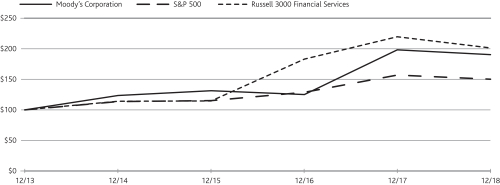
The following graph compares the total cumulative shareholder return of the Company to the performance of Standard & Poor’s Stock 500 Composite Index and the Russell 3000 Financial Services Index. Both of the aforementioned indexes are easily accessible to the Company’s shareholders in newspapers, the internet and other readily available sources for purposes of the following graph.
The comparison assumes that $100.00 was invested in the Company’s common stock and in each of the foregoing indices on December 31, 2013. The comparison also assumes the reinvestment of dividends, if any. The total return for the common stock was 90% during the performance period as compared with a total return during the same period of 101% for the Russell 3000 Financial Services Index and 50% for the S&P 500 Composite Index.
Comparison of Cumulative Total Return
COMPARISON OF 5 YEAR CUMULATIVE TOTAL RETURN
Among Moody’s Corporation, the S&P 500 Index
and the Russell 3000 Financial Services Index
| Year Ended December 31, | ||||||||||||||||||||||||
| 2013 | 2014 | 2015 | 2016 | 2017 | 2018 | |||||||||||||||||||
| Moody’s Corporation | $ | 100.00 | $ | 123.67 | $ | 131.20 | $ | 125.17 | $ | 198.42 | $ | 190.28 | ||||||||||||
| S&P 500 Composite Index | $ | 100.00 | $ | 113.69 | $ | 115.26 | $ | 129.05 | $ | 157.22 | $ | 150.33 | ||||||||||||
| Russell 3000—Financial Services Index | $ | 100.00 | $ | 114.05 | $ | 114.62 | $ | 183.03 | $ | 219.54 | $ | 201.21 |
The comparisons in the graph above are provided in response to disclosure requirements of the SEC and are not intended to forecast or be indicative of future performance of the Company’s common stock.
| 28 | MOODY’S 2018 10-K |
Table of Contents
Item 6. SELECTED FINANCIAL DATA
| --- | --- | --- |
The Company’s selected consolidated financial data should be read in conjunction with Item 7. “MD&A” and the Moody’s Corporation consolidated financial statements and notes thereto.
| Year Ended December 31, | ||||||||||||||||||||
| amounts in millions, except per share data | 2018 | 2017 | 2016 | 2015 | 2014 | |||||||||||||||
| Results of operations | ||||||||||||||||||||
| Revenue | $ | 4,442.7 | $ | 4,204.1 | $ | 3,604.2 | $ | 3,484.5 | $ | 3,334.3 | ||||||||||
| Expenses | ||||||||||||||||||||
| Operating and SG&A Expenses (1) | 2,325.6 | 2,202.5 | 1,950.8 | 1,880.3 | 1,788.9 | |||||||||||||||
| Restructuring | 48.7 | — | 12.0 | — | — | |||||||||||||||
| Depreciation and amortization | 191.9 | 158.3 | 126.7 | 113.5 | 95.6 | |||||||||||||||
| Acquisition-Related Expenses | 8.3 | 22.5 | — | — | — | |||||||||||||||
| Settlement Charge | — | — | 863.8 | — | — | |||||||||||||||
| Total Expenses | 2,574.5 | 2,383.3 | 2,953.3 | 1,993.8 | 1,884.5 | |||||||||||||||
| Operating income(2) | 1,868.2 | 1,820.8 | 650.9 | 1,490.7 | 1,449.8 | |||||||||||||||
| Non-operating (expense) income, net (3)(1) | (197.2 | ) | (34.0 | ) | (92.9 | ) | (111.1 | ) | 11.2 | |||||||||||
| Income before provision for income taxes (2) | 1,671.0 | 1,786.8 | 558.0 | 1,379.6 | 1,461.0 | |||||||||||||||
| Provision for income taxes (4) | 351.6 | 779.1 | 282.2 | 430.0 | 455.0 | |||||||||||||||
| Net income (2) | 1,319.4 | 1,007.7 | 275.8 | 949.6 | 1,006.0 | |||||||||||||||
| Less: Net income attributable to noncontrolling interests | 9.8 | 7.1 | 9.2 | 8.3 | 17.3 | |||||||||||||||
| Net income attributable to Moody’s (2)(5) | $ | 1,309.6 | $ | 1,000.6 | $ | 266.6 | $ | 941.3 | $ | 988.7 | ||||||||||
| Earnings per share | ||||||||||||||||||||
| Basic (2) | $ | 6.84 | $ | 5.24 | $ | 1.38 | $ | 4.70 | $ | 4.69 | ||||||||||
| Diluted (2) | $ | 6.74 | $ | 5.15 | $ | 1.36 | $ | 4.63 | $ | 4.61 | ||||||||||
| Weighted average shares outstanding | ||||||||||||||||||||
| Basic | 191.6 | 191.1 | 192.7 | 200.1 | 210.7 | |||||||||||||||
| Diluted | 194.4 | 194.2 | 195.4 | 203.4 | 214.7 | |||||||||||||||
| Dividends declared per share | $ | 1.76 | $ | 1.14 | $ | 1.49 | $ | 1.39 | $ | 1.18 | ||||||||||
| Operating margin (2) | 42.1 | % | 43.3 | % | 18.1 | % | 42.8 | % | 43.5 | % | ||||||||||
| Operating Cash Flow (6) | $ | 1,461.1 | $ | 754.6 | $ | 1,259.2 | $ | 1,198.1 | $ | 1,077.3 | ||||||||||
| December 31, | ||||||||||||||||||||
| 2018 | 2017 | 2016 | 2015 | 2014 | ||||||||||||||||
| Balance sheet data | ||||||||||||||||||||
| Total assets | $ | 9,526.2 | $ | 8,594.2 | $ | 5,327.3 | $ | 5,103.0 | $ | 4,653.8 | ||||||||||
| Long-term debt | $ | 5,226.1 | $ | 5,111.1 | $ | 3,063.0 | $ | 3,380.6 | $ | 2,532.1 | ||||||||||
| Total shareholders’ equity (deficit) | $ | 656.5 | $ | (114.9 | ) | $ | (1,027.3 | ) | $ | (333.0 | ) | $ | 42.9 |
| (1) | Pursuant to the adoption of a new accounting standard relating to pension accounting as more fully discussed in Note 1, only the service cost component of net periodic expense is classified within operating and SG&A expenses with the remaining components being classified as non-operating (expenses) income. Prior period results have been restated to reflect this classification. |
|---|
| (2) | The significant decrease in 2016 is primarily driven by the 2016 $863.8 million Settlement Charge ($700.7 million, net of tax, or $3.59 per diluted share). |
|---|
| (3) | The 2017 amount includes a $111.1 million Purchase Price Hedge Gain as well as the $59.7 million CCXI Gain. The 2016 amount includes a $34.8 million FX gain relating to the substantial liquidation of a subsidiary. The 2015 and 2014 amounts include benefits of $7.1 million each, related to the favorable resolution of certain Legacy Tax Matters. The 2014 amount also includes the ICRA Gain of $102.8 million. |
|---|
| (4) | Provision for income taxes in the year ended December 31, 2018 includes a charge of $63.9 million relating to an increase in non-U.S. UTPs, partially offset by a $59.0 million benefit from potential realization of foreign tax credits and other adjustments to previous estimates relating to the Tax Act. Provision for income taxes in the year ended December 31, 2017 includes a net charge of $245.6 million related to the impact of U.S. tax reform and a statutory tax rate reduction in Belgium as more fully discussed in Note 16 to the consolidated financial statements in Item 8 of this Form 10-K. |
|---|
| MOODY’S 2018 10-K | 29 |
Table of Contents
| (5) | The 2018 amount includes: i) a $59.0 million ($0.30 per share) benefit related to the impact of U.S. tax reform, ii) a $63.9 million ($0.33 per share) charge related to an increase to non-U.S UTPs; and iii) $36.8 million ($0.19 per share) net restructuring charge. The 2017 amount includes: i) a $245.6 million ($1.27 per share) charge related to the impact of U.S. tax reform and a statutory tax rate reduction in Belgium; ii) a $72.3 million ($0.37 per share) Purchase Price Hedge Gain; and iii) the $59.7 million ($0.31 per share) CCXI Gain. The 2016 amount includes: i) a $700.7 million ($3.59 per share) Settlement Charge; ii) an $8.1 million ($0.04 per share) restructuring charge; and iii) a $34.8 million ($0.18 per share) FX gain relating to the substantial liquidation of a subsidiary. The 2015 and 2014 amounts include benefits of $6.4 million ($0.03 per share) each related to the resolution of certain Legacy Tax Matters. Also, the 2014 amount includes the ICRA Gain of $78.5 million ($0.37 per share). |
|---|
| (6) | The decline in operating cash flow in 2017 is primarily due to payments made relating to the Settlement Charge. Additionally, in the first quarter of 2017, the Company adopted ASU No. 2016-09 “Improvements to Employee Share-Based Payment Accounting”. As required by ASU 2016-09, Excess Tax Benefits or shortfalls relating to employee stock-based compensation are reflected in operating cash flow and the Company has applied this provision on a retrospective basis. Under previous accounting guidance, Excess Tax Benefits or shortfalls were shown as a reduction to operating cash flow and an increase to financing cash flow. |
|---|
| 30 | MOODY’S 2018 10-K |
Table of Contents
Item 7. MANAGEMENT’S DISCUSSION AND ANALYSIS OF FINANCIAL CONDITION AND RESULTS OF OPERATIONS
| --- | --- | --- |
This discussion and analysis of financial condition and results of operations should be read in conjunction with the Moody’s Corporation consolidated financial statements and notes thereto included elsewhere in this annual report on Form 10-K.
This MD&A contains Forward-Looking Statements. See “Forward-Looking Statements” commencing on page 57 and Item 1A. “Risk Factors” commencing on page 17 for a discussion of uncertainties, risks and other factors associated with these statements.
THE COMPANY
Moody’s is a provider of (i) credit ratings; (ii) credit, capital markets and economic research, data and analytical tools; (iii) software solutions that support financial risk management activities; (iv) quantitatively derived credit scores; (v) learning solutions and certification services; (vi) offshore financial research and analytical services; and (vii) company information and business intelligence products. Moody’s reports in two reportable segments: MIS and MA.
MIS, the credit rating agency, publishes credit ratings on a wide range of debt obligations and the entities that issue such obligations in markets worldwide. Revenue is primarily derived from the originators and issuers of such transactions who use MIS ratings in the distribution of their debt issues to investors. Additionally, MIS earns revenue from certain non-ratings-related operations, which consist primarily of financial instrument pricing services in the Asia-Pacific region as well as revenue from ICRA’s non-ratings operations. The revenue from these operations is included in the MIS Other LOB and is not material to the results of the MIS segment.
The MA segment develops a wide range of products and services that support financial analysis and risk management activities of institutional participants in global financial markets. Within its RD&A business, MA offers subscription based research, data and analytical products, including credit ratings produced by MIS, credit research, quantitative credit scores and other analytical tools, economic research and forecasts, business intelligence and company information products, and commercial real estate data and analytical tools. Within its ERS business, MA provides software solutions as well as related risk management services. The PS business provides offshore analytical and research services along with learning solutions and certification programs.
CRITICAL ACCOUNTING ESTIMATES
Moody’s discussion and analysis of its financial condition and results of operations are based on the Company’s consolidated financial statements, which have been prepared in accordance with accounting principles generally accepted in the United States. The preparation of these financial statements requires Moody’s to make estimates and judgments that affect reported amounts of assets and liabilities and related disclosures of contingent assets and liabilities at the dates of the financial statements and revenue and expenses during the reporting periods. These estimates are based on historical experience and on other assumptions that are believed to be reasonable under the circumstances. On an ongoing basis, Moody’s evaluates its estimates, including those related to revenue recognition, accounts receivable allowances, contingencies, restructuring, goodwill and acquired intangible assets, pension and other retirement benefits, and income taxes. Actual results may differ from these estimates under different assumptions or conditions. The following accounting estimates are considered critical because they are particularly dependent on management’s judgment about matters that are uncertain at the time the accounting estimates are made and changes to those estimates could have a material impact on the Company’s consolidated results of operations or financial condition.
Goodwill and Other Acquired Intangible Assets
On July 31st of each year, Moody’s evaluates its goodwill for impairment at the reporting unit level, defined as an operating segment (i.e., MIS and MA), or one level below an operating segment (i.e., a component of an operating segment).
The Company has eight primary reporting units: two within the Company’s ratings business (one for the ICRA business and one that encompasses all of Moody’s other ratings operations) and six reporting units within MA: Content, ERS, MALS (formerly FSTC), MAKS, Bureau van Dijk and Reis. The Content reporting unit offers subscription based research, data and analytical products, including credit ratings produced by MIS, credit research, quantitative credit scores and other analytical tools, economic research and forecasts, business intelligence and company information products, and credit analytical tools. The ERS reporting unit provides products and services that support the credit risk management and regulatory compliance activities of financial institutions and also provides advanced actuarial software for the life insurance industry. These products and services are primarily delivered via software that is licensed on a perpetual basis or sold on a subscription basis. The MALS reporting unit consists of the portion of the MA business that offers both credit training as well as other professional development training. The MAKS reporting unit provides offshore research and analytical services. The Bureau van Dijk reporting unit consists of the Bureau van Dijk business, which was acquired on August 10, 2017, and primarily provides business intelligence and company information products. The Reis reporting unit, consists of the newly acquired Reis business, and provides commercial real estate market information and analytical tools.
| MOODY’S 2018 10-K | 31 |
Table of Contents
The Company evaluates the recoverability of goodwill using a two-step impairment test approach at the reporting unit level. In the first step, the Company assesses various qualitative factors to determine whether the fair value of a reporting unit may be less than its carrying amount. If a determination is made based on the qualitative factors that an impairment does not exist, the Company is not required to perform further testing. If the aforementioned qualitative assessment results in the Company concluding that it is more likely than not that the fair value of a reporting unit may be less than its carrying amount, the fair value of the reporting unit will be quantitatively determined and compared to its carrying value including goodwill. If the fair value of the reporting unit exceeds the carrying value of the net assets assigned to that unit, goodwill is not impaired and the Company is not required to perform further testing. If the fair value of the reporting unit is less than the carrying value, the Company will record a goodwill impairment charge for the amount by which the carrying value exceeds the reporting unit’s fair value in accordance with ASU No. 2017-04, “Intangibles—Goodwill and Other (Topic 350), Simplifying the Test for Goodwill Impairment”. The Company evaluates its reporting units on an annual basis, or more frequently if there are changes in the reporting structure of the Company due to acquisitions, realignments or if there are indicators of potential impairment. For the reporting units where the Company is consistently able to conclude that no impairment exists using only a qualitative approach, the Company’s accounting policy is to perform the second step of the aforementioned goodwill impairment assessment at least once every three years.
At July 31, 2018, the Company performed quantitative assessments of the ERS, MALS, MAKS and ICRA reporting units and a qualitative assessment for the remaining reporting units. No quantitative assessment resulted in the carrying value of the reporting unit exceeding its fair value. Each qualitative analysis resulted in the Company determining that it
Showing the first 8K of 158K characters. Open the full section
Item 7A. QUANTITATIVE AND QUALITATIVE DISCLOSURES ABOUT MARKET RISK
| --- | --- | --- |
Information in response to this item is set forth under the caption “Market Risk” in Part II, item 7 on page 49 of this annual report on Form 10-K.
| 58 | MOODY’S 2018 10-K |
Table of Contents
Item 8. FINANCIAL STATEMENTS
| --- | --- | --- |
Index to Financial Statements
Schedules are omitted as not required or inapplicable or because the required information is provided in the consolidated financial statements, including the notes thereto.
| MOODY’S 2018 10-K | 59 |
Table of Contents
MANAGEMENT’S REPORT ON INTERNAL CONTROL OVER FINANCIAL REPORTING
Management of Moody’s Corporation is responsible for establishing and maintaining adequate internal control over financial reporting and for the assessment of the effectiveness of internal control over financial reporting. As defined by the SEC in Rules 13a-15(f) and 15d-15(f) under the Securities Exchange Act of 1934, internal control over financial reporting is a process designed by, or under the supervision of, the Company’s principal executive and principal financial officers, or persons performing similar functions, and effected by the Company’s Board, management and other personnel, to provide reasonable assurance regarding the reliability of financial reporting and the preparation of financial statements for external purposes in accordance with generally accepted accounting principles.
Moody’s internal control over financial reporting includes those policies and procedures that (1) pertain to the maintenance of records that, in reasonable detail, accurately and fairly reflect the transactions and dispositions of assets of the Company; (2) provide reasonable assurance that transactions are recorded as necessary to permit preparation of financial statements in accordance with generally accepted accounting principles, and that receipts and expenditures of the Company are being made only in accordance with authorizations of Moody’s management and directors; and (3) provide reasonable assurance regarding prevention or timely detection of unauthorized acquisition, use or disposition of the Company’s assets that could have a material effect on the financial statements.
Because of its inherent limitations, internal control over financial reporting may not prevent or detect misstatements. Also, projections of any evaluation of effectiveness to future periods are subject to the risk that controls may become inadequate because of changes in conditions, or that the degree of compliance with the policies or procedures may deteriorate.
Management of the Company has undertaken an assessment of the design and operational effectiveness of the Company’s internal control over financial reporting as of December 31, 2018 based on criteria established in the Internal Control—Integrated Framework (2013) issued by the Committee of Sponsoring Organizations of the Treadway Commission (COSO).
Based on the assessment performed, management has concluded that Moody’s maintained effective internal control over financial reporting as of December 31, 2018.
The effectiveness of our internal control over financial reporting as of December 31, 2018 has been audited by KPMG LLP, an independent registered public accounting firm, as stated in their report which appears herein.
/s/ RAYMOND W. MCDANIEL, JR.
Raymond W. McDaniel, Jr.
President and Chief Executive Officer
/s/ MARK KAYE
Mark Kaye
Senior Vice President and Chief Financial Officer
February 22, 2019
| 60 | MOODY’S 2018 10-K |
Table of Contents
Report of Independent Registered Public Accounting Firm
The Shareholders and Board of Directors of Moody’s Corporation:
Opinions on the Consolidated Financial Statements and Internal Control over Financial Reporting
We have audited the accompanying consolidated balance sheets of Moody’s Corporation (the Company) as of December 31, 2018 and 2017, and the related consolidated statements of operations, comprehensive income, shareholders’ equity (deficit), and cash flows for each of the years in the three-year period ended December 31, 2018, and the related notes (collectively, the consolidated financial statements). We also have audited the Company’s internal control over financial reporting as of December 31, 2018, based on criteria established in Internal Control—Integrated Framework (2013) issued by the Committee of Sponsoring Organizations of the Treadway Commission.
In our opinion, the consolidated financial statements referred to above present fairly, in all material respects, the financial position of the Company as of December 31, 2018 and 2017, and the results of its operations and its cash flows for each of the years in the three-year period ended December 31, 2018, in conformity with U.S. generally accepted accounting principles. Also in our opinion, the Company maintained, in all material respects, effective internal control over financial reporting as of December 31, 2018, based on criteria established in Internal Control—Integrated Framework (2013) issued by the Committee of Sponsoring Organizations of the Treadway Commission.
Change in Accounting Principle
As discussed in Note 1 to the consolidated financial statements, the Company changed its method of accounting for revenue recognition effective January 1, 2018 due to the adoption of Accounting Standard Update (ASU) 2014-019 and all related amendments, which established the Accounting Standard Codification (ASC) Topic 606, Revenue—Revenue from Contracts with Customers.
Basis for Opinions
The Company’s management is responsible for these consolidated financial statements, for maintaining effective internal control over financial reporting, and for its assessment of the effectiveness of internal control over financial reporting included in the accompanying Management’s Report on Internal Control over Financial Reporting. Our responsibility is to express an opinion on the Company’s consolidated financial statements and an opinion on the Company’s internal control over financial reporting based on our audits. We are a public accounting firm registered with the Public Company Accounting Oversight Board (United States) (PCAOB) and are required to be independent with respect to the Company in accordance with the U.S. federal securities laws and the applicable rules and regulations of the Securities and Exchange Commission and the PCAOB.
We conducted our audits in accordance with the standards of the PCAOB. Those standards require that we plan and perform the audit to obtain reasonable assurance about whether the consolidated financial statements are free of material misstatement, whether due to error or fraud, and whether effective internal control over financial reporting was maintained in all material respects.
Our audits of the consolidated financial statements included performing procedures to assess the risks of material misstatement of the consolidated financial statements, whether due to error or fraud, and performing procedures that respond to those risks. Such procedures included examining, on a test basis,
Showing the first 8K of 401K characters. Open the full section
Item 9. CHANGES IN AND DISAGREEMENTS WITH ACCOUNTANTS ON ACCOUNTING AND FINANCIAL DISCLOSURE
| --- | --- | --- |
Not applicable.
Item 9A. CONTROLS AND PROCEDURES
| --- | --- | --- |
Evaluation of Disclosure Controls and Procedures
The Company carried out an evaluation, as required by Rule 13a-15(b) under the Exchange Act, under the supervision and with the participation of the Company’s management, including the Company’s Chief Executive Officer and Chief Financial Officer, of the effectiveness of the design and operation of the Company’s disclosure controls and procedures, as defined in Rule 13a-15(e) of the Exchange Act, as of the end of the period covered by this report (the “Evaluation Date”). Based on such evaluation, such officers have concluded that, as of the Evaluation Date, the Company’s disclosure controls and procedures were effective to provide reasonable assurance that information required to be disclosed by the Company in reports that it files or submits under the Exchange Act is recorded, processed, summarized and reported within the time periods specified in the communication to the Company’s management, including the Company’s Chief Executive Officer and Chief Financial Officer, as appropriate to allow timely decisions regarding required disclosure.
Changes In Internal Control Over Financial Reporting
Information in response to this Item is set forth under the caption “Management’s Report on Internal Control Over Financial Reporting”, in Part II, Item 8 of this annual report on Form 10-K.
Except as described below, the Company’s management, including the Company’s Chief Executive Officer and Chief Financial Officer, has determined that there were no changes in the Company’s internal control over financial reporting that have materially affected, or are reasonably likely to materially affect, these internal controls over financial reporting during the three-month period ended December 31, 2018.
During the fiscal year ended December 31, 2017, the Company acquired Bureau van Dijk, and in the fiscal year ended December 31, 2018, Moody’s integrated the acquired entity into the Company’s financial reporting processes and procedures and internal controls over financial reporting. Additionally, during the fiscal year ended December 31, 2018, the Company implemented internal controls relating to the adoption and assessment of the impact of the new accounting standard relating to leases, which will be adopted by Moody’s on January 1, 2019.
Item 9B. OTHER INFORMATION
| --- | --- | --- |
Not applicable.
| 128 | MOODY’S 2018 10-K |
Table of Contents
PART III
Except for the information relating to the executive officers of the Company set forth in Part I of this annual report on Form 10-K, the information called for by Items 10-14 is contained in the Company’s definitive proxy statement for use in connection with its annual meeting of stockholders scheduled to be held on April 16, 2019, and is incorporated herein by reference.
Item 10. DIRECTORS, EXECUTIVE OFFICERS AND CORPORATE GOVERNANCE
| --- | --- | --- |
Item 11. EXECUTIVE COMPENSATION
| --- | --- | --- |
Item 12. SECURITY OWNERSHIP OF CERTAIN BENEFICIAL OWNERS AND MANAGEMENT AND RELATED STOCKHOLDER MATTERS
| --- | --- | --- |
Item 13. CERTAIN RELATIONSHIPS AND RELATED TRANSACTIONS, AND DIRECTOR INDEPENDENCE
| --- | --- | --- |
Item 14. PRINCIPAL ACCOUNTING FEES AND SERVICES
Item 15. EXHIBITS AND FINANCIAL STATEMENT SCHEDULES
| --- | --- | --- |
LIST OF DOCUMENTS FILED AS PART OF THIS REPORT.
(1) Financial Statements.
See Index to Financial Statements on page 59, in Part II. Item 8 of this Form 10-K.
(2) Financial Statement Schedules.
None.
(3) Exhibits.
INDEX TO EXHIBITS
| 130 | MOODY’S 2018 10-K |
Table of Contents
| MOODY’S 2018 10-K | 131 |
Table of Contents
| 132 | MOODY’S 2018 10-K |
Table of Contents
| MOODY’S 2018 10-K | 133 |
Table of Contents
| * | Filed herewith |
|---|
| † | Management contract of compensatory plan or arrangement |
|---|
Item 16. FORM 10-K SUMMARY
| --- | --- | --- |
None.
| 134 | MOODY’S 2018 10-K |
Table of Contents
| SIGNATURES |
|---|
Pursuant to the requirements of Section 13 or 15(d) of the Securities Exchange Act of 1934, the Registrant has duly caused this report to be signed on its behalf by the undersigned, thereunto duly authorized.
MOODY’S CORPORATION
(Registrant)
By: /s/ RAYMOND W. MCDANIEL, JR.
Raymond W. McDaniel, Jr.
President and Chief Executive Officer
Date: February 22, 2019
Pursuant to the requirements of the Securities Exchange Act of 1934, this report has been signed below by the following persons on behalf of the Registrant and in the capacities and on the date indicated.
/s/ RAYMOND W. MCDANIEL, JR.
Raymond W. McDaniel, Jr.,
President and Chief Executive Officer
(principal executive officer)
/s/ MARK KAYE
Mark Kaye,
Senior Vice President and Chief Financial Officer
(principal financial officer)
/s/ CAROLINE SULLIVAN
Caroline Sullivan,
Senior Vice President and Corporate Controller
(principal accounting officer)
/s/ BASIL L. ANDERSON
Basil L. Anderson,
Director
/s/ JORGE A. BERMUDEZ
Jorge A. Bermudez,
Director
/s/ GERRIT ZALM
Gerrit Zalm,
Director
/s/ KATHRYN M. HILL
Kathryn M. Hill,
Director
/s/ VINCENT A. FORLENZA
Vincent A. Forlenza,
Director
/s/ HENRY A. MCKINNELL, JR. PH.D.
Henry A. McKinnell, Jr. Ph.D.,
Chairman
/s/ LESLIE F. SEIDMAN
Leslie F. Seidman,
Director
/s/ BRUCE VAN SAUN
Bruce Van Saun,
Director
Date: February 22, 2019
| MOODY’S 2018 10-K | 135 |