 filings.tools
Mondelez International 10-K 2015-12-31
Filed 2016-02-19. 21 sections, 588K characters. Original on sec.gov · Markdown · JSON
Cover and table of contents
10-K 1 d51394d10k.htm 10-K
UNITED STATES
SECURITIES AND EXCHANGE COMMISSION
WASHINGTON, D.C. 20549
FORM 10-K
(Mark one)
| x | ANNUAL REPORT PURSUANT TO SECTION 13 OR 15(d) OF THE SECURITIES EXCHANGE ACT OF 1934 |
|---|
For the fiscal year ended December 31, 2015
OR
| ¨ | TRANSITION REPORT PURSUANT TO SECTION 13 OR 15(d) OF THE SECURITIES EXCHANGE ACT OF 1934 |
|---|
COMMISSION FILE NUMBER 1-16483

Mondelēz International, Inc.
(Exact name of registrant as specified in its charter)
| Virginia | 52-2284372 | |
| (State or other jurisdiction of incorporation or organization) | (I.R.S. Employer Identification No.) | |
| Three Parkway North, Deerfield, Illinois | 60015 | |
| (Address of principal executive offices) | (Zip Code) |
Registrant’s telephone number, including area code: 847-943-4000
Securities registered pursuant to Section 12(b) of the Act:
| Title of each class | Name of each exchange on which registered | |
| Class A Common Stock, no par value | The NASDAQ Global Select Market | |
| 1.125% Notes due 2017 | New York Stock Exchange LLC | |
| 2.375% Notes due 2021 | New York Stock Exchange LLC | |
| 1.000% Notes due 2022 | New York Stock Exchange LLC | |
| 1.625% Notes due 2023 | New York Stock Exchange LLC | |
| 1.625% Notes due 2027 | New York Stock Exchange LLC | |
| 2.375% Notes due 2035 | New York Stock Exchange LLC | |
| 4.500% Notes due 2035 | New York Stock Exchange LLC | |
| 3.875% Notes due 2045 | New York Stock Exchange LLC |
Securities registered pursuant to Section 12(g) of the Act: None
Indicate by check mark if the registrant is a well-known seasoned issuer, as defined in Rule 405 of the Securities Act. Yes x No ¨
Indicate by check mark if the registrant is not required to file reports pursuant to Section 13 or Section 15(d) of the Act. Yes ¨ No x
Note: Checking the box above will not relieve any registrant required to file reports pursuant to Section 13 or 15(d) of the Exchange Act from their obligations under those Sections.
Indicate by check mark whether the registrant (1) has filed all reports required to be filed by Section 13 or 15(d) of the Securities Exchange Act of 1934 during the preceding 12 months (or for such shorter period that the registrant was required to file such reports), and (2) has been subject to such filing requirements for the past 90 days. Yes x No ¨
Indicate by check mark whether the registrant has submitted electronically and posted on its corporate Web site, if any, every Interactive Data File required to be submitted and posted pursuant to Rule 405 of Regulation S-T (§ 232.405 of this chapter) during the preceding 12 months (or for such shorter period that the registrant was required to submit and post such files). Yes x No ¨
Indicate by check mark if disclosure of delinquent filers pursuant to Item 405 of Regulation S-K (§ 229.405 of this chapter) is not contained herein, and will not be contained, to the best of registrant’s knowledge, in definitive proxy or information statements incorporated by reference in Part III of this Form 10-K or any amendment to this Form 10-K. x
Indicate by check mark whether the registrant is a large accelerated filer, an accelerated filer, a non-accelerated filer, or a smaller reporting company. See the definitions of “large accelerated filer,” “accelerated filer” and “smaller reporting company” in Rule 12b-2 of the Exchange Act.
| Large accelerated filer x | Accelerated filer ¨ | Non-accelerated filer ¨ | Smaller reporting company ¨ | |||
| (Do not check if a smaller reporting company) |
Indicate by check mark whether the registrant is a shell company (as defined in Rule 12b-2 of the Act). Yes ¨ No x
The aggregate market value of the shares of Class A Common Stock held by non-affiliates of the registrant, computed by reference to the closing price of such stock on June 30, 2015, was $66 billion. At February 12, 2016, there were 1,568,858,264 shares of the registrant’s Class A Common Stock outstanding.
Documents Incorporated by Reference
Portions of the registrant’s definitive proxy statement to be filed with the Securities and Exchange Commission in connection with its annual meeting of shareholders expected to be held on May 18, 2016 are incorporated by reference into Part III hereof.
Mondelēz International, Inc.
In this report, for all periods presented, “we,” “us,” “our,” “the Company” and “Mondelēz International” refer to Mondelēz International, Inc. and subsidiaries. References to “Common Stock” refer to our Class A Common Stock.
Forward-Looking Statements
This report contains a number of forward-looking statements. Words, and variations of words, such as “will,” “may,” “expect,” “would,” “intend,” “plan,” “believe,” “likely,” “estimate,” “anticipate,” “project,” “potential,” “might,” “outlook” and similar expressions are intended to identify our forward-looking statements, including but not limited to statements about: our future performance, including our future revenue growth and margins; our strategy, including our goals to deliver top-tier financial performance and be a great place to work; price volatility and pricing actions; the cost environment and measures to address increased costs; our transformation agenda; the costs of, cost savings generated by, timing of expenditures under and completion of our restructuring programs; our market-leading positions; snack food consumption trends; growth in our snacks business, Power Brands, categories and markets; actions to improve our revenue mix; volatility in global markets; commodity prices and supply; economic conditions; currency exchange rates, controls and restrictions; our expansion plans; our operations in Venezuela and Argentina; pension liabilities related to the coffee business transactions; the significance of the coffee category to our future results; our investment in Keurig, the completion of the transaction, and our ownership interests and governance rights in JDE and Keurig following the transaction; completion of our biscuit operation acquisition; legal matters; changes in laws and regulations and regulatory compliance; environmental compliance and remediation actions; our properties; the estimated value of goodwill and intangible assets; impairment of goodwill and intangible assets and our projections of operating results and other factors that may affect our impairment testing; our accounting estimates and judgments; remediation of the material weakness; pension expenses, contributions and assumptions; employee benefit plan expenses, obligations and assumptions; relationships with employees and representatives; our sustainability initiatives; tax positions; our liquidity, funding sources and uses of funding; reinvestment of earnings; our risk management program, including the use of financial instruments and the effectiveness of our for hedging activities; capital expenditures and funding; share repurchases; dividends; compliance with financial and long-term debt covenants; guarantees and our contractual obligations.
These forward-looking statements involve risks and uncertainties, many of which are beyond our control. Important factors that could cause actual results to differ materially from those described in our forward-looking statements include, but are not limited to, risks from operating globally including in emerging markets; changes in currency exchange rates, controls and restrictions; continued volatility of commodity and other input costs; weakness in economic conditions; weakness in consumer spending; pricing actions; unanticipated disruptions to our business; competition; acquisitions and divestitures, the restructuring program and our other transformation initiatives not yielding the anticipated benefits; changes in the assumptions on which the restructuring program is based; protection of our reputation and brand image; management of our workforce; consolidation of retail customers and competition with retailer and other economy brands; changes in our relationships with suppliers or customers; legal, regulatory, tax or benefit law changes, claims or actions; strategic transactions; our ability to innovate and differentiate our products; significant changes in valuation factors that may adversely affect our impairment testing of goodwill and intangible assets; perceived or actual product quality issues or product recalls; failure to maintain effective internal control over financial reporting; volatility of capital or other markets; pension costs; use of information technology and third party service providers; our ability to protect our intellectual property and intangible assets; a shift in our pre-tax income among jurisdictions, including the United States; and tax law changes. We disclaim and do not undertake any obligation to update or revise any forward-looking statement in this report except as required by applicable law or regulation.
PART I
Item 1. Business.
General
We are one of the world’s largest snack companies with global net revenues of $29.6 billion and earnings from continuing operations of $7.3 billion in 2015. We manufacture and market delicious snack food and beverage products for consumers in 165 countries around the world. Our portfolio includes seven billion dollar brands—Nabisco, Oreo and LU biscuits; Cadbury, Cadbury Dairy Milk and Milka chocolates; and Trident gum, as well as 51 brands that each generated annual revenues of $100 million or more in 2015.
We are proud members of the NASDAQ 100 and Standard & Poor’s 500. Our Common Stock trades on The NASDAQ Global Select Market under the symbol “MDLZ.” We have been incorporated in the Commonwealth of Virginia since 2000.
We have been recognized for our ongoing economic, environmental and social contributions and this year were listed again on the Dow Jones Sustainability Index (“DJSI”) – World and North American Indices. The DJSI selects the top 10% of global companies and top 20% of North American companies based on an extensive review of financial and sustainability programs within each industry. We also participate in the Carbon Disclosure Project Climate and Water forums and continue to disclose and work to reduce our carbon and water footprints. We are committed to continue this and other related work in the areas of sustainable resources and agriculture, mindful snacking, community partnerships and safety of our products and people.
Strategy
We intend to leverage our core strengths, including our advantaged geographic footprint, market leadership positions and portfolio of iconic brands and innovation platforms, to achieve two primary goals: deliver top-tier financial performance and be a great place to work. Top-tier financial performance aims to achieve sustainable top- and bottom-line growth, driven by our transformation agenda, which includes focusing our portfolio, reducing costs and investing for growth. We plan to achieve these goals by executing five long-term strategies:
| • | Unleash the Power of Our People. We believe that our two primary goals of delivering top-tier financial performance and being a great place to work are interdependent and that one is not fully achievable without the other. Being a great place to work enables us to recruit, retain and unleash the talents of great people. We remain focused on evolving our ways of working, our standards of leadership and the development opportunities available to our colleagues. |
|---|
| • | Transform Snacking. Driving growth is at the forefront of our long-term business strategies. By meeting the needs of consumers through innovation of our portfolio of products, we expect to grow and maintain our Power Brands and market-leading positions. |
|---|
Our global Power Brands continue to be a significant competitive advantage. Our Power Brands include global brands such as Oreo, LU and belVita biscuits; Milka, Cadbury Dairy Milk and Lacta chocolate; Halls candy; Trident gum; and Tang powdered beverages. Our brands enable us to fulfill consumer needs with a full range of snacking choices. Along with leveraging our global innovation platforms, we offer a full range of snacking choices that address the different needs of our consumers and quickly adapt successful products from one market to others. For example, in early 2015 we acquired Enjoy Life Foods, which creates allergen-free and better for you snacks such as Plentils gluten-free chips and Enjoy Life nut-free chocolate and seed & fruit products. We are developing plans to expand this business within and outside of the North America region.
In 2015, we also transformed our business portfolio following the deconsolidation of our coffee businesses. On July 2, 2015, we combined our global coffee business with D.E Master Blenders 1753 B.V. (“DEMB”) to form Jacobs Douwe Egberts (“JDE”), a new coffee venture in which we maintain a noncontrolling interest. Following the transactions, our snacks net revenues from biscuits, chocolate, gum and candy were approximately 85% of our 2015 net revenues excluding coffee net revenues. We will continue to have a significant stake in the coffee category, but holding our interest in the coffee venture as an investment will allow us to focus to a greater degree on our snacks portfolio and make operating and sales decisions that will help us to grow the snacks business.
To strengthen how we support and leverage our snacks portfolio, we created a Chief Growth Officer role in 2014 to focus on top-line revenue growth opportunities. Beginning in January 2016, we also have a new Chief Commercial Officer. The Chief Commercial Officer is responsible for the execution of the Company’s commercial plan with oversight over the global sales function and delivery of growth plans by the five regions. This structure will focus us further on pursuing and executing on opportunities through which we can drive the most attractive returns.
| • | Revolutionize Selling. As part of our focus on growth around the world and particularly in emerging markets, we continue to invest heavily in our routes to market and sales capabilities across key markets, and we have made significant improvements in our marketing effectiveness and spending. In 2015, we acquired an 80% interest in a biscuit operation in Vietnam that expanded our routes to market in the Asia Pacific region. In recent years, we have also invested in expanding our brand presence across digital media and have placed increased focus on e-commerce. Effective spending on advertising and marketing fuels our brands and strengthens our growth strategies for the business. |
|---|
| • | Drive Efficiency to Fuel Growth. We manage our business through a virtuous cycle. To drive sales and earnings growth, we focus first on delivering high quality products that meet consumer needs. We expand our margins through leveraging lean and simple cost management programs within our integrated supply chain and through overhead discipline. We reinvest a portion of these savings to pursue additional targeted growth opportunities within our portfolio. |
|---|
| • | Protect the Well-being of Our Planet. We are committed to growing our business while protecting our planet and its people. We strive to enhance the well-being of the people who enjoy and make our products and to nurture communities where we live, work and grow the ingredients that go into our products. To accomplish these objectives, we focus on delivering safe, high-quality foods and maintaining a safe work environment for our employees. We work to protect resources, focusing on where we can have the greatest impact. We also make food that fits the way people eat today and provides balanced snacking choices. |
|---|
Our “Call For Well-Being” initiative focuses on four areas that we believe will have the greatest impact: sustainability, mindful snacking, safety and community partnerships. In each of these areas, we set clear goals and metrics. In 2015, we announced our “Sustainability 2020” goals, including reducing absolute carbon dioxide emissions; reducing deforestation within our agricultural supply chain; focusing water-reduction efforts in high-priority locations; reducing packaging material; and reducing total manufacturing waste.
Reportable Segments
Our operations and management structure are organized into five reportable operating segments:
| • | Latin America |
|---|
| • | Asia Pacific |
|---|
| • | Eastern Europe, Middle East and Africa (“EEMEA”) |
|---|
| • | Europe |
|---|
| • | North America |
|---|
We manage our operations by region to leverage regional operating scale, manage different and changing business environments more effectively and pursue growth opportunities as they arise in our key markets. Our regional management teams have responsibility for the business, product categories and financial results in the regions.
Historically, we have recorded income from equity method investments within our operating income as these investments operated as extensions of our base business. Beginning in the third quarter of 2015, to align with the accounting for our deconsolidated coffee business and related investment in JDE, we began to record the earnings from our equity method investments in after-tax equity method investment earnings outside of segment operating income. For the six months ended December 31, 2015, after-tax equity method investment net earnings were less than $1 million on a combined basis. Earnings from equity method investments through July 2, 2015 recorded within segment operating income were $49 million in Asia Pacific, $3 million in EEMEA and $4 million in North America. For the year ended December 31, 2014 these earnings were $98 million in Asia Pacific, $6 million in EEMEA and $9 million in North America. For the year ended December 31, 2013 these earnings were $99 million in Asia Pacific, $7 million in EEMEA and $1 million in North America. See Note 1, Summary of Significant Accounting Policies – Principles of Consolidation, for additional information.
In 2015, we also began to report stock-based compensation for our corporate employees, which was previously reported within our North America region, within general corporate expenses. We reclassified $32 million of corporate stock-based compensation expense out of the North America segment in 2015.
Our segment net revenues for each of the last three years were:
| For the Years Ended December 31, | ||||||||||||
| 2015 | 2014 | 2013 | ||||||||||
| (in millions) | ||||||||||||
| Net revenues: | ||||||||||||
| Latin America | $ | 4,988 | $ | 5,153 | $ | 5,382 | ||||||
| Asia Pacific | 4,360 | 4,605 | 4,952 | |||||||||
| EEMEA | 2,786 | 3,638 | 3,915 | |||||||||
| Europe | 10,528 | 13,912 | 14,059 | |||||||||
| North America | 6,974 | 6,936 | 6,991 | |||||||||
| $ | 29,636 | $ | 34,244 | $ | 35,299 | |||||||
Currency, the deconsolidation of our global coffee business and other items significantly affect the comparability of our consolidated and segment operating results from year to year. Please see Management’s Discussion and Analysis of Financial Condition and Results of Operations for a review of our operating results.
Our brands span five product categories:
| • | Biscuits (including cookies, crackers and salted snacks) |
|---|
| • | Chocolate |
|---|
| • | Gum & candy |
|---|
| • | Beverages (including coffee through July 2, 2015 and powdered beverages) |
|---|
| • | Cheese & grocery |
|---|
During 2015, our segments contributed to our net revenues in these product categories as follows:
| Percentage of 2015 Net Revenues by Product Category | ||||||||||||||||||||||||
| Gum & | Cheese & | |||||||||||||||||||||||
| Segment | Biscuits | Chocolate | Candy | Beverages (1) | Grocery | Total | ||||||||||||||||||
| Latin America | 5.4% | 2.8% | 3.7% | 2.6% | 2.3% | 16.8% | ||||||||||||||||||
| Asia Pacific | 4.3% | 4.9% | 2.4% | 1.4% | 1.8% | 14.8% | ||||||||||||||||||
| EEMEA | 1.8% | 3.1% | 1.8% | 1.8% | 0.9% | 9.4% | ||||||||||||||||||
| Europe | 8.2% | 15.6% | 2.6% | 5.2% | 3.9% | 35.5% | ||||||||||||||||||
| North America | 18.8% | 0.8% | 3.9% | – | – | 23.5% | ||||||||||||||||||
| 38.5% | 27.2% | 14.4% | 11.0% | 8.9% | 100.0% | |||||||||||||||||||
| (1) | On July 2, 2015, as part of the JDE coffee transactions, we deconsolidated our global coffee businesses primarily from our Europe, EEMEA and Asia Pacific segment beverage categories. Our 2015 net revenues reflect our coffee business through July 2, 2015. Refer to Note 2, Divestitures and Acquisitions – Coffee Business Transactions, for more information. |
|---|
Within our product categories, the classes of products that contributed 10% or more to consolidated net revenues were:
| For the Years Ended December 31, | ||||||||||||||||
| 2015 | 2014 (1) | 2013 (1) | ||||||||||||||
| Biscuits - Cookies and crackers | 34% | 30% | 29% | |||||||||||||
| Chocolate - Tablets, bars and other | 27% | 28% | 27% | |||||||||||||
| Beverages - Coffee | 6% | 11% | 11% |
| (1) | During 2014, we realigned some of our products across product categories and as such, we reclassified the product category net revenues on a basis consistent with the 2015 presentation. |
|---|
We use segment operating income to evaluate segment performance and allocate resources. We believe it is appropriate to disclose this measure to help investors analyze segment performance and trends. For a definition and reconciliation of segment operating income to consolidated pre-tax earnings as well as other information on our segments, see Note 17, Segment Reporting.
Our segment operating income for each of the last three years was:
| For the Years Ended December 31, | ||||||||||||||||||
| 2015 | 2014 | 2013 | ||||||||||||||||
| (in millions) | ||||||||||||||||||
| Segment operating income: | ||||||||||||||||||
| Latin America | $ | 485 | $ | 475 | $ | 570 | ||||||||||||
| Asia Pacific | 268 | 385 | 512 | |||||||||||||||
| EEMEA | 194 | 327 | 379 | |||||||||||||||
| Europe | 1,277 | 1,770 | 1,699 | |||||||||||||||
| North America | 1,105 | 922 | 889 | |||||||||||||||
| $ | 3,329 | $ | 3,879 | $ | 4,049 | |||||||||||||
During the last three fiscal years, our segments contributed to segment operating income as reflected below.
| For the Years Ended December 31, | ||||||||||||||||||
| 2015 | 2014 | 2013 | ||||||||||||||||
| Segment operating income: | ||||||||||||||||||
| Latin America | 14.6% | 12.3% | 14.1% | |||||||||||||||
| Asia Pacific | 8.0% | 9.9% | 12.6% | |||||||||||||||
| EEMEA | 5.8% | 8.4% | 9.4% | |||||||||||||||
| Europe | 38.4% | 45.6% | 42.0% | |||||||||||||||
| North America | 33.2% | 23.8% | 21.9% | |||||||||||||||
| 100.0% | 100.0% | 100.0% | ||||||||||||||||
Significant Divestitures and Acquisitions
For information on our significant divestitures and acquisitions, please refer to Note 2, Divestitures and Acquisitions, and specifically, in connection with our global coffee business deconsolidation, see our discussion under Coffee Business Transactions.
Customers
No single customer accounted for 10% or more of our net revenues from continuing operations in 2015. Our five largest customers accounted for 17% and our ten largest customers accounted for 24% of net revenues from continuing operations in 2015.
Seasonality
Demand for our products is generally balanced over the first three quarters of the year and increases in the fourth quarter primarily because of holidays and other seasonal events.
Competition
We face competition in all aspects of our business. Competitors include large multi-national as well as numerous local and regional companies. Some competitors have different profit objectives than we do and therefore approach pricing and promotional decisions differently. We compete based on product quality, brand recognition and loyalty, service, product innovation, taste, convenience, the ability to identify and satisfy consumer preferences, effectiveness of sales and marketing, routes to market and distribution networks, promotional activity and price. Improving our market position or introducing a new product requires substantial research, development, advertising and promotional expenditures. We believe these investments lead to better products for the consumer and support our growth and market position.
Distribution and Marketing
Across our segments, we generally sell our products to supermarket chains, wholesalers, supercenters, club stores, mass merchandisers, distributors, convenience stores, gasoline stations, drug stores, value stores and other retail food outlets. We distribute our products through direct store delivery, company-owned and satellite warehouses, distribution centers and other facilities. We also use the services of independent sales offices and agents in some of our international locations.
We also sell our products on a growing number of e-commerce platforms as consumer consumption patterns change (reflecting greater consumer time compression and technology use) and retail increasingly expands online. Within our digital and social marketing, we also create opportunities for consumers to easily find and buy our products online. We have built relationships with several retailers to develop customized programs that fit their and our formats and provide consumers additional personalized offerings from our snacks portfolio.
We conduct marketing efforts through three principal sets of activities: (i) consumer marketing and advertising including on-air, print, outdoor, digital and social media and other product promotions; (ii) consumer sales incentives such as coupons and rebates; and (iii) trade promotions to support price features, displays and other merchandising of our products by our customers.
Raw Materials and Packaging
We purchase and use large quantities of commodities, including cocoa, dairy, wheat, corn products, soybean and vegetable oils, sugar and other sweeteners and nuts. In addition, we purchase and use significant quantities of packaging materials to package our products and natural gas, fuels and electricity for our factories and warehouses. We regularly monitor worldwide supply, cost and currency trends related to these commodities so we can cost-effectively secure ingredients, packaging and energy sources required for production.
A number of external factors such as weather conditions, commodity market conditions, currency fluctuations and governmental agricultural programs affect the cost and availability of raw materials and agricultural materials used in our products. We use hedging techniques to limit the impact of fluctuations in the cost of our principal raw materials. However, we cannot fully hedge against changes in commodity costs, and our hedging strategies may not protect us from increases in specific raw material costs.
While the costs of our principal raw materials fluctuate, we believe there will continue to be an adequate supply of the raw materials we use and that they will generally remain available from numerous sources. For additional information on our commodity costs, refer to the Commodity Trends section within Management’s Discussion and Analysis of Financial Condition and Results of Operations.
Intellectual Property
Our intellectual property rights (including trademarks, patents, copyrights, registered designs, proprietary trade secrets, technology and know-how) are material to our business.
We own numerous trademarks and patents in many countries around the world. Depending on the country, trademarks remain valid for as long as they are in use or their registration status is maintained. Trademark registrations generally are for renewable, fixed terms. We also have patents for a number of current and potential products. Our patents cover inventions ranging from basic packaging techniques to processes relating to specific products and to the products themselves. Our issued patents extend for varying periods according to the date of patent application filing or grant and the legal term of patents in the various countries where patent protection is obtained. The actual protection afforded by a patent, which can vary from country to country, depends upon the type of patent, the scope of its coverage as determined by the patent office or courts in the country, and the availability of legal remedies in the country. While our patent portfolio is material to our business, the loss of one patent or a group of related patents would not have a material adverse effect on our business.
From time to time, we grant third parties licenses to use one or more of our trademarks in connection with the manufacture, sale or distribution of third party products. Similarly, we sell some products under brands we license from third parties. In our agreement with Kraft Foods Group, Inc. (“Kraft Foods Group”; which is now part of The Kraft Heinz Company), we each granted the other party various licenses to use certain of our and their respective intellectual property rights in named jurisdictions following the spin-off of our North American grocery business.
Research and Development
We pursue four objectives in research and development: product safety and quality, growth through new products, superior consumer satisfaction and reduced costs. Our innovation efforts focus on anticipating consumer demands and adapting quickly to changing market trends. Wellness products and healthy snacking are a significant focus of our current research and development initiatives. These initiatives aim to accelerate our growth and margins by addressing consumer needs and market trends and leveraging our global innovation platforms, Power Brands and breakthrough technologies.
At December 31, 2015, we had approximately 2,450 scientists and engineers, of which approximately 1,900 are primarily focused on research and development and the remainder are primarily focused on quality assurance and regulatory affairs. Our major technology centers are located in: East Hanover, New Jersey; Whippany, New Jersey; Bournville, United Kingdom; Curitiba, Brazil; Paris, France; Melbourne, Australia; Mexico City, Mexico; Munich, Germany; Reading, United Kingdom; Thane, India; and Suzhou, China. Our research and development expense was $409 million in 2015, $455 million in 2014 and $471 million in 2013. Our total research and development expense was lower in 2015 primarily due to the deconsolidation of our global coffee business, currency and cost optimization initiatives.
Regulation
Our food products and ingredients are subject to local, national and multi-national regulations related to labeling, packaging, pricing, marketing and advertising, privacy and related areas. In addition, various jurisdictions regulate our operations by licensing and inspecting our manufacturing plants and facilities, enforcing standards for selected food products, grading food products, and regulating trade practices related to the sale and pricing of our food products. Many of the food commodities we use in our operations are subject to government agricultural policy and intervention. These policies have substantial effects on prices and supplies and are subject to periodic governmental and administrative review.
Examples of laws and regulations that affect our business include selective food taxes, nutritional labeling requirements and marketing restrictions in markets such as Europe and Latin America; Russian sanctions on the sourcing of raw materials from the European Union and potential labeling disclosure requirements for genetically modified ingredients in the United States. We will continue to monitor developments in laws and regulations. At this time, we do not expect the cost of complying with new laws and regulations will be material. Also refer to Note 1, Summary of Significant Accounting Policies—Currency Translation and Highly Inflationary Accounting, for additional information on government regulations and currency-related impacts on our operations in Argentina, Russia and other countries.
Environmental Regulation
Throughout the countries in which we do business, we are subject to local, national and multi-national environmental laws and regulations relating to the protection of the environment. We have programs across our business units designed to meet applicable environmental compliance requirements. In the United States, the laws and regulations include the Clean Air Act, the Clean Water Act, the Resource Conservation and Recovery Act and the Comprehensive Environmental Response, Compensation, and Liability Act (“CERCLA”). CERCLA imposes joint and several liability on each potentially responsible party. As of December 31, 2015, we had resolved the one active proceeding in the United States under a state equivalent of CERCLA related to our current operations. As of December 31, 2015, we accrued an immaterial amount for the remaining payments related to this resolution. Based on information currently available, we believe that our compliance with environmental laws and regulations will not have a material effect on our financial results.
Employees
We employed approximately 99,000 people worldwide at December 31, 2015 and approximately 104,000 at December 31, 2014. Approximately 5,000 employees transferred to JDE in connection with the global coffee business transactions, and we also added approximately 6,000 employees due to acquisitions in 2015. Employees represented by labor unions or workers’ councils represent approximately 65% of our 87,000 employees outside the United States and approximately 30% of our 12,000 U.S. employees. Our business units are subject to various local, national and multi-national laws and regulations relating to their relationships with their employees. In accordance with European Union requirements, we also have established a European Workers Council composed of management and elected members of our workforce. We believe we generally have good relationships with our employees and their representative organizations.
Foreign Operations
We generated 78.7% of our 2015 net revenues, 82.1% of our 2014 net revenues and 83.1% of our 2013 net revenues from continuing operations outside the United States. We sell our products to consumers in 165 countries. At December 31, 2015, we had operations in more than 80 countries and made our products at 156 manufacturing and processing facilities in 57 countries. Refer to Note 17, Segment Reporting, for additional information on our U.S. and non-U.S. operations. Refer to Item 2, Properties, for more information on our manufacturing and other facilities. Also, for a discussion of risks related to our operations outside the United States, see “Risk Factors” in Item 1A.
Executive Officers of the Registrant
The following are our executive officers as of February 19, 2016:
| Name | Age | Title | ||
| Irene B. Rosenfeld | 62 | Chairman and Chief Executive Officer | ||
| Brian T. Gladden | 50 | Executive Vice President and Chief Financial Officer | ||
| Gustavo H. Abelenda | 55 | Executive Vice President and President, Latin America | ||
| Maurizio Brusadelli | 47 | Executive Vice President and President, Asia Pacific | ||
| Mark A. Clouse | 47 | Executive Vice President and Chief Commercial Officer | ||
| Timothy P. Cofer | 47 | Executive Vice President and Chief Growth Officer | ||
| Roberto de Oliveira Marques | 50 | Executive Vice President and President, North America | ||
| Robin S. Hargrove | 50 | Executive Vice President, Research, Development and Quality | ||
| Lawrence MacDougall | 59 | Executive Vice President and President, EEMEA | ||
| Karen J. May | 57 | Executive Vice President, Human Resources | ||
| Daniel P. Myers | 60 | Executive Vice President, Integrated Supply Chain | ||
| Gerhard W. Pleuhs | 59 | Executive Vice President and General Counsel | ||
| Hubert Weber | 53 | Executive Vice President and President, Europe |
Ms. Rosenfeld became Chief Executive Officer and Director in June 2006 and became Chairman of the Board in March 2007. Prior to that, she served as Chairman and Chief Executive Officer of Frito-Lay, a division of PepsiCo, Inc., a food and beverage company, from September 2004 to June 2006. Ms. Rosenfeld was employed continuously by Mondelēz International and its predecessor, General Foods Corporation, in various capacities from 1981 until 2003, including President of Kraft Foods North America and President of Operations, Technology, Information Systems and Kraft Foods, Canada, Mexico and Puerto Rico.
Mr. Gladden became Executive Vice President and Chief Financial Officer in December 2014. He joined Mondelēz International in October 2014. Prior to that, he served as Senior Vice President and Chief Financial Officer of Dell Inc., a provider of technology products and services, from June 2008 until February 2014, and as President and Chief Executive Officer of SABIC Innovative Plastics, a manufacturer of industrial plastics, from August 2007 to May 2008. Mr. Gladden spent 19 years at the General Electric Company, a multinational conglomerate, in a variety of key leadership positions, including Vice President and General Manager, Resin Business and Chief Financial Officer, GE Plastics.
Mr. Abelenda became Executive Vice President and President, Latin America in January 2013. Prior to that, he served as Group Vice President and President, Latin America from August 2003 to December 2012, Vice President and Managing Director, Brazil from October 2000 to August 2003, Food Vice President, Mercosur Area from April 1998 to October 2000 and General Manager, Brazilian Beverages and Sugar Confectionery Business from February 1997 to April 1998. Mr. Abelenda joined Mondelēz International in 1984.
Mr. Brusadelli became Executive Vice President and President, Asia Pacific in January 2016. He previously served as President Biscuits Business, South East Asia, Japan and Sales Asia Pacific from September 2015 to December 2015, President Markets and Sales Asia Pacific from September 2014 to September 2015, President United Kingdom and Ireland from September 2012 to August 2014 and President Gum & Candy Europe from December 2010 until August 2012. Prior to that, Mr. Brusadelli held various positions of increasing responsibility around the world. Mr. Brusadelli joined Mondelēz International in 1993.
Mr. Clouse became Executive Vice President and Chief Commercial Officer in January 2016. He previously served as Executive Vice President and Chief Growth Officer from July 2014 until December 2015 and Executive Vice President and President, North America from October 2012 to March 2015. He was President of the Snacks and Confectionery business in North America from June 2011 to October 2012, Senior Vice President of the Biscuits Global Category Team from October 2010 to June 2011, Managing Director of Kraft Foods Brazil from January 2008 to September 2010 and President of Kraft Foods Greater China from January 2006 to January 2008. Prior to that, Mr. Clouse held various positions of increasing responsibility around the world. Before joining Mondelēz International in 1996, Mr. Clouse served in the United States Army for seven years, obtaining the rank of Captain.
Mr. Cofer became Executive Vice President and Chief Growth Officer in January 2016. Prior to that, he served as Executive Vice President and President, Asia Pacific and EEMEA from September 2013 until December 2015, Executive Vice President and President, Europe from August 2011 until September 2013, Senior Vice President, Global Chocolate Category from June 2010 to August 2011, Senior Vice President, Strategy and Integration from January 2010 to June 2010, President of Pizza from January 2008 to January 2010, Senior Vice President and General Manager of Oscar Mayer from January 2007 to January 2008 and Vice President and General Manager of EU Chocolate from June 2003 to January 2007. Mr. Cofer joined Mondelēz International in 1992.
Mr. de Oliveira Marques became Executive Vice President and President, North America in March 2015. Prior to joining Mondelēz International, Mr. de Oliveira Marques worked at Johnson & Johnson, a global manufacturer of human health and well-being related products, for 27 years in a variety of leadership positions, most recently as Company Group Chairman, Consumer North America from January 2011 to February 2015 and as Company Group Chairman, Consumer Health Care, Global Design Unit from April 2007 to December 2010.
Mr. Hargrove became Executive Vice President, Research, Development & Quality in April 2015. Prior to that, he served as Senior Vice President, Research, Development & Quality for Mondelēz Europe from January 2013 to March 2015. Before joining Mondelēz International, Mr. Hargrove worked at PepsiCo, Inc., a global food and beverage company, for 19 years in a variety of leadership positions, most recently as Senior Vice President, Research and Development, Europe from December 2006 to December 2012.
Mr. MacDougall became Executive Vice President and President, EEMEA in July 2014. Prior to that, he served as President, EEMEA from November 2012 to July 2014 and as President, Middle East and Africa from March 2010 to October 2012. Prior to its acquisition by Mondelēz International, Mr. MacDougall was continuously employed by Cadbury Pty Ltd, a confectionery company, for 28 years in various leadership positions, most recently serving as President, Middle East and Africa from February 2007 to February 2010.
Ms. May became Executive Vice President, Human Resources in October 2005. Prior to that, she was Corporate Vice President, Human Resources for Baxter International Inc., a healthcare company, from February 2001 to September 2005.
Mr. Myers became Executive Vice President, Integrated Supply Chain in September 2011. Prior to that, he worked for Procter & Gamble, a consumer products company, for 33 years in a variety of leadership positions, most recently serving as Vice President, Product Supply for P&G’s Global Hair Care business from September 2007 to August 2011.
Mr. Pleuhs became Executive Vice President and General Counsel in April 2012. In this role, Mr. Pleuhs oversees the legal, compliance, security, corporate and governance affairs functions within Mondelēz International. Previously, Mr. Pleuhs served as Senior Vice President & Deputy General Counsel, Business Units from November 2007 to March 2012 and Senior Vice President and Deputy General Counsel, International for Kraft Foods Global, Inc. from July 2004 to November 2007. Before joining Mondelēz International in 1990, Mr. Pleuhs held a number of senior positions within the German Law Department of Jacobs Kaffee Deutschland GmbH, an international beverage and confectionery company, prior to and after its acquisition by Altria Group, the former parent company of Mondelēz International. Mr. Pleuhs has a law degree from the University of Kiel, Germany and is licensed to practice law in Germany.
Mr. Weber became Executive Vice President and President Europe in September 2013. Prior to that, he served as President of the European and Global Coffee category from September 2010 until September 2013, President of the DACH region (Germany, Austria and Switzerland) from February 2009 to August 2010, Managing Director, Spain from August 2007 to January 2009, Vice President of Global Tassimo Venture Team from July 2004 to July 2007 and Senior Director, International Sales, Kraft Foods International from January 2000 to June 2004. Mr. Weber joined Mondelēz International in 1988.
Ethics and Governance
We adopted the Mondelēz International Code of Conduct, which qualifies as a code of ethics under Item 406 of Regulation S-K. The code applies to all of our employees, including our principal executive officer, principal financial officer, principal accounting officer or controller, and persons performing similar functions. Our code of ethics is available free of charge on our web site at www.mondelezinternational.com and will be provided free of charge to any shareholder submitting a written request to: Corporate Secretary, Mondelēz International, Inc., Three Parkway North, Deerfield, IL 60015. We will disclose any waiver we grant to an executive officer or director under our code of ethics, or certain amendments to the code of ethics, on our web site at www.mondelezinternational.com.
In addition, we adopted Corporate Governance Guidelines, charters for each of the Board’s four standing committees and the Code of Business Conduct and Ethics for Non-Employee Directors. All of these materials are available on our web site at www.mondelezinternational.com and will be provided free of charge to any shareholder requesting a copy by writing to: Corporate Secretary, Mondelēz International, Inc., Three Parkway North, Deerfield, IL 60015.
Available Information
Our Internet address is www.mondelezinternational.com. Our Annual Reports on Form 10-K, Quarterly Reports on Form 10-Q, Current Reports on Form 8-K and amendments to those reports filed or furnished pursuant to Section 13(a) or 15(d) of the Securities Exchange Act of 1934, as amended (the “Exchange Act”), are available free of charge as soon as possible after we electronically file them with, or furnish them to, the U.S. Securities and Exchange Commission (the “SEC”). You can access our filings with the SEC by visiting www.mondelezinternational.com. The information on our web site is not, and shall not be deemed to be, a part of this Annual Report on Form 10-K or incorporated into any other filings we make with the SEC.
Item 1A. Risk Factors.
You should read the following risk factors carefully when evaluating our business and the forward-looking information contained in this Annual Report on Form 10-K. Any of the following risks could materially and adversely affect our business, operating results, financial condition and the actual outcome of matters described in this Annual Report on Form 10-K. While we believe we have identified and discussed below the key risk factors affecting our business, there may be additional risks and uncertainties that we do not presently know or that we do not currently believe to be significant that may adversely affect our business, performance or financial condition in the future.
We operate in a highly competitive industry.
The food and snacking industry is highly competitive. Our principal competitors include major international food, snack and beverage companies that, like us, operate in multiple geographic areas as well as numerous local and regional companies. We compete based on product quality, brand recognition and loyalty, service, product innovation, taste, convenience, the ability to identify and satisfy consumer preferences, effectiveness of sales and marketing, routes to market and distribution networks, promotional activity and price. If we do not effectively respond to challenges from our competitors, our business could be adversely affected.
Competitor and customer pressures may require that we reduce our prices. These pressures may also restrict our ability to increase prices in response to commodity and other cost increases. Failure to effectively assess, change and set proper pricing may negatively impact the achievement of our strategic and financial goals. The emergence of new distribution channels, such as Internet sales directly to consumers, may affect customer and consumer preferences, cost structures or margins, and we might not achieve our goal of developing and building an industry-leading e-commerce snacks business on our planned timeframe. We may also need to increase or reallocate spending on marketing, advertising and new product innovation to protect or increase market share. These expenditures might not result in trade and consumer acceptance of our efforts. If we reduce prices or our costs increase but we cannot increase sales volumes to offset those changes, then our financial condition and results of operations will suffer.
In addition, companies in our industry are under increasing pressure to improve the efficiency of their overall cost structures. We have announced a transformation agenda with the goals of focusing our portfolio, improving our cost structure and operating model, and accelerating our growth. If we do not achieve these objectives and do so in a way that minimizes disruptions to our business, our financial condition and results of operations could be materially and adversely affected.
Maintaining, extending and expanding our reputation and brand image is essential to our business success.
Our success depends on our ability to maintain brand image for our existing products, extend our brands into new geographies and to new distribution platforms, including online, and expand our brand image with new product offerings.
We seek to maintain, extend and expand our brand image through marketing investments, including advertising and consumer promotions, and product innovation. Continuing global focus on health and wellness, including weight management, and increasing attention from the media, shareholders, consumers, activists and other stakeholders on the role of food marketing could adversely affect our brand image. Undue caution on our part in addressing these challenges could weaken our competitive position. Such pressures could also lead to stricter regulations and increased focus on food and snacking marketing practices. Increased legal or regulatory restrictions on our advertising, consumer promotions and marketing, or our response to those restrictions, could limit our efforts to maintain, extend and expand our brands. Moreover, adverse publicity about regulatory or legal action against us, product quality and safety, or environmental and human rights risks in our supply chain could damage our reputation and brand image, undermine our customers’ confidence and reduce demand for our products, even if the regulatory or legal action is unfounded or these matters are immaterial to our operations.
In addition, our success in maintaining, extending and expanding our brand image depends on our ability to adapt to a rapidly changing marketing and media environment, including our increasing reliance on social media and online dissemination of marketing and advertising campaigns. We are subject to a variety of legal and regulatory restrictions on how and to whom we market our products. These restrictions may limit our ability to maintain, extend and expand our brand image, particularly as social media and the communications environment continue to evolve. Negative posts or comments about us on social networking web sites (whether factual or not) or security breaches related to use of our social media and failure to respond effectively to these posts, comments or activities could seriously damage our reputation and brand image across the various regions in which we operate. In addition, we might fail to invest sufficiently in maintaining, extending and expanding our brand image. As a result, we might be required to recognize impairment charges on our intangible assets or goodwill. If we do not successfully maintain, extend and expand our reputation and brand image, then our brands, product sales, financial condition and results of operations could be materially and adversely affected.
We are subject to risks from operating globally.
We are a global company and generated 78.7% of our 2015 net revenues, 82.1% of our 2014 net revenues and 83.1% of our 2013 net revenues outside the United States. We manufacture and market our products in 165 countries and have operations in more than 80 countries. Therefore, we are subject to risks inherent in global operations. Those risks include:
| • | compliance with U.S. laws affecting operations outside of the United States, including anti-bribery laws such as the Foreign Corrupt Practices Act (“FCPA”); |
|---|
| • | compliance with antitrust and competition laws, data privacy laws, and a variety of other local, national and multi-national regulations and laws in multiple regimes; |
|---|
| • | changes in tax laws, interpretation of tax laws and tax audit outcomes; |
|---|
| • | currency devaluations or fluctuations in currency values, including in developing markets such as Argentina, Brazil, China, Russia, Turkey and Ukraine as well as in developed markets such as countries within the European Union; |
|---|
| • | changes in capital controls, including currency exchange controls, government currency policies or other limits on our ability to import raw materials or finished product into various countries or repatriate cash from outside the United States; |
|---|
| • | discriminatory or conflicting fiscal policies; |
|---|
| • | increased sovereign risk, such as default by or deterioration in the economies and credit ratings of governments, particularly in our Latin America and EEMEA regions; |
|---|
| • | changes in local regulations and laws, the uncertainty of enforcement of remedies in foreign jurisdictions, and foreign ownership restrictions and the potential for nationalization or expropriation of property or other resources; |
|---|
| • | varying abilities to enforce intellectual property and contractual rights; |
|---|
| • | greater risk of uncollectible accounts and longer collection cycles; |
|---|
| • | design, implementation and use of effective control environment processes across our diverse operations and employee base; and |
|---|
| • | the imposition of increased or new tariffs, quotas, trade barriers or similar restrictions on our sales or regulations, taxes or policies that might negatively affect our sales. |
|---|
In addition, political and economic changes or volatility, geopolitical regional conflicts, terrorist activity, political unrest, civil strife, acts of war, public corruption, expropriation and other economic or political uncertainties could interrupt and negatively affect our business operations or customer demand. The slowdown in economic growth or high unemployment in some emerging markets could constrain consumer spending, and declining consumer purchasing power could adversely impact our profitability. Continued instability in the banking and governmental sectors of certain countries or the dynamics associated with the federal and state debt and budget challenges in the United States could adversely affect us. All of these factors could result in increased costs or decreased revenues, and could materially and adversely affect our product sales, financial condition and results of operations.
Our operations in certain emerging markets expose us to political, economic and regulatory risks.
Our growth strategy depends in part on our ability to expand our operations in emerging markets, including Brazil, China, India, Mexico, Russia, Argentina, Ukraine, the Middle East, Africa and Southeast Asia. However, some emerging markets have greater political, economic and currency volatility and greater vulnerability to infrastructure and labor disruptions than more established markets. In many countries, particularly those with emerging economies, it may be common for others to engage in business practices prohibited by laws and regulations with extraterritorial reach, such as the FCPA and the U.K. Bribery Act, or local anti-bribery laws. These laws generally prohibit companies and their employees, contractors or agents from making improper payments to government officials, including in connection with obtaining permits or engaging in other actions necessary to do business. Failure to comply with these laws could subject us to civil and criminal penalties that could materially and adversely affect our reputation, financial condition and results of operations.
In addition, competition in emerging markets is increasing as our competitors grow their global operations and low cost local manufacturers expand and improve their production capacities. Our success in emerging markets is critical to our growth strategy. If we cannot successfully increase our business in emerging markets and manage associated political, economic and regulatory risks, our product sales, financial condition and results of operations could be adversely affected, such as the current year impact of deconsolidating and changing to the cost method of accounting for our Venezuelan operations as discussed in this Form 10-K or any potential impact on our business in Venezuela from future economic or political developments.
Unanticipated business disruptions could adversely affect our ability to provide our products to our customers.
We manufacture and source products and materials on a global scale. We have a complex network of suppliers and materials needs, owned manufacturing locations, co-manufacturing locations, distribution networks and information systems that support our ability to provide our products to our customers consistently. Factors that are hard to predict or beyond our control, like weather, natural disasters, supply and commodity shortages, fire, explosions, terrorism, political unrest, generalized labor unrest or health pandemics could damage or disrupt our operations or our suppliers’ or co-manufacturers’ operations. If we do not effectively respond to disruptions in our operations, for example, by finding alternative suppliers or replacing capacity at key manufacturing or distribution locations, or cannot quickly repair damage to our information, production or supply systems, we may be late in delivering or unable to deliver products to our customers. If that occurs, we may lose our customers’ confidence, and long-term consumer demand for our products could decline. In addition, we might not have the functions, processes or organizational capability necessary to achieve on our anticipated timeframes our strategic ambition to reconfigure our supply chain and drive efficiencies to fuel growth. Further, changes to regulatory restrictions within the markets in which we operate may impact our ability to supply multiple markets with a streamlined manufacturing footprint. These events could materially and adversely affect our product sales, financial condition and results of operations.
We are subject to currency exchange rate fluctuations.
At December 31, 2015, we sold our products in 165 countries and had operations in more than 80 countries. A significant portion of our business is exposed to currency exchange rate fluctuations. Our financial results and capital ratios are sensitive to movements in currency exchange rates because a large portion of our assets, liabilities, revenue and expenses must be translated into U.S. dollars for reporting purposes or converted into U.S. dollars to service obligations such as our U.S. dollar-denominated indebtedness and dividends. In addition, movements in currency exchange rates can affect transaction costs because we source product ingredients from various countries. We seek to mitigate our exposure to exchange rate fluctuations, primarily on cross-currency transactions, but our efforts may not be successful. Accordingly, changes in the currency exchange rates that we use to translate our results into U.S. dollars for financial reporting purposes or for transactions involving multiple currencies could materially and adversely affect our financial condition and results of operations.
Commodity and other input prices are volatile and may increase or decrease significantly or availability of commodities may become constrained.
We purchase and use large quantities of commodities, including cocoa, dairy, wheat, corn products, soybean and vegetable oils, sugar and other sweeteners, and nuts. In addition, we purchase and use significant quantities of packaging materials to package our products and natural gas, fuels and electricity for our factories and warehouses. Prices for these raw materials, other supplies and energy are volatile and can fluctuate due to conditions that are difficult to predict. These conditions include global competition for resources, currency fluctuations, political conditions, severe weather, the potential longer-term consequences of climate change on agricultural productivity, crop disease or pests, water risk, health pandemics, consumer or industrial demand, and changes in governmental trade, alternative energy and agricultural programs. Many of the commodities we purchase are grown by smallholder farmers, who might lack the capacity to invest to increase productivity or adapt to changing conditions. Although we monitor our exposure to commodity prices and hedge against input price increases, we cannot fully hedge against changes in commodity costs, and our hedging strategies may not protect us from increases in specific raw material costs. Continued volatility in the prices of commodities and other supplies we purchase could increase or decrease the costs of our products, and our profitability could suffer as a result. Moreover, increases in the price of our products, including increases to cover higher input costs may result in lower sales volumes, while decreases in input costs could require us to lower our prices and thereby affect our revenues, profits or margins. Likewise, constraints in the supply of key commodities may limit our ability to grow our net revenues and earnings. If our mitigation activities are not effective, if we are unable to price to cover increased costs or must reduce our prices, or if we are limited by supply constraints, our financial condition and results of operations could be materially adversely affected.
Changes in and inconsistencies among laws and regulations in many countries in which we operate could increase our costs.
Our activities throughout the world are highly regulated and subject to government oversight. Various laws and regulations govern food production, storage, distribution, sales, advertising and marketing, as well as licensing, trade, labor, tax and environmental matters, and health and safety practices. Government authorities regularly change laws and regulations and their interpretations. Our compliance with new or revised laws and regulations or the interpretation and application of existing laws and regulations could materially and adversely affect our product sales, financial condition and results of operations.
We may be unable to hire or retain and develop key personnel or a highly skilled and diverse global workforce or manage changes in our workforce.
We must hire, retain and develop effective leaders and a highly skilled and diverse global workforce. We compete to hire new personnel in the many countries in which we manufacture and market our products and then to develop and retain their skills and competencies. Unplanned turnover or failure to develop adequate succession plans for leadership positions or hire and retain a diverse global workforce with the skills and in the locations we need to operate and grow our business could deplete our institutional knowledge base and erode our competitiveness.
We also face increased personnel-related risks in connection with implementing the changes in our transformation agenda related to our operating model and business processes, including building a global shared services capability. These risks could lead to operational challenges, including increased competition for employees with the skills we require to achieve our business goals, higher employee turnover, including of employees with key capabilities, and challenges in developing the capabilities necessary to build a shared services function and transform our business processes. Furthermore, we might be unable to manage changes in, or that affect, our workforce appropriately or satisfy the legal requirements associated with how we manage and compensate our employees. This includes our management of employees represented by labor unions or workers’ councils, who represent approximately 65% of our 87,000 employees outside the United States and approximately 30% of our 12,000 U.S. employees.
These risks could materially and adversely affect our reputation, ability to meet the needs of our customers, product sales, financial condition and results of operations.
We must address risks related to consolidation of retail customers and leverage our value proposition in order to compete against retailer and other economy brands.
Retail customers, such as supermarkets, warehouse clubs and food distributors in the European Union, the United States and our other major markets, continue to consolidate or form buying alliances, resulting in fewer but larger customers with whom we can conduct business. Larger, more sophisticated retail customers and alliances among customers can resist price increases, delist or reduce the shelf space allotted to our products, and demand lower pricing, increased promotional programs, longer payment terms or specifically tailored products. Retail customers might also adopt these tactics in their dealings with us in response to the significant growth in online retailing for consumer products, which is outpacing the growth of traditional retail channels. In addition, larger retail customers have the scale to develop supply chains that permit them to operate with reduced inventories or to develop and market their own retailer and other economy brands that compete with some of our products. Our products must provide higher quality or value to our consumers than the less expensive alternatives, particularly during periods of economic uncertainty. Consumers may not buy our products if consumers perceive the difference in the quality or value between our products and the retailer or other economy brands has narrowed. If consumers switch to purchasing or otherwise prefer the retailer or other economy brands, then we could lose market share or sales volumes or need to shift our product mix to lower margin offerings.
Retail consolidation also increases the risk that adverse changes in our customers’ business operations or financial performance will have a corresponding material adverse effect on us. For example, if our customers cannot access sufficient funds or financing, then they may delay, decrease or cancel purchases of our products, or delay or fail to pay us for previous purchases.
If we do not effectively respond to retail consolidation, increasing retail power and competition from retailer and other economy brands, our reputation, brands, product sales, financial condition and results of operations could be materially and adversely affected.
We are subject to and may fail to manage changes in our relationships with significant customers or suppliers.
During 2015, our five largest customers accounted for 17.0% of our net revenues. There can be no assurance that our customers will continue to purchase our products in the same mix or quantities or on the same terms as in the past, particularly as increasingly powerful retailers continue to demand lower pricing and develop their own brands. The loss of or disruptions related to significant customers, such as the disruptions we experienced in 2014 with customers in France, could result in a material reduction in sales or change in the mix of products we sell to a significant customer. This could materially and adversely affect our product sales, financial condition and results of operations.
Additionally, disputes with significant suppliers, including those related to pricing or performance, could adversely affect our ability to supply products to our customers or operate our business and could materially and adversely affect our product sales, financial condition and results of operations.
We may decide or be required to recall products or be subjected to product liability claims.
We could decide, or laws or regulations could require us, to recall products due to suspected or confirmed and deliberate or unintentional product contamination, spoilage or other adulteration, product misbranding or product tampering. In addition, if another company recalls or experiences negative publicity related to a product in a category in which we compete, consumers might reduce their overall consumption of products in this category. Any of these events could materially and adversely affect our reputation, brands, product sales, financial condition and results of operations.
We may also suffer losses if our products or operations violate applicable laws or regulations, or if our products cause injury, illness or death. In addition, our marketing could face claims of false or deceptive advertising or other criticism. A significant product liability or other legal judgment against us, a related regulatory enforcement action or a widespread product recall could materially and adversely affect our reputation and profitability. Moreover, even if a product liability or consumer fraud claim is unsuccessful, has no merit or is not pursued, the negative publicity surrounding assertions against our products or processes could materially and adversely affect our reputation, brands, product sales, financial condition and results of operations.
We could be subject to legal or tax claims or other regulatory enforcement actions.
We are a large snack food company operating in highly regulated environments and constantly evolving legal, tax and regulatory frameworks around the world. Consequently, we are subject to greater risk of litigation, legal or tax claims or other regulatory enforcement actions. There can be no assurance that our employees, contractors or agents will not violate policies and procedures we have implemented to promote compliance with existing laws and regulations. Moreover, our failure to maintain effective control environment processes could lead to violations, unintentional or otherwise, of laws and regulations. Litigation, legal or tax claims or regulatory enforcement actions arising out of our failure or alleged failure to comply with applicable laws, regulations or controls could subject us to civil and criminal penalties that could materially and adversely affect our reputation, product sales, financial condition and results of operations.
We may not successfully identify, complete or manage strategic transactions.
We regularly evaluate a variety of potential strategic transactions, including acquisitions, divestitures, joint ventures, minority investments and other strategic alliances that could further our strategic business objectives. We may not successfully identify, complete or manage the risks presented by these strategic transactions. Our success depends, in part, upon our ability to identify suitable transactions; negotiate favorable contractual terms; comply with applicable regulations and receive necessary consents, clearances and approvals (including regulatory and antitrust clearances and approvals); integrate or separate businesses; realize the full extent of the benefits, cost savings or synergies presented by strategic transactions; effectively implement control environment processes with employees joining us as a result of a transaction; minimize adverse effects on existing business relationships with suppliers and customers; achieve accurate estimates of fair value; minimize potential loss of customers or key employees; and minimize indemnities and potential disputes with buyers, sellers and strategic partners. In addition, execution or oversight of strategic transactions may result in the diversion of management attention from our existing business and may present financial, managerial and operational risks.
With respect to acquisitions and joint ventures in particular, we are also exposed to potential risks based on our ability to conform standards, controls, policies and procedures, and business cultures; consolidate and streamline operations and infrastructures; identify and eliminate redundant and underperforming operations and assets; manage inefficiencies associated with the integration of operations; and coordinate antitrust and competition laws in the United States, the European Union and other jurisdictions. Joint ventures and strategic alliances pose additional risks, as we share ownership and management responsibilities with one or more other parties who may not have the same objectives, priorities, strategies or resources as we do. In July 2015, we completed transactions to combine our wholly owned coffee businesses with those of DEMB to create a new company, Jacobs Douwe Egberts, and we acquired an 80% interest in a biscuit operation in Vietnam. In December 2015, we announced that we intend to exchange a portion of our equity ownership in JDE for equity in the new holding company of Keurig Green Mountain, Inc. (“Keurig”) in the event of a successful closing of the acquisition of Keurig by an investor group led by JAB Holding Co. Transactions or ventures into which we enter might not meet our financial and non-financial control and compliance expectations or yield the anticipated benefits. Depending on the nature of the business ventures, including whether they operate globally, these ventures could also be subject to many of the same risks we are, including political, economic and regulatory risks, currency exchange rate fluctuations, and volatility of commodity and other input prices. Either partner might fail to recognize alliance relationships that could expose the business to higher risk or make the venture not as productive as expected. Furthermore, we may not be able to complete, on terms favorable to us, desired or proposed divestitures of businesses that do not meet our strategic objectives or our growth or profitability targets. Our divestiture activities, or related activities such as reorganizations, restructuring programs and transformation initiatives, may require us to recognize impairment charges or to take action to reduce costs that remain after we complete a divestiture. Gains or losses on the sales of, or lost operating income from, those businesses may also affect our profitability.
Any of these risks and challenges could materially and adversely affect our business, product sales, financial condition and results of operations.
We must correctly predict, identify and interpret changes in consumer preferences and demand and offer new products to meet those changes.
Consumer preferences for food and snacking products change continually. Our success depends on our ability to predict, identify and interpret the tastes, dietary habits, packaging and other preferences of consumers around the world and to offer products that appeal to these preferences. Moreover, weak economic conditions, recession, equity market volatility or other factors could affect consumer preferences and demand. If we do not offer products that appeal to consumers or if we misjudge consumer demand for our products, our sales and market share will decrease and our profitability could suffer.
We must distinguish among short-term fads, mid-term trends and long-term changes in consumer preferences. If we do not accurately predict which shifts in consumer preferences will be long-term, or if we fail to introduce new and improved products to satisfy those changing preferences, our sales could decline. In addition, because of our varied consumer base, including by geography, we must offer an array of products that satisfy the broad spectrum of consumer preferences. If we fail to expand our product offerings successfully across product categories, or if we do not rapidly develop products in faster growing and more profitable categories, demand for our products could decrease and our profitability could suffer.
Prolonged negative perceptions concerning the health implications of certain food products could influence consumer preferences and acceptance of some of our products and marketing programs. For example, consumers have increasingly focused on health and wellness, including weight management and reducing sodium and added sugar consumption. In addition, consumer preferences differ by region, and we must monitor and adjust our use of ingredients to respond to these regional preferences. We might be unsuccessful in our efforts to effectively respond to changing consumer preferences and social expectations. Continued negative perceptions and failure to satisfy consumer preferences could materially and adversely affect our reputation, product sales, financial condition and results of operations.
Failure to maintain effective internal control over financial reporting could adversely affect us.
The accuracy of our financial reporting depends on the effectiveness of our internal control over financial reporting. Internal control over financial reporting can provide only reasonable assurance with respect to the preparation and fair presentation of financial statements and may not prevent or detect misstatements because of its inherent limitations. These limitations include, among others, the possibility of human error, inadequacy or circumvention of controls and fraud. If we do not maintain effective internal control over financial reporting or design and implement controls sufficient to provide reasonable assurance with respect to the preparation and fair presentation of our financial statements, including in connection with controls executed for us by third parties, we might fail to timely detect any misappropriation of corporate assets or inappropriate allocation or use of funds and could be unable to file accurate financial reports on a timely basis. As a result, our reputation, results of operations and stock price could be materially adversely affected.
In connection with management’s assessment of internal control over financial reporting under Section 404 of the Sarbanes-Oxley Act of 2002 for the fiscal year ended December 31, 2013, we determined that we did not maintain effective monitoring and oversight of controls over the completeness, accuracy and presentation of our accounting for income taxes, including the income tax provision and related tax assets and liabilities. We determined that the ineffective monitoring and oversight of controls over income tax accounting constituted a material weakness. As of December 31, 2015, we remediated this material weakness. See Item 9A, Controls and Procedures, for a discussion of the material weakness and the remediation. If the new controls we implemented to strengthen our overall internal control over accounting for income taxes were not designed or do not continue to operate effectively or if we are unsuccessful in continuing to follow these new processes, we may not timely or accurately report our financial condition or results of operations. This could adversely affect our stock price and the confidence of investors, business partners and others in our financial reports.
We are increasingly dependent on information technology and third party service providers.
We rely on information technology and third party service providers to process, transmit and store company information via business applications, internal networks and the Internet. We use these technologies to support our global business processes and activities, including communicating with our employees, customers and suppliers; running critical business operations; meeting regulatory, legal and tax requirements; and executing various digital marketing and consumer promotion activities.
These technologies and related information are subject to risks related to confidentiality, integrity and continuity, many of which are beyond our control. Confidentiality and integrity of information may be jeopardized by deliberate or unintentional misuse, manipulation or disclosure of information; physical theft; or cybersecurity data breaches. We might face increased risk if our goal of increasing our revenues through new initiatives, including e-commerce, leads to an increase in the amount of confidential information that we process and maintain. Continuity of business applications and services may be disrupted by errors in systems’ maintenance, migration of applications to the cloud, power outages, hardware or software failures, viruses or malware, cyber security attacks, telecommunication failures, natural disasters, terrorist attacks and other catastrophic events.
Should any of these risks materialize, the need to coordinate with various third party service providers might complicate our efforts to resolve the related issues. If our controls, disaster recovery and business continuity plans do not effectively resolve the issues in a timely manner, our product sales, financial condition and results of operations may be materially and adversely affected, and we may experience delays in reporting our financial results.
In addition, should confidential information belonging to us or our employees, customers, consumers, partners or suppliers be misused or breached, we may suffer financial losses relating to remediation, damage to our reputation or brands, loss of intellectual property or penalties or litigation related to violation of data privacy laws and regulations.
Weak financial performance, downgrades in our credit ratings, illiquid global capital markets and volatile global economic conditions could limit our access to the global capital markets, reduce our liquidity and increase our borrowing costs.
We access the long-term and short-term global capital markets to obtain financing. Our financial performance, our short- and long-term debt credit ratings, interest rates, the stability of financial institutions with which we partner, the liquidity of the overall global capital markets and the state of the global economy, including the food industry, could affect our access to, and the availability or cost of, financing on acceptable terms and conditions and our ability to pay dividends in the future. There can be no assurance that we will have access to the global capital markets on terms we find acceptable.
We regularly access the commercial paper markets in the United States and Europe for ongoing funding requirements. A downgrade in our credit ratings by a credit rating agency could increase our borrowing costs and adversely affect our ability to issue commercial paper. Disruptions in the global commercial paper market or other effects of volatile economic conditions on the global credit markets also could reduce the amount of commercial paper that we could issue and raise our borrowing costs for both short- and long-term debt offerings.
Limitations on our ability to access the global capital markets, a reduction in our liquidity or an increase in our borrowing costs could materially and adversely affect our financial condition and results of operations.
Volatility in the equity markets, interest rates, our participation in multiemployer pension plans or other factors could substantially increase our pension costs.
We sponsor a number of defined benefit pension plans for our employees throughout the world. At the end of 2015, the projected benefit obligation of our defined benefit pension plans was $11.1 billion and plan assets were $9.0 billion. The difference between plan obligations and assets, or the funded status of the plans, significantly affects the net periodic benefit costs of our pension plans and the ongoing funding requirements of those plans. Our major defined benefit pension plans are funded with trust assets invested in a globally diversified portfolio of investments, including equities and corporate debt. Among other factors, changes in interest rates, mortality rates, early retirement rates, investment returns, minimum funding requirements in the jurisdictions in which the plans operate, the viability of other employers in the multiemployer pension plans in which we participate and the market value of plan assets can affect the level of plan funding, cause volatility in the net periodic pension cost and increase our future funding requirements. Legislative and other governmental regulatory actions may also increase funding requirements for our pension plans’ benefits obligation.
Volatility in the global capital markets may increase the risk that we are required to make additional cash contributions to the pension plans and recognize further increases in our net periodic pension cost.
Due to our participation in multi-employer pension plans, we may have exposure under those plans that extends beyond what our obligation would be with respect to our employees. Our contributions to a multi-employer plan may increase beyond our bargaining obligations depending on the financial condition of the multi-employer plan. We may be required to participate in funding the unfunded obligations of the plan allocable to a withdrawing employer, and our costs might increase as a result. Further, if we partially or completely withdraw from a multi-employer pension plan, we may be required to pay a partial or complete withdrawal liability. This withdrawal liability will generally increase if there is also a mass withdrawal of other participating employers or if the plan terminates. (See Note 10, Benefit Plans, to the consolidated financial statements for more information on our multiemployer pension plans.)
A significant increase in our pension benefit obligations or funding requirements could have a negative impact on our ability to invest in the business and adversely affect our financial condition and results of operations.
Our intellectual property rights are valuable, and our failure to protect them could reduce the value of our products and brands.
We consider our intellectual property rights, particularly and most notably our trademarks, but also our patents, trade secrets, copyrights and licensing agreements, to be a significant and valuable part of our business. We attempt to protect our intellectual property rights by taking advantage of a combination of patent, trademark, copyright and trade secret laws in various countries, as well as licensing agreements, third party nondisclosure and assignment agreements and policing of third party misuses of our intellectual property. Our failure to obtain or adequately protect our intellectual property rights, or any change in law or other changes that serve to lessen or remove the current legal protections of our intellectual property, may diminish our competitiveness and could materially harm our business.
We may be unaware of third party claims of intellectual property infringement relating to our technology, brands or products. Any litigation regarding patents or other intellectual property could be costly and time-consuming and could divert management’s and other key personnel’s attention from our business operations. Third party claims of intellectual property infringement might require us to pay monetary damages or enter into costly license agreements. We also may be subject to injunctions against development and sale of certain of our products. Any of these occurrences could materially and adversely affect our reputation, product sales, financial condition and results of operations.
Item 1B. Unresolved Staff Comments.
None.
Item 2. Properties.
On December 31, 2015, we had 156 manufacturing and processing facilities in 57 countries and 187 distribution centers and depots worldwide. During 2015, we opened 3 new manufacturing facilities and disposed of or ceased operations in 17 manufacturing facilities, primarily related to the coffee business transactions. We also opened 8 new distribution facilities and no longer own or lease 13 distribution facilities. In addition, a decrease of 24 distribution facilities in our Asia Pacific segment primarily reflects distribution facilities that are owned or leased by third party logistics partners. It is our practice to maintain all of our plants and other facilities in good condition. We believe we have or will add sufficient capacity to meet our planned operating needs.
| As of December 31, 2015 | ||||||||
| Number of | Number of | |||||||
| Manufacturing | Distribution | |||||||
| Facilities | Facilities | |||||||
| Latin America | 20 | 4 | ||||||
| Asia Pacific | 31 | 50 | ||||||
| EEMEA | 25 | 13 | ||||||
| Europe | 63 | 33 | ||||||
| North America | 17 | 87 | ||||||
| Total | 156 | 187 | ||||||
| Owned | 147 | 47 | ||||||
| Leased | 9 | 140 | ||||||
| Total | 156 | 187 | ||||||
Item 3. Legal Proceedings.
Information regarding legal proceedings is available in Note 13, Commitments and Contingencies, to the consolidated financial statements in this report.
Item 4. Mine Safety Disclosures.
Not applicable.
PART II
Item 5. Market for Registrant’s Common Equity, Related Stockholder Matters and Issuer Purchases of Equity Securities.
Our Common Stock is listed on The NASDAQ Global Select Market under the symbol “MDLZ.” At January 31, 2016, there were 59,102 holders of record of our Common Stock. Information regarding the market price of our Common Stock and dividends declared during the last two fiscal years is included in Note 18, Quarterly Financial Data (Unaudited), to the consolidated financial statements.
Comparison of Five-Year Cumulative Total Return
The following graph compares the cumulative total return on our Common Stock with the cumulative total return of the S&P 500 Index and the Mondelēz International performance peer group index. The graph assumes, in each case, that an initial investment of $100 is made at the beginning of the five-year period. The cumulative total return reflects market prices at the end of each year and the reinvestment of dividends each year (and takes into account the value of Kraft Foods Group shares distributed in the Spin-Off). The vertical line below indicates the October 1, 2012 Spin-Off date and is intended to facilitate comparisons of performance against peers listed below and the stock market before and following the Spin-Off.
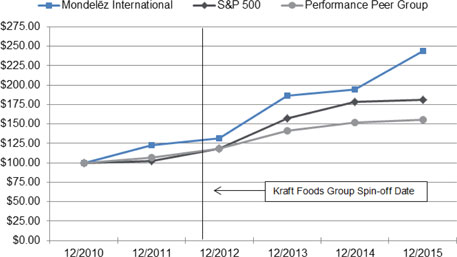
| Mondelēz | Performance | |||||||||||
| Date | International | S&P 500 | Peer Group | |||||||||
| December 31, 2010 | $ | 100.00 | $ | 100.00 | $ | 100.00 | ||||||
| December 31, 2011 | 122.64 | 102.11 | 107.09 | |||||||||
| December 31, 2012 | 131.84 | 118.45 | 118.32 | |||||||||
| December 31, 2013 | 186.02 | 156.82 | 140.93 | |||||||||
| December 31, 2014 | 194.55 | 178.28 | 151.64 | |||||||||
| December 31, 2015 | 243.95 | 180.75 | 155.42 |
The Mondelēz International performance peer group consists of the following companies considered our market competitors or that have been selected on the basis of industry, global focus or industry leadership: Campbell Soup Company, The Coca-Cola Company, Colgate-Palmolive Company, Danone S.A., General Mills, Inc., The Hershey Company, Kellogg Company, Nestlé S.A., PepsiCo, Inc., The Procter & Gamble Company and Unilever PLC.
This performance graph and other information furnished under this Part II Item 5(a) of this Form 10-K shall not be deemed to be “soliciting material” or to be “filed” with the SEC or subject to Regulation 14A or 14C, or to the liabilities of Section 18 of the Exchange Act.
Issuer Purchases of Equity Securities
Our stock repurchase activity for each of the three months in the quarter ended December 31, 2015 was:
| Issuer Purchases of Equity Securities | ||||||||||||||||
| Period | Total Number of Shares Purchased (1) | Average Price Paid per Share | Total Number of Shares Purchased as Part of Publicly Announced Plans or Programs (2) | Approximate Dollar Value of Shares That May Yet Be Purchased Under the Plans or Programs (2) | ||||||||||||
| October 1-31, 2015 | 2,802,427 | $ | 44.77 | 2,790,353 | $ | 5,860,675,551 | ||||||||||
| November 1-30, 2015 | 5,288,316 | 44.45 | 5,286,719 | 5,625,687,529 | ||||||||||||
| December 1-31, 2015 | 4,290,456 | 43.58 | 4,116,106 | 5,446,305,470 | ||||||||||||
| For the Quarter Ended December 31, 2015 | 12,381,199 | 44.22 | 12,193,178 | |||||||||||||
| (1) | The total number of shares purchased includes: (i) shares purchased pursuant to the repurchase program described in (2) below; and (ii) shares tendered to us by employees who used shares to exercise options and to pay the related taxes for grants of restricted and deferred stock that vested, totaling 12,074 shares, 1,597 shares and 174,350 shares for the fiscal months of October, November and December 2015, respectively. |
|---|
| (2) | Our Board of Directors authorized the repurchase of $13.7 billion of our Common Stock through December 31, 2018. Specifically, on March 12, 2013, our Board of Directors authorized the repurchase of up to the lesser of 40 million shares or $1.2 billion of our Common Stock through March 12, 2016. On August 6, 2013, our Audit Committee, with authorization delegated from our Board of Directors, increased the repurchase program capacity to $6.0 billion of Common Stock repurchases and extended the expiration date to December 31, 2016. On December 3, 2013, our Board of Directors approved an increase of $1.7 billion to the program related to a new accelerated share repurchase program, which concluded in May 2014. On July 29, 2015, our Finance Committee, with authorization delegated from our Board of Directors, approved a $6.0 billion increase that raised the repurchase program capacity to $13.7 billion and extended the program through December 31, 2018. See Note 12, Capital Stock, for additional information. |
|---|
Item 6. Selected Financial Data
Mondelēz International, Inc.
Selected Financial Data – Five Year Review (1)
| 2015 | 2014 | 2013 | 2012 | 2011 | ||||||||||||||||
| (in millions, except per share and employee data) | ||||||||||||||||||||
| Continuing Operations (2) | ||||||||||||||||||||
| Net revenues | $ | 29,636 | $ | 34,244 | $ | 35,299 | $ | 35,015 | $ | 35,810 | ||||||||||
| Earnings from continuing operations, net of taxes | 7,291 | 2,201 | 2,332 | 1,606 | 1,764 | |||||||||||||||
| Net earnings attributable to Mondelēz International: | ||||||||||||||||||||
| Per share, basic | 4.49 | 1.29 | 1.30 | 0.90 | 0.99 | |||||||||||||||
| Per share, diluted | 4.44 | 1.28 | 1.29 | 0.88 | 0.99 | |||||||||||||||
| Cash Flow and Financial Position (3) | ||||||||||||||||||||
| Net cash provided by operating activities | 3,728 | 3,562 | 6,410 | 3,923 | 4,520 | |||||||||||||||
| Capital expenditures | 1,514 | 1,642 | 1,622 | 1,610 | 1,771 | |||||||||||||||
| Property, plant and equipment, net | 8,362 | 9,827 | 10,247 | 10,010 | 13,813 | |||||||||||||||
| Total assets | 62,843 | 66,771 | 72,464 | 75,421 | 93,701 | |||||||||||||||
| Long-term debt | 14,557 | 13,821 | 14,431 | 15,519 | 23,013 | |||||||||||||||
| Total Mondelēz International shareholders’ equity | 28,012 | 27,750 | 32,373 | 32,276 | 35,271 | |||||||||||||||
| Shares outstanding at year end (4) | 1,580 | 1,664 | 1,705 | 1,778 | 1,768 | |||||||||||||||
| Per Share and Other Data (5) | ||||||||||||||||||||
| Book value per shares outstanding | 17.73 | 16.68 | 18.99 | 18.15 | 19.95 | |||||||||||||||
| Dividends declared per share (6) | 0.64 | 0.58 | 0.54 | 1.00 | 1.16 | |||||||||||||||
| Common Stock closing price at year end (7) | 44.84 | 36.33 | 35.30 | 25.45 | 37.36 | |||||||||||||||
| Number of employees | 99,000 | 104,000 | 107,000 | 110,000 | 126,000 |
| (1) | The selected financial data should be read in conjunction with Management’s Discussion and Analysis of Financial Condition and Results of Operations and our consolidated financial statements and related notes included elsewhere in this Annual Report on Form 10-K and Annual Reports on Form 10-K for earlier periods. A significant portion of our business is exposed to currency exchange rate fluctuation as a large portion of our assets, liabilities, revenue and expenses must be translated into U.S. dollars for reporting purposes. Refer to Management’s Discussion and Analysis of Financial Condition and Results of Operations for a discussion of operating results on a constant currency basis where noted. |
|---|
| (2) | Significant items impacting the comparability of our results from continuing operations include: Spin-Off Costs in 2012-2014; Restructuring Programs in 2012-2015; Cost Savings Initiatives in 2011-2013; the contribution of our global coffee businesses and investment in JDE and related gain in 2015; other divestitures and sales of property in 2015, 2013 and 2012; acquisitions in 2015 and 2013; the Cadbury acquisition-related Integration Program in 2011-2014; the benefit from the Cadbury acquisition-related indemnification resolution in 2013; losses on debt extinguishment in 2013-2015; unrealized gains on the coffee business transaction currency hedges in 2014 and 2015; debt tender offers completed in 2013-2015; loss on deconsolidation of Venezuela in 2015; the remeasurement of net monetary assets in Venezuela in 2013-2015; accounting calendar changes in 2015, 2013 and 2011 (including a 53rd week of operating results in 2011); impairment charges related to intangible assets in 2015, 2014 and 2012; and our provision for income taxes in all years. Please refer to Notes 1, Summary of Significant Accounting Policies; 2, Divestitures and Acquisitions; 5, Goodwill and Intangible Assets; 6, Restructuring Programs; 7, Integration Program and Cost Savings Initiatives; 8, Debt and Borrowing Arrangements; 9, Financial Instruments; 13, Commitments and Contingencies; 15, Income Taxes; and 17, Segment Reporting, for additional information regarding items affecting comparability of our results from continuing operations. |
|---|
| (3) | Our Cash Flow and Financial Position information includes Kraft Foods Group data for periods prior to the October 1, 2012 Spin-Off date. Refer to the Annual Report on Form 10-K for the year ended December 31, 2012 for information on the divested net assets and items impacting cash flow. Other items impacting comparability primarily relate to the coffee business transactions in 2014 and 2015, the loss on deconsolidation of Venezuela in 2015 and the receipt of net cash proceeds from the resolution of the Starbucks arbitration in 2013. As of December 31, 2015, we had debt issuance costs related to recognized debt liabilities of $46 million, which have been reclassified from long-term other assets to a deduction from the related debt obligations on the consolidated balance sheet. We have also made this reclassification in the prior years presented to be consistent with the current year presentation. |
|---|
| (4) | Refer to Note 12, Capital Stock, for additional information on our share repurchase program in 2013-2015. |
|---|
| (5) | Per Share and Other Data includes Kraft Foods Group data for periods prior to the October 1, 2012 Spin-Off date. Refer to Note 2, Divestitures and Acquisitions, related to the resolution of the Starbucks arbitration in 2013 and the Annual Report on Form 10-K for the year ended December 31, 2012, for additional information on the Cadbury acquisition in 2010. |
|---|
| (6) | Refer to the Equity and Dividends section within Management’s Discussion and Analysis of Financial Condition and Results of Operations for additional information on our dividends following the October 1, 2012 Spin-Off. |
|---|
| (7) | Closing prices reflect historical market prices and have not been adjusted for periods prior to October 1, 2012 to reflect the Spin-Off of Kraft Foods Group on that date. |
|---|
Item 7. Management’s Discussion and Analysis of Financial Condition and Results of Operations.
The following discussion and analysis contains forward-looking statements. It should be read in conjunction with the other sections of this Annual Report on Form 10-K, including the consolidated financial statements and related notes contained in Item 8, “Forward-Looking Statements” and “Risk Factors” contained in Item 1A.
Description of the Company
We manufacture and market primarily snack food products, including biscuits (cookies, crackers and salted snacks), chocolate, gum & candy and various cheese & grocery products, as well as powdered beverage products. We have operations in more than 80 countries and sell our products in 165 countries.
Over the last several years, we have built a presence in the snacking category. We have expanded geographically and continue to invest in product quality, marketing and innovation behind our iconic brands while also implementing a series of cost saving initiatives. Our goals are to achieve industry-leading revenue growth over time driven by the higher expected growth rates of advantaged snack categories; leverage our cost structure through supply chain reinvention, productivity programs, overhead streamlining, volume growth and improved product mix to drive margin gains; and grow earnings per share in the top-tier of our peer group.
Coffee Business Transactions
On July 2, 2015, we completed transactions to combine our wholly owned coffee businesses (including our coffee portfolio in France) with those of D.E Master Blenders 1753 B.V. (“DEMB”) to create a new company, Jacobs Douwe Egberts or JDE. We currently hold a 43.5% equity interest in JDE and Acorn Holdings B.V. (“AHBV”), owner of DEMB, holds the remaining 56.5% equity interest.
In connection with the contribution of our global coffee businesses to JDE, we recorded a pre-tax gain of $6.8 billion (or $6.6 billion after taxes) in 2015. We also recorded approximately $1.0 billion of pre-tax net gains related to hedging the expected cash proceeds from the transactions as described further below.
The consideration we have received to date consists of €3.8 billion of cash ($4.2 billion U.S. dollars as of July 2, 2015), a 43.5% equity interest in JDE and $794 million in receivables (related to sales price adjustments and tax formation cost payments). During the third quarter of 2015, we also recorded $283 million of cash and receivables from JDE related to reimbursement of costs that we incurred in separating our coffee businesses. The cash and equity consideration we received at closing reflects that we retained our interest in a Korea-based joint venture, Dongsuh Foods Corporation. During the second quarter of 2015, we also completed the sale of our interest in a Japanese coffee joint venture, Ajinomoto General Foods, Inc. (“AGF”). In lieu of contributing our interest in the AGF joint venture to JDE, we contributed the net cash proceeds from the sale, and the transaction did not change the consideration received for our global coffee businesses. Please see Note 2, Divestitures and Acquisitions – Other Divestitures, Acquisitions and Sales of Property, for discussion of the divestiture of AGF.
During the fourth quarter, we and JDE concluded negotiations of a sales price adjustment and completed the valuation of our investment in JDE. Primarily related to the negotiated resolution of the sales price adjustment in the fourth quarter, we recorded a $313 million reduction in the pre-tax gain on the coffee transaction, reducing the $7.1 billion estimated gain in the third quarter to the $6.8 billion final gain for 2015. As part of our sales price negotiations, we retained the right to collect future cash payments if certain estimated pension liabilities come in over an agreed amount in the future. As such, we may recognize additional income related to this negotiated term in the future.
The final value of our investment in JDE on July 2, 2015 was €4.1 billion, or $4.5 billion. The fair value of the JDE investment was determined using both income-based and market-based valuation techniques. The discounted cash flow analysis reflected growth, discount and tax rates and other assumptions reflecting the underlying combined businesses and countries in which the combined coffee businesses operate.
In connection with the expected receipt of cash in euros at the time of closing, we entered into a number of consecutive currency exchange forward contracts in 2014 and 2015 to lock in an equivalent expected value in U.S. dollars as of the date the coffee business transactions were first announced in May 2014. Cumulatively, we realized aggregate net gains
and received cash of approximately $1.0 billion on these hedging contracts that increased the cash we received in connection with the coffee business transactions from $4.2 billion in cash consideration received to $5.2 billion. In connection with these currency contracts and the transfer of the sale proceeds to our subsidiaries that deconsolidated net assets and shares, we recognized a net gain of $628 million in 2014 and a net gain of $436 million in 2015 within interest and other expense, net. For additional information on the JDE coffee transactions, see Note 2, Divestitures and Acquisitions.
On December 18, 2015, AHBV and we agreed to provide JDE additional capital to pay down some of its debt with lenders. Our pro rata share of the capital increase was €499 million ($544 million U.S. dollars as of December 18, 2015) and was made in return for additional shares in JDE such that we retained our 43.5% interest in JDE following the capital increase. To fund our share of the capital increase, we contributed €460 million ($501 million) of JDE receivables and made a €39 million ($43 million) cash payment.
On December 6, 2015, we agreed to make an investment in Keurig Green Mountain Inc. (“Keurig”), which is contingent upon the successful completion of a planned acquisition of Keurig by JAB Holding Co. (“JAB” and parent company of AHBV). Following the close of JAB’s planned acquisition of Keurig in early 2016, we intend to exchange a portion of our equity interest in JDE for an equity interest in Keurig. Following the exchange of shares, we expect our ownership in JDE to decrease to approximately 26.5% and our interest in Keurig to be somewhat lower. We expect to account for both investments under the equity method, resulting in our recognizing our share of their earnings within our earnings and our share of their dividends within our cash flows. Our governance rights in JDE will not change significantly and we will have similar governance rights in Keurig following the transaction. Our investment in Keurig will follow the acquisition of Keurig by JAB, which is expected to be completed by the end of the first quarter of 2016 or early in the second quarter. As our exchange of shares in JDE for the investment in Keurig is conditioned upon the actions of JAB and Keurig’s existing shareholders and is subject to further regulatory antitrust reviews, we have not reflected the portion of our investment in JDE that would be exchanged for the Keurig investment as assets held for sale as of December 31, 2015.
Venezuela Deconsolidation
Effective as of the close of the 2015 fiscal year, we concluded that we no longer met the accounting criteria for consolidation of our Venezuela subsidiaries due to a loss of control over our Venezuelan operations and an other-than-temporary lack of currency exchangeability. As of the close of the 2015 fiscal year, we deconsolidated and changed to the cost method of accounting for our Venezuelan operations. We recorded a $778 million pre-tax loss as we reduced the value of our cost method investment in Venezuela and all Venezuelan receivables held by our other subsidiaries to realizable fair value, resulting in full impairment. The recorded loss also included historical cumulative translation adjustments related to our Venezuelan operations that had previously been recorded in
Showing the first 8K of 159K characters. Open the full section
Item 7A. Quantitative and Qualitative Disclosures about Market Risk.
As we operate globally, we are primarily exposed to currency exchange rate, commodity price and interest rate market risks. We monitor and manage these exposures as part of our overall risk management program. Our risk management program focuses on the unpredictability of financial markets and seeks to reduce the potentially adverse effects that the volatility of these markets may have on our operating results. We principally utilize derivative instruments to reduce significant, unanticipated earnings fluctuations that may arise from volatility in currency exchange rates, commodity prices and interest rates. For additional information on our derivative activity and the types of derivative instruments we use to hedge our currency exchange, commodity price and interest rate exposures, see Note 9, Financial Instruments.
Many of our non-U.S. subsidiaries operate in functional currencies other than the U.S. dollar. Fluctuations in currency exchange rates create volatility in our reported results as we translate the balance sheets, operating results and cash flows of these subsidiaries into the U.S. dollar for consolidated reporting purposes. The translation of non-U.S. dollar denominated balance sheets and statements of earnings of our subsidiaries into the U.S. dollar for consolidated reporting generally results in a cumulative translation adjustment to other comprehensive income within equity. A stronger U.S. dollar relative to other functional currencies adversely affects our consolidated earnings and net assets while a weaker U.S. dollar benefits our consolidated earnings and net assets. While we hedge significant forecasted currency exchange transactions as well as certain net assets of non-U.S. operations and other currency impacts, we cannot fully predict or eliminate volatility arising from changes in currency exchange rates on our consolidated financial results. See Consolidated Results of Operations and Results of Operations by Reportable Segment under Discussion and Analysis of Historical Results for currency exchange effects on our financial results during 2015. For additional information on the impact of currency policies, the deconsolidation of our Venezuelan operation and the historical remeasurement of our Venezuelan net monetary assets on our financial condition and results of operations, also see Note 1, Summary of Significant Accounting Policies—Currency Translation and Highly Inflationary Accounting.
We also continually monitor the market for commodities that we use in our products. Input costs may fluctuate widely due to international demand, weather conditions, government policy and regulation and unforeseen conditions. To manage the input cost volatility, we enter into forward purchase agreements and other derivative financial instruments. We also pursue productivity and cost saving measures and take pricing actions when necessary to mitigate the impact of higher input costs on earnings.
We regularly evaluate our variable and fixed-rate debt as well as current and expected interest rates in the markets in which we raise capital. Our primary exposures include movements in U.S. Treasury rates, corporate credit spreads, London Interbank Offered Rates (“LIBOR”), Euro Interbank Offered Rate (“EURIBOR”) and commercial paper rates. We periodically use interest rate swaps and forward interest rate contracts to achieve a desired proportion of variable versus fixed rate debt based on current and projected market conditions. In addition to using interest rate derivatives to manage future interest payments, during 2015, we retired $4.2 billion of our long-term debt and issued $4.5 billion of lower borrowing cost debt. Our weighted-average interest rate on our total debt as of December 31, 2015 was 3.7%, down from 4.3% as of December 31, 2014.
Value at Risk:
We use a value at risk (“VAR”) computation to estimate: 1) the potential one-day loss in the fair value of our interest rate-sensitive financial instruments; and 2) the potential one-day loss in pre-tax earnings of our currency and commodity price-sensitive derivative financial instruments. The VAR analysis was done separately for our currency exchange, fixed income and commodity risk portfolios as of each quarter end during 2015. The instruments included in the VAR computation were currency exchange forwards and options for currency exchange risk, debt and swaps for interest rate risk, and commodity forwards, futures and options for commodity risk. Excluded from the computation were anticipated transactions, currency trade payables and receivables, and net investments in non-U.S. subsidiaries, which the abovementioned instruments are intended to hedge.
The VAR model assumes normal market conditions, a 95% confidence interval and a one-day holding period. A parametric delta-gamma approximation technique was used to determine the expected return distribution in interest rates, currencies and commodity prices for the purpose of calculating the fixed income, currency exchange and commodity VAR, respectively. The parameters used for estimating the expected return distributions were determined by observing interest rate, currency exchange, and commodity price movements over the prior quarter for the calculation of VAR amounts at December 31, 2015 and 2014, and over each of the four prior quarters for the calculation of average VAR amounts during each year. The values of currency and commodity options do not change on a one-to-one basis with the underlying currency or commodity and were valued accordingly in the VAR computation.
As of December 31, 2015, the estimated potential one-day loss in fair value of our interest rate-sensitive instruments, primarily debt, and the estimated potential one-day loss in pre-tax earnings from our currency and commodity instruments, as calculated in the VAR model, were:
| Pre-Tax Earnings Impact | Fair Value Impact | |||||||||||||||||||||||||||||||
| At 12/31/15 | Average | High | Low | At 12/31/15 | Average | High | Low | |||||||||||||||||||||||||
| (in millions) | ||||||||||||||||||||||||||||||||
| Instruments sensitive to: | ||||||||||||||||||||||||||||||||
| Interest rates | $ 56 | $ 60 | $ 78 | $ 50 | ||||||||||||||||||||||||||||
| Foreign currency rates | $ 16 | $ 55 | $ 103 | $ 16 | ||||||||||||||||||||||||||||
| Commodity prices | 15 | 23 | 31 | 15 | ||||||||||||||||||||||||||||
| Pre-Tax Earnings Impact | Fair Value Impact | |||||||||||||||||||||||||||||||
| At 12/31/14 | Average | High | Low | At 12/31/14 | Average | High | Low | |||||||||||||||||||||||||
| (in millions) | ||||||||||||||||||||||||||||||||
| Instruments sensitive to: | ||||||||||||||||||||||||||||||||
| Interest rates | $ 50 | $ 41 | $ 50 | $ 30 | ||||||||||||||||||||||||||||
| Foreign currency rates | $ 51 | $ 42 | $ 58 | $ 25 | ||||||||||||||||||||||||||||
| Commodity prices | 26 | 28 | 38 | 19 |
This VAR computation is a risk analysis tool designed to statistically estimate the maximum expected daily loss, under the specified confidence interval and assuming normal market conditions, from adverse movements in interest rates, currency exchange rates and commodity prices. The computation does not represent actual losses in fair value or earnings we will incur, nor does it consider the effect of favorable changes in market rates. We cannot predict actual future movements in market rates and do not present these VAR results to be indicative of future movements in market rates or to be representative of any actual impact that future changes in market rates may have on our future financial results.
Item 8. Financial Statements and Supplementary Data.
Report of Independent Registered Public Accounting Firm
To the Board of Directors and Shareholders of Mondelēz International, Inc.:
In our opinion, the accompanying consolidated balance sheets and the related consolidated statements of earnings, comprehensive earnings, equity and cash flows present fairly, in all material respects, the financial position of Mondelēz International, Inc. and its subsidiaries at December 31, 2015 and 2014, and the results of their operations and their cash flows for each of the three years in the period ended December 31, 2015 in conformity with accounting principles generally accepted in the United States of America. Also in our opinion, the Company maintained, in all material respects, effective internal control over financial reporting as of December 31, 2015, based on criteria established in Internal Control—Integrated Framework (2013) issued by the Committee of Sponsoring Organizations of the Treadway Commission (COSO). The Company’s management is responsible for these financial statements, for maintaining effective internal control over financial reporting and for its assessment of the effectiveness of internal control over financial reporting, included in the Report of Management on Internal Control Over Financial Reporting appearing under Item 9A. Our responsibility is to express opinions on these financial statements and on the Company’s internal control over financial reporting based on our integrated audits. We conducted our audits in accordance with the standards of the Public Company Accounting Oversight Board (United States). Those standards require that we plan and perform the audits to obtain reasonable assurance about whether the financial statements are free of material misstatement and whether effective internal control over financial reporting was maintained in all material respects. Our audits of the financial statements included examining, on a test basis, evidence supporting the amounts and disclosures in the financial statements, assessing the accounting principles used and significant estimates made by management, and evaluating the overall financial statement presentation. Our audit of internal control over financial reporting included obtaining an understanding of internal control over financial reporting, assessing the risk that a material weakness exists, and testing and evaluating the design and operating effectiveness of internal control based on the assessed risk. Our audits also included performing such other procedures as we considered necessary in the circumstances. We believe that our audits provide a reasonable basis for our opinions.
As discussed in Note 1 to the financial statements, the Company changed the manner in which it classifies deferred income taxes in 2015.
A company’s internal control over financial reporting is a process designed to provide reasonable assurance regarding the reliability of financial reporting and the preparation of financial statements for external purposes in accordance with generally accepted accounting principles. A company’s internal control over financial reporting includes those policies and procedures that (i) pertain to the maintenance of records that, in reasonable detail, accurately and fairly reflect the transactions and dispositions of the assets of the company; (ii) provide reasonable assurance that transactions are recorded as necessary to permit preparation of financial statements in accordance with generally accepted accounting principles, and that receipts and expenditures of the company are being made only in accordance with authorizations of management and directors of the company; and (iii) provide reasonable assurance regarding prevention or timely detection of unauthorized acquisition, use, or disposition of the company’s assets that could have a material effect on the financial statements.
Because of its inherent limitations, internal control over financial reporting may not prevent or detect misstatements. Also, projections of any evaluation of effectiveness to future periods are subject to the risk that controls may become inadequate because of changes in conditions, or that the degree of compliance with the policies or procedures may deteriorate.
/s/ PRICEWATERHOUSECOOPERS LLP
Chicago, Illinois
February 19, 2016
Mondelēz International, Inc. and Subsidiaries
Consolidated Statements of Earnings
For the Years Ended December 31
(in millions of U.S. dollars, except per share data)
| 2015 | 2014 | 2013 | ||||||||||
| Net revenues | $ | 29,636 | $ | 34,244 | $ | 35,299 | ||||||
| Cost of sales | 18,124 | 21,647 | 22,189 | |||||||||
| Gross profit | 11,512 | 12,597 | 13,110 | |||||||||
| Selling, general and administrative expenses | 7,577 | 8,457 | 8,679 | |||||||||
| Asset impairment and exit costs | 901 | 692 | 273 | |||||||||
| Gains on coffee business transactions and divestitures | (6,822 | ) | – | (30 | ) | |||||||
| Loss on deconsolidation of Venezuela | 778 | – | – | |||||||||
| Amortization of intangibles | 181 | 206 | 217 | |||||||||
| Operating income | 8,897 | 3,242 | 3,971 | |||||||||
| Interest and other expense, net | 1,013 | 688 | 1,579 | |||||||||
| Earnings from continuing operations before income taxes | 7,884 | 2,554 | 2,392 | |||||||||
| Provision for income taxes | 593 | 353 | 60 | |||||||||
| Earnings from continuing operations | 7,291 | 2,201 | 2,332 | |||||||||
| Earnings from discontinued operations, net of income taxes | – | – | 1,603 | |||||||||
| Net earnings | 7,291 | 2,201 | 3,935 | |||||||||
| Noncontrolling interest | 24 | 17 | 20 | |||||||||
| Net earnings attributable to Mondelēz International | $ | 7,267 | $ | 2,184 | $ | 3,915 | ||||||
| Per share data: | ||||||||||||
| Basic earnings per share attributable to Mondelēz International: | ||||||||||||
| Continuing operations | $ | 4.49 | $ | 1.29 | $ | 1.30 | ||||||
| Discontinued operations | – | – | 0.91 | |||||||||
| Net earnings attributable to Mondelēz International | $ | 4.49 | $ | 1.29 | $ | 2.21 | ||||||
| Diluted earnings per share attributable to Mondelēz International: | ||||||||||||
| Continuing operations | $ | 4.44 | $ | 1.28 | $ | 1.29 | ||||||
| Discontinued operations | – | – | 0.90 | |||||||||
| Net earnings attributable to Mondelēz International | $ | 4.44 | $ | 1.28 | $ | 2.19 | ||||||
| Dividends declared | $ | 0.64 | $ | 0.58 | $ | 0.54 |
See accompanying notes to the consolidated financial statements.
Mondelēz International, Inc. and Subsidiaries
Consolidated Statements of Comprehensive Earnings
For the Years Ended December 31
**(in
Showing the first 8K of 275K characters. Open the full section
Item 9. Changes in and Disagreements with Accountants on Accounting and Financial Disclosure.
None.
Item 9A. Controls and Procedures.
Evaluation of Disclosure Controls and Procedures
We have established disclosure controls and procedures that are designed to ensure that information required to be disclosed in our reports filed or submitted under the Exchange Act is recorded, processed, summarized and reported within the time periods specified in the rules and forms of the SEC, and such information is accumulated and communicated to our management, including our Chief Executive Officer (“CEO”) and Chief Financial Officer (“CFO”), as appropriate to allow timely decisions regarding required disclosure. Management, together with our CEO and CFO, evaluated the effectiveness of the Company’s disclosure controls and procedures as of December 31, 2015. Based on this evaluation, the CEO and CFO concluded that our disclosure controls and procedures were effective as of December 31, 2015.
Remediation of Material Weakness
As of December 31, 2015, management assessed and concluded that the previously reported material weakness related to accounting for income taxes has been remediated as of December 31, 2015.
As part of the remediation plan, management implemented new policies and procedures pertaining to accounting for income taxes, including:
| • | revising and formalizing numerous income tax accounting review processes, |
|---|
| • | redesigning and implementing a new, more robust internal control set related to income tax accounting, |
|---|
| • | defining and clearly communicating roles and responsibilities for income tax accounting to local and regional personnel, |
|---|
| • | implementing industry-standard technology tools utilized in the accounting for income taxes, |
|---|
| • | conducting extensive training on the accounting and control processes involving income tax accounting, and |
|---|
| • | hiring additional personnel with specific income tax accounting expertise. |
|---|
We and our Board of Directors are committed to maintaining a strong internal control environment, and we believe that these remediation efforts represent significant improvements in our controls. We monitored our processes throughout the remediation period and have concluded that they are operating effectively and are well controlled and sustainable. We will continue to focus on maintaining the system of internal controls that was developed and implemented over the last two years, and we will make enhancements when and where necessary.
Report of Management on Internal Control Over Financial Reporting
Management is responsible for establishing and maintaining adequate internal control over financial reporting as defined in Rules 13a-15(f) and 15d-15(f) under the Exchange Act. Our internal control over financial reporting is a process designed by, or under the supervision of, our CEO and CFO, or persons performing similar functions, and effected by the Company’s Board of Directors, management and other personnel to provide reasonable assurance regarding the reliability of financial reporting and the preparation of financial statements for external purposes in accordance with generally accepted accounting principles. Our internal control over financial reporting includes those written policies and procedures that:
| • | pertain to the maintenance of records that, in reasonable detail, accurately and fairly reflect the transactions and dispositions of assets; |
|---|
| • | provide reasonable assurance that transactions are recorded as necessary to permit preparation of financial statements in accordance with generally accepted accounting principles; |
|---|
| • | provide reasonable assurance that receipts and expenditures are being made only in accordance with management and director authorization; and |
|---|
| • | provide reasonable assurance regarding prevention or timely detection of unauthorized acquisition, use or disposition of assets that could have a material effect on the consolidated financial statements. |
|---|
Because of its inherent limitations, internal control over financial reporting may not prevent or detect misstatements. Also, projections of any evaluation of effectiveness to future periods are subject to the risk that controls may become inadequate because of changes in conditions, or that the degree of compliance with the policies or procedures may deteriorate.
Management assessed the effectiveness of our internal control over financial reporting as of December 31, 2015. Management based this assessment on criteria for effective internal control over financial reporting described in Internal Control—Integrated Framework (2013) issued by the Committee of Sponsoring Organizations of the Treadway Commission (“COSO”).
Based on this assessment, management concluded that the Company’s internal control over financial reporting was effective as of December 31, 2015, based on the criteria in Internal Control-Integrated Framework issued by the COSO.
PricewaterhouseCoopers LLP, an independent registered public accounting firm, has audited the effectiveness of our internal control over financial reporting as of December 31, 2015, as stated in their report that appears under Item 8.
February 19, 2016
Changes in Internal Control Over Financial Reporting
Management, together with our CEO and CFO, evaluated the changes in our internal control over financial reporting during the quarter ended December 31, 2015. As outlined above, we remediated the previously reported material weakness related to our accounting for income taxes by adding controls in prior periods. We concluded our testing of those controls in the fourth quarter, supporting our remediation determination.
During the year ended December 31, 2015, we worked with outsourced partners to further simplify and standardize processes and focus on scalable, transactional processes across all regions. Specifically during the fourth quarter of 2015, we began to transition some of our transactional processing and financial reporting for a number of countries in our Asia Pacific, EEMEA and Latin America regions, as well as some of our Asia Pacific region order-to-cash transactional processing to two outsourced partners. We also transitioned some of our procurement administration functions for our North America and Latin America regions to one of our outsourced partners. We also transitioned certain financial system reconciliations for our EEMEA and Asia Pacific regions to another outsourced partner. Per our service agreements, the controls previously established around these accounting functions will be maintained by our outsourced partners and they are subject to management’s internal control testing.
There were no other changes in our internal control over financial reporting during the quarter ended December 31, 2015, that have materially affected, or are reasonably likely to materially affect, our internal control over financial reporting.
Item 9B. Other Information.
None.
PART III
Item 10. Directors, Executive Officers and Corporate Governance.
Information required by this Item 10 is included under the heading “Executive Officers of the Registrant” in Part I, Item 1 of this Form 10-K, as well as under the headings “Election of Directors,” “Corporate Governance - Governance Guidelines,” “Corporate Governance - Codes of Conduct,” “Board Committees and Membership - Audit Committee” and “Ownership of Equity Securities - Section 16(a) Beneficial Ownership Reporting Compliance” in our definitive Proxy Statement for our Annual Meeting of Shareholders scheduled to be held on May 18, 2016 (“2016 Proxy Statement”). All of this information from the 2016 Proxy Statement is incorporated by reference into this Annual Report.
The information on our web site is not, and shall not be deemed to be, a part of this Annual Report or incorporated into any other filings we make with the SEC.
Item 11. Executive Compensation.
Information required by this Item 11 is included under the headings “Board Committees and Membership - Human Resources and Compensation Committee,” “Compensation of Non-Employee Directors,” “Compensation Discussion and Analysis,” “Executive Compensation Tables” and “Human Resources and Compensation Committee Report for the Year Ended December 31, 2015” in our 2016 Proxy Statement. All of this information is incorporated by reference into this Annual Report.
Item 12. Security Ownership of Certain Beneficial Owners and Management and Related Stockholder Matters.
The number of shares to be issued upon exercise or vesting of awards issued under, and the number of shares remaining available for future issuance under, our equity compensation plans at December 31, 2015 were:
Equity Compensation Plan Information
| Number of Securities | ||||||||||||
| Remaining Available for | ||||||||||||
| Number of Securities to | Future Issuance under | |||||||||||
| be Issued Upon Exercise | Weighted Average | Equity Compensation | ||||||||||
| of Outstanding | Exercise Price of | Plans (excluding | ||||||||||
| Options, Warrants | Outstanding Options, | securities reflected | ||||||||||
| and Rights (1) | Warrants and Rights | in column (a)) (2) | ||||||||||
| (a) | (b) | (c) | ||||||||||
| Equity compensation plans approved by security holders | 64,471,717 | $ | 26.12 | 81,775,279 | ||||||||
| (1) | Includes vesting of deferred stock units and long-term incentive plan stock. |
|---|
| (2) | Includes 40,433,520 options and deferred stock units and 41,341,760 shares of restricted stock available for issuance under the Amended and Restated 2005 Performance Incentive Plan. |
|---|
Information related to the security ownership of certain beneficial owners and management is included in our 2016 Proxy Statement under the heading “Ownership of Equity Securities” and is incorporated by reference into this Annual Report.
Item 13. Certain Relationships and Related Transactions, and Director Independence.
Information required by this Item 13 is included under the headings “Corporate Governance - Director Independence” and “Corporate Governance - Review of Transactions with Related Persons” in our 2016 Proxy Statement. All of this information is incorporated by reference into this Annual Report.
Item 14. Principal Accountant Fees and Services.
Information required by this Item 14 is included under the heading “Board Committees and Membership - Audit Committee” in our 2016 Proxy Statement. All of this information is incorporated by reference into this Annual Report.
PART IV
Item 15. Exhibits and Financial Statement Schedules.
| (a) | Index to Consolidated Financial Statements and Schedules |
|---|
Schedules other than those listed above have been omitted either because such schedules are not required or are not applicable.
| (b) | The following exhibits are filed as part of, or incorporated by reference into, this Annual Report: |
|---|
| 2.1 | Separation and Distribution Agreement between the Registrant and Kraft Foods Group, Inc., dated as of September 27, 2012 (incorporated by reference to Exhibit 2.1 to the Registrant’s Current Report on Form 8-K filed with the SEC on October 1, 2012).* | |
| 2.2 | Canadian Asset Transfer Agreement, by and between Mondelez Canada Inc. and Kraft Canada Inc., dated as of September 29, 2012 (incorporated by reference to Exhibit 2.3 to the Registrant’s Annual Report on Form 10-K filed with the SEC on February 25, 2013).* | |
| 2.3 | Master Ownership and License Agreement Regarding Patents, Trade Secrets and Related Intellectual Property, among Kraft Foods Global Brands LLC, Kraft Foods Group Brands LLC, Kraft Foods UK Ltd. and Kraft Foods R&D Inc., dated as of October 1, 2012 (incorporated by reference to Exhibit 10.3 to the Registrant’s Current Report on Form 8-K filed with the SEC on October 1, 2012).* | |
| 2.4 | Master Ownership and License Agreement Regarding Trademarks and Related Intellectual Property, by and between Kraft Foods Global Brands LLC and Kraft Foods Group Brands LLC., dated as of September 27, 2012 (incorporated by reference to Exhibit 10.4 to the Registrant’s Current Report on Form 8-K filed with the SEC on October 1, 2012).* | |
| 2.5 | First Amendment to the Master Ownerships and License Agreement Regarding Trademarks and Related Intellectual Property, among Intercontinental Great Brands LLC and Kraft Foods Group Brands LLC, dated as of July 15, 2013 (incorporated by reference to Exhibit 2.1 to the Registrant’s Quarterly Report on Form 10-Q filed with the SEC on April 30, 2015). | |
| 2.6 | Second Amendment to the Master Ownership and License Agreement Regarding Trademarks and Related Intellectual Property, among Intercontinental Great Brands LLC and Kraft Foods Group Brands LLC, dated as of October 1, 2014 (incorporated by reference to Exhibit 2.2 to the Registrant’s Quarterly Report on Form 10-Q filed with the SEC on April 30, 2015). | |
| 3.1 | Amended and Restated Articles of Incorporation of the Registrant, effective March 14, 2013 (incorporated by reference to Exhibit 3.1 to the Registrant’s Quarterly Report on Form 10-Q filed with the SEC on May 8, 2013). | |
| 3.2 | Amended and Restated By-Laws of the Registrant, effective as of October 9, 2015 (incorporated by reference to Exhibit 3.1 to the Registrant’s Current Report on Form 8-K filed with the SEC on October 7, 2015). | |
| 4.1 | The Registrant agrees to furnish to the SEC upon request copies of any instruments defining the rights of holders of long-term debt of the Registrant and its consolidated subsidiaries that does not exceed 10 percent of the total assets of the Registrant and its consolidated subsidiaries. | |
| 4.2 | Indenture, by and between the Registrant and Deutsche Bank Trust Company Americas (as successor trustee to The Bank of New York and The Chase Manhattan Bank), dated as of October 17, 2001 (incorporated by reference to Exhibit 4.1 to the Registrant’s Registration Statement on Form S-3 (Reg. No. 333-86478) filed with the SEC on April 18, 2002). | |
| 4.3 | Supplemental Indenture, by and between the Registrant and Deutsche Bank Trust Company Americas, Deutsche Bank AG, London Branch and Deutsche Bank Luxembourg S.A., dated as of December 11, 2013 (incorporated by reference to Exhibit 4.2 to the Registrant’s Current Report on Form 8-K filed with the SEC on December 11, 2013). | |
| 4.4 | Form of Indenture between Mondelēz International, Inc. and Deutsche Bank Trust Company Americas, as trustee (incorporated by reference to Exhibit 4.1 to the Registrant’s Registration Statement on Form S-3 (Reg. No. 333-194330) filed with the SEC on March 5, 2014). |
| 10.1 | $4.5 Billion 5-Year Revolving Credit Agreement, by and among the Registrant, the initial lenders named therein, JPMorgan Securities LLC, Deutsche Bank Securities Inc., Citigroup Global Markets Inc., Credit Suisse Securities (USA) LLC and HSBC Securities (USA) LLC, as joint lead arrangers and joint bookrunners, and JPMorgan Chase Bank, N.A. and Deutsche Bank AG New York Branch, as co-administrative agents, dated as of October 11, 2013 (incorporated by reference to Exhibit 10.1 to the Registrant’s Annual Report on Form 10-K filed with the SEC on March 3, 2014). | |
| 10.2 | Tax Sharing Agreement, by and between the Registrant and Altria Group, Inc., dated as of March 30, 2007 (incorporated by reference to Exhibit 10.3 to the Registrant’s Current Report on Form 8-K filed with the SEC on March 30, 2007). | |
| 10.3 | Tax Sharing and Indemnity Agreement, by and between the Registrant and Kraft Foods Group, Inc., dated as of September 27, 2012 (incorporated by reference to Exhibit 10.1 to the Registrant’s Current Report on Form 8-K filed with the SEC on October 1, 2012). | |
| 10.4 | Global Contribution Agreement by and among Mondelēz International Holdings, LLC, Acorn Holdings B.V., Charger Top HoldCo B.V. and Charger OpCo B.V., dated May 7, 2014 (incorporated by reference to Exhibit 10.1 to the Registrant’s Quarterly Report on Form 10-Q filed with the SEC on August 8, 2014).** | |
| 10.5 | Amendment Agreement to Global Contribution Agreement by and among Mondelēz International Holdings LLC, Acorn Holdings B.V., Jacobs Douwe Egberts B.V. (formerly Charger Top HoldCo B.V.) and Jacobs Douwe Egberts International B.V. (formerly Charger OpCo B.V.), dated July 28, 2015 (incorporated by reference to Exhibit 10.3 to the Registrant’s Quarterly Report on Form 10-Q filed with the SEC on July 31, 2015).** | |
| 10.6 | Shareholders’ Agreement by and among Mondelēz International Holdings, LLC, Delta Charger HoldCo B.V. and Charger Top HoldCo B.V., dated May 7, 2014 (incorporated by reference to Exhibit 10.2 to the Registrant’s Quarterly Report on Form 10-Q filed with the SEC on August 8, 2014).** | |
| 10.7 | Amendment Agreement to Shareholders’ Agreement by and among Delta Charger HoldCo B.V., Mondelez Coffee HoldCo B.V. and Jacobs Douwe Egberts B.V. (formerly Charger Top HoldCo B.V.), dated July 28, 2015 (incorporated by reference to Exhibit 10.4 to the Registrant’s Quarterly Report on Form 10-Q filed with the SEC on July 31, 2015).** | |
| 10.8 | Settlement Agreement, between the Registrant and Kraft Foods Group, Inc., dated June 22, 2015 (incorporated by reference to Exhibit 10.2 to the Registrant’s Quarterly Report on Form 10-Q filed with the SEC on July 31, 2015). | |
| 10.9 | Mondelēz International, Inc. Amended and Restated 2005 Performance Incentive Plan, amended and restated as of May 21, 2014 (incorporated by reference to Exhibit 10.1 to the Registrant’s Current Report on Form 8-K filed with the SEC on May 22, 2014).+ | |
| 10.10 | Form of Mondelēz International, Inc. Amended and Restated 2005 Performance Incentive Plan Restricted Stock Agreement for Mondelēz International Common Stock (incorporated by reference to Exhibit 10.7 to the Registrant’s Annual Report on Form 10-K filed with the SEC on February 20, 2015).+ | |
| 10.11 | Form of Mondelēz International, Inc. Amended and Restated 2005 Performance Incentive Plan Global Deferred Stock Unit Agreement (incorporated by reference to Exhibit 10.8 to the Registrant’s Annual Report on Form 10-K filed with the SEC on February 20, 2015).+ | |
| 10.12 | Form of Mondelēz International, Inc. Amended and Restated 2005 Performance Incentive Plan Non-Qualified U.S. Stock Option Agreement (incorporated by reference to Exhibit 10.9 to the Registrant’s Annual Report on Form 10-K filed with the SEC on February 20, 2015).+ | |
| 10.13 | Form of Mondelēz International, Inc. Amended and Restated 2005 Performance Incentive Plan Non-Qualified Non-U.S. Stock Option Agreement (incorporated by reference to Exhibit 10.10 to the Registrant’s Annual Report on Form 10-K filed with the SEC on February 20, 2015).+ | |
| 10.14 | Form of Mondelēz International, Inc. Amended and Restated 2005 Performance Incentive Plan Global Long-Term Incentive Grant Agreement (incorporated by reference to Exhibit 10.11 to the Registrant’s Annual Report on Form 10-K filed with the SEC on February 20, 2015).+ |
| 10.15 | Mondelēz International, Inc. Long-Term Incentive Plan, restated as of October 2, 2012 (incorporated by reference to Exhibit 10.9 to the Registrant’s Annual Report on Form 10-K filed with the SEC on February 25, 2013).+ | |
| 10.16 | Mondelēz Global LLC Supplemental Benefits Plan I, effective as of September 1, 2012 (incorporated by reference to Exhibit 10.10 to the Registrant’s Annual Report on Form 10-K filed with the SEC on February 25, 2013).+ | |
| 10.17 | Mondelēz Global LLC Supplemental Benefits Plan II, effective as of September 1, 2012 (incorporated by reference to Exhibit 10.11 to the Registrant’s Annual Report on Form 10-K filed with the SEC on February 25, 2013).+ | |
| 10.18 | Form of Mondelēz Global LLC Amended and Restated Cash Enrollment Agreement (incorporated by reference to Exhibit 10.12 to the Registrant’s Annual Report on Form 10-K filed with the SEC on February 25, 2013).+ | |
| 10.19 | Form of Mondelēz Global LLC Amended and Restated Employee Grantor Trust Enrollment Agreement (incorporated by reference to Exhibit 10.13 to the Registrant’s Annual Report on Form 10-K filed with the SEC on February 25, 2013).+ | |
| 10.20 | Mondelēz International, Inc. Amended and Restated 2006 Stock Compensation Plan for Non-Employee Directors, amended and restated as of October 1, 2012 (incorporated by reference to Exhibit 10.14 to the Registrant’s Annual Report on Form 10-K filed with the SEC on February 25, 2013).+ | |
| 10.21 | Mondelēz International, Inc. 2001 Compensation Plan for Non-Employee Directors, amended as of December 31, 2008 and restated as of January 1, 2013 (incorporated by reference to Exhibit 10.15 to the Registrant’s Annual Report on Form 10-K filed with the SEC on February 25, 2013).+ | |
| 10.22 | Mondelēz International, Inc. Change in Control Plan for Key Executives, amended as of February 4, 2015 (incorporated by reference to Exhibit 10.19 to the Registrant’s Annual Report on Form 10-K filed with the SEC on February 20, 2015).+ | |
| 10.23 | Mondelēz Global LLC Executive Deferred Compensation Plan, effective as of October 1, 2012 (incorporated by reference to Exhibit 10.17 to the Registrant’s Annual Report on Form 10-K filed with the SEC on February 25, 2013).+ | |
| 10.24 | Mondelēz Global LLC Executive Deferred Compensation Plan Adoption Agreement, effective as of October 1, 2012 (incorporated by reference to Exhibit 10.18 to the Registrant’s Annual Report on Form 10-K filed with the SEC on February 25, 2013).+ | |
| 10.25 | Deferred Compensation Plan Trust Document, by and between Mondelēz Global LLC and Wilmington Trust Retirement and Institutional Services Company, dated as of September 18, 2012 (incorporated by reference to Exhibit 10.19 to the Registrant’s Annual Report on Form 10-K filed with the SEC on February 25, 2013).+ | |
| 10.26 | Offer of Employment Letter, between the Registrant and Irene B. Rosenfeld, dated June 22, 2006 (incorporated by reference to Exhibit 10.29 to the Registrant’s Quarterly Report on Form 10-Q filed with the SEC on August 8, 2006).+ | |
| 10.27 | Amendment to Offer of Employment Letter, between the Registrant and Irene B. Rosenfeld, amended as of December 31, 2008 (incorporated by reference to Exhibit 10.20 to the Registrant’s Annual Report on Form 10-K filed with the SEC on February 27, 2009).+ | |
| 10.28 | Offer of Employment Letter, between the Registrant and Daniel P. Myers, dated June 20, 2011 (incorporated by reference to Exhibit 10.1 to the Registrant’s Quarterly Report on Form 10-Q filed with the SEC on November 4, 2011).+ | |
| 10.29 | Offer of Employment Letter, between Mondelēz Global LLC and Brian T. Gladden, dated September 26, 2014 (incorporated by reference to Exhibit 10.1 to the Registrant’s Current Report on Form 8-K filed with the SEC on October 9, 2014).+ |
| 10.30 | Offer of Employment Letter, between Mondelēz Global LLC and Roberto de Oliveira Marques, dated February 20, 2015 (incorporated by reference to Exhibit 10.2 to the Registrant’s Quarterly Report on Form 10-Q filed with the SEC on April 30, 2015).+ | |
| 10.31 | Retirement Agreement and General Release, between Mondelēz Global LLC and David Brearton, dated December 15, 2015 (incorporated by reference to Exhibit 10.1 to the Registrant’s Current Report on Form 8-K filed with the SEC on December 18, 2015).+ | |
| 10.32 | Form of Indemnification Agreement for Non-Employee Directors (incorporated by reference to 10.28 to the Registrant’s Annual Report on Form 10-K filed with the SEC on February 27, 2009).+ | |
| 10.33 | Indemnification Agreement between the Registrant and Irene B. Rosenfeld, dated January 27, 2009 (incorporated by reference to Exhibit 10.1 to the Registrant’s Current Report on Form 8-K filed with the SEC on February 2, 2009).+ | |
| 12.1 | Computation of Ratios of Earnings to Fixed Charges. | |
| 21.1 | Subsidiaries of the Registrant. | |
| 23.1 | Consent of PricewaterhouseCoopers LLP, Independent Registered Public Accounting Firm. | |
| 31.1 | Certification of the Registrant’s Chief Executive Officer pursuant to Rule 13a-14(a)/15d-14(a) of the Securities Exchange Act of 1934, as amended, as adopted pursuant to Section 302 of the Sarbanes-Oxley Act of 2002. | |
| 31.2 | Certification of the Registrant’s Chief Financial Officer pursuant to Rule 13a-14(a)/15d-14(a) of the Securities Exchange Act of 1934, as amended, as adopted pursuant to Section 302 of the Sarbanes-Oxley Act of 2002. | |
| 32.1 | Certifications of the Registrant’s Chief Executive Officer and Chief Financial Officer pursuant to 18 U.S.C. 1350, as adopted pursuant to Section 906 of the Sarbanes-Oxley Act of 2002. | |
| 101.1 | The following materials from Mondelēz International’s Annual Report on Form 10-K for the fiscal year ended December 31, 2015, formatted in XBRL (eXtensible Business Reporting Language): (i) the Consolidated Statements of Earnings, (ii) the Consolidated Statements of Comprehensive Earnings, (iii) the Consolidated Balance Sheets, (iv) the Consolidated Statements of Equity, (v) the Consolidated Statements of Cash Flows and (vi) Notes to Consolidated Financial Statements. |
| * | Upon request, Mondelēz International, Inc. agrees to furnish to the U.S. Securities and Exchange Commission, on a supplemental basis, a copy of any omitted schedule or exhibit to such agreement. |
|---|
| ** | Portions of this exhibit (indicated by asterisks) have been omitted pursuant to a request for confidential treatment and have been separately filed with the SEC. |
|---|
| + | Indicates a management contract or compensatory plan or arrangement. |
|---|
SIGNATURES
Pursuant to the requirements of Section 13 or 15(d) of the Securities Exchange Act of 1934, the registrant has duly caused this report to be signed on its behalf by the undersigned, thereunto duly authorized.
| MONDELĒZ INTERNATIONAL, INC. | ||
| By: | /s/ BRIAN T. GLADDEN | |
| (Brian T. Gladden | ||
| Executive Vice President | ||
| and Chief Financial Officer) |
Date: February 19, 2016
Pursuant to the requirements of the Securities Exchange Act of 1934, this report has been signed below by the following persons on behalf of the registrant and in the capacities and on the dates indicated:
| Signature | Title | Date | ||
| /s/ IRENE B. ROSENFELD | Director, Chairman and Chief Executive Officer | February 19, 2016 | ||
| (Irene B. Rosenfeld) | ||||
| /s/ BRIAN T. GLADDEN | Executive Vice President and Chief Financial Officer | February 19, 2016 | ||
| (Brian T. Gladden) | ||||
| /s/ LUCA ZARAMELLA | Senior Vice President and Corporate Controller | February 19, 2016 | ||
| (Luca Zaramella) | ||||
| /s/ STEPHEN F. BOLLENBACH | Director | February 19, 2016 | ||
| (Stephen F. Bollenbach) | ||||
| /s/ LEWIS W.K. BOOTH | Director | February 19, 2016 | ||
| (Lewis W.K. Booth) | ||||
| /s/ LOIS D. JULIBER | Director | February 19, 2016 | ||
| (Lois D. Juliber) | ||||
| /s/ MARK D. KETCHUM | Director | February 19, 2016 | ||
| (Mark D. Ketchum) | ||||
| /s/ JORGE S. MESQUITA | Director | February 19, 2016 | ||
| (Jorge S. Mesquita) | ||||
| /s/ JOSEPH NEUBAUER | Director | February 19, 2016 | ||
| (Joseph Neubauer) | ||||
| /s/ NELSON PELTZ | Director | February 19, 2016 | ||
| (Nelson Peltz) | ||||
| /s/ FREDRIC G. REYNOLDS | Director | February 19, 2016 | ||
| (Fredric G. Reynolds) | ||||
| /s/ CHRISTIANA S. SHI | Director | February 19, 2016 | ||
| (Christiana S. Shi) | ||||
| /s/ PATRICK T. SIEWERT | Director | February 19, 2016 | ||
| (Patrick T. Siewert) | ||||
| /s/ RUTH J. SIMMONS | Director | February 19, 2016 | ||
| (Ruth J. Simmons) | ||||
| /s/ JEAN-FRANÇOIS M. L. VAN BOXMEER | Director | February 19, 2016 | ||
| (Jean-François M. L. van Boxmeer) |
REPORT OF INDEPENDENT REGISTERED PUBLIC ACCOUNTING FIRM
ON FINANCIAL STATEMENT SCHEDULE
To the Board of Directors of Mondelēz International, Inc.:
Our audits of the consolidated financial statements and of the effectiveness of internal control over financial reporting referred to in our report dated February 19, 2016 appearing in this Annual Report on Form 10-K of Mondelēz International, Inc. also included an audit of the financial statement schedule listed in Item 15(a) of this Form 10-K. In our opinion, this financial statement schedule presents fairly, in all material respects, the information set forth therein when read in conjunction with the related consolidated financial statements.
/s/ PRICEWATERHOUSECOOPERS LLP
Chicago, Illinois
February 19, 2016
S-1
Mondelēz International, Inc. and Subsidiaries
Valuation and Qualifying Accounts
For the Years Ended December 31, 2015, 2014 and 2013
(in millions)
| Col. A | Col. B | Col. C | Col. D | Col. E | ||||||||||||||||
| Additions | ||||||||||||||||||||
| Description | Balance at Beginning of Period | Charged to Costs and Expenses | Charged to Other Accounts | Deductions | Balance at End of Period | |||||||||||||||
| (a) | (b) | |||||||||||||||||||
| 2015: | ||||||||||||||||||||
| Allowance for trade receivables | $ | 66 | $ | 14 | $ | (11 | ) | $ | 15 | $ | 54 | |||||||||
| Allowance for other current receivables | 91 | 12 | 7 | 1 | 109 | |||||||||||||||
| Allowance for long-term receivables | 14 | 5 | (3 | ) | – | 16 | ||||||||||||||
| Allowance for deferred taxes | 345 | 46 | (35 | ) | 53 | 303 | ||||||||||||||
| $ | 516 | $ | 77 | $ | (42 | ) | $ | 69 | $ | 482 | ||||||||||
| 2014: | ||||||||||||||||||||
| Allowance for trade receivables | $ | 86 | $ | 9 | $ | (10 | ) | $ | 19 | $ | 66 | |||||||||
| Allowance for other current receivables | 73 | 39 | (13 | ) | 8 | 91 | ||||||||||||||
| Allowance for long-term receivables | 16 | 1 | (2 | ) | 1 | 14 | ||||||||||||||
| Allowance for deferred taxes | 335 | 61 | (25 | ) | 26 | 345 | ||||||||||||||
| $ | 510 | $ | 110 | $ | (50 | ) | $ | 54 | $ | 516 | ||||||||||
| 2013: | ||||||||||||||||||||
| Allowance for trade receivables | $ | 118 | $ | 14 | $ | (11 | ) | $ | 35 | $ | 86 | |||||||||
| Allowance for other current receivables | 45 | 20 | – | (8 | ) | 73 | ||||||||||||||
| Allowance for long-term receivables | 16 | – | – | – | 16 | |||||||||||||||
| Allowance for deferred taxes | 426 | 20 | – | 111 | 335 | |||||||||||||||
| $ | 605 | $ | 54 | $ | (11 | ) | $ | 138 | $ | 510 | ||||||||||
Notes:
| (a) | Primarily related to divestitures, acquisitions and currency translation. |
|---|
| (b) | Represents charges for which allowances were created. |
|---|
S-2