 filings.tools
Mondelez International 10-K 2022-12-31
Filed 2023-02-03. 22 sections, 624K characters. Original on sec.gov · Markdown · JSON
Cover and table of contents
UNITED STATES
SECURITIES AND EXCHANGE COMMISSION
WASHINGTON, D.C. 20549
FORM 10-K
(Mark one)
| ☒ | ANNUAL REPORT PURSUANT TO SECTION 13 OR 15(d) OF THE SECURITIES EXCHANGE ACT OF 1934 |
For the fiscal year ended December 31, 2022
OR
| ☐ | TRANSITION REPORT PURSUANT TO SECTION 13 OR 15(d) OF THE SECURITIES EXCHANGE ACT OF 1934 |
For the transition period from ___________ to ______________
COMMISSION FILE NUMBER 1-16483
Mondelēz International, Inc.
(Exact name of registrant as specified in its charter)
| Virginia | 52-2284372 | |||||||
| (State or other jurisdiction of incorporation or organization) | (I.R.S. Employer Identification No.) | |||||||
| 905 West Fulton Market, Suite 200 | ||||||||
| Chicago, | Illinois | 60607 | ||||||
| (Address of principal executive offices) | (Zip Code) |
Registrant’s telephone number, including area code: 847-943-4000
Securities registered pursuant to Section 12(b) of the Act:
| Title of each class | Trading Symbol(s) | Name of each exchange on which registered | ||||||||||||
| Class A Common Stock, no par value | MDLZ | The Nasdaq Global Select Market | ||||||||||||
| 1.625% Notes due 2027 | MDLZ27 | The Nasdaq Stock Market LLC | ||||||||||||
| 0.250% Notes due 2028 | MDLZ28 | The Nasdaq Stock Market LLC | ||||||||||||
| 0.750% Notes due 2033 | MDLZ33 | The Nasdaq Stock Market LLC | ||||||||||||
| 2.375% Notes due 2035 | MDLZ35 | The Nasdaq Stock Market LLC | ||||||||||||
| 4.500% Notes due 2035 | MDLZ35A | The Nasdaq Stock Market LLC | ||||||||||||
| 1.375% Notes due 2041 | MDLZ41 | The Nasdaq Stock Market LLC | ||||||||||||
| 3.875% Notes due 2045 | MDLZ45 | The Nasdaq Stock Market LLC |
Securities registered pursuant to Section 12(g) of the Act: None
Indicate by check mark if the registrant is a well-known seasoned issuer, as defined in Rule 405 of the Securities Act. Yes x No ¨
Indicate by check mark if the registrant is not required to file reports pursuant to Section 13 or Section 15(d) of the Act. Yes ¨ No x
Note: Checking the box above will not relieve any registrant required to file reports pursuant to Section 13 or 15(d) of the Exchange Act from their obligations under those Sections.
Indicate by check mark whether the registrant (1) has filed all reports required to be filed by Section 13 or 15(d) of the Securities Exchange Act of 1934 during the preceding 12 months (or for such shorter period that the registrant was required to file such reports), and (2) has been subject to such filing requirements for the past 90 days. Yes x No ¨
Indicate by check mark whether the registrant has submitted electronically every Interactive Data File required to be submitted pursuant to Rule 405 of Regulation S-T (§ 232.405 of this chapter) during the preceding 12 months (or for such shorter period that the registrant was required to submit such files). Yes x No ¨
Indicate by check mark whether the registrant is a large accelerated filer, an accelerated filer, a non-accelerated filer, a smaller reporting company, or an emerging growth company. See the definitions of “large accelerated filer,” “accelerated filer,” “smaller reporting company,” and “emerging growth company” in Rule 12b-2 of the Exchange Act.
| Large accelerated filer | x | Accelerated filer | ¨ | |||||||||||||||||
| Non-accelerated filer | ¨ | Smaller reporting company | ☐ | |||||||||||||||||
| Emerging growth company | ☐ |
If an emerging growth company, indicate by check mark if the registrant has elected not to use the extended transition period for complying with any new or revised financial accounting standards provided pursuant to Section 13(a) of the Exchange Act. ¨
Indicate by check mark whether the registrant has filed a report on and attestation to its management’s assessment of the effectiveness of its internal control over financial reporting under Section 404(b) of the Sarbanes-Oxley Act (15 U.S.C. 7262(b)) by the registered public accounting firm that prepared or issued its audit report. ☒
Indicate by check mark whether the registrant is a shell company (as defined in Rule 12b-2 of the Act). Yes ☐ No x
The aggregate market value of the shares of Class A Common Stock held by non-affiliates of the registrant, computed by reference to the closing price of such stock on June 30, 2022, was $85.1 billion. At January 31, 2023, there were 1,363,306,849 shares of the registrant’s Class A Common Stock outstanding.
Documents Incorporated by Reference
Portions of the registrant’s definitive proxy statement to be filed with the Securities and Exchange Commission in connection with its annual meeting of shareholders expected to be held on May 17, 2023 are incorporated by reference into Part III hereof.
Mondelēz International, Inc.
In this report, for all periods presented, “we,” “us,” “our,” “the Company” and “Mondelēz International” refer to Mondelēz International, Inc. and subsidiaries. References to “Common Stock” refer to our Class A Common Stock.
i
Forward-Looking Statements
This report contains “forward-looking statements” within the meaning of Section 27A of the Securities Act of 1933, as amended, and Section 21E of the Securities Exchange Act of 1934, as amended. All statements other than statements of historical fact are “forward-looking statements” for purposes of federal and state securities laws, including any projections of earnings, revenue or other financial items; any statements of the plans, strategies and objectives of management, including for future operations, capital expenditures or share repurchases; any statements concerning proposed new products, services, or developments; any statements regarding future economic conditions or performance; any statements of belief or expectation; and any statements of assumptions underlying any of the foregoing or other future events. Forward-looking statements may include, among others, the words, and variations of words, “will,” “may,” “expect,” “would,” “could,” “might,” “intend,” “plan,” “believe,” “likely,” “estimate,” “anticipate,” “objective,” “predict,” “project,” “drive,” “seek,” “aim,” “target,” “potential,” “commitment,” “outlook,” “continue” or any other similar words.
Although we believe that the expectations reflected in any of our forward-looking statements are reasonable, actual results or outcomes could differ materially from those projected or assumed in any of our forward-looking statements. Our future financial condition and results of operations, as well as any forward-looking statements, are subject to change and to inherent risks and uncertainties, many of which are beyond our control. Important factors that could cause our actual results or performance to differ materially from those contained in or implied by our forward-looking statements include, but are not limited to, the following:
-
weakness in macroeconomic conditions in our markets, including as a result of inflation (and related monetary policy actions by governments in response to inflation), volatility of commodity and other input costs and availability of commodities;
-
geopolitical uncertainty, including the impact of ongoing or new developments in the war in Ukraine, related current and future sanctions imposed by governments and other authorities and related impacts, including on our business operations, employees, reputation, brands, financial condition and results of operations;
-
global or regional health pandemics or epidemics, including COVID-19;
-
competition and our response to channel shifts and pricing and other competitive pressures;
-
pricing actions;
-
promotion and protection of our reputation and brand image;
-
weakness in consumer spending and/or changes in consumer preferences and demand and our ability to predict, identify, interpret and meet these changes;
-
risks from operating globally, including in emerging markets, such as political, economic and regulatory risks;
-
the outcome and effects on us of legal and tax proceedings and government investigations, including the European Commission legal matter;
-
use of information technology and third party service providers;
-
unanticipated disruptions to our business, such as malware incidents, cyberattacks or other security breaches, and supply, commodity, labor and transportation constraints;
-
our ability to identify, complete, manage and realize the full extent of the benefits, cost savings or synergies presented by strategic transactions, including our recently completed acquisitions of Ricolino, Clif Bar, Chipita, Gourmet Food, Grenade and Hu, and the anticipated closing of our planned divestiture of our developed market gum business in North America and Europe;
-
our investments and our ownership interests in those investments, including JDE Peet's and KDP;
-
the restructuring program and our other transformation initiatives not yielding the anticipated benefits;
-
changes in the assumptions on which the restructuring program is based;
-
the impact of climate change on our supply chain and operations;
-
consolidation of retail customers and competition with retailer and other economy brands;
-
changes in our relationships with customers, suppliers or distributors;
-
management of our workforce and shifts in labor availability or labor costs;
-
compliance with legal, regulatory, tax and benefit laws and related changes, claims or actions;
-
perceived or actual product quality issues or product recalls;
-
failure to maintain effective internal control over financial reporting or disclosure controls and procedures;
-
our ability to protect our intellectual property and intangible assets;
-
tax matters including changes in tax laws and rates, disagreements with taxing authorities and imposition of new taxes;
-
changes in currency exchange rates, controls and restrictions;
-
volatility of and access to capital or other markets, the effectiveness of our cash management programs and our liquidity;
-
pension costs;
-
significant changes in valuation factors that may adversely affect our impairment testing of goodwill and intangible assets; and
-
the risks and uncertainties, as they may be amended from time to time, set forth in our filings with the U.S. Securities and Exchange Commission, including this Annual Report on Form 10-K and subsequent Quarterly Reports on Form 10-Q.
There may be other factors not presently known to us or which we currently consider to be immaterial that could cause our actual results to differ materially from those projected in any forward-looking statements we make. We disclaim and do not undertake any obligation to update or revise any forward-looking statement in this report except as required by applicable law or regulation. In addition, historical, current and forward-looking sustainability-related statements may be based on standards for measuring progress that are still developing, internal controls and processes that continue to evolve, and assumptions that are subject to change in the future.
PART I
Item 1. Business.
General
Mondelēz International’s purpose is to empower people to snack right. We sell our products in over 150 countries around the world. We are one of the world’s largest snack companies with global net revenues of $31.5 billion and net earnings of $2.7 billion in 2022. Our core business is making and selling chocolate, biscuits and baked snacks. We also have additional businesses in adjacent, locally relevant categories including gum & candy, cheese & grocery and powdered beverages. Our portfolio includes iconic global and local brands such as Oreo, Ritz, LU, CLIF Bar and Tate’s Bake Shop biscuits and baked snacks, as well as Cadbury Dairy Milk, Milka and Toblerone chocolate.
We strive to create a positive impact on the world and communities in which we operate while driving business performance. Our goal is to lead the future of snacking around the world by offering the right snack, for the right moment, made the right way. We aim to deliver a broad range of delicious, high-quality snacks that nourish life’s moments, made with sustainable ingredients and packaging that consumers can feel good about. We remain committed to driving longstanding and enduring positive change in the world.
Strategy
We aim to be the global leader in snacking by focusing on growth, execution, culture and sustainability. Our strategic plan builds on our strong foundations, including leadership in attractive categories, an attractive global footprint, a strong core of iconic global and local brands, marketing, sales, distribution and cost excellence capabilities, and top talent with a growth mindset.
Our plan to drive long-term growth includes four strategic priorities:
-
Accelerate consumer-centric growth. Our consumers are the reason we want to be the best snacking company in the world, and we put them at the heart of everything we do. With our consumers in mind, we are focused on accelerating and increasing our focus on chocolate, biscuits and baked snacks by investing in both our global and local brands. We are working to deliver multi-category growth in key geographies, expand our presence in high growth channels and increase our presence in under-represented segments and price tiers. As demands on consumers’ time increase and consumer eating habits evolve, we aim to meet consumers' snacking needs. We plan to test, learn and scale new product offerings quickly to meet diverse and evolving local and global snacking demand.
-
Drive operational excellence. Our operational excellence and continuous improvement plans include a special focus on the consumer-facing areas of our business and optimizing our sales, marketing and customer service efforts. To drive productivity gains and cost improvements across our business, we also plan to continue leveraging our global shared services platform, driving greater efficiencies in our supply chain informed by a consumer-centric approach and applying strong cost discipline across our operations. We expect the improvements and efficiencies we drive will fuel our growth and continue to expand profit dollars. We are also focused on boosting digital commerce and our digital transformation program that will help to enable consumer demand and sales opportunities.
-
Build a winning growth culture. To support the acceleration of our growth, we are becoming more agile, digital and local-consumer focused. We are committed to investing in a diverse and talented workforce that helps our business move forward with greater speed and agility along with future-forward growth capabilities. We empower our local teams to innovate and deliver consumers’ snacking needs while continuing to leverage our global scale to efficiently support our growth strategy. We have given our local teams more autonomy to drive commercial and innovation plans as they are closer to the needs and desires of consumers. We will continue to leverage the efficiency and scale of our regional operating units while empowering our local and commercial operations to respond faster to changing consumer preferences and capitalize on growth opportunities. We believe our commitment to diversity, equity and inclusion and operating and cultural shifts to continue building a winning growth culture will help drive profitable top-line growth.
- Scale sustainable snacking. We continue to focus significant efforts to drive progress against our core initiatives for more sustainable and mindful snacking. We have a clear strategic approach to focus on the areas where we believe we can drive the most impact with a sustainable snacking strategy, with environmental, social and governance (“ESG”) goals and initiatives that include significant involvement and oversight by our leadership and Board of Directors. This includes ongoing efforts to sustainably source key ingredients, reduce our end-to-end environmental impact and innovate our processes and packaging to reduce waste and promote recycling. Please see our Sustainability and Mindful Snacking section below.
We run our business with a long-term perspective, and we believe the successful delivery of our strategic plan will drive consistent top- and bottom-line growth and enable us to create long-term value for our shareholders.
Global Operations
We sell our products in over 150 countries and have operations in approximately 80 countries, including 148 manufacturing and processing facilities across 46 countries. The portion of our net revenues generated outside the United States was 73.6% in 2022, 75.1% in 2021 and 73.2% in 2020. For more information on our U.S. and non-U.S. operations, refer to Note 18, Segment Reporting; on our manufacturing and other facilities, refer to Item 2, Properties; and risks related to our operations outside the United States, see Item 1A, Risk Factors.
We also monitor our revenue growth across emerging markets and developed markets:
-
Our emerging markets include our Latin America region in its entirety; the Asia, Middle East and Africa (“AMEA”) region, excluding Australia, New Zealand and Japan; and the following countries from the Europe region: Russia, Ukraine, Türkiye, Kazakhstan, Georgia, Poland, Czech Republic, Slovak Republic, Hungary, Bulgaria, Romania, the Baltics and the East Adriatic countries.
-
Our developed markets include the entire North America region, the Europe region excluding the countries included in the emerging markets definition, and Australia, New Zealand and Japan from the AMEA region.
Reportable Segments
Our operations and management structure are organized into four operating segments:
-
Latin America
-
AMEA
-
Europe
-
North America
We manage our operations by region to leverage regional operating scale, manage different and changing business environments more effectively and pursue growth opportunities as they arise across our key markets. Our regional management teams have responsibility for the business, product categories and financial results in the regions.
Please see Note 18, Segment Reporting and Management’s Discussion and Analysis of Financial Condition and Results of Operations for additional information.
Product Categories
Our brands span five product categories:
-
Biscuits & Baked Snacks (including cookies, crackers, salted snacks, snack bars and cakes & pastries)
-
Chocolate
-
Gum & candy
-
Beverages
-
Cheese & grocery
Seasonality
Demand for our products is generally balanced throughout the year, with increases in the fourth quarter primarily because of holidays and other seasonal events. Depending on the timing of Easter, the holiday sales may shift between and affect net revenue in the first and second quarter.
Customers
We generally sell our products to supermarket chains, wholesalers, supercenters, club stores, mass merchandisers, distributors, convenience stores, gasoline stations, drug stores, value stores and other retail food outlets. We also sell products directly to businesses and consumers through various pure play e-retail platforms, retailer digital platforms, our direct-to-consumer websites and social media platforms. No single customer accounted for 10% or more of our net revenues from continuing operations in 2022. For a discussion of long-term demographics, consumer trends and demand, refer to our Financial Outlook within Management’s Discussion and Analysis of Financial Condition and Results of Operations.
Distribution and Marketing
We distribute our products through direct store delivery, company-owned and satellite warehouses, distribution centers, third party distributors and other facilities. We use the services of independent sales offices and agents in some of our international locations. Through our global digital commerce organization and capabilities, we pursue online growth with partners in key markets around the world, including both pure e-tailers and omni-channel retailers. We continue to invest in advertising and consumer promotions, talent and digital capabilities. Our digital commerce channel strategies play a critical role in our ambition to be the global leader in snacking.
We conduct marketing efforts through three principal sets of activities: (i) consumer marketing and advertising including digital and social media, on-air, print, outdoor and other product promotions; (ii) consumer sales incentives such as coupons and rebates; and (iii) trade promotions to support price features, displays and other merchandising of our products by our customers.
Research, Development and Innovation
We work to understand consumer needs and deliver snacks with consistent quality and taste. We continue to invest in a global network of technical centers to research and support our growth while continuing to innovate our processes. Our innovation and new product development objectives include continuous improvement in food safety and quality, growth through new products, superior consumer satisfaction and reduced production costs. Our innovation efforts focus on anticipating consumer demands and adapting quickly to changing market trends. We work to test-and-learn new ideas and implement successful ones into other areas of our business. Mindful snacking and sustainability are a significant focus of our current research and development initiatives. We work to introduce new varieties of our core products, including new taste or nutrition profiles based on consumer preferences, such as Cadbury Dairy Milk chocolate bars with 30% less sugar, Sugar-free and Gluten-free Oreos and the Cadbury Plant Bar, a vegan (100% plant-based) sustainably-sourced cocoa chocolate bar wrapped in plant-based packaging. We aim to address consumer needs and market trends and leverage scalable innovation platforms, sustainability programs and breakthrough technologies in order to delight our consumers, fuel our growth and reduce our environmental impact. We are focusing our technical research and development resources at 12 technical centers around the globe to drive growth, creativity, greater effectiveness, improved efficiency and accelerated project delivery.
We also have a dedicated innovation and venture hub, SnackFutures, which is designed to capitalize on consumer trends and emerging growth opportunities in mindful snacking. The group’s priorities support incremental growth against three key strategic areas: invent new brands and businesses, invest in early-stage entrepreneurs, and amplify SnackFutures’ impact with the CoLab start-up engagement and mentoring program built to provide start-ups with tools, technologies and expertise that can help them learn, grow and succeed.
Competition
We operate in highly competitive markets that include global, regional and local competitors, including new start-up brands and businesses. Some competitors have different profit objectives and investment time horizons than we do and therefore may approach pricing and promotional decisions differently. We compete based on product quality, brand recognition and loyalty, service, product innovation, taste, convenience, nutritional value, the ability to identify and satisfy consumer preferences, effectiveness of our digital and other sales and marketing strategies, routes to market and distribution networks, promotional activity and price. Our advantaged global footprint, operating scale and portfolio of brands have all significantly contributed to building our market-leading positions across most of the product categories in which we sell. To grow and maintain our market positions, we focus on meeting consumer needs and preferences through a local-first commercial focus, new digital and other sales and marketing initiatives,
product innovation and high standards of product quality. We also continue to optimize our manufacturing and other operations and invest in our brands through ongoing research and development, advertising, marketing and consumer promotions.
Raw Materials and Packaging
We purchase and use large quantities of commodities, including cocoa, dairy, wheat, edible oils, sugar and other sweeteners, flavoring agents and nuts. In addition, we purchase and use significant quantities of packaging materials to package our products and natural gas, fuels and electricity for our factories and warehouses. We monitor worldwide supply, commodity cost and currency trends so we can sustainably and cost-effectively secure ingredients, packaging and fuel required for production.
A number of external factors such as changing weather patterns and conditions, commodity market conditions, the macroeconomic environment, supply chain disruptions, currency fluctuations and the effects of governmental agricultural or other programs affect the cost and availability of raw materials and agricultural materials used in our products. We address higher commodity costs and currency impacts primarily through hedging, higher pricing and manufacturing and overhead cost control. We use hedging techniques to limit the impact of fluctuations in the cost of our principal raw materials; however, we may not be able to fully hedge against commodity cost changes, and our hedging strategies may not protect us from increases in specific raw material costs.
Due to factors noted above, the costs of our principal raw materials can fluctuate. Commodity costs have primarily increased due to recent supply chain disruptions. We expect commodity cost volatility to continue, and our commodity hedging activities cannot fully offset this volatility. Despite the recent and expected supply chain, transportation and labor disruptions, at this time we believe there will continue to be an adequate supply of the raw materials we use and that they will generally remain available. However, we continue to monitor the near-term and long-term impacts of the pandemic, geopolitical conditions, supply chain disruptions, inflationary pressures, climate change and related factors that could affect the availability or cost of raw materials, packaging and energy. For additional information, refer to Management’s Discussion and Analysis of Financial Condition and Results of Operations and Commodity Trends. For information on our ongoing sustainability efforts and programs, refer to Sustainability and Mindful Snacking below.
Human Capital
We believe the strength of our workforce is one of the significant contributors to our success as a global company that leads with purpose. All our employees contribute to our success and help us drive strong financial performance. Attracting, developing and retaining global talent with the right skills to drive our business is central to our purpose, mission and long-term growth strategy. Beyond this, diversity is a strength that drives innovation and growth, and we strive to champion diversity, inclusion, and economic empowerment.
Workforce Profile: At December 31, 2022, we had approximately 91,000 employees. At December 31, 2022, we had approximately 13,000 U.S. employees and approximately 78,000 employees outside the United States, with employees represented by labor unions or workers’ councils representing approximately 28% of our U.S. employees and approximately 50% of our employees outside the United States.
Workplace Safety and Wellness: We promote a strong culture of safety and prioritize keeping all our employees, contractors and visitors safe. To accomplish this, we employ comprehensive health, safety and environment management policies and standards throughout the organization. In addition, we strive to continuously improve our work processes, tools and metrics to reduce workplace injuries and enhance safety.
In response to the COVID-19 pandemic, we will continue to take appropriate measures in our facilities including implementing temperature screening, social distancing, mask-wearing and work-from-home policies where applicable and in accordance with state and local guidelines. We remain committed to providing a modern and flexible approach to how and where we work. We have established a hybrid-model that embraces the benefits of flexibility and collaboration, and expect our office-based employees to engage with colleagues, customers and suppliers in-person on a regular basis.
Diversity, Equity & Inclusion: Diversity, equity & inclusion (“DE&I”) significantly contributes to our winning growth culture. We work to reflect the diversity of ideas and people in our world and to maximize the power and potential of our employees.
In addition, we have many communities and sponsored programs tailored for our diverse workforce, including those that foster gender and race equality. At the end of 2022, women held 41% of global management roles (defined as Director and above) and 40% of executive leadership roles (defined as the Management Leadership Team plus one level below). In September 2020, we announced our goal to double Black representation in our U.S. management team by 2024. For our U.S. leadership, Black employees held 5.5% of management roles (defined as Director and above) at the end of 2022 and 5.1% at the end of 2021.
Our DE&I commitment is led from the top and driven throughout the organization by our Management Leadership Team, Board of Directors and Mondelēz Diversity, Equity & Inclusion Steering Committee. As an important step in our DE&I journey, we established a team, including C-suite officers, our Chief Diversity and Inclusion Officer, and other key senior leaders, charged with collectively setting the strategy and DE&I commitments across the organization.
We also include specific DE&I metrics as a part of the strategic scorecard within our annual incentive plan for our CEO and other senior leaders. The scorecard is used consistently across the Company at both the corporate and region level and is linked directly to the four pillars of our strategy – growth, execution, culture and sustainability.
As a global employer, we recognize and value differences and are championing DE&I around the world. We are creating local and global opportunities to further racial equity and economic empowerment by expanding our DE&I initiatives across three key areas: colleagues, culture and communities. These opportunities include mobilizing our consumer-facing brands and leveraging our partnerships with agencies and advertising platforms to drive change, equity and inclusion.
Talent Management and Development: Maintaining a robust pipeline of talent is crucial to our ongoing success and is a key aspect of succession planning efforts across the organization. Our leadership and people teams are responsible for attracting and retaining top talent by facilitating an environment where employees feel supported and encouraged in their professional and personal development. Specifically, we promote employee development by reviewing strategic positions regularly and identifying potential internal candidates to fill those roles, evaluating job skill sets to identify competency gaps and creating developmental plans to facilitate employee professional growth. We invest in our employees through training and development programs, on the job experiences, coaching, as well as tuition reimbursement for a majority of our employees in the United States to promote continued professional growth. We provide technical and leadership programs across the organization that enable colleagues to grow skills and capabilities to become more successful. We also have dedicated talent programs that support and accelerate leadership development and strengthen our succession plans. Additionally, we understand the importance of maintaining competitive compensation, benefits and appropriate training that provides growth, developmental opportunities and multiple career paths within the Company.
Culture and Employee Engagement: We conduct confidential engagement surveys frequently of our global workforce that are administered and analyzed by an independent third party. Aggregate survey results are reviewed by executive officers and the Board of Directors. Based on the results, we create action plans at global, regional, functional and managerial levels. By acting on results both at an aggregate enterprise level and a department/business/work group level, we have been able to enhance our culture and improve our overall engagement.
We believe this reflects our ongoing efforts to focus on our employees, their well-being and the issues that matter to them. In 2022, we had over 16,000 colleagues actively participating in training that supported their well-being and provided them with new tools and resources to support remote work. We also launched initiatives to further agile ways of working and streamline decision-making processes to enhance productivity and employee engagement. We continue to build a winning growth culture and continue our commitment to work on the areas that matter to our people and build on our momentum.
Total Rewards: As part of our total rewards philosophy, we offer competitive compensation and benefits to attract and retain top talent. Our compensation programs are designed to reinforce our growth agenda and talent strategy as well as drive a strong connection between the contributions of our employees and their pay. We believe the structure of our compensation packages provides the appropriate incentives to attract, retain and motivate our employees. Further, to foster a strong sense of ownership and align the interests of employees with shareholders, we grant stock-based incentives to most senior-level employees.
We also continue to evolve our programs to meet our employees’ health and wellness needs. We provide access to medical and welfare benefits and offer programs to all employees that support work-life balance, including paid parental leave, as well as financial, physical and mental health resources. In 2022, we expanded our Employee Assistance Programs to reach all global colleagues.
We are committed to equal pay for equal work, regardless of gender, race, ethnicity or other personal characteristics. To deliver on that commitment, we benchmark and set pay ranges based on market data and consider various factors such as an employee’s role and experience, job location and performance. We also regularly review our compensation practices to promote fair and equitable pay.
With the support of an independent third-party expert in this field, we conduct global pay equity reviews for salaried employees comparing employees in the same pay grade within a country/area to help identify any unsupported distinctions in pay between employees of different genders and races (as permitted by local country law).
Our last global analysis in 2022 encompassed 83 countries and over 33,000 employees. From this analysis, we noted our pay gap between male and female employees was less than 1%. We anticipate this gap will further decrease through pay adjustments for employees identified during the review. In the United States, we also review pay for salaried employees in the same pay grade by race/ethnicity (Asian, Black and Hispanic). The 2022 independent analysis found no systemic issues and no negative pay gap between non-white and white employees.
Sustainability and Mindful Snacking
Snacking Made Right is the lens through which we determine our ESG priorities to deliver on our mission of leading the future of snacking by offering the right snack, for the right moment, made the right way. We have a clear strategic approach to making snacking right, so we can drive innovative, more sustainable business growth the right way for people and the planet. At our 2022 investor update, we unveiled the evolution of our growth strategy elevating sustainability as a fourth pillar in our long-term growth strategy now sitting alongside growth, execution and culture.
We focus where we believe we can make a bigger difference and deliver greater long-term positive impact. Our strategy and goals in these key focus areas are central to supporting our growth around the world and underpinned by our focus on promoting a culture of safety, quality, inclusivity and equity. Our goal includes more sustainable sourcing of key ingredients, reducing our environmental footprint, promoting the rights of people across our value chain, and evolving our portfolio to offer a broader range of high-quality snacks addressing consumer needs while encouraging consumers to snack mindfully. In 2022 we made progress against these goals, such as expanding our signature raw material sourcing programs. In 2022 we announced the next phase of Cocoa Life backed by an additional $600 million investment through 2030, for a total $1 billion investment since the start of the program.
The Governance, Membership and Sustainability Committee of our Board of Directors oversees our ESG policies and programs related to corporate citizenship, social responsibility, and public policy issues significant to us such as sustainability and environmental responsibility; food labeling, marketing and packaging; philanthropic and political activities and contributions; and Board of Directors ESG education and capabilities. The People and Compensation Committee of our Board of Directors oversees our diversity, equity and inclusion priorities, as well as workplace safety and employee wellness, pay equity, talent sourcing strategies, talent management and development programs and ESG KPIs for incentive plans. The Audit Committee of our Board of Directors oversees our safety priorities, goals and performance, as well as our ESG-related disclosure in SEC filings, including controls and assurance. Our ESG goals are part of our risk and strategic planning processes and are also embedded across our organization and within our annual incentive compensation program for our leadership. Business leadership teams and our Board of Directors regularly review progress toward these programs and priorities.
We discuss our ESG goals and programs in detail in our annual Snacking Made Right report available on our website. We also publish an ESG disclosure data sheet that outlines our alignment with the Sustainability Accounting Standards Board (“SASB”) and Task Force on Climate-related Financial Disclosures (“TCFD”) reporting frameworks. We also provide our annual CDP Climate Change, Water Security and Forests disclosure.
Intellectual Property
Our intellectual property rights (including trademarks, patents, copyrights, registered designs, proprietary trade secrets, recipes, technology and know-how) are material to our business.
We own numerous trademarks and patents in many countries around the world. Depending on the country, trademarks remain valid for as long as they are in use or their registration status is maintained. Trademark registrations generally are renewable for fixed terms. We also have patents for a number of current and potential products. Our patents cover inventions ranging from packaging techniques to processes relating to specific products and to the products themselves. Our issued patents extend for varying periods according to the date of patent application filing or grant and the legal term of patents in the various countries where patent protection is obtained. The actual protection afforded by a patent, which can vary from country to country, depends upon the type of patent, the scope of its coverage as determined by the patent office or courts in the country, and the availability of legal remedies in the country. While our patent portfolio is material to our business, the loss of one patent or a group of related patents would not have a material adverse effect on our business.
From time to time, we grant third parties licenses to use one or more of our trademarks, patents and/or proprietary trade secrets in connection with the manufacture, sale or distribution of third-party products. Similarly, we sell some products under brands, patents and/or proprietary trade secrets we license from third parties. In our agreement with Kraft Foods Group, Inc. (which is now part of The Kraft Heinz Company), we each granted the other party various licenses to use certain of our and their respective intellectual property rights in named jurisdictions following the spin-off of our North American grocery business in 2012.
Regulation
Our food products and ingredients are subject to local, national and multinational regulations related to labeling, health and nutrition claims, packaging, pricing, marketing and advertising, data privacy and related areas. In addition, various jurisdictions regulate our operations by licensing and inspecting our manufacturing plants and facilities, enforcing standards for select food products, grading food products, and regulating trade practices related to the sale and pricing of our food products. Many of the food commodities we use in our operations are subject to government agricultural policy and intervention. These policies have substantial effects on prices and supplies and are subject to periodic governmental and administrative review. In addition, increased attention to environmental and social issues in industry supply chains has led to developing different types of regulation in many countries. The lack of a harmonized approach can lead to uneven scrutiny or enforcement, which can impact our operations.
Examples of laws and regulations that affect our business include workplace safety regulations; selective food taxes; labeling requirements such as front-of-pack labeling based on nutrient profiles or environmental claims; sales or media and marketing restrictions such as those on promotions or advertising products with specified nutrient profiles on certain channels or platforms or during certain hours of the day; sanctions on sales or sourcing of raw materials; cross-border trade concessions or border barriers; corporate tax policies of the United States and other countries; and packaging taxes. In addition, over 25 countries in the European Union have implemented extended producer responsibility (“EPR”) policies as part of national packaging waste policies that make manufacturers responsible for the cost of recycling food and beverage packaging after consumers use it. These range from mandatory regulations to voluntary agreements between government and industry to voluntary industry initiatives. EPR policies are being implemented or contemplated in other jurisdictions around the world, including India, Vietnam and certain states in the United States. Single-use plastic bans and other plastic taxes are being considered in Europe as well as countries including Indonesia and the Philippines.
Throughout the countries in which we do business, we are subject to local, national and multinational environmental laws and regulations relating to the protection of the environment. We have programs across our business units designed to meet applicable environmental compliance requirements. In the United States, the laws and regulations include the Clean Air Act, the Clean Water Act, the Resource Conservation and Recovery Act and the Comprehensive Environmental Response, Compensation, and Liability Act. We are also subject to legislation designed to reduce emissions from greenhouse gases, and many countries are considering introducing carbon taxes that could increase our production costs or those of our suppliers.
We continue to monitor developments in laws and regulations. Also refer to Note 1, Summary of Significant Accounting Policies – Currency Translation and Highly Inflationary Accounting, for additional information on government regulations and currency-related impacts on our operations in the United Kingdom, Argentina and other countries.
Information about our Executive Officers
The following are our executive officers as of February 3, 2023:
| Name | Age | Title | ||||||||||||
| Dirk Van de Put | 62 | Chief Executive Officer | ||||||||||||
| Luca Zaramella | 53 | Executive Vice President and Chief Financial Officer | ||||||||||||
| Paulette R. Alviti | 52 | Executive Vice President and Chief People Officer | ||||||||||||
| Maurizio Brusadelli | 54 | Executive Vice President and President, Asia Pacific, Middle East and Africa | ||||||||||||
| Vinzenz P. Gruber | 57 | Executive Vice President and President, Europe | ||||||||||||
| Mariano C. Lozano | 56 | Executive Vice President and President, Latin America | ||||||||||||
| Daniel E. Ramos | 49 | Executive Vice President, Chief Research and Development Officer | ||||||||||||
| Laura Stein | 61 | Executive Vice President, Corporate & Legal Affairs and General Counsel | ||||||||||||
| Gustavo C. Valle | 58 | Executive Vice President and President, North America |
Mr. Van de Put became Chief Executive Officer and a director in November 2017 and became Chairman of the Board of Directors in April 2018. He formerly served as President and Chief Executive Officer of McCain Foods Limited, a multinational frozen food provider, from July 2011 to November 2017 and as its Chief Operating Officer from May 2010 to July 2011. Mr. Van de Put served as President and Chief Executive Officer, Global Over-the-Counter, Consumer Health Division of Novartis AG, a global healthcare company, from 2009 to 2010. Prior to that, he worked for 24 years in a variety of leadership positions for several global food and beverage providers, including Danone SA, The Coca-Cola Company and Mars, Incorporated.
Mr. Zaramella became Executive Vice President and Chief Financial Officer in August 2018. He previously served as Senior Vice President Corporate Finance, CFO Commercial and Treasurer from June 2016 to July 2018. He also served as Interim Lead Finance North America from April to November 2017. Prior to that, he served as Senior Vice President and Corporate Controller from December 2014 to August 2016 and Senior Vice President, Finance of Mondelēz Europe from October 2011 to November 2014. Mr. Zaramella joined Mondelēz International in 1996.
Ms. Alviti became Executive Vice President and Chief Human Resources Officer (now Executive Vice President and Chief People Officer) in June 2018. Before joining Mondelēz International, Ms. Alviti served as Senior Vice President and Chief Human Resources Officer of Foot Locker, Inc., a leading global retailer of athletically inspired shoes and apparel, from June 2013 to May 2018. Prior to that, Ms. Alviti spent 17 years at PepsiCo, Inc., a global snack and beverage company, in various leadership roles, including Senior Vice President and Chief Human Resources Officer Asia, Middle East, Africa.
Mr. Brusadelli became Executive Vice President and President, Asia Pacific in January 2016 and Executive Vice President and President, Asia Pacific, Middle East and Africa in October 2016. He previously served as President Biscuits Business, South East Asia, Japan and Sales Asia Pacific from September 2015 to December 2015, President Markets and Sales Asia Pacific from September 2014 to September 2015 and President United Kingdom, Ireland and Nordics from September 2012 to August 2014. Prior to that, Mr. Brusadelli held various positions of increasing responsibility. Mr. Brusadelli joined Mondelēz International in 1993.
Mr. Gruber became Executive Vice President and President, Europe in January 2019. He previously served as President, Western Europe from October 2016 to December 2018 and President, Chocolate, Europe from August 2011 to September 2016. Mr. Gruber was formerly employed by Mondelēz International, in various capacities, from 1989 until 2000 and resumed his employment in September 2007.
Mr. Lozano became Executive Vice President and President, Latin America in May 2022. He previously served as CEO of Dannon North America, a business unit of Danone, a global food and beverage company, from January
2014 until April 2017 and CEO Danone North America from September 2017 until December 2022. Mr. Lozano spent more than 24 years at Danone in various leadership roles across Latin America including President, Danone Brazil.
Mr. Ramos became Chief Research & Development Officer in November 2022. Before joining Mondelēz International, Mr. Ramos was Senior Vice President of Global Packaging at The Estée Lauder Companies, a manufacturer and marketer of quality skin care, makeup, fragrance and hair care products, from January 2021 to November 2022, and served as the Chief Scientific Officer at Coty Inc., a multinational beauty company and developer of fragrance, color cosmetics, and skin and body care, from September 2017 to January 2021. Mr. Ramos has worked in Research and Development for over 20 years.
Ms. Stein became Executive Vice President, Corporate & Legal Affairs and General Counsel in January 2021. Before joining Mondelēz International, Ms. Stein spent 15 years at The Clorox Company, a multinational manufacturer and marketer of consumer and professional products, most recently as Executive Vice President – General Counsel and Corporate Affairs from February 2016 to December 2020. She also served as Executive Vice President – General Counsel from February 2015 to February 2016 and as Senior Vice President – General Counsel from January 2005 to February 2015.
Mr. Valle became Executive Vice President and President, North America in March 2022 and was Executive Vice President and President, Latin American from February 2020 to February 2022. Before joining Mondelēz International, Mr. Valle served as Chief Executive Officer of Axia Plus, LLC, a management consulting firm, from February 2018 to January 2020. Prior to that he spent more than 20 years at Groupe Danone SA, a multinational provider of packaged water, dairy and baby food products, in a variety of leadership positions, most recently as Executive Vice President, Dairy Division Worldwide, from January 2015 to January 2018, and Vice President Dairy Division Europe, from January 2014 until December 2014.
Ethics and Governance
We have adopted the Mondelēz International Code of Conduct, which qualifies as a code of ethics under Item 406 of Regulation S-K. The code applies to all of our employees, including our principal executive officer, principal financial officer, principal accounting officer or controller, and persons performing similar functions. Our code of ethics is available free of charge on our web site at www.mondelezinternational.com/investors/corporate-governance and will be provided free of charge to any shareholder submitting a written request to: Corporate Secretary, Mondelēz International, Inc., 905 West Fulton Market, Suite 200, Chicago, IL 60607. We will disclose any waiver we grant to an executive officer or director under our code of ethics, or certain amendments to the code of ethics, on our web site at www.mondelezinternational.com/investors/corporate-governance.
In addition, we have adopted Corporate Governance Guidelines, charters for each of the Board’s four standing committees and the Code of Business Conduct and Ethics for Non-Employee Directors. All of these materials are available on our web site at www.mondelezinternational.com/investors/corporate-governance and will be provided free of charge to any shareholder requesting a copy by writing to: Corporate Secretary, Mondelēz International, Inc., 905 West Fulton Market, Suite 200, Chicago, IL 60607.
Available Information
Our Internet address is www.mondelezinternational.com. Our Annual Reports on Form 10-K, Quarterly Reports on Form 10-Q, Current Reports on Form 8-K and amendments to those reports filed or furnished pursuant to Section 13(a) or 15(d) of the Securities Exchange Act of 1934, as amended (the “Exchange Act”), are available free of charge as soon as possible after we electronically file them with, or furnish them to, the U.S. Securities and Exchange Commission (the “SEC”). You can access our filings with the SEC by visiting www.sec.gov or our website: ir.mondelezinternational.com/sec-filings. The information on our web site is not, and shall not be deemed to be, a part of this Annual Report on Form 10-K or incorporated into any other filings we make with the SEC.
Item 1A. Risk Factors.
You should carefully read the following discussion of significant factors, events and uncertainties when evaluating our business and the forward-looking information contained in this Annual Report on Form 10-K. The events and consequences discussed in these risk factors could materially and adversely affect our business, operating results, liquidity and financial condition. While we believe we have identified and discussed below the key risk factors affecting our business, these risk factors do not identify all the risks we face, and there may be additional risks and uncertainties that we do not presently know or that we do not currently believe to be significant that may have a material adverse effect on our business, performance or financial condition in the future.
Strategic and Operational Risks
Commodity and other input prices are volatile and may increase or decrease significantly or availability of commodities may become constrained.
We purchase and use large quantities of commodities, including cocoa, dairy, wheat, edible oils, sugar and other sweeteners, flavoring agents and nuts. In addition, we purchase and use significant quantities of product packaging materials, natural gas, fuel and electricity for our factories and warehouses, and we also incur expenses in connection with labor and the transportation and delivery of our products. Costs of raw materials, energy and other supplies and services are volatile and fluctuate due to conditions that are difficult to predict. These conditions include global competition for resources; currency fluctuations; geopolitical conditions or conflicts (including the ongoing war in Ukraine and international sanctions imposed on Russia for its invasion of Ukraine); inflationary pressures related to domestic and global economic conditions or supply chain issues; transportation and labor disruptions; tariffs or other trade barriers; government intervention to introduce living income premiums or similar requirements such as those announced in 2019 in two of the main cocoa-growing countries; changes in environmental or trade policy and regulations, alternative energy and agricultural programs; severe weather; agricultural productivity; crop disease or pests; water risk; health pandemics including COVID-19; forest fires; supplier capacity; and consumer or industrial demand. Many of these conditions are or could be exacerbated or worsened by climate change. Increased government intervention and consumer or activist responses caused by increased focus on climate change, deforestation, water, plastic waste, animal welfare and human rights concerns and other risks associated with the global food system could adversely affect our or our suppliers’ reputation and business and our ability to procure the materials we need to operate our business. Some commodities are grown by smallholder farmers who might not be able to invest to increase productivity or adapt to changing conditions. Our work to monitor our exposure to commodity prices and hedge against input price increases cannot fully protect us from changes in commodity costs due to factors like market illiquidity, specific local regulations and downstream costs. Thus, our hedging strategies have not always protected and will not in the future always protect us from increases in specific raw material costs. Continued volatility in the prices of commodities and other supplies we purchase or changes in the types of commodities we purchase as we continue to evolve our product and packaging portfolio could increase or decrease the costs of our products, and our profitability could suffer as a result. Moreover, increases in the price of our products, including increases to cover inflation and higher input, packaging and transportation costs, may result in lower sales volumes or customer delistings, while decreases in input costs could require us to lower our prices and thereby affect our revenues, profits or margins. Likewise, constraints in the supply or availability of key commodities and necessary services like transportation, such as we experienced across our business, particularly in the United States and United Kingdom, may limit our ability to grow our net revenues and earnings. If our mitigation activities are not effective, if we are unable to price to cover increased costs or must reduce our prices, if increased prices affect demand for our products, or if we are limited by supply or distribution constraints, our financial condition, results of operations, cash flows and stock price can be materially adversely affected.
We are subject to risks from operating globally.
We are a global company and generated 73.6% of our 2022 net revenues, 75.1% of our 2021 net revenues and 73.2% of our 2020 net revenues outside the United States. We manufacture and market our products in over 150 countries and have operations in approximately 80 countries. Therefore, we are subject to risks inherent in global operations. Those risks include:
- changing macroeconomic conditions in our markets, including as a result of inflation (and related monetary policy actions by governments in response to inflation), volatile commodity prices and increases in the cost of raw and packaging materials, labor, energy and transportation;
-
compliance with U.S. laws affecting operations outside of the United States, including anti-bribery laws such as the Foreign Corrupt Practices Act (“FCPA”);
-
the imposition of increased or new tariffs, sanctions, export controls, quotas, trade barriers, price floors or similar restrictions on our sales or key commodities like cocoa, potential changes in U.S. trade programs and trade relations with other countries, or regulations, taxes or policies that might negatively affect our sales or profitability;
-
compliance with antitrust and competition laws, trade laws, data privacy laws, anti-bribery laws, human rights laws and a variety of other local, national and multinational regulations and laws in multiple regimes;
-
currency devaluations or fluctuations in currency values, including in developed and emerging markets. This includes events like applying highly inflationary accounting as we did for our Argentinean subsidiaries beginning in July 2018 and for Türkiye beginning in April 2022;
-
changes in capital controls, including currency exchange controls, government currency policies or other limits on our ability to import raw materials or finished products into various countries or repatriate cash from outside the United States;
-
increased sovereign risk, such as defaults by or deterioration in the economies and credit ratings of governments, particularly in emerging markets;
-
changes or inconsistencies in local regulations and laws, the uncertainty of enforcement of remedies in non-U.S. jurisdictions, and foreign ownership restrictions and the potential for nationalization or expropriation of property or other resources;
-
varying abilities to enforce intellectual property and contractual rights;
-
discriminatory or conflicting fiscal policies;
-
greater risk of uncollectible accounts and longer collection cycles; and
-
design, implementation and use of effective control environment processes across our diverse operations and employee base.
In addition, increased political and economic changes or volatility, geopolitical regional conflicts, terrorist activity, political unrest, civil strife, acts of war, government shutdowns, travel or immigration restrictions, tariffs and other trade restrictions, public health risks or pandemics including COVID-19, energy policy or restrictions, public corruption, expropriation and other economic or political uncertainties, including inaccuracies in our assumptions about these factors, could interrupt and negatively affect our business operations or customer demand. High unemployment or
Showing the first 8K of 83K characters. Open the full section
Item 1B. Unresolved Staff Comments.
None.
Item 2. Properties.
On December 31, 2022, we had approximately 148 manufacturing and processing facilities in 46 countries and 111 distribution centers and warehouses worldwide that we owned or leased. In addition to our owned or leased properties, we also utilize a highly distributed network of warehouses and distribution centers that are owned or leased by third party logistics partners, contract manufacturers, co-packers or other strategic partners. We believe we have or will add sufficient capacity to meet our planned operating needs. It is our practice to maintain all of our plants and other facilities in good condition.
| As of December 31, 2022 | |||||||||||
| Number of Manufacturing Facilities | Number of Distribution and Warehouse Facilities | ||||||||||
| Latin America (1) | 16 | 11 | |||||||||
| AMEA | 45 | 29 | |||||||||
| Europe | 63 | 10 | |||||||||
| North America | 24 | 61 | |||||||||
| Total | 148 | 111 | |||||||||
| Owned | 128 | 15 | |||||||||
| Leased | 20 | 96 | |||||||||
| Total | 148 | 111 |
(1)Excludes our deconsolidated Venezuela operations. Refer to Note 1, Summary of Significant Accounting Policies, for more information.
Item 3. Legal Proceedings.
Information regarding legal proceedings is available in Note 14, Commitments and Contingencies, to the consolidated financial statements in this report.
Item 4. Mine Safety Disclosures.
Item 5. Market for Registrant’s Common Equity, Related Stockholder Matters and Issuer Purchases of Equity Securities.
We are proud members of the Standard and Poor’s 500 and Nasdaq 100. Our Common Stock is listed on The Nasdaq Global Select Market under the symbol “MDLZ.” At January 31, 2023, there were 38,218 holders of record of our Common Stock.
Comparison of Five-Year Cumulative Total Return
The following graph compares the cumulative total return on our Common Stock with the cumulative total return of the S&P 500 Index and the Mondelēz International performance peer group index. The graph assumes, in each case, that an initial investment of $100 is made at the beginning of the five-year period. The cumulative total return reflects market prices at the end of each year and the reinvestment of dividends each year.
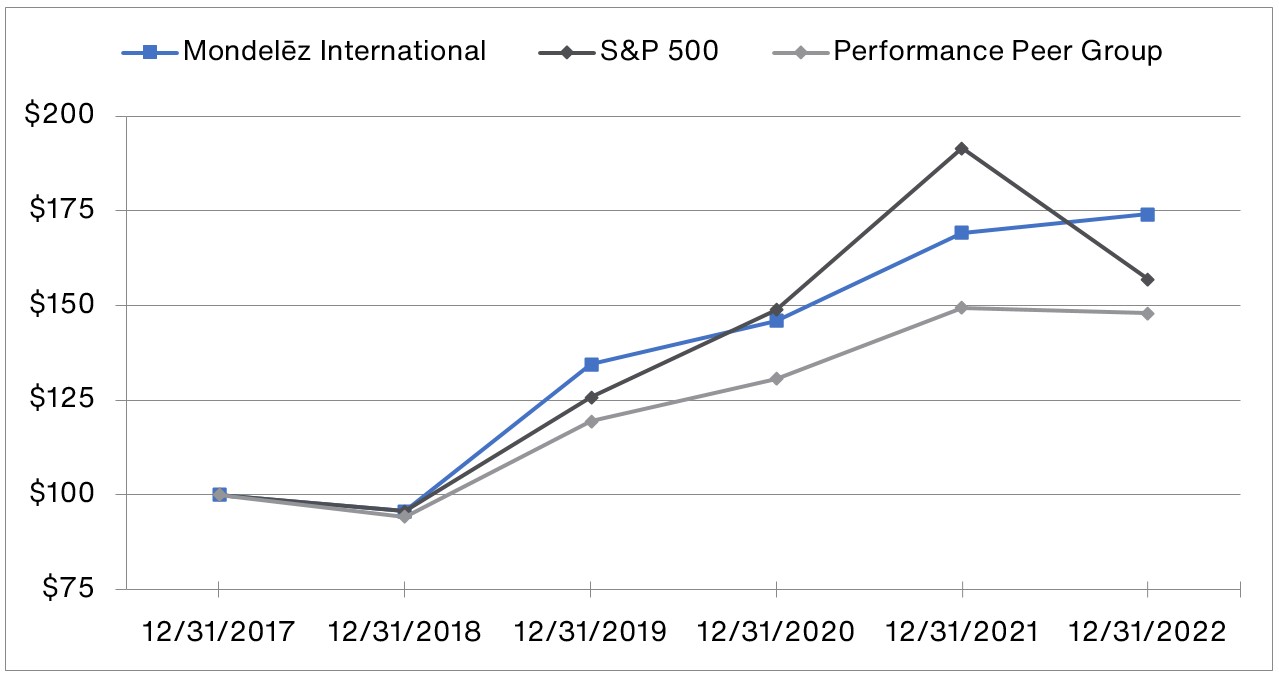
| As of December 31, | Mondelēz International | S&P 500 | Performance Peer Group | |||||||||||||||||
| 2017 | $ | 100.00 | $ | 100.00 | $ | 100.00 | ||||||||||||||
| 2018 | 95.73 | 95.62 | 94.15 | |||||||||||||||||
| 2019 | 134.43 | 125.72 | 119.40 | |||||||||||||||||
| 2020 | 145.97 | 148.85 | 130.65 | |||||||||||||||||
| 2021 | 169.14 | 191.58 | 149.35 | |||||||||||||||||
| 2022 | 174.08 | 156.88 | 147.96 |
The Mondelēz International performance peer group consists of the following companies considered our market competitors or that have been selected on the basis of industry, global focus or industry leadership: Campbell Soup Company, The Coca-Cola Company, Colgate-Palmolive Company, Danone S.A., General Mills, Inc., The Hershey Company, Kellogg Company, The Kraft Heinz Company, Nestlé S.A., PepsiCo, Inc., The Procter & Gamble Company and Unilever PLC.
Issuer Purchases of Equity Securities
Our stock repurchase activity for each of the three months in the quarter ended December 31, 2022 was:
| Period | Total Number of Shares Purchased (1) | Average Price Paid per Share (1) | Total Number of Shares Purchased as Part of Publicly Announced Plans or Programs (2) | Approximate Dollar Value of Shares That May Yet Be Purchased Under the Plans or Programs (2) | ||||||||||||||||||||||
| October 1-31, 2022 | 1,863,361 | $ | 56.55 | 1,847,134 | $ | 1,707 | ||||||||||||||||||||
| November 1-30, 2022 | 600,970 | 64.87 | 585,763 | 1,669 | ||||||||||||||||||||||
| December 1-31, 2022 | 240,012 | 67.47 | 236,873 | 1,653 | ||||||||||||||||||||||
| For the Quarter Ended December 31, 2022 | 2,704,343 | 59.37 | 2,669,770 |
(1)The total number of shares purchased (and the average price paid per share) reflects: (i) shares purchased pursuant to the repurchase program described in (2) below; and (ii) shares tendered to us by employees who used shares to exercise options and to pay the related taxes for grants of deferred stock units that vested, totaling 16,227 shares, 15,207 shares and 3,139 shares for the fiscal months of October, November and December 2022, respectively.
(2)Dollar values stated in millions. Our Board of Directors authorized the repurchase up to $23.7 billion of our Common Stock through December 31, 2023. Since the program inception on March 12, 2013 through December 31, 2022, we have repurchased $22.0 billion. Our Board of Directors authorized a new program for the repurchase of up to $6.0 billion of our Common Stock through December 31, 2025. This authorization, effective January 1, 2023, replaces our current share repurchase program. See related information in Note 13, Capital Stock.
Item 6. Reserved.
Item 7. Management’s Discussion and Analysis of Financial Condition and Results of Operations
The following discussion and analysis contains forward-looking statements. It should be read in conjunction with the other sections of this Annual Report on Form 10-K, including the consolidated financial statements and related notes contained in Forward-Looking Statements and Item 1A, Risk Factors.
Overview of Business and Strategy
Our core business is making and selling chocolate, biscuits and baked snacks, with additional businesses in adjacent, locally relevant categories including gum & candy, cheese & grocery and powdered beverages around the world.
We aim to be the global leader in snacking. Our strategy is to drive long-term growth by focusing on four strategic priorities: accelerating consumer-centric growth, driving operational excellence, creating a winning growth culture and scaling sustainable snacking. We believe the successful implementation of our strategic priorities and leveraging of our attractive global footprint, strong core of iconic global and local brands, marketing, sales, distribution and cost excellence capabilities, and top talent with a growth mindset, will drive consistent top- and bottom-line growth, enabling us to continue to create long-term value for our shareholders.
For more detailed information on our business and strategy, refer to Item 1, Business.
Recent Developments and Significant Items Affecting Comparability
Macroeconomic environment
We continue to observe significant market uncertainty, increasing inflationary pressures, supply constraints, exchange rate volatility as well as ongoing effects from the COVID-19 pandemic. Throughout the pandemic, we experienced an overall increase in demand and revenue growth as consumers increased their food purchases for in-home consumption in some markets, while parts of our business were negatively affected by related lockdowns and restrictions. Additionally, global supply chain, transportation and labor issues escalated and we experienced significantly higher operating costs, including higher overall raw material, transportation, labor and energy costs that have continued to rise.
Our overall outlook for future snacks revenue growth remains strong; however, we anticipate ongoing volatility in response to COVID-related risks and supply chain issues, including labor and transportation constraints. We will continue to proactively manage our business in response to the evolving global economic environment and related uncertainty and business risks while also prioritizing and supporting our employees and customers. We continue to take steps to mitigate impacts to our supply chain, operations, technology and assets.
War in Ukraine
In February 2022, Russia began a military invasion of Ukraine. For the safety of our employees, we stopped production and closed our facilities in Ukraine; since then we have been gradually restoring operations, continuing to take steps to protect the safety of our employees and partially re-opening our two plants. We are providing all of our employees with compensation and with help in securing shelter in neighboring countries, where required and needed. We have also made cash and in-kind donations to several humanitarian aid organizations in the region.
In March 2022, our two Ukrainian manufacturing facilities in Trostyanets and Vyshhorod were significantly damaged.
During the remainder of 2022, the war continued through parts of Ukraine. We continue to make targeted repairs on both our plants. We relaunched our systems and implemented additional safety and security measures. In late June, we partially reopened the Vyshhorod plant and restarted limited potato chip production and in late November, we reopened the Trostyanets plant and restarted limited chocolate production. See Note 1, Summary of Significant Accounting Policies - War in Ukraine, to the condensed consolidated financial statements, and refer to Items Affecting Comparability of Financial Results for additional information.
As a food company, we continue to work to support the continuity of food supply and provide packaged foods to consumers. We have suspended new capital investments and our advertising spending in Russia, but as a food company with more than 2,500 employees in the country, we have not ceased operations given we believe we play a role in the continuity of the food supply. We are complying and will comply with applicable international sanctions
and other measures that have been or may be imposed on Russian entities. We continue to evaluate the situation in Ukraine and Russia and our ability to control our operating activities and businesses on an ongoing basis, and we continue to consolidate both our Ukrainian and Russian subsidiaries. Prior to the onset of the war, Ukraine generated 0.5% and Russia generated 2.9% of 2021 consolidated net revenues and in 2022, Ukraine generated 0.3% and Russia generated 4.0% of consolidated net revenue. Our Russian business has grown as a result of the recent strengthening of the Russian ruble versus the U.S. dollar, underlying trends of consumers toward snack and packaged food categories and increased price. The combination of pricing, volume growth, suspension of advertising and ruble strength has resulted in a significant increase in the profitability of the Russian business and contributed to the growth of our consolidated performance. Our decision to suspend new capital investments in Russia has not had a material impact on our ability to meet demand within our Russian business during 2022. We believe the war in Ukraine has had a negative impact on our business throughout the rest of our Europe operating segment, but the impact of this is difficult to quantify. We cannot predict if the recent strength in our Russian business will continue in the future.
We provide more information on risks related to the war in Ukraine in our Financial Outlook and Commodity Trends section, Item 3, Quantitative and Qualitative Disclosures about Market Risk, and under Item 1A, Risk Factors.
Acquisitions and Divestitures
During 2022, we completed the following acquisitions to strategically complement and expand our existing portfolio:
-
Ricolino, a confectionery business with products sold primarily in Mexico
-
Clif Bar & Company (“Clif Bar”), a leading U.S. maker of nutritious energy bars with organic ingredients
-
Chipita Global S.A. ("Chipita"), a high-growth leader in the central and Eastern European croissant and baked snacks category
Additionally in 2022, we announced our intention to divest our developed market gum and global Halls candy businesses and in Q4 2022, we announced an agreement to sell the developed market gum business with an anticipated closing of Q4 2023, subject to relevant antitrust approvals and closing conditions.
Refer to Note 2, Acquisitions and Divestitures, and Liquidity and Capital Resources for additional details.
Equity Method Investment Transactions
JDE Peet’s Transactions
In 2022, we sold approximately 18.6 million of our shares back to JDE Peet’s, which reduced our ownership interest by approximately 3% to 19.8%. We recorded a loss of €8 million ($8 million). In 2021, we issued €300 million exchangeable bonds. If all bonds were redeemed in exchange for shares, this would represent approximately 8.5 million shares or approximately 9% of our equity interest in JDE Peet's. In 2020, we exchanged our 26.4% ownership interest in JDE for a 26.5% equity interest in JDE Peet’s, which was then taken public. During the initial public offering, we sold approximately 11.1 million shares, recording a pre-tax gain of $131 million and a $250 million tax expense and reducing our ownership interest to 22.9%.
Keurig Dr Pepper Transactions:
In 2021, we sold approximately 42.7 million shares, which reduced our ownership interest by 3.0% to 5.3%. We recorded a pre
Showing the first 8K of 160K characters. Open the full section
Item 7A. Quantitative and Qualitative Disclosures about Market Risk.
As we operate globally, we are primarily exposed to currency exchange rate, commodity price and interest rate market risks. We monitor and manage these exposures as part of our overall risk management program. Our risk management program focuses on the unpredictability of financial markets and seeks to reduce the potentially adverse effects that the volatility of these markets may have on our operating results.
We principally utilize derivative instruments to reduce significant, unanticipated earnings fluctuations that may arise from volatility in currency exchange rates, commodity prices and interest rates. For additional information on our derivative activity and the types of derivative instruments we use to hedge our currency exchange, commodity price and interest rate exposures, see Note 10, Financial Instruments.
Many of our non-U.S. subsidiaries operate in functional currencies other than the U.S. dollar. Fluctuations in currency exchange rates create volatility in our reported results as we translate the balance sheets, operating results and cash flows of these subsidiaries into the U.S. dollar for consolidated reporting purposes. The translation of non-U.S. dollar denominated balance sheets and statements of earnings of our subsidiaries into the U.S. dollar for consolidated reporting generally results in a cumulative translation adjustment to other comprehensive income within equity. A stronger U.S. dollar relative to other functional currencies adversely affects our consolidated earnings and net assets while a weaker U.S. dollar benefits our consolidated earnings and net assets. While we hedge significant forecasted currency exchange transactions as well as certain net assets of non-U.S. operations and other currency impacts, we cannot fully predict or eliminate volatility arising from changes in currency exchange rates on our consolidated financial results. See Consolidated Results of Operations and Results of Operations by Operating Segment under Discussion and Analysis of Historical Results for currency exchange effects on our financial results. Throughout our discussion and analysis of results, we isolate currency impacts and supplementally provide net revenues, operating income and diluted earnings per share on a constant currency basis. For additional information on the impact of currency policies, recent currency devaluations and highly inflationary accounting on our financial condition and results of operations, also see Note 1, Summary of Significant Accounting Policies – Currency Translation and Highly Inflationary Accounting.
We also continually monitor the market for commodities that we use in our products. Input costs may fluctuate widely due to international demand, weather conditions, government policy and regulation and the macroeconomic environment. Refer to Recent Developments and Significant Items Affecting Comparability and Financial Outlook above for updates on recent supply chain, transportation, labor and other disruptions that are increasing operating costs and impacting our results. To manage input cost volatility and inflation, we enter into forward purchase agreements and other derivative financial instruments. We also pursue productivity and cost saving measures and take pricing actions when necessary to mitigate the impact of higher input costs on earnings.
We regularly evaluate our variable and fixed-rate debt as well as current and expected interest rates in the markets in which we raise capital. Our primary exposures include movements in U.S. Treasury rates, corporate credit spreads, commercial paper rates as well as limited debt tied to London Interbank Offered Rates (“LIBOR”). The last publication date of LIBOR rates against various currencies by the Financial Conduct Authority in the United Kingdom was December 31, 2021, with the publication of certain USD rates being phased out after June 30, 2023. We did not have a significant impact to our financial position from the phase out of LIBOR, nor do we expect a significant impact from the remaining phase out given our current mix of variable and fixed-rate debt. We periodically use interest rate swaps and forward interest rate contracts to achieve a desired proportion of variable versus fixed rate debt based on current and projected market conditions. For more information on our debt activity, see Note 9, Debt and Borrowing Arrangements.
See Note 10, Financial Instruments, for more information on our derivative activity.
Value at Risk:
We use a value at risk (“VAR”) computation to estimate: 1) the potential one-day loss in the fair value of our interest rate-sensitive financial instruments; and 2) the potential one-day loss in pre-tax earnings of our currency and commodity price-sensitive derivative financial instruments. The VAR analysis was done separately for our currency exchange, fixed income and commodity risk portfolios as of each quarter end during the periods presented below. The instruments included in the VAR computation were currency exchange forwards and options for currency exchange risk, debt and swaps for interest rate risk, and commodity forwards, futures and options for commodity risk. Excluded from the computation were anticipated transactions, currency trade payables and receivables, and net investments in non-U.S. subsidiaries, which the above-mentioned instruments are intended to hedge.
The VAR model assumes normal market conditions, a 95% confidence interval and a one-day holding period. A parametric delta-gamma approximation technique was used to determine the expected return distribution in interest rates, currencies and commodity prices for the purpose of calculating the fixed income, currency exchange and commodity VAR, respectively. The parameters used for estimating the expected return distributions were determined by observing interest rate, currency exchange and commodity price movements over the prior quarter for the calculation of VAR amounts at December 31, 2022 and 2021, and over each of the four prior quarters for the calculation of average VAR amounts during each year. The values of currency and commodity options do not change on a one-to-one basis with the underlying currency or commodity and were valued accordingly in the VAR computation.
As of December 31, 2022 and December 31, 2021, the estimated potential one-day loss in fair value of our interest rate-sensitive instruments, primarily debt, and the estimated potential one-day loss in pre-tax earnings from our currency and commodity instruments, as calculated in the VAR model, were:
| Pre-Tax Earnings Impact | Fair Value Impact | ||||||||||||||||||||||||||||||||||||||||||||||
| At 12/31/22 | Average | High | Low | At 12/31/22 | Average | High | Low | ||||||||||||||||||||||||||||||||||||||||
| (in millions) | |||||||||||||||||||||||||||||||||||||||||||||||
| Instruments sensitive to: | |||||||||||||||||||||||||||||||||||||||||||||||
| Interest rates | $ | 196 | $ | 201 | $ | 232 | $ | 169 | |||||||||||||||||||||||||||||||||||||||
| Foreign currency rates | $ | 20 | $ | 23 | $ | 30 | $ | 20 | |||||||||||||||||||||||||||||||||||||||
| Commodity prices | 63 | 75 | 118 | 51 | |||||||||||||||||||||||||||||||||||||||||||
| Pre-Tax Earnings Impact | Fair Value Impact | ||||||||||||||||||||||||||||||||||||||||||||||
| At 12/31/21 | Average | High | Low | At 12/31/21 | Average | High | Low | ||||||||||||||||||||||||||||||||||||||||
| (in millions) | |||||||||||||||||||||||||||||||||||||||||||||||
| Instruments sensitive to: | |||||||||||||||||||||||||||||||||||||||||||||||
| Interest rates | $ | 135 | $ | 104 | $ | 135 | $ | 79 | |||||||||||||||||||||||||||||||||||||||
| Foreign currency rates | $ | 11 | $ | 11 | $ | 13 | $ | 9 | |||||||||||||||||||||||||||||||||||||||
| Commodity prices | 52 | 41 | 61 | 24 |
This VAR computation is a risk analysis tool designed to statistically estimate the maximum expected daily loss, under the specified confidence interval and assuming normal market conditions, from adverse movements in interest rates, currency exchange rates and commodity prices. The computation does not represent actual losses in fair value or earnings we will incur, nor does it consider the effect of favorable changes in market rates. We cannot predict actual future movements in market rates and do not present these VAR results to be indicative of future movements in market rates or to be representative of any actual impact that future changes in market rates may have on our future financial results.
Item 8. Financial Statements and Supplementary Data.
Report of Independent Registered Public Accounting Firm
To the Board of Directors and Shareholders of Mondelēz International, Inc.
Opinions on the Financial Statements and Internal Control over Financial Reporting
We have audited the accompanying consolidated balance sheets of Mondelēz International, Inc. and its subsidiaries (the “Company”) as of December 31, 2022 and 2021, and the related consolidated statements of earnings, comprehensive earnings, equity and cash flows for each of the three years in the period ended December 31, 2022, including the related notes (collectively referred to as the “consolidated financial statements”). We also have audited the Company's internal control over financial reporting as of December 31, 2022, based on criteria established in Internal Control - Integrated Framework (2013) issued by the Committee of Sponsoring Organizations of the Treadway Commission (COSO).
In our opinion, the consolidated financial statements referred to above present fairly, in all material respects, the financial position of the Company as of December 31, 2022 and 2021**,** and the results of its operations and its cash flows for each of the three years in the period ended December 31, 2022 in conformity with accounting principles generally accepted in the United States of America. Also in our opinion, the Company maintained, in all material respects, effective internal control over financial reporting as of December 31, 2022, based on criteria established in Internal Control - Integrated Framework (2013) issued by the COSO.
Basis for Opinions
The Company's management is responsible for these consolidated financial statements, for maintaining effective internal control over financial reporting, and for its assessment of the effectiveness of internal control over financial reporting, included in the Report of Management on Internal Control Over Financial Reporting appearing under Item 9A. Our responsibility is to express opinions on the Company’s consolidated financial statements and on the Company's internal control over financial reporting based on our audits. We are a public accounting firm registered with the Public Company Accounting Oversight Board (United States) (PCAOB) and are required to be independent with respect to the Company in accordance with the U.S. federal securities laws and the applicable rules and regulations of the Securities and Exchange Commission and the PCAOB.
We conducted our audits in accordance with the standards of the PCAOB. Those standards require that we plan and perform the audits to obtain reasonable assurance about whether the consolidated financial statements are free of material misstatement, whether due to error or fraud, and whether effective internal control over financial reporting was maintained in all material respects.
Our audits of the consolidated financial statements included performing procedures to assess the risks of material misstatement of the consolidated financial statements, whether due to error or fraud, and performing procedures that respond to those risks. Such procedures included examining, on a test basis, evidence regarding the amounts and disclosures in the consolidated financial statements. Our audits also included evaluating the accounting principles used and significant estimates made by management, as well as evaluating the overall presentation of the consolidated financial statements. Our audit of internal control over financial reporting included obtaining an understanding of internal control over financial reporting, assessing the risk that a material weakness exists, and testing and evaluating the design and operating effectiveness of internal control based on the assessed risk. Our audits also included performing such other procedures as we considered necessary in the circumstances. We believe that our audits provide a reasonable basis for our opinions.
As described in the Report of Management on Internal Control Over Financial Reporting, management has excluded Chipita Global S.A. (“Chipita”), Clif Bar & Company (“Clif Bar”), and Ricolino from its assessment of internal control over financial reporting as of December 31, 2022 because they were acquired by the Company in purchase business combinations during 2022. We have also excluded Chipita, Clif Bar, and Ricolino from our audit of internal control over financial reporting. Chipita, Clif Bar, and Ricolino are wholly-owned subsidiaries whose total assets and total net revenues excluded from management’s assessment and our audit of internal control over financial reporting collectively represent 1.2% and 3.5%, respectively, of the related consolidated financial statement amounts as of and for the year ended December 31, 2022.
Definition and Limitations of Internal Control over Financial Reporting
A company’s internal control over financial reporting is a process designed to provide reasonable assurance regarding the reliability of financial reporting and the preparation of financial statements for external purposes in accordance with generally accepted accounting principles. A company’s internal control over financial reporting includes those policies and procedures that (i) pertain to the maintenance of records that, in reasonable detail, accurately and fairly reflect the transactions and dispositions of the assets of the company; (ii) provide reasonable assurance that transactions are recorded as necessary to permit preparation of financial statements in accordance with generally accepted accounting principles, and that receipts and expenditures of the company are being made only in accordance with authorizations of management and directors of the company; and (iii) provide reasonable assurance regarding prevention or timely detection of unauthorized acquisition, use, or disposition of the company’s assets that could have a material effect on the financial statements.
Because of its inherent limitations, internal control over financial reporting may not prevent or detect misstatements. Also, projections of any evaluation of effectiveness to future periods are subject to the risk that controls may become inadequate because of changes in conditions, or that the degree of compliance with the policies or procedures may deteriorate.
Critical Audit Matters
The critical audit matters communicated below are matters arising from the current period audit of the consolidated financial statements that were communicated or required to be communicated to the audit committee and that (i) relate to accounts or disclosures that are material to the consolidated financial statements and (ii) involved our especially challenging, subjective, or complex judgments. The communication of critical audit matters does not alter in any way our opinion on the consolidated financial statements, taken as a whole, and we are not, by communicating the critical audit matters below, providing separate opinions on the critical audit matters or on the accounts or disclosures to which they relate.
Indefinite-Life Intangible Assets Annual Impairment Assessments for Certain Brand Names
As described in Notes 1 and 6 to the consolidated financial statements, the Company’s consolidated indefinite-life intangible asset balance was $18.4 billion as of December 31, 2022, which consists principally of brand names. At least annually management assesses indefinite-life intangible assets for impairment and if significant potential impairment risk exists for a specific asset, management quantitatively tests the asset for impairment by comparing its estimated fair value with its carrying value. Management estimates fair value using several accepted valuation methods, including relief from royalty, excess earnings and excess margin, that utilize estimates of future sales, earnings growth rates, royalty rates and discount rates t
Showing the first 8K of 258K characters. Open the full section
Item 9. Changes in and Disagreements with Accountants on Accounting and Financial Disclosure.
None.
ltem 9A. Controls and Procedures.
Evaluation of Disclosure Controls and Procedures
We have established disclosure controls and procedures that are designed to ensure that information required to be disclosed in our reports filed or submitted under the Exchange Act is recorded, processed, summarized and reported within the time periods specified in the rules and forms of the SEC, and such information is accumulated and communicated to our management, including our Chief Executive Officer (“CEO”) and Chief Financial Officer (“CFO”), as appropriate to allow timely decisions regarding required disclosure. Management, together with our CEO and CFO, evaluated the effectiveness of the Company’s disclosure controls and procedures as of December 31, 2022. Based on this evaluation, the CEO and CFO concluded that our disclosure controls and procedures were effective as of December 31, 2022.
Report of Management on Internal Control Over Financial Reporting
Management is responsible for establishing and maintaining adequate internal control over financial reporting as defined in Rules 13a-15(f) and 15d-15(f) under the Exchange Act. Our internal control over financial reporting is a process designed by, or under the supervision of, our CEO and CFO, or persons performing similar functions, and effected by the Company’s Board of Directors, management and other personnel to provide reasonable assurance regarding the reliability of financial reporting and the preparation of financial statements for external purposes in accordance with generally accepted accounting principles. Our internal control over financial reporting includes those written policies and procedures that:
-
pertain to the maintenance of records that, in reasonable detail, accurately and fairly reflect the transactions and dispositions of assets;
-
provide reasonable assurance that transactions are recorded as necessary to permit preparation of financial statements in accordance with generally accepted accounting principles;
-
provide reasonable assurance that receipts and expenditures are being made only in accordance with management and director authorization; and
-
provide reasonable assurance regarding prevention or timely detection of unauthorized acquisition, use or disposition of assets that could have a material effect on the consolidated financial statements.
Because of its inherent limitations, internal control over financial reporting may not prevent or detect misstatements. Also, projections of any evaluation of effectiveness to future periods are subject to the risk that controls may become inadequate because of changes in conditions, or that the degree of compliance with the policies or procedures may deteriorate.
Management assessed the effectiveness of our internal control over financial reporting as of December 31, 2022. Management based this assessment on criteria for effective internal control over financial reporting described in Internal Control Integrated Framework (2013) issued by the Committee of Sponsoring Organizations of the Treadway Commission (“COSO”). The scope of Management’s assessment of internal control over financial reporting excludes Chipita, Clif Bar and Ricolino because they were acquired by the Company in purchase business combinations in 2022. The total assets and total net revenues of Chipita, Clif Bar and Ricolino collectively represent 1.2% and 3.5%, respectively, of the related consolidated financial statement amounts as of and for the year ended December 31, 2022.
Based on this assessment, management concluded that the Company’s internal control over financial reporting is effective as of December 31, 2022, based on the criteria in Internal Control Integrated Framework issued by the COSO.
PricewaterhouseCoopers LLP, an independent registered public accounting firm, has audited the effectiveness of our internal control over financial reporting as of December 31, 2022, as stated in their report that appears under Item 8.
February 3, 2023
Changes in Internal Control Over Financial Reporting
Management, together with our CEO and CFO, evaluated the changes in our internal control over financial reporting during the quarter ended December 31, 2022. There were no changes in our internal control over financial reporting during the quarter ended December 31, 2022, that have materially affected, or are reasonably likely to materially affect, our internal control over financial reporting.
Item 9B. Other Information.
None.
Item 9C. Disclosure Regarding Foreign Jurisdictions that Prevent Inspections.
Item 10. Directors, Executive Officers and Corporate Governance.
Information required by this Item 10 is included under the heading “Information about our Executive Officers” in Part I, Item 1 of this Form 10-K, as well as under the headings “Election of Directors,” “Corporate Governance – Governance Guidelines,” “Corporate Governance – Codes of Conduct,” “Board Committees and Membership – Audit Committee” and “Ownership of Equity Securities – Delinquent Section 16(a) Reports” in our definitive Proxy Statement for our Annual Meeting of Shareholders scheduled to be held on May 17, 2023 (“2023 Proxy Statement”). All of this information from the 2023 Proxy Statement is incorporated by reference into this Annual Report.
Item 11. Executive Compensation.
Information required by this Item 11 is included under the headings “Board Committees and Membership – People and Compensation Committee,” “Compensation of Non-Employee Directors,” “Compensation Discussion and Analysis,” “Executive Compensation Tables,” “People and Compensation Committee Report for the Year Ended December 31, 2022” and “CEO Pay Ratio” in our 2023 Proxy Statement. All of this information is incorporated by reference into this Annual Report.
Item 12. Security Ownership of Certain Beneficial Owners and Management and Related Stockholder Matters.
The number of shares to be issued upon exercise or vesting of grants issued under, and the number of shares remaining available for future issuance under, our equity compensation plans at December 31, 2022 were:
Equity Compensation Plan Information
| Number of Securities to be Issued Upon Exercise of Outstanding Options, Warrants and Rights (1) | Weighted Average Exercise Price of Outstanding Options, Warrants and Rights (2) | Number of Securities Remaining Available for Future Issuance under Equity Compensation Plans (excluding securities reflected in column (a)) (3) | |||||||||||||||
| (a) | (b) | (c) | |||||||||||||||
| Equity compensation plans approved by security holders | 24,935,153 | $46.31 | 45,500,000 |
(1)Includes outstanding options, deferred stock units and performance share units and excludes restricted stock.
(2)Weighted average exercise price of outstanding options only.
(3)Shares available for grant under our Amended and Restated 2005 Performance Incentive Plan.
Information related to the security ownership of certain beneficial owners and management is included in our 2023 Proxy Statement under the heading “Ownership of Equity Securities” and is incorporated by reference into this Annual Report.
Item 13. Certain Relationships and Related Transactions, and Director Independence.
Information required by this Item 13 is included under the headings “Corporate Governance – Director Independence” and “Corporate Governance – Review of Transactions with Related Persons” in our 2023 Proxy Statement. All of this information is incorporated by reference into this Annual Report.
Item 14. Principal Accountant Fees and Services.
Information required by this Item 14 is included under the heading “Board Committees and Membership – Audit Committee” in our 2023 Proxy Statement. All of this information is incorporated by reference into this Annual Report.
PART IV
Item 15. Exhibits and Financial Statement Schedules.
*(a)*Index to Consolidated Financial Statements and Schedules
Schedules other than those listed above have been omitted either because such schedules are not required or are not applicable.
*(b)*The following exhibits are filed as part of, or incorporated by reference into, this Annual Report:
| 104 | The cover page from Mondelēz International’s Annual Report on Form 10-K for the fiscal year ended December 31, 2022, formatted in Inline XBRL (included as Exhibit 101). |
| * | Portions of this exhibit (indicated by asterisks) have been omitted pursuant to a request for confidential treatment and have been separately filed with the SEC. | ||||||||||
| + | Indicates a management contract or compensatory plan or arrangement. |
Item 16. Form 10-K Summary
None.
SIGNATURES
Pursuant to the requirements of Section 13 or 15(d) of the Securities Exchange Act of 1934, the registrant has duly caused this report to be signed on its behalf by the undersigned, thereunto duly authorized.
| MONDELĒZ INTERNATIONAL, INC. | ||||||||
| By: | /s/ LUCA ZARAMELLA | |||||||
| Luca Zaramella | ||||||||
| Executive Vice President | ||||||||
| and Chief Financial Officer | ||||||||
| (Duly Authorized Officer) |
Date: February 3, 2023
Pursuant to the requirements of the Securities Exchange Act of 1934, this report has been signed below by the following persons on behalf of the registrant and in the capacities and on the dates indicated:
| Signature | Title | Date | ||||||||||||
| /s/ DIRK VAN DE PUT | Director, Chairman and Chief Executive Officer | February 3, 2023 | ||||||||||||
| (Dirk Van de Put) | ||||||||||||||
| /s/ LUCA ZARAMELLA | Executive Vice President and Chief Financial Officer | February 3, 2023 | ||||||||||||
| (Luca Zaramella) | ||||||||||||||
| /s/ MICHAEL CALL | Senior Vice President, Corporate Controller and Chief Accounting Officer | February 3, 2023 | ||||||||||||
| (Michael Call) | ||||||||||||||
| /s/ LEWIS W.K. BOOTH | Director | February 3, 2023 | ||||||||||||
| (Lewis W.K. Booth) | ||||||||||||||
| /s/ CHARLES E. BUNCH | Director | February 3, 2023 | ||||||||||||
| (Charles E. Bunch) | ||||||||||||||
| /s/ ERTHARIN COUSIN | Director | February 3, 2023 | ||||||||||||
| (Ertharin Cousin) | ||||||||||||||
| /s/ LOIS D. JULIBER | Director | February 3, 2023 | ||||||||||||
| (Lois D. Juliber) | ||||||||||||||
| /s/ ANINDITA MUKHERJEE | Director | February 3, 2023 | ||||||||||||
| (Anindita Mukherjee) | ||||||||||||||
| /s/ JORGE S. MESQUITA | Director | February 3, 2023 | ||||||||||||
| (Jorge S. Mesquita) | ||||||||||||||
| /s/ JANE HAMILTON NIELSEN | Director | February 3, 2023 | ||||||||||||
| (Jane Hamilton Nielsen) | ||||||||||||||
| /s/ CHRISTIANA S. SHI | Director | February 3, 2023 | ||||||||||||
| (Christiana S. Shi) | ||||||||||||||
| /s/ PATRICK T. SIEWERT | Director | February 3, 2023 | ||||||||||||
| (Patrick T. Siewert) | ||||||||||||||
| /s/ MICHAEL A. TODMAN | Director | February 3, 2023 | ||||||||||||
| (Michael A. Todman) |