 filings.tools
Medtronic 10-K 2018-04-27
Filed 2018-06-22. 22 sections, 650K characters. Original on sec.gov · Markdown · JSON
Cover and table of contents
10-K 1 mdt-2018427x10k.htm 10-K
UNITED STATES
SECURITIES AND EXCHANGE COMMISSION
Washington, D.C. 20549
FORM 10-K
| x | Annual report pursuant to section 13 or 15(d) of the Securities Exchange Act of 1934. For the fiscal year ended April 27, 2018. |
| o | Transition report pursuant to Section 13 or 15(d) of the Securities Exchange Act of 1934. For the transition period from __________ to __________ |
Commission File No. 1-36820
 ®
®
MEDTRONIC PUBLIC LIMITED COMPANY
(Exact name of registrant as specified in its charter)
| Ireland | 98-1183488 | |
| (Jurisdiction of incorporation) | (I.R.S. Employer Identification No.) |
20 On Hatch, Lower Hatch Street
Dublin 2, Ireland
(Address of principal executive office)
+353 1 438-1700
(Registrant's telephone number)
Securities registered pursuant to Section 12(b) of the Act:
| Title of each class | Name of each exchange on which registered |
| Ordinary shares, par value $0.0001 per share | New York Stock Exchange, Inc. |
Securities registered pursuant to section 12(g) of the Act:
None
Indicate by check mark if the registrant is a well-known seasoned issuer, as defined in Rule 405 of the Securities Act. Yes x No o
Indicate by check mark if the registrant is not required to file reports pursuant to Section 13 or 15(d) of the Exchange Act. Yes o No x
Indicate by check mark whether the registrant (1) has filed all reports required to be filed by Section 13 or 15(d) of the Securities Exchange Act of 1934 during the preceding 12 months (or for such shorter period that the registrant was required to file such reports), and (2) has been subject to such filing requirements for the past 90 days. Yes x No o
Indicate by check mark whether the registrant has submitted electronically and posted on its corporate Website, if any, every Interactive Data File required to be submitted and posted pursuant to Rule 405 of Regulation S-T (§229.405 of this chapter) during the preceding 12 months (or for such shorter period that the registrant was required to submit and post such files). Yes x No o
Indicate by check mark if disclosure of delinquent filers pursuant to Item 405 of Regulation S-K is not contained herein, and will not be contained, to the best of the registrant’s knowledge, in definitive proxy or information statements incorporated by reference in Part III of this Form 10-K or any amendment to this Form 10-K. x
Indicate by check mark whether the registrant is a large accelerated filer, an accelerated filer, a non-accelerated filer, a smaller reporting company, or an emerging growth company. See definition of “large accelerated filer,” “accelerated filer,” “smaller reporting company,” and "emerging growth company" in Rule 12b-2 of the Exchange Act.
Large accelerated filer x Accelerated filer o Non-accelerated filer o Smaller reporting company o Emerging growth company o
If an emerging growth company, indicate by check mark if the registrant has elected not to use the extended transition period for complying with any new or revised financial accounting standards provided pursuant to Section 13(a) of the Exchange Act. o
Indicate by check mark whether the registrant is a shell company (as defined in Rule 12b-2 of the Exchange Act). Yes o No x
Aggregate market value of voting and non-voting common equity of Medtronic plc held by non-affiliates of the registrant as of October 27, 2017, based on the closing price of $81.30, as reported on the New York Stock Exchange: approximately $110.0 billion. Number of Ordinary Shares outstanding on June 20, 2018: 1,351,709,097
DOCUMENTS INCORPORATED BY REFERENCE
Portions of the registrant’s Proxy Statement for its 2018 Annual General Meeting are incorporated by reference into Part III hereof.
TABLE OF CONTENTS
CAUTIONARY NOTE REGARDING FORWARD-LOOKING STATEMENTS
This Annual Report on Form 10-K, and other written reports of Medtronic public limited company, organized under the laws of Ireland (together with its consolidated subsidiaries, Medtronic, the Company, or we, us, or our), and oral statements made by or with the approval of one of the Company’s executive officers from time to time, may include “forward-looking” statements. All statements other than statements of historical fact contained in this Annual Report on Form 10-K, including statements regarding our future results of operations and financial position, business strategy and plans, objectives of management for future operations and current expectations or forecasts of future results, are forward-looking statements. These statements involve known and unknown risks, uncertainties, and other important factors that may cause our actual results, performance or achievements to be materially different from any future results, performance, or achievements expressed or implied by the forward-looking statements. Our forward-looking statements may include statements related to our growth and growth strategies, developments in the markets for our products, therapies and services, financial results, product development launches and effectiveness, research and development strategy, regulatory approvals, competitive strengths, restructuring and cost-saving initiatives, intellectual property rights, litigation and tax matters, government investigations, mergers and acquisitions, divestitures, market acceptance of our products, therapies and services, accounting estimates, financing activities, ongoing contractual obligations, working capital adequacy, value of our investments, our effective tax rate, our expected returns to shareholders, and sales efforts. In some cases, such statements may be identified by the use of terminology such as “anticipate,” “believe,” “could,” “estimate,” “expect,” “forecast,” “intend,” “looking ahead,” “may,” “plan,” “possible,” “potential,” “project,” “should,” “will,” and similar words or expressions. Forward-looking statements in this Annual Report include, but are not limited to, statements regarding our ability to drive long-term shareholder value, development and future launches of products and continued or future acceptance of products, therapies and services in our segments; expected timing for completion of research studies relating to our products; market positioning and performance of our products, including stabilization of certain product markets; divestitures and the potential benefits thereof; the costs and benefits of integrating previous acquisitions; anticipated timing for United States (U.S.) Food and Drug Administration (FDA) and non-U.S. regulatory approval of new products; increased presence in new markets, including markets outside the U.S.; changes in the market and our market share; acquisitions and investment initiatives, as well as integration of acquired companies into our operations; the resolution of tax matters; the effectiveness of our development activities in reducing patient care costs and hospital stay lengths; our approach towards cost containment; our expectations regarding health care costs, including potential changes to reimbursement policies and pricing pressures; our expectations regarding changes to patient standards of care; our ability to identify and maintain successful business partnerships; the elimination of certain positions or costs related to restructuring initiatives; outcomes in our litigation matters and government investigations; general economic conditions; the adequacy of available working capital and our working capital needs; our payment of dividends and redemption of shares; the continued strength of our balance sheet and liquidity; our accounts receivable exposure; and the potential impact of our compliance with governmental regulations and accounting guidance.
We have based these forward-looking statements largely on our current expectations and projections about future events and financial trends that we believe may affect our business, financial condition and results of operations. These forward-looking statements speak only as of the date of this Annual Report on Form 10-K and are subject to a number of risks, uncertainties and assumptions described in the “Risk Factors” section and elsewhere in this Annual Report on Form 10-K. Because forward-looking statements are inherently subject to risks and uncertainties, some of which cannot be predicted or quantified, you should not rely on these forward-looking statements as predictions of future events. One must carefully consider forward-looking statements and understand that such forward-looking statements are inherently subject to risks and uncertainties, some of which cannot be predicted or quantified, and involve a variety of risks and uncertainties, known and unknown, including, among others, those discussed in the sections entitled “Government Regulation and Other Considerations” within “Item 1. Business” and “Item 1A. Risk Factors” in this Annual Report on Form 10-K, as well as those related to:
| • | competition in the medical device industry; |
| • | reduction or interruption in our supply; |
| • | quality problems, liquidity shortfalls; |
| • | decreasing prices and pricing pressure; |
| • | fluctuations in currency exchange rates; |
| • | changes in applicable tax rates; |
| • | positions taken by taxing authorities; |
| • | adverse regulatory action; |
| • | delays in regulatory approvals; |
| • | litigation results; |
| • | self-insurance; |
| • | commercial insurance; |
| • | health care policy changes; |
| • | international operations; |
| • | cybersecurity incidents; |
| • | failure to complete or achieve the intended benefits of acquisitions or divestitures; or |
| • | disruption of our current plans and operations. |
Consequently, no forward-looking statement may be guaranteed and actual results may vary materially from those projected in the forward-looking statements. We intend to take advantage of the Safe Harbor provisions of the Private Securities Litigation Reform Act of 1995 regarding our forward-looking statements, and are including this sentence for the express purpose of enabling us to use the protections of the safe harbor with respect to all forward-looking statements. While we may elect to update these forward-looking statements at some point in the future, whether as a result of any new information, future events, or otherwise, we have no current intention of doing so except to the extent required by applicable law.
PART I
Item 1. Business
OVERVIEW
Medtronic plc, headquartered in Dublin, Ireland, is among the world's largest medical technology, services, and solutions companies - alleviating pain, restoring health, and extending life for millions of people around the world. Medtronic was founded in 1949 and today serves hospitals, physicians, clinicians, and patients in more than 150 countries worldwide. We remain committed to a mission written by our founder in 1960 that directs us “to contribute to human welfare by the application of biomedical engineering in the research, design, manufacture, and sale of products to alleviate pain, restore health, and extend life.”
With innovation and market leadership, we have pioneered advances in medical technology in all of our businesses. Our commitment to enhance our offerings by developing and acquiring new products, wrap-around programs, and solutions to meet the needs of a broader set of stakeholders is driven by the following primary strategies:
| • | Therapy Innovation: Delivering a strong launch cadence of meaningful therapies and procedures. |
| • | Globalization: Addressing the inequity in health care access globally, primarily in emerging markets. |
| • | Economic Value: Becoming a leader in value-based health care by offering new services and solutions to improve outcomes and efficiencies, lower costs by reducing hospitalizations, improve remote clinical management, and increase patient engagement. |
Our primary customers include hospitals, clinics, third-party health care providers, distributors, and other institutions, including governmental health care programs and group purchasing organizations (GPOs).
Medtronic plc is the successor to Medtronic, Inc., a Minnesota corporation. Medtronic, Inc. and Covidien plc (Covidien) were combined under and became subsidiaries of Medtronic plc on January 26, 2015.
On July 29, 2017, we completed the divestiture of our Patient Care, Deep Vein Thrombosis, and Nutritional Insufficiency businesses. Among the product lines included in the divestiture were the dental and animal health, chart paper, wound care, incontinence, electrodes, SharpSafety, thermometry, perinatal protection, blood collection, compression, and enteral feeding offerings. Prior to the divestiture, these businesses were included within the Minimally Invasive Therapies Group segment.
We have four operating and reportable segments that primarily develop, manufacture, distribute, and sell device-based medical therapies and services. Our segments and their portion of our total reported net sales for fiscal year 2018 of $30.0 billion are as follows:
| • | Cardiac and Vascular Group ($11.4 billion) |
| • | Minimally Invasive Therapies Group ($8.7 billion) |
| • | Restorative Therapies Group ($7.7 billion) |
| • | Diabetes Group ($2.1 billion) |
For more information regarding our segments, please see Note 21 to the consolidated financial statements in "Item 8. Financial Statements and Supplementary Data" in this Annual Report on Form 10-K.
CARDIAC AND VASCULAR GROUP
The Cardiac and Vascular Group is made up of the Cardiac Rhythm & Heart Failure, Coronary & Structural Heart, and Aortic & Peripheral Vascular divisions. The primary medical specialists who use our Cardiac and Vascular products include electrophysiologists, implanting cardiologists, heart failure specialists, cardiovascular, cardiothoracic, and vascular surgeons, and interventional cardiologists and radiologists.
Cardiac Rhythm & Heart Failure
Our Cardiac Rhythm & Heart Failure division develops, manufactures, and markets products for the diagnosis, treatment, and management of heart rhythm disorders and heart failure. Our products include implantable devices, leads and delivery systems, products for the treatment of atrial fibrillation (AF), products designed to reduce surgical site infections, information systems for the management of patients with Cardiac Rhythm & Heart Failure devices, ventricular assist systems, and an integrated health solutions business. Principal products and services offered include:
| • | Implantable cardiac pacemakers including the Azure, Adapta, Advisa MRI SureScan, and Micra Transcatheter Pacing System, which is leadless and does not have a subcutaneous device pocket like a conventional pacemaker. |
| • | Implantable cardioverter defibrillators (ICDs), including the Visia AF and Evera MRI SureScan, which is paired with the reliable Sprint Quattro Secure lead, the only defibrillator lead with more than 12 years of proven performance with active monitoring. |
| • | Implantable cardiac resynchronization therapy devices (CRT-Ds and CRT-Ps) including the Claria/Amplia/Compia family of MRI Quad CRT-D SureScan systems and the Percepta/Serena/Solara family of MRI Quad CRT-P SureScan systems. The Claria CRT-D MRI and Percepta CRT-P MRI devices feature EffectivCRT, which is an algorithm that verifies left ventricular pacing effectiveness and automatically tailors the therapy to individual patients, and the AdaptivCRT algorithm, which reduces a patient's odds of a 30-day heart failure readmission and has demonstrated a reduction in AF risk compared to echo-optimized biventricular pacing. |
| • | AF ablation products including the Arctic Front Advance Cardiac Cryoballoon System, which includes the Arctic Front Advance ST Cryoablation Catheter, designed for pulmonary vein isolation in the treatment of patients with drug refractory paroxysmal AF and the second-generation Phased RF System, PVAC Gold, which uses duty cycled, phased radio frequency energy for the treatment of symptomatic paroxysmal persistent and long-standing persistent AF. |
| • | Insertable cardiac monitor systems including the Reveal LINQ, which is used to record the heart’s electrical activity before, during, and after transient symptoms such as syncope (i.e., fainting) and palpitations to assist in diagnosis. |
| • | Mechanical circulatory support products including miniaturized implantable heart pumps, or ventricular assist devices, patient accessories and surgical tools to treat patients suffering from advanced heart failure. |
| • | TYRX products including the Absorbable Antibacterial Envelope and the TYRX Neuro Absorbable Antibacterial Envelope, which are designed to stabilize electronic implantable devices and help prevent infection associated with implantable pacemakers, defibrillators, and spinal cord neurostimulators. |
| • | Remote monitoring services and patient-centered software to enable efficient care coordination and specialized telehealth nurse support as well as services related to hospital operational efficiency. |
Coronary & Structural Heart
Our Coronary & Structural Heart division includes therapies to treat coronary artery disease and heart valve disorders. Our products include coronary stents and related delivery systems, including a broad line of balloon angioplasty catheters, guide catheters, guide wires, diagnostic catheters, and accessories as well as products for the repair and replacement of heart valves, perfusion systems, positioning and stabilization systems for beating heart revascularization surgery, and surgical ablation products. Principal products and services offered include:
| • | CoreValve family of aortic valves, including our second-generation recapturable TCV system, CoreValve Evolut R, and our third-generation system, CoreValve Evolut PRO. |
| • | Percutaneous Coronary Intervention stent products including our Resolute Integrity and Resolute Onyx drug-eluting stent systems. |
| • | Surgical valve replacement and repair products for damaged or diseased heart valves, including both tissue and mechanical valves, blood-handling products that form a circulatory support system to maintain and monitor blood circulation and coagulation status, oxygen supply, and body temperature during arrested heart surgery, and surgical ablation systems and positioning and stabilization technologies. |
Aortic & Peripheral Vascular
Our Aortic & Peripheral Vascular division is comprised of a comprehensive line of products and therapies to treat aortic disease (such as aneurysms, dissections, and transections) as well as peripheral vascular disease, and venous disease. Our products include endovascular stent graft systems, peripheral drug coated balloons, stent and angioplasty systems, and carotid embolic protection
systems for the treatment of vascular disease outside the heart, and products for superficial and deep venous disease. Principal products and services offered include:
| • | Endovascular stent grafts and accessories including the Endurant Abdominal Aortic Aneurysm Stent Graft System family of products, the Valiant Captivia Thoracic Aortic Aneurysm stent graft system, and the Heli-FX EndoAnchor System. |
| • | Percutaneous angioplasty balloons including the IN.PACT family of drug-coated balloons, vascular stents, such as the Protégé and Everflex self-expanding stents and Visi-Pro balloon expandable stents, directional atherectomy products, such as the HawkOne plaque excision system, and other procedure support tools. |
| • | Products to treat superficial venous diseases in the lower extremities including the ClosureFast RF ablation system and the VenaSeal medical adhesive closure system. |
MINIMALLY INVASIVE THERAPIES GROUP
The Minimally Invasive Therapies Group is made up of the Surgical Innovations and Respiratory, Gastrointestinal, & Renal divisions. Products and therapies of this group are used primarily by hospitals, physicians' offices, ambulatory care centers, and other alternate site healthcare providers. While less frequent, some products and therapies are also used in home settings.
Surgical Innovations
Our Surgical Innovations division develops, manufactures, and markets advanced and general surgical products including surgical stapling devices, vessel sealing instruments, wound closure, electrosurgery products, hernia mechanical devices, mesh implants, and gynecology products and therapies to treat diseases and conditions that are typically, but not exclusively, addressed by surgeons. Principal products and services offered include:
| • | Advanced stapling products, including the Tri-Staple technology platform for endoscopic stapling, including the Endo GIA reloads and reinforced reloads with Tri-Staple Technology and the Endo GIA ultra universal stapler, the Signia and iDrive powered stapling systems, the LigaSure vessel sealing system with nano-coating, and the Sonicision cordless ultrasonic dissection system. |
| • | Electrosurgical hardware and instruments, including the Valleylab FT10 energy platform, and the Force TriVerse electrosurgical pencil. |
| • | Products designed for the treatment of hernias, including the AbsorbaTack absorbable mesh fixation device for hernia repair, the Symbotex composite mesh for surgical laparoscopic and open ventral hernia repair, and Parietex ProGrip, a self-gripping, biocompatible solution for inguinal hernias. |
Respiratory, Gastrointestinal, & Renal
Our Respiratory, Gastrointestinal, & Renal division develops, manufactures, and markets products in the emerging fields of minimally invasive gastrointestinal diagnostics and therapies, respiratory monitoring, airway management and ventilation therapies, and for the treatment of renal disease. Principal products and services offered include:
| • | Gastrointestinal and endoscopy products, including the PillCam COLON, the Emprint ablation system with Thermosphere Technology, the HET Bipolar System, the Cool-tip radiofrequency ablation system, the Barrx platform with the Barrx 360 Express catheter, and the HALO ablation catheters for treatment of Barrett’s esophagus. |
| • | Airway, ventilation, and inhalation therapies products, including the Puritan Bennett 980 ventilator, the Newport e360 and HT70 ventilators, the TaperGuard Evac tube, Shiley Endotracheal Tubes, Shiley Tracheostomy Tubes, and DAR Filters. |
| • | Products focused on patient monitoring, including the Capnostream with Microstream technology capnography monitors, the Nellcor Bedside SpO2 patient monitoring system, the Bispectral Index (BIS) brain monitoring technology, and the INVOS Cerebral/Somatic Oximeter. |
| • | Products providing solutions for the treatment of renal disease, including Palindrome, Mahurkar and Mahurkar Elite Dialysis Access Catheters for renal therapy, and other products designed for use in treatment of both acute and chronic renal failure conditions. |
RESTORATIVE THERAPIES GROUP
The Restorative Therapies Group is made up of the Spine, Brain, Specialty Therapies and Pain Therapies divisions. The primary medical specialists who use the products of this group include spinal surgeons, neurosurgeons, neurologists, pain management specialists, anesthesiologists, orthopedic surgeons, urologists, colorectal surgeons, urogynecologists, interventional radiologists, and ear, nose, and throat specialists.
Spine
Our Spine division develops, manufactures, and markets a comprehensive line of medical devices and implants used in the treatment of the spine and musculoskeletal system. Our Spine division also provides biologic solutions for the orthopedic and dental markets and, in concert with our Neurosurgery business, offers unique and highly differentiated imaging, navigation, power instruments, nerve monitoring, and Mazor robotics integrated for our spine procedures. Principal products and services offered include:
| • | Products to treat a variety of conditions affecting the spine, including degenerative disc disease, spinal deformity, spinal tumors, fractures of the spine, and stenosis. These products include our CD HORIZON SOLERA and LEGACY Systems, and the CAPSTONE, CLYDESDALE, and ELEVATE interbody spacers. |
| • | Products that facilitate less invasive thoracolumbar surgeries, including the CD HORIZON VOYAGER, SOLERA SEXTANT and LONGITUDE Percutaneous Fixation Systems. |
| • | Products to treat conditions in the cervical region of the spine, including the ZEVO and ATLANTIS VISION ELITE Anterior Cervical Plate Systems, the VERTEX SELECT Reconstruction System, and the PRESTIGE and BRYAN Cervical Artificial Discs. |
| • | Biologic solutions products, including our INFUSE Bone Graft (InductOs in the European Union (E.U.)), which contains a recombinant human bone morphogenetic protein, rhBMP-2, for certain spinal, trauma, and oral maxillofacial applications. Demineralized Bone Matrix products, including MagniFuse, Grafton/Grafton Plus, and PROGENIX, and the MASTERGRAFT family of synthetic bone graft products - Matrix, Putty, and Granules. |
Brain Therapies
Our Brain Therapies division develops, manufactures, and markets an integrated portfolio of devices and therapies for the treatment of neurological disorders and diseases, as well as surgical technologies designed to improve the precision and workflow of neuro procedures. Principal products and services offered include:
| • | Neurovascular products to treat diseases of the vasculature in and around the brain. This includes coils, neurovascular stents, and flow diversion products, as well as access and delivery products to support procedures. Products also include the Pipeline Flex Embolization Devices, endovascular treatments for large or giant wide-necked brain aneurysms, the portfolio of Solitaire revascularization devices for treatment of acute ischemic stroke, and a portfolio of access catheters. |
| • | Brain modulation products, including those for the treatment of the disabling symptoms of Parkinson's disease, essential tremor, refractory epilepsy (outside the U.S.), severe, treatment-resistant obsessive compulsive disorder (approved under a Humanitarian Device Exemption (HDE) in the U.S.), and chronic, intractable primary dystonia (approved under a HDE in the U.S.). Specifically, this includes our family of Activa Neurostimulators, including Activa SC (single-channel primary cell battery), Activa PC (dual channel primary cell battery), and Activa RC (dual channel rechargeable battery). |
| • | Neurosurgery products, including platform technologies and implant therapies. Our StealthStation S8 Navigation System and O-arm Imaging System are both platforms used in cranial, spinal, sinus, and orthopedic procedures. Our Midas Rex Surgical Drills are used in cranial, spinal, and orthopedic procedures. Our CSF Management Portfolio is used in treating hydrocephalus and other conditions impacting the intracranial pressure, and our Visualase MRI-guided laser ablation is used in cranial procedures. The Mazor X robotic guidance systems are used in robot-assisted spine procedures under an exclusive worldwide distributor agreement with Mazor Robotics. |
Specialty Therapies
Our Specialty Therapies division develops, manufactures, and markets products and therapies to treat diseases of the ear, nose and throat (ENT), help control the systems of overactive bladder, (non-obstructive) urinary retention, and chronic fecal incontinence. Additionally, our Specialty Therapies division includes products in the emerging field of transformative solutions surgical incision technology, as well as the haemostatic sealing of soft tissue and bone. Principal products and services offered include:
| • | Pelvic health and gastric therapies products, including InterStim, a neurostimulator, to help control the systems of overactive bladder, (non-obstructive) urinary retention, and chronic fecal incontinence. Our percutaneous tibial |
neuromodulation uses the NURO device for the treatment of overactive bladder and associated symptoms of urinary urge incontinence, urinary urgency, and urinary frequency. The Enterra gastric neurostimulator is approved as a humanitarian device and is used for the treatment of chronic, intractable nausea and vomiting due to gastroparesis.
| • | ENT products, including the Straightshot M5 Microdebrider Handpiece, the IPC system, NIM Nerve Monitoring Systems, ENT Navigation System, as well as products for hearing restoration and obstructive sleep apnea. |
| • | Transformative solutions products, including our PEAK Surgery System and Aquamantys System. Our PEAK Surgery System is a tissue dissection system that consists of the PEAK PlasmaBlade and PULSAR Generator and is cleared for use in a variety of settings, including plastic reconstructive surgery, general surgery, and certain conditions of ENT. Our Aquamantys System uses patented transcollation technology to provide haemostatic sealing of soft tissue and bone and is cleared for use in a variety of surgical procedures, including orthopedic surgery, spine, solid organ resection and thoracic procedures. |
Pain Therapies
Our Pain Therapies division develops, manufactures, and markets spinal cord stimulation systems, implantable drug infusion systems for chronic pain, as well as interventional products. Principal products and services offered include:
| • | Spinal cord stimulation products for chronic pain, including rechargeable and non-rechargeable devices and a large selection of leads used to treat chronic back and/or limb pain. This includes systems with SureScan MRI Technology and the Evolve workflow algorithm, including the Intellis (rechargeable) SureScan MRI. Products also include our RestoreSensor (rechargeable) SureScan MRI, with its proprietary AdaptiveStim technology. |
| • | Implantable drug infusion systems, including our SynchroMed II Implantable Infusion System, that deliver small quantities of drug directly into the intrathecal space surrounding the spinal cord. |
| • | Interventional products, including the Xpander II Balloon Kyphoplasty system, the Kyphon-V vertebroplasty system and the OsteoCool RF Tumor ablation system. |
DIABETES GROUP
The Diabetes Group develops, manufactures, and markets products and services for the management of Type I and Type II diabetes. The primary medical specialists who use and/or prescribe our Diabetes products are endocrinologists and primary care physicians. Principal products and services offered include:
| • | Insulin pumps, including the MiniMed 670G system, featuring the first hybrid closed loop system in the world and the most advanced SmartGuard algorithm. The MiniMed 640G system, offered outside the U.S., is an integrated system with the Enhanced Enlite CGM sensor that features SmartGuard technology, which automatically suspends insulin delivery when sensor glucose levels are predicted to approach a low limit and then resumes insulin delivery once levels recover. |
| • | Continuous glucose monitoring (CGM) systems, including the Guardian Connect standalone CGM system and the iPro2 professional CGM, is a product worn by patients to capture glucose data that is later uploaded in a physician’s office to reveal glucose patterns and potential problems, such as hyperglycemic and hypoglycemic episodes. |
| • | Therapy management software, including CareLink software for patients and for healthcare professionals, with advanced web technology to help patients and their health care providers control their diabetes and improve engagement. |
OTHER FACTORS IMPACTING OUR OPERATIONS
Research and Development
The chart below illustrates our research and development (R&D) expense and R&D expense as a percentage of net sales during fiscal years 2018, 2017, and 2016:
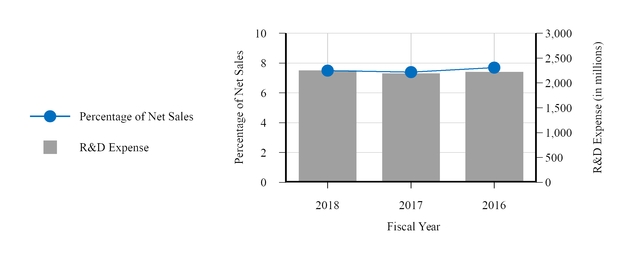
The markets in which we participate are subject to rapid technological advances. Constant improvement of existing products and introduction of new products are necessary to maintain market leadership. Our R&D efforts are directed toward maintaining or achieving technological leadership in each of the markets we serve in order to help ensure that patients using our devices and therapies receive the most advanced and effective treatment possible. We remain committed to developing technological enhancements and new indications for existing products, and less invasive and new technologies for new and emerging markets to address unmet patient needs. That commitment leads to our initiation and participation in many clinical trials each fiscal year as the demand for clinical and economic evidence remains high. Furthermore, our development activities are intended to help reduce patient care costs and the length of hospital stays in the future. We have not engaged in significant customer or government-sponsored research.
Our R&D activities include improving existing products and therapies, expanding their indications and applications for use, and developing new therapies and procedures. We continue to focus on optimizing innovation, improving our R&D productivity, driving growth in emerging markets, clinical evidence generation, and assessing our R&D programs based on their ability to deliver economic value to our customers.
Intellectual Property
We rely on a combination of patents, trademarks, tradenames, copyrights, trade secrets, and non-disclosure and non-competition agreements to establish and protect our proprietary technology. In addition, we have entered into exclusive and non-exclusive licenses relating to a wide array of third-party technologies. In the aggregate, these intellectual property assets and licenses are of material importance to our business; however, we believe that no single patent, technology, trademark, intellectual property asset or license is material in relation to any segment of our business or to our business as a whole.
We operate in an industry characterized by extensive patent litigation. Patent litigation may result in significant damage awards and injunctions that could prevent the manufacture and sale of affected products or result in significant royalty payments in order to continue selling the products. At any given time, we are involved as both a plaintiff and a defendant in a number of patent infringement actions, the outcomes of which may not be known for prolonged periods of time. For additional information, see Note 19 to the consolidated financial statements in “Item 8. Financial Statements and Supplementary Data” in this Annual Report on Form 10-K.
Sales and Distribution
We sell most of our medical devices and therapies through direct sales representatives in the U.S. and a combination of direct sales representatives and independent distributors in markets outside the U.S. For certain portions of our business, we also sell through distributors in the U.S. Our medical supplies products are used primarily in hospitals, surgi-centers and alternate care facilities, such as home care and long-term care facilities, and are marketed to materials managers, GPOs and integrated delivery networks (IDNs) primarily through third-party distributors, although we also have direct sales representatives. We often negotiate with GPOs and IDNs, which enter into supply contracts for the benefit of their member facilities. Our four largest markets are the U.S., Western Europe, Japan, and China. Emerging markets are an area of increasing focus and opportunity, as we believe they remain under-penetrated.
Our marketing and sales strategy is focused on rapid, cost-effective delivery of high-quality products to a diverse group of customers worldwide. To achieve this objective, we organize our marketing and sales teams around physician specialties. This focus enables us to develop highly knowledgeable and dedicated sales representatives who are able to foster strong relationships with physicians and other customers and enhance our ability to cross-sell complementary products.
We are not dependent on any single customer for more than 10 percent of our total net sales.
Competition, Industry and Cost Containment
We compete in both the therapeutic and diagnostic medical markets in more than 150 countries throughout the world. These markets are characterized by rapid change resulting from technological advances and scientific discoveries. Our product lines face a mix of competitors ranging from large manufacturers with multiple business lines to small manufacturers offering a limited selection of products. In addition, we face competition from providers of other medical therapies, such as pharmaceutical companies.
Major shifts in industry market share have occurred in connection with product problems, physician advisories, safety alerts, and publications about our products, reflecting the importance of product quality, product efficacy and quality systems in the medical device industry. In the current environment of managed care, economically motivated customers, consolidation among health care providers, increased competition, and declining reimbursement rates, we have been increasingly required to compete on the basis of price. In order to continue to compete effectively, we must continue to create or acquire advanced technology, incorporate this technology into proprietary products, obtain regulatory approvals in a timely manner, maintain high-quality manufacturing processes, and successfully market these products.
Government and private sector initiatives to limit the growth of health care costs, including price regulation, competitive pricing, bidding and tender mechanics, coverage and payment policies, comparative effectiveness of therapies, technology assessments and managed-care arrangements are continuing in many countries where we do business, including the U.S. These changes put increased emphasis on the delivery of more cost-effective medical devices and therapies. Government programs, including Medicare and Medicaid, private health care insurance and managed-care plans have attempted to control costs by limiting the amount of reimbursement they will pay for particular procedures or treatments, tying reimbursement to outcomes, shifting to population health management, and other mechanisms. Hospitals, which purchase implants, are also seeking to reduce costs through a variety of mechanisms, including, for example, centralized purchasing, and in some cases, limiting the number of vendors that may participate in the purchasing program. Hospitals are also aligning interests with physicians through employment and other arrangements, such as gainsharing, where a hospital agrees with physicians to share any realized cost savings resulting from changes in practice patterns such as device standardization. This has created an increasing level of price sensitivity among customers for our products.
Worldwide Operations
Our global operations are accompanied by certain financial and other risks. Relationships with customers and effective terms of sale vary by country. Exchange rate fluctuations may affect revenues, earnings, and cash flows from operations. We use operational and economic hedges, as well as derivative contracts, to manage the impact of currency exchange rate changes on earnings and cash flow. See “Item 7A. Quantitative and Qualitative Disclosures About Market Risk” and Note 9 to the consolidated financial statements in “Item 8. Financial Statements and Supplementary Data” in this Annual Report on Form 10-K.
Net sales and property, plant, and equipment attributable to significant geographic areas are presented in Note 21 to the consolidated financial statements in “Item 8. Financial Statements and Supplementary Data” in this Annual Report on Form 10-K.
Production and Availability of Raw Materials
We manufacture products at manufacturing facilities located in various countries throughout the world. We purchase many of the components and raw materials used in manufacturing our products from numerous suppliers in various countries. Certain components and raw materials are available only from a sole supplier. We work closely with our suppliers to help ensure continuity of supply while maintaining high quality and reliability. Generally, we have been able to obtain adequate supplies of such raw materials and components. However, due to the U.S. FDA’s manufacturing requirements, we may not be able to quickly establish additional or replacement sources for certain components or materials if we experience a sudden or unexpected reduction or interruption in supply and are unable to develop alternative sources.
For additional information related to our manufacturing facilities refer to “Item 2. Properties” in this Annual Report on Form 10-K.
Quality Management and Product Liability
Our business success depends on the quality of our products, and we have global processes, procedures and programs, including our “Quality Begins with Me” program, that are intended to help us maintain the highest possible level of quality in all products. We operate in an industry susceptible to significant product liability claims. These claims may be brought by individuals seeking relief on their own behalf or purporting to represent a class.
Working Capital
Our goal is to carry sufficient levels of inventory to meet the product delivery needs of our customers. We also provide payment terms to customers in the normal course of business and rights to return product under warranty to meet the operational demands of our customers.
Employees
On April 27, 2018, we employed more than 86,000 full-time employees. Our employees are vital to our success. We believe we have been successful in attracting and retaining qualified personnel in a highly competitive labor market due to our competitive compensation and benefits and our rewarding work environment.
Seasonality
Worldwide sales do not reflect a significant degree of seasonality. However, the number of medical procedures incorporating Medtronic products is generally lower during summer months due to summer vacation schedules in the northern hemisphere, particularly in European countries.
Government Regulation
Our operations and products are subject to extensive regulation by numerous government agencies, including the U.S. FDA, European regulatory authorities such as the Medicines and Healthcare Products Regulatory Agency in the United Kingdom (U.K.) and the Federal Institute for Drugs and Medical Devices in Germany, the China Food and Drug Administration (CFDA), and other government agencies inside and outside the U.S. To varying degrees, each of these agencies requires us to comply with laws and regulations governing the development, testing, manufacturing, labeling, marketing, distribution and post-marketing surveillance of our products. Our business is also affected by patient privacy laws and government payer cost containment initiatives, as well as environmental health and safety laws and regulations.
Product Approval and Monitoring
Many countries where we sell medical devices subject such medical devices and technologies to their own approval and other regulatory requirements regarding performance, safety, and quality of our products. Authorization to commercially distribute a new medical device in the U.S. is generally obtained in one of two ways. The first, known as pre-market notification or the 510(k) process, requires us to demonstrate that our new medical device is substantially equivalent to a legally marketed medical device. The second, more rigorous process, known as pre-market approval, requires us to independently demonstrate that a medical device is safe and effective for its intended use. This process is generally much more time-consuming and expensive than the 510(k) process.
In the E.U., a single regulatory approval process exists, and conformity with the legal requirements is represented by the CE Mark. To obtain a CE Mark, defined products must meet minimum standards of performance, safety, and quality (i.e., the essential requirements), and then, according to their classification, comply with one or more of a selection of conformity assessment routes. The competent authorities of the E.U. countries separately regulate the clinical research for medical devices and the market surveillance of products once they are placed on the market. A new Medical Device Regulation was published by the E.U. in 2017 which will impose significant additional premarket and postmarket requirements. The regulation has a three-year implementation
period to May 2020. After that time, medical devices marketed in the E.U. will require certification according to these new requirements, except that devices with valid CE certificates, issued pursuant to the Medical Device Directives before May 2020, can be placed on the market until May 2024.
The global regulatory environment is increasingly stringent and unpredictable. Several countries that did not have regulatory requirements for medical devices have established such requirements in recent years, and other countries have expanded, or plan to expand, their existing regulations. While harmonization of global regulations has been pursued, requirements continue to differ significantly among countries. We expect this global regulatory environment will continue to evolve, which could impact the cost, the time needed to approve, and ultimately, our ability to maintain existing approvals or obtain future approvals for our products. Regulations of the U.S. FDA and other regulatory agencies in and outside the U.S. impose extensive compliance and monitoring obligations on our business. These agencies review our design and manufacturing practices, labeling, record keeping, and manufacturers’ required reports of adverse experiences and other information to identify potential problems with marketed medical devices. We are also subject to periodic inspections for compliance with applicable quality system regulations, which govern the methods used in, and the facilities and controls used for, the design, manufacture, packaging, and servicing of finished medical devices intended for human use. In addition, the U.S. FDA and other regulatory bodies, both in and outside the U.S. (including the Federal Trade Commission, the Office of the Inspector General of the Department of Health and Human Services, the U.S. Department of Justice, and various state Attorneys General), monitor the promotion and advertising of our products. Any adverse regulatory action, depending on its magnitude, may limit our ability to effectively market and sell our products, limit our ability to obtain future premarket approvals or result in a substantial modification to our business practices and operations. For additional information, see "Item 1A. Risk Factors" We are subject to costly and complex laws and governmental regulations and any adverse regulatory action may materially adversely affect our financial condition and business operations.
In April 2015, we entered into a consent decree with the U.S. FDA relating to our Pain Therapies division's SynchroMed drug infusion system and the Neuromodulation quality system. The consent decree requires us to complete certain corrections and enhancements to the SynchroMed pump and the Neuromodulation quality system. The consent decree’s limitations on our ability to manufacture and distribute the SynchroMed drug infusion system were lifted by the U.S. FDA in September 2017. Following the successful completion of the required third-party expert audits, and in coordination with the FDA, the consent decree will be vacated. The Company must undergo third-party audits and submit audit reports to the U.S. FDA through 2020.
In June 2016, TYRX received a Warning Letter from the U.S. FDA following an inspection at the TYRX facility in Monmouth Junction, New Jersey. The U.S. FDA completed its follow up inspection to the Warning Letter in March 2018 and issued a 483 with observations, although the U.S. FDA noted in its closing meeting that there had been significant improvements made since the prior inspection. We continue to make progress on our commitments and continuously report the progress to the U.S. FDA. In June 2014, HeartWare Inc. received a Warning Letter from the U.S. FDA following an inspection at the HeartWare facility in Miami Lakes, Florida. We acquired HeartWare in August 2016, and have been implementing actions and process improvements to address the items in the Warning Letter. Upon completing implementation of actions and process improvements to address the items in the Warning Letters and reinspection by the U.S. FDA, we expect that the TYRX and HeartWare Warning Letters will be lifted.
Trade Regulations
The movement of products, services, and investment across borders subject us to extensive trade regulations. A variety of laws and regulations in the countries in which we transact business apply to the sale, shipment and provision of goods, services and technology across borders. These laws and regulations govern, among other things, our import, export and other business activities. We are also subject to the risk that these laws and regulations could change in a way that would expose us to additional costs, penalties or liabilities. Some governments also impose economic sanctions against certain countries, persons or entities. In addition to our need to comply with such regulations in connection with our direct activities, we also sell and provide goods, technology and services to agents, representatives and distributors who may export such items to customers and end-users. If we, or the third parties through which we do business, are not in compliance with applicable import, export control or economic sanctions laws and regulations, we may be subject to civil or criminal enforcement action, and varying degrees of liability. Such actions may disrupt or delay sales of our products or services or result in restrictions on our distribution and sales of products or services that may materially impact our business.
Anti-Boycott Laws
Under U.S. laws and regulations, U.S. companies and their subsidiaries and affiliates outside the U.S. are prohibited from participating or agreeing to participate in unsanctioned foreign boycotts in connection with certain business activities, including the sale, purchase, transfer, shipping or financing of goods or services within the U.S. or between the U.S. and countries outside of the U.S. If we, or certain third parties through which we sell or provide goods or services, violate anti-boycott laws and regulations, we may be subject to civil or criminal enforcement action and varying degrees of liability.
Data Privacy and Security Laws and Regulations
As a business with a significant global footprint, compliance with evolving regulations and standards in data privacy and cybersecurity has resulted, and may continue to result, in increased costs, new compliance challenges, and the threat of increased regulatory enforcement activity. Our business relies on the secure electronic transmission, storage and hosting of sensitive information, including personal information, protected health information, financial information, intellectual property and other sensitive information related to our customers and workforce.
For example, in the U.S., the collection, maintenance, protection, use, transmission, disclosure and disposal of certain personal information and the security of medical devices are regulated at the U.S. federal and state, international and industry levels. U.S. federal and state laws protect the confidentiality of certain patient health information, including patient medical records, and restrict the use and disclosure of patient health information by health care providers. Privacy and Security Rules under the Health Insurance Portability and Accountability Act of 1996 (HIPAA), as amended, and the Health Information Technology for Economic and Clinical Health Act of 2009 (HITECH), govern the use, disclosure, and security of protected health information by “Covered Entities,” (which are health care providers that submit electronic claims, health plans, and health care clearinghouses) and by their “Business Associates” (which is anyone that performs a service on behalf of a Covered Entity involving the use or disclosure of protected health information and is not a member of the Covered Entity’s workforce). Rules under HIPAA and HITECH include specific security standards and breach notification requirements. The U.S. Department of Health and Human Services (HHS) (through the Office of Civil Rights) has direct enforcement authority against Covered Entities and Business Associates with regard to both the Security and Privacy Rules, including civil and criminal liability. With the exception of certain of its operations in its Diabetes and care management services businesses, Medtronic is generally not a Covered Entity. Medtronic also operates as a Business Associate to Covered Entities in a limited number of instances. There are comparable state laws governing the use and protection of personal health information by health care providers, and Medtronic may be subject to these laws in certain of its businesses.
In addition to the regulation of personal health information, a number of states have also adopted laws and regulations that may affect our privacy and data security practices for other kinds of personally identifiable information, such as state laws that govern the use, disclosure and protection of sensitive personal information, such as social security numbers, or that are designed to protect credit card account data. State consumer protection laws may also establish privacy and security standards for use and management of personally identifiable information, including information related to consumers and care providers.
Outside the U.S., we are impacted by the privacy and data security requirements at the international, national and regional level, and on an industry specific basis. We serve customers in more than 150 countries. Legal requirements in these countries relating to the collection, storage, handling and transfer of personal data and potentially intellectual property continue to evolve with increasingly strict enforcement regimes. More privacy and security laws and regulations are being adopted, and more are being enforced, with potential for significant financial penalties. In the E.U., increasingly stringent data protection and privacy rules that will have substantial impact on the use of patient data across the healthcare industry became effective in May 2018. The new E.U. General Data Protection Regulation (GDPR) applies uniformly across the E.U. and includes, among other things, a requirement for prompt notice of data breaches to data subjects and supervisory authorities in certain circumstances and significant fines for non-compliance. The GDPR also requires companies processing personal data of individuals residing in the E.U. to comply with E.U. privacy and data protection rules.
Because the laws and regulations continue to expand, differ from jurisdiction to jurisdiction, and are subject to evolving (and at times inconsistent) governmental interpretation, compliance with these laws and regulations may require significant additional cost expenditures or changes in products or business that increase competition or reduce revenue. Noncompliance could result in the imposition of fines, penalties, or orders to stop noncompliant activities.
Regulations Governing Reimbursement
The delivery of our devices is subject to regulation by HHS and comparable state and non-U.S. agencies responsible for reimbursement and regulation of health care items and services. U.S. laws and regulations are imposed primarily in connection with the Medicare and Medicaid programs, as well as the government’s interest in regulating the quality and cost of health care. Other governments also impose regulations in connection with their health care reimbursement programs and the delivery of health care items and services.
U.S. federal health care laws apply when we or customers submit claims for items or services that are reimbursed under Medicare, Medicaid, or other federally-funded health care programs, including laws related to kickbacks, false claims, self-referrals and health care fraud. There are often similar state false claims, anti-kickback, and anti-self-referral and insurance laws that apply to state-funded Medicaid and other health care programs and private third-party payers. In some circumstances, insurance companies can attempt to bring a private cause of action against a manufacturer for a pattern of causing false claims to be filed under the federal Racketeer Influenced and Corrupt Organizations Act, or RICO. In addition, as a manufacturer of U.S. FDA-approved
devices reimbursable by federal healthcare programs, we are subject to the Physician Payments Sunshine Act, which requires us to annually report certain payments and other transfers of value we make to U.S.-licensed physicians or U.S. teaching hospitals. Any failure to comply with these laws and regulations could subject us or our officers and employees to criminal and civil financial penalties.
Implementation of further legislative or administrative reforms to reimbursement systems, or adverse decisions relating to our products by administrators of these systems in coverage or reimbursement, could significantly reduce reimbursement or result in the denial of coverage, which could have an impact on the acceptance of and demand for our products and the prices that our customers are willing to pay for them. Further, as a result of the Patient Protection and Affordable Care Act (the “ACA”), the U.S. is implementing value-based payment methodologies and seeking to create alternate payment models, such as bundled payments, to continue to drive improved value.
Environmental Health and Safety Laws
We are also subject to various environmental health and safety laws and regulations both within and outside the U.S. Like other companies in our industry, our manufacturing and other operations involve the use and transportation of substances regulated under environmental health and safety laws including those related to the transportation of hazardous materials.
Available Information
We maintain a website at www.medtronic.com. Our Annual Reports on Form 10-K, Quarterly Reports on Form 10-Q, Current Reports on Form 8-K, and amendments to those reports filed or furnished pursuant to Section 13(a) or 15(d) of the Securities Exchange Act of 1934, as amended (Exchange Act) are made available under the “About Medtronic - Investors” caption and “Financial Information - SEC Filings” subcaption of our website free of charge as soon as reasonably practicable after we electronically file them with, or furnish them to, the Securities and Exchange Commission (SEC).
Information relating to our corporate governance, including our Principles of Corporate Governance, Code of Conduct (including our Code of Ethics for Senior Financial Officers), Code of Business Conduct and Ethics for Members of the Board of Directors, and information concerning our executive officers, directors and Board committees (including committee charters) is available through our website at www.medtronic.com under the “About Medtronic - Corporate Governance” caption. Information relating to transactions in Medtronic securities by directors and officers is available through our website at www.medtronic.com under the “About Medtronic - Investors” caption and the “Financial Information - SEC Filings” subcaption.
The information listed above may also be obtained upon request from the Medtronic Investor Relations Department, 710 Medtronic Parkway, Minneapolis, MN 55432 USA.
Our website and the information contained on or connected to our website are not incorporated by reference into this Form 10-K.
The SEC maintains a website that contains reports, proxy and information statements, and other information regarding issuers, including the Company, that file electronically with the SEC. The public may obtain any documents that we file with the SEC at http://www.sec.gov. We file annual reports, quarterly reports, proxy statements, and other documents with the SEC under the Exchange Act. The public may read and copy any materials that we file with the SEC at the SEC’s Public Reference Room at 100 F Street, N.E., Room 1580, Washington, D.C. 20549. The public may obtain information on the operation of the Public Reference Room by calling the SEC at 800-SEC-0330.
Item 1A. Risk Factors
Investing in our securities involves a variety of risks and uncertainties, known and unknown, including, among others, those discussed below. Each of the following risks should be carefully considered, together with all the other information included in this Annual Report on Form 10-K, including our consolidated financial statements and the related notes and in our other filings with the SEC. Furthermore, additional risks and uncertainty not presently known to us or that we currently believe to be immaterial may also adversely affect our business. Our business, financial condition, operating results, cash flow and prospects could be materially and adversely affected by any of these risks or uncertainties.
Risks Relating to the Company
We operate in a highly competitive industry and we may be unable to compete effectively.
We compete in both the therapeutic and diagnostic medical markets in more than 150 countries throughout the world. These markets are characterized by rapid change resulting from technological advances and scientific discoveries. In the product lines in which we compete, we face a range of competitors from large companies with multiple business lines to small, specialized manufacturers that offer a limited selection of niche products. Development by other companies of new or improved products, processes, technologies, or the introduction of reprocessed products or generic versions when our proprietary products lose their patent protection may make our existing or planned products less competitive. In addition, we face competition from providers of alternative medical therapies, such as pharmaceutical companies.
We believe our ability to compete depends upon many factors both within and beyond our control, including:
| • | product performance and reliability, |
| • | product technology and innovation, |
| • | product quality and safety, |
| • | breadth of product lines, |
| • | product support services, |
| • | customer support, |
| • | cost-effectiveness and price, and |
| • | reimbursement approval from health care insurance providers. |
Competition may increase as additional companies enter our markets or modify their existing products to compete directly with ours. In addition, academic institutions, governmental agencies and other public and private research organizations also may conduct research, seek patent protection and establish collaborative arrangements for discovery, research, clinical development and marketing of products similar to ours. These companies and institutions compete with us in recruiting and retaining qualified scientific and management personnel, as well as in acquiring necessary product technologies. From time to time we have lost, and may in the future lose, market share in connection with product problems, physician advisories, safety alerts and publications about our products, which highlights the importance of product quality, product efficacy and quality systems to our business. In the current environment of managed care, consolidation among health care providers, increased competition, and declining reimbursement rates, we have been increasingly required to compete on the basis of price. Further, our continued growth and success depend on our ability to develop, acquire and market new and differentiated products, technologies and intellectual property, and as a result we also face competition for marketing, distribution, and collaborative development agreements, establishing relationships with academic and research institutions and licenses to intellectual property. In order to continue to compete effectively, we must continue to create, invest in or acquire advanced technology, incorporate this technology into our proprietary products, obtain regulatory approvals in a timely manner, and manufacture and successfully market our products. Given these factors, we cannot guarantee that we will be able to compete effectively or continue our level of success.
Reduction or interruption in supply or other manufacturing difficulties may adversely affect our manufacturing operations and related product sales.
The manufacture of our products requires the timely delivery of sufficient amount of quality components and materials and is highly exacting and complex, due in part to strict regulatory requirements. We manufacture the majority of our products at numerous manufacturing facilities worldwide. We purchase many of the components and raw materials used in manufacturing these products from numerous suppliers in various countries. We have generally been able to obtain adequate supplies of such raw materials and components. However, for reasons of quality assurance, cost effectiveness, or availability, certain components and raw materials used in our products are obtained from a sole supplier. Although we work closely with our suppliers to try to ensure continuity of supply while maintaining high quality and reliability, the supply of these components and raw materials may be interrupted or insufficient. In addition, due to the stringent regulations and requirements of regulatory agencies, including the U.S. FDA, regarding the manufacture of our products, we may not be able to quickly establish additional or replacement sources. Furthermore, the prices of commodities and other materials used in our products, which are often volatile and outside of our control, could adversely impact our supply. We use resins, other petroleum-based materials and pulp as raw materials in some of our products, and the prices of oil and gas also significantly affect our costs for freight and utilities. A reduction or interruption in supply, and an inability to develop alternative sources for such supply, could adversely affect our ability to manufacture our products in a timely or cost-effective manner and could result in lost sales.
Other disruptions in the manufacturing process or product sales and fulfillment systems for any reason, including equipment malfunction, failure to follow specific protocols and procedures, defective raw materials, natural disasters such as hurricanes, tornadoes or wildfires, and other environmental factors, could lead to launch delays, product shortage, unanticipated costs, lost revenues and damage to our reputation. For example, in June 2017 we experienced a global information technology systems
interruption that affected our customer ordering, distribution, and manufacturing processes. Furthermore, any failure to identify and address manufacturing problems prior to the release of products to our customers could result in quality or safety issues.
In addition, several of our key products are manufactured at a particular manufacturing facility, with limited alternate facilities. If an event occurs that results in damage to one or more of such facilities, such as the damage caused by Hurricane Maria in Puerto Rico in September 2017, we may be unable to manufacture the relevant products at the previous levels or at all. Because of the time required to approve and license a manufacturing facility, a third-party manufacturer may not be available on a timely basis to replace production capacity in the event manufacturing capacity is lost.
We are subject to costly and complex laws and governmental regulations and any adverse regulatory action may materially adversely affect our financial condition and business operations.
Our medical devices and technologies, as well as our business activities, are subject to a complex set of regulations and rigorous enforcement, including by the U.S. FDA, U.S. Department of Justice, Health and Human Services-Office of the Inspector General, and numerous other federal, state, and non-U.S. governmental authorities. To varying degrees, each of these agencies requires us to comply w
Showing the first 8K of 63K characters. Open the full section
Item 1B. Unresolved Staff Comments
None.
Item 2. Properties
Medtronic's principal executive office is located in Dublin, Ireland and is leased by the Company, while its main operational offices are located in the Minneapolis, Minnesota metropolitan area and are owned by the Company.
The Company's total manufacturing and research space is approximately 10 million square feet. Approximately 36 percent of the manufacturing and research facilities are owned by Medtronic and the balance is leased. The following is a summary of the Company's largest manufacturing and research facilities by location:
| Location Country or State | Square Feet (in thousands) | ||
| Connecticut | 1,098 | ||
| China | 985 | ||
| Minnesota | 969 | ||
| Puerto Rico | 831 | ||
| Mexico | 762 | ||
| California | 495 | ||
| Italy | 454 | ||
| Ireland | 446 | ||
| Texas | 431 | ||
| Dominican Republic | 304 | ||
| Arizona | 294 | ||
| Switzerland | 283 | ||
| Colorado | 276 |
Medtronic also maintains sales and administrative offices in the U.S. at 12 locations in 10 states and outside the U.S. at 168 locations in 70 countries. Most of these locations are leased. The Company is using substantially all of its currently available productive space to develop, manufacture, and market products. The Company's facilities are well-maintained, suitable for their respective uses, and adequate for current needs.
Item 3. Legal Proceedings
A discussion of the Company’s legal proceedings is contained in Note 19 to the consolidated financial statements in “Item 8. Financial Statements and Supplementary Data” in this Annual Report on Form 10-K.
Item 4. Mine Safety Disclosures
Not applicable.
PART II
Item 5. Market for Medtronic’s Common Equity, Related Shareholder Matters, and Issuer Purchases of Equity Securities
The Company’s ordinary shares are listed on the New York Stock Exchange under the symbol “MDT.”
The following table provides information about the shares repurchased by the Company during the fourth quarter of fiscal year 2018:
| Fiscal Period | Total Number of Shares Purchased | Average Price Paid per Share | Total Number of Shares Purchased as a Part of Publicly Announced Program | Maximum Approximate Dollar Value of Shares that may yet be Purchased Under the Program | ||||||||||
| 1/27/2018 - 2/23/2018 | 232,323 | $ | 86.09 | 232,323 | $ | 4,166,826,968 | ||||||||
| 2/24/2018 - 3/30/2018 | 1,007,445 | 79.58 | 1,007,445 | 4,086,673,551 | ||||||||||
| 3/31/2018 - 4/27/2018 | 1,270,691 | 78.70 | 1,270,691 | 3,986,698,992 | ||||||||||
| Total | 2,510,459 | $ | 79.74 | 2,510,459 | $ | 3,986,698,992 |
In June 2015, the Company’s Board of Directors authorized, subject to the ongoing existence of sufficient distributable reserves, the repurchase of 80 million of the Company’s ordinary shares. As authorized by the Board of Directors, the Company's share repurchase program expires when the total number of authorized shares have been repurchased. This repurchase authorization was replaced in June 2017 with the repurchase authorization described below. As such, the maximum number of shares that may yet be purchased under the June 2015 share repurchase program is no longer applicable to the repurchase program in place.
In June 2017, the Company's Board of Directors authorized the repurchase of $5.0 billion of the Company’s ordinary shares. This authorization replaces the June 2015 authorization described above. There is no specific time-period associated with this repurchase authorization.
On June 20, 2018, there were approximately 29,965 shareholders of record of the Company’s ordinary shares. Ordinary cash dividends declared and paid totaled 46.0 cents per share for each quarter of fiscal year 2018 and 43.0 cents per share for each quarter of fiscal year 2017. The following prices are the high and low market sales quotations per share of the Company’s ordinary shares for the fiscal years and quarters indicated:
| Fiscal Year | 1st Quarter | 2nd Quarter | 3rd Quarter | 4th Quarter | ||||||||||||
| 2018 High | $ | 89.72 | $ | 85.07 | $ | 87.93 | $ | 87.30 | ||||||||
| 2018 Low | 81.50 | 76.52 | 77.06 | 76.41 | ||||||||||||
| 2017 High | 89.27 | 88.65 | 85.09 | 84.00 | ||||||||||||
| 2017 Low | 78.63 | 80.71 | 69.35 | 74.27 |
Stock Performance Graph
The following graph compares the cumulative total shareholder return on Medtronic’s ordinary shares with the cumulative total shareholder return on the Standard & Poor’s (S&P) 500 Index and the S&P 500 Health Care Equipment Index for the last five fiscal years. The graph assumes that $100 was invested at market close on April 26, 2013 in Medtronic’s ordinary shares, the S&P 500 Index, and the S&P 500 Health Care Equipment Index and that all dividends were reinvested.

| Company/Index | April 2013 | April 2014 | April 2015 | April 2016 | April 2017 | April 2018 | ||||||||||||||||||
| Medtronic, Inc. / Medtronic plc | $ | 100.00 | $ | 128.10 | $ | 173.85 | $ | 180.96 | $ | 194.03 | $ | 194.16 | ||||||||||||
| S&P 500 Index | 100.00 | 120.27 | 139.48 | 139.05 | 163.96 | 187.24 | ||||||||||||||||||
| S&P 500 Health Care Equipment Index | 100.00 | 119.09 | 156.85 | 166.19 | 194.71 | 234.34 |
For information on the Company's equity compensation plans, see "Item 12. Security Ownership of Certain Beneficial Owners and Management and Related Shareholder Matters" in this Annual Report on Form 10-K.
Irish Restrictions on Import and Export of Capital
Except as indicated below, there are no restrictions on non-residents of Ireland dealing in Irish domestic securities, which includes ordinary shares of Irish companies. Except as indicated below, dividends and redemption proceeds also continue to be freely transferable to non-resident holders of such securities. The Financial Transfers Act, 1992, provides that the Irish Minister for Finance can make provision for the restriction of financial transfers between Ireland and other countries. For the purposes of this Act, “financial transfers” include all transfers which would be movements of capital or payments within the meaning of the treaties governing the EU if they had been made between Member States of the EU. This Act has been used by the Minister for Finance to implement European Council Directives, which provide for the restriction of financial transfers to certain countries, organizations and people including the Al-Qaeda network and the Taliban, Afghanistan, Belarus, Burma (Myanmar), Democratic People’s Republic of Korea, Democratic Republic of Congo, Egypt, Eritrea, Iran, Iraq, Ivory Coast, Lebanon, Liberia, Libya, Republic of Guinea, Somalia, Sudan, Syria, Tunisia and Ukraine.
Any transfer of, or payment in respect of, a share or interest in a share involving the government of any country that is currently the subject of United Nations sanctions, any person or body controlled by any of the foregoing, or by any person acting on behalf of the foregoing, may be subject to restrictions pursuant to such sanctions as implemented into Irish law.
Irish Taxes Applicable to U.S. Holders
Dividends paid by Medtronic will generally be subject to Irish dividend withholding tax at the standard rate of income tax (currently 20 percent) unless an exemption applies.
Dividends paid to U.S. residents will not be subject to Irish dividend withholding tax provided that:
| • | in the case of a beneficial owner of Medtronic shares held in the Depository Trust Company (DTC), the address of the beneficial owner in the records of his or her broker is in the United States and this information is provided by the broker to the Company’s qualifying intermediary; or |
| • | in the case of a record owner, the record owner has provided to the Company’s transfer agent a valid U.S Certification of Residence (Form 6166) or valid Irish Non-Resident Form V2. |
Irish income tax may also arise with respect to dividends paid on Medtronic’s ordinary shares. A U.S. resident who meets one of the exemptions from dividend withholding tax described above and who does not hold Medtronic shares through a branch or agency in Ireland through which a trade is carried on generally will not have any Irish income tax liability on a dividend paid by Medtronic. In addition, if a U.S. shareholder is subject to the dividend withholding tax, the withholding payment discharges any Irish income tax liability, provided the shareholder furnishes to the Irish Revenue authorities a statement of the dividend withholding tax imposed.
While the U.S./Ireland Double Tax Treaty contains provisions regarding withholding, due to the wide scope of the exemptions from dividend withholding tax available under Irish domestic law, it would generally be unnecessary for a U.S. resident shareholder to rely on the treaty provisions.
Item 6. Selected Financial Data
Our fiscal year-end is the last Friday in April, and therefore, the total weeks in a fiscal year fluctuates between 52 and 53 weeks. Fiscal years 2018, 2017, 2015, and 2014 were 52-week years. Fiscal year 2016 was a 53-week year, with the additional week occurring in the first quarter. The table below illustrates operating results and other selected financial data for fiscal years 2014 to 2018:
| Fiscal Year | |||||||||||||||||||
| (in millions, except per share data and additional information) | 2018 | 2017 | 2016 | 2015(1) | 2014 | ||||||||||||||
| Operating Results: | |||||||||||||||||||
| Net sales | $ | 29,953 | $ | 29,710 | $ | 28,833 | $ | 20,261 | $ | 17,005 | |||||||||
| Cost of products sold | 9,055 | 9,291 | 9,142 | 6,309 | 4,333 | ||||||||||||||
| Research and development expense | 2,253 | 2,193 | 2,224 | 1,640 | 1,477 | ||||||||||||||
| Selling, general, and administrative expense | 9,974 | 9,711 | 9,469 | 6,904 | 5,847 | ||||||||||||||
| Amortization of intangible assets | 1,823 | 1,980 | 1,931 | 733 | 349 | ||||||||||||||
| Restructuring charges, net | 30 | 363 | 290 | 237 | 78 | ||||||||||||||
| Acquisition-related items | 104 | 220 | 283 | 550 | 117 | ||||||||||||||
| Certain litigation charges | 61 | 300 | 26 | 42 | 770 | ||||||||||||||
| Divestiture-related items | 114 | — | — | — | — | ||||||||||||||
| Gain on sale of businesses | (697 | ) | — | — | — | — | |||||||||||||
| Special charge (gain), net | 80 | 100 | — | (38 | ) | 40 | |||||||||||||
| Other expense, net | 505 | 222 | 107 | 118 | 181 | ||||||||||||||
| Operating profit | 6,651 | 5,330 | 5,361 | 3,766 | 3,813 | ||||||||||||||
| Operating profit margin percent | 22.2 | % | 17.9 | % | 18.6 | % | 18.6 | % | 22.4 | % | |||||||||
| Investment loss | 227 | — | 70 | — | — | ||||||||||||||
| Interest expense, net | 749 | 728 | 955 | 280 | 108 | ||||||||||||||
| Income before income taxes | 5,675 | 4,602 | 4,336 | 3,486 | 3,705 | ||||||||||||||
| Income tax provision | 2,580 | 578 | 798 | 811 | 640 | ||||||||||||||
| Net income | 3,095 | 4,024 | 3,538 | 2,675 | 3,065 | ||||||||||||||
| Net loss attributable to noncontrolling interests | 9 | 4 | — | — | — | ||||||||||||||
| Net income attributable to Medtronic | $ | 3,104 | $ | 4,028 | $ | 3,538 | $ | 2,675 | $ | 3,065 | |||||||||
| Per Ordinary Share: | |||||||||||||||||||
| Basic - Net income attributable to Medtronic | $ | 2.29 | $ | 2.92 | $ | 2.51 | $ | 2.44 | $ | 3.06 | |||||||||
| Diluted - Net income attributable to Medtronic | 2.27 | 2.89 | 2.48 | 2.41 | 3.02 | ||||||||||||||
| Cash dividends declared per ordinary share | 1.84 | 1.72 | 1.52 | 1.22 | 1.12 | ||||||||||||||
| Financial Position at Fiscal Year-end: | |||||||||||||||||||
| Working capital(2) | $ | 12,896 | $ | 10,272 | $ | 16,391 | $ | 21,627 | $ | 15,607 | |||||||||
| Current ratio(2)(3) | 2.3:1.0 | 1.7:1.0 | 3.3:1.0 | 3.3:1.0 | 3.8:1.0 | ||||||||||||||
| Total assets(2) | 91,393 | 99,857 | 99,685 | 106,726 | 37,984 | ||||||||||||||
| Long-term debt | 23,699 | 25,921 | 30,109 | 33,752 | 10,315 | ||||||||||||||
| Shareholders’ equity(2) | 50,720 | 50,208 | 51,977 | 53,144 | 19,357 | ||||||||||||||
| Additional Information: | |||||||||||||||||||
| Full-time employees at year-end | 86,368 | 91,267 | 88,063 | 85,573 | 43,305 | ||||||||||||||
| Full-time equivalent employees at year-end | 98,003 | 102,688 | 98,017 | 92,500 | 49,247 |
| (1) | Covidien plc was acquired on January 26, 2015. As such, for the fiscal year ended April 24, 2015, the results of operations of Covidien are reflected in Medtronic’s results of operations for only the fourth quarter due to the timing of the acquisition, which affects comparability. |
| (2) | Amounts and ratios have been immaterially revised as necessary for prior periods, as discussed in Note 1 to the consolidated financial statements in “Item 8. Financial Statements and Supplementary Data” in this Annual Report on Form 10-K. |
| (3) | The ratio of current assets to current liabilities. The current ratio at April 28, 2017 excludes current assets and current liabilities held for sale. |
Item 7. Management’s Discussion and Analysis of Financial Condition and Results of Operations
The following discussion and analysis provides information management believes to be relevant to understanding the financial condition and results of operations of the Company. You should read this discussion and analysis along with our consolidated financial statements and related notes thereto at April 27, 2018 and April 28, 2017 and for each of the three fiscal years ended April 27, 2018 (fiscal year 2018), April 28, 2017 (fiscal year 2017), and April 29, 2016 (fiscal year 2016), which are presented within "Item 8. Financial Statements and Supplementary Data" in this Annual Report on Form 10-K. Our fiscal year-end is the last Friday in April, and therefore, the total weeks in a fiscal year fluctuates between 52 and 53 weeks. Fiscal years 2018 and 2017 were 52-week years. Fiscal year 2016 was a 53-week year, with the additional week occurring in the first quarter.
Throughout this Management’s Discussion and Analysis, we present certain financial measures that we use to evaluate the operational performance of the Company and as a basis for strategic planning; however, such financial measures are not presented in our financial statements prepared in accordance with generally accepted accounting principles in the U.S. (U.S. GAAP). These financial measures are considered "non-GAAP financial measures" and are intended to supplement, and should not be considered as superior to, financial measures presented in accordance with U.S. GAAP. We generally use non-GAAP financial measures to facilitate management's review of the operational performance of the Company and as a basis for strategic planning. We believe that non-GAAP financial measures provide information useful to investors in understanding the Company's underlying operational performance and trends and may facilitate comparisons with the performance of other companies in the medical technologies industry.
As presented in the GAAP to Non-GAAP Reconciliations section below, our non-GAAP financial measures exclude the impact of certain charges or gains that contribute to or reduce earnings and that may affect financial trends, and include certain charges or benefits that result from transactions or events that we believe may or may not recur with similar materiality or impact to our operations in future periods (Non-GAAP Adjustments).
In the event there is a Non-GAAP Adjustment recognized in our operating results, the tax cost or benefit attributable to that item is separately calculated and reported. Because the effective rate can be significantly impacted by the Non-GAAP Adjustments that take place during the period, we often refer to our tax rate using both the effective rate and the non-GAAP nominal tax rate (Non-GAAP Nominal Tax Rate). The Non-GAAP Nominal Tax Rate is calculated as the income tax provision, adjusted for the impact of Non-GAAP Adjustments, as a percentage of income before income taxes, excluding Non-GAAP Adjustments.
Free cash flow is a non-GAAP financial measure calculated by subtracting property, plant, and equipment additions from operating cash flows.
Refer to the “GAAP to Non-GAAP Reconciliations," "Income Taxes," and "Free Cash Flow" sections for reconciliations of the non-GAAP financial measures to their most directly comparable financial measures prepared in accordance with U.S. GAAP.
EXECUTIVE LEVEL OVERVIEW
Medtronic is among the world's largest medical technology, services, and solutions companies - alleviating pain, restoring health, and extending life for millions of people around the world. Our primary products include those for cardiac rhythm disorders, cardiovascular disease, advanced and general surgical care, respiratory and monitoring solutions, renal care, neurological disorders, spinal conditions and musculoskeletal trauma, urological and digestive disorders, and ear, nose, and throat and diabetes conditions.
The table below presents net income attributable to Medtronic and diluted earnings per share for fiscal years 2018, 2017, and 2016:
| Fiscal Year | Percent Change | |||||||||||||||||
| (in millions, except per share data) | 2018 | 2017 | 2016 | 2018 | 2017 | |||||||||||||
| Net income attributable to Medtronic | $ | 3,104 | $ | 4,028 | $ | 3,538 | (23 | )% | 14 | % | ||||||||
| Diluted earnings per share | $ | 2.27 | $ | 2.89 | $ | 2.48 | (21 | )% | 17 | % |
Diluted earnings per share (EPS) for fiscal year 2018 as compared to fiscal year 2017 was unfavorably affected by the net $2.4 billion tax charge related to the enactment of U.S. comprehensive tax legislation, commonly referred to as the Tax Cuts and Jobs Act (the Tax Act), which had a significant effect on the income tax provision in fiscal year 2018. Further, diluted EPS for fiscal year 2018 was unfavorably affected by an investment loss related to the impairment of certain cost and equity method investments of $227 million, along with impairments of IPR&D of $68 million. Additionally, for fiscal year 2018, diluted EPS was unfavorably affected by the July 29, 2017 sale of the Patient Care, Deep Vein Thrombosis, and Nutritional Insufficiency businesses within the Minimally Invasive Therapies Group. Net sales of these businesses for fiscal years 2018 and 2017 were $0.6 billion and $2.4
billion, respectively. For fiscal year 2018, diluted EPS was partially offset by a $697 million gain on the sale of the Patient Care, Deep Vein Thrombosis, and Nutritional Insufficiency businesses.
Diluted EPS for fiscal year 2017 as compared to 2016 was favorably affected by the recognition of certain tax adjustments of $417 million, including a charge of $442 million in fiscal year 2016 primarily related to the U.S. income tax expense resulting from our completion of an internal reorganization of the ownership of certain legacy Covidien businesses that reduced the cash and investments held by our U.S. controlled non-U.S. subsidiaries, partially offset by a benefit related to the establishment of a deferred tax asset on the tax basis in excess of book basis of a wholly owned U.S. subsidiary of which we disposed. Further, diluted EPS was also affected by a $226 million charge in fiscal year 2016 related to the recognition of the fair value step-up of acquired Covidien inventory.
GAAP to Non-GAAP Reconciliations The tables below present reconciliations of our Non-GAAP financial measures to the most directly comparable financial measures prepared in accordance with U.S. GAAP for fiscal years 2018, 2017, and 2016:
| Fiscal year ended April 27, 2018 | ||||||||||||||||||
| (in millions, except per share data) | Income before income taxes | Income tax provision (benefit) | Net income attributable to Medtronic | Diluted EPS (1) | Effective tax rate | |||||||||||||
| GAAP | $ | 5,675 | $ | 2,580 | $ | 3,104 | $ | 2.27 | 45.5 | % | ||||||||
| Non-GAAP Adjustments: | ||||||||||||||||||
| Restructuring and associated costs (2) | 107 | 20 | 87 | 0.06 | 18.7 | |||||||||||||
| Acquisition-related items | 132 | 42 | 90 | 0.07 | 31.8 | |||||||||||||
| Debt redemption premium (3) | 38 | 12 | 26 | 0.02 | 31.6 | |||||||||||||
| Divestiture-related items (4) | 115 | 12 | 103 | 0.08 | 10.4 | |||||||||||||
| Certain litigation charges | 61 | 8 | 53 |
Showing the first 8K of 122K characters. Open the full section
Item 7A. Quantitative and Qualitative Disclosures About Market Risk
CURRENCY EXCHANGE RATE RISK
Due to the global nature of our operations, we are exposed to currency exchange rate changes which may cause fluctuations in earnings and cash flows. We use operational and economic hedges, as well as currency exchange rate derivative instruments, to manage the impact of currency exchange rate fluctuations. In order to minimize earnings and cash flow volatility resulting from currency exchange rate fluctuations, we enter into derivative instruments, principally forward currency exchange rate contracts. These contracts are designed to hedge anticipated transactions in other currencies and changes in the value of specific assets and liabilities. At inception of the contract, the derivative instrument is designated as either a freestanding derivative or a cash flow hedge. The primary currencies of our derivative instruments are the Euro, Japanese Yen, and British Pound. Fluctuations in the currency exchange rates of currency exposures that are unhedged, such as in certain emerging markets, may result in future earnings and cash flow volatility. We do not enter into currency exchange rate derivative instruments for speculative purposes.
The gross notional amount of all currency exchange rate derivative instruments outstanding at April 27, 2018 and April 28, 2017 was $11.5 billion and $10.8 billion, respectively. At April 27, 2018, these contracts were in a net unrealized loss position of $159 million. A sensitivity analysis of changes in the fair value of all currency exchange rate derivative contracts at April 27, 2018 indicates that, if the U.S. dollar uniformly strengthened/weakened by 10 percent against all currencies, the fair value of these contracts would increase/decrease by approximately $879 million. Any gains and losses on the fair value of derivative contracts would generally be offset by gains and losses on the underlying transactions. These offsetting gains and losses are not reflected in the above analysis.
INTEREST RATE RISK
We are subject to interest rate risk on our short-term investments and our borrowings. We manage interest rate risk in the aggregate, while focusing on our immediate and intermediate liquidity needs. Our debt portfolio at April 27, 2018 was comprised of debt predominately denominated in U.S. dollars, of which approximately 95% is fixed rate debt and approximately 5% is floating-rate debt. We are also exposed to interest rate changes affecting our investments in interest rate sensitive instruments, which include our marketable debt securities, fixed-to-floating interest rate swap agreements, and forward starting interest rate swap agreements.
A sensitivity analysis of the impact on our interest rate-sensitive financial instruments of a hypothetical 10 basis point change in interest rates, as compared to interest rates at April 27, 2018, indicates that the fair value of these instruments would correspondingly change by $81 million.
For a discussion of current market conditions and the impact on our financial condition and results of operations, please see the “Liquidity and Capital Resources” section of the Management's Discussion and Analysis in "Item 7. Management’s Discussion and Analysis of Financial Condition and Results of Operations" in this Annual Report on Form 10-K. For additional discussion of market risk, see Notes 6 and 9 to the consolidated financial statements in “Item 8. Financial Statements and Supplementary Data” in this Annual Report on Form 10-K.
Item 8. Financial Statements and Supplementary Data
Report of Independent Registered Public Accounting Firm
To the Shareholders and Board of Directors of Medtronic plc:
Opinions on the Financial Statements and Internal Control over Financial Reporting
We have audited the accompanying consolidated balance sheets of Medtronic plc and its subsidiaries as of April 27, 2018 and April 28, 2017, and the related consolidated statements of income, comprehensive income, equity and cash flows for each of the three years in the period ended April 27, 2018, including the related notes and schedule of valuation and qualifying accounts for each of the three years in the period ended April 27, 2018 appearing under Item 15(a)(1) (collectively referred to as the “consolidated financial statements”). We also have audited the Company's internal control over financial reporting as of April 27, 2018, based on criteria established in Internal Control - Integrated Framework (2013) issued by the Committee of Sponsoring Organizations of the Treadway Commission (COSO).
In our opinion, the consolidated financial statements referred to above present fairly, in all material respects, the financial position of the Company as of April 27, 2018 and April 28, 2017, and the results of its operations and its cash flows for each of the three years in the period ended April 27, 2018 in conformity with accounting principles generally accepted in the United States of America. Also in our opinion, the Company maintained, in all material respects, effective internal control over financial reporting as of April 27, 2018, based on criteria established in Internal Control - Integrated Framework (2013) issued by the COSO.
Basis for Opinions
The Company's management is responsible for these consolidated financial statements, for maintaining effective internal control over financial reporting, and for its assessment of the effectiveness of internal control over financial reporting, included in Management’s Annual Report on Internal Control over Financial Reporting appearing under Item 9A. Our responsibility is to express opinions on the Company’s consolidated financial statements and on the Company's internal control over financial reporting based on our audits. We are a public accounting firm registered with the Public Company Accounting Oversight Board (United States) ("PCAOB") and are required to be independent with respect to the Company in accordance with the U.S. federal securities laws and the applicable rules and regulations of the Securities and Exchange Commission and the PCAOB.
We conducted our audits in accordance with the standards of the PCAOB. Those standards require that we plan and perform the audits to obtain reasonable assurance about whether the consolidated financial statements are free of material misstatement, whether due to error or fraud, and whether effective internal control over financial reporting was maintained in all material respects.
Our audits of the consolidated financial statements included performing procedures to assess the risks of material misstatement of the consolidated financial statements, whether due to error or fraud, and performing procedures that respond to those risks. Such procedures included examining, on a test basis, evidence regarding the amounts and disclosures in the consolidated financial statements. Our audits also included evaluating the accounting principles used and significant estimates made by management, as well as evaluating the overall presentation of the consolidated financial statements. Our audit of internal control over financial reporting included obtaining an understanding of internal control over financial reporting, assessing the risk that a material weakness exists, and testing and evaluating the design and operating effectiveness of internal control based on the assessed risk. Our audits also included performing such other procedures as we considered necessary in the circumstances. We believe that our audits provide a reasonable basis for our opinions.
Definition and Limitations of Internal Control over Financial Reporting
A company’s internal control over financial reporting is a process designed to provide reasonable assurance regarding the reliability of financial reporting and the preparation of financial statements for external purposes in accordance with generally accepted accounting principles. A company’s internal control over financial reporting includes those policies and procedures that (i) pertain to the maintenance of records that, in reasonable detail, accurately and fairly reflect the transactions and dispositions of the assets of the company; (ii) provide reasonable assurance that transactions are recorded as necessary to permit preparation of financial statements in accordance with generally accepted accounting principles, and that receipts and expenditures of the company are being made only in accordance with authorizations of management and directors of the
company; and (iii) provide reasonable assurance regarding prevention or timely detection of unauthorized acquisition, use, or disposition of the company’s assets that could have a material effect on the financial statements.
Because of its inherent limitations, internal control over financial reporting may not prevent or detect misstatements. Also, projections of any evaluation of effectiveness to future periods are subject to the risk that controls may become inadequate because of changes in conditions, or that the degree of compliance with the policies or procedures may deteriorate.
| /s/ PricewaterhouseCoopers LLP |
| Minneapolis, Minnesota |
| June 22, 2018 |
We have served as the Company’s auditor since 1963.
Medtronic plc
Consolidated Statements of Income
| Fiscal Year | ||||||||||||
| (in millions, except per share data) | 2018 | 2017 | 2016 | |||||||||
| Net sales | $ | 29,953 | $ | 29,710 | $ | 28,833 | ||||||
| Costs and expenses: | ||||||||||||
| Cost of products sold | 9,055 | 9,291 | 9,142 | |||||||||
| Research and development expense | 2,253 | 2,193 | 2,224 | |||||||||
| Selling, general, and administrative expense | 9,974 | 9,711 | 9,469 | |||||||||
| Amortization of intangible assets | 1,823 | 1,980 | 1,931 | |||||||||
| Restructuring charges, net | 30 | 363 | 290 | |||||||||
| Acquisition-related items | 104 | 220 | 283 | |||||||||
| Certain litigation charges | 61 | 300 | 26 | |||||||||
| Divestiture-related items | 114 | — | — | |||||||||
| Gain on sale of businesses | (697 | ) | — | — | ||||||||
| Special charge | 80 | 100 | — | |||||||||
| Other expense, net | 505 | 222 | 107 | |||||||||
| Operating profit | 6,651 | 5,330 | 5,361 | |||||||||
| Investment loss | 227 | — | 70 | |||||||||
| Interest income | (397 | ) | (366 | ) | (431 | ) | ||||||
| Interest expense | 1,146 | 1,094 | 1,386 | |||||||||
| Interest expense, net | 749 | 728 | 955 | |||||||||
| Income before income taxes | 5,675 | 4,602 | 4,336 | |||||||||
| Income tax provision | 2,580 | 578 | 798 | |||||||||
| Net income | 3,095 | 4,024 | 3,538 | |||||||||
| Net loss attributable to noncontrolling interests | 9 | 4 | — | |||||||||
| Net income attributable to Medtronic | $ | 3,104 | $ | 4,028 | $ | 3,538 | ||||||
| Basic earnings per share | $ | 2.29 | $ | 2.92 | $ | 2.51 | ||||||
| D |
Showing the first 8K of 323K characters. Open the full section
Item 9. Changes in and Disagreements with Accountants on Accounting and Financial Disclosure
Not applicable.
Item 9A. Controls and Procedures
Disclosure Controls and Procedures
Our management, with the participation of our Chief Executive Officer and Chief Financial Officer, has evaluated the effectiveness of the design and operation of our disclosure controls and procedures (as defined in Rule 13a-15(e) under the Securities Exchange Act of 1934, as amended (the Exchange Act)) and changes in the Company’s internal control over financial reporting (as defined in Rule 13a-15(f) under the Exchange Act) as of the end of the period covered by this report. Based upon that evaluation, the Chief Executive Officer and Chief Financial Officer have concluded that, as of the end of the period covered by this annual report, our disclosure controls and procedures (as defined in Rule 13a-15(e) of the Exchange Act) are effective.
Management’s Annual Report on Internal Control Over Financial Reporting
Management is responsible for establishing and maintaining adequate internal control over financial reporting for the Company (as defined in Exchange Act Rule 13a-15(f)). Management conducted an evaluation of the effectiveness of internal control over financial reporting based on the framework in Internal Control – Integrated Framework (2013) issued by the Committee of Sponsoring Organizations of the Treadway Commission (COSO). Based on this evaluation, management concluded that the Company’s internal control over financial reporting was effective at April 27, 2018. Our internal control over financial reporting at April 27, 2018, has been audited by PricewaterhouseCoopers LLP, an independent registered public accounting firm who has also audited our consolidated financial statements, as stated in their report in the section entitled “Report of Independent Registered Public Accounting Firm,” which expresses an unqualified opinion on the effectiveness of the Company’s internal control over financial reporting at April 27, 2018, which is included in “Item 8. Financial Statements and Supplementary Data” in this Annual Report on Form 10-K.
Changes in Internal Control over Financial Reporting
The Company began deployment of an enterprise resource planning (ERP) software program, SAP, to the Minimally Invasive Therapies Group during fiscal year 2017. Although no specific implementation activity or related changes in internal controls occurred during the period covered by this Annual Report on Form 10-K, the system deployments will continue in the coming year with a projected completion in fiscal year 2020. There have been no changes in our internal control over financial reporting (as defined in Rules 13a-15(f) under the Exchange Act) during the period covered by this Annual Report on Form 10-K that have materially affected, or are reasonably likely to materially affect, the Company's internal control over financial reporting.
Item 9B. Other Information
None.
PART III
Part III of this Annual Report on Form 10-K incorporates information by reference from the Company's 2018 definitive proxy statement, which will be filed no later than 120 days after April 27, 2018.
Item 10. Directors, Executive Officers, and Corporate Governance
The sections entitled “Proposal 1 — Election of Directors — Directors and Nominees,” “Corporate Governance — Committees of the Board and Meetings,” and “Share Ownership Information — Section 16(a) Beneficial Ownership Reporting Compliance” in the Company's Proxy Statement for our 2018 Annual General Meeting of Shareholders, which will be filed no later than 120 days after April 27, 2018, are incorporated herein by reference.
Set forth below are the names and ages of our Section 16(b) executive officers of Medtronic, as well as information regarding their positions with Medtronic, their periods of service in these capacities, and their business experiences. There are no family relationships among any of the officers named, nor is there any arrangement or understanding pursuant to which any person was selected as an officer.
Omar Ishrak, age 62, has been Chairman and Chief Executive Officer of Medtronic since 2011. Prior to joining Medtronic, Mr. Ishrak served as President and Chief Executive Officer of GE Healthcare Systems, a comprehensive provider of medical imaging and diagnostic technology, from 2009 to 2011. Before that, Mr. Ishrak was President and Chief Executive Officer of GE Healthcare Clinical Systems from 2005 to 2008 and President and Chief Executive Officer of GE Healthcare Ultrasound and BMD from 1995 to 2004. Mr. Ishrak is also a current member of the Board of Directors of Intel Corporation.
Michael J. Coyle, age 56, has been Executive Vice President and Group President, Cardiac and Vascular Group of the Company since January 2015 and of Medtronic, Inc. since December 2009. Prior to that, he served as President of the Cardiac Rhythm Management division at St. Jude from 2001 to 2007, and prior positions included serving St. Jude as President of the company’s Daig Catheter division and numerous leadership positions at Eli Lilly & Company.
Hooman C. Hakami, age 48, has been Executive Vice President and Group President, Diabetes Group of the Company since January 2015 and of Medtronic, Inc. since June 2014. Prior to that, he was President and Chief Executive Officer of Detection and Guidance Solutions at GE Healthcare from April 2012 to May 2014. Prior to that, he served as President and Chief Executive Officer of Interventional Systems from July 2009 to April 2012; Global Business Transformation leader for GE Healthcare from December 2008 to July 2009; and Vice President and General Manager, Global Ultrasound Services from June 2004 to December 2008. Mr. Hakami started his career with GE and has held the following financial roles: Chief Financial Officer for the Global Ultrasound division from 2001 to 2004; Chief Financial Officer for Clinical and Multi-vendor Services from 1999 to 2001; as well as various finance roles at GE Capital from 1994 to 1999; GE's Aerospace Division from 1992 to 1994 and GE Power Systems from 1991 to 1992.
Richard Kuntz, M.D., age 61, has been Senior Vice President and Chief Scientific, Clinical and Regulatory Officer of the Company since January 2015 and of Medtronic, Inc. since August 2009. Prior to that, he was Senior Vice President and President, Neuromodulation from October 2005 to August 2009; and prior to that, he was an interventional cardiologist and Chief of the Division of Clinical Biometrics at Brigham and Women’s Hospital and Associate Professor of Medicine and Chief Scientific Officer of the Harvard Clinical Research Institute.
Bradley E. Lerman, age 61, has been Senior Vice President, General Counsel and Corporate Secretary of the Company since January 2015 and of Medtronic, Inc. since May 2014. Prior to that, he was Executive Vice President, General Counsel and Corporate Secretary at Federal National Mortgage Association (Fannie Mae) from October 2012 to May 2014; Senior Vice President and Chief Litigation Counsel at Pfizer, Inc. from January 2009 to September 2012; Partner at Winston & Strawn from August 1998 to January 2009; partner at Kirkland & Ellis from March 1996 to July 1998; Associate Independent Counsel from October 1994 to March 1996; and Assistant U.S. Attorney in the Northern District of Illinois from February 1986 to September 1994. Mr. Lerman is also a current member of the Board of Directors of McKesson Corporation.
Geoffrey S. Martha, age 48, has been Executive Vice President and President, Restorative Therapies Group since June 2015. Mr. Martha previously served as Senior Vice President of Strategy and Business Development of the Company beginning in January 2015 and of Medtronic, Inc. beginning in August 2011. Prior to that, he served as Managing Director of Business Development at GE Healthcare from April 2007 to July 2011; General Manager for GE Capital Technology Finance Services from November 2003 to March 2007; Senior Vice President, Business Development for GE Capital Vendor Financial Services from February 2002 to October 2003; General Manager for GE Capital Colonial Pacific Leasing from February 2001 to January 2002; and Vice President, Business Development for Potomac Federal, the GE Capital federal financing investment bank from May 1998 to January 2001.
Karen L. Parkhill, age 52, has been Executive Vice President and Chief Financial Officer since June 2016. From 2011 to 2016, Ms. Parkhill served as Vice Chairman and Chief Financial Officer of Comerica Incorporated. Ms. Parkhill was a member of Comerica’s Management Executive Committee and the Comerica Bank Board of Directors. Prior to joining Comerica, Ms. Parkhill worked for J.P. Morgan Chase & Co. in various capacities from 1992 to 2011, including serving as Chief Financial Officer of the Commercial Banking business from 2007 to 2011. Ms. Parkhill is also a current member of the Board of Directors for the Methodist Health System in Dallas.
Carol A. Surface, age 52, has been Senior Vice President and Chief Human Resources Officer of the Company since January 2015 and of Medtronic, Inc. since September 2013. Prior to that, she was the Executive Vice President and Chief Human Resources Officer at Best Buy Co., Inc. from March 2010 to September 2013, and held a series of HR leadership roles at PepsiCo Inc., from May 2000 to March 2010.
Robert ten Hoedt, age 57, has been Executive Vice President and President, EMEA of the Company since January 2015 and of Medtronic, Inc. since May 2014. Prior to that, he was Senior Vice President and President, EMEA and Canada from 2009 to 2014; Vice President CardioVascular Europe and Central Asia from 2006 to 2009; Vice President and General Manager, Vitatron from 1999 to 2006; Gastro-Uro leader from 1994 to 1999; and Marketing Manager, Neurological from 1991 to 1994.
Robert J. White, age 55, has been Executive Vice President and President, Minimally Invasive Therapies Group since December 2017. Prior to that, he was Senior Vice President and President, Asia Pacific from January 2015 to December 2017. Mr. White held various leadership positions at Covidien from 2010 to 2015 including President, Emerging Markets; President, Respiratory and Monitoring Solutions; and Vice President and General Manager, Patient Monitoring. Mr. White also held various leadership positions at GE Healthcare and IBM.
Item 11. Executive Compensation
The sections entitled “Corporate Governance — Director Compensation,” “Corporate Governance — Committees of the Board and Meetings,” “Compensation Discussion and Analysis,” and “Executive Compensation” in Medtronic's Proxy Statement for the Company's 2018 Annual General Meeting of Shareholders, which will be filed no later than 120 days after April 27, 2018, are incorporated herein by reference. The section entitled “Compensation Committee Report” in Medtronic's Proxy Statement for the Company's 2018 Annual General Meeting of Shareholders, which will be filed no later than 120 days after April 27, 2018, is furnished herein by reference.
Item 12. Security Ownership of Certain Beneficial Owners and Management and Related Shareholder Matters
The sections entitled “Share Ownership Information – Significant Shareholders,” “Share Ownership Information – Beneficial Ownership of Management,” and “Executive Compensation — Equity Compensation Plan Information” in Medtronic's Proxy Statement for the Company's 2018 Annual General Meeting of Shareholders, which will be filed no later than 120 days after April 27, 2018, are incorporated herein by reference.
Item 13. Certain Relationships and Related Transactions, and Director Independence
The sections entitled “Corporate Governance — Director Independence” and “Corporate Governance — Related Party Transactions and Other Matters” in Medtronic's Proxy Statement for the Company's 2018 Annual General Meeting of Shareholders, which will be filed no later than 120 days after April 27, 2018, are incorporated herein by reference.
Item 14. Principal Accounting Fees and Services
The sections entitled “Corporate Governance — Committees of the Board and Meetings” and “Audit and Non-Audit Fees” in Medtronic's Proxy Statement for the Company's 2018 Annual General Meeting of Shareholders, which will be filed no later than 120 days after April 27, 2018, are incorporated herein by reference.
PART IV
Item 15. Exhibits and Financial Statement Schedules
| (a) | 1. Financial Statement Schedules |
| Schedule II. Valuation and Qualifying Accounts — years ended April 27, 2018, April 28, 2017, and April 29, 2016. | |
| All other schedules are omitted because they are not applicable or the required information is shown in the financial statements or notes thereto. | |
| 2. Exhibits |
| *Exhibits that are management contracts or compensatory plans or arrangements. | ||
| #Filed herewith. |
MEDTRONIC PLC AND SUBSIDIARIES
SCHEDULE II – VALUATION AND QUALIFYING ACCOUNTS
(in millions)
| Additions | Deductions | ||||||||||||||||||
| Balance at Beginning of Fiscal Year | Charges to Income | Charges to Other Accounts | Other Changes (Debit) Credit | Balance at End of Fiscal Year | |||||||||||||||
| Allowance for doubtful accounts: | |||||||||||||||||||
| Year ended 4/27/18 | $ | 155 | $ | 52 | $ | — | $ | (14 | ) | (a) | $ | 193 | |||||||
| Year ended 4/28/17 | $ | 161 | $ | 39 | $ | — | $ | (45 | ) | (a) | $ | 155 | |||||||
| Year ended 4/29/16 | $ | 144 | $ | 49 | $ | — | $ | (32 | ) | (a) | $ | 161 | |||||||
| Inventory reserve: | |||||||||||||||||||
| Year ended 4/27/18 | $ | 443 | $ | 170 | $ | — | $ | (161 | ) | (b) | $ | 452 | |||||||
| Year ended 4/28/17 | $ | 426 | $ | 155 | $ | 28 | $ | (166 | ) | (b) | $ | 443 | |||||||
| Year ended 4/29/16 | $ | 413 | $ | 164 | $ | 10 | $ | (161 | ) | (b) | $ | 426 | |||||||
| Deferred tax valuation allowance: | |||||||||||||||||||
| Year ended 4/27/18 | $ | 6,311 | $ | 434 | $ | 21 | (c) | $ | (171 | ) | (d) | $ | 7,166 | ||||||
| $ | 571 | (e) | |||||||||||||||||
| Year ended 4/28/17 | $ | 7,032 | $ | 101 | $ | 6 | (c) | $ | (524 | ) | (d) | $ | 6,311 | ||||||
| $ | (304 | ) | (e) | ||||||||||||||||
| Year ended 4/29/16 | $ | 5,607 | $ | 1,194 | $ | 4 | (c) | $ | (88 | ) | (d) | $ | 7,032 | ||||||
| $ | 315 | (e) |
| (a) Primarily consists of uncollectible accounts written off, less recoveries. | |
| (b) Primarily reflects utilization of the inventory reserve. | |
| (c) Reflects the impact from acquisitions. | |
| (d) Reflects carryover attribute utilization and expiration. | |
| (e) Primarily reflects the effects of currency fluctuations. |
Item 16. Form 10-K Summary
Registrants may voluntarily include a summary of information required by Form 10-K under this Item 16. The Company has not elected to include such summary information.
SIGNATURES
Pursuant to the requirements of Section 13 or 15(d) of the Securities Exchange Act of 1934, the registrant has duly caused this report to be signed on its behalf by the undersigned, thereunto duly authorized.
| MEDTRONIC PUBLIC LIMITED COMPANY | ||
| Dated: June 22, 2018 | By: | /s/ Omar Ishrak |
| Omar Ishrak | ||
| Chairman and | ||
| Chief Executive Officer |
Pursuant to the requirements of the Securities Exchange Act of 1934, the report has been signed below by the following persons on behalf of the registrant and in the capacities and on the dates indicated.
| MEDTRONIC PUBLIC LIMITED COMPANY | ||
| Dated: June 22, 2018 | By: | /s/ Omar Ishrak |
| Omar Ishrak | ||
| Chairman and | ||
| Chief Executive Officer | ||
| (Principal Executive Officer) | ||
| Dated: June 22, 2018 | By: | /s/ Karen L. Parkhill |
| Karen L. Parkhill | ||
| Executive Vice President and | ||
| Chief Financial Officer | ||
| (Principal Financial and Accounting Officer) | ||
| Directors | ||
| Richard H. Anderson* | ||
| Craig Arnold* | ||
| Scott C. Donnelly* | ||
| Randall J. Hogan, III* | ||
| Omar Ishrak* | ||
| Shirley Ann Jackson, Ph.D* | ||
| Michael O. Leavitt* | ||
| James T. Lenehan* | ||
| Elizabeth G. Nabel* | ||
| Denise M. O’Leary* | ||
| Kendall J. Powell* | ||
| Robert C. Pozen* |
*Bradley E. Lerman, by signing his name hereto, does hereby sign this document on behalf of each of the above named directors of the registrant pursuant to powers of attorney duly executed by such persons.
| Dated: June 22, 2018 | By: | /s/ Bradley E. Lerman |
| Bradley E. Lerman |