 filings.tools
Item 1. Business
129K characters. Original on sec.gov · Markdown
Item 1. Business
Index to Business
Business Overview & Strategy
As used in this Form 10-K, “MetLife,” the “Company,” “we,” “our” and “us” refer to MetLife, Inc., a Delaware corporation incorporated in 1999, its subsidiaries and affiliates.
MetLife is one of the world’s leading financial services companies, providing insurance, annuities, employee benefits and asset management. We hold leading market positions in the United States, Japan, Latin America, Asia, Europe and the Middle East. We are also one of the largest institutional investors in the United States with a general account portfolio invested primarily in fixed income securities (corporate, structured products, municipals, and government and agency) and mortgage loans, as well as real estate, real estate joint ventures, other limited partnerships and equity securities.
Our well-recognized brand, globally diversified and market-leading businesses, competitive and innovative product offerings and financial strength and expertise should help drive future growth and enhance shareholder value. We will continue to execute on our Next Horizon strategy, creating value focusing on the following three pillars:

| ● | Focus |
| – | Generate strong free cash flow by deploying capital and resources to the highest value opportunities. |
| ● | Simplify |
| – | Simplify our business to deliver operational efficiency and an outstanding customer experience. |
| ● | Differentiate |
| – | Drive competitive advantage through our brand, scale, talent, and innovation. |
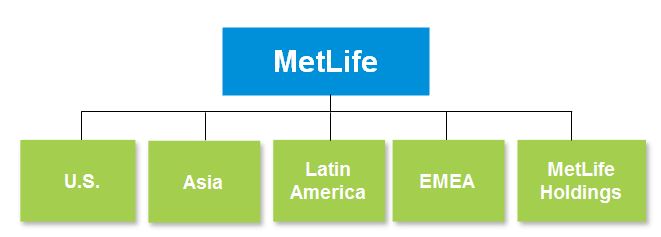
MetLife is organized into five segments: U.S.; Asia; Latin America; Europe, the Middle East and Africa (“EMEA”); and MetLife Holdings. In addition, the Company reports certain of its results of operations in Corporate & Other. See “— Segments and Corporate & Other” and Note 2 of the Notes to the Consolidated Financial Statements for further information on the Company’s segments and Corporate & Other.
In the United States, we provide a variety of insurance and financial services products, including life, dental, disability, vision, accident & health, capital market investment, guaranteed interest, stable value and annuities.
Outside the United States, we provide life, medical, dental, credit and other accident & health insurance, as well as annuities, endowment and retirement & savings products. We believe these businesses will generally continue to grow more quickly than our United States businesses.
Segments and Corporate & Other
U.S.
Our businesses in the U.S. segment offer a broad range of protection products and services aimed at serving the financial needs of our customers throughout their lives. These products are sold to corporations and their respective employees, other institutions and their respective members, as well as individuals. Our U.S. segment is organized into two businesses: Group Benefits and Retirement and Income Solutions (“RIS”). Prior to its disposition in April 2021, our former Property & Casualty business was included in the U.S. segment. See Note 3 of the Notes to the Consolidated Financial Statements for information on the Company's disposition of MetLife Property and Casualty Insurance Company and certain of its wholly-owned subsidiaries (collectively, “MetLife P&C”).
Group Benefits
We have built a leading position in the United States group insurance market through long-standing relationships with many of the largest corporate employers in the United States.
Our Group Benefits business offers life insurance, dental, group short- and long-term disability (“LTD”), individual disability, accidental death and dismemberment (“AD&D”) insurance, vision, and accident & health insurance, as well as prepaid legal plans, and has recently introduced pet insurance. We also sell administrative services-only (“ASO”) arrangements to some employers.
We distribute Group Benefits products and services through a sales force primarily comprised of MetLife employees that is segmented by the size of the target customer. Account executives sell either directly to corporate and other group customers or through an intermediary, such as a broker or consultant. Employers have been emphasizing voluntary products and, as a result, we have increased our focus on communicating and marketing to employees in order to further foster sales of those products.
We have entered into several operating joint ventures and other arrangements with third parties to expand opportunities to market and distribute Group Benefits products and services. We also sell our Group Benefits products and services through sponsoring associations and affinity groups and provide life, dental, accident & health, and vision coverage to certain employees of the U.S. Government. We have longstanding relationships with these employees and continue to cultivate and expand them through additional product offerings.
Group Benefits business quarterly claims experience may vary, as seasonal illnesses effect mortality and morbidity and due to utilization rate fluctuation in our non-medical health businesses. Annual benefit renewal implementation, enrollment, and marketing costs normally elevate Group Benefits business’ expenses in the fourth quarter.
| Major Products | |||||
| Term Life Insurance | A guaranteed benefit upon the death of the insured for a specified time period in return for the periodic payment of premiums. Premiums may be guaranteed at a level amount for the coverage period or may be non-level and non-guaranteed. Term contracts expire without value at the end of the coverage period when the insured party is still living. | ||||
| Variable Life Insurance | Insurance coverage through a contract that gives the policyholder flexibility in investment choices and, depending on the product, in premium payments and coverage amounts, with certain guarantees. Premiums and account balances can be directed by the policyholder into a variety of separate account investment options or directed to the Company’s general account. In the separate account investment options, the policyholder bears the entire risk of the investment results. With some products, by maintaining certain premium level, policyholders may have the advantage of various guarantees that may protect the death benefit from adverse investment experience. | ||||
| Universal Life Insurance | Insurance coverage on the same basis as variable life, except that premiums, and the resulting accumulated balances, are allocated only to the Company’s general account. With some products, by maintaining a certain premium level, policyholders may have the advantage of various guarantees that may protect the death benefit from adverse investment experience. | ||||
| Dental | Insurance and ASO arrangements that assist employees, retirees and their families in maintaining oral health while reducing out-of-pocket expenses. | ||||
| Disability | Insurance and ASO arrangements for groups and individuals to provide benefits for income replacement, payment of business overhead expenses or mortgage protection, in the event of the disability of the insured. | ||||
| Accident & Health Insurance | Accident, critical illness or hospital indemnity coverage to the insured. | ||||
| Vision | Insurance, ASO arrangements, and managed eye health and vision care solutions to assist employees, retirees and their families in maintaining vision health while reducing out-of-pocket expenses. Offered to commercial groups, individuals, health plans and government sponsored programs through a nationwide provider network, retail optical chains and online eyewear providers. |
Retirement and Income Solutions
Our RIS business provides funding and financing solutions that help institutional customers mitigate and manage liabilities primarily associated with their employee benefit programs using a spectrum of life and annuity-based insurance and investment products.
We distribute RIS products and services through dedicated sales teams and relationship managers primarily comprised of MetLife employees. We may sell products directly to benefit plan sponsors and advisors or through brokers, consultants or other intermediaries. In addition, these sales professionals work with individual, group and global distribution areas to better reach and service customers, brokers, consultants and other intermediaries.
| Major Products | ||||||||
| Stable Value Products | • General account guaranteed interest contracts (“GICs”) are designed to provide stable value investment options within tax-qualified defined contribution plans by offering a fixed maturity investment with a guarantee of liquidity at contract value for participant transactions. • Separate account GICs are available to defined contribution plan sponsors by offering market value returns on separate account investments with a general account guarantee of liquidity at contract value. *•*Synthetic GICs or “wraps” are contracts available only to the sponsor of a participant-directed defined contribution plan. The contract “wraps” a portfolio of investments owned by the plan to provide a guarantee that plan participants will always be able to transact in their accounts at contract value. Generally, a wrap contract means that participants will not experience negative returns. • Private floating rate funding agreements are generally privately-placed, unregistered investment contracts issued as general account obligations with interest credited based on a specified rate, such as the three-month London Interbank Offered Rate (“LIBOR”) or other agreed upon short-term benchmark rate. These agreements are used for money market funds, securities lending cash collateral portfolios and short-term investment funds. |
| Annuities | Pension Risk Transfers | General account and separate account annuities are offered in connection with defined benefit pension plans which include single premium buyouts allowing for full or partial transfers of pension liabilities. • General account annuities include nonparticipating group contract benefits purchased for retired employees or active employees covered under terminating or ongoing pension plans. • Separate account annuities include both participating and non-participating group contract benefits. Participating contract benefits are purchased for retired, terminated, or active employees covered under active or terminated pension plans. The assets supporting the guaranteed benefits for each contract are held in a separate account, however, the Company fully guarantees all benefit payments. Non-participating contracts have economic features similar to our general account product, but offer the added protection of an insulated separate account. Under accounting principles generally accepted in the United States of America (“GAAP”), these annuity contracts are treated as general account products. | ||||||
| Institutional Income Annuities | General account contracts that are guaranteed payout annuities purchased for employees upon retirement or termination of employment. Contracts can be life or non-life contingent non-participating contracts which do not provide for any loan or cash surrender value and, with few exceptions, do not permit future considerations. | |||||||
| Structured Settlements | Customized annuities designed to serve as an alternative to a lump sum payment in a lawsuit initiated because of personal injury, wrongful death, or a workers’ compensation claim or other claim for damages. Surrenders are generally not allowed, although commutations are permitted in certain circumstances. Guaranteed payments consist of life contingent annuities, term certain annuities and lump sums. | |||||||
| Risk Solutions | Longevity Reinsurance Solutions | Longevity reinsurance is a risk mitigation solution for United Kingdom (“U.K.”) pension plan sponsors and U.K. insurance companies that write pension risk transfer business, converting uncertain future pension benefit obligations into a fixed stream of payments to MetLife over the duration of the contract as opposed to a lump sum at inception in typical pension risk transfer transactions. | ||||||
| Benefit Funding Solutions | Specialized life insurance products and funding agreements designed specifically to provide solutions for funding postretirement benefits and company-, bank- or trust-owned life insurance used to finance nonqualified benefit programs for executives. | |||||||
| Capital Markets Investment Products | • Funding agreement-backed notes are offered in medium term note programs, under which funding agreements are issued to special-purpose trusts that issue marketable notes in U.S. dollars or foreign currencies. The proceeds of these note issuances are used to acquire funding agreements with matching interest and maturity payment terms from certain subsidiaries of MetLife, Inc. The notes are underwritten and marketed by major investment banks’ broker-dealer operations and are sold to institutional investors. • Funding agreement-backed commercial paper is issued by a special-purpose limited liability company which deposits the proceeds under a master funding agreement issued to it by Metropolitan Life Insurance Company (“MLIC”). The commercial paper is issued in U.S. dollars or foreign currencies, receives the same short-term credit rating as MLIC and is marketed by major investment banks’ broker-dealer operations. • Funding agreements are issued by certain of our insurance subsidiaries to regional Federal Home Loan Banks (“FHLB”) and to a subsidiary of the Federal Agricultural Mortgage Corporation (“Farmer Mac.”) |
Asia
Our Asia segment offers a broad range of products and services to both individuals and corporations, as well as to other institutions, and their respective employees.
Our Asia operations are geographically diverse encompassing both developed and emerging markets. We operate in nine jurisdictions throughout Asia, with our largest operation in Japan. We market our products and services through a range of proprietary and third-party distribution channels.
In Japan, our digitally-enabled face-to-face channels, along with bancassurance and direct marketing, continue to be critical to our overall distribution strategy. Our competitive advantage in bancassurance is based on robust distribution relationships with Japan’s very large banks, trust banks and various regional banks. Outside of Japan, our distribution strategies vary by market and leverage a combination of career and independent agencies, bancassurance and direct marketing. In select markets, we also use independent brokers and our employee sales force to sell group products.
| Major Products | |||||
| Life Insurance | Whole and term life, endowments, universal and variable life, as well as group life products. | ||||
| Accident & Health Insurance | Full range of accident & health products, including medical reimbursement, hospitalization, cancer, critical illness, disability, income protection, personal accident coverage and group health products. | ||||
| Retirement and Savings | Fixed and variable annuities, as well as regular savings products. |
Latin America
Our Latin America segment offers a broad range of products to both individuals and corporations and other institutions (including local, state and federal governments) and their respective employees. We offer government employees life, medical insurance, as well as retirement and savings, and other products, and periodically submit bids to do so.
Our largest operations are in Mexico and Chile. We market our products and services through a multi-channel distribution strategy which varies by geographic region and stage of market development.
We have an exclusive and captive agency distribution network which sells a variety of individual life, accident & health, and pension products. Our direct marketing channel includes sponsors and telesales representatives selling mainly accident & health and individual life products directly to consumers. We also work with brokers and independent agents on sales of group and individual life, accident & health, group medical, dental and pension products, and worksite marketing.
| Major Products | |||||
| Life Insurance | Whole and term life, endowments, universal and variable life, as well as group life products. | ||||
| Retirement and Savings | Fixed annuities and pension products. Fixed income annuities provide for both asset accumulation and asset distribution needs. Our savings-oriented pension products are primarily offered in Chile under a mandatory privatized social security system. See Note 3 of the Notes to the Consolidated Financial Statements for information regarding the Company's September 2021 disposition of its wholly-owned Argentinian subsidiary, MetLife Seguros S.A. (“MetLife Seguros”). | ||||
| Accident & Health Insurance | Group and individual major medical, accidental, and supplemental health products, including AD&D, hospital indemnity, medical reimbursement, and medical coverage for serious medical conditions, as well as dental products. | ||||
| Credit Insurance | Policies designed to fulfill certain loan obligations in the event of the policyholder’s death. |
EMEA
Our EMEA segment offers products to individuals, corporations, other institutions, and their respective employees. See Note 3 of the Notes to the Consolidated Financial Statements for information regarding the Company's disposition of (i) Joint-stock Company MetLife Insurance Company (“MetLife Russia”) and (ii) its wholly-owned subsidiaries in Greece (“MetLife Greece”), as well as the pending disposition of its wholly-owned subsidiaries in Poland (“MetLife Poland”) (MetLife Poland and MetLife Greece, collectively, “MetLife Poland and Greece”).
We operate across EMEA in both developed (Western Europe) and emerging (Central and Eastern Europe, Middle East and Africa) markets. Our largest operations are in the U.K., Turkey and the Gulf region. In more mature markets, we focus our strategy on our preferred market segments to play a “niche” role. We also have a strong market presence in emerging markets leveraging a multi-channel distribution strategy.
Our businesses in EMEA use captive and independent agency, independent brokerage, bancassurance, corporate solutions and direct-to-consumer distribution channels.
| Major Products | |||||
| Life Insurance | Traditional and non-traditional life insurance products, such as whole and term life, endowments and variable life products, as well as group term life programs in most markets. | ||||
| Accident & Health Insurance | Individual and group personal accident and supplemental health products, including AD&D, hospital indemnity, scheduled medical reimbursement plans, and coverage for serious medical conditions. In addition, we provide individual and group major medical coverage in select markets. | ||||
| Retirement and Savings | Fixed annuities and pension products, including group pension programs in select markets. | ||||
| Credit Insurance | Policies designed to fulfill certain loan obligations in the event of the policyholder’s death. |
MetLife Holdings
This segment consists of operations relating to products and businesses that we no longer actively market in the United States. These include variable, universal, term and whole life insurance, variable, fixed and index-linked annuities, and long-term care insurance. It also includes assumed variable annuity guarantees from our former operating joint venture in Japan.
| Major Products | |||||
| Variable, Universal and Term Life Insurance | Similar to products offered by our Group Benefits business, except that these products were historically marketed to individuals through various retail distribution channels. For a description of these products, see “— U.S. — Group Benefits.” | ||||
| Whole Life Insurance | A benefit upon the death of the insured in return for the periodic payment of a fixed premium over a predetermined period. Whole life insurance includes policies that provide a participation feature in the form of dividends. Policyholders may receive dividends in cash, or apply them to increase death benefits, increase cash values available upon surrender or reduce the premiums required to maintain the contract in-force. | ||||
| Variable Annuities | Asset accumulation and asset distribution needs. Variable annuities allow the contractholder to allocate deposits into various investment options in a separate account, as determined by the contractholder. In certain variable annuity products, contractholders may also choose to allocate all or a portion of their account to the Company’s general account and are credited with interest at rates we determine, subject to specified minimums. Contractholders may also elect certain minimum death benefit and minimum living benefit guarantees for which additional fees are charged and where asset allocation restrictions may apply. | ||||
| Fixed and Indexed-Linked Annuities | Fixed annuities provide for asset accumulation and asset distribution needs. Deposits made into deferred annuity contracts are allocated to the Company’s general account and are credited with interest at rates we determine, subject to specified minimums. Fixed income annuities provide a guaranteed monthly income for a specified period of years and/or for the life of the annuitant. Additionally, the Company has issued indexed-linked annuities which allow the contractholder to participate in returns from equity indices. | ||||
| Long-term Care | Protection against the potentially high costs of long-term health care services. Generally pay benefits to insureds who need assistance with activities of daily living or have a cognitive impairment. |
Corporate & Other
Corporate & Other contains various start-up, developing and run-off businesses. Also included in Corporate & Other are: the excess capital, as well as certain charges and activities, not allocated to the segments (including external integration and disposition costs, internal resource costs for associates committed to acquisitions and dispositions and enterprise-wide strategic initiative restructuring charges), interest expense related to the majority of the Company’s outstanding debt, expenses associated with certain legal proceedings and income tax audit issues, the elimination of intersegment amounts (which generally relate to affiliated reinsurance, investment expenses and intersegment loans, bearing interest rates commensurate with related borrowings), and the Company’s investment management business (through which the Company provides public fixed income, private capital and real estate investment solutions to institutional investors worldwide).
Policyholder Liabilities
We establish, and carry as liabilities, actuarially determined amounts that are calculated to meet policy obligations when a policy matures or is surrendered, an insured dies or becomes disabled or upon the occurrence of other covered events, or to provide for future annuity payments. Our liabilities for future policy benefits and claims are established based on estimates by actuaries of how much we will need to pay for future benefits and claims. For life insurance and annuity products, we calculate these liabilities based on assumptions and estimates, including estimated premiums to be received over the assumed life of the policy, the timing of the event covered by the insurance policy, the amount of benefits or claims to be paid and the investment returns on the investments we make with the premiums we receive. We establish liabilities for claims and benefits based on assumptions and estimates of losses and liabilities incurred. Amounts for actuarial liabilities are computed and reported on the consolidated financial statements in conformity with GAAP. For more details on policyholder liabilities see “Management’s Discussion and Analysis of Financial Condition and Results of Operations — Summary of Critical Accounting Estimates — Liability for Future Policy Benefits” and “Management’s Discussion and Analysis of Financial Condition and Results of Operations — Policyholder Liabilities.”
MetLife, Inc.’s insurance subsidiaries, including affiliated captive reinsurers, establish statutory reserves under methods prescribed by insurance laws. These reserves are reported as liabilities, and we expect them to be sufficient to meet policy and contract obligations, when taken together with expected future premiums and interest at assumed rates. Statutory reserves and actuarial liabilities for future policy benefits reported under GAAP generally differ due to the difference in accounting requirements.
U.S. state insurance laws and regulations require certain MetLife entities to submit an annual opinion and memorandum of a qualified actuary. In it, the qualified actuary states that the statutory reserves and related actuarial amounts recorded in support of specified policies and contracts, and the assets supporting such statutory reserves and related actuarial amounts, adequately provide for the anticipated cash flow required to meet contractual obligations and related expenses.
Insurance regulators in many of the non-U.S. jurisdictions in which we operate require certain MetLife entities to prepare and submit a sufficiency analysis of the reserves presented in the locally required regulatory financial statements. See “— Regulation — Insurance Regulation — Policy and Contract Reserve Adequacy Analysis.”
Underwriting and Pricing
We use a variety of underwriting and pricing management controls. Our Global Risk Management Department develops product pricing standards and oversees underwriting practices in MetLife’s insurance businesses. We also regularly conduct experience studies to monitor assumptions against expectations, impose formal new product approval processes, periodically update product profitability studies, and use reinsurance to manage our exposures, as appropriate. See “— Reinsurance Activity.”
Underwriting
Our underwriters and actuaries use detailed underwriting policies, guidelines and procedures to assess and quantify insurance risks, and determine the type and the amount of risk we are willing to accept.
Insurance underwriters consider an applicant’s medical history and other factors such as financial profile, foreign travel, vocations and alcohol, drug and tobacco use. Group insurance underwriters generally evaluate the risk characteristics of the prospective insured group, but may underwrite members of a group on an individual basis for certain voluntary products and coverages. Our own employees generally perform our underwriting, but intermediaries review certain policies under guidelines established by us. Generally, we are not obligated to accept any risk or group of risks from, or to issue a policy or group of policies to, any employer or intermediary. We review requests for coverage on their merits and issue policies only after we have examined and approved the particular risk or group under our underwriting guidelines.
We periodically review all our underwriting to maintain high standards of quality and consistency. Our reinsurers generally have the right to audit our underwriting.
We use underwriting policies, guidelines, philosophies, and strategies that we intend to be competitive and suitable for the customer, the agent and us, to facilitate quality sales, and to serve our customers’ needs while supporting our financial strength and business objectives. We aim to ensure that underwriting risk levels are appropriately reflected in our product pricing.
We continually review our underwriting policies, guidelines, philosophies, and strategies in light of applicable regulations and to ensure that our policies remain competitive, support our marketing strategies and profitability goals, and otherwise remain appropriate.
Pricing
Product pricing reflects our globally-consistent standards. Global Risk Management and regional finance and product teams price and oversee all of our insurance businesses. We base our pricing on the expected benefits payout which we calculate through the use of assumptions for mortality, morbidity, expenses, persistency and investment returns and macroeconomic factors such as inflation. We price investment-oriented products based on factors such as investment returns, expenses, persistency, optionality, and possible variability of results.
Our pricing of certain products may include prospective and retrospective experience rating features. For prospective experience rating, we evaluate past experience to determine future premium rates and we bear all prior year gains and losses. For retrospective experience rating, we evaluate past experience to determine our cost of providing insurance for the customer in light of any features that allow us to recoup certain losses or distribute certain gains back to the policyholder based on prior years’ experience.
We base our rates for group benefit products on anticipated earnings and expenses for the book of business. We generally re-evaluate renewals annually or biannually and re-price products to reflect our experience on such products.
We generally price many of our RIS products on demand. Our pricing reflects our expected investment returns, as well as mortality, longevity and expense assumptions. RIS business is generally nonparticipating and illiquid, as policyholders have few or no options or contractual rights to cash values. However, for products with liquidity provisions, such as stable value, pricing reflects the contractholders’ ability to withdraw at book value over a period of time, as well as our ability to reset rates periodically.
We generally must receive regulatory approval of rates for individual life insurance products. Such rates are highly regulated, even where we are not required to obtain advance regulatory approval. We generally renew such products annually, and they may include pricing terms that are guaranteed for a certain period of time.
We price individual disability income products based on anticipated results by occupation.
Our rates for fixed and variable annuity products are also highly regulated, and we also generally must receive regulatory approval of them. Such products generally include penalties for early withdrawals and policyholder benefit elections to tailor benefits to policyholder needs. We periodically reevaluate the costs of such options and adjust pricing levels on our guarantees. We may also reevaluate the type and level of guarantee features we offer.
We continually review our pricing guidelines in light of applicable regulations and to ensure that our policies remain competitive, support our marketing strategies and profitability goals, and otherwise remain appropriate.
Reinsurance Activity
We enter into reinsurance agreements primarily as a purchaser of reinsurance for our various insurance products. We also provide reinsurance for some third parties’ insurance products. We participate in reinsurance in order to limit losses, minimize exposure to significant risks, and provide additional capacity for future growth. Our reinsurance covers individual risks, group risks, or defined blocks of business, primarily on a coinsurance, yearly renewable term, excess, or catastrophe excess basis. The extent of our retained risks depends on our risk evaluation, subject, in certain circumstances, to maximum retention limits based on our risk appetite. We also cede first dollar mortality risk under certain contracts. We reinsure both mortality and other risks. We obtain reinsurance for capital requirement purposes and when its economic impact makes it appropriate to do so.
We also reinsure for risk and capital management purposes among affiliates, including affiliated captive reinsurers and affiliated offshore insurance companies. Captive reinsurers are affiliated insurance companies licensed as such under the Special Purpose Financial Captive law adopted by several states, including Vermont and South Carolina. Captive insurers’ very narrow business plans restrict most or all of their activity to reinsuring business from their affiliates. See “Management’s Discussion and Analysis of Financial Condition and Results of Operations — Liquidity and Capital Resources — The Company — Capital — Affiliated Captive Reinsurance Transactions.”
For information regarding reinsurance by segment, our catastrophic coverage, and ceded reinsurance recoverable balances, included in premiums, reinsurance and other receivables on the consolidated balance sheets, see Note 6 of the Notes to the Consolidated Financial Statements.
Regulation
Overview
In the United States (“U.S.”), state regulators primarily regulate our life insurance companies, with additional federal regulation of some products and services. The insurance holding company laws of various U.S. jurisdictions apply to MetLife, Inc. and its U.S. insurance subsidiaries. Furthermore, consumer protection laws, privacy, anti-money laundering, securities, commodities, broker-dealer and investment adviser regulations, environmental and unclaimed property laws and regulations, and the Employee Retirement Income Security Act of 1974 (“ERISA”) also apply to some of MetLife’s operations, products and services.
Outside of the U.S., insurance regulatory authorities in the jurisdictions in which our insurance businesses are located or operate principally regulate those businesses. In addition, securities, pension, and other authorities oversee our investment and pension companies where they operate. Regulators also subject our non-U.S. insurance businesses to current and developing solvency regimes, which impose various capital and other requirements. Additionally, regulators may enhance their capital standards and supervision, and impose additional non-U.S. and global regulatory initiatives.
We expect the scope and extent of regulation and regulatory oversight generally to continue to increase. The regulatory environment and changes in laws in the jurisdictions in which we operate could materially harm our results of operations.
Insurance Regulation
Insurance regulation generally aims to protect policyholders and ensure insurance company solvency. Insurance regulators increasingly seek information about the potential impact of activities on holding company systems as a whole, and some jurisdictions have asserted “group-wide” supervision, including model laws and regulations developed through the National Association of Insurance Commissioners’ (“NAIC”) Solvency Modernization Initiative. See “— National Association of Insurance Commissioners” regarding group-wide supervision.
Each of MetLife’s insurance subsidiaries is licensed and regulated in each jurisdiction where it conducts insurance business. The extent of such regulation varies, but most jurisdictions regulate the financial aspects and business conduct of insurers through broad administrative powers with respect to, among other things:
-
licensing companies and agents to transact business;
-
calculating the value of assets to determine compliance with statutory requirements;
-
mandating certain insurance benefits;
-
regulating certain premium rates;
-
reviewing and approving certain policy forms, including required policyholder disclosures;
-
regulating unfair trade and claims practices, including through the imposition of restrictions on marketing and sales practices, distribution arrangements and payment of inducements, and identifying and paying to the states or local authorities benefits and other property that is not claimed by the owners;
-
regulating advertising;
-
protecting and safeguarding personal information and other sensitive data, including through cybersecurity standards;
-
establishing statutory capital and reserve requirements and solvency standards;
-
specifying the conditions under which a ceding company can take credit for reinsurance in its statutory financial statements (i.e., reduce its reserves by the amount of reserves ceded to a reinsurer);
-
fixing maximum interest rates on insurance policy loans and minimum guaranteed crediting rates on life insurance policies and annuity contracts;
-
adopting and enforcing standards with respect to the sale of annuities and other insurance products;
-
approving changes in control of insurance companies;
-
restricting the payment of dividends and other transactions between affiliates; and
-
regulating the types and amounts of investments.
Each insurance subsidiary must file reports, generally including detailed annual financial statements, with insurance regulatory authorities in each of the jurisdictions in which it does business. Such authorities also periodically examine its operations and accounts. These subsidiaries must also file, and in many jurisdictions and in some lines of insurance obtain regulatory approval of, rules, rates, and policy forms relating to the insurance written in the jurisdictions in which they operate.
Insurance, securities, and other regulatory authorities, other law enforcement agencies, and attorneys general, review MetLife, Inc. and its insurance subsidiaries for compliance with laws and regulations regarding the conduct of our insurance and securities businesses. We cooperate with such inquiries and take corrective action when warranted. See Note 21 of the Notes to the Consolidated Financial Statements.
U.S. Federal Initiatives
U.S. federal initiatives can affect our business in a variety of ways, including regulation of financial services, securities, derivatives, pensions, health care, money laundering, foreign sanctions and corrupt practices, and taxation. For instance, legislators and policymakers have proposed various forms of direct and indirect federal regulation of insurance from time to time, such as proposals for the establishment of an optional federal charter for insurance companies. See “Risk Factors — Regulatory and Legal Risks — Changes in Laws or Regulation, or in Supervisory and Enforcement Policies, May Reduce Our Profitability, Limit Our Growth, or Otherwise Adversely Affect Us.”
The Dodd-Frank Wall Street Reform and Consumer Protection Act (“Dodd-Frank”) increased the potential federal role in regulating businesses such as ours, including in the following ways:
-
The Financial Stability Oversight Council may designate certain financial companies as non-bank systemically important financial institutions (“non-bank SIFI”) subject to supervision by the Board of Governors of the Federal Reserve System (“Federal Reserve Board”) and the Federal Reserve Bank of New York (collectively with the Federal Reserve Board, the “Federal Reserve”).
-
The Federal Insurance Office (“FIO”) within the Department of the Treasury may participate in the negotiations of international insurance agreements with foreign regulators for the U.S., collect information about the insurance industry, and recommend prudential standards.
-
If an insurance holding company such as MetLife, Inc. or another non-insurance financial institution were to become insolvent or were in danger of defaulting on its obligations, and regulators determined that this would have serious adverse effects on financial stability in the U.S., then the Federal Deposit Insurance Corporation (“FDIC”) may liquidate such a company as receiver. In that case, the Bankruptcy Code, which ordinarily governs liquidations, would not apply. The FDIC’s purpose would be to mitigate the systemic risks the institution’s failure poses. This is a different objective from that of a bankruptcy trustee under the Bankruptcy Code. In such a liquidation, the holders of such company’s debt could in certain respects be treated differently than under the Bankruptcy Code. The FDIC has established rules relating to the priority of creditors’ claims and the potentially dissimilar treatment of similarly situated creditors. These provisions could apply to some financial institutions whose outstanding debt securities we hold in our investment portfolios. However, state insurance laws would continue to apply to an insurance company resolution.
-
Dodd-Frank provisions may also affect the investments and investment activities of MetLife, Inc. and its subsidiaries, including imposing federal regulation of such activities.
Dodd-Frank and its implementing regulations have changed since the law was adopted. As a result of these changes, and potential changes, we cannot identify all the risks posed and opportunities presented, if any, to our businesses. See “Risk Factors — Regulatory and Legal Risks — Changes in Laws or Regulation, or in Supervisory and Enforcement Policies, May Reduce Our Profitability, Limit Our Growth, or Otherwise Adversely Affect Us.”
Until January 2021, the McCarran–Ferguson Act largely exempted insurance from U.S. antitrust laws. At that time, the Competitive Health Insurance Reform Act applied U.S. antitrust laws to the “business of health insurance” and expanded U.S. regulatory authority accordingly. We expect regulatory oversight and litigation risk for U.S. products, including dental and vision, to increase.
Health Care Regulation
The U.S. excise tax known as the “health insurer fee” was in force for the 2020 calendar year. The health insurer fee no longer applies for calendar years beginning after December 31, 2020. However, demand for and pricing of products remain subject to tax uncertainty. Federal health care statutes and related regulation have imposed increased and unpredictable costs on certain products and may have additional adverse effects. They have also harmed our competitive position, as these rules have a disparate impact on our products compared to products offered by our not-for-profit competitors. See “Risk Factors — Regulatory and Legal Risks — Changes in Laws or Regulation, or in Supervisory and Enforcement Policies, May Reduce Our Profitability, Limit Our Growth, or Otherwise Adversely Affect Us.”
Guaranty Associations and Similar Arrangements
Many jurisdictions in which our insurance subsidiaries transact business require life and health insurers to participate in guaranty or similar associations. These arrangements pay certain insurance benefits owed by impaired, insolvent or failed insurers. These associations levy assessments, up to prescribed limits, on all member insurers in a particular jurisdiction on the basis of the proportionate share of the premiums written by member insurers in the lines of business in which the impaired, insolvent or failed insurer engaged. In addition, certain jurisdictions have government owned or controlled organizations providing life and health insurance to their citizens, whose activities could place additional stress on the adequacy of guaranty fund assessments. Many of these organizations have the power to levy assessments similar to those of the guaranty associations. Some jurisdictions permit member insurers to recover assessments paid through full or partial premium tax offsets. We have established liabilities for guaranty fund assessments that we consider adequate.
Insurance Regulatory Examinations and Other Activities
U.S. state insurance departments periodically examine the books, records, accounts, and business practices of their domiciled insurers. State insurance departments may also conduct examinations of non-domiciliary insurers licensed in their states.
In 2019, MetLife entered into a consent order with the New York State Department of Financial Services (“NYDFS”) relating to the open market conduct quinquennial exam and paid a fine and customer restitution and submitted remediation plans for approval. Except for this consent order or as described in Note 21 of the Notes to the Consolidated Financial Statements, during the years ended December 31, 2021, 2020 and 2019, MetLife did not receive any material adverse findings resulting from state insurance department examinations of its insurance subsidiaries.
In 2018, Pennsylvania, California, Florida, North Dakota and New Hampshire insurance regulators scheduled a multistate re-examination of MetLife and its affiliates relating to compliance with a regulatory settlement agreement relating to unclaimed property. This examination is ongoing.
Regulatory authorities in a small number of states, the Financial Industry Regulatory Authority (“FINRA”) and, occasionally, the U.S. Securities and Exchange Commission (the “SEC”) have conducted investigations or made inquiries relating to sales of individual life insurance policies, annuities or other products written by our insurance or broker-dealer subsidiaries. These investigations often focus on the conduct and/or supervision of particular financial services representatives, the sale of unregistered or unsuitable products, the misuse of client assets, or sales and replacements of annuities and certain riders on such annuities. Over the past several years, we resolved these (and a number of investigations by other regulators) for monetary payments and certain other relief, including restitution payments. We may continue to receive notice of, and may resolve, further investigations and actions on these matters in a similar manner.
Insurance standard-setting and regulatory support organizations, including the NAIC, encourage insurance supervisors to establish Supervisory Colleges. These organizations facilitate cooperation and coordination among insurance supervisors to enhance their understanding of the risk profile of U.S.-based insurance groups with international operations. MetLife’s lead state regulator, the NYDFS, annually chairs Supervisory College meetings that MetLife’s key U.S. and non-U.S. regulators attend.
Regulators supervise our non-U.S. insurance and pension businesses through periodic examinations of insurance company books and records, financial reporting requirements, market conduct examinations and policy filing requirements. The European Insurance and Occupational Pensions Authority (“EIOPA”), along with European legislation, requires European regulators, such as the Central Bank of Ireland, to establish Supervisory Colleges for European Economic Area (“EEA”)-based insurance groups with significant European operations, including MetLife. These colleges facilitate cooperation and coordination among European supervisors to enhance their understanding of an insurance group’s risk profile.
In addition, regulators have scrutinized insurers’ claims payment practices. See Note 21 of the Notes to the Consolidated Financial Statements for further information regarding group annuity benefits and unclaimed property inquiries.
Policy and Contract Reserve Adequacy Analysis
Our U.S. insurance subsidiaries, including affiliated captive reinsurers, must annually analyze their statutory reserves adequacy. In each case, a qualified actuary must submit an opinion that states that the statutory reserves make adequate provision, according to accepted actuarial standards of practice, for the anticipated cash flows required by the contractual obligations and related expenses of the U.S. insurance subsidiary. The actuary considers the adequacy of the statutory reserves in light of the assets held by the insurer with respect to such reserves and related actuarial items, such as the investment earnings on such assets and the consideration the insurer anticipates receiving and retaining under the related policies and contracts. We may increase reserves in order to submit such an opinion without qualification. Our U.S. insurance subsidiaries that must provide these opinions have done so without qualifications since this requirement began.
Many of our non-U.S. insurance operations must also analyze the adequacy of their statutory reserves. In most of those cases, a locally qualified actuary must submit an analysis of the likelihood that the reserves make adequate provision for the insurer’s associated contractual obligations and related expenses. Regulatory and actuarial analytic standards vary widely.
National Association of Insurance Commissioners
The NAIC assists U.S. state insurance regulatory authorities to serve the public interest and achieve their regulatory goals. State insurance regulators may act independently or adopt regulations proposed by the NAIC. State insurance regulators and the NAIC regularly re-examine existing insurance laws and regulations. State insurance regulators establish standards and best practices, conduct peer reviews, and coordinate their regulatory oversight through the NAIC. The NAIC also provides standardized insurance industry accounting and reporting guidance through its Accounting Practices and Procedures Manual (the “Manual”), which states have largely adopted by regulation. However, individual states establish statutory accounting principles, which may differ from the Manual. Changes to the Manual or modifications by the various state insurance departments may affect the statutory capital and surplus of MetLife, Inc.’s U.S. insurance subsidiaries.
U.S. state insurance holding company laws and regulations are generally based on the NAIC’s Insurance Holding Company System Regulatory Act and Regulation (“Model Holding Company Act and Regulation”). These vary from jurisdiction to jurisdiction, but generally require a controlled insurance company (i.e., insurers that are subsidiaries of insurance holding companies) to register and file reports with state regulatory authorities on its capital structure, ownership, financial condition, intercompany transactions and general business operations. They require the ultimate controlling person of a U.S. insurer to file an annual enterprise risk report with the lead state of the insurance holding company system. This report identifies risks likely to have a material adverse effect upon the financial condition or liquidity of the insurer or its insurance holding company system as a whole. Each of our insurance subsidiaries’ domiciliary states has enacted laws to implement these requirements, including the enterprise risk reporting requirement. The holding company laws also authorize state insurance commissioners to act as global group-wide supervisors for internationally active insurance groups (“IAIGs”), as well as other insurers that choose to opt in for the group-wide supervision. These laws provide confidentiality protection for communications with the group-wide supervisor. All states have adopted laws and regulations enhancing group-wide supervision. In 2020, the NYDFS amended its laws to permit the New York Superintendent of Financial Services (“Superintendent”) to act as a group-wide supervisor for IAIGs.
In furtherance of the NAIC’s “Solvency Modernization Initiative,” the NAIC has updated model acts and regulations to address insurance company financial regulation, as discussed below, and, in particular, capital requirements; corporate governance and risk management practices; group supervision; liquidity stress testing, statutory accounting and financial reporting; and reinsurance.
The NAIC’s Corporate Governance Annual Disclosure Model Act, which all states have adopted, requires insurers to annually file detailed information regarding their corporate governance policies.
All states have also adopted the NAIC’s Risk Management and Own Risk and Solvency Assessment Model Act, which requires insurers to maintain a risk management framework and to document an internal own risk and solvency assessment (“ORSA”) of its material risks in normal and stressed environments. MetLife, Inc. has submitted on behalf of the enterprise an ORSA summary report to the NYDFS annually since this requirement became effective.
The NAIC has also approved a valuation manual containing a principle-based approach to the calculation of life insurance reserves (the “Valuation Manual”). Principle-based reserving (“PBR”) is designed to better address reserving for life insurance and annuity products, and it has been adopted by all of our U.S. insurance subsidiaries’ domiciliary states. The NYDFS promulgated a regulation in 2019 that affirms the Superintendent’s authority to deviate from the Valuation Manual to adjust the reserves of a New York domestic life insurance company, such as MLIC, if the NYDFS determines that an alternative requirement would be in the best interest of New York policyholders. The NYDFS subsequently amended the regulation, as a result of which we increased our statutory reserves by approximately $700 million and our statutory capital requirements by approximately $300 million over the prior reserve and capital requirements. We fully graded these impacts into our statutory financial statements over a one-year period ending December 31, 2020.
The NAIC has been focused on a macro-prudential initiative since 2017, which is intended to enhance risk identification efforts by building on the state-based regulation system. In furtherance of this initiative, the NAIC adopted changes to its Statutory Annual Statement reporting, effective for year-end 2019, to improve liquidity risk monitoring. The NAIC also adopted amendments to the Model Holding Company Act and Regulation that implement requirements related to a liquidity stress-testing framework for certain large U.S. life insurers and insurance groups. The applicability of the framework is based on amounts of certain types of business written or material exposure to certain investment transactions, such as derivatives and securities lending. The framework is consistent with MetLife’s liquidity risks policies and procedures, and it will be used as a regulatory tool once the holding company act amendments have been adopted by state legislatures. As of January 1, 2022, the amendments have been adopted by two of our domiciliary states, California and Rhode Island.
We use capital markets solutions to finance a portion of our statutory reserve requirements for several products. These include level premium term life products subject to the NAIC’s Valuation of Life Insurance Policies Model Regulation (commonly referred to as Regulation XXX), universal and variable life policies with secondary guarantees (“ULSG”) subject to NAIC Actuarial Guideline 38 (commonly referred to as Guideline AXXX), and MLIC’s closed block. In order to address the use of captives for policies covered by Regulation XXX and Guideline AXXX, the NAIC adopted Actuarial Guideline 48 (“AG 48”). This guideline has enhanced the statutory financial statement disclosure of an insurer's use of captives and has narrowed the types of assets permitted to back statutory reserves that are required to support the insurer’s future obligations.
AG 48 also requires the actuary of a ceding insurer to opine on the assuming insurer’s collateral associated with the treaty and to issue a qualified opinion if the assuming entity is not complying with the requirements of AG 48. The NAIC’s Term and Universal Life Insurance Reserve Financing Model Regulation codifies the same substantive requirements as AG 48, as amended by the NAIC in 2016, and establishes uniform, national standards governing reserve financing arrangements pertaining to the term life and universal life insurance policies with secondary guarantees. This model regulation has only been adopted by a few states, although it is expected to be broadly adopted in the near term since it will become an NAIC accreditation standard on September 1, 2022.
We cannot predict the capital and reserve impacts, compliance costs, or other effects these initiatives will have on our business, financial condition or results of operations.
Surplus and Capital
Insurers must maintain their capital and surplus at or above minimum levels prescribed by the laws of their respective jurisdictions. Regulators generally have discretionary authority to limit or prohibit an insurer’s sales to policyholders if the insurer has not maintained a minimum surplus or capital or if they find that the further transaction of business will be hazardous to policyholders.
State insurance statutes also typically restrict the dividends or other distributions an insurance company subsidiary may pay to its parent companies and limit the transactions between an insurer and its affiliates. Dividends in excess of prescribed limits and transactions above a specified size between an insurer and its affiliates require the approval of the insurance regulator in the insurer’s state of domicile. See “Management’s Discussion and Analysis of Financial Condition and Results of Operations — Liquidity and Capital Resources — MetLife, Inc. — Liquidity and Capital Sources — Dividends from Subsidiaries.” See also “Dividend Restrictions” in Note 16 of the Notes to the Consolidated Financial Statements for further information regarding such limitations.
Non-U.S. jurisdictions also restrict the amount of such dividends and other distributions. For example, a portion of the annual earnings of our Japan operations may be repatriated each year, and may further be distributed to MetLife, Inc. as a dividend. We may determine not to repatriate profits from the Japan operations or to repatriate a reduced amount in order to maintain or improve the solvency of the Japan operations or for other reasons. In addition, the Financial Services Agency in Japan (“FSA”) may limit or not permit profit repatriations or other transfers of funds to the U.S. if such transfers would be detrimental to the solvency or financial strength of our Japan operations or for other reasons.
Several non-U.S. insurance regulators urged insurance companies to preserve funds during the COVID-19 pandemic. For example, EIOPA had suggested that insurance companies temporarily suspend discretionary dividends during the COVID-19 pandemic.
For developments that could affect our ratio of free cash flow to adjusted earnings results, and thus our surplus and capital, see “Risk Factors.”
Risk-Based Capital
Most of our U.S. insurance subsidiaries are subject to risk-based capital (“RBC”) requirements developed by the NAIC and adopted by their respective domiciliary states. Insurers calculate RBC annually based on a formula that applies factors to various asset, premium, claim, expense and statutory reserve items, taking into account asset, insurance, interest rate, and market and business risk characteristics. Regulators use the formula as an early warning tool to identify insurers that may be inadequately capitalized for purposes of initiating regulatory action, and not as a means to rank insurers generally. State insurance laws provide insurance regulators the authority to require various actions by, or take various actions against, insurers whose total adjusted capital does not meet or exceed certain RBC levels. As of the date of the most recent annual statutory financial statements filed with insurance regulators, the total adjusted capital of each of our subsidiaries subject to these requirements was in excess of each of these RBC levels. See “Statutory Equity and Income” in Note 16 of the Notes to the Consolidated Financial Statements and “Management’s Discussion and Analysis of Financial Condition and Results of Operations — Liquidity and Capital Resources — The Company — Capital — Statutory Capital and Dividends.”
The NYDFS issues annual letters on Special Considerations (each, an “SCL”) to New York-licensed insurance companies, including MLIC, that affect year-end asset adequacy testing. An SCL could mandate assumption changes, which would require us to increase or release certain asset adequacy reserves, which could materially impact our statutory capital and surplus. No changes were made to asset adequacy reserves in either 2021 or 2020 as a result of the SCL. See “Statutory Equity and Income” in Note 16 of the Notes to the Consolidated Financial Statements.
We calculate our internally-defined “Statement-Based Combined RBC Ratio” by dividing the sum of total adjusted capital for MetLife, Inc.’s principal U.S. insurance subsidiaries, excluding American Life Insurance Company (“American Life”), by the sum of company action level RBC for such subsidiaries, including SCL considerations. Our Statement-Based Combined RBC Ratio was in excess of 360% and in excess of 350% at December 31, 2021 and 2020, respectively. By contrast, we calculate an “NAIC-Based Combined RBC Ratio” based on such subsidiaries’ statutory-based filed financial statements and NAIC capital and reserving standards. This NAIC-Based Combined RBC Ratio was in excess of 380% at both December 31, 2021 and 2020. We are not aware of any upcoming NAIC adoptions or state insurance department regulation changes that would have a material impact on our NAIC-Based Combined RBC Ratio.
The NAIC adopted revisions to certain factors used to calculate Life RBC, which is the denominator of the RBC ratios, in light of changes to U.S. tax laws in recent years. These revisions have resulted in increased RBC charges and reduced the RBC ratios of our insurance subsidiaries. The NAIC has approved RBC revisions for corporate bonds, real estate equity and longevity risk that took effect at year-end 2021 and we expect these revisions to have a modest net positive RBC impact on us.
The NAIC developed a group capital calculation (“GCC”) tool using an RBC aggregation methodology for all entities within the insurance holding company system, including non-U.S. entities. The NAIC amended the Model Holding Company Act and Regulation to adopt the GCC Template and Instructions and to implement the annual GCC filing requirement with an insurance group’s lead state regulator. As noted above, the filing requirement will not become effective until the holding company act amendments are adopted by the states. We cannot predict what impact such regulatory tool may have on our business.
In 2020, the NAIC issued guidance on RBC addressing debt restructuring due to the economic impact of the COVID-19 pandemic, where a counterparty might seek concessions. The guidance provides that an insurer does not need to reclassify the RBC category of some loans or other assets on which it has granted a concession. This may avoid a higher capital charge for the asset. The NAIC extended this guidance through January 1, 2022 in further support of the use of prudent loan modifications to mitigate the impact of the COVID-19 pandemic. Following the expiration of the guidance on January 1, 2022, an insurer should rely upon existing accounting guidance regarding the impact of a debt restructuring on the insurer’s RBC.
Solvency Regimes
Our insurance business throughout the EEA is subject to the Solvency II Directive and its implementing rules. These cover the capital adequacy, risk management and regulatory reporting for insurers and reinsurers. Solvency II harmonizes insurance regulation across the European Union (“EU”). Each EEA member state has transposed the Solvency II Directive into its regulatory architecture. Its capital requirements are forward-looking and based on the risk profile of each individual insurance company in order to promote comparability, transparency and competitiveness. In line with the requirements, impacted MetLife entities calculate and report their solvency capital requirement using a standard formula prescribed by the Solvency II Directive and further regulation by the European Commission.
The U.K. ceased to be a member of the EU in January 2020 and, following the expiry of a transition period on December 31, 2020, the U.K. is no longer subject to EU law. The relationship between the U.K. and the EU is now governed by the terms and conditions of a Trade and Cooperation Agreement (the “Trade Agreement”). The Trade Agreement does not contain many substantive provisions relating to financial services. Similarly, it is not expected that the Memorandum of Understanding (“MoU”) relating to financial services that has been concluded by the U.K. and the EU, and which may in the future be entered into between them, will contain many (if any) further substantive provisions. The MoU is, instead, expected to establish a Joint U.K.-EU Regulatory Forum that will serve as a platform to facilitate dialogue between the parties on financial issues. Accordingly, there is currently no change to capital adequacy, risk management and regulatory reporting requirements for U.K. authorized insurers and reinsurers. However, it is possible that the U.K.’s domestic prudential regime may begin to diverge from the Solvency II Directive over time. The U.K. has undertaken a review of the Solvency II Directive and of the regulatory regime that is applicable to U.K. authorized insurers and reinsurers. The U.K.’s HM Treasury is working alongside the Prudential Regulation Authority to prepare a package of proposed reforms to the U.K.’s domestic regulatory regime for consultation in early 2022. The timeframe within which any such proposed reforms will be implemented into U.K. law and regulation is currently unclear, and will depend upon the nature and extent of the proposed changes to the domestic regime, as well as the U.K. insurance industry’s responses to them. Similarly, the European Commission has undertaken its own review of Solvency II and, on September 22, 2021, published a package of proposed legislative reforms for amending the existing regulatory framework. This proposed legislation is being discussed by the European Parliament and Council. While there can be no certainty around the timing of this legislative process, we do not expect any changes to Solvency II resulting from this legislative process to be finalized and transposed into EEA member states’ respective domestic legislation prior to 2024.
Mexico has adopted a Solvency II-type regulatory framework which imposes reserve and capital requirements and corporate governance to foster transparency. In line with the requirements of the local Solvency II, insurance companies calculate and report their capital requirement using a standard formula designed by the local regulators (“CNSF”). In addition, as required, certain MetLife entities must submit annual ORSA reports to the CNSF on an ongoing basis.
In Chile, the law implementing Solvency II-like regulation continues in the studies stage. The implementation date for the new solvency regime has not yet been set; however, it could be in force within four years after the final regulation is published. MetLife Chile implemented governance changes and risk policies to comply with prior regulatory changes. MetLife Chile also submitted its ORSA report to the regulator in September 2021.
The Superintendence of Private Insurance, the Brazilian insurance regulator, has established an insurance framework for minimum capital requirements based on risk, criteria for investment activities, a formal risk management function, and a formal enterprise risk management framework. MetLife Brazil has formalized the designation of a local risk manager and implemented governance structures and risk management framework components in accordance with local regulatory requirements.
Japanese law requires insurers to maintain solvency standards to protect policyholders and to support their own financial strength. Most Japanese life insurers maintain a solvency margin ratio well in excess of the legally mandated minimum. In addition, we expect Japan to introduce an economic value-based solvency regime within the next few years.
In China, the business of our joint venture (as well as the industry) has implemented China Risk Oriented Solvency System (“C-ROSS”), a risk-based solvency regime. Like Solvency II, C-ROSS focuses on risk management and has three pillars (strengthen quantitative capital requirements, enhance qualitative supervision and establish a governance and market discipline process). On December 30, 2021, the China Banking and Insurance Regulatory Commission (“CBIRC”) issued the Regulatory Rules for the Solvency of Insurance Companies (II) (“Rules II”), marking completion of the buildout of C-ROSS Phase II. CBIRC will determine a transition period policy based on actual circumstances, allowing for a step-by-step implementation of some of the regulatory rules, with full implementation to be in place by no later than 2025. Our joint venture will continue strengthening its solvency management in accordance with the revised rules.
The Korea Financial Supervisory Service plans to implement a new solvency system, Korean Insurance Capital Standards, by 2023. We expect this system to reflect the International Association of Insurance Supervisors (“IAIS”) global Insurance Capital Standard and incorporate certain product portfolio and other features specific to the Korean market and include mark-to-market valuation.
IAIS
The IAIS is an association of insurance supervisors and regulators and a member of the Financial Stability Board (“FSB”), an international entity established to coordinate, develop and promote regulatory, supervisory and other financial sector policies in the interest of financial stability. The IAIS participates in the FSB’s initiative to identify and manage systemic risk globally. The IAIS has adopted a holistic framework for the assessment and mitigation of systemic risk in the global insurance sector (the “Holistic Framework”). The framework monitors the build-up of vulnerabilities at jurisdictional and global levels to address any such risk through the application of enhanced supervisory measures based on existing insurance core principles and the common framework for supervision of IAIGs. The FSB annually designated MetLife, Inc. a globally systemically important insurer (“G-SII”) from 2013 to 2016, but suspended all G-SII identifications beginning in 2017 pending completion and implementation of the Holistic Framework, which began in 2020. In 2022, the FSB may decide to discontinue or re-establish the G-SII designation system based on the implementation results of the Holistic Framework.
An IAIS proposal becomes effective when it is enacted through legislation or regulation in the applicable jurisdiction. As MetLife, Inc. is not a U.S. non-bank SIFI, the impact on MetLife, Inc. of the IAIS’s global proposals is uncertain.
NYDFS Guidance on Diversity and Corporate Governance
On March 16, 2021, the NYDFS stated that it expects the insurers it regulates to make diversity of their leadership a business priority and a key element of their corporate governance. The NYDFS collected data from insurers that met certain New York premium thresholds, including MetLife, Inc. and certain of its subsidiaries, regarding the diversity of their corporate boards and management. The NYDFS plans to publish such data on an aggregate basis to measure progress in the industry, and it will include diversity-related questions in its examination process starting in 2022. The NAIC is also evaluating issues related to race, diversity and inclusion, and it is examining practices in the insurance industry in order to determine how barriers are created that disadvantage people of color or historically underrepresented groups.
New York Insurance Regulation 210
Insurance Regulation 210 establishes standards for the determination and any readjustment of non-guaranteed elements (“NGEs”) that may vary at the insurer’s discretion for life insurance policies and annuity contracts delivered or issued for delivery in New York. NGEs include cost of insurance for universal life insurance policies, as well as interest crediting rates for annuities and universal life insurance policies. The regulation requires insurers to notify policyholders at least 60 days in advance of any change in NGEs that is adverse to policyholders and, with respect to life insurance, to notify the NYDFS at least 120 days prior to any such changes. The regulation also requires insurers to inform the NYDFS annually of any changes adverse to policyholders made in the prior year. The regulation generally prohibits insurers from increasing profit margins for in-force policies or adjusting NGEs in order to recoup past losses.
Cybersecurity and Data Protection Regulation
We are subject to a variety of laws and regulations at the local, state, federal and international level regarding the collection, storage, use, processing, disclosure, protection and security of personal information, including health-related and customer information and employee data. Various local, state and federal laws in the U.S. and around the world require companies such as ours to inform consumers of data collection and processing practices and further dictate whether, how, and under what circumstances we can transfer, process or receive personal information, the interpretation and scope of which are constantly evolving and vary significantly from jurisdiction to jurisdiction. We are also subject to laws and regulations governing the security and integrity of our information systems and the non-public information stored therein, many of which require the implementation of comprehensive information security policies and procedures, and require notification to affected individuals and regulators of security breaches and other cyber incidents. Given growing cybersecurity risks and threats posed to information and financial systems by nation-states, terrorist organizations and independent criminal actors in recent years, insurance and other regulators have increased focus on cybersecurity practices, and regulatory and legislative activity in the areas of privacy, data protection and cybersecurity continues to increase worldwide. Below, we highlight some of the key data protection and cybersecurity laws and regulations to which we are subject.
Cybersecurity
The New York Cybersecurity Requirements for Financial Services Companies (the “Regulation”) were promulgated by NYDFS in March 2017 to promote the protection of customer information and information technology systems by establishing and regulating cybersecurity requirements for financial services entities under NYDFS’s jurisdiction. In general, the Regulation requires covered entities, including banking and insurance entities under its jurisdiction, to assess risks associated with their information systems and establish and maintain a cybersecurity program designed to assess those risks and protect the confidentiality, integrity and availability of such systems and data. Specifically, the Regulation provides for, among other things: (i) technical safeguards and controls relating to the governance framework for a cybersecurity program; (ii) risk-based policies, procedures and minimum standards for technology systems for data protection; (iii) minimum standards for cyber breach responses, including notice to NYDFS of certain material events; (iv) designation of a chief information security officer and other qualified cybersecurity personnel; (v) oversight of third party service providers with access to the information systems and nonpublic personal information of covered entities, including via implementation of written policies and procedures to evaluate the third party service provider’s cybersecurity practices; and (vi) identification and documentation of material deficiencies, remediation plans and annual certifications of regulatory compliance to NYDFS. Covered entities who fail to comply with the Regulation may be subject to enforcement actions brought by NYDFS, the result of which could lead to civil penalties, and other legal and reputational costs.
In 2017, the NAIC introduced the Insurance Data Security Model Law (the “Cybersecurity Model Law”). The Cybersecurity Model Law requires insurers and other entities licensed by a state department of insurance to develop, implement and maintain a risk-based information security program and establishes standards for data security and for the investigation of and notification to insurance commissioners of cybersecurity events involving unauthorized access to, or the misuse of, certain nonpublic information. Over the past few years, several states have adopted the Cybersecurity Model Law, including two of our insurance subsidiaries’ domiciliary states, Delaware and South Carolina, and more may adopt it in the future, requiring further compliance and oversight efforts. Such compliance efforts may present an increasing demand on our systems and resources, and require significant new and ongoing investments, including investments in compliance processes, personnel, and technical infrastructure.
On May 12, 2021, President Biden signed Executive Order 14028 on Improving the Nation’s Cybersecurity (the “Order”) to strengthen the U.S. federal government’s cybersecurity defenses and that of its vendors. The Office of Management and Budget (“OMB”) has released several memos expounding on various aspects of the Order; for example, OMB released the federal government’s strategy to move towards Zero Trust cybersecurity principles on January 26, 2022. While MetLife provides employee benefits to several of the agencies that are subject to the Order, it is not directly subject to the new requirements at this time, based on the scope of the Order. While the Order is primarily aimed at technology and software providers and suppliers, there are efforts underway within a whole-of-government approach to combat cyber-attacks and ransomware attacks, which could potentially impose additional cybersecurity requirements on MetLife and other federal contractors over time.
Privacy and Data Protection
In the United States, we are subject to state laws, which impose certain obligations on the processing of personal information and provide consumers specific rights to control their personal information. For instance, the California Consumer Privacy Act (“CCPA”), which applies to certain portions of our business, requires covered companies to provide disclosures to California consumers about such companies’ data collection, use and sharing practices and gives California residents expanded rights with respect to the processing of their personal information. In November 2020, the CCPA was amended by the California Privacy Rights Act (“CPRA”), which will take effect in most material respects on January 1, 2023. The CPRA expands the CCPA, including with respect to certain sensitive personal information, and establishes a regulatory agency dedicated to enforcing those requirements. Regulators may impose fines for violations, and individuals have a private right of action for the unauthorized disclosure of personal information as a result of a failure to maintain reasonable security procedures. The CCPA has not been subject to significant litigation and judicial interpretation and it remains unclear how various provisions of the CCPA will be interpreted and enforced. While a significant portion of our business is exempted from the CCPA’s specific requirements, the Health Insurance Portability and Accountability Act and the insurance laws of several states to which we are subject grant similar rights to insureds, including the right to request copies of their personal information that a company has collected.
Several other states either have proposed or adopted new privacy laws similar to CCPA and CPRA (i.e., Virginia and Colorado enacted laws in 2021 which will come into effect in 2023) which would apply to certain portions of our business. Adapting our practices to comply with these laws and regulations may increase compliance costs and potentially change our business practices.
Outside of the U.S., our subsidiaries are subject to various data protection regimes, including the General Data Protection Regulation (EU) 2016/679 (“GDPR”), which became effective on May 25, 2018 and applies to entities established in the EU, as well as entities not established in the EU, that offer goods or services to EU data subjects, or that monitor consumer behavior that takes place in the EU. The GDPR imposes strict requirements for controllers and processors of personal information, including, for example, more robust disclosures to individuals and a strengthened individual data rights regime, specific timelines for data breach notifications, limitations on retention of information, increased requirements pertaining to special categories of information, such as health information, and additional obligations when contracting with third-party processors in connection with the processing of the personal information. The GDPR also imposes strict requirements on transfers of personal information outside of the European Economic Area to countries which have not been deemed “adequate” by the European Commission. (In this regard, the U.K. has been deemed “adequate” and the United States has not been deemed “adequate”). We are also subject to similar restrictive laws in other jurisdictions that address and impose strict requirements on cross-border data transfers, including, for example, the People’s Republic of China’s Personal Information Protection Law and Brazil’s General Data Protection Law.
While the GDPR provides a more harmonized approach to data protection regulation across the EU member states, it also gives EU member states certain areas of discretion and therefore laws and regulations in relation to certain data processing activities may differ on a member state by member state basis, which could further limit our data collection and processing abilities and could require localized changes to our operating model. Relatedly, following the U.K.’s exit from the EU, data privacy law in the U.K. includes the GDPR as retained in U.K. law by virtue of the European Union (Withdrawal) Act 2018 and the Data Protection Act of 2018, both as amended by the Data Protection, Privacy and Electronic Communications (Amendments etc.) (EU Exit) Regulations 2019 (together “U.K. GDPR”). The relationship between the U.K. and the EU in relation to certain aspects of data protection law remains unclear, which exposes us to further compliance risk. Further, the interpretation of the U.K. GDPR may eventually start to differ from the GDPR, and ensuring compliance with each is and will remain an ongoing commitment that involves substantial costs.
The above laws, and other similar laws that may be passed, may require us to adapt our practices and divert resources from other initiatives and projects to address such evolving compliance and operational requirements. Moreover, despite our efforts, governmental authorities or others may assert that our business practices fail to comply with such requirements, and if we are found to violate any such laws, we may incur substantial fines or damages, have to change our business practices, or face reputational harm, any of which could have an adverse effect on our business.
ERISA, Fiduciary Considerations, and Other Pension and Retirement Regulation
We provide products and services to certain employee benefit plans that are subject to ERISA and/or Section 4975 of the Internal Revenue Code of 1986, as amended (the “Code”). ERISA and the Code impose restrictions, including fiduciary duties to perform solely in the interests of ERISA plan participants and beneficiaries, and to avoid prohibited non-exempt transactions. The applicable provisions of ERISA and the Code are subject to enforcement by the U.S. Department of Labor (“DOL”), the Internal Revenue Service (“IRS”) and the Pension Benefit Guaranty Corporation.
The prohibited transaction rules of ERISA and the Code generally restrict the provision of investment advice to ERISA plans and participants and to Individual Retirement Accounts (“IRAs”) (and certain other arrangements) if the investment recommendation results in fees paid to an individual advisor, the firm that employs the advisor or their affiliates that vary according to the investment recommendation chosen, unless an exemption or exception is available. Similarly, without an exemption or exception, fiduciary advisors are prohibited from receiving compensation from third parties in connection with their advice. ERISA also affects certain of our in-force insurance policies and annuity contracts, as well as insurance policies and annuity contracts we may sell in the future.
The SEC adopted Regulation Best Interest in 2019, and compliance was required beginning on June 30, 2020. Regulation Best Interest requires broker-dealers to act in the best interest of individual investor retail customers when recommending securities transactions or investment strategies involving securities, including recommendations to IRA owners, as well as non-benefit plan retail customers. In addition, other SEC rules require broker-dealers and investment advisers to retail customers to describe their services and conflicts of interest to their retail customers in client relationship summary disclosure and deliver a copy to their retail customers. In December 2020, the DOL released the final version of the prohibited transaction exemption (“PTE”) 2020-02 to allow investment advice fiduciaries to receive compensation without violating ERISA, subject to impartial conduct standards and disclosure obligations aligned with the new SEC rules. In the preamble to PTE 2020-02, the DOL also provided its interpretation of the five-part test used to determine whether a person is acting as an ERISA investment advice fiduciary. PTE 2020-02 became effective on February 16, 2021. In April 2021, the DOL published additional guidance indicating that it may amend or add to this rule.
State regulators and legislatures in Nevada, New Jersey, Maryland and New York have proposed measures that would make broker-dealers, sales agents, and investment advisers and their representatives subject to a fiduciary duty when providing products and services to customers, including pension plans and IRAs, and Massachusetts has enacted a law to that effect. The NYDFS’s annuity suitability regulation incorporates the “best interest” standard and expands the scope of the regulation beyond annuity transactions to include sales of life insurance policies to consumers. In April 2021, the Appellate Division of the New York Supreme Court overturned the regulation for being unconstitutionally vague, and the NYDFS has appealed the decision. Regulation Best Interest under the Securities Exchange Act of 1934, as amended (“Exchange Act”) does not include a private right of action, although the SEC did not indicate an intent to pre-empt state regulation in this area, and some of the state proposals and adopted regulations would allow for a private right of action. As a result of these developments, it is possible that it may become more costly to provide our products and services in the states subject to the new rules.
In 2020, the Chilean Congress approved two bills, each of which allowed individuals to withdraw up to 10% of pension accounts or the account balance if it is below a certain amount. In April 2021, the Chilean Congress approved a third bill allowing for additional withdrawals of pension funds which could deplete approximately one third of pension accounts. The bill also requires insurance companies to advance payments of up to 10% of the reserves allocated to a customer’s annuity. ProVida S.A., MetLife Chile and other companies in the industry continue to process such payments. On December 3, 2021, the bill to allow a fourth withdrawal of pensions and a second advance payment of annuities was rejected by the lower Chamber, thus ending its discussion in Congress. Additional major pension reform in Chile is possible in the future. The impact of any such pension reforms will depend on the final measures adopted, and in some cases could have an adverse effect on our Chilean pension business. We have initiated a formal consultation process with the Chilean government to seek a resolution of our concerns regarding these developments.
Consumer Protection Laws
Numerous federal and state laws affect our earnings and activities, including federal and state consumer protection laws. As part of Dodd-Frank, Congress established the Consumer Financial Protection Bureau (“CFPB”) to supervise and regulate institutions that provide certain financial products and services to consumers. Although the consumer financial services subject to the CFPB’s jurisdiction generally exclude insurance business of the kind in which we engage, the CFPB does have authority to regulate non-insurance consumer services we provide. Consumer protection laws in non-U.S. jurisdictions may also affect us.
Investments Regulation
State insurance laws and regulations limit the amount of investments that our U.S. insurance subsidiaries may have in certain asset categories, such as below investment grade fixed income securities, real estate equity, other equity investments, and derivatives, and require diversification of investment portfolios. Investments exceeding regulatory limitations are not admitted for purposes of measuring surplus. In some instances, laws require us to divest any non-qualifying investments. In addition, many of our non-U.S. insurance subsidiaries and pension companies are subject to other investment laws and regulations.
Changing global financial and economic environments, and the fiscal and monetary policy of governments and central banks around the world, continue to affect our global insurance business. These may affect interest rates, and thereby the pricing levels of risk-bearing investments, as well as our business operations, investment portfolio, and derivatives.
Derivatives Regulation
Dodd-Frank includes a framework of regulation of the over-the-counter (“OTC”) derivatives markets requiring clearing of certain types of interest rate and credit default swap transactions and imposes additional costs, including reporting and margin requirements. Our costs of risk mitigation are increasing under Dodd-Frank. For example, Dodd-Frank imposes requirements to pledge variation and/or initial margin (i) for “OTC-cleared” transactions (OTC derivatives that are cleared and settled through central clearing counterparties), and (ii) for “OTC-bilateral” transactions (OTC derivatives that are bilateral contracts between two counterparties).
We expect increased margin requirements, and capital charges for our counterparties and central clearinghouses related to holding non-cash collateral, to continue to increase our required holdings of cash and government securities. This may cause lower yields and reduce our income due to less favorable pricing for OTC-cleared and OTC-bilateral transactions. Centralized clearing of certain OTC derivatives exposes us to the risk of a default by a clearing member or clearinghouse with respect to our cleared derivative transactions. We use derivatives to mitigate a wide range of risks in connection with our businesses, including the impact of increased benefit exposures from certain of our annuity products that offer guaranteed benefits. We have always been subject to the risk that hedging and other management procedures might prove ineffective in reducing the risks to which insurance policies expose us, or that unanticipated policyholder behavior or mortality, combined with adverse market events, could produce economic losses beyond the scope of the risk management techniques employed. Any such losses could be increased by higher costs of writing derivatives (including customized derivatives) and the reduced availability of customized derivatives that might result from the implementation of Dodd-Frank and comparable international derivatives regulations.
Dodd-Frank also expanded the definition of “swap” and mandated the SEC and U.S. Commodity Futures Trading Commission (“CFTC”) to study whether “stable value contracts” should be treated as swaps. Pursuant to the new definition and the SEC’s and CFTC’s interpretive regulations, products offered by our insurance subsidiaries other than stable value contracts might also be treated as swaps. Should such products become regulated as swaps, we cannot predict how the rules would be applied to them or the effect on such products’ profitability or attractiveness to our clients. Special federal banking rules apply to certain qualified financial contracts, including many derivatives contracts, securities lending agreements and repurchase agreements, with banking institutions and certain of their affiliates. These rules generally require the banking institutions and their applicable affiliates to limit or delay their counterparties default rights (such as the right to terminate the contracts or foreclose on collateral) and restrict assignments and transfers of credit enhancements (such as guarantees) in connection with the banking institution or affiliate bankruptcy, insolvency, resolution or similar proceeding. These rules could limit our recovery in the event of a default, limit our ability to close-out transactions upon the bankruptcy of an affiliate of our counterparty, and increase our counterparty risk.
We expect the amount of collateral we are required to pledge and the payments we are required to make under our OTC swaps transactions to increase as a result of the requirement to pledge initial margin for OTC-bilateral transactions, based on the final margin requirements for non-centrally cleared derivatives.
Securities, Broker-Dealer and Investment Adviser Regulation
U.S. federal and state securities laws and regulations apply to insurance products that are also “securities,” including variable annuity contracts and variable life insurance policies, and certain fixed interest rate or index-linked contracts with features that require them to be deemed as securities or sold through private placement issuances. As a result, some of our subsidiaries and their activities in offering and selling variable insurance contracts and policies are subject to extensive regulation under these securities laws.
Federal and state securities laws and regulations generally grant regulatory agencies broad rulemaking and enforcement powers, including the power to adopt new rules impacting new or existing products, regulate the issuance, sale and distribution of our products and limit or restrict the conduct of business for failure to comply with such laws and regulations. In some non-U.S. jurisdictions, some of our insurance products are considered “securities” under local law, and we may be subject to local securities regulations and oversight by local securities regulators.
Some of our subsidiaries and their activities in offering and selling variable insurance products are subject to extensive regulation under the federal securities laws and regulations administered by the SEC. These subsidiaries issue variable annuity contracts and variable life insurance policies through separate accounts that are registered with the SEC as investment companies under the Investment Company Act of 1940, as amended (the “Investment Company Act”) or are exempt from registration under the Investment Company Act. Such separate accounts are generally divided into sub-accounts, each of which invests in an underlying mutual fund which is itself a registered investment company under the Investment Company Act. In addition, the variable annuity contracts and variable life insurance policies associated with these registered separate accounts are registered with the SEC under the Securities Act of 1933, as amended (the “Securities Act”) or are exempt from registration under the Securities Act. One insurance subsidiary issues a fixed interest rate contract with features that require it to be registered under the Securities Act.
Certain variable contract separate accounts sponsored by our subsidiaries are exempt from registration but may be subject to other provisions of the federal securities laws.
Two of our subsidiaries are registered with the SEC as broker-dealers under the Exchange Act and are members of, and subject to regulation by, FINRA. The SEC, CFTC and FINRA from time to time propose and adopt rules and regulations that impact broker-dealers and products deemed to be securities.
One of our U.S. subsidiaries is registered as an investment adviser with the SEC under the Investment Advisers Act of 1940, as amended, and is also registered or licensed in various non-U.S. jurisdictions, as applicable. In addition, we have non-U.S. subsidiaries that are registered or licensed in non-U.S. jurisdictions to conduct our investment management business. We may also be subject to similar laws and regulations in non-U.S. jurisdictions with respect to the provision of investment advisory services or the conducting of other activities.
Under SEC rules, broker-dealers recommending our variable products and other securities offerings to retail customers are required to comply with a “best interest” standard. SEC rules also require broker-dealers to disclose the nature of services, their standard of conduct, and their conflicts of interest to their retail customers. With regard to insurance products, the NAIC revised its Suitability in Annuity Transactions Model Regulation to add a “best interest” standard for the sale of annuities, which several of our insurance subsidiaries’ domiciliary states adopted and others may consider. In April 2021, as noted above, the Appellate Division of the New York State Supreme Court overturned NYDFS Regulation 187 - Suitability and Best Interests in Life Insurance and Annuity Transactions for being unconstitutionally vague. The NYDFS has appealed the decision.
Federal and state securities regulatory authorities and FINRA from time to time make inquiries and conduct examinations regarding compliance by MetLife, Inc. and its subsidiaries with securities and other laws and regulations. We cooperate with such inquiries and examinations and take corrective action when warranted.
Environmental Laws and Regulations
As an owner and operator of real property in many jurisdictions, we are subject to extensive environmental laws and regulations in such jurisdictions. Inherent in such ownership and operation is also the risk that there may be environmental liabilities and costs in connection with any required remediation of such properties. In addition, we hold equity interests in companies that could potentially be subject to environmental liabilities. We routinely have environmental assessments performed with respect to real estate being acquired for investment and real property to be acquired through foreclosure. Unexpected environmental liabilities may arise. However, based on information currently available to us, we believe that any costs associated with compliance with environmental laws and regulations or any remediation of such properties will not have a material adverse effect on our business, results of operations or financial condition.
The topic of climate risk has come under increased scrutiny by insurance regulators. In September 2020, the NYDFS issued a circular letter to New York domestic and foreign authorized insurers stating that the NYDFS expects insurers to start integrating financial risks related to climate change into their governance frameworks, risk management processes, business strategies and scenario analysis, and developing their approach to climate related financial disclosure.
On November 15, 2021, the NYDFS issued guidance for New York domestic insurers, such as MLIC, stating that insurers are expected to manage financial risks from climate change by taking actions that are proportionate to the nature, scale and complexity of their businesses. For instance, insurers should incorporate climate risk into their financial risk management and manage this risk through their enterprise risk management functions. Insurers must have an implementation plan in place by August 15, 2022 with respect to the NYDFS’s expectations for corporate governance and organizational structure changes (e.g., defining roles and responsibilities related to managing climate risk). With respect to implementing additional changes (e.g., reflecting climate risks in the ORSA and using scenario analysis when developing business strategies), insurers are encouraged to start working on these changes, although the NYDFS plans to issue further guidance with more specific timing information.
The NYDFS also adopted an amendment to the regulation governing enterprise risk management, effective August 13, 2021, that requires certain additional risks, including climate change risk, to be specifically included in an insurance group's enterprise risk management function.
In addition, the FIO has been instructed by President Biden’s Executive Order on Climate-Related Financial Risk, dated May 20, 2021, to seek public comment on climate-related financial risks in the insurance industry. The FIO’s request for information notes that it will work on assessing how the insurance sector may mitigate climate change impacts and help achieve national climate-related goals. The comment period ended in November 2021.
The SEC is continuing its focus on climate, and environmental, social and governance (“ESG”) risks and opportunities, and has published its rulemaking list which contains several ESG-related rulemakings that the SEC is considering.
Unclaimed Property
We are subject to the laws and regulations of states and other jurisdictions concerning identification, reporting and escheatment of unclaimed or abandoned funds, and are subject to audit and examination for compliance with these requirements. See “— Insurance Regulation — Insurance Regulatory Examinations and Other Activities,” which references the regulatory settlement agreement relating to unclaimed property. See also Note 21 of the Notes to the Consolidated Financial Statements.
Brighthouse Separation Tax Treatment
Prior to the spin-off distribution of Brighthouse Financial, Inc. (together with its subsidiaries, “Brighthouse”) common stock in 2017, we received a private letter ruling from the IRS regarding certain significant issues under the Code, as well as an opinion from tax counsel that the distribution qualified for non-recognition of gain or loss to us and our shareholders pursuant to Sections 355 and 361 of the Code, except to the extent of cash received in lieu of fractional shares, each subject to the accuracy of and compliance with certain representations, assumptions and covenants therein.
Notwithstanding the receipt of the private letter ruling and the tax opinion, the IRS could determine that the distribution should be treated as a taxable transaction, for example, if it determines that any of the representations, assumptions or covenants on which the private letter ruling is based are untrue or have been violated. Similarly, the IRS could determine that our disposal of the fair value option of Brighthouse Financial, Inc.’s common stock in the debt-for-equity exchange should be treated as a taxable transaction to MetLife, Inc. Furthermore, as part of the IRS’s policy, the IRS did not determine whether the distribution or the debt-for-equity exchange satisfies certain conditions that are necessary to qualify for non-recognition treatment. Rather, the private letter ruling is based on representations by us and Brighthouse that these conditions have been satisfied. The tax opinion addressed the satisfaction of these conditions. The tax opinion is not binding on the IRS or the courts, and the IRS or a court may take a contrary position. In addition, the tax counsel relied on certain representations and covenants delivered by us and Brighthouse.
If the IRS ultimately determines that the distribution is taxable, the distribution could be treated as a taxable dividend or capital gain to MetLife shareholders who received shares of Brighthouse Financial, Inc. common stock in the distribution for U.S. federal income tax purposes, and such shareholders could incur significant U.S. federal income tax liabilities. In addition, if the IRS ultimately determines that the distribution is taxable, we and Brighthouse could incur significant U.S. federal income tax liabilities, and either we or Brighthouse could have an indemnification obligation to the other, depending on the circumstances.
Even if the spin-off distribution otherwise qualifies for non-recognition of gain or loss under Section 355 of the Code, it may be taxable to us, but not our shareholders, under Section 355(e) of the Code if 50% or more (by vote or value) of our common stock or Brighthouse Financial, Inc.’s common stock is acquired as part of a plan or series of related transactions that include the distribution.
Cross-Border Trade and Investments
Our U.K. business model utilizes certain rights to operate cross-border insurance and investment operations, which were eliminated as a result of the U.K. exiting the EU. In particular, our EEA insurance entities have lost the right to “passport” insurance services into the U.K. Nevertheless, MetLife expects to maintain its existing operating model as an inbound EEA-insurer under the U.K.’s Temporary Permissions Regime, which is due to last for at least three years from January 1, 2021. This will permit MetLife to carry on its insurance business in the U.K. during that period while it discusses its future operating model with the relevant insurance regulators. Operating expenses within our businesses could increase as a result of such changes.
Further, MetLife Investment Management Limited, our investment manager in the U.K., has lost its passporting rights in the EU as a result of Brexit. In order to continue our investment management business in the EU, we have applied to the Central Bank of Ireland for authorization of a new entity under the Undertakings for the Collective Investment in Transferable Securities Directive and the Alternative Investment Fund Managers Directive with the Markets in Financial Instruments Directive top-up permissions.
U.S. sanctions impose restrictions with respect to certain activity involving China. A series of U.S. presidential executive orders imposes prohibitions on engaging in certain transactions involving the purchase or sale of publicly traded securities, or any publicly traded securities that are derivative of, or are designed to provide investment exposure to such securities, of any listed Chinese Military-Industrial Complex Companies. In addition, the Biden administration issued an executive order directing a review of foreign adversary connected software applications to review transactions that risk sabotage of U.S. information and communications technology or services, critical infrastructure, digital economy, national security, or the security and safety of U.S. persons. This review and other legislative processes could result in new actions to restrict U.S. persons from engaging in certain transactions with any identified foreign parties.
London Interbank Offered Rate
The Financial Conduct Authority (“FCA”), the U.K. regulator of LIBOR, previously indicated that it intends to stop persuading or compelling panel banks to submit quotes used to determine LIBOR after 2021. On March 5, 2021, the Intercontinental Exchange (“ICE”) Benchmark Administration, the administrator of LIBOR, announced that it will cease the publication of one week and two-month U.S. Dollar LIBOR and all non-USD (GBP, EUR, CHF and JPY) LIBOR settings at the end of December 2021, but will extend the publication of the remaining U.S. Dollar LIBOR settings (overnight and one-, three-, six- and 12-month U.S. Dollar LIBOR) until the end of June 2023. U.S. bank regulators advised banks to cease writing, subject to certain limited exceptions, new U.S. Dollar LIBOR contracts by the end of 2021.
We use LIBOR and other interbank offered rates as interest reference rates in many of our financial instruments. The transition of our existing LIBOR contracts to alternative reference rates, including the adequacy of LIBOR fallback provisions in such contracts, and whether, how, and when we and others develop and adopt alternative reference rates, will influence the effect of any changes to or discontinuation of LIBOR on us. We continue to identify, assess and monitor market and regulatory developments, assess agreement terms, and evaluate operational readiness related to the transition. The SEC’s Division of Examinations (formerly the Office of Compliance Inspections and Examinations) expects to assess registrants’ efforts to prepare for LIBOR discontinuation and their transition to alternatives. We actively participate in the New York Federal Reserve Bank convened Alternative Reference Rate Committee (“ARRC”) and other industry association efforts on the transition to alternative reference rates. The Company utilized the International Swaps and Derivatives Association, Inc. (“ISDA”) 2020 IBOR Fallbacks Protocol to address the transition from LIBOR and other interbank offered rates to other risk-free rates in its OTC bilateral ISDA derivatives contracts. We also monitor the Financial Accounting Standards Board’s, International Accounting Standards Board’s, and U.S. Treasury Department’s updates on the accounting and tax implications of reference rate reform. In April 2021, the State of New York enacted legislation to address the transition from U.S. Dollar LIBOR for certain New York law governed agreements, which is generally consistent with the ARRC’s recommendations to facilitate the transition. Federal legislation intended to address the transition from U.S. Dollar LIBOR to alternative reference rates for all U.S. law governed contracts with inadequate LIBOR fallback provisions is pending in Congress. There can be no assurance that such federal legislation will be enacted or enacted in a form sufficient to address the LIBOR transition risk for such contracts. We continue to assess current and alternative reference rates’ merits, limitations, risks and suitability for our investment and insurance processes.
Competition
The life insurance industry remains highly competitive. See “Management’s Discussion and Analysis of Financial Condition and Results of Operations — Industry Trends — Competitive Pressures.” We face competition based on factors such as service, product features, scale, price, financial strength, claims-paying ratings, credit ratings, e-business capabilities and name recognition. We compete globally with a large number of insurance companies and non-insurance financial services companies such as banks, broker-dealers and asset managers. We compete for individual consumers, employer and other group customers, as well as agents and other distributors of insurance and investment products. Some of our competitors offer a broader array of products, have more competitive pricing or, with respect to other insurance companies, have higher claims paying ability ratings. In the United States and Japan, we compete with a large number of domestic and foreign-owned life insurance companies, many of which offer products in categories on which we focus. Elsewhere, we compete with the foreign insurance operations of large U.S. insurers and with global insurance groups and local companies. Because we and others underwrite many group insurance products annually, our group purchasers may be able to obtain more favorable terms from competitors rather than renewing coverage with us.
Insurers are focused on their core businesses, specifically in markets where they can achieve scale. They are increasingly seeking alternative sources of revenue focusing on monetization of assets, and fee-based services. They are also looking for opportunities to offer comprehensive solutions which include value-added services along with traditional products.
Financial market volatility will impact insurers’ capital positions, which may strain the competitive environment and lead to industry consolidation. We believe adaptability to market changes (such as those from pandemics), as well as financial strength, technological efficiency and organizational agility, will most significantly differentiate competitors in our industry. We believe we are well positioned to succeed in any environment.
The Company distributes many of its products through a variety of third-party distribution channels, including banks and broker-dealers. We believe potential distribution partners carefully consider the financial strength of the company whose products they sell. Bank and broker-dealer consolidation could increase competition for access to distributors.
We face intense competition for employees. We must attract and retain highly skilled people with knowledge of our business and industry experience to support our business. See “— Human Capital Resources.” We continue to seek to grow our career agency forces in selected global markets. We also continue efforts to enhance the efficiency and production of our sales representatives. These initiatives may not succeed in attracting and retaining productive agents. See “— Segments and Corporate & Other” for information on sales distribution.
Numerous aspects of our business are heavily regulated. Legislative and other changes affecting the regulatory environment can affect our competitive position within the life insurance industry and within the broader financial services industry.
Human Capital Resources
At December 31, 2021, we had approximately 43,000 employees.
We strive to build a purpose-driven and inclusive culture where our employees are energized to make a difference. As a financial services company, we rely significantly on our global workforce, leveraging a wide variety of professional, scientific, management, business, and other skills and expertise, to create value for all of our stakeholders. To continue strengthening and cultivating a diverse workforce that can thrive now and, in the future, we focus on the following:
-
Talent attraction and retention:** We strive to attract and retain a talented, motivated and diverse workforce to execute our business objectives, delivering excellence for all of our stakeholders. In addition to offering a competitive total rewards package and a variety of learning and development opportunities as detailed below, we endeavor to create and articulate an employee value proposition based on inclusivity, empathy, and professional growth. Through these efforts, we aim to attract and retain employees who share our commitment to building a more confident future for all.
-
Health and safety:** We encourage our employees to prioritize health by connecting our purpose, our work, and the importance of overall well-being. We will continue to apply these principles to meet our employees’ needs during the COVID-19 pandemic and beyond. MetLife places the highest value on protecting our employees' health and safety. In response to the COVID-19 pandemic, we have provided our employees with resources for working from home, managing dispersed teams and for parents and caregivers. We have also launched a global platform known as BeWell, providing resources to help employees with resilience and coping, staying balanced, maintaining physical and financial wellbeing, and building healthy relationships.
-
Diversity, equity and inclusion (“DEI”):** We aspire to cultivate an inclusive culture where our diversity of talent positions us to meet the needs of our employees, our customers, our shareholders, and the global communities we serve. We have deepened our DEI commitment and accountability to our employees with our new Global Diversity, Equity and Inclusion Leadership Council led by MetLife’s President and Chief Executive Officer (“CEO”), Michel Khalaf. On workforce diversity, our goal is to be a leading financial company with top-quartile performance as measured against best-in-class industry benchmarks. We measure ourselves against these benchmarks to monitor our progress and effectiveness, including tracking gender, ethnic, and racial diversity representation across seniority levels. Globally, women now represent 25% of our Executive Leadership Team and 33% of our Board of Directors. In the U.S., ethnic and racially diverse employees represent 20% of our Executive Leadership Team and 16% of our Board of Directors. We are committed to fostering an environment where every employee feels a sense of belonging and can bring their best self to their teams and contribute their perspectives to strengthen our business and our culture.
-
Talent and skill development:** Our success as a company begins with our employees. We aim to create a culture of continuous learning through a variety of opportunities for professional development, building a future forward workforce to deliver on our strategic goals. Employees leverage our digitally enabled learning platform known as MyLearning to continuously develop and build the core skills they need in a dynamic environment. Additionally, employees can enhance and expand their skills through experiential learning through our internal talent marketplace known as MyPath, enabling cross-functional learning through hands-on project work. We are focusing on skills development at scale for capabilities critical to successfully serving our customers, specifically in the areas of distribution, leadership and agility. Through this holistic approach to development, we continue to prepare our workforce for the future. We monitor our progress through ongoing tracking of employee participation in our robust learning opportunities and in key areas through the building of capability against skills gap analysis.
-
Compensation and benefits:** We recognize the importance of providing market-aligned compensation opportunities and comprehensive, cost-effective benefits to attract, retain, engage, and motivate talented employees. We use a competitive total compensation framework that consists of base salary, as well as annual and long-term incentive opportunities. Our benefits offerings prioritize holistic well-being, encouraging and equipping all employees globally to sustain and improve their physical, mental, financial and social wellness. Company-paid and company-subsidized healthcare, disability, and life insurance and retirement benefits are market-aligned, and competitive paid time off and parental leave programs are provided in all markets. We regularly review our compensation and benefits programs and consider employee input, as well as market developments when making updates. By designing these programs to enable our employees to build a more confident future, we live our purpose, promote our business objectives, align management’s interests with those of our many stakeholders and underscore our focus on long-term shareholder value.
In addition to the measurement tools referenced above, we monitor our progress on the foregoing initiatives, which are overseen by the MetLife, Inc. Board of Directors, by our employee survey program, through which we gain valuable insights into our employees’ sense of purpose, engagement, and satisfaction. See the MetLife 2020 Sustainability Report (the “Sustainability Report”) at www.metlife.com/sustainability for further detail on how our actions strengthen our workforce. The Sustainability Report, or any other information from the MetLife website, is not a part of or incorporated by reference into this Annual Report on Form 10-K.
Information About Our Executive Officers
Set forth below is information regarding the executive officers of MetLife, Inc. MLIC and MetLife Group, Inc. are affiliates of MetLife, Inc.:
| Name | Age | Position with MetLife and Business Experience | ||||||||||||||||||
| Michel A. Khalaf | 58 | • | President, Chief Executive Officer and Director of MetLife, Inc. (May 2019 – present) | |||||||||||||||||
| • | President, U.S. Business, of MetLife, Inc. (July 2017 – April 2019) | |||||||||||||||||||
| • | President, EMEA, of MetLife, Inc. (November 2011 – July 2017) | |||||||||||||||||||
| John D. McCallion | 48 | • | Executive Vice President and Chief Financial Officer of MetLife, Inc. (August 2018 – July 2019) (November 2019 – present) | |||||||||||||||||
| • | Executive Vice President and Chief Financial Officer and Treasurer of MetLife, Inc. (May 2018 – August 2018) (July 2019 – November 2019) | |||||||||||||||||||
| • | Executive Vice President and Treasurer of MetLife, Inc. (July 2016 – May 2018) | |||||||||||||||||||
| Marlene Debel | 55 | • | Executive Vice President and Chief Risk Officer of MetLife, Inc. (May 2019 – present) | |||||||||||||||||
| • | Executive Vice President and Head of Retirement & Income Solutions of MetLife, Inc. (March 2018 – May 2019) | |||||||||||||||||||
| • | Executive Vice President and Chief Financial Officer, U.S. Business, of MetLife, Inc. (July 2016 – March 2018) | |||||||||||||||||||
| Stephen W. Gauster | 51 | • | Executive Vice President and General Counsel of MetLife, Inc. (May 2018 – present) | |||||||||||||||||
| • | Senior Vice President and Interim General Counsel of MetLife, Inc. (July 2017 – May 2018) | |||||||||||||||||||
| • | Senior Vice President and Chief Counsel, General Corporate Section of the Law Department of MetLife Group, Inc. (January 2016 – June 2017) | |||||||||||||||||||
| Steven J. Goulart | 63 | • | Executive Vice President and Chief Investment Officer of MetLife, Inc. (May 2011 – present) | |||||||||||||||||
| • | Head of the Portfolio Management Unit as Senior Managing Director of MLIC (January 2011 – April 2011) | |||||||||||||||||||
| Bill Pappas | 52 | • | Executive Vice President, Global Technology and Operations, of MetLife, Inc. (November 2019 – present) | |||||||||||||||||
| • | Head of Global Operations, Bank of America, a financial services company (February 2016 – November 2019) | |||||||||||||||||||
| Susan M. Podlogar | 58 | • | Executive Vice President and Chief Human Resources Officer of MetLife, Inc. (July 2017 – present) | |||||||||||||||||
| • | Vice President, Human Resources, Global Medical Devices, Johnson & Johnson, a medical devices, pharmaceutical and consumer products company (May 2016 – June 2017) | |||||||||||||||||||
| Kishore Ponnavolu | 57 | • | President, Asia, of MetLife, Inc. (September 2018 – present) | |||||||||||||||||
| • | Executive Vice President, Property & Casualty, of MetLife Group, Inc (November 2013 – August 2018) | |||||||||||||||||||
| Ramy Tadros | 46 | • | President, U.S. Business, of MetLife, Inc. (May 2019 – present) | |||||||||||||||||
| • | Executive Vice President and Chief Risk Officer of MetLife, Inc. (September 2017 – April 2019) | |||||||||||||||||||
| • | Management Consultant, Oliver Wyman, Inc., a consulting company (September 1997 – July 2017) |
Trademarks
We have a worldwide trademark portfolio that we consider important in the marketing of our products and services, including, among others, the trademark “MetLife.” We also have trademarks, such as the “PROVIDA” trademark, we have acquired with businesses. We believe that our rights in our trademarks are well protected.
Available Information
MetLife encourages investors and others to frequently visit its website (www.metlife.com), including its Investor Relations web pages (https://investor.metlife.com). MetLife announces significant financial and other information to its investors and the public on its Investor Relations web pages in news releases, public conference calls and webcasts, fact sheets, and other documents and media. MetLife, Inc. makes available free of charge on its Investor Relations web pages the reports and other information it publicly discloses with the SEC, including annual reports on Form 10-K, quarterly reports on Form 10-Q, current reports on Form 8-K, any amendments to each of those reports, proxy statements, and other disclosure. The SEC maintains an internet website (https://www.sec.gov) that contains this and other information regarding issuers that file electronically with the SEC, including MetLife, Inc.
The information on MetLife’s website, including MetLife’s Sustainability Report, is not incorporated by reference into this Annual Report on Form 10-K or in any other report or document MetLife submits to the SEC, and any references to MetLife’s website are intended to be inactive textual references only.
Previous: Cover and table of contents · Next: Item 1A. Risk Factors