 filings.tools
Monster Beverage 10-K 2018-12-31
Filed 2019-02-28. 22 sections, 403K characters. Original on sec.gov · Markdown · JSON
Cover and table of contents
10-K 1 a19-30117_110k.htm 10-K
UNITED STATES
SECURITIES AND EXCHANGE COMMISSION
Washington, D.C. 20549
Form 10-K
(Mark One)
[ X] ANNUAL REPORT PURSUANT TO SECTION 13 OR 15(d) OF
THE SECURITIES EXCHANGE ACT OF 1934
For the fiscal year ended December 31, 2018
OR
[ ] TRANSITION REPORT PURSUANT TO SECTION 13 OR 15(d) OF
THE SECURITIES EXCHANGE ACT OF 1934
For the transition period from _____ to _____
Commission File Number 001-18761
MONSTER BEVERAGE CORPORATION
(Exact name of registrant as specified in its charter)
| Delaware | 47-1809393 | |
|---|---|---|
| (State or other jurisdiction of | (I.R.S. Employer | |
| incorporation or organization) | Identification No.) |
1 Monster Way
Corona, California 92879
(Address of principal executive offices) (Zip Code)
Registrant’s telephone number, including area code: (951) 739 - 6200
Securities registered pursuant to Section 12(b) of the Act:
| Title of Each Class | Name of each exchange on which registered | |
|---|---|---|
| Common Stock, $0.005 par value per share | Nasdaq Global Select Market |
Securities registered pursuant to Section 12(g) of the Act: None
Indicate by check mark if the registrant is a well-known seasoned issuer, as defined in Rule 405 of the Securities Act. Yesþ No¨
Indicate by check mark if the registrant is not required to file reports pursuant to Section 13 or Section 15(d) of the Exchange Act. Yes¨ Noþ
Indicate by check mark whether the registrant: (1) has filed all reports required to be filed by Section 13 or 15(d) of the Securities Exchange Act of 1934 during the preceding 12 months (or for such shorter period that the registrant was required to file such reports), and (2) has been subject to such filing requirements for the past 90 days. Yes þ No ¨
Indicate by check mark whether the registrant has submitted electronically every Interactive Data File required to be submitted pursuant to Rule 405 of Regulation S-T (§ 232.405 of this chapter) during the preceding 12 months (or for such shorter period that the registrant was required to submit such files). Yes þ No ¨
Indicate by check mark if disclosure of delinquent filers pursuant to Item 405 of Regulation S-K (§ 229.405 of this chapter) is not contained herein, and will not be contained, to the best of the registrant’s knowledge, in definitive proxy or information statements incorporated by reference in Part III of this Form 10-K or any amendment to this Form 10-K. þ
Indicate by check mark whether the registrant is a large accelerated filer, an accelerated filer, a non-accelerated filer, a smaller reporting company, or an emerging growth company. See definitions of “large accelerated filer,” “accelerated filer,” “smaller reporting company” and “emerging growth company” in Rule 12b-2 of the Exchange Act:
| Large accelerated filer þ | Accelerated filer ¨ | |
|---|---|---|
| Non-accelerated filer ¨ | Smaller reporting company ¨ | |
| Emerging growth company ¨ |
If an emerging growth company, indicate by check mark if the registrant has elected not to use the extended transition period for complying with any new or revised financial accounting standards provided pursuant to Section 13(a) of the Exchange Act. ¨
Indicate by check mark whether the registrant is a shell company (as defined by Rule 12b-2 of the Exchange Act.). Yes ¨ No þ
The aggregate market value of the voting and non-voting common equity held by non-affiliates of the registrant was $28,771,940,302 computed by reference to the closing sale price for such stock on the NASDAQ Global Select Market on June 30, 2018, the last business day of the registrant’s most recently completed second fiscal quarter.
The number of shares of the registrant’s common stock, $0.005 par value per share (being the only class of common stock of the registrant), outstanding on February 20, 2019 was 543,148,169 shares.
DOCUMENTS INCORPORATED BY REFERENCE:
Portions of the registrant’s Definitive Proxy Statement to be filed subsequent to the date hereof with the Commission pursuant to Regulation 14A in connection with the registrant’s 2019 Annual Meeting of Stockholders are incorporated by reference into Part III of this Report. Such Definitive Proxy Statement will be filed with the Securities and Exchange Commission no later than 120 days after the conclusion of the registrant’s fiscal year ended December 31, 2018.
MONSTER BEVERAGE CORPORATION
FORM 10-K
TABLE OF CONTENTS
PART I
Item 1. BUSINESS
When this report uses the words “the Company”, “we”, “us” and “our”, these words refer to Monster Beverage Corporation and its subsidiaries, unless the context otherwise requires. Based in Corona, California, Monster Beverage Corporation is a holding company and conducts no operating business, except through its consolidated subsidiaries. The Company’s subsidiaries primarily develop and market energy drinks.
Overview
We develop, market, sell and distribute energy drink beverages and concentrates for energy drink beverages, primarily under the following brand names:
| · Monster Energy® · Monster Energy Ultra® · Monster Rehab® · Monster MAXX® · Java Monster® · Muscle Monster® · Espresso Monster® · Punch Monster® · Juice Monster® · Monster Hydro® · Caffé Monster® · Predator® · Live+ | · NOS® · Full Throttle® · Burn® · Mother® · Nalu® · Ultra Energy® · Play® and Power Play(stylized)® · Relentless® · BPM® · BU® · Gladiator® · Samurai® · Mutant® |
|---|
Our Monster Energy® brand energy drinks, which represented 91.7%, 90.1% and 90.1% of our net sales for the years ended December 31, 2018, 2017 and 2016, respectively, primarily include the following energy drinks1:
| · Monster Energy® · Lo-Carb Monster Energy® · Monster Assault® · Monster Energy Absolutely Zero® · Juice Monster® Khaos® · Juice Monster® Ripper® · Juice Monster® Pipeline Punch® · Juice Monster® Mango LocoTM · Juice Monster® Pacific PunchTM · Punch Monster® Baller’s Blend® · Monster Cuba LibreTM · Monster Energy® Import · Monster Energy® Export · Monster Rehab® Tea + Lemonade + Energy · Monster Rehab® Raspberry Tea + Energy · Monster Rehab® Tea + Orangeade + Energy · Monster Rehab® Peach Tea + Energy · Monster Rehab® White Dragon Tea + Energy · Muscle Monster® Vanilla | · Java Monster® Kona Blend · Java Monster® Loca Moca® · Java Monster® Mean Bean® · Java Monster® Vanilla Light · Java Monster® Irish Blend® · Java Monster® Salted Caramel · Java Monster® Swiss Chocolate · Monster MAXX® Super Dry · Monster MAXX® Eclipse · Monster MAXX® Solaris · Monster Energy® Fury® · M3(stylized)® Monster Energy® Super Concentrate · Monster Energy Zero Ultra® · Monster Energy Ultra Blue® · Monster Energy Ultra Red® · Monster Energy Ultra Black® · Monster Energy Ultra Sunrise® · Monster Energy Ultra Citron® |
|---|
| · Muscle Monster® Chocolate · Monster Hydro® Mean Green® · Monster Hydro® Manic Melon® · Monster Hydro® Tropical Thunder® · Monster Hydro® Purple Passion® · Monster Hydro® Blue Ice® · Monster Hydro® Zero Sugar® · Monster Energy® Gronk · Monster MuleTM | · Monster Energy Ultra Violet® · Monster Energy® Valentino Rossi · Monster Energy® Lewis Hamilton 44 · Caffé Monster® Vanilla · Caffé Monster® Salted Caramel · Caffé Monster® Mocha · Espresso Monster® Espresso and Cream · Espresso Monster® Vanilla Espresso |
|---|
1__Discontinued products have been omitted.
Industry Overview
The “alternative” beverage category combines non-carbonated, ready-to-drink iced teas, lemonades, juice cocktails, single-serve juices and fruit beverages, ready-to-drink dairy and coffee drinks, energy drinks, sports drinks and single-serve still waters (flavored, unflavored and enhanced) with “new age” beverages, including sodas that are considered natural, sparkling juices and flavored sparkling beverages. According to Beverage Marketing Corporation, domestic U.S. wholesale sales in 2018 for the “alternative” beverage category of the market are estimated at approximately $55.5 billion, representing an increase of approximately 6.7% over estimated domestic U.S. wholesale sales in 2017 of approximately $52.0 billion.
Reportable Segments
We have three operating and reportable segments: (i) Monster Energy® Drinks segment (“Monster Energy® Drinks”), which is comprised of our Monster Energy® drinks, (ii) Strategic Brands segment (“Strategic Brands”), which is comprised primarily of the various energy drink brands acquired from The Coca-Cola Company (“TCCC”) in 2015 as well as our Predator® energy drinks and (iii) Other segment (“Other”), which is comprised of certain products sold by American Fruits and Flavors LLC (“AFF”) (a wholly-owned subsidiary of the Company) to independent third-party customers (“AFF Third-Party Products”). Corporate and unallocated amounts that do not specifically relate to a reportable segment have been allocated to “Corporate and unallocated.”
Our Monster Energy® Drinks segment primarily generates net operating revenues by selling ready-to-drink packaged energy drinks primarily to bottlers and full service beverage distributors. In some cases, we sell directly to retail grocery and specialty chains, wholesalers, club stores, mass merchandisers, convenience chains, drug stores, foodservice customers and the military.
Our Strategic Brands segment primarily generates net operating revenues by selling “concentrates” and/or “beverage bases” to authorized bottling and canning operations. Such bottlers generally combine the concentrates and/or beverage bases with sweeteners, water and other ingredients to produce ready-to-drink packaged energy drinks. The ready-to-drink packaged energy drinks are then sold to other bottlers, full service distributors or retailers, including, retail grocery and specialty chains, wholesalers, club stores, mass merchandisers, convenience chains, foodservice customers, drug stores and the military. To a lesser extent, our Strategic Brands segment generates net operating revenues by selling certain ready-to-drink packaged energy drinks to bottlers and full service beverage distributors.
Generally, the Monster Energy® Drinks segment generates higher per case net operating revenues, but lower per case gross profit margin percentages than the Strategic Brands segment.
For certain risks with respect to our energy drinks see “Part I, Item 1A – Risk Factors” below.
Corporate History
In the 1930s, Hubert Hansen and his sons started a business selling fresh non-pasteurized juices in Los Angeles, California. In 1977, Tim Hansen, one of the grandsons of Hubert Hansen, perceived a demand for shelf stable pasteurized natural juices and juice blends and formed Hansen Foods, Inc. (“HFI”). HFI expanded its product line from juices to include Hansen’s Natural Soda® brand sodas. In 1990, California Co-Packers Corporation (d/b/a Hansen Beverage Company) (“CCC”) acquired certain assets of HFI, including the right to market the Hansen’s® brand name. In 1992, Hansen Natural Corporation acquired the Hansen’s® brand natural soda and apple juice business from CCC. Under our ownership, the Hansen’s® beverage business significantly expanded to include a wide range of beverages within the growing “alternative” beverage category including, in particular, energy drinks. In 2012, we changed our name from Hansen Natural Corporation to Monster Beverage Corporation. In 2015, we acquired the Strategic Brands from TCCC and disposed of our non-energy drink business. In 2016, we completed our acquisition of flavor supplier and long-time business partner AFF.
2018 Product Introductions
During 2018, we continued to expand our existing portfolio of drinks and further develop our distribution markets. During 2018, we introduced the following products:
· BPM® Zero Orange
· Burn® Mango
· Caffé Monster® Mocha
· Caffé Monster® Salted Caramel
· Caffé Monster® Vanilla
· Java Monster® Swiss Chocolate
· Juice Monster® Pacific Punch Energy + Juice
· Live+ Ascend®
· Live+ Ignite®
· Live+ Persist®
· Monster Cuba LibreTM (Japan)
· Monster Hydro® Blue Ice®
· Monster Hydro® Purple Passion®
· Monster Hydro® Zero Sugar
· Monster MAXX® Eclipse
· Monster MAXX® Solaris
· Monster MuleTM (limited distribution)
· Monster Rehab® White Dragon Tea + Energy
· Mother® Passion
· Mutant® Energy Drink
· Mutant® Energy Drink – Gold Strike®
· Mutant® Energy Drink – Red Dawn®
· Nalu® Passion
· Play® Mango
· Predator® Gold Strike®
· Relentless® Mango
· Ultra Energy® Mango
In the normal course of business, we discontinue certain products and/or product lines. Those products or product lines discontinued in 2018, either individually or in aggregate, did not have a material adverse impact on our financial position, results of operations or liquidity.
Products – Monster Energy® Drinks Segment
Monster Energy® Brand Energy Drinks:
Monster Energy® Drinks - a line of carbonated energy drinks. Our Monster Energy® drinks contain vitamins, minerals, nutrients, herbs and other dietary ingredients (collectively, “dietary ingredients”) and are marketed through our full service distributor network. We offer the following energy drinks under the Monster Energy® drink product line: Monster Energy®, Lo-Carb Monster Energy®, Monster Assault®, Monster Energy® Fury®, Juice Monster® Khaos®, Juice Monster® Ripper®, Juice Monster® Pipeline Punch®, Juice Monster® Mango LocoTM, Juice Monster® Pacific PunchTM, Monster Energy® Absolutely Zero, Monster Energy® Import, Monster Energy® Export, Punch Monster® Baller’s Blend®, Punch Monster® Mad Dog, M3(stylized)®, Monster Energy® Super Concentrate, Monster MuleTM, Monster Cuba LibreTM, Monster Energy Zero Ultra®, Monster Energy Ultra Blue®, Monster Energy Ultra Red®, Monster Energy Ultra Black®, Monster Energy Ultra Sunrise®, Monster Energy Ultra Citron®, Monster Energy Ultra Violet®, Monster Energy® Gronk, Monster Energy® Valentino Rossi and Monster Energy® Lewis Hamilton 44.
Caffé Monster_®_ Energy Coffee Drinks – a line of non-carbonated, 100% Arabica coffee, reduced fat, dairy based energy coffee drinks. We offer the following energy coffee drinks under the Caffé Monster® product line: Vanilla, Salted Caramel and Mocha.
Espresso Monster® Espresso + Energy Drinks – a line of non-carbonated dairy based espresso + energy drinks. We offer the following espresso + energy drinks under the Espresso Monster® product line: Espresso and Cream and Vanilla Espresso.
Java Monster® Coffee + Energy Drinks – a line of non-carbonated dairy based coffee + energy drinks. We offer the following coffee + energy drinks under the Java Monster® product line: Java Monster® Kona Blend, Java Monster® Loca Moca®, Java Monster® Mean Bean®, Java Monster® Vanilla Light, Java Monster® Irish Blend®, Java Monster® Salted Caramel and Java Monster® Swiss Chocolate.
Muscle Monster® Energy Shakes – a line of non-carbonated energy shakes containing 25-grams of protein. We offer the following energy shakes under the Muscle Monster® Energy Shakes product line: Vanilla and Chocolate.
Monster MAXX® Energy Drinks – a line of carbonated energy drinks containing nitrous oxide. We offer the following energy drinks under the Monster MAXX® product line: Super Dry, Eclipse and Solaris.
Monster Rehab® Tea + Energy Drinks – a line of non-carbonated energy drinks with electrolytes. We offer the following tea + energy drinks under the Monster Rehab® drink line: Monster Rehab® Tea + Lemonade + Energy, Monster Rehab® Raspberry Tea + Energy, Monster Rehab® Tea + Orangeade + Energy, Monster Rehab® Peach Tea + Energy and Monster Rehab® White Dragon Tea + Energy.
Monster Hydro®:
Monster Hydro® – a line of non-carbonated, lightly sweetened refreshment + energy drinks. We offer the following refreshment + energy drinks under the Monster Hydro® product line: Tropical Thunder®, Mean Green®, Manic Melon®, Purple Passion®, Blue Ice® and Zero Sugar.
Mutant® Energy:
Mutant® Energy – a line of affordable carbonated energy drinks. We offer the following affordable energy drinks under the Mutant® Energy product line: Mutant® Energy Drink, Mutant® Energy Drink – Gold Strike® and Mutant® Energy Drink – Red Dawn®.
Products – Strategic Brands Segment
Strategic Brands Energy Drinks:
BPM® – a line of carbonated energy drinks. We offer the following energy drinks under the BPM® product line: Focus Berry Red, Hydrate Citrus Green and Zero Orange.
BU® – a line of carbonated energy drinks. We offer the following energy drinks under the BU® product line: Original.
Burn_®_ – a line of carbonated energy drinks. We offer the following energy drinks under the Burn® product line: Original, Blue, Zero, Cherry, Lemon Ice, Apple Kiwi, Mango and Passion Punch.
Full Throttle® – a line of carbonated energy drinks. We offer the following energy drinks under the Full Throttle® product line: Citrus and Blue Agave.
Gladiator® – a line of carbonated energy drinks. We offer the following energy drinks under the Gladiator® product line: Original.
Live+ – a line of carbonated energy drinks. We offer the following energy drinks under the Live+ product line: Ascend**®, Ignite®** & Persist**®**.
Mother® – a line of carbonated energy drinks. We offer the following energy drinks under the Mother_®_ product line: Original, Sugar Free, Frosty Berry, Passion, Tropical BlastTM and Kicked Apple**®**.
Nalu_®_ – a line of carbonated energy drinks. We offer the following energy drinks under the Nalu_®_ product line: Original, Exotic, Passion and Frost.
NOS_®_ – a line of carbonated energy drinks. We offer the following energy drinks under the NOS_®_ product line: Original, Sugar Free, Charged Citrus, GT Grape, Cherried Out, Power Punch and Nitro Mango.
Play_®_ and Power Play(stylized)__® – a line of carbonated energy drinks. We offer the following energy drinks under the Play_®_ and Power Play(stylized)® product line: Original, Sugar Free, Apple Kiwi, Passion Fruit and Mango.
Predator_®_ – a line of affordable carbonated energy drinks. We offer the following energy drinks under the Predator Energy product line: Gold Strike.
Relentless_®_ – a line of carbonated energy drinks. We offer the following energy drinks under the Relentless_®_ product line: Origin, Zero, Apple Kiwi, Lemon Ice, Cherry, Passion Punch and Mango.
Samurai_®_ – a line of carbonated energy drinks. We offer the following energy drinks under the Samurai® product line: Strawberry and Fruity.
Ultra Energy_®_ – a line of carbonated energy drinks. We offer the following energy drinks under the Ultra Energy® product line: Original, Fury®, Passion Punch and Mango.
Products – Other Segment
AFF Third-Party Products:
AFF sells a limited number of products to independent third-party customers.
Other Products
We continue to evaluate and, where considered appropriate, introduce additional products, flavors and types of beverages to complement our existing product lines. We may also evaluate, and where considered appropriate, introduce additional types of consumer products we consider to be complementary to our existing products and/or to which our brand names are able to add value.
Products – Packaging
Our products are packaged in a variety of different package types and sizes including, but not limited to, aluminum cans, aluminum Cap Cans, sleek aluminum cans, aluminum cans with re-sealable ends as well as glass bottles and polyethylene terephthalate (PET) plastic bottles.
Manufacture and Distribution
We do not directly manufacture finished goods, but instead outsource the manufacturing process to third-party bottlers and contract packers.
AFF develops and manufactures the primary flavors for our Monster Energy® Drinks segment. We also purchase flavors, concentrates, sweeteners, juices, dietary ingredients, cans, bottles, caps, labels, trays, boxes and other ingredients for our beverage products from ingredient suppliers, which are delivered to our various third-party bottlers and co-packers. In some cases, certain common supplies may be purchased by our various third-party bottlers and co-packers. Depending on the product, the third-party bottlers or co-packers add filtered water and/or other ingredients (including dietary ingredients) for the manufacture and packaging of the finished products into our approved containers in accordance with our recipes and formulas. Depending on the beverage, the bottler/packer may also add carbonation to the products as part of the production process.
For our Strategic Brands segment, we primarily purchase concentrates and/or beverage bases from ingredient suppliers, which are then sold to certain of our various third-party bottlers/distributors. The third-party bottlers/distributors are responsible for the manufacture and packaging of the finished products, including the procurement of all other required ingredients and packaging materials. For certain limited products in the Strategic Brands segment, we may purchase flavors, concentrates, sweeteners, juices, dietary ingredients, cans, bottles, caps, labels, trays, boxes and other ingredients for our Strategic Brand products from our suppliers, which are delivered to our various third-party bottlers and co-packers. In some cases, certain common supplies may be purchased by our various third-party bottlers and co-packers. Depending on the product, the third-party bottlers or co-packers add filtered water and/or other ingredients (including dietary ingredients), for the manufacture and packaging of the finished products into our approved containers in accordance with our recipes and formulas. Depending on the beverage, the bottler/co-packer may also add carbonation to the products as part of the production process.
Co-Packing Arrangements
All of our finished goods are manufactured by various third-party bottlers and co-packers situated throughout the United States and abroad, under separate arrangements with each party. The majority of our co-packaging arrangements are generally on a month-to-month basis or are terminable upon request and do not generally obligate us to produce any minimum quantities of products within specified periods.
In some instances, subject to agreement, certain equipment may be purchased exclusively by us and/or jointly with our co-packers, and installed at their facilities to enable them to produce certain of our products. In certain cases, such equipment remains our property and is returned to us upon termination of the packing arrangements with such co-packers, unless we are reimbursed by the co-packer at the then book value or via a per-case credit over a pre-determined number of cases that are produced at the facilities concerned.
For our Monster Energy® Drinks segment, we are generally responsible for arranging for the purchase and delivery to our third-party bottlers and co-packers of the containers in which our beverage products are packaged.
Our products are packaged in a number of locations, both domestically and internationally, which enables us to produce products closer to the markets where they are sold, with the objective of reducing freight costs as well as transportation-related product damages. As distribution volumes increase in both our domestic and international markets, we will continue to source additional packing arrangements closer to such markets to further reduce freight costs.
Our ability to estimate demand for our products is imprecise, particularly with new products, and may be less precise during periods of rapid growth, particularly in new markets. If we materially underestimate demand for our products and/or are unable to secure sufficient ingredients or raw materials including, but not limited to, aluminum cans, aluminum Cap Cans, sleek aluminum cans, aluminum cans with re-sealable ends, PET plastic bottles, caps, glass bottles, labels, flavors, juice concentrates, coffee, tea, dietary ingredients, other ingredients and certain sweeteners, and/or procure adequate packing arrangements and/or obtain adequate or timely shipment of our products, we might not be able to satisfy demand on a short-term basis. (See “Part I, Item 1A – Risk Factors”).
Our production arrangements are generally of short duration or are terminable upon request. For certain of our products, including certain of our Monster Energy® brand energy drinks, our Java Monster® product line, our Espresso Monster® product line, our Caffé Monster® product line, our Monster Hydro® product line, our Muscle Monster® product line, our Juice Monster® product line and certain of our other products, there are limited co-packing facilities in our domestic and international markets with adequate capacity and/or suitable equipment to package our products. We believe a short disruption or delay in production would not significantly affect our revenues; however, as alternative co-packing facilities in our domestic and international markets with adequate long-term capacity may not be available for such products, either at commercially reasonable rates and/or within a reasonably short time period, if at all, a lengthy disruption or delay in production of any of such products could significantly affect our revenues.
We continue to actively seek alternative and/or additional co-packing facilities around the world (including in Africa, Asia, Australia, Central and South America, China, Europe, India, Mexico, the Middle East and the United States) with adequate capacity and capability for the production of our various products to minimize transportation costs and transportation-related damages as well as to mitigate the risk of a disruption in production and/or importation.
Distribution Agreements
During 2018, we continued to expand distribution of our products in both our domestic and international markets.
Distribution levels vary by product and geographic location. Net sales outside the United States were $1.09 billion, $909.3 million and $733.7 million for the years ended December 31, 2018, 2017 and 2016, respectively.
Monster Energy® Distribution Agreements
We have entered into agreements with various bottlers/distributors providing for the distribution of our products during initial terms of up to twenty years, which may be renewed thereafter for additional terms ranging from one to five years, subject to certain terms and conditions which may vary depending on the form of the agreement. Such agreements remain in effect for their then-current term as long as our products are being distributed, but are subject to specified termination rights held by each party, which may include by way of example, and depending on the form of agreement, termination upon: mutual agreement; material breach of the agreement by, or an insolvency of, either party; deadlock; change of control; changes in legal or regulatory conditions and termination of certain related agreements. Additionally, we are entitled to terminate certain distribution agreements at any time without cause upon payment of a termination fee, including a limited number of distribution agreements with TCCC network bottlers that were entered into prior to 2015.
Certain of our material distribution arrangements for our Monster Energy® brand energy drinks, as amended from time to time, are described below:
(a) Amended and Restated Distribution Coordination Agreement with TCCC, pursuant to which we have designated, and in the future may designate, subject to TCCC’s approval, territories in Canada and the United States in which bottlers from TCCC’s network of wholly or partially-owned and independent bottlers will distribute and sell, or continue to distribute and sell, our Monster Energy® brand energy drinks.
(b) Amended and Restated Distribution Agreement with Coca-Cola Refreshments (“CCR”), pursuant to which CCR distributes, directly and through certain sub-distributors, our Monster Energy® brand energy drinks in a large portion of the United States. As of March 1, 2018, all of the territory previously falling under the Amended and Restated Distribution Agreement with CCR has been assigned by CCR to various TCCC network bottlers in the United States, including CCBCC Operations, LLC and Reyes Coca-Cola Bottling.
(c) Amended and Restated International Distribution Coordination Agreement with TCCC, pursuant to which we have designated, and in the future may designate, countries, or territories within countries, in which we wish to appoint TCCC network bottlers to distribute and sell our Monster Energy® brand energy drinks, subject to TCCC’s approval.
(d) Additionally, we have entered into distribution agreements for certain of our Monster Energy® products with various TCCC network bottlers, both in the United States and internationally.
As of December 31, 2018, all distribution territories in the U.S. have been transitioned to TCCC network bottlers, except for those territories serviced by Big Geyser, Inc. and the Kalil Bottling Group.
Strategic Brands Distribution Agreements
We have entered into distribution coordination agreements with TCCC pursuant to which we have designated, and in the future may designate, subject to TCCC’s approval, territories in which TCCC network bottlers will distribute our Strategic Brands energy drinks.
We have entered into agreements with various TCCC network bottlers, both in the United States and internationally, providing for the distribution and sale of our Strategic Brands energy drinks.
Raw Materials and Suppliers
The principal raw materials used in the manufacturing of our products are aluminum cans, aluminum Cap Cans, sleek aluminum cans, aluminum cans with re-sealable ends, PET plastic bottles, glass bottles, caps, as well as flavors, juice concentrates, glucose, sugar, sucralose, milk, cream, protein, coffee, tea, dietary ingredients and other packaging materials, the costs of which are subject to fluctuations.
AFF is the primary flavor supplier for our Monster Energy® brand energy drinks. We also purchase flavors from other suppliers as well as juices, dietary ingredients, glucose, sugar, sucralose, other sweeteners and other ingredients from independent suppliers located in the United States and abroad.
For our Strategic Brands energy drinks, we purchase flavors, concentrates and/or beverage bases from flavor suppliers including TCCC in the United States and abroad, and may purchase certain other ingredients from independent suppliers located in the United States and abroad.
With regard to our Java Monster®, Espresso Monster®, Caffé Monster® and Muscle Monster® product lines, the dairy, protein and retort co-packing industries are subject to shortages and increased demand from time to time, which may result in production disruption and/or higher prices.
For certain flavors purchased from third-party suppliers and used in a limited number of our Monster Energy® brand energy drinks and/or our Strategic Brands energy drinks, these third-party flavor suppliers own the proprietary rights to certain of their flavor formulas. We do not have possession of the list of such flavor ingredients or formulas used in the production of certain of our products and certain of our blended concentrates, and we may be unable to obtain comparable flavors or concentrates from alternative suppliers on short notice. Our third-party flavor suppliers generally do not make such flavors and/or blended concentrates available to other third-party customers.
We have identified alternative suppliers for many of the ingredients contained in many of our beverages. However, industry-wide shortages of certain flavors, fruits and fruit juices, coffee, tea, dairy-based products, dietary ingredients and sweeteners have been, and could from time to time in the future be, encountered, which could interfere with and/or delay production of certain of our products.
We continually endeavor to develop back-up sources of supply for certain of our flavors and concentrates purchased from third-party suppliers, as well as to negotiate arrangements with our existing suppliers, which would enable us to obtain access to certain of such concentrates or flavor formulas under certain circumstances. We have been partially successful in these endeavors. Additionally, in a limited number of cases, contractual restrictions and/or the necessity to obtain regulatory approvals and licenses may limit our ability to enter into agreements with alternative suppliers, manufacturers and/or distributors.
Competition
The beverage industry is highly competitive. The principal areas of competition are pricing, packaging, development of new products and flavors as well as promotional and marketing strategies. Our products compete with a wide range of drinks produced by a relatively large number of companies, many of which have substantially greater financial, marketing and distribution resources than we do.
Important factors affecting our ability to compete successfully include brand and product image, taste and flavor of products, trade and consumer promotions, rapid and effective development of new and unique cutting edge products, attractive and different packaging, brand exposure and marketing as well as pricing. We also rely on our bottlers and full service beverage distributors to allocate more attention to our products than those of our competitors, provide stable and reliable distribution and secure adequate shelf space in retail outlets. Competitive pressures in the “alternative,” energy, coffee and “functional” beverage categories could cause our products to maintain or to lose market share or we could experience price erosion, which could have a material adverse effect on our business and results of operations.
We have experienced and continue to experience competition from new entrants in the energy drink and energy shot categories. A number of companies who market and distribute iced teas, coffees, juice cocktails and enhanced waters in larger volume packages, such as 16- and 20-ounce glass and plastic bottles (including Bai, Sobe Life Water, BODYARMOR, Vitamin Water, CORE, Snapple, Arizona, Fuse, Ocean Spray, Honest Tea, Gold Peak Tea, Starbucks) and 12- and 16-ounce cans (such as Mountain Dew Kickstart), have added dietary supplements to their products with a view to marketing their products as “functional” or energy beverages or as having “functional” benefits. We believe that many of those products contain lower levels of dietary ingredients, principally deliver refreshment and are positioned differently from our energy or “functional” drinks.
We are also subject to increasing levels of regulatory issues including in relation to the registration and/or taxation of our products in certain new international markets, which may put us at a competitive disadvantage. (See “Government Regulation” below for additional information).
We compete not only for consumer preference, but also for maximum marketing and sales efforts by multi-brand licensed bottlers, brokers and distributors, many of which have a principal affiliation with competing companies and brands. Our products compete with all liquid refreshments and in many cases with products of much larger and in some cases better financed competitors, including the products of numerous nationally and internationally known producers such as TCCC, PepsiCo, Inc. (“PepsiCo”), Keurig Dr. Pepper Inc. (“KDP”) and Red Bull GmbH. We also compete with companies that are smaller or primarily local in operation. Our products also compete with private-label brands such as those carried by grocery store chains, convenience store chains and club stores.
Domestically, our energy drinks compete directly with Red Bull, Rockstar, Amp, Venom, VPX Redline, Rip It, Xenergy, 5-Hour Energy Shots, MiO Energy, Stacker 2, VPX Bang, V8 + Energy, Uptime, hi*ball, CELSIUS, C4 and many other brands. PepsiCo also markets and/or distributes additional products in that market segment such as Pepsi Max, Mountain Dew and Mountain Dew Kickstart. Internationally, our energy drinks compete with Red Bull, Rockstar, V-Energy, Lucozade and numerous local and private-label brands that usually differ from country to country, such as HELL, Shock, Tiger, Boost, TNT, Shark, Dragon, Score, Sting, Hot 6, Battery, Bullit, Flash Up, Black, Non-Stop, Bomba, Semtex, Vive 100, Dark Dog, Speed, Guarana, M-150, Lipovitan, Bacchus, Volt, Bolt, Mr. Big, Boom, Raptor, Amp, Fusion, Hi-Tiger, Eastroc Super Drink, Carabao, Power Horse, XL, Crazy Tiger, Effect, Missile, Nocco, Adrenaline Rush and a host of other international brands.
Our Java Monster®, Caffé Monster® and Espresso Monster® product lines compete directly with Starbucks Frappuccino, Starbucks Doubleshot, Starbucks Doubleshot Energy Plus Coffee and other Starbucks coffee drinks, Rockstar Roasted, Dunkin Donuts, Gold Peak, Stok, High Brew, McCafé, hi*ball and International Delight.
Our Muscle Monster® product line competes directly with Muscle Milk, Core Power, Premier Protein, Kellogg’s Special K Protein, Bolthouse Farms Protein, EAS AdvantEDGE, EAS Myoplex, and Gatorade G Series 03 Recover.
Our Monster Hydro® product line competes directly with Vitamin Water, Sparkling Ice, Bai, Propel, Vita Coco, Lucozade and BODYARMOR.
Sales and Marketing
Our sales and marketing strategy for all our beverages is to focus our efforts on developing brand awareness through image-enhancing programs and product sampling. We use our branded vehicles and other promotional vehicles at events where we offer samples of our products to consumers. We utilize “push-pull” methods to enhance shelf and display space exposure in sales outlets (including racks, coolers and barrel coolers), advertising, in-store promotions and in-store placement of point-of-sale materials to encourage demand from consumers for our products. We also support our brands with prize promotions, price promotions, competitions, endorsements from selected public and sports figures, sports personality endorsements, sampling and sponsorship of selected athletes, teams, series, bands, esports, causes and events. In-store posters, outdoor posters, social media, concerts, print, radio and television advertising (directly and through our sponsorships and endorsements) and coupons may also be used to promote our brands.
We believe that one of the keys to success in the beverage industry is differentiation, making our brands and products visually appealing and distinctive from other beverages on the shelves of retailers. We review our products and packaging on an ongoing basis and, where practical, endeavor to make them different and unique. The labels and graphics for many of our products are redesigned and refreshed from time to time to maximize their visibility and identification, wherever they may be placed in stores, which we continue to reevaluate from time to time.
Where appropriate, we partner with our bottlers/distributors and/or retailers to assist our marketing efforts.
We increased expenditures for our sales and marketing programs by approximately 1.1% in 2018 compared to 2017. As of December 31, 2018, we employed 2,203 employees in sales and marketing activities, of which 1,424 were employed on a full-time basis.
Customers
Our customers are primarily full service beverage bottlers/distributors, retail grocery, drug and specialty chains, wholesalers, club stores, mass merchandisers, convenience chains, foodservice customers and the military. Percentages of our gross sales to our various customer types for the years ended December 31, 2018, 2017 and 2016 are reflected below. Such information includes sales made by us directly to the customer types concerned, which include our full service beverage bottlers/distributors in the United States. Such full service beverage bottlers/distributors in turn sell certain of our products to some of the same customer types listed below. We limit our description of our customer types to include only our sales to our full service bottlers/distributors without reference to such bottlers/distributors’ sales to their own customers.
| 2018 | 2017 | 2016 | |
|---|---|---|---|
| U.S. full service bottlers/distributors | 61% | 63% | 65% |
| International full service bottlers/distributors | 31% | 28% | 25% |
| Club stores and mass merchandisers | 6% | 7% | 8% |
| Retail grocery, specialty chains and wholesalers | 1% | 1% | 1% |
| Other | 1% | 1% | 1% |
Our customers include Coca-Cola Refreshments USA, Inc., Coca-Cola Refreshments Canada Company (Coca-Cola Canada Bottling Limited from September 28, 2018), Coca-Cola Bottling Company, CCBCC Operations, LLC, United Bottling Contracts Company, LLC, Reyes Coca-Cola Bottling, Great Lakes Coca-Cola Bottling, Coca-Cola Southwest Beverages LLC, Coca-Cola of Northern New England, Swire Coca-Cola (USA), Liberty Coca-Cola Beverages and certain other TCCC independent bottlers (collectively the “TCCC North American Bottlers”), Coca-Cola European Partners, Coca-Cola Hellenic, Coca-Cola FEMSA, Coca-Cola Amatil, Swire Coca-Cola (China), COFCO Coca-Cola, Coca-Cola Beverages Africa, Coca-Cola İçecek and certain other TCCC network bottlers, Asahi Soft Drinks, Co., Ltd., Kalil Bottling Group, Wal-Mart, Inc. (including Sam’s Club), Costco Wholesale Corporation and Big Geyser, Inc. A decision by any large customer to decrease amounts purchased from us or to cease carrying our products could have a material negative effect on our financial condition and consolidated results of operations.
TCCC, through certain consolidated subsidiaries (the “TCCC Subsidiaries”), accounted for approximately 3%, 18% and 41% of our net sales for the years ended December 31, 2018, 2017 and 2016, respectively. As part of TCCC’s North America Refranchising initiative (the “North America Refranchising”), the territories of certain TCCC Subsidiaries have been transitioned to certain independent TCCC bottlers/distributors and bottlers/distributors which TCCC accounts for under the equity method (the “TCCC Related Parties”). Accordingly, our percentage of net sales to the TCCC Subsidiaries significantly decreased for the year ended December 31, 2018.
CCBCC Operations, LLC accounted for approximately 13%, 13% and 9% of our net sales for the years ended December 31, 2018, 2017 and 2016, respectively.
Reyes Coca-Cola Bottling accounted for approximately 12%, 6% and 2% of the Company’s net sales for the years ended December 31, 2018, 2017 and 2016, respectively.
Coca-Cola European Partners accounted for approximately 10%, 9% and 9% of the Company’s net sales for the years ended December 31, 2018, 2017 and 2016, respectively.
Seasonality
Sales of ready-to-drink beverages are somewhat seasonal, with the second and third calendar quarters accounting for the highest sales volumes. We believe that the volume of sales in the beverage industry is affected by weather conditions. However, the energy drink category appears to be less seasonal than traditional beverages. Quarterly fluctuations may also be affected by other factors including the introduction of new products, the opening of new markets, particularly internationally, where temperature fluctuations may be more pronounced, the addition of new bottlers and distributors, changes in the mix of the sales of our finished products and increased or decreased advertising and promotional expenses.
Intellectual Property
We presently have more than 10,400 registered trademarks and pending applications in various countries worldwide, and we apply for new trademarks on an ongoing basis. We regard our trademarks, service marks, copyrights, domain names, trade dress and other intellectual property as very important to our business. We consider Monster® (registered outside of the United States in certain jurisdictions), Monster Energy®,  ®, Monster Energy Ultra®, Unleash the Beast!®, Mutant®, Monster Rehab®, Java Monster®, Muscle Monster®, Punch Monster®, Juice Monster®, Monster Hydro®, Espresso Monster®, Caffé Monster®, Monster Energy MAXX®, BU®, Nalu®, NOS®, Full Throttle®, Burn®, Mother®, Ultra Energy®, Play® and Power Play(stylized)®, Relentless®, Predator® and BPM® to be our core trademarks. We also own the intellectual property of our most important flavors for certain of our Monster Energy® Brand energy drinks in perpetuity.
BU®, Nalu®, Burn®, Mother®, Play®, Power Play(stylized)®, Relentless®, Ultra Energy® and BPM® are registered outside of the United States in certain jurisdictions.
We protect our trademarks by applying for registrations and registering our trademarks with the United States Patent and Trademark Office and with government agencies in other countries around the world, particularly where our products are distributed and sold. We assert copyright ownership of the statements, graphics and content appearing on the packaging of our products and in our marketing materials. We aggressively pursue individuals and/or entities seeking to profit from the unauthorized use of our trademarks and copyrights, including, without limitation, wholesalers, street vendors, retailers, online auction site sellers and website operators. In addition to initiating civil actions against these individuals and entities, we work with law enforcement officials where appropriate.
Depending upon the jurisdiction, trademarks are valid as long as they are in use and/or their registrations are properly maintained and they have not been found to have become generic. Registrations of trademarks can generally be renewed as long as the trademarks are in use.
We also enforce and protect our trademark rights against third parties infringing or disparaging our trademarks by opposing registration of conflicting trademarks and initiating litigation as necessary.
Government Regulation
The production, distribution and sale in the United States of many of our products are subject to various U.S. federal and state regulations, including but not limited to: the Federal Food, Drug and Cosmetic Act (“FD&C Act”); the Occupational Safety and Health Act; various environmental statutes; the Safe Drinking Water and Toxic Enforcement Act of 1986 (“California Proposition 65”) and a number of other federal, state and local statutes and regulations applicable to the production, transportation, sale, safety, advertising, marketing, labeling and ingredients of such products. Outside the United States, the production, distribution and sale of many of our products are also subject to numerous statutes and regulations.
We also may in the future be affected by other existing, proposed and potential future regulations or regulatory actions, including those described below, any of which could adversely affect our business, financial condition and results of operations. See “Part I, Item 1A – Risk Factors – Changes in government regulation, or failure to comply with existing regulations, could adversely affect our business, financial condition and results of operations” below for additional information.
Furthermore, legislation may be introduced in the United States and other countries at the federal, state and municipal level in respect of each of the subject areas discussed below. Public health officials and health advocates are increasingly focused on the public health consequences associated with obesity, especially as it affects children, and are seeking legislative change to reduce the consumption of sweetened beverages. There also has been an increased focus on caffeine content in beverages, as discussed below.
Product Formulation, Labeling and Advertising. Globally, we are subject to a number of regulations applicable to the formulation, labeling and advertising of our products. In California, we are subject to California Proposition 65, a law which requires that a specified warning be provided before exposing California consumers to any product that contains in excess of threshold amounts of a substance listed by California as having been found to cause cancer or reproductive toxicity. California Proposition 65 does not require a warning if the manufacturer of a product can demonstrate that the use of the product in question exposes consumers to an average daily quantity of a listed substance that is below that threshold amount, which is determined either by scientific criteria set forth in applicable regulations or via a “safe harbor” threshold that may be established by the state, or the substance is naturally occurring, is the result of necessary cooking, or is subject to another applicable exception. If we are required to add warning labels to any of our products or place warnings in certain locations where our products are sold, it will be difficult to predict whether, or to what extent, such a warning would have an adverse impact on sales of our products in those locations or elsewhere.
In addition, in May 2016, the U.S. Food and Drug Administration (the “FDA”) revised regulations with respect to serving size information and nutrition labeling on food and beverage products, including a new requirement to disclose the amount of added sugars in such products. These changes will go into effect on January 1, 2020. Further, in December 2018, the U.S. Department of Agriculture promulgated regulations requiring that, by January 1, 2022, the labels of certain bioengineered foods must include a disclosure that the food is bioengineered. We may incur significant costs to alter our existing packaging materials to comply with these and other new regulations. Additionally, these new regulations may impact, reduce and/or otherwise affect the purchase and consumption of our products by consumers.
Further, the City of San Francisco enacted an ordinance that would require health warnings on advertisements for certain sugar-sweetened beverages, though enforcement has been delayed due to a lawsuit challenging the ordinance. In January 2019, the U.S. Court of Appeals for the Ninth Circuit, sitting en banc, granted a preliminary injunction blocking enforcement of the ordinance, concluding that a First Amendment challenge to the ordinance was likely to succeed on the merits.
In July 2012, we received a subpoena from the Attorney General for the State of New York in connection with an investigation relating to the advertising, marketing, promotion, ingredients, usage and sale of our Monster Energy® brand energy drinks. We cannot predict the outcome of this inquiry and what effect, if any, it may have on our business, financial condition or results of operations.
Other countries, such as the member states of the Gulf Cooperation Council, Yemen, Colombia, Brazil, and the Dominican Republic, are also considering new labeling requirements, which may require us to amend our labels and warning statements. The United Kingdom Government has also suggested that it may review food labeling laws following the United Kingdom’s departure from the European Union (“Brexit”).
Age and Other Restrictions on Energy Drink Products. Proposals to limit or restrict the sale and/or advertising of energy drinks to minors and/or persons below a specified age, and/or restrict the venues in which energy drinks can be sold, and/or to restrict the use of the Supplemental Nutrition Assistance Program (formerly food stamps) to purchase energy drinks have been raised and/or enacted in certain U.S. states, counties, municipalities and/or in certain foreign countries. For example, Latvia, Lithuania and Turkey prohibit the sale of energy drinks to persons under the age of 18; Canada prohibits the promotion of energy drinks to children 12 years and under; Latvia and Scotland prohibit the sale of energy drinks in educational establishments; and Turkey prohibits the sale or advertising of energy drinks in “collective consumption areas.” Latin American countries such as Chile, Colombia, and Brazil are considering age and other sales restrictions on energy drinks, as are other European countries such as the United Kingdom, Sweden, Norway, Romania and Bulgaria.
Excise Taxes on Energy Drinks. Legislation that would impose an excise tax on sweetened beverages has been proposed in the U.S. Congress, in some state legislatures, and by some local governments, with excise taxes generally ranging between $0.01 and $0.02 per ounce of sweetened beverage. Berkeley, California became the first jurisdiction to pass such a measure, and a general tax of $0.01 per ounce on certain sweetened drinks, including energy drinks, became effective on January 1, 2015. Other U.S. jurisdictions (including Albany, Oakland and San Francisco, California; Boulder, Colorado; and Philadelphia, Pennsylvania and Seattle, Washington) have passed similar measures, some of which have been challenged in litigation. The imposition of such taxes on our products would increase the cost of certain of our products or, to the extent levied directly on consumers, make certain of our products less affordable. Excise taxes on sweetened beverages already are in effect in certain foreign countries where we do business, such as France and Mexico. Similar measures have been enacted but are not yet enforced in, for example, Ireland, South Africa and the United Kingdom. Other countries, including Brazil, are considering similar measures. In addition, legislation has been proposed in certain jurisdictions that would specifically impose excise taxes on energy drinks. For example, Estonia and Ukraine are considering proposals that would impose an excise tax on energy drinks. Such targeted legislation has been passed in other countries. For instance, Hungary has instituted an excise tax to which our products are subject. Bahrain, Saudi Arabia and the United Arab Emirates began applying a selective tax of 100% on energy drinks in 2017, and there are indications that similar measures may be enacted in other Gulf Cooperation Council countries.
Limits on Caffeine Content. Legislation has been proposed to limit the amount of caffeine that may be contained in beverages, including energy drinks. Some jurisdictions where we do business have prescribed limited caffeine content for beverages. For example, on January 1, 2013, new requirements took effect in Canada that limited the amount of caffeine contained in any beverage in a single-serving can or bottle to less than 180 milligrams, and imposed limits on the concentration levels for caffeine. We adjusted the caffeine levels in certain of our Monster Energy® products that are sold in Canada to address these regulations, although the majority of our products were unaffected. Caffeine limit restrictions or restrictions on combining caffeine with other ingredients have also been implemented or proposed in other jurisdictions, including Turkey, India and Pakistan’s Punjab region. Such restrictions could require reformulations of certain of our products. However, we may not be able to satisfactorily reformulate our products in all jurisdictions that adopt similar legislation.
Limitations on Container Size. We package our products in a variety of different package types and sizes including, for certain of our Monster Energy® brand energy drinks, aluminum cans larger than 16 fluid ounces. Certain jurisdictions, such as the member states of the Gulf Cooperation Council, Yemen, Costa Rica and the Dominican Republic, are considering container size limitations on energy drinks and other beverages which may require us to change the size of our products sold in these countries. Other countries, like England, have considered and rejected proposed can size limitations although it is open to such markets to revisit these and other similar proposals.
Compliance with Environmental Laws
Our facilities in the United States are subject to federal, state and local environmental laws and regulations. Our operations in other countries are subject to similar laws and regulations that may be applicable in such countries. Compliance with these provisions has not had, nor do we expect such compliance to have, any material adverse effect upon our capital expenditures, net income or competitive position.
Container Deposits. Various municipalities, states and foreign countries require that a deposit be charged for certain non-refillable beverage containers. The precise requirements imposed by these measures vary by jurisdiction. Other deposit, recycling or product stewardship proposals have been, and may in the future be, introduced in certain U.S. states, counties, municipalities and in certain foreign countries.
In California, we are required to collect redemption values from our customers and to remit such redemption values to the State of California Department of Resources Recycling and Recovery based upon the number of cans and bottles of certain carbonated and non-carbonated products sold. In certain other states and countries where our products are sold, we are also required to collect deposits from our customers and to remit such deposits to the respective jurisdictions based upon the number of cans and bottles of certain carbonated and non-carbonated products sold in such states.
Employees
As of December 31, 2018, we employed a total of 3,142 employees, of which 2,354 were employed on a full-time basis. Of our 3,142 employees, we employed 939 in administrative and operational capacities and 2,203 persons in sales and marketing capacities.
Available Information
As a public company, we are required to file our annual reports on Form 10-K, quarterly reports on Form 10-Q, current reports on Form 8-K, proxy statements on Schedule 14A and other information (including any amendments) with the Securities and Exchange Commission (the “SEC”). You can find the Company’s SEC filings at the SEC’s website, which contains reports, proxy and information statements, and other information regarding issuers that file electronically with the SEC, at http://www.sec.gov.
Our Internet address is www.monsterbevcorp.com. Information contained on our website is not part of this annual report on Form 10-K. Our SEC filings (including any amendments) will be made available free of charge on www.monsterbevcorp.com, as soon as reasonably practicable after we electronically file such material with, or furnish it to, the SEC. In addition, you may request a copy of these filings (excluding exhibits) at no cost by writing to, or telephoning us, at the following address or telephone number:
Monster Beverage Corporation
1 Monster Way
Corona, CA 92879
(951) 739-6200
(800) 426-7367
Item 1A. RISK FACTORS
In addition to the other information in this report, you should carefully consider the following risks. If any of the following risks actually occur, our business, financial condition and/or operating results could be materially adversely affected. The risk factors summarized below are not the only risks we face. Additional risks and uncertainties not currently known to us or that we currently deem to be immaterial may also materially adversely affect our business, financial condition and/or operating results.
The Company and TCCC have extensive commercial arrangements and, as a result, the Company’s future performance is substantially dependent on the success of its relationship with TCCC.
We have transitioned certain third parties’ rights to distribute the Company’s products in most territories in the U.S. to members of TCCC’s distribution network, which largely consists of independent bottlers/distributors. In addition, TCCC has become our preferred distribution partner globally with members of TCCC’s network distributing our products internationally, including in Africa, Asia, Canada, Central and South America, Europe, Mexico and the Middle East. As we continue our international expansion, we expect TCCC’s distribution network to continue as our preferred distribution partner globally. As a result, we have reduced our distributor diversification and are now substantially dependent on TCCC’s domestic and international distribution platforms.
TCCC has a substantial equity investment in the Company. The Company, TCCC and certain affiliates are parties to various agreements in which TCCC and certain affiliates have agreed, subject to certain exceptions, not to compete in the energy drink category in certain territories prior to the termination of the applicable distribution coordination agreement with TCCC. The Company’s distribution agreements with TCCC distributors also provide, subject to certain exceptions, that the applicable distributor will not distribute competitive energy drink products. While we believe that these agreements incentivize TCCC to take steps to ensure that our products receive the appropriate attention in the TCCC distribution system, there can be no assurance of this as disagreements as to the interpretation of the provisions in such agreements may arise and TCCC is a much larger company with many strategic priorities. In addition, TCCC does not control all members of its distribution system, many of which are independent companies that make their own business decisions that may not always align with TCCC’s interests. Moreover, it is possible that we may fail to recognize the expected benefits of the new distribution arrangements regardless of TCCC’s priorities or the priorities of the members of TCCC’s distribution system. In any such case, our operating results could suffer and the value of the Company’s common shares could be adversely affected.
On October 31, 2018, the Company and TCCC mutually agreed to submit an issue to the American Arbitration Association (“AAA”) in order to obtain clarification of an exception to a provision under various agreements preventing TCCC from competing in the energy drink category. TCCC has developed three energy products that it believes it may market under such exception, relating to the Coca-Cola brand. We expect a decision will be reached during the second quarter of 2019. In addition, TCCC has indicated that it has suspended the proposed launch of such products until April 2019. While we believe that the exception does not apply to this situation, there can be no assurances that the arbitration will resolve in our favor. As the relief sought is limited, no reasonable possible range of losses, if any, can be estimated. In addition, if TCCC proceeds with the launch of such products, there can be no assurances that we will not encounter difficulties in maintaining our current revenues, market share or position in the energy drink category in such territories, which could adversely affect our business and operating results.
We derive virtually all of our revenues from energy drinks, and competitive pressure in the energy drink category could adversely affect our business and operating results.
Our focus is in the energy drink category, and our business is vulnerable to adverse changes impacting the energy drink category and business, which could adversely impact our business and the trading price of our common stock.
Virtually all of our sales are derived from our energy drinks, including our Monster Energy® brand energy drinks and our Strategic Brand energy drinks acquired from TCCC in 2015. Our Monster Energy® brand energy drinks and Strategic Brands represented 91.7% and 7.5% of net sales, respectively, for the year ended December 31, 2018. Any decrease in the sales of our Monster Energy® brand and other energy drinks could significantly adversely affect our future revenues and net income. Historically, we have experienced substantial competition from new entrants in the energy drink category as well as from the energy shot category. Domestically, our energy drinks compete directly with Red Bull, Rockstar, Amp, Venom, VPX Redline, Xenergy, MiO Energy, Rip It, Starbucks Doubleshot, Starbucks Doubleshot Energy Plus Coffee, Rockstar Roasted, 5-Hour Energy Shots, Stacker 2, VPX Bang, V8+ Energy, UPTIME, hi*ball, CELSIUS, C4 and many other brands. In addition, certain large companies, such as PepsiCo, market and/or distribute products in that market segment, such as Pepsi Max, Mountain Dew and Mountain Dew Kickstart. Internationally, our energy drinks compete with Red Bull, Rockstar, V-Energy, Lucozade and numerous local and private-label brands that usually differ from country to country, such as HELL, Shock, Tiger, Boost, Speed, TNT, Shark, Hot 6, Shark Energy, Dragon, Score, Sting, Battery, Bullit, Flash Up, Black, Non-Stop, Bomba, Semtex, Vive 100, Dark Dog, Guaraná, M-150, Lipovitan, Bacchus, Volt, Bolt, Mr. Big, Boom, Raptor, Amp, Fusion, Hi-Tiger,
Eastroc Super Drink, Carabao, Power Horse, XL, Crazy Tiger, Effect, Missile, NOCCO, Adrenaline Rush and a host of other international brands. Our Java Monster®, Espresso Monster® and Caffé Monster® product lines compete directly with Starbucks Frappuccino, Starbucks Doubleshot, Starbucks Doubleshot Energy Plus Coffee and other Starbucks coffee drinks, Rockstar Roasted, Dunkin Donuts, Gold Peak Tea, Stok, High Brew, McCafé, hi*ball and International Delight. Our Muscle Monster® product line competes directly with Muscle Milk, Core Power, Premier Protein, Kellogg’s Special K Protein, Bolthouse Farms Protein, EAS AdvantEDGE, EAS Myoplex, Gatorade G Series 03 Recover, 5-Hour and PowerBar. Our Monster Hydro® product line competes directly with Vitamin Water, Sparkling Ice, Bai, Propel, Vita Coco, Lucozade and BODYARMOR. Competitive pressures in the energy drink category could impact our revenues, cause price erosion and/or lower market share, any of which could have a material adverse effect on our business and results of operations.
The Company, in several markets, owns multiple potentially competing brands in the energy drink category.
The Strategic Brands acquired from TCCC in 2015 represented 7.5% of consolidated net sales for the year ended December 31, 2018. In several markets our Monster Energy® brand energy drinks and Strategic Brands compete with each other. Although we continue to integrate the Strategic Brands with our broader energy drink portfolio, we may encounter difficulties managing different and potentially competing brands in such shared markets, which could adversely impact our business and results of operations.
TCCC is a significant shareholder of the Company and may have interests that are different from the Company’s other shareholders (including current shareholders of the Company).
As of February 20, 2019, TCCC owned common shares of the Company representing approximately 19% of the total number of the Company’s outstanding common shares. TCCC has also nominated two directors to the Company’s board of directors. The number of directors that TCCC is entitled to nominate is subject to reduction in certain circumstances. In March 2018, we entered into an agreement extending TCCC’s right to nominate two directors to serve until June 2019.
TCCC’s ownership could also have an effect on the Company’s ability to engage in a change in control transaction. TCCC is obligated for a period of time to vote all of its common shares of the Company in excess of 20% of the outstanding common shares in the same proportion as all common shares not owned by TCCC with respect to a proposal for a change of control. However, if TCCC were to oppose such a change-in-control transaction, a bidder would be required to secure the support of holders of 62.5% of the Company’s common shares not owned by TCCC (assuming that TCCC increased its ownership to 20% of the Company’s common shares) to achieve a vote of a majority of the Company’s outstanding shares for a change-in-control transaction. In addition, TCCC would have a bidding advantage if the Company’s board of directors were to seek to sell the Company in the future because TCCC would not need to pay a control premium on the shares it owns at such time. TCCC and the Company would also be permitted to terminate TCCC’s distribution coordination agreements with the Company after a change in control of the Company. In such event, TCCC would receive a termination fee if TCCC terminated the distribution coordination agreements following a change in control of the Company involving certain TCCC competitors, or if the Company terminated following a change in control of the Company involving any third-party.
The interests of TCCC may be different from or conflict with the interests of the Company’s other shareholders and, as a result, TCCC’s influence may result in the delay or prevention of potential actions or transactions, including a potential change of management or control of the Company, even if such action or transaction may be beneficial to the Company’s other shareholders. Moreover, TCCC’s ownership of a significant amount of the Company’s outstanding common shares could result in downward pressure on the trading price of the Company’s common shares if TCCC were to sell a large portion of its shares (when permitted to sell) or as a result of the perception that such a sale might occur.
Changes in government regulation, or failure to comply with existing regulations, could adversely affect our business, financial condition and results of operations.
Legislation has been proposed and/or adopted at the U.S. federal, state and/or municipal level and proposed and/or adopted in certain foreign jurisdictions to restrict the sale of energy drinks (including, prohibiting the sale of energy drinks at certain establishments or pursuant to certain governmental programs), limit the content of caffeine and other ingredients in beverages, require certain product labeling disclosures and/or warnings, impose excise taxes, limit product size or impose age restrictions for the sale of energy drinks. For a discussion of certain of such legislation, see “Part I, Item 1 – Business – Government Regulation.” Furthermore, additional legislation may be introduced in the United States and other countries at the federal, state, local and municipal level in respect of each of the foregoing subject areas. Public health officials and health advocates are increasingly focused on the public health consequences associated with obesity, especially as it affects children, and are seeking legislative change to reduce the consumption of sweetened beverages. There also has been an increased focus on caffeine content in beverages. To the extent any such legislation is enacted in one or more jurisdictions where a significant amount of our products are sold, individually or in the aggregate, it could result in a reduction in demand for, or availability of, our energy drinks, and adversely affect our business, financial condition and results of operations.
The production, distribution and sale in the United States of many of our products are also currently subject to various federal and state regulations, including, but not limited to: the FD&C Act; the Occupational Safety and Health Act; various environmental statutes; data privacy laws; California Proposition 65; and various other federal, state and local statutes and regulations applicable to the production, transportation, sale, safety, advertising, labeling and ingredients of such products. Outside the United States, the production, distribution and sale of many of our products are also subject to numerous statutes and regulations. If a regulatory authority finds that a current or future product, its label, or a production run is not in compliance with any of these regulations, we may be fined, or such products may have to be recalled, reformulated and/or have the packaging changed, which could adversely affect our business, financial condition and results of operations.
We cannot predict the effect of inquiries from and/or actions by attorneys general, other government agencies and/or quasi-government agencies into the production, advertising, marketing, promotion, labeling, ingredients, usage and/or sale of our energy drink products.
We are subject to the risks of investigations and/or enforcement actions by state attorneys general and/or other government and/or quasi-governmental agencies relating to the advertising, marketing, promotion, ingredients, usage and/or sale of our energy drinks. If an inquiry by a state attorney general or other government or quasi-government agency finds that our products and/or the advertising, marketing, promotion, ingredients, usage and/or sale of such products are not in compliance with applicable laws or regulations, we may become subject to fines, product reformulations, container changes, changes in the usage or sale of our energy drink products and/or changes in our advertising, marketing and promotion practices, each of which could have an adverse effect on our business, financial condition or results of operations.
In addition, from time to time, government and/or quasi-governmental agencies may investigate the safety of caffeine and energy drinks. For example, in January 2013, the Company received and responded to inquiries from U.S. legislators in response to FDA’s investigation into the safety of caffeine in food products, particularly its effects on children and adolescents. These legislators ultimately released a report in January 2015, recommending, inter alia, that the energy drink industry not market to consumers under the age of 18 and not market their products for hydration, and that the FDA develop and release definitions and guidance for this market sector. In addition, other organizations, such as the European Food Safety Authority, have also published reports, studies, articles and opinions on caffeine and energy drinks.
Litigation regarding our products, and related unfavorable media attention, could expose us to significant liabilities and reduce demand for our products.
We have been and are currently named as a defendant in personal injury lawsuits which allege that consumption of our products has been responsible for wrongful deaths and/or injuries. We do not believe that our products are responsible for such wrongful deaths and/or injuries, and we intend to vigorously defend such lawsuits.
Several other lawsuits have been filed against us claiming that certain statements made in our advertisements and/or on the labels of our products were false and/or misleading or otherwise not in compliance with food standards under local law, and/or that our products are not safe. Putative class action lawsuits have also recently been filed against certain of our competitors asserting that certain claims in their advertisements amount to false advertising. We do not believe any statements made by us in our promotional materials or set forth on our product labels are false or misleading or noncompliant with local law, or that our products are in any way unsafe and we vigorously defend these lawsuits.
Any of the foregoing matters or other litigation, the threat thereof, or unfavorable media attention arising from pending or threatened product-related litigation could consume significant financial and managerial resources and result in decreased demand for our products, significant monetary awards against us and injury to our reputation.
Criticism of our energy drink products and/or criticism or a negative perception of energy drinks generally, could adversely affect us.
An unfavorable report on the health effects of caffeine, or criticism or negative publicity regarding the caffeine content and/or any other ingredients in our products or energy drinks generally, including product safety concerns, could have an adverse effect on our business, financial condition and results of operations. Articles critical of the caffeine content and/or other ingredients in energy drinks and/or articles indicating certain health risks of energy drinks have been published in recent years. We believe the overall growth of the energy drink market in the U.S. may have been negatively impacted by the ongoing negative publicity and comments that continue to appear in the media questioning the safety of energy drinks, and suggesting limitations on their ingredients (including caffeine), and/or the levels thereof, and/or imposing minimum age restrictions for consumers. In early 2018, certain retailers in the United Kingdom announced the introduction of voluntary retailer measures to prevent the sale of energy drinks to individuals under the age of 16. If reports, studies or articles critical of caffeine and/or energy drinks continue to be published or are published in the future, or additional voluntary measures are taken, they could adversely affect the demand for our products.
Increased competition could hurt our business.
The beverage industry is highly competitive. The principal areas of competition are pricing, packaging, development of new products, flavors, product positioning as well as promotion and marketing strategies. Our products compete with a wide range of drinks produced by a relatively large number of manufacturers, some of which have substantially greater financial, marketing and distribution resources than we do.
Important factors affecting our ability to compete successfully include the taste and flavor of our products, trade and consumer promotions, rapid and effective development of new and unique cutting edge products, attractive and different packaging, branded product advertising and pricing. Our products compete with all liquid refreshments and in some cases with products of much larger and substantially better financed competitors, including the products of numerous nationally and internationally known producers such as TCCC, PepsiCo, Red Bull GmbH and KDP. We also compete with companies that are smaller or primarily national or local in operations. Our products also compete with private-label brands such as those carried by grocery store chains, convenience store chains and club stores. The rapid growth in sales through e-commerce retailers, e-commerce websites, mobile commerce applications and subscription services, may result in a shift away from physical retail operations to digital channels.
Due to competition in the beverage industry, there can be no assurance that we will not encounter difficulties in maintaining our current revenues, market share or position in the beverage industry. If our revenues decline, our business, financial condition and results of operations could be adversely affected.
Our inability to innovate successfully and to provide new cutting edge products could adversely affect our business and financial results.
Our ability to compete in the highly competitive beverage industry and to achieve our business growth objectives depends, in part, on our ability to develop new flavors, products and packaging. The success of our innovation, in turn, depends on our ability to identify consumer trends and cater to consumer preferences. If we are not successful in our innovation activities, our business, financial condition and results of operation could be adversely affected.
Uncertainty in the financial markets and other adverse changes in general economic or political conditions in any of the major countries in which we do business could adversely affect our industry, business and results of operations.
Global economic uncertainties, including foreign currency exchange rates, affect businesses such as ours in a number of ways, making it difficult to accurately forecast and plan our future business activities. There can be no assurance that economic improvements will occur, or that they would be sustainable, or that they would enhance conditions in markets relevant to us. In addition, we cannot predict the duration and severity of disruptions in any of our markets or the impact they may have on our customers or business, as our expansion outside of the United States has increased our exposure to any developments or crises in African, Asian, European and other international markets. Unfavorable economic conditions and financial uncertainties in our major international markets, including uncertainties surrounding the United Kingdom’s impending withdrawal from the European Union, commonly referred to as “Brexit,” and increases in tariffs that may result, and unstable political conditions, including civil unrest and governmental changes, in certain of our other international markets could undermine global consumer confidence and reduce consumers’ purchasing power, thereby reducing demand for our products.
Changes in consumer preferences may reduce demand for some of our products.
The beverage industry is subject to changing consumer preferences and shifts in consumer preferences may adversely affect us. There is increasing awareness of and concern for the health consequences of obesity. This may reduce demand for our non-diet beverages, which could reduce our revenues and adversely affect our results of operations. Recently, concerns have emerged regarding diet sodas and in particular, aspartame, which is contained in certain of our Strategic Brands energy drinks.
Consumers are seeking greater variety in their beverages. Our future success will depend, in part, upon our continued ability to develop and introduce different and innovative beverages that appeal to consumers. In order to retain and expand our market share, we must continue to develop and introduce different and innovative beverages and be competitive in the areas of taste, quality and price, although there can be no assurance of our ability to do so. There is no assurance that consumers will continue to purchase our products in the future. Product lifecycles for some beverage brands, products and/or
packages may be limited to a few years before consumers’ preferences change. The beverages we currently market are in varying stages of their product lifecycles, and there can be no assurance that such beverages will become or remain profitable for us. We may be unable to achieve volume growth through product and packaging initiatives. We may also be unable to penetrate new markets. Additionally, as shopping patterns are being affected by the digital evolution, with customers embracing shopping by way of mobile device applications, e-commerce retailers and e-commerce websites or platforms, we may be unable to address or anticipate changes in consumer shopping preferences. If our revenues decline, our business, financial condition and results of operations could be adversely affected.
Our continued expansion outside of the United States exposes us to uncertain conditions and other risks in international markets.
We have continued expanding our operations internationally into a variety of new markets, including launches in China and various African and Middle Eastern countries. Our gross sales to customers outside of the United States were approximately 31%, 28% and 25% of consolidated gross sales for the years ended December 31, 2018, 2017 and 2016, respectively. As our growth strategy includes further expanding our international business, if we are unable to continue to expand distribution of our products outside the United States, our growth rate could be adversely affected. In many international markets, we have limited operating experience and in some areas we have no operating experience. It is costly to establish, develop and maintain international operations and develop and promote our brands in international markets. Our percentage gross profit margins in many international markets are expected to be less than the comparable percentage gross profit margins obtained in the United States. We face and will continue to face substantial risks associated with having foreign operations, including: economic and/or political instability in our international markets; unfavorable foreign currency exchange rates; restrictions on or costs relating to the repatriation of foreign profits to the United States, including possible taxes and/or withholding obligations on any repatriations; and tariffs and/or trade restrictions. These risks could have a significant impact on our ability to sell our products on a competitive basis in international markets and could have a material adverse effect on our business, financial condition and results of operations. Also, our operations outside of the United States are subject to risks relating to appropriate compliance with legal and regulatory requirements in local jurisdictions, potential difficulties in staffing and managing local operations, higher product damages, particularly when products are shipped long distances, potentially higher incidence of fraud and/or corruption, credit risk of local customers and distributors and potentially adverse tax consequences.
Global or regional catastrophic events could impact our operations and affect our ability to grow our business.
Because of our increasingly global presence, our business could be affected by unstable political conditions, civil unrest, large-scale terrorist acts, especially those directed against the United States or other major industrialized countries where our products are distributed, the outbreak or escalation of armed hostilities, major natural disasters or widespread outbreaks of infectious diseases. Such events could impact the production and/or distribution of our products. In addition, such events could disrupt global or regional economic activity, which could affect consumer purchasing power, thereby reducing demand for our products. If we are unable to grow our business internationally as a result of these factors, our growth rate could decline.
Fluctuations in foreign currency exchange rates may adversely affect our operating results.
We are exposed to foreign currency exchange rate risk with respect to our sales, expenses, profits, assets and liabilities denominated in currencies other than the U.S. dollar. We may enter into forward currency exchange contracts with financial institutions to create an economic hedge to specifically manage a portion of the foreign exchange risk exposure associated with certain consolidated subsidiaries’ non-functional currency denominated assets and liabilities. We have not used instruments to hedge against all foreign currency risks and are therefore not protected against all foreign currency fluctuations. As a result, our reported earnings may be affected by changes in foreign currency exchange rates. Moreover, any favorable impacts to profit margins or financial results from fluctuations in foreign currency exchange rates are likely to be unsustainable over time. Foreign currency transaction losses were $4.0 million, $3.3 million and $9.7 million for the years ended December 31, 2018, 2017 and 2016, respectively.
Default by or failure of one or more of our counterparty financial institutions could cause us to incur significant losses.
As part of any hedging activities that we may conduct, we may enter into transactions involving derivative financial instruments, including forward contracts, commodity futures contracts, option contracts, collars and swaps, with various financial institutions. We also have significant amounts of cash, cash equivalents and other investments on deposit or in accounts with banks or other financial institutions both in the United States and abroad, exposing us to risk of default by or failure of such counterparty financial institutions. This risk of counterparty default or failure is greater during periods of economic downturn or uncertainty in financial markets. If one of our counterparties became insolvent or filed for bankruptcy, our ability to recover losses incurred due to the default or to retrieve assets deposited or held in accounts with such counterparty may be limited by the counterparty’s liquidity or applicable laws governing insolvency and bankruptcy proceedings. Default by or failure of one or more of our counterparties could cause us to incur significant losses and negatively impact our results of operations and financial condition.
We rely on bottlers and other contract packers to manufacture our products. If we are unable to maintain good relationships with our bottlers and contract packers and/or their ability to manufacture our products becomes constrained or unavailable to us, our business could suffer.
Our acquisition of AFF in 2016 brought our primary flavor supplier in-house for the majority of our Monster Energy® brand energy drinks. However, we also procure flavors from other independent flavor suppliers. We do not manufacture finished goods, but instead outsource manufacturing of our finished goods to bottlers and other contract packers. As a result, in the event of a disruption and/or delay, we may be unable to procure alternative packing facilities at commercially reasonable rates and/or within a reasonably short time period. In addition, there are limited alternative packing facilities in our domestic and international markets with adequate capacity and/or suitable equipment for many of our products, including certain of our Monster Energy® brand energy drinks, our Muscle Monster® product line, our Java Monster® product line, our Espresso Monster® product line, our Monster Hydro® product line and certain of our other products. For example, in the second half of 2016 and into the fourth quarter of 2017, sales of our Java Monster® and Muscle Monster® product lines were adversely impacted by production capacity constraints resulting from production and maintenance issues with certain of our co-packers. While this short-term disruption in production did not significantly affect our revenues, a lengthy disruption or delay in the production of any of our products could significantly adversely affect our revenues from such products because alternative co-packing facilities in the United States and abroad with adequate long-term capacity may not be available for such products either at commercially reasonable rates and/or costs and/or within a reasonably short time period, if at all. In addition, recently there has been a consolidation of co-packers. If we are unable to maintain good relationships with our largest co-packers, or if our costs of co-packing increase, our business, financial condition and results of operations could be adversely affected.
We rely on bottlers and distributors to distribute our products. If we are unable to maintain good relationships with our existing bottlers and distributors and/or secure such bottlers and distributors, our business could suffer.
Many of our bottlers/distributors are affiliated with and manufacture and/or distribute other soda, carbonated and non-carbonated brands and other beverage products (both alcoholic and non-alcoholic). In many cases, such products compete directly with our products.
Unilateral decisions could be taken by our bottlers/distributors, convenience and gas chains, grocery chains, specialty chain stores, club stores and other customers to discontinue carrying certain or all of our products that they are carrying at any time, which could cause our business to suffer.
The TCCC North American Bottlers, Coca-Cola European Partners, Coca-Cola Hellenic, Coca-Cola FEMSA, Coca-Cola Amatil, Swire Coca-Cola (China), COFCO Coca-Cola, Coca-Cola Beverages Africa and Coca-Cola İçecek are our primary domestic and international distributors of our products. As a result, if we are unable to maintain good relationships with the TCCC North American Bottlers, Coca-Cola European Partners, Coca-Cola Hellenic, Coca-Cola FEMSA, Coca-Cola Amatil, Swire Coca-Cola (China), COFCO Coca-Cola, Coca-Cola Beverages Africa and/or Coca-Cola İçecek, or if the TCCC North American Bottlers, Coca-Cola European Partners, Coca-Cola Hellenic, Coca-Cola FEMSA, Coca-Cola Amatil, Swire Coca-Cola (China), COFCO Coca-Cola, Coca-Cola Beverages Africa and/or Coca-Cola İçecek do not effectively focus on marketing, promoting, selling and distributing our products, sales of our products could be adversely affected.
TCCC, through the TCCC Subsidiaries, accounted for approximately 3%, 18% and 41% of our net sales for the years ended December 31, 2018, 2017 and 2016, respectively. A decision by certain TCCC North American Bottlers (including CCBCC Operations, LLC and Reyes Coca-Cola Bottling), Coca-Cola European Partners, Coca-Cola Hellenic, Coca-Cola FEMSA, Coca-Cola Amatil, Swire Coca-Cola (China), COFCO Coca-Cola, Coca-Cola Beverages Africa, Coca-Cola İçecek, Wal-Mart, Inc. (including Sam’s Club), or any other large customer to decrease the amount purchased from us or to cease carrying our products could have a material adverse effect on our financial condition and consolidated results of operations.
The marketing efforts of our distributors are important for our success. If our brands prove to be less attractive to our existing bottlers and distributors, if we fail to attract additional bottlers and distributors, and/or our bottlers/distributors do not market, promote and distribute our products effectively, our business, financial condition and results of operations could be adversely affected.
Increases in costs and/or shortages of raw materials and/or ingredients and/or fuel and/or costs of co-packing could harm our business.
The principal raw materials used by us are aluminum cans, sleek aluminum cans, aluminum Cap Cans, aluminum cans with re-sealable ends, PET plastic bottles, glass bottles, caps, flavors, juice concentrates, glucose, sugar, sucralose, milk, cream, protein, coffee, tea, dietary ingredients and other packaging materials, the costs and availability of which are subject to fluctuations. For certain flavors purchased from third-party suppliers and used in a limited number of our Monster Energy® brand energy drinks and/or our Strategic Brands energy drinks, these third-party flavor suppliers own the proprietary rights to certain of their flavor formulas. We do not have possession of the list of such flavor ingredients or formulas used in the production of certain of our products and certain of our blended concentrates, and we may be unable to obtain comparable flavors or concentrates from alternative suppliers on short notice. Our third-party flavor suppliers generally do not make such flavors and/or blended concentrates available to other third party customers. We have identified alternative suppliers for certain of the ingredients contained in many of our beverages. However, industry-wide shortages of certain flavors, fruits and fruit juices, coffee, tea, dairy-based products, dietary ingredients and sweeteners have been, and could from
time to time in the future be, encountered, which could interfere with and/or delay production of certain of our products. In addition, certain of our co-packing arrangements allow such co-packers to increase their fees based on certain of their own cost increases. We are uncertain whether the prices of any of the above or any other raw materials or ingredients, certain of which have recently risen, will continue to rise or may rise in the future. We are unsure whether we will be able to pass any of such increases on to our customers. Although we generally do not use hedging agreements or alternative instruments to manage the risks associated with securing sufficient ingredients or raw materials, from time to time, we, through our aluminum can suppliers, enter into purchase agreements for the purchase of aluminum, as well as enter into purchase agreements for portions of our annual anticipated requirements for certain of our other raw materials such as glucose, sugar and sucralose. In 2018, the United States imposed tariffs on steel and aluminum as well as on goods imported from China and certain other countries. Additional tariffs imposed by the United States on a broader range of imports, or further retaliatory trade measures taken by China or other countries in response, could result in an increase in supply chain costs.
In addition, some of these raw materials, including certain sizes of cans, are available from limited suppliers.
Our failure to accurately estimate demand for our products could adversely affect our business and financial results.
We may not correctly estimate demand for our existing products and/or new products. Our ability to estimate demand for our products is imprecise, particularly with regard to new products, and may be less precise during periods of rapid growth, particularly in new markets. If we materially underestimate demand for our products or are unable to secure sufficient ingredients or raw materials including, but not limited to, aluminum cans, aluminum Cap Cans, sleek aluminum cans, aluminum cans with re-sealable ends, PET plastic bottles, glass bottles, caps, labels, sucralose, flavors, dietary ingredients, juice concentrates, certain sweeteners, coffee, tea, protein and packaging materials or experience difficulties with our co-packing arrangements, including production shortages or quality issues, we might not be able to satisfy demand on a short-term basis. Moreover, industry-wide shortages of certain juice concentrates, dietary ingredients and sweeteners have been and could, from time to time in the future, be experienced, resulting in production fluctuations and/or product shortages. We generally do not use hedging agreements or alternative instruments to manage this risk. Such shortages could interfere with and/or delay production of certain of our products and could have a material adverse effect on our business and financial results.
If we do not maintain sufficient inventory levels, if we are unable to deliver our products to our customers in sufficient quantities, and/or if our customers’ or retailers’ inventory levels are too high, our operating results could be adversely affected.
If we do not accurately anticipate the future demand for a particular product or the time it will take to obtain new inventory, our inventory levels may be inadequate and our results of operations may be negatively impacted. If we fail to meet our shipping schedules, we could damage our relationships with distributors and/or retailers, increase our distribution costs and/or cause sales opportunities to be delayed or lost. In order to be able to deliver our products on a timely basis, we need to maintain adequate inventory levels of the desired products. If the inventory of our products held by our distributors and/or retailers is too high, they will not place orders for additional products, which could unfavorably impact our future sales and adversely affect our operating results.
The costs of packaging supplies are subject to price increases from time to time, and we may be unable to pass all or some of such increased costs on to our customers.
Many of our packaging supply contracts allow our suppliers to alter the costs they charge us for packaging supplies based on changes in the costs of the underlying commodities that are used to produce those packaging supplies, such as aluminum for cans and pulp and paper for cartons and/or trays. These changes in the prices we pay for our packaging supplies occur at certain predetermined times that vary by product and supplier. In some cases, we are able to fix the prices of certain packaging supplies and/or
commodities for a reasonable period. In other cases, we bear the risk of increases in the costs of these packaging supplies, including the underlying costs of the commodities that comprise these packaging supplies. We do not use derivative instruments to manage this risk. If the costs of these packaging supplies increase, we may be unable to pass these costs along to our customers through corresponding adjustments to the prices we charge, which could have a material adverse effect on our results of operations.
Our intellectual property rights are critical to our success, and the loss of such rights could materially adversely affect our business.
We own numerous trademarks that are very important to our business. We also own the copyright in, and to, a portion of the content on the packaging of our products. We regard our trademarks, copyrights and similar intellectual property as critical to our success and attempt to protect such intellectual property through registration and enforcement actions. However, there can be no assurance that other parties will not infringe or misappropriate our trademarks, copyrights and similar proprietary rights. If we lose some or all of our intellectual property rights, our business may be materially adversely affected.
Negative publicity (whether or not warranted) concerning product safety or quality, human and workplace rights, obesity or other issues could damage our brand image and corporate reputation, and may cause our business to suffer.
Our success depends on our ability to build and maintain the brand image for our existing products, new products and brand extensions and maintain our corporate reputation. There can be no assurance that our advertising, marketing and promotional programs and our commitment to product safety and quality and human rights will have the desired impact on our products’ brand image and on consumer preference and demand. Product safety, quality and/or ingredient content issues, efficacy or lack thereof (real or imagined), or allegations of product contamination, even if false or unfounded, could tarnish the image of the affected brands and may cause consumers to choose other products. Furthermore, our brand image or perceived product quality could be adversely affected by litigation, unfavorable reports in the media (internet or elsewhere), studies in general and regulatory or other governmental inquiries (in each case whether involving our products or those of our competitors) and proposed or new legislation affecting our industry. In addition, from time to time, there are public policy endeavors that are either directly related to our products and packaging or to our business. These public policy debates can occasionally be the subject of backlash from advocacy groups that have a differing point of view and could result in adverse media and consumer reaction, including product boycotts. Similarly, our sponsorship relationships could subject us to negative publicity as a result of actual or alleged misconduct by individuals or entities associated with organizations we sponsor or support. Likewise, campaigns by activists connecting us, or our supply chain, with human and workplace rights issues could adversely impact our corporate image and reputation. We have made a number of commitments to respect human rights, including through our Human Rights Policy, Supplier Code of Conduct, Code of Business Conduct and Ethics and our grievance procedures. Allegations, even if untrue, that we are not respecting one or more of the 30 human rights found in the United Nations Universal Declaration of Human Rights; actual or perceived failure by our suppliers or other business partners to comply with applicable labor and workplace rights laws, including child labor laws, or their actual or perceived abuse or misuse of migrant workers; and adverse publicity surrounding obesity and health concerns related to our products, water usage, environmental impact, labor relations or the like could negatively affect our Company’s overall reputation and brand image, which in turn could have a negative impact on our products’ acceptance by consumers.
If we encounter product recalls, our business may suffer and we may incur material losses.
We may be required from time to time to recall products entirely or from specific co-packers, markets or batches if such products become contaminated, damaged, mislabeled or otherwise materially non-compliant with applicable regulatory requirements. Material product recalls could adversely affect our profitability and our brand image. We do not maintain recall insurance.
If we are not able to retain the full-time services of senior management, there may be an adverse effect on our operations and/or our operating performance until we find suitable replacements.
Our business is dependent, to a large extent, upon the services of our senior management. We do not maintain key person life insurance on any members of our senior management. The loss of services of either Rodney Sacks, Chairman and Chief Executive Officer, Hilton Schlosberg, Vice-Chairman, President and Chief Financial Officer, or any other key members of our senior management could adversely affect our business until suitable replacements can be found. There may be a limited number of personnel with the requisite skills to serve in these positions, and we may be unable to locate or employ such qualified personnel on acceptable terms.
Climate change may negatively affect our business.
There is concern that a gradual increase in global average temperatures due to increased carbon dioxide and other greenhouse gases in the atmosphere could cause significant changes in weather patterns around the globe and an increase in the frequency and severity of natural disasters. While warmer weather has historically been associated with increased sales of our products, changing weather patterns could result in decreased agricultural productivity in certain regions, which may limit availability and/or increase the cost of certain key ingredients, juice concentrates, and dietary and other ingredients used in our products and could impact the food security of communities around the world. Increased frequency or duration of extreme weather conditions could also impair production capabilities, disrupt our supply chain (including, without limitation, the availability of, and/or result in higher prices for, juice concentrates, natural flavors and dietary and other ingredients) and/or impact demand for our products. Natural disasters and extreme weather conditions, such as hurricanes, wildfires, earthquakes or floods, may affect our operations and the operation of our supply chain and unfavorably impact the demand for, or our consumers’ ability to purchase, our products. The predicted effects of climate change may also result in challenges regarding availability and quality of water, or less favorable pricing for water, which could adversely impact our business and results of operations. In addition, public expectations for reductions in greenhouse gas emissions could result in increased energy, transportation and raw material costs, and may require us to make additional investments in facilities and equipment. As a result, the effects of climate change could have a long-term adverse impact on our business and results of operations. Sales of our products may also be influenced to some extent by weather conditions in the markets in which we operate. Weather conditions may influence consumer demand for certain of our beverages, which could have an effect on our operations, either positively or negatively.
Potential changes in accounting standards or practices and/or taxation may adversely affect our financial results.
We cannot predict the impact that future changes in accounting standards or practices may have on our financial results. New accounting standards could be issued that change the way we record revenues, expenses, assets and liabilities. These changes in accounting standards could adversely affect our reported earnings. Increases in direct and indirect income tax rates could affect after-tax income. Equally, increases in indirect taxes (including environmental taxes pertaining to the disposal of beverage containers and/or indirect taxes on beverages generally or energy drinks in particular) could affect our products’ affordability and reduce our sales.
Fluctuations in our effective tax rate could adversely affect our financial condition and results of operations.
We are subject to income and other taxes in both the U.S. and certain foreign jurisdictions. Therefore, we may be subjected to audits for multiple tax years in various jurisdictions at once. At any given time, events may occur which change our expectation about how any such tax audits will be resolved and thus, there could be variability in our quarterly and/or annual tax rates, because these events may change our plans for uncertain tax positions. On December 22, 2017, the President of the United States signed into law the Tax Cuts and Jobs Act (the “Tax Reform Act”) which imposes broad and complex changes to the U.S. tax code. We completed our analysis of the Tax Reform Act during 2018 and adjusted the 2017 provisional estimate to the final amounts in accordance with Staff Accounting Bulletin No. 118.
Volatility of stock price may restrict sale opportunities.
Our stock price is affected by a number of factors, including stockholder expectations, financial results, the introduction of new products by us and our competitors, general economic and market conditions, estimates and projections by the investment community and public comments by other parties as well as many other factors including litigation, many of which are beyond our control. We do not provide guidance on our future performance, including, but not limited to, our revenues, margins, product mix, operating expenses or net income. We may be unable to achieve analysts’ net revenue and/or earnings forecasts, which are based on their own projected revenues, sales volumes and sales mix of many product types and/or new products, certain of which are more profitable than others, as well as their own estimates of gross margin and operating expenses. There can be no assurance that we will achieve any such projected levels or mixes of product sales, revenues, gross margins, operating profits and/or net income. As a result, our stock price is subject to significant volatility, and stockholders may not be able to sell our stock at attractive prices. In addition, periods of volatility in the market price of our stock could result in the initiation of securities class action litigation against us. During the fiscal year ended December 31, 2018, the high of our stock price was $70.22 and the low was $47.61.
Provisions in our organizational documents and control by insiders may prevent changes in control even if such changes would be beneficial to other stockholders.
Our organizational documents may limit changes in control. Furthermore, as of February 20, 2019, Mr. Sacks and Mr. Schlosberg together may be deemed to beneficially own and/or exercise voting control over approximately 9.8% of our outstanding common stock. As of February 20, 2019, TCCC owned approximately 19% of our common stock. Consequently, Mr. Sacks, Mr. Schlosberg and TCCC could exercise significant control over matters submitted to a vote of our stockholders, including electing directors, amending organizational documents and disapproving extraordinary transactions such as a takeover attempt, even though such actions may be favorable to the other common stockholders.
Our cash flow may not be sufficient to fund our long-term goals.
Although we currently have sufficient cash to support our planned operating activities in the current year, we may be unable to generate sufficient cash flow to support our capital expenditure plans and general operating activities in the future. In addition, the terms and/or availability of our credit facility and/or the activities of our debtors and/or creditors could affect the financing of our future growth.
Our investments in marketable securities are subject to risks which may cause losses and affect the liquidity of these investments.
At December 31, 2018, we had $637.5 million in cash and cash equivalents and $320.7 million in short-term investments. We have historically invested these amounts in U.S. treasuries, certificates of deposit, commercial paper, government agencies and municipal securities (which may have an auction reset feature), variable rate demand notes and money market funds meeting certain criteria. Certain of these investments are subject to general credit, liquidity, market and interest rate risks. These risks associated with our investment portfolio may have an adverse effect on our future results of operations, liquidity and financial condition.
We may be required to record a significant charge to earnings if our goodwill or intangible assets become impaired.
Under GAAP, we are required to review our intangible assets for impairment when events or changes in circumstances indicate the carrying value may not be recoverable. Factors that may be considered a change in circumstances indicating that the carrying value of our intangible assets may not be recoverable include, declining or slower than anticipated growth rates for certain of our existing products, a decline in stock price and market capitalization, and slower growth rates in our industry.
We may be required to record a significant charge to earnings in our financial statements during the period in which we determine that our intangible assets have been impaired. Any such charge would adversely impact our results of operations. As of December 31, 2018, our goodwill totaled approximately $1.33 billion and other intangible assets totaled approximately $1.05 billion.
If we fail to maintain effective disclosure controls and procedures and internal control over financial reporting on a consolidated basis, our stock price and investor confidence in the Company could be materially and adversely affected.
We are required to maintain both disclosure controls and procedures as well as internal control over financial reporting that are effective for the purposes described in “Part II, Item 9A – Controls and Procedures.” If we fail to maintain such controls and procedures, our business, results of operations, financial condition and/or the value of our stock could be materially harmed.
Litigation, legal proceedings, arbitrations, government and regulatory inquiries and/or proceedings could expose us to significant liabilities and thus negatively affect our financial results.
We are a party, from time to time, to various litigation claims and legal proceedings, arbitrations, government and regulatory inquiries and/or proceedings, including, but not limited to, intellectual property, fraud, unfair business practices, false advertising, product liability, breach of contract claims, securities actions and shareholder derivative actions. Material legal proceedings are described more fully in, “Part I, Item 3 – Legal Proceedings” and in “Part II, Item 8, Note 11” to our consolidated financial statements contained in this Form 10-K.
Defending these proceedings can result in significant ongoing expenditures and the diversion of our management’s time and attention from the operation of our business, which could have a negative effect on our business operations. Our failure to successfully defend or settle any litigation or legal proceedings could result in liabilities that, to the extent not covered by our insurance, could have a material adverse effect on our financial condition, revenue and profitability, and could cause the market value of our common stock to decline.
We must continually maintain, protect and/or upgrade our information technology systems, including, protecting us from internal and external cybersecurity threats.
Information technology enables us to operate efficiently, interface with customers, maintain financial accuracy and efficiency and accurately produce our financial statements. If we do not appropriately allocate and effectively manage the resources necessary to build and sustain the proper technology infrastructure, we could be subject to transaction errors, processing inefficiencies, the loss of customers, business disruptions, and/or the loss of and/or damage to intellectual property through security breaches, including internal and external cybersecurity threats. Cybersecurity attacks are evolving and include, but are not limited to, malicious software (malware and virus), attempts to gain unauthorized access to networks, computer systems and data and other forms of electronic security breaches that could lead to disruptions in business systems, an inability to process customer orders and/or lost customer orders, unauthorized release of confidential or otherwise protected information and corruption of data. We believe that we have adopted appropriate measures including ongoing cybersecurity risk assessments to mitigate potential risks to our technology and our operations from these information technology-related disruptions. However, given the unpredictability of the timing, nature and scope of such disruptions, we could potentially be subject to operational interruption, damage to our brand image and private data exposure. Moreover, if our data management systems, including our SAP enterprise resource planning system, do not effectively collect, store, process and report relevant data for the operation of our business (whether due to equipment malfunction or constraints, software deficiencies, cybersecurity attack and/or human error), our ability to effectively plan, forecast and execute our business plan and comply with applicable laws and regulations will be impaired, perhaps materially. Any such impairment could materially and adversely affect our financial condition, results of operations, cash flows and the timeliness with which we report our internal and external operating results.
Item 1B. UNRESOLVED STAFF COMMENTS
Not applicable.
Item 2. PROPERTIES
Our principal properties include our corporate headquarters as well as our Southern California warehouse and distribution center.
Our owned corporate headquarters are located at 1 Monster Way, Corona, California 92879, consisting of (i) an approximately 141,000 square-foot, free-standing, six-story building (ENERGY STAR certified), (ii) an approximately 147,625 square-foot three-story parking structure and storage facility, which houses our approximately 14,000 square-foot quality control laboratory, and (iii) an adjacent approximately 75,426 square foot, free-standing, three-story building (pursuing ENERGY STAR certification).
Our owned Southern California warehouse is located in Rialto, California, consisting of an approximately 1,000,000 square-foot building which is LEED certified.
In addition, we lease many smaller office and/or warehouse spaces, both domestically and in certain international locations.
Item 3. LEGAL PROCEEDINGS
The Company, TCCC and certain affiliates are parties to various agreements setting forth, among other things, provisions relating to TCCC’s equity holding in the Company and the terms on which the Company’s energy products are distributed globally by members of TCCC’s distribution network. Among other provisions, the agreements restrict TCCC from competing in the energy drink category in certain territories prior to the termination of the applicable distribution coordination agreement with TCCC, with certain exceptions.
TCCC has developed three energy products that it believes it may market under the exception relating to the Coca-Cola brand. The Company believes that the exception does not apply to this situation. By mutual agreement to obtain clarification, the issue was submitted to AAA arbitration on October 31, 2018. We expect a decision will be reached during the second quarter of 2019. TCCC has indicated that it has suspended the proposed launch of such products until April 2019. As the relief sought is limited, no reasonable possible range of losses, if any, can be estimated.
The Company is currently a defendant in a number of personal injury lawsuits, claiming that the death or other serious injury of the plaintiffs was caused by consumption of Monster Energy® brand energy drinks. The plaintiffs in these lawsuits allege strict product liability, negligence, fraudulent concealment, breach of implied warranties and wrongful death. The Company believes that each complaint is without merit and plans a vigorous defense. The Company also believes that any damages, if awarded, would not have a material adverse effect on the Company’s financial position or results of operations.
Furthermore, from time to time in the normal course of business, the Company is named in other litigation, including consumer class actions, intellectual property litigation and claims from prior distributors. Although it is not possible to predict the ultimate outcome of such litigation, based on the facts known to the Company, management believes that such litigation in the aggregate will likely not have a material adverse effect on the Company’s financial position or results of operations.
The Company evaluates, on a quarterly basis, developments in legal proceedings and other matters that could cause an increase or decrease in the amount of the liability that is accrued, if any, or in the amount of any related insurance reimbursements recorded. As of December 31, 2018, the Company’s consolidated balance sheet includes accrued loss contingencies of approximately $0.06 million.
Item 4. MINE SAFETY DISCLOSURES
Not applicable.
PART II
Item 5. MARKET FOR THE REGISTRANT’S COMMON EQUITY, RELATED STOCKHOLDER MATTERS AND ISSUER PURCHASES OF EQUITY SECURITIES
Principal Market
The Company’s common stock trades on the Nasdaq Global Select Market under the same symbol, “MNST”. As of February 20, 2019, there were 543,148,169 shares of the Company’s common stock outstanding held by approximately 198 holders of record. The holders of record do not include those stockholders whose shares are held of record by banks, brokers and other financial institutions.
Stock Price and Dividend Information
We have not paid cash dividends to our stockholders since our inception and do not anticipate paying cash dividends in the foreseeable future.
On February 28, 2017, the Company’s Board of Directors authorized a share repurchase program for the purchase of up to $500.0 million of the Company’s outstanding common stock (the “February 2017 Repurchase Plan”). During the year ended December 31, 2018, the Company purchased 4.3 million shares of common stock at an average purchase price of $57.74 per share, for a total amount of $249.9 million (excluding broker commissions), under the February 2017 Repurchase Plan, which exhausted the availability under the February 2017 Repurchase Plan. Such shares are included in common stock in treasury in the accompanying consolidated balance sheet at December 31, 2018.
On February 27, 2018, the Company’s Board of Directors authorized a share repurchase program for the purchase of up to $250.0 million of the Company’s outstanding common stock (the “February 2018 Repurchase Program”). During the year ended December 31, 2018, the Company purchased 5.0 million shares of common stock at an average purchase price of $49.81 per share, for a total amount of $249.9 million (excluding broker commissions), which exhausted the availability under the February 2018 Repurchase Program. Such shares are included in common stock in treasury in the accompanying consolidated balance sheet at December 31, 2018.
On May 29, 2018, the Company’s Board of Directors authorized a share repurchase program for the purchase of up to $500.0 million of the Company’s outstanding common stock (the “May 2018 Repurchase Plan”). During the year ended December 31, 2018, the Company purchased 9.0 million shares of common stock at an average purchase price of $55.55 per share, for a total amount of $499.9 million (excluding broker commissions), under the May 2018 Repurchase Plan, which exhausted the availability under the May 2018 Repurchase Plan. Such shares are included in the common stock in treasury in the accompanying consolidated balance sheet at December 31, 2018.
On August 7, 2018, the Company’s Board of Directors authorized a share repurchase program for the purchase of up to $500.0 million of the Company’s outstanding common stock (the “August 2018 Repurchase Plan”). During the year ended December 31, 2018, the Company purchased 6.0 million shares of common stock at an average purchase price of $57.11 per share, for a total amount of $340.3 million (excluding broker commissions), under the August 2018 Repurchase Plan. Such shares are included in the common stock in treasury in the accompanying consolidated balance sheet at December 31, 2018. As a result of purchases of our common stock in January 2019 and February 2019, as of February 26, 2019, $20.6 million remained available for repurchase under the August 2018 Repurchase Plan.
During the year ended December 31, 2018, 34,976 shares of common stock were purchased from employees in lieu of cash payments for options exercised or withholding taxes due for a total amount of $2.1 million. While such purchases are considered common stock repurchases, they are not counted as purchases against our authorized share repurchase programs. Such shares are included in common stock in treasury in the accompanying consolidated balance sheet at December 31, 2018.
The following tabular summary reflects the Company’s repurchase activity during the quarter ended December 31, 2018:
| Period | Total Number of Shares Purchased | Average Price per Share¹ | Total Number of Shares Purchased as Part of Publicly Announced Plans or Programs | Maximum Number (or Approximate Dollar Value) of Shares that May Yet Be Purchased Under the Plans or Programs (In thousands)² | |||||||
|---|---|---|---|---|---|---|---|---|---|---|---|
| Nov 1 – Nov 30, 2018 | 4,812,896 | $ | 57.41 | 4,812,896 | $ | 420,288 | |||||
| Dec 1 – Dec 31, 2018 | 4,607,630 | $ | 56.56 | 4,607,630 | $ | 159,612 |
¹Excluding broker commissions paid.
²Net of broker commissions paid.
Performance Graph
The following graph shows a five-year comparison of cumulative total returns:1
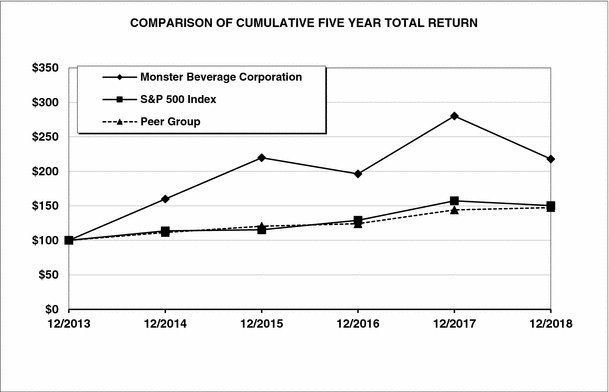
1Annual return assumes reinvestment of dividends. Cumulative total return assumes an initial investment of $100 on December 31, 2013. The Company’s self-selected peer group is comprised of TCCC, Dr Pepper Snapple Group, Inc. (through July 9, 2018), National Beverage Corporation, Jones Soda Company and PepsiCo.
Item 6. SELECTED FINANCIAL DATA
The consolidated statements of operations data set forth below with respect to each of the fiscal years ended December 31, 2016 through 2018 and the balance sheet data as of December 31, 2018 and 2017, are derived from our audited consolidated financial statements included herein, and should be read in conjunction with those financial statements and notes thereto, and with Management’s Discussion and Analysis of Financial Condition and Results of Operations included as Part II, Item 7 of this Annual Report on Form 10-K. The consolidated statements of operations data for the fiscal years ended December 31, 2015 and 2014 and the balance sheet data as of December 31, 2016, 2015 and 2014 are derived from the Company’s audited consolidated financial statements not included herein.
| (in thousands, except per share information) | 2018 | 2017 | 2016 | 2015 | 2014 | ||||||||||
|---|---|---|---|---|---|---|---|---|---|---|---|---|---|---|---|
| Net sales1,2 | $ | 3,807,183 | $ | 3,369,045 | $ | 3,049,393 | $ | 2,722,564 | $ | 2,464,867 | |||||
| Gross profit1,2 | $ | 2,295,375 | $ | 2,137,690 | $ | 1,942,000 | $ | 1,632,301 | $ | 1,339,810 | |||||
| Gross profit as a percentage to net sales | 60.3% | 63.5% | 63.7% | 60.0% | 54.4% | ||||||||||
| Operating income1,3 | $ | 1,283,619 | $ | 1,198,787 | $ | 1,085,338 | $ | 893,653 | $ | 747,505 | |||||
| Net income1,3 | $ | 993,004 | $ | 820,678 | $ | 712,685 | $ | 546,733 | $ | 483,185 | |||||
| Net income per common share: | |||||||||||||||
| Basic | $ | 1.78 | $ | 1.45 | $ | 1.21 | $ | 0.97 | $ | 0.96 | |||||
| Diluted | $ | 1.76 | $ | 1.42 | $ | 1.19 | $ | 0.95 | $ | 0.92 | |||||
| Cash, cash equivalents and investments | $ | 958,163 | $ | 1,203,921 | $ | 600,530 | $ | 2,935,375 | $ | 1,194,397 | |||||
| Total assets | $ | 4,526,891 | $ | 4,791,012 | $ | 4,153,471 | $ | 5,571,277 | $ | 1,938,875 | |||||
| Stockholders’ equity | $ | 3,610,901 | $ | 3,895,212 | $ | 3,329,709 | $ | 4,809,410 | $ | 1,515,150 |
¹ Includes $44.3 million, $43.4 million, $40.3 million, $62.8 million and $15.0 million for the years ended December 31, 2018, 2017, 2016, 2015 and 2014, respectively, related to the recognition of deferred revenue.
2 Net sales and gross profit were negatively impacted by approximately $42.2 million for the year ended December 31, 2018 as a result of the adoption of ASC 606.
3 Includes $26.6 million, $35.4 million, $79.8 million, $224.0 million and ($0.2) million for the years ended December 31, 2018, 2017, 2016, 2015 and 2014, respectively, related to expenditures attributable to the costs associated with terminating existing distributors.
Item 7. MANAGEMENT’S DISCUSSION AND ANALYSIS OF FINANCIAL CONDITION AND RESULTS OF OPERATIONS
The following Management’s Discussion and Analysis of Financial Condition and Results of Operations (“MD&A”) is provided as a supplement to – and should be read in conjunction with – our financial statements and the accompanying notes (“Notes”) included in Part II, Item 8 of this Form 10-K. This discussion contains forward-looking statements that are based on management’s current expectations, estimates and projections about our business and operations. Our actual results may differ materially from those currently anticipated and expressed in such forward-looking statements. See “Forward-Looking Statements” and “Part I, Item 1A – Risk Factors.”
This overview provides our perspective on the individual sections of MD&A. MD&A includes the following sections:
· Our Business – a general description of our business, the value drivers of our business, and opportunities and risks facing our Company, stock repurchases, acquisitions and divestitures;
· Results of Operations – an analysis of our consolidated results of operations for the three years presented in our financial statements;
· Sales – details of our sales measured on a quarterly basis in both dollars and cases;
· Inflation – information about the impact that inflation may or may not have on our results;
· Liquidity and Capital Resources – an analysis of our cash flows, sources and uses of cash and contractual obligations;
· Accounting Policies and Pronouncements – a discussion of accounting policies that require critical judgments and estimates including newly issued accounting pronouncements;
· Forward-Looking Statements – cautionary information about forward-looking statements and a description of certain risks and uncertainties that could cause our actual results to differ materially from the Company’s historical results or our current expectations or projections; and
· Market Risks – information about market risks and risk management. (See “Forward-Looking Statements” and “Part II, Item 7A – Qualitative and Quantitative Disclosures About Market Risks”).
Our Business
Overview
We develop, market, sell and distribute energy drink beverages and concentrates for energy drink beverages, primarily under the following brand names:
| · Monster Energy® · Monster Energy Ultra® · Monster Rehab® · Monster MAXX® · Java Monster® · Muscle Monster® · Espresso Monster® · Punch Monster® · Juice Monster® · Monster Hydro® · Caffé Monster® · Predator® · Live+ | · NOS® · Full Throttle® · Burn® · Mother® · Nalu® · Ultra Energy® · Play® and Power Play(stylized)® · Relentless® · BPM® · BU® · Gladiator® · Samurai® · Mutant® |
|---|
Our net sales of $3.81 billion for the year ended December 31, 2018 represented record annual net sales. Net sales of our Monster Energy® brand energy drinks were $3.49 billion for the year ended December 31, 2018. Net sales of our Strategic Brands were $285.8 million for the year ended December 31, 2018.
Net sales for the year ended December 31, 2018 were negatively impacted by approximately $42.2 million as a result of the adoption of Accounting Standards Codification (“ASC”) 606. Under ASC 606, commissions paid to TCCC, based on sales to certain of the Company’s TCCC bottlers/distributors that TCCC consolidates, or to the TCCC Related Parties, are included as a reduction to net sales. Prior to January 1, 2018, commissions based on sales to the TCCC Related Parties, were included in operating expenses.
Net changes in foreign currency exchange rates had a favorable impact on net sales in the Monster Energy® Drinks segment of approximately $14.6 million for the year ended December 31, 2018. Net changes in foreign currency exchange rates had a favorable impact on net sales in the Strategic Brands segment of approximately $0.2 million for the year ended December 31, 2018.
Our growth strategy includes expanding our international business. Gross sales to customers outside the United States amounted to $1.36 billion, $1.09 billion and $888.7 million for the years ended December 31, 2018, 2017 and 2016, respectively. Such sales were approximately 31%, 28% and 25% of gross sales for the years ended December 31, 2018, 2017 and 2016, respectively.
Our customers are primarily full service beverage bottlers/distributors, retail grocery and specialty chains, wholesalers, club stores, mass merchandisers, convenience chains, foodservice customers and the military. Percentages of our gross sales to our various customer types for the years ended December 31, 2018, 2017 and 2016 are reflected below. Such information includes sales made by us directly to the customer types concerned, which include our full service beverage bottlers/distributors in the United States. Such full service beverage bottlers/distributors in turn sell certain of our products to some of the same customer types listed below. We limit our description of our customer types to include only our sales to our full service bottlers/distributors without reference to such bottlers/distributors’ sales to their own customers.
| 2018 | 2017 | 2016 | ||||
|---|---|---|---|---|---|---|
| U.S. full service bottlers/distributors | 61% | 63% | 65% | |||
| International full service bottlers/distributors | 31% | 28% | 25% | |||
| Club stores and mass merchandisers | 6% | 7% | 8% | |||
| Retail grocery, specialty chains and wholesalers | 1% | 1% | 1% | |||
| Other | 1% | 1% | 1% |
Our customers include Coca-Cola Refreshments USA, Inc., Coca-Cola Refreshments Canada Company (Coca-Cola Canada Bottling Limited from September 28, 2018), Coca-Cola Bottling Company, CCBCC Operations, LLC, United Bottling Contracts Company, LLC, Reyes Coca-Cola Bottling, Great Lakes Coca-Cola Bottling, Coca-Cola Southwest Beverages LLC, Coca-Cola of Northern New England, Swire Coca-Cola, USA, Liberty Coca-Cola Beverages, Coca-Cola European Partners, Coca-Cola Hellenic, Coca-Cola FEMSA, Coca-Cola Amatil, Swire Coca-Cola (China), COFCO Coca-Cola, Coca-Cola Beverages Africa, Coca-Cola İçecek and certain other TCCC network bottlers, Asahi Soft Drinks, Co., Ltd., Kalil Bottling Group, Wal-Mart, Inc. (including Sam’s Club), Costco Wholesale Corporation and Big Geyser, Inc. A decision by any large customer to decrease amounts purchased from us or to cease carrying our products could have a material negative effect on our financial condition and consolidated results of operations.
TCCC, through certain consolidated subsidiaries (the “TCCC Subsidiaries”), accounted for approximately 3%, 18% and 41% of our net sales for the years ended December 31, 2018, 2017 and 2016, respectively. As part of TCCC’s North America Refranchising initiative (the “North America Refranchising”), the territories of certain TCCC Subsidiaries have been transitioned to certain independent TCCC bottlers/distributors and/or TCCC Related Parties. Accordingly, our percentage of net sales to the TCCC Subsidiaries significantly decreased for the year ended December 31, 2018.
CCBCC Operations, LLC accounted for approximately 13%, 13% and 9% of our net sales for the years ended December 31, 2018, 2017 and 2016, respectively.
Reyes Coca-Cola Bottling accounted for approximately 12%, 6% and 2% of the Company’s net sales for the years ended December 31, 2018, 2017 and 2016, respectively.
Coca-Cola European Partners accounted for approximately 10%, 9% and 9% of the Company’s net sales for the years ended December 31, 2018, 2017 and 2016, respectively.
We continue to incur expenditures in connection with the development and introduction of new products and flavors.
Value Drivers of our Business
We believe that the key value drivers of our business include the following:
· International Growth – The introduction, development and sustained profitability of our Monster Energy® brand internationally remains a key value driver for our corporate growth. One or more of our products are distributed in appr
Showing the first 8K of 101K characters. Open the full section
Item 7A. QUANTITATIVE AND QUALITATIVE DISCLOSURES ABOUT MARKET RISK
In the normal course of business our financial position is routinely subject to a variety of risks. The principal market risks (i.e., the risk of loss arising from adverse changes in market rates and prices) to which we are exposed are fluctuations in commodity and other input prices affecting the costs of our raw materials (including, but not limited to, increases in the costs of juice concentrates, increases in the price of aluminum for cans, as well as sugar and other sweeteners, glucose, sucrose, milk, cream, protein, coffee and tea, all of which are used in some or many of our products), fluctuations in energy and fuel prices, and limited availability of certain raw materials. We generally do not use hedging agreements or alternative instruments to manage the risks associated with securing sufficient ingredients or raw materials. We are also subject to market risks with respect to the cost of commodities and other inputs because our ability to recover increased costs through higher pricing is limited by the competitive environment in which we operate.
We do not use derivative financial instruments to protect ourselves from fluctuations in interest rates and generally do not hedge against fluctuations in commodity prices.
Our gross sales to customers outside of the United States were approximately 31% and 28% of consolidated gross sales for the years ended December 31, 2018 and 2017, respectively. Our growth strategy includes expanding our international business. As a result, we are subject to risks from changes in foreign currency exchange rates. During the year ended December 31, 2018, we entered into forward currency exchange contracts with financial institutions to create an economic hedge to specifically manage a portion of the foreign exchange risk exposure associated with certain consolidated subsidiaries’ non-functional currency denominated assets and liabilities. All foreign currency exchange contracts entered into by us as of December 31, 2018 have terms of three months or less. We do not enter into forward currency exchange contracts for speculation or trading purposes.
We have not designated our foreign currency exchange contracts as hedge transactions under FASB ASC 815. Therefore, gains and losses on our foreign currency exchange contracts are recognized in other expense, net, in the consolidated statements of income, and are largely offset by the changes in the fair value of the underlying economically hedged item. We do not consider the potential loss resulting from a hypothetical 10% adverse change in quoted foreign currency exchange rates as of December 31, 2018 to be significant.
As of December 31, 2018, we had $637.5 million in cash and cash equivalents and $320.7 million in short-term investments including certificates of deposit, commercial paper, U.S. government agency securities, U.S. treasuries, variable rate demand notes and municipal securities (which may have an auction reset feature). Certain of these investments are subject to general credit, liquidity, market and interest rate risks.
Item 8. FINANCIAL STATEMENTS AND SUPPLEMENTARY DATA
The information required to be furnished in response to this Item 8 follows the signature page and Index to Exhibits hereto at pages 72 through 115.
Item 9. CHANGES IN AND DISAGREEMENTS WITH ACCOUNTANTS ON ACCOUNTING AND FINANCIAL DISCLOSURE
None.
Item 9A. CONTROLS AND PROCEDURES
Evaluation of Disclosure Controls and Procedures – Under the supervision and with the participation of the Company’s management, including our Chief Executive Officer and Chief Financial Officer, we have evaluated the effectiveness of the design and operation of our disclosure controls and procedures (as defined in Rules 13(a)-15(e) and 15(d)-15(e) of the Exchange Act) as of the end of the period covered by this report. Based upon this evaluation, the Chief Executive Officer and Chief Financial Officer have concluded that our disclosure controls and procedures are effective to ensure that information we are required to disclose in reports that we file or submit under the Exchange Act is (1) recorded, processed, summarized and reported within the time periods specified in rules and forms of the SEC and (2) accumulated and communicated to our management, including our principal executive and principal financial officers as appropriate to allow timely decisions regarding required disclosures.
Management’s Report on Internal Control Over Financial Reporting – Our management is responsible for establishing and maintaining adequate internal control over financial reporting, as defined in Exchange Act Rules 13a-15(f) and 15d-15(f). Under the supervision and with the participation of our management, including our Chief Executive Officer and Chief Financial Officer, our management conducted an evaluation of the effectiveness of our internal control over financial reporting as of December 31, 2018, based on the framework in Internal Control – Integrated Framework (2013) issued by the Committee of Sponsoring Organizations of the Treadway Commission. Based on our management’s evaluation under the framework in Internal Control - Integrated Framework (2013), our management concluded that our internal control over financial reporting was effective as of December 31, 2018.
Our internal control over financial reporting as of December 31, 2018, has been audited by Deloitte & Touche LLP, an independent registered public accounting firm, as stated in their attestation report, which is included herein.
Changes in Internal Control Over Financial Reporting – There were no changes in the Company’s internal controls over financial reporting during the quarter ended December 31, 2018, that have materially affected, or are reasonably likely to materially affect, our internal control over financial reporting.
REPORT OF INDEPENDENT REGISTERED PUBLIC ACCOUNTING FIRM
To the Board of Directors and Stockholders of
Monster Beverage Corporation
Corona, California
Opinion on Internal Control over Financial Reporting
We have audited the internal control over financial reporting of Monster Beverage Corporation and subsidiaries (the “Company”) as of December 31, 2018, based on criteria established in Internal Control —Integrated Framework (2013) issued by the Committee of Sponsoring Organizations of the Treadway Commission (“COSO”). In our opinion, the Company maintained, in all material respects, effective internal control over financial reporting as of December 31, 2018, based on criteria established in Internal Control — Integrated Framework (2013) issued by COSO.
We have also audited, in accordance with the standards of the Public Company Accounting Oversight Board (United States) (“PCAOB”), the consolidated financial statements and financial statement schedule as of and for the year ended December 31, 2018, of the Company and our report dated February 28, 2019, expressed an unqualified opinion on those financial statements and financial statement schedule.
Basis for Opinion
The Company’s management is responsible for maintaining effective internal control over financial reporting and for its assessment of the effectiveness of internal control over financial reporting, included in the accompanying Management’s Report on Internal Control over Financial Reporting. Our responsibility is to express an opinion on the Company’s internal control over financial reporting based on our audit. We are a public accounting firm registered with the PCAOB and are required to be independent with respect to the Company in accordance with the U.S. federal securities laws and the applicable rules and regulations of the Securities and Exchange Commission and the PCAOB.
We conducted our audit in accordance with the standards of the PCAOB. Those standards require that we plan and perform the audit to obtain reasonable assurance about whether effective internal control over financial reporting was maintained in all material respects. Our audit included obtaining an understanding of internal control over financial reporting, assessing the risk that a material weakness exists, testing and evaluating the design and operating effectiveness of internal control based on the assessed risk, and performing such other procedures as we considered necessary in the circumstances. We believe that our audit provides a reasonable basis for our opinion.
Definition and Limitations of Internal Control over Financial Reporting
A company’s internal control over financial reporting is a process designed to provide reasonable assurance regarding the reliability of financial reporting and the preparation of financial statements for external purposes in accordance with generally accepted accounting principles. A company’s internal control over financial reporting includes those policies and procedures that (1) pertain to the maintenance of records that, in reasonable detail, accurately and fairly reflect the transactions and dispositions of the assets of the company; (2) provide reasonable assurance that transactions are recorded as necessary to permit preparation of financial statements in accordance with generally accepted accounting principles, and that receipts and expenditures of the company are being made only in accordance with authorizations of management and directors of the company; and (3) provide reasonable assurance regarding prevention or timely detection of unauthorized acquisition, use, or disposition of the company’s assets that could have a material effect on the financial statements.
Because of its inherent limitations, internal control over financial reporting may not prevent or detect misstatements. Also, projections of any evaluation of effectiveness to future periods are subject to the risk that the controls may become inadequate because of changes in conditions, or that the degree of compliance with the policies or procedures may deteriorate.
/s/ DELOITTE & TOUCHE LLP
Costa Mesa, California
February 28, 2019
Item 9B. OTHER INFORMATION
On February 26, 2019, our Board of Directors authorized a new share repurchase program for the purchase of up to $500.0 million of the Company’s outstanding common stock (the “February 2019 Repurchase Plan”). As of February 26, 2019, $20.6 million remained available for grant under the August 2018 Repurchase Plan. The aggregate amount available to repurchase the Company’s common stock is currently $520.6 million.
PART III
Item 10. DIRECTORS, EXECUTIVE OFFICERS AND CORPORATE GOVERNANCE
The information required by this item regarding our directors is included under the caption “Proposal One – Election of Directors” in our Proxy Statement for our 2019 Annual Meeting of Stockholders to be filed with the SEC within 120 days after the end of the fiscal year ended December 31, 2018 (the “2019 Proxy Statement”) and is incorporated herein by reference.
Information concerning compliance with Section 16(a) of the Exchange Act is included under the caption “Section 16(a) Beneficial Ownership Reporting Compliance” in our 2019 Proxy Statement and is incorporated herein by reference.
Information concerning the Audit Committee and the Audit Committee Financial Expert is reported under the caption “Audit Committee; Report of the Audit Committee; Duties and Responsibilities” in our 2019 Proxy Statement and is incorporated herein by reference.
Code of Business Conduct and Ethics
We have adopted a Code of Business Conduct and Ethics that applies to all our directors, officers (including our principal executive officer, principal financial officer, principal accounting officer and controllers) and employees. The Code of Business Conduct and Ethics and any amendment thereto, as well as any waivers that are required to be disclosed by the rules of the SEC or NASDAQ, may be obtained at http://investors.monsterbevcorp.com/governance.cfm or at no cost to you by writing or telephoning us at the following address or telephone number:
Monster Beverage Corporation
1 Monster Way
Corona, CA 92879
(951) 739-6200
(800) 426-7367
Item 11. EXECUTIVE COMPENSATION
Information concerning the compensation of our directors and executive officers and Compensation Committee Interlocks and Insider Participation is reported under the captions “Compensation Discussion and Analysis,” and “Compensation Committee,” respectively, in our 2019 Proxy Statement and is incorporated herein by reference.
Item 12. SECURITY OWNERSHIP OF CERTAIN BENEFICIAL OWNERS AND MANAGEMENT AND RELATED STOCKHOLDER MATTERS
The disclosure set forth in Item 5, “Market for the Registrant’s Common Equity, Related Stockholder Matters and Issuer Repurchases of Equity Securities”, of this report is incorporated herein.
Information concerning the beneficial ownership of the Company’s Common Stock of (a) those persons known to the Company to be the beneficial owners of more than 5% of the Company’s common stock; (b) each of the Company’s directors and nominees for director; and (c) the Company’s executive officers and all of the Company’s current directors and executive officers as a group is reported under the caption “Principal Stockholders and Security Ownership of Management” in our 2019 Proxy Statement and is incorporated herein by reference.
Item 13. CERTAIN RELATIONSHIPS AND RELATED TRANSACTIONS AND DIRECTOR INDEPENDENCE
Information concerning certain relationships and related transactions is reported under the caption “Certain Relationships and Related Transactions and Director Independence” in our 2019 Proxy Statement and is incorporated herein by reference.
Item 14. PRINCIPAL ACCOUNTING FEES AND SERVICES
Information concerning our accountant fees and our Audit Committee’s pre-approval of audit and permissible non-audit services of independent auditors is reported under the captions “Principal Accounting Firm Fees” and “Pre-Approval of Audit and Non-Audit Services,” respectively, in our 2019 Proxy Statement and is incorporated herein by reference.
PART IV
Item 15. EXHIBITS AND FINANCIAL STATEMENT SCHEDULES
| (a) | The following documents are filed as a part of this Form 10-K: | |||
|---|---|---|---|---|
| Report of Independent Registered Public Accounting Firm | 72 | |||
| Financial Statements: | ||||
| Consolidated Balance Sheets as of December 31, 2018 and 2017 | 73 | |||
| Consolidated Statements of Income for the years ended December 31, 2018, 2017 and 2016 | 74 | |||
| Consolidated Statements of Comprehensive Income for the years ended December 31, 2018, 2017 and 2016 | 75 | |||
| Consolidated Statements of Stockholders’ Equity for the years ended December 31, 2018, 2017 and 2016 | 76 | |||
| Consolidated Statements of Cash Flows for the years ended December 31, 2018, 2017 and 2016 | 77 | |||
| Notes to Consolidated Financial Statements | 79 | |||
| Financial Statement Schedule: Valuation and Qualifying Accounts for the years ended December 31, 2018, 2017 and 2016 | 115 | |||
| Exhibits: | ||||
| The Exhibits listed in the Index of Exhibits, which appears immediately preceding the signature page and is incorporated herein by reference, as filed as part of this Form 10-K. |
Item 16. FORM 10-K SUMMARY
None
INDEX TO EXHIBITS
The following designated exhibits, as indicated below, are either filed or furnished, as applicable herewith or have heretofore been filed or furnished with the Securities and Exchange Commission under the Securities Act of 1933, as amended, or the Securities Exchange Act of 1934, as amended, as indicated by footnote.
- Filed herewith.
+ Management
Showing the first 8K of 154K characters. Open the full section