 filings.tools
Monster Beverage 10-K 2020-12-31
Filed 2021-03-01. 22 sections, 466K characters. Original on sec.gov · Markdown · JSON
Cover and table of contents
UNITED STATES
SECURITIES AND EXCHANGE COMMISSION
Washington, D.C. 20549
Form 10-K
(Mark One)
☒ ANNUAL REPORT PURSUANT TO SECTION 13 OR 15(d) OF
THE SECURITIES EXCHANGE ACT OF 1934
For the fiscal year ended December 31, 2020
OR
☐ TRANSITION REPORT PURSUANT TO SECTION 13 OR 15(d) OF
THE SECURITIES EXCHANGE ACT OF 1934
For the transition period from _____ to _____
Commission file number 001-18761
MONSTER BEVERAGE CORPORATION
(Exact name of registrant as specified in its charter)
| Delaware | 47-1809393 | |
|---|---|---|
| (State or other jurisdiction of | | (I.R.S. Employer |
| incorporation or organization) | | Identification No.) |
1 Monster Way Corona, California 92879
(Address of principal executive offices) (Zip Code)
Registrant’s telephone number, including area code: (951) 739 - 6200
Securities registered pursuant to Section 12(b) of the Act:
| Title of each class | Trading Symbol(s) | Name of each exchange on which registered | ||
|---|---|---|---|---|
| Common Stock, $0.005 par value per share | | MNST | | Nasdaq Global Select Market |
Securities registered pursuant to Section 12(g) of the Act: None
Indicate by check mark if the registrant is a well-known seasoned issuer, as defined in Rule 405 of the Securities Act. Yes þ No ◻
Indicate by check mark if the registrant is not required to file reports pursuant to Section 13 or Section 15(d) of the Exchange Act. Yes ◻ No þ
Indicate by check mark whether the registrant: (1) has filed all reports required to be filed by Section 13 or 15(d) of the Securities Exchange Act of 1934 during the preceding 12 months (or for such shorter period that the registrant was required to file such reports), and (2) has been subject to such filing requirements for the past 90 days. Yes þ No ◻
Indicate by check mark whether the registrant has submitted electronically every Interactive Data File required to be submitted pursuant to Rule 405 of Regulation S-T (§ 232.405 of this chapter) during the preceding 12 months (or for such shorter period that the registrant was required to submit such files). Yes þ No ◻
Indicate by check mark whether the registrant is a large accelerated filer, an accelerated filer, a non-accelerated filer, a smaller reporting company, or an emerging growth company. See definitions of “large accelerated filer,” “accelerated filer,” “smaller reporting company” and “emerging growth company” in Rule 12b-2 of the Exchange Act:
| Large accelerated filer þ | Accelerated filer ◻ | |
|---|---|---|
| Non-accelerated filer ◻ | | Smaller reporting company ☐ |
| | | Emerging growth company ☐ |
If an emerging growth company, indicate by check mark if the registrant has elected not to use the extended transition period for complying with any new or revised financial accounting standards provided pursuant to Section 13(a) of the Exchange Act. ☐
Indicate by check mark whether the registrant has filed a report on and attestation to its management’s assessment of the effectiveness of its internal control over financial reporting under Section 404(b) of the Sarbanes-Oxley Act (15 U.S.C. 7262(b)) by the registered public accounting firm that prepared or issued its audit report. þ
Indicate by check mark whether the registrant is a shell company (as defined by Rule 12b-2 of the Exchange Act.). Yes ☐ No þ
The aggregate market value of the voting and non-voting common equity held by non-affiliates of the registrant was $33,039,197,262 computed by reference to the closing sale price for such stock on the Nasdaq Global Select Market on June 30, 2020, the last business day of the registrant’s most recently completed second fiscal quarter.
The number of shares of the registrant’s common stock, $0.005 par value per share (being the only class of common stock of the registrant), outstanding on February 19, 2021 was 528,137,036 shares.
DOCUMENTS INCORPORATED BY REFERENCE:
Portions of the registrant’s Definitive Proxy Statement to be filed subsequent to the date hereof with the Commission pursuant to Regulation 14A in connection with the registrant’s 2021 Annual Meeting of Stockholders are incorporated by reference into Part III of this Report. Such Definitive Proxy Statement will be filed with the Securities and Exchange Commission no later than 120 days after the conclusion of the registrant’s fiscal year ended December 31, 2020.
MONSTER BEVERAGE CORPORATION
FORM 10-K
TABLE OF CONTENTS
PART I
Item 1. BUSINESS
When this report uses the words “the Company”, “we”, “us” and “our”, these words refer to Monster Beverage Corporation and its subsidiaries, unless the context otherwise requires. Based in Corona, California, Monster Beverage Corporation is a holding company and conducts no operating business, except through its consolidated subsidiaries. The Company’s subsidiaries primarily develop and market energy drinks.
Overview
We develop, market, sell and distribute energy drink beverages and concentrates for energy drink beverages, primarily under the following brand names:
| ● Monster Energy® ● Monster Energy Ultra® ● Monster Rehab® ● Monster MAXX® ● Java Monster® ● Muscle Monster® ● Espresso Monster® ● Punch Monster® ● Juice Monster® ● Monster Hydro® Energy Water ● Monster Hydro® Super Sport ● Monster HydroSport Super Fuel® ● Monster Super Fuel® ● Monster Dragon Tea® ● Reign Total Body Fuel® ● Reign Inferno® Thermogenic Fuel | ● NOS® ● Full Throttle® ● Burn® ● Mother® ● Nalu® ● Ultra Energy® ● Play® and Power Play® (stylized) ● Relentless® ● BPM® ● BU® ● Gladiator® ● Samurai® ● Live+® ● Predator® ● Fury® |
|---|
Industry Overview
The “alternative” beverage category combines non-carbonated, ready-to-drink iced teas, lemonades, juice cocktails, single-serve juices and fruit beverages, ready-to-drink dairy and coffee drinks, energy drinks, sports drinks and single-serve still waters (flavored, unflavored and enhanced) with “new age” beverages, including sodas that are considered natural, sparkling juices and flavored sparkling beverages. According to Beverage Marketing Corporation, domestic U.S. wholesale sales in 2020 for the “alternative” beverage category of the market are estimated at approximately $60.5 billion, representing an increase of approximately 1.8% over estimated domestic U.S. wholesale sales in 2019 of approximately $59.5 billion.
Reportable Segments
We have three operating and reportable segments, (i) Monster Energy® Drinks segment (“Monster Energy® Drinks”), which is primarily comprised of our Monster Energy® drinks and Reign Total Body Fuel® high performance energy drinks, (ii) Strategic Brands segment (“Strategic Brands”), which is primarily comprised of the various energy drink brands acquired from The Coca-Cola Company (“TCCC”) in 2015 as well as our affordable energy brands, and (iii) Other segment (“Other”), which is comprised of certain products sold by American Fruits and Flavors, LLC, a wholly-owned subsidiary, to independent third-party customers (the “AFF Third-Party Products”).
Our Monster Energy® Drinks segment primarily generates net operating revenues by selling ready-to-drink packaged energy drinks primarily to bottlers and full service beverage distributors. In some cases, we sell directly to retail grocery and specialty chains, wholesalers, club stores, mass merchandisers, convenience chains, drug stores, foodservice customers, value stores, e-commerce retailers and the military.
Our Strategic Brands segment primarily generates net operating revenues by selling “concentrates” and/or “beverage bases” to authorized bottling and canning operations. Such bottlers generally combine the concentrates and/or beverage bases with sweeteners, water and other ingredients to produce ready-to-drink packaged energy drinks. The ready-to-drink packaged energy drinks are then sold to other bottlers, full service distributors or retailers, including, retail grocery and specialty chains, wholesalers, club stores, mass merchandisers, convenience chains, foodservice customers, drug stores, value stores, e-commerce retailers and the military. To a lesser extent, our Strategic Brands segment generates net operating revenues by selling certain ready-to-drink packaged energy drinks to bottlers and full service beverage distributors.
Generally, the Monster Energy® Drinks segment generates higher per case net operating revenues, but lower per case gross profit margin percentages than the Strategic Brands segment.
For certain risks with respect to our energy drinks see “Part I, Item 1A – Risk Factors” below.
Corporate History
In the 1930s, Hubert Hansen and his sons started a business selling fresh non-pasteurized juices in Los Angeles, California. In 1977, Tim Hansen, one of the grandsons of Hubert Hansen, perceived a demand for shelf stable pasteurized natural juices and juice blends and formed Hansen Foods, Inc. (“HFI”). HFI expanded its product line from juices to include Hansen’s Natural Soda® brand sodas. In 1990, California Co-Packers Corporation (d/b/a Hansen Beverage Company) (“CCC”) acquired certain assets of HFI, including the right to market the Hansen’s® brand name. In 1992, Hansen Natural Corporation acquired the Hansen’s® brand natural soda and apple juice business from CCC. Under our ownership, the Hansen’s® beverage business significantly expanded to include a wide range of beverages within the growing “alternative” beverage category including, in particular, energy drinks. In 2012, we changed our name from Hansen Natural Corporation to Monster Beverage Corporation. In 2015, we acquired various energy brands from TCCC and disposed of our non-energy drink business. In 2016, we completed our acquisition of flavor supplier and long-time business partner AFF.
2020 Product Introductions
During 2020, we continued to expand our existing energy drink portfolio by adding additional products to our portfolio in a number of countries and further developed our distribution markets. During 2020, we sold the following new products to our bottlers/distributors:
| ● | Monster Energy® Dragon Ice TeaTM Lemon (Brazil) |
|---|
| ● | Monster Energy® Dragon TeaTM (China) |
|---|
| ● | Monster Energy Ultra Fiesta® |
|---|
| ● | Monster Energy Ultra Rosa® |
|---|
| ● | Monster Energy Ultra® Watermelon |
|---|
| ● | Monster Hydro® Super Sport Blue Streak |
|---|
| ● | Monster Hydro® Super Sport Red Dawg |
|---|
| ● | Juice Monster® Khaotic® Energy + Juice |
|---|
| ● | Juice Monster® PapillonTM Energy + Juice |
|---|
| ● | Java Monster® 300 French Vanilla |
|---|
| ● | Java Monster® 300 Mocha |
|---|
| ● | Reign Total Body Fuel® Lilikoi Lychee |
|---|
| ● | Reign Inferno® Thermogenic Fuel Jalapeno Strawberry |
|---|
| ● | Reign Inferno® Thermogenic Fuel Red Dragon |
|---|
| ● | Reign Inferno® Thermogenic Fuel True BLU |
|---|
| ● | NOS® Turbo |
|---|
| ● | Burn® Dark Energy |
|---|
| ● | Burn® Peach |
|---|
| ● | Burn® Zero Raspberry |
|---|
| ● | Nalu® Black Tea & Passion Fruit |
|---|
| ● | Nalu® Green Tea & Ginger |
|---|
| ● | Fury® Gold Strike |
|---|
| ● | Ultra Energy® Peach Mango |
|---|
| ● | Ultra Energy® Zero Raspberry |
|---|
| ● | Monster Energy® Dragon’s Gold (China) |
|---|
In the normal course of business, we discontinue certain products and/or product lines. Those products or product lines discontinued in 2020, either individually or in aggregate, did not have a material adverse impact on our financial position, results of operations or liquidity.
Products – Monster Energy® Drinks Segment
Monster Energy® Drinks – a line of carbonated energy drinks. Our Monster Energy® drinks contain vitamins, minerals, nutrients, herbs and other ingredients (collectively, “supplement ingredients”). We offer the following energy drinks under the Monster Energy® drink product line: Monster Energy®, Lo-Carb Monster Energy®, Monster Assault®, Monster Energy® Fury®, Juice Monster® Khaos®, Juice Monster® Khaotic®, Juice Monster® Mango Loco®, Juice Monster® Pacific Punch®, Juice Mon
Showing the first 8K of 61K characters. Open the full section
Item 1A. RISK FACTORS
In addition to the other information in this Annual Report on Form 10-K, including Management’s Discussion and Analysis of Financial Condition and Results of Operations and the consolidated financial statements and related notes, you should carefully consider the following risks. If any of the following risks actually occur or continue to occur, our business, reputation, financial condition and/or operating results could be materially adversely affected. The risk factors summarized below are not the only risks we face. Additional risks and uncertainties not currently known to us or that we currently deem to be immaterial may also materially adversely affect our business, reputation, financial condition and/or operating results.
Risk Factors Summary
The following is a summary of the principal risks that could materially adversely affect our business, reputation, financial condition and/or operating results. You should read this summary together with the more detailed description of each risk contained below.
Operational and Industry Risks
| ● | The COVID-19 pandemic has had, and we expect will continue to have, certain impacts on our business and operations. Such impacts may have a material adverse or other effect on our business and results of operations. |
|---|
| ● | The Company and TCCC have extensive commercial arrangements and, as a result, the Company’s future performance is substantially dependent on the success of its relationship with TCCC. |
|---|
| ● | Provisions in our organizational documents and control by insiders may prevent changes in control even if such changes would be beneficial to other stockholders. |
|---|
| ● | We rely on bottlers and other contract packers to manufacture our products. If we are unable to maintain good relationships with our bottlers and contract packers and/or their ability to manufacture our products becomes constrained or unavailable to us, our business could suffer. |
|---|
| ● | We rely on bottlers and distributors to distribute our products. If we are unable to maintain good relationships with our existing bottlers and distributors and/or secure such bottlers and distributors, our business could suffer. |
|---|
| ● | We derive virtually all of our revenues from energy drinks, and competitive pressure in the energy drink category could adversely affect our business and operating results. |
|---|
| ● | Criticism of our energy drink products and/or criticism or a negative perception of energy drinks generally, could adversely affect us. |
|---|
| ● | Increased competition in the beverage industry and changing retail landscape could hurt our business. |
|---|
| ● | Our inability to innovate successfully and to provide new cutting edge products could adversely affect our business and financial results. |
|---|
| ● | Changes in consumer product and shopping preferences may reduce demand for some of our products. |
|---|
| ● | Our continued expansion outside of the United States exposes us to uncertain conditions and other risks in international markets. |
|---|
| ● | If we are not able to pass on increases in the costs of raw materials, including aluminum cans and/or ingredients and/or fuel and/or costs of co-packing, such inability could harm our business and result in a higher cost base. Shortages of raw materials including aluminum cans and/or ingredients and/or fuel and/or costs of co-packing could have a material adverse effect on our business and results of operations. |
|---|
| ● | Our failure to accurately estimate demand for our products or maintain sufficient inventory levels could adversely affect our business and financial results. |
|---|
| ● | The costs of packaging supplies are subject to price increases from time to time, and we may be unable to pass all or some of such increased costs on to our customers. |
|---|
| ● | Global or regional catastrophic events could impact our operations and affect our ability to grow our business. |
|---|
| ● | Climate change and natural disasters may negatively affect our business. |
|---|
| ● | If we are not able to retain the full-time services of senior management, there may be an adverse effect on our operations and/or our operating performance until we find suitable replacements. |
|---|
| ● | Negative publicity (whether or not warranted) could damage our brand image and corporate reputation, and may cause our business to suffer. |
|---|
Government Regulation and Litigation Risks
| ● | Changes in government regulation, or failure to comply with existing regulations, could adversely affect our business, financial condition and results of operations. |
|---|
| ● | We cannot predict the effect of possible inquiries from and/or actions by attorneys general, other government agencies and/or quasi-government agencies into the production, advertising, marketing, promotion, labeling, ingredients, usage and/or sale of our energy drink products. |
|---|
| ● | Litigation regarding our products, and related unfavorable media attention, could expose us to significant liabilities and reduce demand for our products, thus negatively affecting our financial results. |
|---|
| ● | If we encounter material product recalls, our business may suffer material losses and such recalls could damage our brand image and corporate reputation, also potentially resulting in material losses. |
|---|
Intellectual Property, Information Technology and Data Privacy Risks
| ● | Our intellectual property rights are critical to our success, and the loss of such rights could materially adversely affect our business. |
|---|
| ● | We must continually maintain, protect and/or upgrade our information technology systems, including protecting us from internal and external cybersecurity threats. |
|---|
| ● | If we fail to comply with data privacy and personal data protection laws, we could be subject to adverse publicity, government enforcement actions and/or private litigation, which may negatively impact our business and operating results. |
|---|
Financial Risks
| ● | Fluctuations in our effective tax rate could adversely affect our financial condition and results of operations. |
|---|
| ● | We may be required in the future to record a significant charge to earnings if our goodwill or intangible assets become impaired. |
|---|
| ● | Fluctuations in foreign currency exchange rates may adversely affect our operating results. |
|---|
| ● | Potential changes in accounting standards or practices and/or taxation may adversely affect our financial results. |
|---|
| ● | If we fail to maintain effective disclosure controls and procedures and internal control over financial reporting on a consolidated basis, our stock price and investor confidence in the Company could be materially and adversely affected. |
|---|
| ● | Uncertainty in the financial markets and other adverse changes in general economic or political conditions in any of the major countries in which we do business could adversely affect our industry, business and results of operations. |
|---|
| ● | Default by or failure of one or more of our counterparty financial institutions could cause us to incur significant losses. |
|---|
| ● | Volatility of stock price may restrict sale opportunities. |
|---|
| ● | Our investments are subject to risks which may cause losses and affect the liquidity of these investments. |
|---|
Showing the first 8K of 82K characters. Open the full section
Item 1B. UNRESOLVED STAFF COMMENTS
Not applicable.
Item 2. PROPERTIES
Our principal properties include our corporate headquarters as well as our Southern California warehouse and distribution center.
Our owned corporate facilities located in Corona, California, consist of (i) an approximately 141,000 square-foot, free-standing, six-story building (ENERGY STAR certified), (ii) an approximately 147,625 square-foot three-story parking structure and storage facility, which houses our approximately 14,000 square-foot quality control laboratory, (iii) an approximately 75,426 square foot, free-standing, three-story building (pursuing ENERGY STAR certification), (iv) an approximately 20,661 square-foot, free-standing, single-story building and (v) an approximately 49,617 square-foot, free-standing, two-story building.
Our owned Southern California warehouse and distribution center is located in Rialto, California, consisting of an approximately 1,000,000 square-foot building which is LEED certified.
During 2020, we purchased a three-story office building located in Uxbridge, United Kingdom.
During 2019, we acquired a manufacturing plant and adjoining land in Athy, County Kildare, Ireland. We intend to utilize the facility to produce and supply ingredients for certain of our international markets.
During 2019, we purchased approximately 7.66 acres of land in San Fernando, California. We are in the process of constructing a new production facility in order to consolidate AFF’s operations into a single location.
In addition, we lease many smaller office and/or warehouse spaces, both domestically and in certain international locations.
Item 3. LEGAL PROCEEDINGS
From time to time in the normal course of business, the Company is named in litigation, including labor and employment matters, personal injury matters, consumer class actions, intellectual property matters and claims from prior distributors. Although it is not possible to predict the ultimate outcome of such litigation, based on the facts known to the Company, management believes that such litigation in aggregate will likely not have a material adverse effect on the Company’s financial position or results of operations.
On September 18, 2020, a derivative complaint was filed on purported behalf of the Company in the United States District Court for the Central District of California. The action is styled Falat v. Sacks, et al., 8:20-cv-01782, and asserts claims against certain officers, current and former directors, and employees of the Company, including Rodney C. Sacks, Hilton H. Schlosberg, Guy P. Carling, Thomas J. Kelly, Emelie C. Tirre, Mark J. Hall, Kathleen E. Ciaramello, Gary P. Fayard, Jeanne P. Jackson, Steven G. Pizula, Benjamin M. Polk, Sydney Selati and Mark S. Vidergauz (collectively, the “Individual Defendants”). The Company is named as a nominal defendant.
The derivative complaint alleges, among other things, that the Individual Defendants breached their fiduciary duties to the Company by allowing others to cause, or themselves causing, the Company to hide discrimination and failing to ensure sufficient diversity, including by permitting conduct to occur that was inconsistent with statements made in the Company’s policies and disclosures, and failing to ensure the Company’s compliance with laws regarding diversity and anti-discrimination. The complaint also asserts claims for abuse of control, unjust enrichment and violation of Section 14(a) of the Securities Exchange Act of 1934, as amended (the “Exchange Act”). The complaint seeks from the Individual Defendants an unspecified amount of damages, restitution, punitive damages and costs to be paid to the Company, and seeks to require the Company to adopt corporate governance reforms, and other equitable relief.
On January 15, 2021, the Company filed a motion to dismiss the action because the plaintiff failed to make a demand on the Company as required by Federal Rule of Civil Procedure 23.1 or to show that demand would have been futile. The Individual Defendants also filed a motion to dismiss the complaint for failure to state a claim against the Individual Defendants, among other reasons. Those motions are scheduled for hearing in the 2021 second quarter. While the Company continues to evaluate these claims, management believes that such litigation will likely not have a material adverse effect on the Company’s financial position or results of operations.
The Company evaluates, on a quarterly basis, developments in legal proceedings and other matters that could cause an increase or decrease in the amount of the liability that is accrued, if any, and any related insurance reimbursements. As of December 31, 2020, the Company’s consolidated balance sheet included accrued loss contingencies of approximately $18.4 million.
Item 4. MINE SAFETY DISCLOSURES
Not applicable.
PART II
Item 5. MARKET FOR THE REGISTRANT’S COMMON EQUITY, RELATED STOCKHOLDER MATTERS AND ISSUER PURCHASES OF EQUITY SECURITIES
Principal Market
The Company’s common stock trades on the Nasdaq Global Select Market under the symbol, “MNST”. As of February 19, 2021, there were 528,137,036 shares of the Company’s common stock outstanding held by approximately 188 holders of record. The holders of record do not include those stockholders whose shares are held of record by banks, brokers and other financial institutions.
Stock Price and Dividend Information
We have not paid cash dividends to our stockholders since our inception and do not anticipate paying cash dividends in the foreseeable future.
On February 26, 2019, the Company’s Board of Directors authorized a share repurchase program for the purchase of up to $500.0 million of the Company’s outstanding common stock (the “February 2019 Repurchase Plan”). During the year ended December 31, 2020, the Company purchased 0.6 million shares of common stock at an average purchase price of $58.16 per share, for a total amount of $36.6 million (excluding broker commissions), which exhausted the availability under the February 2019 Repurchase Plan. Such shares are included in common stock in treasury in the accompanying consolidated balance sheet at December 31, 2020.
On November 6, 2019, the Company’s Board of Directors authorized a new share repurchase program for the purchase of up to $500.0 million of the Company’s outstanding common stock (the “November 2019 Repurchase Plan”). During the year ended December 31, 2020, the Company purchased 9.1 million shares of common stock at an average purchase price of $54.86 per share, for a total amount of $499.9 million (excluding broker commissions), which exhausted the availability under the November 2019 Repurchase Plan. Such shares are included in common stock in treasury in the accompanying consolidated balance sheet at December 31, 2020.
On March 13, 2020, the Company’s Board of Directors authorized a new share repurchase program for the purchase of up to $500.0 million of the Company’s outstanding common stock (the “March 2020 Repurchase Plan”). During the year ended December 31, 2020, the Company purchased 1.0 million shares of common stock at an average purchase price of $55.85 per share, for a total amount of $58.5 million (excluding broker commissions), under the March 2020 Repurchase Plan. Such shares are included in common stock in treasury in the accompanying consolidated balance sheet at December 31, 2020. As of March 1, 2021, $441.5 million remained available for repurchase under the March 2020 Repurchase Plan.
During the year ended December 31, 2020, 0.02 million shares of common stock were purchased from employees in lieu of cash payments for options exercised or withholding taxes due for a total amount of $1.0 million. While such purchases are considered common stock repurchases, they are not counted as purchases against the Company’s authorized share repurchase programs. Such shares are included in common stock in treasury in the accompanying consolidated balance sheet at December 31, 2020.
No shares were repurchased during the quarter ended December 31, 2020.
Performance Graph
The following graph shows a five-year comparison of cumulative total returns:1
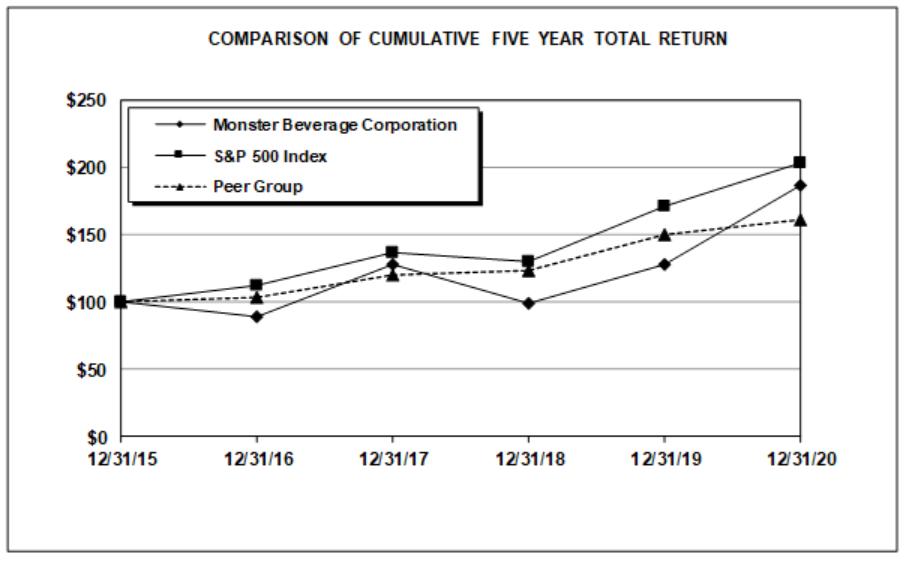
1Annual return assumes reinvestment of dividends. Cumulative total return assumes an initial investment of $100 on December 31, 2015. The Company’s self-selected peer group is comprised of TCCC, Dr. Pepper Snapple Group, Inc. (through July 9, 2018), Keurig Dr. Pepper Inc. (after July 10, 2018), National Beverage Corporation, Jones Soda Company and PepsiCo, Inc.
Item 6. SELECTED FINANCIAL DATA
The consolidated statements of operations data set forth below with respect to each of the fiscal years ended December 31, 2018 through 2020 and the balance sheet data as of December 31, 2020 and 2019, are derived from our audited consolidated financial statements included herein, and should be read in conjunction with those financial statements and notes thereto, and with Management’s Discussion and Analysis of Financial Condition and Results of Operations included as Part II, Item 7 of this Annual Report on Form 10-K. The consolidated statements of operations data for the fiscal years ended December 31, 2017 and 2016 and the balance sheet data as of December 31, 2018, 2017 and 2016 are derived from the Company’s audited consolidated financial statements not included herein.
| | | | | | | | | | | | | | | | |
|---|---|---|---|---|---|---|---|---|---|---|---|---|---|---|---|
| (in thousands, except per share information) | | 2020 | | 2019 | | 2018 | | 2017 | | 2016 | |||||
| Net sales1 | | $ | 4,598,638 | | $ | 4,200,819 | | $ | 3,807,183 | | $ | 3,369,045 | | $ | 3,049,393 |
| Gross profit1 | | $ | 2,723,880 | | $ | 2,518,585 | | $ | 2,295,375 | | $ | 2,137,690 | | $ | 1,942,000 |
| Gross profit as a percentage to net sales | | | 59.2% | | | 60.0% | | | 60.3% | | | 63.5% | | | 63.7% |
| Operating income1,2 | | $ | 1,633,153 | | $ | 1,402,939 | | $ | 1,283,619 | | $ | 1,198,787 | | $ | 1,085,338 |
| Net income1,2 | | $ | 1,409,594 | | $ | 1,107,835 | | $ | 993,004 | | $ | 820,678 | | $ | 712,685 |
| Net income per common share: | | | | | | | |||||||||
| Basic | | $ | 2.66 | | $ | 2.04 | | $ | 1.78 | | $ | 1.45 | | $ | 1.21 |
| Diluted | | $ | 2.64 | | $ | 2.03 | | $ | 1.76 | | $ | 1.42 | | $ | 1.19 |
| Cash, cash equivalents and investments | | $ | 2,106,058 | | $ | 1,343,925 | | $ | 958,163 | | $ | 1,203,921 | | $ | 600,530 |
| Total assets | | $ | 6,202,716 | | $ | 5,150,352 | | $ | 4,526,891 | | $ | 4,791,012 | | $ | 4,153,471 |
| Stockholders’ equity | | $ | 5,160,860 | | $ | 4,171,281 | | $ | 3,610,901 | | $ | 3,895,212 | | $ | 3,329,709 |
¹ Includes $42.1 million, $46.3 million, $44.3 million, $43.4 million and $40.3 million for the years ended December 31, 2020, 2019, 2018, 2017 and 2016, respectively, related to the recognition of deferred revenue.
2 Includes $0.2 million, $11.3 million, $26.6 million, $35.4 million and $79.8 million for the years ended December 31, 2020, 2019, 2018, 2017 and 2016, respectively, related to expenditures attributable to the costs associated with terminating existing distributors_._
Item 7. MANAGEMENT’S DISCUSSION AND ANALYSIS OF FINANCIAL CONDITION AND RESULTS OF OPERATIONS
The following Management’s Discussion and Analysis of Financial Condition and Results of Operations (“MD&A”) is provided as a supplement to – and should be read in conjunction with – our financial statements and the accompanying notes (“Notes”) included in Part II, Item 8 of this Form 10-K. This discussion contains forward-looking statements that are based on management’s current expectations, estimates and projections about our business and operations. Our actual results may differ materially from those currently anticipated and expressed in such forward-looking statements. See “Forward-Looking Statements” and “Part I, Item 1A – Risk Factors.”
This overview provides our perspective on the individual sections of MD&A. MD&A includes the following sections:
| ● | The COVID-19 Pandemic – a discussion of the impact of the COVID-19 pandemic on our business employees and operations; |
|---|
| ● | Our Business – a general description of our business, the value drivers of our business, and opportunities and risks facing our Company, stock repurchases, acquisitions and divestitures; |
|---|
| ● | Results of Operations – an analysis of our consolidated results of operations for the three years presented in our financial statements; |
|---|
| ● | Sales – details of our sales measured on a quarterly basis in both dollars and cases; |
|---|
| ● | Inflation – information about the impact that inflation may or may not have on our results; |
|---|
| ● | Liquidity and Capital Resources – an analysis of our cash flows, sources and uses of cash and contractual obligations; |
|---|
| ● | Accounting Policies and Pronouncements – a discussion of accounting policies that require critical judgments and estimates including newly issued accounting pronouncements; |
|---|
| ● | Forward-Looking Statements – cautionary information about forward-looking statements and a description of certain risks and uncertainties that could cause our actual results to differ materially from the Company’s historical results or our current expectations or projections; and |
|---|
| ● | Market Risks – information about market risks and risk management. (See “Forward-Looking Statements” and “Part II, Item 7A – Qualitative and Quantitative Disclosures About Market Risks”). |
|---|
The COVID – 19 Pandemic
The current COVID-19 pandemic has presented a substantial public health and economic challenge around the world and is affecting our employees, communities and business operations, as well as the global economy and financial markets. The human and economic consequences of the COVID-19 pandemic as well as the measures taken or that may be taken in the future by governments, and consequently businesses (including the Company and its suppliers, full service beverage bottlers/distributors (“bottlers/distributors”), co-packers and other service providers) and the public at large to limit the COVID-19 pandemic, has directly and indirectly impacted our business. The duration and severity of this impact will depend on future developments that are highly uncertain and cannot be accurately predicted, including new information that may emerge concerning the COVID-19 pandemic, the actions taken to limit its spread and the economic impact on local, regional, national and international markets. See “Part I, Item 1A – Risk Factors.”
We have been actively addressing the COVID-19 pandemic with a global task force team working to mitigate the potential impacts to our people and business.
Health and Safety of our Employees and Business Partners
From the beginning of the COVID-19 pandemic, our top priority has been the health, safety and well-being of our employees. Early in March 2020, we implemented global travel restrictions and work-from-home policies for employees who are able to work remotely. For those employees who are unable to work remotely, safety precautions have been instituted, which were developed and adopted in line with guidance from public health authorities and professional consultants. Currently, certain of our offices have partially reopened in the U.S. and in certain countries, and generally, our field sales teams are working with our bottler/distributors and retailers subject to certain safety protocols. During the COVID-19 pandemic, we have taken a number of steps to support our employees, including increasing employee communications, including topics such as mental health and family welfare; creating wellness hotlines and enhancing employee assistance programs; and conducting employee surveys to evaluate employee morale. We are incredibly proud of the teamwork exhibited by our employees, co-packers and bottlers/distributors around the world who are ensuring the integrity of our supply chain.
Customer Demand
Despite the ongoing impact of the COVID-19 pandemic, we achieved record fourth quarter net sales. While the performance in Europe, Middle East and Africa (“EMEA”) was solid in the fourth quarter, EMEA remained adversely affected by the COVID-19 pandemic.
Since mid-March 2020, we have seen a shift in consumer channel preferences and package configurations, including an increase in at-home consumption and a decrease in food service on-premise consumption. Our sales in the 2020 second quarter were initially adversely affected as a result of a decrease in foot traffic in the convenience and gas channel (which is our largest channel) but improved sequentially from the latter half of the 2020 second quarter and throughout the 2020 third and fourth quarters. Our e-commerce, club store, mass merchandiser and grocery and related business continued to increase in 2020, while our food service on-premise business, which is a small channel for the Company, remained challenged. The duration of these trends and the magnitude of such impacts on future periods cannot be precisely estimated at this time, as they are affected by a number of factors (many of which are outside our control).
We have recently seen a resurgence of the COVID-19 pandemic in the Northern Hemisphere while cases in the Southern Hemisphere continue to increase. As a result, a number of countries, particularly in EMEA, have reinstituted lockdowns and other restrictions, which could further impact customer demand.
A reduction in demand for our products or changes in consumer purchasing and consumption patterns, as well as continued economic uncertainty as a result of the COVID-19 pandemic, could adversely affect the financial conditions of retailers and consumers, resulting in reduced or canceled orders for our products, purchase returns and closings of retail or wholesale establishments or other locations in which our products are sold.
Our Distribution and Supply Chain
As of the date of this filing, we do not foresee a material impact on the ability of our co-packers to manufacture and our bottlers/distributors to distribute our products as a result of the COVID-19 pandemic. We are continually addressing the increase in our aluminum can requirements given our volume growth and the current supply constraints in the aluminum can industry. Overall, we are not experiencing significant raw material or finished product shortages and our supply chain remains intact. Depending on the duration of any COVID-19 pandemic related issues, we may experience material disruptions in our supply chain as the pandemic continues.
Liquidity and Capital Resources
As of the date of this filing, we expect to maintain substantial liquidity as we manage through the current environment as described in the “Liquidity and Capital Resources” section below.
Our Business
Overview
We develop, market, sell and distribute energy drink beverages and concentrates for energy drink beverages, primarily under the following brand names:
| ● Monster Energy® ● Monster En
Showing the first 8K of 118K characters. Open the full section
Item 7A. QUANTITATIVE AND QUALITATIVE DISCLOSURES ABOUT MARKET RISK
In the normal course of business our financial position is routinely subject to a variety of risks. The principal market risks (i.e., the risk of loss arising from adverse changes in market rates and prices) to which we are exposed are fluctuations in commodity and other input prices affecting the costs of our raw materials (including, but not limited to, increases in the costs of juice concentrates, increases in the price of aluminum cans, as well as sugar, sucralose and other sweeteners, glucose, sucrose, milk, cream, protein, coffee and tea, all of which are used in some or many of our products), fluctuations in energy and fuel prices, and limited availability of aluminum cans and certain other raw materials. We generally do not use hedging agreements or alternative instruments to manage the risks associated with securing sufficient ingredients or raw materials. We are also subject to market risks with respect to the cost of commodities and other inputs because our ability to recover increased costs through higher pricing is limited by the competitive environment in which we operate.
We do not use derivative financial instruments to protect ourselves from fluctuations in interest rates and generally do not hedge against fluctuations in commodity prices.
Our net sales to customers outside of the United States were approximately 33% and 32% of consolidated net sales for the years ended December 31, 2020 and 2019, respectively. Our growth strategy includes expanding our international business. As a result, we are subject to risks from changes in foreign currency exchange rates. During the year ended December 31, 2020, we entered into forward currency exchange contracts with financial institutions to create an economic hedge to specifically manage a portion of the foreign exchange risk exposure associated with certain consolidated subsidiaries’ non-functional currency denominated assets and liabilities. All foreign currency exchange contracts entered into by us as of December 31, 2020 have terms of three months or less. We do not enter into forward currency exchange contracts for speculation or trading purposes.
We have not designated our foreign currency exchange contracts as hedge transactions under FASB ASC 815. Therefore, gains and losses on our foreign currency exchange contracts are recognized in other income, net, in the consolidated statements of income, and are largely offset by the changes in the fair value of the underlying economically hedged item. We do not consider the potential loss resulting from a hypothetical 10% adverse change in quoted foreign currency exchange rates as of December 31, 2020 to be significant.
As of December 31, 2020, we had $1.18 billion in cash and cash equivalents and $925.6 million in short-term and long-term investments including certificates of deposit, commercial paper, U.S. government agency securities, U.S. treasuries, and to a lesser extent, municipal securities. Certain of these investments are subject to general credit, liquidity, market and interest rate risks.
Item 8. FINANCIAL STATEMENTS AND SUPPLEMENTARY DATA
The information required to be furnished in response to this Item 8 follows the signature page and Index to Exhibits hereto at pages 79 through 126.
Item 9. CHANGES IN AND DISAGREEMENTS WITH ACCOUNTANTS ON ACCOUNTING AND FINANCIAL DISCLOSURE
None.
Item 9A. CONTROLS AND PROCEDURES
Evaluation of Disclosure Controls and Procedures – Under the supervision and with the participation of the Company’s management, including our Co-Chief Executive Officers and Chief Financial Officer, we have evaluated the effectiveness of the design and operation of our disclosure controls and procedures (as defined in Rules 13(a)-15(e) and 15(d)-15(e) of the Exchange Act) as of the end of the period covered by this report. Based upon this evaluation, the Co-Chief Executive Officers and Chief Financial Officer have concluded that our disclosure controls and procedures are effective to ensure that information we are required to disclose in reports that we file or submit under the Exchange Act is (1) recorded, processed, summarized and reported within the time periods specified in rules and forms of the SEC and (2) accumulated and communicated to our management, including our principal executive and principal financial officers as appropriate to allow timely decisions regarding required disclosures.
Management’s Report on Internal Control Over Financial Reporting – Our management is responsible for establishing and maintaining adequate internal control over financial reporting, as defined in Exchange Act Rules 13a-15(f) and 15d-15(f). Under the supervision and with the participation of our management, including our Co-Chief Executive Officers and Chief Financial Officer, our management conducted an evaluation of the effectiveness of our internal control over financial reporting as of December 31, 2020, based on the framework in Internal Control – Integrated Framework (2013) issued by the Committee of Sponsoring Organizations of the Treadway Commission. Based on our management’s evaluation under the framework in Internal Control - Integrated Framework (2013), our management concluded that our internal control over financial reporting was effective as of December 31, 2020.
Our internal control over financial reporting as of December 31, 2020, has been audited by Deloitte & Touche LLP, an independent registered public accounting firm, as stated in their attestation report, which is included herein.
Changes in Internal Control Over Financial Reporting – There were no changes in the Company’s internal controls over financial reporting during the quarter ended December 31, 2020, that have materially affected, or are reasonably likely to materially affect, our internal control over financial reporting.
REPORT OF INDEPENDENT REGISTERED PUBLIC ACCOUNTING FIRM
To the Board of Directors and Stockholders of
Monster Beverage Corporation
Corona, California
Opinion on Internal Control over Financial Reporting
We have audited the internal control over financial reporting of Monster Beverage Corporation and subsidiaries (the “Company”) as of December 31, 2020, based on criteria established in Internal Control —Integrated Framework (2013) issued by the Committee of Sponsoring Organizations of the Treadway Commission (“COSO”). In our opinion, the Company maintained, in all material respects, effective internal control over financial reporting as of December 31, 2020, based on criteria established in Internal Control — Integrated Framework (2013) issued by COSO.
We have also audited, in accordance with the standards of the Public Company Accounting Oversight Board (United States) (“PCAOB”), the consolidated financial statements and financial statement schedule as of and for the year ended December 31, 2020, of the Company and our report dated March 1, 2021, expressed an unqualified opinion on those financial statements.
Basis for Opinion
The Company’s management is responsible for maintaining effective internal control over financial reporting and for its assessment of the effectiveness of internal control over financial reporting, included in the accompanying Management’s Report on Internal Control Over Financial Reporting. Our responsibility is to express an opinion on the Company’s internal control over financial reporting based on our audit. We are a public accounting firm registered with the PCAOB and are required to be independent with respect to the Company in accordance with the U.S. federal securities laws and the applicable rules and regulations of the Securities and Exchange Commission and the PCAOB.
We conducted our audit in accordance with the standards of the PCAOB. Those standards require that we plan and perform the audit to obtain reasonable assurance about whether effective internal control over financial reporting was maintained in all material respects. Our audit included obtaining an understanding of internal control over financial reporting, assessing the risk that a material weakness exists, testing and evaluating the design and operating effectiveness of internal control based on the assessed risk, and performing such other procedures as we considered necessary in the circumstances. We believe that our audit provides a reasonable basis for our opinion.
Definition and Limitations of Internal Control over Financial Reporting
A company’s internal control over financial reporting is a process designed to provide reasonable assurance regarding the reliability of financial reporting and the preparation of financial statements for external purposes in accordance with generally accepted accounting principles. A company’s internal control over financial reporting includes those policies and procedures that (1) pertain to the maintenance of records that, in reasonable detail, accurately and fairly reflect the transactions and dispositions of the assets of the company; (2) provide reasonable assurance that transactions are recorded as necessary to permit preparation of financial statements in accordance with generally accepted accounting principles, and that receipts and expenditures of the company are being made only in accordance with authorizations of management and directors of the company; and (3) provide reasonable assurance regarding prevention or timely detection of unauthorized acquisition, use, or disposition of the company’s assets that could have a material effect on the financial statements.
Because of its inherent limitations, internal control over financial reporting may not prevent or detect misstatements. Also, projections of any evaluation of effectiveness to future periods are subject to the risk that the controls may become inadequate because of changes in conditions, or that the degree of compliance with the policies or procedures may deteriorate.
/s/ DELOITTE & TOUCHE LLP
Costa Mesa, California
March 1, 2021
Item 9B. OTHER INFORMATION
None.
PART III
Item 10. DIRECTORS, EXECUTIVE OFFICERS AND CORPORATE GOVERNANCE
The information required by this item regarding our directors is included under the caption “Proposal One – Election of Directors” in our Proxy Statement for our 2021 Annual Meeting of Stockholders to be filed with the SEC within 120 days after the end of the fiscal year ended December 31, 2020 (the “2021 Proxy Statement”) and is incorporated herein by reference.
Information concerning compliance with Section 16(a) of the Exchange Act is included under the caption “Delinquent Section 16(a) Reports” in our 2021 Proxy Statement and is incorporated herein by reference.
Information concerning the Audit Committee and the Audit Committee Financial Expert is reported under the caption “Audit Committee; Report of the Audit Committee; Duties and Responsibilities” in our 2021 Proxy Statement and is incorporated herein by reference.
Code of Business Conduct and Ethics
We have adopted a Code of Business Conduct and Ethics that applies to all our directors, officers (including our principal executive officers, principal financial officer, principal accounting officer and controllers) and employees. The Code of Business Conduct and Ethics and any amendment thereto, as well as any waivers that are required to be disclosed by the rules of the SEC or NASDAQ, may be obtained at http://investors.monsterbevcorp.com/corporate-governance or at no cost to you by writing or telephoning us at the following address or telephone number:
Monster Beverage Corporation
1 Monster Way
Corona, CA 92879
(951) 739-6200
(800) 426-7367
Item 11. EXECUTIVE COMPENSATION
Information concerning the compensation of our directors and executive officers and Compensation Committee Interlocks and Insider Participation is reported under the captions “Compensation Discussion and Analysis,” and “Compensation Committee,” respectively, in our 2021 Proxy Statement and is incorporated herein by reference.
Item 12. SECURITY OWNERSHIP OF CERTAIN BENEFICIAL OWNERS AND MANAGEMENT AND RELATED STOCKHOLDER MATTERS
The disclosure set forth in Item 5, “Market for the Registrant’s Common Equity, Related Stockholder Matters and Issuer Repurchases of Equity Securities”, of this report is incorporated herein.
Information concerning the beneficial ownership of the Company’s Common Stock of (a) those persons known to the Company to be the beneficial owners of more than 5% of the Company’s common stock; (b) each of the Company’s directors and nominees for director; and (c) the Company’s executive officers and all of the Company’s current directors and executive officers as a group is reported under the caption “Principal Stockholders and Security Ownership of Management” in our 2021 Proxy Statement and is incorporated herein by reference.
Information concerning shares of the Company’s Common Stock authorized for issuance under the Company’s equity compensation plans is reported under the caption “Employee Equity Compensation Plan Information” in our 2021 Proxy Statement and is incorporated herein by reference.
Item 13. CERTAIN RELATIONSHIPS AND RELATED TRANSACTIONS AND DIRECTOR INDEPENDENCE
Information concerning certain relationships and related transactions is reported under the caption “Certain Relationships and Related Transactions and Director Independence” in our 2021 Proxy Statement and is incorporated herein by reference.
Item 14. PRINCIPAL ACCOUNTING FEES AND SERVICES
Information concerning our accountant fees and our Audit Committee’s pre-approval of audit and permissible non-audit services of independent auditors is reported under the captions “Principal Accounting Firm Fees” and “Pre-Approval of Audit and Non-Audit Services,” respectively, in our 2021 Proxy Statement and is incorporated herein by reference.
PART IV
Item 15. EXHIBITS AND FINANCIAL STATEMENT SCHEDULES
| (a) | The following documents are filed as a part of this Form 10-K: |
|---|
| | | | ||
|---|---|---|---|---|
| | | Report of Independent Registered Public Accounting Firm | | 80 |
| | | | | |
| | | Financial Statements: | | |
| | | Consolidated Balance Sheets as of December 31, 2020 and 2019 | | 83 |
| | | Consolidated Statements of Income for the years ended December 31, 2020, 2019 and 2018 | | 84 |
| | | Consolidated Statements of Comprehensive Income for the years ended December 31, 2020, 2019 and 2018 | | 85 |
| | | Consolidated Statements of Stockholders’ Equity for the years ended December 31, 2020, 2019 and 2018 | | 86 |
| | | Consolidated Statements of Cash Flows for the years ended December 31, 2020, 2019 and 2018 | | 87 |
| | | Notes to Consolidated Financial Statements | | 89 |
| | | | | |
| | | Financial Statement Schedule: | | |
| | | Valuation and Qualifying Accounts for the years ended December 31, 2020, 2019 and 2018 | | 126 |
| | | | | |
| | | Exhibits: | | |
| | | The Exhibits listed in the Index of Exhibits, which appears immediately preceding the signature page and is incorporated herein by reference, as filed as part of this Form 10-K. | | |
Item 16. FORM 10-K SUMMARY
None
INDEX TO EXHIBITS
The following designated exhibits, as indicated below, are either filed or furnished, as applicable herewith or have heretofore been filed or furnished with the Securities and Exchange Commission under the Securities Act of 1933, as amended, or the Securities Exchange Act of 1934, as amended, as indicated by footnote.
Showing the first 8K of 171K characters. Open the full section