 filings.tools
Altria Group 10-K 2022-12-31
Filed 2023-02-27. 23 sections, 584K characters. Original on sec.gov · Markdown · JSON
Cover and table of contents
UNITED STATES
SECURITIES AND EXCHANGE COMMISSION
Washington, D.C. 20549
FORM 10-K
☒ ANNUAL REPORT PURSUANT TO SECTION 13 OR 15(d) OF THE SECURITIES EXCHANGE ACT OF 1934
For the fiscal year ended December 31, 2022
OR
☐ TRANSITION REPORT PURSUANT TO SECTION 13 OR 15(d) OF THE SECURITIES EXCHANGE ACT OF 1934
For the transition period from to
Commission File Number 1-08940
ALTRIA GROUP, INC.
(Exact name of registrant as specified in its charter)
| Virginia | 13-3260245 | ||||||||||
| (State or other jurisdiction of incorporation or organization) | (I.R.S. Employer Identification No.) | ||||||||||
| 6601 West Broad Street, | Richmond, | Virginia | 23230 | ||||||||
| (Address of principal executive offices) | (Zip Code) |
804-274-2200
(Registrant’s telephone number, including area code)
Securities registered pursuant to Section 12(b) of the Act:
| Title of each class | Trading Symbols | Name of each exchange on which registered | ||||||
| Common Stock, $0.33 1/3 par value | MO | New York Stock Exchange | ||||||
| 1.700% Notes due 2025 | MO25 | New York Stock Exchange | ||||||
| 2.200% Notes due 2027 | MO27 | New York Stock Exchange | ||||||
| 3.125% Notes due 2031 | MO31 | New York Stock Exchange |
Securities registered pursuant to Section 12(g) of the Act: None
Indicate by check mark if the registrant is a well-known seasoned issuer, as defined in Rule 405 of the Securities Act. þ Yes ¨ No
Indicate by check mark if the registrant is not required to file reports pursuant to Section 13 or Section 15(d) of the Act. ¨ Yes þ No
Indicate by check mark whether the registrant (1) has filed all reports required to be filed by Section 13 or 15(d) of the Securities Exchange Act of 1934 during the preceding 12 months (or for such shorter period that the registrant was required to file such reports), and (2) has been subject to such filing requirements for the past 90 days þ Yes ¨ No
Indicate by check mark whether the registrant has submitted electronically every Interactive Data File required to be submitted pursuant to Rule 405 of Regulation S-T (§232.405 of this chapter) during the preceding 12 months (or for such shorter period that the registrant was required to submit such files) þ Yes ¨ No
Indicate by check mark whether the registrant is a large accelerated filer, an accelerated filer, a non-accelerated filer, a smaller reporting company, or emerging growth company. See the definitions of “large accelerated filer,” “accelerated filer,” “smaller reporting company” and “emerging growth company” in Rule 12b-2 of the Exchange Act.
| Large accelerated filer | þ | Accelerated filer | ☐ | |||||||||||||||||
| Non-accelerated filer | ☐ | Smaller reporting company | ☐ | |||||||||||||||||
| Emerging growth company | ☐ |
If an emerging growth company, indicate by check mark if the registrant has elected not to use the extended transition period for complying with any new or revised financial accounting standards provided pursuant to Section 13(a) of the Exchange Act. ¨
Indicate by check mark whether the registrant has filed a report on and attestation to its management’s assessment of the effectiveness of its internal control over financial reporting under Section 404(b) of the Sarbanes-Oxley Act (15 U.S.C. 7262(b)) by the registered public accounting firm that prepared or issued its audit report. ☑
If securities are registered pursuant to Section 12(b) of the Act, indicate by check mark whether the financial statements of the registrant included in the filing reflect the correction of an error to previously issued financial statements. ¨
Indicate by check mark whether any of those error corrections are restatements that required a recovery analysis of incentive-based compensation received by any of the registrant’s executive officers during the relevant recovery period pursuant to §240.10D-1(b). ¨
Indicate by check mark whether the registrant is a shell company (as defined in Rule 12b-2 of the Act). ☐Yes þ No
As of June 30, 2022, the aggregate market value of the registrant’s common stock held by non-affiliates of the registrant was approximately $75 billion based on the closing sale price of the common stock as reported on the New York Stock Exchange.
| Class | Outstanding at February 15, 2023 | |||||||
| Common Stock, $0.33 1/3 par value | 1,785,563,827 | shares |
DOCUMENTS INCORPORATED BY REFERENCE
| Portions of the registrant’s definitive proxy statement for use in connection with its annual meeting of shareholders to be held on May 18, 2023, to be filed with the U.S. Securities and Exchange Commission on or about April 6, 2023, are incorporated by reference into Part III hereof. |
Part I
Item 1. Business.
General Development of Business
When used in this Annual Report on Form 10-K (“Form 10-K”), the terms “Altria,” “we,” “us” and “our” refer to either (i) Altria Group, Inc. and its consolidated subsidiaries or (ii) Altria Group, Inc. only and not its consolidated subsidiaries, as appropriate in the context.
We have a leading portfolio of tobacco products for U.S. tobacco consumers age 21+. Our Vision by 2030 is to responsibly lead the transition of adult smokers to a smoke-free future (“Vision”). We are Moving Beyond SmokingTM, leading the way in moving adult smokers away from cigarettes by taking action to transition millions to potentially less harmful choices - believing it is a substantial opportunity for adult tobacco consumers, our businesses and society.
Our wholly owned subsidiaries include Philip Morris USA Inc. (“PM USA”), which is engaged in the manufacture and sale of cigarettes in the United States; John Middleton Co. (“Middleton”), which is engaged in the manufacture and sale of machine-made large cigars and pipe tobacco and is a wholly owned subsidiary of PM USA; UST LLC (“UST”), which, through its wholly owned subsidiary U.S. Smokeless Tobacco Company LLC (“USSTC”), is engaged in the manufacture and sale of moist smokeless tobacco products (“MST”) and snus products; and Helix Innovations LLC (“Helix”), which operates in the United States and Canada, and Helix Innovations GmbH and its affiliates (“Helix ROW”), which operate internationally in the rest-of-world, are engaged in the manufacture and sale of oral nicotine pouches. Other wholly owned subsidiaries include Altria Group Distribution Company, which provides sales and distribution services to our domestic tobacco operating companies; Altria Client Services LLC (“ALCS”), which provides various support services to our companies in areas such as legal, regulatory, consumer engagement, finance, human resources and external affairs; and Philip Morris Capital Corporation (“PMCC”), which completed the wind-down of its portfolio of finance assets in 2022 and had no finance assets remaining at December 31, 2022.
In October 2022, Altria, through PM USA, entered into a joint venture with JTI (US) Holding, Inc. (“JTIUH”), a subsidiary of Japan Tobacco Inc. (“Japan Tobacco”), for the U.S. marketing and commercialization of heated tobacco stick (“HTS”) products. The joint venture entity, Horizon Innovations LLC (“Horizon”), is structured to exist in perpetuity and is responsible for the U.S. commercialization of HTS products owned by either party. PM USA holds a 75% economic interest in Horizon with JTIUH having a 25% economic interest. The parties plan to collaborate on a global smoke-free partnership. Horizon is governed by a board of managers, which is comprised of four individuals designated by PM USA and three individuals designated by JTIUH. For further information, see Other Tobacco Products below.
In October 2021, UST sold its subsidiary, International Wine & Spirits Ltd. (“IWS”), which included Ste. Michelle Wine Estates Ltd. (“Ste. Michelle”), in an all-cash transaction with a net purchase price of approximately $1.2 billion and the assumption of certain liabilities of IWS and its subsidiaries (the “Ste. Michelle Transaction”).
In December 2020 and April 2021, we purchased the remaining 20% interest in (i) Helix ROW and (ii) Helix, respectively. The total purchase price of the December 2020 and April 2021 transactions was approximately $250 million.
Our reportable segments are smokeable products and oral tobacco products. The financial services business, the IQOS System (as defined below) heated tobacco business and Helix ROW are included in an all other category due to the relative financial contribution of these businesses to our consolidated results. Prior to the Ste. Michelle Transaction, wine produced and/or sold by Ste. Michelle was a reportable segment. For further information, see Note 14. Segment Reporting to the consolidated financial statements in Item 8. Financial Statements and Supplementary Data of this Form 10-K (“Item 8”).
Our investments in equity securities include Anheuser-Busch InBev SA/NV (“ABI”), Cronos Group Inc. (“Cronos”) and JUUL Labs, Inc. (“JUUL”). We account for our investments in ABI and Cronos under the equity method of accounting using a one-quarter lag. We account for our investment in JUUL at fair value.
For further discussion of our investments in equity securities, see Note 5. Investments in Equity Securities to the consolidated financial statements in Item 8 (“Note 5”).
Description of Business
Portions of the information relating to this Item are included in Operating Results by Business Segment in Item 7. Management’s Discussion and Analysis of Financial Condition and Results of Operations of this Form 10-K (“Item 7”).
Tobacco Space
Our tobacco operating companies include PM USA, USSTC and other subsidiaries of UST, Middleton and Helix.
The products of our tobacco operating companies include: (i) smokeable tobacco products, consisting of combustible cigarettes manufactured and sold by PM USA and machine-made large cigars and pipe tobacco manufactured and sold by Middleton; and (ii) oral
tobacco products, consisting of MST and snus products manufactured and sold by USSTC and oral nicotine pouches manufactured and sold by Helix.
*▪*Cigarettes: PM USA is the largest cigarette company in the United States and substantially all cigarettes are manufactured and sold to customers in the United States. Marlboro, the principal cigarette brand of PM USA, has been the largest-selling cigarette brand in the United States for over 45 years. Total smokeable products segment’s cigarettes shipment volume in the United States was 84.7 billion units in 2022, a decrease of 9.7% from 2021.
*▪*Cigars: Middleton is engaged in the manufacture and sale of machine-made large cigars and pipe tobacco. Middleton contracts with a third-party importer to supply a majority of its cigars and sells substantially all of its cigars to customers in the United States. Black & Mild is the principal cigar brand of Middleton. Total smokeable products segment’s cigars shipment volume was approximately 1.7 billion units in 2022, a decrease of 4.0% from 2021.
*▪*Oral tobacco products: USSTC is the leading producer and marketer of MST products. The oral tobacco products segment includes the premium brands, Copenhagen and Skoal, and a value brand, Red Seal, sold by USSTC. In addition, the oral tobacco products segment includes on! oral nicotine pouches sold by Helix. Substantially all of the oral tobacco products are manufactured and sold to customers in the United States. Total oral tobacco products segment’s shipment volume was 800.6 million units in 2022, a decrease of 2.4% from 2021.
*▪*Other tobacco products: In December 2013, we entered into a series of agreements with Philip Morris International Inc. (“PMI”), including an agreement that granted us an exclusive right to commercialize certain of PMI’s heated tobacco products in the United States. In 2019, PM USA began commercialization of PMI’s IQOS Tobacco Heating System (“IQOS System”) in select markets.
In connection with a patent dispute, the U.S. International Trade Commission (“ITC”) issued a limited exclusion order barring the importation of the IQOS System electronic device, Marlboro HeatSticks and the infringing components into the United States and a cease and desist order barring domestic sales, marketing and distribution of these imported products effective November 29, 2021. Due to this litigation, we removed the IQOS System electronic device and Marlboro HeatSticks from the marketplace. For a further discussion of the ITC decision, see Note 17. Contingencies to the consolidated financial statements in Item 8 (“Note 17”).
In October 2022, we entered into an agreement with PMI to, among other things, transition and ultimately conclude our relationship with respect to the IQOS System in the United States. We have agreed to assign to PMI exclusive U.S. commercialization rights to the IQOS System effective April 30, 2024. PMI will not have access to the Marlboro brand name or other brand assets, as PM USA owns the Marlboro trademark in the United States. For further discussion see Note 4. Goodwill and Other Intangible Assets, net to the consolidated financial statements in Item 8 (“Note 4”).
In connection with the joint venture agreement with JTIUH, Horizon will market and commercialize HTS products, which are defined in the joint venture agreement as products that include both (i) a tobacco heating device intended to heat the consumable without combusting and (ii) a consumable that meets the definition of a cigarette under the U.S. Federal Cigarette Labeling and Advertising Act. Horizon is responsible for the U.S. commercialization of current and future HTS products owned by either party and, upon authorization by the U.S. Food and Drug Administration (“FDA”) of a pre-market tobacco application (“PMTA”), will become the exclusive entity through which the parties market and commercialize HTS products in the United States. Upon PMTA authorization of Ploom HTS products, JTIUH will supply Ploom HTS devices and PM USA will manufacture Marlboro HTS consumables for U.S. commercialization.
*▪*Distribution, Competition and Raw Materials: Our tobacco subsidiaries sell their tobacco products principally to wholesalers (including distributors) and large retail organizations, including chain stores.
The market for tobacco products is highly competitive, characterized by brand recognition and loyalty, with product quality, taste, price, product innovation, marketing, packaging and distribution constituting the significant methods of competition. Promotional activities include, in certain instances and where permitted by law, allowances, the distribution of incentive items, price promotions, product promotions, coupons and other discounts.
The Family Smoking Prevention and Tobacco Control Act (“FSPTCA”) provides the FDA with broad authority to regulate the design, manufacture, packaging, advertising, promotion, sale and distribution of tobacco products; the authority to require disclosures of related information; and the authority to enforce the FSPTCA and related regulations.
In the United States, under a contract growing program, PM USA purchases the majority of its burley and flue-cured leaf tobaccos directly from domestic tobacco growers. Under the terms of this program, PM USA agrees to purchase the amount of tobacco specified in the grower contracts that meets PM USA’s grade and quality standards. PM USA also purchases a portion of its tobacco requirements through leaf merchants.
USSTC purchases dark fire-cured, dark air-cured and burley leaf tobaccos from domestic tobacco growers under a contract growing program. Under the terms of this program, USSTC agrees to purchase the amount of tobacco specified in the grower contracts that meets USSTC’s grade and quality standards.
Middleton purchases burley, dark air-cured and flue-cured leaf tobaccos through leaf merchants. Middleton does not have a contract growing program.
Helix, through an affiliate, purchases tobacco-derived nicotine materials from suppliers and believes its suppliers can satisfy current and anticipated future production requirements.
Our tobacco subsidiaries believe there is an adequate supply of tobacco in the world markets to satisfy their current and anticipated production requirements.
For further discussion of the foregoing matters, the tobacco business environment, trends in market demand and competitive conditions, and related risks, see Item 1A. Risk Factors of this Form 10-K (“Item 1A”) and Tobacco Space - Business Environment in Item 7.
Other Matters
*▪*Customers: For a discussion of PM USA, USSTC, Helix and Middleton’s largest customers, including their percentages of our consolidated net revenues for the years ended December 31, 2022, 2021 and 2020, see Note 14. Segment Reporting to the consolidated financial statements in Item 8 (“Note 14”).
*▪*Executive Officers of Altria: The disclosure regarding executive officers is included in Item 10. Directors, Executive Officers and Corporate Governance - Information about Our Executive Officers as of February 15, 2023 of this Form 10-K.
*▪*Human Capital Resources: We believe our workforce is critical to achieving our Vision. Attracting, developing, deploying and retaining the best talent with the skills to make significant progress toward our Vision is a key business priority. Moreover, we recognize the importance of doing business the right way. We believe culture influences employee actions and decision-making. This is why we dedicate resources to promoting a vibrant, inclusive workplace; attracting, developing and retaining talented, diverse employees; promoting a culture of compliance and integrity; creating a safe workplace; and rewarding and recognizing employees for both the results they deliver and, importantly, how they deliver them.
Oversight and Management
Our Human Resources department is responsible for managing employment-related matters, including recruiting and hiring, onboarding, compensation and benefits design and implementation, performance management, career management and succession planning and professional and learning development. Our inclusion, diversity and equity (“ID&E”) programs are managed by our Corporate Citizenship department. Our Board of Directors (“Board of Directors” or “Board”) and the Compensation and Talent Development Committee provide oversight of human capital matters, including reviewing initiatives and programs related to corporate culture and enterprise-wide talent development, including our ID&E initiatives.
Inclusion, Diversity and Equity
We recognize the critical importance of ID&E in pursuing our Vision and believe in the value of a workforce composed of a broad spectrum of backgrounds and cultures. In 2020, we established the following aspirational Inclusion & Diversity Aiming Points to help guide our efforts:
▪Be an inclusive place to work for all employees, regardless of level, demographic group or work function.
▪Have equal numbers of men and women among our vice president and director-level employees.
▪Increase our vice president and director-level employees who are Asian, Black, Hispanic or two or more races to at least 30%.
▪Increase our vice president and director-level employees who are LGBTQ+, a person with a disability or a veteran.
▪Have diverse functional leadership teams that reflect the organizations they lead.
As of December 31, 2022, women represented 34% of vice president-level and 41% of director-level roles; Asian, Black, Hispanic or employees of two or more races represented 21% of our vice president-level and 26% of our director-level roles.
Compensation and Benefits
Our compensation and benefits programs are designed to help us attract, retain and motivate strong talent. However, we recognize that the decreasing social acceptance of tobacco usage may impact our ability to attract and retain talent. We work to manage this risk by, among other things, targeting total compensation packages to be above peer companies with which we compete for talent. Depending on employee level, total compensation includes different elements – base salary, annual cash incentives, long-term equity and cash incentives and benefits. We design our compensation program to deliver total compensation at levels between the 50th and 75th percentiles of compensation paid to employees in comparable positions at our peer companies. Actual total compensation can exceed the 75th percentile or be below the 50th percentile depending on business and individual performance.
We are committed to pay equity across our companies. Based on the most recent annual analysis we conducted in December 2022, adjusting for factors generally considered to be legitimate differentiators of salary, such as performance and tenure, salaries of our female employees were 99.6% of those of our male employees, and salaries of our non-white employees were 100% of those of our white employees.
In addition to cash and equity compensation, we offer generous employee benefits such as significant company contributions to deferred profit sharing plans, consumer-driven health plan coverage, vacation and holiday pay, disability and life insurance, and up to 12 weeks paid parental and family leave for birth, adoption and foster placement and an additional six weeks paid leave for birth mothers. Our benefits also include physical, emotional and financial wellness programs and family creation assistance benefits, such as adoption assistance and coverage for fertility treatments. While there is some variability in employee benefits across our companies, the examples we provide are available to most employees.
We are also committed to investing in the educational development of our workforce through an unlimited tuition refund program for job-related courses or company-related degrees. We also provide eligible employees with a company-funded contribution applied to the employee’s qualified higher education student loans to help reduce student loan debt.
Attracting, Developing and Retaining Talent
Our salaried entry-level recruitment efforts focus on recruiting relationships with universities, internship opportunities and partnerships with organizations that support diverse students. We complement these recruiting efforts with hiring experienced employees with demonstrated skills and/or leadership capabilities.
To help our employees succeed in their roles and develop in their careers, we emphasize ongoing training and leadership development opportunities. Building skills that drive innovation and aligning our employees to our Vision is important for our long-term success. The Human Resources department leads our learning and development efforts partnering with learning professionals embedded in functions throughout our operating and services companies. Employees have access to a wide variety of development programs, including new employee onboarding, in-person, virtual and self-guided training programs, technical training, including training to maintain professional certifications, and our educational refund program for continuing education.
An additional tool we use to motivate and recognize employees is our employee recognition program, Snap, which allows leaders and employees to reward and recognize colleagues for their outstanding performance and everyday excellence.
We regularly conduct confidential employee engagement surveys to seek feedback on a variety of topics, including employee satisfaction, support from leadership, corporate culture and culture of compliance. In addition, in 2022, we conducted quarterly employee surveys to gauge overall engagement and to obtain feedback on topics such as workplace flexibility, workload, inclusion, development opportunities, management support, compliance and understanding of business strategy. Survey results, including comparisons to prior results, are shared with our employees and our Board and are used to modify or enhance our human capital management programs.
Workplace Safety
Our goal is for every Altria employee to experience an injury-free career, which is supported by our Safety Management System (“SMS”). We strive for continuous improvement in our employee safety program through SMS infrastructure. Our Occupational Safety and Health Administration recordable injury rate for 2022 was 1.3% (versus 1.7% for 2021) and remains below the benchmark for companies in the U.S. Beverage and Tobacco Product Manufacturing industry classification.
Number of Employees and Labor Relations
At December 31, 2022, we employed approximately 6,300 people. Twenty-eight percent of our employees were hourly manufacturing employees who are members of labor unions subject to collective bargaining agreements. We believe we engage and collaborate effectively with our hourly employees, as demonstrated by the positive working relationship between our companies and the unions. We also have long-term agreements that resolve any collective bargaining dispute through binding arbitration, which further demonstrates our trust-based relationship with the unions.
Supply Chain Human Capital Matters
We support efforts to address human capital concerns in the tobacco supply chain. For example, in our domestic tobacco supply chain, in 2022, all of our domestic tobacco growers participated in the Good Agricultural Practices Certification Program to assess growers’ compliance with practices related to labor management and all of our tobacco suppliers participated in the tobacco industry’s Sustainable Tobacco Program, which includes standards related to human and labor rights. Our tobacco companies also establish contract terms and conditions with tobacco growers and leaf suppliers addressing child and forced labor and conduct social compliance audits at leaf supplier facilities in high-risk tobacco growing regions within the United States and internationally. In addition, all suppliers of goods and services that maintain operations in high-risk countries are subject to social compliance audits of those operations.
More information about efforts discussed in this section can be found in our Corporate Responsibility Reports at www.altria.com/responsibility.
*▪*Intellectual Property: Trademarks are of material importance to us and are protected by registration or otherwise. In addition, as of December 31, 2022, the portfolio of United States patents owned by our businesses, as a whole, was material to us and our tobacco businesses. However, no one patent or group of related patents was material to our business or our tobacco businesses as of
December 31, 2022. Our businesses also have proprietary trade secrets, technology, know-how, processes and other intellectual property rights that are protected by appropriate confidentiality measures. Certain trade secrets are material to us and our tobacco businesses.
*▪*Government Regulations: We are subject to various federal, state and local laws and regulations. For discussion of laws and regulations impacting our tobacco operating companies, see Tobacco Space - Business Environment in Item 7.
We and our subsidiaries (and former subsidiaries) are also subject to various federal, state and local laws and regulations concerning the discharge of materials into the environment, or otherwise related to environmental protection, including, in the United States: the Clean Air Act, the Clean Water Act, the Resource Conservation and Recovery Act and the Comprehensive Environmental Response, Compensation and Liability Act (commonly known as “Superfund”), which can impose joint and several liability on each responsible party. Our subsidiaries (and former subsidiaries) are involved in several matters subjecting them to potential costs of remediation and natural resource damages under Superfund or other laws and regulations. Our subsidiaries expect to continue to make capital and other expenditures in connection with environmental laws and regulations. As discussed in Note 2. Summary of Significant Accounting Policies to the consolidated financial statements in Item 8 (“Note 2”), we provide for expenses associated with environmental remediation obligations on an undiscounted basis when such amounts are probable and can be reasonably estimated. Such accruals are adjusted as new information develops or circumstances change. Other than those amounts, it is not possible to reasonably estimate the cost of any environmental remediation and compliance efforts that our subsidiaries may undertake in the future. In the opinion of management, however, compliance with environmental laws and regulations, including the payment of any remediation costs or damages and related expenditures, has not had, and is not expected to have, a material adverse effect on our business, results of operations, capital expenditures, financial position or cash flows.
Available Information
We are required to file annual, quarterly and current reports, proxy statements and other information with the U.S. Securities and Exchange Commission (“SEC”). The SEC maintains an Internet website at www.sec.gov that contains reports, proxy and information statements, and other information regarding issuers from which investors can electronically access our SEC filings.
We make available free of charge on or through our website (www.altria.com) our Form 10-K, Quarterly Reports on Form 10-Q, Current Reports on Form 8-K and amendments to those reports filed or furnished pursuant to Section 13(a) or 15(d) of the Securities Exchange Act of 1934, as amended (the “Exchange Act”), as soon as reasonably practicable after we electronically file such material with, or furnish it to, the SEC. Investors can access our filings with the SEC by visiting www.altria.com/secfilings.
The information on our respective websites is not, and shall not be deemed to be, a part of this Form 10-K or incorporated into any other filings we make with the SEC.
Item 1A. Risk Factors.
Our business is subject to various risks and uncertainties that are difficult to predict, may materially affect actual results and are often outside of our control. We identify a number of these risks and uncertainties below. You should read the following risk factors carefully in connection with evaluating our business and the forward-looking statements contained in this Form 10-K.
This Form 10-K contains statements concerning our expectations, plans, objectives, future financial performance and other statements that are not historical facts. You can identify these forward-looking statements by use of words such as “strategy,” “expects,” “continues,” “plans,” “anticipates,” “believes,” “will,” “estimates,” “forecasts,” “intends,” “projects,” “goals,” “objectives,” “guidance,” “targets” and other words of similar meaning. You can also identify them by the fact that they do not relate strictly to historical or current facts.
We cannot guarantee that any forward-looking statement will be realized, although we believe we have been prudent in our plans, estimates and assumptions. Achievement of future results is subject to risks, uncertainties and assumptions that may prove to be inaccurate. If risks or uncertainties materialize, or if underlying estimates or assumptions prove inaccurate, actual results could differ materially from those anticipated. You should bear this in mind as you consider forward-looking statements and whether to invest in or remain invested in our securities. Under the “safe harbor” provisions of the Private Securities Litigation Reform Act of 1995, we identify important factors that, individually or in the aggregate, could cause actual results and outcomes, including with respect to our ability to achieve our Vision, to differ materially from those contained in, or implied by, any forward-looking statements we make. We elaborate on these important factors and the risks we face throughout this Form 10-K, particularly in the “Executive Summary” and “Business Environment” sections preceding our discussion of the operating results of our segments in Item 7. You should understand that it is not possible to predict or identify all factors and risks. Consequently, you should not consider the foregoing list to be complete. We do not undertake to update any forward-looking statement that we may make from time to time except as required by applicable law.
Risks Relating to Our Business
Business Operations Risks
We may be unsuccessful in anticipating and responding to changes in adult tobacco consumer preferences and purchase behavior, including as a result of difficult economic conditions, which could have a material adverse effect on our business, results of operations, cash flows or financial position.
Our operating companies’ portfolios of tobacco products are largely comprised of premium brands, such as Marlboro, Copenhagen and Skoal. As adult tobacco consumer preferences evolve, consumers are increasingly moving across tobacco categories. The willingness of adult tobacco consumers to purchase premium brands is affected by macroeconomic conditions, including inflation and overall economic stability. In periods of economic uncertainty and high inflation, among other conditions, we have observed adult tobacco consumers reduce consumption, purchase more discount brands and consider lower-priced tobacco products, including different categories of tobacco products than those they traditionally purchase.
Our ability to effectively respond to new and evolving adult tobacco consumer purchase behavior catalyzed by challenging macroeconomic conditions and changes in adult tobacco consumer preferences depends on our ability to promote brand equity successfully among our premium and discount brands and broaden our product portfolios across price-points and categories, including by bringing to market new and innovative tobacco products that appeal to adult tobacco consumers. Our failure to do so or our failure to anticipate changing adult tobacco consumer preferences, improve productivity and protect or enhance margins through cost savings and price increases, could have a material adverse effect on our business, results of operations, cash flows or financial position.
We face significant competition, and our failure to compete effectively could have a material adverse effect on our business, results of operations, cash flows or financial position and our ability to achieve our Vision.
Our operating companies operate in highly competitive environments. Significant competition exists with respect to product quality, taste, price, product innovation, marketing, packaging, distribution and promotional activities. In addition, as adult tobacco consumer preferences evolve, consumers are increasingly moving across tobacco categories. Our operating companies’ failure to compete effectively in these environments could negatively impact profitability, market share (including as a result of down-trading to lower-priced competitive brands) and shipment volume, which could have a material adverse effect on our business, results of operations, cash flows or financial position and our ability to achieve our Vision.
The growth of innovative tobacco products, including e-vapor products and oral nicotine pouches, has contributed to reductions in the consumption levels and industry sales volume of cigarettes and other tobacco products, including MST. Furthermore, the sale of synthetic nicotine products without authorization from the FDA could negatively impact the growth of other innovative tobacco products. If we are unable to compete effectively in innovative tobacco product categories, including through internal product development, on! oral nicotine pouch products, our investment in JUUL, potential future investments in the e-vapor category, our participation in Horizon and other potential future partnerships with Japan Tobacco, such inability could have a material adverse impact on our business, results of operations, cash flows or financial positions and our ability to achieve our Vision.
PM USA also faces competition from lower-priced brands sold by certain United States and foreign manufacturers that have cost advantages because they are not parties to settlements of certain tobacco litigation in the United States and, as such, are not required to make annual settlement payments as required by the parties to the settlements. These settlement payments, which are inflation-adjusted, are significant for PM USA and have contributed to substantial cigarette price increases to help cover their cost. Manufacturers not party to the settlements are subject to state escrow legislation requiring escrow deposits. Such manufacturers may avoid these escrow obligations by concentrating on certain states where escrow deposits are not required or are required on fewer than all such manufacturers’ cigarettes sold in such states. Additional competition has resulted from diversion into the United States market of cigarettes intended for sale outside the United States, the sale of counterfeit cigarettes by third parties, the sale of cigarettes by third parties over the Internet and by other means designed to avoid collection of applicable taxes, and imports of foreign lower-priced brands. Our failure to compete with lower-priced cigarette brands and counter the impacts of illicit trade in tobacco products could have a material adverse effect on our business, results of operations, cash flows or financial position.
We may be unsuccessful in commercializing innovative products, including tobacco products with reduced health risks relative to certain other tobacco products and that appeal to adult tobacco consumers, which may have a material adverse effect on our business, results of operations, cash flows or financial position and our ability to achieve our Vision.
We have growth strategies involving innovative products that may have reduced health risks relative to certain other tobacco products, while continuing to offer adult tobacco consumers (within and outside the United States) products that meet their taste expectations and evolving preferences. If we are not successful in executing these strategies, there could be a material negative impact on our business and our ability to achieve our Vision.
In October 2022, we entered into a joint venture with JTIUH to form Horizon for the marketing and commercialization of HTS products in the U.S. Horizon’s success in generating new revenue streams by commercializing current and future HTS products owned by us or Japan Tobacco is dependent upon a number of factors. Also, if the parties are unsuccessful in collaborating on the development and
global commercialization of additional innovative smoke-free tobacco products, such an outcome could have a negative effect on our ability to generate new revenue streams and enter new geographic markets.
In September 2022, we exercised our option to be released from our JUUL non-competition obligations. As a result, we now have less voting power and influence over JUUL’s financial and operating policies, and JUUL has greater flexibility to pursue strategic options with respect to its business. If we are unable to identify and execute on new opportunities to acquire, develop or commercialize innovative products within the e-vapor space, we could be at a competitive disadvantage in the e-vapor category, which could have a negative effect on our ability to generate new revenue streams.
We cannot predict whether regulators, including the FDA, will permit the marketing or sale of any particular innovative products (including products with claims of reduced risk to adult tobacco consumers), the speed with which they may make such determinations or whether they will impose a burdensome regulatory framework on such products. In addition, the FDA could, for a variety of reasons, determine that innovative products on the market but pending FDA review of the associated PMTA (such as on! oral nicotine pouches), or those that have previously received authorization, including with a claim of reduced exposure, are not appropriate for the public health, and the FDA could require such products be taken off the market. We also cannot guarantee that any innovative products we commercialize will appeal to adult tobacco consumers or whether adult tobacco consumers’ purchasing decisions would be affected by reduced-risk claims on such products if permitted.
If we do not succeed in commercializing innovative tobacco products that appeal to adult tobacco consumers or we fail to obtain or maintain regulatory approval for the marketing or sale of these products, including with claims of reduced health risks, we could be at a competitive disadvantage, which could have a material adverse effect on our business, results of operations, cash flows or financial position and our ability to achieve our Vision.
Failure to complete or manage strategic transactions, including acquisitions, dispositions, joint ventures and investments in third parties, could have a material adverse effect on our business and our ability to achieve our Vision.
We regularly evaluate potential strategic transactions, including acquisitions, dispositions, joint ventures and investments in third parties. Opportunities for strategic transactions may be limited, and the success of any such transaction is dependent upon our ability to realize the expected benefits of the transaction in the expected time frame or at all. Furthermore, following the completion of a transaction there may be certain financial, managerial, staffing and talent, and operational risks, including diversion of management’s attention from existing core businesses, difficulties integrating other businesses into existing operations and other challenges presented by a transaction that does not achieve anticipated sales levels and profitability. We can provide no assurance that we will be able to enter into attractive business relationships or execute strategic transactions on favorable terms or at all or that any such relationships or transactions will improve our competitive position or have the intended financial outcomes. For example, to date, our investments in JUUL and Cronos have not resulted in the economic and competitive advantages expected at the time the investments were made. If any acquisition, disposition, joint venture, investment in a third party or other strategic relationship is not successful, there could be a material negative impact on our business, financial position and our ability to achieve our Vision.
Significant changes in price, availability or quality of tobacco, other raw materials or component parts could have a material adverse effect on our profitability and business.
Shifts in crops (such as those driven by macroeconomic conditions and adverse weather patterns), government restrictions and mandated prices, production control programs, economic trade sanctions, import duties and tariffs, international trade disruptions, inflation, geopolitical instability, climate and environmental changes and disruptions due to man-made or natural disasters may increase the cost or reduce the supply or quality of tobacco, other raw materials, ingredients or component parts used to manufacture our products. Any significant change in such factors could restrict our ability to continue manufacturing and marketing existing products or impact adult consumer product acceptability and have a material adverse effect on our business and profitability.
For varieties of tobacco only available in limited geographies, government-mandated prices and production control programs, political instability or government prohibitions on the import or export of tobacco in certain countries pose additional risks to price, availability and quality. In addition, as consumer demand increases for smoke-free products and decreases for combustible products, the volume of tobacco leaf required for production may decrease, resulting in reduced demand. The reduced demand for tobacco leaf may result in the reduced supply and availability of domestic tobacco as growers divert resources to other crops or cease farming. The unavailability or unacceptability of any one or more particular varieties of tobacco leaf necessary to manufacture our operating companies’ products could restrict our ability to continue marketing existing products or impact adult tobacco consumer product acceptability, which could have a material adverse effect on our business and profitability.
Current macroeconomic conditions and geopolitical instability (including high inflation, high gas prices, rising interest rates, labor shortages, supply and demand imbalances and the Russian invasion of Ukraine) are causing worldwide disruptions and delays to supply chains and commercial markets, which limit access to, and increase the cost of, raw materials, ingredients and component parts (for example, tobacco leaf and resins and aluminum used in our packaging). Furthermore, challenging economic conditions can create the risk that our suppliers, distributors, logistics providers or other third-party partners suffer financial or operational difficulties, which may
impact their ability to provide us with or distribute finished product, raw materials and component parts and services in a timely manner or at all.
In addition, government taxes, restrictions and prohibitions on the sale and use of certain products may limit access to, and increase the costs of, raw materials and component parts and, potentially, impede our ability to sell certain of our products. For example, additional taxes on the use of certain single-use plastics have been proposed by the U.S. Congress, which, if passed, could increase the costs of, and impair our ability to, source certain materials used in the packaging for our products.
If we are unable to compensate for supply shortages or elevated commodity and other costs through sustained price increases, cost efficiencies, such as in manufacturing and distribution, or otherwise manage the exposure through sourcing strategies, the limited use of commodity hedging contracts or through other initiatives, our business, results of operations, cash flows and financial condition could be materially adversely impacted.
Our operating companies rely on a few significant facilities and a small number of key suppliers, distributors and distribution chain service providers, and an extended disruption at a facility or in service by a supplier, distributor or distribution chain service provider could have a material adverse effect on our business, results of operations, cash flows or financial position.
Our operating companies face risks inherent in reliance on a few significant manufacturing facilities and a small number of key suppliers, distributors and distribution chain service providers. A natural or man-made disaster, cyber-incident, global pandemic or other disruption that affects the manufacturing operations of any of our companies, the operations of any key supplier, distributor or distribution chain service provider of any of our operating companies or any other disruption in the supply or distribution of goods or services (including a key supplier’s inability to comply with government regulations, lack of available workers or unwillingness to supply goods or services to a tobacco company) could adversely impact operations. Operations of our operating companies, suppliers, distributors and distribution chain service providers could be suspended temporarily once or multiple times, or halted permanently, depending on various factors. An extended disruption in operations experienced by one or more of our operating companies or in the supply or distribution of goods or services by one or more key suppliers, distributors or distribution chain service providers, could have a material adverse effect on our business, results of operations, cash flows or financial position.
We may be required to write down intangible assets, including trademarks and goodwill, due to impairment, which could have a material adverse effect on our results of operations or financial position.
We periodically calculate the fair value of our reporting units and intangible assets to test for impairment. This calculation may be affected by several factors, including general macroeconomic and geopolitical conditions, regulatory developments, changes in category growth rates as a result of changing adult tobacco consumer preferences, success of planned new product expansions, competitive activity and income and excise taxes. Certain events also can trigger an immediate review of intangible assets. If an impairment is determined to exist, we will incur impairment losses, which could have a material adverse effect on our results of operations or financial position.
We could decide, or be required to, recall products, which could have a material adverse effect on our business, reputation, results of operations, cash flows or financial position.
We could decide, or laws or regulations could require us, to recall products due to the failure to meet quality standards or specifications, suspected or confirmed and deliberate or unintentional product contamination, or other product adulteration, misbranding or tampering. A product recall or a product liability or other claim (even if unsuccessful or without merit) could generate negative publicity about us and our products. In addition, if another company recalls or experiences negative publicity related to a product in a category in which we compete, adult tobacco consumers might reduce their overall consumption of products in the category. Any of these events could have a material adverse effect on our business, reputation, results of operations, cash flows or financial position.
We face various risks related to health epidemics and pandemics, such as the COVID-19 pandemic, and such events, and the measures that international, federal, state and local governments, agencies, law enforcement and health authorities implement to address them, could have a material adverse effect on our business, results of operations, cash flows or financial position.
An epidemic, pandemic or other significant public health emergency, and the measures taken by governmental authorities to address it, could significantly disrupt our ability to operate our businesses in the ordinary course. Furthermore, any associated economic consequences could have a material adverse effect on our business, results of operations, cash flows or financial position.
If COVID-19 resurged or any similar public health emergency occurred in the future, we could experience negative impacts. In addition, the specific characteristics of any future public health emergency and associated governmental responses could result in other negative impacts that we cannot foresee. Accordingly, any future emergence or resurgence of an epidemic, pandemic or other public health emergency could have a material adverse effect on our business, results of operations, cash flows or financial position.
We may be unable to attract and retain a highly skilled and diverse workforce due to the decreasing social acceptance of tobacco usage, tobacco control actions and other factors, which could have a material adverse effect on our business and our ability to achieve our Vision.
Our ability to implement our strategy of attracting and retaining a highly skilled and diverse workforce may be impaired by the decreasing social acceptance of tobacco usage, tobacco regulation and control actions and other factors. The tobacco industry competes for talent with the consumer products industry and other companies that may enjoy greater societal acceptance and fewer long-term challenges. As a result, we may be unable to attract and retain highly skilled and diverse talent. In addition, our ability to retain a highly skilled and diverse workforce may be adversely affected by current labor market dynamics in which the number of U.S. workers leaving their jobs and the competition for highly skilled and diverse workers have increased significantly. Failure to attract and retain highly skilled and diverse talent could have a material adverse effect on our business and our ability to achieve our Vision.
Litigation, Legislative and Regulatory Risks
Unfavorable outcomes with respect to litigation proceedings or any governmental investigations could materially adversely affect our results of operations, cash flows or financial position.
Legal proceedings covering a wide range of matters are pending or threatened in various U.S. and foreign jurisdictions against us and our subsidiaries, including PM USA, as well as our and their respective indemnitees and indemnitors. Various types of claims may be raised in these proceedings, including product liability, unfair trade practices, antitrust, tax, contraband-related claims, patent infringement, employment matters, claims alleging violations of the Racketeer Influenced and Corrupt Organizations Act, claims for contribution and claims of competitors, shareholders and distributors. Legislative action, such as changes to tort law, also may expand the types of claims and remedies available to plaintiffs.
Altria and/or one or more of our subsidiaries, including PM USA, are named as defendants in various e-vapor individual and class action lawsuits related to JUUL e-vapor products, including independent lawsuits initiated by certain state attorneys general.
Litigation is subject to significant uncertainty, and there could be adverse developments in pending or future cases. An unfavorable outcome or settlement of pending tobacco-related or other litigation could encourage the commencement of additional litigation. Damages claimed in some tobacco-related or other litigation are significant and, in certain cases, have ranged in the billions of dollars. The variability in pleadings in multiple jurisdictions and the actual experience of management in litigating claims demonstrate that the monetary relief that may be specified in a lawsuit bears little relevance to the ultimate outcome.
In certain cases, plaintiffs claim that defendants’ liability is joint and several. In such cases, we may face the risk that one or more co-defendants decline or otherwise fail to participate in the bonding required for an appeal or to pay their proportionate or jury-allocated share of a judgment. As a result, we may have to pay more than our proportionate share of any bonding- or judgment-related amounts under certain circumstances. Furthermore, in cases where plaintiffs are successful, we also may be required to pay interest and attorneys’ fees.
Although we historically have been able to obtain required bonds or relief from bonding requirements in order to prevent plaintiffs from seeking to collect judgments while adverse verdicts have been appealed, there remains a risk that such relief may not be obtainable in all cases. This risk has been substantially reduced given that 47 states and Puerto Rico now limit the dollar amount of bonds or require no bond at all. However, tobacco litigation plaintiffs have challenged the constitutionality of Florida’s bond cap statute in several cases and plaintiffs may challenge state bond cap statutes in other jurisdictions as well. Such challenges may include the applicability of state bond caps in federal court. Although we cannot predict the outcome of such challenges, it is possible that our business, results of operations, cash flows or financial position could be materially adversely affected in a particular fiscal quarter or fiscal year by an unfavorable outcome of one or more such challenges.
In certain litigation, we and our subsidiaries may face potentially significant non-monetary remedies that could have a material adverse effect on our businesses. For example, in the Federal Government’s lawsuit, the district court did not impose monetary penalties but ordered significant non-monetary remedies, including the issuance of “corrective statements.” In the patent lawsuit adjudicated before the ITC, the ITC banned the importation of IQOS devices, Marlboro HeatSticks and component parts into the United States and the sale and marketing of any such products previously imported into the United States. As a result of the ITC’s decision, PM USA removed the IQOS devices, Marlboro HeatSticks and any infringing components from the marketplace. Additionally, the U.S. Federal Trade Commission (“FTC”) has issued an administrative complaint against Altria and JUUL on antitrust grounds that, if successful, would allow the FTC to order a broad range of non-monetary remedies with respect to our investment in JUUL, including divestiture of our minority investment in JUUL, rescission of the transaction and all associated agreements, a requirement of FTC approval of future agreements related to the development, manufacture, distribution or sale of e-vapor products and prohibition against any officer or director of either Altria or JUUL serving on the other party’s board of directors or attending meetings of the other party’s board of directors and notice to the FTC in advance of certain corporate actions, including acquisitions, mergers or certain corporate restructurings.
Each of Altria and its subsidiaries named as a defendant in pending litigation believe, and each has been so advised by counsel handling the respective cases, that it has valid defenses to the litigation pending against it, as well as valid bases for appeal of adverse verdicts.
We have defended, and will continue to defend, vigorously against litigation challenges. However, we may enter into settlement discussions in particular cases if we believe it is in our best interests to do so.
From time to time, we are subject to federal and state governmental investigations on a range of matters. We currently are subject to a number of governmental investigations concerning various aspects of our investment in, and relationship with, JUUL.
We cannot predict the outcome of any litigation proceedings or governmental investigations, and unfavorable outcomes in any such proceedings or investigations could materially adversely affect our results of operations, cash flows or financial position.
Significant federal, state and local governmental actions, including FDA regulatory actions, and various private sector actions may continue to have a material adverse impact on our operating companies’ sales volumes and our business.
We face significant governmental and private sector actions, including efforts aimed at reducing the incidence of tobacco use and efforts seeking to hold us responsible for the adverse health effects associated with both smoking and exposure to environmental tobacco smoke. These actions, combined with the diminishing social acceptance of smoking, have resulted in reduced cigarette industry volume, and we expect that these factors will continue to reduce cigarette consumption levels, which could have a material adverse effect on our business, results of operations, cash flows or financial position.
In addition, actions by the FDA and other federal, state or local governments or agencies may (i) impact the adult tobacco consumer acceptability of or access to tobacco products (for example, through nicotine or constituent limits or menthol or other flavor bans), (ii) delay or prevent the launch of new or modified tobacco products or products with claims of reduced risk, (iii) limit adult tobacco consumer choices, (iv) restrict communications to adult tobacco consumers, (v) restrict the ability to differentiate tobacco products, (vi) create a competitive advantage or disadvantage for certain tobacco companies, (vii) impose additional manufacturing, labeling or packing requirements, (viii) interrupt manufacturing or otherwise significantly increase the cost of doing business, (ix) result in increased illicit trade in tobacco products or (x) restrict or prevent the use of specified tobacco products in certain locations or the sale of tobacco products by certain retail establishments. Legislative and regulatory action could also require the recall or other removal of tobacco products from the marketplace (for example as a result of (i) a determination relating to product contamination, (ii) legislation and rulemaking banning menthol or other flavors, (iii) a determination by the FDA that one or more tobacco products do not satisfy the statutory requirements for substantial equivalence, (iv) an FDA requirement that a currently marketed tobacco product proceed through the pre-market review process, (v) the FDA’s failure to authorize a PMTA or (vi) the FDA’s determination that removal is otherwise necessary for the protection of public health).
Any federal, state or local governmental action, including regulatory actions by the FDA, may have a material adverse impact on our business, results of operations, cash flows or financial position. Such action also could negatively impact adult smokers’ transition to these products, which could materially adversely affect our ability to achieve our Vision.
Tobacco products are subject to substantial taxation, and any increases in tobacco product-related taxes could have a material adverse impact on sales of our operating companies’ products.
Tobacco products are subject to substantial taxation, including excise taxes. Significant increases in taxes or fees on tobacco products (including traditional products as well as e-vapor and oral nicotine products) have been proposed or enacted and are likely to continue to be proposed or enacted within the United States at the federal, state and local levels. The frequency and magnitude of excise tax increases can be influenced by various factors, including federal and state budgets and the composition of executive and legislative bodies. Tax increases are expected to continue to have an adverse impact on sales of our operating companies’ tobacco products through lower consumption levels and the potential shift in adult tobacco consumer purchases from the premium to the non-premium or discount segments, to other low-priced or low-taxed tobacco products or to counterfeit and contraband products. Such shifts may also have an adverse impact on the reported share performance of our tobacco products. Any increases in tobacco-related taxes or fees may have a material adverse impact on our business, results of operations, cash flows or financial position. In addition, substantial excise tax increases on e-vapor and oral nicotine products may negatively impact adult smokers’ transition to these products, which could materially adversely affect our ability to achieve our Vision.
International business operations subject us to various U.S. and foreign laws and regulations, and violations of such laws or regulations could result in reputational harm, legal challenges and significant penalties and other costs.
While we are primarily engaged in business activities in the United States, we engage (directly or indirectly) in certain international business activities that are subject to various U.S. and foreign laws and regulations, such as foreign privacy laws, the U.S. Foreign Corrupt Practices Act and other laws prohibiting bribery and corruption. Although we have a Code of Conduct for Compliance and Integrity and a compliance system designed to prevent and detect violations of applicable law, no system can provide assurance that it will always protect against improper actions by employees, joint venture partners, investees or third parties. Violations of these laws, or allegations of such violations could result in reputational harm, legal challenges and significant penalties and other costs.
A challenge to our tax positions, an increase in the income tax rate or other changes to federal or state tax laws could materially adversely affect our earnings or cash flows.
Tax laws and regulations are complex and subject to varying interpretations. A successful challenge to one or more of our tax positions (which could give rise to additional liabilities, including interest and potential penalties), an increase in the corporate income tax rate or other changes to federal or state tax laws, including changes to how foreign investments are taxed, could materially adversely affect our earnings or cash flows.
Legal and regulatory requirements related to climate change and other environmental sustainability matters could have a material adverse impact on our business and results of operations.
The increased concern over climate change and other sustainability matters is likely to result in new or additional legal and regulatory requirements intended to reduce or mitigate environmental issues and may relate to, among other things, greenhouse gas emissions, alternative energy policy, single-use plastics and additional disclosure obligations. This additional regulation may materially adversely affect our business, results of operations, cash flows and financial condition by increasing our compliance and manufacturing costs and negatively impacting our reputation if we are unable to, or are perceived not to, satisfy such requirements.
Capital Markets and Financing Risks
Disruption and uncertainty in the credit and capital markets could materially adversely affect our business.
Access to the credit and capital markets is important for us to satisfy our liquidity and financing needs. We typically access the commercial paper market in the second quarter to help fund payments under the Master Settlement Agreement (the “MSA”), tax obligations and shareholder dividends. Disruption and uncertainty in the credit or capital markets or high interest rates could negatively impact the availability or cost of capital and adversely affect our liquidity, cash flow, earnings and dividend rate. In addition, tighter credit markets may lead to business disruptions for our suppliers and service providers, which could, in turn, materially adversely impact our business, results of operations, cash flows and financial condition.
A downgrade or potential downgrade of our credit ratings could adversely impact our borrowing costs and access to credit and capital markets, which could materially adversely affect our financial condition.
Rating agencies routinely evaluate us, and their ratings are based on a number of factors, including our cash generating capability, levels of indebtedness, policies with respect to shareholder distributions, the impact of strategic transactions and our financial strength generally, as well as factors beyond our control, such as the state of the economy and our industry. Any downgrade or announcement that we are under review for a potential downgrade of our credit ratings, as occurred following our investment in JUUL, especially any downgrade to below investment grade, could increase our future borrowing costs, impair our ability to access the credit and capital markets, including the commercial paper market, on terms commercially acceptable to us or at all or result in a reduction in our liquidity, requiring us to rely on more expensive types of debt financing. Any such outcome could have a material adverse impact our financial condition.
We may be unable to attract investors due to increasing investor expectations of our performance relating to environmental, social and governance factors.
There is an increasing focus from investors and other stakeholders on corporate responsibility, including with respect to environmental, social and governance (“ESG”) matters. There has been an increase in third-party providers of ESG assessments and ratings to satisfy investor demand for measurement of corporate responsibility performance, and the criteria by which these third parties measure such performance may vary or change over time. Investors may use these non-financial performance factors to guide investment strategies and, in some cases, may choose not to invest in us if their policies prevent them from investing in tobacco companies or if they believe our policies, actions or disclosures on corporate responsibility issues are inadequate. There is also increased focus, including by governmental and non-governmental organizations, investors, customers, consumers, our employees and other stakeholders, on sustainability matters. Despite our efforts, any failure to achieve our corporate responsibility goals, including those aimed at reducing the harm associated with our companies’ products, could result in adverse publicity, materially adversely affect our business and reputation and impair our ability to attract and retain investors, which could have a material negative impact on the market value of our stock.
Information Technology and Data Privacy Risks
The failure of our, or our service providers’ or key suppliers’, information systems to function as intended, or cyber-attacks or security breaches, could have a material adverse effect on our business, reputation, results of operations, cash flows or financial position.
We rely extensively on information systems, many of which are managed by third-party service providers (such as cloud data service providers), to support a variety of business processes and activities, including: complying with regulatory, legal, financial reporting and tax requirements; engaging in marketing and e-commerce activities; managing and improving the effectiveness of our operations; manufacturing and distributing our products; collecting and storing sensitive data and confidential information; and communicating with employees, investors, suppliers, trade customers, adult tobacco consumers and others. Our suppliers and supply chain service providers
also rely extensively on information systems. We continue to make appropriate investments in administrative, technical and physical safeguards to protect our information systems and data from cyber-threats, including human error and malicious acts. Our safeguards include employee training, testing and auditing protocols, backup systems and business continuity plans, maintenance of security policies and procedures, monitoring of networks and systems, and third-party risk management.
From time-to-time, we and our suppliers experience attempts to infiltrate and interrupt information systems. While infiltration attempts have increased, to date, interruptions of these information systems as a result of infiltration attempts have not had a material impact on our operations. However, because technology is increasingly complex and cyber-attacks are increasingly sophisticated and more frequent, there can be no assurance that such incidents will not have a material adverse effect on us in the future. Failure of our, or our service providers’ or key suppliers’, information systems to function as intended, or cyber-attacks or security breaches, could result in loss of revenue, assets, personal data, intellectual property, trade secrets or other sensitive and confidential data, violation of applicable privacy and data security laws, reputational harm to the companies and their brands, operational disruptions, legal challenges and significant remediation and other costs.
Our failure to comply with personal data protection and privacy laws could materially adversely affect our business.
We are subject to a variety of continuously evolving and developing laws and regulations in numerous jurisdictions regarding personal data protection and privacy laws. These laws and regulations may be interpreted and applied differently from country to country or, within the United States, from state to state, and can create inconsistent or conflicting requirements. Our efforts to comply with these laws and regulations impose significant costs and challenges that are likely to continue to increase over time, particularly as additional jurisdictions adopt similar regulations. Failure to comply with these laws and regulations or to otherwise protect personal data from unauthorized access, use or other processing, could result in litigation, claims, legal or regulatory proceedings, inquiries or investigations, damage to our reputation, fines or penalties, all of which can have a material adverse effect on our business.
Risks Relating to Our Investments in Equity Securities
The expected benefits of our investment in ABI may not materialize in the expected manner or timeframe or at all, which could have a material adverse impact on our financial position or earnings.
The expected benefits of our investment in ABI may not materialize in the expected manner or timeframe or at all, including due to foreign currency exchange rates; ABI’s business results; ABI’s share price; impairment losses on the value of our investment; our incurrence of additional tax liabilities related to our investment in ABI; and potential reductions in the number of directors that we can have appointed to the ABI board of directors.
We account for our investment in ABI under the equity method of accounting. For purposes of financial reporting, the earnings from and carrying value of our equity investment in ABI are translated into U.S. dollars (“USD”) from various local currencies. In addition, ABI pays dividends in euros, which we convert into USD. During times of a strengthening USD against these currencies, our reported earnings from and carrying value of our equity investment in ABI will be reduced because these currencies will translate into fewer USD and the dividends that we receive from ABI will convert into fewer USD. Dividends and earnings from and carrying value of our equity investment in ABI are also subject to the risks encountered by ABI in its business, its business outlook, cash flow requirements and financial performance, the state of the market and the general economic climate. For example, in 2020, as a result of the uncertainty, volatility and impact of the COVID-19 pandemic on ABI’s business, ABI reduced by 50% its final 2019 dividend paid in the second quarter of 2020 and did not pay its interim 2020 dividend that would have been paid in the fourth quarter of 2020, which resulted in a reduction of cash dividends we received from ABI.
We assess the value of our equity investment in ABI as required by accounting principles generally accepted in the United States. If the carrying value of our investment in ABI exceeds its fair value and any loss in value is other than temporary, we record appropriate impairment losses. In prior periods, we have concluded that the fair value of our equity investment in ABI declined below the carrying value of our investment in ABI and that this decline in fair value was other than temporary. As a result, we recorded non-cash, pre-tax impairment charges for those periods. It is possible that we may be required to record significant impairment charges in the future and, if we do so, our net income and carrying value of our equity investment in ABI could be materially adversely affected.
In the event that our ownership percentage in ABI were to decrease below certain levels, (i) we may be subject to additional tax liabilities, (ii) the number of directors that we have the right to have appointed to the ABI board of directors could be reduced from two to one or zero and (iii) we may be unable to continue to account for our investment in ABI under the equity method of accounting.
A challenge to our investment in JUUL, if successful, could result in a broad range of resolutions, including divestiture of the investment or rescission of the transaction.
A challenge to our investment in JUUL, if successful, could result in a broad range of resolutions such as divestiture of the investment or rescission of the transaction. In April 2020, the FTC issued an administrative complaint against Altria and JUUL alleging that our 35% investment in JUUL and the associated agreements constitute an unreasonable restraint of trade in violation of Section 1 of the Sherman Act and Section 5 of the FTC Act, and substantially lessened competition in violation of Section 7 of the Clayton Act. The FTC seeks a broad range of remedies, including divestiture of our minority investment in JUUL, rescission of the transaction and all associated agreements, a requirement of FTC approval of future agreements related to the development, manufacture, distribution or sale of e-vapor
products and prohibition against any officer or director of either Altria or JUUL serving on the other party’s board of directors or attending meetings of the other party’s board of directors and notice to the FTC in advance of certain corporate actions, including acquisitions, mergers or certain corporate restructurings. The administrative trial was held before an FTC administrative law judge in June 2021. In February 2022, the administrative law judge dismissed the FTC’s complaint. FTC complaint counsel appealed that decision to the FTC Commissioners. Any adverse ruling the FTC Commissioners issue following their review may be appealed to a federal appellate court.
Also, various putative class action lawsuits have been filed against Altria (and in some cases, subsidiaries of Altria) and JUUL. The lawsuits cite the FTC administrative complaint referenced above and allege claims similar to those made by the FTC. Plaintiffs in these lawsuits are seeking various remedies, including treble damages, attorneys’ fees, a declaration that the agreements between Altria and JUUL are invalid, divestiture of our investment in JUUL and rescission of the transaction.
A successful challenge by the FTC or the plaintiffs in the lawsuits to the investment would adversely affect us, including by eliminating, or substantially limiting, our rights with respect to our investment in JUUL and our flexibility to pursue other investments in the e-vapor space.
Our investment in Cronos subjects us to certain risks associated with Cronos’s business, including legal, regulatory and reputational risks.
Our equity investment in Cronos, a Canadian cannabinoid company, subjects us to various risks relating to Cronos’s business, such as legal, regulatory and reputational risks. Cronos is engaged in the manufacture, marketing and distribution of U.S. hemp-derived cannabinoid supplements and cosmetic products in the United States and the cultivation, manufacture and marketing of cannabis and cannabis-derived products for the medical and adult-use markets in various international jurisdictions. Accordingly, Cronos’s operations are subject to laws, regulations and guidelines promulgated by various U.S. and international governmental authorities. In the United States, these laws include the Controlled Substances Act, the Civil Assets Forfeiture Reform Act (as it relates to violation of the Controlled Substances Act), all related applicable anti-money laundering laws and FDA regulations. A failure by Cronos or Altria to comply with these and other applicable laws, including cannabis laws, could result in criminal, civil or tax liability, negative impacts on the availability and cost of capital and credit or reputational harm for Altria.
Item 1B. Unresolved Staff Comments.
None.
Item 2. Properties.
ALCS owns one property in Richmond, Virginia that serves as the headquarters facilities for Altria, PM USA, USSTC, Middleton, Helix and certain other subsidiaries.
PM USA owns and operates a manufacturing facility located in Richmond, Virginia that PM USA uses in the manufacturing of cigarettes (smokeable products segment). PM USA leases portions of this facility to our other subsidiaries for use in the manufacturing of cigars (smokeable products segment) and MST, snus and oral nicotine pouch products (oral tobacco products segment). In addition, PM USA owns a research and technology center in Richmond, Virginia that it leases to ALCS.
The oral tobacco products segment has various manufacturing and processing facilities, the most significant of which are located in Nashville, Tennessee.
The plants and properties owned or leased and operated by us are maintained in good condition and are believed to be suitable and adequate for present needs.
Item 3. Legal Proceedings.
The information required by this Item is included in Note 17 and Exhibits 99.1 and 99.2 to this Form 10-K. Altria’s consolidated financial statements and accompanying notes for the year ended December 31, 2022 were filed on Form 8-K on February 1, 2023 (such consolidated financial statements and accompanying notes are also included in Item 8). The following summarizes certain developments in Altria’s litigation since the filing of the Form 8-K.
Recent Developments
**▪****Non-**Engle Progeny Litigation
Woodley: In February 2023, a jury in a Massachusetts state court returned a verdict in favor of plaintiff and against PM USA, awarding $5 million in compensatory damages. We intend to file post-trial motions challenging the award and, if necessary, an appeal.
**▪**Health Care Cost Recovery Legislation
NPM Adjustment Disputes: In connection with the non-participating manufacturer dispute with the State of Iowa in which Iowa sought a total of approximately $133 million in disputed payments from all defendants combined, as well as treble and punitive damages, and other relief, the participating manufacturers filed a cross motion to compel arbitration, which was heard in December 2022. In February 2023, the Iowa state court granted the participating manufacturers’ motion, compelling arbitration.
**▪**Federal and State Shareholder Derivative Lawsuits
In February 2023, plaintiffs and defendants in all of the federal and state derivative cases agreed upon a settlement that was granted final approval by the federal court in the Eastern District of Virginia. The settlement will become effective upon the expiration of the deadlines for any appeals.
Item 4. Mine Safety Disclosures.
Not applicable.
Part II
Item 5. Market for Registrant’s Common Equity, Related Stockholder Matters and Issuer Purchases of Equity Securities.
Performance Graph
The graph below compares the cumulative total shareholder return of our common stock for the last five years with the cumulative total return for the same period of the S&P 500 Index and the S&P Food, Beverage and Tobacco Industry Group Total Return Index. The graph assumes the investment of $100 in common stock and each of the indices as of the market close on December 31, 2017 and the reinvestment of all dividends on a quarterly basis.
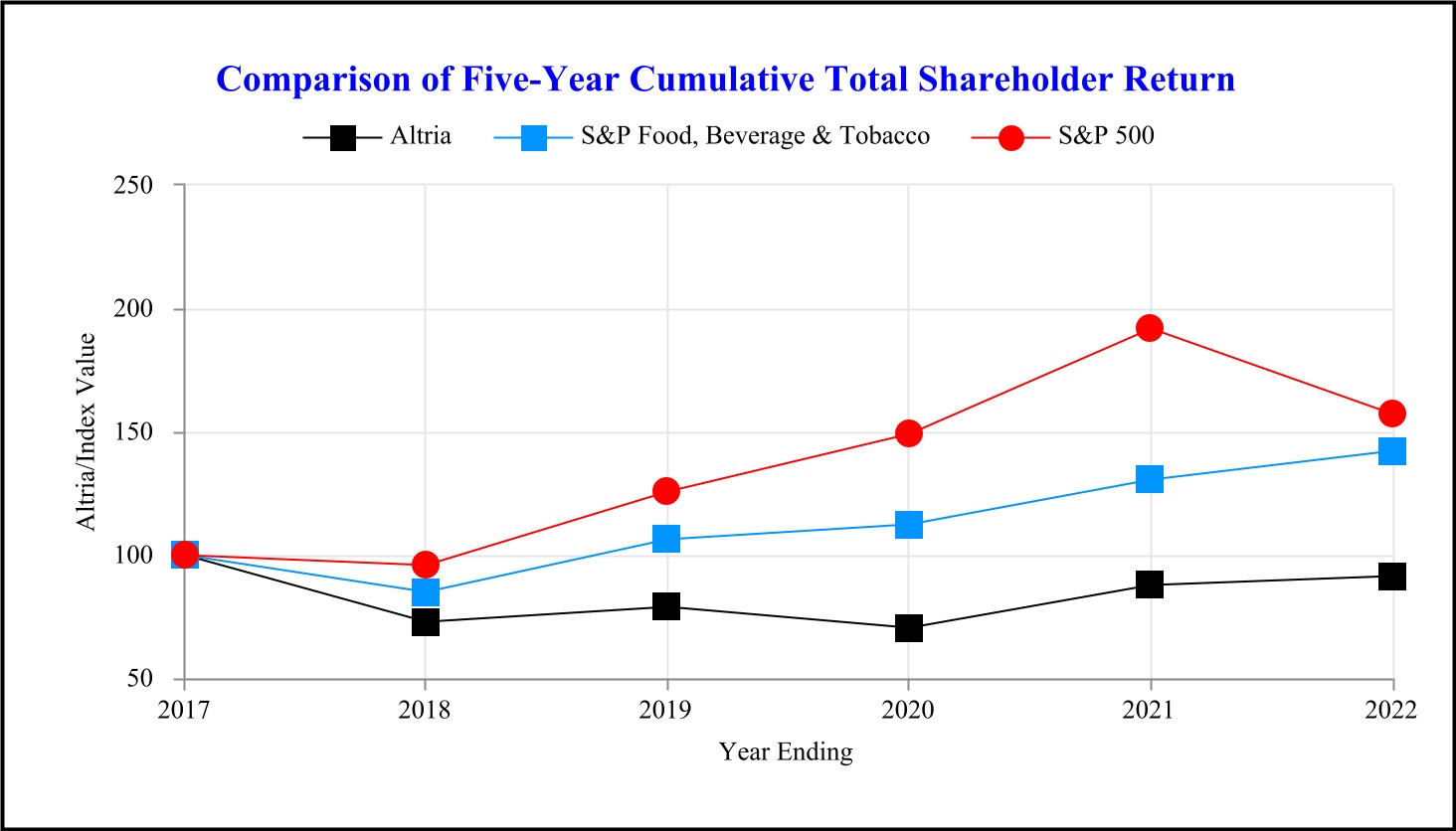
| Date | Altria | S&P Food, Beverage & Tobacco | S&P 500 | |||||||||||||||||
| December 2017 | $ | 100.00 | $ | 100.00 | $ | 100.00 | ||||||||||||||
| December 2018 | $ | 72.91 | $ | 85.08 | $ | 95.61 | ||||||||||||||
| December 2019 | $ | 78.71 | $ | 106.29 | $ | 125.70 | ||||||||||||||
| December 2020 | $ | 70.54 | $ | 112.20 | $ | 148.83 | ||||||||||||||
| December 2021 | $ | 87.66 | $ | 130.35 | $ | 191.55 | ||||||||||||||
| December 2022 | $ | 91.50 | $ | 142.18 | $ | 156.86 |
Sources: FactSet for 2020 to 2022 and Bloomberg “Total Return Analysis” calculated on a daily basis for 2018 and 2019. Total return assumes reinvestment of dividends as of the ex-dividend date.
Market and Dividend Information
The principal stock exchange on which our common stock (par value $0.33 1/3 per share) is listed is the New York Stock Exchange under the trading symbol “MO”. At February 15, 2023, there were approximately 50,000 holders of record of our common stock.
We have a history of paying cash dividends and have maintained a dividend payout ratio target of approximately 80% of our adjusted diluted earnings per share. Future dividend payments remain subject to the discretion of our Board of Directors.
Issuer Purchases of Equity Securities During the Quarter Ended December 31, 2022
In January 2021, our Board of Directors authorized a $2.0 billion share repurchase program that it expanded to $3.5 billion in October 2021 (as expanded, the “January 2021 share repurchase program”), which we completed in December 2022.
In January 2023, our Board of Directors authorized a new $1.0 billion share repurchase program, which we expect to complete by December 31, 2023. The timing of share repurchases under this program depends upon marketplace conditions and other factors, and the program remains subject to the discretion of our Board.
Our share repurchase activity for each of the three months in the period ended December 31, 2022, was as follows:
| Period | Total Number of Shares Purchased (1) | Average Price Paid Per Share | Total Number of Shares Purchased as Part of Publicly Announced Plans or Programs | Approximate Dollar Value of Shares that May Yet be Purchased Under the Plans or Programs | ||||||||||||||||||||||
| October 1- October 31, 2022 | 2,840,310 | $ | 43.90 | 2,840,310 | $ | 249,401,660 | ||||||||||||||||||||
| November 1- November 30, 2022 | 2,774,953 | $ | 44.95 | 2,774,473 | $ | 124,702,252 | ||||||||||||||||||||
| December 1- December 31, 2022 | 2,682,998 | $ | 46.48 | 2,682,893 | $ | — | ||||||||||||||||||||
| For the Quarter Ended December 31, 2022 | 8,298,261 | $ | 45.09 | 8,297,676 |
(1) The total number of shares purchased includes (a) shares purchased under the January 2021 share repurchase program and (b) shares withheld by Altria in an amount equal to the statutory withholding taxes for vested stock-based awards previously granted to eligible employees (which totaled 480 shares in November and 105 shares in December).
Item 6. [Reserved].
Item 7. Management’s Discussion and Analysis of Financial Condition and Results of Operations.
The following discussion should be read in conjunction with the other sections of this Form 10-K, including the consolidated financial statements and related notes contained in Item 8, and the discussion of risk factors that may affect future results in Item 1A. Additionally, refer to Item 7. Management’s Discussion and Analysis of Financial Condition and Results of Operations (“MD&A”) in our 2021 Annual Report on Form 10-K for management’s discussion and analysis of financial condition and results of operations for the year ended December 31, 2021 compared to the year ended December 31, 2020, which we filed with the SEC on February 25, 2022 and is incorporated by reference into this Form 10-K for the year ended December 31, 2022.
In this MD&A section, we refer to the following “adjusted” financial measures: adjusted operating companies income (loss) (“OCI”); adjusted OCI margins; adjusted net earnings attributable to Altria; adjusted diluted earnings per share attributable to Altria; and adjusted effective tax rates. These adjusted financial measures are not required by, or calculated in accordance with, United States generally accepted accounting principles (“GAAP”) and may not be calculated the same as similarly titled measures used by other companies. These adjusted financial measures should thus be considered as supplemental in nature and not considered in isolation or as a substitute for the related financial information prepared in accordance with GAAP. For a further description of these non-GAAP financial measures, see the Non-GAAP Financial Measures section below.
Executive Summary
Our Business
We have a leading portfolio of tobacco products for U.S. tobacco consumers age 21+. Our Vision by 2030 is to responsibly lead the transition of adult smokers to a smoke-free future. We are Moving Beyond SmokingTM, leading the way in moving adult smokers away from cigarettes by taking action to transition millions to potentially less harmful choices - believing it is a substantial opportunity for adult tobacco consumers, our businesses and society.
Our wholly owned subsidiaries include leading manufacturers of both combustible and smoke-free products. In combustibles, we own PM USA, the most profitable U.S. cigarette manufacturer, and Middleton, a leading U.S. cigar manufacturer.
Our smoke-free portfolio includes ownership of USSTC, the leading global MST manufacturer, and Helix, a leading manufacturer of oral nicotine pouches. Additionally, we have a majority-owned joint venture, Horizon, for the U.S. marketing and commercialization of HTS products and, through a separate agreement, we have the exclusive U.S. commercialization rights to the IQOS System and Marlboro HeatSticks through April 2024.
Our investments in equity securities include ABI, the world’s largest brewer, Cronos, a leading Canadian cannabinoid company, and JUUL, a U.S. based e-vapor company.
The brand portfolios of our tobacco operating companies include Marlboro, Black & Mild, Copenhagen, Skoal and on!. Trademarks and service marks related to Altria referenced in this Form 10-K are the property of Altria or our subsidiaries or are used with permission.
For a description of Altria, see Item 1. Business of this Form 10-K (“Item 1”).
Trends and Developments
In this MD&A section, we discuss factors that have impacted our business as of the date of this Form 10-K. In addition, we are aware of certain trends and developments that could, individually or in the aggregate, have a material impact on our business, including the value of our investments in equity securities, in the future. In this Trends and Developments section, we focus on the potential effects on our business resulting from the continued elevated rate of inflation, supply chain disruptions, ongoing geopolitical events and recent regulatory actions.
We continue to monitor the evolving macroeconomic and geopolitical landscapes. High rates of inflation occurred in 2022, driven by increasing global energy, commodity and food prices, which were further exacerbated by other factors, including supply and demand imbalances, labor shortages and the Russian invasion of Ukraine. High inflation, high gas prices and rising interest rates could continue to impact our business by negatively impacting adult tobacco consumers’ disposable income and future purchase behaviors. During 2022, cigarette retail share for the industry discount segment increased. We continue to expect potential fluctuations in discount product share for cigarettes and MST products as price sensitive adult tobacco consumers react to their economic conditions and will monitor the effect of these dynamics on adult tobacco consumers and their purchase behaviors, including overall tobacco product expenditures, mix between premium and discount brand purchases and adoption of smoke-free products. Increases in inflation also have a direct and adverse impact on our MSA expense and other direct and indirect costs. We expect inflation to continue at increased levels in 2023, and the extent of any effects on adult tobacco consumers’ purchase behaviors depends in part on the magnitude and duration of such increased inflation levels. See Operating Results by Business Segment - Tobacco Space - Business Environment for additional information on evolving trends in the tobacco industry and the impacts to our business from increased inflation.
Volatility in domestic and global economies and disruptions in the supply and distribution chains are expected to continue in 2023, resulting from several factors, including the on-going impacts of inflation, supply and demand imbalances across many sectors such as energy and commodities, raw materials availability and geopolitical events. We continue to work to mitigate the potential negative impacts of these macroeconomic and geopolitical dynamics on our businesses through, among other actions, proactive engagement with current and potential suppliers and distributors, the development of alternative sourcing strategies, entry into long-term supply contracts, evolution of our safety, health and environmental protocols at our facilities and prudent oversight of our liquidity. See Operating Results by Business Segment - Tobacco Space - Business Environment for additional information on the supply chain and other impacts of the macroeconomic and geopolitical environment on our business.
Tobacco companies are subject to broad and evolving regulatory and legislative frameworks that could have a material impact on our business. For example, the FDA has issued proposed product standards regarding menthol in cigarettes and characterizing flavors in cigars, and, in June 2022, the Biden Administration published plans for future potential regulatory actions that include the FDA’s plans to develop a proposed product standard that would establish a maximum nicotine level for cigarettes and certain other combustible tobacco products. In addition, certain states and localities are considering or have passed legislation to ban flavors in one or more tobacco products, including California where a ban on the sale of most tobacco products with characterizing flavors became effective in December 2022. See Operating Results by Business Segment - Tobacco Space - Business Environment for additional information on the nature, scope and potential impacts of regulatory and legislative developments.
In June 2022, the FDA issued marketing denial orders (“MDOs”) to JUUL ordering all of JUUL’s products currently marketed in the United States off the market. In July 2022, the FDA administratively stayed the MDOs on a temporary basis, citing its determination that there are scientific issues unique to the JUUL PMTA that warrant additional agency review. This administrative stay temporarily suspends the MDOs, and JUUL’s products currently remain on the market. See *Operating Results by Business Segment - Tobacco Space - Busi
Showing the first 8K of 164K characters. Open the full section
Item 7A. Quantitative and Qualitative Disclosures About Market Risk.
Interest Rate Risk
The fair value of our long-term debt, all of which is fixed-rate debt, is subject to fluctuations resulting primarily from changes in market interest rates. The following table provides the fair value of our long-term debt and the change in fair value based on a 1% increase or decrease in market interest rates at December 31:
| (in billions) | 2022 | 2021 | ||||||||||||
| Fair value | $ | 22.9 | $ | 30.5 | ||||||||||
| Decrease in fair value from a 1% increase in market interest rates | 1.7 | 2.7 | ||||||||||||
| Increase in fair value from a 1% decrease in market interest rates | 2.0 | 3.2 |
We expect interest rates on borrowings under the Credit Agreement to be based on the Term Secured Overnight Financing Rate, plus a percentage based on the higher of the ratings of our long-term senior unsecured debt from Moody’s and S&P. The applicable percentage for borrowings under the Credit Agreement at December 31, 2022 was 1.0% based on our long-term senior unsecured debt ratings on that date. At December 31, 2022 and 2021, we had no borrowings under the Credit Agreement.
Item 8. Financial Statements and Supplementary Data.
Altria Group, Inc. and Subsidiaries
Consolidated Balance Sheets
(in millions of dollars)
| at December 31, | 2022 | 2021 | |||||||||
| Assets | |||||||||||
| Cash and cash equivalents | $ | 4,030 | $ | 4,544 | |||||||
| Receivables: | |||||||||||
| Receivable from the sale of IQOS System commercialization rights | 1,721 | — | |||||||||
| Other | 48 | 47 | |||||||||
| Inventories: | |||||||||||
| Leaf tobacco | 704 | 744 | |||||||||
| Other raw materials | 186 | 166 | |||||||||
| Work in process | 24 | 23 | |||||||||
| Finished product | 266 | 261 | |||||||||
| 1,180 | 1,194 | ||||||||||
| Other current assets | 241 | 298 | |||||||||
| Total current assets | 7,220 | 6,083 | |||||||||
| Property, plant and equipment, at cost: | |||||||||||
| Land and land improvements | 123 | 123 | |||||||||
| Buildings and building equipment | 1,478 | 1,422 | |||||||||
| Machinery and equipment | 2,578 | 2,652 | |||||||||
| Construction in progress | 248 | 235 | |||||||||
| 4,427 | 4,432 | ||||||||||
| Less accumulated depreciation | 2,819 | 2,879 | |||||||||
| 1,608 | 1,553 | ||||||||||
| Goodwill | 5,177 | 5,177 | |||||||||
| Other intangible assets, net | 12,384 | 12,306 | |||||||||
| Investments in equity securities ($250 million and $1,720 million at December 31, 2022 and 2021, respectively, measured at fair value) | 9,600 | 13,481 | |||||||||
| Other assets | 965 | 923 | |||||||||
| Total Assets | $ | 36,954 | $ | 39,523 |
See notes to consolidated financial statements.
Altria Group, Inc. and Subsidiaries
Consolidated Balance Sheets (Continued)
(in millions of dollars, except share and per share data)
| at December 31, | 2022 | 2021 | |||||||||
| Liabilities | |||||||||||
| Current portion of long-term debt | $ | 1,556 | $ | 1,105 | |||||||
| Accounts payable | 552 | 449 | |||||||||
| Accrued liabilities: | |||||||||||
| Marketing | 599 | 664 | |||||||||
| Settlement charges | 2,925 | 3,349 | |||||||||
| Other | 1,299 | 1,365 | |||||||||
| Dividends payable | 1,685 | 1,647 | |||||||||
| Total current liabilities | 8,616 | 8,579 | |||||||||
| Long-term debt | 25,124 | 26,939 | |||||||||
| Deferred income taxes | 2,897 | 3,692 | |||||||||
| Accrued pension costs | 133 | 200 | |||||||||
| Accrued postretirement health care costs | 1,083 | 1,436 | |||||||||
| Deferred gain from the sale of IQOS System commercialization rights | 2,700 | — | |||||||||
| Other liabilities | 324 | 283 | |||||||||
| Total liabilities | 40,877 | 41,129 | |||||||||
| Contingencies (Note 17) | |||||||||||
| Stockholders’ Equity (Deficit) | |||||||||||
| Common stock, par value $0.33 1/3 per share (2,805,961,317 shares issued) | 935 | 935 | |||||||||
| Additional paid-in capital | 5,887 | 5,857 | |||||||||
| Earnings reinvested in the business | 29,792 | 30,664 | |||||||||
| Accumulated other comprehensive losses | (2,771) | (3,056) | |||||||||
| Cost of repurchased stock (1,020,427,195 shares at December 31, 2022 and 982,785,699 shares at December 31, 2021) | (37,816) | (36,006) | |||||||||
| Total stockholders’ equity (deficit) attributable to Altria | (3,973) | (1,606) | |||||||||
| Noncontrolling interests | 50 | — | |||||||||
| Total stockholders’ equity (deficit) | (3,923) | (1,606) | |||||||||
| Total Liabilities and Stockholders’ Equity (Deficit) | $ | 36,954 | $ | 39,523 |
See notes to consolidated financial statements.
Altria Group, Inc. and Subsidiaries
Consolidated Statements of Earnings
(in millions of dollars, except per share data)
| for the years ended December 31, | 2022 | 2021 | 2020 | ||||||||||||||
| Net revenues | $ | 25,096 | $ | 26,013 | $ | 26,153 | |||||||||||
| Cost of sales | 6,442 | 7,119 | 7,818 | ||||||||||||||
| Excise taxes on products | 4,408 | 4,902 | 5,312 | ||||||||||||||
| Gross profit | 14,246 | 13,992 | 13,023 | ||||||||||||||
| Marketing, administration and research costs | 2,327 | 2,432 | 2,150 | ||||||||||||||
| Operating income | 11,919 | 11,560 | 10,873 | ||||||||||||||
| Interest and other debt expense, net | 1,058 | 1,162 | 1,209 | ||||||||||||||
| Loss on early extinguishment of debt | — | 649 | — | ||||||||||||||
| Net periodic benefit income, excluding service cost | (184) | (202) | (77) | ||||||||||||||
| (Income) losses from investments in equity securities | 3,641 | 5,979 | 111 | ||||||||||||||
| Impairment of JUUL equity securities | — | — | 2,600 | ||||||||||||||
| Loss on Cronos-related financial instruments | 15 | 148 | 140 | ||||||||||||||
| Earnings before income taxes | 7,389 | 3,824 | 6,890 | ||||||||||||||
| Provision for income taxes | 1,625 | 1,349 | 2,436 | ||||||||||||||
| Net earnings | 5,764 | 2,475 | 4,454 | ||||||||||||||
| Net losses attributable to noncontrolling interests | — | — | 13 | ||||||||||||||
| Net earnings attributable to Altria | $ | 5,764 | $ | 2,475 | $ | 4,467 | |||||||||||
| Per share data: | |||||||||||||||||
| Basic and diluted earnings per share attributable to Altria | $ | 3.19 | $ | 1.34 | $ | 2.40 | |||||||||||
See notes to consolidated financial statements.
Altria Group, Inc. and Subsidiaries
Consolidated Statements of Comprehensive Earnings
(in millions of
Showing the first 8K of 288K characters. Open the full section
Item 9. Changes in and Disagreements with Accountants on Accounting and Financial Disclosure.
None.
Item 9A. Controls and Procedures.
Disclosure Controls and Procedures
We carried out an evaluation, with the participation of our management, including our Chief Executive Officer and Chief Financial Officer, of the effectiveness of our disclosure controls and procedures (as defined in Rule 13a-15(e) under the Exchange Act) as of the end of the period covered by this Form 10-K. Based upon that evaluation, our Chief Executive Officer and Chief Financial Officer concluded that our disclosure controls and procedures are effective.
There have been no changes in our internal control over financial reporting during the most recent fiscal quarter that have materially affected, or are reasonably likely to materially affect, our internal control over financial reporting.
The Report of Independent Registered Public Accounting Firm and the Report of Management on Internal Control over Financial Reporting are included in Item 8.
Item 9B. Other Information.
None.
Item 9C. Disclosure Regarding Foreign Jurisdictions that Prevent Inspections.
Not applicable.
Part III
Except for the information relating to the executive officers set forth in Item 10, the information called for by Items 10-14 is hereby incorporated by reference to our definitive proxy statement for use in connection with our Annual Meeting of Shareholders to be held on May 18, 2023 that is expected to be filed with the SEC on or about April 6, 2023 (“proxy statement”), and, except as indicated therein, made a part hereof.
Item 10. Directors, Executive Officers and Corporate Governance.
Refer to “Board and Governance Matters - Proposal 1 - Election of Directors” and “Board and Governance Matters - Board and Committee Governance” sections of the proxy statement.
Information about Our Executive Officers as of February 15, 2023:
| Name | Office | Age | ||||||
| Jody L. Begley | Executive Vice President and Chief Operating Officer | 51 | ||||||
| Daniel J. Bryant | Vice President and Treasurer | 53 | ||||||
| Steven D’Ambrosia | Vice President and Controller | 56 | ||||||
| Murray R. Garnick | Executive Vice President and General Counsel | 63 | ||||||
| William F. Gifford, Jr. | Chief Executive Officer | 52 | ||||||
| Salvatore Mancuso | Executive Vice President and Chief Financial Officer | 57 | ||||||
| Heather A. Newman | Senior Vice President, Chief Strategy & Growth Officer | 45 | ||||||
| W. Hildebrandt Surgner, Jr. | Vice President, Corporate Secretary and Associate General Counsel | 57 | ||||||
| Charles N. Whitaker | Senior Vice President, Chief Human Resources Officer and Chief Compliance Officer | 56 |
All of the above-mentioned executive officers have been employed by Altria or our subsidiaries in various capacities during the past five years.
Mr. Whitaker’s wife and Mr. Surgner’s wife are first cousins.
Codes of Conduct and Corporate Governance
We have adopted the Altria Code of Conduct for Compliance and Integrity, which complies with requirements set forth in Item 406 of Regulation S-K. This Code of Conduct applies to all of our employees, including our principal executive officer, principal financial officer, principal accounting officer or controller, and persons performing similar functions. We have also adopted a code of business conduct and ethics that applies to the members of our Board of Directors. These documents are available free of charge on our website at www.altria.com.
Any waiver granted by us to our principal executive officer, principal financial officer or controller under the Code of Conduct, and certain amendments to the Code of Conduct, will be disclosed on our website at www.altria.com within the time period required by applicable rules.
In addition, we have adopted corporate governance guidelines and charters for our Audit, Compensation and Nominating, Corporate Governance and Social Responsibility Committees and the other committees of our Board of Directors. All of these documents are available free of charge on our website at www.altria.com.
The information on our websites is not, and shall not be deemed to be, a part of this Form 10-K or incorporated into any other filings we make with the SEC.
Item 11. Executive Compensation.
Refer to “Executive Compensation,” and “Board and Governance Matters - Director Compensation” sections of our proxy statement.
Item 12. Security Ownership of Certain Beneficial Owners and Management and Related Stockholder Matters.
The number of shares to be issued upon exercise or vesting and the number of shares remaining available for future issuance under our equity compensation plans at December 31, 2022, were as follows:
| Number of Shares to be Issued upon Exercise of Outstanding Options and Vesting of Deferred Stock (a) | Weighted Average Exercise Price of Outstanding Options (b) | Number of Shares Remaining Available for Future Issuance Under Equity Compensation Plans (c) | |||||||||
| Equity compensation plans approved by shareholders (1) | 4,075,093 (2) | $— | 22,623,041 (3) |
(1)Our shareholders have approved the following plans, shares of which are referenced in column (a) or column (c): the 2015 Performance Incentive Plan, the 2020 Performance Incentive Plan and the 2015 Stock Compensation Plan for Non-Employee Directors.
(2)Represents 3,257,795 shares of restricted stock units and 817,298 shares that may be issued upon vesting of performance stock units if maximum performance measures are achieved.
(3)Includes 21,972,920 shares available under the 2020 Performance Incentive Plan and 650,121 shares available under the 2015 Stock Compensation Plan for Non-Employee Directors, and excludes shares reflected in column (a).
Refer to “Ownership of Equity Securities of Altria - Directors and Executive Officers” and “Ownership of Equity Securities of Altria - Certain Other Beneficial Owners” sections of our proxy statement.
Item 13. Certain Relationships and Related Transactions, and Director Independence.
Refer to “Related Person Transactions, Director Code and Code of Conduct” and “Board and Governance Matters - Altria Board of Directors - Director Independence Determinations” sections of our proxy statement.
Item 14. Principal Accounting Fees and Services.
Refer to “Audit Committee Matters - Independent Registered Public Accounting Firm’s Fees” and “Audit Committee Matters - Pre-Approval Policy” sections of our proxy statement.
Part IV
Item 15. Exhibits and Financial Statement Schedules.
(a) Index to Consolidated Financial Statements
| Page | |||||
| Consolidated Balance Sheets at December 31, 2022 and 2021 | 48 | ||||
| Consolidated Statements of Earnings for the years ended December 31, 2022, 2021 and 2020 | 50 | ||||
| Consolidated Statements of Comprehensive Earnings for the years ended December 31, 2022, 2021 and 2020 | 51 | ||||
| Consolidated Statements of Cash Flows for the years ended December 31, 2022, 2021 and 2020 | 52 | ||||
| Consolidated Statements of Stockholders’ Equity (Deficit) for the years ended December 31, 2022, 2021 and 2020 | 54 | ||||
| Notes to Consolidated Financial Statements | 55 | ||||
| Report of Independent Registered Public Accounting Firm (PCAOB ID 238) | 99 | ||||
| Report of Management on Internal Control Over Financial Reporting | 102 |
Schedules have been omitted either because such schedules are not required or are not applicable.
In accordance with Regulation S-X Rule 3-09, the audited financial statements of ABI for the year ended December 31, 2022 will be filed by amendment within six months after ABI’s year ended December 31, 2022.
(b) The following exhibits are filed as part of this Form 10-K:
| 4.6 | Amendment No. 1 to the Credit Agreement, dated January 25, 2019, among Altria Group, Inc. the Lenders and JPMorgan Chase Bank, N.A. and Citibank, N.A. as administrative agents. Incorporated by reference to Altria Group, Inc.’s Current Report on Form 8-K filed on January 31, 2019 (File No. 1-08940). | ||||||||||
| 4.7 | Extension and Amendment No. 2 to the Credit Agreement, effective August 18, 2021, among Altria Group, Inc., the lenders party thereto and JPMorgan Chase Bank, N.A. and Citibank, N.A., as administrative agents. Incorporated by reference to Altria Group, Inc.’s Current Report on Form 8-K filed on August 18, 2021 (File No. 1-08940). | ||||||||||
| 4.8 | Extension and Amendment No. 3 to the Credit Agreement, effective August 17, 2022, among Altria Group, Inc., the lenders party thereto and JPMorgan Chase Bank, N.A. and Citibank, N.A., as administrative agents. Incorporated by reference to Altria Group, Inc.’s Current Report on Form 8-K filed on August 17, 2022 (File No. 1-08940). | ||||||||||
| 4.9 | The Registrant agrees to furnish copies of any instruments defining the rights of holders of long-term debt of the Registrant and its consolidated subsidiaries that does not exceed 10 percent of the total assets of the Registrant and its consolidated subsidiaries to the Commission upon request. | ||||||||||
| 10.1 | Comprehensive Settlement Agreement and Release related to settlement of Mississippi health care cost recovery action, dated as of October 17, 1997. Incorporated by reference to Altria Group, Inc.’s Annual Report on Form 10-K for the year ended December 31, 1997 (File No. 1-08940). | ||||||||||
| 10.2 | Settlement Agreement related to settlement of Florida health care cost recovery action, dated August 25, 1997. Incorporated by reference to Altria Group, Inc.’s Current Report on Form 8-K filed on September 3, 1997 (File No. 1-08940). | ||||||||||
| 10.3 | Comprehensive Settlement Agreement and Release related to settlement of Texas health care cost recovery action, dated as of January 16, 1998. Incorporated by reference to Altria Group, Inc.’s Current Report on Form 8-K filed on January 28, 1998 (File No. 1-08940). | ||||||||||
| 10.4 | Settlement Agreement and Stipulation for Entry of Judgment regarding the claims of the State of Minnesota, dated as of May 8, 1998. Incorporated by reference to Altria Group, Inc.’s Quarterly Report on Form 10-Q for the period ended March 31, 1998 (File No. 1-08940). | ||||||||||
| 10.5 | Settlement Agreement and Release regarding the claims of Blue Cross and Blue Shield of Minnesota, dated as of May 8, 1998. Incorporated by reference to Altria Group, Inc.’s Quarterly Report on Form 10-Q for the period ended March 31, 1998 (File No. 1-08940). | ||||||||||
| 10.6 | Stipulation of Amendment to Settlement Agreement and For Entry of Agreed Order regarding the settlement of the Mississippi health care cost recovery action, dated as of July 2, 1998. Incorporated by reference to Altria Group, Inc.’s Quarterly Report on Form 10-Q for the period ended June 30, 1998 (File No. 1-08940). | ||||||||||
| 10.7 | Stipulation of Amendment to Settlement Agreement and For Entry of Consent Decree regarding the settlement of the Texas health care cost recovery action, dated as of July 24, 1998. Incorporated by reference to Altria Group, Inc.’s Quarterly Report on Form 10-Q for the period ended June 30, 1998 (File No. 1-08940). | ||||||||||
| 10.8 | Stipulation of Amendment to Settlement Agreement and For Entry of Consent Decree regarding the settlement of the Florida health care cost recovery action, dated as of September 11, 1998. Incorporated by reference to Altria Group, Inc.’s Quarterly Report on Form 10-Q for the period ended September 30, 1998 (File No. 1-08940). | ||||||||||
| 10.9 | Master Settlement Agreement relating to state health care cost recovery and other claims, dated as of November 23, 1998. Incorporated by reference to Altria Group, Inc.’s Current Report on Form 8-K filed on November 25, 1998, as amended by Form 8-K/A filed on December 24, 1998 (File No. 1-08940). | ||||||||||
| 10.10 | Stipulation and Agreed Order Regarding Stay of Execution Pending Review and Related Matters, dated as of May 7, 2001. Incorporated by reference to Altria Group, Inc.’s Current Report on Form 8-K filed on May 8, 2001 (File No. 1-08940). | ||||||||||
| 10.11 | Term Sheet effective December 17, 2012, between Philip Morris USA Inc., the other participating manufacturers, and various states and territories for settlement of the 2003 - 2012 Non-Participating Manufacturer Adjustment with those states. Incorporated by reference to Altria Group, Inc.’s Current Report on Form 8-K filed on December 18, 2012 (File No. 1-08940). | ||||||||||
| 10.12 | Intellectual Property Agreement by and between Philip Morris International Inc. and Philip Morris USA Inc., dated as of January 1, 2008. Incorporated by reference to Altria Group, Inc.’s Current Report on Form 8-K filed on March 28, 2008 (File No. 1-08940). | ||||||||||
| 10.13 | Guarantee made by Philip Morris USA Inc. in favor of the lenders party to the 5-Year Revolving Credit Agreement, dated as of August 1, 2018, among Altria Group, Inc., the lenders named therein and JPMorgan Chase Bank, N.A. and Citibank, N.A., as administrative agents, dated as of August 1, 2018. Incorporated by reference to Altria Group, Inc.’s Current Report on Form 8-K filed on August 1, 2018 (File No. 1-08940). |
- Denotes management contract or compensatory plan or arrangement in which directors or executive officers are eligible to participate.
Item 16. Form 10-K Summary.
None.
SIGNATURES
Pursuant to the requirements of Section 13 or 15(d) of the Securities Exchange Act of 1934, the registrant has duly caused this report to be signed on its behalf by the undersigned, thereunto duly authorized.
| ALTRIA GROUP, INC. | ||||||||
| By: | /s/ WILLIAM F. GIFFORD, JR. | |||||||
| (William F. Gifford, Jr. Chief Executive Officer) |
Date: February 27, 2023
Pursuant to the requirements of the Securities Exchange Act of 1934, this report has been signed below by the following persons on behalf of the registrant and in the capacities and on the date indicated:
| Signature | Title | Date | |||||||||||||||
| /s/ WILLIAM F. GIFFORD, JR. (William F. Gifford, Jr.) | Director and Chief Executive Officer | February 27, 2023 | |||||||||||||||
| /s/ SALVATORE MANCUSO (Salvatore Mancuso) | Executive Vice President and Chief Financial Officer | February 27, 2023 | |||||||||||||||
| /s/ STEVEN D’AMBROSIA (Steven D’Ambrosia) | Vice President and Controller | February 27, 2023 | |||||||||||||||
| * IAN L.T. CLARKE, MARJORIE M. CONNELLY, R. MATT DAVIS, JACINTO J. HERNANDEZ, DEBRA J. KELLY-ENNIS, KATHRYN B. MCQUADE, GEORGE MUÑOZ, NABIL Y. SAKKAB, VIRGINIA E. SHANKS, ELLEN R. STRAHLMAN, M. MAX YZAGUIRRE | Directors | ||||||||||||||||
| * By: | /s/ WILLIAM F. GIFFORD, JR. (WILLIAM F. GIFFORD, JR. ATTORNEY-IN-FACT) | February 27, 2023 |