 filings.tools
Mosaic 10-K 2014-12-31
Filed 2015-02-17. 21 sections, 614K characters. Original on sec.gov · Markdown · JSON
Cover and table of contents
10-K 1 mos-20141231x10k.htm 10-K
UNITED STATES
SECURITIES AND EXCHANGE COMMISSION
Washington, D.C. 20549
FORM 10-K
x ANNUAL REPORT PURSUANT TO SECTION 13 OR 15(d) OF
THE SECURITIES EXCHANGE ACT OF 1934
For the year ended December 31, 2014
¨ TRANSITION REPORT PURSUANT TO SECTION 13 OR 15(d) OF
THE SECURITIES EXCHANGE ACT OF 1934
For the transition period from _____ to _____
Commission file number 001-32327
The Mosaic Company
(Exact name of registrant as specified in its charter)
| Delaware | 20-1026454 | |
| (State or other jurisdiction of incorporation or organization) | (I.R.S. Employer Identification No.) |
3033 Campus Drive
Suite E490
Plymouth, Minnesota 55441
(800) 918-8270
(Address and zip code of principal executive offices and registrant’s telephone number, including area code)
Securities registered pursuant to Section 12(b) of the Act:
| Title of each class | Name of each exchange on which registered | |
| Common Stock, par value $0.01 per share | New York Stock Exchange |
Securities registered pursuant to Section 12(g) of the Act: NONE
Indicate by check mark if the registrant is a well-known seasoned issuer, as defined in Rule 405 of the Securities Act. Yes x No ¨
Indicate by check mark if the registrant is not required to file reports pursuant to Section 13 or Section 15(d) of the Act. Yes ¨ No x
Indicate by check mark whether the registrant: (1) has filed all reports required to be filed by Section 13 or 15(d) of the Securities Exchange Act of 1934 during the preceding 12 months (or for such shorter period that the registrant was required to file such reports); and (2) has been subject to such filing requirements for the past 90 days. Yes x No ¨
Indicate by check mark whether the registrant has submitted electronically and posted on its corporate Web site, if any, every Interactive Data File required to be submitted and posted pursuant to Rule 405 of Regulation S-T (§232.405 of this chapter) during the preceding 12 months (or for such shorter period that the registrant was required to submit and post such files). Yes x No ¨
Indicate by check mark if disclosure of delinquent filers pursuant to Item 405 of Regulation S-K (§229.405 of this chapter) is not contained herein, and will not be contained, to the best of registrant’s knowledge, in definitive proxy or information statements incorporated by reference in Part III of this Form 10-K or any amendment to this Form 10-K. x
Indicate by check mark whether the registrant is a large accelerated filer, an accelerated filer, a non-accelerated filer, or a smaller reporting company. See the definitions of “large accelerated filer”, “accelerated filer”, and “smaller reporting company” in Rule 12b-2 of the Exchange Act. (Check one): Large accelerated filer x Accelerated filer ¨ Non-accelerated filer ¨ Smaller reporting company ¨
Indicate by check mark whether the registrant is a shell company (as defined in Rule 12b-2 of the Exchange Act). Yes ¨ No x
As of June 30, 2014, the aggregate market value of the registrant’s voting common stock held by stockholders, other than directors, executive officers, subsidiaries of the Registrant and any other person known by the Registrant as of the date hereof to beneficially own ten percent or more of any class of Registrant’s outstanding voting common stock, and consisting of shares of Common Stock and Class A Common Stock, was approximately $18.0 billion based upon the closing price of a share of Common Stock on the New York Stock Exchange on that date.
Indicate the number of shares outstanding of each of the registrant’s classes of common stock: 348,667,983 shares of Common Stock, 17,176,046 shares of Class A Common Stock and 0 shares of Class B Common Stock, each par value $0.01 per share, as of February 11, 2015.
DOCUMENTS INCORPORATED BY REFERENCE
| 1. | Portions of the registrant’s definitive proxy statement to be delivered in conjunction with the 2015 Annual Meeting of Stockholders (Part III) |
2014 FORM 10-K CONTENTS
PART I.
Item 1. Business.
OVERVIEW
The Mosaic Company is the world’s leading producer and marketer of concentrated phosphate and potash crop nutrients. We are the largest integrated phosphate producer in the world and one of the largest producers and marketers of phosphate-based animal feed ingredients in the United States. We are one of the four largest potash producers in the world. Through our broad product offering, we are a single source supplier of phosphate- and potash-based crop nutrients and animal feed ingredients. We serve customers in approximately 40 countries. We mine phosphate rock in Florida and process rock into finished phosphate products at facilities in Florida and Louisiana. We mine potash in Saskatchewan and New Mexico. We have other production, blending or distribution operations in Brazil, China, India and Paraguay, as well as strategic equity investments in a phosphate rock mine in the Bayovar region in Peru and a joint venture formed to develop a phosphate rock mine and chemical complexes in the Kingdom of Saudi Arabia. Our distribution operations serve the top four nutrient-consuming countries in the world.
The Mosaic Company is a Delaware corporation that was incorporated in March 2004 and serves as the parent company of the business that was formed through the October 2004 combination of IMC Global Inc. and the fertilizer businesses of Cargill, Incorporated. We are publicly traded on the New York Stock Exchange under the ticker symbol “MOS” and are headquartered in Plymouth, Minnesota.
We conduct our business through wholly and majority-owned subsidiaries as well as businesses in which we own less than a majority or a non-controlling interest. We are organized into two reportable business segments: Phosphates and Potash. The following charts show the respective contributions to 2014 sales volumes, net sales and operating earnings for each of these business segments:


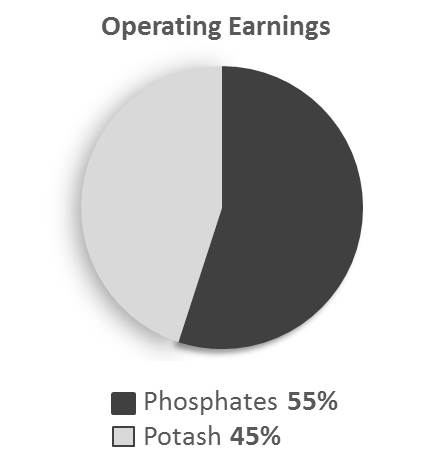
Phosphates Segment — We are the largest integrated phosphate producer in the world and one of the largest producers and marketers of phosphate-based animal feed ingredients in the United States. We sell phosphate-based crop nutrients and animal feed ingredients throughout North America and internationally. Our Phosphates segment also includes our international distribution activities. Our distribution activities include sales offices, port terminals and warehouses in the United States, Canada, and several other key international countries. In addition, the international distribution activities include blending, bagging or production facilities in Brazil, China, India and Paraguay. We account for approximately 14% of estimated global annual production and 71% of estimated North American annual production of concentrated phosphate crop nutrients.
Potash Segment — We are one of the four largest potash producers in the world. We sell potash throughout North America and internationally, principally as fertilizer, but also for use in industrial applications and, to a lesser degree, as animal feed ingredients. We account for approximately 14% of estimated global annual potash production and 44% of estimated North American annual potash production.
As used in this report:
| • | “Mosaic” means The Mosaic Company, both before and after the Merger; |
| • | “GNS” means the company known as GNS II (U.S.) Corp. until it was renamed The Mosaic Company in connection with the Merger; |
| • | “MOS Holdings” means the company known as The Mosaic Company until it was renamed MOS Holdings Inc. in connection with the Merger; |
| • | “we”, “us”, and “our” refer to Mosaic and its direct and indirect subsidiaries, individually or in any combination; |
| • | “IMC” means IMC Global Inc.; |
| • | “Cargill” means Cargill, Incorporated and its direct and indirect subsidiaries, individually or in any combination; |
| • | “Cargill Crop Nutrition” means the crop nutrient business we acquired from Cargill in the Combination; |
| • | “Combination” means the October 22, 2004 combination of IMC and Cargill Crop Nutrition; |
| • | “Cargill Transaction” means the transactions described below under “Cargill Transaction and Share Repurchases” other than repurchases of shares of our Common Stock under the Repurchase Program; |
| • | “MAC Trusts” means the Margaret A. Cargill foundation established under the Acorn Trust dated January 30, 1995, as amended, and the Anne Ray Charitable Trust dated August 20, 1996, as amended; |
| • | “Merger” means a Merger that occurred on May 25, 2011 as part of the transaction described below under “Cargill Transaction.” The Merger was between a subsidiary of GNS and MOS Holdings and had the effect of recapitalizing our Common Stock and making GNS the parent company of MOS Holdings. Prior to the Merger, GNS was a wholly-owned subsidiary of the company then known as The Mosaic Company. In the Merger, all of the outstanding stock of MOS Holdings was converted, on a one-for-one basis, into GNS stock. In connection with the Merger, the company formerly known as The Mosaic Company was renamed MOS Holdings Inc. and GNS was renamed The Mosaic Company. Following the Merger, our common stock continues to trade under the ticker symbol MOS; |
| • | “Stub Period” refers to the seven-month transition period ended December 31, 2013; |
| • | “tonne” or “tonnes” means a metric tonne or tonnes of 2,205 pounds each unless we specifically state that we mean short or long tons; |
| • | references in this report to a particular fiscal year are to the twelve months ended May 31 of that year; and |
| • | statements as to our industry position reflect information from the most recent period available. |
Cargill Transaction and Share Repurchases
Cargill Transaction
In May 2011, Cargill divested its interest in us in a split-off (the “Split-off”) to its stockholders (the “Exchanging Cargill Stockholders”), including the MAC Trusts, and a debt exchange (the “Debt Exchange”) with certain Cargill debt holders (the “Exchanging Cargill Debt Holders”). The agreements relating to the Cargill Transaction contemplated an orderly distribution of the approximately 64% (285.8 million) of our shares that Cargill formerly held. Following the Split-off and Debt Exchange, the MAC Trusts and Exchanging Cargill Debt Holders sold an aggregate of 157.0 million of these shares in underwritten public secondary offerings or to us. These transactions completed the disposition of shares designated to be sold during the 15-month period following the Split-off.
All other shares (approximately 128.8 million shares in the aggregate) of our Class A Common Stock (“Class A Shares”) received by the Exchanging Cargill Stockholders in the Split-off have generally been subject to transfer restrictions unless we consent. These transfer restrictions are removed as the Class A Shares convert to regular Common Stock. The first such conversion, under which all 42.9 million outstanding Class A Shares, Series A-1 (including 21,647,007 shares held by the MAC Trusts), were converted into regular Mosaic Common Stock, par value $.01 per share (“Common Stock”), occurred on November 26, 2013. On November 26, 2014, the remaining 17,176,068 Class A Shares, Series A-2, held by Exchanging Cargill Stockholders, were converted into Common Stock. Conversion of the remaining 17,176,046 Class A Shares, Series A-3, held by Exchanging Cargill S
Showing the first 8K of 98K characters. Open the full section
Item 1A. Risk Factors.
Our business, financial condition or results of operations could be materially adversely affected by any of the risks and uncertainties described below.
Our Esterhazy mine has had an inflow of salt saturated brine for more than 25 years.
Since December 1985, we have had inflows of salt saturated brine into our Esterhazy, Saskatchewan mine. Over the past century, several potash mines experiencing water inflow problems have flooded. In order to control brine inflows at Esterhazy, we have incurred, and will continue to incur, expenditures, certain of which, due to their nature, have been capitalized, while others have been charged to expense.
At various times, we experience changing amounts and patterns of brine inflows at the Esterhazy mine. Periodically, some of these inflows have exceeded available pumping capacity. If that were to continue for several months without abatement, it could exceed our available storage capacity and ability to effectively manage the brine inflow. This could adversely affect production at the Esterhazy mine. See “Key Factors that can Affect Results of Operations and Financial Condition” and “Potash Net Sales and Gross Margin” in our Management’s Analysis for a discussion of costs and other information relating to the brine inflows. The brine inflow is variable, resulting in both net inflows (the rate of inflow is more than the amount we are pumping out of the mine) and net outflows (when we are pumping more brine out of the mine than the rate of inflow). There can be no assurance that:
| • | our pumping, surface storage, underground storage or injection well capacities for brine will continue to be sufficient, or that the pumping, grouting and other measures that we use to manage the inflows at the Esterhazy mine will continue to be effective; |
| • | there will not be a disruption in the supply of calcium chloride, which is a primary material used to reduce or prevent the flow of incoming brine; |
| • | our estimates of the volumes of net inflows or net outflows of brine, or storage capacity for brine at the Esterhazy mine, are accurate; |
| • | the volumes of the brine inflows will not fluctuate from time to time, the rate of the brine inflows will not be greater than our prior experience or current assumptions, changes in inflow patterns will not adversely affect our ability to locate and manage the inflows, or that any such fluctuations, increases or changes would not be material; and |
| • | the expenditures to control the inflows will be consistent with our prior experience or future estimates. |
From time to time, new or improved technology becomes available to facilitate our remediation of the inflows, such as horizontal drilling techniques. Taking advantage of these new or improved technologies may require significant capital expenditures and/or may increase our costs of remediation.
It is possible that the costs of remedial efforts at Esterhazy may further increase in the future and that such an increase could be material, or, in the extreme scenario, that the brine inflows, risk to employees or remediation costs may increase to a level which would cause us to change our mining processes or abandon the mines. See “Key Factors that can Affect Results of Operations and Financial Condition” and “Potash Net Sales and Gross Margin” in our Management’s Analysis, which is incorporated herein by reference, for a discussion of costs, risks and other information relating to the brine inflows.
Due to the ongoing brine inflow at Esterhazy, subject to exceptions that are limited in scope and amount, we are unable to obtain coverage for underground operations for water incursion problems. Our mines at Colonsay, Saskatchewan, and Carlsbad, New Mexico, are also subject to the risks of inflow of water as a result of our shaft mining operations.
Our operating results are highly dependent upon and fluctuate based upon business and economic conditions and governmental policies affecting the agricultural industry where we or our customers operate. These factors are outside of our control and may significantly affect our profitability.
Our operating results are highly dependent upon business and economic conditions and governmental policies affecting the agricultural industry, which we cannot control. The agricultural products business can be affected by a number of factors. The most important of these factors, for U.S. markets, are:
| • | weather patterns and field conditions (particularly during periods of traditionally high crop nutrients consumption); |
| • | quantities of crop nutrients imported to and exported from North America; |
| • | current and projected grain inventories and prices, which are heavily influenced by U.S. exports and world-wide grain markets; and |
| • | U.S. governmental policies, including farm and biofuel policies, which may directly or indirectly influence the number of acres planted, the level of grain inventories, the mix of crops planted or crop prices. |
International market conditions, which are also outside of our control, may also significantly influence our operating results. The international market for crop nutrients is influenced by such factors as the relative value of the U.S. dollar and its impact upon the cost of importing crop nutrients, foreign agricultural policies, including subsidy policies, the existence of, or changes in, import or foreign currency exchange barriers in certain foreign markets, changes in the hard currency demands of certain countries and other regulatory policies of foreign governments, as well as the laws and policies of the United States affecting foreign trade and investment.
Our most important products are global commodities, and we face intense global competition from other crop nutrient producers that can affect our prices and volumes.
Our most important products are concentrated phosphate crop nutrients, including diammonium phosphate, or DAP, monoammonium phosphate, or MAP, MicroEssentials® and muriate of potash, or MOP. We sell most of our DAP, MAP and MOP in the form of global commodities. Our sales of these products face intense global competition from other crop nutrient producers.
Changes in competitors’ production or shifts in their marketing focus have in the past significantly affected both the prices at which we sell our products and the volumes that we sell, and are likely to continue to do so in the future.
Competitors are more likely to increase their production at times when world agricultural and crop nutrient markets are strong, and to focus on sales into regions where their returns are highest. Increases in the global supply of DAP, MAP and MOP or competitors’ increased sales into regions in which we have significant sales could adversely affect our prices and volumes.
Competitors and potential new entrants in the markets for both concentrated phosphate crop nutrients and potash have in recent years expanded capacity, or begun, or announced plans, to expand capacity or build new facilities. The extent to which current global or local economic and financial conditions, changes in global or local economic and financial conditions, or other factors may cause delays or cancellation of some of these ongoing or planned projects, or result in the acceleration of existing or new projects, is unclear. In addition, the level of exports by producers of concentrated phosphate crop nutrients in China depends to a significant extent on Chinese government actions to curb exports through, among other measures, prohibitive export taxes at times when the government believes it desirable to assure ample domestic supplies of concentrated phosphate crop nutrients to stimulate grain and oilseed production.
In addition, some of our competitors wh
Showing the first 8K of 91K characters. Open the full section
Item 1B. Unresolved Staff Comments.
None.
Item 2. Properties.
Information regarding our plant and properties is included in Part I, Item 1, “Business,” of this report.
Item 3. Legal Proceedings.
We have included information about legal and environmental proceedings in Note 20 of our Notes to Consolidated Financial Statements. This information is incorporated herein by reference.
We are also subject to the following legal and environmental proceeding in addition to those described in Note 20 of our Notes to Consolidated Financial Statements:
| • | Nutrient Discharges into the Gulf of Mexico and Mississippi River Basin. On March 13, 2012, the Gulf Restoration Network, the Missouri Coalition for the Environment, the Iowa Environmental Council, the Tennessee Clean Water Network, the Minnesota Center for Environmental Advocacy, Sierra Club, the Waterkeeper Alliance, Inc., the Prairie Rivers Network, the Kentucky Waterways Alliance, the Environmental Law & Policy Center and the Natural Resources Defense Council, Inc. brought a lawsuit in the U.S. District Court for the Eastern District of Louisiana (the “Louisiana District Court”) against the EPA, seeking to require it to establish numeric nutrient criteria for nitrogen and phosphorous in the Mississippi River basin. In July 2011, the EPA had denied the plaintiffs’ July 2008 petition seeking such standards. On May 30, 2012, the Louisiana District Court granted our motion to intervene in this lawsuit. |
On September 20, 2013, the Louisiana District Court issued a decision in this matter, holding that while the EPA was required to respond directly to the petition and find that numeric nutrient criteria either were or were not necessary for the Mississippi River watershed, the EPA had the discretion to decide this issue based on non-technical factors, including cost, policy considerations, administrative complexity and other issues. The EPA appealed this decision to the Fifth Circuit Court of Appeals in November 2013.
We intend to defend vigorously the EPA’s decision. In the event that the EPA were to establish numeric nutrient criteria for nitrogen and phosphorous in the Mississippi River basin and the Gulf of Mexico, we cannot predict what its requirements would be or the effects it would have on us or our customers.
Item 4. Mine Safety Disclosures.
Information concerning mine safety violations or other regulatory matters required by Section 1503(a) of the Dodd-Frank Wall Street Reform and Consumer Protection Act and Item 104 of Regulation S-K is included in Exhibit 95 to this report.
PART II.
Item 5. Market for Registrant’s Common Equity, Related Stockholder Matters and Issuer Purchases of Equity Securities.
We have included information about the market price of, dividends on and the number of holders of our common stock under “Quarterly Results (Unaudited)” in the financial information that is incorporated by reference in this report in Part II, Item 8, “Financial Statements and Supplementary Data.”
The principal stock exchange on which our common stock is traded is The New York Stock Exchange.
The following provides information related to equity compensation plans:
| Plan category | Number of shares to be issued upon exercise of outstanding options, warrants and rights (a) | Weighted-average exercise price of outstanding options, warrants and rights (b) | Number of shares remaining available for future issuance under equity compensation plans (excluding shares reflected in first column) | |||||||
| Equity compensation plans approved by stockholders | 3,931,725 | $ | 48.88 | 15,001,457 | ||||||
| Equity compensation plans not approved by stockholders | — | — | — | |||||||
| Total | 3,931,725 | $ | 48.88 | 15,001,457 |
| (a) | Includes grants of stock options, time-based restricted stock units and performance units. For purposes of the table above, the number of shares to be issued under a performance unit reflects the maximum number of shares of our common stock that may be issued pursuant to such performance unit; the actual number of shares to be issued will depend on the change in the market price of our common stock over a three-year vesting period, with no shares issued if the market price of a share of our common stock at the vesting date (plus, for grants made on and after July 18, 2012 dividends thereon), is less than 50% of its market price on the date of grant and the maximum number issued only if the market price of a share of our common stock at the vesting date (plus, for grants made on and after July 18, 2012 dividends thereon) is at least twice its market price on the date of grant. |
| (b) | Includes weighted average exercise price of stock options only. |
Pursuant to our equity compensation plans, we have granted and may in the future grant employee stock options to purchase shares of common stock of Mosaic for which the purchase price may be paid by means of delivery to us by the optionee of shares of common stock of Mosaic that are already owned by the optionee (at a value equal to market value on the date of the option exercise). During the period covered by this report, no options to purchase shares of common stock of Mosaic were exercised for which the purchase price was so paid.
Issuer Repurchases of Equity Securities(a)
The following table sets forth information with respect to shares of our Common Stock that we purchased under the Repurchase Program during the quarter ended December 31, 2014:
| Period | Total number of shares purchased | Average price paid per share | Total number of shares purchased as part of a publicly announced program | Maximum approximate dollar value that may be yet purchased under the program(b) | ||||
| Common Stock | ||||||||
| October 1, 2014 - October 31, 2014................ | 2,364,849 | $42.35 | 2,364,849 | $431,285,941 | ||||
| November 1, 2014 - November 30, 2014............ | 1,601,361 | $45.15 | 1,601,361 | $358,989,634 | ||||
| December 1, 2014 - December 31, 2014............ | 1,898,624 | $45.44 | 1,898,624 | $272,715,349 | ||||
| Total.................................... | 5,864,834 | $44.12 | 5,864,834 | $272,715,349 |
(a) On February 11, 2014, we announced the Repurchase Program to repurchase up to $1 billion of our Class A Shares or Common Stock, through direct buybacks or in open market transactions. All repurchases shown in the table above were made in the open market.
(b) At the end of the month shown.
The following table sets forth information with respect to our Class A Shares that we purchased under the Share Repurchase Agreements during 2014, and shares of our Common Stock that we repurchased during the period January 1, 2014 through February 6, 2015, including the shares shown in the preceding table:
| Period | Class A Shares | Average price paid per share | Common Stock | Average price paid per share | ||||
| First Quarter | 36,025,563 | $46.37 | 155,000 | $47.75 | ||||
| Second Quarter | 9,277,287 | $49.04 | — | — | ||||
| Third Quarter | 6,184,863 | 48.68 | 1,565,251 | $47.18 | ||||
| Fourth Quarter | — | — | 5,864,834 | $44.12 | ||||
| January 1, 2015 - February 6, 2015................ | — | — | 1,729,777 | 47.07 | ||||
| Total.................................... | 51,487,713 | $47.13 | 9,314,862 | $45.24 |
Item 6. Selected Financial Data.
We have included selected financial data for calendar year 2014, the Stub Period and our fiscal years 2010 through 2013 under “Five Year Comparison,” in the financial information that is included in this report in Part II, Item 8, “Financial Statements and Supplementary Data.” This information is incorporated herein by reference.
Item 7. Management’s Discussion and Analysis of Financial Condition and Results of Operations.
The Management’s Discussion and Analysis of Financial Condition and Results of Operations listed in the Financial Table of Contents included in this report is incorporated herein by reference.
Item 7A. Quantitative and Qualitative Disclosures about Market Risk.
We have included a discussion about market risks under “Market Risk” in the Management’s Analysis that is included in this report in Part II, Item 7, “Management’s Discussion and Analysis of Financial Condition and Results of Operations”. This information is incorporated herein by reference.
Item 8. Financial Statements and Supplementary Data.
Our Consolidated Financial Statements, the Notes to Consolidated Financial Statements, the report of our Independent Registered Public Accounting Firm, and the information under “Quarterly Results” listed in the Financial Table of Contents included in this report are incorporated herein by reference. All other schedules for which provision is made in the applicable accounting regulation of the SEC are not required under the related instructions or are inapplicable, and therefore, have been omitted.
Item 9. Changes in and Disagreements with Accountants on Accounting and Financial Disclosures.
None.
Item 9A. Controls and Procedures.
| (a) | Disclosure Controls and Procedures |
We maintain disclosure controls and procedures designed to ensure that information required to be disclosed in our filings under the Securities Exchange Act of 1934 (the “Exchange Act”) is (i) recorded, processed, summarized and reported within the time periods specified in the SEC’s rules and forms, and (ii) accumulated and communicated to management, including our principal executive officer and our principal financial officer, to allow timely decisions regarding required disclosures. Our management, with the participation of our principal executive officer and our principal financial officer, has evaluated the effectiveness of our disclosure controls and procedures as of the end of the period covered by this Annual Report on Form 10-K. Our principal executive officer and our principal financial officer have concluded, based on such evaluations, that our disclosure controls and procedures were effective for the purpose for which they were designed as of the end of such period.
| (b) | Management’s Report on Internal Control Over Financial Reporting |
We have included management’s report on internal control over financial reporting under “Management’s Report on Internal Control Over Financial Reporting” listed in the Financial Table of Contents included in this report.
We have included our registered public accounting firm’s attestation report on our internal controls over financial reporting under “Report of Independent Registered Public Accounting Firm” listed in the Financial Table of Contents included in this report.
This information is incorporated herein by reference.
| (c) | Changes in Internal Control Over Financial Reporting |
Our management, with the participation of our principal executive officer and our principal financial officer, have evaluated any change in internal control over financial reporting that occurred during the quarter ended December 31, 2014 in accordance with the requirements of Rule 13a-15(d) promulgated by the SEC under the Exchange Act. There were no changes in internal control over financial reporting identified in connection with management’s evaluation that occurred during the quarter ended December 31, 2014 that have materially affected, or are reasonably likely to materially affect, our internal control over financial reporting.
Item 9B. Other Information.
None.
PART III.
Item 10. Directors, Executive Officers and Corporate Governance.
The information contained under the headings “Proposal No. 1—Election of Directors,” “Corporate Governance—Committees of the Board of Directors,” and “Section 16(a) Beneficial Ownership Reporting Compliance” included in our definitive proxy statement for our 2015 annual meeting of stockholders and the information contained under “Executive Officers of the Registrant” in Part I, Item 1, “Business,” in this report is incorporated herein by reference.
We have a Code of Business Conduct and Ethics within the meaning of Item 406 of Regulation S-K adopted by the SEC under the Exchange Act that applies to our principal executive officer, principal financial officer and principal accounting officer. Our Code of Business Conduct and Ethics is available on Mosaic’s website (www.mosaicco.com), and we intend to satisfy the disclosure requirement under Item 5.05 of Form 8-K regarding any amendment to, or waiver from, a provision of our code of ethics by posting such information on our website. The information contained on Mosaic’s website is not being incorporated herein.
Item 11. Executive Compensation.
The information under the headings “Director Compensation”, “Executive Compensation”, and “Compensation Committee Interlocks and Insider Participation” included in our definitive proxy statement for our 2015 annual meeting of stockholders is incorporated herein by reference.
Item 12. Security Ownership of Certain Beneficial Owners and Management and Related Stockholder Matters.
The information under the headings “Beneficial Ownership of Securities” and “Certain Relationships and Related Transactions” included in our definitive proxy statement for our 2015 annual meeting of stockholders is incorporated herein by reference. The table set forth in Part II, Item 5, “Market for Registrant’s Common Equity, Related Stockholder Matters and Issuer Purchases of Equity Securities,” of this report is also incorporated herein by reference.
Item 13. Certain Relationships and Related Transactions, and Director Independence.
The information under the headings “Corporate Governance—Board Independence,” “Corporate Governance—Committees of the Board of Directors,” “Corporate Governance—Other Policies Relating to the Board of Directors—Policy and Procedures Regarding Transactions with Related Persons,” and “Certain Relationships and Related Transactions” included in our definitive proxy statement for our 2015 annual meeting of stockholders is incorporated herein by reference.
Item 14. Principal Accounting Fees and Services.
The information included under “Audit Committee Report and Payment of Fees to Independent Registered Public Accounting Firm—Fees Paid to Independent Registered Public Accounting Firm” and “Audit Committee Report and Payment of Fees to Independent Registered Public Accounting Firm—Pre-approval of Independent Registered Public Accounting Firm Services” included in our definitive proxy statement for our 2015 annual meeting of stockholders is incorporated herein by reference.
PART IV.
Item 15. Exhibits and Financial Statement Schedules.
| (a) | (1) | Consolidated Financial Statements filed as part of this report are listed in the Financial Table of Contents included in this report and incorporated by reference in this report in Part II, Item 8, “Financial Statements and Supplementary Data.” |
| (2) | All schedules for which provision is made in the applicable accounting regulations of the SEC are listed in this report in Part II, Item 8, “Financial Statements and Supplementary Data.” | |
| (3) | Reference is made to the Exhibit Index beginning on page E-1 hereof. | |
| (b) | Exhibits | |
| Reference is made to the Exhibit Index beginning on page E-1 hereof. | ||
| (c) | Summarized financial information of 50% or less owned persons is included in Note 9 of Notes to Consolidated Financial Statements. Financial statements and schedules are omitted as none of such persons are significant under the tests specified in Regulation S-X under Article 3.09 of general instructions to the financial statements. |
SIGNATURES
Pursuant to the requirements of Section 13 or 15(d) of the Securities Exchange Act of 1934, the registrant has duly caused this report to be signed on its behalf by the undersigned, thereunto duly authorized.
| THE MOSAIC COMPANY |
| (Registrant) |
| /s/ James T. Prokopanko |
| James T. Prokopanko |
| Chief Executive Officer and President |
Date: February 17, 2015
S-1
Pursuant to the requirements of the Securities Exchange Act of 1934, this report has been signed below by the following persons on behalf of the registrant and in the capacities and on the dates indicated:
| Name | Title | Date | ||
| /s/ James T. Prokopanko | Chief Executive Officer and President and Director (principal executive officer) | February 17, 2015 | ||
| James T. Prokopanko | ||||
| /s/ Richard L. Mack | Executive Vice President and Chief Financial Officer (principal financial officer) | February 17, 2015 | ||
| Richard L. Mack | ||||
| /s/ Anthony T. Brausen | Senior Vice President—Finance and Chief Accounting Officer (principal accounting officer) | February 17, 2015 | ||
| Anthony T. Brausen | ||||
| * | Chairman of the Board of Directors | February 17, 2015 | ||
| Robert L. Lumpkins | ||||
| * | Director | February 17, 2015 | ||
| Nancy E. Cooper | ||||
| * | Director | February 17, 2015 | ||
| Gregory L. Ebel | ||||
| * | Director | February 17, 2015 | ||
| Timothy S. Gitzel | ||||
| * | Director | February 17, 2015 | ||
| William R. Graber | ||||
| * | Director | February 17, 2015 | ||
| Denise C. Johnson | ||||
| * | Director | February 17, 2015 | ||
| Emery N. Koenig | ||||
| * | Director | February 17, 2015 | ||
| William T. Monahan | ||||
| * | Director | February 17, 2015 | ||
| James L. Popowich | ||||
| * | Director | February 17, 2015 | ||
| David T. Seaton | ||||
| * | Director | February 17, 2015 | ||
| Steven M. Seibert |
| *By: | ||
| /s/ Richard L. Mack | ||
| Richard L. Mack Attorney-in-Fact |
S-2
Exhibit Index
| Exhibit No. | Description | Incorporated Herein by Reference to | Filed with Electronic Submission | |||
| 2.i. | Agreement and Plan of Merger and Contribution, dated as of January 26, 2004, by and among IMC Global Inc. (now known as Mosaic Global Holdings Inc.), Global Nutrition Solutions, Inc. (now known as MOS Holdings Inc. (“MOS Holdings”)), GNS Acquisition Corp., Cargill, Incorporated (“Cargill”) and Cargill Fertilizer, Inc., as amended by Amendment No. 1 to Agreement and Plan of Merger and Contribution, dated as of June 15, 2004, and as further amended by Amendment No. 2 to Agreement and Plan of Merger and Contribution, dated as of October 18, 2004* | Exhibit 2.1 to the Current Report on Form 8-K of Mosaic dated October 22, 2004, and filed on October 28, 2004** | ||||
| 2.ii | Form of Merger and Distribution Agreement, dated January 18, 2011, by and among MOS Holdings Inc., Cargill, The Mosaic Company (“Mosaic,” formerly known as GNS II (U.S.) Corp. (“GNS”), GNS Merger Sub LLC, and, for the limited purposes set forth therein, the Margaret A. Cargill Foundation, the Acorn Trust, the Lilac Trust and the Anne Ray Charitable Trust* | Annex A to the proxy statement/prospectus forming a part of the Registration Statement on Form S-4 filed by GNS pursuant to Rule 424(b)(3) of the Securities Act on April 11, 2011*** | ||||
| 2.iii. | Form of Tax Agreement, dated January 18, 2011, by and among MOS Holdings, Mosaic, and Cargill (the "Tax Agreement") | Annex F to the proxy statement/prospectus forming a part of the Registration Statement on Form S-4 filed by GNS on February 4, 2011*** | ||||
| 2.iv. | Amendment, dated May 24, 2011, to Tax Agreement | Exhibit 2.1 to the Current Report on Form 8-K12B of Mosaic dated May 24, 2011 and filed on May 25, 2011** | ||||
| 2.v. | Form of Asset Purchase Agreement dated as of October 28, 2013, among CF Industries Holdings, Inc., CF Industries, Inc. and The Mosaic Company* | Exhibit 2.i. to the Current Report on Form 8-K of Mosaic dated October 28, 2013 and filed on October 29, 2013** | ||||
| 3.i. | Restated Certificate of Incorporation of Mosaic | X | ||||
| 3.ii. | Amended and Restated Bylaws of Mosaic, effective May 15, 2014 | Exhibit 3.ii to the Quarterly Report on Form 10-Q for the Fiscal Quarter ended June 30, 2014** | ||||
| 4.ii. | Indenture dated as of October 24, 2011, between Mosaic and U.S. Bank National Association, as trustee | Exhibit 4.i. to Mosaic’s Current Report on Form 8-K dated October 24, 2011 and filed on October 24, 2011** | ||||
| 4.iii. | Registrant hereby agrees to furnish to the Commission, upon request, all other instruments defining the rights of holders of each issue of long-term debt of the Registrant and its consolidated subsidiaries | |||||
| 10.i.(a). | MAC Trusts Share Repurchase Agreement dated December 6, 2013 | Exhibit 10.i. to Mosaic’s Current Report on Form 8-K dated December 5, 2013 and filed on December 10, 2013** | ||||
| 10.i.(b). | Form of Family Trusts Share Repurchase Agreements dated February 14, 2014 | Exhibit 10.i.(b) to the Transition Report on Form 10-K of Mosaic for the transition period from June 1, 2013 to December 31, 2013** | ||||
E-1
| Exhibit No. | Description | Incorporated Herein by Reference to | Filed with Electronic Submission | |||
| 10.iii.a.**** | The Mosaic Company 2004 Omnibus Stock and Incentive Plan (the “Omnibus Incentive Plan”), as amended October 8, 2009 | Appendix A to the Proxy Statement of The Mosaic Company dated August 25, 2009** | ||||
| 10.iii.b.**** | Description of Executive Physical Program | Fourth Paragraph of Item 1.01 of the Current Report on Form 8-K of Mosaic dated May 26, 2005, and filed on June 1, 2005** | ||||
| 10.iii.c.**** | Description of Mosaic Management Incentive Program |
Showing the first 8K of 403K characters. Open the full section