 filings.tools
Item 1. BUSINESS
109K characters. Original on sec.gov ·
Item 1. BUSINESS
Overview
We own and operate the Mountain Pass facility, one of the world’s largest integrated rare earth mining and processing facilities and the only major rare earths resource in the Western Hemisphere. Our wholly-owned subsidiary, MP Mine Operations LLC, a Delaware limited liability company (“MPMO”), acquired the Mountain Pass mine and processing facilities in July 2017. Our wholly-owned subsidiary, Secure Natural Resources LLC, a Delaware limited liability company (“SNR”), holds the mineral rights to the Mountain Pass mine and surrounding areas as well as intellectual property rights related to the processing and development of rare earth minerals. Since acquiring Mountain Pass, we have implemented a disciplined operating approach that has produced superior product output and performance compared to that of the prior ownership, while generating cash flows from the sale of our rare earth concentrate. We are now beginning to reinvest those cash flows into the further optimization of the facility to enable integrated separation operations, thereby ensuring upstream supply of rare earth oxides (“REO”) and setting a foundation for long-term growth and value creation for stakeholders.
Our mission is to maximize shareholder returns over the long-term by executing a disciplined business strategy to re-establish a secure and sustainable domestic supply chain for critical sectors of the modern global economy. We believe we can generate positive outcomes for U.S. national security and industry, the U.S. workforce, and the environment.
The Company was incorporated on January 24, 2020, as a Delaware corporation under the name “Fortress Value Acquisition Corp.” (“FVAC”) and formed for the purpose of effecting a merger, capital stock exchange, asset acquisition, stock purchase, reorganization or similar business combination with one or more businesses. On November 17, 2020, in connection with the consummation of the Business Combination (as discussed and defined below), we changed our name to “MP Materials Corp.” References herein to “MPMC,” the “Company,” “we,” “our,” and “us,” refer to MP Materials Corp. and its subsidiaries.
Business Combination
On November 17, 2020, the Company consummated the transactions contemplated by the Agreement and Plan of Merger, dated as of July 15, 2020, as amended on August 26, 2020 (the “Merger Agreement”), by and among FVAC, FVAC Merger Corp. I, a Delaware corporation and a direct, wholly-owned subsidiary of FVAC (“MPMO Merger Corp.”), FVAC Merger LLC II, a Delaware limited liability company that is treated as a corporation for U.S. federal income tax purposes and a direct, wholly-owned subsidiary of FVAC (“SNR Merger Company”), FVAC Merger LLC III, a Delaware limited liability company and a direct wholly-owned subsidiary of FVAC (“MPMO Merger LLC”), FVAC Merger LLC IV, a Delaware limited liability company and a direct wholly-owned subsidiary of FVAC (“SNR Merger LLC”), MPMO and SNR. Pursuant to the Merger Agreement, among other things, MPMO and SNR each became indirect wholly-owned subsidiaries of FVAC.
In accordance with the Merger Agreement, among other things, (a) MPMO and SNR, prior to the consummation of the transactions contemplated by the Merger Agreement, completed reorganizations, pursuant to which, among other things, (i) an affiliate of an MPMO equityholder formed a new Delaware corporation (“MPMO HoldCo”), and SNR formed a new Delaware limited liability company that is treated as a corporation for U.S. federal income tax purposes (“SNR HoldCo”), (ii) each of MPMO HoldCo and SNR HoldCo formed wholly-owned subsidiaries, MPMO Transition Sub, LLC and SNR Transition Sub, LLC, respectively, and (iii) each of MPMO and SNR merged with MPMO Transition Sub, LLC and SNR Transition Sub, LLC, respectively, with MPMO and SNR as the surviving company of each merger and becoming wholly-owned subsidiaries of MPMO HoldCo and SNR HoldCo, respectively; (b) through two consecutive mergers constituting part of the same overall transaction, MPMO Merger Corp., merged with and into MPMO HoldCo, with MPMO HoldCo being the surviving corporation, and immediately thereafter MPMO HoldCo merged with and into MPMO Merger LLC, with MPMO Merger LLC being the surviving company (such mergers, the “MPMO Mergers”); and (c) through two consecutive mergers constituting part of the same overall transaction, SNR Merger Company merged with and into SNR HoldCo, with SNR HoldCo being the surviving company, and immediately thereafter SNR HoldCo merged with and into SNR Merger LLC, with SNR Merger LLC being the surviving company (together with the MPMO Mergers and the other transactions and ancillary agreements contemplated by the Merger Agreement, the “Business Combination”).
On November 17, 2020, immediately prior to the consummation of the Business Combination and pursuant to the Parent Sponsor Warrant Exchange Agreement, entered into by FVAC and Fortress Acquisition Sponsor LLC (the “Sponsor”) on July 15, 2020, the Sponsor exchanged all 5,933,333 of its private placement warrants, each of which was exercisable to purchase one FVAC Class A common stock at $11.50 per share, for an aggregate of 890,000 shares of FVAC Class F common stock that, upon the consummation of the Business Combination, were converted into FVAC Class A common stock (which is not subject to vesting or forfeiture restrictions under the amended and restated letter agreement dated July 15, 2020, and amended and
restated on August 26, 2020, by and among FVAC and the holders of FVAC Class F common stock) (which, after the consummation of the Business Combination is referred to as “Common Stock”).
On November 17, 2020, in connection with the consummation of the Business Combination, the Company issued, in a private placement transaction (the “PIPE Financing”), an aggregate of 20,000,000 shares of Common Stock for an aggregate purchase price of $200.0 million, to the PIPE Investors pursuant to the terms of respective subscription agreements entered into separately between the Company and each PIPE Investor, each dated July 15, 2020 (collectively, the “Subscription Agreements”).
On November 17, 2020, in connection with the consummation of the Business Combination, the Company amended and restated FVAC’s first amended and restated certificate of incorporation (such first amended and restated certificate of incorporation, the “FVAC Charter” and, such second amended and restated certificate of incorporation, the “Second Amended and Restated Certificate of Incorporation”) to:
a)change the name of the Company from “Fortress Value Acquisition Corp.” to “MP Materials Corp.”;
b)increase the total number of authorized shares of all classes of capital stock from 221,000,000 shares to 500,000,000, consisting of (i) 450,000,000 shares of the Common Stock and (ii) 50,000,000 shares of preferred stock;
c)provide for the board of directors of MPMC to be divided into three classes, with only one class of directors being elected each year and members of each class (except for those directors appointed to Class I and Class II in connection with the Business Combination) serving a three-year term;
d)remove or amend those provisions of the FVAC Charter which terminated or otherwise ceased to be applicable following the completion of the Business Combination, including removal of certain provisions relating to the Company’s prior status as a blank check company and the Company’s Class F Common Stock that no longer apply;
e)provide that the Company will not be governed by Section 203 of the Delaware General Corporation Law (“DGCL”) and included a provision that is substantially similar to Section 203 of the DGCL, but excludes the Sponsor, JHL Capital Group and any Exempt Transferee (as defined in the Second Amended and Restated Certificate of Incorporation) and their respective affiliates or successors or any “group”, or any member of any such group, to which such persons are a party from the definition of “interested stockholder,” and to make certain related changes;
f)to provide that the Court of Chancery of the State of Delaware will be the sole and exclusive forum for certain stockholder litigation other than with respect to any complaint asserting a cause of action arising under the United States federal securities laws for which the federal courts of the United States of America will be the exclusive jurisdiction to the fullest extent permitted by law; and
g)require that any amendments relating to Article V (Board of Directors) of the Second Amended and Restated Certificate of Incorporation may only be amended, in addition to any vote required by applicable law, by the affirmative vote of the holders of at least 66.7% of the voting power of all the then-outstanding shares of stock of MPMC entitled to vote in the election of directors, voting together as a single class.
The Business
We own and operate one of the world’s largest integrated rare earth mining and processing facilities and the only major rare earths resource in the Western Hemisphere.
Rare earth elements (“REE”) are fundamental building blocks of the modern economy, impacting trillions of dollars in global gross domestic product (“GDP”) through the enablement of end products across industries including transportation, clean energy, robotics, national defense and consumer electronics, among others. Neodymium (“Nd”) and praseodymium (“Pr”) are rare earth elements which in combination form neodymium-praseodymium (“NdPr”), which represents the Company’s primary revenue opportunity. NdPr is most often utilized in NdPr magnets, which are also commonly referred to as “neo,” “NdFeB,” “NIB,” or permanent magnets and are made predominantly from an alloy of NdPr, iron, and boron. NdPr magnets are the most widely used type of rare earth magnets and are critical for many advanced technologies that are experiencing strong secular growth, including electric vehicles, drones, defense systems, medical equipment, wind turbines, robotics and many others. The rapid growth of these and other advanced motion technologies is expected to drive substantial demand growth for NdPr.
We produce our materials at Mountain Pass, one of the world’s richest rare earth deposits, co-located with integrated state-of-the-art processing and separation facilities. We believe Mountain Pass is the only such integrated facility in the Western Hemisphere and one of the few separation facilities outside of Asia. Current ownership and management acquired the Mountain Pass assets in 2017, restarted operations from cold-idle status and embarked on a deliberate, two-stage plan to optimize the facility and position the Company for growth and profitability. Approximately $1.7 billion has been invested in the Mountain Pass facility since 2011, in addition to the investments in utilities and active infrastructure completed between the 1960s and
- We commenced mining, comminution, beneficiation, and tailings management operations, which we designated Stage I of our multi-stage optimization plan, between December 2017 and February 2018. We currently produce a rare earth concentrate that we sell to Shenghe Resources (Singapore) International Trading Pte. Ltd. (“Shenghe”), an affiliate of Shenghe Resources Holding Co., Ltd., a leading global rare earth company that is publicly listed in China, which, in turn, sells that product to end customers in China. These customers separate the constituent REE contained in our concentrate and sell the separated products to various end users. We believe our concentrate represents approximately 15% of the rare earth content consumed in the global market during the last 12 months. Upon completion of our Stage II optimization project, we anticipate separating REO at our Mountain Pass site and selling our products directly to end users, at which time we expect to no longer sell our concentrate.
As technological innovation drives significant anticipated global growth in demand for REO, we also believe global economic trends, geopolitical realities and sustainability mandates are combining to further support an opportunity for us to create shareholder value. We believe businesses are increasingly prioritizing diversification and security of their global supply chains so as to reduce reliance on a single producer or region for critical supplies. This trend has national security implications as well, illustrated by recent U.S. Presidential directives seeking the onshoring of production in industries deemed critical, including rare earth minerals. For example, on February 24, 2021, President Biden signed an executive order requiring the U.S. government to review supply chains for critical minerals and other identified strategic materials, including rare earth elements, in an effort to ensure that the U.S. is not reliant on other countries, such as China. This executive order calls for a review of a broader set of U.S. supply chains covering the defense, health care, information technology, energy, transportation and agriculture sectors. According to the CRU Group (“CRU”), China accounted for approximately 79% of global REO production in 2020. We believe an even higher percentage of the NdPr magnet supply chain is based in China. Finally, public and private interests are increasingly demanding sustainability throughout production value chains to limit negative environmental and societal impacts from business activity, including pollution and acceleration of climate change. As the only scaled source in North America for critical rare earths, with a processing facility designed to operate with best-in-class sustainability and a competitive cost structure, we believe we are well-positioned to thrive in a transforming global economy.
Our mission is to maximize shareholder returns over the long-term by executing a disciplined business strategy to re-establish a secure and sustainable domestic supply chain for critical sectors of the modern global economy. We believe we can generate positive outcomes for U.S. national security and industry, the U.S. workforce, and the environment.
History of Ownership and Current Operations
MPMO acquired the Mountain Pass mine and the rare earth processing and separation facilities located at the mine out of bankruptcy in July 2017. In the five years prior to our acquisition, the prior owner of Mountain Pass, Molycorp, Inc. (“Molycorp”), invested over $1.7 billion of capital, primarily to construct new rare earth processing and separation facilities on the Mountain Pass mine site. During its tenure, Molycorp encountered operating challenges, struggling to achieve stable production at their designed capacity due to execution issues in concentrate production and challenges in implementing a revised process flow, which we believe sacrificed the natural advantages of Mountain Pass bastnaesite ore and its inherent suitability to low-cost processing. In the refining process further downstream, Molycorp removed the critical oxidizing roasting circuit, which previously had been used at Mountain Pass since 1966, and is a well-accepted process throughout the world. We believe this was done to maximize the production of cerium, one of the lower-value rare earth minerals in the Mountain Pass ore.
We believe that Molycorp also implemented a novel, complicated, reagent-intensive, and, ultimately, unreliable multi-stage leaching and cracking process, which resulted in low recovery of NdPr and high operating costs.
We acquired Mountain Pass with the vision of reincorporating proven process technologies to create an integrated, secure domestic supply chain company at the center of the electric transportation ecosystem to power the coming electric vehicle (“EV”) revolution and to provide a sustainable source of supply for critical sectors of the modern global economy. Our business plan, in contrast to Molycorp, focuses primarily on producing the higher-value rare earths, neodymium and praseodymium, and optimizing costs through the reintroduction of the oxidizing roasting circuit. We plan to eliminate the cracking process and focus on a single-stage leach, providing flexibility to reduce the production of cerium, maximize NdPr production and dramatically reduce costs.
Since acquiring Mountain Pass, we have implemented a disciplined operating approach that has already produced superior product output and performance compared to that of the prior ownership, while also generating cash flows from the sale of our rare earth concentrate. Now, we are beginning to reinvest those cash flows into the further optimization of our facility to enable integrated separation operations, thereby ensuring upstream supply of REO and setting a foundation for long-term growth and value creation for stakeholders.
Prior to acquiring the Mountain Pass facility, we entered into contractual arrangements with Shenghe in 2017 whereby Shenghe agreed to offtake our products under the original offtake agreement (the “Original Offtake Agreement”) and agreed to provide technical assistance under the technical services agreement (the “TSA”). The TSA with Shenghe has been terminated by mutual agreement, but the offtake arrangement continues under an amended and restated offtake agreement (the “A&R Offtake Agreement”). U.S. employees of the Company lead the Company’s operating, engineering, strategic and management activities.
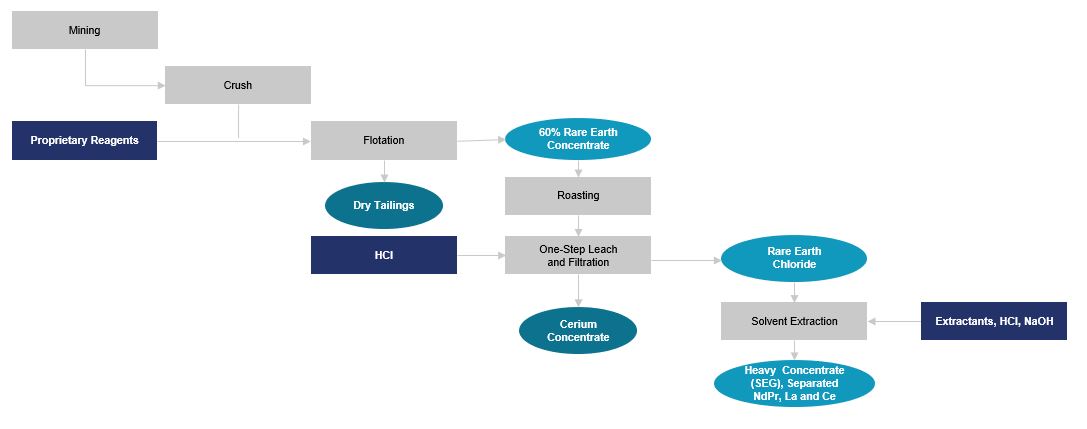
Upon completion of our Stage II optimization plan, processing at our Mountain Pass facility will include five primary process steps: (i) mining and crushing; (ii) milling and flotation; (iii) leaching and impurity removal; (iv) separation and extraction; and (v) product finishing. Having completed Stage I of our optimization plan, we are engaged in the first two of these steps. The first step includes mining the primarily bastnaesite ore followed by comminution, which involves crushing and grinding the ore into a milled slurry. In the second step, the milled bastnaesite slurry is then processed by froth flotation, whereby the bastnaesite floats to the surface while the gangue, or non-desired, elements are suppressed and disposed as tailings. We believe we are unique among scaled rare earth producers in our use of a dry tailings process that allows recycling of the water used in our milling and flotation circuit and eliminates the need for high-risk wet tailings ponds and traditional impoundment dams. This reclaimed water accounts for 95% of our current water consumption, resulting in approximately 5% of the fresh water use of a comparable milling and flotation circuit. As a result, we believe our milling and flotation operations enable us to achieve best-in-class sustainability relative to other producers of REE.
MP MATERIALS’ PROCESS
REVIVING ROASTING PROCESS PIONEERED AT MOUNTAIN PASS
Stage I Execution Successful
Current ownership and management began implementing its Stage I optimization plan following the 2017 acquisition of Mountain Pass. Utilizing technical assistance from Shenghe and our own engineers, management implemented changes in the milling, flotation and tailings management processes; implemented a new, advanced reagent scheme that improved mineral recovery and enabled operation at lower temperatures; and implemented operational best practices. Together, these changes have increased plant uptime to approximately 95% and have driven enhanced flotation reliability, throughput, recovery and production as well as tailings facility reliability and throughput at a significantly lower cost per processed ton. We already have established our ability to achieve approximately 3.2x the production volume of rare earth concentrate versus our predecessor using the same capital equipment, whose insufficient concentrate production drove downtime throughout the facility. We also believe that our Stage I optimization initiatives have enabled us to achieve world-class production cost levels for rare earth concentrate. All of these achievements have enabled us to become operating cash flow positive, despite significant Chinese trade tariffs on ore and concentrates in place over the optimization period. These trade tariffs have since been suspended, further enhancing the earnings power of our Stage I operations.
Stage II Underway
Our Stage II optimization plan is focused on advancing from concentrate production to the separation of individual REO. Engineering, procurement, preliminary construction, and other recommissioning activities are underway and involve upgrades and enhancements to the existing facility process flow to produce separated REO more reliably, at significantly lower cost and with an expected smaller environmental footprint than the prior operator of the Mountain Pass facility. As part of Stage II, we are in the process of reintroducing a roasting circuit, reorienting the plant process flow, increasing product finishing capacity,
improving wastewater management, and making other improvements to materials handling and storage. The reintroduction of the oxidizing roasting circuit also allows subsequent stages of the production process to occur at lower temperatures, and with significantly lower volumes of materials and reagents, which supports lower operating and maintenance costs and higher uptime than our predecessor – in many ways mirroring the types of changes we implemented successfully in Stage I. Upon completion of Stage II, we expect to be a low-cost producer of NdPr, which represents a majority of the value contained in our ore.
The roasting step that oxidizes the rare earth concentrate in a rotary kiln is crucial to ensuring the cost-competitiveness of our site. Roasting of bastnaesite concentrate was pioneered at Mountain Pass in 1966 and roasted concentrate continued to be processed until a new process flow was instituted by the prior owner after 2008. Under the prior owner’s operation, this practice was discontinued to maximize production of cerium, a lower-value rare earth. We believe this decision was a key factor in the deterioration of operating and financial performance under prior ownership. One of the unique attributes of bastnaesite is the ability to convert the trivalent form of cerium in the mixed rare earth concentrate to tetravalent cerium, which has a low propensity to dissolve, enabling cerium to be separated expediently along with other insoluble gangue elements without selective extraction. As compared to the process employed by the prior owner of Mountain Pass, the removal of low-value cerium early in our separations process allows for up to a 40% reduction in the mass of material to be separated and finished, thus dramatically reducing the energy, reagents, and wastewater required to produce the higher-value NdPr. We believe these changes are well-documented in academic literature, have been extensively piloted in both small and large scale by our team and outside laboratories, were used for decades at Mountain Pass prior to Molycorp’s ownership and operational changes, and are standard processes for other bastnaesite ore mines throughout the world.
We have substantially completed our process redesign and engineering for Stage II and we hold all intellectual property and expertise necessary to operate independently of our relationship with Shenghe. We believe that our Stage II optimization project will enable us to materially increase the recovery of NdPr from our concentrate, increase NdPr production and dramatically lower the cost of production, in each case, as compared to the prior owner’s operations.
Our currently idled natural gas-powered combined heat and power (“CHP”) facility includes two 15 megawatt (“MW”) natural gas-fired turbines (that are each capable of producing up to 12MW at our altitude and subject to weather conditions) to produce electricity and steam. We plan to restart the CHP facility in 2021, enabling us to produce low-cost electricity and steam while enhancing the reliability and redundancy of our utility supply. The CHP and required water pre-treatment asset recommissioning is expected to generate significant annualized run-rate savings prior to completion of Stage II. When we are fully operational upon completion of Stage II, we believe that our cost of electricity will be approximately half the cost of electricity from the grid per MW consumed, not including the value of the steam produced.
The Mountain Pass site also is equipped with a chlor-alkali facility to manufacture reagents used in our rare earth separation and processing. Following completion of Stage II, we may decide to bring the chlor-alkali facility back online, which would further integrate our operations, yield additional cost savings and supply redundancy, and further enhance our sustainability profile. Reagents produced from the chlor-alkali facility would be used in the leach, solvent extraction, brine neutralization and finishing processes, while excess reagents could be sold.
We hold the necessary permits to operate our Mountain Pass facility, including conditional use and minor use permits from San Bernardino County, California, and an associated environmental impact report, all of which were issued in 2004, which allow continued operation of the Mountain Pass facility through 2042. We hold numerous other permits and approvals, including permits to operate from the Lahontan Regional Water Quality Control Board for groundwater treatment. We may have to obtain new permits, including, without limitation, air permits issued by the Mojave Desert Air Quality Management District and construction and occupancy permits issued by San Bernardino County to complete the Stage II optimization project.
Combined with other site-specific technical and operational advantages, we believe the execution of our Stage II optimization plan will ensure we become a global low-cost producer of NdPr oxide, just as we are of concentrate at present.
Stage III Downstream Expansion Opportunity
Aside from our co-located refining facility, there are very few integrated rare earth mining and refining plants of scale globally, and none outside of China. This is a core driver behind our mission to restore this critical production capability to the U.S. We also seek to facilitate the restoration of the full magnetics supply chain to the U.S. by participating in the further downstream integration of our rare earth materials into high-strength rare earth permanent magnets. Upon completion of the Stage II optimization plan, we expect to be a cost-competitive, high-volume producer of separated REO. We believe we will then be in position to consider opportunities to integrate further downstream into the business of upgrading NdPr into metal alloys and magnets, ultimately expanding our presence as a global source for rare earth magnetics.
Downstream integration would be completed either via building a captive integrated magnet supply chain or investing in this capability via an acquisition, partnership or joint venture. The integration of magnet production would establish us as the first and only fully-integrated source of supply for rare earth magnets in the Western Hemisphere. In addition to offering end-market magnet customers a complete Western supply chain solution, we believe downstream integration would also create a material incremental value creation opportunity. We believe that the ability to capture significant value from magnet production requires a scaled, steady, cost-effective source of supply of NdPr, which we believe only we are positioned to provide in the Western Hemisphere. Because we will be creating that supply, an owned or partnered magnet production operation would benefit from lower costs and higher margins compared to stand-alone magnet producers. We also believe integration into magnet production would provide some protection from commodity pricing volatility, while also enhancing our business profile as the producer of a critical industrial output in addition to a producer of resources.
While we remain primarily focused on the execution of our Stage II optimization plan over the near term, we intend to focus our business development efforts on a “buy, build, and/or joint venture” strategy designed to capture value downstream in electrification.
Rare Earth Industry Overview and Market Opportunity
The REE group includes 17 elements, primarily the 15 lanthanide elements. Cerium, lanthanum, neodymium, and praseodymium are considered “light REE” that are more predominant in bastnaesite; samarium, europium, and gadolinium are often referred to as “medium REE”; while terbium, dysprosium, holmium, erbium, thulium, ytterbium and lutetium are considered “heavy REE.” Two additional elements, yttrium and scandium are often classified with the heavy REE though they are not lanthanides. Depending upon the rare-earth carrying material, the mixture of light, medium and heavy REE will differ.
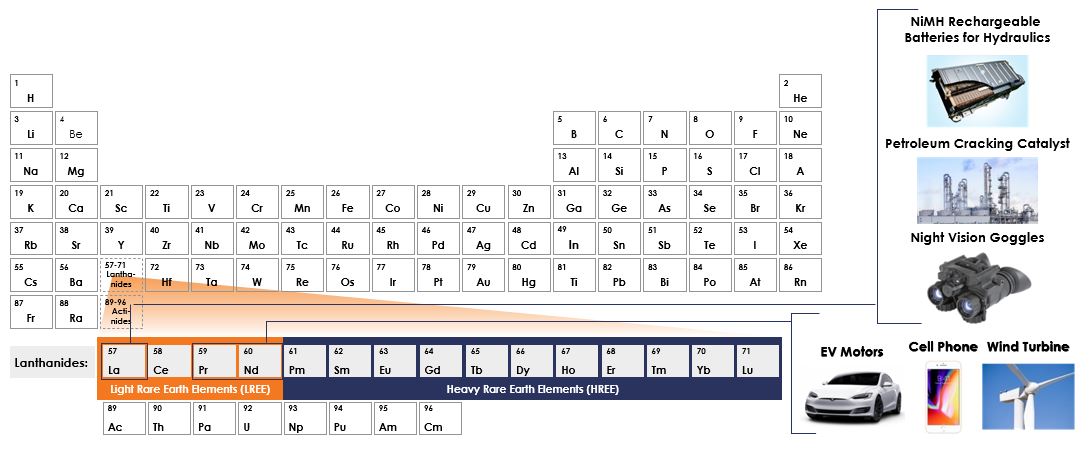
The aggregate global market for REO totaled approximately 161,000 metric tons in 2020 and is expected to grow at a compound annual growth rate (“CAGR”) of approximately 4.2% through 2030, according to research by CRU. REO are used in a diverse array of end markets, including:
-
Clean-Energy and Transportation Technologies:** traction motors in EVs and hybrid electric vehicles (“HEVs”), generators in wind power turbines, and linear motors in mag-lev trains;
-
High-Technology Applications:** miniaturization of smart phones and other mobile devices, computing devices, speakers and microphones, as well as fiber optics, lasers, robotics, medical devices and optical temperature sensors in medical and industrial environments;
-
Critical Defense Applications:** guidance and control systems, communications, global positioning systems, radar and sonar, drones, and railguns; and
-
Essential Industrial Infrastructure:** advanced catalyst applications in oil refining, pollution-control systems in traditional internal-combustion automobiles, glass polishing, and LED lighting and phosphors.
REO Demand Forecast
CRU estimates that the NdPr segment of the REO market—which makes up the significant majority of the market value—is expected to grow at a 7.0% CAGR through 2030, well in excess of the overall REO market. This anticipated growth will be driven by secular growth in demand for NdPr magnets used to enable emerging technology applications including EVs and
electrified transportation modes such as trains, as well as defense and alternative energy solutions such as robotics and wind turbines. These categories comprise approximately 29.3% of the total NdPr market today, but are expected to grow at a significantly higher CAGR as the global economy increasingly embraces sustainable solutions that replace traditional technologies like the internal combustion engine.
Electric Vehicle Market Opportunity
NdPr magnets are critical components in permanent magnet traction motors, the dominant EV motor technology with a more than 90% market share among leading automotive original equipment manufacturers (“OEMs”). EVs are primarily differentiated from vehicles powered by internal combustion engines by their rechargeable power sources and their electric motors. While the EV battery market is evolving, with multiple approaches to battery composition, in EV motors NdPr magnets are already the widely accepted technology standard. NdPr magnets are superior to other types of magnets for this application due to their unequaled efficiency in converting energy into motion with a superior energy-to-weight ratio versus alternatives.
According to research by CRU, annual production of EVs is expected to grow eightfold between 2019 and 2035. Given the intensity of NdPr’s use in permanent magnet traction motors, CRU estimates that EV production alone would consume nearly 100% of today’s annual global production of NdPr, versus consuming just 9% in 2019. Global EV production will not be able to meet this expected increase in demand without an additional, stable supply of NdPr.
Wind Turbine Opportunity
NdPr magnets also are a key component of direct-drive wind turbines, which are gaining market share in wind power installations. The use of rare earth magnets eliminates the need for a gearbox in the wind turbine, making them lighter, cheaper, more reliable, easier to maintain, and capable of generating electricity at lower wind speeds. The wind turbine market is anticipated to account for approximately 28.8% of the global growth in the use of NdPr in rare earth magnets from 2020 to 2030, according to CRU. Every MW of direct-drive wind power installed generates approximately 650kg of incremental NdPr demand.
According to CRU, the anticipated rapid increase in demand for rare earth products, particularly NdPr, has the potential to cause supply shortages within the next few years. As EVs, wind turbines and other advanced applications generate an increasing percentage of global GDP, we believe individual nations and enterprises will require a competitive, diversified and reliable supply chain for REO. We believe that our onshoring of a North American supply chain for REO will help meet the demand for EVs and other emerging industries while lowering single point-of-failure risk.
Supply Chain, Geopolitical and Sustainability Forces Driving Market Opportunity
We believe global economic trends, geopolitical realities and sustainability mandates are reshaping the business and investing landscape to create tailwinds supporting our market opportunity. More importantly, we believe these trends together create a need to establish a fully onshore REO supply chain in the U.S., consistent with our mission. Over the past several decades, U.S. companies have moved critical manufacturing and supply chain operations to lower-cost markets. While this trend has enabled U.S. companies to realize lower production costs and furthered the globalization of the macroeconomy, the strategy of “offshoring” has created supply chain complexities that increased business risk. This circumstance was made more visible during the global COVID-19 pandemic, when businesses across many industries were forced to take rapid action to mitigate disruption of their global supply chains due to variable, cross-border restrictions on economic and business activity. Mitigating actions include increasing the diversification of supply chains, both in number of suppliers and source locations, including back into the U.S. As a result, we believe many companies will be re-evaluating their approach to building supply chains, seeking an appropriate balance between assuring diversity and security of supply and managing cost.
China Dominance of REO Market
Governments are taking steps to strengthen national presence in key industries, including rare earths, and seeking to secure domestic supply chains for their domestic industrial base. China has dominated the global supply of rare earth products for the last 20 years and accounted for approximately 79% of global REO production in 2020. Other than Mountain Pass and deposits in Australia and Myanmar, there are limited reliable sources of REE supply outside of China. Since 2013, stricter regulations on mining production as well as tighter environmental standards and export controls resulted in the formation of six large government-backed production groups in China. This consolidation has resulted in more streamlined management and tighter control of rare earth supply flows and pricing. Export controls on both product and technology, production quotas, and direct and indirect subsidies have ensured that China’s market share of REO production exceeds its share of global reserves. Further, given China’s significant investment in downstream REO-consuming processes such as metallization and magnet manufacturing, Chinese domestic demand is projected to rapidly increase, which could create a shortage of REO available to
consumers outside of China. Chinese government actions and strategic political visits to rare earth facilities have in the past heightened international supply concerns, including China’s potential implementation of export restrictions in conjunction with international disputes.
China also dominates downstream rare earth production, manufacturing substantially all of the world’s supply of rare earth alloys/metals and a significant majority of high-end NdPr magnets. Currently, no production-scale capacity for rare earth metalmaking or permanent magnet production exists in the U.S. The remaining global high-end NdPr alloy/metal and magnet production is conducted primarily in Japan or Japanese-aligned facilities elsewhere in Asia, primarily in Vietnam, Philippines, and Thailand.
United States Actions to Restore Domestic Supply of Key Minerals
The U.S. is taking action to secure domestic sources of REE supply and we believe that we are uniquely positioned to answer several of the U.S. government’s calls to action regarding critical materials supply. On December 20, 2017, former President Trump issued executive order 13817, “A Federal Strategy to Ensure Secure and Reliable Supplies of Critical Minerals,” calling on agencies across the government to develop a strategy to reduce the susceptibility of the United States to critical mineral supply disruptions. On February 16, 2018, the United States Secretary of the Interior presented a list of 35 minerals deemed critical under the definition provided in the executive order, including the entirety of the REE group. On July 22, 2019, former President Trump issued five Presidential Determinations reiterating the importance of domestic production capability of rare earth products and rare earth permanent magnets to the national defense.
In addition, the Biden Administration has indicated their commitment to EVs and clean energy initiatives, including to critical minerals used in these applications. For example, on February 24, 2021, President Biden signed an executive order requiring the U.S. government to review supply chains for critical minerals and other identified strategic materials, including rare earth elements, in an effort to ensure that the U.S. is not reliant on other countries, such as China. This executive order calls for a review of a broader set of U.S. supply chains covering the defense, health care, information technology, energy, transportation and agriculture sectors.
In April 2020, we were selected by the U.S. Department of Defense (the “DoD”) for a preliminary contract to support the initial phase of a DoD effort to restore domestic heavy rare earths production and separation capabilities to the U.S. The construction of a heavy rare earths separation facility at Mountain Pass would be independent of, but complementary to, our Stage II optimization project. The heavy rare earths award contract was formally issued to us on July 10, 2020, and our efforts are now underway, though there is no guarantee that we will receive a contract for subsequent phases of the DoD’s heavy rare earths efforts, or that we will receive any additional U.S. government funding beyond the initial grant. In addition, in November 2020, we were awarded a Defense Production Act Title III technology investment agreement to establish domestic processing for separated light rare earth elements whereby the DoD has agreed to contribute $9.6 million towards our Stage II optimization project.
Environmental, Social, and Governance (“ESG”) Mandates Impacting Global Capital Allocation Throughout Value Chain
Public and private interests are increasingly demanding sustainability throughout production value chains to limit negative environmental and societal impacts from business activity, including pollution and acceleration of climate change. According to a survey by the Global Impact Investing Network, assets devoted to investments focused on ESG factors increased to $715 billion in April 2020, a 42% increase from $502 billion in April 2019.
REO will play a critical role in enabling the global expansion of sustainable industries like EVs and alternative energy solutions, but we also believe that governments, investors and our customers will increasingly demand that REO be produced sustainably. For example, current practices prevalent in the industry for extracting REO from hard rock utilize a wet tailings process that requires excessive groundwater usage and poses significant environmental and safety risks. We are differentiated among large REE producers in our use of a dry tailings process, which allows the water used in our milling and flotation circuit to be recycled and eliminates the need for high-risk wet tailings ponds and traditional impoundment dams. As part of our optimization plan to restore fully integrated development of REO, we are designing what we believe to be additional environmentally responsible production methods into our process that we believe will enable us to achieve best-in-class sustainability. While sustainable production processes can be more costly than traditional mining and processing approaches, we believe the high ore grade at Mountain Pass combined with our scale will enable us to make these investments and still achieve our objective of being a low-cost producer.
We believe our Company advances 11 of the United Nations’ 17 Sustainable Development Goals, across environmental areas including clean energy and sustainable mining, as well as social areas including ownership culture, employee empowerment and securing of strategic resources.
Overall, we believe the trends toward onshoring of supply chains, protection of U.S. national interests in vital industries and heightened focus on sustainable production and investing support our unique opportunity to become a lower-risk solution for customers in Western and allied nations for the supply of critical rare earth materials.
Our Strengths
Our Location: We are the only integrated, scaled producer in the Western Hemisphere, with significant cost advantages.
As worldwide demand for rare earth products increases, the supply of REO is limited by available production capacity, which is currently concentrated in China. A confluence of geopolitical and economic factors is causing downstream customers, such as automotive OEMs, to be increasingly focused on supply risk, highlighting the need to develop domestic production of REE and products. The U.S. government is actively seeking to end the country’s reliance on foreign REE sources, and we believe that our constructive relationship with key regulators and the relative stability of U.S. policies provides us with an advantage relative to non-U.S. REE producers. Within North America, our Mountain Pass facility is the only scaled source for critical rare earths in operation and there are high barriers to entry in the ex-China REE market. We believe it would take years and significant capital for any meaningful domestic competition to develop.
Moreover, the location of our facility affords significant cost and operational advantages that we believe are difficult to replicate, including:
-
the benefits of a fully-integrated, world-class facility leveraging greater than $1.7 billion of prior capital investments;
-
efficient accessibility to/from our facility, which is located approximately 50 miles southwest of Las Vegas, Nevada and immediately adjacent to Interstate 15, within truck drive time of one hour to a major rail-head and four hours to the Ports of Los Angeles and Long Beach;
-
ready access to sufficient water supply; and
-
a rural setting without competing commercial interests.
We believe the self-contained nature of our operations—with mining, milling, separations, and finishing all on one site—creates additional cost advantages and operational risk mitigation.
Our Platform: Positioned to play a prominent role in the transformation of America’s industrial economy.
Since restarting operations in 2017 from cold-idle status, we have increased production of our rare earth concentrate to over 38,000 metric tons of equivalent REO annually, which we believe represented approximately 15% of global REE production during the last twelve months. Our financial performance during the year ended December 31, 2020, has been achieved without significant capital investment, as the primary cost of building the Mountain Pass processing facility was borne by prior ownership. As a result, we believe we are in a strong operating and capital position to execute on Stage II and ultimately to integrate downstream processing of REO via a Stage III downstream expansion strategy, which would create the opportunity to drive additional revenue growth and profits, and position us as a competitively advantaged provider of a key industrial output.
Our current operating success and strategic plan create a strong foundation at a critical moment in the global economy. As the adoption of electric transportation grows, U.S. leadership in automotive, defense, and aerospace manufacturing and within the healthcare industry is increasingly at-risk without a stable, competitive domestic magnetics industry. Commercial and government customers are increasingly demanding redundancy, visibility and cost competitiveness in their supply chains. For example, the DoD in the National Defense and Authorization Act of 2019 required that NdPr magnets (and the relevant supply chain) be sourced from Allied nations, identifying REE and permanent magnets as critical to the defense and industrial security of the United States. We believe automotive OEMs will demand supply chain redundancy as they transition their engine, transmission and motor manufacturing facilities to build EV components. In addition, we believe end consumers will demand that the materials used to build these vehicles be extracted sustainably. We believe we are positioned to address these converging demands to provide customers with a lower-risk solution for rare earth supply, as a low-cost, domestic, environmentally-friendly producer of materials crucial to a sustainable economy.
Our Resource: We own and operate one of the richest rare earth deposits in the world.
More than 60 years of operations have proven that our ore body is one of the world’s largest and highest-grade rare earth resources. The low-volume nature of rare earth mining coupled with the exceptional scale and quality of the ore body results in a resource with significant viability well into the future. Our bastnaesite ore is well-suited to the proven separation technologies upon which our Stage II optimization plan is based. Further, bastnaesite contains significantly lower levels of radioactive thorium and uranium than most other REE-bearing ore types, reducing costs and operational risks.
As of July 1, 2020, SRK Consulting (U.S.), Inc. (“SRK”), an independent consulting firm that we have retained to assess our reserves, estimates total proven reserves of 0.03 million short tons of REO contained in 0.3 million short tons of ore at Mountain Pass, with an average ore grade of 8.19%, and probable reserves of 1.47 million short tons of REO contained in 20.8 million short tons of ore, with an average ore grade of 7.04%. Our total proven and probable reserves are estimated to have an average ore grade of 7.06%. In each case, these estimates use the estimated economical cutoff of 3.83% total rare earth oxide (“TREO”). Based on these estimated reserves and our expected annual production rate of REO upon completion of our Stage II optimization project, our expected mine life is approximately 24 years.
The open pit mine is located on approximately 2,222 fee simple acres with approximately 15,000 acres of mineral rights. We believe there is opportunity to grow the reserve base over time with exploratory drilling, which has not been conducted since 2011.
Our Sustainable Operations: We believe we operate the most environmentally responsible rare earth facility in the world.
Mountain Pass is a state-of-the-art rare earth facility operating with what we believe to be best-in-class environmental standards. Our paste tailings process—where waste from beneficiation is de-watered and that water is recycled back into the process, allowing the remaining solids to be deposited into a lined impoundment—dramatically reduces water consumption, the risk of seepage issues and our environmental footprint and eliminates the need for “tailings ponds” often associated with mining operations that can present a higher risk than paste disposal. Upon the potential restart of our chlor-alkali facility, we expect to consume waste brine from the separations process to produce the key reagents used in separation and finishing. We expect this “closed loop” process will reduce third-party reagent consumption, reduce processing or disposal costs of brine, and further reduce our environmental impact. Clean natural gas will fuel our CHP facility that, upon restart, will provide power and steam to the entire site, which we believe will improve energy efficiency and remove dependence on grid-based power. Our facilities are fully permitted and, we believe, comply with all federal and California environmental regulations, which are among the highest environmental standards in the world. As we grow, we will seek out and obtain such permits and licenses necessary to ensure our facilities continue to comply with required standards. As global industry increasingly considers and works to reduce the environmental impact of operations—and while consumers increasingly understand the “net” environmental impact of adopting green technologies—we believe our sustainable process for producing key materials for the clean-energy economy is a distinct advantage.
According to independent research conducted by the Institute of Energy and Climate Research of the German government research center Forschungszentrum Jülich, rare earth production from the Mountain Pass deposit “demonstrates superiority… in terms of environmental effects” compared to the Mount Weld deposit in Australia and the Bayan Obo deposit in China. The research studied the impact of rare earth production on environmental categories including climate change, freshwater ecotoxicity and particulate matter formation.
Our Operating Approach: We are focused on achieving status as the industry’s low-cost producer, led by a mission-driven management team invested in long-term success.
We have a unique mission in the minerals industry: to re-establish a secure and sustainable supply chain in the U.S. for critical sectors of the modern global economy. The team who purchased Mountain Pass out of bankruptcy and leads the Company today is substantially invested alongside public stockholders of the Company and is committed to the fulfillment of this mission. We believe that fulfillment of this mission will maximize shareholder returns over the long-term and generate positive outcomes for U.S. national security and industry, the U.S. workforce, and the environment.
We believe that fulfilling our mission requires execution of a disciplined business strategy. The rare earths market is highly competitive and, given its concentration in China, is potentially subject to anti-competitive behavior. As a result, we are pursuing a strategy that is differentiated from our predecessor and focused on long-term outcomes. For example, since restarting operations at Mountain Pass, Stage I of our optimization plan was designed to re-establish stable, scaled production of rare earth concentrate, leveraging the current processing facility. That plan has resulted in the restoration of Mountain Pass as an important producer in the global REE market and has generated revenue and Adjusted EBITDA growth that has strengthened our capital position. We also believe we are a low-cost producer of REE concentrate.
Our Stage II optimization plan is designed to make separated REO more reliably, at significantly lower cost and with an expected smaller environmental footprint, which we believe positions us to ultimately act as a low-cost producer of REO, extending the value of our domestic supply chain and eliminating the need to sell our concentrate to Chinese REO producers. In so doing, we have made intentional strategic choices to focus primarily on NdPr versus lower-value REE such as cerium, in contrast to our predecessor’s strategy. We believe our strategic choices will make our higher-value NdPr less costly to produce and will generate less waste, improving our sustainability profile.
Our Business Strategy
Offer the Western Hemisphere a trusted, sustainable source of supply for materials that enable the development of critical industries.
Upon the completion of Stage II, Mountain Pass will be one of the largest, most advanced and efficient fully-integrated REO processing facilities in the world, and the only such facility located in North America. We hope to reinvigorate the industrial history of the rare earths supply chain that originated in the United States, and provide a domestic alternative to both current and future users of rare earths that helps them avoid the risks associated with the single point-of-failure currently represented by China in the global supply chain.
The global effort to curb carbon emissions and reverse climate change often focuses on the impact of the transportation system, and we believe that our products will play a significant role in advancing those efforts. To date, 15 states in the U.S. plus the District of Columbia have adopted or committed to adopting zero emission vehicle mandates. We have seen similar mandates in other countries globally. The NdPr products that we intend to produce at Mountain Pass are essential to the dominant permanent magnet motor technology deployed in approximately 95% of current EVs. We are committed to protecting biodiversity and our environmental management plans cover biodiversity impacts, waste and noise management, air and water pollution, and natural resource and toxic chemical usage. We believe that our commitment to environmentally responsible production of REO will be a strong competitive advantage in building relationships with EV manufacturers, who share our commitment to sustainability.
To meet the anticipated growth in demand for EVs, we believe automotive OEMs will redesign their supply chains to ensure a ready and stable supply of rare earth products. We believe nearly 30% of domestic factories for U.S. automotive OEMs could become obsolete as internal-combustion engine demand wanes. We aim to capitalize on and accelerate this opportunity by seeking to partner with our future customers in their efforts to re-position the capital and labor in their supply chain.
Recommission the largest, most advanced and efficient fully-integrated REO processing facility in the world.
With Stage I of our optimization plan complete, our immediate strategic focus is on Stage II, which includes installing a redesigned roasting circuit, repositioning our leach and impurity removal circuits, and increasing product finishing capacity at Mountain Pass. Our ability to leverage the process experience of our engineering team and implement a culture of achievement, combined with process know-how from a world class global rare earth operator, have led to successful implementation of our optimization plans to date. Over the last 12 months, we have achieved consistent recovery and have maintained mill uptime of approximately 95% with REO production that is approximately 3.2x the highest ever production in a 12-month period by the former operator using the same capital equipment. We expect to leverage this track record, as well as our commitment to best practices and methodical execution, to successfully manage our Stage II optimization plan.
Leverage our low-cost position to maximize earnings power in all commodity price environments.
The success of our business will reflect our ability to manage our costs. Stage II is designed to enable us to manage our cost structure through a revised facility process flow. This process flow will allow us to use significantly less energy and raw materials per ton of separated REO. Installing the roasting circuit to oxidize our rare earth concentrate in a rotary kiln is crucial to ensuring the cost-competitiveness of our site. Additionally, the recommissioning of our natural gas-powered CHP facility will reduce energy, heating and steam costs as well as minimize or eliminate our reliance on the regional electric power grid. The potential re-commissioning of the chlor-alkali facility would enable us to produce our own hydrochloric acid and sodium hydroxide at the Mountain Pass facility and recycle our acid and base inputs, thereby reducing our reliance on external sources of reagents.
Optimization of logistics is also central to maintaining a low-cost position relative to other global producers. Our location offers significant transportation advantages that create meaningful cost efficiencies in securing incoming supplies and shipping our final products. Additionally, upon the completion of Stage II, our integrated site will no longer incur the packaging, handling and transportation costs incurred by competitors who lack co-located processing.
Secure customer relationships and develop a leading rare earth marketing and distribution platform.
We plan to build an efficient and effective marketing and sales organization to engage our customers and better capitalize on the benefits of our position as a sole source of rare earths supply in the Western Hemisphere. We intend to invest significant time and resources with the largest North American consumers of rare earth products, with the objective of building strong relationships and identifying opportunities for collaboration.
Further our mission and ability to capture the full rare earth value chain through downstream integration into NdPr magnet production and exploration of other adjacencies.
Beyond re-establishing a supply chain for REO in the Western Hemisphere through the completion of our strategic plans, we expect to recognize compelling longer-term opportunities to further our mission through the capture of additional value by pairing our attractive access to a large domestic rare earth supply with growing industry demands for magnetic materials. We intend to explore long-term vertical integration through further downstream processing of our REO into rare earth metals, alloys and finished magnets. Such integration could take many forms, including joint ventures with customers, brownfield/greenfield development, or strategic transactions or acquisitions. In addition, we intend to explore future opportunities to invest in, develop, and/or sponsor new downstream opportunities for REO, rare earth metals and alloys and rare earth products that contribute to the sustainability revolution of the industrial economy.
We believe our successes to date at Mountain Pass demonstrate a competency in identifying undervalued assets, creating a disciplined, execution-focused strategy, and assembling the management talent to create value. We intend to apply our experience and skill sets across the rare earth value chain, while allocating capital effectively and responsibly, toward opportunities demonstrated to be in the best interest of stockholders and consistent with our mission.
The Mountain Pass Facility
At the Mountain Pass facility, we own an open-pit mine containing one of the world’s most fully developed rare earth deposits outside of China. In addition to the mine, the Mountain Pass facility includes crushing, milling, flotation and separation facilities, and associated infrastructure. Some of these facilities are currently in a cold-idle state and must be recommissioned for us to reach our anticipated planned production rates. The Mountain Pass facility is located approximately 50 miles southwest of Las Vegas, Nevada near Mountain Pass, San Bernardino County, California. The Mountain Pass facility directly abuts Interstate 15 and may be accessed by existing hard-surface roads.
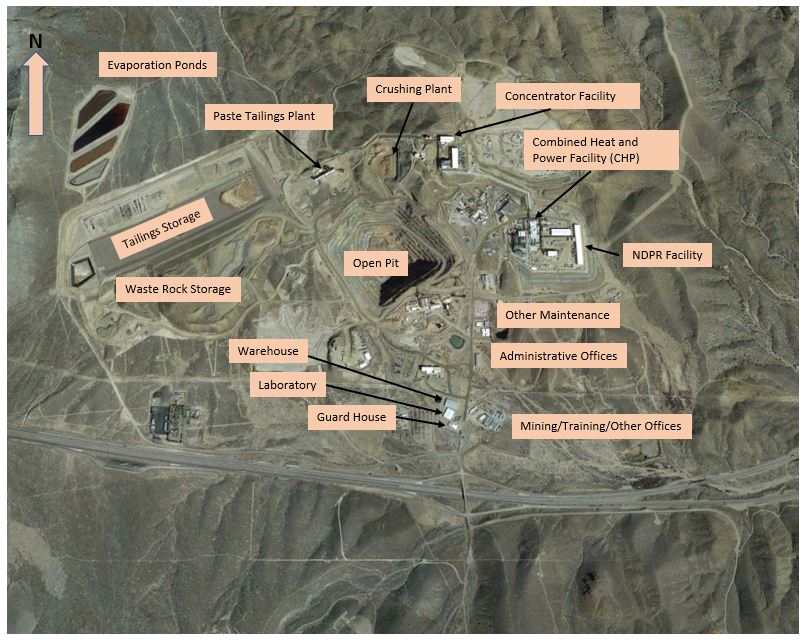
The Mountain Pass facility represents the only developed commercial source of rare earth material in the Western hemisphere. Molybdenum Corporation of America began REE mining operations at the Mountain Pass facility in 1952. REE production at the Mountain Pass facility, as well as milling and separation processes, continued under Unocal Corporation, which purchased Molybdenum Corporation of America in 1977, until 1998. In 1998, all chemical processing operations were
suspended, primarily due to leaks in a wastewater pipeline that transported waste salt water to evaporation ponds on the Ivanpah dry lake bed. Subsequently, in 2005, ChevronTexaco Corporation acquired Unocal Corporation and then, in 2008, Molycorp Minerals, LLC acquired the Mountain Pass facility from Chevron Mining Inc. Operations relating to mining, milling and separations resumed under Molycorp until they were placed into cold-idle status after Molycorp declared bankruptcy in June 2015. In July 2017, we acquired the Mountain Pass facility real property and associated assets from Molycorp. After the acquisition, we engaged the services of approximately 8 contractors who were former employees of Molycorp, covering various disciplines, retained through the bankruptcy to satisfy environmental obligations and support the bankruptcy trustee’s efforts to sell the Molycorp assets.
We hold the necessary permits to operate the Mountain Pass facility, including conditional use and minor use permits from San Bernardino County, California, and an associated environmental impact report, all of which were issued in 2004, which allow continued operation of the Mountain Pass facility through 2042. Since restarting operations at the facility in the fourth quarter of 2017, our activities have focused on the milling and flotation processes, leading to production of a bastnaesite concentrate, rich in REE, with our first concentrate sales in the first quarter of 2018. We now consistently achieve world-class results in our flotation facility, as measured by throughput, uptime, REO recovery, and final product grade.
The Mountain Pass facility is located on 2,222 acres of owned property, and we own mining and mill site claims over a further 15,000 acres of adjacent land. Approximately 938 acres of the 2,222 fee simple acres are currently in use (e.g., existing buildings, infrastructure or active disturbance). Portions of the fee lands are subject to mineral reservations in favor of the United States for some properties and the State of California for other properties. The specific minerals reserved on those parcels vary according to the type of land patent or conveyance document through which the land was acquired or conveyed. The lands surrounding the Mountain Pass facility are mostly public lands managed by the Bureau of Land Management and the National Park Service. In addition, we hold 525 unpatented lode and mineral mining claims and mill sites under the provisions of The Mining Law of 1872. SNR acquired our mineral rights at the Mountain Pass facility from Molycorp in 2016 and MPMO acquired our Mountain Pass facility real property and associated assets from Molycorp in 2017. These mining claims and mill sites provide land for mining, ancillary facilities and expansion capacity around the Mountain Pass facility.
The Mountain Pass facility includes an open-pit mine, infrastructure supporting mining and processing operations, overburden stockpiles, a crusher and mill/flotation plant, leach assets, separation plants, product finishing facilities, a tailings filter plant, tailings storage areas and on-site evaporation ponds, as well as laboratory facilities to support research and development activities, offices, maintenance shops, warehouses and support buildings.
The bastnaesite ore body at the Mountain Pass facility has been mined as a principal source of REE over a period of over 60 years. The Mountain Pass REE deposit is located within an uplifted block of Precambrian metamorphic and igneous rocks that are bounded to the south and east by basin-fill deposits in California’s Ivanpah Valley. The two main groups of rocks in the Mountain Pass area are Early Proterozoic high-grade metamorphic rocks and Middle Proterozoic ultrapotassic rocks and monazitic carbonatites, which carbonatites are associated with higher levels of REE. The currently defined zone of REE mineralization exhibits a strike length of approximately 2,750 feet in a north-northwest direction and extends for approximately 1,500 feet down dip from surface. The true thickness of the greater than 3.0% REO zone ranges from 15 feet to 250 feet. The percentage of each rare earth material contained in the Mountain Pass facility bastnaesite ore is estimated to be as follows:
| Estimated Distribution of TREO Content | |||||
| Element | |||||
| Cerium | 49.1 | % | |||
| Lanthanum | 33.4 | % | |||
| Neodymium | 11.5 | % | |||
| Praseodymium | 4.3 | % | |||
| SEG+ | 1.7 | % |
Rare Earth Reserves
SEC Guidelines
The SEC has established guidelines contained in Industry Guide No. 7 (the “SEC Industry Guide”) to assist registered companies as they estimate ore reserves. These guidelines set forth technical, legal and economic criteria for determining whether our ore reserves can be classified as proven and probable.
“Reserves” are defined by the SEC Industry Guide as that part of a mineral deposit that could be economically and legally extracted or produced at the time of the reserve determination. The SEC Industry Guide divides reserves between “proven (measured) reserves” and “probable (indicated) reserves,” which are defined as follows:
“Proven (measured) reserves” are reserves for which:
-
quantity is computed from dimensions revealed in outcrops, trenches, workings or drillholes; grade and/or quality are computed from the results of detailed sampling; and
-
sites for inspection sampling and measurement are spaced so closely and the geologic character is so well defined that size, shape, depth and mineral content of reserves are well-established.
“Probable (indicated) reserves” are reserves for which:
- quantity and grade and/or quality are computed from information similar to that used for proven (measured) reserves, but the sites for inspection, sampling, and measurement are farther apart or are otherwise less adequately spaced.
The degree of assurance for probable (indicated) reserves, although lower than that for proven (measured) reserves, is high enough to assume continuity between points of observation.
Methodology
When estimating proven and probable reserves, we rely on interpretations made during current and prior mining campaigns at our Mountain Pass facility, the U.S. Geological Survey and various consulting companies, including SRK, to identify the regional and mine area geology and hydrogeology, regional and local structure, deposit geology, current pit slope stability conditions and REE recoveries.
SRK compiled a drillhole database from prior drilling at the Mountain Pass site that includes a total of 137 drillholes with a cumulative length of 79,453.3 feet. Individual drillholes range in length from 56 feet to 2,012 feet, and averaged 580 feet. The majority of core samples in the deposit area analyzed by SRK range from 50 feet to 250 feet along strike of the ore body and 150 feet to 350 feet down dip. The sample data for proven ore reserves consists of survey data, lithologic data and assay results.
Based on the review of historic sample preparation and analytical procedures, SRK initiated a sample check assay program of 1% of the assay database. The material remaining from previous drilling programs consisted of split core stored at the Mountain Pass facility. SRK examined the existing split core using third-party preparation and analytical laboratories. In SRK’s opinion, based on the sample check assay program, our historic data was acceptable for use in preparing their report.
SRK generated a resource estimate as an intermediate step in the estimation of mineral reserves. The mineral resource estimate was based on composites derived from drillhole sample assay results. Grade interpolation was based on the geology, drillhole spacing and geostatistical analysis of the data. The resources were classified by their proximity to the sample locations and number of drillholes. SRK considers the resource model and resource classification to be consistent with Canadian Institute of Mining and Metallurgy guidelines. The distances utilized for resource classification are based on omni-directional variogram results, as follows:
-
Measured mineral resources: Blocks in the model estimated using a minimum of two drillholes which are at maximum average distance of 50 ft;
-
Indicated mineral resources: Blocks in the model estimated using a minimum of two drillholes which are at maximum average distance of 200 ft; and
-
Inferred mineral resources: Blocks in the model that do not meet the criteria for indicated resources but are within a maximum distance of 300 ft from a drillhole.
-
Stockpiles resources as of June 30, 2020, are based on detailed grade control, established bulk density and accurate survey data, and have been depleted forward according to a detailed short-term mine plan and blending schedule. Stockpiles are considered to be measured mineral resources.
Where appropriate, estimated resources are constrained by any known or anticipated restrictive geologic features.
Mineral resources were then converted to mineral reserves through the application of appropriate modifying factors such as mining dilution, mining recovery, cut-off grade calculation, pit optimization and costs, as represented in a life of mine production plan. Measured mineral resources, included in the life of mine plan, that met all criteria established for modifying factors were converted to proven reserves. Indicated mineral resources, included in the life of mine plan, that met all criteria
established for modifying factors were converted to probable reserves. Inferred mineral resources were treated as waste for the purposes of estimating the mineral reserves.
Results
As of July 1, 2020, SRK estimates total proven reserves of 0.03 million short tons of REO contained in 0.3 million short tons of ore at Mountain Pass, with an average ore grade of 8.19%, and probable reserves of 1.47 million short tons of REO contained in 20.8 million short tons of ore, with an average ore grade of 7.04%. Our total proven and probable reserves are estimated to have an average ore grade of 7.06%. In each case, these estimates use the estimated economical cutoff of 3.83% TREO.
Based on these estimated reserves and our expected annual production rate of REO upon completion of our Stage II optimization project, our expected mine life is approximately 24 years. Today, we hold total proven and probable reserves of 1.5 million short tons of REO contained in 21.1 million short tons of ore, although we believe there is opportunity to grow the reserve base over time with exploratory drilling.
The following table provides information as of July 1, 2020, on the amount of our proven and probable REO reserves.
| Average Ore Grade (%) | Ore (Short Tons) | Contained REO (Short Tons) | |||||||||||||||
| Category of Reserves | |||||||||||||||||
| Proven | 8.19 | % | 327,314 | 26,807 | |||||||||||||
| Probable | 7.04 | % | 20,814,014 | 1,465,308 |
In making the estimate above, SRK (i) assumed we have a 100% working interest in the Mountain Pass facility; (ii) included only measured and indicated resources (inferred resources are treated as waste); (iii) assumed full mining recovery; (iv) assumed that mine reserves are fully diluted; (v) assumed production of a rare earth concentrate (60% TREO content) for third-party sale; (vi) assumed an average selling price consistent with historical results resulting in an economic cut-off grade of 3.83% REO within the pit design; (vii) assumed a variable metallurgical recovery factor, based on ore grade, derived from historic results; (viii) utilized June 30, 2020, topography; (ix) included ore stockpiles as proven reserves; (x) assumed all mineral within our patented claim area could be extracted, including mineral outside our currently permitted mining boundaries; and (xi) rounded values to the nearest significant number.
Pricing assumptions were derived from a three-year average of historic pricing for rare earth concentrate, as quoted by Asia Metals (TREO greater than or equal to 70%), for the period from June 30, 2017, to June 10, 2020.
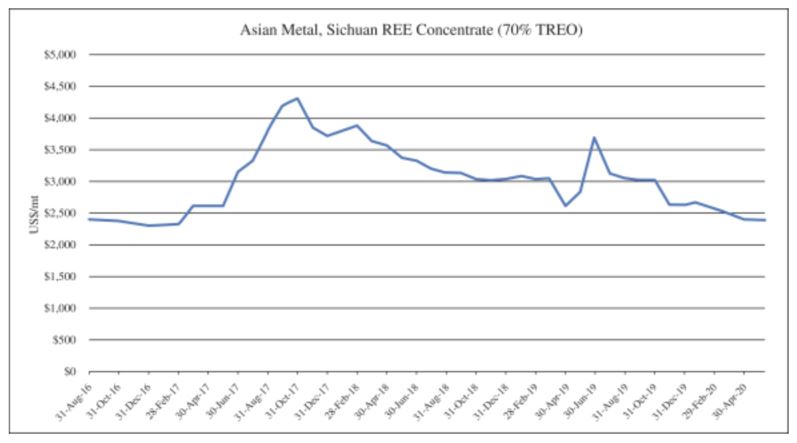
This pricing data was then adjusted to reflect typical forecast concentrate production from Mountain Pass, including the following:
-
prices quoted as renminbi per tonne were converted to U.S. dollar (“US$”) based on exchange rates queried from Bloomberg;
-
average sales price per tonne of REO was calculated and then adjusted to the targeted concentrate grade for Mountain Pass;
-
13% Chinese value added tax was deducted from the sales price; and
-
3% sales charge was deducted from the price.
Based on the above, the adjusted benchmark prices to the Company over this period are presented in the table below. Further, during the period from approximately August 2018 through May 2020, imports of rare earth concentrates to China were subject to a tariff. This tariff was originally implemented at a 10% level in the second round of retaliatory tariffs imposed by China as part of the ongoing trade dispute between the United States and China. The tariff was increased to 25% in June 2019. The current status of this import tariff is that it was suspended as of May 19, 2020, for a period of one year. For comparative purposes, we have included a calculation for a 25% tariff, consistent with the tariff from June 2019 through May 2020, in the table below.
| Chinese Tariff Assumption | Units (1) | Spot (June 10, 2020) | 1-Year Trailing Average | 2-Year Trailing Average | 3-Year Trailing Average | |||||||||||||||||||||||||||
| With Tariff | US$/dry metric tonne | 1,298 | 1,507 | 1,577 | 1,720 | |||||||||||||||||||||||||||
| Without Tariff | US$/dry metric tonne | 1,731 | 2,010 | 2,103 | 2,294 | |||||||||||||||||||||||||||
| With Tariff | US$/dry short ton | 1,178 | 1,368 | 1,431 | 1,561 | |||||||||||||||||||||||||||
| Without Tariff | US$/dry short ton | 1,571 | 1,823 | 1,908 | 2,081 |
(1)Units pertain to total dry weight of rare earth concentrate
For the purposes of the reserve calculation, SRK selected the three-year trailing average without a deduction for the tariff (i.e., US$2,081/dry short ton). The selection of the three-year trailing average is consistent with SEC guidance for pricing assumptions for metals and mining reserve calculations under the SEC Industry Guide. SRK did not include a tariff as no tariff is the current status of the market; however, there remains uncertainty as to the outlook of this tariff. If this tariff is re-introduced in 2021, it will result in a lower price for us for any rare earth concentrate sold into China.
SRK checked these calculated pricing assumptions against actual monthly pricing received by the Company. Variability between the actual price and benchmark price was high, ranging from as close as +/-1% to as much as 31% lower than the benchmark and 16% higher than the benchmark. However, comparing the actual prices to benchmark prices for each month, on average, has resulted in us receiving an average price 3% lower than the calculated benchmark price for that month and a median price 1% lower than the calculated benchmark providing support that this formula presents a reasonable estimate for salable concentrate price.
There are numerous uncertainties inherent in estimating quantities and qualities of REO reserves and costs to mine recoverable reserves, including many factors beyond our control. We will regularly evaluate our REO reserve estimates. This may be done in conjunction with additional exploration drilling programs. We also gain information from blast hole cuttings generated during operations. The estimates of REO reserves as to both quantity and quality will also be updated to reflect new drilling or other data received. Estimates of economically recoverable REO reserves, however, necessarily depend upon a number of variable factors and assumptions, all of which may vary considerably from actual results, such as:
-
geological, mining and processing conditions and/or effects from prior mining that may not be fully identified by available data or that may differ from experience;
-
the strategic approach to mining and processing the deposit may change depending upon market demand, corporate strategy and other prevailing economic conditions;
-
assumptions concerning future prices of rare earth products, foreign exchange rates, process recovery rates, transportation costs, operating costs, capital costs, and reclamation costs; and
-
assumptions concerning future effects of regulation, including the issuance of required permits and taxes by governmental agencies and foreign government policy relating to import or export of rare earth products.
Actual REO tonnage recovered from identified REO reserves and revenues and expenditures with respect to the same may vary materially from estimates. Further, period-to-period, our future estimates of REO reserves may fluctuate significantly as macroeconomic conditions and our level of understanding with respect to the deposit change. These estimates may not accurately reflect our actual REO reserves. Any inaccuracy in our estimates related to our REO reserves could result in lower than expected revenues and higher than expected costs.
Reserve Estimate
SRK completed a review of the operation including, among other things, the size of the underlying ore body and a life of mine plan for the Mountain Pass mine. The purpose of this review was to complete an estimate of the mineral reserve for the operation utilizing assumptions consistent with current operating conditions (i.e., production and sale of a rare earth concentrate). Below is a summary of some of the information from the reserve estimate.
Key project data
| Mine type | Open pit | ||||
| Process description | Crushing, milling, flotation | ||||
| Open pit mine life | 24 years | ||||
| Mill throughput | 2,455 average short tons per day | ||||
| Initial capital costs (1) | $0 | ||||
| Sustaining capital costs | $149 million |
(1)SRK excluded the restart of on-site rare earth separation activities from its estimates and therefore no initial capital expenditure is required given the operation is already actively producing rare earth concentrate for sale.
| Average Ore Grade (%) | Ore (Millions of Short Tons) | Contained REO (Millions of Pounds) | |||||||||||||||
| Contained minerals | |||||||||||||||||
| Proven | 8.19 | % | 0.327 | 54 | |||||||||||||
| Probable | 7.04 | % | 20.814 | 2,930 |
Human Capital Management
We are dedicated to our employees and are committed to safeguarding their health and safety, promoting diversity and inclusion, and developing skills that empower every employee to further our mission. Our diverse workforce is encouraged to use their creativity to drive efficiency, and this value proposition shows—since the formation of MP Materials, we have exceeded a 95% employee retention rate. With our employees at the forefront, we prioritize investments to ensure our team is healthy, driven, and proud to work with us.
We strive to create an ownership culture and work environment that enables us to attract, train, promote, and retain a diverse group of talented employees who together can help us gain a competitive advantage and achieve our operational objectives. We believe our relationship with our employees is good. In addition, we are not subject to any collective bargaining agreements.
Workforce Composition and Benefits
Since relaunching production at Mountain Pass in July 2017, we have increased our full-time employee base from eight contractors in 2017 to 277 employees as of December 31, 2020, of which 208 were field-based employees and 69 were office-based employees. As part of our previously discussed optimization plan, we are committed to creating employment opportunities for U.S. workers and anticipate hiring approximately 200 additional full-time employees as part of Stage II.
We believe employee benefits are an essential component of the Company’s competitive total compensation package. These benefits are designed to attract and retain our employees and include medical, dental, and vision insurance, life insurance, optional accidental death and disability insurance, HSA/FSA, a pharmacy program, and our 401(k) plan. According to independent Milliman benchmarks, our employer contribution to employee healthcare costs is between 68% and 102% higher than national and regional averages and between 21% and 52% higher than competitors in our industry, depending on the type of plan and coverage selected by our employees and their families.
Health and Safety
The health, well-being and safety of our employees, suppliers and communities is our top priority. We are committed to maintaining a strong safety culture and to emphasizing the importance of our employees’ role in identifying, mitigating and communicating safety risks. In this regard, our policies and operational practices reflect a “speak up” culture where all levels of employees are responsible for safety. We believe that the achievement of superior safety performance is both an important short-term and long-term strategic initiative in managing our operations. Safety is included as a significant component of the annual bonus calculation for executives and non-executives, reinforcing our commitment to safety across our organization.
In February 2020, our senior management team initiated a COVID-19 action and implementation plan to address the critical safety, operational and business risks associated with the pandemic. In March 2020, we launched our work-from-home plan for team members working in our corporate offices and revised critical work practices to promote safe operations for our Mountain Pass-based employees in order to keep as many of our employees working as possible. As part of our efforts with our Mountain Pass team, we staggered shift times and breaks to support appropriate distancing protocols; provided personal protective equipment across our team; and initiated an enhanced disinfection program, which included sanitizer, cleaning supplies and electrostatic sprayers, with a focus on shared locations and equipment. As we maneuvered through the pandemic, we ensured employee take-home pay was maintained along with all existing benefits, despite temporary reductions in scheduled hours for certain job functions. We also worked diligently with our employees to accommodate their requests to use the Families First Coronavirus Relief Act and the Family Medical Leave Act.
Through these efforts, as well as our continued commitment to monitor, assess and implement guidance and best practices recommended by the World Health Organization and Centers for Disease Control, we have been able to maintain the continuity of the essential services that we provide to our customers, while also managing the spread of the virus and promoting the health, well-being and safety of our employees, suppliers and communities.
Diversity and Inclusion
We believe that a diverse and inclusive workforce produces better overall decision-making for employees, which benefits the organization. In addition to the requisite skills, we seek to assemble a workforce that is diverse in terms of race, gender, culture and other factors. Currently, the Company provides training to its employees on diversity and inclusion and expects to implement new initiatives to promote and enhance this aspect of our human capital management in the upcoming year.
Training and Development
We are dedicated to the continual training and development of our employees, especially of those in field operations, to ensure we develop future managers and leaders from within our organization. Our training starts on an employee’s first day with on-boarding procedures that focus on safety, responsibility, ethical conduct and inclusive teamwork. In addition, we have an electrical and instrumentation apprenticeship program in which we pay for our employees to attend trade school to increase their opportunity for future advancement.
In addition to on-boarding training, we provide extensive ongoing training and career development focused on:
-
compliance with our Code of Business Conduct and Ethics and laws applicable to our business;
-
skills and competencies directly related to employee positions; and
-
responsibility for personal safety and the safety of fellow employees, others on location and the environment.
Customers
Currently, we sell our rare earth concentrate to Shenghe based on our arrangement under the A&R Offtake Agreement. Shenghe is contractually obligated under the A&R Offtake Agreement to purchase all of our rare earth concentrate product on a “take-or-pay basis” (such that they are obliged to pay for product even if they are unable or unwilling to take delivery). Shenghe sells the rare earth concentrate it acquires under the A&R Offtake Agreement to customers in China, which process and resell these refined products. Over the next few years, we intend to commence our downstream expansion and enter into short- and long-term sales contracts with existing and new customers for separated REO. For certain REE where the market demand is high, we may decide not to enter into letters of intent or contracts prior to commencing production.
Suppliers
We use certain proprietary chemical reagents in our flotation process, which we currently purchase from third-party suppliers. These products are subject to pricing volatility, supply availability and other restrictions and guidelines. In the event of a supply disruption or any other restriction, we believe that alternative reagents could be sourced. The solvent extraction
process is highly reliant upon standard commodity reagents, particularly hydrochloric acid and sodium hydroxide. Supplier matters are discussed in further detail within “Part I, Item 1A. Risk Factors” of this Annual Report on Form 10-K for the year ended December 31, 2020 (this “Annual Report”).
Patents, Trademarks and Licenses
We rely on a combination of trade secret protection, nondisclosure and licensing agreements, patents and trademarks to establish and protect our proprietary intellectual property rights. We utilize trade secret protection and nondisclosure agreements to protect our proprietary rare earth technology. Intellectual property matters are discussed in further detail within “Part I, Item 1A. Risk Factors” of this Annual Report.
Competition
The rare earths mining and processing markets are capital intensive and highly competitive. Outside of the six major rare earth producers in China, and those consolidated under their production quotas—there are only two other producers operating at scale, MPMC and Lynas Rare Earths Ltd., which processes its rare earth materials in Malaysia. Our competitors may have greater financial resources, as well as other strategic advantages to maintain, improve and possibly expand their facilities. Additionally, our Chinese competitors have historically been able to produce at relatively low costs due to domestic economic and regulatory factors, including less stringent environmental regulations. Competition is discussed in further detail within “Part I, Item 1A. Risk Factors” of this Annual Report.
Environmental, Health and Safety Matters
We are subject to numerous and extensive federal, state and local laws, regulations, permits and other legal requirements applicable to the mining and mineral processing industry, including those pertaining to employee health and safety, air emissions, water usage, wastewater and stormwater discharges, air quality standards, greenhouse gas (“GHG”) emissions, waste management, plant and wildlife protection, handling and disposal of hazardous and radioactive substances, remediation of soil and groundwater contamination, land use, reclamation and restoration of properties, the discharge of materials into the environment and groundwater quality and availability. These laws, regulations, permits and legal requirements have had, and will continue to have, a significant effect on our results of operations, earnings and competitive position. Environmental laws and regulation continue to evolve which may require us to meet stricter standards and give rise to greater enforcement, result in increased fines and penalties for non-compliance, and result in a heightened degree of responsibility for companies and their officers, directors and employees. Future laws, regulations, permits or legal requirements, as well as the interpretation or enforcement of existing requirements, may require substantial increases in capital or operating costs to achieve and maintain compliance or otherwise delay, limit or prohibit operations, or other restrictions upon, our current or future operations or result in the imposition of fines and penalties for failure to comply. Complying with these regulations is complicated and requires significant attention and resources. Our employees have a significant amount of experience working with various federal, state and local authorities to address compliance with such laws, regulations and permits; however, we cannot assure you that at all times we have been or will be in compliance with such requirements.
We expect to continue to incur significant sums for ongoing operating environmental expenditures, including salaries, and the costs for monitoring, compliance, remediation, reporting, pollution control equipment and permitting. In addition, we plan to invest significant capital to maintain and upgrade certain infrastructure to ensure we operate in a safe and environmentally sustainable manner.
Permits and Approvals
We hold the necessary permits to operate our facility, including conditional use and minor use permits from San Bernardino County, California, and an associated environmental impact report, all of which were issued in 2004, which allow continued operation of the Mountain Pass facility through 2042. We hold numerous other permits and approvals, including permits to operate from the Lahontan Regional Water Quality Control Board and groundwater treatment. We may be required to obtain new permits, including, without limitation, air permits issued by the Mojave Desert Air Quality Management District and construction and occupancy permits issued by San Bernardino County government, to complete Stage II and our general growth plans. To obtain, maintain and renew these and other environmental permits and perform any required monitoring activities, we may be required to conduct environmental studies and collect and present to governmental authorities data pertaining to the potential impact that our current or future operations may have upon the environment. Permits and approvals are discussed in further detail within “Part I, Item 1A. Risk Factors” of this Annual Report.
Mine Health and Safety Laws
The Federal Mine Safety and Health Act of 1977, as amended by the Mine Improvement and New Emergency Response Act of 2006, and the regulations adopted by the California Occupational Safety and Health Administration, impose stringent health and safety standards on numerous aspects of mining operations, including training of mine personnel, mining procedures, blasting, the equipment used in mining operations and other matters. In 2006, the Mine Safety and Health Administration (“MSHA”) promulgated new emergency mine safety rules addressing mine safety equipment, training and emergency reporting requirements. In addition, the Mine Improvement and New Emergency Response Act of 2006 required improvements in mine safety practices, increased criminal penalties and established a maximum civil penalty for non-compliance, and expanded the scope of federal oversight, inspection and enforcement activities. Mine health and safety laws are discussed in further detail within “Part I, Item 1A. Risk Factors” of this Annual Report.
The Mountain Pass facility maintains a comprehensive safety program. Our employees and contractors are required to complete 24 hours of initial training, as well as attend annual refresher sessions, which cover potential hazards that may be present at the facility. During the training, our commitment to a safe work environment is reinforced through our Stop Work Authority program, which allows any employee or contractor at the facility to stop work that they deem to be unsafe.
Workers’ Compensation
We are required to compensate employees for work-related injuries. The states in which we operate consider changes in workers’ compensation laws from time-to-time. Our costs will vary based on the number of accidents that occur at the Mountain Pass facility and our costs of addressing these claims. We are insured under various state workers’ compensation programs for our operations at the Mountain Pass facility and our offices in Las Vegas, Nevada.
Surface Mining Control and Reclamation
Our San Bernardino County conditional use permit, approved mining plan, reclamation plan and state laws and regulations establish operational, reclamation and closure standards for all aspects of our surface mining operations. Comprehensive environmental protection and reclamation standards must be met during the course of, and upon completion of, mining activities, and our failure to meet such standards may subject us to fines, penalties or other sanctions.
Although we expect the Mountain Pass facility to remain open for significantly longer than the expiration of our 21-year county-approved mine plan, the plan requires that we restore the surface area upon completion of mining. In addition, we must provide financial assurances to secure the performance of these reclamation obligations. To satisfy these financial assurance requirements, we typically obtain surety bonds, which are renewable on an annual basis.
As of December 31, 2020, we have procured $38.4 million in surety bonds that are issued to federal agencies, State of California agencies and the County of San Bernardino to secure the performance of our reclamation obligations. As of December 31, 2020, we had $8.7 million in cash collateral posted as cash-in-trust to secure these obligations.
Water Usage and Pollution Control
The federal Clean Water Act (“CWA”) and similar state and local laws regulate aspects of surface mining and processing operations by imposing restrictions on the discharge of pollutants, including tailings and other material, into waters of the United States. These requirements are complex and subject to amendments, legal challenges and changes in implementation. Recent court decisions, regulatory actions and proposed legislation have created uncertainty over the jurisdiction and permitting requirements of the CWA. Individual or general permits under Section 404 of the CWA are required if we discharge dredged or fill materials into jurisdictional waters of the United States. In addition, our Lahontan Regional Water Quality Control Board permit establishes standards for wastewater that can be discharged to the on-site evaporation ponds. Regular monitoring by the Lahontan Regional Water Quality Control Board, as well as compliance with reporting requirements and performance standards, are preconditions for the issuance and renewal of our permits. The Company spends significant sums on an annual basis to monitor, pump, sample, and maintain wells to track underground water table contamination and on shipping and analysis of well samples. We also maintain surety bonds with the Lahontan Regional Water Quality Control Board to secure our satisfaction of these as well as potential closure and post-closure activities.
Air Pollution Control
The federal Clean Air Act (“CAA”) and similar state and local laws and regulations directly and indirectly regulate our surface mining and processing operations. We currently maintain and operate numerous air pollution control devices required by or necessary to comply with permits from the California Mojave Desert Air Quality Management District. We generally
must obtain permits before we install new sources of air pollution, which may require us to do air quality studies and obtain emission offset credits, which can be costly and time consuming to procure. We expect that our new and expanded facilities and growth plans will require us to secure additional approvals or other permits to allow for our planned growth and to obtain emission credits or offsets for nitrogen oxides, particulate matter (10 microns), sulfur oxide and volatile organic compounds. The increased emissions from these facilities may trigger permitting under Title V of the CAA. Furthermore, although we are currently in compliance with all emissions regulations of the California Air Resources Board, if emissions regulations change we could be required to retrofit or replace off-road, on-road and forklift vehicles to achieve emission standards for nitrogen oxides and particulate matter (10 microns).
Our operations also emit GHGs and we expect to produce emissions exceeding the minimum required for participation in the California cap-and-trade program once the CHP facility is in sustained operation. The amount of credits we will receive and any excess credits we expect to need to purchase are under evaluation. Moreover, the regulation of GHG emissions is in various stages of development and it is possible that both the federal government and California will promulgate additional requirements. Any new GHG regulations could require us to modify existing permits or obtain new permits, implement additional pollution control technology, curtail operations or increase significantly our operating costs. Any further regulation of GHG emissions could adversely affect our business, financial condition, reputation, operating performance and product demand. However, such regulations might also present opportunities for our industry to the extent they increase the demand for rare earth products used in clean-technology applications, such as EVs, HEVs and wind power turbines.
The Mountain Pass facility consumes significant amounts of energy and, accordingly, is subject to fluctuations in energy costs. These costs may increase significantly in part as an indirect result of GHG and other air emission regulations applicable to third-party power suppliers.
Hazardous and Radioactive Substances and Wastes
The Comprehensive Environmental, Response, Compensation and Liability Act (“CERCLA”) and analogous state laws impose liability, without regard to fault or the legality of the original conduct, on certain classes of persons that are considered to have contributed to the actual or threatened release of a “hazardous substance” into the environment. In addition, these laws impose liability for the costs to investigate and remediate contamination or natural resource damage on a joint and several basis on persons who are or were responsible for such releases of hazardous substances, which can include waste generators, site owners, lessees and others. Accordingly, we may be subject to liability under CERCLA and similar state laws for properties that we currently own, lease or operate or that we or our predecessors previously owned, leased or operated, and sites to which our predecessors or we sent waste materials.
Rare earth-bearing minerals often contain naturally occurring radioactive substances, such as thorium and uranium. The mining and processing of REE involves the handling and disposal of such substances, which requires us to comply with extensive safety, health and environmental laws, regulations and permits regarding radioactive substances. We may incur significant costs, obligations or liabilities with respect to such requirements, and any future changes in such requirements (or the interpretation or enforcement thereof) may have a material adverse effect on our business or results of operations. One such permit we currently maintain for our operations is a Radioactive Materials License issued and administered by the California Department of Health Services Radiologic Health Branch. The license applies to the use of sealed radioactive sources used for gauging volumes of materials, as well as certain other activities. A failure to maintain or renew this license could materially adversely affect our business or results of operations.
We generate, manage and dispose of solid and hazardous waste associated with processing and remediation activities. In addition, the demolition of structures in connection with facility expansion and modernization will result in the generation of additional waste. We must comply with a variety of environmental laws, rules and regulations concerning the management, storage and disposal of such wastes. Moreover, in connection with our modernization and expansion effort at the Mountain Pass facility, we will incur additional costs to handle, store and dispose of such wastes.
Endangered Species Act and Mine Reclamation Plan
The federal Endangered Species Act and counterpart state legislation protect species threatened with possible extinction. Such laws and related regulations may have the effect of prohibiting or delaying us from obtaining mining permits and may impose restrictions on pipeline or road building and other mining or construction activities in areas containing the affected species or their habitats. Before we disturb any new land, we conduct a biological survey of the area to determine if nesting birds, protected vegetation, or protected animals are or have been present.
To date, none of the surveys have identified the presence of any species with conservation status or protected habitats on or near our ore reserve. The Golden Eagle is protected in the surrounding area, though we have not had any nesting on the site.
One of our offsite freshwater fields and related infrastructure is located within a critical desert tortoise habitat. We support this habitat by providing fresh water to support the Ivanpah Desert Tortoise Research Facility which breeds and releases tortoises into the wild. Our planned development activities are not anticipated to encroach on the habitat of any threatened or endangered species. In particular, our Stage II optimization plan will not affect any undisturbed land. Our offsite freshwater wells are also within certain protected flora and fauna habitats.
Under the Mining Conditional Use Permit and Mine Reclamation Plan granted by San Bernardino County for the Mountain Pass facility, we stockpile topsoil and vegetation to be used for revegetation as part of the approved reclamation plan. Revegetation will be supplemented by broadcast seeding with native and locally adapted seed and planting of established seedlings and/or shrubs. As part of the approved reclamation plan, which may be updated from time to time, we are complying with the County Development Code regarding the removal or salvage of Joshua Tree, Yucca, and various Cacti. We currently have no conservation status vegetation on or near the ore reserve.
Use of Explosives
In connection with our surface mining activities, we engage contractors who store explosives and blasting agents offsite prior to use on-site, which are subject to regulation, including under the federal Safe Explosives Act and the MSHA. Violation of these regulatory requirements may result in fines, imprisonment, revocation of permits and/or seizure or forfeiture of explosive materials.
Other Environmental Laws
We are required to comply with numerous other federal, state and local environmental laws and regulations in addition to those previously discussed. These additional laws include, for example, the California Environmental Quality Act, the National Environmental Policy Act, the Emergency Planning and Community Right-to-Know Act and the California Accidental Release Prevention Program.
Available Information
Our website is located at www.mpmaterials.com. Annual reports on Form 10‑K, quarterly reports on Form 10‑Q, current reports on Form 8‑K, and amendments to those reports, earnings releases, and financial statements are made available free of charge on the investor relations section of our website as soon as reasonably practicable after we electronically file such materials with, or furnish such materials to, the SEC. Our Code of Business Conduct and Ethics is also available on the investor relations section of our website. The information contained on our website, or accessible from our website, is not incorporated into, and should not be considered part of, this Form 10‑K or any other documents we file with, or furnish to, the SEC. The SEC maintains an internet site (http://www.sec.gov) that contains reports, proxy and information statements and other information regarding issuers that file electronically with the SEC. Annual reports, quarterly reports, current reports, amendments to those reports, earnings releases, financial statements and our various corporate governance documents, including our Code of Business Conduct and Ethics, are also available free of charge upon written request.
Investors and others should note that we may announce material financial information to our investors using our investor relations website (https://investors.mpmaterials.com/overview), SEC filings, press releases, public conference calls and webcasts. We use these channels as well as social media to communicate with our stockholders and the public about our company, our services and other issues. It is possible that the information we post on social media could be deemed to be material information. Therefore, we encourage investors, the media, and others interested in our company to review the information we post on the social media channels listed on our investor relations website.
Previous: Cover and table of contents · Next: Item 1A. RISK FACTORS