 filings.tools
MP Materials 2021 10-K Annual Report
MP · CIK 1801368 · Form 10-K · Fiscal year ended December 31, 2021 · Filed February 28, 2022
23 sections, 483K characters. Original on sec.gov · ·
Risk FactorsBusinessMD&AFinancial StatementsWhat changed vs 2020
Cover and table of contents
UNITED STATES
SECURITIES AND EXCHANGE COMMISSION
Washington, D.C. 20549
FORM 10-K
(Mark One)
| ☑ | ANNUAL REPORT PURSUANT TO SECTION 13 OR 15(d) OF THE SECURITIES EXCHANGE ACT OF 1934 |
For the fiscal year ended December 31, 2021
or
| ☐ | TRANSITION REPORT PURSUANT TO SECTION 13 OR 15(d) OF THE SECURITIES EXCHANGE ACT OF 1934 |
For the transition period from __________ to __________
Commission File Number 001-39277
MP MATERIALS CORP.
(Exact name of registrant as specified in its charter)
| Delaware | 84-4465489 | |||||||
| (State or other jurisdiction of incorporation or organization) | (I.R.S. Employer Identification No.) |
6720 Via Austi Parkway, Suite 450
Las Vegas, Nevada 89119
(702) 844-6111
Securities registered pursuant to Section 12(b) of the Act:
| Title of each class | Trading Symbol(s) | Name of each exchange on which registered | ||||||
| Common Stock, par value of $0.0001 per share | MP | New York Stock Exchange |
Securities registered pursuant to Section 12(g) of the Act: None
Indicate by check mark if the registrant is a well-known seasoned issuer, as defined in Rule 405 of the Securities Act. Yes ☐ No ☑
Indicate by check mark if the registrant is not required to file reports pursuant to Section 13 or Section 15(d) of the Act. Yes ☐ No ☑
Indicate by check mark whether the registrant (1) has filed all reports required to be filed by Section 13 or 15(d) of the Securities Exchange Act of 1934 during the preceding 12 months (or for such shorter period that the registrant was required to file such reports), and (2) has been subject to such filing requirements for the past 90 days. Yes ☑ No ☐
Indicate by check mark whether the registrant has submitted electronically every Interactive Data File required to be submitted pursuant to Rule 405 of Regulation S-T (§232.405 of this chapter) during the preceding 12 months (or for such shorter period that the registrant was required to submit such files). Yes ☑ No ☐
Indicate by check mark whether the registrant is a large accelerated filer, an accelerated filer, a non-accelerated filer, a smaller reporting company, or an emerging growth company. See the definitions of “large accelerated filer,” “accelerated filer,” “smaller reporting company,” and “emerging growth company” in Rule 12b-2 of the Exchange Act.
| Large accelerated filer | ☑ | Accelerated filer | ☐ | Non-accelerated filer | ☐ | Smaller reporting company | ☐ | Emerging growth company | ☐ |
If an emerging growth company, indicate by check mark if the registrant has elected not to use the extended transition period for complying with any new or revised financial accounting standards provided pursuant to Section 13(a) of the Exchange Act. ☐
Indicate by check mark whether the registrant has filed a report on and attestation to its management’s assessment of the effectiveness of its internal control over financial reporting under Section 404(b) of the Sarbanes-Oxley Act (15 U.S.C. 7262(b)) by the registered public accounting firm that prepared or issued its audit report. ☑
Indicate by check mark whether the registrant is a shell company (as defined in Rule 12b-2 of the Act). Yes ☐ No ☑
As of June 30, 2021, the aggregate market value of the voting common stock held by non-affiliates of the registrant was approximately $3.4 billion. Such aggregate market value was computed by reference to the closing price of the common stock as reported on the New York Stock Exchange on June 30, 2021. As of February 17, 2022, the number of shares of the registrant’s common stock outstanding was 177,524,993.
DOCUMENTS INCORPORATED BY REFERENCE
Portions of the registrant’s definitive 2022 proxy statement, anticipated to be filed with the Securities and Exchange Commission within 120 days after the end of the registrant’s fiscal year, are incorporated by reference into Part III of this Form 10-K.
MP MATERIALS CORP. AND SUBSIDIARIES
TABLE OF CONTENTS
i
References herein to the “Company,” “MP Materials,” “we,” “our,” and “us,” refer to MP Materials Corp. and its subsidiaries.
CAUTIONARY NOTE REGARDING FORWARD-LOOKING STATEMENTS
Certain statements included in this Annual Report on Form 10-K for the year ended December 31, 2021 (this “Annual Report”), that are not historical facts are forward-looking statements under Section 27A of the Securities Act of 1933, as amended and Section 21E of the Securities and Exchange Act of 1934, as amended. Forward-looking statements may be identified by the use of the words such as “estimate,” “plan,” “shall,” “may,” “project,” “forecast,” “intend,” “expect,” “anticipate,” “believe,” “seek,” “target,” or similar expressions that predict or indicate future events or trends or that are not statements of historical matters. These forward-looking statements include, but are not limited to, statements regarding estimates and forecasts of other financial and performance metrics and projections of market opportunity. These statements are based on various assumptions, whether or not identified in this Annual Report, and on the current expectations of our management and are not predictions of actual performance. These forward-looking statements are provided for illustrative purposes only and are not intended to serve as, and must not be relied on by any investor as, a guarantee, an assurance, a prediction or a definitive statement of fact or probability. Actual events and circumstances are difficult or impossible to predict and will differ from assumptions. Many actual events and circumstances are beyond our control.
These forward-looking statements are subject to a number of risks and uncertainties, including:
-
fluctuations and uncertainties related to demand for and pricing of rare earth products;
-
uncertainties regarding the growth of existing and emerging uses for rare earth products and ability to compete with substitutions for rare earth minerals;
-
the intense competition within the rare earth mining and processing industry;
-
uncertainties relating to our commercial arrangements with Shenghe Resources (Singapore) International Trading Pte. Ltd., an affiliate of Shenghe Resources Holding Co., Ltd., a global rare earth company listed on the Shanghai Stock Exchange;
-
potential changes in China’s political environment and policies;
-
unanticipated costs or delays associated with our Stage II optimization project;
-
unanticipated costs or delays associated with our Stage III project;
-
risks associated with our intellectual property rights, including uncertainties related to the Company’s ability to obtain the intellectual property rights or licenses of intellectual property rights to produce NdFeB alloy and magnets;
-
uncertainties related to the Company’s ability to produce and supply NdFeB alloy and magnets;
-
the ability to convert current commercial discussions with customers for the sale of rare earth oxide products, NdFeB alloy and magnets into contracts;
-
uncertainties related to the Company entering into a definitive long-term supply agreement with General Motors Company that includes all necessary terms and conditions, which may or may not occur;
-
uncertainties relating to the COVID-19 pandemic, including the Delta and Omicron variants or other variants;
-
potential power shortages at Mountain Pass;
-
increasing costs or limited access to raw materials that may adversely affect our profitability;
-
fluctuations in transportation costs or disruptions in transportation services;
-
inability to meet individual customer specifications;
-
diminished access to water;
-
uncertainty in our estimates of rare earth oxide reserves;
-
risks associated with work stoppages;
-
a shortage of skilled technicians and engineers;
ii
-
loss of key personnel;
-
risks associated with the inherent dangers involved in mining activity and metal and alloy manufacturing;
-
risks associated with events outside of our control, such as natural disasters, climate change, wars or health epidemics or pandemics;
-
risks related to technology systems and security breaches;
-
ability to maintain satisfactory labor relations;
-
ability to comply with various government regulations that are applicable to our business;
-
ability to maintain our governmental licenses, registrations, permits, and approvals necessary for us to operate our business;
-
risks relating to extensive and costly environmental regulatory requirements;
-
risks associated with the terms of our convertible notes; and
-
those factors discussed within “Part I, Item 1A. Risk Factors” of this Annual Report.
If any of these risks materialize or our assumptions prove incorrect, actual results could differ materially from the results implied by these forward-looking statements.
These and other factors that could cause actual results to differ from those implied by the forward-looking statements in this Annual Report are more fully described within “Part I, Item 1A. Risk Factors.” The risks described within “Part I, Item 1A. Risk Factors” of this Annual Report are not exhaustive. Other sections of this Annual Report describe additional factors that could adversely affect our business, financial condition or results of operations. New risk factors emerge from time to time, and it is not possible to predict all such risk factors, nor can we assess the impact of all such risk factors on our business or the extent to which any factor or combination of factors may cause actual results to differ materially from those contained in any forward-looking statements. All forward-looking statements attributable to us or persons acting on our behalf are expressly qualified in their entirety by the foregoing cautionary statements. We undertake no obligations to update or revise publicly any forward-looking statements, whether as a result of new information, future events or otherwise, except as required by law.
In addition, statements of belief and similar statements reflect our beliefs and opinions on the relevant subject. These statements are based upon information available to us, as applicable, as of the date of this Annual Report, and while we believe such information forms a reasonable basis for such statements, such information may be limited or incomplete, and statements should not be read to indicate that we have conducted an exhaustive inquiry into, or review of, all potentially available relevant information. These statements are inherently uncertain, and you are cautioned not to unduly rely upon these statements.
iii
PART I
Item 1. BUSINESS
Overview
MP Materials Corp. is the largest producer of rare earth materials in the Western Hemisphere. The Company owns and operates the Mountain Pass Rare Earth Mine and Processing Facility (“Mountain Pass”), the only rare earth mining and processing site of scale in North America. We estimate the rare earth concentrate we produced and sold in 2021 represented approximately 15% of the rare earth content consumed in the global market. Separated rare earth elements (“REE”) are critical inputs for the magnets that enable the mobility of electric vehicles (“EVs”), drones, defense systems, wind turbines, robotics and many other high-growth, advanced technologies. Our integrated operations at Mountain Pass combine low production costs with high environmental standards, thereby restoring American leadership to a critical industry with a strong commitment to sustainability.
We currently produce a rare earth concentrate that we sell pursuant to the A&R Offtake Agreement (as defined in Note 4, “Relationship and Agreements with Shenghe,” in the notes to the Consolidated Financial Statements) to Shenghe Resources (Singapore) International Trading Pte. Ltd. (“Shenghe”), an affiliate of Shenghe Resources Holding Co., Ltd., a leading global rare earth company that is publicly listed in China, that, in turn, typically sells that product to refiners in China. These refiners separate the constituent REE contained in our concentrate and sell the separated products to their customers. Upon completion of our Stage II optimization project (“Stage II”), we anticipate producing separated rare earth oxides (“REO”), including neodymium-praseodymium (“NdPr”) oxide, and selling these products directly to end users, at which time we may no longer sell our concentrate. Stage II is discussed further in the “Our Process” section below.
In December 2021, we announced (i) that we will build our initial rare earth, metal, alloy and magnet manufacturing facility in Fort Worth, Texas (the “Fort Worth Facility”), and (ii) that we entered into a long-term agreement with General Motors Company (NYSE: GM) (“GM”) to supply U.S.-sourced and manufactured rare earth materials, alloy and finished magnets for the electric motors in more than a dozen models using GM’s Ultium Platform, with a gradual production ramp that begins in 2023. These developments are a part of our Stage III downstream expansion strategy (“Stage III”), which is discussed further in the “Our Process” section below.
As electrification drives significant global growth in demand for REE, we believe global economic trends, geopolitical realities and sustainability mandates are coalescing to further our opportunity to create shareholder value. We believe businesses are increasingly prioritizing diversification and security of their global supply chains so as to reduce reliance on a single producer or region for critical materials. As the only scaled source in North America for critical rare earths, with a processing facility designed to operate with best-in-class sustainability and a competitive cost structure, we believe we are well-positioned to thrive in this transforming global economy.
Our mission is to maximize shareholder returns over the long-term by executing a disciplined business strategy to restore the full rare earth supply chain to the United States of America. We believe we can generate positive outcomes for U.S. national security and industry, the U.S. workforce, and the environment.
Rare Earth Industry Overview
Rare earth elements are fundamental building blocks of the modern economy, impacting trillions of dollars in global gross domestic product through the enablement of end products across industries including transportation, clean energy, robotics, national defense, and consumer electronics, among others. By economic value, NdPr is the largest segment of the REE market. NdPr is most often utilized in NdPr magnets, which are also commonly referred to as “neo,” “NdFeB,” “NIB,” or permanent magnets, and are made predominantly from an alloy of NdPr, iron and boron. NdFeB magnets are the most widely used type of rare earth magnets and are critical for many advanced technologies that are experiencing strong secular growth, including EVs, drones, defense systems, wind turbines, robotics and many others. The rapid growth of these and other advanced motion technologies is expected to drive substantial demand growth for NdPr and NdFeB magnets.
The REE group includes 17 elements, primarily the 15 lanthanide elements. Lanthanum, cerium, praseodymium and neodymium are considered “light REE” that are predominant in bastnaesite; samarium, europium and gadolinium are often referred to as “medium REE”; while terbium, dysprosium, holmium, erbium, thulium, ytterbium and lutetium are considered “heavy REE.” Two additional elements, yttrium and scandium, are often classified as heavy REE although they are not lanthanides. Depending upon the rare earth-bearing mineral, the mixture of light, medium and heavy REE will differ.
The aggregate global market for REO totaled approximately 180,000 metric tons in 2021 and is expected to grow at a compound annual growth rate (“CAGR”) of approximately 4% through 2030, according to research by the CRU Group (“CRU”). Further, CRU estimates that the NdPr segment of the REO market, which makes up the significant majority of the market value, is expected to grow at a 9.1% CAGR through 2030 (excluding the impact of closed loop recycling), well in excess of the overall REO market. This expected growth will be driven by secular growth in demand for NdPr magnets.
REO are used in a diverse array of end markets, including:
-
Clean-Energy and Transportation Technologies:** traction motors in EVs and hybrid electric vehicles, generators in wind power turbines, and linear motors in mag-lev trains;
-
High-Technology Applications:** miniaturization of smart phones and other mobile devices, computing devices, speakers and microphones, as well as fiber optics, lasers, robotics, medical devices and optical temperature sensors in medical and industrial environments;
-
Critical Defense Applications:** guidance and control systems, communications, global positioning systems, radar and sonar, drones, and railguns; and
-
Essential Industrial Infrastructure:** advanced catalyst applications in oil refining, pollution-control systems in traditional internal-combustion automobiles, glass polishing, and LED lighting and phosphors.
Our Process
Upon completion of Stage II, processing at Mountain Pass will include five primary process steps: (i) mining and crushing; (ii) milling and flotation; (iii) leaching and impurity removal; (iv) separation and extraction; and (v) product finishing. Having completed Stage I of our optimization plan (“Stage I”) (discussed below), we are engaged in the first two of these steps. The first step includes mining the primarily bastnaesite ore followed by comminution, which involves crushing and grinding the ore into a milled slurry. In the second step, the milled bastnaesite slurry is then processed by froth flotation, whereby the bastnaesite floats to the surface while the gangue, or non-desired, elements are suppressed and disposed as tailings. We believe we are unique among scaled rare earth producers in our use of a dry tailings process that allows recycling of the water used in our milling and flotation circuit and eliminates the need for high-risk wet tailings ponds and traditional impoundment dams. In 2021, dry tailings processes allowed us to recycle over 1.7 billion liters of water.
Stage I
Following the acquisition of Mountain Pass in July 2017, we began implementing Stage I, which was designed to re-establish stable, scaled production of rare earth concentrate, leveraging the existing processing facility. Since restarting operations from cold-idle status, we implemented changes in the milling, flotation and tailings management processes; implemented and continue to advance an improved reagent scheme to improve mineral recovery; and implemented operational best practices. Together, these changes materially increased plant uptime and reliability driving enhanced flotation throughput, REO recovery and production as well as tailings facility reliability and throughput at a significantly lower cost per processed ton. We have established our ability to achieve approximately 3.5x the production volume of REO content as the prior operator of Mountain Pass using the same capital equipment. We also believe that our Stage I efforts enabled us to achieve world-class production cost levels for rare earth concentrate.
Stage II
Stage II is focused on advancing our operations from the production of rare earth concentrate to the separation of individual REE. Engineering, procurement, construction, and other recommissioning activities are underway and involve upgrades and enhancements to the existing facility process flow to reliably produce separated REE at a lower cost and with an expected smaller environmental footprint per unit of REO produced. As part of Stage II, we are in the process of reintroducing an oxidizing roasting circuit, reorienting the plant process flow, increasing product finishing capacity, improving wastewater management, and making other improvements to materials handling and storage. The reintroduction of the oxidizing roasting circuit also allows subsequent stages of the production process to occur at lower temperatures, and with significantly lower volumes of materials and reagents, which supports lower operating and maintenance costs and higher uptime.
The roasting step that oxidizes the rare earth concentrate in a rotary kiln is crucial to ensuring the cost-competitiveness of Mountain Pass. One of the unique attributes of bastnaesite is the ability to convert the trivalent cerium in the mixed rare earth concentrate to tetravalent cerium that has a low propensity to dissolve, enabling cerium to be separated expediently along with other insoluble gangue elements without selective extraction. Removal of the lower-value cerium early in our separations process will allow for up to a 40% reduction in the mass of material to be separated and finished, thus dramatically reducing the
energy, reagents, and wastewater required to produce the higher-value NdPr. Upon completion of Stage II, we expect to be a global low-cost, high-volume producer of NdPr oxide, which represents a majority of the value contained in our ore.
In February 2022, we were awarded a $35.0 million contract by the Department of Defense’s Office of Industrial Base Policy to design and build a facility to process heavy rare earth elements (“HREE”). Successful completion of this project will establish the first processing and separation facility of its kind for HREEs in support of commercial and defense applications in the United States. The HREE processing and separations facility will be built at Mountain Pass and tie in with the rest of our Stage II facilities.
Stage III
Our mission is to restore the full rare earth magnetics supply chain to the U.S. by pursuing opportunities to integrate further downstream into converting NdPr into metal, alloy, and permanent magnets, as well as advancing magnet recycling capabilities. We recently announced our Fort Worth Facility, which we expect will have the capacity to produce approximately 1,000 metric tons (“MTs”) of finished NdFeB magnets per year, sufficient to power approximately 500,000 EV motors annually. The NdFeB alloy and magnets produced will also support other key markets, including clean energy, electronic and defense technologies. We also expect to supply NdFeB alloy flake to other magnet producers to help develop a diverse and resilient U.S. magnet supply chain. The Fort Worth Facility will serve as the business and engineering headquarters for our growing magnetics division.
The integration of magnet production would establish us as the first and only fully-integrated source of supply for rare earth magnets in the Western Hemisphere. By offering magnet customers a complete, end-to-end Western supply chain solution, we believe vertical integration represents a material incremental value creation opportunity. We believe that the ability to capture significant value from magnet production requires a scaled, steady supply of NdPr, which we believe we are uniquely-positioned to provide in the Western Hemisphere. We also believe integration into magnet production will provide some protection from commodity pricing volatility, while also enhancing our business profile as the producer of a critical industrial output in addition to a producer of resources.
Our Strategy
Offer the Western Hemisphere a trusted, sustainable source of supply for materials and components that enable the development of critical industries.
More than 60 years of operations at Mountain Pass have demonstrated that our ore body is one of the world’s largest and highest-grade rare earth resources. The low-volume nature of rare earth mining coupled with the exceptional scale and quality of the ore body results in a resource with significant viability well into the future.
Upon the completion of Stage II, we believe Mountain Pass will be one of the largest, most advanced and efficient fully-integrated REO processing facilities in the world, and the only such facility located in the Western Hemisphere. We hope to reinvigorate the industrial history of the rare earths supply chain that originated in the United States and provide a domestic alternative to both current and future users of rare earths that helps them avoid the risks associated with the single point-of-failure currently represented by China in the global rare earth supply chain. In addition, the U.S. government is actively seeking to end the country’s reliance on foreign REE sources, and we believe that our constructive relationship with key regulators and the relative stability of U.S. policies provides us with an advantage relative to non-U.S. REE producers.
The global effort to curb carbon emissions and reverse climate change often focuses on the impact of the transportation system, and we believe that our products will play a significant role in advancing those efforts. To date, nearly all U.S. states and the District of Columbia have mandated or offer incentives to support deployment of EVs or alternative fuel vehicles and supporting infrastructure, either through state legislation or private utility incentives within the state, with similar mandates and incentives in other countries globally. The NdPr product that we intend to produce at Mountain Pass is essential to the permanent magnet motor technology deployed in the significant majority of current EVs. In addition, we believe end consumers will demand that the materials used to build these vehicles be extracted sustainably. We are committed to protecting biodiversity and our environmental management plans cover biodiversity impacts, waste and noise management, air and water pollution, as well as natural resource and toxic chemical usage. We believe that our commitment to environmentally responsible production of REO will be a strong competitive advantage in building relationships with EV manufacturers, who share our commitment to sustainability.
A confluence of geopolitical and economic factors is causing downstream customers, such as automotive original equipment manufacturers (“OEMs”), to be increasingly focused on supply risk, highlighting the need to develop domestic production of REE and related products. To meet the growth in demand for EVs, we believe automotive OEMs will redesign
their supply chains to ensure a ready and stable supply of rare earth products as they transition their engine, transmission and motor manufacturing facilities to build EV components. We aim to capitalize on and accelerate this opportunity by seeking to partner with current and future customers in their efforts to re-position the capital and labor in their supply chain and to meet the growth in electrification.
Leverage our low-cost position to maximize earnings power in all commodity price environments.
The success of our business reflects and will reflect our ability to manage our costs. Our production achievements in Stage I have provided economies of scale to lower production costs per unit of REO produced in concentrate. Stage II is designed to enable us to continue to manage our cost structure for separating REE through an optimized facility process flow. This process flow will allow us to use significantly less energy and raw materials per ton of separated REO.
Optimization of logistics is also central to maintaining a low-cost position relative to other global producers. The location of our facility, which is immediately adjacent to Interstate 15, within one hour of truck drive-time to a major railhead and four hours to the Ports of Los Angeles and Long Beach, offers significant transportation advantages that create meaningful cost efficiencies in securing incoming supplies and shipping our final products. We believe the self-contained nature of our operations—with mining, milling, separations, and finishing all on one site—creates additional cost advantages and operational risk mitigation and upon the completion of Stage II, our integrated site will no longer incur the packaging, handling and transportation costs incurred by competitors who lack co-located processing.
Further our mission and ability to capture the full rare earth value chain through downstream integration into NdFeB magnet production.
Beyond re-establishing a supply chain for REE in the Western Hemisphere, we expect to recognize compelling longer-term opportunities to further our mission through the capture of additional value by pairing our attractive access to a large domestic rare earth supply with growing industry demands for magnetic materials. We are currently pursuing vertical integration through further downstream processing of REO into rare earth metals, alloys and finished magnets, including recycling. We intend to achieve this through a buy, build and/or joint venture strategy to achieve technical and cost leadership. We recently announced an agreement with GM and are developing a greenfield metal, alloy and magnet manufacturing and recycling facility in Fort Worth, Texas. We intend to continue exploring future opportunities to invest in, develop, and/or sponsor new downstream opportunities for REO, rare earth metals and alloys and rare earth products that contribute to the electrification of the industrial economy.
We believe our successes to-date at Mountain Pass demonstrate a competency in identifying undervalued assets, creating a disciplined, execution-focused strategy, and assembling the management talent to create value. We intend to apply our experience and skill sets across the rare earth value chain, while allocating capital effectively and responsibly, toward opportunities demonstrated to be in the best interest of our stockholders and consistent with our mission.
Human Capital Resources
Our people are our most valuable asset in progressing toward and ultimately fulfilling the Company’s mission. We strive to develop and maintain an owner-operator culture that instills an entrepreneurial spirit where our employees feel empowered to deliver results through an unwavering commitment to doing what is right in a safe environment. Ensuring we attract, develop and retain top talent across all functions with diverse experiences, backgrounds and perspectives is critical to our success. In each calendar quarter of 2021, our employee retention rate was approximately 94% or higher, which we believe demonstrates that we have prioritized investments and communication to ensure our team is healthy, motivated, proud to work for us, and believes in the Company’s mission.
Workforce Composition and Benefits
Since relaunching production at Mountain Pass in July 2017, we have increased our full-time equivalent (“FTE”) employee base from eight contractors in 2017 to 365 employees as of December 31, 2021, of which 313 were field-based employees and 52 were office-based employees. This represents a 32% increase of FTE employees in 2021. None of the employees are subject to any collective bargaining agreements. As part of our mission, we are committed to creating employment opportunities for U.S. workers and expect to hire more than 150 additional full-time employees as part of Stage II and at least 100 full-time employees as part of Stage III, the majority of which will support the Fort Worth Facility.
In living up to the owner-operator culture that powers our mission, in 2021, we issued immediately vested equity grants to all then-active, non-executive employees for the second year in a row. We believe equity ownership in the Company reinforces an unwavering commitment to our workforce and enhances our employees’ sense of their contribution to the results of the
Company. The equity awards were provided in addition to competitive wages, comprehensive benefits and discretionary bonuses and incentive compensation opportunities.
Health and Safety
The health, well-being and safety of our employees, suppliers and communities are a top priority. We are committed to maintaining a strong safety culture and to emphasizing the importance of our employees’ role in identifying, mitigating and communicating safety risks. We believe that the achievement of superior safety performance is both an important short-term and long-term strategic initiative in managing our operations.
The Company has established appropriate COVID-19 protocols in accordance with laws, guidance and regulations to ensure the safety of all employees and visitors of our facilities. Based on feedback received from our corporate employees through a return-to-office survey, in June 2021, we implemented a temporary hybrid schedule for onsite and remote work for our corporate office. At Mountain Pass, we continued staggered shift times and breaks to support appropriate distancing protocols, provided personal protective equipment across our teams, and initiated an enhanced disinfection program, which included sanitizer, cleaning supplies and electrostatic sprayers, with a focus on shared locations and equipment. We also worked diligently with our employees to accommodate their requests to use the Families First Coronavirus Relief Act and the Family Medical Leave Act. To encourage COVID-19 vaccination participation, the Company administered an incentive program for successful completion of a vaccination regimen.
Through these efforts, as well as our continued commitment to monitor, assess and implement guidance and best practices recommended by the World Health Organization and Centers for Disease Control, we have been able to maintain the continuity of the essential services that we provide to our customers, while also managing the spread of the virus and promoting the health, well-being and safety of our employees, suppliers and communities.
Diversity and Inclusion
We believe that a diverse and inclusive workforce produces better overall decision-making for employees, which benefits the organization. In addition to the requisite skills, we have taken steps to assemble a diverse workforce. One example is partnering with local veterans’ organizations for collaboration on presenting career opportunities and demonstrating support from the Company. As of December 31, 2021, based on employees’ self-reporting, veterans and women represented 4% and 15%, respectively, of our workforce and 18% of managerial or supervisory positions were occupied by women. As we progress with our Stage II and Stage III projects, we will continue to strive to assemble a diverse and inclusive workforce.
Employee Engagement and Development
Employee engagement efforts are critical in ensuring all employees feel heard and valued, and that applicable actions are taken when feedback is received. We provide opportunities for employees to engage with executive management through events such as virtual town hall sessions, which are typically conducted twice per year.
Methodical execution is key to ensuring our Company goals are achieved and exceeded. For 2021, we revamped our performance management evaluation process to align more closely with our mission. This revised performance management baseline, rooted in the values of our organization, will set the foundation for applicable goal-setting, individual development plans and career pathways going forward.
We are dedicated to the continual training and development of our employees, especially of those in field operations, to ensure we develop future managers and leaders from within our organization. Our training starts on an employee’s first day with on-boarding procedures that focus on safety, responsibility, ethical conduct and inclusive teamwork. In addition, we have an electrical and instrumentation apprenticeship program in which we pay for our employees to attend trade school to increase their opportunity for future advancement.
Customers
Currently, we sell the vast majority of our rare earth concentrate to Shenghe under the terms of the A&R Offtake Agreement. Shenghe is contractually obligated under the A&R Offtake Agreement to purchase all of our rare earth concentrate product meeting certain minimum specifications on a “take-or-pay basis” (such that they are obliged to pay for product even if they are unable or unwilling to take delivery). Shenghe sells the rare earth concentrate it acquires under the A&R Offtake Agreement to customers in China, which process and resell these refined products. The A&R Offtake Agreement will terminate by the end of the first quarter of 2022. In February 2022, we entered into a term sheet with Shenghe which provides that once our A&R Offtake Agreement expires, we will continue to sell and Shenghe will continue to purchase our rare earth concentrate
under an offtake arrangement. We may also enter into short- and long-term sales contracts with new customers for the sale of our rare earth concentrate.
In addition, we intend to enter into short- and long-term sales contracts with existing and new customers for separated REO in anticipation of and upon the completion of Stage II. For certain REE where the market demand is high, we may decide not to enter into letters of intent or contracts prior to commencing production.
We are also pursuing sales opportunities for our future NdFeB alloy and magnet products. In December 2021, we entered into a long-term agreement with GM to supply rare earth alloy flake and finished magnets to GM for the electric motors in its Ultium Platform, which will be manufactured in our Fort Worth Facility. We are currently negotiating the terms of a definitive long-term supply agreement with GM, which will include all of the necessary terms and conditions.
Suppliers
We use certain proprietary chemical reagents in our flotation process, which we currently purchase from third-party suppliers. These products are subject to pricing volatility, supply availability and other restrictions and guidelines. In the event of a supply disruption or any other restriction, we believe that alternative reagents could be sourced. The solvent extraction and finishing processes are highly reliant upon standard commodity reagents, particularly hydrochloric acid and sodium hydroxide.
Patents, Trademarks and Licenses
We rely on a combination of trade secret protection, nondisclosure and licensing agreements, patents and trademarks to establish and protect our proprietary intellectual property rights. We utilize trade secret protection and nondisclosure agreements to protect our proprietary rare earth technology.
Competition
The rare earth mining and processing markets are capital intensive and highly competitive. Outside of the six major rare earth producers in China (which are being consolidated into two rare earth conglomerates), and those consolidated under their production quotas—there are only two other producers operating at scale, our Company and Lynas Rare Earths Ltd., which processes its rare earth materials in Malaysia.
Environmental, Health, Safety and Regulatory Matters
We are subject to numerous federal, state and local environmental laws, certifications, regulations, permits, and other legal requirements applicable to the mining and mineral processing industry, including, without limitation, those pertaining to employee health and safety, air quality standards and emissions, water usage, wastewater and stormwater discharges, greenhouse gas (“GHG”) emissions, hazardous and radioactive and other waste management, plant and wildlife protection, remediation of contamination, land use, reclamation and restoration of properties, procurement of certain materials used in our operations, groundwater quality and the use of explosives. These requirements have had, and will continue to have, a significant effect on our results of operations, earnings and competitive position. Environmental laws and regulation continue to evolve which may require us to meet stricter standards and give rise to greater enforcement, result in increased fines and penalties for non-compliance, and result in a heightened degree of responsibility for companies and their officers, directors and employees. Future laws, regulations, permits or legal requirements, as well as the interpretation or enforcement of existing requirements, may require substantial increases in capital or operating costs to achieve and maintain compliance or otherwise delay, limit or prohibit operations, or other restrictions upon, our current or future operations or result in the imposition of fines and penalties for failure to comply.
Complying with these regulations is complicated and requires significant attention and resources. We expect to continue to incur significant sums for ongoing operating environmental expenditures, including salaries, and the costs for monitoring, compliance, remediation, reporting, pollution control equipment and permitting. In addition, we plan to invest significant capital to maintain and upgrade certain infrastructure to ensure we operate in a safe and environmentally sustainable manner.
Information About Our Executive Officers
The persons serving as our executive officers and their positions with us are as follows:
| NAME | AGE | POSITION WITH THE COMPANY | ||||||||||||
| James H. Litinsky | 44 | Chairman of the Board and Chief Executive Officer | ||||||||||||
| Michael Rosenthal | 43 | Chief Operating Officer | ||||||||||||
| Ryan Corbett | 32 | Chief Financial Officer | ||||||||||||
| Elliot Hoops | 47 | General Counsel and Secretary |
James H. Litinsky. Mr. Litinsky is the Founder, Chairman and Chief Executive Officer of MP Materials. Mr. Litinsky is also the Founder, Chief Executive Officer and Chief Investment Officer of JHL Capital Group LLC (“JHL”), an alternative investment management firm. Before founding JHL in 2006, he was a member of the Drawbridge Special Opportunities Fund at Fortress Investment Group. Prior to Fortress, he was a Director of Finance at Omnicom Group, and he worked as a merchant banker at Allen & Company. Mr. Litinsky received a B.A. in Economics from Yale University, cum laude, and a J.D./M.B.A. from the Northwestern University School of Law and the Kellogg School of Management. He was admitted to the Illinois Bar. Mr. Litinsky also serves as a member of the Boards of the Shirley Ryan AbilityLab and the Museum of Contemporary Art Chicago.
Michael Rosenthal. Mr. Rosenthal is a Founder and the Chief Operating Officer of MP Materials. He has managed the Mountain Pass operation since the Company acquired the site in 2017. Before MP Materials, he was a Partner at QVT Financial (“QVT”), an investment management firm. At QVT, Mr. Rosenthal concentrated on investments in the global automotive sector and in China. Prior to joining QVT, he worked as a senior high yield credit analyst for Shenkman Capital Management. Mr. Rosenthal graduated from Duke University with an A.B. degree in Economics and Comparative Area Studies.
Ryan Corbett. Mr. Corbett joined MP Materials as its Chief Financial Officer in 2019. Prior to joining MP Materials, he was a Managing Director at JHL, where he focused on JHL’s investment in MP Materials. Before JHL, Mr. Corbett was a member of alternative asset managers Brahman Capital Corp. and King Street Capital Management LP, both based in New York, where he focused on special situations investments across the capital structure. Mr. Corbett began his career in investment banking and corporate finance at Morgan Stanley & Co. after graduating magna cum laude from the Wharton School of the University of Pennsylvania with a concentration in Finance.
Elliot Hoops. Mr. Hoops joined MP Materials as its General Counsel and Secretary in May 2021. Prior to joining MP Materials, he was Vice President and Deputy General Counsel at Penn National Gaming, Inc. (“Penn National”), a regional gaming company, from January 2019 to May 2021, where he was responsible for a variety of legal matters, including commercial transactions, financings, corporate governance, securities law and gaming regulatory compliance. Prior to joining Penn National, he was Vice President and Legal Counsel at Pinnacle Entertainment, Inc. (“Pinnacle”), a regional gaming company (which was acquired by Penn National), from June 2007 to October 2018. Prior to Pinnacle, he was an associate at Holland and Knight LLP and an attorney advisor with the U.S. Securities and Exchange Commission. Mr. Hoops received his B.A. in English from the University of Michigan, J.D. from the University of Miami, and LL.M. in Securities and Financial Regulation from Georgetown University Law Center.
Available Information
Our website is located at www.mpmaterials.com. Annual reports on Form 10‑K, quarterly reports on Form 10‑Q, current reports on Form 8‑K, and amendments to those reports, proxy and information statements, earnings releases, and financial statements are made available free of charge on the investor relations section of our website as soon as reasonably practicable after we electronically file such materials with, or furnish such materials to, the SEC. Our Code of Business Conduct and Ethics is also available on the investor relations section of our website. The information contained on our website, or accessible from our website, is not incorporated into, and should not be considered part of, this Form 10‑K or any other documents we file with, or furnish to, the SEC. The SEC maintains an internet site (http://www.sec.gov) that contains reports, proxy and information statements and other information regarding issuers that file electronically with the SEC. Annual reports, quarterly reports, current reports, amendments to those reports, proxy and information statements, earnings releases, financial statements and our various corporate governance documents, including our Code of Business Conduct and Ethics, are also available free of charge upon written request.
Investors and others should note that we may announce material financial information to our investors using our investor relations website (https://investors.mpmaterials.com/overview), SEC filings, press releases, public conference calls and
webcasts. We use these channels as well as social media to communicate with our stockholders and the public about our company, our services and other issues. It is possible that the information we post on social media could be deemed to be material information. Therefore, we encourage investors, the media, and others interested in our company to review the information we post on the social media channels listed on our investor relations website.
Other
The Company was incorporated on January 24, 2020, as a Delaware corporation under the name “Fortress Value Acquisition Corp.” (“FVAC”) and formed for the purpose of effecting a merger, capital stock exchange, asset acquisition, stock purchase, reorganization or similar business combination with one or more businesses. On November 17, 2020, the Company consummated the transactions contemplated by the Agreement and Plan of Merger, dated as of July 15, 2020, as amended on August 26, 2020 (the “Merger Agreement”), by and among FVAC, certain direct wholly-owned subsidiaries of FVAC, MP Mine Operations LLC, a Delaware limited liability company (“MPMO”), which owns the Mountain Pass mine and processing facilities, and Secure Natural Resources LLC, a Delaware limited liability company (“SNR”), which holds the mineral rights to the Mountain Pass mine and surrounding areas as well as intellectual property rights related to the processing and development of rare earth minerals. Pursuant to the Merger Agreement, among other things, MPMO and SNR each became wholly-owned subsidiaries of FVAC (the “Business Combination”), which was in turn renamed “MP Materials Corp.”
Item 1A. RISK FACTORS
Investing in our securities involves a high degree of risk. Investors should carefully consider the risks described below and all of the other information we file with the Securities and Exchange Commission (the “SEC”) before deciding to invest in our common stock. If any of the events or developments described below occur, our business, prospects, financial condition, or results of operations could be materially or adversely affected. As a result, the market price of our common stock could decline, and investors could lose all or part of their investment. The risks and uncertainties described below are not the only risks and uncertainties that we face. Additional risks and uncertainties not presently known to us or that we currently deem immaterial may also impair our business operations. The risks discussed below also include forward-looking statements, and our actual results may differ substantially from those discussed in these forward-looking statements. See “Cautionary Note Regarding Forward-Looking Statements” above.
Risk Factor Summary
Our business is subject to a number of risks and uncertainties, including those highlighted immediately following this summary. Some of these risks are:
-
We may be adversely affected by fluctuations in demand for, and prices of, rare earth minerals and products, alloy flake and magnets.
-
The success of our business will depend, in part, on the growth of existing and emerging uses for rare earth products.
-
An increase in the global supply of rare earth products, dumping, predatory pricing and other tactics designed to inhibit our further downstream integration by our competitors may materially adversely affect our profitability.
-
We operate in a highly competitive industry.
-
We currently rely on Shenghe to purchase the vast majority of our rare earth concentrate product on a “take-or-pay” basis and sell that product to end users in China; we cannot assure you that they will continue to honor their contractual obligations to purchase and sell our products, or that they will make optimum efforts to market and sell our products.
-
Changes in China’s political environment and policies, including changes in export policy or the interpretation of China’s export policy and policy on rare earths production or the import of rare earth feedstock, may adversely affect our financial condition and results of operations.
-
The production of rare earth products is a capital-intensive business and the completion of our Stage II project at Mountain Pass will require the commitment of substantial resources; unanticipated costs or delays associated with our ongoing Stage II project could have a material adverse effect on our financial condition or results of operations.
-
Our continued growth depends on our ability to complete the Stage II project at Mountain Pass, which is our only rare earth mining and processing facility.
-
The production of alloy flake and magnets in Stage III is dependent upon the successful completion of our Stage II project and our ability to complete the construction of our Stage III facility; an unanticipated delay in the completion of Stage II or Stage III could have a material adverse effect on our ability to produce alloy flake and magnets.
-
We may not be able to adequately protect our intellectual property rights. If we fail to adequately enforce or defend our intellectual property rights, our business may be harmed. If we infringe, or are accused of infringing, the intellectual property rights of third parties, it may increase our costs or prevent us from being able to commercialize new products.
-
We are currently negotiating a definitive long-term supply agreement with GM that includes all necessary terms and conditions, which may or may not occur. In addition, if we are unable to perform the obligations under a long-term supply agreement with GM, this may have a material adverse effect on our financial position and results of operations.
-
We may not be able to convert current commercial discussions with customers for the sale of REO products, alloy flake and magnets into contracts, which may have a material adverse effect on our financial position and results of operations.
-
The COVID-19 pandemic could have an adverse effect on our business.
-
We are subject to a number of operational risks of our business, including power shortage at the Mountain Pass facility, increasing costs or limited access to raw materials, disruptions in transportation or other services, inability to perfect mineral extraction process, access to water, uncertainty in our estimates of REO reserves, labor matters/labor relations, cybersecurity breaches, and/or ESG (as defined below) matters.
-
The conditional conversion feature of our Convertible Notes, if triggered, may adversely affect our financial condition and operating results.
-
Conversion of our Convertible Notes may dilute the ownership interest of our stockholders or may otherwise depress the price of our common stock.
-
Certain provisions in the indenture governing the Convertible Notes may delay or prevent an otherwise beneficial takeover attempt of us.
-
Servicing our debt requires a significant amount of cash, and we may not have sufficient cash flow from our business to pay our debt.
Risks Relating to our Business and Industry
We may be adversely affected by fluctuations in demand for, and prices of, rare earth minerals and products, alloy flake and magnets.
Because our revenue is, and will be for the foreseeable future, from the sale of rare earth products, changes in demand for, and the market price of, and taxes and other tariffs and fees imposed upon rare earth minerals and products could significantly affect our profitability. Our financial results may be significantly adversely affected by declines in the prices of rare earth minerals and products. Rare earth minerals and product prices may fluctuate and are affected by numerous factors beyond our control such as interest rates, exchange rates, taxes, inflation or deflation, fluctuation in the relative value of the U.S. dollar against foreign currencies on the world market, shipping and other transportation and logistics costs, global and regional supply and demand for rare earth minerals and products, potential industry trends, such as competitor consolidation or other integration methodologies, and the political and economic conditions of countries that produce and procure rare earth minerals and products. Furthermore, supply side factors have a significant influence on price volatility for rare earth minerals. Supply of rare earth minerals is dominated by Chinese producers. The Chinese Central Government regulates production via quotas and environmental standards, and, to a lesser extent, regulation of imports, and has and may continue to change such production quotas, environmental standards, and import regulations. Over the past few years, there has been significant restructuring of the Chinese market in line with Chinese Central Government policy; however, periods of over-supply or speculative trading of rare earth minerals can lead to significant fluctuations in the market price of rare earth minerals.
A prolonged or significant economic contraction in the United States or worldwide could put downward pressure on market prices of rare earth minerals and products. Protracted periods of low prices for rare earth minerals and products could significantly reduce revenues and the availability of required development funds in the future. This could cause substantial reductions to, or a suspension of, REO production operations, impair asset values and reduce our proven and probable rare earth ore reserves.
Demand for our products, including alloy flake and magnets, may be impacted by demand for downstream products incorporating rare earths, including hybrid and electric vehicles, wind turbines, robotics, medical
Showing the first 8K of 89K characters. Open the full section
Item 1B. UNRESOLVED STAFF COMMENTS
None.
Item 2. PROPERTIES
Mountain Pass
We own and operate the Mountain Pass Rare Earth Mine and Processing Facility (previously defined as “Mountain Pass”), which is located on 2,222 fee simple acres of land, approximately 50 miles southwest of Las Vegas, Nevada near Mountain Pass, San Bernardino County, California at geographic coordinates 35°28’56”N latitude and 115°31’54”W longitude. Mountain Pass includes an open-pit mine in the production stage, infrastructure supporting mining and processing operations, overburden and ore stockpiles, a crusher and mill/flotation plant, separation plants, product finishing facilities, tailings processing and storage facilities, and on-site evaporation ponds, as well as laboratory facilities to support product analysis and research and development activities, offices, maintenance shops, warehouses and support buildings. The majority of our facilities and infrastructure currently used to produce a rare earth concentrate were built between 2012 and 2015, are in good operating condition, and benefits from routine maintenance. Modification and recommissioning activities are currently underway on certain idle facilities and infrastructure that we expect to use to separate our rare earth concentrate into other products, including NdPr oxide. The carrying amount of the property, plant and equipment used in the operation of Mountain Pass was approximately $196 million as of December 31, 2021.
Mountain Pass directly abuts Interstate 15 and may be accessed by existing hard-surface roads. Water at Mountain Pass is supplied through active water wells, pit de-watering, and process water recovery. Our facilities at Mountain Pass are currently powered by a natural gas-powered CHP plant, which was installed at Mountain Pass to produce electricity and steam and to minimize or eliminate reliance on the regional electric power grid.
We also own mining and mill site claims over a further 15,000 acres of adjacent land. Approximately 1,118 acres of the 2,222 acres are currently in use (e.g., existing buildings, infrastructure or active disturbance). Portions of the fee lands, none of which are actively being mined or are currently anticipated to be mined for the purpose of recovering ore, are subject to mineral reservations in favor of the United States for some properties and the State of California for other properties. The specific minerals reserved on those parcels vary according to the type of land patent or conveyance document through which the land was acquired or conveyed. The lands surrounding Mountain Pass are mostly public lands managed by the Bureau of Land Management and the National Park Service. In addition, we hold 525 unpatented lode and mineral mining claims and mill sites
under the provisions of The Mining Law of 1872. These mining claims and mill sites provide land for mining, ancillary facilities and expansion capacity around Mountain Pass.
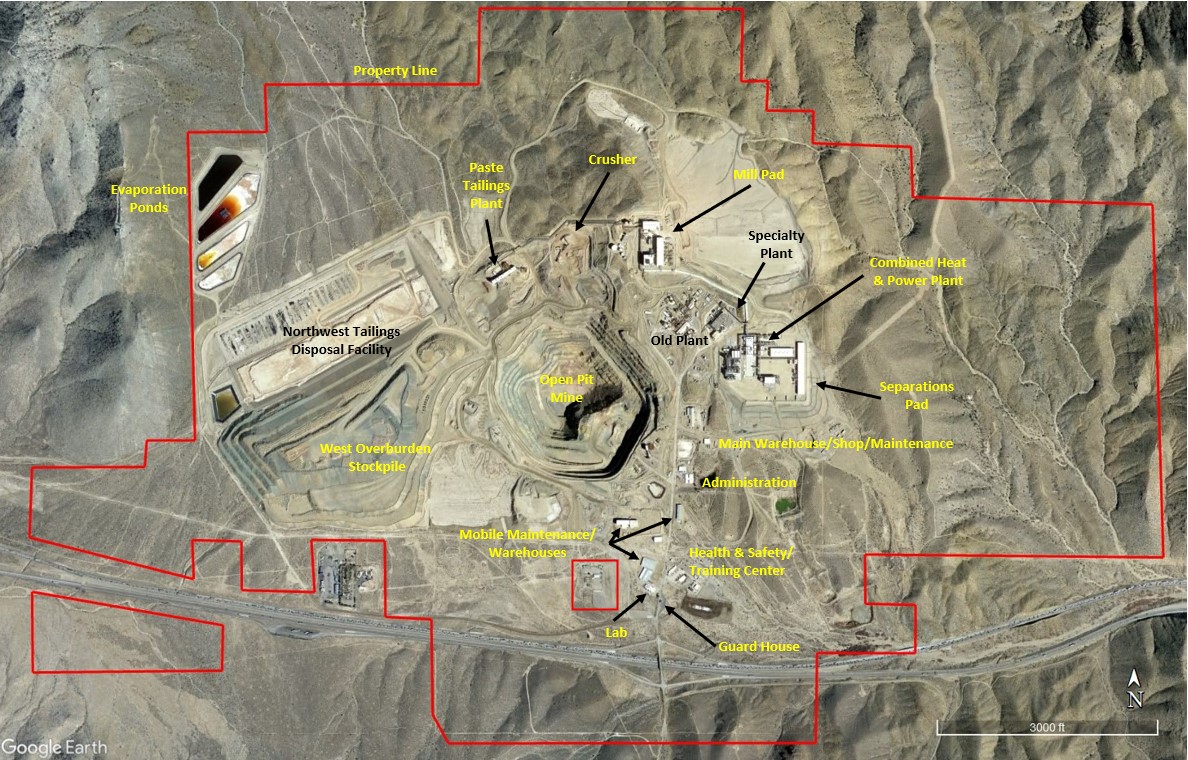
Mountain Pass represents the largest commercial source of rare earth materials in the Western hemisphere. Molybdenum Corporation of America began REE mining operations at Mountain Pass in 1952. Mining, milling and separation processes continued under Unocal Corporation, which purchased Molybdenum Corporation of America in 1977, until 1998. In 2005, ChevronTexaco Corporation acquired Unocal Corporation and then, in 2008, Molycorp Minerals, LLC acquired Mountain Pass from Chevron Mining Inc. Operations relating to mining, milling and separations resumed under Molycorp until they were placed into cold-idle status in mid-2015. In July 2017, we acquired Mountain Pass from the Molycorp estate.
We hold the necessary permits to operate Mountain Pass, including conditional use and minor use permits from San Bernardino County, California, and an associated environmental impact report, all of which were issued in 2004, which currently allow continued operation of Mountain Pass through 2042, though we expect to extend such permits to allow for continued operation through at least 2056. Since restarting operations at the facility in the fourth quarter of 2017, our activities have focused on the milling and flotation processes, leading to production of a bastnaesite concentrate, rich in REE, with our first concentrate sales in the first quarter of 2018.
The bastnaesite ore body at Mountain Pass has been mined as a principal source of REE over a period of over 60 years. The Mountain Pass REE deposit is located within an uplifted block of Precambrian metamorphic and igneous rocks that are bounded to the south and east by basin-fill deposits in California’s Ivanpah Valley. The two main groups of rocks in the Mountain Pass area are Early Proterozoic high-grade metamorphic rocks and Middle Proterozoic ultrapotassic rocks and monazitic carbonatites, which carbonatites are associated with higher levels of REE. The total orebody strike length is approximately 2,750 feet and dip extent is 3,000 feet; true thickness of the more than 2% total rare earth oxide (“TREO”) grade zone ranges between 15 feet and 250 feet. The percentage of each rare earth material contained in typical Mountain Pass
bastnaesite concentrate is estimated to be as follows:
| Estimated Distribution of TREO Content | |||||
| Element | |||||
| Cerium | 50.2 | % | |||
| Lanthanum | 32.3 | % | |||
| Neodymium-Praseodymium | 15.7 | % | |||
| SEG+(1) | 1.8 | % |
(1)See the “Rare Earth Resources and Reserves” section below for definition.
Texas Land
In February 2022, we closed on the purchase of approximately 18 acres of land in Fort Worth, Texas, on which we are building a metal, alloy, and magnet manufacturing and recycling facility as a part of our Stage III strategy.
Corporate Offices
We currently lease our corporate office space at 6720 Via Austi Parkway, Suites 450 and 430, Las Vegas, Nevada 89119, which lease expires on December 31, 2022. In December 2021, we entered into a lease agreement for executive office space at 1700 S. Pavilion Center Drive, Las Vegas, Nevada 89135, which is estimated to commence on January 1, 2023, at which time, we will no longer lease the current office space.
Rare Earth Resources and Reserves
Introduction
Mineral resources and mineral reserves were estimated by SRK Consulting (U.S.) Inc. (“SRK”) for inclusion in this Annual Report. Pursuant to the requirements of Regulation S-K Subpart 1300 (“S-K 1300”), SRK prepared a pre-feasibility level Technical Report Summary (“TRS”) for Mountain Pass with an effective date of September 30, 2021 (refer to Exhibit 96.1 to this Annual Report). The mineral resource and mineral reserve estimated in that TRS were subsequently depleted by SRK to present an estimate of our resources and reserves as of December 31, 2021. The depletion removed by SRK represents resources and reserves that were extracted from the Mountain Pass open pit from October 1, 2021, through December 31, 2021.
Mineral Resource and Mineral Reserve Definitions
Mineral Resources
Item 1300 of S-K 1300 defines a “mineral resource” as a concentration or occurrence of material of economic interest in or on the Earth’s crust in such form, grade or quality, and quantity that there are reasonable prospects for economic extraction. A mineral resource is a reasonable estimate of mineralization, taking into account relevant factors such as cut-off grade, likely mining dimensions, location or continuity, that, with the assumed and justifiable technical and economic conditions, is likely to, in whole or in part, become economically extractable. It is not merely an inventory of all mineralization drilled or sampled.
A “measured mineral resource” is that part of a mineral resource for which quantity and grade or quality are estimated on the basis of conclusive geological evidence and sampling. The level of geological certainty associated with a measured mineral resource is sufficient to allow a qualified person to apply modifying factors, as defined in this section, in sufficient detail to support detailed mine planning and final evaluation of the economic viability of the deposit. Because a measured mineral resource has a higher level of confidence than the level of confidence of either an indicated mineral resource or an inferred mineral resource, a measured mineral resource may be converted to a proven mineral reserve or to a probable mineral reserve.
An “indicated mineral resource” is that part of a mineral resource for which quantity and grade or quality are estimated on the basis of adequate geological evidence and sampling. The level of geological certainty associated with an indicated mineral resource is sufficient to allow a qualified person to apply modifying factors in sufficient detail to support mine planning and evaluation of the economic viability of the deposit. Because an indicated mineral resource has a lower level of confidence than the level of confidence of a measured mineral resource, an indicated mineral resource may only be converted to a probable mineral reserve.
An “inferred mineral resource” is that part of a mineral resource for which quantity and grade or quality are estimated on the basis of limited geological evidence and sampling. The level of geological uncertainty associated with an inferred mineral resource is too high to apply relevant technical and economic factors likely to influence the prospects of economic extraction in a manner useful for evaluation of economic viability. Because an inferred mineral resource has the lowest level of geological confidence of all mineral resources, which prevents the application of the modifying factors in a manner useful for evaluation of economic viability, an inferred mineral resource may not be considered when assessing the economic viability of a mining project and may not be converted to a mineral reserve.
Mineral Reserves
Item 1300 of S-K 1300 defines a “mineral reserve” as an estimate of tonnage and grade or quality of indicated and measured mineral resources that, in the opinion of the qualified person, can be the basis of an economically viable project. More specifically, it is the economically mineable part of a measured or indicated mineral resource, which includes diluting materials and allowances for losses that may occur when the material is mined or extracted. A “proven mineral reserve” is the economically mineable part of a measured mineral resource and can only result from conversion of a measured mineral resource. A “probable mineral reserve” is the economically mineable part of an indicated and, in some cases, a measured mineral resource.
Estimation Methodology
Mineral Resources
The mineral resource estimate has been constrained by a geological model considering relevant rock types, structure, and mineralization envelopes as defined by TREO content within relevant geological features. This geological model is informed principally by diamond core drilling and multiple phases of geological mapping. Sectional interpretation based on the combination of these data were used to influence implicit modeling of the geological data with manual controls where appropriate. Data has been composited to reasonable lengths based on the original sample lengths and expected mining unit scale, and outliers have been addressed during estimation using restrictions on influence.
A number of internal controls have been applied over the history of the Mountain Pass deposit to demonstrate the consistency and reliability of the historic analytical data supporting mineral resource estimation. Almost all data supporting the mineral resource estimation has been generated by some iteration of a site-based laboratory at the Mountain Pass mine. The Mountain Pass laboratory uses various quality assurance and quality control (“QA/QC”) measures to calibrate modern equipment and ensure analytical precision and accuracy. QA/QC generated by previous laboratories has undergone check assays at independent third-party laboratories, and generally demonstrate no consistent bias. The database is also supported by a very limited amount of blind QA/QC inserted during a re-assay program, including site-specific standards of known TREO content, a variety of duplicate samples, and blank samples. The implementation and results of these various QA/QC programs have not been fully aligned with current industry standards and are not comprehensive, but are suitable for use in mineral resource estimation.
Estimates have been validated to the input data using global statistical and visual comparisons, localized swath plot comparisons of mean grades, and review of the limited reconciliation data to the model. In general, estimates are shown to align closely with the input exploration data, but have been demonstrated to be under-reporting relative to the grade control drilling. SRK has dealt with uncertainty and risk at Mountain Pass by classifying the contained resource by varying degrees of confidence in the estimate. The mineral resources at the Mountain Pass deposit have been classified in accordance with S-K 1300. The classification parameters are defined by the distance to composite data, the number of drillholes used to inform block grades and a geostatistical indicator of relative estimation quality (kriging efficiency). As an overall modifier to classification, SRK considered the limited results from the QA/QC noted above and the observed variability in reconciliation in the mineral resource classification as well, both of which preclude statement of measured resources. Bulk density is based on average density measurements collected from the various rock types over the years, and carbonatite density in particular is supported by extensive mining and processing experience with the materials.
A cut-off grade (“COG”) of 2.28% TREO has been developed to ensure that material reported as a mineral resource can satisfy the definition of reasonable potential for eventual economic extraction (“RPEEE”). Mineral resources have been constrained within an economic pit shell based on reserve input parameters. For mineral resources, a revenue factor of 1.0 is selected which corresponds to a break-even pit shell. SRK notes that the pit selected for mineral resources has been influenced by setbacks relative to critical infrastructure such as the tailing storage and the REO mill and flotation facility.
A detailed description of the methodology used to calculate mineral resources is provided in Exhibit 96.1 to this Annual Report.
Mineral Reserves
SRK developed a life-of-mine (“LoM”) plan for the Mountain Pass operation in support of mineral reserves. For economic modeling, 2022 production was assumed to be bastnaesite concentrate. From 2023 onward, it was assumed that the Company will operate a separations facility at Mountain Pass that will allow the Company to separate bastnaesite concentrate into four individual REO products for sale: neodymium and praseodymium (previously defined as “NdPr”) oxide, samarium, europium, and gadolinium (“SEG+”) oxalate, lanthanum carbonate, and cerium chloride. Forecast economic parameters are based on current cost performance for process, transportation, and administrative costs, as well as a first principles estimation of future mining costs. Forecast revenue from concentrate sales and individual separated product sales is based on a preliminary market study commissioned by the Company.
From this evaluation, pit optimization was performed based on an equivalent concentrate price of $6,139 per dry short ton (“ST”) of 60% TREO concentrate (net of the incremental benefits and costs related to REE separations). The results of pit optimization guided the design and scheduling of the ultimate pit. SRK generated a cash flow model which indicated positive economics for the LoM plan, which provides the basis for the reserves. Reserves within the new ultimate pit are sequenced for the full 35-year LoM.
The costs used for pit optimization include estimated mining, processing, sustaining capital, transportation, and administrative costs, including an allocation of corporate costs. Processing and general and administrative (“G&A”) costs used for pit optimization were based on recent actual costs.
Processing recovery for concentrate is variable based on a mathematical relationship to estimate overall TREO recovery versus ore grade. The calculated COG for the reserves is 2.49% TREO, which was applied to indicated blocks contained within an ultimate pit, the design of which was guided by economic pit optimization.
The optimized pit shell selected to guide final pit design was based on a combination of the revenue factor (“RF”) 0.45 pit (used on the north half of the deposit) and the RF 1.00 pit shell (used on the south half of the deposit). The inter-ramp pit slopes used for the design are based on geotechnical studies and range from 42° to 47°.
Measured resources in stockpiles were converted to proven reserves. Indicated pit resources were converted to probable reserves by applying the appropriate modifying factors to potential mining pit shapes created during the mine design process. Inferred resources present within the LoM pit are treated as waste. Internal controls to demonstrate the consistency and reliability of the historic analytical data supporting the mineral resource estimate (which forms the basis for the mineral reserve estimate) are discussed above.
A detailed description of the methodology used to calculate mineral reserves is provided in Exhibit 96.1 to this Annual Report.
Results
Mineral Resources
As of December 31, 2021, SRK estimates total indicated resources of 1.43 million STs with an average grade of 2.83% TREO and 9.08 million STs of inferred resources with an average ore grade of 5.10% TREO. Mineral resources are reported exclusive of mineral reserves. The reference point for the mineral resources is in situ material.
| Category | Resource Type | Cut-Off TREO (%) | Mass | Average Value | |||||||||||||||||||||||||
| Million Short Tons (dry) | TREO**(1)** (%) | La2O3(2) (%) | CeO****2 (%) | Pr6O****11 (%) | Nd2O****3 (%) | Sm2O****3 (%) | |||||||||||||||||||||||
| Indicated | Within the Reserve Pit | 2.28-2.49 | 0.91 | 2.38 | 0.78 | 1.19 | 0.10 | 0.29 | 0.02 | ||||||||||||||||||||
| Within the Resource Pit | 2.28 | 0.52 | 3.61 | 1.18 | 1.80 | 0.16 | 0.44 | 0.03 | |||||||||||||||||||||
| Total Indicated | 1.43 | 2.83 | 0.92 | 1.41 | 0.12 | 0.34 | 0.03 | ||||||||||||||||||||||
| Inferred | Within the Reserve Pit | 2.28-2.49 | 7.03 | 5.48 | 1.79 | 2.73 | 0.24 | 0.66 | 0.05 | ||||||||||||||||||||
| Within the Resource Pit | 2.28 | 2.06 | 3.81 | 1.24 | 1.90 | 0.16 | 0.46 | 0.03 | |||||||||||||||||||||
| Total Inferred | 9.08 | 5.10 | 1.66 | 2.54 | 0.22 | 0.62 | 0.05 |
(1) TREO% represents the total of individually assayed light rare earth oxides on a 99.7% basis of total contained TREO, based on the historical site analyses.
(2)Percentage of individual light rare earth oxides are based on the average ratios; La2O3 is calculated at a ratio of 32.6% grade of TREO% equivalent estimated grade, CeO2 is calculated at a ratio of 49.9% of TREO% equivalent estimated grade, Pr6O11 is calculated at a ratio of 4.3% of TREO% equivalent estimated grade, Nd2O3 is calculated at a ratio of 12.1% of TREO% equivalent estimated grade, and Sm2O3 is calculated at a ratio of 0.9% of TREO% equivalent estimated grade. The sum of light rare earths averages 99.7%; the additional 0.3% cannot be accounted for based on the analyses available to date and has been discounted from this resource statement.
General Notes:
-
Mineral Resources are reported exclusive of Mineral Reserves.
-
Mineral Resources are not Mineral Reserves and do not have demonstrated economic viability. There is no certainty that all or any part of the Mineral Resources estimated will be converted into Mineral Reserves estimate.
-
Mineral Resource tonnage and contained metal have been rounded to reflect the accuracy of the estimate, any apparent errors are insignificant.
-
Mineral Resource tonnage and grade are reported as diluted.
-
The Mineral Resource model has been depleted for historical mining based on the December 31, 2021, pit topography.
-
Pit optimization cut-off grade is based on an average TREO% equivalent concentrate price of $7,059 per ST of dry concentrate (60% TREO, net of the incremental benefits and costs related to REE separations), average mining cost at the pit exit of $1.825 per ST mined plus $0.018 per ST mined for each 15 feet bench above or below the pit exit, combined milling and G&A costs of $69.90 per ST milled, concentrate freight of $177 per ST of dry concentrate, and an average overall pit slope angle of 42° including ramps.
-
The mineral resource statement reported herein only includes the rare earth elements cerium, lanthanum, neodymium, praseodymium, and samarium (often referred to as light rare earths). While other rare earth elements, often referred to as heavy rare earths, are present in the deposit, they are not accounted for in this estimate due to historic data limitations.
The Company’s Annual Report on Form 10-K for the year ended December 31, 2020 (“Prior Year Form 10-K”), did not include a year-end mineral resource estimate. Rather, the resources stated in the Prior Year Form 10-K were estimated as of July 1, 2020, and were inclusive of mineral reserves. Accordingly, it is not practicable to present a meaningful year-over-year comparison of mineral resources pursuant to Item 1304(e) of S-K 1300.
Mineral Reserves
As of December 31, 2021, SRK estimates total proven reserves of 0.05 million STs of ore with an average grade of 9.45% TREO and 30.08 million STs of probable reserves with an average ore grade of 6.33%. Our total proven and probable reserves are estimated as 30.13 million STs with an average grade of 6.34%. The reference point for the mineral reserves is material delivered to the Mountain Pass mill and flotation facility.
Based on these estimated reserves and our expected annual production rate upon completion of the Stage II project (separations facility), our expected mine life is approximately 36 years, including a partial year in 2021 and a partial year in 2056 to complete the processing of stockpiles and separations.
The following table states the amount of our proven and probable mineral reserves as of December 31, 2021.
| Category | Description | Run-of-Mine | TREO% | MY% | Concentrate | ||||||||||||
| Million Short Tons (dry) | Million Short Tons (dry) | ||||||||||||||||
| Proven | Current Stockpiles | 0.05 | 9.45 | 10.88 | 0.01 | ||||||||||||
| In situ | — | — | — | — | |||||||||||||
| Proven Totals | 0.05 | 9.45 | 10.88 | 0.01 | |||||||||||||
| Probable | Current Stockpiles | — | — | — | — | ||||||||||||
| In situ | 30.08 | 6.33 | 6.71 | 2.02 | |||||||||||||
| Probable Totals | 30.08 | 6.33 | 6.71 | 2.02 | |||||||||||||
| Proven + Probable | Current Stockpiles | 0.05 | 9.45 | 10.88 | 0.01 | ||||||||||||
| In situ | 30.08 | 6.33 | 6.71 | 2.02 | |||||||||||||
| Proven + Probable Totals | 30.13 | 6.34 | 6.72 | 2.02 |
General Notes:
-
Reserves stated as contained within an economically mineable open pit design stated above a 2.49% TREO COG.
-
Mineral reserves tonnage and contained metal have been rounded to reflect the accuracy of the estimate, and numbers may not add due to rounding.
-
MY% (mass yield) calculation is based on 60% concentrate grade of the product and the ore grade dependent metallurgical recovery. MY% = (TREO% * Met recovery)/60% concentrate TREO grade.
-
Indicated mineral resources have been converted to Probable reserves. Measured mineral resources have been converted to Proven reserves.
-
Reserves are diluted at the contact of the 2% TREO geological model triangulation (further to dilution inherent to the resource model and assume selective mining unit of 15 feet x 15 feet x 30 feet).
-
Mineral reserves tonnage and grade are reported as diluted.
-
Pit optimization COG is based on an average TREO% equivalent concentration price of $6,139 per ST of dry concentrate (60% TREO, net of the incremental benefits and costs related to REE separations), average mining cost at the pit exit of $1.825 per ST mined plus $0.018 per ST mined for each 15 feet bench above or below the pit exit, combined milling and G&A costs of $69.90 per ST milled, concentrate freight of $177 per ST of dry concentrate, and an average overall pit slope angle of 42° including ramps.
-
The topography used was from December 31, 2021.
-
Reserves contain material inside and outside permitted mining but within mineral lease.
-
Reserves assume 100% mining recovery.
-
The strip ratio was 6.1 to 1 (waste to ore ratio).
-
The mineral reserves were estimated by SRK.
The Company’s Prior Year Form 10-K did not include a year-end mineral reserve estimate. The reserves stated in the Prior Year Form 10-K were estimated as of July 1, 2020. Accordingly, it is not practicable to present a year-over-year comparison of mineral reserves pursuant Item 1304(e) of S-K 1300. Notwithstanding, the following comparison is provided to show the change in reserves over the 18-month period from July 1, 2020, to December 31, 2021.
| Description | Estimate Date | Run-of-Mine | TREO% | MY% | Concentrate | ||||||||||||
| Million Short Tons (dry) | Million Short Tons (dry) | ||||||||||||||||
| Proven + Probable Reserves | December 31, 2021 | 30.13 | 6.34 | 6.72 | 2.02 | ||||||||||||
| Proven + Probable Reserves | July 1, 2020 | 21.14 | 7.06 | 7.67 | 1.62 | ||||||||||||
| Difference | 8.99 | -0.72 | 0.40 | ||||||||||||||
| % Difference | 43% | (10)% | 25% |
Reasons for the differences between the two estimates include: additional resource and geotechnical drilling, revised and updated geological block model, revised methodology for applying mining dilution, revised pit slope angles, updated product prices, updated processing recovery assumptions, updated operating costs, and updated cut-off grade. Product prices, processing recovery, operating costs and cut-off grade were adjusted to reflect on-site rare earth separations, construction of which is expected to be complete by year-end 2022.
Factors and Assumptions Affecting Mineral Resource and Mineral Reserve Estimates
There are numerous uncertainties inherent in estimating quantities and qualities of REO reserves and costs to mine recoverable reserves, including many factors beyond our control. We will regularly evaluate our REO reserve estimates. This may be done in conjunction with additional exploration drilling programs. The estimates of REO reserves as to both quantity and quality will also be updated to reflect new drilling or other data received. Estimates of economically recoverable REO reserves, however, necessarily depend upon a number of variable factors and assumptions, all of which may vary considerably from actual results, such as:
-
geological, mining and processing conditions and/or effects from prior mining that may not be fully identified by available data or that may differ from experience;
-
the strategic approach to mining and processing the deposit may change depending upon market demand, corporate strategy and other prevailing economic conditions;
-
assumptions concerning future prices of rare earth products, foreign exchange rates, process recovery rates, transportation costs, operating costs, capital costs, and reclamation costs; and
-
assumptions concerning future effects of regulation, including the issuance of required permits and taxes by governmental agencies and foreign government policy relating to import or export of rare earth products.
Actual REO tonnage recovered from identified REO reserves and revenues and expenditures with respect to the same may vary materially from estimates. Further, period-to-period, our future estimates of REO reserves may fluctuate significantly as macroeconomic conditions and our level of understanding with respect to the deposit change. These estimates may not accurately reflect our actual REO reserves. Any inaccuracy in our estimates related to our REO reserves could result in lower-than-expected revenues and higher-than-expected costs.
Item 3. LEGAL PROCEEDINGS
From time to time, we may be subject to legal and governmental proceedings and claims in the ordinary course of business. We are not currently a party to any material legal or governmental proceedings, and, to our knowledge, none is threatened.
Item 4. MINE SAFETY DISCLOSURES
The information concerning mine safety violations or other regulatory matters required by Section 1503(a) of the Dodd-Frank Wall Street Reform and Consumer Protection Act and Item 104 of Regulation S-K is included in Exhibit 95.1 to this Annual Report.
PART II
Item 5. MARKET FOR REGISTRANT’S COMMON EQUITY, RELATED STOCKHOLDER MATTERS AND ISSUER PURCHASES OF EQUITY SECURITIES
Market Information and Trading Symbol for Common Stock
Our common stock is currently quoted on the NYSE under the symbols “MP”.
Holders of Record
According to Continental Stock Transfer & Trust Company, our transfer agent, there was 155 active holders of record of our common stock as of February 17, 2022. The actual number of stockholders is greater than these numbers and includes holders who are beneficial owners, but whose shares are held in street name by brokers and other nominees. These numbers of active holders of record also do not include holders whose shares may be held in trust by other entities.
Dividends
The Company has not paid any cash dividends on its common stock to date. The payment of cash dividends in the future will be dependent upon the Company’s revenues and earnings, capital requirements and general financial condition. The payment of any cash dividends will be within the discretion of our Board of Directors at such time. In addition, the Company is not currently contemplating and does not anticipate declaring any stock dividends in the foreseeable future as it is currently expected that available cash resources will be utilized in connection with our ongoing operations and development projects, including Stage II and Stage III.
Unregistered Sales of Equity Securities
We did not have any sales of unregistered equity securities during the three months ended December 31, 2021.
Repurchase of Securities
During the three months ended December 31, 2021, neither we nor any of our affiliates repurchased shares of our common stock registered under Section 12 of the Exchange Act.
Stock Performance Graph
The following graph compares the cumulative total stockholder return for the Company’s common stock to the cumulative total returns for the Russell 2000 Index and a peer group. The total cumulative return calculations are for the period commencing November 18, 2020, for investments in stock, or October 31, 2020, for investments in index, and ending December 31, 2021, and include the reinvestment of dividends. The stock price performance shown in this graph is based on historical data and is neither indicative of, nor intended to forecast, future stock price performance.
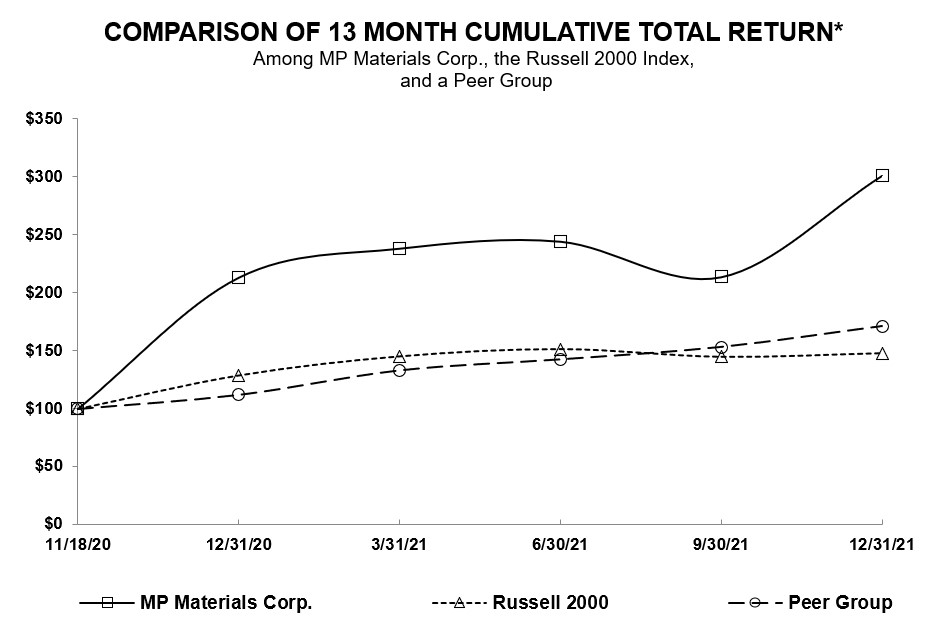
*$100 invested on November 18, 2020, in stock or October 31, 2020, in index, including reinvestment of dividends. Fiscal year ended December 31st.
Copyright © 2022 Russell Investment Group. All rights reserved.
| 11/18/20 | 12/31/20 | 03/31/21 | 06/30/21 | 09/30/21 | 12/31/21 | ||||||||||||||||||||||||||||||
| MP Materials Corp. | $ | 100.00 | $ | 213.19 | $ | 238.24 | $ | 244.27 | $ | 213.59 | $ | 300.99 | |||||||||||||||||||||||
| Russell 2000 Index | $ | 100.00 | $ | 128.68 | $ | 145.02 | $ | 151.24 | $ | 144.65 | $ | 147.75 | |||||||||||||||||||||||
| Peer Group | $ | 100.00 | $ | 112.07 | $ | 133.00 | $ | 142.46 | $ | 153.09 | $ | 170.93 |
Item 6. [RESERVED]
Item 7. MANAGEMENT’S DISCUSSION AND ANALYSIS OF FINANCIAL CONDITION AND RESULTS OF OPERATIONS
You should read the following discussion and analysis of our financial condition and results of operations together with our Consolidated Financial Statements and related notes appearing elsewhere in this annual report on Form 10-K for the year ended December 31, 2021 (this “Annual Report”). A discussion of changes in our results of operations and cash flows between years ended December 31, 2020 and 2019, has been omitted from this Annual Report, but may be found in “Part II, Item 7. Management’s Discussion and Analysis of Financial Condition and Results of Operations, Comparison of the Years Ended December 31, 2020 and 2019,” of our annual report on Form 10-K for the year ended December 31, 2020, filed with the U.S. Securities and Exchange Commission on March 22, 2021. This discussion and analysis contains forward-looking statements that involve risks, uncertainties and assumptions. The actual results may differ materially from those anticipated in these forward-looking statements as a result of certain factors, including, but not limited to, those set forth under “Item 1A. Risk Factors” and elsewhere in this Annual Report. In addition, see “Cautionary Note Regarding Forward-Looking Statements.” References herein to the “Company,” “MP Materials,” “we,” “our,” and “us,” refer to MP Materials Corp. and its subsidiaries.
Executive Overview
MP Materials Corp. is the largest producer of rare earth materials in the Western Hemisphere. The Company owns and operates the Mountain Pass Rare Earth Mine and Processing Facility (“Mountain Pass”), the only rare earth mining and processing site of scale in North America. We estimate the rare earth concentrate we produced and sold in 2021 represented approximately 15% of the rare earth content consumed in the global market. Separated rare earth elements (“REE”) are critical inputs for the magnets that enable the mobility of electric vehicles (“EVs”), drones, defense systems, wind turbines, robotics and many other high-growth, advanced technologies. Our integrated operations at Mountain Pass combine low production costs with high environmental standards, thereby restoring American leadership to a critical industry with a strong commitment to sustainability.
We currently produce a rare earth concentrate that we sell pursuant to the A&R Offtake Agreement (as defined in the “Comparability of Results” section below) to Shenghe Resources (Singapore) International Trading Pte. Ltd. (“Shenghe”), an affiliate of Shenghe Resources Holding Co., Ltd., a leading global rare earth company that is publicly listed in China, that, in turn, typically sells that product to refiners in China. These refiners separate the constituent REE contained in our concentrate and sell the separated products to their customers. Upon completion of our Stage II optimization project (“Stage II”), we anticipate producing separated rare earth oxides (“REO”), including neodymium-praseodymium (“NdPr”) oxide, and selling these products directly to end users, at which time we may no longer sell our concentrate.
In December 2021, we announced that we will build our initial rare earth metal, alloy and magnet manufacturing facility in Fort Worth, Texas (the “Fort Worth Facility”). In addition, we announced that we had entered into a long-term agreement with General Motors Company (NYSE: GM) (“GM”) to supply U.S.-sourced and manufactured rare earth materials, alloy and finished magnets for the electric motors in more than a dozen models using GM’s Ultium Platform, with a gradual production ramp that begins in 2023. We are currently negotiating the terms of a definitive long-term supply agreement with GM which will include all of the necessary terms and conditions. These developments are a part of our Stage III downstream expansion strategy (“Stage III”).
Highlights from the year ended December 31, 2021, include:
-
Revenue growth of 147% year over year, driven by increases in REO production and sales volume and realized price per REO metric ton (“MT”);
-
REO production growth of 10% year over year to 42,413 MTs, reflecting higher ore feed rates and mineral recoveries;
-
Net income of $135.0 million, compared to a net loss of $21.8 million in the prior year, largely driven by higher revenues and a one-time, non-cash settlement charge of $66.5 million in the prior year;
-
Adjusted EBITDA (see below) of $219.1 million, compared to $42.6 million in the prior year, representing growth of 414% year over year, driven by higher per-unit profitability and production efficiencies, slightly offset by increased public company and growth and development costs;
-
Net cash provided by operating activities of $102.0 million, an increase from $3.3 million in the prior year;
-
Adjusted Net Income (see below) growth of 693% year over year, largely driven by higher revenues;
-
Diluted earnings per share of $0.73, compared to loss per share of $0.27 in the prior year;
*•*Net proceeds of $672.3 million raised from the issuance of Convertible Notes (as defined in the “Liquidity and Capital Resources” section below) in March 2021; and
- Steady progress on our Stage II optimization project and acceleration of our Stage III strategy with the announcements of the Fort Worth Facility and the entrance into a long-term agreement with GM.
Our results of operations for the year ended December 31, 2021, demonstrate our strong operational execution as demand for rare earth materials continues to grow, which also resulted in prices for rare earth products, particularly those used in NdFeB magnets, to rise significantly. In 2021, we produced the highest REO output in the history of Mountain Pass. As we continue to drive strong performance in our Stage I operations, we are continuing to make progress on our Stage II optimization project and expect to reach normalized separated oxide production levels in 2023. In addition, our Stage III team is making significant progress on our strategy to repatriate magnet manufacturing to the United States, starting with our initial facility in Fort Worth, Texas.
We consider net income (loss) to be the most directly comparable financial measure calculated in accordance with generally accepted accounting principles in the United States (“GAAP”) to Adjusted EBITDA and Adjusted Net Income (Loss), which are non-GAAP financial measures. Refer to the “Non-GAAP Financial Measures” section below for the definitions of Adjusted EBITDA and Adjusted Net Income (Loss), as well as a reconciliation of net income (loss) to Adjusted EBITDA and Adjusted Net Income (Loss).
Key Performance Indicators
We use the following key performance indicators to evaluate the performance of our business. Our calculations of these performance indicators may differ from similar measures published by other companies in our industry or in other industries. The following table presents our key performance indicators:
| Year ended December 31, | Amount Change | % Change | |||||||||||||||||||||||||||||||||||||||
| (in whole units or dollars, except percentages) | 2021 | 2020 | 2019 | 2021 vs. 2020 |
Showing the first 8K of 97K characters. Open the full section
Item 7A. QUANTITATIVE AND QUALITATIVE DISCLOSURES ABOUT MARKET RISK
We have in the past and may in the future be exposed to certain market risks, including commodity price risks, in the ordinary course of our business, as discussed further below. In addition to commodity pricing risk, our revenues are highly concentrated, with Shenghe accounting for more than 90% of our product sales for all years presented.
Commodity Price Risk
Our results of operations depend in large part upon the market prices of REO and particularly the price of rare earth concentrate. Concentrate prices are less transparent than those of many other commodities. Rare earth concentrate is not quoted on any major commodities market or exchange as product attributes vary and demand is currently constrained to a relatively limited number of refiners, a significant majority of which are based in China.
We believe that we are a leading, low-cost producer of rare earth concentrate containing significant amounts of NdPr. We expect demand for NdPr to continue to grow, driving demand for our concentrate and ultimately, upon the completion of Stage II, separated NdPr oxide, and upon completion of Stage III, magnetic products containing NdPr, but actual demand and pricing may fluctuate for numerous reasons beyond our control, including, among other things, discoveries of new mineral properties, technological changes that lead to diminished reliance on NdPr and/or permanent magnets, and shifts in underlying end-user demand for products or components manufactured with NdPr. See the “Key Factors Affecting Our Performance,” section in “Item 7. Management’s Discussion and Analysis of Financial Condition and Results of Operations.”
While we currently generate revenue in the United States and in U.S. dollars, the market transactions are denominated mainly in the Chinese Yuan, and we are therefore indirectly exposed to currency volatility and devaluation risks. For example, we negotiate monthly U.S. dollar REO prices with Shenghe, which are based in part on the exchange rate between the U.S. dollar and the Chinese Yuan. Geopolitical tensions between the U.S. and China may lead to increased tariffs, preferences for local producers, some of which may be government-supported, changes in taxing regimes or other trade barriers. We have not entered into derivative contracts to protect the selling price for our REO and do not expect to do so in the foreseeable future, as there is no liquid market for such contracts and their cost may be prohibitive, if they could be obtained at all.
Item 8. FINANCIAL STATEMENTS AND SUPPLEMENTARY DATA
REPORT OF INDEPENDENT REGISTERED PUBLIC ACCOUNTING FIRM
To the Stockholders and the Board of Directors
MP Materials Corp.:
Opinions on the Consolidated Financial Statements and Internal Control Over Financial Reporting
We have audited the accompanying consolidated balance sheets of MP Materials Corp. and subsidiaries (the Company) as of December 31, 2021 and 2020, the related consolidated statements of operations, changes in stockholders’ equity (deficit), and cash flows for each of the years in the three-year period ended December 31, 2021, and the related notes (collectively, the consolidated financial statements). We also have audited the Company’s internal control over financial reporting as of December 31, 2021, based on criteria established in Internal Control – Integrated Framework (2013) issued by the Committee of Sponsoring Organizations of the Treadway Commission.
In our opinion, the consolidated financial statements referred to above present fairly, in all material respects, the financial position of the Company as of December 31, 2021 and 2020, and the results of its operations and its cash flows for each of the years in the three-year period ended December 31, 2021, in conformity with U.S. generally accepted accounting principles. Also in our opinion, the Company maintained, in all material respects, effective internal control over financial reporting as of December 31, 2021 based on criteria established in Internal Control – Integrated Framework (2013) issued by the Committee of Sponsoring Organizations of the Treadway Commission.
Basis for Opinions
The Company’s management is responsible for these consolidated financial statements, for maintaining effective internal control over financial reporting, and for its assessment of the effectiveness of internal control over financial reporting, included in the accompanying Management’s Annual Report on Internal Control Over Financial Reporting. Our responsibility is to express an opinion on the Company’s consolidated financial statements and an opinion on the Company’s internal control over financial reporting based on our audits. We are a public accounting firm registered with the Public Company Accounting Oversight Board (United States) (PCAOB) and are required to be independent with respect to the Company in accordance with the U.S. federal securities laws and the applicable rules and regulations of the Securities and Exchange Commission and the PCAOB.
We conducted our audits in accordance with the standards of the PCAOB. Those standards require that we plan and perform the audits to obtain reasonable assurance about whether the consolidated financial statements are free of material misstatement, whether due to error or fraud, and whether effective internal control over financial reporting was maintained in all material respects.
Our audits of the consolidated financial statements included performing procedures to assess the risks of material misstatement of the consolidated financial statements, whether due to error or fraud, and performing procedures that respond to those risks. Such procedures included examining, on a test basis, evidence regarding the amounts and disclosures in the consolidated financial statements. Our audits also included evaluating the accounting principles used and significant estimates made by management, as well as evaluating the overall presentation of the consolidated financial statements. Our audit of internal control over financial reporting included obtaining an understanding of internal control over financial reporting, assessing the risk that a material weakness exists, and testing and evaluating the design and operating effectiveness of internal control based on the assessed risk. Our audits also included performing such other procedures as we considered necessary in the circumstances. We believe that our audits provide a reasonable basis for our opinions.
Definition and Limitations of Internal Control Over Financial Reporting
A company’s internal control over financial reporting is a process designed to provide reasonable assurance regarding the reliability of financial reporting and the preparation of financial statements for external purposes in accordance with generally accepted accounting principles. A company’s internal control over financial reporting includes those policies and procedures that (1) pertain to the maintenance of records that, in reasonable detail, accurately and fairly reflect the transactions and dispositions of the assets of the company; (2) provide reasonable assurance that transactions are recorded as necessary to permit preparation of financial statements in accordance with generally accepted accounting principles, and that receipts and expenditures of the company are being made only in accordance with authorizations of management and directors of the company; and (3) provide reasonable assurance regarding prevention or timely detection of unauthorized acquisition, use, or disposition of the company’s assets that could have a material effect on the financial statements.
Because of its inherent limitations, internal control over financial reporting may not prevent or detect misstatements. Also, projections of any evaluation of effectiveness to future periods are subject to the risk that controls may become inadequate because of changes in conditions, or that the degree of compliance with the policies or procedures may deteriorate.
Critical Audit Matter
The critical audit matter communicated below is a matter arising from the current period audit of the consolidated financial statements that was communicated or required to be communicated to the audit committee and that: (1) relates to accounts or disclosures that are material to the consolidated financial statements and (2) involved our especially challenging, subjective, or complex judgments. The communication of a critical audit matter does not alter in any way our opinion on the consolidated financial statements, taken as a whole, and we are not, by communicating the critical audit matter below, providing a separate opinion on the critical audit matter or on the accounts or disclosures to which it relates.
Related party transactions with Shenghe
As discussed in Notes 4 and 18 to the consolidated financial statements, the Company has entered into a set of commercial agreements with Shenghe Resources (Singapore) International Trading Pte. Ltd (“Shenghe”). Under the agreements, Shenghe purchases the rare earth products produced by the Company at specified prices. A portion of the sales price, for sales made under these agreements, reduces debt owed to Shenghe.
We identified the assessment of the related party transactions (transactions) with Shenghe as a critical audit matter. Subjective auditor judgment was required in assessing the sufficiency of the procedures performed to determine such transactions were identified, accounted for, and disclosed properly by the Company.
The following are the primary procedures we performed to address this critical audit matter. We applied auditor judgment to determine the nature and extent of procedures to be performed over transactions with Shenghe. We evaluated the design and tested the operating effectiveness of certain internal controls related to the identification, accounting, and disclosure of the transactions with Shenghe. We evaluated the identification, accounting, and disclosure of transactions with Shenghe by:
-
obtaining and analyzing underlying documentation for a sample of sales transactions
-
confirming the accounts receivable balance due from Shenghe and the debt balance due to Shenghe as of December 31, 2021
-
reading the underlying agreements with Shenghe and comparing the disclosed terms to the Company’s public filings
-
inquiring of management of the Company and the Audit Committee of the Board of Directors regarding the Shenghe relationship and transactions
-
reading the minutes
Showing the first 8K of 179K characters. Open the full section
Item 9. CHANGES IN AND DISAGREEMENTS WITH ACCOUNTANTS ON ACCOUNTING AND FINANCIAL DISCLOSURE
None.
Item 9A. CONTROLS AND PROCEDURES
Disclosure Controls and Procedures
Under the supervision and with the participation of our management, including our principal executive officer and principal financial and accounting officer, we conducted an evaluation of the effectiveness of our disclosure controls and procedures (as such term is defined in Rules 13a-15(e) and 15d-15(e) under the Securities Exchange Act of 1934, as amended (the “Exchange Act”)) as of December 31, 2021. Based on this evaluation, our Chief Executive Officer and Chief Financial Officer have concluded that, as of the end of the period covered by this Annual Report on Form 10-K (this “Annual Report”), our disclosure controls and procedures were effective to provide reasonable assurance that information required to be disclosed by us in reports we file or submit under the Exchange Act is recorded, processed, summarized, and reported within the time periods specified in SEC rules and forms, and is accumulated and communicated to management, including our Chief Executive Officer and Chief Financial Officer, as appropriate, to allow timely decisions regarding required disclosures.
Management’s Annual Report on Internal Control Over Financial Reporting
Our management is responsible for establishing and maintaining a system of internal control over financial reporting as defined in Rules 13a-15(f) and 15d-15(f) under the Exchange Act. Internal control over financial reporting is designed to provide reasonable assurance regarding the reliability of our financial reporting and preparation of financial statements for external purposes in accordance with accounting principles generally accepted in the United States of America. Internal control over financial reporting includes maintaining records that in reasonable detail accurately and fairly reflect our transactions; providing reasonable assurance that transactions are recorded as necessary for preparation of our financial statements in accordance with accounting principles generally accepted in the United States of America; providing reasonable assurance that our receipts and expenditures are made in accordance with authorizations of our management and directors; and providing reasonable assurance that unauthorized acquisition, use or disposition of our assets that could have a material effect on our financial statements would be prevented or detected on a timely basis.
Management conducted an assessment of the effectiveness of our internal control over financial reporting based on the framework set forth by the Committee of Sponsoring Organizations of the Treadway Commission in the Internal Control— Integrated Framework (2013). Based on this assessment, our management concluded that our internal control over financial reporting was effective as of December 31, 2021, to provide reasonable assurance regarding the reliability of financial reporting and preparation of financial statements for external reporting purposes in accordance with accounting principles generally accepted in the United States of America.
Attestation Report of the Registered Public Accounting Firm
The effectiveness of our internal control over financial reporting as of December 31, 2021, has been audited by KPMG LLP, an independent registered public accounting firm, as stated in their report which is included in Part II, Item 8 of this Annual Report.
Changes in Internal Control Over Financial Reporting
During the fourth quarter of the year ended December 31, 2021, there were no changes in our internal control over financing reporting (as defined in Rules 13a-15(f) and 15d-15(f) under the Exchange Act) that have materially affected, or are reasonably likely to materially affect our internal control over financing reporting.
Item 9B. OTHER INFORMATION
None.
Item 9C. DISCLOSURE REGARDING FOREIGN JURISDICTIONS THAT PREVENT INSPECTIONS
Not applicable.
PART III
Item 10. DIRECTORS, EXECUTIVE OFFICERS AND CORPORATE GOVERNANCE
The remaining information required by this item concerning directors and corporate governance is hereby incorporated by reference to the Company’s definitive proxy statement for its Annual Meeting of Shareholders (the “2022 Proxy Statement”), to be filed with the U.S. Securities and Exchange Commission within 120 days after December 31, 2021, pursuant to Regulation 14A under the Securities Act. Information required by this item concerning executive officers is included in Part I of this Annual Report on Form 10-K.
Item 11. EXECUTIVE COMPENSATION
The information required by this item is hereby incorporated by reference to the 2022 Proxy Statement.
Item 12. SECURITY OWNERSHIP OF CERTAIN BENEFICIAL OWNERS AND MANAGEMENT AND RELATED STOCKHOLDER MATTERS
The information required by this item is hereby incorporated by reference to the 2022 Proxy Statement.
Item 13. CERTAIN RELATIONSHIPS AND RELATED TRANSACTIONS, AND DIRECTOR INDEPENDENCE
The information required by this item is hereby incorporated by reference to the 2022 Proxy Statement.
Item 14. PRINCIPAL ACCOUNTANT FEES AND SERVICES
The information required by this item is hereby incorporated by reference to the 2022 Proxy Statement.
PART IV
Item 15. EXHIBIT AND FINANCIAL STATEMENT SCHEDULES
(a) The following documents are filed as part of this Annual Report:
(1)Report of Independent Registered Public Accounting Firm
Auditor Name: KPMG LLP
Auditor Location: Denver, CO
Auditor Firm ID: 185
Financial Statements (see Item 8. “Financial Statements and Supplementary Data” and incorporated herein by reference).
(2)Financial Statement Schedules (Schedules to the Financial Statements have been omitted because the information required to be set forth therein is not applicable or is shown in the accompanying Financial Statements or notes thereto).
(3)Exhibits (incorporated herein by reference or filed as part of this Annual Report).
Item 16. FORM 10-K SUMMARY
Not applicable.
SIGNATURES
Pursuant to the requirements of Section 13 or 15(d) of the Securities Exchange Act of 1934, the registrant has duly caused this report to be signed on its behalf by the undersigned, thereunto duly authorized.
| MP MATERIALS CORP. | |||||||||||
| Dated: | February 28, 2022 | By: | /s/ Ryan Corbett | ||||||||
| Ryan Corbett | |||||||||||
| Chief Financial Officer |
POWER OF ATTORNEY AND SIGNATURES
We, the undersigned officers and directors of MP Materials Corp. hereby severally constitute and appoint James H. Litinsky and Ryan Corbett, and each of them singly (with full power to each of them to act alone), our true and lawful attorneys-in-fact and agents, with full power of substitution and resubstitution in each of them for her or him and in her or his name, place and stead, and in any and all capacities, to sign any and all amendments to this Annual Report on Form 10‑K, and generally to do all things in our names and on our behalf in such capacities to enable MP Materials Corp. to comply with the provisions of the Securities Exchange Act of 1934, as amended, and all the requirements of the Securities Exchange Commission.
Pursuant to the requirements of the Securities Exchange Act of 1934, as amended, this report has been signed below by the following persons on behalf of the registrant and in the capacities and on the dates indicated.
| Name | Title | Date | ||||||||||||
| /s/ James H. Litinsky | Chief Executive Officer (principal executive officer), Chairman of the Board of Directors and Director | February 28, 2022 | ||||||||||||
| James H. Litinsky | ||||||||||||||
| /s/ Ryan Corbett | Chief Financial Officer (principal financial and accounting officer) | February 28, 2022 | ||||||||||||
| Ryan Corbett | ||||||||||||||
| /s/ Gen. Richard B. Myers | Director | February 28, 2022 | ||||||||||||
| Gen. Richard B. Myers | ||||||||||||||
| /s/ Andrew A. McKnight | Director | February 28, 2022 | ||||||||||||
| Andrew A. McKnight | ||||||||||||||
| /s/ Daniel Gold | Director | February 28, 2022 | ||||||||||||
| Daniel Gold | ||||||||||||||
| /s/ Randall Weisenburger | Director | February 28, 2022 | ||||||||||||
| Randall Weisenburger | ||||||||||||||
| /s/ Maryanne R. Lavan | Director | February 28, 2022 | ||||||||||||
| Maryanne R. Lavan | ||||||||||||||
| /s/ Connie K. Duckworth | Director | February 28, 2022 | ||||||||||||
| Connie K. Duckworth |