 filings.tools
Merck & Co. 10-K 2018-12-31
Filed 2019-02-27. 22 sections, 661K characters. Original on sec.gov · Markdown · JSON
Cover and table of contents
10-K 1 mrk1231201810k.htm 2018 FORM 10-K
As filed with the Securities and Exchange Commission on February 27, 2019
UNITED STATES
SECURITIES AND EXCHANGE COMMISSION
WASHINGTON, D. C. 20549
FORM 10-K
(MARK ONE)
| ☒ | Annual Report Pursuant to Section 13 or 15(d) of the Securities Exchange Act of 1934 | |
| For the Fiscal Year Ended December 31, 2018 | ||
| or | ||
| ☐ | Transition Report Pursuant to Section 13 or 15(d) of the Securities Exchange Act of 1934 | |
| For the transition period from to |
Commission File No. 1-6571
Merck & Co., Inc.
2000 Galloping Hill Road
Kenilworth, N. J. 07033
(908) 740-4000
| Incorporated in New Jersey | I.R.S. Employer Identification No. 22-1918501 |
| Securities Registered pursuant to Section 12(b) of the Act: | ||
| Title of Each Class | Name of Each Exchange on which Registered | |
| Common Stock ($0.50 par value) | New York Stock Exchange | |
| 1.125% Notes due 2021 | New York Stock Exchange | |
| 0.500% Notes due 2024 | New York Stock Exchange | |
| 1.875% Notes due 2026 | New York Stock Exchange | |
| 2.500% Notes due 2034 | New York Stock Exchange | |
| 1.375% Notes due 2036 | New York Stock Exchange |
Number of shares of Common Stock ($0.50 par value) outstanding as of January 31, 2019: 2,581,220,308.
Aggregate market value of Common Stock ($0.50 par value) held by non-affiliates on June 30, 2018 based on closing price on June 30, 2018: $161,991,000,000.
Indicate by check mark if the registrant is a well-known seasoned issuer, as defined in Rule 405 of the Securities Act. Yes ☒ No ☐
Indicate by check mark if the registrant is not required to file reports pursuant to Section 13 or Section 15(d) of the Act. Yes ☐ No ☒
Indicate by check mark whether the registrant (1) has filed all reports required to be filed by Section 13 or 15(d) of the Securities Exchange Act of 1934 during the preceding 12 months (or for such shorter period that the registrant was required to file such reports), and (2) has been subject to such filing requirements for the past 90 days. Yes ☒ No ☐
Indicate by check mark whether the registrant has submitted electronically every Interactive Data File required to be submitted pursuant to Rule 405 of Regulation S-T (§ 232.405 of this chapter) during the preceding 12 months (or for such shorter period that the registrant was required to submit such files). Yes ☒ No ☐
Indicate by check mark if disclosure of delinquent filers pursuant to Item 405 of Regulation S-K (§ 229.405) is not contained herein, and will not be contained, to the best of registrant’s knowledge, in definitive proxy or information statements incorporated by reference in Part III of this Form 10-K or any amendment to this Form 10-K. ☐
Indicate by check mark whether the registrant is a large accelerated filer, an accelerated filer, a non-accelerated filer, a smaller reporting company, or an emerging growth company. See the definitions of “large accelerated filer,” “accelerated filer,” “smaller reporting company,” and “emerging growth company” in Rule 12b-2 of the Exchange Act. (Check One):
| Large accelerated filer | ☒ | Accelerated filer | ☐ |
| Non-accelerated filer | ☐ | Smaller reporting company | ☐ |
| Emerging growth company | ☐ |
If an emerging growth company, indicate by check mark if the registrant has elected not to use the extended transition period for complying with any new or revised financial accounting standards provided pursuant to Section 13(a) of the Exchange Act. ☐
Indicate by check mark whether the registrant is a shell company (as defined in Rule 12b-2 of the Exchange Act). Yes ☐ No ☒
| Documents Incorporated by Reference: | ||
| Document | Part of Form 10-K | |
| Proxy Statement for the Annual Meeting of Shareholders to be held May 28, 2019, to be filed with the Securities and Exchange Commission within 120 days after the close of the fiscal year covered by this report | Part III |
Table of Contents
PART I
Item 1. Business.
Merck & Co., Inc. (Merck or the Company) is a global health care company that delivers innovative health solutions through its prescription medicines, vaccines, biologic therapies and animal health products. The Company’s operations are principally managed on a products basis and include four operating segments, which are the Pharmaceutical, Animal Health, Healthcare Services and Alliances segments.
The Pharmaceutical segment includes human health pharmaceutical and vaccine products. Human health pharmaceutical products consist of therapeutic and preventive agents, generally sold by prescription, for the treatment of human disorders. The Company sells these human health pharmaceutical products primarily to drug wholesalers and retailers, hospitals, government agencies and managed health care providers such as health maintenance organizations, pharmacy benefit managers and other institutions. Human health vaccine products consist of preventive pediatric, adolescent and adult vaccines, primarily administered at physician offices. The Company sells these human health vaccines primarily to physicians, wholesalers, physician distributors and government entities.
The Animal Health segment discovers, develops, manufactures and markets animal health products, including pharmaceutical and vaccine products, for the prevention, treatment and control of disease in all major livestock and companion animal species, which the Company sells to veterinarians, distributors and animal producers.
The Healthcare Services segment provides services and solutions that focus on engagement, health analytics and clinical services to improve the value of care delivered to patients.
The Alliances segment primarily includes results from the Company’s relationship with AstraZeneca LP related to sales of Nexium and Prilosec, which concluded in 2018.
The Company was incorporated in New Jersey in 1970.
All product or service marks appearing in type form different from that of the surrounding text are trademarks or service marks owned, licensed to, promoted or distributed by Merck, its subsidiaries or affiliates, except as noted. All other trademarks or services marks are those of their respective owners.
Product Sales
Total Company sales, including sales of the Company’s top pharmaceutical products, as well as sales of animal health products, were as follows:
| ($ in millions) | 2018 | 2017 | 2016 | ||||||||
| Total Sales | $ | 42,294 | $ | 40,122 | $ | 39,807 | |||||
| Pharmaceutical | 37,689 | 35,390 | 35,151 | ||||||||
| Keytruda | 7,171 | 3,809 | 1,402 | ||||||||
| Januvia/Janumet | 5,914 | 5,896 | 6,109 | ||||||||
| Gardasil/Gardasil 9 | 3,151 | 2,308 | 2,173 | ||||||||
| ProQuad/M-M-R II/Varivax | 1,798 | 1,676 | 1,640 | ||||||||
| Zetia/Vytorin | 1,355 | 2,095 | 3,701 | ||||||||
| Isentress/Isentress HD | 1,140 | 1,204 | 1,387 | ||||||||
| Bridion | 917 | 704 | 482 | ||||||||
| Pneumovax 23 | 907 | 821 | 641 | ||||||||
| NuvaRing | 902 | 761 | 777 | ||||||||
| Simponi | 893 | 819 | 766 | ||||||||
| Animal Health | 4,212 | 3,875 | 3,478 | ||||||||
| Livestock | 2,630 | 2,484 | 2,287 | ||||||||
| Companion Animals | 1,582 | 1,391 | 1,191 | ||||||||
| Other Revenues(1) | 393 | 857 | 1,178 |
| (1) | Other revenues are primarily comprised of Healthcare Services segment revenue, third-party manufacturing sales, and miscellaneous corporate revenues, including revenue hedging activities. |
Pharmaceutical
The Pharmaceutical segment includes human health pharmaceutical and vaccine products. Human health pharmaceutical products consist of therapeutic and preventive agents, generally sold by prescription, for the treatment of human disorders. Human health vaccine products consist of preventive pediatric, adolescent and adult vaccines, primarily administered at physician offices. Certain of the products within the Company’s franchises are as follows:
Oncology
Keytruda (pembrolizumab), the Company’s anti-PD-1 (programmed death receptor-1) therapy, as monotherapy for the treatment of certain patients with non-small-cell lung cancer (NSCLC), melanoma, classical Hodgkin Lymphoma (cHL), urothelial carcinoma, head and neck squamous cell carcinoma (HNSCC), gastric or gastroesophageal junction adenocarcinoma, and microsatellite instability-high (MSI-H) or mismatch repair deficient cancer, and in combination with chemotherapy in certain patients with NSCLC. Keytruda is also used in the United States for monotherapy treatment of certain patients with cervical cancer, primary mediastinal large B-cell lymphoma (PMBCL), hepatocellular carcinoma, and Merkel cell carcinoma, and in combination with chemotherapy for patients with squamous NSCLC; Emend (aprepitant) for the prevention of chemotherapy-induced and post-operative nausea and vomiting; and Temodar (temozolomide) (marketed as Temodal outside the United States), a treatment for certain types of brain tumors. In addition, the Company recognizes alliance revenue related to sales of Lynparza (olaparib), an oral poly (ADP-ribose) polymerase (PARP) inhibitor, for certain types of ovarian and breast cancer; and Lenvima (lenvatinib) for certain types of thyroid cancer, hepatocellular carcinoma, and in combination for certain patients with renal cell carcinoma.
Vaccines
Gardasil (Human Papillomavirus Quadrivalent [Types 6, 11, 16 and 18] Vaccine, Recombinant)/Gardasil 9 (Human Papillomavirus 9-valent Vaccine, Recombinant), vaccines to help prevent certain diseases caused by certain types of human papillomavirus (HPV); ProQuad (Measles, Mumps, Rubella and Varicella Virus Vaccine Live), a pediatric combination vaccine to help protect against measles, mumps, rubella and varicella; M-M-R II (Measles, Mumps and Rubella Virus Vaccine Live), a vaccine to help prevent measles, mumps and rubella; Varivax (Varicella Virus Vaccine Live), a vaccine to help prevent chickenpox (varicella); Pneumovax 23 (pneumococcal vaccine polyvalent), a vaccine to help prevent pneumococcal disease; RotaTeq (Rotavirus Vaccine, Live Oral, Pentavalent), a vaccine to help protect against rotavirus gastroenteritis in infants and children; and Zostavax (Zoster Vaccine Live), a vaccine to help prevent shingles (herpes zoster).
Hospital Acute Care
Bridion (sugammadex) Injection, a medication for the reversal of two types of neuromuscular blocking agents used during surgery; Noxafil (posaconazole) for the prevention of invasive fungal infections; Invanz (ertapenem sodium) for the treatment of certain infections; Cubicin (daptomycin for injection), an I.V. antibiotic for complicated skin and skin structure infections or bacteremia, when caused by designated susceptible organisms; Cancidas (caspofungin acetate), an anti-fungal product; Primaxin (imipenem and cilastatin sodium), an anti-bacterial product; and Zerbaxa (ceftolozane and tazobactam) is currently approved in the United States for the treatment of adult patients with complicated urinary tract infections caused by certain susceptible Gram-negative microorganisms, and is also indicated, in combination with metronidazole, for the treatment of adult patients with complicated intra-abdominal infections caused by certain susceptible Gram-negative and Gram-positive microorganisms.
Immunology
Simponi (golimumab), a once-monthly subcutaneous treatment for certain inflammatory diseases; and Remicade (infliximab), a treatment for inflammatory diseases, which the Company markets in Europe, Russia and Turkey.
Neuroscience
Belsomra (suvorexant), an orexin receptor antagonist indicated for the treatment
Showing the first 8K of 87K characters. Open the full section
Item 1A. Risk Factors.
Investors should carefully consider all of the information set forth in this Form 10-K, including the following risk factors, before deciding to invest in any of the Company’s securities. The risks below are not the only ones the Company faces. Additional risks not currently known to the Company or that the Company presently deems immaterial may also impair its business operations. The Company’s business, financial condition, results of operations or prospects could be materially adversely affected by any of these risks. This Form 10-K also contains forward-looking statements that involve risks and uncertainties. The Company’s results could materially differ from those anticipated in these forward-looking statements as a result of certain factors, including the risks it faces described below and elsewhere. See “Cautionary Factors that May Affect Future Results” below.
The Company is dependent on its patent rights, and if its patent rights are invalidated or circumvented, its business would be adversely affected.
Patent protection is considered, in the aggregate, to be of material importance to the Company’s marketing of human health and animal health products in the United States and in most major foreign markets. Patents covering products that it has introduced normally provide market exclusivity, which is important for the successful marketing and sale of its products. The Company seeks patents covering each of its products in each of the markets where it intends to sell the products and where meaningful patent protection is available.
Even if the Company succeeds in obtaining patents covering its products, third parties or government authorities may challenge or seek to invalidate or circumvent its patents and patent applications. It is important for the Company’s business to defend successfully the patent rights that provide market exclusivity for its products. The Company is often involved in patent disputes relating to challenges to its patents or claims by third parties of infringement against the Company. The Company defends its patents both within and outside the United States, including by filing claims of infringement against other parties. See Item 8. “Financial Statements and Supplementary Data,” Note 11. “Contingencies and Environmental Liabilities” below. In particular, manufacturers of generic pharmaceutical products from time to time file abbreviated NDAs with the FDA seeking to market generic forms of the Company’s products prior to the expiration of relevant patents owned or licensed by the Company. The Company normally responds by defending its patent, including by filing lawsuits alleging patent infringement. Patent litigation and other challenges to the Company’s patents are costly and unpredictable and may deprive the Company of market exclusivity for a patented product or, in some cases, third-party patents may prevent the Company from marketing and selling a product in a particular geographic area.
Additionally, certain foreign governments have indicated that compulsory licenses to patents may be granted in the case of national emergencies or in other circumstances, which could diminish or eliminate sales and profits from those regions and negatively affect the Company’s results of operations. Further, court decisions relating to other companies’ patents, potential legislation relating to patents, as well as regulatory initiatives may result in a more general weakening of intellectual property protection.
If one or more important products lose patent protection in profitable markets, sales of those products are likely to decline significantly as a result of generic versions of those products becoming available. The Company’s results of operations may be adversely affected by the lost sales unless and until the Company has successfully launched commercially successful replacement products. In addition, if products that were measured at fair value and capitalized in connection with acquisitions experience difficulties in the market that negatively affect product cash flows, the Company may recognize material non-cash impairment charges with respect to the value of those products.
A chart listing the patent protection for certain of the Company’s marketed products, and U.S. patent protection for candidates under review and in Phase 3 clinical development is set forth above in Item 1. “Business — Patents, Trademarks and Licenses.”
As the Company’s products lose market exclusivity, the Company generally experiences a significant and rapid loss of sales from those products.
The Company depends upon patents to provide it with exclusive marketing rights for its products for some period of time. Loss of patent protection for one of the Company’s products typically leads to a significant and rapid loss of sales for that product as lower priced generic versions of that drug become available. In the case of products that contribute significantly to the Company’s sales, the loss of market exclusivity can have a material adverse effect
on the Company’s business, cash flow, results of operations, financial position and prospects. For example, pursuant to an agreement with a generic manufacturer, that manufacturer launched in the United States a generic version of Zetia in December 2016. In addition, the Company lost U.S. patent protection for Vytorin in April 2017. As a result, the Company experienced a significant and rapid loss of sales of Zetia and Vytorin in the United States in 2017, which continued in 2018. Furthermore, the patents that provide U.S. and EU market exclusivity for Noxafil will expire in July 2019 and December 2019, respectively, and the Company anticipates a significant decline in U.S. and EU Noxafil sales thereafter.
Key products generate a significant amount of the Company’s profits and cash flows, and any events that adversely affect the markets for its leading products could have a material and negative impact on results of operations and cash flows.
The Company’s ability to generate profits and operating cash flow depends largely upon the continued profitability of the Company’s key products, such as Keytruda, Januvia, Janumet, Gardasil/Gardasil 9 and Bridion. As a result of the Company’s dependence on key products, any event that adversely affects any of these products or the markets for any of these products could have a significant adverse impact on results of operations and cash flows. These events could include loss of patent protection, increased costs associated with manufacturing, generic or over-the-counter availability of the Company’s product or a competitive product, the discovery of previously unknown side effects, results of post-approval trials, increased competition from the introduction of new, more effective treatments and discontinuation or removal from the market of the product for any reason. Such events could have a material adverse effect on the sales of any such products.
For example, in 2018, sales of Zepatier were materially unfavorably affected by increasing competition and declining patient volumes. Sales of Zostavax were also materially unfavorably affected due to competition. The Company expects that competition will continue to adversely affect the sales of these products.
The Company’s research and development efforts may not succeed in developing commercially successful products and the Company may not be able to acquire commercially successful products in other ways; in consequence, the Company may not be able to replace sales of successful products that have lost patent protection.
Like other major pharmaceutical companies, in order to remain competitive, the Company must continue to launch new products. Expected declines in sales of products after the loss of market exclusivity mean that the Company’s future success is dependent on its pipeline of new products, including new products that it may develop through collaborations and joint ventures and products that it is able to obtain through license or acquisition. To accomplish this, the Company commits substantial effort, funds and other resources to research and development, both through its own dedicated resources and through various collaborations with third parties. There is a high rate of failure inherent in the research and development process for new drugs. As a result, there is a high risk that funds invested by the Company in research programs will not generate financial returns. This risk profile is compounded by the fact that this research has a long investment cycle. To bring a pharmaceutical compound from the discovery phase to market may take a decade or more and failure can occur at any point in the process, including later in the process after significant funds have been invested.
For a description of the research and development process, see Item 1. “Business — Research and Development” above. Each phase of testing is highly regulated and during each phase there is a substantial risk that the Company will encounter serious obstacles or will not achieve its goals, therefore, the Company may abandon a product in which it has invested substantial amounts of time and resources. Some of the risks encountered in the research and development process include the following: pre-clinical testing of a new compound may yield disappointing results; competing products from other manufacturers may reach the market first; clinical trials of a new drug may not be successful; a new drug may not be effective or may have harmful side effects; a new drug may not be approved by the regulators for its intended use; it may not be possible to obtain a patent for a new drug; payers may refuse to cover or reimburse the new product; or sales of a new product may be disappointing.
The Company cannot state with certainty when or whether any of its products now under development will be approved or launched; whether it will be able to develop, license or otherwise acquire compounds, product candidates or products; or whether any products, once launched, will be commercially successful. The Company must maintain a continuous flow of successful new products and successful new indications or brand extensions for existing products
sufficient both to cover its substantial research and development costs and to replace sales that are lost as profitable products lose market exclusivity or are displaced by competing products or therapies. Failure to do so in the short term or long term would have a material adverse effect on the Company’s business, results of operations, cash flow, financial position and prospects.
The Company’s success is dependent on the successful development and marketing of new products, which are subject to substantial risks.
Products that appear promising in development may fail to reach the market or fail to succeed for numerous reasons, including the following:
| • | findings of ineffectiveness, superior safety or efficacy of competing products, or harmful side effects in clinical or pre-clinical testing; |
| • | failure to receive the necessary regulatory approvals, including delays in the approval of new products and new indications, or the anticipated labeling, and uncertainties about the time required to obtain regulatory approvals and the benefit/risk standards applied by regulatory agencies in determining whether to grant approvals; |
| • | failure in certain markets to obtain reimbursement commensurate with the level of innovation and clinical benefit presented by the product; |
| • | lack of economic feasibility due to manufacturing costs or other factors; and |
| • | preclusion from commercialization by the proprietary rights of others. |
In the future, if certain pipeline programs are cancelled or if the Company believes that their commercial prospects have been reduced, the Company may recognize material non-cash impairment charges for those programs that were measured at fair value and capitalized in connection with acquisitions or certain collaborations.
Failure to successfully develop and market new products in the short term or long term would have a material adverse effect on the Company’s business, results of operations, cash flow, financial position and prospects.
The Company’s products, including products in development, cannot be marketed unless the Company obtains and maintains regulatory approval.
The Company’s activities, including research, preclinical testing, clinical trials and the manufacturing and marketing of its products, are subject to extensive regulation by numerous federal, state and local governmental authorities in the United States, including the FDA, and by foreign regulatory authorities, including in the EU, Japan and China. In the United States, the FDA administers requirements covering the testing, approval, safety, effectiveness, manufacturing, labeling and marketing of prescription pharmaceuticals. In many cases, the FDA requirements have increased the amount of time and money necessary to develop new products and bring them to market in the United States. Regulation outside the United States also is primarily focused on drug safety and effectiveness and, in many cases, reduction in the cost of drugs. The FDA and foreign regulatory authorities have substantial discretion to require additional testing, to delay or withhold registration and marketing approval and to otherwise preclude distribution and sale of a product.
Even if the Company is successful in developing new products, it will not be able to market any of those products unless and until it has obtained all required regulatory approvals in each jurisdiction where it proposes to market the new products. Once obtained, the Company must maintain approval as long as it plans to market its new products in each jurisdiction where approval is required. The Company’s failure to obtain approval, significant delays in the approval process, or its failure to maintain approval in any jurisdiction will prevent it from selling the products in that jurisdiction. The Company would not be able to realize revenues for those new products in any jurisdiction where it does not have approval.
Developments following regulatory approval may adversely affect sales of the Company’s products.
Even after a product reaches the market, certain developments following regulatory approval may decrease demand for the Company’s products, including the following:
| • | results in post-approval Phase 4 trials or other studies; |
| • | the re-review of products that are already marketed; |
| • | the recall or loss of marketing approval of products that are already marketed; |
| • | changing government standards or public expectations regarding safety, efficacy or labeling changes; and |
| • | greater scrutiny in advertising and promotion. |
In the past several years, clinical trials and post-marketing surveillance of certain marketed drugs of the Company and of competitors within the industry have raised concerns that have led to recalls, withdrawals or adverse labeling of marketed products. Clinical trials and post-marketing surveillance of certain marketed drugs also have raised concerns among some prescribers and patients relating to the safety or efficacy of pharmaceutical products in general that have negatively affected the sales of such products. In addition, increased scrutiny of the outcomes of clinical trials has led to increased volatility in market reaction. Further, these matters often attract litigation and, even where the basis for the litigation is groundless, considerable resources may be needed to respond.
In addition, following in the wake of product withdrawals and other significant safety issues, health authorities such as the FDA, the EMA and Japan’s Pharmaceutical and Medical Device Agency have increased their focus on safety when assessing the benefit/risk balance of drugs. Some health authorities appear to have become more cautious when making decisions about approvability of new products or indications and are re-reviewing select products that are already marketed, adding further to the uncertainties in the regulatory processes. There is also greater regulatory scrutiny, especially in the United States, on advertising and promotion and, in particular, direct-to-consumer advertising.
If previously unknown side effects are discovered or if there is an increase in negative publicity regarding known side effects of any of the Company’s products, it could significantly reduce demand for the product or require the Company to take actions that could negatively affect sales, including removing the product from the market, restricting its distribution or applying for labeling changes. Further, in the current environment in which all pharmaceutical companies operate, the Company is at risk for product liability and consumer protection claims and civil and criminal governmental actions related to its products, research and/or marketing activities.
The Company faces intense competition from lower cost generic products.
In general, the Company faces increasing competition from lower-cost generic products. The patent rights that protect its products are of varying strengths and durations. In addition, in some countries, patent protection is significantly weaker than in the United States or in the EU. In the United States and the EU, political pressure to reduce spending on prescription drugs has led to legislation and other measures that encourage the use of generic and biosimilar products. Although it is the Company’s policy to actively protect its patent rights, generic challenges to the Company’s products can arise at any time, and the Company’s patents may not prevent the emergence of generic competition for its products.
Loss of patent protection for a product typically is followed promptly by generic substitutes, reducing the Company’s sales of that product. Availability of generic substitutes for the Company’s drugs may adversely affect its results of operations and cash flow. In addition, proposals emerge from time to time in the United States and other countries for legislation to further encourage the early and rapid approval of generic drugs. Any such proposal that is enacted into law could worsen this substantial negative effect on the Company’s sales and, potentially, its business, cash flow, results of operations, financial position and prospects.
The Company faces intense competition from competitors’ products.
The Company’s products face intense competition from competitors’ products. This competition may increase as new products enter the market. In such an event, the competitors’ products may be safer or more effective, more convenient to use, have better insurance coverage or reimbursement levels or be more effectively marketed and sold than the Company’s products. Alternatively, in the case of generic competition, including the generic availability of competitors’ branded products, they may be equally safe and effective products that are sold at a substantially lower price than the Company’s products. As a result, if the Company fails to maintain its competitive position, this could have a material adverse effect on its business, cash flow, results of operations, financial position and prospects. In addition, if products that were measured at fair value and capitalized in connection with acquisitions experience
difficulties in the market that negatively impact product cash flows, the Company may recognize material non-cash impairment charges with respect to the value of those products.
The Company faces continued pricing pressure with respect to its products.
The Company faces continued pricing pressure globally and, particularly in mature markets, from managed care organizations, government agencies and programs that could negatively affect the Company’s sales and profit margins. In the United States, these include (i) practices of managed care groups and institutional and governmental purchasers, (ii) U.S. federal laws and regulations related to Medicare and Medicaid, including the Medicare Prescription Drug Improvement and Modernization Act of 2003 and the ACA, and (iii) state activities aimed at increasing price transparency, including new laws as noted above in Item 1. “Competition and the Health Care Environment — Health Care Environment and Government Regulations.” Changes to the health care system enacted as part of health care reform in the United States, as well as increased purchasing power of entities that negotiate on behalf of Medicare, Medicaid, and private sector beneficiaries, could result in further pricing pressures. In addition, in the U.S., larger customers may, in the future, ask for and receive higher rebates on drugs in certain highly competitive categories. The Company must also compete to be placed on formularies of managed care organizations. Exclusion of a product from a formulary can lead to reduced usage in the managed care organization.
In order to provide information about the Company’s pricing practices, the Company annually posts on its website its Pricing Transparency Report for the United States. The report provides the Company’s average annual list price and net price increases across the Company’s U.S. portfolio dating back to 2010.
Outside the United States, numerous major markets, including the EU, Japan and China have pervasive government involvement in funding health care and, in that regard, fix the pricing and reimbursement of pharmaceutical and vaccine products. Consequently, in those markets, the Company is subject to government decision making and budgetary actions with respect to its products.
The Company expects pricing pressures to continue in the future.
The health care industry in the United States will continue to be subject to increasing regulation and political action.
The Company believes that the health care industry will continue to be subject to increasing regulation as well as political and legal action, as future proposals to reform the health care system are considered by the Executive branch, Congress and state legislatures.
In 2010, the United States enacted major health care reform legislation in the form of the ACA. Various insurance market reforms have advanced and state and federal insurance exchanges were launched in 2014. With respect to the effect of the law on the pharmaceutical industry, the law increased the mandated Medicaid rebate from 15.1% to 23.1%, expanded the rebate to Medicaid managed care utilization, and increased the types of entities eligible for the federal 340B drug discount program.
The law also requires pharmaceutical manufacturers to pay a 50% point of service discount to Medicare Part D beneficiaries when they are in the Medicare Part D coverage gap (i.e., the so-called “donut hole”). In 2018, the Company’s revenue was reduced by $365 million due to this requirement. Beginning in 2019, the 50% point of service discount will increase to a 70% point of service discount in the coverage gap, as a result of the Balanced Budget Act of 2018. In addition, the 70% point of service discount will be extended to biosimilar products. Also, pharmaceutical manufacturers are now required to pay an annual non-tax deductible health care reform fee. The total annual industry fee was $4.1 billion in 2018 and will be $2.8 billion in 2019. The fee is assessed on each company in proportion to its share of prior year branded pharmaceutical sales to certain government programs, such as Medicare and Medicaid. In 2018, the Company recorded $124 million of costs for this annual fee.
In 2016, the Centers for Medicare & Medicaid Services (CMS) issued the Medicaid rebate final rule that implements provisions of the ACA effective April 1, 2016. The rule provides comprehensive guidance on the calculation of Average Manufacturer Price and Best Price; two metrics utilized to determine the rebates drug manufacturers are required to pay to state Medicaid programs. The impact of changes resulting from the issuance of the rule is not material to Merck, at this time. However, the Company is still awaiting guidance from CMS on two aspects of the rule that were deferred for later implementation. These include a definition of what constitutes a product ‘line extension’ and a delay
in the participation of the U.S. Territories in the Medicaid Drug Rebate Program until April 1, 2020. The Company will evaluate the financial impact of these two elements when they become effective.
The Company cannot predict the likelihood of future changes in the health care industry in general, or the pharmaceutical industry in particular, or what impact they may have on the Company’s business, cash flow, results of operations, financial position and prospects.
The Company is increasingly dependent on sophisticated software applications and computing infrastructure. In 2017, the Company experienced a network cyber-attack that led to a disruption of its worldwide operations, including manufacturing, research and sales operations. The Company could be a target of future cyber-attacks.
The Company is increasingly dependent on sophisticated software applications and complex information technology systems and computing infrastructure (collectively, “IT systems”) to conduct critical operations. Disruption, degradation, or manipulation of these IT systems through intentional or accidental means could impact key business processes. Cyber-attacks against the Company’s IT systems could result in exposure of confidential information, the modification of critical data, and/or the failure of critical operations. Misuse of these IT systems could result in the disclosure of sensitive personal information or the theft of trade secrets, intellectual property, or other confidential business information. The Company continues to leverage new and innovative technologies across the enterprise to improve the efficacy and efficiency of its business processes; the use of which can create new risks.
In 2017, the Company experienced a network cyber-attack that led to a disruption of its worldwide operations, including manufacturing, research and sales operations. Due to the cyber-attack, the Company was unable to fulfill orders for certain products in certain markets, which had an unfavorable effect on sales in 2017 of approximately $260 million. In addition, the Company recorded manufacturing-related expenses, primarily unfavorable manufacturing variances, in Cost of sales, as well as expenses related to remediation efforts in Selling, general and administrative expenses and Research and development expenses, which aggregated $285 million in 2017, net of insurance recoveries of approximately $45 million. Due to a residual backlog of orders, 2018 sales were unfavorably affected in certain markets by approximately $150 million from the cyber-attack.
The Company has insurance coverage insuring against costs resulting from cyber-attacks and has received proceeds. However, there are disputes with certain of the insurers about the availability of some of the insurance coverage for claims related to the 2017 cyber-attack.
The Company has implemented a variety of measures to further enhance and modernize its systems to guard against similar attacks in the future, and also is pursuing an enterprise-wide effort to enhance the Company's resiliency against future cyber-attacks, including incidents similar to the 2017 attack. The objective of these efforts is not only to protect against future cyber-attacks, but also to improve the speed of the Company’s recovery from such attacks and enable continued business operations to the greatest extent possible during any recovery period.
Although the aggregate impact of cyber-attacks and network disruptions, including the 2017 cyber-attack, on the Company’s operations and financial condition has not been material to date, the Company continues to be a target of events of this nature and expects them to continue. The Company monitors its data, information technology and personnel usage of Company IT systems to reduce these risks and continues to do so on an ongoing basis for any current or potential threats. There can be no assurance that the Company’s efforts to protect its data and IT systems will be successful in preventing disruptions to its operations, including its manufacturing, research and sales operations. Any such disruption could result in loss of revenue, or the loss of critical or sensitive information from the Company’s or the Company’s third party providers’ databases or IT systems and could also result in financial, legal, business or reputational harm to the Company and potentially substantial remediation costs.
The Company is subject to a variety of U.S. and international laws and regulations.
The Company is currently subject to a number of government laws and regulations and, in the future, could become subject to new government laws and regulations. The costs of compliance with such laws and regulations, or the negative results of non-compliance, could adversely affect the business, cash flow, results of operations, financial position and prospects of the Company; these laws and regulations include (i) additional healthcare reform initiatives in the United States or in other countries, including additional mandatory discounts or fees; (ii) the U.S. Foreign Corrupt Practices Act or other anti-bribery and corruption laws; (iii) new laws, regulations and judicial or other governmental
decisions affecting pricing, drug reimbursement, and access or marketing within or across jurisdictions; (iv) changes in intellectual property laws; (v) changes in accounting standards; (vi) new and increasing data privacy regulations and enforcement, particularly in the EU and the United States; (vii) legislative mandates or preferences for local manufacturing of pharmaceutical or vaccine products; (viii) emerging and new global regulatory requirements for reporting payments and other value transfers to healthcare professionals; (ix) environmental regulations; and (x) the potential impact of importation restrictions, embargoes, trade sanctions and legislative and/or other regulatory changes.
The uncertainty in global economic conditions together with cost-reduction measures being taken by certain governments could negatively affect the Company’s operating results.
Uncertainty in global economic and geopolitical conditions may result in a slowdown to the global economy that could affect the Company’s business by reducing the prices that drug wholesalers and retailers, hospitals, government agencies and managed health care providers may be able or willing to pay for the Company’s products or by reducing the demand for the Company’s products, which could in turn negatively impact the Company’s sales and result in a material adverse effect on the Company’s business, cash flow, results of operations, financial position and prospects.
Global efforts toward health care cost containment continue to exert pressure on product pricing and market access. In the United States, pricing pressures continue on many of the Company’s products and, in several international markets, government-mandated pricing actions have reduced prices of generic and patented drugs. The Company anticipates these pricing actions will continue to negatively affect revenue performance in 2019.
If credit and economic conditions worsen, the resulting economic and currency impacts in the affected markets and globally could have a material adverse effect on the Company’s results.
The Company has significant global operations, which expose it to additional risks, and any adverse event could have a material negative impact on the Company’s results of operations.
The extent of the Company’s operations outside the United States is significant. Risks inherent in conducting a global business include:
| • | changes in medical reimbursement policies and programs and pricing restrictions in key markets; |
| • | multiple regulatory requirements that could restrict the Company’s ability to manufacture and sell its products in key markets; |
| • | trade protection measures and import or export licensing requirements, including the imposition of trade sanctions or similar restrictions by the United States or other governments; |
| • | foreign exchange fluctuations; |
| • | diminished protection of intellectual property in some countries; and |
| • | possible nationalization and expropriation. |
In addition, there may be changes to the Company’s business and political position if there is instability, disruption or destruction in a significant geographic region, regardless of cause, including war, terrorism, riot, civil insurrection or social unrest; and natural or man-made disasters, including famine, flood, fire, earthquake, storm or disease. For example, in 2017, the Company’s lone manufacturing plant in Puerto Rico was negatively affected by Hurricane Maria.
In 2016, the United Kingdom (UK) held a referendum in which voters approved an exit from the EU, commonly referred to as “Brexit”. As a result of that referendum, the British government has been in the process of negotiating the terms of the UK’s future relationship with the EU. While the Company has taken actions and made certain contingency plans for scenarios in which the UK and the EU do not reach a mutually satisfactory understanding as to that relationship, it is not possible at this time to predict whether there will be any such understanding, or if such an understanding is reached, whether its terms will vary in ways that result in greater restrictions on imports and exports between the UK and EU countries, increased regulatory complexities, and/or cross border labor issues that could materially adversely impact the Company’s business operations in the UK.
Failure to attract and retain highly qualified personnel could affect the Company’s ability to successfully develop and commercialize products.
The Company’s success is largely dependent on its continued ability to attract and retain highly qualified scientific, technical and management personnel, as well as personnel with expertise in clinical research and development, governmental regulation and commercialization. Competition for qualified personnel in the pharmaceutical industry is intense. The Company cannot be sure that it will be able to attract and retain quality personnel or that the costs of doing so will not materially increase.
In the past, the Company has experienced difficulties and delays in manufacturing certain of its products, including vaccines.
Merck has, in the past, experienced difficulties in manufacturing certain of its products, including vaccines. In addition, the network cyber-attack experienced by the Company in June 2017 led to a disruption of the Company’s operations, including its manufacturing operations. The Company may, in the future, experience difficulties and delays inherent in manufacturing its products, such as (i) failure of the Company or any of its vendors or suppliers to comply with Current Good Manufacturing Practices and other applicable regulations and quality assurance guidelines that could lead to manufacturing shutdowns, product shortages and delays in product manufacturing; (ii) construction delays related to the construction of new facilities or the expansion of existing facilities, including those intended to support future demand for the Company’s products; and (iii) other manufacturing or distribution problems including changes in manufacturing production sites and limits to manufacturing capacity due to regulatory requirements, changes in types of products produced, or physical limitations that could impact continuous supply. In addition, the Company could experience difficulties or delays in manufacturing its products caused by natural disasters, such as hurricanes. Manufacturing difficulties can result in product shortages, leading to lost sales and reputational harm to the Company.
The Company may not be able to realize the expected benefits of its investments in emerging markets.
The Company has been taking steps to increase its sales in emerging markets. However, there is no guarantee that the Company’s efforts to expand sales in these markets will succeed. Some countries within emerging markets may be especially vulnerable to periods of global financial instability or may have very limited resources to spend on health care. In order for the Company to successfully implement its emerging markets strategy, it must attract and retain qualified personnel. The Company may also be required to increase its reliance on third-party agents within less developed markets. In addition, many of these countries have currencies that fluctuate substantially and, if such currencies devalue and the Company cannot offset the devaluations, the Company’s financial performance within such countries could be adversely affected.
The Company’s business in China has grown rapidly in the past few years, and the importance of China to the Company’s overall pharmaceutical and vaccines business outside the United States has increased accordingly. Continued growth of the Company’s business in China is dependent upon ongoing development of a favorable environment for innovative pharmaceutical products and vaccines, sustained access for the Company’s currently marketed products, and the absence of trade impediments or adverse pricing controls. As noted above in Healthcare Environment, pricing pressure in China has increased as the Chinese government has been taking steps to reduce costs, including implementing healthcare reform that has led to the acceleration of generic substitution, where available. In addition, the Company anticipates that the reported inquiries made by various governmental authorities involving multinational pharmaceutical companies in China may continue.
For all these reasons, sales within emerging markets carry significant risks. However, a failure to maintain the Company’s presence in emerging markets could have a material adverse effect on the Company’s business, cash flow, results of operations, financial position and prospects.
The Company is exposed to market risk from fluctuations in currency exchange rates and interest rates.
The Company operates in multiple jurisdictions and virtually all sales are denominated in currencies of the local jurisdiction. Additionally, the Company has entered and will enter into business development transactions, borrowings or other financial transactions that may give rise to currency and interest rate exposure.
Since the Company cannot, with certainty, foresee and mitigate against such adverse fluctuations, fluctuations in currency exchange rates, interest rates and inflation could negatively affect the Company’s business, cash flow, results of operations, financial position and prospects.
In order to mitigate against the adverse impact of these market fluctuations, the Company will from time to time enter into hedging agreements. While hedging agreements, such as currency options and forwards and interest rate swaps, may limit some of the exposure to exchange rate and interest rate fluctuations, such attempts to mitigate these risks may be costly and not always successful.
The Company is subject to evolving and complex tax laws, which may result in additional liabilities that may affect results of operations.
The Company is subject to evolving and complex tax laws in the jurisdictions in which it operates. Significant judgment is required for determining the Company’s tax liabilities, and the Company’s tax returns are periodically examined by various tax authorities. The Company believes that its accrual for tax contingencies is adequate for all open years based on past experience, interpretations of tax law, and judgments about potential actions by tax authorities; however, due to the complexity of tax contingencies, the ultimate resolution of any tax matters may result in payments greater or less than amounts accrued. In addition, the Company may be affected by changes in tax laws, or new tax laws, affecting, for example, tax rates, and/or revised tax law interpretations in domestic or foreign jurisdictions.
Pharmaceutical products can develop unexpected safety or efficacy concerns.
Unexpected safety or efficacy concerns can arise with respect to marketed products, whether or not scientifically justified, leading to product recalls, withdrawals, or declining sales, as well as product liability, consumer fraud and/or other claims, including potential civil or criminal governmental actions.
Reliance on third-party relationships and outsourcing arrangements could adversely affect the Company’s business.
The Company depends on third parties, including suppliers, alliances with other pharmaceutical and biotechnology companies, and third-party service providers, for key aspects of its business including development, manufacture and commercialization of its products and support for its information technology systems. Failure of these third parties to meet their contractual, regulatory and other obligations to the Company or the development of factors that materially disrupt the relationships between the Company and these third parties could have a material adverse effect on the Company’s business.
Negative events in the animal health industry could have a negative impact on future results of operations.
Future sales of key animal health products could be adversely affected by a number of risk factors including certain risks that are specific to the animal health business. For example, the outbreak of disease carried by animals, such as Bovine Spongiform Encephalopathy or mad cow disease, could lead to their widespread death and precautionary destruction as well as the reduced consumption and demand for animals, which could adversely impact the Company’s results of operations. Also, the outbreak of any highly contagious diseases near the Company’s main production sites could require the Company to immediately halt production of vaccines at such sites or force the Company to incur substantial expenses in procuring raw materials or vaccines elsewhere. Other risks specific to animal health include epidemics and pandemics, government procurement and pricing practices, weather and global agribusiness economic events. As the Animal Health segment of the Company’s business becomes more significant, the impact of any such events on future results of operations would also become more significant.
Biologics and vaccines carry unique risks and uncertainties, which could have a negative impact on future results of operations.
The successful development, testing, manufacturing and commercialization of biologics and vaccines, particularly human and animal health vaccines, is a long, complex, expensive and uncertain process. There are unique risks and uncertainties with biologics and vaccines, including:
| • | There may be limited access to, and supply of, normal and diseased tissue samples, cell lines, pathogens, bacteria, viral strains and other biological materials. In addition, government regulations in multiple |
jurisdictions, such as the United States and the EU, could result in restricted access to, or transport or use of, such materials. If the Company loses access to sufficient sources of such materials, or if tighter restrictions are imposed on the use of such materials, the Company may not be able to conduct research activities as planned and may incur additional development costs.
| • | The development, manufacturing and marketing of biologics and vaccines are subject to regulation by the FDA, the EMA and other regulatory bodies. These regulations are often more complex and extensive than the regulations applicable to other pharmaceutical products. For example, in the United States, a BLA, including both preclinical and clinical trial data and extensive data regarding the manufacturing procedures, is required for human vaccine candidates, and FDA approval is generally required for the release of each manufactured commercial lot. |
| • | Manufacturing biologics and vaccines, especially in large quantities, is often complex and may require the use of innovative technologies to handle living micro-organisms. Each lot of an approved biologic and vaccine must undergo thorough testing for identity, strength, quality, purity and potency. Manufacturing biologics requires facilities specifically designed for and validated for this purpose, and sophisticated quality assurance and quality control procedures are necessary. Slight deviations anywhere in the manufacturing process, including filling, labeling, packaging, storage and shipping and quality control and testing, may result in lot failures, product recalls or spoilage. When changes are made to the manufacturing process, the Company may be required to provide pre-clinical and clinical data showing the comparable identity, strength, quality, purity or potency of the products before and after such changes. |
| • | Biologics and vaccines are frequently costly to manufacture because production ingredients are derived from living animal or plant material, and most biologics and vaccines cannot be made synthetically. In particular, keeping up with the demand for vaccines may be difficult due to the complexity of producing vaccines. |
| • | The use of biologically derived ingredients can lead to variability in the manufacturing process and could lead to allegations of harm, including infections or allergic reactions, which allegations would be reviewed through a standard investigation process that could lead to closure of product facilities due to possible contamination. Any of these events could result in substantial costs. |
Product liability insurance for products may be limited, cost prohibitive or unavailable.
As a result of a number of factors, product liability insurance has become less available while the cost has increased significantly. The Company is subject to a substantial number of product liability claims. See Item 8. “Financial Statements and Supplementary Data,” Note 11. “Contingencies and Environmental Liabilities” below for more information on the Company’s current product liability litigation. With respect to product liability, the Company self-insures substantially all of its risk, as the availability of commercial insurance has become more restrictive. The Company has evaluated its risks and has determined that the cost of obtaining product liability insurance outweighs the likely benefits of the coverage that is available and, as such, has no insurance for certain product liabilities effective August 1, 2004, including liability for legacy Merck products first sold after that date. The Company will continually assess the most efficient means to address its risk; however, there can be no guarantee that insurance coverage will be obtained or, if obtained, will be sufficient to fully cover product liabilities that may arise.
Social media platforms present risks and challenges.
The inappropriate and/or unauthorized use of certain media vehicles could cause brand damage or information leakage or could lead to legal implications, including from the improper collection and/or dissemination of personally identifiable information. In addition, negative or inaccurate posts or comments about the Company or its products on any social networking platforms could damage the Company’s reputation, brand image and goodwill. Further, the disclosure of non-public Company-sensitive information by the Company’s workforce or others through external media channels could lead to information loss. Although there is an internal Company Social Media Policy that guides employees on appropriate personal and professional use of social media about the Company, the processes in place may not completely secure and protect information. Identifying new points of entry as social media continues to expand also presents new challenges.
Cautionary Factors that May Affect Future Results
(Cautionary Statements Under the Private Securities Litigation Reform Act of 1995)
This report and other written reports and oral statements made from time to time by the Company may contain so-called “forward-looking statements,” all of which are based on management’s current expectations and are subject to risks and uncertainties which may cause results to differ materially from those set forth in the statements. One can identify these forward-looking statements by their use of words such as “anticipates,” “expects,” “plans,” “will,” “estimates,” “forecasts,” “projects” and other words of similar meaning, or negative variations of any of the foregoing. One can also identify them by the fact that they do not relate strictly to historical or current facts. These statements are likely to address the Company’s growth strategy, financial results, product development, product approvals, product potential, and development programs. One must carefully consider any such statement and should understand that many factors could cause actual results to differ materially from the Company’s forward-looking statements. These factors include inaccurate assumptions and a broad variety of other risks and uncertainties, including some that are known and some that are not. No forward-looking statement can be guaranteed and actual future results may vary materially. The Company does not assume the obligation to update any forward-looking statement. The Company cautions you not to place undue reliance on these forward-looking statements. Although it is not possible to predict or identify all such factors, they may include the following:
-
Competition from generic and/or biosimilar products as the Company’s products lose patent protection.
-
Increased “brand” competition in therapeutic areas important to the Company’s long-term business performance.
-
The difficulties and uncertainties inherent in new product development. The outcome of the lengthy and complex process of new product development is inherently uncertain. A drug candidate can fail at any stage of the process and one or more late-stage product candidates could fail to receive regulatory approval. New product candidates may appear promising in development but fail to reach the market because of efficacy or safety concerns, the inability to obtain necessary regulatory approvals, the difficulty or excessive cost to manufacture and/or the infringement of patents or intellectual property rights of others. Furthermore, the sales of new products may prove to be disappointing and fail to reach anticipated levels.
-
Pricing pressures, both in the United States and abroad, including rules and practices of managed care groups, judicial decisions and governmental laws and regulations related to Medicare, Medicaid and health care reform, pharmaceutical reimbursement and pricing in general.
-
Changes in government laws and regulations, including laws governing intellectual property, and the enforcement thereof affecting the Company’s business.
-
Efficacy or safety concerns with respect to marketed products, whether or not scientifically justified, leading to product recalls, withdrawals or declining sales.
-
Significant changes in customer relationships or changes in the behavior and spending patterns of purchasers of health care products and services, including delaying medical procedures, rationing prescription medications, reducing the frequency of physician visits and foregoing health care insurance coverage.
-
Legal factors, including product liability claims, antitrust litigation and governmental investigations, including tax disputes, environmental concerns and patent disputes with branded and generic competitors, any of which could preclude commercialization of products or negatively affect the profitability of existing products.
-
Cyber-attacks on the Company’s information technology systems, which could disrupt the Company’s operations.
-
Lost market opportunity resulting from delays and uncertainties in the approval process of the FDA and foreign regulatory authorities.
-
Increased focus on privacy issues in countries around the world, including the United States and the EU. The legislative and regulatory landscape for privacy and data protection continues to evolve, and there has been
an increasing amount of focus on privacy and data protection issues with the potential to affect directly the Company’s business, including recently enacted laws in a majority of states in the United States requiring security breach notification.
-
Changes in tax laws including changes related to the taxation of foreign earnings.
-
Changes in accounting pronouncements promulgated by standard-setting or regulatory bodies, including the Financial Accounting Standards Board and the SEC, that are adverse to the Company.
-
Economic factors over which the Company has no control, including changes in inflation, interest rates and foreign currency exchange rates.
This list should not be considered an exhaustive statement of all potential risks and uncertainties. See “Risk Factors” above.
Item 1B. Unresolved Staff Comments.
None.
Item 2. Properties.
The Company’s corporate headquarters is located in Kenilworth, New Jersey. The Company’s U.S. commercial operations are headquartered in Upper Gwynedd, Pennsylvania. The Company’s U.S. pharmaceutical business is conducted through divisional headquarters located in Upper Gwynedd, Pennsylvania and Kenilworth, New Jersey. The Company’s vaccines business is conducted through divisional headquarters located in Upper Gwynedd, Pennsylvania. Merck’s Animal Health headquarters is located in Madison, New Jersey. Principal U.S. research facilities are located in Rahway and Kenilworth, New Jersey, West Point, Pennsylvania, Palo Alto, California, Boston, Massachusetts, South San Francisco, California and Elkhorn, Nebraska (Animal Health). Principal research facilities outside the United States are located in Switzerland and China. Merck’s manufacturing operations are headquartered in Whitehouse Station, New Jersey. The Company also has production facilities for human health products at nine locations in the United States and Puerto Rico. Outside the United States, through subsidiaries, the Company owns or has an interest in manufacturing plants or other properties in Japan, Singapore, South Africa, and other countries in Western Europe, Central and South America, and Asia.
Capital expenditures were $2.6 billion in 2018, $1.9 billion in 2017 and $1.6 billion in 2016. In the United States, these amounted to $1.5 billion in 2018, $1.2 billion in 2017 and $1.0 billion in 2016. Abroad, such expenditures amounted to $1.1 billion in 2018, $728 million in 2017 and $594 million in 2016.
The Company and its subsidiaries own their principal facilities and manufacturing plants under titles that they consider to be satisfactory. The Company believes that its properties are in good operating condition and that its machinery and equipment have been well maintained. Plants for the manufacture of products are suitable for their intended purposes and have capacities and projected capacities adequate for current and projected needs for existing Company products. Some capacity of the plants is being converted, with any needed modification, to the requirements of newly introduced and future products. In addition, in October 2018, the Company announced it plans to invest approximately $16 billion on new capital projects from 2018-2022. The focus of this investment will primarily be on increasing manufacturing capacity across Merck’s key businesses.
Item 3. Legal Proceedings.
The information called for by this Item is incorporated herein by reference to Item 8. “Financial Statements and Supplementary Data,” Note 11. “Contingencies and Environmental Liabilities”.
Item 4. Mine Safety Disclosures.
Not Applicable.
Executive Officers of the Registrant (ages as of February 1, 2019)
All officers listed below serve at the pleasure of the Board of Directors. None of these officers was elected pursuant to any arrangement or understanding between the officer and any other person(s).
| Name | Age | Offices and Business Experience |
| Kenneth C. Frazier | 64 | Chairman, President and Chief Executive Officer (since December 2011) |
| Sanat Chattopadhyay | 59 | Executive Vice President and President, Merck Manufacturing Division (since March 2016); Senior Vice President, Operations, Merck Manufacturing Division (November 2009-March 2016) |
| Frank Clyburn | 54 | Executive Vice President, Chief Commercial Officer (since January 2019); President, Global Oncology Business Unit (October 2013-December 2018); President, Primary Care and Women’s Health Business Line (September 2011-October 2013) |
| Robert M. Davis | 52 | Executive Vice President, Global Services, and Chief Financial Officer (since April 2016); Executive Vice President and Chief Financial Officer (April 2014-April 2016); Corporate Vice President and President, Medical Products, Baxter International, Inc. (October 2010-March 2014) |
| Richard R. DeLuca, Jr. | 56 | Executive Vice President and President, Merck Animal Health (since September 2011) |
| Julie L. Gerberding | 62 | Executive Vice President and Chief Patient Officer, Strategic Communications, Global Public Policy and Population Health (since July 2016); Executive Vice President for Strategic Communications, Global Public Policy and Population Health (January 2015-July 2016); President, Merck Vaccines (January 2010-January 2015) |
| Rita A. Karachun | 55 | Senior Vice President Finance - Global Controller (since March 2014); Assistant Controller (November 2009-March 2014) |
| Steven C. Mizell | 58 | Executive Vice President, Chief Human Resources Officer, Human Resources (since October 2018); Executive Vice President, Chief Human Resources Officer (December 2016-October 2018) and Executive Vice President, Human Resources, Monsanto Company (August 2011-December 2016) |
| Michael T. Nally | 43 | Executive Vice President, Chief Marketing Officer (since January 2019); President, Global Vaccines, Global Human Health (September 2016-January 2019); Managing Director, United Kingdom and Ireland, Global Human Health (January 2014-September 2016); Managing Director, Sweden, Global Human Health (November 2011-January 2014) |
| Roger M. Perlmutter, M.D., Ph.D. | 66 | Executive Vice President and President, Merck Research Laboratories (since April 2013) |
| Jim Scholefield | 56 | Executive Vice President, Chief Information and Digital Officer (since October 2018); Chief Information Officer, Nike, Inc (July 2015-October 2018); Chief Technology Officer, The Coca-Cola Company, (November 2010-June 2015) |
| Jennifer Zachary | 41 | Executive Vice President and General Counsel (since April 2018); Partner, Covington & Burling LLP (January 2013-March 2018) |
PART II
Item 5. Market for Registrant’s Common Equity, Related Stockholder Matters and Issuer Purchases of Equity Securities.
The principal market for trading of the Company’s Common Stock is the New York Stock Exchange (NYSE) under the symbol MRK.
As of January 31, 2019, there were approximately 115,320 shareholders of record of the Company’s Common Stock.
Issuer purchases of equity securities for the three months ended December 31, 2018 were as follows:
Issuer Purchases of Equity Securities
| ($ in millions) | ||||||
| Period | Total Number of Shares Purchased(1) | Average Price Paid Per Share | Approximate Dollar Value of Shares That May Yet Be Purchased Under the Plans or Programs(1) | |||
| October 1 — October 31 | 59,154,075 | $70.56 | $12,709(2) | |||
| November 1 — November 30 | 5,279,715 | $74.64 | $12,315 | |||
| December 1 — December 31 | 4,788,526 | $76.30 | $11,949 | |||
| Total | 69,222,316 | $71.27 | $11,949 |
| (1) | All shares purchased during the period were made as part of a plan approved by the Board of Directors in November 2017 to purchase up to $10 billion in Merck shares. In October 2018, the Board of Directors authorized additional purchases of up to $10 billion of Merck’s common stock for its treasury. Shares are approximated. |
| (2) | Amount includes $1.0 billion being held back pending final settlement under the accelerated share repurchase agreements discussed below. |
Performance Graph
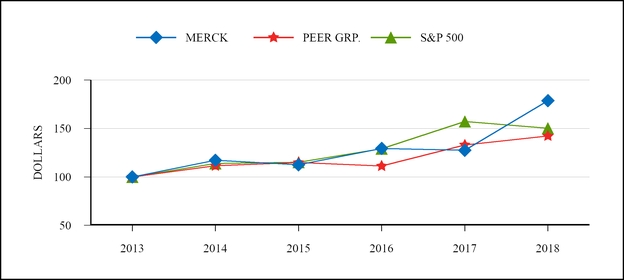
The following graph assumes a $100 investment on December 31, 2013, and reinvestment of all dividends, in each of the Company’s Common Shares, the S&P 500 Index, and a composite peer group of major pharmaceutical companies, which are: AbbVie Inc., Amgen Inc., AstraZeneca plc, Bristol-Myers Squibb Company, Johnson & Johnson, Eli Lilly and Company, GlaxoSmithKline plc, Novartis AG, Pfizer Inc., Roche Holding AG, and Sanofi SA.
Comparison of Five-Year Cumulative Total Return*
Merck & Co., Inc., Composite Peer Group and S&P 500 Index
| End of Period Value | 2018/2013 CAGR** | ||
| MERCK | $179 | 12% | |
| PEER GRP.** | 142 | 7% | |
| S&P 500 | 150 | 8% |
| 2013 | 2014 | 2015 | 2016 | 2017 | 2018 | |
| MERCK | 100.00 | 117.10 | 112.40 | 129.40 | 127.40 | 178.70 |
| PEER GRP. | 100.00 | 111.40 | 114.80 | 111.20 | 133.00 | 142.20 |
| S&P 500 | 100.00 | 113.70 | 115.20 | 129.00 | 157.20 | 150.30 |
| * | Compound Annual Growth Rate |
| ** | Peer group average was calculated on a market cap weighted basis. |
This Performance Graph will not be deemed to be incorporated by reference into any filing under the Securities Act of 1933 or the Securities Exchange Act of 1934, except to the extent that the Company specifically incorporates it by reference. In addition, the Performance Graph will not be deemed to be “soliciting material” or to be “filed” with the SEC or subject to Regulation 14A or 14C, other than as provided in Regulation S-K, or to the liabilities of section 18 of the Securities Exchange Act of 1934, except to the extent that the Company specifically requests that such information be treated as soliciting material or specifically incorporates it by reference into a filing under the Securities Act or the Exchange Act.
Item 6. Selected Financial Data.
The following selected financial data should be read in conjunction with Item 7. “Management’s Discussion and Analysis of Financial Condition and Results of Operations” and consolidated financial statements and notes thereto contained in Item 8. “Financial Statements and Supplementary Data” of this report.
Merck & Co., Inc. and Subsidiaries
($ in millions except per share amounts)
| 2018 (1) | 2017 (2)(3) | 2016 (2)(4) | 2015 (2)(5) | 2014 (2)(6) | |||||||||||||||
| Results for Year: | |||||||||||||||||||
| Sales | $ | 42,294 | $ | 40,122 | $ | 39,807 | $ | 39,498 | $ | 42,237 | |||||||||
| Cost of sales | 13,509 | 12,912 | 14,030 | 15,043 | 16,903 | ||||||||||||||
| Selling, general and administrative | 10,102 | 10,074 | 10,017 | 10,508 | 11,816 | ||||||||||||||
| Research and development | 9,752 | 10,339 | 10,261 | 6,796 | 7,290 | ||||||||||||||
| Restructuring costs | 632 | 776 | 651 | 619 | 1,013 | ||||||||||||||
| Other (income) expense, net | (402 | ) | (500 | ) | 189 | 1,131 | (12,068 | ) | |||||||||||
| Income before taxes | 8,701 | 6,521 | 4,659 | 5,401 | 17,283 | ||||||||||||||
| Taxes on income | 2,508 | 4,103 | 718 | 942 | 5,349 | ||||||||||||||
| Net income | 6,193 | 2,418 | 3,941 | 4,459 | 11,934 | ||||||||||||||
| Less: Net (loss) income attributable to noncontrolling interests | (27 | ) | 24 | 21 | 17 | 14 | |||||||||||||
| Net income attributable to Merck & Co., Inc. | 6,220 | 2,394 | 3,920 | 4,442 | 11,920 | ||||||||||||||
| Basic earnings per common share attributable to Merck & Co., Inc. common shareholders | $ | 2.34 | $ | 0.88 | $ | 1.42 | $ | 1.58 | $ | 4.12 | |||||||||
| Earnings per common share assuming dilution attributable to Merck & Co., Inc. common shareholders | $ | 2.32 | $ | 0.87 | $ | 1.41 | $ | 1.56 | $ | 4.07 | |||||||||
| Cash dividends declared | 5,313 | 5,177 | 5,135 | 5,115 | 5,156 | ||||||||||||||
| Cash dividends declared per common share | $ | 1.99 | $ | 1.89 | $ | 1.85 | $ | 1.81 | $ | 1.77 | |||||||||
| Capital expenditures | 2,615 | 1,888 | 1,614 | 1,283 | 1,317 | ||||||||||||||
| Depreciation | 1,416 | 1,455 | 1,611 | 1,593 | 2,471 | ||||||||||||||
| Average common shares outstanding (millions) | 2,664 | 2,730 | 2,766 | 2,816 | 2,894 | ||||||||||||||
| Average common shares outstanding assuming dilution (millions) | 2,679 | 2,748 | 2,787 | 2,841 | 2,928 | ||||||||||||||
| Year-End Position: | |||||||||||||||||||
| Working capital | $ | 3,669 | $ | 6,152 | $ | 13,410 | $ | 10,550 | $ | 14,198 | |||||||||
| Property, plant and equipment, net | 13,291 | 12,439 | 12,026 | 12,507 | 13,136 | ||||||||||||||
| Total assets | 82,637 | 87,872 | 95,377 | 101,677 | 98,096 | ||||||||||||||
| Long-term debt | 19,806 | 21,353 | 24,274 | 23,829 | 18,629 | ||||||||||||||
| Total equity | 26,882 | 34,569 | 40,308 | 44,767 | 48,791 | ||||||||||||||
| Year-End Statistics: | |||||||||||||||||||
| Number of stockholders of record | 115,800 | 121,700 | 129,500 | 135,500 | 142,000 | ||||||||||||||
| Number of employees | 69,000 | 69,000 | 68,000 | 68,000 | 70,000 |
| (1) | Amounts for 2018 include a charge related to the formation of a collaboration with Eisai Co., Ltd. |
| (2) | Amounts have been recast as a result of the adoption, on January 1, 2018, of a new accounting standard related to the classification of certain defined benefit plan costs. There was no impact to net income as a result of adopting the new accounting standard. |
| (3) | Amounts for 2017 include a provisional net tax charge related to the enactment of U.S. tax legislation and a charge related to the formation of a collaboration with AstraZeneca. |
| (4) | Amounts for 2016 include a charge related to the settlement of worldwide patent litigation related to Keytruda. |
| (5) | Amounts for 2015 include a net charge related to the settlement of Vioxx shareholder class action litigation, foreign exchange losses related to Venezuela, gains on the dispositions of businesses and other assets, and the favorable benefit of certain tax items. |
| (6) | Amounts for 2014 reflect the divestiture of Merck’s Consumer Care business on October 1, 2014, including a gain on the sale, as well as a gain recognized on an option exercise by AstraZeneca, gains on the dispositions of other businesses and assets, and a loss on extinguishment of debt. |
Item 7. Management’s Discussion and Analysis of Financial Condition and Results of Operations.
Description of Merck’s Business
Merck & Co., Inc. (Merck or the Company) is a global health care company that delivers innovative health solutions through its prescription medicines, vaccines, biologic therapies and animal health products. The Company’s operations are principally managed on a products basis and include four operating segments, which are the Pharmaceutical, Animal Health, Healthcare Services and Alliances segments. The Pharmaceutical and Animal Health segments are the only reportable segments.
The Pharmaceutical segment includes human health pharmaceutical and vaccine products. Human health pharmaceutical products consist of therapeutic and preventive agents, generally sold by prescription, for the treatment of human disorders. The Company sells these human health pharmaceutical products primarily to drug wholesalers and retailers, hospitals, government agencies and managed health care providers such as health maintenance organizations, pharmacy benefit managers and other institutions. Human health vaccine products consist of preventive pediatric, adolescent and adult vaccines, primarily administered at physician offices. The Company sells these human health vaccines primarily to physicians, wholesalers, physician distributors and government entities. On December 31, 2016, Merck and Sanofi Pasteur S.A. (Sanofi) terminated their equally-owned joint venture, Sanofi Pasteur MSD (SPMSD), which developed and marketed vaccines in Europe. In 2017, Merck began recording vaccine sales and incurring costs as a result of operating its vaccines business in the European markets that were previously part of the SPMSD joint venture, which was accounted for as an equity method affiliate.
The Animal Health segment discovers, develops, manufactures and markets animal health products, including pharmaceutical and vaccine products, for the prevention, treatment and control of disease in all major livestock and companion animal species, which the Company sells to veterinarians, distributors and animal producers.
The Healthcare Services segment provides services and solutions that focus on engagement, health analytics and clinical services to improve the value of care delivered to patients.
The Alliances segment primarily includes activity from the Company’s relationship with AstraZeneca LP related to sales of Nexium and Prilosec, which concluded in 2018 (see Note 9 to the consolidated financial statements).
Overview
The Company’s performance during 2018 demonstrates execution of its innovation strategy, with revenue growth in oncology, vaccines, hospital acute care and animal health, focused investment in the research and development pipeline, and disciplined allocation of resources. Additionally, Merck completed several business development transactions, expanded its capital expenditures program primarily to increase future manufacturing capacity, and returned capital to shareholders.
Worldwide sales were $42.3 billion in 2018, an increase of 5% compared with 2017. Strong growth in the oncology franchise reflects the performance of Keytruda, as well as alliance revenue related to Lynparza and Lenvima resulting from Merck’s business development activities. Also contributing to revenue growth were higher sales of vaccines, driven primarily by Gardasil/Gardasil 9, and growth in the hospital acute care franchise, largely attributable to Bridion and Noxafil. Higher sales of animal health products, reflecting increases in companion animal and livestock products both from in-line and recently launched products, also contributed to revenue growth. Growth in these areas was partially offset by competitive pressures on Zepatier and Zostavax, as well as the ongoing effects of generic and biosimilar competition that resulted in sales declines for products including Zetia, Vytorin, and Remicade.
Augmenting Merck’s portfolio and pipeline with external innovation remains an important component of the Company’s overall strategy. In 2018, Merck continued executing on this strategy by entering into a strategic collaboration with Eisai Co., Ltd. (Eisai) for the worldwide co-development and co-commercialization of Lenvima. Lenvima is an orally available tyrosine kinase inhibitor discovered by Eisai, which is approved for certain types of thyroid cancer, hepatocellular carcinoma, and in combination for certain patients with renal cell carcinoma. Under the agreement, Merck and Eisai will develop and commercialize Lenvima jointly, both as monotherapy and in combination with Keytruda. In addition, Merck acquired Viralytics Limited (Viralytics), a company focused on oncolytic immunotherapy treatments for a range of cancers. Also, the Company announced an agreement to acquire Antelliq Group (Antelliq), a leader in digital animal identification, traceability and monitoring solutions.
During 2018, the Company advanced its leadership in oncology through focused commercial execution, the achievement of important regulatory milestones and the presentation of clinical data. Keytruda continues its global launch with multiple new indications across several tumor types, including approval from the U.S. Food and Drug Administration (FDA) for the treatment of certain patients with cervical cancer, primary mediastinal large B-cell lymphoma (PMBCL), a type of non-Hodgkin lymphoma, hepatocellular carcinoma, Merkel cell carcinoma, and in combination with chemotherapy for the treatment of certain patients with squamous non-small-cell lung cancer (NSCLC). Also during 2018, the European Commission (EC) approved Keytruda for the treatment of certain patients with head and neck squamous cell carcinoma (HNSCC), for the adjuvant treatment of melanoma, and in combination with chemotherapy for the first-line treatment of certain patients with nonsquamous NSCLC. This was the first approval in Europe for an anti-PD-1 therapy in combination with chemotherapy. Also in 2018, Keytruda was approved in China for the treatment of certain patients with melanoma. Additionally, Merck recently announced the receipt of five new approvals for Keytruda in Japan, including three expanded uses in advanced NSCLC, one in adjuvant melanoma, as well as a new indication in advanced microsatellite instability-high (MSI-H) tumors. Keytruda also continues to launch in many other international markets.
In 2018, Lynparza, which is being developed in a collaboration with AstraZeneca PLC (AstraZeneca), received FDA approval for use in certain patients with metastatic breast cancer who have been previously treated with chemotherapy, and for use as maintenance treatment of adult patients with certain types of advanced ovarian, fallopian tube or primary peritoneal cancer who are in complete or partial response to chemotherapy. Additionally, Lenvima was approved in the United States, European Union (EU), Japan and China for the treatment of certain patients with hepatocellular carcinoma. The FDA and EC also approved two new HIV-1 medicines: Delstrigo, a once-daily fixed-dose combination tablet of doravirine, lamivudine and tenofovir disoproxil fumarate; and Pifeltro (doravirine), a new non-nucleoside reverse transcriptase inhibitor to be administered in combination with other antiretroviral medicines.
Merck continues to invest in its pipeline, with an emphasis on being a leader in immuno-oncology and expanding in other areas such as vaccines and hospital acute care. In addition to the recent regulatory approvals discussed above, the Company has continued to advance its late-stage pipeline with several regulatory submissions. Keytruda is under review in the United States in combination with axitinib, a tyrosine kinase inhibitor, for the first-line treatment of patients with advanced renal cell carcinoma for which it has been granted Priority Review by the FDA; in the EU for the first-line treatment of certain patients with metastatic squamous NSCLC; in the United States and in the EU as monotherapy for the first-line treatm
Showing the first 8K of 162K characters. Open the full section
Item 7A. Quantitative and Qualitative Disclosures about Market Risk.
The information required by this Item is incorporated by reference to the discussion under “Financial Instruments Market Risk Disclosures” in Item 7. “Management’s Discussion and Analysis of Financial Condition and Results of Operations.”
Item 8. Financial Statements and Supplementary Data.
| (a) | Financial Statements |
The consolidated balance sheet of Merck & Co., Inc. and subsidiaries as of December 31, 2018 and 2017, and the related consolidated statements of income, of comprehensive income, of equity and of cash flows for each of the three years in the period ended December 31, 2018, the notes to consolidated financial statements, and the report dated February 27, 2019 of PricewaterhouseCoopers LLP, independent registered public accounting firm, are as follows:
Consolidated Statement of Income
Merck & Co., Inc. and Subsidiaries
Years Ended December 31
($ in millions except per share amounts)
| 2018 | 2017 | 2016 | |||||||||
| Sales | $ | 42,294 | $ | 40,122 | $ | 39,807 | |||||
| Costs, Expenses and Other | |||||||||||
| Cost of sales | 13,509 | 12,912 | 14,030 | ||||||||
| Selling, general and administrative | 10,102 | 10,074 | 10,017 | ||||||||
| Research and development | 9,752 | 10,339 | 10,261 | ||||||||
| Restructuring costs | 632 | 776 | 651 | ||||||||
| Other (income) expense, net | (402 | ) | (500 | ) | 189 | ||||||
| 33,593 | 33,601 | 35,148 | |||||||||
| Income Before Taxes | 8,701 | 6,521 | 4,659 | ||||||||
| Taxes on Income | 2,508 | 4,103 | 718 | ||||||||
| Net Income | 6,193 | 2,418 | 3,941 | ||||||||
| Less: Net (Loss) Income Attributable to Noncontrolling Interests | (27 | ) | 24 | 21 | |||||||
| Net Income Attributable to Merck & Co., Inc. | $ | 6,220 | $ | 2,394 | $ | 3,920 | |||||
| Basic Earnings per Common Share Attributable to Merck & Co., Inc. Common Shareholders | $ | 2.34 | $ | 0.88 | $ | 1.42 | |||||
| Earnings per Common Share Assuming Dilution Attributable to Merck & Co., Inc. Common Shareholders | $ | 2.32 | $ | 0.87 | $ | 1.41 |
Consolidated Statement of Comprehensive Income
Merck & Co., Inc. and Subsidiaries
Years Ended December 31
($ in millions)
| 2018 | 2017 | 2016 | |||||||||
| Net Income Attributable to Merck & Co., Inc. | $ | 6,220 | $ | 2,394 | $ | 3,920 | |||||
| Other Comprehensive (Loss) Income Net of Taxes: | |||||||||||
| Net unrealized gain (loss) on derivatives, net of reclassifications | 297 | (446 | ) | (66 | ) | ||||||
| Net unrealized loss on investments, net of reclassifications | (10 | ) | (58 | ) | (44 | ) | |||||
| Benefit plan net (loss) gain and prior service (cost) credit, net of amortization | (425 | ) | 419 | (799 | ) | ||||||
| Cumulative translation adjustment | (223 | ) | 401 | (169 | ) | ||||||
| (361 | ) | 316 | (1,078 | ) | |||||||
| Comprehensive Income Attributable to Merck & Co., Inc. | $ | 5,859 | $ | 2,710 | $ | 2,842 |
The accompanying notes are an integral part of these consolidated financial statements.
Consolidated Balance Sheet
Merck & Co., Inc. and Subsidiaries
December 31
($ in millions except per share amounts)
| 2018 | 2017 | ||||||
| Assets | |||||||
| Current Assets | |||||||
| Cash and cash equivalents | $ | 7,965 | $ | 6,092 | |||
| Short-term investments | 899 | 2,406 | |||||
| Accounts receivable (net of allowance for doubtful accounts of $119 in 2018 and $159 in 2017) | 7,071 | 6,873 | |||||
| Inventories (excludes inventories of $1,417 in 2018 and $1,187 in 2017 classified in Other assets - see Note 7) | 5,440 | 5,096 | |||||
| Other current assets | 4,500 | 4,299 | |||||
| Total current assets | 25,875 | 24,766 | |||||
| Investments | 6,233 | 12,125 | |||||
| Property, Plant and Equipment (at cost) | |||||||
| Land | 333 | 365 | |||||
| Buildings | 11,486 | 11,726 | |||||
| Machinery, equipment and office furnishings | 14,441 | 14,649 | |||||
| Construction in progress | 3,355 | 2,301 | |||||
| 29,615 | 29,041 | ||||||
| Less: accumulated depreciation | 16,324 | 16,602 | |||||
| 13,291 | 12,439 | ||||||
| Goodwill | 18,253 | 18,284 | |||||
| Other Intangibles, Net | 11,431 | 14,183 | |||||
| Other Assets | 7,554 | 6,075 | |||||
| $ | 82,637 | $ | 87,872 | ||||
| Liabilities and Equity | |||||||
| Current Liabilities | |||||||
| Loans payable and current portion of long-term debt | $ | 5,308 | $ | 3,057 | |||
| Trade accounts payable | 3,318 | 3,102 | |||||
| Accrued and other current liabilities | 10,151 | 10,427 | |||||
| Income taxes payable | 1,971 | 708 | |||||
| Dividends payable | 1,458 | 1,320 | |||||
| Total current liabilities | 22,206 | 18,614 | |||||
| Long-Term Debt | 19,806 | 21,353 | |||||
| Deferred Income Taxes | 1,702 | 2,219 | |||||
| Other Noncurrent Liabilities | 12,041 | 11,117 | |||||
| Merck & Co., Inc. Stockholders’ Equity | |||||||
| Common stock, $0.50 par value Authorized - 6,500,000,000 shares Issued - 3,577,103,522 shares in 2018 and 2017 | 1,788 | 1,788 | |||||
| Other paid-in capital | 38,808 | 39,902 | |||||
| Retained earnings | 42,579 | 41,350 | |||||
| Accumulated other comprehensive loss | (5,545 | ) | (4,910 | ) | |||
| 77,630 | 78,130 | ||||||
| Less treasury stock, at cost: 984,543,979 shares in 2018 and 880,491,914 shares in 2017 | 50,929 | 43,794 | |||||
| Total Merck & Co., Inc. stockholders’ equity | 26,701 | 34,336 | |||||
| Noncontrolling Interests | 181 | 233 | |||||
| Total equity | 26,882 | 34,569 | |||||
| $ | 82,637 | $ | 87,872 |
The accompanying notes are an integral part of this consolidated financial statement.
Consolidated Statement of Equity
Merck & Co., Inc. and Subsidiaries
Years Ended December 31
($ in millions except per share amounts)
| Common Stock | Other Paid-In Capital | Retained Earnings | Accumulated Other Comprehensive Loss | Treasury Stock | Non- controlling Interests | Total | |||||||||||||||||||||
| Balance January 1, 2016 | $1,788 | $ | 40,222 | $ | 45,348 | $ | (4,148 | ) | $ | (38,534 | ) | $ | 91 | $ | 44,767 | ||||||||||||
| Net income attributable to Merck & Co., Inc. | — | — | 3,920 | — | — | — | 3,920 | ||||||||||||||||||||
| Other comprehensive loss, net of taxes | — | — | — | (1,078 | ) | — | — | (1,078 | ) | ||||||||||||||||||
| Cash dividends declared on common stock ($1.85 per share) | — | — | (5,135 | ) | — | — | — | (5,135 | ) | ||||||||||||||||||
| Treasury stock shares purchased | — | — | — | — | (3,434 | ) | — | (3,434 | ) | ||||||||||||||||||
| Acquisition of The StayWell Company LLC | — | — | — | — | — | 124 | 124 | ||||||||||||||||||||
| Net income attributable to noncontrolling interests |
Showing the first 8K of 285K characters. Open the full section
Item 9. Changes in and Disagreements with Accountants on Accounting and Financial Disclosure.
Not applicable.
Item 9A. Controls and Procedures.
Management of the Company, with the participation of its Chief Executive Officer and Chief Financial Officer, evaluated the effectiveness of the Company’s disclosure controls and procedures. Based on their evaluation, as of the end of the period covered by this Form 10-K, the Company’s Chief Executive Officer and Chief Financial Officer have concluded that the Company’s disclosure controls and procedures (as defined in Rules 13a-15(e) or 15d-15(e) under the Securities Exchange Act of 1934, as amended (the Act)) are effective. For the fourth quarter of 2018, there have been no changes in internal control over financial reporting that have materially affected, or are reasonably likely to materially affect, the Company’s internal control over financial reporting.
Management is responsible for establishing and maintaining adequate internal control over financial reporting, as such term is defined in Rule 13a-15(f) of the Act. Management conducted an evaluation of the effectiveness of internal control over financial reporting based on the framework in Internal Control — Integrated Framework issued in 2013 by the Committee of Sponsoring Organizations of the Treadway Commission. Based on this evaluation, management concluded that internal control over financial reporting was effective as of December 31, 2018. PricewaterhouseCoopers LLP, an independent registered public accounting firm, has performed its own assessment of the effectiveness of the Company’s internal control over financial reporting and its attestation report is included in this Form 10-K filing.
Management’s Report
Management’s Responsibility for Financial Statements
Responsibility for the integrity and objectivity of the Company’s financial statements rests with management. The financial statements report on management’s stewardship of Company assets. These statements are prepared in conformity with generally accepted accounting principles and, accordingly, include amounts that are based on management’s best estimates and judgments. Nonfinancial information included in the Annual Report on Form 10-K has also been prepared by management and is consistent with the financial statements.
To assure that financial information is reliable and assets are safeguarded, management maintains an effective system of internal controls and procedures, important elements of which include: careful selection, training and development of operating and financial managers; an organization that provides appropriate division of responsibility; and communications aimed at assuring that Company policies and procedures are understood throughout the organization. A staff of internal auditors regularly monitors the adequacy and application of internal controls on a worldwide basis.
To ensure that personnel continue to understand the system of internal controls and procedures, and policies concerning good and prudent business practices, annually all employees of the Company are required to complete Code of Conduct training. This training reinforces the importance and understanding of internal controls by reviewing key corporate policies, procedures and systems. In addition, the Company has compliance programs, including an ethical business practices program to reinforce the Company’s long-standing commitment to high ethical standards in the conduct of its business.
The financial statements and other financial information included in the Annual Report on Form 10-K fairly present, in all material respects, the Company’s financial condition, results of operations and cash flows. Our formal certification to the Securities and Exchange Commission is included in this Form 10-K filing.
Management’s Report on Internal Control Over Financial Reporting
Management is responsible for establishing and maintaining adequate internal control over financial reporting, as such term is defined in Rule 13a-15(f) under the Securities Exchange Act of 1934. The Company’s internal control over financial reporting is designed to provide reasonable assurance regarding the reliability of financial reporting and the preparation of financial statements for external purposes in accordance with generally accepted accounting principles in the United States of America. Management conducted an evaluation of the effectiveness of internal control over financial reporting based on the framework in Internal Control — Integrated Framework issued
in 2013 by the Committee of Sponsoring Organizations of the Treadway Commission. Based on this evaluation, management concluded that internal control over financial reporting was effective as of December 31, 2018.
Because of its inherent limitations, internal control over financial reporting may not prevent or detect misstatements. Projections of any evaluation of effectiveness to future periods are subject to the risk that controls may become inadequate because of changes in conditions, or that the degree of compliance with the policies or procedures may deteriorate.
The effectiveness of the Company’s internal control over financial reporting as of December 31, 2018, has been audited by PricewaterhouseCoopers LLP, an independent registered public accounting firm, as stated in their report which appears herein.
 | ||
 | ||
| Kenneth C. Frazier | Robert M. Davis | |
| Chairman, President and Chief Executive Officer | Executive Vice President, Global Services, and Chief Financial Officer |
Item 9B. Other Information.
None.
PART III
Item 10. Directors, Executive Officers and Corporate Governance.
The required information on directors and nominees is incorporated by reference from the discussion under Proposal 1. Election of Directors of the Company’s Proxy Statement for the Annual Meeting of Shareholders to be held May 28, 2019. Information on executive officers is set forth in Part I of this document on page 32.
The required information on compliance with Section 16(a) of the Securities Exchange Act of 1934 is incorporated by reference from the discussion under the heading “Section 16(a) Beneficial Ownership Reporting Compliance” of the Company’s Proxy Statement for the Annual Meeting of Shareholders to be held May 28, 2019.
The Company has a Code of Conduct — Our Values and Standards applicable to all employees, including the principal executive officer, principal financial officer, principal accounting officer and Controller. The Code of Conduct is available on the Company’s website at www.merck.com/about/code_of_conduct.pdf. The Company intends to disclose future amendments to certain provisions of the Code of Conduct, and waivers of the Code of Conduct granted to executive officers and directors, if any, on the website within four business days following the date of any amendment or waiver. Every Merck employee is responsible for adhering to business practices that are in accordance with the law and with ethical principles that reflect the highest standards of corporate and individual behavior.
The required information on the identification of the audit committee and the audit committee financial expert is incorporated by reference from the discussion under the heading “Board Meetings and Committees” of the Company’s Proxy Statement for the Annual Meeting of Shareholders to be held May 28, 2019.
Item 11. Executive Compensation.
The information required on executive compensation is incorporated by reference from the discussion under the headings “Compensation Discussion and Analysis”, “Summary Compensation Table”, “All Other Compensation” table, “Grants of Plan-Based Awards” table, “Outstanding Equity Awards” table, “Option Exercises and Stock Vested” table, “Pension Benefits” table, “Nonqualified Deferred Compensation” table, Potential Payments Upon Termination or a Change in Control, including the discussion under the subheadings “Separation” and “Change in Control”, as well as all footnote information to the various tables, of the Company’s Proxy Statement for the Annual Meeting of Shareholders to be held May 28, 2019.
The required information on director compensation is incorporated by reference from the discussion under the heading “Director Compensation” and related “Director Compensation” table and “Schedule of Director Fees” table of the Company’s Proxy Statement for the Annual Meeting of Shareholders to be held May 28, 2019.
The required information under the headings “Compensation and Benefits Committee Interlocks and Insider Participation” and “Compensation and Benefits Committee Report” is incorporated by reference from the Company’s Proxy Statement for the Annual Meeting of Shareholders to be held May 28, 2019.
Item 12. Security Ownership of Certain Beneficial Owners and Management and Related Stockholder Matters.
Information with respect to security ownership of certain beneficial owners and management is incorporated by reference from the discussion under the heading “Stock Ownership Information” of the Company’s Proxy Statement for the Annual Meeting of Shareholders to be held May 28, 2019.
Equity Compensation Plan Information
The following table summarizes information about the options, warrants and rights and other equity compensation under the Company’s equity compensation plans as of the close of business on December 31, 2018. The table does not include information about tax qualified plans such as the Merck U.S. Savings Plan.
| Plan Category | Number of securities to be issued upon exercise of outstanding options, warrants and rights (a) | Weighted-average exercise price of outstanding options, warrants and rights (b) | Number of securities remaining available for future issuance under equity compensation plans (excluding securities reflected in column (a)) (c) | |||||||
| Equity compensation plans approved by security holders(1) | 23,807,101(2) | $ | 51.89 | 110,977,283 | ||||||
| Equity compensation plans not approved by security holders | — | — | — | |||||||
| Total | 23,807,101 | $ | 51.89 | 110,977,283 |
| (1) | Includes options to purchase shares of Company Common Stock and other rights under the following shareholder-approved plans: the Merck Sharp & Dohme 2004, 2007 and 2010 Incentive Stock Plans, the Merck & Co., Inc. 2006 and 2010 Non-Employee Directors Stock Option Plans, and the Merck & Co., Inc. Schering-Plough 2002 and 2006 Stock Incentive Plans. |
| (2) | Excludes approximately 16,128,455 shares of restricted stock units and 2,039,065 performance share units (assuming maximum payouts) under the Merck Sharp & Dohme 2004, 2007 and 2010 Incentive Stock Plans. Also excludes 224,599 shares of phantom stock deferred under the MSD Employee Deferral Program and 582,155 shares of phantom stock deferred under the Merck & Co., Inc. Plan for Deferred Payment of Directors’ Compensation. |
Item 13. Certain Relationships and Related Transactions, and Director Independence.
The required information on transactions with related persons is incorporated by reference from the discussion under the heading “Related Person Transactions” of the Company’s Proxy Statement for the Annual Meeting of Shareholders to be held May 28, 2019.
The required information on director independence is incorporated by reference from the discussion under the heading “Independence of Directors” of the Company’s Proxy Statement for the Annual Meeting of Shareholders to be held May 28, 2019.
Item 14. Principal Accountant Fees and Services.
The information required for this item is incorporated by reference from the discussion under Proposal 4. Ratification of Appointment of Independent Registered Public Accounting Firm for 2019 beginning with the caption “Pre-Approval Policy for Services of Independent Registered Public Accounting Firm” through “Fees for Services Provided by the Independent Registered Public Accounting Firm” of the Company’s Proxy Statement for the Annual Meeting of Shareholders to be held May 28, 2019.
PART IV
Item 15. Exhibits and Financial Statement Schedules.
(a) The following documents are filed as part of this Form 10-K
- Financial Statements
Consolidated statement of income for the years ended December 31, 2018, 2017 and 2016
Consolidated statement of comprehensive income for the years ended December 31, 2018, 2017 and 2016
Consolidated balance sheet as of December 31, 2018 and 2017
Consolidated statement of equity for the years ended December 31, 2018, 2017 and 2016
Consolidated statement of cash flows for the years ended December 31, 2018, 2017 and 2016
Notes to consolidated financial statements
Report of PricewaterhouseCoopers LLP, independent registered public accounting firm
- Financial Statement Schedules
Schedules are omitted because they are either not required or not applicable.
Financial statements of affiliates carried on the equity basis have been omitted because, considered individually or in the aggregate, such affiliates do not constitute a significant subsidiary.
- Exhibits
| Exhibit Number | Description | |||
| 31.1 | — | Rule 13a-14(a)/15d-14(a) Certification of Chief Executive Officer | ||
| 31.2 | — | Rule 13a-14(a)/15d-14(a) Certification of Chief Financial Officer | ||
| 32.1 | — | Section 1350 Certification of Chief Executive Officer | ||
| 32.2 | — | Section 1350 Certification of Chief Financial Officer | ||
| 101 | — | The following materials from Merck & Co., Inc.’s Annual Report on Form 10-K for the fiscal year ended December 31, 2018, formatted in XBRL (Extensible Business Reporting Language): (i) the Consolidated Statement of Income, (ii) the Consolidated Statement of Comprehensive Income, (iii) the Consolidated Balance Sheet, (iv) the Consolidated Statement of Equity, (v) the Consolidated Statement of Cash Flows, and (vi) Notes to Consolidated Financial Statements. |
| * | Management contract or compensatory plan or arrangement. |
| † | Certain portions of the exhibit have been omitted pursuant to a request for confidential treatment. The non-public information has been filed separately with the Securities and Exchange Commission pursuant to rule 24b-2 under the Securities Exchange Act of 1934, as amended. |
Item 16. Form 10-K Summary
Not applicable.
SIGNATURES
Pursuant to the requirements of Section 13 or 15(d) of the Securities Exchange Act of 1934, the registrant has duly caused this report to be signed on its behalf by the undersigned, thereunto duly authorized.
Dated: February 27, 2019
| MERCK & CO., INC. | ||
| By: | KENNETH C. FRAZIER | |
| (Chairman, President and Chief Executive Officer) | ||
| By: | /s/ JENNIFER ZACHARY | |
| Jennifer Zachary | ||
| (Attorney-in-Fact) |
Pursuant to the requirements of the Securities Exchange Act of 1934, this report has been signed below by the following persons on behalf of the Registrant and in the capacities and on the dates indicated.
| Signatures | Title | Date | ||
| KENNETH C. FRAZIER | Chairman, President and Chief Executive Officer; Principal Executive Officer; Director | February 27, 2019 | ||
| ROBERT M. DAVIS | Executive Vice President, Global Services, and Chief Financial Officer; Principal Financial Officer | February 27, 2019 | ||
| RITA A. KARACHUN | Senior Vice President Finance-Global Controller; Principal Accounting Officer | February 27, 2019 | ||
| LESLIE A. BRUN | Director | February 27, 2019 | ||
| THOMAS R. CECH | Director | February 27, 2019 | ||
| PAMELA J. CRAIG | Director | February 27, 2019 | ||
| THOMAS H. GLOCER | Director | February 27, 2019 | ||
| ROCHELLE B. LAZARUS | Director | February 27, 2019 | ||
| JOHN H. NOSEWORTHY | Director | February 27, 2019 | ||
| PAUL B. ROTHMAN | Director | February 27, 2019 | ||
| PATRICIA F. RUSSO | Director | February 27, 2019 | ||
| INGE G. THULIN | Director | February 27, 2019 | ||
| WENDELL P. WEEKS | Director | February 27, 2019 | ||
| PETER C. WENDELL | Director | February 27, 2019 |
Jennifer Zachary, by signing her name hereto, does hereby sign this document pursuant to powers of attorney duly executed by the persons named, filed with the Securities and Exchange Commission as an exhibit to this document, on behalf of such persons, all in the capacities and on the date stated, such persons including a majority of the directors of the Company.
| By: | /S/ JENNIFER ZACHARY | |
| Jennifer Zachary | ||
| (Attorney-in-Fact) |
EXHIBIT INDEX
| * | Management contract or compensatory plan or arrangement. |
| † | Certain portions of the exhibit have been omitted pursuant to a request for confidential treatment. The non-public information has been filed separately with the Securities and Exchange Commission pursuant to rule 24b-2 under the Securities Exchange Act of 1934, as amended. |