 filings.tools
Item 2. MANAGEMENT’S DISCUSSION AND ANALYSIS OF FINANCIAL CONDITION AND RESULTS OF OPERATIONS
81K characters. Original on sec.gov · Markdown
Item 2. MANAGEMENT’S DISCUSSION AND ANALYSIS OF FINANCIAL CONDITION AND RESULTS OF OPERATIONS
You should read the following discussion and analysis of our financial condition and results of operations together with our unaudited financial information and related notes included in this Form 10-Q and our consolidated financial statements and related notes and other financial information in our Annual Report on Form 10-K for the year ended December 31, 2020, which was filed with the SEC on February 26, 2021 (the “2020 Form 10-K”). Some of the information contained in this discussion and analysis or set forth elsewhere in this Form 10-Q, including information with respect to our plans and strategy for our business, includes forward-looking statements that involve risks and uncertainties. As a result of many factors, including those factors set forth in Part II, Item 1A - Risk Factors in this Form 10-Q, our actual results could differ materially from the results described in or implied by the forward-looking statements contained in the following discussion and analysis.
Overview
We are a biotechnology company pioneering messenger RNA (mRNA) therapeutics and vaccines to create a new generation of transformative medicines to improve the lives of patients. mRNA medicines are designed to direct the body’s cells to produce intracellular, membrane, or secreted proteins that have a therapeutic or preventive benefit with the potential to address a broad spectrum of diseases. Our platform builds on continuous advances in basic and applied mRNA science, delivery technology, and manufacturing, providing us the capability to pursue in parallel a robust pipeline of new development candidates. We are developing therapeutics and vaccines for infectious diseases, immuno-oncology, rare diseases, autoimmune diseases and cardiovascular diseases, independently and with our strategic collaborators.
Within our platform, we develop technologies that enable the development of mRNA medicines for diverse applications. When we identify technologies that we believe could enable a new group of potential mRNA medicines with shared product features, we call that group a “modality.” While the programs within a modality may target diverse diseases, they share similar mRNA technologies, delivery technologies, and manufacturing processes to achieve shared product features. The programs within a modality will also generally share similar pharmacology profiles, including the desired dose response, the expected dosing regimen, the target tissue for protein expression, safety and tolerability goals, and pharmaceutical properties. Programs within a modality often have correlated technology risk, but, because they pursue diverse diseases, they often have uncorrelated biology risk. We have created seven modalities to date:
-
prophylactic vaccines;
-
systemic secreted and cell surface therapeutics;
-
cancer vaccines;
-
intratumoral immuno-oncology;
-
localized regenerative therapeutics;
-
systemic intracellular therapeutics; and
-
inhaled pulmonary therapeutics.
We have designated our prophylactic vaccines and systemic secreted and cell surface therapeutics modalities as our “core modalities.” In these core modalities, our strategy is to invest in additional development candidates using our accumulated innovations in technology, our process insights and our preclinical and clinical experience. Our exploratory modalities continue to be a critical part of advancing our strategy to maximize the application of our potential mRNA medicines.
Business Highlights
Moderna COVID-19 Vaccine
On December 18, 2020, we received an Emergency Use Authorization (EUA) from the U.S. Food and Drug Administration (FDA) for the emergency use of the Moderna COVID-19 Vaccine (also referred to as mRNA-1273 and marketed under the brand name Spikevax) in individuals 18 years of age or older. We have also received authorization for our COVID-19 vaccine from health agencies in more than 50 countries and from the World Health Organization (WHO). Additional authorizations are currently under review in other countries. In addition, we have received authorization for our COVID-19 vaccine for use in adolescents in the United Kingdom, European Union, Japan, Canada, Switzerland, Taiwan, Saudi Arabia, Australia and the Philippines, and have pending applications for authorization to administer the vaccine to adolescents with regulatory agencies in the United States and other countries.
The FDA has approved an update to the EUA for the Moderna COVID-19 Vaccine to include a third dose for immunocompromised individuals 18 years of age or older in the United States, as well as the administration of 50 µg booster doses for individuals age 65 and older, people aged 18 to 64 who are at high risk of severe COVID-19, and people aged 18 to 64 with frequent institutional or occupational exposure to SARS-CoV-2. In October 2021, the U.S. Advisory Committee on Immunization Practices (ACIP) also endorsed recommending the Moderna COVID-19 Vaccine as a booster, regardless of the original vaccine received by an individual in their primary series. The European Medicines Agency (EMA) has also authorized a third dose of the Moderna COVID-19 vaccine given at least 28 days after the second dose to severely immunocompromised individuals 12 years of age or older, as well as the administration of 50 µg booster doses for individuals 18 years of age and older. In August 2021, we completed the rolling submission process with the FDA for a Biologics License Application (BLA) for our COVID-19 vaccine, which is subject to Priority Review.
On October 29, 2021, the FDA informed us that the agency will require additional time to evaluate recently conducted international analyses of the risk of myocarditis (inflammation of the heart muscle) after vaccination in connection with our requested EUA to administer the Moderna COVID-19 Vaccine in adolescents (12-17 years of age). The FDA notified us that this review may not be completed before January 2022. An increased risk of myocarditis has been described for mRNA COVID-19 vaccines, including the Moderna COVID-19 vaccine, particularly in young men and following the second dose. The U.S. Centers for Disease Control (CDC) and Prevention and the WHO have stated that myocarditis following vaccination with mRNA vaccines has been rare and generally mild. We are committed to conducting our own careful review of new external analyses as they become available. We do not yet have access to data from some recent international analyses. We currently expect that we will also delay filing a request for EUA of our COVID-19 vaccine at the 50 µg dose level in the pediatric population (6-11 years of age) while the FDA completes its review of the adolescent EUA request.
We have entered into supply agreements with the U.S. Government, several other governments outside the United States and with UNICEF (on behalf of the COVAX Facility) and the African Union for the supply of our COVID-19 vaccine. The agreements are generally subject to receipt of authorization or approval for the use and distribution of the vaccine from the relevant regulatory authority in each jurisdiction. Under these agreements, we are entitled to upfront deposits for our COVID-19 vaccine supply, initially recorded as deferred revenue. As of September 30, 2021, we had approximately $8.3 billion in deferred revenue in connection with the supply agreements with the U.S. Government and other customers, which will be recognized as revenue when revenue recognition criteria have been met.
For the third quarter of 2021, we delivered approximately 73 million doses of our COVID-19 vaccine to the U.S. Government and approximately 136 million doses to other governments, and recognized $4.8 billion in product sales. For the nine months ended September 30, 2021, we delivered approximately 287 million doses of our COVID-19 vaccine to the U.S. Government and approximately 222 million doses to other governments, and recognized $10.7 billion in product sales.
In the second quarter of 2021, we announced additional investments to facilitate the increased supply of our COVID-19 vaccine from our own and partnered manufacturing facilities, and an expansion of the Moderna Technology Center (MTC) in Norwood, Massachusetts, to more than double our facility space to help transform it from a production and lab space to an industrial technology center. These investments are expected to facilitate a doubling of drug substance manufacturing from Lonza’s Switzerland-based facility, a more than doubling of formulation, fill/finish and drug substance manufacturing at Rovi’s Spain-based facility, as well as a 50% increase of drug substance at Moderna’s facilities in the U.S. When completed, the investments are expected to also result in an increase in safety stock of raw materials and finished product used to deliver committed volumes. These forecasted increases to our supply are subject in part to performance by our manufacturing partners, which will require ramping-up capabilities at their own facilities and the hiring of qualified manufacturing personnel.
We currently anticipate that we will be supply between 700 million and 800 million doses of our COVID-19 vaccine in 2021, at the 100 µg dose. Key variables impacting output include longer delivery lead times for international shipments and exports that may shift deliveries to early 2022, temporary impact from expansion of fill/finish capacity and ramp up of product release to market. The ultimate number of doses that we anticipate delivering in 2022 is subject to a number of factors, including demand for the vaccine as the COVID-19 pandemic shifts to an anticipated endemic phase, demand for presentations of our vaccine, the dosage for the vaccine (including different dose amounts for primary series, booster series and pediatric vaccines), and other factors.
Moderna COVID-19 Vaccine Clinical Studies
The final analysis of adjudicated cases from the Phase 3 clinical trial for mRNA-1273, which we refer to as the COVE Study, demonstrated efficacy of 93% through six months after the second dose of the vaccine. The final analysis also demonstrated greater than 98% efficacy against severe cases of COVID-19 and 100% efficacy against death caused by COVID-19 in the per protocol cohort. The final analysis also demonstrated consistency in our subgroup analysis, including analyses by gender, by race and by preexisting medical conditions. The safety profile for mRNA-1273 continues to be consistent with the Phase 3 data over the longer period of safety follow up and across population subgroups.
The Phase 2/3 TeenCOVE study of mRNA-1273 in adolescents ages 12-17 years has completed enrollment in the United States. An initial analysis of 3,732 participants randomized 2:1 in the TeenCOVE study showed a vaccine efficacy rate of 93% in seronegative participants who received at least one injection (modified intent-to-treat cohort) in a secondary analysis. The median duration for follow-up in this analysis was 53 days following the second dose. mRNA-1273 was generally well tolerated. The majority of adverse events were mild or moderate in severity. No serious safety concerns have been identified to date. The most common solicited local adverse event was injection site pain. The most common solicited systemic adverse events after the second dose of mRNA-1273 were headache, fatigue, myalgia and chills. We have received authorization for our COVID-19 vaccine for use in adolescents in the United Kingdom, European Union, Japan, Canada, Switzerland, Taiwan, Saudi Arabia, Australia and the Philippines. We have filed for an EUA for adolescents with the FDA and a determination is pending, as described in further detail above.
The Phase 2/3 KidCOVE study of mRNA-1273 in the pediatric population ages 6 months to 11 years is ongoing. We expect to enroll more than 12,000 healthy pediatric participants in the U.S. and Canada into this two-part, dose escalation study. Data from the KidCOVE study two weeks after the first dose of mRNA-1273 at the 50 µg dose level showed a vaccine efficacy of 100%, using the Phase 3 COVE study primary case definition for COVID-19. Additionally, for asymptomatic infection two weeks after the first dose, vaccine efficacy was 65% (95% CI: .16, .85). For SARS-CoV-2 infection regardless of symptoms, vaccine efficacy was 80% (95% CI: .62, .90) two weeks after the first dose. On October 24, the Company announced positive top line top line data from the Phase 2/3 study of mRNA-1273 in children 6 to 11 years of age. GMR comparing the response in children to the response in young adults from the Phase 3 COVE study was 1.5 (95% CI: 1.3, 1.8), with a seroresponse rate of 99.3%. Two 50 μg doses of mRNA-1273 were generally well tolerated. The Company plans to submit results to the U.S. FDA, EMA and regulatory agencies around the world. The age groups are 6 years to <12 years, 2 years to <6 years and 6 months to <2 years. In part 1, each age group tests one of two dose levels. Following an interim analysis, a dose will be selected for part 2, a placebo-controlled expansion portion of the study, which is expected to enroll 4,000 participants. We are in part 1 of the study for the two other age groups, 2 years to <6 years and 6 months to <2 years old. Dose selection studies are underway for the 2 to <6 years and 6 months to <2 years age groups.
The Phase 1 study of mRNA-1283 is fully enrolled and ongoing. An interim analysis of data from the Phase 1 study of mRNA-1283 at three dose levels indicates that a lower dose of mRNA-1283 achieved similar neutralizing antibody responses compared to a primary series of mRNA-1273. mRNA-1283 had an acceptable tolerability profile. The Company is preparing to begin a Phase 2 booster study of mRNA-1283. mRNA-1283 is a next-generation vaccine candidate against COVID-19 that encodes for the portions of the SARS-CoV-2 spike protein critical for neutralization, specifically the Receptor Binding Domain (RBD) and N-terminal Domain (NTD). The encoded mRNA-1283 antigen is shorter than mRNA-1273 and is being developed as a potential refrigerator-stable mRNA vaccine that will facilitate easier distribution and administration by healthcare providers.
Variant-Specific Booster Candidates
In February 2021, we announced that we had completed manufacturing of clinical trial material for our variant-specific vaccine candidate, mRNA-1273.351, against the SARS-CoV-2 variant known as the Beta variant (or B.1.351, first identified in the Republic of South Africa) and that this vaccine had been shipped to the National Institutes of Health (NIH) for a Phase 1 clinical trial to be led and funded by the NIH’s National Institute of Allergy and Infectious Diseases. We are also developing a multivalent booster candidate, mRNA-1273.211, which combines mRNA-1273 (Moderna’s authorized vaccine against ancestral strains) and the Beta variant in a single vaccine.
Data from our Phase 2 study showed that a single 50 µg dose of mRNA-1273, mRNA-1273.351 or mRNA-1273.211 given as a booster to previously vaccinated individuals (n=20 per group) increased neutralizing antibody titer responses against SARS-CoV-2 and important variants of concern, including the Gamma variant (or P.1, first identified in Brazil), the Beta variant, and the Delta variant (B.1.617.2). Neutralizing antibody levels following the boost approached those observed after primary vaccination with two doses of 100 µg of mRNA-1273. These data have been published in Nature Medicine. Safety and tolerability profiles following third dose booster injections of 50 µg of mRNA-1273, mRNA-1273.351 or mRNA-1273.211 were generally comparable to those observed after the second dose of mRNA-1273 in the previously reported Phase 2 and Phase 3 studies. Our Phase 2 study to evaluate three approaches to boosting is ongoing. We are also in the process of developing a booster tailored to the Delta variant (mRNA-1273.617), and anticipate developing a multivalent booster (referred to as mRNA-1273.213) that combines mRNA-1273.617 with another COVID-19 candidate.
Other Business Updates
On November 1, 2021, we announced that, as part of our commitment to sustainability, we will work to achieve net-zero carbon emissions from our operations globally by 2030. These efforts to reduce our environmental impact are expected to include implementing key initiatives to reduce the carbon footprint from both our existing and future facilities, encouraging green transportation and working with our suppliers as they move toward their own carbon reduction goals.
On November 2, 2021, we announced that we have entered into a strategic research and development collaboration with Metagenomi, Inc., focused on advancing novel gene editing technologies for in vivo human therapeutic applications. The collaboration will utilize Metagenomi’s next generation gene editing tools and leverage Moderna’s mRNA platform, as well as LNP delivery technologies, with the goal of developing curative therapies for patients with serious genetic diseases.
Key Updates for our Other Development Candidates
- Cytomegalovirus (CMV) vaccine (mRNA-1647): Our vaccine against CMV (mRNA-1647) is a vaccine combining six mRNAs in a single vial, which encode for two antigens located on the surface of CMV: five mRNAs encoding the subunits that form the membrane-bound pentamer complex and one mRNA encoding the full-length membrane-bound glycoprotein B (gB). Both the pentamer and gB are essential for CMV to infect barrier epithelial surfaces and gain access to the body. mRNA-1647 is designed to produce an immune response against both the pentamer and gB for the prevention of CMV infection.
Based on the interim analysis of the Phase 2 study, which we announced in April 2021, the 100 μg dose has been chosen for the Phase 3 pivotal study for mRNA-1647, known as the CMVictory study, which will evaluate the prevention of primary CMV infection in seronegative women ages 16-40 years. We plan to enroll up to a total of 8,000 participants, including 6,900 women of child-bearing age from approximately 150 sites across the U.S., Europe and Asia-Pacific into the Phase 3 study, and the first participant was dosed in the Phase 3 study on October 26, 2021. Moderna owns worldwide commercial rights for mRNA-1647.
-
Respiratory syncytial virus (RSV) vaccine (mRNA-1345):** mRNA-1345 is a vaccine against RSV encoding for a prefusion F glycoprotein, which elicits a superior neutralizing antibody response compared to the postfusion state. The Phase 1 study of mRNA-1345 to evaluate the tolerability, reactogenicity and immunogenicity of mRNA-1345 in younger adults, older adults, women of child-bearing age and children is ongoing. All younger adult (ages 18-49 years) and older adult (ages 65-79 years) cohorts are fully enrolled. Dosing in the older adult cohort (ages 65-79 years) is ongoing. Phase 1 interim data from the older adult cohort showed that a single mRNA-1345 vaccination at 50 µg, 100 µg or 200 µg boosted neutralizing antibody titers against RSV-A by approximately 14-fold and against RSV-B by approximately 10-fold. We are preparing for a global Phase 2/3 study with approximately 34,000 participants, which will test the 50 µg dose and we expect the trial to begin by the end of 2021. The age range of toddlers in this de-escalation Phase 1 study is 12-59 months and the pediatric cohort is ongoing, as are the cohorts of women of child-bearing potential. The FDA has granted Fast Track designation for mRNA-1345 in adults older than 60 years of age. There is no approved vaccine for RSV. Moderna owns worldwide commercial rights to mRNA-1345.
-
Seasonal influenza (flu) (mRNA-1010, mRNA-10202 and mRNA-1030):** In January 2021, we announced three development candidates for a seasonal influenza vaccine (mRNA-1010, mRNA-1020 and mRNA-1030). In July 2021, the first participants were dosed in the Phase 1/2 study of mRNA-1010, our first generation flu program, and the Phase 1 portion of the Phase1/2 study is fully enrolled. Preparation for the Phase 2 portion of the study are ongoing. mRNA-1010 is a quadrivalent seasonal influenza vaccine candidate targeting WHO recommendations including A H1N1, H3N2 and influenza B Yamagata and Victoria lineages. Our vision is to develop a respiratory vaccine for the adult and elderly populations combining seasonal flu, a COVID-19 variant booster and RSV. Moderna owns worldwide commercial rights to mRNA-1010.
-
Human metapneumovirus (hMPV) and parainfluenza type 3 (PIV3) vaccine (mRNA-1653):** We are enrolling seropositive pediatric participants (12-36 months of age) in the Phase 1 study of hMPV/PIV3 study (mRNA-1653). The first cohort in this study is fully enrolled. Moderna owns worldwide commercial rights to mRNA-1653.
-
Pediatric RSV and hMPV combination vaccine (mRNA-1365):** mRNA-1365 is a vaccine against RSV encoding for the prefusion F glycoprotein and the hMPV F protein. Moderna owns worldwide commercial rights to mRNA-1365.
-
Zika vaccine (mRNA-1893):** mRNA-1893 is a vaccine against ZIKV. After administration of the vaccine, the mRNA is translated as a polyprotein and processed inside the cell to make a virus-like particle (VLP). This process mimics the response of the cell after natural infection. This program is funded by BARDA. In 2020, we announced positive Phase 1 data showing that mRNA-1893 was well-tolerated at all dose levels, and safety and tolerability did not appear to be influenced by the serostatus of the participants at baseline. All dose levels of mRNA-1893 induced a strong neutralizing ZIKV-specific antibody response in baseline flavivirus seronegative participants. Geometric mean titers (GMTs) post-dose two were comparable to those in a small panel of Zika convalescent sera collected during the epidemic. In participants with pre-existing flavivirus antibodies, neutralizing antibody titers were boosted with a single dose of the vaccine as shown by the GMTs and the seroconversion rates. We have started a Phase 2 study that is expected to enroll approximately 800 participants in the United States and Puerto Rico. There is no approved vaccine for Zika.
-
Human immunodeficiency virus (HIV) (mRNA-1644 and mRNA-1574):** In January 2021, we announced two vaccine programs against HIV. mRNA-1644 is a novel approach to HIV vaccine strategy in humans designed to elicit broadly neutralizing HIV-1 antibodies (bNAbs) and is being developed in collaboration with the International AIDS Vaccine Initiative (IAVI) and the Gates Foundation. A Phase 1 study for mRNA-1644 will use iterative human testing to validate the approach and antigens and multiple novel antigens will be used for germline-targeting and immuno-focusing. A second approach, mRNA-1574, is being evaluated in collaboration with the National Institutes of Health (NIH) and includes multiple native-like trimer antigens.
-
Propionic acidemia (PA) (mRNA-3927):** Enrollment for the Phase 1/2 clinical trial for mRNA-3927, our therapy for the treatment of propionic acidemia, or PA, is ongoing and the first cohort is fully enrolled. The Phase 1/2 study is designed to evaluate the safety and tolerability of mRNA-3927 in patients with PA. PA, is a rare, life-threatening, inherited metabolic disorder due to a defect in the mitochondrial enzyme propionyl-CoA carboxylase (PCC). It primarily affects the pediatric population. There is no approved therapy for PA, including no approved enzyme replacement therapy. We have received Rare Pediatric Disease Designation and Orphan Drug Designation from the FDA and Orphan Drug Designation from the European Commission for the PA program. The FDA has also granted Fast Track designation to mRNA-3927. This is the first development candidate to enter the clinic in our intracellular therapeutics modality.
-
Methylmalonic acidemia (MMA) (mRNA-3705):** Enrollment for the Phase 1/2 clinical trial for mRNA-3705, our therapy for the treatment of methylmalonic acidemia, or MMA, is ongoing and the first patient has been dosed. The Phase 1/2 study is designed to evaluate the safety and tolerability of mRNA-3705 in patients with MMA. MMA is a rare, life-threatening, inherited metabolic disorder that is primarily caused by a defect in the mitochondrial enzyme methylmalonyl-coenzyme A mutase, or MUT. It primarily affects the pediatric population. There is no approved therapy that addresses the underlying disorder, including no approved enzyme replacement therapy, due to the complexity of the protein and its mitochondrial localization.
-
Glycogen storage disease type 1a (GSD1a) (mRNA-3745):** The FDA has granted mRNA-3745 Orphan Drug Designation and completed its review of the IND application allowing it to proceed to clinic. Individuals with GSD1a have a deficiency in glucose-6-phosphatase resulting in pathological blood glucose imbalance. mRNA-3745 is an IV-administered mRNA encoding human G6Pase enzyme, designed to restore the deficient or defective intracellular enzyme activity in patients with GSD1a. Moderna owns worldwide commercial rights to mRNA-3745.
-
Crigler-Najjar Syndrome Type 1 (CN-1)** (mRNA-3351): mRNA-3351 encodes for the human UGT1A1 and is designed to restore the missing or dysfunctional proteins that causes Crigler-Najjar Syndrome Type 1. mRNA-3351 has been granted Rare Pediatric Disease designation by the FDA. We are providing investigational mRNA-3351 to the nonprofit Institute for Life Changing Medicines (ILCM) free of charge. ILCM will be responsible for the clinical development of mRNA-3351 and plans to initiate clinical studies of mRNA-3351 in 2022.
-
IL-2 Mutein (mRNA-6231):** mRNA-6231 is an mRNA-encoded IL-2 modified for the expansion of regulatory T cells. A Phase 1 study in healthy volunteers has dosed its first participants. It is also our first subcutaneously administered therapeutic program.
-
Intratumoral Immuno-Oncology:** The Phase 1 trial evaluating Triplet (mRNA-2752), which includes OX40L and two proinflammatory cytokines, IL-23, and IL-36γ, encapsulated in our proprietary LNP, is ongoing. New expansion cohorts are also enrolling.
-
Personalized cancer vaccine (mRNA-4157):** Our personalized cancer vaccine, or PCV, is currently being evaluated in a Phase 1 and Phase 2 study. The randomized, placebo-controlled Phase 2 study investigating a 1 mg dose of mRNA-4157 in combination with Merck’s pembrolizumab (KEYTRUDA®), compared to pembrolizumab alone, for the adjuvant treatment of high-risk resected melanoma is fully enrolled (n=150). The primary endpoint of the Phase 2 study is recurrence-free survival at 12 months. The Phase 1 in multiple cohorts is ongoing and the expanded head and neck cohort is recruiting additional patients. Moderna shares worldwide commercial rights to mRNA-4157 with Merck.
-
Cystic Fibrosis (CF) (VXc-522):** VXc-522 is an mRNA therapeutic that we are designing in collaboration with Vertex Pharmaceuticals. VXc-522 is designed to treat the underlying cause of CF by enabling cells in the lungs to produce functional cystic fibrosis transmembrane conductance regulator (CFTR) protein for the treatment of the 10% of patients who do not produce any CFTR protein. IND-enabling studies are underway and Vertex expects to submit an IND for this program in 2022. VXc-522 is being advanced by Vertex.
Our Pipeline
The following chart shows our current pipeline of 37 development programs, grouped into modalities—first our two core modalities where we believe we have reduced the technology risk, followed by our four exploratory modalities in which we are continuing to investigate the clinical use of mRNA medicines. In the third quarter of 2021, we refined the way we track our development programs and now separately track each indication of our COVID-19 and RSV vaccine candidates, which resulted in an increase in the number of our development.
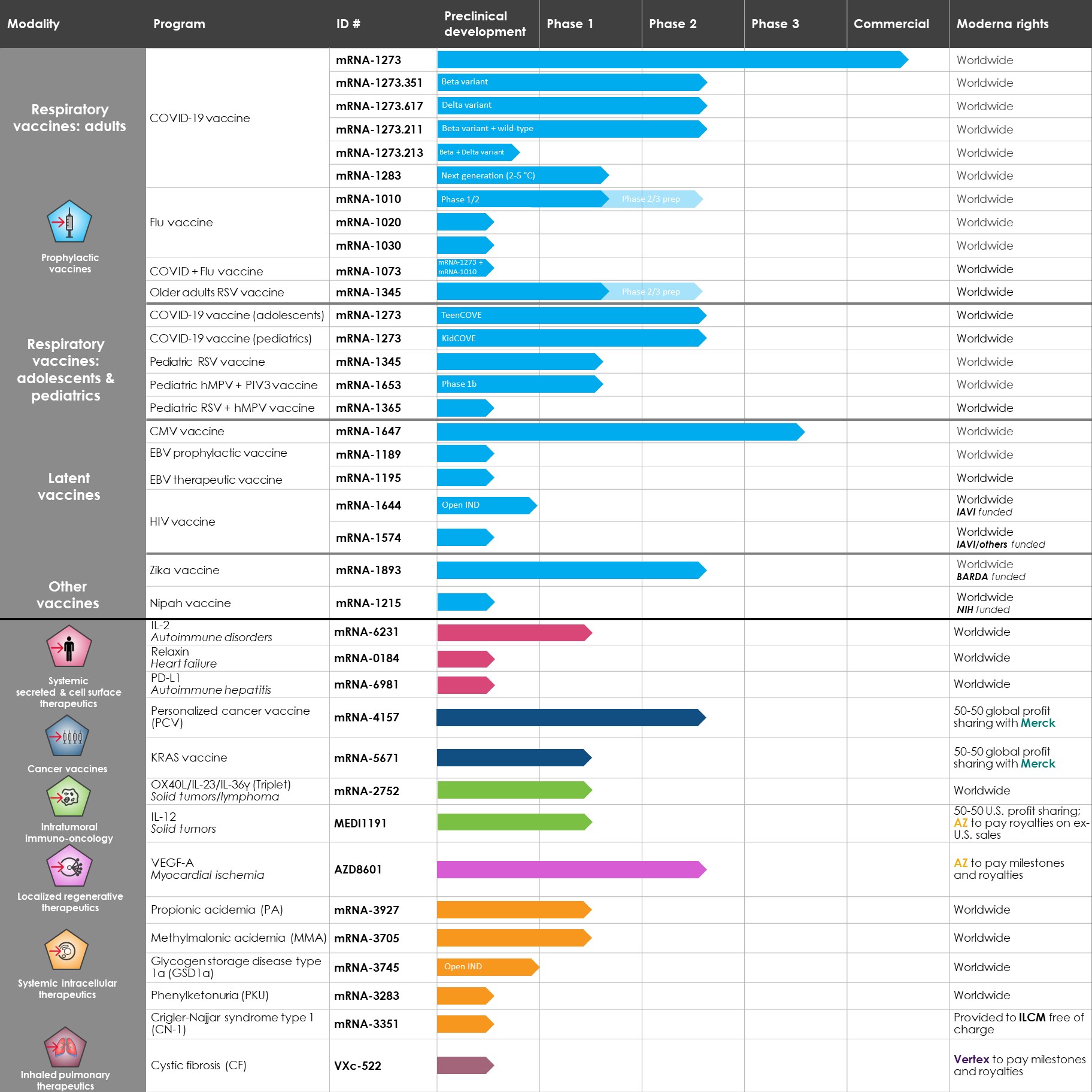
Abbreviations: AZ, AstraZeneca; BARDA, Biomedical Advanced Research and Development Authority; CMV, Cytomegalovirus; DARPA, Defense Advanced Research Projects Agency; EBV, Epstein-Barr virus; HIV, human immunodeficiency virus; hMPV, human metapneumovirus; IAVI, International AIDS Vaccine Initiative; ILCM, Institute for Life Changing Medicines; IL-2, interleukin 2; IL-12, interleukin 12; IL-23, interleukin 23; IL-36γ, interleukin-36 gamma; NIH, National Institutes of Health; OX40L, wildtype OX40 ligand; RSV, respiratory syncytial virus; VEGF-A, vascular endothelial growth factor A.
The breadth of biology addressable using mRNA technology is reflected in our current development pipeline of 37 programs. The diversity of proteins made from mRNA within our development pipeline is shown in the figure below.

We have developed seven modalities, which are summarized as follows:
-
Prophylactic vaccines:** Our prophylactic vaccines modality currently includes 23 development programs, 13 of which have entered into clinical trials. We have ongoing Phase 1 trials for our RSV vaccine in pediatrics and older adults (mRNA-1345), flu vaccine (mRNA-1010), and hMPV/PIV3 vaccine (mRNA-1653). We have ongoing Phase 2 studies for our Zika vaccine (mRNA-1893) and CMV vaccine (mRNA-1647). The Phase 3 trial for our CMV vaccine commenced in October 2021. Our COVID-19 vaccine (mRNA-1273) is described in detail above. Our ten preclinical programs within our prophylactic vaccines modality are for our COVID-19 variant- specific candidate (mRNA-1273.213), our combined COVID-19 and flu vaccine and flu vaccine (mRNA-1073), our seasonal flu vaccines (mRNA-1020 and mRNA-1030), our combination pediatric RSV and hMPV vaccine (mRNA-1365), Epstein-Barr virus (EBV) (mRNA-1189), EBV therapeutic vaccine (mRNA-1195), Nipah virus (mRNA-1215) and HIV (mRNA-1644 and mRNA-1574). Three other vaccines as part of public health programs have had positive Phase 1 readouts―H10N8 vaccine (mRNA-1440), H7N9 flu vaccine (mRNA-1851), and Chikungunya vaccine (mRNA-1388)― but are not being further developed without government or other funding.
-
Systemic secreted and cell surface therapeutics:** We have four systemic secreted and cell surface therapeutics development candidates in our pipeline. Our secreted programs include our antibody against Chikungunya virus (mRNA-1944), Relaxin (mRNA-0184) for cardiac disorders, PD-L1 (mRNA-6981) for autoimmune hepatitis and IL-2 (mRNA-6231) for autoimmune disorders. Our antibody against Chikungunya virus (mRNA-1944) has had positive Phase 1 readouts to date, but we do not have plans to advance to a Phase 2 study. Our IL-2 program (mRNA-6231) is currently in a Phase 1 study, and is our first autoimmune therapeutic candidate to enter the clinic. The remaining programs for Relaxin (mRNA-0184) and PD-L1 (mRNA-6981) are currently in preclinical development.
-
Cancer vaccines: We are currently developing two programs within our cancer vaccines modality. Our personalized cancer vaccine program mRNA-4157 is being developed in collaboration with Merck and is in a multiple-arm Phase 1 trial and a randomized Phase 2 trial, which is fully enrolled. Our second program within this modality, mRNA-5671, is a KRAS vaccine. Our strategic collaborator Merck has a Phase 1 clinical trial ongoing for mRNA-5671.
-
Intratumoral immuno-oncology: We have two programs in this modality. Our first program, OX40L/IL-23/IL-36γ (Triplet) (mRNA-2752), is currently in a Phase 1 study that is designed as an open-label, multicenter study of intratumoral injections of Triplet (mRNA-2752) alone or in combination with durvalumab (anti-PD-L1). Our second program, IL-12 (MEDI1191), is being developed in collaboration with AstraZeneca. AstraZeneca is currently enrolling an open-label multicenter Phase 1 clinical trial of intratumoral injections of MEDI1191 alone and in combination with the checkpoint inhibitor, durvalumab.
-
Localized regenerative therapeutics:** Our localized VEGF-A program, AZD8601, which is being developed by AstraZeneca, has completed a Phase 1a/b trial to describe its safety, tolerability, protein production, and activity in diabetic patients. The study has met its primary objectives of describing safety and tolerability and secondary objectives of demonstrating protein production and changes in blood flow post AZD8601 administration. We believe these data provide clinical proof of mechanism for our mRNA technology outside of the vaccine setting. The Phase 2a study of AZD8601 VEGF-A, which is being developed for patients with ischemic heart disease undergoing coronary artery bypass grafting surgery with moderately impaired systolic function, led by AstraZeneca, has completed recruitment after enrollment of the low dose cohort (n=11). Moderna has licensed worldwide commercial rights to AZD8601 to AstraZeneca.
-
Systemic intracellular therapeutics:** We have five systemic intracellular therapeutics development candidates in our pipeline. Our intracellular programs address propionic acidemia, or PA (mRNA-3927), methylmalonic acidemia (MMA) (mRNA-3705), phenylketonuria (PKU) (mRNA-3283), glycogen storage disorder type 1a (GSD1a) (mRNA-3745) and Crigler-Najjar Syndrome Type 1 (CN-1) (mRNA-3351). We have an ongoing Phase 1 clinical trials for PA (mRNA-3927) and MMA (mRNA-3705). PKU (mRNA-3283), GSD1a (mRNA-3745) and CN-1 (mRNA-3351) are currently in preclinical development. The FDA has granted Orphan Drug Designation for mRNA-3745 and has completed its review of the IND application allowing it to proceed to clinic. We have entered into a collaboration agreement with the Institute for Life Changing Medicines (ILCM) to license mRNA-3351 to ILCM with no upfront fees, and without any downstream payments. ILCM will be responsible for the clinical development of mRNA-3351.
-
Inhaled pulmonary therapeutics:** We have one inhaled pulmonary therapeutic development candidate in our pipeline. Our program addresses cystic fibrosis, or CF (VXc-522), in collaboration partnership with Vertex Pharmaceuticals. VXc-522 is an mRNA therapeutic designed to treat the underlying cause of CF by enabling cells in the lungs to produce functional cystic fibrosis transmembrane conductance regulator (CFTR) protein for the treatment of the 10% of patients who do not produce any CFTR protein. IND-enabling studies are underway and Vertex expects to submit an IND for this program in 2022. Moderna has licensed worldwide commercial rights to VXc-522 to Vertex.
Financial Operations Overview
Revenue
The following table summarizes revenue for each period presented (in millions):
| Three Months Ended September 30, | Nine Months Ended September 30, | |||||||||||||||||||||||||
| 2021 | 2020 | 2021 | 2020 | |||||||||||||||||||||||
| Revenue: | ||||||||||||||||||||||||||
| Product sales | $ | 4,810 | $ | — | $ | 10,740 | $ | — | ||||||||||||||||||
| Grant revenue | 140 | 145 | 473 | 187 | ||||||||||||||||||||||
| Collaboration revenue | 19 | 12 | 47 | 45 | ||||||||||||||||||||||
| Total revenue | $ | 4,969 | $ | 157 | $ | 11,260 | $ | 232 |
We began to record product sales for our COVID-19 vaccine subsequent to its authorization for emergency use by the FDA and Health Canada in December 2020. For the three months ended September 30, 2021, we recognized $4.8 billion of product sales from our COVID-19 vaccine, of which $1.2 billion was generated in the United States and $3.6 billion was generated from the rest of the world. For the nine months ended September 30, 2021, we recognized $10.7 billion of product sales from our COVID-19 vaccine, of which $4.6 billion was generated in the United States and $6.1 billion was generated from the rest of the world.
Other than product sales, our revenue has been primarily derived from government-sponsored and private organizations including BARDA, DARPA and the Gates Foundation and from strategic alliances with AstraZeneca, Merck and Vertex to discover, develop, and commercialize potential mRNA medicines.
Grant revenue was comprised as follows for the periods presented (in millions):
| Three Months Ended September 30, | Nine Months Ended September 30, | ||||||||||||||||||||||
| 2021 | 2020 | 2021 | 2020 | ||||||||||||||||||||
| Grant revenue: | |||||||||||||||||||||||
| BARDA (1) | $ | 128 | $ | 143 | $ | 454 | $ | 183 | |||||||||||||||
| Other | 12 | 2 | 19 | 4 | |||||||||||||||||||
| Total grant revenue | $ | 140 | $ | 145 | $ | 473 | $ | 187 |
(1) For the three months ended September 30, 2021, $124 million of BARDA grant revenue was related to our mRNA-1273 program and $4 million was related to our Zika vaccine program. For the nine months ended September 30, 2021, $447 million of BARDA grant revenue was related to our mRNA-1273 program and $7 million was related to our Zika vaccine program.
Collaboration revenue from our strategic alliances was comprised as follows for the periods presented (in millions):
| Three Months Ended September 30, | Nine Months Ended September 30, | ||||||||||||||||||||||
| 2021 | 2020 | 2021 | 2020 | ||||||||||||||||||||
| Collaboration revenue: | |||||||||||||||||||||||
| AstraZeneca | $ | 3 | $ | — | $ | 7 | $ | 17 | |||||||||||||||
| Merck | 7 | 6 | 11 | 18 | |||||||||||||||||||
| Vertex | 5 | 6 | 23 | 10 | |||||||||||||||||||
| Other | 4 | — | 6 | — | |||||||||||||||||||
| Total collaboration revenue | $ | 19 | $ | 12 | $ | 47 | $ | 45 |
We expect our product sales to significantly increase in 2021 compared to 2020. As of September 30, 2021, we had signed supply agreements of approximately $25.1 billion for the future supply of our COVID-19 vaccine through 2023 and had deferred revenue of $8.3 billion associated with customer deposits received or billable under these agreements. Additional supply agreements have been agreed upon since September 30, 2021, and others are under discussion for 2021 and 2022 deliveries. In addition, we expect to continue to receive funding from our contract with BARDA. As of September 30, 2021, the remaining available funding, net of revenue, earned under our agreement with BARDA for the development of our mRNA-1273 vaccine was $441 million. To the extent that existing or potential future products generate revenue, our revenue may vary due to many uncertainties in the independent development of our mRNA medicines and pursuant to our strategic alliances and other factors.
Cost of sales
Cost of sales includes raw materials, personnel and facility and other costs associated with manufacturing our commercial product. These costs include production materials, production costs at our manufacturing facilities, third-party manufacturing costs, and final formulation and packaging costs. Cost of sales also includes shipping costs and royalties payable to third parties based on sales of our products.
Research and development expenses
The nature of our business and primary focus of our activities generate a significant amount of research and development costs.
Research and development expenses represent costs incurred by us for the following:
-
cost to develop our platform;
-
discovery efforts leading to development candidates;
-
preclinical, nonclinical, and clinical development costs for our programs;
-
cost to develop our manufacturing technology and infrastructure; and
-
digital infrastructure costs.
The costs above comprise the following categories:
-
personnel-related expenses, including salaries, benefits, and stock-based compensation expense;
-
expenses incurred under agreements with third parties, such as consultants, investigative sites, contract research organizations (CROs) that conduct our preclinical studies and clinical trials, and in-licensing arrangements;
-
expenses associated with developing manufacturing capabilities and acquiring materials for preclinical studies and clinical trials, including both internal manufacturing and third-party contract manufacturing organizations (CMOs);
-
expenses incurred for the procurement of materials, laboratory supplies, and non-capital equipment used in the research and development process; and
-
facilities, depreciation, and amortization, and other direct and allocated expenses incurred as a result of research and development activities.
We use our employee and infrastructure resources for the advancement of our platform, and for discovering and developing programs. Due to the number of ongoing programs and our ability to use resources across several projects, indirect or shared operating costs incurred for our research and development programs are generally not recorded or maintained on a program- or modality-specific basis. The following table reflects our research and development expenses, including direct program-specific expenses summarized by modality and indirect or shared operating costs summarized under other research and development expenses during the three and nine months ended September 30, 2021 and 2020 (in millions):
| Three Months Ended September 30, | Nine Months Ended September 30, | |||||||||||||||||||||||||
| 2021 | 2020 | 2021 | 2020 | |||||||||||||||||||||||
| Program expenses by modality: | ||||||||||||||||||||||||||
| Prophylactic vaccines | $ | 271 | $ | 163 | $ | 760 | $ | 208 | ||||||||||||||||||
| Cancer vaccines | 11 | 8 | 35 | 24 | ||||||||||||||||||||||
| Intratumoral immuno-oncology | 6 | 4 | 19 | 7 | ||||||||||||||||||||||
| Systemic secreted and cell surface therapeutics | 3 | 1 | 5 | 2 | ||||||||||||||||||||||
| Systemic intracellular therapeutics | 6 | 2 | 17 | 15 | ||||||||||||||||||||||
| Total program-specific expenses by modality (1) | 297 | 178 | 836 | 256 | ||||||||||||||||||||||
| Other research and development expenses: | ||||||||||||||||||||||||||
| Discovery programs | 15 | 16 | 43 | 37 | ||||||||||||||||||||||
| Platform research | 28 | 24 | 80 | 64 | ||||||||||||||||||||||
| Technical development and unallocated manufacturing expenses | 79 | 80 | 165 | 138 | ||||||||||||||||||||||
| Shared discovery and development expenses | 77 | 33 | 165 | 76 | ||||||||||||||||||||||
| Stock-based compensation | 25 | 13 | 54 | 40 | ||||||||||||||||||||||
| Total research and development expenses | $ | 521 | $ | 344 | $ | 1,343 | $ | 611 |
(1)Includes a total of 34 and 23 development candidates at September 30, 2021 and 2020, respectively. Program-specific expenses include external costs and allocated manufacturing costs of pre-launch inventory, mRNA supply and consumables, and are reflected as of the beginning of the period in which the program was internally advanced to development or removed if development was ceased.
A “modality” refers to a group of programs with common product features and the associated combination of enabling mRNA technologies, delivery technologies, and manufacturing processes. The program-specific expenses by modality summarized in the table above include expenses we directly attribute to our programs, which consist primarily of external costs, such as fees paid to outside consultants, central laboratories, investigative sites, and CROs in connection with our preclinical studies and clinical trials, CMOs, and allocated manufacturing costs of inventory, mRNA supply and consumables. Costs to acquire and manufacture inventory, mRNA supply for preclinical studies and clinical trials are recognized and included in unallocated manufacturing expenses when incurred, and subsequently allocated to program-specific manufacturing costs after completion of the program-specific production. The timing of allocating manufacturing costs to the specific program varies depending on the program development and production schedule. We generally do not allocate personnel-related costs, including stock-based compensation, costs associated with our general platform research, technical development, and other shared costs on a program-specific basis. These costs were therefore excluded from the summary of program-specific expenses by modality. Our newest modality, for inhaled pulmonary therapeutics, was added subsequent to the end of the third quarter of 2021.
Discovery program expenses are costs associated with research activities for our programs in the preclinical discovery stage, and primarily consist of external costs for CROs and lab services, and allocated manufacturing cost of preclinical mRNA supply and consumables.
Platform research expenses are mainly costs to develop technical advances in mRNA science, delivery science, and manufacturing process design. These costs include personnel-related costs, computer equipment, facilities, preclinical mRNA supply and consumables, and other administrative costs to support our platform research. Technology development and unallocated manufacturing expenses are primarily related to non-program-specific manufacturing process development and manufacturing costs.
Shared discovery and development expenses are research and development costs such as personnel-related costs and other costs, which are not otherwise included in development programs, discovery programs, platform research, technical development and unallocated manufacturing expenses, stock-based compensation, and other expenses.
The largest component of our total operating expenses has historically been our investment in research and development activities, including preclinical and clinical development of our product candidates, development of our platform, mRNA technologies, and manufacturing technologies. We expense research and development costs as incurred and cannot reasonably estimate the nature, timing, and estimated costs required to complete the development of the development candidates and investigational medicines we are currently developing or may develop in the future. There are numerous risks and uncertainties associated with the research and development of such development candidates and investigational medicines, including, but not limited to:
-
scope, progress, and expense of developing ongoing and future development candidates and investigational medicines;
-
entry in and completion of related preclinical studies;
-
enrollment in and completion of subsequent clinical trials;
-
safety and efficacy of investigational medicines resulting from these clinical trials;
-
changes in laws or regulations relevant to the investigational medicines in development;
-
receipt of the required regulatory approvals; and
-
commercialization, including establishing manufacturing and marketing capabilities.
As we continue to progress mRNA-1273 through the development process toward a Biologics License Application approval, indication expansion of mRNA-1273 and potential development of variant-specific vaccine candidates during the current pandemic, we expect to continue to incur significant additional expenses. At this time, the magnitude of these potential expenditures is not known. In connection with the BARDA agreement to accelerate development of mRNA-1273, significant grant revenue and expenses are expected in 2021. BARDA’s funding is expected to offset those expenses that are covered under the BARDA agreement, subject to our obtaining reimbursement from BARDA. As of September 30, 2021, the remaining available funding, net of revenue earned was $441 million.
Changes in expectations or outcomes of any of the known or unknown risks and uncertainties may materially impact our expected research and development expenditures. Continued research and development is central to the ongoing activities of our business. Investigational medicines in later stages of clinical development, such as our CMV vaccine (mRNA-1647) and our COVID-19 vaccine, generally have higher development costs than those in earlier stages of clinical development, primarily due to the increased size and duration of later-stage clinical trials. We expect our research and development costs to continue to increase in the foreseeable future as our investigational medicines progress through the development phases and identify and develop additional programs. There are numerous factors associated with the successful commercialization of any of our investigational medicines, including future trial design and various regulatory requirements, many of which cannot be determined with accuracy at this time due to the early stage of development of our investigational medicines. Moreover, future commercial and regulatory factors beyond our control will impact our clinical development programs and plans.
Selling, general and administrative expenses
We started to incur sales and marketing expenses in the fourth quarter of 2020 to prepare for commercial operations in connection with the sale of our COVID-19 vaccine. Selling, general and administrative expenses consist primarily of personnel-related costs, including stock-based compensation, for executives, finance, legal, human resources, business development and other administrative and operational functions, professional fees, accounting and legal services, sales and marketing, information technology and facility-related costs, and expenses associated with obtaining and maintaining intellectual property, or IP. These costs relate to the operation of the business, unrelated to the research and development function, or any individual program.
We anticipate selling, general and administrative expenses will increase as we continue to expand the number of programs in development and to establish our commercial activities both within and outside the United States. We have already incurred additional expenses related to building out a regulatory, sales and marketing team to support the sale, marketing and distribution of our COVID-19 vaccine. If we obtain regulatory approval for any of our other investigational medicines, and do not enter into one or more third-party commercialization collaboration and manufacturing arrangements, we will incur significant additional expenses related to building out these functions.
We have a broad IP portfolio covering our development and commercialization of mRNA vaccine and therapeutic programs, including those related to mRNA design, formulation, and manufacturing platform technologies. We regularly file patent applications to protect innovations arising from our research and development. We also hold trademarks and trademark applications in the United States and foreign jurisdictions. Costs to secure and defend our IP are expensed as incurred and are classified as selling, general and administrative expenses.
Interest income
Interest income consists of interest generated from our investments in cash and cash equivalents, money market funds, and high-quality fixed income securities.
Other expense, net
Other expense, net consists of interest expense, gains (losses) from the sale of investments in marketable securities, foreign currency transaction and remeasurement gains (losses), gains (losses) on foreign currency balance sheet hedges, and other income and expense unrelated to our core operations. Interest expense is primarily derived from our finance leases related to our Moderna Technology Center, and certain contract manufacturing service agreements.
We expect to continue to incur significant expenses as we continue our research and development and commercialization efforts. We expect our programs to mature and advance to later stage clinical development, and we expect expenses to increase as we seek regulatory approvals for our investigational medicines and commercialize any approved mRNA medicines. If we fail to sustain profitability on a continuing basis, we may incur losses in the future.
Critical accounting policies and significant judgments and estimates
Our management’s discussion and analysis of our financial condition and results of operations is based on our condensed consolidated financial statements, which have been prepared in accordance with U.S. generally accepted accounting principles. The preparation of these condensed consolidated financial statements requires us to make judgments and estimates that affect the reported amounts of assets, liabilities, revenues, and expenses and the disclosure of contingent assets and liabilities in our condensed consolidated financial statements. We base our estimates on historical experience, known trends and events, and various other factors that we believe to be reasonable under the circumstances, the results of which form the basis for making judgments about the carrying values of assets and liabilities that are not readily apparent from other sources. Actual results may differ from these estimates under different assumptions or conditions. On an ongoing basis, we evaluate our judgments and estimates in light of changes in circumstances, facts, and experience. The effects of material revisions in estimates, if any, are reflected in the condensed consolidated financial statements prospectively from the date of change in estimates.
There have been no material changes in our critical accounting policies and estimates in the preparation of our condensed consolidated financial statements during the three months ended September 30, 2021 compared to those disclosed in our 2020 Form 10-K.
Recently issued accounting pronouncements
We have reviewed all recently issued standards and have determined that such standards will not have a material impact on our financial statements or do not otherwise apply to our operations.
Results of operations
The following table summarizes our condensed consolidated statements of operations for each period presented (in millions):
| Three Months Ended September 30, | Change 2021 vs. 2020 | ||||||||||||||||||||||
| 2021 | 2020 | $ | % | ||||||||||||||||||||
| Revenue: | |||||||||||||||||||||||
| Product revenue | $ | 4,810 | $ | — | $ | 4,810 | 100% | ||||||||||||||||
| Grant revenue | 140 | 145 | (5) | (3)% | |||||||||||||||||||
| Collaboration revenue | 19 | 12 | 7 | 58% | |||||||||||||||||||
| Total revenue | 4,969 | 157 | 4,812 | 3,065% | |||||||||||||||||||
| Operating Expenses: | |||||||||||||||||||||||
| Cost of sales | 722 | — | 722 | 100% | |||||||||||||||||||
| Research and development | 521 | 344 | 177 | 51% | |||||||||||||||||||
| Selling, general and administrative | 168 | 48 | 120 | 250% | |||||||||||||||||||
| Total operating expenses | 1,411 | 392 | 1,019 | 260% | |||||||||||||||||||
| Income (loss) from operations | 3,558 | (235) | 3,793 | 1,614% | |||||||||||||||||||
| Interest income | 4 | 6 | (2) | (33)% | |||||||||||||||||||
| Other expense, net | (10) | (3) | (7) | 233% | |||||||||||||||||||
| Income (loss) before income taxes | 3,552 | (232) | 3,784 | 1,631% | |||||||||||||||||||
| Provision for income taxes | 219 | 1 | 218 | 21,800% | |||||||||||||||||||
| Net income (loss) | $ | 3,333 | $ | (233) | $ | 3,566 | 1,530% |
| Nine Months Ended September 30, | Change 2021 vs. 2020 | ||||||||||||||||||||||
| 2021 | 2020 | $ | % | ||||||||||||||||||||
| Revenue: | |||||||||||||||||||||||
| Product revenue | $ | 10,740 | $ | — | $ | 10,740 | 100% | ||||||||||||||||
| Grant revenue | 473 | 187 | 286 | 153% | |||||||||||||||||||
| Collaboration revenue | 47 | 45 | 2 | 4% | |||||||||||||||||||
| Total revenue | 11,260 | 232 | 11,028 | 4,753% | |||||||||||||||||||
| Operating Expenses: | |||||||||||||||||||||||
| Cost of sales | 1,665 | — | 1,665 | 100% | |||||||||||||||||||
| Research and development | 1,343 | 611 | 732 | 120% | |||||||||||||||||||
| Selling, general and administrative | 366 | 109 | 257 | 236% | |||||||||||||||||||
| Total operating expenses | 3,374 | 720 | 2,654 | 369% | |||||||||||||||||||
| Income (loss) from operations | 7,886 | (488) | 8,374 | 1,716% | |||||||||||||||||||
| Interest income | 11 | 21 | (10) | (48)% | |||||||||||||||||||
| Other expense, net | (22) | (6) | (16) | 267% | |||||||||||||||||||
| Income (loss) before income taxes | 7,875 | (473) | 8,348 | 1,765% | |||||||||||||||||||
| Provision for income taxes | 541 | 1 | 540 | 54,000% | |||||||||||||||||||
| Net income (loss) | $ | 7,334 | $ | (474) | $ | 7,808 | 1,647% |
Revenue
Total revenue increased by $4.8 billion for the three months ended September 30, 2021, compared to the same period in 2020, due to increases in product sales. Product revenue was $4.8 billion for the three months ended September 30, 2021 from sales of our COVID-19 vaccine. For the three months ended September 30, 2021, we delivered approximately 73 million doses to the U.S. Government and approximately 136 million doses to other governments of our COVID-19 vaccine. We did not have product sales until December 2020.
Total revenue increased by $11.0 billion for the nine months ended September 30, 2021, compared to the same period in 2020, due to increases in product sales and grant revenue. Product revenue was $10.7 billion for the nine months ended September 30, 2021 from sales of our COVID-19 vaccine. For the nine months ended September 30, 2021, we delivered approximately 287 million doses to the U.S. Government and approximately 222 million doses to other governments. We did not have product sales until December 2020. Grant revenue increased by $286 million for the nine months ended September 30, 2021, compared to the same period in 2020, primarily driven by an increase in revenue from BARDA related to our mRNA-1273 vaccine development.
Operating expenses
Cost of sales
We began capitalizing our COVID-19 vaccine inventory costs in December 2020, in connection with an EUA from the FDA, and based upon our expectation that these costs would be recoverable through commercialization of our COVID-19 vaccine. Prior to the capitalization of our COVID-19 vaccine inventory costs, such costs were recorded as research and development expenses in the period incurred. We expensed $242 million of pre-launch inventory costs in 2020. Our cost of sales was $722 million, or 15%, of our product sales, for the three months ended September 30, 2021, including third-party royalties of $168 million. Our cost of sales was $1.7 billion, or 16%, of our product sales, for the nine months ended September 30, 2021, including third-party royalties of $400 million. A portion of the inventory costs associated with our product sales for the nine months ended September 30, 2021 was expensed previously. At the end of the first quarter of 2021, we had substantially utilized our zero-cost COVID-19 vaccine inventory. If inventory sold for the nine months ended September 30, 2021 was valued at cost, our cost of sales for the period would have been $1.9 billion, or 17%, of our product sales. We expect that our cost of sales as a percentage of product sales will remain at a similar level for the remainder of 2021.
Research and development expenses
Research and development expenses increased by $177 million, or 51%, for the three months ended September 30, 2021, compared to the same period in 2020. The increase was primarily attributable to an increase in clinical trial expenses of $155 million and an increase in personnel-related costs of $40 million.
Research and development expenses increased by $732 million, or 120%, for the nine months ended September 30, 2021, compared to the same period in 2020. The increase was primarily attributable to an increase in clinical trial expenses of $591 million, an increase in personnel-related costs of $77 million, and an increase in consulting and outside services of $45 million.
These increases for both the three and nine month periods in 2021 were largely driven by increased mRNA-1273 clinical development and headcount.
Selling, general and administrative expenses
Selling, general and administrative expenses increased by $120 million, or 250%, for the three months ended September 30, 2021, compared to the same period in 2020. The increase was mainly due to an increase in consulting and outside services of $30 million, an increase in distributor fees of $29 million, an increase in marketing expenses of $23 million, and an increase in personnel-related costs of $17 million.
Selling, general and administrative expenses increased by $257 million, or 236%, for the nine months ended September 30, 2021, compared to the same period in 2020. The increase was mainly due to an increase in consulting and outside services of $80 million, an increase in personnel-related costs of $48 million, an increase in marketing expenses of $41 million, and an increase in distributor fees of $32 million.
These increases for both the three and nine month periods in 2021 were primarily driven by our COVID-19 vaccine commercialization-related activities and increased headcount.
Interest income
Interest income decreased by $2 million, or 33%, for the three months ended September 30, 2021, compared to the same period in 2020. Interest income decreased by $10 million, or 48%, for the nine months ended September 30, 2021, compared to the same period in 2020. The decreases in interest income from our investments in marketable securities for both the three and nine month periods in 2021 were mainly driven by an overall lower interest rate environment, partially offset by increased investment balances.
Other expense, net
The following table summarizes other expense, net for each period presented (in millions):
| Three Months Ended September 30, | Change 2021 vs. 2020 | ||||||||||||||||||||||
| 2021 | 2020 | $ | % | ||||||||||||||||||||
| Interest expense | (4) | $ | (2) | (2) | 100% | ||||||||||||||||||
| Other expense, net | (6) | (1) | (5) | 500% | |||||||||||||||||||
| Total other expense, net | $ | (10) | $ | (3) | $ | (7) | 233% |
| Nine Months Ended September 30, | Change 2021 vs. 2020 | ||||||||||||||||||||||
| 2021 | 2020 | $ | % | ||||||||||||||||||||
| Gain on investments | $ | 2 | $ | 1 | $ | 1 | 100% | ||||||||||||||||
| Interest expense | (12) | $ | (6) | (6) | 100% | ||||||||||||||||||
| Other expense, net | (12) | (1) | (11) | 1,100% | |||||||||||||||||||
| Total other expense, net | $ | (22) | $ | (6) | $ | (16) | 267% |
Total other expense, net was immaterial for each of the three months ended September 30, 2021 and 2020. Total other expense, net increased by $16 million, or 267%, for the nine months ended September 30, 2021, compared to the same period in 2020. The increase in other expense, net for the nine-month period in 2021 was primarily due to losses related to our balance sheet hedging activities, partially offset by gains on foreign currency transactions and remeasurements. Our interest expense is primarily related to our finance leases.
Income taxes
Our provision for income taxes for the three and nine months ended September 30, 2021 was $219 million and $541 million, respectively, compared to $1 million for each of the same periods in 2020. Our effective tax rate for the three and nine months ended September 30, 2021 was lower than the U.S. statutory rate primarily due to the benefit related to the release of the valuation allowance on the majority of our tax attributes and other deferred tax assets, the benefit of the foreign derived intangible income deduction, as well as a discrete item for excess tax benefits related to stock-based compensation. Our effective tax rate for the three and nine months ended September 30, 2020 was lower than the U.S. statutory rate primarily due to the valuation allowance.
On a periodic basis, we reassess any valuation allowances that we maintain on our deferred tax assets, weighing positive and negative evidence to assess the recoverability of the deferred tax assets. In the first quarter of 2021, we reassessed the valuation allowance noting the increase in positive evidence, including significant revenue growth, expectations regarding future profitability, and successful supply chain and manufacturing capabilities to meet global product demand. After assessing both the positive evidence and negative evidence, we determined it was more likely than not that we will realize the majority of our deferred tax assets. Therefore, in the first quarter of 2021, we released our valuation allowance on the majority of our federal and state net operating losses and other deferred tax assets through the annual effective tax rate (AETR) as income is earned, resulting in a reduction in the AETR. In addition, we have recorded a discrete benefit of $49 million related to the deferred tax assets that we expect to utilize in future years. As of September 30, 2021, we continue to maintain a valuation allowance on certain state tax attributes.
Liquidity and capital resources
As of September 30, 2021, we had cash, cash equivalents and investments of $15.3 billion. Cash, cash equivalents and investments are invested in accordance with our investment policy, primarily with a view to liquidity and capital preservation. Investments, consisting primarily of government and corporate debt securities, are stated at fair value. As of September 30, 2021, we had current and non-current investments of approximately $3.4 billion and $6.4 billion, respectively.
We historically funded our operations primarily from the sale of equity instruments and from proceeds from certain strategic alliance arrangements and grant agreements. Starting in August 2020, we have entered into supply agreements with the U.S. Government and several governments outside the United States for the supply of our COVID-19 vaccine and receive upfront deposits. As of September 30, 2021, we had $8.3 billion in deferred revenue related to customer deposits received or billable. In addition, as of September 30, 2021, BARDA has committed to fund up to $1.4 billion for the clinical development and advancement of mRNA-1273 to FDA licensure and the scale-up of manufacturing processes of our COVID-19 vaccine. As of September 30, 2021, the remaining available funding from BARDA, net of revenue earned, was $441 million.
We continue to work toward the large-scale technical development, manufacturing scale-up in several countries and larger scale deployment of our COVID-19 vaccine. To support the scale-up, we have expended and will need to continue to expend significant resources and capital.
Cash flow
The following table summarizes the primary sources and uses of cash for each period presented (in millions):
| Nine Months Ended September 30, | |||||||||||
| 2021 | 2020 | ||||||||||
| Net cash provided by (used in): | |||||||||||
| Operating activities | $ | 10,310 | $ | 763 | |||||||
| Investing activities | (7,385) | (1,482) | |||||||||
| Financing activities | — | 1,989 | |||||||||
| Net increase in cash, cash equivalents and restricted cash | $ | 2,925 | $ | 1,270 |
Operating activities
We derive cash flows from operations primarily from cash collected from customer deposits and accounts receivable related to our COVID-19 vaccine supply agreements, as well as certain government-sponsored and private organizations and strategic alliances. Our cash flows from operating activities are significantly affected by our use of cash for operating expenses and working capital to support the business.
Net cash provided by operating activities for the nine months ended September 30, 2021 was $10.3 billion and consisted of net income of $7.3 billion and non-cash adjustments of $203 million, plus a net change in assets and liabilities of $2.8 billion. Non-cash items included depreciation and amortization of $154 million, stock-based compensation of $105 million, deferred income taxes of $89 million, and amortization of investment premium and discount of $33 million. The net change in assets and liabilities was mainly due to an increase in deferred revenue of $4.4 billion, an increase in accrued liabilities of $600 million, an increase in income taxes payable of $565 million, and an increase in accounts payable of $26 million, partially offset by an increase in accounts receivable of $1.8 billion, an increase in inventory of $918 million, an increase in prepaid expenses and other assets of $186 million, and an increase in operating lease right-of-use assets of $25 million.
Net cash provided by operating activities for the nine months ended September 30, 2020 was $763 million and consisted of net loss of $474 million and non-cash adjustments of $96 million, plus a net change in assets and liabilities of $1.1 billion. Non-cash items primarily included stock-based compensation of $67 million, depreciation and amortization of $24 million, and amortization of investment premium and discount of $5 million. The net change in assets and liabilities was mainly due to an increase in deferred revenue of $1.2 billion and an increase in accrued liabilities of $132 million, partially offset by an increase in accounts receivable of $185 million.
Investing activities
Our primary investing activities consist of purchases, sales, and maturities of our investments and capital expenditures for leasehold improvements, manufacturing, laboratory, computer equipment and software.
Net cash used in investing activities for the nine months ended September 30, 2021 was $7.4 billion, which included purchases of marketable securities of $10.3 billion and purchases of property and equipment of $164 million, partially offset by proceeds from sales of marketable securities of $2.0 billion and proceeds from maturities of marketable securities of $1.1 billion.
Net cash used in investing activities for the nine months ended September 30, 2020 was $1.5 billion, which included purchases of marketable securities of $2.3 billion and purchases of property and equipment of $44 million, partially offset by proceeds from maturities of marketable securities of $748 million and proceeds from sales of marketable securities of $140 million.
Financing activities
There was no net cash provided by financing activities for the nine months ended September 30, 2021.
Net cash provided by financing activities for the nine months ended September 30, 2020 was $2.0 billion, primarily from net proceeds from equity offerings of $1.9 billion, and net proceeds from the issuance of common stock in connection with the exercise of stock options under our equity plans of $136 million.
Operation and funding requirements
From our inception to the end of 2020, we incurred significant losses and negative cash flows from operations due to our significant research and development expenses. We generated net income in the first nine months of 2021 in connection with our product sales. We have retained earnings of $5.1 billion as of September 30, 2021. We expect our expenses to increase in connection with our ongoing activities, particularly as we continue research and development of our development candidates and clinical activities for our investigational medicines. We also expect our expenses to increase associated with manufacturing costs, including our arrangements with our international supply and manufacturing partners. Our ongoing work on mRNA-1273, including development of any new generations of boosters and vaccines against variants of SARS-CoV-2, will require significant cash outflows during 2021, most of which may not be reimbursed or otherwise paid for by our partners or collaborators.
We believe that our cash, cash equivalents, and investments as of September 30, 2021, together with cash expected to be generated from operations, will be sufficient to enable us to fund our projected operations, capital expenditures and stock repurchases through at least the next 12 months from the issuance of these financial statements. We are subject to all the risks related to the development and commercialization of novel medicines, and we may encounter unforeseen expenses, difficulties, complications, delays, and other unknown factors including expenses related to the ongoing coronavirus pandemic, which may adversely affect our business. Our forecast of the period of time through which our financial resources will be adequate to support our operations is a forward-looking statement and involves risks and uncertainties, and actual results could vary as a result of a number of factors. We have based this estimate on assumptions that may prove to be wrong, and we could utilize our available capital resources sooner than we currently expect.
If we are unable to sustain profitability on a continuing basis, we may be required to finance future cash needs through a combination of public or private equity offerings, structured financings and debt financings, government funding arrangements, potential future strategic alliances from which we receive upfront fees, milestone payments, and other forms of consideration, and marketing, manufacturing, distribution and licensing arrangements. If we are required to finance future cash needs, additional capital may not be available on reasonable terms, if at all. If we are unable to raise additional capital in sufficient amounts or on terms acceptable to us, we may have to significantly delay, scale back, or discontinue the development or commercialization of one or more of our investigational medicines, or slow down or cease work on one or more of our programs. If we raise additional funds through the issuance of additional equity or debt securities, it could result in dilution to our existing stockholders or increased fixed payment obligations, and any such securities may have rights senior to those of our common stock. If we incur indebtedness, we could become subject to covenants that would restrict our operations and potentially impair our competitiveness, such as limitations on our ability to incur additional debt, limitations on our ability to acquire, sell or license intellectual property rights and other operating restrictions that could adversely impact our ability to conduct our business. If we raise funds through strategic alliances or marketing, distribution, or licensing arrangements with third parties, we may have to relinquish valuable rights to our technologies, future revenue streams, research programs, or investigational medicines or grant licenses on terms that may not be favorable to us. Any of these events could significantly harm our business, financial condition, and prospects.
Contractual Obligations
As of September 30, 2021, other than disclosed within Note 11 and Note 12 to our condensed consolidated financial statements, there have been no material changes to our contractual obligations and commitments from those described under “Management’s Discussion and Analysis of Financial Condition and Results of Operations” included in our 2020 Form 10-K.
Off balance sheet arrangements
As of September 30, 2021, we did not have any off-balance sheet arrangements, as defined in Item 303(a)(4)(ii) of Regulation S-K.
Previous: Item 1. Financial Statements · Next: Item 3. Quantitative and Qualitative Disclosures about Market Risk