 filings.tools
Item 2. MANAGEMENT’S DISCUSSION AND ANALYSIS OF FINANCIAL CONDITION AND RESULTS OF OPERATIONS
63K characters. Original on sec.gov · Markdown
Item 2. MANAGEMENT’S DISCUSSION AND ANALYSIS OF FINANCIAL CONDITION AND RESULTS OF OPERATIONS
You should read the following discussion and analysis of our financial condition and results of operations together with our unaudited financial information and related notes included in this Form 10-Q and our consolidated financial statements and related notes and other financial information in our Annual Report on Form 10-K for the year ended December 31, 2021, which was filed with the Securities and Exchange Commission (the SEC) on February 25, 2022 (the 2021 Form 10-K). Some of the information contained in this discussion and analysis or set forth elsewhere in this Form 10-Q, including information with respect to our plans and strategy for our business, includes forward-looking statements that involve risks and uncertainties. As a result of many factors, including those factors set forth in Part II, Item 1A - Risk Factors in this Form 10-Q, our actual results could differ materially from the results described in or implied by the forward-looking statements contained in the following discussion and analysis.
Overview
We are a biotechnology company pioneering messenger RNA (mRNA) therapeutics and vaccines to create a new generation of transformative medicines to improve the lives of patients. Our platform builds on continuous advances in basic and applied mRNA science, delivery technology, and manufacturing, providing us the capability to pursue in parallel a robust pipeline of new development candidates. We are developing therapeutics and vaccines for infectious diseases, immuno-oncology, rare diseases, autoimmune diseases and cardiovascular diseases, independently and with our strategic collaborators. Within our platform, we develop technologies that enable the development of mRNA medicines for diverse applications. When we identify technologies that we believe could enable a new group of potential mRNA medicines with shared product features, we call that group a “modality.” We have created seven modalities to date:
-
prophylactic vaccines;
-
systemic secreted and cell surface therapeutics;
-
cancer vaccines;
-
intratumoral immuno-oncology;
-
localized regenerative therapeutics;
-
systemic intracellular therapeutics; and
-
inhaled pulmonary therapeutics.
On December 18, 2020, we received an Emergency Use Authorization (EUA) from the U.S. Food and Drug Administration (FDA) for the emergency use of the Moderna COVID-19 Vaccine (also referred to as mRNA-1273 and marketed under the brand name Spikevax) as a two-dose, 100 µg primary series in individuals 18 years of age or older. In January 2022, we received full commercial approval for Spikevax as a two-dose, 100 µg primary series to prevent COVID-19 in individuals 18 years of age and older in the United States. Spikevax is approved or authorized in individuals 18 years and older in more than 70 countries. In addition, Spikevax is authorized by the FDA and global regulators in more than 50 countries as a two-dose 100 µg primary series in adolescents ages 12 to 17 years old and as a two-dose 50 µg primary series in children ages 6 to 11 years old. Additionally, a two-dose, 25 µg primary series of Spikevax is authorized in young children ages 6 months to 5 years old in the United States, Canada, Australia, and other jurisdictions.
The FDA, European Medicines Agency (EMA), Swissmedic and other health agencies around the world have authorized a booster dose of Spikevax at the 50 µg dose level for adults ages 18 years and older. In March 2022, the FDA and other health agencies authorized a second booster dose at the 50 µg dose level for adults 50 years and older and adults over 18 years of age with certain kinds of immunocompromise.
On August 15, 2022, we received the first authorization for our BA.1 Omicron-targeting bivalent COVID-19 booster vaccine (Spikevax Bivalent Original/Omicron, mRNA-1273.214) from the Medicines and Healthcare products Regulatory Agency (MHRA) in the United Kingdom, given as a 50 µg booster dose for individuals 18 years of age and older who have received either a primary series or an initial booster of any of the authorized or approved COVID-19 vaccines. The EMA in the European Union provided a similar authorization for mRNA-1273.214 as a booster vaccine for individuals 12 years and older on September 2, 2022. During the third quarter of 2022, authorizations for mRNA-1273.214 as a booster vaccine were also received in the United Kingdom, the European Union, Japan, Australia, Canada and Switzerland.
On August 31, 2022, we received an EUA from the FDA for our BA.4/BA.5 Omicron-targeting bivalent COVID-19 booster vaccine (mRNA-1273.222), given as a 50 µg booster dose for individuals 18 years of age and older who have received either a primary series or an initial booster of any of the authorized or approved COVID-19 vaccines. On October 12, 2022, we received an EUA from the FDA for mRNA-1273.222 as a 50 µg booster dose for adolescents 12 to 17 years old and as a 25 µg booster dose for children 6 to 11 years old, each following a completed primary series of any authorized COVID-19 vaccine or a previous booster. The EMA in the European Union, the MHRA in the United Kingdom and other countries worldwide have provided similar authorizations for mRNA-1273.222.
Business Highlights and Recent Developments
Moderna COVID-19 Vaccine Clinical Studies
-
Omicron-targeting bivalent boosters (mRNA-1273.214/.222):** We have received authorization from regulatory agencies around the globe for two different Omicron-targeting bivalent booster vaccines against COVID-19, including in the United States, Australia, Canada, Europe, Japan, Switzerland, South Korea, Taiwan and the UK, with additional regulatory submissions completed worldwide.
-
mRNA-1273.214 is a bivalent vaccine targeting the BA.1 Omicron variant, combined with Spikevax. mRNA-1273.222 is a bivalent vaccine targeting the BA.4/BA.5 Omicron variants, combined with Spikevax. Both boosters are administered as a single dose of 50 µg in individuals ages 12 and older, and as a single 25 µg dose in pediatric populations, ages six to 11. mRNA-1273.214 is being studied to evaluate its immunogenicity, safety and reactogenicity as a single booster dose in adults aged 18 years and older. mRNA-1273.214 is being evaluated in an ongoing registrational, Phase 2/3 study in the U.S. and a Phase 3 study in the UK. A Phase 2/3 clinical trial for mRNA-1273.222 is fully enrolled and currently underway, with initial data expected later this year.
-
Based on clinical trial data from the Phase 2/3 trial, mRNA-1273.214 met all primary endpoints, including superior neutralizing antibody response against Omicron (BA.1) when compared to the currently authorized 50 µg booster dose of Spikevax (mRNA-1273) in previously uninfected participants. A booster dose of mRNA-1273.214 increased neutralizing geometric mean titers (GMT) against Omicron approximately 8-fold above baseline levels. In addition, mRNA-1273.214 elicited higher neutralizing antibody titers against the Omicron subvariants BA.4 and BA.5 when compared to Spikevax (mRNA-1273) regardless of prior infection status or age, including in those aged 65 and older. mRNA-1273.214 was generally well tolerated, with a reactogenicity and safety profile consistent with the currently authorized booster.
-
For the third quarter of 2022, we recognized product sales of $3.1 billion from sales of our COVID-19 vaccines, compared to $4.8 billion in the third quarter of 2021.
Key Updates for our Other Development Candidates
- Seasonal influenza (flu) (mRNA-1010):** As part of our influenza vaccine development strategy, we are developing five different influenza vaccines. mRNA-1010 is a single investigational vaccine consisting of four distinct mRNA sequences that encode the A H1N1, H3N2 and influenza B Yamagata and Victoria lineages in our proprietary LNP. mRNA-1011 and mRNA-1012 are investigational vaccines that will include the four WHO-recommended strains and aim to add additional hemagglutinin (HA) antigens (e.g. H3N2, H1N1). mRNA-1020 and mRNA-1030 are investigational vaccines that will aim to add neuraminidase (NA) antigens.
In March 2022, an interim analysis of a Phase 2 study of mRNA-1010 identified no significant safety concerns, and the immunogenicity data is consistent with a potential for superiority to standard dose vaccine for influenza A strains (which drives the majority of disease in adults). The interim data is consistent with potential for non-inferiority to standard dose vaccine in influenza B strains (primarily a concern in pediatrics). A Phase 3 immunogenicity and safety study of mRNA-1010 in the Southern Hemisphere is fully enrolled with approximately 6,000 participants. Initial regulatory feedback supports an accelerated pathway for approval. We also launched a Phase 3 efficacy trial in the Northern Hemisphere, which is ongoing and expected to enroll approximately 23,000 participants.
-
Respiratory syncytial virus (RSV) vaccine (mRNA-1345):** mRNA-1345 is a vaccine against RSV encoding for a prefusion F glycoprotein, which elicits a superior neutralizing antibody response compared to the postfusion state. The Phase 1 study of mRNA-1345 to evaluate the tolerability, reactogenicity and immunogenicity of mRNA-1345 in younger adults, older adults, women of child-bearing age, older adults of Japanese descent and children is ongoing. All cohorts are fully enrolled. Phase 1 interim data from the older adult cohort showed that a single mRNA-1345 vaccination at 50 µg, 100 µg or 200 µg boosted neutralizing antibody titers against RSV-A by approximately 14-fold and against RSV-B by approximately 10-fold. The pivotal global Phase 3 study of mRNA-1345 with approximately 37,000 participants is currently enrolling. The original 34,000 participants are fully enrolled; 3,000 additional participants were added to the study to assess additional symptoms. Additionally, a Phase 3 study to evaluate the safety, tolerability and immunogenicity of mRNA-1345, when given alone or co-administered with a seasonal influenza vaccine, in adults 50 years of age or older is fully enrolled. The FDA has granted Fast Track designation for mRNA-1345 in adults older than 60 years of age.
-
Respiratory combination vaccines (mRNA-1073, mRNA-1230 and mRNA-1045):** We are evaluating several respiratory combination vaccines in the clinic. mRNA-1073 is a combination vaccine that encodes for the COVID spike protein and the influenza HA glycoproteins. A Phase 1/2 study comparing mRNA-1073 to co-administered mRNA-1010 and mRNA-1273, and to mRNA-1010 and mRNA-1273 alone is ongoing in approximately 1,050 participants aged 18-75 years, and the trial is fully enrolled. mRNA-1230 is a combination vaccine that encodes for the COVID spike protein, the influenza HA glycoproteins and the RSV prefusion F protein. mRNA-1045 is a combination vaccine that encodes for the influenza HA glycoproteins and the RSV prefusion F protein. A Phase 1/2 study comparing mRNA-1230 and mRNA-1045 to individual respiratory vaccines, mRNA-1010, mRNA-1345 and mRNA-1273.214 is ongoing.
-
Propionic acidemia (PA) (mRNA-3927):** The Phase 1/2 clinical trial for mRNA-3927, our therapy for the treatment of propionic acidemia, or PA, is ongoing, and the second cohort is fully enrolled. We are enrolling other patients into additional cohorts. The Phase 1/2 study is designed to evaluate the safety and tolerability of mRNA-3927 in patients with PA. PA is a rare, life-threatening, inherited metabolic disorder due to a defect in the mitochondrial enzyme propionyl-CoA carboxylase (PCC). It primarily affects the pediatric population. In September 2022, we announced that several critical milestones have been reached in the trial. Over 120 repeated intravenous doses have been administered to ten patients. mRNA-3927 has been well-tolerated at the doses tested to date, and there have been no dose-limiting toxicities, discontinuations due to safety, or drug-related serious adverse safety events. Three of the ten study participants have been dosed with over one year of continuous treatment and all eligible participants have decided to continue with treatment by participating in the Open Label Extension Study. PA is characterized by recurrent life-threatening metabolic decompensation events (MDEs) which are clinical crises that occur when there is a build-up of toxic metabolites. Due to the objective and disease-defining nature of MDEs, regulators have provided initial support for MDE as a clinically meaningful, preferred primary clinical endpoint for development. Based on preliminary data, there was a decrease in the number of MDEs post-mRNA-3927 treatment. The trial will continue with testing the next dose level (0.6 mg/kg IV every two weeks). There is no approved therapy for PA, including no approved enzyme replacement therapy. We have received Rare Pediatric Disease Designation and Orphan Drug Designation from the FDA and Orphan Drug Designation from the European Commission for the PA program. The FDA has also granted Fast Track designation to mRNA-3927.
-
Methylmalonic acidemia (MMA) (mRNA-3705):** The Phase 1/2 clinical trial for mRNA-3705, our therapy for the treatment of methylmalonic acidemia, or MMA, is ongoing and the second cohort has been fully enrolled. The study is enrolling additional cohorts across the UK, Canada and the U.S. The Phase 1/2 study is designed to evaluate the safety and tolerability of mRNA-3705 in patients with MMA. MMA is a rare, life-threatening, inherited metabolic disorder that is primarily caused by a defect in the mitochondrial enzyme methylmalonyl-coenzyme A mutase (MUT). It primarily affects the pediatric population. There is no approved therapy that addresses the underlying disorder, including no approved enzyme replacement therapy, due to the complexity of the protein and its mitochondrial localization.
-
Glycogen storage disease type 1a (GSD1a) (mRNA-3745):** The Phase 1/2 clinical trial for mRNA-3745, our therapy for the treatment of GSD1a is ongoing. Individuals with GSD1a have a deficiency in glucose-6-phosphatase resulting in pathological blood glucose imbalance. mRNA-3745 is an IV-administered mRNA encoding human G6Pase enzyme, designed to restore the deficient or defective intracellular enzyme activity in patients with GSD1a. In September 2022, we announced that early data on safety and pharmacodynamics for mRNA-3745 have been consistent and encouraging. In two patients, intravenous infusion of mRNA-3745 was well-tolerated to date, and showed extension of fast duration and normalization of glucose during fast. The FDA has granted mRNA-3745 Orphan Drug Designation.
-
IL-12 (MEDI1191)**: In August 2022, AstraZeneca notified us that it was terminating the development of the IL-12 program (MEDI1191) and that they were returning the rights to the program to us. AstraZeneca is continuing to lead the ongoing, open-label multicenter Phase 1 clinical trial of intratumoral injections of MEDI1191 alone and in combination with the checkpoint inhibitor, durvalumab. In April 2022, AstraZeneca presented updated Phase 1 data at the American Association for Cancer Research (AACR) conference. Intratumoral MEDI1191 combined with durvalumab was safe and the combination showed preliminary evidence of clinical benefit, with 29% of patients exhibiting partial responses or stable disease ≥12 weeks as best overall response. We are evaluating the next steps for the program.
-
Personalized cancer vaccine (mRNA-4157):** Our personalized cancer vaccine (PCV) is currently being evaluated in a Phase 1 and Phase 2 study. The randomized, placebo-controlled Phase 2 study investigating a 1 mg dose of mRNA-4157 in combination with Merck’s pembrolizumab (KEYTRUDA®), compared to pembrolizumab alone, for the adjuvant treatment of high-risk resected melanoma is fully enrolled (n=150). The primary endpoint of the Phase 2 study is recurrence-free survival. The Phase 1 in multiple cohorts is ongoing. In September 2022, Merck exercised its option to jointly develop and commercialize mRNA-4157. We and Merck will share costs and any profits related to mRNA-4157 equally under our worldwide collaboration.
Our Pipeline
The following chart shows our current pipeline of 48 development programs, grouped by respiratory vaccines, latent & public health vaccines and therapeutics.
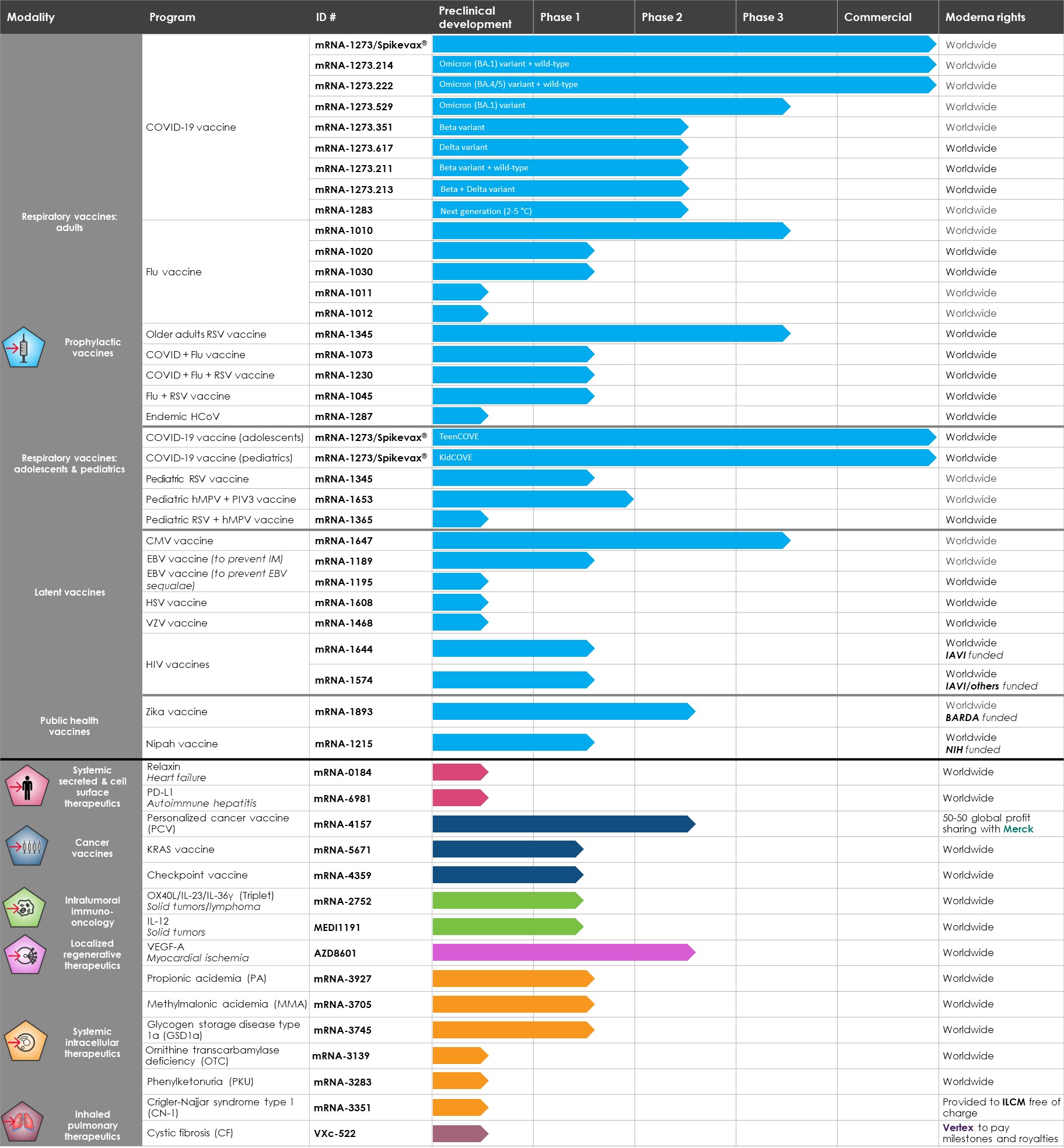
Abbreviations: AZ, AstraZeneca; BARDA, Biomedical Advanced Research and Development Authority; CMV, Cytomegalovirus; DARPA, Defense Advanced Research Projects Agency; EBV, Epstein-Barr virus; HIV, human immunodeficiency virus; hMPV, human metapneumovirus; ILCM, Institute for Life Changing Medicines; IL-12, interleukin 12; IL-23, interleukin 23; IL-36γ, interleukin-36 gamma; NIH, National Institutes of Health; OX40L, wildtype OX40 ligand; RSV, respiratory syncytial virus; VEGF-A, vascular endothelial growth factor A.
We have developed seven modalities, which are summarized as follows:
-
Prophylactic vaccines:** Our prophylactic vaccines modality currently includes 33 development programs, 26 of which have entered into clinical trials. We have ongoing Phase 1 trials for our RSV vaccine in pediatrics (mRNA-1345), flu vaccines (mRNA-1020 and mRNA-1030), combined COVID and flu vaccine (mRNA-1073), combined COVID, flu and RSV vaccine (mRNA-1230), combined flu and RSV vaccine (mRNA-1045), hMPV/PIV3 vaccine (mRNA-1653), EBV vaccine (mRNA-1189), HIV vaccines (mRNA-1644 and mRNA-1574) and Nipah vaccine (mRNA-1215). We have an ongoing Phase 2 study for our Zika vaccine (mRNA-1893). We have ongoing Phase 3 studies for our flu vaccine (mRNA-1010), RSV vaccine in older adults (mRNA-1345) and CMV vaccine (mRNA-1647). Our COVID-19 vaccine (mRNA-1273) is described in detail above. Our seven preclinical programs within our prophylactic vaccines modality are for a combined, pediatric RSV and hMPV vaccine (mRNA-1365), pan-HCoV vaccine (mRNA-1287), seasonal flu vaccines (mRNA-1011 and mRNA-1012), EBV vaccine to prevent long-term sequelae (mRNA-1195), VZV vaccine (mRNA-1468), and HSV vaccine (mRNA-1608). Three other vaccines as part of public health programs have had positive Phase 1 readouts – H10N8 vaccine (mRNA-1440), H7N9 flu vaccine (mRNA-1851), and Chikungunya vaccine (mRNA-1388) – but are not being further developed without government or other funding.
-
Systemic secreted and cell surface therapeutics:** We have two systemic secreted and cell surface therapeutics development candidates in our pipeline. Our secreted programs include Relaxin (mRNA-0184) for cardiac disorders and PD-L1 (mRNA-6981) for autoimmune hepatitis, which are currently in preclinical development. We previously announced positive data from our Chikungunya Antibody program (mRNA-1944) within this modality; however, we do not expect to advance our Chikungunya Antibody program without outside funding, and we are not currently pursuing further development of it at this time.
-
Cancer vaccines:** We are currently developing three programs within our cancer vaccines modality. Our personalized cancer vaccine program (mRNA-4157) is being developed in collaboration with Merck and is in a multiple-arm Phase 1 trial and a randomized Phase 2 trial, which is fully enrolled. Our second program within this modality is a KRAS vaccine (mRNA-5671). We have retained all rights to our KRAS vaccine from Merck and we are evaluating next steps for the program. Our third program is our checkpoint vaccine (mRNA-4359), which has dosed the first patient in a Phase 1 clinical trial.
-
Intratumoral immuno-oncology**: We have two programs in this modality. Our first program, OX40L/IL-23/IL-36γ (Triplet) (mRNA-2752), is currently in a Phase 1 study that is designed as an open-label, multicenter study of intratumoral injections of Triplet (mRNA-2752) alone or in combination with durvalumab (anti-PD-L1). Our second program, IL-12 (MEDI1191), was developed in collaboration with AstraZeneca. In August 2022, AstraZeneca notified us that it was terminating the development of the IL-12 program (MEDI1191) and that they were returning the rights to the program to us. We are evaluating next steps for the program.
-
Localized regenerative therapeutics:** Our localized VEGF-A program, AZD8601, which was developed in collaboration with AstraZeneca, has completed a Phase 1a/b trial to describe its safety, tolerability, protein production, and activity in diabetic patients. The study has met its primary objectives of describing safety and tolerability and secondary objectives of demonstrating protein production and changes in blood flow post AZD8601 administration. We believe these data provide clinical proof of mechanism for our mRNA technology outside of the vaccine setting. In 2021, the Phase 2 study met the primary endpoint of safety and tolerability of AZD8601 for the 3 mg dose. In the study of 11 patients, seven were treated with AZD8601 VEGF-A mRNA and four received placebo injections. Numerical trends were observed in endpoints in the heart failure efficacy domains compared with placebo, including increase in left ventricular ejection fraction (LVEF) and patient reported outcomes. In addition, all seven patients treated with AZD8601 had NT-proBNP (a biomarker that measures the level of a hormone that is elevated in patients with heart failure) levels below heart failure limit at 6 months follow-up compared to one of four patients treated with placebo. After a portfolio review, AstraZeneca has returned the rights to AZD8601 to us. We are evaluating next steps for the program.
-
Systemic intracellular therapeutics:** We have six systemic intracellular therapeutics development candidates in our pipeline. Our intracellular programs address propionic acidemia, or PA (mRNA-3927), methylmalonic acidemia (MMA) (mRNA-3705), glycogen storage disorder type 1a (GSD1a) (mRNA-3745), ornithine transcarbamylase deficiency (OTC) (mRNA-3139), phenylketonuria (PKU) (mRNA-3283), and Crigler-Najjar Syndrome Type 1 (CN-1) (mRNA-3351). We have ongoing Phase 1 clinical trials for PA (mRNA-3927), MMA (mRNA-3705) and GSD1a (mRNA-3745). OTC (mRNA-3139), PKU (mRNA-3283) and CN-1 (mRNA-3351) are currently in preclinical development. We have entered into a collaboration agreement with the Institute for Life Changing Medicines (ILCM) to license mRNA-3351 to ILCM with no upfront fees, and without any downstream payments. ILCM will be responsible for the clinical development of mRNA-3351.
-
Inhaled pulmonary therapeutics:** We have one inhaled pulmonary therapeutic development candidate in our pipeline. Our program addresses cystic fibrosis, or CF (VXc-522), in collaboration partnership with Vertex Pharmaceuticals. VXc-522 is an mRNA therapeutic designed to treat the underlying cause of CF by enabling cells in the lungs to produce functional cystic fibrosis transmembrane conductance regulator (CFTR) protein for the treatment of the 10% of patients who do not produce any CFTR protein. IND-enabling studies are underway and Vertex expects to submit an IND for this program in 2022. Moderna has licensed worldwide commercial rights to VXc-522 to Vertex.
Financial Operations Overview
Revenue
The following table summarizes revenue for the periods presented (in millions):
| Three Months Ended September 30, | Nine Months Ended September 30, | |||||||||||||||||||||||||
| 2022 | 2021 | 2022 | 2021 | |||||||||||||||||||||||
| Revenue: | ||||||||||||||||||||||||||
| Product sales | $ | 3,120 | $ | 4,810 | $ | 13,576 | $ | 10,740 | ||||||||||||||||||
| Grant revenue | 144 | 140 | 453 | 473 | ||||||||||||||||||||||
| Collaboration revenue | 100 | 19 | 150 | 47 | ||||||||||||||||||||||
| Total revenue | $ | 3,364 | $ | 4,969 | $ | 14,179 | $ | 11,260 |
For the three months ended September 30, 2022, we recognized $3.1 billion of product sales from our COVID-19 vaccines, of which $1.0 billion was generated in the United States and $2.1 billion was generated from Europe and the rest of the world. For the three months ended September 30, 2021, we recognized $4.8 billion of product sales from our COVID-19 vaccines, of which $1.2 billion was generated in the United States and $3.6 billion was generated from Europe and the rest of the world.
For the nine months ended September 30, 2022, we recognized $13.6 billion of product sales from our COVID-19 vaccines, of which $3.4 billion was generated in the United States and $10.2 billion was generated from Europe and the rest of the world. For the nine months ended September 30, 2021, we recognized $10.7 billion of product sales from our COVID-19 vaccines, of which $4.6 billion was generated in the United States and $6.1 billion was generated from Europe and the rest of the world.
As of September 30, 2022, we had deferred revenue of $4.1 billion associated with customer deposits received or billable under supply agreements for delivery of our COVID-19 vaccines into 2023. We anticipate that product sales will be greater in the fourth quarter of 2022 than the third quarter of 2022, driven by the timing of marketing authorizations and release of our Omicron-targeting bivalent booster vaccines. Based upon currently signed supply agreements for delivery of our COVID-19 vaccines in 2022 and our supply chain forecast, we expect that our COVID-19 vaccine product sales will be slightly lower in the second half of 2022 than in the first half of 2022, in part due to deferrals of deliveries into the first quarter of 2023 that we originally expected to make in 2022.
Other than product sales, our revenue has been primarily derived from government-sponsored and private organizations including BARDA, DARPA and the Gates Foundation and from strategic alliances with AstraZeneca, Merck and Vertex to discover, develop, and commercialize potential mRNA medicines.
Grant revenue was comprised as follows for the periods presented (in millions):
| Three Months Ended September 30, | Nine Months Ended September 30, | ||||||||||||||||||||||
| 2022 | 2021 | 2022 | 2021 | ||||||||||||||||||||
| Grant revenue: | |||||||||||||||||||||||
| BARDA (1) | $ | 141 | $ | 128 | $ | 442 | $ | 454 | |||||||||||||||
| Other | 3 | 12 | 11 | 19 | |||||||||||||||||||
| Total grant revenue | $ | 144 | $ | 140 | $ | 453 | $ | 473 |
(1) For the three months ended September 30, 2022, $135 million of BARDA grant revenue was related to our mRNA-1273 program and $6 million was related to our Zika vaccine program. For the nine months ended September 30, 2022, $430 million of BARDA grant revenue was related to our mRNA-1273 program and $12 million was related to our Zika vaccine program.
Collaboration revenue from our strategic alliances was comprised as follows for the periods presented (in millions):
| Three Months Ended September 30, | Nine Months Ended September 30, | ||||||||||||||||||||||
| 2022 | 2021 | 2022 | 2021 | ||||||||||||||||||||
| Collaboration revenue: | |||||||||||||||||||||||
| AstraZeneca | $ | 76 | $ | 3 | $ | 80 | $ | 7 | |||||||||||||||
| Merck | 20 | 7 | 35 | 11 | |||||||||||||||||||
| Vertex | 4 | 5 | 33 | 23 | |||||||||||||||||||
| Other | — | 4 | 2 | 6 | |||||||||||||||||||
| Total collaboration revenue | $ | 100 | $ | 19 | $ | 150 | $ | 47 |
In the third quarter of 2022, AstraZeneca elected to terminate our collaborations with them, effective on November 21, 2022. As a result of the termination, we recognized the remaining deferred revenue of $76 million as collaboration revenue during the three months ended September 30, 2022. Please refer to Note 5 to our condensed consolidated financial statements.
As of September 30, 2022, the remaining available funding, net of revenue earned under our agreement with BARDA for the development of our mRNA-1273 vaccine was $67 million. To the extent that existing or potential future products generate revenue, our revenue may vary due to many uncertainties in the future product demand, the development of our mRNA medicines and other factors.
Research and development expenses
We use our employee and infrastructure resources for the advancement of our platform, and for discovering and developing programs. Due to the number of ongoing programs and our ability to use resources across several projects, indirect or shared operating costs incurred for our research and development programs are generally not recorded or maintained on a program- or modality-specific basis. The following table reflects our research and development expenses, including direct program-specific expenses summarized by modality and indirect or shared operating costs summarized under other research and development expenses during the three and nine months ended September 30, 2022 and 2021 (in millions):
| Three Months Ended September 30, | Nine Months Ended September 30, | |||||||||||||||||||||||||
| 2022 | 2021 | 2022 | 2021 | |||||||||||||||||||||||
| Program expenses by modality: | ||||||||||||||||||||||||||
| Prophylactic vaccines | $ | 414 | $ | 271 | $ | 940 | $ | 760 | ||||||||||||||||||
| Systemic secreted and cell surface therapeutics | 4 | 3 | 7 | 5 | ||||||||||||||||||||||
| Cancer vaccines | 7 | 11 | 12 | 35 | ||||||||||||||||||||||
| Intratumoral immuno-oncology | — | 6 | 12 | 19 | ||||||||||||||||||||||
| Systemic intracellular therapeutics | 9 | 6 | 22 | 17 | ||||||||||||||||||||||
| Inhaled pulmonary therapeutics (1) | 2 | — | 7 | — | ||||||||||||||||||||||
| Total program-specific expenses by modality (2) | $ | 436 | $ | 297 | $ | 1,000 | $ | 836 | ||||||||||||||||||
| Other research and development expenses: | ||||||||||||||||||||||||||
| Discovery programs | 62 | 15 | 133 | 43 | ||||||||||||||||||||||
| Platform research | 32 | 28 | 97 | 80 | ||||||||||||||||||||||
| Technical development and unallocated manufacturing expenses | 166 | 79 | 495 | 165 | ||||||||||||||||||||||
| Shared discovery and development expenses | 96 | 77 | 292 | 165 | ||||||||||||||||||||||
| Stock-based compensation | 28 | 25 | 67 | 54 | ||||||||||||||||||||||
| Total research and development expenses | $ | 820 | $ | 521 | $ | 2,084 | $ | 1,343 |
(1)Inhaled pulmonary therapeutics modality was added in the fourth quarter of 2021.
(2)Includes a total of 44 and 34 development candidates at September 30, 2022 and 2021, respectively. Program-specific expenses include external costs and allocated manufacturing costs of pre-launch inventory, mRNA supply and consumables, and are reflected as of the beginning of the period in which the program was internally advanced to development or removed if development was ceased.
A “modality” refers to a group of programs with common product features and the associated combination of enabling mRNA technologies, delivery technologies, and manufacturing processes. The program-specific expenses by modality summarized in the table above include expenses we directly attribute to our programs, which consist primarily of external costs, such as fees paid to outside consultants, central laboratories, investigative sites, and contract research organizations (CROs) in connection with our preclinical studies and clinical trials, contract manufacturing organizations, and allocated manufacturing costs of pre-launch inventory, mRNA supply and consumables. Costs to acquire and manufacture pre-launch inventory, mRNA supply for preclinical studies and clinical trials are recognized and included in unallocated manufacturing expenses when incurred, and subsequently allocated to program-specific manufacturing costs after completion of the program-specific production. The timing of allocating manufacturing costs to the specific program varies depending on the program development and production schedule. We generally do not allocate personnel-related costs, including stock-based compensation, costs associated with our general platform research, technical development, and other shared costs on a program-specific basis. These costs were therefore excluded from the summary of program-specific expenses by modality.
Discovery program expenses are costs associated with research activities for our programs in the preclinical discovery stage, and primarily consist of external costs for CROs and lab services, and allocated manufacturing cost of preclinical mRNA supply and consumables.
Platform research expenses are mainly costs to develop technical advances in mRNA science, delivery science, and manufacturing process design. These costs include personnel-related costs, computer equipment, facilities, preclinical mRNA supply and consumables, and other administrative costs to support our platform research. Technology development and unallocated manufacturing expenses are primarily related to non-program-specific manufacturing process development and manufacturing costs.
Shared discovery and development expenses are research and development costs such as personnel-related costs and other costs, which are not otherwise included in development programs, discovery programs, platform research, technical development and unallocated manufacturing expenses, stock-based compensation, and other expenses.
The largest component of our total operating expenses has historically been our investment in research and development activities, including preclinical and clinical development of our product candidates, development of our platform, mRNA technologies, and manufacturing technologies. As we continue to develop variant-specific and next-generation COVID-19 vaccine candidates, we expect to continue to incur significant additional expenses.
Changes in expectations or outcomes of any of the known or unknown risks and uncertainties may materially impact our expected research and development expenditures. Continued research and development is central to the ongoing activities of our business. Investigational medicines in later stages of clinical development, such as our CMV vaccine, RSV vaccine, flu vaccine and our COVID-19 vaccines, generally have higher development costs than those in earlier stages of clinical development, primarily due to the increased size and duration of later-stage clinical trials. We expect our research and development costs to continue to increase in the foreseeable future as our investigational medicines progress through the development phases and identify and develop additional programs. There are numerous factors associated with the successful commercialization of any of our investigational medicines, including future trial design and various regulatory requirements, many of which cannot be determined with accuracy at this time due to the early stage of development of our investigational medicines. Moreover, future commercial and regulatory factors beyond our control will impact our clinical development programs and plans.
Critical accounting policies and significant judgments and estimates
There have been no material changes in our critical accounting policies and estimates in the preparation of our condensed consolidated financial statements during the three months ended September 30, 2022 compared to those disclosed in our 2021 Form 10-K.
Results of operations
The following table summarizes our condensed consolidated statements of income for each period presented (in millions):
| Three Months Ended September 30, | Change 2022 vs. 2021 | ||||||||||||||||||||||
| 2022 | 2021 | $ | % | ||||||||||||||||||||
| Revenue: | |||||||||||||||||||||||
| Product revenue | $ | 3,120 | $ | 4,810 | $ | (1,690) | (35)% | ||||||||||||||||
| Grant revenue | 144 | 140 | 4 | 3% | |||||||||||||||||||
| Collaboration revenue | 100 | 19 | 81 | 426% | |||||||||||||||||||
| Total revenue | 3,364 | 4,969 | (1,605) | (32)% | |||||||||||||||||||
| Operating Expenses: | |||||||||||||||||||||||
| Cost of sales | 1,100 | 722 | 378 | 52% | |||||||||||||||||||
| Research and development | 820 | 521 | 299 | 57% | |||||||||||||||||||
| Selling, general and administrative | 278 | 168 | 110 | 65% | |||||||||||||||||||
| Total operating expenses | 2,198 | 1,411 | 787 | 56% | |||||||||||||||||||
| Income from operations | 1,166 | 3,558 | (2,392) | (67)% | |||||||||||||||||||
| Interest income | 58 | 4 | 54 | 1,350% | |||||||||||||||||||
| Other expense, net | (7) | (10) | 3 | (30)% | |||||||||||||||||||
| Income before income taxes | 1,217 | 3,552 | (2,335) | (66)% | |||||||||||||||||||
| Provision for income taxes | 174 | 219 | (45) | (21)% | |||||||||||||||||||
| Net income | $ | 1,043 | $ | 3,333 | $ | (2,290) | (69)% |
| Nine Months Ended September 30, | Change 2022 vs. 2021 | ||||||||||||||||||||||
| 2022 | 2021 | $ | % | ||||||||||||||||||||
| Revenue: | |||||||||||||||||||||||
| Product revenue | $ | 13,576 | $ | 10,740 | $ | 2,836 | 26% | ||||||||||||||||
| Grant revenue | 453 | 473 | (20) | (4)% | |||||||||||||||||||
| Collaboration revenue | 150 | 47 | 103 | 219% | |||||||||||||||||||
| Total revenue | 14,179 | 11,260 | 2,919 | 26% | |||||||||||||||||||
| Operating Expenses: | |||||||||||||||||||||||
| Cost of sales | 3,498 | 1,665 | 1,833 | 110% | |||||||||||||||||||
| Research and development | 2,084 | 1,343 | 741 | 55% | |||||||||||||||||||
| Selling, general and administrative | 757 | 366 | 391 | 107% | |||||||||||||||||||
| Total operating expenses | 6,339 | 3,374 | 2,965 | 88% | |||||||||||||||||||
| Income from operations | 7,840 | 7,886 | (46) | (1)% | |||||||||||||||||||
| Interest income | 113 | 11 | 102 | 927% | |||||||||||||||||||
| Other expense, net | (33) | (22) | (11) | 50% | |||||||||||||||||||
| Income before income taxes | 7,920 | 7,875 | 45 | 1% | |||||||||||||||||||
| Provision for income taxes | 1,023 | 541 | 482 | 89% | |||||||||||||||||||
| Net income | $ | 6,897 | $ | 7,334 | $ | (437) | (6)% |
Revenue
Total revenue decreased by $1.6 billion, or 32%, for the three months ended September 30, 2022, compared to the same period in 2021, mainly due to a decrease in product sales of our COVID-19 vaccines. Product revenue decreased by $1.7 billion, or 35%, for the three months ended September 30, 2022, compared to the same period in 2021, primarily due to lower sales volume driven by the timing of marketing authorizations for our Omicron-targeting COVID-19 bivalent boosters and the related manufacturing ramp up.
Total revenue increased by $2.9 billion, or 26%, for the nine months ended September 30, 2022, compared to the same period in 2021, mainly due to an increase in product sales of our COVID-19 vaccines. Product revenue increased by $2.8 billion, or 26%, for the nine months ended September 30, 2022, compared to the same period in 2021, largely driven by a favorable customer mix and higher manufacturing capacity to fulfill customer demand for the first half of 2022 compared to early 2021.
Operating expenses
Cost of sales
Cost of sales for the three months ended September 30, 2022 was $1.1 billion, including third-party royalties of $106 million. Cost of sales for the three months ended September 30, 2022 increased by $378 million, or 52%, compared to the same period in 2021. Cost of sales as a percentage of product sales for the three months ended September 30, 2022 was 35%, compared to 15% for the same period in 2021. These increases were primarily attributable to write-downs for excess and obsolete inventory related to our COVID-19 vaccine, unutilized manufacturing capacity, and losses on firm purchase commitments of raw materials and related cancellation charges, driven by a shift in product demand to our Omicron-targeting COVID-19 bivalent boosters.
Cost of sales for the nine months ended September 30, 2022 was $3.5 billion, including third-party royalties of $470 million. Cost of sales for the nine months ended September 30, 2022 increased by $1.8 billion, or 110%, compared to the same period in 2021. Cost of sales as a percentage of product sales for the nine months ended September 30, 2022 was 26%, compared to 16% for the same period in 2021. These increases were mainly due to write-downs for excess and obsolete inventory related to our COVID-19 vaccines, unutilized manufacturing capacity and losses on firm purchase commitments of raw materials, driven by a shift in product demand.
We expect our manufacturing costs to increase as we move from a pandemic to a seasonal market environment for our COVID-19 vaccines. We expect that this shift will cause our cost of sales for the full year of 2022 to represent a higher percentage of our product sales than the percentage experienced in 2021.
Research and development expenses
Research and development expenses increased by $299 million, or 57%, for the three months ended September 30, 2022, compared to the same period in 2021. The increase was primarily attributable to increases in clinical trial expenses of $200 million and manufacturing costs for clinical trial materials of $49 million.
Research and development expenses increased by $741 million, or 55%, for the nine months ended September 30, 2022, compared to the same period in 2021. The increase was primarily attributable to increases in clinical trial expenses of $400 million, personnel-related costs of $110 million, manufacturing costs for clinical trial materials of $76 million, consulting and outside services of $74 million, and technology and facility-related costs of $42 million. These increases for the three and nine month periods in 2022 were largely driven by increased clinical development, particularly our COVID-19 vaccines, RSV, flu and CMV programs, and headcount.
We expect that research and development expenses will increase in 2022, as compared to 2021, as we continue to progress the development of variant-specific and next-generation COVID-19 vaccine candidates and continue to develop our pipeline and advance our product candidates into later-stage development, in particular those in ongoing Phase 3 studies: our RSV, flu and CMV vaccine programs.
Selling, general and administrative expenses
Selling, general and administrative expenses increased by $110 million, or 65%, for the three months ended September 30, 2022, compared to the same period in 2021. The increase was mainly due to increases in consulting and outside services of $43 million and personnel-related costs of $28 million. These increases for the three month period in 2022 were primarily driven by our COVID-19 vaccine commercialization-related activities and increased headcount.
Selling, general and administrative expenses increased by $391 million, or 107%, for the nine months ended September 30, 2022, compared to the same period in 2021. The increase was mainly due to increases in personnel-related costs of $86 million, consulting and outside services of $80 million, distributor fees of $44 million, marketing expenses of $41 million, and an endowment to the Moderna Charitable Foundation (the Foundation) of $50 million. These increases for the nine month period in 2022 were primarily driven by our COVID-19 vaccine commercialization-related activities, increased headcount, and the launch of the Foundation.
We expect that selling, general and administrative expenses will increase in 2022, as compared to 2021, as we continue to build out our global commercial, regulatory, sales and marketing infrastructure, and continue to expand the number of programs and our business operations.
Interest income
Interest income increased by $54 million for the three months ended September 30, 2022, compared to the same period in 2021. Interest income increased by $102 million for the nine months ended September 30, 2022, compared to the same period in 2021. The increases in interest income from our investments in marketable securities for the three and nine month periods in 2022 were mainly driven by an overall higher interest rate environment and increased investment balances.
Other expense, net
The following table summarizes other expense, net for each period presented (in millions):
| Three Months Ended September 30, | Change 2022 vs. 2021 | ||||||||||||||||||||||
| 2022 | 2021 | $ | % | ||||||||||||||||||||
| Loss on investments | $ | (4) | $ | — | $ | (4) | 100% | ||||||||||||||||
| Interest expense | (8) | (4) | (4) | 100% | |||||||||||||||||||
| Other income (expense), net | 5 | (6) | 11 | (183)% | |||||||||||||||||||
| Total other expense, net | $ | (7) | $ | (10) | $ | 3 | (30)% |
| Nine Months Ended September 30, | Change 2022 vs. 2021 | ||||||||||||||||||||||
| 2022 | 2021 | $ | % | ||||||||||||||||||||
| (Loss) gain on investments | $ | (18) | $ | 2 | $ | (20) | 1,000% | ||||||||||||||||
| Interest expense | (19) | (12) | (7) | 58% | |||||||||||||||||||
| Other income (expense), net | 4 | (12) | 16 | (133)% | |||||||||||||||||||
| Total other expense, net | $ | (33) | $ | (22) | $ | (11) | 50% |
Total other expense, net decreased by $3 million, or 30%, for the three months ended September 30, 2022, compared to the same period in 2021. Total other expense, net increased by $11 million, or 50%, for the nine months ended September 30, 2022, compared to the same period in 2021. The decrease in other expense, net for the three months ended September 30, 2022 was primarily due to a net gain related to our foreign currency balance sheet hedging activities, foreign currency transactions and remeasurements, partially offset by realized losses on available-for-sale debt securities and an increase in interest expense. The increase in other expense, net for the nine months ended September 30, 2022 was primarily due to realized losses on available-for-sale debt securities and an increase in interest expense, partially offset by a net gain related to our foreign currency balance sheet hedging activities, foreign currency transactions, and remeasurements. Our interest expense is primarily related to our finance leases. Please refer to Note 11 to our condensed consolidated financial statements.
Income taxes
Provision for income taxes decreased by $45 million, or 21%, for the three months ended September 30, 2022, compared to the same period in 2021, primarily due to a decrease in pre-tax income, partially offset by a higher effective tax rate. Provision for income taxes increased by $482 million, or 89%, for the nine months ended September 30, 2022, compared to the same period in 2021, primarily due to a higher effective tax rate. The increase in effective tax rate for the three and nine months ended September 30, 2022 was mainly due to the tax benefit recorded in 2021 related to the release of the valuation allowance on the majority of our deferred tax assets and a decrease in excess windfall benefits from stock-based compensation, partially offset by an increase in foreign derived intangible income benefit in 2022. We expect that our effective tax rate will increase for the full year 2022 compared to 2021, mainly driven by the release of the valuation allowance on the majority of the deferred tax assets in 2021.
Liquidity and capital resources
The following table summarizes our cash, cash equivalents, investments and working capital for each period presented (in millions):
| September 30, | December 31, | |||||||||||||
| 2022 | 2021 | |||||||||||||
| Financial assets: | ||||||||||||||
| Cash and cash equivalents | $ | 3,027 | $ | 6,848 | ||||||||||
| Investments | 5,321 | 3,879 | ||||||||||||
| Investments, non-current | 8,655 | 6,843 | ||||||||||||
| Total | $ | 17,003 | $ | 17,570 | ||||||||||
| Working capital: | ||||||||||||||
| Current assets | $ | 14,297 | $ | 16,071 | ||||||||||
| Current liabilities | 6,807 | 9,128 | ||||||||||||
| Total | $ | 7,490 | $ | 6,943 |
Our cash, cash equivalents and investments are invested in accordance with our investment policy, primarily with a view to liquidity and capital preservation. Investments, consisting primarily of government and corporate debt securities, are stated at fair value. Cash, cash equivalents and investments as of September 30, 2022 decreased by $567 million, or 3%, compared to December 31, 2021. During the nine months ended September 30, 2022, we generated cash from operations of $3.3 billion, partially offset by repurchases of our common stock of $2.9 billion, unrealized losses on available-for-sale debt securities of $497 million, and purchases of property and equipment of $308 million.
Working capital, which is current assets less current liabilities, as of September 30, 2022 increased by $547 million, or 8%, compared to December 31, 2021, primarily due to a decrease in short-term deferred revenue of $2.3 billion, mainly driven by revenue recognized from deferred revenue in excess of customer deposits received, and a decrease in income taxes payable of $810 million. This was partially offset by a decrease in cash, cash equivalents and short-term investments of $2.4 billion, primarily due to purchases of long-term marketable securities, repurchases of our common stock, and income tax payments.
As of September 30, 2022, we did not have any off-balance sheet arrangements.
Cash flow
The following table summarizes the primary sources and uses of cash for each period presented (in millions):
| Nine Months Ended September 30, | |||||||||||
| 2022 | 2021 | ||||||||||
| Net cash provided by (used in): | |||||||||||
| Operating activities | $ | 3,319 | $ | 10,310 | |||||||
| Investing activities | (4,128) | (7,385) | |||||||||
| Financing activities | (3,010) | — | |||||||||
| Net (decrease) increase in cash, cash equivalents and restricted cash | $ | (3,819) | $ | 2,925 |
Operating activities
We derive cash flows from operations primarily from cash collected from customer deposits and accounts receivable related to our COVID-19 vaccine supply agreements, as well as certain government-sponsored and private organizations and strategic alliances. Our cash flows from operating activities are significantly affected by our use of cash for operating expenses and working capital to support the business.
Beginning in the third quarter of 2020, we entered into supply agreements with the U.S. Government, other international governments, and Gavi for the supply of our COVID-19 vaccines and received upfront deposits. As of September 30, 2022, we had $4.1 billion in deferred revenue related to customer deposits received or billable.
Net cash provided by operating activities for the nine months ended September 30, 2022 was $3.3 billion and consisted of net income of $6.9 billion and non-cash adjustments of $30 million, partially offset by a net change in assets and liabilities of $3.6 billion. Non-cash items primarily included deferred income taxes of $473 million, depreciation and amortization of $268 million, and stock-based compensation of $164 million. The net change in assets and liabilities was mainly due to a decrease in deferred revenue of $2.7 billion, a decrease in income taxes payable of $810 million, an increase in prepaid expenses and other assets of $669 million, and an increase in inventory of $636 million, partially offset by a decrease in accounts receivable of $480 million, an increase in accrued liabilities of $354 million, and an increase in other liabilities of $273 million.
Net cash provided by operating activities decreased by $7.0 billion, or 68%, during the nine months ended September 30, 2022, compared to the same period in 2021, primarily attributable to revenue recognized from deferred revenue in excess of customer deposits received and increased income tax payments, partially offset by higher collection of receivables.
Investing activities
Our primary investing activities consist of purchases, sales, and maturities of our investments and capital expenditures for leasehold improvements, manufacturing, laboratory, computer equipment and software.
Net cash used in investing activities for the nine months ended September 30, 2022 was $4.1 billion, which primarily included purchases of marketable securities of $8.9 billion and purchases of property and equipment of $308 million, partially offset by proceeds from sales of marketable securities of $2.9 billion and proceeds from maturities of marketable securities of $2.2 billion.
Net cash used in investing activities decreased by $3.3 billion, or 44%, during the nine months ended September 30, 2022, compared to the same period in 2021, primarily reflecting timing differences related to purchases, sales, and maturities of marketable debt securities and changes in our investment portfolio mix.
Financing activities
Net cash used in financing activities for the nine months ended September 30, 2022 was $3.0 billion, primarily due to repurchase of common stock of $2.9 billion.
Net cash used in financing activities increased by $3.0 billion during the nine months ended September 30, 2022, compared to the same period in 2021, mainly due to repurchase of common stock.
Operation and funding requirements
Our principal sources of funding as of September 30, 2022 consisted of cash and cash equivalents, investments, and cash we expect to generate from operations. We generated net income of $12.2 billion for the year ended 2021, following the authorization of our first commercial product in December 2020. From our inception to the end of 2020, we incurred significant losses from operations due to our significant research and development expenses. We have retained earnings of $16.9 billion as of September 30, 2022.
We have significant future capital requirements including expected operating expenses to conduct research and development activities, operate our organization, meet capital expenditure needs, and fund our share repurchase programs (refer to Note 13 to our condensed consolidated financial statements). We expect our expenses to increase in connection with our ongoing activities, particularly as we continue research and development of our development candidates and clinical activities for our investigational medicines. We also expect our expenses to increase associated with manufacturing costs, including our arrangements with our international supply and manufacturing partners. Our ongoing work on our COVID-19 vaccines, including development of any new generations of boosters and vaccines against variants of SARS-CoV-2, and buildout of global commercial, regulatory, sales and marketing infrastructure will require significant cash outflows during 2022, most of which will not be reimbursed or otherwise paid for by our partners or collaborators. In addition, we have substantial facility, lease and purchase obligations (refer to Note 11 and Note 12 to our condensed consolidated financial statements). We have entered into certain collaboration and licensing agreements with third parties that include the funding of certain research and development activities and potential future milestone and royalty payments by us.
We believe that our cash, cash equivalents, and investments as of September 30, 2022, together with cash expected to be generated from operations, will be sufficient to enable us to fund our projected operations, capital expenditures and stock repurchases through at least the next 12 months from the issuance of these financial statements included in this Form 10-Q. We are subject to all the risks related to the development and commercialization of novel medicines, and we may encounter unforeseen expenses, difficulties, complications, delays, and other unknown factors, which may adversely affect our business. Our forecast of the period of time through which our financial resources will be adequate to support our operations is a forward-looking statement and involves risks and uncertainties, and actual results could vary as a result of a number of factors. We have based this estimate on assumptions that may prove to be wrong, and we could utilize our available capital resources sooner than we currently expect.
Contractual Obligations
As of September 30, 2022, other than disclosed within Note 11 and Note 12 to our condensed consolidated financial statements, there have been no material changes to our contractual obligations and commitments from those described under “Management’s Discussion and Analysis of Financial Condition and Results of Operations” included in our 2021 Form 10-K.
Previous: Item 1. Financial Statements · Next: Item 3. Quantitative and Qualitative Disclosures about Market Risk