 filings.tools
Item 2. MANAGEMENT’S DISCUSSION AND ANALYSIS OF FINANCIAL CONDITION AND RESULTS OF OPERATIONS
40K characters. Original on sec.gov · Markdown
Item 2. MANAGEMENT’S DISCUSSION AND ANALYSIS OF FINANCIAL CONDITION AND RESULTS OF OPERATIONS
You should read the following discussion and analysis of our financial condition and results of operations together with our unaudited financial information and related notes included in this Form 10-Q and our consolidated financial statements and related notes and other financial information in our Annual Report on Form 10-K for the year ended December 31, 2022, which was filed with the Securities and Exchange Commission (the SEC) on February 24, 2023 (the 2022 Form 10-K).
Overview
We are a biotechnology company pioneering a new class of medicines made of messenger RNA (mRNA). mRNA medicines are designed to direct the body’s cells to produce intracellular, membrane or secreted proteins that have a therapeutic or preventive benefit with the potential to address a broad spectrum of diseases. Our platform builds on continuous advances in basic and applied mRNA science, delivery technology and manufacturing, providing us the capability to pursue in parallel a robust pipeline of new development candidates. We are developing therapeutics and vaccines for infectious diseases, immuno-oncology, rare diseases, autoimmune diseases and cardiovascular diseases, independently and with our strategic collaborators.
Since our founding in 2010, we have transformed from a research-stage company advancing programs in the field of mRNA to a commercial enterprise with a diverse clinical portfolio of vaccines and therapeutics across seven modalities, a broad intellectual property portfolio and integrated manufacturing capabilities that allow for rapid clinical and commercial production at scale. We have a diverse and extensive development pipeline of 45 development candidates across our 47 development programs, of which 39 are in clinical studies currently.
Our COVID-19 vaccine is our first commercial product and is marketed, where approved, under the name Spikevax®. Our original vaccine, mRNA-1273, targeted the SARS-CoV-2 ancestral strain, and we have leveraged our mRNA platform to rapidly adapt our vaccine to emerging SARS-CoV-2 strains to provide protection as the virus evolves and regulatory guidance is updated.
Business Highlights
In June 2023, we completed submission of a regulatory application to the U.S. Food and Drug Administration (FDA) for our updated COVID-19 vaccine candidate targeting the Omicron XBB.1.5 sublineage of SARS-CoV-2 (mRNA-1273.815). We have also submitted regulatory applications for mRNA-1273.815 to other regulators globally, including to the European Medicines Agency (EMA), Swissmedic and the Ministry of Health, Labour and Welfare in Japan. These submissions are based on guidance from the FDA, the European Centre for Disease Prevention and Control (ECDC) and the EMA, among other regulators and global public health agencies, which advised that COVID-19 vaccines should be updated to a monovalent XBB.1.5 composition. Additionally, we have generated preliminary clinical data of mRNA-1273.815 showing an immune response against XBB descendent sublineages such as XBB.1.5, XBB.1.16, and XBB.2.3.2.
We have initiated a rolling submission of a Biologics License Application to the FDA for our investigational respiratory syncytial virus (RSV) vaccine (mRNA-1345) for adults aged 60 years or older. We have also submitted marketing authorization applications for mRNA-1345 for adults aged 60 years or older with the EMA, Swissmedic, the Therapeutic Goods Administration in Australia and the Medicines and Healthcare products Regulatory Agency in the United Kingdom. The regulatory applications are based on positive data from a prespecified interim analysis of our pivotal ConquerRSV study, a randomized, double-blind, placebo-controlled study of approximately 37,000 adults 60 years or older in 22 countries. In the study, mRNA-1345 met primary efficacy endpoints, demonstrating vaccine efficacy of 83.7% against RSV lower respiratory tract disease in older adults.
For the second quarter of 2023, we recognized product sales of $293 million from sales of our COVID-19 vaccine, compared to $4.5 billion for the second quarter of 2022. Diluted loss per share was $(3.62) for the second quarter of 2023, compared to diluted earnings per share of $5.24 for the second quarter of 2022.
Recent Program Developments
Individualized neoantigen therapy (mRNA-4157)
- We are developing mRNA-4157, an investigational mRNA individualized neoantigen therapy (INT), in collaboration with Merck & Co., Inc (Merck). In July 2023, we and Merck announced the initiation of the pivotal Phase 3 randomized V940-001 clinical trial evaluating mRNA-4157 in combination with KEYTRUDA® (pembrolizumab), Merck’s anti-PD-1 therapy, as an adjuvant treatment in patients with resected high-risk melanoma (Stage IIB-IV). Global recruitment in the trial has begun, and the first patients are enrolling in Australia. The trial is expected to enroll approximately 1,089 patients at more than 165
sites in over 25 countries around the world. The primary endpoint of the study is recurrence-free survival (RFS) and secondary endpoints include distant metastasis-free survival (DMFS), overall survival and safety.
- Based on data from the Phase 2b KEYNOTE-942/mRNA-4157-P201 study, the FDA and EMA granted Breakthrough Therapy Designation and the Priority Medicines (PRIME) scheme, respectively, for mRNA-4157 in combination with KEYTRUDA for the adjuvant treatment of patients with high-risk stage III/IV melanoma following complete resection. We and Merck presented the study’s primary endpoint, RFS, in April 2023 at the American Association for Cancer Research (AACR) Annual Meeting, which showed that mRNA-4157 in combination with KEYTRUDA demonstrated a statistically significant and clinically meaningful improvement in RFS, and reduced the risk of recurrence or death by 44% (HR=0.56 [95% CI, 0.309-1.017]; one-sided p value=0.0266) compared with KEYTRUDA alone in the overall intention-to-treat population. Further data from a key secondary endpoint of the study, DMFS, were presented in June 2023 at the American Society of Clinical Oncology (ASCO) Annual Meeting. We and Merck plan to expand the development program to additional tumor types, including non-small cell lung cancer. In the overall intention-to-treat population, adjuvant treatment with mRNA-4157 in combination with KEYTRUDA demonstrated a statistically significant and clinically meaningful improvement in DMFS compared with KEYTRUDA alone and reduced the risk of developing distant metastasis or death by 65% (HR=0.347 [95% CI, 0.145-0.828]; one-sided p value=0.0063). The secondary endpoint of DMFS, defined as the time from the first dose of KEYTRUDA until the date of first distant recurrence or death from any cause, was pre-specified for statistical testing following the positive primary endpoint of RFS.
Seasonal influenza (flu) vaccines (mRNA-1010)
- The Phase 3 immunogenicity trial (P303) of our seasonal influenza vaccine candidate, mRNA-1010, is fully enrolled. P303 is testing an updated formulation of mRNA-1010 that is expected to lead to improved immune responses against influenza B strains.
CMV vaccine (mRNA-1647)
- The pivotal Phase 3 trial (CMVictory) of our CMV vaccine candidate, mRNA-1647, is more than 80% enrolled, with an expectation to enroll up to 7,300 women from approximately 150 clinical sites. CMVictory is evaluating the vaccine’s ability to protect against primary CMV infection in women ages 16 to 40 years. The trial is a randomized, observer-blind, placebo-controlled study designed to evaluate the efficacy, safety, and immunogenicity of mRNA-1647 to evaluate the prevention of primary infection. The primary efficacy analysis will be triggered based on the accrual of seroconversion cases.
Propionic acidemia (mRNA-3927)
-
The Phase 1/2 clinical trial, the Paramount Study, of mRNA-3927, an investigational mRNA therapy for propionic acidemia (PA), is ongoing and currently enrolling patients in the dose confirmation arm. The trial includes a dose optimization stage (cohorts 1-5) followed by a dose confirmation stage with progression dependent on the safety of the preceding cohort. Enrollment is complete for cohorts 1 through 5. mRNA-3927 has been generally well-tolerated at the doses administered, with encouraging early signs of dose-dependent pharmacology and potential clinical benefit. The majority of eligible participants have elected to continue with treatment by participating in the Open-Label Extension Study.
-
In May 2023, we reported on interim data from the Paramount Study at the 2023 American Society of Gene + Cell Therapy (ASGCT) Annual Meeting.
Emerging Programs
-
In April 2023, we announced new development candidates against Lyme disease, representing our first bacterial vaccine candidates, and norovirus, constituting our first vaccine candidates against an enteric virus. To address Lyme’s biological complexity, we are advancing a seven-valent approach with two Lyme disease vaccine candidates that will be developed in parallel. mRNA-1982 is designed to elicit antibodies specific for Borrelia burgdorferi, which causes almost all Lyme disease in the U.S. mRNA-1975 is designed to elicit antibodies specific for the four major Borrelia species causing disease in the U.S. and Europe. We have initiated a Phase 1 clinical trial for mRNA-1982 and mRNA-1975.
-
A broadly effective norovirus vaccine will require a multivalent vaccine design, given the wide genetic and antigenic diversity of noroviruses. We are developing pentavalent (mRNA-1405) and trivalent (mRNA-1403) candidates for norovirus.
Our Pipeline
The following chart shows our current pipeline of 47 development programs across our seven modalities.
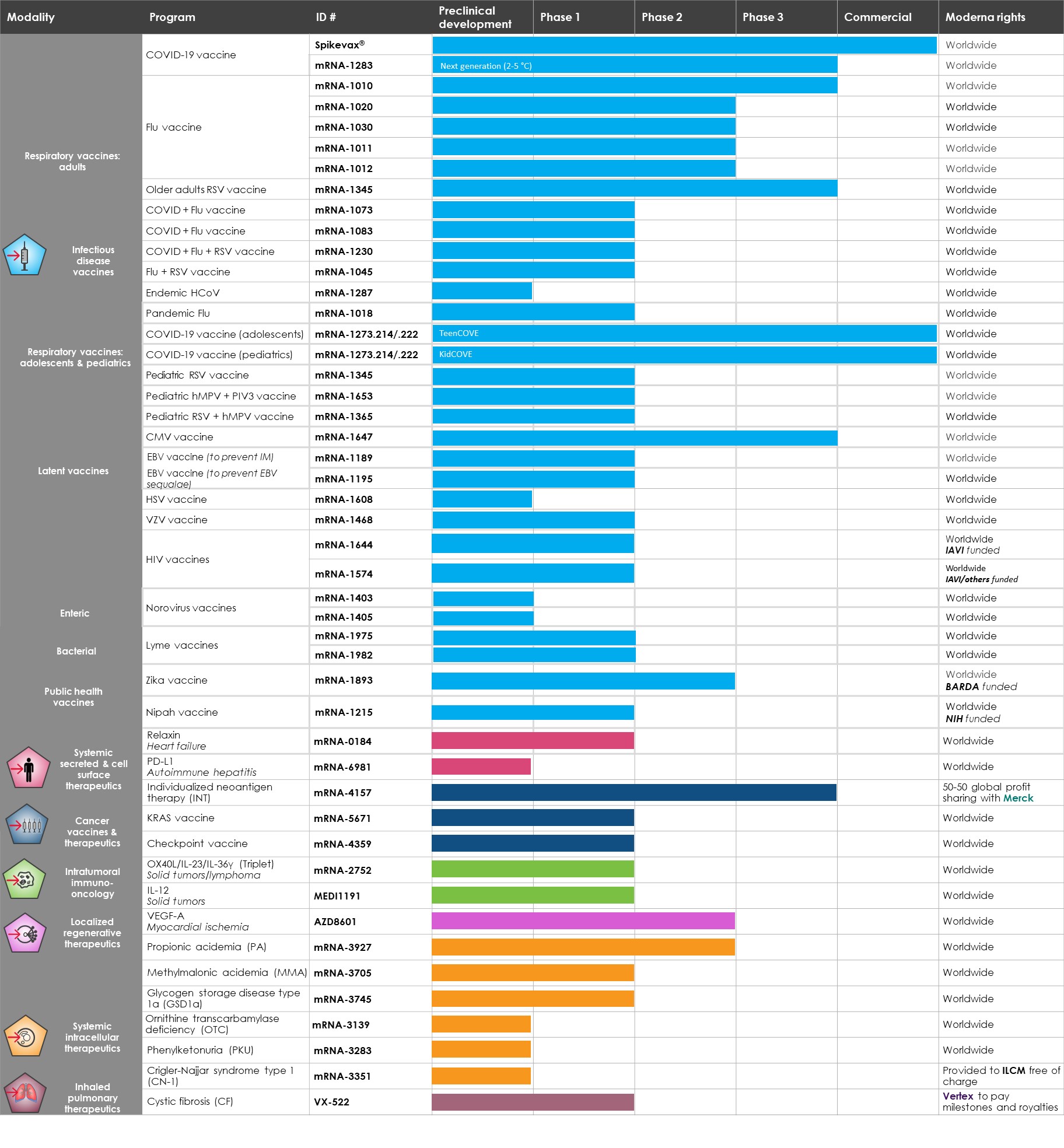
Abbreviations: BARDA, Biomedical Advanced Research and Development Authority; CMV, Cytomegalovirus; EBV, Epstein-Barr virus; HIV, human immunodeficiency virus; hMPV, human metapneumovirus; HSV, herpes simplex virus; ILCM, Institute for Life Changing Medicines; IL-12, interleukin 12; IL-23, interleukin 23; IL-36γ, interleukin-36 gamma; NIAID, National Institute of Allergy and Infectious Diseases; NIH, National Institutes of Health; OX40L, wildtype OX40 ligand; PIV3, human parainfluenza virus 3; RSV, respiratory syncytial virus; VEGF-A, vascular endothelial growth factor A; VZV, varicella-zoster virus.
Results of operations
The following tables summarize our condensed consolidated statements of operations for the periods presented (in millions):
| Three Months Ended June 30, | Change 2023 vs. 2022 | ||||||||||||||||||||||
| 2023 | 2022 | $ | % | ||||||||||||||||||||
| Revenue: | |||||||||||||||||||||||
| Product sales | $ | 293 | $ | 4,531 | $ | (4,238) | (94)% | ||||||||||||||||
| Other revenue | 51 | 218 | (167) | (77)% | |||||||||||||||||||
| Total revenue | 344 | 4,749 | (4,405) | (93)% | |||||||||||||||||||
| Operating expenses: | |||||||||||||||||||||||
| Cost of sales | 731 | 1,381 | (650) | (47)% | |||||||||||||||||||
| Research and development | 1,148 | 710 | 438 | 62% | |||||||||||||||||||
| Selling, general and administrative | 332 | 211 | 121 | 57% | |||||||||||||||||||
| Total operating expenses | 2,211 | 2,302 | (91) | (4)% | |||||||||||||||||||
| (Loss) income from operations | (1,867) | 2,447 | (4,314) | (176)% | |||||||||||||||||||
| Interest income | 104 | 40 | 64 | 160% | |||||||||||||||||||
| Other income (expense), net | 14 | (13) | 27 | 208% | |||||||||||||||||||
| (Loss) income before income taxes | (1,749) | 2,474 | (4,223) | (171)% | |||||||||||||||||||
| (Benefit from) provision for income taxes | (369) | 277 | (646) | (233)% | |||||||||||||||||||
| Net (loss) income | $ | (1,380) | $ | 2,197 | $ | (3,577) | (163)% |
| Six Months Ended June 30, | Change 2023 vs. 2022 | ||||||||||||||||||||||
| 2023 | 2022 | $ | % | ||||||||||||||||||||
| Revenue: | |||||||||||||||||||||||
| Product sales | $ | 2,121 | $ | 10,456 | $ | (8,335) | (80)% | ||||||||||||||||
| Other revenue | 85 | 359 | (274) | (76)% | |||||||||||||||||||
| Total revenue | 2,206 | 10,815 | (8,609) | (80)% | |||||||||||||||||||
| Operating expenses: | |||||||||||||||||||||||
| Cost of sales | 1,523 | 2,398 | (875) | (36)% | |||||||||||||||||||
| Research and development | 2,279 | 1,264 | 1,015 | 80% | |||||||||||||||||||
| Selling, general and administrative | 637 | 479 | 158 | 33% | |||||||||||||||||||
| Total operating expenses | 4,439 | 4,141 | 298 | 7% | |||||||||||||||||||
| (Loss) income from operations | (2,233) | 6,674 | (8,907) | (133)% | |||||||||||||||||||
| Interest income | 213 | 55 | 158 | 287% | |||||||||||||||||||
| Other expense, net | (34) | (26) | (8) | 31% | |||||||||||||||||||
| (Loss) income before income taxes | (2,054) | 6,703 | (8,757) | (131)% | |||||||||||||||||||
| (Benefit from) provision for income taxes | (753) | 849 | (1,602) | (189)% | |||||||||||||||||||
| Net (loss) income | $ | (1,301) | $ | 5,854 | $ | (7,155) | (122)% |
Revenue
Product sales by customer geographic location were as follows (in millions):
| Three Months Ended June 30, | Six Months Ended June 30, | |||||||||||||||||||||||||
| 2023 | 2022 | 2023 | 2022 | |||||||||||||||||||||||
| United States | $ | 2 | $ | 1,450 | $ | 3 | $ | 2,395 | ||||||||||||||||||
| Europe | 60 | 1,390 | 636 | 3,466 | ||||||||||||||||||||||
| Rest of world(1) | 231 | 1,691 | 1,482 | 4,595 | ||||||||||||||||||||||
| Total | $ | 293 | $ | 4,531 | $ | 2,121 | $ | 10,456 |
As of June 30, 2023, our COVID-19 vaccine was our only commercial product authorized for use.
As of June 30, 2023, we had deferred revenue of $1.7 billion associated with customer deposits received or billable under supply agreements for delivery of our COVID-19 vaccines in 2023. We believe that the COVID-19 vaccine market continues to shift to an endemic seasonal market and our product sales will decline significantly in 2023 compared to 2022. In addition, we anticipate greater seasonality for sales, with greater demand in the fall/winter season in each hemisphere as countries seek to provide booster vaccinations to their populations.
Other than product sales, our revenue has been primarily derived from government-sponsored and private organizations including the Biomedical Advanced Research and Development Authority (BARDA), the Defense Advanced Research Projects Agency (DARPA) and the Bill & Melinda Gates Foundation and from strategic alliances with Merck & Co., Inc (Merck), Vertex Pharmaceuticals Incorporated and Vertex Pharmaceuticals (Europe) Limited (together, Vertex) and AstraZeneca plc (AstraZeneca) to discover, develop, and commercialize potential mRNA medicines.
The following table summarizes other revenue for the periods presented (in millions):
| Three Months Ended June 30, | Six Months Ended June 30, | |||||||||||||||||||||||||
| 2023 | 2022 | 2023 | 2022 | |||||||||||||||||||||||
| Grant revenue | $ | 28 | $ | 183 | $ | 52 | $ | 309 | ||||||||||||||||||
| Collaboration revenue | 23 | 35 | 33 | 50 | ||||||||||||||||||||||
| Total other revenue | $ | 51 | $ | 218 | $ | 85 | $ | 359 |
Total revenue decreased by $4.4 billion and $8.6 billion, or 93% and 80%, for the three and six months ended June 30, 2023, respectively, compared to the same periods in 2022, mainly due to decreases in product sales of our COVID-19 vaccine.
Product revenue decreased by $4.2 billion and $8.3 billion, or 94% and 80%, for the three and six months ended June 30, 2023, respectively, compared to the same periods in 2022, primarily due to lower sales volume in 2023.
Other revenue decreased by $167 million and $274 million, or 77% and 76%, for the three and six months ended June 30, 2023, respectively, compared to the same periods in 2022, mainly due to decreases in grant revenue under our agreement with BARDA for the development of our mRNA-1273 vaccine.
Operating expenses
Cost of sales
Cost of sales for the three months ended June 30, 2023 was $731 million, including third-party royalties of $12 million, inventory write-downs of $464 million, unutilized manufacturing capacity of $135 million, and losses on firm purchase commitments of $75 million. Cost of sales for the six months ended June 30, 2023 was $1.5 billion, including third-party royalties of $98 million, inventory write-downs of $612 million, unutilized manufacturing capacity of $270 million, and losses on firm purchase commitments of $141 million. These charges, other than royalties, were largely attributable to a shift in product demand to our latest monovalent XBB.1.5 COVID-19 vaccine candidate as well as a decline in customer demand. The shift from a bivalent to monovalent strain selection rendered the remaining mRNA-1273.222 product inventory obsolete.
Cost of sales for the three months ended June 30, 2023 decreased by $650 million, or 47%, compared to the same period in 2022. Cost of sales as a percentage of product sales for the three months ended June 30, 2023 was 249%, compared to 30% for the same period in 2022. Cost of sales for the six months ended June 30, 2023 decreased by $875 million, or 36%, compared to the same period in 2022. Cost of sales as a percentage of product sales for the six months ended June 30, 2023 was 72%, compared to 23% for the same period in 2022. The decreases in cost of sales in 2023 were primarily driven by lower sales volume. The increases in cost of sales as a percentage of product sales in 2023 were mainly due to the aforementioned charges, other than royalties, over lower product sales, driven by a decline in product demand and increased product seasonality.
We expect our cost of sales as a percentage of product sales to increase as we continue to move from a pandemic market to an endemic market, characterized by greater seasonality, for our COVID-19 vaccine in 2023. We expect that this shift will cause our cost of sales for the full year of 2023 to represent a higher percentage of our product sales than the percentage experienced in 2022. Our per unit manufacturing cost in 2023 is expected to be significantly higher than the prior year; we may continue to experience significant unutilized capacity charges and inventory write-downs in 2023 (please refer to Note 9 to our condensed consolidated financial statements for inventory related charges).
Research and development expenses
Research and development expenses increased by $438 million, or 62%, for the three months ended June 30, 2023, compared to the same period in 2022. The increase was primarily attributable to increases in clinical trial expenses of $134 million, manufacturing costs for clinical trial materials of $109 million, personnel-related costs and stock-based compensation of $84 million and consulting and outside services of $72 million. Research and development expenses increased by $1.0 billion, or 80%, for the six months ended June 30, 2023, compared to the same period in 2022. The increase was primarily attributable to increases in clinical trial expenses of $415 million, manufacturing costs for clinical trial materials of $217 million, personnel-related costs and stock-based compensation of $182 million, consulting and outside services of $86 million, and preclinical research expenses, including collaboration upfront fees, of $50 million. These increases for the three and six month periods in 2023 were largely driven by increased clinical development, particularly for our RSV, flu and CMV programs, increased headcount and our collaboration agreements with Life Edit and Generation Bio executed in the first quarter of 2023.
We expect that research and development expenses will increase in 2023, as compared to 2022, as we continue to progress the development of variant-specific and next-generation COVID-19 vaccine candidates and continue to develop our pipeline and advance our product candidates into later-stage development, in particular those in ongoing Phase 3 studies, our RSV, seasonal flu and CMV vaccine programs, as well as our individualized neoantigen therapy (personalized cancer vaccine) program.
Selling, general and administrative expenses
Selling, general and administrative expenses increased by $121 million, or 57%, for the three months ended June 30, 2023, compared to the same period in 2022. The increase was mainly due to increases in consulting and outside services of $65 million and personnel-related costs and stock-based compensation of $44 million. Selling, general and administrative expenses increased by $158 million, or 33%, for the six months ended June 30, 2023, compared to the same period in 2022. The increase was mainly due to increases in outside services of $115 million, personnel-related costs and stock-based compensation of $85 million and commercial and marketing expense of $29 million, partially offset by a decrease in distributor fees of $57 million and an endowment to the Moderna Charitable Foundation of $50 million contributed in 2022. These increases for the three and six month periods in 2023 were primarily driven by increased headcount and spend in digital, medical affairs and commercial functions to support our digital initiatives, marketed products and company expansion.
We expect that selling, general and administrative expenses will increase in 2023, as compared to 2022, as we continue to build out our global commercial, regulatory, sales and marketing infrastructure, and continue to expand the number of programs and our business operations.
Interest income
Interest income increased by $64 million, or 160%, for the three months ended June 30, 2023, compared to the same period in 2022. Interest income increased by $158 million, or 287%, for the six months ended June 30, 2023, compared to the same period in 2022. The increases in interest income from our investments in marketable securities for the three and six month periods in 2023 were mainly driven by an overall higher interest rate environment.
Other income (expense), net
The following tables summarize other expense, net for the periods presented (in millions):
| Three Months Ended June 30, | Change 2023 vs. 2022 | ||||||||||||||||||||||
| 2023 | 2022 | $ | % | ||||||||||||||||||||
| Gain (loss) on investments | $ | 22 | $ | (8) | $ | 30 | 375% | ||||||||||||||||
| Interest expense | (13) | (5) | (8) | 160% | |||||||||||||||||||
| Other income, net | 5 | — | 5 | 100% | |||||||||||||||||||
| Total other income (expense), net | $ | 14 | $ | (13) | $ | 27 | 208% |
| Six Months Ended June 30, | Change 2023 vs. 2022 | ||||||||||||||||||||||
| 2023 | 2022 | $ | % | ||||||||||||||||||||
| Loss on investments | $ | (13) | $ | (14) | $ | 1 | (7)% | ||||||||||||||||
| Interest expense | (22) | (11) | (11) | 100% | |||||||||||||||||||
| Other income (expense), net | 1 | (1) | 2 | 200% | |||||||||||||||||||
| Total other expense, net | $ | (34) | $ | (26) | $ | (8) | 31% |
Total other income, net increased by $27 million, or 208%, for the three months ended June 30, 2023, compared to the same period in 2022. The increase in other income, net for the three months ended June 30, 2023 was primarily due to gains on equity investments, partially offset by an increase in interest expense. Total other expense, net increased by $8 million, or 31%, for the six months ended June 30, 2023, compared to the same period in 2022. The increase in other expense, net for the six months ended June 30, 2023 was primarily due to a loss on available-for-sale debt securities and an increase in interest expense, partially offset by a net gain on equity investments. Our interest expense is primarily related to our finance leases. Please refer to Note 12 to our condensed consolidated financial statements.
Income taxes
We had a tax benefit of $369 million and $753 million for the three and six months ended June 30, 2023. Provision for income taxes decreased by $646 million, or 233%, for the three months ended June 30, 2023, compared to the same period in 2022. Provision for income taxes decreased by $1.6 billion, or 189%, for the six months ended June 30, 2023, compared to the same period in 2022. The decrease in both periods of 2023 were primarily due to significant decreases in pre-tax income. As a result, the 2023 effective tax rate will not be comparable to the prior year.
Liquidity and capital resources
The following table summarizes our cash, cash equivalents, investments and working capital as of June 30, 2023 and December 31, 2022 (in millions):
| June 30, | December 31, | |||||||||||||
| 2023 | 2022 | |||||||||||||
| Financial assets: | ||||||||||||||
| Cash and cash equivalents | $ | 3,801 | $ | 3,205 | ||||||||||
| Investments | 4,658 | 6,697 | ||||||||||||
| Investments, non-current | 6,105 | 8,318 | ||||||||||||
| Total | $ | 14,564 | $ | 18,220 | ||||||||||
| Working capital: | ||||||||||||||
| Current assets | $ | 10,599 | $ | 13,431 | ||||||||||
| Current liabilities | 3,123 | 4,923 | ||||||||||||
| Total | $ | 7,476 | $ | 8,508 |
Our cash, cash equivalents and investments are invested in accordance with our investment policy, primarily with a view to liquidity and capital preservation. Investments, consisting primarily of government and corporate debt securities, are stated at fair value. Cash, cash equivalents and investments as of June 30, 2023 decreased by $3.7 billion, or 20%, compared to December 31, 2022. During the six months ended June 30, 2023, we had a net cash outflow from operating activities of $2.1 billion, repurchases of our common stock of $1.2 billion, purchases of property and equipment of $347 million, and a business acquisition, net of cash acquired of $85 million, partially offset by unrealized gains on available-for-sale debt securities of $129 million.
Working capital, which is current assets less current liabilities, as of June 30, 2023 decreased by $1.0 billion, or 12%, compared to December 31, 2022, primarily due to a decrease in cash, cash equivalents and short-term investments of $1.4 billion, primarily to fund our operating activities and repurchases of common stock, and a decrease in accounts receivable of $1.2 billion, primarily driven by collections in excess of invoicing. This was partially offset by a decrease in short-term deferred revenue of $1.0 billion, mainly driven by revenue recognized from deferred revenue in excess of customer deposits received, and a decrease in accrued liabilities of $611 million.
As of June 30, 2023, we did not have any off-balance sheet arrangements.
Cash flow
The following table summarizes the primary sources and uses of cash for each period presented (in millions):
| Six Months Ended June 30, | |||||||||||
| 2023 | 2022 | ||||||||||
| Net cash provided by (used in): | |||||||||||
| Operating activities | $ | (2,140) | $ | 3,067 | |||||||
| Investing activities | 3,955 | (5,073) | |||||||||
| Financing activities | (1,210) | (1,969) | |||||||||
| Net increase (decrease) in cash, cash equivalents and restricted cash | $ | 605 | $ | (3,975) |
Operating activities
We derive cash flows from operations primarily from cash collected from customer deposits and accounts receivable related to our COVID-19 vaccine supply agreements, as well as certain government-sponsored and private organizations and strategic alliances. Our cash flows from operating activities are significantly affected by our use of cash for operating expenses and working capital to support the business.
Beginning in the third quarter of 2020, we entered into supply agreements with the U.S. Government and other international organizations for the supply of our COVID-19 vaccine and received upfront deposits. As of June 30, 2023, we had $1.7 billion in deferred revenue related to customer deposits received or billable.
Net cash used in operating activities for the six months ended June 30, 2023 was $2.1 billion and consisted of net loss of $1.3 billion, a net change in assets and liabilities, net of acquisition of business, of $570 million and non-cash adjustments of $269 million. Non-cash items primarily included deferred income taxes of $530 million, depreciation and amortization of $170 million, and stock-based compensation of $149 million. The net change in assets and liabilities was mainly due to a decrease in deferred revenue of $979 million, a decrease in accrued liabilities of $633 million, a decrease in accounts payable of $187 million and an increase in prepaid expenses and other assets of $142 million, partially offset by a decrease in accounts receivable of $1.2 billion and a decrease in inventory of $234 million.
Net operating cash flows decreased by $5.2 billion, or 170%, during the six months ended June 30, 2023, compared to the same period in 2022, primarily attributable to a decrease in net income of $7.2 billion, partially offset by a change in deferred revenue of $1.4 billion and inventory of $714 million.
Investing activities
Our primary investing activities consist of purchases, sales, and maturities of our investments, capital expenditures for leasehold improvements, manufacturing, laboratory, computer equipment and software, and business development.
Net cash provided by investing activities for the six months ended June 30, 2023 was $4.0 billion, which primarily included proceeds from maturities and sales of marketable securities of $5.7 billion, partially offset by purchases of marketable securities of $1.3 billion, purchases of property and equipment of $347 million, and a business acquisition, net of cash acquired of $85 million.
Net investing cash flows increased by $9.0 billion, or 178%, during the six months ended June 30, 2023, compared to the same period in 2022, primarily due to a decrease in purchases of marketable securities of $7.5 billion and an increase in proceeds from maturities of marketable securities of $1.9 billion.
Financing activities
Net cash used in financing activities for the six months ended June 30, 2023 was $1.2 billion, primarily due to repurchases of common stock of $1.2 billion.
Net cash used in financing activities decreased by $759 million, or 39%, during the six months ended June 30, 2023, compared to the same period in 2022, mainly due to a decrease in repurchases of common stock.
Operation and funding requirements
Our principal sources of funding as of June 30, 2023 consisted of cash and cash equivalents, investments, and cash we may generate from operations. We generated net income of $8.4 billion and $12.2 billion for the years ended 2022 and 2021, following the authorization of our first commercial product in December 2020. From our inception to the end of 2020, we incurred significant losses from operations due to our significant research and development expenses. We also incurred a net loss of $1.3 billion for the six months ended June 30, 2023. We have retained earnings of $17.0 billion as of June 30, 2023.
We have significant future capital requirements including expected operating expenses to conduct research and development activities, operate our organization, meet capital expenditure needs, and fund our share repurchase programs (refer to Note 14 to our condensed consolidated financial statements). We expect our expenses to increase in connection with our ongoing activities, particularly as we continue research and development of our development candidates and clinical activities for our investigational medicines. We also expect our expenses to increase associated with manufacturing costs, including our arrangements with our international supply and manufacturing partners. Our ongoing work on our RSV, seasonal flu and CMV vaccine candidates, individualized neoantigen therapy, COVID-19 vaccines, including development of any new generations of boosters and vaccines against variants of SARS-CoV-2, late-stage clinical development, and buildout of global commercial, regulatory, sales and marketing infrastructure will require significant cash outflows during 2023, most of which will not be reimbursed or otherwise paid for by our partners or collaborators. In addition, we have substantial facility, lease and purchase obligations (refer to Note 12 and Note 13 to our condensed consolidated financial statements). We have entered into certain collaboration and licensing agreements with third parties that include the funding of certain research and development activities and potential future milestone and royalty payments by us.
We believe that our cash, cash equivalents, and investments as of June 30, 2023, together with cash expected to be generated from operations, will be sufficient to enable us to fund our projected operations, capital expenditures and stock repurchases through at least the next 12 months from the issuance of these financial statements included in this Form 10-Q. We are subject to all the risks related to the development and commercialization of novel medicines, and we may encounter unforeseen expenses, difficulties, complications, delays, and other unknown factors, which may adversely affect our business. For example, we have experienced a decline in customer demand for our COVID-19 vaccine as the market continues to shift to an endemic seasonal market in 2023, and we may continue to experience negative cash flow from operations in future periods as we continue to invest in our business to support future product launches. Our forecast of the period of time through which our financial resources will be adequate to support our operations is a forward-looking statement and involves risks and uncertainties, and actual results could vary as a result of a number of factors. We have based this estimate on assumptions that may prove to be wrong, and we could utilize our available capital resources sooner than we currently expect.
Critical accounting policies and significant judgments and estimates
There have been no material changes in our critical accounting policies and estimates in the preparation of our condensed consolidated financial statements during the three months ended June 30, 2023 compared to those disclosed in our 2022 Form 10-K.
Contractual Obligations
As of June 30, 2023, other than disclosed within Note 12 and Note 13 to our condensed consolidated financial statements, there have been no material changes to our contractual obligations and commitments from those described under “Management’s Discussion and Analysis of Financial Condition and Results of Operations” included in our 2022 Form 10-K.
Previous: Item 1. Financial Statements · Next: Item 3. Quantitative and Qualitative Disclosures about Market Risk