 filings.tools
MSCI 10-K 2022-12-31
Filed 2023-02-10. 23 sections, 470K characters. Original on sec.gov · Markdown · JSON
Cover and table of contents
UNITED STATES
SECURITIES AND EXCHANGE COMMISSION
Washington, D.C. 20549
________________________________________________________
FORM 10-K
________________________________________________________
(Mark One)
x ANNUAL REPORT PURSUANT TO SECTION 13 OR 15(d)
OF THE SECURITIES EXCHANGE ACT OF 1934
For the fiscal year ended December 31, 2022
o TRANSITION REPORT PURSUANT TO SECTION 13 OR 15(d)
OF THE SECURITIES EXCHANGE ACT OF 1934
For the transition period from ___________ to ___________
Commission file number 001-33812
________________________________________________________

MSCI INC.
(Exact Name of Registrant as Specified in Its Charter)
________________________________________________________
| Delaware | 13-4038723 | ||||
| (State or Other Jurisdiction of Incorporation or Organization) | (I.R.S. Employer Identification Number) |
7 World Trade Center
250 Greenwich Street, 49th Floor
New York, New York 10007
(Address of Principal Executive Offices, zip code)
(212) 804-3900
(Registrant’s telephone number, including area code)
Securities registered pursuant to Section 12(b) of the Act:
| Title of each class | Trading Symbol(s) | Name of each exchange on which registered | ||||||||||||
| Common stock, par value $0.01 per share | MSCI | New York Stock Exchange |
Securities registered pursuant to Section 12(g) of the Act: None
________________________________________________________
Indicate by check mark if the registrant is a well-known seasoned issuer, as defined in Rule 405 of the Securities Act. Yes x No o
Indicate by check mark if the registrant is not required to file reports pursuant to Section 13 or Section 15(d) of the Act. Yes o No x
Indicate by check mark whether the registrant (1) has filed all reports required to be filed by Section 13 or 15(d) of the Securities Exchange Act of 1934 during the preceding 12 months (or for such shorter period that the registrant was required to file such reports), and (2) has been subject to such filing requirements for the past 90 days. Yes x No o
Indicate by check mark whether the registrant has submitted electronically every Interactive Data File required to be submitted pursuant to Rule 405 of Regulation S-T (§232.405 of this chapter) during the preceding 12 months (or for such shorter period that the registrant was required to submit such files). Yes x No o
Indicate by check mark whether the registrant is a large accelerated filer, an accelerated filer, a non-accelerated filer, a smaller reporting company, or an emerging growth company. See the definitions of “large accelerated filer,” “accelerated filer,” “smaller reporting company,” and “emerging growth company” in Rule 12b-2 of the Exchange Act.
| Large accelerated filer | x | Accelerated filer | o | ||||||||
| Non-accelerated filer | o | Smaller Reporting Company | o | ||||||||
| Emerging growth company | o |
If an emerging growth company, indicate by check mark if the registrant has elected not to use the extended transition period for complying with any new or revised financial accounting standards provided pursuant to Section 13(a) of the Exchange Act. o
Indicate by check mark whether the registrant has filed a report on and attestation to its management’s assessment of the effectiveness of its internal control over financial reporting under Section 404(b) of the Sarbanes-Oxley Act (15 U.S.C. 7262(b)) by the registered public accounting firm that prepared or issued its audit report. x
If securities are registered pursuant to Section 12(b) of the Act, indicate by check mark whether the financial statements of the registrant included in the filing reflect the correction of an error to previously issued financial statements. o
Indicate by check mark whether any of those error corrections are restatements that required a recovery analysis of incentive-based compensation received by any of the registrant's executive officers during the relevant recovery period pursuant to §240.10D-1(b). o
Indicate by check mark whether the registrant is a shell company (as defined in Rule 12b-2 of the Act). Yes o No x
The aggregate market value of Common Stock held by non-affiliates of the registrant as of the last business day of the registrant’s most recently completed second fiscal quarter (based on the closing price of these securities as reported by The New York Stock Exchange on June 30, 2022) was $32,171,890,320. Shares of Common Stock held by executive officers and directors of the registrant are not included in the computation. However, the registrant has made no determination that such individuals are “affiliates” within the meaning of Rule 405 under the Securities Act of 1933.
As of February 3, 2023, there were 79,959,989 shares of the registrant’s Common Stock, par value $0.01 per share, outstanding.
Documents incorporated by reference: Portions of the registrant’s proxy statement for its 2023 Annual Meeting of Stockholders, to be filed within 120 days of the end of the fiscal year ended December 31, 2022, are incorporated herein by reference into Part III of this Form 10-K.
MSCI INC.
FORM 10-K
FOR THE YEAR ENDED DECEMBER 31, 2022
TABLE OF CONTENTS
Except as the context otherwise indicates, the terms “MSCI,” the “Company,” “we,” “our” and “us” refer to MSCI Inc. together with its subsidiaries.
This Annual Report on Form 10-K contains trademarks, service marks and trade names owned by us, as well as those owned by others. MSCI, Barra, RiskMetrics, IPD, Real Capital Analytics, Datscha and other MSCI brands and product names are the trademarks, service marks or registered trademarks of MSCI, its subsidiaries or licensors in the United States and other jurisdictions.
FORWARD-LOOKING STATEMENTS
We have included in this Annual Report on Form 10-K, and from time to time may make in our public filings, press releases or other public statements, certain statements that constitute forward-looking statements. In addition, our management may make forward-looking statements to analysts, investors, representatives of the media and others. These forward-looking statements are not historical facts and represent only MSCI’s beliefs regarding future events, many of which, by their nature, are inherently uncertain and beyond our control. These forward-looking statements involve known and unknown risks, uncertainties and other factors that may cause our actual results, levels of activity, performance or achievements to be materially different from any future results, levels of activity, performance or achievements expressed or implied by these statements.
In some cases, you can identify forward-looking statements by the use of words such as “may,” “could,” “expect,” “intend,” “plan,” “seek,” “anticipate,” “believe,” “estimate,” “predict,” “potential” or “continue,” or the negative of these terms or other comparable terminology. Statements concerning our financial position, business strategy and plans or objectives for future operations are forward-looking statements. You should not place undue reliance on forward-looking statements because they involve known and unknown risks, uncertainties and other factors that are, in some cases, beyond our control and that could materially affect our actual results, levels of activity, performance or achievements. Such risks and uncertainties include those set forth under “Risk Factors” in Part I, Item 1A of this Annual Report on Form 10-K. If any of these risks or uncertainties materialize, or if MSCI’s underlying assumptions prove to be incorrect, actual results may vary significantly from what MSCI projected. Any forward-looking statement reflects our current views with respect to future events levels of activity, performance or achievements and is subject to these and other risks, uncertainties and assumptions relating to our operations, results of operations, growth strategy and liquidity.
The forward-looking statements in this report speak only as of the time they are made and do not necessarily reflect our outlook at any other point in time. MSCI assumes no obligation to publicly update or revise these forward-looking statements for any reason, whether as a result of new information, future events, or otherwise, except as required by law. Therefore, readers should carefully review the risk factors set forth in this Annual Report on Form 10-K and in other reports or documents we file from time to time with the Securities and Exchange Commission (the “SEC”).
PART I
Item 1. Business
Overview
We are a leading provider of critical decision support tools and solutions for the global investment community. Our mission-critical offerings help investors address the challenges of a transforming investment landscape and power better investment decisions. Leveraging our knowledge of the global investment process and our expertise in research, data and technology, we enable our clients to understand and analyze key drivers of risk and return and confidently and efficiently build more effective portfolios.
Investors all over the world use our research-driven and technology-enabled tools and solutions to gain insights and improve transparency throughout their investment processes. Our tools and solutions help investors define their investment universe; inform and analyze their asset allocation and portfolio construction decisions; measure and manage portfolio performance and risk; implement sustainable, climate-focused and other investment strategies; conduct performance attribution; construct and manage exchange traded funds (“ETFs”) and other indexed financial products; and facilitate reporting to stakeholders.
Our products and services include indexes; portfolio construction and risk management tools; environmental, social and governance (“ESG”) and climate solutions; and real estate market and transaction data and analysis. We are increasingly focused on open and flexible technology, and our content and capabilities can be accessed by our clients through multiple channels and platforms.
We aim to anticipate the needs of the investment industry with our client-centric focus and our deep understanding of our clients’ workflows, challenges and goals. We are focused on product innovation and data collection to address the evolving needs of an increasingly complex industry. In order to most effectively serve our clients, we are committed to advancing an integrated approach to our offerings, achieving service excellence, enhancing our differentiated research and content, and delivering our solutions via flexible, cutting-edge technology.
Clients
Our clients comprise a wide spectrum of the global investment industry and include the following key client types:
-
Asset owners (including pension funds, endowments, foundations, central banks, sovereign wealth funds, family offices and insurance companies)
-
Asset managers (including managers of institutional funds and accounts, mutual funds, hedge funds, ETFs, insurance products, private banking products and real estate investment trusts)
-
Financial intermediaries (including banks, broker-dealers, exchanges, custodians, trust companies, fund administrators and investment consultants)
-
Wealth managers (including robo-advisors and self-directed brokerages)
-
Real Estate Professionals (including real estate brokers, agents, developers, lenders and appraisers)
-
Corporates (including public and private companies and their advisors)
As of December 31, 2022 we served over 6,600 clients1 in more than 95 countries. For the year ended December 31, 2022, our largest client organization by revenue, BlackRock, accounted for 10.3% of our consolidated operating revenues, with 95.2% of the operating revenues from BlackRock coming from fees based on the assets in BlackRock’s ETFs that are based on our indexes.
Industry Trends and Competitive Advantages
We believe we are uniquely positioned to benefit from emerging trends and to help our clients adapt to a large and rapidly expanding and evolving investment industry. Investing has grown in complexity, with more choices across asset classes, security types and geographies, and more consideration of a wider array of risks and opportunities, including those related to ESG and climate. In addition, the construction and management of investment portfolios are becoming increasingly outcome-oriented, rules-based and technology-driven. As a result, the investment process is transforming, which is reflected in several trends we have observed, including:
- Changing client operating models and business strategies, driven in part by fee compression, changing demographics, the regulatory environment and shifting economic outlooks;
1 For this purpose, affiliated companies under a common parent entity are aggregated and counted as a single client.
-
Increasing use of global, multi-asset-class and other complex investment strategies, including strategies incorporating private asset investments and factor objectives, as investors seek specific and unique outcomes;
-
The need for high-quality data, insightful models and timely research during times of extreme volatility and high uncertainty;
-
Accelerating integration of ESG and climate considerations into investment processes, reporting and products, as sustainable investing becomes more prominent and investors increasingly focus on companies with strong sustainability practices as an indicator of long-term resilience;
-
Continuing growth of indexed investing through indexed investment products such as ETFs, mutual/UCITS funds and annuities, as well as indexed derivatives such as futures, options, structured products and over-the-counter swaps, and other vehicles that seek to track an index, as investors increasingly seek lower-cost investment strategies or seek to incorporate increasingly complex investment strategies across geographies, sectors, factors, trends and other considerations;
-
Increasing allocation of capital to real estate and other private assets and desire for greater transparency into the performance of private assets, with an increased focus on climate and income risk;
-
Increasing demand for data and tools that clients can integrate to support customized portfolio construction and highly specialized preferences and objectives; and
-
Growing use of advanced technologies to enhance investment analytics, evaluate data, streamline operations, create efficiencies and gain competitive advantages.
We believe the following competitive advantages position us well to meet client demands in light of these trends:
-
Differentiated research-enhanced content provides our clients with insights to better understand and adapt to a complex and fast-changing marketplace. We are continually developing a wide range of differentiated content and have amassed an extensive database of historical global market data, proprietary equity index data, ESG and climate data, factor models, private asset benchmark data and risk algorithms, all of which can be critical components of our clients’ investment processes. This content is grounded in our deep knowledge of the global investment process and fueled by experienced research and product development and data management teams.
-
Client-centricity allows us to build strong client relationships globally and better understand and service our clients’ needs in the markets in which they operate. Our client coverage team develops and maintains strong and trusted relationships with senior executives and investment professionals, and we regularly consult with clients and other market participants to discuss their needs, investment trends and implications for our research, product development and client servicing goals.
-
Strong product innovation, supported by flexible, scalable, cutting-edge technology developed by our global team of sophisticated technology and data professionals, enables clients to use MSCI, third-party and their own content efficiently and cost-effectively. Our commitment to open and flexible technology allows us to more efficiently process data for distribution and deliver advanced platform flexibility for easy integration into our clients’ workflows.
Strategy
We provide critical tools and solutions that enable investors to manage the transformations taking place in the investment industry, better understand performance and risk, and build portfolios more effectively and efficiently to achieve their investment objectives. W
Showing the first 8K of 61K characters. Open the full section
Item 1A. . Risk Factors
You should carefully consider the following risks and all of the other information set forth in this Annual Report on Form 10-K. If any of the following risks actually occurs, our business, financial condition or results of operations could be materially and adversely affected. You should read the section titled “Forward-Looking Statements” on page 1 for a description of the types of statements that are considered forward-looking statements, as well as the significance of such statements in the context of this Annual Report on Form 10-K. This information should be read in conjunction with "Management’s Discussion and Analysis of Financial Condition and Result of Operations" and the consolidated financial statements and related notes. These factors could cause our future results to differ materially from our historical results and from expectations reflected in forward-looking statements.
Summary of Risk Factors
Our business is subject to numerous risks and uncertainties, discussed in more detail in the following section. These risks include, among others, the following key risks:
-
Our dependence on third parties to supply data, applications and services for our products and services and on certain vendors to distribute our products;
-
Undetected errors, defects, malfunctions or similar problems in our products leading to increased costs or liability;
-
Our exposure to potential reputational and credibility concerns;
-
The impact of the COVID-19 pandemic or other widespread health crises;
-
The possibility that our clients seek to negotiate lower asset-based fees or cease using our indexes as the basis for indexed investment products;
-
Cancellations or reductions by any of our largest clients or reduced demand for our products or services;
-
The impact of failures, disruptions, instability or vulnerabilities in our information technology systems or applications;
-
Our inability to ensure and protect the confidentiality of data;
-
Our exposure to security breaches including cyber-attacks or failures of our security plans, systems or procedures;
-
Unanticipated failures, interruptions or delays in the performance or delivery of our products as a result of the adoption of new technologies;
-
Security vulnerabilities resulting from our use of open source code;
-
The impact of changes in economic conditions and the global capital markets, including resulting from geopolitical events, adverse equity market conditions, volatility in the financial markets and evolving investment trends;
-
The effects on us from competition and financial and budgetary pressures affecting our clients;
-
Our need to successfully develop new and enhanced products and services in order to remain competitive;
-
The impact of our global operations and any future expansion on management and our exposure to additional issues from our increased global footprint;
-
Failure to comply with laws, rules or regulations; changes to current laws, rules or regulations; or the introduction of new laws, rules or regulations relevant to our business;
-
Our inability to protect our intellectual property rights;
-
The impact of foreign currency exchange rate fluctuation;
-
The impact of our indebtedness on our financial flexibility;
-
The impact of changes in our credit ratings; and
-
Our exposure to tax liabilities in various jurisdictions.
Operational Risks
We are dependent on third parties to supply data, applications and services for our products and services and are dependent on certain vendors to distribute our products. A refusal or failure by a key vendor to distribute our products; any loss of key outside suppliers of data, applications or services; a reduction in the accuracy or quality of such data, applications or services; or any failure by us to comply with our suppliers’ or distributors’ licensing requirements could impair our ability to provide our clients with our products and services, which could have a material adverse effect on our business, financial condition or results of operations.
We rely on third-party suppliers of data, applications and services, including data from stock exchanges and other suppliers (collectively, “Vendor Products”), and depend on the accuracy and quality of Vendor Products and the ability and willingness of such suppliers to deliver, support, enhance and develop new Vendor Products on a timely and cost-effective basis, and respond to emerging industry needs and other changes in order to produce, deliver and develop our products and services. Additionally, we depend on clients to supply certain data in order to provide our services to them. Any failure to supply, errors or reduction in the amount, accuracy or quality of such data supplied from clients impairs our ability to provide them with our products and services.
If Vendor Products include errors, design defects, are delayed, become incompatible with future versions of our products, are unavailable on acceptable terms or are not available at all, we may not be able to deliver our products and services. In addition, in the ordinary course suppliers of Vendor Products are subject to various forms of cyber-attacks or other failures or security breaches. Breaches of our suppliers’ systems and networks may cause material interruptions or malfunctions in our or such suppliers’ websites, applications or data processing, or may compromise the confidentiality and integrity of affected information.
Some of our agreements with third-party suppliers allow them to cancel on short notice and from time to time we receive notices from third-party suppliers threatening to terminate the provision of their products or services to us, and some data suppliers have terminated the provision of their data to us. Termination of the provision of Vendor Products by one or more of our significant suppliers or exclusion from, or restricted use of, or litigation in connection with Vendor Products could decrease the data and materials available for us to use and deliver to our clients. In addition, some of our competitors could enter into exclusive contracts with our data suppliers, including with certain stock exchanges. If our competitors enter into such exclusive contracts, we may be precluded from receiving certain data or other materials from these suppliers or restricted in our use of such data or other materials, which would give our competitors a competitive advantage. Such exclusive contracts could hinder our ability to create our products and services or to provide our clients with the data or other products or services they prefer, which could lead to a decrease in our client base.
Despite our efforts to comply with the licensing requirements of Vendor Products, there can be no assurance that third parties will not challenge our use, which could result in increased acquisition or licensing costs, loss of rights or costly legal actions. Our business could be materially adversely affected if we are unable to timely or effectively replace the data or functionality provided by Vendor Products that become unavailable or fail to operate effectively for any reason. Our operating costs could increase if additional license fees are imposed or current license fees increase or the efforts to incorporate enhancements to Vendor Products are substantial and we are unable to negotiate acceptable licensing arrangements with these suppliers or find alternative sources of equivalent products or services. If any of these risks materialize, they could have a material adverse effect on our business, financial condition or results of operations.
We also rely on certain third-party vendors to distribute our data to clients. While some of our vendors generate revenue in connection with distributing our data, others do not derive a direct financial benefit. Should any of our key vendors refuse to distribute our data for any reason or require that we pay them new or additional fees in connection
Showing the first 8K of 92K characters. Open the full section
Item 1B. Unresolved Staff Comments
Nothing required to be disclosed.
Item 2. Properties
As of December 31, 2022, our principal offices consisted of the following leased properties:
| Location | Square Feet | Expiration Date | ||||||||||||
| New York, New York | 125,811 | (1) | February 28, 2033 | |||||||||||
| Budapest, Hungary | 70,833 | February 28, 2029 | ||||||||||||
| Mumbai, India | 63,143 | July 31, 2032 | ||||||||||||
| Monterrey, Mexico | 56,213 | October 31, 2028 | ||||||||||||
| Manila, Philippines | 31,544 | February 28, 2027 | ||||||||||||
| London, England | 30,519 | December 25, 2026 | ||||||||||||
| Pune, India | 24,434 | January 19, 2026 | ||||||||||||
| Berkeley, California | 19,808 | February 28, 2030 |
(1)As of December 31, 2022, 41,759 square feet of this location have been subleased.
As of December 31, 2022, we had more than 30 leased and occupied locations of which the principal offices are listed above. We believe that our properties are in good operating condition and adequately serve our current business operations. We also anticipate that suitable additional or alternative space, including those under lease options, will be available at commercially reasonable terms for future expansion.
Item 3. Legal Proceedings
Various lawsuits, claims and proceedings have been or may be instituted or asserted against the Company in the ordinary course of business. While the amounts claimed could be substantial, the ultimate liability cannot now be determined because of the considerable uncertainties that exist. Therefore, it is possible that MSCI’s business, operating results, financial condition or cash flows in a particular period could be materially affected by certain contingencies. However, based on facts currently available, management believes that the disposition of matters that are currently pending or asserted will not, individually or in the aggregate, have a material effect on MSCI’s business, operating results, financial condition or cash flows.
Item 4. Mine Safety Disclosures
Not applicable.
PART II
Item 5. Market for Registrant’s Common Equity, Related Stockholder Matters and Issuer Purchases of Equity Securities
Stock Price and Dividends
Our common stock is traded on the New York Stock Exchange under the symbol “MSCI.” As of February 3, 2023, there were 109 shareholders of record of our common stock. Because many shares of our common stock are held by brokers and other institutions on behalf of beneficial holders, we are unable to estimate the total number of shareholders represented by these shareholders of record.
Dividend Policy
The payment amounts of future dividends will be determined by the Board of Directors in light of conditions then existing, including our earnings, financial condition and capital requirements, business conditions, corporate law requirements and other factors. See Part II, Item 7. “Management’s Discussion and Analysis of Financial Condition and Results of Operations—Liquidity and Capital Resources” for additional information on our dividend policy.
Stock Repurchases
Our Board of Directors has approved a stock repurchase program for the purchase of the Company’s common stock in the open market. See Note 11, “Shareholders’ Equity (Deficit),” of the Notes to Consolidated Financial Statements included herein for additional information on our stock repurchase program.
The following table provides information with respect to purchases made by or on behalf of the Company of its shares of common stock during the quarter ended December 31, 2022.
Issuer Purchases of Equity Securities
| Period | Total Number of Shares Purchased (1) | Average Price Paid Per Share | Total Number of Shares Purchased As Part of Publicly Announced Plans or Programs | Approximate Dollar Value of Shares that May Yet Be Purchased Under the Plans or Programs (2) | ||||||||||||||||||||||
| October 1, 2022-October 31, 2022 | 163,117 | $ | 430.06 | 163,064 | $ | 1,304,379,000 | ||||||||||||||||||||
| November 1, 2022-November 30, 2022 | 167 | $ | 502.00 | — | $ | 1,304,379,000 | ||||||||||||||||||||
| December 1, 2022-December 31, 2022 | — | $ | — | — | $ | 1,304,379,000 | ||||||||||||||||||||
| Total | 163,284 | $ | 430.14 | 163,064 | $ | 1,304,379,000 | ||||||||||||||||||||
(1)Includes (i) shares purchased by the Company on the open market under the stock repurchase program; (ii) shares withheld to satisfy tax withholding obligations on behalf of employees that occur upon vesting and delivery of outstanding shares underlying restricted stock units; and (iii) shares held in treasury under the MSCI Inc. Non-Employee Directors Deferral Plan. The value of shares withheld to satisfy tax withholding obligations was determined using the fair market value of the Company’s common stock on the date of withholding, using a valuation methodology established by the Company.
(2)See Note 11, “Shareholders’ Equity (Deficit),” of the Notes to the Consolidated Financial Statements included herein for further information regarding our stock repurchase program.
Recent Sales of Unregistered Securities
There were no unregistered sales of equity securities in the year ended December 31, 2022.
Use of Proceeds from Sale of Registered Securities
None.
FIVE-YEAR STOCK PERFORMANCE GRAPH
The following graph compares the cumulative total shareholders’ return on our common stock, the Standard & Poor’s 500 Stock Index, the MSCI USA Financials Index and the NYSE Composite Index since December 31, 2017 assuming an investment of $100 at the closing price on December 31, 2017. In calculating total annual shareholders’ return, reinvestment of dividends, if any, is assumed. The indexes are included for comparative purposes only. They do not necessarily reflect management’s opinion that such indexes are an appropriate measure of the relative performance of the common stock. This graph is not “soliciting material,” is not to be deemed filed with the SEC and is not to be incorporated by reference in any of our filings under the Securities Act of 1933, as amended (the “Securities Act”) or the Securities Exchange Act of 1934, as amended, whether made before or after the date hereof and irrespective of any general incorporation language in any such filing.
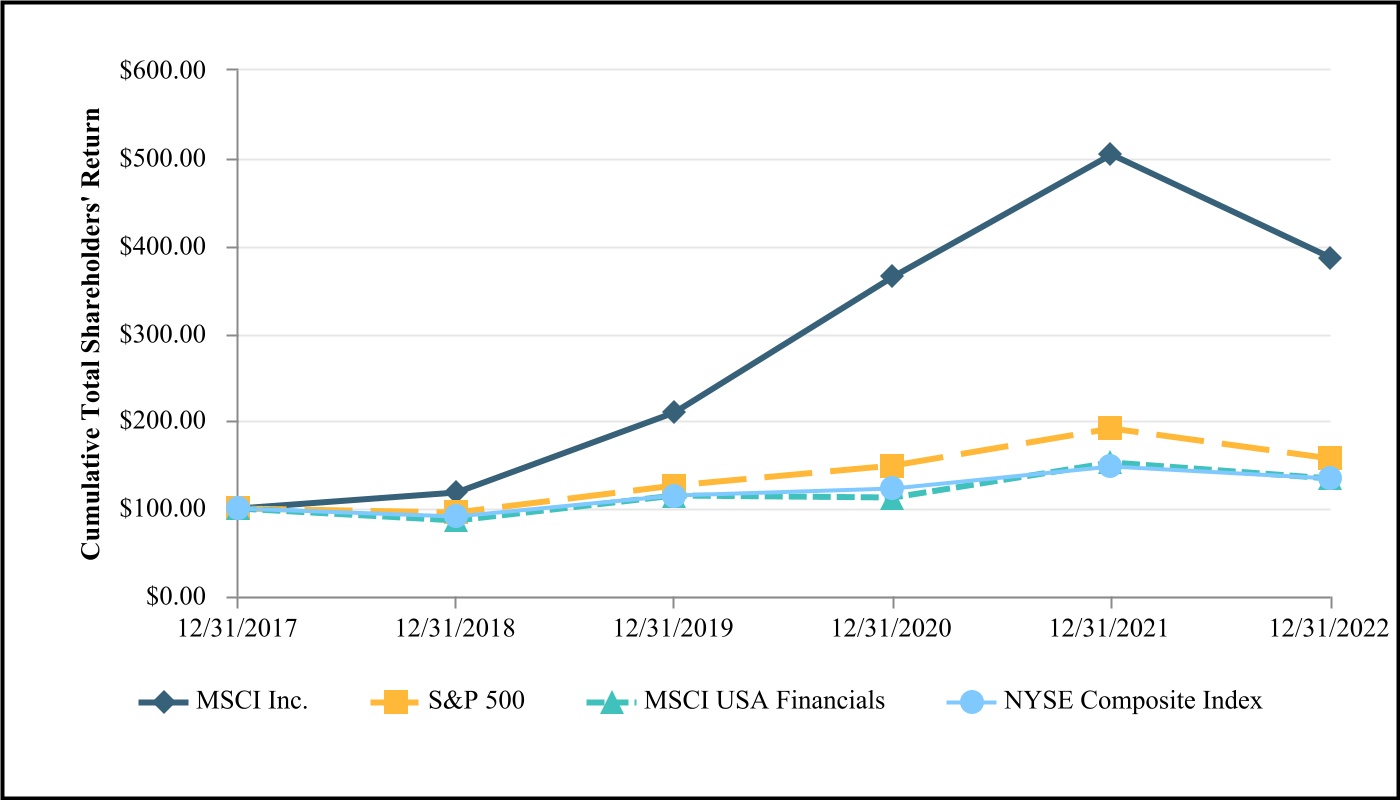
Total Investment Value
| Years Ended | ||||||||||||||||||||||||||||||||||||||
| December 31, 2017 | December 31, 2018 | December 31, 2019 | December 31, 2020 | December 31, 2021 | December 31, 2022 | |||||||||||||||||||||||||||||||||
| MSCI Inc. | $100 | $118 | $209 | $364 | $503 | $386 | ||||||||||||||||||||||||||||||||
| S&P 500 | $100 | $96 | $126 | $149 | $192 | $157 | ||||||||||||||||||||||||||||||||
| MSCI USA Financials Index(1) | $100 | $86 | $115 | $113 | $153 | $134 | ||||||||||||||||||||||||||||||||
| NYSE Composite Index(1) | $100 | $91 | $114 | $122 | $148 | $134 |
(1)To better align with comparable investment opportunities, for the year ended December 31, 2022, MSCI replaced the NYSE Composite Index with the MSCI USA Financials Index. Both indices are presented, in accordance with SEC rules, which require that if a company selects a different index from that used in the immediately preceding fiscal year, the company’s stock performance must be compared against both the newly selected index and previous index in the year of change. MSCI USA Financials Index is an index operated by MSCI.
Item 6. [Reserved]
Item 7. Management’s Discussion and Analysis of Financial Condition and Results of Operations
The following Management’s Discussion and Analysis of Financial Condition and Results of Operations is a discussion and analysis of the financial condition and results of the operations of MSCI Inc. and its consolidated subsidiaries for the year ended December 31, 2022. This discussion should be read in conjunction with the consolidated financial statements and related notes included elsewhere in this Annual Report on Form 10-K. The discussion summarizing the significant factors affecting the results of operations and financial condition of MSCI for the year ended December 31, 2021 can be found in Part II, “Item 7. Management’s Discussion and Analysis of Financial Condition and Results of Operations” of our Annual Report on Form 10-K for the year ended December 31, 2021 (the “2021 Annual Report”), which was filed with the Securities and Exchange Commission on February 11, 2022.
Overview
We are a leading provider of critical decision support tools and solutions for the global investment community. Our mission-critical offerings help investors address the challenges of a transforming investment landscape and power better investment decisions. Leveraging our knowledge of the global investment process and our expertise in research, data and technology, we enable our clients to understand and analyze key drivers of risk and return and confidently and efficiently build more effective portfolios. We operate in four reportable segments as follows: Index, Analytics, ESG and Climate, and All Other – Private Assets.
The operating segments of Real Assets and The Burgiss Group, LLC (“Burgiss”) do not individually meet the segment reporting thresholds and have been combined and presented as part of the All Other – Private Assets reportable segment. During the year ended December 31, 2022, we renamed the Real Estate operating segment to Real Assets.
Our growth strategy includes: (a) extending leadership in research-enhanced content across asset classes, (b) leading the enablement of ESG and climate investment integration, (c) enhancing distribution and content-enabling technology, (d) expanding solutions that empower client customization, (e) strengthening client relationships and growing into strategic partnerships with clients and (f) executing strategic relationships and acquisitions with complementary content and technology companies. For more information about our Company’s operations, see “Item 1: Business”.
Key Financial and Operating Metrics and Drivers
In evaluating our financial performance, we focus on revenue and profit growth, including results accounted for under generally accepted accounting principles in the United States (“GAAP”) as well as non-GAAP measures, for the Company as a whole and by operating segment.
We present revenues disaggregated by types and by segments, which represent our major product lines. We also review expenses by activity, which provides more transparency into how resources are being deployed. In addition, we utilize operating metrics including Run Rate, subscription sales and Retention Rate to manage and assess performance and to provide deeper insights into the recurring portion of our business.
In the discussion that follows, we provide certain variances excluding the impact of foreign currency exchange rate fluctuations and acquisitions. Foreign currency exchange rate fluctuations reflect the difference between the current period results as reported compared to the current period results recalculated using the foreign currency exchange rates in effect for the comparable prior period. While operating revenues adjusted for the impact of foreign currency fluctuations includes asset-based fees that have been adjusted for the impact of foreign currency fluctuations, the underlying AUM, which is the primary component of asset-based fees, is not adjusted for foreign currency fluctuations. Approximately three-fifths of the AUM is invested in securities denominated in currencies other than the U.S. dollar, and accordingly, any such impact is excluded from the disclosed foreign currency-adjusted variances.
Revenues
Our revenues are presented by type and by reportable segment. For each reportable segment, we present revenues disaggregated by the nature of the revenues, which are recurring subscriptions, asset-based fees and non-recurring revenues.
Recurring subscription revenues represent fees earned from clients primarily under renewable contracts and are generally recognized ratably over the term of the license or service pursuant to the contract terms. The fees are recognized as we provide the product and service to the client over the license period and are generally billed in advance, prior to the license start date.
Asset-based fees represent fees earned that are variable in nature, as they are primarily calculated based on the AUM linked to our indexes. Asset-based fees also include revenues related to futures and options contracts linked to our indexes, which are based on trading volumes and fee levels.
Non-recurring revenues primarily represent fees earned on products and services where we typically do not have renewal clauses within the contract. Examples of such products and services include one-time license fees, certain derivative financial products, certain implementation services and historical data sets. Based on the nature of the services provided, non-recurring revenues are generally billed either in advance or after delivery and recognized point in time or over the service period.
Operating Expenses
We group our operating expenses into the following activity categories:
-
Cost of revenues;
-
Selling and marketing;
-
Research and development (“R&D”);
-
General and administrative (“G&A”);
-
Amortization of intangible assets; and
-
Depreciation and amortization of property, equipment and leasehold improvements.
Costs are assigned to these activity categories based on the nature of the expense or, when not directly attributable, an estimated allocation based on the type of effort involved. Cost of revenues, selling and marketing, R&D and G&A all include both compensation as well as non-compensation related expenses
Cost of Revenues
Cost of revenues expenses consist of costs related to the production and servicing of our products and services and primarily includes related information technology costs, including data center, cloud service, platform and infrastructure costs; costs to acquire, produce and maintain market data information; costs of research to support and maintain existing products; costs of product management teams; costs of client service and consultant teams to support customer needs; as well as other support costs directly attributable to the cost of revenues including certain human resources, finance and legal costs.
Selling and Marketing
Selling and marketing expenses consist of costs associated with acquiring new clients or selling new products or product renewals to existing clients and primarily includes the costs of our sales and marketing teams, as well as costs incurred in other departments associated with acquiring new business, including product management, research, technology and sales operations.
Research and Development
R&D expenses consist of costs to develop new or enhance existing products and the costs to develop new or enhanced technologies and service platforms for the delivery of our products and services and primarily include the costs of development, research, product management, project management and the technology support directly associated with these activities.
General and Administrative
G&A expenses consist of costs primarily related to finance operations, human resources, office of the CEO, legal, corporate technology, corporate development, impairment charges associated with right of use assets and certain other administrative costs that are not directly attributed, but are instead allocated, to a prod
Showing the first 8K of 97K characters. Open the full section
Item 7A. Quantitative and Qualitative Disclosures About Market Risk
Foreign Currency Risk
We are subject to foreign currency exchange fluctuation risk. Exchange rate movements can impact the U.S. dollar-reported value of our revenues, expenses, assets and liabilities denominated in non-U.S. dollar currencies or where the currency of such items is different than the functional currency of the entity where these items were recorded.
We generally invoice our clients in U.S. dollars; however, we invoice a portion of our clients in Euros, British pounds sterling, Japanese yen and a limited number of other non-U.S. dollar currencies. For the years ended December 31, 2022 and 2021, 15.9% and 15.1%, respectively, of our revenues were subject to foreign currency exchange rate risk and primarily included clients billed in foreign currency as well as U.S. dollar exposures on non-U.S. dollar foreign operating entities. Of the 15.9% of non-U.S. dollar exposure for the year ended December 31, 2022, 41.4% was in Euros, 30.4% was in British pounds sterling and 18.8% was in Japanese yen. Of the 15.1% of non-U.S. dollar exposure for the year ended December 31, 2021, 41.6% was in Euros, 26.5% was in British pounds sterling and 23.8% was in Japanese yen.
Revenues from asset-based fees represented 23.5% and 27.1% of operating revenues for the years ended December 31, 2022 and 2021, respectively. While a substantial portion of our asset-based fees are invoiced in U.S. dollars, the fees are based on the assets in investment products, of which approximately three-fifths are invested in securities denominated in currencies other than the U.S. dollar. Accordingly, declines in such other currencies against the U.S. dollar will decrease the fees payable to us under such licenses. In addition, declines in such currencies against the U.S. dollar could impact the attractiveness of such investment products resulting in net fund outflows, which would further reduce the fees payable under such licenses.
We are exposed to additional foreign currency risk in certain of our operating costs. Approximately 42.1% and 41.1% of our operating expenses for the years ended December 31, 2022 and 2021, respectively, were denominated in foreign currencies, the significant majority of which were denominated in British pounds sterling, Indian rupees, Euros, Hungarian forints, Mexican pesos and Swiss francs.
We have certain monetary assets and liabilities denominated in currencies other than local functional amounts, and when these balances are remeasured into their local functional currency, either a gain or a loss results from the change of the value of the functional currency as compared to the originating currencies. We manage foreign currency exchange rate risk, in part, through the use of derivative financial instruments comprised principally of forward contracts on foreign currency which are not designated as hedging instruments for accounting purposes. The objective of the derivative instruments is to minimize the impact on the income statement of the volatility of amounts denominated in certain foreign currencies. We recognized total foreign currency exchange gains of $0.5 million for the year ended December 31, 2022 and foreign currency exchange losses of $1.9 million for the year ended December 31, 2021.
Item 8. Financial Statements and Supplementary Data
INDEX TO CONSOLIDATED FINANCIAL STATEMENTS
REPORT OF INDEPENDENT REGISTERED PUBLIC ACCOUNTING FIRM
To the Board of Directors and Shareholders of MSCI Inc.
Opinions on the Financial Statements and Internal Control over Financial Reporting
We have audited the accompanying consolidated statements of financial condition of MSCI Inc. and its subsidiaries (the “Company”) as of December 31, 2022 and 2021, and the related consolidated statements of income, of comprehensive income, of shareholders' equity (deficit) and of cash flows for each of the three years in the period ended December 31, 2022, including the related notes (collectively referred to as the “consolidated financial statements”). We also have audited the Company's internal control over financial reporting as of December 31, 2022, based on criteria established in Internal Control - Integrated Framework (2013) issued by the Committee of Sponsoring Organizations of the Treadway Commission (COSO).
In our opinion, the consolidated financial statements referred to above present fairly, in all material respects, the financial position of the Company as of December 31, 2022 and 2021, and the results of its operations and its cash flows for each of the three years in the period ended December 31, 2022 in conformity with accounting principles generally accepted in the United States of America. Also in our opinion, the Company maintained, in all material respects, effective internal control over financial reporting as of December 31, 2022, based on criteria established in Internal Control - Integrated Framework (2013) issued by the COSO.
Basis for Opinions
The Company's management is responsible for these consolidated financial statements, for maintaining effective internal control over financial reporting, and for its assessment of the effectiveness of internal control over financial reporting, included in Management’s Annual Report on Internal Control Over Financial Reporting appearing under Item 9A. Our responsibility is to express opinions on the Company’s consolidated financial statements and on the Company's internal control over financial reporting based on our audits. We are a public accounting firm registered with the Public Company Accounting Oversight Board (United States) (PCAOB) and are required to be independent with respect to the Company in accordance with the U.S. federal securities laws and the applicable rules and regulations of the Securities and Exchange Commission and the PCAOB.
We conducted our audits in accordance with the standards of the PCAOB. Those standards require that we plan and perform the audits to obtain reasonable assurance about whether the consolidated financial statements are free of material misstatement, whether due to error or fraud, and whether effective internal control over financial reporting was maintained in all material respects.
Our audits of the consolidated financial statements included performing procedures to assess the risks of material misstatement of the consolidated financial statements, whether due to error or fraud, and performing procedures that respond to those risks. Such procedures included examining, on a test basis, evidence regarding the amounts and disclosures in the consolidated financial statements. Our audits also included evaluating the accounting principles used and significant estimates made by management, as well as evaluating the overall presentation of the consolidated financial statements. Our audit of internal control over financial reporting included obtaining an understanding of internal control over financial reporting, assessing the risk that a material weakness exists, and testing and evaluating the design and operating effectiveness of internal control based on the assessed risk. Our audits also included performing such other procedures as we considered necessary in the circumstances. We believe that our audits provide a reasonable basis for our opinions.
Definition and Limitations of Internal Control over Financial Reporting
A company’s internal control over financial reporting is a process designed to provide reasonable assurance regarding the reliability of financial reporting and the preparation of financial statements for external purposes in accordance with generally accepted accounting principles. A company’s internal control over financial reporting includes those policies and procedures that (i) pertain to the maintenance of records that, in reasonable detail, accurately and fairly reflect the transactions and dispositions of the assets of the company; (ii) provide reasonable assurance that transactions are recorded as necessary to permit preparation of financial statements in accordance with generally accepted accounting principles, and that receipts and expenditures of the company are being made only in accordance with authorizations of management and directors of the company; and (iii) provide reasonable assurance regarding prevention or timely detection of unauthorized acquisition, use, or disposition of the company’s assets that could have a material effect on the financial statements.
Because of its inherent limitations, internal control over financial reporting may not prevent or detect misstatements. Also, projections of any evaluation of effectiveness to future periods are subject to the risk that controls may become inad
Showing the first 8K of 154K characters. Open the full section
Item 9. Changes in and Disagreements With Accountants on Accounting and Financial Disclosure
None.
Item 9A. Controls and Procedures
(a). Evaluation of Disclosure Controls and Procedures
The Company maintains disclosure controls and procedures that are designed to ensure that information required to be disclosed in the Company’s reports under the Securities Exchange Act of 1934, as amended (the “Exchange Act”), is recorded, processed, summarized and reported within the time periods specified in the SEC’s rules and forms, and that such information is accumulated and communicated to management, including our Chief Executive Officer (“CEO”) and Chief Financial Officer (“CFO”) as appropriate, to allow timely decisions regarding required disclosure.
Management of the Company, with the participation of its CEO and CFO, evaluated the effectiveness of the Company’s disclosure controls and procedures. Based on their evaluation, as of December 31, 2022, the end of the period covered by this Annual Report on Form 10-K, the Company’s CEO and CFO have concluded that the Company’s disclosure controls and procedures (as defined in Rules 13a-15(e) and 15d-15(e) under the Exchange Act) were effective.
(b). Management’s Annual Report on Internal Control Over Financial Reporting
Our management is responsible for establishing and maintaining adequate internal control over financial reporting. Internal control over financial reporting is defined in Rules 13a-15(f) and 15d-15(f) promulgated under the Exchange Act as a process designed by, or under the supervision of, our principal executive and principal financial officers or persons performing similar functions and effected by the Company’s Board of Directors, management and other personnel, to provide reasonable assurance regarding the reliability of financial reporting and the preparation of financial statements for external purposes in accordance with GAAP and includes those policies and procedures that:
-
pertain to the maintenance of records that, in reasonable detail, accurately and fairly reflect our transactions and dispositions of our assets,
-
provide reasonable assurance that transactions are recorded as necessary to permit preparation of our financial statements in accordance with GAAP, and that our receipts and expenditures are being made only in accordance with authorizations of management and directors of the Company, and
-
provide reasonable assurance regarding prevention or timely detection of unauthorized acquisition, use or disposition of our assets that could have a material effect on the financial statements.
Because of its inherent limitations, internal control over financial reporting may not prevent or detect misstatements. Also, projections of any evaluation of effectiveness to future periods are subject to the risk that controls may become inadequate because of changes in conditions, or that the degree of compliance with the policies or procedures may deteriorate.
Management assessed the effectiveness of our internal control over financial reporting as of December 31, 2022 based on the criteria described in Internal Control—Integrated Framework (2013) issued by the Committee of Sponsoring Organizations of the Treadway Commission (COSO).
Based on this assessment, management, including the Company’s CEO and CFO, concluded that, as of December 31, 2022, our internal control over financial reporting was effective in providing reasonable assurance regarding the reliability of financial reporting and the preparation of financial statements for external purposes in accordance with generally accepted accounting principles.
PricewaterhouseCoopers LLP, our independent registered public accounting firm, has audited and issued a report on the effectiveness of our internal control over financial reporting as of December 31, 2022, which appears on page 56 of this Annual Report on Form 10-K.
(c). Changes in Internal Control Over Financial Reporting
There have been no changes in our internal control over financial reporting (as defined in Rules 13a-15(f) and 15d-15(f) under the Exchange Act) during the fiscal quarter ended December 31, 2022 that have materially affected, or are reasonably likely to materially affect, our internal control over financial reporting.
Item 9B. Other Information
None.
Item 9C. Disclosure Regarding Foreign Jurisdiction that Prevent Inspections
None.
PART III
Item 10. Directors, Executive Officers and Corporate Governance
Except for the information relating to our Executive Officers set forth in Part I of this Annual Report on Form 10-K, we incorporate by reference the information responsive to this Item appearing in our Proxy Statement, which will be filed no later than 120 days after December 31, 2022.
Information regarding our Code of Ethics and Business Conduct and Corporate Governance Policies is incorporated herein by reference from our Proxy Statement, which will be filed no later than 120 days after December 31, 2022. Any amendments to, or waivers from, a provision of our Code of Ethics that apply to our principal executive officer, principal financial officer, principal accounting officer or controller, or persons performing similar functions and that relates to any element of the Code of Ethics enumerated in paragraph (b) of Item 406 of Regulation S-K shall be disclosed by posting such information on our website at www.msci.com. Information contained on our website is not deemed part of or incorporated by reference into this Annual Report on Form 10-K or any other report filed with the SEC.
Item 11. Executive Compensation
We incorporate by reference the information responsive to this Item appearing in our Proxy Statement, which will be filed no later than 120 days after December 31, 2022.
Item 12. Security Ownership of Certain Beneficial Owners and Management and Related Stockholder Matters
We incorporate by reference the additional information responsive to this Item appearing in our Proxy Statement, which will be filed no later than 120 days after December 31, 2022.
Equity Compensation Plans
On February 18, 2016, the Board of Directors, upon the recommendation of the Compensation & Talent Management Committee of the Board of Directors (the “Compensation Committee”), approved the MSCI Inc. 2016 Non-Employee Directors Compensation Plan (the “Directors Plan”), a cash and equity incentive compensation plan that was approved by shareholders at the Company’s 2016 annual meeting of shareholders. The Directors Plan replaced the Company’s then existing non-employee director compensation plan, the MSCI Inc. Independent Directors’ Equity Compensation Plan (the “2011 Plan”). The total number of shares authorized to be awarded under the Directors Plan is 352,460, which is equal to the number of shares that remained available for issuance under the 2011 Plan. Under the MSCI Inc. Non-Employee Directors Deferral Plan, directors may elect to defer receipt of all or any portion of any shares of our common stock issuable upon conversion of any stock unit or any retainer elected to be paid in shares of our common stock until (i) 60 days following separation of service or (ii) the earlier of a specified date or 60 days following separation of service.
On February 18, 2016, the Board of Directors, upon the recommendation of the Compensation Committee, approved the MSCI Inc. 2016 Omnibus Plan (“Omnibus Plan”), an equity incentive compensation plan that was approved by shareholders at the Company’s 2016 annual meeting of shareholders. The Omnibus Plan replaced the Company’s then existing equity compensation plan, the MSCI Inc. Amended and Restated 2007 Equity Incentive Compensation Plan (as amended, the “2007 Plan”). Compensation paid to the Company’s executive officers historically complied with the performance-based compensation exception under 162(m) of the IRC (“162(m)”) by being granted pursuant to the MSCI Inc. Performance Formula and Incentive Plan (the “Performance Plan”). Shareholder approval of the Omnibus Plan constituted approval of the material terms of the performance goals under the Omnibus Plan for purposes of 162(m). In light of the final Section 162(m) regulations published in December 2020, which, among other things, eliminated the performance-based compensation exception under Section 162(m), the Compensation Committee determined to cease awarding compensation to the Company’s executive officers under the Performance Plan starting with calendar year 2021.
Pursuant to the Omnibus Plan, the Company reserved 7,565,483 shares of common stock for issuance; plus any additional shares which become available due to forfeiture, expiration or cancellation of outstanding awards, which were registered under the Securities Act following approval by the Company’s shareholders. This is in addition to currently outstanding awards under the 2007 Plan. The Omnibus Plan permits the Compensation Committee to make grants of a variety of equity-based awards (such as stock options, stock appreciation rights, restricted stock units, restricted stock, performance awards and other stock-based awards) totaling up to 7,565,483 and other cash-based awards to eligible recipients, including employees and consultants. No awards will be granted under the Omnibus Plan after the earliest to occur of (i) April 28, 2026, (ii) the maximum number of shares available for issuance having been issued and (iii) the Board of Directors terminating the Omnibus Plan in accordance with its terms.
The following table presents certain information with respect to our equity compensation plans at December 31, 2022:
| Number of securities to be issued upon exercise of outstanding options, warrants and rights (a) | Weighted-average exercise price of outstanding options, warrants and rights (b) (3) | Number of securities remaining available for future issuance under equity compensation plans (excluding securities reflected in column(a)) (c) | ||||||||||||||||||
| Equity Compensation Plans Approved by Security Holders | ||||||||||||||||||||
| MSCI Inc. 2016 Omnibus Plan | ||||||||||||||||||||
| Restricted Stock Units (“RSUs”) | 151,659 | N/A | ||||||||||||||||||
| Performance Stock Units (“PSUs”) (1) | 930,912 | N/A | ||||||||||||||||||
| Performance Stock Options (“PSOs”) (2) | 235,528 | 549.83 | ||||||||||||||||||
| Total MSCI Inc. 2016 Omnibus Plan | 1,318,099 | N/A | 3,163,384 | |||||||||||||||||
| MSCI Inc. 2016 Non-Employee Directors Compensation Plan (RSUs) | 4,451 | N/A | 273,488 | |||||||||||||||||
| Equity Compensation Plans Not Approved by Security Holders | — | N/A | — | |||||||||||||||||
| Total | 1,322,550 | N/A | 3,436,872 | |||||||||||||||||
(1)The numbers included for PSUs in column (a) reflect the maximum payout. Assuming target number payout, the number of securities to be issued upon vesting of PSUs is 397,588.
(2)The numbers included for PSOs in column (a) reflect options at the maximum payout. Assuming target number payout, the number of securities to be issued upon vesting of PSOs is 117,764.
(3)Does not reflect the unvested RSUs or PSUs included in column (a) because these awards have no exercise price.
Item 13. Certain Relationships and Related Transactions, and Director Independence
We incorporate by reference the information responsive to this Item appearing in our Proxy Statement, which will be filed no later than 120 days after December 31, 2022.
Item 14. Principal Accountant Fees and Services
We incorporate by reference the information responsive to this Item appearing in our Proxy Statement, which will be filed no later than 120 days after December 31, 2022.
PART IV
Item 15. Exhibit and Financial Statement Schedules
(a)(1) Financial Statements
The financial statements are provided under Part II, Item 8. “Financial Statements and Supplementary Data” of this Annual Report on Form 10-K.
(a)(2) Financial Statement Schedules
No financial statement schedules are provided because the information called for is not applicable or not required or is included in the consolidated financial statements or the notes thereto provided under Part II, Item 8. “Financial Statements and Supplementary Data” of this Annual Report on Form 10-K.
(a)(3) Exhibits
The information required by this Item is set forth below.
EXHIBIT INDEX
| Exhibit Number | Description | Form | File No. | Exhibit No. | Filing Date | |||||||||||||||||||||||||||
| 101.DEF | XBRL Taxonomy Extension Definition Linkbase Document. | Filed Herewith | ||||||||||||||||||||||||||||||
| 104.DEF | Cover Page Interactive Data File (formatted as Inline XBRL and contained in Exhibit 101) | Filed Herewith |
*Indicates a management compensation plan, contract or arrangement.
† Certain confidential portions of this Exhibit have been omitted pursuant to Item 601(b) of Regulation S-K because the identified confidential portions (i) are not material and (ii) are of the type that the Company treats as private or confidential.
The Company agrees to furnish an unredacted copy of this exhibit to the Securities and Exchange Commission upon its request.
Item 16. Form 10-K Summary
None.
SIGNATURES
Pursuant to the requirements of Section 13 or 15(d) of the Securities Exchange Act of 1934, the Registrant has duly caused this Report to be signed on its behalf by the undersigned, thereunto duly authorized.
| MSCI INC. | |||||||||||
| By: | /S/ HENRY A. FERNANDEZ | ||||||||||
| Name: | Henry A. Fernandez | ||||||||||
| Title: | Chairman and Chief Executive Officer |
Date: February 10, 2023
POWER OF ATTORNEY
KNOW ALL PERSONS BY THESE PRESENTS, that each person whose signature appears below constitutes and appoints Andrew C. Wiechmann, Robert J. Gutowski and Cecilia Aza, and each or any one of them, his or her true and lawful attorneys-in-fact and agents, with full powers of substitution and resubstitution, for him or her and in his or her name, place and stead, in the capacities indicated below, to sign any and all amendments to this Annual Report on Form 10-K and to file the same, with all exhibits thereto and other documents in connection therewith, with the Securities and Exchange Commission, hereby ratifying and confirming his or her signatures as they may be signed by his or her said attorneys-in-fact and agents, or their substitute or substitutes, to any and all amendments to this Annual Report on Form 10-K.
Pursuant to the requirements of Section 13 or 15(d) of the Securities Exchange Act of 1934, this report has been signed below by the following persons on behalf of the Registrant and in the capacities and on the dates indicated.
| Signature | Title | Date | ||||||||||||
| /S/ HENRY A. FERNANDEZ | Chairman and Chief Executive Officer (principal executive officer) | February 10, 2023 | ||||||||||||
| Henry A. Fernandez | ||||||||||||||
| /S/ ANDREW C. WIECHMANN | Chief Financial Officer (principal financial officer) | February 10, 2023 | ||||||||||||
| Andrew C. Wiechmann | ||||||||||||||
| /S/ JENNIFER MAK | Global Controller and Head of Finance Operations (principal accounting officer) | February 10, 2023 | ||||||||||||
| Jennifer Mak | ||||||||||||||
| /S/ ROBERT G. ASHE | Director | February 10, 2023 | ||||||||||||
| Robert G. Ashe | ||||||||||||||
| /S/ WAYNE EDMUNDS | Director | February 10, 2023 | ||||||||||||
| Wayne Edmunds | ||||||||||||||
| /S/ CATHERINE R. KINNEY | Director | February 10, 2023 | ||||||||||||
| Catherine R. Kinney | ||||||||||||||
| /S/ ROBIN MATLOCK | Director | February 10, 2023 | ||||||||||||
| Robin Matlock | ||||||||||||||
| /S/ JACQUES P. PEROLD | Director | February 10, 2023 | ||||||||||||
| Jacques P. Perold | ||||||||||||||
| /S/ C.D. BAER PETTIT | Director, President and Chief Operating Officer | February 10, 2023 | ||||||||||||
| C.D. Baer Pettit | ||||||||||||||
| /S/ SANDY C. RATTRAY | Director | February 10, 2023 | ||||||||||||
| Sandy C. Rattray | ||||||||||||||
| /S/ LINDA H. RIEFLER | Director | February 10, 2023 | ||||||||||||
| Linda H. Riefler | ||||||||||||||
| /S/ MARCUS L. SMITH | Director | February 10, 2023 | ||||||||||||
| Marcus L. Smith | ||||||||||||||
| /S/ RAJAT TANEJA | Director | February 10, 2023 | ||||||||||||
| Rajat Taneja | ||||||||||||||
| /S/ PAULA VOLENT | Director | February 10, 2023 | ||||||||||||
| Paula Volent |