 filings.tools
Motorola Solutions 10-K 2022-12-31
Filed 2023-02-16. 23 sections, 571K characters. Original on sec.gov · Markdown · JSON
Cover and table of contents
UNITED STATES
SECURITIES AND EXCHANGE COMMISSION
Washington, D.C. 20549
FORM 10-K
| ☒ | ANNUAL REPORT PURSUANT TO SECTION 13 OR 15(d) OF THE SECURITIES EXCHANGE ACT OF 1934 |
For the fiscal year ended December 31, 2022
or
| ☐ | TRANSITION REPORT PURSUANT TO SECTION 13 OR 15(d) OF THE SECURITIES EXCHANGE ACT OF 1934 |
For the transition period from to
Commission File number 1-7221
MOTOROLA SOLUTIONS, INC.
(Exact name of registrant as specified in its charter)
| Delaware | 36-1115800 | |||||||
| (State of Incorporation) | (I.R.S. Employer Identification No.) |
500 W. Monroe Street, Chicago, Illinois 60661
(Address of principal executive offices, zip code)
(847) 576-5000
Registrant’s telephone number, including area code:
Securities registered pursuant to Section 12(b) of the Act:
| Title of Each Class | Trading Symbol(s) | Name of Each Exchange on Which Registered | ||||||||||||||||||
| Common Stock | $0.01 | Par Value | MSI | New York Stock Exchange |
Securities registered pursuant to Section 12(g) of the Act: None
Indicate by check mark if the registrant is a well-known seasoned issuer, as defined in Rule 405 of the Securities Act. Yes ☒ No ☐
Indicate by check mark if the registrant is not required to file reports pursuant to Section 13 or 15(d) of the Securities Exchange Act of 1934. Yes ☐ No ☒
Indicate by check mark whether the registrant (1) has filed all reports required to be filed by Section 13 or 15(d) of the Securities Exchange Act of 1934 during the preceding 12 months (or for such shorter period that the registrant was required to file such reports), and (2) has been subject to such filing requirements for the past 90 days. Yes ☒ No ☐
Indicate by check mark whether the registrant has submitted electronically every Interactive Data File required to be submitted pursuant to Rule 405 of Regulation S-T during the preceding 12 months (or for such shorter period that the registrant was required to submit such files). Yes ☒ No ☐
Indicate by check mark whether the registrant is a large accelerated filer, an accelerated filer, a non-accelerated filer, a smaller reporting company, or an emerging growth company. See the definitions of “large accelerated filer,” “accelerated filer”, “smaller reporting company” and "emerging growth company" in Rule 12b-2 of the Exchange Act.
| Large accelerated filer | ☒ | Accelerated filer | ☐ | Non-accelerated filer | ☐ | Smaller reporting company | ☐ | Emerging growth company | ☐ | ||||||||||||||||||||||||||||||||
If an emerging growth company, indicate by check mark if the registrant has elected not to use the extended transition period for complying with any new or revised financial accounting standards provided pursuant to Section 13(a) of the Exchange Act. ☐
Indicate by check mark whether the registrant has filed a report on and attestation to its management’s assessment of the effectiveness of its internal control over financial reporting under Section 404(b) of the Sarbanes-Oxley Act (15 U.S.C. 7262(b)) by the registered public accounting firm that prepared or issued its audit report. ☒
Indicate by check mark whether the registrant is a shell company (as defined in Rule 12b-2 of the Exchange Act). Yes ☐ No ☒
The aggregate market value of voting and non-voting common equity held by non-affiliates of the registrant as of July 1, 2022 (the last business day of the registrant’s most recently completed second quarter) was approximately $31.0 billion.
The number of shares of the registrant’s Common Stock, $.01 par value per share, outstanding as of February 6, 2023 was 167,250,071.
DOCUMENTS INCORPORATED BY REFERENCE
Portions of the registrant’s definitive Proxy Statement to be delivered to stockholders in connection with its Annual Meeting of Shareholders to be held on May 16, 2023 (the "Proxy Statement"), are incorporated by reference into Part III of this Annual Report on Form 10-K (this "Form 10-K").
Throughout this Form 10-K we “incorporate by reference” certain information in parts of other documents filed with the Securities and Exchange Commission (the “SEC”). The SEC allows us to disclose important information by referring to it in that manner. Please refer to such information.
“Motorola Solutions” (which may be referred to as the “Company,” “we,” “us,” or “our”) means Motorola Solutions, Inc. or Motorola Solutions, Inc. and its subsidiaries, or one of our segments, as the context requires. MOTOROLA, MOTO, MOTOROLA SOLUTIONS and the Stylized M Logo, as well as iDEN are trademarks or registered trademarks of Motorola Trademark Holdings, LLC and are used under license.
Forward-Looking Statements
Statements in this Form 10-K which are not historical in nature are forward-looking statements within the meaning of applicable federal securities law. These statements are made pursuant to the safe harbor provisions of the Private Securities Litigation Reform Act of 1995 and generally include words such as “believes,” “expects,” “intends,” “aims,” “estimates” and similar expressions. We can give no assurance that any future results or events discussed in these statements will be achieved. Any forward-looking statements represent our views only as of today and should not be relied upon as representing our views as of any subsequent date. Readers are cautioned that such forward-looking statements are subject to a variety of risks and uncertainties that could cause our actual results to differ materially from the statements contained in this Form 10-K. Some of these risks and uncertainties include, but are not limited to, those discussed in “Part I. Item 1A. Risk Factors” of this Form 10-K and those described elsewhere in this Form 10-K or in our other SEC filings. Forward-looking statements include, but are not limited to, statements under the following headings: (1) “Business,” about: (a) industry growth and demand, including opportunities resulting from such growth, (b) future product development and the demand for, growth related to, and benefits of, new products, (c) growth of sales with existing customers, (d) customer spending and behavior and requests for vendor financing, (e) the impact of our strategy and focus areas, (f) the impact from the loss of key customers, (g) competitive position and our ability to maintain a leadership position in our core products, (h) increased competition, (i) our practice of subcontracting work to other companies to fulfill customer needs, (j) the impact of recent acquisitions on our business, (k) the impact of existing and future regulatory matters (including with respect to climate change) on our business, (l) the firmness of each segment's backlog, (m) the competitiveness of the patent portfolio, (n) the impact of research and development, (o) the availability and costs of materials and components, energy supplies and labor and the impact of such availability and costs, (p) the seasonality of the business, and (q) our human capital management strategy and philosophy; (2) "Risk Factors," about potential impacts of the risks we face; (3) “Legal Proceedings,” about the ultimate disposition of pending legal matters and timing; (4) “Management's Discussion and Analysis of Financial Condition and Results of Operations,” about: (a) the impact of the Russia-Ukraine conflict on our business and the potential for broader economic disruption, (b) the continuing and future impact of COVID-19 on our business, (c) the availability and costs of materials and components (including inventory levels) and the impact of such availability and costs (including our actions in response to such availability and costs), (d) the impact of inflation on our business, including the impact of the Federal Reserve’s interest rate increases and the impact of our actions in response to such inflation, (e) the impact of the American Rescue Plan Act of 2021 on our business, (f) the impact of global economic and political conditions on our business, (g) the impact of the United Kingdom’s Competition and Markets Authority’s provisional decision regarding Airwave (including our actions in response to such provisional decision) on our business, (h) the impact on our business of our entry into a signed agreement with the Home Office of the United Kingdom for us to exit the Emergency Services Network contract early, (i) the impact of taxes on our business, (j) the impact of acquisitions on our business, (k) the impact of existing and future laws, regulations, international treaties and industry standards relating to climate change on our business, (l) market growth/contraction, demand, spending and resulting opportunities, (m) industry growth and demand, including opportunities resulting from such growth, (n) future product development and demand for, growth related to, and benefits of, new products, (o) the impact of foreign exchange rate fluctuations, (p) our continued ability to reduce our operating expenses, (q) expected impacts to operating leverage and operating margins, (r) the growth of sales opportunities in our LMR Communications, Video Security and Access Control and Command Center technologies, (s) the return of capital to shareholders through dividends and/or repurchasing shares, (t) the impact and success of our business strategy and portfolio, (u) future payments, charges, and use of accruals associated with our reorganization of business programs and employee separation costs, (v) our ability and cost to repatriate funds, (w) future cash contributions to pension plans or retiree health benefit plans, (x) the liquidity of our investments, (y) our ability and cost to access the capital markets, (z) our ability to borrow and the amount available under our credit facilities, (aa) adequacy of internal resources to fund expected working capital and capital expenditure measurements, (bb) expected payments pursuant to commitments under agreements and other obligations in the short-term and long-term, (cc) the ability to meet minimum purchase obligations, (dd) the impact of contractual damage claims exceeding the underlying contract value, (ee) our ability to sell accounts receivable and the terms and amounts of such sales, (ff) the outcome and effect of ongoing and future legal proceedings, and (gg) the impact of the adoption of accounting pronouncements on our financial results; and (5) “Quantitative and Qualitative Disclosures about Market Risk,” about: (a) the impact of foreign currency risk, (b) the impact of interest rate risk, and (c) future hedging activity and expectations of the Company.
PART I
Item 1. Business
Overview
Motorola Solutions is a global leader in public safety and enterprise security. Our technologies in Land Mobile Radio Communications ("LMR" or "LMR Communications"), Video Security and Access Control ("Video") and Command Center,
bolstered by managed and support services, help make communities safer and businesses stay productive and secure. We serve more than 100,000 public safety and commercial customers in over 100 countries, providing “purpose-built” solutions designed for their unique needs, and we have a rich heritage of innovation focusing on advancing global safety for more than 90 years.
We are incorporated under the laws of the State of Delaware as the successor to an Illinois corporation, Motorola, Inc., organized in 1928. We changed our name from Motorola, Inc. to Motorola Solutions, Inc. on January 4, 2011. Our principal executive offices are located at 500 W. Monroe St., Chicago, Illinois 60661.
Business Organization
We manage our business organizationally through two segments: “Products and Systems Integration” and “Software and Services.” Within these segments, we have principal product lines that also follow our three major technologies: LMR Communications, Video and Command Center. In January 2023, we began using Command Center as a naming convention, eliminating the "Software" descriptor from Command Center Software in order to inform investors that the Company has software components more broadly across all technologies; this name change does not require any financial information to be reclassified from previous periods.
-
LMR Communications: Infrastructure, devices (two-way radio and broadband, including both for public safety and professional and commercial radio ("PCR")) and software that enable communications, inclusive of installation and integration, backed by services, to assure availability, security and resiliency.
-
Video: Cameras (fixed, body-worn, in-vehicle), access control, infrastructure, video management, software and artificial intelligence ("AI")-enabled analytics that enable visibility “on scene” and bring attention to what’s important.
-
Command Center: Software suite that enables collaboration and shares information throughout the public safety workflow from "911 call to case closure."
The Company has invested across these three technologies, evolving the Company’s LMR focus to purposefully integrate software, video security and access control solutions for public safety and enterprise customers globally.
Our strategy is to generate value through the integration of critical communications, video security, access control and data and analytics. While each technology individually strives to make users safer and more productive, we believe we can enable better outcomes for our customers when we unite these technologies as one connected system. Our goal is to help remove silos between systems, unify data, streamline workflows and simplify operations for our customers. Across all three technologies, we offer cloud-based solutions, cybersecurity services, software and subscription services as well as managed and support services.
The schools we serve provide an example of our integrated technology ecosystem in action, which can be tailored to a school's unique needs and can span the end-to-end workflow for daily school operations as well as for emergencies. Video security and analytics such as license plate recognition can alert security and help identify potentially suspicious activities, influencing building access. AI-powered video analytics can search video footage and help locate individuals based on physical descriptions. Software can help share real-time alerts and live video feeds with school officials and public safety agencies for incident response. Voice and data communications can notify school employees of security breaches, while mass notification and incident management platforms can help to coordinate an emergency response across school safety personnel, local law enforcement and administrators. Together, these technologies can help schools to detect, analyze, communicate and manage safety and security threats.
The principal products within each segment, by technology, are described below:
Products and Systems Integration Segment
In 2022, the segment’s net sales were $5.7 billion, representing 63% of our consolidated net sales.
LMR Communications
Our LMR Communications technology includes infrastructure and devices for LMR, public safety Long Term Evolution (“LTE”) and enterprise-grade private LTE. Our technology enables voice and multimedia collaborations across two-way radio, WiFi and public and private broadband networks. We are a global leader in the two-way radio category, including Project 25 (P25), Terrestrial Trunked Radio (“TETRA”) and Digital Mobile Radio (DMR), as well as other PCR solutions. We also deliver LTE solutions for public safety, government and commercial users, including infrastructure and devices operating in both low-band and mid-band frequencies, including Citizens’ Broadband Radio Service (CBRS) frequencies. Primary sources of revenue for this technology come from selling devices and building telecommunications networks, including infrastructure, installation and integration with our customers’ technology environments.
We believe that public safety agencies and enterprises continue to trust LMR communications systems and devices because they are purpose-built and designed for reliability, availability, security and resiliency to withstand the most challenging conditions.
By adding broadband data capabilities to our two-way radios, we strive to provide our customers with greater functionality and multimedia access to the information and data they need in their workflows. Examples include application services such as GPS location to better protect lone workers, job dispatch to share detailed information and over-the-air programming to optimize device uptime. Our view is that complementary data applications such as these enable government, public safety and enterprise
customers to work more efficiently and safely, while maintaining their mission-critical voice communications to remain connected and working in collaboration with others.
The LMR technology within the Products and Systems Integration segment represented 82% of the net sales of the total segment in 2022.
Video
Our Video technology includes video management infrastructure, AI video powered security cameras including fixed and certain mobile video equipment as well as on-premise and cloud-based access control solutions. Since 2018, we have developed our video security and access control business through investments in research and development and acquisitions, directly contributing to our growth strategy to serve as a leader in end-to-end video security solutions and supporting the expansion of our portfolio.
We deploy video security and access control solutions to thousands of government and commercial customers around the world including school campuses, transportation systems, healthcare centers, public venues, utilities, prisons, factories, casinos, airports, financial institutions, government facilities, state and local law enforcement agencies and retailers. Organizations such as these utilize video security and access control to verify critical events or incidents in real-time and to provide data to investigate an event or incident after it happens.
Our view is that government and public safety customers in particular are increasingly turning to video security technologies, including fixed and mobile cameras, to increase visibility, accountability and safety for citizens, communities and first responders alike. Additionally, our view is that government, public safety agencies and businesses are increasingly turning to scalable, cloud-based multi-factor authentication access control to make their facilities more secure.
The Video technology within the Products and Systems Integration segment represented 18% of the net sales of the total segment in 2022.
Software and Services Segment
In 2022, the segment’s net sales were $3.4 billion, representing 37% of our consolidated net sales.
LMR Communications
LMR Communications services include support and managed services, which offer a broad continuum of support for our customers. Support services include repair and replacement, technical support and preventative maintenance, and more advanced offerings such as system monitoring, software updates and cybersecurity services. Managed services range from partial to full operational support of customer-owned or Motorola Solutions-owned networks. Our customers’ systems often have multi-year or multi-decade lifespans that help drive demand for software upgrades, device and infrastructure refresh opportunities, as well as additional services to monitor, manage, maintain and secure these complex networks and solutions. We strive to deliver services to our customers that help improve performance across their systems, devices and applications for greater safety and productivity.
Given the mission-critical nature of our customers’ operational environments, we aim to design the LMR networks they rely on for availability, security and resiliency. We have a comprehensive approach to system upgrades that addresses hardware, software and implementation services. As new system releases become available, we work with our customers to upgrade software, hardware, or both, with respect to site controllers, comparators, routers, LAN switches, servers, dispatch consoles, logging equipment, network management terminals, network security devices such as firewalls and intrusion detection sensors, and more, on-site or remotely.
The LMR technology within the Software and Services segment represented 67% of the net sales of the total segment in 2022.
Video
Video software includes video management software, decision management and digital evidence management software, certain mobile video equipment, and advanced vehicle location data analysis software, including license plate recognition. Our software is designed to complement video hardware systems, providing end-to-end video security to strive to keep people, property and assets safe.
Our video network management software is embedded with AI-enabled analytics to deliver operational insights to our customers by bringing attention to important events within their video footage. Given the growing volume of video content, we believe that analytics are critical to deliver meaningful, action-oriented insights. Our view is that these insights can help to proactively detect an important event in real time as well as reactively search video content to detect an important event that occurred in the past. For example, AI-enabled analytics can highlight unusual behavior such as a person at a facility out of hours, locate a missing child at a theme park with Appearance Search, flag a vehicle of interest at a school through license plate recognition, or send an alert through access control if doors are propped open at a hospital.
Our cloud technologies can offer organizations the ability to access, search and manage their video security and access control system from a centralized dashboard, accessible on devices such as smartphones and laptops. Additionally, our Avigilon fixed video systems can be cloud-administered by connecting to Avigilon Cloud Services (ACS), providing our customers with the ability to securely access video across their sites from a remote or central monitoring location.
Our Video services include our "video-as-a-service" subscription-based offerings for law enforcement, simplifying procurement by bundling hardware and software into a single subscription. For example, body-worn cameras and in-car video systems can be paired with either on-premises or cloud-based digital evidence management software and complementary command center products. Our cloud solutions are also sold as-a-service, available as single-year to multi-year hosted services, supporting our customers with upgrades and software enhancements to help ensure system performance and technological advancement.
The Video technology within the Software and Services segment represented 15% of the net sales of the total segment in 2022.
Command Center
Our Command Center portfolio consists of native cloud and on-premises software solutions that support the complex process of the public safety workflow from "911 call to case closure." From the moment a person contacts 911, an array of individuals engage to gather information to coordinate a response and manage the post-incident resolution. These individuals include dispatchers who route calls to police, fire and emergency medical services, first responders in the field, intelligence analysts who manage real-time operations, records specialists who preserve the integrity of information and evidence, crime analysts who identify patterns and accelerate investigations, and corrections officers who oversee jail and inmate management.
Additionally, to help ensure that individuals within the public safety workflow can work as efficiently, effectively and safely as possible, we believe it’s important that individuals within enterprise settings can communicate and collaborate directly with public safety agencies, particularly during emergencies. We remain focused on strengthening the intersection of public safety and enterprise security, offering solutions that are designed to help individuals, businesses and public safety agencies work together and share the information that better informs people to take appropriate action.
Our Command Center software supports these individuals through the three phases of incident response: incident awareness, incident management and post-incident resolution. Incident awareness software includes community engagement applications for tip submissions, crime mapping and evidence submission, panic buttons that can share real-time incident details and location, 911 call management software (including multimedia) and next-generation core services for 911 call routing. Incident management software includes voice and computer aided dispatch (CAD) for dispatch and coordinating first response, mass notification software, collaboration software to share operational updates, real-time intelligence software that shows a single, real-time view of video feeds and other alerts on a map, and field response and reporting to help frontline personnel collaborate, manage incident activity and file reports from the field. Post-incident resolution software includes centralized records and evidence management for record-keeping and judicial sharing, analytics including license plate recognition, and jail and inmate management to streamline the process and enable secure inter-agency information sharing.
As the public safety market continues to leverage both on-premises and cloud "software-as-a-service" (SaaS) technologies to efficiently run their operations, reduce response times and increase officer availability, we offer both native cloud-based applications and cloud features that enhance on-premises applications. We believe our products and services enhance first responders’ situational awareness and safety by integrating critical communications, video security, data and analytics to provide an all-in-one operational view of the incident.
Another area of public safety evolution is increasing adoption of Next Generation 911 Core Services (“NGCS”), a group of products and services needed to create infrastructure connectivity in order to process a 911 call using Next Generation (“NG”) technology. The NG infrastructure is an Emergency Service IP Network ("ESInet"), which can carry voice, data and multimedia. ESInet enables 911 call takers at public safety answering points to respond to text, video and data. Our NGCS can be offered as a managed service and includes call routing, ESInet, location services, geographic information services, cybersecurity and our continuous network and security operations center dedicated to public safety.
Additionally, Command Center includes interoperability software that helps to ensure communication is not limited by coverage area, network technology or device type. Our solutions, including Kodiak, WAVE PTX and CriticalConnect, enable interoperability among devices across multiple networks. For example, a two-way radio network can connect with an LTE network making it possible for individuals to communicate securely and more easily across technologies.
The Command Center technology within the Software and Services segment represented 18% of the net sales of the total segment in 2022.
Our Customers and Contracts
We serve government agencies, state and local public safety agencies, as well as commercial and industrial customers. Our customer base is fragmented and widespread when considering the many levels of government public safety agency and private sector decision-makers that procure and use our products and services. Serving this global customer base spanning federal, state, county, province, territory, municipal, and departmental independent bodies, along with our commercial and industrial customers, requires a significant go-to-market investment.
Our sales model includes both direct sales by our in-house sales force, which tends to focus on our largest accounts, and sales through our channel partner program. Our trained channel partners include independent dealers, distributors and software vendors around the world. The dealers and distributors each have their own sales organizations that complement and extend the reach of our sales force. The independent software vendors offer customized applications that meet specific needs of the customers we serve.
Our largest customers are the U.S. government (through multiple contracts with its various branches and agencies, including the armed services) and the Home Office of the United Kingdom ("the UK"), each representing approximately 7% of our consolidated net sales in 2022. The loss of these customers could have a material adverse effect on our revenue and earnings over several quarters as many of our contracts with these governments are long-term in nature. All contracts with the U.S. government, and certain other government agencies within the U.S., are subject to cancellation at the customer’s convenience. For a discussion of risks related to government contracting requirements, please refer to “Part I. Item 1A. Risk Factors” in this Form 10-K.
Payment terms with our customers vary worldwide. Generally, contractual payment terms range from 30 to 45 days from the invoice date within North America and typically do not exceed 90 days from the invoice date in regions outside of North America. A portion of our contracts include implementation milestones, such as delivery, installation, and system acceptance, which generally take 30 to 180 days to complete. Invoicing the customer is dependent on completion of the milestones. We generally do not grant extended payment terms. As required for competitive reasons, we may provide long-term financing in connection with equipment purchases. Financing may cover all or a portion of the purchase price. Refer to “Part I. Item 1A. Risk Factors” in this Form 10-K for a discussion of risks related to requests by customers to provide vendor financing.
Generally, our contracts do not include a right of return, other than for standard warranty provisions. Due to customer purchasing patterns and the cyclical nature of the markets we serve, our sales tend to be somewhat higher in the second half of the year, with the fourth quarter being the highest.
Competition
We operate in highly competitive markets that are sensitive to technological advances. Competitive factors in these markets include product quality and reliability, technological capabilities, cost-effectiveness and industry experience. In operating in these competitive markets, we have broadened how we work with our customers, expanding from our global LMR installed base to integrate Video and Command Center. For example, our Command Center suite can integrate our customers’ LMR systems to provide unified voice and data information throughout the critical 911 workflow. Adding Video enables multimedia collaboration and offers visibility for police officers within the command center and in the field. The interplay of technologies, guided by our deep knowledge of the public safety and enterprise workflows, delivers customers one connected system to unify their critical communications, video security, access control, data, and analytics streams.
We experience widespread competition from a growing number of existing and new competitors, including large system integrators and manufacturers of private and public wireless network equipment and devices. As demand for fully integrated technologies continues to grow, we may face additional competition from public telecommunications carriers and telecommunications equipment providers to small video solutions startups.
As we continue to evolve our services strategy, we may subcontract work to other companies to fulfill customer needs in geographical areas that we do not have coverage for or for additional services that we do not provide. For a description of risks related to our use of the services of subcontractors, refer to “Part I. Item 1A. Risk Factors” of this Form 10-K.
Our major competitors within our LMR, Video and Command Center technologies include the following companies:
| Technology | Competitor | ||||
| LMR | L3Harris Technologies, Hytera, Airbus, JVCKenwood Corporation, BK Technologies, iCOM, RCA, Sepura, Tait | ||||
| Video | Axis Communications, Hikvision, Dahua Technology Company, Hanwha Group, Genetec, Axon Enterprise, Bosch Security Systems, Milestone Systems, LenelS2, Brivo, Allegion, Assa Abloy, dormakaba, SALTO, Spectrum Brands | ||||
| Command Center | CentralSquare Technologies, Axon Enterprise, Tyler Technologies, Intrado, Intergraph Corporation, Zetron, ComTech Telecommunications, RapidDeploy, Mark43, Hexagon, Genetec, SOMA Global, AlertMedia, Everbridge, Omnilert, Onsolve |
Other Information
Backlog
Our backlog includes orders that have been received and are believed to be firm. As of December 31, 2022 and December 31, 2021, our backlog was as follows:
| December 31 | |||||||||||
| (In millions) | 2022 | 2021 | |||||||||
| Products and Systems Integration | $ | 4,900 | $ | 4,006 | |||||||
| Software and Services | 9,447 | 9,553 | |||||||||
| $ | 14,347 | $ | 13,559 |
Approximately 60% of the Products and Systems Integration segment backlog and 25% of the Software and Services segment backlog is expected to be recognized as revenue during 2023. The firmness of such orders is subject to future events that may cause the amount recognized to change.
Recent Acquisitions
| Technology | Segment | Acquisition | Description | Purchase Price | Date of Acquisition | ||||||||||||
| Command Center | Software and Services | Rave Mobile Safety, Inc. ("Rave Mobile") | Provider of mass notification and incident management services. | $553 million and share-based compensation of $2 million | December 14, 2022 | ||||||||||||
| LMR Communications | Products and Systems Integration | Futurecom Systems Group, ULC | Provider of radio coverage extension solutions. | $30 million | October 25, 2022 | ||||||||||||
| LMR Communications | Products and Systems Integration | Barrett Communications Pty Ltd | Provider of specialized radio communications. | $18 million | August 8, 2022 | ||||||||||||
| Video Security and Access Control | Products and Systems Integration | Videotec S.p.A. | Provider of ruggedized video security solutions. | $23 million and share-based compensation of $4 million | May 12, 2022 | ||||||||||||
| Video Security and Access Control | Software and Services | Calipsa, Inc. | Provider of cloud-native advanced video analytics. | $39 million and share-based compensation of $4 million | April 19, 2022 | ||||||||||||
| LMR Communications | Software and Services | TETRA Ireland Communications Limited | Provider of Ireland's National Digital Radio Service. | $120 million | March 23, 2022 | ||||||||||||
| Video Security and Access Control | Products and Systems Integration Software and Services | Ava Security Limited | Provider of cloud-native video security and analytics. | $388 million and share-based awards and compensation of $7 million | March 3, 2022 | ||||||||||||
| Command Center | Software and Services | 911 Datamaster, Inc. | Provider of Next Generation 911 data solutions that help to ensure emergency calls are accurately located and routed based on the caller's location. | $35 million and share-based compensation of $3 million | December 16, 2021 | ||||||||||||
| Video Security and Access Control | Products and Systems Integration Software and Services | Envysion, Inc. | Provider of enterprise video security and business analytics. | $124 million and share-based compensation of $1 million | October 29, 2021 | ||||||||||||
| Video Security and Access Control | Products and Systems Integration Software and Services | Openpath Security, Inc. | Provider of cloud-based mobile access control. | $298 million and share-based compensation of $29 million | July 15, 2021 | ||||||||||||
| Command Center | Software and Services | Callyo | Provider of cloud-based mobile applications for law enforcement in North America, including critical mobile technological capabilities that enable information to flow seamlessly from the field to the command center. | $63 million, inclusive of share-based compensation of $3 million | August 28, 2020 |
| Video Security and Access Control | Products and Systems Integration Software and Services | Pelco, Inc. | Global provider of video security solutions, adding a broad range of products for a variety of commercial and industrial environments and use cases. | $110 million | July 31, 2020 | ||||||||||||
| Video Security and Access Control | Products and Systems Integration Software and Services | IndigoVision Group plc | Provider of video security solutions to enhance geographical reach across a wider customer base. | $37 million | June 16, 2020 | ||||||||||||
| LMR Communications | Software and Services | Unnamed cybersecurity services business | Provider of vulnerability assessments, cybersecurity consulting, and managed services, including security monitoring of network operations. | $32 million | April 30, 2020 | ||||||||||||
| LMR Communications | Software and Services | Unnamed cybersecurity services business | Provider of vulnerability assessments, cybersecurity consulting, managed services, and remediation and response capabilities. | $40 million, inclusive of share-based compensation of $6 million | March 3, 2020 |
Research and Development
We prioritize investments in research and development ("R&D") to expand and improve our products through both new product introductions and continuous enhancements to our core products. Our R&D programs are focused on the development of: LMR Communications, Video and Command Center.
R&D expenditures were $779 million in 2022, $734 million in 2021 and $686 million in 2020. As of December 31, 2022, we had approximately 8,000 employees engaged in R&D activities. In addition, we engage in R&D activities with joint development and manufacturing partners and outsource certain activities to engineering firms to further supplement our internal spend.
Intellectual Property Matters
Patent protection is an important aspect of our operations. We have a portfolio of U.S. and foreign utility and design patents relating to our products, systems and technologies, including developments in radio frequency technology and circuits, wireless network technologies, over-the-air protocols, mission-critical communications, software and services, video security and access control, and next-generation public safety. We also file new patent applications with the U.S. Patent and Trademark Office and foreign patent offices.
We license some of our patents to third-parties, but licensing is not a significant source of revenue for our business. We are also licensed to use certain patents owned by others. Royalty and licensing fees vary from year-to-year and are subject to the terms of the agreements and sales volumes of the products subject to the license. Motorola Solutions has a royalty-free license under all of the patents and patent applications assigned to Motorola Mobility at the time of the separation of the two businesses in 2011.
We actively participate in the development of standards for interoperable, mission-critical digital two-way radio systems. Our patents are used in standards in which our products and services are based. We offer standards-based licenses to those patents on fair, reasonable and non-discriminatory terms.
We believe that our patent portfolio will continue to provide us with a competitive advantage in our core product areas as well as provide leverage in the development of future technologies. While we are not dependent upon a single patent or even a few patents, we do have patents that protect features and functionality of our products and services. While these patents are important, our success also depends upon our extensive know-how, innovative culture, technological leadership and distribution channels. We do not rely solely on patents or other intellectual property rights to protect or establish our market position; however, we will enforce our intellectual property rights when it is necessary to protect our innovation, or in some cases where attempts to negotiate mutually-agreeable licenses are not successful.
We seek to obtain patents, copyright registrations, and trademark registrations to protect our proprietary positions whenever possible and wherever practical. As of December 31, 2022, we owned approximately 6,530 granted patents in the U.S. and foreign countries and had approximately 870 U.S. and foreign patent applications pending. Foreign patents and patent applications are mostly counterparts of our U.S. patents. During 2022, we were granted approximately 376 patents in the U.S. and in foreign countries.
We no longer own certain logos and other trademarks, trade names and service marks, including MOTOROLA, MOTO, MOTOROLA SOLUTIONS and the Stylized M logo and all derivatives thereof (“Motorola Marks”) and, since 2010, we have licensed the Motorola Marks from Motorola Trademark Holdings, LLC. which is currently owned by Motorola Mobility. For a description of the risks we face related to intellectual property, refer to “Part I. Item 1A. Risk Factors” in this Form 10-K.
Inventory and Raw Materials
Our practice is to carry inventory levels to meet customers' delivery requirements. In 2022, we increased our carrying levels of inventory in response to increased demand for our products and to actively manage supply chain disruptions, including those related to the COVID-19 pandemic and semiconductor shortages. We provide custom products that require the stocking of inventories and a large variety of piece parts and replacement parts in order to meet delivery and warranty requirements. To the extent supplier product life cycles are shorter than ours, stocking of lifetime buy inventories is required to meet long-term warranty and contractual requirements. In addition, replacement parts are stocked for delivery on customer demand within a short delivery cycle.
Availability of required materials and components is generally dependable; however, particularly within the semiconductor market, fluctuations in supply and market demand in 2022 caused selective shortages and increased costs driven by the need to purchase semiconductor components from alternative sources, including brokers. While we continued to navigate supply chain constraints in 2022, we anticipate the broader impact of inflationary pressures driven by material and supply chain costs and disruptions (including elevated costs to procure materials within the semiconductor market) to continue into 2023. For a description of risks related to our supply chain, including relating to the COVID-19 pandemic and the semiconductor market, refer to “Part I. Item 1A. Risk Factors” in this Form 10-K.
We currently procure certain materials and components from single-source vendors. In addition, we import materials and components that are subject to import duties. The duties and tariffs we are subject to do not have a significant impact on our financial results. A material disruption from a single-source vendor may have a material adverse impact on our results of operations. If certain single-source suppliers were to become capacity constrained or insolvent, it could result in a reduction or interruption in supplies, or an increase in the price of supplies, and adversely impact our financial results.
Natural gas, electricity and, to a lesser extent, oil are the primary sources of energy for our manufacturing operations. Each of these resources is currently in adequate supply for our operations. The cost to operate our facilities and freight costs are dependent on world oil prices and external third-party logistics rates for inbound and outbound air lanes. Freight costs were also impacted by disruptions in transportation related to the COVID-19 pandemic in 2022; however, we expect global transportation costs to decrease in 2023 compared to 2022. Labor is generally available in reasonable proximity to our manufacturing facilities and the manufacturing facilities of our largest outsourced manufacturing suppliers. Difficulties in obtaining any of the aforementioned resources, or significant cost increases, could affect our financial results.
Government Regulations
Environment, Worker Health and Safety & Climate Regulations
Some of our operations use substances regulated under various federal, state, local and international laws governing the environment and worker health and safety, including those governing the discharge of pollutants into the ground, air and water, the management and disposal of hazardous substances and wastes, and the cleanup of contaminated sites, as well as relating to the protection of the environment. Certain products of ours are subject to various federal, state, local and international laws governing chemical substances in electronic products.
Certain aspects of our operations and supply chain have become, and are expected to become increasingly subject to federal, state, local and international laws, regulations and international treaties and industry standards relating to climate change. For example, in the European Union (the "EU"), the EU Corporate Sustainability Reporting Directive, Corporate Sustainability Due Diligence Directive and EU taxonomy initiatives will introduce additional due diligence and disclosure requirements addressing sustainability that we expect will apply to us in the coming years.
Radio Spectrum Regulations
Radio spectrum is required to provide wireless voice, data and video communications service. The allocation of spectrum is regulated in the U.S. and other countries and limited spectrum is allocated to wireless services and specifically to public safety users. We manufacture and market products and provide services in spectrum bands already allocated by regulatory bodies. These include voice and data infrastructure, mobile radios and portable or hand-held devices. Consequently, our results could be positively or negatively affected by the rules and regulations adopted by regulatory agencies. Our products operate both on licensed and unlicensed spectrum. The availability of additional radio spectrum may provide new business opportunities. Conversely, the loss of available radio spectrum may result in the loss of business opportunities. Regulatory changes in current spectrum bands (e.g., the sharing of previously dedicated or other spectrum) may also provide opportunities or may require modifications to some of our products so they can continue to be manufactured and marketed. Based on growing demands for broadband, regulators continue to consider repurposing narrowband spectrum to broadband.
Telecommunications Regulations
Certain of our offerings include telecommunications or other communications services that are subject to regulation in various federal, state, and international jurisdictions. For example, we are a provider of selective routing services for 911 calls in the US, which subjects us to various federal and state regulations including those for 911 service reliability. We also provide WAVE PTX push-to-talk offerings with and without telecommunications connectivity in various countries in the EU. Additional types of regulations applicable to our offerings that include telecommunications or other communications services may include certification or licensing requirements, lawful intercept compliance obligations, cybersecurity and incident response obligations, and regulatory fee requirements. If we do not comply with applicable rules and regulations, we could be subject to enforcement actions, fines, and restrictions on our ability to operate or offer certain of our services.
Data Privacy Regulations
The U.S. federal government and many state and local governments have adopted or are considering laws or regulations governing the use of AI and biometrics, including facial recognition and license plate recognition technology, which may in some instances cover certain products and services we offer (references to privacy-related legislation or laws in this document encompass all of these technologies). Similar laws and regulations are being enacted or considered in some jurisdictions outside the U.S., including the EU.
Compliance with the laws currently in effect described above did not have a material effect upon our capital expenditures, earnings or competitive position in 2020 through 2022. For a description of the risks we face related to these and other regulatory matters, refer to “Part 1. Item 1A. Risk Factors” of this Form 10-K.
Human Capital Management
We have a "people first" philosophy. Our employees are our driving force, drawn from all segments of our global society to make a difference for our customers.
As of December 31, 2022, we employed approximately 20,000 people globally with 53% in the North America region and 47% in the International region. Of our total global employees, 40% were employed in engineering. Our goal is to foster a workplace where our employees feel that their unique opinions, cultures and abilities contribute to their personal success, as well as our Company’s success.
We believe the next big idea can come from anyone, anywhere, at any time. We offer structured mentorship programs and invest in employees’ development and training enabling them to network, develop and grow their skills to influence the future of public safety and enterprise security. Employees also have access to a wide variety of technical, functional, and professional skills learning resources, including virtual, self-directed courses and on-the-job learning opportunities.
We strive for business growth by creating a supportive, equitable and inclusive environment where employees feel engaged, connected to our business and invested in the collective success of our customers and communities. Our human resources team works with leaders within each business function to perform annual talent reviews to assess the performance of every team member and identify development opportunities. This comprehensive process fosters growth across our Company by focusing on our high-potential talent and the rigor of succession plan development for our most critical roles. As part of our compensation philosophy, we strive to offer and maintain market-competitive wages, incentives, and benefits for our employees to attract and retain talent, and we review our rewards programs each year in an effort to ensure they are competitive with local market practices in the industries and countries where we operate. More specifically, our total rewards package for our global employees includes broad-based stock grants and bonuses, an employee stock purchase plan, healthcare, wellness and retirement benefits, paid parental and family leave, commuter benefits, paid time off (including flexible time off for U.S. exempt employees), flexible work options and other assistance and support for employees going through life-changing events.
We strive to embed diversity, equity and inclusion (“DEI”) across the Company. We continue to incorporate DEI practices into our hiring, and have created partnerships with organizations that help generate and recruit a diverse talent pipeline. We also continue to provide programs within our internal DEI strategic plan. In 2022, our program included development initiatives for high-potential women leaders, events about culture and diversity, a talent recruiting event with students from Historically Black Colleges and Universities, an expanded revision of our marketing, sales and communications materials in an effort to eliminate non-inclusive language and terminology from such materials, and continued DEI education for our global workforce. Also in 2022, we introduced affinity groups to provide a new way for employees with shared interests to create connections and build relationships and grew membership within our eight business councils with the goal of enabling employees from diverse backgrounds to feel a sense of belonging in a supportive community and safe environment. Finally, we published mid-year demographic data on our DEI website, including regarding employees who self identify as LGBTQ+, Veteran or Persons with Disabilities. The Motorola Solutions Foundation also increased its charitable granting as compared to 2021.
The safety of our employees remains a priority, and we continuously strive to provide a safe and injury-free workplace, using our global environmental, health and safety (“EHS”) management system to ensure program and reporting consistency at all of our sites. Our general approach includes assessing risks and identifying controls through the use of our comprehensive job hazard and risk assessment tool. Throughout the COVID-19 pandemic, we have remained focused on protecting the health and safety of our employees
Additional information regarding how our purpose and ethics informs our approach to corporate responsibility can be found in our 2021 Corporate Responsibility Report, which is available on our website. The information contained on or accessible through our corporate website, including but not limited to our DEI website and our 2021 Corporate Responsibility Report, is not incorporated by reference into and is not a part of this Form 10-K.
Material Dispositions
None.
Available Information
We make available free of charge through the Investor Relations section of our website, www.motorolasolutions.com/investors*,* our annual reports on Form 10-K, quarterly reports on Form 10-Q, current reports on Form 8-K, proxy statements, other reports filed under the Securities Exchange Act of 1934, as amended (“Exchange Act”), and all other reports and amendments filed with, or furnished to, the SEC simultaneously or as soon as reasonably practicable after such material is electronically filed with, or furnished to, the SEC. Our reports are also available free of charge on the SEC’s website,
www.sec.gov*.* Also available free of charge on our website as provided above are the following corporate governance documents:
-
Motorola Solutions, Inc. Restated Certificate of Incorporation with Amendments
-
Conformed Restated Certificate of Incorporation of Motorola Solutions, Inc. (amended Jan. 4, 2011)
-
Certificate of Amendment to the Restated Certificate of Incorporation of Motorola, Inc. (effective Jan. 4, 2011)
-
Certificate of Ownership and Merger of Motorola Name Change Corporation into Motorola, Inc. (effective Jan. 4, 2011)
-
Motorola Solutions, Inc. Amended and Restated Bylaws
-
Board Governance Guidelines
-
Director Independence Guidelines
-
Principles of Conduct for Members of the Motorola Solutions, Inc. Board of Directors
-
Motorola Solutions Code of Business Conduct, which is applicable to all Motorola Solutions employees, including the principal executive officers, the principal financial officer and the controller (principal accounting officer)
-
Audit Committee Charter
-
Compensation and Leadership Committee Charter
-
Governance and Nominating Committee Charter
All of our reports and corporate governance documents may also be obtained electronically and without charge by contacting Investor Relations at investors@motorolasolutions.com. Our website (including our DEI website referenced above) and the information contained therein or incorporated therein are not incorporated by reference into and are not a part of this Form 10-K.
Item 1A. Risk Factors
You should carefully consider the risks described below in addition to our other filings with the SEC and the other information set forth in this Form 10-K, including the “Management’s Discussion and Analysis of Financial Conditions and Results of Operations” section in Part II. Item 7 and our consolidated financial statements in Part II. Item 8. If any of the risks and uncertainties described in the cautionary factors described below actually occur or continue to occur, our business, financial condition, results of operations, reputation and the trading price of our common stock could be materially and adversely affected. These risks may be amplified by the effects of macroeconomic events or developments, such as inflationary pressures, supply chain constraints, the Russia-Ukraine conflict and the ongoing COVID-19 pandemic. Moreover, the risks below are not the only risks we face and additional risks not currently known to us or that we presently deem immaterial may emerge or become material at any time and may negatively impact our business, financial condition, results of operations, reputation or the trading price of our common stock.
Risks Related to Laws and Regulations
We are subject to complex and changing laws and regulations in various jurisdictions regarding privacy, data protection and information security, which exposes us to increased costs and potential liabilities in the event of any actual or perceived failure to comply with such legal obligations and could adversely affect our business.
The EU adopted the General Data Protection Regulation (“GDPR”) which took effect on May 25, 2018, harmonizing data protection laws across the E.U. The GDPR strengthens individual privacy rights and enhances data protection obligations for processors and controllers of personal data. This includes expanded disclosures about how personal information is to be used, limitations on retention of information and mandatory data breach notification requirements. Noncompliance with the GDPR can trigger significant fines. Following GDPR enactment, other countries have also implemented similar privacy laws.
Also, U.S. federal, state and other foreign governments and agencies have adopted or are considering adopting laws and regulations regarding the collection, storage, use, processing and disclosure of personal data. State governments within the U.S. are starting to enact their own versions of “GDPR-like” privacy legislation, which will create additional compliance challenges, risk, and administrative burden, such as the California Consumer Privacy Act (“CCPA”); the Virginia Consumer Data Protection Act; the Connecticut Data Privacy Act; the Utah Consumer Privacy Act and the Colorado Privacy Act. In addition, California voters passed by ballot initiative the California Privacy Rights Act in November 2020, which expands the CCPA. Comprehensive U.S. federal privacy legislation is also being discussed seriously by lawmakers, and the Federal Trade Commission has commenced a privacy rulemaking. It is possible that a one-size fits all compliance program may be difficult to achieve and manage globally, and that we will be forced to comply with a patchwork of inconsistent privacy regulations.
Because the interpretation and application of privacy and data protection laws are complex and still uncertain, it is possible that these laws may be interpreted and applied in a manner that is inconsistent with our existing practices or the features of our products, software and services. There is continued uncertainty concerning rules related to transfers of EU and United Kingdom (“UK”) personal data outside of their respective jurisdictions. Cloud-based solutions may be subject to further regulation, including data localization requirements and restrictions concerning international transfer of data, the operational and cost impact of which cannot be fully known at this time.
Any failure or perceived failure by us, our business partners, or third-party service providers to comply with privacy and security-related data protection laws, regulations and standards, or the privacy commitments in contracts could result in proceedings against us by governmental entities or others and significant fines, which could have a material adverse effect on our business and operating results and harm our reputation.
Existing or future legislation and regulations pertaining to AI, AI-enabled products and the use of biometrics (e.g., facial recognition) or other video analytics that apply to us or to our customers may make it more challenging, costly, or in some cases prohibit certain products or services from being offered or modified and subject us to regulatory and litigation risks and potential liabilities, which could adversely affect our business and results of operations. We could suffer reputational or competitive damage from negative publicity related to products and services that utilize AI or other regulated analytics, which could also adversely affect our business and results of operations.
Current or future privacy-related legislation and governmental regulations pertaining to AI, AI-enabled products and the use of biometrics or other video analytics may affect how our business is conducted or expose us to unfavorable developments resulting from changes in the regulatory landscape. For example, laws such as the Biometric Information Privacy Act in Illinois have restricted the collection, use and storage of biometric information and provide a private right of action of persons who are aggrieved by violations of the act. Such legislation and regulations have exposed us to, and we expect that they will continue to expose us to, regulatory and litigation risks. Legislation and governmental regulations related to AI and the use of biometrics and other video analytics may also influence our current and prospective customers’ activities, as well as their expectations and needs in relation to our products and services. Compliance with these laws and regulations may be onerous and expensive, and may be inconsistent from jurisdiction to jurisdiction, further increasing the cost of compliance and the risk of liability. It is also not clear how existing and future laws and regulations governing issues such as AI, AI-enabled products, biometrics and other video analytics apply or will be enforced with respect to the products and services we sell. Any such increase in costs or increased risk of liability as a result of changes in these laws and regulations or in their interpretation could individually or in the aggregate make our products and services that use AI technologies, biometrics or other video analytics less attractive to our customers, cause us to change or limit our business practices or affect our financial condition and operating results.
We are increasingly building AI into many of our offerings. We envision a future in which AI operating in our products and services will help our public safety and private sector customers build safer communities with stronger communication platforms. AI may be flawed and datasets may be insufficient or contain biased information. Additionally, AI presents emerging ethical issues and we may enable or offer solutions that draw controversy due to their perceived or actual impact on society. As we work to responsibly meet our customers’ needs for products and services that use AI, we could suffer reputational or competitive damage as a result of any inconsistencies in the application of the technology or ethical concerns both of which may generate negative publicity.
Government regulation of radio frequencies may limit the growth of private and public safety narrowband and broadband systems or reduce barriers to entry for new competitors.
Radio spectrum is required to provide wireless voice, data, and video communications service. The allocation of frequencies is regulated in the U.S. and other countries and limited spectrum
Showing the first 8K of 79K characters. Open the full section
Item 1B. Unresolved Staff Comments
None.
Item 2. Properties
As of February 6, 2023, the material properties that we used in connection with our business, serving all segments, are as follows:
| Location | Approximate Size in Sq. Ft. (In thousands) | Owned vs. Leased | Purpose | ||||||||
| Schaumburg, Illinois, U.S. | 345 | Leased | Research & development and customer support | ||||||||
| Elgin, Illinois, U.S. | 301 | Leased | Manufacturing and distribution | ||||||||
| Krakow, Poland | 301 | Leased | Research & development and corporate administrative | ||||||||
| Penang, Malaysia | 300 | Leased | Manufacturing and distribution, research & development and corporate administrative | ||||||||
| Plantation, Florida, U.S. | 182 | Leased | Corporate administrative | ||||||||
| Chicago, Illinois, U.S. | 179 | Leased | Corporate administrative (global headquarters) | ||||||||
| Tel Aviv, Israel | 152 | Leased | Research & development and corporate administrative | ||||||||
| British Columbia, Canada | 108 | Leased | Manufacturing and distribution and corporate administrative | ||||||||
| Allen, Texas, U.S. | 138 | Owned | Manufacturing and distribution and corporate administrative | ||||||||
| Richardson, Texas, U.S. | 136 | Leased | Manufacturing and distribution | ||||||||
| Schio, Italy | 125 | Leased | Manufacturing, engineering, administrative |
Item 3. Legal Proceedings
In addition to the matter referenced below, we are subject to legal proceedings and claims that have not been fully resolved and which have arisen in the ordinary course of business. In the opinion of management, the ultimate disposition of these matters will not have a material adverse effect on our consolidated financial position, liquidity or results of operations. However, an unfavorable resolution could have a material adverse effect on our consolidated financial position, liquidity or results of operations in the periods in which the matters are ultimately resolved, or in the periods in which more information is obtained that changes management's opinion of the ultimate disposition.
Refer to the description of "Hytera Litigation" in "Note 12: Commitments and Contingencies” to our consolidated financial statements included in Part II, Item 8 of this Form 10-K for information regarding our legal proceedings.
Item 4. Mine Safety Disclosures
Not applicable.
Information about our Executive Officers
The following are the persons who are the executive officers of the Company, their ages, and current titles as of February 16, 2023 and the positions they have held during the last five years with the Company or as otherwise noted:
Gregory Q. Brown; age 62; Chairman and Chief Executive Officer since May 3, 2011.
Karen E. Dunning; age 66; Senior Vice President, Human Resources since February 1, 2023; Senior Vice President, Human Resources, Labor & Employment, CAO Operations & Real Estate from November 2021 to January 2023; Corporate Vice President, Human Resources, Labor & Employment, CAO Operations & Real Estate from July 2019 to November 2021; Corporate Vice President, Human Resources, Labor & Employment, CAO Operations from December 2018 to June 2019; and Vice President, CAO Operations and Talent Acquisition from December 2016 to December 2018.
Katherine Maher, age 40; Corporate Vice President and Chief Accounting Officer since March 14, 2022; Vice President and Corporate Controller from November 2021 to March 2022; Finance Director, North America Credit & Systems Integration, from July 2020 to November 2021; and North America Distribution Finance Director from May 2018 to July 2020.
John P. "Jack" Molloy; age 51; Executive Vice President and Chief Operating Officer since November 18, 2021; Executive Vice President, Products and Sales from August 2018 to November 2021; and Executive Vice President, Worldwide Sales and Services from July 2017 to August 2018.
Rajan S. Naik; age 51; Senior Vice President, Strategy and Ventures, since December 2017.
James A. Niewiara; age 54; Senior Vice President, General Counsel since February 1, 2023; Senior Vice President, Commercial Law, Litigation, Antitrust & Intellectual Property from April 2020 to January 2023; Corporate Vice President, Lead Counsel, Commercial Law, Litigation & Antitrust from May 2019 to April 2020; and Corporate Vice President, Lead Counsel, Americas, Sales & Product Operations from January 2017 to May 2019.
Mahesh Saptharishi; age 45; Executive Vice President and Chief Technology Officer since November 18, 2021; Senior Vice President, Software Enterprise and Mobile Video, and Chief Technology Officer from June 2021 to November 2021; Chief Technology Officer & Senior Vice President, Software Enterprise from April 2021 to June 2021; Senior Vice President, Chief Technology Officer from February 2019 to April 2021; and Chief Technology Officer, Senior Vice President of Avigilon from September 2014 to January 2019. Avigilon, a provider of advanced security and video solutions, is a subsidiary of the Company, which the Company acquired in 2018.
Jason J. Winkler; age 48; Executive Vice President and Chief Financial Officer since July 1, 2020; Senior Vice President, Finance from September 2018 to June 2020; and Corporate Vice President, Finance, Global Sales & Services from February 2016 to September 2018.
Cynthia M. Yazdi; age 58; Senior Vice President, Communications & Brand since February 2, 2022; Senior Vice President, Chief of Staff, Communications & Brand and Motorola Solutions Foundation from November 2021 to February 2022; Senior Vice President, Chief of Staff, Marketing and Communications and Motorola Solutions Foundation from August 2018 to November 2021; Corporate Vice President, Chief of Staff to the Chairman and CEO, Global Marketing and Communications from February 2018 to August 2018; and Vice President, Chief of Staff, Global Marketing and Communications from September 2016 to February 2018.
The above executive officers will serve as executive officers of the Company until the regular meeting of the Board of Directors in May 2023 or until their respective successors are elected. There is no family relationship between any of the executive officers listed above.
PART II
Item 5. Market for Registrant’s Common Equity, Related Stockholder Matters and Issuer Purchases of Equity Securities
Motorola Solutions' common stock is listed on the New York Stock Exchange and trades under the symbol "MSI." The number of stockholders of record of its common stock on February 6, 2023 was 18,620. This figure does not include a substantially greater number of “street name” holders whose shares are held of record by banks, brokers and other financial institutions.
During 2022, we declared regular quarterly dividends of $0.79 per share of our common stock for each of the first three quarters of fiscal 2022, and $0.88 per share of our common stock for the fourth quarter of fiscal 2022. While we expect to continue to pay comparable regular quarterly dividends in 2023, any future dividend payments will be at the discretion of our Board of Directors and will depend upon our profits, financial requirements and other factors, including legal restrictions on the payment of dividends, general business conditions and such other factors as our Board of Directors deems relevant.
Unregistered Sales of Equity Securities
On December 14, 2022, the Company issued 7,747 shares of common stock in connection with the acquisition of Rave Mobile to certain former shareholders of Rave Mobile. The stock was issued for an aggregate grant-date fair value of $2 million that will be expensed over an average service period of two years. The foregoing transaction did not involve any underwriters, any underwriting discounts or commissions, or any public offerings. The shares with respect to the transaction were issued in reliance upon the exemption from registration provided by Section 4(a)(2) of the Securities Act of 1933, as amended, in a privately negotiated transaction not involving any public offerings or solicitations.
Issuer Purchases of Equity Securities
The following table provides information with respect to acquisitions by the Company of shares of its common stock during the quarter ended December 31, 2022.
| Period | (a) Total Number of Shares Purchased | (b) Average Price Paid per Share (1) | (c) Total Number of Shares Purchased as Part of Publicly Announced Plans or Program (2) | (d) Approximate Dollar Value of Shares that May Yet Be Purchased Under the Plans or Program (2) | |||||||||||||||||||
| 9/29/2022 to 10/26/2022 | 302,878 | $ | 226.63 | 302,878 | $ | 1,303,410,831 | |||||||||||||||||
| 10/27/2022 to 11/21/2022 | 55,498 | $ | 245.11 | 55,498 | $ | 1,289,807,771 | |||||||||||||||||
| 11/22/2022 to 12/28/2022 | 18,562 | $ | 253.99 | 18,562 | $ | 1,285,093,268 | |||||||||||||||||
| Total | 376,938 | $ | 230.70 | 376,938 |
| (1) | Average price paid per share of common stock repurchased is the execution price, including commissions paid to brokers. | ||||
| (2) | As originally announced on July 28, 2011, and subsequently amended, including in May 2021, the Board of Directors has authorized the Company to repurchase an aggregate amount of up to $16.0 billion of its outstanding shares of common stock (the “share repurchase program”). The share repurchase program does not have an expiration date. As of December 31, 2022, the Company had used approximately $14.7 billion, including transaction costs, to repurchase shares, leaving approximately $1.3 billion of authority available for future repurchases. |
Performance Graph
The following graph compares the five-year cumulative total shareholder returns of Motorola Solutions, Inc., the S&P 500 Index and the S&P Communications Equipment Index.
This graph assumes $100 was invested in the stock or the indices on December 31, 2017 and reflects the reinvestment of dividends.
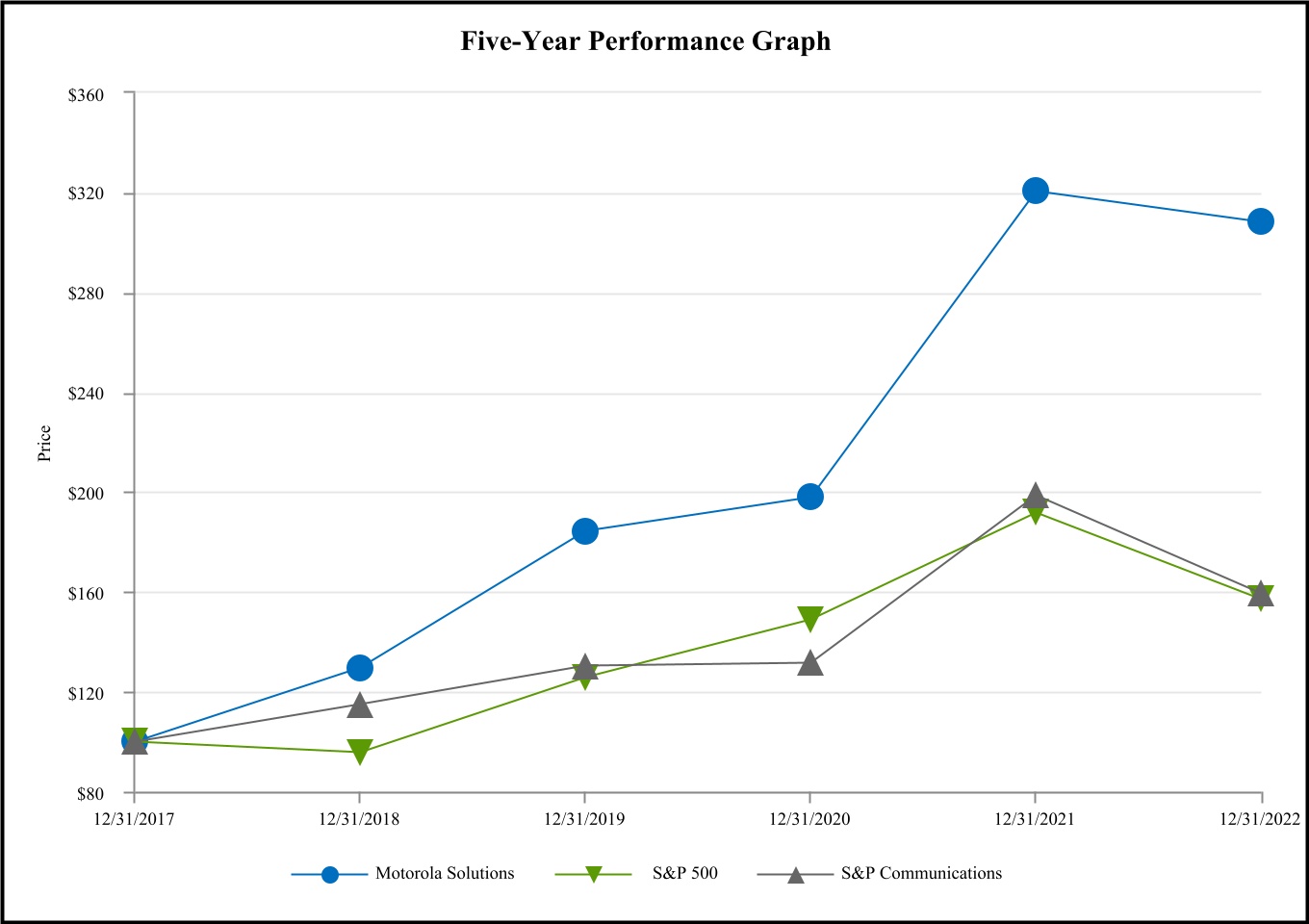
| Years Ended | December 31, 2017 | December 31, 2018 | December 31, 2019 | December 31, 2020 | December 31, 2021 | December 31, 2022 | ||||||||||||||
| Motorola Solutions | $ | 100.00 | $ | 129.63 | $ | 184.32 | $ | 197.94 | $ | 320.48 | $ | 308.28 | ||||||||
| S&P 500 | $ | 100.00 | $ | 95.61 | $ | 125.70 | $ | 148.81 | $ | 191.48 | $ | 156.77 | ||||||||
| S&P Communications Equipment | $ | 100.00 | $ | 115.08 | $ | 130.51 | $ | 131.34 | $ | 198.73 | $ | 159.23 |
Item 6. [Reserved.]
Item 7. Management’s Discussion and Analysis of Financial Condition and Results of Operations
The following is a discussion and analysis of our financial position as of December 31, 2022 and 2021 and results of operations and cash flows for each of the three years in the period ended December 31, 2022. This commentary should be read in conjunction with our consolidated financial statements and the notes thereto appearing under “Item 8: Financial Statements and Supplementary Data.”
Executive Overview
Our Business
Motorola Solutions is a global leader in public safety and enterprise security. Our technologies in Land Mobile Radio Communications ("LMR" or "LMR Communications"), Video Security and Access Control ("Video") and Command Center, bolstered by managed and support services, help make communities safer and businesses stay productive and secure. We serve more than 100,000 public safety and commercial customers in over 100 countries, providing “purpose-built” solutions designed for their unique needs, and we have a rich heritage of innovation focusing on advancing global safety for more than 90 years.
We manage our business organizationally through two segments: “Products and Systems Integration” and “Software and Services.” Within these segments, we have principal product lines that also follow our three major technologies: LMR Communications, Video and Command Center. In January 2023, we began using Command Center as a naming convention, eliminating the "Software" descriptor from Command Center Software in order to inform investors that the Company has software components more broadly across all technologies; this name change does not require any financial information to be reclassified from previous periods.
The Company has invested across these three technologies, evolving the Company’s LMR focus to purposefully integrate software, video security and access control solutions for public safety and enterprise customers globally.
Our strategy is to generate value through the integration of critical communications, video security, access control and data and analytics. While each technology individually strives to make users safer and more productive, we believe we can enable better outcomes for our customers when we unite these technologies as one connected system. Our goal is to help remove silos between systems, unify data, streamline workflows, and simplify operations for our customers. Across all three technologies, we offer cloud-based solutions, cybersecurity services, software and subscription services as well as managed and support services.
The schools we serve provide an example of our integrated technology ecosystem in action, which can be tailored to a school's unique needs and can span the end-to-end workflow for daily school operations as well as for emergencies. Video security and analytics such as license plate recognition can alert security and identify potentially suspicious activities, influencing building access. AI-powered video analytics can search video footage and help locate individuals based on physical descriptions. Software can help share real-time alerts and live video feeds with school officials and public safety agencies for incident response. Voice and data communications can notify school employees of security breaches, while mass notification and incident management platforms can help to coordinate an emergency response across school safety personnel, local law enforcement and administrators. Together, these technologies can help schools to detect, analyze, communicate and manage safety and security threats.
The principal products within each segment, by technology, are described below:
Products and Systems Integration Segment
In 2022, the segment’s net sales were $5.7 billion, representing 63% of our consolidated net sales.
LMR Communications
Our LMR Communications technology includes infrastructure and devices for LMR, public safety Long Term Evolution (“LTE”) and enterprise-grade private LTE. Our technology enables voice and multimedia collaborations across two-way radio, WiFi and public and private broadband networks. We are a global leader in the two-way radio category, including Project 25 (P25), Terrestrial Trunked Radio ("TETRA") and Digital Mobile Radio (DMR), as well as other PCR solutions. We also deliver LTE solutions for public safety, government and commercial users, including infrastructure and devices operating in both low-band and mid-band frequencies, including Citizens’ Broadband Radio Service (CBRS) frequencies. Primary sources of revenue for this technology come from selling devices and building telecommunications networks, including infrastructure, installation and integration with our customers’ technology environments.
We believe that public safety agencies and enterprises continue to trust LMR communications systems and devices because they are purpose-built and designed for reliability, availability, security and resiliency to withstand the most challenging conditions.
By adding broadband data capabilities to our two-way radios, we strive to provide our customers with greater functionality and multimedia access to the information and data they need in their workflows. Examples include application services such as GPS location to better protect lone workers, job dispatch to share detailed information and over-the-air programming to optimize device uptime. Our view is that complementary data applications such as these enable government, public safety and enterprise
customers to work more efficiently and safely, while maintaining their mission-critical voice communications to remain connected and working in collaboration with others.
The LMR technology within the Products and Systems Integration segment represented 82% of the net sales of the total segment in 2022.
Video
Our Video technology includes video management infrastructure, AI-video powered security cameras including fixed and certain mobile video equipment as well as on-premise and cloud-based access control solutions. Since 2018, we have developed our video security and access control business through investments in research and development and acquisitions, directly contributing to our growth strategy to serve as a leader in end-to-end video security solutions and supporting the expansion of our portfolio.
We deploy video security and access control solutions to thousands of government and commercial customers around the world including school campuses, transportation systems, healthcare centers, public venues, utilities, prisons, factories, casinos, airports, financial institutions, government facilities, state and local law enforcement agencies and retailers. Organizations such as these utilize video security and access control to verify critical events or incidents in real-time and to provide data to investigate an event or incident after it happens.
Our view is that government and public safety customers in particular are increasingly turning to video security technologies, including fixed and mobile cameras, to increase visibility, accountability and safety for citizens, communities and first responders alike. Additionally, our view is that government, public safety agencies and businesses are increasingly turning to scalable, cloud-based multi-factor authentication access control to make their facilities more secure.
The Video technology within the Products and Systems Integration segment represented 18% of the net sales of the total segment in 2022.
Software and Services Segment
In 2022, the segment’s net sales were $3.4 billion, representing 37% of our consolidated net sales.
LMR Communications
LMR Communications services include support and managed services, which offer a broad continuum of support for our customers. Support services include repair and replacement, technical support and preventative maintenance, and more advanced offerings such as system monitoring, software updates and cybersecurity services. Managed services range from partial to full
Showing the first 8K of 105K characters. Open the full section
Item 7A. Quantitative and Qualitative Disclosures About Market Risk
Interest Rate Risk
Our exposure to market risk for changes in interest rates relates primarily to our long-term debt as interest rate fluctuations impact the fair value of our long-term debt. As of December 31, 2022, we had $6.0 billion of long-term debt, including the current portion, which is primarily priced at long-term, fixed interest rates. A hypothetical 10% decrease in interest rates as of the end of 2022 would have increased the fair value of our debt by approximately $118 million at December 31, 2022. See "Note 5: Debt and Credit Facilities" to the consolidated financial statements included in “Part II. Item 8. Financial Statements and Supplementary Data” of this Form 10-K for more information on our long-term debt.
Foreign Currency Risk
We are exposed to foreign currency risk as a result of buying and selling in various currencies, our net investments in foreign entities, and monetary assets and liabilities denominated in a currency other than the functional currency of the legal entity holding the instrument. We use financial instruments to reduce our overall exposure to the effects of currency fluctuations on cash flows. Our policy prohibits speculation in financial instruments for profit on exchange rate price fluctuations, trading in currencies for which there are no underlying exposures, or entering into transactions for any currency to intentionally increase the underlying exposure.
Our strategy related to foreign exchange exposure management is to offset the gains or losses on the financial instruments against losses or gains on the underlying operational cash flows, net investments or monetary assets and liabilities based on our assessment of risk. We enter into derivative contracts for some of our non-functional currency cash, receivables, and payables, which are primarily denominated in major currencies that can be traded on open markets. Our policy permits us to use forward contracts and options to hedge these currency exposures. In addition, we enter into derivative contracts for some forecasted transactions or net investments in some of our overseas entities, which are designated as part of a hedging relationship if it is determined that the transaction qualifies for hedge accounting under the provisions of the authoritative accounting guidance for derivative instruments and hedging activities. A portion of our exposure is from currencies that are not traded in liquid markets and these are addressed, to the extent reasonably possible, by managing net asset positions, product pricing and component sourcing.
We had outstanding foreign exchange contracts totaling $1.1 billion at the end of each of December 31, 2022 and 2021. Management does not believe these financial instruments should subject it to undue risk due to foreign exchange movements because gains and losses on these contracts should generally offset gains and losses on the underlying assets, liabilities and transactions.
The following table shows the five largest net notional amounts of the positions to buy or sell foreign currency as of December 31, 2022 and the corresponding positions as of December 31, 2021:
| Notional Amount | |||||||||||
| Net Buy (Sell) by Currency | 2022 | 2021 | |||||||||
| British pound | $ | 290 | $ | 128 | |||||||
| Euro | 185 | 164 | |||||||||
| Australian dollar | (130) | (76) | |||||||||
| Chinese renminbi | (61) | (89) | |||||||||
| Brazilian real | (44) | (23) |
Foreign exchange financial instruments that are subject to the effects of currency fluctuations, which may affect reported earnings, include derivative financial instruments and other monetary assets and liabilities denominated in a currency other than the functional currency of the legal entity holding the instrument. Currently, our derivative financial instruments consist primarily of currency forward contracts. Other monetary assets and liabilities denominated in a currency other than the functional currency of the legal entity consist primarily of cash, cash equivalents, accounts payable and accounts receivable. Assuming the amounts of the outstanding foreign exchange contracts represent our underlying foreign exchange risk related to monetary assets and liabilities, a hypothetical unfavorable 10% movement in the foreign exchange rates at December 31, 2022 would reduce the value of those monetary assets and liabilities by approximately $76 million. Our market risk calculation represents an estimate of reasonably possible net losses that would be recognized assuming hypothetical 10% movements in future currency market pricing and is not necessarily indicative of actual results, which may or may not occur. It does not represent the maximum possible loss or any expected loss that may occur, since actual future gains and losses will differ from those estimated, based upon, among other things, actual fluctuation in market rates, operating exposures, and the timing thereof. We believe, however, that any such loss incurred would be offset by the effects of market rate movements on the respective underlying derivative financial instruments transactions.
Item 8. Financial Statements and Supplementary Data
Index to Consolidated Financial Statements
REPORT OF INDEPENDENT REGISTERED PUBLIC ACCOUNTING FIRM
To the Board of Directors and Stockholders of Motorola Solutions, Inc.
Opinions on the Financial Statements and Internal Control over Financial Reporting
We have audited the accompanying consolidated balance sheets of Motorola Solutions, Inc. and its subsidiaries (the “Company”) as of December 31, 2022 and 2021, and the related consolidated statements of operations, of comprehensive income (loss), of stockholders’ equity (deficit) and of cash flows for each of the three years in the period ended December 31, 2022, including the related notes (collectively referred to as the “consolidated financial statements”). We also have audited the Company's internal control over financial reporting as of December 31, 2022, based on criteria established in Internal Control - Integrated Framework (2013) issued by the Committee of Sponsoring Organizations of the Treadway Commission (COSO).
In our opinion, the consolidated financial statements referred to above present fairly, in all material respects, the financial position of the Company as of December 31, 2022 and 2021, and the results of its operations and its cash flows for each of the three years in the period ended December 31, 2022 in conformity with accounting principles generally accepted in the United States of America. Also in our opinion, the Company maintained, in all material respects, effective internal control over financial reporting as of December 31, 2022, based on criteria established in Internal Control - Integrated Framework (2013) issued by the COSO.
Basis for Opinions
The Company's management is responsible for these consolidated financial statements, for maintaining effective internal control over financial reporting, and for its assessment of the effectiveness of internal control over financial reporting, included in Management’s Report on Internal Control Over Financial Reporting appearing under Item 9A. Our responsibility is to express opinions on the Company’s consolidated financial statements and on the Company's internal control over financial reporting based on our audits. We are a public accounting firm registered with the Public Company Accounting Oversight Board (United States) (PCAOB) and are required to be independent with respect to the Company in accordance with the U.S. federal securities laws and the applicable rules and regulations of the Securities and Exchange Commission and the PCAOB.
We conducted our audits in accordance with the standards of the PCAOB. Those standards require that we plan and perform the audits to obtain reasonable assurance about whether the consolidated financial statements are free of material misstatement, whether due to error or fraud, and whether effective internal control over financial reporting was maintained in all material respects.
Our audits of the consolidated financial statements included performing procedures to assess the risks of material misstatement of the consolidated financial statements, whether due to error or fraud, and performing procedures that respond to those risks. Such procedures included examining, on a test basis, evidence regarding the amounts and disclosures in the consolidated financial statements. Our audits also included evaluating the accounting principles used and significant estimates made by management, as well as evaluating the overall presentation of the consolidated financial statements. Our audit of internal control over financial reporting included obtaining an understanding of internal control over financial reporting, assessing the risk that a material weakness exists, and testing and evaluating the design and operating effectiveness of internal control based on the assessed risk. Our audits also included performing such other procedures as we considered necessary in the circumstances. We believe that our audits provide a reasonable basis for our opinions.
Definition and Limitations of Internal Control over Financial Reporting
A company’s internal control over financial reporting is a process designed to provide reasonable assurance regarding the reliability of financial reporting and the preparation of financial statements for external purposes in accordance with generally accepted accounting principles. A company’s internal control over financial reporting includes those policies and procedures that (i) pertain to the maintenance of records that, in reasonable detail, accurately and fairly reflect the transactions and dispositions of the assets of the company; (ii) provide reasonable assurance that transactions are recorded as necessary to permit preparation of financial statements in accordance with generally accepted accounting principles, and that receipts and expenditures of the company are being made only in accordance with authorizations of management and directors of the company; and (iii) provide reasonable assurance regarding prevention or timely detection of unauthorized acquisition, use, or disposition of the company’s assets that could have a material effect on the financial statements.
Because of its inherent limitations, internal control over financial reporting may not prevent or detect misstatements. Also, projections of any evaluation of effectiveness to future periods are subject to the risk that controls may become inadequate because of changes in conditions, or that the degree of compliance with the policies or procedures may deteriorate.
Critical Audit Matters
The critical audit matter communicated below is a matter arising from the current period audit of the consolidated financial statements that was communicated or required to be communicated to the audit committee and that (i) relates to accounts or disclosures that are material to the consolidated financial statements and (ii) involved our especially challenging, subjective, or complex judgments. The communication of critical audit matters does not alter in any way our opinion on the consolidated financial statements, taken as a whole, and we are not, by communicating the critical audit matter below, providing a separate opinion on the critical audit matter or on the accounts or disclosures to which it relates.
Revenue Recognition - Estimated Costs to Complete System Contracts
As described in Note 1 to the consolidated financial statements, $1.8 billion of the Company’s total revenues for the year ended December 31, 2022 was generated from System contracts. The Company recognizes revenue on a significant portion of System contracts on an over-time basis, electing an input method of estimated costs as a measure of performance completed. For contracts accounted fo
Showing the first 8K of 261K characters. Open the full section
Item 9. Changes in and Disagreements with Accountants on Accounting and Financial Disclosure
None.
Item 9A. Controls and Procedures
Evaluation of Disclosure Controls and Procedures.
Under the supervision and with the participation of our senior management, including our chief executive officer and chief financial officer, we conducted an evaluation of the effectiveness of the design and operation of our disclosure controls and procedures, as defined in Rules 13a-15(e) or 15d-15(e) under the Exchange Act, as of December 31, 2022 (the "Evaluation Date"), the end of the period covered by this Form 10-K. Based on this evaluation, our chief executive officer and chief financial officer concluded as of the Evaluation Date that our disclosure controls and procedures were effective such that the information relating to Motorola Solutions, including our consolidated subsidiaries, required to be disclosed in our SEC reports: (i) is recorded, processed, summarized and reported within the time periods specified in SEC rules and forms, and (ii) is accumulated and communicated to Motorola Solutions’ management, including our chief executive officer and chief financial officer, as appropriate to allow timely decisions regarding required disclosure.
Management’s Report on Internal Control Over Financial Reporting.
The Company's management is responsible for establishing and maintaining adequate internal control over financial reporting as such term is defined in Rule 13a-15(f) of the Exchange Act. Under the supervision and with the participation of our senior management, including our chief executive officer and chief financial officer, we assessed the effectiveness of our internal control over financial reporting as of December 31, 2022, using the criteria set forth in the Internal Control-Integrated Framework (2013) issued by the Committee of Sponsoring Organizations of the Treadway Commission ("COSO"). Based on this assessment, management has concluded that our internal control over financial reporting was effective as of December 31, 2022.
The Company’s independent registered public accounting firm, PricewaterhouseCoopers LLP, has issued an attestation report on the Company’s internal control over financial reporting. The report on the audit of internal control over financial reporting appears in "Part II, Item 8, Financial Statements and Supplementary Data" of this Form 10-K.
Changes in Internal Control Over Financial Reporting.
There have been no changes in our internal control over financial reporting that occurred during our most recent fiscal quarter that have materially affected or are reasonably likely to materially affect our internal control over financial reporting.
Item 9B. Other Information
None.
Item 9C. Disclosure Regarding Foreign Jurisdictions that Prevent Inspections
Not applicable.
PART III
Item 10. Directors, Executive Officers and Corporate Governance
The response to this Item with respect to directors is incorporated herein by reference to the information under the caption “Our Board - Who We Are” of our Proxy Statement; with respect to executive officers, is contained in Part I hereof under the caption “Information About our Executive Officers”; and, with respect to the audit committee, is incorporated herein by reference to the information under the caption “Committees of the Board” of the Proxy Statement.
Motorola Solutions has adopted a code of ethics, the Motorola Solutions Code of Business Conduct (the “Code”), that applies to all employees, including the Company’s principal executive officer, principal financial officer and controller (principal accounting officer). The Code is posted in the Corporate Governance section on Motorola Solutions’ Internet website, www.motorolasolutions.com/investors, and is available electronically and without charge by contacting Investor Relations at investors@motorolasolutions.com. Any legally required disclosures regarding amendments to, or waivers from, the Code applicable to executive officers will be posted on our Internet website or disclosed in a Current Report on Form 8-K filed with the SEC.
Item 11. . Executive Compensation
The response to this Item is incorporated herein by reference to the information under the captions "How We Determine Director Compensation," "How Our Directors Are Compensated,” "Compensation Discussion and Analysis," "Compensation and Leadership Committee Report,” "Compensation and Leadership Committee Interlocks and Insider Participation," “Named Executive Officer Compensation," and “CEO Pay Ratio” of the Proxy Statement.
Item 12. . Security Ownership of Certain Beneficial Owners and Management and Related Stockholder Matters
The response to this Item is incorporated herein by reference to the information under the captions “Equity Compensation Plan Information” and “Security Ownership Information” of the Proxy Statement.
Item 13. . Certain Relationships and Related Transactions, and Director Independence
The response to this Item is incorporated herein by reference to the information under the captions “Related Person Transaction Policy and Procedures” and “Independence” of the Proxy Statement.
Item 14. . Principal Accounting Fees and Services
The response to this Item is incorporated by reference to the information under the captions “Independent Registered Public Accounting Firm Fees” and “Audit Committee Pre-Approval Policies” of the Proxy Statement.
PART IV
Item 15. . Exhibits and Financial Statement Schedules
**(a)**1. Financial Statements
See Part II, Item 8 hereof.
2. Financial Statement Schedules
All schedules omitted are inapplicable or the information required is shown in the consolidated financial statements or notes thereto.
3. Exhibits
Exhibit numbers 10.5 through 10.61 listed in this Exhibit Index are management contracts or compensatory plans or arrangements required to be filed as exhibits to this form by Item 15(b) hereof.
| 2.1 | Arrangement Agreement, dated February 1, 2018, among Motorola Solutions, Inc., Motorola Solutions Canada Holdings Inc. and Avigilon Corporation (incorporated by reference to Exhibit 2.1 to Motorola Solutions, Inc.’s Current Report on Form 8-K filed on March 28, 2018). | ||||||||||
| 3.1 (a) | Restated Certificate of Incorporation of Motorola, Inc., as amended through May 5, 2009 (incorporated by reference to Exhibit 3(i)(b) to Motorola, Inc.’s Quarterly Report on Form 10-Q for the fiscal quarter ended July 4, 2009). | ||||||||||
| 3.1 (b) | Certificate of Amendment to the Restated Certificate of Incorporation of Motorola, Inc., effective January 4, 2011, as filed with the Secretary of State of the State of Delaware (incorporated by reference to Exhibit 3.1 to Motorola Solutions, Inc.'s Current Report on Form 8-K filed on January 10, 2011). | ||||||||||
| 3.1 (c) | Certificate of Ownership and Merger merging Motorola Name Change Corporation into Motorola, Inc., effective January 4, 2011, as filed with the Secretary of State of the State of Delaware (incorporated by reference to Exhibit 3.2 to Motorola Solutions, Inc.’s Current Report on Form 8-K filed on January 10, 2011). | ||||||||||
| 3.2 | Amended and Restated Bylaws of Motorola Solutions, Inc. effective as of November 17, 2022 (incorporated by reference to Exhibit 3.1 to Motorola Solutions, Inc.’s Current Report on Form 8-K filed on November 18, 2022). | ||||||||||
| 4.1 (a) | Senior Indenture, dated as of May 1, 1995, between The Bank of New York Mellon Trust Company, N.A. (as successor Trustee to JPMorgan Chase Bank (as successor in interest to Bank One Trust Company) and BNY Midwest Trust Company (as successor in interest to Harris Trust and Savings Bank) and Motorola, Inc. (incorporated by reference to Exhibit 4(d) of the Registrant's Registration Statement on Form S-3 filed on September 25, 1995). | ||||||||||
| 4.1 (b) | Instrument of Resignation, Appointment and Acceptance, dated as of January 22, 2001, among Motorola, Inc., Bank One Trust Company, N.A. and BNY Midwest Trust Company (as successor in interest to Harris Trust and Savings Bank) (incorporated by reference to Exhibit 4.2(b) to Motorola, Inc.’s Annual Report on Form 10-K for the fiscal year ended December 31, 2000). | ||||||||||
| 4.1 (c) | Indenture, dated as of August 19, 2014, between Motorola Solutions, Inc. and The Bank of New York Mellon Trust Company, N.A., as trustee (incorporated by reference to Exhibit 4.1 to Motorola Solutions, Inc.’s Current Report on Form 8-K filed on August 19, 2014). | ||||||||||
| 4.1 (d) | Indenture, dated as of September 5, 2019, between Motorola Solutions, Inc. and The Bank of New York Mellon Trust Company, N.A., as trustee, related to the 1.75% Convertible Senior Notes Due 2024 (incorporated by reference to Exhibit 10.2 to Motorola Solutions, Inc.’s Current Report on Form 8-K filed on September 5, 2019). | ||||||||||
| Certain instruments defining the rights of holders of long-term debt of Motorola Solutions, Inc. and of all its subsidiaries for which consolidated or unconsolidated financial statements are required to be filed are being omitted pursuant to paragraph (b)(4)(iii)(A) of Item 601 of Regulation S-K. Motorola Solutions, Inc. agrees to furnish a copy of any such instrument to the Commission upon request. | |||||||||||
| 4.2 | Description of the Registrant's Securities Registered Pursuant to Section 12 of the Securities Exchange Act of 1934 (incorporated by reference to Exhibit 4.1(e) to Motorola Solutions, Inc.'s Annual Report on Form 10-K for the fiscal year ended December 31, 2020). | ||||||||||
| 10.1 | Amended and Restated Master Separation and Distribution Agreement, effective as of July 31, 2010, among Motorola Mobility Holdings, Inc. (f/k/a Motorola SpinCo Holdings Corporation), Motorola Mobility, Inc. and Motorola, Inc. (incorporated by reference to Exhibit 2.1 to Amendment No. 1 to the Form 10 Registration Statement filed on August 31, 2010 by Motorola Mobility Holdings, Inc. (formerly Motorola SpinCo Holdings Corporation)). | ||||||||||
| 10.2 | Amended and Restated Intellectual Property License Agreement, effective as of July 31, 2010, between Motorola Mobility, Inc. and Motorola, Inc. (incorporated by reference to Exhibit 10.2 to Amendment No. 1 to the Form 10 Registration Statement filed on August 31, 2010 by Motorola Mobility Holdings, Inc. (formerly Motorola SpinCo Holdings Corporation)). | ||||||||||
| 10.3 | Amended and Restated Exclusive License Agreement, effective as of July 30, 2010, between Motorola Trademark Holdings, LLC and Motorola, Inc. (incorporated by reference to Exhibit 10.3 to Amendment No. 3 to the Form 10 Registration Statement filed on November 12, 2010 by Motorola Mobility Holdings, Inc.). | ||||||||||
| 10.4 | Tax Sharing Agreement, effective as of July 31, 2010, among Motorola Mobility Holdings, Inc. (f/k/a Motorola SpinCo Holdings Corporation), Motorola Mobility, Inc. and Motorola, Inc. (incorporated by reference to Exhibit 10.4 to Amendment No. 1 to the Form 10 Registration Statement filed on August 31, 2010 by Motorola Mobility Holdings, Inc. (formerly Motorola SpinCo Holdings Corporation)). |
| 10.5 | Motorola Solutions Omnibus Incentive Plan of 2015 (f/k/a the Motorola Omnibus Incentive Plan of 2006), as amended and restated effective May 18, 2015 (incorporated by reference to Exhibit 10.1 to Motorola Solutions, Inc.’s Current Report on Form 8-K filed on May 21, 2015). | ||||||||||
| 10.6 | First Amendment to the Motorola Solutions Omnibus Incentive Plan of 2015 (f/k/a the Motorola Omnibus Incentive Plan of 2006), as amended and restated effective May 18, 2015 (incorporated by reference to Exhibit 10.1 to Motorola Solutions, Inc.’s Quarterly Report on Form 10-Q for the fiscal quarter ended September 26, 2020). | ||||||||||
| 10.7 | Motorola Solutions Amended and Restated Omnibus Incentive Plan of 2015, effective as of May 17, 2022 (incorporated by reference to Exhibit 10.1 to Motorola Solutions, Inc.’s Current Report on Form 8-K filed on May 20, 2022). | ||||||||||
| 10.8 | Form of Motorola Solutions, Inc. Performance Option Award Agreement for grants to Section 16 Officers on or after March 10, 2022 (incorporated by reference to Exhibit 10.9 to Motorola Solutions, Inc.’s Quarterly Report on Form 10-Q for the fiscal quarter ended April 2, 2022). | ||||||||||
| 10.9 | Form of Motorola Solutions, Inc. Performance Option Award Agreement for grants to Section 16 Officers from February 14, 2019 to March 9, 2022 (incorporated by reference to Exhibit 10.2 to Motorola Solutions, Inc.’s Quarterly Report on Form 10-Q for the fiscal quarter ended March 30, 2019). | ||||||||||
| 10.10 | Form of Motorola Solutions, Inc. Performance Option Award Agreement for grants to Section 16 Officers from March 9, 2015 to February 13, 2019 (incorporated by reference to Exhibit 10.1 to Motorola Solutions, Inc.’s Current Report on Form 8-K filed on March 11, 2015). | ||||||||||
| 10.11 | Form of Motorola Solutions, Inc. Award Document-Terms and Conditions Related to Employee Nonqualified Stock Options for grants to Section 16 Officers on or after March 10, 2022 (incorporated by reference to Exhibit 10.6 to Motorola Solutions, Inc.’s Quarterly Report on Form 10-Q for the fiscal quarter ended April 2, 2022). | ||||||||||
| 10.12 | Form of Motorola Solutions, Inc. Award Document-Terms and Conditions Related to Employee Nonqualified Stock Options for grants to Section 16 Officers from May 6, 2013 to March 9, 2022 (incorporated by reference to Exhibit 10.2 to Motorola Solutions, Inc.’s Quarterly Report on Form 10-Q for the fiscal quarter ended June 29, 2013). | ||||||||||
| 10.13 | Form of Motorola Solutions, Inc. Award Document-Terms and Conditions Related to Employee Nonqualified Stock Options relating to the Motorola Solutions Omnibus Incentive Plan of 2015, as amended, for grants on or after March 10, 2022 (incorporated by reference to Exhibit 10.3 to Motorola Solutions, Inc.’s Quarterly Report on Form 10-Q for the fiscal quarter ended April 2, 2022). | ||||||||||
| 10.14 | Form of Motorola Solutions, Inc. Award Document-Terms and Conditions Related to Employee Nonqualified Stock Options relating to the Motorola Solutions Omnibus Incentive Plan of 2015 for grants from February 15, 2018 to March 9, 2022 (incorporated by reference to Exhibit 10.4 to Motorola Solutions, Inc.’s Quarterly Report on Form 10-Q for the fiscal quarter ended March 31, 2018). | ||||||||||
| 10.15 | Form of Motorola Solutions, Inc. Award Document-Terms and Conditions Related to Employee Nonqualified Stock Options relating to the Motorola Solutions Omnibus Incentive Plan of 2015 for grants from March 9, 2017 to February 14, 2018 (incorporated by reference to Exhibit 10.6 to Motorola Solutions’ Quarterly Report on Form 10-Q for the fiscal quarter ended April 1, 2017). | ||||||||||
| 10.16 | Form of Motorola Solutions, Inc. Award Document-Terms and Conditions Related to Employee Nonqualified Stock Options relating to the Motorola Solutions Omnibus Incentive Plan of 2006 for grants from February 3, 2014 to March 8, 2017 (incorporated by reference to Exhibit 10.9 to Motorola Solutions, Inc.’s Annual Report on Form 10-K for the fiscal year ended December 31, 2013). | ||||||||||
| 10.17 | Form of Motorola Solutions, Inc. Award Document-Terms and Conditions Related to Employee Nonqualified Stock Options relating to the Motorola Solutions Omnibus Incentive Plan of 2006 for grants from January 4, 2011 to February 2, 2014 (incorporated by reference to Exhibit 10.11 to Motorola Solutions, Inc.’s Annual Report on Form 10-K for the fiscal year ended December 31, 2010). | ||||||||||
| 10.18 | Form of Motorola Solutions, Inc. Stock Option Consideration Agreement for grants on or after March 10, 2022 (incorporated by reference to Exhibit 10.4 to Motorola Solutions, Inc.’s Quarterly Report on Form 10-Q for the fiscal quarter ended April 2, 2022). | ||||||||||
| 10.19 | Form of Motorola Solutions, Inc. Stock Option Consideration Agreement for grants from March 9, 2017 to March 9, 2022 (incorporated by reference to Exhibit 10.7 to Motorola Solutions, Inc.'s Quarterly Report on Form 10-Q for the fiscal quarter ended April 1, 2017). | ||||||||||
| 10.20 | Form of Motorola Solutions Stock Option Consideration Agreement for grants from February 3, 2014 to March 8, 2017 (incorporated by reference to Exhibit 10.14 to Motorola Solutions, Inc.’s Annual Report on Form 10-K for the fiscal year ended December 31, 2013). | ||||||||||
| 10.21 | Form of Motorola Solutions, Inc. Market Stock Unit Agreement for grants to Section 16 Officers on or after March 10, 2022 (incorporated by reference to Exhibit 10.8 to Motorola Solutions, Inc.’s Quarterly Report on Form 10-Q for the fiscal quarter ended April 2, 2022). | ||||||||||
| 10.22 | Form of Motorola Solutions, Inc. Market Stock Unit Agreement for grants to Section 16 Officers from March 9, 2017 to March 9, 2022 (incorporated by reference to Exhibit 10.2 to Motorola Solutions, Inc.'s Quarterly Report on Form 10-Q for the fiscal quarter ended April 1, 2017). | ||||||||||
| 10.23 | Form of Motorola Solutions, Inc. Restricted Stock Unit Agreement relating to the Motorola Solutions Omnibus Incentive Plan of 2015, as amended, for grants to Section 16 Officers on or after March 10, 2022 (incorporated by reference to Exhibit 10.10 to Motorola Solutions, Inc.’s Quarterly Report on Form 10-Q for the fiscal quarter ended April 2, 2022). |
| 10.24 | Form of Motorola Solutions, Inc. Restricted Stock Unit Agreement relating to the Motorola Solutions Omnibus Incentive Plan of 2015 for grants to Section 16 Officers from March 9, 2017 to March 9, 2022 (incorporated by reference to Exhibit 10.5 to Motorola Solutions, Inc.’s Quarterly Report on Form 10-Q for the fiscal quarter ended April 1, 2017). | ||||||||||
| 10.25 | Form of Motorola Solutions, Inc. Restricted Stock Unit Agreement relating to the Motorola Solutions Omnibus Incentive Plan of 2015, as amended, for grants to Appointed Vice Presidents and Elected Officers on or after March 10, 2022 (incorporated by reference to Exhibit 10.1 to Motorola Solutions, Inc.’s Quarterly Report on Form 10-Q for the fiscal quarter ended April 2, 2022). | ||||||||||
| 10.26 | Form of Motorola Solutions, Inc. Restricted Stock Unit Agreement relating to the Motorola Solutions Omnibus Incentive Plan of 2015 for grants to Appointed Vice Presidents and Elected Officers from February 15, 2018 to March 9, 2022 (incorporated by reference to Exhibit 10.2 to Motorola Solutions, Inc.’s Quarterly Report on Form 10-Q for the fiscal quarter ended March 31, 2018). | ||||||||||
| 10.27 | Form of Motorola Solutions, Inc. Restricted Stock Unit Agreement relating to the Motorola Solutions Omnibus Incentive Plan of 2015, as amended, for grants to Employees on or after March 10, 2022 (incorporated by reference to Exhibit 10.2 to Motorola Solutions, Inc.’s Quarterly Report on Form 10-Q for the fiscal quarter ended April 2, 2022). | ||||||||||
| 10.28 | Form of Motorola Solutions, Inc. Restricted Stock Unit Agreement relating to the Motorola Solutions Omnibus Incentive Plan of 2015 for grants to Employees from February 15, 2018 to March 9, 2022 (incorporated by reference to Exhibit 10.3 to Motorola Solutions, Inc.’s Quarterly Report on Form 10-Q for the fiscal quarter ended March 31, 2018). | ||||||||||
| 10.29 | Form of Motorola Solutions, Inc. Performance Stock Unit Award Agreement for grants to non-Section 16 Officers on or after March 10, 2022 (incorporated by reference to Exhibit 10.5 to Motorola Solutions, Inc.’s Quarterly Report on Form 10-Q for the fiscal quarter ended April 2, 2022). | ||||||||||
| 10.30 | Form of Motorola Solutions, Inc. Performance Stock Unit Award Agreement for grants to non-Section 16 Officers from February 11, 2021 to March 9, 2022 (incorporated by reference to Exhibit 10.4 to Motorola Solutions, Inc.’s Quarterly Report on Form 10-Q for the fiscal quarter ended April 3, 2021). | ||||||||||
| 10.31 | Form of Motorola Solutions, Inc. Performance Stock Unit Award Agreement for grants to Section 16 Officers on or after March 10, 2022 (incorporated by reference to Exhibit 10.7 to Motorola Solutions, Inc.’s Quarterly Report on Form 10-Q for the fiscal quarter ended April 2, 2022). | ||||||||||
| 10.32 | Form of Motorola Solutions, Inc. Performance Stock Unit Award Agreement for grants to Section 16 Officers from February 11, 2021 to March 9, 2022 (incorporated by reference to Exhibit 10.3 to Motorola Solutions, Inc.’s Quarterly Report on Form 10-Q for the fiscal quarter ended April 3, 2021). | ||||||||||
| 10.33 | Form of Motorola Solutions, Inc. Performance Stock Unit Award Agreement for grants to Section 16 Officers from May 13, 2019 to February 10, 2021 (incorporated by reference to Exhibit 10.1 to Motorola Solutions, Inc.’s Quarterly Report on Form 10-Q for the fiscal quarter ended June 29, 2019). | ||||||||||
| 10.34 | Form of Motorola Solutions, Inc. Performance Stock Unit Award Agreement for grants to Gregory Q. Brown on or after March 10, 2022 (incorporated by reference to Exhibit 10.11 to Motorola Solutions, Inc.’s Quarterly Report on Form 10-Q for the fiscal quarter ended April 2, 2022). | ||||||||||
| 10.35 | Form of Motorola Solutions, Inc. Performance Stock Unit Award Agreement for grants to Gregory Q. Brown from February 11, 2021 to March 9, 2022 (incorporated by reference to Exhibit 10.2 to Motorola Solutions, Inc.’s Quarterly Report on Form 10-Q for the fiscal quarter ended April 3, 2021). | ||||||||||
| 10.36 | Form of Motorola Solutions, Inc. Performance Stock Unit Award Agreement for grants to Gregory Q. Brown from May 13, 2019 to February 10, 2021 (incorporated by reference to Exhibit 10.2 to Motorola Solutions, Inc.’s Quarterly Report on Form 10-Q for the fiscal quarter ended June 29, 2019). | ||||||||||
| 10.37 | Form of Motorola Solutions Award Document-Terms and Conditions Related to Employee Nonqualified Stock Options for Gregory Q. Brown, relating to the Motorola Solutions Omnibus Incentive Plan of 2006 for grants on or after January 4, 2011 (incorporated by reference to Exhibit 10.25 to Motorola Solutions, Inc.’s Annual Report on Form 10-K for the fiscal year ended December 31, 2010). | ||||||||||
| 10.38 | Form of Motorola Solutions, Inc. Performance Option Award Agreement for grants to Gregory Q. Brown on or after March 9, 2015 (incorporated by reference to Exhibit 10.3 to Motorola Solutions, Inc.’s Current Report on Form 8-K filed on March 11, 2015). | ||||||||||
| 10.39 | Form of Motorola Solutions Stock Option Consideration Agreement for Gregory Q. Brown for grants on or after March 10, 2022 under the Motorola Solutions Omnibus Incentive Plan of 2015, as amended (incorporated by reference to Exhibit 10.13 to Motorola Solutions, Inc.’s Quarterly Report on Form 10-Q for the fiscal quarter ended April 2, 2022). | ||||||||||
| 10.40 | Form of Motorola Solutions Stock Option Consideration Agreement for Gregory Q. Brown for grants from January 4, 2011 to March 9, 2022 under the Motorola Solutions Omnibus Incentive Plan of 2006 (incorporated by reference to Exhibit 10.27 to Motorola Solutions, Inc.’s Annual Report on Form 10-K for the fiscal year ended December 31, 2010). | ||||||||||
| 10.41 | Form of Motorola Solutions, Inc. Market Stock Unit Agreement for grants to Gregory Q. Brown on or after March 10, 2022 (incorporated by reference to Exhibit 10.12 to Motorola Solutions, Inc.’s Quarterly Report on Form 10-Q for the fiscal quarter ended April 2, 2022). | ||||||||||
| 10.42 | Form of Motorola Solutions, Inc. Market Stock Unit Agreement for grants to Gregory Q. Brown from March 9, 2015 to March 9, 2022 (incorporated by reference to Exhibit 10.4 to Motorola Solutions, Inc.’s Current Report on Form 8-K filed on March 11, 2015). |
| 10.43 | Form of Motorola Solutions Deferred Stock Units Agreement between Motorola Solutions, Inc. and its non-employee directors, relating to the deferred stock units issued in lieu of cash compensation to directors under the Motorola Solutions Omnibus Incentive Plan of 2006, for acquisitions on or after January 1, 2012 (incorporated by reference to Exhibit 10.37 to Motorola Solutions, Inc.’s Annual Report on Form 10-K for the fiscal year ended December 31, 2011). | ||||||||||
| 10.44 | Form of Motorola Solutions Deferred Stock Units Award between Motorola Solutions, Inc. and its non-employee directors under the Motorola Solutions Omnibus Incentive Plan of 2006 or any successor plan for grants on or after January 1, 2012 (incorporated by reference to Exhibit 10.40 to Motorola Solutions, Inc.’s Annual Report on Form 10-K for the fiscal year ended December 31, 2011). | ||||||||||
| 10.45 | Form of Motorola Solutions Deferred Stock Units Award between Motorola Solutions, Inc. and its non-employee directors under the Motorola Solutions Omnibus Incentive Plan of 2006 or any successor plan for grants from January 4, 2011 to December 31, 2011 (incorporated by reference to Exhibit 10.39 to Motorola Solutions, Inc.’s Annual Report on Form 10-K for the fiscal year ended December 31, 2010). | ||||||||||
| 10.46 | Motorola Solutions Executive Officer Short Term Incentive Plan dated January 17, 2013 (effective January 1, 2013) (incorporated by reference to Exhibit 10.50 to Motorola Solutions’ Annual Report on Form 10-K for the fiscal year ended December 31, 2012). | ||||||||||
| 10.47 | Motorola Solutions Executive Officer Short Term Incentive Plan Term Sheet (incorporated by reference to Exhibit 10.51 to Motorola Solutions, Inc.’s Annual Report on Form 10-K for the fiscal year ended December 31, 2012). | ||||||||||
| 10.48 | Motorola Solutions Long Range Incentive Plan (LRIP), as Amended and Restated February 11, 2021 (incorporated by reference to Exhibit 10.1 to Motorola Solutions, Inc.’s Quarterly Report on Form 10-Q for the fiscal quarter ended April 3, 2021). | ||||||||||
| 10.49 | Motorola Solutions Long Range Incentive Plan (LRIP), as Amended and Restated May 13, 2019 (incorporated by reference to Exhibit 10.3 to Motorola Solutions, Inc.’s Quarterly Report on Form 10-Q for the fiscal quarter ended June 29, 2019). | ||||||||||
| 10.50 | 2020-2022 Performance Measures under the Motorola Solutions Long Range Incentive Plan (LRIP), as approved on February 13, 2020 (incorporated by reference to Exhibit 10.1 to Motorola Solutions, Inc.’s Quarterly Report on Form 10-Q for the fiscal quarter ended March 28, 2020). | ||||||||||
| 10.51 | 2021-2023 Performance Measures under the Motorola Solutions Long Range Incentive Plan (LRIP), as approved on February 11, 2021 (incorporated by reference to Exhibit 10.5 to Motorola Solutions, Inc.’s Quarterly Report on Form 10-Q for the fiscal quarter ended April 3, 2021). | ||||||||||
| 10.52 | 2022-2024 Performance Measures under the Motorola Solutions Long Range Incentive Plan (LRIP), as approved on February 15, 2022 (incorporated by reference to Exhibit 10.14 to Motorola Solutions, Inc.’s Quarterly Report on Form 10-Q for the fiscal quarter ended April 2, 2022). | ||||||||||
| 10.53 | Motorola Solutions Management Deferred Compensation Plan (As Amended and Restated Effective as of June 1, 2013) (incorporated by reference to Exhibit 10.1 to Motorola Solutions, Inc.'s Current Report on Form 8-K filed on June 5, 2013). | ||||||||||
| 10.54 | Motorola Solutions, Inc. 2011 Senior Officer Change in Control Severance Plan, as amended and restated November 13, 2014 (incorporated by reference to Exhibit No. 10.54 to Motorola Solutions, Inc.’s Annual Report on Form 10-K for the fiscal year ended December 31, 2014). | ||||||||||
| 10.55 | Motorola Solutions, Inc. 2011 Executive Severance Plan, as amended and restated November 13, 2014 (incorporated by reference to Exhibit No. 10.55 to Motorola Solutions, Inc.’s Annual Report on Form 10-K for the fiscal year ended December 31, 2014). | ||||||||||
| 10.56 | Arrangement for directors’ fees for non-employee directors (description incorporated by reference from the information under the caption “How our Directors are Compensated” of Motorola Solutions Inc.’s Proxy Statement on Schedule 14A for the 2022 Annual Meeting of Shareholders filed on March 31, 2022 (“Motorola Solutions’ Proxy Statement”)). | ||||||||||
| 10.57 | Description of insurance covering non-employee directors and their spouses (including a description incorporated by reference from the information under the caption “How our Directors are Compensated” of the Motorola Solutions’ Proxy Statement, and incorporated by reference to Exhibit 10.1 to Motorola Solutions, Inc.'s Quarterly Report on Form 10-Q for the fiscal quarter ended on July 3, 2021). | ||||||||||
| 10.58 | Employment Agreement, dated August 27, 2008, by and between Motorola, Inc. and Gregory Q. Brown (incorporated by reference to Exhibit 10.1 to Motorola, Inc.’s Current Report on Form 8-K filed on August 29, 2008). | ||||||||||
| 10.59 | Amendment dated December 15, 2008, to the Employment Agreement dated August 27, 2008 by and between Motorola, Inc. and Gregory Q. Brown (incorporated by reference to Exhibit No. 10.50 to Motorola, Inc.’s Annual Report on Form 10-K for the fiscal year ended December 31, 2008). | ||||||||||
| 10.60 | Second Amendment, dated May 28, 2010, to the Employment Agreement dated August 27, 2008, as amended, by and between Motorola, Inc. and Gregory Q. Brown (incorporated by reference to Exhibit 10.1 to Motorola, Inc.’s Current Report on Form 8-K filed on May 28, 2010). | ||||||||||
| 10.61 | Third Amendment, dated March 10, 2014, to the Employment Agreement dated August 27, 2008, as amended, by and between Motorola Solutions, Inc. and Gregory Q. Brown (incorporated by reference to Exhibit 10.1 to Motorola Solutions, Inc.’s Current Report on Form 8-K filed on March 13, 2014). | ||||||||||
| 10.62 | Revolving Credit Agreement, dated as of March 24, 2021, among Motorola Solutions, Inc., JPMorgan Chase Bank, N.A., as administrative agent, and the several lenders and agents party thereto (incorporated by reference to Exhibit 10.1 to Motorola Solutions, Inc.'s Current Report on Form 8-K filed on March 25, 2021). |
| 10.63 | Revised and Amended Aircraft Time Sharing Agreement, dated as of October 1, 2015, between Motorola Solutions, Inc. and Gregory Q. Brown (incorporated by reference to Exhibit 10.4 to Motorola Solutions, Inc.’s Quarterly Report on Form 10-Q for the fiscal quarter ended October 3, 2015). | ||||||||||
| 10.64 | Investment Agreement, dated as of September 5, 2019, among Motorola Solutions, Inc., Silver Lake Alpine, L.P. and Silver Lake Alpine (Offshore Master) L.P. (incorporated by reference to Exhibit 10.1 to Motorola Solutions, Inc.’s Current Report on Form 8-K filed on September 5, 2019). | ||||||||||
| *21 | Subsidiaries of Motorola Solutions, Inc. | ||||||||||
| *23.1 | Consent of Independent Registered Public Accounting Firm. | ||||||||||
| *31.1 | Certification of Gregory Q. Brown pursuant to Section 302 of the Sarbanes-Oxley Act of 2002. | ||||||||||
| *31.2 | Certification of Jason J. Winkler pursuant to Section 302 of the Sarbanes-Oxley Act of 2002. | ||||||||||
| **32.1 | Certification of Gregory Q. Brown pursuant to Section 906 of the Sarbanes-Oxley Act of 2002. | ||||||||||
| **32.2 | Certification of Jason J. Winkler pursuant to Section 906 of the Sarbanes-Oxley Act of 2002. | ||||||||||
| 101.INS | Inline XBRL Instance Document | ||||||||||
| 101.SCH | Inline XBRL Taxonomy Extension Scheme Document | ||||||||||
| 101.CAL | Inline XBRL Taxonomy Extension Calculation Linkbase Document | ||||||||||
| 101.DEF | Inline XBRL Taxonomy Extension Definition Linkbase Document | ||||||||||
| 101.LAB | Inline XBRL Taxonomy Extension Label Linkbase Document | ||||||||||
| 101.PRE | Inline XBRL Taxonomy Extension Presentation Linkbase Document | ||||||||||
| 104 | Cover Page Interactive Data File (formatted as inline XBRL and contained in Exhibit 101) |
- Filed herewith
** Furnished herewith
**(b)**Exhibits:
See Item 15(a) 3 above.
Item 16. Form 10-K Summary
None.
SIGNATURES
Pursuant to the requirements of Section 13 or 15(d) of the Securities Exchange Act of 1934, Motorola Solutions, Inc. has duly caused this report to be signed on its behalf by the undersigned, thereunto duly authorized.
| MOTOROLA SOLUTIONS, INC. | ||||||||
| By: | /S/ GREGORY Q. BROWN | |||||||
| Gregory Q. Brown | ||||||||
| Chairman and Chief Executive Officer |
February 16, 2023
Pursuant to the requirements of the Securities Exchange Act of 1934, this report has been signed below by the following persons on behalf of Motorola Solutions, Inc. and in the capacities and on the dates indicated.
| Signature | Title | Date | ||||||||||||
| /S/ GREGORY Q. BROWN | Chairman and Chief Executive Officer | February 16, 2023 | ||||||||||||
| Gregory Q. Brown | and Director (Principal Executive Officer) | |||||||||||||
| /S/ JASON J. WINKLER | Executive Vice President and | February 16, 2023 | ||||||||||||
| Jason J. Winkler | Chief Financial Officer (Principal Financial Officer) | |||||||||||||
| /S/ KATHERINE MAHER | Corporate Vice President and | February 16, 2023 | ||||||||||||
| Katherine Maher | Chief Accounting Officer (Principal Accounting Officer) | |||||||||||||
| /S/ KENNETH D. DENMAN | Director | February 16, 2023 | ||||||||||||
| Kenneth D. Denman | ||||||||||||||
| /S/ EGON P. DURBAN | Director | February 16, 2023 | ||||||||||||
| Egon P. Durban | ||||||||||||||
| /S/ AYANNA M. HOWARD | Director | February 16, 2023 | ||||||||||||
| Ayanna M. Howard | ||||||||||||||
| /S/ CLAYTON M. JONES | Director | February 16, 2023 | ||||||||||||
| Clayton M. Jones | ||||||||||||||
| /S/ JUDY C. LEWENT | Director | February 16, 2023 | ||||||||||||
| Judy C. Lewent | ||||||||||||||
| /S/ GREGORY K. MONDRE | Director | February 16, 2023 | ||||||||||||
| Gregory K. Mondre | ||||||||||||||
| /S/ JOSEPH M. TUCCI | Director | February 16, 2023 | ||||||||||||
| Joseph M. Tucci | ||||||||||||||