 filings.tools
Norwegian Cruise Line Holdings 10-K 2013-12-31
Filed 2014-02-21. 21 sections, 432K characters. Original on sec.gov · Markdown · JSON
Cover and table of contents
10-K 1 d662798d10k.htm 10-K
Table of Contents
UNITED STATES
SECURITIES AND EXCHANGE COMMISSION
Washington, D.C. 20549
FORM 10-K
(Mark One)
| x | ANNUAL REPORT PURSUANT TO SECTION 13 OR 15(d) OF THE SECURITIES EXCHANGE ACT OF 1934 |
|---|
For the fiscal year ended December 31, 2013
OR
| ¨ | TRANSITION REPORT PURSUANT TO SECTION 13 OR 15(d) OF THE SECURITIES EXCHANGE ACT OF 1934 |
|---|
For the transition period from to
Commission file number: 001-35784
NORWEGIAN CRUISE LINE HOLDINGS LTD.
(Exact name of registrant as specified in its charter)
| Bermuda | 98-0691007 | |
| (State or other jurisdiction of incorporation or organization) | (I.R.S. Employer Identification No.) |
7665 Corporate Center Drive, Miami, Florida 33126
(Address of principal executive offices) (zip code)
(305) 436-4000
(Registrant’s telephone number, including area code)
Securities registered pursuant to Section 12(b) of the Act:
| Title of each class | Name of each exchange on which registered | |
| Ordinary shares, par value $.001 per share | The NASDAQ Stock Market LLC |
Securities registered pursuant to Section 12(g) of the Act: None
Indicate by check mark if the registrant is a well-known seasoned issuer, as defined in Rule 405 of the Securities Act. Yes x No ¨
Indicate by check mark if the registrant is not required to file reports pursuant to Section 13 or Section 15(d) of the Act. Yes ¨ No x
Indicate by check mark whether the registrant (1) has filed all reports required to be filed by Section 13 or 15(d) of the Securities Exchange Act of 1934 during the preceding 12 months (or for such shorter period that the registrant was required to file such reports), and (2) has been subject to such filing requirements for the past 90 days. Yes x No ¨
Table of Contents
Indicate by check mark whether the registrant has submitted electronically and posted on its corporate Web site, if any, every Interactive Data File required to be submitted and posted pursuant to Rule 405 of Regulation S-T (§232.405 of this chapter) during the preceding 12 months (or for such shorter period that the registrant was required to submit and post such files). Yes x No ¨
Indicate by check mark if disclosure of delinquent filers pursuant to Item 405 of Regulation S-K is not contained herein, and will not be contained, to the best of registrant’s knowledge, in definitive proxy or information statements incorporated by reference in Part III of this Form 10-K or any amendment to this Form 10-K. ¨
Indicate by check mark whether the registrant is a large accelerated filer, an accelerated filer, a non-accelerated filer, or a smaller reporting company (See the definitions of “large accelerated filer,” “accelerated filer” and “smaller reporting company” in Rule 12b-2 of the Exchange Act).
| Large accelerated filer | ¨ | Accelerated filer | ¨ | |||
| Non-accelerated filer | x (Do not check if a smaller reporting company) | Smaller reporting company | ¨ |
Indicate by check mark whether the registrant is a shell company (as defined in Rule 12b-2 of the Act). Yes ¨ No x
As of June 28, 2013, the last business day of the registrant’s most recently completed second fiscal quarter, the aggregate market value of voting stock held by non-affiliates of the registrant based upon the closing sales price for the registrant’s ordinary shares as reported on The NASDAQ Stock Market was $820.7 million.
There were 205,167,499 ordinary shares outstanding as of February 14, 2014.
Documents Incorporated by Reference
Portions of the Proxy Statement for the registrant’s 2014 Annual General Meeting of Shareholders, to be filed with the Securities and Exchange Commission not later than 120 days after December 31, 2013, are incorporated by reference in Part III herein.
Table of Contents
NORWEGIAN CRUISE LINE HOLDINGS LTD.
TABLE OF CONTENTS
Table of Contents
Terms Used in this Annual Report
Unless otherwise indicated or the context otherwise requires, references in this annual report to (i) the “Company,” “we,” “our” and “us” refer to, prior to the consummation of our IPO, NCL Corporation Ltd. and/or its subsidiaries and after our IPO, Norwegian Cruise Line Holdings Ltd., or “NCLH” and its subsidiaries, (ii) “NCLC” refers to NCL Corporation Ltd. and/or its subsidiaries, (iii) “Norwegian Cruise Line” or “Norwegian” refers to the Norwegian Cruise Line brand and its predecessors and “NCL America” or “NCLA” refers to our U.S.-flagged operations, (iv) “Apollo” refers to Apollo Global Management, LLC and its subsidiaries and the “Apollo Funds” refers to one or more of AIF VI NCL (AIV), L.P., AIF VI NCL (AIV II), L.P., AIF VI NCL (AIV III), L.P., AIF VI NCL (AIV IV), L.P., AAA Guarantor-Co-Invest VI (B), L.P., Apollo Overseas Partners (Delaware) VI, L.P., Apollo Overseas Partners (Delaware 892) VI, L.P., Apollo Overseas Partners VI, L.P. and Apollo Overseas Partners (Germany) VI, L.P., (v) “TPG Global” refers to TPG Global, LLC, “TPG” refers to TPG Global and its affiliates and the “TPG Viking Funds” refers to one or more of TPG Viking, L.P., TPG Viking AIV I, L.P., TPG Viking AIV II, L.P., and TPG Viking AIV III, L.P. and/or certain other affiliated investment funds, each an affiliate of TPG, (vi) “Genting HK” refers to Genting Hong Kong Limited and/or its affiliates (formerly Star Cruises Limited and/or its affiliates) (Genting HK owns NCLH’s ordinary shares indirectly through Star NCLC Holdings Ltd. (“Star NCLC”)), and (vii) “Affiliate(s)” or “Sponsor(s)” refers to Genting HK, the Apollo Funds and/or the TPG Viking Funds. References to the “U.S.” are to the United States of America, “dollars” or “$” are to U.S. dollars and “euros” or “€” are to the official currency of the Eurozone. For further information about our non-GAAP financial measures including a reconciliation to the most directly comparable GAAP financial measure, we refer you to “Item 7—Management’s Discussion and Analysis of Financial Condition and Results of Operations.” Unless otherwise indicated, in this annual report, the following terms have the meanings set forth below:
| • | Adjusted EBITDA. EBITDA adjusted for other income (expense), impairment loss and other supplemental adjustments. |
|---|
| • | Adjusted EBITDA Margin. Adjusted EBITDA as a percentage of total revenue. |
|---|
| • | Adjusted EPS. Diluted earnings (loss) per share adjusted for supplemental adjustments. |
|---|
| • | Adjusted Net Cruise Cost Excluding Fuel. Net Cruise Cost less fuel expense adjusted for supplemental adjustments. |
|---|
| • | Adjusted Net Income. Net income adjusted for supplemental adjustments. |
|---|
| • | Berths. Double occupancy capacity per cabin (single occupancy per studio cabin) even though many cabins can accommodate three or more passengers. |
|---|
| • | Breakaway Class Ships. Norwegian Breakaway delivered in April 2013 and Norwegian Getaway delivered in January 2014. |
|---|
| • | Breakaway Plus Class Ships. Norwegian Escape scheduled for delivery in the fourth quarter of 2015 and Norwegian Bliss scheduled for delivery in the first quarter of 2017. |
|---|
| • | Business Enhancement Capital Expenditures. Capital expenditures other than those related to new ship construction. |
|---|
| • | Capacity Days. Available Berths multiplied by the number of cruise days for the period. |
|---|
| • | Charter. The hire of a ship for a specified period of time. |
|---|
| • | Constant Currency. A calculation whereby foreign currency-denominated revenue and expenses in a period are converted at the U.S. dollar exchange rate of a comparable period in order to eliminate the effects of the foreign exchange fluctuations. |
|---|
| • | Dry-dock. A process whereby a ship is positioned in a large basin where all of the fresh/sea water is pumped out in order to carry out cleaning and repairs of those parts of a ship which are below the water line. |
|---|
| • | EBITDA. Earnings before interest, taxes, depreciation and amortization. |
|---|
| • | GAAP. Generally accepted accounting principles in the U.S. |
|---|
| • | Gross Cruise Cost. The sum of total cruise operating expense and marketing, general and administrative expense. |
|---|
| • | Gross Tons. A unit of enclosed passenger space on a cruise ship, such that one gross ton = 100 cubic feet or 2.831 cubic meters. |
|---|
| • | Gross Yield. Total revenue per Capacity Day. |
|---|
| • | IMO. International Maritime Organization, a United Nations agency that sets international standards for shipping. |
|---|
| • | IPO. The initial public offering of 27,058,824 ordinary shares, par value $.001 per share, of NCLH, which was consummated on January 24, 2013. |
|---|
| • | Major North American Cruise Brands. Norwegian Cruise Line, Carnival Cruise Lines, Royal Caribbean International, Holland America, Princess Cruises and Celebrity Cruises. |
|---|
Table of Contents
| • | Management NCL Corporation Units. NCLC’s previously outstanding profits interests issued to management (or former management) of NCLC which have been converted into units in NCLC in connection with the Corporate Reorganization. |
|---|
| • | Net Cruise Cost. Gross Cruise Cost less commissions, transportation and other expense and onboard and other expense. |
|---|
| • | Net Cruise Cost Excluding Fuel. Net Cruise Cost less fuel expense. |
|---|
| • | Net Revenue. Total revenue less commissions, transportation and other expense and onboard and other expense. |
|---|
| • | Net Yield. Net Revenue per Capacity Day. |
|---|
| • | Occupancy Percentage. The ratio of Passenger Cruise Days to Capacity Days. A percentage in excess of 100% indicates that three or more passengers occupied some cabins. |
|---|
| • | Passenger Cruise Days. The number of passengers carried for the period, multiplied by the number of days in their respective cruises. |
|---|
| • | ROI Capital Expenditures. Comprised of project-based capital expenditures which have a quantified return on investment. |
|---|
| • | SEC. U.S. Securities and Exchange Commission. |
|---|
| • | Secondary Offering(s). Public offering in August 2013 resulting in the sale of 23,000,000 ordinary shares by our Sponsors and public offering in December 2013 resulting in the sale of 25,300,000 ordinary shares by our Sponsors. |
|---|
| • | Shipboard Retirement Plan. An unfunded defined benefit pension plan for certain crew members which computes benefits based on years of service, subject to certain requirements. |
|---|
Industry and Market Data
This annual report includes market share and industry data and forecasts that we obtained from industry publications, third-party surveys and internal company surveys. Industry publications, including those from Cruise Lines International Association (“CLIA”) and surveys and forecasts generally state that the information contained therein has been obtained from sources believed to be reliable. CLIA is a non-profit marketing and training organization formed in 1975 to promote cruising. All CLIA information, obtained from the CLIA website “cruising.org,” relates to the CLIA member cruise lines. In 2013, CLIA expanded to include similar organizations outside of North America. Today CLIA represents 63 global cruise brands which operate 95% of global cruise capacity. All other references to third party information are publicly available at nominal or no cost. We use the most currently available industry and market data to support statements as to our market position. Although we believe that the industry publications and third-party sources are reliable, we have not independently verified any of the data. Similarly, while we believe our internal estimates with respect to our industry are reliable, our estimates have not been verified by any independent sources. While we are not aware of any misstatements regarding any industry data presented herein, our estimates, in particular as they relate to market share and our general expectations, involve risks and uncertainties and are subject to change based on various factors, including those discussed under “Item 1A—Risk Factors” and “Item 7— Management’s Discussion and Analysis of Financial Condition and Results of Operations” in this annual report.
Cautionary Statement Concerning Forward-Looking Statements
Certain statements in this annual report constitute forward-looking statements intended to qualify for the safe harbor from liability established by the Private Securities Litigation Reform Act of 1995. All statements other than statements of historical facts in this report, including, without limitation, those regarding our business strategy, financial position, results of operations, plans, prospects and objectives of management for future operations (including development plans and objectives relating to our activities), are forward-looking statements. Many, but not all of these statements can be found by looking for words like “expect,” “anticipate,” “goal,” “project,” “plan,” “believe,” “seek,” “will,” “may,” “forecast,” “estimate,” “intend” and “future” and for similar words. Forward-looking statements do not guarantee future performance and may involve risks, uncertainties and other factors which could cause our actual results, performance or achievements to differ materially from the future results, performance or achievements expressed or implied in those forward-looking statements. Examples of these risks, uncertainties and other factors include, but are not limited to:
| • | the adverse impact of general economic conditions and related factors such as high levels of unemployment and underemployment, fuel price increases, declines in the securities and real estate markets, and perceptions of these conditions that decrease the level of disposable income of consumers or consumer confidence; |
|---|
| • | changes in cruise capacity, as well as capacity changes in the overall vacation industry; |
|---|
| • | intense competition from other cruise companies as well as non-cruise vacation alternatives which could affect our ability to compete effectively; |
|---|
| • | negative publicity surrounding the cruise industry; |
|---|
Table of Contents
| • | changes in fuel prices and/or other cruise operating costs; |
|---|
| • | the risks associated with operating internationally, including changes in interest rates and/or foreign currency rates; |
|---|
| • | the continued borrowing availability under our credit facilities and compliance with our financial covenants; |
|---|
| • | our substantial indebtedness, including the inability to generate the necessary amount of cash to service our existing debt, and to repay our credit facilities; |
|---|
| • | our ability to incur significantly more debt despite our substantial existing indebtedness; |
|---|
| • | the impact of volatility and disruptions in the global credit and financial markets which may adversely affect our ability to borrow and could increase our counterparty credit risks, including those under our credit facilities, derivatives, contingent obligations, insurance contracts and new ship progress payment guarantees; |
|---|
| • | adverse events impacting the security of travel such as terrorist acts, acts of piracy, armed conflict and other international events; |
|---|
| • | the impact of any future changes relating to how external distribution channels sell and market our cruises; |
|---|
| • | the impact of any future increases in the price of, or major changes or reduction in, commercial airline services; |
|---|
| • | the impact of delays, costs and other factors resulting from emergency ship repairs as well as scheduled repairs, maintenance and refurbishment of our ships; |
|---|
| • | the delivery schedules and estimated costs of new ships on terms that are favorable or consistent with our expectations; |
|---|
| • | the impact of problems encountered at shipyards, as well as, any potential claim, impairment loss, cancellation or breach of contract in connection with our contracts with shipyards; |
|---|
| • | the impact of the spread of epidemics and viral outbreaks; |
|---|
| • | the uncertain political environment in countries where we operate; |
|---|
| • | the impact of weather and natural disasters; |
|---|
| • | accidents and other incidents affecting the health, safety, security and vacation satisfaction of guests or causing damage to ships, which could cause the modification of itineraries or cancellation of a cruise or series of cruises; |
|---|
| • | the impact of pending or threatened litigation and investigations; |
|---|
| • | our ability to obtain insurance coverage on terms that are favorable or consistent with our expectations; |
|---|
| • | the impact of any breaches in data security or other disturbances to our information technology and other networks; |
|---|
| • | the impact of amendments to our collective bargaining agreements for crew members and other employee relation issues; |
|---|
| • | the continued availability of attractive port destinations; |
|---|
| • | our ability to attract and retain key personnel and qualified shipboard crew, maintain good relations with employee unions, maintain or renegotiate our collective bargaining agreements on favorable terms and prevent any disruptions in work; |
|---|
| • | changes involving the tax, environmental, health, safety, security and other regulatory regimes in which we operate; |
|---|
| • | increases in our future fuel expenses related to implementing IMO regulations, which require the use of higher priced low sulfur fuels in certain cruising areas; |
|---|
| • | the implementation of regulations in the U.S. requiring U.S. citizens to obtain passports for travel to additional foreign destinations; and |
|---|
| • | other factors set forth under “Risk Factors.” |
|---|
The above examples are not exhaustive and new risks emerge from time to time. Except as required by law, we undertake no obligation to publicly update or revise any forward-looking statements, whether as a result of new information, future events or otherwise. Such forward-looking statements are based on our current beliefs, assumptions, expectations, estimates and projections regarding our present and future business strategies and the environment in which we will operate in the future. These forward-looking statements speak only as of the date of this annual report. We expressly disclaim any obligation or undertaking to release publicly any updates or revisions to any forward-looking statement contained herein to reflect any change in our expectations with regard thereto or any change of events, conditions or circumstances on which any such statement was based.
Table of Contents
PART I.
Item 1. Business
History and Development of the Company
Norwegian Cruise Line commenced operations out of Miami in 1966. In February 2000, Genting HK acquired control of and subsequently became the sole owner of the Norwegian Cruise Line operations.
In January 2008, the Apollo Funds acquired 50% of the outstanding ordinary share capital of NCLC. As part of this investment, the Apollo Funds assumed control of NCLC’s Board of Directors. Also, in January 2008, the TPG Viking Funds acquired, in the aggregate, 12.5% of NCLC’s outstanding share capital from the Apollo Funds.
In January 2013, NCLH completed its IPO and NCLC and NCLH completed the Corporate Reorganization (defined below). In August 2013 and December 2013, NCLH completed the Secondary Offerings. Subsequent to our IPO and the Secondary Offerings, the relative ownership percentages of NCLH’s ordinary shares as of December 31, 2013 by our Sponsors was 62.7%.
Our Sponsors
Apollo
Apollo is a leading global alternative investment manager with offices in New York, Los Angeles, Houston, London, Frankfurt, Luxembourg, Singapore, Hong Kong and Mumbai. Apollo has assets under management of over $161.2 billion invested in its private equity, capital markets and real estate businesses. Apollo owns a controlling interest in Prestige Cruises International, Inc. which operates through two distinct upscale cruise brands, Oceania Cruises and Regent Seven Seas Cruises. Investment funds managed by Apollo also have current and past investments in other travel and leisure companies, including Caesars Entertainment Corporation (“Caesars Entertainment”), Great Wolf Resorts, Vail Resorts, AMC Entertainment, Wyndham International and other hotel properties.
TPG
TPG is a leading global private investment firm founded in 1992 with $55.7 billion of assets under management and with offices in San Francisco, Fort Worth, Austin, Beijing, Chongqing, Hong Kong, London, Luxembourg, Melbourne, Moscow, Mumbai, New York, Paris, São Paulo, Shanghai, Singapore and Tokyo. TPG has extensive experience with global public and private investments executed through leveraged buyouts, recapitalizations, spinouts, growth investments, joint ventures and restructurings.
Genting HK
Genting HK was founded in 1993 and through its subsidiary, Star Cruises Asia Holding Ltd., operates a leading cruise line in the Asia-Pacific region. Its headquarters are located in Hong Kong and it is represented in more than 20 locations worldwide, with offices and representatives in Asia, Australia, Europe and the U.S. Genting HK currently has a fleet of six ships, which offer various cruise itineraries in the Asia Pacific region.
Corporate Reorganization
In February 2011, NCLH, a Bermuda limited company, was formed with the issuance to the Sponsors of, in aggregate, 10,000 ordinary shares, with a par value of $.001 per share. On January 24, 2013, we completed our IPO. In connection with the consummation of the IPO, the Sponsors’ ordinary shares in NCLC were exchanged for the ordinary shares of NCLH, and NCLH became the owner of 100% of the ordinary shares and parent company of NCLC (the “Corporate Reorganization”). Prior to the Corporate Reorganization which was effected solely for the purpose of reorganizing our corporate structure, NCLH had not conducted any activities other than those incidental to the formation and to prepare for the Corporate Reorganization and IPO.
NCLC is treated as a partnership for U.S. federal income tax purposes, and the terms of the partnership (including the economic rights with respect thereto) are set forth in an amended and restated tax agreement for NCLC. Economic interests in NCLC are represented by the partnership interests established under the tax agreement, which we refer to as “NCL Corporation Units.” The NCL Corporation Units held by NCLH (as a result of its ownership of 100% of the ordinary shares of NCLC) represent a 97.8% economic interest in NCLC as of December 31, 2013.
In connection with the Corporate Reorganization, NCLC’s outstanding profits interests granted under the profits sharing agreement to management (or former management) of NCLC were exchanged for an economically equivalent number of NCL Corporation Units. We refer to the NCL Corporation Units exchanged for profits interests granted under the profits sharing agreement as Management NCL Corporation Units. The Management NCL Corporation Units received upon the exchange of outstanding profits interests are subject to the same time-based vesting requirements and performance-based vesting requirements applicable to the profits interests for which they were exchanged. The Management NCL Corporation Units issued in exchange for the profits interests represent a 2.2% economic interest in NCLC as of December 31, 2013.
Table of Contents
NCL Corporation Units are not transferrable without NCLH’s prior consent and do not entitle the holders to any voting, pre-emptive, or sinking fund rights. Any distributions (other than the tax distributions described below) made by NCLC are allocated on a pro rata basis to NCLH and the holders of the Management NCL Corporation Units, based upon the total number of NCL Corporation Units (including Management NCL Corporation Units) outstanding. Distributions by NCLC to NCLH or holders of Management NCL Corporation Units do not entitle holders of ordinary shares of NCLH to any portion of such distribution or to any additional distribution by NCLH.
NCLC does not have any current plans to make any distributions, other than tax distributions which may occur in the future. To the extent funds are legally available, NCLC will make cash distributions, which we refer to as “tax distributions,” to holders of the NCL Corporation Units (including the Management NCL Corporation Units) if ownership of the NCL Corporation Units gives rise to U.S. taxable income for the holder. The U.S. taxable income attributable to NCLH’s ownership of NCL Corporation Units may be different from the relative U.S. taxable income attributable to the Management NCL Corporation Units. In that case, tax distributions may be made on a non-pro rata basis with the holders of Management NCL Corporation Units possibly receiving relative tax distributions greater than the tax distributions received by NCLH.
Holders of NCL Corporation Units (including the Management NCL Corporation Units prior to exchange for ordinary shares of NCLH, as described below) may be entitled to recover on account of the economic interest represented by those units in a bankruptcy or other insolvency event of NCLC or NCLH (even if NCLH incurs debt or other claims that are senior to its ordinary shares). In contrast, the rights of the holders of NCLH’s ordinary shares will be potentially junior to the debt or senior claims (if any) incurred by NCLH in a bankruptcy or other insolvency event. In this respect, the NCL Corporation Units (including the Management NCL Corporation Units) may be considered, in some cases, to be potentially structurally superior to those of the holders of ordinary shares of NCLH in a bankruptcy or other insolvency event for NCLH and NCLC.
Subject to certain procedures and restrictions (including the vesting schedules applicable to the Management NCL Corporation Units and any applicable legal and contractual restrictions), each holder of Management NCL Corporation Units has the right to cause NCLC and NCLH to exchange the holder’s Management NCL Corporation Units for ordinary shares of NCLH at an exchange rate equal to one ordinary share for every Management NCL Corporation Unit (or, at NCLC’s election, a cash payment equal to the value of the exchanged Management NCL Corporation Units), subject to customary adjustments for stock splits, subdivisions, combinations and similar extraordinary events. Any non-pro rata tax distributions made to a Management NCL Corporation Unit holder will reduce the amount of NCLH’s ordinary shares (or ca
Showing the first 8K of 121K characters. Open the full section
Item 1A. Risk Factors
In addition to the other information contained in this annual report, you should carefully consider the following risk factors in evaluating us and our business. If any of the risks discussed in this annual report actually occur, our business, financial condition and results of operations could be materially adversely affected. In connection with the forward-looking statements that appear in this annual report, you should also carefully review the cautionary statement referred to under “Cautionary Statement Concerning Forward-Looking Statements.”
Risk factors related to our business
The specific risk factors set forth below, as well as the other information contained in this annual report, could cause our actual results to differ from our expected or historical results and individually or any combination thereof could adversely affect our business, financial condition and results of operations.
The adverse impact of general economic and related factors such as high levels of unemployment and underemployment, fuel price increases, declines in the securities and real estate markets, and perceptions of these conditions can decrease the level of disposable income of consumers or consumer confidence. The demand for cruises is affected by international, national and local economic conditions.
The demand for cruises is affected by international, national and local economic conditions. Adverse changes in the perceived or actual economic climate, such as higher fuel prices, higher interest rates, stock and real estate market declines and/or volatility, more restrictive credit markets, higher taxes, and changes in governmental policies could reduce the level of discretionary income or consumer confidence in the countries from which we source our guests.
An increase in cruise capacity without a corresponding increase in passenger demand, could materially and adversely affect our business, financial condition and results of operations.
Historically, cruise capacity has grown to meet the growth in demand. According to CLIA, 17.6 million passengers in 2013 took cruises on CLIA member lines versus 7.2 million passengers in 2000, representing a compound annual growth rate of approximately 7.1%. CLIA estimates that between 2013 and 2016, the North America based CLIA member line fleet will increase by approximately 29 ships, representing a compound annual capacity growth of 3.4%. In order to profitably utilize this new capacity, the cruise industry
Table of Contents
will likely need to improve its percentage share of the U.S. population who has cruised at least once, which is approximately 24%, according to CLIA. If there is an industry-wide increase in capacity without a corresponding increase in public demand, we, as well as the entire cruise industry, could experience reduced occupancy rates and/or be forced to discount our prices. In addition, increased cruise capacity could impact our ability to retain and attract qualified shipboard employees, including officers, at competitive levels and, therefore, increase our shipboard employee costs.
We face intense competition from other cruise companies as well as non-cruise vacation alternatives and we may not be able to compete effectively.
We face intense competition from other cruise companies, primarily the other Major North American Cruise Brands, which together comprise approximately 90% of the North American cruise market as measured by total Berths. These brands include Carnival Cruise Lines and Royal Caribbean International in the contemporary segment and Holland America, Princess Cruises and Celebrity Cruises in the premium segment. As of December 31, 2013, Norwegian Cruise Line accounted for approximately 13% of the Major North American Cruise Brands’ capacity in terms of Berths. We compete against all of these operators principally on the quality of our ships, our differentiated product offering, selection of our itineraries and value proposition of our cruises. We also face competition for many itineraries from other cruise operators as well as competition from non-cruise vacation alternatives. In the event we do not compete effectively, our business could be adversely affected.
Our substantial indebtedness could adversely affect our ability to raise additional capital to fund our operations, limit our ability to react to changes in the economy or our industry and prevent us from making debt service payments.
Our level of indebtedness could limit cash flow available for our operations and could adversely affect our financial condition, operations, prospects and flexibility. As of December 31, 2013, we had approximately $3.1 billion of total debt. Our substantial indebtedness could:
| • | limit our ability to borrow money for our working capital, capital expenditures, development projects, debt service requirements, strategic initiatives or other purposes; |
|---|
| • | make it more difficult for us to satisfy our obligations with respect to our indebtedness, and any failure to comply with the obligations of any of our debt instruments, including restrictive covenants and borrowing conditions, could result in an event of default under the agreements governing our indebtedness; |
|---|
| • | require us to dedicate a substantial portion of our cash flow from operations to the repayment of our indebtedness thereby reducing funds available to us for other purposes; |
|---|
| • | limit our flexibility in planning for, or reacting to, changes in our operations or business; |
|---|
| • | make us more highly leveraged than some of our competitors, which may place us at a competitive disadvantage; |
|---|
| • | make us more vulnerable to downturns in our business or the economy; |
|---|
| • | restrict us from making strategic acquisitions, introducing new technologies or exploiting business opportunities; |
|---|
| • | restrict us from taking certain actions by means of restrictive covenants; |
|---|
| • | make our credit card processors seek more restrictive terms in respect of our credit card arrangements; and |
|---|
| • | expose us to the risk of increased interest rates as certain of our borrowings are at a variable rate of interest. |
|---|
Based on our December 31, 2013 outstanding variable rate debt balance, a one percentage point increase in the LIBOR interest rates would increase our annual interest expense by approximately $19.4 million, excluding the effects of capitalization of interest. In addition, future financings we may undertake may also provide for rates that fluctuate with prevailing interest rates.
Negative publicity surrounding the cruise industry may have an adverse effect on our financial condition and results of operations.
Negative publicity, or heightened media scrutiny of the cruise industry, due to incidents relating to vessel operation, environmental or natural disasters such as hurricanes, epidemics and viral outbreaks aboard a vessel, or any occurrence which brings into question the safety and security of the industry may result in an adverse effect on our financial condition and results of operations including the decrease in demand for cruise vacations and a damage to the reputation of the cruise industry as a safe and reliable vacation alternative. The considerable expansion in the use of social media in recent years can further amplify any negative publicity that may be generated.
Table of Contents
Increases in fuel prices and/or other cruise operating costs would increase the cost of our cruise ship operations.
Fuel expense accounted for 18.3% of our total cruise operating expense in 2013, 19.2% in 2012 and 16.6% in 2011. Future increases in the cost of fuel globally would increase the cost of our cruise ship operations. In addition, we could experience increases in other cruise operating costs, due to market forces and economic or political instability beyond our control.
Conducting business internationally may result in increased costs and risks.
We operate our business internationally and plan to continue to develop our international presence. Operating internationally exposes us to a number of risks, including political risks, risks of increase in duties and taxes, risks relating to anti-bribery laws, as well as changes in laws and policies affecting cruising, vacation or maritime businesses, or governing the operations of foreign-based companies. Because some of our expenses are incurred in foreign currencies, we are exposed to exchange rate risks. Additional risks include interest rate movements, imposition of trade barriers and restrictions on repatriation of earnings.
We have implemented safeguards and policies to prevent violations of various anti-corruption laws that prohibit improper payments or offers of payments to foreign governments and their officials for the purpose of obtaining or retaining business by our employees and agents. However, our existing safeguards and any future improvements may prove to be less than effective and our employees or agents may engage in conduct for which we might be held responsible. If employees violate our policies or we fail to maintain adequate record-keeping and internal accounting practices to accurately record our transactions, we may be subject to regulatory sanctions, or severe criminal or civil sanctions and penalties.
The agreements governing our indebtedness contain restrictions that limit our flexibility in operating our business.
The agreements governing our indebtedness contain, and any instruments governing future indebtedness of ours would likely contain, a number of covenants that impose significant operating and financial restrictions on us, including restrictions or prohibitions on our ability to, among other things:
| • | incur additional debt or issue certain preference shares; |
|---|
| • | pay dividends on or make distributions in respect of our share capital or make other restricted payments, including the ability of NCLC to make distributions or other restricted payments to NCLH; |
|---|
| • | make certain investments; |
|---|
| • | sell certain assets; |
|---|
| • | create liens on certain assets; |
|---|
| • | consolidate, merge, sell or otherwise dispose of all or substantially all of our assets; |
|---|
| • | enter into certain transactions with our affiliates; and |
|---|
| • | designate our subsidiaries as unrestricted subsidiaries. |
|---|
As a result of these covenants, we are limited in the manner in which we conduct our business, and we may be unable to engage in favorable business activities or finance future operations or capital needs.
We have pledged a significant portion of our assets as collateral under our existing debt agreements. If any of the holders of our indebtedness accelerate the repayment of such indebtedness, there can be no assurance that we will have sufficient assets to repay our indebtedness.
Under our existing debt agreements we are required to satisfy and maintain specified financial ratios. Our ability to meet those financial ratios can be affected by events beyond our control, and there can be no assurance that we will meet those ratios. A failure to comply with the covenants contained in our existing debt agreements could result in an event of default under the agreements, which, if not cured or waived, could have a material adverse effect on our business, financial condition and results of operations. In the event of any default under our existing debt agreements, the holders of our indebtedness thereunder:
| • | will not be required to lend any additional amounts to us, if applicable; |
|---|
| • | could elect to declare all indebtedness outstanding, together with accrued and unpaid interest and fees, to be due and payable and terminate all commitments to extend further credit, if applicable; and/or |
|---|
| • | could require us to apply all of our available cash to repay such indebtedness. |
|---|
Such actions by the holders of our indebtedness could cause cross defaults under our other indebtedness. If we were unable to repay those amounts, the holders of our indebtedness under our existing senior secured credit facilities could proceed against the collateral granted to them to secure that indebtedness.
Table of Contents
If the indebtedness under our existing debt agreements were to be accelerated, there can be no assurance that our assets would be sufficient to repay such indebtedness in full.
Despite our substantial indebtedness, we may still be able to incur significantly more debt. This could intensify the risks described above.
We may be able to incur substantial indebtedness at any time in the future. Although the terms of the agreements governing our indebtedness contain restrictions on our ability to incur additional indebtedness, these restrictions are subject to a number of important qualifications and exceptions, and the indebtedness incurred in compliance with these restrictions could be substantial. We may not be able to generate sufficient cash to service all of our indebtedness, and may be forced to take other actions to satisfy our obligations under our indebtedness that may not be successful. Our ability to satisfy our debt obligations will depend upon, among other things:
| • | our future financial and operating performance, which will be affected by prevailing economic conditions and financial, business, regulatory and other factors, many of which are beyond our control; and |
|---|
| • | our future ability to borrow under certain of our existing senior secured credit facilities, the availability of which depends on, among other things, our complying with the covenants in such existing senior secured credit facilities. |
|---|
There can be no assurance that our business will generate sufficient cash flow from operations, or that we will be able to draw under certain of our existing senior secured credit facilities or otherwise, in an amount sufficient to fund our liquidity needs.
If our cash flows and capital resources are insufficient to service our indebtedness, we may be forced to reduce or delay capital expenditures, sell assets, seek additional capital or restructure or refinance our indebtedness. These alternative measures may not be successful and may not permit us to meet our scheduled debt service obligations. Our ability to restructure or refinance our debt will depend on the condition of the capital markets and our financial condition at such time. Any refinancing of our debt could be at higher interest rates and may require us to comply with more onerous covenants, which could further restrict our business operations. In addition, the terms of existing or future debt agreements may restrict us from adopting some of these alternatives. In the absence of such operating results and resources, we could face substantial liquidity problems and might be required to dispose of material assets or operations to meet our debt service and other obligations. We may not be able to consummate those dispositions for fair market value or at all. Furthermore, any proceeds that we could realize from any such dispositions may not be adequate to meet our debt service obligations then due. Neither our Sponsors nor any of their respective affiliates has any continuing obligation to provide us with debt or equity financing.
The impact of volatility and disruptions in the global credit and financial markets may adversely affect our ability to borrow and could increase our counterparty credit risks, including those under our credit facilities, derivatives, contingent obligations, insurance contracts and new ship progress payment guarantees.
There can be no assurance that we will be able to borrow additional money on terms as favorable as our current debt, on commercially acceptable terms, or at all. Some of the counterparties under our credit facilities, derivatives, contingent obligations, insurance contracts and new ship progress payment guarantees may be unable to perform their obligations or may breach their obligations to us under our contracts with them, which could include failures of financial institutions to fund required borrowings under our loan agreements and to pay us amounts that may become due under our derivative contracts and other agreements. Also, we may be limited in obtaining funds to pay amounts due to our counterparties under our derivative contracts and to pay amounts that may become due under other agreements. If we were to elect to replace any counterparty for their failure to perform their obligations under such instruments, we would likely incur significant costs to replace the counterparty. Any failure to replace any counterparties under these circumstances may result in additional costs to us or an ineffective instrument.
Terrorist acts, acts of piracy, armed conflict and threats thereof, and other international events impacting the security of travel could adversely affect the demand for cruises.
Past acts of terrorism have had an adverse effect on tourism, travel and the availability of air service and other forms of transportation. The threat or possibility of future terrorist acts, an outbreak of hostilities or armed conflict abroad or the possibility thereof, the issuance of travel advisories by national governments, and other geo-political uncertainties have had in the past and may again in the future have an adverse impact on the demand for cruises and consequently the pricing for cruises. Decreases in demand and reduced pricing in response to such decreased demand would adversely affect our business by reducing our profitability.
We rely on external distribution channels for passenger bookings, and major changes in the availability of external distribution channels could undermine our customer base.
In 2013, the majority of our guests booked their cruises through independent travel agents. In the event that the travel agent distribution channel is adversely impacted by the worldwide economic downturn, or other reason, this could reduce the distribution channels available for us to market and sell our cruises and we could be forced to increase the use of alternative distribution channels.
Table of Contents
We rely on scheduled commercial airline services for passenger connections, and increases in the price of, or major changes or reduction in, commercial airline services could undermine our customer base.
A number of our guests depend on scheduled commercial airline services to transport them to ports of embarkation for our cruises. Increases in the price of airfare, due to increases in fuel prices or other factors, would increase the overall vacation cost to our guests and may adversely affect demand for our cruises. Changes in commercial airline services as a result of strikes, weather or other events, or the lack of availability due to schedule changes or a high level of airline bookings could adversely affect our ability to deliver guests to our cruises and/or increase our cruise operating expense.
Any delays in the construction and delivery of a cruise ship could have an adverse effect on our business, financial condition and results of operations.
Delays in the construction, repair, refurbishment and delivery of a cruise ship can occur as a result of events such as insolvency, work stoppages, other labor actions or “force majeure” events experienced by our shipbuilders and other such companies that are beyond our control. Any termination or breach of contract following such an event may result in, among other things, the forfeiture of prior deposits or payments made by us, potential claims and impairment of losses. A significant delay in the delivery of a new ship, or a significant performance deficiency or mechanical failure of a new ship, particularly in light of decreasing availability of Dry-dock facilities, could have an adverse effect on our business, financial condition and results of operations.
Epidemics and viral outbreaks could have an adverse effect on our business, financial condition and results of operations.
Public perception about the safety of travel and adverse publicity related to passenger or crew illness, such as incidents of H1N1, stomach flu, or other contagious diseases, may impact demand for cruises. If any wide-ranging health scare should occur, our business, financial condition and results of operations would likely be adversely affected.
The political environment in certain countries where we operate is uncertain and our ability to operate our business as we have in the past may be restricted.
We operate in waters and call at ports throughout the world, including geographic regions that, from time to time, have experienced political and civil unrest as well as insurrection and armed hostilities. Adverse international events could affect demand for cruise products generally and could have an adverse effect on us.
Adverse incidents involving cruise ships may adversely affect our business, financial condition and results of operations.
The operation of cruise ships carries an inherent risk of loss caused by adverse weather conditions, maritime disaster, including, but not limited to, oil spills and other environmental mishaps, fire, mechanical failure, collisions, human error, war, terrorism, piracy, political action, civil unrest and insurrection in various countries and other circumstances or events. Any such event may result in loss of life or property, loss of revenue or increased costs. The operation of cruise ships also involves the risk of other incidents at sea or while in port, including missing guests, inappropriate crew or passenger behavior and onboard crimes, which may bring into question passenger safety, may adversely affect future industry performance and may lead to litigation against us. Although we place passenger safety as the highest priority in the design and operation of our fleet, we have experienced accidents and other incidents involving our cruise ships and there can be no assurance that similar events will not occur in the future. It is possible that we could be forced to cancel a cruise or a series of cruises due to these factors or incur increased port related and other costs resulting from such adverse events. Any such event involving our cruise ships or other passenger cruise ships may adversely affect guests’ perceptions of safety or result in increased governmental or other regulatory oversight. An adverse judgment or settlement in respect of any of the ongoing claims against us may also lead to negative publicity about us. Anything that damages our reputation (whether or not justified), including adverse publicity about passenger safety, could have an adverse impact on demand, which could lead to price discounting and a reduction in our sales and could adversely affect our business, financial condition and results of operations.
There can be no assurance that all risks are fully insured against or that any particular claim will be fully paid. Such losses, to the extent they are not adequately covered by contractual remedies or insurance, could affect our financial results. In addition, we have been and continue to be subject to calls, or premiums, in amounts based not only on our own claim records, but also the claim records of all other members of the protection and indemnity associations through which we receive indemnity coverage for tort liability. Our payment of these calls and increased premiums could result in significant expenses to us which could reduce our cash flows. If we were to sustain significant losses in the future, our ability to obtain insurance coverage or coverage at commercially reasonable rates could be materially adversely affected.
Breaches in data security or other disturbances to our information technology and other networks could impair our operations and have a material adverse impact on our business, financial condition and results of operations.
The integrity and reliability of our information technology systems and other networks are crucial to our business operations. We have made significant investments in our information technology systems to optimize booking procedures, enhance the marketing power of our website and control costs. Any unauthorized use of our information systems to gain access to sensitive information, corrupt data or create general disturbances in our operations systems could impair our ability to conduct business and damage our reputation. If our security measures were breached, we could be exposed to cyber-related risks and malware and access to credit cards and other sensitive data could be at risk.
Table of Contents
Amendments to the collective bargaining agreements for crew members of our fleet and other employee relation issues may materially adversely affect our financial results.
Currently, we are a party to six collective bargaining agreements. Three of these agreements are in effect through 2014. Of the three remaining agreements, two are scheduled to expire in 2018 and one is scheduled to expire in 2020. Upon appropriate notice, the agreements may be reopened at certain yearly intervals, and we received notice from one of the parties to reopen wage/benefit negotiations in 2013. These negotiations were completed and effective from July 2013 without material cost to the Company. Any future amendments to such collective bargaining agreements or inability to satisfactorily renegotiate such agreements may increase our labor costs and have a negative impact on our financial condition. In addition, our collective bargaining agreements may not prevent a disruption in work on our ships in the future. Any such disruptions in work could have a material adverse effect on our financial results.
Unavailability of ports of call may materially adversely affect our business, financial condition and results of operations.
We believe that attractive port destinations are a major reason why guests choose to go on a particular cruise or on a cruise vacation. The availability of ports is affected by a number of factors, including, but not limited to, existing capacity constraints, security concerns, adverse weather conditions and natural disasters, financial limitations on port development, local governmental regulations and local community concerns about port development and other adverse impacts on their communities from additional tourists. Any limitations on the availability of our ports of call could adversely affect our business, financial condition and results of operations.
The loss of key personnel or our inability to recruit or retain qualified personnel may materially adversely affect our business, financial condition and results of operations.
We rely upon the ability, expertise, judgment, discretion, integrity and good faith of our senior management team. Our success is dependent upon our personnel and our ability to recruit and retain high quality employees. We must continue to recruit, retain and motivate management and other employees sufficient to maintain our current business and support our projected growth. The loss of services of any of the key members of our management team could have a material adverse effect on our business, financial condition and results of operations. See “Item 1— “Business—Executive Officers” for additional information about our management personnel.
The leadership of our President and Chief Executive Officer, Mr. Sheehan, and other executive officers has been a critical element of our success. The death or disability of Mr. Sheehan or other extended or permanent loss of his services, or any negative market or industry perception with respect to him or arising from his loss, could have a material adverse effect on our business. Our other executive officers and other members of senior management have substantial experience and expertise in our business and have made significant contributions to our growth and success. The unexpected loss of services of one or more of these individuals could also materially adversely affect us. We are not protected by key man or similar life insurance covering members of our senior management. We have employment agreements with our executive officers, but these agreements do not guarantee that any given executive will remain with us.
Risks related to the regulatory environment in which we operate
Future changes in applicable tax laws, or our inability to take advantage of favorable tax regimes, could increase the amount of taxes we must pay.
We believe and have taken the position that our income that is considered to be derived from the international operation of ships as well as certain income that is considered to be incidental to such income (“shipping income”), is exempt from U.S. federal income taxes under Section 883 of the Internal Revenue Code of 1986, as amended (the “Code”), based upon certain assumptions as to shareholdings and other information as more fully described in “Item 1—Business—Regulatory Issues—Taxation—Exemption of Operating Income from U.S. Federal Income Taxation.” The provisions of Section 883 of the Code are subject to change at any time, possibly with retroactive effect.
We believe and have taken the position that substantially all of our income derived from the international operation of ships is properly categorized as shipping income and that we do not have a material amount of non-qualifying income. It is possible, however, that a much larger percentage of our income does not qualify (or will not qualify) as shipping income. Moreover, the exemption for shipping income is only available for years in which NCLH will satisfy complex stock ownership tests under Section 883 of the Code as described in “Item 1—Business— Regulatory Issues— Taxation—Exemption of Operating Income from U.S. Federal Income Taxation.” There are factual circumstances beyond our control, including changes in the direct and indirect owners of NCLH’s ordinary shares, which could cause us or our subsidiaries to lose the benefit of this tax exemption. Finally, any changes in our operations could significantly increase our exposure to either the Net Tax Regime or the 4% Regime (each as defined in “Item 1—Business—Taxation of Operating Income: In General”), and we can give no assurances on this matter.
If we or any of our subsidiaries were not to qualify for the exemption under Section 883 of the Code, our or such subsidiary’s U.S.-source income would be subject to either the Net Tax Regime or the 4% Regime (each as defined in “Item 1— Business— Regulatory Issues— Taxation—Taxation of Operating Income: In General”). As of the date of this filing, we believe that NCLH and its subsidiaries will satisfy the stock ownership tests imposed under Section 883 and therefore believe that NCLH will qualify for the
Table of Contents
exemption under Section 883. However, as discussed above, there are factual circumstances beyond our control that could cause NCLH to not meet the stock ownership tests. Therefore, we can give no assurances on this matter. We refer you to “Item 1—Business—Regulatory Issues—Taxation—Exemption of Operating Income from U.S. Federal Income Taxation.”
We may be subject to state, local and non-U.S. income or non-income taxes in various jurisdictions, including those in which we transact business, own property or reside. We may be required to file tax returns in some or all of those jurisdictions. Our state, local or non-U.S. tax treatment may not conform to the U.S. federal income tax treatment discussed above. We may be required to pay non-U.S. taxes on dispositions of foreign property or operations involving foreign property that may give rise to non-U.S. income or other tax liabilities in amounts that could be substantial.
The various tax regimes to which we are currently subject result in a relatively low effective tax rate on our worldwide income. These tax regimes, however, are subject to change, possibly with retroactive effect. For example, legislation has been proposed in the past that would eliminate the benefits of the exemption from U.S. federal income tax under Section 883 of the Code and subject all or a portion of our shipping income to taxation in the United States. Moreover, we may become subject to new tax regimes and may be unable to take advantage of favorable tax provisions afforded by current or future law including exemption of branch profits and dividend withholding taxes under the US – UK Income Tax Treaty on income derived in respect of our U.S.–flagged operation.
We are subject to complex laws and regulations, including environmental laws and regulations, which could adversely affect our operations and any changes in the current laws and regulations could lead to increased costs or decreased revenue.
Some environmental groups have lobbied for more extensive oversight of cruise ships and have generated negative publicity about the cruise industry and its environmental impact. Increasingly stringent federal, state, local and international laws and regulations on environmental protection and health and safety of workers could affect our operations. The U.S. Environmental Protection Agency, the IMO (a United Nations agency with responsibility for the safety and security of shipping and the prevention of marine pollution by ships), the Council of the European Union and individual states are considering, as well as implementing, new laws and rules to manage cruise ship waste. In addition, many aspects of the cruise industry are subject to governmental regulation by the U.S. Coast Guard as well as international treaties such as SOLAS, an international safety regulation, MARPOL, an international environmental regulation, and STCW and its conventions in ship manning. International regulations regarding ballast water and security levels are currently pending.
Additionally, the U.S. and various state and foreign government and regulatory agencies have enacted or are considering new environmental regulations and policies, such as requiring the use of low-sulfur fuels, increasing fuel efficiency requirements and further restricting emissions, including those of green-house gases. Compliance with such laws and regulations may entail significant expenses for ship modification and changes in operating procedures which could adversely impact our operations as well as our competitors’ operations. In 2006, Alaskan voters approved a ballot measure requiring that cruise ships meet Alaska Water Quality Standards (“WQS”). Pursuant to the ballot measure, Alaska approved stringent regulations and required a waste water discharge permit for cruise ships beginning in 2008. Legislation approved in 2009 allowed the state to issue general permits that contain effluent limits or standards that are less stringent than the WQS where the ship is using economically feasible methods of pollution prevention. In 2013, the state extended the permit program, and allowed ship operators to apply for mixing zones in upcoming permits, an option that may ease compliance with certain WQS. The International Labor Organization’s Maritime Labor Convention, 2006 went into force on August 20, 2013. The Convention regulates many aspects of maritime crew labor and impacts the worldwide sourcing of new crewmembers. MARPOL regulations have established special Emission Control Areas (“ECAs”) with stringent limitations on sulfur and nitrogen oxide emissions. Ships operating in designated ECAs (which include the Baltic Sea, the North Sea/English Channel, and many of the waters within 200 nautical miles of the U.S. and Canadian coasts including the Hawaiian Islands; waters surrounding Puerto Rico and the U.S. Virgin Islands have been included as of January 2014) are generally expected to meet the new emissions limits through the use of low-sulfur fuels.
These issues are, and we believe will continue to be, an area of focus by the relevant authorities throughout the world. This could result in the enactment of more stringent regulation of cruise ships that would subject us to increasing compliance costs in the future.
By virtue of our operations in the U.S., the FMC requires us to maintain a third-party performance guarantee on our behalf in respect of liabilities for non-performance of transportation and other obligations to guests. The FMC has proposed rules that would significantly increase the amount of our required guarantees and accordingly our cost of compliance. There can be no assurance that such an increase in the amount of our guarantees, if required, would be available to us. For additional discussion of the FMC’s proposed requirements, we refer you to “Item 1—Business—Regulatory Issues.”
In 2007, the state of Alaska implemented taxes, some of which were rolled back in 2010, which have impacted the cruise industry operating in Alaska. It is possible that other states, countries or ports of call that our ships regularly visit may also decide to assess new taxes or fees or change existing taxes or fees specifically applicable to the cruise industry and its employees and/or guests, which could increase our operating costs and/or could decrease the demand for cruises.
Table of Contents
Changes in health, safety, security and other regulatory issues could materially adversely affect our business, financial condition and results of operations.
We are subject to various international, national, state and local health, safety and security laws and regulations. For additional discussion of these requirements, we refer you to “Item 1—Business—Regulatory Issues.” Changes in existing legislation or regulations and the imposition of new requirements could adversely affect our business, financial condition and results of operations.
Implementation of U.S. federal regulations, requiring U.S. citizens to obtain passports for seaborne travel to all foreign destinations, could adversely affect our business. Many cruise guests may not currently have passports or may not obtain a passport card (previously known as the People Access Security Service Card, or PASS Card) as an alternative to a passport. This card was created to meet the documentary requirements of the Western Hemisphere Travel Initiative. Applications for the card have been accepted since February 1, 2008 and the cards were made available to the public beginning in July 2008.
We may become subject to taxes in Bermuda after March 31, 2035, which could materially adversely affect our business, financial condition and results of operations.
Under current Bermuda law, we are not subject to tax on income or capital gains. We have received from the Minister of Finance under The Exempted Undertakings Tax Protection Act 1966, as amended, an assurance that, in the event that Bermuda enacts legislation imposing tax computed on profits, income, any capital asset, gain or appreciation, or any tax in the nature of estate duty or inheritance, then the imposition of any such tax shall not be applicable to us or to any of our operations or shares, debentures or other obligations, until March 31, 2035. We could be subject to taxes in Bermuda after that date. This assurance is subject to the proviso that it is not to be construed to prevent the application of any tax or duty to such persons as are ordinarily resident in Bermuda or to prevent the application of any tax payable in accordance with the provisions of the Land Tax Act 1967 or otherwise payable in relation to any property leased to us. We pay annual Bermuda government fees.
Risks related to our ordinary shares
We are a “controlled company” within the meaning of the rules of NASDAQ and, as a result, rely on, exemptions from certain corporate governance requirements.
On January 18, 2013, NCLH listed its ordinary shares on the NASDAQ Global Select Market and Genting HK, the Apollo Funds and the TPG Viking Funds, or their respective affiliates, together continue to control a majority of its ordinary shares. As a result, we are a “controlled company” within the meaning of the corporate governance standards of NASDAQ. Under the rules of NASDAQ, a company of which more than 50% of the voting power is held by an individual, group or another company is a “controlled company” and may elect not to comply with certain corporate governance requirements, including the requirement:
| • | that a majority of its Board of Directors consists of independent directors; |
|---|
| • | that NCLH have a nominating/corporate governance committee that is composed entirely of independent directors with a written charter addressing the committee’s purpose and responsibilities; |
|---|
| • | that NCLH have a compensation committee that is composed entirely of independent directors with a written charter addressing the committee’s purpose and responsibilities; and |
|---|
| • | for an annual performance evaluation of the nominating/corporate governance and compensation committees. |
|---|
NCLH has utilized these exemptions. As a result, NCLH does not have a majority of independent directors nor is NCLH required to have any independent directors on its nominating/corporate governance and compensation committees, and NCLH is not required to have an annual performance evaluation of the nominating/corporate governance and compensation committees. Accordingly, its shareholders do not have the same protections afforded to shareholders of companies that are subject to a national securities exchange’s general corporate governance requirements (without giving effect to the “controlled company” exemptions of NASDAQ).
We are controlled by the Sponsors, who hold a significant percentage of NCLH’s ordinary shares and whose interests may not be aligned with ours or our public shareholders.
The majority of NCLH’s voting ordinary shares are held by affiliates of Genting HK, the Apollo Funds and the TPG Viking Funds. The shareholders’ agreement governing the relationship among those parties gives the Apollo Funds effective control over our affairs and policies, subject to certain limitations. Genting HK and the Apollo Funds also control the election of our Board of Directors, the appointment of management, the entering into of mergers, sales of substantially all of our assets and other material transactions. The directors appointed by Genting HK and the Apollo Funds have the authority, on our behalf and subject to the terms of our debt agreements and the shareholders’ agreement, to issue additional ordinary shares, implement share repurchase programs, declare dividends, pay advisory fees and make other decisions, and they may have an interest in our doing so. The interests of Genting HK, the Apollo Funds and the TPG Viking Funds could conflict with our public shareholders’ interests in material respects.
Table of Contents
Furthermore, Genting HK engages in the cruise industry and leisure, entertainment and hospitality activities and Apollo and TPG are in the business of managing investment funds which make investments in companies and one or more of which has now and may from time to time hold interests in businesses that compete directly or indirectly with us, as well as businesses that represent major guests of our business. Investment funds managed by Genting HK, Apollo and/or TPG may also pursue acquisition opportunities that may be complementary to our business, and as a result, those acquisition opportunities may not be available to us. So long as NCLH’s Sponsors continue to control a significant amount of its outstanding voting ordinary shares, such shareholders will continue to be able to strongly influence or effectively control our decisions. Additionally, the concentration of ownership held by NCLH’s Sponsors could delay, defer or prevent a change of control of us or impede a merger, takeover or other business combination.
Shareholders of our Company may have greater difficulties in protecting their interests than as shareholders of a U.S. corporation.
We are a Bermuda exempted company. The Companies Act 1981 of Bermuda (the “Companies Act”), which applies to our Company, differs in material respects from laws generally applicable to U.S. corporations and their shareholders. Taken together with the provisions of our bye-laws, some of these differences may result in you having greater difficulties in protecting your interests as a shareholder of our Company than you would have as a shareholder of a U.S. corporation. This affects, among other things, the circumstances under which transactions involving an interested director are voidable, whether an interested director can be held accountable for any benefit realized in a transaction with our Company, what approvals are required for business combinations by our Company with a large shareholder or a wholly-owned subsidiary, what rights you may have as a shareholder to enforce specified provisions of the Companies Act or our bye-laws, and the circumstances under which we may indemnify our directors and officers.
The market price for our ordinary shares could be subject to wide fluctuations.
The market price for our ordinary shares could be volatile and subject to wide fluctuations in response to factors including the following:
| • | actual or anticipated fluctuations in our quarterly results; |
|---|
| • | the public’s reaction to our press releases, other public announcements and filings with the SEC; |
|---|
| • | sales of large blocks of our ordinary shares, or the expectation that such sales may occur, including sales by our directors, officers and Sponsors; |
|---|
| • | market and industry perception of our success, or lack thereof, in pursuing our growth strategy; |
|---|
| • | announcements of new itineraries or services or the introduction of new ships by us or our competitors; |
|---|
| • | changes in financial estimates by securities analysts; |
|---|
| • | conditions in the cruise industry; |
|---|
| • | price and volume fluctuations in the stock markets generally; |
|---|
| • | announcements by our competitors of significant acquisitions, strategic partnerships, joint ventures or capital commitments; |
|---|
| • | our involvement in significant acquisitions, strategic alliances or joint ventures; |
|---|
| • | changes in government and environmental regulation; |
|---|
| • | changes in accounting standards, policies, guidance, interpretations or principles; |
|---|
| • | additions or departures of key personnel; |
|---|
| • | changes in general market, economic and political conditions in the U.S. and global economies or financial markets, including those resulting from natural disasters, terrorist attacks, acts of war and responses to such events; or |
|---|
| • | potential litigation. |
|---|
In addition, the securities markets have from time to time experienced significant price and volume fluctuations that are not related to the operating performance of particular companies. These market fluctuations may also materially and adversely affect the market price of our shares.
The substantial number of ordinary shares that will be eligible for sale in the near future may cause the market price of our ordinary shares to decline.
There were 205,160,340 ordinary shares of NCLH issued and outstanding as of December 31, 2013. The ordinary shares (i) issued in connection with our IPO, (ii) sold in Secondary Offerings completed in August and December 2013, by the Sponsors, (iii) issued or to be issued under our new long-term incentive plan or (iv) issued or to be issued in exchange for Management NCL Corporation Units are or will be freely transferable, except for any shares held by our “affiliates,” as that term is defined in Rule 144 under the Securities Act of 1933, as amended (the “Securities Act”). Ordinary shares that continue to be held by our Sponsors and key employees may also be sold in the public market in the future subject to the restrictions contained in Rule 144 under the Securities Act. If our Sponsors sell
Table of Contents
a substantial amount of our ordinary shares, the prevailing market price for our ordinary shares could be adversely affected. If our Sponsors continue to sell, it is possible that one or more Sponsors may no longer own any of our ordinary shares. The uncertainty regarding the future ownership of the Company by the Sponsors could materially adversely impact our operations and the market price of our ordinary shares.
As of December 31, 2013, there were an aggregate of 4,709,692 outstanding Management NCL Corporation Units, which represent a 2.2% economic interest in NCLC. In connection with the consummation of the IPO, we entered into an exchange agreement with NCLC. Pursuant to the exchange agreement, and subject to certain procedures and restrictions (including the vesting schedules applicable to the Management NCL Corporation Units and any applicable legal and contractual restrictions), each holder of Management NCL Corporation Units has the right to cause NCLC and us to exchange the holder’s Management NCL Corporation Units for our ordinary shares at an exchange rate equal to one ordinary share for every Management NCL Corporation Unit (or, at NCLC’s election, a cash payment equal to the value of the exchanged Management NCL Corporation Units), subject to customary adjustments for stock splits, subdivisions, combinations and similar extraordinary events. We have reserved for issuance a number of our ordinary shares corresponding to the number of Management NCL Corporation Units. On August 19, 2013, NCLH filed a registration statement with the SEC, which is effective, to register on a continuous basis the issuance of the ordinary shares to be received by the holders of Management NCL Corporation Units who elected or will elect to exchange. We may issue our ordinary shares or other securities from time to time as consideration for future acquisitions and investments. If any such acquisition or investment is significant, the number of ordinary shares, or the number or aggregate principal amount, as the case may be, of other securities that we may issue may in turn be substantial. We may also grant registration rights covering those ordinary shares or other securities in connection with any such acquisitions and investments.
We have granted approximately 5.0 million options to acquire our ordinary shares to our management team under our new long-term incentive plan. We filed a registration statement on Form S-8 under the Securities Act covering the 15,035,106 ordinary shares reserved for issuance under our new long-term incentive plan (including the shares subject to the option grants described above). Accordingly, ordinary shares registered under such registration statement will be available for sale in the open market upon exercise or other acquisition by the holders, subject to vesting restrictions, Rule 144 limitations applicable to our affiliates and any applicable contractual lock-up provisions.
We do not have current plans to pay dividends on our ordinary shares.
We do not currently intend to pay dividends to our shareholders and our Board of Directors may never declare a dividend. Our debt agreements limit or prohibit, and any of our future debt arrangements may restrict, among other things, the ability of our subsidiaries, including NCLC, to pay distributions to NCLH and our ability to pay cash dividends to our shareholders. In addition, any determination to pay dividends in the future will be entirely at the discretion of our Board of Directors and will depend upon our results of operations, cash requirements, financial condition, business opportunities, contractual restrictions, restrictions imposed by applicable law and other factors that our Board of Directors deems relevant. We are not legally or contractually required to pay dividends. In addition, we are a holding company and would depend upon our subsidiaries for their ability to pay distributions to us to finance any dividend or pay any other obligations of NCLH. Investors seeking dividends should not purchase our ordinary shares.
Provisions in our constitutional documents may prevent or discourage takeovers and business combinations that our shareholders might consider to be in their best interests.
Our bye-laws contain provisions that may delay, defer, prevent or render more difficult a takeover attempt that our shareholders consider to be in their best interests. As a result, these provisions may prevent our shareholders from receiving a premium to the market price of our shares offered by a bidder in a takeover context. Even in the absence of a takeover attempt, the existence of these provisions may adversely affect the prevailing market price of our shares if they are viewed as discouraging takeover attempts in the future. These provisions include (subject to the Shareholders’ Agreement):
| • | the ability of our Board of Directors to designate one or more series of preference shares and issue preference shares without shareholder approval; |
|---|
| • | a classified board of directors; |
|---|
| • | the sole power of a majority of our Board of Directors to fix the number of directors; |
|---|
| • | the power of our Board of Directors to fill any vacancy on our Board of Directors in most circumstances, including when such vacancy occurs as a result of an increase in the number of directors or otherwise; and |
|---|
| • | advance notice requirements for nominating directors or introducing other business to be conducted at shareholder meetings. |
|---|
Additionally, our bye-laws contain provisions that prevent third parties, other than the Apollo Funds, the TPG Viking Funds and Genting HK, from acquiring beneficial ownership of more than 4.9% of its outstanding shares without the consent of our Board of Directors and provide for the lapse of rights, and sale, of any shares acquired in excess of that limit. The effect of these provisions as well as the significant ownership of ordinary shares by our Sponsors may preclude third parties from seeking to acquire a controlling interest in us in transactions that shareholders might consider to be in their best interests and may prevent them from receiving a premium above market price for their shares.
Table of Contents
Any issuance of preference shares could make it difficult for another company to acquire us or could otherwise adversely affect holders of our ordinary shares, which could depress the price of our ordinary shares.
Our Board of Directors has the authority to issue preference shares and to determine the preferences, limitations and relative rights of shares of preference shares and to fix the number of shares constituting any series and the designation of such series, without any further vote or action by our shareholders, subject to the Shareholders’ Agreement. Our preference shares could be issued with voting, liquidation, dividend and other rights superior to the rights of our ordinary shares. The potential issuance of preference shares may delay or prevent a change in control of us, discouraging bids for our ordinary shares at a premium over the market price, and adversely affect the market price and the voting and other rights of the holders of our ordinary shares.
Item 1B. Unresolved Staff Comments
Not applicable.
Item 2. Properties
Information about our cruise ships, including their size and primary areas of operation, as well as information regarding our cruise ships under construction, estimated expenditures and financing may be found under “Item 1—Business—Our Fleet” and “Item 7— Management’s Discussion and Analysis of Financial Condition and Results of Operations—Future Capital Commitments.” Information about environmental regulations and issues that may affect our utilization and operation of cruise ships may be found under “Item 1—Business—Regulatory Issues—Health and Environment.”
Our principal executive offices are located at 7665 Corporate Center Drive, Miami, Florida where we lease approximately 228,000 square feet of facilities. We also lease approximately (i) 24,300 square feet of office space in Sunrise, Florida for sales; (ii) 25,600 square feet of office space in Honolulu, Hawaii for administrative purposes; (iii) 9,600 square feet of office space in London, England for sales and marketing in the United Kingdom and Ireland; (iv) 11,000 square feet of office space in Wiesbaden, Germany for sales and marketing in Europe; and (v) 31,000 square feet of office space in Phoenix, Arizona for a call center. In addition, we own a private island in the Bahamas, Great Stirrup Cay, which we utilize as a port-of-call on some of our itineraries. In 2013, we purchased a future cruise destination in Belize which will be introduced in 2015. We believe that our facilities are adequate for our current needs, and that we are capable of obtaining additional facilities as necessary.
Item 3. Legal Proceedings
In July 2009, a class action complaint was filed against NCL (Bahamas) Ltd. in the United States District Court, Southern District of Florida, on behalf of a purported class of crew members alleging inappropriate deductions of their wages pursuant to the Seaman’s Wage Act and wrongful termination resulting in a loss of retirement benefits. In December 2010, the Court denied the plaintiffs’ Motion for Class Certification. In February 2011, the plaintiffs filed a Motion for Reconsideration as to the Court’s Order on Class Certification which was denied. The Court tried six individual plaintiffs’ claims, and in September 2012 awarded wages aggregating approximately $100,000 to such plaintiffs. In October 2013, the United States Court of Appeals for the Eleventh Circuit affirmed the Court’s rulings as to the denial of Class Certification and the trial verdict. The Plaintiffs’ have filed a petition for a writ of certiorari in the United States Supreme Court seeking review of the appellate court’s decision. We intend to continue to vigorously defend this action and are not able at this time to estimate the impact of these proceedings.
In May 2011, a class action complaint was filed against NCL (Bahamas) Ltd. in the United States District Court, Southern District of Florida, on behalf of a purported class of crew members alleging inappropriate deductions of their wages pursuant to the Seaman’s Wage Act and breach of contract. In July 2012, this action was stayed by the Court pending the outcome of the litigation commenced with the class action complaint filed in July 2009. We are vigorously defending this action and are not able at this time to estimate the impact of these proceedings.
In the normal course of our business, various other claims and lawsuits have been filed or are pending against us. Most of these claims and lawsuits are covered by insurance and, accordingly, the maximum amount of our liability is typically limited to our deductible amount. Nonetheless, the ultimate outcome of these claims and lawsuits that are not covered by insurance cannot be determined at this time. We have evaluated our overall exposure with respect to all of our threatened and pending litigation and, to the extent required, we have accrued amounts for all estimable probable losses associated with our deemed exposure. We are currently unable to estimate any other potential contingent losses beyond those accrued, as discovery is not complete nor is adequate information available to estimate such range of loss or potential recovery. We intend to vigorously defend our legal position on all claims and, to the extent necessary, seek recovery.
Item 4. Mine Safety Disclosures
Item 5. Market for Registrant’s Common Equity, Related Stockholder Matters and Issue Purchases of Equity Securities
Market Information
NCLH’s ordinary shares have been listed on the NASDAQ Global Select Market under the symbol “NCLH” since January 18, 2013. Prior to this time, there was no public market for NCLH’s ordinary shares. The table below sets forth the high and low sales prices of our ordinary shares as reported by the NASDAQ Global Select Market for 2013 by quarter:
| High | Low | |||||||
| Fourth Quarter | $ | 35.97 | $ | 28.57 | ||||
| Third Quarter | 33.67 | 28.28 | ||||||
| Second Quarter | 32.93 | 28.00 | ||||||
| First Quarter from January 18, 2013 | 31.91 | 19.00 |
Holders
As of February 14, 2014 there were 151 record holders of NCLH’s ordinary shares. Since certain of its shares are held by brokers and other institutions on behalf of shareholders, the foregoing number is not representative of the number of beneficial owners.
Dividends
We intend to retain all currently available funds and as much as necessary of future earnings in order to fund the continued development and growth of our business. Our debt agreements also impose restrictions on our ability to pay dividends. Any determination to pay dividends in the future will be at the discretion of our Board of Directors and will depend upon our results of operations, financial condition, restrictions imposed by applicable law and our financing agreements and other factors that our Board of Directors deem relevant.
Significant Changes
Except as identified in this annual report, no significant change in our financial condition has occurred since the date of the most recent consolidated audited financial statements contained in this annual report.
Table of Contents
Stock Performance Graph
This performance graph shall not be deemed “soliciting material” or to be “filed” with the Securities and Exchange Commission for purposes of Section 18 of the Securities Exchange Act of 1934, as amended (the “Exchange Act”), or otherwise subject to the liabilities under that Section, and shall not be deemed to be incorporated by reference into any filing of NCLH under the Securities Act of 1933, as amended, or the Exchange Act.
The following graph shows a comparison (from January 18, 2013, the date our ordinary shares commenced trading on the NASDAQ Global Select Market, through December 31, 2013) of the cumulative total return for our ordinary shares, the Standard & Poor’s 500 Composite Stock Index and the Dow Jones United States Travel and Leisure index. The Stock Performance Graph assumes for comparison that the value of our ordinary shares and of each index was $100 on January 18, 2013. Past performance is not necessarily an indicator of future results. The stock prices used were as of the close of business on the respective dates.
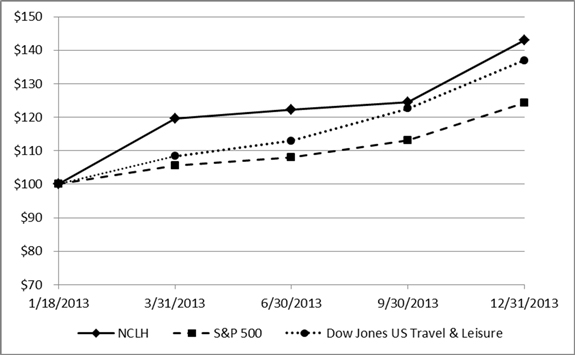
Item 6. Selected Financial Data
The selected consolidated financial data presented below for the years 2009 through 2012 and as of the end of each such year are derived from NCLC’s consolidated financial statements and should be read in conjunction with those financial statements and the related notes as well as with “Item 7—Management’s Discussion and Analysis of Financial Condition and Results of Operations.”
Prior to the year ended December 31, 2013, the financial statements are those of NCLC; however, we have retrospectively applied the exchange of ordinary shares due to the Corporate Reorganization as the effect is substantially the same as a stock split. The Corporate Reorganization is reflected in NCLH’s financial statements for the first time in the quarter ended March 31, 2013. In addition, the prior comparative periods will be the activity of NCLC during such periods.
Table of Contents
| As of or for the Year Ended December 31, | ||||||||||||||||||||
| (in thousands, except share data, per share data and operating data) | 2013 | 2012 | 2011 | 2010 | 2009 | |||||||||||||||
| Statement of operations data: | ||||||||||||||||||||
| Total revenue | $ | 2,570,294 | $ | 2,276,246 | $ | 2,219,324 | $ | 2,012,128 | $ | 1,855,204 | ||||||||||
| Operating income | $ | 395,887 | $ | 357,093 | $ | 316,112 | $ | 230,609 | $ | 171,095 | ||||||||||
| Net income (1) | $ | 102,886 | $ | 168,556 | $ | 126,859 | $ | 22,986 | $ | 66,952 | ||||||||||
| Net income attributable to non-controlling interest | $ | 1,172 | $ | — | $ | — | $ | — | $ | — | ||||||||||
| Net income attributable to Norwegian Cruise Line Holdings Ltd. (1) | $ | 101,714 | $ | 168,556 | $ | 126,859 | $ | 22,986 | $ | 66,952 | ||||||||||
| Earnings per share: | ||||||||||||||||||||
| Basic | $ | 0.50 | $ | 0.95 | $ | 0.71 | $ | 0.13 | $ | 0.38 | ||||||||||
| Diluted | $ | 0.49 | $ | 0.94 | $ | 0.71 | $ | 0.13 | $ | 0.38 | ||||||||||
| Weighted-average shares: | ||||||||||||||||||||
| Basic | 202,993,839 | 178,232,850 | 177,869,461 | 177,563,047 | 174,856,765 | |||||||||||||||
| Diluted | 209,239,484 | 179,023,683 | 178,859,720 | 178,461,210 | 175,275,440 | |||||||||||||||
| Balance sheet data: | ||||||||||||||||||||
| Total assets | $ | 6,650,978 | $ | 5,938,427 | $ | 5,562,411 | $ | 5,572,371 | $ | 4,819,837 | ||||||||||
| Property and equipment, net | $ | 5,647,670 | $ | 4,960,142 | $ | 4,640,093 | $ | 4,639,281 | $ | 3,836,127 | ||||||||||
| Long-term debt, including current portion | $ | 3,127,789 | $ | 2,985,353 | $ | 3,038,081 | $ | 3,204,085 | $ | 2,557,691 | ||||||||||
| Total shareholders’ equity (2) | $ | 2,631,266 | $ | 2,018,784 | $ | 1,844,463 | $ | 1,740,526 | $ | 1,713,040 | ||||||||||
| Operating data: | ||||||||||||||||||||
| Passengers carried | 1,628,278 | 1,503,107 | 1,530,113 | 1,404,137 | 1,318,441 | |||||||||||||||
| Passenger Cruise Days | 11,400,906 | 10,332,914 | 10,227,438 | 9,559,049 | 9,243,154 | |||||||||||||||
| Capacity Days | 10,446,216 | 9,602,730 | 9,454,570 | 8,790,980 | 8,450,980 | |||||||||||||||
| Occupancy Percentage | 109.1 | % | 107.6 | % | 108.2 | % | 108.7 | % | 109.4 | % |
| (1) | In 2013, includes $160.6 million of expenses associated with debt prepayments. In 2010, includes a loss of $33.1 million primarily due to losses on foreign exchange contracts associated with the financing of Norwegian Epic. In 2009, includes foreign currency translation and interest rate swap losses of $9.6 million primarily due to fluctuations in the euro/U.S. dollar exchange rate. In 2009, these amounts were offset by the change in fair value of our fuel derivative contracts of $20.4 million. |
|---|
| (2) | In 2009, NCLC received $100.0 million from its shareholders and issued 1,000,000 additional ordinary shares of $.0012 par value to its shareholders pro rata in accordance with their percentage ownership resulting in an aggregate 21,000,000 ordinary shares of $.0012 par value issued and outstanding as of December 31, 2009. |
|---|
Item 7. Management’s Discussion and Analysis of Financial Condition and Results of Operations
Non-GAAP Financial Measures
We use certain non-GAAP financial measures, such as Net Revenue, Net Yield, Net Cruise Cost, Adjusted Net Cruise Cost Excluding Fuel and Adjusted EBITDA to enable us to analyze our performance. See “Terms Used in this Annual Report” for the definition of these non-GAAP financial measures. We utilize Net Revenue and Net Yield to manage our business on a day-to-day basis and believe that they are the most relevant measures of our revenue performance because they reflect the revenue earned by us net of significant variable costs. In measuring our ability to control costs in a manner that positively impacts net income, we believe changes in Net Cruise Cost and Adjusted Net Cruise Cost Excluding Fuel to be the most relevant indicators of our performance.
As our business includes the sourcing of passengers and deployment of vessels outside of North America, a portion of our revenue and expenses are denominated in foreign currencies, particularly euro and British Pound sterling, which are subject to fluctuations in currency exchange rates versus our reporting currency, the U.S. dollar. In order to monitor results excluding these fluctuations, we calculate certain non-GAAP measures on a Constant Currency basis whereby current period revenue and expenses denominated in foreign currencies are converted to U.S. dollars using currency exchange rates of the comparable period. We believe that presenting these non-GAAP measures on both a reported and Constant Currency basis is useful in providing a more comprehensive view of trends in our business.
We believe that Adjusted EBITDA is appropriate as a supplemental financial measure as it is used by management to assess operating performance, is a factor in the evaluation of the performance of management and is the primary metric used in determining the Company’s performance incentive bonus paid to its employees. We believe that Adjusted EBITDA is a useful measure in determining the Company’s performance as it reflects certain operating drivers of the Company’s business, such as sales growth, operating costs,
Table of Contents
marketing, general and administrative expense and other operating income and expense. Adjusted EBITDA is not a defined term under GAAP. Adjusted EBITDA is not intended to be a measure of liquidity or cash flows from operations or measures comparable to net income as it does not take into account certain requirements such as capital expenditures and related depreciation, principal and interest payments and tax payments and it includes other supplemental adjustments.
In addition, Adjusted Net Income and Adjusted EPS are supplemental financial measures used to demonstrate GAAP net income and EPS excluding certain charges. We use Adjusted Net Income and Adjusted EPS as key performance measures of our earnings performance, and we believe that both management and investors benefit from referring to these non-GAAP financial measures in assessing our performance and when planning, forecasting, and analyzing future periods. These non-GAAP financial measures also facilitate management’s internal comparison to our historical performance. These charges vary from period to period; accordingly, our presentation of Adjusted Net Income and Adjusted EPS may not be indicative of future adjustments or results.
You are encouraged to evaluate each adjustment used in calculating our non-GAAP financial measures and the reasons we consider our non-GAAP financial measures appropriate for supplemental analysis. In evaluating our non-GAAP financial measures, you should be aware that in the future we may incur expenses similar to the adjustments in our presentation. Our non-GAAP financial measures have limitations as analytical tools, and you should not consider these measures in isolation or as a substitute for analysis of our results as reported under GAAP. Our presentation of our non-GAAP financial measures should not be construed as an inference that our future results will be unaffected by unusual or non-recurring items. Our non-GAAP financial measures may not be comparable to other companies. Please see a historical reconciliation of these measures to the most comparable GAAP measure presented in our consolidated financial statements below in the “Results of Operations” section.
Financial Presentation
Revenue from our cruise and cruise-related activities are categorized by us as “passenger ticket revenue” and “onboard and other revenue.” Passenger ticket revenue and onboard and other revenue vary according to the size of the ship in operation, the length of cruises operated and the markets in which the ship operates. Our revenue is seasonal based on demand for cruises, which has historically been strongest during the summer months.
Passenger ticket revenue primarily consists of revenue for accommodations, meals in certain restaurants on the ship, certain onboard entertainment, and includes revenue for service charges and air and land transportation to and from the ship to the extent guests purchase these items from us. Onboard and other revenue primarily consists of revenue from gaming, beverage sales, shore excursions, specialty dining, retail sales, spa services and photo. We record onboard revenue from onboard activities we perform directly or that are performed by independent concessionaires, from which we receive a share of their revenue. Our cruise operating expense is classified as follows:
| • | Commissions, transportation and other primarily consists of direct costs associated with passenger ticket revenue. These costs include travel agent commissions, air and land transportation expenses, related credit card fees, costs associated with service charges and certain port expenses. |
|---|
| • | Onboard and other primarily consists of direct costs that are incurred in connection with onboard and other revenue. These include costs incurred in connection with shore excursions, beverage sales and gaming. |
|---|
| • | Payroll and related consists of the cost of wages and benefits for shipboard employees. |
|---|
| • | Fuel includes fuel costs, the impact of certain fuel hedges and fuel delivery costs. |
|---|
| • | Food consists of food costs for passengers and crew. |
|---|
| • | Other consists of repairs and maintenance (including Dry-dock costs), ship insurance, Charter costs and other ship expenses. |
|---|
Critical Accounting Policies
Our consolidated financial statements have been prepared in accordance with GAAP in the U.S. The preparation of these consolidated financial statements requires us to make estimates, judgments and assumptions that affect the reported amounts of assets and liabilities and disclosure of contingent assets and liabilities at the date of our consolidated financial statements and the reported amounts of revenues and expenses during the periods presented. We rely on historical experience and on various other assumptions that we believe to be reasonable under the circumstances to make these estimates and judgments. Actual results could differ materially from these estimates. We believe that the following critical accounting policies affect the significant estimates used in the preparation of our consolidated financial statements. These critical accounting policies, which are presented in detail in our notes to our audited consolidated financial statements, relate to ship accounting, asset impairment and contingencies.
Table of Contents
Ship Accounting
Ships represent our most significant assets, and we record them at cost less accumulated depreciation. Depreciation of ships is computed on a straight-line basis over the estimated service lives of primarily 30 years after a 15% reduction for the estimated residual value of the ship. Improvement costs that we believe add value to our ships are capitalized to the ship and depreciated over the improvements’ estimated useful lives. Repairs and maintenance activities are charged to expense as incurred. We account for Dry-dock costs under the direct expense method which requires us to expense all Dry-dock costs as incurred.
We determine the useful life of our ships based primarily on our estimates of the average useful life of the ships’ major component systems, such as cabins, main diesels, main electric, superstructure and hull. In addition, we consider the impact of anticipated changes in the vacation market and technological conditions and historical useful lives of similarly-built ships. Given the large and complex nature of our ships, our accounting estimates related to ships and determinations of ship improvement costs to be capitalized require considerable judgment and are inherently uncertain. Should certain factors or circumstances cause us to revise our estimate of ship service lives or projected residual values, depreciation expense could be materially lower or higher. If circumstances cause us to change our assumptions in making determinations as to whether ship improvements should be capitalized, the amounts we expense each year as repairs and maintenance costs could increase, partially offset by a decrease in depreciation expense. If we reduced our estimated average 30-year ship service life by one year, depreciation expense for the year ended December 31, 2013 would have increased by $6.1 million. In addition, if our ships were estimated to have no residual value, depreciation expense for the same period would have increased by $30.6 million. We believe our estimates for ship accounting are reasonable and our methods are consistently applied. We believe that depreciation expense is based on a rational and systematic method to allocate our ships’ costs to the periods that benefit from the ships’ usage.
Asset Impairment
We review our long-lived assets, principally ships, for impairment whenever events or changes in circumstances indicate that the carrying amount of an asset may not be recoverable. Assets are grouped and evaluated at the lowest level for which there are identifiable cash flows that are largely independent of the cash flows of other groups of assets. We consider historical performance and future estimated results in our evaluation of potential impairment and then compare the carrying amount of the asset to the estimated future cash flows expected to result from the use of the asset. If the carrying amount of the asset exceeds the estimated expected undiscounted future cash flows, we measure the amount of the impairment by comparing the carrying amount of the asset to its fair value. We estimate fair value based on the best information available making whatever estimates, judgments and projections considered necessary. The estimation of fair value is generally measured by discounting expected future cash flows at discount rates commensurate with the risk involved.
Goodwill and other indefinite-lived assets, principally trade names, are reviewed for impairment on an annual basis or earlier if there is an event or change in circumstances that would indicate that the carrying value of these assets could not be fully recovered.
We believe our estimates and judgments with respect to our long-lived assets, principally ships, and goodwill and other indefinite-lived intangible assets are reasonable. Nonetheless, if there was a material change in assumptions used in the determination of such fair values or if there is a material change in the conditions or circumstances that influence such assets, we could be required to record an impairment charge. As of December 31, 2013, our annual review supports the carrying value of these assets.
Contingencies
Periodically, we assess potential liabilities related to any lawsuits or claims brought against us or any asserted claims, including tax, legal and/or environmental matters. Although it is typically very difficult to determine the timing and ultimate outcome of such actions, we use our best judgment to determine if it is probable that we will incur an expense related to the settlement or final adjudication of such matters and whether a reasonable estimation of such probable loss, if any, can be made. In assessing probable losses, we take into consideration estimates of the amount of insurance recoveries, if any. In accordance with the guidance on accounting for contingencies, we accrue a liability when we believe a loss is probable and the amount of loss can be reasonably estimated. Due to the inherent uncertainties related to the eventual outcome of litigation and potential insurance recoveries, although we believe that our estimates and judgments are reasonable, it is possible that certain matters may be resolved for amounts materially different from any estimated provisions or previous disclosures.
Executive Overview
Total revenue increased 12.9% to $2.6 billion for the year ended December 31, 2013 compared to $2.3 billion for the year ended December 31, 2012. Net Revenue for the year ended December 31, 2013 increased 13.4% to $1.9 billion from $1.7 billion in the same period in 2012 with an improvement of both Net Yield of 4.3% and Capacity Days of 8.8%.
Table of Contents
For the year ended December 31, 2013, we had Adjusted Net Income and Adjusted EPS of $295.8 million and $1.41, respectively, which excludes $27.9 million of expenses related to non-cash compensation and $165.0 million of expenses related to prepayments of debt, a change in corporate entity structure and our Secondary Offerings. On a GAAP basis, net income attributable to Norwegian Cruise Line Holdings Ltd. and diluted earnings per share were $101.7 million and $0.49, respectively. Operating income increased 10.9% to $395.9 million for the year ended December 31, 2013 from $357.1 million in 2012. A 16.5% improvement in Adjusted EBITDA was achieved for the same period as revenue increased primarily due to an increase in passenger ticket pricing. Our business improvement measures continued to have an impact even with the increase in the cost of fuel. We refer you to our Results of Operations below for a calculation of Net Revenue, Adjusted Net Income, Adjusted EPS and Adjusted EBITDA.
Results of Operations
We reported total revenue, total cruise operating expense, operating income and net income as follows (in thousands, except per share data):
| Year Ended December 31, | ||||||||||||
| 2013 | 2012 | 2011 | ||||||||||
| Total revenue | $ | 2,570,294 | $ | 2,276,246 | $ | 2,219,324 | ||||||
| Total cruise operating expense | $ | 1,657,659 | $ | 1,478,433 | $ | 1,467,876 | ||||||
| Operating income | $ | 395,887 | $ | 357,093 | $ | 316,112 | ||||||
| Net income attributable to Norwegian Cruise Line Holdings Ltd. | $ | 101,714 | $ | 168,556 | $ | 126,859 | ||||||
| Earnings per share: | ||||||||||||
| Basic | $ | 0.50 | $ | 0.95 | $ | 0.71 | ||||||
| Diluted | $ | 0.49 | $ | 0.94 | $ | 0.71 | ||||||
The following table sets forth operating data as a percentage of revenue:
| Year Ended December 31, | ||||||||||||
| 2013 | 2012 | 2011 | ||||||||||
| Revenue | ||||||||||||
| Passenger ticket | 70.6 | % | 70.5 | % | 70.4 | % | ||||||
| Onboard and other | 29.4 | % | 29.5 | % | 29.6 | % | ||||||
| Total revenue | 100.0 | % | 100.0 | % | 100.0 | % | ||||||
| Cruise operating expense | ||||||||||||
| Commissions, transportation and other | 17.7 | % | 18.0 | % | 18.5 | % | ||||||
| Onboard and other | 7.6 | % | 7.7 | % | 7.6 | % | ||||||
| Payroll and related | 13.3 | % | 12.9 | % | 13.1 | % | ||||||
| Fuel | 11.8 | % | 12.5 | % | 11.0 | % | ||||||
| Food | 5.3 | % | 5.5 | % | 5.6 | % | ||||||
| Other | 8.8 | % | 8.4 | % | 10.3 | % | ||||||
| Total cruise operating expense | 64.5 | % | 65.0 | % | 66.1 | % | ||||||
| Other operating expense | ||||||||||||
| Marketing, general and administrative | 11.7 | % | 11.0 | % | 11.3 | % | ||||||
| Depreciation and amortization | 8.4 | % | 8.3 | % | 8.3 | % | ||||||
| Total other operating expense | 20.1 | % | 19.3 | % | 19.6 | % | ||||||
| Operating income | 15.4 | % | 15.7 | % | 14.3 | % | ||||||
| Non-operating income (expense) | ||||||||||||
| Interest expense, net | (11.0 | )% | (8.3 | )% | (8.6 | )% | ||||||
| Other income (expense) | 0.1 | % | — | % | 0.1 | % | ||||||
| Total non-operating income (expense) | (10.9 | )% | (8.3 | )% | (8.5 | )% | ||||||
| Net income before income taxes | 4.5 | % | 7.4 | % | 5.8 | % | ||||||
| Income tax expense | (0.5 | )% | — | % | (0.1 | )% | ||||||
| Net income | 4.0 | % | 7.4 | % | 5.7 | % | ||||||
| Net income attributable to non-controlling interest | — | % | — | % | — | % | ||||||
| Net income attributable to Norwegian Cruise Line Holdings Ltd. | 4.0 | % | 7.4 | % | 5.7 | % | ||||||
Table of Contents
The following table sets forth selected statistical information:
| Year Ended December 31, | ||||||||||||
| 2013 | 2012 | 2011 | ||||||||||
| Passengers carried | 1,628,278 | 1,503,107 | 1,530,113 | |||||||||
| Passenger Cruise Days | 11,400,906 | 10,332,914 | 10,227,438 | |||||||||
| Capacity Days | 10,446,216 | 9,602,730 | 9,454,570 | |||||||||
| Occupancy Percentage | 109.1 | % | 107.6 | % | 108.2 | % |
Gross Yield and Net Yield were calculated as follows (in thousands, except Capacity Days and Yield data):
| Year Ended December 31, | ||||||||||||||||||||
| 2013 | 2013 Constant Currency | 2012 | 2012 Constant Currency | 2011 | ||||||||||||||||
| Passenger ticket revenue | $ | 1,815,869 | $ | 1,814,397 | $ | 1,604,563 | $ | 1,621,412 | $ | 1,563,363 | ||||||||||
| Onboard and other revenue | 754,425 | 754,425 | 671,683 | 671,683 | 655,961 | |||||||||||||||
| Total revenue | 2,570,294 | 2,568,822 | 2,276,246 | 2,293,095 | 2,219,324 | |||||||||||||||
| Less: | ||||||||||||||||||||
| Commissions, transportation and other expense | 455,816 | 455,286 | 410,531 | 415,030 | 410,709 | |||||||||||||||
| Onboard and other expense | 195,526 | 195,526 | 173,916 | 173,916 | 169,329 | |||||||||||||||
| Net Revenue | $ | 1,918,952 | $ | 1,918,010 | $ | 1,691,799 | $ | 1,704,149 | $ | 1,639,286 | ||||||||||
| Capacity Days | 10,446,216 | 10,446,216 | 9,602,730 | 9,602,730 | 9,454,570 | |||||||||||||||
| Gross Yield | $ | 246.05 | $ | 245.91 | $ | 237.04 | $ | 238.80 | $ | 234.74 | ||||||||||
| Net Yield | $ | 183.70 | $ | 183.61 | $ | 176.18 | $ | 177.47 | $ | 173.39 |
Gross Cruise Cost, Net Cruise Cost, Net Cruise Cost Excluding Fuel and Adjusted Net Cruise Cost Excluding Fuel were calculated as follows (in thousands, except Capacity Days and per Capacity Day data):
| Year Ended December 31, | ||||||||||||||||||||
| 2013 | 2013 Constant Currency | 2012 | 2012 Constant Currency | 2011 | ||||||||||||||||
| Total cruise operating expense | $ | 1,657,659 | $ | 1,655,971 | $ | 1,478,433 | $ | 1,487,544 | $ | 1,467,876 | ||||||||||
| Marketing, general and administrative expense | 301,155 | 300,719 | 251,183 | 252,615 | 251,351 | |||||||||||||||
| Gross Cruise Cost | 1,958,814 | 1,956,690 | 1,729,616 | 1,740,159 | 1,719,227 | |||||||||||||||
| Less: | ||||||||||||||||||||
| Commissions, transportation and other expense | 455,816 | 455,286 | 410,531 | 415,030 | 410,709 | |||||||||||||||
| Onboard and other expense | 195,526 | 195,526 | 173,916 | 173,916 | 169,329 | |||||||||||||||
| Net Cruise Cost | 1,307,472 | 1,305,878 | 1,145,169 | 1,151,213 | 1,139,189 | |||||||||||||||
| Less: Fuel expense | 303,439 | 303,439 | 283,678 | 283,678 | 243,503 | |||||||||||||||
| Net Cruise Cost Excluding Fuel | 1,004,033 | 1,002,439 | 861,491 | 867,535 | 895,686 | |||||||||||||||
| Less: Other (1) | 33,049 | 33,049 | — | — | — | |||||||||||||||
| Adjusted Net Cruise Cost Excluding Fuel | $ | 970,984 | $ | 969,390 | $ | 861,491 | $ | 867,535 | $ | 895,686 | ||||||||||
| Capacity Days | 10,446,216 | 10,446,216 | 9,602,730 | 9,602,730 | 9,454,570 | |||||||||||||||
| Gross Cruise Cost per Capacity Day | $ | 187.51 | $ | 187.31 | $ | 180.12 | $ | 181.22 | $ | 181.84 | ||||||||||
| Net Cruise Cost per Capacity Day | $ | 125.16 | $ | 125.01 | $ | 119.25 | $ | 119.88 | $ | 120.49 | ||||||||||
| Net Cruise Cost Excluding Fuel per Capacity Day | $ | 96.11 | $ | 95.96 | $ | 89.71 | $ | 90.34 | $ | 94.74 | ||||||||||
| Adjusted Net Cruise Cost Excluding Fuel per Capacity Day | $ | 92.95 | $ | 92.80 | $ | 89.71 | $ | 90.34 | $ | 94.74 |
| (1) | Consists of non-cash share-based compensation related to our IPO and other supplemental adjustments. |
|---|
Table of Contents
Adjusted Net Income and Adjusted EPS were calculated as follows (in thousands, except share and per share data):
| Year Ended December 31, | ||||||||||||
| 2013 | 2012 | 2011 | ||||||||||
| Net income attributable to Norwegian Cruise Line Holdings Ltd. | $ | 101,714 | $ | 168,556 | $ | 126,859 | ||||||
| Net income attributable to non-controlling interest | 1,172 | — | — | |||||||||
| Net income | 102,886 | 168,556 | 126,859 | |||||||||
| Non-cash compensation | 9,408 | 4,500 | — | |||||||||
| Non-cash share-based compensation related to IPO | 18,527 | — | — | |||||||||
| Expenses related to debt prepayments (1) | 160,573 | — | — | |||||||||
| Other (2) | 4,396 | — | — | |||||||||
| Adjusted Net Income | $ | 295,790 | $ | 173,056 | $ | 126,859 | ||||||
| Diluted weighted-average shares outstanding | 209,239,484 | 179,023,683 | 178,859,720 | |||||||||
| Diluted earnings per share (3) | $ | 0.49 | $ | 0.94 | $ | 0.71 | ||||||
| Adjusted EPS | $ | 1.41 | $ | 0.97 | $ | 0.71 | ||||||
| (1) | Consists of premiums, write-offs of deferred fees and other expenses related to prepayments of debt. |
|---|
| (2) | Expenses incurred from changes in corporate entity structure and our Secondary Offerings. |
|---|
| (3) | Diluted earnings per share is computed by dividing net income by diluted weighted-average shares outstanding. |
|---|
Adjusted EBITDA was calculated as follows (in thousands):
| Year Ended December 31, | ||||||||||||
| 2013 | 2012 | 2011 | ||||||||||
| Net income attributable to Norwegian Cruise Line Holdings Ltd. | $ | 101,714 | $ | 168,556 | $ | 126,859 | ||||||
| Interest expense, net | 282,602 | 189,930 | 190,187 | |||||||||
| Income tax expense | 11,802 | 706 | 1,700 | |||||||||
| Depreciation and amortization expense | 215,593 | 189,537 | 183,985 | |||||||||
| EBITDA | 611,711 | 548,729 | 502,731 | |||||||||
| Net income attributable to non-controlling interest | 1,172 | — | — | |||||||||
| Other (income) expense | (1,403 | ) | (2,099 | ) | (2,634 | ) | ||||||
| Non-cash compensation and other (1) | 17,188 | 9,004 | 5,942 | |||||||||
| Non-cash share-based compensation related to IPO | 18,527 | — | — | |||||||||
| Adjusted EBITDA | $ | 647,195 | $ | 555,634 | $ | 506,039 | ||||||
| (1) | Consists of non-cash compensation, expenses incurred from changes in corporate entity structure, our Secondary Offerings and other supplemental adjustments. |
|---|
Year Ended December 31, 2013 (“2013”) Compared to Year Ended December 31, 2012 (“2012”)
Revenue
Total revenue increased 12.9% to $2.6 billion in 2013 compared to $2.3 billion in 2012. Net Revenue increased 13.4% in 2013, primarily due to an increase in Capacity Days of 8.8% related to the delivery of Norwegian Breakaway and an increase in Net Yield of 4.3%. The increase in Net Yield was due to an increase in passenger ticket pricing and higher onboard and other revenue, partially due to the introduction of Norwegian Breakaway to the fleet. On a Constant Currency basis, Net Yield increased 4.2% in 2013 compared to 2012.
Expense
Total cruise operating expense increased 12.1% in 2013 compared to 2012 primarily due to an increase in Capacity Days, expenses related to planned Dry-docks and fuel expense, partially offset by the timing of certain expenses. The increase in fuel expense was primarily the result of a 1.7% increase in the average fuel price to $675 per metric ton in 2013 from $664 in 2012. Total other operating expense increased 17.3% in 2013 compared to 2012 primarily due to non-cash expenses related to share-based compensation recognized upon the realization of our IPO, the timing of certain expenses and depreciation expense related to the addition of Norwegian Breakaway. On a Capacity Day basis, Net Cruise Cost increased 5.0% on an as reported and 4.8% on a Constant Currency basis due to the expenses discussed above. Adjusted Net Cruise Cost Excluding Fuel per Capacity Day increased 3.6% and 3.4% on an as reported and Constant Currency basis, respectively, mainly due to the timing of certain expenses.
Table of Contents
Interest expense, net increased to $282.6 million in 2013 from $189.9 million in 2012 primarily due to $160.6 million of expenses associated with debt prepayments partially offset by lower interest rates resulting from the benefits from the redemption of higher rate debt and refinancing transactions.
Income tax expense increased to $11.8 million in 2013 from $0.7 million in 2012 primarily due to the change in our U.S. tax status from a partnership to a corporation in connection with our IPO.
Year Ended December 31, 2012 (“2012”) Compared to Year Ended December 31, 2011 (“2011”)
Revenue
Total revenue increased 2.6% to $2.3 billion in 2012 compared to $2.2 billion in 2011. Net Revenue increased 3.2% in 2012, primarily due to an increase in Net Yield of 1.6% and an increase in Capacity Days of 1.6%. The increase in Net Yield was primarily due to an increase in passenger ticket pricing and the increase in Capacity Days in 2012 was primarily due to the timing of certain repairs and maintenance. On a Constant Currency basis, Net Yield increased 2.4% in 2012 compared to 2011.
Expense
Total cruise operating expense increased slightly in 2012 compared to 2011 due to an increase in Capacity Days as described above and higher ship operating expenses. The increase in ship operating expenses was primarily due to an increase in fuel expense as a result of a 16.3% increase in average fuel price to $664 per metric ton in 2012 from $571 in 2011. Total other operating expense increased slightly compared to 2011 due to an increase in depreciation expense related to the purchase of Norwegian Sky primarily offset by lower general and administrative expenses as a result of ongoing business improvement initiatives. Net Cruise Cost increased slightly in 2012 primarily due to an increase in Capacity Days. On a Capacity Day basis, Net Cruise Cost decreased 1.0% primarily due to the decrease in general and administrative expenses discussed above substantially offset by an increase in fuel expense. Excluding fuel expense, Net Cruise Cost per Capacity Day decreased 5.3%. On a Constant Currency basis, Net Cruise Cost per Capacity Day decreased slightly and excluding fuel expense decreased 4.6%.
Interest expense, net of capitalized interest, was $189.9 million in 2012 compared to $190.2 million in 2011.
Liquidity and Capital Resources
General
As of December 31, 2013, our liquidity was $450.5 million consisting of $56.5 million in cash and cash equivalents and $394.0 million available under our revolving credit facility. Our primary ongoing liquidity requirements are to finance working capital, capital expenditures and debt service.
As of December 31, 2013, we had a working capital deficit of $892.6 million. This deficit included $411.8 million of advance ticket sales, which represents the passenger revenues we collect in advance of sailing dates and accordingly are substantially more like deferred revenue balances rather than actual current cash liabilities. Our business model, along with our revolving credit facility, allows us to operate with a working capital deficit and still meet our operating, investing and financing needs.
Our debt agreements limit or prohibit, and any of our future debt arrangements may restrict, among other things, the ability of our subsidiaries, including NCLC, to pay distributions to NCLH and our ability to pay cash dividends to our shareholders. We are a holding company and depend upon our subsidiaries for their ability to pay distributions to us to finance any dividend or pay any other obligations of NCLH. However, we do not believe that these restrictions have had or are expected to have an impact on our ability to meet any cash obligations.
Sources and Uses of Cash
In this section, references to 2013 refer to the year ended December 31, 2013, references to 2012 refer to the year ended December 31, 2012 and references to 2011 refer to the year ended December 31, 2011.
Net cash provided by operating activities was $475.3 million in 2013 as compared to $398.6 million in 2012 and $357.0 million in 2011. Although net income decreased in 2013 compared to 2012, primarily due to $124.2 million of fees related to the prepayment of debt and $11.4 million of deferred income taxes, net cash provided by operating activities increased mainly due to timing differences in cash receipts and payments relating to operating assets and liabilities primarily with an increase in advance ticket sales. The 2012 balance included $6.0 million related to the premium received from the issuance of $100.0 million of senior unsecured notes. The change in net cash provided by operating activities for the year ended 2012 reflects the increase in net income to $168.6 million in 2012 compared to $126.9 million in 2011, as well as timing differences in cash receipts and payments relating to operating assets and liabilities and $6.0 million related to the premium received from the issuance of $100.0 million of senior unsecured notes.
Table of Contents
Net cash used in investing activities was $894.9 million in 2013, primarily related to the payments for construction and delivery of Norwegian Breakaway and construction of Norwegian Getaway, as well as other ship improvements and shoreside projects. Net cash used in investing activities was $303.8 million in 2012, primarily related to payments for construction of Norwegian Breakaway and Norwegian Getaway, the purchase of Norwegian Sky, and other ship improvements and shoreside projects. Net cash used in investing activities was $184.8 million in 2011, primarily related to payments for construction of Norwegian Breakaway and Norwegian Getaway.
Net cash provided by financing activities was $430.5 million in 2013, primarily due to the issuance of our $300.0 million 5% senior notes due 2018 as well as borrowings under other credit facilities and the proceeds from the issuance of ordinary shares partially offset by repayments of our $450.0 million 11.75% senior secured notes due 2016 and revolving credit facilities, and a payment related to the Norwegian Sky purchase agreement. Net cash used in financing activities was $108.2 million in 2012, primarily due to repayments of our revolving credit facilities, other borrowings and loan arrangement fees which were partially offset by borrowings on our revolving credit facilities and by the issuance of $100.0 million of senior unsecured notes. Net cash used in financing activities was $168.3 million in 2011, primarily due to repayments of our revolving credit facility and repayments of borrowings related to Norwegian Epic partially offset by borrowings related to the construction of Norwegian Breakaway and Norwegian Getaway.
Future Capital Commitments
Future capital commitments consist of contracted commitments, including future expected capital expenditures for business enhancements and ship construction contracts. As of December 31, 2013, anticipated capital expenditures together with amounts for ship construction and related export credit financing were as follows (in thousands, based on the euro/U.S. dollar exchange rate as of December 31, 2013):
| Full Year | ||||||||||||
| 2014 | 2015 | 2016 | ||||||||||
| Ship construction | $ | 802,650 | $ | 968,101 | $ | 116,336 | ||||||
| Ship financing | (705,968 | ) | (761,085 | ) | (46,069 | ) | ||||||
| Ship construction net of financing | $ | 96,682 | $ | 207,016 | $ | 70,267 | ||||||
| Business Enhancement Capital Expenditures, including ROI Capital Expenditures (1)(2)(3) | $ | 98,000 | $ | 81,000 | $ | 92,000 | ||||||
| Incremental ROI Capital Expenditures for exhaust gas scrubbers | $ | 27,000 | $ | 29,000 | $ | 8,000 | ||||||
| (1) | 2014 includes $38.0 million in ROI Capital Expenditures |
|---|
| (2) | 2014, 2015 and 2016 exclude amounts for exhaust gas scrubbers |
|---|
| (3) | 2014 and 2015 include investment for development of our future cruise destination in Belize |
|---|
We have orders with Meyer Werft for two ships for delivery in the fourth quarter of 2015 and the first quarter of 2017. These ships, Norwegian Escape and Norwegian Bliss, will be the largest in our fleet at approximately 163,000 Gross Tons with 4,200 Berths each and will be similar in design and innovation to our Breakaway Class Ships. The combined contract cost of these two ships is approximately €1.4 billion, or $1.9 billion based on the euro/U.S. dollar exchange rate as of December 31, 2013. We have export credit financing in place that provides financing for 80% of their contract price.
In connection with the contracts to build these ships, we do not anticipate any contractual breaches or cancellation to occur. However, if any would occur, it could result in, among other things, the forfeiture of prior deposits or payments made by us, subject to certain refund guarantees, and potential claims and impairment losses which may materially impact our business, financial condition and results of operations.
Capitalized interest for the year ended December 31, 2013 was $26.3 million for the construction of Norwegian Breakaway, Norwegian Getaway, Norwegian Escape and Norwegian Bliss. Capitalized interest for the years ended December 31, 2012 and 2011 was $22.1 million and $16.7 million, respectively, for the construction of Norwegian Breakaway and Norwegian Getaway.
Table of Contents
Off-Balance Sheet Transactions
None.
Contractual Obligations
As of December 31, 2013, our contractual obligations, with initial or remaining terms in excess of one year, including interest payments on long-term debt obligations, were as follows (in thousands):
| Total | Less than 1 year | 1-3 years | 3-5 years | More than 5 years | ||||||||||||||||
| Long-term debt(1) | $ | 3,127,789 | $ | 286,575 | $ | 645,807 | $ | 1,417,580 | $ | 777,827 | ||||||||||
| Due to Affiliate(2) | 91,672 | 36,544 | 55,128 | — | — | |||||||||||||||
| Operating leases(3) | 36,416 | 6,740 | 11,341 | 10,855 | 7,480 | |||||||||||||||
| Ship construction contracts(4) | 2,594,068 | 810,081 | 1,008,942 | 775,045 | — | |||||||||||||||
| Port facilities(5) | 200,769 | 28,589 | 58,675 | 51,433 | 62,072 | |||||||||||||||
| Interest(6) | 378,485 | 75,083 | 139,245 | 98,559 | 65,598 | |||||||||||||||
| Other(7) | 49,574 | 26,668 | 18,468 | 2,293 | 2,145 | |||||||||||||||
| Total | $ | 6,478,773 | $ | 1,270,280 | $ | 1,937,606 | $ | 2,355,765 | $ | 915,122 | ||||||||||
| (1) | Net of unamortized original issue discount of $1.4 million. Also includes capital leases. |
|---|
| (2) | Primarily related to the purchase of Norwegian Sky. |
|---|
| (3) | Primarily for offices, motor vehicles and office equipment. |
|---|
| (4) | For Norwegian Getaway, Norwegian Escape and Norwegian Bliss based on the euro/U.S. dollar exchange rate as of December 31, 2013. Export credit financing is in place from a syndicate of banks. |
|---|
| (5) | Primarily for our usage of certain port facilities. |
|---|
| (6) | Includes fixed and variable rates with LIBOR held constant as of December 31, 2013. |
|---|
| (7) | Future commitments for service, maintenance and other Business Enhancement Capital Expenditure contracts. |
|---|
Other
Certain of our service providers may require collateral in the normal course of our business. The amount of collateral may change based on certain terms and conditions.
As a routine part of our business, depending on market conditions, exchange rates, pricing and our strategy for growth, we regularly consider opportunities to enter into contracts for the building of additional ships. We may also consider the sale of ships, potential acquisitions and strategic alliances. If any of these were to occur, they may be financed through the incurrence of additional permitted indebtedness, through cash flows from operations, or through the issuance of debt, equity or equity-related securities.
Funding Sources
Our debt agreements contain covenants that, among other things, require us to maintain a minimum level of liquidity, as well as limit our net funded debt-to-capital ratio, maintain certain other ratios and restrict our ability to pay dividends. Our ships and substantially all other property and equipment are pledged as collateral for our debt. We believe we were in compliance with these covenants as of December 31, 2013.
The impact of changes in world economies and especially the global credit markets has created a challenging environment and may reduce future consumer demand for cruises and adversely affect our counterparty credit risks. In the event this environment deteriorates, our business, financial condition and results of operations could be adversely impacted.
We believe our cash on hand, expected future operating cash inflows, additional available borrowings under our existing credit facility and our ability to issue debt securities or raise additional equity, will be sufficient to fund operations, debt payment requirements, capital expenditures and maintain compliance with covenants under our debt agreements over the next twelve-month period. As a result of the equity infusion from our IPO and the related use of proceeds, our leverage was improved and our balance sheet was strengthened. There is no assurance that cash flows from operations and additional financings will be available in the future to fund our future obligations.
Table of Contents
Item 7A. Qualitative and Quantitative Disclosures about Market Risk
General
We are exposed to market risk attributable to changes in interest rates, foreign currency exchange rates and fuel prices. We attempt to minimize these risks through a combination of our normal operating and financing activities and through the use of derivatives. The financial impacts of these derivative instruments are primarily offset by corresponding changes in the underlying exposures being hedged. We achieve this by closely matching the amount, term and conditions of the derivatives with the underlying risk being hedged. We do not hold or issue derivatives for trading or other speculative purposes. Derivative positions are monitored using techniques including market valuations and sensitivity analyses.
Interest Rate Risk
As of December 31, 2013, we had interest rate swap agreements to modify our exposure to interest rate movements and to manage our interest expense. As of December 31, 2013, 38% of our debt was fixed and 62% was variable, which includes the effects of the interest rate swap. The notional amount of outstanding debt associated with the interest rate swap agreements as of December 31, 2013 was $660.4 million. Based on our December 31, 2013 outstanding variable rate debt balance, a one percentage point increase in annual LIBOR interest rates would increase our annual interest expense by approximately $19.4 million excluding the effects of capitalization of interest.
Foreign Currency Exchange Rate Risk
As of December 31, 2013, we had foreign currency derivatives to hedge the exposure to volatility in foreign currency exchange rates related to our ship construction contracts denominated in euros. These derivatives hedge the foreign currency exchange rate risk on a portion of the final payments on our ship construction contracts. The payments not hedged aggregate €1.4 billion, or $1.9 billion based on the euro/U.S. dollar exchange rate as of December 31, 2013. We estimate that a 10% change in the euro as of December 31, 2013 would result in a $189.9 million change in the U.S. dollar value of the foreign currency denominated remaining payments.
Fuel Price Risk
Our exposure to market risk for changes in fuel prices relates to the forecasted purchases of fuel on our ships. Fuel expense, as a percentage of our total cruise operating expense, was 18.3%, 19.2% and 16.6% for the years ended December 31, 2013, 2012 and 2011 respectively. We use fuel derivative agreements to mitigate the financial impact of fluctuations in fuel prices and as of December 31, 2013, we had hedged approximately 65%, 53% and 15% of our 2014, 2015 and 2016 projected metric tons of fuel purchases, respectively. We estimate that a 10% increase in our weighted-average fuel price would increase our anticipated 2014 fuel expense by $30.8 million. This increase would be partially offset by an increase in the fair value of our fuel swap agreements and fuel collars and options of $16.3 million. Fair value of our derivative contracts is derived using valuation models that utilize the income valuation approach. These valuation models take into account the contract terms such as maturity, as well as other inputs such as fuel types, fuel curves, creditworthiness of the counterparty and the Company, as well as other data points.
Item 8. Financial Statements and Supplementary Data
Our Financial Statements and Quarterly Selected Financial Data are included beginning on page F-1 of this report.
Item 9. Changes In and Disagreements With Accountants on Accounting and Financial Disclosure
None.
Item 9A. Controls and Procedures
Evaluation of Disclosure Controls and Procedures
Our management has evaluated, with the participation of our Chief Executive Officer and Chief Financial Officer, the effectiveness of our disclosure controls and procedures as of December 31, 2013. There are inherent limitations to the effectiveness of any system of disclosure controls and procedures, including the possibility of human error and the circumvention or overriding of the controls and procedures. Accordingly, even effective disclosure controls and procedures can only provide reasonable assurance of achieving their control objectives. Based upon management’s evaluation, our Chief Executive Officer and Chief Financial Officer concluded that our disclosure controls and procedures were effective as of December 31, 2013 to provide reasonable assurance that the information required to be disclosed by us in the reports we file or submit under the Exchange Act is recorded, processed, summarized and reported within the time periods specified in the rules and forms of the Securities and Exchange Commission, and that it is accumulated and communicated to our management, including our Chief Executive Officer and Chief Financial Officer, as appropriate to allow timely decisions regarding required disclosure.
Table of Contents
Management’s Report on Internal Control over Financial Reporting
Our management is responsible for establishing and maintaining adequate internal control over financial reporting, as such term is defined in Exchange Act Rule 13a-15(f). Under the supervision and with the participation of our management, including our Chief Executive Officer and Chief Financial Officer, we conducted an evaluation of the effectiveness of our internal control over financial reporting based on the 1992 Internal Control-Integrated Framework issued by the Committee of Sponsoring Organizations of the Treadway Commission (“COSO Framework”). Based on this evaluation under the COSO Framework, management concluded that our internal control over financial reporting was effective as of December 31, 2013.
PricewaterhouseCoopers LLP, an independent registered certified public accounting firm, has issued an attestation report regarding its assessment of NCLH’s internal control over financial reporting as of December 31, 2013, as stated in their report, which is included on page F-1.
Changes in Internal Control Over Financial Reporting
There have been no changes in our internal control over financial reporting during the quarter ended December 31, 2013 that have materially affected, or are reasonably likely to materially affect, our internal control over financial reporting.
Limitations on the Effectiveness of Controls
It should be noted that any system of controls, however well designed and operated, can provide only reasonable, and not absolute, assurance that the objectives of the system will be met. In addition, the design of any control system is based in part upon certain assumptions about the likelihood of future events. Because of these and other inherent limitations of control systems, there is only the reasonable assurance that our controls will succeed in achieving their goals under all potential future conditions.
Item 9B. Other Information
Disclosure Pursuant to Section 219 of the Iran Threat Reduction and Syria Human Rights Act
Apollo Global Management, LLC (“Apollo”) has provided notice to us that, as of October 24, 2013, certain investment funds managed by affiliates of Apollo beneficially owned approximately 22% of the limited liability company interests of CEVA Holdings, LLC (“CEVA”). Under the limited liability company agreement governing CEVA, certain investment funds managed by affiliates of Apollo hold a majority of the voting power of CEVA and have the right to elect a majority of the board of CEVA. CEVA may be deemed to be under common control with us, but this statement is not meant to be an admission that common control exists. As a result, it appears that we are required to provide disclosures as set forth below pursuant to Section 219 of the Iran Threat Reduction and Syria Human Rights Act of 2012 (“ITRA”) and Section 13(r) of the Securities Exchange Act of 1934, as amended (the “Exchange Act”).
Apollo has informed us that CEVA has provided it with the information below relevant to Section 13(r) of the Exchange Act. The disclosure below does not relate to any activities conducted by us and does not involve us or our management. The disclosure relates solely to activities conducted by CEVA and its consolidated subsidiaries. We have not independently verified or participated in the preparation of the disclosure below.
“Through an internal review of its global operations, CEVA has identified the following transactions in an Initial Notice of Voluntary Self-Disclosure that CEVA filed with the U.S. Treasury Department Office of Foreign Assets Control (“OFAC”) on October 28, 2013. CEVA’s review is ongoing. CEVA will file a further report with OFAC after completing its review.
The internal review indicates that, in February 2013, CEVA Freight Holdings (Malaysia) SDN BHD (“CEVA Malaysia”) provided customs brokerage for export and local haulage services for a shipment of polyethylene resin to Iran shipped on a vessel owned and/or operated by HDS Lines, also an SDN. The revenues and net profits for these services were approximately $779.54 USD and $311.13 USD, respectively. In September 2013, CEVA Malaysia provided customs brokerage services for the import into Malaysia of fruit juice from Alifard Co. in Iran via HDS Lines. The revenues and net profits for these services were approximately $227.41 USD and $89.29 USD, respectively.
These transactions violate the terms of internal CEVA compliance policies, which prohibit transactions involving Iran. Upon discovering these transactions, CEVA promptly launched an internal investigation, and is taking action to block and prevent such transactions in the future. CEVA intends to cooperate with OFAC in its review of this matter.”
Table of Contents
PART III.
Item 10. Directors, Executive Officers and Corporate Governance
Except for information concerning executive officers (called for by Item 401(b) of Regulation S-K), which is included in Part I of the Annual Report on Form 10-K and except as disclosed below with respect to our Code of Business Conduct and Ethics, the information required under Item 10 is incorporated herein by reference to our definitive proxy statement to be filed with the SEC within 120 days after the end of our fiscal year ended December 31, 2013 in connection with our 2014 Annual General Meeting of Shareholders.
Code of Conduct and Ethics
We have adopted a Code of Business Conduct and Ethics that applies to all of our employees, including our principal executive officer, principal financial officer, principal accounting officer or controller and persons performing similar functions, and our directors. This document is posted on our website at www.investor.ncl.com. We intend to disclose waivers from, and amendments to, our Code of Business Conduct and Ethics that apply to our directors and executive officers, including our principal executive officer, principal financial officer, principal accounting officers or controller and persons performing similar functions, by posting such information on our website www.investor.ncl.com to the extent required by applicable rules of the Securities and Exchange Commission and The NASDAQ Stock Market LLC. None of the websites referenced in this Annual Report on Form 10-K or the information contained therein is incorporated herein by reference.
Item 11. Executive Compensation
The information required under Item 11 is incorporated herein by reference to our definitive proxy statement to be filed with the SEC within 120 days after the end of our fiscal year ended December 31, 2013 in connection with our 2014 Annual General Meeting of Shareholders.
Item 12. Security Ownership of Certain Beneficial Owners and Management and Related Stockholder Matters
The information required under Item 12 is incorporated herein by reference to our definitive proxy statement to be filed with the SEC within 120 days after the end of our fiscal year ended December 31, 2013 in connection with our 2014 Annual General Meeting of Shareholders.
Item 13. Certain Relationships and Related Transactions and Director Independence
The information required under Item 13 is incorporated herein by reference to our definitive proxy statement to be filed with the SEC within 120 days after the end of our fiscal year ended December 31, 2013 in connection with our 2014 Annual General Meeting of Shareholders.
Item 14. Principal Accounting Fees and Services
The information required under Item 14 is incorporated herein by reference to our definitive proxy statement to be filed with the SEC within 120 days after the end of our fiscal year ended December 31, 2013 in connection with our 2014 Annual General Meeting of Shareholders.
Table of Contents
PART IV
Item 15. Exhibits, Financial Statement Schedules
(1) Financial Statements
Our Consolidated Financial Statements have been prepared in accordance with Item 8. Financial Statements and Supplementary Data and are included beginning on page F-1 of this report.
(2) Financial Statement Schedules
Schedule II: Valuation and Qualifying Accounts
(3) Exhibits
The exhibits listed on the accompanying Index to Exhibits are filed or incorporated by reference as part of this Annual Report on Form 10-K and such Index to Exhibits is hereby incorporated herein by reference.
Table of Contents
SIGNATURES
Pursuant to the requirements of Section 13 or 15(d) of the Securities Exchange Act of 1934, as amended, the registrant has duly caused this Annual Report on Form 10-K to be signed on its behalf by the undersigned, thereunto duly authorized, in Miami, Florida, on February 21, 2014.
| NORWEGIAN CRUISE LINE HOLDINGS LTD. | ||
| By: | /s/ Kevin M. Sheehan | |
| Name: | Kevin M. Sheehan | |
| Title: | President and Chief Executive Officer |
POWER OF ATTORNEY
Each person whose signature appears below constitutes and appoints Kevin M. Sheehan, Wendy A. Beck, Daniel S. Farkas and Howard L. Flanders, and each of them, his true and lawful attorneys-in-fact and agents, each with full power of substitution and resubstitution, for him or her and in his or her name, place and stead, in any and all capacities, to sign any and all amendment to this Annual Report on Form 10-K, and to file the same, with exhibits thereto and other documents in connection therewith, with the Securities and Exchange Commission, granting unto said attorneys-in-fact and agents, and each of them, full power and authority to do and perform each and every act and thing requisite and necessary to be done, as fully to all intents and purposes as he or she might or could do in person, hereby ratifying and confirming all that each of said attorneys-in-fact and agents or their substitute or substitutes may lawfully so or cause to be done by virtue hereof.
Pursuant to the requirements of the Securities Exchange Act of 1934, as amended, this Annual Report on Form 10-K has been signed below by the following persons in the capacities and on the date indicated.
| Signature | Title | Date | ||
| /s/ Kevin M. Sheehan | President and Chief Executive Officer | February 21, 2014 | ||
| Kevin M. Sheehan | (Principal Executive Officer) | |||
| /s/ Wendy A. Beck | Executive Vice President and Chief Financial Officer | February 21, 2014 | ||
| Wendy A. Beck | (Principal Financial Officer and Principal Accounting Officer) | |||
| /s/ Tan Sri Lim Kok Thay | Director, Chairman of the Board | February 21, 2014 | ||
| Tan Sri Lim Kok Thay | ||||
| /s/ Adam M. Aron | Director | February 21, 2014 | ||
| Adam M. Aron | ||||
| /s/ John Chidsey | Director | February 21, 2014 | ||
| John Chidsey | ||||
| /s/ Kevin Crowe | Director | February 21, 2014 | ||
| Kevin Crowe | ||||
| /s/ David Chua Ming Huat | Director | February 21, 2014 | ||
| David Chua Ming Huat | ||||
| /s/ Steve Martinez | Director | February 21, 2014 | ||
| Steve Martinez | ||||
| /s/ Karl Peterson | Director | February 21, 2014 | ||
| Karl Peterson |
Table of Contents
| /s/ Walter L. Revell | Director | February 21, 2014 | ||
| Walter L. Revell | ||||
| /s/ Marc J. Rowan | Director | February 21, 2014 | ||
| Marc J. Rowan | ||||
| /s/ F. Robert Salerno | Director | February 21, 2014 | ||
| F. Robert Salerno | ||||
| /s/ Robert Seminara | Director | February 21, 2014 | ||
| Robert Seminara |
Table of Contents
INDEX TO EXHIBITS
| Exhibit Number | Description of Exhibit | |
| 3.1 | Memorandum of Association of Norwegian Cruise Line Holdings Ltd. (incorporated herein by reference to Exhibit 3.1 to amendment no. 5 to Norwegian Cruise Line Holdings Ltd.’s registration statement on Form S-1 filed on January 8, 2013 (File No. 333-175579)) | |
| 3.2 | Amended and Restated Bye-Laws of Norwegian Cruise Line Holdings Ltd. (incorporated herein by reference to Exhibit 3.1 to Norwegian Cruise Line Holdings Ltd.’s Form 8-K filed on January 30, 2013 (File No. 001-35784)) | |
| 4.1 | Indenture, dated February 6, 2013, by and among NCL Corporation Ltd. as Issuer and U.S. Bank National Association as trustee with respect to $300.0 million 5.00% Senior Notes due 2018 (incorporated herein by reference to Exhibit 4.1 to Norwegian Cruise Line Holdings Ltd.’s Form 8-K filed on February 8, 2013 (File No. 001-35784)) | |
| 4.2 | Form of Certificate of Ordinary Shares (incorporated herein by reference to Exhibit 4.7 to amendment no. 5 to Norwegian Cruise Line Holdings Ltd.’s registration statement on Form S-1 filed on January 8, 2013 (File No. 333-175579)) | |
| 9.1 | Deed of Trust, dated January 24, 2013, by and between Norwegian Cruise Line Holdings Ltd. and State House Trust Company Limited (incorporated herein by reference to Exhibit 9.1 to Norwegian Cruise Line Holdings Ltd.’s Form 8-K filed on February 8, 2013 (File No. 001-35784)) | |
| 10.1 | €258.0 million Pride of America Loan, dated as of April 4, 2003, by and among Ship Holding LLC and a syndicate of international banks and related Guarantee by NCL Corporation Ltd. (incorporated herein by reference to Exhibit 4(e) to NCL Corporation Ltd.’s registration statement on Form F-4 filed on October 3, 2005 (File No. 333-128780)) + | |
| 10.2 | Supplemental Amendment, dated June 1, 2005, to €258.0 million Pride of America Loan, dated as of April 4, 2003, by and among Pride of America Ship Holding, Inc., NCL Corporation Ltd. and a syndicate of international banks (incorporated herein by reference to Exhibit 4.6 to NCL Corporation Ltd.’s annual report on Form 20-F filed on March 29, 2006 (File No. 333-128780)) | |
| 10.3 | Seventh Supplemental Deed , dated November 13, 2006, to €258.0 million Pride of America Loan, dated as of April 4, 2003, as amended, by an agreement dated April 20, 2004, by and among Pride of America Ship Holding, Inc. and a syndicate of international banks and related Guarantee by NCL Corporation Ltd. (incorporated herein by reference to Exhibit 4.27 to NCL Corporation Ltd.’s annual report on Form 20-F filed on March 6, 2007 (File No. 333-128780)) + | |
| 10.4 | Eighth Supplemental Deed, dated December 21, 2007, to €258.0 million Pride of America Loan, dated as of April 4, 2003, as amended, by and among Pride of America Ship Holding, Inc., NCL Corporation Ltd. and a syndicate of international banks and related amended and restated Guarantees by NCL Corporation Ltd. (incorporated herein by reference to Exhibit 4.58 to NCL Corporation Ltd.’s annual report on Form 20-F filed on March 13, 2008 (File No. 333-128780)) + | |
| 10.5 | Ninth Supplemental Deed, dated April 2, 2009, to €258.0 million Pride of America Loan, dated as of April 4, 2003, as amended, by and among Pride of America Ship Holding, Inc., NCL Corporation Ltd. and a syndicate of international banks and related amended and restated Guarantee by NCL Corporation Ltd. (incorporated herein by reference to Exhibit 4.36 to Amendment No. 1 to NCL Corporation Ltd.’s annual report on Form 20-F filed on May 25, 2010 (File No. 333-128780)) + | |
| 10.6 | Tenth Supplemental Deed, dated July 22, 2010, to €258.0 mil |
Showing the first 8K of 163K characters. Open the full section