 filings.tools
Norwegian Cruise Line Holdings 10-K 2023-12-31
Filed 2024-02-28. 24 sections, 512K characters. Original on sec.gov · Markdown · JSON
Cover and table of contents
Yes
UNITED STATES
SECURITIES AND EXCHANGE COMMISSION
Washington, D.C. 20549
FORM 10-K
(Mark One)
| ☒ | ANNUAL REPORT PURSUANT TO SECTION 13 OR 15(d) OF THE SECURITIES EXCHANGE ACT OF 1934 |
For the fiscal year ended December 31, 2023
OR
| ☐ | TRANSITION REPORT PURSUANT TO SECTION 13 OR 15(d) OF THE SECURITIES EXCHANGE ACT OF 1934 |
For the transition period from to
Commission file number: 001-35784
NORWEGIAN CRUISE LINE HOLDINGS LTD.
(Exact name of registrant as specified in its charter)
| Bermuda | 98-0691007 |
| (State or other jurisdiction of incorporation or organization) | (I.R.S. Employer Identification No.) |
7665 Corporate Center Drive**,** Miami**,** Florida 33126
(Address of principal executive offices) (zip code)
(305) 436-4000
(Registrant’s telephone number, including area code)
Securities registered pursuant to Section 12(b) of the Act:
| Title of each class | Trading Symbol(s) | Name of each exchange on which registered | ||
| Ordinary shares, par value $0.001 per share | NCLH | The New York Stock Exchange |
Securities registered pursuant to Section 12(g) of the Act: None
Indicate by check mark if the registrant is a well-known seasoned issuer, as defined in Rule 405 of the Securities Act. Yes ⌧ No ◻
Indicate by check mark if the registrant is not required to file reports pursuant to Section 13 or Section 15(d) of the Act. Yes ◻ No ⌧
Indicate by check mark whether the registrant (1) has filed all reports required to be filed by Section 13 or 15(d) of the Securities Exchange Act of 1934 during the preceding 12 months (or for such shorter period that the registrant was required to file such reports), and (2) has been subject to such filing requirements for the past 90 days. Yes ⌧ No ◻
Indicate by check mark whether the registrant has submitted electronically every Interactive Data File required to be submitted pursuant to Rule 405 of Regulation S-T (§ 232.405 of this chapter) during the preceding 12 months (or for such shorter period that the registrant was required to submit such files). Yes ⌧ No ◻
Indicate by check mark whether the registrant is a large accelerated filer, an accelerated filer, a non-accelerated filer, a smaller reporting company, or an emerging growth company. See the definitions of “large accelerated filer,” “accelerated filer,” “smaller reporting company” and “emerging growth company” in Rule 12b-2 of the Exchange Act.
| | |
|---|---|
| Large accelerated filer ☒ | Accelerated filer ◻ |
| Non-accelerated filer ◻ | Smaller reporting company ☐ |
| Emerging growth company ☐ |
If an emerging growth company, indicate by check mark if the registrant has elected not to use the extended transition period for complying with any new or revised financial accounting standards provided pursuant to Section 13(a) of the Exchange Act. ◻
Indicate by check mark whether the registrant has filed a report on and attestation to its management’s assessment of the effectiveness of its internal control over financial reporting under Section 404(b) of the Sarbanes Oxley Act (15 U.S.C. 7262(b)) by the registered public accounting firm that prepared or issued its audit report. ☒
If securities are registered pursuant to Section 12(b) of the Act, indicate by check mark whether the financial statements of the registrant included in the filing reflect the correction of an error to previously issued financial statements. ☐
Indicate by check mark whether any of those error corrections are restatements that required a recovery analysis of incentive-based compensation received by any of the registrant’s executive officers during the relevant recovery period pursuant to §240.10D-1(b). ◻
Indicate by check mark whether the registrant is a shell company (as defined in Rule 12b-2 of the Act). Yes ☐ No ☒
As of June 30, 2023, the last business day of the registrant’s most recently completed second fiscal quarter, the aggregate market value of voting stock held by non-affiliates of the registrant based upon the closing sales price for the registrant’s ordinary shares as reported on The New York Stock Exchange was $9.2 billion.
There were 425,657,468 ordinary shares outstanding as of February 16, 2024.
Documents Incorporated by Reference
Portions of the Proxy Statement for the registrant’s 2024 Annual General Meeting of Shareholders, to be filed with the Securities and Exchange Commission not later than 120 days after December 31, 2023, are incorporated by reference in Part III herein.
NORWEGIAN CRUISE LINE HOLDINGS LTD.
TABLE OF CONTENTS
Terms Used in this Annual Report
Unless otherwise indicated or the context otherwise requires, references in this Annual Report on Form 10-K (“Annual Report”) to (i) the “Company,” “we,” “our” and “us” refer to NCLH (as defined below) and its subsidiaries, (ii) “NCLC” refers to NCL Corporation Ltd., (iii) “NCLH” refers to Norwegian Cruise Line Holdings Ltd., (iv) “Norwegian Cruise Line” or “Norwegian” refers to the Norwegian Cruise Line brand and its predecessors, and (v) “Prestige” refers to Prestige Cruises International S. de R.L. (formerly Prestige Cruises International, Inc.), together with its consolidated subsidiaries, including Oceania Cruises Ltd. (formerly Oceania Cruises S. de R.L.) (“Oceania Cruises”) and Seven Seas Cruises Ltd. (formerly Seven Seas Cruises S. de R.L.) (“Regent”) (Oceania Cruises also refers to the brand by the same name and Regent also refers to the brand Regent Seven Seas Cruises).
References to the “U.S.” are to the United States of America, and “dollars” or “$” are to U.S. dollars, the “U.K.” are to the United Kingdom, “British Pound Sterling” or “£” are to the official currency of the U.K. and “euros” or “€” are to the official currency of the Eurozone.
This Annual Report includes certain non-GAAP financial measures, such as Adjusted Gross Margin, Net Cruise Cost, Adjusted Net Cruise Cost Excluding Fuel, Adjusted EBITDA, Adjusted Net Income (Loss) and Adjusted EPS. Definitions of these non-GAAP financial measures are included below. For further information about our non-GAAP financial measures including detailed adjustments made in calculating our non-GAAP financial measures and a reconciliation to the most directly comparable GAAP financial measure, we refer you to “Item 7—Management’s Discussion and Analysis of Financial Condition and Results of Operations.”
Unless otherwise indicated in this Annual Report, the following terms have the meanings set forth below:
| ● | Acquisition of Prestige. In November 2014, we acquired Prestige in a cash and stock transaction for total consideration of $3.025 billion, including the assumption of debt. |
|---|
| ● | Adjusted EBITDA. EBITDA adjusted for other income (expense), net and other supplemental adjustments. |
|---|
| ● | Adjusted EPS. Adjusted Net Income (Loss) divided by the number of diluted weighted-average shares outstanding. |
|---|
| ● | Adjusted Gross Margin. Gross margin adjusted for payroll and related, fuel, food, other and ship depreciation. Gross margin is calculated pursuant to GAAP as total revenue less total cruise operating expense and ship depreciation. |
|---|
| ● | Adjusted Net Cruise Cost Excluding Fuel. Net Cruise Cost Excluding Fuel adjusted for supplemental adjustments. |
|---|
| ● | Adjusted Net Income (Loss). Net income (loss) adjusted for the effect of dilutive securities and other supplemental adjustments. |
|---|
| ● | Allura Class Ships. Oceania Cruises’ Vista and Oceania Cruises’ Allura. |
|---|
| ● | Berths. Double occupancy capacity per cabin (single occupancy per studio cabin) even though many cabins can accommodate three or more passengers. |
|---|
| ● | Breakaway Class Ships. Norwegian Breakaway and Norwegian Getaway. |
|---|
| ● | Breakaway Plus Class Ships. Norwegian Escape, Norwegian Joy, Norwegian Bliss and Norwegian Encore. |
|---|
| ● | Capacity Days. Berths available for sale multiplied by the number of cruise days for the period for ships in service. |
|---|
| ● | CDC. The U.S. Centers for Disease Control and Prevention. |
|---|
| ● | Dry-dock. A process whereby a ship is positioned in a large basin where all of the fresh/sea water is pumped out in order to carry out cleaning and repairs of those parts of a ship which are below the water line. |
|---|
| ● | EBITDA. Earnings before interest, taxes, and depreciation and amortization. |
|---|
| ● | EPS. Earnings (loss) per share. |
|---|
| ● | GAAP. Generally accepted accounting principles in the U.S. |
|---|
| ● | Gross Cruise Cost. The sum of total cruise operating expense and marketing, general and administrative expense. |
|---|
| ● | Gross Tons. A unit of enclosed passenger space on a cruise ship, such that one gross ton equals 100 cubic feet or 2.831 cubic meters. |
|---|
| ● | IMO. International Maritime Organization, a United Nations agency that sets international standards for shipping. |
|---|
| ● | IPO. The initial public offering of 27,058,824 ordinary shares, par value $0.001 per share, of NCLH, which was consummated on January 24, 2013. |
|---|
| ● | Jewel Class Ships. Norwegian Jewel, Norwegian Pearl, Norwegian Jade and Norwegian Gem. |
|---|
| ● | Net Cruise Cost. Gross Cruise Cost less commissions, transportation and other expense and onboard and other expense. |
|---|
| ● | Net Cruise Cost Excluding Fuel. Net Cruise Cost less fuel expense. |
|---|
| ● | Occupancy or Occupancy Percentage. The ratio of Passenger Cruise Days to Capacity Days. A percentage greater than 100% indicates that three or more passengers occupied some cabins. |
|---|
| ● | Passenger Cruise Days. The number of passengers carried for the period, multiplied by the number of days in their respective cruises. |
|---|
| ● | Prima Class Ships. Norwegian Prima, Norwegian Viva, Norwegian Aqua and three additional ships on order. |
|---|
| ● | Private Exchangeable Notes. On May 28, 2020, pursuant to an indenture among NCLC, as issuer, NCLH, as guarantor, and U.S. Bank National Association, as trustee, NCLC issued $400.0 million aggregate principal amount of exchangeable senior notes due 2026. The Private Exchangeable Notes were repurchased in March 2021. |
|---|
| ● | Revolving Loan Facility. The senior secured revolving credit facility, which was increased from $875 million to $1.2 billion in October 2023. |
|---|
| ● | SEC. U.S. Securities and Exchange Commission. |
|---|
| ● | Senior Secured Credit Facility. The Credit Agreement, originally dated as of May 24, 2013, as amended and restated on October 31, 2014, June 6, 2016, October 10, 2017, January 2, 2019 and May 8, 2020, and as further amended on January 29, 2021, March 25, 2021, November 12, 2021 and December 6, 2022, by and among NCLC and Voyager Vessel Company, LLC, as co-borrowers, JPMorgan Chase Bank, N.A., as administrative |
|---|
| agent and as collateral agent, and various lenders and agents, providing for a senior secured credit facility consisting of (i) the Revolving Loan Facility and (ii) the Term Loan A Facility. |
|---|
| ● | Shipboard Retirement Plan. An unfunded defined benefit pension plan for certain crew members which computes benefits based on years of service, subject to certain requirements. |
|---|
| ● | Term Loan A Facility. The senior secured term loan A facility which was fully repaid in October 2023. |
|---|
Cautionary Statement Concerning Forward-Looking Statements
Some of the statements, estimates or projections contained in this report are “forward-looking statements” within the meaning of the U.S. federal securities laws intended to qualify for the safe harbor from liability established by the Private Securities Litigation Reform Act of 1995. All statements other than statements of historical facts contained, or incorporated by reference, in this report, including, without limitation, those regarding our business strategy, financial position, results of operations, plans, prospects, actions taken or strategies being considered with respect to our liquidity position, valuation and appraisals of our assets and objectives of management for future operations (including those regarding expected fleet additions, our expectations regarding the impact of macroeconomic conditions and recent global events, our expectations regarding cruise voyage occupancy, operational position, demand for voyages, plans or goals for our sustainability program and decarbonization efforts, our expectations for future cash flows and profitability, financing opportunities and extensions, and efforts to reduce operating expenses and capital expenditures) are forward-looking statements. Many, but not all, of these statements can be found by looking for words like “expect,” “anticipate,” “goal,” “project,” “plan,” “believe,” “seek,” “will,” “may,” “forecast,” “estimate,” “intend,” “future” and similar words. Forward-looking statements do not guarantee future performance and may involve risks, uncertainties and other factors which could cause our actual results, performance or achievements to differ materially from the future results, performance or achievements expressed or implied in those forward-looking statements. Examples of these risks, uncertainties and other factors include, but are not limited to the impact of:
●adverse general economic factors, such as fluctuating or increasing levels of interest rates, inflation, unemployment, underemployment and the volatility of fuel prices, declines in the securities and real estate markets, and perceptions of these conditions that decrease the level of disposable income of consumers or consumer confidence;
●implementing precautions in coordination with regulators and global public health authorities to protect the health, safety and security of guests, crew and the communities we visit and to comply with related regulatory restrictions;
●our indebtedness and restrictions in the agreements governing our indebtedness that require us to maintain minimum levels of liquidity and be in compliance with maintenance covenants and otherwise limit our flexibility in operating our business, including the significant portion of assets that are collateral under these agreements;
●our ability to work with lenders and others or otherwise pursue options to defer, renegotiate, refinance or restructure our existing debt profile, near-term debt amortization, newbuild related payments and other obligations and to work with credit card processors to satisfy current or potential future demands for collateral on cash advanced from customers relating to future cruises;
●our need for additional financing or financing to optimize our balance sheet, which may not be available on favorable terms, or at all, and our outstanding exchangeable notes and any future financing which may be dilutive to existing shareholders;
●the unavailability of ports of call;
●future increases in the price of, or major changes, disruptions or reduction in, commercial airline services;
●changes involving the tax and environmental regulatory regimes in which we operate, including new regulations aimed at reducing greenhouse gas emissions;
●the accuracy of any appraisals of our assets;
●our success in controlling operating expenses and capital expenditures;
●trends in, or changes to, future bookings and our ability to take future reservations and receive deposits related thereto;
●adverse events impacting the security of travel, or customer perceptions of the security of travel, such as terrorist acts, armed conflict, such as Russia’s invasion of Ukraine or the Israel-Hamas war, or threats thereof, acts of piracy, and other international events;
●public health crises, including the COVID-19 pandemic, and their effect on the ability or desire of people to travel (including on cruises);
●adverse incidents involving cruise ships;
●our ability to maintain and strengthen our brand;
●breaches in data security or other disturbances to our information technology systems and other networks or our actual or perceived failure to comply with requirements regarding data privacy and protection;
●changes in fuel prices and the type of fuel we are permitted to use and/or other cruise operating costs;
●mechanical malfunctions and repairs, delays in our shipbuilding program, maintenance and refurbishments and the consolidation of qualified shipyard facilities;
●the risks and increased costs associated with operating internationally;
●our inability to recruit or retain qualified personnel or the loss of key personnel or employee relations issues;
●impacts related to climate change and our ability to achieve our climate-related or other sustainability goals;
●our inability to obtain adequate insurance coverage;
●pending or threatened litigation, investigations and enforcement actions;
●volatility and disruptions in the global credit and financial markets, which may adversely affect our ability to borrow and could increase our counterparty credit risks, including those under our credit facilities, derivatives, contingent obligations, insurance contracts and new ship progress payment guarantees;
●any further impairment of our trademarks, trade names or goodwill;
●our reliance on third parties to provide hotel management services for certain ships and certain other services;
●fluctuations in foreign currency exchange rates;
●our expansion into new markets and investments in new markets and land-based destination projects;
●overcapacity in key markets or globally; and
●other factors set forth under “Risk Factors” herein.
The above examples are not exhaustive and new risks emerge from time to time. There may be additional risks that we consider immaterial or which are unknown. Such forward-looking statements are based on our current beliefs, assumptions, expectations, estimates and projections regarding our present and future business strategies and the environment in which we expect to operate in the future. These forward-looking statements speak only as of the date made. We expressly disclaim any obligation or undertaking to release publicly any updates or revisions to any
forward-looking statement to reflect any change in our expectations with regard thereto or any change of events, conditions or circumstances on which any such statement was based, except as required by law.
WEBSITE REFERENCES
In this Annual Report, we make references to our website at https://www.nclhltd.com. References to our website through this Annual Report are provided for convenience only and the content on our website does not constitute a part of, and shall not be deemed incorporated by reference into, this Annual Report.
PART I
Item 1. Business
History and Development of the Company
Norwegian commenced operations from Miami, Florida in 1966, launching the modern cruise industry by offering weekly departures from Miami, Florida to destinations in the Caribbean. In February 2011, NCLH, a Bermuda limited company, was formed. In January 2013, NCLH completed its IPO and the ordinary shares of NCLC were exchanged for the ordinary shares of NCLH, and NCLH became the owner of 100% of the ordinary shares and parent company of NCLC. In November 2014, we completed the Acquisition of Prestige.
During the fourth quarter of 2023, in response to the Organisation for Economic Co-operation and Development (“OECD”)’s BEPS 2.0 Pillar 2 global tax reform, the Company restructured its organizational structure by realigning many of its operations across its three different brands into a single jurisdiction, Bermuda. In connection with the reorganization, among other steps, certain NCLH subsidiaries previously domiciled in the Isle of Man, the Cayman Islands, the Republic of the Marshall Islands, the Republic of Panama and the state of Delaware, were redomiciled to Bermuda.
Our Company
Business Overview
We are a leading global cruise company which operates the Norwegian Cruise Line, Oceania Cruises and Regent Seven Seas Cruises brands.
Our brands offer itineraries to worldwide destinations including Europe, Asia, Australia, New Zealand, South America, Africa, Canada, Bermuda, Caribbean, Alaska and Hawaii. Norwegian’s U.S.-flagged ship, Pride of America, provides the industry’s only entirely inter-island itinerary in Hawaii.
All of our brands offer an assortment of features, amenities and activities, including a variety of accommodations, multiple dining venues, bars and lounges, spa, casino and retail shopping areas and numerous entertainment choices. All brands also offer a selection of shore excursions at each port of call as well as hotel packages for stays before or after a voyage.
As of December 31, 2023, we had 32 ships with approximately 66,500 Berths. During 2023, we took delivery of three ships. In April 2023 we took delivery of Oceania Cruises’ Vista, in August 2023 we took delivery of Norwegian Viva, and in November 2023 we took delivery of Seven Seas Grandeur. We have orders for five additional ships to be delivered. For the Norwegian brand, we have four Prima Class Ships on order, with currently scheduled delivery dates from 2025 through 2028. For Oceania Cruises, we have one Allura Class Ship on order for delivery in 2025. These additions to our fleet are expected to increase our total Berths to approximately 82,500.
Corporate Information
Our registered offices are located at Walkers Corporate (Bermuda) Limited, Park Place, 55 Par-la-Ville Road, Hamilton HM 11, Bermuda. Our principal executive offices are located at 7665 Corporate Center Drive, Miami, Florida 33126. Daniel S. Farkas, the Company’s Executive Vice President, General Counsel, Chief Development Officer and Assistant Secretary, is our agent for service of process at our principal executive offices.
Near-Term Priorities
Capitalize on healthy demand environment
In 2023, we took delivery of three ships and absorbed the corresponding new capacity. We managed to maintain an optimal 12-month forward booked position while also increasing pricing. Additionally, we focused on maximizing onboard revenue generation by implementing bundling strategies to increase revenue generation prior to sailing. These efforts allowed us to leverage the healthy demand environment and drive overall profitability, and we expect to continue to take advantage of these market conditions in 2024.
Right-size cost base
We are currently undergoing a broad and ongoing effort to improve operating efficiencies, including cost minimization initiatives, to strengthen the foundation for sustained, profitable growth and mitigate the impact of inflation and supply chain disruptions. We have various planned initiatives both shoreside and shipboard, either already implemented or in process, which we expect will contribute to this broader efficiency improvement effort while continuing to provide value to our guests.
Strategic enhancements to guest experience
We are continually working on enhancements aimed at maximizing guest satisfaction and with a focus on efficient investments that prioritize returns. For example, in 2023 we announced that we would improve the connectivity for guests and crew at sea by offering Space X’s Starlink high-speed internet on our ships, which is expected to be completed for the entire fleet in 2024. By identifying and implementing these enhancements, we aim to provide an exceptional guest experience and further strengthen our market position.
Chart path to reduce leverage and lower the balance sheet risk
In 2023, we continued to take actions to bolster our financial condition as part of our long-term post-pandemic financial recovery strategy.
| ● | Refinanced the Term Loan A Facility maturing in January 2024 and 2025 with two non-amortizing instruments: NCLC issued $600 million aggregate principal amount of 8.375% senior secured notes due 2028 in February 2023 and $790 million aggregate principal amount of 8.125% senior secured notes due 2029 in October 2023. |
|---|
| ● | Amended and restated the Senior Secured Credit Facility (the “Sixth ARCA”) in October 2023, which among other things, increased the aggregate amount of the Revolving Loan Facility from $875 million to $1.2 billion and extended the maturity to October 2026. |
|---|
| ● | In February 2023, we entered into an amended and restated commitment letter for $650 million to provide additional liquidity to the Company through February 2024, with an option for NCLC to further extend the commitment through February 2025 at its election. In connection with the execution of the current commitment letter, NCLC issued $250 million aggregate principal amount of 9.75% senior secured notes due 2028. In February 2024, we extended the $650 million undrawn commitment from February 2024 to March 2024 while maintaining our option to further extend the commitment. We are currently taking steps to refinance the commitment. As further described in “Item 7. Management’s Discussion and Analysis of Financial Condition and Results of Operations—Liquidity and Capital Resources,” we expect the refinanced commitment to be extended for one year through March 2025, when effective. In connection with this refinancing, the $250 million 9.75% senior secured notes due 2028 are expected to be repurchased. This refinancing, which is expected to close in early March subject to approval by our Board of Directors, will reduce interest expense and leverage while also releasing all of the collateral securing the notes and commitment. |
|---|
Refer to Note 8 – “Long-Term Debt” for further details about the above transactions.
Our Fleet
The following table presents information about our ships and their primary areas of operation based on current and future itineraries, which are subject to change.
| | |||||
|---|---|---|---|---|---|
| Ship (1) | Year****Built | Primary Areas of Operation | |||
| Norwegian | | | | ||
| Norwegian Aqua (2) | | 2025 | | Europe, Caribbean | |
| Norwegian Viva | | 2023 | | The Bahamas, Caribbean, Europe | |
| Norwegian Prima | | 2022 | | The Bahamas, Bermuda, Canada & New England, Caribbean, Europe | |
| Norwegian Encore | | 2019 | | Alaska, The Bahamas, Caribbean, Central America, Mexico-Pacific, U.S. West Coast | |
| Norwegian Bliss | | 2018 | | Alaska, Caribbean, Central America, Europe, Mexico-Pacific, U.S. West Coast | |
| Norwegian Joy | | 2017 | | The Bahamas, Bermuda, Canada & New England, Caribbean, Central America, Mexico-Pacific, U.S. West Coast | |
Showing the first 8K of 109K characters. Open the full section
Item 1A. Risk Factors
In addition to the other information contained in this Annual Report, you should carefully consider the following risk factors in evaluating our business. If any of the risks discussed or additional risks and uncertainties not currently known to us or that we currently deem to be immaterial actually occur, our business, financial condition and results of operations could be materially adversely affected. The ordering of the risk factors below is not intended to reflect an indication of priority or likelihood. In connection with the forward-looking statements that appear in this Annual Report, you should also carefully review the cautionary statement referred to under “Cautionary Statement Concerning Forward–Looking Statements.”
Debt/Liquidity Related Risk Factors
If our results of operations and financial performance do not recover as planned, we may not be in compliance with maintenance covenants in certain of our debt facilities.
Certain of our debt facilities include maintenance and financial covenants. For example, under the Sixth ARCA, we are required to maintain a loan to value ratio of less than 0.70 to 1.00. Financial covenants include free liquidity of no less than $250,000,000 at all times, a total net funded debt to total capitalization ratio and an EBITDA to consolidated debt service ratio of at least 1.25 to 1.00 at the end of each fiscal quarter unless free liquidity is greater than or equal to $300,000,000 at that time. If we expect to not be in compliance, we would expect to seek waivers from the lenders under these facilities or renegotiate these facilities prior to any covenant violation.
Any covenant waiver or renegotiation of any of our debt facilities has led, and may in the future lead, to increased costs, increased interest rates, additional restrictive covenants and other available lender protections that would be applicable to us under these debt facilities, and such increased costs, restrictions and modifications may vary among debt facilities. Our ability to provide additional lender protections under these facilities will be limited by the restrictions in our indebtedness. There can be no assurance that we would be able to obtain waivers or renegotiate these facilities in a timely manner, on acceptable terms or at all. If we were not able to obtain a covenant waiver under any one or more of these debt facilities or renegotiate such facilities, we would be in default of such agreements, which could result in cross defaults to our other debt agreements. As a consequence, we would need to refinance or repay the applicable debt facility or facilities, and would be required to raise additional debt or equity capital, or divest assets, to refinance or repay such facility or facilities. If we were to be unable to obtain a covenant waiver under any one or more of these debt facilities or renegotiate these facilities, there can be no assurance that we would be able to raise sufficient debt or equity capital, or divest assets, to refinance or repay such facility or facilities.
With respect to each of these debt facilities, if we were unable to or did not obtain a waiver, renegotiate or refinance or repay such debt facilities, it would lead to an event of default under such facilities, which could lead to an acceleration of the indebtedness under such debt facilities. In turn, this would lead to an event of default and potential acceleration of amounts due under all of our outstanding debt and derivative contract payables. If we were unable to repay those amounts, the holders of our secured indebtedness could proceed against the collateral granted to them to secure that indebtedness, which includes a significant portion of our assets including our ships. Any such action would have an adverse impact on our business, financial condition and results of operations. As a result, the failure to obtain the covenant waivers or renegotiate our facilities as described above would have a material adverse effect on us and our ability to service our debt obligations.
We anticipate that we will need additional financing in the future, which may not be available on favorable terms, or at all, and our outstanding exchangeable notes and any future financing may be dilutive to existing shareholders.
We anticipate that we will need additional equity and/or debt financing in the future to refinance our existing debt and to fund our newbuild program. We may be unable to obtain any desired additional financing on terms favorable to us, or at all, depending on market and other conditions. The ability to raise additional financing depends on numerous factors that are outside of our control, including general economic and market conditions, the health of financial institutions, our credit ratings and investors’ and lenders’ assessments of our prospects and the prospects of the cruise industry in general.
If we raise additional funds by issuing debt, we may be subject to limitations on our operations due to restrictive covenants, which may be more restrictive than the covenants in our existing debt agreements, and we may be required to further encumber our assets. We may not have sufficient available collateral to pledge to support additional financing. If adequate funds are not available on acceptable terms, or at all, we may be unable to fund our operations or respond to competitive pressures, which could negatively affect our business. Our credit ratings, which have been downgraded in the past, could be further downgraded, which could have an impact on the availability and/or cost of financing. In addition, we may conclude that there is a substantial doubt about our ability to operate as a going concern, which could have additional effects on our credit ratings and the availability and/or cost of financing. There can be no assurance that our ability to access the credit and/or capital markets will not be adversely affected by changes in the financial markets and the global economy. If we are not able to fulfill our liquidity needs through operating cash flows and/or borrowings under credit facilities or otherwise in the capital markets, our business and financial condition could be adversely affected and it may be necessary for us to reorganize our company in its entirety, including through bankruptcy proceedings, and our shareholders may lose their investment in our ordinary shares.
If we raise additional funds through equity and/or debt issuances, NCLH’s shareholders could experience dilution of their ownership interest, and these securities could have rights, preferences, and privileges that are superior to that of holders of NCLH’s ordinary shares. Further, the exchange of some or all of our outstanding exchangeable notes may dilute the ownership interests of NCLH’s shareholders. Upon exchange of any of the exchangeable notes, any sales in the public market of NCLH’s ordinary shares issuable upon such exchange could adversely affect prevailing market prices of NCLH’s ordinary shares. In addition, the existence of the exchangeable notes may encourage short selling by market participants that engage in hedging or arbitrage activity, and anticipated exchange of any of the exchangeable notes into NCLH ordinary shares could depress the price of NCLH’s ordinary shares.
Our indebtedness, and the agreements governing our indebtedness, may limit our flexibility in operating our business and a substantial majority of our assets are collateral under our debt agreements.
A substantial portion of our cash flow from operations is dedicated to the repayment of our indebtedness, which may limit our available funds for other business functions and strategic opportunities and may make us more vulnerable to downturns in our business, the economy and the industry in which we operate. We may not be able to generate sufficient cash to service our indebtedness, and may be forced to take other actions to satisfy our
Showing the first 8K of 73K characters. Open the full section
Item 1B. Unresolved Staff Comments
None.
Item 1C. Cybersecurity
Risk Management and Strategy
Our Board of Directors and management team recognizes the importance of assessing, identifying, and managing material risks associated with cybersecurity threats, as such term is defined in Item 106(a) of Regulation S-K. Our cybersecurity risks are considered individually as part of our enterprise risk management program alongside other risks, and prioritized and discussed with our Board of Directors.
Our internal Security Operations Center (“SOC”) has primary responsibility for assessing, identifying, and managing material risks associated with cybersecurity threats, and provides information security monitoring for both shoreside and shipboard information systems and applications. The SOC is a team comprised of cybersecurity professionals who are responsible for real-time incident response management for our IT infrastructure, which includes our websites, applications, databases, servers, network devices and components and workstations. They are trained and equipped to identify, contain, analyze and investigate any perceived security threats as well as assist internal users with any information security questions or reported issues, such as phishing/scam emails, information security concerns and security solution related access or performance issues.
As part of our cybersecurity program, team members are offered cybersecurity training and participate in awareness programs including phishing simulation exercises, regular cybersecurity newsletters and reminders and programming and events during cybersecurity awareness month.
Our processes also address cybersecurity threat risks associated with our use of third-party service providers, including those who have access to our customer, prospect, supplier or employee data or our systems. In addition, cybersecurity considerations affect the selection and oversight of our third-party service providers. We generally require that third-party service providers that access, host our data, or could otherwise introduce cybersecurity risk to us, enter into contracts that obligate them to manage their cybersecurity risks in certain ways and report any cybersecurity incidents to us.
We engage third-party advisory firms to conduct assessments of the maturity of our security program and, among other measures, work to be Payment Card Industry (“PCI”) compliant where required. We also maintain incident response procedures and business continuity and contingency plans and periodically hire third parties to conduct vulnerability analyses. We also compare our processes to standards set by the National Institute of Standards and Technology (“NIST”) and/or International Organization for Standardization (“ISO”), as appropriate.
Governance
The Technology, Environmental, Safety and Security (“TESS”) Committee of our Board of Directors oversees our programs and policies related to data protection and cybersecurity and receives updates on related risks from our Chief Information Security Officer on at least an annual basis, and more often as the circumstances require. The Audit Committee of our Board of Directors also receives updates, at least annually, from our Chief Information Officer and/or Chief Information Security Officer regarding cybersecurity and other information system compliance matters that may pose risks to our financial reporting or operations.
Our Chief Information Security Officer is responsible for our overall data security and cybersecurity risk reduction efforts, including information security compliance, training and awareness and application, network and system security. Our Chief Information Security Officer has 25 years of prior experience in the fields of information systems, cybersecurity, risk management, and infrastructure management. Our Chief Information Security Officer holds master’s and bachelor’s degrees in both Computer Information Systems and Business Administration and the following certifications: Certified Internal Controls Auditor (CICA), Payment Card Industry Professional (PCIP), Certified
Information Systems Security Professional (CISSP), Certified Information Systems Auditor (CISA) and Certified in Risk and Information Systems Control (CRISC).
We discuss risks related to cybersecurity threats under the heading “Breaches in data security or other disturbances to our information systems and other networks or our actual or perceived failure to comply with requirements regarding data privacy and protection could impair our operations, subject us to significant fines, penalties and damages, and have a material adverse impact on our business, financial condition and results of operations” included as part of our risk factor disclosures in Item 1A of this Annual Report, which disclosures are incorporated by reference herein. We are not aware of any risks from cybersecurity threats, including as a result of any previous cybersecurity incidents, that have materially affected or are reasonably likely to materially affect our business, including our business strategy, results of operations, or financial condition and any expenses we have incurred from cybersecurity incidents were immaterial.
Item 2. Properties
Information about our cruise ships may be found under “Item 1. Business—Our Fleet” and “Item 7. Management’s Discussion and Analysis of Financial Condition and Results of Operations—Liquidity and Capital Resources.”
NCLH’s principal executive offices are located in Miami, Florida where we lease approximately 393,571 square feet of facilities.
We lease a number of domestic and international offices throughout Europe, Asia, South America and Australia to administer our brand operations globally. Norwegian owns a private island in the Bahamas, Great Stirrup Cay, which we utilize as a port-of-call on some of our itineraries. We operate a private cruise destination in Belize, Harvest Caye.
We believe that our facilities are adequate for our current needs, and that we are capable of obtaining additional facilities as necessary.
Item 3. Legal Proceedings
Our threshold for disclosing material environmental legal proceedings involving a governmental authority where potential monetary sanctions are involved is $1 million.
See “Item 8—Financial Statements and Supplementary Data—Notes to Consolidated Financial Statements—Note 13 Commitments and Contingencies” in Part II of this Annual Report for information about material legal proceedings.
Item 4. Mine Safety Disclosures
None.
PART II
Item 5. Market for Registrant’s Common Equity, Related Stockholder Matters and Issuer Purchases of Equity Securities
Market Information
NCLH’s ordinary shares are listed on the NYSE under the symbol “NCLH.”
Holders
As of February 16, 2024, there were 278 record holders of NCLH’s ordinary shares. Since certain of NCLH’s ordinary shares are held by brokers and other institutions on behalf of shareholders, the foregoing number is not representative of the number of beneficial owners.
Dividends
NCLH does not currently pay dividends to its shareholders. Any determination to pay dividends in the future will be at the discretion of our Board of Directors and will depend upon our results of operations, financial condition, restrictions imposed by applicable law and our financing agreements and other factors that our Board of Directors deems relevant.
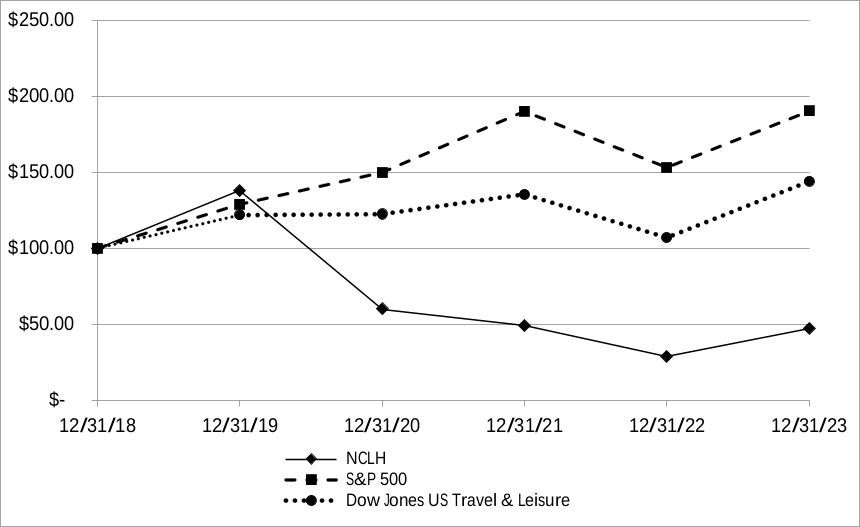
Stock Performance Graph
This performance graph shall not be deemed “soliciting material” or to be “filed” with the SEC for purposes of Section 18 of the Exchange Act, or otherwise subject to the liabilities under that Section, and shall not be deemed to be incorporated by reference into any filing of NCLH under the Securities Act of 1933, as amended, or the Exchange Act.
The following graph shows a comparison of the cumulative total return for our ordinary shares, the Standard & Poor’s 500 Composite Stock Index and the Dow Jones United States Travel and Leisure index. The Stock Performance Graph assumes that $100 was invested at the closing price of our ordinary shares on the NYSE and in each index on the last trading day of fiscal 2018. Past performance is not necessarily an indicator of future results. The stock prices used were as of the close of business on the respective dates.
Item 6. [Reserved]
Item 7. Management’s Discussion and Analysis of Financial Condition and Results of Operations
Financial Presentation
The following discussion and analysis contains forward-looking statements within the meaning of the federal securities laws, and should be read in conjunction with the disclosures we make concerning risks and other factors that may affect our business and operating results. You should read this information in conjunction with the consolidated financial statements and the notes thereto included in this Annual Report. See also “Cautionary Statement Concerning Forward-Looking Statements” immediately prior to Part I, Item 1 in this Annual Report.
We categorize revenue from our cruise and cruise-related activities as either “passenger ticket” revenue or “onboard and other” revenue. Passenger ticket revenue and onboard and other revenue vary according to product offering, the size of the ship in operation, the length of cruises operated and the markets in which the ship operates. Our revenue is seasonal based on demand for cruises, which has historically been strongest during the Northern Hemisphere’s summer months; however, our cruise voyages were completely suspended from March 2020 until July 2021 due to the COVID-19 pandemic and our resumption of cruise voyages was phased in gradually, with full operation of our fleet resumed in May 2022. Passenger ticket revenue primarily consists of revenue for accommodations, meals in certain restaurants on the ship, certain onboard entertainment, government taxes, fees and port expenses and includes revenue for service charges and air and land transportation to and from the ship to the extent guests purchase these items from us. Onboard and other revenue primarily consists of revenue from casino, beverage sales, shore excursions, specialty dining, retail sales, spa services and Wi-Fi services. Our onboard revenue is derived from onboard activities we perform directly or that are performed by independent concessionaires, from which we receive a share of their revenue.
Our cruise operating expense is classified as follows:
| ● | Commissions, transportation and other primarily consists of direct costs associated with passenger ticket revenue. These costs include travel advisor commissions, air and land transportation expenses, related credit card fees, certain government taxes, fees and port expenses and the costs associated with shore excursions and hotel accommodations included as part of the overall cruise purchase price. |
|---|
| ● | Onboard and other primarily consists of direct costs incurred in connection with onboard and other revenue, including casino, beverage sales and shore excursions. |
|---|
| ● | Payroll and related consists of the cost of wages, benefits and logistics for shipboard employees and costs of certain inventory items, including food, for a third party that provides crew and other hotel services for certain ships. |
|---|
| ● | Fuel includes fuel costs, the impact of certain fuel hedges and fuel delivery costs. |
|---|
| ● | Food consists of food costs for passengers and crew on certain ships. |
|---|
| ● | Other consists of repairs and maintenance (including Dry-dock costs), ship insurance and other ship expenses. |
|---|
Critical Accounting Policies
Our consolidated financial statements have been prepared in accordance with U.S. GAAP. The preparation of these consolidated financial statements requires us to make estimates, judgments and assumptions that affect the reported amounts of assets and liabilities and disclosure of contingent assets and liabilities at the date of our consolidated financial statements and the reported amounts of revenue and expenses during the periods presented. We rely on historical experience and on various other assumptions that we believe to be reasonable under the circumstances to make these estimates and judgments. Actual results could differ materially from these estimates. We believe that the following critical accounting policies reflect the significant estimates and assumptions used in the preparation of our consolidated
financial statements. These critical accounting policies, which are presented in detail in our notes to our audited consolidated financial statements, relate to ship accounting and asset impairment.
Ship Accounting
Ships represent our most significant assets, and we record them at cost less accumulated depreciation. Depreciation of ships is computed on a straight-line basis over the weighted average useful lives of primarily 30 years after a 15% reduction for the estimated residual value of the ship. Our residual value is established based on our long-term estimates of the expected remaining future benefit at the end of the ships’ weighted average useful lives. In 2022 and 2023, the Company took delivery of Norwegian’s first Prima Class Ship and Oceania Cruises’ first Allura Class Ship, respectively. Based on the design, structure and technological advancements made to these new classes of ships and the analyses of their major components, which is generally performed upon the introduction of a new class of ship, we have assigned the Prima Class Ships and Allura Class Ships a weighted-average useful life of 35 years with a residual value of 10%. Ship improvement costs that we believe add value to our ships are capitalized to the ship and depreciated over the shorter of the improvements’ estimated useful lives or the remaining useful life of the ship. When we record the retirement of a ship component included within the ship’s cost basis, we estimate the net book value of the component being retired and remove it from the ship’s cost basis. Repairs and maintenance activities are charged to expense as incurred. We account for Dry-dock costs under the direct expense method which requires us to expense all Dry-dock costs as incurred.
We determine the weighted average useful lives of our ships based primarily on our estimates of the costs and useful lives of the ships’ major component systems on the date of acquisition, such as cabins, main diesels, main electric, superstructure and hull, and their related proportional weighting to the ship as a whole. The useful lives of components of new ships and ship improvements are estimated based on the economic lives of the new components. In addition, to determine the useful lives of the major components of new ships and ship improvements, we consider the impact of the historical useful lives of similar assets, manufacturer recommended lives, planned maintenance programs and anticipated changes in technological conditions. Given the large and complex nature of our ships, our accounting estimates related to ships and determinations of ship improvement costs to be capitalized require judgment and are uncertain. Should certain factors or circumstances cause us to revise our estimate of ship service lives or projected residual values, depreciation expense could be materially lower or higher.
If circumstances cause us to change our assumptions in making determinations as to whether ship improvements should be capitalized, the amounts we expense each year as repairs and maintenance costs could increase, partially offset by a decrease in depreciation expense. If we reduced our estimated weighted average ship service life by one year, depreciation expense for the year ended December 31, 2023 would have increased by $19.4 million. In addition, if our ships were estimated to have no residual value, depreciation expense for the same period would have increased by $84.4 million. We believe our estimates for ship accounting are reasonable and our methods are consistently applied. We believe that depreciation expense is based on a rational and systematic method to allocate our ships’ costs to the periods that benefit from the ships’ usage.
Asset Impairment
We review our long-lived assets, principally ships, for impairment whenever events or changes in circumstances indicate that the carrying amount of an asset may not be recoverable. Assets are grouped and evaluated at the lowest level for which there are identifiable cash flows that are largely independent of the cash flows of other groups of assets. For ship impairment analyses, the lowest level for which identifiable cash flows are largely independent of other assets and liabilities is each individual ship. We consider historical performance and future estimated results in our evaluation of potential impairment and then compare the carrying amount of the asset to the estimated undiscounted future cash flows expected to result from the use of the asset. If the carrying amount of the asset exceeds the estimated expected undiscounted future cash flows, we measure the amount of the impairment by comparing the carrying amount of the asset to its estimated fair value. We estimate fair value based on the best information available utilizing estimates, judgments and projections as necessary. Our estimate of fair value is generally measured by discounting expected future cash flows at discount rates commensurate with the associated risk.
We evaluate goodwill and trade names for impairment annually or more frequently when an event occurs or circumstances change that indicates the carrying value of a reporting unit may not be recoverable. In 2023, we changed our annual evaluation date for impairment from December 31 to October 1. We believe this measurement date, which represents a change in the method of applying an accounting principle, is preferable because it better aligns with the timing of the Company’s financial planning process, which is a key component of the annual impairment tests. The change in the measurement date did not delay, accelerate or prevent an impairment charge. The accounting policy change is not material and will be applied prospectively. For our evaluation of goodwill, we use a qualitative assessment which allows us to first assess qualitative factors to determine whether it is more likely than not (i.e., more than 50%) that the estimated fair value of a reporting unit is less than its carrying value. For trade names we also provide a qualitative assessment to determine if there is any indication of impairment.
In order to make this evaluation, we consider whether any of the following factors or conditions exist:
| ● | Changes in general macroeconomic conditions, such as a deterioration in general economic conditions; limitations on accessing capital; fluctuations in foreign exchange rates; or other developments in equity and credit markets; |
|---|
| ● | Changes in industry and market conditions such as a deterioration in the environment in which an entity operates; an increased competitive environment; a decline in market-dependent multiples or metrics (in both absolute terms and relative to peers); a change in the market for an entity’s products or services; or a regulatory or political development; |
|---|
| ● | Changes in cost factors that have a negative effect on earnings and cash flows; |
|---|
| ● | Decline in overall financial performance (for both actual and expected performance); |
|---|
| ● | Entity and reporting unit specific negative events such as changes in management, key personnel, strategy, or customers; litigation; or a change in the composition or carrying amount of net assets; and |
|---|
| ● | Decline in share price (in both absolute terms and relative to peers). |
|---|
It is at our discretion whether to perform the qualitative test and we may bypass the qualitative test in any period and proceed directly to the quantitative impairment test. We may also, at our discretion, resume performing the qualitative assessment in any subsequent period.
We believe our estimates and judgments with respect to our long-lived assets, principally ships, goodwill, trade names and other indefinite-lived intangible assets are reasonable. Nonetheless, if there was a material change in assumptions used in the determination of such fair values or if there is a material change in the conditions or circumstances that influence such assets, we could be required to record an impairment charge. If a material change occurred or the result of the qualitative assessment indicated it is more likely than not that the estimated fair value of the asset is less than its carrying value, we would conduct a quantitative assessment comparing the fair value to its carrying value.
We have concluded that our business has three reporting units. Each brand, Oceania Cruises, Regent Seven Seas and Norwegian, constitutes a business for which discrete financial information is available and management regularly reviews the operating results and, therefore, each brand is considered an operating segment.
For our annual impairment evaluation, we performed a quantitative assessment for the Regent Seven Seas reporting unit and of each brand’s trade names. Based on the results of the assessment, we determined there was no impairment of goodwill because the fair value of the Regent Seven Seas reporting unit substantially exceeded its carrying value. As of December 31, 2023, there was $98.1 million of goodwill remaining for the Regent Seven Seas reporting unit. Trade names were $500.5 million as of December 31, 2023. As of October 1, 2023, our annual impairment reviews support the carrying values of these assets. See Note 2 – “Summary of Significant Accounting Policies” for more information.
Non-GAAP Financial Measures
We use certain non-GAAP financial measures, such as Adjusted Gross Margin, Net Yield, Net Cruise Cost, Adjusted Net Cruise Cost Excluding Fuel, Adjusted EBITDA, Adjusted Net Income (Loss) and Adjusted EPS, to enable us to analyze our performance. See “Terms Used in this Annual Report” for the definitions of these and other non-GAAP financial measures. We utilize Adjusted Gross Margin and Net Yield to manage our business on a day-to-day basis because it reflects revenue earned net of certain direct variable costs. We also utilize Net Cruise Cost and Adjusted Net Cruise Cost Excluding Fuel to manage our business on a day-to-day basis. In measuring our ability to control costs in a manner that positively impacts our net income (loss), we believe changes in Adjusted Gross Margin, Net Yield, Net Cruise Cost and Adjusted Net Cruise Cost Excluding Fuel to be the most relevant indicators of our performance. Per Capacity Day data is not presented for the year ended December 31, 2022 as we do not consider it meaningful for comparison purposes due to our phased restart of cruise operations, which was completed in May 2022.
We believe that Adjusted EBITDA is appropriate as a supplemental financial measure as it is used by management to assess operating performance. We also believe that Adjusted EBITDA is a useful measure in determining our performance as it reflects certain operating drivers of our business, such as sales growth, operating costs, marketing, general and administrative expense and other operating income and expense. In addition, management uses Adjusted EBITDA as a performance measure for our incentive compensation. Adjusted EBITDA is not a defined term under GAAP nor is it intended to be a measure of liquidity or cash flows from operations or a measure comparable to net income (loss), as it does not take into account certain requirements such as capital expenditures and related depreciation, principal and interest payments and tax payments and it includes other supplemental adjustments.
In addition, Adjusted Net Income (Loss) and Adjusted EPS are non-GAAP financial measures that exclude certain amounts and are used to supplement GAAP net income (loss) and EPS. We use Adjusted Net Income (Loss) and Adjusted EPS as key performance measures of our earnings performance. We believe that both management and investors benefit from referring to these non-GAAP financial measures in assessing our performance and when planning, forecasting and analyzing future periods. These non-GAAP financial measures also facilitate management’s internal comparison to our historical performance. In addition, management uses Adjusted EPS as a performance measure for our incentive compensation. The amounts excluded in the presentation of these non-GAAP financial measures may vary from period to period; accordingly, our presentation of Adjusted Net Income (Loss) and Adjusted EPS may not be indicative of future adjustments or results. For example, for the year ended December 31, 2022, we incurred $12.1 million related to restructuring costs or charges. We included this as an adjustment in the reconciliation of Adjusted Net Income (Loss) since the expenses are not representative of our day-to-day operations; however, this adjustment did not occur and is not included in the comparative period presented within this Annual Report.
You are encouraged to evaluate each adjustment used in calculating our non-GAAP financial measures and the reasons we consider our non-GAAP financial measures appropriate for supplemental analysis. In evaluating our non-GAAP financial measures, you should be aware that in the future we may incur expenses similar to the adjustments in our presentation. Our non-GAAP financial measures have limitations as analytical tools, and you should not consider these measures in isolation or as a substitute for analysis of our results as reported under GAAP. Our presentation of our non-GAAP financial measures should not be construed as an inference that our future results will be unaffected by unusual or non-recurring items. Our non-GAAP financial measures may not be comparable to other companies. Please see a historical reconciliation of these measures to the most comparable GAAP measure presented in our consolidated financial statements below in the “Results of Operations” section.
Financing Transactions
In February 2023, NCLC issued $600 million aggregate principal amount of 8.375% senior secured notes due 2028. The net proceeds from the notes were used to repay the loans outstanding under our Term Loan A Facility that otherwise would have become due in January 2024, including to pay any accrued and unpaid interest thereon, as well as related premiums, fees and expenses.
In February 2023, our $1 billion commitment letter was extended through February 2024, with an option for NCLC to further extend the commitments through February 2025 at its election. Simultaneously, the amount of the commitment
was reduced to $650 million, which may be drawn in up to two draws, and in connection with the execution of the current commitment letter, NCLC issued $250 million aggregate principal amount of 9.75% senior secured notes due 2028. NCLC used the net proceeds for general corporate purposes. In February 2024, we extended the $650 million undrawn commitment from February 2024 to March 2024 while maintaining our option to further extend the commitment. We are currently taking steps to refinance the commitment, which is subject to approval by our Board of Directors. We expect the refinanced commitment to be extended for one year through March 2025, when effective.
In October 2023, NCLC issued $790 million aggregate principal amount of 8.125% senior secured notes due 2029. The net proceeds from the notes, together with cash on hand, were used to repay the Term Loan A Facility, including to pay any accrued and unpaid interest thereon, as well as related premiums, fees and expenses. No term loans remain outstanding.
Also in October 2023, NCLC entered into the Sixth ARCA, an amendment and restatement of the Senior Secured Credit Facility, which among other things, increased the aggregate amount of the Revolving Loan Facility from $875 million to $1.2 billion.
See Note 8 – “Long-Term Debt” for more information.
Update on Bookings
The Company continues to experience healthy consumer demand and is at an all-time high booked position and with pricing reflective of some of the best booking weeks in the Company’s history beginning with Black Friday and Cyber Monday. However, because of our cancellation policies, bookings may not be representative of actual revenues. Additionally, onboard revenue remains robust, with broad-based strength across all revenue streams.
As a result of the ongoing conflict in Israel and the Red Sea, the Company cancelled and redirected all calls to Israel during the fourth quarter of 2023. Additionally, all calls to Israel and the Red Sea have been cancelled and redirected for the entirety of 2024. Prior to the conflict, approximately 7% of the capacity in the fourth quarter of 2023 and 4% of capacity for the full year 2024 expected to visit the Middle East, which includes Bahrain, Cyprus, Egypt, Israel, Jordan, Oman, Qatar, Saudi Arabia, and the United Arab Emirates. Approximately 1% of second quarter 2024 capacity and 1% of 2024 capacity were expected to sail through the Red Sea.
Macroeconomic Trends and Uncertainties
As a result of conditions associated with global macroeconomic events, the global economy, including the financial and credit markets, has experienced volatility and disruptions, including impacts to inflation rates, fuel prices, foreign currencies and interest rates. Our costs have been, and are expected to continue to be, adversely impacted by these factors. We have used, and may continue to use, derivative instruments to attempt to mitigate the risk of volatility in fuel prices and interest rates. In an attempt to mitigate risks related to inflation, our supply chain department has negotiated contracts with varying terms, with a goal of providing us with the ability to take advantage of cost declines when they occur, and diversified our sourcing options. These strategies may not fully offset the impact of current macroeconomic conditions; however, during 2023, we continued to see progress from our ongoing margin enhancement initiative. The Company continues to prioritize identifying and evaluating a variety of initiatives to improve its cost structure and margin profile, while preserving its brand equity and optimal guest satisfaction levels. Furthermore, we are exposed to fluctuations in the euro exchange rate for certain portions of ship construction contracts that have not been hedged. See “Item 1A. Risk Factors” in our Annual Report for additional information.
Climate Change
We believe the increasing focus on climate change, including the Company’s recently established targets for greenhouse gas reductions, and evolving regulatory requirements will materially impact our future capital expenditures and results of operations. We have set interim targets to guide us on our path to net zero and provide more details about them in our annual ESG Report. We expect to incur significant expenses related to these regulatory requirements and commitments, which may include expenses related to greenhouse gas emissions reduction initiatives and the purchase of emissions
allowances, among other things. We have and may continue to be required to change certain operating procedures, for example slowing the speed of our ships, to meet regulatory requirements, which could adversely impact our operations. We are evaluating the effects of global climate change related requirements, which are still evolving, including our ability to mitigate certain future expenses through initiatives to reduce greenhouse gas emissions; consequently, the full impact to the Company is not yet known. Additionally, our ships, port facilities, corporate offices and island destinations have in the past and may again be adversely affected by an increase in the frequency and intensity of adverse weather conditions caused by climate change. For example, certain ports have become temporarily unavailable to us due to hurricane damage and other destinations have either considered or implemented restrictions on cruise operations due to environmental concerns. Refer to “Impacts related to climate change may adversely affect our business, financial condition and results of operations” in “Item 1A. Risk Factors” for further information.
Pillar 2 and Income Tax Expense
During the three months ended December 31, 2023, in response to changes in the global tax landscape due to the implementation of the OECD’s Pillar 2 global tax reform initiative, the Company restructured its organizational footprint by realigning many of its operations across its three different brands into a single jurisdiction, Bermuda, and exited our U.K. tax residency status for NCLH and NCLC as of December 31, 2023. The Company continues to monitor further regulations related to the implementation of the Bermuda Corporate Income Tax Act, and the forecast of the Company’s non-exempt taxable income in the Bermuda and U.S. jurisdictions, and the outlooks for the cruise industry and broader economy. As a result of the enactment of the Bermuda Corporate Income Tax Act 2023, the Company recognized additional deferred tax assets and has a valuation allowance related to our Bermuda deferred tax assets of $532.4 million as of December 31, 2023. The Bermuda deferred tax assets amount will continue to be evaluated through the enactment date, January 1, 2025, and is subject to material change as this is an estimated amount. Refer to Note 12 – “Income Taxes” for further information. Additionally, the Company continues to maintain a valuation allowance with respect to its U.S. net deferred tax assets, which has a balance of $159.8 million as of December 31, 2023. We will continue to evaluate all relevant positive and negative evidence in monitoring the realizability of our deferred tax assets and determining the appropriate timing for the recognition of any valuation allowance reversal. In the future, the Company may recognize a material reversal of its valuation allowance on both its U.S. and Bermuda deferred tax assets. The Company would not expect to have a material change in its income tax expense, with the exception of any potential impact from a release of the valuation allowance.
Executive Overview
Total revenue increased 76.5% to $8.5 billion for the year ended December 31, 2023 compared to $4.8 billion for the year ended December 31, 2022. Capacity Days increased by 29.0%.
For the year ended December 31, 2023, we had net income and diluted EPS of $166.2 million and $0.39, respectively. For the year ended December 31, 2022, we had net loss and diluted EPS of $(2.3) billion and $(5.41), respectively. Operating income increased to $930.9 million for the year ended December 31, 2023 from an operating loss of $(1.6) billion for the year ended December 31, 2022.
We had Adjusted Net Income and Adjusted EPS of $298.0 million and $0.70, respectively, for the year ended December 31, 2023, including $131.8 million of adjustments primarily consisting of share-based compensation, compared to Adjusted Net Loss and Adjusted EPS of $(1.9) billion and $(4.64), respectively, for the year ended December 31, 2022. Adjusted EBITDA increased to $1.9 billion for the year ended December 31, 2023 from $(673.9) for the year ended December 31, 2022. We refer you to our “Results of Operations” below for a calculation of Adjusted Net Income (Loss), Adjusted EPS and Adjusted EBITDA.
Results of Operations
The discussion below compares the results of operations for the year ended December 31, 2023 to the year ended December 31, 2022. You should read this discussion in conjunction with the consolidated financial statements and the notes thereto included elsewhere in this Annual Report. For a comparison of the Company’s results of operations for the fiscal years ended December 31, 2022 to the year ended December 31, 2021, see “Item 7, Management’s Discussion and
Analysis of Financial Condition and Results of Operations” in the Company’s annual report on Form 10-K for the year ended December 31, 2022, which was filed with the U.S. Securities and Exchange Commission on February 28, 2023.
We reported total revenue, total cruise operating expense, operating income (loss) and net income (loss) as follows (in thousands, except per share data):
| | | | | | | |
|---|---|---|---|---|---|---|
| | | Year Ended December 31, | ||||
| | 2023 | 2022 | ||||
| Total revenue | | $ | 8,549,924 | | $ | 4,843,760 |
| Total cruise operating expense | | $ | 5,468,587 | | $ | 4,267,086 |
| Operating income (loss) | | $ | 930,911 | | $ | (1,551,757) |
| Net income (loss) | | $ | 166,178 | | $ | (2,269,909) |
| EPS: | | | ||||
| Basic | | $ | 0.39 | | $ | (5.41) |
| Diluted | | $ | 0.39 | | $ | (5.41) |
The following table sets forth operating data as a percentage of total revenue:
| | | | | | |
|---|---|---|---|---|---|
| | | Year Ended December 31, | |||
| | 2023 | 2022 | |||
| Revenue | | | | | |
| Passenger ticket | 67.3 | % | 67.2 | % | |
| Onboard and other | 32.7 | % | 32.8 | % | |
| Total revenue | 100.0 | % | 100.0 | % | |
| Cruise operating expense | |||||
| Commissions, transportation and other | 22.0 | % | 21.4 | % | |
| Onboard and other | 7.0 | % | 7.4 | % | |
| Payroll and related | 14.8 | % | 22.5 | % | |
| Fuel | 8.4 | % | 14.2 | % | |
| Food | 4.2 | % | 5.4 | % | |
| Other | 7.6 | % | 17.2 | % | |
| Total cruise operating expense | 64.0 | % | 88.1 | % | |
| Other operating expense | |||||
| Marketing, general and administrative | 15.7 | % | 28.5 | % | |
| Depreciation and amortization | 9.4 | % | 15.5 | % | |
| Total other operating expense | 25.1 | % | 44.0 | % | |
| Operating income (loss) | 10.9 | % | (32.1) | % | |
| Non-operating income (expense) | |||||
| Interest expense, net | (8.5) | % | (16.5) | % | |
| Other income (expense), net | (0.5) | % | 1.6 | % | |
| Total non-operating income (expense) | (9.0) | % | (14.9) | % | |
| Net income (loss) before income taxes | 1.9 | % | (47.0) | % | |
| Income tax benefit (expense) | — | % | 0.1 | % | |
| Net income (loss) | 1.9 | % | (46.9) | % |
The following table sets forth selected statistical information:
| | | | | |
|---|---|---|---|---|
| | Year Ended December 31, | |||
| | 2023 | 2022 | ||
| Passengers carried | 2,716,546 | 1,663,275 | ||
| Passenger Cruise Days | 23,311,672 | 12,791,773 | ||
| Capacity Days (1) | 22,652,588 | 17,566,069 | ||
| Occupancy Percentage | 102.9 | % | 72.8 | % |
| (1) | Excludes certain capacity on Pride of America, which was temporarily unavailable in 2022. |
|---|
Adjusted Gross Margin and Net Yield were calculated as follows (in thousands except Capacity Days and per Capacity Day data):
| | | | | | | |
|---|---|---|---|---|---|---|
| | | Year Ended December 31, | ||||
| | | | 2023 | | 2022 | |
| Total revenue | | $ | 8,549,924 | | $ | 4,843,760 |
| Less: | | | ||||
| Total cruise operating expense | | | 5,468,587 | | | 4,267,086 |
| Ship depreciation | | | 753,629 | | | 700,988 |
| Gross Margin | | | 2,327,708 | | | (124,314) |
| Ship depreciation | | | 753,629 | | | 700,988 |
| Payroll and related | | | 1,262,119 | | | 1,088,639 |
| Fuel | | | 716,833 | | | 686,825 |
| Food | | 358,310 | | 263,807 | ||
| Other | | 648,142 | | 835,254 | ||
| Adjusted Gross Margin | | $ | 6,066,741 | | $ | 3,451,199 |
| Capacity Days | | 22,652,588 | | | | |
| Gross Margin per Capacity Day | | $ | 102.76 | | | |
| Net Yield | | $ | 267.82 | | | |
Gross Cruise Cost, Net Cruise Cost, Net Cruise Cost Excluding Fuel and Adjusted Net Cruise Cost Excluding Fuel were calculated as follows (in thousands except Capacity Days and per Capacity Day data):
| | | | | | | |
|---|---|---|---|---|---|---|
| | | Year Ended December 31, | ||||
| | | 2023 | 2022 | |||
| Total cruise operating expense | | $ | 5,468,587 | | $ | 4,267,086 |
| Marketing, general and administrative expense | | 1,341,858 | | 1,379,105 | ||
| Gross Cruise Cost | | 6,810,445 | | 5,646,191 | ||
| Less: | | | ||||
| Commissions, transportation and other expense | | 1,883,279 | | 1,034,629 | ||
| Onboard and other expense | | 599,904 | | 357,932 | ||
| Net Cruise Cost | | 4,327,262 | | 4,253,630 | ||
| Less: Fuel expense | | 716,833 | | 686,825 | ||
| Net Cruise Cost Excluding Fuel | | 3,610,429 | | 3,566,805 | ||
| Less Other Non-GAAP Adjustments: | | | ||||
| Non-cash deferred compensation (1) | | 2,312 | | 2,797 | ||
| Non-cash share-based compensation (2) | | 118,940 | | 113,563 | ||
| Restructuring costs (3) | | | — | | | 12,140 |
| Adjusted Net Cruise Cost Excluding Fuel | | $ | 3,489,177 | | $ | 3,438,305 |
| Capacity Days | | 22,652,588 | | | | |
| Gross Cruise Cost per Capacity Day | | $ | 300.65 | | | |
| Net Cruise Cost per Capacity Day | | $ | 191.03 | | | |
| Net Cruise Cost Excluding Fuel per Capacity Day | | $ | 159.38 | | | |
| Adjusted Net Cruise Cost Excluding Fuel per Capacity Day | | $ | 154.03 | | | |
| (1) | Non-cash deferred compensation expenses related to the crew pension plan and other crew expenses, which are included in payroll and related expense. |
|---|
| (2) | Non-cash share-based compensation expenses related to equity awards, which are included in marketing, general and administrative expense and payroll and related expense. |
|---|
| (3) | Restructuring costs related to the workforce reduction are included in marketing, general and administrative expense. |
|---|
Adjusted Net Income (Loss) and Adjusted EPS were calculated as follows (in thousands, except share and per share data):
| | | | | | | |
|---|---|---|---|---|---|---|
| | | Year Ended December 31, | ||||
| | 2023 | 2022 | ||||
| Net income (loss) | | $ | 166,178 | | $ | (2,269,909) |
| Non-GAAP Adjustments: | | | ||||
| Non-cash deferred compensation (1) | | 4,039 | | 4,048 | ||
| Non-cash share-based compensation (2) | | 118,940 | | 113,563 | ||
| Restructuring costs (3) | | — | | 12,140 | ||
| Extinguishment and modification of debt (4) | | 8,822 | | 193,374 | ||
| Adjusted Net Income (Loss) | | $ | 297,979 | | $ | (1,946,784) |
| Diluted weighted-average shares outstanding - Net income (loss) and Adjusted Net Income (Loss) | | 427,400,849 | | 419,773,195 | ||
| Diluted EPS | | $ | 0.39 | | $ | (5.41) |
| Adjusted EPS | | $ | 0.70 | | $ | (4.64) |
| (1) | Non-cash deferred compensation expenses related to the crew pension plan and other crew expenses are included in payroll and related expense and other income (expense), net. |
|---|
| (2) | Non-cash share-based compensation expenses related to equity awards are included in marketing, general and administrative expense and payroll and related expense. |
|---|
| (3) | Restructuring costs related to the workforce reduction are included in marketing, general and administrative expense. |
|---|
| (4) | Losses on extinguishments and modifications of debt are primarily included in interest expense, net. |
|---|
EBITDA and Adjusted EBITDA were calculated as follows (in thousands):
| | | | | | | |
|---|---|---|---|---|---|---|
| | | Year Ended December 31, | ||||
| | 2023 | 2022 | ||||
| Net income (loss) | | $ | 166,178 | | $ | (2,269,909) |
| Interest expense, net | | 727,531 | | 801,512 | ||
| Income tax (benefit) expense | | (3,002) | | (6,794) | ||
| Depreciation and amortization expense | | 808,568 | | 749,326 | ||
| EBITDA | | 1,699,275 | | (725,865) | ||
| Other (income) expense, net (1) | | 40,204 | | (76,566) | ||
| Other Non-GAAP Adjustments: | | | ||||
| Non-cash deferred compensation (2) | | 2,312 | | 2,797 | ||
| Non-cash share-based compensation (3) | | 118,940 | | 113,563 | ||
| Restructuring costs (4) | | | — | | | 12,140 |
| Adjusted EBITDA | | $ | 1,860,731 | | $ | (673,931) |
| (1) | Primarily consists of gains and losses, net of foreign currency remeasurements, and in 2022, derivatives not designated as hedges. |
|---|
| (2) | Non-cash deferred compensation expenses related to the crew pension plan and other crew expenses are included in payroll and related expense. |
|---|
| (3) | Non-cash share-based compensation expenses related to equity awards are included in marketing, general and administrative expense and payroll and related expense. |
|---|
| (4) | Restructuring costs related to the workforce reduction are included in marketing, general and administrative expense. |
|---|
Year Ended December 31, 2023 (“2023”) Compared to Year Ended December 31, 2022 (“2022”)
Revenue
Total revenue increased 76.5% to $8.5 billion in 2023 compared to $4.8 billion in 2022. In 2023, revenue primarily increased as a result of increases in our Occupancy following our return to service with 23.3 million Passenger Cruise Days compared to 12.8 million in 2022.
Expense
Total cruise operating expense increased 28.2% in 2023 compared to 2022. In 2023, our cruise operating expenses increased due to the resumption of voyages, resulting in higher payroll, food and direct variable costs of fully operating ships. In 2022, the year started with 16 ships operating with guests onboard and ended with the full fleet in service, which was completed in May 2022. Gross Cruise Cost increased 20.6% in 2023 compared to 2022, primarily related to the change in costs described above.
Interest expense, net was $727.5 million in 2023 compared to $801.5 million in 2022. The decrease in 2023 primarily reflects lower losses from extinguishment of debt and debt modification costs, which were $8.8 million in 2023 and $193.4 million in 2022. Excluding these losses, interest expense increased primarily as a result of higher rates.
Other income (expense), net was expense of $40.2 million in 2023 compared to income of $76.6 million in 2022. In 2023, the expense primarily related to net losses on foreign currency remeasurements. In 2022, the income was primarily due to gains on derivatives not designated as hedges and gains from foreign currency remeasurements.
Liquidity and Capital Resources
General
As of December 31, 2023, our liquidity of $2.3 billion consisted of cash and cash equivalents of $402.4 million, borrowings available under our $1.2 billion fully undrawn Revolving Loan Facility and a $650 million undrawn commitment less related fees. Our primary ongoing liquidity requirements are to finance working capital, capital expenditures and debt service. As of December 31, 2023, we had a working capital deficit of $4.7 billion. This deficit included $3.1 billion of advance ticket sales, which represents the total revenue we collected in advance of sailing dates and accordingly are substantially more like deferred revenue balances rather than actual current cash liabilities. Our business model, along with our liquidity and undrawn export-credit backed facilities, allows us to operate with a working capital deficit and still meet our operating, investing and financing needs.
In February 2023, NCLC issued $600 million aggregate principal amount of 8.375% senior secured notes due 2028. The net proceeds from the notes were used to repay the loans outstanding under our Term Loan A Facility that otherwise would have become due in January 2024, including to pay any accrued and unpaid interest thereon, as well as related premiums, fees and expenses.
In February 2023, our $1 billion commitment letter was extended through February 2024, with an option for NCLC to further extend the commitments through February 2025 at its election. Simultaneously, the amount of the commitment was reduced to $650 million, which may be drawn in up to two draws, and in connection with the execution of the current commitment letter, NCLC issued $250 million aggregate principal amount of 9.75% senior secured notes due 2028. NCLC used the net proceeds for general corporate purposes. In February 2024, we extended the $650 million undrawn commitment from February 2024 to March 2024 while maintaining our option to further extend the commitment.
In October 2023, NCLC issued $790 million aggregate principal amount of 8.125% senior secured notes due 2029. The net proceeds from the notes, together with cash on hand, were used to repay the Term Loan A Facility, including to pay any accrued and unpaid interest thereon, as well as related premiums, fees and expenses.
Also in October 2023, NCLC entered into the Sixth ARCA, an amendment and restatement of the Senior Secured Credit Facility, which among other things, increased the aggregate amount of the Revolving Loan Facility from $875 million to $1.2 billion. No term loans remain outstanding.
Refer to Note 8 – “Long-Term Debt” for further details about the above financing transactions.
Based on our liquidity estimates and our current resources, we have concluded we have sufficient liquidity to satisfy our obligations for at least the next 12 months. There can be no assurance that the accuracy of the assumptions used to estimate our liquidity requirements will be correct, and our ability to be predictive is uncertain due to the dynamic nature of the current operating environment, including any current macroeconomic events and conditions such as inflation, rising fuel prices and higher interest rates.
As noted above, we extended the $650 million undrawn commitment from February 2024 to March 2024 while maintaining our option to further extend the commitment. In February 2024, the Commitment Parties (as defined in Note 8 – “Long-Term Debt”) entered into a third amended and restated commitment letter (the “third amended commitment letter”), which is expected to become effective in March 2024. The effectiveness is subject to approval by our Board of Directors. Upon effectiveness, the third amended commitment letter will amend and restate the current commitment letter and extend the commitments thereunder through March 2025. Pursuant to the third amended commitment letter, and subject to effectiveness thereof, the Commitment Parties have agreed to purchase from NCLC an aggregate principal amount of $650 million of senior unsecured notes due five years after the issue date (the “Commitment Notes”) at NCLC’s option. If drawn, the Commitment Notes will bear interest at a rate per annum equal to (A) the greater of (i) the interest rate of the 7.75% senior notes due 2029 (“2029 Unsecured Notes”) and (ii) the then-current secondary trading yield applicable to the 2029 Unsecured Notes plus (B) 200 basis points. The Commitment Notes will be subject to a one-time structuring fee of 0.50% and a quarterly commitment fee of 0.75% for so long as the commitments with respect to the Commitment Notes are outstanding. If drawn, the Commitment Notes will be subject to an issue fee of 0.50%. In connection with the execution of the third amended commitment letter, and subject to effectiveness thereof, NCLC has agreed to repurchase all of the outstanding Class A Notes (as defined in Note 8 – “Long-Term Debt”) at a purchase price of 107% of the principal amount thereof plus accrued and unpaid interest thereon.
We also intend to refinance the $565.0 million 3.625% senior unsecured notes due in December 2024 prior to September 2024. Within the next twelve months, we may pursue other refinancings in order to reduce interest expense and/or extend debt maturities. There is no assurance that cash flows from operations and additional financings will be available in the future to fund our future obligations. Beyond the next 12 months, we will pursue refinancings and other balance sheet optimization transactions in order to reduce interest expense and/or extend debt maturities. Refer to Item 1A, “Risk Factors” for further details regarding risks and uncertainties that may cause our results to differ from our expectations.
At December 31, 2023, we were in compliance with all of our debt covenants. If we do not continue to remain in compliance with our covenants, we would have to seek additional amendments to or waivers of the covenants. However, no assurances can be made that such amendments or waivers would be approved by our lenders. Generally, if an event of default under any debt agreement occurs, then pursuant to cross default and/or cross acceleration clauses, substantially all of our outstanding debt and derivative contract payables could become due, and all debt and derivative contracts could be terminated, which would have a material adverse impact to our operations and liquidity.
Our Moody’s long-term issuer rating is B2, our senior secured rating is B1 and our senior unsecured rating is Caa1. Our S&P Global issuer credit rating is B, our issue-level rating on our $1.2 billion Revolving Loan Facility, 2028 Senior Secured Notes and 2029 Senior Secured Notes is BB-, our issue-level rating on our other senior secured notes is B+ and our senior unsecured rating is CCC+. If our credit ratings were to be further downgraded, or general market conditions were to ascribe higher risk to our rating levels, our industry, or us, our access to capital and the cost of any debt or equity financing will be further negatively impacted. We also have capacity to incur additional indebtedness under our debt agreements and may issue additional ordinary shares from time to time, subject to our authorized number of ordinary shares. However, there is no guarantee that debt or equity financings will be available in the future to fund our obligations, or that they will be available on terms consistent with our expectations.
As of December 31, 2023, we had advance ticket sales of $3.2 billion, including the long-term portion, which included approximately $78.0 million of future cruise credits. We also have agreements with our credit card processors that, as of December 31, 2023, governed approximately $2.9 billion in advance ticket sales that had been received by the Company relating to future voyages. These agreements allow the credit card processors to require under certain circumstances, including the existence of a material adverse change, excessive chargebacks and other triggering events, that the Company maintain a reserve which would be satisfied by posting collateral. Although the agreements vary, these requirements may generally be satisfied either through a percentage of customer payments withheld or providing cash funds directly to the card processor. Any cash reserve or collateral requested could be increased or decreased. As of December 31, 2023, we had cash collateral reserves of approximately $51.6 million, which includes $20.1 million recognized in accounts receivable, net and $31.5 million recognized in other long-term assets. During the year ended December 31, 2023, the Company received a return of cash collateral from one credit card processor of $500 million, which was previously classified as other long-term assets. We may be required to pledge additional collateral and/or post additional cash reserves or take other actions in the future that may adversely affect our liquidity.
Sources and Uses of Cash
In this section, references to 2023 refer to the year ended December 31, 2023, references to 2022 refer to the year ended December 31, 2022.
Net cash provided by operating activities was $2.0 billion in 2023 compared to net cash provided by operating activities of $210.0 million in 2022. Net cash provided by operating activities included net income (loss) and the timing differences in cash receipts and payments relating to operating assets and liabilities. The net cash provided by operating activities in 2023 included net income of $166.2 million and an increase in advance ticket sales of $503.7 million. The net cash provided by operating activities in 2022 included net losses of $(2.3) billion, an increase in advance ticket sales of $928.9 million and loss on extinguishment of debt of $188.8 million.
Net cash used in investing activities was $2.9 billion in 2023, primarily related to three new ship deliveries and newbuild payments. Net cash used in investing activities was $1.8 billion in 2022, primarily related to the delivery of Norwegian Prima.
Net cash provided by financing activities was $346.9 million in 2023, primarily due to newbuild loans and $1.6 billion from our various note offerings, partially offset by debt repayments and a net decrease in our Revolving Loan Facility balance. Net cash provided by financing activities was $1.0 billion in 2022, primarily due to newbuild loans and the proceeds of $2.1 billion from our various note offerings partially offset by debt repayments and related redemption premiums associated with extinguishment of certain senior secured notes.
For the Company’s cash flow activities for the fiscal year ended December 31, 2021, see “Item 7, Management’s Discussion and Analysis of Financial Condition and Results of Operations” in the Company’s annual report on Form 10-K for the year ended December 31, 2022, which was filed with the U.S. Securities and Exchange Commission on February 28, 2023.
Future Capital Commitments
Future capital commitments consist of contracted commitments, including ship construction contracts. Anticipated expenditures related to ship construction contracts are $0.4 billion, $2.1 billion and $1.4 billion for the years ending December 31, 2024, 2025 and 2026, respectively. We have export-credit backed financing in place for the anticipated expenditures related to ship construction contracts of $0.2 billion, $1.5 billion and $0.8 billion for the years ending December 31, 2024, 2025 and 2026, respectively. Anticipated non-newbuild capital expenditures are $475 million for the year ended December 31, 2024. Future expected capital expenditures will significantly increase our depreciation and amortization expense.
For the Norwegian brand, we have four Prima Class Ships on order, each ranging from approximately 156,300 to 169,000 Gross Tons with 3,550 to 3,850 Berths, with currently scheduled delivery dates from 2025 through 2028. For
the Oceania Cruises brand, we have an order for one Allura Class Ship to be delivered in 2025. The Allura Class Ship will be approximately 67,800 Gross Tons and 1,250 Berths.
As of December 31, 2023, the combined contract prices, including amendments and change orders, of the five ships on order for delivery was approximately €5.8 billion, or $6.4 billion based on the euro/U.S. dollar exchange rate as of December 31, 2023. We have obtained fixed-rate export-credit backed financing which is expected to fund approximately 80% of the contract price of each ship on order, subject to certain conditions. We do not anticipate any contractual breaches or cancellations to occur. However, if any such events were to occur, it could result in, among other things, the forfeiture of prior deposits or payments made by us and potential claims and impairment losses which may materially impact our business, financial condition and results of operations.
Capitalized interest for the year ended December 31, 2023 and 2022 was $56.4 million and $58.4 million, respectively, primarily associated with the construction of our newbuild ships.
Material Cash Requirements
As of December 31, 2023, our material cash requirements for debt and ship construction were as follows (in thousands):
| | | | | | | | | | | | | | | | | | | | | | |
|---|---|---|---|---|---|---|---|---|---|---|---|---|---|---|---|---|---|---|---|---|---|
| | | 2024 | 2025 | 2026 | 2027 | 2028 | Thereafter | Total | |||||||||||||
| Long-term debt (1) | | $ | 2,365,645 | | $ | 1,905,404 | | $ | 2,715,005 | | $ | 3,655,025 | | $ | 2,189,874 | | $ | 4,207,094 | | $ | 17,038,047 |
| Ship construction contracts (2) | | 282,218 | | | 1,904,962 | | | 1,326,932 | | | 1,273,658 | | | 1,186,339 | | | — | | 5,974,109 | ||
| Total | | $ | 2,647,863 | | $ | 3,810,366 | | $ | 4,041,937 | | $ | 4,928,683 | | $ | 3,376,213 | | $ | 4,207,094 | | $ | 23,012,156 |
| (1) | Includes principal as well as estimated interest payments with Term SOFR held constant as of December 31, 2023. Includes exchangeable notes which can be settled in shares. Excludes the impact of any future possible refinancings and undrawn export-credit backed facilities. |
|---|
| (2) | Ship construction contracts are for our newbuild ships based on the euro/U.S. dollar exchange rate as of December 31, 2023. As of December 31, 2023, we have committed undrawn export-credit backed facilities of $5.4 billion which funds approximately 80% of our ship construction contracts. Excludes the impact of expected future ship construction contracts that are not effective noted above. |
|---|
For other operational commitments for lease and port obligations we refer you to Note 5 – “Leases” and Note 13 – “Commitments and Contingencies,” respectively, for further information.
Funding Sources
Certain of our debt agreements contain covenants that, among other things, require us to maintain a minimum level of liquidity, as well as limit our net funded debt-to-capital ratio and maintain certain other ratios. Approximately $16.2 billion of our assets are pledged as collateral for certain of our debt. We believe we were in compliance with our covenants as of December 31, 2023.
In addition, our existing debt agreements restrict, and any of our future debt arrangements may restrict, among other things, the ability of our subsidiaries, including NCLC, to make distributions and/or pay dividends to NCLH and NCLH’s ability to pay cash dividends to its shareholders. NCLH is a holding company and depends upon its subsidiaries for their ability to pay distributions to it to finance any dividend or pay any other obligations of NCLH. However, we do not believe that these restrictions have had or are expected to have an impact on our ability to meet any cash obligations.
We believe our cash on hand, the impact of the undrawn commitment less related fees, borrowings available under our $1.2 billion fully undrawn Revolving Loan Facility, expected future operating cash inflows and our ability to issue debt securities or additional equity securities, will be sufficient to fund operations, debt payment requirements, capital expenditures and maintain compliance with covenants under our debt agreements over the next 12-month period. Refer
to “—Liquidity and Capital Resources—General” for further information regarding the debt covenant waivers and liquidity requirements.
Other
Certain service providers may require collateral in the normal course of our business. The amount of collateral may change based on certain terms and conditions.
As a routine part of our business, depending on market conditions, exchange rates, pricing and our strategy for growth, we regularly consider opportunities to enter into contracts for the building of additional ships. We may also consider the sale of ships, potential acquisitions and strategic alliances. If any of these transactions were to occur, they may be financed through the incurrence of additional permitted indebtedness, through cash flows from operations, or through the issuance of debt, equity or equity-related securities.
We refer you to “—Liquidity and Capital Resources—General” for information regarding collateral provided to our credit card processors.
Item 7A. Quantitative and Qualitative Disclosures about Market Risk
General
We are exposed to market risk attributable to changes in interest rates, foreign currency exchange rates and fuel prices. We attempt to minimize these risks through a combination of our normal operating and financing activities and through the use of derivatives. The financial impacts of these derivative instruments are primarily offset by corresponding changes in the underlying exposures being hedged. We achieve this by closely matching the notional, term and conditions of the derivatives with the underlying risk being hedged. We do not hold or issue derivatives for trading or other speculative purposes. Derivative positions are monitored using techniques including market valuations and sensitivity analyses.
Interest Rate Risk
As of December 31, 2023, 95% of our debt was fixed and 5% was variable. As of December 31, 2022, 75% of our debt was fixed and 25% was variable, which includes the effects of an interest rate swap that matured during the year ended December 31, 2022. The change in our fixed rate percentage from December 31, 2022 to December 31, 2023 was primarily due to the addition of fixed rate debt and refinancing variable rate debt with fixed rate debt. Based on our December 31, 2023 outstanding variable rate debt balance, a one percentage point increase in annual Term SOFR interest rates would increase our annual interest expense by approximately $6.8 million excluding the effects of capitalization of interest.
Foreign Currency Exchange Rate Risk
As of December 31, 2023, future ship construction obligations aggregate €5.4 billion, or $6.0 billion based on the euro/U.S. dollar exchange rate as of December 31, 2023. As of December 31, 2022, the ship construction obligations aggregated €4.5 billion, or $4.8 billion, based on the euro/U.S. dollar exchange rate as of December 31, 2022. The change from December 31, 2022 to December 31, 2023 was due to an increase in contract price for our newbuild agreements. We estimate that a 10% change in the euro as of December 31, 2023 would result in a $0.6 billion change in the U.S. dollar value of the foreign currency denominated remaining payments.
Fuel Price Risk
Our exposure to market risk for changes in fuel prices relates to the forecasted purchases of fuel on our ships. Fuel expense, as a percentage of our total cruise operating expense, was 13.1% for the year ended December 31, 2023 and 16.1% for the year ended December 31, 2022. We use fuel derivative agreements to mitigate the financial impact of fluctuations in fuel prices and as of December 31, 2023, we had hedged approximately 53% and 21% of our 2024 and
2025 projected metric tons of fuel purchases, respectively. As of December 31, 2022, we had hedged none of our 2024 or 2025 projected metric tons of fuel purchases. Additional fuel swaps were executed between December 31, 2022 to December 31, 2023 to lower our fuel price risk.
We estimate that a 10% increase in our weighted-average fuel price would increase our anticipated 2024 fuel expense by $63.7 million. This increase would be partially offset by an increase in the fair value of our fuel swap agreements of $34.1 million. Fair value of our derivative contracts is derived using valuation models that utilize the income valuation approach. These valuation models take into account the contract terms such as maturity, as well as other inputs such as fuel types, fuel curves, creditworthiness of the counterparty and the Company, as well as other data points.
Item 8. Financial Statements and Supplementary Data
Our Consolidated Financial Statements are included beginning on page F-1 of this report.
Item 9. Changes In and Disagreements With Accountants on Accounting and Financial Disclosure
None.
Item 9A. Controls and Procedures
Evaluation of Disclosure Controls and Procedures
Our management has evaluated, with the participation of our Chief Executive Officer and Chief Financial Officer, the effectiveness of our disclosure controls and procedures, as such term is defined in Exchange Act Rule 13a-15(e), as of December 31, 2023. There are inherent limitations to the effectiveness of any system of disclosure controls and procedures, including the possibility of human error and the circumvention or overriding of the controls and procedures. Accordingly, even effective disclosure controls and procedures can only provide reasonable assurance of achieving their control objectives. Based upon management’s evaluation, our Chief Executive Officer and Chief Financial Officer concluded that our disclosure controls and procedures were effective as of December 31, 2023, to provide reasonable assurance that the information required to be disclosed by us in the reports we file or submit under the Exchange Act is recorded, processed, summarized and reported within the time periods specified in the rules and forms of the SEC, and that it is accumulated and communicated to our management, including our Chief Executive Officer and Chief Financial Officer, as appropriate to allow timely decisions regarding required disclosure.
Management’s Annual Report on Internal Control over Financial Reporting
Our management is responsible for establishing and maintaining adequate internal control over financial reporting, as such term is defined in Exchange Act Rule 13a-15(f). Under the supervision and with the participation of our management, including our Chief Executive Officer and Chief Financial Officer, we conducted an evaluation of the effectiveness of our internal control over financial reporting based on the 2013 Internal Control-Integrated Framework issued by the Committee of Sponsoring Organizations of the Treadway Commission (“COSO Framework”). Based on this evaluation under the COSO Framework, management concluded that our internal control over financial reporting was effective as of December 31, 2023.
The effectiveness of the Company’s internal control over financial reporting as of December 31, 2023 has been audited by PricewaterhouseCoopers LLP, the independent registered public accounting firm that audited the financial statements included in this Annual Report, as stated in their report, which is included on page F-1.
Changes in Internal Control Over Financial Reporting
There have been no changes in our internal control over financial reporting during the quarter ended December 31, 2023 that have materially affected, or are reasonably likely to materially affect, our internal control over financial reporting.
Limitations on the Effectiveness of Controls
It should be noted that any system of controls, however well designed and operated, can provide only reasonable, and not absolute, assurance that the objectives of the system will be met. In addition, the design of any control system is based in part upon certain assumptions about the likelihood of future events. Because of these and other inherent limitations of control systems, there is only the reasonable assurance that our controls will succeed in achieving their goals under all potential future conditions.
Item 9B. Other Information
10b5-1 Trading Arrangements
During the three months ended December 31, 2023, none of our directors or officers subject to Section 16 of the Securities Exchange Act of 1934 adopted or terminated any “Rule 10b5-1 trading arrangement” or “non-Rule 10b5-1 trading arrangement” (in each case, as defined in Item 408(a) of Regulation S-K).
Item 9C. Disclosure Regarding Foreign Jurisdictions that Prevent Inspections
Not applicable.
PART III
Item 10. Directors, Executive Officers and Corporate Governance
Except for information concerning executive officers (called for by Item 401(b) of Regulation S-K), which is included in Part I of this Annual Report and except as disclosed below with respect to our Code of Ethical Business Conduct, the information required under Item 10 is incorporated herein by reference to our definitive proxy statement to be filed with the SEC within 120 days after the end of our fiscal year ended December 31, 2023 in connection with our 2024 Annual General Meeting of Shareholders.
Code of Ethical Business Conduct
We have adopted a Code of Ethical Business Conduct that applies to all of our employees, including our principal executive officer, principal financial officer, principal accounting officer or controller and persons performing similar functions, and our directors. This document is posted on our website at https://www.nclhltd.com/investors. We intend to disclose waivers from, and amendments to, our Code of Ethical Business Conduct that apply to our directors and executive officers, including our principal executive officer, principal financial officer, principal accounting officers or controller and persons performing similar functions, by posting such information on our website https://www.nclhltd.com/investors to the extent required by applicable rules of the SEC and the NYSE. None of the websites referenced in this Annual Report or the information contained therein is incorporated herein by reference.
Item 11. Executive Compensation
The information required under Item 11 is incorporated herein by reference to our definitive proxy statement to be filed with the SEC within 120 days after the end of our fiscal year ended December 31, 2023 in connection with our 2024 Annual General Meeting of Shareholders.
Item 12. Security Ownership of Certain Beneficial Owners and Management and Related Stockholder Matters
The information required under Item 12 is incorporated herein by reference to our definitive proxy statement to be filed with the SEC within 120 days after the end of our fiscal year ended December 31, 2023 in connection with our 2024 Annual General Meeting of Shareholders.
Item 13. Certain Relationships and Related Transactions, and Director Independence
The information required under Item 13 is incorporated herein by reference to our definitive proxy statement to be filed with the SEC within 120 days after the end of our fiscal year ended December 31, 2023 in connection with our 2024 Annual General Meeting of Shareholders.
Item 14. Principal Accounting Fees and Services
The information required under Item 14 is incorporated herein by reference to our definitive proxy statement to be filed with the SEC within 120 days after the end of our fiscal year ended December 31, 2023 in connection with our 2024 Annual General Meeting of Shareholders.
PART IV
Item 15. Exhibits, Financial Statement Schedules
(1) Financial Statements
Our Consolidated Financial Statements have been prepared in accordance with Item 8. Financial Statements and Supplementary Data and are included beginning on page F-1 of this report.
(2) Financial Statement Schedules
Schedule II: Valuation and Qualifying Accounts for the three years ended December 31, 2023 are included on page 84.
(3) Exhibits
The exhibits listed below are filed or incorporated by reference as part of this Annual Report.
INDEX TO EXHIBITS
Showing the first 8K of 62K characters. Open the full section
Item 16. Form 10-K Summary
None.
SIGNATURES
Pursuant to the requirements of Section 13 or 15(d) of the Securities Exchange Act of 1934, as amended, the registrant has duly caused this Annual Report on Form 10-K to be signed on its behalf by the undersigned, thereunto duly authorized, in Miami, Florida, on February 28, 2024.
| NORWEGIAN CRUISE LINE HOLDINGS LTD. | ||
| By: | /s/ Harry Sommer | |
| Name: | Harry Sommer | |
| Title: | President and Chief Executive Officer |
POWER OF ATTORNEY
Each person whose signature appears below constitutes and appoints Harry Sommer, Mark A. Kempa, Daniel S. Farkas and Faye L. Ashby, and each of them, his or her true and lawful attorneys-in-fact and agents, each with full power of substitution and resubstitution, for him or her and in his or her name, place and stead, in any and all capacities, to sign any and all amendments to this Annual Report on Form 10-K, and to file the same, with exhibits thereto and other documents in connection therewith, with the SEC, granting unto said attorneys-in-fact and agents, and each of them, full power and authority to do and perform each and every act and thing requisite and necessary to be done, as fully to all intents and purposes as he or she might or could do in person, hereby ratifying and confirming all that each of said attorneys-in-fact and agents or their substitute or substitutes may lawfully so or cause to be done by virtue hereof.
Pursuant to the requirements of the Securities Exchange Act of 1934, as amended, this Annual Report on Form 10-K has been signed below by the following persons in the capacities and on the date indicated.
| Signature | Title | Date | ||
|---|---|---|---|---|
| /s/ Harry Sommer | Director, President and Chief Executive Officer | February 28, 2024 | ||
| Harry Sommer | (Principal Executive Officer) | |||
| /s/ Mark A. Kempa | Executive Vice President and Chief Financial Officer | February 28, 2024 | ||
| Mark A. Kempa | (Principal Financial Officer) | |||
| /s/ Faye L. Ashby | Senior Vice President and Chief Accounting Officer | February 28, 2024 | ||
| Faye L. Ashby | (Principal Accounting Officer) | |||
| /s/ José E. Cil | Director | February 28, 2024 | ||
| José E. Cil | ||||
| /s/ Harry C. Curtis | Director | February 28, 2024 | ||
| Harry C. Curtis | ||||
| /s/ David M. Abrams | Director | February 28, 2024 | ||
| David M. Abrams | ||||
| /s/ Stella David | Director | February 28, 2024 | ||
| Stella David | ||||
| /s/ Russell W. Galbut | Director and Chairman | February 28, 2024 | ||
| Russell W. Galbut | ||||
| /s/ Mary E. Landry | Director | February 28, 2024 | ||
| Mary E. Landry | ||||
| | | | | |
| /s/ Zillah Byng-Thorne | Director | February 28, 2024 | ||
| Zillah Byng-Thorne | ||||
| | | | | |
| | | | | |
| | | | | |
| | | | | |
Norwegian Cruise Line Holdings Ltd.
Schedule II Valuation and Qualifying Accounts (in thousands)
| | | | | | | | | | | | | | | | |
|---|---|---|---|---|---|---|---|---|---|---|---|---|---|---|---|
| | | | | | Additions | | | | | | | ||||
| | | | Charged to | Charged to | | | | | |||||||
| | Balance | | costs and | | other | | | | | Balance | |||||
| Description | | 12/31/20 | expenses | accounts (a) | | Deductions (b) | 12/31/21 | ||||||||
| | | | | | | | | | | | | | | | |
| Valuation allowance on deferred tax assets | | $ | 42,876 | | $ | — | | $ | 45,163 | | $ | (190) | | $ | 87,849 |
| | | | | | | | | | | | | | | | |
|---|---|---|---|---|---|---|---|---|---|---|---|---|---|---|---|
| | | | Charged to | Charged to | | | | | |||||||
| | Balance | | costs and | | other | | | | | Balance | |||||
| Description | | 12/31/21 | expenses | accounts (a) | | Deductions (b) | 12/31/22 | ||||||||
| | | | | | | | | | | | | | | | |
| Valuation allowance on deferred tax assets | | $ | 87,849 | | $ | — | | $ | 52,219 | | $ | (335) | | $ | 139,733 |
| | | | | | | | | | | | | | | | |
|---|---|---|---|---|---|---|---|---|---|---|---|---|---|---|---|
| | | | Charged to | Charged to | | | | | |||||||
| | | Balance | | costs and | | other | | | | | Balance | ||||
| Description | 12/31/22 | expenses | accounts (a) | | Deductions (b) | 12/31/23 | |||||||||
| | | | | | | | | | | | | | | | |
| Valuation allowance on deferred tax assets | | $ | 139,733 | | $ | — | | $ | 561,693 | | $ | (6,661) | | $ | 694,765 |
| (a) | Amount relates to a valuation allowance on net U.S. and Bermuda deferred tax assets. |
|---|
| (b) | Amount relates to (i) utilization of deferred tax assets, (ii) revaluation of deferred tax assets from their functional currency to U.S. dollars and (iii) reversal of valuation allowances. |
|---|
Index to Consolidated Financial Statements
Report of Independent Registered Public Accounting Firm
To the Board of Directors and Shareholders of Norwegian Cruise Line Holdings Ltd.
Opinions on the Financial Statements and Internal Control over Financial Reporting
We have audited the accompanying consolidated balance sheets of Norwegian Cruise Line Holdings Ltd. and its subsidiaries (the “Company”) as of December 31, 2023 and 2022, and the related consolidated statements of operations, of comprehensive income (loss), of changes in shareholders’ equity and of cash flows for each of the three years in the period ended December 31, 2023, including the related notes and financial statement schedule listed in the index appearing under Item 15(2) (collectively referred to as the “consolidated financial statements”). We also have audited the Company's internal control over financial reporting as of December 31, 2023, based on criteria established in _Internal Control - Integ
Showing the first 8K of 171K characters. Open the full section