 filings.tools
Item 1. Business
97K characters. Original on sec.gov · Markdown
Item 1. Business
Overview
Nasdaq is a global technology company serving the capital markets and other industries. Our diverse offerings of data, analytics, software and services enables clients to optimize and execute their business vision with confidence.
We manage, operate and provide our products and services in four business segments: Market Technology, Investment Intelligence, Corporate Platforms and Market Services.
History
Nasdaq was founded in 1971 as a wholly-owned subsidiary of FINRA. Beginning in 2000, FINRA restructured and broadened ownership in Nasdaq by selling shares to FINRA members, investment companies and issuers listed on The Nasdaq Stock Market. In connection with this restructuring, FINRA fully divested its ownership of Nasdaq in 2006, and The Nasdaq Stock Market became an independent registered national securities exchange in 2007.
In February 2008, Nasdaq and OMX AB combined their businesses, and we changed our corporate name to The NASDAQ OMX Group, Inc. This transformational combination resulted in the expansion of our business from a U.S.-based exchange operator to a global exchange company offering technology that powers our own exchanges and markets as well as many other marketplaces around the world. We operated as the NASDAQ OMX Group until we rebranded our business as Nasdaq, Inc. in 2015.
Growth Strategy
To ensure our continued success in the evolving business environment, we have established a clear and consistent vision, mission, purpose and strategy:
Our Vision: To reimagine markets to realize the potential of tomorrow.
Our Mission: To provide the premier platform and ecosystem for global capital markets and beyond with unmatched technology, insights and markets expertise.
Our Purpose: To champion inclusive growth and prosperity. We power stronger economies, create more equitable opportunities and contribute to a more sustainable world to help our communities, clients, employees and people of all backgrounds reach their full potential.
Our Strategy:
Under the strategic direction that we have been implementing over the past five years, we have focused on maximizing the resources, people and capital allocated to our largest growth opportunities. These opportunities, which include anti-financial crime and market infrastructure technology solutions, analytics and workflows for investment managers and asset owners, and ESG solutions, constitute large and growing opportunities where we feel our strengths in technology, analytics and capital markets expertise, combined with our expansive client network, position us to meet our clients’ evolving needs. We are also committed to investing to maintain the strong competitive positioning of our foundational marketplace and corporate businesses, as well as over time reducing capital allocated to areas that we believe are less strategic to our clients and which have less long-term growth potential within Nasdaq.
Our four business segments reflect our broad capabilities, with Market Technology and Investment Intelligence providing our technology and analytics growth platform, and Corporate Platforms and Market Services serving as our foundational marketplace core.

- Increasing Investment in Businesses Where We See the Highest Growth Opportunity. We have increased investment in fast-growing markets that we believe help solve our clients’ biggest challenges and are likely to generate growth for our stockholders. These areas include: the index and analytics business within our Investment Intelligence segment; broader governance technology and consultative solutions, including ESG-focused solutions, within our Corporate Platforms segment; and anti-financial crime solutions and trade surveillance in our Market Technology segment.
In February 2021, we completed the acquisition of Verafin, a provider of anti-financial crime management solutions, which is part of our Market Technology segment. We are continuing to invest in the Market Technology segment through the expansion, enhancement, and flexibility of our technology platform, in addition to leveraging emerging technologies such as machine intelligence in our Trade Surveillance offering.
In December 2021, we completed the acquisition of QDiligence, a provider of software that facilitates digital director and officer questionnaires and self-evaluations for directors and corporate secretaries. We plan to integrate QDiligence as part of the Nasdaq Governance Solutions business.
-
Enhancing Our Foundation. As we strive to grow our business, we have also focused on enhancing our leadership position in the marketplaces in which we operate as we continue to innovate with new functionality and strong market share in our core markets. In December 2021, we announced a multi-year partnership with Amazon Web Services, or AWS, to migrate our North American exchanges to the cloud. Nasdaq will utilize a new edge computing solution that was co-designed by Nasdaq and AWS for market infrastructure. The partnership with AWS will also further our strategy with our market infrastructure clients, including banks, clearing houses, central securities depositories and regulators that rely on us for their core trading, clearing and settlement and surveillance technology. We believe these offerings can provide such clients with added agility in adjusting to changing industry dynamics. We plan to work with AWS to develop viable cloud choices that include public-cloud and hybrid models. The collaboration with AWS also includes opportunities to explore other ways to leverage AWS’s cloud capabilities across our other businesses, including our anti-financial crime and data and analytics businesses.
-
Optimizing Slower Growth Businesses. We continually review areas that are not critical to our core. In June 2021, we sold our U.S. Fixed Income business. This transaction aligns with our strategy to concentrate our resources and capital in order to maximize our potential as a major technology and analytics provider to the global capital markets. See “2021 Divestiture,” of Note 4, “Acquisitions and Divestiture,” to the consolidated financial statements for further discussion of this transaction.
Products and Services
Market Technology
Powering over 130 market infrastructure operators and new market clients in more than 55 countries, our Market Technology business is a leading global technology solutions provider and partner to exchanges, clearing organizations, central securities depositories, regulators, banks, brokers, buy-side firms and corporate businesses. Our solutions can handle a wide array of assets, including but not limited to cash equities, equity derivatives, currencies, various interest-bearing securities, commodities, energy products and digital currencies. Our solutions can also be used in the creation of new asset classes, and non-capital markets customers, including those in insurance liabilities securitization, cryptocurrencies and sports wagering.
Nasdaq’s market technology is utilized by leading markets in the U.S., Europe and Asia as well as emerging markets in the Middle East, Latin America, and Africa. Additionally, more than 220 market participants leverage our surveillance technology globally to manage their integrity obligations and assist them in complying with market rules, regulations and internal market surveillance policies.
During 2021, we continued to build out our SaaS business portfolio by extending and migrating our current offerings to SaaS. Across our product portfolio, ranging from our Marketplace Service Platform to our Surveillance offerings, we added more than 25 new SaaS customers. Additionally, our Verafin solutions are offered to our clients entirely on a SaaS basis.
Our Market Technology segment has evolved from its origins serving the capital markets, as we have leveraged NFF to develop our SaaS platform and offerings. We expect to continue to expand adoption by our clients of this SaaS model in the future.
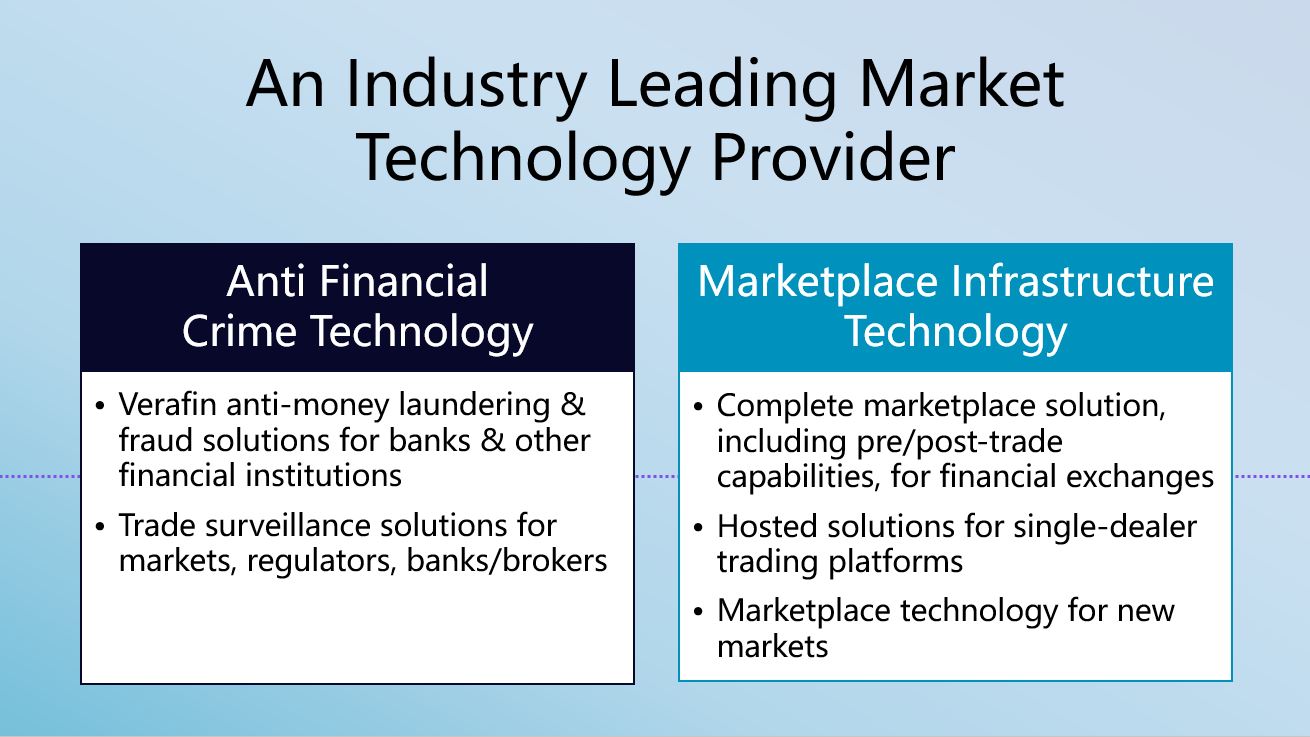
Anti Financial Crime Technology
Integrity of markets is core to everything we do at Nasdaq. As such, we continue to extend our anti-financial crime strategy in the Market Technology segment. We have seen a growing demand globally for our products and services within the Anti Financial Crime Technology business. Our Nasdaq Trade Surveillance solution is a SaaS solution designed for brokers and other market participants to assist them in complying with market rules, regulations and internal market surveillance policies. We provide an anti-money laundering offering with an automated investigator tool for retail banks, the Nasdaq Automated Investigator. Verafin provides a cloud-based platform to help detect, investigate, and report money laundering and financial fraud to more than 2,100 financial institutions in North America.
Market Infrastructure Technology
For Market Infrastructure Operators, we provide and deliver mission-critical solutions across the trade lifecycle via the NFF, which is our flexible and modular architecture and technology that provides next generation capital markets capabilities in an open and agile environment. The NFF is designed to cover all aspects of a market operator’s needs, from trading and clearing to risk management, market surveillance, index development, data, management, testing, and quality assurance.
Recently, we have seen a growing demand for our products and service outside of the traditional capital markets. Market Technology currently offers its services to several digital assets exchanges, two commercial real estate markets, the reinsurance market, and several sports wagering operators. Our Marketplaces Services Platform provides next-generation marketplace capabilities spanning the transaction lifecycle to facilitate the exchange of assets, services and information across various types of market ecosystems and machine-to-machine transactions. The Marketplaces Services Platform is targeted at new markets and enables end-to-end marketplace implementation without the resources required with on-premise solutions.
Many Market Infrastructure projects involve complex delivery management and systems integration. Through our integration services, we can assume responsibility for projects that involve migration to a new system and the establishment of entirely new marketplaces. We also offer operation and support for the applications, systems platforms, networks and other components included in an information technology solution, as well as advisory services.
Investment Intelligence
Our Investment Intelligence segment provides the global investing community with access to the financial markets together with strong investment insights.
Our Investment Intelligence segment includes our Market Data, Index and Analytics businesses.
For both institutional and retail investors, our market and alternative data enhances transparency and access to the markets we operate, and we help guide investment decisions around the globe through our proprietary indexes and analytics.
Market Data
Our Market Data business sells and distributes historical and real-time market data to the sell-side, the institutional investing community, retail online brokers, proprietary trading shops, other venues, internet portals and data distributors.
Our market data products enhance transparency of market activity within our exchanges and provide critical information to professional and non-professional investors globally. We collect, process and create information and earn revenues as a distributor of our own, as well as select third-party content. We provide varying levels of quote and trade information to our customers who in turn provide subscriptions for this information. Our systems enable distributors to gain access to our market depth, fund valuation, order imbalances, market sentiment and other analytical data.
We distribute this proprietary market information to both market participants and non-participants through a number of proprietary products, including Nasdaq TotalView, our flagship market depth quote product. TotalView shows subscribers quotes, orders and total anonymous interest at every displayed price level in The Nasdaq Stock Market for Nasdaq-listed securities and critical data for the opening, closing, halt and IPO crosses. We also offer TotalView products for our Nasdaq BX, Nasdaq PSX, Nasdaq Fixed Income and other Nordic markets.
We operate several other proprietary services and data products to provide market information, including Nasdaq Basic, a low cost alternative to the industry Level 1 feed and Nasdaq Canada Basic, a low cost alternative to other high priced data feeds. We also provide various other data, including data relating to our six U.S. options exchanges, Nordic and U.S. futures, and Nordic commodities.
Our Market Data business also includes revenues from U.S. tape plans. The plan administrators sell quotation and last sale information for all transactions in Nasdaq-listed securities, whether traded on The Nasdaq Stock Market or other exchanges, to market participants and to data distributors, who then provide the information to subscribers. After deducting costs, the plan administrators distribute the tape revenues to the respective plan participants based on a formula required by Regulation NMS that takes into account both trading and quoting activity.
The Nasdaq Nordic and Nasdaq Baltic exchanges, as well as Nasdaq Commodities, also offer data products and services. These data products and services provide critical market transparency to professional and non-professional investors who participate in European marketplaces and, at the same time, give investors greater insight into these markets.
Much like the U.S. products, European data products and services are based on trading information from the Nasdaq Nordic and Nasdaq Baltic exchanges, as well as Nasdaq Commodities, for the following classes of assets: cash equities, bonds, derivatives and commodities. We provide varying levels of quote and trade information to market participants and to data distributors, who in turn provide subscriptions for this information. Significant European data products include Nordic Equity TotalView, Nordic Derivatives TotalView, and Nordic Fixed Income TotalView, Level 2 and Analytics.
Index
Our Index business develops and licenses Nasdaq-branded indexes and financial products. License fees for our trademark licenses vary by product based on a percentage of underlying assets, dollar value of a product issuance, number of products or number of contracts traded. We also license cash-settled options, futures and options on futures on our indexes.
As of December 31, 2021, 362 ETPs listed on 25 exchanges in over 20 countries tracked a Nasdaq index and accounted for $424 billion in AUM. This includes approximately $94 billion in ETP AUM, or 22% of the total AUM that tracked our smart beta indexes during this same time period. Our flagship index, the Nasdaq-100 Index, includes the top 100 non-financial companies listed on The Nasdaq Stock Market, and is tracked by more than 100 ETPs worldwide, and had nearly $300 billion in assets tracking the index as of December 31, 2021.
We provide index data products based on Nasdaq indexes. Index data products include our Global Index Data Service, which delivers real-time index values throughout the trading day, and Global Index Watch/Global Index File Delivery Service, which delivers daily as well as historical weightings and components data, corporate actions and a breadth of additional data for the indexes that we operate.
Nasdaq Dorsey Wright, or NDW, provides passive indexing and smart beta strategies to support the financial advisor community, as well as Systematic Relative Strength strategies to manage separately and unified managed accounts. NDW strengthens Nasdaq’s position as a leading smart beta index provider in the U.S.
Analytics
Our Analytics business provides asset managers, investment consultants and institutional asset owners with information and analytics to make data-driven investment decisions, deploy their resources more productively, and provide liquidity solutions for private funds. Through our eVestment and Solovis solutions, we provide a suite of cloud-based solutions that help institutional investors and consultants conduct pre-investment due diligence, and monitor their portfolios post-investment. The eVestment platform also enables asset managers to efficiently distribute information about their firms and funds to asset owners and consultants worldwide.
Additionally, our Nasdaq Cloud Data Service provides a flexible and efficient method of delivery for real-time exchange data and other financial information. Data is made available through a suite of application programming interfaces, or APIs, allowing for the integration of data from disparate sources and a reduction in time to market for customer-designed applications. The API is highly scalable and can support the delivery of real-time exchange data.
Through the Solovis platform, endowments, foundations, pensions and family offices transform how they collect and aggregate investment data, analyze portfolio performance, model and predict future outcomes, and share meaningful portfolio insights with key stakeholders. The Nasdaq Fund Network and Nasdaq Data Link are additional platforms in our suite of investment data analytics offerings and data management tools. Nasdaq Fund Network gathers and distributes daily net asset values from over 35,000 funds and other investment vehicles across North America. We have extended Nasdaq Fund Network to support the distribution of collective investment trusts, hedge funds, managed accounts, separate accounts and demand deposit accounts. Nasdaq Data Link strengthens our position as a leading source for financial, economic, and alternative datasets. For investment management firms, investment banks and other investors, the platform powers data-driven decision-making for users across the globe via universal APIs, and provides for highly efficient data discovery and delivery. Additionally, our Data Fabric solution, launched in 2021, enables investment firms to leverage the technology and team that powers Nasdaq Data Link to manage their own internal data with greater speed and efficiency.
Corporate Platforms
Our Corporate Platforms segment includes our Listing Services and IR & ESG Services businesses. These businesses deliver critical capital market and ESG solutions across the lifecycle of public and private companies.
Listing Services
We operate a variety of listing platforms around the world to provide multiple global capital raising solutions for public companies. Companies listed on our markets represent a diverse array of industries including, among others, health care, consumer products, telecommunication services, information technology, financial services, industrials and energy. Our main listing markets are The Nasdaq Stock Market and the Nasdaq Nordic and Nasdaq Baltic exchanges.
Companies seeking to list securities on The Nasdaq Stock Market may do so on one of the three market tiers: The Nasdaq Global Select Market, The Nasdaq Global Market, or The Nasdaq Capital Market. To qualify, companies must meet minimum listing requirements, including specified financial and corporate governance criteria. Once listed, companies must maintain rigorous listing and corporate governance standards. We offer a suite of products to assist companies manage corporate governance standards, discussed below in “IR & ESG Services.”
As of December 31, 2021, a total of 4,178 companies listed securities on The Nasdaq Stock Market, with 1,632 listings on The Nasdaq Global Select Market, 1,169 on The Nasdaq Global Market and 1,377 on The Nasdaq Capital Market.
We seek new listings from companies conducting IPOs, including SPACs, and direct listings as well as companies looking to switch from alternative exchanges. In 2021, The Nasdaq Stock Market attracted 1,000 new listings, including 752 IPOs, representing 73% of U.S. IPOs in 2021. Of the 752 IPOs that listed on The Nasdaq Stock Market, 319 were operating companies, representing 76% of all operating company IPOs in 2021 and 71% of SPACs IPOs. Nasdaq featured the year's largest IPO as well as the largest direct listing by first trade volume. The new listings were comprised of the following:
| IPOs | 752 | ||||
| Switches from the New York Stock Exchange LLC, or NYSE and the NYSE American LLC, or NYSE American | 33 | ||||
| Upgrades from OTC | 112 | ||||
| ETPs and Other Listings | 103 | ||||
| Total | 1,000 |
During 2021, we had 33 new listings resulting from companies switching their listings from NYSE or NYSE American to join Nasdaq. Together with companies that transferred additional securities to Nasdaq during 2021, an aggregate of $361 billion in global equity market capitalization switched to Nasdaq. Notable switches in 2021 included Honeywell, Palo Alto Networks and Lucid Group.
We also offer listings on the exchanges that comprise Nasdaq Nordic and Nasdaq Baltic. For smaller companies and growth companies, we offer access to the financial markets through the Nasdaq First North alternative marketplaces. As of December 31, 2021, a total of 1,235 companies listed securities on our Nordic and Baltic exchanges.
Our European listing customers include companies, funds and governments. Customers issue securities in the form of cash equities, depository receipts, warrants, ETPs, convertibles, rights, options, bonds or fixed-income related products. In 2021, a total of 207 new companies listed on our Nordic and Baltic exchanges. In addition, 12 companies upgraded their listings from Nasdaq First North to Nasdaq Main Market.
During 2021, we announced a joint venture with several financial institutions to establish an institutional-grade, centralized secondary trading venue for issuers, brokers, shareholders and prospective investors of private company stock. We contributed our Nasdaq Private Market platform to this new, standalone, independent company, of which we own the largest minority interest. Nasdaq Private Market’s existing technology, client relationships and regulatory infrastructure will provide the foundation for the joint venture to develop a full suite of liquidity solutions for private companies. Private companies, brokers and investors
will be able to access, connect, manage and execute their private company stock transactions through a global marketplace and customized technology solutions. The platform will continue to manage and support private company stock transactions including tender offers, buy-side book-building, auctions, investor block trades, company directed windows of liquidity and pre-direct listing continuous trading. In addition, the platform will provide end-to-end settlement process management and an inter-broker global marketplace through its existing ATS for all customers, from employees to institutions, to access and transact.
We are continuing to grow our U.S. Corporate Bond exchange for the listing of corporate bonds. This exchange operates pursuant to The Nasdaq Stock Market exchange license and is powered by the NFF. Surveillance is conducted by the Nasdaq regulatory team, assisted by our Nasdaq Trade Surveillance solution. As of December 31, 2021, 107 corporate bonds were listed on the Corporate Bond exchange. Our U.S. corporate bond listing offering won 23 new issues and we added five existing bond listings that transferred from the NYSE.
IR & ESG Services
Our IR & ESG Services business serves both public and private companies and organizations. Our public company clients can be companies listed on our exchanges or other U.S. and global exchanges. We help organizations enhance their ability to understand and expand their global shareholder base, improve corporate governance, and navigate the evolving ESG landscape through our suite of advanced technology, analytics, and consultative services. We also provide clients with counsel on a range of governance and sustainability-related issues.
As of December 31, 2021, we provided IR & ESG Services offerings in the following key areas:
-
Investor Relations Intelligence. We offer a global team of consultative experts that deliver advisory services including Equity Surveillance & Shareholder Analysis, Investor Engagement and Perception Studies, as well as an industry-leading platform, Nasdaq IR Insight®, to investor relations professionals and executive teams. These solutions allow investor relations officers and executives to better manage their investor relations programs, understand their investor base, target new investors, manage meetings and consume key data such as investor profiles, equity research, consensus estimates and news.
-
Environmental, Social and Governance Solutions. Our ESG Advisory practice helps companies analyze, assess and action best practices to attract long-term capital. OneReport, a SaaS solution, helps organizations to navigate corporate responsibility frameworks, manage information capture and response process, and deliver ESG data to ratings agencies and other stakeholders.
We also provide a global technology offering and consultative services that streamline the meeting process for board of directors and executive leadership teams and help them accelerate decision making and strengthen governance. Our solutions protect sensitive data and facilitate productive collaboration, which enables board members and teams to work faster and more effectively. In December 2021, we enhanced our position as a provider of governance technology and consultative solutions with the acquisition of QDiligence, a provider of software that facilitates digital director and officer questionnaires and self-evaluations for boards of directors and corporate secretaries.
Market Services
Our Market Services segment includes our Equity Derivative Trading and Clearing, Cash Equity Trading, FICC and Trade Management Services businesses.
Equity Derivative Trading and Clearing
We operate six options exchanges in the U.S.: Nasdaq PHLX, The Nasdaq Options Market, Nasdaq BX Options, Nasdaq ISE, Nasdaq GEMX and Nasdaq MRX. These exchanges facilitate the trading of equity, ETF, index and foreign currency options. Together, our combined options market share in 2021 represented the largest share of the U.S. market for all categories, including single-exchange-listed options products. Our options trading platforms provide trading opportunities to both retail investors, algorithmic trading firms and market makers, who tend to prefer electronic trading, and institutional investors, who typically require high touch services to execute their trades, which are often performed on our trading floor in Philadelphia.
In Europe, Nasdaq offers trading in derivatives, such as stock options and futures and index options and futures. Nasdaq Clearing offers central counterparty clearing services for stock options and futures and index options and futures.
Cash Equity Trading
In the U.S., we operate three cash equity exchanges: The Nasdaq Stock Market, Nasdaq BX and Nasdaq PSX. Our U.S. cash equity exchanges offer trading of both Nasdaq-listed and non-Nasdaq-listed securities. The Nasdaq Stock Market is the largest single venue of liquidity for trading U.S.-listed cash equities. Market participants include market makers, broker-dealers, ATSs, institutional investors, and registered securities exchanges.
In Canada, we operate an exchange with three independent markets, Nasdaq Canada CXC, Nasdaq Canada CX2 and Nasdaq Canada CXD, for the trading of Canadian-listed securities.
In Europe, Nasdaq operates exchanges in Stockholm (Sweden), Copenhagen (Denmark), Helsinki (Finland), and Reykjavik (Iceland) as well as the clearing operations of Nasdaq Clearing, as Nasdaq Nordic. We also operate exchanges in Tallinn (Estonia), Riga (Latvia) and Vilnius (Lithuania) as Nasdaq Baltic.
Collectively, the Nasdaq Nordic and Nasdaq Baltic exchanges offer trading in cash equities, depository receipts, warrants, convertibles, rights, fund units and ETFs, as well as trading and clearing of derivatives and clearing of resale and repurchase agreements. Our platform allows the exchanges to share the same trading system, which enables efficient cross-border trading and settlement, cross membership and a single source for Nordic data products. Settlement and registration of cash equity trading takes place in Sweden, Finland, and Denmark via the local central securities depositories. In addition, Nasdaq owns a central securities depository that provides notary, settlement, central maintenance and other services in the Baltic countries and Iceland.
FICC
Our FICC business includes Nasdaq Fixed Income, or NFI, offering trading and clearing services for fixed income products in Europe and Nasdaq Commodities.
NFI provides a wide range of products and services, such as trading and clearing, for fixed income products in Sweden, Denmark, Finland, Iceland, Estonia, Lithuania and Latvia. Nasdaq is the largest bond listing venue in the Nordics, with more than 5,600 listed retail and institutional bonds. In addition, Nasdaq Nordic facilitates the trading and clearing of Nordic fixed income derivatives in a unique market structure. Buyers and sellers agree to trades in fixed income derivatives through bilateral negotiations and then report those trades to Nasdaq Clearing. Nasdaq Clearing offers central counterparty clearing services for fixed-income options and futures and interest rate swaps. Nasdaq Clearing also operates a clearing service for the resale and repurchase agreement market.
Nasdaq Commodities is the brand name for Nasdaq’s European commodity-related products and services. Nasdaq Commodities’ offerings include derivatives in power, natural gas and carbon emission markets, seafood, electricity certificates and clearing services. These products are listed on Nasdaq Oslo ASA, except for seafood, which is listed on Fishpool, a third party platform.
Nasdaq Oslo ASA is the commodity derivatives exchange for European products. All trades with Nasdaq Oslo ASA are subject to clearing with Nasdaq Clearing, which offers central counterparty clearing services for commodities options and futures.
In June 2021, we sold our U.S. Fixed Income business, which included an electronic platform for the trading of U.S. Treasuries.
Additionally, in June 2021, we completed the acquisition of a majority stake in Puro.earth, a Finnish-based leading marketplace for carbon removal. Puro.earth offers industrial carbon removal instruments that are verifiable and tradable through an open, online platform. The addition of Puro.earth’s marketplace capabilities to our suite of ESG-focused technologies and workflow solutions gives our clients further resources to successfully achieve their ESG objectives.
Trade Management Services
We provide market participants with a wide variety of alternatives for connecting to and accessing our markets for a fee. Our marketplaces may be accessed via a number of different protocols used for quoting, order entry, trade reporting and connectivity to various data feeds. In April 2021, we launched WorkX, an upgraded version of Nasdaq Workstation, a browser-based, front-end interface that allows market participants to view data and enter orders, quotes and trade reports. WorkX enables a seamless workflow and enhanced trade intelligence. All current Workstation users are expected to migrate to WorkX by the end of 2022. In addition, we offer a variety of add-on compliance tools to help firms comply with regulatory requirements.
We provide colocation services to market participants, whereby we offer firms cabinet space and power to house their own equipment and servers within our data centers. Additionally, we offer a number of wireless connectivity offerings between select data centers using millimeter wave and microwave technology.
Our broker services operations business primarily offers technology and customized securities administration solutions to financial participants in the Nordic market. Such services and solutions primarily consist of flexible back-office systems, which allow customers to efficiently manage safekeeping, settlement and corporate actions and reporting, and include connectivity to exchanges and central securities depositories. In January 2020, we commenced an orderly wind-down of this broker services business. We expect this wind-down to continue through the second quarter of 2022.
Technology
Technology plays a key role in ensuring the growth, reliability and regulation of financial markets. We have established a technology risk program to evaluate the resiliency of critical systems, including risks associated with cybersecurity. This program is focused on identifying areas for improvement in systems, and implementing changes and upgrades to technology and processes to minimize future risk. We have continued our focus on improving the security of our technology with an emphasis on employee awareness through training, targeted phishing campaigns, and new tool deployment for our securities operations team. See “Item 1A. Risk Factors,” in this Annual Report on Form 10-K for further discussion.
Core Technology. The NFF is Nasdaq’s approach to delivering end-to-end solutions to market infrastructure operators, buy-side firms, sell-side firms and other non-financial markets in addition to also supporting Nasdaq's own internal trading systems. The framework consists of a single operational core platform that ties together Nasdaq’s portfolio of functionality across the trade lifecycle, in an open framework whereby exchanges, clearinghouses, central securities depositories, and other entities can easily integrate Nasdaq’s business applications with each other, as well as other third-party solutions. In addition to being able to integrate a broad range of business functions, the NFF
enables end users to leverage recent technology developments.
Competitive Strengths
We are a global technology company and we continue to diversify our product and service offerings by having a client-first focus and orientation; unparalleled expertise in markets; a trusted, independent, global brand; unique technology capabilities and reputation; and fostering a leading issuer community and investor intelligence platform. Our business segments complement each other. We believe that our strong competitive position in large, high-growth markets positions us for sustained growth.
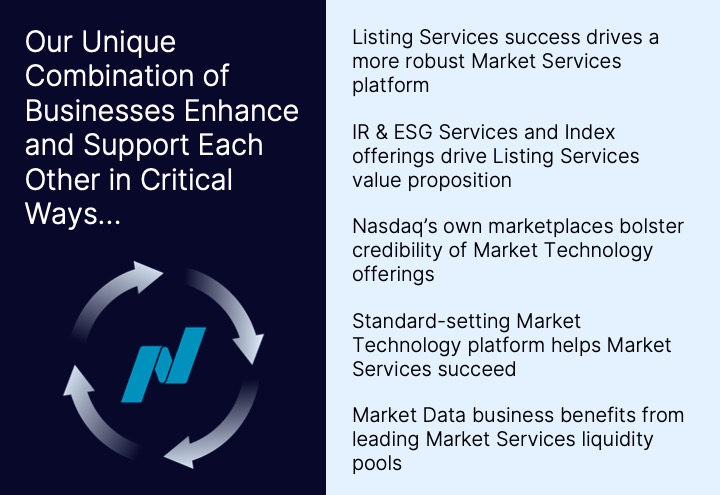
A Unique Value Proposition
We operate a diverse and resilient capital markets franchise with a marketplace core. Our businesses provide capital-markets infrastructure services to industry players, allowing us to:
-
Develop efficient and reliable technologies to facilitate capital markets activity;
-
Manage the complexities and costs of business on a global scale; and
-
Provide data, tools and insights that drive sound decision making.
Technological Strength
The strength and resiliency of our technology, enhanced by our Market Technology business, in meeting the advancing demands of our global customer base is vital to the continued success of our business and distinguishes us from our competitors.
A Focus on Client Needs Throughout the Marketplace
We strive to serve a diverse range of clients including:
-
Brokers and Traders** - Helping brokers and traders to confidently plan, optimize and execute their business vision.
-
Market Participants** - Enabling market participants to monitor and capitalize on real-time market changes.
-
Investors and Asset Managers** - Offering products and services to assist investors and asset managers in optimizing their portfolios and offerings.
-
Listed Companies** - Promoting the capital health of our listed companies.
-
Market Infrastructure Players** - Assisting market infrastructure players (exchanges, regulators, clearinghouses, and central securities depositories) in increasing efficiency, meeting customer needs and growing revenue.
-
Capital Markets** - Delivering efficiencies through economies of scale (cost, speed, connectivity) to all members of the capital-markets ecosystem.
-
Banks and Financial Institutions** - Providing a suite of trade surveillance and anti-financial crime management solutions.
Competition
Market Technology
Traditionally, exchanges and exchange-related businesses would internally develop technology, sometimes aided by consultants. However, over time this model has changed as many operators have recognized the cost-savings made possible by buying technology from third parties. As a result, two types of competitors have emerged in our Market Technology segment: exchange operators and technology providers unaffiliated with exchanges. These organizations make available a range of off-the-shelf technology, including trading, clearing, market surveillance, settlement, depository and information dissemination, and offer customization and operation expertise. Market conditions in Market Technology are evolving rapidly, which makes continuous investment and innovation a necessity. Our partnership with AWS to migrate our exchanges, in a phased approach, to the cloud enables us to compete with other companies that are developing cloud-based exchanges and market technology offerings.
A wide range of providers compete with us in surveillance, where standardization of products and budget pressures drive customers to focus on pricing. Our competitors range from large enterprise software providers that cover the broader compliance lifecycle to smaller vendors focusing on a single silo of the compliance workflow. Recently, an influx of start-ups have entered the space from the FinTech landscape, often shifting from data and analytics, or a complementary silo like electronic communications, to surveillance. For our anti-financial crime offering, competitors include core banking solution providers, independent fraud and anti-money laundering solution providers and FinTech start-ups. We also compete against enterprise solution providers and point solutions for clients with larger AUM. The anti-financial crime offering competes on a number of factors, including but not limited to, increased workflow efficiency, quality of the data output and pricing.
Our surveillance and anti-financial crime offerings must demonstrate the ability to decrease false-positives, provide in-depth views into potential abuses and risks that stem from those cases and help firms reduce both the reputational and regulatory risk, and complexity in efforts to keep markets and financial institutions safe.
Investment Intelligence
Our Market Data business in the U.S. includes both proprietary and consolidated data products. Proprietary data products are made up exclusively of data derived from each exchange’s systems. Consolidated data products are distributed by SEC-mandated consolidators (one for Nasdaq-listed stocks and another for NYSE and other-listed stocks) that share the revenue among the exchanges that contribute data. In Europe, all data products are proprietary, as there is no official data consolidator. Competition in the data business is intense and is influenced by rapidly changing technology and the creation of new product and service offerings.
The sale of our proprietary data products is under competitive threat globally from alternative exchanges and trading venues that offer similar products. Our data business competes with other exchanges and third party vendors to provide information to market participants. Examples of our competitors in proprietary data products are ICE, Cboe, TSX, and Dow Jones & Company.
The consolidated data business is under competitive pressure from other securities exchanges that trade Nasdaq-listed securities. In addition, The Nasdaq Stock Market similarly competes for the tape fees from the sale of information on securities listed on other markets.
Our Index business faces competition from providers of various competing financial indexes. For example, there are a number of indexes that aim to track the technology sector and thereby compete with the Nasdaq-100 Index and the Nasdaq Composite Index. We face competition from investment banks, dedicated index providers, markets and other product developers, including S&P Dow Jones Indices, MSCI and FTSE Russell.
Our Analytics business faces competition from a broad array of data and analytics suppliers, both established firms and small start-ups. Our primary competitors are Morningstar, FactSet and any number of smaller firms along with start-up data providers and aggregators. Our Solovis offering competes with other analytics providers, including Addepar and Caissa. Additionally, other large providers to the financial services industry, such as Bloomberg and Refinitiv, are believed to be interested in pursuing certain aspects of the services we provide.
Corporate Platforms
Our Listing Services business in both the U.S. and Europe provides a means of facilitating capital formation through public capital markets. There are competing ways of raising capital, and we seek to demonstrate the benefits of listing shares on our exchange. Our primary competitor for larger company stock share listings in the U.S. is NYSE. The Nasdaq Stock Market competes with local and international markets located outside the U.S. for listings of equity securities of both U.S. and non-U.S. companies that choose to list (or dual-list) outside of their home country. For example, The Nasdaq Stock Market competes for listings with exchanges in Europe and Asia, such as LSE and The Stock Exchange of Hong Kong Limited. Additionally, we face competition from private equity firms that may elect to keep their portfolio companies as private companies.
The Listings Services business in Europe is characterized by a large number of exchanges competing for new or secondary listings. Each country has one or more national exchanges, which are often the first choice of companies in each respective country. For those considering an alternative, competing European exchanges that frequently attract many listings from outside their respective home countries include LSE, Euronext N.V. and Deutsche Börse AG. In addition to the larger exchanges, companies seeking capital or liquidity from public capital markets are able to raise capital without a regulated market listing and can consider trading their shares on smaller markets and quoting facilities.
In our IR & ESG Services business, competition is varied and can be fragmented. For our Investor Relations Intelligence solutions, there are many regional competitors and relatively few global providers. Other exchange operators are partnering with firms that have capabilities in this area and seeking to acquire relevant assets in order to provide investor relations services to customers alongside listing services. The competitive landscape for our Governance Solutions business varies by customer segment and geography. Most competitors offer SaaS solutions that are supported by a data centered strategy. Some firms offer specialized services that focus on a single niche segment. The larger players often offer additional services. Customers frequently seek single-source providers that are able to address a broad range of needs within a single platform. Our ESG-focused services, including Nasdaq OneReport and ESG Advisory, are positioned in evolving markets with competitors offering multiple point solutions providing software, data or consulting services.
Market Services
We face intense competition in North America and Europe in businesses that comprise our Market Services segment. We seek to provide market participants with greater functionality, trading system stability and performance, high levels of customer service, and efficient pricing. In both North America and Europe, our competitors include other exchange operators, operators of non-exchange trading systems and banks and brokerages that operate their own internal trading pools and platforms.
In the U.S., our options markets compete with exchanges operated by Cboe Global Markets, Inc., or Cboe, Miami International Holdings, Inc., or MIAX, Intercontinental Exchange, Inc., or ICE, and Boston Options Market. In cash equities in the U.S., we compete with exchanges operated by Cboe, ICE, MIAX, The Investors Exchange, and the recently launched Members Exchange and the Long Term Stock Exchange. We also face competition from ATSs, known as “dark pools,” and other less-heavily regulated broker-owned trade facilitation systems, as well as from other types of OTC trading. In Canada, our cash equities exchange competes with exchanges such as the Toronto Stock Exchange, or TSX, and other marketplaces.
In Europe, our cash equities markets compete with exchanges such as Euronext N.V., Deutsche Börse AG and London Stock Exchange Group plc, or LSE, and many MTFs such as Cboe, Turquoise and Aquis. Our competitors in the trading and clearing of options and futures on European equities include Eurex, Cboe, ICE Futures Europe and London Clearing House, or LCH. In addition, in equities in Europe we face competition from other broker-owned systems, dark pools, SIs, and other types of OTC trading. Competition among exchanges for trading European equity derivatives tends to occur where there is competition in the trading of the underlying equities. In addition to exchange-based competition, we face competition from OTC derivative markets.
The implementation of MiFID II and MiFIR has resulted in further competitive pressure on our European trading business. SIs are already attracting a significant share of electronically matched volume and we expect such venues to compete aggressively for the trading of equity securities listed on our Nordic exchanges. Different bilateral trading systems pursuing block business also remain active in Europe. As part of this, trading on SIs has increased markedly as volumes migrate from more transparent types of trading venues. Regulators are continuously monitoring the market structure and have, in a series of consultations, asked for input regarding suggested changes to MiFID II.
Our European fixed income and commodities products and services are subject to competitive pressure from European exchanges and clearinghouses.
Our Trade Management Services business competes with other exchange operators, extranet providers, and data center providers.
Intellectual Property
We believe that our intellectual property assets are important for maintaining the competitive differentiation of our products, systems, software and services, enhancing our ability to access technology of third parties and maximizing our return on research and development investments.
To support our business objectives and benefit from our investments in research and development, we actively create and maintain a wide array of intellectual property assets, including patents and patent applications related to our
innovations, products and services; trademarks related to our brands, products and services; copyrights in software and creative content; trade secrets; and through other intellectual property rights, licenses of various kinds and contractual provisions. We enter into confidentiality and invention assignment agreements with our employees and contractors, and utilize non-disclosure agreements with third parties with whom we conduct business in order to secure and protect our proprietary rights and to limit access to, and disclosure of, our proprietary information.
We own, or have licensed, rights to trade names, trademarks, domain names and service marks that we use in conjunction with our operations and services. We have registered many of our most important trademarks in the U.S. and in foreign countries. For example, our primary “Nasdaq” mark is a registered trademark that we actively seek to protect in the U.S. and in over 50 other countries worldwide.
Over time, we have accumulated a robust portfolio of issued patents in the U.S. and in many other jurisdictions across the world. We currently hold rights to patents relating to certain aspects of our products, systems, software and services, but we primarily rely on the innovative skills, technical competence and marketing abilities of our personnel. No single patent is in itself core to the operations of Nasdaq or any of its principal business areas.
Corporate Venture Practice
We operate a corporate venture program to make minority investments primarily in emerging growth financial technology companies that are strategically relevant to, and aligned with, Nasdaq. Investments are made through the venture program to further our research and development efforts and accelerate the path to commercial viability. We expect that capital invested will continue to be modest and will not have a material impact on our consolidated financial statements, existing capital return or deployment priorities. Since its inception in 2017, our venture program has grown, with aggregate initial and follow-on investments of approximately $90 million in 19 companies in various sectors, including data, analytics and workflow, digital assets, market infrastructure, anti-financial crime, new marketplaces, and ESG.
Environmental, Social and Governance Matters
Nasdaq is committed to further advancing our longer-term ESG strategy, advocacy and oversight. We continue to engage with internal and external stakeholders at all levels on ESG matters. During 2021, we deepened our corporate and community ESG efforts, including expanding ESG oversight of our own operations and furthering our commitment to greater sustainability and climate change awareness.
For the fourth consecutive year, Nasdaq achieved its continued commitment to be carbon neutral across all business operations through the purchase of green power, carbon removal offsets, and renewable energy certificates. We were named to the Dow Jones Sustainability North America Index for the sixth consecutive year and have seen
positive progress on our ESG scores across multiple rating agencies. Nasdaq is also a signatory to the United Nations Global Compact and the United Nations Principles of Responsible Investment.
While our business operations account for a comparatively small environmental impact, we are able to focus environmental efforts on several key areas, including the way we use energy resources, manage our workspaces, and conduct business travel. Through these efforts, we seek to lessen the environmental impact of our organization by reducing atmospheric carbon emissions and managing water and waste associated with business operations. Our commitment to implement Science-Based targets as part of the Science-Based Targets Initiative further emphasizes our ambition to drive to a net-zero economy. For the first time, Nasdaq obtained a Platinum LEED certification for our New York Headquarters and we continue to look for opportunities to transition to green offices across the globe.
We also expanded our ESG services and solutions with new offerings for our clients, including:
-
the Nasdaq ESG Advisory Program, which pairs companies with consultative ESG expertise to help them analyze, assess and enact ESG program best practices with the goals of attracting long-term capital and enhancing value;
-
the Nasdaq OneReport platform, which helps clients streamline the data gathering process under various frameworks for sustainability reporting and to provide data to ratings agencies;
-
the Nasdaq Sustainable Bond Network, which connects issuers and investors in sustainable, green and social bonds, and provides access to detailed information and impact data allowing investors to make more informed decisions;
-
the Nasdaq ESG Data Hub, which connects investors with expert-led ESG data sets from leading providers across a wide spectrum of areas, including gender diversity, carbon emissions and climate risk, providing detailed and tangible intelligence on companies’ ESG profiles;
-
the Nasdaq ESG Data Portal, which now includes ESG-related data from more than 630 companies;
-
the Nasdaq ESG Footprint, a tool to help both institutional and retail investors understand the impact of their portfolios; and
-
the acquisition of a majority stake in Puro.earth, a leading marketplace for carbon removal, which we believe will address the growing demand for carbon removal by corporations, as well as enable new carbon removal methodologies as technologies evolve.
In 2021, we also adopted a new Supplier Code of Ethics, which encourages our suppliers and vendors to adopt sustainability and environmental practices in line with our published Environmental Practices Statement. This code asks our suppliers to measure, report, and mitigate any potential negative climate change and biodiversity impacts associated with their operations, products and services including energy and water consumption, greenhouse gas emissions, waste, air and water pollution, nature loss and hazardous materials. Our policy asks suppliers to provide us with information to support our reporting and transparency commitments related to environmental sustainability and supply chain emissions. Additionally, the Supplier Code of Ethics expects suppliers to promote a diverse and inclusive workforce and encourages suppliers to engage diverse-owned business in their supply chain. Our Supplier Code of Ethics is available on Nasdaq’s website.
During 2021, the SEC adopted Nasdaq’s new listings rule for companies listed on our U.S. exchange to publicly disclose consistent, transparent diversity statistics regarding their board of directors and choose whether to meet recommended board diversity objectives or disclose their reasons for not doing so. The diversity rule is currently being challenged by two advocacy groups in the U.S. Court of Appeals for the Fifth Circuit.
Nasdaq also was included in the 2021 Bloomberg Gender-Equality Index in recognition for advancing equality across its global workforce, and earned a perfect score for the third consecutive year by the Human Rights Campaign Foundation’s 2021 Corporate Equality Index regarding LGBTQ+ workplace equality.
For more information regarding our ESG efforts in 2021, both internally and externally, please see the section entitled “Human Capital Management” below and our Proxy Statement.
Regulation
We are subject to extensive regulation in the U.S., Canada and Europe.
U.S. Regulation
U.S. federal securities laws establish a system of cooperative regulation of securities markets, market participants and listed companies. SROs conduct the day-to-day administration and regulation of the nation’s securities markets under the close supervision of, and subject to extensive regulation, oversight and enforcement by, the SEC. SROs, such as national securities exchanges, are registered with the SEC.
This regulatory framework applies to our U.S. business in the following ways:
-
regulation of our registered national securities exchanges; and
-
regulation of our U.S. broker-dealer and investment advisor subsidiaries.
National Securities Exchanges. SROs in the securities industry are an essential component of the regulatory scheme of the Exchange Act for providing fair and orderly markets and protecting investors. The Exchange Act and the rules thereunder, as well as each SRO’s own rules, impose many regulatory and operational responsibilities on SROs, including the day-to-day responsibilities for market and broker-dealer oversight. Moreover, an SRO is responsible for enforcing compliance by its members, and persons associated with its members, with the provisions of the Exchange Act, the rules and regulations thereunder, and the rules of the SRO, including rules and regulations governing the business conduct of its members.
Nasdaq currently operates three cash equity, six options markets and one corporate bond market in the U.S. We operate The Nasdaq Stock Market, The Nasdaq Options Market and the Corporate Bond Market pursuant to The Nasdaq Stock Market’s SRO license; Nasdaq BX and Nasdaq BX Options pursuant to Nasdaq BX’s SRO license; Nasdaq PSX and Nasdaq PHLX pursuant to Nasdaq PHLX’s SRO license; and Nasdaq ISE, Nasdaq GEMX and Nasdaq MRX, each of which operates an options market under its own SRO license. As SROs, each entity has separate rules pertaining to its broker-dealer members and listed companies. Broker-dealers that choose to become members of our exchanges are subject to the rules of those exchanges.
All of our U.S. national securities exchanges are subject to SEC oversight, as prescribed by the Exchange Act, including periodic and special examinations by the SEC. Our exchanges also are potentially subject to regulatory or legal action by the SEC at any time in connection with alleged regulatory violations. We have been subject to a number of routine reviews and inspections by the SEC or external auditors in the ordinary course, and we have been and may in the future be subject to SEC enforcement proceedings. To the extent such actions or reviews and inspections result in regulatory or other changes, we may be required to modify the manner in which we conduct our business, which may adversely affect our business, operating results and financial condition.
Section 19 of the Exchange Act provides that our exchanges must submit to the SEC proposed changes to any of the SROs’ rules, practices and procedures, including revisions to provisions of our certificate of incorporation and by-laws that constitute SRO rules. The SEC will typically publish such proposed changes for public comment, after which the SEC may approve or disapprove the proposal, as it deems appropriate. SEC approval requires a finding by the SEC that the proposal is consistent with the requirements of the Exchange Act and the rules and regulations thereunder. Pursuant to the requirements of the Exchange Act, our exchanges must file with the SEC, among other things, all proposals to change their pricing structure.
Nasdaq conducts real-time market monitoring, certain equity surveillance not involving cross-market activity, most options surveillance, rulemaking and membership functions through our Nasdaq Regulation department. We review suspicious trading behavior discovered by our regulatory staff, and depending on the nature of the activity, may refer the activity to FINRA for further investigation. Pursuant to regulatory services agreements between FINRA and our SROs, FINRA provides certain regulatory services to our markets, including some regulation of trading activity and surveillance and investigative functions. Our SROs retain ultimate regulatory responsibility for all regulatory activities performed under regulatory agreements by FINRA, and for fulfilling all regulatory obligations for which FINRA does not have responsibility under the regulatory services agreements.
In addition to its other SRO responsibilities, The Nasdaq Stock Market, as a listing market, also is responsible for overseeing each listed company’s compliance with The Nasdaq Stock Market’s financial and corporate governance standards. Our listing qualifications department evaluates applications submitted by issuers interested in listing their securities on The Nasdaq Stock Market to determine whether the quantitative and qualitative listing standards have been satisfied. Once securities are listed, the listing qualifications department monitors each issuer’s on-going compliance with The Nasdaq Stock Market’s continued listing standards.
Broker-dealer regulation. Nasdaq’s broker-dealer subsidiaries are subject to regulation by the SEC, the SROs and various state securities regulators. Nasdaq operates three broker-dealers: Nasdaq Execution Services, LLC, NFSTX, LLC, and Nasdaq Capital Markets Advisory LLC. Each broker-dealer is registered with the SEC, a member of FINRA and registered in the U.S. states and territories required by the operation of its business. In addition, we own a minority interest in NPM Securities.
Nasdaq Execution Services operates as our routing broker for sending orders from Nasdaq's U.S. cash equity and options exchanges to other venues for execution. NFSTX is a registered ATS and acts as an intermediary to facilitate secondary transactions in certain funds (both registered or not registered under the Investment Company Act of 1940), business development companies, certain closed-end funds and private real estate investment funds. Nasdaq Capital Markets Advisory acts as a third-party advisor to privately-held or publicly-traded companies during IPOs and various other offerings.
The SEC, FINRA and the exchanges adopt rules and examine broker-dealers and require strict compliance with their rules and regulations. The SEC, SROs and state securities commissions may conduct administrative proceedings which can result in censures, fines, the issuance of cease-and-desist orders or the suspension or expulsion of a broker-dealer, its officers or employees. The SEC and state regulators may also institute proceedings against broker-dealers seeking an injunction or other sanction. All broker-dealers have an SRO that is assigned by the SEC as the broker-dealer’s Designated
Examining Authority. The Designated Examining Authority is responsible for examining a broker-dealer for compliance with the SEC’s financial responsibility rules. FINRA is the current Designated Examining Authority for each of our broker-dealer subsidiaries.
Our registered broker-dealers are subject to regulatory requirements intended to ensure their general financial soundness and liquidity, which require that they comply with certain minimum capital requirements. As of December 31, 2021, each of our broker-dealers were in compliance with all of the applicable capital requirements.
Regulatory contractual relationships with FINRA. Our SROs have signed a series of regulatory service agreements covering the services FINRA provides to the respective SROs. Under these agreements, FINRA personnel act as our agents in performing the regulatory functions outlined above, and FINRA bills us a fee for these services. These agreements have enabled us to reduce our headcount while ensuring that the markets for which we are responsible are properly regulated. However, we have reduced the scope of services provided by FINRA under these regulatory services agreements and are performing certain of those regulatory functions directly. In addition, our SROs retain ultimate regulatory responsibility for all regulatory activities performed under these agreements by FINRA.
Exchange Act Rule 17d-2 permits SROs to enter into agreements, commonly called Rule 17d-2 agreements, approved by the SEC with respect to enforcement of common rules relating to common members. Our SROs have entered into several such agreements under which FINRA assumes regulatory responsibility for specifics covered by the agreement, including:
-
agreements with FINRA covering the enforcement of common rules, the majority of which relate to the regulation of common members of our SROs and FINRA;
-
joint industry agreements with FINRA covering responsibility for enforcement of insider trading rules;
-
joint industry agreement with FINRA covering enforcement of rules related to cash equity sales practices and certain other non-market related rules; and
-
joint industry agreement covering enforcement of rules related to options sales practices.
Regulation NMS and Options Intermarket Linkage Plan. We are subject to Regulation NMS for our cash equity markets, and our options markets have joined the Options Intermarket Linkage Plan. These are designed to facilitate the routing of orders among exchanges to create a national market system as mandated by the Exchange Act. One of the principal purposes of a national market system is to assure that brokers may execute investors’ orders at the best market price. Both Regulation NMS and the Options Intermarket Linkage Plan require that exchanges avoid trade-throughs, locking or crossing of markets and provide market participants with electronic access to the best prices among the markets for the applicable cash equity or options order.
In addition, Regulation NMS requires that every national securities exchange on which an NMS stock is traded and every national securities association act jointly pursuant to one or more national market system plans to disseminate consolidated information, including a national best bid and national best offer, on quotations for transactions in NMS stocks, and that such plan or plans provide for the dissemination of all consolidated information for an individual NMS stock through a single plan processor.
The UTP Plan was filed with and approved by the SEC as a national market system plan in accordance with the Exchange Act and Regulation NMS to provide for the collection, consolidation and dissemination of such information for Nasdaq-listed securities. The Nasdaq Stock Market serves as the processor for the UTP Plan pursuant to a contract that was recently extended for a two-year term through October 2023. The Nasdaq Stock Market also serves as the administrator for the UTP Plan. To fulfill its obligations as the processor, The Nasdaq Stock Market has designed, implemented, maintained, and operated a data processing and communications system, hardware, software and communications infrastructure to provide processing for the UTP Plan. As the administrator, The Nasdaq Stock Market manages the distribution of market data, the collection of the resulting market data revenue, and the dissemination of that revenue to plan members in accordance with the terms of the UTP Plan and of Regulation NMS.
In May 2020, the SEC adopted an order to require changes to the governance of securities information processors. In June 2020, we and several other exchanges petitioned the U.S. Court of Appeals for the District of Columbia Circuit, or the Court of Appeals, to review the SEC’s governance order. In June 2021, the Court of Appeals dismissed our petition as premature, but gave us leave to challenge the governance order after the SEC acted pursuant to the order to approve a national market system plan implementing it. Accordingly, we refiled our challenge in August 2021, and also asked the Court of Appeals to stay the operation of the new national market system plan. In October 2021, the Court of Appeals granted our stay request. This case is scheduled for oral argument on March 24, 2022.
In December 2020, the SEC adopted a rule to modify the infrastructure for the collection, consolidation and dissemination of market data for exchange-listed national market stocks, or NMS data. The rule changes include, among other things, requiring exchanges to add more “core data” to the securities information processors, including partial depth-of-book, certain odd-lot quotations/transactions, auction, regulatory, and administrative data; eliminating central, official consolidators of tape plans and enabling multiple competing consolidators to register to aggregate and disseminate core data; and authorizing persons to purchase and aggregate core data directly from the exchanges for their own use. The rule implementation schedule has not yet been finalized by the SEC, and we are not certain of the timing, or the impact, of these new rules on our business or role as a
securities information processor. In February 2021, we petitioned the U.S. Court of Appeals for the District of Columbia Circuit to review the SEC’s rulemaking. This case is scheduled for oral argument on March 18, 2022.
Regulation SCI. Regulation SCI is a set of rules designed to strengthen the technology infrastructure of the U.S. securities markets. Regulation SCI applies to national securities exchanges, operators of certain ATSs, market data information providers and clearing agencies, subjecting these entities to extensive new compliance obligations, with the goals of reducing the occurrence of technical issues that disrupt the securities markets and improving recovery time when disruptions occur. We implemented an inter-disciplinary program to ensure compliance with Regulation SCI. Regulation SCI policies and procedures were created, internal policies and procedures were updated, and an information technology governance program was developed to ensure compliance.
Regulation of Registered Investment Advisor Subsidiary. Our subsidiary NDW is an investment advisor registered with the SEC under the Investment Advisors Act of 1940. In this capacity, NDW is subject to oversight and inspections by the SEC. Among other things, registered investment advisors like NDW must comply with certain disclosure obligations, advertising and fee restrictions and requirements relating to client suitability and custody of funds and securities. Registered investment advisors are also subject to anti-fraud provisions under both federal and state law.
CFTC Regulation. The Dodd-Frank Wall Street Reform and Consumer Protection Act also has resulted in increased CFTC regulation of our use of certain regulated derivatives products, as well as the operations of some of our subsidiaries outside the U.S. and their customers.
Canadian Regulation
Regulation of Nasdaq Canada is performed by the Canadian Securities Administrators, an umbrella organization of Canada’s provincial and territorial securities regulators. As a recognized exchange in Ontario, Nasdaq Canada must comply with the terms and conditions of its exchange recognition order. While exempt from exchange recognition in each jurisdiction in Canada other than Ontario where Nasdaq Canada carries on business, Nasdaq must also comply with the terms and conditions of an exemption order granted by the other jurisdictions in order to maintain its exemptive status. Oversight of the exchange is performed by Nasdaq Canada’s lead regulator, the Ontario Securities Commission.
Nasdaq Canada is subject to several national marketplace related instruments which set out requirements for marketplace operations, trading rules and managing electronic trading risk. Exchange terms and conditions include but are not limited to, requirements for governance, regulation, rules and rulemaking, fair access, conflict management and financial viability.
European Regulation
Regulation of our markets in the European Union and the European Economic Area focuses on matters relating to financial services, listing and trading of securities, clearing and settlement of securities and commodities as well as issues related to market abuse.
In July 2016, the European Union’s Market Abuse Regulation, which is intended to prevent market abuse, entered into force. MiFID II and MiFIR entered into force in January 2018 and primarily affect our European trading businesses. Many of the provisions of MiFID II and MiFIR are implemented through technical standards drafted by the European Securities and Markets Authority and approved by the European Commission. In addition, in 2016, the European Union adopted legislation on governance and control of the production and use of benchmark indexes. The Benchmark Regulation applies in the European Union from early 2018. However, due to transitional clauses in the Benchmark Regulation, Nasdaq as a benchmark provider, did not need to be in compliance with the Benchmark Regulation until January 1, 2020 in relation to benchmarks provided by Nasdaq’s European subsidiaries, or until January 1, 2024, in relation to benchmarks provided by non-European Nasdaq entities. As the regulatory environment continues to evolve and related opportunities arise, we intend to continue developing our products and services to ensure that the exchanges and clearinghouse that comprise Nasdaq Nordic and Nasdaq Baltic maintain favorable liquidity and offer fair and efficient trading.
The entities that operate trading venues in the Nordic and Baltic countries are each subject to local regulations. As a result, we have a strong local presence in each jurisdiction in which we operate regulated businesses. The regulated entities have decision-making power and can adopt policies and procedures and retain resources to manage all operations subject to their license. In Sweden, general supervision of the Nasdaq Stockholm exchange is carried out by the SFSA, while Nasdaq Clearing’s role as CCP in the clearing of derivatives is supervised by the SFSA and overseen by the Swedish central bank (Riksbanken). Additionally, as a function of the Swedish two-tier supervisory model, certain surveillance in relation to the exchange market is carried out by the Nasdaq Stockholm exchange, through its surveillance function.
Nasdaq Stockholm’s exchange activities are regulated primarily by the SSMA, which implements MiFID II into Swedish law and which sets up basic requirements regarding the board of the exchange and its share capital, and which also outlines the conditions on which exchange licenses are issued. The SSMA also provides that any changes to the exchange’s articles of association following initial registration must be approved by the SFSA. Nasdaq Clearing holds the license as a CCP under EMIR.
With respect to ongoing operations, the SSMA requires exchanges to conduct their activities in an honest, fair and professional manner, and in such a way as to maintain public
confidence in the securities markets. When operating a regulated market, an exchange must apply the principles of free access (i.e., that each person which meets the requirements established by law and by the exchange may participate in trading), neutrality (i.e., that the exchange’s rules for the regulated market are applied in a consistent manner to all those who participate in trading) and transparency (i.e., that the participants must be given speedy, simultaneous and correct information concerning trading and that the general public must be given the opportunity to access this information). Additionally, the exchange operator must identify and manage the risks that may arise in its operations, use secure technical systems and identify and handle the conflicts of interest that may arise between the exchange or its owners’ interests and the interest in safeguarding effective risk management and secure technical systems. Similar requirements are set up by EMIR in relation to clearing operations.
The SSMA also contains the framework for both the SFSA’s supervisory work in relation to exchanges and clearinghouses and the surveillance to be carried out by the exchanges themselves. The latter includes the requirement that an exchange should have “an independent surveillance function with sufficient resources and powers to meet the exchange’s obligations.” That requires the exchange to, among other things, supervise trading and price information, compliance with laws, regulations and good market practice, participant compliance with trading participation rules, financial instrument compliance with relevant listing rules and the extent to which issuers meet their obligation to submit regular financial information to relevant authorities.
The regulatory environment in the other Nordic and Baltic countries in which a Nasdaq entity has a trading venue is broadly similar to the regulatory environment in Sweden. Since 2005, there has been cooperation between the supervisory authorities in Sweden, Iceland, Denmark and Finland, which looks to safeguard effective and comprehensive supervision of the exchanges comprising Nasdaq Nordic and the systems operated by it, and to ensure a common supervisory approach. In 2019, the supervisory authority in Norway joined this cooperation.
Nasdaq owns a central securities depository known as Nasdaq CSD SE (Societas Europaea)¸ that provides notary, settlement, central maintenance and other services in the Baltic countries and in Iceland. Nasdaq CSD SE is licensed under the European Central Securities Depositories Regulation and is supervised by the respective regulatory institutions.
We operate a licensed exchange, Nasdaq Oslo ASA, in Norway that trades and lists commodity derivatives. Although Norway is not a member of the EU, as a result of the European Economic Area, or EEA, agreement (agreement on the EEA entered into between the EU and European Free Trade Association) the regulatory environment is broadly similar to what applies in EU member states. In addition, in January 2019 new legislation entered into force in Norway
mirroring the provisions of MiFID II and MIFIR. As a result, the regulatory environment in Norway is similar to Sweden. The Financial Supervisory Authority of Norway supervises the Norwegian exchange on an autonomous basis and the Norwegian exchange also has a separate market surveillance function overseen by the Financial Supervisory Authority.
Confidence in capital markets is paramount for trading to function properly. Nasdaq Nordic carries out market surveillance through an independent unit that is separate from the business operations. The surveillance work is conceptually organized into two functions: one for the review and admission of listing applications and surveillance activities related to issuers (issuer surveillance) and one for surveillance of trading (trading surveillance). The real-time trading surveillance for the Finnish, Icelandic, Danish and Swedish markets has been centralized to Stockholm. In addition, there are special personnel who carry out surveillance activities at Nasdaq Oslo and the three Baltic exchanges. In Finland, Sweden and Estonia, decisions to list new companies on the main market are made by listing committees that have external members in addition to members from each respective exchange and in the other countries the decision is made either by the respective president of the exchange or by the executive board.
If there is suspicion that a listed company or member has acted in breach of exchange regulations, the matter is handled by the respective surveillance department. Serious breaches are considered by the respective disciplinary committee in Denmark, Finland, Iceland, Sweden and Norway. Suspected insider trading is reported to the appropriate authorities in the respective country.
In the United Kingdom, The Nasdaq Stock Market, Nasdaq Oslo ASA, Nasdaq Stockholm AB, Nasdaq Copenhagen A/S, and Nasdaq Helsinki Ltd are each subject to regulation by the Financial Conduct Authority as “Recognised Overseas Investment Exchanges.” Nasdaq Clearing is registered as a recognized third country CCP with the Bank of England under the temporary recognition regime. The registration became effective on December 31, 2020, and lasts for three years. We will be applying for permanent recognition within eighteen months of the end of this implementation period.
Human Capital Management
Nasdaq deepened its commitment to, and investment in, attracting, retaining, developing and motivating its employees during 2021, and while the COVID-19 pandemic has continued to create certain challenges for our employees, we have bolstered our human capital management efforts throughout the past year. The cultural foundation at Nasdaq is based on our core values: Act as an Owner, Play as a Team, Fuel Client Success, Lead with Integrity, Expand Your Expertise, and Drive Innovation. We believe these cultural values energize and align employees with our most important priorities, and encourage and reward high levels of performance, innovation and growth, while not promoting undue risk.
During 2021, we continued to bolster our efforts to create a diverse and inclusive work environment of equal opportunity, where employees feel respected and valued for their contributions, and where Nasdaq and its employees have opportunities to make positive contributions to our local communities. Nasdaq held its first annual Purpose Week in 2021, a week-long internal series showcasing Nasdaq’s inclusive growth initiatives and leveraging Nasdaq’s unique position at the center of capital markets. The week featured online events, volunteer activities, expert discussions and business innovation challenges for the entire global Nasdaq workforce.
As of December 31, 2021, Nasdaq had 5,814 full and part-time employees. Our total headcount includes 776 employees from Verafin, which we acquired in February 2021.
ESG Oversight
The Nominating & ESG Committee has formal responsibility and oversight for ESG policies and programs and receives regular reporting on key ESG matters and initiatives. Our Corporate ESG Steering Committee serves as the central coordinating body for our ESG strategy; it is co-chaired by executive leaders and comprised of geographically diverse representatives from multiple business units.
COVID-19 and Employee Safety
As the COVID-19 pandemic continues around the world, affecting all of our offices, we are committed to ensuring the safety and well-being of our employees and stakeholders, and complying with local government regulations in the areas in which we operate. This includes having the vast majority of our employees work from home, while implementing additional safety measures and precautions for employees continuing critical on-site work in certain of our offices or returning to the office. We currently expect to transition to a hybrid work environment during 2022 as we reopen our global offices and will continue to evaluate local conditions and regulations
We also continued benefits for our employees that were introduced in 2020 as a result of COVID-19, and introduced additional new benefits this year in an effort to help our employees balance their work and personal commitments. These benefits include providing “flex days” for additional time away from the office without requiring the usage of vacation or personal leave days, additional family care resources and benefits, including back-up childcare and other caregiver support, subsidized distance-learning enrichment programs and free home workout programs through different wellness and fitness providers. We also added new programs to help employees coordinate care for chronically ill family members and to support employees whose family experienced the death of a loved one. Our managers participated in additional training programs to help them lead their teams through COVID-19 concerns and challenges.
Talent Management and Development
We continued to increase our efforts in attracting and retaining our employees. Nasdaq seeks to hire world-class, innovative, and diverse talent across the globe. We created a Talent Attraction Team focused on strategic marketing and branding to position Nasdaq as a top employer of choice for talent in our industry, helping to increase our pool of top candidates for open positions, particularly diverse candidates.
We continued to strengthen our diversity recruiting efforts to help us attract talent using innovative new techniques and channels, enabling us to successfully launch partnerships with diverse talent organizations, such as the National Society of Black Engineers, the Society of Women Engineers, Women in Technology, Grace Hopper and the Society of Hispanic Professional Engineers, improving brand awareness of Nasdaq and helping us to attract more diverse candidates in our recruiting campaigns.
During 2021, we launched a year-long campaign called “Your Career Journey” to engage employees and managers in sustained professional development, and established a core curriculum to customize curated development training for employees at each level of seniority. We created performance objectives for each our managers measuring them on managerial effectiveness, and the outcomes were included in each manager’s year-end performance evaluation. We further refined our onboarding and exit surveys to better understand why employees join, and leave, Nasdaq. Our internal employee engagement score, based on our biannual employee engagement surveys, increased year-over-year from 2020. Additionally, our peer-to-peer employee recognition program rewards employees and highlights recognized employees on our internal social media channels, further amplifying the recognition. Our workforce voluntary attrition rate during 2021 was 11.5%. This voluntary attrition rate is lower than averages in the financial services and technology sectors, as well as for all industries, based on a study for the U.S. for the period June 1, 2020 to June 1, 2021.
Our internship program welcomed 157 interns remotely to Nasdaq, and 64% of graduating interns were converted into full-time hires.
We have invested in professional development for our employees, including offering access to more than 18,000 professional development programs; providing tuition assistance to employees enrolled in degree-granting academic programs; holding internal career fairs and career development programs; establishing formal mentoring programs and providing one-on-one professional coaching opportunities. We also launched a new internal platform, the Talent Marketplace, to enable our employees to find short-term on-the-job development “gigs” throughout the company, as well as search for and apply for internal full-time job opportunities. This program provides greater exposure and professional development for our employees to learn about different organizations in the company and expand their professional network at Nasdaq, which we believe is a highly effective employee retention technique.
Finally, to reward our employees at various stages of their tenure with Nasdaq, we introduced a new anniversary recognition program that includes, depending on the work anniversary, Nasdaq-branded merchandise, charitable donations in the name of an employee, personalized messages from our Chief Executive Officer and recognition on our Nasdaq Tower in New York City.
Diversity, Equity and Inclusion
We have established three pillars to guide our diversity, equity and inclusion efforts with our employees: Workforce, to ensure our employee population is representative of the communities in which we operate; Workplace, to ensure a positive, equitable workplace experience for all employees of Nasdaq; and Marketplace, to positively influence our peers in the capital market space and to invest in our local communities in which we operate.
Nasdaq sponsors eleven employee-led internal affinity networks. These networks include more than 1,900 employee members, representing 39% of our employees, to support the diverse communities that comprise our workforce, including networks for our Black, Asian American, Hispanic, LGBTQ+, female, disabled, veteran, and parent/caregiver employees and those that support these employees. The networks provide both formal and informal development programs and guidance for their members, and benefit the entire Nasdaq workforce through educational events, guest speakers, and volunteering opportunities.
In order to monitor our diversity efforts on an ongoing basis, each business unit has a dashboard reflecting the diversity of their employee population and leaders can track diverse representation on a monthly basis, including hires, departures, and employee sentiment. During 2021, more than 80% of our global managers, and 100% of our executive team, participated in a “conscious inclusion” leadership development program that offered training and increased awareness on inclusion issues. We also added customized developmental programs for underrepresented talent, including executive mentoring and accelerated leadership development programs. In 2021, we launched a high-potential leadership program for our Black employees to hone their skills and increase advancement opportunities; 50% of participants in this program were promoted in 2021, while 100% of participants have remained with Nasdaq to date. During our annual executive succession planning exercise with our Board of Directors, we achieved a 34% increase in the diversity of our succession candidates (considering gender, race and LGBTQ+ status) due to a focus by our senior executives on identifying and cultivating talent deeper in their organizations. Additionally, as a signatory to the Parity Pledge, we fulfilled our commitment to interview female candidates for all externally advertised roles at the Vice President level and above.
Workplace Demographics
During 2021, we continued our progress to increase the diversity of our global workforce. Our global employee base of women grew from 35% to 36%, and in the United States, we increased our under-represented minority representation from 15% to 16%. In the United States, Nasdaq has increased representation of under-represented minorities by approximately 10% since 2019.
Gender and Ethnicity Performance Data as of December 31, 2021 and 2020
Gender**:**
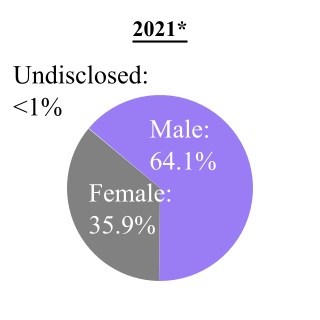
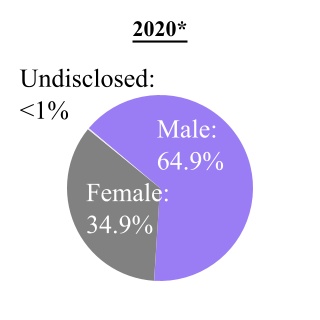
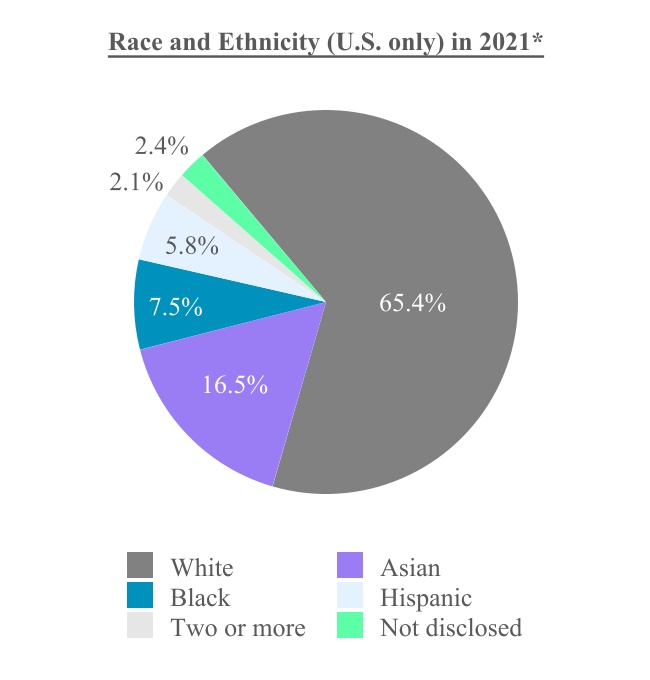
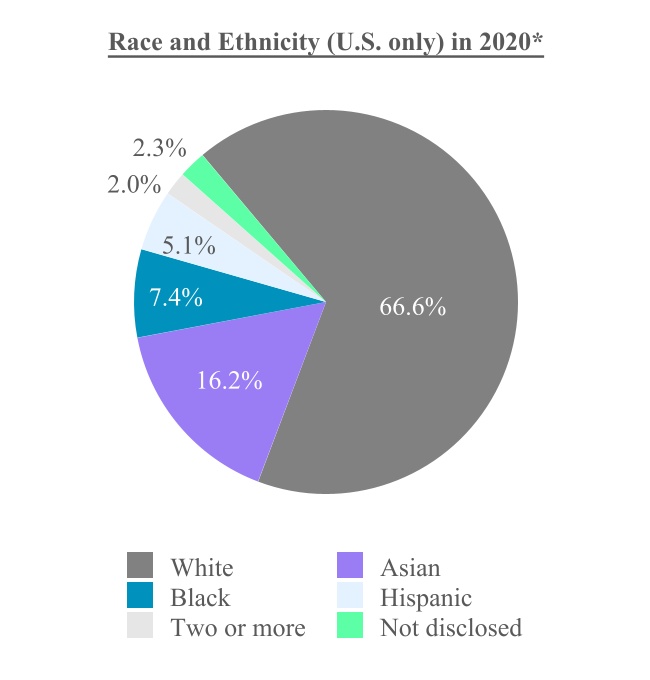
- In the charts above, totals may not add up to 100% due to rounding and the omission of race and ethnicities that are less than 0.3%.
Additionally, in order to better understand our pay equity performance, we are currently conducting a global pay equity analysis, which is expected to be completed in the beginning of the second quarter of 2022. As a first step, we plan to review the conclusions internally and evaluate any potential gaps in pay equity.
Finally, to increase transparency of our workforce, Nasdaq publishes statistics on the composition of its own global workforce by gender, and of its U.S. workforce by gender, race and ethnicity, in our U.S. EEO-1 report and our Sustainability Report, which are available on our website.
Compensation and Benefits
Our Total Rewards compensation program is designed to attract, retain, and empower employees to successfully execute our growth strategy. Our comprehensive Total Rewards program reflects our commitment to protecting our employees’ health, well-being and financial security.
Our talented employees are our greatest asset, and we offer competitive compensation to attract and retain the best employees. Our pay-for-performance compensation programs includes market-competitive base salaries, annual bonuses or sales commissions, and equity. The majority of our employees are granted annual long-term equity awards, enabling them to be owners of the company, committed to our long-term success and aligning their interests with the short-term and long-term interests of our shareholders.
Our Total Rewards program extends beyond compensation, offering a suite of programs, benefits, perquisites and resources to support employee priorities. In addition to cash and equity compensation, we also offer employee benefits such as health (medical, dental, vision and telehealth) insurance, fertility benefits, paid time off, paid parental leave, adoption assistance, an employee stock purchase plan, student loan repayment benefits, charitable contribution matching and a U.S. 401(k) Plan with company matching. Since the start of the pandemic, we have introduced additional benefits to support our employees, as described above under “COVID-19 and Employee Safety.” We also provide additional benefits to our international employees based on local regulations and practice to address market-specific needs.
Community Involvement
We are committed to creating lasting, positive change within our Company and the communities we serve.
Our employees take pride in being active in our communities. Through our Nasdaq GoodWorks Corporate Responsibility Program, we have committed to supporting the communities in which we live and work by providing eligible full and part-time employees two paid days off per year to volunteer. We also match charitable donations of all Nasdaq employees and contractors up to $1,000, or more in certain circumstances, per calendar year. While most of our volunteer efforts in 2021 continued to remain virtual due to the pandemic, we organized more than 100 employee volunteer events around the world.
As part of Nasdaq’s ongoing commitment to diversity, equity, inclusion and culture, we have continued our series, Amplifying Black Voices, which we initiated in 2020. This year, the program is a multimedia retrospective featuring works of art and photography documenting Black culture and life. These works are displayed on the Nasdaq MarketSite tower in Times Square throughout the year, enabling the entire community to view and celebrate the exhibits.
In September 2020, we launched the “Purpose Initiative,” which is designed to advance inclusive growth and prosperity, and we continued to expand this initiative throughout 2021. The Purpose Initiative comprises our philanthropic, community outreach, corporate sustainability, and employee volunteerism programs, all designed to leverage our unique place at the center of capital creation, markets, and technology and drive stronger economies, more equitable opportunities and contribute to a more sustainable world. During 2021, the Purpose Initiative held two company-wide roundtables, which explored topics such as advancing inclusive growth and prosperity, particularly for women of color, and investor and community engagement to increase market accessibility across race, ethnicity, gender and class. Nasdaq also held its first “Purpose Week” to further the initiative, which included six company-wide webinars, volunteer opportunities, an innovation challenge and other events involving and recognizing company employees.
The mission of the Nasdaq Foundation, which was relaunched in 2020, is focused on two primary goals: (i) reimagining investor engagement to equip under-represented communities with the financial knowledge to share in the wealth that markets create; and (ii) leveraging our investment in the Nasdaq Entrepreneurial Center alongside new strategic partnerships with organizations that can help build a deeper, data-led understanding of where the challenges are greatest, what existing efforts could be amplified, and how the Nasdaq Foundation can make new and distinctive contributions.
The Nasdaq Foundation provided six grants during 2021 to organizations that seek to fulfill that mission. These grants were awarded to, among others, Wall Street Bound, an organization to increase diversity on Wall Street; 1863 Ventures, a start-up accelerator fund assisting minority entrepreneurs throughout the growth lifecycle; and The Leave No Women Behind program, which seeks to advance female entrepreneurship in Utah by offering a suite of programs to provide female entrepreneurs with the knowledge to start or scale up a business.
Nasdaq Website and Availability of SEC Filings
We file periodic reports, proxy statements and other information with the SEC. The SEC maintains a website that contains reports, proxy and information statements, and other information regarding issuers that file electronically with the SEC. The address of that site is http://www.sec.gov.
Our website is http://ir.nasdaq.com. Information on our website is not a part of this Form 10-K. We make available free of charge on our website, or provide a link to, our Forms 10-K, Forms 10-Q and Forms 8-K and any amendments to these documents, that are filed or furnished pursuant to Section 13(a) or 15(d) of the Exchange Act as soon as reasonably practicable after we electronically file such material with, or furnish it to, the SEC. To access these filings, go to our website and click on “Financials” then click on “SEC Filings.”
Previous: Cover and table of contents · Next: Item 1A. Risk Factors