 filings.tools
Item 1. Business
73K characters. Original on sec.gov · Markdown
Item 1. Business
OVERVIEW
NEE is one of the largest electric power and energy infrastructure companies in North America and a leader in the renewable energy industry. NEE has two principal businesses, FPL and NEER. FPL is the largest electric utility in the state of Florida and one of the largest electric utilities in the U.S. FPL’s strategic focus is centered on investing in generation, transmission and distribution facilities to deliver on its value proposition of low customer bills, high reliability, outstanding customer service and clean energy solutions for the benefit of its more than 5.7 million customers. NEER is the world's largest generator of renewable energy from the wind and sun, as well as a world leader in battery storage. NEER’s strategic focus is centered on the development, construction and operation of long-term contracted assets throughout the U.S. and Canada, primarily consisting of clean energy solutions such as renewable generation facilities and battery storage projects, and electric transmission facilities.
In January 2019, NEE acquired Gulf Power Company, a rate-regulated electric utility engaged in the generation, transmission, distribution and sale of electric energy in northwest Florida. On January 1, 2021, FPL and Gulf Power Company merged, with FPL as the surviving entity. However, during 2021, FPL continued to be regulated as two separate ratemaking entities in the former service areas of FPL and Gulf Power. The FPL segment and Gulf Power continued to be separate operating segments of NEE, as well as FPL, through 2021. Effective January 1, 2022, FPL became regulated as one ratemaking entity with new unified rates and tariffs, and also became one operating segment of NEE (see FPL – FPL Regulation – FPL Electric Rate Regulation – Base Rates – Base Rates Effective January 2022 through December 2025). For purposes of discussion herein, the use of the term "FPL" represents FPL the legal entity and beginning January 1, 2022, an operating segment of NEE. Through December 31, 2021, "FPL segment" represents FPL, excluding Gulf Power, and "Gulf Power" represents an operating division of FPL, each operating segments of NEE and FPL.
As described in more detail in the following sections, NEE seeks to create value in its two principal businesses by meeting its customers' needs more economically and more reliably than its competitors. NEE's strategy has resulted in profitable growth over sustained periods at both FPL and NEER. Management seeks to grow each business in a manner consistent with the varying opportunities available to it; however, management believes that the diversification and balance represented by FPL and NEER is a valuable characteristic of the enterprise and recognizes that each business contributes to NEE's financial strength in different ways. FPL and NEER share a common platform with the objective of lowering costs and creating efficiencies for their businesses. NEE and its subsidiaries, with employees totaling approximately 15,000 as of December 31, 2021, continue to develop and implement enterprise-wide initiatives focused on improving productivity, process effectiveness and quality.
As of January 1, 2022, NEE's segments for financial reporting purposes are FPL and NEER. NEECH, a wholly owned subsidiary of NEE, owns and provides funding for NEE's operating subsidiaries, other than FPL and its subsidiaries. NEP, an affiliate of NextEra Energy Resources, acquires, manages and owns contracted clean energy projects with stable, long-term cash flows. See NEER section below for further discussion of NEP. The following diagram depicts NEE's simplified ownership structure:
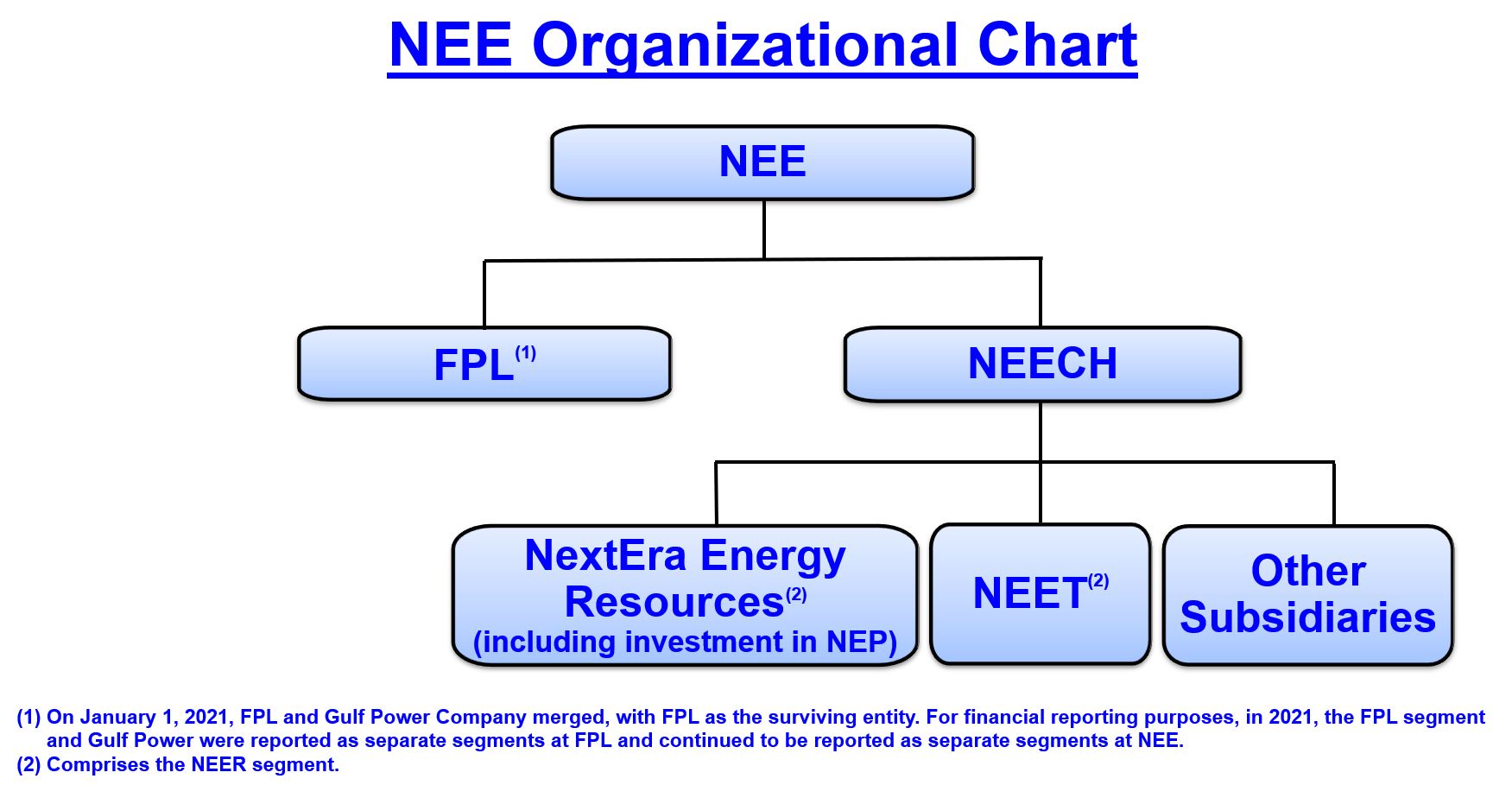
FPL
FPL is a rate-regulated electric utility engaged primarily in the generation, transmission, distribution and sale of electric energy in Florida. FPL is the largest electric utility in the state of Florida and one of the largest electric utilities in the U.S. At December 31, 2021, the FPL segment had approximately 28,450 MW of net generating capacity, approximately 77,000 circuit miles of transmission and distribution lines and 696 substations. FPL provides service to its electric customers through integrated transmission and distribution systems that link its generation facilities to its customers. FPL also owns a retail gas business, which serves approximately 117,000 residential and commercial natural gas customers in four counties throughout southern Florida with 3,750 miles of natural gas distribution pipelines.
On January 1, 2021, FPL and Gulf Power Company merged, with FPL as the surviving entity. However, during 2021, FPL continued to be regulated as two separate ratemaking entities in the former service areas of FPL and Gulf Power. The FPL segment and Gulf Power continued to be separate operating segments of NEE, as well as FPL, through 2021. Effective January 1, 2022, FPL became regulated as one ratemaking entity with new unified rates and tariffs, and also became one operating segment of NEE. See FPL – FPL Regulation – FPL Electric Rate Regulation – Base Rates – Base Rates Effective January 2022 through December 2025 below. FPL serves more than 11 million people through more than 5.7 million customer accounts. The following map shows FPL's service areas and plant locations, which cover most of the east and lower west coasts of Florida and are in eight counties throughout northwest Florida (see FPL Sources of Generation below).

CUSTOMERS AND REVENUE
FPL's primary source of operating revenues is from its retail customer base; it also serves a limited number of wholesale customers within Florida. The percentage of the FPL segment's operating revenues and customer accounts by customer class were as follows:
 |  |
For both retail and wholesale customers, the prices (or rates) that FPL may charge are approved by regulatory bodies, by the FPSC in the case of retail customers and by the FERC in the case of wholesale customers. In general, under U.S. and Florida law, regulated rates are intended to cover the cost of providing service, including a reasonable rate of return on invested capital. Since the regulatory bodies have authority to determine the relevant cost of providing service and the appropriate rate of return on capital employed, there can be no guarantee that FPL will be able to earn any particular rate of return or recover all of its costs through regulated rates. See FPL Regulation below.
FPL seeks to maintain attractive rates for its customers. Since rates are largely cost-based, maintaining low rates requires a strategy focused on developing and maintaining a low-cost position, including the implementation of ideas generated from cost savings initiatives. A common benchmark used in the electric power industry for comparing rates across companies is the price of 1,000 kWh of consumption per month for a residential customer. The FPL segment's 2021 average bill for 1,000 kWh of monthly residential usage was well below both the average of reporting electric utilities within Florida and the July 2021 national average (the latest date for which this data is available) as indicated below:

FRANCHISE AGREEMENTS AND COMPETITION
FPL's service to its electric retail customers is provided primarily under franchise agreements negotiated with municipalities or counties. During the term of a franchise agreement, which is typically 30 years, the municipality or county agrees not to form its own utility, and FPL has the right to offer electric service to residents. At December 31, 2021, the FPL segment held 192 franchise agreements with various municipalities and counties in Florida with varying expiration dates through 2051. These franchise agreements covered approximately 88% of the FPL segment's retail customer base in Florida. At December 31, 2021, the FPL segment also provided service to customers in 11 other municipalities and to 23 unincorporated areas within its service area without franchise agreements pursuant to the general obligation to serve as a public utility. FPL relies upon Florida law for access to public rights of way.
Because any customer may elect to provide his/her own electric services, FPL effectively must compete for an individual customer's business. As a practical matter, few customers provide their own service at the present time since FPL's cost of service is lower than the cost of self-generation for the vast majority of customers. Changing technology, economic conditions and other factors could alter the favorable relative cost position that FPL currently enjoys; however, FPL seeks as a matter of strategy to ensure that it delivers superior value, in the form of low customer bills, high reliability, outstanding customer service and clean energy solutions.
In addition to self-generation by residential, commercial and industrial customers, FPL also faces competition from other suppliers of electrical energy to wholesale customers and from alternative energy sources. In each of 2021, 2020 and 2019, operating revenues from wholesale and industrial electric customers combined represented approximately five percent of the FPL segment's total operating revenues.
For the building of new steam and solar generating capacity of 75 MW or greater, the FPSC requires investor-owned electric utilities, including FPL, to issue a request for proposal (RFP) except when the FPSC determines that an exception from the RFP process is in the public interest. The RFP process allows independent power producers and others to bid to supply the new generating capacity. If a bidder has the most cost-effective alternative, meets other criteria such as financial viability and demonstrates adequate expertise and experience in building and/or operating generating capacity of the type proposed, the investor-owned electric utility would seek to negotiate a purchased power agreement with the selected bidder and request that the FPSC approve the terms of the purchased power agreement and, if appropriate, provide the required authorization for the construction of the bidder's generating capacity.
FPL SOURCES OF GENERATION
At December 31, 2021, the FPL segment's resources for serving load consisted of approximately 28,564 MW of net generating capacity, of which 28,450 MW were from FPL-owned facilities and 114 MW were available through purchased power agreements. FPL owned and operated 30 units with generating capacity of 22,008 MW that primarily use natural gas and 41 solar generation facilities with generating capacity totaling 2,940 MW. In addition, FPL owned, or had undivided interests in, and operated 4 nuclear units with net generating capacity totaling 3,502 MW (see Nuclear Operations below). FPL also develops and constructs battery storage projects, which when combined with its solar projects, serve to enhance its ability to meet customer needs for a nearly firm generation source. At December 31, 2021, the FPL segment had 483 MW of battery storage capacity. FPL customer usage and operating revenues are typically higher during the summer months, largely due to the prevalent use of air conditioning in its service area. Occasionally, unusually cold temperatures during the winter months result in significant increases in electricity usage for short periods of time.
FPL is in the process of modernizing two generation units at its Lauderdale facility to a high-efficiency, clean-burning natural gas unit (Dania Beach Clean Energy Center). The Dania Beach Clean Energy Center is expected to provide approximately 1,200 MW of generating capacity and to be in service by mid-2022. Through 2025, FPL plans to add new solar generation with cost recovery mechanisms through base rates, a Solar Base Rate Adjustment (SoBRA) and SolarTogetherTM (a voluntary community solar program that gives certain FPL electric customers an opportunity to participate directly in the expansion of solar energy and receive credits on their related monthly customer bill). FPL placed approximately 450 MW of solar generating capacity in service in January 2022 and is currently in the process of constructing an additional 1,190 MW of solar generating capacity, which is expected to be placed in service in 2023 (see FPL Regulation – FPL Electric Rate Regulation – Base Rates – Base Rates Effective January 2022 through December 2025 below).
Fuel Sources
FPL relies upon a mix of fuel sources for its generation facilities, the ability of some of its generation facilities to operate on both natural gas and oil, and on purchased power to maintain the flexibility to achieve a more economical fuel mix in order to respond to market and industry developments.


| *approximately 71% has dual fuel capability |
Significant Fuel and Transportation Contracts. At December 31, 2021, FPL had the following significant fuel and transportation contracts in place:
-
firm transportation contracts with six different transportation suppliers for natural gas pipeline capacity for an aggregate maximum delivery quantity of 2,916,000 MMBtu/day with expiration dates through 2042 (see Note 15 – Contracts);
-
several contracts for the supply of uranium and the conversion, enrichment and fabrication of nuclear fuel with expiration dates through 2037; and
-
short- and medium-term natural gas supply contracts to provide a portion of FPL's anticipated needs for natural gas. The remainder of FPL's natural gas requirements is purchased in the spot market.
Nuclear Operations
At December 31, 2021, FPL owned, or had undivided interests in, and operated the four nuclear units in Florida discussed below. FPL's nuclear units are periodically removed from service to accommodate planned refueling and maintenance outages, including inspections, repairs and certain other modifications. Scheduled nuclear refueling outages require the unit to be removed from service for variable lengths of time.
| Facility | FPL's Ownership (MW) | Beginning of Next Scheduled Refueling Outage | Operating License Expiration Date | |||||||||||||||||
| St. Lucie Unit No. 1 | 981 | September 2022 | 2036(a) | |||||||||||||||||
| St. Lucie Unit No. 2 | 840(b) | February 2023 | 2043(a) | |||||||||||||||||
| Turkey Point Unit No. 3 | 837 | April 2023 | 2052 | |||||||||||||||||
| Turkey Point Unit No. 4 | 844 | March 2022 | 2053 |
(a) In 2021, FPL filed an application with the NRC to renew both St. Lucie operating licenses for an additional 20 years. License renewals are pending.
(b) Excludes 147 MW operated by FPL but owned by non-affiliates.
NRC regulations require FPL to submit a plan for decontamination and decommissioning five years before the projected end of plant operation. If the license renewals are approved by the NRC, FPL's plans provide for St. Lucie Unit No. 1 to be shut down in 2056 with decommissioning activities to be integrated with the dismantlement of St. Lucie Unit No. 2 commencing in 2063. Current plans provide for the dismantlement of Turkey Point Units Nos. 3 and 4 with decommissioning activities commencing in 2052 and 2053, respectively.
FPL's nuclear facilities use both on-site storage pools and dry storage casks to store spent nuclear fuel generated by these facilities, which are expected to provide sufficient storage of spent nuclear fuel that is generated at these facilities through license expiration, as well as through any pending license extensions.
FPL ENERGY MARKETING AND TRADING
FPL's Energy Marketing & Trading division (EMT) buys and sells wholesale energy commodities, such as natural gas, oil and electricity. EMT procures natural gas and oil for FPL's use in power generation and sells excess natural gas, oil and electricity. EMT also uses derivative instruments (primarily swaps, options and forwards) to manage the physical and financial risks inherent in the purchase and sale of fuel and electricity. Substantially all of the results of EMT's activities are passed through to customers in the fuel or capacity clauses. See Management's Discussion – Energy Marketing and Trading and Market Risk Sensitivity and Note 3.
FPL REGULATION
FPL's operations are subject to regulation by a number of federal, state and other organizations, including, but not limited to, the following:
-
the FPSC, which has jurisdiction over retail rates, service area, issuances of securities, planning, siting and construction of facilities, among other things;
-
the FERC, which oversees the acquisition and disposition of generation, transmission and other facilities, transmission of electricity and natural gas in interstate commerce, proposals to build and operate interstate natural gas pipelines and storage facilities, and wholesale purchases and sales of electric energy, among other things;
-
the NERC, which, through its regional entities, establishes and enforces mandatory reliability standards, subject to approval by the FERC, to ensure the reliability of the U.S. electric transmission and generation system and to prevent major system blackouts;
-
the NRC, which has jurisdiction over the operation of nuclear power plants through the issuance of operating licenses, rules, regulations and orders; and
-
the EPA, which has the responsibility to maintain and enforce national standards under a variety of environmental laws, in some cases delegating authority to state agencies. The EPA also works with industries and all levels of government, including federal and state governments, in a wide variety of voluntary pollution prevention programs and energy conservation efforts.
FPL Electric Rate Regulation
The FPSC sets rates at a level that is intended to allow the utility the opportunity to collect from retail customers total revenues (revenue requirements) equal to its cost of providing service, including a reasonable rate of return on invested capital. To accomplish this, the FPSC uses various ratemaking mechanisms, including, among other things, base rates and cost recovery clauses. Although FPL and Gulf Power Company merged effective January 1, 2021, FPL continued to be regulated as two separate rate making entities until January 1, 2022 when new unified rates and tariffs became effective for the combined utility system (including the former Gulf Power service area). See Base Rates Effective January 2022 through December 2025 below.
Base Rates. In general, the basic costs of providing electric service, other than fuel and certain other costs, are recovered through base rates, which are designed to recover the costs of constructing, operating and maintaining the utility system. These basic costs include O&M expenses, depreciation and taxes, as well as a return on investment in assets used and useful in providing electric service (rate base). At the time base rates are established, the allowed rate of return on rate base approximates the FPSC's determination of the utility's estimated weighted-average cost of capital, which includes its costs for outstanding debt and an allowed return on common equity. The FPSC monitors the utility's actual regulatory ROE through a surveillance report that is filed monthly with the FPSC. The FPSC does not provide assurance that any regulatory ROE will be achieved. Base rates are determined in rate proceedings or through negotiated settlements of those proceedings. Proceedings can occur at the initiative of the utility or upon action by the FPSC. Existing base rates remain in effect until new base rates are approved by the FPSC.
Base Rates Effective January 2022 through December 2025 – In December 2021, the FPSC issued a final order approving a stipulation and settlement between FPL and several intervenors in FPL's base rate proceeding (2021 rate agreement).
Key elements of the 2021 rate agreement, which is effective from January 2022 through at least December 2025, include, among other things, the following:
- New retail base rates and charges were established for the combined utility system (including the former Gulf Power service area) resulting in the following increases in annualized retail base revenues:
◦$692 million beginning January 1, 2022, and
◦$560 million beginning January 1, 2023.
- In addition, FPL is eligible to receive, subject to conditions specified in the 2021 rate agreement, base rate increases associated with the addition of up to 894 MW annually of new solar generation through the SoBRA mechanism in each of
2024 and 2025, and may carry forward any unused MW in 2024 to 2025. FPL has agreed to an installed cost cap of $1,250 per kW and will be required to demonstrate that these proposed solar facilities are cost effective.
-
FPL's authorized regulatory ROE is 10.60%, with a range of 9.70% to 11.70%. If FPL's earned regulatory ROE falls below 9.70%, FPL may seek retail base rate relief. If the earned regulatory ROE rises above 11.70%, any party with standing may seek a review of FPL's retail base rates. If the average 30-year U.S. Treasury rate is 2.49% or greater over a consecutive six-month period, the authorized regulatory ROE will increase to 10.80% with a range of 9.80% to 11.80%. If triggered, the increase in the authorized regulatory ROE will not result in an incremental general base rate increase, but will apply for all other regulatory purposes, including the SoBRA mechanism.
-
Subject to certain conditions, FPL may amortize, over the term of the 2021 rate agreement, up to $1.45 billion of depreciation reserve surplus, provided that in any year of the 2021 rate agreement FPL must amortize at least enough reserve amount to maintain its minimum authorized regulatory ROE and also may not amortize any reserve amount that would result in an earned regulatory ROE in excess of its maximum authorized regulatory ROE. FPL is limited to the amortization of $200 million of depreciation reserve surplus during the first year of the 2021 rate agreement.
-
FPL is authorized to expand SolarTogether™ by constructing an additional 1,788 MW of solar generation from 2022 through 2025, such that the total capacity of SolarTogether™ would be 3,278 MW.
-
Future storm restoration costs would be recoverable on an interim basis beginning 60 days from the filing of a cost recovery petition, but capped at an amount that produces a surcharge of no more than $4 for every 1,000 kWh of usage on residential bills during the first 12 months of cost recovery. Any additional costs would be eligible for recovery in subsequent years. If storm restoration costs exceed $800 million in any given calendar year, FPL may request an increase to the $4 surcharge. See Note 1 – Storm Funds, Storm Reserves and Storm Cost Recovery.
-
If federal or state permanent corporate income tax changes become effective during the term of the 2021 rate agreement, FPL will be able to prospectively adjust base rates after a review by the FPSC.
In December 2021, Floridians Against Increased Rates, Inc. and, as a group in January 2022, Florida Rising, Inc., Environmental Confederation of Southwest Florida, Inc., and League of United Latin American Citizens of Florida filed notices of appeal challenging the FPSC's final order approving the 2021 rate agreement, which notices of appeal are pending before the Florida Supreme Court.
Base Rates Effective January 2017 through December 2021 – In December 2016, the FPSC issued a final order approving a stipulation and settlement between FPL and several intervenors in FPL's base rate proceeding (2016 rate agreement). Key elements of the 2016 rate agreement, which became effective in January 2017, provided for, among other things, the following:
- new retail base rates and charges which resulted in the following increases in annualized retail base revenues:
◦$400 million beginning January 1, 2017;
◦$211 million beginning January 1, 2018; and
◦$200 million beginning April 1, 2019 for a new approximately 1,720 MW natural gas-fired combined-cycle unit in Okeechobee County, Florida (Okeechobee Clean Energy Center) that achieved commercial operation on March 31, 2019;
-
additional base rate increases in 2018 through 2020 associated with the addition of approximately 1,200 MW of new solar generating capacity that became operational during that timeframe;
-
a regulatory ROE of 10.55% with a range of 9.60% to 11.60%;
-
subject to certain conditions, the right to reduce depreciation expense up to $1.25 billion (reserve), provided that in any year of the 2016 rate agreement FPL was required to amortize enough reserve to maintain an earned regulatory ROE within the range of 9.60% to 11.60%; and
-
an interim cost recovery mechanism for storm restoration costs. See Note 1 – Storm Funds, Storm Reserves and Storm Cost Recovery.
Cost Recovery Clauses. Cost recovery clauses are designed to permit full recovery of certain costs and provide a return on certain assets allowed to be recovered through various clauses. Cost recovery clause costs are recovered through levelized monthly charges per kWh or kW, depending on the customer's rate class. These cost recovery clause charges are calculated annually based on estimated costs and estimated customer usage for the following year, plus or minus true-up adjustments to reflect the estimated over or under recovery of costs for the current and prior periods. An adjustment to the levelized charges may be approved during the course of a year to reflect revised estimates. FPL recovers costs from customers through the following clauses:
-
Fuel – primarily fuel costs, the most significant of the cost recovery clauses in terms of operating revenues (see Note 1 – Rate Regulation);
-
Storm Protection Plan – costs associated with an FPSC-approved transmission and distribution storm protection plan, which includes costs for hardening of overhead transmission and distribution lines, undergrounding of certain distribution lines and vegetation management;
-
Capacity – primarily certain costs associated with the acquisition of several electric generation facilities (see Note 1 – Rate Regulation);
-
Energy Conservation – costs associated with implementing energy conservation programs; and
- Environmental – certain costs of complying with federal, state and local environmental regulations enacted after April 1993 and costs associated with three of FPL's solar facilities placed in service prior to 2016.
The FPSC has the authority to disallow recovery of costs that it considers excessive or imprudently incurred. These costs may include, among others, fuel and O&M expenses, the cost of replacing power lost when generation units are unavailable, storm restoration costs and costs associated with the construction or acquisition of new facilities.
FERC
The Federal Power Act grants the FERC exclusive ratemaking jurisdiction over wholesale sales of electricity and the transmission of electricity and natural gas in interstate commerce. Pursuant to the Federal Power Act, electric utilities must maintain tariffs and rate schedules on file with the FERC which govern the rates, terms and conditions for the provision of FERC-jurisdictional wholesale power and transmission services. The Federal Power Act also gives the FERC authority to certify and oversee an electric reliability organization with authority to establish and independently enforce mandatory reliability standards applicable to all users, owners and operators of the bulk-power system. See NERC below. Electric utilities are subject to accounting, record-keeping and reporting requirements administered by the FERC. The FERC also places certain limitations on transactions between electric utilities and their affiliates.
NERC
The NERC has been certified by the FERC as an electric reliability organization. The NERC's mandate is to ensure the reliability and security of the North American bulk-power system through the establishment and enforcement of reliability standards approved by FERC. The NERC's regional entities also enforce reliability standards approved by the FERC. FPL is subject to these reliability standards and incurs costs to ensure compliance with continually heightened requirements, and can incur significant penalties for failing to comply with them.
FPL Environmental Regulation
FPL is subject to environmental laws and regulations as described in the NEE Environmental Matters section below. FPL expects to seek recovery through the environmental clause for compliance costs associated with any new environmental laws and regulations.
FPL HUMAN CAPITAL
FPL had approximately 9,700 employees at December 31, 2021, with approximately 31% of these employees represented by the International Brotherhood of Electrical Workers (IBEW), substantially all of which are under collective bargaining agreements that have approximately three-year terms expiring in April 2022 and January 2025.
GULF POWER
Gulf Power became a part of FPL's rate-regulated electric utility system beginning January 1, 2021, but continued to be regulated as a separate ratemaking entity until January 1, 2022 when new unified rates and tariffs became effective for the combined utility system (see FPL – FPL Regulation – FPL Electric Rate Regulation – Base Rates – Base Rates Effective January 2022 through December 2025). Prior to January 1, 2022, Gulf Power operated under a separate base rate settlement agreement that provided for an allowed regulatory ROE of 10.25%, with a range of 9.25% to 11.25%. As of December 31, 2021, Gulf Power served approximately 481,000 customers in eight counties throughout northwest Florida and had approximately 3,500 MW of electric net generating capacity and 9,500 miles of transmission and distribution lines located primarily in Florida, and was subject to similar regulations described in FPL – FPL Regulation above.
On January 1, 2019, NEE completed the acquisition of all of the outstanding common shares of Gulf Power Company under a stock purchase agreement with The Southern Company dated May 20, 2018, as amended, for approximately $4.44 billion in cash consideration and the assumption of approximately $1.3 billion of Gulf Power debt. On January 1, 2021, Gulf Power Company and FPL merged, with FPL as the surviving entity. The FPL segment and Gulf Power continued to be separate operating segments of NEE, as well as FPL, through 2021. See Note 6 – Gulf Power Company and – Merger of FPL and Gulf Power Company for further discussion.
NEER
NEER, comprised of NEE's competitive energy and rate-regulated transmission businesses, is a diversified clean energy business with a strategy that emphasizes the development, construction and operation of long-term contracted assets with a focus on renewable projects. NEE reports NextEra Energy Resources and NEET, a rate-regulated transmission business, on a combined basis for segment reporting purposes, and the combined segment is referred to as NEER. The NEER segment currently owns, develops, constructs, manages and operates electric generation facilities in wholesale energy markets in the U.S. and Canada. NEER, with approximately 24,600 MW of total net generating capacity at December 31, 2021, is one of the largest wholesale generators of electric power in the U.S., including approximately 24,070 MW of net generating capacity across 38 states and 520 MW of net generating capacity in 4 Canadian provinces. At December 31, 2021**,** NEER operates facilities, in which it has ownership interests, with a total generating capacity of approximately 30,000 MW. NEER produces the majority of its electricity from clean and renewable sources as described more fully below. In addition, NEER develops and constructs battery storage projects, which when combined with its renewable projects, serve to enhance its ability to meet customer needs for a nearly firm generation source, or as standalone facilities. At December 31, 2021, NEER had net ownership interest in approximately 735 MW of battery storage capacity. NEER is the world's largest generator of renewable energy from the wind and sun based on 2021 MWh produced on a net generation basis, as well as a world leader in battery storage. The NEER segment also owns, develops, constructs and operates rate-regulated transmission facilities in North America. At December 31, 2021, NEER's rate-regulated transmission facilities and transmission lines that connect its electric generation facilities to the electric grid are comprised of approximately 265 substations and 2,680 circuit miles of transmission lines.
NEER also engages in energy-related commodity marketing and trading activities, including entering into financial and physical contracts. These contracts primarily include power and fuel commodities and their related products for the purpose of providing full energy and capacity requirements services, primarily to distribution utilities in certain markets, and offering customized power and fuel and related risk management services to wholesale customers, as well as to hedge the production from NEER's generation assets that is not sold under long-term power supply agreements. In addition, NEER participates in natural gas, natural gas liquids and oil production through operating and non-operating ownership interests, and in pipeline infrastructure construction, management and operations, through either wholly owned subsidiaries or noncontrolling or joint venture interests, hereafter referred to as the gas infrastructure business. NEER also hedges the expected output from its gas infrastructure production assets to protect against price movements.
NEP – NEP acquires, manages and owns contracted clean energy projects with stable long-term cash flows through a limited partner interest in NEP OpCo. NEP's projects include energy projects contributed by or acquired from NextEra Energy Resources, or acquired from third parties, as well as ownership interests in contracted natural gas pipelines acquired from third parties. NextEra Energy Resources' indirect limited partnership interest in NEP OpCo based on the number of outstanding NEP OpCo common units was approximately 54.7% at December 31, 2021. NextEra Energy Resources accounts for its ownership interest in NEP as an equity method investment with its earnings/losses from NEP as equity in earnings (losses) of equity method investees and accounts for its project sales to NEP as third-party sales in its consolidated financial statements. See Note 1 – Basis of Presentation. At December 31, 2021, NEP owned, or had an ownership interest in, a portfolio of wind, solar and solar plus battery storage projects with energy project capacity totaling approximately 7,997 MW and contracted natural gas pipelines, all located in the U.S. as further discussed in Generation and Other Operations. NextEra Energy Resources operates essentially all of the energy projects in NEP's portfolio and its ownership interest in the portfolio's capacity was approximately 3,618 MW at December 31, 2021.
GENERATION AND OTHER OPERATIONS
NEER sells products associated with its generation facilities (energy, capacity, renewable energy credits (RECs) and ancillary services) in competitive markets in regions where those facilities are located. Customer transactions may be supplied from NEER generation facilities or from purchases in the wholesale markets, or from a combination thereof. See Markets and Competition below.
At December 31, 2021, NEER managed or participated in the management of essentially all of the following generation projects, natural gas pipelines and transmission facilities that it wholly owned or in which it had an ownership interest.

Generation Assets and Other Operations
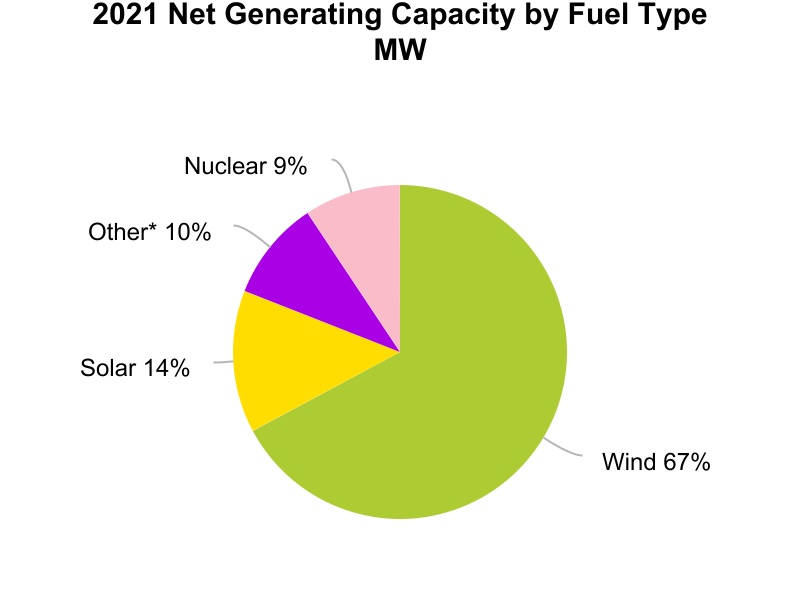
| *Primarily natural gas |
Generation Assets
NEER's portfolio of generation assets primarily consist of generation facilities with long-term power sales agreements for substantially all of their capacity and/or energy output. Information related to contracted generation assets at December 31, 2021 was as follows:
-
represented approximately 22,658 MW of total net generating capacity;
-
weighted-average remaining contract term of the power sales agreements and the remaining life of the PTCs associated with repowered wind facilities of approximately 16 years, based on forecasted contributions to earnings and forecasted amounts of electricity produced by the repowered wind facilities; and
-
several contracts for the supply of uranium and the conversion, enrichment and fabrication of nuclear fuel for all nuclear units with expiration dates through 2033 (see Note 15 – Contracts).
NEER's merchant generation assets primarily consist of generation facilities that do not have long-term power sales agreements to sell their capacity and/or energy output and therefore require active marketing and hedging. Merchant generation assets at December 31, 2021 represented approximately 1,932 MW of total net generating capacity, including 1,102 MW from nuclear generation and 824 MW from other peak generation facilities, and are primarily located in the Northeast region of the U.S. NEER utilizes swaps, options, futures and forwards to lock in pricing and manage the commodity price risk inherent in power sales and fuel purchases.
NEER Generation Assets Fuel/Technology Mix
NextEra Energy Resources utilized the following mix of fuel sources for generation facilities in which it has an ownership interest:

| *Primarily natural gas |
Wind Facilities
-
located in 20 states in the U.S. and 4 provinces in Canada;
-
operated a total generating capacity of 20,531 MW at December 31, 2021;
-
ownership interests in a total net generating capacity of 16,517 MW at December 31, 2021;
◦essentially all MW are from contracted wind assets located primarily throughout Texas and the West and Midwest regions of the U.S. and Canada;
*◦*added approximately 2,008 MW of new generating capacity and repowered wind generating capacity totaling 435 MW in the U.S. in 2021 and sold assets to NEP and third parties totaling approximately 1,500 MW (see Note 1 – Disposal of Businesses/Assets and Sale of Noncontrolling Ownership Interests).
Solar Facilities
-
located in 29 states in the U.S.;
-
operated photovoltaic, distributed generation and solar thermal facilities with a total generating capacity of 4,356 MW at December 31, 2021;
-
ownership interests in solar facilities with a total net generating capacity of 3,391 MW at December 31, 2021;
◦essentially all MW are from contracted solar facilities located primarily throughout the West and South regions of the U.S.;
*◦*added approximately 728 MW of generating capacity in the U.S. in 2021 and sold assets to NEP and third parties totaling approximately 468 MW (see Note 1 – Disposal of Businesses/Assets and Sale of Noncontrolling Ownership Interests).
Nuclear Facilities
At December 31, 2021, NextEra Energy Resources owned, or had undivided interests in, and operated the three nuclear units discussed below. NEER's nuclear units are periodically removed from service to accommodate planned refueling and maintenance outages, including inspections, repairs and certain other modifications. Scheduled nuclear refueling outages require the unit to be removed from service for variable lengths of time.
| Facility | Location | Ownership (MW) | Portfolio Category | Next Scheduled Refueling Outage | Operating License Expiration Date | |||||||||||||||||||||||||||
| Seabrook | New Hampshire | 1,102(a) | Merchant | April 2023 | 2050 | |||||||||||||||||||||||||||
| Point Beach Unit No. 1 | Wisconsin | 595 | Contracted(b) | March 2022 | 2030(c) | |||||||||||||||||||||||||||
| Point Beach Unit No. 2 | Wisconsin | 595 | Contracted(b) | March 2023 | 2033(c) |
(a) Excludes 147 MW operated by NEER but owned by non-affiliates.
(b) NEER sells all of the output of Point Beach Units Nos. 1 and 2 under long-term contracts through their current operating license expiration dates.
(c) In 2020, NEER filed an application with the NRC to renew both Point Beach operating licenses for an additional 20 years. License renewals are pending.
NEER is responsible for all nuclear unit operations and the ultimate decommissioning of the nuclear units, the cost of which is shared on a pro-rata basis by the joint owners for the jointly-owned units. NRC regulations require plant owners to submit a plan for decontamination and decommissioning five years before the projected end of plant operation. NEER's nuclear facilities use both on-site storage pools and dry storage casks to store spent nuclear fuel generated by these facilities, which are expected to provide sufficient storage of spent nuclear fuel that is generated at these facilities through current license expiration, as well as through any pending license extensions.
NEER also owns an approximately 70% interest in Duane Arnold, a nuclear facility located in Iowa that ceased operations in August 2020. NEER submitted a site-specific cost estimate and plan for decontamination and decommissioning to the NRC. All spent nuclear fuel housed onsite is expected to be in long-term dry storage within three years of plant shutdown and until the DOE is able to take possession. NEER estimates that the cost of decommissioning Duane Arnold is fully funded and expects completion by approximately 2080.
Policy Incentives for Renewable Energy Projects
U.S. federal, state and local governments have established various incentives to support the development of renewable energy projects. These incentives include accelerated tax depreciation, PTCs, ITCs, cash grants, tax abatements and RPS programs. Pursuant to the U.S. federal Modified Accelerated Cost Recovery System, wind and solar projects are substantially depreciated for tax purposes over a five-year period even though the useful life of such projects is generally much longer than five years.
Owners of utility-scale wind facilities are eligible to claim an income tax credit (the PTC, or an ITC in lieu of the PTC) upon initially achieving commercial operation. The PTC is determined based on the amount of electricity produced by the wind facility during the first ten years of commercial operation. This incentive was created under the Energy Policy Act of 1992 and has been extended several times. Alternatively, an ITC equal to 30% of the cost of a wind facility may be claimed in lieu of the PTC. Owners of solar facilities are eligible to claim a 30% ITC for new solar facilities. In order to qualify for the PTC (or an ITC in lieu of the PTC) for wind or an ITC for solar, construction of a facility must begin before a specified date and the taxpayer must maintain a continuous program of construction or continuous efforts to advance the project to completion. The Internal Revenue Service (IRS) issued guidance establishing a safe harbor for the continuous efforts and continuous construction requirements. The current guidance provides that the requirements for safe harbor will generally be satisfied if the facility is placed in service no more than six years after the year in which construction of the facility began for a facility that began construction in 2016 through 2019, five years for a facility that began construction in 2020 and four years for a facility that begins construction in 2021 and beyond. Retrofitted wind facilities may re-qualify for PTCs or ITCs pursuant to the 5% safe harbor for the begin construction requirement, as long as the cost basis of the new investment is at least 80% of the facility’s total fair value. Tax credits for qualifying wind and solar projects are subject to the following schedule.
| Year construction of project begins(a) | |||||||||||||||||||||||||||||||||||||||||||||||||||||||||||
| 2016 | 2017 | 2018 | 2019 | 2020 | 2021 | 2022 | 2023 | 2024 and beyond | |||||||||||||||||||||||||||||||||||||||||||||||||||
| PTC(b) | 100 | % | 80 | % | 60 | % | 40 | % | 60 | % | 60 | % | - | - | - | ||||||||||||||||||||||||||||||||||||||||||||
| Wind ITC(c) | 30 | % | 24 | % | 18 | % | 12 | % | 18 | % | 18 | % | - | - | - | ||||||||||||||||||||||||||||||||||||||||||||
| Solar ITC(d) | 30 | % | 30 | % | 30 | % | 30 | % | 26 | % | 26 | % | 26 | % | 22 | % | 10 | % |
(a) To qualify for the PTC or an ITC, a project must be placed in service no more than six years after the year in which construction of the project began for a facility that began construction in 2016 – 2019, five years for a facility that began construction in 2020 and four years for a facility that begins construction in 2021 and beyond.
(b) Percentage of the full PTC available for wind projects that began construction during the applicable year.
(c) Percentage of eligible project costs that can be claimed as ITC by wind projects that began construction during the applicable year.
(d) Percentage of eligible project costs that can be claimed as ITC by solar projects that begin construction during the applicable year. ITC is limited to 10% for solar projects not placed in service before January 1, 2026.
Other countries, including Canada, provide for incentives like feed-in-tariffs for renewable energy projects. The feed-in-tariffs promote renewable energy investments by offering long-term contracts to renewable energy producers, typically based on the cost of generation of each technology.
Other Operations
Gas Infrastructure Business – At December 31, 2021, NextEra Energy Resources had ownership interests in natural gas pipelines, the most significant of which are discussed below, and in oil and gas shale formations located primarily in the Midwest and South regions of the U.S.
| Miles of Pipeline | Pipeline Location/Route | Ownership | Total Net Capacity (per day) | In-Service Dates | |||||||||||||||||||||||||
| Texas Pipelines(a) | 542 | South Texas | 52.8% | (b) | 2.09 Bcf | 1950s – 2015 | |||||||||||||||||||||||
| Sabal Trail(c) | 517 | Southwestern Alabama to Central Florida | 42.5% | 0.43 Bcf | June 2017 – May 2020 | ||||||||||||||||||||||||
| Florida Southeast Connection(c) | 169 | Central Florida to South Florida | 100% | 0.64 Bcf | June 2017 | ||||||||||||||||||||||||
| Central Penn Line(d) | 191 | Northeastern Pennsylvania to Southeastern Pennsylvania | 21.3% | (b) | 0.39 Bcf | October 2018 – October 2021 |
(a) A NEP portfolio of seven natural gas pipelines, of which a third party owns a 10% interest in a 120-mile pipeline with a daily capacity of approximately 2.3 Bcf. Approximately 1.64 Bcf per day of net capacity is contracted with firm ship-or-pay contracts that have expiration dates ranging from 2022 to 2035.
(b) Ownership percentage based on NextEra Energy Resources limited partnership interest in NEP OpCo common units.
(c) See Note 15 – Contracts for a discussion of transportation contracts with FPL.
(d) NEP has an indirect equity method investment in the Central Penn Line (CPL) which represents an approximately 39% aggregate ownership interest in the CPL.
NEER also has a 31.9% ownership interest in a 303-mile natural gas pipeline that is under construction in West Virginia and Virginia. Completion of construction of the natural gas pipeline is subject to certain conditions, including applicable regulatory approvals and the resolution of legal challenges. See Note 4 – Nonrecurring Fair Value Measurements for a discussion of impairment charges in the first quarter of 2022 and in 2020 and Note 15 – Contracts for a discussion of a transportation contract with a NextEra Energy Resources subsidiary.
Rate-Regulated Transmission – At December 31, 2021, certain entities within the NEER segment had ownership interests in rate-regulated transmission facilities, the most significant of which are discussed below, which are located primarily in ERCOT, CAISO, Southwest Power Pool (SPP), Independent Electricity System Operator (IESO) and NYISO jurisdictions.
| Miles | Substations | Kilovolt | Location | Rate Regulator | Ownership | Actual/Expected In-Service Dates | |||||||||||||||||||||||||||||||||||
| Operational: | |||||||||||||||||||||||||||||||||||||||||
| Lone Star | 347 | 9 | 345 | Texas | PUCT | 100% | 2013 | ||||||||||||||||||||||||||||||||||
| Trans Bay Cable | 53 | 2 | 200 DC(a) | California | FERC | 100% | 2010 | ||||||||||||||||||||||||||||||||||
| GridLiance(b) | 700 | 31 | 69 – 230 | Illinois, Kansas, Kentucky, Missouri, Nevada and Oklahoma | FERC | 100% | (b) | 1960 – 2021 | |||||||||||||||||||||||||||||||||
| Under Construction: | |||||||||||||||||||||||||||||||||||||||||
| NextBridge Infrastructure | 280 | - | 230 | Ontario, Canada | OEB | 50% | First Quarter of 2022 | ||||||||||||||||||||||||||||||||||
| Empire State Line | 20 | 2 | 345 | New York | FERC | 100% | December 2021 – Mid-2022 | ||||||||||||||||||||||||||||||||||
(a) Direct current
(b) Comprised of three FERC-regulated transmission utilities; the assets of which are owned 100% except for a 26-mile transmission line and 5 substations, of which NEET owns a 65% interest.
Customer Supply and Proprietary Power and Gas Trading – NEER provides commodities-related products to customers, engages in energy-related commodity marketing and trading activities and includes the operations of a retail electricity provider. Through NextEra Energy Resources subsidiary PMI, NEER:
-
manages risk associated with fluctuating commodity prices and optimizes the value of NEER's power generation and gas infrastructure production assets through the use of swaps, options, futures and forwards;
-
sells output from NEER's plants that is not sold under long-term contracts and procures fuel for use by NEER's generation fleet;
-
provides full energy and capacity requirements to customers; and
-
markets and trades energy-related commodity products, including power, fuel, renewable attributes and carbon offsets, as well as marketing and trading services to customers.
MARKETS AND COMPETITION
Electricity markets in the U.S. and Canada are regional and diverse in character. All are extensively regulated, and competition in these markets is shaped and constrained by regulation. The nature of the products offered varies based on the specifics of regulation in each region. Generally, in addition to the natural constraints on pricing freedom presented by competition, NEER may also face specific constraints in the form of price caps, or maximum allowed prices, for certain products. NEER's ability to sell the output of its generation facilities may also be constrained by available transmission capacity, which can vary from time to time and can have a significant impact on pricing.
The degree and nature of competition is different in wholesale markets than in retail markets. The majority of NEER's revenues are derived from wholesale electricity markets. Wholesale power generation is a capital-intensive, commodity-driven business with numerous industry participants. NEER primarily competes on the basis of price, but believes the green attributes of NEER's generation assets, its creditworthiness and its ability to offer and manage reliable customized risk solutions to wholesale customers are competitive advantages. Wholesale power generation is a regional business that is highly fragmented relative to many other commodity industries and diverse in terms of industry structure. As such, there is a wide variation in terms of the capabilities, resources, nature and identity of the companies NEER competes with depending on the market. In wholesale markets, customers' needs are met through a variety of means, including long-term bilateral contracts, standardized bilateral products such as full requirements service and customized supply and risk management services.
In general, U.S. and Canadian electricity markets encompass three classes of services: energy, capacity and ancillary services. Energy services relate to the physical delivery of power; capacity services relate to the availability of MW capacity of a power generation asset; and ancillary services are other services that relate to power generation assets, such as load regulation and spinning and non-spinning reserves. The exact nature of these classes of services is defined in part by regional tariffs. Not all regions have a capacity services class, and the specific definitions of ancillary services vary from region to region.
RTOs and ISOs exist throughout much of North America to coordinate generation and transmission across wide geographic areas and to run markets. NEER operates in all RTO and ISO jurisdictions. At December 31, 2021, NEER also had generation facilities with ownership interests in a total net generating capacity of approximately 5,730 MW that fall within reliability regions that are not under the jurisdiction of an established RTO or ISO, including 3,532 MW within the Western Electricity Coordinating Council and 2,051 MW within the SERC Reliability Corporation. Although each RTO and ISO may have differing objectives and structures, some benefits of these entities include regional planning, managing transmission congestion, developing larger wholesale markets for energy and capacity, maintaining reliability and facilitating competition among wholesale electricity providers. NEER has operations that fall within the following RTOs and ISOs**:**

NEER competes in different regions to differing degrees, but in general it seeks to enter into long-term bilateral contracts for the full output of its generation facilities. At December 31, 2021, approximately 92% of NEER's net generating capacity was committed under long-term contracts. Where long-term contracts are not in effect, NEER sells the output of its facilities into daily spot markets. In such cases, NEER will frequently enter into shorter term bilateral contracts, typically of less than three years duration, to hedge the price risk associated with selling into a daily spot market. Such bilateral contracts, which may be hedges either for physical delivery or for financial (pricing) offset, serve to protect a portion of the revenue that NEER expects to derive from the associated generation facility. Contracts that serve the economic purpose of hedging some portion of the expected revenue of a generation facility but are not recorded as hedges under GAAP are referred to as “non-qualifying hedges” for adjusted earnings purposes. See Management's Discussion – Overview – Adjusted Earnings.
Certain facilities within the NEER wind and solar generation portfolio produce RECs and other environmental attributes which are typically sold along with the energy from the plants under long-term contracts, or may be sold separately from wind and solar generation not sold under long-term contracts. The purchasing party is solely entitled to the reporting rights and ownership of the environmental attributes.
While the majority of NEER's revenue is derived from the output of its generation facilities, NEER is also an active competitor in several regions in the wholesale full requirements business and in providing structured and customized power and fuel products and services to a variety of customers. In the full requirements service, typically, the supplier agrees to meet the customer's needs for a full range of products for every hour of the day, at a fixed price, for a predetermined period of time, thereby assuming the risk of fluctuations in the customer's volume requirements.
Expanded competition in a frequently changing regulatory environment presents both opportunities and risks for NEER. Opportunities exist for the selective acquisition of generation assets and for the construction and operation of efficient facilities that can sell power in competitive markets. NEER seeks to reduce its market risk by having a diversified portfolio by fuel type and location, as well as by contracting for the future sale of a significant amount of the electricity output of its facilities.
NEER REGULATION
The energy markets in which NEER operates are subject to domestic and foreign regulation, as the case may be, including local, state and federal regulation, and other specific rules.
At December 31, 2021, essentially all of NEER's operating independent power projects located in the U.S. have received exempt wholesale generator status as defined under the Public Utility Holding Company Act of 2005. Exempt wholesale generators own or operate a facility exclusively to sell electricity to wholesale customers. They are barred from selling electricity directly to retail customers. While projects with exempt wholesale generator status are exempt from various restrictions, each project must still comply with other federal, state and local laws, including, but not limited to, those regarding siting, construction, operation, licensing, pollution abatement and other environmental laws.
Additionally, most of the NEER facilities located in the U.S. are subject to FERC regulations and market rules and the NERC's mandatory reliability standards, all of its facilities are subject to environmental laws and the EPA's environmental regulations, and its nuclear facilities are also subject to the jurisdiction of the NRC. See FPL – FPL Regulation for additional discussion of FERC, NERC, NRC and EPA regulations. Rates of NEER's rate-regulated transmission businesses are set by regulatory bodies as noted in Generation and Other Operations – Generation Assets and Other Operations – Other Operations – Rate-Regulated Transmission. With the exception of facilities located in ERCOT, the FERC has jurisdiction over various aspects of NEER's business in the U.S., including the oversight and investigation of competitive wholesale energy markets, regulation of the transmission and sale of natural gas, and oversight of environmental matters related to natural gas projects and major electricity policy initiatives. The PUCT has jurisdiction, including the regulation of rates and services, oversight of competitive markets, and enforcement of statutes and rules, over NEER facilities located in ERCOT.
Certain entities within the NEER segment and their affiliates are also subject to federal and provincial or regional regulations in Canada related to energy operations, energy markets and environmental standards. In Canada, activities related to owning and operating wind and solar projects and participating in wholesale and retail energy markets are regulated at the provincial level. In Ontario, for example, electric generation facilities must be licensed by the OEB and may also be required to complete registrations and maintain market participant status with the IESO, in which case they must agree to be bound by and comply with the provisions of the market rules for the Ontario electricity market as well as the mandatory reliability standards of the NERC.
In addition, NEER is subject to environmental laws and regulations as described in the NEE Environmental Matters section below. In order to better anticipate potential regulatory changes, NEER continues to actively evaluate and participate in regional market redesigns of existing operating rules for the integration of renewable energy resources and for the purchase and sale of energy commodities.
NEER HUMAN CAPITAL
NEER had approximately 5,200 employees at December 31, 2021. NEER has collective bargaining agreements with the IBEW, the Utility Workers Union of America and the Security Police and Fire Professionals of America, which collectively represent approximately 12% of NEER's employees. The collective bargaining agreements have approximately two- to four-year terms and expire between September 2022 and December 2025.
NEE ENVIRONMENTAL MATTERS
NEE and its subsidiaries, including FPL, are subject to environmental laws and regulations, including extensive federal, state and local environmental statutes, rules and regulations relating to, among others, air quality, water quality and usage, waste management, wildlife protection and historical resources, for the siting, construction and ongoing operations of their facilities. The U.S. government and certain states and regions, as well as the Government of Canada and its provinces, have taken and continue to take certain actions, such as proposing and finalizing regulations or setting targets or goals, regarding the regulation and reduction of greenhouse gas emissions and the increase of renewable energy generation. The environmental laws in the U.S., including, among others, the Endangered Species Act, the Migratory Bird Treaty Act, and the Bald and Golden Eagle Protection Act, provide for the protection of numerous species, including endangered species and/or their habitats, migratory birds and eagles. The environmental laws in Canada, including, among others, the Species at Risk Act, provide for the recovery of wildlife species that are endangered or threatened and the management of species of special concern. Complying with these environmental laws and regulations could result in, among other things, changes in the design and operation of existing facilities and changes or delays in the location, design, construction and operation of new facilities. Failure to comply could result in fines, penalties, criminal sanctions or injunctions. NEE's rate-regulated subsidiaries expect to seek recovery for compliance costs associated with any new environmental laws and regulations, which recovery for FPL would be through the environmental clause.
WEBSITE ACCESS TO SEC FILINGS
NEE and FPL make their SEC filings, including the annual report on Form 10-K, quarterly reports on Form 10-Q, current reports on Form 8-K, and any amendments to those reports, available free of charge on NEE's internet website, www.nexteraenergy.com, as soon as reasonably practicable after those documents are electronically filed with or furnished to the SEC. The information and materials available on NEE's website (or any of its subsidiaries' or affiliates' websites) are not incorporated by reference into this combined Form 10-K.
INFORMATION ABOUT OUR EXECUTIVE OFFICERS(a)
| Name | Age | Position | Effective Date | |||||||||||||||||
| Miguel Arechabala | 60 | Executive Vice President, Power Generation Division of NEE Executive Vice President, Power Generation Division of FPL | January 1, 2014 | |||||||||||||||||
| Deborah H. Caplan | 59 | Executive Vice President, Human Resources and Corporate Services of NEE Executive Vice President, Human Resources and Corporate Services of FPL | April 15, 2013 | |||||||||||||||||
| Robert Coffey | 58 | Executive Vice President, Nuclear Division and Chief Nuclear Officer of NEE Vice President and Chief Nuclear Officer of FPL | June 14, 2021 June 15, 2021 | |||||||||||||||||
| Paul I. Cutler | 62 | Treasurer of NEE Treasurer of FPL Assistant Secretary of NEE | February 19, 2003 February 18, 2003 December 10, 1997 | |||||||||||||||||
| John W. Ketchum(b) | 51 | President and Chief Executive Officer of NextEra Energy Resources | March 1, 2019 | |||||||||||||||||
| Rebecca J. Kujawa(b) | 46 | Executive Vice President, Finance and Chief Financial Officer of NEE Executive Vice President, Finance and Chief Financial Officer of FPL | March 1, 2019 | |||||||||||||||||
| James M. May | 45 | Vice President, Controller and Chief Accounting Officer of NEE | March 1, 2019 | |||||||||||||||||
| Ronald R. Reagan | 53 | Executive Vice President, Engineering, Construction and Integrated Supply Chain of NEE Vice President, Engineering and Construction of FPL | January 1, 2020 March 1, 2019 | |||||||||||||||||
| James L. Robo(b) | 59 | Chairman, President and Chief Executive Officer of NEE Chairman of FPL | December 13, 2013 May 2, 2012 | |||||||||||||||||
| Charles E. Sieving | 49 | Executive Vice President & General Counsel of NEE Executive Vice President of FPL | December 1, 2008 January 1, 2009 | |||||||||||||||||
| Eric E. Silagy(b) | 56 | President and Chief Executive Officer of FPL | May 30, 2014 |
(a)Information is as of February 17, 2022. Executive officers are elected annually by, and serve at the pleasure of, their respective boards of directors. Except as noted below, each officer has held his/her present position for five years or more and his/her employment history is continuous. Mr. Coffey served as Vice President, Nuclear for FPL from May 2019 to June 2021. He previously was Regional Vice President for FPL's southern fleet from January 2018 to May 2019 and Site Vice President at Point Beach from May 2016 to January 2018. Mr. Ketchum served as Executive Vice President, Finance and Chief Financial Officer of NEE and FPL from March 2016 to February 2019. Ms. Kujawa served as Vice President, Business Management of NextEra Energy Resources from March 2012 to February 2019. Mr. May served as Controller of NextEra Energy Resources from April 2015 to February 2019. Mr. Reagan served as Vice President, Engineering and Construction of NEE from November 2018 to December 2019 and Vice President, Integrated Supply Chain of NEE from October 2012 to November 2018.
(b)The following information was announced January 25, 2022 and is effective March 1, 2022. Mr. Robo was appointed as Executive Chairman of NEE and will cease to serve as President and Chief Executive Officer of NEE and Chairman of FPL. Mr. Ketchum was appointed President and Chief Executive Officer of NEE and will cease to serve as President and Chief Executive Officer of NextEra Energy Resources. Mrs. Kujawa was appointed as President and Chief Executive Officer of NextEra Energy Resources and will cease to serve as Executive Vice President, Finance and Chief Financial Officer of NEE and FPL. T. Kirk Crews II, age 43, was appointed Executive Vice President, Finance and Chief Financial Officer of NEE and FPL. Mr. Crews served as Vice President, Business Management since March 2019 and was Vice President, Controller and Chief Accounting Officer of NEE from September 2016 until March 2019. Mr. Silagy will take on the added responsibility of Chairman of FPL.
Previous: Cover and table of contents · Next: Item 1A. Risk Factors