 filings.tools
NiSource 10-K 2017-12-31
Filed 2018-02-20. 21 sections, 438K characters. Original on sec.gov · Markdown · JSON
Cover and table of contents
10-K 1 ni-20171231x10k.htm 10-K
UNITED STATES
SECURITIES AND EXCHANGE COMMISSION
Washington, D.C. 20549
FORM 10-K
| þ | ANNUAL REPORT PURSUANT TO SECTION 13 OR 15(d) |
OF THE SECURITIES EXCHANGE ACT OF 1934
For the fiscal year ended December 31, 2017
OR
| ¨ | TRANSITION REPORT PURSUANT TO SECTION 13 OR 15(d) |
OF THE SECURITIES EXCHANGE ACT OF 1934
For the transition period from to
Commission file number 001-16189
NiSource Inc.
(Exact name of registrant as specified in its charter)
| Delaware | 35-2108964 | |
| (State or other jurisdiction of incorporation or organization) | (I.R.S. Employer Identification No.) | |
| 801 East 86th Avenue Merrillville, Indiana | 46410 | |
| (Address of principal executive offices) | (Zip Code) |
(877) 647-5990
(Registrant’s telephone number, including area code)
Securities registered pursuant to Section 12(b) of the Act:
| Title of each class | Name of each exchange on which registered | |||
| Common Stock | New York |
Securities registered pursuant to Section 12(g) of the Act: None
Indicate by check mark if the registrant is a well-known seasoned issuer, as defined in Rule 405 of the Securities Act. Yes þ No ¨
Indicate by check mark if the registrant is not required to file reports pursuant to Section 13 or 15(d) of the Act. Yes ¨ No þ
Indicate by check mark whether the registrant (1) has filed all reports required to be filed by Section 13 or 15(d) of the Securities Exchange Act of 1934 during the preceding 12 months (or for such shorter period that the registrant was required to file such reports), and (2) has been subject to such filing requirements for the past 90 days.
Yes þ No ¨
Indicate by check mark whether the registrant has submitted electronically and posted on its corporate Website, if any, every Interactive Data File required to be submitted and posted pursuant to Rule 405 of Regulation S-T (§232.405 of this chapter) during the preceding 12 months (or for such shorter period that the registrant was required to submit and post such files).
Yes þ No ¨
Indicate by check mark if disclosure of delinquent filers pursuant to Item 405 of Regulation S-K (§229.405) is not contained herein, and will not be contained, to the best of registrant’s knowledge, in definitive proxy or information statements incorporated by reference in Part III of this Form 10-K or any amendment to this Form 10-K. ¨
Indicate by check mark whether the registrant is a large accelerated filer, an accelerated filer, a non-accelerated filer, a smaller reporting company, or an emerging growth company. See the definition of “large accelerated filer,” “accelerated filer,” “smaller reporting company,” and "emerging growth company" in Rule 12-b-2 of the Exchange Act.
| Large accelerated filer þ | Accelerated filer ¨ | Emerging growth company ¨ | ||
| Non-accelerated filer ¨ | Smaller reporting company ¨ |
If an emerging growth company, indicate by check mark if the registrant has elected not to use the extended transition period for complying with any new or revised financial accounting standards provided pursuant to Section 13(a) of the Exchange Act. ¨
Indicate by check mark whether the registrant is a shell company (as defined in Rule 12b-2 of the Act). Yes ¨ No þ
The aggregate market value of the registrant's common stock, par value $0.01 per share (the "Common Stock") held by non-affiliates was approximately $8,237,384,461 based upon the June 30, 2017, closing price of $25.36 on the New York Stock Exchange.
There were 337,410,827 shares of Common Stock outstanding as of February 12, 2018.
Documents Incorporated by Reference
Part III of this report incorporates by reference specific portions of the Registrant’s Notice of Annual Meeting and Proxy Statement relating to the Annual Meeting of Stockholders to be held on May 8, 2018.
CONTENTS
DEFINED TERMS
The following is a list of abbreviations or acronyms that are used in this report:
| NiSource Subsidiaries, Affiliates and Former Subsidiaries | ||
| Capital Markets | NiSource Capital Markets, Inc. | |
| Columbia | Columbia Energy Group | |
| Columbia of Kentucky | Columbia Gas of Kentucky, Inc. | |
| Columbia of Maryland | Columbia Gas of Maryland, Inc. | |
| Columbia of Massachusetts | Bay State Gas Company | |
| Columbia of Ohio | Columbia Gas of Ohio, Inc. | |
| Columbia of Pennsylvania | Columbia Gas of Pennsylvania, Inc. | |
| Columbia of Virginia | Columbia Gas of Virginia, Inc. | |
| Company | NiSource Inc. and its subsidiaries, unless otherwise indicated by the context | |
| CPG | Columbia Pipeline Group, Inc. | |
| CPPL | Columbia Pipeline Partners LP | |
| CPRC | Columbia Gas of Pennsylvania Receivables Corporation | |
| NIPSCO | Northern Indiana Public Service Company LLC | |
| NiSource | NiSource Inc. | |
| NiSource Corporate Services | NiSource Corporate Services Company | |
| NiSource Finance | NiSource Finance Corporation | |
| Abbreviations | ||
| AFUDC | Allowance for funds used during construction | |
| AMRP | Accelerated Main Replacement Program | |
| AOCI | Accumulated Other Comprehensive Income | |
| ASC | Accounting Standards Codification | |
| ASU | Accounting Standards Update | |
| ATM | At-the-market | |
| Board | Board of Directors | |
| CAA | Clean Air Act | |
| CCGT | Combined Cycle Gas Turbine | |
| CCRs | Coal Combustion Residuals | |
| CEP | Capital Expenditure Program | |
| CERCLA | Comprehensive Environmental Response Compensation and Liability Act (also known as Superfund) | |
| CO2 | Carbon Dioxide | |
| Columbia OpCo | CPG OpCo LP | |
| CPP | Clean Power Plan | |
| DPU | Department of Public Utilities | |
| DSM | Demand Side Management | |
| ECR | Environmental Cost Recovery | |
| ECT | Environmental Cost Tracker | |
| EERM | Environmental Expense Recovery Mechanism | |
| EGUs | Electric utility steam generating unit | |
| ELG | Effluence limitations guidelines |
| DEFINED TERMS | ||
|---|---|---|
| EPA | United States Environmental Protection Agency | |
| EPS | Earnings per share | |
| FAC | Fuel adjustment clause | |
| FASB | Financial Accounting Standards Board | |
| FERC | Federal Energy Regulatory Commission | |
| FTRs | Financial Transmission Rights | |
| GAAP | Generally Accepted Accounting Principles | |
| GCA | Gas cost adjustment | |
| GCR | Gas cost recovery | |
| GHG | Greenhouse gases | |
| GSEP | Gas System Enhancement Program | |
| gwh | Gigawatt hours | |
| IBM | International Business Machines Corp. | |
| IPO | Initial Public Offering | |
| IRP | Infrastructure Replacement Program | |
| IRS | Internal Revenue Service | |
| IURC | Indiana Utility Regulatory Commission | |
| LDCs | Local distribution companies | |
| LIFO | Last-in, first-out | |
| MGP | Manufactured Gas Plant | |
| MISO | Midcontinent Independent System Operator | |
| Mizuho | Mizuho Corporate Bank Ltd. | |
| MMDth | Million dekatherms | |
| MPSC | Maryland Public Service Commission | |
| mw | Megawatts | |
| mwh | Megawatt hours | |
| NAAQS | National Ambient Air Quality Standards | |
| NOL | Net Operating Loss | |
| NYMEX | The New York Mercantile Exchange | |
| NYSE | The New York Stock Exchange | |
| OCC | Ohio Consumers' Counsel | |
| OPEB | Other Postretirement and Postemployment Benefits | |
| PATH | Protecting Americans from Tax Hikes Act of 2015 | |
| PCB | Polychlorinated biphenyls | |
| PHMSA | U.S. Department of Transportation Pipeline and Hazardous Materials Safety Administration | |
| PISCC | Post-in-service carrying charges | |
| PNC | PNC Bank N.A. | |
| ppb | Parts per billion | |
| PSC | Public Service Commission | |
| PUC | Public Utility Commission | |
| PUCO | Public Utilities Commission of Ohio | |
| RCRA | Resource Conservation and Recovery Act | |
| RDAF | Revenue decoupling adjustment factor |
| DEFINED TERMS | ||
|---|---|---|
| Separation | The separation of NiSource's natural gas pipeline, midstream and storage business from NiSource's natural gas and electric utility business accomplished through the pro rata distribution by NiSource to holders of its outstanding common stock of all the outstanding shares of common stock of CPG. The separation was completed on July 1, 2015. | |
| SEC | Securities and Exchange Commission | |
| Sugar Creek | Sugar Creek electric generating plant | |
| TCJA | Tax Cuts and Jobs Act of 2017 | |
| TDSIC | Transmission, Distribution and Storage System Improvement Charge | |
| TUAs | Transmission Upgrade Agreements | |
| VIE | Variable Interest Entity | |
| VSCC | Virginia State Corporation Commission |
Note regarding forward-looking statements
This Annual Report on Form 10-K contains “forward-looking statements,” within the meaning of Section 27A of the Securities Act of 1933, as amended (the "Securities Act"), and Section 21E of the Securities Exchange Act of 1934, as amended (the "Exchange Act"). Investors and prospective investors should understand that many factors govern whether any forward-looking statement contained herein will be or can be realized. Any one of those factors could cause actual results to differ materially from those projected. These forward-looking statements include, but are not limited to, statements concerning NiSource’s plans, strategies, objectives, expected performance, expenditures, recovery of expenditures through rates, stated on either a consolidated or segment basis, and any and all underlying assumptions and other statements that are other than statements of historical fact. All forward-looking statements are based on assumptions that management believes to be reasonable; however, there can be no assurance that actual results will not differ materially.
Factors that could cause actual results to differ materially from the projections, forecasts, estimates and expectations discussed in this Annual Report on Form 10-K include, among other things, NiSource’s debt obligations; any changes to the credit rating of NiSource or certain of its subsidiaries; NiSource’s ability to execute its growth strategy; changes in general economic, capital and commodity market conditions; pension funding obligations; economic regulation and the impact of regulatory rate reviews; NiSource's ability to obtain expected financial or regulatory outcomes; any damage to NiSource's reputation; compliance with environmental laws and the costs of associated liabilities; fluctuations in demand from residential and commercial customers; economic conditions of certain industries; the success of NIPSCO's electric generation strategy; the price of energy commodities and related transportation costs; the reliability of customers and suppliers to fulfill their payment and contractual obligations; potential impairments of goodwill or definite-lived intangible assets; changes in taxation and accounting principles; potential incidents and other operating risks associated with NiSource's business; the impact of an aging infrastructure; the impact of climate change; potential cyber-attacks; construction risks and natural gas costs and supply risks; extreme weather conditions; the attraction and retention of a qualified workforce; advances in technology; the ability of NiSource's subsidiaries to generate cash; uncertainties related to the expected benefits of the Separation; the ability of NiSource to manage new initiatives and organizational changes; the performance of certain third-party suppliers upon which NiSource relies; NiSource's ability to obtain sufficient insurance coverage; and other matters set forth in Item 1A, “Risk Factors” of this report, many of which risks are beyond the control of NiSource. In addition, the relative contributions to profitability by each business segment, and the assumptions underlying the forward-looking statements relating thereto, may change over time.
All forward-looking statements are expressly qualified in their entirety by the foregoing cautionary statements. NiSource undertakes no obligation to, and expressly disclaims any such obligation to, update or revise any forward-looking statements to reflect changed assumptions, the occurrence of anticipated or unanticipated events or changes to the future results over time or otherwise, except as required by law.
ITEM 1. BUSINESS
NISOURCE INC.
NiSource Inc. is an energy holding company under the Public Utility Holding Company Act of 2005 whose subsidiaries are fully regulated natural gas and electric utility companies serving approximately 3.9 million customers in seven states. NiSource is the successor to an Indiana corporation organized in 1987 under the name of NIPSCO Industries, Inc., which changed its name to NiSource on April 14, 1999.
NiSource is one of the nation’s largest natural gas distribution companies, as measured by number of customers. NiSource’s principal subsidiaries include NiSource Gas Distribution Group, Inc., a natural gas distribution holding company, and NIPSCO, a gas and electric company. NiSource derives substantially all of its revenues and earnings from the operating results of these rate-regulated businesses.
On July 1, 2015, NiSource completed the Separation of CPG from NiSource. CPG's operations consisted of all of NiSource's Columbia Pipeline Group Operations segment prior to the Separation. Following the Separation, NiSource retained no ownership interest in CPG.
NiSource’s reportable segments are: Gas Distribution Operations and Electric Operations. The following is a summary of the business for each reporting segment. Refer to Item 7, “Management’s Discussion and Analysis of Financial Condition and Results of Operations” and Note 22, "Segments of Business," in the Notes to Consolidated Financial Statements for additional information for each segment.
Gas Distribution Operations
NiSource’s natural gas distribution operations serve approximately 3.5 million customers in seven states and operate approximately 60,000 miles of pipeline located in our service areas described below. Through its wholly-owned subsidiary NiSource Gas Distribution Group, Inc., NiSource owns six distribution subsidiaries that provide natural gas to approximately 2.6 million residential, commercial and industrial customers in Ohio, Pennsylvania, Virginia, Kentucky, Maryland and Massachusetts. Additionally, NiSource also distributes natural gas to approximately 830,000 customers in northern Indiana through its wholly-owned subsidiary NIPSCO.
Electric Operations
NiSource generates, transmits and distributes electricity through its subsidiary NIPSCO to approximately 469,000 customers in 20 counties in the northern part of Indiana and engages in wholesale and transmission transactions. NIPSCO owns and operates three coal-fired electric generating stations: four units at R.M. Schahfer located in Wheatfield, IN, two units at Bailly located in Chesterton, IN and one unit at Michigan City located in Michigan City, IN. The three operating facilities have a net capability of 2,540 mw. NIPSCO also owns and operates Sugar Creek, a CCGT plant located in West Terre Haute, IN with net capability of 535 mw, three gas-fired generating units located at NIPSCO’s coal-fired electric generating stations with a net capability of 196 mw and two hydroelectric generating plants with a net capability of 10 mw: Oakdale located at Lake Freeman in Carroll County, IN and Norway located at Lake Schahfer in White County, IN. These facilities provide for a total system operating net capability of 3,281 mw.
Refer to Note 18, "Other Commitments and Contingencies," and Note 25, "Subsequent Event," in the Notes to Consolidated Financial Statements for additional information on NIPSCO's long-term generation strategy.
NIPSCO’s transmission system, with voltages from 69,000 to 345,000 volts, consists of 2,843 circuit miles. NIPSCO is interconnected with five neighboring electric utilities. During the year ended December 31, 2017, NIPSCO generated 65.2% and purchased 34.8% of its electric requirements.
NIPSCO participates in the MISO transmission service and wholesale energy market. The MISO is a nonprofit organization created in compliance with FERC regulations to improve the flow of electricity in the regional marketplace and to enhance electric reliability. Additionally, the MISO is responsible for managing energy markets, transmission constraints and the day-ahead, real-time, FTR and ancillary markets. NIPSCO transferred functional control of its electric transmission assets to the MISO, and transmission service for NIPSCO occurs under the MISO Open Access Transmission Tariff.
Business Strategy
NiSource focuses its business strategy on its core, rate-regulated asset-based businesses with most of its operating income generated from the rate-regulated businesses. NiSource’s utilities continue to move forward on core infrastructure and environmental investment programs supported by complementary regulatory and customer initiatives across all seven states in which it operates. NiSource’s goal is to develop strategies that benefit all stakeholders as it addresses changing customer conservation patterns, develops more contemporary pricing structures, and embarks on long-term investment programs. These strategies are intended to improve reliability and safety, enhance customer services and reduce emissions while generating sustainable returns.
Item 1. BUSINESS
NISOURCE INC.
Competition and Changes in the Regulatory Environment
The regulatory frameworks applicable to NiSource’s operations, at both the state and federal levels, continue to evolve. These changes have had and will continue to have an impact on NiSource’s operations, structure and profitability. Management continually seeks new ways to be more competitive and profitable in this environment.
The Gas Distribution Operations companies have pursued non-traditional revenue sources within the evolving natural gas marketplace. These efforts include the sale of products and services upstream of the companies’ service territory, the sale of products and services in the companies’ service territories, and gas supply cost incentive mechanisms for service to their core markets. The upstream products are made up of transactions that occur between an individual Gas Distribution Operations company and a buyer for the sales of unbundled or rebundled gas supply and capacity. The on-system services are offered by NiSource to customers and include products such as the transportation and balancing of gas on the Gas Distribution Operations company system. The incentive mechanisms give the Gas Distribution Operations companies an opportunity to share in the savings created from such situations as gas purchase prices paid below an agreed upon benchmark and their ability to reduce pipeline capacity charges with their customers.
Increased efficiency of natural gas appliances and improvements in home building codes and standards has contributed to a long-term trend of declining average use per customer. Residential usage for the year ended December 31, 2017 decreased primarily due to warmer weather in the Company's operating area compared to the prior year. While historically rate design at the distribution level has been structured such that a large portion of cost recovery is based upon throughput rather than in a fixed charge, operating costs are largely incurred on a fixed basis and do not fluctuate due to changes in customer usage. As a result, Gas Distribution Operations have pursued changes in rate design to more effectively match recoveries with costs incurred. Each of the states in which Gas Distribution Operations operate has different requirements regarding the procedure for establishing changes to rate design. Columbia of Ohio restructured its rate design through a base rate proceeding and has adopted a “de-coupled” rate design which more closely links the recovery of fixed costs with fixed charges. Columbia of Massachusetts received regulatory approval of a decoupling mechanism which adjusts revenues to an approved benchmark level through a volumetric adjustment factor. Columbia of Maryland and Columbia of Virginia have regulatory approval for a revenue normalization adjustment for certain customer classes, a decoupling mechanism whereby monthly revenues that exceed or fall short of approved levels are reconciled in subsequent months. In a prior base rate proceeding, Columbia of Pennsylvania implemented a pilot residential weather normalization adjustment. Columbia of Maryland, Columbia of Virginia and Columbia of Kentucky have had approval for a weather normalization adjustment for many years. In a prior base rate proceeding, NIPSCO implemented a higher fixed customer charge for residential and small customer classes moving toward full straight fixed variable rate design.
Natural Gas Competition. Open access to natural gas supplies over interstate pipelines and the deregulation of the commodity price of gas has led to tremendous change in the energy markets. LDC customers and marketers can purchase gas directly from producers and marketers as an open, competitive market for gas supplies has emerged. This separation or “unbundling” of the transportation and other services offered by pipelines and LDCs allows customers to purchase the commodity independent of services provided by the pipelines and LDCs. The LDCs continue to purchase gas and recover the associated costs from their customers. NiSource’s Gas Distribution Operations’ subsidiaries are involved in programs that provide customers the opportunity to purchase their natural gas requirements from third parties and use the NiSource Gas Distribution Operations’ subsidiaries for transportation services.
Gas Distribution Operations competes with investor-owned, municipal, and cooperative electric utilities throughout its service areas as well as other regulated and unregulated natural gas intra and interstate pipelines and other alternate fuels, such as propane and fuel oil. Gas Distribution Operations continues to be a strong competitor in the energy market as a result of strong customer preference for natural gas. Competition with providers of electricity has traditionally been the strongest in the residential and commercial markets of Kentucky, southern Ohio, central Pennsylvania and western Virginia due to comparatively low electric rates. Natural gas competes with fuel oil and propane in the Massachusetts market mainly due to the installed base of fuel oil and propane-based heating which has comprised a declining percentage of the overall market over the last few years. However, fuel oil and propane are more viable in today’s oil market.
Electric Competition. Indiana electric utilities generally have exclusive service areas under Indiana regulations, and retail electric customers in Indiana do not have the ability to choose their electric supplier. NIPSCO faces non-utility competition from other energy sources, such as self-generation by large industrial customers and other distributed energy sources.
Seasonality
A significant portion of NiSource's operations is subject to seasonal fluctuations in sales. During the heating season, which is primarily from November through March, revenues from gas sales are more significant, and during the cooling season, which is primarily June through September, revenues from electric sales are more significant, than in other months.
ITEM 1. BUSINESS
NISOURCE INC.
Other Relevant Business Information
NiSource’s customer base is broadly diversified, with no single customer accounting for a significant portion of revenues.
As of December 31, 2017, NiSource had 8,175 employees of whom 3,199 were subject to collective bargaining agreements. Collective bargaining agreements for 189 employees are set to expire within one year.
For a listing of certain subsidiaries of NiSource refer to Exhibit 21.
NiSource electronically files various reports with the Securities and Exchange Commission (SEC), including annual reports on Form 10-K, quarterly reports on Form 10-Q, current reports on Form 8-K and amendments to such reports, as well as NiSource's proxy statements for the Company's annual meetings of stockholders. The public may read and copy any materials that NiSource files with the SEC at the SEC’s Public Reference Room at 100 F Street, N.E., Washington, D.C. 20549. The public may obtain information on the operation of the Public Reference Room by calling the SEC at 1-800-SEC-0330. The SEC also maintains an Internet site that contains reports and information statements, and other information regarding issuers that file electronically with the SEC at http://www.sec.gov. NiSource makes all SEC filings available without charge to the public on its web site at http://www.nisource.com.
ITEM 1A. RISK FACTORS
NISOURCE INC.
Our operations and financial results are subject to various risks and uncertainties, including those described below, that could adversely affect our business, financial condition, results of operations, cash flows, and the trading price of our common stock.
We have substantial indebtedness which could adversely affect our financial condition.
Our businesses are capital intensive and we rely significantly on long-term debt to fund a portion of our capital expenditures and repay outstanding debt, and on short-term borrowings to fund a portion of day-to-day business operations. We had total consolidated indebtedness of $9,002.2 million outstanding as of December 31, 2017. Our substantial indebtedness could have important consequences. For example, it could:
| • | limit our ability to borrow additional funds or increase the cost of borrowing additional funds; |
| • | reduce the availability of cash flow from operations to fund working capital, capital expenditures and other general corporate purposes; |
| • | limit our flexibility in planning for, or reacting to, changes in the business and the industries in which we operate; |
| • | lead parties with whom we do business to require additional credit support, such as letters of credit, in order for us to transact such business; |
| • | place us at a competitive disadvantage compared to competitors that are less leveraged; |
| • | increase vulnerability to general adverse economic and industry conditions; and |
| • | limit our ability to execute on our growth strategy, which is dependent upon access to capital to fund our substantial infrastructure investment program. |
Some of our debt obligations contain financial covenants related to debt-to-capital ratios and cross-default provisions. Our failure to comply with any of these covenants could result in an event of default, which, if not cured or waived, could result in the acceleration of outstanding debt obligations.
A drop in our credit ratings could adversely impact our cash flows, results of operation, financial condition and liquidity.
The availability and cost of credit for our businesses may be greatly affected by credit ratings. The credit rating agencies periodically review our ratings, taking into account factors such as our capital structure and earnings profile. In 2017, Moody’s affirmed the NiSource senior unsecured rating of Baa2 and its commercial paper rating of P-2, with stable outlooks. Moody’s also affirmed NIPSCO’s Baa1 rating and Columbia of Massachusetts’s Baa2 rating, with stable outlooks. In 2017, Standard & Poor’s affirmed the BBB+ senior unsecured ratings of NiSource and its subsidiaries and affirmed NiSource’s commercial paper rating of A-2, with stable outlooks. In 2017, Fitch affirmed the long-term issuer default ratings of NiSource and NIPSCO to BBB and affirmed the commercial paper rating of F3, with stable outlooks. A credit rating is not a recommendation to buy, sell or hold securities, and may be subject to revision or withdrawal at any time by the assigning rating organization.
We are committed to maintaining investment grade credit ratings, however, there is no assurance we will be able to do so in the future. Our credit ratings could be lowered or withdrawn entirely by a rating agency if, in its judgment, the circumstances warrant. Any negative rating action could adversely affect our ability to access capital at rates and on terms that are attractive. A negative rating action could also adversely impact our business relationships with suppliers and operating partners.
Certain NiSource subsidiaries have agreements that contain “ratings triggers” that require increased collateral in the form of cash, a letter of credit or other forms of security for new and existing transactions if the credit ratings of NiSource or certain of its subsidiaries are dropped below investment grade. These agreements are primarily for insurance purposes and for the physical purchase or sale of gas or power. As of December 31, 2017, the collateral requirement that would be required in the event of a downgrade below the ratings trigger levels would amount to approximately $46.1 million. In addition to agreements with ratings triggers, there are other agreements that contain “adequate assurance” or “material adverse change” provisions that could necessitate additional credit support such as letters of credit and cash collateral to transact business. If the credit ratings of NiSource or certain of its subsidiaries were downgraded, especially below investment grade, financing costs and the principal amount of borrowings would likely increase due to the additional risk of our debt and because certain counterparties may require additional credit support as described above. Such amounts may be material and could adversely affect our cash flows, results of operations and financial condition.
ITEM 1A. RISK FACTORS
NISOURCE INC.
We may not be able to execute our business plan or growth strategy, including utility infrastructure investments.
Business or regulatory conditions may result in us not being able to execute our business plan or growth strategy, including identified, planned and other utility infrastructure investments. Our customer and regulatory initiatives may not achieve planned results. Utility infrastructure investments may not materialize, may cease to be achievable or economically viable and may not be successfully completed. Natural gas may cease to be viewed as an economically and environmentally attractive fuel. Certain groups may oppose natural gas delivery and infrastructure investments because of perceived environmental impacts associated with the natural gas supply chain and end use. Energy conservation, energy efficiency, distributed generation, energy storage and other factors may reduce energy demand. Any of these developments could adversely affect our results of operations and growth prospects.
Adverse economic and market conditions or increases in interest rates could materially and adversely affect our results of operations, cash flows, financial condition and liquidity.
While the national economy is experiencing modest growth, we cannot predict how robust future growth will be or whether or not it will be sustained. Deteriorating or sluggish economic conditions in our operating jurisdictions could adversely impact our ability to maintain or grow our customer base and collect revenues from customers, which could reduce revenue growth and increase operating costs.
We rely on access to the capital markets to finance our liquidity and long-term capital requirements, including expenditures for our utility infrastructure and to comply with future regulatory requirements, to the extent not satisfied by the cash flow generated by our operations. We have historically relied on long-term debt to fund a portion of our capital expenditures and repay outstanding debt, and on short-term borrowings to fund a portion of day-to-day business operations. Successful implementation of our long-term business strategies, including capital investment, is dependent upon our ability to access the capital and credit markets, including the banking and commercial paper markets, on competitive terms and rates. An economic downturn or uncertainty, market turmoil, changes in tax policy, challenges faced by financial institutions, changes in our credit ratings, or a change in investor sentiment toward us or the utilities industry generally could adversely affect our ability to raise additional capital or refinance debt. Reduced access to capital markets and/or increased borrowing costs could reduce future net income and cash flows. Refer to Note 14, “Long-Term Debt,” in the Notes to Consolidated Financial Statements for information related to outstanding long-term debt and maturities of that debt. In addition, if any of these risks or uncertainties limit our access to the credit and capital markets or significantly increase our cost of capital, it could limit our ability to implement, or increase the costs of implementing, our business plan, which, in turn, could materially and adversely affect our results of operations, cash flows, financial condition and liquidity.
Capital market performance and other factors may decrease the value of benefit plan assets, which then could require significant additional funding and impact earnings.
The performance of the capital markets affects the value of the assets that are held in trust to satisfy future obligations under defined benefit pension and other postretirement benefit plans. We have significant obligations in these areas and hold significant assets in these trusts. These assets are subject to market fluctuations and may yield uncertain returns, which fall below our projected rates of return. A decline in the market value of assets may increase the funding requirements of the obligations under the defined benefit pension and other postretirement benefit plans. Additionally, changes in interest rates affect the liabilities under these benefit plans; as interest rates decrease, the liabilities increase, which could potentially increase funding requirements. Further, the funding requirements of the obligations related to these benefits plans may increase due to changes in governmental regulations and participant demographics, including increased numbers of retirements or changes in life expectancy assumptions. Ultimately, significant funding requirements and increased pension or other postretirement benefit plan expense could negatively impact our results of operations and financial position.
The majority of our revenues are subject to economic regulation and are exposed to the impact of regulatory rate reviews and proceedings.
Most of our revenues are subject to economic regulation at either the federal or state level. As such, the revenues generated by us are subject to regulatory review by the applicable federal or state authority. These rate reviews determine the rates charged to customers and directly impact revenues. Our financial results are dependent on frequent regulatory proceedings in order to ensure timely recovery of costs. Additionally, the costs of complying with future changes in environmental and federal pipeline safety laws and regulations are expected to be significant, and their recovery through rates will be contingent on regulatory approval.
ITEM 1A. RISK FACTORS
NISOURCE INC.
As a result of efforts to introduce market-based competition in certain markets where the regulated businesses conduct operations, we may compete with independent marketers for customers. This competition exposes us to the risk that certain infrastructure investments may not be recoverable and may affect results of our growth strategy and financial position.
Failure to adapt to advances in technology could make us less competitive.
A key element of our business model is that generating power at central station power plants achieves economies of scale and produces power at a competitive cost. Research and development activities are ongoing for new technologies that produce power or reduce power consumption. These technologies include renewable energy, distributed generation, energy storage, and energy efficiency. Advances in technology or changes in laws or regulations could reduce the cost of these or other alternative methods of producing power to a level that is competitive with that of most central station power electric production or result in smaller-scale, more fuel efficient, and/or more cost effective distributed generation. This could cause power sales to decline and the value of our generating facilities to decline. In addition, a failure by us to effectively adapt to changes in technology could harm our ability to remain competitive in the marketplace for our products, services and processes.
We are exposed to significant reputational risks, which make us vulnerable to a loss of cost recovery, increased litigation and negative public perception.
As a utility company, we are subject to adverse publicity focused on the reliability of our services, the speed with which we are able to respond effectively to electric outages, natural gas leaks and similar interruptions caused by storm damage or other unanticipated events, as well as our own or third parties' actions or failure to act. We are also subject to adverse publicity related to perceived environmental impacts. If customers, legislators, or regulators have or develop a negative opinion of us, this could result in less favorable legislative and regulatory outcomes or increased regulatory oversight, increased litigation and negative public perception. The imposition of any of the foregoing could have a material adverse effect on our business, results of operations, cash flow and financial condition.
Our businesses are regulated under numerous environmental laws. The cost of compliance with these laws, and changes to or additions to, or reinterpretations of the laws, could be significant. Liability from the failure to comply with existing or changed laws could have a material adverse effect on our business, results of operations, cash flows and financial condition.
Our businesses are subject to extensive federal, state and local environmental laws and rules that regulate, among other things, air emissions, water usage and discharges, and waste products such as coal combustion residuals. Compliance with these legal obligations require us to make expenditures for installation of pollution control equipment, remediation, environmental monitoring, emissions fees, and permits at many of our facilities. These expenditures are significant, and we expect that they will continue to be significant in the future. Furthermore, if we fail to comply with environmental laws and regulations or are found to have caused damage to the environment or persons, even if caused by factors beyond our control, that failure or harm may result in the assessment of civil or criminal penalties and damages against us and injunctions to remedy the failure or harm.
Existing environmental laws and regulations may be revised and new laws and regulations seeking to change environmental regulation of the energy industry may be adopted or become applicable to us. Revised or additional laws and regulations may result in significant additional expense and operating restrictions on our facilities or increased compliance costs, which may not be fully recoverable from customers through regulated rates and could, therefore, impact our financial position, financial results and cash flow. Moreover, such costs could materially affect the continued economic viability of one or more of our facilities.
An area of significant uncertainty and risk are the laws concerning emission of GHG. While we continue to reduce GHG emissions through electric generation with lower carbon intensity, priority pipeline replacement, energy efficiency, leak detection, and other programs, GHG emissions are an expected aspect of the electric and natural gas business. Revised or additional future GHG legislation and/or regulation related to the generation of electricity or the extraction, production, distribution and end use of natural gas could materially impact our financial position, financial results and cash flows.
Even in instances where legal and regulatory requirements are already known or anticipated, the original cost estimates for environmental capital projects, remediation of past harm, or the costs of operating pollution reduction strategies or equipment can differ materially from the amount ultimately expended. The actual future expenditures depend on many factors, including the nature and extent of impact, the method of cleanup, the cost of raw materials, contractor costs, and the availability of cost recovery. Changes in costs and the ability to recover under regulatory mechanisms could affect our financial position, financial results and cash flows.
ITEM 1A. RISK FACTORS
NISOURCE INC.
A significant portion of the gas and electricity we sell is used by residential and commercial customers for heating and air conditioning. Accordingly, fluctuations in weather, gas and electricity commodity costs and economic conditions impact demand of our customers and our operating results.
Energy sales are sensitive to variations in weather. Forecasts of energy sales are based on “normal” weather, which represents a long-term historical average. Significant variations from normal weather could have, and have had, a material impact on energy sales. Additionally, residential usage, and to some degree commercial usage, is sensitive to fluctuations in commodity costs for gas and electricity, whereby usage declines with increased costs, thus affecting our financial results. Lastly, residential and commercial customers’ usage is sensitive to economic conditions and factors such as unemployment, consumption and consumer confidence. Therefore, prevailing economic conditions may affect our financial results.
Our business operations are subject to economic conditions in certain industries.
Business operations throughout our service territories have been and may continue to be adversely affected by economic events at the national and local level where it operates. In particular, sales to large industrial customers, such as those in the steel, oil refining, industrial gas and related industries, may be impacted by economic downturns. The U.S. manufacturing industry continues to adjust to changing market conditions including international competition, increasing costs, and fluctuating demand for its products.
The implementation of NIPSCO’s electric generation strategy, including the retirement of its coal generation units, may not achieve intended results.
On November 1, 2016, NIPSCO submitted its Integrated Resource Plan with the IURC setting forth its short- and long-term electric generation plans in an effort to maintain affordability while providing reliable, flexible and cleaner sources of power. However, there are inherent risks and uncertainties, including changes in market conditions, environmental regulations, commodity costs and customer expectations, which may impede NIPSCO’s ability to achieve these intended results. In addition, the Integrated Resource Plan included an intention to retire the Bailly coal generation units (Units 7 and 8) as soon as mid-2018 and two units (Units 17 and 18) at the R.M. Schahfer Generating Station by the end of 2023. The MISO subsequently approved NIPSCO’s plan to retire the two Bailly coal generation units by May 31, 2018. On February 1, 2018, NIPSCO commenced a four-month outage of Bailly Generating Station Unit 8 to begin work on converting the unit to a synchronous condenser (a piece of equipment designed to maintain voltage to ensure continued reliability on the transmission system). NIPSCO expects to complete the retirement of Units 7 and 8 by May 31, 2018. NIPSCO’s electric generation strategy could require significant future capital expenditures, operating costs and charges to earnings that may negatively impact our financial position, financial results and cash flows.
Fluctuations in the price of energy commodities or their related transportation costs or an inability to obtain an adequate, reliable and cost-effective fuel supply to meet customer demands may have a negative impact on our financial results.
Our electric generating fleet is dependent on coal and natural gas for fuel, and our gas distribution operations purchase and resell much of the natural gas we deliver. These energy commodities are vulnerable to price fluctuations and fluctuations in associated transportation costs. From time to time, we have used hedging in order to offset fluctuations in commodity supply prices. We rely on regulatory recovery mechanisms in the various jurisdictions in order to fully recover the commodity costs incurred in operations. However, while we have historically been successful in recovery of costs related to such commodity prices, there can be no assurance that such costs will be fully recovered through rates in a timely manner.
In addition, we depend on electric transmission lines, natural gas pipelines, and other transportation facilities owned and operated by third parties to deliver the electricity and natural gas we sell to wholesale markets, supply natural gas to our gas storage and electric generation facilities, and provide retail energy services to customers. If transportation is disrupted, or if capacity is inadequate, we may be unable to sell and deliver our gas and electric services to some or all of our customers. As a result, we may be required to procure additional or alternative electricity and/or natural gas supplies at then-current market rates, which, if disallowed, could have a material adverse effect on our businesses, financial condition, cash flows, results of operations and/or prospects.
We are exposed to risk that customers will not remit payment for delivered energy or services, and that suppliers or counterparties will not perform under various financial or operating agreements.
Our extension of credit is governed by a Corporate Credit Risk Policy, involves considerable judgment and is based on an evaluation of a customer or counterparty’s financial condition, credit history and other factors. We monitor our credit risk exposure by obtaining credit reports and updated financial information for customers and suppliers, and by evaluating the financial status of our banking partners and other counterparties by reference to market-based metrics such as credit default swap pricing levels, and to traditional
ITEM 1A. RISK FACTORS
NISOURCE INC.
credit ratings provided by the major credit rating agencies. Adverse economic conditions could result in an increase in defaults by customers, suppliers and counterparties.
We have significant goodwill and definite-lived intangible assets. An impairment of goodwill or definite-lived intangible assets could result in a significant charge to earnings and negatively impact our compliance with certain covenants under financing agreements.
In accordance with GAAP, we test goodwill for impairment at least annually and review our definite-lived intangible assets for impairment when events or changes in circumstances indicate the carrying value may not be recoverable. Goodwill also is tested for impairment when factors, examples of which include reduced cash flow estimates, a sustained decline in stock price or market capitalization below book value, indicate that the carrying value may not be recoverable. We would be required to record a charge in our financial statements for the period in which any impairment of the goodwill or definite-lived intangible assets is determined, negatively impacting the results of operations. A significant charge could impact the capitalization ratio covenant under certain financing agreements. We are subject to a financial covenant under our five-year revolving credit facility, which requires us to maintain a debt to capitalization ratio that does not exceed 70%. A similar covenant in a 2005 private placement note purchase agreement requires us to maintain a debt to capitalization ratio that does not exceed 75%. As of December 31, 2017, the ratio was 67.6%.
Changes in taxation and the ability to quantify such changes could adversely affect our financial results.
We are subject to taxation by the various taxing authorities at the federal, state and local levels where we do business. Legislation or regulation which could affect our tax burden could be enacted by any of these governmental authorities. For example, on December 22, 2017, President Trump signed into law the TCJA, which includes numerous provisions that will affect businesses, including changes to U.S. corporate tax rates, business-related exclusions, and deductions and credits. The outcome of regulatory proceedings regarding the extent to which the effect of reduced corporate tax rate will be shared with customers and the time period over which it will be shared could significantly impact future earnings and cash flows. Separately, a challenge by a taxing authority, our ability to utilize tax benefits such as carryforwards or tax credits, or a deviation from other tax-related assumptions may cause actual financial results to deviate from previous estimates.
Changes in accounting principles may adversely affect our financial results.
Future changes in accounting rules and associated changes in regulatory accounting may negatively impact the way we record revenues, expenses, assets and liabilities. These changes in accounting standards may adversely affect our financial condition and results of operations.
Distribution of natural gas, and the generation, transmission and distribution of electricity involve numerous risks that may result in incidents and other operating risks and costs.
Our gas distribution activities, as well as generation, transmission, and distribution of electricity, involve a variety of inherent hazards and operating risks, such as gas leaks, downed power lines, other incidents, third-party damages, large scale outages, and mechanical problems, which could cause substantial financial losses. In addition, these risks could result in serious injury or loss of life to employees and the general public, significant damage to property, environmental pollution, impairment of our operations, adverse regulatory rulings and reputational harm, which in turn could lead to substantial losses for us. The location of pipeline facilities, or generation, transmission, substation and distribution facilities near populated areas, including residential areas, commercial business centers and industrial sites, could increase the level of damages resulting from such events. These activities may subject us to litigation or administrative proceedings from time to time, which could result in substantial monetary judgments, fines, or penalties against us, or be resolved on unfavorable terms. The occurrence of such events could adversely affect our financial position and results of operations. In accordance with customary industry practice, we maintain insurance against some, but not all, of these risks and losses.
Aging infrastructure may lead to disruptions in operations and increased capital expenditures and maintenance costs, all of which could negatively impact our financial results.
We have risks associated with aging infrastructure assets. The age of these assets may result in a need for replacement, a higher level of maintenance costs and unscheduled outages despite efforts by us to properly maintain or upgrade these assets through inspection, scheduled maintenance and capital investment. The failure to operate these assets as desired could result in gas leaks and other incidents and in our inability to meet firm service obligations, which could adversely impact revenues, and could also result in increased capital expenditures and maintenance costs, which, if not fully recovered from customers, could negatively impact our financial results.
Item 1A. RISK FACTORS
NISOURCE INC.
The impacts of climate change, natural disasters, acts of terrorism or other catastrophic events may disrupt operations and reduce the ability to service customers.
A disruption or failure of natural gas distribution systems, or within electric generation, transmission or distribution systems, in the event of a major hurricane, tornado, terrorist attack or other catastrophic event could cause delays in completing sales, providing services, or performing other critical functions. We have experienced disruptions in the past from hurricanes and tornadoes and other events of this nature. The occurrence of such events could adversely affect our financial position and results of operations. In accordance with customary industry practice, we maintain insurance against some, but not all, of these risks and losses. There is also a concern that climate change may exacerbate the risks to physical infrastructure. Such risks include heat stresses to power lines, storms that damage infrastructure, lake and sea level changes that damage the manner in which services are currently provided, droughts or other stresses on water used to supply services, and other extreme weather conditions. Climate change and the costs that may be associated with its impacts have the potential to affect our business in many ways, including increasing the cost we incur in providing our products and services, impacting the demand for and consumption of our products and services (due to change in both costs and weather patterns), and affecting the economic health of the regions in which we operate.
A cyber-attack on any of our or certain third-party computer systems upon which we rely may adversely affect our ability to operate.
We are reliant on technology to run our business, which is dependent upon financial and operational computer systems to process critical information necessary to conduct various elements of our business, including the generation, transmission and distribution of electricity, operation of our gas pipeline facilities and the recording and reporting of commercial and financial transactions to regulators, investors and other stakeholders. In addition to general information and cyber risks that all large corporations face (e.g., malware, malicious intent by insiders and inadvertent disclosure of sensitive information), the utility industry faces evolving cybersecurity risks associated with protecting sensitive and confidential customer information, electric grid infrastructure, and natural gas infrastructure. Increasing large-scale corporate attacks in conjunction with more sophisticated threats continue to challenge power and utility companies. Any failure of our computer systems, or those of our customers, suppliers or others with whom we do business, could materially disrupt our ability to operate our business and could result in a financial loss and possibly do harm to our reputation.
Additionally, our information systems experience ongoing, often sophisticated, cyber-attacks by a variety of sources with the apparent aim to breach our cyber-defenses. Although we attempt to maintain adequate defenses to these attacks and works through industry groups and trade associations to identify common threats and assess our countermeasures, a security breach of our information systems could (i) impact the reliability of our generation, transmission and distribution systems and potentially negatively impact our compliance with certain mandatory reliability standards, (ii) subject us to harm associated with theft or inappropriate release of certain types of information such as system operating information or information, personal or otherwise, relating to our customers or employees, and/or (iii) impact our ability to manage our businesses.
Our capital projects and programs subject us to construction risks and natural gas costs and supply risks.
Our business requires substantial capital expenditures for investments in, among other things, capital improvements to our electric generating facilities, electric and natural gas distribution infrastructure, natural gas storage, and other projects, including projects for environmental compliance. We are engaged in intrastate natural gas pipeline modernization programs to maintain system integrity and enhance service reliability and flexibility. NIPSCO also is currently engaged in a number of capital projects, including environmental improvements to its electric generating stations, as well as the construction of new transmission facilities. As we undertake these projects and programs, we may not be able to complete them on schedule or at the anticipated costs. Additionally, we may construct or purchase some of these projects and programs to capture anticipated future growth in natural gas production, which may not materialize, and may cause the construction to occur over an extended period of time. We also may not receive the anticipated increases in revenue and cash flows resulting from such projects and programs until after their completion. To the extent that delays occur, costs become unrecoverable, or we otherwise become unable to effectively manage and complete our capital projects, our results of operations, cash flows, and financial condition may be adversely affected.
Sustained extreme weather conditions may negatively impact our operations.
We conduct our operations across a wide geographic area subject to varied and potentially extreme weather conditions, which may from time to time persist for sustained periods of time. Despite preventative maintenance efforts, persistent weather related stress on our infrastructure may reveal weaknesses in our systems not previously known to us or otherwise present various operational challenges across all business segments. Further, adverse weather may affect our ability to conduct operations in a manner that satisfies customer expectations or contractual obligations, including by causing service disruptions.
ITEM 1A. RISK FACTORS
NISOURCE INC.
Failure to attract and retain an appropriately qualified workforce could harm our results of operations.
We operate in an industry that requires many of our employees to possess unique technical skill sets. Events such as an aging workforce without appropriate replacements, the mismatch of skill sets to future needs, or the unavailability of contract resources may lead to operating challenges or increased costs. These operating challenges include lack of resources, loss of knowledge, and a lengthy time period associated with skill development. In addition, current and prospective employees may determine that they do not wish to work for us due to market, economic, employment and other conditions. Failure to hire and retain qualified employees, including the ability to transfer significant internal historical knowledge and expertise to the new employees, may adversely affect our ability to manage and operate our business. If we are unable to successfully attract and retain an appropriately qualified workforce, our results of operations could be adversely affected.
We are a holding company and are dependent on cash generated by our subsidiaries to meet our debt obligations and pay dividends on our common stock.
We are a holding company and conduct our operations primarily through our subsidiaries. Substantially all of our consolidated assets are held by our subsidiaries. Accordingly, our ability to meet our debt obligations or pay dividends on our common stock is largely dependent upon cash generated by these subsidiaries. In the event a major subsidiary is not able to pay dividends or transfer cash flows to us, our ability to service our debt obligations or pay dividends could be negatively affected.
The Separation may result in significant tax liabilities.
The Separation was conditioned on the receipt by us of a legal opinion to the effect that the distribution of CPG shares to our stockholders is expected to qualify as tax-free under Section 355 of the U.S. Internal Revenue Code. Even though we have received such an opinion, the IRS could determine on audit that the distribution is taxable. Both NiSource and our stockholders could incur significant U.S. Federal income tax liabilities if taxing authorities conclude the distribution is taxable.
If we cannot effectively manage new initiatives and organizational changes, we will be unable to address the opportunities and challenges presented by our strategy and the business and regulatory environment.
In order to execute on our sustainable growth strategy and enhance our culture of ongoing continuous improvement, we must effectively manage the complexity and frequency of new initiatives and organizational changes. If we are unable to make decisions quickly, assess our opportunities and risks, and implement new governance, managerial and organizational processes as needed to execute our strategy in this increasingly dynamic and competitive business and regulatory environment, our financial condition, results of operations and relationships with our business partners, regulators, customers and shareholders may be negatively impacted.
We outsource certain business functions to third-party suppliers and service providers, and substandard performance by those third parties could harm our business, reputation and results of operations.
Utilities rely on extensive networks of business partners and suppliers to support critical enterprise capabilities across their organizations. We outsource certain services to third parties in areas including construction services, information technology, materials, fleet, environmental, operational services and other areas. Outsourcing of services to third parties could expose us to inferior service quality or substandard deliverables, which may result in non-compliance (including with applicable legal requirements and industry standards) or reputational harm, which could negatively impact our results of operations. If any difficulties in the operation of these systems were to occur, they could adversely affect our results of operations, or adversely affect our ability to work with regulators, unions, customers or employees.
We may be unable to obtain insurance on acceptable terms or at all, and the insurance coverage we do obtain may not provide protection against all significant losses.
Our ability to obtain insurance, as well as the cost and coverage of such insurance, could be affected by developments affecting our business; international, national, state, or local events; and the financial condition of insurers. Insurance coverage may not continue to be available at all or at rates or terms similar to those presently available to us. In addition, our insurance may not be sufficient or effective under all circumstances and against all hazards or liabilities to which we may be subject. Any losses for which we are not fully insured or that are not covered by insurance at all could materially adversely affect our results of operations, cash flows, and financial position.
Item 1B. UNRESOLVED STAFF COMMENTS
NISOURCE INC.
None.
Item 2. PROPERTIES
Discussed below are the principal properties held by NiSource and its subsidiaries as of December 31, 2017.
Gas Distribution Operations
Refer to Item 1, "Business - Gas Distribution Operations" of this report for further information on Gas Distribution Operations properties.
Electric Operations
Refer to Item 1, "Business - Electric Operations" of this report for further information on Electric Operations properties.
Corporate and Other Operations
NiSource owns the Southlake Complex, its 325,000 square foot headquarters building located in Merrillville, Indiana.
Character of Ownership
The principal properties of NiSource and its subsidiaries are owned free from encumbrances, subject to minor exceptions, none of which are of such a nature as to impair substantially the usefulness of such properties. Many of NiSource's subsidiary offices in various communities served are occupied under leases. All properties are subject to routine liens for taxes, assessments and undetermined charges (if any) incidental to construction. It is NiSource’s practice to regularly pay such amounts, as and when due, unless contested in good faith. In general, the electric lines, gas pipelines and related facilities are located on land not owned by NiSource and its subsidiaries, but are covered by necessary consents of various governmental authorities or by appropriate rights obtained from owners of private property. NiSource does not, however, generally have specific easements from the owners of the property adjacent to public highways over, upon or under which its electric lines and gas distribution pipelines are located. At the time each of the principal properties was purchased a title search was made. In general, no examination of titles as to rights-of-way for electric lines, gas pipelines or related facilities was made, other than examination, in certain cases, to verify the grantors’ ownership and the lien status thereof.
Item 3. LEGAL PROCEEDINGS
The Company is party to certain claims and legal proceedings arising in the ordinary course of business, none of which is deemed to be individually material at this time. Due to the inherent uncertainty of litigation, there can be no assurance that the resolution of any particular claim or proceeding would not have a material adverse effect on the Company’s results of operations, financial position or liquidity. If one or more of such matters were decided against the Company, the effects could be material to the Company’s results of operations in the period in which the Company would be required to record or adjust the related liability and could also be material to the Company’s cash flows in the periods the Company would be required to pay such liability.
Item 4. MINE SAFETY DISCLOSURES
Not applicable.
SUPPLEMENTAL ITEM. EXECUTIVE OFFICERS OF THE REGISTRANT
NISOURCE INC.
The following is a list of the Executive Officers of the Registrant, including their names, ages, offices held and other recent business experience, as of February 1, 2018.
| Name | Age | Office(s) Held in Past 5 Years | |||
| Joseph Hamrock | 54 | President and Chief Executive Officer of NiSource since July 1, 2015. | |||
| Executive Vice President and Group Chief Executive Officer of NiSource from May 2012 to July 2015. | |||||
| President and Chief Operating Officer of American Electric Power Company - Ohio (electric utility company) from 2008 to May 2012. | |||||
| Donald E. Brown | 46 | Executive Vice President and Chief Financial Officer of NiSource since June 2016. | |||
| Executive Vice President, Chief Financial Officer and Treasurer of NiSource from July 2015 to June 2016. | |||||
| Executive Vice President, Finance Department of NiSource from March 2015 to July 2015. | |||||
| Vice President and Chief Financial Officer of UGI Utilities, a division of UGI Corporation (gas and electric utility company) from 2010 to March 2015. | |||||
| Peter T. Disser | 49 | Vice President, Audit of NiSource since November 2017. | |||
| Vice President of Planning and Analysis of NiSource from June 2016 to November 2017. | |||||
| Chief Financial Officer of NIPSCO from 2012 to June 2016. | |||||
| Michael J. Finissi | 56 | Executive Vice President, Safety, Capital Execution and Technical Services of NiSource since May 2017. | |||
| Senior Vice President, Capital Execution of NiSource from July 2015 to May 2017. | |||||
| Senior Vice President and Chief Operating Officer of NIPSCO from 2010 to July 2015. | |||||
| Carrie J. Hightman | 60 | Executive Vice President and Chief Legal Officer of NiSource since 2007. | |||
| Carl W. Levander | 56 | Executive Vice President, Regulatory Policy and Corporate Affairs of NiSource since May 2016. | |||
| Executive Vice President and Chief Regulatory Officer of NiSource from July 2015 to May 2016. | |||||
| President of Columbia of Virginia from 2006 to July 2015. | |||||
| Violet G. Sistovaris | 56 | Executive Vice President and President, NIPSCO since October 2016. | |||
| Executive Vice President, NIPSCO from June 2015 to October 2016. | |||||
| Senior Vice President and Chief Information Officer of NiSource from May 2014 to June 2015. | |||||
| Senior Vice President and Chief Information Officer of NiSource Corporate Services Company from 2008 to May 2014. | |||||
| Pablo A. Vegas | 44 | Executive President, Gas Segment and Chief Customer Officer of NiSource since May 2017. | |||
| Executive Vice President and President, Columbia Gas Group from May 2016 to May 2017. | |||||
| President and Chief Operating Officer of American Electric Power Company from May 2012 to May 2016. | |||||
| Teresa M. Smith | 54 | Vice President of Human Resources for NiSource Corporate Services Company since 2010. |
PART II
Item 5. MARKET FOR REGISTRANT’S COMMON EQUITY, RELATED STOCKHOLDER MATTERS AND ISSUER PURCHASES OF EQUITY SECURITIES
NISOURCE INC.
NiSource’s common stock is listed and traded on the New York Stock Exchange under the symbol “NI.” The table below indicates the high and low sales prices of NiSource’s common stock, and dividends per share, during the periods indicated.
| 2017 | 2016 | ||||||||||||||||||||||
| High | Low | Dividend Per Share | High | Low | Dividend Per Share | ||||||||||||||||||
| First Quarter | $ | 24.29 | $ | 21.65 | $ | 0.175 | $ | 23.74 | $ | 19.05 | $ | 0.155 | |||||||||||
| Second Quarter | 26.56 | 23.53 | 0.175 | 26.53 | 21.97 | 0.155 | |||||||||||||||||
| Third Quarter | 27.29 | 24.96 | 0.175 | 26.94 | 23.20 | 0.165 | |||||||||||||||||
| Fourth Quarter | 27.76 | 24.63 | 0.175 | 24.06 | 21.17 | 0.165 | |||||||||||||||||
| $ | 0.700 | $ | 0.640 |
Holders of shares of NiSource’s common stock are entitled to receive dividends if and when declared by NiSource’s Board out of funds legally available. The policy of the Board has been to declare cash dividends on a quarterly basis payable on or about the 20th day of February, May, August, and November. At its January 26, 2018, meeting, the Board declared a quarterly common dividend of $0.195 per share, payable on February 20, 2018 to holders of record on February 9, 2018.
Although the Board currently intends to continue the payment of regular quarterly cash dividends on common shares, the timing and amount of future dividends will depend on the earnings of NiSource’s subsidiaries, their financial condition, cash requirements, regulatory restrictions, any restrictions in financing agreements and other factors deemed relevant by the Board. There can be no assurance that NiSource will continue to pay such dividends or the amount of such dividends.
As of February 12, 2018, NiSource had 21,177 common stockholders of record and 337,410,827 shares outstanding.
PART II
ITEM 5. MARKET FOR REGISTRANT’S COMMON EQUITY, RELATED STOCKHOLDER MATTERS AND ISSUER PURCHASES OF EQUITY SECURITIES
NISOURCE INC.
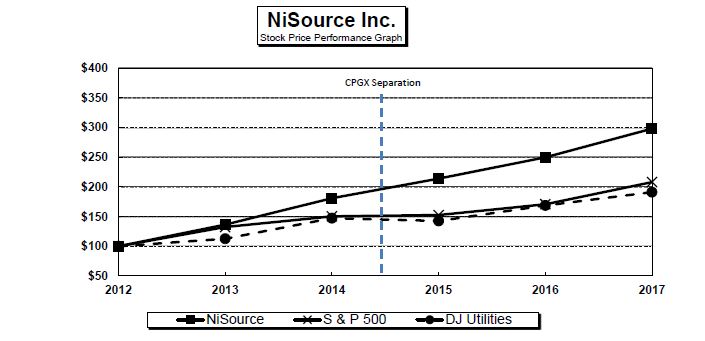
The graph below compares the cumulative total shareholder return of NiSource’s common stock for the last five years with the cumulative total return for the same period of the S&P 500 and the Dow Jones Utility indices. On July 1, 2015, NiSource completed the Separation. Following the Separation, NiSource retained no ownership interest in CPG. The Separation is treated as a special dividend for purposes of calculating the total shareholder return, with the then-current market value of the distributed shares being deemed to have been reinvested on the Separation date in shares of NiSource common stock. A vertical line is included on the graph below to identify the periods before and after the Separation.
The foregoing performance graph is being furnished as part of this annual report solely in accordance with the requirement under Rule 14a-3(b)(9) to furnish stockholders with such information, and therefore, shall not be deemed to be filed or incorporated by reference into any filings by NiSource under the Securities Act or the Exchange Act.
The total shareholder return for NiSource common stock and the two indices is calculated from an assumed initial investment of $100 and assumes dividend reinvestment, including the impact of the distribution of CPG common stock in the Separation.
Item 6. SELECTED FINANCIAL DATA
NISOURCE INC.
The selected data presented below as of and for the five years ended December 31, 2017, are derived from the Consolidated Financial Statements of NiSource. The data should be read together with the Consolidated Financial Statements including the related notes thereto included in Item 8 of this Form 10-K.
| Year Ended December 31, (dollars in millions except per share data) | 2017 | 2016 | 2015 | 2014 | 2013 | ||||||||||||||
| Statement of Income Data: | |||||||||||||||||||
| Operating Revenues | |||||||||||||||||||
| Gas Distribution | $ | 2,063.2 | $ | 1,850.9 | $ | 2,081.9 | $ | 2,597.8 | $ | 2,226.3 | |||||||||
| Gas Transportation | 1,021.5 | 964.6 | 969.8 | 987.4 | 820.0 | ||||||||||||||
| Electric | 1,785.5 | 1,660.8 | 1,572.9 | 1,672.0 | 1,563.4 | ||||||||||||||
| Other | 4.4 | 16.2 | 27.2 | 15.2 | 15.7 | ||||||||||||||
| Total Operating Revenues | 4,874.6 | 4,492.5 | 4,651.8 | 5,272.4 | 4,625.4 | ||||||||||||||
| Operating Income | 910.6 | 858.2 | 799.9 | 789.1 | 698.1 | ||||||||||||||
| Income from Continuing Operations | 128.6 | 328.1 | 198.6 | 256.2 | 221.0 | ||||||||||||||
| Balance Sheet Data: | |||||||||||||||||||
| Total Assets | 19,961.7 | 18,691.9 | 17,492.5 | 24,589.8 | 22,473.6 | ||||||||||||||
| Capitalization | |||||||||||||||||||
| Common stockholders’ equity | 4,320.1 | 4,071.2 | 3,843.5 | 6,175.3 | 5,886.6 | ||||||||||||||
| Long-term debt, excluding amounts due within one year | 7,512.2 | 6,058.2 | 5,948.5 | 8,151.5 | 7,588.2 | ||||||||||||||
| Total Capitalization | $ | 11,832.3 | $ | 10,129.4 | $ | 9,792.0 | $ | 14,326.8 | $ | 13,474.8 | |||||||||
| Per Share Data: | |||||||||||||||||||
| Basic Earnings Per Share from Continuing Operations ($) | $ | 0.39 | $ | 1.02 | $ | 0.63 | $ | 0.81 | $ | 0.71 | |||||||||
| Diluted Earnings Per Share from Continuing Operations ($) | $ | 0.39 | $ | 1.01 | $ | 0.63 | $ | 0.81 | $ | 0.71 | |||||||||
| Other Data: | |||||||||||||||||||
| Dividends declared per share ($) | $ | 0.70 | $ | 0.64 | $ | 0.83 | $ | 1.02 | $ | 0.98 | |||||||||
| Shares outstanding at the end of the year (in thousands) | 337,016 | 323,160 | 319,110 | 316,037 | 313,676 | ||||||||||||||
| Number of common stockholders | 21,009 | 22,272 | 30,190 | 25,233 | 26,965 | ||||||||||||||
| Capital expenditures | $ | 1,753.8 | $ | 1,490.4 | $ | 1,367.5 | $ | 1,339.6 | $ | 1,248.5 | |||||||||
| Number of employees | 8,175 | 8,007 | 7,596 | 8,982 | 8,477 |
| • | The decrease in income from continuing operations during 2017 was due primarily to increased tax expense as a result of the impact of adopting the provisions of the TCJA and a loss on early extinguishment of long-term debt, as discussed below. |
| • | During the second quarter of 2017, NiSource Finance executed a tender offer for $990.7 million of outstanding notes consisting of a combination of its 6.40% notes due 2018, 6.80% notes due 2019, 5.45% notes due 2020, and 6.125% notes due 2022. In conjunction with the debt retired, NiSource Finance recorded a $111.5 million loss on early extinguishment of long-term debt, primarily attributable to early redemption premiums. |
| • | On July 1, 2015, NiSource completed the Separation. The results of operations of the former Columbia Pipeline Group Operations segment have been classified as discontinued operations for all periods presented. See Note 3, "Discontinued Operations," in the Notes to the Consolidated Financial Statements for further information. |
| • | Prior to the Separation, CPG closed its placement of $2,750.0 million in aggregate principal amount of its senior notes. Using the proceeds from this offering, CPG made cash payments to NiSource representing the settlement of inter-company borrowings and the payment of a one-time special dividend. In May 2015, using proceeds from the cash payments from CPG, NiSource Finance settled its two bank term loans in the amount of $1,075.0 million and executed a tender offer for $750.0 million consisting of a combination of its 5.25% notes due 2017, 6.40% notes due 2018 and 4.45% notes due 2021. In conjunction with the debt retired, NiSource Finance recorded a $97.2 million loss on early extinguishment of long-term debt, primarily attributable to early redemption premiums. |
ITEM 7. MANAGEMENT’S DISCUSSION AND ANALYSIS OF FINANCIAL CONDITION AND RESULTS OF OPERATIONS
NISOURCE INC.
| Index | Page |
| Executive Summary | 21 |
| Summary of Consolidated Financial Results | 21 |
| Results and Discussion of Segment Operations | 25 |
| Gas Distribution Operations | 26 |
| Electric Operations | 29 |
| Liquidity and Capital Resources | 33 |
| Off Balance Sheet Arrangements | 36 |
| Market Risk Disclosures | 37 |
| Other Information | 38 |
EXECUTIVE SUMMARY
This Management’s Discussion and Analysis of Financial Condition and Results of Operations (Management’s Discussion) analyzes the financial condition, results of operations and cash flows of NiSource and its subsidiaries. It also includes management’s analysis of past financial results and certain potential factors that may affect future results, potential future risks and approaches that may be used to manage those risks. See "Note regarding forward-looking statements" at the beginning of this report for a list of factors that may cause results to differ materially.
Management’s Discussion is designed to provide an understanding of NiSource's operations and financial performance and should be read in conjunction with the Company's Consolidated Financial Statements and related Notes to Consolidated Financial Statements in this annual report.
NiSource is an energy holding company under the Public Utility Holding Company Act of 2005 whose subsidiaries are fully regulated natural gas and electric utility companies serving customers in seven states. NiSource generates substantially all of its operating income through these rate-regulated businesses which are summarized for financial reporting purposes into two primary reportable segments: Gas Distribution Operations and Electric Operations.
Refer to the “Business” section under Item 1 of this annual report and Note 22, "Segments of Business," in the Notes to the Consolidated Financial Statements for further discussion of NiSource's regulated utility business segments.
NiSource’s goal is to develop strategies that benefit all stakeholders as it addresses changing customer conservation patterns, develops more contemporary pricing structures an
Showing the first 8K of 72K characters. Open the full section
Item 7. MANAGEMENT’S DISCUSSION AND ANALYSIS OF FINANCIAL CONDITION AND RESULTS OF OPERATIONS (continued)
NISOURCE INC.
Other Information
Critical Accounting Policies
NiSource applies certain accounting policies based on the accounting requirements discussed below that have had, and may continue to have, significant impacts on NiSource’s results of operations and Consolidated Financial Statements.
Basis of Accounting for Rate-Regulated Subsidiaries. ASC Topic 980, Regulated Operations, provides that rate-regulated subsidiaries account for and report assets and liabilities consistent with the economic effect of the way in which regulators establish rates, if the rates established are designed to recover the costs of providing the regulated service and if the competitive environment makes it probable that such rates can be charged and collected. Certain expenses and credits subject to utility regulation or rate determination normally reflected in income are deferred on the Consolidated Balance Sheets and are recognized in income as the related amounts are included in service rates and recovered from or refunded to customers. The total amounts of regulatory assets and liabilities reflected on the Consolidated Balance Sheets were $1,801.2 million and $2,795.6 million at December 31, 2017, and $1,885.4 million and $1,381.8 million at December 31, 2016, respectively. For additional information, refer to Note 8, “Regulatory Matters,” in the Notes to Consolidated Financial Statements.
In the event that regulation significantly changes the opportunity for NiSource to recover its costs in the future, all or a portion of NiSource’s regulated operations may no longer meet the criteria for the application of ASC Topic 980, Regulated Operations. In such event, a write-down of all or a portion of NiSource’s existing regulatory assets and liabilities could result. If transition cost recovery is approved by the appropriate regulatory bodies that would meet the requirements under GAAP for continued accounting as regulatory assets and liabilities during such recovery period, the regulatory assets and liabilities would be reported at the recoverable amounts. If unable to continue to apply the provisions of ASC Topic 980, Regulated Operations, NiSource would be required to apply the provisions of ASC Topic 980-20, Discontinuation of Rate-Regulated Accounting. In management’s opinion, NiSource’s regulated subsidiaries will be subject to ASC Topic 980, Regulated Operations for the foreseeable future.
Certain of the regulatory assets reflected on NiSource’s Consolidated Balance Sheets require specific regulatory action in order to be included in future service rates. Although recovery of these amounts is not guaranteed, NiSource believes that these costs meet the requirements for deferral as regulatory assets. Regulatory assets requiring specific regulatory action amounted to $398.4 million at December 31, 2017. If NiSource determined that the amounts included as regulatory assets were not recoverable, a charge to income would immediately be required to the extent of the unrecoverable amounts.
The passage of the TCJA into law necessitated the remeasurement of NiSource’s deferred income tax balances to reflect the new U.S. corporate income tax rate of 21%. For NiSource’s regulated entities, substantially all of the impact of this remeasurement was recorded to a regulatory asset or regulatory liability, as appropriate, until such time that NiSource receives final regulatory orders prescribing the required accounting treatment and related impact on future customer rates. To the extent final regulatory orders received prescribe accounting treatment different from what is currently reflected in NiSource’s financial statements, NiSource’s results of operations could be impacted.
Pension and Postretirement Benefits. NiSource has defined benefit plans for both pension and other postretirement benefits. The calculation of the net obligations and annual expense related to the plans requires a significant degree of judgment regarding the discount rates to be used in bringing the liabilities to present value, expected long-term rates of return on plan assets, health care trend rates, and mortality rates, among other assumptions. Due to the size of the plans and the long-term nature of the associated liabilities, changes in the assumptions used in the actuarial estimates could have material impacts on the measurement of the net obligations and annual expense recognition. Differences between actuarial assumptions and actual plan results are deferred into AOCI or a regulatory balance sheet account, depending on the jurisdiction of the NiSource entity. These deferred gains or losses are then amortized into the income statement when the accumulated differences exceed 10% of the greater of the projected benefit obligation or the fair value of plan assets (known in GAAP as the “corridor” method) or when settlement accounting is triggered.
The discount rates, expected long-term rates of return on plan assets, health care cost trend rates and mortality rates are critical assumptions. Methods used to develop these assumptions are described below. While a third party actuarial firm assists with the development of many of these assumptions, NiSource is ultimately responsible for selecting the final assumptions.
The discount rate is utilized principally in calculating the actuarial present value of pension and other postretirement benefit obligations and net periodic pension and other postretirement benefit plan costs. NiSource’s discount rates for both pension and other postretirement benefits are determined using spot rates along an AA-rated above median yield curve with cash flows matching the expected duration of benefit payments to be made to plan participants.
The expected long-term rate of return on plan assets is a component utilized in calculating annual pension and other postretirement
ITEM 7. MANAGEMENT’S DISCUSSION AND ANALYSIS OF FINANCIAL CONDITION AND RESULTS OF OPERATIONS (continued)
NISOURCE INC.
benefit plan costs. NiSource estimates the expected return on plan assets by evaluating expected bond returns, equity risk premiums, target asset allocations, the effects of active plan management, the impact of periodic plan asset rebalancing and historical performance. NiSource also considers the guidance from its investment advisors in making a final determination of its expected rate of return on assets.
For measurement of 2018 net periodic benefit cost, NiSource selected an expected pre-tax long-term rate of return of 7.00% and 5.80% for its pension and other postretirement benefit plan assets, respectively.
NiSource estimates the assumed health care cost trend rate, which is used in determining the Company's other postretirement benefit net expense, based upon its actual health care cost experience, the effects of recently enacted legislation, third-party actuarial surveys and general economic conditions.
NiSource uses the Society of Actuaries’ most recently published mortality data in developing a best estimate of mortality as part of the calculation of the pension and other postretirement benefit obligations.
The following tables illustrate the effects of changes in these actuarial assumptions while holding all other assumptions constant:
| Impact on December 31, 2017 Projected Benefit Obligation Increase/(Decrease) | |||||||
| Change in Assumptions (in millions) | Pension Benefits | Other Postretirement Benefits | |||||
| +50 basis points change in discount rate | $ | (94.8 | ) | $ | (28.7 | ) | |
| -50 basis points change in discount rate | 103.0 | 31.5 | |||||
| +50 basis points change in health care trend rates | 14.9 | ||||||
| -50 basis points change in health care trend rates | (12.9 | ) | |||||
| Impact on 2017 Expense Increase/(Decrease)(1) | |||||||
| Change in Assumptions (in millions) | Pension Benefits | Other Postretirement Benefits | |||||
| +50 basis points change in discount rate | $ | (2.3 | ) | $ | (0.7 | ) | |
| -50 basis points change in discount rate | 2.5 | 0.6 | |||||
| +50 basis points change in expected long-term rate of return on plan assets | (8.5 | ) | (1.1 | ) | |||
| -50 basis points change in expected long-term rate of return on plan assets | 8.5 | 1.1 | |||||
| +50 basis points change in health care trend rates | 0.5 | ||||||
| -50 basis points change in health care trend rates | (0.5 | ) |
(1)Before labor capitalization and regulatory deferrals.
In January 2017, NiSource changed the method used to estimate the service and interest components of net periodic benefit cost for pension and other postretirement benefits. This change, compared to the previous method, resulted in a decrease in the actuarially-determined service and interest cost components. Historically, NiSource estimated service and interest cost utilizing a single weighted-average discount rate derived from the yield curve used to measure the benefit obligation at the beginning of the period. For fiscal 2017 and beyond, NiSource now utilizes a full yield curve approach to estimate these components by applying the specific spot rates along the yield curve used in the determination of the benefit obligation to the relevant projected cash flows. For further discussion of NiSource’s pension and other postretirement benefits, see Note 11, “Pension and Other Postretirement Benefits,” in the Notes to Consolidated Financial Statements.
Goodwill. NiSource has seven goodwill reporting units, comprised of the seven state operating companies within the Gas Distribution Operations reportable segment. NiSource’s goodwill assets at December 31, 2017 were $1,690.7 million, most of which resulted from the acquisition of Columbia on November 1, 2000.
As required by GAAP, NiSource tests for impairment of goodwill on an annual basis and on an interim basis when events or circumstances indicate that a potential impairment may exist. NiSource’s annual goodwill test takes place in the second quarter of each year and was most recently finalized as of May 1, 2017.
NiSource completed a quantitative ("step 1") fair value measurement of its reporting units during the May 1, 2016 goodwill test.
ITEM 7. MANAGEMENT’S DISCUSSION AND ANALYSIS OF FINANCIAL CONDITION AND RESULTS OF OPERATIONS (continued)
NISOURCE INC.
Consistent with NiSource’s historical impairment testing of goodwill, fair value of the reporting units was determined based on a weighting of income and market approaches. These approaches require significant judgments including appropriate long-term growth rates and discount rates for the income approach and appropriate multiples of earnings for peer companies and control premiums for the market approach. A qualitative ("step 0") test was completed on May 1, 2017. NiSource assessed various assumptions, events and circumstances that would have affected the estimated fair value of the reporting units in its baseline May 1, 2016 test. The results of this assessment indicated that it is not more likely than not that its reporting unit fair values are less than the reporting unit carrying values and no impairments are necessary.
The discount rates were derived using peer company data compiled with the assistance of a third party valuation services firm. The discount rates used are subject to change based on changes in tax rates at both the state and federal level, debt and equity ratios at each reporting unit and general economic conditions.
The long-term growth rate was derived by evaluating historic growth rates, new business and investment opportunities beyond the near term horizon. The long-term growth rate is subject to change depending on inflationary impacts to the U.S. economy and the individual business environments in which each reporting unit operates.
The May 1, 2016 test indicated the fair value of each of the reporting units that carry or are allocated goodwill exceeded their carrying values, indicating that no impairment existed under the step 1 annual impairment test. If the estimates of free cash flow used in this step 1 analysis had been 10% lower, the resulting fair values would have still been greater than the carrying value for each of the reporting units tested, holding all other assumptions constant.
Revenue Recognition. Revenue is recorded as products and services are delivered. Utility revenues are billed to customers monthly on a cycle basis. Revenues are recorded on the accrual basis and include estimates for electricity and gas delivered but not billed. Refer to Note 1-I, “Revenue Recognition,” in the Notes to Consolidated Financial Statements.
NiSource adopted the provisions of ASC 606 beginning on January 1, 2018 using a modified retrospective method, which was applied to all contracts. No material adjustments were made to January 1, 2018 opening balances as a result of the adoption and NiSource does not anticipate material changes in the amount or timing of future revenue recognition as a result of the adoption of ASC 606.
Recently Issued Accounting Pronouncements
Refer to Note 2, "Recent Accounting Pronouncements," in the Notes to Consolidated Financial Statements.
Item 7A. QUANTITATIVE AND QUALITATIVE DISCLOSURES ABOUT MARKET RISK
Quantitative and Qualitative Disclosures about Market Risk are reported in Item 7. “Management’s Discussion and Analysis of Financial Condition and Results of Operations – Market Risk Disclosures.”
ITEM 8. FINANCIAL STATEMENTS AND SUPPLEMENTARY DATA
NISOURCE INC.
ITEM 8. FINANCIAL STATEMENTS AND SUPPLEMENTARY DATA (continued)
NISOURCE INC.
REPORT OF INDEPENDENT REGISTERED PUBLIC ACCOUNTING FIRM
To the stockholders and the Board of Directors of NiSource Inc.
Opinion on the Financial Statements
We have audited the accompanying consolidated balance sheets of NiSource Inc. and subsidiaries (the "Company") as of December 31, 2017 and 2016, the related statements of consolidated income, comprehensive income, common stockholders' equity, and cash flows for each of the three years in the period ended December 31, 2017, and the related notes and the schedule listed in the Index at item 15 (collectively referred to as the "financial statements"). In our opinion, the financial statements present fairly, in all material respects, the financial position of the Company as of December 31, 2017 and 2016, and the results of its operations and its cash flows for each of the three years in the period ended December 31, 2017, in conformity with accounting principles generally accepted in the United States of America.
We have also audited, in accordance with the standards of the Public Company Accounting Oversight Board (United States) (PCAOB), the Company's internal control over financial reporting as of December 31, 2017, based on criteria established in Internal Control - Integrated Framework (2013) issued by the Committee of Sponsoring Organizations of the Treadway Commission and our report dated February 20, 2018, expressed an unqualified opinion on the Company's internal control over financial reporting.
Emphasis of a Matter
As discussed in Note 3 to the consolidated financial statements, on July 1, 2015 the Company completed the spin-off of its subsidiary Columbia Pipeline Group, Inc.
Basis for Opinion
These financial statements are the responsibility of the Company's management. Our responsibility is to express an opinion on the Company's financial statements based on our audits. We are a public accounting firm registered with the PCAOB and are required to be independent with respect to the Company in accordance with the U.S. federal securities laws and the applicable rules and regulations of the Securities and Exchange Commission and the PCAOB.
We conducted our audits in accordance with the standards of the PCAOB. Those standards require that we plan and perform the audit to obtain reasonable assurance about whether the financial statements are free of material misstatement, whether due to error or fraud. Our audits included performing procedures to assess the risks of material misstatement of the financial statements, whether due to error or fraud, and performing procedures that respond to those risks. Such procedures included examining, on a test basis, evidence regarding the amounts and disclosures in the financial statements. Our audits also included evaluating the accounting principles used and significant estimates made by management, as well as evaluating the overall presentation of the financial statements. We believe that our audits provide a reasonable basis for our opinion.
/s/ DELOITTE & TOUCHE LLP
Columbus, Ohio
February 20, 2018
We have served as the Company's auditor since 2002.
ITEM 8. FINANCIAL STATEMENTS AND SUPPLEMENTARY DATA (continued)
NISOURCE INC.
REPORT OF INDEPENDENT REGISTERED PUBLIC ACCOUNTING FIRM
To the stockholders and the Board of Directors of NiSource Inc.
Opinion on Internal Control over Financial Reporting
We have audited the internal control over financial reporting of NiSource Inc. and subsidiaries (the “Company”) as of December 31, 2017, based on criteria established in Internal Control - Integrated Framework (2013) issued by the Committee of Sponsoring Organizations of the Treadway Commission (COSO). In our opinion, the Company maintained, in
Showing the first 8K of 93K characters. Open the full section
Item 8. FINANCIAL STATEMENTS AND SUPPLEMENTARY DATA (continued)
Columbia of Ohio. On November 28, 2012, the PUCO approved Columbia of Ohio’s application to extend its IRP for an additional five years (2013-2017), allowing Columbia of Ohio to continue to invest and recover on its accelerated main replacements. Columbia of Ohio filed its most recent application to adjust rates associated with its IRP and DSM Riders on February 27, 2017, which requested authority to increase annual revenues by approximately $31.5 million that includes recovery of and return on approximately $235.9 million of incremental IRP capital investments in 2016. On March 23, 2017, the PUCO Staff filed comments which recommended approval of the application with only minor revisions. The PUCO issued an order on April 26, 2017, approving Columbia of Ohio's application. New rates went into effect on May 1, 2017.
On February 27, 2017, Columbia of Ohio also filed an application requesting authority to extend its IRP for an additional five years (2018-2022). On July 10, 2017, the PUCO Staff recommended approval of Columbia of Ohio's IRP for the additional five years, with modifications to Columbia of Ohio's proposed IRP rates for the five-year period. A joint stipulation and recommendation, outlining annual maximum IRP rates for the five-year period, was filed on August 18, 2017 and was supported or not opposed by all parties except the OCC. A hearing on the stipulation was held on October 2, 2017 and briefing was completed on November 7, 2017. On January 31, 2018, the PUCO issued an order that approved the stipulation.
On December 1, 2017, Columbia of Ohio filed an application that requested authority to implement a rider to begin recovering plant and associated deferrals related to the CEP. The application requested authority to increase annual revenues, through the requested rider, by approximately $29 million in 2018, with biennial increases up to approximately $98 million in 2022. The filing is pending at the PUCO and no procedural schedule has been established. The CEP was established in 2011 and allows for deferral of interest, depreciation and property taxes on certain plant investments not recovered through its IRP modernization tracker.
NIPSCO Gas. On September 27, 2017, NIPSCO filed a base rate case with the IURC, seeking an annual revenue increase of $143.5 million (inclusive of amounts being recovered through various tracker programs). As part of this filing and among other items, NIPSCO proposed to update base rates for ongoing infrastructure improvements, revised depreciation rates and ongoing level of expenses to reflect the current costs of providing natural gas service. An order is expected in the second half of 2018. A supplemental filing to the base rate case was submitted on January 26, 2018 to reflect the impact of the TCJA, seeking a revised annual revenue increase of $117.9 million.
On April 30, 2013, then Indiana Governor Pence signed Senate Enrolled Act 560, the TDSIC statute, into law. Among other provisions, this legislation provides for cost recovery outside of a base rate proceeding for new or replacement electric and gas transmission, distribution, and storage projects that a public utility undertakes for the purposes of safety, reliability, system modernization, or economic development. Provisions of the TDSIC statute require that, among other things, requests for recovery include a seven-year plan of eligible investments. Once the plan is approved by the IURC, eighty percent of eligible costs can be recovered using a periodic rate adjustment mechanism. The cost recovery mechanism is referred to as a TDSIC mechanism. Recoverable costs include a return on, and of, the investment, including AFUDC, post-in-service carrying charges, operation and maintenance expenses, depreciation and property taxes. The remaining twenty percent of recoverable costs are to be deferred for future recovery in the public utility’s next general rate case. The periodic rate adjustment mechanism is capped at an annual increase of no more than two percent of total retail revenues. On August 31, 2017, NIPSCO filed TDSIC-7 requesting to recover an incremental increase to revenue of $3.5 million associated with incremental capital investment of $59.0 million made in the first half of 2017. An order approving NIPSCO's filing was received from the IURC on December 28, 2017, and new rates went into effect on January 1, 2018.
On November 8, 2017, NIPSCO filed a petition with the IURC seeking approval of NIPSCO’s federally mandated pipeline safety compliance plan. The four year compliance plan includes a total estimated $91 million of capital costs and $23 million of expected operating and maintenance costs. NIPSCO is requesting all associated accounting and ratemaking relief, including establishment of a periodic rate adjustment mechanism.
Columbia of Massachusetts. On July 7, 2014, the Governor of Massachusetts signed into law Chapter 149 of the Acts of 2014, An Act Relative to Natural Gas Leaks (“the Act”). The Act authorizes natural gas distribution companies to file gas infrastructure replacement plans with the Massachusetts DPU to address the replacement of aging natural gas pipeline infrastructure. In addition, the Act provides that the Massachusetts DPU may, after review of the plans, allow the proposed estimated costs of the plan into rates as of May 1 of the subsequent year. On October 31, 2016, Columbia of Massachusetts filed its GSEP for the 2017 construction year. Columbia of Massachusetts proposed to recover incremental revenue of $8.1 million associated with incremental capital investment of $72.9 million made during calendar year 2017. An order was received from the Massachusetts DPU on April 28, 2017 approving the filing and rates went into effect on May 1, 2017. On October 31, 2017, Columbia of Massachusetts filed its GSEP for the 2018 construction year. Columbia of Massachusetts is proposing to recover incremental revenue of $9.7 million associated with incremental capital investment of $83.9 million to be made during calendar year 2018. The filing included a request
NISOURCE INC.
Notes to Consolidated Financial Statements
ITEM 8. FINANCIAL STATEMENTS AND SUPPLEMENTARY DATA (continued)
for a waiver to allow collection of the $3.1 million revenue requirement that exceeds the GSEP cap provision as previously calculated. If the waiver is not approved, the incremental revenue will be $6.6 million. An order is expected from the Massachusetts DPU in the second quarter of 2018, with new rates effective May 1, 2018.
Columbia of Virginia. On April 29, 2016, Columbia of Virginia filed a request with the VSCC, seeking an annual revenue increase of $37.0 million. On September 28, 2016, Columbia of Virginia implemented updated interim base rates subject to refund. On January 17, 2017, Columbia of Virginia presented a stipulation and proposed recommendation, representing a settlement by all parties to the proceeding that included a base revenue increase of $28.5 million. On March 17, 2017, by final order, the VSCC approved the settlement agreement without modification. In accordance with the terms of the final order, during 2017, Columbia of Virginia completed its refund of the difference between the interim customer rates implemented in 2016 and the rates approved by the final order.
Columbia Gas of Kentucky. On October 13, 2017, Columbia of Kentucky filed its application to adjust rates associated with its AMRP, requesting authority to increase annual revenues by $4.5 million associated with incremental capital investment of $24.0 million to be made during calendar year 2018. On December 22, 2017, the Kentucky PSC issued an order approving Columbia of Kentucky’s request as filed, with rates effective January 2, 2018.
Columbia of Maryland. On April 14, 2017, Columbia of Maryland filed a request with the MPSC to adjust base rates. On July 28, 2017, all parties filed a settlement agreement with the MPSC, under which Columbia of Maryla
Showing the first 8K of 156K characters. Open the full section
Item 9. CHANGES IN AND DISAGREEMENTS WITH ACCOUNTANTS ON ACCOUNTING AND FINANCIAL DISCLOSURE
None.
Item 9A. CONTROLS AND PROCEDURES
Evaluation of Disclosure Controls and Procedures
NiSource’s chief executive officer and its chief financial officer are responsible for evaluating the effectiveness of the Company's disclosure controls and procedures (as defined in Exchange Act Rules 13a-15(e) and 15d-15(e)). NiSource's disclosure controls and procedures are designed to provide reasonable assurance that the information required to be disclosed by the Company in reports that are filed or submitted under the Exchange Act are accumulated and communicated to management, including NiSource's chief executive officer and chief financial officer, as appropriate, to allow timely decisions regarding required disclosure and is recorded, processed, summarized and reported within the time periods specified in the rules and forms of the SEC. Based upon that evaluation, NiSource's chief executive officer and chief financial officer concluded that, as of the end of the period covered by this report, disclosure controls and procedures were effective to provide reasonable assurance that financial information was processed, recorded and reported accurately.
Management’s Annual Report on Internal Control over Financial Reporting
NiSource management, including NiSource’s chief executive officer and chief financial officer, are responsible for establishing and maintaining NiSource’s internal control over financial reporting, as such term is defined under Rule 13a-15(f) or Rule 15d-15(f) promulgated under the Exchange Act. However, management would note that a control system can provide only reasonable, not absolute, assurance that the objectives of the control system are met. NiSource’s management has adopted the 2013 framework set forth in the Committee of Sponsoring Organizations of the Treadway Commission report, Internal Control - Integrated Framework, the most commonly used and understood framework for evaluating internal control over financial reporting, as its framework for evaluating the reliability and effectiveness of internal control over financial reporting. During 2017, NiSource conducted an evaluation of its internal control over financial reporting. Based on this evaluation, NiSource management concluded that NiSource’s internal control over financial reporting was effective as of the end of the period covered by this annual report.
Deloitte & Touche LLP, NiSource’s independent registered public accounting firm, issued an attestation report on NiSource’s internal controls over financial reporting which is contained in Item 8, “Financial Statements and Supplementary Data.”
Changes in Internal Controls
There have been no changes in NiSource’s internal control over financial reporting during the most recently completed quarter covered by this report that has materially affected, or is reasonably likely to materially affect, NiSource’s internal control over financial reporting.
Item 9B. OTHER INFORMATION
Not applicable.
NISOURCE INC.
PART III
Item 10. DIRECTORS, EXECUTIVE OFFICERS AND CORPORATE GOVERNANCE
Except for the information required by this item with respect to NiSource's executive officers included at the end of Part I of this report on Form 10-K, the information required by this Item 10 is incorporated herein by reference to the discussion in "Proposal 1 Election of Directors," "Corporate Governance," and "Section 16(a) Beneficial Ownership Reporting Compliance," of the Proxy Statement for the Annual Meeting of Stockholders to be held on May 8, 2018.
Item 11. EXECUTIVE COMPENSATION
The information required by this Item 11 is incorporated herein by reference to the discussion in "Corporate Governance - Compensation Committee Interlocks and Insider Participation," "Director Compensation," "Executive Compensation," and "Executive Compensation - Compensation Committee Report," of the Proxy Statement for the Annual Meeting of Stockholders to be held on May 8, 2018.
Item 12. SECURITY OWNERSHIP OF CERTAIN BENEFICIAL OWNERS AND MANAGEMENT AND RELATED STOCKHOLDER MATTERS
The information required by this Item 12 is incorporated herein by reference to the discussion in "Security Ownership of Certain Beneficial Owners and Management" and "Equity Compensation Plan Information" of the Proxy Statement for the Annual Meeting of Stockholders to be held on May 8, 2018.
Item 13. CERTAIN RELATIONSHIPS AND RELATED TRANSACTIONS, AND DIRECTOR INDEPENDENCE
The information required by this Item 13 is incorporated herein by reference to the discussion in "Corporate Governance - Policies and Procedures with Respect to Transactions with Related Persons" and "Corporate Governance - Director Independence" of the Proxy Statement for the Annual Meeting of Stockholders to be held on May 8, 2018.
Item 14. PRINCIPAL ACCOUNTING FEES AND SERVICES
The information required by this Item 14 is incorporated herein by reference to the discussion in "Independent Auditor Fees" of the Proxy Statement for the Annual Meeting of Stockholders to be held on May 8, 2018.
PART IV
NISOURCE INC.
Item 15. EXHIBITS, FINANCIAL STATEMENT SCHEDULES
Financial Statements and Financial Statement Schedules
The following financial statements and financial statement schedules filed as a part of the Annual Report on Form 10-K are included in Item 8, "Financial Statements and Supplementary Data."
Exhibits
The exhibits filed herewith as a part of this report on Form 10-K are listed on the Exhibit Index below. Each management contract or compensatory plan or arrangement of NiSource, listed on the Exhibit Index, is separately identified by an asterisk.
Pursuant to Item 601(b), paragraph (4)(iii)(A) of Regulation S-K, certain instruments representing long-term debt of NiSource’s subsidiaries have not been included as Exhibits because such debt does not exceed 10% of the total assets of NiSource and its subsidiaries on a consolidated basis. NiSource agrees to furnish a copy of any such instrument to the SEC upon request.
| EXHIBIT NUMBER | DESCRIPTION OF ITEM |
| (2.1) | Separation and Distribution Agreement, dated as of June 30, 2015, by and between NiSource Inc. and Columbia Pipeline Group, Inc. (incorporated by reference to Exhibit 2.1 to the NiSource Inc. Form 8-K filed on July 2, 2015). |
| (3.1) | Amended and Restated Certificate of Incorporation (incorporated by reference to Exhibit 3.1 to the NiSource Inc. Form 10-Q filed on August 3, 2015). |
| (3.2) | Bylaws of NiSource Inc., as amended and restated through January 26, 2018 (incorporated by reference to Exhibit 3.1 to the NiSource Inc. Form 8-K filed on January 26, 2018). |
| (4.1) | Indenture, dated as of March 1, 1988, by and between Northern Indiana Public Service Company ("NIPSCO") and Manufacturers Hanover Trust Company, as Trustee (incorporated by reference to Exhibit 4 to the NIPSCO Registration Statement (Registration No. 33-44193)). |
| (4.2) | First Supplemental Indenture, dated as of December 1, 1991, by and between Northern Indiana Public Service Company and Manufacturers Hanover Trust Company, as Trustee (incorporated by reference to Exhibit 4.1 to the NIPSCO Registration Statement (Registration No. 33-63870)). |
| (4.3) | Indenture Agreement, dated as of February 14, 1997, by and between NIPSCO Industries, Inc., NIPSCO Capital Markets, Inc. and Chase Manhattan Bank as trustee (incorporated by reference to Exhibit 4.1 to the NIPSCO Industries, Inc. Registration Statement (Registration No. 333-22347)). |
| (4.4) | Second Supplemental Indenture, dated as of November 1, 2000, by and among NiSource Capital Markets, Inc., NiSource Inc., New NiSource Inc., and The Chase Manhattan Bank, as trustee (incorporated by reference to Exhibit 4.45 to the NiSource Inc. Form 10-K for the period ended December 31, 2000). |
| (4.5) | Indenture, dated November 14, 2000, among NiSource Finance Corp., NiSource Inc., as guarantor, and The Chase Manhattan Bank, as Trustee (incorporated by reference to Exhibit 4.1 to the NiSource Inc. Form S-3, dated November 17, 2000 (Registration No. 333-49330)). |
| (4.6) | Form of 3.490% Notes due 2027 (incorporated by reference to Exhibit 4.1 to the NiSource Inc. Form 8-K filed on May 17, 2017). |
| (4.7) | Form of 4.375% Notes due 2047 (incorporated by reference to Exhibit 4.2 to the NiSource Inc. Form 8-K filed on May 17, 2017). |
| (4.8) | Form of 3.950% Notes due 2048 (incorporated by reference to Exhibit 4.1 to the NiSource Inc. Form 8-K filed on September 8, 2017). |
| (4.9) | Form of 2.650% Notes due 2022 (incorporated by reference to Exhibit 4.1 to the NiSource Inc. Form 8-K filed on November 14, 2017). |
| (4.10) | Second Supplemental Indenture, dated as of November 30, 2017, between NiSource Inc. and The Bank of New York Mellon, as trustee (incorporated by reference to Exhibit 4.4 to Post-Effective Amendment No. 1 to Form S-3 filed November 30, 2017 (Registration No. 333-214360)). |
| (4.11) | Third Supplemental Indenture, dated as of November 30, 2017, between NiSource Inc. and The Bank of New York Mellon, as trustee (incorporated by reference to Exhibit 4.2 to the NiSource Inc. Form 8-K filed on December 1, 2017). |
| (10.1) | 2010 Omnibus Incentive Plan (incorporated by reference to Exhibit B to the NiSource Inc. Definitive Proxy Statement to Stockholders for the Annual Meeting held on May 11, 2010, filed on April 2, 2010).* |
| (10.2) | First Amendment to the 2010 Omnibus Incentive Plan (incorporated by reference to Exhibit 10.2 to the NiSource Inc. Form 10-K filed on February 18, 2014.)* |
| (10.3) | 2010 Omnibus Incentive Plan (incorporated by reference to Exhibit C to the NiSource Inc. Definitive Proxy Statement to Stockholders for the Annual Meeting held on May 12, 2015, filed on April 7, 2015).* |
| (10.4) | Second Amendment to the NiSource Inc. 2010 Omnibus Incentive Plan (incorporated by reference to Exhibit 10.1 to the NiSource Inc. Form 8-K filed October 23, 2015.)* |
| (10.5) | Form of Performance Share Award Agreement under the 2010 Omnibus Incentive Plan (incorporated by reference to Exhibit 10.1 to the NiSource Inc. Form 10-Q filed on April 30, 2014.)* |
| (10.6) | Form of Amended and Restated 2013 Performance Share Agreement effective on implementation of the spin-off on July 1, 2015, (under the 2010 Omnibus Incentive Plan)(incorporated by reference to Exhibit 10.1 to the NiSource Inc. Form 10-Q filed on November 3, 2015).* |
| (10.7) | Form of Amended and Restated 2014 Performance Share Agreement effective on the implementation of the spin-off on July 1, 2015, (under the 2010 Omnibus Incentive Plan)(incorporated by reference to Exhibit 10.2 to the NiSource Inc. Form 10-Q filed on November 3, 2015).* |
| (10.8) | Form of Amendment to Restricted Stock Unit Award Agreement related to Vested but Unpaid NiSource Restricted Stock Unit Awards for Nonemployee Directors of NiSource entered into as of July 13, 2015 (incorporated by reference to Exhibit 10.3 to the NiSource Inc. Form 10-Q filed on November 3, 2015).* |
| (10.9) | NiSource Inc. Nonemployee Director Retirement Plan, as amended and restated effective May 13, 2008 (incorporated by reference to Exhibit 10.2 to the NiSource Inc. Form 10-K filed on February 27, 2009).* |
| (10.10) | Supplemental Life Insurance Plan effective January 1, 1991, as amended, (incorporated by reference to Exhibit 2 to the NIPSCO Industries, Inc. Form 8-K filed on March 25, 1992).* |
| (10.11) | Form of Change in Control and Termination Agreement (incorporated by reference to Exhibit 99.1 to the NiSource Inc. Form 8-K filed January 6, 2014).* |
| (10.12) | Revised Form of Change in Control and Termination Agreement (incorporated by reference to Exhibit 10.2 to the NiSource Inc. Form 8-K filed on October 23, 2015.)* |
| (10.13) | Form of Restricted Stock Agreement under the 2010 Omnibus Incentive Plan (incorporated by reference to Exhibit 10.18 to the NiSource Inc. Form 10-K filed on February 28, 2011).* |
| (10.14) | Form of Restricted Stock Unit Award Agreement for Non-employee directors under the Non-employee Director Stock Incentive Plan (incorporated by reference to Exhibit 10.19 to the NiSource Inc. Form 10-K filed on February 28, 2011).* |
| (10.15) | Form of Restricted Stock Unit Award Agreement for Nonemployee Directors under the 2010 Omnibus Incentive Plan (incorporated by reference to Exhibit 10.1 to NiSource Inc. Form 10-Q filed on August 2, 2011).* |
| (10.16) | Form of Performance Share Award Agreement under the 2010 Omnibus Incentive Plan (incorporated by reference to Exhibit 10.3 to the NiSource Inc. Form 10-Q filed on May 3, 2016).* |
| (10.17) | Form of Restricted Stock Unit Award Agreement under the 2010 Omnibus Incentive Plan.* (incorporated by reference to Exhibit 10.17 to the NiSource Inc. Form 10-K filed on February 22, 2017) |
| (10.18) | Form of Restricted Stock Unit Award Agreement for Nonemployee Directors under the 2010 Omnibus Incentive Plan. (incorporated by reference to Exhibit 10.18 to the NiSource Inc. Form 10-K filed on February 22, 2017) * |
| (10.19) | Amended and Restated NiSource Inc. Supplemental Executive Retirement Plan effective May 13, 2011 (incorporated by reference to Exhibit 10.3 to NiSource Inc. Form 10-Q filed on October 28, 2011).* |
| (10.20) | Amended and Restated Pension Restoration Plan for NiSource Inc. and Affiliates effective May 13, 2011 (incorporated by reference to Exhibit 10.4 to NiSource Inc. Form 10-Q filed on October 28, 2011).* |
| (10.21) | Amended Restated Savings Restoration Plan for NiSource Inc. and Affiliates effective October 22, 2012 (incorporated by reference to Exhibit 10.20 to the NiSource Inc. Form 10-K filed on February 19, 2013).* |
| (10.22) | Amended and Restated NiSource Inc. Executive Deferred Compensation Plan effective November 1, 2012 (incorporated by reference to Exhibit 10.21 to the NiSource Inc. Form 10-K filed on February 19, 2013).* |
| (10.23) | NiSource Inc. Executive Severance Policy, as amended and restated, effective January 1, 2015 (incorporated by reference to Exhibit 10.21 to the NiSource Inc. Form 10-K filed on February 18, 2015).* |
| (10.24) | Fourth Amended and Restated Revolving Credit Agreement, dated as of November 28, 2016, among NiSource Finance Corp., as Borrower, NiSource Inc., the Lenders party thereto, Barclays Bank PLC, as Administrative Agent, JPMorgan Chase Bank, N.A. and The Bank of Tokyo-Mitsubishi UFJ, Ltd., as Co-Syndication Agents, Citibank, N.A., Credit Suisse AG, Cayman Islands Branch and Wells Fargo Bank, National Association, as Co-Documentation Agents, and Barclays Bank PLC, JPMorgan Chase Bank, N.A., The Bank of Tokyo-Mitsubishi UFJ, Ltd., Credit Suisse Securities (USA) LLC, Citigroup Global Markets, Inc. and Wells Fargo Securities, LLC, as Joint Lead Arrangers and Joint Bookrunners (incorporated by reference to Exhibit 10.1 to the NiSource Inc. Form 8-K filed on November 28, 2016). |
| (10.25) | Note Purchase Agreement, dated as of August 23, 2005, by and among NiSource Finance Corp., as issuer, NiSource Inc., as guarantor, and the purchasers named therein (incorporated by reference to Exhibit 10.1 to the NiSource Inc. Current Report on Form 8-K filed on August 26, 2005). |
| (10.26) | Amendment No. 1, dated as of November 10, 2008, to the Note Purchase Agreement by and among NiSource Finance Corp., as issuer, NiSource Inc., as guarantor, and the purchasers whose names appear on the signature page thereto (incorporated by reference to Exhibit 10.30 to the NiSource Inc. Form 10-K filed on February 27, 2009). |
| (10.27) | Term Loan Agreement, dated as of March 31, 2016, by and among NiSource Finance Corp., as Borrower, NiSource Inc., as Guarantor, the Lenders party thereto, and PNC Bank, National Association, as Administrative Agent, JP Morgan Chase Bank, N.A., as Syndication Agent, and Mizuho Bank, Ltd., as Documentation Agent (incorporated by reference to Exhibit 10.1 to the NiSource Inc. Form 10-Q filed on May 3, 2016). |
| (10.28) | Letter Agreement, dated as of March 17, 2015, by and between NiSource Inc. and Donald Brown. (incorporated by reference Exhibit 10.1 to the NiSource Inc. Form 10-Q filed on April 30, 2015).* |
| (10.29) | Letter Agreement, dated as of February 23, 2016, by and between NiSource Inc. and Pablo A. Vegas. (incorporated by reference Exhibit 10.29 to the NiSource Inc. Form 10-K filed on February 22, 2017).* |
| (10.30) | Tax Allocation Agreement, dated as of June 30, 2015, by and between NiSource Inc. and Columbia Pipeline Group, Inc. (incorporated by reference to Exhibit 10.1 of the NiSource Inc. Form 8-K filed on July 2, 2015). |
| (10.31) | Employee Matters Agreement, dated as of June 30, 2015, by and between NiSource Inc. and Columbia Pipeline Group, Inc. (incorporated by reference to Exhibit 10.2 of the NiSource Inc. Form 8-K filed on July 2, 2015). |
| (10.32) | Form of Change in Control and Termination Agreement (incorporated by reference to Exhibit 10.1 to the NiSource Inc. Form 10-Q filed on August 2, 2017). |
| (10.33) | Form of Performance share Award Agreement under the 2010 Omnibus Incentive Plan.* ** |
| (10.34) | Form of 2018 Restricted Stock Unit Award Agreement under the 2010 Omnibus Incentive Plan.* ** |
| (12) | Ratio of Earnings to Fixed Charges.** |
| (21) | List of Subsidiaries.** |
| (23) | Consent of Deloitte & Touche LLP.** |
| (31.1) | Certification of Chief Executive Officer, pursuant to Section 302 of the Sarbanes-Oxley Act of 2002.** |
| (31.2) | Certification of Chief Financial Officer, pursuant to Section 302 of the Sarbanes-Oxley Act of 2002.** |
| (32.1) | Certification of Chief Executive Officer, pursuant to Section 906 of the Sarbanes-Oxley Act of 2002 (furnished herewith).** |
| (32.2) | Certification of Chief Financial Officer, pursuant to Section 906 of the Sarbanes-Oxley Act of 2002 (furnished herewith).** |
| (101.INS) | XBRL Instance Document.** |
| (101.SCH) | XBRL Schema Document.** |
| (101.CAL) | XBRL Calculation Linkbase Document.** |
| (101.LAB) | XBRL Labels Linkbase Document.** |
| (101.PRE) | XBRL Presentation Linkbase Document.** |
| (101.DEF) | XBRL Definition Linkbase Document.** |
| * | Management contract or compensatory plan or arrangement of NiSource Inc. |
| ** | Exhibit filed herewith. |
References made to NIPSCO filings can be found at Commission File Number 001-04125. References made to NiSource Inc. filings made prior to November 1, 2000 can be found at Commission File Number 001-09779.
SIGNATURES
Pursuant to the requirements of Section 13 or 15(d) of the Securities Exchange Act of 1934, the registrant has duly caused this report to be signed on its behalf by the undersigned, hereunto duly authorized.
| NiSource Inc. | ||
| (Registrant) | ||
| Date: February 20, 2018 | By: | /s/ JOSEPH HAMROCK |
| Joseph Hamrock | ||
| President, Chief Executive Officer and Director | ||
| (Principal Executive Officer) |
Pursuant to the requirements of the Securities Exchange Act of 1934, this report has been signed below by the following persons on behalf of the registrant and in the capacities and on the dates indicated.
| /s/ | JOSEPH HAMROCK | President, Chief | Date: February 20, 2018 | |||
| Joseph Hamrock | Executive Officer and Director (Principal Executive Officer) | |||||
| /s/ | DONALD E. BROWN | Executive Vice President and | Date: February 20, 2018 | |||
| Donald E. Brown | Chief Financial Officer (Principal Financial Officer) | |||||
| /s/ | JOSEPH W. MULPAS | Vice President and | Date: February 20, 2018 | |||
| Joseph W. Mulpas | Chief Accounting Officer (Principal Accounting Officer) | |||||
| /s/ | RICHARD L. THOMPSON | Chairman and Director | Date: February 20, 2018 | |||
| Richard L. Thompson | ||||||
| /s/ | RICHARD A. ABDOO | Director | Date: February 20, 2018 | |||
| Richard A. Abdoo | ||||||
| /s/ | PETER A. ALTABEF | Director | Date: February 20, 2018 | |||
| Peter A. Altabef | ||||||
| /s/ | ERIC L. BUTLER | Director | Date: February 20, 2018 | |||
| Eric L. Butler | ||||||
| /s/ | ARISTIDES S. CANDRIS | Director | Date: February 20, 2018 | |||
| Aristides S. Candris | ||||||
| /s/ | WAYNE S. DEVEYDT | Director | Date: February 20, 2018 | |||
| Wayne S. DeVeydt | ||||||
| /s/ | DEBORAH A. HENRETTA | Director | Date: February 20, 2018 | |||
| Deborah A. Henretta | ||||||
| /s/ | MICHAEL E. JESANIS | Director | Date: February 20, 2018 | |||
| Michael E. Jesanis | ||||||
| /s/ | KEVIN T. KABAT | Director | Date: February 20, 2018 | |||
| Kevin T. Kabat | ||||||
| /s/ | CAROLYN Y. WOO | Director | Date: February 20, 2018 | |||
| Carolyn Y. Woo |