 filings.tools
Item 1. BUSINESS
30K characters. Original on sec.gov · Markdown
Item 1. BUSINESS
NIS****OURCE INC.
NIPSCO’s transmission system, with voltages from 69,000 to 765,000 volts, consists of 3,009 circuit miles. NIPSCO is interconnected with eight neighboring electric utilities. During the year ended December 31, 2020, NIPSCO generated 68.8% and purchased 31.2% of its electric requirements.
NIPSCO participates in the MISO transmission service and wholesale energy market. MISO is a nonprofit organization created in compliance with FERC regulations to improve the flow of electricity in the regional marketplace and to enhance electric reliability. Additionally, MISO is responsible for managing energy markets, transmission constraints and the day-ahead, real-time, Financial Transmission Rights and ancillary markets. NIPSCO transferred functional control of its electric transmission assets to MISO, and transmission service for NIPSCO occurs under the MISO Open Access Transmission Tariff.
Business Strategy
We focus our business strategy on providing safe and reliable service through our core, rate-regulated asset-based utilities, which generate substantially all of our operating income. Our utilities continue to move forward on core safety, infrastructure and environmental investment programs supported by complementary regulatory and customer initiatives across all six states in which we operate. Our goal is to develop strategies that benefit all stakeholders as we (i) address changing customer conservation patterns, (ii) align our price structures with our cost structure, and (iii) embark on long-term investment programs. These strategies focus on improving safety and reliability, enhancing customer service, lowering customer bills and reducing emissions while generating sustainable returns.
The safety of our customers, communities and employees remains our top priority. The SMS transitioned in 2020 from an accelerated project launch to an established operating model within NiSource. With the continued support and advice from the Quality Review Board, a panel of third parties with safety operations expertise engaged by management to advise on safety matters, we are continuing to mature our SMS processes, capabilities and talent as we collaborate within and across industries to enhance safety and reduce operational risk.
In its 2018 Integrated Resource Plan submission to the IURC, NIPSCO laid out a plan to retire the R.M. Schahfer Generating Station by 2023 and Michigan City Generating Station by 2028. These units represent 72% of NIPSCO’s remaining generation capacity. The current replacement plan includes renewable sources of energy, including wind, solar, and battery storage, to be obtained through a combination of NIPSCO investment and PPAs. Refer to Note 20-E, "Other Matters," in the Notes to Consolidated Financial Statements for further discussion of these plans.
Rate Case Actions
The following table describes current rate case actions as applicable in each of our jurisdictions net of tracker impacts. See "Cost Recovery and Trackers" below for further detail on trackers.
| (in millions) | |||||||||||||||||||||||
| Company | Proposed ROE | Approved ROE | Requested Incremental Revenue | Approved Incremental Revenue | Filed | Status | Rates Effective | ||||||||||||||||
| NIPSCO - Electric(1) | 10.80 | % | 9.75 | % | $ | 21.4 | $ | (53.5) | October 31, 2018 | Approved December 4, 2019 | January 2020 | ||||||||||||
| Columbia of Pennsylvania(2) | 9.86 | % | N/A | $ | 76.8 | In process | April 24, 2020 | Order Expected Q1 2021 | January 2021 | ||||||||||||||
| Columbia of Maryland | 10.95 | % | None specified(3) | $ | 5.0 | $ | 2.0 | May 15, 2020 | Approved November 7, 2020 | December 2020 |
(1)Rates were implemented in two steps, with implementation of step 1 rates effective on January 2, 2020 and step 2 rates effective on March 2, 2020.
(2)On December 4, 2020, a Recommended Decision was issued by the Administrative Law Judge (ALJ) for the PUC to "deny the Company's request in its entirety because it has not met its burden of providing, by substantial evidence, that the proposed base rate revenue increase will result in just and reasonable rates, as required by 66 Pa.C.S.A. § 1301 during the current Coronavirus-2019 pandemic." Columbia of Pennsylvania filed Exceptions to the ALJ’s Recommended Decision on December 22, 2020 in which the Company proposed an increase of $76.8 million to be implemented in two steps: (1) an increase of $38.4 million to be effective January 23, 2021 through June 30, 2021, and defer revenue related to the remaining increase to regulatory assets during this phase, and (2) the remaining increase of $38.4 million to be implemented on July 1, 2021. Columbia of Pennsylvania proposed to recover the revenue deferred to a Regulatory Asset during the initial phase over a one-year period beginning January 1, 2022 and ending December 31, 2022. A Final Order from the PUC is expected during the first quarter of 2021 for rates effective retroactively on January 23, 2021.
(3)Columbia of Maryland's rate case resulted in a black box settlement, representing a settlement to a specific revenue increase but not a specified ROE. The settlement provides use of a 9.60% ROE for future Make Whole and Infrastructure Tracker filings.
ITEM 1. BUSINESS
NIS****OURCE INC.
Competition and Changes in the Regulatory Environment
The regulatory frameworks applicable to our operations, including environmental regulations, at both the state and federal levels, continue to evolve. These changes have had and will continue to have an impact on our operations, structure and profitability. Management continually seeks new ways to be more competitive and profitable in this environment. We believe we are, in all material respects, in compliance with such laws and regulations and do not expect continued compliance to have a material impact on our capital expenditures, earnings, or competitive position. We continue to monitor existing and pending laws and regulations, and the impact of regulatory changes cannot be predicted with certainty. Refer to Note 20-D, "Environmental Matters" in the Notes to Consolidated Financial Statements for more information regarding environmental regulations that are applicable to our operations.
The Gas Distribution Operations utilities have pursued non-traditional revenue sources within the evolving natural gas marketplace. These efforts include (i) the sale of products and services upstream of the companies’ service territory, (ii) the sale of products and services in the companies’ service territories, and (iii) gas supply cost incentive mechanisms for service to their core markets. The upstream products are made up of transactions that occur between an individual Gas Distribution Operations utility and a buyer for the sales of unbundled or rebundled gas supply and capacity. The on-system services are offered by us to customers and include products such as the transportation and balancing of gas on the Gas Distribution Operations utility's system. The incentive mechanisms give the Gas Distribution Operations utilities an opportunity to share in the savings created from such situations as gas purchase prices paid below an agreed upon benchmark and their ability to reduce pipeline capacity charges with their customers.
Increased efficiency of natural gas appliances and improvements in home building codes and standards has contributed to a long-term trend of declining average use per customer. While historical rate design at the distribution level has been structured such that a large portion of cost recovery is based upon throughput rather than in a fixed charge, operating costs are largely incurred on a fixed basis and do not fluctuate due to changes in customer usage. As a result, Gas Distribution Operations have pursued changes in rate design to more effectively match recoveries with costs incurred. Each of the states in which Gas Distribution Operations operate has different requirements regarding the procedure for establishing changes to rate design. Columbia of Ohio has adopted a decoupled rate design that closely links the recovery of fixed costs with fixed charges. Columbia of Maryland and Columbia of Virginia have regulatory approval for weather and revenue normalization adjustments for certain customer classes, which adjust monthly revenues that exceed or fall short of approved levels. Columbia of Pennsylvania continues to operate its pilot residential weather normalization adjustment. Columbia of Kentucky incorporates a weather normalization adjustment. In a prior gas base rate proceeding, NIPSCO implemented a higher fixed customer charge for residential and small customer classes moving toward recovering more of its fixed costs through a fixed recovery charge, but has no weather or usage protection mechanism.
Cost Recovery and Trackers. Comparability of our line item operating results are impacted by regulatory trackers that allow for the future recovery in rates of certain costs as described below. Increases in expenses that are the subject to approved regulatory tracker mechanisms generally lead to increased regulatory assets, which ultimately result in a corresponding increase in operating revenues and, therefore, have essentially no impact on total operating income results. Certain approved regulatory tracker mechanisms allow for abbreviated regulatory proceedings in order for the operating companies to quickly implement revised rates and recover associated costs.
A portion of the Gas Distribution revenue is related to the recovery of gas costs, the review and recovery of which occurs through standard regulatory proceedings. All states in our operating area require periodic review of actual gas procurement activity to determine prudence and confirm the recovery of prudently incurred energy commodity costs supplied to customers.
A portion of the Electric Operations revenue is related to the recovery of fuel costs to generate power and the fuel costs related to purchased power. These costs are recovered through a FAC, which is updated quarterly to reflect actual costs incurred to supply electricity to customers.
Natural Gas Competition. Open access to natural gas supplies over interstate pipelines and the deregulation of the gas supply has led to tremendous change in the energy markets. LDC customers can purchase gas directly from producers and marketers in an open, competitive market. This separation or “unbundling” of the transportation and other services offered by LDCs allows customers to purchase the commodity independent of services provided by LDCs. LDCs continue to purchase gas and recover the associated costs from their customers. Our Gas Distribution Operations’ subsidiaries are involved in programs that provide customers the opportunity to purchase their natural gas requirements from third parties and use our Gas Distribution Operations’ subsidiaries for transportation services.
ITEM 1. BUSINESS
NIS****OURCE INC.
Gas Distribution Operations competes with (i) investor-owned, municipal, and cooperative electric utilities throughout its service areas, (ii) other regulated and unregulated natural gas intra and interstate pipelines and (iii) other alternate fuels, such as propane and fuel oil. Gas Distribution Operations continues to be a strong competitor in the energy market as a result of strong customer preference for natural gas. Competition with providers of electricity has traditionally been the strongest in the residential and commercial markets of Kentucky, southern Ohio, central Pennsylvania and western Virginia due to comparatively low electric rates.
Electric Competition. Indiana electric utilities generally have exclusive service areas under Indiana regulations, and retail electric customers in Indiana do not have the ability to choose their electric supplier. NIPSCO faces non-utility competition from other energy sources, such as self-generation by large industrial customers and other distributed energy sources.
Seasonality
A significant portion of our operations are subject to seasonal fluctuations in sales. During the heating and cooling seasons, revenues from gas and electric sales, respectively, are more significant than in other months. The heating season is primarily from November through March, and the cooling season is primarily from June through September.
Human Capital
Human Capital Goals and Objectives*.* We have aligned our human capital goals to achieve the overall company objectives by driving an enhanced talent strategy, elevating support for front-line leaders, fostering a culture of rigor and accountability and strengthening our Human Resources function as a whole.
Workforce Composition*.* As of December 31, 2020, we had 7,301 full-time and 88 part-time employees. 2,728 employees were subject to collective bargaining agreements with various labor unions. Six of these agreements covering 527 employees are set to expire within one year.
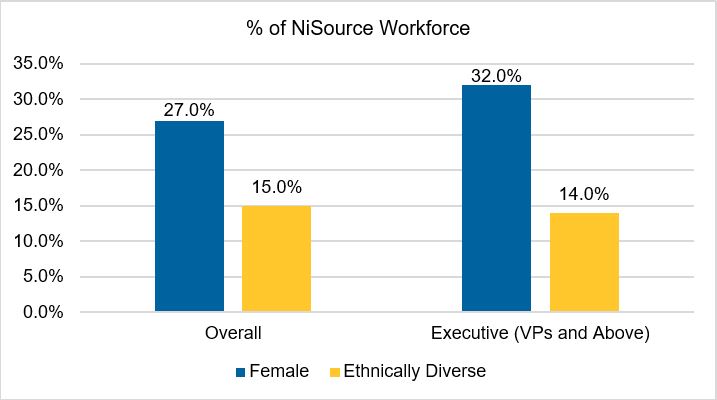
Diversity*.* Our talent acquisition teams hired 612 external candidates in 2020 across all business segments. 35% of external hires were female and 18% were racially or ethnically diverse. In 2020, we engaged with community-based organizations, conducted career interest workshops in local schools, and focused our employee mentorship program on females. We also led a separate targeted development program for select employees to support the growth and development of female and ethnically diverse talent. We offered several employee resource groups (“ERGs”) and hosted mostly virtual activities throughout 2020. We have ERGs set up to support African-American, LatinX, veterans, LGBTQ+, female and Asian employees, among others, and held several sponsored conversations between senior executives and the ERGs.
The following provides the diversity breakdown of NiSource as of December 31, 2020:
Talent Development*.* We offer leadership development programs to enhance the behaviors and skills of our existing and future leaders. In 2020, we had participation from employees of all levels. We also offer extensive technical and non-technical
ITEM 1. BUSINESS
NIS****OURCE INC.
employee training programs. Additionally, we strive to provide promotion and advancement opportunities for employees. In 2020, 84% of all leadership positions at the supervisor and above level were filled internally. Succession planning is regularly conducted to ensure bench strength for leadership positions. We utilize retention bonuses and conduct stay conversations in order to retain talent. Retention at NiSource in 2020 was over 93%. Retention is calculated using the total number of terminations divided by the average headcount for the annual period, not including the impacts from the sale of the Massachusetts Business and voluntary separation programs.
Employee Safety and Wellness*.* We have a number of programs to support employees and their families’ physical, mental, and financial well-being. These programs include a paid wellness day, telemedicine services, an Employee Assistance Program, Integrated Health Management navigation services, employee paid sick/disability leave and paid illness in family days, competitive medical, dental, vision, life and long term disability programs including employee health savings account company contributions and no cost registered financial planner counseling.
In response to COVID-19, we have implemented procedures designed to protect our employees who work in the field and who continue to work in operational and corporate facilities, including social distancing, wearing face coverings, temperature checks and more frequent cleaning of equipment and facilities. We have also implemented work-from-home policies and practices. We have minimized non-essential work that requires an employee to enter a customer premise and limited company vehicle occupancy to one person, where possible. We continue to employ physical and cybersecurity measures to ensure that our operational and support systems remain functional. Our actions to date have mitigated the spread of COVID-19 amongst our employees. We will continue to follow the Centers for Disease Control and Prevention ("CDC") guidance and implement safety measures intended to ensure employee and customer safety during the pandemic.
Other Relevant Business Information
Our customer base is broadly diversified, with no single customer accounting for a significant portion of revenues.
For a listing of certain subsidiaries of NiSource refer to Exhibit 21.
We electronically file various reports with the SEC, including annual reports on Form 10-K, quarterly reports on Form 10-Q, current reports on Form 8-K and amendments to such reports, as well as our proxy statements for the Company's annual meetings of stockholders at http://www.sec.gov. Additionally, we make all SEC filings available without charge to the public on our web site at http://www.nisource.com. The information contained on our website is not included in, nor incorporated by reference into, this Annual Report on Form 10-K.
ITEM 1A. RISK FACTORS
NIS****OURCE INC.
Our operations and financial results are subject to various risks and uncertainties, including those described below, that could adversely affect our business, financial condition, results of operations, cash flows, and the trading price of our common stock.
OPERATIONAL RISKS
We may not be able to execute our business plan or growth strategy, including utility infrastructure investments.
Business or regulatory conditions may result in us not being able to execute our business plan or growth strategy, including identified, planned and other utility infrastructure investments, which includes investments related to natural gas pipeline modernization and investments related to our renewable energy projects and the build-transfer execution goals within our business plan. Our “NiSource Next” initiative, a comprehensive program designed to identify long-term sustainable capability enhancements and cost optimization improvements, may not be effective. Our customer and regulatory initiatives may not achieve planned results. Utility infrastructure investments may not materialize, may cease to be achievable or economically viable and may not be successfully completed. Natural gas may cease to be viewed as an economically and environmentally attractive fuel. Environmental activist groups, investors and governmental entities may continue to oppose natural gas delivery and infrastructure investments in the jurisdictions where we operate because of perceived environmental impacts associated with the natural gas supply chain and end use. Energy conservation, energy efficiency, distributed generation, energy storage, policies favoring electric heat over gas heat and other factors may reduce demand for natural gas and energy. In addition, we consider acquisitions or dispositions of assets or businesses, joint ventures and mergers from time to time as we execute on our business plan and growth strategy. Any of these circumstances could adversely affect our results of operations and growth prospects. Even if our business plan and growth strategy are executed, there is still risk of, among other things, human error in maintenance, installation or operations, shortages or delays in obtaining equipment, and performance below expected levels (in addition to the other risks discussed in this section).
Our gas distribution and transmission activities, as well as generation, transmission and distribution of electricity, involve a variety of inherent hazards and operating risks, including potential public safety risks.
Our gas distribution and transmission activities, as well as generation, transmission, and distribution of electricity, involve a variety of inherent hazards and operating risks, including, but not limited to, gas leaks and over-pressurization, downed power lines, excavation or vehicular damage to our infrastructure, outages, environmental spills, mechanical problems and other incidents, which could cause substantial financial losses, as demonstrated in part by the Greater Lawrence Incident. In addition, these hazards and risks have resulted and may in the future result in serious injury or loss of life to employees and/or the general public, significant damage to property, environmental pollution, impairment of our operations, adverse regulatory rulings and reputational harm, which in turn could lead to substantial losses for us. The location of pipeline facilities, including regulator stations, liquefied natural gas and underground storage, or generation, transmission, substation and distribution facilities near populated areas, including residential areas, commercial business centers and industrial sites, could increase the level of damages resulting from such incidents. As with the Greater Lawrence Incident, certain incidents have subjected and may in the future subject us to litigation or administrative or other legal proceedings from time to time, both civil and criminal, which could result in substantial monetary judgments, fines, or penalties against us, be resolved on unfavorable terms, and require us to incur significant operational expenses. The occurrence of incidents has in certain instances adversely affected and could in the future adversely affect our reputation, cash flows, financial position and/or results of operations. We maintain insurance against some, but not all, of these risks and losses.
Failure to adapt to advances in technology and manage the related costs could make us less competitive and negatively impact our results of operations and financial condition.
A key element of our business model includes generating power at central station power plants to achieve economies of scale and produce power at a competitive cost. We continue to research, plan for, and implement new technologies that produce reliable, cost-efficient power or reduce power consumption. These technologies include renewable energy, distributed generation, energy storage, and energy efficiency. Advances in technology, changes in laws or regulations (including subsidization) and other alternative methods of producing power are reducing the cost of electric generation from these sources to a level that is competitive with most central station power electric production. This could cause power sales to decline and the value of our generating facilities to decline. New technologies may require us to make significant expenditures to remain competitive and may result in the obsolescence of certain operating assets.
Our natural gas business model leverages widespread utilization of natural gas for space heating as a core driver of revenues. Alternative energy sources, new technologies or alternatives to natural gas space heating, including cold climate heat pumps and/or efficiency of other products, could reduce demand and increase customer attrition, which would impact our ability to recover on our investments in our gas distribution assets.
ITEM 1A. RISK FACTORS
NIS****OURCE INC.
In addition, customers are increasingly expecting additional communications, increased access to information, and expanded electronic capabilities regarding their electric and natural gas services, which, in some cases, involves additional investments in technology. We also rely on technology to adequately maintain key business records.
Our future success will depend, in part, on our ability to anticipate and successfully adapt to technological changes, to offer services that meet customer demands and evolving industry standards, and to recover all, or a significant portion of, any unrecovered investment in obsolete assets. A failure by us to effectively adapt to changes in technology and manage the related costs could harm our ability to remain competitive in the marketplace for our products, services and processes and could have a material adverse impact on our results of operations and financial condition.
Aging infrastructure may lead to disruptions in operations and increased capital expenditures and maintenance costs, all of which could negatively impact our financial results.
We have risks associated with aging infrastructure, including our electric and gas infrastructure assets. These risks can be driven by threats such as, but not limited to, electrical faults, mechanical failure, internal corrosion, external corrosion, ground movement and stress corrosion and/or cracking. The age of these assets may result in a need for replacement, a higher level of maintenance costs, or unscheduled outages, despite efforts by us to properly maintain or upgrade these assets through inspection, scheduled maintenance and capital investment. In addition, the nature of the information available on aging infrastructure assets, which in some cases is incomplete, may make inspections, maintenance, upgrading and replacement of the assets particularly challenging. Missing or incorrect infrastructure data may lead to (1) difficulty properly locating facilities, which can result in excavator damage and operational or emergency response issues, and (2) configuration and control risks associated with the modification of system operating pressures in connection with turning off or turning on service to customers, which can result in unintended outages or operating pressures. Also, additional maintenance and inspections are required in some instances in order to improve infrastructure information and records and address emerging regulatory or risk management requirements, which increases our costs. The failure to operate these assets as desired could result in interruption of electric service, major component failure at generating facilities and electric substations, gas leaks and other incidents and in our inability to meet firm service obligations, which could adversely impact revenues, and could also result in increased capital expenditures and maintenance costs, which, if not fully recovered from customers, could negatively impact our financial results.
We may be unable to obtain insurance on acceptable terms or at all, and the insurance coverage we do obtain may not provide protection against all significant losses.
Our ability to obtain insurance, as well as the cost and coverage of such insurance, are affected by developments affecting our business; international, national, state, or local events; and the financial condition and underwriting considerations of insurers. For example, some insurers are moving away from underwriting certain energy related businesses such as those in the coal industry or those exposed to certain perils such as wildfires as well as gas explosion events or other infrastructure-related risks. The utility insurance market is experiencing a hardening environment due to reductions in commercial suppliers and the capacity they are willing to issue, increases in overall demand for capacity, and a prevalence of severe losses. We have not been able to obtain liability insurance coverage at previously procured limits at rates that are acceptable to us. Insurance coverage may not continue to be available at limits, rates or terms acceptable to us. The premiums we pay for our insurance coverage have significantly increased as a result of market conditions and the accumulated loss ratio over the history of our operations, and we expect that they will continue to increase as a result of hardening in market conditions. In addition, our insurance is not sufficient or effective under all circumstances and against all hazards or liabilities to which we are subject. For example, total expenses related to the Greater Lawrence Incident exceeded the total amount of liability coverage available under our policies. Certain types of damages, expenses or claimed costs, such as fines and penalties, have been and in the future may be excluded under the policies. In addition, insurers providing insurance to us may raise defenses to coverage under the terms and conditions of the respective insurance policies that could result in a denial of coverage or limit the amount of insurance proceeds available to us. Any losses for which we are not fully insured or that are not covered by insurance at all could materially adversely affect our results of operations, cash flows, and financial position.
The implementation of NIPSCO’s electric generation strategy, including the retirement of its coal generation units, may not achieve intended results.
Our plan to replace 80% of our coal generation capacity by mid-2023 and all of our coal generation by the end of 2028 with primarily renewable resources may not progress as anticipated. On October 31, 2018, NIPSCO submitted its 2018 Integrated Resource Plan with the IURC setting forth its short- and long-term electric generation plans in an effort to maintain affordability while providing reliable, flexible and cleaner sources of power. The Integrated Resource Plan evaluated demand-side and supply-side resource alternatives to meet NIPSCO customers' future energy requirements over the ensuing 20 years.
Previous: Cover and table of contents · Next: Item 1A. RISK FACTORS