 filings.tools
Cover and table of contents
48K characters. Original on sec.gov ·
Cover and table of contents
UNITED STATES
SECURITIES AND EXCHANGE COMMISSION
Washington, D.C. 20549
FORM 10-K
| ☑ | ANNUAL REPORT PURSUANT TO SECTION 13 OR 15(d) |
OF THE SECURITIES EXCHANGE ACT OF 1934
For the fiscal year ended December 31, 2021
OR
| ☐ | TRANSITION REPORT PURSUANT TO SECTION 13 OR 15(d) |
OF THE SECURITIES EXCHANGE ACT OF 1934
For the transition period from to
Commission file number 001-16189
NiSource Inc.
(Exact name of registrant as specified in its charter)
| DE | 35-2108964 | ||||||||||
| (State or other jurisdiction of incorporation or organization) | (I.R.S. Employer Identification No.) | ||||||||||
| 801 East 86th Avenue | |||||||||||
| Merrillville, | IN | 46410 | |||||||||
| (Address of principal executive offices) | (Zip Code) |
(877) 647-5990
(Registrant’s telephone number, including area code)
Securities registered pursuant to Section 12(b) of the Act:
| Title of Each Class | Trading Symbol(s) | Name of Each Exchange on Which Registered | ||||||
| Common Stock, par value $0.01 per share | NI | NYSE | ||||||
| Depositary Shares, each representing a 1/1,000th ownership interest in a share of 6.50% Series B Fixed-Rate Reset Cumulative Redeemable Perpetual Preferred Stock, par value $0.01 per share, liquidation preference $25,000 per share and a 1/1,000th ownership interest in a share of Series B-1 Preferred Stock, par value $0.01 per share, liquidation preference $0.01 per share | NI PR B | NYSE | ||||||
| Series A Corporate Units | NIMC | NYSE |
Securities registered pursuant to Section 12(g) of the Act: None
Indicate by check mark if the registrant is a well-known seasoned issuer, as defined in Rule 405 of the Securities Act. Yes þ No ¨
Indicate by check mark if the registrant is not required to file reports pursuant to Section 13 or 15(d) of the Act. Yes ¨ No þ
Indicate by check mark whether the registrant (1) has filed all reports required to be filed by Section 13 or 15(d) of the Securities Exchange Act of 1934 during the preceding 12 months (or for such shorter period that the registrant was required to file such reports), and (2) has been subject to such filing requirements for the past 90 days.
Yes þ No ¨
Indicate by check mark whether the registrant has submitted electronically every Interactive Data File required to be submitted pursuant to Rule 405 of Regulation S-T (§232.405 of this chapter) during the preceding 12 months (or for such shorter period that the registrant was required to submit such files).
Yes þ No ¨
Indicate by check mark whether the registrant is a large accelerated filer, an accelerated filer, a non-accelerated filer, a smaller reporting company, or an emerging growth company. See the definition of “large accelerated filer,” “accelerated filer,” “smaller reporting company,” and "emerging growth company" in Rule 12-b-2 of the Exchange Act.
Large accelerated filer þ Accelerated Filer ¨ Emerging Growth Company ☐ Non-accelerated Filer ¨ Smaller Reporting Company ☐
If an emerging growth company, indicate by check mark if the registrant has elected not to use the extended transition period for complying with any new or revised financial accounting standards provided pursuant to Section 13(a) of the Exchange Act. ☐
Indicate by check mark whether the registrant has filed a report on and attestation to its management’s assessment of the effectiveness of its internal control over financial reporting under Section 404(b) of the Sarbanes-Oxley Act (15 U.S.C. 7262(b)) by the registered public accounting firm that prepared or issued its audit report. ☑
Indicate by check mark whether the registrant is a shell company (as defined in Rule 12b-2 of the Act). Yes ☐ No þ
The aggregate market value of the registrant's common stock, par value $0.01 per share (the "Common Stock") held by non-affiliates was approximately $9,579,675,045 based upon the June 30, 2021, closing price of $24.50 on the New York Stock Exchange.
There were 405,385,010 shares of Common Stock outstanding as of February 15, 2022.
Documents Incorporated by Reference
Part III of this report incorporates by reference specific portions of the Registrant’s Notice of Annual Meeting and Proxy Statement relating to the Annual Meeting of Stockholders to be held on May 24, 2022.
CONTENTS
| DEFINED TERMS | ||||||||
| The following is a list of frequently used abbreviations or acronyms that are found in this report: | ||||||||
| NiSource Subsidiaries and Affiliates | ||||||||
| Columbia of Kentucky | Columbia Gas of Kentucky, Inc. | |||||||
| Columbia of Maryland | Columbia Gas of Maryland, Inc. | |||||||
| Columbia of Massachusetts | Bay State Gas Company | |||||||
| Columbia of Ohio | Columbia Gas of Ohio, Inc. | |||||||
| Columbia of Pennsylvania | Columbia Gas of Pennsylvania, Inc. | |||||||
| Columbia of Virginia | Columbia Gas of Virginia, Inc. | |||||||
| NIPSCO | Northern Indiana Public Service Company LLC | |||||||
| NiSource ("we," "us" or "our") | NiSource Inc. | |||||||
| Rosewater | Rosewater Wind Generation LLC and its wholly owned subsidiary, Rosewater Wind Farm LLC | |||||||
| Indiana Crossroads Wind | Indiana Crossroads Wind Generation LLC and its wholly owned subsidiary, Indiana Crossroads Wind Farm LLC | |||||||
| Abbreviations and Other | ||||||||
| ACE | Affordable Clean Energy | |||||||
| AFUDC | Allowance for funds used during construction | |||||||
| AOCI | Accumulated Other Comprehensive Income (Loss) | |||||||
| ASC | Accounting Standards Codification | |||||||
| ASU | Accounting Standards Update | |||||||
| ATM | At-the-market | |||||||
| BTA | Build-transfer agreement | |||||||
| CAP | Compliance Assurance Process | |||||||
| CCGT | Combined Cycle Gas Turbine | |||||||
| CCRs | Coal Combustion Residuals | |||||||
| CEP | Capital Expenditure Program | |||||||
| CERCLA | Comprehensive Environmental Response Compensation and Liability Act (also known as Superfund) | |||||||
| Corporate Units | Series A Corporate Units | |||||||
| COVID-19 ("the COVID-19 pandemic" or "the pandemic") | Novel Coronavirus 2019 and its variants, including the Delta and Omicron variants, and any other variant that may emerge | |||||||
| DPU | Department of Public Utilities | |||||||
| DSM | Demand Side Management | |||||||
| EPA | United States Environmental Protection Agency | |||||||
| EPS | Earnings per share | |||||||
| Equity Units | Series A Equity Units | |||||||
| FAC | Fuel adjustment clause | |||||||
| FMCA | Federally Mandated Cost Adjustment | |||||||
| GAAP | Generally Accepted Accounting Principles | |||||||
| GCA | Gas cost adjustment | |||||||
| GHG | Greenhouse gases | |||||||
| GWh | Gigawatt hours | |||||||
| HLBV | Hypothetical Liquidation at Book Value | |||||||
| IRP | Infrastructure Replacement Program | |||||||
| IRS | Internal Revenue Service | |||||||
| IURC | Indiana Utility Regulatory Commission |
| DEFINED TERMS | ||||||||
| LDCs | Local distribution companies | |||||||
| LIBOR | London InterBank Offered Rate | |||||||
| LIFO | Last-in, first-out | |||||||
| Massachusetts Business | All of the assets sold to, and liabilities assumed by, Eversource pursuant to the Asset Purchase Agreement | |||||||
| MGP | Manufactured Gas Plant | |||||||
| MISO | Midcontinent Independent System Operator | |||||||
| MMDth | Million dekatherms | |||||||
| MW | Megawatts | |||||||
| MWh | Megawatt hours | |||||||
| NOL | Net Operating Loss | |||||||
| NTSB | National Transportation Safety Board | |||||||
| NYMEX | The New York Mercantile Exchange | |||||||
| OPEB | Other Postretirement and Postemployment Benefits | |||||||
| PCB | Polychlorinated biphenyls | |||||||
| PHMSA | Pipeline and Hazardous Materials Safety Administration | |||||||
| PPA | Power Purchase Agreement | |||||||
| PSC | Public Service Commission | |||||||
| PUC | Public Utilities Commission | |||||||
| RCRA | Resource Conservation and Recovery Act | |||||||
| ROE | Return on Equity | |||||||
| ROU | Right of Use | |||||||
| SAVE | Steps to Advance Virginia's Energy Plan | |||||||
| Scope 1 GHG Emissions | Direct emissions from sources owned or controlled by us (e.g., emissions from our combustion of fuel, vehicles, and process emissions and fugitive emissions) | |||||||
| SEC | Securities and Exchange Commission | |||||||
| SMRP | Safety Modification and Replacement Program | |||||||
| SMS | Safety Management System | |||||||
| STRIDE | Strategic Infrastructure Development and Enhancement | |||||||
| TCJA | An Act to provide for reconciliation pursuant to titles II and V of the concurrent resolution on the budget for fiscal year 2018 (commonly known as the Tax Cuts and Jobs Act of 2017) | |||||||
| TDSIC | Transmission, Distribution and Storage System Improvement Charge | |||||||
| U.S. Attorney's Office | U.S. Attorney's Office for the District of Massachusetts | |||||||
| VIE | Variable Interest Entity |
Note regarding forward-looking statements
This Annual Report on Form 10-K contains "forward-looking statements," within the meaning of Section 27A of the Securities Act of 1933, as amended (the "Securities Act"), and Section 21E of the Securities Exchange Act of 1934, as amended (the "Exchange Act"). Investors and prospective investors should understand that many factors govern whether any forward-looking statement contained herein will be or can be realized. Any one of those factors could cause actual results to differ materially from those projected. These forward-looking statements include, but are not limited to, statements concerning our plans, strategies, objectives, expected performance, expenditures, recovery of expenditures through rates, stated on either a consolidated or segment basis, and any and all underlying assumptions and other statements that are other than statements of historical fact. Expressions of future goals and expectations and similar expressions, including "may," "will," "should," "could," "would," "aims," "seeks," "expects," "plans," "anticipates," "intends," "believes," "estimates," "predicts," "potential," "targets," "forecast," and "continue," reflecting something other than historical fact are intended to identify forward-looking statements.
All forward-looking statements are based on assumptions that management believes to be reasonable; however, there can be no assurance that actual results will not differ materially.
Factors that could cause actual results to differ materially from the projections, forecasts, estimates and expectations discussed in this Annual Report on Form 10-K include, among other things, our ability to execute our business plan or growth strategy, including utility infrastructure investments; potential incidents and other operating risks associated with our business; our ability to adapt to, and manage costs related to, advances in technology; impacts related to our aging infrastructure; our ability to obtain sufficient insurance coverage and whether such coverage will protect us against significant losses; the success of our electric generation strategy; construction risks and natural gas costs and supply risks; fluctuations in demand from residential and commercial customers; fluctuations in the price of energy commodities and related transportation costs or an inability to obtain an adequate, reliable and cost-effective fuel supply to meet customer demands; the attraction and retention of a qualified, diverse workforce and ability to maintain good labor relations; our ability to manage new initiatives and organizational changes; the actions of activist stockholders; the performance of third-party suppliers and service providers; potential cybersecurity-attacks; increased requirements and costs related to cybersecurity; any damage to our reputation; any remaining liabilities or impact related to the sale of the Massachusetts Business; the impacts of natural disasters, potential terrorist attacks or other catastrophic events; the physical impacts of climate change and the transition to a lower carbon future; our ability to manage the financial and operational risks related to achieving our carbon emission reduction goals; our debt obligations; any changes to our credit rating or the credit rating of certain of our subsidiaries; any adverse effects related to our equity units; adverse economic and capital market conditions or increases in interest rates; economic regulation and the impact of regulatory rate reviews; our ability to obtain expected financial or regulatory outcomes; continuing and potential future impacts from the COVID-19 pandemic; economic conditions in certain industries; the reliability of customers and suppliers to fulfill their payment and contractual obligations; the ability of our subsidiaries to generate cash; pension funding obligations; potential impairments of goodwill; changes in the method for determining LIBOR and the potential replacement of the LIBOR benchmark interest rate; the outcome of legal and regulatory proceedings, investigations, incidents, claims and litigation; potential remaining liabilities related to the Greater Lawrence Incident; compliance with the agreements entered into with the U.S. Attorney’s Office to settle the U.S. Attorney’s Office’s investigation relating to the Greater Lawrence Incident; compliance with applicable laws, regulations and tariffs; compliance with environmental laws and the costs of associated liabilities; changes in taxation; and other matters set forth in Item 1, "Business," Item 1A, "Risk Factors" and Part II, Item 7, "Management’s Discussion and Analysis of Financial Condition and Results of Operations," of this report, some of which risks are beyond our control. In addition, the relative contributions to profitability by each business segment, and the assumptions underlying the forward-looking statements relating thereto, may change over time.
All forward-looking statements are expressly qualified in their entirety by the foregoing cautionary statements. We undertake no obligation to, and expressly disclaim any such obligation to, update or revise any forward-looking statements to reflect changed assumptions, the occurrence of anticipated or unanticipated events or changes to the future results over time or otherwise, except as required by law.
PART I
ITEM 1. BUSINESS
NIS****OURCE INC.
NiSource Inc. is an energy holding company under the Public Utility Holding Company Act of 2005 whose primary subsidiaries are fully regulated natural gas and electric utility companies, serving approximately 3.7 million customers in six states. NiSource is the successor to an Indiana corporation organized in 1987 under the name of NIPSCO Industries, Inc., which changed its name to NiSource on April 14, 1999.
NiSource’s principal subsidiaries include NiSource Gas Distribution Group, Inc., a natural gas distribution holding company, and NIPSCO, a gas and electric company. NiSource derives substantially all of its revenues and earnings from the operating results of these rate-regulated businesses.
NiSource has two reportable segments: Gas Distribution Operations and Electric Operations. The following is a summary of the business for each reporting segment. Refer to Item 7, “Management’s Discussion and Analysis of Financial Condition and Results of Operations” and Note 23, "Segments of Business," in the Notes to Consolidated Financial Statements for additional information related to each segment.
Gas Distribution Operations
Our natural gas distribution operations serve approximately 3.2 million customers in six states. Through our wholly-owned subsidiary NiSource Gas Distribution Group, Inc., we own five distribution subsidiaries that provide natural gas to approximately 2.4 million residential, commercial and industrial customers in Ohio, Pennsylvania, Virginia, Kentucky, and Maryland. Additionally, we distribute natural gas to approximately 853,000 customers in northern Indiana through our wholly-owned subsidiary NIPSCO. We operate approximately 54,600 miles of distribution main pipeline plus the associated individual customer service lines and 1,000 miles of transmission main pipeline located in our service areas described below. Throughout our service areas we also have gate stations and other operations support facilities.
We earn revenues that are approved by the jurisdictions in which we operate for the delivery of natural gas to our customers. The approved revenues include provisions to adjust billings for fluctuations in the cost of natural gas. Revenues are adjusted for differences between actual costs, subject to reconciliation, and the amounts billed in current rates.
Electric Operations
We generate, transmit and distribute electricity through our subsidiary NIPSCO to approximately 483,000 customers in 20 counties in the northern part of Indiana and also engage in wholesale electric and transmission transactions. We own and operate sources of generation as well as source power through PPAs. We continue to transition our generation portfolio to primarily renewable sources. During 2021, we operated Rosewater for the full year and Indiana Crossroads Wind went into service during December 2021. We also purchased energy generated from renewable sources through PPAs. In October 2021, NIPSCO completed the retirement of two coal-burning units with installed capacity of approximately 903 MW at Schahfer Generating Station, located in Wheatfield, IN. As of December 31, 2021 we have multiple PPAs that provide 500 MW of capacity, with contracts expiring between 2024 and 2040. See below for information on our owned operating facilities:
| Facility Name | Location | Fuel Type | Generating Capacity (MW)****(1) | |||||||||||
| R.M. Schahfer | Wheatfield, IN | Steam - Coal | 722 | |||||||||||
| Michigan City | Michigan City, IN | Steam - Coal | 455 | |||||||||||
| Sugar Creek | West Terre Haute, IN | CCGT | 563 | |||||||||||
| R.M. Schahfer | Wheatfield, IN | Natural Gas | 155 | |||||||||||
| Oakdale | Carroll County, IN | Hydro | 9 | |||||||||||
| Norway | White County, IN | Hydro | 7 | |||||||||||
| Rosewater Wind Generation LLC(2) | White County, IN | Wind | 102 | |||||||||||
| Indiana Crossroads Wind Generation LLC(2) | White County, IN | Wind | 302 | |||||||||||
| Total MW Capacity | 2,315 |
(1)Represents current net generating capability of each fossil fuel and hydro generating unit. Nameplate capacity is listed for wind generating units.
(2)NIPSCO is the managing partner of these joint ventures. Refer to Note 4, "Variable Interest Entities," in the Notes to Consolidated Financial Statements for more information.
NIPSCO’s transmission system, with voltages from 69,000 to 765,000 volts, consists of 3,024 circuit miles. NIPSCO is interconnected with eight neighboring electric utilities.
ITEM 1. BUSINESS
NIS****OURCE INC.
NIPSCO participates in the MISO transmission service and wholesale energy market. MISO is a nonprofit organization created in compliance with FERC regulations to improve the flow of electricity in the regional marketplace and to enhance electric reliability. Additionally, MISO is responsible for managing energy markets, transmission constraints and the day-ahead, real-time, Financial Transmission Rights and ancillary markets. NIPSCO transferred functional control of its electric transmission assets to MISO, and transmission service for NIPSCO occurs under the MISO Open Access Transmission Tariff. NIPSCO units are dispatched by MISO which takes into account economics, reliability of the MISO system and unit availability. During the year ended December 31, 2021, NIPSCO units were dispatched to meet 47.87% of its load requirements, and NIPSCO purchased 52.13% from the MISO market.
Business Strategy
We focus our business strategy on providing safe and reliable service through our core, rate-regulated asset-based utilities, which generate substantially all of our operating income. Our utilities continue to move forward on core safety, infrastructure and environmental investment programs supported by complementary regulatory and customer initiatives across all six states in which we operate. Our goal is to develop strategies that benefit all stakeholders as we (i) embark on long-term infrastructure investment and safety programs to better serve our customers, (ii) align our tariff structures with our cost structure, and (iii) address changing customer conservation patterns. These strategies focus on improving safety and reliability, enhancing customer service, ensuring customer affordability and reducing emissions while generating sustainable returns.
The safety of our customers, communities and employees has been and remains our top priority. SMS is an established operating model within NiSource. With the continued support and advice from our Quality Review Board (a panel of third parties with safety operations expertise engaged by management to advise on safety matters), we are continuing to mature our SMS processes, capabilities and talent as we collaborate within and across industries to enhance safety and reduce operational risk. Additionally, we continue to pursue regulatory and legislative initiatives that will allow residential customers not currently on our system to obtain gas service in a cost effective manner.
In November 2021, we submitted our 2021 Integrated Resource Plan with the IURC. The plan calls for the replacement of the retiring units with a diverse portfolio of resources including demand side management resources, incremental solar, stand-alone energy storage and upgrades to existing facilities at the Sugar Creek Generating Station, among other steps. Refer to Item 7, "Management's Discussion and Analysis of Financial Condition and Results of Operations” for further discussion of these plans.
The NiSource Political Action Committee ("NiPAC") provides our employees a voice in the political process. NiPAC is a voluntary, employee and director driven and funded political action committee, and NiPAC makes bipartisan political contributions to local, state and federal candidates, where permitted and in accordance with established guidelines. Consistent with our commitments and our approach to engagement, the NiPAC leadership committee members evaluate candidates for support on issues important to our business.
Natural Gas Competition. Open access to natural gas supplies over interstate pipelines and the deregulation of the gas supply has led to tremendous change in the energy markets. LDC customers can purchase gas directly from producers and marketers in an open, competitive market. This separation or “unbundling” of the transportation and other services offered by LDCs allows customers to purchase the commodity independent of services provided by LDCs. LDCs continue to purchase gas and recover the associated costs from their customers. Certain of our Gas Distribution Operations’ subsidiaries are involved in programs that provide our residential and commercial customers the opportunity to purchase their natural gas requirements from third parties and use our Gas Distribution Operations’ subsidiaries for transportation services. As of December 31, 2021, 26.2% of our residential customers and 35.4% of our commercial customers participated in such programs.
Gas Distribution Operations competes with (i) investor-owned, municipal, and cooperative electric utilities throughout its service areas, (ii) other regulated and unregulated natural gas intra and interstate pipelines and (iii) other alternate fuels, such as propane and fuel oil. Gas Distribution Operations continues to be a strong competitor in the energy market as a result of strong customer preference for natural gas. Competition with providers of electricity has traditionally been the strongest in the residential and commercial markets of Kentucky, southern Ohio, central Pennsylvania and western Virginia due to comparatively low electric rates.
Electric Competition. Indiana electric utilities generally have exclusive service areas under Indiana regulations, and retail electric customers in Indiana do not have the ability to choose their electric supplier. NIPSCO faces non-utility competition from other energy sources, such as self-generation by large industrial customers and other distributed energy sources.
ITEM 1. BUSINESS
NIS****OURCE INC.
Seasonality
A significant portion of our operations are subject to seasonal fluctuations in sales. During the heating and cooling seasons, revenues from gas and electric sales, respectively, are more significant than in other months. The heating season is primarily from November through March, and the cooling season is primarily from June through September.
Rate Case Actions
The following table describes current rate case actions as applicable in each of our jurisdictions net of tracker impacts. See "Cost Recovery and Trackers" below for further detail on trackers.
| (in millions) | |||||||||||||||||||||||
| Company | Proposed ROE | Approved ROE | Requested Incremental Revenue | Approved Incremental Revenue | Filed | Status | Rates Effective | ||||||||||||||||
| Currently Approved in Rates | |||||||||||||||||||||||
| Columbia of Pennsylvania(1) | 10.95 | % | None specified | $ | 98.3 | $ | 58.5 | March 30, 2021 | Approved December 16, 2021 | December 2021 | |||||||||||||
| Columbia of Maryland | 10.85 | % | 9.65 | % | $ | 4.8 | $ | 2.4 | May 14, 2021 | Approved December 3, 2021 | December 2021 | ||||||||||||
| Columbia of Kentucky(2) | 10.30 | % | 9.35 | % | $ | 26.7 | $ | 18.3 | May 28, 2021 | Approved December 28, 2021 | January 2022 | ||||||||||||
| Columbia of Virginia(3) | 10.95 | % | None specified | $ | 14.2 | $ | 1.3 | August 28, 2018 | Approved June 12, 2019 | February 2019 | |||||||||||||
| Columbia of Ohio | 11.50 | % | 10.39 | % | $ | 87.8 | $ | 47.1 | March 3, 2008 | Approved December 3, 2008 | December 2008 | ||||||||||||
| NIPSCO - Gas | 10.70 | % | 9.85 | % | $ | 138.1 | $ | 105.6 | September 27, 2017 | Approved September 19, 2018 | October 2018 | ||||||||||||
| NIPSCO - Electric | 10.80 | % | 9.75 | % | $ | 21.4 | $ | (53.5) | October 31, 2018 | Approved December 4, 2019 | January 2020 | ||||||||||||
| Active Rate Cases | |||||||||||||||||||||||
| Columbia of Ohio | 10.95 | % | In process | $ | 221.4 | In process | June 30, 2021 | Order Expected Q3 2022 | Q3 2022 | ||||||||||||||
| NIPSCO - Gas(4) | 10.50 | % | In process | $ | 109.7 | In process | September 29, 2021 | Order Expected Q3 2022 | September 2022 |
(1)No approved ROE is identified for this matter since the approved revenue increase is the result of a black box settlement under which parties agree upon the amount of increase without specifying ratemaking elements to establish the Company's revenue requirement. Pursuant to the settlement, for purposes of calculating its DSIC, Columbia of Pennsylvania shall use the equity return rate for gas utilities contained in the Pennsylvania Commission’s most recent Quarterly Report on the Earnings of Jurisdictional Utilities, including quarterly updates thereto.
(2)The approved ROE for natural gas capital riders (e.g.,SMRP) is 9.275%.
(3)Columbia of Virginia's rate case resulted in a black box settlement, representing a settlement to a specific revenue increase but not a specified ROE. The settlement provides use of a 9.70% ROE for future SAVE filings.
(4)Proposed new rates would be implemented in 2 steps, with implementation of step 1 rates to be effective in September 2022 and step 2 rates to be effective in March 2023.
COVID-19 Regulatory Deferrals
In addition to the cost deferred to a regulatory asset as noted in Note 9, "Regulatory Matters," in the Notes to Consolidated Financial Statements, certain states have permitted us to track lost late and disconnect fee revenues due to the pandemic. While these costs do not qualify as regulatory assets under ASC 980, we will consider seeking recovery of these costs in future regulatory proceedings.
Competition and Changes in the Regulatory Environment
The regulatory frameworks applicable to our operations, including environmental regulations, at both the state and federal levels, continue to evolve. These changes have had and will continue to have an impact on our operations, structure and profitability. Management continually seeks new ways to be more competitive and profitable in this environment. We believe we are, in all material respects, in compliance with such laws and regulations and do not expect continued compliance to have a material impact on our capital expenditures, earnings, or competitive position. We continue to monitor existing and pending laws and regulations, and the impact of regulatory changes cannot be predicted with certainty. Refer to Note 19-E, "Environmental Matters," in the Notes to Consolidated Financial Statements for more information regarding environmental regulations that are applicable to our operations.
The Gas Distribution Operations utilities have pursued non-traditional revenue sources within the evolving natural gas marketplace. These efforts include (i) the sale of products and services upstream of the companies’ service territory, (ii) the sale of products and services in the companies’ service territories, and (iii) gas supply cost incentive mechanisms for service to their
ITEM 1. BUSINESS
NIS****OURCE INC.
core markets. The upstream products are made up of transactions that occur between an individual Gas Distribution Operations utility and a buyer for the sales of unbundled or rebundled gas supply and capacity. The on-system services are offered by us to customers and include products such as the transportation and balancing of gas on the Gas Distribution Operations utility's system. The incentive mechanisms give the Gas Distribution Operations utilities an opportunity to share in the savings created from such situations as gas purchase prices paid below an agreed upon benchmark and their ability to reduce pipeline capacity charges with their customers.
We recognize that energy efficiency reduces emissions, conserves natural resources and saves our customers money. Our gas distribution companies offers programs such as energy efficiency upgrades, home checkups and weatherization services. The increased efficiency of natural gas appliances and improvements in home building codes and standards contributes to a long-term trend of declining average use per customer. While we are looking to expand offerings so the energy efficiency programs can benefit as many customers as possible, our Gas Distribution Operations have pursued changes in rate design to more effectively match recoveries with costs incurred. Columbia of Ohio has adopted a straight fixed variable rate design that closely links the recovery of fixed costs with fixed charges. Columbia of Maryland and Columbia of Virginia have regulatory approval for weather and revenue normalization adjustments for certain customer classes, which adjust monthly revenues that exceed or fall short of approved levels. Columbia of Pennsylvania continues to operate its pilot residential weather normalization adjustment and also has a fixed customer charge. This weather normalization adjustment only adjusts revenues when actual weather compared to normal varies by more than 3%. Columbia of Kentucky incorporates a weather normalization adjustment for certain customer classes and also has a fixed customer charge. In a prior gas base rate proceeding, NIPSCO implemented a higher fixed customer charge for residential and small customer classes moving toward recovering more of its fixed costs through a fixed recovery charge, but has no weather or usage protection mechanism.
While increased efficiency of electric appliances and improvements in home building codes and standards has similarly impacted the average use per electric customer in recent years, NIPSCO expects future growth in per customer usage as a result of increasing electric applications. Further growth is anticipated as electric vehicles become more prevalent. These ongoing changes in use of electricity will likely lead to development of innovative rate designs, and NIPSCO will continue efforts to design rates that increase the certainty of recovery of fixed costs.
Cost Recovery and Trackers. Comparability of our line item operating results is impacted by regulatory trackers that allow for the recovery in rates of certain costs such as those described below. Increases in the expenses that are subject to approved regulatory tracker mechanisms generally lead to increased regulatory assets, which ultimately result in a corresponding increase in operating revenues and, therefore, have essentially no impact on total operating income results. Certain approved regulatory tracker mechanisms allow for abbreviated regulatory proceedings in order for the operating companies to quickly implement revised rates and recover associated costs.
A portion of the Gas Distribution revenue is related to the recovery of gas costs, the review and recovery of which occurs through standard regulatory proceedings. All states in our operating area require periodic review of actual gas procurement activity to determine prudence and confirm the recovery of prudently incurred energy commodity costs supplied to customers.
A portion of the Electric Operations revenue is related to the recovery of fuel costs to generate power and the fuel costs related to purchased power. These costs are recovered through a FAC, which is updated quarterly to reflect actual costs incurred to supply electricity to customers.
Human Capital
Human Capital Management Governance and Organizational Practices. The Compensation and Human Capital Committee of our Board of Directors (the "Board") is primarily responsible for assisting the Board in overseeing our human capital management practices. In October 2021, the Board renamed the Compensation Committee the “Compensation and Human Capital Committee” and clarified the Committee’s responsibilities in its Charter to include reviewing our human capital management function and programs, including related procedures, programs, policies and practices, and to make recommendations to management with respect to equal employment opportunity and diversity, equity and inclusion initiatives; employee engagement and corporate culture; and talent management. Our Board also reviews human capital management matters, including talent strategy, employee engagement and culture. Earlier in 2021, we hired a new Senior Vice President and Chief Human Resources Officer and a new Vice President and Chief Diversity Officer to lead these initiatives.
In addition to overseeing our human capital management practices, our Board is committed to ensuring that the Board is comprised of directors with diverse skills, expertise, experience and demographics, including racial and gender diversity. Women and people of color each comprise 30% of our Board.
ITEM 1. BUSINESS
NIS****OURCE INC.
Human Capital Goals and Objectives*.* We have aligned our human capital goals to achieve overall company strategic and operational objectives by driving an enhanced talent strategy, elevating support for front-line leaders, fostering a culture of rigor and accountability and strengthening our human resources function as a whole.
Workforce Composition*.* As of December 31, 2021, we had 7,272 full-time and 70 part-time employees. Thirty-six percent of our employees were subject to collective bargaining agreements with various labor unions and 32% of our employees were subject to collective bargaining agreements that are set to expire within one year. We are currently in the process of renegotiating these agreements.
Diversity, Equity and Inclusion*.* We are committed to accelerating and embedding diversity, equity and inclusion throughout the enterprise to reflect the communities and customers we serve. Our talent acquisition teams hired 748 external candidates in 2021 across all business segments. Thirty-eight percent of external hires were female and 21% were racially or ethnically diverse. In 2021, we engaged with community-based organizations, conducted career interest workshops in local schools, and focused our employee mentorship program on females. We also led a separate targeted development program for select employees to support the growth and development of female and ethnically diverse talent. We offer several employee resource groups (“ERGs”) and host mostly virtual activities throughout each year. We have ERGs to support African-American, Hispanic, veterans, LGBTQ+, female and Asian employees, among others, and held several sponsored conversations between senior executives and the ERGs.
In order to provide additional transparency, we are enhancing our corporate website to include more information on our diversity, equity and inclusion program and plans, which are led by our Chief Diversity, Equity and Inclusion Officer, with the full support of our Chief Human Resources Officer, executive leadership team, Compensation and Human Capital Committee and Board. We plan to post consolidated EEO-1 report data on our website by the end of the first quarter of 2022.
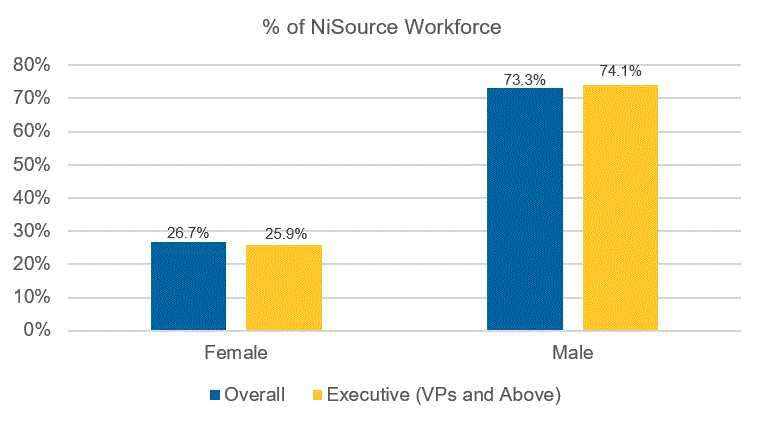
The following graph shows the percentage of total employees represented by females and males overall and for our officers as of December 31, 2021:
ITEM 1. BUSINESS
NIS****OURCE INC.
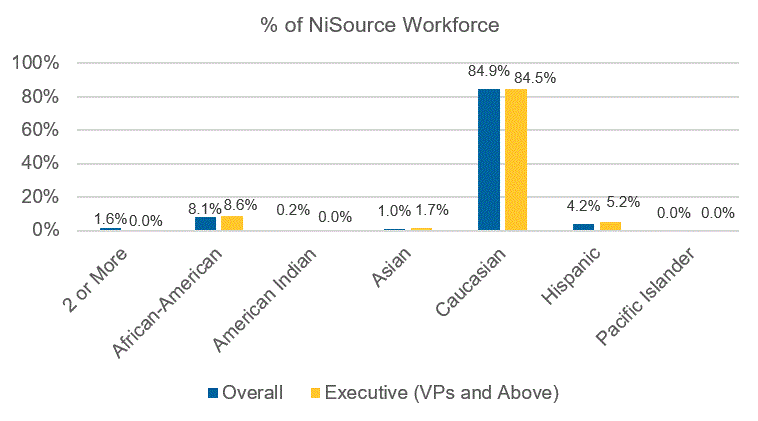
The following graph shows the percentage of total employees represented by race/ethnicity overall and for our officers as of December 31, 2021:
Talent Development and Retention*.* We offer leadership development programs to enhance the behaviors and skills of our existing and future leaders. In 2021, we had participation from employees of all levels. We also offer extensive technical and non-technical employee development training programs.
We strive to provide promotion and advancement opportunities for employees. In 2021, 86% of all leadership positions at the supervisor and above level were filled internally. We develop and implement targeted development action plans to increase succession candidate readiness for leadership roles. We also monitor the risk and potential impact of talent loss and take action to increase retention of top talent. Retention at NiSource in 2021 was over 89%. Retention is calculated using the total number of separations divided by the average headcount for the annual period. In addition to voluntary separations, separations include involuntary separation (2.0%), resignation (4.6%), and retirement (4.2%).
Talent Attraction. To recruit and hire individuals with a variety of skills, talents, backgrounds and experiences, we value and cultivate relationships with community and diversity outreach sources. We also target jobs fairs including those focused on people of color, veteran and women candidates and partner with local colleges and universities to identify and recruit qualified applicants in the communities we serve.
Similar to other companies that are adjusting in a COVID-19 environment, we are focused on our future of work and creating a more flexible, agile model for roles that can be performed in a more virtual setting. We anticipate expanding our recruiting footprint for certain roles that do not require to be in-person within our operating states.
Succession Planning. We perform succession planning quarterly for officer-level and critical roles to ensure that we develop and sustain a strong bench of talent capable of performing at the highest levels. Not only is talent identified, but potential paths of development are discussed to ensure that employees have an opportunity to build their skills and are well-prepared for future roles. We maintain formal succession plans for our Chief Executive Officer ("CEO") and key executive officers. The succession plan for our CEO is reviewed by the Nominating and Governance Committee and the succession plans for executive officers (other than the CEO) and critical roles are reviewed by the Compensation and Human Capital Committee annually or more frequently as needed.
Employee and Workplace Health and Safety*.* We have a number of programs to support employees and their families’ physical, mental, and financial well-being. These programs include a paid wellness day, telemedicine services, an Employee Assistance Program, Integrated Health Management navigation services, employee paid sick/disability leave and paid illness in