 filings.tools
NiSource 10-K 2022-12-31
Filed 2023-02-22. 23 sections, 606K characters. Original on sec.gov · Markdown · JSON
Cover and table of contents
UNITED STATES
SECURITIES AND EXCHANGE COMMISSION
Washington, D.C. 20549
FORM 10-K
| ☑ | ANNUAL REPORT PURSUANT TO SECTION 13 OR 15(d) |
OF THE SECURITIES EXCHANGE ACT OF 1934
For the fiscal year ended December 31, 2022
OR
| ☐ | TRANSITION REPORT PURSUANT TO SECTION 13 OR 15(d) |
OF THE SECURITIES EXCHANGE ACT OF 1934
For the transition period from to
Commission file number 001-16189
NiSource Inc.
(Exact name of registrant as specified in its charter)
| DE | 35-2108964 | ||||||||||
| (State or other jurisdiction of incorporation or organization) | (I.R.S. Employer Identification No.) | ||||||||||
| 801 East 86th Avenue | |||||||||||
| Merrillville, | IN | 46410 | |||||||||
| (Address of principal executive offices) | (Zip Code) |
(877) 647-5990
(Registrant’s telephone number, including area code)
Securities registered pursuant to Section 12(b) of the Act:
| Title of Each Class | Trading Symbol(s) | Name of Each Exchange on Which Registered | ||||||
| Common Stock, par value $0.01 per share | NI | NYSE | ||||||
| Depositary Shares, each representing a 1/1,000th ownership interest in a share of 6.50% Series B Fixed-Rate Reset Cumulative Redeemable Perpetual Preferred Stock, par value $0.01 per share, liquidation preference $25,000 per share and a 1/1,000th ownership interest in a share of Series B-1 Preferred Stock, par value $0.01 per share, liquidation preference $0.01 per share | NI PR B | NYSE | ||||||
| Series A Corporate Units | NIMC | NYSE |
Securities registered pursuant to Section 12(g) of the Act: None
Indicate by check mark if the registrant is a well-known seasoned issuer, as defined in Rule 405 of the Securities Act. Yes þ No ¨
Indicate by check mark if the registrant is not required to file reports pursuant to Section 13 or 15(d) of the Act. Yes ¨ No þ
Indicate by check mark whether the registrant (1) has filed all reports required to be filed by Section 13 or 15(d) of the Securities Exchange Act of 1934 during the preceding 12 months (or for such shorter period that the registrant was required to file such reports), and (2) has been subject to such filing requirements for the past 90 days.
Yes þ No ¨
Indicate by check mark whether the registrant has submitted electronically every Interactive Data File required to be submitted pursuant to Rule 405 of Regulation S-T (§232.405 of this chapter) during the preceding 12 months (or for such shorter period that the registrant was required to submit such files).
Yes þ No ¨
Indicate by check mark whether the registrant is a large accelerated filer, an accelerated filer, a non-accelerated filer, a smaller reporting company, or an emerging growth company. See the definition of “large accelerated filer,” “accelerated filer,” “smaller reporting company,” and "emerging growth company" in Rule 12-b-2 of the Exchange Act.
Large accelerated filer þ Accelerated Filer ¨ Emerging Growth Company ☐ Non-accelerated Filer ¨ Smaller Reporting Company ☐
If an emerging growth company, indicate by check mark if the registrant has elected not to use the extended transition period for complying with any new or revised financial accounting standards provided pursuant to Section 13(a) of the Exchange Act. ☐
Indicate by check mark whether the registrant has filed a report on and attestation to its management’s assessment of the effectiveness of its internal control over financial reporting under Section 404(b) of the Sarbanes-Oxley Act (15 U.S.C. 7262(b)) by the registered public accounting firm that prepared or issued its audit report. ☑
If securities are registered pursuant to Section 12(b) of the Act, indicate by check mark whether the financial statements of the registrants included in the filing reflect the correction of an error to previously issued financial statements. ☐
Indicate by check mark whether any of those error corrections are restatements that required a recovery analysis of incentive-based compensation received by any of the registrant's executive officers during the relevant recovery period pursuant to §240. 10D-1(b).☐
Indicate by check mark whether the registrant is a shell company (as defined in Rule 12b-2 of the Act). Yes ☐ No þ
The aggregate market value of the registrant's common stock, par value $0.01 per share (the "Common Stock") held by non-affiliates was approximately $11,950,785,429 based upon the June 30, 2022, closing price of $29.49 on the New York Stock Exchange.
There were 412,507,944 shares of Common Stock outstanding as of February 15, 2023.
Documents Incorporated by Reference
Part III of this report incorporates by reference specific portions of the Registrant’s Notice of Annual Meeting and Proxy Statement relating to the Annual Meeting of Stockholders to be held on May 23, 2023.
CONTENTS
Showing the first 8K of 61K characters. Open the full section
Item 1. BUSINESS
NIS****OURCE INC.
Employee and Workplace Health and Safety*.* We have several programs to support employees, and their families’ physical, mental, and financial well-being. These programs include a paid wellness day, telemedicine services, an Employee Assistance Program, Integrated Health Management navigation services, employee paid sick/disability leave, parental leave, and paid illness in family days. We also offer competitive medical, dental, vision, life and long-term disability programs, including employee health savings account company contributions.
We have a robust program to support employee, contractor and public safety, which is led by our Chief Safety Officer and is overseen by the Safety, Operations, Regulatory and Policy Committee of our Board. As we will outline in our annual safety report on our corporate website, we continue to invest in risk reduction activities and assets**.**
Culture and Engagement. Our culture is another important aspect of our ability to advance our strategic and operational objectives. In addition to our DE&I, recruiting, development and retention programs described above, we also invest in internal communications programs, including in-person and virtual learning and networking opportunities, as well as regular town hall communications with employees. We measure and monitor culture and employee engagement through a variety of channels including employee lifecycle, pulse, and census surveys.
To instill and reinforce our values and culture, we require our employees to participate in regular trainings on ethics and compliance topics each year, including raising concerns, treating others with respect, preventing discrimination in the workplace, anti-bribery and corruption, data protection, unconscious biases, harassment, conflicts of interest, and how to use the anonymous ethics and compliance hotline. All employees receive training on our Code of Business Conduct biannually or more frequently if there is a material change in content. Our business ethics program, including the employee training program, is reviewed annually by our executive leadership team and the Audit Committee of our Board.
Our Compensation and Human Capital Committee reviews reports from our Chief Human Resources Officer and Chief Diversity, Equity and Inclusion Officer on employee engagement and corporate culture. Our Board reviews results and action plans related to our enterprise-wide comprehensive employee engagement survey. Our executive leadership team, including our Chief Executive Officer, communicates directly and regularly with all employees on timely ethics topics through electronic messages, coffee chats, and all-employee town hall meetings. These communications emphasize the importance of our values and culture in the workplace.
Other Relevant Business Information
Our customer base is broadly diversified, with no single customer accounting for a significant portion of revenues.
For a listing of material subsidiaries of NiSource, refer to Exhibit 21.
We electronically file various reports with the SEC, including annual reports on Form 10-K, quarterly reports on Form 10-Q, current reports on Form 8-K and amendments to such reports, as well as our proxy statements for the Company's annual meetings of stockholders at http://www.sec.gov. Additionally, we make all SEC filings available without charge to the public on our web site at http://www.nisource.com. The information contained on our website is not included in, nor incorporated by reference into, this Annual Report on Form 10-K.
INFORMATION ABOUT OUR EXECUTIVE OFFICERS
NIS****OURCE INC.
The following is a list of our Executive Officers, including their names, ages, offices held and other recent business experience.
| Name | Age | Office(s) Held in Past 5 Years | ||||||||||||
| Lloyd M. Yates | 62 | President and Chief Executive Officer | ||||||||||||
| Executive Vice President, Customer and Delivery Operations, and President, Carolinas Region, of Duke Energy Corporation from 2014 to 2019. | ||||||||||||||
| Donald E. Brown | 51 | Executive Vice President and Chief Financial Officer | ||||||||||||
| Executive Vice President of NiSource since May 2015. | ||||||||||||||
| Chief Financial Officer of NiSource since July 2015. | ||||||||||||||
| President, NiSource Corporate Services since June 2020. | ||||||||||||||
| Melody Birmingham | 51 | Executive Vice President, Chief Innovation Officer | ||||||||||||
| Senior Vice President and Chief Administrator Officer of Duke Energy Corporation from May 2021 to June 2022. | ||||||||||||||
| Senior Vice President, Supply Chain and Chief Procurement Officer of Duke Energy Corporation from November 2018 to April 2021. | ||||||||||||||
| President of Duke Energy Corporation from June 2015 to November 2018 | ||||||||||||||
| William Jefferson, Jr | 61 | Executive Vice President, Operations and Chief Safety Officer | ||||||||||||
| Station Director and Vice President at STPNOC, Wadsworth, Texas, from 2016 to May 2022. | ||||||||||||||
| Shawn Anderson | 41 | Senior Vice President,Strategy and Chief Risk Officer | ||||||||||||
| Vice President, Strategy of NiSource from January 2019 to May 2020. | ||||||||||||||
| Vice President of NiSource from May 2018 to December 2018. | ||||||||||||||
| Treasurer and Chief Risk Officer of NiSource from June 2016 to December 2018. | ||||||||||||||
| Kimberly S. Cuccia | 39 | Senior Vice President, General Counsel and Corporate Secretary | ||||||||||||
| Vice President General Counsel, Interim Corporate Secretary of NiSource from January 2022 to March 2022. | ||||||||||||||
| Vice President and Deputy General Counsel, Regulatory, of NiSource Corporate Services Company, from January 2021 to December 2021. | ||||||||||||||
| Vice President and General Counsel, Columbia Gas of Massachusetts, NiSource Corporate Services Company, from October 2019 to December 2020. | ||||||||||||||
| Vice President and General Counsel, Massachusetts Restoration, NiSource Corporate Services Company, from October 2018 to October 2019. | ||||||||||||||
| Chief Counsel, Columbia Gas Companies from June 2015 to September 2018. | ||||||||||||||
| Melanie B. Berman | 52 | Senior Vice President and Chief Human Resources Officer | ||||||||||||
| Executive Vice President and Chief Human Resources Officer of The Michaels Companies, Inc. from 2020 to 2021. | ||||||||||||||
| Vice President, Human Resources of Anthem, Inc. from January 2018 to 2019. |
ITEM 1A. RISK FACTORS
NIS****OURCE INC.
Our operations and financial results are subject to various risks and uncertainties, including those described below, that could adversely affect our business, financial condition, results of operations, cash flows, and the market price of our common stock.
OPERATIONAL RISKS
We may not be able to complete the sale of a minority interest in NIPSCO on the expected timeline or at all.
On November 7, 2022, we announced our intention to sell a minority interest in NIPSCO (the “NIPSCO Minority Interest Sale”). We intend to evaluate various alternatives to determine the optimal transaction structure to maximize stakeholder value as a result of the NIPSCO Minority Interest Sale. A successful sale will be dependent on factors such as regulatory approval(s) and negotiations with one or more counterparties. There can be no assurances that we will be able to successfully complete the NIPSCO Minority Interest Sale on the anticipated timeline or at all. Furthermore, there can be no assurances that the NIPSCO Minority Interest Sale will lead to the anticipated benefits to stockholders.
We may not be able to execute our business plan or growth strategy, including the NIPSCO Minority Interest Sale and utility infrastructure investments.
Business or regulatory conditions may result in our inability to execute our business plan or growth strategy, including the NIPSCO Minority Interest Sale and identified, planned and other utility infrastructure investments, which includes investments related to natural gas pipeline modernization and our renewable energy projects, and the build-transfer execution goals within our business plan.
Our Enterprise Transformation Roadmap initiatives are designed to identify long-term sustainable capability enhancements, cost optimization improvements, technology investments and work process optimization, has increased the volume and pace of change and may not be effective as it continues. Our customer and regulatory initiatives may not achieve planned results. Utility infrastructure investments may not materialize, may cease to be achievable or economically viable and may not be successfully completed. Natural gas may cease to be viewed as an economically and environmentally attractive fuel. Certain environmental activist groups, investors and governmental entities continue to oppose natural gas delivery and infrastructure investments because of perceived environmental impacts associated with the natural gas supply chain and end use. Energy conservation, energy efficiency, distributed generation, energy storage, policies favoring electric heat over gas heat and other factors may reduce demand for natural gas and electricity. In addition, we consider acquisitions or dispositions of assets or businesses, JVs, including in connection with the NIPSCO Minority Interest Sale, and mergers from time to time as we execute on our business plan and growth strategy. Any of these circumstances could adversely affect our results of operations and growth prospects. Even if our business plan and growth strategy are executed, there is still risk of, among other things, human error in maintenance, installation or operations, shortages or delays in obtaining equipment, including as a result of transportation delays and availability, labor availability and performance below expected levels (in addition to the other risks discussed in this section). We are currently experiencing, and expect to continue to experience, supply chain challenges, including labor availability issues, impacting our ability to obtain materials for our gas and electric projects. Risks to our capital projects, including risks related to supply chain challenges and labor availability, are described in a separate risk factor below.
Our gas distribution and transmission activities, as well as generation, transmission and distribution of electricity, involve a variety of inherent hazards and operating risks, including potential public safety risks.
Our gas distribution and transmission activities, as well as generation, transmission and distribution of electricity, involve a variety of inherent hazards and operating risks, including, but not limited to, gas leaks and over-pressurization, downed power lines, stray electrical voltage, excavation or vehicular damage to our infrastructure, outages, environmental spills, mechanical problems and other incidents, which could cause substantial financial losses, as demonstrated in part by the Greater Lawrence Incident. We also have distribution propane assets that involve similar risks. In addition, these hazards and risks have resulted and may result in the future in serious injury or loss of life to employees and/or the general public, significant damage to property, environmental pollution, impairment of our operations, adverse regulatory rulings and reputational harm, which in turn could lead to substantial losses for NiSource and its stockholders. The location of pipeline facilities, including regulator stations, liquefied natural gas and underground storage, or generation, transmission, substation and distribution facilities near populated areas, including residential areas, commercial business centers and industrial sites, could increase the level of damages resulting from such incidents. As with the Greater Lawrence Incident, certain incidents have subjected and may in the future subject us to both civil and criminal litigation or administrative or other legal proceedings from time to time, which could result in substantial monetary judgments, fines, or penalties against us, be resolved on unfavorable terms, and require us to incur significant operational expenses. The occurrence of incidents has in certain instances adversely affected and could in the
ITEM 1A. RISK FACTORS
NIS****OURCE INC.
future adversely affect our reputation, cash flows, financial position and/or results of operations. We maintain insurance against some, but not all, of these risks and losses.
We may conduct certain operations, including in connection with the NIPSCO Minority Interest Sale, through a JV arrangement involving third-party investors that may result in delays, litigation or operational impasses.
We may enter into JV arrangements involving third-party investors, including in connection with the NIPSCO Minority Interest Sale. As part of a JV arrangement, third-party investors may hold certain protective rights that may impact our ability to make certain decisions. Any such third-party investors may have interests and objectives which may differ from ours and, accordingly, disputes may arise that may result in delays, litigation or operational impasses.
Failure to adapt to advances in technology and manage the related costs could make us less competitive and negatively impact our results of operations and financial condition.
A key element of our electric business model includes generating power at central station power plants to achieve economies of scale and produce power at a competitive cost. We continue to transition our generation portfolio in order to implement new and diverse technologies including renewable energy, distributed generation, energy storage, and energy efficiency designed to reduce regulated emissions. Advances in technology and potential competition supported by changes in laws or regulations could reduce the cost of electric generation and provide retail alternatives causing power sales to decline and the value of our generating facilities to decline.
Our natural gas business model depends on widespread utilization of natural gas for space heating as a core driver of revenues. Alternative energy sources, new technologies or alternatives to natural gas space heating, including cold climate heat pumps and/or efficiency of other products, could reduce demand and increase customer attrition, which could impact our ability to recover on our investments in our gas distribution assets.
Our future success will depend, in part, on our ability to anticipate and successfully adapt to technological changes, to offer services that meet customer demands and evolving industry standards, including environmental impacts associated with our products and services, and to recover all, or a significant portion of, remaining investments in retired assets. A failure by us to effectively adapt to changes in technology and manage the related costs could harm the ability of our products and services to remain competitive in the marketplace and could have a material adverse impact on our results of operations and financial condition.
Aging infrastructure may lead to disruptions in operations and increased capital expenditures and maintenance costs, all of which could negatively impact our financial results.
We have risks associated with aging electric and gas infrastructure. These risks can be driven by threats such as, but not limited to, electrical faults, mechanical failure, internal corrosion, external corrosion, ground movement and stress corrosion and/or cracking. The age of these assets may result in a need for replacement, a higher level of maintenance costs or unscheduled outages, despite efforts by us to properly maintain or upgrade these assets through inspection, scheduled maintenance and capital investment. In addition, the nature of the information available on aging infrastructure assets, which in some cases is incomplete, may make the operation of the infrastructure, inspections, maintenance, upgrading and replacement of the assets particularly challenging. Missing or incorrect infrastructure data may lead to (1) difficulty properly locating facilities, which can result in excavator damage and operational or emergency response issues, and (2) configuration and control risks associated with the modification of system operating pressures in connection with turning off or turning on service to customers, which can result in unintended outages or operating pressures. Also, additional maintenance and inspections are required in some instances to improve infrastructure information and records and address emerging regulatory or risk management requirements, resulting in increased costs.
Supply chain issues related to shortages of materials and transportation logistics may lead to delays in the maintenance and replacement of aging infrastructure, which could increase the probability and/or impact of a public safety incident. We lack diversity in suppliers of some gas materials. While we have implemented contractual protections with suppliers and stockpile some materials in inventory for such supply risks, we may not be effective in ensuring that we can obtain adequate emergency supply on a timely basis in each state, that no compromises are being made on quality and that we have alternate suppliers available. The failure to operate our assets as desired could result in interruption of electric service, major component failure at generating facilities and electric substations, gas leaks and other incidents, and an inability to meet firm service and compliance
ITEM 1A. RISK FACTORS
NIS****OURCE INC.
obligations, which could adversely impact revenues, and could also result in increased capital expenditures and maintenance costs, which, if not fully recovered from customers, could negatively impact our financial results.
We may be unable to obtain insurance on acceptable terms or at all, and the insurance coverage we do obtain may not provide protection against all significant losses.
Our ability to obtain insurance, as well as the cost and coverage of such insurance, are affected by developments affecting our business; international, national, state, or local events; and the financial condition and underwriting considerations of insurers. For example, some insurers are moving away from underwriting certain carbon-intensive energy-related businesses such as those in the coal industry or those exposed to specific perils such as wildfires as well as gas explosion events or other infrastructure-related or natural catastrophe risks. The utility insurance market continues to be impacted by a prevalence of severe losses, and despite significant annual increases in rates over the past few years, markets are experiencing unacceptable loss ratios. Certain perils, such as cyber, are now being excluded from some master policies for property and casualty insurance, requiring procurement of additional policies to be obtained to maintain consistent coverage at an additional cost. Capacity limits insurers are willing to issue have decreased, requiring participation from more insurers to provide adequate coverage. Insurance coverage may not continue to be available at limits, rates or terms acceptable to us. In addition, our insurance is not sufficient or effective under all circumstances and against all hazards or liabilities to which we are subject. Certain types of damages, expenses or claimed costs, such as fines and penalties, have been and in the future may be excluded under the policies. In addition, insurers providing insurance to us may raise defenses to coverage under the terms and conditions of the respective insurance policies that could result in a denial of coverage or limit the amount of insurance proceeds available to us. Any losses for which we are not fully insured or that are not covered by insurance at all could materially adversely affect our results of operations, cash flows and financial position.
Aspects of the implementation of our electric generation strategy, including the retirement of our coal generation units, may be delayed and may not achieve intended results.
As discussed in “Results and Discussion of Segment Operations - Electric Operations,” in Management’s Discussion and Analysis of Financial Condition and Results of Operations, our 2018 Integrated Resource Plan (“2018 Plan”) outlines the path to retire the remaining two coal units at R.M. Schahfer by the end of 2025 and the remaining coal-fired generation by the end of 2028, to be replaced by lower-cost, reliable and cleaner options. Our 2021 Integrated Resource Plan (“2021 Plan”) validated the activities underway pursuant to our 2018 Plan and calls for the retirement of the Michigan City Generating Station, replacement of existing vintage gas peaking units at the R.M. Schahfer Generating Station and upgrades to the transmission system to enhance our electric generation transition. Recent developments, including macro supply chain issues and U.S. federal policy actions, have created significant uncertainty around the availability of key input material necessary to develop and place our renewable energy projects in service. In the U.S., solar industry supply chain issues include the pending U.S. Department of Commerce investigation on Antidumping and Countervailing Duties Anti Circumvention Petition filed by a domestic solar manufacturer (the “DOC Investigation”), the Uyghur Forced Labor Protection Act, Section 201 Tariffs and persistent general global supply chain and labor availability issues. The most prominent effect of these issues is the significant curtailment of imported solar panels and other key components required to complete utility scale solar projects in the U.S. Any available solar panels may not meet the cost and efficiency standards of our currently approved projects and the incremental cost may not be recoverable through customer rates. As a result of the challenges in obtaining solar panels, many solar projects in the U.S. have been delayed or canceled. As we are in the midst of a transition to an electric generation portfolio with more renewable resources, including solar, our projects are subject to the effects of these issues.
Our expectation has been that solar energy sources would be one of the primary ways in which we will meet our electric generation capacity and reliability obligations to the MISO market and reliably serve our customers when we retire our coal generation capacity. The high level of uncertainty surrounding the completion of our solar renewable energy projects creates significant risks for us to reliably meet our capacity and energy obligations to MISO and to provide reliable and affordable energy to our customers. Any additional delays to the completion dates of our ten planned and approved solar projects are expected to impact our capacity position and our ability to meet our resource adequacy obligations to MISO. Delays to the completion dates of our projects could also include delays in the financial return of certain investments and impact the overall timing of our electric generation transition.
As noted above, we expect our electric generation strategy to require additional investment to meet our MISO obligations and may require significant future capital expenditures, operating costs and charges to earnings that may negatively impact our financial position, financial results and cash flows. An inability to secure and deliver on renewable projects is negatively
ITEM 1A. RISK FACTORS
NIS****OURCE INC.
impacting our generation transition timeline and may negatively impact our achievement of decarbonization goals and reputation.
Our capital projects and programs subject us to construction risks and natural gas costs and supply risks, and are subject to regulatory oversight, including requirements for permits, approvals and certificates from various governmental agencies.
Our business requires substantial capital expenditures for investments in, among other things, capital improvements to our electric generating facilities, electric and natural gas distribution infrastructure, natural gas storage and other projects, including projects for environmental compliance. As we undertake these projects and programs, we may be unable to complete them on schedule or at the anticipated costs due in part to shortages in materials as described more fully below. Additionally, we may construct or purchase some of these projects and programs to capture anticipated future growth, which may not materialize, and may cause the construction to occur over an extended period of time.
Our existing and planned capital projects require numerous permits, approvals and certificates from federal, state, and local governmental agencies. If there is a delay in obtaining any required regulatory approvals or if we fail to obtain or maintain any required approvals or to comply with any applicable laws or regulations, we may not be able to construct or operate our facilities, we may be forced to incur additional costs or we may be unable to recover any or all amounts invested in a project. We also may not receive the anticipated increases in revenue and cash flows resulting from such projects and programs until after their completion. Other construction risks include changes in the availability and costs of materials, equipment, commodities or labor (including changes to tariffs on materials), delays caused by construction incidents or injuries, work stoppages, shortages in qualified labor, poor initial cost estimates, unforeseen engineering issues, the ability to obtain necessary rights-of-way, easements and transmissions connections and general contractors and subcontractors not performing as required under their contracts.
We are monitoring risks related to increasing order and delivery lead times for construction and other materials, increasing risk associated with the unavailability of materials due to global shortages in raw materials and issues with transportation logistics, and risk of decreased construction labor productivity in the event of disruptions in the availability of materials critical to our gas and electric operations. Our efforts to enhance our resiliency to supply chain shortages may not be effective. We are also seeing increasing prices associated with certain materials, equipment and products, which impacts our ability to complete major capital projects at the cost that was planned and approved. To the extent that delays occur or costs increase, customer affordability as well as our business operations, results of operations, cash flows and financial condition could be materially adversely affected. In addition, to the extent that delays occur on projects that target system integrity, the risk of an operational incident could increase. For more information on global availability of materials for our renewable projects, see “ - Results and Discussion of Segment Operations - Electric Operations - Electric Supply and Generation Transition.” To the extent that delays occur, costs become unrecoverable or recovery is delayed, or we otherwise become unable to effectively manage and complete our capital projects, our results of operations, cash flows, and financial condition may be adversely affected.
A significant portion of the gas and electricity we sell is used by residential and commercial customers for heating and air conditioning. Accordingly, fluctuations in weather, gas and electricity commodity costs, inflation and economic conditions impact demand of our customers and our operating results.
Energy sales are sensitive to variations in weather. Forecasts of energy sales are based on “normal” weather, which represents a long-term historical average. Significant variations from normal weather resulting from climate change or other factors could have, and have had, a material impact on energy sales. Additionally, residential usage, and to some degree commercial usage, is sensitive to fluctuations in commodity costs for gas and electricity, whereby usage declines with increased costs, thus affecting our financial results. Commodity prices have been and may continue to be volatile. Rising gas costs could heighten regulator and stakeholder sensitivity relative to the impact of base rate increases on customer affordability. Lastly, residential and commercial customers’ usage is sensitive to economic conditions and factors such as recession, inflation, unemployment, consumption and consumer confidence. Therefore, prevailing economic conditions affecting the demand of our customers may in turn affect our financial results.
Fluctuations in the price of energy commodities or their related transportation costs or an inability to obtain an adequate, reliable and cost-effective fuel supply to meet customer demands may have a negative impact on our financial results.
ITEM 1A. RISK FACTORS
NIS****OURCE INC.
Our current electric generating fleet is dependent on coal and natural gas for fuel, and our gas distribution operations purchase and resell a portion of the natural gas we deliver to our customers. These energy commodities are subject to price fluctuations and fluctuations in associated transportation costs. We use physical hedging through the use of storage assets and use financial products in certain jurisdictions in order to offset fluctuations in commodity supply prices. We rely on regulatory recovery mechanisms in the various jurisdictions in order to fully recover the commodity costs incurred in selling energy to our customers. However, while we have historically been successful in the recovery of costs related to such commodity prices, there can be no assurance that such costs will be fully recovered through rates in a timely manner.
In addition, we depend on electric transmission lines, natural gas pipelines, and other transportation facilities owned and operated by third parties to deliver the electricity and natural gas we sell to wholesale markets, supply natural gas to our gas storage and electric generation facilities, and provide retail energy services to our customers. If transportation is disrupted, if capacity is inadequate or if supply is interrupted due to issues at the wellhead, we may be unable to sell and deliver our gas and electric services to some or all of our customers. As a result, we may be required to procure additional or alternative electricity and/or natural gas supplies at then-current market rates, which, if recovery of related costs is disallowed, could have a material adverse effect on our businesses, financial condition, cash flows, results of operations and/or prospects.
Failure to attract and retain an appropriately qualified workforce, and maintain good labor relations, could harm our results of operations.
We operate in an industry that requires many of our employees and contractors to possess unique technical skill sets. An aging workforce without appropriate replacements, the mismatch of skill sets to future needs, the unavailability of talent for internal positions and the unavailability of contract resources may lead to operating challenges or increased costs. These operating challenges include lack of resources, loss of knowledge and a lengthy time period associated with skill development. For example, certain skills, such as those related to construction, maintenance and repair of transmission and distribution systems, are in high demand and have a limited supply. Current and prospective employees may determine that they do not wish to work for us due to market, economic, employment and other conditions, including those related to organizational changes as described in the risk factor below.
We face increased competition for talent in the current environment of sustained labor shortage and increased turnover rates. Incidents of any pandemic in our workforce could increase the risk of worker illness and availability. These or other employee workforce factors could negatively impact our business, financial condition or results of operations.
A significant portion of our workforce is subject to collective bargaining agreements. Our collective bargaining agreements are generally negotiated on an operating company basis with some companies having multiple bargaining agreements, which may span different geographies. Any failure to reach an agreement on new labor contracts or to renegotiate these labor contracts might result in strikes, boycotts or other labor disruptions. Our workforce continuity plans may not be effective in avoiding work stoppages that may result from labor negotiations or mass resignations. Labor disruptions, strikes or significant negotiated wage and benefit increases, whether due to union activities, employee turnover or otherwise, could have a material adverse effect on our businesses, results of operations and/or cash flows.
Our strategic plan includes enhanced technology and transmission and distribution investments and a reduction in reliance on coal-fired generation. As part of our strategic plan, we will need to attract and retain personnel that are qualified to implement our strategy and may need to retrain or re-skill certain employees to support our long-term objectives.
Failure to hire and retain qualified employees, including the ability to transfer significant internal historical knowledge and expertise to the new employees, may adversely affect our ability to manage and operate our business. If we are unable to successfully attract and retain an appropriately qualified workforce and maintain satisfactory collective bargaining agreements, safety, service reliability, customer satisfaction and our results of operations could be adversely affected.
If we cannot effectively manage new initiatives and organizational changes, we will be unable to address the opportunities and challenges presented by our strategy and the business and regulatory environment.
In order to execute on our sustainable growth strategy and enhance our culture of ongoing continuous improvement, we must effectively manage the complexity and frequency of new initiatives and organizational changes. The organizational changes from our transformation initiatives have put short-term pressure on employees due to the volume and pace of change and, in some cases, loss of personnel. Front-line workers are being impacted by the variety of process and technology changes that are currently in progress.
ITEM 1A. RISK FACTORS
NIS****OURCE INC.
If we are unable to make decisions quickly, assess our opportunities and risks, and successfully implement new governance, managerial and organizational processes as needed to execute our strategy in this increasingly dynamic and competitive business and regulatory environment, our financial condition, results of operations and relationships with our business partners, regulators, customers, employees and stockholders may be negatively impacted.
Actions of activist stockholders could negatively affect our business and stock price and cause us to incur significant expenses.
We may be subject to actions or proposals from activist stockholders or others that may not be aligned with our long-term strategy or the interests of our other stockholders. We have had communications with an activist stockholder. Our response to suggested actions, proposals, director nominations and contests for the election of directors by activist stockholders could disrupt our business and operations, divert the attention of our board of directors, management and employees and be costly and time‐consuming. Potential actions by activist stockholders or others may interfere with our ability to execute our strategic plans; create perceived uncertainties as to the future direction of our business or strategy; cause uncertainty with our regulators; make it more difficult to attract and retain qualified personnel; and adversely affect our relationships with our existing and potential business partners. Any of the foregoing could adversely affect our business, financial condition and results of operations. Also, we may be required to incur significant fees and other expenses related to responding to stockholder activism, including for third-party advisors. Moreover, our stock price could be subject to significant fluctuation or otherwise be adversely affected by the events, risks and uncertainties of any stockholder activism.
We outsource certain business functions to third-party suppliers and service providers, and substandard performance by those third parties could harm our business, reputation and results of operations.
Utilities rely on extensive networks of business partners and suppliers to support critical enterprise capabilities across their organizations. Like other companies in the utilities industry, we are seeing slowing deliveries from suppliers and in some cases materials and labor shortages for capital projects. We outsource certain services to third parties in areas including construction services, information technology, materials, fleet, environmental, operational services, corporate and other areas. In addition to delays and unavailability at times, outsourcing of services to third parties could expose us to inferior service quality or substandard deliverables, which may result in non-compliance (including with applicable legal requirements and industry standards), interruption of service or accidents or reputational harm, which could negatively impact our results of operations. We do not have full visibility into our supply chain, which may impact our ability to serve customers in a safe, reliable and cost-effective manner. These risks include the risk of operational failure, reputation damage, disruption due to new supply chain disruptions, exposure to significant commercial losses and fines and poorly positioned and distressed suppliers. If we continue to see delayed deliveries and shortages or if any other difficulties in the operations of these third-party suppliers and service providers, including their systems, were to occur, they could adversely affect our results of operations, or adversely affect our ability to work with regulators, unions, customers or employees.
A cyber-attack on any of our or certain third-party technology systems upon which we rely may adversely affect our ability to operate and could lead to a loss or misuse of confidential and proprietary information or potential liability.
We are reliant on technology to run our business, which is dependent upon financial and operational technology systems to process critical information necessary to conduct various elements of our business, including the generation, transmission and distribution of electricity; operation of our gas pipeline facilities; and the recording and reporting of commercial and financial transactions to regulators, investors and other stakeholders. In addition to general information and cyber risks that all large corporations face (e.g., ransomware, malware, unauthorized access attempts, phishing attacks, malicious intent by insiders, third-party software vulnerabilities and inadvertent disclosure of sensitive information), the utility industry faces evolving and increasingly complex cybersecurity risks associated with protecting sensitive and confidential customer and employee information, electric grid infrastructure, and natural gas infrastructure. Deployment of new business technologies, along with maintaining legacy technology, represents a large-scale opportunity for attacks on our information systems and confidential customer and employee information, as well as on the integrity of the energy grid and the natural gas infrastructure. Additionally, the conflict between Russia and Ukraine, as well as increased surveillance activity from China, has increased the likelihood of a cyber-attack on critical infrastructure systems.
Increasing large-scale corporate attacks in conjunction with more sophisticated threats continue to challenge power and utility companies. Any failure of our technology systems, or those of our customers, suppliers or others with whom we do business,
ITEM 1A. RISK FACTORS
NIS****OURCE INC.
could materially disrupt our ability to operate our business and could result in a financial loss and possibly do harm to our reputation.
Additionally, our information systems experience ongoing, often sophisticated, cyber-attacks by a variety of sources, including foreign sources, with the apparent aim to breach our cyber-defenses. While we have implemented and maintain a cybersecurity program designed to protect our information technology, operational technology, and data systems from such attacks, our cybersecurity program does not prevent all breaches or cyberattack incidents. We have experienced an increase in the number of attempts by external parties to access our networks or our company data without authorization. We have experienced, and expect to continue to experience, cyber intrusions and attacks to our information systems and our operational technology. To our knowledge, none of these intrusions or attacks have resulted in a material cybersecurity intrusion or data breach. The risk of a disruption or breach of our operational technology, or the compromise of the data processed in connection with our operations, through cybersecurity breach or ransomware attack has increased as attempted attacks have advanced in sophistication and number around the world. Technological complexities combined with advanced cyber-attack techniques, lack of cyber hygiene and human error can result in a cybersecurity incident, such as a ransomware attack. Supplier non-compliance with cyber controls can also result in a cybersecurity incident. Attacks can occur at any point in the supply chain or with any suppliers. In addition, unmanned aircraft systems (UAS) or drones are used for various commercial and recreational purposes across the country. The Cybersecurity & Infrastructure Security Agency (CISA) released alerts pertaining to UASs being used for malicious activities and the cybersecurity risk is continuing to increase.
In addition, we collect and retain personally identifiable information of our customers, stockholders and employees. Customers, stockholders and employees expect that we will adequately protect their personal information. The regulatory environment surrounding information security and privacy is increasingly demanding.
Although we attempt to maintain adequate defenses to these attacks and work through industry groups and trade associations to identify common threats and assess our countermeasures, a security breach of our information systems and/or operational technology, or a security breach of the information systems of our customers, suppliers or others with whom we do business, could (i) adversely impact our ability to safely and reliably deliver electricity and natural gas to our customers through our generation, transmission and distribution systems and potentially negatively impact our compliance with certain mandatory reliability and gas flow standards, (ii) subject us to reputational and other harm or liabilities associated with theft or inappropriate release of certain types of information such as system operating information or information, personal or otherwise, relating to our customers or employees, (iii) impact our ability to manage our businesses, and/or (iv) subject us to legal and regulatory proceedings and claims from third parties, in addition to remediation costs, any of which, in turn, could have a material adverse effect on our businesses, cash flows, financial condition, results of operations and/or prospects. Although we do maintain cyber insurance, it is possible that such insurance will not adequately cover any losses or liabilities we may incur as a result of a cybersecurity incident.
Compliance with and changes in cybersecurity requirements have a cost and operational impact on our business, and failure to comply with such laws and regulations could adversely impact our reputation, results of operations, financial condition and/or cash flows.
As cyber-attacks are becoming more sophisticated, U.S. government warnings have indicated that critical infrastructure assets, including pipelines and electric infrastructure, may be specifically targeted by certain groups. In 2021, the Transportation Security Administration (“TSA”) announced two new security directives in response to a ransomware attack on the Colonial Pipeline that occurred earlier in the year. These directives require critical pipeline owners to comply with mandatory reporting measures, designate a cybersecurity coordinator, provide vulnerability assessments, and ensure compliance with certain cybersecurity requirements. Such directives or other requirements may require expenditure of significant additional resources to respond to cyberattacks, to continue to modify or enhance protective measures, or to assess, investigate and remediate any critical infrastructure security vulnerabilities. Additionally, on November 30, 2022, the TSA issued an advance notice of proposed rulemaking (ANPRM) seeking public comment on more comprehensive, formal cybersecurity regulations for the pipeline industry. Any failure to comply with such government regulations or failure in our cybersecurity protective measures may result in enforcement actions that may have a material adverse effect on our business, results of operations and financial condition. In addition, there is no certainty that costs incurred related to securing against threats will be recovered through rates.
The impacts of natural disasters, acts of terrorism, acts of war, civil unrest, cyber-attacks, accidents, public health emergencies or other catastrophic events may disrupt operations and reduce the ability to service customers.
Item 1A. RISK FACTORS
NIS****OURCE INC.
A disruption or failure of natural gas distribution systems, or within electric generation, transmission or distribution systems, in the event of a major hurricane, tornado, or other major weather event, or terrorist attack, acts of war, including the political and economic disruption and uncertainty related to Russia’s military invasion of Ukraine, civil unrest, cyber-attack (as further detailed above), accident, public health emergency, pandemic, or other catastrophic event could cause delays in completing sales, providing services, or performing other critical functions. We have experienced disruptions in the past from hurricanes and tornadoes and other events of this nature. Also, companies in our industry face a heightened risk of exposure to and have experienced acts of terrorism and vandalism. Our electric and gas physical infrastructure may be targets of physical security threats or terrorist activities that could disrupt our operations. We have increased security given the current environment and may be required by regulators or by the future threat environment to make investments in security that we cannot currently predict. In addition, the supply chain constraints that we are experiencing could impact timely restoration of services. The occurrence of such events could adversely affect our financial position and results of operations. In accordance with customary industry practice, we maintain insurance against some, but not all, of these risks and losses.
We are exposed to significant reputational risks, which make us vulnerable to a loss of cost recovery, increased litigation and negative public perception.
As a utility company, we are subject to adverse publicity focused on the reliability of our services, the speed with which we are able to respond effectively to electric outages, natural gas leaks or events and related accidents and similar interruptions caused by storm damage, physical or cyber security incidents, or other unanticipated events, as well as our own or third parties’ actions or failure to act. We are subject to prevailing labor markets and potential high attrition, which may impact the speed of our customer service response. We are also facing supply chain challenges, the impacts of which may adversely impact our reputation in several areas as described elsewhere in these risk factors. We are also subject to adverse publicity related to actual or perceived environmental impacts. If customers, legislators or regulators have or develop a negative opinion of us, this could result in less favorable legislative and regulatory outcomes or increased regulatory oversight, increased litigation and negative public perception. The adverse publicity and investigations we experienced as a result of the Greater Lawrence Incident may have an ongoing negative impact on the public’s perception of us. It is difficult to predict the ultimate impact of this adverse publicity. The foregoing may have continuing adverse effects on our business, results of operations, cash flow and financial condition.
The physical impacts of climate change and the transition to a lower carbon future are impacting our business and could materially adversely affect our results of operations.
Climate change is exacerbating risks to our physical infrastructure by increasing the frequency of extreme weather, including heat stresses to power lines, cold temperature stress to our electric and gas systems, and storms and floods that damage infrastructure. In addition, climate change is likely to cause lake and river level changes that affect the manner in which services are currently provided and droughts or other limits on water used to supply services, and other extreme weather conditions. We have adapted and will continue to evolve our infrastructure and operations to meet current and future needs of our stakeholders. With higher frequency of these and other possible extreme weather events it may become more costly for us to safely and reliably deliver certain products and services to our customers. Some of these costs may not be recovered. To the extent that we are unable to recover those costs, or if higher rates arising from recovery of such costs result in reduced demand for services, our future financial results may be adversely impacted. Further, as the intensity and frequency of significant weather events increases, insurers may reprice or remove themselves from insuring risks for which the company has historically maintained insurance, resulting in increased cost or risk to us.
Our strategy may be impacted by policy and legal, technology, market and reputational risks and opportunities that are associated with the transition to a lower-carbon economy, as disclosed in other risk factors in this section. As a result of increased awareness regarding climate change, coupled with adverse economic conditions, availability of alternative energy sources, including private solar, microturbines, fuel cells, energy-efficient buildings and energy storage devices, and new regulations restricting emissions, including potential regulations of methane emissions, some consumers and companies may use less energy, meet their own energy needs through alternative energy sources or avoid expansions of their facilities, including natural gas facilities, which may result in less demand for our services. As these technologies become a more cost-competitive option over time, whether through cost effectiveness or government incentives and subsidies, certain customers may choose to meet their own energy needs and subsequently decrease usage of our systems and services, which may result in, among other things, our generating facilities becoming less competitive and economical. Further, evolving investor sentiment related to the use of fossil fuels and initiatives to restrict continued production of fossil fuels could result in a significant impact on our electric generation and natural gas businesses in the future.
ITEM 1A. RISK FACTORS
NIS****OURCE INC.
Some of our baseload generation is dependent on natural gas and coal, and we pass through the costs for these energy sources to our customers. In addition, in our gas distribution business, we procure natural gas on behalf of certain customers, and we pass through the actual cost of the gas consumed. Diminished investor interest in funding fossil fuel development could reduce the amount of exploration and production of natural gas or coal, or investment in gas transmission pipelines. Reduced production and transportation of natural gas could, in the long-term, lead to supply shortages leading to baseload generation outages. Given that we pass through commodity costs to customers, this could also create the potential for regulatory questions resulting from increased customer costs. We are unable to forecast the future of commodity markets, but reduced fossil fuel investment, due to evolving investor sentiment, could lead to higher commodity prices and shortages impacting our generation and our reputation with regulators. Conversely, demand for our services may increase as a result of customer changes in response to climate change. For example, as the utilization of electric vehicles increases, demand for electricity may increase, resulting in increased usage of our systems and services.
Any negative views with respect to our environmental practices or our ability to meet the challenges posed by climate change from regulators, customers, investors or legislators could harm our reputation and adversely affect the perceived value of our products and services. Changes in policy to combat climate change, and technology advancement, each of which can also accelerate the implications of a transition to a lower carbon economy, may materially adversely impact our business, financial position, results of operations, and cash flows*.* For example, in February 2023, the Maryland Office of People's Counsel filed a petition with the Maryland Public Service Commission seeking an investigation regarding planning, practices, and future operations of natural gas suppliers in the state.
We are subject to operational and financial risks and liabilities associated with the implementation and efforts to achieve our carbon emission reduction goals.
On November 7, 2022, we announced our goal of reaching net zero Scope 1 and 2 greenhouse gas emissions by 2040 (the “Net Zero Goal”). Achieving the Net Zero Goal will require supportive regulatory and legislative policies, favorable stakeholder environments and advancement of technologies that are not currently economical to deploy, the impacts and costs of which are not fully understood at this time. NIPSCO’s electric generation transition is a key element of the Net Zero Goal. Our analysis and plan for execution, which is outlined in the NIPSCO 2021 Integrated Resource Plan, requires us to make a number of assumptions. These goals and underlying assumptions involve risks and uncertainties and are not guarantees. Should one or more of our underlying assumptions prove incorrect, our actual results and ability to achieve our emissions goal could differ materially from our expectations. Certain of the assumptions that could impact our ability to meet our emissions goal include, but are not limited to: the accuracy of current emission measurements, service territory size and capacity needs remaining in line with expectations; regulatory approval; impacts of future environmental regulations or legislation; impact of future GHG pricing regulations or legislation, including a future carbon tax or methane fee; price, availability and regulation of carbon offsets; price of fuel, such as natural gas; cost of energy generation technologies, such as wind and solar, natural gas and storage solutions; adoption of alternative energy by the public, including adoption of electric vehicles; rate of technology innovation with regards to alternative energy resources; our ability to implement our modernization plans for our pipelines and facilities; the ability to complete and implement generation alternatives to NIPSCO’s coal generation and retirement dates of NIPSCO’s coal facilities by 2028; the ability to construct and/or permit new natural gas pipelines; the ability to procure resources needed to build at a reasonable cost, the lack of scarcity of resources and labor, project cancellations, construction delays or overruns and the ability to appropriately estimate costs of new generation; impact of any supply chain disruptions; and advancement of energy efficiencies. Any negative opinions with respect to these goals or our environmental practices, including any inability to achieve, or a scaling back of these goals, formed by regulators, customers, investors or legislators could harm our reputation and have an adverse effect on our financial condition.
FINANCIAL, ECONOMIC AND MARKET RISKS
We have substantial indebtedness which could adversely affect our financial condition.
Our business is capital intensive and we rely significantly on long-term debt to fund a portion of our capital expenditures and repay outstanding debt, and on short-term borrowings to fund a portion of day-to-day business operations. We had total consolidated indebtedness of $11,315.5 million outstanding as of December 31, 2022. Our substantial indebtedness could have important consequences. For example, it could:
-
limit our ability to borrow additional funds or increase the cost of borrowing additional funds;
-
reduce the availability of cash flow from operations to fund working capital, capital expenditures and other general corporate purposes;
ITEM 1A. RISK FACTORS
NIS****OURCE INC.
-
limit our flexibility in planning for, or reacting to, changes in the business and the industries in which we operate;
-
lead parties with whom we do business to require additional credit support, such as letters of credit, in order for us to transact such business;
-
place us at a competitive disadvantage compared to competitors that are less leveraged;
-
increase vulnerability to general adverse economic and industry conditions; and
-
limit our ability to execute on our growth strategy, which is dependent upon access to capital to fund our substantial infrastructure investment program.
Some of our debt obligations contain financial covenants related to debt-to-capital ratios and cross-default provisions. Our failure to comply with any of these covenants could result in an event of default, which, if not cured or waived, could result in the acceleration of outstanding debt obligations.
A drop in our credit ratings could adversely impact our cash flows, results of operation, financial condition and liquidity.
The availability and cost of credit for our businesses may be greatly affected by credit ratings. The credit rating agencies periodically review our ratings, taking into account factors such as our capital structure, earnings profile, and overall shifts in the economy or business environment. We are committed to maintaining investment grade credit ratings; however, there is no assurance we will be able to do so in the future. Our credit ratings could be lowered or withdrawn entirely by a rating agency if, in its judgment, the circumstances warrant. Any negative rating action could adversely affect our ability to access capital at rates and on terms that are attractive. A negative rating action could also adversely impact our business relationships with suppliers and operating partners, who may be less willing to extend credit or offer us similarly favorable terms as secured in the past under such circumstances.
Certain of our subsidiaries have agreements that contain “ratings triggers” that require increased collateral in the form of cash, a letter of credit or other forms of security for new and existing transactions if our credit ratings (including the standalone credit ratings of certain of our subsidiaries) are dropped below investment grade. These agreements are primarily for insurance purposes and for the physical purchase or sale of gas or power. As of December 31, 2022, the collateral requirement that would be required in the event of a downgrade below the ratings trigger levels would amount to approximately $85.7 million. In addition to agreements with ratings triggers, there are other agreements that contain “adequate assurance” or “material adverse change” provisions that could necessitate additional credit support such as letters of credit and cash collateral to transact business.
If our or certain of our subsidiaries’ credit ratings were downgraded, especially below investment grade, financing costs and the principal amount of borrowings would likely increase due to the additional risk of our debt and because certain counterparties may require additional credit support as described above. Such amounts may be material and could adversely affect our cash flows, results of operations and financial condition. Losing investment grade credit ratings may also result in more restrictive covenants and reduced flexibility on repayment terms in debt issuances, lower share price and greater stockholder dilution from common equity issuances, in addition to reputational damage within the investment community.
Adverse economic and market conditions, including increased inflation, increases in interest rates, recession or changes in investor sentiment could materially and adversely affect our business, results of operations, cash flows, financial condition and liquidity.
Deteriorating, sluggish or volatile economic conditions in our operating jurisdictions could adversely impact our ability to maintain or grow our customer base and collect revenues from customers, which could reduce our revenue or growth rate and increase operating costs. A continued economic downturn or recession, or slowing or stalled recovery from such economic downturn or recession, may have a material adverse effect on our business, financial condition, or results of operations.
We rely on access to the capital markets to finance our liquidity and long-term capital requirements, including expenditures for our utility infrastructure and to comply with future regulatory requirements, to the extent not satisfied by the cash flow generated by our operations. We have historically relied on long-term debt and on the issuance of equity securities to fund a portion of our capital expenditures and repay outstanding debt, and on short-term borrowings to fund a portion of day-to-day business operations. Actions to reduce inflation, including raising interest rates, increase our cost of borrowing, which in turn could make it more difficult to obtain financing for our operations or investments on favorable terms. Successful implementation of our long-term business strategies, including capital investment, is dependent upon our ability to access the
ITEM 1A. RISK FACTORS
NIS****OURCE INC.
capital and credit markets, including the banking and commercial paper markets, on competitive terms and rates. An economic downturn or uncertainty, market turmoil, changes in interest rates, changes in tax policy, challenges faced by financial institutions, changes in our credit ratings, or a change in investor sentiment toward us or the utilities industry generally could adversely affect our ability to raise additional capital or refinance debt. For example, because NIPSCO’s current generating facilities substantially rely on coal for its operations, certain financial institutions may choose not to participate in our financing arrangements. In addition, large institutional investors may choose to sell or choose not to purchase our stock due to environmental, social and governance (“ESG”) concerns or concerns regarding renewable energy supply chain challenges. Reduced access to capital markets, increased borrowing costs, and/or lower equity valuation levels could reduce future earnings per share and cash flows. In addition, any rise in interest rates may lead to higher borrowing costs, which may adversely impact reported earnings, cost of capital and capital holdings.
If, in the future, we face limits to the credit and capital markets or experience significant increases in the cost of capital or are unable to access the capital markets, it could limit our ability to implement, or increase the costs of implementing, our business plan, which, in turn, could materially and adversely affect our results of operations, cash flows, financial condition and liquidity.
The COVID-19 pandemic has adversely impacted and may continue to adversely impact our business, results of operations, financial condition, liquidity and cash flows.
The COVID-19 pandemic has resulted in widespread impacts on the global economy and financial markets. The duration and ultimate impact of the COVID-19 pandemic on our business, results of operations and financial condition, including liquidity, capital and financing resources, will depend on numerous evolving factors and future developments, which are highly uncertain and cannot be predicted at this time. Such factors and developments may include the severity and duration of the COVID-19 pandemic, including whether there are periods of increased COVID-19 cases; the emergence of other new or more contagious variants that may render vaccines ineffective or less effective; disruption to our operations resulting from employee illnesses or any inability to attract, retain or motivate employees; the development, availability and administration of effective treatment or vaccines and the willingness of individuals to receive a vaccine; the extent and duration of the impact on the U.S. or global economy, including the pace and extent of recovery from the COVID-19 pandemic; and the actions that have been or may be taken by various governmental authorities in response to the COVID-19 pandemic.
Most of our revenues are subject to economic regulation and are exposed to the impact of regulatory rate reviews and proceedings.
Most of our revenues are subject to economic regulation at either the federal or state level. As such, the revenues generated by us are subject to regulatory review by the applicable federal or state authority. These rate reviews determine the rates charged to customers and directly impact revenues. Our financial results are dependent on frequent regulatory proceedings in order to ensure timely recovery of costs and investments. As described in more detail in the risk factor below, the outcomes of these proceedings are uncertain, potentially lengthy and could be influenced by many factors, some of which may be outside of our control, including the cost of providing service, the necessity of expenditures, the quality of service, regulatory interpretations, customer intervention, economic conditions and the political environment. Further, the rate orders are subject to appeal, which creates additional uncertainty as to the rates that will ultimately be allowed to be charged for services.
The actions of regulators and legislators could result in outcomes that may adversely affect our earnings and liquidity.
The rates that our electric and natural gas companies charge their customers are determined by their state regulatory commissions and by the FERC. These commissions also regulate the companies’ accounting, operations, the issuance of certain securities and certain other matters. The FERC also regulates the transmission of electric energy, the sale of electric energy at wholesale, accounting, issuance of certain securities and certain other matters, including reliability standards through the North American Electric Reliability Corporation (NERC).
Under state and federal law, our electric and natural gas companies are entitled to charge rates that are sufficient to allow them an opportunity to recover their prudently incurred operating and capital costs and a reasonable rate of return on invested capital, to attract needed capital and maintain their financial integrity, while also protecting relevant public interests. Our electric and natural gas companies are required to engage in regulatory approval proceedings as a part of the process of establishing the terms and rates for their respective services. Each of these companies prepares and submits periodic rate filings with their respective regulatory commissions for review and approval, which allows for various entities to challenge our current or future rates, structures or mechanisms and could alter or limit the rates we are allowed to charge our customers. These proceedings typically involve multiple parties, including governmental bodies and officials, consumer advocacy groups, and various consumers of energy, who have differing concerns. Any change in rates, including changes in allowed rate of return, are subject
ITEM 1A. RISK FACTORS
NIS****OURCE INC.
to regulatory approval proceedings that can be contentious, lengthy, and subject to appeal. This may lead to uncertainty as to the ultimate result of those proceedings. Established rates are also subject to subsequent prudency reviews by state regulators, whereby various portions of rates could be adjusted, subject to refund or disallowed, including cost recovery mechanisms. The ultimate outcome and timing of regulatory rate proceedings could have a significant effect on our ability to recover costs or earn an adequate return. Adverse decisions in our proceedings could adversely affect our financial position, results of operations and cash flows.
There can be no assurance that regulators will approve the recovery of all costs incurred by our electric and natural gas companies, including costs for construction, operation and maintenance, and compliance with current and future changes in environmental, federal pipeline safety, critical infrastructure and cyber security laws and regulations. Challenges arise with state regulators on inflationary pricing for electric and gas materials and potential price increases, ensuring that updated pricing for electric and gas materials is included in plans and regulatory assumptions, and ensuring there is a regulatory recovery model for emergency inventory stock. There is debate among state regulators and other stakeholders over how to transition to a decarbonized economy and prudency arguments relative to investing in natural gas assets when the depreciable life of the assets may be shortened due to electrification. The inability to recover a significant amount of operating costs could have an adverse effect on a company’s financial position, results of operations and cash flows.
Changes to rates may occur at times different from when costs are incurred. Additionally, catastrophic events at other utilities could result in our regulators and legislators imposing additional requirements that may lead to additional costs for the companies.
In addition to the risk of disallowance of incurred costs, regulators may also impose downward adjustments in a company’s allowed ROE as well as assess penalties and fines. Regulators may reduce ROE to mitigate potential customer bill increases due to items unrelated to capital investments such as potential increases in taxes and incremental costs related to COVID-19. These actions would have an adverse effect on our financial position, results of operations and cash flows.
Our electric business is subject to mandatory reliability and critical infrastructure protection standards established by NERC and enforced by the FERC. The critical infrastructure protection standards focus on controlling access to critical physical and cybersecurity assets. Compliance with the mandatory reliability standards could subject our electric utilities to higher operating costs. In addition, compliance with PHMSA regulations could subject our gas utilities to higher operating costs. If our businesses are found to be in noncompliance, we could be subject to sanctions, including substantial monetary penalties, or damage to our reputation.
Changes in tax laws, as well as the potential tax effects of business decisions, could negatively impact our business, results of operations (including our expected project returns from our planned renewable energy projects), financial condition and cash flows.
Our business operations are subject to economic conditions in certain industries.
Business operations throughout our service territories have been and may continue to be adversely affected by economic events at the national and local level where our businesses operate. In particular, sales to large industrial customers, such as those in the steel, oil refining, industrial gas and related industries, are impacted by economic downturns and recession; geographic or technological shifts in production or production methods; and consumer demand for environmentally friendly products and practices. The U.S. manufacturing industry continues to adjust to changing market conditions including international competition, inflation and increasing costs, and fluctuating demand for its products. In addition, our results of operations are negatively impacted by lower revenues resulting from higher bankruptcies, predominately focused on commercial and industrial customers not able to sustain operations through the economic disruptions related to the pandemic.
We are exposed to risk that customers will not remit payment for delivered energy or services, and that suppliers or counterparties will not perform under various financial or operating agreements.
Our extension of credit is governed by a Corporate Credit Risk Policy, involves considerable judgment by our employees and is based on an evaluation of a customer or counterparty’s financial condition, credit history and other factors. We monitor our credit risk exposure by obtaining credit reports and updated financial information for customers and suppliers, and by evaluating the financial status of our banking partners and other counterparties by reference to market-based metrics such as credit default swap pricing levels, and to traditional credit ratings provided by the major credit rating agencies. Adverse economic conditions result in an increase in defaults by customers, suppliers and counterparties.
ITEM 1A. RISK FACTORS
NIS****OURCE INC.
We are a holding company and are dependent on cash generated by our subsidiaries to meet our debt obligations and pay dividends on our stock.
We are a holding company and conduct our operations primarily through our subsidiaries, which are separate and distinct legal entities. Substantially all of our consolidated assets are held by our subsidiaries. Accordingly, our ability to meet our debt obligations or pay dividends on our common stock and preferred stock is largely dependent upon cash generated by these subsidiaries. In the event a major subsidiary is not able to pay dividends or transfer cash flows to us, our ability to service our debt obligations or pay dividends could be negatively affected.
The trading prices for our Equity Units, initially consisting of Corporate Units, and related treasury units and Series C Mandatory Convertible Preferred Stock, are expected to be affected by, among other things, the trading prices of our common stock, the general level of interest rates and our credit quality.
The trading prices of the Equity Units, initially consisting of Corporate Units, which are listed on the New York Stock Exchange, and the related treasury units and Series C Mandatory Convertible Preferred Stock in the secondary market, are expected to be affected by, among other things, the trading prices of our common stock, the general level of interest rates and our credit quality. It is impossible to predict whether the price of our common stock or interest rates will rise or fall. The price of our common stock could be subject to wide fluctuations in the future in response to many events or factors, including those discussed in the risk factors herein, many of which events and factors are beyond our control. Fluctuations in interest rates may give rise to arbitrage opportunities based upon changes in the relative value of the common stock underlying the purchase contracts and of the other components of the Equity Units. Any such arbitrage could, in turn, affect the trading prices of the Corporate Units, treasury units, mandatory convertible preferred stock and our common stock.
The early settlement right triggered under certain circumstances and the supermajority rights of the Series C Mandatory Convertible Preferred Stock following a fundamental change, could discourage a potential acquirer.
The fundamental change early settlement right with respect to the purchase contracts triggered under certain circumstances by a fundamental change and the supermajority voting rights of the Series C Mandatory Convertible Preferred Stock in connection with certain fundamental change transactions jointly could discourage a potential acquirer, including potential acquirers that would otherwise seek a transaction with us that would be attractive to our investors.
Our Equity Units, initially consisting of Corporate Units, and related Series C Mandatory Convertible Preferred Stock, and the issuance and sale of common stock in settlement of the purchase contracts and conversion of mandatory convertible preferred stock, may all adversely affect the market price of our common stock and will cause dilution to our stockholders.
The market price of our common stock is likely to be influenced by our Equity Units, initially consisting of Corporate Units, and related mandatory convertible preferred stock. For example, the market price of our common stock could become more volatile and could be depressed by:
-
investors’ anticipation of the sale into the market of a substantial number of additional shares of our common stock issued upon settlement of the purchase contracts or conversion of our mandatory convertible preferred stock;
-
possible sales of our common stock by investors who view our Equity Units, initially consisting of Corporate Units, or related mandatory convertible preferred stock as a more attractive means of equity participation in us than owning shares of our common stock; and
-
hedging or arbitrage trading activity that may develop involving our Equity Units, initially consisting of Corporate Units, or related mandatory convertible preferred stock and our common stock.
In addition, we cannot predict the effect that future issuances or sales of our common stock, if any, including those made upon the settlement of the purchase contracts or conversion of the mandatory convertible preferred stock, may have on the market price for our common stock.
Our Equity Units, initially consisting of Corporate Units, and the issuance and sale of substantial amounts of common stock, including issuances and sales upon the settlement of the purchase contracts or conversion of the mandatory convertible preferred stock, could adversely affect the market price of our common stock and will cause dilution to our stockholders.
Capital market performance and other factors may decrease the value of benefit plan assets, which then could require significant additional funding and impact earnings.
ITEM 1A. RISK FACTORS
NIS****OURCE INC.
The performance of the capital markets affects the value of the assets that are held in trust to satisfy future obligations under defined benefit pension and other postretirement benefit plans. We have significant obligations in these areas and hold significant assets in these trusts. These assets are subject to market fluctuations and may yield uncertain returns, which fall below our projected rates of return. A decline in the market value of assets may increase the funding requirements of the obligations under the defined benefit pension plans. Additionally, changes in interest rates affect the liabilities under these benefit plans; as interest rates decrease, the liabilities increase, which could potentially increase funding requirements. Further, the funding requirements of the obligations related to these benefits plans may increase due to changes in governmental regulations and participant demographics, including increased numbers of retirements or longer life expectancy assumptions, as well as voluntary early retirements. In addition, lower asset returns result in increased expenses. Ultimately, significant funding requirements and increased pension or other postretirement benefit plan expense could negatively impact our results of operations and financial position.
We have significant goodwill. Any future impairments of goodwill could result in a significant charge to earnings in a future period and negatively impact our compliance with certain covenants under financing agreements.
In accordance with GAAP, we test goodwill for impairment at least annually and review our definite-lived intangible assets for impairment when events or changes in circumstances indicate its fair value might be below its carrying value. Goodwill is also tested for impairment when factors, examples of which include reduced cash flow estimates, a sustained decline in stock price or market capitalization below book value, indicate that the carrying value may not be recoverable.
A significant charge in the future could impact the capitalization ratio covenant under certain financing agreements. We are subject to a financial covenant under our revolving credit facility and term credit agreement, which requires us to maintain a debt to capitalization ratio that does not exceed 70%. As of December 31, 2022, the ratio was 58.9%.
LITIGATION, REGULATORY AND LEGISLATIVE RISKS
The outcome of legal and regulatory proceedings, investigations, inquiries, claims and litigation related to our business operations may have a material adverse effect on our results of operations, financial position or liquidity.
We are involved in legal and regulatory proceedings, investigations, inquiries, claims and litigation in connection with our business operations, including those related to the Greater Lawrence Incident, the most significant of which are summarized in Note 19, "Other Commitments and Contingencies," in the Notes to Consolidated Financial Statements. Our insurance does not cover all costs and expenses that we have incurred relating to the Greater Lawrence Incident, and does not fully cover incidents that could occur in the future. Due to the inherent uncertainty of the outcomes of such matters, there can be no assurance that the resolution of any particular claim or proceeding would not have a material adverse effect on our results of operations, financial position or liquidity.
The Greater Lawrence Incident has materially adversely affected and may continue to materially adversely affect our financial condition, results of operations and cash flows and we may have continued financial liabilities related to the sale of the Massachusetts Business.
In connection with the Greater Lawrence Incident, we have incurred and will incur various costs and expenses. While we have recovered the full amount of our liability insurance coverage available under our policies, total expenses related to the incident exceeded such amount. Expenses in excess of our liability insurance coverage have materially adversely affected and may continue to materially adversely affect our results of operations, cash flows and financial position. We may also incur additional costs associated with the Greater Lawrence Incident, beyond the amount currently anticipated, including in connection with civil litigation. Additionally, it may be difficult to determine whether a claim for damages from a third party related to the Massachusetts Business or the Greater Lawrence Incident is our responsibility or Eversource’s, and we may expend substantial resources trying to determine whether we or Eversource has responsibility for the claim. Further, state or federal legislation may be enacted that would require us to incur additional costs by mandating various changes, including changes to our operating practice standards for natural gas distribution operations and safety. In addition, if it is determined in other matters that we did not comply with applicable statutes, regulations or rules in connection with the operations or maintenance of our natural gas system, and we are ordered to pay additional amounts in penalties, or other amounts, our financial condition, results of operations, and cash flows could be materially and adversely affected.
Our settlement with the U.S. Attorney’s Office in respect of federal charges in connection with the Greater Lawrence Incident may expose us to further penalties, liabilities and private litigation, and may impact our operations.
On February 26, 2020, the Company entered into a DPA and Columbia of Massachusetts entered into a plea agreement with the U.S. Attorney’s Office to resolve the U.S. Attorney’s Office’s investigation relating to the Greater Lawrence Incident, which
ITEM 1A. RISK FACTORS
NIS****OURCE INC.
was subsequently approved by the United States District Court for the District of Massachusetts. The agreements impose various compliance and remedial obligations on the Company and Columbia of Massachusetts. Failure to comply with the terms of these agreements could result in further enforcement action by the U.S. Attorney’s Office, expose the Company and Columbia of Massachusetts to penalties, financial or otherwise, and subject the Company to further private litigation, each of which could impact our operations and have a material adverse effect on our business.
Our businesses are subject to various federal, state and local laws, regulations, tariffs and policies. We could be materially adversely affected if we fail to comply with such laws, regulations, tariffs and policies or with any changes in or new interpretations of such laws, regulations, tariffs and policies.
Our businesses are subject to various federal, state and local laws, regulations, tariffs and policies, including, but not limited to, those relating to natural gas pipeline safety, employee safety, the environment and our energy infrastructure. In particular, we are subject to significant federal, state and local regulations applicable to utility companies, including regulations by the various utility commissions in the states where we serve customers. These regulations significantly influence our operating environment, may affect our ability to recover costs from utility customers, and cause us to incur substantial compliance and other costs. Existing laws, regulations, tariffs and policies may be revised or become subject to new interpretations, and new laws, regulations, tariffs and policies may be adopted or become applicable to us and our operations. In some cases, compliance with new laws, regulations, tariffs and policies increases our costs or risks of liability. Supply chain constraints may challenge our ability to remain in compliance if we cannot obtain the materials that we need to operate our business in a compliant manner. If we fail to comply with laws, regulations and tariffs applicable to us or with any changes in or new interpretations of such laws, regulations, tariffs or policies, our financial condition, results of operations, regulatory outcomes and cash flows may be materially adversely affected.
Our businesses are regulated under numerous environmental laws and regulations. The cost of compliance with these laws and regulations, and changes to or additions to, or reinterpretations of the laws and regulations, could be significant, and the cost of compliance may not be recoverable. Liability from the failure to comply with existing or changed laws and regulations could have a material adverse effect on our business, results of operations, cash flows and financial condition.
Our businesses are subject to extensive federal, state and local environmental laws and rules that regulate, among other things, air emissions, water usage and discharges, GHG and waste products such as CCR. Compliance with these legal obligations require us to make significant expenditures for installation of pollution control equipment, remediation, environmental monitoring, emissions fees, and permits at many of our facilities. Furthermore, if we fail to comply with environmental laws and regulations or are found to have caused damage to the environment or persons, that failure or harm may result in the assessment of civil or criminal penalties and damages against us, injunctions to remedy the failure or harm, and the inability to operate facilities as designed and intended.
Existing environmental laws and regulations may be revised and new laws and regulations may be adopted or become applicable to us, with an increasing focus on the impact of coal and natural gas facilities that may result in significant additional expense and operating restrictions on our facilities, which may not be fully recoverable from customers and could materially affect the continued economic viability of our facilities.
An area of significant uncertainty and risk are potential changes to the laws concerning emission of GHG. While we continue to execute our plan to reduce our Scope 1 GHG emissions through the retirement of coal-fired electric generation, increased sourcing of renewable energy, priority pipeline replacement, leak detection and repair, and other methods, and while we have set a Net Zero Goal, GHG emissions are anticipated to be associated with energy delivery for many years. Future GHG legislation and/or regulation related to the generation of electricity or the extraction, production, distribution, transmission, storage and end use of natural gas could materially impact our gas supply, financial position, financial results and cash flows.
Another area of significant uncertainty and risk are the regulations concerning CCR. The EPA has issued regulations and plans to promulgate additional regulations concerning the management, transformation, transportation and storage of CCRs. NIPSCO is also incurring or will incur costs associated with closing, corrective action, and ongoing monitoring of certain CCR impoundments. We have two pending petitions at the Indiana Utility Regulatory Commission (IURC) seeking recovery of ash pond closure costs related to federal regulations governing CCRs at the Michigan City and R.M. Schahfer Generating Stations and believe there is supportive Indiana law authorizing such recovery. Further, a release of CCR to the environment could result in remediation costs, penalties, claims, litigation, increased compliance costs, and reputational damage.
We currently have a pending application with the EPA to continue operation of a CCR impoundment that is tied to operation of R.M. Schahfer Generating Station Units 17 and 18 to the end of 2025, with the CCR impoundment closing by October 2028. In
ITEM 1A. RISK FACTORS
NIS****OURCE INC.
proposed and final EPA actions denying continued operation of CCR impoundments at other utilities, EPA said that CCR impoundments should cease receipt of CCRs within 135 days of final EPA action unless certain conditions are demonstrated, such as potential reliability issues. In the event that approval is not obtained, future operations could be impacted.
The actual future expenditures to achieve environmental compliance depends on many factors, including the nature and extent of impact, the method of improvement, the cost of raw materials, contractor costs, and requirements established by environmental authorities. Changes in costs and the ability to recover under regulatory mechanisms could affect our financial position, financial results and cash flows.
Changes in taxation and the ability to quantify such changes as well as challenges to tax positions could adversely affect our financial results.
We are subject to taxation by the various taxing authorities at the federal, state and local levels where we do business. Legislation or regulation which could affect our tax burden could be enacted by any of these governmental authorities. The IRA imposed a 15 percent minimum tax rate on book earnings for corporations with higher than $1 billion of annual income, along with a 1 percent excise tax on corporate stock repurchases while providing tax incentives to promote various clean energy initiatives. We are currently assessing the potential impact of these legislative changes. The outcome of regulatory proceedings regarding the extent to which the effect of a change in corporate tax rate will impact customers and the time period over which the impact will occur could significantly impact future earnings and cash flows. Separately, a challenge by a taxing authority, changes in taxing authorities’ administrative interpretations, decisions, policies and positions, our ability to utilize tax benefits such as carryforwards or tax credits, or a deviation from other tax-related assumptions may cause actual financial results to deviate from previous estimates.
Item 1B. UNRESOLVED STAFF COMMENTS
NIS****OURCE INC.
None.
Item 2. PROPERTIES
Discussed below are the principal properties held by us and our subsidiaries as of December 31, 2022.
Gas Distribution Operations
Refer to Item 1, "Business - Gas Distribution Operations," of this report for further information on Gas Distribution Operations properties.
Electric Operations
Refer to Item 1, "Business - Electric Operations," of this report for further information on Electric Operations properties.
Corporate and Other Operations
We own the Southlake Complex, our 325,000 square foot headquarters building located in Merrillville, Indiana.
Character of Ownership
Our principal properties and our subsidiaries' principal properties are owned free from encumbrances, subject to minor exceptions, none of which are of such a nature as to impair substantially the usefulness of such properties. Many of our subsidiary offices in various communities served are occupied under leases. All properties are subject to routine liens for taxes, assessments and undetermined charges (if any) incidental to construction. It is our practice to regularly pay such amounts, as and when due, unless contested in good faith. In general, the electric lines, gas pipelines and related facilities are located on land not owned by us or our subsidiaries, but are covered by necessary consents of various governmental authorities or by appropriate rights obtained from owners of private property. We do not, however, generally have specific easements from the owners of the property adjacent to public highways over, upon or under which our electric lines and gas distribution pipelines are located. At the time each of the principal properties was purchased, a title search was made. In general, no examination of titles as to rights-of-way for electric lines, gas pipelines or related facilities was made, other than examination, in certain cases, to verify the grantors’ ownership and the lien status thereof.
Item 3. LEGAL PROCEEDINGS
For a description of our legal proceedings, see Note 19, "Other Commitments and Contingencies - C. Legal Proceedings," in the Notes to Consolidated Financial Statements.
Item 4. MINE SAFETY DISCLOSURES
Not applicable.
PART II
Item 5. MARKET FOR REGISTRANT’S COMMON EQUITY, RELATED STOCKHOLDER MATTERS AND ISSUER PURCHASES OF EQUITY SECURITIES
NIS****OURCE INC.
NiSource’s common stock is listed and traded on the New York Stock Exchange under the symbol "NI."
Holders of shares of NiSource’s common stock are entitled to receive dividends if and when declared by the Board out of funds legally available, subject to the prior dividend rights of holders of our preferred stock or the depositary shares representing such preferred stock outstanding, and if full dividends have not been declared and paid on all outstanding shares of preferred stock in any dividend period, no dividend may be declared or paid or set aside for payment on our common stock. The policy of the Board has been to declare cash dividends on a quarterly basis payable on or about the 20th day of February, May, August, and November. At its January 26, 2023 meeting, the Board declared a quarterly common dividend of $0.250 per share, payable on February 17, 2023 to holders of record on February 7, 2023.
Although the Board currently intends to continue the payment of regular quarterly cash dividends on common shares, the timing and amount of future dividends will depend on the earnings of NiSource’s subsidiaries, their financial condition, cash requirements, regulatory restrictions, any restrictions in financing agreements and other factors deemed relevant by the Board. There can be no assurance that NiSource will continue to pay such dividends or the amount of such dividends.
As of February 15, 2023, NiSource had 16,572 common stockholders of record and 412,507,944 shares outstanding.
The graph below compares the cumulative total shareholder return of NiSource’s common stock for the period commencing December 31, 2017 and ending December 31, 2022 with the cumulative total return for the same period of the S&P 500 and the Dow Jones Utility indices.
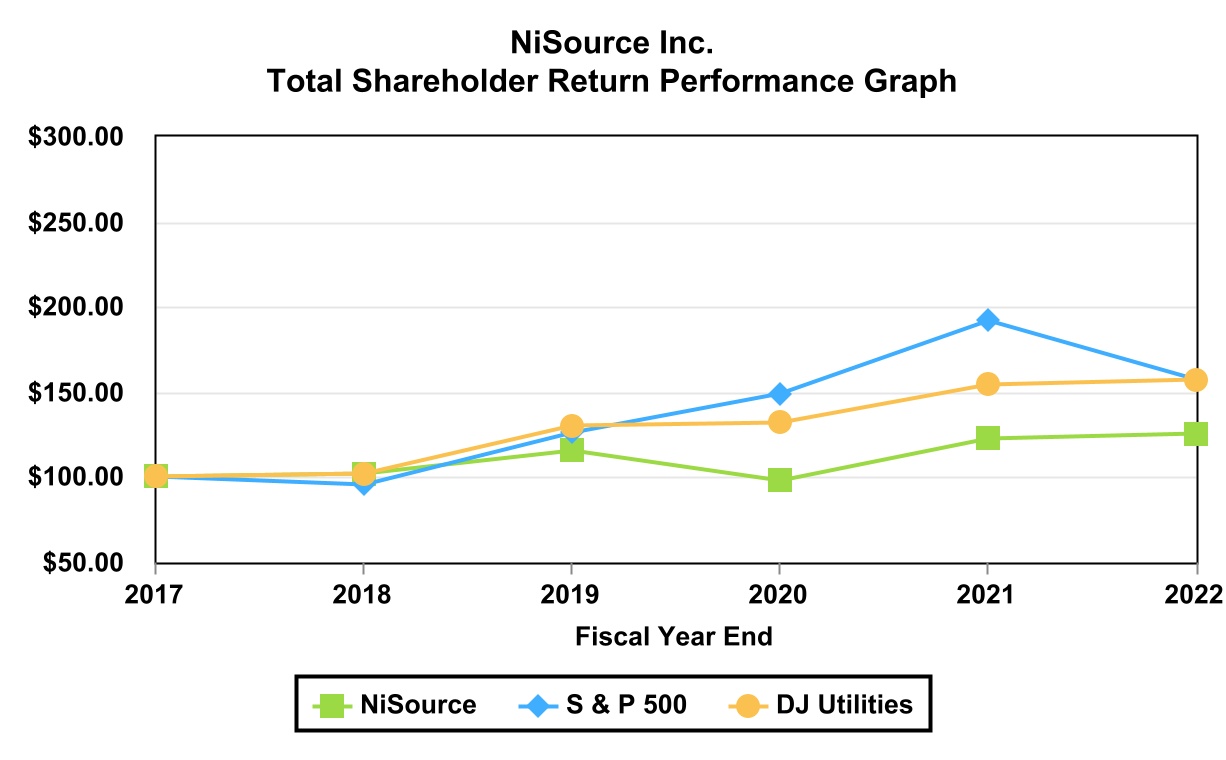
The foregoing performance graph is being furnished as part of this annual report solely in accordance with the requirement under Rule 14a-3(b)(9) to furnish stockholders with such information, and therefore, shall not be deemed to be filed or incorporated by reference into any filings by NiSource under the Securities Act or the Exchange Act.
The total shareholder return for NiSource common stock and the two indices is calculated from an assumed initial investment of $100 and assumes dividend reinvestment.
Purchases of Equity Securities by Issuer and Affiliated Purchasers. For the three months ended December 31, 2022, no equity securities that are registered by NiSource Inc. pursuant to Section 12 of the Securities Exchange Act of 1934 were purchased by or on behalf of us or any of our affiliated purchasers.
Item 6. RESERVED
NIS****OURCE INC.
Not applicable.
ITEM 7. MANAGEMENT’S DISCUSSION AND ANALYSIS OF FINANCIAL CONDITION AND RESULTS OF OPERATIONS
NIS****OURCE INC.
EXECUTIVE SUMMARY
This Management's Discussion and Analysis of Financial Condition and Results of Operations ("Management's Discussion") includes management’s analysis of past financial results and certain potential factors that may affect future results, potential future risks and approaches that may be used to manage those risks. See "Note regarding forward-looking statements" and Item 1A, "Risk Factors" at the beginning of this report for a list of factors that may cause results to differ materially.
This Management's Discussion is designed to provide an understanding of our operations and financial performance and should be read in conjunction with our Consolidated Financial Statements and related Notes to Consolidated Financial Statements in this annual report.
We are an energy holding company under the Public Utility Holding Company Act of 2005 whose subsidiaries are fully regulated natural gas and electric utility companies serving customers in six states. We generate substantially all of our operating income through these rate-regulated businesses, which are summarized for financial reporting purposes into two primary reportable segments: Gas Distribution Operations and Electric Operations.
Refer to the "Business" section under Item 1 of this annual report and Note 21, "Business Segment Information," in the Notes to Consolidated Financial Statements for further discussion of our regulated utility business segments.
Our goal is to develop strategies that benefit all stakeholders as we (i) embark on long-term infrastructure investment and safety programs to better serve our customers, (ii) align our tariff structures with our cost structure, and (iii) address changing customer conservation patterns. These strategies focus on improving safety and reliability, enhancing customer service, ensuring customer affordability and reducing emissions while generating sustainable returns. The safety of our customers, communities and employees remains our top priority. In 2022, NiSource achieved conformance certification to the American Petroleum Institute Recommended Practice 1173, which serves as the guiding practice for our SMS. This certification marks an important milestone for our SMS and NiSource’s journey towards operational excellence. Additionally, we continue to pursue regulatory and legislative initiatives that will allow residential customers not currently on our system to obtain gas service in a cost effective manner.
2022 Overview: In 2022, we continued to make significant progress towards our strategic and financial goals and objectives. We completed the first full year of operating Indiana Crossroads Wind, and construction is near completion for two of our solar projects. In 2022, we filed four rate cases and resolved three, in Pennsylvania, Maryland, and the gas rate case in Indiana filed in 2021. In addition, the Ohio rate case was resolved in January 2023 and the Virginia rate case is anticipated to be resolved in the first quarter of 2023. These cases represent balanced outcomes supporting all stakeholders. Between our Gas Distribution and Electric Operating Segments, we added 25,000 customers. We also invested $1.6 billion in infrastructure modernization to enhance safe, reliable service, including replacement of 410 miles of distribution main and service lines, 48 miles of underground cable and 1,352 electric poles.
We also made advancements in key strategic initiatives, described in further detail below.
Your Energy, Your Future: Our plan to replace our coal generation capacity by the end of 2028 with primarily renewable resources, initiated through our 2018 Integrated Resource Plan ("2018 Plan") is well underway, and we are continually adjusting to the dynamic renewable energy landscape. As of December 31, 2022, we have executed and received IURC approval for BTAs and PPAs with a combined nameplate capacity of 1,950 MW and 1,380 MW, respectively, under the 2018 Plan. During 2022, we made significant progress on our first two solar BTAs and anticipate completion of these projects and tax equity financing in 2023. We have also taken contractual actions on a number of our other renewable projects to address the
Item 7. MANAGEMENT’S DISCUSSION AND ANALYSIS OF FINANCIAL CONDITION AND RESULTS OF OPERATIONS (continued)
NIS****OURCE INC.
timing of these projects as well as consider the broad market issues facing the industry. We remain on track to retire R.M Schahfer's remaining two coal units by the end of 2025. In August 2022, the IRA was signed into law. We are evaluating the impact of this legislation to our renewable projects with potential to drive increased value to customers as part of our expansion of renewable projects and generation transition strategy. However, the leveraging of the IRA will be considered on a project-by-project basis and evaluate several factors, both quantitative and qualitative, that results in the best position for project success as well as customer and company considerations. For additional information, see "Results and Discussion of Segment Operations - Electric Operations," in this Management's Discussion.
In 2021, we announced and filed with the IURC the Preferred Energy Resource Plan associated with our 2021 Integrated Resource Plan ("2021 Plan"). The 2021 Plan lays out a timeline to retire the Michigan City Generating Station by the end of 2028. The 2021 Plan calls for the replacement of the retiring units with a diverse portfolio of resources including demand side management resources, incremental solar, stand-alone energy storage and upgrades to existing facilities at the Sugar Creek Generating Station, among other steps. Additionally, the 2021 Plan calls for a natural gas peaking unit to replace existing vintage gas peaking units at the R.M. Schahfer Generating Station to support system reliability and resiliency, as well as upgrades to the transmission system to enhance our electric generation transition. The planned retirement of the two vintage gas peaking units at the R.M. Schahfer Generating Station is also expected to occur by the end of 2028. Final retirement dates for these units, as well as Michigan City, will be subject to MISO approval. We are continuing to evaluate potential projects under the 2021 Plan given the responses to our Request for Proposal issued in August 2022.
Transformation: The NiNext initiative, which commenced in 2020, focused on optimizing our workforce and advancing our operations. NiNext has been foundational in preparing for incremental, enterprise-wide investments to address inefficiencies in our current technology footprint, which stem primarily from a complex array of legacy systems. We plan to address these inefficiencies through our Enterprise Transformation Roadmap with investments in technology systems and infrastructure. As a result of these investments, we will deliver more modern, dependable, and secure IT systems backed with standardized processes to reduce the operating risks of our business, increase workforce efficiencies, and increase visibility to data which will be leveraged to drive risk-informed decisions. Our Enterprise Transformation Roadmap will position us to accomplish future strategic investments and aspirational goals.
Economic Environment: We are monitoring risks related to increasing order and delivery lead times for construction and other materials, increasing risk of unavailability of materials due to global shortages in raw materials, and risk of decreased construction labor productivity in the event of disruptions in the availability of materials. We are also seeing increasing prices associated with certain materials and supplies. To the extent that delays occur or our costs increase, our business operations, results of operations, cash flows, and financial condition could be materially adversely affected. For more information on supply chain impacts to our electric generation strategy, see "Results and Discussion of Segment Operations - Electric Operations," in this Management's Discussion.
Early in 2022, NIPSCO experienced a rail service shortage in deliveries of coal, particularly to its Michigan City Generating Station, and the primary rail carrier for that generating station was unable to provide assurance of adequate future service to maintain coal inventory. A lack of adequate coal deliveries to any of our coal-fired generating facilities for an extended period could deplete our inventories to a level that prevents the generating station from running, and NIPSCO would need to rely on market purchases of replacement power, which could increase the cost of electricity for NIPSCO's customers. NIPSCO believes these shortages have been resolved but continues to monitor deliveries of coal from its rail carriers. This did not have a material impact on our operations in 2022.
We are faced with increased competition for employee and contractor talent in the current labor market, which has resulted in increased costs to attract and retain talent. We are ensuring that we use all internal human capital programs (development, leadership enablement programs, succession, performance management) to promote retention of our current employees along with having a competitive and attractive appeal for potential recruits. With a focus on workforce planning, we are anticipating to evaluate our talent footprint for the future by creating flexible work arrangements where we can, to ensure we have the right people, in the right role, and at the right time. To the extent we are unable to execute on our workforce planning initiatives and experience increased employee and contractor costs, our business operations, results of operations, cash flows, and financial condition could be materially adversely affected.
We experienced an increase in natural gas costs as the spot market for natural gas substantially increased throughout much of 2022, followed by a decrease in the price of natural gas since November 2022. Nationally, levels of gas in storage were lower in 2022 compared to 2021, liquified natural gas exports to Europe continued at a steady pace, and domestic production saw a recent decline in demand. These factors drove increased volatility in the marketplace, which influenced customer bills
ITEM 7. MANAGEMENT’S DISCUSSION AND ANALYSIS OF FINANCIAL CONDITION AND RESULTS OF OPERATIONS (continued)
NIS****OURCE INC.
throughout 2022. While production was increasing towards the end of 2022, weather changes have limited demand and decreased withdrawals, causing inventory balances to be higher compared to 2021. With this decline in price, we expect to see lower volatility and declining customer bills. For the year ended December 31, 2022, we did not see this volatility have a material impact on our results of operations. For more information on our commodity price impacts, see "Results and Discussion of Segment Operations - Gas Distribution Operations," and "Market Risk Disclosures."
Due to rising interest rates, we experienced higher interest expense in 2022 compared to 2021 associated with short-term borrowings. We continue to evaluate our financing plan to manage interest expense and exposure to rates. For more information on interest rate risk, see "Market Risk Disclosures".
For more information on global availability of materials for our renewable projects, see "Results and Discussion of Segment Operations - Electric Operations - Electric Supply and Generation Transition."
Summary of Consolidated Financial Results
A summary of our consolidated financial results for the years ended December 31, 2022, 2021 and 2020, are presented below:
| Favorable (Unfavorable) | |||||||||||||||||||||||||||||
| Year Ended December 31*,* (in millions, except per share amounts) | 2022 | 2021 | 2020 | 2022 vs. 2021 | 2021 vs. 2 |
Showing the first 8K of 87K characters. Open the full section
Item 7A. Quantitative and Qualitative Disclosures About Market Risk
Quantitative and Qualitative Disclosures about Market Risk are reported in Item 7, “Management’s Discussion and Analysis of Financial Condition and Results of Operations – Market Risk Disclosures.”
ITEM 8. FINANCIAL STATEMENTS AND SUPPLEMENTARY DATA
NIS****OURCE INC.
ITEM 8. FINANCIAL STATEMENTS AND SUPPLEMENTARY DATA (continued)
NIS****OURCE INC.
REPORT OF INDEPENDENT REGISTERED PUBLIC ACCOUNTING FIRM
To the shareholders and the Board of Directors of NiSource Inc.
Opinion on the Financial Statements
We have audited the accompanying consolidated balance sheets of NiSource Inc. and subsidiaries (the "Company") as of December 31, 2022 and 2021, the related statements of consolidated income (loss), comprehensive income (loss), stockholders' equity, and cash flows for each of the three years in the period ended December 31, 2022, and the related notes and the schedule listed in the Index at Item 15 (collectively referred to as the "financial statements"). In our opinion, the financial statements present fairly, in all material respects, the financial position of the Company as of December 31, 2022 and 2021, and the results of its operations and its cash flows for each of the three years in the period ended December 31, 2022, in conformity with accounting principles generally accepted in the United States of America.
We have also audited, in accordance with the standards of the Public Company Accounting Oversight Board (United States) (PCAOB), the Company's internal control over financial reporting as of December 31, 2022, based on criteria established in Internal Control — Integrated Framework (2013) issued by the Committee of Sponsoring Organizations of the Treadway Commission and our report dated February 22, 2023, expressed an unqualified opinion on the Company's internal control over financial reporting.
Basis for Opinion
These financial statements are the responsibility of the Company's management. Our responsibility is to express an opinion on the Company's financial statements based on our audits. We are a public accounting firm registered with the PCAOB and are required to be independent with respect to the Company in accordance with the U.S. federal securities laws and the applicable rules and regulations of the Securities and Exchange Commission and the PCAOB.
We conducted our audits in accordance with the standards of the PCAOB. Those standards require that we plan and perform the audit to obtain reasonable assurance about whether the financial statements are free of material misstatement, whether due to error or fraud. Our audits included performing procedures to assess the risks of material misstatement of the financial statements, whether due to error or fraud, and performing procedures that respond to those risks. Such procedures included examining, on a test basis, evidence regarding the amounts and disclosures in the financial statements. Our audits also included evaluating the accounting principles used and significant estimates made by management, as well as evaluating the overall presentation of the financial statements. We believe that our audits provide a reasonable basis for our opinion.
Critical Audit Matters
The critical audit matter communicated below is a matter arising from the current-period audit of the financial statements that was communicated or required to be communicated to the audit committee and that (1) relates to accounts or disclosures that are material to the financial statements and (2) involved our especially challenging, subjective, or complex judgments. The communication of critical audit matters does not alter in any way our opinion on the financial statements, taken as a whole, and we are not, by communicating the critical audit matter below, providing a separate opinion on the critical audit matter or on the accounts or disclosures to which it relates.
Impact of Rate Regulation on the Financial Statements - Refer to Notes 1 and 9 to the consolidated financial statements
Critical Audit Matter Description
The Company’s subsidiaries are fully regulated natural gas and electric utility companies serving customers in six states. These rate-regulated subsidiaries account for and report assets and liabilities consistent with the economic effect of the manner in which regulators establish rates, if the rates established are designed to recover the costs of providing the regulated service and it is probable that such rates can be charged to and collected from customers. Certain expenses and credits subject to utility regulation or rate determination normally reflected in income are deferred on the consolidated balance sheets and are later recognized in income as the related amounts are included in customer rates and recovered from or refunded to customers.
The Company’s subsidiaries’ rates are subject to regulatory rate-setting processes. Rates are determined and approved in regulatory proceedings based on an analysis of the subsidiaries’ costs to provide utility service and a return on, and recovery of, the subsidiaries’ investment in the utility business. Regulatory decisions can have an impact on the recovery of costs, the rate of return earned on investment, and the timing and amount of assets to be recovered by rates. The respective commission’s regulation of rates is premised on the full recovery of prudently incurred costs and a reasonable rate of return on invested
ITEM 8. FINANCIAL STATEMENTS AND SUPPLEMENTARY DATA (continued)
NIS****OURCE INC.
REPORT OF INDEPENDENT REGISTERED PUBLIC ACCOUNTING FIRM
capital. Decisions to be made by the commission in the future will impact the accounting for regulated operations, including decisions about the amount of allowable costs and return on invested capital included in rates and any refunds that may be required. While the Company has indicated it expects to recover costs from customers through regulated rates, there is a risk that the commission will not approve: (1) full recovery of the costs of providing utility service, or (2) full recovery of all amounts invested in the utility business and a reasonable return on that investment.
We identified the accounting for rate-regulated subsidiaries as a critical audit matter due to the significant judgments made by management to support its assertions about impacted account balances and disclosures and the high degree of subjectivity involved in assessing the impact of future regulatory orders on the financial statements. Management judgments include assessing the likelihood of (1) recovery in future rates of incurred costs and (2) refunds of amounts previously collected from customers. Given that management’s accounting judgments are based on assumptions about the outcome of future decisions by regulatory commissions, auditing these judgments required specialized knowledge of accounting for rate regulation and the rate making process due to its inherent complexities.
How the Critical Audit Matter Was Addressed in the Audit
Our audit procedures related to the uncertainty of future decisions by the commissions focused on the ongoing Columbia Gas of Ohio base rate case and the Northern Indiana Public Service Company electric base rate case proceedings and included the following, among others:
-
We tested the effectiveness of management’s controls over the evaluation of the likelihood of (1) the recovery in future rates of costs incurred as property, plant, and equipment and deferred as regulatory assets, and (2) a refund or a future reduction in rates that should be reported as regulatory liabilities. We also tested the effectiveness of management’s controls over the initial recognition of amounts as property, plant, and equipment; regulatory assets or liabilities; and the monitoring and evaluation of regulatory developments, that may affect the likelihood of recovering costs in future rates or of a future reduction in rates.
-
We evaluated the Company’s disclosures related to the impacts of rate regulation, including the balances recorded and regulatory developments.
-
We read relevant regulatory orders issued by the commissions for the Company, regulatory statutes, interpretations, procedural memorandums, filings made by interveners, and other publicly available information to assess the likelihood of recovery in future rates or of a future reduction in rates based on precedents of the commissions’ treatment of similar costs under similar circumstances. We evaluated the external information and compared to management’s recorded regulatory asset and liability balances for completeness.
-
For regulatory matters in process, we inspected the Company’s and intervenors’ filings with the commissions that may impact the Company’s future rates, for any evidence that might contradict management’s assertions related to recoverability of recorded assets. Additionally, we evaluated the joint stipulation filed by Columbia Gas of Ohio with the Public Utilities Commission of Ohio.
-
We inquired of management about property, plant, and equipment that may be abandoned with an emphasis on the generation strategy related to Northern Indiana Public Service Company’s R.M. Schahfer and Michigan City Generating Stations. We inspected minutes of the board of directors and regulatory orders and other filings with the commissions to identify evidence that may contradict management’s assertion regarding probability of an abandonment.
-
We read the relevant regulatory orders issued by the Commission for the Company’s renewable energy investments. We evaluated the appropriateness of recognizing a regulatory liability or asset representing timing differences between the profit allocated under the Hypothetical Liquidation at Book Value (HLBV) method related to the consolidated joint ventures and the allowed earnings included in regulatory rates. We also evaluated the appropriateness of the offset to the regulatory liability or asset recorded in depreciation expense.
-
We evaluated the Company’s disclosures related to the application of ASC Topic 980 to consolidated joint venture accounting.
/s/ DELOITTE & TOUCHE LLP
Columbus, Ohio
February 22, 2023
We have served as the Company's auditor since 2002.
ITEM 8. FINANCIAL STATEMENTS AND SUPPLEMENTARY DATA (continued)
NIS****OURCE INC.
STATEMENTS OF CONSOLIDATED INCOME (LOSS)
| Year Ended December 31*, (in millions, except per share amounts)* | 2022 | 2021 | 2020 | ||||||||||||||
| Operating Revenues | |||||||||||||||||
| Customer revenues | $ | 5,738.6 | $ | 4,731.3 | $ | 4,473.2 | |||||||||||
| Other revenues | 112.0 | 168.3 | 208.5 | ||||||||||||||
| Total Operating Revenues | 5,850.6 | 4,899.6 | 4,681.7 | ||||||||||||||
| Operating Expenses | |||||||||||||||||
| Cost of energy | 2,110.5 | 1,392.3 | 1,109.3 | ||||||||||||||
| Operation and maintenance | 1,489.4 | 1,456.0 | 1,585.9 | ||||||||||||||
| Depreciation and amortization | 820.8 | 748.4 | 725.9 | ||||||||||||||
| Loss (gain) on sale of assets, net | (104.2) | 7.7 | 410.6 | ||||||||||||||
| Other taxes | 268.3 | 288.3 | 299.2 | ||||||||||||||
| Total Operating Expenses | 4,584.8 | 3,892.7 | 4,130.9 | ||||||||||||||
| Operating Income | 1,265.8 | 1,006.9 | 550.8 | ||||||||||||||
| Other Income (Deductions) | |||||||||||||||||
| Interest expense, net | (361.6) | (341.1) | (370.7) | ||||||||||||||
| Other, net | 52.2 | 40.8 | 32.1 | ||||||||||||||
| Loss on early extinguishment of long-term debt | — | — | (243.5) | ||||||||||||||
| Total Other Deductions, Net | (309.4) | (300.3) | (582.1) | ||||||||||||||
| Income (Loss) before Income Taxes | 956.4 | 706.6 | (31.3) | ||||||||||||||
| Income Taxes | 164.6 | 117.8 | (17.1) | ||||||||||||||
| Net Income (Loss) | 791.8 | 588.8 | (14.2) | ||||||||||||||
| Net income (loss) attributable to noncontrolling interest | (12.3) | 3.9 | 3.4 | ||||||||||||||
| Net Income (Loss) attributable to NiSource | 804.1 | 584.9 | (17.6) | ||||||||||||||
| Preferred dividends | (55.1) | (55.1) | (55.1) | ||||||||||||||
| Net Income (Loss) Available to Common Shareholders | 749.0 | 529.8 | (72.7) | ||||||||||||||
| Earnings (Loss) Per Share | |||||||||||||||||
| Basic Earnings (Loss) Per Share | $ | 1.84 | $ | 1.35 | $ | (0.19) | |||||||||||
| Diluted Earnings (Loss) Per Share | $ | 1.70 | $ | 1.27 | $ | (0.19) | |||||||||||
| Basic Average Common Shares Outstanding | 407.1 | 393.6 | 384.3 | ||||||||||||||
| Diluted Average Common Shares | 442.7 | 417.3 | 384.3 |
The accompanying Notes to Consolidated Financial Statements are an integral part of these statements.
ITEM 8. FINANCIAL STATEMENTS AND SUPPLEMENTARY DATA (continued)
NIS****OURCE INC.
STATEMENTS OF CONSOLIDATED COMPREHENSIVE INCOME (LOSS)
| Year Ended December 31, (in millions, net of taxes) | 2022 | 2021 | 2020 | ||||||||||||||
| Net Income (Loss) | $ | 791.8 | $ | 588.8 | $ | (14.2) | |||||||||||
| Other comprehensive income (loss): | |||||||||||||||||
| Net unrealized gain (loss) on available-for-sale securities(1) | (13.3) | (3.9) | 2.7 | ||||||||||||||
| Net unrealized gain (loss) on cash flow hedges(2) | 109.9 | 25.4 | (70.7) | ||||||||||||||
| Unrecognized pension and OPEB benefit (costs)(3) | (6.9) | 8.4 | 3.9 | ||||||||||||||
| Total other comprehensive income (loss) | 89.7 | 29.9 | (64.1) | ||||||||||||||
| Total Comprehensive Income (Loss) | $ | 881.5 | $ | 618.7 | $ | (78.3) | |||||||||||
(1) Net unrealized gain (loss) on available-for-sale securities, net of $3.5 million tax benefit, $1.0 million tax benefit and $0.7 million tax expense in 2022, 2021 and 2020, respectively.
(2) Net unrealized gain (loss) on derivatives qualifying as cash flow hedges, net of $36.4 million tax expense, $8.4 million tax expense and $23.4 million tax benefit in 2022, 2021 and 2020, respectively.
(3) Unrecognized pension and OPEB benefit (costs), net of $2.3 million tax benefit, $3.8 million tax expense and $0.1 million tax benefit in 2022, 2021 and 2020, respectively.
The accompanying Notes to Consolidated Financial Statements are an integral part of these statements.
ITEM 8. FINANCIAL STATEMENTS AND SUPPLEMENTARY DATA (continued)
NIS****OURCE INC.
CONSOLIDATED BALANCE SHEETS
| (in millions) | December 31, 2022 | December 31, 2021 | |||||||||
| ASSETS | |||||||||||
| Property, Plant and Equipment | |||||||||||
| Plant | $ | 27,551.3 | $ | 25,171.3 | |||||||
| Accumulated depreciation and amortization | (7,708.7) | (7,289.5) | |||||||||
| Net Property, Plant and Equipment(1) | 19,842.6 | 17,881.8 | |||||||||
| Investments and Other Assets | |||||||||||
| Unconsolidated affiliates | 1.6 | 0.8 | |||||||||
| Available-for-sale debt securities (amortized cost of $166.7 and $169.3, allowance for credit losses of $0.9 and $0.2, respectively) | 151.6 | 171.8 | |||||||||
| Other investments | 71.0 | 87.1 | |||||||||
| Total Investments and Other Assets | 224.2 | 259.7 | |||||||||
| Current Assets | |||||||||||
| Cash and cash equivalents | 40.8 | 84.2 | |||||||||
| Restricted cash | 34.6 | 10.7 | |||||||||
| Accounts receivable | 1,065.8 | 849.1 | |||||||||
| Allowance for credit losses | (23.9) | (23.5) | |||||||||
| Accounts receivable, net | 1,041.9 | 825.6 | |||||||||
| Gas inventory | 531.7 | 327.4 | |||||||||
| Materials and supplies, at average cost | 151.4 | 139.1 | |||||||||
| Electric production fuel, at average cost | 68.8 | 32.2 | |||||||||
| Exchange gas receivable | 128.1 | 99.6 | |||||||||
| Regulatory assets | 233.2 | 206.2 | |||||||||
| Deposits to renewable generation asset developer | 143.8 | — | |||||||||
| Prepayments and other | 210.0 | 195.8 | |||||||||
| Total Current Assets(1) | 2,584.3 | 1,920.8 | |||||||||
| Other Assets | |||||||||||
| Regulatory assets | 2,347.6 | 2,286.0 | |||||||||
| Goodwill | 1,485.9 | 1,485.9 | |||||||||
| Deferred charges and other | 252.0 | 322.7 | |||||||||
| Total Other Assets | 4,085.5 | 4,094.6 | |||||||||
| Total Assets | $ | 26,736.6 | $ | 24,156.9 |
(1)Includes $978.5 million and $695.9 million in 2022 and 2021, respectively, of net property, plant and equipment assets and $25.7 million and $14.3 million in 2022 and 2021, respectively, of current assets of consolidated VIEs that may be used only to settle obligations of the consolidated VIEs. Refer to Note 4, "Variable Interest Entities," for additional information.
The accompanying Notes to Consolidated Financial Statements are an integral part of these statements.
ITEM 8. FINANCIAL STATEMENTS AND SUPPLEMENTARY DATA (continued)
NIS****OURCE INC.
CONSOLIDATED BALANCE SHEETS
| (in millions, except share amounts) | December 31, 2022 | December 31, 2021 | |||||||||
| CAPITALIZATION AND LIABILITIES | |||||||||||
| Capitalization | |||||||||||
| Stockholders’ Equity | |||||||||||
| Common stock - $0.01 par value, 600,000,000 shares authorized; 412,142,602 and 405,303,023 shares outstanding, respectively | $ | 4.2 | $ | 4.1 | |||||||
| Preferred stock - $0.01 par value, 20,000,000 shares authorized; 1,302,500 and 1,302,500 shares outstanding, respectively | 1,546.5 | 1,546.5 | |||||||||
| Treasury stock | (99.9) | (99.9) | |||||||||
| Additional paid-in capital | 7,375.3 | 7,204.3 | |||||||||
| Retained deficit | (1,213.6) | (1,580.9) | |||||||||
| Accumulated other comprehensive loss | (37.1) | (126.8) | |||||||||
| Total NiSource Stockholders' Equity | 7,575.4 | 6,947.3 | |||||||||
| Noncontrolling interest in consolidated subsidiaries | 326.4 | 325.6 | |||||||||
| Total Stockholders’ Equity | 7,901.8 | 7,272.9 | |||||||||
| Long-term debt, excluding amounts due within one year | 9,523.6 | 9,183.4 | |||||||||
| Total Capitalization | 17,425.4 | 16,456.3 | |||||||||
| Current Liabilities | |||||||||||
| Current portion of long-term debt | 30.0 | 58.1 | |||||||||
| Short-term borrowings | 1,761.9 | 560.0 | |||||||||
| Accounts payable | 899.5 | 697.8 | |||||||||
| Customer deposits and credits | 324.7 | 237.9 | |||||||||
| Taxes accrued | 246.2 | 277.1 | |||||||||
| Interest accrued | 138.4 | 105.5 | |||||||||
| Exchange gas payable | 147.6 | 107.7 | |||||||||
| Regulatory liabilities | 236.8 | 137.4 | |||||||||
| Accrued compensation and employee benefits | 167.5 | 182.7 | |||||||||
| Obligations to renewable generation asset developer | 347.2 | — | |||||||||
| Other accruals | 360.7 | 382.0 | |||||||||
| Total Current Liabilities(1) | 4,660.5 | 2,746.2 | |||||||||
| Other Liabilities | |||||||||||
| Deferred income taxes | 1,854.5 | 1,659.4 | |||||||||
| Accrued liability for postretirement and postemployment benefits | 245.5 | 292.5 | |||||||||
| Regulatory liabilities | 1,775.8 | 1,842.6 | |||||||||
| Asset retirement obligations | 478.1 | 469.7 | |||||||||
| Other noncurrent liabilities and deferred credits | 296.8 | 690.2 | |||||||||
| Total Other Liabilities(1) | 4,650.7 | 4,954.4 | |||||||||
| Commitments and Contingencies (Refer to Note 19, "Other Commitments and Contingencies") | |||||||||||
| Total Capitalization and Liabilities | $ | 26,736.6 | $ | 24,156.9 |
(1)Includes $128.2 million and $10.0 million in 2022 and 2021, respectively, of current liabilities and $30.6 million and $20.5 million in 2022 and 2021, respectively, of other liabilities of consolidated VIEs that creditors do not have recourse to our general credit. Refer to Note 4, "Variable Interest Entities," for additional information.
The accompanying Notes to Consolidated Financial Statements are an integral part of these statements.
ITEM 8. FINANCIAL STATEMENTS AND SUPPLEMENTARY DATA (continued)
NIS****OURCE INC.
STATEMENTS OF CONSOLIDATED CASH FLOWS
| Year Ended December 31, (in millions) | 2022 | 2021 | 2020 | ||||||||||||||
| Operating Activities | |||||||||||||||||
| Net Income (Loss) | $ | 791.8 | $ | 588.8 | $ | (14.2) | |||||||||||
| Adjustments to Reconcile Net Income to Net Cash from Operating Activities: | |||||||||||||||||
| Loss on early extinguishment of debt | — | — | 243.5 | ||||||||||||||
| Depreciation and amortization | 820.8 | 748.4 | 725.9 | ||||||||||||||
| Deferred income taxes and investment tax credits | 156.9 | 111.9 | (29.0) | ||||||||||||||
| Stock compensation expense and 401(k) profit sharing contribution | 24.9 | 24.3 | 17.4 | ||||||||||||||
| Loss (gain) on sale of assets | (105.3) | 5.6 | 409.8 | ||||||||||||||
| Other adjustments | 5.7 | (0.7) | (0.3) | ||||||||||||||
| Changes in Assets and Liabilities: | |||||||||||||||||
| Accounts receivable | (216.3) | (40.3) | (3.9) | ||||||||||||||
| Inventories | (258.9) | (112.9) | (1.5) | ||||||||||||||
| Accounts payable | 165.0 | 54.9 | (29.7) | ||||||||||||||
| Exchange gas receivable/payable | 57.8 | (114.2) | (6.9) | ||||||||||||||
| Other accruals | 73.4 | 43.0 | (175.1) | ||||||||||||||
| Prepayments and other current assets | (9.8) | (36.6) | (5.9) | ||||||||||||||
| Regulatory assets/liabilities | (129.4) | 76.8 | 70.8 | ||||||||||||||
| Postretirement and postemployment benefits | 84.7 | (96.4) | (103.6) | ||||||||||||||
| Deferred charges and other noncurrent assets | (4.1) | (4.7) | (15.0) | ||||||||||||||
| Other noncurrent liabilities and deferred credits | (47.8) | (30.0) | 21.7 | ||||||||||||||
| Net Cash Flows from Operating Activities | 1,409.4 | 1,217.9 | 1,104.0 | ||||||||||||||
| Investing Activities | |||||||||||||||||
| Capital expenditures | (2,203.1) | (1,838.0) | (1,758.1) | ||||||||||||||
| Insurance Recoveries | 105.0 | — | — | ||||||||||||||
| Cost of removal | (151.7) | (121.1) | (138.2) | ||||||||||||||
| Proceeds from disposition of assets | — | 0.7 | 1,115.9 | ||||||||||||||
| Purchases of available-for-sale securities | (73.5) | (102.9) | (144.7) | ||||||||||||||
| Sales of available-for-sale securities | 75.7 | 97.8 | 131.4 | ||||||||||||||
| Payment to renewable generation asset developer | (323.9) | (240.4) | (85.3) | ||||||||||||||
| Other investing activities | 1.3 | (1.0) | (0.1) | ||||||||||||||
| Net Cash Flows used for Investing Activities | (2,570.2) | (2,204.9) | (879.1) | ||||||||||||||
| Financing Activities | |||||||||||||||||
| Proceeds from issuance of long-term debt | 345.6 | — | 2,974.0 | ||||||||||||||
| Repayments of long-term debt and finance lease obligations | (60.3) | (25.7) | (1,622.0) | ||||||||||||||
| Issuance of short-term debt (maturity > 90 days) | 1,000.0 | — | 1,350.0 | ||||||||||||||
| Repayment of short-term debt (maturity > 90 days) | — | — | (2,200.0) | ||||||||||||||
| Change in short-term debt (maturity ≤ 90 days) | 202.2 | 57.0 | (420.1) | ||||||||||||||
| Issuance of common stock, net of issuance costs | 154.3 | 299.6 | 211.4 | ||||||||||||||
| Equity costs, premiums and other debt related costs | (13.0) | (18.2) | (246.5) | ||||||||||||||
| Contributions from noncontrolling interest | 21.2 | 245.1 | 82.2 | ||||||||||||||
| Distributions to noncontrolling interest | (6.0) | (0.6) | — | ||||||||||||||
| Issuance of equity units, net of underwriting costs | — | 839.9 | — | ||||||||||||||
| Dividends paid - common stock | (381.5) | (345.2) | (321.6) | ||||||||||||||
| Dividends paid - preferred stock | (55.1) | (55.1) | (55.1) | ||||||||||||||
| Contract liability payment | (66.1) | (40.5) | — | ||||||||||||||
| Net Cash Flows from (used for) Financing Activities | 1,141.3 | 956.3 | (247.7) | ||||||||||||||
| Change in cash, cash equivalents and restricted cash | (19.5) | (30.7) | (22.8) | ||||||||||||||
| Cash, cash equivalents and restricted cash at beginning of period | 94.9 | 125.6 | 148.4 | ||||||||||||||
| Cash, Cash Equivalents and Restricted Cash at End of Period | $ | 75.4 | $ | 94.9 | $ | 125.6 |
| Reconciliation to Balance Sheet | 2022 | 2021 | 2020 | ||||||||||||||
| Cash and cash equivalents | 40.8 | 84.2 | 116.5 | ||||||||||||||
| Restricted Cash | 34.6 | 10.7 | 9.1 | ||||||||||||||
| Total Cash, Cash Equivalents and Restricted Cash | 75.4 | 94.9 | 125.6 |
The accompanying Notes to Consolidated Financial Statements are an integral part of these statements.
Item 8. FINANCIAL STATEMENTS AND SUPPLEMENTARY DATA (continued)
NIS****OURCE INC.
STATEMENTS OF CONSOLIDATED STOCKHOLDERS' EQUITY
| (in millions) | Common Stock | Preferred Stock**(1)** | Treasury Stock | Additional Paid-In Capital | Retained Deficit | Accumulated Other Comprehensive Loss | Noncontrolling Interest in Consolidated Subsidiaries | Total | |||||||||||||||||||||||||||||||||||||||
| Balance as of January 1, 2020 | $ | 3.8 | $ | 880.0 | $ | (99.9) | $ | 6,666.2 | $ | (1,370.8) | $ | (92.6) | $ | — | $ | 5,986.7 | |||||||||||||||||||||||||||||||
| Comprehensive Loss: | |||||||||||||||||||||||||||||||||||||||||||||||
| Net Income (Loss) | — | — | — | — | (17.6) | — | 3.4 | (14.2) | |||||||||||||||||||||||||||||||||||||||
| Other comprehensive loss, net of tax | — | — | — | — | — | (64.1) | — | (64.1) | |||||||||||||||||||||||||||||||||||||||
| Dividends: | |||||||||||||||||||||||||||||||||||||||||||||||
| Common stock ($0.84 per share) | — | — | — | — | (321.7) | — | — | (321.7) | |||||||||||||||||||||||||||||||||||||||
| Preferred stock (See Note 13) | — | — | — | — | (55.1) | — | — | (55.1) | |||||||||||||||||||||||||||||||||||||||
| Contributions from noncontrolling interest | — | — | — | — | — | — | 82.2 | 82.2 | |||||||||||||||||||||||||||||||||||||||
| Stock issuances: | |||||||||||||||||||||||||||||||||||||||||||||||
| Employee stock purchase plan | — | — | — | 5.7 | — | — | — | 5.7 | |||||||||||||||||||||||||||||||||||||||
| Long-term incentive plan | — | — | — | 8.4 | — | — | — | 8.4 | |||||||||||||||||||||||||||||||||||||||
| 401(k) and profit sharing | — | — | — | 13.4 | — | — | — | 13.4 | |||||||||||||||||||||||||||||||||||||||
| ATM Program | 0.1 | — | — | 196.4 | — | — | — | 196.5 | |||||||||||||||||||||||||||||||||||||||
| Balance as of December 31, 2020 | $ | 3.9 | $ | 880.0 | $ | (99.9) | $ | 6,890.1 | $ | (1,765.2) | $ | (156.7) | $ | 85.6 | $ | 5,837.8 | |||||||||||||||||||||||||||||||
| Comprehensive Income: | |||||||||||||||||||||||||||||||||||||||||||||||
| Net Income | — | — | — | — | 584.9 | — | 3.9 | 588.8 | |||||||||||||||||||||||||||||||||||||||
| Other comprehensive income, net of tax | — | — | — | — | — | 29.9 | — | 29.9 | |||||||||||||||||||||||||||||||||||||||
| Dividends: | |||||||||||||||||||||||||||||||||||||||||||||||
| Common stock ($0.88 per share) | — | — | — | — | (345.5) | — | — | (345.5) | |||||||||||||||||||||||||||||||||||||||
| Preferred stock (See Note 13) | — | — | — | — | (55.1) | — | — | (55.1) | |||||||||||||||||||||||||||||||||||||||
| Contributions from noncontrolling interest | — | — | — | — | — | — | 236.7 | 236.7 | |||||||||||||||||||||||||||||||||||||||
| Distributions to noncontrolling interest | — | — | — | — | — | — | (0.6) | (0.6) | |||||||||||||||||||||||||||||||||||||||
| Stock issuances: | |||||||||||||||||||||||||||||||||||||||||||||||
| Equity Units | — | 666.5 | — | — | — | — | — | 666.5 | |||||||||||||||||||||||||||||||||||||||
| Employee stock purchase plan | — | — | — | 5.0 | — | — | — | 5.0 | |||||||||||||||||||||||||||||||||||||||
| Long-term incentive plan | — | — | — | 11.8 | — | — | — | 11.8 | |||||||||||||||||||||||||||||||||||||||
| 401(k) and profit sharing | — | — | — | 9.5 | — | — | — | 9.5 | |||||||||||||||||||||||||||||||||||||||
| ATM Program | 0.2 | — | — | 287.9 | — | — | — | 288.1 | |||||||||||||||||||||||||||||||||||||||
| Balance as of December 31, 2021 | $ | 4.1 | $ | 1,546.5 | $ | (99.9) | $ | 7,204.3 | $ | (1,580.9) | $ | (126.8) | $ | 325.6 | $ | 7,272.9 | |||||||||||||||||||||||||||||||
| Comprehensive Income: | |||||||||||||||||||||||||||||||||||||||||||||||
| Net Income (Loss) | — | — | — | — | 804.1 | — | (12.3) | 791.8 | |||||||||||||||||||||||||||||||||||||||
| Other comprehensive income, net of tax | — | — |
Showing the first 8K of 262K characters. Open the full section
Item 9. CHANGES IN AND DISAGREEMENTS WITH ACCOUNTANTS ON ACCOUNTING AND FINANCIAL DISCLOSURE
None.
ITEM 9A. CONTROLS AND PROCEDURES
Evaluation of Disclosure Controls and Procedures
Our chief executive officer and chief financial officer are responsible for evaluating the effectiveness of disclosure controls and procedures (as defined in Exchange Act Rules 13a-15(e) and 15d-15(e)). Our disclosure controls and procedures are designed to provide reasonable assurance that the information required to be disclosed by the Company in reports that are filed or submitted under the Exchange Act are accumulated and communicated to management, including our chief executive officer and chief financial officer, as appropriate, to allow timely decisions regarding required disclosure and is recorded, processed, summarized and reported within the time periods specified in the rules and forms of the SEC. Based upon that evaluation, our chief executive officer and chief financial officer concluded that, as of the end of the period covered by this report, disclosure controls and procedures were effective to provide reasonable assurance that financial information was processed, recorded and reported accurately.
Management’s Annual Report on Internal Control over Financial Reporting
Our management, including our chief executive officer and chief financial officer, are responsible for establishing and maintaining internal control over financial reporting, as such term is defined under Rule 13a-15(f) or Rule 15d-15(f) promulgated under the Exchange Act. However, management would note that a control system can provide only reasonable, not absolute, assurance that the objectives of the control system are met. Our management has adopted the 2013 framework set forth in the Committee of Sponsoring Organizations of the Treadway Commission report, Internal Control - Integrated Framework, the most commonly used and understood framework for evaluating internal control over financial reporting, as its framework for evaluating the reliability and effectiveness of internal control over financial reporting. During 2022, we conducted an evaluation of our internal control over financial reporting. Based on this evaluation, management concluded that our internal control over financial reporting was effective as of the end of the period covered by this annual report.
Deloitte & Touche LLP, our independent registered public accounting firm, issued an attestation report on our internal controls over financial reporting which is included herein.
Changes in Internal Controls
There have been no changes in our internal control over financial reporting during the most recently completed quarter covered by this report that has materially affected, or is reasonably likely to materially affect, our internal control over financial reporting.
Item 9A. CONTROLS AND PROCEDURES
NIS****OURCE INC.
REPORT OF INDEPENDENT REGISTERED PUBLIC ACCOUNTING FIRM
To the shareholders and the Board of Directors of NiSource Inc.
Opinion on Internal Control over Financial Reporting
We have audited the internal control over financial reporting of NiSource Inc. and subsidiaries (the “Company”) as of December 31, 2022, based on criteria established in Internal Control — Integrated Framework (2013) issued by the Committee of Sponsoring Organizations of the Treadway Commission (COSO). In our opinion, the Company maintained, in all material respects, effective internal control over financial reporting as of December 31, 2022, based on criteria established in Internal Control — Integrated Framework (2013) issued by COSO.
We have also audited, in accordance with the standards of the Public Company Accounting Oversight Board (United States) (PCAOB), the consolidated financial statements as of and for the year ended December 31, 2022, of the Company and our report dated February 22, 2023, expressed an unqualified opinion on those financial statements.
Basis for Opinion
The Company’s management is responsible for maintaining effective internal control over financial reporting and for its assessment of the effectiveness of internal control over financial reporting, included in the accompanying Management's Report on Internal Control Over Financial Reporting. Our responsibility is to express an opinion on the Company’s internal control over financial reporting based on our audit. We are a public accounting firm registered with the PCAOB and are required to be independent with respect to the Company in accordance with the U.S. federal securities laws and the applicable rules and regulations of the Securities and Exchange Commission and the PCAOB.
We conducted our audit in accordance with the standards of the PCAOB. Those standards require that we plan and perform the audit to obtain reasonable assurance about whether effective internal control over financial reporting was maintained in all material respects. Our audit included obtaining an understanding of internal control over financial reporting, assessing the risk that a material weakness exists, testing and evaluating the design and operating effectiveness of internal control based on the assessed risk, and performing such other procedures as we considered necessary in the circumstances. We believe that our audit provides a reasonable basis for our opinion.
Definition and Limitations of Internal Control over Financial Reporting
A company’s internal control over financial reporting is a process designed to provide reasonable assurance regarding the reliability of financial reporting and the preparation of financial statements for external purposes in accordance with generally accepted accounting principles. A company’s internal control over financial reporting includes those policies and procedures that (1) pertain to the maintenance of records that, in reasonable detail, accurately and fairly reflect the transactions and dispositions of the assets of the company; (2) provide reasonable assurance that transactions are recorded as necessary to permit preparation of financial statements in accordance with generally accepted accounting principles, and that receipts and expenditures of the company are being made only in accordance with authorizations of management and directors of the company; and (3) provide reasonable assurance regarding prevention or timely detection of unauthorized acquisition, use, or disposition of the company’s assets that could have a material effect on the financial statements.
Because of its inherent limitations, internal control over financial reporting may not prevent or detect misstatements. Also, projections of any evaluation of effectiveness to future periods are subject to the risk that controls may become inadequate because of changes in conditions, or that the degree of compliance with the policies or procedures may deteriorate.
/s/ DELOITTE & TOUCHE LLP
Columbus, Ohio
February 22, 2023
Item 9B. OTHER INFORMATION
NIS****OURCE INC.
Not applicable.
Item 9C. DISCLOSURE REGARDING FOREIGN JURISDICTIONS THAT PREVENT INSPECTIONS
Not applicable.
PART III
NIS****OURCE INC.
Item 10. DIRECTORS, EXECUTIVE OFFICERS AND CORPORATE GOVERNANCE
Except for the information required by this item with respect to our executive officers included at the end of Part I of this report on Form 10-K, the information required by this Item 10 is incorporated herein by reference to the discussion in "Proposal 1 Election of Directors," "Corporate Governance - Board Committee Composition," "Corporate Governance - Code of Business Conduct," and "Delinquent Section 16(a) Reports" of the Proxy Statement for the Annual Meeting of Stockholders to be held on May 23, 2023.
Item 11. EXECUTIVE COMPENSATION
The information required by this Item 11 is incorporated herein by reference to the discussion in "Corporate Governance - Compensation Committee Interlocks and Insider Participation," "2022 Director Compensation," "2022 Executive Compensation," "Compensation Discussion and Analysis (CD&A)," and "Compensation and Human Capital Committee Report" of the Proxy Statement for the Annual Meeting of Stockholders to be held on May 23, 2023.
Item 12. SECURITY OWNERSHIP OF CERTAIN BENEFICIAL OWNERS AND MANAGEMENT AND RELATED STOCKHOLDER MATTERS
The information required by this Item 12 is incorporated herein by reference to the discussion in "Security Ownership of Certain Beneficial Owners and Management," and "Equity Compensation Plan Information" of the Proxy Statement for the Annual Meeting of Stockholders to be held on May 23, 2023.
Item 13. CERTAIN RELATIONSHIPS AND RELATED TRANSACTIONS, AND DIRECTOR INDEPENDENCE
The information required by this Item 13 is incorporated herein by reference to the discussion in "Corporate Governance - Policies and Procedures with Respect to Transactions with Related Persons" and "Corporate Governance - Director Independence" of the Proxy Statement for the Annual Meeting of Stockholders to be held on May 23, 2023.
Item 14. PRINCIPAL ACCOUNTING FEES AND SERVICES
The information required by this Item 14 is incorporated herein by reference to the discussion in "Independent Registered Public Accounting Firm Fees" of the Proxy Statement for the Annual Meeting of Stockholders to be held on May 23, 2023.
PART IV
NIS****OURCE INC.
Item 15. EXHIBITS, FINANCIAL STATEMENT SCHEDULES
Financial Statements and Financial Statement Schedules
The following financial statements and financial statement schedules filed as a part of the Annual Report on Form 10-K are included in Item 8, "Financial Statements and Supplementary Data."
Exhibits
The exhibits filed herewith as a part of this report on Form 10-K are listed on the Exhibit Index below. Each management contract or compensatory plan or arrangement of ours, listed on the Exhibit Index, is separately identified by an asterisk.
Pursuant to Item 601(b), paragraph (4)(iii)(A) of Regulation S-K, certain instruments representing long-term debt of our subsidiaries have not been included as Exhibits because such debt does not exceed 10% of the total assets of ours and our subsidiaries on a consolidated basis. We agree to furnish a copy of any such instrument to the SEC upon request.
| EXHIBIT NUMBER | DESCRIPTION OF ITEM | ||||
| (1.1) | Form of Equity Distribution Agreement (incorporated by reference to Exhibit 1.1 of the NiSource Inc. Form 8-K filed on February 22, 2021). | ||||
| (1.2) | Form of Master Forward Sale Confirmation (incorporated by reference to Exhibit 1.2 of the NiSource Inc. Form 8-K filed on February 22, 2021). | ||||
| (2.1) | Separation and Distribution Agreement, dated as of June 30, 2015, by and between NiSource Inc. and Columbia Pipeline Group, Inc. (incorporated by reference to Exhibit 2.1 to the NiSource Inc. Form 8-K filed on July 2, 2015). | ||||
| (2.2) | Asset Purchase Agreement, dated as of February 26, 2020, by and among NiSource Inc., Bay State Gas Company d/b/a Columbia Gas of Massachusetts and Eversource Energy (incorporated by reference to Exhibit 2.1 of the NiSource Inc. Form 8-K filed on February 27, 2020). (incorporated by reference to Exhibit 2.2 to the NiSource Inc. Form 10-K filed on February 17, 2021). | ||||
| (3.1) | Amended and Restated Certificate of Incorporation (incorporated by reference to Exhibit 3.1 to the Registrant’s Form 10-Q, filed with the Commission on August 3, 2015). | ||||
| (3.2) | Certificate of Amendment of Amended and Restated Certificate of Incorporation of NiSource dated May 7, 2019 (incorporated by reference to Exhibit 3.1 of the NiSource Inc. Form 8-K filed on May 8, 2019). | ||||
| (3.3) | Bylaws of NiSource Inc., as amended and restated through August 9, 2022 (incorporated by reference to Exhibit 3.1 to the NiSource Inc. Form 8-K filed on August 10, 2022). | ||||
| (3.4) | Certificate of Designations of 5.65% Series A Fixed-Rate Reset Cumulative Redeemable Perpetual Preferred Stock (incorporated by reference to Exhibit 3.1 of the NiSource Inc. Form 8-K filed on June 12, 2018). | ||||
| (3.5) | Certificate of Designations of 6.50% Series B Fixed-Rate Reset Cumulative Redeemable Perpetual Preferred Stock (incorporated by reference to Exhibit 3.1 of the NiSource Inc. Form 8-K filed on December 6, 2018). | ||||
| (3.6) | Certificate of Designations of Series B-1 Preferred Stock (incorporated by reference to Exhibit 3.1 to the NiSource Inc. Form 8-K filed on December 27, 2018). | ||||
| (3.7) | Certificate of Designations with respect to the Series C Mandatory Convertible Preferred Stock, dated April 19, 2021 (incorporated by reference to Exhibit 3.1 of the NiSource Inc. Form 8-K filed on April 19, 2021). | ||||
| (4.1) | Indenture, dated as of March 1, 1988, by and between Northern Indiana Public Service Company ("NIPSCO") and Manufacturers Hanover Trust Company, as Trustee (incorporated by reference to Exhibit 4 to the NIPSCO Registration Statement (Registration No. 33-44193)). | ||||
| (4.2) | First Supplemental Indenture, dated as of December 1, 1991, by and between Northern Indiana Public Service Company and Manufacturers Hanover Trust Company, as Trustee (incorporated by reference to Exhibit 4.1 to the NIPSCO Registration Statement (Registration No. 33-63870)). | ||||
| (4.3) | Indenture Agreement, dated as of February 14, 1997, by and between NIPSCO Industries, Inc., NIPSCO Capital Markets, Inc. and Chase Manhattan Bank as trustee (incorporated by reference to Exhibit 4.1 to the NIPSCO Industries, Inc. Registration Statement (Registration No. 333-22347)). | ||||
| (4.4) | Second Supplemental Indenture, dated as of November 1, 2000, by and among NiSource Capital Markets, Inc., NiSource Inc., New NiSource Inc., and The Chase Manhattan Bank, as trustee (incorporated by reference to Exhibit 4.45 to the NiSource Inc. Form 10-K for the period ended December 31, 2000). | ||||
| (4.5) | Indenture, dated November 14, 2000, among NiSource Finance Corp., NiSource Inc., as guarantor, and The Chase Manhattan Bank, as Trustee (incorporated by reference to Exhibit 4.1 to the NiSource Inc. Form S-3, dated November 17, 2000 (Registration No. 333-49330)). | ||||
| (4.6) | Form of 3.490% Notes due 2027 (incorporated by reference to Exhibit 4.1 to the NiSource Inc. Form 8-K filed on May 17, 2017). | ||||
| (4.7) | Form of 4.375% Notes due 2047 (incorporated by reference to Exhibit 4.2 to the NiSource Inc. Form 8-K filed on May 17, 2017). | ||||
| (4.8) | Form of 3.950% Notes due 2048 (incorporated by reference to Exhibit 4.1 to the NiSource Inc. Form 8-K filed on September 8, 2017). | ||||
| (4.9) | Form of 2.650% Notes due 2022 (incorporated by reference to Exhibit 4.1 to the NiSource Inc. Form 8-K filed on November 14, 2017). | ||||
| (4.10) | Second Supplemental Indenture, dated as of November 30, 2017, between NiSource Inc. and The Bank of New York Mellon, as trustee (incorporated by reference to Exhibit 4.4 to Post-Effective Amendment No. 1 to Form S-3 filed November 30, 2017 (Registration No. 333-214360)). | ||||
| (4.11) | Third Supplemental Indenture, dated as of November 30, 2017, between NiSource Inc. and The Bank of New York Mellon, as trustee (incorporated by reference to Exhibit 4.2 to the NiSource Inc. Form 8-K filed on December 1, 2017). | ||||
| (4.12) | Second Supplemental Indenture, dated as of February 12, 2018, between Northern Indiana Public Service Company and The Bank of New York Mellon, solely as successor trustee under the Indenture dated as of March 1, 1988 between the Company and Manufacturers Hanover Trust Company, as original trustee. (incorporated by reference to Exhibit 4.1 to the NiSource Inc. Form 10-Q filed on May 2, 2018). | ||||
| (4.13) | Third Supplemental Indenture, dated as of June 11, 2018, by and between NiSource Inc. and The Bank of New York Mellon, as trustee (including form of 3.650% Notes due 2023) (incorporated by reference to Exhibit 4.1 of the NiSource Inc. Form 8-K filed on June 12, 2018). | ||||
| (4.14) | Deposit Agreement, dated as of December 5, 2018, among NiSource, Inc., Computershare Inc. and Computershare Trust Company, N.A., acting jointly as depositary, and the holders from time to time of the depositary receipts described therein (incorporated by reference to Exhibit 4.1 of the NiSource Inc. Form 8-K filed on December 6, 2018). | ||||
| (4.15) | Form of Depositary Receipt (incorporated by reference to Exhibit 4.1 of the NiSource Inc. Form 8-K filed on December 6, 2018). | ||||
| (4.16) | Amended and Restated Deposit Agreement, dated as of December 27, 2018, among NiSource, Inc., Computershare Inc. and Computershare Trust Company, N.A., acting jointly as depositary, and the holders from time to time of the depositary receipts described therein (incorporated by reference to Exhibit 4.1 to the NiSource Inc. Form 8-K filed on December 27, 2018). | ||||
| (4.17) | Form of Depositary Receipt (incorporated by reference to Exhibit 4.1 to the NiSource Inc. Form 8-K filed on December 27, 2018). | ||||
| (4.18) | Form of 2.950% Notes due 2029 (incorporated by reference to Exhibit 4.1 to NiSource Inc. Form 8-K filed on August 12, 2019). | ||||
| (4.19) | Amended and Restated NiSource Inc. Employee Stock Purchase Plan (incorporated by reference to Exhibit C to the Registrant’s Definitive Proxy Statement on Schedule 14A, filed with the Commission on April 1, 2019). | ||||
| (4.20) | Description of NiSource Inc.’s Securities Registered Under Section 12 of the Exchange Act. (incorporated by reference to Exhibit 4.20 of the NiSource Form 10-K filed on February 28, 2020) | ||||
| (4.21) | Form of 3.600% Notes due 2030 (incorporated by reference to Exhibit 4.1 to the NiSource Inc. Form 8-K filed on April 8, 2020). | ||||
| (4.22) | Form of 0.950% Notes due 2025 (incorporated by reference to Exhibit 4.1 to the NiSource Inc. Form 8-K filed on August 18, 2020). | ||||
| (4.23) | Form of 1.700% Notes due 2031(incorporated by reference to Exhibit 4.2 to the NiSource Inc. Form 8-K filed on August 18, 2020). | ||||
| (4.24) | Purchase Contract and Pledge Agreement, dated April 19, 2021, between NiSource Inc. and U.S. Bank National Association, in its capacity as the purchase contract agent, collateral agent, custodial agent and securities intermediary (incorporated by reference to Exhibit 4.1 of the NiSource Inc. Form 8-K filed on April 19, 2021). | ||||
| (4.25) | Form of Series A Corporate Units Certificate (incorporated by reference to Exhibit 4.1 of the NiSource Inc. Form 8-K filed on April 19, 2021). | ||||
| (4.26) | Form of Series A Treasury Units Certificate (incorporated by reference to Exhibit 4.1 of the NiSource Inc. Form 8-K filed on April 19, 2021). | ||||
| (4.27) | Form of Series A Cash Settled Units Certificate (incorporated by reference to Exhibit 4.1 of the NiSource Inc. Form 8-K filed on April 19, 2021). | ||||
| (4.28) | Form of Series C Mandatory Convertible Preferred Stock Certificate (incorporated by reference to Exhibit 3.1 of the NiSource Inc. Form 8-K filed on April 19, 2021). | ||||
| (4.29) | Form of 5.000% Notes due 2052 (incorporated by reference to Exhibit 4.1 of the NiSource Inc. Form 8-K filed on June 10, 2022). | ||||
| (10.1) | 2010 Omnibus Incentive Plan (incorporated by reference to Exhibit B to the NiSource Inc. Definitive Proxy Statement to Stockholders for the Annual Meeting held on May 11, 2010, filed on April 2, 2010).* | ||||
| (10.2) | First Amendment to the 2010 Omnibus Incentive Plan (incorporated by reference to Exhibit 10.2 to the NiSource Inc. Form 10-K filed on February 18, 2014.)* | ||||
| (10.3) | 2010 Omnibus Incentive Plan (incorporated by reference to Exhibit C to the NiSource Inc. Definitive Proxy Statement to Stockholders for the Annual Meeting held on May 12, 2015, filed on April 7, 2015).* | ||||
| (10.4) | Second Amendment to the NiSource Inc. 2010 Omnibus Incentive Plan (incorporated by reference to Exhibit 10.1 to the NiSource Inc. Form 8-K filed October 23, 2015.)* | ||||
| (10.5) | Form of Amended and Restated 2013 Performance Share Agreement effective on implementation of the spin-off on July 1, 2015, (under the 2010 Omnibus Incentive Plan)(incorporated by reference to Exhibit 10.1 to the NiSource Inc. Form 10-Q filed on November 3, 2015).* | ||||
| (10.6) | Form of Amended and Restated 2014 Performance Share Agreement effective on the implementation of the spin-off on July 1, 2015, (under the 2010 Omnibus Incentive Plan)(incorporated by reference to Exhibit 10.2 to the NiSource Inc. Form 10-Q filed on November 3, 2015).* | ||||
| (10.7) | Form of Amendment to Restricted Stock Unit Award Agreement related to Vested but Unpaid NiSource Restricted Stock Unit Awards for Nonemployee Directors of NiSource entered into as of July 13, 2015 (incorporated by reference to Exhibit 10.3 to the NiSource Inc. Form 10-Q filed on November 3, 2015).* | ||||
| (10.8) | NiSource Inc. Nonemployee Director Retirement Plan, as amended and restated effective May 13, 2008 (incorporated by reference to Exhibit 10.2 to the NiSource Inc. Form 10-K filed on February 27, 2009).* | ||||
| (10.9) | Supplemental Life Insurance Plan effective January 1, 1991, as amended, (incorporated by reference to Exhibit 2 to the NIPSCO Industries, Inc. Form 8-K filed on March 25, 1992).* | ||||
| (10.10) | Revised Form of Change in Control and Termination Agreement (incorporated by reference to Exhibit 10.2 to the NiSource Inc. Form 8-K filed on October 23, 2015.)* | ||||
| (10.11) | Form of Restricted Stock Agreement under the 2010 Omnibus Incentive Plan (incorporated by reference to Exhibit 10.18 to the NiSource Inc. Form 10-K filed on February 28, 2011).* | ||||
| (10.12) | Form of Restricted Stock Unit Award Agreement for Non-employee directors under the Non-employee Director Stock Incentive Plan (incorporated by reference to Exhibit 10.19 to the NiSource Inc. Form 10-K filed on February 28, 2011).* | ||||
| (10.13) | Form of Restricted Stock Unit Award Agreement for Nonemployee Directors under the 2010 Omnibus Incentive Plan (incorporated by reference to Exhibit 10.1 to NiSource Inc. Form 10-Q filed on August 2, 2011).* | ||||
| (10.14) | Form of Restricted Stock Unit Award Agreement under the 2010 Omnibus Incentive Plan (incorporated by reference to Exhibit 10.17 to the NiSource Inc. Form 10-K filed on February 22, 2017).* | ||||
| (10.15) | Form of Restricted Stock Unit Award Agreement for Nonemployee Directors under the 2010 Omnibus Incentive Plan (incorporated by reference to Exhibit 10.18 to the NiSource Inc. Form 10-K filed on February 22, 2017). * | ||||
| (10.16) | Amended and Restated NiSource Inc. Executive Deferred Compensation Plan effective November 1, 2012 (incorporated by reference to Exhibit 10.21 to the NiSource Inc. Form 10-K filed on February 19, 2013).* | ||||
| (10.17) | NiSource Inc. Executive Severance Policy, as amended and restated, effective January 1, 2015 (incorporated by reference to Exhibit 10.21 to the NiSource Inc. Form 10-K filed on February 18, 2015).* | ||||
| (10.18) | Note Purchase Agreement, dated as of August 23, 2005, by and among NiSource Finance Corp., as issuer, NiSource Inc., as guarantor, and the purchasers named therein (incorporated by reference to Exhibit 10.1 to the NiSource Inc. Current Report on Form 8-K filed on August 26, 2005). | ||||
| (10.19) | Amendment No. 1, dated as of November 10, 2008, to the Note Purchase Agreement by and among NiSource Finance Corp., as issuer, NiSource Inc., as guarantor, and the purchasers whose names appear on the signature page thereto (incorporated by reference to Exhibit 10.30 to the NiSource Inc. Form 10-K filed on February 27, 2009). | ||||
| (10.20) | Letter Agreement, dated as of March 17, 2015, by and between NiSource Inc. and Donald Brown. (incorporated by reference Exhibit 10.1 to the NiSource Inc. Form 10-Q filed on April 30, 2015).* | ||||
| (10.21) | Letter Agreement, dated as of February 23, 2016, by and between NiSource Inc. and Pablo A. Vegas. (incorporated by reference Exhibit 10.29 to the NiSource Inc. Form 10-K filed on February 22, 2017).* | ||||
| (10.22) | Employee Matters Agreement, dated as of June 30, 2015, by and between NiSource Inc. and Columbia Pipeline Group, Inc. (incorporated by reference to Exhibit 10.2 of the NiSource Inc. Form 8-K filed on July 2, 2015). | ||||
| (10.23) | Form of Change in Control and Termination Agreement (incorporated by reference to Exhibit 10.1 to the NiSource Inc. Form 10-Q filed on August 2, 2017).* | ||||
| (10.24) | Form of Performance Share Award Agreement under the 2010 Omnibus Incentive Plan (incorporated by reference to Exhibit 10.33 to the NiSource Form 10-K filed on February 20, 2018).* | ||||
| (10.25) | Form of Restricted Stock Unit Award Agreement under the 2010 Omnibus Incentive Plan (incorporated by reference to Exhibit 10.34 to the NiSource Form 10-K filed on February 20, 2018).* | ||||
| (10.26) | Common Stock Subscription Agreement, dated as of May 2, 2018, by and among NiSource Inc. and the purchasers named therein (incorporated by reference to Exhibit 10.1 of the NiSource Inc. Form 8-K filed on May 2, 2018). | ||||
| (10.27) | Registration Rights Agreement, dated as of May 2, 2018, by and among NiSource Inc. and the purchasers named therein (incorporated by reference to Exhibit 10.2 of the NiSource Inc. Form 8-K filed on May 2, 2018). | ||||
| (10.28) | Purchase Agreement, dated as of June 6, 2018, by and among NiSource Inc. and Credit Suisse Securities (USA) LLC, J.P. Morgan Securities LLC, Morgan Stanley & Co. LLC and MUFG Securities Americas Inc., as representatives, relating to the 5.650% Series A Preferred Stock (incorporated by reference to Exhibit 10.1 of the NiSource Inc. Form 8-K filed on June 12, 2018). | ||||
| (10.29) | Purchase Agreement, dated as of June 6, 2018, by and among NiSource Inc. and Credit Suisse Securities (USA) LLC, J.P. Morgan Securities LLC, Morgan Stanley & Co. LLC and MUFG Securities Americas Inc., as representatives, relating to the 3.650% Notes due 2023 (incorporated by reference to Exhibit 10.2 of the NiSource Inc. Form 8-K filed on June 12, 2018). | ||||
| (10.30) | Registration Rights Agreement, dated as of June 11, 2018, by and among NiSource Inc. and Credit Suisse Securities (USA) LLC, J.P. Morgan Securities LLC, Morgan Stanley & Co. LLC and MUFG Securities Americas Inc., as representatives, relating to the 5.650% Series A Preferred Stock (incorporated by reference to Exhibit 10.3 of the NiSource Inc. Form 8-K filed on June 12, 2018). | ||||
| (10.31) | Registration Rights Agreement, dated as of June 11, 2018, by and among NiSource Inc. and Credit Suisse Securities (USA) LLC, J.P. Morgan Securities LLC, Morgan Stanley & Co. LLC and MUFG Securities Americas Inc., as representatives, relating to the 3.650% Notes due 2023 (incorporated by reference to Exhibit 10.4 of the NiSource Inc. Form 8-K filed on June 12, 2018). | ||||
| (10.32) | Form of 2019 Performance Share Award Agreement under the 2010 Omnibus Incentive Plan. (incorporated by reference to Exhibit 10.45 of the NiSource Inc. Form 10-K filed on February 20, 2019).* | ||||
| (10.33) | Amended and Restated NiSource Inc. Employee Stock Purchase Plan adopted as of February 1, 2019 (incorporated by reference to Exhibit C to the NiSource Inc. Definitive Proxy Statement to Stockholders for the Annual Meeting to be held on May 7, 2019, filed on April 1, 2019). | ||||
| (10.34) | Form of Performance Share Award Agreement (incorporated by reference to Exhibit 10.39 of the NiSource Form 10-K filed on February 28, 2020).* | ||||
| (10.35) | Form of Restricted Stock Unit Award Agreement (incorporated by reference to Exhibit 10.40 of the NiSource Form 10-K filed on February 28, 2020). * | ||||
| (10.36) | Form of Cash-Based Award Agreement (incorporated by reference to Exhibit 10.41 of the NiSource Form 10-K filed on February 28, 2020). * | ||||
| (10.37) | Columbia Gas of Massachusetts Plea Agreement dated February 26, 2020 (incorporated by reference to Exhibit 10.2 of the NiSource Inc. Form 8-K filed on February 27, 2020). | ||||
| (10.38) | NiSource Deferred Prosecution Agreement dated February 26, 2020 (incorporated by reference to Exhibit 10.1 of the NiSource Inc. Form 8-K filed on February 27, 2020). | ||||
| (10.39) | 2020 Omnibus Incentive Plan (incorporated by reference to Exhibit A to the NiSource Inc. Definitive Proxy Statement to Stockholders for the Annual Meeting held on May 19, 2020, filed on April 13, 2020).* | ||||
| (10.40) | Settlement Agreement, dated July 2, 2020, by and among Bay State Gas Company d/b/a Columbia Gas of Massachusetts, NiSource Inc., Eversource Gas Company of Massachusetts, Eversource Energy, the Massachusetts Attorney General’s Office, the Massachusetts Department of Energy Resources the Low-Income Weatherization and Fuel Assistance Program Network (incorporated by reference to Exhibit 10.1 of the NiSource Inc. Form 8-K filed on July 6, 2020). | ||||
| (10.41) | Form of Restricted Stock Unit Award Agreement for Nonemployee Directors under the 2020 Omnibus Incentive Plan (incorporated by reference to Exhibit 10.2 of the NiSource Inc. Form 10-Q filed on August 5, 2020).* | ||||
| (10.42) | Addendum to Plea Agreement filed on or about June 21, 2020 in the United States District Court for the District of Massachusetts (incorporated by reference to Exhibit 10.4 of the NiSource Inc. Form 10-Q filed on August 5, 2020). | ||||
| (10.43) | Letter Agreement by and among NiSource Inc., Bay State Gas Company d/b/a Columbia Gas of Massachusetts and Eversource Energy Relating to Asset Purchase Agreement, dated October 9, 2020 (incorporated by reference to Exhibit 10.3 to the NiSource Inc. Form 10-Q filed on November 2, 2020).*** | ||||
| (10.44) | NiSource Inc. Supplemental Executive Retirement Plan, as amended and restated effective November 1, 2020 (incorporated by reference to Exhibit 10.4 to the NiSource Inc. Form 10-Q filed on November 2, 2020).* | ||||
| (10.45) | Pension Restoration Plan for NiSource Inc. and Affiliates, as amended and restated effective November 1, 2020 (incorporated by reference to Exhibit 10.5 to the NiSource Inc. Form 10-Q filed on November 2, 2020). | ||||
| (10.46) | Savings Restoration Plan for NiSource Inc. and Affiliates, as amended and restated effective November 1, 2020 (incorporated by reference to Exhibit 10.6 to the NiSource Inc. Form 10-Q filed on November 2, 2020).* | ||||
| (10.47) | NiSource Inc. Executive Severance Policy, as amended and restated effective October 19, 2020 (incorporated by reference to Exhibit 10.7 to the NiSource Inc. Form 10-Q filed on November 2, 2020).* | ||||
| (10.48) | NiSource Next Voluntary Separation Program, effective as of August 5, 2020 (incorporated by reference to Exhibit 10.8 to the NiSource Inc. Form 10-Q filed on November 2, 2020).* | ||||
| (10.49) | Letter Agreement dated October 19, 2020 by and between NiSource Inc. and Carrie Hightman (incorporated by reference to Exhibit 10.9 to the NiSource Inc. Form 10-Q filed on November 2, 2020).* | ||||
| (10.50) | Amendment to Settlement Agreement by and among Bay State Gas Company d/b/a Columbia Gas of Massachusetts, NiSource Inc., Eversource Gas Company of Massachusetts, Eversource Energy, the Massachusetts Attorney General’s Office, the Massachusetts Department of Energy Resources and the Low-Income Weatherization and Fuel Assistance Program Network, dated September 29, 2020 (incorporated by reference to Exhibit 10.2 to the NiSource Inc. Form 10-Q filed on November 2, 2020). | ||||
| (10.51) | Form of Restricted Stock Unit Award Agreement. (incorporated by reference to Exhibit 10.53 to the NiSource Inc. Form 10-K filed on February 17, 2021).* | ||||
| (10.52) | Form of Performance Share Unit Award Agreement. (incorporated by reference to Exhibit 10.54 to the NiSource Inc. Form 10-K filed on February 17, 2021).* | ||||
| (10.53) | Form of Special Performance Share Unit Award Agreement. (incorporated by reference to Exhibit 10.55 to the NiSource Inc. Form 10-K filed on February 17, 2021).* | ||||
| (10.54) | Sixth Amended and Restated Revolving Credit Agreement, dated as of February 18, 2022, among NiSource Inc., as Borrower, the Lenders party thereto, Barclays Bank PLC, as Administrative Agent, JPMorgan Chase Bank, N.A. and MUFG Bank, Ltd., as Co-Syndication Agents, Credit Suisse AG, New York Branch, Wells Fargo Bank, National Association, and Bank of America, National Association, as Co-Documentation Agents, Barclays Bank PLC and MUFG Bank, Ltd., as Co-Sustainability Structuring Agents, and Barclays Bank PLC, JPMorgan Chase Bank, N.A. MUFG Bank, Ltd., Credit Suisse Loan Funding LLC, Wells Fargo Securities, LLC, and BofA Securities, Inc., as Joint Lead Arrangers and Joint Bookrunners (incorporated by reference to Exhibit 10.1 of the NiSource Inc. Form 8-K filed on February 18, 2022). | ||||
| (10.55) | First Amendment to the NiSource Inc. 2020 Omnibus Incentive Plan (incorporated by reference to Exhibit 10.1 of the NiSource Inc. Form 10-Q filed on May 4, 2022) | ||||
| (10.56) | Credit Agreement, dated as of December 20, 2022, among NiSource Inc., as Borrower, the lenders party thereto, and JPMorgan Chase Bank, N.A., as Administrative Agent, PNC Capital Markets LLC, as Syndication Agent, Bank of America, N.A. and Wells Fargo Bank, N.A., as Co-Documentation Agents and JPMorgan Chase Bank, N.A., PNC Capital Markets LLC, Bank of America, N.A. and Wells Fargo Securities, LLC, as Joint Lead Arrangers and Joint Bookrunners (incorporated by reference to Exhibit 10.1 of the NiSource Inc. Form 8-K filed on December 20, 2022) | ||||
| (10.57) | Form of Restricted Stock Unit Award Agreement.* ** | ||||
| (10.58) | Form of Performance Share Unit Award Agreement.* ** | ||||
| (10.59) | Form of Restricted Stock Unit Award Agreement.* ** | ||||
| (10.60) | Form of Performance Share Unit Award Agreement.* ** | ||||
| (21) | List of Subsidiaries.** | ||||
| (23) | Consent of Deloitte & Touche LLP.** | ||||
| (31.1) | Certification of Chief Executive Officer, pursuant to Section 302 of the Sarbanes-Oxley Act of 2002.** | ||||
| (31.2) | Certification of Chief Financial Officer, pursuant to Section 302 of the Sarbanes-Oxley Act of 2002.** | ||||
| (32.1) | Certification of Chief Executive Officer, pursuant to Section 906 of the Sarbanes-Oxley Act of 2002 (furnished herewith).** | ||||
| (32.2) | Certification of Chief Financial Officer, pursuant to Section 906 of the Sarbanes-Oxley Act of 2002 (furnished herewith).** | ||||
| (101.INS) | Inline XBRL Instance Document - the instance document does not appear in the Interactive Data File because its XBRL tags are embedded within the Inline XBRL document. ** | ||||
| (101.SCH) | Inline XBRL Schema Document.** | ||||
| (101.CAL) | Inline XBRL Calculation Linkbase Document.** | ||||
| (101.LAB) | Inline XBRL Labels Linkbase Document.** | ||||
| (101.PRE) | Inline XBRL Presentation Linkbase Document.** | ||||
| (101.DEF) | Inline XBRL Definition Linkbase Document.** | ||||
| (104) | Cover page Interactive Data File (formatted as inline XBRL, and contained in Exhibit 101.) |
| * | Management contract or compensatory plan or arrangement of NiSource Inc. |
| ** | Exhibit filed herewith. |
| *** | Schedules and exhibits have been omitted pursuant to Item 601(b)(2) of Regulation S-K. NiSource agrees to furnish supplementally a copy of any omitted schedules or exhibits to the SEC upon request. |
References made to NIPSCO filings can be found at Commission File Number 001-04125. References made to NiSource Inc. filings made prior to November 1, 2000 can be found at Commission File Number 001-09779.
Item 16. FORM 10-K SUMMARY
None.
SIGNATURES
Pursuant to the requirements of Section 13 or 15(d) of the Securities Exchange Act of 1934, the registrant has duly caused this report to be signed on its behalf by the undersigned, hereunto duly authorized.
| NiSource Inc. | ||||||||
| (Registrant) | ||||||||
| Date: February 22, 2023 | By: | /s/ LLOYD M. YATES | ||||||
| Lloyd M. Yates | ||||||||
| President, Chief Executive Officer and Director | ||||||||
| (Principal Executive Officer) |
Pursuant to the requirements of the Securities Exchange Act of 1934, this report has been signed below by the following persons on behalf of the registrant and in the capacities and on the dates indicated.
| /s/ | LLOYD M. YATES | President, Chief | Date: February 22, 2023 | |||||||||||||||||
| Lloyd M. Yates | Executive Officer and Director (Principal Executive Officer) | |||||||||||||||||||
| /s/ | DONALD E. BROWN | Executive Vice President and | Date: February 22, 2023 | |||||||||||||||||
| Donald E. Brown | Chief Financial Officer (Principal Financial Officer) | |||||||||||||||||||
| /s/ | GUNNAR J. GODE | Vice President and | Date: February 22, 2023 | |||||||||||||||||
| Gunnar J. Gode | Chief Accounting Officer (Principal Accounting Officer) | |||||||||||||||||||
| /s/ | KEVIN T. KABAT | Chairman of the Board | Date: February 22, 2023 | |||||||||||||||||
| Kevin T. Kabat | ||||||||||||||||||||
| /s/ | PETER A. ALTABEF | Director | Date: February 22, 2023 | |||||||||||||||||
| Peter A. Altabef | ||||||||||||||||||||
| /s/ | SONDRA L. BARBOUR | Director | Date: February 22, 2023 | |||||||||||||||||
| Sondra L. Barbour | ||||||||||||||||||||
| /s/ | THEODORE H. BUNTING, JR. | Director | Date: February 22, 2023 | |||||||||||||||||
| Theodore H. Bunting, Jr. | ||||||||||||||||||||
| /s/ | ERIC L. BUTLER | Director | Date: February 22, 2023 | |||||||||||||||||
| Eric L. Butler | ||||||||||||||||||||
| /s/ | ARISTIDES S. CANDRIS | Director | Date: February 22, 2023 | |||||||||||||||||
| Aristides S. Candris | ||||||||||||||||||||
| /s/ | DEBORAH A. HENRETTA | Director | Date: February 22, 2023 | |||||||||||||||||
| Deborah A. Henretta | ||||||||||||||||||||
| /s/ | DEBORAH A.P. HERSMAN | Director | Date: February 22, 2023 | |||||||||||||||||
| Deborah A. P. Hersman | ||||||||||||||||||||
| /s/ | MICHAEL E. JESANIS | Director | Date: February 22, 2023 | |||||||||||||||||
| Michael E. Jesanis | ||||||||||||||||||||
| /s/ | WILLIAM D. JOHNSON | Director | Date: February 22, 2023 | |||||||||||||||||
| William D. Johnson | ||||||||||||||||||||
| /s/ | CASSANDRA S. LEE | Director | Date: February 22, 2023 | |||||||||||||||||
| Cassandra S. Lee |