 filings.tools
NIKE 10-K 2018-05-31
Filed 2018-07-25. 22 sections, 423K characters. Original on sec.gov · Markdown · JSON
Cover and table of contents
10-K 1 nke-5312018x10k.htm 10-K
UNITED STATES
SECURITIES AND EXCHANGE COMMISSION
Washington, D.C. 20549
FORM 10-K
(Mark One)
þ ANNUAL REPORT PURSUANT TO SECTION 13 OR 15(D) OF THE SECURITIES EXCHANGE ACT OF 1934
FOR THE FISCAL YEAR ENDED May 31, 2018
OR
¨ TRANSITION REPORT PURSUANT TO SECTION 13 OR 15(D) OF THE SECURITIES EXCHANGE ACT OF 1934
FOR THE TRANSITION PERIOD FROM TO .
Commission File No. 1-10635
NIKE, Inc.
(Exact name of Registrant as specified in its charter)
| OREGON | 93-0584541 |
| (State or other jurisdiction of incorporation) | (IRS Employer Identification No.) |
| One Bowerman Drive, Beaverton, Oregon | 97005-6453 |
| (Address of principal executive offices) | (Zip Code) |
| (503) 671-6453 |
(Registrant’s telephone number, including area code)
| SECURITIES REGISTERED PURSUANT TO SECTION 12(B) OF THE ACT: | |
| Class B Common Stock | New York Stock Exchange |
| (Title of each class) | (Name of each exchange on which registered) |
| SECURITIES REGISTERED PURSUANT TO SECTION 12(G) OF THE ACT: | ||
| NONE |
| Indicate by check mark: | YES | NO | ||||
| • | if the registrant is a well-known seasoned issuer, as defined in Rule 405 of the Securities Act. | þ | ¨ | |||
| • | if the registrant is not required to file reports pursuant to Section 13 or Section 15(d) of the Act. | ¨ | þ | |||
| • | whether the registrant (1) has filed all reports required to be filed by Section 13 or 15(d) of the Securities Exchange Act of 1934 during the preceding 12 months (or for such shorter period that the registrant was required to file such reports), and (2) has been subject to such filing requirements for the past 90 days. | þ | ¨ | |||
| • | whether the registrant has submitted electronically and posted on its corporate Website, if any, every Interactive Data File required to be submitted and posted pursuant to Rule 405 of Regulation S-T (§232.405 of this chapter) during the preceding 12 months (or for such shorter period that the registrant was required to submit and post such files). | þ | ¨ | |||
| • | if disclosure of delinquent filers pursuant to Item 405 of Regulation S-K (§229.405 of this chapter) is not contained herein, and will not be contained, to the best of registrant’s knowledge, in definitive proxy or information statements incorporated by reference in Part III of this Form 10-K or any amendment to this Form 10-K. | þ | ||||
| • | whether the registrant is a large accelerated filer, an accelerated filer, a non-accelerated filer, smaller reporting company or an emerging growth company. See the definitions of “large accelerated filer,” “accelerated filer,” “smaller reporting company” and “emerging growth company” in Rule 12b-2 of the Exchange Act. | |||||
| Large accelerated filer þ | Accelerated filer ¨ | Non-accelerated filer ¨ | Smaller reporting company ¨ | Emerging growth company ¨ | ||
| • | if an emerging growth company, if the registrant has elected not to use the extended transition period for complying with any new or revised financial accounting standards provided pursuant to Section 13(a) of the Exchange Act. | ¨ | ||||
| • | whether the registrant is a shell company (as defined in Rule 12b-2 of the Act). | ¨ | þ |
| As of November 30, 2017, the aggregate market values of the Registrant’s Common Stock held by non-affiliates were: | ||||
| Class A | $ | 4,475,052,736 | ||
| Class B | 78,093,099,655 | |||
| $ | 82,568,152,391 |
| As of July 20, 2018, the number of shares of the Registrant’s Common Stock outstanding were: | |||
| Class A | 320,065,752 | ||
| Class B | 1,280,488,786 | ||
| 1,600,554,538 |
DOCUMENTS INCORPORATED BY REFERENCE:
Parts of Registrant’s Proxy Statement for the Annual Meeting of Shareholders to be held on September 20, 2018 are incorporated by reference into Part III of this Report.
NIKE, INC.
ANNUAL REPORT ON FORM 10-K
Table of Contents
PART I
Item 1. Business
| General |
NIKE, Inc. was incorporated in 1967 under the laws of the State of Oregon. As used in this report, the terms “we,” “us,” “NIKE” and the “Company” refer to NIKE, Inc. and its predecessors, subsidiaries and affiliates, collectively, unless the context indicates otherwise. Our NIKE digital commerce website is located at www.nike.com. On our NIKE corporate website, located at investors.nike.com, we post the following filings as soon as reasonably practicable after they are electronically filed with, or furnished to, the United States Securities and Exchange Commission (the “SEC”): our annual report on Form 10-K, our quarterly reports on Form 10-Q, our current reports on Form 8-K and any amendments to those reports filed or furnished pursuant to Section 13(a) or 15(d) of the Securities and Exchange Act of 1934, as amended. Our definitive Proxy Statements are also posted on our corporate website. All such filings on our corporate website are available free of charge. Copies of these filings may also be obtained by visiting the Public Reference Room of the SEC at 100 F Street, NE, Washington, D.C. 20549, or by calling the SEC at 1-800-SEC-0330 and are available on the SEC’s website (www.sec.gov). Also available on our corporate website are the charters of the committees of our Board of Directors, as well as our corporate governance guidelines and code of ethics; copies of any of these documents will be provided in print to any shareholder who submits a request in writing to NIKE Investor Relations, One Bowerman Drive, Beaverton, Oregon 97005-6453.
Our principal business activity is the design, development and worldwide marketing and selling of athletic footwear, apparel, equipment, accessories and services. NIKE is the largest seller of athletic footwear and apparel in the world. We sell our products through NIKE-owned retail stores and through digital platforms (which we refer to collectively as our “NIKE Direct” operations), to retail accounts and a mix of independent distributors, licensees and sales representatives in virtually all countries around the world. Virtually all of our products are manufactured by independent contractors. Nearly all footwear and apparel products are produced outside the United States, while equipment products are produced both in the United States and abroad.
| Products |
We focus our NIKE Brand product offerings in six key categories: Running, NIKE Basketball, the Jordan Brand, Football (Soccer), Training and Sportswear (our sports-inspired lifestyle products). We also market products designed for kids, as well as for other athletic and recreational uses such as American football, baseball, cricket, lacrosse, skateboarding, tennis, volleyball, wrestling, walking and outdoor activities.
NIKE’s athletic footwear products are designed primarily for specific athletic use, although a large percentage of the products are worn for casual or leisure purposes. We place considerable emphasis on innovation and high-quality construction in the development and manufacturing of our products. Sportswear, Running and the Jordan Brand are currently our top-selling footwear categories and we expect them to continue to lead in footwear sales.
We also sell sports apparel covering the above-mentioned categories, which feature the same trademarks and are sold predominantly through the same marketing and distribution channels as athletic footwear. Our sports apparel, similar to our athletic footwear products, is designed primarily for athletic use and exemplifies our commitment to innovation and high-quality construction. Sportswear, Training and Running are currently our top-selling apparel categories and we expect them to continue to lead in apparel sales. We often market footwear, apparel and accessories in “collections” of similar use or by category. We also market apparel with licensed college and professional team and league logos.
We sell a line of performance equipment and accessories under the NIKE Brand name, including bags, socks, sport balls, eyewear, timepieces, digital devices, bats, gloves, protective equipment and other equipment designed for sports activities. We also sell small amounts of various plastic products to other manufacturers through our wholly-owned subsidiary, NIKE IHM, Inc., doing business as Air Manufacturing Innovation.
Our Jordan Brand designs, distributes and licenses athletic and casual footwear, apparel and accessories predominantly focused on basketball using the Jumpman trademark. Sales and operating results for Jordan Brand products are reported within the respective NIKE Brand geographic operating segments.
One of our wholly-owned subsidiary brands, Converse, headquartered in Boston, Massachusetts, designs, distributes and licenses casual sneakers, apparel and accessories under the Converse, Chuck Taylor, All Star, One Star, Star Chevron and Jack Purcell trademarks. Operating results of the Converse brand are reported on a stand-alone basis.
Another of our wholly-owned subsidiary brands, Hurley, headquartered in Costa Mesa, California, designs and distributes a line of action sports and youth lifestyle apparel and accessories under the Hurley trademark. Sales and operating results for Hurley products are included within the NIKE Brand’s North America geographic operating segment.
In addition to the products we sell to our wholesale customers and directly to consumers through our NIKE Direct operations, we have also entered into license agreements that permit unaffiliated parties to manufacture and sell, using NIKE-owned trademarks, certain apparel, digital devices and applications and other equipment designed for sports activities.
| Sales and Marketing |
Financial information about geographic and segment operations appears in Note 17 — Operating Segments and Related Information of the accompanying Notes to the Consolidated Financial Statements.
We experience moderate fluctuations in aggregate sales volume during the year. Historically, revenues in the first and fourth fiscal quarters have slightly exceeded those in the second and third quarters. However, the mix of product sales may vary considerably as a result of changes in seasonal and geographic demand for particular types of footwear, apparel and equipment, as well as other macroeconomic, operating and logistics-related factors.
Because NIKE is a consumer products company, the relative popularity of various sports and fitness activities and changing design trends affect the demand for our products. We must, therefore, respond to trends and shifts in consumer preferences by adjusting the mix of existing product offerings, developing new products, styles and categories and influencing sports and fitness preferences through extensive marketing. Failure to respond in a timely and adequate manner could have a material adverse effect on our sales and profitability. This is a continuing risk. Refer to Item 1A. Risk Factors.
We report our NIKE Brand operations based on our internal geographic organization. Each NIKE Brand geographic segment operates predominantly in one industry: the design, development, marketing and selling of athletic footwear, apparel and equipment. In June 2017, we announced a new company alignment designed to allow NIKE to better serve the consumer personally, at scale. As a result of this organizational realignment, the Company’s reportable operating segments for the NIKE Brand are: North America; Europe, Middle East & Africa (EMEA); Greater China; and Asia Pacific & Latin America (APLA), and include results for the NIKE, Jordan and Hurley brands. Sales through our NIKE Direct operations are managed within each geographic operating segment.
Converse is also a reportable segment and operates in one industry: the design, marketing, licensing and selling of casual sneakers, apparel and accessories. Converse direct to consumer operations, including digital commerce, are reported within the Converse operating segment results.
| United States Market |
For fiscal 2018, NIKE Brand and Converse sales in the United States accounted for approximately 42% of total revenues, compared to 46% and 47% for fiscal 2017 and fiscal 2016, respectively. We sell our NIKE Brand, Jordan Brand, Hurley and Converse products to thousands of retail accounts in the United States, including a mix of footwear stores, sporting goods stores, athletic specialty stores, department stores, skate, tennis and golf shops and other retail accounts. In the United States, we utilize NIKE sales offices to solicit such sales. During fiscal 2018, our three largest customers accounted for approximately 21% of sales in the United States.
Our NIKE Direct and Converse direct to consumer operations sell NIKE Brand, Jordan Brand, Hurley and Converse products to consumers through various digital platforms. In addition, our NIKE Direct and Converse direct to consumer operations sell through the following number of retail stores in the United States:
| U.S. Retail Stores | Number | |
| NIKE Brand factory stores | 220 | |
| NIKE Brand in-line stores (including employee-only stores) | 31 | |
| Converse stores (including factory stores) | 112 | |
| Hurley stores (including factory and employee stores) | 29 | |
| TOTAL | 392 |
In the United States, NIKE has seven significant distribution centers. Five are located in Memphis, Tennessee, two of which are owned and three of which are leased. Two other distribution centers, one located in Indianapolis, Indiana, and one located in Dayton, Tennessee, are leased and operated by third-party logistics providers. NIKE Brand apparel and equipment are also shipped from our Foothill Ranch, California distribution center, which we lease. Smaller leased, and third-party leased and operated, distribution facilities are located in various parts of the United States.
| International Markets |
For fiscal 2018, non-U.S. NIKE Brand and Converse sales accounted for approximately 58% of total revenues, compared to 54% and 53% for fiscal 2017 and fiscal 2016, respectively. We sell our products to retail accounts, through our own NIKE Direct operations and through a mix of independent distributors, licensees and sales representatives around the world. We sell to thousands of retail accounts and ship products from 62 distribution centers outside of the United States. During fiscal 2018, NIKE’s three largest customers outside of the United States accounted for approximately 13% of total non-U.S. sales.
In addition to NIKE and Converse owned digital commerce platforms in over 45 countries, our NIKE Direct and Converse direct to consumer businesses operate the following number of retail stores outside the United States:
| Non-U.S. Retail Stores | Number | |
| NIKE Brand factory stores | 664 | |
| NIKE Brand in-line stores (including employee-only stores) | 65 | |
| Converse stores (including factory stores) | 61 | |
| TOTAL | 790 |
International branch offices and subsidiaries of NIKE are located in Argentina, Australia, Austria, Belgium, Bermuda, Brazil, Canada, Chile, China, Croatia, the Czech Republic, Denmark, Finland, France, Germany, Greece, Hong Kong, Hungary, India, Indonesia, Ireland, Israel, Italy, Japan, Korea, Macau, Malaysia, Mexico, the Netherlands, New Zealand, Norway, Panama, the Philippines, Poland, Portugal, Russia, Singapore, Slovakia, Slovenia, South Africa, Spain, Sri Lanka, Sweden, Switzerland, Taiwan, Thailand, Turkey, the United Arab Emirates, the United Kingdom, Uruguay and Vietnam.
| Significant Customer |
No customer accounted for 10% or more of our worldwide net revenues during fiscal 2018.
| Product Research, Design and Development |
We believe our research, design and development efforts are key factors in our success. Technical innovation in the design and manufacturing process of footwear, apparel and athletic equipment receives continued emphasis as we strive to produce products that help to enhance athletic performance, reduce injury and maximize comfort, while reducing waste.
In addition to our own staff of specialists in the areas of biomechanics, chemistry, exercise physiology, engineering, industrial design, sustainability and related fields, we also utilize research committees and advisory boards made up of athletes, coaches, trainers, equipment managers, orthopedists, podiatrists and other experts who consult with us and review designs, materials, concepts for product and manufacturing process improvements and compliance with product safety regulations around the world. Employee athletes, athletes engaged under sports marketing contracts and other athletes wear-test and evaluate products during the design and development process.
As we continue to develop new technologies, we are simultaneously focused on the design of innovative products incorporating such technologies throughout our product categories. Using market intelligence and research, our various design teams identify opportunities to leverage new technologies in existing categories responding to consumer preferences. The proliferation of NIKE Air, Lunar, Zoom, Free, Flywire, Dri-Fit, Flyknit, Flyweave, ZoomX, React and NIKE+ technologies throughout our Running, NIKE Basketball, Jordan Brand, Football (Soccer), Training and Sportswear categories, among others, typifies our dedication to designing innovative products.
| Manufacturing |
We are supplied by 124 footwear factories located in 13 countries. The largest single footwear factory accounted for approximately 9% of total fiscal 2018 NIKE Brand footwear production. Virtually all of our footwear is manufactured outside of the United States by independent contract manufacturers which often operate multiple factories. For fiscal 2018, contract factories in Vietnam, China and Indonesia manufactured approximately 47%, 26% and 21% of total NIKE Brand footwear, respectively. We also have manufacturing agreements with independent contract manufacturers in Argentina, India, Brazil, Mexico and Italy to manufacture footwear for sale primarily within those countries. For fiscal 2018, five footwear contract manufacturers each accounted for greater than 10% of footwear production and in the aggregate accounted for approximately 69% of NIKE Brand footwear production.
We are supplied by 328 apparel factories located in 37 countries. The largest single apparel factory accounted for approximately 13% of total fiscal 2018 NIKE Brand apparel production. Virtually all of our apparel is manufactured outside of the United States by independent contract manufacturers which often operate multiple factories. For fiscal 2018, contract factories in China, Vietnam and Thailand produced approximately 26%, 18% and 10% of total NIKE Brand apparel, respectively. For fiscal 2018, one apparel contract manufacturer accounted for more than 10% of apparel production, and the top five contract manufacturers in the aggregate accounted for approximately 47% of NIKE Brand apparel production.
The principal materials used in our footwear products are natural and synthetic rubber, plastic compounds, foam cushioning materials, natural and synthetic leather, nylon, polyester and canvas, as well as polyurethane films used to make NIKE Air-Sole cushioning components. During fiscal 2018, Air Manufacturing Innovation, with facilities near Beaverton, Oregon and in St. Charles, Missouri, as well as independent contractors in China and Vietnam, were our suppliers of the Air-Sole cushioning components used in footwear. The principal materials used in our apparel products are natural and synthetic fabrics and threads (both virgin and recycled); specialized performance fabrics designed to efficiently wick moisture away from the body, retain heat and repel rain and/or snow; and plastic and metal hardware. NIKE’s independent contractors and suppliers buy raw materials for the manufacturing of our footwear, apparel and equipment products. Most raw materials are available and purchased by those independent contractors and suppliers in the countries where manufacturing takes place. NIKE’s independent contract manufacturers and suppliers have thus far experienced little difficulty in satisfying raw material requirements for the production of our products.
Since 1972, Sojitz Corporation of America (“Sojitz America”), a large Japanese trading company and the sole owner of our redeemable preferred stock, has performed significant import-export financing services for us. During fiscal 2018, Sojitz America provided financing and purchasing services for NIKE Brand products sold in certain NIKE markets including Argentina, Brazil, Canada, India, South Africa and Uruguay, excluding products produced and sold in the same country. Approximately 6% of NIKE Brand sales occurred in those countries. Any failure of Sojitz America to provide these services or any failure of Sojitz America’s banks could disrupt our ability to acquire products from our suppliers and to deliver products to our customers in those markets. Such a disruption could result in canceled orders that would adversely affect sales and profitability. However, we believe that any such disruption would be short-term in duration due to the ready availability of alternative sources of financing at competitive rates. Our current agreements with Sojitz America expire on May 31, 2019.
| International Operations and Trade |
Our international operations and sources of supply are subject to the usual risks of doing business abroad, such as the implementation of, or potential changes in, foreign and domestic trade policies, increases in import duties, anti-dumping measures, quotas, safeguard measures, trade restrictions, restrictions on the transfer of funds and, in certain parts of the world, political instability and terrorism. We have not, to date, been materially affected by any such risk, but cannot predict the likelihood of such material effects occurring in the future.
In recent years, uncertain global and regional economic and political conditions have affected international trade and increased protectionist actions around the world. These trends are affecting many global manufacturing and service sectors, and the footwear and apparel industries, as a whole, are not immune. Companies in our industry are facing trade protectionism in many different regions, and in nearly all cases we are working together with industry groups to address trade issues and reduce the impact to the industry, while observing applicable competition laws. Notwithstanding our efforts, protectionist measures have resulted in increases in the cost of our products, and additional measures, if implemented, could adversely affect sales and/or profitability for NIKE, as well as the imported footwear and apparel industry as a whole.
We monitor protectionist trends and developments throughout the world that may materially impact our industry, and we engage in administrative and judicial processes to mitigate trade restrictions. We are actively monitoring actions that may result in additional anti-dumping measures and could affect our industry. We are also monitoring for and advocating against other impediments that may limit or delay customs clearance for imports of footwear, apparel and equipment. Changes in U.S. trade policies, including new and potential tariffs or penalties on imported goods, may negatively affect U.S. corporations with production activities outside the U.S., including NIKE. There have also been discussions and commentary regarding retaliatory actions by countries affected by the new tariffs and other changes in U.S. trade policy, and certain foreign governments have instituted or are considering imposing trade sanctions on certain U.S. goods, which could negatively affect U.S. corporations with business operations and/or consumer markets in those countries. Depending on the extent that certain new or proposed reforms are implemented by the U.S. government and the manner in which foreign governments respond to such reforms, it may become necessary for us to change the way we conduct business, which may adversely affect our results of operations. In addition, with respect to proposed trade restrictions targeting China, which represents an important sourcing country and consumer market for us, we are working with a broad coalition of global businesses and trade associations representing a wide variety of sectors to help ensure that any legislation enacted and implemented (i) addresses legitimate and core concerns, (ii) is consistent with international trade rules and (iii) reflects and considers China’s domestic economy and the important role it has in the global economic community.
Where trade protection measures are implemented, we believe that we have the ability to develop, over a period of time, adequate alternative sources of supply for the products obtained from our present suppliers. If events prevented us from acquiring products from our suppliers in a particular country, our operations could be temporarily disrupted and we could experience an adverse financial impact. However, we believe we could abate any such disruption, and that much of the adverse impact on supply would, therefore, be of a short-term nature, although alternate sources of supply might not be as cost-effective and could have an ongoing adverse impact on profitability.
NIKE advocates for trade liberalization for footwear and apparel in a number of regional and bilateral free trade agreements.
Our international operations are also subject to compliance with the U.S. Foreign Corrupt Practices Act, or FCPA, and other anti-bribery laws applicable to our operations. We source a significant portion of our products from, and have important consumer markets, outside of the United States, and we have policies and procedures to address compliance with the FCPA and similar laws by us, our employees, agents, suppliers and other partners.
| Competition |
The athletic footwear, apparel and equipment industry is highly competitive on a worldwide basis. We compete internationally with a significant number of athletic and leisure footwear companies, athletic and leisure apparel companies, sports equipment companies and large companies having diversified lines of athletic and leisure footwear, apparel and equipment, including adidas, Anta, ASICS, Li Ning, lululemon athletica, Puma, Under Armour and V.F. Corporation, among others. The intense competition and the rapid changes in technology and consumer preferences in the markets for athletic and leisure footwear and apparel and athletic equipment, constitute significant risk factors in our operations.
NIKE is the largest seller of athletic footwear and apparel in the world. Important aspects of competition in this industry are:
| • | Product attributes such as quality; performance and reliability; new product innovation and development and consumer price/value. |
| • | Consumer connection and affinity for brands and products, developed through marketing and promotion; social media interaction; customer support and service; identification with prominent and influential athletes, public figures, coaches, teams, colleges and sports leagues who endorse our brands and use our products and active engagement through sponsored sporting events and clinics. |
| • | Effective sourcing and distribution of products, with attractive merchandising and presentation at retail, both in-store and online. |
We believe that we are competitive in all of these areas.
| Trademarks and Patents |
We believe that our intellectual property rights are important to our brand, our success and our competitive position. We pursue available protections of these rights and vigorously protect them against third-party theft and infringement.
We utilize trademarks on nearly all of our products and believe having distinctive marks that are readily identifiable is an important factor in creating a market for our goods, in identifying our brands and the Company, and in distinguishing our goods from the goods of others. We consider our NIKE and Swoosh trademarks to be among our most valuable assets and we have registered these trademarks in almost 170 jurisdictions worldwide. In addition, we own many other trademarks that we utilize in marketing our products. We own common law rights in the trade dress of several significant shoe designs and elements. For certain trade dress, we have sought and obtained trademark registrations.
We have copyright protection in our design, graphics and other original works. In some instances, we also obtain registered copyrights.
We own patents and have a license under other patents, which facilitate our use of “Air” technologies.
We file for, own and maintain many U.S. and foreign utility patents, as well as many U.S. and foreign design patents protecting components, technologies, materials, manufacturing techniques, features, functionality, and industrial and aesthetic designs used in and for the manufacture of various athletic and leisure footwear and apparel, athletic equipment and digital devices and related software applications. These patents expire at various times.
We believe our success depends upon our capabilities in areas such as design, research and development, production and marketing rather than exclusively upon our patent and trade secret positions.
However, we have followed a policy of filing patent applications in the United States and select foreign countries on inventions, designs and improvements that we deem valuable. We also continue to vigorously protect our trademarks and patents against third-party infringement.
| Employees |
As of May 31, 2018, we had approximately 73,100 employees worldwide, including retail and part-time employees. Management is committed to maintaining an environment where all NIKE employees have the opportunity to reach their full potential. None of our employees are represented by a union, except for certain employees in the Asia Pacific & Latin America geography, where local law requires those employees to be represented by a trade union. Also, in some countries outside of the United States, local laws require employee representation by works councils (which may be entitled to information and consultation on certain Company decisions) or by organizations similar to a union. In certain European countries, we are required by local law to enter into and/or comply with industry-wide or national collective bargaining agreements. NIKE has never experienced a material interruption of operations due to labor disagreements.
| Executive Officers of the Registrant |
The executive officers of NIKE, Inc. as of July 24, 2018 are as follows:
Mark G. Parker, Chairman, President and Chief Executive Officer — Mr. Parker, 62, was appointed President and Chief Executive Officer in January 2006 and named Chairman of the Board in June 2016. He has been employed by NIKE since 1979 with primary responsibilities in product research, design and development, marketing and brand management. Mr. Parker was appointed divisional Vice President in charge of product development in 1987, corporate Vice President in 1989, General Manager in 1993, Vice President of Global Footwear in 1998 and President of the NIKE Brand in 2001.
Chris L. Abston, Vice President and Corporate Controller — Mr. Abston, 55, joined NIKE in 2015 from Wal-Mart Stores, Inc., where he served as Vice President, Global Controls and Governance since February 2015. Prior to that he was Vice President and Controller of Walmart International from February 2013 to January 2015, responsible for the oversight of international accounting and reporting, and Vice President and Assistant Controller of Wal-Mart Stores, Inc. from May 2011 to January 2013. Before joining Wal-Mart, Mr. Abston spent 25 years in public accounting with Ernst & Young LLP, most recently leading its Strategic Growth Markets practice as a Partner in the Dallas office.
Andrew Campion, Executive Vice President and Chief Financial Officer — Mr. Campion, 46, joined NIKE in 2007 as Vice President of Global Planning and Development, leading strategic and financial planning. He was appointed Chief Financial Officer of the NIKE Brand in 2010, responsible for leading all aspects of financial management for the Company’s flagship brand. In 2014, he was appointed Senior Vice President, Strategy, Finance and Investor Relations in addition to his role as Chief Financial Officer of NIKE Brand. Mr. Campion assumed the role of Executive Vice President and Chief Financial Officer in August 2015. Prior to joining NIKE, he held leadership roles in strategic planning, mergers and acquisitions, financial planning and analysis, operations and planning, investor relations and tax at The Walt Disney Company from 1996 to 2007.
Elliott Hill, President, Consumer and Marketplace — Mr. Hill, 54, joined NIKE in 1988, with primary responsibilities in sales and retail. He has served as Apparel Sales Director in Europe, Retail Development Director in Europe, Vice President of Sales and Retail in EMEA, General Manager of US Retail, Vice President of US Sales, Retail and NIKE.com, and Vice President of Global Retail. Most recently, Mr. Hill served as President of Geographies and Sales and Vice President and General Manager of North America. Mr. Hill was appointed President, Consumer and Marketplace in March 2018.
Hilary K. Krane, Executive Vice President, Chief Administrative Officer and General Counsel — Ms. Krane, 54, joined NIKE as Vice President and General Counsel in April 2010. In 2011, her responsibilities expanded, and she became Vice President, General Counsel and Corporate Affairs. Ms. Krane was appointed Executive Vice President, Chief Administrative Officer and General Counsel in 2013. Prior to joining NIKE, Ms. Krane was General Counsel and Senior Vice President for Corporate Affairs at Levi Strauss & Co. from 2006 to 2010. From 1996 to 2006, she was a Partner and Assistant General Counsel at PricewaterhouseCoopers LLP.
Monique S. Matheson, Executive Vice President, Global Human Resources — Ms. Matheson, 51, joined NIKE in 1998, with primary responsibilities in the human resources function. She was appointed as Vice President and Senior Business Partner in 2011 and Vice President, Chief Talent and Diversity Officer in 2012. Ms. Matheson was appointed Executive Vice President, Global Human Resources in July 2017.
John F. Slusher, Executive Vice President, Global Sports Marketing — Mr. Slusher, 49, joined NIKE in 1998, with primary responsibilities in global sports marketing. Mr. Slusher was appointed Director of Sports Marketing for Asia Pacific and Americas in 2006, divisional Vice President of Asia Pacific & Americas Sports Marketing in September 2007 and Vice President, Global Sports Marketing in November 2007. Prior to joining NIKE, Mr. Slusher was an attorney at the law firm of O’Melveny & Myers from 1995 to 1998.
Eric D. Sprunk, Chief Operating Officer — Mr. Sprunk, 54, joined NIKE in 1993. He was appointed Finance Director and General Manager of the Americas in 1994, Finance Director for NIKE Europe in 1995, Regional General Manager of NIKE Europe Footwear in 1998 and Vice President & General Manager of the Americas in 2000. Mr. Sprunk was appointed Vice President of Global Footwear in 2001, Vice President of Merchandising and Product in 2009 and Chief Operating Officer in 2013. Prior to joining NIKE, Mr. Sprunk was a certified public accountant with Price Waterhouse from 1987 to 1993.
Item 1A. Risk Factors
Special Note Regarding Forward-Looking Statements and Analyst Reports
Certain written and oral statements, other than purely historic information, including estimates, projections, statements relating to NIKE’s business plans, objectives and expected operating results and the assumptions upon which those statements are based, made or incorporated by reference from time to time by NIKE or its representatives in this report, other reports, filings with the SEC, press releases, conferences or otherwise, are “forward-looking statements” within the meaning of the Private Securities Litigation Reform Act of 1995 and Section 21E of the Securities Exchange Act of 1934, as amended. Forward-looking statements include, without limitation, any statement that may predict, forecast, indicate or imply future results, performance or achievements, and may contain the words “believe,” “anticipate,” “expect,” “estimate,” “project,” “will be,” “will continue,” “will likely result” or words or phrases of similar meaning. Forward-looking statements involve risks and uncertainties which may cause actual results to differ materially from the forward-looking statements. The risks and uncertainties are detailed from time to time in reports filed by NIKE with the SEC, including reports filed on Forms 8-K, 10-Q and 10-K, and include, among others, the following: international, national and local general economic and market conditions; the size and growth of the overall athletic footwear, apparel and equipment markets; intense competition among designers, marketers, distributors and sellers of athletic footwear, apparel and equipment for consumers and endorsers; demographic changes; changes in consumer preferences; popularity of particular designs, categories of products and sports; seasonal and geographic demand for NIKE products; difficulties in anticipating or forecasting changes in consumer preferences, consumer demand for NIKE products and the various market factors described above; difficulties in implementing, operating and maintaining NIKE’s increasingly complex information technology systems and controls, including, without limitation, the systems related to demand and supply planning and inventory control; interruptions in data and information technology systems; consumer data security; fluctuations and difficulty in forecasting operating results, including, without limitation, the fact that advance orders may not be indicative of future revenues due to changes in shipment timing, the changing mix of orders with shorter lead times, and discounts, order cancellations and returns; the ability of NIKE to sustain, manage or forecast its growth and inventories; the size, timing and mix of purchases of NIKE’s products; increases in the cost of materials, labor and energy used to manufacture products; new product development and introduction; the ability to secure and protect trademarks, patents and other intellectual property; product performance and quality; customer service; adverse publicity, including without limitation, through social media or in connection with brand damaging events; the loss of significant customers or suppliers; dependence on distributors and licensees; business disruptions; increased costs of freight and transportation to meet delivery deadlines; increases in borrowing costs due to any decline in NIKE’s debt ratings; changes in business strategy or development plans; general risks associated with doing business outside of the United States, including, without limitation, exchange rate fluctuations, inflation, import duties, tariffs, quotas, political and economic instability and terrorism; the impact of recent U.S. tax reform legislation on our results of operations; the potential impact of new laws, regulations or policy, including, without limitation, tariffs, import/export, trade and immigration regulations or policies; changes in government regulations; the impact of, including business and legal developments relating to, climate change and natural disasters; litigation, regulatory proceedings and other claims asserted against NIKE; the ability to attract and retain qualified employees, and any negative public perception with respect to key personnel; the effects of NIKE’s decision to invest in or divest of businesses and other factors referenced or incorporated by reference in this report and other reports.
The risks included here are not exhaustive. Other sections of this report may include additional factors which could adversely affect NIKE’s business and financial performance. Moreover, NIKE operates in a very competitive and rapidly changing environment. New risks emerge from time to time and it is not possible for management to predict all such risks, nor can it assess the impact of all such risks on NIKE’s business or the extent to which any risk, or combination of risks, may cause actual results to differ materially from those contained in any forward-looking statements. Given these risks and uncertainties, investors should not place undue reliance on forward-looking statements as a prediction of actual results.
Investors should also be aware that while NIKE does, from time to time, communicate with securities analysts, it is against NIKE’s policy to disclose to them any material non-public information or other confidential commercial information. Accordingly, shareholders should not assume that NIKE agrees with any statement or report issued by any analyst irrespective of the content of the statement or report. Furthermore, NIKE has a policy against issuing or confirming financial forecasts or projections issued by others. Thus, to the extent that reports issued by securities analysts contain any projections, forecasts or opinions, such reports are not the responsibility of NIKE.
Our products face intense competition.
NIKE is a consumer products company and the relative popularity of various sports and fitness activities and changing design trends affect the demand for our products. The athletic footwear, apparel and equipment industry is highly competitive both in the United States and worldwide. We compete internationally with a significant number of athletic and leisure footwear companies, athletic and leisure apparel companies, sports equipment companies and large companies having diversified lines of athletic and leisure footwear, apparel and equipment. We also compete with other companies for the production capacity of independent manufacturers that produce our products. Our NIKE Direct operations, both through our digital commerce operations and retail stores, also compete with multi-brand retailers selling our products.
Product offerings, technologies, marketing expenditures (including expenditures for advertising and endorsements), pricing, costs of production, customer service, digital commerce platforms and social media presence are areas of intense competition. This, in addition to rapid changes in technology and consumer preferences in the markets for athletic and leisure footwear and apparel and athletic equipment, constitute significant risk factors in our operations. In addition, the competitive nature of retail including shifts in the ways in which consumers are shopping, and the rising trend of digital commerce, constitutes a risk factor implicating our NIKE Direct and wholesale operations. If we do not adequately and timely anticipate and respond to our competitors, our costs may increase or the consumer demand for our products may decline significantly.
Failure to maintain our reputation and brand image could negatively impact our business.
Our iconic brands have worldwide recognition, and our success depends on our ability to maintain and enhance our brand image and reputation. Maintaining, promoting and growing our brands will depend on our design and marketing efforts, including advertising and consumer campaigns, product innovation and product quality. Our commitment to product innovation and quality a
Showing the first 8K of 69K characters. Open the full section
Item 1B. Unresolved Staff Comments
None.
Item 2. Properties
The following is a summary of principal properties owned or leased by NIKE:
The NIKE World Campus, owned by NIKE and located near Beaverton, Oregon, USA, is an approximately 400-acre site consisting of over 40 buildings which, together with adjacent leased properties, functions as our world headquarters and is occupied by approximately 11,200 employees engaged in management, research, design, development, marketing, finance and other administrative functions serving nearly all of our divisions. We also lease various office facilities in the surrounding metropolitan area. We lease a similar, but smaller, administrative facility in Hilversum, the Netherlands, which serves as the headquarters for the Europe, Middle East & Africa geography and management of certain brand functions for our non-U.S. operations. We also lease an office complex in Shanghai, China, our headquarters for Greater China, occupied by employees focused on implementing our wholesale, NIKE Direct and merchandising strategies in the region, among other functions.
In the United States, NIKE has seven significant distribution centers. Five are located in Memphis, Tennessee, two of which are owned and three of which are leased. Two other distribution centers, one located in Indianapolis, Indiana, and one located in Dayton, Tennessee, are leased and operated by third-party logistics providers. NIKE Brand apparel and equipment are also shipped from our Foothill Ranch, California distribution center, which we lease. Smaller leased, and third-party leased and operated, distribution facilities are located in various parts of the United States. NIKE has several distribution facilities outside the United States, some of which are leased and operated by third-party logistics providers. The most significant distribution facilities outside the United States are located in Laakdal, Belgium; Taicang, China; Tomisato, Japan and Incheon, Korea, all of which we own.
Air Manufacturing Innovation manufactures Air-Sole cushioning components at NIKE-owned facilities and one leased facility located near Beaverton, Oregon and in St. Charles, Missouri. Air Manufacturing Innovation also manufactures and sells small amounts of various other plastic products to other manufacturers.
Aside from the principal properties described above, we lease many offices worldwide for sales and administrative purposes. We lease 1,181 retail stores worldwide, which primarily consist of factory stores. See “United States Market” and “International Markets” in Part I of this Report. Our leases expire at various dates through the year 2035.
Item 3. Legal Proceedings
There are no material pending legal proceedings, other than ordinary routine litigation incidental to our business, to which we are a party or of which any of our property is the subject.
Item 4. Mine Safety Disclosures
Not applicable.
PART II
Item 5. Market for Registrant’s Common Equity, Related Stockholder Matters and Issuer Purchases of Equity Securities
NIKE’s Class B Common Stock is listed on the New York Stock Exchange and trades under the symbol NKE. At July 20, 2018, there were 22,271 holders of record of our Class B Common Stock and 15 holders of record of our Class A Common Stock. These figures do not include beneficial owners who hold shares in nominee name. The Class A Common Stock is not publicly traded, but each share is convertible upon request of the holder into one share of Class B Common Stock. Refer to Selected Quarterly Financial Data in Part II, Item 6 of this Report for information regarding quarterly high and low sales prices for the Class B Common Stock as reported on the New York Stock Exchange Composite Tape, and for dividends declared on the Class A and Class B Common Stock.
In November 2015, the Board of Directors approved a four-year, $12 billion share repurchase program. As of May 31, 2018, the Company had repurchased 149.4 million shares at an average price of $58.25 per share for a total approximate cost of $8.7 billion under this program. The Company intends to use excess cash, future cash from operations and/or proceeds from debt to fund repurchases.
The following table presents a summary of share repurchases made by NIKE under this program during the quarter ended May 31, 2018:
| Period | Total Number of Shares Purchased | Average Price Paid per Share | Total Number of Shares Purchased as Part of Publicly Announced Plans or Programs | Maximum Number (or Approximate Dollar Value) of Shares that May Yet Be Purchased Under the Plans or Programs (In millions) | ||||||||||
| March 1 — March 31, 2018 | 8,602,814 | $ | 65.94 | 8,602,814 | $ | 4,282 | ||||||||
| April 1 — April 30, 2018 | 7,823,991 | $ | 67.08 | 7,823,991 | $ | 3,757 | ||||||||
| May 1 — May 31, 2018 | 6,625,000 | $ | 69.63 | 6,625,000 | $ | 3,296 | ||||||||
| 23,051,805 | $ | 67.39 | 23,051,805 |
| Performance Graph |
The following graph demonstrates a five-year comparison of cumulative total returns for NIKE’s Class B Common Stock; the Standard & Poor’s 500 Stock Index; the Standard & Poor’s Apparel, Accessories & Luxury Goods Index; and the Dow Jones U.S. Footwear Index. The graph assumes an investment of $100 on May 31, 2013 in each of our Class B Common Stock and the stocks comprising the Standard & Poor’s 500 Stock Index; the Standard & Poor’s Apparel, Accessories & Luxury Goods Index; and the Dow Jones U.S. Footwear Index. Each of the indices assumes that all dividends were reinvested on the day of issuance.
COMPARISON OF 5-YEAR CUMULATIVE TOTAL RETURN AMONG NIKE, INC.; S&P 500 INDEX; S&P APPAREL, ACCESSORIES & LUXURY GOODS INDEX; AND THE DOW JONES U.S. FOOTWEAR INDEX
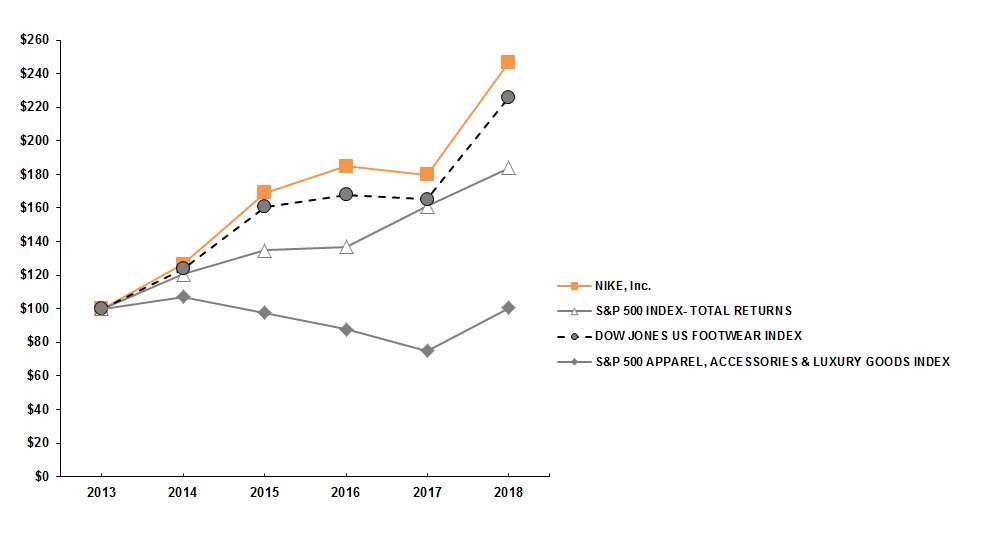
The Dow Jones U.S. Footwear Index consists of NIKE, Deckers Outdoor Corporation, Skechers U.S.A., Inc., Steven Madden, Ltd. and Wolverine World Wide, Inc. Because NIKE is part of the Dow Jones U.S. Footwear Index, the price and returns of NIKE stock have a substantial effect on this index. The Standard & Poor’s Apparel, Accessories & Luxury Goods Index consists of Michael Kors Holdings Limited, Ralph Lauren Corporation, Tapestry, Inc., Under Armour, Inc. and V.F. Corporation, among other companies. The Dow Jones U.S. Footwear Index and the Standard & Poor’s Apparel, Accessories & Luxury Goods Index include companies in two major lines of business in which the Company competes. The indices do not encompass all of the Company’s competitors, nor all product categories and lines of business in which the Company is engaged.
The stock performance shown on the performance graph above is not necessarily indicative of future performance. The Company will not make or endorse any predictions as to future stock performance.
The performance graph above is being furnished solely to accompany this Report pursuant to Item 201(e) of Regulation S-K, is not being filed for purposes of Section 18 of the Securities Exchange Act of 1934, as amended, and is not to be incorporated by reference into any filing of the Company, whether made before or after the date hereof, regardless of any general incorporation language in such filing.
Item 6. Selected Financial Data
All share and per share amounts are reflective of the two-for-one stock split that began trading at the split-adjusted price on December 24, 2015.
| (In millions, except per share data and financial ratios) | Financial History | ||||||||||||||||||
| 2018 | 2017 | 2016 | 2015 | 2014 | |||||||||||||||
| Year Ended May 31, | |||||||||||||||||||
| Revenues | $ | 36,397 | $ | 34,350 | $ | 32,376 | $ | 30,601 | $ | 27,799 | |||||||||
| Gross profit | 15,956 | 15,312 | 14,971 | 14,067 | 12,446 | ||||||||||||||
| Gross margin | 43.8 | % | 44.6 | % | 46.2 | % | 46.0 | % | 44.8 | % | |||||||||
| Net income | 1,933 | 4,240 | 3,760 | 3,273 | 2,693 | ||||||||||||||
| Earnings per common share: | |||||||||||||||||||
| Basic | 1.19 | 2.56 | 2.21 | 1.90 | 1.52 | ||||||||||||||
| Diluted | 1.17 | 2.51 | 2.16 | 1.85 | 1.49 | ||||||||||||||
| Weighted average common shares outstanding | 1,623.8 | 1,657.8 | 1,697.9 | 1,723.5 | 1,766.7 | ||||||||||||||
| Diluted weighted average common shares outstanding | 1,659.1 | 1,692.0 | 1,742.5 | 1,768.8 | 1,811.6 | ||||||||||||||
| Cash dividends declared per common share | 0.78 | 0.70 | 0.62 | 0.54 | 0.47 | ||||||||||||||
| Cash flow from operations(1) | 4,955 | 3,846 | 3,399 | 4,906 | 3,158 | ||||||||||||||
| Price range of common stock: | |||||||||||||||||||
| High | 73.49 | 60.33 | 68.19 | 52.75 | 40.13 | ||||||||||||||
| Low | 50.35 | 49.01 | 47.25 | 36.57 | 29.56 | ||||||||||||||
| At May 31, | |||||||||||||||||||
| Cash and equivalents | $ | 4,249 | $ | 3,808 | $ | 3,138 | $ | 3,852 | $ | 2,220 | |||||||||
| Short-term investments | 996 | 2,371 | 2,319 | 2,072 | 2,922 | ||||||||||||||
| Inventories | 5,261 | 5,055 | 4,838 | 4,337 | 3,947 | ||||||||||||||
| Working capital | 9,094 | 10,587 | 9,667 | 9,225 | 8,319 | ||||||||||||||
| Total assets | 22,536 | 23,259 | 21,379 | 21,590 | 18,579 | ||||||||||||||
| Long-term debt | 3,468 | 3,471 | 1,993 | 1,072 | 1,191 | ||||||||||||||
| Capital lease obligations | 75 | 27 | 15 | 5 | 74 | ||||||||||||||
| Redeemable preferred stock | 0.3 | 0.3 | 0.3 | 0.3 | 0.3 | ||||||||||||||
| Shareholders’ equity | 9,812 | 12,407 | 12,258 | 12,707 | 10,824 | ||||||||||||||
| Year-end stock price | 71.80 | 52.99 | 55.22 | 50.84 | 38.46 | ||||||||||||||
| Market capitalization | 114,983 | 87,084 | 92,867 | 87,044 | 66,921 | ||||||||||||||
| Financial Ratios: | |||||||||||||||||||
| Return on equity(2) | 17.4 | % | 34.4 | % | 30.1 | % | 27.8 | % | 24.6 | % | |||||||||
| Return on assets(2) | 8.4 | % | 19.0 | % | 17.5 | % | 16.3 | % | 14.9 | % | |||||||||
| Inventory turns | 4.0 | 3.8 | 3.8 | 4.0 | 4.1 | ||||||||||||||
| Current ratio at May 31 | 2.5 | 2.9 | 2.8 | 2.5 | 2.7 | ||||||||||||||
| Price/Earnings ratio at May 31(2) | 61.4 | 21.1 | 25.6 | 27.5 | 25.9 |
| (1) | Prior year amounts have been updated to reflect the adoption of Accounting Standards Update No. 2016-09, Compensation — Stock Compensation (Topic 718): Improvements to Employee Share-Based Payment Accounting. As a result of adoption, the Company reclassified cash inflows of $177 million, $281 million, $218 million and $132 million for the years ended May 31, 2017, 2016, 2015 and 2014, respectively, related to excess tax benefits from share-based payment awards, from Cash used by financing activities to Cash provided by operations. Additionally, the Company reclassified cash outflows of $29 million, $22 million, $8 million and $13 million for the years ended May 31, 2017, 2016, 2015 and 2014, respectively, related to tax payments for the net settlement of share-based payment awards, from Cash provided by operations to Cash used by financing activities within the Consolidated Statements of Cash Flows. Refer to Note 1 — Summary of Significant Accounting Policies for additional information. |
| (2) | Certain fiscal 2018 financial ratios reflect the impact of the Tax Cuts and Jobs Act. Refer to Note 9 — Income Taxes for additional information. |
| Selected Quarterly Financial Data |
| (Unaudited) (In millions, except per share data) | 1st Quarter | 2nd Quarter | 3rd Quarter | 4th Quarter | ||||||||||||||||||||||||||||
| 2018 | 2017 | 2018 | 2017 | 2018(1) | 2017 | 2018 | 2017 | |||||||||||||||||||||||||
| Revenues | $ | 9,070 | $ | 9,061 | $ | 8,554 | $ | 8,180 | $ | 8,984 | $ | 8,432 | $ | 9,789 | $ | 8,677 | ||||||||||||||||
| Gross profit | 3,962 | 4,123 | 3,678 | 3,616 | 3,938 | 3,750 | 4,378 | 3,823 | ||||||||||||||||||||||||
| Gross margin | 43.7 | % | 45.5 | % | 43.0 | % | 44.2 | % | 43.8 | % | 44.5 | % | 44.7 | % | 44.1 | % | ||||||||||||||||
| Net income (loss) | 950 | 1,249 | 767 | 842 | (921 | ) | 1,141 | 1,137 | 1,008 | |||||||||||||||||||||||
| Earnings (loss) per common share: | ||||||||||||||||||||||||||||||||
| Basic | 0.58 | 0.75 | 0.47 | 0.51 | (0.57 | ) | 0.69 | 0.71 | 0.61 | |||||||||||||||||||||||
| Diluted | 0.57 | 0.73 | 0.46 | 0.50 | (0.57 | ) | 0.68 | 0.69 | 0.60 | |||||||||||||||||||||||
| Weighted average common shares outstanding | 1,639.1 | 1,672.0 | 1,627.0 | 1,659.1 | 1,623.5 | 1,653.1 | 1,605.7 | 1,646.9 | ||||||||||||||||||||||||
| Diluted weighted average common shares outstanding | 1,676.9 | 1,708.9 | 1,660.9 | 1,693.2 | 1,623.5 | 1,686.3 | 1,641.2 | 1,678.6 | ||||||||||||||||||||||||
| Cash dividends declared per common share | 0.18 | 0.16 | 0.20 | 0.18 | 0.20 | 0.18 | 0.20 | 0.18 | ||||||||||||||||||||||||
| Price range of common stock: | ||||||||||||||||||||||||||||||||
| High | 60.53 | 60.33 | 61.21 | 59.18 | 70.25 | 58.42 | 73.49 | 59.00 | ||||||||||||||||||||||||
| Low | 50.79 | 51.48 | 50.35 | 49.01 | 59.24 | 50.06 | 63.21 | 50.81 |
| (1) | The third quarter of fiscal 2018 reflects the impact from the enactment of the Tax Cuts and Jobs Act. Refer to Note 9 — Income Taxes for additional information. |
Item 7. Management’s Discussion and Analysis of Financial Condition and Results of Operations
NIKE designs, develops, markets and sells athletic footwear, apparel, equipment, accessories and services worldwide. We are the largest seller of athletic footwear and apparel in the world. We sell our products through NIKE-owned retail stores and through digital platforms (which we refer to collectively as our “NIKE Direct” operations), to retail accounts and a mix of independent distributors, licensees and sales representatives in virtually all countries around the world. Our goal is to deliver value to our shareholders by building a profitable global portfolio of branded footwear, apparel, equipment and accessories businesses. Our strategy is to achieve long-term revenue growth by creating innovative, “must have” products, building deep personal consumer connections with our brands and delivering compelling consumer experiences through digital platforms and at retail.
In June 2017, we announced the Consumer Direct Offense, a new company alignment designed to allow NIKE to better serve the consumer personally, at scale. Leveraging the power of digital, NIKE plans to drive growth — by accelerating innovation and product creation, moving even closer to the consumer through key cities, and deepening one-to-one connections. As a result of this organizational realignment, beginning in fiscal 2018, the Company’s reportable operating segments for the NIKE Brand are: North America; Europe, Middle East & Africa (EMEA); Greater China; and Asia Pacific & Latin America (APLA).
Through the Consumer Direct Offense, we are focusing on our Triple Double strategy, with the objective of doubling the impact of innovation, increasing our speed to market and growing our direct connections with consumers. As a result of the execution of this strategy, our long-term financial goals through fiscal 2023, on average, per year, are as follows:
| • | High single-digit revenue growth; |
| • | Gross margin expansion of as much as 50 basis points; |
| • | Slight selling and administrative expense leverage; |
| • | Mid-teens earnings per share growth; and |
| • | Low-thirties percentage rate of return on invested capital. |
Over the past ten years, we have achieved strong growth in many of these metrics. During this time, revenues for NIKE, Inc. have grown 7% on an annual compounded basis, annual gross margin has ranged from 43.5% to 46.4%, diluted earnings per common share has grown steadily and our return on invested capital has been as high as 34.7%.
Our fiscal 2018 results demonstrated the power of the NIKE, Inc. portfolio to generate revenue growth, while investing in capabilities in support of our Triple Double strategy to fuel our next phase of long-term growth and profitability. We achieved record revenues for fiscal 2018, growing 6% to $36.4 billion. The NIKE Brand, which represents over 90% of NIKE, Inc. Revenues, delivered 7% revenue growth. On a currency-neutral basis, NIKE Brand revenues grew 5%, driven by strong revenue growth across all international geographies and NIKE Direct, as well as growth in footwear, apparel and most key categories. Revenues for Converse decreased 8% and 11% on a reported and currency-neutral basis, respectively, primarily driven by lower revenues in North America.
Income before income taxes decreased 11% for fiscal 2018, in part reflecting the negative impact of weakening foreign currency exchange rates. Revenue growth was more than offset by higher selling and administrative expense, gross margin contraction, and a shift to other expense, net from other income, net for fiscal 2017. NIKE, Inc. gross margin decreased 80 basis points primarily due to foreign currency exchange rate headwinds. Selling and administrative expense was higher as a percent of revenues, reflecting investments in digital capabilities, consumer experiences and product and brand marketing to drive long-term growth under the Consumer Direct Offense.
Diluted earnings per common share reflects a 2% decline in the weighted average diluted common shares outstanding, driven by our share repurchase program.
While foreign currency markets remain volatile, we continue to see opportunities to drive future growth and profitability, and remain committed to effectively managing our business to achieve our financial goals over the long-term by executing against the operational strategies outlined above.
Use of Non-GAAP Financial Measures
Throughout this Annual Report on Form 10-K, we discuss non-GAAP financial measures, including references to wholesale equivalent revenues and currency-neutral revenues, which should be considered in addition to, and not in lieu of, the financial measures calculated and presented in accordance with accounting principles generally accepted in the United States of America (“U.S. GAAP”). References to wholesale equivalent revenues are intended to provide context as to the total size of our NIKE Brand market footprint if we had no NIKE Direct operations. NIKE Brand wholesale equivalent revenues consist of (1) sales to external wholesale customers and (2) internal sales from our wholesale operations to our NIKE Direct operations, which are charged at prices comparable to those charged to external wholesale customers. Additionally, currency-neutral revenues are calculated using actual exchange rates in use during the comparative prior year period to enhance the visibility of the underlying business trends excluding the impact of translation arising from foreign currency exchange rate fluctuations.
Management uses these non-GAAP financial measures when evaluating the Company’s performance, including when making financial and operating decisions. Additionally, management believes these non-GAAP financial measures provide investors with additional financial information that should be considered when assessing our underlying business performance and trends. However, references to wholesale equivalent revenues and currency-neutral revenues should not be considered in isolation or as a substitute for other financial measures calculated and presented in accordance with U.S. GAAP and may not be comparable to similarly titled non-GAAP measures used by other companies.
| Results of Operations |
| (Dollars in millions, except per share data) | Fiscal 2018 | Fiscal 2017 | % Change | Fiscal 2016 | % Change | |||||||||||||
| Revenues | $ | 36,397 | $ | 34,350 | 6 | % | $ | 32,376 | 6 | % | ||||||||
| Cost of sales | 20,441 | 19,038 | 7 | % | 17,405 | 9 | % | |||||||||||
| Gross profit | 15,956 | 15,312 | 4 | % | 14,971 | 2 | % | |||||||||||
| Gross margin | 43.8 | % | 44.6 | % | 46.2 | % | ||||||||||||
| Demand creation expense | 3,577 | 3,341 | 7 | % | 3,278 | 2 | % | |||||||||||
| Operating overhead expense | 7,934 | 7,222 | 10 | % | 7,191 | 0 | % | |||||||||||
| Total selling and administrative expense | 11,511 | 10,563 | 9 | % | 10,469 | 1 | % | |||||||||||
| % of revenues | 31.6 | % | 30.8 | % | 32.3 | % | ||||||||||||
| Interest expense (income), net | 54 | 59 | — | 19 | — | |||||||||||||
| Other expense (income), net | 66 | (196 | ) | — | (140 | ) | — | |||||||||||
| Income before income taxes | 4,325 | 4,886 | -11 | % | 4,623 | 6 | % | |||||||||||
| Income tax expense | 2,392 | 646 | 270 | % | 863 | -25 | % | |||||||||||
| Effective tax rate | 55.3 | % | 13.2 | % | 18.7 | % |
Showing the first 8K of 113K characters. Open the full section
Item 7A. Quantitative and Qualitative Disclosures about Market Risk
In the normal course of business and consistent with established policies and procedures, we employ a variety of financial instruments to manage exposure to fluctuations in the value of foreign currencies and interest rates. It is our policy to utilize these financial instruments only where necessary to finance our business and manage such exposures; we do not enter into these transactions for trading or speculative purposes.
We are exposed to foreign currency fluctuations, primarily as a result of our international sales, product sourcing and funding activities. Our foreign exchange risk management program is intended to lessen both the positive and negative effects of currency fluctuations on our consolidated results of operations, financial position and cash flows. We use forward and option contracts to hedge certain anticipated, but not yet firmly committed, transactions as well as certain firm commitments and the related receivables and payables, including third-party and intercompany transactions. We have, in the past, and may in the future, also use forward or options contracts to hedge our investment in the net assets of certain international subsidiaries to offset foreign currency translation adjustments related to our net investment in those subsidiaries. Where exposures are hedged, our program has the effect of delaying the impact of exchange rate movements on our Consolidated Financial Statements.
The timing for hedging exposures, as well as the type and duration of the hedge instruments employed, are guided by our hedging policies and determined based upon the nature of the exposure and prevailing market conditions. Typically, the Company may enter into hedge contracts starting up to 12 to 24 months in advance of the forecasted transaction and may place incremental hedges up to 100% of the exposure by the time the forecasted transaction occurs. The majority of derivatives outstanding as of May 31, 2018 are designated as foreign currency cash flow hedges, primarily for Euro/U.S. Dollar, British Pound/Euro and Japanese Yen/U.S. Dollar currency pairs. Refer to Note 16 — Risk Management and Derivatives in the accompanying Notes to the Consolidated Financial Statements for additional information.
Our earnings are also exposed to movements in short- and long-term market interest rates. Our objective in managing this interest rate exposure is to limit the impact of interest rate changes on earnings and cash flows and to reduce overall borrowing costs. To achieve these objectives, we maintain a mix of commercial paper, bank loans, and fixed-rate debt of varying maturities.
| Market Risk Measurement |
We monitor foreign exchange risk, interest rate risk and related derivatives using a variety of techniques including a review of market value, sensitivity analysis and Value-at-Risk (“VaR”). Our market-sensitive derivative and other financial instruments are foreign currency forward contracts, foreign currency option contracts, interest rate swaps, intercompany loans denominated in non-functional currencies, fixed interest rate U.S. Dollar denominated debt and fixed interest rate Japanese Yen denominated debt.
We use VaR to monitor the foreign exchange risk of our foreign currency forward and foreign currency option derivative instruments only. The VaR determines the maximum potential one-day loss in the fair value of these foreign exchange rate-sensitive financial instruments. The VaR model estimates assume normal market conditions and a 95% confidence level. There are various modeling techniques that can be used in the VaR computation. Our computations are based on interrelationships between currencies and interest rates (a “variance/co-variance” technique). These interrelationships are a function of foreign exchange currency market changes and interest rate changes over the preceding one-year period. The value of foreign currency options does not change on a one-to-one basis with changes in the underlying currency rate. We adjust the potential loss in option value for the estimated sensitivity (the “delta” and “gamma”) to changes in the underlying currency rate. This calculation reflects the impact of foreign currency rate fluctuations on the derivative instruments only and does not include the impact of such rate fluctuations on non-functional currency transactions (such as anticipated transactions, firm commitments, cash balances and accounts and loans receivable and payable), including those which are hedged by these instruments.
The VaR model is a risk analysis tool and does not purport to represent actual losses in fair value we will incur nor does it consider the potential effect of favorable changes in market rates. It also does not represent the full extent of the possible loss that may occur. Actual future gains and losses will differ from those estimated because of changes or differences in market rates and interrelationships, hedging instruments and hedge percentages, timing and other factors.
The estimated maximum one-day loss in fair value on our foreign currency sensitive derivative financial instruments, derived using the VaR model, was $93 million and $97 million at May 31, 2018 and 2017, respectively. The VAR decreased year-over-year as a result of a decrease in foreign currency volatilities at May 31, 2018. Such a hypothetical loss in the fair value of our derivatives would be offset by increases in the value of the underlying transactions being hedged. The average monthly change in the fair values of foreign currency forward and foreign currency option derivative instruments was $260 million and $161 million during fiscal 2018 and fiscal 2017, respectively.
The instruments not included in the VaR are intercompany loans denominated in non-functional currencies, fixed interest rate Japanese Yen denominated debt, fixed interest rate U.S. Dollar denominated debt and interest rate swaps. Intercompany loans and related interest amounts are eliminated in consolidation. Furthermore, our non-functional currency intercompany loans are substantially hedged against foreign exchange risk through the use of forward contracts, which are included in the VaR calculation above. Therefore, we consider the interest rate and foreign currency market risks associated with our non-functional currency intercompany loans to be immaterial to our consolidated financial position, results from operations and cash flows.
Details of third-party debt are provided in the table below. The table presents principal cash flows and related weighted average interest rates by expected maturity dates.
| Expected Maturity Date Year Ending May 31, | ||||||||||||||||||||||||||||||||
| (Dollars in millions) | 2019 | 2020 | 2021 | 2022 | 2023 | Thereafter | Total | Fair Value | ||||||||||||||||||||||||
| Foreign Exchange Risk | ||||||||||||||||||||||||||||||||
| Japanese Yen Functional Currency | ||||||||||||||||||||||||||||||||
| Long-term Japanese Yen debt — Fixed rate | ||||||||||||||||||||||||||||||||
| Principal payments | $ | 6 | $ | 6 | $ | 3 | $ | — | $ | — | $ | — | $ | 15 | $ | 16 | ||||||||||||||||
| Average interest rate | 2.4 | % | 2.4 | % | 2.4 | % | 0.0 | % | 0.0 | % | 0.0 | % | 2.4 | % | ||||||||||||||||||
| Interest Rate Risk | ||||||||||||||||||||||||||||||||
| Japanese Yen Functional Currency | ||||||||||||||||||||||||||||||||
| Long-term Japanese Yen debt — Fixed rate | ||||||||||||||||||||||||||||||||
| Principal payments | $ | 6 | $ | 6 | $ | 3 | $ | — | $ | — | $ | — | $ | 15 | $ | 16 | ||||||||||||||||
| Average interest rate | 2.4 | % | 2.4 | % | 2.4 | % | 0.0 | % | 0.0 | % | 0.0 | % | 2.4 | % | ||||||||||||||||||
| U.S. Dollar Functional Currency | ||||||||||||||||||||||||||||||||
| Long-term U.S. Dollar debt — Fixed rate | ||||||||||||||||||||||||||||||||
| Principal payments | $ | — | $ | — | $ | — | $ | — | $ | 500 | $ | 3,000 | $ | 3,500 | $ | 3,279 | ||||||||||||||||
| Average interest rate | 0.0 | % | 0.0 | % | 0.0 | % | 0.0 | % | 2.3 | % | 3.3 | % | 3.1 | % |
The fixed interest rate Japanese Yen denominated debt instruments were issued by and are accounted for by one of our Japanese subsidiaries. Accordingly, the monthly translation of these instruments, which varies due to changes in foreign exchange rates, is recognized in Accumulated other comprehensive income upon consolidation of this subsidiary.
Item 8. Financial Statements and Supplementary Data
Management of NIKE, Inc. is responsible for the information and representations contained in this report. The financial statements have been prepared in conformity with accounting principles generally accepted in the United States of America (“U.S. GAAP”) and include certain amounts based on our best estimates and judgments. Other financial information in this report is consistent with these financial statements.
Our accounting systems include controls designed to reasonably assure assets are safeguarded from unauthorized use or disposition and provide for the preparation of financial statements in conformity with U.S. GAAP. These systems are supplemented by the selection and training of qualified financial personnel and an organizational structure providing for appropriate segregation of duties.
An internal corporate audit department reviews the results of its work with the Audit & Finance Committee of the Board of Directors, presently comprised of three outside, independent directors. The Audit & Finance Committee is responsible for the appointment of the independent registered public accounting firm and reviews, with the independent registered public accounting firm, management and the internal corporate audit staff, the scope and the results of the annual audit, the effectiveness of the accounting control system and other matters relating to the financial affairs of NIKE as the Audit & Finance Committee deems appropriate. The independent registered public accounting firm and the internal corporate auditors have full access to the Audit & Finance Committee, with and without the presence of management, to discuss any appropriate matters.
| Management’s Annual Report on Internal Control Over Financial Reporting |
Management is responsible for establishing and maintaining adequate internal control over financial reporting, as such term is defined in Rule 13(a) - 15(f) and Rule 15(d) - 15(f) of the Securities Exchange Act of 1934, as amended. Internal control over financial reporting is a process designed to provide reasonable assurance regarding the reliability of financial reporting and the preparation of the financial statements for external purposes in accordance with generally accepted accounting principles in the United States of America. Internal control over financial reporting includes those policies and procedures that: (i) pertain to the maintenance of records that, in reasonable detail, accurately and fairly reflect the transactions and dispositions of assets of the Company; (ii) provide reasonable assurance that transactions are recorded as necessary to permit preparation of financial statements in accordance with generally accepted accounting principles, and that receipts and expenditures of the Company are being made only in accordance with authorizations of our management and directors; and (iii) provide reasonable assurance regarding prevention or timely detection of unauthorized acquisition, use or disposition of assets of the Company that could have a material effect on the financial statements.
While “reasonable assurance” is a high level of assurance, it does not mean absolute assurance. Because of its inherent limitations, internal control over financial reporting may not prevent or detect every misstatement and instance of fraud. Controls are susceptible to manipulation, especially in instances of fraud caused by the collusion of two or more people, including our senior management. Also, projections of any evaluation of effectiveness to future periods are subject to the risk that controls may become inadequate because of changes in conditions, or that the degree of compliance with the policies or procedures may deteriorate.
Under the supervision and with the participation of our Chief Executive Officer and Chief Financial Officer, our management conducted an evaluation of the effectiveness of our internal control over financial reporting based upon the framework in Internal Control — Integrated Framework (2013) issued by the Committee of Sponsoring Organizations of the Treadway Commission (COSO). Based on the results of our evaluation, our management concluded that our internal control over financial reporting was effective as of May 31, 2018.
PricewaterhouseCoopers LLP, an independent registered public accounting firm, has audited (1) the Consolidated Financial Statements and (2) the effectiveness of our internal control over financial reporting as of May 31, 2018, as stated in their report herein.
| Mark G. Parker | Andrew Campion |
| Chairman, President and Chief Executive Officer | Chief Financial Officer |
| Report of Independent Registered Public Accounting Firm |
To the Board of Directors and Shareholders of NIKE, Inc.
Opinions on the Financial Statements and Internal Control over Financial Reporting
We have audited the accompanying consolidated balance sheets of NIKE, Inc. and its subsidiaries as of May 31, 2018 and 2017, and the related consolidated statements of income, comprehensive income, shareholders’ equity and cash flows for each of the three years in the period ended May 31, 2018, including the related notes and financial statement schedule listed in the index appearing under Item 15(a)(2) (collectively referred to as the “consolidated financial statements”). We also have audited the Company’s internal control over financial reporting as of May 31, 2018, based on criteria established in Internal Control - Integrated Framework (2013) issued by the Committee of Sponsoring Organizations of the Treadway Commission (COSO).
In our opinion, the consolidated financial statements referred to above present fairly, in all material respects, the financial position of the Company as of May 31, 2018 and 2017, and the results of their operations and their cash flows for each of the three years in the period ended May 31, 2018 in conformity with accounting principles generally accepted in the United States of America. Also in our opinion, the Company maintained, in all material respects, effective internal control over financial reporting as of May 31, 2018, based on criteria established in Internal Control - Integrated Framework (2013) issued by the COSO.
Change in Accounting Principle
As discussed in Note 1 to the consolidated financial statements, the Company changed the manner in which it accounts for share-based payment awards to employees as of June 1, 2017.
Basis for Opinions
The Company’s management is responsible for these consolidated financial statements, for maintaining effective internal control over financial reporting, and for its assessment of the effectiveness of internal control over financial reporting, included in Management’s Annual Report on Internal Control over Financial Reporting appearing under Item 8. Our responsibility is to express opinions on the Company’s consolidated financial statements and on the Company’s internal control over financial reporting based on our audits. We are a public accounting firm registered with the Public Company Accounting Oversight Board (United States) (“PCAOB”) and are required to be independent with respect to the Company in accordance with the U.S. federal securities laws and the applicable rules and regulations of the Securities and Exchange Commission and the PCAOB.
We conducted our audits in accordance with the standards of the PCAOB. Those standards require that we plan and perform the audits to obtain reasonable assurance about whether the consolidated financial statements are free of material misstatement, whether due to error or fraud, and whether effective internal control over financial reporting was maintained in all material respects.
Our audits of the consolidated financial statements included performing procedures to assess the risks of material misstatement of the consolidated financial statements, whether due to error or fraud, and performing procedures that respond t
Showing the first 8K of 150K characters. Open the full section
Item 9. Changes in and Disagreements with Accountants on Accounting and Financial Disclosure
There has been no change of accountants nor any disagreements with accountants on any matter of accounting principles or practices or financial statement disclosure required to be reported under this Item.
Item 9A. Controls and Procedures
We maintain disclosure controls and procedures designed to ensure information required to be disclosed in our Exchange Act reports is recorded, processed, summarized and reported within the time periods specified in the SEC’s rules and forms and such information is accumulated and communicated to our management, including our Chief Executive Officer and Chief Financial Officer, as appropriate, to allow for timely decisions regarding required disclosure. In designing and evaluating the disclosure controls and procedures, management recognizes any controls and procedures, no matter how well designed and operated, can provide only reasonable assurance of achieving the desired control objectives, and management is required to apply its judgment in evaluating the cost-benefit relationship of possible controls and procedures.
We carry out a variety of ongoing procedures, under the supervision and with the participation of our management, including our Chief Executive Officer and Chief Financial Officer, to evaluate the effectiveness of the design and operation of our disclosure controls and procedures. Based on the foregoing, our Chief Executive Officer and Chief Financial Officer concluded that our disclosure controls and procedures were effective at the reasonable assurance level as of May 31, 2018.
“Management’s Annual Report on Internal Control Over Financial Reporting” is included in Item 8 of this Report.
We have continued several transformation initiatives to centralize and simplify our business processes and systems. These are long-term initiatives, which we believe will enhance our internal control over financial reporting due to increased automation and further integration of related processes. We will continue to monitor our internal control over financial reporting for effectiveness throughout the transformation.
There have not been any other changes in our internal control over financial reporting during our most recent fiscal quarter that have materially affected, or are reasonably likely to materially affect, our internal control over financial reporting.
Item 9B. Other Information
On July 20, 2018, the Compensation Committee (the “Committee”) of the Board of Directors of NIKE, Inc. (the “Company”), approved a form of discretionary performance award agreement (the “DPA”) to enable the Company to award cash incentives to employees in recognition of Company and individual performance. The form of DPA is intended to enhance the Company’s ability to pay for performance on a case-by-case basis by supplementing the Company’s existing performance-based compensation plans, including the Amended and Restated Long-Term Incentive Plan (“LTIP”) and the Executive Performance Sharing Plan. The foregoing is qualified in its entirety by reference to the form of DPA, which is filed as Exhibit 10.22 hereto and incorporated by reference herein.
Additionally, on July 20, 2018, the Committee approved awards under the form of DPA to the Company’s continuing named executive officers (collectively, the “Officers”) as follows: Mark G. Parker, $1,295,000; Andrew Campion, $277,500; Eric D. Sprunk, $277,500; Hilary K. Krane, $185,000; and John F. Slusher, $185,000. As further described in the Company’s 2018 Proxy Statement, the Committee adjusted the payouts for LTIP awards covering the fiscal 2016-2018 performance period to primarily account for the impact of the Tax Cuts and Jobs Act. Because the terms of the LTIP awards, as applicable to the Company's named executive officers, did not contemplate the Tax Cuts and Jobs Act, the Committee determined to award these one-time DPA grants so as to put the Officers in the same position as the non-executive officer LTIP participants.
PART III
Item 10. Directors, Executive Officers and Corporate Governance
The information required by Item 401 of Regulation S-K regarding directors is included under “Election of Directors” in the definitive Proxy Statement for our 2018 Annual Meeting of Shareholders and is incorporated herein by reference. The information required by Item 401 of Regulation S-K regarding executive officers is included under “Executive Officers of the Registrant” in Item 1 of this Report. The information required by Item 405 of Regulation S-K is included under “Election of Directors — Section 16(a) Beneficial Ownership Reporting Compliance” in the definitive Proxy Statement for our 2018 Annual Meeting of Shareholders and is incorporated herein by reference. The information required by Item 406 of Regulation S-K is included under “Corporate Governance — Code of Business Conduct and Ethics” in the definitive Proxy Statement for our 2018 Annual Meeting of Shareholders and is incorporated herein by reference. The information required by Items 407(d)(4) and (d)(5) of Regulation S-K regarding the Audit & Finance Committee of the Board of Directors is included under “Corporate Governance — Board Committees” in the definitive Proxy Statement for our 2018 Annual Meeting of Shareholders and is incorporated herein by reference.
Item 11. Executive Compensation
The information required by Items 402, 407(e)(4) and 407(e)(5) of Regulation S-K regarding executive compensation is included under “Election of Directors — Director Compensation for Fiscal 2018,” “Compensation Discussion and Analysis,” “Executive Compensation,” “Election of Directors — Compensation Committee Interlocks and Insider Participation,” and “Compensation Committee Report” in the definitive Proxy Statement for our 2018 Annual Meeting of Shareholders and is incorporated herein by reference.
Item 12. Security Ownership of Certain Beneficial Owners and Management and Related Stockholder Matters
The information required by Item 201(d) of Regulation S-K is included under “Executive Compensation — Equity Compensation Plans” in the definitive Proxy Statement for our 2018 Annual Meeting of Shareholders and is incorporated herein by reference. The information required by Item 403 of Regulation S-K is included under “Election of Directors — Stock Holdings of Certain Owners and Management” in the definitive Proxy Statement for our 2018 Annual Meeting of Shareholders and is incorporated herein by reference.
Item 13. Certain Relationships and Related Transactions and Director Independence
The information required by Items 404 and 407(a) of Regulation S-K is included under “Election of Directors — Transactions with Related Persons” and “Corporate Governance — Director Independence” in the definitive Proxy Statement for our 2018 Annual Meeting of Shareholders and is incorporated herein by reference.
Item 14. Principal Accountant Fees and Services
The information required by Item 9(e) of Schedule 14A is included under “Ratification of Independent Registered Public Accounting Firm” in the definitive Proxy Statement for our 2018 Annual Meeting of Shareholders and is incorporated herein by reference.
PART IV
Item 15. Exhibits and Financial Statement Schedules
| (a) | The following documents are filed as part of this report: | |
| Form 10-K Page No. | ||
| 1. | Financial Statements: | |
| Report of Independent Registered Public Accounting Firm | 43 | |
| Consolidated Statements of Income for each of the three years ended May 31, 2018, May 31, 2017 and May 31, 2016 | 44 | |
| Consolidated Statements of Comprehensive Income for each of the three years ended May 31, 2018, May 31, 2017 and May 31, 2016 | 45 | |
| Consolidated Balance Sheets at May 31, 2018 and May 31, 2017 | 46 | |
| Consolidated Statements of Cash Flows for each of the three years ended May 31, 2018, May 31, 2017 and May 31, 2016 | 47 | |
| Consolidated Statements of Shareholders’ Equity for each of the three years ended May 31, 2018, May 31, 2017 and May 31, 2016 | 48 | |
| Notes to Consolidated Financial Statements | 49 | |
| 2. | Financial Statement Schedule: | |
| II — Valuation and Qualifying Accounts for the years ended May 31, 2018, 2017 and 2016 | 77 | |
| All other schedules are omitted because they are not applicable or the required information is shown in the financial statements or notes thereto. | ||
| 3. | Exhibits: |
- Management contract or compensatory plan or arrangement.
The Exhibits filed herewith do not include certain instruments with respect to long-term debt of NIKE and its subsidiaries, inasmuch as the total amount of debt authorized under any such instrument does not exceed 10 percent of the total assets of NIKE and its subsidiaries on a consolidated basis. NIKE agrees, pursuant to Item 601(b)(4)(iii) of Regulation S-K, that it will furnish a copy of any such instrument to the SEC upon request.
Upon written request to Investor Relations, NIKE, Inc., One Bowerman Drive, Beaverton, Oregon 97005-6453, NIKE will furnish shareholders with a copy of any Exhibit upon payment of $0.10 per page, which represents our reasonable expenses in furnishing Exhibits.
SCHEDULE II — Valuation and Qualifying Accounts
| (In millions) | Balance at Beginning of Period | Charged to Costs and Expenses | Charged to Other Accounts(1) | Write-Offs, Net | Balance at End of Period | |||||||||||||||
| Sales returns reserve | ||||||||||||||||||||
| For the year ended May 31, 2016 | $ | 379 | $ | 788 | $ | (15 | ) | $ | (708 | ) | $ | 444 | ||||||||
| For the year ended May 31, 2017 | 444 | 696 | 3 | (800 | ) | 343 | ||||||||||||||
| For the year ended May 31, 2018 | 343 | 640 | 5 | (658 | ) | 330 | ||||||||||||||
| Allowance for doubtful accounts(2) | ||||||||||||||||||||
| For the year ended May 31, 2016 | $ | 78 | $ | 52 | $ | (2 | ) | $ | (85 | ) | $ | 43 | ||||||||
| For the year ended May 31, 2017 | 43 | 16 | — | (40 | ) | 19 | ||||||||||||||
| For the year ended May 31, 2018 | 19 | 19 | — | (8 | ) | 30 |
| (1) | Amounts included in this column primarily relate to foreign currency translation. |
| (2) | Includes both current and non-current portions of the allowance for doubtful accounts. The non-current portion is included in Deferred income taxes and other assets on the Consolidated Balance Sheets. |
Item 16. Form 10-K Summary
None.
Consent of Independent Registered Public Accounting Firm
We hereby consent to the incorporation by reference in the Registration Statements on Form S-3 (No. 333-212617) and Form S-8 (Nos. 033-63995, 333-63581, 333-63583, 333-68864, 333-68886, 333-71660, 333-104822, 333-117059, 333-133360, 333-164248, 333-171647, 333-173727, 333-208900 and 333-215439) of NIKE, Inc. of our report dated July 24, 2018 relating to the financial statements, financial statement schedule and the effectiveness of internal control over financial reporting, which appears in this Form 10-K.
/s/ PricewaterhouseCoopers LLP
Portland, Oregon
July 24, 2018
Signatures
Pursuant to the requirements of Section 13 or 15(d) of the Securities Exchange Act of 1934, the registrant has duly caused this report to be signed on its behalf by the undersigned, thereunto duly authorized.
| NIKE, INC. | ||
| By: | /s/ MARK G. PARKER | |
| Mark G. Parker | ||
| Chairman, President and Chief Executive Officer | ||
| Date: | July 24, 2018 |
Pursuant to the requirements of the Securities Exchange Act of 1934, as amended, this report has been signed below by the following persons on behalf of the registrant and in the capacities and on the dates indicated.
| Signature | Title | Date |
| PRINCIPAL EXECUTIVE OFFICER AND DIRECTOR: | ||
| /s/ MARK G. PARKER Mark G. Parker | Chairman, President and Chief Executive Officer | July 24, 2018 |
| PRINCIPAL FINANCIAL OFFICER: | ||
| /s/ ANDREW CAMPION Andrew Campion | Chief Financial Officer | July 24, 2018 |
| PRINCIPAL ACCOUNTING OFFICER: | ||
| /s/ CHRIS L. ABSTON Chris L. Abston | Corporate Controller | July 24, 2018 |
| DIRECTORS: | ||
| /s/ CATHLEEN A. BENKO Cathleen A. Benko | Director | July 24, 2018 |
| /s/ ELIZABETH J. COMSTOCK Elizabeth J. Comstock | Director | July 24, 2018 |
| /s/ JOHN G. CONNORS John G. Connors | Director | July 24, 2018 |
| /s/ TIMOTHY D. COOK Timothy D. Cook | Director | July 24, 2018 |
| /s/ JOHN J. DONAHOE II John J. Donahoe II | Director | July 24, 2018 |
| /s/ ALAN B. GRAF, JR. Alan B. Graf, Jr. | Director | July 24, 2018 |
| /s/ PETER B. HENRY Peter B. Henry | Director | July 24, 2018 |
| /s/ TRAVIS A. KNIGHT Travis A. Knight | Director | July 24, 2018 |
| /s/ JOHN C. LECHLEITER John C. Lechleiter | Director | July 24, 2018 |
| /s/ MICHELLE A. PELUSO Michelle A. Peluso | Director | July 24, 2018 |
| /s/ JOHNATHAN A. RODGERS Johnathan A. Rodgers | Director | July 24, 2018 |
| /s/ JOHN R. THOMPSON, JR. John R. Thompson, Jr. | Director | July 24, 2018 |