 filings.tools
Northrop Grumman 10-K 2022-12-31
Filed 2023-01-26. 23 sections, 513K characters. Original on sec.gov · Markdown · JSON
Cover and table of contents
UNITED STATES
SECURITIES AND EXCHANGE COMMISSION
Washington, D.C. 20549
| FORM | 10-K |
| ☒ | ANNUAL REPORT PURSUANT TO SECTION 13 OR 15(d) OF THE SECURITIES EXCHANGE ACT OF 1934 |
For the fiscal year ended December 31, 2022
or
| ☐ | TRANSITION REPORT PURSUANT TO SECTION 13 OR 15(d) OF THE SECURITIES EXCHANGE ACT OF 1934 |
For the transition period from _____ to _____
Commission file number 1-16411
NORTHROP GRUMMAN CORPORATION
(Exact name of registrant as specified in its charter)
| Delaware | 80-0640649 | ||||||||||
| (State or other jurisdiction of incorporation or organization) | (I.R.S. Employer Identification Number) | ||||||||||
| 2980 Fairview Park Drive | |||||||||||
| Falls Church, | Virginia | 22042 | |||||||||
| (Address of principal executive offices) | (Zip code) |
(703) 280-2900
(Registrant’s telephone number, including area code)
Securities registered pursuant to section 12(b) of the Act:
| Title of each class | Trading Symbol(s) | Name of each exchange on which registered | ||||||
| Common Stock | NOC | New York Stock Exchange |
Securities registered pursuant to Section 12(g) of the Act: None
Indicate by check mark if the registrant is a well-known seasoned issuer, as defined in Rule 405 of the Securities Act.
Yes ☒ No ☐
Indicate by check mark if the registrant is not required to file reports pursuant to Section 13 or 15(d) of the Act.
Yes ☐ No ☒
Indicate by check mark whether the registrant (1) has filed all reports required to be filed by Section 13 or 15(d) of the Securities Exchange Act of 1934 during the preceding 12 months (or such shorter period that the registrant was required to file such reports), and (2) has been subject to such filing requirements for the past 90 days.
Yes ☒ No ☐
Indicate by check mark whether the registrant has submitted electronically every Interactive Data File required to be submitted pursuant to Rule 405 of Regulation S-T (§232.405 of this chapter) during the preceding 12 months (or for such shorter period that the registrant was required to submit such files).
Yes ☒ No ☐
Indicate by check mark whether the registrant is a large accelerated filer, an accelerated filer, a non-accelerated filer, a smaller reporting company or an emerging growth company. See the definitions of “large accelerated filer,” “accelerated filer,” “smaller reporting company” and “emerging growth company” in Rule 12b-2 of the Exchange Act:
Large Accelerated Filer ☒ Accelerated Filer ☐ Smaller Reporting Company ☐
Non-accelerated Filer ☐ Emerging Growth Company ☐
If an emerging growth company, indicate by check mark if the registrant has elected not to use the extended transition period for complying with any new or revised financial accounting standards provided pursuant to Section 13(a) of the Exchange Act. ☐
Indicate by check mark whether the registrant has filed a report on and attestation to its management’s assessment of the effectiveness of its internal control over financial reporting under Section 404(b) of the Sarbanes-Oxley Act (15 U.S.C. 7262(b)) by the registered public accounting firm that prepared or issued its audit report. ☒
Indicate by check mark whether the registrant is a shell company (as defined in Rule 12b-2 of the Act).
Yes ☐ No ☒
As of June 30, 2022, the aggregate market value of the common stock (based upon the closing price of the stock on the New York Stock Exchange) of the registrant held by non-affiliates was approximately $74.0 billion.
As of January 23, 2023, 153,053,371 shares of common stock were outstanding.
DOCUMENTS INCORPORATED BY REFERENCE
Portions of Northrop Grumman Corporation’s Proxy Statement to be filed with the Securities and Exchange Commission pursuant to Regulation 14A for the 2023 Annual Meeting of Shareholders are incorporated by reference in Part III of this Form 10-K.
NORTHROP GRUMMAN CORPORATION
TABLE OF CONTENTS
i
ii
NORTHROP GRUMMAN CORPORATION
PART I
Item 1. Business
HISTORY AND ORGANIZATION
History
Northrop Grumman Corporation (herein referred to as “Northrop Grumman,” the “company,” “we,” “us,” or “our”) is a leading global aerospace and defense technology company. We deliver a broad range of products, services and solutions to U.S. and international customers, and principally to the U.S. Department of Defense (DoD) and intelligence community. Our broad portfolio is aligned to support national security priorities and our solutions equip our customers with capabilities they need to connect, protect and advance humanity.
The company is a leading provider of space systems, advanced aircraft, missile defense, advanced weapons and long-range fires capabilities, mission systems, networking and communications, strategic deterrence systems, and breakthrough technologies, such as artificial intelligence, advanced computing and cyber. We are focused on competing and winning programs that enable continued growth, performing on our commitments and affordably delivering capability our customers need. With the investments we've made in advanced technologies, combined with our talented workforce and digital transformation capabilities, Northrop Grumman is well positioned to meet our customers' needs today and in the future. For a discussion of risks associated with our operations, see “Risk Factors.”
The company originally was formed in 1939 in Hawthorne, California as Northrop Aircraft Incorporated and was reincorporated in Delaware in 1985, as Northrop Corporation. Northrop Corporation was a principal developer of flying wing technology, including the B-2 Spirit bomber. We developed into one of the largest defense companies in the world through a series of acquisitions, as well as organic growth, including the following:
-
1994 - Acquired Grumman Corporation, a premier military aircraft systems integrator. The combined company was renamed Northrop Grumman Corporation;
-
1996 - Acquired the defense and electronics businesses of Westinghouse Electric Corporation, developer of sophisticated radar and other electronics systems;
-
2001 - Acquired Litton Industries, Inc., a global electronics and information technology company and full service shipbuilder;
-
2001 - Acquired Newport News Shipbuilding Inc., designer and builder of nuclear-powered aircraft carriers and submarines;
-
2002 - Acquired TRW Inc., developer of military and civil space systems and payloads, and integrator of complex, mission-enabling systems and services;
-
2011 - Completed the spin-off of Huntington Ingalls Industries, Inc., operator of our former shipbuilding business, comprised largely of a part of Litton Industries and Newport News Shipbuilding;
-
2018 - Acquired Orbital ATK, Inc. (OATK), developer and producer of satellites and other space systems, launch vehicles and missile products; and
-
2021 - Completed the sale of our IT and mission support services business (the “IT services divestiture”) to Veritas Capital.
Organization
From time to time, we acquire or dispose of businesses and realign contracts, programs or businesses among and within our operating segments. Internal realignments are typically designed to leverage existing capabilities more fully and to enhance efficient development and delivery of products and services. At December 31, 2022, the company was aligned in four operating sectors, which also comprise our reportable segments: Aeronautics Systems, Defense Systems, Mission Systems and Space Systems.
AERONAUTICS SYSTEMS
Aeronautics Systems is a leader in the design, development, production, integration, sustainment and modernization of advanced aircraft systems for the U.S. Air Force, the U.S. Navy, other U.S. government agencies, and international customers. These aircraft systems support four mission areas: strike; air dominance; battle management
-1-
NORTHROP GRUMMAN CORPORATION
and control; and intelligence, surveillance and reconnaissance (ISR). Aeronautics Systems is reported in two business areas: Autonomous Systems and Manned Aircraft.
Autonomous Systems – provides unmanned autonomous aircraft systems, including high-altitude long-endurance (HALE) strategic ISR systems and vertical take-off and landing (VTOL) tactical ISR systems. Key programs include:
-
MQ-4C Triton, which provides wide area strategic ISR over vast ocean and coastal regions for maritime domain awareness to the U.S. Navy and Australia;
-
RQ-4 Global Hawk, which provides high resolution imagery of land masses for theater awareness and strategic ISR to the U.S. Air Force, Japan, and the Republic of Korea;
-
North Atlantic Treaty Organization (NATO) Alliance Ground Surveillance (AGS), a Global Hawk variant, for strategic ISR missions conducted in multinational theater operations; and
-
MQ-8B and MQ-8C Fire Scout, ship-based, VTOL tactical ISR systems that provide situational awareness and precision targeting for the U.S. Navy.
Manned Aircraft – provides strategic long-range strike aircraft, tactical fighter and air dominance aircraft, and airborne battle management and command and control systems. Key programs include:
-
Development and production of the U.S. Air Force B-21 Raider long-range strike bomber, as well as modernization and sustainment services for the B-2 Spirit bomber;
-
Fuselage production for the F/A-18 Super Hornet and the F-35 Lighting II Joint Strike Fighter for use by U.S. and international forces;
-
E-2D Advanced Hawkeye battle management aircraft production for the U.S. Navy, Japan, and France; and
-
E-8C Joint Surveillance Target Attack Radar System (JSTARS) aircraft sustainment and modernization for the U.S. Air Force.
DEFENSE SYSTEMS
Defense Systems is a leader in the design, development, production, integration, sustainment and modernization of weapon and mission systems for U.S. military and civilian agency customers, and a broad range of international customers. Major products and services include integrated battle management systems, weapons systems and aircraft and mission systems sustainment and modernization. The sector is reported in two business areas: Battle Management & Missile Systems, and Mission Readiness.
Battle Management & Missile Systems – designs, develops and integrates all-domain command and control (C2) and weapons systems, including munitions and missiles. The business provides integration and interoperability of net-enabled battle management, sensors, targeting and surveillance systems – a backbone architecture for Joint All-Domain Command and Control (JADC2) capable of integrating sensors and shooters, as well as air and missile defense C2 systems. It also develops and produces precision strike weapons; advanced propulsion, including high speed air-breathing and hypersonic systems; and high-performance gun systems and precision munitions. Competencies include system and software development; integration of weapon systems; tactical missile and component development and production; and production of advanced fuzes, munitions and defense electronics. Key programs include:
-
Integrated Air and Missile Defense Battle Command System (IBCS) for the U.S. Army and Poland, which is a system that integrates sensors and effectors to deliver among the most advanced C2 systems for joint and coalition forces;
-
U.S. Navy’s Advanced Anti-Radiation Guided Missile (AARGM), a medium-range, air-to-surface missile, and its extended range variant, AARGM-ER;
-
Guided Multiple Launch Rocket System (GMLRS) propulsion and warhead subsystems for a surface-to-surface system used to defeat targets using indirect precision fires up to 70-plus kilometers;
-
Precision Guidance Kit (PGK), replaces conventional fuzes for artillery and mortar munitions and transforms them into Global Positioning System enabled precision guided weapons;
-
Hypersonic Attack Cruise Missile (HACM) air-breathing, scramjet propulsion subsystem for the hypersonic air-launched cruise missile to travel at speeds of Mach 5 or greater; and
-2-
NORTHROP GRUMMAN CORPORATION
- Forward Area Air Defense Command and Control (FAAD C2), the Army’s long-standing program of record for short range air defense and Counter Rocket, Artillery and Mortar (C-RAM), as well as the interim C2 for Counter Unmanned Aircraft Systems (C-UAS).
Mission Readiness – provides full life cycle service and support for software, weapons systems and aircraft, and logistics support, sustainment, operations and modernization for air, sea and ground systems. It also supports critical warfighter training for complex missions in a realistic virtual environment. Competencies include aircraft, electronics and embedded software sustainment; digital engineering and extended reality training for platform logistics; and maintenance. Key programs include:
-
Global system sustainment and operations support for the F-35, B-2, P-3 Orion, E-6B Mercury, KC-30A multi-role tanker, C-27J transport, Global Hawk and Triton programs;
-
Special Electronics Mission Aircraft (SEMA) intelligence, surveillance and reconnaissance support;
-
AAQ-24 sensor sustainment and repair for U.S. military customers; and
-
APN-241 radar sustainment, repair and production for U.S. military and foreign military sales (FMS) customers.
MISSION SYSTEMS
Mission Systems is a leader in advanced mission solutions and multifunction systems, primarily for the U.S. defense and intelligence community, and international customers. Major products and services include cyber; command, control, communications and computers, intelligence, surveillance and reconnaissance (C4ISR) systems; radar, electro-optical/infrared (EO/IR) and acoustic sensors; electronic warfare systems; advanced communications and network systems; cyber solutions; intelligence processing systems; navigation; and maritime power, propulsion and payload launch systems. The sector is reported in four business areas: Airborne Multifunction Sensors; Maritime/Land Systems & Sensors; Navigation, Targeting & Survivability; and Networked Information Solutions.
Airborne Multifunction Sensors – delivers products, systems and services that support airborne platforms with multi-function radio frequency (RF) and EO/IR systems; radar, electronic warfare and situational awareness mission systems; and high altitude ISR sensors. Competencies include fire control, surveillance and early warning and control radar systems; electronic attack and electronic support systems; and multi-sensor processing. Key unrestricted programs include:
-
Airborne Early Warning & Control (AEW&C). The center piece of the E-7 AEW&C aircraft is the Multi-role Electronically Scanned Array (MESA) radar which enables 360 degree long range advanced air moving target indicator (AMTI) capabilities for Battle Management, Command and Control, and Maritime Surveillance;
-
F-35 fire control radar and Distributed Aperture System (DAS), which provides 360 degree field of view tracking, identifying, missile warning and night vision capabilities;
-
LONGBOW Fire Control Radar (FCR), which provides fire control radar capabilities for the global AH-64 helicopter fleet; and
-
Scalable Agile Beam Radar (SABR), an active electronically scanned array fire control radar system for F-16 aircraft.
Maritime/Land Systems & Sensors – delivers products, systems and services that enable maritime and ground platform mission capabilities via sensors, targeting and surveillance systems; electronic warfare systems; mission module integration; power, propulsion and control systems; and missile launchers. Competencies include ground and maritime radar systems; nuclear ship propulsion and power generation systems; shipboard missile and encapsulated payload launch systems; integrated bridge systems; unmanned maritime vehicles; high-resolution undersea sensors; deep-sea packaging; and mission integration. Key unrestricted programs include:
-
Surface Electronic Warfare Improvement Program (SEWIP) Block III, which protects surface ships from anti-ship missiles, provides early detection, signal analysis and threat warning;
-
Ground/Air Task Oriented Radar (G/ATOR), a mobile multi-mode active electronically scanned array;
-
Littoral Combat Ship Mission Module Integration, which provides engineering design, support and production of mission modules for U.S. Navy littoral combat ships; and
-3-
NORTHROP GRUMMAN CORPORATION
- DDG Modernization, which is comprised of several subsystems to support modernization of Arleigh Burke-class guided missile destroyers including Integrated Bridge and Navigation Systems (IBNS) and ship control systems.
Navigation, Targeting & Survivability – delivers products, systems and services that support aircraft platforms with targeting, self-protection and situational awareness mission systems; and provides embedded navigation and positioning sensors for a range of platforms including ships, aircraft, spacecraft and weapons. Competencies include EO/IR and RF self-protection; targeting and surveillance systems; digitized cockpits; and inertial navigation systems. Key unrestricted programs include:
-
LITENING Advanced Targeting Pod, an electro-optical infrared sensor system for targeting and surveillance that enables aircrews to detect, acquire, identify and track targets at long ranges;
-
Large Aircraft and Common Infrared Countermeasures (LAIRCM, DoN LAIRCM, CIRCM) systems, which protect large aircraft as well as rotary wing and medium fixed wing aircraft from infrared missiles using advanced laser technology;
-
APR-39 DV(2) and EV(2) Radar Warning Receiver programs, which produce a digital radar warning receiver for the U.S. Army, Navy and Marines;
-
AC/MC 130J Radio Frequency Countermeasures system, which provides superior situational awareness and better enables aircraft survivability in operationally relevant environments;
-
Embedded Global Positioning System (GPS) / Inertial Navigation Systems-Modernization (EGI-M) program, which provides state-of-the-art airborne navigation capabilities with an open architecture that enables rapid responses to future threats; and
-
UH-60V Black Hawk integrated mission equipment package, which modernizes the U.S. Army’s Black Hawk helicopters with a glass cockpit, including an integrated computational system, visual display system and control display units, extending the life and mission capabilities of the UH-60 platform.
Networked Information Solutions – delivers products, systems and services in the areas of advanced communications and network systems, full spectrum cyber solutions, secure processing, transformational computing, advanced technology development, and Signals Intelligence (SIGINT) mission systems. Competencies include software defined radios and network gateways, communications and counter-communications systems; cyber mission management; large scale cyber solutions for national security applications; cyber survivability; ground software systems; and SIGINT sensors and processing. Key unrestricted programs include:
-
F-35 Communications, Navigation and Identification (CNI) integrated avionics system, which provides secure communications and interoperability capabilities;
-
Battlefield Airborne Communications Node (BACN), one of the first airborne gateway systems that allows platforms to communicate and securely share data;
-
Joint Counter Radio-Controlled Improvised Explosive Device Electronic Warfare (JCREW), a software-programmable jammer that provides protection from improvised explosive devices (IEDs);
-
Exploitation and cyber programs, which provide cyber and intelligence domain support through unique intelligence and cyber capabilities; and
-
Airborne Signals Intelligence Payload (ASIP), which delivers key signals intelligence capabilities to the warfighter by detecting, identifying, and locating radar and other types of electronic and modern communication signals.
SPACE SYSTEMS
Space Systems is a leader in delivering end-to-end mission solutions through the design, development, integration, production and operation of space, missile defense, launch and strategic missile systems for national security, civil government, commercial and international customers. Major products include satellites and payloads; ground systems; missile defense systems and interceptors; launch vehicles and related propulsion systems; and strategic missiles. The sector is reported in two business areas: Space and Launch & Strategic Missiles.
Space – designs, develops, manufactures and integrates spacecraft systems, subsystems, sensors, payloads and ground systems to deliver mission capability to national security, science and environmental, communications, on-orbit servicing, and human-rated space systems for earth orbit and deep-space exploration missions. Much of this business is performed through restricted programs. Key unrestricted programs include:
-4-
NORTHROP GRUMMAN CORPORATION
-
Cygnus spacecraft, used in the execution of our CRS contracts with NASA;
-
Habitation and Logistics Outpost (HALO) module in support of NASA’s Gateway;
-
Evolved Strategic SATCOM (ESS) and Protected Tactical SATCOM (PTS) satellites and payloads providing survivable, protected communications to U.S. forces;
-
Next-Generation Overhead Persistent Infrared (Next Gen OPIR) program satellites and payloads providing data for missile defense;
-
Space Development Agency Tracking and Transport layers providing missile warning/tracking and resilient, low-latency, high-volume data transport communication systems; and
-
James Webb Space Telescope (JWST) operations and sustainment contract.
Launch & Strategic Missiles – designs, develops, manufactures and integrates small- and medium-class space launch vehicles to place satellites into earth orbit; suborbital launch vehicles that place payloads into a variety of high-altitude trajectories; large strategic missile systems; and missile defense systems. Competencies include large strategic missile design, integration, production and sustainment, as well as the production of medium- and large-class rocket propulsion systems for human and cargo launch vehicles, hypersonic boosters and missile defense interceptors. Key programs include:
-
Ground Based Strategic Deterrent (GBSD) Engineering & Manufacturing Development (EMD) program;
-
Missile defense systems, interceptors, targets, mission processing and boosters for the Missile Defense Agency's (MDA) Next-Generation Interceptor (NGI), Ground-based Midcourse Defense Weapon Systems (GWS);
-
Development and production of solid rocket motors for NASA’s Space Launch System (SLS) heavy lift vehicle;
-
Antares rocket, used in the execution of our Commercial Resupply Services (CRS) contracts with the National Aeronautics and Space Administration (NASA);
-
63-inch diameter Graphite Epoxy Motor (GEM 63) and the extended length variation (GEM 63XL) solid rocket boosters used to provide lift capability for the ATLAS V and Vulcan launch vehicles;
-
Medium-class solid rocket motors for the U.S. Navy's Trident II Fleet Ballistic Missile program; and
-
Intercontinental Ballistic Missile (ICBM) Ground Subsystem Support Contract (GSSC).
CUSTOMER CONCENTRATION
Our largest customer is the U.S. government. Sales to the U.S. government accounted for 86 percent, 85 percent and 84 percent of sales during the years ended December 31, 2022, 2021 and 2020, respectively. For further information on sales by customer type, contract type and geographic region, see Note 16 to the consolidated financial statements. See “Risk Factors” for further discussion regarding risks related to customer concentration.
COMPETITIVE CONDITIONS
We compete with many companies in the defense, intelligence and federal civil markets. The Boeing Company, General Dynamics, L3Harris Technologies, Lockheed Martin, and Raytheon Technologies are some of our primary competitors. Key characteristics of our industry include long operating cycles and intense competition, which is evident through the number of competitors bidding on program opportunities and the number of bid protests (competitor protests of U.S. government procurement awards).
It is common in the defense industry for work on major programs to be shared among a number of companies. A company competing to be a prime contractor may, upon ultimate award of the contract to another competitor, serve as a subcontractor to the ultimate prime contracting company. It is not unusual to compete for a contract award with a peer company and, simultaneously, perform as a supplier to or a customer of that same competitor on other contracts, or vice versa.
SEASONALITY
No material portion of our business is considered to be seasonal.
-5-
NORTHROP GRUMMAN CORPORATION
BACKLOG
At December 31, 2022, total backlog, which is equivalent to the company’s remaining performance obligations, was $78.7 billion as compared with $76.0 billion at December 31, 2021. For further information, see “Backlog” in “Management’s Discussion and Analysis of Financial Condition and Results of Operations” (MD&A) and Note 1 to the consolidated financial statements.
INTELLECTUAL PROPERTY
We routinely apply for and own a number of U.S. and foreign patents related to the technologies we develop. We also develop and protect intellectual property as trade secrets. In addition to owning a large portfolio of proprietary intellectual property, we license some intellectual property rights to third parties and we license or otherwise obtain access to intellectual property from third parties. The U.S. government typically holds licenses to patents developed in the performance of U.S. government contracts and may use or authorize others to use the inventions covered by these patents for certain purposes. See “Risk Factors” for further discussion regarding risks related to intellectual property.
RAW MATERIALS
We have experienced challenges with access to certain raw materials due to macroeconomic factors and several global events such as microelectronics shortages, COVID-19 and geopolitical conflicts. In some cases, these challenges have significantly increased the cost and/or lead time required to obtain certain raw materials. Nonetheless, these challenges have not to date materially impacted our ability to perform on our contracts. See “Risk Factors” for further discussion regarding risks related to raw materials.
HUMAN CAPITAL
Fostering a culture that offers employees opportunities to live our values, deliver for our customers, and act responsibly and sustainably is central to our diverse and talented workforce. Our culture and values enable us to continue attracting qualified talent, particularly those with security clearances and requisite skills in multiple areas, including science, technology, engineering and math. During 2022, despite facing a tight labor market, this focus on our culture and workforce was a factor in our ability to hire approximately 16,000 new employees, and as of December 31, 2022, we have approximately 95,000 employees.
Additional information regarding our human capital strategy is available in our Environmental, Social, and Governance (ESG) Report and Proxy Statement, which can be found on our company website. Information on our website, including our ESG Report (formerly our Sustainability Report), is not incorporated by reference into this Annual Report.
Our Values and Culture
Our values reflect our priorities and form the bedrock of our culture:
-
We do the right thing – we earn trust, act with ethics, integrity and transparency, treat everyone with respect, value diversity and foster safe and inclusive environments.
-
We do what we promise – we own the delivery of results, focused on quality.
-
We commit to shared success – we work together to focus on the mission and take accountability for the sustainable success of our people, customers, shareholders, suppliers and communities.
-
We pioneer – with fierce curiosity, dedication and innovation, we seek to solve the world’s most challenging problems.
We believe our culture and values are vital to the ongoing success of the company, including our ability to attract and retain a talented and diverse workforce. Our values are also integral to our commitment to long-term sustainability, with robust ESG practices across our company. The company has a Standards of Business Conduct program. Our employees are empowered to raise concerns without fear of reprisal. In addition to full-time ethics professionals, we also have over 140 business conduct advisors who promote values and an ethical culture within the company.
Our annual engagement survey gives employees a voice and a mechanism to provide feedback on our culture. This survey is managed by a third-party vendor to encourage employee candor on key engagement drivers, including company leadership, culture, inclusion and career development. In 2022, 79 percent of employees responded to the survey, an indication that our employees believe their feedback matters, and we were named a “High Performing
-6-
NORTHROP GRUMMAN CORPORATION
Company” by the third party vendor based on our survey results. Our leaders review the survey responses and work collaboratively with their teams to take meaningful actions based on survey results.
Diversity, Equity and Inclusion
Diversity, equity and inclusion (DE&I) is vital to our culture and our company’s success. Our ability to leverage the power of our diverse workforce enhances employee engagement and enables us to innovate, perform and deliver on quality, which results in value for our shareholders, customers, and employees. Diversity is one of the company’s non-financial ESG performance metrics and is reviewed by the Board of Directors. Across our U.S. employee population, as of December 31, 2022, 25 percent are female, 37 percent are people of color, 18 percent are veterans and 8 percent are persons with disabilities. At the vice president level, 34 percent are female and 19 percent are people of color.
Talent Management
Northrop Grumman’s talent strategy is designed to maximize the full potential of our people and our business. We are focused on providing an end-to-end experience from pre-hire to retirement. This includes creating inclusive, employee-centric experiences, cultivating leadership, offering multiple development pathways and expanding the talent pipeline into and through the company.
We hold regular talent review discussions to ensure line of sight to talent at various levels of the organization. Succession plans are refreshed and reviewed to ensure a robust, diverse pipeline of talent and business continuity with a tight linkage to development.
We focus on accelerating learning and development of our leaders by providing a combination of experiences and education. Our Leading for Impact Program offers developmental paths for new and experienced managers seeking to refresh or build their leadership capabilities. Nearly 3,000 leaders have honed their skills leveraging various learning modalities, including virtual and in-person instructor-led, web-based training and micro-courses to support our managers.
Our employee development programs are designed to strengthen employee skills that align to our current and future business needs, encourage knowledge sharing and support career progression and growth. We utilize My Learning Experience, a machine learning enabled content aggregator designed to create a unique and personalized learning experience for each employee. We offer our employees online career-specific tools and resources and we also support development opportunities through educational institutions with our Education Assistance Program. Our early-in-career rotation program, Pathways, develops talent pipelines with both depth of skills and breadth of experiences that are critical to the company’s future talent needs. Our technical cohort programs are uniquely designed to cultivate technical, domain expertise and collaborative thought leadership for early through advanced career levels.
As our company continues to grow, we rely on an integrated talent acquisition approach. The company strategically attracts, identifies, and onboards candidates in support of business needs and priorities. In order to accomplish our goals, we seek talent with unique perspectives, skills and experiences; maintain strategic relationships with colleges; offer a robust employee referral program; and partner with numerous diversity organizations, military organizations and trusted external partners, with a commitment to growing and supporting a diverse talent pipeline. Amidst the evolving and, at times, challenging hiring environment, we apply agile recruiting methods as we work to adapt to the changing labor marketplace and to ensure employees and candidates have an exceptional experience.
Employee Health and Safety
People are our most valuable resource, and we work diligently to protect the health, safety and well-being of our employees, customers, visitors and others at our facilities. During 2022, we have taken, and continue to take, robust actions in response to the COVID-19 pandemic to help protect the health, safety and well-being of our employees and others. See “COVID-19” in MD&A for further discussion.
Health and safety are a core focus in everything we do. Risk and hazard identification, abatement and prevention are key components of Northrop Grumman’s safety program. Everyone has a responsibility to identify workplace hazards and we empower employees to report these hazards without fear of repercussion. We evaluate the effectiveness of our health and safety programs externally, through benchmarking with industry peers and the U.S. Bureau of Labor Statistics. Internally, we determine program effectiveness by conducting trend analyses of our past performance.
-7-
NORTHROP GRUMMAN CORPORATION
Collective Agreements
Approximately 4,000 employees are covered by 15 collective agreements in the U.S., of which we negotiated four renewals in 2022 and expect to negotiate one renewal in 2023.
See “Risk Factors” for further discussion regarding risks related to our workforce and employee relations.
REGULATORY MATTERS
Government Contract Security Restrictions
We are prohibited by the U.S. government from publicly discussing the details of certain classified programs. These programs are generally referred to as “restricted” in this Annual Report. The consolidated financial statements and financial information in this Annual Report reflect the operating results of our entire company, including restricted programs.
Contracts
We generate the majority of our business from long-term contracts with the U.S. government for development, production and support activities. Unless otherwise specified in a contract, allowable and allocable costs are billed to contracts with the U.S. government pursuant to the Federal Acquisition Regulation (FAR) and U.S. government Cost Accounting Standards (CAS), which are regulations that govern cost accounting requirements for government contracts. Examples of costs incurred by us and not billed to the U.S. government in accordance with applicable FAR and CAS requirements include, but are not limited to, unallowable employee compensation, charitable donations, interest expense, advertising, and certain legal and travel costs.
We monitor our contracts on a regular basis for compliance with our policies and procedures and applicable government laws and regulations. In addition, costs incurred and allocated to contracts with the U.S. government are routinely audited by the Defense Contract Audit Agency (DCAA).
Our long-term contracts typically fall into one of two contract types:
Cost-type contracts – Cost-type contracts include cost plus fixed fee, cost plus award fee and cost plus incentive fee contracts. Cost-type contracts generally provide for reimbursement of a contractor’s allowable costs incurred plus fee. As a result, cost-type contracts have less financial risk associated with unanticipated cost growth but generally provide lower profit margins than fixed-price contracts. Cost-type contracts typically require that the contractor use its best efforts to accomplish the scope of the work within some specified time and stated dollar limitation. Fees on cost-type contracts can be fixed in terms of dollar value or can be variable due to award and incentive fees, which are generally based on performance criteria such as cost, schedule, quality and/or technical performance. Award fees are determined and earned based on customer evaluation of the company’s performance against contractual criteria. Incentive fees are generally based on cost or schedule and provide for an initially negotiated fee to be adjusted later, based on the relationship of total allowable costs to total target costs or as schedule milestones are met. Award and incentive fees are included in total estimated sales to the extent it is probable that a significant reversal in the amount of cumulative revenue recognized will not occur when the uncertainty associated with the variable consideration is subsequently resolved. We estimate variable consideration as the most likely amount to which we expect to be entitled.
Fixed-price contracts – Firm fixed-price contracts include a specified scope of work for a price that is a pre-determined, negotiated amount and not typically subject to adjustment regardless of costs incurred by the contractor, absent changes by the customer. As a result, fixed-price contracts typically have more financial risk associated with unanticipated cost growth, but provide the opportunity for higher profit margins. Certain fixed-price incentive fee contracts provide for reimbursement of the contractor’s allowable costs plus a fee up to a cost ceiling amount, typically through a cost-sharing ratio that affects profitability. These contracts effectively become firm fixed-price contracts once the cost-share ceiling is reached. Time-and-materials contracts are considered fixed-price contracts as they specify a fixed hourly rate for each labor hour charged.
Profit margins on our contracts may vary materially depending on, among other things, the contract type, contract phase (e.g., development, low-rate production or mature production), negotiated fee arrangements, achievement of performance objectives, unexpected macroeconomic factors or other circumstances, and cost, schedule and technical performance.
See Note 1 to the consolidated financial statements and “Risk Factors” for further information regarding our contracts and Note 16 to the consolidated financial statements for sales by contract type.
-8-
NORTHROP GRUMMAN CORPORATION
The following table summarizes sales for the year ended December 31, 2022, recognized by contract type and customer category:
| $ in millions | U.S. Government(1) | International(2) | Other Customers | Total | Percentage of Total Sales | |||||||||||||||||||||||||||
| Cost-type contracts | $ | 18,110 | $ | 594 | $ | 7 | $ | 18,711 | 51 | % | ||||||||||||||||||||||
| Fixed-price contracts | 13,213 | 4,254 | 424 | 17,891 | 49 | % | ||||||||||||||||||||||||||
| Total sales | $ | 31,323 | $ | 4,848 | $ | 431 | $ | 36,602 | 100 | % |
(1)Sales to the U.S. government include sales from contracts for which we are the prime contractor, as well as those for which we are a subcontractor and the ultimate customer is the U.S. government. Each of the company’s segments derives substantial revenue from the U.S. government.
(2) International sales include sales from contracts for which we are the prime contractor, as well as those for which we are a subcontractor and the ultimate customer is an international customer. These sales include foreign military sales contracted through the U.S. government.
Environmental
Our operations are subject to and affected by federal, state, local and foreign laws, regulations and enforcement actions relating to protection of the environment. We have incurred and expect to continue to incur capital and operating costs to comply with applicable environmental laws and regulations and to achieve our environmental sustainability commitments. See “Risk Factors” and Notes 1 and 12 to the consolidated financial statements for further information regarding environmental matters.
In 2022, we announced our next generation environmental sustainability goals. These goals focus on Northrop Grumman’s facilities in addition to supply chain partners and customers:
-
Net zero greenhouse gas emissions in operations by 2035;
-
Source 50 percent of total electricity from renewable sources by 2030;
-
Strengthen leadership in operational footprint reduction through setting and achieving pioneering targets in environmental stewardship by 2025, including potable water use and solid waste to landfill;
-
In collaboration with key customers, work to develop a pioneering product stewardship program focused on material efficiency, product design and life cycle assessment;
-
Update the company’s "Standards of Business Conduct for Suppliers and Other Trading Partners" to incorporate industry-leading sustainability practices by 2023;
-
Expand Technology for Conservation initiatives in proximity to Northrop Grumman's U.S. locations by 2030, in collaboration with external partners.
Additional information regarding our environmental sustainability goals is available in our ESG Report, which can be found on our company website.
EXECUTIVE OFFICERS
See “Directors, Executive Officers and Corporate Governance” for information about our executive officers.
AVAILABLE INFORMATION
Our principal executive offices are located at 2980 Fairview Park Drive, Falls Church, Virginia 22042. Our telephone number is (703) 280-2900 and our home page is www.northropgrumman.com.
Our annual reports on Form 10-K, quarterly reports on Form 10-Q, current reports on Form 8-K and proxy statement for the annual shareholders’ meeting, as well as any amendments to those reports, are available free of charge through our website as soon as reasonably practicable after we file them with the U.S. Securities and Exchange Commission (SEC). You can learn more about us by reviewing our SEC filings on the investor relations page of our website.
The SEC also maintains a website at www.sec.gov that contains reports, proxy statements and other information about SEC registrants, including Northrop Grumman Corporation.
-9-
NORTHROP GRUMMAN CORPORATION
References to our website and the SEC’s website in this report are provided as a convenience and do not constitute, and should not be viewed as, incorporation by reference of the information contained on, or available through, such websites. Such information should not be considered a part of this report, unless otherwise expressly incorporated by reference in this report.
Item 1A. Risk Factors
Our consolidated financial position, results of operations and cash flows are subject to various risks, many of which are not exclusively within our control, that may cause actual performance to differ materially from historical or projected future performance. We encourage you to consider carefully the risk factors described below in evaluating the information contained in this report as the outcome of one or more of these risks could have a material adverse effect on our financial position, results of operations and/or cash flows.
Industry and Economic Risks
**▪**We depend heavily on a single customer, the U.S. government, for a substantial portion of our business. Changes in this customer’s priorities and spending could have a material adverse effect on our financial position, results of operations and/or cash flows.
Our primary customer is the U.S. government, from which we derived 86 percent of our sales in 2022; we have a number of large programs with the U.S. Department of the Air Force, in particular. The U.S. government has the ability to delay, modify or cancel ongoing competitions, procurements and programs, as well as to change its future acquisition strategy. We cannot predict the impact on existing, follow-on, replacement or future programs from potential changes in the threat environment, defense spending levels, government priorities, political leadership, procurement practices and strategy, inflation and other macroeconomic trends, military strategy; or broader changes in social, economic or political demands and priorities.
The U.S. government has the ability to terminate contracts, in whole or in part, for its convenience or for default based on performance. In the event of termination for convenience, contractors are generally protected by provisions covering reimbursement for costs incurred and profit on those costs up to the amount authorized under the contract, but not the anticipated profit that would have been earned. In the event of termination due to default, contractors may be required to pay for re-procurement costs in excess of the original contract price, net of the value of work accepted from the original contract, as well as other damages. Termination due to our default (or that of a teammate) could have a material adverse effect on our reputation, our ability to compete for other contracts and our financial position, results of operations and/or cash flows.
The U.S. government also has the ability to stop work under a contract for a limited period of time for its convenience. The U.S. government has invoked and could invoke this ability across a limited or broad number of contracts. In the event of a stop work order, contractors are typically protected by provisions covering reimbursement for costs incurred to date and for costs associated with the temporary stoppage of work plus a reasonable fee. However, such temporary stoppages often introduce inefficiencies and result in financial and other damages for which contractors may not be able to negotiate full recovery. In some cases, they have also ultimately resulted and could result in termination of a contract for convenience or reduced future orders.
A significant shift in government priorities, programs or strategies could have a material adverse effect on our financial position, results of operations and/or cash flows.
**▪**Significant delays or reductions in appropriations for our programs and U.S. government funding more broadly, including a prolonged continuing resolution or breach of the debt ceiling, can negatively impact our business and programs and could have a material adverse effect on our financial position, results of operations and/or cash flows.
U.S. government programs are subject to annual congressional budget authorization and appropriation processes. For many programs, Congress appropriates funds annually even though the program performance period may extend over several years. Programs are often partially funded initially, with additional funds committed only as Congress makes further appropriations. When we or our subcontractors incur costs in excess of funds obligated on a contract, we are generally at risk for reimbursement unless and until additional funds are obligated to the contract. We cannot predict what funding will ultimately be approved for individual programs. In addition, pressures on, as well as laws and plans relating to the federal budget, potential changes in priorities and defense spending, the timing and substance of the appropriations process, use of continuing resolutions (with restrictions, e.g., on new starts) and the federal debt limit (including a breach), have adversely affected and could adversely affect the amount and timing of funding for individual programs and delay purchasing or payments by our customers. In the event government
-10-
NORTHROP GRUMMAN CORPORATION
funding for our significant programs is reduced, delayed or unavailable, or orders are reduced, our contracts or subcontracts, or competitions for such programs have at times been, and in the future may be, terminated or changed.
The U.S. continues to face an uncertain and changing political environment, along with substantial fiscal and economic challenges, which affect funding. The budget and macroeconomic environment, political instability, and uncertainty surrounding the appropriations processes and the debt ceiling, remain significant short and long-term risks. See “Overview” in MD&A. Considerable uncertainty exists regarding how future budget and program decisions will unfold. If annual appropriations bills are not timely enacted, the U.S. government may continue to operate under a continuing resolution, restricting new contract or program starts, presenting resource allocation challenges and placing limitations on budgets, and we may face a prolonged government shutdown that could lead to program cancellations, disruptions and/or stop work orders and could limit the U.S. government’s ability to progress programs and make timely payments. A prolonged shutdown could limit our ability to perform on our contracts and successfully compete for new work. If the statutory debt limit is not increased adequately, we could be obligated to work without receiving timely payments. A prolonged breach could have far-reaching adverse consequences. If current macroeconomic pressures (especially from inflation and labor and supply chain challenges) are prolonged or worsen, and increased costs continue, then existing or anticipated appropriated and contracted funds may not be sufficient to cover costs incurred on existing or future programs. The National Defense Authorization Act for FY 2023 grants DoD discretionary authority under limited circumstances to provide extraordinary relief to contractors to address certain inflationary impacts under the current macroeconomic environment for FY 2023. This or other relief may not be available or adequate to address the significant impacts of the broader macroeconomic environment.
Future funding for certain programs in which we participate may be reduced, delayed or cancelled. Budget cuts globally could adversely affect the viability of our subcontractors and suppliers. While we believe that our business is well-positioned in areas for future defense spending, changing priorities, budget pressures, defense spending cuts, challenges in the appropriations process, the possibility of a year-long continuing resolution and breach of the debt ceiling, ongoing fiscal debates and the global economic environment increase uncertainties and risk.
Significant delays or reductions in appropriations for our current and future programs; long-term funding under a continuing resolution; an extended debt ceiling breach or government shutdown; and/or future budget and program decisions, among other items, may negatively impact our business and programs and could have a material adverse effect on our financial p
Showing the first 8K of 81K characters. Open the full section
Item 1B. Unresolved Staff Comments
None.
FORWARD-LOOKING STATEMENTS AND PROJECTIONS
This Annual Report on Form 10-K and the information we are incorporating by reference contain statements that constitute “forward-looking statements” within the meaning of the Private Securities Litigation Reform Act of 1995. Words such as “will,” “expect,” “anticipate,” “intend,” “may,” “could,” “should,” “plan,” “project,” “forecast,” “believe,” “estimate,” “guidance,” “outlook,” “trends,” “goals” and similar expressions generally identify these forward-looking statements. Forward-looking statements include, among other things, statements relating to our future financial condition, results of operations and/or cash flows. Forward-looking statements are based upon assumptions, expectations, plans and projections that we believe to be reasonable when made, but which may change over time. These statements are not guarantees of future performance and inherently involve a wide range of risks and uncertainties that are difficult to predict. Specific risks that could cause actual results to differ materially from those expressed or implied in these forward-looking statements include, but are not limited to, those identified under “Risk Factors” and other important factors disclosed in this report and from time to time in our other filings with the SEC. These risks and uncertainties are amplified by the global macroeconomic, health, security and political environments, including inflationary pressures, labor and supply chain challenges and the COVID-19 pandemic, which have caused and will continue to cause significant challenges, instability and uncertainty. They include:
Industry and Economic Risks
- our dependence on the U.S. government for a substantial portion of our business
-24-
NORTHROP GRUMMAN CORPORATION
-
significant delays or reductions in appropriations and/or for our programs, and U.S. government funding and program support more broadly, including as a result of a prolonged continuing resolution and/or government shutdown, and/or related to hostilities and other global events
-
significant delays or reductions in payments as a result of or related to a breach of the debt ceiling
-
the use of estimates when accounting for our contracts and the effect of contract cost growth and our efforts to recover or offset such costs and/or changes in estimated contract costs and revenues, including as a result of inflationary pressures, labor shortages, supply chain challenges and/or other macroeconomic factors, and risks related to management’s judgments and assumptions in estimating and/or projecting contract revenue and performance which may be inaccurate
-
continued pressures from macroeconomic trends, including inflation, supply chain delays and disruptions, and labor challenges, including on costs, schedules, performance and ability to meet expectations
-
increased competition within our markets and bid protests
Legal and Regulatory Risks
-
investigations, claims, disputes, enforcement actions, litigation (including criminal, civil and administrative) and/or other legal proceedings
-
the improper conduct of employees, agents, subcontractors, suppliers, business partners or joint ventures in which we participate, including the impact on our reputation and our ability to do business
-
changes in procurement and other laws, SEC, DoD and other rules and regulations, contract terms and practices applicable to our industry, findings by the U.S. government as to our compliance with such requirements, more aggressive enforcement of such requirements and changes in our customers’ business practices globally
-
environmental matters, including unforeseen environmental costs and government and third party claims
-
unanticipated changes in our tax provisions or exposure to additional tax liabilities
Business and Operational Risks
-
impacts related to health epidemics, pandemics, including the COVID-19 pandemic, such as labor, supply chain or financial, schedule or cost impacts (without corresponding recovery), among other impacts
-
cyber and other security threats or disruptions faced by us, our customers or our suppliers and other partners, and changes in related regulations
-
our ability to attract and retain a qualified, talented and diverse workforce with the necessary security clearances to meet our performance obligations
-
the performance and viability of our subcontractors and suppliers and the availability and pricing of raw materials and components, particularly with inflationary pressures, increased costs, shortages in labor and financial resources, supply chain disruptions, and extended material lead times
-
environmental, social and governance matters, including especially climate change, their impacts on our company, our operations and our stakeholders (employees, suppliers, customers, shareholders and regulators), and changes in laws, regulations and priorities related to these issues
-
our exposure to additional risks as a result of our international business, including risks related to global security, geopolitical and economic factors, misconduct, suppliers, laws and regulations
-
our ability to meet performance obligations under our contracts, including obligations that require innovative design capabilities, are technologically complex, require certain manufacturing expertise or are dependent on factors not wholly within our control
-
natural disasters
-
products and services we provide related to hazardous and high risk operations, including the production and use of such products, which subject us to various environmental, regulatory, financial, reputational and other risks
-
our ability appropriately to exploit and/or protect intellectual property rights
-
our ability to develop new products and technologies, progress digital transformation, and maintain technologies, facilities, and equipment to win new competitions and meet the needs of our customers
-25-
NORTHROP GRUMMAN CORPORATION
General and Other Risk Factors
-
the adequacy and availability of, and ability to obtain, insurance coverage, customer indemnifications or other liability protections
-
the future investment performance of plan assets, gains or losses associated with changes in valuation of marketable securities related to our non-qualified benefit plans, changes in actuarial assumptions associated with our pension and other postretirement benefit plans and legislative or other regulatory actions impacting our pension and postretirement benefit obligations
-
changes in business conditions that could impact business investments and/or recorded goodwill or the value of other long-lived assets, and other potential future liabilities
We urge you to consider the limitations on, and risks associated with, forward-looking statements and not unduly rely on the accuracy of forward-looking statements. These forward-looking statements speak only as of the date this report is first filed or, in the case of any document incorporated by reference, the date of that document. We undertake no obligation to publicly update or revise any forward-looking statements, whether as a result of new information, future events or otherwise, except as required by applicable law.
Item 2. Properties
At December 31, 2022, we had approximately 52 million square feet of floor space at 473 separate locations, primarily in the U.S., for manufacturing, warehousing, research and testing, administration and various other uses. We leased to third parties approximately 255,000 square feet of our owned and leased facilities. The company’s major operations are at the following locations:
Aeronautics Systems
El Segundo, Mojave, Palmdale, Redondo Beach and San Diego, CA; Melbourne and St. Augustine, FL; Iuka and Moss Point, MS; Beavercreek, OH; Oklahoma City, OK; and Clearfield, UT.
Defense Systems
Huntsville, AL; Mesa and Sierra Vista, AZ; Los Angeles, CA; Warner Robins, GA; Lake Charles, LA; Elkton, MD; Elk River and Plymouth, MN; Dulles, McLean and Radford, VA; and Keyser, WV. Locations outside the U.S. include Australia.
Mission Systems
McClellan, San Diego, Sunnyvale and Woodland Hills, CA; Apopka, FL; Rolling Meadows, IL; Annapolis, Annapolis Junction, Elkridge, Halethorpe, Linthicum and Sykesville, MD; Bethpage and Williamsville, NY; Cincinnati, OH; Salt Lake City, UT; and Chantilly, Charlottesville and Fairfax, VA. Locations outside the U.S. include France, Germany, Italy and the United Kingdom.
Space Systems
Huntsville, AL; Chandler and Gilbert, AZ; Azusa, Carson, Los Angeles, Manhattan Beach, Oxnard, Redondo Beach and San Diego, CA; Aurora and Colorado Springs, CO; Beltsville, MD; Devens, MA; Brigham City, Clearfield, Magna, Ogden, Roy and Tremonton, UT; and Dulles and Sterling, VA.
Corporate
Falls Church, VA
The following is a summary of our floor space at December 31, 2022:
| Square feet (in thousands) | Owned | Leased | U.S. Government Owned/Leased | Total | ||||||||||||||||||||||
| Aeronautics Systems | 3,170 | 6,427 | 3,302 | 12,899 | ||||||||||||||||||||||
| Defense Systems | 1,367 | 3,397 | 2,285 | 7,049 | ||||||||||||||||||||||
| Mission Systems | 7,995 | 4,331 | — | 12,326 | ||||||||||||||||||||||
| Space Systems | 9,350 | 8,659 | 548 | 18,557 | ||||||||||||||||||||||
| Corporate | 372 | 305 | — | 677 | ||||||||||||||||||||||
| Total | 22,254 | 23,119 | 6,135 | 51,508 |
We maintain our properties in good operating condition and believe the productive capacity of our properties is adequate to meet current contractual requirements and those for the foreseeable future.
-26-
NORTHROP GRUMMAN CORPORATION
Item 3. Legal Proceedings
We have provided information about certain legal proceedings in which we are involved in Notes 11 and 12 to the consolidated financial statements.
We are a party to various investigations, lawsuits, arbitration, claims, enforcement actions and other legal proceedings, including government investigations and claims, that arise in the ordinary course of our business. These types of matters could result in administrative, civil or criminal fines, penalties or other sanctions (which terms include judgments or convictions and consent or other voluntary decrees or agreements); compensatory, treble or other damages; non-monetary relief or actions; or other liabilities. Government regulations provide that certain allegations against a contractor may lead to suspension or debarment from future government contracts or suspension of export privileges for the company or one or more of its components. The nature of legal proceedings is such that we cannot assure the outcome of any particular matter. For additional information on pending matters, please see Notes 11 and 12 to the consolidated financial statements, and for further information on the risks we face from existing and future investigations, lawsuits, arbitration, claims, enforcement actions and other legal proceedings, please see “Risk Factors.”
Consistent with SEC Regulation S-K Item 103, we have elected to disclose those environmental proceedings with a governmental entity as a party where the company reasonably believes such proceeding would result in monetary sanctions, exclusive of interest and costs, of $1.0 million or more.
Item 4. Mine Safety Disclosures
No information is required in response to this item.
-27-
NORTHROP GRUMMAN CORPORATION
PART II
Item 5. Market for Registrant’s Common Equity, Related Stockholder Matters and Issuer Purchases of Equity Securities
COMMON STOCK
We have 800,000,000 shares authorized at a $1 par value per share, of which 153,157,924 shares and 156,284,423 shares were issued and outstanding as of December 31, 2022 and 2021, respectively.
PREFERRED STOCK
We have 10,000,000 shares authorized at a $1 par value per share, of which no shares were issued and outstanding as of December 31, 2022 and 2021.
MARKET INFORMATION
Our common stock is listed on the New York Stock Exchange and trades under the symbol NOC.
HOLDERS
As of January 23, 2023, there were 19,192 common shareholders of record.
PURCHASES OF EQUITY SECURITIES BY THE ISSUER AND AFFILIATED PURCHASERS
The table below summarizes our repurchases of common stock during the three months ended December 31, 2022:
| Period | Total Number of Shares Purchased | Average Price Paid per Share**(1)** | Total Number of Shares Purchased as Part of Publicly Announced Plans or Programs | Approximate Dollar Value of Shares that May Yet Be Purchased under the Plans or Programs ($ in millions) | ||||||||||||||||||||||
| October 1, 2022 - October 28, 2022 | 235,900 | $ | 503.31 | 235,900 | $ | 3,000 | ||||||||||||||||||||
| October 29, 2022 - November 25, 2022 | 485,309 | 519.87 | 485,309 | 2,748 | ||||||||||||||||||||||
| November 26, 2022 - December 31, 2022 | 215,725 | 532.61 | 215,725 | 2,633 | ||||||||||||||||||||||
| Total | 936,934 | $ | 518.63 | 936,934 | $ | 2,633 |
(1)Includes commissions paid.
Share repurchases take place from time to time, subject to market and regulatory conditions and management’s discretion, in the open market or in privately negotiated transactions. The company retires its common stock upon repurchase and, in the periods presented, has not made any purchases of common stock other than in connection with these publicly announced repurchase programs.
See Note 3 to the consolidated financial statements for further information on our share repurchase programs.
-28-
NORTHROP GRUMMAN CORPORATION
STOCK PERFORMANCE GRAPH
Comparison of Cumulative Five Year Total Return
Among Northrop Grumman, the Standard & Poor’s (S&P) 500 Index and the S&P Aerospace & Defense (A&D) Index
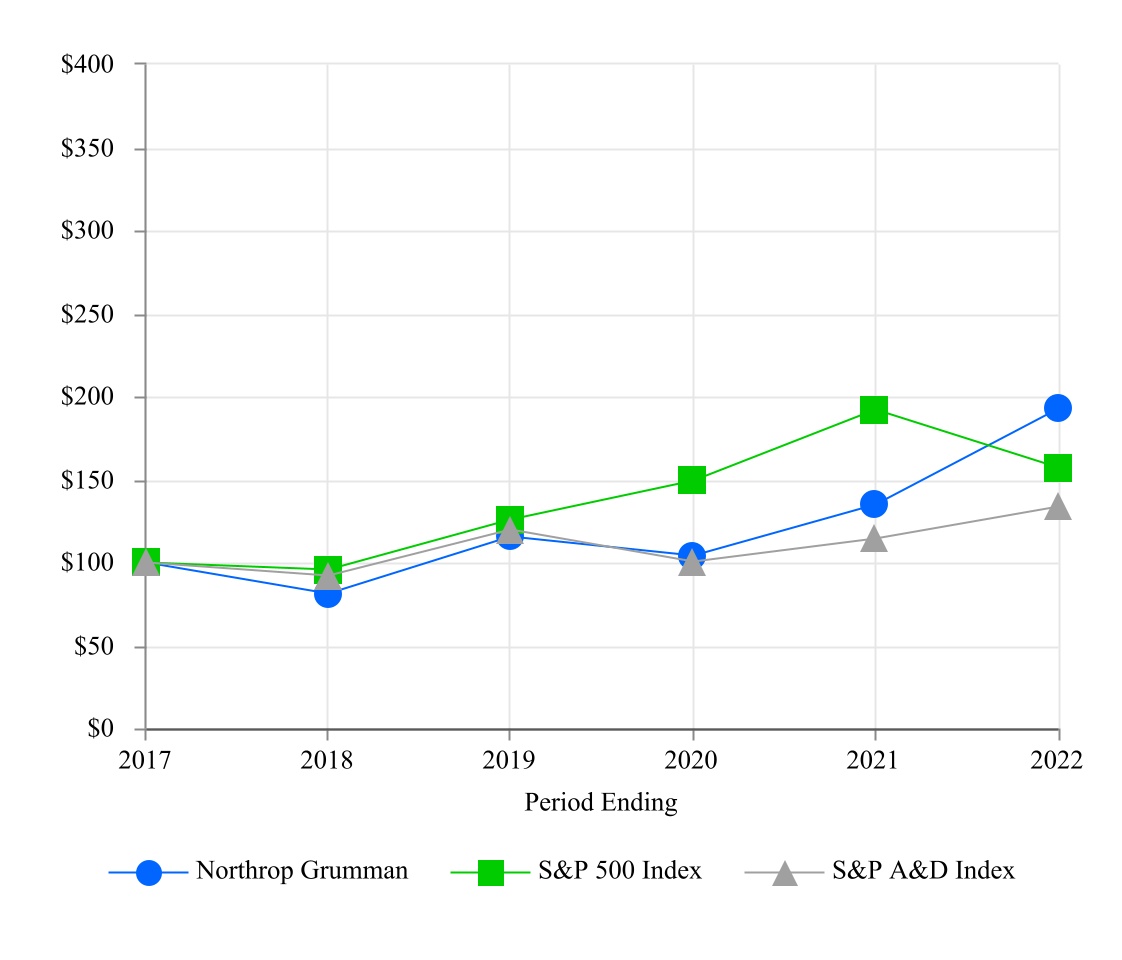
-
Assumes $100 invested at the close of business on December 31, 2017, in Northrop Grumman Corporation common stock, the S&P 500 Index and the S&P A&D Index.
-
The cumulative total return assumes reinvestment of dividends.
-
The S&P A&D Index is comprised of The Boeing Company, General Dynamics Corporation, Howmet Aerospace Inc., Huntington Ingalls Industries Inc., L3Harris Technologies, Inc., Lockheed Martin Corporation, Northrop Grumman Corporation, Raytheon Technologies Corporation, Textron, Inc., and TransDigm Group Incorporated.
-
The total return is weighted according to market capitalization of each company at the beginning of each year.
-
This graph is not deemed to be “filed” with the SEC or subject to the liabilities of Section 18 of the Securities Exchange Act of 1934 (the Exchange Act), and should not be deemed to be incorporated by reference into any of our prior or subsequent filings under the Securities Act of 1933 or the Exchange Act.
Item 6. [Reserved]
-29-
NORTHROP GRUMMAN CORPORATION
Item 7. Management’s Discussion and Analysis of Financial Condition and Results of Operations
OVERVIEW
The following discussion should be read along with the financial statements included in this Form 10-K, as well as Part II, “Item 7. Management's Discussion and Analysis of Financial Condition and Results of Operations” of our Form 10-K for the year ended December 31, 2021 (“2021 Annual Report on Form 10-K”).
Global Security Environment
The U.S. and its allies continue to face a global security environment of heightened tensions and instability, threats from state and non-state actors, including in particular major global powers, as well as terrorist organizations, increasing nuclear tensions, diverse regional security concerns and political instability. The market for defense products, services and solutions globally is driven by these complex and evolving security challenges, considered in the broader context of political and socioeconomic circumstances and priorities. Our operations and financial performance, as well as demand for our products and services, are impacted by global events, including violence and unrest. The same is true for our suppliers and other business partners.
The conflict in Ukraine has increased global tensions and instability, highlighted threats and increased global demand, as well as further disrupted global supply chains and added costs. We have experienced a modest increase in demand for certain of our goods and services directly and indirectly related to the conflict in the Ukraine. We also have experienced a slight disruption to some of our programs and supply chain, including unanticipated cost growth, as a result of the conflict in Ukraine and economic sanctions. However, we do not have sizable business dealings in Russia or Ukraine, and do not anticipate significant adverse impacts from the ongoing conflict.
More broadly, the conflict in Ukraine and threats elsewhere have heightened tensions and highlighted security requirements globally, especially in Europe and the Pacific region, as well as the U.S. We have started to see, and expect to continue to see, increased demand for defense products and services from allies and partner nations, particularly in those areas. We are actively exploring both opportunities and risks.
For further information on the global security environment, including the risks related thereto, see “Management’s Discussion and Analysis of Financial Condition and Results of Operations,” “Liquidity and Capital Resources,” “Quantitative and Qualitative Disclosures About Market Risks” and “Risk Factors.”
Global Health and Economic Environment
COVID-19
Since at least March 2020, when it was first characterized as a global pandemic, COVID-19 has dramatically impacted and continues to impact the global health and economic environments, including millions of confirmed cases and deaths, business slowdowns or shutdowns, labor shortfalls, supply chain challenges, regulatory challenges, inflationary pressures and market volatility. We discussed in some detail in our Annual Reports on Form 10-K for the fiscal years ended December 31, 2020 and 2021, and subsequent SEC filings, the pandemic, its impacts and risks, and actions taken up to the time of each filing. In this Form 10-K, we provide a further update.
In 2022, the pandemic continued to have significant adverse impacts on the global health and macroeconomic environments, particularly with the spread of new variants and other viruses and illnesses, ongoing disruption of the labor force and supply chains, continued inflation, and market volatility and uncertainties. We expect such adverse impacts to continue. However, with extraordinary efforts by our employees, our governments and customers, our partners and our company, direct COVID-19-related impacts on our business generally declined in 2022. While we cannot predict the future course of the pandemic or its consequences, we are not currently assuming significant additional direct COVID-19 related impacts on our business.
The company continues to work to monitor and address the pandemic, including its impact on our company, our employees, our customers, our suppliers and our communities. Our goals have been, and continue to be, to keep our employees safe, to lessen the potential adverse impacts, both health and economic, and to continue to position the company for long-term success. Like the communities in which we operate, our actions have varied, and will continue to vary, depending on the spread of COVID-19 and other illnesses, applicable government requirements, and the needs of our stakeholders.
Global Economic Environment
In part as a result of the COVID-19 pandemic, the global economic environment has experienced, and continues to experience, extraordinary challenges, including high rates of inflation and inflationary pressures; widespread delays and disruptions in supply chains; workforce challenges, including labor shortages (especially in critical skill areas); and market volatility. These macroeconomic factors have contributed, and we expect will continue to contribute, to increased costs, delays and other performance challenges, as well as increased competing demands for limited
-30-
NORTHROP GRUMMAN CORPORATION
resources to address such increased costs and other challenges, for our company, our suppliers and partners, and our customers. For example, as discussed in greater detail in Note 12 to the consolidated financial statements, our latest estimated cost to complete the low-rate initial production (LRIP) phase of the B-21 program reflects updated estimates for adverse impacts from these macroeconomic factors, as well as potential opportunities to address them.
We continue to work hard to mitigate some of the challenges caused by the current macroeconomic environment on our business, including by taking steps to support our suppliers and small businesses and enhancing our workforce through extensive hiring, development and retention efforts. However, the broader macroeconomic environment, including inflationary pressures and supply chain challenges, continued adversely to affect the company’s results for the year ended December 31, 2022. We cannot clearly predict how long these macroeconomic challenges will continue, or how they will change over time, or what additional resources will be available, but we expect to see this challenging macroeconomic environment continue adversely to impact the global economy, our customers, our industry and our company in 2023.
In addition, increased interest rates, raising the cost of borrowing for governments, could further impact government spending priorities (in the U.S. and allied countries, in particular), including their demand for defense products. Economic tensions and changes in international trade policies, including higher tariffs on imported goods and materials and renegotiation of free trade agreements, could also further impact the global market for defense products, services and solutions.
U.S. Political, Budget and Regulatory Environment
On March 15, 2022, the President signed into law the Consolidated Appropriations Act for FY 2022, which provided full-year funding for federal agencies, including $782 billion for national defense. This represented an approximately $42 billion or 6 percent increase above the budget for FY 2021, approximately $30 billion more than the Administration had initially requested. The Pentagon’s portion of the overall national defense budget for FY 2022 was $743 billion.
On March 28, 2022, the President proposed his budget for FY 2023, which included $813 billion for national defense programs, approximately $31 billion or 4 percent higher than what was appropriated in FY 2022. The Pentagon’s portion of the overall requested national defense budget was $773 billion.
On December 23, 2022, the President signed the National Defense Authorization Act (NDAA) for FY 2023, which supports approximately $858 billion in FY 2023 funding for national defense, $817
Showing the first 8K of 100K characters. Open the full section
Item 7A. Quantitative and Qualitative Disclosures About Market Risk
EQUITY RISK
We are exposed to market risk with respect to our portfolio of marketable securities with a fair value of $332 million at December 31, 2022. These securities are exposed to market volatilities, changes in price and interest rates.
INTEREST RATE RISK
We are exposed to interest rate risk on variable-rate short-term credit facilities for which there were no borrowings outstanding at December 31, 2022. At December 31, 2022, we have $12.9 billion of long-term debt, primarily consisting of fixed-rate debt, with a fair value of approximately $12.1 billion. The terms of our fixed-rate debt obligations do not generally allow investors to demand payment of these obligations prior to maturity. Therefore, we do not have significant exposure to interest rate risk for our fixed-rate debt; however, we do have exposure to fair value risk if we repurchase or exchange long-term debt prior to maturity. Additionally, if we were to refinance our long-term debt, it may be refinanced at higher interest rates.
FOREIGN CURRENCY RISK
In certain circumstances, we are exposed to foreign currency risk. We enter into foreign currency forward contracts to manage a portion of the exchange rate risk related to receipts from customers and payments to suppliers denominated in foreign currencies. We do not hold or issue derivative financial instruments for trading purposes. At December 31, 2022, foreign currency forward contracts with a notional amount of $221 million were outstanding. At December 31, 2022, a 10 percent unfavorable foreign exchange rate movement would not have a material impact on our consolidated financial position, annual results of operations and/or cash flows.
INFLATION RISK
The global macroeconomic environment has experienced, and continues to experience, extraordinary challenges, including the highest rates of inflation in 40 years. These macroeconomic factors have contributed, and we expect will continue to contribute, to increased costs, among other concerns. We cannot predict how long these inflationary pressures will continue, or how they may change over time, but we expect to see continued impacts on the global economy, our customers, our industry and our company.
Historically, we generally have been able to anticipate such increases in costs when pricing our contracts, and our bids for longer-term firm fixed-price contracts have typically included assumptions regarding cost escalations in amounts that have been sufficient to cover most cost increases over the period of performance, including as offset by operational efficiencies. However, the company, its subcontractors and other suppliers, have experienced, and continue to experience, increased pressures from recent heightened levels of inflation and the challenges of the current macroeconomic environment, which we have not been able to fully mitigate. If inflationary pressures continue to persist, they may continue to have an adverse impact on our consolidated financial position, results of operations and/or cash flows.
-50-
Item 8. Financial Statements and Supplementary Data
REPORT OF INDEPENDENT REGISTERED PUBLIC ACCOUNTING FIRM
To the Board of Directors and Shareholders of
Northrop Grumman Corporation
Falls Church, Virginia
Opinion on the Financial Statements
We have audited the accompanying consolidated statements of financial position of Northrop Grumman Corporation and subsidiaries (the “Company”) as of December 31, 2022 and 2021, the related consolidated statements of earnings and comprehensive income, changes in shareholders’ equity, and cash flows for each of the three years in the period ended December 31, 2022, and the related notes (collectively referred to as the “financial statements”). In our opinion, the financial statements present fairly, in all material respects, the financial position of the Company as of December 31, 2022 and 2021, and the results of its operations and its cash flows for each of the three years in the period ended December 31, 2022, in conformity with accounting principles generally accepted in the United States of America.
We have also audited, in accordance with the standards of the Public Company Accounting Oversight Board (United States) (PCAOB), the Company’s internal control over financial reporting as of December 31, 2022, based on the criteria established in Internal Control - Integrated Framework (2013) issued by the Committee of Sponsoring Organizations of the Treadway Commission and our report dated January 25, 2023 expressed an unqualified opinion on the Company’s internal control over financial reporting.
Basis for Opinion
These financial statements are the responsibility of the Company’s management. Our responsibility is to express an opinion on the Company’s financial statements based on our audits. We are a public accounting firm registered with the PCAOB and are required to be independent with respect to the Company in accordance with the U.S. federal securities laws and the applicable rules and regulations of the Securities and Exchange Commission and the PCAOB.
We conducted our audits in accordance with the standards of the PCAOB. Those standards require that we plan and perform the audit to obtain reasonable assurance about whether the financial statements are free of material misstatement, whether due to error or fraud. Our audits included performing procedures to assess the risks of material misstatement of the financial statements, whether due to error or fraud, and performing procedures that respond to those risks. Such procedures included examining, on a test basis, evidence regarding the amounts and disclosures in the financial statements. Our audits also included evaluating the accounting principles used and significant estimates made by management, as well as evaluating the overall presentation of the financial statements. We believe that our audits provide a reasonable basis for our opinion.
Critical Audit Matters
The critical audit matters communicated below are matters arising from the current-period audit of the financial statements that were communicated or required to be communicated to the audit and risk committee and that (1) relate to accounts or disclosures that are material to the financial statements and (2) involved our especially challenging, subjective, or complex judgments. The communication of critical audit matters does not alter in any way our opinion on the financial statements, taken as a whole, and we are not, by communicating the critical audit matters below, providing separate opinions on the critical audit matters or on the accounts or disclosures to which they relate.
Revenue Recognition - Cost and Revenue Estimates for Development Contracts - Refer to Note 1 to the financial statements
Critical Audit Matter Description
As more fully described in Note 1 to the financial statements, the Company recognizes substantially all revenue as control is transferred to the customer on their long-term contracts over time using the cost-to-cost method (cost incurred relative to total cost estimated at completion). Use of the cost-to-cost-method requires the Company to make reasonably dependable estimates regarding the revenue and costs associated with the design, manufacture and delivery of their products or services. The Company estimates profit on these contracts as the difference between total estimated sales and total estimated costs at completion and recognizes that profit as costs are incurred. Cost
-51-
NORTHROP GRUMMAN CORPORATION
estimates on contracts requiring development work are inherently more uncertain as to future events than production contracts, and, as a result, there is typically more variability in those estimates. Certain of these contracts are fixed price in nature, which results in greater financial risk associated with unanticipated cost growth. Alternatively, cost-type contracts may have award or incentive fees that are subject to uncertainty and may be earned over extended periods or towards the end of the contract. As a result, the estimation of costs required to complete these contracts and the expected revenues that will be earned is complex and requires significant judgment.
Given the judgment necessary to make reasonably dependable estimates regarding the revenue and costs associated with such contracts, auditing these estimates required extensive audit effort due to the complexity of the underlying programs and a high degree of auditor judgment when performing audit procedures and evaluating the results of those procedures.
How the Critical Audit Matter Was Addressed in the Audit
Our auditing procedures related to the cost and revenue estimates for these development contracts included the following, among others:
-
We tested the effectiveness of controls over the estimates of total costs and revenues on such contracts, including development costs and any related award or incentive fee estimates for the relevant performance obligations.
-
We selected certain long-term contracts for testing and performed the following procedures:
–Evaluated whether the recognition of revenue over time on such contracts was appropriate based on the terms and conditions of each contract, including whether continuous transfer of control to the customer occurred as progress was made toward fulfilling the performance obligation.
–Tested management’s identification of distinct performance obligations by evaluating whether the underlying goods and services were highly interdependent and interrelated.
–Tested management’s determination of the transaction price, including any award or incentive fees, based on the consideration expected to be received in accordance with the rights and obligations established under the contracts and any contractual modifications.
–Evaluated the estimates of total cost and revenue for the performance obligation by:
▪Conducting inquiries of relevant program teams regarding any challenges related to the program.
▪Comparing costs incurred to date to the costs management estimated to be incurred to date.
▪Evaluating management’s ability to achieve the estimates of total cost and revenue by performing corroborating inquiries with the Company’s program and business management, and testing management’s process used to develop the estimates based on their work plans, engineering specifications, program labor, and supplier contracts. This includes management’s process to identify macroeconomic impacts to programs, which could include forecasted cost impacts and assumptions on the ability to recover those costs.
▪Comparing management’s estimates for the selected contracts to costs and revenues of similar performance obligations, when applicable.
–Tested the mathematical accuracy of management’s calculation of revenue recognized during the period for the performance obligations.
Income Taxes - Uncertain Tax Positions - Refer to Notes 1 and 7 to the financial statements
Critical Audit Matter Description
The Company files income tax returns in the U.
Showing the first 8K of 182K characters. Open the full section
Item 9. Changes in and Disagreements with Accountants on Accounting and Financial Disclosure
None.
Item 9A. Controls and Procedures
DISCLOSURE CONTROLS AND PROCEDURES
Our principal executive officer (Chair, Chief Executive Officer and President) and principal financial officer (Corporate Vice President and Chief Financial Officer) have evaluated the company’s disclosure controls and procedures (as defined in Rule 13a-15(e) and Rule 15d-15(e) of the Securities Exchange Act of 1934 (the Exchange Act)) as of December 31, 2022, and have concluded that these controls and procedures are effective to ensure that information required to be disclosed by us in the reports that we file or submit under the Exchange Act is recorded, processed, summarized and reported within the time periods specified in the SEC’s rules and forms. These disclosure controls and procedures include, without limitation, controls and procedures designed to ensure that information required to be disclosed in the reports that we file or submit is accumulated and communicated to management, including the principal executive officer and the principal financial officer, as appropriate to allow timely decisions regarding required disclosure.
CHANGES IN INTERNAL CONTROL OVER FINANCIAL REPORTING
During the three months ended December 31, 2022, no change occurred in our internal control over financial reporting that materially affected, or is reasonably likely to materially affect, our internal control over financial reporting.
Item 9B. Other Information
None.
-90-
MANAGEMENT’S REPORT ON INTERNAL CONTROL OVER FINANCIAL REPORTING
The management of Northrop Grumman Corporation (the company) prepared and is responsible for the consolidated financial statements and all related financial information contained in this Annual Report. This responsibility includes establishing and maintaining effective internal control over financial reporting. The company’s internal control over financial reporting is designed to provide reasonable assurance regarding the reliability of financial reporting and the preparation of financial statements for external purposes in accordance with accounting principles generally accepted in the United States of America.
To comply with the requirements of Section 404 of the Sarbanes–Oxley Act of 2002, the company designed and implemented a structured and comprehensive assessment process to evaluate its internal control over financial reporting across the enterprise. The assessment of the effectiveness of the company’s internal control over financial reporting is based on criteria established in Internal Control—Integrated Framework (2013) issued by the Committee of Sponsoring Organizations of the Treadway Commission. Because of its inherent limitations, a system of internal control over financial reporting can provide only reasonable assurance and may not prevent or detect misstatements. Management regularly monitors its internal control over financial reporting, and actions are taken to correct deficiencies as they are identified. Based on its assessment, management has concluded that the company’s internal control over financial reporting was effective as of December 31, 2022.
Deloitte & Touche LLP issued an attestation report dated January 25, 2023, concerning the company’s internal control over financial reporting, which is contained in this Annual Report. The company’s consolidated financial statements as of and for the year ended December 31, 2022, have been audited by the independent registered public accounting firm of Deloitte & Touche LLP in accordance with the standards of the Public Company Accounting Oversight Board (United States).
/s/ Kathy J. Warden
Chair, Chief Executive Officer and President
/s/ David F. Keffer
Corporate Vice President and Chief Financial Officer
January 25, 2023
-91-
REPORT OF INDEPENDENT REGISTERED PUBLIC ACCOUNTING FIRM
To the Board of Directors and Shareholders of
Northrop Grumman Corporation
Falls Church, Virginia
Opinion on Internal Control over Financial Reporting
We have audited the internal control over financial reporting of Northrop Grumman Corporation and subsidiaries (the “Company”) as of December 31, 2022, based on criteria established in Internal Control - Integrated Framework (2013) issued by the Committee of Sponsoring Organizations of the Treadway Commission (COSO). In our opinion, the Company maintained, in all material respects, effective internal control over financial reporting as of December 31, 2022, based on the criteria established in Internal Control - Integrated Framework (2013) issued by COSO.
We have also audited, in accordance with the standards of the Public Company Accounting Oversight Board (United States) (PCAOB), the consolidated financial statements as of and for the year ended December 31, 2022 of the Company and our report dated January 25, 2023 expressed an unqualified opinion on those financial statements.
Basis for Opinion
The Company’s management is responsible for maintaining effective internal control over financial reporting and for its assessment of the effectiveness of internal control over financial reporting, included in the accompanying Management’s Report on Internal Control over Financial Reporting. Our responsibility is to express an opinion on the Company’s internal control over financial reporting based on our audit. We are a public accounting firm registered with the PCAOB and are required to be independent with respect to the Company in accordance with the U.S. federal securities laws and the applicable rules and regulations of the Securities and Exchange Commission and the PCAOB.
We conducted our audit in accordance with the standards of the PCAOB. Those standards require that we plan and perform the audit to obtain reasonable assurance about whether effective internal control over financial reporting was maintained in all material respects. Our audit included obtaining an understanding of internal control over financial reporting, assessing the risk that a material weakness exists, testing and evaluating the design and operating effectiveness of internal control based on the assessed risk, and performing such other procedures as we considered necessary in the circumstances. We believe that our audit provides a reasonable basis for our opinion.
Definition and Limitations of Internal Control over Financial Reporting
A company’s internal control over financial reporting is a process designed to provide reasonable assurance regarding the reliability of financial reporting and the preparation of financial statements for external purposes in accordance with generally accepted accounting principles. A company’s internal control over financial reporting includes those policies and procedures that (1) pertain to the maintenance of records that, in reasonable detail, accurately and fairly reflect the transactions and dispositions of the assets of the company; (2) provide reasonable assurance that transactions are recorded as necessary to permit preparation of financial statements in accordance with generally accepted accounting principles, and that receipts and expenditures of the company are being made only in accordance with authorizations of management and directors of the company; and (3) provide reasonable assurance regarding prevention or timely detection of unauthorized acquisition, use, or disposition of the company’s assets that could have a material effect on the financial statements.
Because of its inherent limitations, internal control over financial reporting may not prevent or detect misstatements. Also, projections of any evaluation of effectiveness to future periods are subject to the risk that controls may become inadequate because of changes in conditions, or that the degree of compliance with the policies or procedures may deteriorate.
/s/ Deloitte & Touche LLP
McLean, Virginia
January 25, 2023
Item 9C. Disclosure Regarding Foreign Jurisdictions that Prevent Inspections
None.
-92-
NORTHROP GRUMMAN CORPORATION
PART III
Item 10. Directors, Executive Officers and Corporate Governance
DIRECTORS
Information about our Directors will be incorporated herein by reference to the Proxy Statement for the 2023 Annual Meeting of Shareholders, to be filed with the SEC within 120 days after the end of the company’s fiscal year.
INFORMATION ABOUT OUR EXECUTIVE OFFICERS
Our executive officers as of January 25, 2023, are listed below, along with their ages on that date, positions and offices held with the company, and principal occupations and employment, focused primarily on the past five years.
| Name | Age | Office Held | Since | Recent Business Experience | ||||||||||||||||||||||
| Kathy J. Warden | 51 | Chair, Chief Executive Officer and President | 2019 | Chief Executive Officer and President (2019); President and Chief Operating Officer (2018) | ||||||||||||||||||||||
| Ann M. Addison | 61 | Corporate Vice President and Chief Human Resources Officer | 2019 | Corporate Vice President (2018); Executive Vice President and Chief Human Resources Officer, Leidos (2016-2018) | ||||||||||||||||||||||
| Matthew Bromberg | 52 | Corporate Vice President, Global Operations | 2022 | President, Military Engines, Pratt & Whitney (2017-2021) | ||||||||||||||||||||||
| Mark A. Caylor | 58 | Corporate Vice President and President, Mission Systems Sector | 2018 | |||||||||||||||||||||||
| Sheila C. Cheston | 64 | Corporate Vice President and General Counsel | 2010 | |||||||||||||||||||||||
| Michael A. Hardesty | 51 | Corporate Vice President, Controller, and Chief Accounting Officer | 2013 | |||||||||||||||||||||||
| Thomas H. Jones | 56 | Corporate Vice President and President, Aeronautics Systems Sector | 2021 | Vice President and General Manager, Airborne C4ISR Division, Mission Systems Sector (2017-2020) | ||||||||||||||||||||||
| Lesley A. Kalan | 49 | Corporate Vice President and Chief Strategy and Development Officer | 2020 | Corporate Vice President, Government Relations (2018-2019) | ||||||||||||||||||||||
| David F. Keffer | 45 | Corporate Vice President and Chief Financial Officer | 2020 | General Partner, Blue Delta Capital Partners (2018-2020); Chief Financial Officer and Executive Vice President, CSRA, Inc. (2015-2018) | ||||||||||||||||||||||
| David T. Perry | 58 | Corporate Vice President and Chief Global Business Officer | 2019 | Corporate Vice President and Chief Global Business Development Officer (2012-2019) | ||||||||||||||||||||||
-93-
NORTHROP GRUMMAN CORPORATION
| Name | Age | Office Held | Since | Recent Business Experience | ||||||||||||||||||||||
| Mary D. Petryszyn | 61 | Corporate Vice President | 2022 | Corporate Vice President and President, Defense Systems Sector (2020-2022); Vice President and General Manager, Land and Avionics C4ISR Division, Mission Systems Sector (2016-2019) | ||||||||||||||||||||||
| Roshan Roeder | 43 | Corporate Vice President and President, Defense Systems Sector | 2022 | Vice President and General Manager, Airborne Multifunction Sensors, Mission Systems Sector (2020-2022); Vice President Program Management, Communications Business Unit, Mission Systems Sector (2018-2020); Vice President Program Management, Advanced Ground Sensors, Mission Systems Sector (2016-2018) | ||||||||||||||||||||||
| Lucy C. Ryan | 49 | Corporate Vice President, Communications | 2019 | Vice President, Enterprise Communications (2018); Director of Communications, General Dynamics (2010-2018) | ||||||||||||||||||||||
| Thomas L. Wilson | 54 | Corporate Vice President and President, Space Systems Sector | 2022 | Vice President and General Manager, Strategic Space Systems Division, Space Systems Sector (2020-2021); Vice President of Strategy and Business Development, Space Systems Sector (2020); Vice President of Business Development, Former Innovation Systems Sector (2018-2020); Vice President of Strategy and Business Development, Space Systems Group, Orbital ATK, Inc. (2015-2018) |
AUDIT COMMITTEE FINANCIAL EXPERT
The information as to the Audit and Risk Committee and the Audit and Risk Committee Financial Expert will be incorporated herein by reference to the Proxy Statement for the 2023 Annual Meeting of Shareholders.
CODE OF ETHICS
We have adopted Standards of Business Conduct for all of our employees, including the principal executive officer, principal financial officer and principal accounting officer. The Standards of Business Conduct can be found on our internet website at www.northropgrumman.com under “Who We Are – Investors – Corporate Governance – Standards of Business Conduct.” A copy of the Standards of Business Conduct is available to any stockholder who requests it by writing to: Northrop Grumman Corporation, c/o Office of the Secretary, 2980 Fairview Park Drive, Falls Church, VA 22042. We disclose amendments to provisions of our Standards of Business Conduct by posting amendments on our website. Waivers of the provisions of our Standards of Business Conduct that apply to our directors and executive officers are disclosed in a Current Report on Form 8-K.
The website and information contained on it or incorporated in it are not intended to be incorporated in this Annual Report on Form 10-K or other filings with the SEC.
OTHER DISCLOSURES
Other disclosures required by this Item will be incorporated herein by reference to the Proxy Statement for the 2023 Annual Meeting of Shareholders.
Item 11. Executive Compensation
Information concerning Executive Compensation required by this Item 11, including information concerning Compensation Committee Interlocks and Insider Participation and the Compensation Committee Report, will be incorporated herein by reference to the Proxy Statement for the 2023 Annual Meeting of Shareholders.
Item 12. Security Ownership of Certain Beneficial Owners and Management and Related Stockholder Matters
The information as to Securities Authorized for Issuance Under Equity Compensation Plans and Security Ownership of Certain Beneficial Owners and Management will be incorporated herein by reference to the Proxy Statement for the 2023 Annual Meeting of Shareholders.
-94-
NORTHROP GRUMMAN CORPORATION
For a description of securities authorized under our equity compensation plans, see Note 14 to the consolidated financial statements.
Item 13. Certain Relationships and Related Transactions, and Director Independence
The information as to Certain Relationships and Related Transactions and Director Independence will be incorporated herein by reference to the Proxy Statement for the 2023 Annual Meeting of Shareholders.
Item 14. Principal Accounting Fees and Services
The information as to Principal Accounting Fees and Services will be incorporated herein by reference to the Proxy Statement for the 2023 Annual Meeting of Shareholders.
-95-
NORTHROP GRUMMAN CORPORATION
PART IV
Item 15. Exhibits, Financial Statement Schedules
(a)1. Report of Independent Registered Public Accounting Firm (PCAOB ID No. 34)
Financial Statements
Consolidated Statements of Earnings and Comprehensive Income
Consolidated Statements of Financial Position
Consolidated Statements of Cash Flows
Consolidated Statements of Changes in Shareholders’ Equity
Notes to Consolidated Financial Statements
- Financial Statement Schedules
All schedules have been omitted because they are not applicable, not required, or the information has been otherwise supplied in the consolidated financial statements or notes to the consolidated financial statements.
- Exhibits
| 3(b) | Amended and Restated Bylaws of Northrop Grumman Corporation dated December 4, 2018 (incorporated by reference to Exhibit 3.1 to Form 8-K filed December 10, 2018, File No. 001-16411) |
-96-
NORTHROP GRUMMAN CORPORATION
| 4(l) | Indenture between TRW Inc. (predecessor-in-interest to Northrop Grumman Systems Corporation) and Mellon Bank, N.A., as trustee, dated as of May 1, 1986 (incorporated by reference to Exhibit 2 to the Form 8-A Registration Statement of TRW Inc. dated July 3, 1986, File No. 001-02384) |
| 4(m) | First Supplemental Indenture between TRW Inc. (predecessor-in-interest to Northrop Grumman Systems Corporation) and Mellon Bank, N.A., as trustee, dated as of August 24, 1989 (incorporated by reference to Exhibit 4(b) to Form S-3 Registration Statement No. 33-30350 of TRW Inc.) |
-97-
NORTHROP GRUMMAN CORPORATION
| 4(w) | Form of Northrop Grumman Corporation’s 5.050% Senior Note due 2040 (incorporated by reference to Exhibit C to Exhibit 4(a) to Form 8-K filed November 8, 2010, File No. 001-16411) |
| 4(aa) | Form of 3.250% Senior Note due 2023 (incorporated by reference to Exhibit B to Exhibit 4(a) to Form 8-K filed May 31, 2013, File No. 001-16411) |
| 4(bb) | Form of 4.750% Senior Note due 2043 (incorporated by reference to Exhibit C to Exhibit 4(a) to Form 8-K filed May 31, 2013, File No. 001-16411) |
-98-
NORTHROP GRUMMAN CORPORATION
| 4(dd) | Form of 3.850% Senior Note due 2045 (incorporated by reference to Exhibit A to Exhibit 4.1 to Form 8-K filed February 6, 2015, File No. 001-16411) |
| 4(ff) | Form of 3.200% Senior Note due 2027 (incorporated by reference to Exhibit A to Exhibit 4.1 to Form 8-K filed December 1, 2016, File No. 001-16411) |
| 4(ii) | Form of 2.930% Senior Note due 2025 (incorporated by reference to Exhibit C to Exhibit 4.1 to Form 8-K filed October 13, 2017, File No. 001-16411) |
| 4(jj) | Form of 3.250% Senior Note due 2028 (incorporated by reference to Exhibit D to Exhibit 4.1 to Form 8-K filed October 13, 2017, File No. 001-16411) |
| 4(kk) | Form of 4.030% Senior Note due 2047 (incorporated by reference to Exhibit E to Exhibit 4.1 to Form 8-K filed October 13, 2017, File No. 001-16411) |
| 4(ll) | Form of 4.400% Senior Note due 2030 (incorporated by reference to Exhibit 4.1 to Form 8-K filed March 24, 2020, File No. 001-16411) |
| 4(mm) | Form of 5.150% Senior Note due 2040 (incorporated by reference to Exhibit 4.1 to Form 8-K filed March 24, 2020, File No. 001-16411) |
| 4(nn) | Form of 5.250% Senior Note due 2050 (incorporated by reference to Exhibit 4.1 to Form 8-K filed March 24, 2020, File No. 001-16411) |
| 4(pp) | Form of 7.875% Senior Note due 2026 (incorporated by reference to Exhibit A in Exhibit 4.1 to Form 8-K filed September 3, 2021, File No. 001-16411) |
| 4(qq) | Form of 7.750% Senior Note due 2026 (incorporated by reference to Exhibit B in Exhibit 4.1 to Form 8-K filed September 3, 2021, File No. 001-16411) |
| 4(rr) | Form of 6.650% Senior Note due 2028 (incorporated by reference to Exhibit C in Exhibit 4.1 to Form 8-K filed September 3, 2021, File No. 001-16411) |
| 4(ss) | Form of 7.750% Senior Note due 2029 (incorporated by reference to Exhibit D in Exhibit 4.1 to Form 8-K filed September 3, 2021, File No. 001-16411) |
| 4(tt) | Form of 7.750% Senior Note due 2031 (incorporated by reference to Exhibit E in Exhibit 4.1 to Form 8-K filed September 3, 2021, File No. 001-16411) |
-99-
NORTHROP GRUMMAN CORPORATION
| 4(uu) | Form of 6.980% Senior Note due 2036 (incorporated by reference to Exhibit F in Exhibit 4.1 to Form 8-K filed September 3, 2021, File No. 001-16411) |
| 4(vv) | Description of Securities (incorporated by reference to Exhibit 4(ll) to Form 10-K for the year ended December 31, 2019, filed January 30, 2020, File No. 001-16411) |
-100-
NORTHROP GRUMMAN CORPORATION
-101-
NORTHROP GRUMMAN CORPORATION
-102-
NORTHROP GRUMMAN CORPORATION
| +10(y) | Executive Supplemental Individual Disability Insurance Plan dated June 10, 2022 |
| *+10(dd) | Transition and Retirement Agreement dated as of September 9, 2022, as revised, by and between Northrop Grumman Systems Corporation and Mary D. Petryszyn |
| *21 | Subsidiaries |
| *23 | Consent of Independent Registered Public Accounting Firm |
| *24 | Power of Attorney |
| *31.1 | Certification of Kathy J. Warden pursuant to Section 302 of the Sarbanes-Oxley Act of 2002 |
| *31.2 | Certification of David F. Keffer pursuant to Section 302 of the Sarbanes-Oxley Act of 2002 |
| **32.1 | Certification of Kathy J. Warden pursuant to Section 906 of the Sarbanes-Oxley Act of 2002 |
| **32.2 | Certification of David F. Keffer pursuant to Section 906 of the Sarbanes-Oxley Act of 2002 |
| *101 | Northrop Grumman Corporation Annual Report on Form 10-K for the fiscal year ended December 31, 2022, formatted as inline XBRL (Extensible Business Reporting Language); (i) the Cover Page, (ii) the Consolidated Statements of Earnings and Comprehensive Income, (iii) Consolidated Statements of Financial Position, (iv) Consolidated Statements of Cash Flows, (v) Consolidated Statements of Changes in Shareholders’ Equity, and (vi) Notes to Consolidated Financial Statements. The instance document does not appear in the Interactive Data File because its XBRL tags are embedded within the Inline XBRL document. |
| *104 | Cover Page Interactive Data File (formatted as Inline XBRL and contained in Exhibit 101) |
| + | Management contract or compensatory plan or arrangement |
| * | Filed with this Report |
| ** | Furnished with this Report |
Item 16. Form 10-K Summary
None.
-103-
NORTHROP GRUMMAN CORPORATION
SIGNATURES
Pursuant to the requirements of Section 13 or 15(d) of the Securities Exchange Act of 1934, the registrant has duly caused this report to be signed on its behalf by the undersigned, thereunto duly authorized, on the 25th day of January 2023.
| NORTHROP GRUMMAN CORPORATION | ||||||||
| By: | /s/ Michael A. Hardesty | |||||||
| Michael A. Hardesty | ||||||||
| Corporate Vice President, Controller and Chief Accounting Officer | ||||||||
| (Principal Accounting Officer) |
Pursuant to the requirements of the Securities Exchange Act of 1934, this report has been signed on behalf of the registrant this the 25th day of January 2023, by the following persons and in the capacities indicated.
| Signature | Title | |||||||
| Kathy J. Warden* | Chair, Chief Executive Officer and President (Principal Executive Officer), and Director | |||||||
| David F. Keffer* | Corporate Vice President and Chief Financial Officer (Principal Financial Officer) | |||||||
| Michael A. Hardesty | Corporate Vice President, Controller and Chief Accounting Officer (Principal Accounting Officer) | |||||||
| David P. Abney* | Director | |||||||
| Marianne C. Brown* | Director | |||||||
| Donald E. Felsinger* | Director | |||||||
| Ann M. Fudge* | Director | |||||||
| Madeleine A. Kleiner* | Director | |||||||
| Karl J. Krapek* | Director | |||||||
| Arvind Krishna* | Director | |||||||
| Graham N. Robinson* | Director | |||||||
| Gary Roughead* | Director | |||||||
| Thomas M. Schoewe* | Director | |||||||
| James S. Turley* | Director | |||||||
| Mark A. Welsh III* | Director |
| *By: | /s/ Jennifer C. McGarey | ||||
| Jennifer C. McGarey | |||||
| Corporate Vice President and Secretary | |||||
| Attorney-in-Fact | |||||
| pursuant to a power of attorney |
-104-