 filings.tools
ServiceNow 10-K 2022-12-31
Filed 2023-01-31. 23 sections, 393K characters. Original on sec.gov · Markdown · JSON
Cover and table of contents
UNITED STATES
SECURITIES AND EXCHANGE COMMISSION
Washington, D.C. 20549
FORM 10-K
| ☒ | Annual Report pursuant to Section 13 or 15(d) of the Securities Exchange Act of 1934 |
For the fiscal year ended December 31, 2022
OR
| ☐ | Transition report pursuant to Section 13 or 15(d) of the Securities Exchange Act of 1934 |
Commission File Number: 001-35580
SERVICEN****OW, I****NC.
(Exact name of registrant as specified in its charter)
| Delaware | 20-2056195 | |||||||
| (State or other jurisdiction of incorporation or organization) | (I.R.S. Employer Identification Number) |
ServiceNow, Inc.
2225 Lawson Lane
Santa Clara, California 95054
(408) 501-8550
(Address, including zip code, and telephone number, including area code, of registrant’s principal executive offices)
Securities registered pursuant to Section 12(b) of the Act:
| Title of each class | Trading Symbol | Name of each exchange on which registered | ||||||||||||
| Common stock, par value $0.001 per share | NOW | The New York Stock Exchange |
Securities registered pursuant to Section 12(g) of the Act:
Not applicable
Indicate by check mark if the registrant is a well-known seasoned issuer, as defined in Rule 405 of the Securities Act. Yes ☒ No ☐
Indicate by check mark if the registrant is not required to file reports pursuant to Section 13 or Section 15(d) of Act. Yes ☐ No ☒
Indicate by check mark whether the registrant (1) has filed all reports required to be filed by Section 13 or 15(d) of the Securities Exchange Act of 1934 during the preceding 12 months (or for such shorter period that the registrant was required to file such reports), and (2) has been subject to such filing requirements for the past 90 days: Yes ☒ No ☐
Indicate by check mark whether the registrant has submitted electronically every Interactive Data File required to be submitted pursuant to Rule 405 of Regulation S-T (§232.405 of this chapter) during the preceding 12 months (or for such shorter period that the registrant was required to submit such files). Yes ☒ No ☐
Indicate by check mark whether the registrant is a large accelerated filer, an accelerated filer, a non-accelerated filer, a smaller reporting company or an emerging growth company. See the definitions of “large accelerated filer,” “accelerated filer,” “smaller reporting company” and “emerging growth company” in Rule 12b-2 of the Exchange Act.
| Large Accelerated Filer | ☒ | Accelerated Filer | ☐ | ||||||||
| Non-Accelerated Filer | ☐ | Smaller Reporting Company | ☐ | ||||||||
| Emerging Growth Company | ☐ |
If an emerging growth company, indicate by check mark if the registrant has elected not to use the extended transition period for complying with any new or revised financial accounting standards provided pursuant to Section 13(a) of the Exchange Act. ☐
Indicate by check mark whether the registrant has filed a report on and attestation to its management’s assessment of the effectiveness of its internal control over financial reporting under Section 404(b) of the Sarbanes-Oxley Act (15 U.S.C. 7262(b)) by the registered public accounting firm that prepared or issued its audit report. ☒
If securities are registered pursuant to Section 12(b) of the Act, indicate by check mark whether the financial statements of the registrant included in the filing reflect the correction of an error to previously issued financial statements. ☐
Indicate by check mark whether any of those error corrections are restatements that required a recovery analysis of incentive-based compensation received by any of the registrant’s executive officers during the relevant recovery period pursuant to §240.10D-1(b). ☐
Indicate by check mark whether the registrant is a shell company (as defined in Rule 12b-2 of the Act). Yes ☐ No ☒
Based on the closing price of the registrant’s Common Stock on the last business day of the registrant’s most recently completed second fiscal quarter, which was June 30, 2022, the aggregate market value of its shares (based on a closing price of $475.52 per share on June 30, 2022 as reported on the New York Stock Exchange) held by non-affiliates was approximately $73.6 billion.
As of January 25, 2023, there were approximately 203 million shares of the registrant’s Common Stock outstanding.
DOCUMENTS INCORPORATED BY REFERENCE
Portions of the registrant’s definitive proxy statement for its 2023 Annual Meeting of Stockholders (Proxy Statement) to be filed within 120 days of the registrant’s fiscal year ended December 31, 2022, are incorporated by reference in Part III of this Report on Form 10-K. Except with respect to information specifically incorporated by reference in this Form 10-K, the Proxy Statement is not deemed to be filed as part of this Form 10-K.
TABLE OF CONTENTS
PART I
FORWARD-LOOKING STATEMENTS
This Annual Report on Form 10-K, including the “Management’s Discussion and Analysis of Financial Condition and Results of Operations,” contains forward-looking statements regarding future events and our future results that are based on our current expectations, estimates, forecasts and projections about our business, our results of operations, the industry in which we operate and the beliefs and assumptions of our management. Words such as “believe,” “may,” “will,” “estimate,” “continue,” “anticipate,” “would,” “could,” “should,” “intend” and “expect,” as well as variations of these words and similar expressions, are intended to identify those forward-looking statements. Forward-looking statements are only predictions and are subject to risks, uncertainties, assumptions and other factors that are difficult to predict. Therefore, actual results may differ materially and adversely from those expressed in any forward-looking statements. Factors that might cause or contribute to such differences include, but are not limited to, those discussed in this Report under “Risk Factors” in Item 1A of Part I and elsewhere herein and in other reports we file with the Securities and Exchange Commission (“SEC”). While forward-looking statements are based on our management’s reasonable expectations at the time that they are made, you should not rely on those statements. We undertake no obligation to revise or update publicly any forward-looking statements for any reason, whether as a result of new information, future events or otherwise, except as may be required by law.
Item 1. BUSINESS
ServiceNow was founded on a simple premise: a better technology platform will help work flow better. Our purpose is to make the world work better for everyone. We help global enterprises across industries, universities and governments to digitize their workflows—the individual tasks that need to be executed to get a job done. Our technology platform, which we refer to as the Now Platform, seamlessly connects workflows across siloed organizations and systems in a way that unlocks productivity, improves experiences for both employees and customers and delivers real business outcomes.
We organize our workflow applications along four primary areas: Technology, Customer and Industry, Employee and Creator. Our Technology Workflows give Information Technology (“IT”) departments the ability to plan, build, operate and service across the entire technology lifecycle. Our Customer and Industry Workflows help organizations reimagine the customer experience and increase customer loyalty. Our Employee Workflows help customers simplify how their employees get the services they need, creating a familiar, consumer-like way to get work done from wherever an employee may be—at home, in the workplace or in the field. Our Creator Workflows enable our customers to quickly create, test, and deploy their own applications on the Now Platform.
Traditionally, business processes have been automated and embedded across enterprise technology systems from finance, human resources (“HR”), sales, customer support and beyond. Over time, these systems have become disconnected, siloed and complex, as they offer limited flexibility and adaptability and lack the intuition and empowerment that users have come to expect from consumer-grade internet applications and sites. ServiceNow reduces these limitations. We offer the capability to quickly change how work is done to keep pace with a rapidly changing environment. The Now Platform delivers a simple, user-friendly experience, making work easier, faster and more productive.
We believe a better service and end-user experience is the ultimate desired outcome of digital transformation. The Now Platform enables our customers’ digital transformation from non-integrated enterprise technology solutions with manual and disconnected processes and activities, to integrated enterprise technology solutions with automation and connected processes and activities. The transformation to digital operations, enabled by the Now Platform, increases our customers’ resiliency and security and delivers great experiences and additional value to their employees and consumers.
Our success began with Information Technology Service Management (“ITSM”), a category in which ServiceNow remains a market leader. Over time, we expanded beyond our ITSM capabilities to meet the needs of our customers’ expanding digital requirements to modernize technology operations, employee experiences, customer experiences, industry-specific challenges and application development and integration. We are recognized as a leader for multiple products across our Technology, Customer and Industry, Employee and Creator Workflows.
The Now Platform’s task-based orientation allows work to be done with a single, aligned view of every service experience. For example, a new employee uses ServiceNow to complete onboarding tasks with their new employer. The new employee interfaces through an integrated ServiceNow platform that guides the employee through tasks originated from ServiceNow or other systems. Similarly, customer service can be executed in a way that solves problems without creating frustration.
Over the years, we have expanded our customer base, and our customers have expanded their use of the Now Platform. For example, many companies now have multi-year digital transformation plans, many of which involve introducing uses of additional ServiceNow products and services. From a single, out-of-the-box solution, companies recognize the value of using additional products to strengthen the richness and quality of their data running through the Now Platform. As we help organizations realize more value from the Now Platform and better serve their stakeholders, we do so in a manner that also helps organizations accelerate their environmental, social and governance (“ESG”) ambitions. To serve the growing focus on ESG, ServiceNow also offers an integrated ESG solution on the Now Platform as part of our Technology Workflows.
ServiceNow strives to help our customers solve their unique challenges, operate on their unique technologies and systems and change at their unique pace. The foundation of our approach to customers and our ambition to be the defining enterprise software company of the 21st century is grounded in our values.
-
Wow our customers:** Customers are the center of our world. We strive to deliver the best customer experiences and innovations.
-
Win as a team:** We share the same goals and have clear roles in achieving them. We deliver results as a team and enjoy the journey.
-
Create belonging:** Diversity, equity and inclusion are fundamental. Belonging is the breakthrough. We lead with empathy, which means listening and acting to make everyone feel they belong with ServiceNow.
-
Stay hungry and humble**: We do not take success for granted. We are always ready to learn and evolve. We grow together, bringing fresh ideas and new perspectives.
For all these reasons, our customers trust us with their mission critical operations, and we feel immensely proud that “The World Works with ServiceNow.”
Our Products
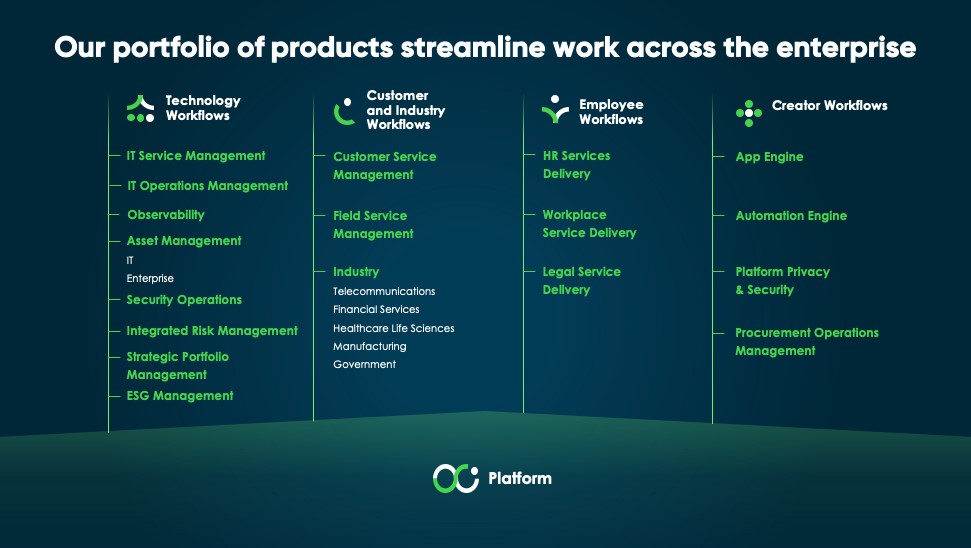
ServiceNow’s product portfolio—which spans our Technology, Customer and Industry, Employee and Creator Workflows—is delivered on the Now Platform. The products under each of our workflows help customers connect, automate and empower work across systems and silos to enable great outcomes for businesses and great experiences for people. Each year, two platform upgrades are released, delivering new standard functionality and new standalone products to further simplify the way our customers work and enhance productivity.
The Now Platform
The Now Platform is a single platform with one data model, one code base and one architecture, enabling speed, productivity and innovation and offering a one-stop shop for automation and simplification of manual processes. It is highly flexible, scalable, and extensible. The Now Platform delivers workflows across siloed organizations and systems by connecting them together in a seamless way to unlock productivity and improve experiences for both employees and customers. As the foundation for how we deliver our enterprise-wide digital workflows, the Now Platform integrates with our customers’ cloud platforms and systems of choice, allowing our customers to deliver workflows across their current and future preferred systems of record and collaboration platforms. The automation of workflows on our platform can be enhanced by additional functionality, such as artificial intelligence (“AI”), machine learning, robotic process automation, process mining, performance analytics, electronic service catalogs and portals, configuration management systems, data benchmarking, encryption and collaboration and low-code/no-code development tools. While every company has a different suite of user interfaces from web-based to mobile to conversation applications, the Now Platform creates a common user experience to manage workflows across all interfaces.
The Now Platform also powers three native mobile experiences for everyday work across the enterprise: Virtual Agent, Now Mobile and Mobile Onboarding. Enterprises can leverage our platform’s consumer-like, mobile experiences to help them deliver services such as HR information and tools or ordering a computer. Our goal is to make our customers’ work lives as simple, easy and mobile-friendly as their personal lives.
Technology Workflows
Our Technology Workflows help companies unite IT, risk management, and security operations on a single platform to deliver modern, resilient digital services aligned to our customers’ priorities. Our Technology products assist IT departments to serve their customers, manage their networks, identify and remediate security vulnerabilities and threats, gain visibility across their IT resources and asset lifecycles, optimize IT costs and reduce time spent on administrative tasks. We enable technology departments through IT Service Management (“ITSM”), IT Operations Management, Observability, IT Asset Management, Security Operations, Integrated Risk Management and Strategic Portfolio Management, among other products. We also enable enterprise-wide outcomes through Enterprise Asset Management, Integrated Risk Management, Strategic Portfolio Management and ESG Management products. Many of these products also enable our Customer and Industry and Employee Workflows.
IT Service Management
As our flagship product suite, ITSM defines, structures, consolidates, manages and automates the digital services that an enterprise offers its employees, customers and partners. Among ITSM’s capabilities are predictive intelligence, Virtual Agent, recording incidents, remediating problems, automating routine tasks and requests, performance analytics and continual improvement management capabilities.
IT Operations Management
Our IT Operations Management product suite connects a customer’s physical and cloud-based IT infrastructure with our applications and platform. It identifies a customer’s IT infrastructure components (e.g., servers) and associated digital services (e.g., email), which are dependent upon that infrastructure. It also maintains a single data record for all IT configurable items, which allows our customers to exercise control over their on-premises or cloud-based infrastructures and orchestrate key processes and tasks.
Observability
Lightstep Observability provides deep, real-time visibility into cloud-native environments and custom applications that power our customers’ internal- and external-facing products and services. Lightstep Observability empowers site reliability engineering and application development teams to mitigate business disruption, accelerate innovation and deliver outstanding customer experiences.
Asset Management
Our Asset Management product suite includes IT Asset Management and Enterprise Asset Management. Our IT Asset Management product automates customers’ IT software, hardware and cloud asset lifecycles with workflows to track the financial, contractual and inventory details of these IT assets from end-to-end. Our Enterprise Asset Management product automates processes across the lifecycle of a customer's physical business assets from planning, deployment, inventory management and maintenance through retirement.
Security Operations
Our Security Operations product connects with internal and third-party security alerts from a customer’s infrastructure to prioritize and respond to incidents and vulnerabilities according to their potential impact on a customer’s business.
Integrated Risk Management
Our Integrated Risk Management (“IRM”) suite (formerly, Governance, Risk and Compliance) helps customers manage risk and resilience in real time. Among the IRM product suite’s capabilities are policy and compliance management, risk management, business continuity management, third-party risk management, privacy management, audit management and operational risk management.
Strategic Portfolio Management
Our Strategic Portfolio Management (“SPM”) product suite (formerly, IT Business Management) enables customers to drive business outcomes by aligning their strategy with investments and execution. SPM helps customers plan, visualize and track value realization across their portfolio of projects, initiatives and digital products.
ESG Management
ServiceNow ESG Management helps customers elevate their environmental, social and governance (“ESG”) programs with streamlined data collection, on-demand progress monitoring and automated reporting. Integrations with Strategic Portfolio Management and Integrated Risk Management provide a holistic dashboard that enables our customers to accelerate and operationalize their ESG strategies by setting material goals and policies, tracking metrics and risks, driving enterprise-wide compliance and enabling investor-grade ESG disclosure.
Customer and Industry Workflows
Customer and Industry Workflows help drive customer loyalty with connected digital workflows that deliver modern customer experiences. Customer and Industry Workflows help customers elevate their customer service with enhanced resolution efficiency and improved service quality made possible with workflows, automation and location-based work tasks management. Customer service departments no longer have to rely on agents searching multiple systems to find a single answer to customer issues. Integrating front-end customer service capabilities with operations and field service resources, our Customer and Industry Workflows products help create a seamless customer experience from issue to resolution through connected digital workflows that deliver fast support on a customer’s channel of choice. We enable Customer and Industry Workflows through Customer Service Management, Field Service Management and Industry specific products, among other products.
Customer Service Management
Our Customer Service Management product defines, structures, consolidates, manages and automates common customer service cases and requests, such as password resets. Additionally, with Customer Service Management, companies can route work from the customer service agent to field service, engineering, operations, finance or legal personnel to resolve the underlying issues.
Field Service Management
Our Field Service Management product allows field service agents to be assigned, deployed and managed on the same underlying customer service management platform that created and managed the customer incident.
Industry
We offer industry solutions to better address the unique needs for specific industries, including financial services, telecommunications, media and technology, healthcare and life sciences, manufacturing and the public sector. We intend to offer other industry-specific solutions in addition to our other workflow products.
-
With Telecommunications Service Management, Order Management and Network Inventory Management, customers can scale their order management process, launch services quickly, enhance customer care, automate service assurance, gain real-time data visibility and optimize their network management on a single platform.
-
With Financial Services Operations, banking and insurance customers can unite their front, middle and back offices to improve customer and employee experiences.
-
With Healthcare and Life Sciences Service Management, customers can offer consumer-grade experiences, unlock productivity, streamline operations and efficiently manage and service clinical devices.
-
With Manufacturing Connected Workforce and Operational Technology Management, customers can empower their workforce with digital tools and knowledge to improve efficiency and create a single system of action for their operational environment, improve uptime and drive outcomes across their operations.
-
In addition, with our newly launched Public Sector Digital Services platform in 2022, public sector customers can build a seamless experience to increase trust, empathy and transparency between government agencies and constituents, and connect government agencies with each other on a single digital platform.
Employee Workflows
Our Employee Workflows can transform the employee experience and make work better for our customers’ employees by letting their employees work and collaborate where and how they want, improving productivity and agility. Employee Workflows products also help customers be more efficient with their employee resources, staffing and delivery services, streamline employee lifecycle events and increase visibility as workforces continue to be remote. We enable Employee Workflows through HR Service Delivery, Safe Workplace Suite, Workplace Service Delivery, and Legal Service Delivery, among other products.
HR Service Delivery
Our HR Service Delivery product defines, structures, consolidates, manages and automates HR services related to employee requests. HR Service Delivery capabilities include HR case management, employee self-service, manager experiences, knowledge management and management of employee lifecycle events across multiple departments, such as onboarding, transfers and off-boarding.
Workplace Service Delivery
Our Workplace Service Delivery product keeps our customers’ workplaces running smoothly with a multi-channel, mobile-enabled solution. With Workplace Service Delivery, employees of our customers can automate requests, reservations and repairs and track health and safety incidents, which enables them to optimize space usage, receive easy access to services, manage requests efficiently and get real-time visibility.
Legal Service Delivery
Our Legal Service Delivery product consolidates manual tools and modernizes internal legal operations processes to manage legal requests across the enterprise. With Legal Service Delivery, legal teams can gain efficiency, deliver support efficiently with automated responses and get insight into demand with real-time reporting and dashboards.
Creator Workflows
Creator Workflows help customers build and manage cross-enterprise digital workflow applications fast with a low-code platform that safely delivers agile services at scale and with enterprise-wide platform features such as those that allows customers to manage security and privacy instances and storage. As organizations digitally transform, they need to pivot faster with new processes and business models. This requires faster, more agile execution with more automation delivered through software applications and enterprise-wide features. With Creator Workflows, citizen developers have access to pre-built templates, low-code tools and modular building blocks created by professional developers. The user experience is further enhanced when such apps and features are used on the same platform on which they were built. We enable Creator Workflows through App Engine and Automation Engine, among other products.
App Engine
Our App Engine product empowers enterprise-class low-code application delivery with intuitive and intelligent experiences, at speed and scale. With App Engine, customers and third-party developers can extend workflow automation by creating, testing and deploying their own consumer-grade applications that can be scaled from a single department to the entire enterprise. Examples of the types of applications our customers have developed include:
-
an application developed by a global company that allows its employees around the world to request compliance, data privacy and legal services through a single self-service portal, freeing legal and compliance personnel to focus on their core functions;
-
an application developed by a company to permit its sales personnel to view training materials remotely that has become the primary medium for disseminating sales materials to employees and third-party brokers; and
-
a state-of-the-art supplier relationship management application developed by a technology research and advisory firm, that facilitates the roll out of enhanced services at competitive prices.
Automation Engine
Our Automation Engine product enables anyone who creates an application on the Now Platform to extend workflows into third-party products and leverage robotic process automation and document intelligence capabilities. Automation Engine also provides a framework that allows developers to create and publish integrations for use by anyone. The Now Platform provides connectors to hundreds of products and integrations in the ServiceNow Store.
Platform Privacy and Security
Our Platform Privacy and Security product provides premium security and privacy controls to help ServiceNow customers protect and control their sensitive data in the cloud.
Procurement Operations Management
Our Procurement Operations Management suite connects to customer's existing ERP systems and provides a source-to-pay workflow automation solution that enables procurement departments to create a unified work experience across teams. It enables organizations to do more with their existing procurement teams when efficiency is critical and scale the business without dramatically increasing staff.
Impact
ServiceNow Impact helps our customers accelerate their value realization with ServiceNow's products and solutions by offering AI-based recommendations and dashboards, proactive and preventative tools and a team of experts, training and coaching.
Professional Services
Our Professional Services are offered by ServiceNow alone and in a co-delivery model with our network of partners to help customers maximize the value of their ServiceNow investment. Our Professional Services include process design, implementation, configuration, architecture and optimization services. With our Now Value methodology as the foundation for customer success, our services bring together our experts and leading practices enabling our customers to create value and drive customer outcomes as they embark on enterprise digital transformations through the use of our platform. Our training services include programs for all of our products.
Customer Support
Customers receive standard and enhanced support from technical resources located around the globe. We offer customer support on a subscription-based model and we offer self-service technical support through our support portal, which provides access to documentation, knowledge base articles, online training, online support forums and online case creation.
Our Technology and Operations
We operate a multi-instance architecture that provides each customer with its own dedicated application logic and database. This architecture is designed to deliver high-availability, scalability, performance, security and ease of upgrading. Our cloud infrastructure primarily consists of industry-standard servers, networks and storage components. We host our full software-as-a-service (“SaaS”) experience on our own private cloud and use public cloud service providers for customers that
are primarily in highly regulated markets.
Our data centers operate in paired configurations to enable replication for high-availability and redundancy. We currently operate data centers in Australia, Brazil, Canada, Germany, India, Ireland, Japan, South Korea, the Netherlands, Singapore, Switzerland, the United Kingdom and the United States, and we continuously evaluate our data center operations and capacity in existing and new geographies.
We offer customers the option to deploy our services on dedicated hardware in our data centers. We also offer customers the option to have their European Union (“EU”) hosted data handled exclusively within the EU. Our architecture gives us the added flexibility to allow customers the option of deploying our services internally or under contract with a third party to host the software in order to support unique regulatory or security requirements. While there are some limitations on agility and flexibility as compared to our cloud offering, a minority of our customers have elected the third-party alternative. The standard and enhanced customer support we provide for self-hosted customers is similar to the support we provide to customers deployed in our managed data centers.
Sales and Marketing
We market and sell our products and services to enterprises across industries, including government, financial services, healthcare, telecommunications, manufacturing, IT services, technology, oil and gas, education and consumer products. We sell our product offerings and services through subscription services primarily through our global direct sales organization. We also sell services through managed services providers and resale partners.
Our marketing efforts and lead generation activities consist primarily of customer referrals, digital advertising (including via our website), trade shows, industry events, brand campaigns and press releases. We also host our annual Knowledge user conference, webinars and other user forums, including regional forums, which we call World Forums, where customers and partners both participate in and present on a variety of programs designed to educate them on industry best practices and help accelerate their success.
We continue to expand our sales capabilities in new geographies, including through investments in direct and indirect sales channels, professional services capabilities, customer support resources, post-sales customer support resources, strategic alliances and partnerships, implementation partners and advisory councils. We also plan to increase our investment in our existing locations in order to achieve scale efficiencies in our sales and marketing efforts.
Partner Ecosystem
In addition to our global direct sales organization, we also have a strong and growing ecosystem of partners that helps accelerate our customers’ digital transformation initiatives and deliver customer value at scale. Our partners play a critical role in helping companies digitally transform their business. Our industry and workflow capabilities paired with our partners’ industry and functional domain experience help customers of all sizes. Together with our partners, we offer industry and domain-focused solutions at scale and are accelerating digital transformation as we help companies drive new approaches in engaging their end users and employees.
Customers
We primarily sell our services to large enterprise customers, and we host and support large, enterprise-wide deployments for our customers. As of December 31, 2022, we had approximately 7,700 enterprise customers. Our customers operate in a wide variety of industries, including government, financial services, healthcare, manufacturing, IT services, technology, oil and gas, telecommunications, education and consumer products. The portion of our revenues generated by sales to government customers has also increased over time. See “Risk Factors—Doing business with the public sector and heavily-regulated organizations subjects us to risks related to the government procurement process, regulations, and contracting requirements” for additional information about our sales to government customers.
Research and Development
Our research and development organization is responsible for the design, development, testing and validation of our solutions. We focus on innovating and developing new services and core technologies and further enhancing the functionality, reliability and performance of our existing solutions. Using emerging technologies, we can anticipate customer demands and then bring new services and new versions of existing services to market quickly in order to remain competitive in the marketplace. We have made, and will continue to make, significant investments in research and development to broaden our
platform capabilities, strengthen our existing applications, expand the number of applications on our platform, enhance our user experience and develop additional mobile, automation and machine intelligence technologies.
Acquisitions and Investments
In addition to our own research and development investments, we have made strategic acquisitions and investments and will continue to assess opportunities to complement our technology and skill sets and expand our product reach. Our focus is on building out our platform and products through both organic investments to support customer needs and acquisitions of talent and enhanced capabilities. For example, our acquisitions and larger strategic investments in 2022 focused on bringing observability and log management, additional AI capabilities, real-time process execution capabilities, process mining and skills mapping intelligence to the Now Platform and across our suite of products.
Competition
As customers accelerate their digital transformation plans and digital operation initiatives, they demand less complexity and lower total cost solutions for the implementation, sourcing, integration and ongoing maintenance of their IT environments. The Now Platform is designed to meet customers’ demands and offers solutions that are complementary to the offerings of many enterprise software vendors. We work directly with product and service offerings from a broad range of companies, including some of the largest in the world, and continuously increase our strategic alliances with many of these companies as we expand our integrations for customers. As we grow and the space where we operate develops and matures, we increasingly find ourselves in competition with solutions and alternative approaches to solving customer needs, including:
-
Enterprise application software vendors. We designed the Now Platform to quickly integrate with, and complement the performance of well-established, enterprise application software vendors, such as Oracle, SAP, Salesforce and Workday. Customers may choose to work directly with their application software vendors to improve integrations and create connected workflows.
-
New technologies and entrants. Markets are rapidly evolving and highly competitive, with relatively low barriers to entry. New technologies and competitors are entering the markets to solve similar problems in different ways, intensifying competition. Customers may choose alternative technologies to improve integrations and create connected workflows. New entrants may choose to offer software tailored to specific services, as opposed to competing across all Now Platform capabilities.
-
In-house solutions. Customers may choose to work with their internal IT departments or other personnel to build custom workflow solutions and integrations.
-
Cloud-based vendors. As businesses increasingly utilize public cloud and SaaS-based offerings, they are adopting a hybrid (on-premises and off-premises) approach for their existing and new compute workloads. As a result, our services will need to increasingly compete for customers’ hybrid IT workloads with off-premises public cloud and SaaS-based offerings.
Intellectual Property
We rely upon a combination of U.S. and international copyright, trade secret, patent and trademark laws and confidentiality procedures and contractual restrictions, such as confidentiality and license agreements, to establish, protect and grow our intellectual property (“IP”) rights. In addition, we enter into confidentiality and proprietary rights agreements with our employees, partners, vendors, consultants and other third parties and control access to our IP and other proprietary information. We also purchase or license IP and technology that we incorporate into our products or services.
We continue to grow our global patent portfolio and IP rights that relate to our platform, applications, services, research and development and other activities. Our success depends in part upon our ability to protect our core technology and IP. As of December 31, 2022, we had over 2,000 U.S. and foreign patents, including patents acquired from third parties, and over 700 pending patent applications. We do not believe that our proprietary technology is dependent on any single patent or other IP right or group of related patents or IP rights. We file patent applications to protect our IP and have and may continue to acquire additional patents, patent portfolios or patent applications. See “Risk Factors—Lawsuits against us by third parties that allege we infringe their intellectual property rights could harm our business and operating results” and “Risk Factors—Our intellectual property protections may not provide us with a competitive advantage and defending our intellectual property may result in substantial expenses that harm our operating results” for additional information.
Environmental, Social and Governance
Our ESG strategy is driven by our purpose to “make the world work better for everyone.” Our global impact programs focus on areas where we can make our business, our communities and the world more equitable and sustainable. The challenges we and our stakeholders have been facing in the last few years, such as the pandemic, racial injustice and climate change, have emphasized the unique role we can have as a company in helping our customers manage their ESG priorities. Initiatives to reduce the carbon footprint of our operations not only serve the purpose of sustaining our planet, but also make us more attractive to our customers who are looking to reduce their own carbon footprint and that of their supply chains. Initiatives to improve our diversity, equity and inclusion (“DEI”) serve to build a more inclusive workforce. They also help us to attract and retain the diverse talent that allows us to innovate more quickly and create products that “wow our customers.” Initiatives to strengthen the governance of our business—leading with ethics and focusing on security and data privacy— improve the oversight of our business and also help us to earn trust with our customers that makes them comfortable managing more of their core business operations with our products. In this way, our ESG strategy is embedded in our business priorities, culture and values.
Our board of directors and management team oversee our ESG strategy. Specifically, our Nominating and Governance Committee oversees our ESG activities, programs, risks and public disclosures; our Audit Committee oversees our processes, procedures and validation surrounding our ESG disclosures; and our Compensation Committee oversees our human capital management. Our enterprise-wide ESG Steering Committee, under the leadership of our CFO, helps guide our ESG strategy, goals, progress and key initiatives. Our additional management steering committees and councils help address specific priorities such as risk management, compliance and data governance. Activities and progress against our ESG priorities are regularly reviewed by the board of directors.
We began issuing our annual Global Impact Report in 2021 to provide insights into the ESG areas where we are focusing our efforts. For the environment, we are sustaining our planet by supporting the transition to a net-zero world for our customers and our own operations. For governance, we are acting with integrity by building trust through ethical, transparent and secure business practices. For social, we are creating work opportunities that are equitable, accessible and rewarding for all people. Additional information about our social initiatives is discussed below in “—Human Capital Management.” In April 2022, we announced an expansion of our carbon neutrality commitment to provide our customers with a carbon neutral cloud. In early 2022, we signed on our first customers for our new ESG Management solution and we were once again listed as a member of the Dow Jones Sustainability Index (DJSI) for North America.
Human Capital Management
Our People Strategy
Our People Strategy is pivotal to our goal of becoming the defining enterprise software company of the 21st century. Our People Strategy is designed to help us execute against our business strategy, while living our best lives, doing our best work and fulfilling our purpose together. We aim to attract, recruit, develop and retain the best, most diverse talent, celebrating the diversity and differences that drive our innovation and creativity. We are committed to a respectful, rewarding and inclusive work environment that enables our people to grow themselves, grow their teams and grow the business with the mission to make the world work better for everyone. Our People Strategy is based on two foundational principles and three key pillars.
Foundational principles
-
We must always honor ServiceNow’s authentic culture and purpose as we continue to grow.
-
We must ensure that our People Strategy is informed by data and insights as we strive to scale efficiently and make informed and unbiased decisions.
Key focus areas
-
Scale and Innovation:** Build a talent system that helps us attract, grow and retain the people who will drive our business forward.
-
Inclusive Employee Experience:** Power our company with a more diverse workforce, equitable processes that drive positive outcomes and inclusive employee experience.
-
Growth and Development:** Invest in new learning and development paths and resources for our people to grow themselves and their teams.
Our Culture
ServiceNow’s culture is grounded in our values, first discussed above. We live our culture by regularly listening to our people and gathering feedback directly from our workforce to inform our programs and employee needs globally. We listen through our Employee Voice Surveys (“EVS”), which measure and analyze employee engagement, including on such topics as inclusion and belonging, learning and development, recognition, pay, and wellbeing. EVS insights are used to action plan at all levels of the organization and inform the assessment of our human capital management approach and its alignment with our purpose and business strategy.
We also listen by gaining insights across the employee lifecycle through onboarding, exit, and other check-in surveys. Among other things, our listening in 2022 gave us invaluable insights into employees’ desire for more career development and enablement tools and resources, which also led to the development and refinement of our performance management tools available on the Now Platform.
As a result of our culture, we earned several external recognitions in 2022 that speak to our strong culture, including from the Fortune World’s Most Admired Companies, the Fortune 100 Best Companies to Work For and the Glassdoor Best Places to Work.
Diversity, Equity and Inclusion
“Creating Belonging” is one of our four company values. We expect each of our people to live our values both inside and outside of the work environment. We have several initiatives focused on recruiting, learning and development, and culture to weave DEI throughout our talent processes to drive sustainable progress as we strive to create a more diverse, equitable and inclusive culture. In 2022, following the appointment of our Chief Equity and Inclusion Officer, we formalized our global DEI strategic framework with a focus on inclusion in and through our business. The framework has three pillars:
-
Enable and empower our people**: Drive a relentless commitment to employee belonging and success by enhancing equitable processes, policies and practices across the moments that matter for our employees.
-
Hire with intent**: Recruit high performing and diverse talent across all levels by designing a unique and exemplary hiring process that is global and collaborative.
-
Amplify DEI impact**: Build on the global ESG/DEI movement with human ingenuity and technology by advancing DEI with like-minded customers, suppliers and community partners.
Within ServiceNow, we support multiple Belonging Groups for women, racial and ethnic minorities, military veterans, people with disabilities, people of different faiths and people who identify as LGBTQI+. These groups are intended to give employees a safe space and help support our culture and community-building efforts across ServiceNow. We also publicly disclose our progress on a multitude of workforce metrics in the various reports we issue that include information on gender, race, and ethnic minority representation in our U.S. employee population. In addition, we launched an internal “Diversity Advisory Council” tasked with identifying and addressing DEI opportunity areas within ServiceNow. These efforts are enhanced through a new inclusive leadership development course required for all people managers.
We also create belonging in our communities. Our NextGen Professional Program (“NextGen”) supports our digital readiness focus area. We recently launched RiseUp, a global program designed to skill one million people on the ServiceNow Platform by 2024. It aspires to fuel a new economy of in-demand, job-ready talent with an emphasis on faster, more equitable career paths in the high-growth ServiceNow ecosystem. While the program is currently focused on placing talent within ServiceNow customers and partners, RiseUp also is expected to create a pipeline of new, diverse talent for ServiceNow in the near future. The program invests in digital skills training for marginalized and underserved communities. In addition, we are helping break down systemic barriers by offering digital experiences for students in Hispanic Serving Institutions, Puerto Rican Universities and Historically Black Colleges and Universities to provide development opportunities, such as launching a “women code to win” contest at those institutions.
Total Rewards
Our total rewards philosophy has at its core the goal of attracting, rewarding, and retaining top talent to help us execute our strategy and mission. We believe in competitive pay practices and a pay-for-performance culture. In addition to base salary, all our employees are eligible to participate in our annual cash bonus plan or in our sales commission plan. In order to attract and retain the best talent, we have a broad-based discretionary equity program and an employee stock purchase plan, which enable employees to participate in our success. Our employees enjoy expansive and diverse benefit offerings that focus on physical, mental and financial wellbeing.
Pay Equity
Everyone deserves to be treated fairly and respectfully. We believe there should be equity across the entire talent ecosystem – from hiring through career advancement. To achieve that, we continue to build and scale equitable people practices that foster inclusive and fair outcomes for all employees. This includes pay equity. Because pay equity is so dynamic at a high-growth company like ours, we manage it on an ongoing basis and do regular analyses and adjustments, as warranted. We are proud that our process led us to achieve systematic pay equity as of September 1, 2022, our latest company-wide analysis, and helps ensure that we maintain pay equity on an ongoing basis.
Learning and Development
Our people have a deep desire to learn and grow. Our learning and development programs are designed to “grow self, grow team, grow business.” In addition to the extensive functional learning program run by individual business units that focus on technical skills and capabilities, our global Learning and Development program is focused on enabling all our people – from our early-in-career talent who have access to programs that help them plan for professional growth and financial success to our more tenured leaders who have access to programs focusing on the importance of inclusive leadership, strategy and trust in the new world of work.
New Ways of Working and Wellbeing
Our Future of Work policy supports our people as they adapt to new ways of working that shift paradigms, embrace flexibility, promote inclusion and drive innovation. Beginning in 2022, the majority of our employees are expected in a workplace three days or fewer a week, which provides them flexibility to organize their schedules. Our flexible working environment enables us to attract, recruit and retain the best talent and we believe such an environment will only serve to strengthen our company. Our growing fully-remote workforce allows us to continue sourcing different, more diverse talent who are not geographically close to a ServiceNow office location.
ServiceNow is committed to supporting wellbeing for employees at work and in their personal lives. Our standard, comprehensive benefits package covers many physical, emotional and financial wellness programs. We also offer our employees additional time-off with “Wellbeing Days” to further support their health and wellness.
Workforce Metrics
As of December 31, 2022, we employed 20,433 people on a full-time basis, 10,960 in the United States and 9,473 internationally. None of our U.S. employees are represented by a labor union. Employees in certain European countries are represented by workers’ councils and have the benefits of collective bargaining arrangements at the national and/or sector level. We have not experienced interruptions of operations or work stoppages due to labor disagreements.
Available Information
You can obtain copies of our Annual Report on Form 10-K, Quarterly Reports on Form 10-Q, Current Reports on Form 8-K, and other filings with the SEC, and all amendments to these filings, free of charge from our website at www.servicenow.com/company/investor-relations/sec-filings.html as soon as reasonably practicable after we file or furnish them with the SEC. The SEC maintains an Internet site that contains reports, proxy and information statements and other information regarding issuers that file electronically with the SEC at www.sec.gov. The contents of, or accessible through, these websites are not incorporated into this filing. Our references to the URLs for these websites are intended to be inactive textual references only.
Investors and others should note that we announce material financial information to our investors using our investor relations website (https://www.servicenow.com/company/investor-relations.html), SEC filings, press releases, public conference calls and webcasts. We use these channels, including our website and social media, to communicate with our investors and the public about our company, our products and solutions and other issues. It is possible that the information we post on social media could be deemed to be material information. Therefore, we encourage investors, the media and others interested in our company to review the information we make available on our website and the social media channels listed on our website.
Item 1A. RISK FACTORS
Investing in our securities involves risks. You should carefully consider the risks and uncertainties under “Risk Factors Summary” and the more detailed descriptions immediately following the summary, together with all of the other information in this Annual Report on Form 10-K, including our consolidated financial statements and related notes, before making an investment decision. The risks and uncertainties described below are not the only ones we face. The occurrence of any of the following risks or additional risks and uncertainties not presently known to us or that we currently believe to be immaterial could materially and adversely affect our business, financial condition or results of operations. Many risks affect more than one category, and the risks are not in order of significance or probability of occurrence because they have been grouped by categories. Our stock price could decline due to any of these risks.
Risk Factors Summary
This summary of risks below is intended to provide an overview of the risks we face and should not be considered a substitute for the more fulsome risk factors discussed immediately following this summary.
-
Risks Related to Our Ability to Grow Our Business
-
Laws, regulations and customer expectations regarding the use, storage and movement of data may restrict our ability to continue to optimize our platform and adversely affect our business.
-
We participate in intensely competitive markets, and if we do not compete effectively, our business and operating results will be harmed.
-
If we fail to innovate in response to rapidly evolving technological and market developments and customer needs, our competitive position and business prospects may be harmed.
-
If we are unsuccessful in increasing our penetration of international markets or managing the risks associated with foreign markets, our business and operating results will be adversely affected.
-
We rely on our network of partners for an increasing portion of our revenues, and if these partners fail to perform, our ability to sell and distribute our products may be impacted, and our operating results and growth rate may be harmed.
-
Doing business with the public sector and heavily-regulated organizations subjects us to risks related to government procurement processes, regulations, and contracting requirements.
-
If we fail to comply with applicable anti-corruption and anti-bribery laws, export control laws, economic and trade sanctions laws, or other global trade laws, we could be subject to penalties and civil and/or criminal sanctions and our business could be materially adversely affected.
-
Delays in the release of, or actual or perceived defects in, our products may slow the adoption of our latest technologies, reduce our ability to efficiently provide services, decrease customer satisfaction, and adversely impact future product sales.
-
As more of our sales efforts are targeted at larger enterprise customers, our sales cycle may become longer and more expensive and we may encounter pricing pressure and implementation and configuration challenges.
-
As we acquire or invest in companies and technologies, we may not realize the expected business or financial benefits and the acquisitions and investments may divert our management’s attention and result in additional shareholder dilution.
-
Risks Related to the Operation of Our Business
-
If we or our third-party service providers experience an actual or perceived cybersecurity event, our platform may be perceived as not being secure, and we may lose customers or incur significant liabilities, which would harm our business and operating results.
-
If we lose key members of our management team or qualified employees or are unable to attract and retain the employees we need, our costs will increase and our business and operating results will be adversely affected.
-
Disruptions or defects in our services could damage our customers’ businesses, subject us to substantial liability and harm our reputation and financial results.
-
Lawsuits against us by third parties that allege we infringe their intellectual property rights could harm our business and operating results.
-
Our intellectual property protections may not provide us with a competitive advantage, and defending our intellectual property may result in substantial expenses that harm our operating results.
-
Our use of open source software could harm our ability to sell our products and services and subject us to possible litigation.
-
Various factors, including our customers’ business, integration, migration, compliance and security requirements, or errors by us, our partners, or our customers, may cause implementations of our products to be delayed, inefficient or otherwise unsuccessful.
-
Natural disasters, including climate change, and other events beyond our control could harm our business.
*•*Risks Related to the Financial Performance or Financial Position of Our Business
-
Our operating results may vary significantly from period to period, and if we fail to meet the financial performance expectations of investors or securities analysts, the price of our common stock could decline substantially.
-
Because we generally recognize revenues from our subscription service over the subscription term, a decrease in new subscriptions or renewals during a reporting period may not be immediately reflected in our operating results for that period.
-
As our business grows, we expect our revenue growth rate to decline over the long term.
-
Changes in our effective tax rate or disallowance of our tax positions may adversely affect our financial position and results.
-
Our debt service obligations may adversely affect our financial condition and cash flows from operations.
*•*Risks Related to General Economic Conditions
-
Global economic conditions may harm our industry, business and results of operations.
-
Foreign currency exchange rate fluctuations could harm our financial results.
*•*Risks Related to Ownership of Our Common Stock
-
Our stock price is likely to continue to be volatile and could subject us to litigation.
-
Provisions in our governing documents, Delaware law or 2030 Notes might discourage, delay or prevent a change of control or changes in our management and, therefore, depress our stock price.
Risks Related to Our Ability to Grow Our Business
Laws, regulations and customer expectations regarding the use, storage and movement of data may restrict our ability to continue to optimize our platform and adversely affect our business.
Governments have adopted, and may likely continue to adopt, laws and regulations affecting the use, storage and movement of data, including laws related to data privacy, the use of machine learning and artificial intelligence (“AI”), and data sovereignty or residency requirements. As a cloud-based service provider, we optimize performance of our products and services by utilizing data centers located in, and support provided from, different jurisdictions. As we continue to innovate and improve the offerings on our platform, we leverage machine learning and AI to create more efficient and effective workflows for our customers. Changing laws, regulations and standards applying to the collection, storage, use, sharing, transfer or other control or processing of data, including personal data such as employee or marketing data, could affect our ability to efficiently and cost-effectively offer our services, to develop our products and services to maximize their utility, as well as our customers’ ability to use data or share data with service providers. Such changes may restrict our ability to use, store or otherwise process data of our customers in connection with providing and supporting our services. In some cases, this could impact our ability to offer our services in certain locations or our customers’ ability to deploy our services globally.
Exis
Showing the first 8K of 86K characters. Open the full section
Item 1B. UNRESOLVED STAFF COMMENTS
None.
Item 2. PROPERTIES
Our principal office is located in Santa Clara, California, where we lease approximately 1,101,000 square feet of space under lease agreements for our business operations and product development. We also maintain offices globally. All of our properties are currently leased. We believe our existing facilities are adequate to meet our current requirements. See Note 17 in the notes to our consolidated financial statements included elsewhere in this Annual Report on Form 10-K for more information about our lease commitments.
Item 3. LEGAL PROCEEDINGS
From time to time, we are party to litigation and other legal proceedings in the ordinary course of business. While the results of any litigation or other legal proceedings are uncertain, we are not presently a party to any legal proceedings that, if determined adversely to us, would individually or taken together have a material adverse effect on our business, financial position, results of operations or cash flows.
Item 4. MINE SAFETY DISCLOSURES
Not applicable.
PART II
Item 5. MARKET FOR REGISTRANT’S COMMON EQUITY, RELATED STOCKHOLDER MATTERS AND ISSUER PURCHASES OF EQUITY SECURITIES
Market Information for Common Stock
Our common stock is listed on the New York Stock Exchange under the symbol “NOW.”
Dividends
Our board of directors currently intends to retain any future earnings to support operations and to finance the growth and development of our business, and therefore does not intend to pay cash dividends on our common stock for the foreseeable future.
Stockholders
As of December 31, 2022, there were 15 registered stockholders of record (not including an indeterminate number of beneficial holders of stock held in street name through brokers and other intermediaries) of our common stock.
Securities Authorized for Issuance under Equity Compensation Plans
The information required by this item will be incorporated by reference from our definitive proxy statement to be filed with the SEC pursuant to Regulation 14A.
Stock Performance Graph
This performance graph shall not be deemed “soliciting material” or to be “filed” with the SEC, for purposes of Section 18 of the Securities Exchange Act of 1934, as amended (the “Exchange Act”), or otherwise subject to the liabilities under that section, and shall not be deemed incorporated by reference into any of our other filings under the Securities Act of 1933, (the “Securities Act”) or the Exchange Act except to the extent we specifically incorporate it by reference into such filing.
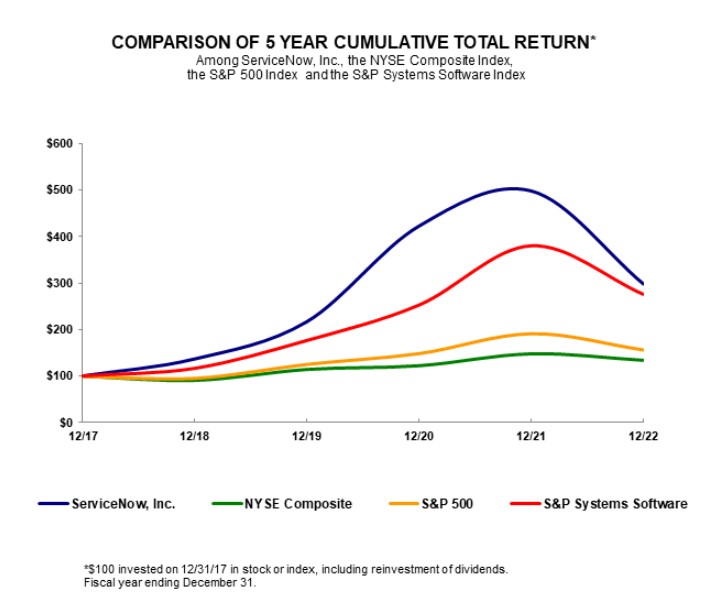
The graph below compares the cumulative total stockholder return on our common stock with the cumulative total return on the S&P 500 Index, NYSE Composite Index and the Standard & Poor Systems Software Index for each of the last five fiscal years ended December 31, 2018 through December 31, 2022, assuming an initial investment of $100. Data for the S&P 500 Index, NYSE Composite Index and the Standard & Poor Systems Software Index assume reinvestment of dividends.
The comparisons in the graph below are based upon historical data and are not indicative of, nor intended to forecast, future performance of our common stock.
| Base Period | ||||||||||||||||||||||||||||||||||||||||||||
| Dec 31, 2017 | Dec 31, 2018 | Dec 31, 2019 | Dec 31, 2020 | Dec 31, 2021 | Dec 31, 2022 | |||||||||||||||||||||||||||||||||||||||
| ServiceNow, Inc. | 100.00 | 136.55 | 216.52 | 422.14 | 497.82 | 297.78 | ||||||||||||||||||||||||||||||||||||||
| NYSE Composite | 100.00 | 91.05 | 114.28 | 122.26 | 147.54 | 133.75 | ||||||||||||||||||||||||||||||||||||||
| S&P 500 | 100.00 | 95.62 | 125.72 | 148.85 | 191.58 | 156.89 | ||||||||||||||||||||||||||||||||||||||
| S&P Systems Software | 100.00 | 116.38 | 176.18 | 252.08 | 379.36 | 275.12 |
Unregistered Sales of Equity Securities
In May 2022, we entered into unwind agreements to settle the remaining portion of the 2022 Warrants. In connection with the settlement of the remaining portion of the 2022 Warrants, we delivered, in an exchange pursuant to Section 3(a)(9) of the Securities Act of 1933, as amended, an aggregate of 602,752 shares of our common stock to the holders of the 2022 Warrants, which were Citibank, N.A., Goldman Sachs & Co. LLC, JPMorgan Chase Bank, National Association, London Branch, and Morgan Stanley & Co. International plc. We did not receive any proceeds from the unwind agreements in connection with the 2022 Warrants, nor were they subject to underwriting discounts or commissions.
Issuer Purchases of Equity Securities
None.
| Item 6. SELECTED CONSOLIDATED FINANCIAL DATA |
Item 6. is no longer required as the Company has adopted certain provisions within the amendments to Regulation S-K that eliminate Item 301.
Item 7. MANAGEMENT’S DISCUSSION AND ANALYSIS OF FINANCIAL CONDITION AND RESULTS OF OPERATIONS
This section of our Annual Report on Form 10-K discusses our financial condition and results of operations for the fiscal years ended December 31, 2022 and 2021, and year-to-year comparisons between fiscal 2022 and fiscal 2021 in accordance with U.S. Generally Accepted Accounting Principles (“GAAP”). A discussion of our financial condition and results of operations for the fiscal year ended December 31, 2020 and year-to-year comparisons between fiscal 2021 and fiscal 2020 that is not included in this Annual Report on Form 10-K can be found in “Management’s Discussion and Analysis of Financial Condition and Results of Operations” in Part II, Item 7 of our Annual Report on Form 10-K for the fiscal year ended December 31, 2021, filed on February 3, 2022.
Our free cash flow measure included in the section entitled “—Key Business Metrics—Free Cash Flow,” is not in accordance with GAAP. This non-GAAP financial measure is not intended to be considered in isolation or as a substitute for, or superior to, financial information prepared and presented in accordance with GAAP. This measure may be different from non-GAAP financial measures used by other companies, limiting its usefulness for comparison purposes. We encourage investors to carefully consider our results under GAAP, as well as our supplemental non-GAAP results, to more fully understand our business.
Overview
ServiceNow was founded on a simple premise: a better technology platform will help work flow better. Our purpose is to make the world work better for everyone. We help global enterprises across industries, universities and governments to digitize their workflows. The Now Platform, seamlessly connects workflows across siloed organizations and systems in a way that unlocks productivity, improves experiences for both employees and customers and delivers real business outcomes. We organize our workflow applications along four primary areas: Technology, Customer and Industry, Employee and Creator. The Now Platform enables our customers’ digital transformation from non-integrated enterprise technology solutions with manual and disconnected processes and activities, to integrated enterprise technology solutions with automation and connected processes and activities. The transformation to digital operations, enabled by the Now Platform, increases our customers’ resiliency and security and delivers great experiences and additional value to their employees and consumers.
We are closely monitoring the unfolding events of the Russian invasion of Ukraine. While the Russia-Ukraine conflict is still evolving and the outcome remains highly uncertain, we do not believe the Russia-Ukraine conflict will have a material impact on our business and results of operations. However, if the Russia-Ukraine conflict continues or worsens, leading to greater global economic disruptions and uncertainty, our business and results of operations could be materially impacted. Our customers in Russia represented an immaterial portion of our net assets and total consolidated revenues both as of and for the year ended December 31, 2022 and December 31, 2021.
See the “Risk Factors” section in Part I, Item 1A of this Annual Report for further discussion of the possible impact of the Russia-Ukraine conflict on our business.
Key Business Metrics
Remaining performance obligations. Transaction price allocated to remaining performance obligations (“RPO”) represents contracted revenue that has not yet been recognized, which includes deferred revenue and non-cancelable amounts that will be invoiced and recognized as revenue in future periods. RPO excludes contracts that are billed in arrears, such as certain time and materials contracts, as we apply the “right to invoice” practical expedient under relevant accounting guidance. Current remaining performance obligations (“cRPO”) represents RPO that will be recognized as revenue in the next 12 months.
As of December 31, 2022, our RPO was $14 billion, of which 49% represented cRPO. RPO and cRPO increased by 22%, respectively, compared to December 31, 2021. Factors that may cause our RPO to vary from period to period include the following:
-
Foreign currency exchange rates. While a majority of our contracts have historically been in U.S. Dollars, an increasing percentage of our contracts in recent periods has been in foreign currencies, particularly the Euro and British Pound Sterling. Fluctuations in foreign currency exchange rates as of the balance sheet date will cause variability in our RPO.
-
Mix of offerings. In a minority of cases, we allow our customers to host our software by themselves or through a third-party service provider. In self-hosted offerings, we recognize a portion of the revenue upfront upon the delivery of the software and as a result, such revenue is excluded from RPO.
-
Subscription start date. From time to time, we enter into contracts with a subscription start date in the future and these amounts are included in RPO if such contracts are signed by the balance sheet date.
-
Timing of contract renewals. While customers typically renew their contracts at the end of the contract term, from time to time, customers may do so either before or after the scheduled expiration date. For example, in cases where we are successful in selling additional products or services to an existing customer, a customer may decide to renew its existing contract early to ensure that all its contracts expire on the same date. In other cases, prolonged negotiations or other factors may result in a contract not being renewed until after it has expired.
*•*Contract duration. While we typically enter into multi-year subscription services, the duration of our contracts varies. Further, we continue to see an increase in the number of 12-month agreements entered into with the U.S. federal government throughout the year, with the highest number of agreements entered into in the quarter ended September 30, driven primarily by timing of their annual budget expenditures. We sometimes also enter into contracts with durations that have a 12-month or shorter term to enable the contracts to co-terminate with the existing contract. The contract duration will cause variability in our RPO.
Number of customers with ACV greater than $1 million. We count the total number of customers with annual contract value (“ACV”) greater than $1 million as of the end of the period. We had 1,637, 1,346, and 1,082 customers with ACV greater than $1 million as of December 31, 2022, 2021 and 2020, respectively. For purposes of customer count, a customer is defined as an entity that has a unique Dunn & Bradstreet Global Ultimate (“GULT”) Data Universal Numbering System (“DUNS”) number and an active subscription contract as of the measurement date. The DUNS number is a global standard for business identification and tracking. We make exceptions for holding companies, government entities and other organizations for which the GULT, in our judgment, does not accurately represent the ServiceNow customer. For example, while all U.S. government agencies roll up to “Government of the United States” under the GULT, we count each government agency that we contract with as a separate customer. Our customer count is subject to adjustments for acquisitions, spin-offs and other market activity; accordingly, we restate previously disclosed number of customers with ACV greater than $1 million calculations to allow for comparability. ACV is calculated based on the foreign exchange rate in effect at the time the contract was signed. Foreign exchange rate fluctuations could cause some variability in the number of customers with ACV greater than $1 million. We believe information regarding the total number of customers with ACV greater than $1 million provides useful information to investors because it is an indicator of our growing customer base and demonstrates the value customers are receiving from the Now Plat
Showing the first 8K of 60K characters. Open the full section
Item 7A. QUALITATIVE AND QUANTITATIVE DISCLOSURES ABOUT MARKET RISK
Foreign Currency Exchange Risk
We have foreign currency risks related to our revenue and operating expenses denominated in currencies other than the U.S. Dollar, primarily the Euro and British Pound Sterling. We are a net receiver of Euro and British Pound Sterling, and therefore benefit from a weakening of the U.S. Dollar relative to these currencies and, conversely, are adversely affected by a strengthening of the U.S. Dollar relative to these currencies. Revenues denominated in U.S. Dollar as a percentage of total revenues was 72%, 70% and 71% for the years ended December 31, 2022, 2021 and 2020, respectively.
A hypothetical 10% increase in the U.S. Dollar against other currencies would have resulted in a decrease in operating income of $75 million, $62 million and $47 million for the years ended December 31, 2022, 2021 and 2020, respectively. This analysis disregards the possibilities that rates can move in opposite directions and that losses from one geographic area may be offset by gains from another geographic area.
To mitigate our risks associated with fluctuations in foreign currency exchange rates, we enter into foreign currency derivative contracts to hedge a portion of our net outstanding monetary assets and liabilities. These derivative contracts are intended to offset gains or losses related to remeasuring monetary assets and liabilities that are denominated in currencies other than the functional currency of the entities in which they are recorded.
These derivative contracts expose us to credit risk to the extent that the counterparties may be unable to meet the terms of the arrangement. We mitigate this credit risk by transacting with major financial institutions with high credit ratings and entering into master netting arrangements, which permit net settlement of transactions with the same counterparty. While the contract or notional amount is often used to express the volume of foreign currency derivative contracts, the amounts potentially subject to credit risk are generally limited to the amounts, if any, by which the counterparties’ obligations under the agreements exceed our obligations to the counterparties. We are not required to pledge, and are not entitled to receive, cash collateral related to these derivative instruments. We do not enter into derivative contracts for trading or speculative purposes. Refer to Note 8 in the notes to our consolidated financial statements included elsewhere in this Annual Report on Form 10-K for additional information.
Interest Rate Sensitivity
We had an aggregate of $6.4 billion in cash, cash equivalents, short-term investments and long-term investments as of December 31, 2022. This amount was invested primarily in money market funds, certificates of deposit, corporate notes and bonds, government and agency securities and other debt securities with a minimum rating of BBB by Standard & Poor’s, Baa2 by Moody’s or BBB by Fitch. The primary objectives of our investment activities are the preservation of capital and support of our liquidity requirements. Our investments are exposed to market risk due to fluctuations in interest rates, which may affect our interest income and the fair market value of our investments.
As of December 31, 2022, a hypothetical 100 basis point increase in interest rates would have resulted in an approximate $39 million decline of the fair value of our available-for-sale securities. This estimate is based on a sensitivity model that measures market value changes when changes in interest rates occur.
As of December 31, 2021, we had an aggregate of $4.9 billion in cash, cash equivalents, short-term investments and long-term investments, and a hypothetical 100 basis point increase in interest rates would have resulted in an approximate $30 million decline of the fair value of our available-for-sale securities.
Market Risk
In August 2020, we issued 1.40% fixed rate ten-year notes with an aggregate principal amount of $1.5 billion due on September 1, 2030. The 2030 Notes were issued at 99.63% of principal and we incurred approximately $13 million of debt issuance costs. Interest is payable semi-annually in arrears on March 1 and September 1 of each year, beginning on March 1, 2021, and the entire outstanding principal amount is due at maturity on September 1, 2030. The 2030 Notes are unsecured obligations and the indentures governing the 2030 Notes contain customary events of default and covenants that, among others and subject to exceptions, restrict the Company’s ability to incur or guarantee debt secured by liens on specified assets or enter into sale and lease-back transactions with respect to specified properties.
In May and June 2017, we issued the 2022 Notes with an aggregate principal amount of $782.5 million. These 2022 Notes were recorded at face value less unamortized discount on our consolidated balance sheet. Because these instruments do not bear interest, we had no economic interest rate exposure associated with changes in interest rates. However, the fair value of our 2022 Notes was exposed to interest rate risks. In addition, the fair value of the 2022 Notes was affected by our stock price due to the conversion feature and would generally increase as the stock price increases. The remaining principal of 2022 Notes was settled on June 1, 2022.
We hold cash balances with multiple financial institutions in various countries and these balances routinely exceed deposit insurance limits.
As of December 31, 2022 and 2021, we had $252 million and $99 million, respectively, of non-marketable equity investments in privately held companies. Recording upward and downward adjustments to the carrying value of our non-marketable equity investments requires quantitative assessments of the fair value of our non-marketable equity investments using various valuation methodologies and involves the use of estimates. The timing and amount of observable price changes are influenced by market dynamics that can impact the valuation of our non-marketable equity investments. These changes could be material based on market conditions and events.
Item 8. CONSOLIDATED FINANCIAL STATEMENTS AND SUPPLEMENTARY DATA
SERVICENOW, INC.
INDEX TO CONSOLIDATED FINANCIAL STATEMENTS
Report of Independent Registered Public Accounting Firm
To the Board of Directors and Stockholders of ServiceNow, Inc.
Opinions on the Financial Statements and Internal Control over Financial Reporting
We have audited the accompanying consolidated balance sheets of ServiceNow, Inc. and its subsidiaries (the “Company”) as of December 31, 2022 and 2021, and the related consolidated statements of comprehensive income, of stockholders’ equity and of cash flows for each of the three years in the period ended December 31, 2022, including the related notes (collectively referred to as the “consolidated financial statements”). We also have audited the Company's internal control over financial reporting as of December 31, 2022, based on criteria established in Internal Control - Integrated Framework (2013) issued by the Committee of Sponsoring Organizations of the Treadway Commission (COSO).
In our opinion, the consolidated financial statements referred to above present fairly, in all material respects, the financial position of the Company as of December 31, 2022 and 2021, and the results of its operations and its cash flows for each of the three years in the period ended December 31, 2022 in conformity with accounting principles generally accepted in the United States of America. Also in our opinion, the Company maintained, in all material respects, effective internal control over financial reporting as of December 31, 2022, based on criteria established in Internal Control - Integrated Framework (2013) issued by the COSO.
Basis for Opinions
The Company's management is responsible for these consolidated financial statements, for maintaining effective internal control over financial reporting, and for its assessment of the effectiveness of internal control over financial reporting, included in Management’s Report on Internal Control Over Financial Reporting appearing under Item 9A. Our responsibility is to express opinions on the Company’s consolidated financial statements and on the Company's internal control over financial reporting based on our audits. We are a public accounting firm registered with the Public Company Accounting Oversight Board (United States) (PCAOB) and are required to be independent with respect to the Company in accordance with the U.S. federal securities laws and the applicable rules and regulations of the Securities and Exchange Commission and the PCAOB.
We conducted our audits in accordance with the standards of the PCAOB. Those standards require that we plan and perform the audits to obtain reasonable assurance about whether the consolidated financial statements are free of material misstatement, whether due to error or fraud, and whether effective internal control over financial reporting was maintained in all material respects.
Our audits of the consolidated financial statements included performing procedures to assess the risks of material misstatement of the consolidated financial statements, whether due to error or fraud, and performing procedures that respond to those risks. Such procedures included examining, on a test basis, evidence regarding the amounts and disclosures in the consolidated financial statements. Our audits also included evaluating the accounting principles used and significant estimates made by management, as well as evaluating the overall presentation of the consolidated financial statements. Our audit of internal control over financial reporting included obtaining an understanding of internal control over financial reporting, assessing the risk that a material weakness exists, and testing and evaluating the design and operating effectiveness of internal control based on the assessed risk. Our audits also included performing such other procedures as we considered necessary in the circumstances. We believe that our audits provide a reasonable basis for our opinions.
Definition and Limitations of Internal Control over Financial Reporting
A company’s internal control over financial reporting is a process designed to provide reasonable assurance regarding the reliability of financial reporting and the preparation of financial statements for external purposes in accordance with generally accepted accounting principles. A company’s internal control over financial reporting includes those policies and procedures that (i) pertain to the maintenance of records that, in reasonable detail, accurately and fairly reflect the transactions and dispositions of the assets of the company; (ii) provide reasonable assurance that transactions are recorded as necessary to permit preparation of financial statements in accordance with generally accepted accounting principles, and that receipts and expenditures of the company are being made only in accordance with authorizations of management and directors of the company; and (iii) provide reasonable assurance regarding prevention or timely detection of unauthorized acquisition, use, or disposition of the company’s assets that could have a material effect on the financial statements.
Because of its inherent limitations, internal control over financial reporting may not prevent or detect misstatements. Also, projections of any evaluation of effectiveness to future periods are subject to the risk that controls may become inadequate because of changes in conditions, or that the degree of compliance with the policies or procedures may deteriorate.
Critical Audit Matters
The critical audit matter communicated below is a matter arising from the current period audit of the consolidated financial statements that was communicated or required to be communicated to the audit committee and that (i) relates to accounts or disclosures that are material to the consolidated financial statements and (ii) involved our especially challenging, subjective, or complex judgments. The communication of critical audit matters does not alter in any way our opinion on the consolidated financial statements, taken as a whole, and we are not, by communicating the critical audit matter below, providing a separate opinion on the critical audit matter or on the accounts or disclosures to which it relates.
Subscription revenue recognition - customer contracts with multiple performance obligations
As described in Note 2 to the consolidated financial statements, the Company enters into contracts that can include various combinations of products and services, which are generally capable of being distinct and accounted for as separate performance obligations. Subscription revenues include self-hosted offerings in which customers deploy, or the Company grants customers the option to deploy without significant penalty, the Company’s subscription services internally or contr
Showing the first 8K of 136K characters. Open the full section
Item 9. CHANGES IN AND DISAGREEMENTS WITH ACCOUNTANTS ON ACCOUNTING AND FINANCIAL DISCLOSURE
None.
Item 9A. CONTROLS AND PROCEDURES
(a) Evaluation of Disclosure Controls and Procedures
Regulations under the Exchange Act require public companies, including our Company, to maintain “disclosure controls and procedures,” which are defined in Rule 13a-15(e) and Rule 15d-15(e) to mean a company’s controls and other procedures that are designed to ensure that information required to be disclosed in the reports that it files or submits under the Exchange Act is recorded, processed, summarized and reported, within the time periods specified in the SEC’s rules and forms. Disclosure controls and procedures include, without limitation, controls and procedures designed to ensure that information required to be disclosed in our reports filed or submitted under the Exchange Act is accumulated and communicated to management, including our principal executive officer and principal financial officer, or persons performing similar functions, as appropriate, to allow timely decisions regarding required or necessary disclosures. In designing and evaluating our disclosure controls and procedures, management recognizes that disclosure controls and procedures, no matter how well conceived and operated, can provide only reasonable, not absolute, assurance that the objectives of the disclosure controls and procedures are met. Additionally, in designing disclosure controls and procedures, our management necessarily was required to apply its judgment in evaluating the cost-benefit relationship of possible disclosure controls and procedures. Our Chief Executive Officer and Chief Financial Officer have concluded, based on the evaluation of the effectiveness of the disclosure controls and procedures by our management as of December 31, 2022, that our disclosure controls and procedures were effective at the reasonable assurance level for this purpose.
(b) Management’s Report on Internal Control Over Financial Reporting
Our management is responsible for establishing and maintaining adequate internal control over financial reporting (as defined in Rules 13a-15(f) and 15d-15(f) under the Exchange Act) to provide reasonable assurance regarding the reliability of our financial reporting and the preparation of consolidated financial statements for external purposes in accordance with generally accepted accounting principles.
Our management, under the supervision of our Chief Executive Officer and Chief Financial Officer, conducted an evaluation of the effectiveness of our internal control over financial reporting based on the framework in Internal Control—Integrated Framework (2013), issued by the Committee of Sponsoring Organizations of the Treadway Commission. Based on this evaluation, management concluded that our internal control over financial reporting was effective as of December 31, 2022.
The effectiveness of our internal control over financial reporting as of December 31, 2022 has been audited by PricewaterhouseCoopers LLP, an independent registered public accounting firm, as stated in their report, which is included in Item 8 of this Annual Report on Form 10-K.
(c) Changes in Internal Control over Financial Reporting
There were no changes to our internal control over financial reporting (as such term is defined in Rules 13a-15(f) and 15d-15(f) under the Exchange Act) that occurred during the quarter ended December 31, 2022 that have materially affected, or is reasonably likely to materially affect, our internal control over financial reporting.
Item 9B. OTHER INFORMATION
None.
Item 9C. DISCLOSURES REGARDING FOREIGN JURISDICTION THAT PREVENT INSPECTIONS
Not Applicable.
PART III
Item 10. DIRECTORS, EXECUTIVE OFFICERS AND CORPORATE GOVERNANCE
The information required by this item will be incorporated by reference from our definitive proxy statement to be filed pursuant to Regulation 14A.
Item 11. EXECUTIVE COMPENSATION
The information required by this item will be incorporated by reference from our definitive proxy statement to be filed pursuant to Regulation 14A.
Item 12. SECURITY OWNERSHIP OF CERTAIN BENEFICIAL OWNERS AND MANAGEMENT AND RELATED STOCKHOLDER MATTERS
The information required by this item will be incorporated by reference from our definitive proxy statement to be filed pursuant to Regulation 14A.
Item 13. CERTAIN RELATIONSHIPS AND RELATED TRANSACTIONS AND DIRECTOR INDEPENDENCE
The information required by this item will be incorporated by reference from our definitive proxy statement to be filed pursuant to Regulation 14A.
Item 14. PRINCIPAL ACCOUNTANT FEES AND SERVICES
The information required by this item will be incorporated by reference from our definitive proxy statement to be filed pursuant to Regulation 14A.
PART IV
Item 15. EXHIBITS AND FINANCIAL STATEMENT SCHEDULES
The following documents are filed as a part of this Annual Report on Form 10-K:
(a) Financial Statements
The information concerning our financial statements, and Report of Independent Registered Public Accounting Firm required by this Item is incorporated by reference herein to the section of this Annual Report on Form 10-K in Item 8, entitled “Consolidated Financial Statements and Supplementary Data.”
(b) Financial Statement Schedules
All schedules have been omitted because the required information is not present or not present in amounts sufficient to require submission of the schedules, or because the information required is included in Item 8, entitled the “Consolidated Financial Statements and Supplementary Data.”
(c) Exhibits
The list of exhibits filed with this report is set forth in the Exhibit Index following the signature pages and is incorporated herein by reference.
Item 16. FORM 10-K SUMMARY
None.
EXHIBIT INDEX
| Exhibit Number | Description of Document | Incorporated by Reference | Filed Herewith | ||||||||||||||||||||||||||||||||
| Form | File No. | Exhibit | Filing Date | ||||||||||||||||||||||||||||||||
| 101.PRE | Inline XBRL Taxonomy Extension Presentation Linkbase Document | X | |||||||||||||||||||||||||||||||||
| 104 | Cover Page Interactive Data File (formatted as inline XBRL and contained in Exhibit 101) | X | |||||||||||||||||||||||||||||||||
- Indicates a management contract, compensatory plan or arrangement.
** The certifications on Exhibit 32 hereto are deemed not “filed” for purposes of Section 18 of the Securities and Exchange Act of 1934, as amended, or otherwise subject to the liability of that Section. Such certifications will not be deemed incorporated by reference into any filing under the Securities Act or the Exchange Act.
SIGNATURES
Pursuant to the requirements of Section 13 or 15(d) of the Securities Exchange Act of 1934, the registrant has duly caused this report to be signed on its behalf by the undersigned thereunto duly authorized.
Dated: January 30, 2023
| SERVICENOW, INC. | |||||||||||
| By: | /s/ William R. McDermott | ||||||||||
| William R. McDermott Chief Executive Officer |
POWER OF ATTORNEY
KNOW ALL BY THESE PRESENTS, that each person whose signature appears below constitutes and appoints William R. McDermott and Gina Mastantuono, and each of them, as his or her true and lawful attorneys-in-fact and agents, each with the full power of substitution, for him or her and in his or her name, place or stead, in any and all capacities, to sign any and all amendments to this report, and to file the same, with exhibits thereto and other documents in connection therewith, with the Securities and Exchange Commission, granting unto said attorneys-in-fact and agents, and each of them, full power and authority to do and perform each and every act and thing requisite and necessary to be done in and about the premises, as fully to all intents and purposes as he might or could do in person, hereby ratifying and confirming all that said attorneys-in-fact and agents, or their or his substitute or substitutes, may lawfully do or cause to be done by virtue hereof.
Pursuant to the requirements of the Securities Exchange Act of 1934, this report has been signed by the following persons in the capacities and on the dates indicated.
| Signature | Title | Date | ||||||||||||
| /s/ William R. McDermott | Chairman and Chief Executive Officer (Principal Executive Officer) | January 30, 2023 | ||||||||||||
| William R. McDermott | ||||||||||||||
| /s/ Gina Mastantuono | Chief Financial Officer (Principal Financial Officer) | January 30, 2023 | ||||||||||||
| Gina Mastantuono | ||||||||||||||
| /s/ Kevin T. McBride | Chief Accounting Officer (Principal Accounting Officer) | January 30, 2023 | ||||||||||||
| Kevin T. McBride | ||||||||||||||
| /s/ Frederic B. Luddy | Director | January 30, 2023 | ||||||||||||
| Frederic B. Luddy | ||||||||||||||
| /s/ Susan L. Bostrom | Director | January 30, 2023 | ||||||||||||
| Susan L. Bostrom | ||||||||||||||
| /s/ Teresa Briggs | Director | January 30, 2023 | ||||||||||||
| Teresa Briggs | ||||||||||||||
| /s/ Jonathan C. Chadwick | Director | January 30, 2023 | ||||||||||||
| Jonathan C. Chadwick | ||||||||||||||
| /s/ Paul E. Chamberlain | Director | January 30, 2023 | ||||||||||||
| Paul E. Chamberlain | ||||||||||||||
| /s/ Lawrence J. Jackson, Jr. | Director | January 30, 2023 | ||||||||||||
| Lawrence J. Jackson, Jr. | ||||||||||||||
| /s/ Jeffrey A. Miller | Director | January 30, 2023 | ||||||||||||
| Jeffrey A. Miller | ||||||||||||||
| /s/ Joseph M. Quinlan | Director | January 30, 2023 | ||||||||||||
| Joseph M. Quinlan | ||||||||||||||
| /s/ Anita M. Sands | Director | January 30, 2023 | ||||||||||||
| Anita M. Sands |