 filings.tools
Item 1. Business
72K characters. Original on sec.gov · Markdown
Item 1. Business
General
NRG Energy, Inc., or NRG or the Company, is an integrated power company built on dynamic retail brands with diverse generation assets. NRG brings the power of energy to customers by producing and selling electricity and related products and services in major competitive power markets in the U.S. and Canada in a manner that delivers value to all of NRG's stakeholders. NRG is a customer-driven business focused on perfecting the integrated model by balancing retail load with generation supply within its deregulated markets. The Company sells energy, services, and innovative, sustainable products and services directly to retail customers under the brand names NRG, Reliant, Green Mountain Energy, Stream, and XOOM Energy, as well as other brand names owned by NRG, supported by approximately 23,000 MW of generation as of December 31, 2019. NRG was incorporated as a Delaware corporation on May 29, 1992.
NRG divested non-core businesses including, among others: (i) NRG Yield, Inc. and the Renewables Platform during 2018; and (ii) the South Central Portfolio during 2019.
The Company previously owned GenOn Energy, Inc. which filed for bankruptcy on June 14, 2017. As a result of the bankruptcy filing, NRG determined it no longer controlled GenOn and deconsolidated GenOn and its subsidiaries for financial reporting purposes. On December 14, 2018, GenOn emerged from bankruptcy as a standalone company no longer owned by NRG.
Since 2017, the Company has been executing its three-year Transformation Plan, which includes targets related to operations and cost excellence, portfolio optimization, and capital structure and allocation enhancement. See Item 7 – Management’s Discussion and Analysis of Financial Conditions and Results of Operations for further discussion.
Strategy
NRG's strategy is to maximize stockholder value through the safe production and sale of reliable power to its customers in the markets it serves, while positioning the Company to provide innovative solutions to the end-use energy customer. This strategy is intended to enable the Company to optimize its integrated model to generate stable and predictable cash flow, significantly strengthen earnings and cost competitiveness, and lower risk and volatility.
To effectuate the Company’s strategy, NRG is focused on: (i) serving the energy needs of end-use residential, commercial and industrial customers in competitive markets through multiple brands and channels with a variety of retail energy products and services differentiated by innovative features, premium service, sustainability, and loyalty/affinity programs; (ii) offering innovative and renewable energy solutions for customers; (iii) excellence in operating performance of its existing assets; (iv) optimal hedging of NRG's net retail and generation positions; and (v) engaging in disciplined and transparent capital allocation.
Sustainability is an integral piece of NRG's strategy and ties directly to business success, reduced risks and brand value. On September 24, 2019, NRG announced the acceleration of its science-based GHG emissions reduction goals to align with prevailing climate science, limiting warming to a 1.5 degree Celsius scenario. Under its new GHG emissions reduction timeline, NRG is targeting to achieve a 50% reduction by 2025 and net-zero emissions by 2050, from a 2014 baseline.
Business Overview
The Company’s core business is the sale of electricity and natural gas to residential, commercial and industrial customers, supported by the Company's wholesale generation.
Beginning in 2020, the Company is managing its integrated model based on the combined results of the retail and wholesale generation businesses. The Company’s integrated model consists of three core functions: Customer Operations, Market Operations and Plant Operations, which directly support each other in each geographic region. The Company’s integrated model provides the advantage of being able to supply the Company’s retail customers with electricity from the Company’s assets, which reduces the need to sell power to and buy power from other institutions and intermediaries, resulting in stable earnings and cash flows, lower transaction costs and less credit exposure. The integrated model also results in a reduction in actual and contingent collateral through offsetting transactions, thereby minimizing transactions with third parties.
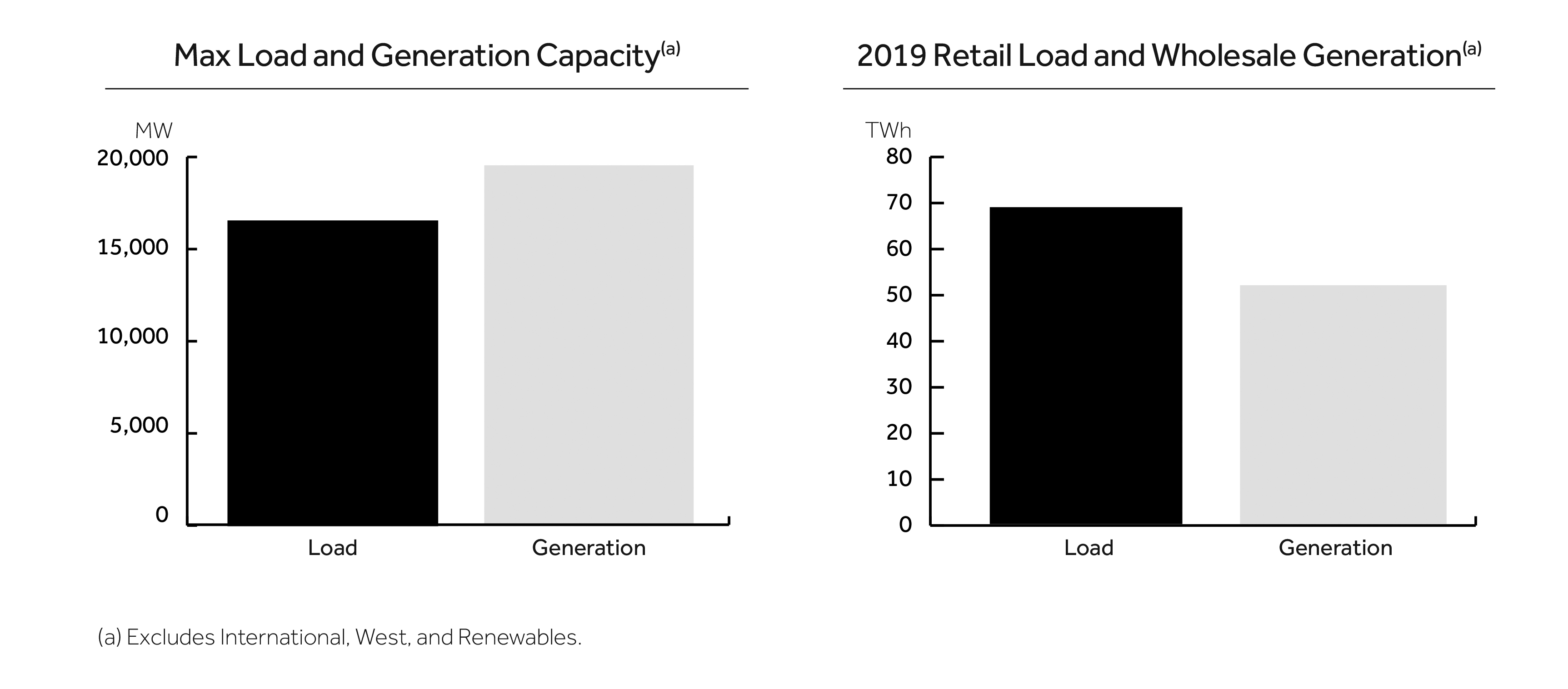
NRG provides energy and related services to residential, industrial and commercial customers at either fixed, indexed or variable prices through various brands and sales channels across the U.S. and Canada. Residential and small commercial (Mass market) customers typically contract for terms ranging from one month to five years, while industrial and large commercial (C&I) contracts are often between one year and five years in length. NRG sold approximately 69 TWhs of electricity and 23 MMDth of natural gas in 2019 and served approximately 3.7 million customers as of December 31, 2019, making it one of the largest competitive energy retailers in the U.S. In any given year, the quantity of TWhs and MMDth sold can be affected by weather, economic conditions and competition. As of the end of 2019, NRG had recurring electricity and/or natural gas sales in
19 U.S. states, the District of Columbia, and 2 provinces in Canada. NRG's retail brands, collectively, have the largest share of competitively served residential electric customers in Texas and nationwide.
The vast majority of the Company’s business is in Texas, where the Company’s generation supply is fully integrated with its retail load. In the East, the Company’s retail load is more disperse throughout the region and not fully integrated with the Company’s generation supply due to the location of its power plants in that region. In the West, the Company’s business is primarily generation supply.
The charts below illustrate NRG's U.S. retail capabilities, power generation and net capacity as of and for the year ended December 31, 2019:
Customer Operations
Customer Operations is responsible for growing and retaining the customer base and delivering an outstanding customer experience. This includes acquisition and retention of all of NRG’s residential, small commercial, government and commercial & industrial customers. NRG employs a multi-brand strategy that leverages a wide array of sales and partnership channels, direct face-to-face sales channels, call centers, websites, and brokers. Go-to-market activities include market strategy planning and development, product innovation, offer design, campaign execution, marketing and creative services, and selling. Customer portfolio maintenance and retention activities include fulfillment, billing, payment processing, collections, customer service, issue resolution, and contract renewals. Throughout all Customer Operations activities, the customer experience is kept at the forefront to inform decision-making and optimize retention, while creating supporters and advocates for NRG’s brands in the market.
Product Offerings
NRG sells a variety of products to residential and small commercial customers including retail electricity and energy management, natural gas, home security, line and surge protection products, HVAC installation, repair and maintenance, carbon offsets, back-up power stations, portable power, portable solar and portable lighting. Mass market customers make purchase decisions based on a variety of factors, including price, incentive, customer service, brand, innovative offers/features and referrals from friends and family. Through its broad range of service offerings and value propositions, NRG is able to attract, retain, and increase the value of its customer relationships. NRG's brands are recognized for exemplary customer service, innovative smart energy and technology product offerings, and environmentally-friendly solutions.
The Company also provides retail services, including demand response, commodity sales, energy efficiency and energy management solutions to C&I customers. The Company is an integrated provider of supply and distributed energy resources and focuses on distributed products and services as businesses seek greater reliability, cleaner power and/or other benefits that they cannot obtain from the grid. These solutions include system power, distributed generation, renewable products, carbon management and specialty services, backup generation, storage and distributed solar, demand response, and energy efficiency and advisory services. In providing on-site energy solutions, the Company often benefits from its ability to supply energy products from its wholesale generation portfolio to C&I customers. In 2019, the Company sold approximately 20 TWhs of electricity to C&I customers and managed approximately 2,000 MWs of demand response positions across its portfolio.
Market Operations
Market Operations has two primary objectives: (i) to supply load to our customers in the most cost-efficient manner; and (ii) to maximize the value of any excess generation after satisfying the Company’s customer load requirements. These objectives are intended to reduce supply costs and maximize earnings with predictable cash flows.
To meet these objectives, NRG enters into supply, power sales and hedging arrangements via a wide range of products and contracts, including (i) renewable PPAs, (ii) capacity auctions and other contracted revenue sources, (iii) fuel supply and transportation contracts, and (iv) natural gas derivative instruments and other financial instruments.
In addition, because changes in power prices in the markets where NRG operates are generally correlated to changes in natural gas prices, NRG uses hedging strategies that may include power and natural gas forward purchases and sales contracts to manage the commodity price risk.
Renewable PPAs
During 2019, NRG began procuring mid to long-term renewable generation through power purchase agreements. As of December 31, 2019, NRG has entered into PPAs in Texas totaling approximately 1,600 MWs with third-party project developers and other counterparties. The average tenor of these agreements is ten years. The Company expects to continue evaluating and executing agreements, such as these, that support the needs of the business.
Capacity and Other Contracted Revenue Sources
NRG's revenues and cash flows, primarily in the East and West, benefit from capacity/demand payments and other contracted revenue sources, originating from market clearing capacity prices, resource adequacy contracts, tolling arrangements and other long-term contractual arrangements.
The Company's largest sources of capacity revenues are capacity auctions in PJM, ISO-NE and NYISO. Both PJM and ISO-NE operate a pay-for-performance model where capacity payments are modified based on real-time performance and NRG's actual revenues will be the combination of revenues based on the cleared auction MWs plus the net of any over- and under-performance of NRG's respective generation assets. The Company primarily sells physical capacity forward through bilateral contracts for our New York assets. To the extent NRG is not able to enter into a physical bilateral contract, NRG will sell the remaining capacity into the NYISO six month strip, monthly or spot auctions
*◦*2023/2024 ISO-NE Auction Results - On February 5, 2020 ISO-NE announced the results of its 2023/2024 forward capacity auction. NRG cleared 784 MW of capacity. NRG's expected capacity revenues from the auction for the 2023/2024 delivery year are approximately $18 million.
◦PJM Auction Results — PJM announced during 2019 it was suspending all auction deadlines relating to Base Residual Auctions for 2022/2023 and 2023/2024 delivery year, consistent with FERC’s July 25, 2019 Order. Refer to the Capacity Market Reforms Filing discussion within the Regional Regulatory Developments section below for further discussion.
In California, there is a resource adequacy requirement that is primarily satisfied through bilateral contracts. Such bilateral contracts are typically short-term resource adequacy contracts. When bilateral contracting does not satisfy the resource adequacy need, such shortfalls can be addressed through procurement tools administered by the CAISO, including the capacity procurement mechanism or reliability must-run contracts.
Fuel Supply and Transportation
NRG's fuel requirements consist of various forms of fossil fuel and nuclear fuel. The prices of fossil fuels can be volatile. The Company obtains its fossil fuels from multiple suppliers and through multiple transporters. Although availability is generally not an issue, localized shortages, transportation availability, delays arising from extreme weather conditions and supplier financial stability issues can and do occur. The preceding factors related to the sources and availability of raw materials are fairly uniform across the Company's business and fuel products used. NRG's primary fuel requirements consist of the following:
Natural Gas — NRG operates a fleet of mid-merit and peaking natural gas plants across all its U.S. wholesale regions. Fuel needs are managed on a spot basis, especially for peaking assets, as the Company does not believe it is prudent to forward purchase natural gas for these types of units as the dispatch is highly unpredictable. The Company contracts for natural gas storage services, as well as natural gas transportation services to deliver natural gas when needed.
Coal — The Company believes it is adequately hedged, using forward coal supply agreements, for its domestic coal consumption for 2020. NRG actively manages its coal requirements based on forecasted generation, market volatility and its inventory on site. As of December 31, 2019, NRG had purchased forward contracts to provide fuel for approximately 58% of the Company's expected requirements for 2020 and 2021 per the table below. NRG purchased approximately 17 million tons of coal in 2019, almost all of which was Powder River Basin coal. For fuel transport, NRG has entered into various rail transportation and rail car lease agreements with varying tenures that will provide for most of the Company's transportation requirements of Powder River Basin coal for the next 2 years.
The following table shows the percentage of the Company's coal requirements for 2020 and 2021 that have been purchased forward as of December 31, 2019:
| Percentage of Company's Requirement | |||||
| 2020 | 100 | % | |||
| 2021 | 16 | % |
Nuclear Fuel — STP's owners satisfy their fuel supply requirements by: (i) acquiring uranium concentrates and contracting for conversion of the uranium concentrates into uranium hexafluoride; (ii) contracting for enrichment of uranium hexafluoride; and (iii) contracting for fabrication of nuclear fuel assemblies. Through its proportionate participation in STPNOC, which is the NRC-licensed operator of STP that is responsible for all aspects of fuel procurement, NRG is party to a number of long-term forward purchase contracts with many of the world's largest suppliers covering STP's requirements for uranium concentrates with only approximately 25% of STP's requirements outstanding for the duration of the original operating license. Similarly, NRG is party to long-term contracts to procure STP's requirements for conversion and enrichment services and fuel fabrication for the life of the operating license. Since the operating license was renewed for another 20 years in 2017, STPNOC has begun to review a second phase of fuel purchasing.
Natural Gas Derivative Instruments and Other Financial Instruments
NRG also trades electric power, natural gas and related commodity and financial products, including forwards, futures, options and swaps.
Plant Operations
The Company owns a diversified power generation portfolio with approximately 23,000 MW of fossil fuel, nuclear and renewable generation capacity at 32 plants as of December 31, 2019. The Company's power generation assets are diversified by fuel-type, dispatch level and region, which helps mitigate the risks associated with fuel price volatility and market demand cycles. NRG continually evaluates its generation portfolio to focus on asset optimization opportunities and the locational value of its generation assets in each of the markets where the Company participates, as well as opportunities for the development of new generation.
The following table summarizes NRG's generation portfolio as of December 31, 2019:
| (In MW)(a) | ||||||||||||||||||||||||||||||||||||||||||||||||||
| Type | Texas | East/West(b)(c) | Other (d) | Total | ||||||||||||||||||||||||||||||||||||||||||||||
| Natural gas | 4,759 | 4,994 | — | 9,753 | ||||||||||||||||||||||||||||||||||||||||||||||
| Coal | 4,174 | 3,745 | — | 7,919 | ||||||||||||||||||||||||||||||||||||||||||||||
| Oil | — | 3,600 | — | 3,600 | ||||||||||||||||||||||||||||||||||||||||||||||
| Nuclear | 1,126 | — | — | 1,126 | ||||||||||||||||||||||||||||||||||||||||||||||
| Utility Scale Solar | — | 321 | — | 321 | ||||||||||||||||||||||||||||||||||||||||||||||
| Battery Storage & Distributed Solar | 2 | — | 60 | 62 | ||||||||||||||||||||||||||||||||||||||||||||||
| Total generation capacity | 10,061 | 12,660 | 60 | 22,781 | ||||||||||||||||||||||||||||||||||||||||||||||
(a) All Utility Scale Solar and Distributed Solar facilities are described in MW on an alternating current basis. MW figures provided represent nominal summer net MW capacity of power generated as adjusted for the Company's owned or leased interest excluding capacity from inactive/mothballed units
(b) Includes the remaining Renewables generation assets
(c) Includes 1,153 MW for the Cottonwood facility that was sold to Cleco on February 4, 2019, which the Company is leasing until 2025
(d) The Distributed Solar figure includes the aggregate production capacity of installed and activated residential solar energy systems
Plant Operations is responsible for operating the Company's generation facilities at the highest standards of safety and reliability, and includes (i) operations and maintenance, (ii) asset management, and (iii) development, engineering and construction.
Operations & Maintenance
NRG operates and maintains its generation portfolio, as well as approximately 8,100 MW of additional coal and natural gas generation capacity at 17 plants operated on behalf of third parties as of December 31, 2019 using prudent industry practices for the safe, reliable and economic generation of electricity in compliance with all local, state and federal requirements. The Company follows a consistent set of operating requirements, including a solid base of training, required adherence to specific safety and environmental limits, procedure and checklist usage, and the implementation of continuous process improvement through incident investigations.
NRG uses best-in-class maintenance practices for preventive, predictive, and corrective maintenance planning. The Company’s strategic planning process evaluates equipment condition, performance, and obsolescence to support the development of a comprehensive work scope and schedule for long-term performance.
Asset Management
NRG manages all aspects of its generation portfolio to optimize the lifecycle value of the assets, consistent with the Company’s goals. The Company evaluates capital projects required for continued operation and strategic enhancement of the assets, provides quality assurance on capital outlays, and assesses the impact of rules, regulations, and laws on business profitability. In addition, the Company manages its long-term contracts, power purchase agreements, and real estate holdings and provides third party asset management services.
Development, Engineering & Construction
NRG develops, engineers and executes major plant modifications, “new build” generation and energy storage projects that enhance the value of its generation portfolio and provide options to meet generation growth needs in the retail markets we serve, in accordance with the Company’s strategic goals. Projects have included gas-fired generation development and construction, coal to gas conversions, grid scale energy storage development, grid scale renewable construction, and asset demolition, remediation and reclamation work.
Operational Statistics
The following statistics represent the Company's retail customer count, load and contract mix:
| Years ended December 31, | |||||||||||||||||||||||||||||
| 2019 | 2018 | 2017 | |||||||||||||||||||||||||||
| Sales volumes (in GWh) | |||||||||||||||||||||||||||||
| Mass market electricity - Texas | 38,958 | 37,846 | 36,169 | ||||||||||||||||||||||||||
| Mass market electricity - All other regions | 9,918 | 7,968 | 6,221 | ||||||||||||||||||||||||||
| C&I electricity - Texas | 18,976 | 20,192 | 19,586 | ||||||||||||||||||||||||||
| C&I electricity - All other regions | 1,214 | 984 | 814 | ||||||||||||||||||||||||||
| Total Load | 69,066 | 66,990 | 62,790 | ||||||||||||||||||||||||||
| Customer count - Electricity (in thousands) | |||||||||||||||||||||||||||||
| Mass market - Texas (a) | |||||||||||||||||||||||||||||
| Average Retail | 2,358 | 2,209 | 2,177 | ||||||||||||||||||||||||||
| Ending Retail | 2,450 | 2,318 | 2,188 | ||||||||||||||||||||||||||
| Mass market - All other regions | |||||||||||||||||||||||||||||
| Average Retail | 990 | 790 | 675 | ||||||||||||||||||||||||||
| Ending Retail | 1,070 | 903 | 673 | ||||||||||||||||||||||||||
| (a) Includes customers of non-electric services | |||||||||||||||||||||||||||||
| Customer count - Natural gas (in thousands) | |||||||||||||||||||||||||||||
| Average Retail Mass market | 122 | 64 | 11 | ||||||||||||||||||||||||||
| Ending Retail Mass market | 158 | 99 | 15 | ||||||||||||||||||||||||||
| Customer contract mix | |||||||||||||||||||||||||||||
| Fixed | 67 | % | 65 | % | 70 | % | |||||||||||||||||||||||
| Variable | 24 | % | 25 | % | 22 | % | |||||||||||||||||||||||
| Indexed | 9 | % | 10 | % | 8 | % | |||||||||||||||||||||||
| 100 | % | 100 | % | 100 | % |
The following are industry statistics for the Company's fossil and nuclear plants, as defined by the NERC, and are more fully described below:
Annual Equivalent Availability Factor, or EAF — Measures the percentage of maximum generation available over time as the fraction of net maximum generation that could be provided over a defined period of time after all types of outages and deratings, including seasonal deratings, are taken into account.
Net Heat Rate — The net heat rate represents the total amount of fuel in BTU required to generate one net kWh provided.
Net Capacity Factor — The net amount of electricity that a generating unit produces over a period of time divided by the net amount of electricity it could have produced if it had run at full power over that time period. The net amount of electricity produced is the total amount of electricity generated minus the amount of electricity used during generation.
The tables below present these performance metrics for the Company's generation portfolio, including leased facilities and those accounted for through equity method investments, for the years ended December 31, 2019 and 2018:
| Year Ended December 31, 2019 | |||||||||||||||||||||||||||||||||||||||||||||||||||||
| Fossil and Nuclear Plants (a) | |||||||||||||||||||||||||||||||||||||||||||||||||||||
| Net Owned Capacity (MW) | Net Generation (MWh) (In thousands) (a) | Annual Equivalent Availability Factor | Average Net Heat Rate BTU/kWh | Net Capacity Factor | |||||||||||||||||||||||||||||||||||||||||||||||||
| Texas | 10,061 | 37,995 | 83.3 | % | 10,542 | 43.2 | % | ||||||||||||||||||||||||||||||||||||||||||||||
| East/West/Other (b)(c) | 12,720 | 16,375 | 81.5 | % | 9,215 | 16.2 | % |
| Year Ended December 31, 2018 | |||||||||||||||||||||||||||||||||||||||||||||||||||||
| Fossil and Nuclear Plants (a) | |||||||||||||||||||||||||||||||||||||||||||||||||||||
| Net Owned Capacity (MW) | Net Generation (MWh) (In thousands) (a) | Annual Equivalent Availability Factor | Average Net Heat Rate BTU/kWh | Net Capacity Factor | |||||||||||||||||||||||||||||||||||||||||||||||||
| Texas | 10,161 | 38,214 | 85.2 | % | 10,423 | 44.7 | % | ||||||||||||||||||||||||||||||||||||||||||||||
| East/West/Other (b)(c) | 13,097 | 21,089 | 82.8 | % | 9,711 | 17.8 | % |
(a)Net generation excludes equity method investments
(b)Includes the 1,263 MW Cottonwood facility that NRG leased back upon the sale of the South Central Portfolio in 2019. The year ended December 31, 2018 also included Sherbino, which was sold in 2019
(c)Includes the aggregate production capacity of installed and activated residential solar energy systems
The generation performance by region for the three years ended December 31, 2019, 2018 and 2017 is shown below:
| Net Generation | |||||||||||||||||||||||||||||
| (In thousands of MWh) | 2019 | 2018 | 2017 | ||||||||||||||||||||||||||
| Texas | |||||||||||||||||||||||||||||
| Coal | 21,985 | 24,781 | 24,757 | ||||||||||||||||||||||||||
| Gas | 6,315 | 4,415 | 4,428 | ||||||||||||||||||||||||||
| Nuclear (a) | 9,695 | 9,018 | 9,509 | ||||||||||||||||||||||||||
| Total Texas | 37,995 | 38,214 | 38,694 | ||||||||||||||||||||||||||
| East/West | |||||||||||||||||||||||||||||
| Coal | 4,435 | 7,965 | 8,403 | ||||||||||||||||||||||||||
| Oil | 209 | 544 | 319 | ||||||||||||||||||||||||||
| Gas | 11,719 | 11,797 | 10,949 | ||||||||||||||||||||||||||
| Renewables | 12 | 783 | 1,667 | ||||||||||||||||||||||||||
| Total East/West | 16,375 | 21,089 | 21,338 |
(a)Reflects the Company's undivided interest in total MWh generated by STP
Competition
While there has been consolidation in the competitive retail space over the past few years, there is still considerable competition for customers. In Texas, there is healthy competition in deregulated areas and customers can choose providers based on the most appealing offers. Outside of Texas, electricity retailers compete with the incumbent utilities, in addition to other retail electric providers, which can inhibit competition, depending on the market rules of the state. Most markets have more than 30 retailers competing for customers, while Texas has more than 50 retailers. There is a high degree of fragmentation, with both large and small competitors offering a range of value propositions, including value, rewards, and sustainability.
Wholesale generation is highly fragmented and diverse in terms of industry structure by region. As such, there is a wide variation in terms of the capabilities, resources, nature and identities of the Company’s competitors depending on the market. Competitors include regulated utilities, municipalities, cooperatives, other independent power producers, and power marketers or trading companies, including those owned by financial institutions.
Seasonality and Price Volatility
The sale of electric power to retail customers is a seasonal business with the demand for power generally peaking during the summer months. As a result, net working capital requirements for the Company's retail operations generally increase during summer months along with the higher revenues, and then decline during off-peak months. Weather may impact operating results and extreme weather conditions could have a material impact. The rates charged to retail customers may be impacted by fluctuations in total power prices and market dynamics, such as the price of natural gas, transmission constraints, competitor actions, and changes in market heat rates.
Annual and quarterly operating results of the Company's generation portfolio can be significantly affected by weather and energy commodity price volatility. Significant other events, such as the demand for natural gas, interruptions in fuel supply infrastructure and relative levels of hydroelectric capacity can increase seasonal fuel and power price volatility. The preceding factors related to seasonality and price volatility are fairly uniform across the regions in which the Company operates.
Market Framework
NRG sells energy and related services, as well as portable power and battery solutions, to customers across the country. In most of the states that have introduced retail consumer choice, NRG competitively offers electricity, natural gas, portable power and other value-enhancing services to customers. Each retail consumer choice state establishes its own retail competition laws and regulations, and the specific operational, licensing, and compliance requirements vary by state. Regulated terms and conditions of default service, as well as any movement to replace default service with competitive services, as is done in ERCOT, can affect customer participation in retail competition. The attractiveness of NRG's retail offerings may be impacted by the rules, regulations, market structure and communication requirements from public utility commissions in each state across the country.
NRG's fleet operates in organized energy markets, known as RTOs or ISOs. Each organized market administers day-ahead and real-time centralized bid-based energy and ancillary services markets pursuant to tariffs approved by FERC, or in the case of ERCOT, market rules approved by the PUCT. These tariffs and rules dictate how the energy markets operate, how market participants make bilateral sales with one another, and how entities with market-based rates are compensated. Established prices reflect the value of energy at the specific location and time it is delivered, which is known as the Locational Marginal Price. Each market is subject to market mitigation measures designed to limit the exercise of locational market power. These market structures facilitate NRG's sale of power and capacity products at market-based rates.
Other than ERCOT, each of the ISO regions also operates a capacity or resource adequacy market that provides an opportunity for generating and demand response resources to earn revenues to offset their fixed costs that are not recovered in the energy and ancillary services markets. The ISOs are also responsible for transmission planning and operations.
Texas
NRG's business in Texas is subject to standards and regulations adopted by the PUCT and ERCOT(a), including the requirement for retailers to be certified by the PUCT in order to contract with end-users to sell electricity. The ERCOT market is one of the nation's largest and, historically, fastest growing power markets. ERCOT is an energy- only market and has implemented market rule changes referred to as the Operating Reserve Demand Curve (ORDC) to provide pricing more reflective of higher energy value when operating reserves are scarce or constrained. The PUCT directed the implementation of the ORDC in 2014 to act as the primary scarcity pricing mechanism. The PUCT directed ERCOT to implement changes in 2019. The first phase became effective on March 1, 2019 and the second phase will become effective on March 1, 2020. The majority of the retail load in the ERCOT market region is served by competitive retail suppliers, except certain areas that have not opted into competitive consumer choice and are served by municipal utilities and electric cooperatives.
East
While most of the states in the East region have introduced some level of retail consumer choice for electricity and/or natural gas, the incumbent utilities currently provide default service in most of the states and as a result typically serve the majority of residential customers. NRG’s retail activities in the East are subject to standards and regulations adopted by the ISOs and state public utility commissions, including the requirement for retailers to be certified in each state in order to contract with end-users to sell electricity.
(a) The Cottonwood facility is located in Deweyville, Texas, but operates in the MISO market
NRG's power plants and demand response assets located in the East region of the U.S. are within the control areas of ISO-NE, MISO, NYISO and PJM. Each of the market regions in the East region provides for robust competition in the day-ahead and real-time energy and ancillary services markets. Additionally, the East region receives a significant portion of its revenues from capacity markets. PJM and ISO-NE use a three-year forward capacity auction, while NYISO uses a month-ahead capacity auction. MISO has an annual auction, known as the Planning Resource Auction. Capacity market prices are sensitive to design parameters, as well as additions of new capacity. Both ISO-NE and PJM operate a pay-for-performance model where capacity payments are modified based on real-time generator performance. In such markets, NRG’s actual capacity revenues will be the combination of cleared auction prices times the quantity of MWs cleared, plus the net of any over-performance "bonus payments" and any under-performance charges. Additionally, bidding rules allow for the incorporation of a risk premium into generator bids.
West
In the West region of the U.S., NRG operates a fleet of natural gas-fired power plants located entirely within the CAISO footprint. The CAISO operates day-ahead and real-time locational markets for energy and ancillary services, while managing congestion primarily through nodal prices. The CAISO system facilitates NRG's sale of power, ancillary services and capacity products at market-based rates, either within the CAISO's centralized energy and ancillary service markets or bilaterally pursuant to tolling arrangements or other capacity sales with California's LSEs. The CPUC also determines capacity requirements for LSEs and for specified local areas utilizing inputs from the CAISO. Both the CAISO and CPUC rules require LSEs to contract with sufficient generation resources in order to maintain minimum levels of generation within defined local areas. Additionally, the CAISO has independent authority to contract with needed resources under certain circumstances, typically either when LSEs have failed to procure sufficient resources, or system conditions change unexpectedly.
The Company’s Agua Caliente and Ivanpah projects are party to PPAs with PG&E. Both projects have project financing with the U.S. DOE. Agua Caliente Borrower 1 LLC, along with Agua Caliente Borrower 2 LLC, which is owned by Clearway Energy Inc., were party to a back-leverage financing related to the Agua Caliente project, which was repaid in 2019. On January 29, 2019, PG&E Corp. and subsidiary utility PG&E filed for Chapter 11 bankruptcy protection. For further discussion see Energy Regulatory Matters, Item 15 — Note 13, Debt and Finance Leases, and Item 15 — Note 17, Investments Accounted for by the Equity Method and Variable Interest Entities, to the Consolidated Financial Statements.
Regulatory Matters
As participants in wholesale and retail energy markets and owners of power plants, certain NRG entities are subject to regulation by various federal and state government agencies. These include the CFTC, FERC, NRC and the PUCT, as well as other public utility commissions in certain states where NRG's generation or distributed generation assets are located. In addition, NRG is subject to the market rules, procedures and protocols of the various ISO and RTO markets in which it participates. Likewise, certain NRG entities participating in the retail markets are subject to rules and regulations established by the states in which NRG entities are licensed to sell at retail. NRG must also comply with the mandatory reliability requirements imposed by NERC and the regional reliability entities in the regions where NRG operates.
NRG's operations within the ERCOT footprint are not subject to rate regulation by FERC, as they are deemed to operate solely within the ERCOT market and not in interstate commerce. These operations are subject to regulation by the PUCT, as well as to regulation by the NRC with respect to NRG's ownership interest in STP.
Federal Energy Regulation
PG&E Corporation Bankruptcy Filing — On January 18, 2019, NextEra Energy, Inc., filed a petition for declaratory order requesting that FERC assert its jurisdiction over PG&E's wholesale contracts prior to PG&E's formal bankruptcy filing. Exelon Corporation and EDF Renewables filed similar complaints. On January 25, 2019, FERC found that it and the bankruptcy courts have concurrent jurisdiction to review and address the disposition of wholesale power contracts. Separately, the PG&E bankruptcy court ruled on June 7, 2019 that it does not share concurrent jurisdiction with FERC and has unilateral discretion to address the disposition of wholesale power contracts, which ruling was appealed by FERC and various counterparties to such contracts. On June 26, 2019, PG&E appealed the FERC order that was issued on January 25, 2019. Both sets of appeals are currently pending before the Court of Appeals for the Ninth Circuit and the issue of jurisdiction over wholesale power contracts remains in litigation.
On September 9, 2019, PG&E filed a plan of reorganization that would assume all power purchase agreements, including those held by the Agua Caliente project and two of the Ivanpah units. On October 17, 2019, a group of unsecured noteholders filed a competing plan of reorganization that would also assume all power purchase agreements, including those held by the Agua Caliente project and the two Ivanpah units.
On January 22, 2020, PG&E announced that it had reached an agreement with certain noteholder plan proponents and, on January 31, 2020, the PG&E plan was amended to provide for the eventual implementation of such settlement. On February 4, 2020, the Bankruptcy Court approved such settlement, and the noteholders have accordingly agreed to support the PG&E plan. On February 5, 2020, the noteholders caused the noteholder plan to be withdrawn. There are many conditions that must be satisfied before the PG&E plan and assumption of the power purchase agreements can become effective, including, but not limited to, approvals by various classes of creditors, the Bankruptcy Court, and the CPUC. A hearing before the Bankruptcy Court to consider whether the PG&E plan will be approved and confirmed is currently expected to occur on May 29, 2020.
State Energy Regulation
State Out-Of-Market Subsidy Proposals — NRG has opposed efforts to provide out-of-market subsidies for nuclear generators and intends to continue opposing them in the future. Nuclear subsidy programs have either been implemented, are in the process of being implemented, or have been introduced for discussion in Connecticut, Illinois, New Jersey, New York, Ohio and Pennsylvania. NRG and others were unsuccessful in challenging the legality of the subsidies in Illinois and New York, and the U.S. Supreme Court has declined to review the lower court decisions. Through our PJM trade organization, NRG is also currently participating in an appeal of NJBPU's Order regarding ZECs.
Illinois Legislature Considers Changes to the Generator Business Model — In Illinois, in addition to legislation to provide more subsidies to nuclear power plants in the state, the Legislature is also considering several bills that may affect NRG’s wholesale and retail revenues, including a bill that would replace the PJM capacity market with a state-run capacity market. NRG continues to oppose the ongoing legislative effort and supports a competitive clean energy market design that would competitively reduce greenhouse gas emission through the procurement of clean energy resources without sacrificing the consumer benefits of the competitive PJM market design.
New York State Climate Leadership and Community Protection Act — The New York State Legislature enacted climate change legislation establishing by 2030, 70 percent of the state's energy will be generated by renewables and by 2040, the state's entire electric system must be zero-emitting. The law includes a provision that the NYSPSC may temporarily suspend or modify the obligations under its program if it finds that the program impedes safe and adequate electric service, likely impairs "existing obligations and agreements," and/or increases consumer late payments or service disconnections. The legislation includes provision for offsets, including carbon capture and sequestration, but electric generation sources are not eligible to participate in the offsets mechanism.
Regional Regulatory Developments
NRG is affected by rule/tariff changes that occur in the ISO regions. For further discussion on regulatory developments see Item 15 — Note 24, Regulatory Matters, to the Consolidated Financial Statements.
East/West
PJM
Capacity Market Reforms Filing — On December 19, 2019, FERC issued an order on the pending proposals to reform the PJM market to mitigate subsidized resources in the capacity market. FERC directed PJM to apply the Minimum Offer Price Rule, or MOPR, to new and existing resources receiving state subsidies and subject them to default offer floor prices in their capacity bids. The Order provided for various category specific exemptions to the MOPR, as well as a unit specific exemption, which permits any resource that can justify an offer lower than the default offer price floor to submit such capacity bids to PJM for review. As part of the December 19, 2019 FERC Order, FERC gave PJM 90 days to make a compliance filing and submit tariff language to reflect the requirements of the Order and directed PJM to include in this filing a timetable for when it proposes to hold the previously postponed Base Residual Auctions for the 2022/2023 and 2023/2024 delivery years. Multiple parties filed for rehearing. Subjecting subsidized resources to default offer floors in the capacity market should protect the market from further price suppression. The impact of these changes on capacity markets outcomes is dependent on, among other factors, bidding behavior, load forecast changes, new resource entry, and existing resource exit.
PJM's Operating ORDC Filing — On March 29, 2019, PJM proposed energy and reserve market reforms to enhance price formation in reserve markets, which includes modifying its ORDC and aligning market-based reserve products in Day-Ahead and Real-Time markets. The matter is pending at FERC. If the proposal were approved as filed, energy and reserve market prices could increase.
Independent Market Monitor Market Seller Offer Cap Complaint — On February 21, 2019, the Independent Market Monitor filed a complaint alleging that the current Market Seller Offer Cap is too high. On April 9, 2019, PJM filed its answer arguing that as a threshold matter the Independent Market Monitor is not authorized to file a complaint against PJM and among other things, that the Market Monitor failed to support its claim that the expected number of performance assessment hours used to calculate the cap is overstated. The Company’s trade organization filed a protest in the docket echoing PJM’s concerns. The
Market Monitor subsequently filed answers in the docket and the docket remains pending. If the request is granted, default market offer caps could be lower.
PJM’s Fast Start Pricing Filing — On April 19, 2019, FERC ordered PJM to implement fast start pricing because it found that the existing fast start pricing practices are unjust and unreasonable because they do not allow prices to reflect the marginal cost of serving load. PJM made its compliance filing on August 30, 2019. On January 23, 2020, FERC issued an order holding the proceeding in abeyance until July 31, 2020, to allow PJM to consider changes to address FERC's concern about a mismatch between dispatch and pricing. The changes could provide more accurate pricing to reflect the marginal cost of serving load.
New England
ISO-NE Retention of Mystic Units — ISO-NE is currently engaged in a proceeding at FERC regarding how to ensure system reliability in a gas-constrained system. In particular, FERC has approved ISO-NE's proposal to retain units at the Mystic generating station, which utilizes liquefied natural gas for fuel security. Among other things, FERC specifically will allow resources retained for fuel security to enter a zero bid in the Forward Capacity Auction, and also ordered ISO-NE to provide a long-term market-based solution for fuel security. On January 2, 2019, multiple parties filed for rehearing. The motions for rehearing are pending at FERC. On January 10, 2020, FERC rejected Exelon's request to have the option to terminate the second year of its two-year cost of service agreement for Mystic units 8 and 9. The outcome of this matter may affect future capacity market prices.
ISO-NE Inventoried Energy Compensation Proposal — On March 25, 2019, ISO-NE proposed an interim measure to address near-term fuel security concerns. The proposal would provide payment for inventoried energy during winter months. NRG protested, among other things, the payment rate proposed by the ISO for inventoried energy. After ISO-NE supplemented its filings due to a deficiency notice from FERC, NRG filed comments to ISO-NE's response on June 27, 2019. On August 6, 2019, FERC issued a notice stating that due to lack of quorum, ISO-NE's proposal became effective by operation of law. Multiple parties filed for rehearing. Those rehearings were denied. Subsequently, multiple parties filed an appeal of FERC's Order to the Court of Appeals for the D.C. Circuit. The case is pending. ISO-NE's proposal will affect future capacity market prices and the compensation fuel secure units receive.
Connecticut Department of Energy and Environmental Protection Integrated Resource Plan Proceeding — In Connecticut's ongoing proceeding related to its Integrated Resource Plan, the Connecticut Department of Energy and Environmental Protection issued a notice of technical meeting and opportunity for public comment on January 8, 2020 seeking comment on two issues: (1) the compatibility of state goals and those of ISO-NE and (2) the possibility of alternative market designs that would be more in line with the state's goals. On January 22, 2020, NRG presented its thoughts and on February 5, 2020, NRG filed comments advocating for competitive markets and proposed its competitive clean energy market design. On February 28, 2020, the Connecticut Departments of Energy and Environmental Protection will hold a second technical meeting.
New York
New York State Public Service Commission Retail Energy Market Proceedings — On February 23, 2016, the NYSPSC issued an order referred to as the Retail Reset Order. Among other things, the Retail Reset Order placed a price cap on energy supply offers and imposed burdensome new regulations on customers. Various parties have challenged the NYSPSC's authority to regulate prices charged by competitive suppliers. On May 9, 2019 the New York Court of Appeals, the state’s highest tribunal, issued a decision affirming the NYSPSC’s authority to regulate ESCO’s prices as a condition of access to the utilities’ infrastructure. In conjunction with the court challenge, the NYSPSC also noticed an evidentiary proceeding. On December 12, 2019, the NYSPSC issued an order adopting changes to the retail access energy market based on the record in the evidentiary proceeding. The Order limits ESCO offers to three compliant products: guaranteed savings from the utility default rate, a fixed term capped at 5% of the rolling 12-month average utility default rate, or NY-sourced renewable energy that is at least 50% greater than the prevailing NY Renewable Energy Standard for load serving entities. The Order also establishes new ESCO eligibility criteria and certification process, as well as re-certification of current ESCOs. The NYSPSC ordered compliance effective February 10, 2020. On January 13, 2020, multiple parties filed motions for rehearing and a stay of the Order. On January 17, 2020, NRG filed a request for a 90-day extension of the February 10, 2020 effective date, and, on January 22, 2020, the NYSPSC granted an extension for compliance to May 11, 2020. The limited offerings imposed by the Order, as issued, may negatively impact the retail business.
New York State Public Service Commission Resource Adequacy Proceeding — On August 8, 2019, the NYSPSC established an investigation into New York's resource adequacy market design. On November 8, 2019, NRG filed comments and recommendations, specifically putting forth NRG's Forward Clean Energy Market Proposal, that would allow New York to maintain a reliable system while advancing its environmental goals. The proceeding is pending. Any actions taken by the NYSPSC could affect market design and market prices in New York.
Independent Power Producers of New York (IPPNY) Complaint — On February 20, 2020, FERC rejected a rehearing request asking FERC to direct NYISO to require that capacity from existing generation resources that would have exited the market but for out-of-market payments be mitigated and found that NYISO complied with the initial order to establish a stakeholder process to consider whether buyer side mitigation measures are needed to address these agreements. On January 9, 2017, EPSA requested FERC to promptly direct NYISO to file tariff provisions to address pending market concerns related to out-of-market payments to existing generation in NYISO. On April 5, 2018, EPSA filed a motion for renewed request for expedited action on the MOPR. Failure to implement buyer-side mitigation measures could result in uneconomic entry, which artificially decreases capacity prices below competitive market levels.
New York Buyer Side Mitigation Proceedings — On February 20, 2020, FERC issued multiple orders pertaining to the NYISO capacity market. The orders narrowed certain exemptions to buyer side mitigation measures. Specifically, FERC stated that certain renewable and self-supply resources would be exempt from offer floor mitigation but rejected NYISO’s proposal of a 1,000 MW cap on renewable resources that could qualify for the exemption. FERC ordered NYISO to make a compliance filing narrowly tailoring its cap. FERC also rejected a complaint to exempt new electric storage resources. It also rejected a blanket exemption to demand response providers currently subject to mitigation but granted a request for new demand response to receive a blanket exemption from the buyer side mitigation measures. Implementation of buyer-side mitigation measures to address price suppression provides more accurate capacity price signals in the competitive market.
Texas
ORDC Reforms — In January 2019, the PUCT directed ERCOT to implement changes to its scarcity pricing structure, known as the ORDC, which is designed to increase the likelihood of scarcity pricing to support existing generation and new investment. The PUCT directed ORDC reforms to be implemented in two phases of gradually increasing magnitude. The first phase became effective on March 1, 2019 and the second phase will become effective on March 1, 2020. To date, the ORDC reforms have produced a noticeable improvement in scarcity pricing.
Environmental Regulatory Matters
NRG is subject to numerous environmental laws in the development, construction, ownership and operation of power plants. These laws generally require that governmental permits and approvals be obtained before construction and during operation of power plants. Federal and state environmental laws historically have become more stringent over time. Future laws may require the addition of emissions controls or other environmental controls or impose restrictions on the Company's operations. Complying with environmental laws often involves significant capital and operating expenses, as well as occasionally curtailing operations. NRG decides to invest capital for environmental controls based on the relative certainty of the requirements, an evaluation of compliance options, and the expected economic returns on capital.
A number of regulations that may affect the Company are under review by the EPA, including ash storage and disposal requirements, NAAQS revisions and implementation and effluent limitation guidelines. NRG will evaluate the impact of these regulations as they are revised but cannot fully predict the impact of each until anticipated revisions and legal challenges are resolved.
Air
The CAA and the resulting regulations (as well as similar state and local requirements) have the potential to affect air emissions, operating practices and pollution control equipment required at power plants. Under the CAA, the EPA sets NAAQS for certain pollutants including SO2, ozone, and PM2.5. Many of the Company's facilities are located in or near areas that are classified by the EPA as not achieving certain NAAQS (non-attainment areas). The relevant NAAQS have become more stringent. The Company maintains a comprehensive compliance strategy to address continuing and new requirements. Complying with increasingly stringent air regulations could require the installation of additional emissions control equipment at some NRG facilities or retiring of units if installing such controls is not economic. Significant changes to air regulatory programs affecting the Company are described below.
Clean Power Plan — The attention in recent years on GHG emissions has resulted in federal regulations and state legislative and regulatory action. In October 2015, the EPA finalized the CPP, addressing GHG emissions from existing EGUs. On February 9, 2016, the U.S. Supreme Court stayed the CPP. In July 2019, EPA promulgated the ACE rule, which rescinded the CPP, which sought to broadly regulate CO2 emissions from the power sector. The ACE rule requires states that have coal-fired EGUs to develop plans to seek heat rate improvements from coal-fired EGUs. Texas, Illiniois and Delaware have started working on plans to comply with the ACE rule. Numerous parties have challenged the ACE rule in the D.C. Circuit and numerous parties have filed petitions for reconsideration with the EPA.
Greenhouse Gas Emissions — NRG emits CO2 (and small quantities of other GHGs) when generating electricity at a majority of its facilities. The graphs presented below illustrate NRG's domestic emissions of CO2e for the 2015 through 2019 period. Nearly all (>99%) of NRG's GHG emissions are subject to federal (U.S. EPA) GHG reporting requirements. From 2015 to 2019, the Company's CO2e emissions decreased from 56 million metric tons to 37 million metric tons, representing a 34% reduction. The factors leading to the decreased emissions include reductions in fleet-wide annual net generation and a market-driven shift from coal as a primary fuel to natural gas.
On September 24, 2019, NRG announced the acceleration of its science-based GHG emissions reduction goals to align with prevailing climate science, limiting warming to a 1.5 degree Celsius scenario. Under its new GHG emissions reduction timeline, NRG is targeting to achieve a 50% reduction by 2025 and net-zero emissions by 2050, from a 2014 baseline.
As of December 31, 2019, less than 25% of the Company's consolidated operating revenues were derived from coal-fired operating assets.
The following tables reflect the Company’s generation portfolio, including leased facilities and those accounted for through equity method investments. Prior year information was adjusted to remove divested assets.

Byproducts, Wastes, Hazardous Materials and Contamination
In April 2015, the EPA finalized the rule regulating byproducts of coal combustion (e.g., ash and gypsum) as solid wastes under the RCRA. In September 2017, the EPA agreed to reconsider the rule. On July 30, 2018, the EPA promulgated a rule that amends the existing ash rule by extending some of the deadlines and providing more flexibility for compliance. On August 21, 2018, the D.C. Circuit found, among other things, that the EPA had not adequately regulated unlined ponds and legacy ponds. On August 14, 2019, the EPA proposed targeted changes to the April 2015 Rule including changes to address the August 2018 D.C. Circuit decision. On December 2, 2019, the EPA released for comment "Closure Part A Proposal" to revise the CCR Rule to address the D.C. Circuit's 2018 decision regarding the adequacy of clay-lined impoundments, obligations to close all unlined impoundments and related deadlines. On February 20, 2020, the EPA proposed the framework for developing and implementing a federal permit program for states that are not approved to administer the CCR rule. We anticipate that the EPA will promulgate new regulations to address these issues and others as it reconsiders other aspects of the existing rule. The Company will provide estimates of the cost of compliance after the EPA finalizes revisions to the rule.
Domestic Site Remediation Matters
Under certain federal, state and local environmental laws, a current or previous owner or operator of a facility, including an electric generating facility, may be required to investigate and remediate releases or threatened releases of hazardous or toxic substances or petroleum products. NRG may be responsible for property damage, personal injury and investigation and remediation costs incurred by a party in connection with hazardous material releases or threatened releases. These laws impose liability without regard to whether the owner knew of or caused the presence of the hazardous substances, and the courts have interpreted liability under such laws to be strict (without fault) and joint and several. Cleanup obligations can often be triggered during the closure or decommissioning of a facility, in addition to spills during its operations. Further discussions of affected NRG sites can be found in Item 15 — Note 23, Commitments and Contingencies, to the Consolidated Financial Statements.
Nuclear Waste — The federal government's program to construct a nuclear waste repository at Yucca Mountain, Nevada was discontinued in 2010. Since 1998, the U.S. DOE has been in default of the federal government's obligations to begin accepting spent nuclear fuel, or SNF, and high-level radioactive waste, or HLW, under the Nuclear Waste Policy Act. Owners of nuclear plants, including the owners of STP, had been required to enter into contracts setting out the obligations of the owners and the U.S. DOE, including the fees to be paid by the owners for the U.S. DOE's services to license a spent fuel repository. Effective May 16, 2014, the U.S. DOE stopped collecting the fees.
On February 5, 2013, STPNOC entered into a settlement agreement with the U.S. DOE for payment of damages relating to the U.S. DOE's failure to accept SNF and HLW under the Nuclear Waste Policy Act through December 31, 2013, which has been extended twice through addendums to cover payments through December 31, 2019. STPNOC expects the settlement to be extended for another three-year period. There are no facilities for the reprocessing or permanent disposal of SNF currently in operation in the U.S., nor has the NRC licensed any such facilities. STPNOC currently stores all SNF generated by its nuclear generating facilities on-site. STPNOC plans to continue to assert claims against the U.S. DOE for damages relating to the U.S. DOE's failure to accept SNF and HLW.
Under the federal Low-Level Radioactive Waste Policy Act of 1980, as amended in 1985, the state of Texas is required to provide, either on its own or jointly with other states in a compact, for the disposal of all low-level radioactive waste generated within the state. Texas is currently in a compact with the state of Vermont, and the compact low-level waste facility located in Andrews County in Texas has been operational since 2012.
Water
The Company is required under the CWA to comply with intake and discharge requirements, requirements for technological controls and operating practices. As with air quality regulations, federal and state water regulations have become more stringent and imposed new requirements.
Effluent Limitations Guidelines — In November 2015, the EPA revised the Effluent Limitations Guidelines for Steam Electric Generating Facilities, which would have imposed more stringent requirements (as individual permits were renewed) for wastewater streams from FGD, fly ash, bottom ash, and flue gas mercury control. On September 18, 2017, the EPA promulgated a final rule that, among other things, postpones the compliance dates to preserve the status quo for FGD wastewater and bottom ash transport water by two years to November 2020 until the EPA completes its next rulemaking. On April 12, 2019, the United States Court of Appeals for the Fifth circuit addressed challenges to the rule brought by several environmental groups related to legacy wastewaters and coal ash leachate and remanded portions of the rule to the EPA. On November 22, 2019, the EPA proposed amending the 2015 ELG rule by: (x) decreasing the stringency of the selenium limit (but increasing the stringency of the nitrate and mercury limits) for FGD wastewater; (y) relaxing the zero-discharge requirement for bottom ash transport water; and (z) changing several deadlines. The Company has eliminated its estimate of the environmental capital expenditures that would have been required to comply with permits incorporating the revised guidelines. The Company will revisit these estimates after the EPA finalizes revisions to the rule.
Regional Environmental Developments
NY NOx — On December 31, 2019, the New York State Department of Environmental Conservation finalized a more stringent NOx regulation that will result in the retirement of the Company's combustion turbines in Astoria, New York in 2023.
Ash Regulation in Illinois — On July 30, 2019, Illinois enacted legislation that requires the state to promulgate regulations regarding coal ash at surface impoundments. We expect the state to promulgate the implementing regulations in March 2021, at which time regulated entities will then prepare and submit permit applications.
Customers
NRG sells to a wide variety of customers, primarily end-use customers in the residential, commercial and industrial sectors. The Company owns and operates power plants to generate and sell power to wholesale customers, such as utilities and other intermediaries. The Company had no customer that comprised more than 10% of the Company's consolidated revenues for the year ended December 31, 2019.
Employees
As of December 31, 2019, NRG and its consolidated subsidiaries had 4,577 employees, approximately 24% of whom were covered by U.S. bargaining agreements. During 2019, the Company did not experience any labor stoppages or labor disputes at any of its facilities.
Available Information
NRG's annual reports on Form 10-K, quarterly reports on Form 10-Q, current reports on Form 8-K, and amendments to those reports filed or furnished pursuant to section 13(a) or 15(d) of the Exchange Act are available free of charge through the SEC's website, www.sec.gov, and through the Company's website, www.nrg.com, as soon as reasonably practicable after they are electronically filed with, or furnished to, the SEC. The Company also routinely posts press releases, presentations, webcasts, sustainability reports and other information regarding the Company on the Company's website. The information posted on the Company's website is not a part of this report.
Previous: Cover and table of contents · Next: Item 1A. Risk Factors