 filings.tools
NRG Energy 10-K 2022-12-31
Filed 2023-02-23. 23 sections, 759K characters. Original on sec.gov · Markdown · JSON
Cover and table of contents
UNITED STATES SECURITIES AND EXCHANGE COMMISSION
Washington, D.C. 20549
Form 10-K
| ☒ | ANNUAL REPORT PURSUANT TO SECTION 13 OR 15(d) OF THE SECURITIES EXCHANGE ACT OF 1934 For the Fiscal Year ended December 31, 2022. | |||||||
| ☐ | TRANSITION REPORT PURSUANT TO SECTION 13 OR 15(d) OF THE SECURITIES EXCHANGE ACT OF 1934 For the Transition period from to . |
Commission file No. 001-15891
NRG Energy, Inc.
(Exact name of registrant as specified in its charter)
| Delaware (State or other jurisdiction of incorporation or organization) | 41-1724239 (I.R.S. Employer Identification No.) | |||||||
| 910 Louisiana Street, Houston, Texas (Address of principal executive offices) | 77002 (Zip Code) |
(713) 537-3000
(Registrant's telephone number, including area code)
Securities registered pursuant to Section 12(b) of the Act:
| Title of Each Class | Trading Symbol(s) | Name of Exchange on Which Registered | ||||||
| Common Stock, par value $0.01 | NRG | New York Stock Exchange |
Securities registered pursuant to Section 12(g) of the Act: None
Indicate by check mark if the registrant is a well-known seasoned issuer, as defined in Rule 405 of the Securities Act. Yes ☒ No ☐
Indicate by check mark if the registrant is not required to file reports pursuant to Section 13 or Section 15(d) of the Exchange Act. Yes ☐ No ☒
Indicate by check mark whether the registrant (1) has filed all reports required to be filed by Section 13 or 15(d) of the Securities Exchange Act of 1934 during the preceding 12 months (or for such shorter period that the registrant was required to file such reports), and (2) has been subject to such filing requirements for the past 90 days. Yes ☒ No ☐
Indicate by check mark whether the registrant has submitted electronically every Interactive Data File required to be submitted pursuant to Rule 405 of Regulation S-T (§232.405 of this chapter) during the preceding 12 months (or for such shorter period that the registrant was required to submit such files). Yes ☒ No ☐
Indicate by check mark whether the registrant is a large accelerated filer, an accelerated filer, a non-accelerated filer, a smaller reporting company, or an emerging growth company. See the definitions of "large accelerated filer," "accelerated filer," "smaller reporting company," and "emerging growth company" in Rule 12b-2 of the Exchange Act.
| Large Accelerated Filer ☒ | Accelerated filer | ☐ | |||||||||||||||||||||
| Non-accelerated filer ☐ | Smaller reporting company | ☐ | |||||||||||||||||||||
| Emerging growth company | ☐ |
If an emerging growth company, indicate by check mark if the registrant has elected not to use the extended transition period for complying with any new or revised financial accounting standards provided pursuant to Section 13(a) of the Exchange Act. ☐
Indicate by check mark whether the registrant has filed a report on and attestation to its management's assessment of the effectiveness of its internal control over financial reporting under Section 404(b) of the Sarbanes-Oxley Act (15 U.S.C 7262(b)) by the registered public accounting firm that prepared or issued its audit report ☒
If securities are registered pursuant to Section 12(b) of the Act, indicate by check mark whether the financial statements of the registrant included in the filing reflect the correction of an error to previously issued financial statements. ☐
Indicate by check mark whether any of those error corrections are restatements that required a recovery analysis of incentive-based compensation received by any of the registrant’s executive officers during the relevant recovery period pursuant to §240.10D-1(b). ☐
Indicate by check mark whether the registrant is a shell company (as defined in Rule 12b-2 of the Act). Yes ☐ No ☒
As of the last business day of the most recently completed second fiscal quarter, the aggregate market value of the common stock of the registrant held by non-affiliates was approximately $6,461,030,777 based on the closing sale price of $38.17 as reported on the New York Stock Exchange.
Indicate the number of shares outstanding of each of the registrant's classes of common stock as of the latest practicable date.
| Class | Outstanding at February 15, 2023 | |||||||
| Common Stock, par value $0.01 per share | 229,774,238 |
Documents Incorporated by Reference:
Portions of the Registrant's definitive Proxy Statement relating to its 2023 Annual Meeting of Stockholders
are incorporated by reference into Part III of this Annual Report on Form 10-K
TABLE OF CONTENTS
Glossary of Terms
When the following terms and abbreviations appear in the text of this report, they have the meanings indicated below:
| ACE | Affordable Clean Energy | |||||||
| Adjusted EBITDA | Adjusted earnings before interest, taxes, depreciation and amortization | |||||||
| AESO | Alberta Electric System Operator | |||||||
| ARO | Asset Retirement Obligation | |||||||
| ASC | The FASB Accounting Standards Codification, which the FASB established as the source of authoritative GAAP | |||||||
| ASU | Accounting Standards Updates – updates to the ASC | |||||||
| AUC | Alberta Utilities Commission | |||||||
| Bankruptcy Court | United States Bankruptcy Court for the Southern District of Texas, Houston Division | |||||||
| Brazos | Brazos Electric Power Cooperative, Inc. | |||||||
| BTU | British Thermal Unit | |||||||
| Business | NRG Business, which serves business customers | |||||||
| CAA | Clean Air Act | |||||||
| CAISO | California Independent System Operator | |||||||
| CARES Act | Coronavirus Aid, Relief, and Economic Security Act | |||||||
| CDD | Cooling Degree Day | |||||||
| Centrica | Centrica plc | |||||||
| CFTC | U.S. Commodity Futures Trading Commission | |||||||
| CO2 | Carbon Dioxide | |||||||
| CO2e | Carbon Dioxide Equivalents | |||||||
| Company | NRG Energy, Inc. | |||||||
| Convertible Senior Notes | As of December 31, 2022, consists of NRG’s $575 million unsecured 2.75% Convertible Senior Notes due 2048 | |||||||
| Cottonwood | Cottonwood Generating Station, a 1,177 MW natural gas-fueled plant | |||||||
| COVID-19 | Coronavirus Disease 2019 | |||||||
| CPP | Clean Power Plan | |||||||
| CPUC | California Public Utilities Commission | |||||||
| CWA | Clean Water Act | |||||||
| D.C. Circuit | U.S. Court of Appeals for the District of Columbia Circuit | |||||||
| DSI | Dry Sorbent Injection | |||||||
| DSU | Deferred Stock Unit | |||||||
| Dual fuel customers | Customer that have both electricity and natural gas service with the Company | |||||||
| Economic gross margin | Sum of retail revenue, energy revenue, capacity revenue and other revenue, less cost of fuels, purchased energy and other cost of sales | |||||||
| EGU | Electric Generating Unit | |||||||
| EPA | U.S. Environmental Protection Agency | |||||||
| EPC | Engineering, Procurement and Construction | |||||||
| ERCOT | Electric Reliability Council of Texas, the Independent System Operator and the regional reliability coordinator of the various electricity systems within Texas | |||||||
| ESP | Electrostatic Precipitator | |||||||
| ESPP | NRG Energy, Inc. Amended and Restated Employee Stock Purchase Plan | |||||||
| Exchange Act | The Securities Exchange Act of 1934, as amended | |||||||
| FASB | Financial Accounting Standards Board | |||||||
| FERC | Federal Energy Regulatory Commission | |||||||
| FGD | Flue gas desulfurization |
| FPA | Federal Power Act | |||||||
| FTRs | Financial Transmission Rights | |||||||
| GAAP | Generally accepted accounting principles in the United States | |||||||
| GHG | Greenhouse Gas | |||||||
| Green Mountain Energy | Green Mountain Energy Company | |||||||
| GW | Gigawatts | |||||||
| GWh | Gigawatt Hours | |||||||
| HDD | Heating Degree Day | |||||||
| Heat Rate | A measure of thermal efficiency computed by dividing the total BTU content of the fuel burned by the resulting kWhs generated. Heat rates can be expressed as either gross or net heat rates, depending whether the electricity output measured is gross or net generation and is generally expressed as BTU per net kWh | |||||||
| HLW | High-level radioactive waste | |||||||
| Home | NRG Home, which serves residential customers | |||||||
| ICE | Intercontinental Exchange | |||||||
| IRA | Inflation Reduction Act | |||||||
| ISO | Independent System Operator, also referred to as RTOs | |||||||
| ISO-NE | ISO New England Inc. | |||||||
| Ivanpah | Ivanpah Solar Electric Generation Station, a 393 MW solar thermal power plant located in California's Mojave Desert in which NRG owns 54.5% interest | |||||||
| kWh | Kilowatt-hours | |||||||
| LaGen | Louisiana Generating LLC | |||||||
| LIBOR | London Inter-Bank Offered Rate | |||||||
| MDth | Thousand Dekatherms | |||||||
| Midwest Generation | Midwest Generation, LLC | |||||||
| MISO | Midcontinent Independent System Operator, Inc. | |||||||
| MMBtu | Million British Thermal Units | |||||||
| MMDth | Million Dekatherms | |||||||
| MW | Megawatts | |||||||
| MWh | Saleable megawatt hour net of internal/parasitic load megawatt-hour | |||||||
| NAAQS | National Ambient Air Quality Standards | |||||||
| NEIL | Nuclear Electric Insurance Limited | |||||||
| NEPOOL | New England Power Pool | |||||||
| NERC | North American Electric Reliability Corporation | |||||||
| Net Capacity Factor | The net amount of electricity that a generating unit produces over a period of time divided by the net amount of electricity it could have produced if it had run at full power over that time period. The net amount of electricity produced is the total amount of electricity generated minus the amount of electricity used during generation | |||||||
| Net Exposure | Counterparty credit exposure to NRG, net of collateral | |||||||
| Net Generation | The net amount of electricity produced, expressed in kWhs or MWhs, that is the total amount of electricity generated (gross) minus the amount of electricity used during generation | |||||||
| NOL | Net Operating Loss | |||||||
| NOx | Nitrogen Oxides | |||||||
| NPNS | Normal Purchase Normal Sale | |||||||
| NRC | U.S. Nuclear Regulatory Commission | |||||||
| NRG | NRG Energy, Inc. | |||||||
| NRG LTIP | NRG Energy, Inc. Amended and Restated Long-Term Incentive Plan | |||||||
| Nuclear Decommissioning Trust Fund | NRG's nuclear decommissioning trust fund assets, which are for the Company's portion of the decommissioning of the STP, units 1 & 2 |
| Nuclear Waste Policy Act | U.S. Nuclear Waste Policy Act of 1982 | |||||||
| NYISO | New York Independent System Operator | |||||||
| NYMEX | New York Mercantile Exchange | |||||||
| OCI/OCL | Other Comprehensive Income/(Loss) | |||||||
| ORDC | Operating Reserve Demand Curve | |||||||
| ORDPA | Online Reliability Deployment Price Adder | |||||||
| Peaking | Units expected to satisfy demand requirements during the periods of greatest or peak load on the system | |||||||
| Petra Nova | Petra Nova Parish Holdings, LLC | |||||||
| PJM | PJM Interconnection, LLC | |||||||
| PM2.5 | Particulate Matter that has a diameter of less than 2.5 micrometers | |||||||
| PPA | Power Purchase Agreement | |||||||
| PUCT | Public Utility Commission of Texas | |||||||
| Rayburn | Rayburn Country Electric Cooperative, Inc. | |||||||
| RCRA | Resource Conservation and Recovery Act of 1976 | |||||||
| Receivables Securitization Facilities | Collectively, the Receivables Facility and the Repurchase Facility | |||||||
| RECs | Renewable Energy Certificates | |||||||
| Renewable PPA | A third-party PPA entered into directly with a renewable generation facility for the offtake of the RECs or other similar environmental attributes generated by such facility, coupled with the associated power generated by that facility. | |||||||
| Renewables | Consists of the following projects in which NRG has an ownership interest: Agua Caliente, Ivanpah, and solar generating stations located at various NFL Stadiums | |||||||
| Renewables Platform | The renewable operating and development platform sold to Global Infrastructure Partners with NRG's interest in NRG Yield. | |||||||
| REP | Retail electric provider | |||||||
| Revolving Credit Facility | The Company's $3.7 billion revolving credit facility as of December 31, 2022, a component of the Senior Credit Facility, due 2024 which was amended on May 28, 2019 and August 20, 2020. The revolving credit facility was amended on February 14, 2023, increasing the facility to $4.3 billion | |||||||
| RGGI | Regional Greenhouse Gas Initiative | |||||||
| RMR | Reliability Must-Run | |||||||
| RPS | Renewable Portfolio Standards | |||||||
| RPSU | Relative Performance Stock Unit | |||||||
| RSU | Restricted Stock Unit | |||||||
| RTO | Regional Transmission Organization | |||||||
| SCR | Selective Catalytic Reduction Control System | |||||||
| SEC | U.S. Securities and Exchange Commission | |||||||
| Securities Act | The Securities Act of 1933, as amended | |||||||
| Senior Credit Facility | NRG's senior secured credit facility, comprised of the Revolving Credit Facility and the 2023 Term Loan Facility. The 2023 Term Loan Facility was repaid in the second quarter of 2019 | |||||||
| Senior Notes | As of December 31, 2022, NRG's $4.6 billion outstanding unsecured senior notes consisting of $375 million of the 6.625% senior notes due 2027, $821 million of 5.75% senior notes due 2028, $733 million of the 5.25% senior notes due 2029, $500 million of the 3.375% senior notes due 2029, $1.0 billion of the 3.625% senior notes due 2031 and $1.1 billion of the 3.875% senior notes due 2032 | |||||||
| Senior Secured Notes | As of December 31, 2022, NRG’s $2.5 billion outstanding Senior Secured First Lien Notes consists of $600 million of the 3.75% Senior Secured First Lien Notes due 2024, $500 million of the 2.0% Senior Secured First Lien Notes due 2025, $900 million of the 2.45% Senior Secured First Lien Notes due 2027, and $500 million of the 4.45% Senior Secured First Lien Notes due 2029 | |||||||
| SNF | Spent Nuclear Fuel |
| SO2 | Sulfur Dioxide | |||||||
| South Central Portfolio | NRG's South Central Portfolio, which owned and operated a portfolio of generation assets consisting of Bayou Cove, Big Cajun-I, Big Cajun-II, Cottonwood and Sterlington, was sold on February 4, 2019. NRG is leasing back the Cottonwood facility through May 2025 | |||||||
| S&P | Standard & Poor's | |||||||
| STP | South Texas Project — nuclear generating facility located near Bay City, Texas in which NRG owns a 44% interest | |||||||
| STPNOC | South Texas Project Nuclear Operating Company | |||||||
| Tax Act | The Tax Cuts and Jobs Act of 2017 | |||||||
| TDSP | Transmission/distribution service provider | |||||||
| Texas Genco | Texas Genco LLC | |||||||
| TSR | Total Shareholder Return | |||||||
| TWh | Terawatt Hours | |||||||
| U.S. | United States of America | |||||||
| U.S. DOE | U.S. Department of Energy | |||||||
| VaR | Value at Risk | |||||||
| VIE | Variable Interest Entity | |||||||
| Winter Storm Elliott | A major winter storm that had impacts across the majority of the United States and parts of Canada occurring in December 2022 | |||||||
| Winter Storm Uri | A major winter and ice storm that had widespread impacts across North America occurring in February 2021 |
PART I
Item 1. Business
General
NRG Energy, Inc., or NRG or the Company, is a consumer services company built on dynamic retail brands. NRG brings the power of energy to customers by producing and selling energy and related products and services, nation-wide in the U.S. and Canada in a manner that delivers value to all of NRG's stakeholders. NRG sells power, natural gas, and home and power services, and develops innovative, sustainable solutions, predominately under the brand names NRG, Reliant, Direct Energy, Green Mountain Energy, Stream, and XOOM Energy. The Company has a customer base that includes approximately 5.4 million Home customers as well as commercial, industrial, and wholesale customers, supported by approximately 16 GW of generation as of December 31, 2022.
On December 6, 2022, NRG and Vivint Smart Home, Inc. (“Vivint”) announced the entry into a definitive agreement under which the Company will acquire Vivint, a smart home platform company, in an all-cash transaction. The acquisition will accelerate the realization of NRG’s consumer-focused growth strategy and create a leading essential home services platform fueled by market-leading brands, unparalleled insights, proprietary technologies and complementary sales channels. The close of the acquisition is targeted for the first quarter of 2023 and is subject to customary closing conditions.
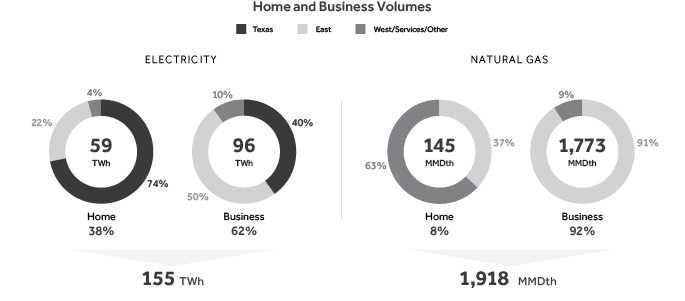
NRG sold 155 TWhs of electricity and 1,918 MMDth of natural gas in 2022, making it one of the largest competitive energy retailers in the U.S. As of the end of 2022, NRG had recurring electricity and/or natural gas sales in 24 U.S. states, the District of Columbia, and 8 provinces in Canada. NRG's retail brands, collectively, have the largest share of competitively served residential electric customers in Texas and nationwide.
The following chart represents NRG's sales volumes for the year ended December 31, 2022:
Strategy
NRG's strategy is to maximize stakeholder value through the safe production and sale of reliable electricity and natural gas to its customers in the markets it serves, while positioning the Company to provide innovative solutions to the end-use energy or service customer. This strategy is intended to enable the Company to optimize its integrated model to generate stable and predictable cash flow, significantly strengthen earnings and cost competitiveness, and lower risk and volatility. Sustainability is a philosophy that underpins and facilitates value creation across NRG's business for its stakeholders. It is an integral piece of NRG's strategy and ties directly to business success, reduced risks and enhanced reputation.
To effectuate the Company’s strategy, NRG is focused on: (i) serving the energy needs of end-use residential, commercial and industrial, and wholesale counterparties in competitive markets through multiple brands and channels; (ii) offering a variety of energy products and services, including renewable energy solutions, that are differentiated by innovative features, premium service, sustainability, and loyalty/affinity programs; (iii) excellence in operating performance of its assets; (iv) optimal hedging of its portfolio; and (v) engaging in disciplined and transparent capital allocation.
The Company announced in 2021 a four-year plan, that began in 2022, to spend $2 billion in order to achieve growth through optimization of the Company's core power and natural gas sales, as well as integrated solution sales within its core network in both power and home services. The planned acquisition of Vivint announced in December 2022 will be the primary growth vehicle to achieve this plan.
Business Overview
The Company’s core business is the sale of electricity and natural gas to residential, commercial and industrial and wholesale customers, supported by the Company's wholesale generation. NRG manages its operations based on the combined results of the retail and wholesale generation businesses with a geographical focus.
The Company's business is segmented as follows:
-
Texas, which includes all activity related to customer, plant and market operations in Texas, other than Cottonwood;
-
East, which includes all activity related to customer, plant and market operations in the East;
-
West/Services/Other, which primarily includes the following assets and activities: (i) all activity related to customer, plant and market operations in the West and Canada, (ii) the services businesses, (iii) activity related to the Cottonwood facility, (iv) the remaining renewables activity, including the Company’s equity method investment in Ivanpah Master Holdings, LLC, and (v) activity related to the Company’s equity method investment for the Gladstone power plant in Australia; and
-
Corporate activities.
In Texas, the Company’s generation supply is fully integrated with its retail load. The integrated model provides the advantage of being able to supply a portion of the Company’s retail customers with electricity from the Company’s assets, which reduces the need to sell electricity to and buy electricity from other institutions and intermediaries, resulting in stable earnings and cash flows, lower transaction costs and less credit exposure. The integrated model also results in a reduction in actual and contingent collateral through offsetting transactions, thereby reducing transactions with third parties.
The Company’s integrated model consists of three core functions: Customer Operations, Market Operations and Plant Operations, which directly support each other in each geographic region.
Customer Operations
Customer Operations is responsible for growing and retaining the customer base and delivering an outstanding customer experience. This includes acquisition and retention of all of NRG’s residential, small commercial, government and commercial & industrial customers. NRG employs a multi-brand strategy that leverages a wide array of sales and partnership channels, direct face-to-face sales channels, call centers, websites, and brokers. Go-to-market activities include market strategy planning and development, product innovation, offer design, campaign execution, marketing and creative services, and selling. Customer portfolio maintenance and retention activities include fulfillment, billing, payment processing, collections, customer service, issue resolution, and contract renewals. NRG provides energy and related services at either fixed, indexed or month-to-month prices. Home customers typically contract for terms ranging from one month to five years, while Business contracts are often between one year and five years in length. Throughout all Customer Operations activities, the customer experience is kept at the forefront to inform decision-making and optimize retention, while creating supporters and advocates for NRG’s brands in the market. Following the expansion of the customer base with the acquisition of Direct Energy in 2021, Customer Operations now comprises three end-use customer facing teams: NRG Home, which serves residential customers, NRG Business, which serves business customers, and NRG Services, which primarily includes the services businesses acquired.
Product Offerings
NRG sells a variety of products to residential and small commercial customers, including retail electricity and energy management, natural gas, home security, line and surge protection products, HVAC installation, repair and maintenance, home protection products, carbon offsets, back-up power stations, portable power, portable solar and portable lighting. Home and Services customers make purchase decisions based on a variety of factors, including price, incentive, customer service, brand, innovative offers/features and referrals from friends and family. Through its broad range of service offerings and value propositions, NRG is able to attract, retain, and increase the value of
Showing the first 8K of 80K characters. Open the full section
Item 1A. Risk Factors
NRG's risk factors are grouped into the following categories: (i) Risks Related to the Proposed Acquisition of Vivint; (ii) Risks Related to the Operation of NRG's Business; (iii) Risks Related to Governmental Regulation and Laws; (iv) Risks Related to Economic and Financial Market Conditions, and the Company's Indebtedness; and (v) Risks Related to Public Health Threats.
Risks Related to the Proposed Acquisition of Vivint
If completed, the acquisition of Vivint may not achieve its intended results.
The Company entered into the Purchase Agreement with the expectation that the acquisition would result in various benefits, including, among other things, cost savings and operating efficiencies. Achieving the anticipated benefits of the acquisition is subject to a number of uncertainties, including whether the businesses of NRG and Vivint are integrated in an efficient and effective manner. Failure to achieve these anticipated benefits could result in increased costs, lower-than-expected revenues or income generated by the combined company and diversion of management's time and energy and could have an adverse effect on the Company's business, financial results and prospects.
The Company will be subject to business uncertainties and contractual restrictions while the acquisition of Vivint is pending that could adversely affect its financial results.
Uncertainty about the effects of the acquisition of Vivint on employees, customers and suppliers may have an adverse effect on NRG's business. Although the Company intends to take steps designed to reduce any adverse effects, these uncertainties may impair its ability to attract, retain and motivate key personnel until the acquisition is completed and for a period of time thereafter, and could cause customers, suppliers and others to seek to change existing business relationships.
Employee retention and recruitment may be particularly challenging prior to the completion of the acquisition, as employees and prospective employees may experience uncertainty about their future roles with the combined company. If, despite the Company's retention and recruiting efforts, key employees depart or fail to accept employment with NRG because of issues relating to the uncertainty and difficulty of integration or a desire not to remain with the combined company, the Company's financial results could be affected.
The pursuit of the acquisition and the preparation for the integration of NRG and Vivint may place a significant burden on management and internal resources. The diversion of management attention away from ongoing business concerns and any difficulties encountered in the transition and integration process could affect the Company's business, results of operations and financial condition.
In addition, the Company has agreed not to take any actions that would materially delay the satisfaction of any of the closing conditions to the transaction or prevent any of those conditions from being satisfied. This restriction on the Company's actions may prevent it from pursuing otherwise attractive business opportunities or making other changes to its business prior to the completion of the acquisition or termination of the merger agreement.
Risks Related to the Operation of NRG's Business
NRG's financial performance may be impacted by price fluctuations in the retail and wholesale power and natural gas markets, as well as fluctuations in coal and oil markets and other market factors that are beyond the Company's control.
Market prices for power, capacity, ancillary services, natural gas, coal and oil are unpredictable and tend to fluctuate substantially. Electric power generally must be produced concurrently with its use. As a result, power prices are subject to significant volatility due to supply and demand imbalances, especially in the day-ahead and spot markets. Long and short-term power and gas prices may also fluctuate substantially due to other factors outside of the Company's control, including:
-
changes in generation capacity in the Company’s markets, including the addition of new supplies of power as a result of the development of new plants, expansion of existing plants, the continued operation of uneconomic power plants due to state subsidies, retirement of existing plants or addition of new transmission capacity;
-
environmental regulations and legislation;
-
electric supply disruptions, including plant outages and transmission disruptions;
-
changes in power and gas transmission infrastructure;
-
fuel price volatility and transportation capacity constraints or inefficiencies;
-
changes in law, including judicial decisions;
-
weather conditions, including extreme weather conditions and seasonal fluctuations, including the effects of climate change;
-
changes in commodity prices and the supply of commodities, including but not limited to natural gas, coal and oil;
-
changes in the demand for power or gas, or in patterns of power or gas usage, including the potential development of demand-side management tools and practices, distributed generation, and more efficient end-use technologies;
-
development of new fuels, new technologies and new forms of competition for the production of power;
-
economic and political conditions;
-
federal, state and provincial power regulations and legislation, and regulations and actions of the ISO and RTOs;
-
changes in prices related to RECs; and
-
changes in capacity prices and capacity markets.
While retail rates are generally designed to allow retail sellers of electricity and natural gas to pass through price fluctuations and other changes to costs, the Company may not be able to pass through all such changes to customers. For example, serving retail power customers in ISOs that have a capacity market exposes the Company to the risk that capacity costs can change and may not be recoverable, or the Company may engage in sales of power at fixed prices. Additionally, increases in wholesale costs to retail customers may cause additional customer defaults or increased customer attrition, or may be impacted by regulatory rules.
Further, in low natural gas price environments, natural gas can be the more cost-competitive fuel compared to coal for generating electricity. The Company enters into guaranteed supply contracts to provide for the amount of coal needed to operate its base load coal-fired generating facilities. The Company may experience periods where it holds excess amounts of coal if fuel pricing results in the Company reducing or idling coal-fired generating facilities. In addition, the Company may incur costs to terminate supply contracts for coal in excess of its generating requirements.
Such factors and the associated fluctuations in power prices have affected the Company's wholesale and retail profitability in the past and are expected to continue to do so in the future.
Volatile power and gas supply costs and demand for power and gas could adversely affect the financial performance of NRG's retail operations.
NRG's retail power operations purchase a significant portion of their supply from third parties. All of the gas sold by the Company in retail and wholesale markets is purchased from third parties. As a result, financial performance depends on the ability to obtain adequate supplies of power and gas from third parties at prices below the prices NRG charges its customers. Consequently, the Company's earnings and cash flows could be adversely affected in any period in which the wholesale power or gas prices rise at a greater rate than the rates the Company can charge to customers. The price of wholesale electricity and gas supply purchases associated with the retail operations' energy commitments can be different than that reflected in the rates charged to customers due to, among other factors:
-
varying supply procurement contracts used and the timing of entering into related contracts;
-
subsequent changes
Showing the first 8K of 84K characters. Open the full section
Item 1B. Unresolved Staff Comments
None.
Item 2. Properties
Listed below are descriptions of NRG's interests in facilities, operations and/or projects owned or leased as of December 31, 2022. The rated MW capacity figures provided represent nominal summer MW capacity of power generated. Net MW capacity is adjusted for the Company's owned or leased interest as of December 31, 2022. The Company believes its existing facilities, operations and/or projects are suitable for the conduct of its business. The following table summarizes NRG's power production and cogeneration facilities by region:
| Name of Facility | Power Market | Plant Type | Primary Fuel | Location | Rated MW Capacity**(a)** | Net MW Capacity**(b)** | % Owned | ||||||||||||||||||||||||||||||||||||||||
| Texas | |||||||||||||||||||||||||||||||||||||||||||||||
| Cedar Bayou | ERCOT | Fossil | Natural Gas | TX | 1,494 | 1,494 | 100.0 | ||||||||||||||||||||||||||||||||||||||||
| Cedar Bayou 4 | ERCOT | Fossil | Natural Gas | TX | 504 | 252 | 50.0 | ||||||||||||||||||||||||||||||||||||||||
| Elbow Creek | ERCOT | Other | Battery Storage | TX | 2 | 2 | 100.0 | ||||||||||||||||||||||||||||||||||||||||
| Greens Bayou | ERCOT | Fossil | Natural Gas | TX | 330 | 330 | 100.0 | ||||||||||||||||||||||||||||||||||||||||
| Gregory | ERCOT | Fossil | Natural Gas | TX | 365 | 365 | 100.0 | ||||||||||||||||||||||||||||||||||||||||
| Limestone | ERCOT | Fossil | Coal | TX | 1,660 | 1,660 | 100.0 | ||||||||||||||||||||||||||||||||||||||||
| San Jacinto | ERCOT | Fossil | Natural Gas | TX | 160 | 160 | 100.0 | ||||||||||||||||||||||||||||||||||||||||
| South Texas Project | ERCOT | Nuclear | Uranium | TX | 2,572 | 1,132 | 44.0 | ||||||||||||||||||||||||||||||||||||||||
| T.H. Wharton | ERCOT | Fossil | Natural Gas | TX | 1,002 | 1,002 | 100.0 | ||||||||||||||||||||||||||||||||||||||||
| W.A. Parish(c) | ERCOT | Fossil | Coal | TX | 2,514 | 2,514 | 100.0 | ||||||||||||||||||||||||||||||||||||||||
| W.A. Parish | ERCOT | Fossil | Natural Gas | TX | 1,118 | 1,118 | 100.0 | ||||||||||||||||||||||||||||||||||||||||
| Total Texas | 11,721 | 10,029 | |||||||||||||||||||||||||||||||||||||||||||||
| East | |||||||||||||||||||||||||||||||||||||||||||||||
| Astoria Turbines(d) | NYISO | Fossil | Natural Gas | NY | 420 | 420 | 100.0 | ||||||||||||||||||||||||||||||||||||||||
| Chalk Point | PJM | Fossil | Natural Gas | MD | 80 | 80 | 100.0 | ||||||||||||||||||||||||||||||||||||||||
| Fisk | PJM | Fossil | Oil | IL | 171 | 171 | 100.0 | ||||||||||||||||||||||||||||||||||||||||
| Indian River(e) | PJM | Fossil | Coal | DE | 410 | 410 | 100.0 | ||||||||||||||||||||||||||||||||||||||||
| Indian River | PJM | Fossil | Oil | DE | 16 | 16 | 100.0 | ||||||||||||||||||||||||||||||||||||||||
| Joliet(f) | PJM | Fossil | Natural Gas | IL | 1,381 | 1,381 | 100.0 | ||||||||||||||||||||||||||||||||||||||||
| Powerton | PJM | Fossil | Coal | IL | 1,538 | 1,538 | 100.0 | ||||||||||||||||||||||||||||||||||||||||
| Vienna | PJM | Fossil | Oil | MD | 167 | 167 | 100.0 | ||||||||||||||||||||||||||||||||||||||||
| Waukegan | PJM | Fossil | Oil | IL | 101 | 101 | 100.0 | ||||||||||||||||||||||||||||||||||||||||
| Total East | 4,284 | 4,284 | |||||||||||||||||||||||||||||||||||||||||||||
| West/Services/Other | |||||||||||||||||||||||||||||||||||||||||||||||
| Cottonwood | MISO | Fossil | Natural Gas | TX | 1,166 | 1,166 | ___(g) | ||||||||||||||||||||||||||||||||||||||||
| Gladstone | Fossil | Coal | AUS | 1,613 | 605 | 37.5 | |||||||||||||||||||||||||||||||||||||||||
| Ivanpah | CAISO | Renewable | Solar | CA | 393 | 214 | 54.5 | ||||||||||||||||||||||||||||||||||||||||
| Midway-Sunset | CAISO | Fossil | Natural Gas | CA | 226 | 113 | 50.0 | ||||||||||||||||||||||||||||||||||||||||
| Stadiums and Other | Renewable | Solar | various | 5 | 5 | 100.0 | |||||||||||||||||||||||||||||||||||||||||
| Total West/Services/Other | 3,403 | 2,103 | |||||||||||||||||||||||||||||||||||||||||||||
| Total Fleet | 19,408 | 16,416 |
(a)MW capacity of the facility without taking into account NRG ownership percentage
(b)Actual capacity can vary depending on factors including weather conditions, operational conditions, and other factors. Additionally, ERCOT, NYISO and PJM require periodic demonstration of capability, and the capacity may vary individually and in the aggregate from time to time
(c)In May 2022, W.A. Parish Unit 8 came offline as a result of damage to the steam turbine/generator. Based on work completed to date, the Company is targeting to return the unit to service by the end of the second quarter of 2023
(d)On January 6, 2023, the Company closed on the sale of land and related assets at the Astoria site but continues to own and operate the Astoria gas turbines. The gas turbines' planned retirement date remains April 30, 2023
(e)The Company previously announced the shut down of the Indian River facility. However, PJM identified reliability impacts resulting from the proposed deactivation and Indian River Unit 4 currently remains active under a RMR agreement which is expected to end December 31, 2026
(f)The Company plans to retire Joliet 7 and 8 on June 1, 2023
(g)NRG leases 100% interests in the Cottonwood facility through a facility lease agreement expiring in May 2025 and operates the Cottonwood facility
The following units were deactivated during 2022:
| Name of Facility | Power Market | Plant Type | Primary Fuel | Location | Rated MW Capacity | Net MW Capacity | % Owned | |||||||||||||||||||||||||||||||||||||
| East | ||||||||||||||||||||||||||||||||||||||||||||
| Waukegan 7 | PJM | Fossil | Coal | IL | 682 | 682 | 100.0 | % | ||||||||||||||||||||||||||||||||||||
| Waukegan 8 | PJM | Fossil | Coal | IL | 101 | 101 | 100.0 | % | ||||||||||||||||||||||||||||||||||||
| Will County 4 | PJM | Fossil | Coal | IL | 510 | 510 | 100.0 | % | ||||||||||||||||||||||||||||||||||||
| Total | 1,293 | 1,293 |
Other Properties
NRG owns several real properties and facilities related to its generation assets, other vacant real property unrelated to its generation assets, and properties not used for operational purposes. NRG believes it has satisfactory title to its plants and facilities in accordance with standards generally accepted in the electric power industry, subject to exceptions that, in the Company's opinion, would not have a material adverse effect on the use or value of its portfolio.
NRG leases its operational and corporate headquarters at 910 Louisiana Street, Houston, Texas, its financial and commercial corporate offices at 804 Carnegie Center, Princeton, New Jersey, as well as its retail operations offices, call centers, and various other office space.
Item 3. Legal Proceedings
See Item 15 — Note 23, Commitments and Contingencies, to the Consolidated Financial Statements for discussion of the material legal proceedings to which NRG is a party.
Item 4. Mine Safety Disclosures
The information concerning mine safety violations or other regulatory matters required by Section 1503(a) of the Dodd-Frank Wall Street Reform and Consumer Protection Act and Item 104 of Regulation S-K (17 CFR 229.104) is included in Exhibit 95.1 to this Form 10-K.
PART II
Item 5. Market for Registrant's Common Equity, Related Stockholder Matters and Issuer Purchases of Equity Securities.
Market Information and Holders
NRG's common stock trades on the New York Stock Exchange under the symbol "NRG". NRG's authorized capital stock consists of 500,000,000 shares of common stock and 10,000,000 shares of preferred stock. A total of 25,000,000 shares of the Company's common stock are authorized for issuance under the NRG LTIP. For more information about the NRG LTIP, refer to Item 12 — Security Ownership of Certain Beneficial Owners and Management and Related Stockholder Matters and Item 15 — Note 21, Stock-Based Compensation, to the Consolidated Financial Statements*.*
As of January 31, 2023, there were 15,792 common stockholders of record.
NRG increased the annual dividend to $1.40 from $1.30 per share beginning in the first quarter of 2022 and further increased the annual dividend by 8% to $1.51 per share beginning in the first quarter of 2023. NRG expects to target an annual dividend growth rate of 7-9% per share in subsequent years.
Issuer Purchases of Equity Securities
The table below sets forth the information with respect to purchases made by or on behalf of NRG or any "affiliated purchaser" (as defined in Rule 10b-18(a)(3) under the Exchange Act) of NRG's common stock during the quarter ended December 31, 2022.
| For the three months ended December 31, 2022 | Total Number of Shares Purchased | Average Price Paid per Share**(b)** | Total Number of Shares Purchased as Part of Publicly Announced Plans or Programs | Approximate Dollar Value of Shares that May Yet Be Purchased Under the Plans or Programs**(a)(c)** | ||||||||||||||||||||||
| Month #1 | ||||||||||||||||||||||||||
| (October 1, 2022 to October 31, 2022 | 1,817,278 | $ | 41.71 | 1,817,278 | $ | 390,876,781 | ||||||||||||||||||||
| Month #2 | ||||||||||||||||||||||||||
| (November 1, 2022 to November 30, 2022, | 823,175 | $ | 44.25 | 823,175 | $ | 354,437,274 | ||||||||||||||||||||
| Month #3 | ||||||||||||||||||||||||||
| (December 1, 2022 to December 31, 2022) | — | $ | — | — | $ | 354,437,274 | ||||||||||||||||||||
| Total at December 31, 2022 | 2,640,453 | $ | 42.50 | 2,640,453 |
(a)On December 6, 2021, the Company announced that the Board of Directors had authorized $1 billion for share repurchases, as part of NRG’s Capital Allocation policy. The program began in December 2021 and is expected to be completed in 2023, subject to the availability of excess cash and full visibility of the achievement of the Company's 2023 targeted credit metrics
(b)The average price paid per share excludes commissions of $0.02 per share paid in connection with the open market share repurchases
(c)Includes commissions of $0.02 per share paid in connection with the open market share repurchases
Stock Performance Graph
The performance graph below compares the cumulative total stockholder return on NRG's common stock for the period December 31, 2017 through December 31, 2022, with the cumulative total return of the Standard & Poor's 500 Composite Stock Price Index ("S&P 500") and the Philadelphia Utility Sector Index ("UTY").
The performance graph shown below is being furnished and compares each period assuming that $100 was invested on December 31, 2017, in each of the common stock of NRG, the stocks included in the S&P 500 and the stocks included in the UTY, and that all dividends were reinvested.
Comparison of Cumulative Total Return

| 12/31/2017 | 12/31/2018 | 12/31/2019 | 12/31/2020 | 12/31/2021 | 12/31/2022 | ||||||||||||||||||||||||||||||
| NRG Energy, Inc. | $ | 100.00 | $ | 139.59 | $ | 140.55 | $ | 137.54 | $ | 163.06 | $ | 124.79 | |||||||||||||||||||||||
| S&P 500 | 100.00 | 95.62 | 125.72 | 148.85 | 191.58 | 156.88 | |||||||||||||||||||||||||||||
| UTY | 100.00 | 103.52 | 131.28 | 134.85 | 159.45 | 160.49 |
Item 6. Reserved
Item 7. Management's Discussion and Analysis of Financial Condition and Results of Operations
The discussion and analysis below has been organized as follows:
-
Executive Summary, including the business environment in which the Company operates, a discussion of regulation, weather, competition and other factors that affect the business, and other significant events that are important to understanding the results of operations and financial condition;
-
Results of operations for the years ended December 31, 2022 and December 31, 2021, including an explanation of significant differences between the periods in the specific line items of NRG's Consolidated Statements of Operations;
-
Liquidity and capital resources including liquidity position, financial condition addressing credit ratings, material cash requirements and commitments, and other obligations; and
-
Critical accounting estimates that are most important to both the portrayal of the Company's financial condition and results of operations, and require management's most difficult, subjective, or complex judgments.
As you read this discussion and analysis, refer to NRG's Consolidated Statements of Operations in this Form 10-K, which present the results of the Company's operations for the years ended December 31, 2022 and 2021, and also refer to Item 1 to this Form 10-K for more detail discussion about the Company's business. A discussion and analysis of fiscal year 2020 may be found in Part II, Item 7 — Management's Discussion and Analysis of Financial Condition and Results of Operations of the Annual Report on Form 10-K for the fiscal year ended December 31, 2021.
Executive Summary
NRG Energy, Inc., or NRG or the Company, is a consumer services company built on dynamic retail brands. NRG brings the power of energy to customers by producing and selling energy and related products and services, nation-wide in the U.S. and Canada in a manner that delivers value to all of NRG's stakeholders. NRG sells power, natural gas, home and power services, and develops innovative, sustainable solutions, predominately under the brand names NRG, Reliant, Direct Energy, Green Mountain Energy, Stream, and XOOM Energy. The Company has a customer base that includes approximately 5.4 million Home customers as well as commercial, industrial, and wholesale customers, supported by approximately 16 GW of generation as of December 31, 2022.
Business Environment
The industry dynamics and external influences affecting the Company, its businesses, and the retail energy and power generation industry in 2022 and for the future medium term include:
Market Dynamics — The price of natural gas plays an important role in setting the price of electricity in many of the regions where NRG operates. Natural gas prices are driven by variables including demand from the industrial, residential, and electric sectors, productivity across natural gas supply basins, costs of natural gas production, changes in pipeline infrastructure, global LNG demand, exports of natural gas, and the financial and hedging profile of natural gas customers and producers. In 2022, the average natural gas price at Henry Hub was 73% higher than in 2021.
NRG may experience impacts to gross margins due to significant, rapid changes in current natural gas prices and the lag in its ability to make a corresponding adjustment to the retail rates it charges customers on term and month to month contracts. The Company hedges its load commitments in order to mitigate the impact of changes in commodity prices, and as a result, these gross margin impacts would be realized in future periods until it is able to make the corresponding adjustments to the retail customer rates.
The relative price of natural gas as compared to coal is the primary driver of coal demand. Coal commodity prices decreased in 2022 although supply chain disruptions are still affecting coal deliveries, as further discussed below in Global Supply Chain Disruptions.
Electricity Prices — The price of electricity is a key determinant of the profitability of the Company. Many variables such as the price of different fuels, weather, load growth and unit availability all coalesce to impact the final price for electricity and the Company's profitability. An increase in supply cost volatility in the competitive retail markets may result in smaller companies choosing to exit the market, which may result in further consolidation in the competitive retail space. The following table summarizes average on-peak power prices for each of the major markets in which NRG operates for the years ended December 31, 2022 and 2021. The average on-peak power prices decreased significantly in Texas due to Winter Storm Uri's impact on 2021 pricing. East and West average on-peak prices increased as a result of higher natural gas prices.
| Average On-Peak Power Price ($/MWh) | |||||||||||||||||
| Year Ended December 31, | 2022 vs 2021 | ||||||||||||||||
| Region | 2022 | 2021 | Change % | ||||||||||||||
| Texas | |||||||||||||||||
| ERCOT - Houston(a) | $ | 90.62 | $ | 192.17 | (53) | % | |||||||||||
| ERCOT - North(a) | 78.34 | 189.05 | (59) | % | |||||||||||||
| East | |||||||||||||||||
| NY J/NYC(b) | 93.58 | 48.71 | 92 | % | |||||||||||||
| NEPOOL(b) | 92.42 | 51.81 | 78 | % | |||||||||||||
| COMED (PJM)(b) | 71.86 | 41.33 | 74 | % | |||||||||||||
| PJM West Hub(b) | 83.48 | 45.67 | 83 | % | |||||||||||||
| West | |||||||||||||||||
| CAISO - SP15(b) | 87.67 | 53.53 | 64 | % | |||||||||||||
| MISO - Louisiana Hub(b) | 71.12 | 43.05 | 65 | % |
(a)Average on-peak power prices based on real time settlement prices as published by the respective ISOs
(b)Average on-peak power prices based on day-ahead settlement prices as published by the respective ISOs
Increased Awareness of, and Action to Combat, Climate Change —Diverse groups of stakeholders, including investors, asset managers, financial institutions, non-government organizations, industry coalitions, individual companies, consumer groups and academic institutions, are increasingly engaged in efforts to limit global warming in the post-industrial era to 1.5 degrees Celsius. As a result, policymakers and regulators at regional, national, sub-national and local levels of government, both in the U.S. and other parts of the world, are increasingly focused on actions to combat climate change.
NRG actively monitors climate change related developments that could impact its business and regularly engages with a diverse set of stakeholders on these issues. Such engagement helps the Company identify and pursue potential opportunities both to decarbonize its business and better serve its customers. NRG is committed to providing transparent disclosures of its climate risks and opportunities to stakeholders. The Company was an early supporter of the Task Force on Climate-related Financial Disclosures ("TCFD") recommendations after they were issued in 2017, published a TCFD mapping disclosure in December 2020 and issued a stand-alone TCFD report in December 2021.
Lower Carbon Infrastructure Development — Policy mechanisms at the state and federal level, including production and investment tax credits, cash grants, loan guarantees, accelerated depreciation tax benefits, RPS, and carbon trading plans, have supported and continue to support the development of renewable generation, demand-side and smart grid, and other lower carbon infrastructure technologies. The U.S. Inf
Showing the first 8K of 139K characters. Open the full section
Item 7A. Quantitative and Qualitative Disclosures About Market Risk
NRG is exposed to several market risks in the Company's normal business activities. Market risk is the potential loss that may result from market changes associated with the Company's retail operations, merchant power generation, or with an existing or forecasted financial or commodity transactions. The types of market risks the Company is exposed to are commodity price risk, interest rate risk, liquidity risk, credit risk and currency exchange risk. In order to manage these risks, the Company uses various fixed-price forward purchase and sales contracts, futures and option contracts traded on NYMEX and other exchanges, and swaps and options traded in the over-the-counter financial markets to:
-
Manage and hedge fixed-price purchase and sales commitments;
-
Reduce exposure to the volatility of cash market prices, and
-
Hedge fuel requirements for the Company's generating facilities.
Commodity Price Risk
Commodity price risks result from exposures to changes in spot prices, forward prices, volatilities, and correlations between various commodities, such as natural gas, electricity, coal, oil, and emissions credits. NRG manages the commodity price risk of the Company's load servicing obligations and merchant generation operations by entering into various derivative or non-derivative instruments to hedge the variability in future cash flows from forecasted sales and purchases of power and fuel. NRG measures the risk of the Company's portfolio using several analytical methods, including sensitivity tests, scenario tests, stress tests, position reports and VaR. NRG uses a Monte Carlo simulation based VaR model to estimate the potential loss in the fair value of its energy assets and liabilities, which includes generation assets, gas transportation and storage assets, load obligations and bilateral physical and financial transactions, based on historical and forward values for factors such as customer demand, weather, commodity availability and commodity prices. The Company's VaR model is based on a one-day holding period at a 95% confidence interval for the forward 36 months, not including the spot month. The VaR model is not a complete picture of all risks that may affect the Company's results. Certain events such as counterparty defaults, regulatory changes, and extreme weather and prices that deviate significantly from historically observed values are not reflected in the model.
The following table summarizes average, maximum and minimum VaR for NRG's commodity portfolio, calculated using the VaR model for the years ended December 31, 2022 and 2021:
| (In millions) | 2022 | 2021 | |||||||||
| VaR as of December 31, | $ | 74 | $ | 30 | |||||||
| For the year ended December 31, | |||||||||||
| Average(a) | $ | 51 | $ | 35 | |||||||
| Maximum(a) | 86 | 53 | |||||||||
| Minimum(a) | 26 | 23 |
(a)Calculation is based on NRG generation assets and load obligations excluding the acquisition of Direct Energy assets and load obligations in the first quarter of 2021
The increase in the range of the daily VaR results was primarily due to increased commodity prices and market volatility during 2022 as compared to 2021. In order to provide additional information, the Company also uses VaR to estimate the potential loss of derivative financial instruments that are subject to mark-to-market accounting. These derivative instruments include transactions that were entered into for both asset management and trading purposes. The VaR for the derivative
financial instruments calculated using the diversified VaR model for the entire term of these instruments entered into for both asset management and trading was $413 million as of December 31, 2022, primarily driven by asset-backed transactions.
Retail Customer Credit Risk
NRG is exposed to retail credit risk related to its Business and Home customers. Retail credit risk results in losses when a customer fails to pay for services rendered. The losses may result from both nonpayment of customer accounts receivable and the loss of in-the-money forward value. NRG manages retail credit risk through the use of established credit policies that include monitoring of the portfolio and the use of credit mitigation measures, such as deposits or prepayment arrangements.
As of December 31, 2022, the Company's retail customer credit exposure to Home and Business customers was diversified across many customers and various industries, as well as government entities. Current economic conditions may affect the Company's customers' ability to pay bills in a timely manner, which could increase customer delinquencies and may lead to an increase in credit losses. The Company's provision for credit losses resulting from credit risk was $11 million, $698 million and $108 million for the years ending December 31, 2022, 2021 and 2020, respectively. During the year ended December 31, 2022, the provision for credit losses included the Company's loss mitigation efforts recognized as income of $126 million related to Winter Storm Uri. During the year ended December 31, 2021, the provision for credit losses included $596 million of expenses due to the impacts of Winter Storm Uri.
Liquidity Risk
Liquidity risk arises from the general funding needs of the Company's activities and the management of the Company's assets and liabilities. The Company is currently exposed to additional collateral posting if natural gas prices decline, primarily due to the long natural gas equivalent position at various exchanges used to hedge NRG's retail supply load obligations.
Based on a sensitivity analysis for power and gas positions under marginable contracts as of December 31, 2022, a $0.50 per MMBtu decrease in natural gas prices across the term of the marginable contracts would cause an increase in margin collateral posted of approximately $811 million and a 1.00 MMBtu/MWh decrease in heat rates for heat rate positions would result in an increase in margin collateral posted of approximately $380 million. This analysis uses simplified assumptions and is calculated based on portfolio composition and margin-related contract provisions as of December 31, 2022.
Counterparty Credit Risk
Credit risk relates to the risk of loss resulting from non-performance or non-payment by counterparties pursuant to the terms of their contractual obligations. The Company monitors and manages credit risk through credit policies that include: (i) an established credit approval process; (ii) a daily monitoring of counterparties' credit limits; (iii) the use of credit mitigation measures such as margin, collateral, prepayment arrangements, or volumetric limits; (iv) the use of payment netting agreements; and (v) the use of master netting agreements that allow for the netting of positive and negative exposures of various contracts associated with a single counterparty. Risks surrounding counterparty performance and credit could ultimately impact the amount and timing of expected cash flows. The Company seeks to mitigate counterparty risk by having a diversified portfolio of counterparties. The Company also has credit protection within various agreements to call on additional collateral support if and when necessary. Cash margin is collected and held at the Company to cover the credit risk of the counterparty until positions settle.
As of December 31, 2022, counterparty credit exposure, excluding credit exposure from RTOs, ISOs, and registered commodity exchanges and certain long-term agreements, was $2.7 billion, of which the Company held collateral (cash and letters of credit) against those positions of $1.0 billion resulting in a net exposure of $1.7 billion. NRG periodically receives collateral from counterparties in excess of their exposure. Collateral amounts shown include such excess while net exposure shown excludes excess collateral received. Approximately 80% of the Company's exposure before collateral is expected to roll off by the end of 2024. The following table highlights the net counterparty credit exposure by industry sector and by counterparty credit quality. Net counterparty credit exposure is defined as the aggregate net asset position for NRG with counterparties where netting is permitted under the enabling agreement and includes all cash flow, mark-to-market, NPNS, and non-derivative transactions. As of December 31, 2022, the aggregate credit exposure is shown net of collateral held, and includes amounts net of receivables or payables.
| Category | Net Exposure (a) (b) (% of Total) | ||||
| Utilities, energy merchants, marketers and other | 62 | % | |||
| Financial institutions | 38 | ||||
| Total | 100 | % |
| Category | Net Exposure (a) (b) (% of Total) | ||||
| Investment grade | 65 | % | |||
| Non-Investment grade/Non-Rated | 35 | ||||
| Total | 100 | % |
(a)Counterparty credit exposure excludes uranium and coal transportation contracts because of the unavailability of market prices
(b)The figures in the tables above exclude potential counterparty credit exposure related to RTOs, ISOs, registered commodity exchanges and certain long-term contracts
The Company has no exposure to wholesale counterparties in excess of 10% of the total net exposure discussed above as of December 31, 2022. Changes in hedge positions and market prices will affect credit exposure and counterparty concentration.
During Winter Storm Uri, in February 2021, the Company experienced nonperformance by a counterparty in one of its bilateral financial hedging transactions, resulting in exposure of $403 million. During December 2022, the Company received $70 million as part of the Company's loss mitigation efforts related to this exposure.
RTOs and ISOs
The Company participates in the organized markets of CAISO, ERCOT, ISO-NE, MISO, NYISO and PJM, known as RTOs or ISOs. Trading in these markets is approved by FERC, or in the case of ERCOT, approved by the PUCT and include credit policies that, under certain circumstances, require that losses arising from the default of one member on spot market transactions be shared by the remaining participants. As a result, the counterparty credit risk to these markets is limited to NRG’s applicable share of the overall market and are excluded from the above exposures.
Exchange Traded Transactions
The Company enters into commodity transactions on registered exchanges, notably ICE, NYMEX and Nodal. These clearinghouses act as the counterparty and transactions are subject to extensive collateral and margining requirements. As a result, these commodity transactions have limited counterparty credit risk.
Long-Term Contracts
Counterparty credit exposure described above excludes credit risk exposure under certain long-term contracts, primarily solar under Renewable PPAs. As external sources or observable market quotes are not available to estimate such exposure, the Company values these contracts based on various techniques including, but not limited to, internal models based on a fundamental analysis of the market and extrapolation of observable market data with similar characteristics. Based on these valuation techniques, as of December 31, 2022, aggregate credit risk exposure managed by NRG to these counterparties was approximately $1.1 billion for the next five years.
Interest Rate Risk
As of December 31, 2022, the Company's debt fair value was $7.0 billion and carrying value was $8.1 billion. NRG estimates that a 1% decrease in market interest rates would have increased the fair value of the Company's long-term debt by $480 million.
Credit Risk Related Contingent Features
Certain of the Company's hedging and trading agreements contain provisions that entitle the counterparty to demand that the Company post additional collateral if the counterparty determines that there has been deterioration in the Company's credit quality, generally termed “adequate assurance” under the agreements, or require the Company to post additional collateral if there were a downgrade in the Company's credit rating. The collateral potentially required for contracts with adequate assurance clauses that are in a net liability position as of December 31, 2022, was $1.5 billion. The Company is also a party to certain marginable agreements under which it has a net liability position, but the counterparty has not called for the collateral due, which was approximately $195 million as of December 31, 2022. In the event of a downgrade in the Company's credit rating and if called for by the counterparty, $30 million of additional collateral would be required for all contracts with credit rating contingent features as of December 31, 2022.
Currency Exchange Risk
NRG is subject to transactional exchange rate risk from transactions with customers in countries outside of the U.S., primarily within Canada, as well as from intercompany transactions between affiliates. Transactional exchange rate risk arises from the purchase and sale of goods and services in currencies other than the Company's functional currency or the functional currency of an applicable subsidiary. NRG hedges a portion of its forecasted currency transactions with foreign exchange forward contracts. As of December 31, 2022, NRG is exposed to changes in foreign currency primarily associated with the purchase of U.S. dollar denominated natural gas for its Canadian business and entered into foreign exchange contracts with notional amount of $569 million.
The Company is subject to translation exchange rate risk related to the translation of the financial statements of its foreign operations into U.S. dollars. Costs incurred and sales recorded by subsidiaries operating outside of the U.S. are translated into U.S. dollars using exchange rates effective during the respective period. As a result, the Company is exposed to movements in the exchange rates of various currencies against the U.S. dollar, primarily the Canadian and Australian dollars. A hypothetical 10% appreciation in major currencies relative to the U.S. dollar as of December 31, 2022, would have resulted in an increase of $17 million to net income within the Consolidated Statement of Operations.
Item 8. Financial Statements and Supplementary Data
The financial statements and schedules are included in Part IV, Item 15 of this Form 10-K.
Item 9. Changes in and Disagreements With Accountants on Accounting and Financial Disclosure
None.
Item 9A. Controls and Procedures
Conclusion Regarding the Effectiveness of Disclosure Controls and Procedures and Internal Control Over Financial Reporting
Under the supervision and with the participation of NRG's management, including its principal executive officer, principal financial officer and principal accounting officer, NRG conducted an evaluation of the effectiveness of the design and operation of its disclosure controls and procedures, as such term is defined in Rules 13a-15(e) or 15d-15(e) of the Exchange Act. Based on this evaluation, the Company's principal executive officer, principal financial officer and principal accounting officer concluded that the disclosure controls and procedures were effective as of the end of the period covered by this Annual Report on Form 10-K. Management's report on the Company's internal control over financial reporting and the report of the Company's independent registered public accounting firm are incorporated under the caption "Management's Report on Internal Control over Financial Reporting" and under the caption "Report of Independent Registered Public Accounting Firm" in this Annual Report on Form 10-K for the fiscal year ended December 31, 2022.
Changes in Internal Control over Financial Reporting
There were no changes in NRG’s internal control over financial reporting (as such term is defined in Rule 13a-15(f) under the Exchange Act) that occurred in the fourth quarter of 2022 that materially affected, or are reasonably likely to materially affect, NRG’s internal control over financial reporting.
Inherent Limitations over Internal Controls
NRG's internal control over financial reporting is designed to provide reasonable assurance regarding the reliability of financial reporting and the preparation of consolidated financial statements for external purposes in accordance with GAAP. The Company's internal control over financial reporting includes those policies and procedures that:
1.Pertain to the maintenance of records that, in reasonable detail, accurately and fairly reflect the transactions and dispositions of the Company's assets;
2.Provide reasonable assurance that transactions are recorded as necessary to permit preparation of consolidated financial statements in accordance with GAAP, and that the Company's receipts and expenditures are being made only in accordance with authorizations of its management and directors; and
3.Provide reasonable assurance regarding prevention or timely detection of unauthorized acquisition, use or disposition of the Company's assets that could have a material effect on the consolidated financial statements.
Internal control over financial reporting cannot provide absolute assurance of achieving financial reporting objectives because of its inherent limitations, including the possibility of human error and circumvention by collusion or overriding of controls. Accordingly, even an effective internal control system may not prevent or detect material misstatements on a timely basis. Also, projections of any evaluation of effectiveness to future periods are subject to the risk that controls may become inadequate because of changes in conditions or that the degree of compliance with the policies or procedures may deteriorate.
Management's Report on Internal Control over Financial Reporting
The Company's management is responsible for establishing and maintaining adequate internal control over financial reporting, as such term is defined in Exchange Act Rule 13a-15(f). Under the supervision and with the participation of the Company's management, including its principal executive officer, principal financial officer and principal accounting officer, the Company conducted an evaluation of the effectiveness of its internal control over financial reporting based on the framework in Internal Control — Integrated Framework (2013) issued by the Committee of Sponsoring Organizations of the Treadway Commission. Based on the Company's evaluation under the framework in Internal Control — Integrated Framework (2013), the Company's management concluded that its internal control over financial reporting was effective as of December 31, 2022.
The effectiveness of the Company's internal control over financial reporting as of December 31, 2022 has been audited by KPMG LLP, the Company's independent registered public accounting firm, as stated in its report which is included in this Annual Report on Form 10-K.
REPORT OF INDEPENDENT REGISTERED PUBLIC ACCOUNTING FIRM
To the Board of Directors and Stockholders
NRG Energy, Inc.:
Opinion on Internal Control Over Financial Reporting
We have audited NRG Energy, Inc. and subsidiaries' (the Company) internal control over financial reporting as of December 31, 2022, based on criteria established in Internal Control — Integrated Framework (2013) issued by the Committee of Sponsoring Organizations of the Treadway Commission*.* In our opinion, the Company maintained, in all material respects, effective internal control over financial reporting as of December 31, 2022, based on criteria established in Internal Control — Integrated Framework (2013) issued by the Committee of Sponsoring Organizations of the Treadway Commission.
We also have audited, in accordance with the standards of the Public Company Accounting Oversight Board (United States) (PCAOB), the consolidated balance sheets of the Company as of December 31, 2022 and 2021, the related consolidated statements of operations, comprehensive income, stockholders’ equity, and cash flows for each of the years in the three-year period ended December 31, 2022, and the related notes and financial statement schedule II (collectively, the consolidated financial statements), and our report dated February 23, 2023 expressed an unqualified opinion on those consolidated financial statements.
Basis for Opinion
The Company's management is responsible for maintaining effective internal control over financial reporting and for its assessment of the effectiveness of internal control over financial reporting, included in the accompanying Management’s Report on Internal Control over Financial Reporting. Our responsibility is to express an opinion on the Company’s internal control over financial reporting based on our audit. We are a public accounting firm registered with the PCAOB and are required to be independent with respect to the Company in accordance with the U.S. federal securities laws and the applicable rules and regulations of the Securities and Exchange Commission and the PCAOB.
We conducted our audit in accordance with the standards of the PCAOB. Those standards require that we plan and perform the audit to obtain reasonable assurance about whether effective internal control over financial reporting was maintained in all material respects. Our audit of internal control over financial reporting included obtaining an understanding of internal control over financial reporting, assessing the risk that a material weakness exists, and testing and evaluating the design and operating effectiveness of internal control based on the assessed risk. Our audit also included performing such other procedures as we considered necessary in the circumstances. We believe that our audit provides a reasonable basis for our opinion.
Definition and Limitations of Internal Control Over Financial Reporting
A company’s internal control over financial reporting is a process designed to provide reasonable assurance regarding the reliability of financial reporting and the preparation of financial statements for external purposes in accordance with generally accepted accounting principles. A company’s internal control over financial reporting includes those policies and procedures that (1) pertain to the maintenance of records that, in reasonable detail, accurately and fairly reflect the transactions and dispositions of the assets of the company; (2) provide reasonable assurance that transactions are recorded as necessary to permit preparation of financial statements in accordance with generally accepted accounting principles, and that receipts and expenditures of the company are being made only in accordance with authorizations of management and directors of the company; and (3) provide reasonable assurance regarding prevention or timely detection of unauthorized acquisition, use, or disposition of the company’s assets that could have a material effect on the financial statements.
Because of its inherent limitations, internal control over financial reporting may not prevent or detect misstatements. Also, projections of any evaluation of effectiveness to future periods are subject to the risk that controls may become inadequate because of changes in conditions, or that the degree of compliance with the policies or procedures may deteriorate.
/s/ KPMG LLP
Philadelphia, Pennsylvania
February 23, 2023
Item 9B. Other Information
None.
Item 9C. Disclosure Regarding Foreign Jurisdictions that Prevent Inspections
Not applicable.
PART III
Item 10. Directors, Executive Officers and Corporate Governance
Directors and Executive Officers
Information required by this Item is incorporated by reference to the similarly named section of NRG's Definitive Proxy Statement for its 2023 Annual Meeting of Stockholders.
Code of Ethics
NRG has adopted a code of ethics entitled "NRG Code of Conduct" that applies to directors, officers and employees, including the chief executive officer and senior financial officers of NRG. It may be accessed through the "Governance" section of the Company's website at www.nrg.com. NRG also elects to disclose the information required by Form 8-K, Item 5.05, "Amendments to the Registrant's Code of Ethics, or Waiver of a Provision of the Code of Ethics," through the Company's website, and such information will remain available on this website for at least a 12-month period. A copy of the "NRG Code of Conduct" is available in print to any stockholder who requests it.
Other information required by this Item is incorporated by reference to the similarly named section of NRG's Definitive Proxy Statement for its 2023 Annual Meeting of Stockholders.
Item 11. Executive Compensation
Information required by this Item is incorporated by reference to the similarly named section of NRG's Definitive Proxy Statement for its 2023 Annual Meeting of Stockholders.
Item 12. Security Ownership of Certain Beneficial Owners and Management and Related Stockholder Matters
Securities Authorized for Issuance under Equity Compensation Plans
| Plan Category | (a) Number of Securities to be Issued Upon Exercise of Outstanding Options, Warrants and Rights | (b) Weighted-Average Exercise Price of Outstanding Options, Warrants and Rights | (c) Number of Securities Remaining Available for Future Issuance Under Equity Compensation Plans (Excluding Securities Reflected in Column (a) | |||||||||||||||||
| Equity compensation plans approved by security holders | 2,865,336 | (1) | $ | — | 10,673,145 | (2) | ||||||||||||||
(1)Consists of shares issuable under the NRG LTIP and the ESPP. The NRG LTIP became effective upon the Company's emergence from bankruptcy. On April 27, 2017, the NRG LTIP was amended and restated to increase the number of shares available for issuance to 25,000,000. The ESPP, as amended and restated, was approved by the Company's stockholders on April 27, 2017, and became effective April 28, 2017. As of December 31, 2022, there were 2,493,374 shares reserved from the Company's treasury shares for the ESPP
(2)Consists of 8,179,771 shares of common stock under NRG's LTIP and 2,493,374 shares of treasury stock reserved for issuance under the ESPP
NRG LTIP currently provides for grants of restricted stock units, relative performance stock units, deferred stock units and dividend equivalent rights. NRG's directors, officers and employees, as well as other individuals performing services for, or to whom an offer of employment has been extended by the Company, are eligible to receive grants under the NRG LTIP. The purpose of the NRG LTIP is to promote the Company's long-term growth and profitability by providing these individuals with incentives to maximize stockholder value and otherwise contribute to the Company's success and to enable the Company to attract, retain and reward the best available persons for positions of responsibility. The Compensation Committee of the Board of Directors administers the NRG LTIP.
Other information required by this Item is incorporated by reference to the similarly named section of NRG's Definitive Proxy Statement for its 2023 Annual Meeting of Stockholders.
Item 13. Certain Relationships and Related Transactions, and Director Independence
Information required by this Item is incorporated by reference to the similarly named section of NRG's Definitive Proxy Statement for its 2023 Annual Meeting of Stockholders.
Item 14. Principal Accounting Fees and Services
Information required by this Item is incorporated by reference to the similarly named section of NRG's Definitive Proxy Statement for its 2023 Annual Meeting of Stockholders.
PART IV
Item 15. Exhibits, Financial Statement Schedules
(a)(1) Financial Statements
The following consolidated financial statements of NRG Energy, Inc. and related notes thereto, together with the reports thereon of KPMG LLP, Philadelphia, PA, Auditor Firm ID: 185, are included herein:
Consolidated Statements of Operations — Years ended December 31, 2022, 2021, and 2020
Consolidated Statements of Comprehensive Income — Years ended December 31, 2022, 2021, and 2020
Consolidated Balance Sheets — As of December 31, 2022 and 2021
Consolidated Statements of Cash Flows — Years ended December 31, 2022, 2021, and 2020
Consolidated Statements of Stockholders' Equity — Years ended December 31, 2022, 2021, and 2020
Notes to Consolidated Financial Statements
(a)(2) Financial Statement Schedule
The following Consolidated Financial Statement Schedule of NRG Energy, Inc. is filed as part of Item 15 of this report and should be read in conjunction with the Consolidated Financial Statements.
Schedule II — Valuation and Qualifying Accounts
All other schedules for which provision is made in the applicable accounting regulation of the Securities and Exchange Commission are not required under the related instructions or are inapplicable, and therefore, have been omitted.
(a)(3) Exhibits: See Exhibit Index submitted as a separate section of this report.
(b) Exhibits
See Exhibit Index submitted as a separate section of this report.
(c) Not applicable
REPORT OF INDEPENDENT REGISTERED PUBLIC ACCOUNTING FIRM
To the Board of Directors and Stockholders
NRG Energy, Inc.:
Opinion on the Consolidated Financial Statements
We have audited the accompanying consolidated balance sheets of NRG Energy, Inc. and subsidiaries (the Company) as of December 31, 2022 and 2021, the related consolidated statements of operations, comprehensive income, stockholders' equity, and cash flows for each of the years in the three-year period ended December 31, 2022, and the related notes and financial statement schedule II (collectively, the consolidated financial statements). In our opinion, the consolidated financial statements present fairly, in all material respects, the financial position of the Company as of December 31, 2022 and 2021, and the results of its operations and its cash flows for each of the years in the three-year period ended December 31, 2022, in conformity with U.S. generally accepted accounting principles.
We also have audited, in accordance with the standards of the Public Company Accounting Oversight Board (United States) (PCAOB), the Company's internal control over financial reporting as of December 31, 2022, based on criteria established in Internal Control – Integrated Framework (2013) issued by the Committee of Sponsoring Organizations of the Treadway Commission, and our report dated February 23, 2023 expressed an unqualified opinion on the effectiveness of the Company's internal control over financial reporting.
Basis for Opinion
These consolidated financial statements are the responsibility of the Company's management. Our responsibility is to express an opinion on these consolidated financial statements based on our audits. We are a public accounting firm registered with the PCAOB and are required to be independent with respect to the Company in accordance with the U.S. federal securities laws and the applicable rules and regulations of the Securities and Exchange Commission and the PCAOB.
We conducted our audits in accordance with the standards of the PCAOB. Those standards require that we plan and perform the audit to obtain reasonable assurance about whether the consolidated financial statements are free of material misstatement, whether due to error or fraud. Our audits included performing procedures to assess the risks of material misstatement of the consolidated financial statements, whether due to error or fraud, and performing procedures that respond to those risks. Such procedures included examining, on a test basis, evidence regarding the amounts and disclosures in the consolidated financial statements. Our audits also included evaluating the accounting principles used and significant estimates made by management, as well as evaluating the overall presentation of the consolidated financial statements. We believe that our audits provide a reasonable basis for our opinion.
Critical Audit Matter
The critical audit matter communicated below is a matter arising from the current period audit of the consolidated financial statements that was communicated or required to be communicated to the audit committee and that: (1) relates to accounts or disclosures that are material to the consolidated financial statements and (2) involved our especially challenging, subjective, or complex judgments. The communication of a critical audit matter does not alter in any way our opinion on the consolidated financial statements, taken as a whole, and we are not, by communicating the critical audit matter below, providing a separate opinions on the critical audit matter or on the accounts or disclosures to which it relates.
Evaluation of the sufficiency of audit evidence over revenues
As discussed in Note 3 to the consolidated financial statements, the Company had $31.543 billion of revenues. Revenue is derived from various revenue streams in different geographic markets and the Company’s processes and related information technology (IT) systems used to record revenue differ for each of these revenue streams.
We identified the evaluation of the sufficiency of audit evidence over revenues as a critical audit matter which required a high degree of auditor judgment due to the number of revenue streams and IT systems involved in the revenue recognition process. This included determining the revenue streams over which procedures were to be performed and evaluating the nature and extent of evidence obtained over the individual revenue streams as well as revenue in the aggregate. It also included the involvement of IT professionals with specialized skills and knowledge to assist in the performance of certain procedures.
The following are the primary procedures we performed to address this critical audit matter. We, with the assistance of IT professionals, applied auditor judgment to determine the revenue streams over which procedures were performed as well as the nature and extent of such procedures. For each revenue stream over which procedures were performed, we
evaluated the design and tested the operating effectiveness of certain internal controls over the Company’s revenue recognition processes; involved IT professionals, who assisted in testing certain IT applications used by the Company in its revenue recognition processes; and assessed recorded revenue for a selection of transactions by comparing the amounts recognized to underlying documentation, including contracts with customers. In addition, we evaluated the sufficiency of audit evidence obtained over revenues by assessing the results of procedures performed, including the appropriateness of such evidence.
/s/ KPMG LLP
We have served as the Company's auditor since 2004.
Philadelphia, Pennsylvania
February 23, 2023
NRG ENERGY, INC. AND SUBSIDIARIES
CONSOLIDATED STATEMENTS OF OPERATIONS
| For the Year Ended December 31, | |||||||||||||||||
| (In millions, except per share amounts) | 2022 | 2021 | 2020 | ||||||||||||||
| Revenues | |||||||||||||||||
| Total revenues | $ | 31,543 | $ | 26,989 | $ | 9,093 | |||||||||||
| Operating Costs and Expenses | |||||||||||||||||
| Cost of operations (excluding depreciation and amortization shown below) | 27,446 | 20,482 |
Showing the first 8K of 383K characters. Open the full section
Item 16. Form 10-K Summary
None.
SIGNATURES
Pursuant to the requirements of Section 13 or 15(d) of the Securities Exchange Act of 1934, the registrant has duly caused this report to be signed on its behalf by the undersigned thereunto duly authorized.
| NRG ENERGY, INC. (Registrant) | |||||||||||
| By: | /s/ MAURICIO GUTIERREZ | ||||||||||
| Mauricio Gutierrez Chief Executive Officer |
Date: February 23, 2023
POWER OF ATTORNEY
Each person whose signature appears below constitutes and appoints Brian E. Curci and Christine A. Zoino, each or any of them, such person's true and lawful attorney-in-fact and agent with full power of substitution and resubstitution for such person and in such person's name, place and stead, in any and all capacities, to sign any and all amendments to this report on Form 10-K, and to file the same with all exhibits thereto, and other documents in connection therewith, with the Securities and Exchange Commission, granting unto said attorneys-in-fact and agents, and each of them, full power and authority to do and perform each and every act and thing necessary or desirable to be done in and about the premises, as fully to all intents and purposes as such person, hereby ratifying and confirming all that said attorneys-in-fact and agents, or any of them or his or their substitute or substitutes, may lawfully do or cause to be done by virtue hereof.
In accordance with the Exchange Act, this report has been signed by the following persons on behalf of the registrant in the capacities indicated on February 23, 2023.
| Signature | Title | Date | ||||||||||||
| /s/ MAURICIO GUTIERREZ | President, Chief Executive Officer and | February 23, 2023 | ||||||||||||
| Mauricio Gutierrez | Director (Principal Executive Officer) | |||||||||||||
| /s/ ALBERTO FORNARO | Chief Financial Officer | February 23, 2023 | ||||||||||||
| Alberto Fornaro | (Principal Financial Officer) | |||||||||||||
| /s/ EMILY PICARELLO | Corporate Controller | February 23, 2023 | ||||||||||||
| Emily Picarello | (Principal Accounting Officer) | |||||||||||||
| /s/ LAWRENCE S. COBEN | Chair of the Board | February 23, 2023 | ||||||||||||
| Lawrence S. Coben | ||||||||||||||
| /s/ E. SPENCER ABRAHAM | Director | February 23, 2023 | ||||||||||||
| E. Spencer Abraham | ||||||||||||||
| /s/ ANTONIO CARRILLO | Director | February 23, 2023 | ||||||||||||
| Antonio Carrillo | ||||||||||||||
| /s/ MATTHEW CARTER, JR. | Director | February 23, 2023 | ||||||||||||
| Matthew Carter, Jr. | ||||||||||||||
| /s/ HEATHER COX | Director | February 23, 2023 | ||||||||||||
| Heather Cox | ||||||||||||||
| /s/ ELISABETH B. DONOHUE | Director | February 23, 2023 | ||||||||||||
| Elisabeth B. Donohue | ||||||||||||||
| /s/ PAUL W. HOBBY | Director | February 23, 2023 | ||||||||||||
| Paul W. Hobby | ||||||||||||||
| /s/ ALEXANDRA PRUNER | Director | February 23, 2023 | ||||||||||||
| Alexandra Pruner | ||||||||||||||
| /s/ ANNE C. SCHAUMBURG | Director | February 23, 2023 | ||||||||||||
| Anne C. Schaumburg | ||||||||||||||
| /s/ THOMAS H. WEIDEMEYER | Director | February 23, 2023 | ||||||||||||
| Thomas H. Weidemeyer |