 filings.tools
Norfolk Southern 10-K 2021-12-31
Filed 2022-02-04. 21 sections, 341K characters. Original on sec.gov · Markdown · JSON
Cover and table of contents
UNITED STATES SECURITIES AND EXCHANGE COMMISSION
Washington, D.C. 20549
FORM 10-K
☒ ANNUAL REPORT PURSUANT TO SECTION 13 OR 15(d) OF THE SECURITIES EXCHANGE ACT OF 1934
for the fiscal year ended DECEMBER 31, 2021
☐ TRANSITION REPORT PURSUANT TO SECTION 13 OR 15(d) OF THE SECURITIES EXCHANGE ACT OF 1934
for the transition period from ___________ to___________
Commission File Number 1-8339
NORFOLK SOUTHERN CORPORATION
(Exact name of registrant as specified in its charter)
| Virginia | 52-1188014 | |||||||
| (State or other jurisdiction of incorporation or organization) | (I.R.S Employer Identification No.) | |||||||
| 650 West Peachtree Street NW | 30308-1925 | |||||||
| Atlanta, | Georgia | |||||||
| (Address of principal executive offices) | (Zip Code) | |||||||
| (855) | 667-3655 | |||||||
| (Registrant’s telephone number, including area code) |
Securities registered pursuant to Section 12(b) of the Act:
| Title of each class | Trading Symbol(s) | Name of each exchange on which registered | ||||||
| Norfolk Southern Corporation Common Stock (Par Value $1.00) | NSC | New York Stock Exchange |
Securities registered pursuant to Section 12(g) of the Act: NONE
Indicate by check mark if the registrant is a well-known seasoned issuer, as defined in Rule 405 of the Securities Act. Yes ☒ No ☐
Indicate by check mark if the registrant is not required to file reports pursuant to Section 13 or 15(d) of the Act. Yes ☐ No ☒
Indicate by check mark whether the registrant (1) has filed all reports required to be filed by Section 13 or 15(d) of the Securities Exchange Act of 1934 during the preceding 12 months (or for such shorter period that the registrant was required to file such reports), and (2) has been subject to such filing requirements for the past 90 days. Yes ☒ No ☐
Indicate by check mark whether the registrant has submitted electronically every Interactive Data File required to be submitted pursuant to Rule 405 of Regulation S-T (§ 232.405 of this chapter) during the preceding 12 months (or for such shorter period that the registrant was required to submit such files). Yes ☒ No ☐
Indicate by check mark whether the registrant is a large accelerated filer, an accelerated filer, a non-accelerated filer, a smaller reporting company, or an emerging growth company. See the definitions of "large accelerated filer", "accelerated filer", "smaller reporting company", and "emerging growth company" in Rule 12b-2 of the Exchange Act.
Large accelerated filer ☒ Accelerated filer ☐ Non-accelerated filer ☐ Smaller reporting company ☐ Emerging growth company ☐
If an emerging growth company, indicate by check mark if the registrant has elected not to use the extended transition period for complying with any new or revised financial accounting standards provided pursuant to Section 13(a) of the Exchange Act. ☐
Indicate by check mark whether the registrant has filed a report on and attestation to its management’s assessment of the effectiveness of its internal control over financial reporting under Section 404(b) of the Sarbanes-Oxley Act (15 U.S.C. 7262(b)) by the registered public accounting firm that prepared or issued its audit report. ☒
Indicate by check mark whether the registrant is a shell company (as defined in Rule 12b-2 of the Act). Yes ☐ No ☒
The aggregate market value of the voting common equity held by non-affiliates at June 30, 2021 was $65,486,012,788 (based on the closing price as quoted on the New York Stock Exchange on June 30, 2021).
The number of shares outstanding of each of the registrant’s classes of common stock, at January 31, 2022: 239,777,444 (excluding 20,320,777 shares held by the registrant’s consolidated subsidiaries).
DOCUMENTS INCORPORATED BY REFERENCE: Portions of the Registrant’s definitive proxy statement to be filed electronically pursuant to Regulation 14A not later than 120 days after the end of the fiscal year, are incorporated herein by reference in Part III.
TABLE OF CONTENTS
NORFOLK SOUTHERN CORPORATION AND SUBSIDIARIES
K2
PART I
NORFOLK SOUTHERN CORPORATION AND SUBSIDIARIES
Item 1. Business and Item 2. Properties
GENERAL – Norfolk Southern Corporation (Norfolk Southern) is an Atlanta, Georgia-based company that owns a major freight railroad, Norfolk Southern Railway Company (NSR). We were incorporated on July 23, 1980, under the laws of the Commonwealth of Virginia. Our common stock (Common Stock) is listed on the New York Stock Exchange (NYSE) under the symbol “NSC.”
Unless indicated otherwise, Norfolk Southern Corporation and its subsidiaries, including NSR, are referred to collectively as NS, we, us, and our.
We are primarily engaged in the rail transportation of raw materials, intermediate products, and finished goods primarily in the Southeast, East, and Midwest and, via interchange with rail carriers, to and from the rest of the United States (U.S.). We also transport overseas freight through several Atlantic and Gulf Coast ports. We offer the most extensive intermodal network in the eastern half of the U.S.
We make available free of charge through our website, www.norfolksouthern.com, our annual report on Form 10-K, quarterly reports on Form 10-Q, current reports on Form 8-K, and all amendments to those reports as soon as reasonably practicable after such material is electronically filed with or furnished to the U.S. Securities and Exchange Commission (SEC). In addition, the following documents are available on our website and in print to any shareholder who requests them:
-
Corporate Governance Guidelines
-
Charters of the Committees of the Board of Directors
-
The Thoroughbred Code of Ethics
-
Code of Ethical Conduct for Senior Financial Officers
-
Categorical Independence Standards for Directors
-
Norfolk Southern Corporation Bylaws
K3
RAILROAD OPERATIONS – At December 31, 2021, we operated approximately 19,300 route miles in 22 states and the District of Columbia.
Our system reaches many manufacturing plants, electric generating facilities, mines, distribution centers, transload facilities, and other businesses located in our service area.
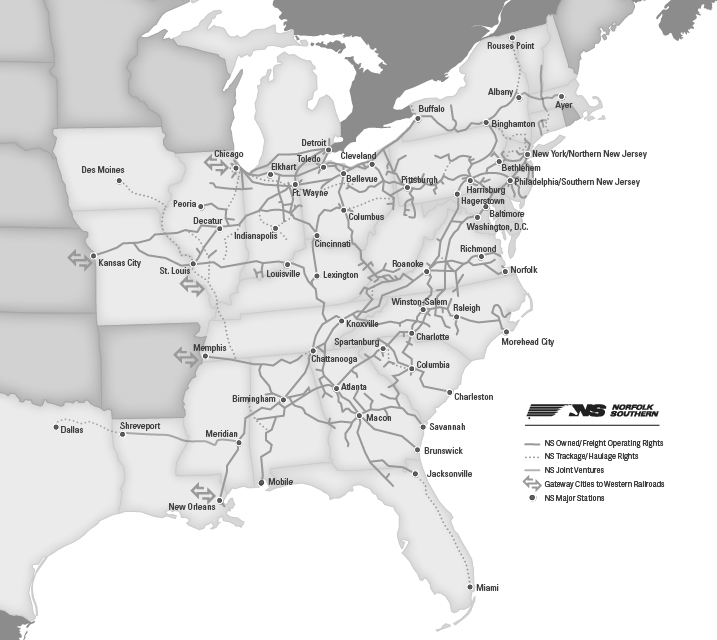
Corridors with heaviest freight volume:
-
New York City area to Chicago (via Allentown and Pittsburgh)
-
Chicago to Macon (via Cincinnati, Chattanooga, and Atlanta)
-
Central Ohio to Norfolk (via Columbus and Roanoke)
-
Birmingham to Meridian
-
Cleveland to Kansas City
-
Memphis to Chattanooga
K4
The miles operated, which include major leased lines between Cincinnati and Chattanooga, and an exclusive operating agreement for trackage rights over property owned by North Carolina Railroad Company, were as follows:
| Mileage Operated at December 31, 2021 | |||||||||||||||||||||||||||||
| Route Miles | Second and Other Main Track | Passing Track, Crossovers and Turnouts | Way and Yard Switching | Total | |||||||||||||||||||||||||
| Owned | 14,522 | 2,677 | 1,985 | 8,202 | 27,386 | ||||||||||||||||||||||||
| Operated under lease, contract or trackage | |||||||||||||||||||||||||||||
| rights | 4,797 | 1,889 | 405 | 839 | 7,930 | ||||||||||||||||||||||||
| Total | 19,319 | 4,566 | 2,390 | 9,041 | 35,316 |
We operate freight service over lines with significant ongoing Amtrak and commuter passenger operations and conduct freight operations over trackage owned or leased by Amtrak, New Jersey Transit, Southeastern Pennsylvania Transportation Authority, Metro-North Commuter Railroad Company, Maryland Department of Transportation, and Michigan Department of Transportation.
The following table sets forth certain statistics relating to our operations for the past five years:
| Years ended December 31, | ||||||||||||||||||||||||||||||||
| 2021 | 2020 | 2019 | 2018 | 2017 | ||||||||||||||||||||||||||||
| Revenue ton miles (billions) | 178 | 164 | 194 | 207 | 201 | |||||||||||||||||||||||||||
| Revenue per thousand revenue ton miles | $ | 62.56 | $ | 59.67 | $ | 58.21 | $ | 55.25 | $ | 52.38 | ||||||||||||||||||||||
| Revenue ton miles (thousands) per railroad employee | 9,694 | 8,191 | 7,939 | 7,822 | 7,474 | |||||||||||||||||||||||||||
| Ratio of railway operating expenses to railway | ||||||||||||||||||||||||||||||||
| operating revenues (railway operating ratio) | 60.1% | 69.3% | 64.7% | 65.4% | 66.6% |
RAILWAY OPERATING REVENUES – Total railway operating revenues were $11.1 billion in 2021. Following is an overview of our three commodity groups. See the discussion of merchandise revenues by major commodity group, intermodal revenues, and coal revenues and tonnage in Item 7 “Management’s Discussion and Analysis of Financial Condition and Results of Operations.”
MERCHANDISE – Our merchandise commodity group is composed of four groupings:
-
Agriculture, forest and consumer products includes soybeans, wheat, corn, fertilizer, livestock and poultry feed, food products, food oils, flour, sweeteners, ethanol, lumber and wood products, pulp board and paper products, wood fibers, wood pulp, scrap paper, beverages, canned goods, and consumer products.
-
Chemicals includes sulfur and related chemicals, petroleum products (including crude oil), chlorine and bleaching compounds, plastics, rubber, industrial chemicals, chemical wastes and sand.
-
Metals and construction includes steel, aluminum products, machinery, scrap metals, cement, aggregates, minerals, clay, transportation equipment, and items for the U.S. military.
-
Automotive includes finished motor vehicles and automotive parts.
In 2021, we handled 2.3 million merchandise carloads, which accounted for 60% of our total railway operating revenues.
K5
INTERMODAL – Our intermodal commodity group consists of shipments moving in domestic and international containers and trailers. These shipments are handled on behalf of intermodal marketing companies, international steamship lines, premium customers and asset owning companies. In 2021, we handled 4.1 million intermodal units, which accounted for 28% of our total railway operating revenues.
COAL – Coal revenues accounted for 12% of our total railway operating revenues in 2021. We handled 73 million tons, or 0.7 million carloads, most of which originated on our lines from major eastern coal basins, with the balance from major western coal basins received via the Memphis and Chicago gateways. Our coal franchise supports the electric generation market, serving approximately 50 coal-fired power plants, as well as the export, domestic metallurgical and industrial markets, primarily through direct rail and river, lake, and coastal facilities, including various terminals on the Ohio River, Lamberts Point in Norfolk, Virginia, the Port of Baltimore, and Lake Erie.
FREIGHT RATES – Our predominant pricing mechanisms, private contracts and exempt price quotes, are not subject to regulation. In general, market forces are the primary determinant of rail service prices.
RAILWAY PROPERTY
Our railroad infrastructure makes us capital intensive with net properties of approximately $32 billion on a historical cost basis.
Property Additions – Property additions for the past five years were as follows:
| 2021 | 2020 | 2019 | 2018 | 2017 | |||||||||||||||||||||||||
| ($ in millions) | |||||||||||||||||||||||||||||
| Road and other property | $ | 1,041 | $ | 1,046 | $ | 1,371 | $ | 1,276 | $ | 1,210 | |||||||||||||||||||
| Equipment | 429 | 448 | 648 | 675 | 513 | ||||||||||||||||||||||||
| Total | $ | 1,470 | $ | 1,494 | $ | 2,019 | $ | 1,951 | $ | 1,723 |
Our capital spending and replacement programs are and have been designed to assure the ability to provide safe, efficient, and reliable rail transportation services.
K6
Equipment – At December 31, 2021, we owned or leased the following units of equipment:
| Owned | Leased | Total | Capacity of Equipment | ||||||||||||||||||||
| Locomotives: | (Horsepower) | ||||||||||||||||||||||
| Multiple purpose | 3,068 | — | 3,068 | 11,940,400 | |||||||||||||||||||
| Auxiliary units | 138 | — | 138 | — | |||||||||||||||||||
| Switching | 4 | — | 4 | 4,400 | |||||||||||||||||||
| Total locomotives | 3,210 | — | 3,210 | 11,944,800 | |||||||||||||||||||
| Freight cars: | (Tons) | ||||||||||||||||||||||
| Gondola | 17,781 | 2,643 | 20,424 | 2,282,819 | |||||||||||||||||||
| Hopper | 8,113 | — | 8,113 | 925,510 | |||||||||||||||||||
| Covered hopper | 5,664 | — | 5,664 | 629,896 | |||||||||||||||||||
| Box | 2,684 | 706 | 3,390 | 308,515 | |||||||||||||||||||
| Flat | 1,428 | 136 | 1,564 | 131,168 | |||||||||||||||||||
| Other | 1,558 | — | 1,558 | 69,649 | |||||||||||||||||||
| Total freight cars | 37,228 | 3,485 | 40,713 | 4,347,557 | |||||||||||||||||||
| Other: | |||||||||||||||||||||||
| Chassis | 33,751 | 880 | 34,631 | ||||||||||||||||||||
| Containers | 18,310 | — | 18,310 | ||||||||||||||||||||
| Work equipment | 5,502 | 243 | 5,745 | ||||||||||||||||||||
| Vehicles | 2,833 | 19 | 2,852 | ||||||||||||||||||||
| Miscellaneous | 2,245 | — | 2,245 | ||||||||||||||||||||
| Total other | 62,641 | 1,142 | 63,783 |
The following table indicates the number and year built for locomotives and freight cars owned at December 31, 2021:
| 2021 | 2020 | 2019 | 2018 | 2017 | 2012- 2016 | 2007- 2011 | 2006 & Before | Total | |||||||||||||||||||||||||||||||||||||||||||||
| Locomotives: | |||||||||||||||||||||||||||||||||||||||||||||||||||||
| No. of units | — | 10 | 35 | 15 | 55 | 266 | 259 | 2,570 | 3,210 | ||||||||||||||||||||||||||||||||||||||||||||
| % of fleet | — | — | 1 | % | 1 | % | 2 | % | 8 | % | 8 | % | 80 | % | 100 | % | |||||||||||||||||||||||||||||||||||||
| Freight cars: | |||||||||||||||||||||||||||||||||||||||||||||||||||||
| No. of units | — | — | 200 | — | 470 | 5,745 | 8,041 | 22,772 | 37,228 | ||||||||||||||||||||||||||||||||||||||||||||
| % of fleet | — | — | 1 | % | — | 1 | % | 15 | % | 22 | % | 61 | % | 100 | % |
K7
The following table shows the average age of our owned locomotive and freight car fleets at December 31, 2021 and information regarding 2021 retirements:
| Locomotives | Freight Cars | ||||||||||
| Average age – in service | 26.7 years | 25.7 years | |||||||||
| Retirements | 2 units | 2,308 units | |||||||||
| Average age – retired | 31.5 years | 42.2 years |
Track Maintenance – Of the 35,300 total miles of track on which we operate, we are responsible for maintaining 28,700 miles, with the remainder being operated under trackage rights from other parties responsible for maintenance.
Over 84% of the main line trackage (including first, second, third, and branch main tracks, all excluding rail operated pursuant to trackage rights) has rail ranging from 131 to 155 pounds per yard with the standard installation currently at 136 pounds per yard. Approximately 41% of our lines, excluding rail operated pursuant to trackage rights, carried 20 million or more gross tons per track mile during 2021.
The following table summarizes several measurements regarding our track roadway additions and replacements during the past five years:
| 2021 | 2020 | 2019 | 2018 | 2017 | |||||||||||||||||||||||||
| Track miles of rail installed | 458 | 418 | 449 | 416 | 466 | ||||||||||||||||||||||||
| Miles of track surfaced | 4,225 | 4,785 | 5,012 | 4,594 | 5,368 | ||||||||||||||||||||||||
| Crossties installed (millions) | 2.0 | 1.8 | 2.4 | 2.2 | 2.5 |
Traffic Control – Of the 16,200 route miles we dispatch, 11,300 miles are signalized, including 8,500 miles of centralized traffic control (CTC) and 2,800 miles of automatic block signals. Of the 8,500 miles of CTC, 7,600 miles are controlled by data radio originating at 355 base station radio sites.
ENVIRONMENTAL MATTERS – Compliance with federal, state, and local laws and regulations relating to the protection of the environment is one of our principal goals. To date, such compliance has not had a material effect on our financial position, results of operations, liquidity, or competitive position. See Note 17 to the Consolidated Financial Statements.
HUMAN CAPITAL MANAGEMENT
Workforce – We employed an average of 18,500 employees during 2021, and 18,100 employees at the end of 2021. Approximately 80% of our railroad employees – referred to as “craft” employees – are covered by collective bargaining agreements with various labor unions. See the discussion of “Labor Agreements” in Item 7 “Management’s Discussion and Analysis of Financial Condition and Results of Operations.” The remainder of our workforce is composed of management employees.
Craft Workforce Levels and Productivity – Maintaining appropriate headcount levels for our craft-employee workforce is critical to our on-time and consistent delivery of customers’ goods and operational efficiency goals. We manage this human capital metric through forecasting tools designed to ensure the optimal level of staffing to meet business demands while controlling costs. We measure and monitor employee productivity based on gross ton miles per train and engine employee.
Safety – We are dedicated to providing employees with a safe workplace and the knowledge and tools they need to work safely and return home safely every day. Our commitment to an injury-free workplace is illustrated by our “I am Coming Home” safety message, which is featured prominently in our yards, shops, and facilities and further reinforces the importance of working safely. We measure employee safety performance through internal metrics such as lost-time injuries and serious injuries per 200,000 employee-hours and metrics established by the Federal
K8
Railroad Administration (FRA), such as FRA reportable injuries per 200,000 employee-hours. Given the importance of safety among our workforce and business, in 2020, our Board of Directors established a standing Safety Committee that, among other duties, reviews, monitors, and evaluates our compliance with our safety programs and practices.
Attracting and Retaining Management Employees – Our talent strategy for management employees is essential to attracting strong candidates in a competitive talent environment. We evaluate the effectiveness of that strategy by studying market trends, benchmarking the attractiveness of our employee value proposition, and analyzing retention data.
We also focus on driving employee engagement, which is key to increasing employee productivity, retention, and safety. We take a data-centric approach, including the use of quarterly surveys among management employees, to identify new initiatives that will help boost engagement and drive business results.
Employee Development and Training – We provide a range of developmental programs, opportunities, skills, and resources for our employees to work safely and be successful in their careers. We provide hands-on training and simulation training designed to improve training effectiveness and safety outcomes.
We also use modern learning and performance technologies to offer robust professional growth opportunities. Through on-demand digital course offerings, custom-built learning paths, and performance-management tools, our platforms deliver a contemporary, convenient, and inclusive approach to professional development.
Diversity, Equity and Inclusion – As a leading transportation service company, we understand that competing in the global marketplace requires recruiting the most qualified, talented, and diverse people. We strive to create a diverse, equitable, and inclusive workplace where a wide range of perspectives and experiences are represented, valued, and empowered to thrive.
While our current workforce reflects a broad range of backgrounds and experiences, we continue to focus on building an even more diverse workforce, using technology-driven outreach and multiple recruiting relationships to maintain a robust pipeline of diverse talent.
To underscore our commitment to cultivating a workplace experience where the unique experiences, perspectives, and contributions of all our people are valued, our senior management team recently signed a pledge reaffirming our commitment to diversity, equity, and inclusion. To advance that commitment, senior leaders from across the company serve on an Inclusion Leadership Council, which is accountable for setting our enterprise inclusion strategy and articulating measurable goals and actions needed to achieve them.
GOVERNMENT REGULATION – In addition to environmental, safety, securities, and other regulations generally applicable to all business, our railroads are subject to regulation by the U.S. Surface Transportation Board (STB). The STB has jurisdiction to varying extents over rates, routes, customer access provisions, fuel surcharges, conditions of service, and the extension or abandonment of rail lines. The STB has jurisdiction to determine whether we are “revenue adequate” on an annual basis based on the results of the prior year. A railroad is “revenue adequate” on an annual basis under the applicable law when its return on net investment exceeds the rail industry’s composite cost of capital. This determination is made pursuant to a statutory requirement. The STB also has jurisdiction over the consolidation, merger, or acquisition of control of and by rail common carriers.
The relaxation of economic regulation of railroads, following the Staggers Rail Act of 1980, included exemption from STB regulation of the rates and most service terms for intermodal business (trailer-on-flat-car, container-on-flat-car), rail boxcar shipments, lumber, manufactured steel, automobiles, and certain bulk commodities such as sand, gravel, pulpwood, and wood chips for paper manufacturing. Further, all shipments that we have under contract are effectively removed from commercial regulation for the duration of the contract. Approximately 90% of our revenues comes from either exempt shipments or shipments moving under transportation contracts; the remainder comes from shipments moving under public tariff rates.
K9
Efforts have been made over the past several years to increase federal economic regulation of the rail industry, and such efforts are expected to continue in 2022. The Staggers Rail Act of 1980 substantially balanced the interests of shippers and rail carriers, and encouraged and enabled rail carriers to innovate, invest in their infrastructure, and compete for business, thereby contributing to the economic health of the nation and to the revitalization of the industry. Accordingly, we will continue to oppose efforts to reimpose increased economic regulation.
Government regulations are further discussed within Item 1A “Risk Factors” and the safety and security of our railroads are discussed within the “Security of Operations” section contained herein.
COMPETITION – There is continuing strong competition among rail, water, and highway carriers. Price is usually only one factor of importance as shippers and receivers choose a transport mode and specific hauling company. Inventory carrying costs, service reliability, ease of handling, and the desire to avoid loss and damage during transit are also important considerations, especially for higher-valued finished goods, machinery, and consumer products. Even for raw materials, semi-finished goods, and work-in-progress, users are increasingly sensitive to transport arrangements that minimize problems at successive production stages.
Our primary rail competitor is CSX Corporation (CSX); both we and CSX operate throughout much of the same territory. Other railroads also operate in parts of the territory. We also compete with motor carriers, water carriers, and with shippers who have the additional options of handling their own goods in private carriage, sourcing products from different geographic areas, and using substitute products.
Certain marketing strategies to expand reach and shipping options among railroads and between railroads and motor carriers enable railroads to compete more effectively in specific markets.
SECURITY OF OPERATIONS – We continue to enhance the security of our rail system. Our comprehensive security plan is modeled on and was developed in conjunction with the security plan prepared by the Association of American Railroads (AAR) post September 11, 2001. The AAR Security Plan defines four Alert Levels and details the actions and countermeasures that are being applied across the railroad industry to mitigate the risk of terrorist, violent extremist or seriously disruptive cyber-attack increases or decreases. The Alert Level actions include countermeasures that will be applied in three general areas: (1) operations (including transportation, engineering, and mechanical); (2) information technology and communications; and, (3) railroad police. All of our Operations Division employees are advised by their supervisors or train dispatchers, as appropriate, of any change in Alert Level and any additional responsibilities they may incur due to such change.
Our security plan also complies with U.S. Department of Transportation (DOT) security regulations pertaining to training and security plans with respect to the transportation of hazardous materials. As part of the plan, security awareness training is given to all railroad employees who directly affect hazardous material transportation safety, and is integrated into hazardous material training programs. Additionally, location-specific security plans are in place for rail corridors in certain metropolitan areas referred to as High Threat Urban Areas (HTUA). Particular attention is aimed at reducing risk in a HTUA by: (1) the establishment of secure storage areas for rail cars carrying toxic-by-inhalation (TIH) materials; (2) the expedited movement of trains transporting rail cars carrying TIH materials; (3) reducing the number of unattended loaded tank cars carrying TIH materials; and (4) cooperation with federal, state, local, and tribal governments to identify those locations where security risks are the highest.
We also operate five facilities that are under U.S. Coast Guard (USCG) Maritime Security Regulations. With respect to these facilities, each facility’s security plan has been approved by the applicable Captain of the Port and remains subject to inspection by the USCG.
Additionally, we continue to engage in close and regular coordination with numerous federal and state agencies, including the U.S. Department of Homeland Security (DHS), the Transportation Security Administration, the Federal Bureau of Investigation, the FRA, the USCG, U.S. Customs and Border Protection, the Department of Defense, and various state Homeland Security offices.
In 2021, through the Norfolk Southern Operation Awareness and Response Program as well as participation in the Transportation Community Awareness and Emergency Response Program, we provided rail accident response
K10
training to approximately 3,500 emergency responders, such as local police and fire personnel, utilizing a combination of online training and face-to-face training sessions. In addition, 2021 saw the return of the Safety Train Tour; we conducted an abbreviated Six-Stop Safety Train Tour that provided hands-on training to approximately 700 first responders.
We also continually evaluate ourselves for appropriate business continuity and disaster recovery planning, with test scenarios that include cybersecurity attacks. Our risk-based information security program helps ensure our defenses and resources are aligned to address the most likely and most damaging potential attacks, to provide support for our organizational mission and operational objectives, and to keep us in the best position to detect, mitigate, and recover from a wide variety of potential attacks in a timely fashion.
Item 1A. Risk Factors
The risks set forth in the following risk factors could have a materially adverse effect on our financial position, results of operations, or liquidity in a particular year or quarter, and could cause those results to differ materially from those expressed or implied in our forward-looking statements. The information set forth in this Item 1A “Risk Factors” should be read in conjunction with the rest of the information included in this annual report, including
Item 7 “Management’s Discussion and Analysis of Financial Condition and Results of Operations” and Item 8 “Financial Statements and Supplementary Data.”
REGULATORY AND LEGISLATIVE RISKS
Significant governmental legislation, regulation, and Executive Orders over commercial, tax, operating and environmental matters could affect us, our customers, and the markets we serve. Congress can enact laws that could increase economic regulation of the industry. Similarly, regulations promulgated by agencies and the issuance of Executive Orders can affect us, our customers, and the markets we serve. Railroads presently are subject to commercial regulation by the STB, which has jurisdiction to varying extents over rates, routes, customer access provisions, fuel surcharges, conditions of service, and the extension or abandonment of rail lines. The STB also has jurisdiction over the consolidation, merger, or acquisition of control of and by rail common carriers. Additional economic regulation of the rail industry by Congress or the STB, whether under new or existing laws, could have a significant negative impact on our ability to negotiate prices for rail services, on railway operating revenues, and on the efficiency of our operations. Such additional industry regulation, as well as enactment of any new tax laws, could also negatively impact cash flows from operating activities and, therefore, could result in reduced capital spending on our rail network or abandonment of lines.
Railroads are also subject to the enactment of laws by Congress and regulation by the DOT and the DHS, which regulate most aspects of our operations related to safety and security. The Rail Safety Improvement Act of 2008, the Surface Transportation Extension Act of 2015, and the implementing regulations promulgated by the FRA required us (and each other Class I railroad) to implement an interoperable positive train control system (PTC) on main lines over which five million or more gross tons of annual traffic and certain hazardous materials are transported, and on any main lines over which intercity or commuter rail passenger transportation is regularly provided. We completed our PTC implementation prior to the December 31, 2020 deadline. PTC is designed to prevent train-to-train collisions, speed-related derailments, and certain other accidents caused by human error, but it will not prevent all types of train accidents or incidents. The PTC system will continue to result in additional operating costs and capital expenditures, and may result in increased claims and litigation costs.
Our operations are subject to extensive federal and state environmental laws and regulations concerning, among other things: emissions to the air; discharges to waterways or groundwater supplies; handling, storage, transportation, and disposal of waste and other materials; and, the cleanup of hazardous material or petroleum releases. The risk of incurring environmental liability, for acts and omissions, past, present, and future, is inherent in the railroad business. This risk includes property owned by us, whether currently or in the past, that is or has been subject to a variety of uses, including our railroad operations and other industrial activity by past owners or our past and present tenants.
Environmental problems that are latent or undisclosed may exist on these properties, and we could incur environmental liabilities or costs, the amount and materiality of which cannot be estimated reliably at this time, with
K11
respect to one or more of these properties. Moreover, lawsuits and claims involving other unidentified environmental sites and matters are likely to arise from time to time.
OPERATIONAL RISKS
Pandemics, epidemics or endemic diseases could further impact us, our customers, our supply chain and our operations. The magnitude and duration of a pandemic, epidemic or endemic disease, and its impact on our customers and general economic conditions will influence the demand for our services and affect our revenues. In addition, such outbreaks could affect our operations and business continuity if a significant number of our essential employees, overall or in a key location, are quarantined from contraction of or exposure to the disease or if governmental orders prevent our employees or critical suppliers (including individuals that have not received mandated vaccinations) from working. Our compliance with vaccine mandates could lead to employee absences, resignations, labor disputes or work stoppages. The COVID-19 pandemic negatively impacted the economy and continues to generate economic uncertainty. Future pandemics, epidemics or endemic diseases may cause similar consequences. To the extent such diseases adversely affects our business and financial results, they may also have the effect of heightening many of the other risks described in the risk factors included herein, or may affect our operating and financial results in a manner that is not presently known to us.
A significant cybersecurity incident or other disruption to our technology infrastructure could disrupt our business operations. We rely on information technology, and improvements in that technology, in all aspects of our business. If we experience significant disruption or failure of one or more of information technology systems operated by us or under control of third parties, including computer hardware, software, and communications equipment, we could experience a service interruption or other operational difficulties. Although we maintain comprehensive security programs designed to protect our information technology systems, we are continually targeted by threat actors attempting to access our networks. While we have experienced cybersecurity events that have had minimal impact, future events may result in more significant impacts to business operations. These potentially impactful events could include unauthorized access to our systems, viruses, ransomware, and/or compromise, acquisition, or destruction of our data. We also could be impacted by cybersecurity events targeting third parties that we rely on for business operations, including third party vendors that have access to our systems or data and third parties in our supply chain. Such a direct or indirect cybersecurity incident could interrupt our service, cause safety failures or operational difficulties, decrease revenues, increase operating costs, impact our efficiency, damage our corporate reputation, and/or expose us to litigation or government investigations, which could result in penalties, fines or judgments. In addition, our failure to comply with privacy-related or data protection laws and regulations could result in government investigations and proceedings against us, or litigation, resulting in adverse reputational impacts, penalties, and legal liability.
Our business may be seriously harmed if we fail to develop, implement, maintain, upgrade, enhance, protect and integrate our information technology systems. If we do not have sufficient capital to develop, acquire or implement new technology, we may suffer a competitive disadvantage within the rail industry and with companies providing alternative modes of transportation service.
As a common carrier by rail, we must offer to transport hazardous materials, regardless of risk. Transportation of certain hazardous materials could create catastrophic losses in terms of personal injury and property (including environmental) damage and compromise critical parts of our rail network. The costs of a catastrophic rail accident involving hazardous materials could exceed our insurance coverage. We have obtained insurance for potential losses for third-party liability and first-party property damages (see Note 17 to the Consolidated Financial Statements); however, insurance is available from a limited number of insurers and may not continue to be available or, if available, may not be obtainable on terms acceptable to us.
We face competition from other transportation providers. We are subject to competition from motor carriers, railroads and, to a lesser extent, ships, barges, and pipelines, on the basis of transit time, pricing, and quality and reliability of service. While we have used primarily internal resources to build or acquire and maintain our rail system, trucks and barges have been able to use public rights-of-way maintained by public entities. Any future improvements, expenditures, legislation, or regulation materially increasing the quality or reducing the cost of alternative modes of transportation in the regions in which we operate (such as granting materially greater latitude
K12
for motor carriers with respect to size or weight limitations or adoption of autonomous commercial vehicles) could have a material adverse effect on our ability to compete with other modes of transportation.
Capacity constraints could negatively impact our service and operating efficiency. We could experience capacity constraints on our rail network related to increased demand for rail services, locomotive or employee shortages, severe weather, congestion on other railroads, including passenger activities, or impacts from changes to our network structure or composition. Such constraints could result in operational inefficiencies or adversely affect our operations.
Significant increases in demand for rail services could result in the unavailability of qualified personnel and resources like locomotives. Changes in workforce demographics, training requirements, and availability of qualified personnel, particularly for engineers and conductors, could have a negative impact on our ability to meet short-term demand for rail service. Unpredicted increases in demand for rail services may exacerbate such risks and could negatively impact our operational efficiency.
Constraints on the supply chain or the operations of carriers with which we interchange may adversely affect our operations. Our ability to provide rail service to customers in the U.S. and Canada depends in large part upon a functioning global supply chain and our ability to maintain collaborative relationships with connecting carriers (including shortlines and regional railroads) with respect to, among other matters, freight rates, revenue division, car supply and locomotive availability, data exchange and communications, reciprocal switching, interchange, and trackage rights. Deterioration in the supply chain or operations of or service provided by connecting carriers, or in our relationship with those connecting carriers, could result in our inability to meet our customers’ demands or require us to use alternate train routes, which could result in significant additional costs and network inefficiencies. Additionally, any significant consolidations, mergers or operational changes among other railroads may significantly redefine our market access and reach.
The vast majority of our employees belong to labor unions, and labor agreements, strikes, or work stoppages could adversely affect our operations. Approximately 80% of our railroad employees are covered by collective bargaining agreements with various labor unions. If our craft employees were to engage in a strike, work stoppage, or other slowdown, we could experience a significant disruption of our operations. Additionally, future national labor agreements, or renegotiation of labor agreements or provisions of labor agreements, could significantly increase our costs for health care, wages, and other benefits.
We may be affected by terrorism or war. Any terrorist attack, or other similar event, any government response thereto, and war or risk of war could cause significant business interruption. Because we play a critical role in the nation’s transportation system, we could become the target of such an attack or have a significant role in the government’s preemptive approach or response to an attack or war.
Although we currently maintain insurance coverage for third-party liability arising out of war and acts of terrorism, we maintain only limited insurance coverage for first-party property damage and damage to property in our care, custody, or control caused by certain acts of terrorism. In addition, premiums for some or all of our current insurance programs covering these losses could increase dramatically, or insurance coverage for certain losses could be unavailable to us in the future.
We may be affected by supply constraints resulting from disruptions in the fuel markets or the nature of some of our supplier markets. We consumed over 380 million gallons of diesel fuel in 2021. Fuel availability could be affected by any limitation in the fuel supply or by any imposition of mandatory allocation or rationing regulations. A severe fuel supply shortage arising from production curtailments, increased demand in existing or emerging foreign markets, disruption of oil imports, disruption of domestic refinery production, damage to refinery or pipeline infrastructure, political unrest, war or other factors could impact us as well as our customers and other transportation companies.
Due to the capital-intensive nature, as well as the industry-specific requirements of the rail industry, high barriers of entry exist for potential new suppliers of core railroad items, such as locomotives and rolling stock equipment. Additionally, we compete with other industries for available capacity and raw materials used in the production of
K13
locomotives and certain track and rolling stock materials. Changes in the competitive landscapes of these limited supplier markets could result in increased prices or significant shortages of materials.
LITIGATION RISKS
We may be subject to various claims and lawsuits that could result in significant expenditures. The nature of our business exposes us to the potential for various claims and litigation related to labor and employment, personal injury, commercial disputes, freight loss and other property damage, and other matters. Job-related personal injury and occupational claims are subject to the Federal Employer’s Liability Act (FELA), which is applicable only to railroads. FELA’s fault-based tort system produces results that are unpredictable and inconsistent as compared with a no-fault worker’s compensation system. The variability inherent in this system could result in actual costs being different from the liability recorded.
A catastrophic rail accident, whether on our lines or another carrier’s, involving any or all of release of hazardous materials, freight loss, property damage, personal injury, and environmental liability could compromise critical parts of our rail network. Losses associated with such an accident involving us could exceed our insurance coverage, resulting in a material adverse effect on our liquidity. Any material changes to current litigation trends could also have a material adverse effect on our liquidity to the extent not covered by insurance.
We have obtained insurance for potential losses for third-party liability and first-party property damages (see Note 17 to the Consolidated Financial Statements); however, insurance is available from a limited number of insurers and may not continue to be available or, if available, may not be obtainable on terms acceptable to us.
CLIMATE CHANGE RISKS
Severe weather and disasters have caused, and could again cause, significant business interruptions and expenditures. Severe weather conditions and other natural phenomena resulting from changing weather patterns and rising sea levels or other causes, including hurricanes, floods, fires, landslides, extreme temperatures, significant precipitation, and earthquakes, have caused, and may again cause damage to our network, our workforce to be unavailable and us to be unable to use our equipment. Additionally, shifts in weather patterns caused by climate change are expected to increase the frequency, severity or duration of certain adverse weather conditions, which could cause more significant business interruptions that result in increased costs, increased liabilities, and decreased revenues.
Concern over climate change has led to significant federal, state, and international legislative and regulatory efforts to limit greenhouse gas (GHG) emissions. Restrictions, caps, taxes, or other controls on GHG emissions, including diesel exhaust, could significantly increase our operating costs and decrease the amount of traffic we handle.
In addition, legislation and regulation related to GHG emissions could negatively affect the markets we serve and our customers. Even without legislation or regulation, government incentives and adverse publicity relating to GHG emissions could negatively affect the markets for certain of the commodities we carry and our customers that (1) use commodities we carry to produce energy, including coal, (2) use significant amounts of energy in producing or delivering the commodities we carry, or (3) manufacture or produce goods that consume significant amounts of energy associated with GHG emissions.
MACROECONOMIC AND MARKET RISKS
We may be affected by general economic conditions. Negative changes in domestic and global economic conditions, including reduced import and export volumes, could affect the producers and consumers of the commodities we carry. Economic conditions could also result in bankruptcies of one or more large customers.
We may be affected by energy prices. Volatility in energy prices could have a significant effect on a variety of items including, but not limited to: the economy; demand for transportation services; business related to the energy sector, including crude oil, natural gas, and coal; fuel prices; and, fuel surcharges.
K14
The state of capital markets could adversely affect our liquidity. We rely on the capital markets to provide some of our capital requirements, including the issuance of debt instruments and the sale of certain receivables. Significant instability or disruptions of the capital markets, including the credit markets, or deterioration of our financial position due to internal or external factors could restrict or eliminate our access to, and/or significantly increase the cost of, various financing sources, including bank credit facilities and issuance of corporate bonds. Instability or disruptions of the capital markets and deterioration of our financial position, alone or in combination, could also result in a reduction of our credit rating to below investment grade, which could prohibit or restrict us from accessing external sources of short- and long-term debt financing and/or significantly increase the associated costs.
Item 1B. Unresolved Staff Comments
None.
Item 3. Legal Proceedings
In 2007, various antitrust class actions filed against us and other Class I railroads in various Federal district courts regarding fuel surcharges were consolidated in the District of Columbia by the Judicial Panel on Multidistrict Litigation. In 2012, the court certified the case as a class action. The defendant railroads appealed this certification, and the Court of Appeals for the District of Columbia vacated the District Court’s decision and remanded the case for further consideration. On October 10, 2017, the District Court denied class certification. The decision was upheld by the Court of Appeals on August 16, 2019. Since that decision, various individual cases have been filed in multiple jurisdictions and also consolidated in the District of Columbia. We believe the allegations in the complaints are without merit and intend to vigorously defend the cases. We do not believe the outcome of these proceedings will have a material effect on our financial position, results of operations, or liquidity.
In 2018, a lawsuit was filed against one of our subsidiaries by the minority owner in a jointly-owned terminal railroad company in which our subsidiary has the majority ownership. The lawsuit alleged violations of various state laws and federal antitrust laws. It is reasonably possible that we could incur a loss in the case; however, we intend to vigorously defend the case and believe that we will prevail. The potential range of loss cannot be estimated at this time.
Item 4. Mine Safety Disclosures
Not applicable.
K15
Information About Our Executive Officers
Our executive officers generally are elected and designated annually by the Board of Directors (Board) at its first meeting held after the annual meeting of stockholders, and they hold office until their successors are elected. Executive officers also may be elected and designated throughout the year as the Board considers appropriate. There are no family relationships among our officers, nor any arrangement or understanding between any officer and any other person pursuant to which the officer was selected. The following table sets forth certain information, at February 1, 2022, relating to our officers.
| Name, Age, Present Position | Business Experience During Past Five Years | ||||
| James A. Squires, 60, Chairman and Chief Executive Officer | Present position since October 1, 2015. | ||||
| Alan H. Shaw, 54, President | Present position since December 1, 2021. Served as Executive Vice President and Chief Marketing Officer from May 16, 2015 to December 1, 2021. | ||||
| Ann A. Adams, 51, Executive Vice President and Chief Transformation Officer | Present position since April 1, 2019. Served as Vice President Human Resources from April 1, 2016 to April 1, 2019. | ||||
| Claude E. Elkins, Jr., 56, Executive Vice President and Chief Marketing Officer | Present position since December 1, 2021. Served as Vice President Industrial Products from April 1, 2018 to December 1, 2021. Served as Group Vice President Chemicals from March 1, 2016 to April 1, 2018. | ||||
| Mark R. George, 54, Executive Vice President Finance and Chief Financial Officer | Present position since November 1, 2019. Prior to joining Norfolk Southern, served as Vice President, Finance and Chief Financial Officer at segments of United Technologies Corporation. The positions were Vice President Finance, Strategy, IT and Chief Financial Officer at Otis Elevator Company from October 2015 to May 2019, and Vice President Finance and Chief Financial Officer at Carrier Corporation from June 2019 until joining Norfolk Southern. | ||||
| Cynthia M. Sanborn, 57, Executive Vice President and Chief Operating Officer | Present position since September 1, 2020. Prior to joining Norfolk Southern, served as served as Vice President Network Planning & Operations at Union Pacific from May 2019 to September 2020 and as Regional Vice President – Western Region from February 2018 to May 2019. Previously served as Executive Vice President and Chief Operating Officer at CSX from September 2015 to November 2017. | ||||
| Lorri J. Kleine, 57, Senior Vice President Law and Chief Legal Officer | Present position since January 10, 2022. Served as Vice President Law from March 1, 2020 to January 10, 2022. Served as Senior General Counsel from August 1, 2019 to March 1, 2020. Served as General Counsel from December 1, 2016 to August 1, 2019. | ||||
| Clyde H. Allison, Jr., 58, Vice President and Controller | Present position since June 1, 2020. Served as Vice President and Treasurer from February 1, 2017 to June 1, 2020. |
K16
PART II
NORFOLK SOUTHERN CORPORATION AND SUBSIDIARIES
Item 5. Market for Registrant’s Common Equity, Related Stockholder Matters and Issuer Purchases of Equity Securities
STOCK INFORMATION
Common Stock is owned by 20,616 stockholders of record as of December 31, 2021, and is traded on the New York Stock Exchange under the symbol “NSC.”
ISSUER PURCHASES OF EQUITY SECURITIES
| Period | Total Number of Shares (or Units) Purchased(1) | Average Price Paid per Share (or Unit) | Total Number of Shares (or Units) Purchased as Part of Publicly Announced Plans or Programs(2) | Maximum Number (or Approximate Dollar Value) of Shares (or Units) that may yet be Purchased under the Plans or Programs(2) | ||||||||||||||||||||||
| October 1-31, 2021 | 861,374 | $ | 268.13 | 861,374 | 10,467,071 | |||||||||||||||||||||
| November 1-30, 2021 | 269 | 282.17 | — | 10,467,071 | ||||||||||||||||||||||
| December 1-31, 2021 | 2,427,166 | 287.85 | 2,426,998 | 8,040,073 | ||||||||||||||||||||||
| Total | 3,288,809 | 3,288,372 |
(1)Of this amount, 437 represent shares tendered by employees in connection with the exercise of stock options under the stockholder-approved Long-Term Incentive Plan (LTIP).
(2)On September 26, 2017, our Board of Directors authorized the repurchase of up to an additional 50 million shares of Common Stock through December 31, 2022. As of December 31, 2021, 8.0 million shares remain authorized for repurchase.
K17
Item 7. Management’s Discussion and Analysis of Financial Condition and Results of Operations
Norfolk Southern Corporation and Subsidiaries
The following discussion and analysis should be read in conjunction with the Consolidated Financial Statements and Notes.
OVERVIEW
We are one of the nation’s premier transportation companies, moving goods and materials that help drive the U.S. economy. We connect customers to markets and communities to economic opportunity with safe, reliable, and cost-effective shipping solutions. Our Norfolk Southern Railway Company subsidiary operates in 22 states and the District of Columbia. We are a major transporter of industrial products, including agriculture, forest and consumer products, chemicals, and metals and construction materials. In addition, in the East we serve every major container port and operate the most extensive intermodal network. We are also a principal carrier of coal, automobiles, and automotive parts.
During 2021, revenue growth and the absence of two prior-year charges resulted in substantial increases in operating income, net income and earnings per share. Our current year results compare favorably to the prior year, during which there was a pandemic-induced decline in demand which resulted in reduced earnings.
The COVID-19 pandemic continues to impact the U.S. and global economies and has resulted in ongoing supply chain challenges. We are monitoring and reacting to the evolving nature of the pandemic, governmental responses, and their impacts on our business, including employee availability. We remain committed to protecting our employees, operating safely, and providing excellent transportation service products for our customers.
SUMMARIZED RESULTS OF OPERATIONS
| 2021 | 2020 | |||||||||||||||||||||||||||||||
| 2021 | 2020 | 2019 | vs. 2020 | vs. 2019 | ||||||||||||||||||||||||||||
| ($ in millions, except per share amounts) | (% change) | |||||||||||||||||||||||||||||||
| Income from railway operations | $ | 4,447 | $ | 3,002 | $ | 3,989 | 48 | % | (25 | %) | ||||||||||||||||||||||
| Net income | $ | 3,005 | $ | 2,013 | $ | 2,722 | 49 | % | (26 | %) | ||||||||||||||||||||||
| Diluted earnings per share | $ | 12.11 | $ | 7.84 | $ | 10.25 | 54 | % | (24 | %) | ||||||||||||||||||||||
| Railway operating ratio (percent) | 60.1 | 69.3 | 64.7 | (13 | %) | 7 | % |
Income from railway operations increased in 2021 compared to 2020, the result of a 14% increase in railway operating revenues and a 1% reduction in railway operating expenses. Revenue growth was driven by increased average revenue per unit and higher volumes, the result of improved customer demand. The decline in railway operating expenses was largely due to the absence of two charges, as 2020 results were adversely impacted by a $385 million loss on asset disposal related to locomotives and a $99 million impairment charge related to an equity method investment. For more information on these charges, see Notes 7 and 6, respectively. Higher fuel costs, purchased services, and compensation and benefits expense mostly offset the reduction associated with these charges. Additionally, gains on the sale of operating properties increased compared to the prior year. The 48% increase in income from railway operations drove comparable increases in net income and diluted earnings per share. Our railway operating ratio (a measure of the amount of operating revenues consumed by operating expenses) decreased to 60.1 percent.
Income from railway operations declined in 2020 compared to 2019 as railway operating revenues fell 13% which exceeded a 7% reduction in operating expenses. Railway operating revenues declined as lower customer demand resulted in reduced volume. Additionally, negative mix and lower fuel surcharge revenue, partially offset by increased pricing, led to lower average revenue per unit. Railway operating expenses decreased due to declines in
K18
fuel price and consumption, reduced employment levels, lower volumes and operational efficiency improvements. These decreases in expenses were partially offset by the impact of the aforementioned charges.
The following tables adjust our 2020 U.S. Generally Accepted Accounting Principles (GAAP) financial results to exclude the effects of the loss on asset disposal and investment impairment. The income tax effects on these non-GAAP adjustments were calculated based on the applicable tax rates to which the non-GAAP adjustments relate. We use these non-GAAP financial measures internally and believe this information provides useful supplemental information to investors to facilitate making period-to-period comparisons by excluding the 2020 charges. While we believe that these non-GAAP financial measures are useful in evaluating our business, this information should be considered as supplemental in nature and is not meant to be considered in isolation from, or as a substitute for, the related financial information prepared in accordance with GAAP. In addition, these non-GAAP financial measures may not be the same as similar measures presented by other companies.
| Non-GAAP Reconciliation for 2020 | |||||||||||||||||||||||
| Reported (GAAP) | Loss on Asset Disposal | Investment Impairment | Adjusted (non-GAAP) | ||||||||||||||||||||
| ($ in millions, except per share amounts) | |||||||||||||||||||||||
| Railway operating expenses | $ | 6,787 | $ | (385) | $ | (99) | $ | 6,303 | |||||||||||||||
| Income from railway operations | $ | 3,002 | $ | 385 | $ | 99 | $ | 3,486 | |||||||||||||||
| Income before income taxes | $ | 2,530 | $ | 385 | $ | 99 | $ | 3,014 | |||||||||||||||
| Income taxes | $ | 517 | $ | 97 | $ | 25 | $ | 639 | |||||||||||||||
| Net income | $ | 2,013 | $ | 288 | $ | 74 | $ | 2,375 | |||||||||||||||
| Diluted earnings per share | $ | 7.84 | $ | 1.12 | $ | 0.29 | $ | 9.25 | |||||||||||||||
| Railway operating ratio (percent) | 69.3 | (3.9) | (1.0) | 64.4 | |||||||||||||||||||
In the table below, references to 2020 results and related comparisons use the adjusted, non-GAAP results from the table above.
| 2021 | Adjusted | ||||||||||||||||||||||||||||
| Adjusted |
Showing the first 8K of 60K characters. Open the full section
Item 7A. Quantitative and Qualitative Disclosures About Market Risk
The information required by this item is included in Item 7 “Management’s Discussion and Analysis of Financial Condition and Results of Operations” under the heading “Market Risks.”
K31
Item 8. Financial Statements and Supplementary Data
INDEX TO FINANCIAL STATEMENTS
K32
Report of Management
February 4, 2022
To the Stockholders
Norfolk Southern Corporation:
Management is responsible for establishing and maintaining adequate internal control over financial reporting. In order to ensure that Norfolk Southern’s internal control over financial reporting is effective, management regularly assesses such controls and did so most recently as of December 31, 2021. This assessment was based on criteria for effective internal control over financial reporting described in Internal Control – Integrated Framework (2013) issued by the Committee of Sponsoring Organizations of the Treadway Commission. Based on this assessment, management has concluded that we maintained effective internal control over financial reporting as of December 31, 2021.
KPMG LLP, independent registered public accounting firm, has audited our financial statements and issued an attestation report on our internal control over financial reporting as of December 31, 2021.
| /s/ James A. Squires | /s/ Mark R. George | /s/ Clyde H. Allison, Jr. | ||||||||||||
| James A. Squires | Mark R. George | Clyde H. Allison, Jr. | ||||||||||||
| Chairman and | Executive Vice President Finance | Vice President and | ||||||||||||
| Chief Executive Officer | and Chief Financial Officer | Controller |
K33
Report of Independent Registered Public Accounting Firm
To the Stockholders and Board of Directors
Norfolk Southern Corporation:
Opinion on Internal Control Over Financial Reporting
We have audited Norfolk Southern Corporation and subsidiaries’ (the Company) internal control over financial reporting as of December 31, 2021, based on criteria established in Internal Control – Integrated Framework (2013) issued by the Committee of Sponsoring Organizations of the Treadway Commission. In our opinion, the Company maintained, in all material respects, effective internal control over financial reporting as of December 31, 2021, based on criteria established in Internal Control – Integrated Framework (2013) issued by the Committee of Sponsoring Organizations of the Treadway Commission.
We also have audited, in accordance with the standards of the Public Company Accounting Oversight Board (United States) (PCAOB), the consolidated balance sheets of the Company as of December 31, 2021 and 2020, the related consolidated statements of income, comprehensive income, cash flows, and changes in stockholders’ equity for each of the years in the three-year period ended December 31, 2021, and the related notes and financial statement schedule of valuation and qualifying accounts as listed in Item 15(A)2 (collectively, the consolidated financial statements), and our report dated February 4, 2022 expressed an unqualified opinion on those consolidated financial statements.
Basis for Opinion
The Company’s management is responsible for maintaining effective internal control over financial reporting and for its assessment of the effectiveness of internal control over financial reporting, included in the accompanying Management's Annual Report on Internal Control Over Financial Reporting. Our responsibility is to express an opinion on the Company’s internal control over financial reporting based on our audit. We are a public accounting firm registered with the PCAOB and are required to be independent with respect to the Company in accordance with the U.S. federal securities laws and the applicable rules and regulations of the Securities and Exchange Commission and the PCAOB.
We conducted our audit in accordance with the standards of the PCAOB. Those standards require that we plan and perform the audit to obtain reasonable assurance about whether effective internal control over financial reporting was maintained in all material respects. Our audit of internal control over financial reporting included obtaining an understanding of internal control over financial reporting, assessing the risk that a material weakness exists, and testing and evaluating the design and operating effectiveness of internal control based on the assessed risk. Our audit also included performing such other procedures as we considered necessary in the circumstances. We believe that our audit provides a reasonable basis for our opinion.
Definition and Limitations of Internal Control Over Financial Reporting
A company’s internal control over financial reporting is a process designed to provide reasonable assurance regarding the reliability of financial reporting and the preparation of financial statements for external purposes in accordance with generally accepted accounting principles. A company’s internal control over financial reporting includes those policies and procedures that (1) pertain to the maintenance of records that, in reasonable detail, accurately and fairly reflect the transactions and dispositions of the assets of the company; (2) provide reasonable assurance that transactions are recorded as necessary to permit preparation of financial statements in accordance with generally accepted accounting principles, and that receipts and expenditures of the company are being made only in accordance with authorizations of management and directors of the company; and (3) provide reasonable assurance regarding prevention or timely detection of unauthorized a
Showing the first 8K of 138K characters. Open the full section
Item 9. Changes in and Disagreements with Accountants on Accounting and Financial Disclosure
Not applicable.
Item 9A. Controls and Procedures
Disclosure Controls and Procedures
Our Chief Executive Officer and Chief Financial Officer, with the assistance of management, evaluated the effectiveness of our disclosure controls and procedures (as such term is defined in Rules 13a-15(e) and 15d-15(e) under the Securities Exchange Act of 1934, as amended (Exchange Act)) at December 31, 2021. Based on such evaluation, our officers have concluded that, at December 31, 2021, our disclosure controls and procedures were effective to ensure that information required to be disclosed in our reports under the Exchange Act is recorded, processed, summarized, and reported, within the time period specified in the SEC’s rules and forms, and that such information is accumulated and communicated to management, including the Chief Executive Officer and the Chief Financial Officer, as appropriate, to allow timely decisions regarding required disclosure.
Management’s Annual Report on Internal Control Over Financial Reporting
We are responsible for establishing and maintaining adequate internal control over financial reporting. Our internal control over financial reporting includes those policies and procedures that pertain to our ability to record, process, summarize, and report reliable financial data. We recognize that there are inherent limitations in the effectiveness of any internal control over financial reporting, including the possibility of human error and the circumvention or overriding of internal control. Accordingly, even effective internal control over financial reporting can provide only reasonable assurance with respect to financial statement preparation. Further, because of changes in conditions, the effectiveness of internal control over financial reporting may vary over time.
Our Board of Directors, acting through its Audit Committee, is responsible for the oversight of our accounting policies, financial reporting, and internal control. The Audit Committee of our Board of Directors is comprised of outside directors who are independent of management. The independent registered public accounting firm and our internal auditors have full and unlimited access to the Audit Committee, with or without management, to discuss the adequacy of internal control over financial reporting, and any other matters which they believe should be brought to the attention of the Audit Committee.
We have issued a report of our assessment of internal control over financial reporting, and our independent registered public accounting firm has issued an attestation report on our internal control over financial reporting at December 31, 2021. These reports appear in Item 8 of this report on Form 10-K.
Changes in Internal Control Over Financial Reporting
During the fourth quarter of 2021, we have not identified any changes in internal control over financial reporting that have materially affected, or are reasonably likely to materially effect, our internal control over financial reporting.
Item 9B. Other Information
None.
Item 9C. Disclosure Regarding Foreign Jurisdictions that Prevent Inspections
Not applicable.
K75
PART III
NORFOLK SOUTHERN CORPORATION AND SUBSIDIARIES
Item 10. Directors, Executive Officers and Corporate Governance
In accordance with General Instruction G(3), information called for by Part III, Item 10, is incorporated herein by reference from the information appearing under the caption “Election of Directors,” under the caption “Delinquent Section 16(a) Reports,” under the caption “Committees of the Board,” under the caption “Shareholder Recommendations and Nominations,” and under the caption “The Thoroughbred Code of Ethics” in our definitive Proxy Statement for our 2022 Annual Meeting of Stockholders, which definitive Proxy Statement will be filed electronically with the SEC pursuant to Regulation 14A. The information regarding executive officers called for by Item 401 of Regulation S-K is included in Part I hereof beginning under “Information about our Executive Officers.”
Item 11. Executive Compensation
In accordance with General Instruction G(3), information called for by Part III, Item 11, is incorporated herein by reference from the information:
-
under the caption “Compensation of Directors;”
-
under the caption “Compensation Discussion and Analysis,” the information appearing in the “Summary Compensation Table” and the “2021 Grants of Plan-Based Awards” table, including the narrative to such tables, the “Outstanding Equity Awards at Fiscal Year-End 2021” and “Option Exercises and Stock Vested in 2021” tables, and the tabular and narrative information appearing under the subcaptions “Retirement Benefits,” “Deferred Compensation,” and “Potential Payments Upon a Change in Control or Other Termination of Employment;” and,
-
under the captions “Compensation Committee Interlocks and Insider Participation,” “Compensation Policy Risk Assessment,” and “Compensation Committee Report,”
in each case included in our definitive Proxy Statement for our 2022 Annual Meeting of Stockholders, which definitive Proxy Statement will be filed electronically with the SEC pursuant to Regulation 14A.
K76
Item 12. Security Ownership of Certain Beneficial Owners and Management and Related Stockholder Matters
In accordance with General Instruction G(3), information on security ownership of certain beneficial owners and management called for by Part III, Item 12, is incorporated herein by reference from the information appearing under the caption “Beneficial Ownership of Stock” in our definitive Proxy Statement for our 2022 Annual Meeting of Stockholders, which definitive Proxy Statement will be filed electronically with the SEC pursuant to Regulation 14A.
Equity Compensation Plan Information (at December 31, 2021)
| Plan Category | Number of securities to be issued upon exercise of outstanding options, warrants and rights | Weighted- average exercise price of outstanding options, warrants and rights | Number of securities remaining available for future issuance under equity compensation plans (1) | ||||||||||||||||||||
| (a) | (b) | (c) | |||||||||||||||||||||
| Equity compensation plans | |||||||||||||||||||||||
| approved by securities holders(2) | 1,820,307 | (3) | $ | 109.88 | (5) | 8,609,075 | |||||||||||||||||
| Equity compensation plans | |||||||||||||||||||||||
| not approved by securities holders | 185,552 | (4) | 90.35 | 435,867 | (6) | ||||||||||||||||||
| Total | 2,005,859 | 9,044,942 |
(1)Excludes securities reflected in column (a).
(2)LTIP.
(3)Includes options, RSUs and PSUs granted under LTIP that will be settled in shares of Common Stock.
(4)TSOP.
(5)Calculated without regard to 909,964 outstanding RSUs and PSUs at December 31, 2021.
(6)Reflects shares remaining available for grant under TSOP.
Norfolk Southern Corporation Long-Term Incentive Plan
Established on June 28, 1983, and approved by our stockholders at their Annual Meeting held on May 10, 1984, LTIP was adopted to promote the success of our company by providing an opportunity for non-employee Directors, officers, and other key employees to acquire a proprietary interest in Norfolk Southern Corporation (the Corporation). The Board of Directors amended LTIP on January 23, 2015, which amendment was approved by shareholders on May 14, 2015, to include the reservation for issuance of an additional 8,000,000 shares of authorized but unissued Common Stock.
The amended LTIP adopted a fungible share reserve ratio so that, for awards granted after May 13, 2010, the number of shares remaining for issuance under the amended LTIP will be reduced (i) by 1 for each award granted as an option or stock-settled SAR, or (ii) by 1.61 for an award made in the form other than an option or stock-settled SAR. Any shares of Common Stock subject to options, PSUs, restricted shares, or RSUs which are not issued as Common Stock will again be available for award under LTIP after the expiration or forfeiture of an award.
K77
Non-employee Directors, officers, and other key employees residing in the U.S. or Canada are eligible for selection to receive LTIP awards. Under LTIP, the Committee, or the Corporation’s chief executive officer to the extent the Committee delegates award-making authority pursuant to LTIP, may grant incentive stock options, nonqualified stock options, SARs, RSUs, restricted shares, PSUs and performance shares. In addition, dividend equivalent payments may be awarded for options, RSUs and PSUs. Awards under LTIP may be made subject to forfeiture under certain circumstances and the Committee may establish such other terms and conditions for the awards as provided in LTIP.
The option price is at least the higher of (i) the average of the high and low prices at which Common Stock is traded on the date of grant, or (ii) the closing price of Common Stock on the date of the grant. All options are subject to a vesting period of at least one year, and the term of the option will not exceed ten years. LTIP specifically prohibits option repricing without stockholder approval, except that adjustments may be made in the event of changes in our capital structure or Common Stock.
PSUs entitle a recipient to receive performance-based compensation at the end of a three-year cycle based on our performance during that period. For the 2021 PSU awards, corporate performance will be based directly on return on average capital invested, with total return to stockholders serving as a modifier, and will be settled in shares of Common Stock.
RSUs are payable in cash or in shares of Common Stock at the end of a restriction period. During the restriction period, the holder of the RSUs has no beneficial ownership interest in the Common Stock represented by the RSUs and has no right to vote the shares represented by the units or to receive dividends (except for dividend equivalent payment rights that may be awarded with respect to the RSUs). The Committee at its discretion may waive the restriction period, but settlement of any RSUs will occur on the same settlement date as would have applied absent a waiver of restrictions, if no performance goals were imposed. RSUs will be settled in shares of Common Stock.
Norfolk Southern Corporation Thoroughbred Stock Option Plan
Our Board of Directors adopted TSOP on January 26, 1999, to promote the success of our company by providing an opportunity for management employees to acquire a proprietary interest in our company and thereby to provide an additional incentive to management employees to devote their maximum efforts and skills to the advancement, betterment, and prosperity of our company and our stockholders. Under TSOP there were 6,000,000 shares of authorized but unissued Common Stock reserved for issuance. TSOP has not been and is not required to have been approved by our stockholders.
Active full-time management employees residing in the U.S. or Canada are eligible for selection to receive TSOP awards. Under TSOP, the Committee, or the Corporation’s chief executive officer to the extent the Committee delegates award-making authority pursuant to TSOP, may grant nonqualified stock options subject to such terms and conditions as provided in TSOP.
The option price may not be less than the average of the high and low prices at which Common Stock is traded on the date of the grant. All options are subject to a vesting period of at least one year, and the term of the option will not exceed ten years. TSOP specifically prohibits repricing without stockholder approval, except for capital adjustments.
K78
Norfolk Southern Corporation Directors’ Restricted Stock Plan
The Plan was adopted on January 1, 1994, and was designed to increase ownership of Common Stock by our non-employee Directors so as to further align their ownership interest in our company with that of our stockholders. The Plan has not been and is not required to have been approved by our stockholders.
Effective January 23, 2015, the Board amended the Plan to provide that no additional awards will be made under the Plan. Prior to that amendment, only non-employee Directors who are not and never have been employees of our company were eligible to participate in the Plan. Upon becoming a Director, each eligible Director received a one-time grant of 3,000 restricted shares of Common Stock. No additional shares may be granted under the Plan. No individual member of the Board exercised discretion concerning the eligibility of any Director or the number of shares granted.
The restriction period applicable to restricted shares granted under the Plan begins on the date of the grant and ends on the earlier of the recipient’s death or the day after the recipient ceases to be a Director by reason of disability or retirement. During the restriction period, shares may not be sold, pledged, or otherwise encumbered. Directors forfeit the restricted shares if they cease to serve as a Director of our company for reasons other than their disability, retirement, or death.
Item 13. Certain Relationships and Related Transactions, and Director Independence
In accordance with General Instruction G(3), information called for by Part III, Item 13, is incorporated herein by reference from the information appearing under the caption “Related Persons Transactions” and under the caption “Director Independence” in our definitive Proxy Statement for our 2022 Annual Meeting of Stockholders, which definitive Proxy Statement will be filed electronically with the SEC pursuant to Regulation 14A.
Item 14. Principal Accountant Fees and Services
Our independent registered public accounting firm is KPMG LLP, Atlanta, GA, Auditor Firm ID: 185.
In accordance with General Instruction G(3), information called for by Part III, Item 14, is incorporated herein by reference from the information appearing under the caption “Ratification of Appointment of Independent Registered Public Accounting Firm” in our definitive Proxy Statement for our 2022 Annual Meeting of Stockholders, which definitive Proxy Statement will be filed electronically with the SEC pursuant to Regulation 14A.
K79
PART IV
NORFOLK SOUTHERN CORPORATION AND SUBSIDIARIES
Item 15. Exhibits and Financial Statement Schedule
K80
K81
K82
K83
K84
K85
K86
| (xx)*,** | Form of Norfolk Southern Corporation Long-Term Incentive Plan, Award Agreement for Pro-Rata Forfeiture of Performance Share Units Due to Retirement as approved by the Compensation Committee on January 24, 2022. | |||||||
| (yy)*,** | Form of Norfolk Southern Corporation Long-Term Incentive Plan, Award Agreement for Pro-Rata Vesting of Non-Qualified Stock Options as approved by the Compensation Committee on January 24, 2022. | |||||||
| 21** | Subsidiaries of the Registrant. | |||||||
| 23** | Consent of Independent Registered Public Accounting Firm. | |||||||
| 31-A** | Rule 13a-14(a)/15d-014(a) CEO Certification. | |||||||
| 31-B** | Rule 13a-14(a)/15d-014(a) CFO Certification. | |||||||
| 32** | Section 1350 Certifications. | |||||||
| 101** | The following financial information from Norfolk Southern Corporation’s Annual Report on Form 10-K for the year ended December 31, 2021, formatted in Inline Extensible Business Reporting Language (iXBRL) includes: (i) the Consolidated Statements of Income for each of the years ended December 31, 2021, 2020, and 2019; (ii) the Consolidated Statements of Comprehensive Income for each of the years ended December 31, 2021, 2020, and 2019; (iii) the Consolidated Balance Sheets at December 31, 2021 and 2020; (iv) the Consolidated Statements of Cash Flows for each of the years ended December 31, 2021, 2020, and 2019; (v) the Consolidated Statements of Changes in Stockholders’ Equity for each of the years ended December 31, 2021, 2020, and 2019; and (vi) the Notes to Consolidated Financial Statements. | |||||||
| ** Management contract or compensatory arrangement.* | ||||||||
| *** Filed herewith.* |
| (B) | Exhibits. | |||||||
| The Exhibits required by Item 601 of Regulation S-K as listed in Item 15(A)3 are filed herewith or incorporated by reference. | ||||||||
| (C) | Financial Statement Schedules. | |||||||
| Financial statement schedules and separate financial statements specified by this Item are included in Item 15(A)2 or are otherwise not required or are not applicable. | ||||||||
| Exhibits 23, 31, and 32 are included in copies assembled for public dissemination. All exhibits are included in the 2021 Form 10-K posted on our website at www.norfolksouthern.com under “Invest in NS” and “SEC Filings” or you may request copies by writing to: | ||||||||
| Office of Corporate Secretary Norfolk Southern Corporation 650 West Peachtree Street NW Atlanta, Georgia 30308-1925 |
K87
Item 16. Form 10-K Summary
Not applicable.
K88
POWER OF ATTORNEY
Each person whose signature appears on the next page under SIGNATURES hereby authorizes Lorri J. Kleine and Mark R. George, or any one of them, to execute in the name of each such person, and to file, any amendments to this report, and hereby appoints Lorri J. Kleine and Mark R. George, or any one of them, as attorneys-in-fact to sign on his or her behalf, individually and in each capacity stated below, and to file, any and all amendments to this report.
SIGNATURES
Pursuant to the requirements of Section 13 or 15(d) of the Securities Exchange Act of 1934, Norfolk Southern Corporation has duly caused this report to be signed on its behalf by the undersigned, thereunto duly authorized, on this 4th day of February, 2022.
| /s/ James A. Squires | |||||
| By: | James A. Squires | ||||
| (Chairman and Chief Executive Officer) |
K89
Pursuant to the requirements of the Securities Exchange Act of 1934, this report has been signed below on this 4th day of February, 2022, by the following persons on behalf of Norfolk Southern Corporation and in the capacities indicated.
| Signature | Title | ||||
| /s/ James A. Squires (James A. Squires) | Chairman and Chief Executive Officer and Director (Principal Executive Officer) | ||||
| /s/ Mark R. George (Mark R. George) | Executive Vice President Finance and Chief Financial Officer (Principal Financial Officer) | ||||
| /s/ Clyde H. Allison, Jr. (Clyde H. Allison, Jr.) | Vice President and Controller (Principal Accounting Officer) | ||||
| /s/ Thomas D. Bell, Jr. (Thomas D. Bell, Jr.) | Director | ||||
| /s/ Mitchell E. Daniels, Jr. (Mitchell E. Daniels, Jr.) | Director | ||||
| /s/ Marcela E. Donadio (Marcela E. Donadio) | Director | ||||
| /s/ John C. Hufford, Jr. (John C. Hufford, Jr.) | Director | ||||
| /s/ Christopher T. Jones (Christopher T. Jones) | Director | ||||
| /s/ Thomas C. Kelleher (Thomas C. Kelleher) | Director | ||||
| /s/ Steven F. Leer (Steven F. Leer) | Director | ||||
| /s/ Michael D. Lockhart (Michael D. Lockhart) | Director | ||||
| /s/ Amy E. Miles (Amy E. Miles) | Director | ||||
| /s/ Claude Mongeau (Claude Mongeau) | Director | ||||
| /s/ Jennifer F. Scanlon (Jennifer F. Scanlon) | Director | ||||
| /s/ John R. Thompson (John R. Thompson) | Director |
K90
Schedule II
Norfolk Southern Corporation and Subsidiaries
Valuation and Qualifying Accounts
Years ended December 31, 2021, 2020, and 2019
($ in millions)
| Additions charged to: | |||||||||||||||||||||||||||||
| Beginning Balance | Expenses | Other Accounts | Deductions | Ending Balance | |||||||||||||||||||||||||
| Year ended December 31, 2021 | |||||||||||||||||||||||||||||
| Current portion of casualty and | |||||||||||||||||||||||||||||
| other claims included in | |||||||||||||||||||||||||||||
| accounts payable | $ | 182 | $ | 20 | $ | 80 | (2) | $ | 116 | (3) | $ | 166 | |||||||||||||||||
| Casualty and other claims | |||||||||||||||||||||||||||||
| included in other liabilities | 169 | 77 | (1) | — | 76 | (4) | 170 | ||||||||||||||||||||||
| Year ended December 31, 2020 | |||||||||||||||||||||||||||||
| Current portion of casualty and | |||||||||||||||||||||||||||||
| other claims included in | |||||||||||||||||||||||||||||
| accounts payable | $ | 212 | $ | 27 | $ | 81 | (2) | $ | 138 | (3) | $ | 182 | |||||||||||||||||
| Casualty and other claims | |||||||||||||||||||||||||||||
| included in other liabilities | 171 | 80 | (1) | — | 82 | (4) | 169 | ||||||||||||||||||||||
| Year ended December 31, 2019 | |||||||||||||||||||||||||||||
| Current portion of casualty and | |||||||||||||||||||||||||||||
| other claims included in | |||||||||||||||||||||||||||||
| accounts payable | $ | 213 | $ | 22 | $ | 131 | (2) | $ | 154 | (3) | $ | 212 | |||||||||||||||||
| Casualty and other claims | |||||||||||||||||||||||||||||
| included in other liabilities | 158 | 89 | (1) | — | 76 | (4) | 171 |
(1)Includes adjustments for changes in estimates for prior years’ claims.
(2)Includes revenue refunds and overcharges provided through deductions from operating revenues and transfers
from other accounts.
(3)Payments and reclassifications to/from accounts payable.
(4)Payments and reclassifications to/from other liabilities.
K91