 filings.tools
Northern Trust 10-K 2024-12-31
Filed 2025-02-24. 24 sections, 951K characters. Original on sec.gov · Markdown · JSON
Cover and table of contents
UNITED STATES
SECURITIES AND EXCHANGE COMMISSION
Washington, D.C. 20549
FORM 10-K
| ☒ | ANNUAL REPORT PURSUANT TO SECTION 13 OR 15(d) OF THE SECURITIES EXCHANGE ACT OF 1934 |
For the fiscal year ended December 31, 2024
OR
| ☐ | TRANSITION REPORT PURSUANT TO SECTION 13 OR 15(d) OF THE SECURITIES EXCHANGE ACT OF 1934 |
For the transition period from to
Commission File No. 001-36609
NORTHERN TRUST CORPORATION
(Exact name of registrant as specified in its charter)
| Delaware | 36-2723087 | ||||
| (State or other jurisdiction of incorporation or organization) | (I.R.S. Employer Identification No.) |
| 50 South La Salle Street | ||||||||
| Chicago, | Illinois | 60603 | ||||||
| (Address of principal executive offices) | (Zip Code) |
Registrant’s telephone number, including area code: (312) 630-6000
Securities registered pursuant to Section 12(b) of the Act:
| Title of Each Class | Trading Symbol | Name of Each Exchange On Which Registered | ||||||
| Common Stock, $1.66 2/3 Par Value | NTRS | The NASDAQ Stock Market LLC | ||||||
| Depositary Shares, each representing 1/1,000th interest in a share of Series E Non-Cumulative Perpetual Preferred Stock | NTRSO | The NASDAQ Stock Market LLC |
Securities registered pursuant to Section 12(g) of the Act: None
Indicate by check mark if the registrant is a well-known seasoned issuer, as defined in Rule 405 of the Securities Act. Yes ☒ No ☐
Indicate by check mark if the registrant is not required to file reports pursuant to Section 13 or Section 15(d) of the Act. Yes ☐ No ☒
Indicate by check mark whether the registrant: (1) has filed all reports required to be filed by Section 13 or 15(d) of the Securities Exchange Act of 1934 during the preceding 12 months (or for such shorter period that the registrant was required to file such reports), and (2) has been subject to such filing requirements for the past 90 days. Yes ☒ No ☐
Indicate by check mark whether the registrant has submitted electronically every Interactive Data File required to be submitted pursuant to Rule 405 of Regulation S-T (§232.405 of this chapter) during the preceding 12 months (or for such shorter period that the registrant was required to submit such files). Yes ☒ No ☐
Indicate by check mark whether the registrant is a large accelerated filer, an accelerated filer, a non-accelerated filer, a smaller reporting company, or an emerging growth company. See the definitions of “large accelerated filer,” “accelerated filer,” “smaller reporting company,” and “emerging growth company” in Rule 12b-2 of the Exchange Act.
| Large accelerated filer | ☒ | Accelerated filer | ☐ | Emerging growth company | ☐ | ||||||||||||
| Non-accelerated filer | ☐ | Smaller reporting company | ☐ |
If an emerging growth company, indicate by check mark if the registrant has elected not to use the extended transition period for complying with any new or revised financial accounting standards provided pursuant to Section 13(a) of the Exchange Act. ☐
Indicate by check mark whether the registrant has filed a report on and attestation to its management’s assessment of the effectiveness of its internal control over financial reporting under Section 404(b) of the Sarbanes-Oxley Act (15 U.S.C. 7262(b)) by the registered public accounting firm that prepared or issued its audit report. ☒
If securities are registered pursuant to Section 12(b) of the Act, indicate by check mark whether the financial statements of the registrant included in the filing reflect the correction of an error to previously issued financial statements. □
Indicate by check mark whether any of those error corrections are restatements that required a recovery analysis of incentive-based compensation received by any of the registrant’s executive officers during the relevant recovery period pursuant to §240.10D-1(b). □
Indicate by check mark whether the registrant is a shell company (as defined in Exchange Act Rule 12b-2). Yes ☐ No ☒
The aggregate market value of the registrant’s common stock as of June 28, 2024 (the last business day of the registrant’s most recently completed second fiscal quarter), based upon the last sale price of the common stock at June 28, 2024 as reported by The NASDAQ Stock Market LLC, held by non-affiliates was approximately $16.6 billion. Determination of stock ownership by non-affiliates was made solely for the purpose of responding to this requirement and the registrant is not bound by this determination for any other purpose.
At January 31, 2025, 195,697,744 shares of common stock, $1.66 2/3 par value, were outstanding.
Portions of the registrant’s Proxy Statement for its 2025 Annual Meeting of Stockholders are incorporated by reference into Part III hereof.
NORTHERN TRUST CORPORATION
FORM 10-K
ANNUAL REPORT PURSUANT TO SECTION 13 OR 15(d) OF THE SECURITIES EXCHANGE ACT OF 1934
| 2024 ANNUAL REPORT | NORTHERN TRUST CORPORATION i |
GLOSSARY OF TERMS
When the following terms and abbreviations appear in the text of this report, they have the meanings indicated below:
| AFS | Available for Sale | ||||
| AIFMD | Alternative Investment Fund Managers Directive | ||||
| ALCO | Asset and Liability Management Committee | ||||
| AMA | Basel Advanced Measurement Approach | ||||
| AML | Anti-Money Laundering | ||||
| AOCI | Accumulated Other Comprehensive Income | ||||
| AS | Asset Servicing | ||||
| ASC | Accounting Standards Codification | ||||
| ASU | Accounting Standards Update | ||||
| AUC/A | Assets Under Custody/Administration | ||||
| AUM | Assets Under Management | ||||
| Bank | The Northern Trust Company | ||||
| Banking book | Northern Trust’s structural assets, liabilities, net investments, and off-balance sheet instruments subject to interest rate risk and/or foreign currency risk. It is distinct from the trading book. | ||||
| Basel Committee | International Basel Committee on Banking Supervision | ||||
| Basel III | Industry-standard guidelines published by the Basel Committee | ||||
| Basel III Endgame Proposal | Proposed rule issued by U.S. banking agencies to implement the Basel III endgame agreement for large banks | ||||
| BMR | European Union Benchmarks Regulation | ||||
| Brexit | The withdrawal of the United Kingdom from the European Union | ||||
| BRRD | Bank Recovery and Resolution Directive (EU) | ||||
| Business Risk Committee | Business Risk Committee of the Board of Directors | ||||
| CCAR | Comprehensive Capital Analysis and Review | ||||
| CCPA | California Consumer Privacy Act, as amended | ||||
| CEOC | Compliance & Ethics Oversight Committee | ||||
| CFPB | Consumer Financial Protection Bureau | ||||
| CFTC | U.S. Commodity Futures Trading Commission | ||||
| Corporation | Northern Trust Corporation | ||||
| CRA | Community Reinvestment Act | ||||
| CRC | Credit Risk Committee | ||||
| CRD | Capital Requirements Directive of June 26, 2013 (EU) | ||||
| CRO | Chief Risk Officer | ||||
| CRR | Capital Requirements Regulation of June 26, 2013 (EU) | ||||
| CSD | Central Securities Depositories | ||||
| CSDR | Central Securities Depositories Regulation (EU) | ||||
| CSSF | Commission de Surveillance du Secteur Financier (Luxembourg) | ||||
| DFAST | Dodd-Frank Act Stress Tests | ||||
| DGS | Deposit Guarantee Schemes | ||||
| DGSD | Deposit Guarantee Schemes Directive | ||||
| DIF | Federal Deposit Insurance Corporation’s Deposit Insurance Fund | ||||
| Dodd-Frank Act | Dodd-Frank Wall Street Reform and Consumer Protection Act | ||||
| ECB | European Central Bank | ||||
| EEA | European Economic Area | ||||
| EMIR | European Market Infrastructure Regulation 648/2012 | ||||
| EOP | End of Period | ||||
| ESG | Environmental, Social and Governance | ||||
| EU | European Union |
| ii 2024 ANNUAL REPORT | NORTHERN TRUST CORPORATION |
GLOSSARY OF TERMS (continued)
| Exchange Act | Securities Exchange Act of 1934, as amended | ||||
| FASB | Financial Accounting Standards Board | ||||
| FCA | Financial Conduct Authority | ||||
| FDIA | Federal Deposit Insurance Act | ||||
| FDIC | Federal Deposit Insurance Corporation | ||||
| Federal Reserve Board | The Board of Governors of the Federal Reserve System | ||||
| FICC | Fixed Income Clearing Corporation | ||||
| FinCEN | Financial Crimes Enforcement Network | ||||
| FINRA | Financial Industry Regulatory Authority | ||||
| FRC | Fiduciary Risk Committee | ||||
| FTE | Fully Taxable Equivalent | ||||
| FTP | Funds Transfer Pricing | ||||
| FX | Foreign Exchange | ||||
| GAAP | Generally Accepted Accounting Principles | ||||
| GDPR | General Data Protection Regulation | ||||
| GERC | Global Enterprise Risk Committee | ||||
| GFX | Global Foreign Exchange | ||||
| GSIB | Global Systemically Important Banks | ||||
| HTM | Held to Maturity | ||||
| HQLAs | High-Quality Liquid Assets | ||||
| Investment Advisers Act | Investment Advisers Act of 1940, as amended | ||||
| IR | Interest Rate | ||||
| IRD | Interest Rate Derivative | ||||
| ITRC | Information Technology Risk Committee | ||||
| LCR | Liquidity Coverage Ratio | ||||
| LCR Final Rule | Regulation promulgated by U.S. federal banking regulators to implement LCR requirements in the United States for certain banking organizations. | ||||
| LGD | Loss Given Default | ||||
| LIBOR | London Interbank Offered Rate | ||||
| LIBOR Act | Adjustable Interest Rate (LIBOR) Act | ||||
| LTV | Loan-to-Collateral Value | ||||
| MD&A | Management’s Discussion and Analysis | ||||
| MIFID | Market in Financial Instruments Directive | ||||
| MIFIR | Markets in Financial Instruments Regulation | ||||
| MLD5 | Fifth EU Money Laundering Directive | ||||
| MLRC | Market & Liquidity Risk Committee | ||||
| MREL | Minimum requirements for own funds and eligible liabilities (EU) | ||||
| MROC | Model Risk Oversight Committee | ||||
| MSDC | Macroeconomic Scenario Development Committee | ||||
| MVE | Market Value of Equity | ||||
| NAICS | North American Industry Classification System | ||||
| NAV | Net Asset Value | ||||
| NFA | National Futures Association | ||||
| NII | Net Interest Income | ||||
| N/M | Not Meaningful | ||||
| NSFR | Net Stable Funding Ratio requirement in the United States | ||||
| NSFR Final Rule | Regulation promulgated by U.S. federal banking regulators to implement NSFR requirements in the United States for certain banking organizations. |
| 2024 ANNUAL REPORT | NORTHERN TRUST CORPORATION iii |
GLOSSARY OF TERMS (continued)
| OFAC | U.S. Department of the Treasury’s Office of Foreign Assets Control | ||||
| ORC | Operational Risk Committee | ||||
| OREO | Other Real Estate Owned | ||||
| OTC | Over-the-Counter | ||||
| PD | Probability of Default | ||||
| PIPL | Personal Information Protection Law (China) | ||||
| PRA | Prudential Regulation Authority | ||||
| ROU | Right-of-Use | ||||
| RWA | Risk-Weighted Assets | ||||
| SEC | U.S. Securities and Exchange Commission | ||||
| Series D Preferred Stock | Series D Non-Cumulative Perpetual Preferred Stock | ||||
| Series E Preferred Stock | Series E Non-Cumulative Perpetual Preferred Stock | ||||
| SOFR | Secured Overnight Finance Rate | ||||
| SFDR | Sustainable Finance Disclosure Regulations (EU) | ||||
| SRD II | Shareholder Rights Directive (EU) | ||||
| SFTR | Securities Financing Transactions and Reuse of Collateral | ||||
| Taxonomy Regulations | Regulation (EU) 2020/852 | ||||
| Trading book | Foreign (non-U.S.) currency trading positions subject to foreign currency risk, as well as trading securities and interest rate derivative transactions, both subject to interest rate risk. | ||||
| UCITS | Undertakings for the Collective Investment in Transferable Securities | ||||
| UK | United Kingdom | ||||
| UK GDPR | General Data Protection Regulation in the UK | ||||
| VaR | Value-at-Risk | ||||
| VIE | Variable Interest Entity | ||||
| WM | Wealth Management | ||||
| iv 2024 ANNUAL REPORT | NORTHERN TRUST CORPORATION |
PART I
Item 1. BUSINESS
Northern Trust Corporation
Northern Trust Corporation (the “Corporation”) is a leading provider of wealth management, asset servicing, asset management and banking solutions to corporations, institutions, families and individuals. The Corporation is a financial holding company conducting business through various U.S. and non-U.S. subsidiaries, including The Northern Trust Company (Bank).
The Bank is an Illinois banking corporation headquartered in Chicago and the Corporation’s principal subsidiary. Founded in 1889, the Bank conducts its business through its U.S. operations and its various U.S. and non-U.S. branches and subsidiaries. At December 31, 2024, the Bank had consolidated assets of $154.9 billion and common bank equity capital of $10.8 billion.
The Corporation was formed as a holding company for the Bank in 1971. The Corporation has a global presence with offices in 24 U.S. states and Washington, D.C., and across 22 locations in Canada, Europe, the Middle East and the Asia-Pacific region. At December 31, 2024, the Corporation had consolidated total assets of $155.5 billion and stockholders’ equity of $12.8 billion.
The Corporation expects that the Bank will continue in the foreseeable future to be the major source of the Corporation’s consolidated assets, revenues, and net income. Except where the context otherwise requires, references to “Northern Trust,” “we,” “us,” “our,” “its,” or similar terms mean Northern Trust Corporation and its subsidiaries on a consolidated basis.
Business Overview
Northern Trust focuses on managing and servicing client assets through its two client-focused reporting segments: Asset Servicing and Wealth Management. Asset management and related services are provided to Asset Servicing and Wealth Management clients primarily by the Asset Management business. The revenue and expenses of Asset Management and certain other support functions are allocated fully to Asset Servicing and Wealth Management. Northern Trust reports certain income and expense items not allocated to Asset Servicing and Wealth Management in a third reporting segment, Other.
ASSET SERVICING
Asset Servicing (AS) is a leading global provider of asset servicing and related services to corporate and public retirement funds, foundations, endowments, fund managers, insurance companies, sovereign wealth funds, and other institutional investors around the globe. Asset servicing and related services encompass a full range of capabilities including but not limited to: custody; fund administration; investment operations outsourcing; investment management; investment risk and analytical services; employee benefit services; securities lending; foreign exchange; treasury management; brokerage services; transition management services; banking; and cash management. Client relationships are managed through the Bank and the Bank’s and the Corporation’s other subsidiaries, including support from locations in North America, Europe, the Middle East, and the Asia-Pacific region. At December 31, 2024, total Asset Servicing assets under custody/administration (AUC/A), assets under custody, and assets under management (AUM) were $15.6 trillion, $12.2 trillion, and $1.2 trillion, respectively.
WEALTH MANAGEMENT
Wealth Management (WM) focuses on high-net-worth individuals and families, business owners, executives, professionals, retirees, and established privately-held businesses in its target markets. In supporting these targeted segments, Wealth Management provides trust, investment management, custody, and philanthropic services; financial consulting; guardianship and estate administration; family business consulting; family financial education; brokerage services; and private and business banking. Wealth Management also includes Global Family Office, which provides customized services, including but not limited to: investment management; global custody; fiduciary; private banking; family office consulting; and technology solutions to meet the complex financial and reporting needs of ultra-high-net-worth individuals and family offices across the globe.
Wealth Management is one of the largest providers of advisory services in the United States, with AUC/A, assets under custody, and AUM of $1.1 trillion, $1.1 trillion, and $450.7 billion, respectively, at December 31, 2024. Wealth Management services are delivered by multidisciplinary teams through a network of offices in 19 U.S. states and Washington, D.C., as well as offices in London, Guernsey, Singapore, and Abu Dhabi.
| 2024 ANNUAL REPORT | NORTHERN TRUST CORPORATION 1 |
ASSET MANAGEMENT
Asset Management, through the Corporation’s various subsidiaries, supports the Asset Servicing and Wealth Management reporting segments by providing a broad range of asset management and related services and other products to clients around the world. Investment solutions are delivered through separately managed accounts, bank common and collective funds, registered investment companies, exchange traded funds, non-U.S. collective investment funds, and unregistered private investment funds. Asset Management’s capabilities include active and passive equity; active and passive fixed income; cash management; multi-asset and alternative asset classes (such as private equity and hedge funds of funds); and multi-manager advisory services and products. Asset Management’s activities also include overlay services and other risk management services. Asset Management operates internationally through subsidiaries and distribution arrangements and its revenue and expense are fully allocated to Asset Servicing and Wealth Management. As discussed above, Northern Trust managed $1.6 trillion in assets as of December 31, 2024, including $1.2 trillion for Asset Servicing clients and $450.7 billion for Wealth Management clients.
Competition
Northern Trust faces intense competition in all aspects and areas of its business. Competition comes from both regulated and unregulated financial services organizations, whose products and services span the local, national, and global markets in which Northern Trust conducts operations. Our competitors include a broad range of financial institutions and service companies, including other custodial banks, investment counseling firms, deposit-taking institutions, asset management firms, benefits consultants, trust companies, investment banking firms, insurance companies, and various financial technology companies, including software providers and data services firms. As our businesses grow and markets evolve, we may encounter increasing and new forms of competition around the world.
Northern Trust’s business strategy is to provide exceptional quality financial services to targeted market segments in which it believes it has a competitive advantage to offer clients a unique value proposition. As part of this strategy, Northern Trust seeks to differentiate itself from its competitors with premier, holistic solutions and exceptional experiences tailored to meet clients’ needs. In addition, Northern Trust emphasizes the development and growth of recurring and scalable sources of fee-based income and continual productivity improvements. Northern Trust also seeks to maintain its foundational strength with a strong, conservative balance sheet and a globally respected brand.
Economic Conditions And Government Policies
The earnings of Northern Trust are affected by numerous external influences. Chief among these are general economic conditions, both domestic and international, and actions that governments and their central banks take in managing their economies. These general conditions affect all of Northern Trust’s businesses, as well as the quality, value, and profitability of its loan and investment portfolios.
The Board of
Showing the first 8K of 73K characters. Open the full section
Item 1A. RISK FACTORS
In the normal course of our business activities, we are exposed to a variety of risks. The following discussion sets forth the material risk factors that we have identified. Although we discuss these risk factors primarily in the context of their potential effects on our business, financial condition or results of operations, these risks could have other possible adverse consequences, including those described below. Additional risks beyond those discussed below, elsewhere in this Annual Report on Form 10-K or in other of our reports filed with, or furnished to, the SEC also could affect us adversely. Further, we cannot assure you that the risk factors herein or elsewhere in our other reports address all potential risks that we may face.
For a discussion of the risks and uncertainties that may affect our future results, see “Forward-Looking Statements” included in Item 7, “Management’s Discussion and Analysis of Financial Condition and Results of Operations.”
Summary
Our business, financial condition or results of operations may be materially and adversely affected by various risk types and considerations, including market risks, operational risks, credit risks, liquidity risks, regulatory and legal risks, strategic risks, and other risks, including as a result of the following:
| 2024 ANNUAL REPORT | NORTHERN TRUST CORPORATION 13 |
Market Risks
-
We are dependent on fee-based business for a majority of our revenues, which may be affected adversely by market volatility, a downturn in economic conditions, underperformance and/or negative trends in investment preferences.
-
Changes in interest rates can affect our earnings negatively.
-
Changes in the monetary, trade and other policies of various regulatory authorities, central banks, governments and international agencies may reduce our earnings and affect our growth prospects negatively.
-
Macroeconomic conditions and uncertainty in the global economy, including the financial stability of various regions or countries across the globe, including the risk of defaults on sovereign debt and related stresses on financial markets, could have a significant adverse effect on our earnings.
-
Declines in the value of securities held in our investment portfolio can affect us negatively.
-
Changes in a number of particular market conditions, including in foreign currency rates, cross-border investing activity and the demand for borrowing or lending securities, could affect our earnings negatively.
Operational Risks
-
We are subject to many types of operational risks that could affect our earnings negatively.
-
We are highly dependent on information technology systems, and networks, many of which are operated by third parties, and any failures of, or disruptions to, our or such third parties’ technological systems or networks could materially and adversely affect our business.
-
Breaches of our security measures, including, but not limited to, those resulting from cyber-attacks, or other information security incidents may result in losses.
-
Errors, breakdowns in controls or other mistakes in the provision of services to clients or in carrying out transactions for our own account can subject us to liability, result in losses or have a negative effect on our earnings in other ways.
-
Our dependence on technology, and the need to update frequently our technology infrastructure, exposes us to risks that also can result in losses.
-
A failure or circumvention of our controls and procedures could have a material adverse effect on our business, financial condition and results of operations.
-
Failure of any of our third-party vendors (or their vendors) to perform can result in losses.
-
We are subject to certain risks inherent in operating globally which may affect our business adversely.
-
Failure to control our costs and expenses adequately could affect our earnings negatively.
-
Pandemics, natural disasters, global climate change, acts of terrorism, geopolitical tensions, and global conflicts may have a negative impact on our business and operations.
Credit Risks
-
Failure to evaluate accurately the prospects for repayment when we extend credit or maintain an adequate allowance for credit losses can result in losses or the need to make additional provisions for credit losses, both of which reduce our earnings.
-
Market volatility and/or weak economic conditions can result in losses or the need for additional provisions for credit losses, both of which reduce our earnings.
-
The failure or perceived weakness of any of our significant counterparties could expose us to loss.
Liquidity Risks
-
If we do not manage our liquidity effectively, our business could suffer.
-
If the Bank is unable to supply the Corporation with funds over time, the Corporation could be unable to meet its various obligations.
-
We may need to raise additional capital in the future, which may not be available to us or may only be available on unfavorable terms.
-
Any downgrades in our credit ratings, or an actual or perceived reduction in our financial strength, could affect our borrowing costs, capital costs and liquidity adversely.
Regulatory and Legal Risks
-
Failure to comply with regulations and/or supervisory expectations can result in penalties and regulatory constraints that restrict our ability to grow or even conduct our business, or that reduce earnings.
-
We are subject to extensive and evolving government regulation and supervision that impacts our operations. Changes by the U.S. and other governments to laws, regulations and policies applicable to the financial services industry may heighten the challenges we face and make regulatory compliance more difficult and costly.
-
We are subject to complex and evolving laws, regulations, rules, standards and contractual obligations regarding data privacy and security, which could increase the cost of doing business, compliance risks and potential liability.
| 14 2024 ANNUAL REPORT | NORTHERN TRUST CORPORATION |
-
We may be impacted adversely by claims or litigation, including claims or litigation relating to our fiduciary responsibilities.
-
We may be impacted adversely by supervisory and/or regulatory enforcement matters.
-
We may fail to set aside adequate reserves for, or otherwise underestimate our liability relating to, pending and threatened claims, with a negative effect on our earnings.
-
The ultimate impact on us of regulatory divergence between the United Kingdom and the European Union remains uncertain.
-
If we fail to comply with legal standards, we could incur liability to our clients or lose clients, which could affect our earnings negatively.
Strategic Risks
-
If we are not able to attract, retain and motivate personnel, our business could be negatively affected.
-
If we do not develop and execute strategic plans successfully, our growth may be impacted negatively.
-
We are subject to intense competition in all aspects of our businesses, which could have a negative effect on our ability to maintain satisfactory prices and grow our earnings.
-
Damage to our reputation could have a direct and negative effect on our ability to compete, grow and generate revenue.
-
We need to invest in innovation constantly, and the inability or failure to do so may affect our businesses and earnings negatively.
-
Failure to understand or appreciate fully the risks associated with development or delivery of new product and service offerings may affect our businesses and earnings negatively.
-
Our success with large, complex clients requires an understanding of the market and legal, regulatory and accounting standar
Showing the first 8K of 114K characters. Open the full section
Item 1B. UNRESOLVED STAFF COMMENTS
None.
Item 1C. CYBERSECURITY
Risk management and strategy
Northern Trust understands the importance of managing cybersecurity risk to ensure the safety and security of our data, network and systems. Our cybersecurity program is regularly assessed by Audit Services through various assurance activities, with the results reported to the Audit Committee of the Board of Directors (Audit Committee), and by the Non-Financial Risk team, with the results reported to the Business Risk Committee of the Board of Directors (Business Risk Committee). Northern Trust also operates a global security operations center for threat identification and response. The center aggregates security threat information from systems and platforms across the business and alerts the organization in accordance with its documented Cybersecurity Incident Response Plan. In addition to the cybersecurity controls managed and monitored within the organization, Northern Trust uses external third-party security teams on a regular basis to assess the effectiveness of our cybersecurity program and controls. These teams perform program maturity assessments, penetration tests, security assessments, and reviews of Northern Trust’s vulnerability to cyber-attacks. Annually, certain elements of the cybersecurity program are subject to an audit by an independent consultant, as well as an assessment by a separate, independent third party, the results of which, including opportunities identified for improvement and related remediation plans, are reviewed with the Board. Our cybersecurity program is also examined regularly by the Corporation’s prudential and conduct regulators within the scope of their jurisdiction.
The Cybersecurity Incident Response Plan was developed to respond to cybersecurity incidents. A cybersecurity incident starts with malicious intent and can include, but is not limited to, disruptions of service, denials-of-service, compromises of information systems, data exfiltration or data corruption. The plan provides a streamlined approach that includes enterprise-level response plans. The plans can be invoked rapidly to address matters that raise enterprise concern and to communicate impact, actions, and status to senior management, including the Chief Information Security Officer (CISO), and appropriate stakeholders, including escalation to appropriate Board-level governance committees, and is reviewed, tested, and updated regularly.
Northern Trust’s disclosure procedures and controls also address cybersecurity incidents and include elements to ensure an analysis of potential disclosure obligations arising from any such incidents. Northern Trust maintains compliance programs to address the applicability of restrictions on securities trading while in possession of material, nonpublic information, including instances in which such information may relate to cybersecurity incidents.
Northern Trust also maintains a comprehensive Information and Cyber Security Training and Awareness practice providing baseline and targeted education and awareness for employees and contractors. This program includes at least one required annual online training class for all employees and contractors, supplemental refresher training throughout the year, targeted training based on roles and risk levels, multiple simulated phishing and vishing attacks with associated training, the distribution of regular cybersecurity awareness materials, and the designation of individuals as Information Security and Privacy champions within the businesses.
Governance
The Business Risk Committee, which reports regularly to the Board, oversees management’s actions to identify, assess, mitigate and remediate material issues related to cybersecurity and technology risk as part of our enterprise risk management program and processes. The Cybersecurity Risk Oversight Subcommittee of the Business Risk Committee, chaired by the former chief information officer and chief transformation officer of a Fortune 50 company, assists the Business Risk Committee in discharging its oversight duties with respect to cybersecurity risk and meets on a regular basis to provide for an even deeper focus on, and governance framework around, cybersecurity risks inherent in the Corporation’s business. The Business Risk Committee, Cybersecurity Risk Oversight Subcommittee, and the Board are regularly briefed on the organization’s cybersecurity posture by senior management, including the Chief Executive Officer, Chief Information Officer (CIO), Chief Risk Officer, Head of Non-Financial Risk, Head of Cyber and Technology Risk, and CISO. The CISO has over 20 years of experience leading teams at financial institutions, including in the areas of risk
| 32 2024 ANNUAL REPORT | NORTHERN TRUST CORPORATION |
management and information security, reports to the CIO and is responsible for identifying, managing, and, if necessary, remediating cybersecurity risk to ensure the protection of our data, network, and systems. The primary management-level committees responsible for assessing and managing cybersecurity risk are the Information Technology Oversight Committee, chaired by the CIO, who has over 20 years of experience in technology leadership roles, and the Information Technology Risk Committee, chaired by the Head of Cyber and Technology Risk, who has over 20 years of cybersecurity and risk management experience.
Effective management of risks related to the confidentiality, integrity, and availability of information is crucial in an environment of increasing cybersecurity threats and requires a structured approach to establish and communicate expectations and required practices. Northern Trust’s cybersecurity and technology risk management program provides the overall structure for identifying, assessing and managing the respective risks in a sustainable manner supported by an organizational structure that reflects support from executive management and includes risk committees comprised of members from across the business. The program is supported by the Cyber and Technology Risk Management Policy approved by the Business Risk Committee. The Cyber and Technology Risk Management Policy and Framework are based on the National Institute of Standards and Technology (NIST) Cybersecurity Framework and Cyber Risk Institute (CRI) Profile and provide a comprehensive overview of cybersecurity and technology risk management governance activities pertaining to the confidentiality of information, integrity of systems, data and processes, and the availability of business functions that may be adversely impacted. These governance processes, internal controls, and risk management practices, which are part of our enterprise risk management program and processes, are designed to keep risk at levels appropriate to Northern Trust’s overall cyber risk appetite and the inherent risk in the markets in which Northern Trust operates. Northern Trust employees are responsible for promoting cybersecurity best practices as well as adhering to applicable policies and standards to safeguard data and business systems. In cases where Northern Trust relies on third-party vendors to perform services, controls are routinely reviewed for alignment with industry standards and their ability to protect information in accordance with Northern Trust’s Third-Party Risk Management Program.
To date, Northern Trust has not identified any cybersecurity threats or incidents that have materially affected or are reasonably likely to materially affect our business strategy, results of operations, or financial condition. However, despite our efforts, we cannot eliminate all risks from cybersecurity threats or incidents, or provide assurances that we have not experienced an undetected cybersecurity threat or incident. For more information about these risks, see “Breaches of our security measures, including, but not limited to, those resulting from cyber-attacks or other information security incidents, may result in losses,” in Item 1A, “Risk Factors.”
Item 2. PROPERTIES
The executive offices of the Corporation and the Bank are located at 50 South La Salle Street in Chicago. This Bank-owned building is occupied by various divisions of Northern Trust’s businesses. Adjacent to this building is one office building in which the Bank leases space principally for the asset management business. Financial services are provided by the Bank and other subsidiaries of the Corporation through a network of offices in 24 U.S. states and Washington, D.C., and across 22 locations in Canada, Europe, the Middle East and the Asia-Pacific region. The majority of those offices are leased. The Bank’s other primary U.S. operations are located in five facilities: a leased facility at 333 South Wabash Avenue in Chicago; a leased facility in Tempe, Arizona; and one leased and two Bank-owned supplementary operations/data center buildings located in the western suburbs of Chicago. A majority of the Bank’s London-based staff is located at a leased facility at Canary Wharf in London. Additional support and operations activity originates from two facilities in India, one facility in Ireland, and one facility in the Philippines, all of which are leased. The Bank and the Corporation’s other subsidiaries operate from various other facilities in North America, Europe, the Asia-Pacific region, and the Middle East, most of which are leased.
The Corporation believes that its owned and leased facilities are suitable and adequate for its business needs. The Corporation continues to evaluate its owned and leased facilities and may determine from time to time that certain of its facilities are no longer necessary for its operations. There is no assurance that the Corporation will be able to dispose of any excess facilities or that it will not incur costs in connection with such dispositions, which could be material to its operating results in a given period.
For additional information relating to properties and lease commitments, refer to Note 8, “Buildings and Equipment” and Note 9, “Lease Commitments,” included under Item 8, “Financial Statements and Supplementary Data,” and which information is incorporated herein by reference.
Item 3. LEGAL PROCEEDINGS
The information presented under the caption “Legal Proceedings” in Note 24, “Commitments and Contingent Liabilities,” included under Item 8, “Financial Statements and Supplementary Data,” is incorporated herein by reference.
| 2024 ANNUAL REPORT | NORTHERN TRUST CORPORATION 33 |
Item 4. MINE SAFETY DISCLOSURES
Not applicable.
SUPPLEMENTAL ITEM – INFORMATION ABOUT OUR EXECUTIVE OFFICERS
The following sets forth certain information with regard to each executive officer of the Corporation.
Michael G. O’Grady - Mr. O’Grady, age 59, joined Northern Trust in 2011 and has served as Chairman of the Board since 2019, as Chief Executive Officer since 2018 and as President since 2017. Prior to that, Mr. O’Grady served as Executive Vice President and President of Corporate & Institutional Services from 2014 to 2016 and as Chief Financial Officer from 2011 to 2014. Before joining Northern Trust, Mr. O’Grady served as a Managing Director in Bank of America Merrill Lynch’s Investment Banking Group.
Clive A. Bellows - Mr. Bellows, age 61, joined Northern Trust in 2011 and has served as Executive Vice President and President of Europe, Middle East and Africa since June 2024. Prior to that, Mr. Bellows served as Head of Global Fund Services for Europe, Middle East and Africa from 2016 to June 2024. Before joining Northern Trust in 2011, Mr. Bellows served as Managing Director and Head of Relationship Management for Asset Managers and Hedge Funds at JPMorgan Chase & Co. from 2006 to 2011 and as Executive Director and Global Head of Client Service, Global Markets at Deutsche Bank AG from 2004 to 2006. Mr. Bellows also served as Head of Relationship Management for the Global Fund Services and Investment Manager Liaison Group at Northern Trust from 1997 to 2003.
Peter B. Cherecwich - Mr. Cherecwich, age 60, joined Northern Trust in 2007 and has served as Executive Vice President and Chief Operating Officer since October 2024. Prior to that, Mr. Cherecwich served as President of Asset Servicing since 2017, as President of Global Fund Services from 2010 to 2017 and as Chief Operating Officer of Corporate & Institutional Services from 2008 to 2014. From 2007 to 2008, he served as Head of Institutional Strategy & Product Development. Before joining Northern Trust, Mr. Cherecwich served in several executive and operational roles at State Street Corporation.
Kelley A. Conway - Ms. Conway, age 51, joined Northern Trust in 2021 and has served as Executive Vice President and Head of Strategic Change, Data and Digital since October 2024. Prior to that, Ms. Conway served as Executive Vice President and Head of Corporate and Digital Strategy. Prior to joining Northern Trust, Ms. Conway led the Financial Services Technology Advisory practice in North America and Global Capital Markets Applied Intelligence Practice at Accenture, where she had been employed since 2017.
David W. Fox, Jr. - Mr. Fox, age 65, joined Northern Trust in 2012 and has served as Executive Vice President and Chief Financial Officer since October 2024. Prior to that, Mr. Fox served as Executive Vice President and President of the Global Family & Private Investment Offices Group from July 2015 through September 2024 and as Executive Vice President and Head of the Americas, Corporate & Institutional Services from May 2012 to June 2015. Before joining Northern Trust, Mr. Fox served in various leadership roles with J.P.Morgan.
Steven L. Fradkin - Mr. Fradkin, age 63, joined Northern Trust in 1985 and has served as Executive Vice President and Vice Chairman since October 2024. Prior to that, Mr. Fradkin served as President of Wealth Management since 2014, and as President of Corporate & Institutional Services from 2009 to 2014. From 2004 to 2009, he served as Chief Financial Officer.
Daniel E. Gamba - Mr. Gamba, age 57, joined Northern Trust as Executive Vice President and President of Asset Management in April 2023. Before joining Northern Trust, Mr. Gamba spent over two decades at Blackrock, Inc., where he served as Co-Head of Fundamental Equities from 2020 to February 2023, as Global Head of Active Equity Product Strategy from 2016 to 2020, and as Head of Americas Institutional iShares Business and Co-Head iShares U.S. from 2011 to 2016. Prior to that, Mr. Gamba served in various executive roles at Blackrock, Inc.
Mark C. Gossett - Mr. Gossett, age 63, joined Northern Trust in 1983 and has served as Executive Vice President and Chief Risk Officer since 2020. Prior to that, Mr. Gossett served as Chief Credit Officer and Head of Market and Liquidity Risk from 2014 to 2020 and as Co-Head of Global Foreign Exchange from 2012 to 2014. Mr. Gossett also previously served as the Chief Risk Officer of Asset Management from 2009 to 2012 and as the Chief Operating Officer of Asset Management from 2005 to 2009.
| 34 2024 ANNUAL REPORT | NORTHERN TRUST CORPORATION |
Jane B. Karpinski - Ms. Karpinski, age 62, joined Northern Trust in 2006 and has served as Executive Vice President since 2016 and as Global Head of Regulatory Affairs since December 2023. Ms. Karpinski previously served as Chief Audit Executive from 2017 to December 2023, and as Controller from 2013 to 2017. Prior to that, she served as International Chief Financial Officer from 2012 to 2013, and as Chief Financial Officer for Europe, Middle East and Africa from 2007 to 2012.
John P. Landers - Mr. Landers, age 52, joined Northern Trust in 2003 and has served as Executive Vice President since December 2024 and as Controller since December 2023. Mr. Landers previously served as Chief Productivity Officer from January 2023 to December 2023 and as Chief Financial Officer of Asset Servicing from September 2015 to January 2023.
Susan C. Levy - Ms. Levy, age 67, joined Northern Trust in 2014 and has served as Executive Vice President and General Counsel since that time. Ms. Levy also previously served as Corporate Secretary from 2018 to 2021. Before joining Northern Trust, Ms. Levy served as Managing Partner of the law firm Jenner & Block from 2008 to 2014, where she was a partner since 1990.
Teresa A. Parker - Ms. Parker, age 64, joined Northern Trust in 1982 and has served as Executive Vice President and President of Asset Servicing since October 2024. Prior to that, Ms. Parker served as President of Europe, Middle East and Africa since 2017 and as Chief Operating Officer of Corporate & Institutional Services from 2014 to 2017. From 2009 to 2014, she served as Executive Vice President, Corporate & Institutional Services for the Asia-Pacific region.
Thomas A. South - Mr. South, age 55, joined Northern Trust in 1999 and has served as Executive Vice President and Chief Information Officer since 2018. Prior to that, Mr. South served as Chief Business Architect from 2014 to 2018 and as Chief Operating Officer of Operations & Technology from 2013 to 2014.
Alexandria Taylor - Ms. Taylor, age 42, joined Northern Trust in 2022 and has served as Executive Vice President and Chief Administrative Officer since October 2024. Prior to that, she served as Chief Human Resources Officer. Before joining Northern Trust, Ms. Taylor spent nearly two decades at Bank of America based in New York City where she was the head of Human Resources for corporate, institutional and wealth management businesses. She also oversaw the team responsible for Global Human Resources regulatory relations. Prior to that, Ms. Taylor held positions of increasing responsibility and complexity at Bank of America.
Jason J. Tyler - Mr. Tyler, age 53, joined Northern Trust in 2011 and has served as Executive Vice President and President of Wealth Management since October 2024. Prior to that, Mr. Tyler served as Chief Financial Officer since 2020, as Chief Financial Officer of Wealth Management from 2018 to 2019, as Global Head of Asset Management’s Institutional Group from 2014 to 2018, and as Global Head of Strategy from 2011 to 2014. Before joining Northern Trust, Mr. Tyler served in certain executive and operational roles at Ariel Investments and Bank One/American National Bank.
All officers are appointed annually by the Board of Directors. Officers continue to hold office until their successors are duly elected or until their death, resignation or removal by the Board.
| 2024 ANNUAL REPORT | NORTHERN TRUST CORPORATION 35 |
PART II
Item 5. MARKET FOR REGISTRANT’S COMMON EQUITY, RELATED STOCKHOLDER MATTERS AND ISSUER PURCHASES OF EQUITY SECURITIES
Our common stock is listed on The NASDAQ Stock Market LLC under the symbol “NTRS.” There were 1,417 stockholders of record as of January 31, 2025. The following table shows certain information relating to the Corporation’s purchases of common stock through our share repurchase program for the three months ended December 31, 2024.
TABLE 2: REPURCHASES OF COMMON STOCK IN THE FOURTH QUARTER OF 2024
| PERIOD | TOTAL NUMBER OF SHARES PURCHASED | AVERAGE PRICE PAID PER SHARE | TOTAL NUMBER OF SHARES PURCHASED AS PART OF A PUBLICLY ANNOUNCED PLAN | MAXIMUM NUMBER OF SHARES THAT MAY YET BE PURCHASED UNDER THE PLAN | ||||||||||
| October 1 - 31, 2024 | 223,867 | $ | 101.85 | 223,867 | 13,076,283 | |||||||||
| November 1 - 30, 2024 | 1,259,715 | 106.36 | 1,259,715 | 11,816,568 | ||||||||||
| December 1 - 31, 2024 | 867,740 | 108.45 | 867,740 | 10,948,828 | ||||||||||
| Total (Fourth Quarter) | 2,351,322 | $ | 106.70 | 2,351,322 | 10,948,828 |
On October 19, 2021, the Corporation announced a share repurchase program under which the Corporation’s Board of Directors authorized the Corporation to repurchase up to 25.0 million shares of the Corporation’s common stock. The repurchase authorization approved by the Board of Directors has no expiration date, thus the Corporation retains the ability to repurchase when circumstances warrant and applicable regulation permits. For more information, please refer to Note 13, “Stockholders’ Equity,” provided in Item 8, “Financial Statements and Supplementary Data.”
| 36 2024 ANNUAL REPORT | NORTHERN TRUST CORPORATION |
COMPARISON OF FIVE-YEAR CUMULATIVE TOTAL RETURN
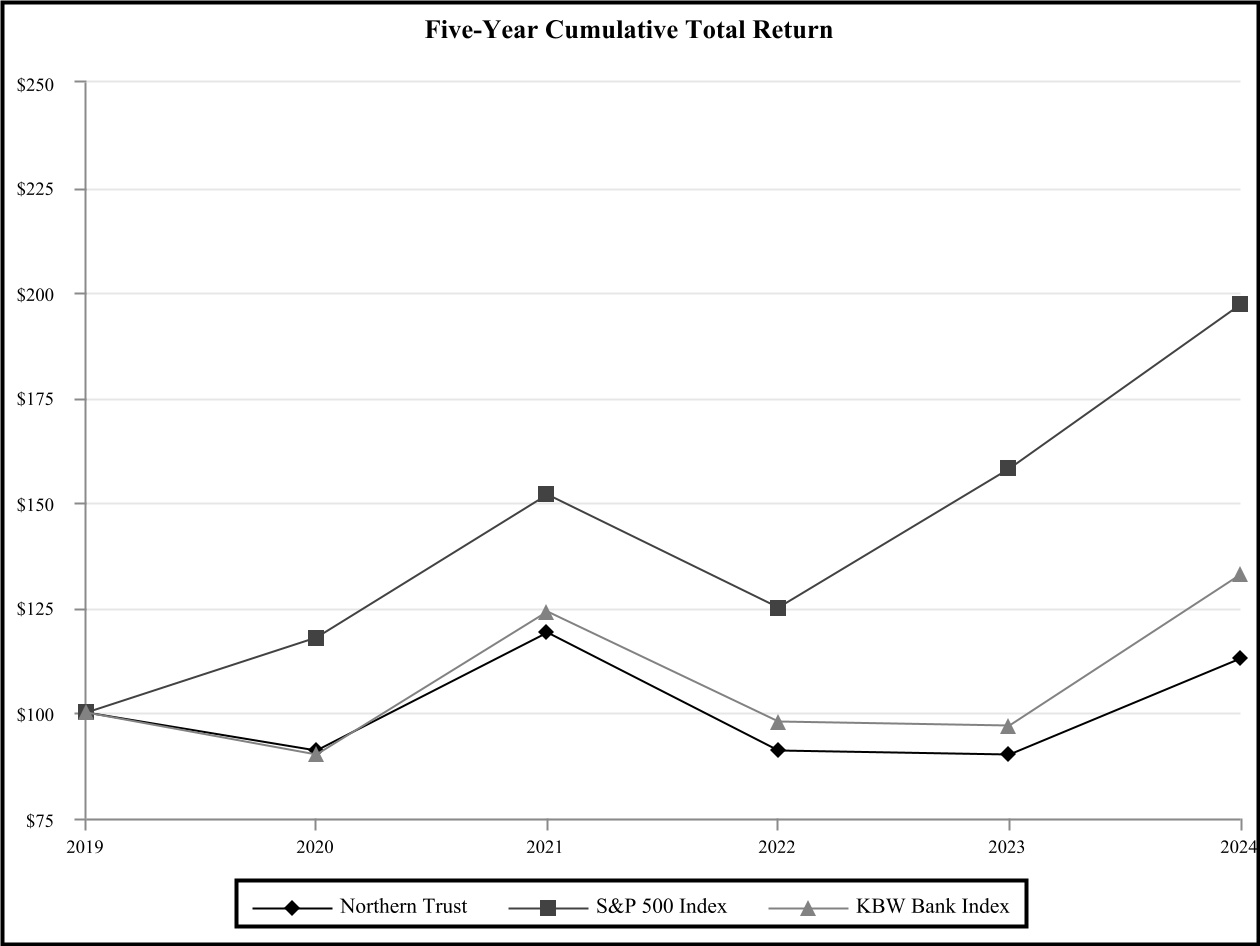
The following graph compares the cumulative total stockholder return on the Corporation’s common stock to the cumulative total return of the S&P 500 Index and the KBW Bank Index for the five fiscal years ended December 31, 2024. The cumulative total stockholder return assumes the investment of $100 in the Corporation’s common stock and in each index on December 31, 2019 and assumes reinvestment of dividends. The KBW Bank Index is a modified-capitalization-weighted index made up of 24 of the largest banking companies in the United States. The Corporation is included in the S&P 500 Index and the KBW Bank Index.
Total Return Assumes $100 Invested on December 31, 2019 with Reinvestment of Dividends
| DECEMBER 31, | ||||||||||||||||||||
| 2019 | 2020 | 2021 | 2022 | 2023 | 2024 | |||||||||||||||
| Northern Trust | $ | 100 | $ | 91 | $ | 119 | $ | 91 | $ | 90 | $ | 113 | ||||||||
| S&P 500 Index | 100 | 118 | 152 | 125 | 158 | 197 | ||||||||||||||
| KBW Bank Index | 100 | 90 | 124 | 98 | 97 | 133 |
Item 6. [RESERVED]
| 2024 ANNUAL REPORT | NORTHERN TRUST CORPORATION 37 |
MANAGEMENT’S DISCUSSION AND ANALYSIS OF FINANCIAL CONDITION AND RESULTS OF OPERATIONS
Item 7. MANAGEMENT’S DISCUSSION AND ANALYSIS OF FINANCIAL CONDITION AND RESULTS OF OPERATIONS
The following is management’s discussion and analysis of the financial condition and results of operations (MD&A) of Northern Trust Corporation (Corporation) for the year ended December 31, 2024. The following should be read in conjunction with the consolidated financial statements and related footnotes included in this report. Investors also should read the section titled “Forward-Looking Statements.”
BUSINESS OVERVIEW
The Corporation is a leading provider of wealth management, asset servicing, asset management and banking solutions to corporations, institutions, families and individuals. The Corporation focuses on managing and servicing client assets through its two client-focused reporting segments: Asset Servicing and Wealth Management. Asset management and related services are provided to Asset Servicing and Wealth Management clients primarily by the Asset Management business.
The Corporation conducts business through various U.S. and non-U.S. subsidiaries, including The Northern Trust Company (the Bank). The Corporation was formed as a holding company for the Bank in 1971. The Corporation has a global presence with offices in 24 U.S. states and Washington, D.C., and across 22 locations in Canada, Europe, the Middle East and the Asia-Pacific region. Except where the context requires otherwise, the terms “Northern Trust,” “we,” “us,” “our,” “its,” or similar terms refers to the Corporation and its subsidiaries on a consolidated basis.
FINANCIAL OVERVIEW
TABLE 3: FINANCIAL HIGHLIGHTS
| FOR THE YEAR ENDED DECEMBER 31, | % Change(1) | |||||||||||||||||||
| ($ In Millions) | 2024 | 2023 | 2022 | 2024 / 2023 | 2023 / 2022 | |||||||||||||||
| Noninterest Income | $ | 6,113.3 | $ | 4,791.5 | $ | 4,874.0 | 28 | % | (2) | % | ||||||||||
| Net Interest Income | 2,177.1 | 1,982.0 | 1,887.2 | 10 | % | 5 | % | |||||||||||||
| Total Revenue | $ | 8,290.4 | $ | 6,773.5 | $ | 6,761.2 | 22 | % | — | % | ||||||||||
| Provision for Credit Losses | (3.0) | 24.5 | 12.0 | N/M | N/M | |||||||||||||||
| Noninterest Expense | 5,633.9 | 5,284.2 | 4,982.9 | 7 | % | 6 | % | |||||||||||||
| Income before Income Taxes | $ | 2,659.5 | $ | 1,464.8 | $ | 1,766.3 | 82 | % | (17) | % | ||||||||||
| Provision for Income Taxes | 628.4 | 357.5 | 430.3 | 76 | % | (17) | % | |||||||||||||
| Net Income | $ | 2,031.1 | $ | 1,107.3 | $ | 1,336.0 | 83 | % | (17) | % | ||||||||||
| Preferred Stock Dividends | 41.8 | 41.8 | 41.8 | — | % | — | % | |||||||||||||
| Net Income Applicable to Common Stock | $ | 1,989.3 | $ | 1,065.5 | $ | 1,294.2 | 87 | % | (18) | % | ||||||||||
| PER COMMON SHARE | ||||||||||||||||||||
| Net Income – Basic | $ | 9.80 | $ | 5.09 | $ | 6.16 | 93 | % | (17) | % | ||||||||||
| – Diluted | 9.77 | 5.08 | 6.14 | 92 | % | (17) | % | |||||||||||||
| Cash Dividends Declared Per Common Share | 3.00 | 3.00 | 2.90 | — | % | 3 | % | |||||||||||||
| Carrying Value – End of Period (EOP) | 60.74 | 53.69 | 49.78 | 13 | % | 8 | % | |||||||||||||
| Market Price – EOP | 102.50 | 84.38 | 88.49 | 21 | % | (5) | % | |||||||||||||
| SELECTED RATIOS AND METRICS | ||||||||||||||||||||
| Return on Average Common Equity | 17.4 | % | 10.0 | % | 12.7 | % | ||||||||||||||
| Return on Average Assets | 1.39 | 0.78 | 0.88 | |||||||||||||||||
| Dividend Payout Ratio | 30.7 | 59.1 | 47.2 | |||||||||||||||||
| Average Stockholders’ Equity to Average Assets | 8.4 | 8.1 | 7.3 |
(1) Percentage calculations are based on actual balances rather than the rounded amounts presented in the table above.
N/M - Not meaningful
| 38 2024 ANNUAL REPORT | NORTHERN TRUST CORPORATION |
MANAGEMENT’S DISCUSSION AND ANALYSIS OF FINANCIAL CONDITION AND RESULTS OF OPERATIONS
CONSOLIDATED RESULTS OF OPERATIONS
The following information summarizes our consolidated results of operations for 2024 compared to 2023. For a discussion related to the consolidated results of operations for 2023 compared to 2022, refer to Part II, Item 7, “Management’s Discussion and Analysis of Financial Condition and Results of Operations,” in our Annual Report on Form 10-K for the year ended December 31, 2023 (2023 Form 10-K), which was filed with the United States Securities and Exchange Commission on February 27, 2024.
Revenue
Northern Trust generates the majority of its revenue from Noninterest Income that primarily consists of Trust, Investment and Other Servicing Fees. Net Interest Income comprises the remainder of revenue and consists of Interest Income generated by earning assets, net of Interest Expense on deposits and borrowed funds.
Revenue in 2024 of $8.3 billion increased $1.5 billion, or 22%, from $6.8 billion in 2023, primarily driven by higher Other Operating Income, Trust, Investment and Other Servicing Fees, and Net Interest Income. Noninterest Income represented 74% and 71% of total revenue in 2024 and 2023, respectively, and totaled $6.1 billion in 2024, which increased $1.3 billion, or 28%, from $4.8 billion in 2023.
Noninterest Income in 2024 increased primarily due to higher Other Operating Income as well as Trust, Investment and Other Servicing Fees. Other Operating Income of $1.2 billion in 2024 increased $928.7 million from $228.7 million in the prior year, primarily driven by a $896.7 million gain related to Northern Trust’s participation in an exchange offer related to shares of a class of Visa, Inc. common stock and a $68.1 million gain on the sale of an equity investment, partially offset by mark-to-market activity on existing swap agreements related to shares of a class of Visa, Inc. common stock, including a $12.8 million expense related to litigation escrow funding, as well as losses recognized as a result of a securities repositioning related to the supplemental pension plan and impairment charges taken on certain investments. Please refer to Note 24, “Commitments and Contingent Liabilities” included under Item 8, “Financial Statements and Supplementary Data,” for additional details related to the exchange offer. Trust, Investment and Other Servicing Fees of $4.7 billion in 2024 increased $366.0 million, or 8%, from $4.4 billion in 2023, primarily due to favorable markets and net new business. Investment Security Gains (Losses), net reflects $189.3 million of losses in 2024 as compared to $169.5 million of losses in 2023, both due to repositionings of the available for sale debt securities portfolio in each year.
Net Interest Income on a fully taxable equivalent (FTE) basis in 2024 of $2.2 billion increased $169.4 million, or 8%, from $2.0 billion in 2023, primarily due to higher deposits and higher average interest rates, partially offset by an unfavorable balance sheet mix. The net interest margin on an FTE basis increased to 1.64% in 2024 from 1.56% in 2023, primarily due to higher average interest rates and a favorable funding mix shift. Average earning assets increased $3.6 billion, or 3%, from $1
Showing the first 8K of 268K characters. Open the full section
Item 7A. QUANTITATIVE AND QUALITATIVE DISCLOSURES ABOUT MARKET RISK
The information called for by this item is incorporated herein by reference to the “Risk Management” section of Item 7, “Management’s Discussion and Analysis of Financial Condition and Results of Operations,” in this Annual Report on Form 10-K.
| 90 2024 ANNUAL REPORT | NORTHERN TRUST CORPORATION |
Item 8. FINANCIAL STATEMENTS AND SUPPLEMENTARY DATA
Report of Independent Registered Public Accounting Firm
To the Stockholders and Board of Directors
Northern Trust Corporation:
Opinion on the Consolidated Financial Statements
We have audited the accompanying consolidated balance sheets of Northern Trust Corporation and subsidiaries (the Corporation) as of December 31, 2024 and 2023, the related consolidated statements of income, comprehensive income, changes in stockholders’ equity, and cash flows for each of the years in the three-year period ended December 31, 2024, and the related notes (collectively, the consolidated financial statements). In our opinion, the consolidated financial statements present fairly, in all material respects, the financial position of the Corporation as of December 31, 2024 and 2023, and the results of its operations and its cash flows for each of the years in the three-year period ended December 31, 2024, in conformity with U.S. generally accepted accounting principles.
We also have audited, in accordance with the standards of the Public Company Accounting Oversight Board (United States) (PCAOB), the Corporation’s internal control over financial reporting as of December 31, 2024, based on criteria established in Internal Control – Integrated Framework (2013) issued by the Committee of Sponsoring Organizations of the Treadway Commission, and our report dated February 24, 2025 expressed an unqualified opinion on the effectiveness of the Corporation’s internal control over financial reporting.
Basis for Opinion
These consolidated financial statements are the responsibility of the Corporation’s management. Our responsibility is to express an opinion on these consolidated financial statements based on our audits. We are a public accounting firm registered with the PCAOB and are required to be independent with respect to the Corporation in accordance with the U.S. federal securities laws and the applicable rules and regulations of the Securities and Exchange Commission and the PCAOB.
We conducted our audits in accordance with the standards of the PCAOB. Those standards require that we plan and perform the audit to obtain reasonable assurance about whether the consolidated financial statements are free of material misstatement, whether due to error or fraud. Our audits included performing procedures to assess the risks of material misstatement of the consolidated financial statements, whether due to error or fraud, and performing procedures that respond to those risks. Such procedures included examining, on a test basis, evidence regarding the amounts and disclosures in the consolidated financial statements. Our audits also included evaluating the accounting principles used and significant estimates made by management, as well as evaluating the overall presentation of the consolidated financial statements. We believe that our audits provide a reasonable basis for our opinion.
Critical Audit Matter
The critical audit matter communicated below is a matter arising from the current period audit of the consolidated financial statements that was communicated or required to be communicated to the audit committee and that: (1) relates to accounts or disclosures that are material to the consolidated financial statements and (2) involved our especially challenging, subjective, or complex judgments. The communication of a critical audit matter does not alter in any way our opinion on the consolidated financial statements, taken as a whole, and we are not, by communicating the critical audit matter below, providing a separate opinion on the critical audit matter or on the accounts or disclosures to which it relates.
| 2024 ANNUAL REPORT | NORTHERN TRUST CORPORATION 91 |
Assessment of the allowance for credit losses for commercial loans evaluated on a collective basis
As discussed in Notes 1 and 6 to the consolidated financial statements, the Corporation’s allowance for credit losses for commercial loans evaluated on a collective basis (the collective ACL) was $137.3 million of a total allowance for credit losses assigned to loans of $168.0 million as of December 31, 2024. Expected credit losses are measured on a collective basis as long as the financial assets included in the respective pool share similar risk characteristics. The allowance estimation methodology for the collective assessment is based on data representative of the Corporation’s financial asset portfolio from a historical observation period that includes both expansionary and recessionary periods. The estimation methodology and the related qualitative adjustment framework segregate the loan portfolio into segments based on loan and obligor specific factors, including loan type, borrower type, collateral type, loan size, and borrower credit quality. The estimation methodology applies probability of default and loss given default assumptions to the projected exposure at default on a pool basis. For each segment, the probability of default (PD) and loss given default (LGD) are derived for each quarter of the remaining life of each instrument. For the first two years (the reasonable and supportable period), these factors are derived by applying quarterly macroeconomic projections using models developed from historical data on macroeconomic factors and loans with similar factors, including the borrower rating assigned to individual obligors, as applicable. For periods beyond the reasonable and supportable period, the Corporation reverts to its own long-run historical loss experience on a straight-line basis over four quarters. The projected exposure at default for every quarter is based on contractual balance projections as of each quarter-end. Estimating expected lifetime credit losses requires the consideration of the effect of future economic conditions. The Corporation employs multiple scenarios over a reasonable and supportable period to project future conditions. The Corporation determines the probability weights assigned to each scenario at each quarter-end. The quantitative allowance is then reviewed within the qualitative adjustment framework, through which the Corporation applies judgment by assessing internal risk factors, potential limitations in the quantitative methodology, and other factors that are not fully contemplated in the forecast to compute adjustments to the quantitative allowance that may impact individual or multiple segments of the loan portfolio.
We identified the assessment of the quantitative component of the collective ACL as a critical audit matter. A high degree of audit effort, including specialized skills and knowledge, and subjective and complex auditor judgment was involved in the assessment of the quantitative component of the collective ACL due to significant measurement uncertainty. Specifically, the assessment encompassed the evaluation of the quantitative component of the collective ACL methodology, including the methods and models used to estimate the PD and LGD and their significant assumptions, the multiple economic forecast scenarios and macroeconomic factors and their respective weightings, and borrower ratings for certain commercial loans. In addition, auditor judgment was required to evaluate the sufficiency of audit evidence obtained.
The following are the primary procedures we performed to address this critical audit matter. We evaluated the design and operating effectiveness of certain internal controls related to the critical audit matter. This included controls related to the Corporation’s measurement of the quantitative component of the collective ACL estimate, including controls over:
-
development of the quantitative component of the collective ACL methodology
-
development, calibration and/or performance monitoring of certain PD and LGD models
-
development and approval of the multiple
Showing the first 8K of 408K characters. Open the full section
Item 9. CHANGES IN AND DISAGREEMENTS WITH ACCOUNTANTS ON ACCOUNTING AND FINANCIAL DISCLOSURE
None.
Item 9A. CONTROLS AND PROCEDURES
Disclosure Controls and Procedures
As of December 31, 2024, the Corporation’s management, with the participation of the Corporation’s Chief Executive Officer and Chief Financial Officer, evaluated the effectiveness of the Corporation’s disclosure controls and procedures (as defined in Rules 13a-15(e) and 15d-15(e) under the Exchange Act) that are designed to ensure that information required to be disclosed by the Corporation in the reports that it files or submits under the Exchange Act is recorded, processed, summarized and reported within the time periods specified in the SEC’s rules and forms. Based on such evaluation, such officers have concluded that, as of December 31, 2024, the Corporation’s disclosure controls and procedures are effective.
Management’s Report on Internal Control Over Financial Reporting
Management of the Corporation is responsible for establishing and maintaining adequate internal control over financial reporting (as defined in Rules 13a-15(f) and 15d-15(f) under the Exchange Act) to provide reasonable assurance to the Corporation’s management and Board of Directors regarding the preparation of reliable published financial statements. This internal control includes monitoring mechanisms, and actions are taken to correct deficiencies identified.
Management assessed the Corporation’s internal control over financial reporting as of December 31, 2024, based on the criteria for effective internal control over financial reporting described in Internal Control – Integrated Framework (2013) issued by the Committee of Sponsoring Organizations of the Treadway Commission. Based on this assessment, management concluded that, as of December 31, 2024, the Corporation maintained effective internal control over financial reporting. Additionally, KPMG LLP, the independent registered public accounting firm that audited the Corporation’s consolidated financial statements as of, and for the year ended, December 31, 2024, included in this Annual Report on Form 10-K, has issued an attestation report on the effectiveness of the Corporation’s internal control over financial reporting as of December 31, 2024.
Changes in Internal Control Over Financial Reporting
There have been no changes in the Corporation’s internal control over financial reporting identified in connection with the evaluation required by Rules 13a-15 and 15d-15 under the Exchange Act during the last fiscal quarter that have materially affected, or are reasonably likely to materially affect, the Corporation’s internal control over financial reporting.
| 2024 ANNUAL REPORT | NORTHERN TRUST CORPORATION 169 |
Report of Independent Registered Public Accounting Firm
To the Stockholders and Board of Directors
Northern Trust Corporation:
Opinion on Internal Control Over Financial Reporting
We have audited Northern Trust Corporation and subsidiaries’ (the Corporation) internal control over financial reporting as of December 31, 2024, based on criteria established in Internal Control – Integrated Framework (2013) issued by the Committee of Sponsoring Organizations of the Treadway Commission. In our opinion, the Corporation maintained, in all material respects, effective internal control over financial reporting as of December 31, 2024, based on criteria established in Internal Control – Integrated Framework (2013) issued by the Committee of Sponsoring Organizations of the Treadway Commission.
We also have audited, in accordance with the standards of the Public Company Accounting Oversight Board (United States) (PCAOB), the consolidated balance sheets of the Corporation as of December 31, 2024 and 2023, the related consolidated statements of income, comprehensive income, changes in stockholders’ equity, and cash flows for each of the years in the three-year period ended December 31, 2024, and the related notes (collectively, the consolidated financial statements), and our report dated February 24, 2025 expressed an unqualified opinion on those consolidated financial statements.
Basis for Opinion
The Corporation’s management is responsible for maintaining effective internal control over financial reporting and for its assessment of the effectiveness of internal control over financial reporting, included in the accompanying Management’s Report on Internal Control Over Financial Reporting. Our responsibility is to express an opinion on the Corporation’s internal control over financial reporting based on our audit. We are a public accounting firm registered with the PCAOB and are required to be independent with respect to the Corporation in accordance with the U.S. federal securities laws and the applicable rules and regulations of the Securities and Exchange Commission and the PCAOB.
We conducted our audit in accordance with the standards of the PCAOB. Those standards require that we plan and perform the audit to obtain reasonable assurance about whether effective internal control over financial reporting was maintained in all material respects. Our audit of internal control over financial reporting included obtaining an understanding of internal control over financial reporting, assessing the risk that a material weakness exists, and testing and evaluating the design and operating effectiveness of internal control based on the assessed risk. Our audit also included performing such other procedures as we considered necessary in the circumstances. We believe that our audit provides a reasonable basis for our opinion.
Definition and Limitations of Internal Control Over Financial Reporting
A company’s internal control over financial reporting is a process designed to provide reasonable assurance regarding the reliability of financial reporting and the preparation of financial statements for external purposes in accordance with generally accepted accounting principles. A company’s internal control over financial reporting includes those policies and procedures that (1) pertain to the maintenance of records that, in reasonable detail, accurately and fairly reflect the transactions and dispositions of the assets of the company; (2) provide reasonable assurance that transactions are recorded as necessary to permit preparation of financial statements in accordance with generally accepted accounting principles, and that receipts and expenditures of the company are being made only in accordance with authorizations of management and directors of the company; and (3) provide reasonable assurance regarding prevention or timely detection of unauthorized acquisition, use, or disposition of the company’s assets that could have a material effect on the financial statements.
Because of its inherent limitations, internal control over financial reporting may not prevent or detect misstatements. Also, projections of any evaluation of effectiveness to future periods are subject to the risk that controls may become inadequate because of changes in conditions, or that the degree of compliance with the policies or procedures may deteriorate.
Chicago, Illinois
February 24, 2025
| 170 2024 ANNUAL REPORT | NORTHERN TRUST CORPORATION |
Item 9B. OTHER INFORMATION
During the three months ended December 31, 2024, none of our directors or officers (as defined in Rule 16a-1(f) promulgated under the Securities Exchange Act of 1934, as amended) adopted, terminated or modified a Rule 10b5-1 trading arrangement or a non-Rule 10b5-1 trading arrangement (as such terms are defined in Item 408 of Regulation S-K).
Item 9C. DISCLOSURE REGARDING FOREIGN JURISDICTIONS THAT PREVENT INSPECTIONS
Not applicable.
PART III
Item 10. DIRECTORS, EXECUTIVE OFFICERS AND CORPORATE GOVERNANCE
The information called for by this item is incorporated by reference to “Supplemental Item – Information About Our Executive Officers” in Part I of this Annual Report on Form 10-K, as well as the following sections of the Corporation’s definitive Proxy Statement for the 2025 Annual Meeting of Stockholders: “Item 1 – Election of Directors,” “Information about the Nominees for Director,” “Security Ownership by Directors and Executive Officers,” “Corporate Governance – Code of Business Conduct and Ethics,” “Corporate Governance – Director Nominations and Qualifications and Proxy Access,” “Corporate Governance – Securities Transaction Policy and Policy Against Hedging,” “Board and Board Committee Information – Audit Committee” and “Board and Board Committee Information – Board Committees.”
Item 11. EXECUTIVE COMPENSATION
The information called for by this item is incorporated herein by reference to the “Compensation Discussion and Analysis,” “Human Capital and Compensation Committee Report,” “Executive Compensation,” and “Director Compensation” sections of the Corporation’s definitive Proxy Statement for the 2025 Annual Meeting of Stockholders.
Item 12. SECURITY OWNERSHIP OF CERTAIN BENEFICIAL OWNERS AND MANAGEMENT AND RELATED STOCKHOLDER MATTERS
The information called for by this item is incorporated herein by reference to the “Security Ownership by Directors and Executive Officers,” “Security Ownership of Certain Beneficial Owners,” and “Equity Compensation Plan Information” sections of the Corporation’s definitive Proxy Statement for the 2025 Annual Meeting of Stockholders.
Item 13. CERTAIN RELATIONSHIPS AND RELATED TRANSACTIONS, AND DIRECTOR INDEPENDENCE
The information called for by this item is incorporated herein by reference to the “Board and Board Committee Information,” “Corporate Governance – Director Independence” and the “Corporate Governance – Related Person Transactions Policy” sections of the Corporation’s definitive Proxy Statement for the 2025 Annual Meeting of Stockholders.
Item 14. PRINCIPAL ACCOUNTANT FEES AND SERVICES
The information called for by this item is incorporated herein by reference to the “Audit Matters” section of the Corporation’s definitive Proxy Statement for the 2025 Annual Meeting of Stockholders.
| 2024 ANNUAL REPORT | NORTHERN TRUST CORPORATION 171 |
PART IV
ITEM 15 – EXHIBITS AND FINANCIAL STATEMENT SCHEDULES
ITEM 15(a)(1) AND (2) – NORTHERN TRUST CORPORATION AND SUBSIDIARIES LIST OF FINANCIAL STATEMENTS AND FINANCIAL STATEMENT SCHEDULES
The following financial statements of the Corporation and its Subsidiaries included in Item 8, “Financial Statements and Supplementary Data,” of this Annual Report on Form 10-K are incorporated herein by reference.
| For Northern Trust Corporation and Subsidiaries: | ||
| Consolidated Balance Sheets - December 31, 2024 and 2023 | ||
| Consolidated Statements of Income - Years Ended December 31, 2024, 2023, and 2022 | ||
| Consolidated Statements of Comprehensive Income - Years Ended December 31, 2024, 2023, and 2022 | ||
| Consolidated Statements of Changes in Stockholders’ Equity - Years Ended December 31, 2024, 2023, and 2022 | ||
| Consolidated Statements of Cash Flows - Years Ended December 31, 2024, 2023, and 2022 | ||
| Notes to Consolidated Financial Statements | ||
| Report of Independent Registered Public Accounting Firm (KPMG LLP, Chicago, IL, Auditor Firm ID: 185) |
Financial statement schedules have been omitted for the reason that they are not required or are not applicable.
Item 15. (a)(3) – EXHIBITS
| 172 2024 ANNUAL REPORT | NORTHERN TRUST CORPORATION |
| 2024 ANNUAL REPORT | NORTHERN TRUST CORPORATION 173 |
| 174 2024 ANNUAL REPORT | NORTHERN TRUST CORPORATION |
*** Indicates a management contract or a compensatory plan or agreement.*
**** Indicates a document being furnished with this Form 10-K. Information in this Form 10-K furnished herewith shall not be deemed to be “filed” for the purposes of Section 18 of the Securities Exchange Act of 1934, as amended, or otherwise subject to the liabilities of that Section. Such exhibit shall not be deemed incorporated by reference into any filing under the Securities Act of 1933, as amended, or the Securities Exchange Act of 1934.*
Item 16. FORM 10-K SUMMARY
None.
| 2024 ANNUAL REPORT | NORTHERN TRUST CORPORATION 175 |
SIGNATURES
Pursuant to the requirements of Section 13 or 15(d) of the Securities Exchange Act of 1934, the Registrant has duly caused this Annual Report on Form 10-K to be signed on its behalf by the undersigned, thereunto duly authorized.
Date: February 24, 2025
| Northern Trust Corporation | |||||
| (Registrant) | |||||
| By: | /s/ Michael G. O’Grady | ||||
| Michael G. O’Grady | |||||
| Chairman and Chief Executive Officer |
Pursuant to the requirements of the Securities Exchange Act of 1934, this Annual Report on Form 10-K has been signed below by the following persons on behalf of the Registrant and in the capacities and on the date indicated.
| 176 2024 ANNUAL REPORT | NORTHERN TRUST CORPORATION |
| Signature | Capacity | |||||||
| /s/ Michael G. O'Grady | Chairman and Chief Executive Officer (Principal Executive Officer) | |||||||
| Michael G. O’Grady | ||||||||
| /s/ David W. Fox, Jr. | Executive Vice President and Chief Financial Officer (Principal Financial Officer) | |||||||
| David W. Fox, Jr. | ||||||||
| /s/ John P. Landers | Executive Vice President and Controller (Principal Accounting Officer) | |||||||
| John P. Landers | ||||||||
| /s/ Linda Walker Bynoe | Director | |||||||
| Linda Walker Bynoe | ||||||||
| /s/ Susan Crown | Director | |||||||
| Susan Crown | ||||||||
| /s/ Chandra Dhandapani | Director | |||||||
| Chandra Dhandapani | ||||||||
| /s/ Dean M. Harrison | Director | |||||||
| Dean M. Harrison | ||||||||
| /s/ Jay L. Henderson | Director | |||||||
| Jay L. Henderson | ||||||||
| /s/ Marcy S. Klevorn | Director | |||||||
| Marcy S. Klevorn | ||||||||
| /s/ Siddharth N. (Bobby) Mehta | Director | |||||||
| Siddharth N. (Bobby) Mehta | ||||||||
| /s/ Richard M. Petrino | Director | |||||||
| Richard M. Petrino | ||||||||
| /s/ Martin P. Slark | Director | |||||||
| Martin P. Slark | ||||||||
| /s/ David H.B. Smith, Jr. | Director | |||||||
| David H.B. Smith, Jr. | ||||||||
| /s/ Donald Thompson | Director | |||||||
| Donald Thompson | ||||||||
| /s/ Charles A. Tribbett, III | Director | |||||||
| Charles A. Tribbett, III |
Date: February 24, 2025
| 2024 ANNUAL REPORT | NORTHERN TRUST CORPORATION 177 |