 filings.tools
NVIDIA 10-K 2023-01-29
Filed 2023-02-24. 23 sections, 400K characters. Original on sec.gov · Markdown · JSON
Cover and table of contents
UNITED STATES
SECURITIES AND EXCHANGE COMMISSION
Washington, D.C. 20549
FORM 10-K
| ☒ | ANNUAL REPORT PURSUANT TO SECTION 13 OR 15(d) OF THE SECURITIES EXCHANGE ACT OF 1934 |
For the fiscal year ended January 29, 2023
OR
| ☐ | TRANSITION REPORT PURSUANT TO SECTION 13 OR 15(d) OF THE SECURITIES EXCHANGE ACT OF 1934 |
Commission file number: 0-23985
NVIDIA CORPORATION
(Exact name of registrant as specified in its charter)
| Delaware | 94-3177549 | ||||
| (State or other jurisdiction of | (I.R.S. Employer | ||||
| Incorporation or Organization) | Identification No.) |
2788 San Tomas Expressway
Santa Clara, California 95051
(408) 486-2000
(Address, including zip code, and telephone number, including area code, of principal executive offices)
Securities registered pursuant to Section 12(b) of the Act:
| Title of each class | Trading Symbol(s) | Name of each exchange on which registered | ||||||
| Common Stock, $0.001 par value per share | NVDA | The Nasdaq Global Select Market |
Securities registered pursuant to Section 12(g) of the Act:
None
Indicate by check mark if the registrant is a well-known seasoned issuer, as defined in Rule 405 of the Securities Act. Yes ☐ No ☒
Indicate by check mark if the registrant is not required to file reports pursuant to Section 13 or Section 15(d) of the Act. Yes ☐ No ☒
Indicate by check mark whether the registrant (1) has filed all reports required to be filed by Section 13 or 15(d) of the Securities Exchange Act of 1934 during the preceding 12 months (or for such shorter period that the registrant was required to file such reports), and (2) has been subject to such filing requirements for the past 90 days. Yes ☒ No ☐
Indicate by check mark whether the registrant has submitted electronically every Interactive Data File required to be submitted pursuant to Rule 405 of Regulation S-T (§232.405 of this chapter) during the preceding 12 months (or for such shorter period that the registrant was required to submit such files). Yes ☒ No ☐
Indicate by check mark whether the registrant is a large accelerated filer, an accelerated filer, a non-accelerated filer, a smaller reporting company, or an emerging growth company. See the definitions of “large accelerated filer," “accelerated filer," “smaller reporting company," and "emerging growth company" in Rule 12b-2 of the Exchange Act.
| Large accelerated filer | ☒ | Accelerated filer | ☐ | Non-accelerated filer | ☐ | Smaller reporting company | ☐ | Emerging growth company | ☐ |
If an emerging growth company, indicate by check mark if the registrant has elected not to use the extended transition period for complying with any new or revised financial accounting standards provided pursuant to Section 13(a) of the Exchange Act. ☐
Indicate by check mark whether the registrant has filed a report on and attestation to its management’s assessment of the effectiveness of its internal control over financial reporting under Section 404(b) of the Sarbanes-Oxley Act (15 U.S.C. 7262(b)) by the registered public accounting firm that prepared or issued its audit report. ☒
If securities are registered pursuant to Section 12(b) of the Act, indicate by check mark whether the financial statements of the registrant included in the filing reflect the correction of an error to previously issued financial statements. ☐
Indicate by check mark whether any of those error corrections are restatements that required a recovery analysis of incentive-based compensation received by any of the registrant’s executive officers during the relevant recovery period pursuant to §240.10D-1(b). ☐
Indicate by check mark whether the registrant is a shell company (as defined in Rule 12b-2 of the Act). Yes ☐ No ☒
The aggregate market value of the voting stock held by non-affiliates of the registrant as of July 29, 2022 was approximately $434.37 billion (based on the closing sales price of the registrant's common stock as reported by the Nasdaq Global Select Market on July 29, 2022). This calculation excludes 98 million shares held by directors and executive officers of the registrant. This calculation does not exclude shares held by such organizations whose ownership exceeds 5% of the registrant's outstanding common stock that have represented to the registrant that they are registered investment advisers or investment companies registered under section 8 of the Investment Company Act of 1940.
The number of shares of common stock outstanding as of February 17, 2023 was 2.47 billion.
DOCUMENTS INCORPORATED BY REFERENCE
Portions of the registrant's Proxy Statement for its 2023 Annual Meeting of Shareholders to be filed with the Securities and Exchange Commission pursuant to Regulation 14A not later than 120 days after the end of the fiscal year covered by this Annual Report on Form 10-K are incorporated by reference into Part III, Items 10-14 of this Annual Report on Form 10-K.
NVIDIA CORPORATION
TABLE OF CONTENTS
WHERE YOU CAN FIND MORE INFORMATION
Investors and others should note that we announce material financial information to our investors using our investor relations website, press releases, SEC filings and public conference calls and webcasts. We also use the following social media channels as a means of disclosing information about the company, our products, our planned financial and other announcements and attendance at upcoming investor and industry conferences, and other matters and for complying with our disclosure obligations under Regulation FD:
NVIDIA Twitter Account (https://twitter.com/nvidia)
NVIDIA Corporate Blog (http://blogs.nvidia.com)
NVIDIA Facebook Page (https://www.facebook.com/nvidia)
NVIDIA LinkedIn Page (http://www.linkedin.com/company/nvidia)
NVIDIA Instagram Page (https://www.instagram.com/nvidia)
In addition, investors and others can view NVIDIA videos on YouTube (https://www.YouTube.com/nvidia).
The information we post through these social media channels may be deemed material. Accordingly, investors should monitor these accounts and the blog, in addition to following our press releases, SEC filings and public conference calls and webcasts. This list may be updated from time to time. The information we post through these channels is not a part of this Annual Report on Form 10-K. These channels may be updated from time to time on NVIDIA's investor relations website.
Forward-Looking Statements
This Annual Report on Form 10-K contains forward-looking statements which are based on our management's beliefs and assumptions and on information currently available to our management. In some cases, you can identify forward-looking statements by terms such as “may,” “will,” “should,” “could,” “goal,” “would,” “expect,” “plan,” “anticipate,” “believe,” “estimate,” “project,” “predict,” “potential” and similar expressions intended to identify forward-looking statements. These statements involve known and unknown risks, uncertainties and other factors, which may cause our actual results, performance, time frames or achievements to be materially different from any future results, performance, time frames or achievements expressed or implied by the forward-looking statements. We discuss many of these risks, uncertainties and other factors in this Annual Report on Form 10-K in greater detail under the heading “Risk Factors.” Given these risks, uncertainties and other factors, you should not place undue reliance on these forward-looking statements. Also, these forward-looking statements represent our estimates and assumptions only as of the date of this filing. You should read this Annual Report on Form 10-K completely and with the understanding that our actual future results may be materially different from what we expect. We hereby qualify our forward-looking statements by these cautionary statements. Except as required by law, we assume no obligation to update these forward-looking statements publicly, or to update the reasons actual results could differ materially from those anticipated in these forward-looking statements, even if new information becomes available in the future.
All references to “NVIDIA,” “we,” “us,” “our” or the “Company” mean NVIDIA Corporation and its subsidiaries.
In addition, statements that “we believe” and similar statements reflect our beliefs and opinions on the relevant subject. These statements are based upon information available to us as of the filing date of this Annual Report on Form 10-K, and while we believe such information forms a reasonable basis for such statements, such information may be limited or incomplete, and our statements should not be read to indicate that we have conducted an exhaustive inquiry into, or review of, all potentially available relevant information. These statements are inherently uncertain and investors are cautioned not to unduly rely upon these statements.
© 2023 NVIDIA Corporation. All rights reserved.
PART I
Item 1. BUSINESS
Our Company
NVIDIA pioneered accelerated computing to help solve the most challenging computational problems. Since our original focus on PC graphics, we have expanded to several other large and important computationally intensive fields. Fueled by the sustained demand for exceptional 3D graphics and the scale of the gaming market, NVIDIA has leveraged its GPU architecture to create platforms for scientific computing, artificial intelligence, or AI, data science, autonomous vehicles, or AV, robotics, metaverse and 3D internet applications.
The GPU was initially used to simulate human imagination, enabling the virtual worlds of video games and films. Today, it also simulates human intelligence, enabling a deeper understanding of the physical world. Its parallel processing capabilities, supported by thousands of computing cores, are essential to running deep learning algorithms. This form of AI, in which software writes itself by learning from large amounts of data, can serve as the brain of computers, robots and self-driving cars that can perceive and understand the world. GPU-powered deep learning is being adopted by thousands of enterprises to deliver services and products that would have been immensely difficult with traditional coding. Some of the most recent applications of GPU-powered deep learning include recommendation systems, which are AI algorithms trained to understand the preferences, previous decisions, and characteristics of people and products using data gathered about their interactions, large language models, which can recognize, summarize, translate, predict and generate text and other content based on knowledge gained from massive datasets, and generative AI, which uses algorithms that create new content, including audio, code, images, text, simulations, and videos, based on the data they have been trained on.
NVIDIA has a platform strategy, bringing together hardware, systems, software, algorithms, libraries, and services to create unique value for the markets we serve. While the computing requirements of these end markets are diverse, we address them with a unified underlying architecture leveraging our GPUs and software stacks. The programmable nature of our architecture allows us to support several multi-billion-dollar end markets with the same underlying technology by using a variety of software stacks developed either internally or by third-party developers and partners. The large and growing number of developers across our platforms strengthens our ecosystem and increases the value of our platform to our customers.
Innovation is at our core. We have invested over $37 billion in research and development since our inception, yielding inventions that are essential to modern computing. Our invention of the GPU in 1999 defined modern computer graphics and established NVIDIA as the leader in computer graphics. With our introduction of the CUDA programming model in 2006, we opened the parallel processing capabilities of our GPU for general purpose computing. This approach significantly accelerates the most demanding high-performance computing, or HPC, applications in fields such as aerospace, bio-science research, mechanical and fluid simulations, and energy exploration. Today, our GPUs and networking accelerate many of the fastest supercomputers across the world. In addition, the massively parallel compute architecture of our GPUs and associated software are well suited for deep learning and machine learning, powering the era of AI. While traditional CPU-based approaches no longer deliver advances on the pace described by Moore’s Law, NVIDIA accelerated computing delivers performance improvements on a pace ahead of Moore’s Law, giving the industry a path forward.
Gamers choose NVIDIA GPUs to enjoy immersive, increasingly cinematic virtual worlds. GPUs also help underpin the world’s fastest growing spectator sport, eSports, which attracts hundreds of millions of viewers to watch top-quality live video gaming. In addition to serving the growing number of gamers, the market for gaming GPUs is expanding because of the burgeoning population of live streamers, broadcasters, artists and creators.
Researchers and developers use our GPUs to accelerate a wide range of important applications, from simulating molecular dynamics to climate forecasting. With support for more than 2,800 applications - including 23 of the top 25 HPC applications - NVIDIA GPUs enable some of the most promising areas of discovery, from climate prediction to materials science and from wind tunnel simulation to genomics. Including GPUs and networking, NVIDIA powers over 70% of the supercomputers on the global TOP500 list, including 23 of the top 30 systems on the Green500 list.
The world’s leading cloud service providers, or CSPs, and consumer internet companies use our GPUs and broader data center-scale accelerated computing platforms to enable, accelerate or enrich the services they deliver to billions of end-users, including search, recommendations, social networking, online shopping, live video, translation, AI assistants, navigation, and cloud computing.
A rapidly growing number of enterprises and startups across a broad range of industries use our GPUs and software to bring automation to the products and services they build. The transportation industry is turning to our platforms for autonomous driving; the healthcare industry is leveraging them for enhanced medical imaging and acceleration of drug discovery; and the financial services industry is using them for fraud detection.
Professional designers use our GPUs and software to create visual effects in movies and to design buildings and products ranging from cell phones to commercial aircraft.
Headquartered in Santa Clara, California, NVIDIA was incorporated in California in April 1993 and reincorporated in Delaware in April 1998.
Termination of the Arm Share Purchase Agreement
In February 2022, NVIDIA and SoftBank Group Corp., or SoftBank, announced the termination of the Share Purchase Agreement whereby NVIDIA would have acquired Arm Limited, or Arm, from SoftBank. The parties agreed to terminate because of significant regulatory challenges preventing the completion of the transaction. We recorded an acquisition termination cost of $1.35 billion in fiscal year 2023 reflecting the write-off of the prepayment provided at signing.
Our Businesses
We report our business results in two segments.
The Compute & Networking segment includes our Data Center accelerated computing platform; networking; automotive AI Cockpit, autonomous driving development agreements, and autonomous vehicle solutions; electric vehicle computing platforms; Jetson for robotics and other embedded platforms; NVIDIA AI Enterprise and other software; and cryptocurrency mining processors, or CMP.
The Graphics segment includes GeForce GPUs for gaming and PCs, the GeForce NOW game streaming service and related infrastructure, and solutions for gaming platforms; Quadro/NVIDIA RTX GPUs for enterprise workstation graphics; virtual GPU, or vGPU, software for cloud-based visual and virtual computing; automotive platforms for infotainment systems; and Omniverse Enterprise software for building and operating metaverse and 3D internet applications.
Our Markets
We specialize in markets in which our computing platforms can provide tremendous acceleration for applications. These platforms incorporate processors, interconnects, software, algorithms, systems, and services to deliver unique value. Our platforms address four large markets where our expertise is critical: Data Center, Gaming, Professional Visualization, and Automotive.
Data Center
The NVIDIA computing platform is focused on accelerating the most compute-intensive workloads, such as AI, data analytics, graphics and scientific computing, across hyperscale, cloud, enterprise, public sector, and edge data centers. The platform consists of our energy efficient GPUs, data processing units, or DPUs, interconnects and systems, our CUDA programming model, and a growing body of software libraries, software development kits, or SDKs, application frameworks and services, which are either available as part of the platform or packaged and sold separately.
For both AI and HPC applications, the NVIDIA accelerated computing platform greatly increases computer and data center performance and power efficiency relative to conventional CPU-only approaches. In the field of AI, NVIDIA’s platform accelerates both deep learning and machine learning workloads. Deep learning is a computer science approach where neural networks are trained to recognize patterns from massive amounts of data in the form of images, sounds and text - in some instances better than humans - and in turn provide predictions in production use cases. Machine learning is a related approach that leverages algorithms as well
as data to learn how to make determinations or predictions. HPC, which includes scientific computing, uses numerical computational approaches to solve large and complex problems.
We are engaged with thousands of organizations working on AI in a multitude of industries, from automating tasks such as consumer product and service recommendations, to chatbots for the automation of or assistance with live customer interactions, to enabling fraud detection in financial services, to optimizing oil exploration and drilling. These organizations include the world’s leading consumer internet and cloud services companies, enterprises and startups seeking to implement AI in transformative ways across multiple industries. We partner with industry leaders to help transform their applications or their computing platforms. We also have partnerships in transportation, retail, healthcare, and manufacturing, among others, to accelerate the adoption of AI.
At the foundation of the NVIDIA accelerated computing platform are our GPUs, which excel at parallel workloads such as the training and inferencing of neural networks. They are available in industry standard servers from every major computer maker and CSP, as well as in our DGX AI supercomputer, a purpose-built system for deep learning and GPU accelerated applications. To facilitate customer adoption, we have also built other ready-to-use system reference designs around our GPUs, including HGX for hyperscale and supercomputing data centers, EGX for enterprise and edge computing, IGX for high-precision edge AI, and AGX for autonomous machines.
In fiscal year 2023, we introduced the Hopper architecture of data center GPUs, and started shipping the first Hopper-based GPU – the flagship H100. Hopper includes a Transformer Engine, designed to accelerate the training of AI transformer models by an order of magnitude over the prior generation. H100 is ideal for accelerating applications such as large language models, deep recommender systems, genomics and complex digital twins.
NVIDIA will offer enterprise customers NVIDIA AI cloud services directly and through our network of partners. Examples of these services include NVIDIA DGX Cloud, which is cloud-based infrastructure and software for training AI models, and customizable pretrained AI models. NVIDIA has partnered with leading cloud service providers to host these services in their data centers.
Our networking solutions include InfiniBand and Ethernet network adapters and switches, related software, and cables. This has enabled us to architect end-to-end data center-scale computing platforms that can interconnect thousands of compute nodes with high-performance networking. While historically the server was the unit of computing, as AI and HPC workloads have become extremely large spanning thousands of compute nodes, the data center has become the new unit of computing, with networking as an integral part.
Beyond GPUs, NVIDIA has expanded its data center processor portfolio to include DPUs, currently shipping in the market, and CPUs with samples planned to ship in the first half of fiscal year 2024. The NVIDIA Bluefield DPU is supported by foundational data-center-infrastructure-on-a-chip software, or DOCA, that lets developers build software-defined, hardware-accelerated networking, security, storage and management applications for BlueField DPUs. Partners supporting Bluefield include many of the top security, storage and networking companies. We can optimize across the entire computing, networking and storage stack to deliver data center-scale computing solutions. The Grace CPU is designed for AI infrastructure and high-performance computing, providing the highest performance and twice the memory bandwidth and energy-efficiency compared to today’s leading server chips.
While our approach starts with powerful chips, what makes it a full-stack computing platform is our large body of software, including the CUDA parallel programming model, the CUDA-X collection of application acceleration libraries, Application Programming Interfaces, or APIs, SDKs and tools, and domain-specific application frameworks. We also offer the NVIDIA GPU Cloud registry, or NGC, a comprehensive catalog of easy-to-use, optimized software stacks across a range of domains including scientific computing, deep learning, and machine learning. With NGC, AI developers, researchers and data scientists can get started with the development of AI and HPC applications and deploy them on DGX systems, NVIDIA-Certified systems from our partners, or with NVIDIA’s cloud partners.
In addition to software that is delivered to customers as an integral part of our data center computing platform, we offer paid licenses to NVIDIA AI Enterprise, a comprehensive suite of enterprise-grade AI software; and NVIDIA vGPU software for graphics-rich virtual desktops and workstations.
Gaming
Gaming is the largest entertainment industry, with PC gaming as the predominant platform. Many factors propel computer gaming’s growth, including new high production value games and franchises, the continued rise of competitive gaming or eSports, social connectivity and the increasing popularity of game streamers, modders, or gamers who create game modifications, and creators.
Our gaming platforms leverage our GPUs and sophisticated software to enhance the gaming experience with smoother, higher quality graphics. We developed NVIDIA RTX to bring next generation graphics and AI to games. NVIDIA RTX features ray tracing technology for real-time, cinematic-quality rendering. Ray tracing, which has long been used for special effects in the movie industry, is a computationally intensive technique that simulates the physical behavior of light to achieve greater realism in computer-generated scenes. NVIDIA RTX also features deep learning super sampling, or NVIDIA DLSS, our AI technology that boosts frame rates while generating beautiful, sharp images for games.
Our products for the gaming market include GeForce RTX and GeForce GTX GPUs for gaming desktop and laptop PCs, GeForce NOW cloud gaming for playing PC games on underpowered devices, SHIELD for high quality streaming on TV, as well as system-on-chips (SOCs) and development services for game consoles.
In fiscal year 2023, we introduced the GeForce RTX 40 Series of gaming GPUs, based on the Ada Lovelace architecture. The 40 Series features our third generation RTX technology, third generation NVIDIA DLSS, and fourth generation Tensor Cores to deliver up to 4X the performance of the previous generation.
Professional Visualization
We serve the Professional Visualization market by working closely with independent software vendors, or ISVs, to optimize their offerings for NVIDIA GPUs. Our GPU computing platform enhances productivity and introduces new capabilities for critical workflows in many fields, such as design and manufacturing and digital content creation. Design and manufacturing encompass computer-aided design, architectural design, consumer-products manufacturing, medical instrumentation, and aerospace. Digital content creation includes professional video editing and post-production, special effects for films, and broadcast-television graphics.
The NVIDIA RTX platform makes it possible to render film-quality, photorealistic objects and environments with physically accurate shadows, reflections and refractions using ray tracing in real-time. Many leading 3D design and content creation applications developed by our ecosystem partners now support RTX, allowing professionals to accelerate and transform their workflows with NVIDIA RTX GPUs and software.
Digital images used in product design need to mirror reality. This requires simulating the physical behavior of light and materials, or physically-based rendering. NVIDIA Omniverse is a virtual world simulation and collaboration platform for 3D workflows, such as building and operating metaverse and 3D internet applications, available as a software subscription for enterprise use and free for individual use. Omniverse, virtual reality, or VR, and augmented reality, or AR, are being incorporated in a growing number of enterprise applications. Virtual car showrooms, surgical training, architectural walkthroughs, and bringing historical scenes to life all deploy these technologies, powered by our GPUs.
Automotive
NVIDIA’s Automotive market is comprised of AV, AI cockpit, electric vehicle computing platforms, and infotainment platform solutions. Leveraging our technology leadership in AI and building on our long-standing automotive relationships, we are delivering a complete end-to-end solution for the AV market under the DRIVE Hyperion brand. NVIDIA has demonstrated multiple applications of AI within the car: AI can drive the car itself as a pilot in fully autonomous mode or it can also be a co-pilot, assisting the human driver while creating a safer driving experience.
NVIDIA is working with several hundred partners in the automotive ecosystem including automakers, truck makers, tier-one suppliers, sensor manufacturers, automotive research institutions, HD mapping companies, and startups to develop and deploy AI systems for self-driving vehicles. Our unified AI computing architecture starts with training deep neural networks using our GPUs, and then running a full perception, fusion, planning and control stack within the vehicle on the NVIDIA DRIVE Hyperion platform. The DRIVE Hyperion platform consists of the high-performance, energy efficient DRIVE AGX computing hardware, a reference sensor set that supports full self-driving capability as well as an open, modular DRIVE Software
platform. The DRIVE Software platform includes DRIVE Chauffeur for autonomous driving, mapping and parking services, Drive Concierge for intelligent in-vehicle experiences, and real time conversational AI capability based on NVIDIA Omniverse Avatar software.
In addition, we offer a scalable data center-based simulation solution, NVIDIA DRIVE Sim, based on NVIDIA Omniverse software, for digital cockpit development, as well as for testing and validating a self-driving platform. NVIDIA's unique end-to-end, software-defined approach is designed for continuous innovation and continuous development, enabling cars to receive over-the-air updates to add new features and capabilities throughout the life of a vehicle.
Business Strategies
NVIDIA’s key strategies that shape our overall business approach include:
Advancing the NVIDIA accelerated computing platform. NVIDIA’s accelerated computing platform can solve complex problems in significantly less time and with lower power consumption than alternative computational approaches. Indeed, it can help solve problems that were previously deemed unsolvable. We work to deliver continued performance leaps that outpace Moore’s Law by leveraging innovation across the architecture, chip design, system, interconnect, and software layers. This full-stack innovation approach allows us to deliver order-of-magnitude performance advantages relative to legacy approaches in our target markets, which include Data Center, Gaming, Professional Visualization, and Automotive. While the computing requirements of these end markets are diverse, we address them with a unified underlying architecture leveraging our GPUs, CUDA and networking technologies as the fundamental building blocks. The programmable nature of our architecture allows us to make leveraged investments in research and development: we can support several multi-billion-dollar end markets with shared underlying technology by using a variety of software stacks developed either internally or by third-party developers and partners. We utilize this platform approach in each of our target markets.
Extending our technology and platform leadership in AI. We provide a complete, end-to-end accelerated computing platform for deep learning and machine learning, addressing both training and inferencing. This includes GPUs, interconnects, systems, our CUDA programming language, algorithms, libraries, and other software. GPUs are uniquely suited to AI, and we will continue to add AI-specific features to our GPU architecture to further extend our leadership position. Our AI technology leadership is reinforced by our large and expanding ecosystem in a virtuous cycle. Our GPU platforms are available from virtually every major server maker and CSP, as well as on our own AI supercomputer. There are 3.8 million developers worldwide using CUDA and our other software tools to help deploy our technology in our target markets. We evangelize AI through partnerships with hundreds of universities and over 13,000 startups through our Inception program. Additionally, our Deep Learning Institute provides instruction on the latest techniques on how to design, train, and deploy neural networks in applications using our accelerated computing platform.
Extending our technology and platform leadership in computer graphics. We believe that computer graphics is fundamental to the continued expansion and evolution of computing. We apply our research and development resources to enhance the user experience for consumer entertainment and professional visualization applications, and create new virtual world and simulation capabilities. Our technologies are instrumental in driving gaming forward, as developers leverage our libraries and algorithms to deliver an optimized gaming experience on our GeForce platform. Our computer graphics platforms leverage not only our industry-leading GeForce and NVIDIA RTX GPUs, but also optimized software stacks. For example, GeForce Experience enhances each gamer’s experience by optimizing their PC’s settings, as well as enabling the recording and sharing of gameplay. Our Studio drivers enhance and accelerate a number of popular creative applications. Omniverse is real-time 3D design collaboration and virtual world simulation software that empowers artists, designers and creators to connect and collaborate in leading design applications. We also enable interactive graphics applications - such as games, movie and photo editing and design software - to be accessed by almost any device, almost anywhere, through our cloud platforms such as vGPU for enterprise and GeForce NOW for gaming.
Advancing the leading autonomous vehicle platform. We believe the advent of AV will soon revolutionize the transportation industry. In our view, AI is the key technology enabler of this opportunity, as the algorithms required for autonomous driving - such as perception, localization, and planning - are too complex for legacy hand-coded approaches and will use multiple trained neural networks instead. Therefore, we provide a full functionally safe AI-based hardware and software solution for the AV market under the DRIVE brand, which we are bringing to market through our partnerships with automotive original equipment manufacturers, or
OEMs, tier-1 suppliers, and start-ups. Our AV solution also includes the GPU-based hardware required to train the neural networks before their in-vehicle deployment, as well as to re-simulate their operation prior to any over-the-air software updates. We believe our comprehensive, top-to-bottom and end-to-end approach will enable the transportation industry to solve the complex problems arising from the shift to autonomous driving.
Leveraging our intellectual property, or IP. We believe our IP is a valuable asset that can be accessed by our customers and partners through license and development agreements when they desire to build such capabilities directly into their own products, or have us do so through a custom development. Such license and development arrangements can further enhance the reach of our technology.
Sales and Marketing
Our worldwide sales and marketing strategy is key to achieving our objective of providing markets with our high-performance and efficient computing platforms and software. Our sales and marketing teams, located across our global markets, work closely with end customers and various industry ecosystems through our partner network. Our partner network incorporates each industry's respective OEMs, original device manufacturers, or ODMs, system builders, add-in board manufacturers, or AIBs, retailers/distributors, ISVs, internet and CSPs, automotive manufacturers and tier-1 automotive suppliers, mapping companies, start-ups, and other ecosystem participants.
Members of our sales team have technical expertise and product and industry knowledge. We also employ a team of application engineers and solution architects to assist our partner network in designing, testing, and qualifying system designs that incorporate our platforms. We believe that the depth and quality of our design support are key to improving our partner network’s time-to-market, maintaining a high level of customer satisfaction, and fostering relationships that encourage our end customers and partner network to use the next generation of our products within each platform.
To encourage the development of applications optimized for our platforms and software, we seek to establish and maintain strong relationships in the software development community. Engineering and marketing personnel engage with key software developers to promote and discuss our platforms, as well as to ascertain individual product requirements and solve technical problems. Our developer program makes our products available to developers prior to launch in order to encourage the development of AI frameworks, SDKs, and APIs for software applications and game titles that are optimized for our platforms. Our Deep Learning Institute provides in-person and online training for developers in industries and organizations around the world to build AI and accelerated computing applications that leverage our platforms.
As NVIDIA’s business has evolved from a focus primarily on gaming products to broader markets, and from chips to platforms, systems and software, so, too, have our avenues to market. Thus, in addition to sales to customers in our partner network, certain of our products are also sold direct to CSPs, enterprise customers, retail channels and consumers.
Seasonality
Our computing platforms serve a diverse set of markets such as consumer gaming, enterprise and cloud data centers, professional workstations, and automotive. Our consumer products typically see stronger revenue in the second half of our fiscal year. In addition, based on the production schedules of key customers, some of our products for notebooks and game consoles typically generate stronger revenue in the second and third quarters, and weaker revenue in the fourth and first quarters. In fiscal year 2023, our supply exceeded our demand in several areas, and our revenue did not follow historical seasonal patterns. Historical seasonality trends may not repeat.
Manufacturing
We do not manufacture semiconductors used for our products. Instead, we utilize a fabless manufacturing strategy, whereby we employ key suppliers for all phases of the manufacturing process, including wafer fabrication, assembly, testing, and packaging. This strategy uses the expertise of industry-leading suppliers that are certified by the International Organization for Standardization in such areas as fabrication, assembly, quality control and assurance, reliability, and testing. Additionally, we can avoid many of the significant costs and risks associated with owning and operating manufacturing operations. While we may directly procure certain raw materials used in the production of our products, such as memory, substrates and a variety of components, our suppliers are responsible for procurement of most of the raw materials used in the
production of our products. As a result, we can focus our resources on product design, additional quality assurance, marketing, and customer support. We have placed non-cancellable inventory orders for certain product components in advance of our historical lead times, paid premiums and provided deposits to secure future supply and capacity and may need to continue to do so in the future.
We have expanded our supplier relationships to build redundancy and resilience in our operations. We utilize suppliers, such as Taiwan Semiconductor Manufacturing Company Limited and Samsung Electronics Co. Ltd, to produce our semiconductor wafers. We then utilize independent subcontractors and contract manufacturers, such as Amkor Technology, BYD Auto Co. Ltd., or BYD Auto, Hon Hai Precision Industry Co., or Hon Hai, King Yuan Electronics Co., Ltd., Omni Logistics, LLC, Siliconware Precision Industries Company Ltd., and Wistron Corporation to perform assembly, testing, and packaging of most of our products and platforms. We use contract manufacturers such as Flex Ltd., Jabil Inc., and Universal Scientific Industrial Co., Ltd., to manufacture our standard and custom adapter card products and switch systems, and Fabrinet to manufacture our networking cables. We purchase substrates from Ibiden Co. Ltd., Kinsus Interconnect Technology Corporation, and Unimicron Technology Corporation, and memory from Micron Technology, Samsung Semiconductor, Inc., or Samsung, and SK Hynix. We often consign key components or materials such as the GPU, SoC, memory, and integrated circuit to the contract manufacturers.
We typically receive semiconductor products from our subcontractors, perform incoming quality assurance and configuration using test equipment purchased from industry-leading suppliers such as Advantest America Inc. and Chroma ATE Inc., and then ship the semiconductors to contract manufacturers, such as BYD Auto and Hon Hai, distributors, motherboard and add-in card, or AIC, customers from our third-party warehouses in Hong Kong, Israel, and the United States. Generally, these manufacturers assemble and test the boards based on our design kit and test specifications, and then ship our products to retailers, system builders, or OEMs as motherboard and AIC solutions.
Competition
The market for our products is intensely competitive and is characterized by rapid technological change and evolving industry standards. We believe that the principal competitive factors in this market are performance, breadth of product offerings, access to customers and partners and distribution channels, software support, conformity to industry standard APIs, manufacturing capabilities, processor pricing, and total system costs. We believe that our ability to remain competitive will depend on how well we are able to anticipate the features and functions that customers and partners will demand and whether we are able to deliver consistent volumes of our products at acceptable levels of quality and at competitive prices. We expect competition to increase from both existing competitors and new market entrants with products that may be lower priced than ours or may provide better performance or additional features not provided by our products. In addition, it is possible that new competitors or alliances among competitors could emerge and acquire significant market share.
A significant source of competition comes from companies that provide or intend to provide GPUs, CPUs, DPUs, embedded SoCs, and other accelerated, AI computing processor products, and providers of semiconductor-based high-performance interconnect products based on InfiniBand, Ethernet, Fibre Channel and proprietary technologies. Some of our competitors may have greater marketing, financial, distribution and manufacturing resources than we do and may be more able to adapt to customer or technological changes. We expect an increasingly competitive environment in the future.
Our current competitors include:
-
suppliers and licensors of hardware and software for discrete and integrated GPUs, custom chips and other accelerated computing solutions, including solutions offered for AI, such as Advanced Micro Devices, Inc., or AMD, and Intel Corporation, or Intel;
-
large cloud services companies with internal teams designing chips and software that incorporate accelerated or AI computing functionality as part of their internal solutions or platforms, such as Alibaba Group, Alphabet Inc., Amazon, Inc., and Baidu, Inc.;
-
suppliers of Arm-based CPUs and companies that incorporate CPUs as part of their internal solutions or platforms;
-
suppliers of SoC products that are used in servers or embedded into automobiles, autonomous machines, and gaming devices, such as Ambarella, Inc., AMD, Broadcom Inc., or Broadcom, Intel, Qualcomm Incorporated, Renesas Electronics Corporation, and Samsung, or companies with internal teams designing SoC products for internal use, such as Tesla, Inc.; and
-
suppliers of interconnect, switch cable solutions, and DPUs such as AMD, Applied Optoelectronics, Inc., Arista Networks, Broadcom, Cisco Systems, Inc., or Cisco, Hewlett Packard Enterprise Company, Intel, Juniper Networks, Inc., Lumentum Holdings, and Marvell Technology Group, as well as internal teams of system vendors and large cloud services companies.
Patents and Proprietary Rights
We rely primarily on a combination of patents, trademarks, trade secrets, employee and third-party nondisclosure agreements, and licensing arrangements to protect our IP in the United States and internationally. Our currently issued patents have expiration dates from March 2023 to June 2045. We have numerous patents issued, allowed, and pending in the United States and in foreign jurisdictions. Our patents and pending patent applications primarily relate to our products and the technology used in connection with our products. We also rely on international treaties, organizations, and foreign laws to protect our IP. The laws of certain foreign countries in which our products are or may be manufactured or sold, including various countries in Asia, may not protect our products or IP rights to the same extent as the laws of the United States. This decreased protection makes the possibility of piracy of our technology and products more likely. We continuously assess whether and where to seek formal protection for particular innovations and technologies based on such factors as:
-
the location in which our products are manufactured;
-
our strategic technology or product directions in different countries;
-
the degree to which IP laws exist and are meaningfully enforced in different jurisdictions; and
-
the commercial significance of our operations and our competitors' operations in particular countries and regions.
We have licensed technology from third parties and expect to continue to enter into such license agreements.
Government Regulations
Our worldwide business activities are subject to various laws, rules, and regulations of the United States as well as of foreign governments.
During the third quarter of fiscal year 2023, the U.S. government announced new license requirements that impact certain exports to China (including Hong Kong and Macau) and Russia of some of our data center products. The impact of the new license requirements is difficult to quantify, and it may be challenging for us to manage our operations and forecast our operating results due to these requirements. Refer to “Item 1A. Risk Factors- Risks Related to Regulatory, Legal, Our Stock and Other Matters” for a discussion of this potential impact.
Additionally, our acquisitions may be subject to government regulatory reviews, and the cost to comply with such regulations or costs incurred where regulatory challenges prevent the completion of an acquisition could have a material impact on our business. In February 2022, we announced the termination of the Share Purchase Agreement by which we would have acquired Arm due to significant regulatory challenges preventing the completion of the transaction. We recorded an acquisition termination cost of $1.35 billion in fiscal year 2023 reflecting the write-off of the prepayment provided at signing.
Compliance with laws, rules, and regulations has not otherwise had a material effect upon our capital expenditures, results of operations, or competitive position and we do not currently anticipate material capital expenditures for environmental control facilities. Compliance with existing or future governmental regulations, including, but not limited to, those pertaining to IP ownership and infringement, taxes, import and export requirements and tariffs, anti-corruption, business acquisitions, foreign exchange controls and cash repatriation restrictions, data privacy requirements, competition and antitrust, advertising, employment, product regulations, cybersecurity, environmental, health and safety requirements, the responsible use of AI,
climate change, cryptocurrency, and consumer laws, could increase our costs, impact our competitive position, and otherwise may have a material adverse impact on our business, financial condition and results of operations in subsequent periods. Refer to “Item 1A. Risk Factors” for a discussion of these potential impacts.
Environmental, Social and Corporate Governance
NVIDIA invents computing technologies that improve lives and address global challenges. Our goal is to integrate sound environmental, social and corporate governance, or ESG, principles and practices into every aspect of the Company. The Nominating and Corporate Governance Committee of our Board of Directors is responsible for reviewing and discussing with management our practices related to ESG. We assess our programs annually in consideration of stakeholder expectations, market trends, and business risks and opportunities. These issues are important for our continued business success and reflect the topics of highest concern to NVIDIA and our stakeholders.
The following section and the Human Capital Management Section below provide an overview of our principles and practices. More information can be found on the Corporate Responsibility section of our website and in our annual Corporate Responsibility Report, or CR Report. Information contained on our website or in our annual CR Report is not incorporated by reference into this or any other report we file with the Securities and Exchange Commission, or the SEC. Refer to “Item 1A. Risk Factors” for a discussion of risks and uncertainties we face related to ESG.
Climate Change
In the area of sustainability, we address our climate impacts across our product lifecycle and assess risks, including current and emerging regulations and market impacts.
In our CR Report published in July 2022, we published metrics related to our environmental impact for fiscal year 2022. Fiscal year 2023 metrics are expected to be published in the first half of fiscal year 2024. There has been no material impact to our capital expenditures, results of operations or competitive position associated with global sustainability regulations, compliance, or costs from sourcing renewable energy. By the end of fiscal year 2025, our goal is to purchase or generate enough renewable energy to match 100% of our global electricity usage for our offices and data centers.
Whether it is creation of technology to power next-generation laptops or designs to support high-performance supercomputers, improving energy efficiency is important in our research, development, and design processes. GPUs are inherently more energy efficient than other forms of computing because they are optimized for throughput, performance per watt, and certain AI workloads. The energy efficiency of our products is evidenced by our continued strong presence on the Green500 list of the most energy-efficient systems. We powered 23 of the top 30 most energy efficient systems, including the top supercomputer, on the November 2022 Green500 list.
We plan to build Earth-2, a digital twin of the Earth on NVIDIA AI and NVIDIA Omniverse platforms. Earth-2 will enable scientists, companies, and policy makers to do ultra-high-resolution predictions of the impact of climate change and explore mitigation and adaptation strategies.
Human Capital Management
We believe that our employees are our greatest assets, and they play a key role in creating long-term value for our stakeholders. As of the end of fiscal year 2023, we had 26,196 employees in 35 countries, 19,532 were engaged in research and development and 6,664 were engaged in sales, marketing, operations, and administrative positions.
To be competitive and execute our business strategy successfully, we must recruit, develop, and retain talented employees, including qualified executives, scientists, engineers, and technical and non-technical staff.
Recruitment
As the demand for global technical talent continues to be competitive, we have grown our technical workforce and have been successful in attracting top talent to NVIDIA. We have attracted strong talent globally with our differentiated hiring strategies for university, professional, executive and diverse recruits. The COVID-19 pandemic created expanded hiring opportunities in new geographies and provided increased
flexibility for employees to work from locations of their choice. Our workforce is about 80% technical and about 50% hold advanced degrees.
Earlier in fiscal year 2023, we slowed our hiring to focus on our current employees and manage costs. We maintain a connection for global talent from universities through on-campus collaborations with professors and student organizations, as well as engagement with technical organizations and participation at industry conferences. Our own employees help to surface top talent, with over 37% of our new hires in fiscal year 2023 coming from employee referrals.
Development and Retention
To support employee development, we provide opportunities to learn on-the-job through training programs, one on one coaching and ongoing feedback. We have a library of live and on-demand learning experiences that include workshops, panel discussions, and speaker forums. We curate learning paths focused on our most common development needs and constantly upgrade our offerings to ensure that our employees are exposed to the most current programs and technologies available. We offer tuition reimbursement programs to subsidize educational programs and advanced certifications. We encourage internal mobility through career coaching that advises employees on developmental activities and internal transfer opportunities. We have implemented specifically designed mentoring and development programs for women and employees from traditionally underrepresented groups to ensure widespread readiness for future advancement.
To evaluate employee sentiment and engagement, we use pulse surveys, a suggestion box, and an anonymous third-party platform. Pulse surveys help us gain insight into employee experience and provide ideas so that we can prioritize areas to take action. The suggestion box is an always-on, interactive tool where employees share their thoughts about making our company a better place to work. The anonymous third-party platform is designed to protect the identity of the reporter and provide a mechanism for reporters to follow an investigation and receive responses.
We want NVIDIA to be a place where people can build their careers over their lifetime. Our employees tend to come and stay. In fiscal year 2023, our overall turnover rate was 5.3%.
Compensation, Benefits, and Well-Being
Our compensation program rewards performance and is structured to encourage employees to invest in the Company’s future. Employees receive equity, except where unavailable due to local regulations, that is tied to the value of our stock price and vests over time to retain employees while simultaneously aligning their interests with those of our shareholders.
We offer comprehensive benefits to support our employees’ and their families’ physical health, well-being and financial health, including 401(k) programs in the U.S., statutory pension programs outside the U.S., our employee stock purchase program, flexible work hours and time off, and programs to address mental health, stress, and time-management challenges. We evaluate our benefit offerings globally and aim to provide comparable support across the regions where we operate. We are committed to providing tailored benefits based on community needs, including assistance for military members, additional mental health benefits, and support for new birth parents, and those who wish to become parents.
Diversity and Inclusion
We believe that diverse teams fuel innovation, and we are committed to creating an inclusive culture that supports all employees.
When recruiting for new talent or managing current talent, we focus on recruiting, developing, and retaining a more diverse workforce with a focus on those historically underrepresented in the technology field, including women, Black/African American, and Hispanic/Latino candidates.
To this end, we have been:
-
Partnering with institutions and professional organizations serving historically underrepresented communities;
-
Assigning dedicated recruiting teams to shepherd underrepresented candidates through the interview process;
-
Embedding inclusion recruiting partners throughout the business to help align candidates with internal opportunities;
-
Supporting the development of women employees through programs aimed at building a pipeline of future leaders;
-
Providing peer support and executive sponsors for nine internal community resource groups;
-
Providing training and education to managers and peers on fostering supportive environments and recruiting for diversity;
-
Ensuring we have and review a diverse pool of candidates for requisitions; and
-
Measuring year over year progress and providing leadership visibility on diversity efforts.
As of the end of fiscal year 2023, our global workforce was 80% male, 19% female, and 1% not declared, with 6% of our workforce in the United States composed of Black or African American and Hispanic or Latino employees.
Health and COVID-19
We supported our people and their families in making their health and safety a top priority during fiscal year 2023 and throughout the COVID-19 pandemic to keep our workforce safe.
Hybrid Working Environment
We support a hybrid work environment, understanding that many employees want the flexibility to work in the office or from home, and make that decision based on the conditions around them at any point in time.
Steps we took to support employees working from home include:
-
Home-focused health and well-being programs;
-
Learning and development resources on how to work, lead and manage remotely; and
-
Opportunities for employees to socially connect with one another virtually.
During fiscal year 2024, we will continue a flexible work environment and have instituted Company-wide “rest days” for employees to recharge.
Information About Our Executive Officers
The following sets forth certain information regarding our executive officers, their ages and positions as of February 17, 2023:
| Name | Age | Position | ||||||||||||
| Jen-Hsun Huang | 60 | President and Chief Executive Officer | ||||||||||||
| Colette M. Kress | 55 | Executive Vice President and Chief Financial Officer | ||||||||||||
| Ajay K. Puri | 68 | Executive Vice President, Worldwide Field Operations | ||||||||||||
| Debora Shoquist | 68 | Executive Vice President, Operations | ||||||||||||
| Timothy S. Teter | 56 | Executive Vice President and General Counsel |
Jen-Hsun Huang co-founded NVIDIA in 1993 and has served as our President, Chief Executive Officer and a member of the Board of Directors since our inception. From 1985 to 1993, Mr. Huang was employed at LSI Logic Corporation, a computer chip manufacturer, where he held a variety of positions including as Director of Coreware, the business unit responsible for LSI's SOC. From 1983 to 1985, Mr. Huang was a microprocessor designer for AMD, a semiconductor company. Mr. Huang holds a B.S.E.E. degree from Oregon State University and an M.S.E.E. degree from Stanford University.
Colette M. Kress joined NVIDIA in 2013 as Executive Vice President and Chief Financial Officer. Prior to NVIDIA, Ms. Kress most recently served as Senior Vice President and Chief Financial Officer of the Business Technology and Operations Finance organization at Cisco Systems, Inc., a networking equipment company, since 2010. At Cisco, Ms. Kress was responsible for financial strategy, planning, reporting and business
development for all business segments, engineering and operations. From 1997 to 2010 Ms. Kress held a variety of positions at Microsoft Corporation, or Microsoft, a software company, including, beginning in 2006, Chief Financial Officer of the Server and Tools division, where Ms. Kress was responsible for financial strategy, planning, reporting and business development for the division. Prior to joining Microsoft, Ms. Kress spent eight years at Texas Instruments Incorporated, a semiconductor company, where she held a variety of finance positions. Ms. Kress holds a B.S. degree in Finance from University of Arizona and an M.B.A. degree from Southern Methodist University.
Ajay K. Puri joined NVIDIA in 2005 as Senior Vice President, Worldwide Sales and became Executive Vice President, Worldwide Field Operations in 2009. Prior to NVIDIA, he held positions in sales, marketing, and general management over a 22-year career at Sun Microsystems, Inc., a computing systems company. Mr. Puri previously held marketing, management consulting, and product development positions at Hewlett-Packard Company, an information technology company, Booz Allen Hamilton Inc., a management and technology consulting company, and Texas Instruments Incorporated. Mr. Puri holds a B.S.E.E. degree from the University of Minnesota, an M.S.E.E. degree from the California Institute of Technology and an M.B.A. degree from Harvard Business School.
Debora Shoquist joined NVIDIA in 2007 as Senior Vice President of Operations and in 2009 became Executive Vice President of Operations. Prior to NVIDIA, Ms. Shoquist served from 2004 to 2007 as Executive Vice President of Operations at JDS Uniphase Corp., a provider of communications test and measurement solutions and optical products for the telecommunications industry. She served from 2002 to 2004 as Senior Vice President and General Manager of the Electro-Optics business at Coherent, Inc., a manufacturer of commercial and scientific laser equipment. Previously, she worked at Quantum Corp., a data protection company, as President of the Personal Computer Hard Disk Drive Division, and at Hewlett-Packard Corp. Ms. Shoquist holds a B.S. degree in Electrical Engineering from Kansas State University and a B.S. degree in Biology from Santa Clara University.
Timothy S. Teter joined NVIDIA in 2017 as Senior Vice President, General Counsel and Secretary and became Executive Vice President, General Counsel and Secretary in February 2018. Prior to NVIDIA, Mr. Teter spent more than two decades at the law firm of Cooley LLP, where he focused on litigating patent and technology related matters. Prior to attending law school, he worked as an engineer at Lockheed Missiles and Space Company, an aerospace company. Mr. Teter holds a B.S. degree in Mechanical Engineering from the University of California at Davis and a J.D. degree from Stanford Law School.
Available Information
Our annual reports on Form 10-K, quarterly reports on Form 10-Q, current reports on Form 8-K and, if applicable, amendments to those reports filed or furnished pursuant to Section 13(a) or 15(d) of the Securities Exchange Act of 1934, as amended, or the Exchange Act, are available free of charge on or through our website, http://www.nvidia.com, as soon as reasonably practicable after we electronically file such material with, or furnish it to, the Securities and Exchange Commission, or the SEC. The SEC’s website, http://www.sec.gov, contains reports, proxy and information statements, and other information regarding issuers that file electronically with the SEC. Our web site and the information on it or connected to it are not a part of this Annual Report on Form 10-K.
Item 1A. RISK FACTORS
In evaluating NVIDIA, the following risk factors should be considered in addition to the other information in this Annual Report on Form 10-K. Purchasing or owning NVIDIA common stock involves investment risks including, but not limited to, the risks described below. Any one of the following risks could harm our business, financial condition, results of operations or reputation, which could cause our stock price to decline, and you may lose all or a part of your investment. Additional risks, trends and uncertainties not presently known to us or that we currently believe are immaterial may also harm our business, financial condition, results of operations or reputation.
Risk Factors Summary
Risks Related to Our Industry and Markets
-
Failure to meet the evolving needs of our industry and markets may adversely impact our financial results.
-
Competition in our current and target markets could cause us to lose market share and revenue.
Risks Related to Demand, Supply and Manufacturing
-
Failure to estimate customer demand properly has led and could lead to mismatches between supply and demand.
-
Dependency on third-party suppliers and their technology reduces our control over product quantity and quality, manufacturing yields, development, enhancement, and product delivery schedules and could harm our business.
-
Defects in our products have caused and could cause us to incur significant expenses to remediate and can damage our business.
Risks Related to Our Global Operating Business
-
Adverse economic conditions may harm our business.
-
International operations are a significant part of our business, and economic, political, business, and other changes in the regions in which we operate may expose us to risks that could harm our business.
-
Product, system security, and data breaches and cyber-attacks could disrupt our operations and adversely affect our financial condition, stock price and reputation.
-
Business disruptions could harm our operations and financial results.
-
Climate change may have a long-term impact on our business.
-
We may not be able to realize the potential benefits of business investments or acquisitions, nor successfully integrate acquisition targets.
-
A significant amount of our revenue stems from a limited number of customers and could be adversely affected if we lose or are prevented from selling to any of these customers.
-
We may be unable to attract, retain and motivate our executives and key employees.
-
Modification or interruption of our business processes and information systems may disrupt our business, processes and internal controls.
-
The COVID-19 pandemic has affected and could continue to have a material adverse impact on our financial condition and results of operations.
-
Our operating results have in the past fluctuated and may in the future fluctuate, and if our operating results are below the expectations of securities analysts or investors, our stock price could decline.
Risks Related to Regulatory, Legal, Our Stock and Other Matters
-
We are subject to complex laws, rules and regulations, and political and other actions, which may adversely impact our business.
-
Increased scrutiny from shareholders, regulators, and others regarding our environmental, social and governance responsibilities could result in financial, reputational and operational harm.
-
Issues relating to the responsible use of our technologies, including AI, may result in reputational and financial harm and liability.
-
Adequately protecting our IP rights could be costly, and our ability to compete could be harmed if we are unsuccessful or if we are prohibited from making or selling our products.
-
We are subject to stringent and changing data privacy and security laws, rules, regulations, and other obligations. Privacy or security concerns relating to our products and services could damage our reputation, deter customers, or result in legal or regulatory proceedings and liability.
-
Our operating results may be adversely impacted by additional tax liabilities, higher than expected tax rates and other tax-related factors.
-
Our business is exposed to the risks associated with litigation, investigations and regulatory proceedings.
-
Our indebtedness could adversely affect our financial position and cash flows from operations and prevent us from implementing our strategy or fulfilling our contractual obligations.
-
Delaware law, provisions in our governing documents, and our agreement with Microsoft could delay or prevent a change in control.
Risk Factors
Risks Related to Our Industry and Markets
Failure to meet the evolving needs of our industry and markets may adversely impact our financial results.
Our accelerated computing platforms experience rapid changes in technology, customer requirements, competitive products, and industry standards.
Our success depends on our ability to:
-
timely identify industry changes, adapt our strategies, and develop new or enhance existing products and technologies that meet the evolving needs of these markets, including due to unexpected changes in industry standards or disruptive technological innovation that could render our products incompatible with products developed by other companies;
-
develop new products and technologies through investments in research and development;
-
launch new offerings with new business models including standalone software, cloud solutions, and software-, infrastructure-, or platform-as-a-service solutions;
-
expand the ecosystem for our products and technologies;
-
meet evolving and prevailing customer and industry safety and compliance standards;
-
manage product and software lifecycles to maintain customer and end user satisfaction;
-
develop, acquire, and maintain the internal and external infrastructure needed to scale our business, including our acquisitions integrations, customer support, e-commerce, IP licensing capabilities and cloud service capacity; and
-
complete technical, financial, compliance, sales and marketing investments for some of the above activities.
We invest in research and development in markets where we have a limited operating history, which may not produce meaningful revenue for several years, if at all. If we fail to develop or monetize new products and technologies, or if they do not become widely adopted, our financial results could be adversely affected. Obtaining design wins may involve a lengthy process and depend on our ability to anticipate and provide features and functionality that customers will demand. They also do not guarantee revenue. Failure to obtain a design win may prevent us from obtaining future design wins in subsequent generations. We cannot ensure that the products and technologies we bring to market will provide value to our customers and partners. If we fail any of these key success criteria, our financial results may be harmed.
We will offer enterprise customers NVIDIA AI cloud services directly and through our network of partners. Examples of these services include NVIDIA DGX Cloud, which is cloud-based infrastructure and software for training AI models, and customizable pretrained AI models. NVIDIA has partnered with leading cloud service providers to host these services in their data centers, and we entered into multi-year cloud service agreements in the second half of fiscal year 2023 to support these offerings and our research and development activities. NVIDIA AI cloud services may not be successful and will take time, resources and investment. We also offer or plan to offer standalone software solutions for AI including NVIDIA AI Enterprise, NVIDIA Omniverse, NVIDIA DRIVE for automotive, and several other software solutions. These new
business models or strategies may not be successful and we may fail to sell any meaningful standalone software or as-a-service solutions. We may incur significant costs and may not achieve any signif
Showing the first 8K of 88K characters. Open the full section
Item 1B. UNRESOLVED STAFF COMMENTS
Not applicable.
Item 2. PROPERTIES
Our headquarters is in Santa Clara, California. We own and lease approximately 3 million square feet of office and building space for our corporate headquarters. In addition, we lease data center space in Santa Clara, California. We also own and lease facilities for data centers, research and development, and/or sales and administrative purposes throughout the U.S. and in various international locations, primarily in China, India, Israel, and Taiwan. We believe our existing facilities, both owned and leased, are in good condition and suitable for the conduct of our business. We do not identify or allocate assets by operating segment. For additional information regarding obligations under leases, refer to Note 3 of the Notes to the Consolidated Financial Statements in Part IV, Item 15 of this Annual Report on Form 10-K, which information is hereby incorporated by reference.
Item 3. LEGAL PROCEEDINGS
Please see Note 13 of the Notes to the Consolidated Financial Statements in Part IV, Item 15 of this Annual Report on Form 10-K for a discussion of our legal proceedings.
Item 4. MINE SAFETY DISCLOSURES
Not applicable.
PART II
Item 5. MARKET FOR REGISTRANT’S COMMON EQUITY, RELATED STOCKHOLDER MATTERS AND ISSUER PURCHASES OF EQUITY SECURITIES
Our common stock is traded on the Nasdaq Global Select Market under the symbol NVDA. Public trading of our common stock began on January 22, 1999. Prior to that, there was no public market for our common stock. As of February 17, 2023, we had approximately 344 registered shareholders, not including those shares held in street or nominee name.
Issuer Purchases of Equity Securities
On May 23, 2022, our Board of Directors increased and extended our share repurchase program to repurchase additional common stock up to a total of $15 billion through December 2023. Since the inception of our share repurchase program, we have repurchased an aggregate of 1.10 billion shares for a total cost of $17.12 billion through January 29, 2023. During fiscal year 2023, we repurchased 63 million shares for $10.04 billion. As of January 29, 2023, we are authorized, subject to certain specifications, to repurchase shares of our common stock up to $7.23 billion through December 2023.
The repurchases can be made in the open market, in privately negotiated transactions, pursuant to a Rule 10b5-1 trading plan or in structured share repurchase programs, and can be made in one or more larger repurchases, in compliance with Rule 10b-18 of the Exchange Act, subject to market conditions, applicable legal requirements, and other factors. The program does not obligate NVIDIA to acquire any particular amount of common stock and the program may be suspended at any time at our discretion.
In fiscal year 2023, we paid $398 million in quarterly cash dividends. Our cash dividend program and the payment of future cash dividends under that program are subject to our Board of Directors' continuing determination that the dividend program and the declaration of dividends thereunder are in the best interests of our shareholders.
The following table presents details of our share repurchase transactions during the fourth quarter of fiscal year 2023:
| Period | Total Number of Shares Purchased (In millions) | Average Price Paid per Share | Total Number of Shares Purchased as Part of Publicly Announced Program (In millions) | Approximate Dollar Value of Shares that May Yet Be Purchased Under the Program (In billions) | ||||||||||||||||||||||
| October 31, 2022 - November 27, 2022 | 7 | $ | 148.11 | 7 | $ | 7.23 | ||||||||||||||||||||
| November 28, 2022 - December 25, 2022 | — | $ | — | — | $ | 7.23 | ||||||||||||||||||||
| December 26, 2022 - January 29, 2023 | — | $ | — | — | $ | 7.23 | ||||||||||||||||||||
| Total | 7 | 7 |
Restricted Stock Unit Share Withholding
We withhold common stock shares associated with net share settlements to cover tax withholding obligations upon the vesting of restricted stock unit awards under our employee equity incentive program. During fiscal year 2023, we withheld approximately 8 million shares for a total value of $1.48 billion
through net share settlements. Refer to Note 4 of the Notes to the Consolidated Financial Statements in Part IV, Item 15 of this Annual Report on Form 10-K for further discussion regarding our equity incentive plans.
Stock Performance Graphs
The following graph compares the cumulative total shareholder return for our common stock, the S&P 500 Index, and the Nasdaq 100 Index for the five years ended January 29, 2023. The graph assumes that $100 was invested on January 28, 2018 in our common stock and in each of the S&P 500 Index and the Nasdaq 100 Index. Our common stock is a component of each of the presented indices. Total return assumes reinvestment of dividends in each of the indices indicated. Total return is based on historical results and is not intended to indicate future performance.
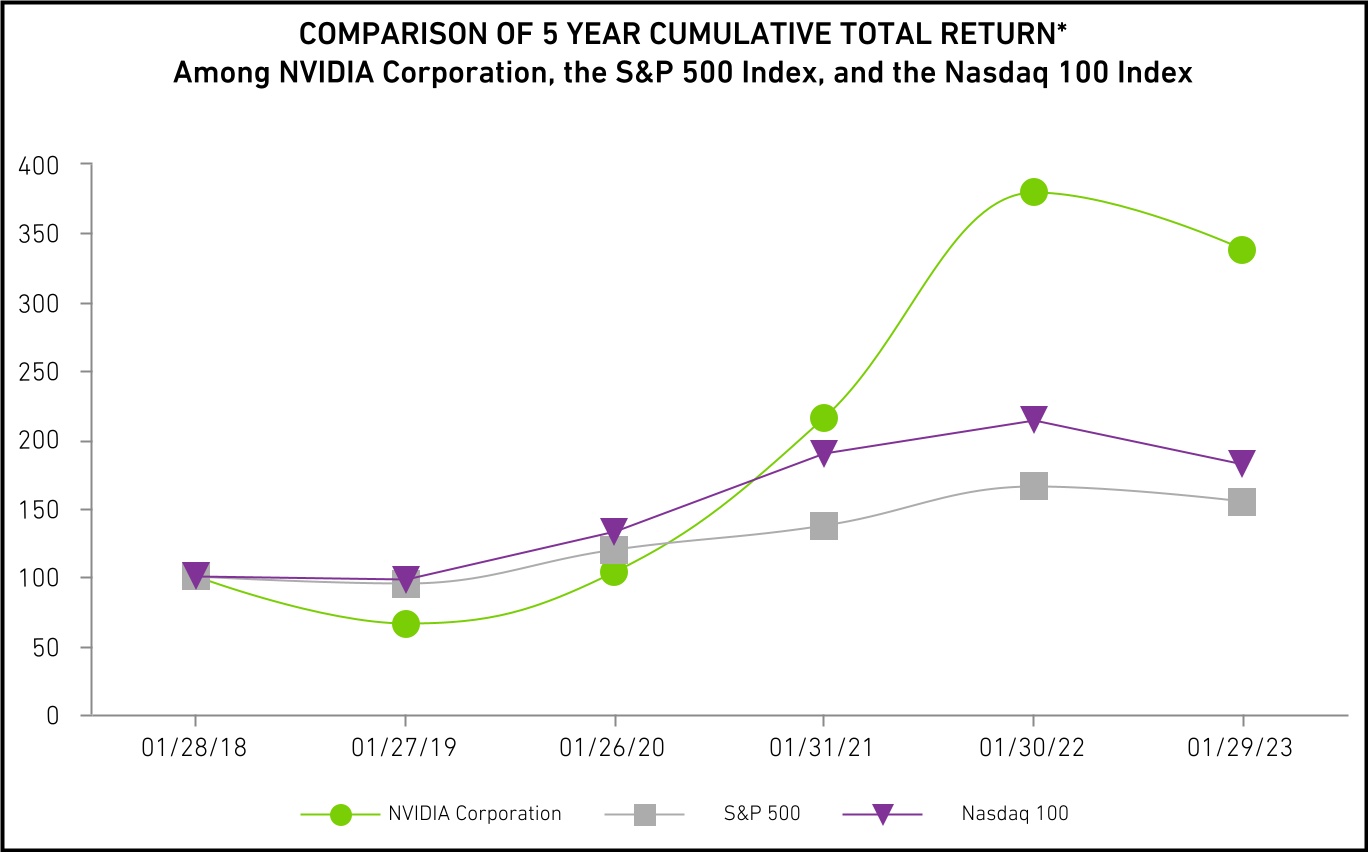
*$100 invested on 1/28/18 in stock and in indices, including reinvestment of dividends.
Source: FactSet financial data and analytics.
| 1/28/2018 | 1/27/2019 | 1/26/2020 | 1/31/2021 | 1/30/2022 | 1/29/2023 | ||||||||||||||||||||||||||||||
| NVIDIA Corporation | $ | 100.00 | $ | 66.00 | $ | 103.63 | $ | 215.33 | $ | 378.94 | $ | 338.18 | |||||||||||||||||||||||
| S&P 500 | $ | 100.00 | $ | 94.60 | $ | 119.36 | $ | 137.01 | $ | 165.79 | $ | 154.80 | |||||||||||||||||||||||
| Nasdaq 100 | $ | 100.00 | $ | 97.69 | $ | 133.01 | $ | 189.72 | $ | 213.63 | $ | 181.38 |
Item 6. [RESERVED]
Item 7. MANAGEMENT’S DISCUSSION AND ANALYSIS OF FINANCIAL CONDITION AND RESULTS OF OPERATIONS
The following discussion and analysis of our financial condition and results of operations should be read in conjunction with “Item 1A. Risk Factors”, our Consolidated Financial Statements and related Notes thereto, as well as other cautionary statements and risks described elsewhere in this Annual Report on Form 10-K, before deciding to purchase, hold or sell shares of our common stock.
Overview
Our Company and Our Businesses
NVIDIA pioneered accelerated computing to help solve the most challenging computational problems. Since our original focus on PC graphics, we have expanded to several other large and important computationally intensive fields. Fueled by the sustained demand for exceptional 3D graphics and the scale of the gaming market, NVIDIA has leveraged its GPU architecture to create platforms for scientific computing, AI, data science, AV, robotics, metaverse and 3D internet applications.
Our two operating segments are "Compute & Networking" and "Graphics." Refer to Note 17 of the Notes to the Consolidated Financial Statements in Part IV, Item 15 of this Annual Report on Form 10-K for additional information.
Headquartered in Santa Clara, California, NVIDIA was incorporated in California in April 1993 and reincorporated in Delaware in April 1998.
Recent Developments, Future Objectives and Challenges
Supply, Products Transitions, and New Products and Business Models
Our supply, which includes inventory on hand, purchase obligations and prepaid supply agreements, has grown significantly due to current supply chain conditions, complexity of our products, and recent reductions in demand. At the end of fiscal year 2023, purchase obligations and prepaid supply agreements represented more than half of our total supply. Inventory provisions for excess inventory and purchase obligations totaled $2.17 billion in fiscal year 2023. We may incur inventory provisions if our inventory or supply commitments are misaligned with demand for our products.
Product transitions are complex as we often ship both new and legacy architecture products simultaneously and we and our channel partners prepare to ship and support new products. We are currently transitioning the architecture of our Data Center, Professional Visualization, and Gaming products. Qualification time for new products, customers anticipating product transitions and channel partners reducing channel inventory of legacy architectures ahead of new product introductions can create reductions or volatility in our revenue. While we have managed prior product transitions and have previously sold multiple product architectures at the same time, these transitions are difficult and prior trends may not continue.
We build technology and products for use cases and applications that may be new or may not yet exist. Examples include our Omniverse platform and third-party large language models and generative models. Our demand estimates for these use cases and applications can be incorrect and create volatility in our revenue or supply levels, and we may not be able to generate any revenue from these use cases and applications.
NVIDIA AI Cloud Service Offerings
We will offer enterprise customers NVIDIA AI cloud services directly and through our network of partners. Examples of these services include NVIDIA DGX Cloud, which is cloud-based infrastructure and software for training AI models, and customizable pretrained AI models. NVIDIA has partnered with leading cloud service providers to host these services in their data centers.
We entered into multi-year cloud service agreements in the second half of fiscal year 2023 to these offerings and our research and development activities. NVIDIA AI cloud services may not be successful and will take time, resources and investment. We also offer or plan to offer standalone software solutions for AI including NVIDIA AI Enterprise, NVIDIA Omniverse, NVIDIA DRIVE for automotive, and several other software solutions. These new business models or strategies may not be successful and we may fail to sell any meaningful standalone software or as-a-service solutions. We may incur significant costs and may not achieve any significant revenue from these offerings.
Global Trade
During the third quarter of fiscal year 2023, the USG announced new license requirements that, with certain exceptions, impact exports to China (including Hong Kong and Macau) and Russia of our A100 and H100 integrated circuits, DGX or any other systems or boards which incorporate A100 or H100 integrated circuits and our A100X. We are required to transition certain operations out of China (including Hong Kong), including research and development and supply and distribution operations. We have engaged with customers in China to provide alternative products not subject to the new license requirements, such as our new A800 offering.
Management of these new license and other requirements is complicated and time consuming. Our results and competitive position may be harmed if customers in China do not want to purchase our alternative product offerings, if customers purchase product from competitors, or if customers develop their own internal solution, if the USG does not grant licenses in a timely manner or denies licenses to significant customers, or if we incur significant transition costs.
COVID-19
During fiscal year 2023, we reopened our offices worldwide. We incurred incremental expenses and related in-office costs as we ramped onsite services.
Restrictions may be imposed or reinstated as the pandemic resurfaces, such as lockdown measures due to COVID-19 containment efforts in China. During fiscal year 2023, end customer sales for our products in China have been negatively impacted by lockdowns and this impact may continue if lockdowns return. COVID-19-related disruptions have created and may continue to create supply chain and logistics constraints. Challenges in estimating demand could become more pronounced or volatile in the future on both a global and regional basis.
Russia
In fiscal year 2023, we stopped direct sales to Russia and later in the year, we closed business operations in Russia. Direct sales to Russia in fiscal year 2022 were immaterial. Our revenue to partners that sell into Russia may have been negatively impacted due to the war in Ukraine.
Termination of the Arm Share Purchase Agreement
In February 2022, NVIDIA and SoftBank announced the termination of the Share Purchase Agreement whereby NVIDIA would have acquired Arm from SoftBank due to significant regulatory challenges preventing the completion of the transaction. We recorded an acquisition termination cost of $1.35 billion in fiscal year 2023 reflecting the write-off of the prepayment provided at signing.
Fiscal Year 2023 Summary
| Year Ended | |||||||||||||||||
| January 29, 2023 | January 30, 2022 | Change | |||||||||||||||
| ($ in millions, except per share data) | |||||||||||||||||
| Revenue | $ | 26,974 | $ | 26,914 | — | % | |||||||||||
| Gross margin | 56.9 | % | 64.9 | % | Down 8.0 pts | ||||||||||||
| Operating expenses | $ | 11,132 | $ | 7,434 | Up 50% | ||||||||||||
| Income from operations | $ | 4,224 | $ | 10,041 | Down 58% | ||||||||||||
| Net income | $ | 4,368 | $ | 9,752 | Down 55% | ||||||||||||
| Net income per diluted share | $ | 1.74 | $ | 3.85 | Down 55% |
We specialize in markets where our computing platforms can provide tremendous acceleration for applications. These platforms incorporate processors, interconnects, software, algorithms, systems, and services to deliver unique value. Our platforms address four large markets where our expertise is critical: Data Center, Gaming, Professional Visualization, and Automotive.
Revenue for fiscal year 2023 revenue was $26.97 billion, flat compared with a year ago.
Data Center revenue was up 41% from a year ago led by strong growth from hyperscale customers and also reflects purchases made by several CSP partners to support multi-year cloud service agreements for our new NVIDIA AI cloud service offerings and our research and development activities.
Gaming revenue was down 27% from a year ago reflecting lower sell-in to partners to help reduce channel inventory levels as global macro-economic conditions and COVID-19 related disruptions in China weighed on gaming demand.
Professional Visualization revenue was down 27% from a year ago reflecting a lower sell-in to partners to help reduce channel inventory levels.
Automotive revenue was up 60% from a year ago reflecting growth in sales of self-driving solutions, computing solutions for electric vehicle makers and strength in sales of AI cockpit solutions. The increase also included growth in automotive development arrangements.
OEM and Other revenue was down 61% from a year ago driven by notebook OEM and CMP. CMP revenue was nominal in fiscal year 2023 and $550 million in fiscal year 2022.
Gross margin for fiscal year 2023 declined from a year ago, driven by $2.17 billion of inventory charges largely relating to excess supply of NVIDIA Ampere architecture Gaming and Data Center products as compared to the demand expectations for these products, particularly for the expected demand in China. The inventory charges were comprised of $1.04 billion for inventory on hand and $1.13 billion for inventory purchase obligations in excess of our demand expectations.
Operating expenses, which included a $1.35 billion acquisition termination charge related to the Arm transaction, were up 50% from a year ago. The increase also reflected compensation, data center infrastructure, and engineering development costs.
Cash, cash equivalents and marketable securities were $13.30 billion.
During fiscal year 2023, we returned $10.44 billion to shareholders in the form of share repurchases and cash dividends. As of the end of fiscal year 2023, we had $7.23 billion remaining under our share repurchase authorization through December 2023.
Market Platform Highlights
Data Center revenue for fiscal year 2023 was $15.01 billion, up 41% from fiscal year 2022. The strong growth in Data Center revenue was influenced by hyperscaler and cloud usage of our accelerated computing platforms and networking portfolio. In Data Center, we announced the NVIDIA Hopper GPU architecture and began ramping the first products based on the architecture, including the NVIDIA H100 Tensor Core GPU. The NVIDIA OVX server reference design launched for digital twins and other Omniverse applications. We completed two new large language models for cloud AI services — NVIDIA NeMo LLM and NVIDIA BioNeMo LLM. Additionally, we announced the NVIDIA Spectrum-4 end-to-end 400Gbps networking platform and began shipping Quantum-2 in December 2022.
Gaming revenue for fiscal year 2023 was $9.07 billion, down 27% from fiscal year 2022. Gaming results were influenced by the rapid change in economic conditions causing excess inventory with our channel partners. We introduced pricing programs for our channel partners and started undershipping GPU supply to the partners so that we could lower inventory in the channel. As we exited fiscal year 2023, we have made meaningful progress in establishing lower inventory levels with our channel partners. In Gaming, we announced the new Ada Lovelace GPU architecture, and introduced the first products based on Ada, including the GeForce RTX 4090, RTX 4080, and RTX 4070 Ti desktop GPUs and laptop GPUs featured in over 170 laptop designs. We introduced NVIDIA DLSS 3 for over 50 games and applications. We brought GeForce RTX 4080-class performance to the GeForce NOW Ultimate membership tier.
Professional Visualization revenue for fiscal year 2023 was $1.54 billion, down 27% from fiscal year 2022. Professional Visualization results were influenced by the rapid change in economic conditions causing excess inventory with our OEM partners. In Professional Visualization, we added new NVIDIA Ampere architecture RTX GPUs for workstations. We also announced Omniverse Avatar Cloud Engine and Omniverse Cloud and released a major update to NVIDIA Omniverse Enterprise.
Automotive revenue for fiscal year 2023 grew 60% compared to fiscal year 2022 to $903 million. In Automotive, we started production of the NVIDIA DRIVE Orin autonomous vehicle SOC and introduced next-generation NVIDIA DRIVE Thor.
Critical Accounting Policies and Estimates
Management’s discussion and analysis of financial condition and results of operations are based upon our consolidated financial statements, which have been prepared in accordance with accounting principles generally accepted in the United States, or U.S. GAAP. The preparation of these financial statements requires us to make estimates and judgments that affect the reported amounts of assets, liabilities, revenue, cost of revenue, expenses and related disclosure of contingencies. On an on-going basis, we evaluate our estimates, including those related to inventories, revenue recognition, and income taxes. We base our estimates on historical experience and on various other assumptions that are believed to be reasonable under the circumstances, the results of which form the basis for making judgments about the carrying values of assets and liabilities.
We believe the following critical accounting policies affect our significant judgments and estimates used in the preparation of our consolidated financial statements. Our management has discussed the development and selection of these critical accounting policies and estimates with the Audit Committee of our Board of Directors. The Audit Committee has reviewed our disclosures relating to our critical accounting policies and estimates in this Annual Report on Form 10-K.
Inventories
Inventory cost is computed on an adjusted standard basis, which approximates actual cost on an average or first-in, first-out basis. We charge cost of sales for inventory provisions to write-down our inventory to the lower of cost or net realizable value or for obsolete or excess inventory, and for excess product purchase commitments. Most of our inventory provisions relate to excess quantities of products or components, based on our inventory levels and future product purchase commitments compared to assumptions about future demand and market conditions, which requires management judgment.
Situations that may result in excess or obsolete inventory or excess product purchase commitments include changes in business and economic conditions, changes in market conditions, sudden and significant decreases in demand for our products, inventory obsolescence because of changing technology and customer requirements, new product introductions resulting in less demand for existing products or inconsistent spikes in demand due to unexpected end use cases, failure to estimate customer demand properly, ordering in advance of historical lead-times and the impact of changes in future demand, or increase in demand for competitive products, including competitive actions. Cancellation or deferral of customer purchase orders could result in our holding excess inventory.
The overall net effect on our gross margin from inventory provisions and sales of items previously written down was an unfavorable impact of 7.5% in fiscal year 2023 and 0.9% in fiscal year 2022. As a fabless semiconductor company, we must make commitments to purchase inventory based on forecasts of future customer demand. In doing so, we must account for our third-party manufacturers' lead times and constraints. In the past, our manufacturing lead times have been long, and in some cases, extended beyond twelve months for some products. We place non-cancellable inventory orders for certain product components in advance of our historical lead times, pay premiums and provide deposits to secure future supply and capacity. We also adjust to other market factors, such as product offerings and pricing actions by our competitors, new product transitions, and macroeconomic conditions - all of which may impact demand for our products.
Refer to the Gross Profit and Gross Margin discussion below in this Management's Discussion and Analysis for further discussion.
Revenue Recognition
We derive our revenue from product sales, including hardware and systems, license and development arrangements, software licensing, and cloud services. We determine revenue recognition through the following steps: (1) identification of the contract with a customer; (2) identification of the performance obligations in the contract; (3) determination of the transaction price; (4) allocation of the transaction price to the performance obligations in the contract (where revenue is allocated on a relative standalone selling
price basis by maximizing the use of observable inputs to determine the standalone selling price for each performance obligation); and (5) recognition of revenue when, or as, we satisfy a performance obligation.
Product Sales Revenue
Revenue from product sales is recognized upon transfer of control of products to customers in an amount that reflects the consideration we expect to receive in exchange for those products. Certain products are sold with support or an extended warranty for the incorporated system, hardware, and/or software. Support and extended warranty revenue are recognized ratably over the service period, or as services are performed. Revenue is recognized net of allowances for returns, customer programs and any taxes collected from customers.
For products sold with a right of return, we record a reduction to revenue by establishing a sales return allowance for estimated product returns at the time revenue is recognized, based primarily on historical return rates. However, if product returns for a fiscal period are anticipated to exceed historical return rates, we may determine that additional sales return allowances are required to properly reflect our estimated exposure for product returns.
Our customer programs involve rebates, which are designed to serve as sales incentives to resellers of our products in various target markets, and marketing development funds, or MDFs, which represent monies paid to our partners that are earmarked for market segment development and are designed to support our partners’ activities while also promoting NVIDIA products. We account for customer programs as a reduction to revenue and accrue for potential rebates and MDFs based on the amount we expect to be claimed by customers.
License and Development Arrangements
Our license and development arrangements with customers typically require significant customization of our IP components. As a result, we recognize the revenue from the license and the revenue from the development services as a single performance obligation over the period in which the development services are performed. We measure progress to completion based on actual cost incurred to date as a percentage of the estimated total cost required to complete each project. If a loss on an arrangement becomes probable during a period, we record a provision for such loss in that period.
Refer to Note 1 of the Notes to the Consolidated Financial Statements in Part IV, Item 15 of this Annual Report on Form 10-K for additional information.
Income Taxes
We recognize federal, state and foreign current tax liabilities or assets based on our estimate of taxes payable or refundable in the current fiscal year by tax jurisdiction. We recognize federal, state and foreign deferred tax assets or liabilities, as appropriate, for our estimate of future tax effects attributable to temporary differences and carryforwards; and we record a valuation allowance to reduce any deferred tax assets by the amount of any tax benefits that, based on available evidence and judgment, are not expected to be realized.
Our calculation of deferred tax assets and liabilities is based on certain estimates and judgments and involves dealing with uncertainties in the application of complex tax laws. Our estimates of deferred tax assets and liabilities may change based, in part, on added certainty or finality to an anticipated outcome, changes in accounting standards or tax laws in the United States, or foreign jurisdictions where we operate, or changes in other facts or circumstances. In addition, we recognize liabilities for potential United States and foreign income tax contingencies based on our estimate of whether, and the extent to which, additional taxes may be due. If we determine that payment of these amounts is unnecessary or if the recorded tax liability is less than our current assessment, we may be required to recognize an income tax benefit or additional income tax expense in our financial statements accordingly.
As of the end of fiscal years 2023 and 2022, we had a valuation allowance of $1.48 billion and $907 million, respectively, related to capital loss carryforwards, state, and certain other deferred tax assets that management determined not likely to be realized due, in part, to jurisdictional projections of future taxable income, including capital gains. To the extent realization of the deferred tax assets becomes more-likely-than-not, we would recognize such deferred tax assets as income tax benefits during the period.
We recognize the benefit from a tax position only if it is more-likely-than-not that the position would be sustained upon audit based solely on the technical merits of the tax position. Our policy is to include interest and penalties related to unrecognized tax benefits as a component of income tax expense.
Refer to Note 14 of the Notes to the Consolidated Financial Statements in Part IV, Item 15 of this Annual Report on Form 10-K for additional information.
Change in Accounting Estimate
In February 2023, we completed an assessment of the useful lives of our property, plant, and equipment. Based on advances in technology and usage rate, we increased the estimated useful life of a majority of the server, storage, and network equipment from three years to a range of four to five years, and assembly and test equipment from five years to seven years. This change in accounting estimate became effective at the beginning of fiscal year 2024. Based on the carrying amounts of a majority of our server, storage, network, and assembly and test equipment, net in use as of the end of fiscal year 2023, it is estimated this change will increase our fiscal year 2024 operating income by $133 million as a result of the reduction in depreciation expense.
Results of Operations
A discussion regarding our financial condition and results of operations for fiscal year 2023 compared to fiscal year 2022 is presented below. A discussion regarding our financial condition and results of operations for fiscal year 2022 compared to fiscal year 2021 can be found under Item 7 in our Annual Report on Form 10-K for the fiscal year ended January 30, 2022, filed with the SEC on March 18, 2022, which is available free of charge on the SEC’s website at http://www.sec.gov and at our investor relations website, http://investor.nvidia.com.
The following table sets forth, for the periods indicated, certain items in our Consolidated Statements of Income expressed as a percentage of revenue.
| Year Ended | |||||||||||
| January 29, 2023 | January 30, 2022 | ||||||||||
| Revenue | 100.0 | % | 100.0 | % | |||||||
| Cost of revenue | 43.1 | 35.1 | |||||||||
| Gross profit | 56.9 | 64.9 | |||||||||
| Operating expenses | |||||||||||
| Research and development | 27.2 | 19.6 | |||||||||
| Sales, general and administrative | 9.1 | 8.0 | |||||||||
| Acquisition termination cost | 5.0 | — | |||||||||
| Total operating expenses | 41.3 | 27.6 | |||||||||
| Income from operations | 15.6 | 37.3 | |||||||||
| Interest income | 1.0 | 0.1 | |||||||||
| Interest expense | (1.0) | (0.9) | |||||||||
| Other, net | (0.1) | 0.4 | |||||||||
| Other income (expense), net | (0.1) | (0.4) | |||||||||
| Income before income tax | 15.5 | 36.9 | |||||||||
| Income tax expense (benefit) | (0.7) | 0.7 | |||||||||
| Net income | 16.2 | % | 36.2 | % |
Revenue
Revenue by Reportable Segments
| Year Ended | |||||||||||||||||||||||
| January 29, 2023 | January 30, 2022 | $ Change | % Change | ||||||||||||||||||||
| ($ in millions) | |||||||||||||||||||||||
| Compute & Networking | $ | 15,068 | $ | 11,046 | $ | 4,022 | 36 | % | |||||||||||||||
| Graphics | 11,906 | 15,868 | (3,962) | (25) | % | ||||||||||||||||||
| Total | $ | 26,974 | $ | 26,914 | $ | 60 | — | % |
Compute & Networking - The year-on-year increase was led by growth from hyperscale customers and also reflects purchases made by several CSP partners to support multi-year cloud service agreements for our new NVIDIA AI cloud service offerings and our research and development activities. The increase was also related to the growth in Automotive. CMP contributed an insignificant amount in fiscal year 2023 compared to $550 million in fiscal year 2022.
Graphics - The year-on-year decrease primarily reflects lower sell-in to partners to help reduce channel inventory levels as global macro-economic conditions and COVID-19 related disruptions in China weighed on gaming demand.
Concentration of Revenue
Revenue from sales to customers outside of the United States accounted for 69% and 84% of total revenue for fiscal years 2023 and 2022, respectively. The decline in revenue outside the U.S. was primarily driven by China and Taiwan related to Data Center and Gaming. Revenue by geographic region is allocated to countries based on the billed location even if the revenue may be attributable to end customers in a different location.
No customer represented 10% or more of total revenue for fiscal years 2023 and 2022.
Gross Profit and Gross Margin
Gross profit consists of total revenue, net of allowances, less cost of revenue. Cost of revenue consists primarily of the cost of semiconductors, including wafer fabrication, assembly, testing and packaging, board and device costs, manufacturing support costs, including labor and overhead associated with such purchases, final test yield fallout, inventory and warranty provisions, memory and component costs, tariffs, and shipping costs. Cost of revenue also includes acquisition-related costs, development costs for license and service arrangements, IP-related costs, and stock-based compensation related to personnel associated with manufacturing operations.
Gross margin was 56.9% and 64.9% for fiscal years 2023 and 2022, respectively. The decrease in fiscal year 2023 was primarily due to $2.17 billion of inventory provisions in fiscal year 2023, which consists of approximately $1.04 billion for inventory on hand and approximately $1.13 billion for inventory purchase obligations in excess of our current demand projections.
Inventory provisions totaled $2.17 billion and $354 million for fiscal years 2023 and 2022, respectively. Sales of inventory that was previously written-off totaled $137 million and $111 million for fiscal years 2023 and 2022, respectively. As a result, the overall net effect on our gross margin was an unfavorable impact of 7.5% and 0.9% in fiscal years 2023 and 2022, respectively.
Compute & Networking - The gross margin of our Compute & Networking segment decreased during fiscal year 2023 when compared to fiscal year 2022, primarily due to inventory provisions.
Graphics - The gross margin of our Graphics segment decreased during fiscal year 2023 when compared to fiscal year 2022, primarily due to inventory and related provisions and lower margins of GeForce GPUs.
Operating Expenses
| Year Ended | |||||||||||||||||||||||
| January 29, 2023 | January 30, 2022 | $ Change | % Change | ||||||||||||||||||||
| ($ in millions) | |||||||||||||||||||||||
| Research and development expenses | $ | 7,339 | $ | 5,268 | $ | 2,071 | 39 | % | |||||||||||||||
| % of revenue | 27.2 | % | 19.6 | % | |||||||||||||||||||
| Sales, general and administrative expenses | 2,440 | 2,166 | 274 | 13 | % | ||||||||||||||||||
| % of revenue | 9.1 | % | 8.0 | % | |||||||||||||||||||
| Acquisition termination cost | 1,353 | — | 1,353 | 100 | % | ||||||||||||||||||
| % of revenue | 5.0 | % | — | % | |||||||||||||||||||
| Total operating expenses | $ | 11,132 | $ | 7,434 | $ | 3,698 | 50 | % | |||||||||||||||
| % of revenue | 41.3 | % | 27.6 | % |
The increase in research and development expense for fiscal year 2023 was primarily driven by increased compensation, employee growth, engineering development costs, and data center infrastructure.
The increase in sales, general and administrative expense for fiscal year 2023 was primarily driven by increased compensation and employee growth.
We recorded an acquisition termination cost related to the Arm transaction of $1.35 billion in fiscal year 2023 reflecting the write-off of the prepayment provided at signing.
Other Income (Expense), Net
| Year Ended | |||||||||||||||||||||||
| January 29, 2023 | January 30, 2022 | $ Change | % Change | ||||||||||||||||||||
| ($ in millions) | |||||||||||||||||||||||
| Interest income | $ | 267 | $ | 29 | $ | 238 | 821 | % | |||||||||||||||
| Interest expense | (262) | (236) | (26) | 11 | % | ||||||||||||||||||
| Other, net | (48) | 107 | (155) | (145) | % | ||||||||||||||||||
| Other income (expense), net | $ | (43) | $ | (100) | $ | 57 | (57) | % |
Interest income consists of interest earned on cash, cash equivalents and marketable securities. The increase in interest income was primarily due to higher yields earned on our investments.
Interest expense is primarily comprised of coupon interest and debt discount amortization related to our notes. The increase in expense reflects interest on the $5.00 billion debt offering issued in June 2021.
Other, net, consists primarily of realized or unrealized gains and losses from investments in non-affiliated entities and the impact of changes in foreign currency rates. Change in other, net, compared to fiscal year 2022 was primarily driven by mark-to-market losses from publicly traded equity investments and changes in value from our non-affiliated private investments. Refer to Note 8 of the Notes to the Consolidated Financial Statements in Part IV, Item 15 of this Annual Report on Form 10-K for additional information regarding our investments in non-affiliated entities.
Income Taxes
We recognized income tax benefit of $187 million for fiscal year 2023 and income tax expense of $189 million for fiscal year 2022. Income tax as a percentage of income before income tax was a benefit of 4.5% for fiscal year 2023 and an expense of 1.9% for fiscal year 2022.
Beginning in fiscal year 2023, the 2017 Tax Cuts and Jobs Act, or TCJA, requires taxpayers to capitalize research and development expenditures and to amortize domestic expenditures over five years and foreign expenditures over fifteen years.
The fiscal year 2023 effective tax rate includes the mandatory capitalization and amortization of research and development expenses beginning in fiscal year 2023, which resulted in a greater FDII deduction and significantly increased current taxes, with a corresponding deferred tax benefit at the relevant statutory tax rate.
The decrease in our effective tax rate in fiscal year 2023 as compared to fiscal year 2022 was primarily due to increased tax benefits of the FDII deduction, stock-based compensation, and the U.S. federal research tax credit, relative to lower profitability. This is partially offset by the impact of an increase in the proportion of earnings subject to U.S. tax in fiscal year 2023 and the one-time benefits of the domestication of a foreign subsidiary in fiscal year 2022, or the Domestication.
Our effective tax rate for fiscal year 2023 was lower than the U.S. federal statutory rate of 21% due primarily to tax benefits from the FDII deduction, tax benefits related to stock-based compensation and the U.S. federal research tax credit.
Our effective tax rate for fiscal year 2022 was lower than the U.S. federal statutory rate of 21% due to tax benefits from the FDII deduction, income earned in jurisdictions that are subject to taxes lower than the U.S. federal statutory tax rate, excess tax benefits related to stock-based compensation, recognition of U.S. federal research tax credit and the one-time benefits of the Domestication.
Refer to Note 14 of the Notes to the Consolidated Financial Statements in Part IV, Item 15 of this Annual Report on Form 10-K for additional information.
Liquidity and Capital Resources
| January 29, 2023 | January 30, 2022 | ||||||||||
| (In millions) | |||||||||||
| Cash and cash equivalents | $ | 3,389 | $ | 1,990 | |||||||
| Marketable securities | 9,907 | 19,218 | |||||||||
| Cash, cash equivalents, and marketable securities | $ | 13,296 | $ | 21,208 |
| Year Ended | |||||||||||
| January 29, 2023 | January 30, 2022 | ||||||||||
| (In millions) | |||||||||||
| Net cash provided by operating activities | $ | 5,641 | $ | 9,108 | |||||||
| Net cash provided by (used in) investing activities | $ | 7,375 | $ | (9,830) | |||||||
| Net cash provided by (used in) financing activities | $ | (11,617) | $ | 1,865 |
As of January 29, 2023, we had $13.30 billion in cash, cash equivalents and marketable securities, a decrease of $7.91 billion from the end of fiscal year 2022. Our investment policy requires the purchase of highly rated fixed income securities, the diversification of investment types and credit exposures, and certain maturity limits on our portfolio.
Cash provided by operating activities decreased in fiscal year 2023 compared to fiscal year 2022, primarily due to a decrease in net income adjusted for certain non-cash items, such as the Arm acquisition termination cost of $1.35 billion, and higher tax payments, partially offset by changes in working capital. Changes in working capital were primarily driven by lower accounts receivable due to strong collections partially offset by timing of supplier payments and inventory deliveries.
Cash provided by investing activities increased in fiscal year 2023 compared to fiscal year 2022, primarily driven by lower purchases and higher sales and maturities of marketable securities, offset by higher capital expenditures.
Cash used in financing activities increased in fiscal year 2023 compared to fiscal year 2022, due to share repurchases and the absence of debt issuance proceeds in fiscal year 2023, offset by absence of debt repayment.
Liquidity
Our primary sources of liquidity are our cash and cash equivalents, our marketable securities, and cash generated by our operations. At the end of fiscal year 2023, we had $13.30 billion in cash, cash equivalents and marketable securities. We believe that we have sufficient liquidity to meet our operating requirements for at least the next twelve months, and for the foreseeable future, including our future supply obligations and $1.25 billion of debt repayment due in fiscal year 2024. We continuously evaluate our liquidity and capital resources, including our access to external capital, to ensure we can finance future capital requirements.
Our marketable securities consist of debt securities issued by the U.S. government and its agencies, highly rated corporations and financial institutions, and foreign government entities, as well as certificates of deposit issued by highly rated financial institutions. These marketable securities are primarily denominated in U.S. dollars. Refer to Note 8 of the Notes to the Consolidated Financial Statements in Part IV, Item 15 of this Annual Report on Form 10-K for additional information.
During fiscal year 2024, we expect to use our existing cash and cash equivalents, our marketable securities, and the cash generated by our operations to fund our capital investments of approximately $1.10 billion to $1.30 billion related to property and equipment.
Except for approximately $1.38 billion of cash, cash equivalents, and marketable securities held outside the U.S. for which we have not accrued any related foreign or state taxes if we repatriate these amounts to the U.S., substantially all of our cash, cash equivalents and marketable securities held outside of the U.S. at the end of fiscal year 2023 are available for use in the U.S. without incurring additional U.S. federal income taxes.
Beginning in fiscal year 2023, the TCJA requires taxpayers to capitalize research and development expenditures and to amortize domestic expenditures over five years and foreign expenditures over fifteen years. The adverse cash flow impact of mandatory capitalization will be reduced in future years as capitalized research and development expenditures continue to amortize. Refer to Note 14 of the Notes to the Consolidated Financial Statements in Part IV, Item 15 of this Annual Report on Form 10-K for additional information.
Capital Return to Shareholders
During fiscal year 2023, we returned $10.04 billion in share repurchases and $398 million in quarterly cash dividends. Our cash dividend program and the payment of future cash dividends under that program are subject to our Board of Directors' continuing determination that the dividend program and the declaration of dividends thereunder are in the best interests of our shareholders.
As of January 29, 2023, we were authorized, subject to certain specifications, to repurchase additional shares of our common stock up to $7.23 billion through December 2023.
Outstanding Indebtedness and Commercial Paper Program
Our aggregate debt maturities as of January 29, 2023, by year payable, are as follows:
| January 29, 2023 | ||||||||
| (In millions) | ||||||||
| Due in one year | $ | 1,250 | ||||||
| Due in one to five years | 2,250 | |||||||
| Due in five to ten years | 4,000 | |||||||
| Due in greater than ten years | 3,500 | |||||||
| Unamortized debt discount and issuance costs | (47) | |||||||
| Net carrying amount | 10,953 | |||||||
| Less short-term portion | (1,250) | |||||||
| Total long-term portion | $ | 9,703 |
We have a $575 million commercial paper program to support general corporate purposes. As of the end of fiscal year 2023, we had not issued any commercial paper.
Refer to Note 12 of the Notes to the Consolidated Financial Statements in Part IV, Item 15 of this Annual Report on Form 10-K for further discussion.
Material Cash Requirements and Other Obligations
For a description of our long-term debt, purchase obligations, and operating lease obligations, refer to Note 12, Note 13, and Note 3 of the Notes to the Consolidated Financial Statements in Part IV, Item 15 of this Annual Report on Form 10-K, respectively.
We have unrecognized tax benefits of $1.02 billion, which includes related interest and penalties of $95 million, recorded in non-current income tax payable at the end of fiscal year 2023. We are unable to reasonably estimate the timing of any potential tax liability, interest payments, or penalties in individual years due to uncertainties in the underlying income tax positions and the timing of the effective settlement of such tax positions. We are currently under examination by the Internal Revenue Service for our fiscal years 2018 and 2019. Refer to Note 14 of the Notes to the Consolidated Financial Statements in Part IV, Item 15 of this Annual Report on Form 10-K for further information.
Climate Change
To date, there has been no material impact to our results of operations associated with global sustainability regulations, compliance, costs from sourcing renewable energy or climate-related business trends.
Adoption of New and Recently Issued Accounting Pronouncements
Refer to Note 1 of the Notes to the Consolidated Financial Statements in Part IV, Item 15 of this Annual Report on Form 10-K for a discussion of adoption of new and recently issued accounting pronouncements.
Item 7A. QUANTITATIVE AND QUALITATIVE DISCLOSURES ABOUT MARKET RISK
Investment and Interest Rate Risk
We are exposed to interest rate risk related to our fixed-rate investment portfolio and outstanding debt. The investment portfolio is managed consistent with our overall liquidity strategy in support of both working capital needs and strategic growth of our businesses.
As of the end of fiscal year 2023, we performed a sensitivity analysis on our investment portfolio. According to our analysis, parallel shifts in the yield curve of both plus or minus 0.5% would result in changes in fair values for these investments of $17 million.
As of the end of fiscal year 2023, we had $11.00 billion of senior Notes outstanding. We carry the Notes at face value less unamortized discount on our Consolidated Balance Sheets. As the Notes bear interest at a fixed rate, we have no financial statement risk associated with changes in interest rates. Refer to Note 12 of
the Notes to the Consolidated Financial Statements in Part IV, Item 15 of this Annual Report on Form 10-K for additional information.
Foreign Exchange Rate Risk
We consider our direct exposure to foreign exchange rate fluctuations to be minimal as our sales are in United States dollars and foreign currency forward contracts are used to offset movements of foreign currency exchange rate movements. Gains or losses from foreign currency remeasurement are included in other income or expense. The impact of foreign currency transaction gain or loss included in determining net income was not significant for fiscal years 2023 and 2022.
Sales and arrangements with third-party manufacturers provide for pricing and payment in United States dollars, and, therefore, are not subject to exchange rate fluctuations. Increases in the value of the United States’ dollar relative to other currencies would make our products more expensive, which could negatively impact our ability to compete. Conversely, decreases in the value of the United States’ dollar relative to other currencies could result in our suppliers raising their prices in order to continue doing business with us. Additionally, we have international operations and incur expenditures in currencies other than U.S. dollars. Our operating expenses benefit from a stronger dollar and are adversely affected by a weaker dollar. The primary currency we hedge is Israeli Shekel.
We use foreign currency forward contracts to mitigate the impact of foreign currency exchange rate movements on our operating expenses. We designate these contracts as cash flow hedges and assess the effectiveness of the hedge relationships on a spot to spot basis. Gains or losses on the contracts are recorded in accumulated other comprehensive income or loss, and then reclassified to operating expense when the related operating expenses are recognized in earnings or ineffectiveness should occur.
We also use foreign currency forward contracts to mitigate the impact of foreign currency movements on monetary assets and liabilities that are denominated in currencies other than U.S. dollar. These forward contracts were not designated for hedge accounting treatment. Therefore, the change in fair value of these contracts is recorded in other income or expense and offsets the change in fair value of the hedged foreign currency denominated monetary assets and liabilities, which is also recorded in other income or expense.
If the U.S. dollar strengthened by 10% as of January 29, 2023 and January 30, 2022, the amount recorded in accumulated other comprehensive income (loss) related to our foreign exchange contracts before tax effect would have been approximately $112 million and $103 million lower, respectively. Change in value recorded in accumulated other comprehensive income (loss) would be expected to offset a corresponding change in hedged forecasted foreign currency expenses when recognized.
If an adverse 10% foreign exchange rate change was applied to our balance sheet hedging contracts, it would have resulted in an adverse impact on income before taxes of approximately $36 million and $41 million as of January 29, 2023 and January 30, 2022, respectively. These changes in fair values would be offset in other income (expense), net by corresponding change in fair values of the foreign currency denominated monetary assets and liabilities, assuming the hedge contracts fully cover the foreign currency denominated monetary assets and liabilities balances.
Refer to Note 11 of the Notes to the Consolidated Financial Statements in Part IV, Item 15 of this Annual Report on Form 10-K for additional information.
Item 8. FINANCIAL STATEMENTS AND SUPPLEMENTARY DATA
The information required by this Item is set forth in our Consolidated Financial Statements and Notes thereto included in this Annual Report on Form 10-K.
Item 9. CHANGES IN AND DISAGREEMENTS WITH ACCOUNTANTS ON ACCOUNTING AND FINANCIAL DISCLOSURE
None.
Item 9A. CONTROLS AND PROCEDURES
Controls and Procedures
Disclosure Controls and Procedures
Based on their evaluation as of January 29, 2023, our management, including our Chief Executive Officer and Chief Financial Officer, has concluded that our disclosure controls and procedures (as defined in Rule 13a-15(e) under the Exchange Act) were effective to provide reasonable assurance.
Management’s Annual Report on Internal Control Over Financial Reporting
Our management is responsible for establishing and maintaining adequate internal control over financial reporting, as such term is defined in Exchange Act Rule 13a-15(f). Under the supervision and with the participation of our management, including our Chief Executive Officer and Chief Financial Officer, we conducted an evaluation of the effectiveness of our internal control over financial reporting as of January 29, 2023 based on the criteria set forth in Internal Control - Integrated Framework (2013) issued by the Committee of Sponsoring Organizations of the Treadway Commission. Based on our evaluation under the criteria set forth in Internal Control — Integrated Framework, our management concluded that our internal control over financial reporting was effective as of January 29, 2023.
The effectiveness of our internal control over financial reporting as of January 29, 2023 has been audited by PricewaterhouseCoopers LLP, an independent registered public accounting firm, as stated in its report which is included herein.
Changes in Internal Control Over Financial Reporting
There have been no changes in our internal control over financial reporting during the quarter ended January 29, 2023 that have materially affected, or are reasonably likely to materially affect, our internal control over financial reporting. In fiscal year 2022, we began an upgrade of our enterprise resource planning, or ERP, system, which will update much of our existing core financial systems. The ERP system is designed to accurately maintain our financial records used to report operating results. The upgrade will occur in phases. During the second quarter of fiscal year 2023, we completed the consolidated financial reporting phase of the implementation, which included updating our internal control over financial reporting. We will continue to evaluate each quarter whether there are changes that materially affect our internal control over financial reporting.
Inherent Limitations on Effectiveness of Controls
Our management, including our Chief Executive Officer and Chief Financial Officer, does not expect that our disclosure controls and procedures or our internal controls, will prevent all error and all fraud. A control system, no matter how well conceived and operated, can provide only reasonable, not absolute, assurance that the objectives of the control system are met. Further, the design of a control system must reflect the fact that there are resource constraints, and the benefits of controls must be considered relative to their costs. Because of the inherent limitations in all control systems, no evaluation of controls can provide absolute assurance that all control issues and instances of fraud, if any, within NVIDIA have been detected.
Item 9B. OTHER INFORMATION
None.
Item 9C. DISCLOSURE REGARDING FOREIGN JURISDICTIONS THAT PREVENT INSPECTIONS
Not Applicable.
PART III
Certain information required by Part III is omitted from this report because we will file with the SEC a definitive proxy statement pursuant to Regulation 14A, or the 2023 Proxy Statement, no later than 120 days after the end of fiscal year 2023, and certain information included therein is incorporated herein by reference.
Item 10. DIRECTORS, EXECUTIVE OFFICERS AND CORPORATE GOVERNANCE
Identification of Directors
Information regarding directors required by this item will be contained in our 2023 Proxy Statement under the caption “Proposal 1 - Election of Directors,” and is hereby incorporated by reference.
Identification of Executive Officers
Reference is made to the information regarding executive officers appearing under the heading “Information About Our Executive Officers” in Part I of this Annual Report on Form 10-K, which information is hereby incorporated by reference.
Identification of Audit Committee and Financial Experts
Information regarding our Audit Committee required by this item will be contained in our 2023 Proxy Statement under the captions “Report of the Audit Committee of the Board of Directors” and “Information About the Board of Directors and Corporate Governance,” and is hereby incorporated by reference.
Material Changes to Procedures for Recommending Directors
Information regarding procedures for recommending directors required by this item will be contained in our 2023 Proxy Statement under the caption “Information About the Board of Directors and Corporate Governance,” and is hereby incorporated by reference.
Delinquent Section 16(a) Reports
Information regarding compliance with Section 16(a) of the Exchange Act required by this item will be contained in our 2023 Proxy Statement under the caption “Delinquent Section 16(a) Reports,” and is hereby incorporated by reference.
Code of Conduct
Information regarding our Code of Conduct required by this item will be contained in our 2023 Proxy Statement under the caption “Information About the Board of Directors and Corporate Governance - Code of Conduct,” and is hereby incorporated by reference. The full text of our Code of Conduct and Financial Team Code of Conduct are published on the Investor Relations portion of our website, under Governance, at www.nvidia.com. If we make any amendments to either code, or grant any waiver from a provision of either code to any executive officer or director, we will promptly disclose the nature of the amendment or waiver on our website or in a report on Form 8-K. The contents of our website are not a part of this Annual Report on Form 10-K.
Item 11. EXECUTIVE COMPENSATION
Information regarding our executive compensation required by this item will be contained in our 2023 Proxy Statement under the captions “Executive Compensation”, “Compensation Committee Interlocks and Insider Participation”, “Director Compensation” and “Compensation Committee Report,” and is hereby incorporated by reference.
Item 12. SECURITY OWNERSHIP OF CERTAIN BENEFICIAL OWNERS AND MANAGEMENT AND RELATED STOCKHOLDER MATTERS
Ownership of NVIDIA Securities
Information regarding ownership of NVIDIA securities required by this item will be contained in our 2023 Proxy Statement under the caption “Security Ownership of Certain Beneficial Owners and Management,” and is hereby incorporated by reference.
Equity Compensation Plan Information
Information regarding our equity compensation plans required by this item will be contained in our 2023 Proxy Statement under the caption "Equity Compensation Plan Information," and is hereby incorporated by reference.
Item 13. CERTAIN RELATIONSHIPS AND RELATED TRANSACTIONS, AND DIRECTOR INDEPENDENCE
Information regarding related transactions and director independence required by this item will be contained in our 2023 Proxy Statement under the captions “Review of Transactions with Related Persons” and “Information About the Board of Directors and Corporate Governance - Independence of the Members of the Board of Directors,” and is hereby incorporated by reference.
Item 14. PRINCIPAL ACCOUNTANT FEES AND SERVICES
Information regarding accounting fees and services required by this item will be contained in our 2023 Proxy Statement under the caption “Fees Billed by the Independent Registered Public Accounting Firm,” and is hereby incorporated by reference.
PART IV
Item 15. EXHIBIT AND FINANCIAL STATEMENT SCHEDULES
Report of Independent Registered Public Accounting Firm
To the Board of Directors and Shareholders of NVIDIA Corporation
Opinions on the Financial Statements and Internal Control over Financial Reporting
We have audited the accompanying consolidated balance sheets of NVIDIA Corporation and its subsidiaries (the “Company”) as of January 29, 2023 and January 30, 2022, and the related consolidated statements of income, comprehensive income, shareholders' equity and cash flows for each of the three years in the period ended January 29, 2023, including the related notes and financial statement schedule listed in the index appearing under Item 15(a)(2) (collectively referred to as the “consolidated financial statements”). We also have audited the Company's internal control over financial reporting as of January 29, 2023, based on criteria established in Internal Control - Integrated Framework (2013) issued by the Committee of Sponsoring Organizations of the Treadway Commission (COSO).
In our opinion, the consolidated financial statements referred to above present fairly, in all material respects, the financial position of the Company as of January 29, 2023 and January 30, 2022, and the results of its operations and its cash flows for each of the three years in the period ended January 29, 2023 in conformity with accounting principles generally accepted in the United States of America. Also in our opinion, the Company maintained, in all material respects, effective internal control over financial reporting as of January 29, 2023, based on criteria established in Internal Control - Integrated Framework (2013) issued by the COSO.
Basis for Opinions
The Company's management is responsible for these consolidated financial statements, for maintaining effective internal control over financial reporting, and for its assessment of the effectiveness of internal control over financial reporting, included in Management’s Annual Report on Internal Control over Financial Reporting appearing under Item 9A. Our responsibility is to express opinions on the Company’s consolidated financial statements and on the Company's internal control over financial reporting based on our audits. We are a public accounting firm registered with the Public Company Accounting Oversight Board (United States) (PCAOB) and are required to be independent with respect to the Company in accordance with the U.S. federal securities laws and the applicable rules and regulations of the Securities and Exchange Commission and the PCAOB.
We conducted our audits in accordance with the standards of the PCAOB. Those standards require that we plan and perform the audits to obtain reasonable assurance about whether the consolidated financial statements are free of material misstatement, whether due to error or fraud, and whether effective internal control over financial reporting was maintained in all material respects.
Our audits of the consolidated financial statements included performing procedures to assess the risks of material misstatement of the consolidated financial statements, whether due to error or fraud, and performing procedures that respond to those risks. Such procedures included examining, on a test basis, evidence regarding the amounts and disclosures in the consolidated financial statements. Our audits also included evaluating the accounting principles used and significant estimates made by management, as well as evaluating the overall presentation of the consolidated financial statements. Our audit of internal control over financial reporting included obtaining an understanding of internal control over financial reporting, assessing the risk that a material weakness exists, and testing and evaluating the design and operating effectiveness of internal control based on the assessed risk. Our audits also included performing such other procedures as we considered necessary in the circumstances. We believe that our audits provide a reasonable basis for our opinions.
Definition and Limitations of Internal Control over Financial Reporting
A company’s internal control over financial reporting is a process designed to provide reasonable assurance regarding the reliability of financial reporting and the preparation of financial statements for external purposes i
Showing the first 8K of 177K characters. Open the full section
Item 16. FORM 10-K SUMMARY
Not Applicable.
SIGNATURES
Pursuant to the requirements of Section 13 or 15(d) of the Securities Exchange Act of 1934, the Registrant has duly caused this report to be signed on its behalf by the undersigned, thereunto duly authorized, on February 24, 2023.
| NVIDIA Corporation | |||||
| By: | /s/ Jen-Hsun Huang | ||||
| Jen-Hsun Huang | |||||
| President and Chief Executive Officer |
POWER OF ATTORNEY
KNOW ALL PERSONS BY THESE PRESENTS, that each person whose signature appears below constitutes and appoints Jen-Hsun Huang and Colette M. Kress, and each or any one of them, his true and lawful attorney-in-fact and agent, with full power of substitution and resubstitution, for him and in his name, place and stead, in any and all capacities, to sign any and all amendments to this report, and to file the same, with all exhibits thereto, and other documents in connection therewith, with the Securities and Exchange Commission, granting unto said attorneys-in-facts and agents, and each of them, full power and authority to do and perform each and every act and thing requisite and necessary to be done in connection therewith, as fully to all intents and purposes as he might or could do in person, hereby ratifying and confirming all that said attorneys-in-fact and agents, or any of them, or their or his substitutes or substitutes, may lawfully do or cause to be done by virtue hereof.
Pursuant to the requirements of the Securities Exchange Act of 1934, this report has been signed below by the following persons on behalf of the registrant and in the capacities and on the dates indicated.
| Signature | Title | Date | ||||||
| /s/ JEN-HSUN HUANG | President, Chief Executive Officer and Director (Principal Executive Officer) | February 24, 2023 | ||||||
| Jen-Hsun Huang | ||||||||
| /s/ COLETTE M. KRESS | Executive Vice President and Chief Financial Officer (Principal Financial Officer) | February 24, 2023 | ||||||
| Colette M. Kress | ||||||||
| /s/ DONALD ROBERTSON | Vice President and Chief Accounting Officer (Principal Accounting Officer) | February 24, 2023 | ||||||
| Donald Robertson | ||||||||
| /s/ ROBERT BURGESS | Director | February 24, 2023 | ||||||
| Robert Burgess | ||||||||
| /s/ TENCH COXE | Director | February 24, 2023 | ||||||
| Tench Coxe | ||||||||
| /s/ JOHN O. DABIRI | Director | February 24, 2023 | ||||||
| John O. Dabiri | ||||||||
| /s/ PERSIS DRELL | Director | February 24, 2023 | ||||||
| Persis Drell | ||||||||
| /s/ DAWN HUDSON | Director | February 24, 2023 | ||||||
| Dawn Hudson | ||||||||
| /s/ HARVEY C. JONES | Director | February 24, 2023 | ||||||
| Harvey C. Jones | ||||||||
| /s/ MICHAEL MCCAFFERY | Director | February 24, 2023 | ||||||
| Michael McCaffery | ||||||||
| /s/ STEPHEN C. NEAL | Director | February 24, 2023 | ||||||
| Stephen C. Neal | ||||||||
| /s/ MARK L. PERRY | Director | February 24, 2023 | ||||||
| Mark L. Perry | ||||||||
| /s/ A. BROOKE SEAWELL | Director | February 24, 2023 | ||||||
| A. Brooke Seawell | ||||||||
| /s/ AARTI SHAH | Director | February 24, 2023 | ||||||
| Aarti Shah | ||||||||
| /s/ MARK STEVENS | Director | February 24, 2023 | ||||||
| Mark Stevens |