 filings.tools
NVIDIA (NVDA) 10-K risk factor changes: FY2024 vs FY2023
The 2024-01-28 10-K against the 2023-01-29 one, compared heading by heading and sentence by sentence.
Item 1A203 rewritten148 added53 removed210 unchanged
All filing items974 rewritten638 added444 removed1,432 unchanged
Summary
counted, not written
- Item 1A lists 24 risk factor headings: 2 new, 11 reworded and 11 unchanged since FY2023. 2 headings from FY2023 no longer appear.
- Sentence by sentence, 638 added, 444 removed, 974 rewritten and 1,432 unchanged across 17 items that differ.
- New this year: Item 1C. Cybersecurity.
New Item 1A headings (2)
- Competition could adversely impact our market share and financial results.
- Business disruptions could harm our operations, lead to a decline in revenue and increase our costs.
Removed Item 1A headings (2)
- Competition in our current and target markets could cause us to lose market share and revenue.
- The COVID-19 pandemic has affected and could continue to have a material adverse impact on our financial condition and results of operations.
Reworded Item 1A headings (11)
- Failure to estimate customer demand
[removed: properly][added: accurately] has led and could lead to mismatches between supply and demand. - Dependency on third-party suppliers and their technology to manufacture, assemble, test,
[removed: package]or[removed: design][added: package] our products reduces our control over product quantity and quality, manufacturing yields,[removed: development, enhancement]and product delivery schedules and could harm our business. - International [added: sales and] operations are a significant part of our business, which exposes us to
[removed: us to]risks that could harm our business. - Product, system security, and data protection breaches, as well as cyber-attacks, could disrupt our operations, reduce our expected
[removed: revenue and][added: revenue,] increase our expenses,[removed: which could adversely affect our stock price]and[removed: damage][added: significantly harm] our [added: business and] reputation. - We may not be able to realize the potential benefits of business investments or acquisitions, and we may not be able to successfully integrate
[removed: acquisition targets,][added: acquired companies,] which could hurt our ability to grow our business, develop new products or sell our products. - We receive a significant amount of our revenue from a limited number of [added: partners and distributors and we have a concentration of sales to] customers [added: who purchase directly or indirectly from us,] and our revenue could be adversely affected if we lose or are prevented from selling to any of these customers.
- Our business is dependent upon the proper functioning of our business processes and information systems and modification or interruption of such systems may disrupt our business,
[removed: processes]and internal controls. - Increased scrutiny from shareholders, regulators and others regarding our
[removed: environmental, social and governance responsibilities][added: corporate sustainability practices] could result in additional costs or risks and adversely impact our reputation and willingness of customers and suppliers to do business with us. - Issues relating to the responsible use of our technologies, including AI in our offerings, may result in reputational
[removed: and][added: or] financial harm and liability. - We are subject to stringent and changing data privacy and security laws, rules,
[removed: regulations,][added: regulations] and other obligations.[removed: Privacy or security concerns relating to our products and services][added: These areas] could damage our reputation, deter current and potential customers, [added: affect our product design,] or result in legal or regulatory proceedings and liability. - We [added: may] have exposure to additional tax liabilities and our operating results may be adversely impacted by [added: changes in tax laws,] higher than expected tax rates and other tax-related factors.
A heading is new when no FY2023 heading matches it after ignoring case and punctuation, and reworded when it shares at least 60 percent of its words with one that went away. All current risk factor headings.
Sentences by item
24 items, with every count and a link to each item that changed
Underlined words on a shaded ground are new in FY2024; struck-through words were in FY2023. Sentences that are wholly new or wholly gone are labelled rather than marked.
Item 1A. Risk Factors
203 rewritten, 148 added, 53 removed, 210 unchanged
[removed: *In evaluating NVIDIA, the] [added: *The] following risk factors should be considered in addition to the other information in this Annual Report on Form 10-K.
[removed: Any one of the] [added: The] following risks could harm our business, financial condition, results of operations or reputation, which could cause our stock price to [removed: decline, and you may lose all or a part of your investment.][added: decline.]
- Failure to meet the evolving needs of our industry [removed: and markets] may adversely impact our financial results.
- Failure to estimate customer demand [removed: properly] [added: accurately] has led and could lead to mismatches between supply and demand.
- Dependency on third-party suppliers and their technology [added: to manufacture, assemble, test, or package our products] reduces our control over product quantity and quality, manufacturing yields, [removed: development, enhancement,] and product delivery schedules and could harm our business.
- Defects in our products have caused and could cause us to incur significant expenses to remediate and [removed: can] [added: could] damage our business.
- International [added: sales and] operations are a significant part of our business, [removed: and economic, political, business, and other changes in the regions in] which [removed: we operate may expose] [added: exposes] us to risks that could harm our business.
- Product, system [removed: security,] [added: security] and data breaches and cyber-attacks could disrupt our operations and adversely affect our financial condition, stock price and reputation.
- A significant amount of our revenue stems from a limited number of [removed: customers] [added: partners] and [added: distributors and we have a concentration of sales to end customers, and our revenue] could be adversely affected if we lose or are prevented from selling to any of these [added: end] customers.
- Modification or interruption of our business processes and information systems may disrupt our business, [removed: processes] and internal controls.
- Increased scrutiny from shareholders, regulators, and others regarding our [removed: environmental, social and governance responsibilities] [added: corporate sustainability practices] could result in financial, [removed: reputational and] [added: reputational, or] operational [removed: harm.][added: harm and liability.]
- Issues relating to the responsible use of our technologies, including AI, may result in reputational [removed: and] [added: or] financial harm and liability.
[removed: Privacy or security concerns relating to our products and services] [added: These areas] could damage our reputation, deter customers, [added: affect product design,] or result in legal or regulatory proceedings and liability.
- Our operating results may be adversely impacted by additional tax liabilities, higher than expected tax [removed: rates] [added: rates, changes in tax laws,] and other tax-related factors.
- Our business is exposed to the risks associated with litigation, [removed: investigations] [added: investigations,] and regulatory proceedings.
- Delaware law, provisions in our governing [removed: documents,] [added: documents] and our agreement with Microsoft could delay or prevent a change in control.
- timely identify industry changes, adapt our strategies, and develop new or enhance [added: and maintain] existing products and technologies that meet the evolving needs of these markets, including due to unexpected changes in industry standards or disruptive technological innovation that could render our products incompatible with products developed by other companies;
- develop [added: or acquire] new products and technologies through investments in research and development;
- launch new offerings with new business models including [removed: standalone] software, [added: services, and] cloud solutions, [removed: and] [added: as well as] software-, infrastructure-, or platform-as-a-service solutions;
- meet evolving and prevailing customer and industry [removed: safety] [added: safety, security, reliability expectations,] and compliance standards;
- manage product and software lifecycles to maintain customer and [removed: end user] [added: end-user] satisfaction;
- develop, acquire, [added: maintain,] and [removed: maintain] [added: secure access to] the internal and external infrastructure needed to scale our business, including [added: sufficient energy for powering data centers using] our [removed: acquisitions] [added: products, acquisition] integrations, customer support, e-commerce, IP licensing capabilities and cloud service capacity; and
- complete technical, financial, [added: operational,] compliance, sales and marketing investments for [removed: some of] the above activities.
We [removed: invest] [added: have invested] in research and development in markets where we have a limited operating history, which may not produce meaningful revenue for several years, if at all.
Obtaining design wins may involve a lengthy process and [removed: depend] [added: depends] on our ability to anticipate and provide features and functionality that customers will demand.
[removed: Examples of these services include] [added: We have begun offering enterprise customers] NVIDIA DGX [removed: Cloud,] [added: Cloud services directly and through our network of partners,] which [removed: is] [added: include] cloud-based [removed: infrastructure and] [added: infrastructure,] software [added: and services] for training [added: and deploying] AI models, and [added: NVIDIA AI Foundations for] customizable pretrained AI models.
[removed: NVIDIA has] [added: We have] partnered with [removed: leading cloud service providers] [added: CSPs] to host [removed: these] [added: such software and] services in their data centers, and we entered [added: and may continue to enter] into multi-year cloud service agreements [removed: in the second half of fiscal year 2023] to support these offerings and our research and development activities.
NVIDIA [removed: AI cloud] [added: DGX Cloud] services may not be successful and will take time, [removed: resources] [added: resources,] and investment.
We also offer or plan to offer standalone software [removed: solutions for AI] [added: solutions,] including NVIDIA AI Enterprise, NVIDIA Omniverse, NVIDIA [removed: DRIVE for automotive,] [added: DRIVE,] and several other software solutions.
[added: These new] business models or strategies may not be [removed: successful] [added: successful,] and we may fail to sell any meaningful standalone software or [removed: as-a-service solutions.][added: services.]
Our competitors’ products, services and technologies, including those mentioned above in this Annual Report on Form 10-K, may be cheaper or provide better functionality or features than ours, which has resulted and may in the future result in [removed: lower than expected] [added: lower-than-expected] selling prices for our products.
Some of our competitors operate their own fabrication facilities, [added: and] have longer operating histories, larger customer bases, more comprehensive IP portfolios and patent protections, [removed: new designs and] more design wins, and greater financial, sales, marketing and distribution resources than we do.
These competitors may be able to acquire market share and/or prevent us from doing so, more effectively identify and capitalize upon opportunities in new markets and [removed: end user customer] [added: end-user] trends, more quickly transition their products, and [removed: secure] [added: impinge on our ability to procure] sufficient foundry capacity and [removed: packaging] [added: scarce input] materials during a supply-constrained environment, which could harm our business.
For example, others may offer cloud-based services that compete with our AI cloud service offerings, and we may not be able to establish market share sufficient to achieve [added: the] scale necessary to meet our business objectives.
If we are unable to successfully compete in this environment, demand for our products, services and technologies could [removed: decrease, which would cause our revenue to decline.][added: decrease and we may not establish meaningful revenue.]
Failure to estimate customer demand [removed: properly] [added: accurately] has led and could lead to mismatches between supply and demand.
We use third parties to manufacture and assemble our products, and we have [removed: had and may in the future have] long manufacturing lead times.
If our estimates of customer demand are [removed: ultimately] inaccurate, as we have experienced [removed: from time to time,] [added: in the past,] there could be a significant mismatch between supply and demand.
While we have in the past entered and may in the future enter into long-term supply and capacity commitments, we may not be able to secure sufficient [removed: commitments for capacity to address our business needs or our long-term demand expectations may change.]
Additionally, our ability to sell certain products has been and could be impeded if components [removed: from third parties that are] necessary for the finished [removed: product] [added: products] are not [removed: available.][added: available from third parties.]
- Competition could adversely impact our market share and financial results.
The timing and availability of these cloud services has changed and may continue to change, impacting our revenue, expenses, and development timelines.
Competition could adversely impact our market share and financial results.
commitments for capacity to address our business needs, or our long-term demand expectations may change.
These risks may increase as we shorten our product development cycles, enter new lines of business, or integrate new suppliers or components into our supply chain, creating additional supply chain complexity.
This risk may increase as a result of our platform strategy.
If our existing suppliers are unable to scale their capabilities to meet our supply needs, we may require additional sources of capacity, which may require additional deposits.
- changes in product development cycles and time to market;
- the availability of sufficient data center capacity and energy for customers to procure;
- changes that impact the ecosystem for the architectures underlying our products and technologies;
Demand for our data center systems and products surged in fiscal year 2024.
Entering fiscal year 2025, we are gathering customer demand indications across several product transitions.
We have demand visibility for our new data center products ramping later in fiscal year 2025.
We have increased our supply and capacity purchases with existing suppliers, added new vendors and entered into prepaid manufacturing and capacity agreements.
These increased purchase volumes, the number of suppliers, and the integration of new vendors into our supply chain may create more complexity and execution risk.
We may continue to enter into new supplier and capacity arrangements.
Our purchase commitments and obligations for inventory and manufacturing capacity at the end of fiscal year 2024 were impacted by shortening lead times for certain components.
Supply of Hopper architecture products is improving, and demand remains very strong.
We expect our next-generation products to be supply-constrained based upon demand indications.
Our customer orders and longer-term demand estimates may change or may not be correct, as we have experienced in the past.
Due to our product introduction cycles, we are almost always in various stages of transitioning the architecture of our Data Center, Professional Visualization, and Gaming products.
We will have a broader and faster Data Center product launch cadence to meet a growing and diverse set of AI opportunities.
The increased frequency of these transitions may magnify the challenges associated with managing our supply and demand due to long manufacturing lead times.
transitions, and we may be unable to sell multiple product architectures at the same time for current and future architecture transitions.
The increasing frequency and complexity of newly introduced products may result in unanticipated quality or production issues that could increase the magnitude of inventory provisions, warranty or other costs or result in product delays.
Deployment of new products to customers creates additional challenges due to the complexity of our technologies, which has impacted and may in the future impact the timing of customer purchases or otherwise impact our demand.
Many end customers often do not purchase directly from us but instead purchase indirectly through multiple OEMs, ODMs, system integrators, distributors, and other channel partners.
Additionally, since some of our products are part of a complex data center buildout, supply constraints or availability issues with respect to any one component have had and may have a broader revenue impact.
We build technology and introduce products for new and innovative use cases and applications, such as NVIDIA DGX Cloud services, NVIDIA AI Foundations, Omniverse platform, LLMs, and generative AI models.
Recent technologies, such as generative AI models, have emerged, and while they have driven increased demand for Data Center, the long-term trajectory is unknown.
Because our products may be used in multiple use cases and applications, it is difficult for us to estimate with any reasonable degree of precision the impact of generative AI models on our reported revenue or forecasted demand.
Additionally, we started shipping our CPU product offerings, the Grace CPU and Grace Hopper Superchips, in the third quarter of fiscal year 2024.
Our ability to adequately predict our CPU demand may create volatility in our revenue or supply levels.
This has created and may in the future create increased aftermarket sales of our
GPUs, which could negatively impact retail prices for our GPUs and reduce demand for our new GPUs.
These subcontractors assist with procuring components used in our systems, boards, and products.
- failure by our suppliers to comply with our policies and expectations and emerging regulatory requirements;
Our hardware and software product and service offerings are complex.
AI software products we or our partners offer rely on
training data that may originate from third parties and new training methods, and the resulting products may contain unknown or undetected defects and errors, or reflect unintended bias.
Purchasing or owning NVIDIA common stock involves investment risks including, but not limited to, the risks described below.
- Competition in our current and target markets could cause us to lose market share and revenue.
- The COVID-19 pandemic has affected and could continue to have a material adverse impact on our financial condition and results of operations.
We will offer enterprise customers NVIDIA AI cloud services directly and through our network of partners.
These new
Competition in our current and target markets could cause us to lose market share and revenue.
- time to market;
Our supply, which includes inventory on hand, purchase obligations and prepaid supply agreements, has grown significantly due to current supply chain conditions, complexity of our products, and recent reductions in demand.
At the end of fiscal year 2023, purchase obligations and prepaid supply agreements represented more than half of our total supply.
Our demand predictions may not be correct, as we have experienced from time to time.
Our architecture transitions of Data Center, Professional Visualization, and Gaming products may impair our ability to predict demand and impact our supply mix.
We sell most of our products through channel partners, who sell to distributors, retailers, and/or end customers.
revenue has sequentially declined.
We build technology and products for use cases and applications that may be new or may not yet exist.
Examples include our Omniverse platform and third-party large language models and generative models.
We previously introduced Lite Hash Rate, or LHR, GeForce GPUs with limited Ethereum mining capability and provided CMP products in an effort to address demand from gamers and direct miners to CMP.
With the Ethereum 2.0 merge, NVIDIA Ampere and Ada Lovelace architectures no longer include LHR.
We also rely on third-party software development tools to assist us in the design, simulation and verification of new products or product enhancements.
The design requirements necessary to meet consumer demands for greater functionality from our products may exceed the capabilities of available software development tools.
We conduct our business and have offices worldwide.
We may not achieve our stated goal to source 100% of our global electricity use from renewable energy by the end of fiscal year 2025, which could harm our reputation, or we may incur additional,
unexpected costs to achieve such a goal.
We may face decreased demand for computationally powerful but energy intensive products, such as our GPUs, despite their energy efficient design and operation, and/or increased consumer or customer expectations around the energy efficiency of our products, could negatively impact our business.
For example, in February 2022, NVIDIA and SoftBank announced the termination of the Share Purchase Agreement whereby NVIDIA would have acquired Arm from SoftBank due to significant regulatory challenges preventing the completion of the transaction.
We recorded in operating expenses a $1.35 billion charge in fiscal year 2023 reflecting the write-off of the prepayment provided at signing.
- diversion of capital and other resources, including management’s attention;
- difficulty in realizing a satisfactory return and uncertainties to realize the benefits of an acquisition or strategic investment, if at all;
- difficulty or inability in obtaining governmental, regulatory approval or restrictions or other consents and approvals or financing;
- legal proceedings initiated as a result of an acquisition or investment;
- potential failure of our due diligence processes to identify significant issues with the assets or company in which we are investing or are acquiring; and
The COVID-19 pandemic has affected and could continue to have a material adverse impact on our financial condition and results of operations.
The COVID-19 pandemic has impacted and may continue to impact our workforce and operations and those of our customers, partners, vendors and suppliers.
COVID-19-related disruptions have created and may continue to create supply chain and logistics constraints, and COVID-19 containment around the world has put restrictions on, among other areas, manufacturing facilities, commerce, and support operations.
Restrictions may be imposed or reinstated as the pandemic resurfaces, such as lockdown measures due to COVID-19 containment efforts in China.
End customer sales for our products in China have been negatively impacted by lockdowns and this impact may continue if lockdowns return.
COVID-19 has also resulted in, and may continue to result in, disruption of and volatility in global financial markets, which could impact overall technology spending or negatively affect our stock price and liquidity.
All of these factors have had or could in the future have a material negative impact on our business.
We modified our business and workforce practices in response to COVID-19, including with respect to flexible work and social distancing measures, and we may take further actions as required by government regulations or in the best interests of our employees, customers, partners and suppliers.
These and other measures have caused and may in the future cause us to incur incremental expenses and costs.
The extent of the impact of the COVID-19 pandemic on our operational and financial performance and our ability to timely execute our business strategies may continue to be difficult to measure and predict.
An excerpt. Shown here: 40 of 203 rewritten, 40 of 148 added and 40 of 53 removed. The counts are complete. For every sentence, read Item 1A. Risk Factors in the FY2024 filing and the FY2023 filing.
Item 7. Management's Discussion and Analysis of Financial Condition and Results of Operations
100 rewritten, 153 added, 118 removed, 108 unchanged
[removed: Fueled by the sustained demand for exceptional 3D graphics and the scale of the gaming market,] NVIDIA has leveraged its GPU architecture to create platforms for [added: accelerated computing, AI solutions,] scientific computing, [removed: AI,] data science, AV, robotics, metaverse and 3D internet applications.
[removed: Supply, Products] [added: Demand and Supply, Product] Transitions, and New Products and Business Models
[removed: Inventory provisions] [added: Provisions] for [removed: excess] inventory and [added: excess inventory] purchase obligations totaled [removed: $2.17] [added: $2.2] billion [removed: in] [added: for both] fiscal [removed: year] [added: years 2024 and] 2023.
We may incur inventory provisions [added: or impairments] if our inventory or supply [added: or capacity] commitments [removed: are misaligned with] [added: exceed] demand for our [removed: products.][added: products or demand declines.]
Product transitions are complex as we often ship both new and [removed: legacy] [added: prior] architecture products simultaneously and we and our channel partners prepare to ship and support new products.
[removed: We] [added: Due to our product introduction cycles, we] are [removed: currently] [added: almost always in various stages of] transitioning the architecture of our Data Center, Professional Visualization, and Gaming products.
Qualification time for new products, customers anticipating product transitions and channel partners reducing channel inventory of [removed: legacy] [added: prior] architectures ahead of new product introductions can create reductions or volatility in our revenue.
While we have managed prior product transitions and have previously sold multiple product architectures at the same time, these transitions are [removed: difficult] [added: difficult, may impair our ability to predict demand] and [removed: prior trends] [added: impact our supply mix, and we] may [removed: not continue.][added: incur additional costs.]
Our demand estimates for [removed: these] [added: new] use [removed: cases] [added: cases, applications,] and [removed: applications] [added: services] can be incorrect and create volatility in our revenue or supply levels, and we may not be able to generate [removed: any] [added: significant] revenue from these use [removed: cases] [added: cases, applications,] and [removed: applications.][added: services.]
During the third quarter of fiscal year 2023, the [removed: USG] [added: USG,] announced [removed: new license] [added: licensing] requirements that, with certain exceptions, impact exports to China (including Hong Kong and Macau) and Russia of our A100 and H100 integrated circuits, DGX or any other systems or boards which incorporate A100 or H100 integrated [removed: circuits and our A100X.][added: circuits.]
We recorded an acquisition termination cost [added: related to the Arm transaction] of [removed: $1.35] [added: $1.4] billion in fiscal year 2023 reflecting the write-off of the prepayment provided at signing.
Fiscal Year [removed: 2023] [added: 2024] Summary
| Revenue | | | $ | [removed: 26,974] [added: 60,922] | | | | | $ | [removed: 26,914] [added: 26,974] | | | | | [removed: —] [added: Up 126%] | | [removed: %] |
| Gross margin | | | [removed: 56.9] [added: 72.7] | | % | | | | [removed: 64.9] [added: 56.9] | | % | | | | [removed: Down 8.0] [added: Up 15.8] pts | | |
| Operating expenses | | | $ | [removed: 11,132] [added: 11,329] | | | | | $ | [removed: 7,434] [added: 11,132] | | | | | Up [removed: 50%] [added: 2%] | | |
| Net income per diluted share | | | $ | [removed: 1.74] [added: 11.93] | | | | | $ | [removed: 3.85] [added: 1.74] | | | | | [removed: Down 55%] [added: Up 586%] | | |
Revenue for fiscal year [removed: 2023 revenue] [added: 2024] was [removed: $26.97] [added: $60.9] billion, [removed: flat compared with] [added: up 126% from] a year ago.
[added: |] Cash, cash [removed: equivalents] [added: equivalents,] and marketable securities [removed: were $13.30 billion.][added: | | | $ | 25,984 | | | | | $ | 13,296 | |]
Data Center revenue for fiscal year [removed: 2023] [added: 2024] was [removed: $15.01] [added: $47.5] billion, up [removed: 41%] [added: 217%] from fiscal year [removed: 2022.][added: 2023.]
Gaming revenue for fiscal year [removed: 2023] [added: 2024] was [removed: $9.07] [added: $10.4] billion, [removed: down 27%] [added: up 15%] from fiscal year [removed: 2022.][added: 2023.]
Professional Visualization revenue for fiscal year [removed: 2023] [added: 2024] was [removed: $1.54] [added: $1.6] billion, [removed: down 27%] [added: up 1%] from fiscal year [removed: 2022.][added: 2023.]
Critical Accounting [removed: Policies and] Estimates
[removed: Management’s discussion and analysis of financial condition and results of operations are based upon our] [added: Our] consolidated financial [removed: statements, which have been] [added: statements are] prepared in accordance with accounting principles generally accepted in the United States, or U.S. GAAP.
Situations that may result in excess or obsolete inventory or excess product purchase commitments include changes in business and economic conditions, changes in market conditions, sudden and significant decreases in demand for our products, inventory obsolescence because of changing technology and customer requirements, new product introductions resulting in less demand for existing products or inconsistent spikes in [removed: demand due to unexpected end use cases,] [added: demand,] failure to estimate customer demand properly, ordering in advance of historical [removed: lead-times] [added: lead-times, government regulations] and the impact of changes in future demand, or increase in demand for competitive products, including competitive actions.
The [removed: overall] net effect on our gross margin from inventory provisions and sales of items previously written down was an unfavorable impact of [removed: 7.5%] [added: 2.7%] in fiscal year [removed: 2023] [added: 2024] and [removed: 0.9%] [added: 7.5%] in fiscal year [removed: 2022.][added: 2023.]
[removed: As a fabless semiconductor company, we must make commitments to purchase] [added: Our] inventory [added: and capacity purchase commitments are] based on forecasts of future customer demand.
[removed: In doing so, we must] [added: We] account for our third-party manufacturers' lead times and constraints.
[removed: In the past, our] [added: Our] manufacturing lead times [added: can be and] have been long, and in some cases, extended beyond twelve months for some products.
We [added: may] place non-cancellable inventory orders for certain product components in advance of our historical lead times, pay premiums and provide deposits to secure future supply and capacity.
[removed: Support] [added: Revenue from License] and [removed: extended warranty revenue are] [added: Development Arrangements is] recognized [removed: ratably] over the [removed: service period, or as] [added: period in which the development] services are performed.
However, if product returns for a fiscal period are anticipated to exceed historical return rates, we may determine that additional sales return allowances are required to [removed: properly] reflect our estimated exposure for product returns.
We account for customer [removed: programs] [added: programs, which involve rebates and marketing development funds,] as a reduction [removed: to] [added: in] revenue and accrue for [removed: potential rebates and MDFs] [added: such programs] based on the amount we expect to be claimed by customers.
[removed: We] [added: Each fiscal reporting period, we] measure progress to completion based on actual cost incurred to date as a percentage of the estimated total cost required to complete each project.
Refer to Note 1 of the Notes to the Consolidated Financial Statements in Part IV, Item 15 of this Annual Report on Form 10-K for [removed: additional information.][added: a summary of significant accounting policies.]
Our estimates of deferred tax assets and liabilities may change based, in part, on added certainty or finality to an anticipated outcome, changes in accounting standards or tax laws in the [removed: United States,] [added: U.S.] or foreign jurisdictions where we operate, or changes in other facts or circumstances.
In addition, we recognize liabilities for potential [removed: United States] [added: U.S.] and foreign income tax contingencies based on our estimate of whether, and the extent to which, additional taxes may be due.
As of the end of fiscal years [removed: 2023] [added: 2024] and [removed: 2022,] [added: 2023,] we had a valuation allowance of [removed: $1.48] [added: $1.6] billion and [removed: $907 million,] [added: $1.5 billion,] respectively, related to capital loss carryforwards, [removed: state,] and certain [added: state and] other deferred tax assets that management determined [added: are] not likely to be realized due, in part, to jurisdictional projections of future taxable income, including capital gains.
Refer to Note [removed: 14] [added: 9] of the Notes to the Consolidated Financial Statements in Part IV, Item 15 of this Annual Report on Form 10-K for additional [removed: information.][added: information regarding our investments in non-affiliated entities.]
In February 2023, we [removed: completed an assessment of] [added: assessed] the useful lives of our property, plant, and equipment.
A discussion regarding our financial condition and results of operations for fiscal year [removed: 2023] [added: 2024] compared to fiscal year [removed: 2022] [added: 2023] is presented below.
Demand for our data center systems and products surged in fiscal year 2024.
Entering fiscal year 2025, we are gathering customer demand indications across several product transitions.
We have demand visibility for our new data center products ramping later in fiscal year 2025.
We have increased our supply and capacity purchases with existing suppliers, added new vendors and entered into prepaid manufacturing and capacity agreements.
These increased purchase volumes, the number of suppliers, and the integration of new vendors into our supply chain may create more complexity and execution risk.
Our purchase commitments and obligations for inventory and manufacturing capacity at the end of fiscal year 2024 were impacted by shortening lead times for certain components.
We may continue to enter into new supplier and capacity arrangements.
Supply of Hopper architecture products is improving, and demand remains very strong.
We expect our next-generation products to be supply-constrained based upon demand indications.
We build finished products and maintain inventory in advance of anticipated demand.
While we have entered into long-term supply and capacity commitments, we may not be able to secure sufficient commitments for capacity to address our business needs, or our long-term demand expectations may change.
These risks may increase as we shorten our product development cycles, enter new lines of business, or integrate new suppliers or components into our supply chain, creating additional supply chain complexity.
We will have a broader and faster Data Center product launch cadence to meet a growing and diverse set of AI opportunities.
The increased frequency of these transitions may magnify the challenges associated with managing our supply and demand due to manufacturing lead times.
The increasing frequency and complexity of newly introduced products could result in quality or production issues that could increase inventory provisions, warranty or other costs or result in product delays.
Deployment of new products to customers creates additional challenges due to the complexity of our technologies, which has impacted and may in the future impact the timing of customer purchases or otherwise impact our demand.
We build technology and introduce products for new and innovative use cases and applications such as our NVIDIA DGX Cloud services, Omniverse platform, LLMs, and generative AI models.
Recent technologies, such as generative AI models, have emerged, and while they have driven increased demand for Data Center, the long-term trajectory is unknown.
In July 2023, the USG informed us of an additional licensing requirement for a subset of A100 and H100 products destined to certain customers and other regions, including some countries in the Middle East.
In October 2023, the USG announced new and updated licensing requirements that became effective in our fourth quarter of fiscal year 2024 for exports to China and Country Groups D1, D4, and D5 (including but not limited to Saudi Arabia, the United Arab Emirates, and Vietnam, but excluding Israel) of our products exceeding certain performance thresholds, including A100, A800, H100, H800, L4, L40, L40S and RTX 4090.
The licensing requirements also apply to the export of products exceeding certain performance thresholds to a party headquartered in, or with an ultimate parent headquartered in, Country Group D5, including China.
On October 23, 2023, the USG informed us the licensing requirements were effective immediately for shipments of our A100, A800, H100, H800, and L40S products.
Our sales to China decreased as a percentage of total Data Center revenue from 19% in fiscal year 2023 to 14% in fiscal year 2024.
We have not received licenses to ship these restricted products to China.
We are working to expand our Data Center product portfolio to offer new solutions, including those for which the USG does not require a license or advance notice before each shipment.
We have started to ship alternatives to the China market in small volumes.
China represented a mid-single digit percentage of our Data Center revenue in the fourth quarter of fiscal year 2024 due to USG licensing requirements and we expect China to be in a similar range in the first quarter of fiscal year 2025.
To the extent that a customer requires products covered by the licensing requirements, we may seek a license for the customer but have no assurance that the USG will grant such a license, or that the USG will act on the license application in a timely manner or at all.
Our competitive position has been harmed, and our competitive position and future results may be further harmed in the long term, if there are further changes in the USG’s export controls.
Given the increasing strategic importance of AI and rising geopolitical tensions, the USG has changed and may again change the export control rules at any time and further subject a wider range of our products to export restrictions and licensing requirements, negatively impacting our business and financial results.
In the event of such change, we may be unable to sell our inventory of such products and may be unable to develop replacement products not subject to the licensing requirements, effectively excluding us from all or part of the China market, as well as other impacted markets, including the Middle East.
While we work to enhance the resiliency and redundancy of our supply chain, which is currently concentrated in the Asia-Pacific region, new and existing export controls or changes to existing export controls could limit alternative manufacturing locations and negatively impact our business.
Refer to “Item 1A.
Risk Factors – Risks Related to Regulatory, Legal, Our Stock and Other Matters” for a discussion of this potential impact.
Macroeconomic Factors
Macroeconomic factors, including inflation, increased interest rates, capital market volatility, global supply chain constraints and global economic and geopolitical developments, may have direct and indirect impacts on our results of operations, particularly demand for our products.
While difficult to isolate and quantify, these macroeconomic factors can also impact our supply chain and manufacturing costs, employee wages, costs for capital equipment and value of our investments.
Our product and solution pricing generally does not fluctuate with short-term changes in our costs.
Within our supply chain, we continuously manage product availability and costs with our vendors.
Israel and Hamas Conflict
Our supply, which includes inventory on hand, purchase obligations and prepaid supply agreements, has grown significantly due to current supply chain conditions, complexity of our products, and recent reductions in demand.
At the end of fiscal year 2023, purchase obligations and prepaid supply agreements represented more than half of our total supply.
We build technology and products for use cases and applications that may be new or may not yet exist.
Examples include our Omniverse platform and third-party large language models and generative models.
NVIDIA AI Cloud Service Offerings
We will offer enterprise customers NVIDIA AI cloud services directly and through our network of partners.
Examples of these services include NVIDIA DGX Cloud, which is cloud-based infrastructure and software for training AI models, and customizable pretrained AI models.
NVIDIA has partnered with leading cloud service providers to host these services in their data centers.
We entered into multi-year cloud service agreements in the second half of fiscal year 2023 to these offerings and our research and development activities.
NVIDIA AI cloud services may not be successful and will take time, resources and investment.
We also offer or plan to offer standalone software solutions for AI including NVIDIA AI Enterprise, NVIDIA Omniverse, NVIDIA DRIVE for automotive, and several other software solutions.
These new business models or strategies may not be successful and we may fail to sell any meaningful standalone software or as-a-service solutions.
We may incur significant costs and may not achieve any significant revenue from these offerings.
We are required to transition certain operations out of China (including Hong Kong), including research and development and supply and distribution operations.
We have engaged with customers in China to provide alternative products not subject to the new license requirements, such as our new A800 offering.
Management of these new license and other requirements is complicated and time consuming.
Our results and competitive position may be harmed if customers in China do not want to purchase our alternative product offerings, if customers purchase product from competitors, or if customers develop their own internal solution, if the USG does not grant licenses in a timely manner or denies licenses to significant customers, or if we incur significant transition costs.
COVID-19
During fiscal year 2023, we reopened our offices worldwide.
We incurred incremental expenses and related in-office costs as we ramped onsite services.
Restrictions may be imposed or reinstated as the pandemic resurfaces, such as lockdown measures due to COVID-19 containment efforts in China.
During fiscal year 2023, end customer sales for our products in China have been negatively impacted by lockdowns and this impact may continue if lockdowns return.
COVID-19-related disruptions have created and may continue to create supply chain and logistics constraints.
Challenges in estimating demand could become more pronounced or volatile in the future on both a global and regional basis.
Russia
In fiscal year 2023, we stopped direct sales to Russia and later in the year, we closed business operations in Russia.
Direct sales to Russia in fiscal year 2022 were immaterial.
Our revenue to partners that sell into Russia may have been negatively impacted due to the war in Ukraine.
Termination of the Arm Share Purchase Agreement
In February 2022, NVIDIA and SoftBank announced the termination of the Share Purchase Agreement whereby NVIDIA would have acquired Arm from SoftBank due to significant regulatory challenges preventing the completion of the transaction.
| | | | January 29, 2023 | | | | | | January 30, 2022 | | | | | | Change | | |
| Income from operations | | | $ | 4,224 | | | | | $ | 10,041 | | | | | Down 58% | | |
| Net income | | | $ | 4,368 | | | | | $ | 9,752 | | | | | Down 55% | | |
Data Center revenue was up 41% from a year ago led by strong growth from hyperscale customers and also reflects purchases made by several CSP partners to support multi-year cloud service agreements for our new NVIDIA AI cloud service offerings and our research and development activities.
Gaming revenue was down 27% from a year ago reflecting lower sell-in to partners to help reduce channel inventory levels as global macro-economic conditions and COVID-19 related disruptions in China weighed on gaming demand.
Professional Visualization revenue was down 27% from a year ago reflecting a lower sell-in to partners to help reduce channel inventory levels.
Automotive revenue was up 60% from a year ago reflecting growth in sales of self-driving solutions, computing solutions for electric vehicle makers and strength in sales of AI cockpit solutions.
The increase also included growth in automotive development arrangements.
OEM and Other revenue was down 61% from a year ago driven by notebook OEM and CMP.
CMP revenue was nominal in fiscal year 2023 and $550 million in fiscal year 2022.
An excerpt. Shown here: 40 of 100 rewritten, 40 of 153 added and 40 of 118 removed. The counts are complete. For every sentence, read Item 7. Management's Discussion and Analysis of Financial Condition and Results of Operations in the FY2024 filing and the FY2023 filing.
Item 7A. Quantitative and Qualitative Disclosures about Market Risk
11 rewritten, 1 added, 10 removed, 10 unchanged
The investment portfolio is managed consistent with our overall liquidity strategy in support of both working capital needs and [removed: strategic] growth of our businesses.
As of the end of fiscal year [removed: 2023,] [added: 2024,] we performed a sensitivity analysis on our investment portfolio.
According to our analysis, parallel shifts in the yield curve of [removed: both] plus or minus 0.5% would result in [removed: changes] [added: a change] in fair [removed: values] [added: value] for these investments of [removed: $17] [added: $93] million.
As of the end of fiscal year [removed: 2023,] [added: 2024,] we had [removed: $11.00] [added: $9.7] billion of senior Notes [added: net] outstanding.
[removed: As the Notes bear interest at a fixed rate, we have no] financial statement risk associated with changes in interest rates.
[added: Refer to Note 12 of] the Notes to the Consolidated Financial Statements in Part IV, Item 15 of this Annual Report on Form 10-K for additional information.
Gains or losses from foreign currency remeasurement are included in other income or [removed: expense.][added: expenses.]
The impact of foreign currency transaction gain or loss included in determining net income was not significant for fiscal years [removed: 2023] [added: 2024] and [removed: 2022.][added: 2023.]
Conversely, decreases in the value of the United States’ dollar relative to other currencies could result in our suppliers raising their [removed: prices in order to continue doing business with us.][added: manufacturing costs.]
If the U.S. dollar strengthened by 10% as of January [removed: 29, 2023] [added: 28, 2024] and January [removed: 30, 2022,] [added: 29, 2023,] the amount recorded in accumulated other comprehensive income (loss) related to our foreign exchange contracts before tax effect would have been [removed: approximately $112] [added: $116] million and [removed: $103] [added: $112] million lower, respectively.
If an adverse 10% foreign exchange rate change was applied to our balance sheet hedging contracts, it would have resulted in an adverse impact on income before taxes of [removed: approximately $36] [added: $60] million and [removed: $41] [added: $36] million as of January [removed: 29, 2023] [added: 28, 2024] and January [removed: 30, 2022,] [added: 29, 2023,] respectively.
As the Notes bear interest at a fixed rate, we have no
Refer to Note 12 of
Additionally, we have international operations and incur expenditures in currencies other than U.S. dollars.
Our operating expenses benefit from a stronger dollar and are adversely affected by a weaker dollar.
The primary currency we hedge is Israeli Shekel.
We use foreign currency forward contracts to mitigate the impact of foreign currency exchange rate movements on our operating expenses.
We designate these contracts as cash flow hedges and assess the effectiveness of the hedge relationships on a spot to spot basis.
Gains or losses on the contracts are recorded in accumulated other comprehensive income or loss, and then reclassified to operating expense when the related operating expenses are recognized in earnings or ineffectiveness should occur.
We also use foreign currency forward contracts to mitigate the impact of foreign currency movements on monetary assets and liabilities that are denominated in currencies other than U.S. dollar.
These forward contracts were not designated for hedge accounting treatment.
Therefore, the change in fair value of these contracts is recorded in other income or expense and offsets the change in fair value of the hedged foreign currency denominated monetary assets and liabilities, which is also recorded in other income or expense.
Item 1. Business
113 rewritten, 61 added, 77 removed, 152 unchanged
Its parallel processing capabilities, supported by thousands of computing cores, are essential [removed: to running] [added: for] deep learning algorithms.
GPU-powered [removed: deep learning is] [added: AI solutions are] being [removed: adopted] [added: developed] by thousands of enterprises to deliver services and products that would have been immensely difficult [added: or even impossible] with traditional coding.
While the computing requirements of these end markets are diverse, we address them with a unified underlying architecture leveraging our GPUs and [added: networking and] software stacks.
The large and growing number of developers [added: and installed base] across our platforms strengthens our ecosystem and increases the value of our platform to our customers.
We have invested over [removed: $37] [added: $45.3] billion in research and development since our inception, yielding inventions that are essential to modern computing.
Our invention of the GPU in 1999 [removed: defined modern computer graphics and established NVIDIA as] [added: sparked] the [removed: leader in] [added: growth of the PC gaming market and redefined] computer graphics.
With our introduction of the CUDA programming model in 2006, we opened the parallel processing capabilities of our GPU [added: to a broad range of compute-intensive applications, paving the way] for [removed: general purpose computing.][added: the emergence of modern AI.]
In addition to serving the growing number of gamers, the market for [removed: gaming] [added: PC] GPUs is expanding because of the burgeoning population of live streamers, broadcasters, [removed: artists] [added: artists,] and creators.
Researchers and developers use our [removed: GPUs] [added: computing solutions] to accelerate a wide range of important applications, from simulating molecular dynamics to climate forecasting.
With support for more than [removed: 2,800 applications - including 23 of the top 25 HPC applications -] [added: 3,500 applications,] NVIDIA [removed: GPUs enable] [added: computing enables] some of the most promising areas of discovery, from climate prediction to materials science and from wind tunnel simulation to genomics.
Including GPUs and networking, NVIDIA powers over [removed: 70%] [added: 75%] of the supercomputers on the global TOP500 list, including [removed: 23] [added: 24] of the top 30 systems on the Green500 list.
The world’s leading cloud service providers, or CSPs, and consumer internet companies use our [removed: GPUs and broader] data center-scale accelerated computing platforms to enable, accelerate or enrich the services they deliver to billions of [removed: end-users,] [added: end users,] including [added: AI solutions and assistants,] search, recommendations, social networking, online shopping, live video, [removed: translation, AI assistants, navigation,] and [removed: cloud computing.][added: translation.]
The [added: enterprise software industry uses them for new AI assistants and chatbots; the] transportation industry [removed: is turning to our platforms] for autonomous driving; the healthcare industry [removed: is leveraging them] for [removed: enhanced medical imaging] [added: accelerated] and [removed: acceleration of] [added: computer-aided] drug discovery; and the financial services industry [removed: is using them] for [added: customer support and] fraud detection.
The Compute & Networking segment [removed: includes] [added: is comprised of] our Data Center accelerated computing [removed: platform; networking;] [added: platforms and end-to-end networking platforms including Quantum for InfiniBand and Spectrum for Ethernet; our NVIDIA DRIVE automated-driving platform and] automotive [removed: AI Cockpit, autonomous driving] development [removed: agreements, and autonomous vehicle solutions; electric vehicle computing platforms;] [added: agreements;] Jetson [removed: for] robotics and other embedded platforms; NVIDIA AI Enterprise and other software; and [removed: cryptocurrency mining processors, or CMP.][added: DGX Cloud software and services.]
The Graphics segment includes GeForce GPUs for gaming and PCs, the GeForce NOW game streaming service and related [removed: infrastructure, and solutions for gaming platforms;] [added: infrastructure;] Quadro/NVIDIA RTX GPUs for enterprise workstation graphics; virtual GPU, or vGPU, software for cloud-based visual and virtual computing; automotive platforms for infotainment systems; and Omniverse Enterprise software for building and operating metaverse and 3D internet applications.
We specialize in markets [removed: in which] [added: where] our computing platforms can provide tremendous acceleration for applications.
The NVIDIA [removed: computing] [added: Data Center] platform is focused on accelerating the most compute-intensive workloads, such as AI, data analytics, graphics and scientific computing, [removed: across hyperscale, cloud, enterprise, public sector,] [added: delivering significantly better performance] and [removed: edge data centers.][added: power efficiency relative to conventional CPU-only approaches.]
We [removed: partner] [added: work] with industry leaders to help [added: build or] transform their applications [removed: or their computing platforms.][added: and data center infrastructure.]
We also have partnerships in [removed: transportation, retail,] [added: automotive,] healthcare, [removed: and] [added: financial services,] manufacturing, [added: and retail] among others, to accelerate the adoption of AI.
[removed: Examples of these services include] [added: In fiscal year 2024, we launched the] NVIDIA DGX Cloud, [added: an AI-training-as-a-service platform] which [removed: is] [added: includes] cloud-based infrastructure and software for [removed: training AI models, and] [added: AI,] customizable pretrained AI [removed: models.][added: models, and access to NVIDIA experts.]
[removed: NVIDIA has] [added: We have] partnered with leading cloud service providers to host [removed: these services] [added: this service] in their data centers.
This has enabled us to architect [removed: end-to-end] data center-scale computing platforms that can interconnect thousands of compute nodes with high-performance networking.
Beyond GPUs, [removed: NVIDIA has expanded its] [added: our] data center [removed: processor portfolio] [added: platform expanded] to include [removed: DPUs, currently shipping] [added: DPUs] in [removed: the market,] [added: fiscal year 2022] and CPUs [removed: with samples planned to ship] in [removed: the first half of] fiscal year 2024.
While our approach starts with powerful chips, what makes it a full-stack computing platform is our large body of software, including the CUDA parallel programming model, the CUDA-X collection of [removed: application] acceleration libraries, [removed: Application Programming Interfaces, or] APIs, [removed: SDKs and tools,] [added: SDKs,] and domain-specific application frameworks.
In addition to software [removed: that is] delivered to customers as an integral part of our data center computing platform, we offer paid licenses to NVIDIA AI Enterprise, a comprehensive suite of enterprise-grade AI [removed: software;] [added: software] and NVIDIA vGPU software for graphics-rich virtual desktops and workstations.
Many factors propel [removed: computer gaming’s] [added: its] growth, including new high production value games and franchises, the continued rise of competitive [removed: gaming] [added: gaming,] or eSports, social connectivity and the increasing popularity of game streamers, modders, or gamers who [removed: create game modifications,] [added: remaster games,] and creators.
Our products for the gaming market include GeForce RTX and GeForce GTX GPUs for gaming desktop and laptop PCs, GeForce NOW cloud gaming for playing PC games on underpowered devices, [removed: SHIELD for high quality streaming on TV,] as well as [removed: system-on-chips (SOCs)] [added: SoCs] and development services for game consoles.
[added: We offer] NVIDIA Omniverse [removed: is] [added: as] a [removed: virtual world simulation and collaboration] [added: development] platform [removed: for 3D workflows, such as building] and operating [removed: metaverse and 3D internet] [added: system for building virtual world simulation] applications, available as a software subscription for enterprise use and free for individual use.
[removed: NVIDIA has] [added: We have] demonstrated multiple applications of AI within the car: AI can drive the car itself as a pilot in fully autonomous mode or it can also be a co-pilot, assisting the human driver while creating a safer driving experience.
[removed: NVIDIA is] [added: We are] working with several hundred partners in the automotive ecosystem including automakers, truck makers, tier-one suppliers, sensor manufacturers, automotive research institutions, HD mapping companies, and startups to develop and deploy AI systems for self-driving vehicles.
Our unified AI computing architecture starts with training deep neural networks using our [removed: GPUs,] [added: Data Center computing solutions,] and then running a full perception, fusion, [removed: planning] [added: planning,] and control stack within the vehicle on the NVIDIA DRIVE Hyperion platform.
[removed: The] DRIVE Hyperion [removed: platform] consists of the high-performance, energy efficient DRIVE AGX computing hardware, a reference sensor set that supports full self-driving capability as well as an open, modular DRIVE [removed: Software][added: software platform for autonomous driving, mapping, and parking services, and intelligent in-vehicle experiences.]
[removed: NVIDIA's] [added: Our] unique end-to-end, software-defined approach is designed for continuous innovation and continuous development, enabling cars to receive over-the-air updates to add new features and capabilities throughout the life of a vehicle.
Advancing the NVIDIA accelerated computing platform. [removed: NVIDIA’s] [added: Our] accelerated computing platform can solve complex problems in significantly less time and with lower power consumption than alternative computational approaches.
Extending our technology and platform leadership in AI. We provide a complete, end-to-end accelerated computing platform for [removed: deep learning and machine learning,] [added: AI,] addressing both training and inferencing.
Our [removed: GPU] [added: computing] platforms are available from virtually every major server maker and CSP, as well as on our own AI [removed: supercomputer.][added: supercomputers.]
There are [removed: 3.8] [added: over 4.7] million developers worldwide using CUDA and our other software tools to help deploy our technology in our target markets.
We evangelize AI through partnerships with hundreds of universities and [removed: over 13,000] [added: thousands of] startups through our Inception program.
Extending our technology and platform leadership in computer graphics. We believe that computer graphics [added: infused with AI] is fundamental to the continued expansion and evolution of computing.
We apply our research and development resources to enhance the user experience for consumer entertainment and professional visualization [removed: applications,] [added: applications] and create new virtual world and simulation capabilities.
NVIDIA is now a full-stack computing infrastructure company with data-center-scale offerings that are reshaping industry.
Our full-stack includes the foundational CUDA programming model that runs on all NVIDIA GPUs, as well as hundreds of domain-specific software libraries, software development kits, or SDKs, and Application Programming Interfaces, or APIs.
This deep and broad software stack accelerates the performance and eases the deployment of NVIDIA accelerated computing for computationally intensive workloads such as artificial intelligence, or AI, model training and inference, data analytics, scientific computing, and 3D graphics, with vertical-specific optimizations to address industries ranging from healthcare and telecom to automotive and manufacturing.
Our data-center-scale offerings are comprised of compute and networking solutions that can scale to tens of thousands of GPU-accelerated servers interconnected to function as a single giant computer; this type of data center architecture and scale is needed for the development and deployment of modern AI applications.
Examples include generative AI, which can create new content such as text, code, images, audio, video, and molecule structures, and recommendation systems, which can recommend highly relevant content such as products, services, media or ads using deep neural networks trained on vast datasets that capture the user preferences.
In 2012, the AlexNet neural network, trained on NVIDIA GPUs, won the ImageNet computer image recognition competition, marking the “Big Bang” moment of AI.
We introduced our first Tensor Core GPU in 2017, built from the ground-up for the new era of AI, and our first autonomous driving system-on-chips, or SoC, in 2018.
Our acquisition of Mellanox in 2020 expanded our innovation canvas to include networking and led to the introduction of a new processor class – the data processing unit, or DPU.
Over the past 5 years, we have built full software stacks that run on top of our GPUs and CUDA to bring AI to the world’s largest industries, including NVIDIA DRIVE stack for autonomous driving, Clara for healthcare, and Omniverse for industrial digitalization; and introduced the NVIDIA AI Enterprise software – essentially an operating system for enterprise AI applications.
In 2023, we introduced our first data center CPU, Grace, built for giant-scale AI and high-performance computing.
With a strong engineering culture, we drive fast, yet harmonized, product and technology innovations in all dimensions of computing including silicon, systems, networking, software and algorithms.
More than half of our engineers work on software.
Enterprises and startups across a broad range of industries use our accelerated computing platforms to build new generative AI-enabled products and services, or to dramatically accelerate and reduce the costs of their workloads and workflows.
With the advent of generative AI, we expect a broader set of PC users to choose NVIDIA GPUs for running generative AI applications locally on their PC, which is critical for privacy, latency, and cost-sensitive AI applications.
Professional artists, architects and designers use NVIDIA partner products accelerated with our GPUs and software platform for a range of creative and design use cases, such as creating visual effects in movies or designing buildings and products.
In addition, generative AI is expanding the market for our workstation-class GPUs, as more enterprise customers develop and deploy AI applications with their data on-premises.
It is deployed in cloud, hyperscale, on-premises and edge data centers.
The platform consists of compute and networking offerings typically delivered to customers as systems, subsystems, or modules, along with software and services.
Our compute offerings include supercomputing platforms and servers, bringing together our energy efficient GPUs, DPUs, interconnects, and fully optimized AI and high-performance computing, or HPC, software stacks.
In addition, they include NVIDIA AI Enterprise software; our DGX Cloud service; and a growing body of acceleration libraries, APIs, SDKs, and domain-specific application frameworks.
Our networking offerings include end-to-end platforms for InfiniBand and Ethernet, consisting of network adapters, cables, DPUs, and switch systems, as well as a full software stack.
Our end customers include the world’s leading public cloud and consumer internet companies, thousands of enterprises and startups, and public sector entities.
Our direct customers include original equipment manufacturers, or OEMs, original device manufacturers, or ODMs, system integrators and distributors which we partner with to help bring our products to market.
They are available in the NVIDIA accelerated computing platform and in industry standard servers from every major cloud provider and server maker.
RTX GPUs will also accelerate a new generation of AI applications.
With an installed base of over 100 million AI capable PCs, more than 500 RTX AI-enabled applications and games, and a robust suite of development tools, RTX is already the AI PC leader.
Industrial enterprises are adopting Omniverse’s 3D and simulation technologies to digitalize their complex physical assets, processes, and environments – building digital twins of factories, real time 3D product configurators, testing and validating autonomous robots and vehicles, powered by NVIDIA accelerated computing infrastructure on-premises and in the cloud.
Automotive market is comprised of platform solutions for automated driving and in-vehicle cockpit computing.
This includes full-stack data center-scale compute and networking solutions across processing units, interconnects, systems, and software.
Our compute solutions include all three major processing units in AI servers – GPUs, CPUs, and DPUs.
In addition, we offer DGX Cloud, an AI-training-as-a-service platform, and NeMo – a complete solution for building enterprise-ready Large Language Models, or LLMs, using open source and proprietary LLMs created by NVIDIA and third parties.
Our computer graphics platforms leverage AI end-to-end, from the developer tools and cloud services to the Tensor Cores included in all RTX-class GPUs.
For example, NVIDIA Avatar Cloud Engine, or ACE, is a suite of technologies that help developers bring digital avatars to life with generative AI, running in the cloud or locally on the PC.
In addition, EV makers are looking for next-generation centralized car computers that integrate a wide range of intelligent functions into a single AI compute platform.
For example, our solution architects work with CSPs to provide pre-sales assistance to optimize their hardware and software infrastructure for generative AI and LLM training and deployment.
They also work with foundation model and enterprise software developers to optimize the training and fine-tuning of their models and services, and with enterprise end-users, often in collaboration with their global system integrator of choice, to fine-tune models and build AI applications.
Our supply chain is concentrated in the Asia-Pacific region.
We purchase memory from Micron Technology, Inc., SK Hynix Inc., and Samsung.
We utilize CoWoS technology for semiconductor packaging.
In July 2023, the USG informed us of an additional licensing requirement for a subset of A100 and H100 products destined to certain customers and other regions, including some countries in the Middle East.
Since our original focus on PC graphics, we have expanded to several other large and important computationally intensive fields.
Fueled by the sustained demand for exceptional 3D graphics and the scale of the gaming market, NVIDIA has leveraged its GPU architecture to create platforms for scientific computing, artificial intelligence, or AI, data science, autonomous vehicles, or AV, robotics, metaverse and 3D internet applications.
Some of the most recent applications of GPU-powered deep learning include recommendation systems, which are AI algorithms trained to understand the preferences, previous decisions, and characteristics of people and products using data gathered about their interactions, large language models, which can recognize, summarize, translate, predict and generate text and other content based on knowledge gained from massive datasets, and generative AI, which uses algorithms that create new content, including audio, code, images, text, simulations, and videos, based on the data they have been trained on.
This approach significantly accelerates the most demanding high-performance computing, or HPC, applications in fields such as aerospace, bio-science research, mechanical and fluid simulations, and energy exploration.
Today, our GPUs and networking accelerate many of the fastest supercomputers across the world.
In addition, the massively parallel compute architecture of our GPUs and associated software are well suited for deep learning and machine learning, powering the era of AI.
While traditional CPU-based approaches no longer deliver advances on the pace described by Moore’s Law, NVIDIA accelerated computing delivers performance improvements on a pace ahead of Moore’s Law, giving the industry a path forward.
GPUs also help underpin the world’s fastest growing spectator sport, eSports, which attracts hundreds of millions of viewers to watch top-quality live video gaming.
A rapidly growing number of enterprises and startups across a broad range of industries use our GPUs and software to bring automation to the products and services they build.
Professional designers use our GPUs and software to create visual effects in movies and to design buildings and products ranging from cell phones to commercial aircraft.
Termination of the Arm Share Purchase Agreement
In February 2022, NVIDIA and SoftBank Group Corp., or SoftBank, announced the termination of the Share Purchase Agreement whereby NVIDIA would have acquired Arm Limited, or Arm, from SoftBank.
The parties agreed to terminate because of significant regulatory challenges preventing the completion of the transaction.
We recorded an acquisition termination cost of $1.35 billion in fiscal year 2023 reflecting the write-off of the prepayment provided at signing.
The platform consists of our energy efficient GPUs, data processing units, or DPUs, interconnects and systems, our CUDA programming model, and a growing body of software libraries, software development kits, or SDKs, application frameworks and services, which are either available as part of the platform or packaged and sold separately.
For both AI and HPC applications, the NVIDIA accelerated computing platform greatly increases computer and data center performance and power efficiency relative to conventional CPU-only approaches.
In the field of AI, NVIDIA’s platform accelerates both deep learning and machine learning workloads.
Deep learning is a computer science approach where neural networks are trained to recognize patterns from massive amounts of data in the form of images, sounds and text - in some instances better than humans - and in turn provide predictions in production use cases.
Machine learning is a related approach that leverages algorithms as well
as data to learn how to make determinations or predictions.
HPC, which includes scientific computing, uses numerical computational approaches to solve large and complex problems.
We are engaged with thousands of organizations working on AI in a multitude of industries, from automating tasks such as consumer product and service recommendations, to chatbots for the automation of or assistance with live customer interactions, to enabling fraud detection in financial services, to optimizing oil exploration and drilling.
These organizations include the world’s leading consumer internet and cloud services companies, enterprises and startups seeking to implement AI in transformative ways across multiple industries.
They are available in industry standard servers from every major computer maker and CSP, as well as in our DGX AI supercomputer, a purpose-built system for deep learning and GPU accelerated applications.
To facilitate customer adoption, we have also built other ready-to-use system reference designs around our GPUs, including HGX for hyperscale and supercomputing data centers, EGX for enterprise and edge computing, IGX for high-precision edge AI, and AGX for autonomous machines.
In fiscal year 2023, we introduced the Hopper architecture of data center GPUs, and started shipping the first Hopper-based GPU – the flagship H100.
Hopper includes a Transformer Engine, designed to accelerate the training of AI transformer models by an order of magnitude over the prior generation.
H100 is ideal for accelerating applications such as large language models, deep recommender systems, genomics and complex digital twins.
NVIDIA will offer enterprise customers NVIDIA AI cloud services directly and through our network of partners.
Our networking solutions include InfiniBand and Ethernet network adapters and switches, related software, and cables.
The NVIDIA Bluefield DPU is supported by foundational data-center-infrastructure-on-a-chip software, or DOCA, that lets developers build software-defined, hardware-accelerated networking, security, storage and management applications for BlueField DPUs.
Partners supporting Bluefield include many of the top security, storage and networking companies.
The Grace CPU is designed for AI infrastructure and high-performance computing, providing the highest performance and twice the memory bandwidth and energy-efficiency compared to today’s leading server chips.
We also offer the NVIDIA GPU Cloud registry, or NGC, a comprehensive catalog of easy-to-use, optimized software stacks across a range of domains including scientific computing, deep learning, and machine learning.
With NGC, AI developers, researchers and data scientists can get started with the development of AI and HPC applications and deploy them on DGX systems, NVIDIA-Certified systems from our partners, or with NVIDIA’s cloud partners.
In fiscal year 2023, we introduced the GeForce RTX 40 Series of gaming GPUs, based on the Ada Lovelace architecture.
The 40 Series features our third generation RTX technology, third generation NVIDIA DLSS, and fourth generation Tensor Cores to deliver up to 4X the performance of the previous generation.
Digital images used in product design need to mirror reality.
This requires simulating the physical behavior of light and materials, or physically-based rendering.
Omniverse, virtual reality, or VR, and augmented reality, or AR, are being incorporated in a growing number of enterprise applications.
An excerpt. Shown here: 40 of 113 rewritten, 40 of 61 added and 40 of 77 removed. The counts are complete. For every sentence, read Item 1. Business in the FY2024 filing and the FY2023 filing.
Cover and table of contents
35 rewritten, 8 added, 7 removed, 78 unchanged
For the fiscal year ended January [removed: 29, 2023][added: 28, 2024]
[removed: ][added: ]
[added: |] 2788 San Tomas [removed: Expressway][added: Expressway, Santa Clara, California | | | 95051 | | |]
[removed: (Address, including zip code, and telephone number, including area code,] [added: | (Address] of principal executive offices) [added: | | | (Zip Code) | | |]
The aggregate market value of the voting stock held by non-affiliates of the registrant as of July [removed: 29, 2022] [added: 28, 2023] was approximately [removed: $434.37 billion] [added: $1.1 trillion] (based on the closing sales price of the registrant's common stock as reported by the Nasdaq Global Select Market on July [removed: 29, 2022).][added: 28, 2023).]
This calculation excludes [removed: 98] [added: 105] million shares held by directors and executive officers of the registrant.
The number of shares of common stock outstanding as of February [removed: 17, 2023] [added: 16, 2024] was [removed: 2.47] [added: 2.5] billion.
Portions of the registrant's Proxy Statement for its [removed: 2023] [added: 2024] Annual Meeting of Shareholders to be filed with the Securities and Exchange Commission pursuant to Regulation 14A not later than 120 days after the end of the fiscal year covered by this Annual Report on Form 10-K are incorporated by reference into Part III, Items 10-14 of this Annual Report on Form 10-K.
| [Item [removed: 1.](#i8ce5c25b938445b1bec835777d6cece9_13)] [added: 1.](#i13eac97307cc485c971e826acbda8be7_13)] | | | [removed: [Business](#i8ce5c25b938445b1bec835777d6cece9_13)] [added: [Business](#i13eac97307cc485c971e826acbda8be7_13)] | | | [removed: [4](#i8ce5c25b938445b1bec835777d6cece9_13)] [added: [4](#i13eac97307cc485c971e826acbda8be7_13)] | | |
| [Item [removed: 1A.](#i8ce5c25b938445b1bec835777d6cece9_16)] [added: 1A.](#i13eac97307cc485c971e826acbda8be7_16)] | | | [Risk [removed: Factors](#i8ce5c25b938445b1bec835777d6cece9_16)] [added: Factors](#i13eac97307cc485c971e826acbda8be7_16)] | | | [removed: [15](#i8ce5c25b938445b1bec835777d6cece9_16)] [added: [13](#i13eac97307cc485c971e826acbda8be7_16)] | | |
| [Item [removed: 1B.](#i8ce5c25b938445b1bec835777d6cece9_19)] [added: 1B.](#i13eac97307cc485c971e826acbda8be7_19)] | | | [Unresolved Staff [removed: Comments](#i8ce5c25b938445b1bec835777d6cece9_19)] [added: Comments](#i13eac97307cc485c971e826acbda8be7_19)] | | | [removed: [33](#i8ce5c25b938445b1bec835777d6cece9_19)] [added: [31](#i13eac97307cc485c971e826acbda8be7_19)] | | |
| [Item [removed: 2.](#i8ce5c25b938445b1bec835777d6cece9_22)] [added: 2.](#i13eac97307cc485c971e826acbda8be7_22)] | | | [removed: [Properties](#i8ce5c25b938445b1bec835777d6cece9_22)] [added: [Properties](#i13eac97307cc485c971e826acbda8be7_22)] | | | [removed: [33](#i8ce5c25b938445b1bec835777d6cece9_22)] [added: [32](#i13eac97307cc485c971e826acbda8be7_22)] | | |
| [Item [removed: 3.](#i8ce5c25b938445b1bec835777d6cece9_25)] [added: 3.](#i13eac97307cc485c971e826acbda8be7_25)] | | | [Legal [removed: Proceedings](#i8ce5c25b938445b1bec835777d6cece9_25)] [added: Proceedings](#i13eac97307cc485c971e826acbda8be7_25)] | | | [removed: [34](#i8ce5c25b938445b1bec835777d6cece9_25)] [added: [32](#i13eac97307cc485c971e826acbda8be7_25)] | | |
| [Item [removed: 4.](#i8ce5c25b938445b1bec835777d6cece9_28)] [added: 4.](#i13eac97307cc485c971e826acbda8be7_28)] | | | [Mine Safety [removed: Disclosures](#i8ce5c25b938445b1bec835777d6cece9_28)] [added: Disclosures](#i13eac97307cc485c971e826acbda8be7_28)] | | | [removed: [34](#i8ce5c25b938445b1bec835777d6cece9_28)] [added: [32](#i13eac97307cc485c971e826acbda8be7_28)] | | |
| [Item [removed: 5.](#i8ce5c25b938445b1bec835777d6cece9_34)] [added: 5.](#i13eac97307cc485c971e826acbda8be7_34)] | | | [Market for Registrant’s Common Equity, Related Stockholder Matters and Issuer Purchases of Equity [removed: Securities](#i8ce5c25b938445b1bec835777d6cece9_34)] [added: Securities](#i13eac97307cc485c971e826acbda8be7_34)] | | | [removed: [34](#i8ce5c25b938445b1bec835777d6cece9_34)] [added: [32](#i13eac97307cc485c971e826acbda8be7_34)] | | |
| [Item [removed: 7.](#i8ce5c25b938445b1bec835777d6cece9_40)] [added: 7.](#i13eac97307cc485c971e826acbda8be7_40)] | | | [Management’s Discussion and Analysis of Financial Condition and Results of [removed: Operations](#i8ce5c25b938445b1bec835777d6cece9_40)] [added: Operations](#i13eac97307cc485c971e826acbda8be7_40)] | | | [removed: [36](#i8ce5c25b938445b1bec835777d6cece9_40)] [added: [34](#i13eac97307cc485c971e826acbda8be7_40)] | | |
| [Item [removed: 7A.](#i8ce5c25b938445b1bec835777d6cece9_52)] [added: 7A.](#i13eac97307cc485c971e826acbda8be7_52)] | | | [Quantitative and Qualitative Disclosures About Market [removed: Risk](#i8ce5c25b938445b1bec835777d6cece9_52)] [added: Risk](#i13eac97307cc485c971e826acbda8be7_52)] | | | [removed: [46](#i8ce5c25b938445b1bec835777d6cece9_52)] [added: [43](#i13eac97307cc485c971e826acbda8be7_52)] | | |
| [Item [removed: 8.](#i8ce5c25b938445b1bec835777d6cece9_55)] [added: 8.](#i13eac97307cc485c971e826acbda8be7_55)] | | | [Financial Statements and Supplementary [removed: Data](#i8ce5c25b938445b1bec835777d6cece9_55)] [added: Data](#i13eac97307cc485c971e826acbda8be7_55)] | | | [removed: [47](#i8ce5c25b938445b1bec835777d6cece9_55)] [added: [44](#i13eac97307cc485c971e826acbda8be7_55)] | | |
| [Item [removed: 9.](#i8ce5c25b938445b1bec835777d6cece9_58)] [added: 9.](#i13eac97307cc485c971e826acbda8be7_58)] | | | [Changes in and Disagreements [removed: With] [added: with] Accountants on Accounting and Financial [removed: Disclosure](#i8ce5c25b938445b1bec835777d6cece9_58)] [added: Disclosure](#i13eac97307cc485c971e826acbda8be7_58)] | | | [removed: [47](#i8ce5c25b938445b1bec835777d6cece9_58)] [added: [44](#i13eac97307cc485c971e826acbda8be7_58)] | | |
| [Item [removed: 9A.](#i8ce5c25b938445b1bec835777d6cece9_61)] [added: 9A.](#i13eac97307cc485c971e826acbda8be7_61)] | | | [Controls and [removed: Procedures](#i8ce5c25b938445b1bec835777d6cece9_61)] [added: Procedures](#i13eac97307cc485c971e826acbda8be7_61)] | | | [removed: [47](#i8ce5c25b938445b1bec835777d6cece9_61)] [added: [44](#i13eac97307cc485c971e826acbda8be7_61)] | | |
| [Item [removed: 9B.](#i8ce5c25b938445b1bec835777d6cece9_64)] [added: 9B.](#i13eac97307cc485c971e826acbda8be7_64)] | | | [Other [removed: Information](#i8ce5c25b938445b1bec835777d6cece9_64)] [added: Information](#i13eac97307cc485c971e826acbda8be7_64)] | | | [removed: [48](#i8ce5c25b938445b1bec835777d6cece9_64)] [added: [45](#i13eac97307cc485c971e826acbda8be7_64)] | | |
| [Item [removed: 9C.](#i8ce5c25b938445b1bec835777d6cece9_67)] [added: 9C.](#i13eac97307cc485c971e826acbda8be7_67)] | | | [Disclosure Regarding Foreign Jurisdictions that Prevent [removed: Inspections](#i8ce5c25b938445b1bec835777d6cece9_67)] [added: Inspections](#i13eac97307cc485c971e826acbda8be7_67)] | | | [removed: [48](#i8ce5c25b938445b1bec835777d6cece9_67)] [added: [45](#i13eac97307cc485c971e826acbda8be7_67)] | | |
| [Item [removed: 10.](#i8ce5c25b938445b1bec835777d6cece9_73)] [added: 10.](#i13eac97307cc485c971e826acbda8be7_73)] | | | [Directors, Executive Officers and Corporate [removed: Governance](#i8ce5c25b938445b1bec835777d6cece9_73)] [added: Governance](#i13eac97307cc485c971e826acbda8be7_73)] | | | [removed: [48](#i8ce5c25b938445b1bec835777d6cece9_73)] [added: [45](#i13eac97307cc485c971e826acbda8be7_73)] | | |
| [Item [removed: 11.](#i8ce5c25b938445b1bec835777d6cece9_76)] [added: 11.](#i13eac97307cc485c971e826acbda8be7_76)] | | | [Executive [removed: Compensation](#i8ce5c25b938445b1bec835777d6cece9_76)] [added: Compensation](#i13eac97307cc485c971e826acbda8be7_76)] | | | [removed: [49](#i8ce5c25b938445b1bec835777d6cece9_76)] [added: [46](#i13eac97307cc485c971e826acbda8be7_76)] | | |
| [Item [removed: 12.](#i8ce5c25b938445b1bec835777d6cece9_79)] [added: 12.](#i13eac97307cc485c971e826acbda8be7_79)] | | | [Security Ownership of Certain Beneficial Owners and Management and Related Stockholder [removed: Matters](#i8ce5c25b938445b1bec835777d6cece9_79)] [added: Matters](#i13eac97307cc485c971e826acbda8be7_79)] | | | [removed: [49](#i8ce5c25b938445b1bec835777d6cece9_79)] [added: [46](#i13eac97307cc485c971e826acbda8be7_79)] | | |
| [Item [removed: 13.](#i8ce5c25b938445b1bec835777d6cece9_82)] [added: 13.](#i13eac97307cc485c971e826acbda8be7_82)] | | | [Certain Relationships and Related Transactions, and Director [removed: Independence](#i8ce5c25b938445b1bec835777d6cece9_82)] [added: Independence](#i13eac97307cc485c971e826acbda8be7_82)] | | | [removed: [50](#i8ce5c25b938445b1bec835777d6cece9_82)] [added: [46](#i13eac97307cc485c971e826acbda8be7_82)] | | |
| [removed: [I](#i8ce5c25b938445b1bec835777d6cece9_85)[tem 14.](#i8ce5c25b938445b1bec835777d6cece9_85)] [added: [Item 14.](#i13eac97307cc485c971e826acbda8be7_85)] | | | [Principal Accountant Fees and [removed: Services](#i8ce5c25b938445b1bec835777d6cece9_85)] [added: Services](#i13eac97307cc485c971e826acbda8be7_85)] | | | [removed: [50](#i8ce5c25b938445b1bec835777d6cece9_85)] [added: [46](#i13eac97307cc485c971e826acbda8be7_85)] | | |
| [Item [removed: 15.](#i8ce5c25b938445b1bec835777d6cece9_91)] [added: 15.](#i13eac97307cc485c971e826acbda8be7_91)] | | | [removed: [Exhibit](#i8ce5c25b938445b1bec835777d6cece9_91) [and](#i8ce5c25b938445b1bec835777d6cece9_91) [Financial] [added: [Exhibit and Financial] Statement [removed: Schedules](#i8ce5c25b938445b1bec835777d6cece9_91)] [added: Schedules](#i13eac97307cc485c971e826acbda8be7_91)] | | | [removed: [51](#i8ce5c25b938445b1bec835777d6cece9_91)] [added: [47](#i13eac97307cc485c971e826acbda8be7_91)] | | |
| [Item [removed: 16.](#i8ce5c25b938445b1bec835777d6cece9_181)] [added: 16.](#i13eac97307cc485c971e826acbda8be7_181)] | | | [Form 10-K [removed: Summary](#i8ce5c25b938445b1bec835777d6cece9_181)] [added: Summary](#i13eac97307cc485c971e826acbda8be7_181)] | | | [removed: [90](#i8ce5c25b938445b1bec835777d6cece9_181)] [added: [83](#i13eac97307cc485c971e826acbda8be7_181)] | | |
| [removed: [Signatures](#i8ce5c25b938445b1bec835777d6cece9_184)] [added: [Signatures](#i13eac97307cc485c971e826acbda8be7_184)] | | | | | | [removed: [91](#i8ce5c25b938445b1bec835777d6cece9_184)] [added: [84](#i13eac97307cc485c971e826acbda8be7_184)] | | |
NVIDIA [removed: Twitter] [added: X] Account (https://twitter.com/nvidia)
In some cases, you can identify forward-looking statements by terms such as “may,” “will,” “should,” “could,” “goal,” “would,” “expect,” “plan,” “anticipate,” “believe,” “estimate,” “project,” “predict,” [removed: “potential”] [added: “potential,”] and similar expressions intended to identify forward-looking statements.
We discuss many of these risks, [removed: uncertainties] [added: uncertainties,] and other factors in this Annual Report on Form 10-K in greater detail under the heading “Risk Factors.” Given these risks, [removed: uncertainties] [added: uncertainties,] and other factors, you should not place undue reliance on these forward-looking statements.
*All references to “NVIDIA,” “we,” “us,” [removed: “our”] [added: “our,”] or the “Company” mean NVIDIA Corporation and its subsidiaries.*
*© [removed: 2023] [added: 2024] NVIDIA Corporation.
| | | | | | |
Registrant’s telephone number, including area code: (408) 486-2000
| | | | [P](#i13eac97307cc485c971e826acbda8be7_10)[art](#i13eac97307cc485c971e826acbda8be7_10) [I](#i13eac97307cc485c971e826acbda8be7_10) | | | | | |
| [Item 1C](#i13eac97307cc485c971e826acbda8be7_1782) | | | [Cybersecurity](#i13eac97307cc485c971e826acbda8be7_1782) | | | [31](#i13eac97307cc485c971e826acbda8be7_1782) | | |
| | | | [P](#i13eac97307cc485c971e826acbda8be7_31)[art](#i13eac97307cc485c971e826acbda8be7_31) [II](#i13eac97307cc485c971e826acbda8be7_31) | | | | | |
| [Item 6.](#i13eac97307cc485c971e826acbda8be7_37) | | | [\[Reserved\]](#i13eac97307cc485c971e826acbda8be7_37) | | | [33](#i13eac97307cc485c971e826acbda8be7_37) | | |
| | | | [P](#i13eac97307cc485c971e826acbda8be7_70)[art](#i13eac97307cc485c971e826acbda8be7_70) [III](#i13eac97307cc485c971e826acbda8be7_70) | | | | | |
| | | | [P](#i13eac97307cc485c971e826acbda8be7_88)[art](#i13eac97307cc485c971e826acbda8be7_88) [IV](#i13eac97307cc485c971e826acbda8be7_88) | | | | | |
Santa Clara, California 95051
(408) 486-2000
| | | | [PART I](#i8ce5c25b938445b1bec835777d6cece9_10) | | | | | |
| | | | [PART II](#i8ce5c25b938445b1bec835777d6cece9_31) | | | | | |
| [Item 6.](#i8ce5c25b938445b1bec835777d6cece9_37) | | | [\[R](#i8ce5c25b938445b1bec835777d6cece9_37)[eserve](#i8ce5c25b938445b1bec835777d6cece9_37)[d](#i8ce5c25b938445b1bec835777d6cece9_37)[\]](#i8ce5c25b938445b1bec835777d6cece9_37) | | | [35](#i8ce5c25b938445b1bec835777d6cece9_37) | | |
| | | | [PART III](#i8ce5c25b938445b1bec835777d6cece9_70) | | | | | |
| | | | [PART IV](#i8ce5c25b938445b1bec835777d6cece9_88) | | | | | |
Item 1C. Cybersecurity
0 rewritten, 22 added, 0 removed, 0 unchanged
New section this year
Risk management and strategy
We have in place certain infrastructure, systems, policies, and procedures that are designed to proactively and reactively address circumstances that arise when unexpected events such as a cybersecurity incident occur.
These include processes for assessing, identifying, and managing material risks from cybersecurity threats.
Our information security management program generally follows processes outlined in frameworks such as the ISO 27001 international standard for Information Security and we evaluate and evolve our security measures as appropriate.
We consult with external parties, such as cybersecurity firms and risk management and governance experts, on risk management and strategy.
Identifying, assessing, and managing cybersecurity risk is integrated into our overall risk management systems and processes, and we have in place cybersecurity and data privacy training and policies designed to (a) respond to new requirements in global privacy laws and (b) prevent, detect, respond to, mitigate and recover from identified and significant cybersecurity threats.
We also have a vendor risk assessment process consisting of the distribution and review of supplier questionnaires designed to help us evaluate cybersecurity risks that we may encounter when working with third parties that have access to confidential and other sensitive company information.
We take steps designed to ensure that such vendors have implemented data privacy and security controls that help mitigate the cybersecurity risks associated with these vendors.
We routinely assess our high-risk suppliers’ conformance to industry standards (e.g., ISO 27001, ISO 28001, and C-TPAT), and we evaluate them for additional information, product, and physical security requirements.
Refer to “Item 1A.
Risk factors” in this annual report on Form 10-K for additional information about cybersecurity-related risks.
Governance
Information security matters, including managing and assessing risks from cybersecurity threats, remain under the oversight of the Company’s Board of Directors, or the Board.
The Audit Committee of the Board, or the Audit Committee, also reviews the adequacy and effectiveness of the Company’s information security policies and practices and the internal controls regarding information security risks.
The Audit Committee receives regular information security updates from management, including our Chief Security Officer and members of our security team.
The Board also receives annual reports on information security matters from our Chief Security Officer and members of our security team.
Our security efforts are managed by a team of executive cybersecurity, IT, engineering, operations, and legal professionals.
We have established a cross-functional leadership team, consisting of executive-level leaders, that meets regularly to review cybersecurity matters and evaluate emerging threats.
With oversight and guidance provided by the cross-functional leadership team, our information security teams refine our practices to address emerging security risks and changes in regulations.
Our executive-level leadership team also participates in cybersecurity incident response efforts by engaging with the incident response team and helping direct the company’s response to and assessment of certain cybersecurity incidents.
We have designated a Chief Security Officer that reports to our Senior Vice President of Software Engineering to manage our assessment and management of material risks from cybersecurity threats.
Our Chief Security Officer’s cybersecurity expertise includes over 17 years of combined government and private sector assignments.
Item 5. Market for Registrant's Common Equity, Related Stockholder Matters and Issuer Purchases of Equity Securities
12 rewritten, 10 added, 10 removed, 19 unchanged
As of February [removed: 17, 2023,] [added: 16, 2024,] we had approximately [removed: 344] [added: 382] registered shareholders, not including those shares held in street or nominee name.
During fiscal year [removed: 2023,] [added: 2024,] we repurchased [removed: 63] [added: 21] million shares [added: of our common stock] for [removed: $10.04] [added: $9.7] billion.
As of January [removed: 29, 2023,] [added: 28, 2024,] we [removed: are] [added: were] authorized, subject to certain specifications, to repurchase [added: additional] shares of our common stock up to [removed: $7.23 billion through December 2023.][added: $22.5 billion.]
In fiscal year [removed: 2023,] [added: 2024,] we paid [removed: $398] [added: $395] million in quarterly cash dividends.
The following table presents details of our share repurchase transactions during the fourth quarter of fiscal year [removed: 2023:][added: 2024:]
| Total | | | | | | [removed: 7] [added: 5.3] | | | | | | | | | | | | [removed: 7] [added: 5.3] | | | | | | | | |
We withhold common stock shares associated with net share settlements to cover tax withholding obligations upon the vesting of [removed: restricted stock unit] [added: RSU] awards under our employee equity incentive program.
The following graph compares the cumulative total shareholder return for our common stock, the S&P 500 Index, and the Nasdaq 100 Index for the five years ended January [removed: 29, 2023.][added: 28, 2024.]
The graph assumes that $100 was invested on January [removed: 28, 2018] [added: 27, 2019] in our common stock and in each of the S&P 500 Index and the Nasdaq 100 Index.
[removed: 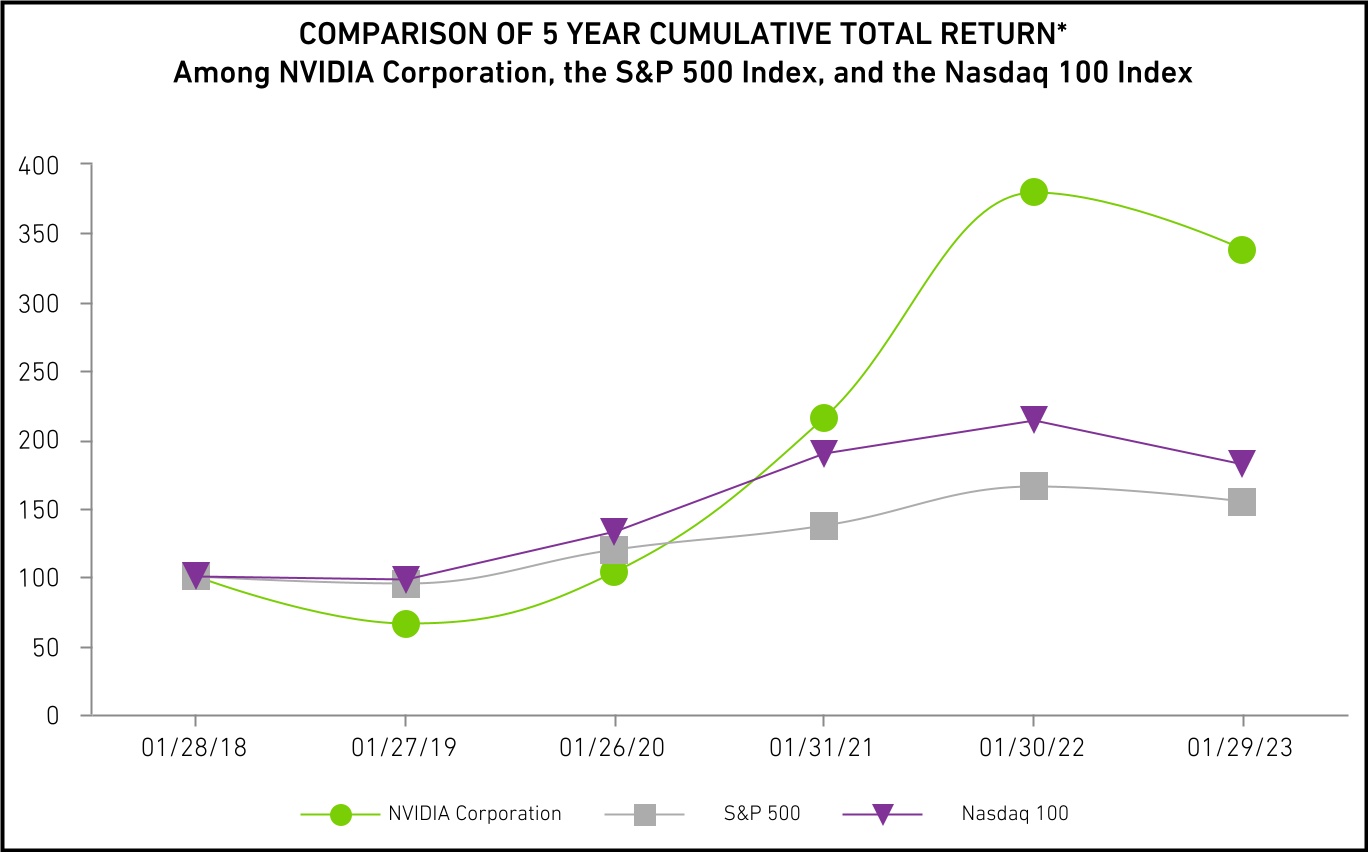][added: 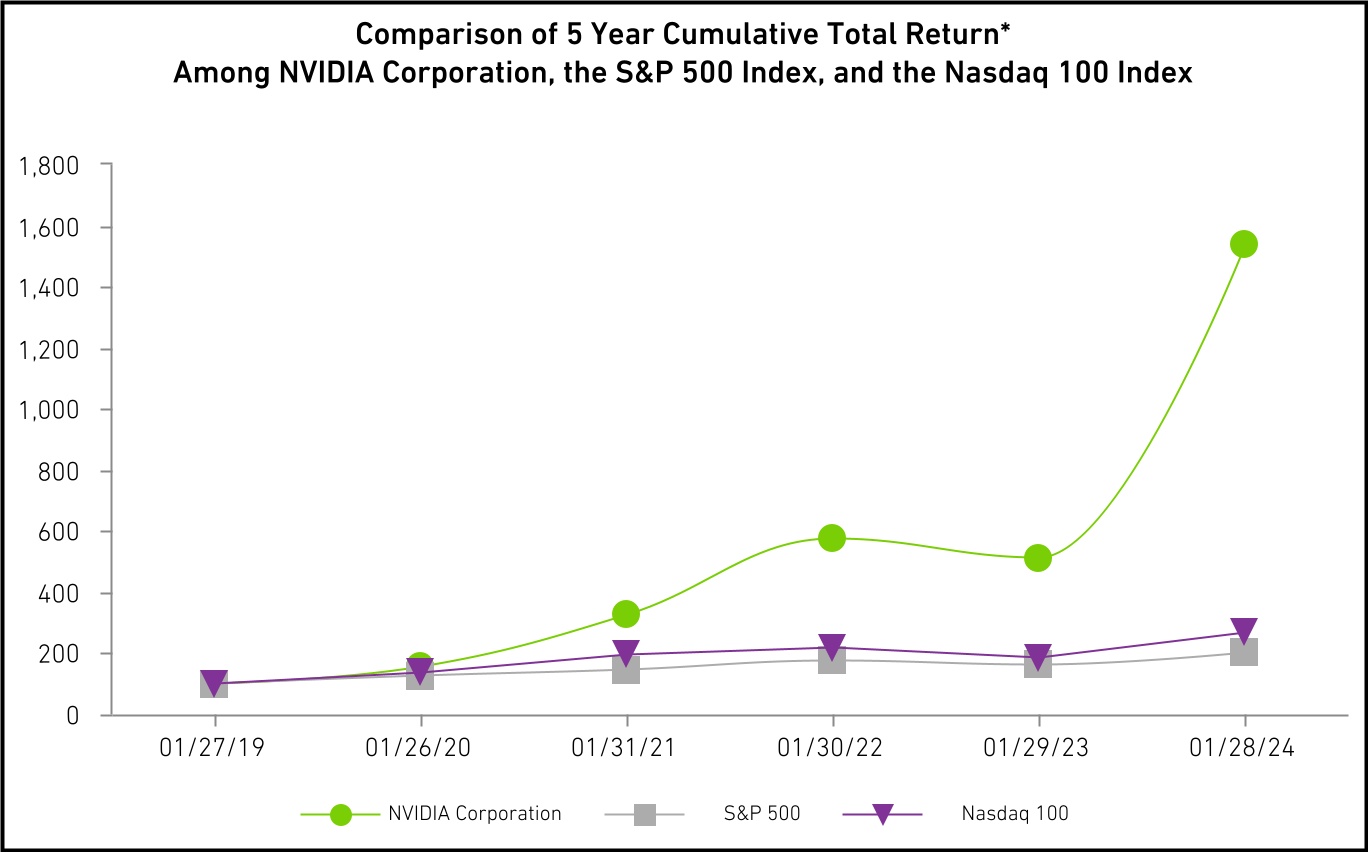]
*$100 invested on [removed: 1/28/18] [added: 1/27/19] in stock and in indices, including reinvestment of dividends.
| | | | [removed: 1/28/2018] [added: 1/27/2019] | | | | | | [removed: 1/27/2019] [added: 1/26/2020] | | | | | | [removed: 1/26/2020] [added: 1/31/2021] | | | | | | [removed: 1/31/2021] [added: 1/30/2022] | | | | | | [removed: 1/30/2022] [added: 1/29/2023] | | | | | | [removed: 1/29/2023] [added: 1/28/2024] | | |
In August 2023, our Board of Directors approved an increase to our share repurchase program of an additional $25.0 billion, without expiration.
| October 30, 2023 - November 26, 2023 | | | | | | 0.9 | | | | | | $ | 464.39 | | | | | 0.9 | | | | | | $ | 24.8 | |
| November 27, 2023 - December 24, 2023 | | | | | | 1.1 | | | | | | $ | 477.26 | | | | | 1.1 | | | | | | $ | 24.3 | |
| December 25, 2023 - January 28, 2024 | | | | | | 3.3 | | | | | | $ | 540.85 | | | | | 3.3 | | | | | | $ | 22.5 | |
From January 29, 2024 to February 16, 2024, we repurchased 2.8 million shares for $1.9 billion pursuant to a Rule 10b5-1 trading plan.
During fiscal year 2024, we withheld
approximately 7 million shares for a total value of $2.8 billion through net share settlements.
| NVIDIA Corporation | | | $ | 100.00 | | | | | $ | 157.02 | | | | | $ | 326.26 | | | | | $ | 574.15 | | | | | $ | 512.40 | | | | | $ | 1,536.28 | |
| S&P 500 | | | $ | 100.00 | | | | | $ | 126.17 | | | | | $ | 144.83 | | | | | $ | 175.25 | | | | | $ | 163.63 | | | | | $ | 199.83 | |
| Nasdaq 100 | | | $ | 100.00 | | | | | $ | 136.15 | | | | | $ | 194.20 | | | | | $ | 218.68 | | | | | $ | 185.67 | | | | | $ | 268.13 | |
On May 23, 2022, our Board of Directors increased and extended our share repurchase program to repurchase additional common stock up to a total of $15 billion through December 2023.
Since the inception of our share repurchase program, we have repurchased an aggregate of 1.10 billion shares for a total cost of $17.12 billion through January 29, 2023.
| October 31, 2022 - November 27, 2022 | | | | | | 7 | | | | | | $ | 148.11 | | | | | 7 | | | | | | $ | 7.23 | |
| November 28, 2022 - December 25, 2022 | | | | | | — | | | | | | $ | — | | | | | — | | | | | | $ | 7.23 | |
| December 26, 2022 - January 29, 2023 | | | | | | — | | | | | | $ | — | | | | | — | | | | | | $ | 7.23 | |
During fiscal year 2023, we withheld approximately 8 million shares for a total value of $1.48 billion
through net share settlements.
| NVIDIA Corporation | | | $ | 100.00 | | | | | $ | 66.00 | | | | | $ | 103.63 | | | | | $ | 215.33 | | | | | $ | 378.94 | | | | | $ | 338.18 | |
| S&P 500 | | | $ | 100.00 | | | | | $ | 94.60 | | | | | $ | 119.36 | | | | | $ | 137.01 | | | | | $ | 165.79 | | | | | $ | 154.80 | |
| Nasdaq 100 | | | $ | 100.00 | | | | | $ | 97.69 | | | | | $ | 133.01 | | | | | $ | 189.72 | | | | | $ | 213.63 | | | | | $ | 181.38 | |
Item 9A. Controls and Procedures
6 rewritten, 1 added, 1 removed, 13 unchanged
Based on their evaluation as of January [removed: 29, 2023,] [added: 28, 2024,] our management, including our Chief Executive Officer and Chief Financial Officer, has concluded that our disclosure controls and procedures (as defined in Rule 13a-15(e) under the Exchange Act) were effective to provide reasonable assurance.
Under the supervision and with the participation of our management, including our Chief Executive Officer and Chief Financial Officer, we conducted an evaluation of the effectiveness of our internal control over financial reporting as of January [removed: 29, 2023] [added: 28, 2024] based on the criteria set forth in *Internal Control - Integrated Framework (2013)* issued by the Committee of Sponsoring Organizations of the Treadway Commission.
Based on our evaluation under the criteria set forth in *Internal Control — Integrated Framework*, our management concluded that our internal control over financial reporting was effective as of January [removed: 29, 2023.][added: 28, 2024.]
The effectiveness of our internal control over financial reporting as of January [removed: 29, 2023] [added: 28, 2024] has been audited by PricewaterhouseCoopers LLP, an independent registered public accounting firm, as stated in its report which is included herein.
There have been no changes in our internal control over financial reporting during the quarter ended January [removed: 29, 2023] [added: 28, 2024] that have materially affected, or are reasonably likely to materially affect, our internal control over financial reporting.
In fiscal year 2022, we began an upgrade of our enterprise resource planning, or ERP, system, which will update much of our [removed: existing core financial systems.]
existing core financial systems.
During the second quarter of fiscal year 2023, we completed the consolidated financial reporting phase of the implementation, which included updating our internal control over financial reporting.
Item 9B. Other Information
0 rewritten, 3 added, 1 removed, 0 unchanged
On December 18, 2023, John O.
Dabiri, a member of our Board of Directors, adopted a trading arrangement that is intended to satisfy the affirmative defense conditions of Rule 10b5-1(c) for the sale through December 2, 2024 of an estimated 553 shares of our common stock, assuming our closing stock price as of January 26, 2024.
The number of shares is based on an estimate because the plan specifies a formulaic dollar amount of shares to be sold.
None.
Item 9C. Disclosure Regarding Foreign Jurisdictions that Prevent Inspections
1 rewritten, 0 added, 0 removed, 2 unchanged
Certain information required by Part III is omitted from this report because we will file with the SEC a definitive proxy statement pursuant to Regulation 14A, or the [removed: 2023] [added: 2024] Proxy Statement, no later than 120 days after the end of fiscal year [removed: 2023,] [added: 2024,] and certain information included therein is incorporated herein by reference.
Item 10. Directors, Executive Officers and Corporate Governance
5 rewritten, 0 added, 0 removed, 10 unchanged
Information regarding directors required by this item will be contained in our [removed: 2023] [added: 2024] Proxy Statement under the caption “Proposal 1 - Election of Directors,” and is hereby incorporated by reference.
Information regarding our Audit Committee required by this item will be contained in our [removed: 2023] [added: 2024] Proxy Statement under the captions “Report of the Audit Committee of the Board of Directors” and “Information About the Board of Directors and Corporate Governance,” and is hereby incorporated by reference.
Information regarding procedures for recommending directors required by this item will be contained in our [removed: 2023] [added: 2024] Proxy Statement under the caption “Information About the Board of Directors and Corporate Governance,” and is hereby incorporated by reference.
Information regarding compliance with Section 16(a) of the Exchange Act required by this item will be contained in our [removed: 2023] [added: 2024] Proxy Statement under the caption “Delinquent Section 16(a) Reports,” and is hereby incorporated by reference.
Information regarding our Code of Conduct required by this item will be contained in our [removed: 2023] [added: 2024] Proxy Statement under the caption “Information About the Board of Directors and Corporate Governance - Code of Conduct,” and is hereby incorporated by reference.
Item 11. Executive Compensation
1 rewritten, 0 added, 0 removed, 0 unchanged
Information regarding our executive compensation required by this item will be contained in our [removed: 2023] [added: 2024] Proxy Statement under the captions “Executive Compensation”, “Compensation Committee Interlocks and Insider Participation”, “Director Compensation” and “Compensation Committee Report,” and is hereby incorporated by reference.
Item 12. Security Ownership of Certain Beneficial Owners and Management and Related Stockholder Matters
2 rewritten, 0 added, 0 removed, 2 unchanged
Information regarding ownership of NVIDIA securities required by this item will be contained in our [removed: 2023] [added: 2024] Proxy Statement under the caption “Security Ownership of Certain Beneficial Owners and Management,” and is hereby incorporated by reference.
Information regarding our equity compensation plans required by this item will be contained in our [removed: 2023] [added: 2024] Proxy Statement under the caption "Equity Compensation Plan Information," and is hereby incorporated by reference.
Item 13. Certain Relationships and Related Transactions, and Director Independence
1 rewritten, 0 added, 0 removed, 0 unchanged
Information regarding related transactions and director independence required by this item will be contained in our [removed: 2023] [added: 2024] Proxy Statement under the captions “Review of Transactions with Related Persons” and “Information About the Board of Directors and Corporate Governance - Independence of the Members of the Board of Directors,” and is hereby incorporated by reference.
Item 14. Principal Accountant Fees and Services
1 rewritten, 0 added, 0 removed, 1 unchanged
Information regarding accounting fees and services required by this item will be contained in our [removed: 2023] [added: 2024] Proxy Statement under the caption “Fees Billed by the Independent Registered Public Accounting Firm,” and is hereby incorporated by reference.
Item 15. Exhibit and Financial Statement Schedules
467 rewritten, 229 added, 167 removed, 784 unchanged
| | | | | | | | | | [Report of Independent Registered Public Accounting [removed: Firm](#i8ce5c25b938445b1bec835777d6cece9_94)] [added: Firm](#i13eac97307cc485c971e826acbda8be7_94)] (PCAOB ID: 238) | | | [removed: [52](#i8ce5c25b938445b1bec835777d6cece9_94)] [added: [48](#i13eac97307cc485c971e826acbda8be7_94)] | | |
| | | | | | | | | | [Consolidated Statements of Income for the years ended [removed: January](#i8ce5c25b938445b1bec835777d6cece9_97) [29](#i8ce5c25b938445b1bec835777d6cece9_97)[, 202](#i8ce5c25b938445b1bec835777d6cece9_97)[3](#i8ce5c25b938445b1bec835777d6cece9_97)[,](#i8ce5c25b938445b1bec835777d6cece9_97) [January] [added: January 28, 2024, January 29, 2023, and January] 30, [removed: 2022](#i8ce5c25b938445b1bec835777d6cece9_97)[, and](#i8ce5c25b938445b1bec835777d6cece9_97) [January 31, 2021](#i8ce5c25b938445b1bec835777d6cece9_97)] [added: 2022](#i13eac97307cc485c971e826acbda8be7_97)] | | | [removed: [54](#i8ce5c25b938445b1bec835777d6cece9_97)] [added: [50](#i13eac97307cc485c971e826acbda8be7_97)] | | |
| | | | | | | | | | [Consolidated Statements of Comprehensive Income for the years [removed: ended](#i8ce5c25b938445b1bec835777d6cece9_100) [January] [added: ended January 28, 2024, January] 29, 2023, [removed: January 30, 2022,] and January [removed: 31, 2021](#i8ce5c25b938445b1bec835777d6cece9_97)] [added: 30, 2022](#i13eac97307cc485c971e826acbda8be7_100)] | | | [removed: [55](#i8ce5c25b938445b1bec835777d6cece9_100)] [added: [51](#i13eac97307cc485c971e826acbda8be7_100)] | | |
| | | | | | | | | | [Consolidated Balance Sheets as [removed: of](#i8ce5c25b938445b1bec835777d6cece9_103)] [added: of](#i13eac97307cc485c971e826acbda8be7_103)] [January [added: 28, 2024 and January] 29, [removed: 2023](#i8ce5c25b938445b1bec835777d6cece9_97) [an](#i8ce5c25b938445b1bec835777d6cece9_97)[d](#i8ce5c25b938445b1bec835777d6cece9_97) [January 30, 2022](#i8ce5c25b938445b1bec835777d6cece9_97)] [added: 2023](#i13eac97307cc485c971e826acbda8be7_97)] | | | [removed: [56](#i8ce5c25b938445b1bec835777d6cece9_103)] [added: [52](#i13eac97307cc485c971e826acbda8be7_103)] | | |
| | | | | | | | | | [Consolidated Statements of Shareholders’ Equity for the years [removed: ended](#i8ce5c25b938445b1bec835777d6cece9_109)] [added: ended](#i13eac97307cc485c971e826acbda8be7_109)] [January [added: 28, 2024, January] 29, 2023, [removed: January 30, 2022,] and January [removed: 31, 2021](#i8ce5c25b938445b1bec835777d6cece9_97)] [added: 30, 2022](#i13eac97307cc485c971e826acbda8be7_97)] | | | [removed: [57](#i8ce5c25b938445b1bec835777d6cece9_109)] [added: [53](#i13eac97307cc485c971e826acbda8be7_109)] | | |
| | | | | | | | | | [Consolidated Statements of Cash Flows for the years [removed: ended](#i8ce5c25b938445b1bec835777d6cece9_115)] [added: ended](#i13eac97307cc485c971e826acbda8be7_115)] [January [added: 28, 2024, January] 29, 2023, [removed: January 30, 2022,] and January [removed: 31, 2021](#i8ce5c25b938445b1bec835777d6cece9_97)] [added: 30, 2022](#i13eac97307cc485c971e826acbda8be7_97)] | | | [removed: [58](#i8ce5c25b938445b1bec835777d6cece9_115)] [added: [54](#i13eac97307cc485c971e826acbda8be7_115)] | | |
| | | | | | | | | | [Notes to the Consolidated Financial [removed: Statements](#i8ce5c25b938445b1bec835777d6cece9_118)] [added: Statements](#i13eac97307cc485c971e826acbda8be7_118)] | | | [removed: [59](#i8ce5c25b938445b1bec835777d6cece9_118)] [added: [55](#i13eac97307cc485c971e826acbda8be7_118)] | | |
| | | | | | | | | | [Schedule II Valuation and Qualifying Accounts for the years [removed: ended](#i8ce5c25b938445b1bec835777d6cece9_175)] [added: ended](#i13eac97307cc485c971e826acbda8be7_175)] [January [added: 28, 2024, January] 29, 2023, [removed: January 30, 2022,] and January [removed: 31, 2021](#i8ce5c25b938445b1bec835777d6cece9_97)] [added: 30, 2022](#i13eac97307cc485c971e826acbda8be7_97)] | | | [removed: [87](#i8ce5c25b938445b1bec835777d6cece9_175)] [added: [81](#i13eac97307cc485c971e826acbda8be7_175)] | | |
| | | | | | | | | | [The exhibits listed in the accompanying index to exhibits are filed or incorporated by reference as a part of this Annual Report on Form [removed: 10-K.](#i8ce5c25b938445b1bec835777d6cece9_178)] [added: 10-K.](#i13eac97307cc485c971e826acbda8be7_178)] | | | [removed: [88](#i8ce5c25b938445b1bec835777d6cece9_178)] [added: [82](#i13eac97307cc485c971e826acbda8be7_178)] | | |
We have audited the accompanying consolidated balance sheets of NVIDIA Corporation and its subsidiaries (the “Company”) as of January [removed: 29, 2023] [added: 28, 2024] and January [removed: 30, 2022,] [added: 29, 2023,] and the related consolidated statements of income, comprehensive income, shareholders' equity and cash flows for each of the three years in the period ended January [removed: 29, 2023,] [added: 28, 2024,] including the related notes and financial statement schedule listed in the index appearing under Item 15(a)(2) (collectively referred to as the “consolidated financial statements”).
We also have audited the Company's internal control over financial reporting as of January [removed: 29, 2023,] [added: 28, 2024,] based on criteria established in [removed: *Internal] [added: Internal] Control - Integrated [removed: Framewor*k] [added: Framework] (2013) issued by the Committee of Sponsoring Organizations of the Treadway Commission (COSO).
In our opinion, the consolidated financial statements referred to above present fairly, in all material respects, the financial position of the Company as of January [removed: 29, 2023] [added: 28, 2024] and January [removed: 30, 2022,] [added: 29, 2023,] and the results of its operations and its cash flows for each of the three years in the period ended January [removed: 29, 2023] [added: 28, 2024] in conformity with accounting principles generally accepted in the United States of America.
Also in our opinion, the Company maintained, in all material respects, effective internal control over financial reporting as of January [removed: 29, 2023,] [added: 28, 2024,] based on criteria established in [removed: *Internal] [added: Internal] Control - Integrated [removed: Framework*] [added: Framework] (2013) issued by the COSO.
A company’s internal control over financial reporting includes those policies and procedures that (i) pertain to the maintenance of records that, in reasonable detail, accurately and fairly reflect the transactions and dispositions of the assets of the company; (ii) provide reasonable assurance that transactions are recorded as necessary to permit preparation of financial statements in accordance with generally accepted accounting principles, and that receipts and expenditures of the company are being made only in accordance with authorizations of management and [added: directors of the company; and (iii) provide reasonable assurance regarding prevention or timely detection of unauthorized acquisition, use, or disposition of the company’s assets that could have a material effect on the financial statements.]
As of January [removed: 29, 2023,] [added: 28, 2024,] the Company’s consolidated inventories balance was [removed: $5,159 million] [added: $5.3 billion] and the Company’s consolidated outstanding inventory purchase and long-term supply [added: and capacity] obligations balance was [removed: $4,920 million,] [added: $16.1 billion,] of which a significant portion relates to inventory purchase obligations.
| Revenue | | | $ | [removed: 26,974] [added: 60,922] | | | | | $ | [removed: 26,914] [added: 26,974] | | | | | $ | [removed: 16,675] [added: 26,914] | |
| Cost of revenue | | | [removed: 11,618] [added: 16,621] | | | | | | [removed: 9,439] [added: 11,618] | | | | | | [removed: 6,279] [added: 9,439] | | |
| Gross profit | | | [removed: 15,356] [added: 44,301] | | | | | | [removed: 17,475] [added: 15,356] | | | | | | [removed: 10,396] [added: 17,475] | | |
| Research and development | | | [removed: 7,339] [added: 8,675] | | | | | | [removed: 5,268] [added: 7,339] | | | | | | [removed: 3,924] [added: 5,268] | | |
| Sales, general and administrative | | | [removed: 2,440] [added: 2,654] | | | | | | [removed: 2,166] [added: 2,440] | | | | | | [removed: 1,940] [added: 2,166] | | |
| Acquisition termination cost | | | [removed: 1,353] [added: —] | | | | | | [removed: —] [added: 1,353] | | | | | | — | | |
| Total operating expenses | | | [removed: 11,132] [added: 11,329] | | | | | | [removed: 7,434] [added: 11,132] | | | | | | [removed: 5,864] [added: 7,434] | | |
| Interest income | | | [removed: 267] [added: 866] | | | | | | [removed: 29] [added: 267] | | | | | | [removed: 57] [added: 29] | | |
| Interest expense | | | [removed: (262)] [added: (257)] | | | | | | [removed: (236)] [added: (262)] | | | | | | [removed: (184)] [added: (236)] | | |
| Other, net | | | [removed: (48)] [added: 237] | | | | | | [removed: 107] [added: (48)] | | | | | | [removed: 4] [added: 107] | | |
| Other income (expense), net | | | [removed: (43)] [added: 846] | | | | | | [removed: (100)] [added: (43)] | | | | | | [removed: (123)] [added: (100)] | | |
| Income before income tax | | | [removed: 4,181] [added: 33,818] | | | | | | [removed: 9,941] [added: 4,181] | | | | | | [removed: 4,409] [added: 9,941] | | |
| Income tax expense (benefit) | | | [removed: (187)] [added: 4,058] | | | | | | [removed: 189] [added: (187)] | | | | | | [removed: 77] [added: 189] | | |
| Net income | | | $ | [removed: 4,368] [added: 29,760] | | | | | $ | [removed: 9,752] [added: 4,368] | | | | | $ | [removed: 4,332] [added: 9,752] | |
| Basic | | | $ | [removed: 1.76] [added: 12.05] | | | | | $ | [removed: 3.91] [added: 1.76] | | | | | $ | [removed: 1.76] [added: 3.91] | |
| Diluted | | | $ | [removed: 1.74] [added: 11.93] | | | | | $ | [removed: 3.85] [added: 1.74] | | | | | $ | [removed: 1.73] [added: 3.85] | |
| Basic | | | [removed: 2,487] [added: 2,469] | | | | | | [removed: 2,496] [added: 2,487] | | | | | | [removed: 2,467] [added: 2,496] | | |
| Diluted | | | [removed: 2,507] [added: 2,494] | | | | | | [removed: 2,535] [added: 2,507] | | | | | | [removed: 2,510] [added: 2,535] | | |
| Available-for-sale [removed: debt] securities: | | | | | | | | | | | | | | | | | |
| Net [added: change in] unrealized gain (loss) | | | [removed: (31)] [added: 80] | | | | | | [removed: (16)] [added: (31)] | | | | | | [removed: 2] [added: (16)] | | |
| Reclassification adjustments for net realized gain (loss) included in net income | | | [removed: 1] [added: (48)] | | | | | | [removed: —] [added: (49)] | | | | | | [removed: (2)] [added: 29] | | |
| Net change in unrealized loss | | | [removed: (30)] [added: (10)] | | | | | | [removed: (16)] [added: (2)] | | | | | | [removed: —] [added: (14)] | | |
| Net [added: change in] unrealized gain (loss) | | | [removed: 47] [added: 80] | | | | | | [removed: (43)] [added: (30)] | | | | | | [removed: 9] [added: (16)] | | |
| Reclassification adjustments for net realized gain [removed: (loss)] included in net income | | | [removed: (49)] [added: —] | | | | | | [removed: 29] [added: 1] | | | | | | [removed: 9] [added: —] | | |
| Net change in unrealized gain (loss) | | | [removed: (2)] [added: 38] | | | | | | [removed: (14)] [added: 47] | | | | | | [removed: 18] [added: (43)] | | |
February 21, 2024
| Operating income | | | 32,972 | | | | | | 4,224 | | | | | | 10,041 | | |
| Net income | | | $ | 29,760 | | | | | $ | 4,368 | | | | | $ | 9,752 | |
| | | | Jan 28, 2024 | | | | | | Jan 29, 2023 | | |
| (In millions, except per share data) | | | | | | | | | | | | | | | | | | | | | | | | | | | | | | | | | | | | | | | | | |
| | | | | | | | | | | | | | | | | | | | | | | | | | | | | | | | | | | | | | | | | | |
| | | | | | | | | | | | | | | | | | | | | | | | | | | | | | | | | | | | | | | | | | |
| | | | | | | | | | | | | | | | | | | | | | | | | | | | | | | | | | | | | | | | | | |
| | | | | | | | | | | | | | | | | | | | | | | | | | | | | | | | | | | | | | | | | | |
| | | | | | | | | | | | | | | | | | | | | | | | | | | | | | | | | | | | | | | | | | |
| | | | | | | | | | | | | | | | | | | | | | | | | | | | | | | | | | | | | | | | | | |
| | | | | | | | | | | | | | | | | | | | | | | | | | | | | | | | | | | | | | | | | | |
| | | | | | | | | | | | | | | | | | | | | | | | | | | | | | | | | | | | | | | | | | |
| Shares repurchased | | | (21) | | | | | | — | | | | | | (27) | | | | | | — | | | | | | — | | | | | | (9,719) | | | | | | (9,746) | | |
| Balances, Jan 28, 2024 | | | 2,464 | | | | | | $ | 2 | | | | | $ | 13,132 | | | | | $ | — | | | | | $ | 27 | | | | | $ | 29,817 | | | | | $ | 42,978 | |
| Net income | | | $ | 29,760 | | | | | $ | 4,368 | | | | | $ | 9,752 | |
The effect of this change for the fiscal year ended January 28, 2024 was a benefit of $33 million and $102 million for cost of revenue and operating expenses, respectively, which resulted in an increase in operating income of $135 million and net income of $114 million after tax, or $0.05 per both basic and diluted share.
[Table of Contents](#i13eac97307cc485c971e826acbda8be7_7)
Cloud services are typically sold on a standalone basis, but certain offerings may be sold with hardware and/or software and related support.
Contracts with Multiple Performance Obligations
Our contracts may contain more than one of the products and services listed above, each of which is separately accounted for as a distinct performance obligation.
We account for multiple agreements with a single customer as a single contract if the contractual terms and/or substance of those agreements indicate that they may be so closely related that they are, in effect, parts of a single contract.
We allocate the total transaction price to each distinct performance obligation in a multiple performance obligations arrangement on a relative standalone selling price basis.
The standalone selling price reflects the price we would charge for a specific product or service if it were sold separately in similar circumstances and to similar customers.
When determining standalone selling price, we maximize the use of observable inputs.
If a contract contains a single performance obligation, no allocation is required.
[Table of Contents](#i13eac97307cc485c971e826acbda8be7_7)
(Continued)
or other third-party claims against us will be resolved without litigation, fines and/or substantial settlement payments or judgments.
[Table of Contents](#i13eac97307cc485c971e826acbda8be7_7)
(Continued)
we intend to sell the securities before recovery of its amortized cost basis.
[Table of Contents](#i13eac97307cc485c971e826acbda8be7_7)
(Continued)
Our investment in non-affiliates consists of marketable equity securities, which are publicly traded, and non-marketable equity securities, which are investments in privately held companies.
Marketable equity securities have readily determinable fair values with changes in fair value recorded in other income (expense), net.
Non-marketable equity securities include investments that do not have a readily determinable fair value.
The investments that do not have readily determinable fair value are measured at cost minus impairment, if any, and are adjusted for changes resulting from observable price changes in orderly transactions for an identical or similar investment in the same issuer, or the measurement alternative.
All gains and losses on these investments, realized and unrealized, are recognized in other income (expense), net on our Consolidated Statements of Income.
We assess whether an impairment loss has occurred on our investments in non-marketable equity securities, accounted for under the measurement alternative based on quantitative and qualitative factors.
directors of the company; and (iii) provide reasonable assurance regarding prevention or timely detection of unauthorized acquisition, use, or disposition of the company’s assets that could have a material effect on the financial statements.
February 24, 2023
NVIDIA CORPORATION AND SUBSIDIARIES
| | | | | | | | | | | | | | | | | | |
| | | | January 29, 2023 | | | | | | January 30, 2022 | | | | | | January 31, 2021 | | |
| Income from operations | | | 4,224 | | | | | | 10,041 | | | | | | 4,532 | | |
| | | | | | | | | | | | |
| --- | --- | --- | --- | --- | --- | --- | --- | --- | --- | --- | --- |
| Balances, January 26, 2020 | | | 2,450 | | | | | | $ | 3 | | | | | $ | 7,043 | | | | | $ | (9,814) | | | | | $ | 1 | | | | | $ | 14,971 | | | | | $ | 12,204 | |
| Fair value of partially vested equity awards assumed in connection with acquisitions | | | — | | | | | | — | | | | | | 86 | | | | | | — | | | | | | — | | | | | | — | | | | | | 86 | | |
NOTES TO THE CONSOLIDATED FINANCIAL STATEMENTS
Fiscal year 2021 was a 53-week year.
Reclassifications
Certain prior fiscal year balances have been reclassified to conform to the current fiscal year presentation.
Prior period intangible asset gross carrying amount and accumulated amortization in Note 7 have been adjusted to write off immaterial fully amortized intangible assets as of January 30, 2022.
The inputs into our judgments and estimates consider the economic implications of COVID-19.
This change in accounting estimate became effective at the beginning of fiscal year 2024.
Based on the carrying amounts of a majority of our server, storage, network, and assembly and test equipment, net in use as of the end of fiscal year 2023, it is estimated this change will increase our fiscal year 2024 operating income by $133 million as a result of the reduction in depreciation expense.
Certain products are
attribution method over the requisite employee service period while compensation expense for PSUs is recognized using an accelerated amortization model.
This allowance consists of an amount
We initially capitalize the fair value of IPR&D as an intangible asset with an indefinite life.
When IPR&D projects are completed, we reclassify the IPR&D as an amortizable purchased intangible asset and amortize over the asset’s estimated useful life.
Non-marketable equity investments in privately-held companies are recorded at fair value on a non-recurring basis only if an impairment or observable price adjustment occurs in the period with changes in fair value recorded through net income.
The estimated fair value is based on quantitative and qualitative factors including subsequent financing activities by the investee.
Marketable equity investments in publicly-held companies are recorded at fair value with the related unrealized and realized gains and losses recognized in other income (expense), net.
regulatory challenges preventing the completion of the transaction.
Acquisition of Mellanox Technologies, Ltd.
In April 2020, we completed the acquisition of all outstanding shares of Mellanox for a total purchase consideration of $7.13 billion.
Purchase Price Allocation
The aggregate purchase consideration has been allocated as follows (in millions):
| | | | | | | | | |
| --- | --- | --- | --- | --- | --- | --- | --- | --- |
| Purchase Price | | | | | | | | |
| Cash paid for outstanding Mellanox ordinary shares (1) | | | | | | $ | 7,033 | |
| Cash for Mellanox equity awards (2) | | | | | | 16 | | |
| Total cash consideration | | | | | | 7,049 | | |
| Fair value of Mellanox equity awards assumed by NVIDIA (3) | | | | | | 85 | | |
| Total purchase consideration | | | | | | $ | 7,134 | |
| Allocation | | | | | | | | |
An excerpt. Shown here: 40 of 467 rewritten, 40 of 229 added and 40 of 167 removed. The counts are complete. For every sentence, read Item 15. Exhibit and Financial Statement Schedules in the FY2024 filing and the FY2023 filing.
Item 16. Form 10-K Summary
16 rewritten, 2 added, 0 removed, 30 unchanged
Pursuant to the requirements of Section 13 or 15(d) of the Securities Exchange Act of 1934, the Registrant has duly caused this report to be signed on its behalf by the undersigned, thereunto duly authorized, on February [removed: 24, 2023.][added: 21, 2024.]
| /s/ JEN-HSUN HUANG | | | President, Chief Executive Officer and Director (Principal Executive Officer) | | | February [removed: 24, 2023] [added: 21, 2024] | | |
| /s/ COLETTE M. KRESS | | | Executive Vice President and Chief Financial Officer (Principal Financial Officer) | | | February [removed: 24, 2023] [added: 21, 2024] | | |
| /s/ DONALD ROBERTSON | | | Vice President and Chief Accounting Officer (Principal Accounting Officer) | | | February [removed: 24, 2023] [added: 21, 2024] | | |
| /s/ ROBERT BURGESS | | | Director | | | February [removed: 24, 2023] [added: 21, 2024] | | |
| /s/ TENCH COXE | | | Director | | | February [removed: 24, 2023] [added: 21, 2024] | | |
| /s/ JOHN O. DABIRI | | | Director | | | February [removed: 24, 2023] [added: 21, 2024] | | |
| /s/ PERSIS DRELL | | | Director | | | February [removed: 24, 2023] [added: 21, 2024] | | |
| /s/ DAWN HUDSON | | | Director | | | February [removed: 24, 2023] [added: 21, 2024] | | |
| /s/ HARVEY C. JONES | | | Director | | | February [removed: 24, 2023] [added: 21, 2024] | | |
| /s/ MICHAEL MCCAFFERY | | | Director | | | February [removed: 24, 2023] [added: 21, 2024] | | |
| /s/ STEPHEN C. NEAL | | | Director | | | February [removed: 24, 2023] [added: 21, 2024] | | |
| /s/ MARK L. PERRY | | | Director | | | February [removed: 24, 2023] [added: 21, 2024] | | |
| /s/ A. BROOKE SEAWELL | | | Director | | | February [removed: 24, 2023] [added: 21, 2024] | | |
| /s/ AARTI SHAH | | | Director | | | February [removed: 24, 2023] [added: 21, 2024] | | |
| /s/ MARK STEVENS | | | Director | | | February [removed: 24, 2023] [added: 21, 2024] | | |
| /s/ MELISSA B. LORA | | | Director | | | February 21, 2024 | | |
| Melissa B. Lora | | | | | | | | |