 filings.tools
NXP Semiconductors 20-F 2016-12-31
Filed 2017-03-03. 23 sections, 668K characters. Original on sec.gov · Markdown · JSON
Cover and table of contents
20-F 1 d289369d20f.htm 20-F
Table of Contents
As filed with the Securities and Exchange Commission on March 3, 2017
UNITED STATES
SECURITIES AND EXCHANGE COMMISSION
WASHINGTON, D.C. 20549
FORM 20-F
| ☐ | REGISTRATION STATEMENT PURSUANT TO SECTION 12(b) OR (g) OF THE SECURITIES EXCHANGE ACT OF 1934 |
|---|
OR
| ☒ | ANNUAL REPORT PURSUANT TO SECTION 13 OR 15(d) OF THE SECURITIES EXCHANGE ACT OF 1934 |
|---|
For the fiscal year ended December 31, 2016
OR
| ☐ | TRANSITION REPORT PURSUANT TO SECTION 13 OR 15(d) OF THE SECURITIES EXCHANGE ACT OF 1934 |
|---|
OR
| SHELL COMPANY REPORT PURSUANT TO SECTION 13 OR 15(d) OF THE SECURITIES EXCHANGE ACT OF 1934 |
|---|
Date of event requiring this shell company report
For the transition period from to
Commission file number 001-34841
NXP Semiconductors N.V.
(Exact name of Registrant as specified in its charter)
The Netherlands
(Jurisdiction of incorporation or organization)
High Tech Campus 60, Eindhoven 5656 AG, the Netherlands
(Address of principal executive offices)
Jean Schreurs, SVP and Chief Corporate Counsel, High Tech Campus 60, 5656 AG, Eindhoven, the Netherlands
Telephone: +31 40 2728686 / E-mail: jean.schreurs@nxp.com
(Name, Telephone, E-mail and/or Facsimile number and Address of Company Contact Person)
Securities registered or to be registered pursuant to Section 12(b) of the Act.
| Title of each class | Name of each exchange on which registered | |
| Common shares—par value euro (EUR) 0.20 per share | The NASDAQ Global Select Market |
Securities registered or to be registered pursuant to Section 12(g) of the Act.
None
(Title of class)
Securities for which there is a reporting obligation pursuant to Section 15(d) of the Act.
Common shares—par value EUR 0.20 per share
(Title of class)
Indicate the number of outstanding shares of each of the issuer’s classes of capital or common stock as of the close of the period covered by the Annual Report.
| Class | Outstanding at December 31, 2016 | |
| Ordinary shares, par value EUR 0.20 per share | 346,002,862 shares |
Indicate by check mark if the registrant is a well-known seasoned issuer, as defined in Rule 405 of the Securities Act. ☒ Yes ☐ No
If this report is an annual or transition report, indicate by check mark if the registrant is not required to file reports pursuant to Section 13 or 15(d) of the Securities Exchange Act of 1934. ☐ Yes ☒ No
Note—Checking the box above will not relieve any registrant required to file reports pursuant to Section 13 or 15(d) of the Securities Exchange Act of 1934 from their obligations under those Sections.
Indicate by check mark whether the registrant (1) has filed all reports required to be filed by Section 13 or 15(d) of the Securities Exchange Act of 1934 during the preceding 12 months (or for such shorter period that the registrant was required to file such reports), and (2) has been subject to such filing requirements for the past 90 days. ☒ Yes ☐ No
Indicate by check mark whether the registrant has submitted electronically and posted on its corporate Web site, if any, every Interactive Data File required to be submitted and posted pursuant to Rule 405 of Regulation S-T (§232.405 of this chapter) during the preceding 12 months (or for such shorter period that the registrant was required to submit and post such files). ☒ Yes ☐ No
Indicate by check mark whether the registrant is a large accelerated filer, an accelerated filer, or a non-accelerated filer. See definition of “accelerated filer and large accelerated filer” in Rule 12b-2 of the Exchange Act. (Check one)
Large accelerated filer ☒ Accelerated filer ☐ Non-accelerated filer ☐
Indicate by check mark which basis of accounting the registrant has used to prepare the financial statements included in this filing:
| U.S. GAAP ☒ | International Financial Reporting Standards as issued by the International Accounting Standards Board ☐ | Other ☐ |
If “Other” has been checked in response to the previous question, indicate by check mark which financial statement item the registrant has elected to follow. Item 17 ☐ Item 18 ☐
If this is an Annual Report, indicate by check mark whether the registrant is a shell company (as defined in Rule 12b-2 of the Exchange Act). ☐ Yes ☒ No
Table of Contents
TABLE OF CONTENTS
Table of Contents
Table of Contents
Introduction
This Annual Report contains forward-looking statements that contain risks and uncertainties. Our actual results may differ significantly from future results as a result of factors such as those set forth in Part I. Item 3D. Risk Factors and Part I, Item 5G. Safe Harbor.
The financial information included in this Annual Report is based on United States Generally Accepted Accounting Principles (U.S. GAAP), unless otherwise indicated.
In presenting and discussing our financial position, operating results and cash flows, management uses certain non-U.S. GAAP financial measures. These non-U.S. GAAP financial measures should not be viewed in isolation or as alternatives to the equivalent U.S. GAAP measures and should be used in conjunction with the most directly comparable U.S. GAAP measures. A discussion of non-U.S. GAAP measures included in this Annual Report and a reconciliation of such measures to the most directly comparable U.S. GAAP measures are set forth under “Use of Certain Non-U.S. GAAP Financial Measures” contained in this report under Part I, Item 5A. Operating Results.
Unless otherwise required, all references herein to “we”, “our”, “us”, “NXP” and the “Company” are to NXP Semiconductors N.V. and its consolidated subsidiaries.
A glossary of abbreviations and technical terms used in this Annual Report is set forth on page 80.
Table of Contents
PART I
Item 1. Identity of Directors, Senior Management and Advisers
| --- | --- |
Not applicable.
Item 2. Offer Statistics and Expected Timetable
| --- | --- |
Not applicable.
Item 3. Key Information
| --- | --- |
On October 27, 2016, NXP entered into a purchase agreement (the “Purchase Agreement”) with Qualcomm River Holdings B.V. (“Buyer”), a wholly-owned, indirect subsidiary of Qualcomm Incorporated. Pursuant to the Purchase Agreement, Buyer commenced a tender offer to acquire all of the issued and outstanding common shares of NXP for $110 per share in cash, for estimated total cash consideration of $38 billion. The tender offer is not subject to any financing condition. An Extraordinary General Meeting of NXP’s shareholders was convened on January 27, 2017, in connection with the offer where the shareholders of NXP approved all resolutions brought before them, with 95% of the votes cast in favor of each such resolution. In light of the foregoing, the tender offer is now conditioned on the tender of 80% of the outstanding shares of NXP. Buyer, with NXP’s prior written consent (not to be unreasonably withheld, conditioned or delayed), may reduce the required threshold to a percentage not less than 70% of the outstanding shares. Pending the receipt of certain regulatory approvals, as well as satisfaction of other customary closing conditions, the proposed transaction is expected to close by the end of calendar 2017.
The Purchase Agreement contains certain termination rights for NXP and Buyer. If the Purchase Agreement is terminated under certain circumstances, including termination by NXP to enter into a superior proposal for an alternative acquisition transaction or a termination following a change of recommendation by the NXP Board, NXP will be obligated to pay to Buyer a termination compensation equal to $1.25 billion in cash. If the Purchase Agreement is terminated under certain circumstances, including circumstances relating to the failure to obtain antitrust approvals or failure to complete in all material respects certain internal reorganization steps and related dispositions with respect to NXP, Buyer will be obligated to pay to NXP a termination compensation equal to $2 billion in cash.
On June 14, 2016, NXP announced an agreement to divest its Standard Products (“SP”) business to a consortium of financial investors consisting of Beijing JianGuang Asset Management Co., Ltd (“JAC Capital”) and Wise Road Capital LTD (“Wise Road Capital”). On February 6, 2017 we divested SP, receiving $2.75 billion in cash proceeds.
NXP B.V. and NXP Funding LLC, subsidiaries of NXP, delivered notice on February 7, 2017 that it will pre-pay (i) all its outstanding floating-rate term loan due March 2017 (“Term Loan E”) in an aggregate principal amount of $388 million, (ii) all its outstanding floating-rate term loan due January 2020 (“Term Loan D”) in an aggregate principal amount of $387 million and (iii) all its outstanding floating-rate term loan due December 2020 (“Term Loan F”) in an aggregate principal amount of $1,436 million, in each case, together with accrued interest and applicable fees. The funds for these pre-payments will come from the proceeds of the previously announced completion of the divestiture of the Standard Products business of NXP.
Additionally, on February 7, 2017, NXP B.V., together with NXP Funding LLC, delivered notice to holders of its 5.75% Senior Notes due 2021 (the “Notes”) that it will redeem on March 9, 2017, $500 million of the outstanding aggregate principal amount of these Notes, which represents all of the outstanding aggregate principal amount of the Notes, as permitted under Article 3 of the indenture dated February 14, 2013 and paragraph 5 of the Notes. The funds for this redemption will come from available surplus cash.
A. Selected Financial Data
The following table presents a summary of our selected historical consolidated financial data. We prepare our financial statements in accordance with U.S. GAAP.
The results of operations for prior years are not necessarily indicative of the results to be expected for any future period.
On December 7, 2015, we acquired Freescale Semiconductor, Ltd. (“Freescale”) for a total consideration of $11.6 billion (the “Merger”). The results of their operations and the estimated fair value of the assets acquired and liabilities assumed in the business combination are included in our financial statements from the date of acquisition forward.
Table of Contents
The selected historical consolidated financial data should be read in conjunction with the discussion under Part I, Item 5A. Operating Results and the Consolidated Financial Statements and the accompanying notes included elsewhere in this Annual Report.
| As of and for the years ended December 31, | ||||||||||||||||||||
| ($ in millions unless otherwise stated) | 2016 | 2015 | 2014 | 2013 | 2012 | |||||||||||||||
| Consolidated Statements of Operations: | ||||||||||||||||||||
| Revenue | 9,498 | 6,101 | 5,647 | 4,815 | 4,358 | |||||||||||||||
| Gross profit(1) | 4,069 | 2,787 | 2,640 | 2,177 | 1,988 | |||||||||||||||
| Total operating expenses(2) | (4,228 | ) | (2,035 | ) | (1,601 | ) | (1,535 | ) | (1,605 | ) | ||||||||||
| Other income (expense)(3) | 9 | 1,263 | 10 | 9 | 29 | |||||||||||||||
| Operating income (loss) | (150 | ) | 2,015 | 1,049 | 651 | 412 | ||||||||||||||
| Financial income (expense) | (453 | ) | (529 | ) | (410 | ) | (274 | ) | (437 | ) | ||||||||||
| Income (loss) from continuing operations attributable to stockholders | 200 | 1,526 | 539 | 348 | (116 | ) | ||||||||||||||
| Income (loss) from discontinued operations attributable to stockholders | — | — | — | — | 1 | |||||||||||||||
| Net income (loss) attributable to stockholders | 200 | 1,526 | 539 | 348 | (115 | ) | ||||||||||||||
| Per share data: | ||||||||||||||||||||
| Basic earnings per common share attributable to stockholders in $ | ||||||||||||||||||||
| - Income (loss) from continuing operations | 0.59 | 6.36 | 2.27 | 1.40 | (0.46 | ) | ||||||||||||||
| - Income (loss) from discontinued operations | — | — | — | — | — | |||||||||||||||
| - Net income (loss) | 0.59 | 6.36 | 2.27 | 1.40 | (0.46 | ) | ||||||||||||||
| Diluted earnings per common share attributable to stockholders in $ | ||||||||||||||||||||
| - Income (loss) from continuing operations | 0.58 | 6.10 | 2.17 | 1.36 | (0.46 | ) | ||||||||||||||
| - Income (loss) from discontinued operations | — | — | — | — | — | |||||||||||||||
| - Net income (loss) | 0.58 | 6.10 | 2.17 | 1.36 | (0.46 | ) | ||||||||||||||
| Weighted average number of shares of common stock outstanding during the year (in thousands) | ||||||||||||||||||||
| • Basic | 338,477 | 239,764 | 237,954 | 248,526 | 248,064 | |||||||||||||||
| • Diluted(4) | 347,607 | 250,116 | 248,609 | 255,050 | 248,064 | |||||||||||||||
| Consolidated balance sheet data(5): | ||||||||||||||||||||
| Cash and cash equiva |
Showing the first 8K of 104K characters. Open the full section
Item 4. Information on the Company
| --- | --- |
A. History and Develop ment of the Company
Our legal name is NXP Semiconductors N.V. and our commercial name is “NXP” or “NXP Semiconductors”.
We are incorporated in the Netherlands as a Dutch public company with limited liability (naamloze vennootschap).
On August 5, 2010, we made an initial public offering of 34 million shares of our common stock and listed our common stock on the NASDAQ Global Select Market.
We are a holding company (the “holding” company) whose only material assets are the direct ownership of 100% of the shares of NXP B.V., a Dutch private company with limited liability (besloten vennootschap met beperkte aansprakelijkheid).
Our corporate seat is in Eindhoven, the Netherlands. Our principal executive office is at High Tech Campus 60, 5656 AG Eindhoven, the Netherlands, and our telephone number is +31 40 2729999. Our registered agent in the United States is Freescale Semiconductor, Inc., 6501 William Cannon Dr. West, Austin, Texas 78735, United States of America, phone number +1 512 8952000.
On March 2, 2015, NXP announced that the company had entered into a definitive agreement under which it would merge with Freescale Semiconductor, Ltd. (“Freescale”) (the “Merger”). The Merger was consummated on December 7, 2015. As a result, Freescale’s results of operations are included in NXP’s Consolidated Statements of Operations as from December 7, 2015.
NXP accounted for the Merger under the acquisition method of accounting in accordance with Financial Accounting Standards Board Accounting Standards Topic 805, Business Combinations, with NXP treated as the accounting acquirer, see further discussion below.
On June 14, 2016, NXP announced an agreement to divest its Standard Products business to a consortium of financial investors consisting of Beijing JianGuang Asset Management Co., Ltd (“JAC Capital”) and Wise Road Capital LTD (“Wise Road Capital”). On February 6, 2017 we divested SP, receiving $2.75 billion in cash proceeds.
On October 27, 2016, NXP entered into a purchase agreement (the “Purchase Agreement”) with Qualcomm River Holdings B.V. (“Buyer”), a wholly-owned, indirect subsidiary of Qualcomm Incorporated. Pursuant to the Purchase Agreement, Buyer commenced a tender offer to acquire all of the issued and outstanding common shares of NXP for $110 per share in cash, for estimated total cash consideration of $38 billion. The tender offer is not subject to any financing condition. An Extraordinary General Meeting of NXP’s shareholders was convened on January 27, 2017, in connection with the offer where the shareholders of NXP approved all resolutions brought before them, with 95% of the votes cast in favor of each such resolution. In light of the foregoing, the tender offer is now conditioned on the tender of 80% of the outstanding shares of NXP, and Buyer, with NXP’s prior written consent (not to be unreasonably withheld, conditioned or delayed), may reduce the required threshold to a percentage not less than 70% of the outstanding shares. Pending the receipt of certain regulatory approvals, as well as satisfaction of other customary closing conditions, the proposed transaction is expected to close by the end of calendar 2017.
The Purchase Agreement contains certain termination rights for NXP and Buyer. If the Purchase Agreement is terminated under certain circumstances, including termination by NXP to enter into a superior proposal for an alternative acquisition transaction or a termination following a change of recommendation by the NXP Board, NXP will be obligated to pay to Buyer a termination compensation equal to $1.25 billion in cash. If the Purchase Agreement is terminated under certain circumstances, including circumstances relating to the failure to obtain antitrust approvals or failure to complete in all material respects certain internal reorganization steps and related dispositions with respect to NXP, Buyer will be obligated to pay to NXP a termination compensation equal to $2 billion in cash.
B. Business Overview
Semiconductor Market Overview
Semiconductors perform a broad variety of functions within electronic products and systems, including processing data, sensing, storing information and converting or controlling electronic signals. Semiconductors vary significantly depending upon the specific function or application of the end product in which the semiconductor is used and the customer who is deploying it. Semiconductors also vary on a number of technical characteristics including the degree of integration, level of customization, programmability and the process technology utilized to manufacture the semiconductor. Advances in semiconductor technology have increased the functionality and performance of semiconductors, improving their features and power consumption characteristics while reducing their size and cost. These advances have resulted in growth of semiconductors and electronic content across a diverse array of products. The semiconductor market totaled $339 billion in 2016.
Table of Contents
Business Combinations
On October 27, 2016, we announced that we had entered into an agreement to be purchased by a subsidiary of QUALCOMM Incorporated (“Qualcomm”). Pursuant to the agreement, a subsidiary of Qualcomm commenced a tender offer to acquire all of the issued and outstanding common shares of NXP for $110 per share in cash. Pending the receipt of certain regulatory approvals, as well as satisfaction of other customary closing conditions, the proposed transaction is expected to close by the end of calendar 2017.
On December 7, 2015, we completed the Merger with Freescale in a stock and cash transaction.
In connection with the Merger, each outstanding share of Freescale common stock was converted into 0.3521 shares of NXP common stock and $6.25 in cash, without interest. NXP issued 110 million shares of common stock to former holders of Freescale common stock, representing 32% of the 342 million total shares of outstanding NXP common stock after the Merger. NXP was determined to be the accounting acquirer. Freescale’s financial results from the Merger date through December 31, 2016, are included in our Consolidated Statement of Operations, as discussed herein.
The Merger created a market leader in automotive, broad based microcontroller and security semiconductor solutions, with a highly complementary product portfolio. The Merger enables NXP to better serve a broader array of customers in strategic markets.
Other Significant Transactions
On June 14, 2016, we announced an agreement to divest our Standard Products business to a consortium of financial investors consisting of Beijing JianGuang Asset Management Co., Ltd (“JAC Capital”) and Wise Road Capital LTD (“Wise Road Capital”). On February 6, 2017 we divested SP, receiving $2.75 billion in cash proceeds.
On December 7, 2015, we divested our RF Power business to JAC Capital.
On November 9, 2015, we completed setting up WeEn Semiconductors, a Bipolar Power joint venture in China with JAC Capital. WeEn Semiconductors, in which JAC Capital owns 51% and we own 49%, combines our advanced technology from our former Bipolar Power business line with JAC Capital’s strong connections in the Chinese manufacturing network and distribution channels to lower manufacturing costs and boost profit margins of high end electronic products in China.
Our Company
We are a global semiconductor company and a long-standing supplier in the industry, with over 50 years of innovation and operating history. For the year ended December 31, 2016, we generated revenue of $9,498 million, compared to $6,101 million for the year ended December 31, 2015.
We provide leading High Performance Mixed Signal (HPMS) and Standard Product (SP) solutions that leverage our combined portfolio of intellectual property, deep application knowledge, process technology and manufacturing expertise in the domains of cryptography—security, high-speed interface, radio frequency (RF), mixed-signal analog-digital (mixed A/D), power management, digital signal processing and embedded system design.
Our product solutions are used in a wide range of end-market applications including: automotive, personal security and identification, wireless and wireline infrastructure, mobile communications, multi-market industrial, consumer and computing. We engage with leading global original equipment manufacturers (OEM) and sell products in all major geographic regions.
Reporting Segments
NXP is organized into two market oriented reportable segments, High Performance Mixed Signal (“HPMS”) and Standard Products (“SP”). Corporate and Other represents the remaining portion (or “segment”) to reconcile to the Consolidated Financial Statements. You can find a description of each of our reportable segments below. We also have a manufacturing group that manages our manufacturing and supply chain activities.
Markets, applications and products
HPMS products consist of highly differentiated application-specific semiconductors and system solutions, which accounted for 87% of our total product revenue in 2016. We believe the HPMS market is an attractive market due to the growth in excess of the overall semiconductor market, the high barriers to entry, the loyalty of the customer base, the relative pricing stability and lower long-term capital intensity.
SP products consists primarily of discrete semiconductor devices that can be incorporated in many different types of electronics equipment, are typically sold to a wide variety of customers, and accounted for 13% of our total product revenue in 2016. NXP SP products are differentiated by our ability to consistently deliver cost effective, high unit volumes, which meet stringent quality levels and are a reflection of our long history of operational supply chain and continuously improved manufacturing processes. As a result we have been successful in improving the overall profitability of our SP segment.
Table of Contents
High Performance Mixed Signal
The HPMS segment consists of the following four business lines: Automotive, Secure Identification Solutions, Secure Connected Devices and Secure Interfaces and Infrastructure.
We focus on developing products and system and sub-system solutions that are innovative and allow our customers to bring their end products to market more quickly. Our products, particularly our application system and sub-system solutions, help our customers design critical parts of their end products and thus help many of them to differentiate themselves based on feature performance, advanced functionality, cost or time-to-market.
We apply our technical expertise in the areas of RF, analog, power management, interface, security technologies and digital processing across our priority applications markets. Our strong RF capabilities are utilized in our high performance RF for wireless infrastructure and industrial applications, car security and car radio products, mobile connectivity and contactless identification products. Our power technologies and capabilities are applied in AC-DC power conversion, power management and audio power products, while our ability to design ultra-low power semiconductors is used in a wide range of our products including our consumer, mobile, identification, healthcare products and our microcontrollers. Our high-speed interface design skills are applied in various interface products, and our security capability is used in our identification solutions, digital networking and microcontroller solutions. Finally, our digital processing capabilities are used in our microcontroller and application processor based products, our digital networking products, our Auto DSPs and the products leveraging our Coolflux ultra-low power DSPs, such as in our hearing aid products.
The below table provides an overview of the key applications per each business line, the leading market positions and our key customers.
| Automotive | Secure Identification Solutions | Secure Connected Devices | Secure Interfaces and Infrastructure | |||||
| Key applications | • Car access & immobilizers • In vehicle networking • Car entertainment • ADAS • Telematics • ABS • Transmission/ throttle control • Automotive Lighting • Gateways • Battery Management • Sensors | • Secure identity • Tagging | • Secure transactions • Mobile handset • Tablet • Personal computer • Smart buildings • White goods & home appliances • Medical/Personal Healthcare • Industrial/ IoT • Consumer/TV/Set top box | • Wireless base stations • Networking • Satellite & CATV infra • Radar • Power supplies • Lighting • Mobile Handsets • Pachinko machines | ||||
| Selected market leading positions | • #1 in Automotive semiconductors • #1 Can/LIN/ Flex Ray in-vehicle networking • #1 passive keyless entry/ immobilizers • #1 car radio • #1 Chassis & Safety • #1 Powertrain • #2 automotive MCU • #2 audio amplifiers | • #1 e-Government • #1 Transport & Access management • #1 Banking | • #1 I broad based MCU • #1 NFC | • #1 in RF Power • #1 in communication processors | ||||
| Key OEM and electronic manufacturing services (EMS) end customers | • Autoliv • Bosch • Continental • Delphi • Denso • Fujitsu Ten • Hyundai • TRW • Valeo • Visteon | • Avery Dennison • China Vision Microelectronic • Chutian Dragon • Gemalto • Giesecke • Hengbao • Linxens • Oberthur • Smartrac • Wuhan/Tianyu Info | • Amazon • Apple • BBK • Bosch • Continental • Huawei • LG • Samsung • Visteon • ZLG Electronics | • Apple • Arris • Cisco • Ericsson • Huawei • NEC • Nokia • Philips • Samsung • ZTE |
The table above provides a list of our key OEM, ODM and electronic manufacturing services end customers in alphabetical order, based on 2016 revenue, of which some of whom are supplied by distributors. Key distributors across these applications are Arrow, Avnet, Edom, Vitec and WPG.
Automotive****. Growth in semiconductor sales to the global automotive market relies on global economic trends, the unit growth of automobiles manufactured and the growth in semiconductor content per vehicle which is being driven by the proliferation of electronic features throughout the vehicle. Among the highest growth applications are advanced driver assistance systems (ADAS), infotainment (information, convenience and connectivity), secure in-vehicle networking and electrified powertrain (hybrid and electric vehicles).
Due to the high degree of regulatory scrutiny and safety requirements, the automotive semiconductor market is characterized by stringent qualification processes, zero defect quality processes, functionally safe design architecture, high reliability, extensive design-in timeframes and long product life cycles which results in significant barriers to entry.
Semiconductor content per vehicle continues to increase due to government regulation for improved safety and emissions, the standardization of higher-end options across a greater number of vehicle classes as well as consumer demand for greater fuel efficiency, advanced safety and multimedia applications. Automotive safety features are evolving from passive safety systems to active safety systems with ADAS such as radar, vision, vehicle-to-vehicle and vehicle-to-infrastructure (V2X) systems. We believe regulatory actions
Table of Contents
and consumer demand in both the developed and emerging markets should drive the increase in applications such as ADAS, secure connectivity, electronic safety and stability control. Semiconductor content per vehicle is also increasing to address applications such as engine management, fuel economy improvement, driver comfort, convenience and user interface. In addition, with the increase in overall semiconductor content in modern automobiles, the demand for secure in-vehicle networking continues to increase as various subsystems communicate within the automobile and with external devices and networks. Data integrity and security hardware features for safeguarding memory, communication and system data are also increasing in importance.
As a result of the Merger with Freescale, NXP became the largest semiconductor supplier to the automotive industry with strong positions in Car Entertainment, In-Vehicle Networking, Secure Car Access, Chassis & Safety and Powertrain. The combined portfolio is highly complementary, enabling NXP to address a broader scope of complete and complex solutions for our automotive partners. We continue to invest in growth areas including the evolution of the Secure Connected Car, ADAS and other safety and comfort applications.
In Car Entertainment, we are the market leader with the broadest portfolio of products offerings addressing both audio and visual head-end unit applications. Our leadership in audio processing for mid-to-high-end car radio is driven by excellent reception performance as well as high-levels of integration of terrestrial, satellite and digital multi-band tuners. Within the low-end and after-market car radio, our leadership is a result of highly integrated, single-chip radio solutions that offer our customers ease of implementation and lower total cost of ownership. In digital reception, we have developed multi-standard radios based on our software-defined radio implementation. In addition, we provide class-AB and class-D audio amplifiers and power analog products for car entertainment. Our i.MX applications processors, which are developed and brought to market by our Microcontroller and Processor teams, are highly integrated ARM-based application processors with integrated audio, video and graphics capability.
In the In-vehicle Networking market, we are the market leader, having played a defining role in setting in-vehicle networking standards including the CAN, LIN, FlexRay and more recently the two-wire automotive Ethernet standard. We are a leading supplier to major OEMs and continue to drive new system concepts, such as partial networking for enhanced energy efficiency.
In the Secure Car Access market, we are the market leader in two-way secure entry products, and have pioneered the development of next generation passive keyless entry/start with our customers. As a result of our R&D innovations we are a key supplier to almost all major automobile manufacturers for secure access products.
In Chassis & Safety we offer a broad range of sensors and microcontrollers. Our inertial sensors enable vehicle stability control and airbag crash detection while our pressure sensors are well-positioned for continued growth in tire pressure monitoring, occupancy detection and engine control.
In Powertrain, we offer power management solutions which provide the intelligence engine management systems that reduce emissions and improve fuel efficiency. In December 2013, we announced a joint venture with Datang Telecom, targeting the China domestic hybrid and electrical car market. This joint venture became active in April 2014.
In ADAS, we are developing solutions for Radar, Vision and Secure V2X. In 2013, we made a strategic investment in Cohda Wireless, an equipment vendor in the Intelligent Transport Systems (ITS) market with whom we co-operate for V2X solutions. In December 2013, we also announced the intended sale of our Telematics Module business to Telit Communications which closed in March 2014.
We employ our proprietary processes for automotive-grade, high-voltage, RF and non-volatile processes as well as our technology standards and leading edge security IP developed by our Secure Identification Solutions business, to deliver our automotive solutions. We design our products to be compliant with all key global relevant automotive quality standards (such as ISO/TS16949 and VDA6.3).
For the full year 2016, we had High Performance Mixed Signal revenue of $3,379 million in automotive applications, compared to $1,342 million in 2015, which represents a 151.8% year over year increase. According to Strategy Analytics, the total market for automotive semiconductors was $31.0 billion in 2015, and projects it will grow at a compounded annual growth rate of 6.3% between 2015 and 2019.
Secure Identification Solutions (SIS). The SIS business is focused on delivering solutions to address the security and privacy requirements of three specific end market dynamics: (1) the increasing adoption of chip-based banking cards (“Banking”); (2) the increasing usage of high-volume, single-payment platform systems for urban transportation (“Transit—Access”); and (3) the increased need to provide government sponsored products to assure privacy and secure cross-border movement of people (“eGov”).
Nearly all of SIS products consist of multi-functional solutions comprised of passive RF connectivity devices facilitating information transfer from the user document to reader infrastructure; secure, tamper-proof microcontroller devices in which information is securely encrypted (“secure element”); and secure real-time operating system software products to facilitate the encryption-decryption of data, and the interaction with the reader infrastructure systems. Our solutions are developed to assure extreme levels of security of user information, undergoing stringent and continued global governmental and banking certification processes, as well as delivering the highest level of device performance enabling significant throughput and productivity to our customers.
In the banking sector NXP is the market leader in the contact, contactless and dual-interface bank card market. We have innovated and deployed “multi-application” banking solutions which support a combination of payment, transit and access solutions all leveraging a single physical bank card. In the transit and access market, NXP’s MIFARE products are ubiquitous throughout the world, having been deployed in over 750 cities, facilitating the mass transit requirements of over one billion people per day. Additionally our transit and access products are deployed in application such as employee identification for facility access and security. We are also focused on deploying our technology into new emerging market applications such as interactive gaming, theme-park attendee management and
Table of Contents
supply chain and inventory product management to support high velocity supply chain management. In the eGovernment sector, NXP is a market leader providing solutions for chip-based cross-border passports, drivers-licenses, health cards and other government sponsored identification documents. We have also worked with emerging market government agencies to facilitate government sponsored identity cards which also serve as payment platforms helping the mass-population of under-banked.
For the full year 2016, we had High Performance Mixed Signal revenue of $737 million in SIS, compared to $973 million in 2015, which represents a 24.3% year over year decline. According to ABI Research, the market size for secure identification ICs was $3.5 billion in 2015, and is expected to grow at a compounded annual rate of 6% to $4.6 billion in 2019.
Secure Connected Devices (SCD). The SCD business is focused on delivering solutions to enable the future of connected devices – also known as “Internet of Things” (IoT). We believe the future growth of secure connected devices requires the ability to deliver four fundamental functional capabilities: (1) embedded microcontrollers; (2) connectivity – short range RF and wireless technology (Bluetooth LE, Zigbee, Thread and NFC); (3) security; and (4) sensor. We see end-markets and applications emerging in the area of Mobile Payments, Smart Home-Health, Smart Cities, Wearables and Smart Industrial.
The SCD business has a broad portfolio products which we believe enables NXP to successfully compete and deliver all aspects of semiconductor-based technologies for connected devices including microcontrollers, secure mobile transactions solutions and various connectivity solutions.
Post-merger, we are the largest supplier of broad based microcontrollers. We differentiate ourselves versus our competitors with a broad portfolio of products addressing different processing power, connectivity standards, peripherals and security levels depending on customers evolving requirements.
We have a strong position in multi-purpose 32-bit ARM-based microcontrollers serving a broad array of applications. Our portfolio is highly scalable, and is coupled with our extensive software and design tools. This enables our customers to design-in and deploy our MCUs families, leveraging a consistent software development environment. Due to the scalability of our portfolio we are able to help future-proof our customer’s products as their systems evolve, becoming more complex or requiring greater processing capabilities over time. We believe we have the broadest ARM portfolio in the industry.
Our i.MX family of processors are designed in conjunction with a broad suite of additional products including power management solutions, audio codecs, touch sensors and accelerometers to provide full systems solutions across a wide range of operating systems and applications. Our i.MX 6 family of applications processors integrates one, two or four ARM Cortex-A9 cores running up to 1.2 GHz and includes five devices: the single-core i.MX 6Solo and i.MX 6SoloLite, dual-core i.MX 6Dual and i.MX 6DualLite, and quad-core i.MX 6Quad processors. Together, these products provide a family of applications processors featuring software, power and pin compatibility across single, dual and quad core implementations. Software support includes Linux and Android implementations.
We are the market leader in secure mobile transactions. NXP has pioneered and led the development of the ISO standard for Near Field Communications (NFC), which is rapidly emerging as the de facto standard for secure short-range connectivity. In combination with our industry leading SmartMX family of secure element device as well as our secure operating system, NXP has garnered market leadership in the deployment of mobile wallets and mobile payment. Our position leverages our decades long position in cryptography and security in the Banking, Transit – Access and eGov sectors.
Post-merger NXP has a broad and diverse portfolio of connectivity assets, IP and application knowledge which we believe enables us to fulfill our customer’s connectivity requirements for IoT applications, including smart lighting, smart energy, wireless remote controls & switches and healthcare monitoring.
In February 2015 we acquired Quintic, which brought assets and IP to broaden our connectivity portfolio. Specifically, Quintic is an innovator in the area of Bluetooth Low Energy (BTLE), a key connectivity standard for IoT devices.
Our mobile audio business focuses on smart speaker drivers and leverages many of the same core technologies and competencies as our personal healthcare business. We also sell software solutions for mobile phones through our NXP Software business. The NXP Software solutions business develops audio solutions that enable mobile device manufacturers to produce differentiated hand held products that enhance the end-user experience. Our software has been incorporated into over 1 billion mobile devices produced by many of the world’s leading mobile device manufacturers.
Our personal healthcare revenue is generated by our hearing aid products, which leverage our proprietary, ultra-low power Coolflux – brand of DSP devices, our low power audio IC design capabilities and our magnetic induction radio technology. We design customer-specific ICs for major hearing aid OEMs, and many of these customers fund our product development efforts.
Our overall High Performance Mixed Signal revenue in the SCD business was $2,146 million in 2016, compared to $1,261 million in 2015, which represents a 70.2% year over year growth. We estimate the worldwide market for Microcontrollers 32-bit was $6.5 billion in 2015, and we expect a compounded annual growth rate of 10.3% between 2015 and 2019.
Our leadership in secure/smartcard Microcontrollers and our position in the non-secure Microcontrollers outside Automotive creates a number one position in broad based Microcontrollers.
Secure Interfaces and Infrastructure (SI&I). Our SI&I businesses consist of: Digital Networking Processors, Secure Interface and System Management Products, High-performance RF Power-Amplifiers (HPRF) and Smart Antennae solutions.
NXP is a significant participant in the communications infrastructure market. Our communications processors are programmable semiconductors that perform tasks related to control and management of digital data, as well as network interfaces. They are designed to
Table of Contents
handle tasks related to data transmission between nodes within a network, the manipulation of that data upon arrival at its destination and protocol conversion. Our product portfolio includes 32-bit and 64-bit offerings ranging from a single core to 28- and 45-nanometer multicore QorIQ communications processors. Wireless-infrastructure processors combine communication processors with DSP functionality and specific wireless acceleration technology. Our portfolio of secure wireless-infrastructure processors targets small cells and macro base stations. These products perform baseband processing and support multiple cellular-network air-interfaces such as LTE-Advanced, TD-LTE, LTE, HSPA+, TD-SCDMA, and CDMA2000K. Used by leading original equipment manufacturers (OEMs) worldwide, our broad portfolio of wireless-infrastructure and communications processors satisfies wireless infrastructure requirements.
We are major supplier in the highly fragmented interface and system management products. Our products address many interface standards and we serve various applications across the mobile, computing, industrial, consumer and automotive markets. We have broad product portfolios including UARTs. Bridges-devices, I2 C, SPI, LED-lighting controllers, low power real-time clocks and watch ICs, HDMI switches and transceivers, and display port multiplexers. Our core competency is the ability to deliver products that manage high speed data and system voltage over the same interface. We generate a large part of our revenue by selling products to a very broad customer base, which we serve through our distribution channel. We have successfully engaged with leading OEMs to drive semi-custom products which in turn allow us to refine and accelerate our innovation and product roadmaps. We are engaged in development activities and standard setting initiatives with many of the innovation leaders in each of these markets. Key growth drivers will be the adoption rate of new high-speed interface standards such as USB type-C.
We are also active in high efficiency AC-DC power conversion ICs for notebook personal computers. Our strength in AC-DC power conversion is based on our leading edge high-voltage power analog process technologies and engineering capabilities in designing high efficiency power conversion products. Due to worldwide conservation efforts, many countries, states and local governments have adopted regulations that increase the demand for higher power efficiency solutions in computing and consumer applications, especially in power conversion.
We are the market leader in HPRF power amplifiers for markets, such as mobile base stations, wireless connectivity, satellite and CATV infrastructure and receivers, industrial applications, and to a lesser extent the military and aerospace markets. We are engaged with the majority of the largest customers in mobile base stations and in several other application areas.
Both Freescale and NXP prior to the Merger were the main suppliers into the HPRF power amplifier market. As a result of the Merger, NXP was required to sell its HPRF business. On December 7, 2015 NXP completed the divestment of its RF Power business to JAC Capital.
We have an emerging business offering Smart Antennae solutions based on Low Noise Amplifier (LNA) technology. We engage and sell our Smart Antennae solutions to varied customers in the mobile, consumer electronics and cable television infrastructure markets.
Our overall revenue in these businesses was $1,824 million in 2016 versus $1,144 million in 2015, which represents an increase of 59.4% year over year.
Standard Products
Our Standard Products business supplies a broad range of standard semiconductor components, such as small signal discretes, power discretes, protection and signal conditioning devices and standard logic devices, which we largely produce in dedicated in-house high-volume manufacturing operations. Our portfolio consists of a large variety of catalog products, using widely-known production techniques, with characteristics that are largely standardized throughout the industry as well as leading discrete solutions especially in the field of ESD protection / EMI filtering and low loss rectification and power switching. Our Standard Products are often sold as separate components, but in many cases, are used in conjunction with our High Performance Mixed Signal solutions, often within the same subsystems. Further, we are able to leverage customer engagements where we provide standard products devices, as discrete components, within a system to identify and pursue potential High Performance Mixed Signal opportunities.
Our products are sold both directly to OEMs as well as through distribution, and are primarily differentiated on cost, packaging type and miniaturization, and supply chain performance. Alternatively, our innovative products include “design-in” products, which require significant engineering effort to be designed into an application solution. For these products, our efforts make it more difficult for a competitor to easily replace our product, which makes these businesses more predictable in terms of revenue and pricing than is typical for standard products.
Table of Contents
Our key product applications, markets and customers are described in the table below.
| Key Products | • SS Transistors and Diodes • SS MOS • Power MOS • Interface protection devices • General Purpose Logic | |
| Key OEM and electronic manufacturing services (EMS) end customers | • Apple • BBK • Bosch • Continental • Delphi • Delta Electronics • Huawei • Lear • Samsung • Valeo |
The table above provides a list of our key OEM and electronic manufacturing services end customers in alphabetical order, based on 2016 revenue, of which some of whom are supplied by distributors. Key distributors across these applications are Arrow, Avnet, Future and WPG.
In 2016, our Standard Products business generated net revenue of $1,220 million, compared to $1,241 million in 2015, which represents a 1.7% year over year decline.
We are the number one global supplier of small-signal discretes with one of the broadest product portfolios in the industry. We have a strong position due to our strong cost competitiveness, supply chain performance, leverage of our OEM relationships and a broadening portfolio. We are focusing on expanding our share of higher margin products in this business. In addition, we are also building a small signal MOSFET product line, which leverages our small signal transistors and diodes packaging operations and strong customer relationships. In addition to our small signal discretes products, we have a Power MOSFET product line, which is focused on the low-voltage segment of this market. The majority of our revenue in Power MOSFETs is to automotive customers.
We estimate that the market for discretes, excluding RF & Microwave, was $17 billion in 2015 and growth is expected with a CAGR of 4% to $20 billion in 2019.
Additionally, the Standard Products segment also includes Standard Logic ICs. We have the number two position in Standard Logic IC markets based on worldwide revenue for 2015, which we deploy in a large number of our High Performance Mixed Signal solutions. We offer several product families for low-voltage applications in communication equipment, personal computers, personal computer peripherals and consumer and portable electronics. Our 3V and 5V families hold a leading share of the logic market. We continue to expand into the higher margin product range in this business by expanding, among others, our switches and translators (or custom logic) portfolio and optimizing our manufacturing. We estimate the worldwide Standard Logic market at $1.4 billion in 2015, and is estimated to grow with compound annual rate of 1.1% between 2015 and 2019.
Corporate and Other
We manufacture integrated circuits and discrete semiconductors through a combination of wholly owned manufacturing facilities, manufacturing facilities operated jointly with other semiconductor companies and third-party foundries and assembly and test subcontractors. Our manufacturing operations primarily focus on manufacturing and supplying products to our High Performance Mixed Signal and Standard Products businesses. We manage our manufacturing assets together through one centralized organization to ensure we realize scale benefits in asset utilization, purchasing volumes and overhead leverage across businesses.
In the future, we expect to outsource an increased part of our internal demand for wafer foundry and packaging services to third-party manufacturing sources in order to increase our flexibility to accommodate increased demand mainly in our High Performance Mixed Signal and to a lesser extent in Standard Products businesses.
The manufacturing of a semiconductor involves several phases of production, which can be broadly divided into “front-end” and “back-end” processes. Front-end processes take place at highly complex wafer manufacturing facilities (called fabrication plants or “wafer fabs”), and involve the imprinting of substrate silicon wafers with the precise circuitry required for semiconductors to function. The front-end production cycle requires high levels of precision and involves as many as 300 process steps. Back-end processes involve the assembly, test and packaging of semiconductors in a form suitable for distribution. In contrast to the highly complex front-end process, back-end processing is generally less complicated, and as a result we tend to determine the location of our back-end facilities based more on cost factors than on technical considerations.
We primarily focus our internal and joint venture wafer manufacturing operations on running proprietary specialty process technologies that enable us to differentiate our products on key performance features, and we generally outsource wafer manufacturing in process technologies that are available at third-party wafer foundries when it is economical to do so. In addition, we increasingly
Table of Contents
focus our in-house manufacturing on our competitive 8-inch facilities, which predominantly run manufacturing processes in the 140 nanometer, 180 nanometer and 250 nanometer process nodes, and have concentrated the majority of our manufacturing base in Asia. This focus increases our return on invested capital and reduces capital expenditures.
Our front-end manufacturing facilities use a broad range of production processes and proprietary design methods, including CMOS, bipolar, bipolar CMOS (“BiCMOS”) and double-diffused metal on silicon oxide semiconductor (“DMOS”) technologies. Our wafer fabs produce semiconductors with line widths ranging from 90 nanometers to 3 microns for integrated circuits and 0.5 microns to greater than 4 microns for discretes. This broad technology portfolio enables us to meet increasing demand from customers for system solutions, which require a variety of technologies.
Our back-end manufacturing facilities test and package many different types of products using a wide variety of processes. To optimize flexibility, we use shared technology platforms for our back-end assembly operations. Most of our assembly and test activities are maintained in-house. Finally, a number of our High Performance Mixed Signal products enjoy significant packaging cost and innovation benefits due to the scale of our Standard Products business, which manufactures tens of billions of units per year.
The following table shows selected key information with respect to our major front-end and back-end facilities:
| Site | Ownership | Wafer sizes used | Line widths used (vm) | Technology/Products | ||||||||||
| (Microns) | ||||||||||||||
| Front-end(1) | ||||||||||||||
| Singapore(2) | 61.2 | % | 8” | 0.14-0.25 | CMOS | |||||||||
| Nijmegen, the Netherlands | 100 | % | 8” | 0.14-0.80 | CMOS, BiCMOS, LDMOS | |||||||||
| Hamburg, Germany(4) | 100 | % | 6”/8” | 0.5-3.0 | Discretes | |||||||||
| Manchester, United Kingdom(4) | 100 | % | 6” | 0.5 | Power discretes | |||||||||
| Oak Hill, Austin, US | 100 | % | 8” | 0.25 | CMOS, BiCMOS, Sensors, LDMOS, HDTMOS, PowerCMOS | |||||||||
| Chandler, US | 100 | % | 8” | 0.25-0.50 | CMOS, eNVM, PowerCMOS | |||||||||
| Austin Technology and Manufacturing Center, US | 100 | % | 8” | 0.09-0.18 | CMOS, eNVM, PowerCMOS, Advanced CMOS, SoC | |||||||||
| Back-end(3) | ||||||||||||||
| Kaohsiung, Taiwan | 100 | % | — | — | NFC, Automotive Car-access, Micro-controllers | |||||||||
| Bangkok, Thailand | 100 | % | — | — | Automotive In-Vehicle Networking and Sensors, Banking and e-Passport modules, Standard Logic | |||||||||
| Guangdong, China(4) | 100 | % | — | — | Discrete devices and Standard Logic | |||||||||
| Seremban, Malaysia(4) | 100 | % | — | — | Discrete devices and Standard Logic | |||||||||
| Cabuyao, Philippines(4) | 100 | % | — | — | Power discrete and Automotive Sensors | |||||||||
| Kuala Lumpur, Malaysia | 100 | % | — | — | Micro-processors, Micro-controllers, Power Management, Analog and Mixed Signal, RF devices | |||||||||
| Tianjin, China | 100 | % | — | — | Micro-controllers, Automotive MCU, Analog and Sensors |
| (1) | In front-end we entered into a joint venture with JAC Capital for the Bipolar products in which we currently hold a 49% interest. The Jilin front end fab transferred into this JV. |
|---|
| (2) | Joint venture with TSMC; we are entitled to 60% of the joint venture’s annual capacity. |
|---|
| (3) | In back-end manufacturing we entered into a joint venture with ASE in Suzhou, China (ASEN), in which we currently hold a 40% interest. |
|---|
| (4) | These facilities were divested in connection with the sale of the Standard Products business to JAC Capital that closed on February 6, 2017. |
|---|
We use a large number of raw materials in our front- and back-end manufacturing processes, including silicon wafers, chemicals, gases, lead frames, substrates, molding compounds and various types of precious and other metals. Our most important raw materials are the raw, or substrate, silicon wafers we use to make our semiconductors. We purchase these wafers, which must meet exacting specifications, from a limited number of suppliers in the geographic region in which our fabrication facilities are located. At our wholly owned fabrication plants, we use raw wafers ranging from 6 inches to 8 inches in size. Our SSMC wafer fab facility, which produces 8 inch wafers, is jointly owned by TSMC and ourselves. We are leveraging our experience in that fab facility in optimizing our remaining wholly owned Nijmegen and Hamburg wafer fabs. The Merger has added multiple 8 inch fabs for production of a wide portfolio of analog, mixed signal and processors products and this large scale and knowledge base will enable us to further optimize processes. Our other remaining fabs are small and are focused exclusively on manufacturing power discretes. Emerging fabrication technologies employ larger wafer sizes and, accordingly, we expect that our production requirements will in the future shift towards larger substrate wafers.
Table of Contents
We typically source our other raw materials in a similar fashion as our wafers, although our portfolio of suppliers is more diverse. Some of our suppliers provide us with materials on a just-in-time basis, which permits us to reduce our procurement costs and the negative cash flow consequences of maintaining inventories, but exposes us to potential supply chain interruptions. We purchase most of our raw materials on the basis of fixed price contracts, but generally do not commit ourselves to long-term purchase obligations, which permits us to renegotiate prices periodically.
Sales, Marketing and Customers
We market our products worldwide to a variety of OEMs, ODMs, contract manufacturers and distributors. We generate demand for our products by delivering High Performance Mixed Signal solutions to our customers, and supporting their system design-in activities by providing application architecture expertise and local field application engineering support.
Our sales and marketing teams are organized into six regions, which are EMEA (Europe, the Middle East and Africa), the Americas, Japan, South Korea, Greater China and Asia Pacific. These sales regions are responsible for managing the customer relationships, design-in and promotion of new products. We seek to further expand the presence of application engineers closely supporting our customers and to increase the amount of product development work that we can conduct jointly with our leading customers. Our web-based marketing tool is complementary to our direct customer technical support.
Our sales and marketing strategy focuses on deepening our relationship with our top OEMs and electronic manufacturing service customers and distribution partners and becoming their preferred supplier, which we believe assists us in reducing sales volatility in challenging markets. We have long-standing customer relationships with most of our customers. Our 10 largest OEM end customers, some of whom are supplied by distributors, in alphabetical order, are Apple, BBK, Bosch, Continental, Delphi, Denso, Huawei, Samsung, TRW and ZTE. When we target new customers, we generally focus on companies that are leaders in their markets either in terms of market share or leadership in driving innovation. We also have a strong position with our distribution partners being a top three semiconductor supplier (other than microprocessors and memory ICs) through distribution worldwide. Our 3 largest distribution partners are Arrow, Avnet and WPG.
Our revenue is primarily the sum of our direct sales to original equipment manufacturers, or OEMs, plus our distributors’ resale of NXP products. One distributor accounted for more than 10% of total 2016 revenue: Avnet accounted for 13% of our revenue in 2016, 14% in 2015 and 13% in 2014. WPG accounted for less than 10% of our revenue in 2016, 14% in 2015 and 13% in 2014. No other distributor accounted for more than 10% of our revenue in 2016, 2015 or 2014. No individual OEM for which we had direct sales to accounted for more than 10% of revenue in 2016, 2015 or 2014.
Research and Development, Patents and Licenses, etc.
See the discussion set forth under Part I, Item 5C. Research and Development, Patents and Licenses, etc.
Competition
We compete with many different semiconductor companies, ranging from multinational companies with integrated research and development, manufacturing, sales and marketing organizations across a broad spectrum of product lines, to “fabless” semiconductor companies, to companies that are focused on a single application market segment or standard product. Most of these competitors compete with us with respect to some, but not all, of our businesses.
Our key competitors (excluding those related to the Standard Products business which was divested on February 6, 2017) in alphabetical order include Analog Devices Inc., Broadcom, Cavium, Infineon, Intel, Linear Technology, Maxim Integrated Products, Microchip, Renesas, Power Integrations, Silicon Laboratories, STMicroelectronics and Texas Instruments.
The basis on which we compete varies across market segments and geographic regions. Our High Performance Mixed Signal businesses compete primarily on the basis of our ability to timely develop new products and the underlying intellectual property and on meeting customer requirements in terms of cost, product features, quality, warranty and availability. In addition, our High Performance Mixed Signal system solutions businesses require in-depth knowledge of a given application market in order to develop robust system solutions and qualified customer support resources.
Legal Proceedings
The information set forth under the “Litigation” caption of note 17 of our notes to the Consolidated Financial Statements included in Part III, Item 18 of this Report is incorporated herein by reference. For additional discussion of certain risks associated with legal proceedings, see Part I, Item 3D. Risk Factors above.
Environmental Regulation
The information set forth under the “Environmental remediation” caption of note 17 of our notes to the Consolidated Financial Statements included in Part III, Item 18 of this Report is incorporated herein by reference. For additional discussion of certain risks associated with environmental regulation, see Part I, Item 3D. Risk Factors above.
Table of Contents
C. Organizational Structure
A list of our significant subsidiaries, including name, country of incorporation or residence and proportion of ownership interest and voting power is provided as “Exhibit 21.1” under Part III, Item 19. Exhibits and is incorporated herein by reference.
CORPORATE STRUCTURE
The following chart reflects our corporate structure as of December 31, 2016.
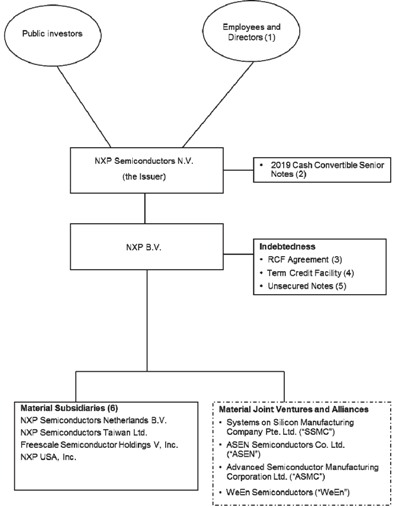
| (1) | For a more detailed description of our Long-Term Incentive Plans see the discussion set forth under “Share Based Compensation Plans” contained in this Report in Part I, Item 6B. Compensation. |
|---|
| (2) | As of December 31, 2016, we had $1,150 million aggregate principal amount of 2019 Cash Convertible Senior Notes outstanding. |
|---|
| (3) | As of December 31, 2016, no borrowings were outstanding under the RCF Agreement. |
|---|
| (4) | As of December 31, 2016, we had $2,211 million aggregate principal amount outstanding under the Term Loans. |
|---|
| (5) | As of December 31, 2016, we had $6,000 million aggregate principal amount of Unsecured Notes outstanding. |
|---|
| (6) | This list of material subsidiaries includes the subsidiaries that are guarantors under our RCF Agreement and our Secured Term Credit Agreement. Other subsidiaries provide a guarantee under certain of our other outstanding indebtedness. See Item 5B. Liquidity and Capital Resources, under the captions 2016 Financing Activities, 2015 Financing Activities and 2014 Financing Activities. |
|---|
Table of Contents
D. Property, Plant and Equipment
NXP uses 108 sites in 32 countries with 13.6 million square feet of total owned and leased building space of which 10.4 million square feet is owned property.
The following table sets out our principal real property holdings as of December 31, 2016:
| Location | Use | Owned/leased | Building space (square feet) | |||||
| Eindhoven, the Netherlands | Headquarters | Leased | 152,666 | |||||
| Hamburg, Germany (1) | Manufacturing | Owned | 749,609 | |||||
| Nijmegen, the Netherlands | Manufacturing | Owned | 1,515,550 | |||||
| Singapore (SSMC) * | Manufacturing | Owned | 757,852 | |||||
| Bangkok, Thailand | Manufacturing | Owned | 547,882 | |||||
| Cabuyao, Philippines (2) | Manufacturing | Owned | 494,656 | |||||
| Kaohsiung, Taiwan | Manufacturing | Owned | 636,395 | |||||
| Manchester, United Kingdom (2) | Manufacturing | Owned | 264,340 | |||||
| Guangdong, China (2) | Manufacturing | Leased | 927,569 | |||||
| Tianjin, China | Manufacturing | Owned | 447,624 | |||||
| Seremban, Malaysia (2) | Manufacturing | Owned | 322,285 | |||||
| Kuala Lumpur, Malaysia | Manufacturing | Owned | 828,858 | |||||
| Chandler, United States | Manufacturing | Owned | 1,173,196 | |||||
| Austin (Oak Hill), United States | Manufacturing | Owned | 1,514,389 | |||||
| Austin (Ed Bluestein), United States | Manufacturing | Owned | 1,158,731 |
| * | Joint venture between TSMC and NXP. |
|---|
| (1) | As of February 6, 2017, this property has been divested with the sale of the Standard Products business. NXP will lease part of this property from the former SP business. |
|---|
| (2) | As of February 6, 2017, these properties have been divested with the sale of the Standard Products business. |
|---|
Areas which are not fully closed are not considered as buildings (eg. sport fields, parking space). If it is not possible to differentiate between production facility and offices in the same building all is considered manufacturing.
Item 4A. Unresolved Staff Comments
| --- | --- |
Not applicable.
Item 5. Operating and Financial Review and Prospects
| --- | --- |
Critical Accounting Estimates
The preparation of financial statements and related disclosures in accordance with U.S. GAAP requires our management to make judgments, assumptions and estimates that affect the amounts reported in our Consolidated Financial Statements and the accompanying notes. Our management bases its estimates and judgments on historical experience, current economic and industry conditions and on various other factors that are believed to be reasonable under the circumstances. Actual results may differ from these estimates under different assumptions or conditions.
The methods, estimates, and judgments that we use in applying our accounting policies have a significant impact on the results that we report in our consolidated financial statements. Some of our accounting policies require us to make difficult and subjective judgments, often as a result of the need to make estimates regarding matters that are inherently uncertain. Our most critical accounting estimates include:
| • | the valuation of inventory, which impacts gross margin; |
|---|
| • | the assessment of recoverability of goodwill, identified intangible assets and tangible fixed assets, which impacts gross margin or operating expenses when we record asset impairments or accelerate their depreciation or amortization; |
|---|
| • | revenue recognition, which impacts our results of operations; |
|---|
| • | the recognition of current and deferred income taxes (including the measurement of uncertain tax positions), which impacts our provision for income taxes; |
|---|
| • | the assumptions used in the determination of postretirement benefit obligations, which impacts operating expenses; |
|---|
| • | the assumptions used in the determination of share based compensation, which impacts gross margin and operating expenses; and |
|---|
| • | the recognition and measurement of loss contingencies, which impacts gross margin or operating expenses when we recognize a loss contingency or revise the estimates for a loss contingency. |
|---|
In the following section, we discuss these policies further, as well as the estimates and judgments involved.
Table of Contents
Inventories
Inventories are valued at the lower of cost or market. We regularly review our inventories and write down our inventories for estimated losses due to obsolescence. This allowance is determined for groups of products based on sales of our products in the recent past and/or expected future demand. Future demand is affected by market conditions, technological obsolescence, new products and strategic plans, each of which is subject to change with little or no forewarning. In estimating obsolescence, we utilize information that includes projecting future demand.
The need for strategic inventory levels to ensure competitive delivery performance to our customers are balanced against the risk of inventory obsolescence due to rapidly changing technology and customer requirements.
The change in our reserves for inventories was primarily due to the normal review and accrual of obsolete or excess inventory. If actual future demand or market conditions are less favorable than those projected by our management, additional inventory write-downs may be required.
Goodwill
Goodwill is required to be tested for impairment at least annually or sooner whenever events or changes in circumstances indicate that the assets may be impaired. Such events or changes in circumstances can be significant changes in business climate, operating performance or competition, or upon the disposition of a significant portion of a reporting unit. A significant amount of judgment is involved in determining if an indicator of impairment has occurred between annual test dates. This impairment review compares the fair value for each reporting unit containing goodwill to its carrying value. Determining the fair value of a reporting unit involves the use of significant estimates and assumptions, including projected future cash flows, discount rates based on weighted average cost of capital and future economic and market conditions. We base our fair-value estimates on assumptions we believe to be reasonable. Actual cash flow amounts for future periods may differ from estimates used in impairment testing.
For the annual impairment assessment in 2016, we determined that for each of our reporting units, it was more likely than not that the fair value of the reporting units exceeded the carrying value. During the fourth quarter of each of the prior two fiscal years, we have completed our annual impairment assessments and concluded that goodwill was not impaired in any of these years.
Impairment or disposal of identified intangible assets and tangible fixed assets
We perform reviews of property, plant and equipment, and certain identifiable intangibles, excluding goodwill, to determine if facts and circumstances indicate that the useful life is shorter than what we had originally estimated or that the carrying amount of assets may not be recoverable. If such facts and circumstances exist, we assess the recoverability of the long-lived assets by comparing the projected undiscounted net cash flows associated with the related asset or group of assets over their remaining lives against their respective carrying amounts. In the event such cash flows are not expected to be sufficient to recover the recorded value of the assets, the assets are written down to their estimated fair values based on the expected discounted future cash flows attributable to the assets or based on appraisals. Impairment losses, if any, are based on the excess of the carrying amount over the fair value of those assets.
The assumptions and estimates used to determine future values and remaining useful lives of our intangible and other long-lived assets are complex and subjective. They can be affected by various factors, including external factors such as industry and economic trends, and internal factors such as changes in our business strategy and our forecasts for specific product lines. In 2016, we recognized an impairment charge of $89 million relative to IPR&D that was acquired from Freescale . In 2015, we recognized disposals of intangibles relative to our sale of the Bipolar and RF Power Businesses. In 2014, no impairments or disposal of identified intangible assets and tangible fixed assets were required to be recognized.
Revenue recognition
The Company’s revenue is derived from sales to distributors, made-to-order sales to Original Equipment Manufacturers (“OEMs”) and similar customers.
Revenue is recognized when persuasive evidence of an arrangement exists, delivery has occurred or the service has been provided, the sales price is fixed or determinable, and collection is reasonably assured, based on the terms and conditions of the sales contract. For made-to-order sales, these criteria are met at the time the product is shipped and delivered to the customer and title and risk have passed to the customer. Acceptance of the product by the customer is generally not contractually required, since, for made-to-order customers, design approval occurs before manufacturing and subsequently delivery follows without further acceptance protocols. Payment terms used are those that are customary in the particular geographic market. When management has established that all aforementioned conditions for revenue recognition have been met and no further post-shipment obligations exist, revenue is recognized.
For sales to distributors, revenue is recognized upon sale to the distributor (sell-in accounting). We record reductions to sales associated with reserves for allowances for collectibility, discounts, price protection, product returns and
Showing the first 8K of 92K characters. Open the full section
Item 6. Directors, Senior Management and Employees
| --- | --- |
A. Directors and Senior Management
The following description sets forth certain information about management and management-related matters. We have a one-tier board structure.
Board of Directors
Set forth below are the names, ages and positions as of December 31, 2016, of the persons who serve as members of our board of directors.
| Name | Age | Position | ||
| Richard L. Clemmer | 65 | Executive director, president and chief executive officer | ||
| Sir Peter Bonfield | 72 | Non-executive director and chairman of the board | ||
| Johannes P. Huth | 56 | Non-executive director and vice-chairman of the board | ||
| Kenneth A. Goldman | 67 | Non-executive director | ||
| Dr. Marion Helmes | 51 | Non-executive director | ||
| Josef Kaeser | 59 | Non-executive director | ||
| Ian Loring | 50 | Non-executive director | ||
| Eric Meurice | 60 | Non-executive director | ||
| Peter Smitham | 74 | Non-executive director | ||
| Julie Southern | 57 | Non-executive director | ||
| Gregory Summe | 60 | Non-executive director | ||
| Rick Tsai | 65 | Non-executive director |
| • | Richard L. Clemmer (1951, American). Mr. Clemmer became executive director, president and chief executive officer on January 1, 2009. Prior to that, from December 2007, Mr. Clemmer was a member of the supervisory board of NXP B.V. and a senior advisor of Kohlberg Kravis Roberts & Co. Prior to joining NXP, he was the President and CEO of Agere Systems, served as Chairman of u-Nav Microelectronics Corporation, and was executive vice president and chief financial officer at Quantum Corporation. Prior to that, Mr. Clemmer worked for Texas Instruments Incorporated as senior vice president and semiconductor group chief financial officer. Mr. Clemmer also serves on the board of NCR Corporation. |
|---|
| • | Sir Peter Bonfield CBE FREng (1944, British). Sir Peter has been appointed as a non-executive director and as the chairman of our board of directors in August 2010. Prior to that, Sir Peter was the chairman of the supervisory board of NXP B.V. from September 29, 2006. Sir Peter served as chief executive officer and chairman of the executive committee for British Telecom plc from 1996 to 2002 and prior to that was chairman and chief executive officer of ICL plc (now Fujitsu Services Holdings Ltd.). Sir Peter also worked in the semiconductor industry during his tenure as a divisional director at Texas Instruments Incorporated, for whom he held a variety of senior management positions around the world. Sir Peter currently holds non-executive directorships at Taiwan Semiconductor Manufacturing Company Limited, Mentor Graphics Corporation and serves as Chairman of Global Logic Inc. Sir Peter is Chair of Council and Senior Pro-Chancellor at Loughborough University, Chairman of the Board, East West Institute UK and Board Director, East West Institute USA and Board Mentor at CMi in Belgium. He is also Advisor to Longreach LLP in Hong Kong, Alix Partners UK LLP in London and G3 Good Governance Ltd in London. |
|---|
Table of Contents
| • | Johannes P. Huth (1960, German). Mr. Huth has been appointed as a non-executive director and vice-chairman of our board of directors in August 2010. Prior to that, Mr. Huth was a member and chairman of our supervisory board and a member and vice-chairman of NXP B.V.’s supervisory board from September 29, 2006. Mr. Huth joined Kohlberg Kravis Roberts & Co. LLP in May 1999 and is a Member of KKR and Head of KKR’s operations in Europe, the Middle East and Africa. He is also a member of the Firm’s Management Committee and several of the Firm’s Investment Committees. Prior to joining KKR, he was a member of the Management Committee of Investcorp and jointly responsible for Investcorp’s operations in Europe. From 1986 to 1991, he worked at Salomon Brothers, where he was a Vice President in the Mergers and Acquisitions departments in London and New York. Mr. Huth currently is also member of the Supervisory Board of GEG German Estate Group AG, member of the Board of SoftwareOne AG and member of the Board of Cognita Ltd. He is the Chairman of the Trustees of Impetus – Private Equity Foundation, a charitable organization set up by the Private Equity industry focused on providing support to charities involved with young people not in education, employment or training. He is Vice-Chair of the Board of Trustees of the Design Museum, trustee of the Staedel Museum in Frankfurt and trustee of The Education Endowment Foundation. He is a Visiting Fellow of Oxford University and a Fellow of the Royal Society of Arts. He earned a BSc with Highest Honors from the London School of Economics and an MBA from the University of Chicago. Mr. Huth is also a member of the Global Advisory Board of the Booth School of Business at the University of Chicago. |
|---|
| • | Kenneth A. Goldman (1949, American). Mr. Goldman has been appointed as a non-executive director of our board of directors effective August 6, 2010. Mr. Goldman is chief financial officer of Yahoo!, Inc responsible for Yahoo!’s global finance functions including financial planning and analysis, controllership, tax, treasury and investor relations since October 2012. Prior to that, Mr. Goldman served as senior vice president, finance and administration, and chief financial officer of Fortinet, Inc, a provider of unified threat management solutions, from September 2007 to September 2012. From November 2006 to August 2007, Mr. Goldman served as executive vice president and chief financial officer of Dexterra, Inc. From August 2000 until March 2006, Mr. Goldman served as senior vice president, finance and administration, and chief financial officer of Siebel Systems, Inc., and from December 1999 to December 2003, Mr. Goldman served on the Financial Accounting Standards Board’s primary advisory group. Mr. Goldman also serves on the board of directors of Yahoo! Japan, Trinet, GoPro, Inc. and several private companies. Mr. Goldman in 2015 was appointed to a three year term on the Standards Advisory Group which advises the PCAOB. Mr. Goldman was a member of board of trustees of Cornell University from 2005 to 2013 and was designated as Emeritus Trustee. He was formerly a member of the Treasury Advisory Committee on the Auditing Profession, a public committee that made recommendations in September 2008 to encourage a more sustainable auditing profession. Mr. Goldman holds a B.S. in Electrical Engineering from Cornell University and an M.B.A. from the Harvard Business School. |
|---|
| • | Dr. Marion Helmes (1965, German). Dr. Helmes has been appointed a non-executive director of our board of directors in October 2013. Dr. Helmes was the Speaker of the Management Board of Celesio AG until July 2014; in addition she was CFO of Celesio from January 2012 until July 2014. Prior to joining Celesio, she was member of the board of management and CFO of Q-Cells SE and from 1997 until 2010 she held various management roles at ThyssenKrupp, including CFO of ThyssenKrupp Stainless and CFO of ThyssenKrupp Elevator. Dr. Helmes is currently also non-executive director, Vice-Chairman, member of the Presiding Committee, member of the Compensation Committee and member of the Audit and Finance Committee of ProSiebenSat.1 Media SE. Dr. Helmes is currently also non-executive director, Member of the Nomination Committee and Chairman of the Audit Committee of Bilfinger SE and also non-executive director, Member of the Nomination Committee and the Audit Committee of British American Tobacco plc. |
|---|
| • | | Josef Kaeser (1957, German). Mr. Kaeser has been appointed as a non-executive director of our board of directors effective September 1, 2010. Mr. Kaeser is the president and chief executiv
Showing the first 8K of 79K characters. Open the full section
Item 7. Major Shareholders and Related Party Transactions
| --- | --- |
A. Major Shareholders
The following table shows the amount and percentage of our common stock beneficially owned as of December 31, 2016, December 31, 2015 and December 31, 2014 by (i) each person who is or was known by us to own beneficially more than 5% of our common stock, (ii) each current member of our board of directors, and (iii) all members of the board and named executive officers as a group. A person is a “beneficial owner” of a security if that person has or shares voting or investment power over the security or if he has the right to acquire beneficial ownership within 60 days. Unless otherwise noted, these persons may be contacted at our executive offices and, unless otherwise noted, have to our knowledge sole voting and investment power over the shares listed.
| Common Stock Beneficially Owned as of December 31 | ||||||||||||||||||||||||
| 2016 | 2015 | 2014 | ||||||||||||||||||||||
| Number | %* | Number | %* | Number | %* | |||||||||||||||||||
| T. Rowe(1) | 32,862,425 | 9.50 | — | — | 1,715,115 | 0.68 | ||||||||||||||||||
| FMR LLC(2) | 12,618,417 | 3.65 | 22,525,068 | 6.51 | 22,796,838 | 9.05 | ||||||||||||||||||
| Blackstone Funds | — | — | 33,275,028 | 9.62 | — | — | ||||||||||||||||||
| Wellington Management Company, LLP | — | — | — | — | 18,843,170 | 7.48 | ||||||||||||||||||
| Richard L. Clemmer | 4,553,772 | 1.32 | 4,188,683 | 1.21 | 3,410,762 | 1.36 | ||||||||||||||||||
| Sir Peter Bonfield | 32,611 | 0.01 | 30,487 | 0.01 | 25,312 | 0.01 | ||||||||||||||||||
| Johannes P. Huth | 12,560 | 0.004 | 8,135 | 0.002 | 98,351 | 0.04 | ||||||||||||||||||
| Kenneth Goldman | 21,433 | 0.006 | 33,526 | 0.01 | 28,351 | 0.011 | ||||||||||||||||||
| Dr. Marion Helmes | 9,914 | 0.003 | 6,487 | 0.002 | 1,685 | 0.001 | ||||||||||||||||||
| Josef Kaeser | 33,915 | 0.01 | 30,487 | 0.01 | 25,312 | 0.01 | ||||||||||||||||||
| Ian Loring | 40,912 | 0.01 | 36,486 | 0.01 | 28,351 | 0.011 | ||||||||||||||||||
| Eric Meurice | 5,857 | 0.002 | 3,117 | 0.001 | — | — | ||||||||||||||||||
| Julie Southern | 6,940 | 0.002 | 4,127 | 0.001 | 1,072 | 0.001 | ||||||||||||||||||
| Rick Tsai | 5,857 | 0.002 | 3,117 | 0.001 | — | — | ||||||||||||||||||
| Peter Smitham | — | — | — | — | — | — | ||||||||||||||||||
| Gregory L. Summe | 4,381 | 0.001 | 4,381 | 0.001 | — | — | ||||||||||||||||||
| All directors as a group | 4,728,152 | 1.37 | 4,349,033 | 1.26 | 3,619,196 | 1.44 |
| * | Percentage computations are based on 346,002,862 shares of our common stock issued and outstanding as of December 31, 2016 and December 31, 2015 and 251,751,500 as of December 31, 2014. |
|---|
| (1) | Information about the number of common shares owned by T. Rowe Price Associates, Inc. (“T. Rowe”) on December 31, 2016, is based solely on a Schedule 13G filed by T. Rowe with the SEC on February 7, 2017, reporting share ownership as of December 31, 2016. T. Rowe’s address is 100 E. Pratt Street, Baltimore, Maryland 21202. T. Rowe beneficially owned an aggregate of 32,862,425 common shares, has sole power to vote 10,917,873 shares and the sole power to dispose of 32,847,258 shares of our common stock. |
|---|
| (2) | Information about the number of common shares owned by FMR LLC (“FMR”) on December 31, 2016, is based solely on a Schedule 13G filed by FMR LLC and Abigail P. Johnson with the SEC on February 14, 2017, reporting share ownership as of December 31, 2016. The address of FMR is 245 Summer Street, Boston, Massachusetts 02210. FMR, along with certain of its subsidiaries and affiliates, and other companies, beneficially owned an aggregate of 12,618,417 common shares, has sole power to vote 1,654,656 shares and the sole power to dispose of 12,618,417 shares of our common stock. Abigail P. Johnson is a Director, the Chairman, and the Chief Executive Officer of FMR. Members of the Johnson family, including Abigail P. Johnson, are the predominant owners, directly or through trusts, of Series B voting common shares of FMR, representing 49% of the voting power of FMR. The Johnson family group and all other Series B shareholders have entered into a shareholders’ voting agreement under which all Series B voting common shares will be voted in accordance with the majority vote of Series B voting common shares. Accordingly, through their ownership of voting common shares and the execution of the shareholders’ voting agreement, members of the Johnson family may be deemed, under the Investment Company Act of 1940, to form a controlling group with respect to FMR. |
|---|
No shareholders held different voting rights.
As described elsewhere in this Annual Report, on October 27, 2016, Qualcomm River Holdings B.V., an indirect, wholly-owned subsidiary of QUALCOMM Incorporated, and NXP entered into a definitive agreement which will result, subject to the satisfaction or waiver of the conditions in the agreement, in a change in control of NXP.
B. Related Party Transactions
The transactions NXP has with related parties are not deemed to be material, individually or in the aggregate. See Part III, Item 18. Financial Statements, note 20 Related-party Transactions.
C. Interests of Experts and Counsel
Not applicable.
Table of Contents
Item 8. Financial Information
| --- | --- |
A. Consolidated Stateme nts and Other Financial Information
Consolidated Statements
See Part III, Item 18. Financial Statements.
Dividend Policy
We currently retain all of our earnings for use in the operation and expansion of our business, to repurchase or redeem capital stock, and in the repayment of our debt. We have never declared or paid any cash dividends on our common stock and may not pay any cash dividends in the foreseeable future. Whether or not dividends will be paid in the future will depend on, among other things, our results of operations, financial condition, level of indebtedness, cash requirements, covenants in our financings, contractual restrictions and other factors that our board of directors and our stockholders may deem relevant. If, in the future, our board of directors decides not to allocate profits to our reserves (making such profits available to be distributed as dividends), any decision to pay dividends on our common stock will be at the discretion of our stockholders. In addition, under the terms of the Purchase Agreement, we must obtain consent in advance from Buyer to declare, set aside or pay any dividend on our common stock.
B. Significant Changes
Not applicable.
Table of Contents
Item 9. The Offer and Listing
| --- | --- |
A. Offer and Listing Details
The following table shows the high and low closing sales prices of the common stock on the stock market of NASDAQ as reported in the Official Price List for the following periods:
| Most recent six months | ||||||||||||||||||||||
| January 2017 | December 2016 | November 2016 | October 2016 | September 2016 | August 2016 | |||||||||||||||||
| High | Low | High | Low | High | Low | High | Low | High | Low | High | Low | |||||||||||
| 98.79 | 96.00 | 99.00 | 97.10 | 99.55 | 96.59 | 104.49 | 98.66 | 102.01 | 81.40 | 88.94 | 81.85 |
On February 10, 2017, the closing sales price of the common stock on the stock market of NASDAQ was $101.99.
| 2016 | 2015 | 2014 | ||||||||||||||||||||||
| High | Low | High | Low | High | Low | |||||||||||||||||||
| 1st quarter | 84.44 | 64.00 | 108.03 | 72.38 | 59.91 | 42.94 | ||||||||||||||||||
| 2nd quarter | 94.49 | 75.04 | 112.25 | 95.33 | 66.44 | 55.72 | ||||||||||||||||||
| 3rd quarter | 102.01 | 76.05 | 99.28 | 79.26 | 73.01 | 60.50 | ||||||||||||||||||
| 4th quarter | 104.49 | 96.59 | 97.95 | 73.00 | 77.85 | 53.90 |
| High | Low | |||||||
| 2016 | 104.49 | 64.00 | ||||||
| 2015 | 112.25 | 72.38 | ||||||
| 2014 | 77.85 | 42.94 | ||||||
| 2013 | 45.95 | 25.29 | ||||||
| 2012 | 26.97 | 16.01 |
B. Plan of Distribution
Not applicable.
C. Markets
The shares of common stock of the Company are listed on the stock market of the NASDAQ Global Select Market in New York under the ticker symbol “NXPI”.
D. Selling Shareholders
Not applicable.
E. Dilution
Not applicable.
F. Expenses of the Issue
Not applicable.
Item 10. Additional Information
| --- | --- |
A. Share Capital
Not applicable.
B. Memorandum and Articles of Association
The information required by this section is incorporated by reference to Exhibit 3.2 of Amendment No. 7 to the Company’s Registration Statement on Form F-1, filed on August 5, 2010 (File No. 333-166128).
C. Material Contracts
Other than the material contracts described below, we have not entered into any material contracts other than in the ordinary course of business.
Table of Contents
2016
On May 23, 2016, we entered into the Senior Indenture between NXP B.V. and NXP Funding LLC as Issuers, each of the guarantors party thereto and Deutsche Bank Trust Company Americas as Trustee in connection with the issuance of 4.125% and 4.625% Senior Unsecured Notes with aggregate principal amounts of $850 million, due June 1, 2021 and $900 million, due June 1, 2023. On August 1, 2016, NXP B.V., together with NXP Funding LLC, issued an additional aggregate principal amount of $500 million of 4.125% Senior Unsecured Notes due 2021 under this agreement.
On June 14, 2016, we entered into an agreement with Beijing JianGuang Asset Management Co., Ltd (“JAC Capital”) and Wise Road Capital LTD (“Wise Road Capital”) to divest our Standard Products business. On February 6, 2017 we divested SP, receiving $2.75 billion in cash proceeds.
On June 13, 2016, we entered into amendments to the Shareholder Agreements with certain former Freescale shareholders (the “Sponsors”) to amend the transfer restrictions for the Sponsors in relation to NXP shares received in the Merger.
On August 11, 2016, we entered into the Senior Indenture among NXP B.V. and NXP Funding LLC as Issuers, each of the guarantors party thereto and Deutsche Bank Trust Company Americas as Trustee in connection with the issuance of $1,000 million aggregate principal amount of 3.875% Senior Unsecured Notes due 2022.
On September 22, 2016, we entered in the 2016 New Term Loan Joinder Agreement by and among the Tranche F Lenders defined therein, NXP B.V. and NXP Funding LLC as Borrowers and Credit Suisse AG as Administrative Agent in connection with the entry into Term Loan F for an aggregate principal amount of $1,440 million
On October 27, 2016, NXP entered into a purchase agreement (the “Purchase Agreement”) with Qualcomm River Holdings B.V. (“Buyer”), a wholly-owned, indirect subsidiary of Qualcomm Incorporated. Pursuant to the Purchase Agreement, Buyer commenced a tender offer to acquire all of the issued and outstanding common shares of NXP for $110 per share in cash, for estimated total cash consideration of $38 billion. The tender offer is not subject to any financing condition. An Extraordinary General Meeting of NXP’s shareholders was convened on January 27, 2017, in connection with the offer where the shareholders of NXP approved all resolutions brought before them, with 95% of the votes cast in favor of each such resolution. In light of the foregoing, the tender offer is now conditioned on the tender of 80% of the outstanding shares of NXP, and Buyer, with NXP’s prior written consent (not to be unreasonably withheld, conditioned or delayed), may reduce the required threshold to a percentage not less than 70% of the outstanding shares. Pending the receipt of certain regulatory approvals, as well as satisfaction of other customary closing conditions, the proposed transaction is expected to close by the end of calendar 2017.
The Purchase Agreement contains certain termination rights for NXP and Buyer. If the Purchase Agreement is terminated under certain circumstances, including termination by NXP to enter into a superior proposal for an alternative acquisition transaction or a termination following a change of recommendation by the NXP Board, NXP will be obligated to pay to Buyer a termination compensation equal to $1.25 billion in cash. If the Purchase Agreement is terminated under certain circumstances, including circumstances relating to the failure to obtain antitrust approvals or failure to complete in all material respects certain internal reorganization steps and related dispositions with respect to NXP, Buyer will be obligated to pay to NXP a termination compensation equal to $2 billion in cash.
2015
On March 1, 2015, we entered into a Merger Agreement, by and among the Company, Freescale and Nimble Acquisition Limited (“Merger Sub”), a Bermuda exempted limited liability company and Sub, providing for the merger of Sub with and into Freescale (the “Merger”), with Freescale surviving the Merger as a wholly-owned, indirect subsidiary of the Company.
Concurrently with the execution and delivery of the Merger Agreement, Freescale Holdings L.P. (“Freescale LP”), the largest holder of Freescale Common Shares, the Company and certain limited partners of Freescale LP, entered into a support agreement (the “Support Agreement”) whereby Freescale LP committed, among other things, subject to the terms and conditions of the Support Agreement, to vote all of its Freescale Common Shares (representing 64% of the Freescale Common Shares outstanding as of the date of the Support Agreement) for the adoption of (and not to participate in any litigation challenging) the Merger Agreement.
On December 7, 2015, we entered into the Bermuda Merger Agreement, by and among the Company, Freescale and Merger Sub, consummating the Merger. As per the same date, we entered into Shareholders Agreements with the Sponsors, containing transfer restrictions for the Sponsors in relation to NXP shares received in the Merger and the requirement for NXP to use its best efforts to cause to be declared effective by the SEC a registration statement on Form F-1 or Form F-3 or such other available form covering the NXP ordinary shares requested to be included by certain of the Sponsors.
In connection with the Merger, we also entered into the following financing agreements:
| • | 2020 Senior Unsecured Notes and 2022 Senior Unsecured Notes: On June 2, 2015, NXP B.V. and NXP Funding LLC entered into an indenture in relation to $600 million aggregate principal amount of 2020 Senior Unsecured Notes and $400 million aggregate principal amount of 2022 Senior Unsecured Notes that they issued. |
|---|
| • | RCF Agreement: NXP B.V. and NXP Funding LLC, as Borrowers, the several lenders party thereto, the Collateral Agent, Morgan Stanley Senior Funding Inc., as RCF Administrative Agent, the joint lead arrangers, the joint bookrunners and the co-managers, each as detailed therein, entered on December 7, 2015 into a $600 million RCF Agreement. All present and future obligations of the Borrowers arising under and pursuant to the terms of the RCF Agreement are guaranteed pursuant to RCF |
|---|
Table of Contents
| Guaranty Agreement by and among NXP B.V., NXP Funding LLC, NXP Semiconductors Netherlands B.V. and NXP Semiconductors Taiwan Ltd. (collectively, the “NXP Credit Guarantors”) and Freescale Semiconductor Holdings V, Inc. and Freescale Semiconductor Inc. (collectively, the “Freescale Credit Guarantors”) dated as of December 7, 2015; |
|---|
| • | Term Loan B: The Borrowers, the several lenders party thereto, Morgan Stanley Senior Funding LLC, as Collateral Agent, Credit Suisse AG, as Term Loan Administrative Agent, the joint lead arrangers, the joint bookrunners and the co-managers, each as detailed therein, entered into a $2,700 million New Secured Term Credit Agreement. All present and future obligations of the Borrowers arising under and pursuant to the terms of the New Secured Term Credit Agreement are guaranteed pursuant to the Term Loan Guaranty Agreement by and among each of the NXP Credit Guarantors and each of the Freescale Credit Guarantors dated as of December 7, 2015; |
|---|
| • | Secured Bridge Term Credit Agreement: The Borrowers, the Collateral Agent, Credit Suisse AG, as Bridge Loan Administrative Agent, and the lenders party thereto, entered on December 7, 2015 into a Secured Bridge Term Credit Agreement. All present and future obligations of the Borrowers arising under and pursuant to the terms of the Secured Bridge Term Credit Agreement are guaranteed pursuant to the Bridge Loan Guaranty Agreement by and among each of the NXP Credit Guarantors and each of the Freescale Credit Guarantors dated as of December 7, 2015. Amounts outstanding under the Secured Bridge Term Credit Agreement were repaid in full on December 16, 2015; and |
|---|
| • | Secured Notes: NXP B.V., NXP Funding LLC, NXP Semiconductors Netherlands B.V., NXP Semiconductors UK Limited, NXP Semiconductors USA, Inc., NXP Semiconductors Germany GmbH, NXP Semiconductors Hong Kong Limited, NXP Semiconductors Philippines Inc., NXP Semiconductors Singapore Pte. Ltd., NXP Semiconductors Taiwan Ltd. and NXP Manufacturing (Thailand) Ltd. entered into and acceded to the A&R Freescale Indentures as additional guarantors. |
|---|
On May 28, 2015, we entered into an agreement to sell our RF Power business to JAC Capital, and on December 7, 2015 we completed this divestment.
D. Exchange Controls
Cash dividends payable on our ordinary shares and cash interest payments to holders of our debt securities may be remitted from the Netherlands to nonresidents without legal restrictions imposed by the laws of the Netherlands, except that (i) such payments must be reported to the Dutch Central Bank for statistical purposes only and (ii) the transfer of funds to jurisdictions subject to general economic sanctions adopted in connection with policies of the United Nations, European Commission or similar measures imposed directly by the Government of the Netherlands may be restricted.
E. Taxation
Certain Tax Considerations-Holder of Common Stock
Summary of Dutch Tax Considerations
The following summary describes the material Dutch tax consequences of the ownership and disposition of our shares of common stock as of the date hereof and is intended as general information only. This summary does not contain a detailed description of all the Dutch tax law consequences applicable to you as a holder of shares of common stock in the Company in light of your particular circumstances and does not address the effects of any non-Dutch tax laws. For Dutch tax purposes, a holder of our shares may include an individual who or an entity that does not have the legal title of the shares, but to whom nevertheless the shares are attributed based either on such individual or entity holding a beneficial interest in the shares or based on specific statutory provisions, including statutory provisions pursuant to which shares are attributed to an individual who is, or who has directly or indirectly inherited from a person who was, the settlor, grantor or similar originator of a trust, foundation or similar entity that holds the shares.
If you are considering the purchase, ownership or disposition of our shares, you should consult your own tax advisors concerning the Dutch tax consequences to you in light of your particular situation as well as any consequences arising under the laws of any other taxing jurisdiction.
The following summary is based on the Dutch tax law as applied and interpreted by Dutch tax courts and as published and in effect on the date hereof, without prejudice to any amendments introduced at a later date and implemented with or without retroactive effect. For the purpose of this paragraph, “Dutch taxes” means taxes of whatever nature levied by or on behalf of the Netherlands or any of its subdivisions or taxing authorities. The Netherlands means the part of the Kingdom of the Netherlands located in Europe and does not include Bonaire, St. Eustatius and Saba. Any reference hereafter made to a treaty for the avoidance of double taxation concluded by the Netherlands includes the Tax Regulation for the Kingdom of the Netherlands (Belastingregeling voor het Koninkrijk), the Tax Regulation for the country of the Netherlands (Belastingregeling voor het land Nederland) and the Agreement between the Taipei Representative Office in the Netherlands and the Netherlands Trade and Investment Office in Taipei for the avoidance of double taxation.
Table of Contents
Withholding Tax
A stockholder is generally subject to Dutch dividend withholding tax at a rate of 15 percent on dividends distributed by us, if any. Generally, we are responsible for the withholding of such dividend withholding tax at source; the dividend withholding tax is for the account of the stockholder.
Dividends distributed by us include, but are not limited to:
| • | distributions of profits in cash or in kind, whatever they be named or in whatever form; |
|---|
| • | proceeds from the liquidation of the Company, or proceeds from the repurchase of shares by the Company, in excess of the average paid-in capital recognized for Dutch dividend withholding tax purposes; |
|---|
| • | the par value of shares issued to a stockholder or an increase in the par value of shares, to the extent that no contribution, recognized for Dutch dividend withholding tax purposes, has been made or will be made; and |
|---|
| • | partial repayment of paid-in capital, that is (i) not recognized for Dutch dividend withholding tax purposes, or (ii) recognized for Dutch dividend withholding tax purposes, to the extent that we have net profits (zuivere winst), unless (a) the general meeting of stockholders has resolved in advance to make such repayment and (b) the par value of the shares concerned has been reduced with an equal amount by way of an amendment to our articles of association. The term net profits includes anticipated profits that have yet to be realized. |
|---|
Notwithstanding the above, no withholding is required in the event of a repurchase of shares, if certain conditions are fulfilled.
Furthermore, subject to certain exceptions under Dutch domestic law, we may not be required to transfer to the Dutch tax authorities the full amount of Dutch dividend withholding tax withheld in respect of dividends distributed by us, if we have received a profit distribution from a qualifying foreign subsidiary (including a subsidiary resident on Bonaire, St. Eustatius or Saba), which distribution is exempt from Dutch corporate income tax and has been subject to a foreign withholding tax of at least 5 percent. The amount that does not have to be transferred to the Dutch tax authorities can generally not exceed the lesser of (i) 3 percent of the dividends distributed by us and (ii) 3 percent of the profit distributions that we received from qualifying foreign subsidiaries in the calendar year in which we distribute the dividends (up to the moment of such dividend distribution) and in the two previous calendar years. Further limitations and conditions apply. We will, upon request, provide stockholders with information regarding the Dutch dividend withholding tax that was retained by us.
If a stockholder is resident in a country other than the Netherlands under the provisions of a treaty for the avoidance of double taxation between the Netherlands and such country, such stockholder may, depending on the terms of such treaty, be entitled to an exemption from, reduction in or refund of Dutch dividend withholding tax on dividends distributed by us.
If a stockholder is subject to Dutch corporate income tax and is entitled to the participation exemption in relation to the benefits derived from the shares held by it and such shares are attributable to an enterprise carried out in the Netherlands, such stockholder will generally be entitled to an exemption from Dutch dividend withholding tax on dividends distributed by us.
If a stockholder (i) is resident in another member state of the European Union or an appointed state of the European Economic Area, i.e. Iceland, Norway and Liechtenstein, according to the tax laws of that state and, under the terms of a double taxation agreement concluded by that state with a third state, is not considered to be resident for tax purposes outside the European Union, Iceland, Norway or Liechtenstein; and (ii) owns an interest in us to which the Dutch participation exemption would be applicable if the stockholder were resident in the Netherlands; such stockholder will generally be eligible for an exemption from Dutch dividend withholding tax on dividends distributed by us.
Furthermore, if a stockholder:
| (a) | is an entity which is resident for Dutch tax purposes in a member state of the European Union, Iceland, Norway or Liechtenstein or which is a qualifying stockholder resident elsewhere; |
|---|
| (b) | is not subject to a tax levied by reference to its profits in its country of residence; and |
|---|
| (c) | would not have been subject to Dutch corporate income tax had the stockholder been resident in the Netherlands for Dutch tax purposes; |
|---|
such stockholder will be eligible for a full refund of Dutch dividend withholding tax on dividends distributed by us, unless such stockholder is comparable to an exempt investment institution (vrijgestelde beleggingsinstelling) or fiscal investment institution (fiscale beleggingsinstelling), as described respectively in article 6a and 28 of the Dutch corporate income tax act 1969 ( Wet op de vennootschapsbelasting 1969). For purposes of (a) above, a qualifying stockholder is an entity that (i) is resident for Dutch tax purposes in a jurisdiction which has an arrangement for the exchange of tax information with the Netherlands and (ii) holds its shares as a portfolio investment, i.e. such shares are not held with a view to the establishment or maintenance of lasting and direct economic links between the stockholder and the company and the shares do not allow the stockholder to participate effectively in the management or control of the company.
A stockholder who is considered to be resident in the United States and is entitled to the benefits of the convention between the United States and the Netherlands for the avoidance of double taxation and the prevention of fiscal evasion with respect to taxes on income, dated December 18, 1992, as amended most recently by the Protocol signed March 8, 2004 (the “Treaty”), will be entitled to a reduction in the Dutch withholding tax by way of an exemption, reduction or refund, as follows:
| • | if the U.S. stockholder is an exempt pension trust, as described in article 35 of the Treaty, or an exempt organization, as described in article 36 of the Treaty, the U.S. stockholder will be exempt from Dutch dividend withholding tax; |
|---|
Table of Contents
| • | if the U.S. stockholder is a company which holds directly at least 10 percent of the voting power in the company, the U.S. stockholder will be subject to Dutch withholding tax at a rate not exceeding 5 percent; |
|---|
| • | if the U.S. stockholder is a company which holds directly at least 80 percent of the voting power in the company and certain other conditions are met, the U.S. stockholder will be exempt from Dutch dividend withholding tax; and |
|---|
| • | in all other cases, the U.S. stockholder will be subject to Dutch dividend withholding tax at a rate of 15 percent. |
|---|
According to Dutch domestic anti-dividend stripping rules, no credit against Dutch (corporate) income tax, exemption from, reduction in or refund of, Dutch dividend withholding tax will be granted if the recipient of the dividend paid by us is not considered to be the beneficial owner ( uiteindelijk gerechtigde ) of such dividends as meant in these rules.
Taxes on Income and Capital Gains
The description of taxation set out in this section of the Report does not apply to any stockholder who is an individual for whom the income or capital gains derived from our shares of common stock are attributable to employment activities, the income from which is taxable in the Netherlands.
A stockholder will not be subject to Dutch taxes on income or capital gains in respect of the ownership and disposal of our shares, other than Dutch dividend withholding tax as described above, except if:
| (i) | the stockholder is, or is deemed to be, resident in the Netherlands for Dutch (corporate) income tax purposes; |
|---|
| (ii) | the stockholder derives profits from an enterprise, whether as entrepreneur (ondernemer) or pursuant to a co-entitlement to the net worth of such enterprise other than as an entrepreneur or a stockholder, which enterprise is, in whole or in part, carried on through a permanent establishment (vaste inrichting) or a permanent representative (vaste vertegenwoordiger) in the Netherlands, to which permanent establishment or a permanent representative the shares are attributable; |
|---|
| (iii) | the stockholder is an individual and derives benefits from miscellaneous activities (resultaat uit overige werkzaamheden ) carried out in the Netherlands in respect of the shares, including, without limitation, activities which are beyond the scope of active portfolio investment activities; |
|---|
| (iv) | the stockholder is an individual and has a substantial interest (aanmerkelijk belang) or a fictitious substantial interest (fictief aanmerkelijk belang) in the company, which is not attributable to the assets of an enterprise; |
|---|
| (v) | the stockholder is not an individual and (a) the stockholder has a substantial interest or a fictitious substantial interest in the company, (b) the main purpose, or one of the main purposes of the shareholding is the avoidance of the levy of Dutch income tax or dividend withholding tax on someone other than the stockholder, and (c) there is an artificial arrangement or series of arrangements; |
|---|
| (vi) | the stockholder is not an individual and is entitled to a share in the profits of an enterprise or a co-entitlement to the net-worth of an enterprise, other than by way of the holding of securities, which enterprise is effectively managed in the Netherlands and to which enterprise the shares are attributable; or |
|---|
| (vii) | the stockholder is an individual and is entitled to a share in the profits of an enterprise, other than by way of the holding of securities, which enterprise is effectively managed in the Netherlands and to which enterprise the shares are attributable. |
|---|
Generally, a stockholder has a substantial interest if such stockholder, alone or together with its partner, directly or indirectly (a) owns, or holds certain rights on, shares representing five percent or more of the total issued and outstanding capital of the company, or of the issued and outstanding capital of any class of shares of the company; (b) holds rights to, directly or indirectly, acquire shares, whether or not already issued, representing five percent or more of the total issued and outstanding capital of the company, or of the issued and outstanding capital of any class of shares of the company; or (c) owns, or holds certain rights on, profit participating certificates that relate to five percent or more of the annual profit of the company or to five percent or more of the liquidation proceeds of the company. A stockholder will also have a substantial interest if its partner or one of certain relatives of the stockholder or of its partner has a substantial interest.
Generally, a stockholder has a fictitious substantial interest in the company if, without having an actual substantial interest in the company (i) an enterprise has been contributed to the company in exchange for shares on an elective non-recognition basis; (ii) the shares have been obtained under inheritance law or matrimonial law, on a non-recognition basis, while the disposing stockholder had a substantial interest in the company; (iii) the shares have been acquired pursuant to a share merger, legal merger or legal demerger, on an elective non-recognition basis, while the stockholder prior to this transaction had a substantial interest in an entity that was party thereto; or (iv) the shares held by the stockholder, prior to dilution, qualified as a substantial interest and, by election, no gain was recognized upon disqualification of these shares.
Table of Contents
Gift Tax and Inheritance Tax
No Dutch gift or inheritance tax is due in respect of any gift of the shares by, or inheritance of the shares on the death of, a stockholder, except if:
| (i) | at the time of the gift or death of the stockholder, the stockholder is resident, or is deemed to be resident, in the Netherlands; |
|---|
| (ii) | the stockholder passes away within 180 days after the date of the gift of the shares and is not, or not deemed to be, at the time of the gift, but is, or deemed to be, at the time of its death, resident in the Netherlands; or |
|---|
| (iii) | the gift of the shares is made under a condition precedent and the stockholder is resident, or is deemed to be resident, in the Netherlands at the time the condition is fulfilled. |
|---|
For purposes of Dutch gift or inheritance tax, an individual who is of Dutch nationality will be deemed to be resident in the Netherlands if the individual has been resident in the Netherlands at any time during the ten years preceding the date of the gift or his/her death. For purposes of Dutch gift tax, any individual, irrespective of its nationality, will be deemed to be resident in the Netherlands if he has been resident in the Netherlands at any time during the 12 months preceding the date of the gift.
Other Taxes and Duties
No other Dutch taxes, including turnover tax and taxes of a documentary nature, such as capital tax, stamp or registration tax or duty, are payable by or on behalf of a stockholder by reason only of the purchase, ownership and disposal of the shares.
Residency
A stockholder will not become resident, or deemed resident in the Netherlands for tax purposes by reason only of holding the shares.
United States Federal Income Tax Considerations
The following summary describes the material United States federal income tax consequences of the ownership and disposition of our shares as of the date hereof. The summary set forth below is applicable only to United States Holders (as defined below) (i) who are residents of the United States for purposes of the Treaty, (ii) whose shares do not, for purposes of the Treaty, form part of the business property of a permanent establishment, or pertain to a fixed base, in the Netherlands, and (iii) who otherwise qualify for the full benefits of the Treaty. Except where noted, this summary deals only with shares held as capital assets. As used herein, the term “United States Holder” means a beneficial owner of a share that is for United States federal income tax purposes:
| • | an individual citizen or resident of the United States; |
|---|
| • | a corporation (or other entity treated as a corporation for United States federal income tax purposes) created or organized in or under the laws of the United States, any state thereof or the District of Columbia; |
|---|
| • | an estate the income of which is subject to United States federal income taxation regardless of its source; or |
|---|
| • | a trust if it (1) is subject to the primary supervision of a court within the United States and one or more United States persons have the authority to control all substantial decisions of the trust or (2) has a valid election in effect under applicable United States Treasury regulations to be treated as a United States person. |
|---|
This summary does not represent a detailed description of the United States federal income tax consequences applicable to you if you are subject to special treatment under the United States federal income tax laws, including if you are:
| • | a dealer in securities or currencies; |
|---|
| • | a financial institution; |
|---|
| • | a regulated investment company; |
|---|
| • | a real estate investment trust; |
|---|
| • | an insurance company; |
|---|
| • | a tax-exempt organization; |
|---|
| • | a person holding our shares as part of a hedging, integrated or conversion transaction, a constructive sale or a straddle; |
|---|
| • | a trader in securities that has elected the mark-to-market method of accounting for your securities; |
|---|
| • | a person liable for alternative minimum tax; |
|---|
| • | a person who owns or is deemed to own 10% or more of our voting stock; |
|---|
| • | a person holding our shares in connection with a trade or business conducted outside of the United States; |
|---|
| • | a partnership or other pass-through entity for United States federal income tax purposes; or |
|---|
| • | a person whose “functional currency” is not the United States dollar. |
|---|
The summary below is based upon the provisions of the United States Internal Revenue Code of 1986, as amended (the “Code”), and regulations, rulings and judicial decisions thereunder as of the date hereof, and such authorities may be replaced, revoked or modified, perhaps retroactively, so as to result in United States federal income tax consequences different from those discussed below.
If a partnership (or other entity treated as a partnership for United States federal income tax purposes) holds our shares, the tax treatment of a partner will generally depend upon the status of the partner and the activities of the partnership. If you are a partnership or a partner of a partnership holding our shares, you should consult your tax advisors.
Table of Contents
This summary does not contain a detailed description of all the United States federal income tax consequences to you in light of your particular circumstances and does not address the Medicare tax on net investment income or the effects of any state, local or non-United States tax laws. If you are considering the purchase, ownership or disposition of our shares, you should consult your own tax advisors concerning the United States federal income tax consequences to you in light of your particular situation as well as any consequences arising under the laws of any other taxing jurisdiction.
Taxation of Dividends
The gross amount of distributions on the shares (including any amounts withheld in respect of Dutch withholding taxes to the extent such amounts are actually transferred to the Dutch tax authorities, as described under “Certain Tax Considerations—Holder of Common Stock—Summary of Dutch Tax Considerations—Withholding Tax” above) will be taxable as dividends to the extent paid out of our current or accumulated earnings and profits, as determined under United States federal income tax principles. Such amounts taxable as dividends (including any portion thereof withheld and paid over to the Dutch tax authorities) will be includable in your gross income as ordinary income on the day actually received by you or on the day received by your nominee or agent that holds the shares on your behalf. Such dividends will not be eligible for the dividends received deduction allowed to corporations under the Code.
With respect to non-corporate United States investors, certain dividends received from a qualified foreign corporation may be subject to reduced rates of taxation. A qualified foreign corporation includes a foreign corporation that is eligible for the benefits of a comprehensive income tax treaty with the United States which the United States Treasury Department determines to be satisfactory for these purposes and which includes an exchange of information provision. The United States Treasury Department has determined that the Treaty meets these requirements. We believe we are currently eligible for the benefits of the Treaty. A foreign corporation is also treated as a qualified foreign corporation with respect to dividends paid by that corporation on shares that are readily tradable on an established securities market in the United States. United States Treasury Department guidance indicates that our shares, which are listed on the NASDAQ Global Select Market, are considered readily tradable on an established securities market in the United States. There can be no assurance that our shares will be considered readily tradable on an established securities market in later years.
Non-corporate holders that do not meet a minimum holding period requirement during which they are not protected from a risk of loss or that elect to treat the dividend income as “investment income” pursuant to Section 163(d)(4) of the Code will not be eligible for the reduced rates of taxation regardless of our status as a qualified foreign corporation. For this purpose, the minimum holding period requirement will not be met if a share has been held by a holder for 60 days or less during the 121-day period beginning on the date which is 60 days before the date on which such share becomes ex-dividend with respect to such dividend, appropriately reduced by any period in which such holder is protected from risk of loss. In addition, the rate reduction will not apply to dividends if the recipient of a dividend is obligated to make related payments with respect to positions in substantially similar or related property. This disallowance applies even if the minimum holding period has been met. You should consult your own tax advisors regarding the application of these rules to your particular circumstances.
The maximum rate of withholding tax on dividends paid to you pursuant to the Treaty is 15 percent. You may be required to properly demonstrate to the Company and the Dutch tax authorities your entitlement to the reduced rate of withholding under the Treaty. Subject to certain conditions and limitations, Dutch withholding taxes on dividends may be treated as foreign taxes eligible for credit against your United States federal income tax liability. However, amounts withheld to reflect Dutch withholding taxes will not be creditable to the extent that we are allowed to reduce the amount of the withholding tax that is actually transferred to the Dutch tax authorities, as described under “Certain Tax Considerations—Holder of Common Stock—Summary of Dutch Tax Considerations—Withholding Tax” above. For purposes of calculating the foreign tax credit, dividends paid on the shares will be treated as income from sources outside the United States and will generally constitute passive category income. Further, in certain circumstances, if you:
| • | have held shares for less than a specified minimum period during which you are not protected from risk of loss, or |
|---|
| • | are obligated to make payments related to the dividends, |
|---|
you will not be allowed a foreign tax credit for foreign taxes imposed on dividends paid on the shares. The rules governing the foreign tax credit are complex. You are urged to consult your tax advisors regarding the availability of the foreign tax credit under your particular circumstances.
To the extent that the amount of any distribution exceeds our current and accumulated earnings and profits for a taxable year, as determined under United States federal income tax principles, the distribution will first be treated as a tax-free return of capital, causing a reduction in the adjusted basis of the shares, and to the extent the amount of the distribution exceeds your tax basis, the excess will be taxed as capital gain recognized on a sale or exchange. However, we do not expect to determine earnings and profits in accordance with United States federal income tax principles. Therefore, you should expect that a distribution will generally be treated as a dividend (as discussed above).
Passive Foreign Investment Company
Based on the composition of our income and valuation of our assets, including goodwill, we do not believe we were a passive foreign investment company (a “PFIC”) for the 2016 taxable year, and we do not expect to become one in the future, although there can be no assurance in this regard. If, however, we are or become a PFIC, you could be subject to additional United States federal income taxes on gain recognized with respect to the shares and on certain distributions, plus an interest charge on certain taxes treated as having been deferred under the PFIC rules. Non-corporate United States Holders will not be eligible for reduced rates of taxation on any dividends received from us if we are a PFIC in the taxable year in which such dividends are paid or in the preceding taxable year.
Table of Contents
Taxation of Capital Gains
For United States federal income tax purposes, you will recognize taxable gain or loss on any sale or exchange of a share in an amount equal to the difference between the amount realized for the share and your tax basis in the share. Such gain or loss will generally be capital gain or loss. Capital gains of non-corporate United States Holders (including individuals) derived with respect to capital assets held for more than one year are eligible for reduced rates of taxation. The deductibility of capital losses is subject to limitations. Any gain or loss recognized by you will generally be treated as United States source gain or loss.
Information Reporting and Backup Withholding
In general, information reporting will apply to dividends in respect of our shares and the proceeds from the sale, exchange or redemption of our shares that are paid to you within the United States (and in certain cases, outside the United States), unless you are an exempt recipient. Backup withholding may apply to such payments if you fail to provide a taxpayer identification number or certification of other exempt status or fail to report in full dividend and interest income.
Any amounts withheld under the backup withholding rules will be allowed as a refund or a credit against your United States federal income tax liability provided the required information is furnished to the Internal Revenue Service.
F. Dividends and Paying Agents
Not applicable.
G. Statement by Experts
Not applicable.
H. Documents on Display
It is possible to read and copy documents referred to in this Report on Form 20-F that have been filed with the SEC at the SEC’s public reference room located at 450 Fifth Street, NW, Washington, D.C. 20549.
Please call the SEC at 1-800-SEC-0330 for further information on the public reference rooms and their copy charges.
The Company’s SEC filings are also publicly available through the SEC’s website at www.sec.gov.
I. Subsidiary Information
Not applicable.
Item 11. Quantitative and Qualitative Disclosures about Market Risk
| --- | --- |
We are exposed to changes in interest rates and foreign currency exchange rates because we finance certain operations through fixed and variable rate debt instruments and denominate our transactions in a variety of foreign currencies. Changes in these rates may have an impact on future cash flow and earnings. We manage these risks through normal operating and financing activities and, when deemed appropriate, through the use of derivative financial instruments. We do not enter into financial instruments for trading or speculative purposes.
By using derivative instruments, we are subject to credit and market risk. The fair market value of the derivative instruments is determined by using valuation models whose inputs are derived using market observable inputs, including interest rate yield curves, as well as foreign exchange and commodity spot and forward rates, and reflects the asset or liability position as of the end of each reporting period. When the fair value of a derivative contract is positive, the counterparty owes us, thus creating a receivable risk for us. We are exposed to counterparty credit risk in the event of non-performance by counterparties to our derivative agreements. We minimize counterparty credit (or repayment) risk by entering into transactions with major financial institutions of investment grade credit rating. Our exposure to market risk is not hedged in a manner that completely eliminates the effects of changing market conditions on earnings or cash flow.
Interest Rate Risk
Effective February 10, 2017, we have repaid all outstanding Term Loans (see note 24, “Subsequent Events”, to the Consolidated Financial Statements included in Part III, Item 18 of this Report for additional information), substantially reducing our interest rate risk going forward. Our RCF Agreement has a $600 million borrowing capacity with floating rate interest, but there are currently no borrowings under this facility. At December 31, 2016, without taking into account the aforementioned repayment of the Term Loans, a hypothetical increase in LIBOR based interest rates of 100 basis points would have caused our interest expense on our floating rate debt to increase by $22 million on an annualized basis.
Table of Contents
Additional information regarding our notes is provided in notes 2, Significant Accounting Policies, and 16, Debt, of our notes to the Consolidated Financial Statements included in Part III, Item 18 of this Report is incorporated herein by reference.
Foreign Currency Risks
We are also exposed to market risk from changes in foreign currency exchange rates, which could affect operating results as well as our financial position and cash flows. We monitor our exposures to these market risks and generally employ operating and financing activities to offset these exposures where appropriate. If we do not have operating or financing activities to sufficiently offset these exposures, from time to time, we may employ derivative financial instruments such as swaps, collars, forwards, options or other instruments to limit the volatility to earnings and cash flows generated by these exposures. Derivative financial instruments are only used for hedging purposes and not for trading or speculative purposes. Counterparties to our derivatives contracts are all major banking institutions. In the event of financial insolvency or distress of a counterparty to our derivative financial instruments, we may be unable to settle transactions if the counterparty does not provide us with sufficient collateral to secure its net settlement obligation to us, which could have a negative impact on our results. The Company measures all derivative financial instruments based on fair values derived from market prices of the instruments or from option pricing models, as appropriate and record these as assets or liabilities in the balance sheet. Changes in the fair values are recognized in the statement of operations immediately unless cash flow hedge accounting is applied. A summary of our foreign currency accounting policies is provided in note 2, Significant Accounting Policies, of our notes to the Consolidated Financial Statements included in Part III, Item 18 of this Report is incorporated herein by reference.
At December 31, 2016 our net liability related to foreign currency option and forward contracts designated as hedges of foreign currency risk on certain operating expenditure transactions was negligible. If our forecasted operating expenditures for currencies in which we hedge were to decline by 20% and foreign exchange rates were to change unfavorably by 20% in our hedged foreign currency, we would incur a negligible loss.
Financial assets and liabilities held by consolidated subsidiaries that are not denominated in the functional currency of those entities are subject to the effects of currency fluctuations and may affect reported earnings. As a global company, we face exposure to adverse movements in foreign currency exchange rates. We may hedge currency exposures associated with certain assets and liabilities denominated in nonfunctional currencies and certain anticipated nonfunctional currency transactions. As a result, we could experience unanticipated gains or losses on anticipated foreign currency cash flows, as well as economic loss with respect to the recoverability of investments.
Our primary foreign currency exposure relates to the U.S. dollar to euro exchange rate. However, our foreign currency exposures also relate, but are not limited, to the Chinese Yuan, the Japanese Yen, the Pound Sterling, the Malaysian Ringgit, the Singapore Dollar, the Taiwan Dollar and the Thailand Baht.
Equity Price Risk
Cash Convertible Senior Notes
Our Cash Convertible Senior Notes include conversion and settlement provisions that are based on the price of our common stock at conversion or at maturity of the notes. In addition, the hedges and warrants associated with these convertible notes also include settlement provisions that are based on the price of our common stock. The amount of cash we may be required to pay to the holders at conversion or maturity of the notes is determined by the price of our common stock. The amount of cash that we may receive from hedge counterparties in connection with the related hedges and the number of shares that we may be required to provide warrant counterparties in connection with the related warrants are also determined by the price of our common stock.
Item 12. Description of Securities Other than Equity Securities
Item 13. Defaults, Dividend Arrearages and Delinquencies
| --- | --- |
None
Item 14. Material Modifications to the Rights of Security Holders and Use of Proceeds
| --- | --- |
None
Item 15. Controls and Procedures
| --- | --- |
Disclosure Controls and Procedures
As of the end of the period covered by this Report, our management, with the participation of our chief executive officer and chief financial officer, conducted an evaluation pursuant to Rule 13a-15(e) and 15d-15(e) of the Securities and Exchange Act of 1934, as amended (the “Exchange Act”) of the effectiveness of the design and operation of our disclosure controls and procedures. Based on this evaluation, our chief executive officer and chief financial officer concluded that as of the end of the period covered by this Report such disclosure controls and procedures were effective to provide reasonable assurance that information required to be disclosed in reports we filed or submitted under the Exchange Act was recorded, processed, summarized and reported within the time periods specified in the rules and forms of the Securities and Exchange Commission, and included controls and procedures designed to ensure that information required to be disclosed in such reports was accumulated and communicated to our management, including our chief executive officer and chief financial officer, as appropriate to allow timely decisions regarding required disclosure.
Management’s Report on Internal Control over Financial Reporting
The Company’s management is responsible for establishing and maintaining adequate internal control over financial reporting as defined in Rules 13a-15(f) and 15(d)-15(f) of the Exchange Act. The Company’s internal control over financial reporting is designed to provide reasonable assurance, not absolute assurance, regarding the reliability of financial reporting and the preparation of financial statements for external purposes in accordance with U.S. generally accounting principles.
Because of its inherent limitations, internal control over financial reporting may not prevent or detect all misstatements. Moreover, projections of any evaluation of effectiveness to future periods are subject to the risk that controls may become inadequate because of changes in conditions, or that the degree of compliance with the policies or procedures may deteriorate.
Our management assessed the effectiveness of the Company’s internal control over financial reporting as of December 31, 2016 based on the criteria established in “Internal Control - Integrated Framework (2013)” by the Committee of Sponsoring Organizations of the Treadway Commission (COSO). Based on that assessment our management concluded that our internal control over financial reporting was effective as of December 31, 2016.
NXP acquired Freescale Semiconductor on December 7, 2015 and integration continues to be ongoing. For the year ended December 31, 2016 management incorporated the internal controls of the acquired entity into its evaluation of internal control over financial reporting, whereas for the year ended December 31, 2015 management’s assessment and conclusion on the effectiveness of internal control over financial reporting, excluded the entity. During 2016, other than the aforementioned, there have not been any changes in the Company’s internal controls over financial reporting that have materially affected, or are reasonably likely to materially affect, the Company’s internal controls over financial reporting.
It should be noted that any control system, regardless of how well it is designed and operated, can provide only reasonable, not absolute, assurance that its objectives will be met. Control systems can be circumvented by the individual acts of some persons, by collusion of two or more people, or by management override of the control. In addition, controls may become inadequate because of changes in conditions, or the degree of compliance with the policies or procedures may deteriorate. Because of these and other inherent limitations of control systems, there can be no assurance that any design will succeed in achieving its stated goals under all potential future conditions, regardless of how remote.
Attestation Report of the Independent Registered Public Accounting Firm
For the year ended December 31, 2016 an attestation report regarding internal control over financial reporting of the Company’s independent registered public accounting firm is required. The attestation is included in Part III, Item 18. Financial Statements.
Item 16A. Audit Committee Financial Expert
| --- | --- |
Mr. Goldman, chairman of our audit committee, qualifies as an “audit committee financial expert” as such term is defined in Item 407(d)(5) of Regulation S-K and as determined by our board of directors. Our board of directors has determined that Mr. Goldman is an independent director under the NASDAQ Global Select Market Corporate Governance Rules.
Table of Contents
Item 16B. Code of Ethics
| --- | --- |
The NXP Code of Conduct outlines our general commitment to be a responsible social partner and the way in which we attempt to interact with our stakeholders, including stockholders, suppliers, customers, employees and the market. The Code of Conduct expresses our commitment to an economically, socially and ethically sustainable way of working. It covers our policy on a diverse array of subjects, including corporate gifts, child labor, International Labor Organization conventions, working hours, sexual harassment, free-market competition, bribery and the integrity of financial reporting.
The NXP Code of Conduct is available on our website at www.nxp.com/investor/governance. We will disclose on this website any amendments to, or waivers from, our Code of Business Conduct and Ethics (to the extent applicable to any principal executive officer, principal financial officer, principal accounting officer or controller, or persons performing similar functions). The information contained on our website or that can be accessed through our website neither constitutes part of this Report on Form 20-F nor is incorporated by reference herein.
Item 16C. Principal Accountant Fees and Services
| --- | --- |
The Company has instituted a comprehensive auditor independence policy that regulates the relation between the Company and its external auditors and is available on our website ( www.nxp.com/investor ). The policy includes rules for the pre-approval by the audit committee of all services to be provided by the external auditor. The policy also describes the prohibited services that may not be provided. Proposed services may be pre-approved at the beginning of the year by the audit committee (annual pre-approval) or may be pre-approved during the year by the audit committee in respect of a particular engagement (specific pre-approval). The annual pre-approval is based on a detailed, itemized list of services to be provided, designed to ensure that there is no management discretion in determining whether a service has been approved and to ensure the audit committee is informed of each service it is pre-approving. Unless pre-approval with respect to a specific service has been given at the beginning of the year, each proposed service requires specific pre-approval during the year. Any annually pre-approved services where the fee for the engagement is expected to exceed pre-approved cost levels or budgeted amounts will also require specific pre-approval. The term of any annual pre-approval is 12 months from the date of the pre-approval unless the audit committee states otherwise. During 2016, there were no services provided to the Company by the external auditors which were not pre-approved by the audit committee.
The external auditor attends, in principle, all meetings of the audit committee. The findings of the external auditor, the audit approach and the risk analysis are also discussed at these meetings. The external auditor attends the meeting of the board of directors at which the report of the external auditor with respect to the audit of the annual accounts is discussed, and at which the annual accounts are approved. In its audit report on the annual accounts to the board of directors, the external auditor refers to the financial reporting risks and issues that were identified during the audit, internal control matters, and any other matters, as appropriate, requiring communication under the auditing standards generally accepted in the Netherlands and the United States.
Our Consolidated Financial Statements included in this Report have been audited by KPMG Accountants N.V., an independent registered public accounting firm. These financial statements have been approved by the board of directors.
The aggregate fees billed for professional services rendered for the fiscal periods 2016 and 2015 were as follows:
Aggregate fees KPMG
| ($ in millions) | 2016 | 2015 | ||||||
| Audit fees | 3.8 | 4.9 | ||||||
| Other fees | 0.1 | 0.1 | ||||||
| 3.9 | 5.0 |
Audit fees consist of fees for the examination of both the consolidated and statutory financial statements and for 2015 include fees paid by Freescale to KPMG prior to the acquisition. Audit fees also include fees that only our independent registered accounting firm can reasonably provide such as comfort letters and review of documents filed with the SEC. Other fees consist of fees for professional services by our independent registered public accounting firm for permissible non-audit services.
| Item 16D. | Exemptions from the Listing Standards for Audit Committees |
|---|
Not applicable.
Table of Contents
| Item 16E. | Purchases of Equity Securities by the Issuer and Affiliated Purchasers |
|---|
The following table provides a summary of shares repurchased by the Company in 2016:
| Period begin | Period end | Period | Total Number of Shares Purchased | Average Price Paid per Share | Total Number of Shares Purchased as Part of Publicly Announced Plans or Programs | Maximum Number of Shares that May Yet Be Purchased Under the Plans or Programs | ||||||||||||||||||
| January 1 | February 7 | January | 1,701,372 | 75.69 | 1,701,372 | 16,900,178 | ||||||||||||||||||
| February 8 | March 6 | February | 2,220,591 | 67.98 | 2,220,591 | 14,679,587 | ||||||||||||||||||
| March 7 | April 3 | March | 225,509 | 81.33 | 225,509 | 14,454,078 | ||||||||||||||||||
| April 4 | May 8 | April | 1,675,063 | 81.61 | 1,675,063 | 12,779,015 | ||||||||||||||||||
| May 9 | June 5 | May | 326,400 | 87.19 | 216,147 | 12,562,868 | ||||||||||||||||||
| June 6 | July 3 | June | 2,328,764 | 85.99 | 2,328,764 | 10,234,104 | ||||||||||||||||||
| July 4 | August 7 | July | 2,957,291 | 84.26 | 2,957,291 | 7,276,813 | ||||||||||||||||||
| August 8 | September 4 | August | 2,890,078 | 87.67 | 2,890,078 | 4,386,735 | ||||||||||||||||||
| September 5 | October 2 | September | 606,382 | 86.81 | 606,382 | 3,780,353 | ||||||||||||||||||
| October 3 | November 6 | October | 515,609 | 100.82 | 515,609 | 3,264,744 | ||||||||||||||||||
| November 7 | December 4 | November | 55,110 | 98.85 | 55,110 | 3,209,634 | ||||||||||||||||||
| December 5 | December 31 | December | 35,699 | 97.99 | 35,699 | 3,173,935 | ||||||||||||||||||
| Total 2016 | 15,537,868 | 82.36 | 15,427,615 |
From time to time, last in September 2015, the General Meeting of Shareholders authorized the Board of Directors to repurchase shares of our common stock. On that basis, the Board of Directors resolved to repurchase shares to cover in part employee stock options and equity rights under its long term incentive plans. The purchases identified in the table were all pursuant to this authorization.
| Item 16F. | Change in Registrant’s Certifying Accountant |
|---|
Not applicable.
| Item 16G. | Corporate Governance |
|---|
The Dutch Corporate Governance Code
Since our initial public offering in August 2010, we have been required to comply with the Dutch corporate governance code. The Dutch corporate governance code, as revised, became effective on January 1, 2009, and applies to all Dutch companies listed on a government-recognized stock exchange, whether in the Netherlands or elsewhere. The code is based on a “comply or explain” principle. Accordingly, companies are required to disclose in their Annual Reports filed in the Netherlands whether or not they are complying with the various rules of the Dutch corporate governance code that are addressed to the board of directors or, if any, the supervisory board of the company and, if they do not apply those provisions, to give the reasons for such non-application. The code contains principles and best practice provisions for managing boards, supervisory boards, stockholders and general meetings of stockholders, financial reporting, auditors, disclosure, compliance and enforcement standards.
The Dutch corporate governance code provides that if a company indicates to what extent it applies the best practice provisions, such company will be deemed to have applied the Dutch corporate governance code.
The following discussion summarizes the primary differences between our corporate governance structure and best practice provisions of the Dutch corporate governance code:
| • | Best practice provisions II.2.4 and II.2.5 state that stock options granted to members of our board shall, in any event, not be exercised in the first three years after the date of granting and shares granted to board members without financial consideration shall be retained for a period of at least five years or until at least the end of the employment, if this period is shorter. Under our equity incentive schemes, part of the stock options granted to our chief executive officer are exercisable one year after the date of grant, and members of our board who received restrictive shares and performance shares are not required to retain these shares for at least five years. Although a deviation from the Corporate Governance Code, we hold the view that the combination of equity incentives granted to our chief executive officer, in relation to his obligation—laid down in the NXP Executive Equity Ownership Policy of October 2013—to maintain at least 20% of the after tax number of NXP shares delivered upon the vesting of any performance stock units granted as of October 2013, as well as the applicable strict vesting and performance criteria, will enhance the goal of promoting long-term investments in the Company. The same is true for the equity grants made to other members of our board, which also have very strict vesting criteria with the purpose of creating long-term commitment to the Company. |
|---|
Table of Contents
| • | Pursuant to best practice provision IV.1.1, a general meeting of stockholders is empowered to cancel binding nominations of candidates for the board, and to dismiss members of the board by a simple majority of votes of those in attendance, although the company may require a quorum of at least one third of the voting rights outstanding. If such quorum is not represented, but a majority of those in attendance vote in favor of the proposal, a second meeting may be convened and its vote will be binding, even without a one-third quorum. Our articles of association currently state that the general meeting of stockholders may at all times overrule a binding nomination by a resolution adopted by at least a two-thirds majority of the votes cast, if such majority represents more than half of the issued share capital. Although a deviation from provision IV.1.1 of the Dutch Corporate Governance Code, we hold the view that these provisions will enhance the continuity of the Company’s management and policies. |
|---|
Effective January 1, 2012, Dutch law does not allow directors to vote on a matter with regard to which they have an interest.
The NASDAQ Global Select Market Corporate Governance Rules
We are a foreign private issuer. As a result, in accordance with the listing requirements of the NASDAQ Global Select Market, we rely on home country governance requirements and are exempt from certain corporate governance requirements that would otherwise apply in accordance with the listing requirements of the NASDAQ Global Select Market. These exemptions and home country rules relied on by us are described below:
| • | We are exempt from NASDAQ’s quorum requirements applicable to meetings of stockholders. Pursuant to Dutch corporate law, the validity of a resolution by the general meeting of stockholders does not depend on the proportion of the capital or stockholders represented at the meeting (i.e. quorum), unless the law or articles of association of a company provide otherwise. Our articles of association provide that a resolution proposed to the general meeting of stockholders by the board of directors shall be adopted by a simple majority of votes cast, unless another majority of votes or quorum is required under Dutch law or our articles of association. All other resolutions shall be adopted by a two thirds majority of the votes cast, provided such majority represents at least half of the issued share capital, unless another majority of votes or quorum is required under Dutch law. To this extent, our practice varies from the requirement of Listing Rule 5620(c), which requires an issuer to provide in its bylaws for a quorum, and that such quorum may not be less than one-third of the outstanding voting stock. |
|---|
| • | We are exempt from NASDAQ’s requirements regarding the solicitation of proxies and provision of proxy statements for meetings of stockholders. We inform stockholders of meetings in a public notice. We prepare a proxy statement and solicit proxies from the holders of our listed stock. Our practice in this regard, however, differs from the typical practice of U.S. corporate issuers in that the advance record date for determining the holders of record entitled to attend and vote at our stockholder meetings is determined by Dutch law (currently 28 days prior to the meeting). As an administrative necessity, we establish a mailing record date in advance of each meeting of stockholders for purposes of determining the stockholders to which the proxy statement and form of proxy will be sent. However, only stockholders of record on the specified record date are entitled to attend and vote, directly or by proxy, at the meeting. |
|---|
| • | NASDAQ requires stockholder approval prior to the issuance of securities when a stock option or purchase plan is to be established or materially amended or other equity compensation arrangement made or materially amended, pursuant to which stock may be acquired by officers, directors, employees or consultants. Under Dutch law and the Dutch corporate governance code, stockholder approval is only required for equity compensation plans (or changes thereto) for members of the board, and not for equity compensation plans for other groups of employees. However, we note that under Dutch law, the stockholders have the power to issue shares or rights to subscribe for shares at the general meeting of the stockholders unless such power has been delegated to the board. On June 2, 2015, our general meeting of stockholders has empowered our board of directors to issue additional shares and grant rights to subscribe for shares of common stock, up to 10% of the issued share capital which authorization can be used for general purposes and an additional 10% if the shares of common stock are issued or rights are granted in connection with an acquisition, merger or (strategic) alliance, and to restrict or exclude pre-emptive rights pertaining to (the right to subscribe for) shares for a period of 18 months from June 2, 2015 until December 2, 2016. |
|---|
| • | As a foreign private issuer, we are exempt from NASDAQ’s requirement that compensation committees be comprised exclusively of independent directors provided that we describe the home country practice followed in lieu of such requirement and disclose the reasons for not having such an independent compensation committee. Under Dutch law and the Dutch corporate governance code, the general meeting of stockholders must adopt a policy in respect of the remuneration of the board. In accordance with our articles of association and our board rules, the remuneration of the executive directors is determined by the board of directors upon the recommendation of our nominating and compensation committee. Accordingly, applicable laws, regulations and corporate governance rules and practices do not require independence of the members of our nominating and compensation committee. Currently, all three members of our nominating and compensation committee are independent directors under the Dutch corporate governance rules and under the NASDAQ and SEC compensation committee structure and membership requirements. |
|---|
| • | We are exempt from NASDAQ’s requirement to have independent director oversight of director nominations. In accordance with Dutch law, our articles of association require that our directors will be appointed by the general meeting of stockholders upon the binding nomination of the board. In accordance with our board rules, the nominating and compensation committee will recommend the nomination of directors to our board. |
|---|
Table of Contents
| • | NASDAQ requires us to adopt a nominations committee charter or a board resolution addressing the nominations process. In accordance with the Dutch corporate governance code, we have adopted the committee’s charter. However, the nominations process has been set out in our articles of association and board rules. |
|---|
Moreover, we will not distribute Annual Reports to all of our stockholders in accordance with NASDAQ rules. Dutch law requires that the external auditors be appointed at the general meeting of stockholders and not by the audit committee. Our audit committee, which consists of members of our board of directors, shall only make a recommendation to the stockholders through the board of directors for the appointment and compensation of the independent registered public accounting firm and shall oversee and evaluate the work of our independent registered public accounting firm.
| Item 16H. | Mine Safety Disclosures |
|---|
Not applicable.
Table of Contents
PART III
Item 17. Financial Statements
| --- | --- |
Not applicable.
Item 18. Financial Statements
| --- | --- |
See pages F-1 to F-[ ]
Item 19. Exhibits
| --- | --- |
| Exhibit Number | Description of Document | |
| 2.1# | Sale and Purchase Agreement, dated as of December 22, 2010, between NXP Semiconductors N.V., NXP B.V., the Dover Corporation, Knowles Electronics, LLC and EFF Acht Beteiligungsverwaltung GmbH (incorporated by reference to Exhibit 2.1 of the Form 20-F of NXP Semiconductors N.V. filed on March 13, 2012) | |
| 3.1 | Certificate of Incorporation (incorporated by reference to Exhibit 3.1 of Amendment No. 7 to the Registration Statement on Form F-1 of NXP Semiconductors N.V., filed on August 2, 2010 (File No. 333-166128)) | |
| 3.2 | Articles of Association of NXP Semiconductors N.V. (incorporated by reference to Exhibit 3.2 of Amendment No. 7 to the Registration Statement on Form F-1 of NXP Semiconductors N.V., filed on August 2, 2010 (File No. 333-166128)) | |
| 4.1 | Secured Term Credit Agreement dated March 4, 2011, as amended by (i) the Joinder and Amendment Agreement dated as of November 18, 2011, (ii) the New Term Loan Joinder Agreement dated as of February 16, 2012, (iii) the New Term Loan Joinder Agreement dated as of December 10, 2012, (iv) the 2013 New Term Loan Joinder Agreement dated as of November 27, 2013, and (v) the 2014 New Term Loan Joinder Agreement dated as of February 18, 2014, among NXP B.V. and NXP Funding LLC as borrowers, Barclays Bank PLC as Administrative Agent, Morgan Stanley Senior Funding, Inc. as Global Collateral Agent, Mizuho Corporate Bank, Ltd. as Taiwan Collateral Agent, and the lenders party thereto. (incorporated by reference to Exhibit 4.8 of the Form 20-F of NXP Semiconductors N.V. filed on March 13, 2012) | |
| 4.2 | Secured Revolving Credit Agreement dated April 27, 2012, as amended by an Incremental Joinder Agreement dated as of October 29, 2012, among NXP Semiconductors N.V., NXP B.V. and NXP Funding LLC as borrower, Morgan Stanley Senior Funding, Inc. as Global Collateral Agent and Administrative Agent, Mizuho Corporate Bank, Ltd. as Taiwan Collateral Agent and the lenders party thereto. (incorporated by reference to Exhibit 4.10 of the Form 20-F of NXP Semiconductors N.V. filed on March 1, 2013) | |
| 4.3 | Senior Unsecured Indenture dated as of February 14, 2013 among NXP B.V. and NXP Funding LLC as Issuers, each of the Guarantors named on the signature page thereto as borrower and Deutsche Bank Trust Company Americas as Trustee (incorporated by reference to Exhibit 4.13 of Form 20-F of NXP Semiconductors N.V. filed on March 13, 2012) | |
| 4.4 | Senior Unsecured Indenture dated as of March 12, 2013 among NXP B.V. and NXP Funding LLC as Issuers, each of the Guarantors named on the signature pages thereto and Deutsche Bank Trust Company Americas as Trustee (incorporated by reference to Exhibit 4.7 of the Form-20F of NXP Semiconductors N.V. filed on February 28, 2014) | |
| 4.5 | Senior Unsecured Indenture dated as of May 20, 2013 among NXP B.V. and NXP Funding LLC as Issuers, each of the Guarantors named on the signature pages thereto and Deutsche Bank Trust Company Americas as Trustee (incorporated by reference to Exhibit 4.8 of the Form-20F of NXP Semiconductors N.V. filed on February 28, 2014) | |
| 4.6 | Senior Unsecured Indenture dated as of September 24, 2013 among NXP B.V. and NXP Funding LLC as Issuers, each of the Guarantors named on the signature page thereto and Deutsche Bank Trust Company Americas as Trustee (incorporated by reference to Exhibit 4.9 of the Form-20F of NXP Semiconductors N.V. filed on February 28, 2014) | |
| 4.7 | Senior Unsecured Indenture dated as of November 24, 2014 among NXP Semiconductors N.V. as Issuer and Deutsche Bank Trust Company Americas as Trustee (incorporated by reference to Exhibit 4.7 of the Form 20-F of NXP Semiconductors N.V. filed on March 6, 2015) | |
| 4.8 | Support Agreement, dated as of March 1, 2015, by and among NXP Semiconductors N.V., Freescale Holdings L.P. and certain limited partners of Freescale Holdings L.P. (incorporated by reference to Exhibit 2 of the Form 6-K of NXP Semiconductors N.V. filed on March 3, 2015) | |
| 4.9 | Commitment Letter, dated as of March 1, 2015, by and among NXP B.V., Credit Suisse Securities (USA) LLC and Credit Suisse AG, Cayman Islands Branch (incorporated by reference to Exhibit 3 of the Form 6-K of NXP Semiconductors N.V. filed on March 3, 2015) |
Table of Contents
| Exhibit Number | Description of Document | |
| 4.10 | Senior Unsecured Indenture dated June 9, 2015 among NXP B.V. and NXP Funding LLC as Issuers, each of the Guarantors named on the signature pages thereto and Deutsche Bank Trust Company Americas as Trustee (incorporated by reference to Exhibit 4.10 of the Form 20-F of NXP Semiconductors N.V. filed on February 26, 2016) | |
| 4.11 | Secured Term Credit Agreement dated as of December 7, 2015 among NXP B.V. and NXP Funding LLC as Borrowers, the several lenders from time to time parties thereto, Morgan Stanley Senior Funding, Inc. as Collateral Agent, Credit Suisse AG as Administrative Agent, Credit Suisse Securities (USA) LLC, Morgan Stanley Senior Funding, Inc., Barclays Bank PLC, Deutsche Bank Securities Inc. and Bank of America, N.A. as Joint Lead Arrangers and Joint Bookrunners, and Goldman Sachs Lending Partners LLC, Citigroup Global Markets Limited and Coöperative Centrale Raiffeisen-Boerenleenbank B.A. as Co-Managers (incorporated by reference to Exhibit 2 of the Form 6-K of NXP Semiconductors N.V. filed on December 7, 2015) | |
| 4.12 | Term Loan Guaranty Agreement dated as of December 7, 2015 among the guarantors listed on the signature pages thereto, Credit Suisse AG as Administrative Agent and Morgan Stanley Senior Funding, Inc. as Collateral Agent (incorporated by reference to Exhibit 3 of the Form 6-K of NXP Semiconductors N.V. filed on December 7, 2015) | |
| 4.13 | RCF Agreement dated as of December 7, 2015 among NXP B.V. and NXP Funding LLC as Borrowers, the several lenders from time to time parties thereto, Morgan Stanley Senior Funding, Inc. as Collateral Agent, Morgan Stanley Senior Funding, Inc., as Administrative Agent, Citibank, N.A. as Letter of Credit Issuer, Credit Suisse Securities (USA) LLC, Morgan Stanley Senior Funding, Inc., Barclays Bank PLC, Deutsche Bank Securities Inc. and Bank of America N.A. as Joint Lead Arrangers and Joint Bookrunners, and Goldman Sachs Lending Partners LLC, Citigroup Markets Limited and Coöperative Centrale Raiffeisen-Boerenleenbank B.A. as Co-Managers (incorporated by reference to Exhibit 4 of the Form 6-K of NXP Semiconductors N.V. filed on December 7, 2015) | |
| 4.14 | RCF Guaranty Agreement dated as of December 7, 2015 among NXP B.V., NXP Funding LLC and each of the the subsidiary guarantors listed on the signature pages thereto, Morgan Stanley Senior Funding, Inc. as Collateral Agent and Morgan Stanley Senior Funding, Inc. as Administrative Agent (incorporated by reference to Exhibit 5 of the Form 6-K of NXP Semiconductors N.V. filed on December 7, 2015) | |
| 4.15 | Secured Bridge Term Credit Agreement dated as of December 7, 2015 among NXP B.V. and NXP Funding LLC as Borrowers, the lenders from time to time parties thereto, Morgan Stanley Senior Funding, Inc. as Collateral Agent and Credit Suisse AG as Administrative Agent (incorporated by reference to Exhibit 6 of the Form 6-K of NXP Semiconductors N.V. filed on December 7, 2015) | |
| 4.16 | Bridge Loan Guaranty Agreement dated as of December 7, 2015 among NXP B.V., NXP Funding LLC and each of the subsidiary guarantors listed on the signature pages thereto, Morgan Stanley Senior Funding, Inc. as Collateral Agent and Credit Suisse AG as Administrative Agent (incorporated by reference to Exhibi |
Showing the first 8K of 247K characters. Open the full section