 filings.tools
Item 4. Information on the Company
48K characters. Original on sec.gov · Markdown
Item 4. Information on the Company
A. History and Development of the Company
Corporate Information
Our legal name is NXP Semiconductors N.V. and our commercial name is “NXP” or “NXP Semiconductors”.
Table of Contents
We are incorporated in the Netherlands as a Dutch public company with limited liability (naamloze vennootschap).
On August 5, 2010, we made an initial public offering of 34 million shares of our common stock and listed our common stock on the Nasdaq Global Select Market.
We are a holding company (the “holding” company) whose only material assets are the direct ownership of 100% of the shares of NXP B.V., a Dutch private company with limited liability (besloten vennootschap met beperkte aansprakelijkheid).
Our corporate seat is in Eindhoven, the Netherlands. Our principal executive office is at High Tech Campus 60, 5656 AG Eindhoven, the Netherlands, and our telephone number is +31 40 2729999. Our registered agent in the United States is NXP USA, Inc., 6501 William Cannon Dr. West, Austin, Texas 78735, United States of America, phone number +1 512 8952000.
Business Combinations
On February 20, 2018, Buyer and NXP entered into the Purchase Agreement Amendment under which Buyer agreed to revise the terms of its tender offer to acquire all of the issued and outstanding common shares of NXP and increase the offer price from $110 per share to $127.50 per share, less any applicable withholding taxes and without interest to the holders thereof, payable in cash, subject to the satisfaction or waiver of the conditions in the Purchase Agreement. Pending the receipt of certain regulatory approvals, as well as satisfaction of other customary closing conditions, the proposed transaction is expected to close in the first half of 2018.
The Purchase Agreement contains certain termination rights for NXP and Buyer. If the Purchase Agreement is terminated under certain circumstances, including termination by NXP to enter into a superior proposal for an alternative acquisition transaction or a termination following a change of recommendation by the NXP Board, NXP will be obligated to pay to Buyer a termination compensation equal to $1.25 billion in cash. If the Purchase Agreement is terminated under certain circumstances, including circumstances relating to the failure to obtain antitrust approvals or failure to complete in all material respects certain internal reorganization steps and related dispositions with respect to NXP, Buyer will be obligated to pay to NXP a termination compensation equal to $2 billion in cash.
On December 7, 2015, NXP acquired Freescale in a stock and cash transaction for a total consideration of $11.6 billion. In connection with the Merger, each outstanding share of Freescale common stock was converted into 0.3521 shares of NXP common stock and $6.25 in cash, without interest. NXP issued 110 million shares of common stock to former holders of Freescale common stock, representing 32% of the 342 million total shares of outstanding NXP common stock after the Merger. Freescale’s financial results from the Merger date through December 31, 2017, are included in NXP’s Consolidated Statement of Operations, as discussed herein. NXP accounted for the Merger under the acquisition method of accounting in accordance with Financial Accounting Standards Board Accounting Standards Topic 805, Business Combinations, with NXP treated as the accounting acquirer, see further discussion below.
The Merger created a market leader in automotive, broad based microcontroller and security semiconductor solutions, with a highly complementary product portfolio. The Merger enables NXP to better serve a broader array of customers in strategic markets.
Other Significant Transactions
On March 27, 2018, NXP Semiconductors N.V. through its subsidiary NXP B.V., has entered into a definitive agreement to sell its 40% equity interest of Suzhou ASEN Semiconductors Co., Ltd. to J&R Holding Limited. The closing of this transaction is expected in the second quarter of 2018, subject to customary regulatory approvals.
On April 19, 2017, we sold our shares in Advanced Semiconductor Manufacturing Corporation Ltd. (ASMC), representing a 27.47 percent ownership, for a total consideration of $54 million.
On June 14, 2016, we announced an agreement to divest our Standard Products (“SP”) business to a consortium of financial investors consisting of JAC Capital and Wise Road Capital. On February 6, 2017 NXP divested SP, receiving $2.6 billion in cash proceeds, net of cash divested.
On December 7, 2015, we divested our RF Power business to JAC Capital.
On November 9, 2015, we completed setting up WeEn Semiconductors, a Bipolar Power joint venture in China with JAC Capital. WeEn Semiconductors, in which JAC Capital owns 51% and we own 49%, combines our advanced technology from our former Bipolar Power business line with JAC Capital’s strong connections in the Chinese manufacturing network and distribution channels to lower manufacturing costs and boost profit margins of high end electronic products in China.
B. Business Overview
Semiconductor Market Overview
Semiconductors perform a broad variety of functions within electronic products and systems, including processing data, sensing, storing information and converting or controlling electronic signals. Semiconductors vary significantly depending upon the specific function or application of the end product in which the semiconductor is used and the customer who is deploying it. Semiconductors also vary on a number of technical characteristics including the degree of integration, level of customization, programmability and the process technology utilized to manufacture the semiconductor. Advances in semiconductor technology have increased the functionality and performance of semiconductors, improving their features and power consumption characteristics while reducing their size and cost. These advances have resulted in growth of semiconductors and electronic content across a diverse array of products. The semiconductor market totaled $412 billion in 2017.
Table of Contents
Our Company
We are a global semiconductor company and a long-standing supplier in the industry, with over 50 years of innovation and operating history. For the year ended December 31, 2017, we generated revenue of $9,256 million, compared to $9,498 million for the year ended December 31, 2016.
We provide leading High Performance Mixed Signal (HPMS) and, until February 6, 2017, Standard Product (SP) solutions that leverage our combined portfolio of intellectual property, deep application knowledge, process technology and manufacturing expertise in the domains of cryptography—security, high-speed interface, radio frequency (RF), mixed-signal analog-digital (mixed A/D), power management, digital signal processing and embedded system design.
Our product solutions are used in a wide range of end-market applications including: automotive, personal security and identification, wireless and wireline infrastructure, mobile communications, multi-market industrial, consumer and computing. We engage with leading global original equipment manufacturers (OEM) and sell products in all major geographic regions.
Reporting Segments
Until February 6, 2017, NXP was organized into two market oriented reportable segments, High Performance Mixed Signal (“HPMS”) and Standard Products (“SP”). Corporate and Other represents the remaining portion (or “segment”) to reconcile to the Consolidated Financial Statements. You can find a description of each of our reportable segments below. We also have a manufacturing group that manages our manufacturing and supply chain activities.
Markets, applications and products
HPMS products consist of highly differentiated application-specific semiconductors and system solutions, which accounted for 99% of our total product revenue in 2017. We believe the HPMS market is an attractive market due to the growth in excess of the overall semiconductor market, the high barriers to entry, the loyalty of the customer base, the relative pricing stability and lower long-term capital intensity.
SP products consisted primarily of discrete semiconductor devices that could be incorporated in many different types of electronics equipment, were typically sold to a wide variety of customers, and accounted for 1% of our total product revenue in 2017, as it was divested on February 6, 2017.
High Performance Mixed Signal
The HPMS segment consists of the following four business lines: Automotive, Secure Identification Solutions, Secure Connected Devices and Secure Interfaces and Infrastructure.
We focus on developing products and system and sub-system solutions that are innovative and allow our customers to bring their end products to market more quickly. Our products, particularly our application system and sub-system solutions, help our customers design critical parts of their end products and thus help many of them to differentiate themselves based on feature performance, advanced functionality, cost or time-to-market.
We apply our technical expertise in the areas of RF, analog, power management, interface, security technologies and digital processing across our priority applications markets. Our strong RF capabilities are utilized in our high performance RF for wireless infrastructure and industrial applications, car security and car radio products, mobile connectivity and contactless identification products. Our power technologies and capabilities are applied in AC-DC power conversion, power management and audio power products, while our ability to design ultra-low power semiconductors is used in a wide range of our products including our consumer, mobile, identification, healthcare products and our microcontrollers. Our high-speed interface design skills are applied in various interface products, and our security capability is used in our identification solutions, digital networking and microcontroller solutions. Finally, our digital processing capabilities are used in our microcontroller and application processor based products, our digital networking products, our Auto DSPs and the products leveraging our Coolflux ultra-low power DSPs, such as in our hearing aid products.
Table of Contents
The below table provides an overview of the key applications per each business line, the leading market positions and our key customers.
| Automotive | Secure Identification Solutions | Secure Connected Devices | Secure Interfaces and Infrastructure | |||||
| Key applications | • Car access & immobilizers • In vehicle networking • Car entertainment • ADAS • Telematics • ABS • Transmission/ throttle control • Automotive Lighting • Gateways • Battery Management • Sensors | • Secure identity • Tagging | • Secure transactions • Mobile handset • Tablet • Personal computer • Smart buildings • White goods & home appliances • Medical/Personal Healthcare • Industrial/ IoT • Consumer/TV/Set top box | • Wireless base stations • Networking • Satellite & CATV infra • Radar • Power supplies • Lighting • Mobile Handsets • Pachinko machines | ||||
| Selected market leading positions | • #1 in Automotive semiconductors • #1 Can/LIN/ Flex Ray in-vehicle networking • #1 passive keyless entry/ immobilizers • #1 car radio • #1 Chassis & Safety • #1 Powertrain • #2 automotive MCU • #2 audio amplifiers | • #1 e-Government • #1 Transport & Access management • #1 Banking | • #1 I broad based MCU • #1 NFC | • #1 in RF Power • #1 in communication processors | ||||
| Key OEM and electronic manufacturing services (EMS) end customers | • Autoliv • Bosch • Continental • Delphi • Denso • Fujitsu Ten • Lear • TRW • Valeo • Visteon | • Avery Dennison • Bundesdruckerei • China Vision Microelectronic • Chutian Dragon • Eastcompeace • Gemalto • Giesecke • HID • Linxens • Smartrac | • Amazon • Apple • BBK • Bosch • Huawei • LG • Relaince • Samsung • Visteon • ZLG Electronics | • Apple • Arris • Cisco • Ericsson • Huawei • Fujitsu • NEC • Nokia • Samsung • ZTE |
The table above provides a list of our key OEM, ODM and electronic manufacturing services end customers in alphabetical order, based on 2017 revenue, of which some of whom are supplied by distributors. Key distributors across these applications are Arrow, Avnet, Edom, Nexty, Vitec and WPG.
Automotive****. Growth in semiconductor sales to the global automotive market relies on global economic trends, the unit growth of automobiles manufactured and the growth in semiconductor content per vehicle which is being driven by the proliferation of electronic features throughout the vehicle. Among the highest growth applications are advanced driver assistance systems (ADAS), infotainment (information, convenience and connectivity), secure in-vehicle networking and electrified powertrain (hybrid and electric vehicles).
Due to the high degree of regulatory scrutiny and safety requirements, the automotive semiconductor market is characterized by stringent qualification processes, zero defect quality processes, functionally safe design architecture, high reliability, extensive design-in timeframes and long product life cycles which results in significant barriers to entry.
Semiconductor content per vehicle continues to increase due to government regulation for improved safety and emissions, the standardization of higher-end options across a greater number of vehicle classes as well as consumer demand for greater fuel efficiency, advanced safety and multimedia applications. Automotive safety features are evolving from passive safety systems to active safety systems with ADAS such as radar, vision, vehicle-to-vehicle and vehicle-to-infrastructure (V2X) systems. We believe regulatory actions and consumer demand in both the developed and emerging markets should drive the increase in applications such as ADAS, secure connectivity, electronic safety and stability control. Semiconductor content per vehicle is also increasing to address applications such as engine management, fuel economy improvement, driver comfort, convenience and user interface. In addition, with the increase in overall semiconductor content in modern automobiles, the demand for secure in-vehicle networking continues to increase as various subsystems communicate within the automobile and with external devices and networks. Data integrity and security hardware features for safeguarding memory, communication and system data are also increasing in importance.
As a result of the Merger with Freescale, NXP became the largest semiconductor supplier to the automotive industry with strong positions in Car Entertainment, In-Vehicle Networking, Secure Car Access, Chassis & Safety and Powertrain. The combined portfolio is highly complementary, enabling NXP to address a broader scope of complete and complex solutions for our automotive partners. We continue to invest in growth areas including the evolution of the Secure Connected Car, ADAS and other safety and comfort applications.
In Car Entertainment, we are the market leader with the broadest portfolio of products offerings addressing both audio and visual head-end unit applications. Our leadership in audio processing for mid-to-high-end car radio is driven by excellent reception performance as well as high-levels of integration of terrestrial, satellite and digital multi-band tuners. Within the low-end and after-market car radio, our leadership is a result of highly integrated, single-chip radio solutions that offer our customers ease of implementation and lower total cost of ownership. In digital reception, we have developed multi-standard radios based on our software-defined radio implementation. In addition, we provide class-AB and class-D audio amplifiers and power analog products for car entertainment. Our i.MX applications processors, which are developed and brought to market by our Microcontroller and Processor teams, are highly integrated ARM-based application processors with integrated audio, video and graphics capability.
Table of Contents
In the In-vehicle Networking market, we are the market leader, having played a defining role in setting in-vehicle networking standards including the CAN, LIN, FlexRay and more recently the two-wire automotive Ethernet standard. We are a leading supplier to major OEMs and continue to drive new system concepts, such as partial networking for enhanced energy efficiency.
In the Secure Car Access market, we are the market leader in two-way secure entry products, and have pioneered the development of next generation passive keyless entry/start with our customers. As a result of our R&D innovations we are a key supplier to almost all major automobile manufacturers for secure access products.
In Chassis & Safety we offer a broad range of sensors and microcontrollers. Our inertial sensors enable vehicle stability control and airbag crash detection while our pressure sensors are well-positioned for continued growth in tire pressure monitoring, occupancy detection and engine control.
In Powertrain, we offer power management solutions which provide the intelligence engine management systems that reduce emissions and improve fuel efficiency. In December 2013, we announced a joint venture with Datang Telecom, targeting the China domestic hybrid and electrical car market. This joint venture became active in April 2014.
In ADAS, we are developing solutions for Radar, Vision and Secure V2X. In 2013, we made a strategic investment in Cohda Wireless, an equipment vendor in the Intelligent Transport Systems (ITS) market with whom we co-operate for V2X solutions. In December 2013, we also announced the intended sale of our Telematics Module business to Telit Communications which closed in March 2014.
We employ our proprietary processes for automotive-grade, high-voltage, RF and non-volatile processes as well as our technology standards and leading edge security IP developed by our Secure Identification Solutions business, to deliver our automotive solutions. We design our products to be compliant with all key global relevant automotive quality standards (such as ISO/TS16949 and VDA6.3).
For the full year 2017, we had High Performance Mixed Signal revenue of $3,762 million in automotive applications, compared to $3,379 million in 2016, which represents a 11% year over year increase. According to Strategy Analytics, the total market for automotive semiconductors was $34.1 billion in 2016, and projects it will grow at a compounded annual growth rate of 5.9% between 2016 and 2020.
Secure Identification Solutions (SIS). The SIS business is focused on delivering solutions to address the security and privacy requirements of three specific end market dynamics: (1) the increasing adoption of chip-based banking cards (“Banking”); (2) the increasing usage of high-volume, single-payment platform systems for urban transportation (“Transit—Access”); and (3) the increased need to provide government sponsored products to assure privacy and secure cross-border movement of people (“eGov”).
Nearly all of SIS products consist of multi-functional solutions comprised of passive RF connectivity devices facilitating information transfer from the user document to reader infrastructure; secure, tamper-proof microcontroller devices in which information is securely encrypted (“secure element”); and secure real-time operating system software products to facilitate the encryption-decryption of data, and the interaction with the reader infrastructure systems. Our solutions are developed to assure extreme levels of security of user information, undergoing stringent and continued global governmental and banking certification processes, as well as delivering the highest level of device performance enabling significant throughput and productivity to our customers.
In the banking sector NXP is the market leader in the contact, contactless and dual-interface bank card market. We have innovated and deployed “multi-application” banking solutions which support a combination of payment, transit and access solutions all leveraging a single physical bank card. In the transit and access market, NXP’s MIFARE products are ubiquitous throughout the world, having been deployed in over 750 cities, facilitating the mass transit requirements of over one billion people per day. Additionally our transit and access products are deployed in application such as employee identification for facility access and security. We are also focused on deploying our technology into new emerging market applications such as interactive gaming, theme-park attendee management and supply chain and inventory product management to support high velocity supply chain management. In the eGovernment sector, NXP is a market leader providing solutions for chip-based cross-border passports, drivers-licenses, health cards and other government sponsored identification documents. We have also worked with emerging market government agencies to facilitate government sponsored identity cards which also serve as payment platforms helping the mass-population of under-banked.
For the full year 2017, we had High Performance Mixed Signal revenue of $523 million in SIS, compared to $737 million in 2016, which represents a 29% year over year decline. According to ABI Research, the market size for secure identification ICs was $3.5 billion in 2016, and is expected to grow at a compounded annual rate of 3.9% to $4.1 billion in 2020.
Secure Connected Devices (SCD). The SCD business is focused on delivering solutions to enable the future of connected devices – also known as “Internet of Things” (IoT). We believe the future growth of secure connected devices requires the ability to deliver four fundamental functional capabilities: (1) embedded microcontrollers; (2) connectivity – short range RF and wireless technology (Bluetooth LE, Zigbee, Thread and NFC); (3) security; and (4) sensor. We see end-markets and applications emerging in the area of Mobile Payments, Smart Home-Health, Smart Cities, Wearables and Smart Industrial.
The SCD business has a broad portfolio products which we believe enables NXP to successfully compete and deliver all aspects of semiconductor-based technologies for connected devices including microcontrollers, secure mobile transactions solutions and various connectivity solutions.
Table of Contents
Post-Merger, we are the largest supplier of broad based microcontrollers. We differentiate ourselves versus our competitors with a broad portfolio of products addressing different processing power, connectivity standards, peripherals and security levels depending on customers evolving requirements.
We have a strong position in multi-purpose 32-bit ARM-based microcontrollers serving a broad array of applications. Our portfolio is highly scalable, and is coupled with our extensive software and design tools. This enables our customers to design-in and deploy our MCUs families, leveraging a consistent software development environment. Due to the scalability of our portfolio we are able to help future-proof our customer’s products as their systems evolve, becoming more complex or requiring greater processing capabilities over time. We believe we have the broadest ARM portfolio in the industry.
Our i.MX family of processors are designed in conjunction with a broad suite of additional products including power management solutions, audio codecs, touch sensors and accelerometers to provide full systems solutions across a wide range of operating systems and applications. Our i.MX 6 family of applications processors integrates one, two or four ARM Cortex-A9 cores running up to 1.2 GHz and includes five devices: the single-core i.MX 6Solo and i.MX 6SoloLite, dual-core i.MX 6Dual and i.MX 6DualLite, and quad-core i.MX 6Quad processors. Together, these products provide a family of applications processors featuring software, power and pin compatibility across single, dual and quad core implementations. Software support includes Linux and Android implementations.
We are the market leader in secure mobile transactions. NXP has pioneered and led the development of the ISO standard for Near Field Communications (NFC), which is rapidly emerging as the de facto standard for secure short-range connectivity. In combination with our industry leading SmartMX family of secure element device as well as our secure operating system, NXP has garnered market leadership in the deployment of mobile wallets and mobile payment. Our position leverages our decades long position in cryptography and security in the Banking, Transit – Access and eGov sectors.
NXP has a broad and diverse portfolio of connectivity assets, IP and application knowledge which we believe enables us to fulfill our customer’s connectivity requirements for IoT applications, including smart lighting, smart energy, wireless remote controls & switches and healthcare monitoring.
In February 2015 we acquired Quintic, which brought assets and IP to broaden our connectivity portfolio. Specifically, Quintic is an innovator in the area of Bluetooth Low Energy (BTLE), a key connectivity standard for IoT devices.
Our mobile audio business focuses on smart speaker drivers and leverages many of the same core technologies and competencies as our personal healthcare business. We also sell software solutions for mobile phones through our NXP Software business. The NXP Software solutions business develops audio solutions that enable mobile device manufacturers to produce differentiated hand held products that enhance the end-user experience. Our software has been incorporated into over 1 billion mobile devices produced by many of the world’s leading mobile device manufacturers.
Our personal healthcare revenue is generated by our hearing aid products, which leverage our proprietary, ultra-low power Coolflux – brand of DSP devices, our low power audio IC design capabilities and our magnetic induction radio technology. We design customer-specific ICs for major hearing aid OEMs, and many of these customers fund our product development efforts.
Our overall High Performance Mixed Signal revenue in the SCD business was $2,587 million in 2017, compared to $2,146 million in 2016, which represents a 21% year over year growth. We estimate the worldwide market for Microcontrollers 32-bit was $7.5 billion in 2016, and we expect a compounded annual growth rate of 9.7% between 2016 and 2020.
Our leadership in secure/smartcard Microcontrollers and our position in the non-secure Microcontrollers outside Automotive creates a number one position in broad based Microcontrollers.
Secure Interfaces and Infrastructure (SI&I). Our SI&I businesses consist of: Digital Networking Processors, Secure Interface and System Management Products, High-performance RF Power-Amplifiers (HPRF) and Smart Antennae solutions.
NXP is a significant participant in the communications infrastructure market. Our communications processors are programmable semiconductors that perform tasks related to control and management of digital data, as well as network interfaces. They are designed to handle tasks related to data transmission between nodes within a network, the manipulation of that data upon arrival at its destination and protocol conversion. Our product portfolio includes 32-bit and 64-bit offerings ranging from a single core to 28- and 45-nanometer multicore QorIQ communications processors. Wireless-infrastructure processors combine communication processors with DSP functionality and specific wireless acceleration technology. Our portfolio of secure wireless-infrastructure processors targets small cells and macro base stations. These products perform baseband processing and support multiple cellular-network air-interfaces such as LTE-Advanced, TD-LTE, LTE, HSPA+, TD-SCDMA, and CDMA2000K. Used by leading OEMs worldwide, our broad portfolio of wireless-infrastructure and communications processors satisfies wireless infrastructure requirements.
We are major supplier in the highly fragmented interface and system management products. Our products address many interface standards and we serve various applications across the mobile, computing, industrial, consumer and automotive markets. We have broad product portfolios including UARTs. Bridges-devices, I2 C, SPI, LED-lighting controllers, low power real-time clocks and watch ICs, HDMI switches and transceivers, and display port multiplexers. Our core competency is the ability to deliver products that manage high speed data and system voltage over the same interface. We generate a large part of our revenue by selling products to a very broad customer base, which we serve through our distribution channel. We have successfully engaged with leading OEMs to drive semi-custom products which in turn allow us to refine and accelerate our innovation and product roadmaps. We are engaged in development activities and standard setting initiatives with many of the innovation leaders in each of these markets. Key growth drivers will be the adoption rate of new high-speed interface standards such as USB type-C.
Table of Contents
We are also active in high efficiency AC-DC power conversion ICs for notebook personal computers. Our strength in AC-DC power conversion is based on our leading edge high-voltage power analog process technologies and engineering capabilities in designing high efficiency power conversion products. Due to worldwide conservation efforts, many countries, states and local governments have adopted regulations that increase the demand for higher power efficiency solutions in computing and consumer applications, especially in power conversion.
We are the market leader in HPRF power amplifiers for markets, such as mobile base stations, wireless connectivity, satellite and CATV infrastructure and receivers, industrial applications, and to a lesser extent the military and aerospace markets. We are engaged with the majority of the largest customers in mobile base stations and in several other application areas.
Both Freescale and NXP prior to the Merger were the main suppliers into the HPRF power amplifier market. As a result of the Merger, NXP was required to sell its HPRF business. On December 7, 2015 NXP completed the divestment of its RF Power business to JAC Capital.
We also have a business offering Smart Antennae solutions based on Low Noise Amplifier (LNA) technology. We engage and sell our Smart Antennae solutions to varied customers in the mobile, consumer electronics and cable television infrastructure markets.
Our overall revenue in these businesses was $1,873 million in 2017 versus $1,824 million in 2016, which represents an increase of 3% year over year.
Standard Products
Until February 6, 2017, our SP business supplied a broad range of standard semiconductor components, such as small signal discretes, power discretes, protection and signal conditioning devices and standard logic devices, which were largely produced in dedicated in-house high-volume manufacturing operations. Our portfolio consisted of a large variety of catalog products, using widely-known production techniques, with characteristics that were largely standardized throughout the industry as well as leading discrete solutions especially in the field of ESD protection / EMI filtering and low loss rectification and power switching. Our SP products were often sold as separate components, but in many cases, were used in conjunction with our HPMS solutions, often within the same subsystems. Further, we were able to leverage customer engagements where we provided standard products devices, as discrete components, within a system to identify and pursue potential HPMS opportunities.
Our products were sold both directly to OEMs as well as through distribution, and were primarily differentiated on cost, packaging type and miniaturization, and supply chain performance. Alternatively, our innovative products included “design-in” products, which required significant engineering effort to be designed into an application solution. For these products, our efforts made it more difficult for a competitor to easily replace our product, which made these businesses more predictable in terms of revenue and pricing than is typical for standard products.
Corporate and Other
We manufacture integrated circuits and discrete semiconductors through a combination of wholly owned manufacturing facilities, manufacturing facilities operated jointly with other semiconductor companies and third-party foundries and assembly and test subcontractors. We manage our manufacturing assets together through one centralized organization to ensure we realize scale benefits in asset utilization, purchasing volumes and overhead leverage across businesses.
In the future, we expect to outsource an increased part of our internal demand for wafer foundry and packaging services to third-party manufacturing sources in order to increase our flexibility to accommodate increased demand.
The manufacturing of a semiconductor involves several phases of production, which can be broadly divided into “front-end” and “back-end” processes. Front-end processes take place at highly complex wafer manufacturing facilities (called fabrication plants or “wafer fabs”), and involve the imprinting of substrate silicon wafers with the precise circuitry required for semiconductors to function. The front-end production cycle requires high levels of precision and involves as many as 300 process steps. Back-end processes involve the assembly, test and packaging of semiconductors in a form suitable for distribution. In contrast to the highly complex front-end process, back-end processing is generally less complicated, and as a result we tend to determine the location of our back-end facilities based more on cost factors than on technical considerations.
We primarily focus our internal and joint venture wafer manufacturing operations on running proprietary specialty process technologies that enable us to differentiate our products on key performance features, and we generally outsource wafer manufacturing in process technologies that are available at third-party wafer foundries when it is economical to do so. In addition, we increasingly focus our in-house manufacturing on our competitive 8-inch facilities, which predominantly run manufacturing processes in the 140 nanometer, 180 nanometer and 250 nanometer process nodes, and have concentrated the majority of our manufacturing base in Asia. This focus increases our return on invested capital and reduces capital expenditures.
Our front-end manufacturing facilities use a broad range of production processes and proprietary design methods, including CMOS, bipolar, bipolar CMOS (“BiCMOS”) and double-diffused metal on silicon oxide semiconductor (“DMOS”) technologies. Our wafer fabs produce semiconductors with line widths ranging from 90 nanometers to 3 microns for integrated circuits and 0.5 microns to greater than 4 microns for discretes. This broad technology portfolio enables us to meet increasing demand from customers for system solutions, which require a variety of technologies.
Table of Contents
Our back-end manufacturing facilities test and package many different types of products using a wide variety of processes. To optimize flexibility, we use shared technology platforms for our back-end assembly operations. Most of our assembly and test activities are maintained in-house.
The following table shows selected key information with respect to our major front-end and back-end facilities:
| Site | Ownership | Wafer sizes used | Line widths used (vm) | Technology/Products | ||||||||
| (Microns) | ||||||||||||
| Front-end(1) | ||||||||||||
| Singapore(2) | 61.2 | % | 8” | 0.14-0.25 | CMOS | |||||||
| Nijmegen, the Netherlands | 100 | % | 8” | 0.14-0.80 | CMOS, BiCMOS, LDMOS | |||||||
| Oak Hill, Austin, US | 100 | % | 8” | 0.25 | CMOS, BiCMOS, Sensors, LDMOS, HDTMOS, PowerCMOS | |||||||
| Chandler, US | 100 | % | 8” | 0.25-0.50 | CMOS, eNVM, PowerCMOS | |||||||
| Austin Technology and Manufacturing Center, US | 100 | % | 8” | 0.09-0.18 | CMOS, eNVM, PowerCMOS, Advanced CMOS, SoC | |||||||
| Back-end(3) | ||||||||||||
| Kaohsiung, Taiwan | 100 | % | — | — | NFC, Automotive Car-access, Micro-controllers | |||||||
| Bangkok, Thailand | 100 | % | — | — | Automotive In-Vehicle Networking and Sensors, Banking and e-Passport modules, Standard Logic | |||||||
| Kuala Lumpur, Malaysia | 100 | % | — | — | Micro-processors, Micro-controllers, Power Management, Analog and Mixed Signal, RF devices | |||||||
| Tianjin, China | 100 | % | — | — | Micro-controllers, Automotive MCU, Analog and Sensors |
| (1) | In front-end we entered into a joint venture with JAC Capital for the Bipolar products in which we currently hold a 49% interest. The Jilin front end fab transferred into this JV. |
|---|
| (2) | Joint venture with TSMC; we are entitled to 60% of the joint venture’s annual capacity. |
|---|
| (3) | On March 27, 2018, we entered into a definitive agreement to sell our 40% equity interest in Suzhou ASEN Semiconductors Co., Ltd., a back-end manufacturing joint venture with ASE in Suzhou, China. We expect this transaction to close in the second quarter of 2018, subject to customary regulatory approvals. |
|---|
We use a large number of raw materials in our front- and back-end manufacturing processes, including silicon wafers, chemicals, gases, lead frames, substrates, molding compounds and various types of precious and other metals. Our most important raw materials are the raw, or substrate, silicon wafers we use to make our semiconductors. We purchase these wafers, which must meet exacting specifications, from a limited number of suppliers in the geographic region in which our fabrication facilities are located. At our wholly owned fabrication plants, we use raw wafers ranging from 6 inches to 8 inches in size. Our SSMC wafer fab facility, which produces 8 inch wafers, is jointly owned by TSMC and ourselves. We are leveraging our experience in that fab facility in optimizing our remaining wholly owned Nijmegen wafer fab. The Merger has added multiple 8 inch fabs for production of a wide portfolio of analog, mixed signal and processors products and this large scale and knowledge base will enable us to further optimize processes. Emerging fabrication technologies employ larger wafer sizes and, accordingly, we expect that our production requirements will in the future shift towards larger substrate wafers.
We typically source our other raw materials in a similar fashion as our wafers, although our portfolio of suppliers is more diverse. Some of our suppliers provide us with materials on a just-in-time basis, which permits us to reduce our procurement costs and the negative cash flow consequences of maintaining inventories, but exposes us to potential supply chain interruptions. We purchase most of our raw materials on the basis of fixed price contracts, but generally do not commit ourselves to long-term purchase obligations, which permits us to renegotiate prices periodically.
Sales, Marketing and Customers
We market our products worldwide to a variety of OEMs, ODMs, contract manufacturers and distributors. We generate demand for our products by delivering HPMS solutions to our customers, and supporting their system design-in activities by providing application architecture expertise and local field application engineering support.
Our sales and marketing teams are organized into six regions, which are EMEA (Europe, the Middle East and Africa), the Americas, Japan, South Korea, Greater China and Asia Pacific. These sales regions are responsible for managing the customer relationships, design-in and promotion of new products. We seek to further expand the presence of application engineers closely supporting our customers and to increase the amount of product development work that we can conduct jointly with our leading customers. Our web-based marketing tool is complementary to our direct customer technical support.
Table of Contents
Our sales and marketing strategy focuses on deepening our relationship with our top OEMs and electronic manufacturing service customers and distribution partners and becoming their preferred supplier, which we believe assists us in reducing sales volatility in challenging markets. We have long-standing customer relationships with most of our customers. Our 10 largest OEM end customers, some of whom are supplied by distributors, in alphabetical order, are Apple, Bosch, Continental, Delphi, Denso, Huawei, LG, Samsung, Visteon and ZTE. When we target new customers, we generally focus on companies that are leaders in their markets either in terms of market share or leadership in driving innovation. We also have a strong position with our distribution partners being a top three semiconductor supplier (other than microprocessors and memory ICs) through distribution worldwide. Our 3 largest distribution partners are Arrow, Avnet and WPG.
Our revenue is primarily the sum of our direct sales to OEMs plus our distributors’ resale of NXP products. One distributor accounted for more than 10% of total 2017 revenue: Avnet accounted for 15% of our revenue in 2017, 13% in 2016 and 14% in 2015. WPG accounted for less than 10% of our revenue in 2017, less than 10% of our revenue in 2016 and 14% in 2015. No other distributor accounted for more than 10% of our revenue in 2017, 2016 or 2015. With 11% of total revenue, Continental was the only OEM for which we had direct sales to that accounted for more than 10% of revenue in 2017. In 2016 and 2015, this percentage was below 10%.
Research and Development, Patents and Licenses, etc.
See the discussion set forth under Part I, Item 5.C. Research and Development, Patents and Licenses, etc.
Competition
We compete with many different semiconductor companies, ranging from multinational companies with integrated research and development, manufacturing, sales and marketing organizations across a broad spectrum of product lines, to “fabless” semiconductor companies, to companies that are focused on a single application market segment or standard product. Most of these competitors compete with us with respect to some, but not all, of our businesses.
Our key competitors in alphabetical order include Analog Devices Inc., Broadcom, Cavium, Infineon, Intel, Maxim Integrated Products, Microchip, Renesas, Power Integrations, Silicon Laboratories, STMicroelectronics and Texas Instruments.
The basis on which we compete varies across market segments and geographic regions. Our HPMS businesses compete primarily on the basis of our ability to timely develop new products and the underlying intellectual property and on meeting customer requirements in terms of cost, product features, quality, warranty and availability. In addition, our HPMS system solutions businesses require in-depth knowledge of a given application market in order to develop robust system solutions and qualified customer support resources.
Legal Proceedings
The information set forth under the “Litigation” caption of note 17 of our notes to the Consolidated Financial Statements included in Part III, Item 18 of this Annual Report is incorporated herein by reference. For additional discussion of certain risks associated with legal proceedings, see Part I, Item 3.D. Risk Factors.
Environmental Regulation
The information set forth under the “Environmental remediation” caption of note 17 of our notes to the Consolidated Financial Statements included in Part III, Item 18 of this Annual Report is incorporated herein by reference. For additional discussion of certain risks associated with environmental regulation, see Part I, Item 3.D. Risk Factors.
Table of Contents
C. Organizational Structure
A list of our significant subsidiaries, including name, country of incorporation or residence and proportion of ownership interest and voting power is provided as “Exhibit 21.1” under Part III, Item 19. Exhibits and is incorporated herein by reference.
CORPORATE STRUCTURE
The following chart reflects our corporate structure as of December 31, 2017.
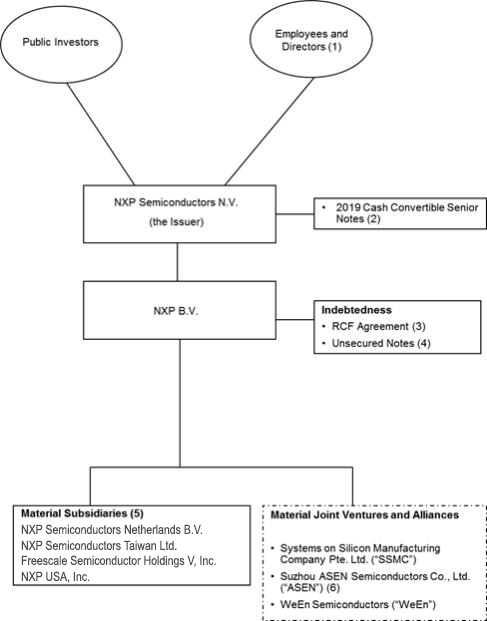
| (1) | For a more detailed description of our Long-Term Incentive Plans see the discussion set forth under “Share Based Compensation Plans” contained in this Annual Report in Part I, Item 6.B. Compensation. |
|---|
| (2) | As of December 31, 2017, we had $1,150 million aggregate principal amount of 2019 Cash Convertible Senior Notes outstanding. |
|---|
| (3) | As of December 31, 2017, no borrowings were outstanding under the RCF Agreement. |
|---|
| (4) | As of December 31, 2017, we had $5,500 million aggregate principal amount of unsecured notes outstanding. |
|---|
| (5) | This list of material subsidiaries includes the subsidiaries that are guarantors under our RCF Agreement. Other subsidiaries provide a guarantee under certain of our other outstanding indebtedness. See Part I, Item 5.B. Liquidity and Capital Resources, under the captions 2017 Financing Activities, 2016 Financing Activities and 2015 Financing Activities. |
|---|
| (6) | On March 27, 2018, we entered into a definitive agreement to sell our 40% equity interest of ASEN. The closing of this transaction is expected in the second quarter of 2018, subject to customary regulatory approvals. |
|---|
Table of Contents
D****. Property, Plant and Equipment
NXP uses 95 sites in 30 countries with 10.9 million square feet of total owned and leased building space of which 9.5 million square feet is owned property.
The following table sets out our principal real property holdings as of December 31, 2017:
| Location | Use | Owned/leased | Building space (square feet) | |||||
| Eindhoven, the Netherlands | Headquarters | Leased | 152,666 | |||||
| Nijmegen, the Netherlands | Manufacturing | Owned | 1,515,550 | |||||
| Singapore (SSMC) * | Manufacturing | Owned | 757,852 | |||||
| Bangkok, Thailand | Manufacturing | Owned | 547,882 | |||||
| Kaohsiung, Taiwan | Manufacturing | Owned | 636,395 | |||||
| Tianjin, China | Manufacturing | Owned | 447,624 | |||||
| Kuala Lumpur, Malaysia | Manufacturing | Owned | 828,858 | |||||
| Chandler, United States | Manufacturing | Owned | 1,173,196 | |||||
| Austin (Oak Hill), United States | Manufacturing | Owned | 1,514,389 | |||||
| Austin (Ed Bluestein), United States | Manufacturing | Owned | 1,158,731 |
| * | Joint venture between TSMC and NXP. |
|---|
Areas which are not fully closed are not considered as buildings (eg. sport fields, parking space). If it is not practicable to differentiate between production facility and offices in the same building all is considered manufacturing.
Previous: Item 3. Key Information · Next: Item 4A. Unresolved Staff Comments