 filings.tools
ON Semiconductor 10-K 2022-12-31
Filed 2023-02-06. 22 sections, 481K characters. Original on sec.gov · Markdown · JSON
Cover and table of contents
UNITED STATES
SECURITIES AND EXCHANGE COMMISSION
Washington, D.C. 20549
FORM 10-K
(Mark One)
| ☒ | ANNUAL REPORT PURSUANT TO SECTION 13 OR 15(d) OF THE SECURITIES EXCHANGE ACT OF 1934 |
For the fiscal year ended December 31, 2022
Or
| ☐ | TRANSITION REPORT PURSUANT TO SECTION 13 OR 15(d) OF THE SECURITIES EXCHANGE ACT OF 1934 |
For the transition period from to
(Commission File Number) 001-39317
ON SEMICONDUCTOR CORPORATION
(Exact name of registrant as specified in its charter)
| Delaware | 36-3840979 | |||||||
| (State or other jurisdiction of incorporation or organization) | (I.R.S. Employer Identification No.) |
5005 E. McDowell Road
Phoenix, AZ 85008
(602) 244-6600
(Address, zip code and telephone number, including area code, of principal executive offices)
| Securities Registered Pursuant to Section 12(b) of the Act: | ||||||||
| Title of each class | Trading Symbol(s) | Name of each exchange on which registered | ||||||
| Common Stock, par value $0.01 per share | ON | The Nasdaq Stock Market LLC | ||||||
Securities Registered Pursuant to Section 12(g) of the Act:
None
Indicate by check mark if the registrant is a well-known seasoned issuer, as defined in Rule 405 of the Securities Act. Yes ☒ No ☐
Indicate by check mark if the registrant is not required to file reports pursuant to Section 13 or Section 15(d) of the Act. Yes ☐ No ☒
Indicate by check mark whether the registrant (1) has filed all reports required to be filed by Section 13 or 15(d) of the Securities Exchange Act of 1934 during the preceding 12 months (or for such shorter period that the registrant was required to file such reports), and (2) has been subject to such filing requirements for the past 90 days. Yes ☒ No ☐
Indicate by check mark whether the registrant has submitted electronically every Interactive Data File required to be submitted pursuant to Rule 405 of Regulation S-T (§ 232.405 of this chapter) during the preceding 12 months (or for such shorter period that the registrant was required to submit such files). Yes ☒ No ☐
Indicate by check mark whether the registrant is a large accelerated filer, an accelerated filer, a non-accelerated filer, a smaller reporting company, or an emerging growth company. See the definitions of "large accelerated filer," "accelerated filer," "smaller reporting company," and "emerging growth company" in Rule 12b-2 of the Exchange Act.
| Large accelerated filer | ☒ | Accelerated filer | ☐ | ||||||||
| Non-accelerated filer | ☐ | Smaller reporting company | ☐ | ||||||||
| Emerging growth company | ☐ |
If emerging growth company, indicate by check mark if the registrant has elected not to use the extended transition period for complying with any new or revised financial accounting standards provided pursuant to Section 13(a) of the Exchange Act. ☐
Indicate by check mark whether the registrant has filed a report on and attestation to its management's assessment of the effectiveness of its internal control over financial reporting under Section 404(b) of the Sarbanes-Oxley Act (15 U.S.C. 7262(b)) by the registered public accounting firm that prepared or issued its audit report. Yes ☒ No ☐
Indicate by check mark whether the registrant is a shell company (as defined in Rule 12b-2 of the Exchange Act). Yes ☐ No ☒
The aggregate market value of the voting and non-voting common equity held by non-affiliates of the registrant was $20,262,351,285 as of July 1, 2022, based on the closing sales price of such stock on the Nasdaq Global Select Market. Shares held by executive officers, directors and persons owning directly or indirectly more than 10% of the outstanding common stock (as applicable) have been excluded from the preceding number because such persons may be deemed to be affiliates of the registrant.
The number of shares of the registrant's common stock outstanding at February 1, 2023 was 431,967,907.
Documents Incorporated by Reference
Portions of the registrant's Definitive Proxy Statement relating to its 2023 Annual Meeting of Stockholders, which is expected to be filed pursuant to Regulation 14A within 120 days after the registrant's fiscal year ended December 31, 2022, are incorporated by reference into Part III of this Form 10-K.
ON SEMICONDUCTOR CORPORATION
FORM 10-K
TABLE OF CONTENTS
| Part I | ||||||||
| Item 1. | Business | 5 | ||||||
| Overview | 5 | |||||||
| Revenue Generating Activities | 6 | |||||||
| Markets | 8 | |||||||
| Resources | 10 | |||||||
| Seasonality | 12 | |||||||
| Government Regulation | 12 | |||||||
| Environmental, Social and Governance Initiatives | 13 | |||||||
| Human Capital Resources | 13 | |||||||
| Executive Officers of the Registrant | 14 | |||||||
| Available Information | 16 | |||||||
| Item 1A. | Risk Factors | 16 | ||||||
| Item 1B. | Unresolved Staff Comments | 29 | ||||||
| Item 2. | Properties | 29 | ||||||
| Item 3. | Legal Proceedings | 29 | ||||||
| Item 4. | Mine Safety Disclosure | 29 | ||||||
| Part II | ||||||||
| Item 5. | Market for Registrant's Common Equity, Related Stockholder Matters and Issuer Purchases of Equity Securities | 29 | ||||||
| Item 6. | [Reserved] | 31 | ||||||
| Item 7. | Management's Discussion and Analysis of Financial Condition and Results of Operations | 31 | ||||||
| Item 7A. | Quantitative and Qualitative Disclosures about Market Risk | 41 | ||||||
| Item 8. | Financial Statements and Supplementary Data | 42 | ||||||
| Item 9. | Changes in and Disagreements with Accountants on Accounting and Financial Disclosure | 42 | ||||||
| Item 9A. | Controls and Procedures | 42 | ||||||
| Item 9B. | Other Information | 43 | ||||||
| Item 9C. | Disclosure Regarding Foreign Jurisdictions that Prevent Inspections | 43 | ||||||
| Part III | ||||||||
| Item 10. | Directors, Executive Officers and Corporate Governance | 43 | ||||||
| Item 11. | Executive Compensation | 43 | ||||||
| Item 12. | Security Ownership of Certain Beneficial Owners and Management and Related Stockholder Matters | 44 | ||||||
| Item 13. | Certain Relationships and Related Transactions, and Director Independence | 44 | ||||||
| Item 14. | Principal Accountant Fees and Services | 44 | ||||||
| Part IV | ||||||||
| Item 15. | Exhibits and Financial Statement Schedules | 44 | ||||||
| Item 16. | Form 10-K Summary | 50 | ||||||
| Signatures | 51 |
(See the glossary immediately following this table of contents for definitions of certain abbreviated terms)
ON SEMICONDUCTOR CORPORATION
FORM 10-K
GLOSSARY OF SELECTED ABBREVIATED TERMS*
| Abbreviated Term | Defined Term | |||||||
| 0% Notes | 0% Convertible Senior Notes due 2027 | |||||||
| 1.00% Notes | 1.00% Convertible Senior Notes due 2020 | |||||||
| 1.625% Notes | 1.625% Convertible Senior Notes due 2023 | |||||||
| 3.875% Notes | 3.875% Senior Notes due 2028 | |||||||
| ADAS | Advanced driver assistance systems | |||||||
| Amended Credit Agreement | Credit Agreement, dated as of April 15, 2016, as subsequently amended, by and among the Company, as borrower, the several lenders party thereto, Deutsche Bank AG, New York Branch, as administrative agent and collateral agent, and certain other parties, providing for the Revolving Credit Facility and the Term Loan "B" Facility | |||||||
| Amended and Restated SIP | ON Semiconductor Corporation Amended and Restated Stock Incentive Plan, as amended | |||||||
| AI | Artificial Intelligence | |||||||
| AMIS | AMIS Holdings, Inc. | |||||||
| AR/VR | Augmented reality/virtual reality | |||||||
| ASC | Accounting Standards Codification | |||||||
| ASIC | Application specific integrated circuits | |||||||
| ASSP | Application specific standard product | |||||||
| ASU | Accounting Standards Update | |||||||
| BEPS | Base Erosion and Profit Shifting | |||||||
| CMOS | Complementary metal oxide semiconductor | |||||||
| Commission or SEC | Securities and Exchange Commission | |||||||
| ECL | Emitter coupled logic | |||||||
| EDI | Electronic data interface | |||||||
| EPA | Environmental Protection Agency | |||||||
| ESPP | ON Semiconductor Corporation 2000 Employee Stock Purchase Plan, as amended | |||||||
| EV/HEV | Electric vehicles/hybrid electric vehicles | |||||||
| Exchange Act | Securities Exchange Act of 1934, as amended | |||||||
| Fairchild | Fairchild Semiconductor International Inc., a wholly-owned subsidiary of ON Semiconductor Corporation. In April 2022, this entity was converted into a limited liability company (Fairchild Semiconductor International, LLC). | |||||||
| FASB | Financial Accounting Standards Board | |||||||
| Freescale | Freescale Semiconductor, Inc. | |||||||
| IC | Integrated circuit | |||||||
| IGBT | Insulated-gate bipolar transistor | |||||||
| IP | Intellectual property | |||||||
| IPRD | In-process research and development | |||||||
| LIBO Rate | A base rate per annum equal to the London Interbank Offered Rate as administered by the Intercontinental Exchange Benchmark Administration | |||||||
| LSI | Large-scale integration | |||||||
| MOSFET | Metal oxide semiconductor field effect transistor | |||||||
| Motorola | Motorola Inc. | |||||||
| OEM | Original equipment manufacturers | |||||||
| PC | Personal computer | |||||||
| PRP | Potentially responsible party | |||||||
| QCS | Division within ASG, primarily associated with the legacy Quantenna division | |||||||
| Revolving Credit Facility | A $1.97 billion revolving credit facility created pursuant to the Amended Credit Agreement | |||||||
| RF | Radio frequency | |||||||
| RSU | Restricted stock unit | |||||||
| SCI LLC | Semiconductor Components Industries, LLC, a wholly-owned subsidiary of ON Semiconductor Corporation | |||||||
| Securities Act | Securities Act of 1933, as amended | |||||||
| SiC | Silicon carbide | |||||||
| SiPM | Silicon photomultipliers | |||||||
| SPAD | Single photon avalanche diode arrays | |||||||
| Term Loan "B" Facility | A $2.4 billion term loan "B" facility created pursuant to the Amended Credit Agreement | |||||||
| U.S. or United States | United States of America | |||||||
| WBG | Wide band gap | |||||||
- Terms used, but not defined, within the body of the Form 10-K are defined in this Glossary.
PART I
Item 1. Business
Overview
ON Semiconductor Corporation, together with its wholly and majority-owned subsidiaries, which operate under the onsemiTM brand ("onsemi," "we," "us," "our," or the "Company"), was incorporated under the laws of the state of Delaware in 1992.
We provide industry leading intelligent power and sensing solutions to help our customers solve challenging problems and create cutting edge products for a better future. Our intelligent power technologies enable the electrification of the automotive industry that allows for lighter and longer-range electric vehicles, empowers efficient fast-charging systems and propels sustainable energy for the highest efficiency solar strings, industrial power and storage systems. Our intelligent power solutions for automotive allows our customers to exceed range targets with lower weight and reduce system cost through efficiency. Our intelligent sensing technologies support the next generation industry allowing for smarter factories and buildings while also enhancing the automotive mobility experience with imaging and depth sensing that make advanced vehicle safety and automated driving systems possible. We believe the evolution of the automotive industry, with advancements in autonomous driving, ADAS, vehicle electrification, and the increase in electronics content for vehicle platforms, is reshaping the boundaries of transportation.
Through sensing integration, we believe our intelligent power solutions achieve superior efficiencies compared to our peers. This integration allows lower temperature operation and reduced cooling requirements while saving costs and minimizing weight. In addition, our power solutions deliver power with less die per module, achieving higher range for a given battery capacity.
Additionally, we serve a broad base of end-user markets, which include communications, computing and consumer.
We are organized into the following three operating and reportable segments: the Power Solutions Group ("PSG"), the Advanced Solutions Group ("ASG") and the Intelligent Sensing Group ("ISG").
Business Strategy Developments
Our primary focus continues to be on profitable revenue growth in our focused end-markets of automotive and industrial infrastructure, as well as obtaining longer-term supply arrangements with strategic end-customers. We are focused on achieving efficiencies in our operating and capital expenditures. We have made significant progress on gross margin and operating margin expansion by focusing our capital allocation on research and development investments and resources to accelerate growth in high-margin products and end-markets. Additionally, we continue to rationalize our product portfolio by moving away from non-differentiated, non-strategic products, which in most cases had lower gross and operating margins. To this effect, in September 2022, we approved an exit plan to wind down QCS, which will further enable us to direct our investments to areas of strategic focus.
During 2022, we completed the divestitures of certain manufacturing facilities. We believe these actions, among others, will allow us to transition from sub-scale factories into a lighter internal fabrication model where our financial performance will be less volatile and not as heavily influenced by our internal manufacturing volumes. We will continue to evaluate our manufacturing footprint in 2023 to align with our investment priorities and corporate strategy. Our goal is to reduce volatility in our gross margins and maximize return on our manufacturing investments with the intention of having our product strategy drive our manufacturing footprint and capital investments. In 2023, our focus will be on ramping up manufacturing at our recently acquired East Fishkill, New York fabrication ("EFK") facility, as well as investing to expand our facilities in the Czech Republic, Hudson, New Hampshire, and South Korea to increase our SiC manufacturing capabilities to meet the growing demand for our SiC-based solutions.
See Note 5: ''Acquisitions and Divestitures'' in the notes to our audited consolidated financial statements included elsewhere in this Form 10-K for additional information related to our acquisition and divestiture activity.
Recent Acquisitions
On December 31, 2022, we completed our acquisition of the EFK facility and certain other assets and liabilities from GLOBALFOUNDRIES U.S. Inc. ("GFUS"), which was previously announced in April 2019, for total consideration of
$406.3 million. In connection with the acquisition agreement, we paid GFUS $100.0 million and $70.0 million during 2020 and 2019, respectively, with the balance of $236.3 million paid on January 3, 2023. In addition, in 2019 we paid GFUS a one-time license fee of $30.0 million for certain technology, which has been recognized as an intangible asset subject to amortization. The transaction has been accounted for as a business combination.
On October 28, 2021, we completed our acquisition of GT Advanced Technologies Inc. ("GTAT"), a producer of SiC substrates. The purchase price for the acquisition was $434.9 million, which included cash consideration of $424.6 million and effective settlement of pre-acquisition balances (non-cash) of approximately $10.0 million, in exchange for all of the outstanding equity interests of GTAT. We believe the acquisition of GTAT will act as a building block to fuel growth and secure supply of SiC to meet growing customer demand for SiC-based solutions.
Completed Divestitures of Certain Manufacturing Facilities
During 2022, in line with our business strategy, we divested our wafer manufacturing facilities in Oudenaarde, Belgium, South Portland, Maine, Pocatello, Idaho and Niigata, Japan. We agreed to wafer supply agreements with the respective buyers of these facilities to ensure that there is no disruption in our ability to meet customer demand for our products.
See Note 5: ''Acquisitions and Divestitures'' in the notes to our audited consolidated financial statements included elsewhere in this Form 10-K for additional information.
New Legislation
In August 2022, the Creating Helpful Incentives to Produce Semiconductors and Science Act, H.R. 4346 (the "CHIPS Act") and the Inflation Reduction Act, H.R. 5376 (the "IR Act") were signed into law. Among other things, the CHIPS Act provides various incentives and tax credits to United States companies for research, development, manufacturing and workforce development in domestic semiconductor manufacturing. The IR Act introduces a 15% corporate alternative minimum tax ("CAMT") for certain corporations and a 1% excise tax on certain stock repurchases. The Company is evaluating the provisions of the new laws and the potential impacts to the Company. See Note 4: ''Recent Accounting Pronouncements and Other Developments''' in the notes to our audited consolidated financial statements included elsewhere in this Form 10-K for additional information.
Revenue-Generating Activities
onsemi generates revenue from the sale of semiconductor products to distributors and direct customers. We also generate revenue, to a much lesser extent, from product development agreements and manufacturing services provided to customers. We believe that our ability to offer a broad range of products, combined with our global manufacturing and logistics network, provides our customers with single source purchasing.
The following table illustrates the product technologies under each of our segments based on our operating strategy:
| PSG | ASG | ISG | ||||||||||||||||||
| 2022 Revenue (%) | 50.5% | 34.1% | 15.3% | |||||||||||||||||
| Analog products | Analog products | Actuator Drivers | ||||||||||||||||||
| SiC products | ASIC products | CMOS Image Sensors | ||||||||||||||||||
| Discrete products | ECL products | Image Signal Processors | ||||||||||||||||||
| MOSFET products | Foundry products / services | LSI products | ||||||||||||||||||
| Power Module products | Gate Driver products | Single Photon Detectors | ||||||||||||||||||
| Isolation products | LSI products | Sensors | ||||||||||||||||||
| Memory products | Standard Logic products | |||||||||||||||||||
| Gate Driver products | ||||||||||||||||||||
| Standard Logic products | ||||||||||||||||||||
See Note 3: ''Revenue and Segment Information'' in the notes to our audited consolidated financial statements included elsewhere in this Form 10-K for other information regarding our segments, their revenue and property, plant and equipment and the gross profit derived from each segment.
Products and Technology
The following provides certain information regarding the products and technologies for each of our operating segments.
PSG
PSG offers a wide array of analog, discrete, module and integrated semiconductor products that perform multiple application functions, including power switching, power conversion, signal conditioning, circuit protection, signal amplification and voltage regulation functions. The trends driving growth within our end-user markets are primarily higher power efficiency and power density in power applications, the demand for greater functionality, and faster data transmission rates in all communications. The advancement of existing volt electrical infrastructure, electrification of power train in the form of EV/HEV, higher trench density enabling lower losses in power efficient packages and lower capacitance and integrated signal conditioning products to support faster data transmission rates significantly increase the use of high-power semiconductor solutions. The recent increase in the use of WBG MOSFETs and diodes, including SiC and IGBT, is further expanding the use of semiconductor products.
ASG
ASG designs and develops analog, mixed-signal, advanced logic, ASSPs and ASICs, RF and integrated power solutions for a broad base of end-users in different end-markets. Our product solutions enable industry leading active mode and standby mode efficiency now demanded by regulatory agencies around the world. Additionally, ASG offers trusted foundry and design services for our government customers, which leverages our broad range of manufacturing, IC design, packaging, and silicon technology offerings to provide turn-key solutions for our customers.
ISG
ISG designs and develops CMOS image sensors, image signal processors, single photon detectors, including SiPM and SPAD arrays, as well as actuator drivers for autofocus and image stabilization for a broad base of end-users in the different end-markets. Our broad range of product offerings delivers excellent pixel performance, sensor functionality and camera systems capabilities in which high quality visual imagery is becoming increasingly important to our customers and their end-users, particularly in automotive and factory automation and in applications powered by AI.
Customers
We sell our products to distributors and direct customers for ultimate use in a variety of end-products in different end-markets. In general, we have maintained long-term relationships with our key customers and our sales agreements are renewable periodically and contain certain terms and conditions with respect to payment, delivery, warranty and supply. During 2022, we entered into a number of long-term supply agreements with certain strategic end-customers, which generally include minimum purchase commitments. Certain of our agreements, subject to our standard terms and conditions, have provisions allowing for termination at any time for convenience by either party.
We generally warrant that products sold to our customers will, at the time of shipment, be free from defects in workmanship and materials and conform to our approved specifications. Our standard warranty extends for a period of two years from the date of delivery, except in the case of image sensor products, which are warrantied for one year from the date of delivery. Unless otherwise agreed in writing with our customers, they may cancel orders 120 days prior to shipment for standard products without penalty and, for custom products, prior to shipment, provided they pay onsemi's actual costs incurred as of the date we receive the cancellation notice. The loss of one of our large customers would have a material adverse effect on the operations of the respective segment, and may have a material adverse effect on our consolidated results of operations.
Distributors
Sales to distributors accounted for approximately 58% of our revenue in 2022, 64% of our revenue in 2021 and 60% of our revenue in 2020. We had one distributor whose revenue accounted for approximately 12% of the total revenue for the year ended December 31, 2022. Our distributors resell our products to contract manufacturers, OEMs among other companies. Sales to distributors are typically made pursuant to agreements that provide return rights and stock rotation provisions permitting limited levels of product returns.
Direct Customers
Sales to direct customers, accounted for approximately 42% of our revenue in 2022, 36% of our revenue in 2021 and 40% of our revenue in 2020. Large multi-nationals and selected regional OEMs, which are significant in specific markets, form our core direct customers. Generally, these customers do not have the right to return our products following a sale other than pursuant to our warranty.
For additional information regarding agreements with our customers, see "Markets," "Resources" and "Risk Factors - Trends, Risks and Uncertainties Related to Our Business" included elsewhere in this Form 10-K and Note 2: ''Significant Accounting Policies'' under the heading "Revenue Recognition" in the notes to our audited consolidated financial statements included elsewhere in this Form 10-K.
Markets
Product Development
onsemi is focused on innovation to create intelligent power and sensing technologies that solve the most challenging customer problems. Our product development efforts are directed towards the following:
-
Powering the electrification of the automotive industry with our intelligent power technologies that allow for lighter and longer-range electric vehicles and enable efficient fast-charging systems;
-
Propelling the sustainable energy evolution with our intelligent power technologies for the highest efficiency solar strings, industrial power and storage systems;
-
Enhancing the automotive mobility experience with our intelligent sensing technologies with imaging and depth sensing that make advanced vehicle safety and automated driving systems possible; and
-
Enabling automation and data exchange (Industry 4.0) with our intelligent sensing technologies for smarter factories and buildings.
While our new product development efforts continue to be focused on building solutions in areas that appeal to customers in focused market segments and across multiple high-growth applications, it is our practice to regularly re-evaluate our research and development spending, to assess the deployment of resources and to review the funding of high-growth technologies. We deploy people and capital with the goal of maximizing the return for our research and development investments by targeting innovative products and solutions for high growth applications that we believe position us to outperform the industry.
End-Markets
We serve a broad base of end-user markets, with a primary focus towards automotive and industrial. The following table sets forth our principal end-markets, the estimated percentage (based in part on information provided by our distributors) of our revenue generated from each end-market during 2022, and sample applications for our products. Other includes the end-markets of communication, consumer and computing.
| Automotive | Industrial | Other | ||||||||||||||||||||||||
| 2022 Revenue (%) | 40.4% | 27.5% | 32.1% | |||||||||||||||||||||||
| Sample applications | EV | Energy & EV Charging Infrastructure | Cloud Computing/Data Center Servers | |||||||||||||||||||||||
| ADAS | Industrial Automation | 5G Base Stations | ||||||||||||||||||||||||
| Power Management | Security & Surveillance | Graphics Cards | ||||||||||||||||||||||||
| Powertrain | Machine Vision | Gaming, Home Entertainment Systems, & Set Top Boxes | ||||||||||||||||||||||||
| In-Vehicle Networking | Smart Cities & Buildings | Routers | ||||||||||||||||||||||||
| Body & Interior | Hearing Health, Diagnostic, Therapy, & Monitoring | Notebooks, Laptops, Desktop PCs and Tablets | ||||||||||||||||||||||||
| Lighting | Power Solutions | USB Type-C | ||||||||||||||||||||||||
| Sensors | AR/VR | White Goods | ||||||||||||||||||||||||
| Engine Control | Motor Control | Power Supplies | ||||||||||||||||||||||||
| Robotics | Smart Phones | |||||||||||||||||||||||||
Competition
We face significant competition from major international semiconductor companies, as well as smaller companies focused on specific market niches. Because some of our components include functionality that in some cases may be integrated into more complex ICs, we also face competition from manufacturers of ICs, ASICs and fully-customized ICs, as well as customers who develop their own IC products. See "Risk Factors—Trends, Risks and Uncertainties Related to Our Business" included elsewhere in this Form 10-K for additional information.
Some of our competitors have greater financial and other resources to pursue development, engineering, manufacturing, marketing and distribution of their products and may generally be better situated to withstand adverse economic or market conditions. The semiconductor industry has experienced, and may continue to experience, significant consolidation among companies and vertical integration among customers. The following discusses the effects of competition on our three operating segments:
PSG
Our competitive strengths include our core competencies of leading-edge fabrication technologies, micro and module packaging expertise, breadth of product line and IP portfolio, high quality cost effective manufacturing and supply chain management, which ensures supply to our customers. Our commitment to continual innovation allows us to provide an ever broader range of semiconductor solutions to our customers who differentiate in power density and power efficiency, the key performance characteristics driving our markets.
The principal methods of competition in our discrete, module and integrated semiconductor products are through new products and package innovations enabling enhanced performance over existing products. Of particular importance are our intelligent power technologies based on silicon and SiC wide band gap technologies, which we use to design, manufacture, and deliver to our customers as bare die, packaged discrete solutions or power module solutions. In addition to our power technologies, we believe our integrated circuit, signal and protection technologies have significant performance advantages over our competition. PSG’s primary competitors include: Infineon Technologies AG ("Infineon"), STMicroelectronics N.V. ("STMicroelectronics"), Wolfspeed Inc., Texas Instruments Incorporated ("TI") and Nexperia BV.
ASG
ASG principally competes on design experience, manufacturing capability, depth and quality of IP, ability to service customer needs from the design phase to the shipping of a completed product, length of design cycle, longevity of technology support and experience of sales and technical support personnel. Our competitive position with respect to the above basis is enhanced by long-standing relationships with leading direct customers.
Our ability to compete successfully depends on internal and external variables. These variables include, but are not limited to, the timeliness with which we can develop new products and technologies, product performance and quality, manufacturing yields and availability of supply, customer service, pricing, industry trends and general economic trends. Competitors for certain of ASG's products and solutions include: Infineon, NXP Semiconductors N.V. ("NXP"), STMicroelectronics and TI.
ISG
ISG differentiates itself from the competition through deep technical knowledge and close customer relationships to drive leading edge sensing performance for both human and machine vision applications. ISG has significant imaging experience and was one of the earliest to commercialize CMOS active pixel sensors and introduce CMOS technology in many of our markets. ISG has leveraged this expertise into market leading positions in automotive and industrial applications, which allows us to offer technical and end-user applications knowledge to help customers develop innovative sensing solutions across a broad range of end-user needs.
Competitors for certain of ISG's products and solutions include: Sony Semiconductor Manufacturing Corporation, Samsung Electronics Co., Ltd., and Omnivision Technologies Inc.
Sales, Marketing and Distribution
We have global distribution centers in China, the Philippines and Singapore. Global and regional distribution channels further support our customers' needs for quick response and service. We offer efficient, cost-effective global applications support from our technical information centers and solution engineering centers, allowing for applications that are developed in one region of
the world to be instantaneously available throughout all other regions.
Backlog
Our sales are made primarily pursuant to orders that are booked as far as 52 weeks in advance of delivery. Generally, prices and quantities are fixed at the time of booking. Backlog as of a given date consists of existing orders and forecasted demand from our customers, in each case scheduled to be shipped in the current or future period. Backlog is influenced by several factors, including market demand, pricing and customer order patterns in reaction to product lead times.
In the semiconductor industry, backlog quantities and shipment schedules under outstanding purchase orders are frequently revised to reflect changes in customer needs. Historically, a significant portion of our backlog was cancellable, however, our current agreements, including orders subject to minimum purchase commitments under our longer-term supply arrangements, are not subject to cancellation, unless otherwise mutually agreed.
Resources
Raw Materials
Our manufacturing processes use many raw materials, including silicon wafers, SiC wafers, laminate substrates, gold, copper, lead frames, mold compound, ceramic packages and various chemicals and gases as well as other production supplies used in our manufacturing processes. We seek to obtain our raw materials and supplies in a timely, planned manner from our suppliers to allow for our manufacturing cycle to align with the timing of our customer demands. However, suppliers may extend lead times, limit supplies or increase prices due to capacity constraints or other factors beyond our control, including any caused by the COVID-19 pandemic or other public health crises.
Manufacturing and Design Operations
We currently have domestic design operations in Arizona, California, Idaho, New York, Oregon, Pennsylvania, Rhode Island, Texas, Utah and Virginia. We also have foreign design operations in Belgium, Canada, China, the Czech Republic, France, Germany, India, Ireland, Israel, Italy, Japan, South Korea, the Philippines, Romania, Singapore, the Slovak Republic, Slovenia, Switzerland, Taiwan and the United Kingdom. In October 2022, we ceased operations at our design locations in Australia and Russia as part of the exit plan to wind down QCS. We operate front-end wafer fabrication facilities in the Czech Republic, Japan, South Korea, Malaysia and the United States and back-end assembly and test site facilities in Canada, China, Malaysia, the Philippines, Vietnam and the United States. In addition to these front-end and back-end manufacturing operations, our facility in Hudson, New Hampshire manufactures SiC crystal boules and our facility in Rožnov pod Radhoštěm, Czech Republic manufactures silicon wafers that are used by a number of our facilities.
The table below sets forth information with respect to the manufacturing facilities we operate either directly or pursuant to joint ventures, the reportable segments that use such facilities, and the approximate gross square footage of each site's building, which includes, among other things, manufacturing, laboratory, warehousing, office, utility, support and unused areas.
| Location | Reportable Segment | Size (sq. ft.) | ||||||||||||
| Front-end Facilities: | ||||||||||||||
| East Fishkill, New York | ASG, ISG and PSG | 2,724,137 | ||||||||||||
| Gresham, Oregon | ASG, ISG and PSG | 558,457 | ||||||||||||
| Rožnov pod Radhoštěm, Czech Republic | ASG and PSG | 438,882 | ||||||||||||
| Seremban, Malaysia (Site 2) (3) | ASG and PSG | 133,061 | ||||||||||||
| Bucheon, South Korea | ASG and PSG | 861,081 | ||||||||||||
| Mountaintop, Pennsylvania | ASG and PSG | 437,000 | ||||||||||||
| Aizuwakamatsu, Japan | ASG and PSG | 734,482 | ||||||||||||
| Back-end Facilities: | ||||||||||||||
| Burlington, Canada (1) | ASG | 95,440 | ||||||||||||
| Leshan, China (3) | ASG and PSG | 416,339 | ||||||||||||
| Seremban, Malaysia (Site 1) (3) | ASG, ISG and PSG | 328,275 | ||||||||||||
| Carmona, Philippines (3) | ASG, ISG and PSG | 926,367 | ||||||||||||
| Tarlac City, Philippines (3) | ASG, ISG and PSG | 381,764 | ||||||||||||
| Shenzhen, China (1) | ASG, ISG and PSG | 275,463 | ||||||||||||
| Bien Hoa, Vietnam (3) | ASG and PSG | 294,418 | ||||||||||||
| Nampa, Idaho (1) (2) | ISG | 166,268 | ||||||||||||
| Cebu, Philippines (3) | ASG and PSG | 228,460 | ||||||||||||
| Suzhou, China (3) | ASG and PSG | 452,639 | ||||||||||||
| Other Facilities: | ||||||||||||||
| Rožnov pod Radhoštěm, Czech Republic | ASG, ISG and PSG | 11,873 | ||||||||||||
| Thuan An District, Vietnam (3) | ASG and PSG | 30,494 | ||||||||||||
| Hudson, New Hampshire (1) | PSG | 272,036 |
(1)These facilities are leased.
(2)This facility is used for both front-end and back-end operations.
(3)These facilities are located on leased land.
For additional information regarding acquisitions and divestitures, see Note 5: ''Acquisitions and Divestitures'' in the notes to our audited consolidated financial statements included elsewhere in this Form 10-K.
All of our manufacturing facilities are fully owned and operated by us, except our assembly and test operations facility located in Leshan, China, which is owned by Leshan-Phoenix Semiconductor Company Limited, a joint venture company in which we own 80% of the outstanding equity interests ("Leshan"). The financial and operating results of Leshan have been consolidated in our financial statements. Our joint venture partner is Leshan Radio Company Ltd. ("Leshan Radio"), is formerly a state-owned enterprise. Pursuant to the joint venture agreement between us and Leshan Radio, requests for production capacity are made to the board of directors of Leshan by each shareholder of the joint venture. Each request represents a purchase commitment, provided that any shareholder may elect to pay the cost associated with the unused capacity (which is generally equal to the fixed cost of the capacity) in lieu of satisfying the commitment. We purchased 80% of Leshan's production capacity in each of 2022, 2021 and 2020 and are currently committed to purchase approximately 80% of Leshan's expected production capacity in 2023.
We use third-party contractors for some of our manufacturing activities, primarily for wafer fabrication and the assembly and testing of finished goods. Our agreements with these contract manufacturers typically require us to forecast product needs and commit to purchase services consistent with these forecasts. In some cases, longer-term commitments are required in the early stages of the relationship. These manufacturers collectively accounted for approximately 43% of our total manufacturing input costs in 2022, 37% in 2021 and 33% in 2020.
For information regarding risks associated with our foreign operations, see "Risk Factors — Trends, Risks and Uncertainties Related to Our Business" included elsewhere in this Form 10-K.
Patents, Trademarks, Copyrights and Other Intellectual Property Rights
We market our products under worldwide trademarks including the ON Semiconductor, ON, onsemi, and various product names and logos, and, in the United States and internationally, we rely primarily on a combination of patents, trademarks, copyrights, trade secrets, employee and non-disclosure agreements and licensing agreements to protect our IP. We acquired or were licensed or sublicensed to a significant amount of IP, including patents and patent applications, in connection with our acquisitions, and we have numerous United States and foreign patents issued, allowed and pending. As of December 31, 2022, we held patents with expiration dates ranging from 2023 to 2043, and none of the patents that expire in the next three years are expected to materially affect our business. We do not consider our business substantially dependent on any single onsemi patent. Our policy is to protect our products and processes by asserting our IP rights where appropriate and prudent and by obtaining patents, copyrights and other IP rights used in connection with our business when practicable and appropriate.
For information regarding risks associated with intellectual property, see "Risk Factors — Trends, Risks and Uncertainties Related to Intellectual Property" included elsewhere in this Form 10-K.
Seasonality
We believe our business today is driven more by content gains within applications and secular growth drivers and not solely by macroeconomic and industry cyclicality, as was the case historically. Our 2022 results were positively influenced by macroeconomic factors including a better-than-expected demand and recovery from the COVID-19 pandemic along with our efforts focused on price increases, better utilization, product diversification and content gains. We could again experience period-to-period fluctuations in operating results due to general industry or macroeconomic conditions. For information regarding risks associated with the cyclicality and seasonality of our business, see "Risk Factors—Trends, Risks and Uncertainties Related to Our Business" included elsewhere in this Form 10-K.
Government Regulation
Our manufacturing operations are subject to environmental and worker health and safety laws and regulations. These laws and regulations include those relating to emissions and discharges into the air and water, the management and disposal of hazardous substances, the release of hazardous substances into the environment at or from our facilities and at other sites and the investigation and remediation of contamination. As with other companies engaged in like businesses, the nature of our operations exposes us to the risk of liabilities and claims, regardless of fault, with respect to such matters, including personal injury claims and civil and criminal fines.
We believe that our operations are in material compliance with applicable environmental and health and safety laws and regulations. The costs we incurred in complying with applicable environmental regulations for the year ended December 31, 2022 were not material, and we do not expect the cost of complying with existing environmental and health and safety laws and regulations, together with any liabilities for currently known environmental conditions, to have a material adverse effect on our capital expenditures or earnings or on our competitive position. It is possible, however, that future developments, including
changes in laws and regulations, government policies, customer specification, personnel and physical property conditions, including currently undiscovered contamination, could lead to material costs, and such costs may have a material adverse effect on our future business or prospects. See Note 13: ''Commitments and Contingencies'' in the notes to our audited consolidated financial statements included elsewhere in this Form 10-K for information on certain environmental matters.
We are also subject to numerous United States and foreign laws and regulations, including, without limitation, tariffs, trade sanctions, trade barriers, trade embargoes, regulations relating to import-export control, technology transfer restrictions, the International Traffic in Arms Regulation promulgated under the Arms Export Control Act ("ITAR"), the Foreign Corrupt Practices Act ("FCPA"), and the anti-boycott provisions of the U.S. Export Administration Act. Additionally, United States or China governmental authorities have taken, and may continue to take, administrative, legislative or regulatory action that could impact our operations.
We believe that our operations are in material compliance with applicable trade regulations relating to import-export control, technology transfer restrictions, ITAR, FCPA, the anti-boycott provisions of the U.S. Export Administration Act, and similar applicable laws and regulations. The costs we incurred in complying with applicable trade regulations for the year ended December 31, 2022 were not material, and we do not expect the cost of complying with existing trade laws and regulations to have a material adverse effect on our capital expenditures or earnings or on our competitive position. It is possible, however, that future developments, including changes in laws and regulations or government policies, could lead to material costs, and such costs may have a material adverse effect on our future business or prospects. For information regarding risks associated with import-export control regulations and similar applicable laws and regulations, see "Risk Factors—Trends, Risks and Uncertainties Related to Our Business" included elsewhere in this Form 10-K.
Environmental, Social and Governance Initiatives
onsemi strives to be a responsible corporate citizen. We uphold ethical standards in our business practices and policies, and we believe that sustainable corporate practices and consistent attention to environmental, social and governance priorities will help enhance long-term value for our stockholders.
In 2022, onsemi affirmed its climate change policy, highlighting the focus areas for its climate change-related actions. onsemi is committed to protect and respect its environment and energy resources for future generations throughout its operations, including wafer fabrication, assembly, test, support operations, and through its value chain. In that regard, onsemi has committed to achieving net zero emissions by 2040.
We work together with our customers, peers, partners and suppliers to promote continual improvement in human rights, labor, environment, health and safety, anti-corruption, ethics and management system standards within our operations and our supply chain. We proactively comply with the Responsible Business Alliance (“RBA”) Code of Conduct including the elimination of forced labor, slavery and human trafficking and conflict minerals pursuant to our involvement with the Responsible Minerals Initiative.
Our Board of Directors (the "Board of Directors") and management regularly evaluate our corporate responsibility policies, including our Code of Business Conduct and other corporate social responsibility policies and programs, to ensure an effective outcome and adherence by our employees, suppliers, vendors and partners.
Human Capital Resources
Core Principles
Our success depends on our ability to attract, train, retain and motivate our employees involved in the design, development, manufacturing and support of new and existing products and services. As we are a member of the RBA, its principles are fundamental to our corporate culture and core values and are reflected in our commitments to our employees, customers, communities and other stakeholders. These principles include providing a safe and positive work environment to our employees that emphasizes learning and professional development and respect for individuals and ethical conduct.
Headcount
As of December 31, 2022, we had approximately 31,000 regular full-time employees and approximately 109 part-time and temporary employees in facilities located in 34 countries. Approximately 10.8% of our regular full-time employees are located in the United States and Canada, 11.0% in Europe and Middle Eastern countries and 78.1% in Asia Pacific and Japan, with approximately 74.7% engaged in manufacturing, 1.7% in research and development, 3.5% in customer service or other aspects of sales and marketing, and 20.1% in other roles. Approximately 116 of our domestic employees (or approximately 3.6% of our United States-based employees) are covered by a collective bargaining agreement. All of these employees are located at our Mountain Top, Pennsylvania manufacturing facility. Certain of our foreign employees are covered by collective bargaining arrangements (e.g., those in China, Vietnam, Japan, the Czech Republic and Belgium) or similar arrangements or are represented by workers councils.
The disclosed headcount information does not include the addition of approximately 1,050 full-time employees who joined the Company as part of the EFK acquisition, which was completed on December 31, 2022, as their employment with onsemi was not effective until January 1, 2023. For additional information, see Note 5: ''Acquisitions and Divestitures'' in the notes to our audited consolidated financial statements included elsewhere in this Form 10-K.
Diversity, Equity and Inclusion
We are consciously expanding the diversity of our workforce, creating growth and development opportunities for our employees, embracing different perspectives and fostering an inclusive work environment. We have organization-level and overall metrics to monitor for diverse director-level and above employees, diverse new hires and diverse promotions. Our Human Resources organization and the Human Capital and Compensation Committee of the Board of Directors, through its charter, provides oversight of our policies, programs and initiatives focusing on workflow equity and workplace inclusion.
Compensation, Benefits, Health, Safety and Wellness
Our compensation philosophy is focused on delivering competitive compensation with total rewards based on corporate affordability in a way that enables attraction, retention, and recognition of performance delivered in an equitable manner. We provide our employees and their families with access to flexible and convenient health and wellness programs, including benefits that secure them during events that may require time away from work or that impact their financial well-being. We use a combination of total rewards and other programs (which vary by region and salary grade) to attract and retain our employees, including: annual performance bonuses; stock awards, including an employee stock purchase plan; retirement support; healthcare and insurance benefits; business travel and disability insurance; health savings and flexible spending accounts; flexible work schedules, vacation and paid time off; parental leave; paid counseling assistance; backup child and adult care; education assistance; and on-site services, such as health centers and fitness centers.
Career Growth and Development
We invest resources in professional development and growth as a means of improving employee motivation, performance and improving retention. Our talent development programs provide employees with the resources they need to help achieve their career goals, build management skills and lead their organizations. We have established a leadership pathway model as a tool for employees to practice and apply learning as part of their development.
Turnover
We monitor employee turnover rates by region and globally. The average tenure of our employees is approximately seven years and approximately one-fifth of our employees have been employed by us for more than 10 years. We believe our compensation philosophy along with the career growth and development opportunities promotes longer employee tenure and reduces voluntary turnover.
Executive Officers of the Registrant
Certain information concerning our executive officers as of February 6, 2023 is set forth below.
| Name | Age | Position | ||||||||||||
| Hassane El-Khoury | 43 | President, Chief Executive Officer and Director | ||||||||||||
| Thad Trent | 55 | Executive Vice President, Chief Financial Officer and Treasurer | ||||||||||||
| Ross F. Jatou | 53 | Senior Vice President and General Manager, ISG | ||||||||||||
| Simon Keeton | 49 | Executive Vice President and General Manager, PSG | ||||||||||||
| Robert Tong | 63 | Senior Vice President and General Manager, ASG | ||||||||||||
All of our executive officers are also officers of SCI LLC. The present term of office for the officers named above will generally expire on the earliest of their retirement, resignation or removal. There are no family relationships among our executive officers.
Hassane El-Khoury. Mr. El-Khoury was elected as a Director of onsemi and appointed as President and Chief Executive Officer of onsemi in December 2020. Prior to joining onsemi, he spent 13 years at Cypress Semiconductor Corporation, a semiconductor design and manufacturing company ("Cypress"), serving as Chief Executive Officer from August 2016 to April 2020. During his time at Cypress, he held various positions spanning business unit management, product development, applications engineering and business development. Additionally, Mr. El-Khoury currently serves as a member of the board of directors at Sakuu Corporation. He holds a Bachelor of Science in electrical engineering from Lawrence Technological University and a Master's of Engineering Management from Oakland University.
Thad Trent. Mr. Trent was appointed Executive Vice President and Chief Financial Officer and Treasurer of onsemi in February 2021. Mr. Trent has held several leadership roles throughout his career, most recently as Chief Financial Officer at Cypress ("Cypress CFO") responsible for strategic planning, accounting, investor relations, tax, corporate development and information technology. Under his leadership, Cypress’ revenue increased from $723 million to $2.5 billion, and the enterprise value increased five times during his five-year tenure as Cypress CFO.
He served as Cypress CFO until its sale to Infineon in April 2020. He is a seasoned finance professional with progressive leadership and management experience with both global publicly held technology companies and startups. Mr. Trent has a proven track record of driving sustainable financial performance, transformative mergers and acquisitions, operational excellence, process efficiency, financial leadership and robust compliance and regulatory control. He earned his Bachelor of Science in business administration and finance at San Diego State University.
Ross F. Jatou. Mr. Jatou joined onsemi in 2015 as the Vice President and General Manager of the Automotive Solutions Division within our ISG division. In October 2020, he was named Senior Vice President and General Manager, ISG of onsemi, assuming leadership of both the divisions within ISG: the Automotive Sensing Division and the Industrial and Consumer Solutions Division. Prior to onsemi, Mr. Jatou had an extensive career with NVIDIA Corporation of nearly 15 years, where he was the Vice President of Hardware Engineering. His background and experience include product development, engineering management, and automotive design quality and forecasting, and he is an expert in imaging graphics and system interfaces, telecommunications, high performance computing, automotive and embedded solutions. He has a Bachelor of Science degree in electrical engineering and a Master of Applied Science in millimeter wave technology and parallel processing from the University of Toronto. Mr. Jatou completed executive business programs from Stanford University School of Business and Harvard Business School.
Simon Keeton. Mr. Keeton joined onsemi in July 2007 and is currently the Executive Vice President and General Manager, PSG of onsemi. During his career, Mr. Keeton has held various management positions within onsemi. Before Mr. Keeton’s promotion to his current role on January 1, 2019, he was a Senior Vice President and General Manager of the MOSFET Division. From 2012 to 2016, Mr. Keeton served as Vice President and General Manager of the Integrated Circuit Division under our former Standard Products Group. Prior to that time, he served as Vice President and General Manager of the Consumer Products Division from 2009 to 2012 and as Business Unit Director of our Signals and Interface Business Unit from 2007 to 2009. Before joining onsemi, Mr. Keeton served as Strategic Planning Manager of the Digital Enterprise Group of Intel Corporation ("Intel") and held various marketing and business management roles at Vitesse Semiconductor Corporation. He earned a Bachelor of Science degree in computer engineering and a Master of Science Degree in electrical engineering from Michigan State University, and a Master of Business Administration from Pepperdine University – in addition to completing an executive business program from Harvard Business School.
Robert Tong. Mr. Tong joined onsemi in 2008 and is currently the Senior Vice President and General Manager, ASG of onsemi. Having joined onsemi through its acquisition of AMI Semiconductor, Inc., Mr. Tong has held a number of
management positions within onsemi. Prior to Mr. Tong’s promotion to his current role on June 1, 2022, he was Senior Vice President of the Mobile, Computing and Cloud Division. Prior to AMI Semiconductor, he served as president and chief executive officer of Dspfactory, a fabless semiconductor startup of DSP products for the hearing health industry. A fellow of the Canadian Academy of Engineering, Mr. Tong serves on the advisory board for the Dean of Engineering at McMaster University. He holds a Bachelor of Engineering degree in electrical and electronics engineering from McMaster University, as well as a Master of Business Administration from Wilfrid Laurier University and a Master of Applied Science in electrical and electronics engineering from the University of Waterloo.
Available Information
Our website is www.onsemi.com. We make our annual report on Form 10-K, quarterly reports on Form 10-Q, current reports on Form 8-K and other reports and all amendments to those reports available, free of charge, in the "Investor Relations" section of our website as soon as reasonably practicable after we electronically file these materials with, or furnish these materials to the SEC. Information on or accessible through our website is neither part of, nor incorporated by reference into, this Form 10-K or any other report filed with or furnished to the SEC. You can also find these materials on the SEC website at www.sec.gov, which contains reports, proxy statements and other information regarding issuers that file electronically with the SEC.
Item 1A. Risk Factors
Forward-Looking Statements
This Annual Report on Form 10-K includes "forward-looking statements," as that term is defined in Section 27A of the Securities Act and Section 21E of the Exchange Act. All statements, other than statements of historical facts, included or incorporated in this Form 10-K could be deemed forward-looking statements, particularly statements about our plans, strategies and prospects under the headings "Management’s Discussion and Analysis of Financial Condition and Results of Operations" and "Business." Forward-looking statements are often characterized by the use of words such as "believes," "estimates," "expects," "projects," "may," "will," "intends," "plans," "anticipates," "should" or similar expressions, or by discussions of strategy, plans or intentions. All forward-looking statements in this Form 10-K are made based on our current expectations, forecasts, estimates and assumptions, and involve risks, uncertainties and other factors that could cause results or events to differ materially from those expressed in the forward-looking statements. Important factors that could cause our actual results to differ materially from those anticipated in the forward-looking statements are described below. Readers are cautioned not to place undue reliance on forward-looking statements. We assume no obligation to update such information, which speak only as of the date made, except as may be required by law.
Investing in our securities involves a high degree of risk and uncertainty, and you should carefully consider the trends, risks and uncertainties described below and other information in this Form 10-K and subsequent reports filed with or furnished to the SEC before making any investment decision with respect to our securities. The risk factors described herein are not all of the risks we may face. Other risks not presently known to us or that we currently believe are immaterial may materially affect our business. If any of the following trends, risks or uncertainties actually occurs or continues, our business, financial condition or operating results could be materially and adversely affected, the trading prices of our securities could decline, and you could lose all or part of your investment. All forward-looking statements attributable to us or persons acting on our behalf are expressly qualified in their entirety by this cautionary statement.
Trends, Risks and Uncertainties Related to Our Business
The manufacturing and other operations required to produce our products are highly dependent on the efficient operation of numerous processes, including processes contingent upon third party component manufacturers and other service providers, and any disruption in these processes could have a material adverse effect on our business and results of operations.
Our manufacturing network includes multiple owned and third-party facilities, which may each produce one or more components necessary for the assembly of a single product. As a result of this interdependence, an operational disruption at a facility may have a disproportionate impact on our ability to produce many of our products. In the event of a disruption at any such facility, we may be unable to effectively source replacement components on acceptable terms from qualified third parties, in which case our ability to produce many of our products could be materially disrupted or delayed. Conversely, some of our facilities are single source facilities that only produce one of our end-products, and a disruption at any such facility would materially delay or cease production of the related product. In the event of any such operational disruption, we may experience difficulty in beginning production of replacement components or products at new facilities or transferring production to other
existing facilities, any of which could result in a loss of future revenues and materially adversely affect our business and results of operations.
In addition, for certain manufacturing activities and for the supply of raw materials, we utilize third-party suppliers. Our agreements with these manufacturers typically require us to commit to purchase services based on forecasted product needs, which may be inaccurate, and, in some cases, require longer-term commitments. We are also dependent upon a limited number of highly specialized third-party suppliers for required components and materials for certain of our key technologies. Arranging for replacement manufacturers and suppliers can be time-consuming and costly, and the number of qualified alternative providers can be extremely limited. Our business operations, productivity and customer relations could be materially adversely affected if these contractual relationships were disrupted or terminated, the cost of such services increased significantly, the quality of the services provided deteriorated or our forecasted needs proved to be materially incorrect. Generally, our agreements with suppliers of raw materials impose no minimum or continuing supply obligations, and we obtain our raw materials and supplies from a large number of sources. Shortages could occur in various essential raw materials, and if we are unable to obtain adequate supplies of raw materials in a timely manner, the costs of our raw materials increases significantly, their quality deteriorates or they give rise to compatibility or performance issues in our products, our results of operations could be materially adversely affected.
Our manufacturing efficiency is contingent upon the operations of these interdependent processes and will continue to be an important factor in our future profitability, and there can be no assurance that we will be able to maintain this manufacturing efficiency, increase manufacturing efficiency to the same extent as our competitors, or be successful in our manufacturing rationalization plans. If we are unable to utilize our manufacturing facilities, testing facilities and external manufacturers at expected or minimum purchase obligation levels, or if production capacity increases while revenue does not, the fixed costs and other operating expenses associated with these facilities and arrangements will not be fully absorbed, resulting in higher average unit costs and lower gross profits, which could have a material adverse effect on our results of operations.
We may be unable to implement certain business strategies and any issue with the pursuit of such business strategies could materially adversely affect our business and results of operations.
We may from time to time determine to implement business strategies and restructuring initiatives in order to remain competitive. Because our strategies and restructuring activities may involve changes to many aspects of our business, including the location of our production facilities and personnel and the potential exit of certain product lines and businesses, our ability to successfully do so depends on a number of factors, many of which are outside of our control. If we are not able to effectively manage or efficiently implement these strategies and/or restructuring initiatives for reasons within or outside of our control, then our business operations could be materially adversely affected.
In addition, implementation of a business strategy may lead to the disruption of our existing business operations. For example, following the announcement of our commitment to achieving net zero emissions by 2040, we may take actions to pursue our goal of generating net-zero emissions that may result in material expenditures that could impact our financial condition or results of operations and/or could disrupt our existing operations. Similarly, the contingent risks associated with transferring our existing operations to an acquirer, as is the case with several transition services being provided in connection with our recent divestitures, could materially impact our financial condition or r
Showing the first 8K of 74K characters. Open the full section
Item 1B. Unresolved Staff Comments
None.
Item 2. Properties
Our corporate headquarters, as well as certain design center and research and development operations, are located in approximately 600,000 square feet of building space on property that we lease in Phoenix, Arizona. We also own and lease properties around the world for use as sales offices, design centers, research and development labs, warehouses, logistic centers, trading offices and manufacturing support. The size and location of these properties, which are used by all of our reportable segments, change from time to time based on business requirements. We operate distribution centers, which are leased or contracted through a third-party, in locations throughout Asia, Europe and the Americas. See "Business—Resources" included elsewhere in this Form 10-K for information on properties used in our manufacturing operations. While these facilities are primarily used in manufacturing operations, they also include office, utility, laboratory, warehouse and unused space. Additionally, we own and lease research and development facilities located in Belgium, Canada, China, the Czech Republic, France, Germany, India, Ireland, Israel, Italy, Japan, the Philippines, Singapore, South Korea, Romania, the Slovak Republic, Slovenia, Switzerland, Taiwan, the United Kingdom and the United States. Our joint venture in Leshan, China also owns manufacturing, warehouse, laboratory, office and other unused space. We also lease two research and development facilities, one located in Australia and one located in Russia, and the Company is in the process of terminating these two leases as part of the exit plan to wind down QCS. We believe that our facilities around the world, whether owned or leased, are well-maintained.
Certain of our properties are subject to encumbrances such as mortgages and liens. See Note 9: ''Long-Term Debt'' in the notes to our audited consolidated financial statements included elsewhere in this Form 10-K for further information. In addition, due to local law restrictions, the land upon which our facilities are located in certain foreign locations is subject to varying long-term leases. See "Business—Resources" included elsewhere in this Form 10-K for further details on our properties and "Business-Governmental Regulation" for further details on environmental regulation of our properties.
Item 3. Legal Proceedings
See Note 13: ''Commitments and Contingencies'' under the heading "Legal Matters" in the notes to our audited consolidated financial statements included elsewhere in this Form 10-K for a description of legal proceedings and related matters.
Item 4. . Mine Safety Disclosure
Not applicable.
PART II
Item 5. Market for Registrant's Common Equity, Related Stockholder Matters and Issuer Purchases of Equity Securities
Our common stock is traded under the symbol "ON" on the Nasdaq Global Select Market. The stock price details can be obtained from the Nasdaq website at www.nasdaq.com. As of February 1, 2023, there were approximately 182 holders of record of our common stock and 431,967,907 shares of common stock outstanding.
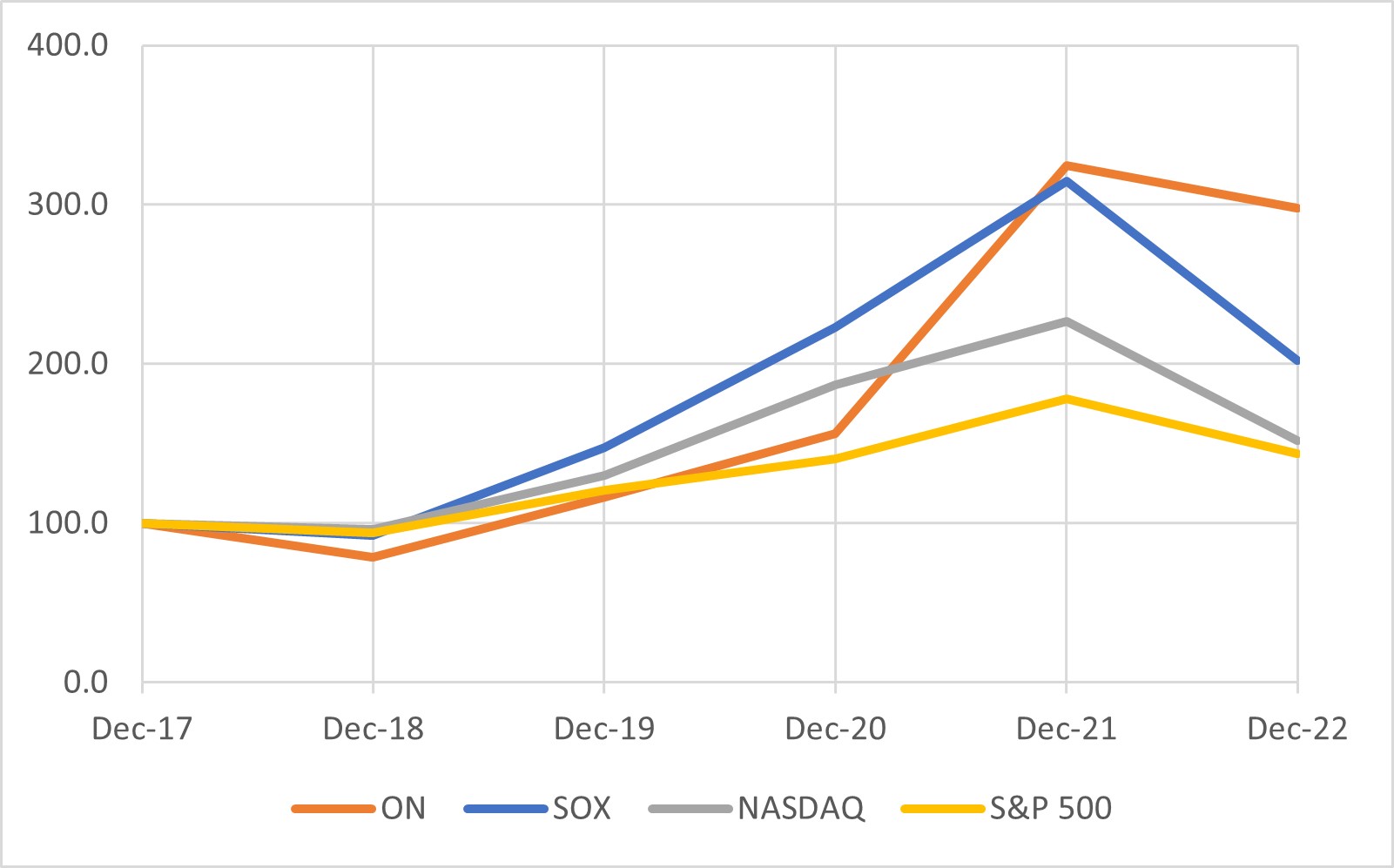
Company Stock Performance
The following graph shows a comparison of the five-year cumulative total stockholder return for onsemi, the PHLX Semiconductor Sector Index (SOX), the Standard and Poor's 500 (S&P 500), and the NASDAQ Composite Index. The comparison assumes $100 was invested on December 31, 2017 in shares of our common stock and in each of the indices shown
and assumes that all of the dividends were reinvested. Note that past stock price performance is not necessarily indicative of future stock price performance. The performance graph in this Form 10-K shall be deemed furnished, and not filed, and shall not be deemed incorporated by reference into any filing under the Securities Act or the Exchange Act as a result of this furnishing, except to the extent that we specifically incorporate it by reference.
We have neither declared nor paid any cash dividends on our common stock since our initial public offering. Our future dividend policy with respect to our common stock will depend upon our earnings, capital requirements, financial condition, debt restrictions and other factors deemed relevant by our Board of Directors in its sole discretion.
Our outstanding debt facilities may limit the amount of dividends we are permitted to pay and the amount of shares we are permitted to buy back under the Share Repurchase Program (as defined below), or any new share repurchase programs adopted by the Company. We may pay dividends and buy back shares under the Share Repurchase Program in an unlimited amount so long as, after giving effect thereto, the consolidated total net leverage ratio (calculated in accordance with our Amended Credit Agreement) does not exceed 2.50 to 1.00. In addition, so long as no default has occurred and is continuing or results therefrom, our Amended Credit Agreement permits us to pay cash dividends to our common stockholders, buy back shares under the Share Repurchase Program, or a combination thereof, in an amount up to $100.0 million per year. See Note 9: ''Long-Term Debt'' in the notes to the audited consolidated financial statements included elsewhere in this Form 10-K for further discussion of our Amended Credit Agreement.
Issuer Purchases of Equity Securities
The following table provides information regarding repurchases of our common stock during the quarter ended December 31, 2022:
| Period (1) | Total Number of Shares Purchased**(2)** | Average Price Paid per Share ($) (3) | Total Number of Shares Purchased as Part of Publicly Announced Plans or Programs | Approximate Dollar Value of Shares that May Yet be Purchased Under the Plans or Programs ($ in millions) ($) (4) | ||||||||||||||||||||||
| October 1, 2022 - October 28, 2022 | — | $ | — | — | $ | 1,126.1 | ||||||||||||||||||||
| October 29, 2022 - November 25, 2022 | 1,147,852 | 70.45 | 589,826 | 1,084.7 | ||||||||||||||||||||||
| November 26, 2022 - December 31, 2022 | 761,833 | 68.93 | 702,627 | 1,036.1 | ||||||||||||||||||||||
| Total | 1,909,685 | 69.84 | 1,292,453 |
(1)The periods represent our fiscal month start and end dates for the fourth quarter of 2022.
(2)Included above is an aggregate of 617,232 shares that were received pursuant to bond hedges for which no cash was
exchanged.
(3)The price per share is based on the fair market value at the time of tender, repurchase or exercise of outstanding put options, respectively.
(4)Represents the authorized amount remaining under the Share Repurchase Program.
Share Repurchase Program
The repurchases under the Share Repurchase Program amounted to $259.8 million during the year ended December 31, 2022. There were no repurchases of common stock under the Share Repurchase Program during the year ended December 31, 2021 and $65.3 million in repurchases of common stock under the Share Repurchase Program during the year ended December 31, 2020.
The Share Repurchase Program allowed for the repurchase of our common stock from time to time in privately negotiated transactions or open market transactions, including pursuant to a trading plan in accordance with Rule 10b5-1 and Rule 10b-18 of the Exchange Act, or by any combination of such methods or other methods. The Share Repurchase Program, which did not require us to purchase any particular amount of common stock and was subject to the discretion of the Board of Directors, expired on December 31, 2022, with approximately $1,036.0 million remaining unutilized.
In February 2023, the Board of Directors approved a new share repurchase program (the “2023 Share Repurchase Program”), which allows for the repurchase of our common stock from time to time in privately negotiated transactions or open market transactions, including pursuant to a trading plan in accordance with Rule 10b5-1 and Rule 10b-18 of the Exchange Act, or by any combination of such methods or other methods. The 2023 Share Repurchase Program, which does not require us to purchase any minimum amount of our common stock, has an aggregate limit of $3.0 billion from February 8, 2023 through December 31, 2025 (exclusive of fees, commissions and other expenses). Any repurchases will be at the Company’s discretion and will be subject to market conditions, the price of our shares and other factors. The share repurchase program may be modified, suspended or terminated by the Board of Directors at any time without prior notice.
See Note 10: ''Earnings Per Share and Equity'' of the notes to our audited consolidated financial statements included elsewhere in this Form 10-K for further information on shares of common stock tendered to the Company by employees to satisfy applicable employee withholding taxes due upon vesting of RSUs and the Share Repurchase Program.
Item 6. [Reserved]
Item 7. Management’s Discussion and Analysis of Financial Condition and Results of Operations
You should read the following discussion in conjunction with our audited historical consolidated financial statements, including the notes thereto, which are included elsewhere in this Form 10-K. Management's Discussion and Analysis of Financial Condition and Results of Operations contains statements that are forward-looking. These statements are based on current expectations and assumptions that are subject to risk, uncertainties, and other factors. Actual results could differ materially because of the factors discussed in "Risk Factors" and elsewhere in this Form 10-K.
Executive Overview
This executive overview presents summarized information regarding our business and operating trends only. For further information relating to the information summarized herein, see "Management's Discussion and Analysis of Financial Condition and Results of Operations" in its entirety.
onsemi Results
Our revenue for the year ended December 31, 2022 was $8,326.2 million, an increase of 23.5% from $6,739.8 million for the year ended December 31, 2021. The increase was attributable to our strategy to focus on a product mix that yields higher margins, and an increase in average selling prices driven by strong market demand. During 2022, we reported net income attributable to onsemi of $1,902.2 million compared to $1,009.6 million in 2021. Our operating income totaled $2,360.0 million during 2022 compared to $1,287.6 million during 2021. The increase in our operating income and net income was due to significantly better gross margins primarily driven by higher revenue in focused end-markets, favorable product mix, increase in average selling prices and savings from restructuring activities. Our gross margin increased by approximately 870 basis points to 49.0% in 2022 from 40.3% in 2021. See discussion under "Results of Operations" for additional discussion on the reasons for the fluctuations year over year.
Business and Macroeconomic Environment
The semiconductor industry has traditionally been highly cyclical, has often experienced significant downturns in connection with, or in anticipation of, declines in general economic conditions, and may experience uncertainty and volatility in the future.
During the year ended December 31, 2022, our product demand remained strong as we achieved record annual revenues. However, we are aware of and are monitoring the economic environment and related forecasts, which suggest global economic slowdowns could continue and potentially result in certain economies entering a recessionary period, which could include the United States. Given the current conditions, we are actively managing our manufacturing activity and spending to align with our forecasted demand. We believe the current volatility in general economic conditions is not expected to have a significant impact on our long-term strategic and growth initiatives.
During 2022, we achieved revenue growth as well as expanded our gross margin and operating margin. The semiconductor industry conditions have resulted in increased costs throughout our supply chain. In some cases, we have been able to increase our prices and pass these increased costs along to our customers, which also partially contributed to higher revenue for 2022. We expect to continue to evaluate cost-saving initiatives to be able to align our overall cost structure, capital investments and other expenditures with our expected revenue, spending and capacity levels to help offset increased costs. We have taken, and continue to take actions, including but not limited to, exiting product lines, that do not support our gross margin improvements and strategic objectives.
See Note 7: ''Restructuring, Asset Impairments and Other Charges, net'' in the notes to our audited consolidated financial statements included elsewhere in this Form 10-K for information relating to our most recent cost-saving initiatives.
Results of Operations
A discussion of our results of operations for the year ended December 31, 2022 compared to December 31, 2021 is included below. For a discussion and comparison of the results of our operations for the year ended December 31, 2021 with the year ended December 31, 2020, refer to "Management's Discussion and Analysis of Financial Conditions and Results of Operations" in our Form 10-K for the year ended December 31, 2021 filed with the SEC on February 14, 2022.
Operating Results
The following table summarizes certain information relating to our operating results that has been derived from our audited consolidated financial statements (in millions):
| Year ended December 31, | |||||||||||||||||||||||||||||||||||||||||||||||
| 2022 | 2021 | Change | |||||||||||||||||||||||||||||||||||||||||||||
| Revenue | $ | 8,326.2 | $ | 6,739.8 | $ | 1,586.4 | |||||||||||||||||||||||||||||||||||||||||
| Cost of revenue | 4,249.0 | 4,025.5 | 223.5 | ||||||||||||||||||||||||||||||||||||||||||||
| Gross profit | 4,077.2 | 2,714.3 | 1,362.9 | ||||||||||||||||||||||||||||||||||||||||||||
| Operating expenses: | |||||||||||||||||||||||||||||||||||||||||||||||
| Research and development | 600.2 | 655.0 | (54.8) | ||||||||||||||||||||||||||||||||||||||||||||
| Selling and marketing | 287.9 | 293.6 | (5.7) | ||||||||||||||||||||||||||||||||||||||||||||
| General and administrative | 343.2 | 304.8 | 38.4 | ||||||||||||||||||||||||||||||||||||||||||||
| Amortization of acquisition-related intangible assets | 81.2 | 99.0 | (17.8) | ||||||||||||||||||||||||||||||||||||||||||||
| Restructuring, asset impairments and other charges, net | 17.9 | 71.4 | (53.5) | ||||||||||||||||||||||||||||||||||||||||||||
| Goodwill and intangible asset impairment | 386.8 | 2.9 | 383.9 | ||||||||||||||||||||||||||||||||||||||||||||
| Total operating expenses | 1,717.2 | 1,426.7 | 290.5 | ||||||||||||||||||||||||||||||||||||||||||||
| Operating income | 2,360.0 | 1,287.6 | 1,072.4 | ||||||||||||||||||||||||||||||||||||||||||||
| Other income (expense), net: | |||||||||||||||||||||||||||||||||||||||||||||||
| Interest expense | (94.9) | (130.4) | 35.5 | ||||||||||||||||||||||||||||||||||||||||||||
| Interest income | 15.5 | 1.4 | 14.1 | ||||||||||||||||||||||||||||||||||||||||||||
| Loss on debt refinancing and prepayment | (7.1) | (29.0) | 21.9 | ||||||||||||||||||||||||||||||||||||||||||||
| Gain on divestiture of businesses | 67.0 | 10.2 | 56.8 | ||||||||||||||||||||||||||||||||||||||||||||
| Other income, net | 21.7 | 18.0 | 3.7 | ||||||||||||||||||||||||||||||||||||||||||||
| Other income (expense), net | 2.2 | (129.8) | 132.0 | ||||||||||||||||||||||||||||||||||||||||||||
| Income before income taxes | 2,362.2 | 1,157.8 | 1,204.4 | ||||||||||||||||||||||||||||||||||||||||||||
| Income tax provision benefit | (458.4) | (146.6) | (311.8) | ||||||||||||||||||||||||||||||||||||||||||||
| Net income | 1,903.8 | 1,011.2 | 892.6 | ||||||||||||||||||||||||||||||||||||||||||||
| Less: Net income attributable to non-controlling interest | (1.6) | (1.6) | — | ||||||||||||||||||||||||||||||||||||||||||||
| Net income attributable to ON Semiconductor Corporation | $ | 1,902.2 | $ | 1,009.6 | $ | 892.6 |
Revenue
Revenue was $8,326.2 million and $6,739.8 million for 2022 and 2021, respectively. The increase from 2021 to 2022 of $1,586.4 million, or 23.5%, was attributable to a 22.4%, 18.4% and 41.7% increase in revenue in PSG, ASG and ISG, respectively, which is further explained below.
We had one customer, a distributor, whose revenue accounted for approximately 12% of the total revenue for the year ended December 31, 2022.
Revenue by operating and reportable segments was as follows (dollars in millions):
| 2022 | As a % of Revenue (1) | 2021 | As a % of Revenue (1) | |||||||||||||||||||||||||||||
| PSG | $ | 4,208.2 | 50.5 | % | $ | 3,439.1 | 51.0 | % | ||||||||||||||||||||||||
| ASG | 2,841.3 | 34.1 | % | 2,399.9 | 35.6 | % | ||||||||||||||||||||||||||
| ISG | 1,276.7 | 15.3 | % | 900.8 | 13.4 | % | ||||||||||||||||||||||||||
| Total revenue | $ | 8,326.2 | $ | 6,739.8 |
(1)Certain of the amounts may not total due to rounding of individual amounts.
Revenue from PSG
Revenue from PSG increased by $769.1 million, or approximately 22.4%, during 2022 compared to 2021. The revenue from our Advanced Power Division and our Integrated Circuits, Protection and Signal Division increased by $672.7 million and $96.4 million, respectively. These increases primarily were driven by our strategy to focus on SiC, a product mix that yields higher margins and an increase in average selling prices driven by strong market demand.
Revenue from ASG
Revenue from ASG increased by $441.4 million, or approximately 18.4%, during 2022 compared to 2021. The revenue from our Automotive Division, Industrial Solutions Division and Mobile, Computing and Cloud Division increased by $224.2 million, $173.8 million and $77.1 million, respectively. The increases primarily were due to our strategy to focus on a product mix that yields higher margins, and an increase in average selling prices driven by strong market demand.
Revenue from ISG
Revenue from ISG increased by $375.9 million, or approximately 41.7%, during 2022 compared to 2021. The revenue from our Automotive Sensing Division and our Industrial and Consumer Solutions Division increased by $357.3 million and $18.7 million, respectively. The increase in revenue was due to our strategy to focus on a product mix that yields higher margins, and an increase in average selling prices driven by strong market demand.
Revenue by Geographic Location
Revenue by geographic location, based on sales billed from the respective country or regions, are as follows (dollars in millions):
| 2022 | As a % of Revenue (1) | 2021 | As a % of Revenue (1) | ||||||||||||||||||||||||||||||||
| Hong Kong | $ | 2,315.8 | 27.8 | % | $ | 1,828.6 | 27.1 | % | |||||||||||||||||||||||||||
| Singapore | 2,133.9 | 25.6 | % | 2,097.8 | 31.1 | % | |||||||||||||||||||||||||||||
| United Kingdom | 1,492.3 | 17.9 | % | 1,123.6 | 16.7 | % | |||||||||||||||||||||||||||||
| United States | 1,464.7 | 17.6 | % | 931.6 | 13.8 | % | |||||||||||||||||||||||||||||
| Other | 919.5 | 11.0 | % | 758.2 | 11.2 | % | |||||||||||||||||||||||||||||
| Total Revenue | $ | 8,326.2 | $ | 6,739.8 |
(1)Certain of the amounts may not total due to rounding of individual amounts.
Gross Profit and Gross Margin
Our gross profit by operating and reportable segment was as follows (dollars in millions):
| 2022 | As a % of Segment Revenue (1) | 2021 | As a % of Segment Revenue (1) | ||||||||||||||||||||||||||||||||||||||||||||
| PSG | $ | 1,994.3 | 47.4 | % | $ | 1,318.3 | 38.3 | % | |||||||||||||||||||||||||||||||||||||||
| ASG | 1,474.5 | 51.9 | % | 1,055.6 | 44.0 | % | |||||||||||||||||||||||||||||||||||||||||
| ISG | 608.4 | 47.7 | % | 340.4 | 37.8 | % | |||||||||||||||||||||||||||||||||||||||||
| Total gross profit | $ | 4,077.2 | 49.0 | % | $ | 2,714.3 | 40.3 | % |
(1)Certain of the amounts may not total due to rounding of individual amounts.
Our gross profit increased by $1,362.9 million, or approximately 50%, from $2,714.3 million during 2021 to $4,077.2 million during 2022. Gross margin increased to 49.0% during 2022 compared to 40.3% during 2021.
The significant increases in gross profit and gross margin were primarily driven by higher revenue, particularly in the
automotive and industrial end-markets, and a favorable product mix, which included price increases to resolve price-to-value discrepancies for our products.
Operating Expenses
Research and Development
Research and development expenses were $600.2 million and $655.0 million, or approximately 7% and 10% of revenue for 2022 and 2021, respectively, representing a decrease of $54.8 million, or approximately 8% year-over-year. The decrease was primarily due to a reduction in payroll and other related expenses associated with the wind down of QCS.
Selling and Marketing
Selling and marketing expenses were $287.9 million and $293.6 million, or approximately 3% and 4% of revenue for 2022 and 2021, respectively, representing a decrease of $5.7 million, or approximately 2% year-over-year. The decrease was primarily due to a reduction in payroll-related expenses due to census declines from hiring delays and attrition.
General and Administrative
General and administrative expenses were $343.2 million and $304.8 million, or approximately 4% and 5% of revenue for 2022 and 2021, respectively, representing an increase of $38.4 million, or approximately 13% year-over-year. The increase was primarily due to higher variable compensation and stock compensation.
Amortization of Acquisition—Related Intangible Assets
Amortization of acquisition-related intangible assets was $81.2 million and $99.0 million for 2022 and 2021, respectively, representing a decrease of $17.8 million, or approximately 18.0%, year-over-year. The decrease was due to the reduction in amortization expense as certain intangible technology-related assets became fully amortized in 2021 and the full write-off of QCS intangibles.
Restructuring, Asset Impairments and Other Charges, net
Restructuring, asset impairments and other charges, net was $17.9 million and $71.4 million for 2022 and 2021, respectively. Charges in 2022 represent severance charges, contract termination costs and litigation expenses and primarily relate to the QCS wind down. Amounts incurred during 2021 primarily related to the involuntary severance plan. For additional information, see Note 7: ''Restructuring, Asset Impairments and Other Charges, net'' in the notes to our audited consolidated financial statements included elsewhere in this Form 10-K.
Goodwill and Intangible Asset Impairment
Goodwill and intangible asset impairment was $386.8 million and $2.9 million for 2022 and 2021, respectively. During 2022, we recorded a goodwill impairment charge of $330.0 million and an intangible asset impairment charge of $56.8 million, as a result of a shift in our focus on long-term product mix in our strategic markets and the QCS wind down. See Note 6: ''Goodwill and Intangible Assets'' in the notes to our unaudited consolidated financial statements included elsewhere in this Form 10-K for additional information.
Other Income and Expenses
Interest Expense
Interest expense decreased by $35.5 million, or approximately 27.2%, to $94.9 million during 2022 compared to $130.4 million in 2021. The decrease was primarily due to the lack of amortization of debt discount on our convertible notes due to the adoption of ASU 2020-06, the effect of the issuance of the 0% Notes, as a majority of the proceeds were utilized to repay higher rate debt. Our average gross amount of long-term debt balance (including current maturities) during 2022 and 2021 was $3,243.3 million and $3,423.9 million, respectively. Our weighted average interest rate on our gross amount of long-term debt (including current maturities) was 2.9% and 3.8% per annum in 2022 and 2021, respectively.
See "Liquidity and Capital Resources—Key Financing and Capital Events" below and Note 9: ''Long-Term Debt'' in the notes to our audited consolidated financial statements included elsewhere in this Form 10-K for a description of our indebtedness and
our refinancing activities.
Gain on Divestiture of Businesses
Gain on divestiture of business was $67.0 million in 2022, compared to $10.2 million in 2021. The gain during 2022 relates to the divestiture of the wafer manufacturing facilities in Niigata, Japan, Pocatello, Idaho, South Portland, Maine and Oudenaarde, Belgium.
Loss on Debt Refinancing and Prepayment
We recorded loss on debt refinancing and prepayment of $7.1 million during 2022. This was primarily related to the partial prepayment of the Term Loan "B" Facility. See "Liquidity and Capital Resources—Key Financing and Capital Events" below and Note 9: ''Long-Term Debt'' in the notes to our audited consolidated financial statements included elsewhere in this Form 10-K for a description of our indebtedness and our refinancing activities.
Other income, net
Other income, net was $18.0 million in 2021 compared to an income of $21.7 million in 2022, reflecting a change of approximately 20.6%. The increase was primarily due to the fluctuations in foreign currencies resulting in increased transaction gains offset by losses on hedges that were realized.
Income Tax Provision
We recorded an income tax provision of $458.4 million and $146.6 million in 2022 and 2021, respectively, representing effective tax rates of 19.4% and 12.7%. The increase in our effective tax rate was substantially driven by the impact of nondeductible goodwill and foreign operations.
For additional information, see Note 16: ''Income Taxes'' and Note 6: ''Goodwill and Intangible Assets'' in the notes to the audited consolidated financial statements included elsewhere in this Form 10-K.
Liquidity and Capital Resources
Overview
Our principal sources of liquidity are cash on hand, cash generated from operations, funds from external borrowings and debt and equity issuances. In the near term, we expect to fund our primary cash requirements through cash generated from operations and with cash and cash equivalents on hand. We also have the ability to utilize our Revolving Credit Facility, which has approximately $1.5 billion available for future borrowings. Our balance of cash and cash equivalents was $2,919.0 million as of December 31, 2022.
We require cash to: (i) fund our operating expenses, working capital requirements, outlays for strategic acquisitions and investments; (ii) service our debt, including principal and interest; (iii) conduct research and development; (iv) incur capital expenditures; and (v) repurchase our common stock. As part of our business strategy, we review acquisition and divestiture opportunities on a regular basis.
During the ordinary course of business, we evaluate our cash requirements and, if necessary, adjust our expenditures to reflect the current market conditions and our projected sales and demand. Our capital expenditures are primarily directed towards manufacturing equipment, and can materially influence our available cash for other initiatives. Future capital expenditures may be impacted by events and transactions that are not currently forecasted.
We believe that the key factors that could adversely affect our internal and external sources of cash include:
-
Changes in demand for our products, competitive pricing pressures, supply chain constraints, effective management of our manufacturing capacity, our ability to achieve further reductions in operating expenses, our ability to make progress on the achievement of our business strategy and sustainability goals, the impact of our restructuring programs on our production and cost efficiency and our ability to make the research and development expenditures required to remain competitive in our business; and
-
The debt and equity capital markets could impact our ability to obtain needed financing on acceptable terms or to
respond to business opportunities and developments as they arise, including interest rate fluctuations, macroeconomic conditions, sudden reductions in the general availability of lending from banks or the related increase in cost to obtain bank financing and our ability to maintain compliance with covenants under our debt agreements in effect from time to time.
Sources and Uses of Cash
As part of our business strategy, we review acquisition and divestiture opportunities on a regular basis. Excluded from the discussion below is the EFK facility, which we acquired on December 31, 2022 for $406.3 million in cash, of which approximately $236.3 million was paid in January 2023. See Note 5: ''Acquisitions and Divestitures'' in the notes to our audited consolidated financial statements included elsewhere in this Form 10-K.
The following are the significant sources and uses of cash during 2022:
-
Our cash flows from operating activities were $2,633.1 million.
-
We paid approximately $1,005.0 million for capital expenditures.
-
Borrowing of $500.0 million under the Revolving Credit Facility, the net proceeds of which were used to prepay the outstanding balance of $500.0 million under the Term Loan "B" Facility.
-
Repurchased approximately 4.0 million shares of common stock for an aggregate purchase price of $259.8 million.
-
Divestiture of manufacturing facilities in Oudenaarde, Belgium, South Portland, Maine, Pocatello, Idaho and Niigata, Japan for approximately $275.0 million in the aggregate. See Note 5: ''Acquisitions and Divestitures'' in the notes to our audited consolidated financial statements included elsewhere in this Form 10-K.
Operating Activities
Our long-term cash generation is dependent on the ability of our operations to generate cash. Our cash flows from operating activities were $2,633.1 million, $1,782.0 million and $884.3 million for the years ended December 31, 2022, 2021 and 2020, respectively. Our operating cash flows for the year ended December 31, 2022 increased by $851.1 million, or 47.8%, compared to the year ended December 31, 2021 and was primarily attributable to a significant increase in net income due to our strategy to focus on a product mix that yields higher margins combined with increased demand and prices for our products.
Our ability to maintain positive operating cash flows is dependent on, among other factors, our success in achieving our revenue goals and manufacturing and operating cost targets. Management of our assets and liabilities, including both working capital and long-term assets and liabilities, also influences our operating cash flows.
Investing Activities
Our cash flows used in investing activities were $705.4 million, $915.1 million and $453.6 million for the years ended December 31, 2022, 2021 and 2020, respectively. The decrease of $209.7 million for the year ended December 31, 2022 compared to the year ended December 31, 2021 was primarily attributable to capital expenditures offset by proceeds from the sale of real estate and divestitures. During the year ended December 31, 2022, 2021 and 2020, we paid $1,005.0 million, $444.6 million and $383.6 million, respectively, for capital expenditures. Our capital expenditures as a percent of revenue increased in 2022 to 12%, primarily as a result of the silicon carbide expansion and our facility expansion investments. In 2023, we expect capital expenditures to be approximately 20% of revenue as these investments along with other capital initiatives will increase.
Financing Activities
Our cash flows used in financing activities were $370.0 million, $569.4 million and $244.0 million for the years ended December 31, 2022, 2021 and 2020, respectively. The decrease of $199.4 million for the year ended December 31, 2022 compared to the year ended December 31, 2021 was primarily attributable to proceeds and payments related to long-term borrowings and share repurchase activity.
See Part I, Item 1A "Risk Factors" included elsewhere in this Form 10-K for additional information related to liquidity matters.
Debt
Our ability to service our long-term debt, including our 0% Notes, 3.875% Notes, 1.625% Notes, the Revolving Credit Facility and the Term Loan "B" Facility, to remain in compliance with the various covenants contained in our debt agreements and to fund working capital, capital expenditures and business development efforts will depend on our ability to generate cash from operating activities, which is subject to, among other things, our future operating performance, as well as to financial, competitive, legislative, regulatory and other conditions, some of which may be beyond our control.
As of December 31, 2022, there was $1,086.0 million outstanding under the Term Loan "B" Facility, in addition to $805.0 million aggregate principal amount of the 0% Notes, $700.0 million aggregate principal amount of 3.875% Notes and $137.3 million aggregate principal amount of the 1.625% Notes. The aggregate principal amount of outstanding 1.625% Notes, net of unamortized discount and issuance costs, has been reclassified as a current portion of long-term debt. The associated interest expense related to this indebtedness will continue to have a significant impact on our results of operations.
See Note 5: ''Acquisitions and Divestitures'' and Note 9: ''Long-Term Debt'' in the notes to our audited consolidated financial statements included elsewhere in this Form 10-K for additional information.
Key Financing and Capital Events
Overview
We continually evaluate our debt and capital structure and when appropriate, we have completed various measures to secure liquidity, repurchase shares of our common stock, reduce interest costs, amend existing key financing arrangements and, in some cases, extend a portion of our debt maturities to continue to provide us additional operating flexibility. Certain of these measures continued in 2022, which included the partial repayment of our Term Loan through borrowings of $500.0 million under our Revolving Credit Facility and the amendment of our credit agreement to eliminate the LIBO Rate as a borrowing alternative. For further discussion of our debt instruments, see Note 9: ''Long-Term Debt'' and for further discussion on the Share Repurchase Program (as defined below), see Note 10: ''Earnings Per Share and Equity'' in the notes to our audited consolidated financial statements included elsewhere in this Form 10-K.
2022 Financing Events
-
In connection with the Company’s $500.0 million draw down on the Revolving Credit Facility, we expensed $7.3 million of unamortized debt discount and issuance costs primarily attributed to a partial pay-down of debt as loss on debt refinancing and prepayment.
-
Repurchases under the Share Repurchase Program amounted to $259.8 million during the year ended December 31, 2022.
-
On November 9, 2022, we entered into separate privately negotiated transactions with certain holders of the 1.625% Notes to repurchase or exchange, as applicable, $16.0 million in aggregate principal amount of the 1.625% Notes for a total consideration of $16.0 million in cash and 552,000 shares of common stock.
-
On November 16, 2022, we entered into the Tenth Amendment to the Amended Credit Agreement to transition the interest rate base from the LIBO Rate to Term SOFR.
2021 Financing Events
-
In May 2021, we completed a private offering of $805.0 million aggregate principal amount of 0% Notes. In connection with the issuance of the 0% Notes, we entered into convertible note hedge transactions with the initial purchasers of the 0% Notes or their affiliates ("Counterparties") and paid $160.3 million in cash for the convertible note hedges. We also entered into warrant transactions with the Counterparties and received $93.8 million in cash for the sale of warrants.
-
Contemporaneously with the issuance of the 0% Notes, we entered into separate privately negotiated transactions with certain holders of the 1.625% Notes to repurchase or exchange, as applicable, $372.4 million in aggregate principal amount of the 1.625% Notes for a total consideration of $506.5 million in cash and 5.4 million shares of common stock. In December 2021, we repurchased $47.4 million of the 1.625% Notes for $47.4 million in cash and 1.6 million
shares of common stock.
- During the year ended December 31, 2021, we repaid the outstanding balance of $700.0 million under the Revolving Credit Facility using a portion of the net proceeds from the issuance of the 0% Notes and cash on hand.
2020 Financing Events
-
The 1.00% Notes matured on December 1, 2020. The maturity of the notes resulted in us paying $690.0 million in cash, to holders of the 1.00% Notes using our available cash and cash equivalents. The excess over the principal amount was settled by issuing shares of common stock held in treasury. At the time of issuance of the 1.00% Notes, we concurrently entered into hedge transactions with certain of the initial purchasers of the 1.00% Notes, and accordingly, repurchased an equivalent number of shares of our common stock at fair market value, to effectively offset the issuance of shares. Also at the time of issuance of the 1.00% Notes, we sold warrants to certain bank counterparties whereby the holders of the warrants had the option to purchase from us the equivalent number of shares of our common stock at a price of $25.96 per share. All these warrants were exercised by the holders during the first and second quarters of 2021 and were settled by issuing an aggregate of 13.4 million shares of common stock.
-
In August 2020, we completed a private offering of $700.0 million aggregate principal amount of the 3.875% Notes due 2028. In connection with the issuance, we incurred original issue discount and debt issuance costs amounting to $9.4 million.
-
In March 2020, we borrowed $1,165.0 million under the Revolving Credit Facility as a precautionary measure in order to increase our cash position and provide financial flexibility in light of the uncertainty resulting from the impact of the COVID-19 pandemic. Due to better macroeconomic and business conditions, we used the net proceeds from the issuance of the 3.875% Notes along with cash on hand to repay $1,200.0 million of outstanding borrowings with the remaining $65.0 million balance we repaid $65.0 million on December 31, 2020.
-
During 2020, we repurchased 3.6 million shares of our common stock for an aggregate purchase price of $65.3 million pursuant to the Share Repurchase Program.
Debt Guarantees and Related Covenants
As of December 31, 2022, we were in compliance with the indentures relating to our 0% Notes, 3.875% Notes and 1.625% Notes and with covenants relating to our Term Loan "B" Facility and Revolving Credit Facility. Our 0% Notes, 3.875% Notes and 1.625% Notes are senior to the existing and future subordinated indebtedness of onsemi and our guarantor subsidiaries and rank equally in right of payment to all of our existing and future senior debt and as unsecured obligations and are subordinated to all of our existing and future secured debt to the extent of the assets securing such debt. Failure to comply with any of our covenants or any other terms of our Term Loan "B" Facility and Revolving Credit Facility could result in higher interest rates on our borrowings or the acceleration of the maturities of our outstanding debt.
See Note 9: ''Long-Term Debt'' in the notes to our audited consolidated financial statements included elsewhere in this Form 10-K for additional information.
Critical Accounting Policies and Estimates
The accompanying discussion and analysis of our financial condition and results of operations is based upon our audited consolidated financial statements, which have been prepared in accordance with accounting principles generally accepted in the United States. We believe certain of our accounting policies are critical to understanding our financial position and results of operations. We utilize the following critical accounting policies in the preparation of our financial statements. In addition to our critical accounting policies below, see Note 2: ''Significant Accounting Policies'' in the notes to our audited consolidated financial statements included elsewhere in this Form 10-K.
Use of Estimates. The preparation of financial statements in accordance with GAAP requires us to make estimates and assumptions that affect the reported amount of assets and liabilities at the date of the financial statements and the reported amount of revenue and expenses during the reporting period. We evaluate these estimates and judgments on an ongoing basis and base our estimates on experience, current and expected future conditions, third-party evaluations and various other assumptions that we believe are reasonable under the circumstances. Significant estimates have been used by management in conjunction with the following: (i) future payouts for customer incentives and amounts subject to allowances and returns; (ii) valuation and obsolescence relating to inventories; (iii) measurement of valuation allowances against deferred tax assets, and
evaluations of uncertain tax positions; (iv) assumptions used in business combinations; and (v) testing for impairment of long-lived assets and goodwill. Additionally, during periods where it becomes applicable, significant estimates will be used by management in determining the future cash flows used to assess and test for impairment of long-lived assets and goodwill. Actual results may differ from the estimates and assumptions used in the consolidated financial statements.
Revenue Recognition**.** We generate revenue from sales of our semiconductor products to direct customers and distributors. We also generate revenue, to a much lesser extent, from product development agreements and manufacturing services provided to customers. We recognize revenue when we satisfy a performance obligation in an amount reflecting the consideration to which we expect to be entitled. For sales agreements, we have identified the promise to transfer products, each of which is distinct, to be the performance obligation. For product development agreements, we have identified the completion of a service defined in the agreement to be the performance obligation. We apply a five-step approach in determining the amount and timing of revenue to be recognized: (1) identifying the contract with a customer; (2) identifying the performance obligations in the contract; (3) determining the transaction price; (4) allocating the transaction price to the performance obligations in the contract; and (5) recognizing revenue when the performance obligation is satisfied. We allocate the transaction price to each distinct product based on its relative stand-alone selling price. In determining the transaction price, we evaluate whether the price is subject to refund or adjustment to determine the net consideration to which we expect to be entitled. Substantially all of our revenue is recognized at the time control of the products transfers to the customer.
Sales to certain distributors, primarily those with ship and credit rights, can be subject to price adjustment on certain products. We develop an estimate of their expected claims under the ship and credit program based on the historical claims data submitted by product and customer and expected future claims, which requires the use of estimates and assumptions related to the amount of each claim as well as the historical period used to develop the estimate.
Our direct customers do not have the right to return products, other than pursuant to the provisions of our standard warranty. Sales to distributors, however, are typically made pursuant to agreements that provide return rights and stock rotation provisions permitting limited levels of product returns. Provisions for discounts and rebates to customers, estimated returns and allowances, ship and credit claims and other adjustments are provided for in the same period the related revenue are recognized, and are netted against revenue. For non-quality related returns, we recognize a related asset for the right to recover returned products with a corresponding reduction to cost of goods sold. We record a reserve for cash discounts as a reduction to accounts receivable and a reduction to revenue, based on the experience with each customer.
Inventories**.** We carry our inventories at the lower of standard cost (which approximates actual cost on a first-in, first-out basis) or net realizable value and record provisions for potential excess and obsolete inventories based upon a regular analysis of inventory on hand compared to historical and projected end-user demand. The determination of projected end-user demand requires the use of estimates and assumptions related to projected unit sales for each product. These provisions can influence our results from operations. For example, when demand falls for a given part, all or a portion of the related inventory that is considered to be in excess of anticipated demand is reserved, impacting our cost of revenue and gross profit. The majority of product inventory that has been previously reserved is ultimately discarded. However, we do sell some products that have previously been written down, such sales have historically been consistently insignificant and the related impact on our margins has also been insignificant.
Income Taxes. Income taxes are accounted for using the asset and liability method. Under this method, deferred income tax assets and liabilities are recognized for the future tax consequences attributable to temporary differences between the financial statement carrying amounts of existing assets and liabilities and their respective tax bases. Deferred income tax assets and liabilities are measured using enacted tax rates expected to apply to taxable income in the years in which these temporary differences are expected to be recovered or settled. The effect on deferred tax assets and liabilities of a change in tax rates is recognized in income in the period that includes the enactment date. A valuation allowance is provided for those deferred tax assets for which we cannot conclude that it is more likely than not that such deferred tax assets will be realized.
In determining the amount of the valuation allowance, estimated future taxable income, feasible tax planning strategies, future reversals of existing temporary differences and taxable income in prior carryback years, if a carryback is permitted are considered. If we determine it is more likely than not that all or a portion of the remaining deferred tax assets will not be realized, the valuation allowance will be increased with a charge to income tax expense. Conversely, if we determine it is more likely than not to be able to utilize all or a portion of the deferred tax assets for which a valuation allowance has been provided, the related portion of the valuation allowance will be recorded as a reduction to income tax expense.
We recognize and measure benefits for uncertain tax positions using a two-step approach. The first step is to evaluate the tax position taken or expected to be taken in a tax return by determining if the weight of available evidence indicates that is it more
likely than not that the tax positions will be sustained upon audit, including resolution of any related appeals or litigation processes. For tax positions that are more likely than not to be sustained upon audit, the second step is to measure the tax benefit as the largest amount that is more than 50% likely to be realized upon settlement. No tax benefit is recognized for tax positions that are not more likely than not to be sustained. Our practice is to recognize interest and/or penalties related to income tax matters in income tax expense. Significant judgment is required to evaluate uncertain tax positions. Evaluations are based upon a number of factors, including changes in facts or circumstances, changes in tax law, correspondence with tax authorities during the course of tax audits and effective settlement of audit issues. Changes in the recognition or measurement of uncertain tax positions could result in material increases or decreases in income tax expense in the period in which the change is made, which could have a material impact to our effective tax rate.
Business Combination. We use estimates and assumptions in allocating the purchase price of acquired business by utilizing established valuation techniques appropriate for the technology industry to record the acquired assets and liabilities at fair value. We utilize the income approach, cost approach or market approach, depending upon which approach is the most appropriate based on the nature and reliability of available data. If the income approach is used, the fair value determination is predicated upon the value of the future cash flows that an asset is expected to generate over its economic life and involves significant assumptions as to cash flows, associated expenses, long-term growth rates and discount rates. The cost approach takes into account the cost to replace (or reproduce) the asset and involves assumptions relating to the asset's value of physical, functional and/or economic obsolescence that has occurred with respect to the asset. The market approach is used to estimate value from an analysis of actual transactions or offerings for economically comparable assets available as of the valuation date. Determining the fair value of acquired technology assets is judgmental in nature and requires the use of significant estimates and assumptions, including the discount rate, revenue growth rates, projected gross margins, and estimated research and development expenses.
Impairment of Goodwill and Long-Lived Assets. We evaluate our goodwill for potential impairment annually during the fourth quarter and whenever events or changes in circumstances indicate the carrying value of goodwill may not be recoverable. Our impairment evaluation consists of a qualitative assessment, and if deemed necessary, a quantitative test is performed which compares the fair value of a reporting unit with its carrying amount, including goodwill.
Determining the fair value of our reporting units is subjective in nature and involves the use of significant estimates and assumptions, including projected net cash flows, discount and long-term growth rates. We determine the fair value of our reporting units based on an income approach, whereby the fair value of the reporting unit is derived from the present value of estimated future cash flows. The assumptions about estimated cash flows include factors such as future revenue, gross profit, operating expenses, and industry trends. We consider historical rates and current market conditions when determining the discount and long-term growth rates to use in its analysis. We consider other valuation methods, such as the cost approach or market approach, if it is determined that these methods provide a more representative approximation of fair value.
We evaluate the recoverability of the carrying amount of our property, plant and equipment and intangible assets, whenever events or changes in circumstances indicate that the carrying amount of an asset group may not be fully recoverable. Impairment is first assessed when the undiscounted expected cash flows derived for an asset group are less than its carrying amount. Impairment losses, if applicable, are measured as the amount by which the carrying value of an asset group exceeds its fair value and are recognized in operating results. We continually apply our best judgment when applying these impairment rules to determine the timing of the impairment test, the undiscounted cash flows used to assess impairments and the fair value of an impaired asset group. The dynamic economic environment in which we operate and the resulting assumptions used to estimate future cash flows impact the outcome of our impairment tests. As we continue to implement our business strategy to rationalize products and manufacturing locations to transition to a lighter internal fabrication model, there could be divestiture transactions resulting in a portion of goodwill or other assets being de-recognized, and which may or may not result in accounting charges.
Contingencies**.** We are involved in a variety of legal matters that arise in the normal course of business. Based on the available information, we evaluate the relevant range and likelihood of potential outcomes and we record the appropriate liability when the amount is deemed probable and reasonably estimable.
Recent Accounting Pronouncements
For a discussion of recent accounting pronouncements, see Note 4: ''Recent Accounting Pronouncements and Other Developments'' in the notes to our audited consolidated financial statements included elsewhere in this Form 10-K.
Item 7A. Quantitative and Qualitative Disclosures About Market Risk
We are exposed to financial market risks, including changes in interest rates and foreign currency exchange rates. To mitigate these risks, we utilize derivative financial instruments. We do not use derivative financial instruments for speculative or trading purposes.
As of December 31, 2022, our gross long-term debt (including current maturities) totaled $3,228.3 million. We have no interest rate exposure to rate changes on our fixed rate debt, which totaled $2,392.3 million. We do have interest rate exposure with respect to the $836.0 million balance of our variable interest rate debt outstanding as of December 31, 2022. A 50 basis point increase in interest rates would impact our expected annual interest expense for the next 12 months by approximately $5.4 million, inclusive of the impact of our interest rate swaps which hedge the risk of variability in the interest payment cash flows on a portion of our variable interest rate debt. Additionally, some of this impact would be offset by additional interest earned on our cash and cash equivalents should rates on deposits and investments also increase.
To ensure the adequacy and effectiveness of our foreign exchange hedge positions, we continually monitor our foreign exchange forward positions. However, given the inherent limitations of forecasting and the anticipatory nature of exposures intended to be hedged, we cannot provide any assurances that such programs will offset more than a portion of the adverse financial impact resulting from unfavorable movements in foreign exchange rates.
We are subject to risks associated with transactions that are denominated in currencies other than our functional currencies, as well as the effects of translating amounts denominated in a foreign currency to the U.S. Dollar as a normal part of the reporting process. Some of our Japanese operations utilize Japanese Yen as the functional currency, which results in a translation adjustment that is included as a component of accumulated other comprehensive income.
We enter into forward foreign currency contracts that economically hedge the gains and losses generated by the re-measurement of certain recorded assets and liabilities in a non-functional currency. Changes in the fair value of these undesignated hedges are recognized in other income and expense immediately as an offset to the changes in the fair value of the assets or liabilities being hedged. The notional amount of foreign exchange contracts at December 31, 2022 and 2021 was $272.0 million and $288.3 million, respectively.
Substantially all of our revenue is transacted in U.S. Dollars. However, a significant amount of our operating expenditures and capital purchases are transacted in local currencies, including Chinese Renminbi, Czech Koruna, Euros, Japanese Yen, Korean Won, Malaysian Ringgit, Philippine Peso and Vietnamese Dong. Due to the materiality of our transactions in these local currencies, our results are impacted by changes in currency exchange rates measured against the U.S. Dollar. For example, we determined that based on a hypothetical weighted-average change of 10% in currency exchange rates, our operating income would have impacted our income before taxes by approximately $112.8 million for the year ended December 31, 2022, assuming no offsetting hedge position or correlated activities.
See Note 15: ''Financial Instruments'' in the notes to the audited consolidated financial statements included elsewhere in this Form 10-K for further information with respect to our hedging activity.
Item 8. Financial Statements and Supplementary Data
Our consolidated Financial Statements listed in the index appearing under Part IV, Item 15(a)(1) of this Form 10-K and the Financial Statement Schedule listed in the index appearing under Part IV, Item 15(a)(2) of this Form 10-K are filed as part of this Form 10-K and are incorporated herein by reference in this Item 8.
Item 9. Changes in and Disagreements with Accountants on Accounting and Financial Disclosure
None.
Item 9A. Controls and Procedures
Evaluation of Disclosure Controls and Procedures.
We carried out an evaluation, under the supervision and with the participation of our management, including our Chief Executive Officer and Chief Financial Officer, of the effectiveness of our disclosure controls and procedures (as defined in Rules 13a-15(e) and 15d-15(e) of the Exchange Act). Based upon that evaluation, our Chief Executive Officer and Chief Financial Officer concluded that, as of the end of the period covered in this Form 10-K, our disclosure controls and procedures were effective to ensure that information required to be disclosed in reports filed or submitted under the Exchange Act is recorded, processed, summarized and reported within the required time periods and is accumulated and communicated to our management, including our Chief Executive Officer and Chief Financial Officer, as appropriate, to allow timely decisions
regarding required disclosure.
Changes in Internal Control Over Financial Reporting.
We also carried out an evaluation, under the supervision and with the participation of our management, including our Chief Executive Officer and Chief Financial Officer, of changes to our internal control over financial reporting (as defined in Rules 13a-15(f) and 15d-15(f) of the Exchange Act) that occurred during the fiscal quarter ended December 31, 2022.
There have been no changes to our internal control over financial reporting (as defined in Exchange Act Rules 13a-15(f) and 15d-15(f)) that occurred during the fiscal quarter ended December 31, 2022 which have materially affected, or are reasonably likely to materially affect, our internal control over financial reporting.
Management's Report on Internal Control Over Financial Reporting.
Our management is responsible for establishing and maintaining adequate internal control over financial reporting (as defined in Exchange Act Rules 13a-15(f) and 15d-15(f)). Because of its inherent limitations, internal control over financial reporting may not prevent or detect misstatements. Also, projections of any evaluation of effectiveness to future periods are subject to the risk that controls may become inadequate because of changes in conditions, or that the degree of compliance with the policies and procedures may deteriorate.
Our management assessed the effectiveness of our internal control over financial reporting as of December 31, 2022. In making this assessment, we used the criteria set forth by the Committee of Sponsoring Organizations of the Treadway Commission in Internal Control—Integrated Framework 2013. Based on this assessment, management has concluded that our internal control over financial reporting was effective as of December 31, 2022.
Management's assessment of the effectiveness of internal control over financial reporting as of December 31, 2022 excluded the East Fishkill, New York site and fabrication facility ("EFK"), which was acquired in a purchase business combination by the Company on December 31, 2022. EFK's total assets and total revenue excluded from management’s assessment represent 3.4% and 0%, respectively, of the related consolidated financial statement amounts as of and for the year ended December 31, 2022.
The effectiveness of our internal control over financial reporting as of December 31, 2022 has been audited by PricewaterhouseCoopers LLP, an independent registered public accounting firm, as stated in their report which appears in "Exhibits and Financial Statement Schedules" of this Form 10-K.
Item 9B. Other Information
None.
Item 9C. Disclosure Regarding Foreign Jurisdictions that Prevent Inspections
Not applicable.
PART III
Item 10. Directors, Executive Officers and Corporate Governance
The information under the heading "Executive Officers of the Registrant" in this Form 10-K is incorporated by reference into this section. Information concerning directors and persons nominated to become directors and executive officers is incorporated by reference from the text under the captions "Management Proposals—Proposal No. 1: Election of Directors," "The Board of Directors and Corporate Governance," and "Miscellaneous Information—Stockholder Nominations and Proposals" in our Proxy Statement to be filed pursuant to Regulation 14A within 120 days after our fiscal year ended December 31, 2022 in connection with our 2023 Annual Meeting of Stockholders ("Proxy Statement").
Code of Business Conduct
Information concerning our Code of Business Conduct is incorporated by reference from the text under the caption "The Board of Directors and Corporate Governance—Code of Business Conduct" in our Proxy Statement.
Item 11. Executive Compensation
Information concerning executive compensation is incorporated by reference from the text under the captions "The Board of Directors and Corporate Governance—2022 Compensation of Directors," "Compensation of Executive Officers," "Compensation Committee Report," "Compensation Discussion and Analysis," "onsemi 2022 Pay Ratio Disclosure," "2022 Pay versus Performance" and "Human Capital and Compensation Committee Interlocks and Insider Participation" in our Proxy Statement.
The information incorporated by reference under the caption "Compensation Committee Report" in our Proxy Statement shall be deemed furnished, and not filed, in this Form 10-K and shall not be deemed incorporated by reference into any filing under the Securities Act or the Exchange Act as a result of this furnishing, except to the extent that we specifically incorporate it by reference.
Item 12. Security Ownership of Certain Beneficial Owners and Management and Related Stockholder Matters
Information concerning security ownership of certain beneficial owners and management is incorporated by reference from the text under the captions "Principal Stockholders," "Share Ownership of Directors and Officers" and "Share-Based Compensation Plan Information" in our Proxy Statement.
Item 13. Certain Relationships and Related Transactions, and Director Independence
Information concerning certain relationships and related transactions involving us and certain others is incorporated by reference from the text under the captions "Management Proposals—Proposal No. 1: Election of Directors," "The Board of Directors and Corporate Governance," and "Related Party Transactions" in our Proxy Statement.
Item 14. Principal Accountant Fees and Services
Information concerning principal accounting fees and services is incorporated by reference from the text under the caption "Management Proposals — Proposal No. 4: Ratification of Selection of Independent Registered Public Accounting Firm" in our Proxy Statement.
PART IV
| Item 15. | Exhibits and Financial Statement Schedules |
| (a) | The following documents are filed as part of this Annual Report on Form 10-K: |
| (1) | Consolidated Financial Statements: |
| ON Semiconductor Corporation Consolidated Financial Statements: | |||||
| Report of Independent Registered Public Accounting Firm (PCAOB ID 238) | 52 | ||||
| Consolidated Balance Sheets as of December 31, 2022 and 2021 | 54 | ||||
| Consolidated Statements of Operations and Comprehensive Income for the years ended December 31, 2022, 2021 and 2020 | 55 | ||||
| Consolidated Statements of Stockholders' Equity for the years ended December 31, 2022, 2021 and 2020 | 56 | ||||
| Consolidated Statements of Cash Flows for the years ended December 31, 2022, 2021 and 2020 | 57 | ||||
| Notes to Consolidated Financial Statements | 58 |
| (2) | Consolidated Financial Statement Schedule: |
| Schedule II - Valuation and Qualifying Accounts for the years ended December 31, 2022, 2021 and 2020 | 99 |
All other schedules are omitted because they are not applicable or the required information is shown in the financial statements or related notes.
| (3) | Exhibits: |
EXHIBIT INDEX*
| * | Reports filed under the Securities Exchange Act (Form 10-K, Form 10-Q and Form 8-K) are filed under File No. 000-30419 and File No. 001-39317. |
| (1) | Filed herewith. |
| (2) | Management contract or compensatory plan, contract or arrangement. |
| (3) | Furnished herewith. |
| † | Schedules or other attachments to these exhibits not filed herewith shall be furnished to the Commission upon request. |
Item 16. . Form 10-K Summary
None.
SIGNATURES
Pursuant to the requirements of Section 13 or 15(d) of the Securities Exchange Act of 1934, the registrant has duly caused this report to be signed on its behalf by the undersigned, thereunto duly authorized.
| February 6, 2023 | ON Semiconductor Corporation | |||||||
| By: /s/ HASSANE EL-KHOURY | ||||||||
| Name: Hassane El-Khoury | ||||||||
| Title: President and Chief Executive Officer |
Pursuant to the requirements of the Securities Exchange Act of 1934, this report has been signed below by the following persons on behalf of the registrant and in the capacities and on the dates indicated.
| Signature | Titles | Date | ||||||
| /s/ HASSANE EL-KHOURY Hassane El-Khoury | President, Chief Executive Officer and Director | February 6, 2023 | ||||||
| (Principal Executive Officer) | ||||||||
| /s/ THAD TRENT Thad Trent | Executive Vice President, Chief Financial Officer and Treasurer | February 6, 2023 | ||||||
| (Principal Financial Officer) | ||||||||
| /s/ BERNARD R. COLPITTS, JR. Bernard R. Colpitts, Jr. | Chief Accounting Officer (Principal Accounting Officer) | February 6, 2023 | ||||||
| * | Chair of the Board of Directors | February 6, 2023 | ||||||
| Alan Campbell | ||||||||
| * | Director | February 6, 2023 | ||||||
| Atsushi Abe | ||||||||
| * | Director | February 6, 2023 | ||||||
| Susan K. Carter | ||||||||
| * | Director | February 6, 2023 | ||||||
| Thomas L. Deitrich | ||||||||
| * | Director | February 6, 2023 | ||||||
| Gilles Delfassy | ||||||||
| * | Director | February 6, 2023 | ||||||
| Bruce E. Kiddoo | ||||||||
| * | Director | February 6, 2023 | ||||||
| Paul A. Mascarenas | ||||||||
| * | Director | February 6, 2023 | ||||||
| Gregory L. Waters | ||||||||
| * | Director | February 6, 2023 | ||||||
| Christine Y. Yan | ||||||||
| *By: /s/ THAD TRENT Thad Trent | Attorney-in-Fact | February 6, 2023 |
Report of Independent Registered Public Accounting Firm
To the Board of Directors and Stockholders of ON Semiconductor Corporation
Opinions on the Financial Statements and Internal Control over Financial Reporting
We have audited the accompanying consolidated balance sheets of ON Semiconductor Corporation and its subsidiaries (the “Company”) as of December 31, 2022 and 2021, and the related consolidated statements of operations and comprehensive income, of stockholders’ equity and of cash flows for each of the three years in the period ended December 31, 2022, including the related notes and financial statement schedule listed in the index appearing under Item 15(a)(2) (collectively referred to as the “consolidated financial statements”). We also have audited the Company's internal control over financial reporting as of December 31, 2022, based on criteria established in Internal Control - Integrated Framework (2013) issued by the Committee of Sponsoring Organizations of the Treadway Commission (COSO).
In our opinion, the consolidated financial statements referred to above present fairly, in all material respects, the financial position of the Company as of December 31, 2022 and 2021, and the results of its operations and its cash flows for each of the three years in the period ended December 31, 2022 in conformity with accounting principles generally accepted in the United States of America. Also in our opinion, the Company maintained, in all material respects, effective internal control over financial reporting as of December 31, 2022, based on criteria established in Internal Control - Integrated Framework (2013) issued by the COSO.
Basis for Opinions
The Company's management is responsible for these consolidated financial statements, for maintaining effective internal control over financial reporting, and for its assessment of the effectiveness of internal control over financial reporting, included in Management’s Report on Internal Control Over Financial Reporting appearing under Item 9A. Our responsibility is to express opinions on the Company’s consolidated financial statements and on the Company's internal control over financial reporting based on our audits. We are a public accounting firm registered with the Public Company Accounting Oversight Board (United States) (PCAOB) and are required to be independent with respect to the Company in accordance with the U.S. federal securities laws and the applicable rules and regulations of the Securities and Exchange Commission and the PCAOB.
We conducted our audits in accordance with the standards of the PCAOB. Those standards require that we plan and perform the audits to obtain reasonable assurance about whether the consolidated financial statements are free of material misstatement, whether due to error or fraud, and whether effective internal control over financial reporting was maintained in all material respects.
Our audits of the consolidated financial statements included performing procedures to assess the risks of material misstatement of the consolidated financial statements, whether due to error or fraud, and performing procedures that respond to those risks. Such procedures included examining, on a test basis, evidence regarding the amounts and disclosures in the consolidated financial statements. Our audits also included evaluating the accounting principles used and significant estimates made by management, as well as evaluating the overall presentation of the consolidated financial statements. Our audit of internal control over financial reporting included obtaining an understanding of internal control over financial reporting, assessing the risk that a material weakness exists, and testing and evaluating the design and operating effectiveness of internal control based on the assessed risk. Our audits also included performing such other procedures as we considered necessary in the circumstances. We believe that our audits provide a reasonable basis for our opinions.
As described in Management’s Report on Internal Control Over Financial Reporting, management has excluded East Fishkill, New York site and fabrication facilities ("EFK") from its assessment of internal control over financial reporting as of December 31, 2022 because it was acquired by the Company in a purchase business combination during 2022. We have also excluded EFK from our audit of internal control over financial reporting. EFK's total assets and total revenue excluded from management’s assessment and our audit of internal control over financial reporting represent 3.4% and 0%, respectively, of the related consolidated financial statement amounts as of and for the year ended December 31, 2022.
Definition and Limitations of Internal Control over Financial Reporting
A company’s internal control over financial reporting is a process designed to provide reasonable assurance regarding the reliability of financial reporting and the preparation of financial statements for external purposes in accordance with generally accepted acco
Showing the first 8K of 232K characters. Open the full section