 filings.tools
Oracle 10-K 2016-05-31
Filed 2016-06-22. 20 sections, 637K characters. Original on sec.gov · Markdown · JSON
Cover and table of contents
10-K 1 d203801d10k.htm 10-K
Table of Contents
UNITED STATES
SECURITIES AND EXCHANGE COMMISSION
Washington, D.C. 20549
FORM 10-K
| x | ANNUAL REPORT PURSUANT TO SECTION 13 OR 15(d) OF THE SECURITIES EXCHANGE ACT OF 1934 |
For the fiscal year ended May 31, 2016
OR
| ¨ | TRANSITION REPORT PURSUANT TO SECTION 13 OR 15(d) OF THE SECURITIES EXCHANGE ACT OF 1934 |
For the transition period from to
Commission file number: 001-35992
Oracle Corporation
(Exact name of registrant as specified in its charter)
| Delaware | 54-2185193 | |
| (State or other jurisdiction of incorporation or organization) | (I.R.S. Employer Identification No.) | |
| 500 Oracle Parkway | ||
| Redwood City, California | 94065 | |
| (Address of principal executive offices) | (Zip Code) |
(650) 506-7000
(Registrant’s telephone number, including area code)
Securities registered pursuant to Section 12(b) of the Act:
| Title of each class | Name of each exchange on which registered | |
| Common Stock, par value $0.01 per share 2.25% senior notes due January 2021 3.125% senior notes due July 2025 | New York Stock Exchange New York Stock Exchange New York Stock Exchange |
Securities registered pursuant to Section 12(g) of the Act:
None
Indicate by check mark if the registrant is a well-known seasoned issuer, as defined in Rule 405 of the Securities Act. YES x NO ¨
Indicate by check mark if the registrant is not required to file reports pursuant to Section 13 or Section 15(d) of the Act. YES ¨ NO x
Indicate by check mark whether the registrant (1) has filed all reports required to be filed by Section 13 or 15(d) of the Securities Exchange Act of 1934 during the preceding 12 months (or for such shorter period that the registrant was required to file such reports), and (2) has been subject to such filing requirements for the past 90 days. YES x NO ¨
Indicate by check mark whether the registrant has submitted electronically and posted on its corporate Website, if any, every Interactive Data File required to be submitted and posted pursuant to Rule 405 of Regulation S-T (§232.405 of this chapter) during the preceding 12 months (or for such shorter period that the registrant was required to submit and post such files). YES x NO ¨
Indicate by check mark if disclosure of delinquent filers pursuant to Item 405 of Regulation S-K (§229.405 of this chapter) is not contained herein, and will not be contained, to the best of registrant’s knowledge, in definitive proxy or information statements incorporated by reference in Part III of this Form 10-K or any amendment to this Form 10-K. ¨
Indicate by check mark whether the registrant is a large accelerated filer, an accelerated filer, a non-accelerated filer, or a smaller reporting company. See the definitions of “large accelerated filer,” “accelerated filer” and “smaller reporting company” in Rule 12b-2 of the Exchange Act.
| Large accelerated filer x | Accelerated filer ¨ | |
| Non-accelerated filer ¨ | Smaller reporting company ¨ | |
| (Do not check if a smaller reporting company) |
Indicate by check mark whether the registrant is a shell company (as defined in Rule 12b-2 of the Exchange Act). YES ¨ NO x
The aggregate market value of the voting stock held by non-affiliates of the registrant was $118,269,080,000 based on the number of shares held by non-affiliates of the registrant as of May 31, 2016, and based on the closing sale price of common stock as reported by the New York Stock Exchange on November 30, 2015, which is the last business day of the registrant’s most recently completed second fiscal quarter. This calculation does not reflect a determination that persons are affiliates for any other purposes.
Number of shares of common stock outstanding as of June 15, 2016: 4,122,730,000.
Documents Incorporated by Reference:
Portions of the registrant’s definitive proxy statement relating to its 2016 annual stockholders’ meeting are incorporated by reference into Part III of this Annual Report on Form 10-K where indicated.
Table of Contents
ORACLE CORPORATION
FISCAL YEAR 2016
FORM 10-K
ANNUAL REPORT
TABLE OF CONTENTS
Table of Contents
Cautionary Note on Forward-Looking Statements
For purposes of this Annual Report, the terms “Oracle,” “we,” “us” and “our” refer to Oracle Corporation and its consolidated subsidiaries. This Annual Report on Form 10-K contains statements that are not historical in nature, are predictive in nature, or that depend upon or refer to future events or conditions or otherwise contain forward-looking statements within the meaning of Section 21 of the Securities Exchange Act of 1934, as amended, and the Private Securities Litigation Reform Act of 1995. These include, among other things, statements regarding:
| • | our expectation that we will continue to acquire companies, products, services and technologies to further our corporate strategy; |
|---|
| • | our belief that our acquisitions should allow us to grow and continue to make investments in research and development; |
|---|
| • | our expectation that the total revenues of our cloud and on-premise software business generally will continue to increase due to continued demand for our software products, expected growth in our cloud and software license updates and product support offerings, and contributions from acquisitions; |
|---|
| • | our expectation that we will continue to place significant strategic emphasis on growing our cloud software as a service (SaaS) and platform as a service (PaaS) business, which will affect the growth of our cloud SaaS and PaaS revenues and our new software license revenues and the related expenses; |
|---|
| • | our intention that we will renew our cloud SaaS and PaaS contracts when they are eligible for renewal; |
|---|
| • | our belief that software license updates and product support revenues and margins will grow; |
|---|
| • | our belief that our PaaS offerings are a large opportunity for us to expand our cloud and on-premise software business; |
|---|
| • | our expectation that our hardware business will have lower operating margins as a percentage of revenues than our cloud and on-premise software business; |
|---|
| • | our expectation that we will continue to make significant investments in research and development and related product opportunities, including those related to hardware products and services, and our belief that research and development efforts are essential to maintaining our competitive position; |
|---|
| • | our international operations providing a significant portion of our total revenues and expenses; |
|---|
| • | continued realization of gains or losses with respect to our foreign currency exposures; |
|---|
| • | the sufficiency of our sources of funding for working capital, capital expenditures, contractual obligations, acquisitions, dividends, stock repurchases, debt repayments and other matters; |
|---|
| • | our expectation that we will continue paying comparable cash dividends on a quarterly basis; |
|---|
| • | our belief that we have adequately provided under U.S. generally accepted accounting principles for outcomes related to our tax audits and that the final outcome of our tax-related examinations, agreements or judicial proceedings will not have a material effect on our results of operations, our assumptions regarding the potential U.S. income tax liability associated with any repatriation of our undistributed earnings held by our foreign subsidiaries, and our belief that our net deferred tax assets will be realized in the foreseeable future; |
|---|
| • | our estimates and current intentions regarding potential future goodwill impairment losses, if any; |
|---|
| • | our belief that the outcome of certain legal proceedings and claims to which we are a party will not, individually or in the aggregate, result in losses that are materially in excess of amounts already recognized, if any; |
|---|
| • | the timing and amount of our stock repurchases; |
|---|
| • | our expectation that seasonal trends will continue in the future; |
|---|
| • | our expectations regarding the impact of recent accounting pronouncements on our consolidated financial statements; |
|---|
Table of Contents
| • | our expectation that to the extent customers renew support contracts or cloud SaaS and PaaS contracts from companies that we have acquired, we will recognize revenues for the full contracts’ values over the respective renewal periods; |
|---|
| • | our ability to predict quarterly hardware revenues; |
|---|
| • | the timing of customer orders and delays in our ability to manufacture or deliver a few large transactions substantially affecting the amount of hardware products revenues, expenses and operating margins that we will report; |
|---|
as well as other statements regarding our future operations, financial condition and prospects, and business strategies. Forward-looking statements may be preceded by, followed by or include the words “expects,” “anticipates,” “intends,” “plans,” “believes,” “seeks,” “strives,” “estimates,” “will,” “should,” “is designed to” and similar expressions. We claim the protection of the safe harbor for forward-looking statements contained in the Private Securities Litigation Reform Act of 1995 for all forward-looking statements. We have based these forward-looking statements on our current expectations and projections about future events. These forward-looking statements are subject to risks, uncertainties and assumptions about our business that could affect our future results and could cause those results or other outcomes to differ materially from those expressed or implied in the forward-looking statements. Factors that might cause or contribute to such differences include, but are not limited to, those discussed in “Risk Factors” included elsewhere in this Annual Report and as may be updated in filings we make from time to time with the U.S. Securities and Exchange Commission, including the Quarterly Reports on Form 10-Q to be filed by us in our fiscal year 2017, which runs from June 1, 2016 to May 31, 2017.
We have no obligation to publicly update or revise any forward-looking statements, whether as a result of new information, future events or risks, except to the extent required by applicable securities laws. If we do update one or more forward-looking statements, no inference should be drawn that we will make additional updates with respect to those or other forward-looking statements. New information, future events or risks could cause the forward-looking events we discuss in this Annual Report not to occur. You should not place undue reliance on these forward-looking statements, which reflect our expectations only as of the date of this Annual Report.
Table of Contents
PART I
Item 1. Business
Oracle Corporation provides products and services that address all aspects of corporate information technology (IT) environments—application, platform and infrastructure. Our Oracle Cloud offerings provide a comprehensive and fully integrated stack of application, platform, compute and storage services in all three primary layers of the cloud: Software as a Service (SaaS), Platform as a Service (PaaS) and Infrastructure as a Service (IaaS). Our on-premise offerings include Oracle database and middleware software, application software, hardware (Oracle Engineered Systems, servers, storage, networking and industry-specific products), and related support and services. We provide our cloud and on-premise offerings to over 400,000 worldwide customers via deployment models that best suit their needs.
Our comprehensive and fully integrated stack of SaaS, PaaS and IaaS offerings integrate the software, hardware and services on the customers’ behalf in IT environments that we deploy, support and manage for the customer. Our integrated Oracle Cloud offerings are designed to be rapidly deployable to enable customers shorter time to innovation; easily maintainable to reduce integration and testing work; connectable among differing deployment models to enable interchangeability and extendibility between cloud and on-premise IT environments; compatible to easily move workloads between on-premise IT environments and the Oracle Cloud; cost-effective by requiring lower upfront customer investment; and secure, standards-based and reliable. We are a leader in the core technologies of cloud IT environments, including database and middleware software as well as enterprise applications, virtualization, clustering, large-scale systems management and related infrastructure. Our products and services are the building blocks of our Oracle Cloud services, our partners’ cloud services and our customers’ cloud IT environments.
In addition to providing a broad spectrum of cloud offerings, we develop and sell our products and services to our customers worldwide for use in their global data centers and on-premise IT environments. An important element of our corporate strategy is to continue our investments in, and innovation with respect to, our products and services that we offer through our cloud and on-premise software, hardware and services businesses. In fiscal 2016, 2015 and 2014, we invested $5.8 billion, $5.5 billion and $5.2 billion, respectively, in research and development to enhance our existing portfolio of offerings and products and to develop new technologies and services. We have a deep understanding as to how all components within IT environments—application, platform and infrastructure—interact and function with one another. We focus our development efforts on improving the performance, security, operation and integration of these differing technologies to make them more cost-effective and easier to deploy, manage and maintain for our customers and to improve their computing performance relative to our competitors. After the initial purchase of Oracle products and services, our customers can continue to take advantage of our research and development investments and deep IT expertise by purchasing and renewing Oracle support offerings, which may include product enhancements that we periodically deliver to our Oracle E-Business Suite, Siebel, PeopleSoft and JD Edwards application software products, among others, or by renewing their SaaS, PaaS and IaaS contracts with us.
As customers deploy with the Oracle Cloud, many are adopting a hybrid IT model whereby certain of their IT resources are deployed and managed through the Oracle Cloud, while other of their IT resources are deployed and managed on-premise, and both sets of resources can be managed as one. Our recently introduced Oracle Cloud at Customer provides an additional deployment model that customers may opt for and utilizes the Oracle Cloud Machine to bring certain Oracle Cloud PaaS and IaaS offerings to a customer’s on-premise IT environment to meet data sovereignty, data residency, data protection and regulatory business policy requirements, among others. We focus the engineering of our products and services to best connect different deployment models to enable flexibility, ease, agility, compatibility, extensibility and seamlessness.
A selective and active acquisition program is another important element of our corporate strategy. We believe our acquisitions enhance the products and services that we can offer to customers, expand our customer base, provide greater scale to accelerate innovation, grow our revenues and earnings, and increase stockholder value. In recent years, we have invested billions of dollars to acquire a number of companies, products, services and technologies that add to, are complementary to, or have otherwise enhanced our existing offerings. We expect to continue to acquire companies, products, services and technologies to further our corporate strategy.
Table of Contents
We have three businesses that deliver our application, platform and infrastructure technologies: cloud and on-premise software, hardware and services. These businesses can be further divided into certain operating segments (Note 16 of Notes to Consolidated Financial Statements, included elsewhere in this Annual Report, provides additional information related to our operating segments):
| • | our cloud and on-premise software business is comprised of three operating segments: (1) cloud software and on-premise software, which includes our SaaS and PaaS offerings, (2) cloud infrastructure as a service and (3) software license updates and product support. Our cloud and on-premise software business represented 78%, 77% and 76% of our total revenues in fiscal 2016, 2015 and 2014, respectively; |
|---|
| • | our hardware business is comprised of two operating segments: (1) hardware products and (2) hardware support. Our hardware business represented 13% of our total revenues in fiscal 2016, and 14% of our total revenues in each of fiscal 2015 and 2014; and |
|---|
| • | our services business is comprised of the remainder of our operating segments and offers consulting services, enhanced support services and education services. Our services business represented 9% of our total revenues in each of fiscal 2016 and 2015, and 10% of our total revenues in fiscal 2014. |
|---|
Oracle Corporation was incorporated in 2005 as a Delaware corporation and is the successor to operations originally begun in June 1977.
Application, Platform and Infrastructure Technologies
Oracle’s comprehensive portfolio of application, platform and infrastructure technologies address an organization’s business, infrastructure and development IT requirements. Our applications, platform and infrastructure technologies are based upon industry standards and are designed to be enterprise-grade, reliable, scalable and secure. We offer these technologies through our cloud and on-premise software, hardware and services businesses and deliver them through flexible and interoperable deployment models that enable customer choice and best meet customer IT needs.
Application and Platform Technologies
Our application and platform technologies consist of comprehensive on-premise and cloud software offerings including our SaaS and PaaS offerings, Oracle Applications, Oracle Database, Oracle Fusion Middleware and Java, among others, and related support.
Our application and platform technologies are substantially built on standards-based architectures that are designed to help customers reduce the cost and complexity of their IT infrastructure. Our commitment to industry standards results in software that works in customer environments with Oracle or non-Oracle hardware or software components and that can be adapted to meet specific industry or business nee
Showing the first 8K of 82K characters. Open the full section
Item 1A. Risk Factors
We operate in rapidly changing economic and technological environments that present numerous risks, many of which are driven by factors that we cannot control or predict. The following discussion, as well as our “Critical Accounting Policies and Estimates” discussion in Management’s Discussion and Analysis of Financial Condition and Results of Operations (Item 7), highlights some of these risks. The risks described below are not exhaustive and you should carefully consider these risks and uncertainties before investing in our securities.
Our Oracle Cloud strategy, including our Oracle Software as a Service (SaaS), Platform as a Service (PaaS), Infrastructure as a Service (IaaS) and Data as a Service (DaaS) offerings, may adversely affect our revenues and profitability. We offer customers a full range of consumption models, including the deployment of our products via our cloud-based SaaS, PaaS, IaaS and DaaS offerings. These business models continue to evolve, and we may not be able to compete effectively, generate significant revenues or maintain the profitability of our cloud offerings. Additionally, the increasing prevalence of cloud and SaaS delivery models offered by us and our competitors may unfavorably impact the pricing of our on-premise enterprise software offerings and our cloud offerings, and has a dampening impact on overall demand for our on-premise software product and service offerings, which has reduced and could continue to reduce our revenues and profitability, at least in the near term. If we do not successfully execute our cloud computing strategy or anticipate the cloud computing needs of our customers, our reputation as a cloud services provider could be harmed and our revenues and profitability could decline.
As customer demand for our cloud offerings increases, we experience volatility in our reported revenues and operating results due to the differences in timing of revenue recognition between our new software licenses and hardware arrangements relative to our cloud offering arrangements. Customers generally purchase our cloud offerings on a subscription basis and revenues from these offerings are generally recognized ratably over the terms of the subscriptions. The deferred revenue that results from sales of our cloud offerings may prevent any deterioration in sales activity associated with our cloud offerings from becoming immediately observable in our consolidated statement of operations. This is in contrast to revenues associated with our new software licenses arrangements whereby new software licenses revenues are generally recognized in full at the time of delivery of
Table of Contents
the related software licenses. We incur certain expenses associated with the infrastructures and marketing of our cloud offerings in advance of our ability to recognize the revenues associated with these offerings.
We have also acquired a number of cloud computing companies, and the integration of these companies into our Oracle Cloud strategy may not be as efficient or scalable as anticipated, which could adversely affect our ability to fully realize the benefits anticipated from these acquisitions.
Our success depends upon our ability to develop new products and services, integrate acquired products and services and enhance our existing products and services. Rapid technological advances, changing delivery models and evolving standards in computer hardware and software development and communications infrastructure, changing and increasingly sophisticated customer needs and frequent new product introductions and enhancements characterize the industries in which we compete. If we are unable to develop new or sufficiently differentiated products and services, enhance and improve our product offerings and support services in a timely manner or position and price our products and services to meet demand, customers may not purchase or subscribe to our software, hardware or cloud offerings or renew software support, hardware support or cloud subscriptions contracts. Renewals of these contracts are important to the growth of our business. In addition, we cannot provide any assurance that the standards on which we choose to develop new products will allow us to compete effectively for business opportunities in emerging areas.
We have continued to refresh and release new offerings of our cloud and on-premise software and hardware products and services, including our Database Multitenant, Database In-Memory, SaaS, PaaS, IaaS, DaaS and Oracle Engineered Systems offerings. Our business may be adversely affected if:
| • | we do not continue to develop and release these or other new or enhanced products and services within the anticipated time frames; |
|---|
| • | there is a delay in market acceptance of a new, enhanced or acquired product line or service; |
|---|
| • | there are changes in information technology (IT) trends that we do not adequately anticipate or address with our product development efforts; |
|---|
| • | we do not timely optimize complementary product lines and services; or |
|---|
| • | we fail to adequately integrate, support or enhance acquired product lines or services. |
|---|
If our security measures for our products and services are compromised and as a result, our data, our customers’ data or our IT systems are accessed improperly, made unavailable, or improperly modified, our products and services may be perceived as vulnerable, our brand and reputation could be damaged, the IT services we provide to our customers could be disrupted, and customers may stop using our products and services, all of which could reduce our revenue and earnings, increase our expenses and expose us to legal claims and regulatory actions. We are in the IT business, and our products and services, including our Oracle Cloud offerings, store, retrieve, manipulate and manage our customers’ information and data, external data, as well as our own data. We have a reputation for secure and reliable product offerings and related services and we have invested a great deal of time and resources in protecting the integrity and security of our products, services and the internal and external data that we manage.
At times, we encounter attempts by third parties to identify and exploit product and service vulnerabilities, penetrate or bypass our security measures, and gain unauthorized access to our or our customers’, partners’ and suppliers’ software, hardware and cloud offerings, networks and systems, any of which could lead to the compromise of personal information or the confidential information or data of Oracle or our customers. Computer hackers and others may be able to develop and deploy IT related viruses, worms, and other malicious software programs that could attack our products and services, exploit potential security vulnerabilities of our products and services, create system disruptions and cause shutdowns or denials of service. This is also true for third-party data, products or services incorporated into our own. Data may also be accessed or modified improperly as a result of customer, partner, employee or supplier error or malfeasance and third parties may attempt to fraudulently induce customers, partners, employees or suppliers into disclosing sensitive information such as user names, passwords or other information in order to gain access to our data, our customers’, suppliers’ or partners’ data or the IT systems of Oracle, its customers, suppliers or partners.
Table of Contents
High-profile security breaches at other companies have increased in recent years, and security industry experts and government officials have warned about the risks of hackers and cyber-attacks targeting IT products and businesses. Although this is an industry-wide problem that
Showing the first 8K of 75K characters. Open the full section
Item 1B. Unresolved Staff Comments
None.
Item 2. Properties
Our properties consist of owned and leased office facilities for sales, support, research and development, services, manufacturing, cloud operations and administrative and other functions. Our headquarters facility consists of approximately 2.0 million square feet in Redwood City, California, substantially all of which we own. We also own or lease other facilities for current use consisting of approximately 25.1 million square feet in various other locations in the United States and abroad. Approximately 2.6 million square feet, or 10%, of our total owned and leased space is sublet or is being actively marketed for sublease or disposition. We lease our principal internal manufacturing facility for our hardware products in Hillsboro, Oregon. Our cloud operations deliver our Oracle Cloud offerings through the use of global data centers including those that we own and operate in Austin, Texas, West Jordan, Utah, and Linlithgow, Scotland and those that we utilize through colocation suppliers. We believe our facilities are in good condition and suitable for the conduct of our business.
Item 3. Legal Proceedings
The material set forth in Note 15 (pertaining to information regarding contingencies related to our income taxes) and Note 18 (pertaining to information regarding legal contingencies) of Notes to Consolidated Financial Statements in Item 15 of this Annual Report on Form 10-K is incorporated herein by reference.
Item 4. Mine Safety Disclosures
None.
Table of Contents
PART II
| Item 5. | Market for Registrant’s Common Equity, Related Stockholder Matters and Issuer Purchases of Equity Securities |
|---|
Our common stock is traded on the New York Stock Exchange under the symbol “ORCL.” According to the records of our transfer agent, we had 10,869 stockholders of record as of May 31, 2016. The following table sets forth the low and high sale prices per share of our common stock, based on the last daily sale, in each of our last eight fiscal quarters.
| Fiscal 2016 | Fiscal 2015 | |||||||||||||||
| Low Sale Price | High Sale Price | Low Sale Price | High Sale Price | |||||||||||||
| Fourth Quarter | $ | 37.76 | $ | 41.61 | $ | 41.47 | $ | 44.73 | ||||||||
| Third Quarter | $ | 33.94 | $ | 39.23 | $ | 39.95 | $ | 46.23 | ||||||||
| Second Quarter | $ | 35.44 | $ | 40.62 | $ | 37.56 | $ | 42.41 | ||||||||
| First Quarter | $ | 35.45 | $ | 44.91 | $ | 39.61 | $ | 42.81 |
We declared and paid cash dividends totaling $0.60 and $0.51 per outstanding common share over the course of fiscal 2016 and fiscal 2015, respectively.
In June 2016, our Board of Directors declared a quarterly cash dividend of $0.15 per share of our outstanding common stock payable on July 27, 2016 to stockholders of record as of the close of business on July 6, 2016. We currently expect to continue paying comparable cash dividends on a quarterly basis; however, future declarations of dividends and the establishment of future record and payment dates are subject to the final determination of our Board of Directors.
For equity compensation plan information, please refer to Item 12 in Part III of this Annual Report.
Stock Repurchase Programs
Our Board of Directors has approved a program for us to repurchase shares of our common stock. On March 15, 2016, we announced that our Board of Directors approved an expansion of our stock repurchase program by an additional $10.0 billion. As of May 31, 2016, approximately $8.8 billion remained available for stock repurchases pursuant to our stock repurchase program.
Our stock repurchase authorization does not have an expiration date and the pace of our repurchase activity will depend on factors such as our working capital needs, our cash requirements for acquisitions and dividend payments, our debt repayment obligations or repurchases of our debt, our stock price, and economic and market conditions. Our stock repurchases may be effected from time to time through open market purchases or pursuant to a Rule 10b5-1 plan. Our stock repurchase program may be accelerated, suspended, delayed or discontinued at any time.
The following table summarizes the stock repurchase activity for the three months ended May 31, 2016 and the approximate dollar value of shares that may yet be purchased pursuant to our stock repurchase program:
| (in millions, except per share amounts) | Total Number of Shares Purchased | Average Price Paid per Share | Total Number of Shares Purchased as Part of Publicly Announced Program | Approximate Dollar Value of Shares that May Yet Be Purchased Under the Program | ||||||||||||
| March 1, 2016—March 31, 2016 | 16.9 | $ | 39.50 | 16.9 | $ | 10,142.4 | ||||||||||
| April 1, 2016—April 30, 2016 | 15.8 | $ | 40.80 | 15.8 | $ | 9,496.6 | ||||||||||
| May 1, 2016—May 31, 2016 | 16.5 | $ | 39.69 | 16.5 | $ | 8,840.6 | ||||||||||
| Total | 49.2 | $ | 39.98 | 49.2 | ||||||||||||
Table of Contents
Stock Performance Graph and Cumulative Total Return
The graph below compares the cumulative total stockholder return on our common stock with the cumulative total return of the S&P 500 Index and the S&P Information Technology Index for each of the last five fiscal years ended May 31, 2016, assuming an investment of $100 at the beginning of such period and the reinvestment of any dividends. The comparisons in the graphs below are based upon historical data and are not indicative of, nor intended to forecast, future performance of our common stock.
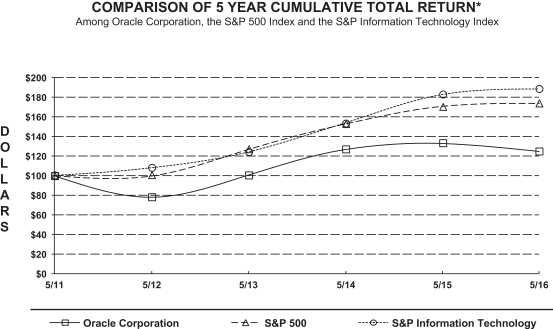
*$100 INVESTED ON MAY 31, 2011 IN STOCK OR
INDEX-INCLUDING REINVESTMENT OF DIVIDENDS
| 5/11 | 5/12 | 5/13 | 5/14 | 5/15 | 5/16 | |||||||||||||||||||
| Oracle Corporation | 100.00 | 77.98 | 100.48 | 126.70 | 132.75 | 124.63 | ||||||||||||||||||
| S&P 500 Index | 100.00 | 99.59 | 126.75 | 152.67 | 170.69 | 173.62 | ||||||||||||||||||
| S&P Information Technology Index | 100.00 | 107.57 | 123.83 | 153.42 | 182.29 | 187.97 |
Table of Contents
Item 6. Selected Financial Data
The following table sets forth selected financial data as of and for our last five fiscal years. This selected financial data should be read in conjunction with the consolidated financial statements and related notes included in Item 15 of this Annual Report. Over our last five fiscal years, we have acquired a number of companies, including MICROS Systems, Inc. in fiscal 2015, among others. The results of our acquired companies have been included in our consolidated financial statements since their respective dates of acquisition and have contributed to our revenues, income, earnings per share and total assets.
| As of and for the Year Ended May 31, | ||||||||||||||||||||
| (in millions, except per share amounts) | 2016(1) | 2015(1) | 2014 | 2013 | 2012 | |||||||||||||||
| Consolidated Statements of Operations Data: | ||||||||||||||||||||
| Total revenues | $ | 37,047 | $ | 38,226 | $ | 38,275 | $ | 37,180 | $ | 37,121 | ||||||||||
| Operating income | $ | 12,604 | $ | 13,871 | $ | 14,759 | $ | 14,684 | $ | 13,706 | ||||||||||
| Net income | $ | 8,901 | $ | 9,938 | $ | 10,955 | $ | 10,925 | $ | 9,981 | ||||||||||
| Earnings per share—diluted | $ | 2.07 | $ | 2.21 | $ | 2.38 | $ | 2.26 | $ | 1.96 | ||||||||||
| Diluted weighted average common shares outstanding | 4,305 | 4,503 | 4,604 | 4,844 | 5,095 | |||||||||||||||
| Cash dividends declared per common share | $ | 0.60 | $ | 0.51 | $ | 0.48 | $ | 0.30 | $ | 0.24 | ||||||||||
| Consolidated Balance Sheets Data: | ||||||||||||||||||||
| Working capital(2) | $ | 47,105 | $ | 47,892 | $ | 33,739 | $ | 28,813 | $ | 24,630 | ||||||||||
| Total assets(2) | $ | 112,180 | $ | 110,903 | $ | 90,266 | $ | 81,745 | $ | 78,274 | ||||||||||
| Notes payable and other borrowings(3) | $ | 43,855 | $ | 41,958 | $ | 24,097 | $ | 18,427 | $ | 16,421 |
| (1) | Our results of operations for fiscal 2016 compared to fiscal 2015, and fiscal 2015 compared to fiscal 2014, were significantly impacted by movements in international currencies relative to the U.S. Dollar, which decreased our fiscal 2016 and 2015 total revenues by 5 and 4 percentage points, respectively, total operating expenses by 4 and 3 percentage points, respectively, and total operating income by 7 and 6 percentage points, respectively, in comparison to the corresponding prior year periods. |
|---|
| (2) | Total working capital and total assets sequentially increased in nearly all periods presented primarily due to the favorable impacts to our net current assets resulting from our net income generated during all periods presented and the issuances of long-term senior notes of $20.0 billion in fiscal 2015, €2.0 billion and $3.0 billion in fiscal 2014 and $5.0 billion in fiscal 2013. Our total assets were also favorably impacted by the issuance of $3.8 billion of short term borrowings in fiscal 2016. These increases were partially offset by cash used for acquisitions, repurchases of our common stock, dividend payments and capital expenditures made in all periods presented and the repayments of certain of our senior notes in fiscal 2016, 2015 and 2013. |
|---|
| (3) | Our notes payable and other borrowings, which represented the summation of our notes payable, current and other current borrowings, and notes payable and other non-current borrowings as reported per our consolidated balance sheets as of the dates listed in the table above, increased between fiscal 2012 and fiscal 2016 due to the issuances of $3.8 billion of short-term borrowings made pursuant to our revolving credit agreements in fiscal 2016, and the issuances of long-term senior notes of $20.0 billion in fiscal 2015, €2.0 billion and $3.0 billion in fiscal 2014, and $5.0 billion in fiscal 2013. See Note 8 of Notes to Consolidated Financial Statements included elsewhere in this Annual Report for additional information regarding our notes payable and other borrowings. |
|---|
Table of Contents
Item 7. Management’s Discussion and Analysis of Financial Condition and Results of Operations
We begin Management’s Discussion and Analysis of Financial Condition and Results of Operations with an overview of our businesses, key operating segments and significant trends. This overview is followed by a summary of our critical accounting policies and estimates that we believe are important to understanding the assumptions and judgments incorporated in our reported financial results. We then provide a more detailed analysis of our results of operations and financial condition.
Business Overview
Oracle Corporation provides products and services that address all aspects of corporate information technology (IT) environments—application, platform and infrastructure. Our Oracle Cloud offerings provide a comprehensive and fully integrated stack of application, platform, compute and storage services in all three primary layers of the cloud: Software as a Service (SaaS), Platform as a Service (PaaS) and Infrastructure as a Service (IaaS). Our on-premise offerings include Oracle database and middleware software, application software, hardware (Oracle Engineered Systems, servers, storage, networking and industry-specific products), and related support and services. We provide our cloud and on-premise offerings to over 400,000 worldwide customers via deployment models that best suit their needs.
Our comprehensive and fully integrated stack of SaaS, PaaS and IaaS offerings integrate the software, hardware and services on the customers’ behalf in IT environments that we deploy, support and manage for the customer. Our integrated Oracle Cloud offerings are designed to be rapidly deployable to enable customers shorter time to innovation; easily maintainable to reduce integration and testing work; connectable among differing deployment models to enable interchangeability and extendibility between cloud and on-premise IT environments; compatible to easily move workloads between on-premise IT environments and the Oracle Cloud; cost-effective by requiring lower upfront customer investment; and secure, standards-based and reliable. We are a leader in the core technologies of cloud IT environments, including database and middleware software as well as enterprise applications, virtualization, clustering, large-scale systems management and related infrastructure. Our products and services are the building blocks of our Oracle Cloud services, our partners’ cloud services and our customers’ cloud IT environments.
In addition to providing a broad spectrum of cloud offerings, we develop and sell our products and services to our customers worldwide for use in their global data centers and on-premise IT environments. An important element of our corporate strategy is to continue our investments in, and innovation with respect to, our products and services that we offer through our cloud and on-premise software, hardware and services businesses. We have a deep understanding as to how all components within IT environments—application, platform and infrastructure—interact and function with one another. We focus our development efforts on improving the performance, security, operation and integration of these differing technologies to make them more cost-effective and easier to deploy, manage and maintain for our customers and to improve their computing performance relative to our competitors. After the initial purchase of Oracle products and services, our customers can continue to take advantage of our research and development investments and deep IT expertise by purchasing and renewing Oracle support offerings, which may include product enhancements that we periodically deliver to our Oracle E-Business Suite, Siebel, PeopleSoft and JD Edwards application software products, among others, or by renewing their SaaS, PaaS and IaaS contracts with us.
As customers deploy with the Oracle Cloud, many are adopting a hybrid IT model whereby certain of their IT resources are deployed and managed through the Oracle Cloud, while other of their IT resources are deployed and managed on-premise, and both sets of resources can be managed as one. We focus the engineering of our products and services to best connect these different deployment models to enable flexibility, ease, agility, compatibility, extensibility and seamlessness.
A selective and active acquisition program is another important element of our corporate strategy. We believe our acquisitions enhance the products and services that we can offer to customers, expand our customer base, provide greater scale to accelerate innovation, grow our revenues and earnings, and increase stockholder value. In recent years, we have invested billions of dollars to acquire a number of companies, products, services and
Table of Contents
technologies that add to, are complementary to, or have otherwise enhanced our existing offerings. We expect to continue to acquire companies, products, services and technologies to further our corporate strategy.
We have three businesses that deliver our application, platform and infrastructure technologies: cloud and on-premise software, hardware and services. These businesses can be further divided into certain operating segments (Note 16 of Notes to Consolidated Financial Statements, included elsewhere in this Annual Report, provides additional information related to our operating segments). Each of our businesses and operating segments has unique characteristics and faces different opportunities and challenges. Although we report our actual results in U.S. Dollars, we conduct a significant number of transactions in currencies other than U.S. Dollars. Therefore, we present constant currency information to provide a framework for assessing how our underlying businesses performed excluding the effects of foreign currency rate fluctuations. An overview of our three businesses and related operating segments follows.
Cloud and On-Premise Software Business
Our cloud and on-premise software business, which represented 78%, 77% and 76% of our total revenues in fiscal 2016, 2015 and 2014, respectively, is comprised of three operating segments: (1) cloud software and on-premise software, (2) cloud IaaS and (3) software license updates and product support. On a constant currency basis, we expect that our cloud and on-premise software business’ total revenues generally will continue to increase due to continued demand for our software products, expected growth in our cloud and software license updates and product support offerings, including the high percentage of customers that renew their software license updates and product support contracts, and contributions from our acquisitions, which should allow us to grow and continue to make investments in research and development.
Cloud Software and On-Premise Software: Our cloud software and on-premise software line of business markets, sells and delivers a broad spectrum of application and platform technologies through our SaaS and PaaS offerings, which are certain of our software applications and platforms that are delivered via a cloud-based IT environment that we host, manage and support, and through the licensing of our software products including Oracle Applications, Oracle Database, Oracle Fusion Middleware and Java, among others.
We believe the comprehensiveness and breadth of our SaaS, PaaS and on-premise software offerings provides greater benefit to our customers and differentiates us from many of our competitors that offer more limited or specialized software offerings. Our SaaS and PaaS offerings are designed to be interoperable with one another, thereby limiting the integration and tuning of multiple cloud applications from multiple vendors. Our SaaS and PaaS offerings are designed to deliver secure data isolation and flexible upgrades, self-service access controls for users, a Service-Oriented Architecture (SOA) for integration with on-premise systems, and a high performance, high availability infrastructure based on o
Showing the first 8K of 189K characters. Open the full section
Item 7A. Quantitative and Qualitative Disclosures About Market Risk
Cash, Cash Equivalents, Marketable Securities and Interest Income Risk
Our bank deposits and time deposits are generally held with large, diverse financial institutions worldwide with high investment-grade credit ratings or financial institutions that meet investment-grade ratings criteria, which we believe mitigates credit risk and certain other risks. In addition, as of May 31, 2016, substantially all of our marketable securities are high quality with approximately 28% having maturity dates within one year and 72% having maturity dates within one to six years (a description of our marketable securities held is included in Note 3 and Note 4 of Notes to Consolidated Financial Statements included elsewhere in this Annual Report and “Liquidity and Capital Resources” above). We hold a mix of both fixed and floating-rate debt securities. The fair values of our fixed-rate debt securities are impacted by interest rate movements and if interest rates would have been higher by 50 basis points as of May 31, 2016, we estimate the change would have decreased the fair values of our marketable securities holdings by $282 million. Our floating-rate debt securities serve to lower the overall risk to our investments portfolio associated with the risk of rising interest rates. Substantially all of our marketable securities are designated as available-for-sale. We generally do not use our investments for trading purposes.
Changes in the overall level of interest rates affect the interest income that is generated from our cash, cash equivalents and marketable securities. For fiscal 2016, total interest income was $538 million with our cash, cash equivalents and marketable securities investments yielding an average 1.16% on a worldwide basis. The table below presents the approximate fair values of our cash, cash equivalents and marketable securities and the related weighted-average interest rates for our investment portfolio at May 31, 2016 and 2015.
| May 31, | ||||||||||||||||
| 2016 | 2015 | |||||||||||||||
| (Dollars in millions) | Fair Value | Weighted- Average Interest Rate | Fair Value | Weighted- Average Interest Rate | ||||||||||||
| Cash and cash equivalents | $ | 20,152 | 0.35% | $ | 21,716 | 0.36% | ||||||||||
| Marketable securities | 35,973 | 1.62% | 32,652 | 1.07% | ||||||||||||
| Total cash, cash equivalents and marketable securities | $ | 56,125 | 1.16% | $ | 54,368 | 0.79% | ||||||||||
Interest Expense Risk
Interest Expense Risk—Fixed to Variable Interest Rate Swap Agreements
Our total borrowings were $43.9 billion as of May 31, 2016, consisting of $37.8 billion of fixed-rate borrowings, $2.3 billion of floating-rate borrowings (Floating-Rate Notes) and $3.8 billion of short-term borrowings under a revolving credit agreement (Short-Term Borrowings).
Table of Contents
We have entered into certain interest rate swap agreements that have the economic effect of modifying the fixed-interest obligations associated with our $1.5 billion of 2.375% senior notes due January 2019 (January 2019 Notes), our $2.0 billion of 2.25% senior notes due October 2019 (October 2019 Notes), and our $1.5 billion of 2.80% senior notes due July 2021 (July 2021 Notes) so that the interest payable on these senior notes effectively became variable based on LIBOR. The critical terms of the interest rate swap agreements match the critical terms of the January 2019 Notes, October 2019 Notes, and July 2021 Notes that the interest rate swap agreements pertain to, including the notional amounts and maturity dates. We do not use these interest rate swap arrangements or our fixed-rate borrowings for trading purposes. We are accounting for these interest rate swap agreements as fair value hedges pursuant to ASC 815, Derivatives and Hedging (ASC 815). The total fair value gain of these fixed to variable interest rate swap agreements as of May 31, 2016 was $122 million. If LIBOR-based interest rates would have been higher by 100 basis points as of May 31, 2016, the change would have decreased the fair values of the fixed to variable swap agreements by $185 million. Additional details regarding our senior notes and related interest rate swap agreements are included in Notes 8 and 11 of Notes to Consolidated Financial Statements included elsewhere in this Annual Report.
By issuing the Floating-Rate Notes and the Short-Term Borrowings, and by entering into the aforementioned interest rate swap arrangements, we have assumed risks associated with variable interest rates based upon LIBOR. As of May 31, 2016, the weighted-average interest rate associated with our Floating-Rate Notes, Short-Term Borrowings and January 2019 Notes, October 2019 Notes and July 2021 Notes, after considering the effects of the aforementioned interest rate swap arrangements, was 1.14%. Changes in the overall level of interest rates affect the interest expense that we recognize in our statements of operations. An interest rate risk sensitivity analysis is used to measure interest rate risk by computing estimated changes in cash flows as a result of assumed changes in market interest rates. As of May 31, 2016, if LIBOR-based interest rates would have been higher by 100 basis points, the change would have increased our interest expense annually by approximately $76 million as it relates to our fixed to variable interest rate swap agreements and floating-rate borrowings.
Currency Risk
Foreign Currency Transaction Risk—Foreign Currency Forward Contracts
We transact business in various foreign currencies and have established a program that primarily utilizes foreign currency forward contracts to offset the risks associated with the effects of certain foreign currency exposures. Under this program, our strategy is to enter into foreign currency forward contracts so that increases or decreases in our foreign currency exposures are offset by gains or losses on the foreign currency forward contracts in order to mitigate the risks and volatility associated with our foreign currency transactions. We may suspend this program from time to time. Our foreign currency exposures typically arise from intercompany sublicense fees, intercompany loans and other intercompany transactions. Our foreign currency forward contracts are generally short-term in duration.
Neither do we use these foreign currency forward contracts for trading purposes nor do we designate these forward contracts as hedging instruments pursuant to ASC 815. Accordingly, we record the fair values of these contracts as of the end of our reporting period to our consolidated balance sheet with changes in fair values recorded to our consolidated statement of operations. Given the short duration of the forward contracts, amounts recorded generally are not significant. The balance sheet classification for the fair values of these forward contracts is prepaid expenses and other current assets for forward contracts in an unrealized gain position and other current liabilities for forward contracts in an unrealized loss position. The statement of operations classification for changes in fair values of these forward contracts is non-operating income (expense), net for both realized and unrealized gains and losses.
Table of Contents
We expect that we will continue to realize gains or losses with respect to our foreign currency exposures, net of gains or losses from our foreign currency forward contracts. Our ultimate realized gain or loss with respect to foreign currency exposures will generally depend on the size and type of cross-currency transactions that we enter into, the currency exchange rates associated with these exposures and changes in those rates, the net realized gain or loss on our foreign currency forward contracts and other factors. As of May 31, 2016 and 2015, the notional amounts of the forward contracts we held to purchase U.S. Dollars in exchange for other major international currencies were $2.7 billion and $2.2 billion, respectively. As of May 31, 2016 and 2015, the notional amounts of forward contracts we held to sell U.S. Dollars in exchange for other major international currencies were $2.0 billion and $1.2 billion, respectively. The fair values of our outstanding foreign currency forward contracts were nominal at May 31, 2016 and 2015. Net foreign exchange transaction losses included in non-operating income (expense), net in the accompanying consolidated statements of operations were $110 million, $157 million and $375 million in fiscal 2016, 2015 and 2014, respectively. Included in the net foreign exchange transaction losses for fiscal 2016, 2015 and 2014 were foreign currency remeasurement losses relating to our Venezuelan subsidiary’s operations of $7 million, $23 million and $213 million, respectively (see Note 1 of Notes to Consolidated Financial Statements included elsewhere in this Annual Report for additional information). As a large portion of our consolidated operations are international, we could experience additional foreign currency volatility in the future, the amounts and timing of which are unknown.
Foreign Currency Translation Risk—Impact on Cash, Cash Equivalents and Marketable Securities
Fluctuations in foreign currencies impact the amount of total assets and liabilities that we report for our foreign subsidiaries upon the translation of these amounts into U.S. Dollars. In particular, the amount of cash, cash equivalents and marketable securities that we report in U.S. Dollars for a significant portion of the cash held by these subsidiaries is subject to translation variance caused by changes in foreign currency exchange rates as of the end of each respective reporting period (the offset to which is substantially recorded to accumulated other comprehensive loss on our consolidated balance sheet and is also presented as a line item in our consolidated statements of comprehensive income included elsewhere in this Annual Report).
As the U.S. Dollar fluctuated against certain international currencies as of the end of fiscal 2016, the amount of cash, cash equivalents and marketable securities that we reported in U.S. Dollars for foreign subsidiaries that hold international currencies as of May 31, 2016 decreased relative to what we would have reported using a constant currency rate as of May 31, 2015. As reported in our consolidated statements of cash flows, the estimated effects of exchange rate changes on our reported cash and cash equivalents balances in U.S. Dollars for fiscal 2016, 2015 and 2014 were decreases of $115 million, $1.2 billion and $158 million, respectively. The following table includes estimates of the U.S. Dollar equivalent of cash, cash equivalents and marketable securities denominated in certain major foreign currencies that we held as of May 31, 2016:
| (in millions) | U.S. Dollar Equivalent at May 31, 2016 | |||
| Euro | $ | 2,430 | ||
| Japanese Yen | 618 | |||
| Indian Rupee | 493 | |||
| Chinese Renminbi | 442 | |||
| Canadian Dollar | 369 | |||
| British Pound | 262 | |||
| Swiss Franc | 191 | |||
| Australian Dollar | 184 | |||
| Other foreign currencies | 1,806 | |||
| Total cash, cash equivalents and marketable securities denominated in foreign currencies | $ | 6,795 | ||
If overall foreign currency exchange rates in comparison to the U.S. Dollar uniformly would have been weaker by 10%, the amount of cash, cash equivalents and marketable securities we would report in U.S. Dollars would have decreased by approximately $680 million, assuming constant foreign currency cash, cash equivalents and marketable securities balances.
Table of Contents
Foreign Currency Translation Risk—Net Investment Hedge
In July 2013, we issued €750 million of 3.125% senior notes due July 2025 (July 2025 Notes). We designated the July 2025 Notes as a net investment hedge of our investments in certain of our international subsidiaries that use the Euro as their functional currency in order to reduce the volatility in stockholders’ equity caused by the changes in foreign currency exchange rates of the Euro with respect to the U.S. Dollar. As a result, provided there is no ineffectiveness related to the hedge, the change in the carrying value of the Euro-denominated July 2025 Notes due to fluctuations in foreign currency exchange rates on the effective portion is recorded in accumulated other comprehensive loss on our consolidated balance sheet and is also presented as a line item in our consolidated statements of comprehensive income included elsewhere in this Annual Report and totaled $25 million of net other comprehensive losses for fiscal 2016. Any remaining change in the carrying value of the July 2025 Notes representing any ineffective portion of the net investment hedge is recognized in non-operating income (expense), net. We did not record any ineffectiveness during fiscal 2016.
Fluctuations in the exchange rates between the Euro and the U.S. Dollar will impact the amount of U.S. Dollars that we will require to settle the July 2025 Notes at maturity. If the U.S. Dollar would have been weaker by 10% in comparison to the Euro as of May 31, 2016, we estimate our obligation to cash settle the principal portion of the July 2025 Notes in U.S. Dollars would have increased by approximately $84 million.
Item 8. Financial Statements and Supplementary Data
The response to this item is submitted as a separate section of this Annual Report. See Part IV, Item 15.
Item 9. Changes In and Disagreements with Accountants on Accounting and Financial Disclosure
None.
Item 9A. Controls and Procedures
Evaluation of Disclosure Controls and Procedures
As of the end of the period covered by this Annual Report on Form 10-K, we carried out an evaluation under the supervision and with the participation of our Disclosure Committee and our management, including our Principal Executive Officers (one of whom is our Principal Financial Officer), of the effectiveness of the design and operation of our disclosure controls and procedures pursuant to Exchange Act Rules 13a-15(e) and 15d-15(e). Disclosure controls are procedures that are designed to ensure that information required to be disclosed in our reports filed under the Securities Exchange Act of 1934, or the Exchange Act, such as this Annual Report on Form 10-K, is recorded, processed, summarized and reported within the time periods specified by the U.S. Securities and Exchange Commission. Disclosure controls are also designed to ensure that such information is accumulated and communicated to our management, including our Principal Executive Officers (one of whom is our Principal Financial Officer), as appropriate to allow timely decisions regarding required disclosure. Our quarterly evaluation of disclosure controls includes an evaluation of some components of our internal control over financial reporting. We also perform a separate annual evaluation of internal control over financial reporting for the purpose of providing the management report below.
The evaluation of our disclosure controls included a review of their objectives and design, our implementation of the controls and the effect of the controls on the information generated for use in this Annual Report on Form 10-K. In the course of the controls evaluation, we reviewed data errors or control problems identified and sought to confirm that appropriate corrective actions, including process improvements, were being undertaken. This type of evaluation is performed on a quarterly basis so that the conclusions of management, including our Principal Executive Officers (one of whom is our Principal Financial Officer), concerning the effectiveness of the disclosure controls can be reported in our periodic reports on Form 10-Q and Form 10-K. Many of the components of our disclosure controls are also evaluated on an ongoing basis by both our internal audit and finance organizations. The overall goals of these various evaluation activities are to monitor our disclosure controls and to modify them as necessary. We intend to maintain our disclosure controls as dynamic processes and procedures that we adjust as circumstances merit.
Table of Contents
Based on our management’s evaluation (with the participation of our Principal Executive Officers, one of whom is our Principal Financial Officer), as of the end of the period covered by this report, our Principal Executive Officers have concluded that our disclosure controls and procedures were effective.
Management’s Report on Internal Control over Financial Reporting
Our management is responsible for establishing and maintaining adequate internal control over financial reporting, as such term is defined in Exchange Act Rules 13a-15(f) and 15d-15(f). Under the supervision and with the participation of our management, including our Principal Executive Officers (one of whom is our Principal Financial Officer), we conducted an evaluation of the effectiveness of our internal control over financial reporting as of May 31, 2016 based on the guidelines established in Internal Control—Integrated Framework issued by the Committee of Sponsoring Organizations of the Treadway Commission’s 2013 framework. Our internal control over financial reporting includes policies and procedures that provide reasonable assurance regarding the reliability of financial reporting and the preparation of financial statements for external reporting purposes in accordance with U.S. GAAP.
Based on the results of our evaluation, our management concluded that our internal control over financial reporting was effective as of May 31, 2016. We reviewed the results of management’s assessment with our Finance and Audit Committee.
The effectiveness of our internal control over financial reporting as of May 31, 2016 has been audited by Ernst & Young LLP, an independent registered public accounting firm, as stated in their report which is included in Part IV, Item 15 of this Annual Report.
Changes in Internal Control over Financial Reporting
There were no changes in our internal control over financial reporting identified in connection with the evaluation required by paragraph (d) of Exchange Act Rules 13a-15 or 15d-15 that occurred during our last fiscal quarter that have materially affected, or are reasonably likely to materially affect, our internal control over financial reporting.
Inherent Limitations on Effectiveness of Controls
Our management, including our Principal Executive Officers (one of whom is our Principal Financial Officer), believes that our disclosure controls and procedures and internal control over financial reporting are designed to provide reasonable assurance of achieving their objectives and are effective at the reasonable assurance level. However, our management does not expect that our disclosure controls and procedures or our internal control over financial reporting will prevent all errors and all fraud. A control system, no matter how well conceived and operated, can provide only reasonable, not absolute, assurance that the objectives of the control system are met. Further, the design of a control system must reflect the fact that there are resource constraints and the benefits of controls must be considered relative to their costs. Because of the inherent limitations in all control systems, no evaluation of controls can provide absolute assurance that all control issues and instances of fraud, if any, have been detected. These inherent limitations include the realities that judgments in decision-making can be faulty and that breakdowns can occur because of a simple error or mistake. Additionally, controls can be circumvented by the individual acts of some persons, by collusion of two or more people or by management override of the controls. The design of any system of controls also is based in part upon certain assumptions about the likelihood of future events and there can be no assurance that any design will succeed in achieving its stated goals under all potential future conditions; over time, controls may become inadequate because of changes in conditions, or the degree of compliance with policies or procedures may deteriorate. Because of the inherent limitations in a cost-effective control system, misstatements due to error or fraud may occur and not be detected.
Item 9B. Other Information
Item 10. Directors, Executive Officers and Corporate Governance
Pursuant to General Instruction G(3) of Form 10-K, the information required by this item relating to our executive officers is included under the caption “Executive Officers of the Registrant” in Part I of this Annual Report.
The other information required by this Item 10 is incorporated by reference from the information contained in our Proxy Statement to be filed with the U.S. Securities and Exchange Commission in connection with the solicitation of proxies for our 2016 Annual Meeting of Stockholders (2016 Proxy Statement) under the sections entitled “Board of Directors—Nominees for Directors,” “Board of Directors—Committees, Membership and Meetings,” “Board of Directors—Committees, Membership and Meetings—The Finance and Audit Committee,” “Corporate Governance—Employee Matters—Code of Conduct,” and “Section 16(a) Beneficial Ownership Reporting Compliance.”
Item 11. Executive Compensation
The information required by this Item 11 is incorporated by reference from the information to be contained in our 2016 Proxy Statement under the sections entitled “Board of Directors—Committees, Membership and Meetings—The Compensation Committee—Compensation Committee Interlocks and Insider Participation,” “Board of Directors—Director Compensation,” and “Executive Compensation.”
Item 12. Security Ownership of Certain Beneficial Owners and Management and Related Stockholder
Matters
The information required by this Item 12 is incorporated herein by reference from the information to be contained in our 2016 Proxy Statement under the sections entitled “Security Ownership of Certain Beneficial Owners and Management” and “Executive Compensation—Equity Compensation Plan Information.”
Item 13. Certain Relationships and Related Transactions, and Director Independence
The information required by this Item 13 is incorporated herein by reference from the information to be contained in our 2016 Proxy Statement under the sections entitled “Corporate Governance—Board of Directors and Director Independence” and “Transactions with Related Persons.”
Item 14. Principal Accounting Fees and Services
The information required by this Item 14 is incorporated herein by reference from the information to be contained in our 2016 Proxy Statement under the section entitled “Ratification of Selection of Independent Registered Public Accounting Firm.”
Table of Contents
PART IV
Item 15. Exhibits and Financial Statement Schedules
(a) 1. Financial Statements
The following financial statements are filed as a part of this report:
| Page | ||||
| Reports of Independent Registered Public Accounting Firm | 84 | |||
| Consolidated Financial Statements: | ||||
| Balance Sheets as of May 31, 2016 and 2015 | 86 | |||
| Statements of Operations for the years ended May 31, 2016, 2015 and 2014 | 87 | |||
| Statements of Comprehensive Income for the years ended May 31, 2016, 2015 and 2014 | 88 | |||
| Statements of Equity for the years ended May 31, 2016, 2015 and 2014 | 89 | |||
| Statements of Cash Flows for the years ended May 31, 2016, 2015 and 2014 | 90 | |||
| Notes to Consolidated Financial Statements | 91 | |||
| 2. Financial Statement Schedules | ||||
| The following financial statement schedule is filed as a part of this report: | ||||
| Page | ||||
| Schedule II. Valuation and Qualifying Accounts | 136 |
All other schedules are omitted because they are not required or the required information is shown in the financial statements or notes thereto.
(b) Exhibits
The information required by this Item is set forth in the Index of Exhibits that follows the signature page of this Annual Report.
Table of Contents
Report of Independent Registered Public Accounting Firm
The Board of Directors and Stockholders of Oracle Corporation
We have audited the accompanying consolidated balance sheets of Oracle Corporation as of May 31, 2016 and 2015, and the related consolidated statements of operations, comprehensive income, equity, and cash flows for each of the three years in the period ended May 31, 2016. Our audits also included the financial statement schedule listed in the Index at Item 15(a) 2. These financial statements and schedule are the responsibility of the Company’s management. Our responsibility is to express an opinion on these financial statements and schedule based on our audits.
We conducted our audits in accordance with the standards of the Public Company Accounting Oversight Board (United States). Those standards require that we plan and perform the audit to obtain reasonable assurance about whether the financial statements are free of material misstatement. An audit includes examining, on a test basis, evidence supporting the amounts and disclosures in the financial statements. An audit also includes assessing the accounting principles used and significant estimates made by management, as well as evaluating the overall financial statement presentation. We believe that our audits provide a reasonable basis for our opinion.
In our opinion, the financial statements referred to above present fairly, in all material respects, the consolidated financial position of Oracle Corporation at May 31, 2016 and 2015, and the consolidated results of its operations and its cash flows for each of the three years in the period ended May 31, 2016, in conformity with U.S. generally accepted accounting principles. Also, in our opinion, the related financial statement schedule, when considered in relation to the basic financial statements taken as a whole, presents fairly in all material respects the information set forth therein.
We also have audited, in accordance with the standards of the Public Company Accounting Oversight Board (United States), Oracle Corporation’s internal control over financial reporting as of May 31, 2016, based on criteria established in Internal Control-Integrated Framework issued by the Committee of Sponsoring Organizations of the Treadway Commission (2013 framework) and our report dated June 22, 2016 expressed an unqualified opinion thereon.
/s/ Ernst & Young LLP
San Jose, California
June 22, 2016
Table of Contents
Report of Independent Registered Public Accounting Firm
The Board of Directors and Stockholders of Oracle Corporation
We have audited Oracle Corporation’s internal control over financial reporting as of May 31, 2016, based on criteria established in Internal Control—Integrated Framework issued by the Committee of Sponsoring Organizations of the Treadway Commission (2013 framework) (the COSO criteria). Oracle Corporation’s management is responsible for maintaining effective internal control over financial reporting, and for its assessment of the effectiveness of internal control over financial reporting included in the accompanying Management’s Report on Internal Control Over Financial Reporting. Our responsibility is to express an opinion on the company’s internal control over financial reporting based on our audit.
We conducted our audit in accordance with the standards of the Public Company Accounting Oversight Board (United States). Those standards require that we plan and perform the audit to obtain reasonable assurance about whether effective internal control over financial reporting was maintained in all material respects. Our audit included obtaining an understanding of internal control over financial reporting, assessing the risk that a material weakness exists, testing and evaluating the design and operating effectiveness of internal control based on the assessed risk, and performing such other procedures as we considered necessary in the circumstances. We believe that our audit provides a reasonable basis for our opinion.
A company’s internal control over financial reporting is a process designed to provide reasonable assurance regarding the reliability of financial reporting and the preparation of financial statements for external purposes in accordance with generally accepted accounting principles. A company’s internal control over financial reporting includes those policies and procedures that (1) pertain to the maintenance of records that, in reasonable detail, accurately and fairly reflect the transactions and dispositions of the assets of the company; (2) provide reasonable assurance that transactions are recorded as necessary to permit preparation of financial statements in accordance with generally accepted accounting principles, and that receipts and expenditures of the company are being made only in accordance with authorizations of management and directors of the company; and (3) provide reasonable assurance regarding prevention or timely detection of unauthorized acquisition, use, or disposition of the company’s assets that could have a material effect on the financial statements.
Because of its inherent limitations, internal control over financial reporting may not prevent or detect misstatements. Also, projections of any evaluation of effectiveness to future periods are subject to the risk that controls may become inadequate because of changes in conditions, or that the degree of compliance with the policies or procedures may deteriorate.
In our opinion, Oracle Corporation maintained, in all material respects, effective internal control over financial reporting as of May 31, 2016, based on the COSO criteria.
We also have audited, in accordance with the standards of the Public Company Accounting Oversight Board (United States), the consolidated balance sheets of Oracle Corporation as of May 31, 2016 and 2015, and the related consolidated statements of operations, comprehensive income, equity, and cash flows for each of the three years in the period ended May 31, 2016 of Oracle Corporation and our report dated June 22, 2016 expressed an unqualified opinion thereon.
/s/ Ernst & Young LLP
San Jose, California
June 22, 2016
Table of Contents
ORACLE CORPORATION
CONSOLIDATED BALANCE SHEETS
As of May 31, 2016 and 2015
| May 31, |
Showing the first 8K of 242K characters. Open the full section