 filings.tools
Oracle (ORCL) 10-K risk factor changes: FY2023 vs FY2022
The 2023-05-31 10-K against the 2022-05-31 one, compared heading by heading and sentence by sentence.
Item 1A145 rewritten44 added83 removed177 unchanged
All filing items1,445 rewritten629 added343 removed1,320 unchanged
Summary
counted, not written
- Item 1A headings could not be compared: only 0 carried over between the two years, which usually means one filing was read wrongly, so none is reported as new or removed.
- Sentence by sentence, 629 added, 343 removed, 1,445 rewritten and 1,320 unchanged across 21 items that differ.
Sentences by item
21 items, with every count and a link to each item that changed
Underlined words on a shaded ground are new in FY2023; struck-through words were in FY2022. Sentences that are wholly new or wholly gone are labelled rather than marked.
Item 1A. Risk Factors
145 rewritten, 44 added, 83 removed, 177 unchanged
The following discussion, as well as our [removed: “Critical Accounting Policies and Estimates”] discussion in Item 7 Management’s Discussion and Analysis of Financial Condition and Results of Operations, highlights some of these risks.
[removed: Business] [added: Business] and Operational [removed: Risks][added: Risks]
[added: We may be unsuccessful in developing and selling new products and services, integrating acquired products and services and enhancing our existing products and services.] Rapid technological advances, intense competition, changing delivery models and evolving standards in computer hardware and software development and communications infrastructure, changing and increasingly sophisticated customer needs and frequent new product introductions and enhancements characterize the industries in which we compete.
Renewals of these contracts are important to [removed: the growth of] our [removed: business.][added: future success.]
Machine learning and [removed: artificial intelligence] [added: AI] are increasingly driving innovations in technology, but if they fail to operate as anticipated or our other products do not perform as promised, our business and reputation may be harmed.
[removed: | | • |] we do not continue to develop and release new or enhanced products and services within the anticipated time frames; [removed: |]
[removed: | | • |] infrastructure costs to deliver new or enhanced products and services take longer or result in greater costs than anticipated; [removed: |]
[removed: | | • |] we are unable to increase our existing data center capacity or establish data centers in new geographic locations in a timely manner to meet current or expected customer demand; [removed: |]
[removed: | | • |] there is a delay in market acceptance of and difficulty in transitioning new and existing customers to new, enhanced or acquired product lines or services; [removed: |]
[removed: | | • |] there are changes in [removed: information technology (IT)] [added: IT] trends that we do not adequately anticipate or [added: timely] address with our product development efforts; [removed: |]
[removed: | | • |] we do not optimize complementary product lines and services in a timely manner; or [removed: |]
[removed: | | • |] we fail to adequately integrate, support or enhance acquired product lines or services. [removed: |]
[added: If we do not successfully execute our Oracle Cloud strategy, including our offerings of Oracle Cloud Services, our revenues and profitability may decline.] We provide our cloud and other offerings to customers worldwide via a variety of deployment models, including via our cloud-based SaaS and OCI offerings.
In connection with these investments, we entered, and expect to continue to enter, into long-term operating lease commitments with third party data center providers that generally require us to pay [added: significant contract termination] fees to early exit such obligations should our strategies change, which could adversely impact our profitability and cash flows.
[added: Our products and services may not function properly if we experience significant coding, manufacturing or configuration errors in our cloud, license and hardware offerings.] Despite testing prior to the release and throughout the lifecycle of a product or service, our cloud, license and hardware offerings sometimes contain coding, manufacturing or configuration errors that can impact their function, performance and security, and result in other negative consequences.
Errors in our cloud, license or hardware offerings could affect their ability to properly function, integrate or operate with other cloud, license or hardware offerings, could result in service interruptions, delays or outages of our cloud offerings, could create security vulnerabilities in our products or services, could delay the development or release of new products or services or new versions of products or services, and could adversely affect market acceptance [added: of our products or services.]
Therefore, any flaws could affect our and our customers’ abilities to conduct business operations and to ensure accuracy in financial processes and reporting, and may result in unanticipated [removed: costs.][added: costs and interruptions.]
[removed: Enterprise customers rely on our cloud, license and hardware offerings and related services to run their businesses, and errors in our cloud, license and hardware offerings and related services] could expose us to product liability, performance and warranty claims as well as significant harm to our brand and reputation, which could impact our future sales.
[removed: If] [added: If] we are unable to compete effectively, the results of operations and prospects for our business could be [removed: harmed.][added: harmed. We face intense competition in all aspects of our business.]
[removed: Many] [added: We believe many] vendors spend amounts in excess of what Oracle spends to develop and market applications and infrastructure technologies including databases, middleware products, application development tools, business applications, collaboration products and business intelligence, compute, storage and networking products, among others, which compete with Oracle applications and infrastructure offerings.
[removed: Use] [added: In addition, use] of our competitors’ technologies [removed: influences] [added: can influence] a customer’s purchasing decision or [removed: creates] [added: create] an environment that makes it less efficient to utilize or migrate to Oracle products and services.
If our competitors offer deep discounts on certain products or services or develop products that the marketplace considers more valuable, we may need to lower prices, introduce pricing models and offerings [added: or offer other terms] that are less favorable to us, [removed: or offer other favorable terms] in order to compete successfully.
Additionally, the increasing prevalence of cloud delivery models offered by us and our competitors may unfavorably impact the pricing of our other cloud and license, hardware and services offerings, and we may also incur increased cloud delivery expenses as we expand our cloud operations and update our infrastructure, all of which could reduce our revenues [removed: and/or] [added: and] profitability.
[removed: Any] [added: Any] failure to offer high-quality technical support services may adversely affect our relationships with our customers and our financial [removed: results.][added: results.]
We may be unable to respond quickly enough to accommodate short-term increases in customer demand for support services or may be inefficient in our [added: resolution of customer support issues.]
Any failure to maintain high-quality technical support, or a market perception that we do not maintain high-quality technical support, could adversely affect our reputation, [removed: our ability to sell and renew our applications and infrastructure offerings to existing and prospective customers, and our business, operating results, and financial position.]
[removed: Our] [added: Our] cloud offerings and hardware offerings are complex, and if we cannot successfully manage this complexity, including the sourcing of technologies and components, the results of these businesses will [removed: suffer.][added: suffer. We depend on suppliers to develop, manufacture and deliver on a timely basis the necessary technologies and components for our hardware products that we market and sell to our customers and that we use as a part of our cloud infrastructure to deliver our cloud offerings, and there are some technologies and components that can only be purchased from a single vendor due to price, quality, technology, availability or other business constraints.]
Our supply chain operations [removed: have been, and likely will continue to be, negatively impacted by the COVID-19 pandemic and] could [removed: also] be disrupted by industry consolidation and component constraints or shortages, natural disasters, political unrest, [removed: other] public health crises, changes to trade [removed: policies,] [added: laws or regulations,] port stoppages or other transportation disruptions or slowdowns, or other factors affecting the countries or regions where these single source component vendors are located or where the products are being [removed: shipped.][added: shipped (such as the tensions between China and Taiwan).]
[added: Our periodic workforce restructurings and reorganizations can be disruptive.] We are currently restructuring our workforce and in the past we have restructured or made other adjustments to our workforce in response to management changes, product changes, performance issues, changes in strategies, acquisitions and other internal [added: and external considerations.]
[added: We may lose key employees or may be unable to hire enough qualified employees.] We rely on hiring qualified employees and the continued service of our senior management, including our Chairman of the Board of Directors, Chief Technology Officer and founder; our Chief Executive Officer; other members of our executive team; and other key employees.
[removed: Depending on their role, this means that many] [added: Many of our] employees [removed: can choose their office location, as well as] [added: will] continue to work from home some or all of the time.
While we believe this [removed: may help] [added: has helped] us engage with a wider pool of talent and may help to retain employees who want or need more flexibility, it may fail [removed: to yield these desired benefits and could also lead to increased employee burnout or negatively impact employee productivity, and it may present cybersecurity risks and additional risks for our real estate portfolio and strategy.]
Members of our senior management team have left Oracle over the years for a variety of reasons, and [removed: we cannot guarantee that there will not be additional departures, which] [added: any future departures] may be disruptive to our operations.
[added: There are risks associated with our cloud and license and hardware indirect sales channels which could affect our future operating results.] Our cloud and license, and hardware indirect channel [removed: network is] [added: networks are] comprised primarily of resellers, system integrators/implementers, consultants, education providers, internet service providers, network integrators and independent software vendors.
[removed: | | • |] our contracts with channel participants were terminated or our relationships with channel participants were to deteriorate; [removed: |]
[removed: | | • |] any of our competitors enter into strategic relationships with or acquire a significant channel participant; [removed: |]
[removed: | | • |] the financial condition or operations of our channel participants were to weaken; or [removed: |]
[removed: | | • |] the level of demand for our channel participants’ products and services were to decrease. [removed: |]
[removed: Acquisitions] [added: Acquisitions] present many risks and we may not achieve the financial and strategic goals that were contemplated at the time of a [removed: transaction.][added: transaction. We review and consider strategic acquisitions of companies, products, services and technologies.]
Risks we may face in connection with our acquisition [removed: program, such as our recent acquisition of Cerner,] [added: program] include:
we fail to meet our contractual service level commitments;
sanctions, export controls or other regulatory, legislative or other barriers prevent us from serving certain customers or restrict our customers from operating in specific jurisdictions;
In addition, our profitability and revenues could be adversely impacted if we lost one or more of our key customers for any reason, including as a result of any of the factors discussed above.
Any such loss could also limit or reduce our growth in future periods.
Enterprise customers rely on our cloud, license and hardware offerings and related services to run their businesses, and errors in our cloud, license and hardware offerings and related services
Our enterprise cloud, license and hardware offerings compete directly with certain offerings from some of the largest and most competitive companies in the world.
In addition, due to the low barriers to entry in many of our market segments, new technologies and new and growing competitors frequently emerge to challenge our offerings.
For example, we offer our customers multicloud services whereby our customers can combine cloud services from multiple clouds with the goal of optimizing cost, functionality and performance.
OCI’s multicloud services work with a number of our competitors’ products, including Microsoft Azure, Amazon Web Services and Google Cloud Platform.
This multicloud strategy could lead our customers to migrate away from our cloud offerings to our competitors’ products, which could adversely affect our revenues and profitability.
our ability to sell and renew our applications and infrastructure offerings to existing and prospective customers, and our business, operating results, and financial position.
In addition, we have in some instances responded to such shortages by committing to higher purchases and balances of hardware products that we market and sell to our customers and that we use as a part of our cloud infrastructure to deliver our cloud offerings, relative to our historical positions.
While this permits us to secure manufacturing capacity, it has increased excess and obsolescence risk of such hardware products and could adversely impact our profitability and cash flows.
We expect these factors will continue to impact us in the future.
These types of restructurings may also lead to a shortage of sufficiently skilled employees in certain roles.
Hiring freezes or slowdowns may result in decreased productivity while existing employees take on additional roles and responsibilities, and may also lead to a shortage of sufficiently skilled employees in certain roles.
We recently updated our on-site attendance expectations, which may vary by line of business and location.
A transition away from our hybrid work model to on-site work requirements could result in employee dissatisfaction and attrition, and could also lead to increased employee burnout or negatively impact employee productivity.
to yield these desired benefits and it may present cybersecurity risks and additional risks for our real estate portfolio and strategy.
an acquisition may not further our business strategy as we expected, we may not integrate an acquired company or technology as successfully as we expected, we may impose our business practices or alter
For example, multiple U.S.-based technology companies have been fined between €225 million and €1.2 billion for alleged GDPR violations.
Although we believe that our income and non-income based
The Organization for Economic Cooperation and Development (OECD) and the G20 have developed a two-pillar framework that would provide greater taxing rights to market jurisdictions where customers or users are located and implement a 15% global minimum tax on multinational corporate groups.
On December 12, 2022, the European Union member states agreed to implement the OECD’s global corporate minimum tax rate of 15%.
Other countries are also actively considering changes to their tax laws to adopt certain parts of the OECD’s two-pillar framework.
Our international sales and operations and global customer base subject us to additional risks that can adversely affect our operating results. We derive a substantial portion of our revenues from, and have significant operations, outside of the U.S., and in both our U.S. and non-U.S. operations we serve customers based in or with ties to numerous jurisdictions around the world.
For example, in March 2022, following Russia’s invasion of Ukraine and the imposition of economic sanctions and export controls targeting Russia by the U.S., EU and other countries, we withdrew our operations from the Russian Federation and the Republic of Belarus.
We continue to monitor relations between the U.S. and the Russian Federation, the Republic of Belarus and the People’s Republic of China, among others.
It is difficult to anticipate the effect such relations may have on us.
Compliance with any further economic sanctions, export controls or other regulatory restrictions (and any retaliatory responses thereto) taken by the U.S. or other countries could prevent us from serving certain customers or restrict our customers from operating in specific jurisdictions, which could have an adverse effect on our operations and results of operations.
the potential for other hostilities, including but not limited to escalating tensions between China and Taiwan;
products and services, directly or indirectly, to the DoD and other federal and state government entities that implement similar cybersecurity requirements.
Further, new laws, regulations, policies, and international accords relating to ESG matters, including sustainability, climate change, human capital, and diversity, are being developed and formalized in the U.S., Europe and elsewhere, which may require specific, target-driven frameworks or disclosure requirements.
For example, in the U.S., the SEC has proposed rules requiring, among other things, disclosure of public companies’ climate-related strategies, costs,
impacts and targets.
Standards for reporting ESG metrics, including ESG-related disclosures that may be required by the SEC or other regulators, are complex and evolving, and the implementation and oversight of controls to comply with applicable reporting and disclosure standards could impose significant compliance costs.
In addition, such disclosure requirements could result in revisions to our previous ESG-related disclosure or challenges in meeting evolving and varied regulatory and other stakeholder expectations and standards, which could expose us to liability or harm our reputation and prospects.
Changes in the fair values of these investments are also subject to the general conditions of public and private equity markets, which are uncertain and have in the past varied, and may in the future vary, materially by period.
For example, we will experience
Further, our stock repurchase program may be accelerated, suspended, delayed or discontinued at any time.
| --- | --- |
Our success depends upon our ability to develop and sell new products and services, integrate acquired products and services and enhance our existing products and services.
During fiscal 2022, we held many of our major customer events in a virtual format.
Our shift to virtual customer events may not be successful, and we may not be able to showcase our products as well as we have historically done through in-person events or generate the same customer interest, opportunities and leads through these virtual events.
We currently plan to reintroduce large in-person events during fiscal 2023 but we may not be able to do so successfully and our customers may not be able or willing to attend them, which could adversely impact our ability to market and sell our products and services.
| --- | --- | --- |
[Index to Financial Statements](#ITEM_15_EXHIBITS_FINANCIAL_STATEMENT_SCH)
Our Oracle Cloud strategy, including our Oracle Cloud Software-as-a-Service and Oracle Cloud Infrastructure (SaaS and OCI, respectively, and collectively, Oracle Cloud Services) offerings, may adversely affect our revenues and profitability.
We might experience significant coding, manufacturing or configuration errors in our cloud, license and hardware offerings.
of our products or services.
We face intense competition in all aspects of our business.
We may also face increasing competition from open source software initiatives in which competitors may provide software and intellectual property for free.
Existing or new competitors could gain sales opportunities or customers at our expense.
We may need to change our pricing models to compete successfully.
The intense competition we face in the sales of our products and services and general economic and business conditions could put pressure on us to change our prices.
resolution of customer support issues.
We depend on suppliers to develop, manufacture and deliver on a timely basis the necessary technologies and components for our hardware products that we market and sell to our customers and that we use as a part of our cloud infrastructure to deliver our cloud offerings, and there are some technologies and components that can only be purchased from a single vendor due to price, quality, technology, availability or other business constraints.
We are susceptible to third-party manufacturing and logistics delays, which could result in the loss of sales and customers.
The conditions caused by the COVID-19 pandemic created, and likely will continue to create, delays in our supply chain.
Third-party manufacturing and logistics delays attributable to the effects of COVID-19 caused delays in the manufacturing and fulfilment of certain customer orders during fiscal 2022.
Our hardware revenues and profitability have declined and could continue to decline.
Our hardware business may adversely affect our total revenues and overall profitability and related growth rates.
We may not achieve our estimated revenue, profit or other financial projections with respect to our hardware business in a timely manner or at all due to a number of factors, including:
| | • | our focus on certain of our more profitable Oracle Engineered Systems and certain other hardware products we consider strategic and the de-emphasis of certain of our lower profit margin commodity hardware products; |
| | • | changes in strategies and frequency for the development and introduction of new versions or next generations of our hardware products; |
| | • | decreased customer demand for related hardware support as hardware products approach the end of their useful lives; and |
| | • | general supply chain material shortages worldwide, which were further exacerbated globally as a result of the COVID-19 pandemic. |
In addition, we have in some instances responded to such shortages by committing to higher inventory purchases and balances relative to our historical positions in order to secure manufacturing capacity, which has in some instances increased inventory excess and obsolescence risk and adversely impacted our operating cash flows.
Our periodic workforce restructurings and reorganizations can be disruptive.
and external considerations.
We may lose key employees or may be unable to hire enough qualified employees.
We recently reopened certain of our offices around the globe and we intend to reopen other offices when it is safe to do so and local requirements allow.
Our employees continue to have flexibility to choose where and how to work.
Our cloud and license, and hardware indirect sales channels could affect our future operating results.
On June 8, 2022, we closed the acquisition of Cerner Corporation (“Cerner”).
We continue to review and consider strategic acquisitions of companies, products, services and technologies.
The COVID-19 pandemic has affected how we and our customers are operating our respective businesses, and the duration and extent to which this will impact our future results of operations remains uncertain.
For example, the COVID-19 pandemic has led governments to implement preventative measures to contain or control further spread of the virus, such as travel restrictions, prohibitions of non-essential activities, quarantines, work-from-home directives and shelter-in-place/social distancing orders.
These preventative measures led to sharp reductions in demand in certain industries in which our customers operate.
It is not clear what long-term effects the COVID-19 pandemic will have on our business, including the effects on our customers, partners, suppliers and prospects.
An excerpt. Shown here: 40 of 145 rewritten, 40 of 44 added and 40 of 83 removed. The counts are complete. For every sentence, read Item 1A. Risk Factors in the FY2023 filing and the FY2022 filing.
Item 7. Management’s Discussion and Analysis of Financial Condition and Results of Operations
272 rewritten, 168 added, 67 removed, 204 unchanged
We then provide a more detailed analysis of our results of operations and financial condition for fiscal [removed: 2022] [added: 2023] compared to fiscal [removed: 2021.][added: 2022.]
A discussion regarding our financial condition and results of operations for fiscal [removed: 2021] [added: 2022] compared to fiscal [removed: 2020] [added: 2021] can be found in Management’s Discussion and Analysis of Financial Condition and Results of Operations in Part II, Item 7 of our Annual Report on Form 10-K for the fiscal year ended May 31, [removed: 2021,] [added: 2022,] as filed with the SEC on June 21, [removed: 2021,] [added: 2022,] which is available free of charge on the SEC’s website at www.sec.gov and on our Investor Relations website at www.oracle.com/investor.
[removed: Business Overview][added: Business Overview]
These models include [removed: on-premise deployments,] [added: on-premise,] cloud-based [removed: deployments,] and hybrid deployments (an approach that combines both on-premise and cloud-based deployments).
[removed: Cloud] [added: Cloud] and License [removed: Business][added: Business]
Our cloud and license business, which represented [removed: 85%] [added: 83%] and [removed: 84%] [added: 85%] of our total revenues in fiscal [removed: 2022] [added: 2023] and [removed: 2021,] [added: 2022,] respectively, markets, sells and delivers a broad spectrum of enterprise applications and infrastructure technologies through our cloud and license offerings.
[removed: | | • |] Cloud services and license support revenues, which include: [removed: |]
[removed: | | o | license support revenues, which are earned by providing Oracle license support services to customers that have elected to purchase support services in connection with the purchase of Oracle applications and infrastructure software licenses for use in cloud, on-premise and other IT environments. Substantially all license support customers renew their support contracts with us upon expiration in order to continue to benefit from technical support services and the periodic issuance of unspecified updates and enhancements, which current license support customers are entitled to receive.] License support contracts are generally priced as a percentage of the net fees paid by the customer to purchase a cloud license and/or on-premise license; are generally billed in advance of the support services being performed; are generally renewed at the customer’s option; and are generally recognized as revenues ratably over the contractual period that the support services are provided, which is generally one year; and [removed: |]
[removed: | | o |] cloud services revenues, which [removed: provide] [added: are earned by providing] customers access to Oracle Cloud applications and infrastructure technologies via cloud-based deployment models that Oracle develops, provides unspecified updates and enhancements for, deploys, hosts, manages and supports and that [removed: |][added: customers access by entering into a subscription agreement with us for a stated period.]
[removed: | | | customers access by entering into a subscription agreement with us for a stated period.] Oracle Cloud Services arrangements are generally billed in advance of the cloud services being performed; generally have durations of one to three years; are generally renewed at the customer’s option; and are generally [removed: recognized as revenues ratably over the contractual period of the cloud contract or, in the case of usage model contracts, as the cloud services are consumed over time. |]
[removed: | | • | Cloud license and on-premise license revenues, which include revenues from the licensing of our software products including Oracle Applications, Oracle Database, Oracle Middleware and Java, among others, which our customers deploy within cloud-based, on-premise and other IT environments. Our cloud license and on-premise license transactions are generally perpetual in nature and are generally recognized as revenues up front at the point in time when the software is made available to the customer to download and use. Revenues from usage-based royalty arrangements for distinct cloud licenses and on-premise licenses are recognized at the point in time when the software end user usage occurs.] The timing of a few large license transactions can substantially affect our quarterly license revenues due to the point-in-time nature of revenue recognition for license transactions, which is different than the typical revenue recognition pattern for our cloud services and license support revenues in which revenues are generally recognized ratably over the contractual terms. [removed: Cloud license and on-premise license customers have the option to purchase and renew license support contracts, as further described above. |]
The proportion of our cloud services [removed: and license support] revenues relative to our [removed: cloud license and on-premise license revenues, hardware revenues and services] [added: total] revenues has increased and we expect this trend to continue.
Cloud services [removed: and license support] revenues represented [removed: 71%] [added: 32%, 25% and 22%] of our total revenues during [removed: each of] fiscal [added: 2023,] 2022 and [removed: 2021 and 70% of our total revenues during fiscal 2020.][added: 2021, respectively.]
[removed: | | • |] expected growth in our cloud services and license support offerings; and [removed: |]
[removed: | | • |] continued demand for our cloud license and on-premise license offerings. [removed: |]
The historical upward trend of our cloud and license business’ revenues over the course of the four quarters within a particular fiscal year is primarily due to the addition of new cloud services and license support contracts to the [added: customer contract base that we generally recognize as revenues ratably or based upon customer usage over the respective contractual terms and the renewal of existing customers’ cloud services and license support contracts over the course of each fiscal year that we generally recognize as revenues in a similar manner; and the historical]
[removed: customer contract base that we generally recognize as revenues ratably or based upon customer usage over the respective contractual terms and the renewal of existing customers’ cloud services and license support contracts over the course of each fiscal year that we generally recognize as revenues in a similar manner; and the historical] upward trend of our cloud license and on-premise license revenues, which we generally recognize at a point in time upon delivery; in each case over those four fiscal quarterly periods.
[removed: Hardware Business][added: Hardware Business]
Our hardware business, which represented [removed: 7%] [added: 6%] and [removed: 8%] [added: 7%] of our total revenues in fiscal [removed: 2022] [added: 2023] and [removed: 2021,] [added: 2022,] respectively, provides a broad selection of enterprise hardware products and hardware-related software products including Oracle Engineered Systems, servers, storage, industry-specific hardware offerings, operating systems, virtualization, management and other hardware-related software, and related hardware support.
Our hardware revenues, cost of hardware and hardware operating margins that we report are affected by many factors, including our manufacturing partners’ abilities to timely manufacture or deliver a few large hardware transactions, with this factor becoming more pronounced in recent periods due to global supply chain constraints for certain technology components; our strategy for and the position of our hardware products relative to competitor offerings; customer demand for competing offerings, including cloud infrastructure offerings; the strength of general economic and business conditions; governmental budgetary constraints; whether customers decide to purchase hardware support contracts at or in close proximity to the time of hardware product sale; the percentage of our hardware support contract customer base that renews its support [removed: contracts] [added: contracts;] and the close association between hardware products, which have a finite life, and customer demand for related hardware support as hardware products age; customer decisions to either maintain or upgrade their existing hardware infrastructure to newly developed technologies that are available; and foreign currency rate fluctuations.
[removed: Services Business][added: Services Business]
Our services business, which represented [added: 11% and] 8% of our total revenues in [removed: each of] fiscal [removed: 2022] [added: 2023] and [removed: 2021,] [added: 2022, respectively,] helps customers and partners maximize the performance of their investments in Oracle applications and infrastructure technologies.
Our services revenues are affected by many factors including our strategy for, and the competitive position of, our services; customer demand for our cloud and license and hardware offerings and the related services that we may market and sell in connection with these offerings; general economic conditions; [added: governmental budgetary constraints; personnel reductions in our customers’ IT departments; tighter controls over customer discretionary spending; and foreign currency rate fluctuations.]
[removed: Acquisitions][added: Acquisitions]
[removed: Notes] [added: Refer to Note] 2 [removed: and 17] of Notes to Consolidated Financial [removed: Statements,] [added: Statements] included elsewhere in this Annual [removed: Report, provide] [added: Report for] additional information related to our acquisition of Cerner and our other recent acquisitions.
[removed: Critical] [added: Critical] Accounting Policies and [removed: Estimates][added: Estimates]
Our consolidated financial statements are prepared in accordance with U.S. generally accepted accounting principles (GAAP) as set forth in the Financial Accounting Standards Board’s Accounting Standards Codification (ASC), and we consider [removed: the] various staff accounting bulletins and other applicable guidance issued by the SEC.
[removed: | | • |] Revenue Recognition; [removed: |]
[removed: | | • |] Business Combinations; [removed: |]
[removed: | | • |] Goodwill and Intangible Assets—Impairment Assessments; [removed: |]
[removed: | | • |] Accounting for Income Taxes; and [removed: |]
[removed: | | • |] Legal and Other Contingencies. [removed: |]
[added: Refer to] Note 1 of Notes to Consolidated Financial Statements included elsewhere in this Annual Report [removed: includes additional information about] [added: for more discussion of] our critical and other accounting policies.
[removed: Revenue Recognition][added: Revenue Recognition]
We allocate the transaction price for each customer contract to each performance obligation based on the relative SSP (the determination of SSP is discussed below) for each [removed: performance obligation within each contract.]
[removed: Business Combinations][added: Business Combinations]
[removed: Subsequent] to the measurement period or final determination of the net asset values for the business combination, whichever comes first, changes in our estimates of such contingencies will affect earnings and could have a material effect on our results of operations and financial position.
[removed: Goodwill] [added: Goodwill] and Intangible Assets—Impairment [removed: Assessments][added: Assessments]
[removed: Accounting] [added: Accounting] for Income [removed: Taxes][added: Taxes]
Some of these uncertainties arise as a consequence of revenue sharing and cost reimbursement arrangements among related entities, the process of identifying items of revenues and expenses that qualify for preferential tax [added: treatment, and the segregation of foreign and domestic earnings and expenses to avoid double taxation.]
license support revenues, which are earned by providing Oracle license support services to customers that have elected to purchase support services in connection with the purchase of Oracle applications and infrastructure licenses for use in cloud, on-premise and other IT environments.
Substantially all license support customers renew their support contracts with us upon expiration in order to continue to benefit from technical support services and the periodic issuance of unspecified updates and enhancements, which current license support customers are entitled to receive.
recognized as revenues ratably over the contractual period of the cloud contract or, in the case of usage model contracts, as the cloud services are consumed over time.
Cloud license and on-premise license revenues, which include revenues from the licensing of our software products including Oracle Applications, Oracle Database, Oracle Middleware and Java, among others, which our customers deploy within cloud-based, on-premise or other IT environments.
Our cloud license and on-premise license transactions are generally perpetual in nature and are generally recognized as revenues up front at the point in time when the software is made available to the customer to download and use.
Revenues from usage-based royalty arrangements for distinct cloud licenses and on-premise licenses are recognized at the point in time when the software end user usage occurs.
Cloud license and on-premise license customers have the option to purchase and renew license support contracts, as further described above.
We acquired certain companies and technologies during fiscal 2023 and 2022, including Cerner in fiscal 2023.
There were no significant changes to our critical accounting policies and estimates from the prior year.
performance obligation within each contract.
Subsequent
the need for a valuation allowance.
Impact of Acquisitions
The comparability of our operating results for fiscal 2023 compared to fiscal 2022 was impacted by our recent acquisitions, including Cerner.
In our discussion of changes in our results of operations for fiscal 2023 compared to fiscal 2022, we have qualitatively disclosed the impact of our acquired products and services subsequent to the acquisition date to the growth in operating segments’ revenues where such qualitative discussions would be meaningful for an understanding of the factors that influenced the changes in our results of operations.
When material, we have also provided quantitative disclosures related to such acquired products and services.
The impacts of expense contributions from our recent acquisitions subsequent to the acquisition dates generally were not separately identifiable due to the integration of these businesses and operating segments into our existing operations, and/or were insignificant to our results of operations during the periods presented.
During fiscal 2022, we remitted and recorded $4.7 billion for certain litigation related items that we do not expect to recur in future periods.
| | | | | | | | | | | | | |
| Services | | | 5,594 | | | 75% | | 81% | | | 3,205 | |
(1)
Excluding the effects of foreign currency rate fluctuations, our total revenues increased across our three businesses during fiscal 2023 relative to fiscal 2022 primarily due to revenue contributions from our acquisition of Cerner.
In our hardware business, the increase during fiscal 2023 was primarily due to growth in our Oracle Exadata and certain other strategic hardware product offerings.
In reported currency, Cerner contributed $5.9 billion to our total revenues during fiscal 2023.
Furthermore, during fiscal 2022, we recorded gains of $250 million on operating asset sales, which was allocated as a benefit to most of our operating expense lines as presented per our consolidated statement of operations and which reduced our total operating expenses during the same period.
These constant currency expense increases during fiscal 2023 were
partially offset by the absence of $4.7 billion of litigation related charges that were recorded to acquisition related and other expenses during fiscal 2022.
We do not expect the litigation related charges to recur in future periods.
| | | | | | | | | |
| | | $ | 5,673 | | | $ | 6,944 | |
(1)
As of May 31, 2023, estimated future amortization related to intangible assets was as follows (in millions):
| | | | | |
| Fiscal 2028 | | | 635 | |
(2)
For fiscal 2022, acquisition related and other expenses also included certain litigation related charges.
(3)
Restructuring expenses during fiscal 2023 and 2022 primarily related to employee severance in connection with our Fiscal 2022 Oracle Restructuring Plan (2022 Restructuring Plan).
(4)
| | | | | | | | | |
| --- | --- |
| --- | --- | --- |
governmental budgetary constraints; personnel reductions in our customers’ IT departments; tighter controls over customer discretionary spending; and foreign currency rate fluctuations.
On December 20, 2021, we entered into an Agreement and Plan of Merger with Cerner Corporation (Cerner), a provider of digital information systems used within hospitals and health systems that are designed to enable medical professionals to deliver better healthcare to individual patients and communities, for a preliminary estimated purchase price of approximately $28.2 billion.
The transaction closed on June 8, 2022.
treatment, and the segregation of foreign and domestic earnings and expenses to avoid double taxation.
litigation and may revise our estimates.
Recent Global Events
Oracle withdrew its operations from the Russian Federation and the Republic of Belarus in March 2022.
Neither of the aforementioned countries, nor Ukraine, have composed or are expected to compose a material portion of Oracle’s total consolidated revenues, net income, net assets, or workforce.
We serve hundreds of thousands of customers globally across a broad geographic and industry base.
We are profitable and generate a large amount of positive cash flow from our operations, and we do not believe the current posture of the Russia-Ukraine situation will jeopardize either of these characteristics of our business.
Other impacts due to this rapidly evolving situation are currently unknown and could potentially subject our business to materially adverse consequences.
For a more complete discussion of the risks we encounter in our business, please refer to Item 1A Risk Factors included elsewhere in this Annual Report.
In addition, for a discussion of the impacts on and risks to our business from COVID-19, please refer to the risks included in Item 1A Risk Factors in this Annual Report and the information presented below in Results of Operations in this Item 7.
Consistent with our internal management reporting processes, the below operating segment presentation for fiscal 2021 is noted to include any revenues adjustments related to cloud services and license support contracts that would have otherwise been recorded by the acquired businesses as independent entities but were not recognized in our consolidated statements of operations for fiscal 2021 due to certain business combination accounting requirements that were eliminated in fiscal 2022.
reconciliation of the summations of total segment margin as presented in the discussion below to total income before income taxes as presented per our consolidated statements of operations for fiscal 2022 and 2021.
We experienced COVID-19 related impacts to our businesses during fiscal 2022 and 2021.
Certain of these historical impacts to our operating results are further discussed below.
Any future impacts are currently unknown.
Separately,
| | • | as described further below and in Note 16 of Notes to Consolidated Financial Statements included elsewhere in this Annual Report, we remitted and recorded $4.7 billion for certain litigation related charges during fiscal 2022; |
| | • | as described further above, Oracle withdrew its operations from the Russian Federation and the Republic of Belarus in March 2022. Oracle recorded fiscal 2022 revenues of $248 million from these two countries, a reduction of $118 million relative to fiscal 2021. No revenues are expected to be recognized from these two countries prospectively; and |
| | • | as described further below and in Notes 1 and 13 of Notes to Consolidated Financial Statements included elsewhere in this Annual Report, we recorded a $2.3 billion one-time net deferred tax benefit during fiscal 2021 that related to a partial realignment of our legal entity structure that resulted in the intra-group transfer of certain intellectual property rights. |
| Services | | | 3,205 | | | 6% | | 8% | | | 3,021 | |
Customers also renewed their related cloud contracts and license support contracts to continue to gain access to the latest versions of our technologies and to receive support services.
The constant currency decrease in our hardware business’ revenues during fiscal 2022 relative to fiscal 2021 was due to the emphasis we placed on the marketing and sale of our growing cloud-based infrastructure technologies and the de-emphasis of our sales and marketing efforts for certain of our non-strategic hardware products and related support services.
Excluding the effects of foreign currency rate fluctuations, our total operating expenses increased during fiscal 2022 relative to fiscal 2021 substantially due to certain litigation related charges recorded to acquisition related and other expenses as further described in Note 16 of Notes to Consolidated Financial Statements included elsewhere in this Annual Report.
These constant currency expense increases were partially offset by lower amortization of intangible assets, lower restructuring expenses and by $250 million of gains from operating asset sales, which were allocated across most of our operating expense lines during fiscal 2022.
During fiscal 2022 and
2021, we curtailed certain variable expenditures including employee travel expenses, among others, primarily in response to COVID-19.
We expect certain of these expenses may normalize in future periods provided global economic and health conditions improve.
| | | $ | 6,944 | | | $ | 379 | |
| (1) | Due to business combination accounting rules that were applicable to acquisitions closed prior to fiscal 2022, we have estimated the fair values of the cloud services and license support contracts assumed and did not recognize the cloud services and license support revenue amounts presented in the above table for fiscal 2021 that would have otherwise been recorded by the acquired businesses as independent entities upon delivery of the contractual obligations. To the extent customers for which these contractual obligations pertain renew these contracts with us, we expect to recognize revenues for the full contracts’ values over the respective contracts’ renewal periods. |
| | Fiscal 2023 | | $ | 750 | |
| --- | --- | --- | --- | --- | --- |
| --- | --- | --- | --- | --- | --- | --- | --- | --- | --- |
| | | | 2022 | | | | 2021 | | |
| Americas | | $ | 20,594 | | | 10% | | 10% | | $ | 18,783 | |
| Total expenses(2) | | | 11,969 | | | 9% | | 11% | | | 10,932 | |
An excerpt. Shown here: 40 of 272 rewritten, 40 of 168 added and 40 of 67 removed. The counts are complete. For every sentence, read Item 7. Management’s Discussion and Analysis of Financial Condition and Results of Operations in the FY2023 filing and the FY2022 filing.
Item 7A. Quantitative and Qualitative Disclosures About Market Risk
17 rewritten, 2 added, 2 removed, 21 unchanged
[removed: Equity] [added: Equity] Price [removed: Risk][added: Risk]
[removed: Marketable] [added: Marketable] and Non-Marketable Equity [removed: Investments][added: Investments]
Our marketable and non-marketable equity securities investments totaled [added: $972 million and] $1.1 billion [removed: and $946 million] as of May 31, [removed: 2022] [added: 2023] and [removed: 2021,] [added: 2022,] respectively.
The timing and amounts of changes in fair [removed: value, if any,] [added: value] of our marketable and non-marketable equity investments depends on factors beyond our control, including the perceived and actual performance of the companies in which we invest.
[removed: Currency Risk][added: Currency Risk]
[removed: Foreign] [added: Foreign] Currency Translation [removed: Risk][added: Risk]
[added: In particular,] the [added: strengthening of the] U.S. Dollar generally will reduce the reported amount of our foreign-denominated cash, cash equivalents, [removed: marketable securities,] [added: trade receivables,] total revenues and total expenses that we translate into U.S. Dollars and report in our consolidated financial statements for, and as of the end of, each reporting period.
[removed: Foreign] [added: Foreign] Currency Transaction [removed: Risk][added: Risk]
Our principal currency exposures include the [added: Australian Dollar, Brazilian Real,] Euro, Japanese [removed: Yen, Saudi Arabian Riyal, Indian Rupee] [added: Yen] and [removed: British Pound.][added: Saudi Riyal.]
[removed: We realize] [added: Realized] gains or losses with respect to our foreign currency exposures, net of gains or losses from our foreign currency forward contracts, and [removed: we] also [removed: incur] costs [added: incurred] to enter into these foreign currency forward [removed: contracts, substantially all of which] [added: contracts] are included in non-operating expenses or income, net in our consolidated financial statements.
[removed: Sensitivity Analysis][added: Sensitivity Analysis]
The following table sets forth the hypothetical potential losses that we consider to be the most material to the reported fair values and/or future earnings of our [removed: interest rate,] equity [removed: price] [added: investments] and foreign currency influenced holdings, prior to any income tax effects, resulting from hypothetical changes in relevant market rates as of or for the reporting periods below:
| | | | | | | [removed: Year] [added: Year] Ended May [removed: 31,] [added: 31,] | | | | | | |
| [removed: (in millions)] [added: (in millions)] | | [removed: Hypothetical Change] [added: Hypothetical Change] | | [removed: Impact] [added: Impact] | | [removed: 2022] [added: 2023] | | | | [removed: 2021] [added: 2022] | | |
| Marketable and non-marketable equity investments | | 25% decrease in market price and fair values | | Earnings | | $ | [removed: (277] [added: (243] | ) | | $ | [removed: (236] [added: (277] | ) |
| Total revenues | | 10% decrease in foreign exchange rates | | Earnings | | $ | [removed: (2,107] [added: (2,037] | ) | | $ | [removed: (2,061] [added: (2,107] | ) |
| Cash, cash equivalents and [removed: marketable securities] [added: trade receivables, net] | | 10% decrease in foreign exchange rates | | Fair values | | $ | [removed: (421] [added: (1,407] | ) | | $ | [removed: (650] [added: (1,131] | ) |
Our non-marketable convertible debt investments would be subject to equity price risk in the future when the convertible option is exercised.
| | | | | | | | | | | | | |
| --- | --- |
In particular, the strengthening of
Item 1. Business
175 rewritten, 32 added, 31 removed, 169 unchanged
These models include [removed: on-premise deployments,] [added: on-premise,] cloud-based [removed: deployments,] and hybrid deployments (an approach that combines both on-premise and cloud-based [removed: deployment)] [added: deployments),] such as [removed: our] Oracle [added: Exadata] Cloud@Customer [removed: offering (an instance] [added: and Dedicated Region offerings (instances] of Oracle Cloud in a customer’s own data [removed: center).][added: center) and multicloud options that enable customers to use Oracle Cloud in conjunction with other public clouds.]
Using Oracle technologies, our customers build, deploy, run, manage and support their internal and external products, services and business [removed: operations] [added: operations,] including, for example, a global cloud applications developer that utilizes Oracle Cloud Infrastructure (OCI) to power its software-as-a-service (SaaS) offerings; a multi-national financial institution that runs its banking applications using [removed: the] Oracle Exadata [removed: Database Machine;] [added: Cloud@Customer;] and a global consumer products company that leverages Oracle Fusion Cloud Enterprise Resource Planning for its accounting processes, [removed: consolidation] [added: risk management, supply chain] and financial planning functions.
Oracle Cloud Services are designed to be rapidly deployable to enable customers shorter time to innovation; intuitive for casual and experienced users; easily maintainable to reduce upgrade, integration and testing work; connectable among differing deployment models to enable [removed: interchangeability] [added: interoperability] and [removed: extendibility between IT environments; compatible] [added: extensibility] to easily move workloads [removed: between] [added: among] the Oracle Cloud and other IT [added: and cloud] environments; cost-effective by [removed: requiring lower] [added: lowering] upfront customer [removed: investment;] [added: investments] and [added: implementing usage-based resource consumption costs; and highly] secure, standards-based and reliable.
Substantially all [removed: customers, at their option,] [added: customers opt to] purchase license support contracts when they purchase an Oracle license.
Oracle also offers [added: professional] services to assist our customers and partners to maximize the performance of their [added: investments in] Oracle [removed: purchases.][added: products and services.]
In fiscal [removed: 2022, 2021] [added: 2023, 2022] and [removed: 2020,] [added: 2021,] we invested [removed: $7.2] [added: $8.6] billion, [removed: $6.5] [added: $7.2] billion and [removed: $6.1] [added: $6.5] billion, respectively, in research and development to enhance our existing portfolio of offerings and to develop new technologies and services.
We have a deep understanding as to how applications and infrastructure technologies interact and function with one [removed: another] [added: another,] including through the use of OCI to power our Oracle Fusion SaaS Applications, which we and our customers use to run internal business processes.
[added: on improving the performance, security, reliability, operation, integration and cost-effectiveness of our offerings] relative to our competitors; facilitating the ease with which organizations are able to deploy, use, manage and maintain our offerings; and incorporating emerging technologies within our offerings to enable leaner business processes, automation and innovation.
For example, the Oracle Autonomous Database is designed to deliver transformational infrastructure as an OCI offering that [removed: utilizes] [added: uses] machine learning [removed: capabilities.][added: capabilities to automate many traditionally manual functions.]
We believe that our acquisitions enhance the products and services that we can offer to customers, expand our customer base, provide greater scale to accelerate innovation, grow our revenues and [removed: earnings,] [added: earnings] and increase stockholder value.
We have invested billions of dollars over time to acquire a number of companies, products, services and technologies that add to, are complementary to, or have otherwise enhanced our existing offerings, including our acquisition of Cerner Corporation [added: (Cerner)] in June 2022 (see Note 2 of Notes to Consolidated Financial Statements included elsewhere in this Annual Report for additional information).
We have three [removed: businesses,] [added: businesses:] cloud and [removed: license, hardware, and services,] [added: license; hardware;] and [removed: each is comprised of a single operating segment.][added: services.]
[removed: Oracle] [added: Oracle] Applications and Infrastructure [removed: Technologies][added: Technologies]
Oracle’s comprehensive portfolio of applications and infrastructure technologies is designed to address an organization’s IT environment [removed: needs] [added: needs,] including business process, infrastructure and applications development requirements, among others.
Oracle applications and infrastructure [removed: technologies] [added: technologies,] including database and middleware software as well as enterprise applications, virtualization, clustering, large-scale systems management and related infrastructure products and [removed: services] [added: services,] are the building blocks of Oracle Cloud Services, our partners’ cloud [removed: services,] [added: services] and our customers’ cloud IT environments.
Oracle applications and infrastructure offerings are marketed and sold through our cloud and [removed: license, hardware,] [added: license] and [removed: services] [added: hardware] businesses and are delivered through the Oracle [removed: Cloud,] [added: Cloud] or through other IT deployment [removed: models] [added: models,] including cloud-based, hybrid and on-premise deployments.
We believe that we can market and sell our Oracle [removed: SaaS and OCI] [added: Cloud Services] offerings together to help new and existing customers migrate their extensive installed base of on-premise and cloud-based applications and infrastructure [added: technologies to the Oracle Cloud and we believe we are in the early stages of what we expect will be a material migration of our existing Oracle customer base from on-premise applications and infrastructure products and services to the Oracle Cloud.]
In addition, we also believe we can market our Oracle [removed: SaaS and OCI services] [added: Cloud Services offerings] to a broader ecosystem of small and medium-sized businesses, non-IT lines of business purchasers, developers and partners due to the highly available, intuitive design, ease of access, low touch and low cost characteristics of the Oracle Cloud.
[removed: To address customer demand and enable customer choice,] we have introduced certain programs for customers to pivot their applications and infrastructure licenses and license support contracts to the Oracle Cloud for new deployments and to migrate to and expand with the Oracle Cloud for their existing workloads.
The proportion of our cloud services [removed: and license support] revenues relative to our [removed: cloud license and on-premise license revenues, hardware revenues and services] [added: total] revenues has increased and our cloud services [removed: and license support] revenues represented [removed: 71%] [added: 32%, 25% and 22%] of our total revenues during [removed: each of] fiscal [added: 2023,] 2022 and [removed: 2021 and 70% of our total revenues during fiscal 2020.][added: 2021, respectively.]
[removed: Oracle] [added: Oracle] Applications [removed: Technologies][added: Technologies]
Our applications cloud services and license support revenues represented [removed: 42%, 41%] [added: 47%, 42%] and [removed: 40%] [added: 41%] of our total cloud services and license support revenues during fiscal [removed: 2022, 2021] [added: 2023, 2022] and [removed: 2020,] [added: 2021,] respectively.
Oracle applications offerings include our Oracle Cloud SaaS offerings, which are available for customers as a subscription, and Oracle applications license offerings, which are available for customers to purchase for use within the Oracle [removed: Cloud,] [added: Cloud] and other cloud-based and on-premise IT environments, and include the option to purchase related license support.
We also offer industry-specific applications, which provide solutions to customers in the automotive, communications, construction and engineering, consumer goods, energy and water, financial services, food and beverage, government and education, healthcare, high technology, hospitality, industrial manufacturing, life sciences, media and entertainment, oil and gas, professional services, retail, travel and [removed: transportation,] [added: transportation] and wholesale distribution industries, among others.
[removed: Oracle] [added: Oracle] Cloud Software-as-a-Service [removed: (SaaS)][added: (SaaS)]
Oracle’s broad spectrum of Oracle Cloud SaaS offerings provides customers a choice of software applications that are delivered via a cloud-based IT environment that we deploy, manage, upgrade and [removed: support,] [added: support] and that customers purchase by entering into a subscription agreement with us for a stated period.
Our SaaS offerings represent an industry leading business innovation platform, leveraging Oracle’s Next-Generation Cloud Infrastructure, and include a broad suite of modular, [removed: next generation] [added: next-generation] cloud software applications spanning all core business [removed: functions] [added: functions,] including, among others:
[removed: | | • |] Oracle Fusion Cloud Enterprise Resource Planning (ERP), which is designed to be a complete, global and integrated ERP solution to help organizations improve decision making and workforce productivity, and to optimize back-office operations by utilizing a single data and security model with a common user interface; [removed: |]
[removed: | | • |] Oracle Fusion Cloud Enterprise Performance Management (EPM), which is designed to analyze financial performance, drive accurate and agile financial plans, optimize the financial close and consolidation process, streamline account reconciliation and satisfy an organization’s reporting requirements; [removed: |]
[removed: | | • |] Oracle Fusion Cloud Supply Chain and Manufacturing Management (SCM), which is designed to help organizations create, optimize and digitize their supply chains and innovate products quickly; [removed: |]
[removed: | | • |] Oracle Fusion Cloud Human Capital Management (HCM), which is designed to help organizations find, develop and retain their talent, enable collaboration, provide complete workforce insights, improve business process [removed: efficiency,] [added: efficiency] and enable users to connect to an integrated suite of HCM applications from any device; [removed: |]
[removed: | | • |] Oracle Fusion Sales, Service and Marketing, which are modules that are designed to be complete and integrated solutions to help organizations deliver consistent and personalized customer experiences across their customer channels, touch points and interactions; [removed: |]
[removed: | | • |] NetSuite Applications Suite, which is designed to be a unified, cloud-based applications suite to run a company’s entire business and includes financials and ERP, customer relationship management, human resources, professional services and commerce, among others. [removed: Our NetSuite applications are generally marketed to small to medium-sized organizations; and |]
[removed: | | • |] Oracle Advertising, which [removed: enables] [added: is designed to enable] organizations to leverage their own data and consumer data to inform and measure marketing strategies and programs. [removed: |]
In addition, we offer several cloud-based industry solutions to address specific customer needs within certain industries including communications, construction and engineering, education, financial services, government, healthcare, hospitality, [removed: manufacturing,] [added: manufacturing] and retail, among others.
Our SaaS offerings are designed to support connected business processes in the cloud and are centered on an intuitive and conversational user experience, a responsive, open and flexible business [removed: core,] [added: core] and a common data model.
These SaaS capabilities are designed to simplify customer IT environments, reduce time to implement and upgrade, enable agility, reduce risk, provide an intuitive user experience for casual and experienced [removed: users,] [added: users] and enable customers to focus resources on business growth opportunities.
Our SaaS offerings are also designed to natively incorporate advanced technologies such as Internet-of-Things (IoT), artificial [removed: intelligence,] [added: intelligence (AI),] machine learning, blockchain, digital assistants and advances in the “human interface” and how users interact with Oracle Cloud SaaS offerings within a business context or to augment human capabilities to enhance productivity.
[removed: Oracle] [added: Oracle] Applications [removed: Licenses][added: Licenses]
These licensed applications are designed to manage and automate core business functions across the enterprise, including HCM, ERP, EPM, SCM, Customer [removed: Experience,] [added: Experience] and industry-specific applications, as described above, among others.
Oracle SaaS and OCI (collectively Oracle Cloud Services) offerings provide comprehensive and integrated applications and infrastructure services delivered via various cloud delivery models enabling our customers to choose the best option that meets their specific business needs.
We focus our development efforts
Each business is comprised of a single operating segment.
To address customer demand and enable customer choice,
Our NetSuite applications are generally marketed to small to medium-sized organizations;
Oracle Cerner healthcare, which is designed to enable medical professionals to deliver better healthcare to individual patients and communities; and
enhancements, which current license support customers are entitled to receive.
OCI is designed to be differentiated from other cloud
Oracle Alloy is engineered to enable partners to control the commercial and customer experience to address their specific market needs for cloud services.
Oracle Autonomous Database is available on OCI for shared or dedicated deployments and on-premise with Oracle Exadata Cloud@Customer and OCI Dedicated Region.
enterprises to manage the end-to-end lifecycle of user identities across all enterprise resources.
However, although we believe that our patents have value, neither our business as a whole nor any of our principal businesses are materially dependent on a single patent.
Our Board of Directors oversees diversity and inclusion (D&I) matters and the Compensation Committee of our Board of Directors is responsible for reviewing and monitoring matters related to human capital management, including talent acquisition and retention.
| | | | | | | | | | | |
We believe that D&I powers innovation and that the diversity of our workforce is critical to helping our customers solve difficult problems.
We strive to enable our employees to further their careers, build their networks and foster the skills needed to succeed at Oracle, including through participation in our Employee Resource Groups, which offer employees opportunities to engage in mentor relationships and further develop diverse leaders and employees at Oracle.
We are proud to be recognized for our ongoing progress and commitment to D&I.
Examples of recognition received include being named one of the World’s Top Female-Friendly Companies and one of America’s Best Employers For Women by Forbes in 2022 and one of America’s Best Employers For Diversity by Forbes in 2023; a Best Place to Work by the Disability Equality Index in 2022 for the fifth consecutive year; a 2022 Best Place to Work for LGBTQ+ Equality
by the Human Rights Campaign; a 2023 5-Star Employer by VETS Indexes; and a 2023 Top Supporter of Historically Black College and University Engineering Schools by Career Communications Group.
Oracle and our employees also rise to the occasion in times of crisis.
During fiscal 2023, through employee donations and Oracle’s matching contributions, we raised more than $1 million for disaster relief and recovery in response to earthquakes in Turkey, hurricanes in the United States and other natural disasters.
Oracle also contributes tens of millions of dollars annually to protect the natural world and wildlife, advance education and strengthen communities.
Among our recent commitments is a $1 million multi-year grant to The National Museum of African American History and Culture, a Smithsonian Institution museum located in Washington, D.C.
Oracle is committed to being at the forefront of positive social impact through initiatives focused on education, the environment and community.
Our philanthropic education initiatives, Oracle Academy and the Oracle Education Foundation, help students develop the skills they need to become technology innovators and leaders.
Oracle also hosts Design Tech High School, a public charter school, at our Redwood Shores, California campus.
For example, following our acquisition of Cerner, we also face competition from large healthcare IT providers such as Epic Systems Corporation, Allscripts Healthcare Solutions, Inc., Arcadia Solutions, athenahealth, Inc. and InterSystems Corporation, among others.
| | | |
| Stuart Levey | | Executive Vice President, Chief Legal Officer |
Corporate Architect from January 2003 to November 2006.
Prior to joining Oracle, Mr. Levey served as Chief Executive Officer of Diem Association from August 2020 until June 2022, and as Chief Legal Officer of HSBC Holdings, plc from January 2012 to August 2020.
She served as our Senior Vice President, Corporate Controller from December 2020 to December 2022, as our Senior Vice President, Assistant Corporate Controller from September 2017 to December 2020; and as our Vice President, Global Controllers Organization and Mergers and Acquisitions from November 2012 to September 2017.
| --- | --- |
Oracle Cloud Services offerings, which include Oracle SaaS and OCI offerings, provide comprehensive and integrated applications and infrastructure services delivered via cloud-based deployment models.
We focus our development efforts on improving the performance, security, operation, integration and cost-effectiveness of our offerings
Recent Global Events
Oracle withdrew its operations from the Russian Federation and the Republic of Belarus in March 2022.
Neither of the aforementioned countries, nor Ukraine, have composed or are expected to compose a material portion of Oracle’s total consolidated revenues, net income, net assets, or workforce.
Our business was also affected by the impacts of COVID-19 during the fiscal 2022 and 2021 periods presented in this Annual Report.
For additional discussion of these matters and their impacts to Oracle, and a more complete discussion of the risks we encounter in our business, please refer to Item 1A Risk Factors and Item 7 Management’s Discussion and Analysis of Financial Condition and Results of Operations, each of which are included elsewhere in this Annual Report.
We believe Oracle applications and infrastructure offerings enable flexibility, interoperability and choice to best meet customer IT needs.
technologies to the Oracle Cloud, and we believe we are in the early stages of what we expect will be a material migration of our existing Oracle customer base from on-premise applications and infrastructure products and services to the Oracle Cloud.
| --- | --- | --- |
Oracle Database may be deployed in various IT
Oracle Autonomous Database offers the following options, among others:
| | • | Shared Exadata Cloud Infrastructure, which is designed to provide a simple and elastic deployment choice in OCI regions where Oracle autonomously operates all aspects of the database lifecycle, including database placement, backup and software updates; |
| | • | Dedicated Exadata Cloud Infrastructure, which is designed to provide dedicated compute, storage, networking and database resources for a single tenant in OCI regions, enabling high levels of security isolation and governance, customizable operational policies for autonomous operations, workload placement and optimization, availability, over-provisioning and peak usage; and |
| | • | Exadata Cloud@Customer Infrastructure, which is designed to be deployed in customer data centers to provide the characteristics of a private, on-premise cloud but with cloud automation, consumption pricing, and Oracle management of the infrastructure and software. |
While we believe that our patents have value, no single patent is essential to us or to any of our principal businesses.
We believe that innovation starts with inclusion.
We are proud to be recognized for our progress and commitment to D&I, including being named a Best Place to Work for LGBTQ+ Equality in 2022 by the Human Rights Campaign Foundation, a 2021 Best Place to Work for Disability Inclusion by the Disability Equality Index, and a 2022 Top Supporter of Historically Black College and University Engineering Schools by Career Communications Group.
Flexible Work Options
For the vast majority of Oracle’s employees, productivity is not tied to being in an office and collaboration can happen between people anywhere.
Oracle’s modern approach to work gives our employees more flexibility to choose where and how to work.
Depending on their role, many of our employees can choose their office location, as well as work from home some or all of the time.
We believe this allows us to engage with a wider pool of talent and retain employees who want or need more flexibility.
Many of our employees participate in Oracle’s corporate citizenship initiatives focused on education, the environment and community.
Of particular note are the efforts made by employees to support colleagues impacted by the Russia-Ukraine conflict, above and beyond the direct support Oracle has provided.
In addition to monetary donations by employees and by Oracle through its matching program to support humanitarian relief efforts in Ukraine and Oracle employees in need, many employees have offered direct assistance to Ukrainian coworkers and their families as they seek safety.
| Dorian E. Daley | | Executive Vice President and General Counsel |
She served as our Secretary from October 2007 until October 2017 and she was our Senior Vice President, General Counsel from October 2007 to April 2015.
She served as our Vice President, Legal, Associate General Counsel and Assistant Secretary from June 2004 to October 2007, as Associate General Counsel and Assistant Secretary from October 2001 to June 2004 and as Associate General Counsel from February 2001 to October 2001.
He served as our Senior Vice President, Corporate Controller and Chief Accounting Officer from February 2008 to April 2015 and served as our Vice President, Corporate Controller and Chief Accounting Officer from April 2007 to February 2008.
An excerpt. Shown here: 40 of 175 rewritten, all 32 added and all 31 removed. The counts are complete. For every sentence, read Item 1. Business in the FY2023 filing and the FY2022 filing.
Item 3. Legal Proceedings
0 rewritten, 0 added, 1 removed, 1 unchanged
| --- | --- |
Cover and table of contents
83 rewritten, 13 added, 14 removed, 65 unchanged
[removed: [Index to] [added: | Item 15. | | [Exhibits and] Financial [removed: Statements](#ITEM_15_EXHIBITS_FINANCIAL_STATEMENT_SCH)][added: Statement Schedules](#item_15_exhibits_financial_statement_sch) | | 60 |]
[removed: UNITED STATES][added: UNITED STATES]
[removed: SECURITIES] [added: SECURITIES] AND EXCHANGE [removed: COMMISSION][added: COMMISSION]
[removed: Washington,] [added: Washington,] D.C. [removed: 20549][added: 20549]
[removed: FORM 10-K][added: FORM 10-K]
[removed: | | ☒ | ANNUAL REPORT PURSUANT TO SECTION 13 OR 15(d) OF |][added: ANNUAL REPORT]
[added: ☒ ANNUAL REPORT PURSUANT TO SECTION 13 OR 15(d) OF] THE SECURITIES EXCHANGE ACT OF [removed: 1934][added: 1934]
[removed: For] [added: For] the fiscal year [removed: ended May 31, 2022][added: ended May 31, 2023]
[removed: | |] ☐ [removed: | TRANSITION] [added: TRANSITION] REPORT PURSUANT TO SECTION 13 OR 15(d) OF [removed: |][added: THE SECURITIES EXCHANGE ACT OF 1934]
[removed: For] [added: For] the transition period from [added: ___] to [added: ___]
[removed: Commission] [added: Commission] File [removed: Number: 001-35992][added: Number: 001-35992]
[removed: Oracle Corporation][added: Oracle Corporation]
[removed: (Exact] [added: (Exact] name of registrant as specified in its [removed: charter)][added: charter)]
| [removed: Delaware] [added: Delaware] | [removed: 54-2185193] [added: 54-2185193] |
| [removed: (State] [added: (State] or other jurisdiction [removed: of incorporation] [added: of incorporation] or [removed: organization)] [added: organization)] | [removed: (I.R.S. Employer Identification No.)] [added: (I.R.S. Employer Identification No.)] |
| [removed: 2300] [added: 2300] Oracle [removed: Way] [added: Way] | |
| [removed: Austin, Texas (Address] [added: Austin, Texas (Address] of principal executive [removed: offices)] [added: offices)] | [removed: 78741 (Zip Code)] [added: 78741 (Zip Code)] |
[removed: (737) 867-1000][added: (737) 867-1000]
[removed: (Registrant’s] [added: (Registrant’s] telephone number, including area [removed: code)][added: code)]
[removed: Securities] [added: Securities] registered pursuant to Section 12(b) of the [removed: Act:][added: Act:]
| [removed: Title] [added: Title] of each [removed: class] [added: class] | [removed: Trading Symbol(s)] [added: Trading Symbol(s)] | [removed: Name] [added: Name] of each exchange on which [removed: registered] [added: registered] |
[removed: Securities] [added: Securities] registered pursuant to Section 12(g) of the [removed: Act:][added: Act:]
The aggregate market value of the voting stock held by non-affiliates of the registrant was [removed: $137,902,273,000] [added: $129,615,142,000] based on the number of shares held by non-affiliates of the registrant as of May 31, [removed: 2022,] [added: 2023,] and based on the closing sale price of common stock as reported by the New York Stock Exchange on November 30, [removed: 2021,] [added: 2022,] which is the last business day of the registrant’s most recently completed second fiscal quarter.
Number of shares of common stock outstanding as of June [removed: 13, 2022: 2,664,926,000.][added: 12, 2023: 2,714,259,000.]
[removed: Documents] [added: Documents] Incorporated by [removed: Reference:][added: Reference:]
Portions of the registrant's definitive proxy statement relating to its [removed: 2022] [added: 2023] annual meeting of stockholders are incorporated by reference into Part III of this Annual Report on Form 10-K where indicated.
Such proxy statement will be filed with the U.S. Securities and Exchange Commission within 120 days of the registrant’s fiscal year ended May 31, [removed: 2022.][added: 2023.]
[removed: FISCAL] [added: FISCAL] YEAR [removed: 2022][added: 2023]
[removed: TABLE] [added: TABLE] OF [removed: CONTENTS][added: CONTENTS]
| | | | | [removed: Page] [added: Page] |
| [removed: PART I.] [added: PART I.] | | | | |
| Item 1. | | [removed: [Business](#ITEM_1_BUSINESS)] [added: [Business](#item_1_business)] | | [removed: 4] [added: 3] |
| Item 1A. | | [Risk [removed: Factors](#ITEM_1A_RISK_FACTORS)] [added: Factors](#item_1a_risk_factors)] | | [removed: 18] [added: 17] |
| Item 1B. | | [Unresolved Staff [removed: Comments](#ITEM_1B_UNRESOLVED_STAFF_COMMENTS)] [added: Comments](#item_1b_unresolved_staff_comments)] | | [removed: 33] [added: 31] |
| Item 2. | | [removed: [Properties](#ITEM_2_PROPERTIES)] [added: [Properties](#item_2_properties)] | | [removed: 33] [added: 32] |
| Item 3. | | [Legal [removed: Proceedings](#ITEM_3_LEGAL_PROCEEDINGS)] [added: Proceedings](#item_3_legal_proceedings)] | | [removed: 33] [added: 32] |
| Item 4. | | [Mine Safety [removed: Disclosures](#ITEM_4_MINE_SAFETY_DISCLOSURES)] [added: Disclosures](#item_4_mine_safety_disclosures)] | | [removed: 33] [added: 32] |
| [removed: PART II.] [added: PART II.] | | | | |
| Item 5. | | [Market for Registrant’s Common Equity, Related Stockholder Matters and Issuer Purchases of Equity [removed: Securities](#ITEM_5_MARKET_FOR_REGISTRANTS_COMMON_EQU)] [added: Securities](#item_5_market_registrants)] | | [removed: 34] [added: 33] |
| Item 6. | | [removed: [\[Reserved\]](#Reserved)] [added: [\[Reserved\]](#reserved)] | | [removed: 35] [added: 34] |
OR
| | |
| | | |
If securities are registered pursuant to Section 12(b) of the Act, indicate by check mark whether the financial statements of the registrant included in the filing reflect the correction of an error to previously issued financial statements.
Indicate by check mark whether any of those error corrections are restatements that required a recovery analysis of incentive-based compensation received by any of the registrant’s executive officers during the relevant recovery period pursuant to §240.10D-1(b).
ORACLE CORPORATION
FORM 10-K
| | | [Signatures](#signatures) | | 115 |
| | | | | |
our belief that we have adequately provided under U.S. generally accepted accounting principles for outcomes related to our tax audits and that the final outcome of our tax-related examinations,
the possibility that we may incur additional restructuring expenses in future periods due to the initiation of new restructuring plans;
our expectation that supply chain shortages and the risks associated with our response to such shortages, including committing to higher purchases and balances of hardware products, will continue to impact us in the future;
PART I
| --- | --- | --- |
OR
ANNUAL REPORT
| Item 15. | | [Exhibits and Financial Statement Schedules](#ITEM_15_EXHIBITS_FINANCIAL_STATEMENT_SCH) | | 62 |
| | | [Signatures](#SIGNATURES) | | 116 |
| | • | the possible impact of the Russia-Ukraine situation on our business, including our belief that our profitability and the generation of positive cash flow from our operations will not be jeopardized by the current situation; |
| | • | our expectations regarding the impacts on our business as a result of the global COVID-19 pandemic; |
| | • | our expectations regarding the acquisition of Cerner Corporation; |
| | • | our expectations regarding the ability of the Oracle Autonomous Database to deliver rapid insights and innovation to our customers while also reducing customer downtime and cost; |
| | • | our expectation that variable expenditures that were curtailed primarily in response to COVID-19 may normalize in future periods provided global economic and health conditions improve; |
| | • | the cost savings we expect to realize pursuant to our Fiscal 2022 Oracle Restructuring Plan; |
| | • | our expectation that, to the extent customers renew support contracts or cloud SaaS and OCI contracts from companies that we have acquired prior to fiscal 2022, we will recognize revenues for the full contracts’ values over the respective renewal periods; |
filings we make from time to time with the U.S. Securities and Exchange Commission (the SEC), including our Quarterly Reports on Form 10-Q to be filed by us in our fiscal year 2023, which runs from June 1, 2022 to May 31, 2023.
PART I
An excerpt. Shown here: 40 of 83 rewritten, all 13 added and all 14 removed. The counts are complete. For every sentence, read Cover and table of contents in the FY2023 filing and the FY2022 filing.
Item 1B. Unresolved Staff Comments
0 rewritten, 1 added, 1 removed, 1 unchanged
[Index to Financial Statements](#item_15_exhibits_financial_statement_sch)
| --- | --- |
Item 2. Properties
2 rewritten, 0 added, 1 removed, 5 unchanged
We also own or lease other facilities for current use consisting of approximately [removed: 23.1] [added: 29.2] million square feet in various other locations in the U.S. and abroad.
Approximately [removed: 4.7] [added: 9.6] million square feet, or [removed: 20%,] [added: 32%,] of our total owned and leased space is sublet or is being actively marketed for sublease or disposition.
| --- | --- |
Item 4. Mine Safety Disclosures
1 rewritten, 0 added, 1 removed, 2 unchanged
[removed: PART II][added: PART II]
| --- | --- |
Item 5. Market for Registrant’s Common Equity, Related Stockholder Matters and Issuer Purchases of Equity Securities
10 rewritten, 13 added, 10 removed, 9 unchanged
Our common stock is traded on the New York Stock Exchange under the symbol “ORCL.” According to the records of our transfer agent, we had [removed: 7,706] [added: 7,297] stockholders of record as of May 31, [removed: 2022.][added: 2023.]
[removed: Stock] [added: Stock] Repurchase [removed: Program][added: Program]
As of May 31, [removed: 2022,] [added: 2023,] approximately [removed: $9.4] [added: $8.2] billion remained available for stock repurchases pursuant to our stock repurchase program.
Our stock repurchases may be effected from time to time through open market purchases or pursuant to a Rule 10b5-1 [added: trading] plan.
The following table summarizes the stock repurchase activity for the three months ended May 31, [removed: 2022] [added: 2023] and the approximate dollar value of shares that may yet be purchased pursuant to our stock repurchase program:
| [removed: (in] [added: (in] millions, except per share [removed: amounts)] [added: amounts)] | | [removed: Total] [added: Total] Number of Shares [removed: Purchased] [added: Purchased] | | | | [removed: Average] [added: Average] Price Paid per [removed: Share] [added: Share] | | | | [removed: Total] [added: Total] Number of Shares Purchased as Part of Publicly Announced [removed: Program] [added: Program] | | | | [removed: Approximate] [added: Approximate] Dollar Value of Shares that May Yet Be Purchased Under the [removed: Program] [added: Program] | | |
[removed: Stock] [added: Stock] Performance Graph and Cumulative Total [removed: Return][added: Return]
The graph below compares the cumulative total stockholder return on our common stock with the cumulative total return of the S&P 500 [removed: Index and] [added: Index,] the S&P Information Technology Index [added: and the Dow Jones U.S. Technology Total Return Index] for each of the last five fiscal years ended May 31, [removed: 2022,] [added: 2023,] assuming an investment of $100 at the beginning of such period and the reinvestment of any dividends.
[removed: 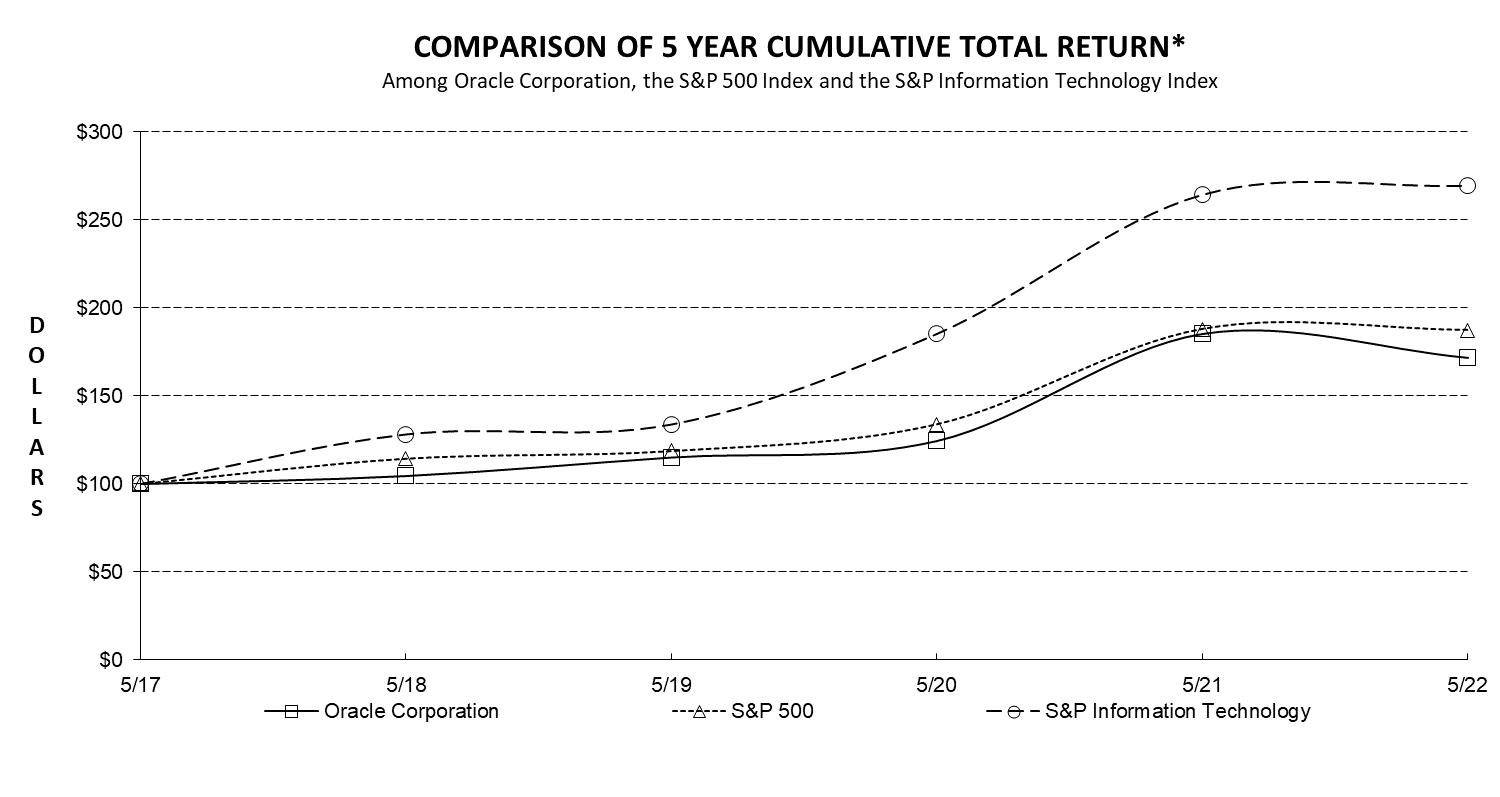][added: ]
*$100 INVESTED ON MAY 31, [removed: 2017] [added: 2018] IN STOCK OR
| | | | | | | | | | | | | | | | | |
| March 1, 2023—March 31, 2023 | | | 0.6 | | | $ | 87.46 | | | | 0.6 | | | $ | 8,258.5 | |
| April 1, 2023—April 30, 2023 | | | 0.5 | | | $ | 94.72 | | | | 0.5 | | | $ | 8,214.0 | |
| May 1, 2023—May 31, 2023 | | | 0.5 | | | $ | 98.90 | | | | 0.5 | | | $ | 8,162.4 | |
| Total | | | 1.6 | | | $ | 93.29 | | | | 1.6 | | | | | |
We have elected to replace the S&P Information Technology Index with the Dow Jones U.S. Technology Total Return Index because we believe the new index represents a more diversified group of companies across the technology industry and is more aligned with our peer group.
In this transition year, the stock performance graph below includes the new index and the previously reported index.
| | | | | | | | | | | | | | | | | | | | | | | | | |
| | | 5/18 | | | | 5/19 | | | | 5/20 | | | | 5/21 | | | | 5/22 | | | | 5/23 | | |
| Oracle Corporation | | | 100.0 | | | | 110.1 | | | | 119.0 | | | | 177.2 | | | | 164.2 | | | | 246.2 | |
| S&P 500 Index | | | 100.0 | | | | 103.8 | | | | 117.1 | | | | 164.3 | | | | 163.8 | | | | 168.6 | |
| S&P Information Technology Index | | | 100.0 | | | | 104.4 | | | | 144.5 | | | | 206.1 | | | | 210.2 | | | | 250.8 | |
| Dow Jones U.S. Technology Total Return Index | | | 100.0 | | | | 103.1 | | | | 143.4 | | | | 212.3 | | | | 203.7 | | | | 242.2 | |
| --- | --- |
On December 9, 2021, we announced that our Board of Directors approved an expansion of our stock repurchase program by an additional $10.0 billion.
| March 1, 2022—March 31, 2022 | | | 2.8 | | | $ | 79.24 | | | | 2.8 | | | $ | 9,831.4 | |
| April 1, 2022—April 30, 2022 | | | 2.4 | | | $ | 79.28 | | | | 2.4 | | | $ | 9,642.4 | |
| May 1, 2022—May 31, 2022 | | | 2.7 | | | $ | 71.06 | | | | 2.7 | | | $ | 9,448.5 | |
| Total | | | 7.9 | | | $ | 76.41 | | | | 7.9 | | | | | |
| | | 5/17 | | | | 5/18 | | | | 5/19 | | | | 5/20 | | | | 5/21 | | | | 5/22 | | |
| Oracle Corporation | | | 100.0 | | | | 104.6 | | | | 115.1 | | | | 124.5 | | | | 185.3 | | | | 171.7 | |
| S&P 500 Index | | | 100.0 | | | | 114.4 | | | | 118.7 | | | | 134.0 | | | | 188.0 | | | | 187.4 | |
| S&P Information Technology Index | | | 100.0 | | | | 128.2 | | | | 133.8 | | | | 185.3 | | | | 264.3 | | | | 269.4 | |
Item 6. [Reserved]
0 rewritten, 0 added, 1 removed, 1 unchanged
| --- | --- |
Item 8. Financial Statements and Supplementary Data
0 rewritten, 0 added, 1 removed, 2 unchanged
| --- | --- |
Item 9. Changes In and Disagreements with Accountants on Accounting and Financial Disclosure
0 rewritten, 0 added, 2 removed, 1 unchanged
| --- | --- |
[Index to Financial Statements](#ITEM_15_EXHIBITS_FINANCIAL_STATEMENT_SCH)
Item 9A. Controls and Procedures
12 rewritten, 1 added, 2 removed, 11 unchanged
[removed: Evaluation] [added: Evaluation] of Disclosure Controls and [removed: Procedures][added: Procedures]
Based on our management’s evaluation (with the participation of our Principal Executive and Financial Officer), as of the end of the period covered by this report, our Principal Executive and Financial Officer has concluded that our disclosure controls and procedures were effective as of May 31, [removed: 2022] [added: 2023] to provide reasonable assurance that information required to be disclosed by us in reports that we file or submit under the Exchange Act is (i) recorded, processed, summarized and reported within the time periods specified in the SEC rules and forms and (ii) accumulated and communicated to our management, including our Principal Executive and Financial Officer as appropriate to allow timely decisions regarding required disclosure.
[removed: Management’s] [added: Management’s] Report on Internal Control over Financial [removed: Reporting][added: Reporting]
Under the supervision and with the participation of our management, including our Principal Executive and Financial Officer, we conducted an evaluation of the effectiveness of our internal control over financial reporting as of May 31, [removed: 2022] [added: 2023] based on the guidelines established in *Internal Control—Integrated Framework* issued by the Committee of Sponsoring Organizations of the Treadway Commission’s 2013 framework.
Based on the results of our evaluation, our management concluded that our internal control over financial reporting was effective as of May 31, [removed: 2022.][added: 2023.]
The effectiveness of our internal control over financial reporting as of May 31, [removed: 2022] [added: 2023] has been audited by Ernst & Young LLP, an independent registered public accounting firm, as stated in their report which is included in Part IV, Item 15 of this Annual Report.
[removed: Changes] [added: Changes] in Internal Control over Financial [removed: Reporting][added: Reporting]
[removed: There] [added: Except as described above, there] were no changes in our internal control over financial reporting identified in connection with the evaluation required by paragraph (d) of Exchange Act Rules 13a-15 or 15d-15 that occurred during our last fiscal quarter that have materially affected, or are reasonably likely to materially affect, our internal control over financial reporting.
[removed: Inherent] [added: Inherent] Limitations on Effectiveness of [removed: Controls][added: Controls]
A control system, no matter how [removed: well conceived] [added: well-conceived] and operated, can provide only reasonable, not absolute, assurance that the objectives of the control system are met.
These inherent limitations include the realities that judgments in [removed: decision-making] [added: decision making] can be faulty and that breakdowns can occur because of a simple error or mistake.
[added: The design of any system of controls] also is based in part upon certain assumptions about the likelihood of future events and there can be no assurance that any design will succeed in achieving its stated goals under all potential future conditions; over time, controls may become inadequate because of changes in conditions, or the degree of compliance with policies or procedures may deteriorate.
As a result of our acquisition of Cerner on June 8, 2022, our internal control over financial reporting, subsequent to the date of acquisition, includes certain additional internal controls relating to Cerner.
| --- | --- |
The design of any system of controls
Item 9B. Other Information
0 rewritten, 0 added, 1 removed, 3 unchanged
| --- | --- |
Item 10. Directors, Executive Officers and Corporate Governance
2 rewritten, 0 added, 1 removed, 0 unchanged
Pursuant to General Instruction G(3) of Form 10-K, the information required by this item relating to our executive officers is included under the caption [removed: “Executive Officers of the Registrant”] [added: “Information About Our Executive Officers”] in Part I of this Annual Report.
The other information required by this Item 10 is incorporated herein by reference from the information contained in our Proxy Statement to be filed with the [removed: U.S. Securities and Exchange Commission] [added: SEC] in connection with the solicitation of proxies for our [removed: 2022] [added: 2023] Annual Meeting of Stockholders [removed: (2022] [added: (2023] Proxy Statement).
| --- | --- |
Item 11. Executive Compensation
1 rewritten, 0 added, 1 removed, 0 unchanged
The information required by this Item 11 is incorporated herein by reference from the information to be contained in our [removed: 2022] [added: 2023] Proxy Statement.
| --- | --- |
Item 12. Security Ownership of Certain Beneficial Owners and Management and Related Stockholder Matters
1 rewritten, 0 added, 1 removed, 0 unchanged
The information required by this Item 12 is incorporated herein by reference from the information to be contained in our [removed: 2022] [added: 2023] Proxy Statement.
| --- | --- |
Item 13. Certain Relationships and Related Transactions, and Director Independence
1 rewritten, 0 added, 1 removed, 0 unchanged
The information required by this Item 13 is incorporated herein by reference from the information to be contained in our [removed: 2022] [added: 2023] Proxy Statement.
| --- | --- |
Item 14. Principal Accountant Fees and Services
1 rewritten, 1 added, 2 removed, 1 unchanged
The information required by this Item 14 is incorporated herein by reference from the information to be contained in our [removed: 2022] [added: 2023] Proxy Statement.
PART IV
| --- | --- |
PART IV
Item 15. Exhibits and Financial Statement Schedules
722 rewritten, 354 added, 119 removed, 647 unchanged
[removed: | (a) | 1.] Financial [removed: Statements |][added: Statements]
| | | [removed: Page] [added: Page] |
| [Reports of Independent Registered Public Accounting [removed: Firm](#REPORT_INDEPENDENT_REGISTERED_PUBLIC_ACC)] [added: Firm](#report_independent_registered_public_acc)] (PCAOB ID: 42) | | [removed: 63] [added: 61] |
| [Balance Sheets as of May 31, [removed: 2022] [added: 2023] and [removed: 2021](#CONSOLIDATED_BALANCE_SHEETS)] [added: 2022](#consolidated_balance_sheets)] | | [removed: 66] [added: 64] |
| [Statements of Operations for the years ended May 31, [removed: 2022, 2021] [added: 2023, 2022] and [removed: 2020](#CONSOLIDATED_STATEMENTS_OPERATIONS)] [added: 2021](#consolidated_statements_operations)] | | [removed: 67] [added: 65] |
| [Statements of Comprehensive Income for the years ended May 31, [removed: 2022, 2021] [added: 2023, 2022] and [removed: 2020](#CONSOLIDATED_STATEMENTS_COMPREHENSIVE_IN)] [added: 2021](#consolidated_statements_comprehensive_in)] | | [removed: 68] [added: 66] |
| [Statements of Stockholders’ [removed: (Deficit)] Equity [added: (Deficit)] for the years ended May 31, [removed: 2022, 2021] [added: 2023, 2022] and [removed: 2020](#CONSOLIDATED_STATEMENTS_EQUITY)] [added: 2021](#consolidated_statements_equity)] | | [removed: 69] [added: 67] |
| [Statements of Cash Flows for the years ended May 31, [removed: 2022, 2021] [added: 2023, 2022] and [removed: 2020](#CONSOLIDATED_STATEMENTS_CASH_FLOWS)] [added: 2021](#consolidated_statements_cash_flows)] | | [removed: 70] [added: 68] |
| [Notes to Consolidated Financial [removed: Statements](#N1_ORGANIZATION_SIGNIFICANT_ACCOUNTING_P)] [added: Statements](#n1_organization_significant_accounting_p)] | | [removed: 71] [added: 69] |
Financial Statement [removed: Schedules][added: Schedules]
[removed: (b) Exhibits][added: (b) Exhibits]
[removed: Report] [added: Report] of Independent Registered Public Accounting [removed: Firm][added: Firm]
[removed: Opinion] [added: Opinion] on the Financial [removed: Statements][added: Statements]
We have audited the accompanying consolidated balance sheets of Oracle Corporation (the Company) as of May 31, [removed: 2022] [added: 2023] and [removed: 2021,] [added: 2022,] the related consolidated statements of operations, comprehensive income, [removed: equity,] [added: stockholders’ equity (deficit)] and cash flows for each of the three years in the period ended May 31, [removed: 2022,] [added: 2023,] and the related notes (collectively referred to as the “financial statements”).
In our opinion, the financial statements present fairly, in all material respects, the financial position of the Company at May 31, [removed: 2022] [added: 2023] and [removed: 2021,] [added: 2022,] and the results of its operations and its cash flows for each of the three years in the period ended May 31, [removed: 2022,] [added: 2023,] in conformity with U.S. generally accepted accounting principles.
We also have audited, in accordance with the standards of the Public Company Accounting Oversight Board (United States) (PCAOB), the Company's internal control over financial reporting as of May 31, [removed: 2022,] [added: 2023,] based on criteria established in Internal Control-Integrated Framework issued by the Committee of Sponsoring Organizations of the Treadway Commission (2013 framework) and our report dated June [removed: 21, 2022] [added: 20, 2023] expressed an unqualified opinion thereon.
[removed: Basis] [added: Basis] for [removed: Opinion][added: Opinion]
[removed: Critical] [added: Critical] Audit [removed: Matter][added: Matters]
The critical audit [removed: matter] [added: matters] communicated below [removed: is a matter] [added: are matters] arising from the current period audit of the financial statements that [removed: was] [added: were] communicated or required to be communicated to the audit committee and that: (1) [removed: relates] [added: relate] to accounts or disclosures that are material to the financial statements and (2) involved our especially challenging, [removed: subjective,] [added: subjective] or complex judgments.
The communication of [removed: the] critical audit [removed: matter] [added: matters] does not alter in any way our opinion on the financial statements, taken as a whole, and we are not, by communicating the critical audit [removed: matter] [added: matters] below, providing [removed: a] separate [removed: opinion] [added: opinions] on the critical audit [removed: matter] [added: matters] or on the accounts or disclosures to which [removed: it relates.][added: they relate.]
| | | [removed: Income] [added: Income] Tax – Uncertain tax [removed: positions] [added: positions] |
| [removed: Description] [added: *Description] of the [removed: matter] [added: matter*] | | As discussed in Note 13 of the financial statements, the Company recognizes uncertain tax positions and measures unrecognized tax benefits related to various domestic and foreign matters. As of May 31, [removed: 2022,] [added: 2023,] the total amount of unrecognized tax benefits was [removed: $7.3] [added: $7.7] billion, of which [removed: $4.3] [added: $3.9] billion, if recognized would impact the Company’s effective tax rate. The Company uses significant judgment in the accounting for [added: some of these] uncertain tax positions including the interpretation and application of tax laws and legal rulings in various jurisdictions. Auditing management’s evaluation of whether an uncertain tax position is more likely than not to be sustained and the measurement of the benefit of various tax positions was complex, involved significant judgment, and was based on interpretations and application of tax laws and legal rulings. |
| [removed: *How* *we* *addressed the* *matter in* *our* *audit*] [added: *How we addressed the matter in our audit*] | | We obtained an understanding, evaluated the design, and tested the operating effectiveness of the controls over management’s process for interpretation and application of tax laws and legal rulings, as well as development of the assumptions and estimates used in the measurement of uncertain tax positions. To test management’s assessment of which uncertain tax positions are more likely than not to be sustained, we performed audit procedures that included, among [removed: others reading and] [added: others,] evaluating management’s assumptions and analysis, including any communications with taxing authorities that detailed the basis and technical merits of the uncertain tax positions. We involved our tax subject matter professionals in assessing the technical merits of certain tax positions based on our knowledge of relevant tax laws and experience with related taxing authorities. In addition, we also evaluated the Company’s disclosures in relation to these matters included in Note 13 of the financial statements. |
[removed: Opinion] [added: Opinion] on Internal Control Over Financial [removed: Reporting][added: Reporting]
We have audited Oracle Corporation’s internal control over financial reporting as of May 31, [removed: 2022,] [added: 2023,] based on criteria established in [added: the] Internal [removed: Control —] [added: Control—] Integrated Framework issued by the Committee of Sponsoring Organizations of the Treadway Commission (2013 framework) (the COSO criteria).
In our opinion, Oracle Corporation (the Company) maintained, in all material respects, effective internal control over financial reporting as of May 31, [removed: 2022,] [added: 2023,] based on the COSO criteria.
We also have audited, in accordance with the standards of the Public Company Accounting Oversight Board (United States) (PCAOB), the consolidated balance sheets of Oracle Corporation as of May 31, [removed: 2022] [added: 2023] and [removed: 2021,] [added: 2022,] the related consolidated statements of operations, comprehensive income, [removed: equity,] [added: stockholders’ equity (deficit)] and cash flows for each of the three years in the period ended May 31, [removed: 2022,] [added: 2023,] and the related notes and our report dated June [removed: 21, 2022] [added: 20, 2023] expressed an unqualified opinion thereon.
[removed: Definition] [added: Definition] and Limitations of Internal Control Over Financial [removed: Reporting][added: Reporting]
[removed: ORACLE CORPORATION][added: ORACLE CORPORATION]
[removed: CONSOLIDATED BALANCE SHEETS][added: CONSOLIDATED BALANCE SHEETS]
[removed: As] [added: As] of May 31, [removed: 2022] [added: 2023] and [removed: 2021][added: 2022]
| | | [removed: May 31,] [added: May 31,] | | | | | | |
| [removed: (in] [added: (in] millions, except per share [removed: data)] [added: data)] | | [removed: 2022] [added: 2023] | | | | [removed: 2021] [added: 2022] | | | [added: | 2021 | | |]
| [removed: ASSETS] [added: ASSETS] | | | | | | | | |
| Cash and cash equivalents | | $ | [removed: 21,383] [added: 9,765] | | | $ | [removed: 30,098] [added: 21,383] | |
| Marketable securities | | | [removed: 519] [added: 422] | | | | [removed: 16,456] [added: 519] | |
| Trade receivables, net of allowances for credit losses of [removed: $362] [added: $428] and [removed: $373] [added: $362] as of May 31, [removed: 2022] [added: 2023] and May 31, [removed: 2021,] [added: 2022,] respectively | | | [removed: 5,953] [added: 6,915] | | | | [removed: 5,409] [added: 5,953] | |
| Prepaid expenses and other current assets | | | [removed: 3,778] [added: 3,902] | | | | [removed: 3,604] [added: 3,778] | |
| Total current assets | | | [removed: 31,633] [added: 21,004] | | | | [removed: 55,567] [added: 31,633] | |
| Property, plant and equipment, net | | | [removed: 9,716] [added: 17,069] | | | | [removed: 7,049] [added: 9,716] | |
(a)
1.
2.
Report of Independent Registered Public Accounting Firm
| | | |
| | | |
| | | Business combinations – Valuation of intangible assets |
| *Description of the matter* | | As discussed in Note 2 of the financial statements, the Company completed the acquisition of Cerner Corporation during fiscal year 2023 for a total purchase price of $28.2 billion, which was accounted for as a business combination. In connection with this acquisition, management recognized customer relationship, order backlog, developed technology and trade name intangible assets of $12.0 billion. The valuation of the customer relationship and developed technology intangible assets is complex and judgmental due to the use of subjective assumptions in the valuation models used by management when determining their estimated fair value. In particular, the fair value estimates for the acquired assets are sensitive to changes in assumptions for revenue growth, and cost of revenues and operating expenses as a percentage of revenue. Auditing management’s valuation of customer relationship and developed technology intangible assets is complex due to the auditor judgment required to evaluate management’s assumptions used in determining the fair value of these assets. |
| *How we addressed the matter in our audit* | | We obtained an understanding, evaluated the design and tested the operating effectiveness of controls over the determination of the fair value of customer relationships and developed technology intangible assets. This included controls over management’s development of the assumptions described above. To test the estimated fair value of the customer relationships and developed technology intangible assets, we performed audit procedures that included, among others, evaluating the Company’s selection of valuation methodologies with the assistance of our valuation specialists and application of acquisition accounting, and evaluating the significant assumptions used by the Company to develop the forecasted revenue growth rates and projected cost of revenues and operating expenses. We compared the significant assumptions to current industry, market and economic trends, and to the historical results of the acquired business and tested the completeness and accuracy of the underlying data used by management in the valuation. |
June 20, 2023
Basis for Opinion
June 20, 2023
| | | | | | | | | |
| (in millions, except per share data) | | 2023 | | | | 2022 | | |
(1)
For the Years Ended May 31, 2023, 2022 and 2021
| | | Year Ended May 31, | | | | | | | | | | |
| Net income | | $ | 8,503 | | | $ | 6,717 | | | $ | 13,746 | |
For the Years Ended May 31, 2023, 2022 and 2021
| | | | | | | | | | | | | | | | | | | | | | | | | | | | | |
| Assumption of stock-based compensation plan awards in connection with acquisitions | | | — | | | | 55 | | | | — | | | | — | | | | 55 | | | | — | | | | 55 | |
| Other, net | | | — | | | | (18 | ) | | | 1 | | | | — | | | | (17 | ) | | | (98 | ) | | | (115 | ) |
| Net income | | | — | | | | — | | | | 8,503 | | | | — | | | | 8,503 | | | | 165 | | | | 8,668 | |
| Balances as of May 31, 2023 | | | 2,713 | | | $ | 30,215 | | | $ | (27,620 | ) | | $ | (1,522 | ) | | $ | 1,073 | | | $ | 483 | | | $ | 1,556 | |
ORACLE CORPORATION
For the Years Ended May 31, 2023, 2022 and 2021
| | | Year Ended May 31, | | | | | | | | | | |
| Net income | | $ | 8,503 | | | $ | 6,717 | | | $ | 13,746 | |
| Proceeds from issuances of commercial paper, net of repayments | | | 500 | | | | — | | | | — | |
| Fair values of stock awards assumed in connection with acquisitions | | $ | 55 | | | $ | — | | | $ | — | |
ORACLE CORPORATION
May 31, 2023
1.
These models include on-premise, cloud-based and hybrid deployments (an approach that combines both on-premise and cloud based deployments).
On June 8, 2022, we completed our acquisition of Cerner Corporation (Cerner), a provider of digital information systems used within hospitals and health systems, by means of a merger of one of our wholly owned subsidiaries with and into Cerner such that Cerner became an indirect, wholly owned subsidiary of Oracle.
Through our acquisition of Cerner, we enhanced our offerings of each of our three existing businesses, cloud and license, hardware and services.
The consolidated financial statements included in this Annual Report include the financial results of Cerner prospectively from the date of acquisition.
During the first quarter of fiscal 2023, we completed an assessment of the useful lives of our servers and increased the estimate of the useful lives from four years to five years effective at the beginning of fiscal 2023.
Based on the carrying value of our servers as of May 31, 2022, this change in accounting estimate decreased our total operating expenses by $434 million during fiscal 2023.
technical support services.
| --- | --- |
| --- | --- | --- |
2.
June 21, 2022
| Balances as of May 31, 2019 | | | 3,359 | | | $ | 26,909 | | | $ | (3,496 | ) | | $ | (1,628 | ) | | $ | 21,785 | | | $ | 578 | | | $ | 22,363 | |
| Net income | | | — | | | | — | | | | 10,135 | | | | — | | | | 10,135 | | | | 164 | | | | 10,299 | |
| Proceeds from maturities of marketable securities | | | 19,788 | | | | 26,024 | | | | 4,687 | |
| Change in unsettled repurchases of common stock | | $ | (48 | ) | | $ | 66 | | | $ | (40 | ) |
In fiscal 2022, we adopted Accounting Standards Update (ASU) 2019-12, *Income Taxes (Topic 740): Simplifying the Accounting for Income Taxes; and* ASU 2021-08, *Business Combinations (Topic 805): Accounting for Contract Assets and Contract Liabilities from Contracts with Customers*, neither of which had a material impact to our consolidated financial statements for the year ended May 31, 2022.
NOTES TO CONSOLIDATED FINANCIAL STATEMENTS—(Continued)
information available to us at the time that these estimates, judgments and assumptions are made.
available continuously throughout the contract period.
combination.
Certain of these instruments are adjusted for observable price changes from orderly transactions.
demand within specific time horizons (generally six to nine months).
If we determine in
Advertising
Substantially all advertising costs are expensed as incurred.
Advertising expenses, which were included within sales and marketing expenses, were $273 million, $202 million and $178 million in fiscal 2022, 2021 and 2020, respectively.
| Commercial paper debt securities | | | — | | | | 11,712 | |
| Commercial paper debt securities | | | — | | | | — | | | | — | | | | — | | | | 11,712 | | | | 11,712 | |
| Developed technology | | $ | 4,237 | | | $ | 165 | | | $ | (436 | ) | | $ | 3,966 | | | $ | (3,621 | ) | | $ | (475 | ) | | $ | 436 | | | $ | (3,660 | ) | | $ | 616 | | | $ | 306 | | | | 3 | |
| Other | | | 1,269 | | | | — | | | | (48 | ) | | | 1,221 | | | | (1,118 | ) | | | (83 | ) | | | 48 | | | | (1,153 | ) | | | 151 | | | | 68 | | | N/A | | |
| Total intangible assets, net | | $ | 11,003 | | | $ | 160 | | | $ | (716 | ) | | $ | 10,447 | | | $ | (8,573 | ) | | $ | (1,150 | ) | | $ | 716 | | | $ | (9,007 | ) | | $ | 2,430 | | | $ | 1,440 | | | | | |
| Balances as of May 31, 2020 | | $ | 39,637 | | | $ | 2,367 | | | $ | 1,765 | | | $ | 43,769 | |
| $1,500, 2.80%, due July 2021(1) | | July 2014 | | $ | — | | | N.A | | $ | 1,500 | | | 2.82% |
| $4,250, 1.90%, due September 2021 | | July 2016 | | | — | | | N.A | | | 4,250 | | | 1.94% |
| $2,500, 2.50%, due October 2022 | | October 2012 | | | 2,500 | | | 2.51% | | | 2,500 | | | 2.51% |
| (1) | We entered into certain interest rate swap agreements that had the economic effects of modifying the fixed-interest obligations associated with the 2.80% senior notes that were outstanding as of May 31, 2021 and that were due and were settled in July 2021 (July 2021 Notes) so that the interest payable on these notes effectively became variable based on LIBOR. The effective interest rates after consideration of these fixed to variable interest rate swap agreements was 0.87% for the July 2021 Notes as of May 31, 2021. Refer to Note 1 for a description of our accounting for fair value hedges. |
| Fiscal 2023 | | $ | 3,750 | |
| Thereafter | | | 50,000 | |
| Total | | $ | 76,234 | |
Credit Agreements
In March 2022, we entered into the following two credit agreements:
| | • | a $6.0 billion, five-year revolving credit agreement (the Revolving Credit Agreement), which provides for an unsecured $6.0 billion, five-year revolving credit facility (the Revolving Facility) to be used for our working capital purposes and for other general corporate purposes. Subject to certain conditions stated in the Revolving Credit Agreement, we may borrow, prepay and reborrow amounts under the Revolving Facility during the term of the Revolving Credit Agreement. All amounts borrowed under the Revolving Credit Agreement will become due on March 8, 2027, unless the commitments are terminated earlier either at our request or, if an event of default occurs, by the lenders (or automatically in the case of certain bankruptcy-related events). Interest is based on either (a) a Term Secured Overnight Financing Rate (SOFR)-based formula plus a margin of 87.5 basis points to 150.0 basis points, depending on the credit rating assigned to our long-term senior unsecured debt, or (b) a Base Rate formula plus a margin of 0.0 basis point to 50.0 basis points, depending on the same such credit rating, each as set forth in the Revolving Credit Agreement; and |
| | • | a $15.7 billion delayed draw term loan credit agreement (the Bridge Credit Agreement), which provides for an unsecured $15.7 billion, 364-day term loan commitment (the Bridge Facility), subject to the satisfaction of certain customary conditions. The Bridge Credit Agreement provides that, subject to certain exceptions, net cash proceeds received by us from certain debt and equity issuances shall result in mandatory prepayments or commitment reductions under the Bridge Credit Agreement. The proceeds of borrowings under the Bridge Facility were used to finance the acquisition of Cerner, our refinancing of indebtedness in connection with such acquisition and to pay related fees and expenses. All amounts borrowed under the Bridge Credit Agreement will become due on March 7, 2023, unless settled earlier pursuant to the terms of the Bridge Credit Agreement. Interest is based on either (a) a Term SOFR-based formula plus a margin of 100.0 basis points to 137.5 basis points, depending on the credit rating assigned to our long-term senior unsecured debt, or (b) a Base Rate formula plus a margin of 0.0 basis point to 37.5 basis points, depending on the same such credit rating, each as set forth in the Bridge Credit Agreement. |
No amounts were outstanding pursuant to either of the credit agreements as of May 31, 2022.
On June 8, 2022, we drew down the full amount of the Bridge Credit Agreement to finance the acquisition of Cerner.
Any changes to the estimates or timing of executing the 2022 Restructuring Plan will be reflected in our future results of operations.
recorded to the restructuring expense line item within our consolidated statements of operations as they were incurred.
An excerpt. Shown here: 40 of 722 rewritten, 40 of 354 added and 40 of 119 removed. The counts are complete. For every sentence, read Item 15. Exhibits and Financial Statement Schedules in the FY2023 filing and the FY2022 filing.