 filings.tools
Otis Worldwide 10-K 2021-12-31
Filed 2022-02-04. 23 sections, 509K characters. Original on sec.gov · Markdown · JSON
Cover and table of contents
UNITED STATES
SECURITIES AND EXCHANGE COMMISSION
WASHINGTON D.C. 20549
FORM 10-K
| ☒ | ANNUAL REPORT PURSUANT TO SECTION 13 OR 15(d) OF THE SECURITIES EXCHANGE ACT OF 1934 |
For the fiscal year ended December 31, 2021
or
| ¨ | TRANSITION REPORT PURSUANT TO SECTION 13 OR 15(d) OF THE SECURITIES EXCHANGE ACT OF 1934 |
For the transition period from ______ to ______.
Commission file number 001-39221

OTIS WORLDWIDE CORPORATION
(Exact name of registrant as specified in its charter)
| Delaware | 83-3789412 | |||||||
| (State or other jurisdiction of incorporation) | (I.R.S. Employer Identification No.) |
One Carrier Place, Farmington, Connecticut 06032
(Address of principal executive offices, including zip code)
(860) 674-3000
(Registrant's telephone number, including area code)
Securities registered pursuant to Section 12(b) of the Act:
| Title of each class | Trading Symbol(s) | Name of each exchange on which registered | ||||||
| Common Stock ($0.01 par value) | OTIS | New York Stock Exchange | ||||||
| 0.000% Notes due 2023 | OTIS/23 | New York Stock Exchange | ||||||
| 0.318% Notes due 2026 | OTIS/26 | New York Stock Exchange | ||||||
| 0.934% Notes due 2031 | OTIS/31 | New York Stock Exchange |
Indicate by check mark if the registrant is a well-known seasoned issuer, as defined in Rule 405 of the Securities Act. Yes ý. No ¨.
Indicate by check mark if the registrant is not required to file reports pursuant to Section 13 or Section 15(d) of the Act. Yes ☐. No ý.
Indicate by check mark whether the registrant (1) has filed all reports required to be filed by Section 13 or 15(d) of the Securities Exchange Act of 1934 during the preceding 12 months (or for such shorter period that the registrant was required to
file such reports), and (2) has been subject to such filing requirements for the past 90 days. Yes ý. No ¨.
Indicate by check mark whether the registrant has submitted electronically every Interactive Data File required to be submitted pursuant to Rule 405 of Regulation S-T (§232.405) during the preceding 12 months (or for such shorter period that the registrant was required to submit and post such files). Yes ý. No ¨.
Indicate by check mark whether the registrant is a large accelerated filer, an accelerated filer, a non-accelerated filer, smaller reporting company, or an emerging growth company. See the definitions of "large accelerated filer," "accelerated filer," "smaller reporting company," and "emerging growth company" in Rule 12b-2 of the Exchange Act.
| Large Accelerated Filer | ý | Accelerated Filer | ¨ | ||||||||
| Non-accelerated Filer | ¨ | Smaller Reporting Company | ☐ | ||||||||
| Emerging Growth Company | ☐ |
If an emerging growth company, indicate by check mark if the registrant has elected not to use the extended transition period for complying with any new or revised financial accounting standards provided pursuant to Section 13(a) of the Exchange Act. ¨
Indicate by check mark whether the Registrant has filed a report on and attestation to its management’s assessment of the effectiveness of its internal control over financial reporting under Section 404(b) of the Sarbanes-Oxley Act (15 U.S.C. 7262(b)) by the registered public accounting firm that prepared or issued its audit report. ý.
Indicate by check mark whether the registrant is a shell company (as defined in Rule 12b-2 of the Act). Yes ☐. No ý.
The aggregate market value of the voting Common Stock held by non-affiliates at June 30, 2021 was approximately $34,888,309,556 based on the New York Stock Exchange closing price for such shares on that date. For purposes of this calculation, the Registrant has assumed that its directors and executive officers are affiliates.
At January 21, 2022, there were 424,962,356 shares of Common Stock outstanding.
DOCUMENTS INCORPORATED BY REFERENCE
Part III hereof incorporates by reference portions of the Otis Worldwide Corporation Proxy Statement for the 2022 Annual Meeting of Shareholders (the "2022 Proxy Statement"). The 2022 Proxy Statement will be filed with the U.S. Securities and Exchange Commission within 120 days after the end of the fiscal year to which this report relates.
OTIS WORLDWIDE CORPORATION
Form 10-K
For the Year Ended December 31, 2021
TABLE OF CONTENTS
Otis Worldwide Corporation's and its subsidiaries' names, abbreviations thereof, logos, and product and service designators are all either the registered or unregistered trademarks or tradenames of Otis Worldwide Corporation and its subsidiaries. Names, abbreviations of names, logos, and product and service designators of other companies are either the registered or unregistered trademarks or tradenames of their respective owners. As used herein, the terms "we", "us", "our", "the Company" or "Otis", unless the context otherwise requires, mean Otis Worldwide Corporation and its subsidiaries. References to Internet websites in this Form 10-K are provided for convenience only. Information available through these websites is not incorporated by reference into this Form 10-K.
PART I
Item 1. Business
Our Company
Otis is the world’s leading elevator and escalator manufacturing, installation and service company. We serve customers in over 200 countries and territories around the world. Otis has global scale and local focus, with over 1,400 branches and offices, and a direct physical presence in approximately 80 countries.
Separation from United Technologies Corporation
Otis is a Delaware corporation and was incorporated on March 1, 2019 in connection with the separation and distribution ("Separation") of each of Otis and Carrier Global Corporation ("Carrier") from United Technologies Corporation, subsequently renamed Raytheon Technologies Corporation ("UTC" or "RTX", as applicable) into separate independent publicly-traded companies. The Separation occurred on April 3, 2020. References to "UTC" relate to pre-Separation matters, and references to "RTX" relate to post-Separation matters.
The Separation was completed pursuant to a Separation and Distribution Agreement ("Separation Agreement") and other agreements with UTC and Carrier related to the Separation, including but not limited to a transition services agreement ("TSA"), a tax matters agreement ("TMA"), an employee matter agreement ("EMA") and an intellectual property agreement (the "Intellectual Property Agreement"). For further discussion of these agreements, see Item 1A, "Note 1: Business Overview" in Item 8 and Item 15 in this Form 10-K.
The following description of our business should be read in conjunction with Item 7 in this Form 10-K, including the information contained therein under the heading "Business Overview."
Description of Business by Segment
Our Company is organized into two segments, New Equipment and Service, which, for the year ended December 31, 2021, contributed 45% and 55% of our net sales, and 21% and 79% of our segment operating profit, respectively. Our international operations represented approximately 74% of our net sales for the year ended December 31, 2021.
New Equipment
Through our New Equipment segment, we design, manufacture, sell and install a wide range of passenger and freight elevators, as well as escalators and moving walkways for residential, commercial and infrastructure projects. In 2021, our New Equipment segment had sales of $6.4 billion and operating profit of $459 million. In 2021, our New Equipment sales in China and the Americas each represented approximately one-third of our new equipment net sales, respectively, while China represented over half of our global New Equipment unit volume.
We have developed a range of elevator and escalator solutions to meet the varying needs and objectives of our diverse customers. Our primary elevator and escalator solutions are described below.
The Gen2 family of elevators has been our principal low-and mid-rise elevator solution. Since its launch in 2000, Otis has sold over one million Gen2 units, making it our best selling elevator platform. In 2021, we introduced the successors to the Gen2 family of elevators: the Gen3 and Gen360 digital elevator platforms. These platforms enhance the space-saving, energy-efficient design of the Gen2 elevator with the connectivity of the Otis ONE IoT (internet of things) digital service platform, while adding additional safety features for the passengers and our colleagues who maintain the elevator. Otis ONE is designed
to continuously monitor equipment health and performance in real time to provide proactive, predictive and transparent information to our technicians and customers. The technology expands predictive and remote maintenance capabilities to support improved elevator up-time and service productivity.
The Gen360 elevator also features a new native electronic architecture, with many mechanical components replaced by electronic components that in connection with our service increase reliability, reduce the potential for entrapments and free hoistway space to accommodate larger cabins. The new Otis One IoT solution turns the elevator into a network of sensors for real-time status updates. A foldable, in-ceiling platform allows maintenance operations to be performed safely from within the car rather than on top of it and, depending on local regulations, eliminates the need for a refuge space above the car and the protrusion on the roof for a flat roof design. With 360-degree cameras in the hoistway, Otis service teams can visually confirm, fine-tune, diagnose and solve many issues remotely without stopping the elevator.
For taller, high-rise buildings, our most prominent product is the SkyRise elevator solution. The SkyRise advanced high-rise elevator platform combines cutting-edge technologies and precision engineering to deliver solutions for residential, commercial and mixed use skyscrapers.
Otis offers a range of technologies for improving the passenger experience as well as the safety and efficiency of the building itself. Our proprietary Compass 360 destination management system groups passengers by their desired destination and directs them to an assigned car that minimizes waiting and ride time. The system's algorithms anticipate traffic demand within a building and improves traffic flow. Otis eView in-car display streams live, customizable infotainment to passengers and connects them to OTISLINE during an emergency. The Otis eCall Plus smartphone app enables passengers to summon their elevator remotely for a touchless experience. We have also rolled out new voice and gesturing technologies for summoning elevators to customers in China and North America, with other geographies to follow. And the new Otis Cab Air Purifier significantly reduces airborne bacteria and viruses, another innovation designed to address customer needs and passenger preferences as the result of the COVID-19 pandemic.
In addition to elevator solutions, we also offer escalators and moving walkways. With a range of finishes and aesthetics, Otis escalators integrate easily with building designs. Our smart design and features enhance sustainability and passenger safety, such as sensor-equipped escalators and moving walkways that efficiently run only when passengers approach, or operate at reduced speeds to conserve energy when there are no riders.
Our New Equipment customers include real-estate and building developers and general contractors who develop and/or design buildings for residential, commercial, retail or mixed-use activity. We also sell New Equipment to government agencies, particularly, to support infrastructure projects, such as airports, railways or metros. We generally sell directly to our customers through our New Equipment sales personnel. Due to the large and widespread nature of the customer base in China and certain other geographies, our direct sales force is augmented by agents and distributors. We also rely on agents and distributors to sell our new equipment in certain other countries and territories. Given the breadth of our customer base and the large number of customers to whom we deliver new equipment on an annual basis, we are not dependent on any single customer and do not have any contracts material to Otis as a whole with any single customer. Our network of agents and distributors is broad and geographically dispersed, and we do not rely on or have any contracts material to Otis as a whole with any single agent or distributor.
New Equipment customers typically engage with us at an early stage during the construction cycle. The timing of order placement depends on factors including project complexity and customer requirements. Elevator installation usually occurs midway through building construction.
Most New Equipment orders are delivered within 12 months of booking, though larger projects can take longer to deliver based on customer construction schedules. When placing New Equipment orders, customers typically make an advance payment to cover costs including design and contract engineering. These advance payments are typically followed by periodic progress payments at specified milestones, such as delivery of materials at the job site and completion of installation and equipment commissioning. Installation is carried out by our installation technicians or through subcontractors, in which case we typically complete the final inspection and commissioning to ensure that our quality standards are met. Revenues are recognized based on percentage of completion. Once commissioned, New Equipment units are typically supported by a warranty for a limited period of time.
Service
Through our Service segment, we perform maintenance and repair services, as well as modernization services to upgrade elevators and escalators. We have a maintenance portfolio of over 2.1 million units globally, which includes Otis equipment manufactured and sold by us, as well as equipment from other original equipment manufacturers. Through our network of service sales personnel, we sell our services directly to customers in all significant elevator and escalator end-segments around the world. In 2021, our Service segment had net sales of $7.9 billion and operating profit of $1.8 billion.
Service customers typically comprise building owners, facility managers, housing associations and government agencies that operate buildings where elevators and escalators are installed. Customers securing services for elevators are frequently different from those who initially make purchasing decisions with respect to New Equipment solutions. With over 2.1 million maintenance units under contract globally, we have a wide range of customers in our Service segment and do not have any single service contract material to Otis as a whole. Contract duration depends on a number of factors, including customer needs, regulatory requirements and industry/geography dynamics. We work closely with our customers to renew these contracts as appropriate. Certain types of customers, such as those owning or operating large properties or portfolios of properties, tend to execute long-term maintenance agreements.
We grow our maintenance portfolio through conversion of newly installed units into maintenance contracts, through prospecting and winning units already in service from customers using another service provider and through acquisitions. Our Service sales personnel seek to win service contracts upon the expiration or termination of existing service contracts from customers by offering a superior value proposition through service excellence, an engaged and technically sophisticated group of field service technicians, a streamlined customer experience and strong elevator and escalator operating performance.
Our services include inspections, preventive maintenance offerings and other customized maintenance offerings tailored to meet customer needs. A basic maintenance contract provides for inspection consistent with local regulatory needs. We also provide customers with repair services to address equipment and component wear and tear, as well as breakdowns. We offer incremental, tiered maintenance and service offerings, with varying levels of coverage up to and including comprehensive component replacement coverage.
Similar to most other electro-mechanical equipment, elevators and escalators are subject to wear and tear, which over time erodes equipment functionality. As elevator equipment ages, we work with customers to help renew or refresh their elevators with modernization solutions that enhance equipment operation and improve building functionality. Modernization offerings can range from relatively simple upgrades of interior finishes and aesthetics to complex upgrades of larger components and sub-systems.
We provide our Service offerings to our customers through a global network of approximately 34,000 Service mechanics operating out of over 1,400 branches and offices typically located in close proximity to concentrations of customers. Our mechanics are critical to our ability to deliver a high level of service to our customers. Our OTISLINE operations provide personalized customer support 24/7. They receive customer service requests and assign and dispatch field technicians, as necessary, to respond to service requests. Our network of service parts centers, repair centers, and obsolescence management capabilities are key enablers to supporting customers by keeping their elevators and escalators in good working condition.
Digital Technology initiatives
Otis has been using technology to monitor elevator performance remotely for decades, culminating in our latest Otis ONE technology discussed under "New Equipment" above. We also offer multimedia subscription options with additional voice, data and video digital services to customers leveraging our IoT technologies. By the end of 2021, approximately 35% of our global portfolio is connected. In 2022, we expect to continue to innovate and expand our digital ecosystem and suite of digital solutions for both our existing service portfolio customers and for new equipment shipments from our factories.
Research and Development & Intellectual Property
Innovation is a fundamental characteristic of our history and is central to our strategy. For the year ended December 31, 2021, research and development ("R&D") expense was $159 million and 1.1% as a percentage of net sales. In addition to research and development expense, we made investments in digital and strategic initiatives of approximately $59 million, which in combination with research and development expense was 1.5% as a percentage of net sales. We coordinate our R&D efforts globally through an operating model that sets global and local priorities based on customer and segment needs. We have 11 R&D centers and 18 factories around the world, including major locations in China, India, France, Spain and the United States. The R&D centers are strategically located close to concentrations of customers and factories to enable efficient development of engineering solutions that can serve as global model products and adapt quickly and efficiently to local customer needs and local demographic and construction trends. We have approximately 1,300 engineers globally, with increasing focus on digital initiatives, software, design of the user interface and the user experience.
We maintain a portfolio of patents, trademarks, copyrights, trade secrets, licenses and franchises related to the Otis business to protect our R&D investments in products and services. We currently own approximately 3,700 globally issued patents, and we have approximately 2,700 patent applications pending globally, of which approximately 2,600 applications were filed in the last three years. Our patents are primarily filed in Europe, the United States and Asia. We believe that our patents and trade secrets create a competitive advantage and that we have taken reasonable measures to build a portfolio of valid and enforceable intellectual property rights. However, these intellectual property rights might be challenged and could be found invalid or unenforceable. Loss of strategic patents and trade secrets could significantly affect our competitiveness. See Item 1A in this Form 10-K for further discussion of intellectual property matters.
Joint Ventures and Non-Wholly Owned Subsidiaries
Our international strategic relationships, joint ventures and non-wholly owned subsidiaries are an important part of our business as they support our access to international markets and customers. Results of these entities are consolidated with our financial and operational results. In addition to China and Spain, as discussed below, we also operate through joint ventures and non-wholly owned subsidiaries in other countries, including Italy, Russia, Malaysia, and certain countries in the Middle East.
China
We operate in China through two principal joint ventures: Otis Elevator (China) Investment Company Limited (“Otis China”) and Otis Electric Elevator Company Limited (“Otis Electric”). Otis China is a joint venture established in 1998 for the purpose of manufacturing, installing and servicing elevators, escalators and related equipment. We are a majority owner of Otis China, and Tianjin Tai Kang Investment Co. Ltd. (“Tianjin Tai Kang”) is our joint venture partner. Otis Electric, a subsidiary of Otis China, is a joint venture established in 1997 for the purpose of manufacturing, installing and servicing elevators, escalators and related equipment. Otis China owns a controlling equity stake in Otis Electric. Otis China’s partner in Otis Electric is Xizi Elevator Group Co.
Zardoya Otis
We conduct our operations based in Spain through Zardoya Otis S.A. (“Zardoya Otis”), which manufactures, installs and services elevators and elevator equipment in Spain, and exports elevator equipment it manufactures for installation by certain of our subsidiaries outside of Spain. Zardoya Otis’ shares are listed on Spanish stock exchanges, and the company is subject to the supervision of the Spanish Securities Exchange Commission (Comisión Nacional del Mercado de Valores (the "CNMV")). We own a majority equity stake in Zardoya Otis, with Euro Syns S.A. owning a minority position and the remaining shares being held by public shareholders.
In September 2021, the Company announced a tender offer to acquire all of the issued and outstanding shares of Zardoya Otis not owned by Otis. See Item 1A and "Note 1: Business Overview" in Item 8 in this Form 10-K for further details regarding this pending transaction, including risks associated therewith.
Competition
We operate in a global and highly competitive industry. Due to the global and localized nature of the industry, there are numerous participants of varying size that operate in our industry. According to industry estimates, there are hundreds of participants that offer New Equipment solutions and several thousand participants that offer maintenance and service solutions. In both the New Equipment and Service segments, major competitors globally include KONE Oyj, Schindler Group and TK Elevator, while there are a number of additional competitors in the Asia Pacific region. Competitive dynamics vary significantly by segment and geography. In the Service segment, independent service providers and other small operators are significant competitors in most of our local geographies. These independent service providers have an aggregate portfolio of about 50% of service units, but account for a smaller percentage of the service business when measured by value because of the types of units and level of maintenance covered by these providers.
There are several factors that determine competitiveness in the industry, including local codes and compliance requirements, customer preferences, price, reputation, delivery and execution, product quality, equipment performance, reliability and long-term service and product support. Our success in both our New Equipment and Service segments depends upon our ability to develop and market our products, services and solutions, as well as our ability to provide the people, technologies, facilities, equipment and financial capacity needed to deliver those products and services with maximum efficiency. We believe our global presence, local relationships and proven track record in executing complex elevator and escalator solutions contribute to our iconic brand, reputation and competitive position in the industry. We believe our business strategies sustain New Equipment growth, accelerate Service portfolio growth, advance the digitalization of Otis, focus and empower the organization, support our ability to successfully compete across the New Equipment and Service segments, and will help deliver sustainable earnings growth.
Compliance with Government Regulations
We conduct our business through subsidiaries and affiliates worldwide. Any changes in legislation or government policies impacting our industry, including with respect to employee safety, labor-related regulations, industrial equipment, licensing requirements, foreign ownership limitations and building and elevator safety codes, can affect our operations. We closely monitor local legislation and government policies in the locations in which we operate.
In addition, our operations are subject to and affected by environmental regulations promulgated by federal, state and local authorities in the United States and regulatory authorities with jurisdiction over our foreign operations. We have incurred and will likely continue to incur liabilities under various government statutes and regulations for the cleanup of pollutants previously released into the environment. We do not anticipate that compliance with current provisions relating to the protection of the environment or that any payments we may be required to make for cleanup liabilities will have a material adverse effect upon our competitive position, cash flows, results of operations or financial condition.
U.S. laws, regulations, orders, and other measures concerning the export or re-export of products, software, services and technology to, and other trade-related activities involving, non-U.S. countries and parties affect the operations of Otis and its affiliates, as do those of other countries pertaining to similar matters.
For further discussion of risks related to environmental matters and other government regulations, see in this Form 10-K Item 1A, Item 7 and "Note 2: Summary of Significant Accounting Policies" and "Note 22: Contingent Liabilities" in Item 8 in this Form 10-K.
Seasonality
Our business and operating results are generally not subject to significant fluctuations as a result of seasonality, although we have experienced lower New Equipment sales in Asia in the first calendar quarter, coinciding with Lunar New Year celebrations. In addition, we have also experienced lower New Equipment sales in the fourth quarter in China, due to a national holiday that occurs during the first week of October which may impact the relative mix of sales within the quarter.
Raw Materials and Supplies
Due to the global and distributed nature of our operations, we partner with a diverse network of several thousand suppliers globally. These include product and non-product suppliers, as well as subcontractors. We rely on approximately 500 key suppliers for our manufacturing supply chain.
Components and systems necessary to effectively complete our New Equipment projects, as well as to satisfy our maintenance and repair obligations, are often available from two or more sources within the industry. While we believe no single supplier is material to our business, some components or applications require particular specifications or qualifications. In those cases, there may be a single supplier or a limited number of suppliers that can readily provide such components, which have in the past, and could in the future, result in supply constraints or cost pressures due to an issue with such a supplier, including financial or operational difficulties or a contract dispute. Additionally, the slowdown of economic activity due to COVID-19 and subsequent ongoing recovery in certain regions, as well as the impact of COVID-19 more broadly on employment and the economy, have created long lead times and product shortages for certain components and supplier. We implemented mitigation actions to address potential disruption in and other risks relating to our supply chain, including the use of safety stock and alternative materials, as well as risk assessments, qualification of multiple supply sources and use of long term supplier agreements.
Although at times high prices for some raw materials important to our business have caused margin and cost pressures for our business, including in connection with the impact of COVID-19-and the ongoing recovery, we do not expect near-term unavailability or pricing of materials, components or supplies that would have a material adverse effect on our business. We seek to manage commodity price risk through locking and hedging strategies, as well as passing the increases onto our customers through pricing. See Item 1A in this Form 10-K for risks associated with raw material and supply chain, as well as COVID-19.
Environmental, Social and Governance ("ESG")
Otis is committed to working for the global good of our passengers, customers, colleagues and society. In order to align our ESG initiatives with our broader strategy, we completed a materiality assessment in 2020 to determine our most critical ESG areas for management, goal-setting and reporting. This allows us to focus on the topics most important to our business. We also became a signatory to the U.N. Global Compact in March 2021. Our ESG goals and alignment to U.N. Sustainable Development Goals are categorized into four areas: Health & Safety, Environmental & Impact, People & Communities and Governance & Accountability.
We have published our ESG goals, which can be found in the Investor section of our corporate website. Additionally, we expect to publish an ESG report on our ESG activities, metrics and progress towards our goals starting in 2022. In 2022, our progress towards reducing Scope 1 and Scope 2 greenhouse gases will be a factor in determining payouts under our executive short-term incentive plan. Our ESG goals and ESG report are not incorporated by reference into this Form 10-K and will be available in the Investors section of our website (http://www.otis.com) under the heading "ESG". Also, see "Human Capital" below for additional information regarding certain ESG initiatives related to our colleagues, including health & safety, employee engagement and diversity, equity and inclusion.
There have been no, and we do not expect there to be in the near term, material impacts on our business, financial condition or results of operations as a result of compliance with legislation or regulatory rules regarding climate change, from the known physical effects of climate change or as a result of implementing our ESG initiatives. Increased regulation and other climate change concerns, however, could subject us to additional costs and restrictions, and we are not able to predict how such regulations or concerns would affect our business, operations or financial results.
Human Capital
As of December 31, 2021, our global workforce consists of approximately 70,000 colleagues, with 42% in Asia, 35% in Europe, the Middle East and Africa (“EMEA”) and 22% in the Americas.
Approximately 63% of our workforce in the U.S. is covered by collective bargaining agreements. Outside of the U.S., our colleagues are represented by workers' councils or statutory labor unions as may be customary or required in those jurisdictions. While we strive to maintain good relationships with our employee representative bodies, our business may be adversely affected by work stoppages, union negotiations, labor disputes and other matters associated with our labor force. The collective bargaining agreement for most of our bargaining unit colleagues in the U.S. was renewed without disruption in July 2017 and is
set to expire in July 2022. Although some previous contract renegotiations have had a significant impact on our financial condition or results of operations, we do not anticipate that the renegotiation of this contract will have a material adverse effect on our competitive position, cash flows, financial condition or results of operations. For a discussion of employment-related matters, see Item 1A in this Form 10-K.
Compensation
Our colleagues are vital to our success, and we offer pay and benefits designed to attract, retain and motivate our colleagues and align their compensation with both individual and our overall performance. While our programs vary by location and based on the roles of our colleagues, they include competitive base pay, short-term incentive bonuses, long-term incentive pay in the form of stock awards, retirement plans, health care and insurance benefits, paid time off, tuition assistance through our Employee Scholar program, family leave, dependent care and employee assistance programs.
Safety and Health
Safety is one of the Otis Absolutes. For that reason, safety measures and indicators are regularly monitored by management and reported to our Board of Directors. To promote safety, we have a health and safety management system and regularly measure the effectiveness of our health and safety programs. We empower all of our colleagues and subcontractors with stop work authority if they perceive an unsafe condition or a behavior that may cause injury. We also seek to promote a culture where stop work authority can be freely exercised without the fear of retribution or retaliation, and a learning culture to enhance the quality and delivery of safety and technical training.
For our colleagues to be effective, they need to be healthy. Starting in 2020, with the added stress of the COVID-19 pandemic, we increased our efforts to improve our colleagues’ mental health by expanding employee assistance plan benefits and by bringing increased attention to the importance of mental health. We believe this is an important initiative to continue and we are striving to provide employee assistance plan benefits to all of our colleagues by the end of 2022. During 2020 and 2021, we covered the cost of COVID-19 testing and treatment for our U.S. based colleagues and their covered family members under our welfare plans. We have, where possible, also offered remote work flexibility for our colleagues.
Training and Development
We strive to emphasize development and training, as we believe that individual and corporate success is driven by lifelong learning and by empowering our colleagues. As a result, we provide a range of development and mentoring opportunities that vary based on a colleague's career stage and function. One of our flagship programs is “Otis University,” a global program that builds leadership and functional capabilities in sales, field, engineering, operations, and major projects. We are very proud of our “Employee Scholar Program,” which is a comprehensive, company-sponsored education program that allows colleagues to expand their skills through degree or certification programs. Since the program's inception in 1997, Otis, as a business unit of UTC and following the Separation, has supported Otis colleagues in receiving more than 5,500 degrees across 60 countries through an investment of over $95 million in the Employee Scholar Program.
Ensuring that we have access to trained technicians is very important to our business. Our mechanics receive extensive training to service and install equipment safely. This training, which is provided by Otis and our unions, consists of live, virtual, and on-the-job modules with experienced mechanics. To help us attract talent and provide us with a pipeline of trained mechanics in China, we have partnered with five technology schools in the country to offer the Otis Technology Academy. The students in the technology schools are provided with technical training, certifications, hands-on access to our equipment and an Otis apprenticeship period. We are also increasing the number of women in our mechanic population across the world in order to enhance diversity and to obtain access to a larger talent pool.
Commitment to Change
We aim to be an equal-opportunity employer of choice for people of broad perspectives and experiences, cultures, genders, races, and generations. We want to be a business whose workforce mirrors the diversity of our customers and the communities where we live and work and a place where every voice feels safe, welcomed and heard. To help us achieve these objectives, we:
-
Conducted an independent review of our Company to uncover and eliminate biases affecting any colleagues in our hiring, compensation, professional development and other business practices;
-
Accelerated anti-racism, unconscious bias and inclusion learning for colleagues at all levels of the organization and throughout their Otis careers;
-
Created a diversity, equity & inclusion ("DE&I") advisory group at the enterprise level and regional DE&I councils to ensure transparency and to hold us accountable for achieving measurable progress towards a diverse, inclusive culture;
-
Amplified our ongoing commitment to STEM and vocational education, by joining with community and business partners to invest in and build a diverse talent pipeline;
-
Made social justice and racial equality an integral part of our community giving, volunteerism and external reporting programs; and
-
Promoted and expanded mental health and well-being benefits, policies and practices to support our colleagues.
In addition, we believe that it is important for us to significantly increase the number of women we have in executive roles. In 2020, we joined the Paradigm for Parity coalition, pledging our commitment to establish gender parity across our executive leadership by 2030. In 2022, our progress against attaining gender parity across our executive leadership will be a factor in determining payouts under our executive short-term incentive plan.
Engagement
We believe that engaged colleagues deliver better service to our customers. We measure engagement by conducting colleague surveys two to three times a year. The results, which are reported to our Board of Directors and management, help us assess how our colleagues feel about working for us. We use the survey results to develop action plans to address areas of concern. The engagement surveys, which anonymizes the data, cover topics such as safety, ethics, belonging, quality, company prospects, inclusion, empowerment, accountability and managerial effectiveness.
Available Information
This Form 10-K and our quarterly reports on Form-10-Q, current reports on Form 8-K and any amendments to those reports are available free of charge through the Investors section of our Internet website (http://www.otis.com) under the heading "Financial Information" as soon as reasonably practicable after these reports are electronically filed with, or furnished to, the SEC. In addition, the SEC maintains a website (http://www.sec.gov) containing reports, proxy and information statements and other information regarding issuers that file electronically with the SEC.
Cautionary Note Concerning Factors That May Affect Future R****esults
This Form 10-K contains statements which, to the extent they are not statements of historical or present fact, constitute “forward-looking statements” under the securities laws. From time to time, oral or written forward-looking statements may also be included in other information released to the public. These forward-looking statements are intended to provide management’s current expectations or plans for Otis’ future operating and financial performance, based on assumptions currently believed to be valid. Forward-looking statements can be identified by the use of words such as “believe,” “expect,” “expectations,” “plans,” “strategy,” “prospects,” “estimate,” “project,” “target,” “anticipate,” “will,” “should,” “see,” “guidance,” “outlook,” “medium-term,” “near-term,” “confident,” “goals” and other words of similar meaning in connection with a discussion of future operating or financial performance, the Tender Offer and the Separation. Forward-looking statements may include, among other things, statements relating to future sales, earnings, cash flow, results of operations, uses of cash, dividends, share repurchases, tax rates, R&D spend, credit ratings, net indebtedness and other measures of financial performance or potential future plans, strategies or transactions of Otis following the Separation or in connection with the Tender Offer, including the estimated costs associated with the Separation and the Tender Offer, or statements that relate to climate change and our intent to achieve certain ESG targets or goals, including operational impacts and costs associated therewith, and other statements that are not historical facts. All forward-looking statements involve risks, uncertainties and other factors that may cause actual results to differ materially from those expressed or implied in the forward-looking statements. For those statements, Otis claims the protection of the safe harbor for forward-looking statements contained in the U.S. Private Securities Litigation Reform Act of 1995. Such risks, uncertainties and other factors include, without limitation:
-
the effect of economic conditions in the industries and markets in which Otis and its businesses operate in the U.S. and globally and any changes therein, including financial market conditions, fluctuations in commodity prices, interest rates and foreign currency exchange rates, levels of end market demand in construction, pandemic health issues (including COVID-19 and variants thereof and the ongoing economic recovery therefrom and their effects on, among other things, global supply, demand and distribution), natural disasters and the financial condition of Otis’ customers and suppliers;
-
challenges in the development, production, delivery, support, performance and realization of the anticipated benefits of advanced technologies and new products and services;
-
future levels of indebtedness, capital spending and research and development spending;
-
future availability of credit and factors that may affect such availability, credit market conditions and Otis’ capital structure;
-
the timing and scope of future repurchases of Otis’ common stock ("Common Stock"), which may be suspended at any time due to various factors, including market conditions and the level of other investing activities and uses of cash;
-
fluctuations in prices and delays and disruption in delivery of materials and services from suppliers, whether as a result of COVID-19 or otherwise;
-
cost reduction or containment actions, restructuring costs and related savings and other consequences thereof;
-
new business and investment opportunities;
-
the outcome of legal proceedings, investigations and other contingencies;
-
pension plan assumptions and future contributions;
-
the impact of the negotiation of collective bargaining agreements and labor disputes;
-
the effect of changes in political conditions in the U.S. and other countries in which Otis and its businesses operate on general market conditions, global trade policies and currency exchange rates in the near term and beyond;
-
the effect of changes in tax, environmental, regulatory (including among other things import/export) and other laws and regulations in the U.S. and other countries in which Otis and its businesses operate;
-
the ability of Otis to retain and hire key personnel;
-
the scope, nature, impact or timing of acquisition and divestiture activity, including among other things integration of acquired businesses into existing businesses and realization of synergies and opportunities for growth and innovation and incurrence of related costs;
-
the timing of closing, if any, of the Tender Offer and the ability to achieve the expected benefits of the Tender Offer and the timing thereof;
-
the ability to achieve the expected benefits of the Separation;
-
the determination by the Internal Revenue Service and other tax authorities that the distribution or certain related transactions should be treated as taxable transactions; and
-
the amount of our obligations and nature of our contractual restrictions pursuant to, and disputes that have or may hereafter arise under the agreements we entered into with RTX and Carrier in connection with the Separation.
These and other factors are more fully discussed in the “Business”, “Risk Factors” and “Management’s Discussion and Analysis of Financial Condition and Results of Operations” sections and elsewhere in this Form 10-K and may cause actual results to differ materially from those expressed or implied in the forward-looking statements. The forward-looking statements speak only as of the date of this report, or in the case of any document incorporated by reference, the date of that document. We undertake no obligation to publicly update or revise any forward-looking statements, whether as a result of new information, future events or otherwise, except as required by applicable law. Additional information as to factors that may cause actual results to differ materially from those expressed or implied in the forward-looking statements is disclosed from time to time in our other filings with the SEC.
Item 1A. Risk Factors
Our business, financial condition, operating results and cash flows can be impacted by the factors set forth below, any one of which could cause our actual results to vary materially from recent results or from our anticipated future results.
Risks Related to our Business
We may be affected by global economic, capital market and political conditions in general, and conditions in the construction and infrastructure industries in particular.
Our business, financial condition, operating results and cash flows may be adversely affected by changes in global economic conditions and geopolitical risks, including global credit market conditions, levels of consumer and business confidence, commodity prices, raw material and energy costs, supply chain issues, foreign currency exchange rates, interest rates, labor costs, levels of government spending and deficits, trade policies, tariffs and trade barriers, political conditions, regulatory changes, fluctuations in residential and commercial construction activity, pandemic health issues (see discussion of COVID-19 below), natural disasters, actual or anticipated default on sovereign debt and other challenges that could affect the global economy. These economic and political conditions affect businesses such as ours in a number of ways. In particular, a slowdown in building and remodeling activity or decreased public spending on infrastructure projects could adversely affect our financial performance.
Our business may be further impacted by the COVID-19 pandemi****c.
COVID-19, including variants of the original virus, has continued to spread throughout the world, resulting in prolonged travel restrictions and shutdowns, occupancy limits or other restrictions of non-essential businesses, including construction and hospitality venues, impacting to various extents our factory operations, new equipment installations and access to units under maintenance. The ultimate impact of the COVID-19 pandemic on our business is uncertain at this time and will depend on future developments, including the availability, efficacy and distribution of various vaccines and treatments for COVID-19, but further prolonged restrictions or the rollback of reopening measures due to higher infection rates may further disrupt our operations and the operations of our suppliers, distributors and customers. COVID-19 has adversely affected and could further affect the ability of our customers to pay for our products and services and to obtain financing for significant purchases and operations, which has resulted in, and could further result in, a decrease and/or cancellation of orders for our products and services and/or payment delays or defaults. Similarly, COVID-19 and the ongoing economic recovery from the virus have adversely affected and may further affect our supply base and increase the potential for one or more of our suppliers to experience production constraints, distribution challenges, financial distress or bankruptcy, which could impact our ability to fulfill orders on time or at anticipated cost. Additionally, governments, including in the U.S., have enacted, or may enact, vaccine mandates. While the U.S. Supreme Court has recently blocked enforcement of one mandate, other mandates remain in effect, and uncertainty remains around whether additional mandates may be adopted in the future. Such mandates could result in labor disruptions, employee attrition, difficulty securing future labor needs and loss of government contracts. Furthermore, it is unclear what longer term effects the virus will have on the global economy, including the commercial building industry. Any of these factors could have a material adverse effect on our business, results of operations, cash flows and financial condition.
Our international operations subject us to risk as our results of operations may be adversely affected by changes in local and regional economic conditions, such as fluctuations in exchange rates, risks associated with government policies on international trade and investments, and risks associated with China and other emerging markets.
We conduct our business on a global basis, with approximately 74% of our 2021 net sales derived from international operations. Changes in local and regional economic conditions, including credit conditions and fluctuations in exchange rates, may affect product demand and reported profits in our non-U.S. operations, where transactions are generally denominated in local currencies. In addition, currency fluctuations may affect the prices we pay for the materials used in our products. Though we engage in hedging strategies to manage foreign currency exposures in connection with certain cross-border transactions, our operating margins may be negatively impacted by currency fluctuations that result in higher costs or lower revenues for certain cross-border transactions. Our financial statements are denominated in U.S. Dollars. Accordingly, fluctuations in exchange rates may also give rise to gains or losses when financial statements of non-U.S. operating units are translated into U.S. Dollars. Given that the majority of our sales are non-U.S. based, a strengthening of the U.S. Dollar against other major foreign currencies could adversely affect our results of operations.
Our international sales and operations are subject to risks associated with changes in local government laws, regulations and policies, including those related to investments and limitations on foreign ownership of businesses, taxation, foreign exchange controls, capital controls, employment regulations and the repatriation of earnings. Government policies on international trade and investments such as import quotas, capital controls, punitive taxes or tariffs or similar trade barriers, whether imposed by individual governments or regional trade blocs, can affect demand for our products and services, impact the competitive position of our products or services, or encumber our ability to manufacture or sell products in certain countries. The implementation of more restrictive trade policies, including the imposition of tariffs, or the renegotiation of existing trade agreements with the U.S. or countries where we sell large quantities of products and services, procure materials incorporated into our products, manufacture products or recruit and employ employees, including trade relations between the U.S. and China (as discussed below), could have a material adverse effect on our business, results of operations and financial condition, including our ability to recruit and retain employees or deploy certain employees to the geographies where their skills are best utilized. Our international sales and operations are also sensitive to changes in foreign nations’ priorities, including government budgets, as well as to political and economic instability. International transactions may involve increased financial and legal risks due to differing legal systems and customs in foreign countries.
China is currently the largest end market for sales of new equipment in our industry, with our New Equipment sales in China representing approximately 35% of our global New Equipment net sales and over half of our global New Equipment unit volume. Changes to market and economic conditions in China, including credit conditions for our customers, or an escalation of trade conflicts between the U.S. and China, may impact our ability to continue New Equipment net sales in China at rates consistent with prior years. Furthermore, as is the case in many countries where we operate, the legal and regulatory regime in China is evolving, and accordingly, we could, in the future, be required to comply with significant requirements unique to China in order to maintain access to Chinese markets.
We expect that sales to emerging markets will continue to account for a significant portion of our sales as those and other developing nations and regions around
Showing the first 8K of 66K characters. Open the full section
Item 1B. Unresolved Staff Comments
None.
Item 2. Properties
We have a direct physical presence in approximately 80 countries with an overall property portfolio comprising approximately 15 million square feet of space as of December 31, 2021, compared to approximately 16 million square feet of space as of December 31, 2020. We have approximately 2,300 facilities, of which approximately 50%, 37% and 13% of which are located in EMEA, Asia and the Americas, respectively. We operate over 1,400 branches and offices, 11 R&D centers and 18 manufacturing facilities globally. Our principal manufacturing facilities are located across Brazil, China, Czech Republic, France, India, Korea, Russia, Spain, and the United States, of which 10 are owned. Our principal R&D centers are located in China, the United States, India, France, Germany, Japan and Spain. Our branches and R&D centers typically support both our New Equipment and Service segments.
Our fixed assets as of December 31, 2021 include manufacturing facilities and non-manufacturing facilities, such as warehouses, and a substantial quantity of machinery and equipment, most of which are general purpose machinery and equipment using special jigs, tools and fixtures and in many instances having automatic control features and special adaptations. The facilities, warehouses, machinery and equipment in use as of December 31, 2021 are substantially in good operating condition.
Item 3. Legal Proceedings
For a discussion regarding material legal proceedings, see "Note 22, Contingent Liabilities" to the Consolidated Financial Statements within Item 8 of this Form 10-K.
Item 4. Mine Safety Disclosures
Not applicable.
PART II
Item 5. Market for Registrant's Common Equity, Related Stockholder Matters and Issuer Purchases of Equity Securities
Our Common Stock is listed on the New York Stock Exchange under the symbol "OTIS". There were approximately 22,100 registered shareholders at January 21, 2022. The information required by Item 5 with respect to securities authorized for issuance under equity compensation plans is incorporated by reference to Part III, Item 12 in this Form 10-K.
Stock Performance Graph
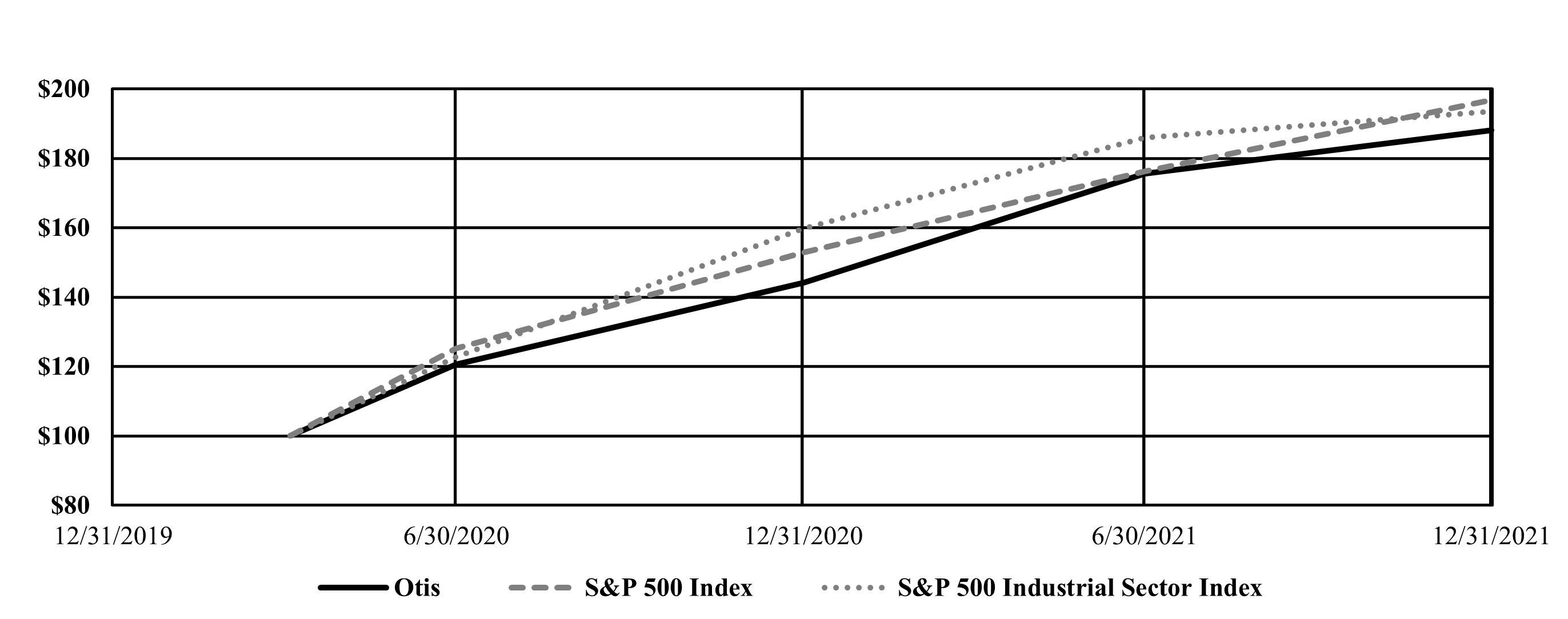
The following table and graph illustrate the total return from April 3, 2020 (date of Separation) through December 31, 2021, for (1) our Common Stock, (2) the Standard and Poor's ("S&P") 500 Index, and (3) the S&P 500 Industrial Sector Index. The graph and table assume that $100.00 was invested on April 3, 2020 in each of our Common Stock, the S&P 500 Index and the S&P 500 Industrial Select Sector Index, and that any dividends were reinvested. The comparison reflected in the graph and the table are not intended to forecast the future performance of our Common Stock and may not be indicative of our future performance.
Comparison of Cumulative Total Return - Table
| April 3, 2020 | June 30, 2020 | December 31, 2020 | June 30, 2021 | December 31, 2021 | ||||||||||||||||
| Otis | $ | 100 | $ | 121 | $ | 144 | $ | 176 | $ | 188 | ||||||||||
| S&P 500 Index | 100 | 125 | 153 | 176 | 197 | |||||||||||||||
| S&P 500 Industrial Sector Index | 100 | 122 | 158 | 186 | 193 |
Comparison of Cumulative Total Return - Graph
Issuer Purchases of Equity Securities
The following table provides information about our purchases during the quarter ended December 31, 2021 of equity securities that are registered by us pursuant to Section 12 of the Exchange Act.
| 2021 | Total Number of Shares Purchased (thousands) | Average Price Paid per Share (1) | Total Number of Shares Purchased as Part of a Publicly Announced Program (thousands) | Approximate Dollar Value of Shares that May Yet Be Purchased Under the Program (dollars in millions) | ||||||||||||||||||||||
| October 1 - October 31 | — | $ | — | — | $ | 275 | ||||||||||||||||||||
| November 1 - November 30 | — | — | — | $ | 275 | |||||||||||||||||||||
| December 1 - December 31 | — | — | — | $ | 275 | |||||||||||||||||||||
| Total | — | $ | — | — |
(1) Average price paid per share includes costs associated with the repurchases.
On April 27, 2020, our Board of Directors authorized a share repurchase program for up to $1 billion of Common Stock. As of December 31, 2021, the maximum dollar value of shares that may yet be purchased under this current program was approximately $275 million. Under this program, shares may be purchased on the open market, in privately negotiated transactions, under accelerated share repurchase programs or under plans complying with rules 10b5-1 and 10b-18 under the Exchange Act. As a result of the increased debt incurred to fund the Tender Offer, we have temporarily suspended our share repurchases as we focus on deleveraging.
Item 6. [Reserved]
Item 7. Management's Discussion and Analysis of Financial Condition and Results of Operations
BUSINESS OVERVIEW
We are the world’s leading elevator and escalator manufacturing, installation and service company. Our Company is organized into two segments, New Equipment and Service. Through our New Equipment segment, we design, manufacture, sell and install a wide range of passenger and freight elevators, as well as escalators and moving walkways for residential and commercial buildings and infrastructure projects. Our New Equipment customers include real-estate and building developers and general contractors who develop and/or design buildings for residential, commercial, retail or mixed-use activity. We sell our New Equipment directly to customers, as well as through agents and distributors.
Through our Service segment, we perform maintenance and repair services for both our own products and those of other manufacturers and provide modernization services to upgrade elevators and escalators. Maintenance services include inspections to ensure code compliance, preventive maintenance offerings and other customized maintenance offerings tailored to meet customer needs, as well as repair services to address equipment and component wear and tear and breakdowns. Modernization services enhance equipment operation and improve building functionality. Modernization offerings can range from relatively simple upgrades of interior finishes and aesthetics to complex upgrades of larger components and sub-systems. Our typical Service customers include building owners, facility managers, housing associations and government agencies that operate buildings where elevators and escalators are installed.
We function under a centralized operating model whereby we pursue a global strategy set around New Equipment and Service, in large measure, because we seek to grow our maintenance portfolio, in part, through the conversion of new elevator and escalator installations into service contracts. Accordingly, we benefit from an integrated global strategy, which sets priorities and establishes accountability across the full product lifecycle.
For additional discussion of our business, refer to Item 1 in this Form 10-K.
Zardoya Otis Tender Offer
The Company announced a tender offer to acquire all of the issued and outstanding shares of Zardoya Otis not owned by Otis (the "Tender Offer"). The offer price is €7.07 per share in cash after adjusting for dividends. As of February 4, 2022, the Tender Offer remains outstanding and has not yet been completed. See "Note 1: Business Overview" and "Note 10: Borrowings and Lines of Credit" in Item 8 in this Form 10-K, as well as "Liquidity and Financial Condition" in this item, for further details regarding this pending transaction and financing arrangements entered into in connection with the Tender Offer and Item 1A in this Form 10-K for additional risks related to thereto.
Impact of COVID-19 on our Company
The results of our operations and overall financial performance were impacted due to the COVID-19 pandemic during the years ended December 31, 2021 and 2020. COVID-19 has had, and could continue to have, an impact on our business, including impacts to overall financial performance in 2022, as a result of the following, among other things:
-
Customer demand impacting our new equipment, maintenance and repair, and modernization businesses
-
Cancellations or delays of customer orders
-
Customer liquidity constraints and related credit reserves
-
Supplier and raw material capacity constraints, delays and related costs
We currently do not expect any significant impact to our capital and financial resources from the COVID-19 pandemic, including our overall liquidity position based on our available cash and cash equivalents and our access to credit facilities and the capital markets.
See the "Liquidity and Financial Condition" section of this item of this Form 10-K for further detail and Item 1A in this Form 10-K for additional risks related to COVID-19.
Separation from United Technologies Corporation
As previously disclosed, on April 3, 2020, Otis became an independent, publicly-traded company and its Common Stock is listed under the symbol "OTIS" on the New York Stock Exchange ("NYSE") as a result of the separation ("the Separation") of each of Otis and Carrier Global Corporation ("Carrier") from United Technologies Corporation, subsequently renamed Raytheon Technologies Corporation ("UTC" or "RTX", as applicable).
Prior to the Separation on April 3, 2020, our historical financial statements were prepared on a standalone combined basis and were derived from the consolidated financial statements and accounting records of our former parent, UTC. For the periods subsequent to April 3, 2020, our financial statements are presented on a consolidated basis as the Company became a standalone public company.
We entered into a transition services agreement ("TSA") and tax matters agreement ("TMA") with our former parent, UTC, and Carrier on April 2, 2020. Under the TSA, we received services for information technology, technical and engineering support, application support for operations, general administrative services and other support services. The TSA and the related trailing exit costs are substantially completed as of December 31, 2021. For additional discussion, see "Note 5: Related Parties" in Item 8 in this Form 10-K.
The TMA governs the parties’ respective rights, responsibilities and obligations with respect to tax matters (including responsibility for taxes, entitlement to refunds, allocation of tax attributes, preparation of tax returns, control of tax contests and other tax matters). For additional discussion, see "Note 5: Related Parties" in Item 8 in this Form 10-K.
See Item 1A in this Form 10-K for discussion on risks related to Separation.
RESULTS OF OPERATIONS
Net Sales
| (dollars in millions) | 2021 | 2020 | 2019 | |||||||||||||||||
| Net sales | $ | 14,298 | $ | 12,756 | $ | 13,118 | ||||||||||||||
| Percentage change year-over-year | 12.1 | % | (2.8) | % | 1.6 | % |
The factors contributing to the total percentage change year-over-year in total Net sales are as follows:
| 2021 | 2020 | |||||||||||||
| Organic volume | 8.9 | % | (2.1) | % | ||||||||||
| Foreign currency translation | 3.0 | % | (0.4) | % | ||||||||||
| Acquisitions and divestitures, net | 0.2 | % | (0.2) | % | ||||||||||
| Other | — | % | (0.1) | % | ||||||||||
| Total % change | 12.1 | % | (2.8) | % |
The Organic volume increase of 8.9% for 2021 was driven by increases in organic sales of 15.5% in New Equipment and 4.1% in Service.
The Organic volume decrease of (2.1)% for 2020 was driven by decreases in organic sales of (4.0)% in New Equipment and (0.7)% in Service.
See "Segment Review" below for a discussion of Net sales by segment.
Cost of Products and Services Sold
| (dollars in millions) | 2021 | 2020 | 2019 | |||||||||||||||||
| Cost of products and services sold | $ | 10,105 | $ | 8,977 | $ | 9,292 | ||||||||||||||
| Percentage change year-over |
Showing the first 8K of 93K characters. Open the full section
Item 7A. Quantitative and Qualitative Disclosures About Market Risk
We are exposed to fluctuations in foreign currency exchange rates and commodity prices. To manage certain of those exposures, we use derivative instruments, including forward contracts. Derivative instruments utilized by us in our hedging activities are viewed as risk management tools, involve relatively little complexity and are not used for trading or speculative purposes. We diversify the counterparties used and monitor the concentration of risk to limit our counterparty exposure.
We have evaluated our exposure to changes in foreign currency exchange rates, commodity prices and interest rates in our market risk sensitive instruments, which are primarily cash, debt and derivative instruments, using a value at risk analysis. Based on a 95% confidence level and one-day holding period, as of December 31, 2021, the potential loss in fair value on our market risk sensitive instruments was not material in relation to our financial position, results of operations or cash flows. Our calculated value at risk exposure represents an estimate of reasonably possible net losses based on volatilities and correlations, and is not necessarily indicative of actual results. Additionally, any losses or gains on derivative instruments would be mostly offset by corresponding gains or losses in the remeasurement of the underlying transactions being hedged.
Refer to "Note 2: Summary of Significant Accounting Policies", "Note 10: Borrowings and Lines of Credit" and "Note 18: Financial Instruments" in Item 8 in this Form 10-K for additional discussion of foreign currency exchange, interest rates and financial instruments, including the aggregate notional amount of our outstanding foreign currency and commodity price hedges.
Foreign Currency Exposures
The value of certain foreign currencies as compared to the U.S. Dollar may impact Otis’ financial results. We have a high volume of foreign currency exposures that result from our international sales, purchases, investments and other international transactions. International sales were approximately $10.6 billion, $9.3 billion and $9.5 billion in 2021, 2020 and 2019, respectively. We manage foreign currency exposures that are associated with committed foreign currency purchases and sales as well as foreign currency denominated assets and liabilities that are created in the ordinary course of business. More than insignificant exposures, that cannot be naturally offset, are generally hedged with foreign currency derivatives.
For our non-U.S. based entities, a substantial portion of revenues are generated and costs are incurred in local currencies. We transact business in various foreign currencies, which exposes our cash flows and earnings to changes in foreign currency exchange rates. We periodically enter into sales contracts denominated in currencies other than the functional currency of the parties to the transaction, which can create foreign exchange exposure. While the objective of the hedging program is to minimize the foreign currency exchange impact on operating results, there are typically variances between the hedging gains or losses and the translational impact due to the length of hedging contracts, changes in the sales profile, volatility in the exchange rates and other such operational considerations. Otis does not enter into hedging contracts for speculative purposes.
As discussed in "Note 18: Financial Instruments" in Item 8 in this Form 10-K, as of December 31, 2021 we have ¥21.5 billion ($189 million) of Japanese Yen denominated long-term debt, which qualifies as a net investment hedge against our investments in Japanese businesses. As of December 31, 2021, the net investment hedge is deemed to be effective.
As discussed in "Note 10: Borrowings and Lines of Credit" in Item 8 in this Form 10-K, as of December 31, 2021 we have €1,600 million ($1,807 million) of Euro denominated long-term debt.
Commodity Price Risk
The fluctuation in prices of certain raw materials may impact Otis' financial results. We are exposed to volatility in the prices of commodities used in some of our products and component parts, such as steel, aluminum and copper, among others. When possible and appropriate, we maintain fixed price contracts on raw materials and component parts. However, we are prone to exposure as these contracts expire. When possible and appropriate, we also include price escalation linked to commodity prices in contracts with our customers and take pricing actions for future contracts. However, products and services delivered to our customers are often provided a year or more after being agreed to, and not all raw material price increases can be passed along to customers with existing contracts. Therefore, when commodity price risk is not mitigated by other methods, we may enter into hedging contracts. Otis does not enter into hedging contracts for speculative purposes.
Interest Rate Risk
Our long-term debt portfolio primarily consists of fixed-rate instruments. For any variable rate debt, interest rate changes in the London Interbank Offered Rate ("LIBOR") will impact future earnings and cash flows. From time to time, we may hedge floating rates using interest rate swaps. The hedges would be designated as fair value hedges and the gains and losses on the swaps would be reported in interest expense, reflecting that portion of interest expense at a variable rate.
For information concerning market risk sensitive instruments, see discussion under the headings "Foreign Exchange Exposures" and "Derivatives and Hedging Activity" in "Note 2: Summary of Accounting Policies," as well as "Note 18: Financial Instruments" in Item 8 in this Form 10-K for additional discussion on unrecognized tax benefits.
Item 8. Financial Statements and Supplementary Data
INDEX TO CONSOLIDATED FINANCIAL STATEMENTS AND
FINANCIAL STATEMENT SCHEDULE
(All other schedules are not required and have been omitted)
Management's Report on Internal Control over Financial Reporting
The management of Otis is responsible for establishing and maintaining adequate internal control over financial reporting. Internal control over financial reporting is a process designed to provide reasonable assurance regarding the reliability of financial reporting and the preparation of financial statements for external reporting purposes in accordance with accounting principles generally accepted in the United States of America. Because of its inherent limitations, internal control over financial reporting may not prevent or detect misstatements.
Management has assessed the effectiveness of Otis' internal control over financial reporting as of December 31, 2021. In making its assessment, management has utilized the criteria set forth by the Committee of Sponsoring Organizations of the Treadway Commission in Internal Control - Integrated Framework (2013). Management concluded that based on its assessment, Otis' internal control over financial reporting was effective as of December 31, 2021. The effectiveness of Otis' internal control over financial reporting, as of December 31, 2021, has been audited by PricewaterhouseCoopers LLP, an independent registered public accounting firm, as stated in their report which is included herein.
| OTIS WORLDWIDE CORPORATION (Registrant) | |||||
| by: | /s/ JUDITH F. MARKS | ||||
| Judith F. Marks | |||||
| Chair, President and Chief Executive Officer | |||||
| by: | /s/ RAHUL GHAI | ||||
| Rahul Ghai | |||||
| Executive Vice President and Chief Financial Officer | |||||
| by: | /s/ MICHAEL P. RYAN | ||||
| Michael P. Ryan | |||||
| Vice President and Chief Accounting Officer | |||||
Report of Independent Registered Public Accounting Firm
To the Board of Directors and Shareholders of Otis Worldwide Corporation
Opinions on the Financial Statements and Internal Control over Financial Reporting
We have audited the accompanying consolidated balance sheets of Otis Worldwide Corporation and its subsidiaries (the “Company”) as of December 31, 2021 and 2020, and the related consolidated statements of operations, of comprehensive income, of changes in equity and of cash flows for each of the three years in the period ended December 31, 2021, including the related notes and financial statement schedule listed in the accompanying index (collectively referred to as the “consolidated financial statements”). We also have audited the Company's internal control over financial reporting as of December 31, 2021, based on criteria established in Internal Control - Integrated Framework (2013) issued by the Committee of Sponsoring Organizations of the Treadway Commission (COSO).
In our opinion, the consolidated financial statements referred to above present fairly, in all material respects, the financial position of the Company as of December 31, 2021 and 2020, and the results of its operations and its cash flows for each of the three years in the period ended December 31, 2021 in conformity with accounting principles generally accepted in the United States of America. Also in our opinion, the Company maintained, in all material respects, effective internal control over financial reporting as of December 31, 2021, based on criteria established in Internal Control - Integrated Framework (2013) issued by the COSO.
Basis for Opinions
The Company's management is responsible for these consolidated financial statements, for maintaining effective internal control over financial reporting, and for its assessment of the effectiveness of internal control over financial reporting, included in the accompanying Management’s Report on Internal Control over Financial Reporting. Our responsibility is to express opinions on the Company’s consolidated financial statements and on the Company's internal control over financial reporting based on our audits. We are a public accounting firm registered with the Public Company Accounting Oversight Board (United States) (PCAOB) and are required to be independent with respect to the Company in accordance with the U.S. federal securities laws and the applicable rules and regulations of the Securities and Exchange Commission and the PCAOB.
We conducted our audits in accordance with the standards of the PCAOB. Those standards require that we plan and perform the audits to obtain reasonable assurance about whether the consolidated financial statements are free of material misstatement, whether due to error or fraud, and whether effective internal control over financial reporting was maintained in all material respects.
Our audits of the consolidated financial statements included performing procedures to assess the risks of material misstatement of the consolidated financial statements, whether due to error or fraud, and performing procedures that respond to those risks. Such procedures included examining, on a test basis, evidence regarding the amounts and disclosures in the consolidated financial statements. Our audits also included evaluating the accounting principles used and significant estimates made by management, as well as evaluating the overall presentation of the consolidated financial statements. Our audit of internal control over financial reporting included obtaining an understanding of internal control over financial reporting, assessing the risk that a material weakness exists, and testing and evaluating the design and operating effectiveness of internal control based on the assessed risk. Our audits also included performing such other procedures as we considered necessary in the cir
Showing the first 8K of 239K characters. Open the full section
Item 9. Changes in and Disagreements with Accountants on Accounting and Financial Disclosure
None.
Item 9A. Controls and Procedures
Evaluation of Disclosure Controls and Procedures
As required by Rule 13a-15(e) under the Exchange Act, we carried out an evaluation under the supervision and with the participation of our management, including the President and Chief Executive Officer ("CEO"), the Executive Vice President and Chief Financial Officer ("CFO") and the Vice President and Chief Accounting Officer ("CAO"), of the effectiveness of the design and operation of our disclosure controls and procedures as of December 31, 2021. There are inherent limitations to the effectiveness of any system of disclosure controls and procedures, including the possibility of human error and the circumvention or overriding of the controls and procedures. Accordingly, even effective disclosure controls and procedures can only provide reasonable assurance of achieving their control objectives. Based upon our evaluation, our CEO, our CFO and our CAO have concluded that, as of December 31, 2021, our disclosure controls and procedures were effective to provide reasonable assurance that information required to be disclosed in the reports that we file or submit under the Exchange Act is recorded, processed, summarized and reported within the time periods specified in the applicable rules and forms, and that it is accumulated and communicated to our management, including our CEO, our CFO and our CAO, as appropriate, to allow timely decisions regarding required disclosure.
Management Report on Internal Control over Financial Reporting
The information required by Item 9A relating to Management's Annual Report on Internal Control Over Financial Reporting and Attestation Report of the Registered Public Accounting Firm is found in Item 8. Financial Statements and Supplementary Data of this Form 10-K and incorporated herein by reference.
Changes in Internal Control over Financial Reporting
There has been no change in our internal control over financial reporting during the quarter ended December 31, 2021, that materially affected, or is reasonably likely to materially affect, our internal control over financial reporting.
Item 9B. Other Information
None.
Item 9C. Disclosure Regarding Foreign Jurisdictions that Prevent Inspections
Not Applicable.
PART III
Item 10. Directors, Executive Officers and Corporate Governance
The information required by Item 10 with respect to directors, the Audit Committee of the Board of Directors and audit committee financial experts is incorporated herein by reference to the section of our Proxy Statement for the 2022 Annual Meeting of Shareholders titled "Corporate governance" (under the subheadings "Proposal 1: Election of directors", "Our Board leadership structure", "Board committees" and "Our board nominees").
Information about our Executive Officers
The following persons are executive officers of Otis Worldwide Corporation:
| Name | Position | Other Business Experience Since 1/1/2017 | Age as of 2/4/2022 | |||||||||||||||||
| Bernardo Calleja Fernandez | President, Otis EMEA (since November 2020) | President of Otis South Europe & Africa, Otis; President, Otis South Europe & Turkey, Otis | 59 | |||||||||||||||||
| James F. Cramer | President, Otis Americas (since June 2020) | Regional Vice President, U.S. Western Region, Otis | 57 | |||||||||||||||||
| Rahul Ghai | Executive Vice President and Chief Financial Officer (since April 2020) | Vice President and Chief Financial Officer, Otis; Senior Vice President and Chief Financial Officer, Harris Corporation | 50 | |||||||||||||||||
| Nora E. LaFreniere | Executive Vice President and General Counsel (since July 2021) | Executive Vice President, Chief General Counsel and Corporate Secretary, Vice President, General Counsel, Otis | 50 | |||||||||||||||||
| Abbe Luersman | Executive Vice President and Chief People Officer (since July 2021) | Chief Human Resource Officer, Ahold Delhaize | 54 | |||||||||||||||||
| Judith F. Marks | Chair, President and Chief Executive Officer (since February 2022) | President and Chief Executive Officer; President, Otis; Chief Executive Officer, Siemens USA and Dresser-Rand (a Siemens company); Executive Vice President, New Equipment Solutions, Dresser-Rand | 58 | |||||||||||||||||
| Stephane de Montlivault | President, Otis Asia Pacific (since April 2020) | President, Otis Asia Pacific; President, Otis Northeast Asia, Otis President, Northeast Asia and President of Nippon Otis Elevator Company | 62 | |||||||||||||||||
| Michael P. Ryan | Vice President and Chief Accounting Officer (since April 2020) | Vice President and Assistant Controller, UTC; and Executive Director, Corporate Accounting and Controls, UTC | 52 | |||||||||||||||||
| Peiming Zheng (Perry) | President, Otis China and Chief Customer Product Officer (since December 2021) | President, Otis China; President, Business & Industrial Systems China, Otis | 54 |
All of the officers serve at the pleasure of the Board of Directors of Otis Worldwide Corporation.
Information concerning Section 16(a) compliance is incorporated herein by reference to the section of our Proxy Statement for the 2022 Annual Meeting of Shareholders titled "Other important information" under the subheading "Delinquent section 16(a) reports." We have adopted a code of ethics, the Otis Absolutes, that applies to all our directors, officers, employees and representatives. This code is publicly available on our website at http://www.otis.com/How-We-Work/Ethics-And-Compliance/Pages/Default.aspx. Amendments to the code of ethics and any grant of a waiver from a provision of the code requiring disclosure under applicable SEC rules will be disclosed on our website. Our Corporate Governance Guidelines and the charters of our Board of Directors’ Audit Committee, Compensation Committee and Nominations and Governance Committee are available on our website at http://www.otis.com/Who-We-Are/Corporate-Governance/Pages/default.aspx. These materials may also be requested in print free of charge by writing to our Investor Relations Department at Otis Worldwide Corporation, One Carrier Place, Investor Relations, Farmington, CT 06032.
Item 11. Executive Compensation
The information required by Item 11 is incorporated herein by reference to the sections of our Proxy Statement for the 2022 Annual Meeting of Shareholders titled "Executive compensation", "Compensation of directors" and "Report of the compensation committee".
Item 12. Security Ownership of Certain Beneficial Owners and Management and Related Stockholder Matters
The information relating to security ownership of certain beneficial owners and management is incorporated herein by reference to the section of our Proxy Statement for the 2022 Annual Meeting of Shareholders titled "Other important information" under the subheading "Stock ownership" (“Beneficial stock ownership of directors and executive officers" and "Certain beneficial owners”).
Equity Compensation Plan Information
The following table provides information as of December 31, 2021 concerning Common Stock issuable under Otis’ equity compensation plans.
| Plan category | Number of securities to be issued upon exercise of outstanding options, warrants and rights (a) | Weighted-average exercise price of outstanding options, warrants and rights (b) | Number of securities remaining available for future issuance under equity compensation plans (excluding securities reflected in column (a) (c) | ||||||||||||||||||||||||||||||||
| Equity compensation plans approved by shareholders | 5,221,275 | (1) | $52.97 | 25,645,407 | (2) | ||||||||||||||||||||||||||||||
| Equity compensation plans not approved by shareholders | - | - | - |
(1) Consists of the following issuable shares of Common Stock awarded under the Otis Worldwide Corporation 2020 Long-Term Incentive Plan ("LTIP"): (i) shares of Common Stock issuable upon the exercise of outstanding non-qualified stock options; (ii) shares of Common Stock issuable upon the exercise of outstanding Stock Appreciation Rights ("SARs"); (iii) shares of Common Stock issuable pursuant to outstanding restricted stock unit and performance share unit awards, assuming performance at the target level (up to an additional 330,204 shares of Common Stock could be issued if performance goals are achieved above target); and (iv) shares of Common Stock issuable upon the settlement of outstanding deferred stock units and restricted stock units under the Otis Worldwide Corporation Board of Directors Stock Unit Plan. Under the LTIP, each SAR is exercisable for a number of shares of Common Stock having a value equal to the increase in the market price of a share of such stock from the date the SAR was granted. For purposes of determining the total number of shares to be issued in respect of outstanding SARs, we have used the New York Stock Exchange ("NYSE") closing price for a share of Common Stock on December 31, 2021 of $87.07. The weighted-average exercise price shown in the column above takes into account only the shares identified in clauses (i) and (ii).
(2) Represents the maximum number of shares of Common Stock available to be awarded under the LTIP as of December 31, 2021. Performance share units, deferred stock units and restricted stock units ("Full Share Awards") will result in a reduction in the number of shares of Common Stock available for delivery under the LTIP in an amount equal to twice the number of shares to which the award corresponds under the terms of the LTIP. Stock options and SARs do not constitute Full Share Awards and will result in a reduction in the number of shares of Common Stock available for delivery under the 2020 LTIP on a one-for-one basis.
Item 13. Certain Relationships and Related Transactions, and Director Independence
The information required by Item 13 is incorporated herein by reference to the sections of our Proxy Statement for the 2022 Annual Meeting of Shareholders titled "Corporate governance" under the subheading "Our board nominees" (including under the subheading "Director independence") and "Other important information" (under the subheading "Transactions with related persons").
Item 14. Principal Accounting Fees and Services
The information required by Item 14 is incorporated by reference to the section of our Proxy Statement for the 2022 Annual Meeting of Shareholders titled "Proposal 3: Appoint an independent auditor for 2022", including the information provided in that section with regard to "Audit Fees", "Audit-Related Fees", "Tax Fees" and "All Other Fees".
PART IV
Item 15. Exhibits and Financial Statement Schedules
(a) The following documents are filed as part of this Form 10-K:
(1) Financial Statements. The financial statements are set forth in Item 8. "Financial Statements and Supplementary Data" in this Form 10-K.
(2) Financial Statement Schedules. The following financial statement schedule is set forth in Item 8. "Financial Statements and Supplementary Data" in this Form 10-K. All other schedules have been omitted because they are not required, are not applicable or the required information is shown in the financial statements or the notes thereto.
- Schedule II — Valuation and Qualifying Accounts
(3) Exhibits. The following list of exhibits includes exhibits submitted with this Form 10-K as filed with the SEC and those incorporated by reference to other filings.
Notes to Exhibits List:
- Submitted electronically herewith.
Attached as Exhibit 101 to this report are the following formatted in XBRL (Extensible Business Reporting Language): (i) Consolidated Statements of Operations for the three years ended December 31, 2021, (ii) Consolidated Statements of Comprehensive Income for the three years ended December 31, 2021, (iii) Consolidated Balance Sheets as of December 31, 2021 and 2020, (iv) Consolidated Statements of Cash Flows for the three years ended December 31, 2021, (v) Consolidated Statements of Changes in Equity for the three years ended December 31, 2021, (vi) Notes to Consolidated Financial Statements, and (vii) Financial Schedule of Valuation and Qualifying Accounts.
Item 16. Form 10-K Summary
Not applicable.
Pursuant to the requirements of the Securities Exchange Act of 1934, as amended, the Registrant has duly caused this report to be signed on its behalf by the undersigned, thereunto duly authorized.
| OTIS WORLDWIDE CORPORATION (Registrant) | |||||||||||
| Dated: | February 4, 2022 | by: | /s/ RAHUL GHAI | ||||||||
| Rahul Ghai | |||||||||||
| Executive Vice President and Chief Financial Officer | |||||||||||
| (on behalf of the Registrant and as the Registrant's Principal Financial Officer) | |||||||||||
| Dated: | February 4, 2022 | by: | /s/ MICHAEL P. RYAN | ||||||||
| Michael P. Ryan | |||||||||||
| Vice President and Chief Accounting Officer | |||||||||||
| (on behalf of the Registrant and as the Registrant's Principal Accounting Officer) |
Pursuant to the requirements of the Securities Exchange Act of 1934, as amended, this report has been signed below by the following persons on behalf of the Registrant and in the capacities and on the dates indicated.
| Signature | Title | Date | ||||||
| /s/ JUDITH F. MARKS | Director, Chair, President and Chief Executive Officer | February 4, 2022 | ||||||
| Judith F. Marks | ||||||||
| /s/ RAHUL GHAI | Executive Vice President and Chief Financial Officer | February 4, 2022 | ||||||
| Rahul Ghai | ||||||||
| /s/ MICHAEL P. RYAN | Vice President and Chief Accounting Officer | February 4, 2022 | ||||||
| Michael P. Ryan | ||||||||
| /s/ JEFFREY H. BLACK* | Director | |||||||
| Jeffrey H. Black | ||||||||
| /s/ KATHY HOPINKAH HANNAN* | Director | |||||||
| Kathy Hopinkah Hannan | ||||||||
| /s/ SHAILESH G. JEJURIKAR* | Director | |||||||
| Shailesh G. Jejurikar | ||||||||
| /s/ CHRISTOPHER J. KEARNEY* | Director | |||||||
| Christopher J. Kearney | ||||||||
| /s/ HAROLD W. MCGRAW III* | Director | |||||||
| Harold W. McGraw III | ||||||||
| /s/ MARGARET M.V. PRESTON* | Director | |||||||
| Margaret M.V. Preston | ||||||||
| /s/ SHELLEY STEWART, JR.* | Director | |||||||
| Shelley Stewart, Jr. | ||||||||
| /s/ JOHN H. WALKER* | Director | |||||||
| John H. Walker | ||||||||
| *By: /s/ NORA E. LAFRENIERE | ||||||||
| Executive Vice President and General Counsel, as Attorney-in-fact | ||||||||
| Date: February 4, 2022 |