 filings.tools
Occidental Petroleum 10-K 2020-12-31
Filed 2021-02-26. 20 sections, 734K characters. Original on sec.gov · Markdown · JSON
Cover and table of contents
UNITED STATES SECURITIES AND EXCHANGE COMMISSION
Washington, D.C. 20549
Form 10-K
| ☑ | Annual Report Pursuant to Section 13 or 15(d) of the Securities Exchange Act of 1934 | ☐ | Transition Report Pursuant to Section 13 or 15(d) of the Securities Exchange Act of 1934 | ||||||||||||||
| For the fiscal year ended | December 31, 2020 | For the transition period from to |
Commission File Number 1-9210
Occidental Petroleum Corporation
(Exact name of registrant as specified in its charter)
| State or other jurisdiction of incorporation or organization | Delaware | ||||||||||||||||
| I.R.S. Employer Identification No. | 95-4035997 | ||||||||||||||||
| Address of principal executive offices | 5 Greenway Plaza, Suite 110 | Houston, | Texas | ||||||||||||||
| Zip Code | 77046 | ||||||||||||||||
| Registrant’s telephone number, including area code | (713) | 215-7000 |
Securities registered pursuant to Section 12(b) of the Act:
| Title of Each Class | Trading Symbol | Name of Each Exchange on Which Registered | ||||||
| Common Stock, $0.20 par value | OXY | New York Stock Exchange | ||||||
| Warrants to Purchase Common Stock, $0.20 par value | OXY WS | New York Stock Exchange |
Securities registered pursuant to Section 12(g) of the Act: None
Indicate by check mark if the registrant is a well-known seasoned issuer, as defined in Rule 405 of the Securities Act.
Yes ☑ No ☐
Indicate by check mark if the registrant is not required to file reports pursuant to Section 13 or Section 15(d) of the Act.
Yes ☐ No ☑
Indicate by check mark whether the registrant (1) has filed all reports required to be filed by Section 13 or 15(d) of the Securities Exchange Act of 1934 during the preceding 12 months (or for such shorter period that the registrant was required to file such reports), and (2) has been subject to such filing requirements for the past 90 days. Yes ☑ No ☐
Indicate by check mark whether the registrant has submitted electronically every Interactive Data File required to be submitted pursuant to Rule 405 of Regulation S-T (§232.405 of this chapter) during the preceding 12 months (or for such shorter period that the registrant was required to submit such files). Yes ☑ No ☐
Indicate by check mark whether the registrant is a large accelerated filer, an accelerated filer, a non-accelerated filer, a smaller reporting company, or an emerging growth company. See the definitions of “large accelerated filer,” “accelerated filer,” “smaller reporting company” and “emerging growth company” in Rule 12b-2 of the Exchange Act.
| Large Accelerated Filer | ☑ | Accelerated Filer | ☐ | Emerging Growth Company | ☐ | ||||||||||||
| Non-Accelerated Filer | ☐ | Smaller Reporting Company | ☐ |
If an emerging growth company, indicate by check mark if the registrant has elected not to use the extended transition period for complying with any new or revised financial accounting standards provided pursuant to Section 13(a) of the Exchange Act. ☐
Indicate by check mark whether the registrant has filed a report on and attestation to its management’s assessment of the effectiveness of its internal control over financial reporting under Section 404(b) of the Sarbanes-Oxley Act (15 U.S.C. 7262(b)) by the registered public accounting firm that prepared or issued its audit report. ☑
Indicate by check mark whether the registrant is a shell company (as defined in Rule 12b-2 of the Act). Yes ☐ No ☑
The aggregate market value of the registrant’s Common Stock held by nonaffiliates of the registrant was approximately $17.0 billion computed by reference to the closing price on the New York Stock Exchange of $18.30 per share of Common Stock on June 30, 2020.
At January 31, 2021, there were 931,554,718 shares of Common Stock outstanding, par value $0.20 per share.
DOCUMENTS INCORPORATED BY REFERENCE
Portions of the registrant’s definitive Proxy Statement, relating to its 2021 Annual Meeting of Stockholders, are incorporated by reference into Part III of this Form 10-K.
 | BUSINESS AND PROPERTIES |
Part I
ITEMS 1 AND 2. BUSINESS AND PROPERTIES
In this report, “Occidental”, “we” and “our” refers to Occidental Petroleum Corporation, a Delaware corporation incorporated in 1986, or Occidental and one or more entities in which it owns a controlling interest (subsidiaries). Occidental conducts its operations through its various subsidiaries and affiliates. Occidental’s executive offices are located at 5 Greenway Plaza, Suite 110, Houston, Texas 77046; telephone (713) 215-7000.
| GENERAL |
Occidental’s principal businesses consist of three reporting segments: oil and gas, chemical and midstream and marketing. The oil and gas segment explores for, develops and produces oil and condensate, natural gas liquids (NGL) and natural gas. The chemical segment (OxyChem) mainly manufactures and markets basic chemicals and vinyls. The midstream and marketing segment purchases, markets, gathers, processes, transports and stores oil, condensate, NGL, natural gas, carbon dioxide (CO2) and power. It also trades around its assets, including transportation and storage capacity, and invests in entities that conduct similar activities such as Western Midstream Partners, L.P. (WES).
The midstream and marketing segment also includes Oxy Low Carbon Ventures (OLCV). OLCV seeks to leverage Occidental’s carbon management expertise that is derived from its enhanced oil recovery (EOR) operations to develop carbon capture, utilization and storage facilities that are expected to source anthropogenic CO2 and promote innovative technologies that drive cost efficiencies and economically grow Occidental’s business while reducing emissions.
On August 8, 2019, pursuant to the Agreement and Plan of Merger dated May 9, 2019, Occidental acquired all of the outstanding shares of Anadarko Petroleum Corporation (Anadarko), through a transaction in which a wholly owned subsidiary of Occidental merged with and into Anadarko (the Acquisition). The Acquisition added to Occidental's oil and gas portfolio, primarily in the Permian Basin, DJ Basin, Gulf of Mexico and Algeria, and an interest in WES.
For further information regarding Occidental’s segments, geographic areas of operation and current developments, see the Management’s Discussion and Analysis of Financial Condition and Results of Operations section under Part II, Item 7, of this Form 10-K and Note 18 - Industry Segments and Geographic Areas in the Notes to Consolidated Financial Statements.
| HUMAN CAPITAL RESOURCES |
Occidental’s culture of diversity, inclusion and belonging aspires to create an environment where differences are appreciated, all employees are included and everyone feels that they belong. As part of our commitment to support this culture, we conducted a robust survey across our organization. The results were reviewed with our Board of Directors and are a basis for our company’s core values.
Occidental’s human capital resources extend across several regions. Occidental has attracted a diverse work force of exceptional talent, including employees from many nations. This diversity enriches our culture, our employees' experience on the job and contributes to an innovative and effective business model that encourages local communities to thrive. Diversity, inclusion and belonging power our innovation and spirit of excellence, as well as our knowledge and results. Embedding diversity, inclusion and belonging into our culture enhances Occidental’s collaboration, performance and growth and helps uphold our organizational values. Occidental’s culture of diversity, inclusion and belonging is designed to create an environment where our employees’ differences are celebrated and encouraged. Occidental’s management works to leverage its employees’ various backgrounds, unique experiences and points of view to spark innovation, empower growth, outperform expectations and maximize results. Diversity is who we are, inclusion is how we work and belonging is how we thrive. Occidental’s recruiting, training and career development programs are designed to help every employee realize his or her full potential.
The below table approximates regional distribution of Occidental’s employees:
| North America | Middle East | Latin America | Other (a) | Total (b) | ||||||||||||||||||||||||||||
| Union | 500 | 800 | 50 | — | 1,350 | |||||||||||||||||||||||||||
| Non-Union | 7,750 | 2,500 | 100 | 100 | 10,450 | |||||||||||||||||||||||||||
| Total | 8,250 | 3,300 | 150 | 100 | 11,800 |
(a)Other headcount includes North Africa, Europe and Asia.
(b)Includes approximately 2,900 employees in the Chemical segment.
| 2 | OXY 2020 FORM 10-K |
| BUSINESS AND PROPERTIES |
Occidental is dedicated to attracting and retaining top talent and Occidental is regularly evaluating and updating its human capital resources to enable its employees to live well and work well. Occidental offers education resources, programs, time away benefits and insurance to support multiple factors of health including physical, financial, social and mental. Occidental’s ultimate goal is to give employees the tools and resources they need to succeed both personally and professionally and foster a safe and collaborative work environment.
Occidental’s employees are key to its ability to safely adapt to an evolving business environment; one of Occidental’s top priorities is safety for all. In industries where Occidental operates one of the key performance indicators of a successful company is a low injury incidence rate. Occidental’s injury rate for 2020 was historically low. Management’s compensation is impacted by the number of health and safety incidents, which was most recently reflected in management’s 2020 annual bonus determination.
Occidental’s employees are evaluated relative to Occidental’s core values. These core values are as follows:
■Lead with Passion
■Outperform Expectations
■Deliver Results Responsibly
■Unleash Opportunities
■Commit to Good
| AVAILABLE INFORMATION |
Occidental’s annual reports on Form 10-K, quarterly reports on Form 10-Q, current reports on Form 8-K and any amendments to those reports are available free of charge on its website, www.oxy.com, as soon as reasonably practicable after Occidental electronically files the material with, or furnishes it to, the Securities and Exchange Commission (SEC). In addition, copies of Occidental’s annual report will be made available, free of charge, upon written request.
Information contained on Occidental’s website is not part of this report or any other filings with the SEC.
| OXY 2020 FORM 10-K | 3 |
| BUSINESS AND PROPERTIES |
| OIL AND GAS OPERATIONS |
GENERAL
Occidental’s oil and gas assets are characterized by an advantaged mix of short-cycle and long-cycle high-return development opportunities. Occidental conducts its ongoing exploration and production activities in the United States, the Middle East and Africa. Within the United States, Occidental has operations in Texas, New Mexico and Colorado, as well as offshore operations in the Gulf of Mexico. Internationally, Occidental conducts operations primarily in Oman, United Arab Emirates (UAE) and Algeria. Operations in Ghana are classified as held for sale as of December 31, 2020. Refer to the Oil and Gas Acreage section in Supplemental Oil and Gas Information under Item 8 of this Form 10-K for further disclosure of Occidental’s holdings of developed and undeveloped oil and gas acreage.
COMPETITION
As a producer of oil, condensate, NGL and natural gas, Occidental competes with numerous other domestic and international public, private and government producers. Oil (which includes condensate), NGL and natural gas are sensitive to prevailing global and local, current and anticipated market conditions. Occidental’s competitive strategy relies on maintaining production in a capital efficient manner through developing conventional and unconventional fields and utilizing primary and EOR techniques in areas where Occidental has a competitive advantage as a result of its successful operations or investments in shared infrastructure. Occidental also competes to develop and produce its worldwide oil and gas reserves safely and cost-effectively, maintain a skilled workforce and obtain quality services.
PROVED RESERVES AND SALES VOLUMES
The table below shows Occidental’s year-end oil, NGL and natural gas proved reserves. See the information under Oil and Gas Segment in the Management's Discussion and Analysis section under Part II, Item 7, of this report for details regarding Occidental’s proved reserves, the reserves estimation process, sales and production volumes, production costs and other reserves-related data.
COMPARATIVE OIL AND GAS PROVED RESERVES AND SALES VOLUMES
Oil and NGL are in millions of barrels; natural gas is in billions of cubic feet (Bcf); barrels of oil equivalent (Boe) are in millions.
| 2020 | 2019 | 2018 | |||||||||||||||||||||||||||||||||||||||||||||
| Oil | NGL | Gas | Boe | (a) | Oil | NGL | Gas | Boe | (a) | Oil | NGL | Gas | Boe | (a) | |||||||||||||||||||||||||||||||||
| Proved Reserves (b) | |||||||||||||||||||||||||||||||||||||||||||||||
| United States | 1,144 | 384 | 2,446 | 1,936 | 1,570 | 540 | 4,128 | 2,798 | 1,186 | 284 | 1,445 | 1,711 | |||||||||||||||||||||||||||||||||||
| International (c,d) | 331 | 215 | 2,573 | 975 | 469 | 208 | 2,572 | 1,106 | 397 | 202 | 2,650 | 1,041 | |||||||||||||||||||||||||||||||||||
| Total | 1,475 | 599 | 5,019 | 2,911 | 2,039 | 748 | 6,700 | 3,904 | 1,583 | 486 | 4,095 | 2,752 | |||||||||||||||||||||||||||||||||||
| Sales Volumes | |||||||||||||||||||||||||||||||||||||||||||||||
| United States | 205 | 81 | 561 | 380 | 155 | 52 | 326 | 261 | 91 | 25 | 119 | 136 | |||||||||||||||||||||||||||||||||||
| International (c,d) | 59 | 13 | 195 | 104 | 64 | 13 | 204 | 111 | 62 | 11 | 189 | 104 | |||||||||||||||||||||||||||||||||||
| Total | 264 | 94 | 756 | 484 | 219 | 65 | 530 | 372 | 153 | 36 | 308 | 240 |
(a)Natural gas volumes are converted to Boe at six thousand cubic feet (Mcf) of gas per one barrel of oil. Conversion to Boe does not necessarily result in price equivalency.
(b)The detailed proved reserves information presented in accordance with Item 1202(a)(2) to Regulation S-K under the Securities Exchange Act of 1934 (Exchange Act) is provided in the Supplemental Oil and Gas Information section in Item 8 of this Form 10-K. Proved reserves are stated on a net basis after applicable royalties.
(c)International proved reserves and sales volumes in 2019 have been reclassified to include Occidental’s operations in Algeria.
(d)Excludes reserves and sales volumes related to Occidental’s discontinued operations in 2020 and 2019, respectively.
| 4 | OXY 2020 FORM 10-K |
| BUSINESS AND PROPERTIES |
| CHEMICAL OPERATIONS |
GENERAL
OxyChem owns and operates manufacturing plants at 22 domestic sites in Alabama, Georgia, Illinois, Kansas, Louisiana, Michigan, New Jersey, New York, Ohio, Tennessee and Texas and at two international sites in Canada and Chile.
COMPETITION
OxyChem competes with numerous other domestic and international chemical producers. OxyChem’s market position was first or second in the United States in 2020 for the principal basic chemical products it manufactures and markets as well as for vinyl chloride monomer (VCM). OxyChem ranks in the top three producers of polyvinyl chloride (PVC) in the United States. OxyChem’s competitive strategy is to be a low-cost producer of its products in order to compete on price.
OxyChem produces the following products:
| Principal Products | Major Uses | Annual Capacity | ||||||
| Basic Chemicals | ||||||||
| Chlorine | Raw material for ethylene dichloride (EDC), water treatment and pharmaceuticals | 3.4 million tons | ||||||
| Caustic soda | Pulp, paper and aluminum production | 3.5 million tons | ||||||
| Chlorinated organics | Refrigerants (a), silicones and pharmaceuticals | 1.0 billion pounds | ||||||
| Potassium chemicals | Fertilizers, batteries, soaps, detergents and specialty glass | 0.4 million tons | ||||||
| EDC | Raw material for VCM | 2.1 billion pounds | ||||||
| Chlorinated isocyanurates | Swimming pool sanitation and disinfecting products | 131 million pounds | ||||||
| Sodium silicates | Catalysts, soaps, detergents and paint pigments | 0.6 million tons | ||||||
| Calcium chloride | Ice melting, dust control, road stabilization and oil field services | 0.7 million tons | ||||||
| Vinyls | ||||||||
| VCM | Precursor for PVC | 6.2 billion pounds | ||||||
| PVC | Piping, building materials and automotive and medical products | 3.7 billion pounds | ||||||
| Ethylene | Raw material for VCM | 1.2 billion pounds (b) |
(a)Includes 4CPe, a raw material used in making next generation, climate friendly refrigerants with low global warming and zero ozone depletion potential.
(b)Amount is gross production capacity for 50/50 joint venture with Orbia (formerly Mexichem).
| OXY 2020 FORM 10-K | 5 |
| BUSINESS AND PROPERTIES |
| MIDSTREAM AND MARKETING OPERATIONS |
GENERAL
Occidental’s midstream and marketing operations primarily support and enhance its oil and gas and chemical businesses. The midstream and marketing segment strives to maximize realized value by optimizing the use of its gathering, processing, transportation, storage and terminal commitments and by providing access to domestic and international markets. To generate returns, the segment evaluates opportunities across the value chain and uses its assets to provide services to Occidental subsidiaries, as well as third parties. The midstream and marketing segment operates or contracts for services on gathering systems, gas plants, co-generation facilities and storage facilities and invests in entities that conduct similar activities. The midstream and marketing segment has equity investments in WES and Dolphin Energy Limited. WES owns gathering systems, plants and pipelines and earns revenue from fee-based and service-based contracts with Occidental and third parties. Dolphin Energy Limited owns and operates a pipeline which connects its gas processing and compression plant in Qatar and its receiving facilities in UAE and uses its network of Dolphin Energy Limited-owned and other existing leased pipelines to supply natural gas across the UAE and to Oman. Also included in the midstream and marketing segment is OLCV.
COMPETITION
Occidental’s midstream and marketing businesses operate in competitive and highly regulated markets. Occidental competes for capacity and infrastructure for the gathering, processing, transportation, storage and delivery of its products, which are sold at current market prices or on a forward basis to refiners, end users and other market participants. Occidental’s marketing business competes with other market participants on exchange platforms and through other bilateral transactions with direct counterparties.
Occidental’s midstream and marketing operations are conducted in the locations described below as of December 31, 2020:
| Location | Description | Capacity (a) | ||||||
| Gas Plants | ||||||||
| Texas, New Mexico and Colorado | Occidental and third-party-operated natural gas gathering, compression and processing systems and CO2 processing and capturing | 2.7 Bcf/d | ||||||
| Rocky Mountains, Pennsylvania and Texas | Equity investment in WES - gas processing facilities | 5.6 Bcf/d | ||||||
| UAE | Natural gas processing facilities for Al Hosn | 1.3 Bcf/d | ||||||
| Pipelines and Gathering Systems | ||||||||
| Texas, New Mexico and Colorado | CO2 fields and pipeline systems transporting CO2 to oil and gas producing locations | 2.8 Bcf/d | ||||||
| Qatar, UAE and Oman | Equity investment in the Dolphin Energy Limited natural gas pipeline | 3.2 Bcf/d | ||||||
| United States | Equity investment in WES involved in gathering and transportation | 17,027 miles of pipeline | ||||||
| Power Generation | ||||||||
| Texas and Louisiana | Occidental-operated power and steam generation facilities | 1,218 megawatts of electricity and 1.6 million pounds of steam per hour | ||||||
| OLCV | ||||||||
| Texas | Occidental-owned solar generation facility | 16.8 megawatts of electricity | ||||||
| Texas | Equity investment in a zero-emission natural gas generation demonstration facility | 50 megawatts of electricity | ||||||
| Canada | Equity investment in direct air capture technology, which captures CO2 directly from the atmosphere. The captured CO2 can be permanently sequestered or synthesized into transportation fuels. |
(a)Amounts are gross, including interests held by third parties.
| 6 | OXY 2020 FORM 10-K |
| BUSINESS AND PROPERTIES |
| ENVIRONMENTAL REGULATION |
For environmental regulation information, including associated costs, see the information under Environmental Liabilities and Expenditures in the Management’s Discussion and Analysis of Financial Condition and Results of Operations section under Part II, Item 7, of this Form 10-K and Risk Factors under Part I, Item 1A.
Item 1A. RISK FACTORS
Risks related to Occidental’s business and operations
The COVID-19 pandemic has adversely affected our business and the ultimate effect on our operations and financial condition will depend on future developments, which are highly uncertain.
The COVID-19 pandemic has adversely affected the global economy, disrupted global supply chains and created significant volatility in the financial markets. In addition, the pandemic has resulted in travel restrictions, business closures and the institution of quarantining and other restrictions on movement in many communities. As a result, there has been a significant reduction in demand for and prices of crude oil, NGL and natural gas. If the reduced demand for and prices of crude oil, NGL and natural gas persist for a prolonged period, our operations, financial condition, cash flows, level of expenditures and the quantity of estimated proved reserves that may be attributed to our properties may be materially and adversely affected. Our operations also may be adversely affected if significant portions of our workforce are unable to work effectively, including because of illness, quarantines, government actions or other restrictions in connection with the pandemic. We have implemented workplace restrictions in our offices and work sites for health and safety reasons and continue to monitor national, state and local government directives where we have operations and/or offices. Further, our business plan, including our financing and liquidity plan, includes, among other things, planned divestitures. If general economic conditions or conditions in the energy industry persist at current levels for an extended period of time, we may not be able to complete these transactions on favorable terms, in a timely manner or at all. The extent to which the COVID-19 pandemic adversely affects our business, results of operations and financial condition will depend on future developments, which are highly uncertain, including the scope and duration of the pandemic and actions taken by governmental authorities and other third parties in response to the pandemic. The COVID-19 pandemic may also materially adversely affect our operating and financial results in a manner that is not currently known to us or that we do not currently consider to present significant risks to our operations. To the extent the COVID-19 pandemic may continue to adversely affect our business, operations, financial condition and operating results, it may also have the effect of heightening the other risks described herein.
Volatile global and local commodity pricing strongly affect Occidental’s results of operations.
Occidental’s financial results correlate closely to the prices it obtains for its products, particularly oil and, to a lesser extent, NGL and its chemical products and natural gas.
Prices for oil, NGL and natural gas fluctuate widely. Historically, the markets for oil, NGL and natural gas have been volatile and may continue to be volatile in the future. If the prices of oil, NGL or natural gas continue to be volatile or decline, Occidental’s operations, financial condition, cash flows, level of expenditures and the quantity of estimated proved reserves that may be attributed to our properties may be materially and adversely affected. Prices are set by global and local market forces which are not in Occidental’s control. These factors include, among others:
■Worldwide and domestic supplies of, and demand for, oil, NGL, natural gas and refined products;
■The cost of exploring for, developing, producing, refining and marketing oil, NGL, natural gas and refined products;
■Operational impacts such as production disruptions, technological advances and regional market conditions, including available transportation capacity and infrastructure constraints in producing areas;
■Changes in weather patterns and climate;
■The impacts of the members of the Organization of the Petroleum Exporting Countries (OPEC) and other non-OPEC member-producing nations that may agree to and maintain production levels;
■The worldwide military and political environment, including uncertainty or instability resulting from an escalation or outbreak of armed hostilities or acts of terrorism in the United States or elsewhere;
■The price and availability of alternative and competing fuels;
■Technological advances affecting energy consumption and supply;
■Domestic and foreign governmental regulations and taxes;
■Shareholder activism or activities by non-governmental organizations to restrict the exploration, development and production of oil, NGL and natural gas;
■Additional or increased nationalization and expropriation activities by foreign governments;
■The impact and uncertainty of world health events, including the COVID-19 pandemic;
| OXY 2020 FORM 10-K | 7 |
| RISK FACTORS |
■Volatility in commodity markets;
■The effect of energy conservation efforts; and
■Global inventory levels and general economic conditions.
The long-term effects of these and other conditions on the prices of oil, NGL, natural gas and refined products are uncertain and there can be no assurance that the demand or pricing for Occidental’s products will follow historic patterns or recover meaningfully in the near-term. Prolonged or substantial decline, or sustained market uncertainty, in these commodity prices may have the following effects on Occidental’s business:
■Adversely affect Occidental’s financial condition, liquidity, ability to reduce debt, pay dividends and finance planned capital expenditures, ability to repurchase shares and results of operations;
■Reduce the amount of oil, NGL and natural gas that Occidental can produce economically;
■Cause Occidental to delay or postpone some of its capital projects;
■Reduce Occidental’s revenues, operating income or cash flows;
■Reduce the amounts of Occidental’s estimated proved oil, NGL and natural gas reserves;
■Reduce the carrying value of Occidental’s oil and natural gas properties due to recognizing impairments of proved properties, unproved properties and exploration assets;
■Reduce the standardized measure of discounted future net cash flows relating to oil, NGL and natural gas reserves;
■Limit Occidental’s access to, or increase the cost of, sources of capital such as equity and long-term debt; and
■Adversely affect the ability of Occidental’s partners to fund their working interest capital requirements.
Generally, Occidental’s historical practice has been to remain exposed to the market prices of commodities. In 2019, Occidental entered into 2020 Brent-priced 3-way collars combined with 2021 call options on the same volume to manage its near-term exposure to cash flow variability from oil price risks in 2020. The 2021 call options were sold to enhance the upside retention in 2020. In 2020, management elected to hedge a portion of Occidental’s expected 2021 natural gas production to enhance cash flow stability. In the future, management may continue to hedge some of the risk of oil, NGL and natural gas price fluctuations. Commodity price risk management activities may prevent us from fully benefiting from price increases and may expose us to regulatory, counterparty credit and other risks.
The prices obtained for Occidental’s chemical products correlate to the health of the United States and global economies, as well as chemical industry expansion and contraction cycles. Occidental also depends on feedstocks and energy to produce chemicals, which are commodities subject to significant price fluctuations.
Occidental may experience delays, cost overruns, losses or other unrealized expectations in development efforts and exploration activities.
Oil, NGL and natural gas exploration and production activities are subject to numerous risks beyond our control, including the risk that drilling will not result in commercially viable oil, NGL and natural gas production. In its development and exploration activities, Occidental bears the risks of:
■Equipment failures;
■Construction delays;
■Escalating costs or competition for services, materials, supplies or labor;
■Property or border disputes;
■Disappointing drilling results or reservoir performance;
■Title problems and other associated risks that may affect its ability to profitably grow production, replace reserves and achieve its targeted returns;
■Actions by third-party operators of our properties;
■Delays and costs of drilling wells on lands subject to complex development terms and circumstances; and
■Oil, NGL and natural gas gathering, transportation and processing availability, restrictions or limitations.
Exploration is inherently risky and is subject to delays, misinterpretation of geologic or engineering data, unexpected geologic conditions or finding reserves of disappointing quality or quantity, which may result in significant losses.
Governmental actions and political instability may affect Occidental’s results of operations.
Occidental’s businesses are subject to the actions and decisions of many federal, state, local and foreign governments and political interests. As a result, Occidental faces risks of:
■New or amended laws and regulations, or new or different applications or interpretations of existing laws and regulations, including those related to drilling, manufacturing or production processes (including flaring, well stimulation techniques such as hydraulic fracturing and acidization), pipelines, labor and employment, taxes, royalty rates, permitted production rates, entitlements, import, export and use of raw materials, equipment or products, use
| 8 | OXY 2020 FORM 10-K |
| RISK FACTORS |
or increased use of land, water and other natural resources, safety, the manufacturing of chemicals, asset integrity management, the marketing or export of commodities, security and environmental protection, all of which may restrict or prohibit activities of Occidental or its contractors, increase Occidental’s costs or reduce demand for Occidental’s products. In addition, violation of certain governmental laws and regulations may result in strict, joint and several liability and the imposition of significant civil and criminal fines and penalties;
■Refusal of, or delay in, the extension or grant of exploration, development or production contracts; and
■Development delays and cost overruns due to approval delays for, or denial of, drilling, construction, environmental and other regulatory approvals, permits and authorizations.
The following are examples of actions and decisions recently taken by federal and state governments that impact Occidental’s businesses:
In January 2021, the Colorado Oil and Gas Conservation Commission (COGCC) adopted new regulations that impose siting requirements or “setbacks” on certain oil and gas drilling locations based on the distance of a proposed well pad to occupied structures. Pursuant to the regulations, well pads cannot be located within 500 feet of an occupied structure without the consent of the property owner. As part of the permitting process, the COGCC will consider a series of siting requirements for all drilling locations located between 500 feet and 2,000 feet of an occupied structure. Alternatively, the operator may seek a waiver from each owner and tenant within the designated distance. While Occidental is currently evaluating the impact of these regulations on its business, at this time, Occidental does not anticipate significant near-term changes to our development program in the DJ Basin based on these regulations. However, as a result, certain of Occidental’s proved undeveloped (PUD) reserves have been derecognized as they no longer meet the regulatory certainty criteria to be considered proved reserves. Occidental’s ability to reestablish previously derecognized PUD reserves, as well as establishing new PUD locations, will depend upon Occidental establishing a history of obtaining drilling permits under the new regulations and thus meeting the SEC’s “reasonably certain” threshold for adding PUD reserves. Occidental currently believes it will be able to successfully navigate the new setback guidelines.
An executive order was issued in January 2021, Tackling the Climate Crisis at Home and Abroad, that mandated an indefinite pause on new oil and gas leasing on federal lands, onshore and offshore, while a comprehensive review of oil and gas permitting and leasing process is conducted by the U.S. Department of the Interior. In conducting this review, the Secretary of the Interior is required to consider whether to adjust royalties associated with oil and gas resources extracted from public lands and offshore waters to account for corresponding climate costs.
In addition, effective January 20, 2021, the Department of the Interior issued an order temporarily elevating the decision-making approval previously delegated to the Department of the Interior’s agencies and bureaus, including the Bureau of Ocean Energy Management (BOEM) and the Bureau of Land Management (BLM), to issue any onshore and offshore fossil fuel authorization for, including but not limited to a lease, amendment to a lease, affirmative extension of a lease, contract or other agreement or permit to drill to the leadership of the Department of the Interior. Occidental is continuing to evaluate the overall impact of these new regulatory issuances on its oil and gas operations on federal leases.
In addition, Occidental has experienced and may continue to experience adverse consequences, such as risk of loss or production limitations, because certain of its international operations are located in countries affected by political instability, nationalizations, corruption, armed conflict, terrorism, insurgency, civil unrest, security problems, labor unrest, OPEC production restrictions, equipment import restrictions and sanctions. Exposure to such risks may increase if a greater percentage of Occidental’s future oil and gas production or revenue comes from international sources.
Occidental’s oil and gas business operates in highly competitive environments, which affect, among other things, its ability to make acquisitions to grow production and replace reserves.
Results of operations, reserves replacement and growth in oil and gas production depend, in part, on Occidental’s ability to profitably acquire additional reserves. Occidental has many competitors (including national oil companies), some of which: (i) are larger and better funded; (ii) may be willing to accept greater risks; (iii) have greater access to capital; (iv) have substantially larger staffs; or (v) have special competencies. Competition for reserves may make it more difficult to find attractive investment opportunities or require delay of reserve replacement efforts. Further, during periods of low product prices, any cash conservation efforts may delay production growth and reserve replacement efforts. Also, there is substantial competition for capital available for investment in the oil and natural gas industry. Our failure to acquire properties, grow production, replace reserves and attract and retain qualified personnel could have a material adverse effect on our cash flows and results of operations.
In addition, Occidental’s acquisition activities carry risks that it may: (i) not fully realize anticipated benefits due to less-than-expected reserves or production or changed circumstances, such as declines in oil, NGL and natural gas prices; (ii) bear unexpected integration costs or experience other integration difficulties; (iii) experience share price declines based on the market’s evaluation of the activity; or (iv) be subject to liabilities that are greater than anticipated.
| OXY 2020 FORM 10-K | 9 |
| RISK FACTORS |
Occidental’s oil and gas reserves are estimates based on professional judgments and may be subject to revision.
Reported oil and gas reserves are an estimate based on periodic review of reservoir characteristics and recoverability, including production decline rates, operating performance and economic feasibility at the prevailing commodity prices, assumptions concerning future oil and natural gas prices, future operating costs and capital expenditures, workover and remedial costs, assumed effects of regulation by governmental agencies, the quantity, quality and interpretation of relevant data, taxes and availability of funds. The procedures and methods for estimating the reserves by our internal engineers were reviewed by independent petroleum consultants; however, there are inherent uncertainties in estimating reserves. Actual production, revenues, expenditures, oil, NGL and natural gas prices and taxes with respect to our reserves may vary from estimates and the variance may be material. If Occidental were required to make significant negative reserve revisions, its results of operations and stock price could be adversely affected.
In addition, the discounted cash flows included in this Form 10-K should not be construed as the fair value of the reserves attributable to our properties. The estimated discounted future net cash flows from proved reserves are based on an unweighted arithmetic average of the first-day-of-the-month price for each month within the year in accordance with SEC regulations. Actual future prices and costs may differ materially from SEC regulation-compliant prices and costs used for purposes of estimating future discounted net cash flows from proved reserves. Also, actual future net cash flows may differ from these discounted net cash flows due to the amount and timing of actual production, availability of financing for capital expenditures necessary to develop our undeveloped reserves, supply and demand for oil, NGL and natural gas, increases or decreases in consumption of oil, NGL and natural gas and changes in governmental regulations or taxation.
Climate change and further regulation of greenhouse gas emissions may adversely affect Occidental’s operations or results.
Continuing political and social attention to the issue of climate change has resulted in both existing and pending international agreements and national, regional and local legislation and regulatory programs to reduce greenhouse gas emissions. In December 2009, the Environmental Protection Agency (EPA) determined that emissions of carbon dioxide, methane and other greenhouse gases endanger public health and the environment because emissions of such gases are, according to the EPA, contributing to warming of the Earth’s atmosphere and other climatic changes. Based on these findings, the EPA began adopting and implementing regulations to restrict emissions of greenhouse gases under existing provisions of the Clean Air Act. The current administration has identified climate change as a priority and has issued new executive orders and regulatory actions prohibiting or restricting oil and gas development activities in certain areas. As an example in January 2021, the actions undertaken by the Department of the Interior to temporarily elevate the decision-making approval process for new fossil fuel leases or permits. In addition, the United States has re-entered the Paris Agreement, which requires countries to periodically review and represent a progression in greenhouse gas emission reduction goals and an executive order was issued, Protecting Public Health and the Environment and Restoring Science to Tackle the Climate Crisis. In the future, the United States may choose to adhere to other international agreements targeting greenhouse gas reductions and there may be new executive orders, regulatory actions and/or legislation targeting greenhouse gas emissions or prohibiting or restricting oil and gas development activities.
However, in the current absence of federal legislation to significantly reduce emissions of greenhouse gases to date, many state governments have established rules aimed at reducing greenhouse gas emissions, some including greenhouse gas cap and trade programs. Most of these cap and trade programs work by requiring major sources of emissions, such as electric power plants, or major producers of fuels, including refineries and natural gas processing plants, to acquire and surrender emission allowances.
These and other government actions relating to greenhouse gas emissions could require Occidental to incur increased operating and maintenance costs including higher rates charged by service providers, costs to purchase and operate emissions control systems, to acquire emission allowances, pay carbon taxes, or comply with new regulatory or reporting requirements or prevent Occidental from conducting oil and gas development activities in certain areas, or they could promote the use of alternative sources of energy and thereby decrease demand for oil, NGL and natural gas and other products that Occidental’s businesses produce. Any such legislation or regulatory programs could also increase the cost of consuming, and thereby reduce demand for, oil, NGL, natural gas or other products produced by Occidental’s businesses and lower the value of its reserves. Consequently, government actions designed to reduce emissions of greenhouse gases could have an adverse effect on Occidental’s business, financial condition, results of operations, cash flows and reserves.
It is difficult to predict the timing and certainty of such government actions and their ultimate effect on Occidental, which could depend on, among other things, the type and extent of greenhouse gas reductions required, the availability and price of emission allowances or credits, the availability and price of alternative fuel sources, the energy sectors covered and Occidental’s ability to recover the costs incurred through its operating agreements or the pricing of its oil, NGL, natural gas and other products and whether service providers are able to pass increased costs through to Occidental.
There also have been efforts in the investment community, including investment advisers and certain sovereign wealth, pension and endowment funds, as well as other stakeholders, promoting divestment of fossil fuel equities and pressuring lenders to limit funding to companies engaged in the extraction of fossil fuel reserves. Such environmental activism and
| 10 | OXY 2020 FORM 10-K |
| RISK FACTORS |
initiatives aimed at limiting climate change and reducing air pollution could adversely affect our business activities, operations and ability to access capital. Such initiatives could cause the market value of our securities to decrease, our cost of capital to increase and adversely affect our reputation. Finally, increasing attention to climate change risks has resulted in an increased possibility of governmental investigations and additional private litigation against Occidental without regard to causation or our contribution to the asserted damage, which could increase our costs or otherwise adversely affect our business. Occidental has been named in certain private litigation relating to these matters.
Occidental has recorded impairments of its proved and unproved oil and gas properties and will continue to assess further impairments in the future.
We have recorded impairments of our proved and unproved oil and gas properties resulting from prolonged declines in oil and gas prices and may record such impairments in the future. Past impairments include pre-tax impairment and related charges to both proved and unproved oil and gas properties and a lower of cost or net realizable value adjustment for crude inventory. In 2020, Occidental recognized a pre-tax impairment to its oil and gas proved and unproved properties of $9.2 billion. If there is a worsening of the macroeconomic conditions and if such worsened condition is expected to or does persist for a prolonged period of time, Occidental’s oil and gas properties may be subject to further testing for impairment, which could result in additional non-cash asset impairments. Such impairments could be material to the financial statements.
Occidental’s businesses may experience catastrophic events.
The occurrence of events such as hurricanes, floods, droughts, earthquakes or other acts of nature, well blowouts, pandemics, fires, explosions, pipeline ruptures, chemical releases, oil releases, including maritime releases, releases into navigable waters and groundwater contamination, material or mechanical failure, industrial accidents, physical attacks, abnormally pressured or structured formations and other events that cause operations to cease or be curtailed may negatively affect Occidental’s businesses and the communities in which it operates. Coastal operations are particularly susceptible to disruption from extreme weather events. Any of these risks could adversely affect our ability to conduct operations or result in substantial losses to us as a result of:
■Damage to and destruction of property and equipment, including property and equipment owned by third-parties which our operations rely upon;
■Damage to natural resources;
■Pollution and other environmental damage, including spillage or mishandling of recovered chemicals or fluids;
■Regulatory investigations and penalties;
■Loss of well location, acreage, expected production and related reserves;
■Suspension or delay of our operations;
■Substantial liability claims; and
■Repair and remediation costs.
Third-party insurance may not provide adequate coverage or Occidental may be self-insured with respect to the related losses. In addition, under certain circumstances, we may be liable for environmental damage caused by previous owners or operators of properties that we own, lease or operate. As a result, we may incur substantial liabilities to third parties or governmental entities for environmental matters for which we do not have insurance coverage, which could reduce or eliminate funds available for exploration, development or acquisitions or cause us to incur losses.
Occidental uses CO****2 for its EOR operations. Occidental’s production from these operations may decline if Occidental is not able to obtain sufficient amounts of CO2.
Occidental’s CO2 EOR operations are critical to Occidental’s long-term strategy. Oil production from Occidental’s CO2 EOR projects depends largely on having access to sufficient amounts of naturally occurring or anthropogenic CO2. Occidental’s ability to produce oil from its CO2 EOR projects would be hindered if the supply of CO2 was limited due to, among other things, problems with current CO2 producing wells and facilities, including compression equipment, catastrophic pipeline failure or the ability to economically purchase naturally occurring or anthropogenic CO2. This could have a material adverse effect on Occidental’s financial condition, results of operations or cash flows. Future oil production from its CO2 EOR operations is dependent on the timing, volumes and location of CO2 injections and, in particular, Occidental’s ability to obtain sufficient volumes of CO2. Market conditions may cause the delay or cancellation of the development of naturally occurring CO2 sources or construction of plants that produce anthropogenic CO2 as a byproduct that can be purchased, thus limiting the amount of CO2 available for use in Occidental’s CO2 EOR operations.
Occidental is exposed to cyber-related risks.
The oil and gas industry is increasingly dependent on digital and industrial control technologies to conduct certain exploration, development and production activities. Occidental relies on digital and industrial control systems, related
| OXY 2020 FORM 10-K | 11 |
| RISK FACTORS |
infrastructure, technologies and networks to run its business and to control and manage its oil and gas, chemicals, marketing and pipeline operations. Use of the internet, cloud services, mobile communication systems and other public networks exposes Occidental’s business and that of other third parties with whom Occidental does business to cyber attacks. Cyber attacks on businesses have escalated in recent years.
Information and industrial control technology system failures, network disruptions and breaches of data security could disrupt our operations by causing delays, impeding processing of transactions and reporting financial results, resulting in the unintentional disclosure of company, partner, customer or employee information or could damage our reputation. A cyber attack involving our information or industrial control systems and related infrastructure, or that of our business associates, could negatively impact our operations in a variety of ways, including but not limited to, the following:
■Unauthorized access to seismic data, reserves information, strategic information, or other sensitive or proprietary information could have a negative impact on our ability to compete for oil and natural gas resources;
■Data corruption, communication or systems interruption or other operational disruption during drilling activities could result in delays and failure to reach the intended target or cause a drilling incident;
■Data corruption, communication or systems interruption or operational disruptions of production-related infrastructure could result in a loss of production or accidental discharge;
■A cyber attack on our chemical operations could result in a disruption of the manufacturing and marketing of our products or a potential environmental hazard;
■A cyber attack on a vendor or service provider could result in supply chain disruptions, which could delay or halt our construction and development projects;
■A cyber attack on third-party gathering, pipeline, processing, terminal or other infrastructure systems could delay or prevent us from transporting, processing and marketing our production;
■A cyber attack involving commodities exchanges or financial institutions could slow or halt commodities trading, thus preventing us from marketing our production or engaging in hedging activities;
■A cyber attack that halts activities at a power generation facility or refinery using natural gas as feedstock could have a significant impact on the natural gas market;
■A cyber attack on a communications network or power grid could cause operational disruption;
■A cyber attack on our automated and surveillance systems could cause a loss in production and potential environmental hazards;
■A deliberate corruption of our financial or operating data could result in events of non-compliance which could then lead to regulatory fines or penalties; and
■A cyber attack resulting in the loss or disclosure of, or damage to, our or any of our customer’s or supplier’s data or confidential information could harm our business by damaging our reputation, subjecting us to potential financial or legal liability and requiring us to incur significant costs, including costs to repair or restore our systems and data or to take other remedial steps.
Even though Occidental has implemented controls and multiple layers of security to mitigate the risks of a cyber attack that it believes are reasonable, there can be no assurance that such cyber security measures will be sufficient to prevent security breaches of its systems from occurring, and if a breach occurs, it may remain undetected for an extended period of time. Further, Occidental has no control over the comparable systems of the third parties with whom it does business. While Occidental has experienced cyber attacks in the past, Occidental has not suffered any material losses. However, if in the future Occidental’s cyber security measures are compromised or prove insufficient, the potential consequences to Occidental’s businesses and the communities in which it operates could be significant. As cyber attacks continue to evolve in magnitude and sophistication, Occidental may be required to expend additional resources in order to continue to enhance Occidental’s cyber security measures and to investigate and remediate any digital and operational systems, related infrastructure, technologies and network security vulnerabilities, which would increase our costs. A system failure or data security breach, or a series of such failures or breaches, could have a material adverse effect on our financial condition, results of operations or cash flows.
Occidental’s oil and gas reserve additions may not continue at the same rate and a failure to replace reserves may negatively affect Occidental’s business.
Producing oil and natural gas reservoirs generally are characterized by declining production rates that vary depending upon reservoir characteristics and other factors. Unless Occidental conducts successful exploration or development activities, acquires properties containing proved reserves, or both, proved reserves will generally decline and negatively impact our business. The value of our securities and our ability to raise capital will be adversely impacted if we are not able to replace reserves that are depleted by production or replace our declining production with new production. Occidental expects improved recovery, extensions and discoveries to continue as main sources for reserve additions but factors such as geology, government regulations and permits, the effectiveness of development plans and the ability to make the necessary capital investments or acquire capital are partially or fully outside management’s control and could cause results to differ materially from expectations.
| 12 | OXY 2020 FORM 10-K |
| RISK FACTORS |
Occidental’s operations and financial results could be significantly negatively impacted by its offshore operations.
Occidental is vulnerable to risks associated with our offshore operations that could negatively impact our operations and financial results. Occidental conducts offshore operations in the Gulf of Mexico and Ghana. Occidental’s operations and financial results could be significantly impacted by conditions in some of these areas and are also vulnerable to certain unique risks associated with operating offshore, including those relating to the following:
■Hurricanes and other adverse weather conditions;
■Geological complexities and water depths associated with such operations;
■Limited number of partners available to participate in projects;
■Oilfield service costs and availability;
■Compliance with environmental, safety and other laws and regulations;
■Terrorist attacks or piracy;
■Remediation and other costs and regulatory changes resulting from oil spills or releases of hazardous materials;
■Failure of equipment or facilities; and
■Response capabilities for personnel, equipment or environmental incidents.
In addition, Occidental conducts some of its exploration in deep waters (greater than 1,000 feet) where operations, support services and decommissioning activities are more difficult and costly than in shallower waters. The deep waters in the Gulf of Mexico, as well as international deepwater locations, lack the physical and oilfield service infrastructure present in shallower waters. As a result, deepwater operations may require significant time between a discovery and the time that Occidental can market its production, thereby increasing the risk involved with these operations.
Additional domestic and international deepwater drilling laws, regulations and other restrictions, delays in the processing and approval of drilling permits and exploration, development, oil spill response and decommissioning plans and other offshore-related developments may have a material adverse effect on Occidental’s business, financial condition or results of operations.
BOEM and the Bureau of Safety and Environmental Enforcement (BSEE) have imposed more stringent permitting procedures and regulatory safety and performance requirements for new wells to be drilled in federal waters. In addition, these governmental agencies are continuing to evaluate, develop and implement new, more restrictive regulatory requirements, which could result in additional costs, delays, restrictions or obligations with respect to oil exploration and production operations conducted offshore. For example, the BOEM has considered, and may adopt, supplemental bonding procedures for the decommissioning of offshore wells, platforms, pipelines and other facilities, which may be material. Compliance with these more stringent regulatory requirements and with existing environmental and oil spill regulations, together with any uncertainties or inconsistencies in decisions and rulings by governmental agencies, delays in the processing and approval of drilling permits or exploration, development, oil spill response and decommissioning plans and possible additional regulatory initiatives could result in difficult and more costly actions and adversely affect or delay new drilling and ongoing development efforts.
Occidental’s indebtedness may make it more vulnerable to economic downturns and adverse developments in its business. Further downgrades in Occidental’s credit ratings or future increases in interest rates may negatively impact Occidental’s cost of, and ability to access the capital markets.
Occidental’s level of indebtedness could increase Occidental’s vulnerability to adverse changes in general economic and industry conditions, economic downturns and adverse developments in its business and/or limit Occidental’s flexibility in planning for or reacting to changes in its business and the industries in which it operates. From time to time, Occidental has relied on access to the capital markets for funding, including in connection with the Acquisition. There can be no assurance that additional debt or equity financing will be available to Occidental in the future on acceptable terms, or at all. Occidental’s ability to obtain additional financing or refinancing will be subject to a number of factors, including general economic and market conditions, Occidental’s performance, investor sentiment and its ability to meet existing debt compliance requirements. If Occidental is unable to generate sufficient funds from its operations to satisfy its capital requirements, including its existing debt obligations, or to raise additional capital on acceptable terms, Occidental’s business could be adversely affected. As of December 31, 2020, Occidental’s long-term debt was rated BB by Fitch Ratings, Ba2 by Moody’s Investors Service and BB- by Standard and Poor’s. Any additional downgrade in the credit rating of Occidental could negatively impact its cost of, and ability to access, capital and to effectively execute aspects of its strategy and may require Occidental to provide cash collateral, letters of credit or other forms of security under certain contractual agreements, which would increase Occidental’s operating costs and reduce liquidity. As a result, further downgrades in Occidental’s credit ratings could have a material adverse impact on Occidental’s financial condition, operating results or liquidity.
| OXY 2020 FORM 10-K | 13 |
| RISK FACTORS |
Further, a portion of Occidental’s indebtedness bears interest at variable interest rates, some of which is tied to the London Interbank Offered Rate (LIBOR). In July 2017, the United Kingdom Financial Conduct Authority, which regulates LIBOR, announced that it intends to stop compelling banks to submit rates for the calculation of LIBOR after the end of 2021. In early December 2020, the administrator for LIBOR proposed, subject to market consultation, to end the publication of one week and two month USD LIBOR after December 2021 and remaining USD LIBOR tenors in mid-2023. At the same time, major U.S. bank regulators called upon banks to cease entering into new contracts that use USD LIBOR as a reference rate by the end of 2021 at the latest. The Alternative Reference Rates Committee, a group of market participants convened under the auspices of the U.S. Federal Reserve Board and other U.S. regulators, has recommended the Secured Overnight Financing Rate (SOFR), calculated based on repurchase agreements backed by treasury securities, as its recommended alternative benchmark rate to replace USD LIBOR.
However, at this time, it is not known whether or when SOFR or other proposed alternative reference rates will attain market traction as replacements for LIBOR, and the proposal to cease publication of major USD LIBOR tenors by mid-2023 is not yet final. It is not possible to predict the effect of these changes, other reforms or the establishment of alternative reference rates in the United Kingdom, the United States or elsewhere. These reforms and other pressures will likely cause LIBOR to disappear entirely or to perform differently than in the past. The consequences of these developments cannot be entirely predicted but may include an increase in the cost of Occidental’s variable rate indebtedness, including floating rate notes and interest rate swaps, which may have an adverse effect on Occidental’s financial condition, operating results or cash flows.
Anadarko’s Tronox settlement may not be deductible for income tax purposes; Occidental may be required to repay the tax refund Anadarko received in 2016 related to the deduction of the Tronox settlement payment, which may have a material adverse effect on Occidental’s results of operations, liquidity and financial condition.
In April 2014, Anadarko and Kerr-McGee Corporation and certain of its subsidiaries (collectively, Kerr-McGee) entered into a settlement agreement for $5.2 billion, resolving all claims that were or could have been asserted in connection with the May 2009 lawsuit filed by Tronox against Anadarko and Kerr-McGee in the U.S. Bankruptcy Court for the Southern District of New York. After the settlement became effective in January 2015, Anadarko paid $5.2 billion and deducted this payment on its 2015 federal income tax return. Due to the deduction, Anadarko had a net operating loss carryback for 2015, which resulted in a tentative tax refund of $881 million in 2016.
The IRS has audited Anadarko’s tax position regarding the deductibility of the payment and in September 2018 issued a statutory notice of deficiency rejecting Anadarko’s refund claim. Anadarko disagreed and filed a petition with the U.S. Tax Court to dispute the disallowance in November 2018. The case was in the IRS appeals process until the second quarter of 2020; however, it has since been returned to the U.S. Tax Court where Occidental expects to continue pursuing resolution. In accordance with Accounting Standards Codification (ASC) Topic 740’s guidance on the accounting for uncertain tax positions, as of December 31, 2020, Occidental has recorded no tax benefit on the tentative cash tax refund. If the payment is ultimately determined not to be deductible, Occidental would be required to repay the tentative refund received plus interest totaling approximately $1.2 billion as of December 31, 2020, which could have a material adverse effect on our liquidity and consolidated balance sheets. Occidental’s consolidated financial statements include an uncertain tax position for the tentative cash tax refund ($898 million in federal taxes and $27 million in state taxes) plus accrued interest of approximately $255 million. This amount is not covered by insurance. For additional information on income taxes, see Note 11 - Lawsuits, Claims, Commitments and Contingencies in the Notes to Consolidated Financial Statements in Part II Item 8 of this Form 10-K.
Occidental may not be able to complete its planned divestitures of certain assets on favorable terms or at all.
Since the Acquisition, Occidental has realized $8.2 billion of after-tax net proceeds from significant asset divestitures. The completion of any future divestitures will be subject to customary closing conditions, and certain of the divestitures may be conditioned on the receipt of required government and regulatory approvals. Occidental may not be able to complete its planned divestitures on favorable terms, in a timely manner or at all. Any difficulties with respect to the completion of the planned divestitures could have a material adverse effect on Occidental’s business, financial condition, results of operations, cash flows and/or stock price. See Note 4 - Divestitures and Other Transactions in the Notes to Consolidated Financial Statements in Part II Item 8 of this Form 10-K for information about the Total transaction.
Occidental’s future results could be adversely affected if it is unable to execute new business strategies effectively.
Occidental’s results of operations depend on the extent to which it can execute new business strategies effectively. Occidental’s strategies, which include reaching net-zero emissions with its operations before 2040, are subject to business, economic and competitive uncertainties and contingencies, many of which are beyond its control. Additionally, Occidental may be forced to develop or implement new technologies at substantial costs to achieve its strategies. These uncertainties and costs could cause Occidental to not be able to fully implement or realize the anticipated results and benefits of its business strategies.
| 14 | OXY 2020 FORM 10-K |
| RISK FACTORS |
Item 1B. UNRESOLVED STAFF COMMENTS
None.
Item 3. LEGAL PROCEEDINGS
For information regarding legal proceedings, see the information under Lawsuits, Claims, Commitments and Contingencies in the Management’s Discussion and Analysis section of this Form 10-K and in Note 11 - Lawsuits, Claims, Commitments and Contingencies in the Notes to Consolidated Financial Statements.
Item 4. MINE SAFETY DISCLOSURES
Not applicable.
| INFORMATION ABOUT OUR EXECUTIVE OFFICERS |
Each executive officer holds his or her office from the date of election by the Board of Directors until the first board meeting held after the next Annual Meeting of Stockholders or until his or her removal or departure or a successor is duly elected, if earlier.
The following table sets forth the executive officers of Occidental as of February 26, 2021:
| Name Current Title | Age at February 26, 2021 | Positions with Occidental and Employment History | ||||||
| Marcia E. Backus Senior Vice President, General Counsel and Chief Compliance Officer | 66 | Senior Vice President, General Counsel and Chief Compliance Officer since December 2016; Senior Vice President, General Counsel, Chief Compliance Officer and Corporate Secretary, 2015-2016; Vice President, General Counsel and Corporate Secretary, 2014-2015; Vice President and General Counsel, 2013-2014; Vinson & Elkins: Partner, 1990-2013. | ||||||
| Peter J. Bennett Vice President | 53 | Vice President since 2016 and President, Commercial Development U.S. Onshore Resources and Carbon Management since October 2020; President and General Manager of Permian Resources and the Rockies, 2020; Senior Vice President, Permian Resources, 2018-2020; President and General Manager - Permian Resources New Mexico, 2017-2018; Chief Transformation Officer, 2016-2017; Vice President Operations Planning & Portfolio Management, 2016; Vice President Operations Portfolio & Integrated Planning, 2015-2016; Vice President Operations Planning & Optimization, 2014-2015. | ||||||
| Christopher O. Champion Vice President, Chief Accounting Officer and Controller | 51 | Vice President, Chief Accounting Officer and Controller since August 2019; Anadarko Petroleum Corporation: Senior Vice President, Chief Accounting Officer and Controller, 2017-2019; Vice President, Chief Accounting Officer and Controller 2015-2017; KPMG LLP: Audit Partner, 2003-2015. | ||||||
| Kenneth Dillon Senior Vice President | 61 | Senior Vice President since December 2016; President - International Oil and Gas Operations since June 2016; Senior Vice President - Operations and Major Projects, 2014-2016; Senior Vice President - Major Projects, 2012-2014. | ||||||
| Vicki Hollub President and Chief Executive Officer | 61 | President, Chief Executive Officer and Director since April 2016; President, Chief Operating Officer and Director, 2015-2016; Senior Executive Vice President and President, Oxy Oil and Gas, 2015; Executive Vice President and President Oxy Oil and Gas - Americas, 2014-2015; Vice President and Executive Vice President, U.S. Operations, Oxy Oil and Gas, 2013-2014. | ||||||
| Richard A. Jackson Senior Vice President | 45 | Senior Vice President since November 2020; President Operations U.S. Onshore Resources and Carbon Management since October 2020; President and General Manager, EOR and Oxy Low Carbon Ventures, LLC, 2020; President Low Carbon Venture, 2019-2020; Senior Vice President, Operation Support, 2018-2019; Vice President, Investor Relations, 2017-2018; President and General Manager Permian Resources Delaware Basin, 2014-2017; Vice President of Drilling Americas, 2011-2014. | ||||||
| Robert L. Peterson Senior Vice President and Chief Financial Officer | 50 | Senior Vice President and Chief Financial Officer since April 2020; Senior Vice President, Permian EOR, 2019-2020; Vice President Permian Strategy, 2018-2019; Director Permian Business Area, 2017-2018; President OxyChem, 2014-2017. |
| OXY 2020 FORM 10-K | 15 |
| OTHER INFORMATION |
Part II
Item 5. MARKET FOR REGISTRANT’S COMMON EQUITY, RELATED STOCKHOLDER MATTERS AND ISSUER PURCHASES OF EQUITY SECURITIES
| MARKET INFORMATION, HOLDERS AND DIVIDEND POLICY |
Occidental’s common stock is listed and traded on the New York Stock Exchange under the ticker symbol “OXY.” The common stock was held by approximately 28,200 stockholders of record at January 31, 2021, which does not include beneficial owners for whom Cede and Co. or others act as nominees.
Occidental’s current annualized dividend rate is $0.04 per share. The declaration of future dividends is a business decision made by the Board of Directors from time to time and will depend on Occidental’s financial condition and other factors deemed relevant by the Board.
| SHARE REPURCHASE ACTIVITIES |
Occidental’s share repurchase activities for the year ended December 31, 2020, were as follows:
| Period | Total Number of Shares Purchased | (a) | Average Price Paid per Share | Total Number of Shares Purchased as Part of Publicly Announced Plans or Programs | Maximum Number of Shares that May Yet Be Purchased Under the Plans or Programs | ||||||||||||||||||||||||||||||||||||
| First Quarter 2020 | — | $ | — | — | |||||||||||||||||||||||||||||||||||||
| Second Quarter 2020 | 157,808 | $ | 24.40 | — | |||||||||||||||||||||||||||||||||||||
| Third Quarter 2020 | — | $ | — | — | |||||||||||||||||||||||||||||||||||||
| October 1 - 31, 2020 | — | $ | — | — | |||||||||||||||||||||||||||||||||||||
| November 1 - 30, 2020 | 164,077 | $ | 12.70 | — | |||||||||||||||||||||||||||||||||||||
| December 1 - 31, 2020 | 313,698 | $ | 17.65 | — | |||||||||||||||||||||||||||||||||||||
| Fourth Quarter 2020 | 477,775 | $ | 15.95 | — | |||||||||||||||||||||||||||||||||||||
| Total 2020 | 635,583 | $ | 18.05 | — | 44,206,787 | (b) |
(a)All 2020 purchases were from the trustee of Occidental’s defined contribution savings plan.
(b)Represents the total number of shares remaining at year end under Occidental’s share repurchase program of 185 million shares. The program was initially announced in 2005. The program does not obligate Occidental to acquire any specific number of shares and may be discontinued at any time.
| 16 | OXY 2020 FORM 10-K |
| OTHER INFORMATION |
| PERFORMANCE GRAPH |
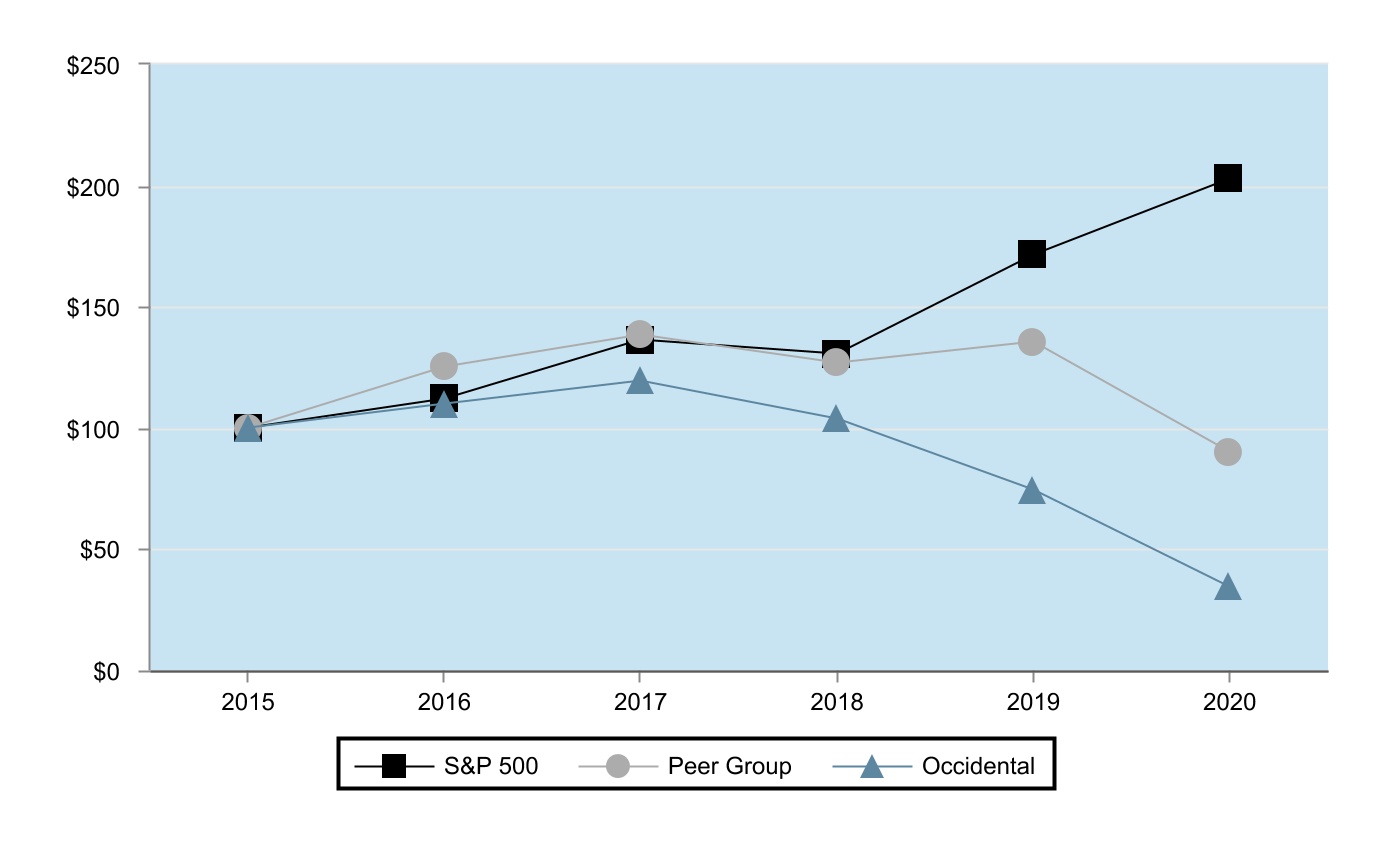
The following graph compares the yearly percentage change in Occidental’s cumulative total return on its common stock with the cumulative total return of the Standard & Poor’s 500 Stock Index (S&P 500), which includes Occidental with that of Occidental’s peer group over the five-year period ended December 31, 2020. The graph assumes that $100 was invested at the beginning of the five-year period shown in the graph below in: (i) Occidental common stock, (ii) the stock of the companies in the S&P 500 and (iii) each of the peer group companies’ common stock weighted by their relative market capitalization within the peer group and that all dividends were reinvested. The cumulative total return of the peer group companies’ common stock includes the cumulative total return of Occidental’s common stock.
Occidental’s peer group consists of BP p.l.c., Chevron Corporation, ConocoPhillips, EOG Resources, Inc., ExxonMobil Corporation, Royal Dutch Shell plc, Total S.A. and Occidental.
| Fiscal Year Ended December 31, | 2015 | 2016 | 2017 | 2018 | 2019 | 2020 | |||||||||||||||||||||||||||||
| Occidental | $ | 100 | $ | 110 | $ | 119 | $ | 104 | $ | 75 | $ | 35 | |||||||||||||||||||||||
| Peer Group | $ | 100 | $ | 125 | $ | 139 | $ | 127 | $ | 136 | $ | 90 | |||||||||||||||||||||||
| S&P 500 | $ | 100 | $ | 112 | $ | 136 | $ | 130 | $ | 171 | $ | 203 |
The information provided in this Performance Graph shall not be deemed “soliciting material” or “filed” with the SEC or subject to Regulation 14A or 14C under the Exchange Act, other than as provided in Item 201 to Regulation S-K under the Exchange Act, or subject to the liabilities of Section 18 of the Exchange Act and shall not be deemed incorporated by reference into any filing under the Securities Act of 1933 or the Exchange Act except to the extent Occidental specifically requests that it be treated as soliciting material or specifically incorporates it by reference.
| OXY 2020 FORM 10-K | 17 |
| OTHER INFORMATION |
Item 6. SELECTED FINANCIAL DATA
| millions, except per-share amounts | 2020 | 2019 (a) | 2018 | 2017 | 2016 | ||||||||||||||||||||||||
| RESULTS OF OPERATIONS (b) | |||||||||||||||||||||||||||||
| Net sales | $ | 17,809 | $ | 20,911 | $ | 17,824 | $ | 12,508 | $ | 10,090 | |||||||||||||||||||
| Income (loss) from continuing operations | $ | (13,533) | $ | (507) | $ | 4,131 | $ | 1,311 | $ | (1,002) | |||||||||||||||||||
| Net income (loss) attributable to common stockholders | $ | (15,675) | $ | (985) | $ | 4,131 | $ | 1,311 | $ | (574) | |||||||||||||||||||
| Net income (loss) from continuing operations attributable to common stockholders - basic per common share | $ | (15.65) | $ | (1.20) | $ | 5.40 | $ | 1.71 | $ | (1.31) | |||||||||||||||||||
| Net income (loss) attributable to common stockholders - basic per common share | $ | (17.06) | $ | (1.22) | $ | 5.40 | $ | 1.71 | $ | (0.75) | |||||||||||||||||||
| Net income (loss) attributable to common stockholders - diluted per common share | $ | (17.06) | $ | (1.22) | $ | 5.39 | $ | 1.70 | $ | (0.75) | |||||||||||||||||||
| FINANCIAL POSITION (b) | |||||||||||||||||||||||||||||
| Total assets | $ | 80,064 | $ | 107,190 | $ | 42,159 | $ | 42,026 | $ | 43,109 | |||||||||||||||||||
| Long-term debt, net | $ | 35,745 | $ | 38,537 | $ | 10,201 | $ | 9,328 | $ | 9,819 | |||||||||||||||||||
| Stockholders’ equity | $ | 18,573 | $ | 34,232 | $ | 21,330 | $ | 20,572 | $ | 21,497 | |||||||||||||||||||
| MARKET CAPITALIZATION (c) | $ | 16,124 | $ | 36,846 | $ | 45,998 | $ | 56,357 | $ | 54,437 | |||||||||||||||||||
| CASH FLOW FROM CONTINUING OPERATIONS | |||||||||||||||||||||||||||||
| Operating: | |||||||||||||||||||||||||||||
| Cash flow from continuing operations | $ | 3,842 | $ | 7,336 | $ | 7,669 | $ | 4,861 | $ | 2,520 | |||||||||||||||||||
| Investing: | |||||||||||||||||||||||||||||
| Capital expenditures | $ | (2,535) | $ | (6,367) | $ | (4,975) | $ | (3,599) | $ | (2,717) | |||||||||||||||||||
| Payments for purchases of assets and businesses | $ | (114) | $ | (28,088) | $ | (928) | $ | (1,064) | $ | (2,044) | |||||||||||||||||||
| Sales of assets, net | $ | 2,281 | $ | 6,143 | $ | 2,824 | $ | 1,403 | $ | 302 | |||||||||||||||||||
| Cash provided (used) by all other investing activities, net | $ | (410) | $ | (540) | $ | (127) | $ | 181 | $ | (284) | |||||||||||||||||||
| Financing: | |||||||||||||||||||||||||||||
| Cash dividends paid | $ | (1,845) | $ | (2,624) | $ | (2,374) | $ | (2,346) | $ | (2,309) | |||||||||||||||||||
| Purchases of treasury stock | $ | (12) | $ | (237) | $ | (1,248) | $ | (25) | $ | (22) | |||||||||||||||||||
| Proceeds from long-term debt, net - Occidental | $ | 6,936 | $ | 21,557 | $ | 978 | $ | — | $ | 4,203 | |||||||||||||||||||
| Payment of long-term debt, net - Occidental | $ | (8,916) | $ | (6,959) | $ | (500) | $ | — | $ | (2,710) | |||||||||||||||||||
| Proceeds from issuance of common and preferred stock | $ | 134 | $ | 10,028 | $ | 33 | $ | 28 | $ | 36 | |||||||||||||||||||
| Cash provided (used) by all other financing activities, net | $ | (805) | $ | 431 | $ | 9 | $ | — | $ | — | |||||||||||||||||||
| DIVIDENDS PER COMMON SHARE | $ | 0.82 | $ | 3.14 | $ | 3.10 | $ | 3.06 | $ | 3.02 | |||||||||||||||||||
| WEIGHTED-AVERAGE BASIC SHARES OUTSTANDING | 919 | 810 | 762 | 765 | 764 |
(a)Summary financial information included the impact of the Acquisition, see Note 3 - The Acquisition in the Notes to Consolidated Financial Statements in Part II Item 8 of this Form 10-K. Summary results of operations from the date of the Acquisition to December 31, 2019 included the results of WES, a previously consolidated subsidiary. See Note 1 - Summary of Significant Accounting Policies in the Notes to Consolidated Financial Statements in Part II Item 8 of this Form 10-K.
(b)See the MD&A section of this report and the Notes to Consolidated Financial Statements for information regarding acquisitions and dispositions, discontinued operations and other charges affecting comparability.
(c)Market capitalization is calculated by multiplying the year-end total shares of common stock issued, less shares held as treasury stock, by the year-end closing stock price.
| 18 | OXY 2020 FORM 10-K |
| MANAGEMENT’S DISCUSSION AND ANALYSIS |
Item 7. MANAGEMENT’S DISCUSSION AND ANALYSIS OF FINANCIAL CONDITION AND RESULTS OF OPERATIONS (MD&A)
The following discussion should be read together with the Consolidated Financial Statements and the Notes to Consolidated Financial Statements, which are included in this Form 10-K in Item 8 and the information set forth in Risk Factors under Part 1, Item 1A.
| OXY 2020 FORM 10-K | 19 |
| MANAGEMENT’S DISCUSSION AND ANALYSIS |
| CURRENT BUSINESS OUTLOOK AND STRATEGY |
GENERAL
Occidental’s operations, financial condition, cash flows and levels of expenditures are highly dependent on oil prices and, to a lesser extent, NGL and natural gas prices, the Midland-to-Gulf-Coast oil spreads and the prices it receives for its chemical products. The worldwide economy has been severely impacted by the ongoing effects of the COVID-19 pandemic, which began during the first quarter of 2020. In the first quarter, travel restrictions and stay-at-home orders were implemented for much of the world to limit the spread of COVID-19. Though certain restrictions have been lifted, some areas have recently reinstated stay at home orders and oil and gas demand remains below pre-pandemic levels. On April 12, 2020, certain members of the OPEC and 10 non-OPEC partner countries (OPEC+) agreed to production cuts intended to mitigate the oil supply and demand imbalance to stabilize prices. On January 5, 2021, OPEC+ agreed to extend the cuts through March 2021. These production cuts coupled with declining U.S. production helped mitigate the supply and demand imbalance. While the spot WTI oil price has recovered to above $60.00/Bbl as of the date of this filing, the average daily WTI oil price fell from $57.03/Bbl in 2019 to $39.40/Bbl in 2020 or 31 percent. We expect that the oil supply and demand balance and consequently oil prices in the near-term will continue to be influenced by the duration and severity of the COVID-19 pandemic; the effectiveness and pace of the distribution of the recently approved vaccines; and OPEC+ and U.S. production levels.
LIQUIDITY
In response to the dramatic drop in oil prices and the current macroeconomic environment, Occidental has taken significant measures to increase its near and mid-term liquidity and address near-term debt maturities. Specifically, during 2020 Occidental:
■Reduced its 2020 capital budget to $2.6 billion from a range of $5.2 billion to $5.4 billion, a midpoint reduction of approximately 50%;
■Made significant cuts to its 2020 operating and corporate costs. On an annualized basis, Occidental has realized $1.5 billion of overhead savings and over $900 million in operating cost savings, of which a majority is expected to remain permanent in future years;
■Reduced the quarterly common stock dividend to $0.01 per share from $0.79 per share, effective July 2020, which on an annualized basis, will reduce its common stock dividend outlay by approximately $2.9 billion;
■Elected to pay the preferred stock dividend paid in the second and third quarters of 2020 in the form of shares of common stock, in lieu of cash, preserving $400 million of liquidity. Occidental elected to pay the dividend paid in the fourth quarter in cash. The Board of Directors will continue to assess market conditions and Occidental's financial condition on a quarterly basis to determine whether the preferred stock dividend will be paid in shares of stock, in cash or a combination of shares of common stock and cash;
■Entered into a new receivable securitization facility that provides additional liquidity of up to $400 million;
■Issued $7.0 billion in senior unsecured notes (the Senior Notes Offerings) during 2020 to extend certain debt maturities in 2021-2023 to 2025-2031;
■Since the Acquisition, completed significant asset divestitures for net proceeds of approximately $8.2 billion;
■Used the net proceeds from asset sales, cash on hand and Senior Notes Offerings to retire or tender $6.0 billion of 2021, $2.7 billion of 2022 and $264 million of 2023 maturities; and
■Exchanged approximately 27.9 million WES common units to retire a $260 million note payable to WES due 2038.
In 2019, Occidental entered into three-way oil collar and call derivative instruments to reduce its exposure to commodity price risk and increase the predictability of near-term cash flows. The majority of the collars settled in 2020 with the receipt of cash of $960 million. The remaining $52 million settled in 2021. See Note 9 - Derivatives in the Notes to Consolidated Financial Statements in Part II, Item 8 of this Form 10-K.
Occidental believes the actions outlined above enhance its liquidity position to fund its operations. Occidental will continue to evaluate the economic environment, as well as the commodity price environment, and may make further adjustments to its future levels of expenditures and operating and corporate costs. However, the ultimate impact of the COVID-19 pandemic on Occidental's results of operations, cash flows and financial position are unknown, and those impacts could be material. Additionally, actions taken in response to the current macro-environment may result in the long-term reduction o
Showing the first 8K of 182K characters. Open the full section
Item 7A. QUANTITATIVE AND QUALITATIVE DISCLOSURES ABOUT MARKET RISK
| COMMODITY PRICE RISK |
GENERAL
Occidental’s results are sensitive to fluctuations in oil, NGL and natural gas prices. Price changes at current global prices and levels of production affect Occidental’s pre-tax annual income by approximately $200 million for a $1 per barrel change in oil prices and $85 million for a $1 per barrel change in NGL prices. If domestic natural gas prices varied by $0.10 per Mcf, it would have an estimated annual effect on Occidental’s pre-tax income of approximately $35 million. These price-change sensitivities include the impact of PSC and similar contract volume changes on income. If production levels change in the future, the sensitivity of Occidental’s results to prices also will change. Marketing results are sensitive to price changes of oil, natural gas and, to a lesser degree, other commodities. A $0.25 change in the Midland-to-Gulf-Coast oil spreads impacts total year operating cash flows by $65 million.
Occidental’s results are also sensitive to fluctuations in chemical prices. A variation in chlorine and caustic soda prices of $10 per ton would have a pre-tax annual effect on income of approximately $10 million and $30 million, respectively. A variation in PVC prices of $0.01 per lb. would have a pre-tax annual effect on income of approximately $30 million. Historically, over time, product price changes have tracked raw material and feedstock product price changes, somewhat mitigating the effect of price changes on margins.
Occidental uses derivative instruments, including a combination of short-term futures, forwards, options and swaps, to obtain the average prices for the relevant production month and to improve realized prices for oil and gas.
RISK MANAGEMENT
Occidental conducts its risk management activities for marketing and trading under the controls and governance of its risk control policies. The controls under these policies are implemented and enforced by a risk management group which monitors risk by providing an independent and separate evaluation and check. Members of the risk management group report to the Corporate Vice President and Treasurer. Controls for these activities include limits on value at risk, limits on credit, limits on total notional trade value, segregation of duties, delegation of authority, daily price verifications, reporting to senior management on various risk measures and a number of other policy and procedural controls.
FAIR VALUE OF MARKETING DERIVATIVE CONTRACTS
Occidental carries derivative contracts it enters into in connection with its marketing activities at fair value. Fair values for these contracts are derived from Level 1 and Level 2 sources. The fair values in future maturity periods are insignificant.
| OXY 2020 FORM 10-K | 53 |
 | QUANTITATIVE AND QUALITATIVE DISCLOSURES |
The following table shows the fair value of Occidental’s derivatives (excluding collateral), segregated by maturity periods and by methodology of fair value estimation:
| Maturity Periods | ||||||||||||||||||||||||||||||||
| Source of Fair Value Assets/(Liabilities) millions | 2021 | 2022 and 2023 | 2024 and 2025 | 2026 and thereafter | Total | |||||||||||||||||||||||||||
| Prices actively quoted | $ | (97) | $ | — | $ | — | $ | — | $ | (97) | ||||||||||||||||||||||
| Prices provided by other external sources | (1) | 2 | — | — | 1 | |||||||||||||||||||||||||||
| Total | $ | (98) | $ | 2 | $ | — | $ | — | $ | (96) |
QUANTITATIVE INFORMATION
Occidental uses value at risk to estimate the potential effects of changes in fair values of commodity contracts used in trading activities. This measure determines the maximum potential negative one day change in fair value with a 95% level of confidence. Additionally, Occidental uses complementary trading limits including position and tenor limits and maintains liquid positions as a result of which market risk typically can be neutralized or mitigated on short notice. As a result of these controls, Occidental believes that the market risk of its trading activities is not reasonably likely to have a material adverse effect on its performance.
| INTEREST RATE RISK |
GENERAL
Occidental acquired interest rate swap contracts in the Acquisition. Occidental pays a fixed interest rate and receives a floating interest rate indexed to three-month LIBOR. The swaps have an initial term of 30 years with mandatory termination dates in September 2021 through 2023 and a total notional amount of approximately $1.5 billion as of December 31, 2020. As of December 31, 2020, Occidental had a net liability of approximately $1.4 billion based on the fair value of the swaps of negative $1.8 billion netted against $374 million in posted cash collateral. A 25-basis point decrease in implied LIBOR rates over the term of the swaps would result in an additional liability of approximately $173 million on these swaps.
As of December 31, 2020, Occidental had variable rate debt with a notional value of $1.1 billion outstanding. A 25-basis point increase in LIBOR interest rates would increase gross interest expense approximately $3 million per year.
As of December 31, 2020, Occidental had fixed rate debt with a fair value of $32.7 billion outstanding. A 25-basis point change in Treasury rates would change the fair value of the fixed rate debt approximately $600 million.
TABULAR PRESENTATION OF INTEREST RATE RISK
The table below provides information about Occidental’s long-term debt obligations. Debt amounts represent principal payments by maturity date.
| millions except percentages | U.S. Dollar Fixed-Rate Debt | U.S. Dollar Variable-Rate Debt | Total (a) | |||||||||||||||||
| 2021 | $ | 371 | $ | 27 | $ | 398 | ||||||||||||||
| 2022 | 1,006 | 1,052 | 2,058 | |||||||||||||||||
| 2023 | 949 | — | 949 | |||||||||||||||||
| 2024 | 3,898 | — | 3,898 | |||||||||||||||||
| 2025 | 2,900 | — | 2,900 | |||||||||||||||||
| Thereafter | 24,964 | 68 | 25,032 | |||||||||||||||||
| Total | $ | 34,088 | $ | 1,147 | $ | 35,235 | ||||||||||||||
| Weighted-average interest rate | 4.78% | 1.73% | 4.68% | |||||||||||||||||
| Fair Value | $ | 32,678 | $ | 1,128 | $ | 33,806 |
(a)Excluded net unamortized debt premiums of $748 million and debt issuance cost of $156 million.
| FOREIGN CURRENCY RISK |
Occidental’s international operations have limited currency risk. Occidental manages its exposure primarily by balancing monetary assets and liabilities and limiting cash positions in foreign currencies to levels necessary for operating purposes. A vast majority of international oil sales are denominated in United States dollars. Additionally, all of Occidental’s consolidated
| 54 | OXY 2020 FORM 10-K |
| QUANTITATIVE AND QUALITATIVE DISCLOSURES |
international oil and gas subsidiaries have the United States dollar as the functional currency. As of December 31, 2020, the fair value of foreign currency derivatives used in the marketing operations was immaterial. The effect of exchange rates on transactions in foreign currencies is included in periodic income.
| CREDIT RISK |
The majority of Occidental’s counterparty credit risk is related to the physical delivery of energy commodities to its customers and any inability of these customers to meet their settlement commitments. Occidental manages credit risk by selecting counterparties that it believes to be financially strong, by entering into netting arrangements with counterparties and by requiring collateral or other credit risk mitigants, as appropriate. Occidental actively evaluates the creditworthiness of its counterparties, assigns appropriate credit limits and monitors credit exposures against those assigned limits. Occidental also enters into futures contracts through regulated exchanges with select clearinghouses and brokers, which are subject to minimal credit risk as a significant portion of these transactions settle on a daily margin basis.
Certain OTC derivative instruments contain credit-risk-contingent features, primarily tied to credit ratings for Occidental or its counterparties, which may affect the amount of collateral that each party would need to post. The fair value of derivative instruments with credit-risk-contingent features, that were net liabilities at December 31, 2020 was $104 million (net of $374 million collateral) and $787 million (net of $169 million collateral) at December 31, 2019. Credit-risk-contingent features are primarily related to interest rate swaps.
As of December 31, 2020, the substantial majority of the credit exposures were with investment grade counterparties. Occidental believes its exposure to credit-related losses at December 31, 2020, was not material and losses associated with credit risk have been insignificant for all years presented.
| DERIVATIVE INSTRUMENTS HELD FOR NON-TRADING PURPOSES |
As of December 31, 2020, Occidental had derivative instruments in place to reduce the price risk associated with future oil production of 350Mbbl/d. As of December 31, 2020, these derivative instruments were at a $42 million net derivative liability position.
The following table shows a sensitivity analysis based on both a 5% and 10% change in commodity prices and their effect on the net derivative liability position of $42 million at December 31, 2020:
| millions except percentages | ||||||||||||||||||||
| Percent change in commodity prices | Resulting net fair value position-asset (liability) | Change to fair value from December 31, 2020 position | ||||||||||||||||||
| + 5% | $ | (67) | $ | (25) | ||||||||||||||||
| - 5% | $ | (26) | $ | 16 | ||||||||||||||||
| + 10% | $ | (102) | $ | (60) | ||||||||||||||||
| -10% | $ | (15) | $ | 27 |
As of December 31, 2020, Occidental had derivative instruments in place to reduce the price risk associated with future gas production of 530 thousand MMbtu/d. As of December 31, 2020, these derivative instruments were at a $25 million net derivative asset position.
The following table shows a sensitivity analysis based on both a 5% and 10% change in commodity prices and their effect on the net derivative asset position of $25 million at December 31, 2020:
| millions except percentages | ||||||||||||||||||||
| Percent change in commodity prices | Resulting net fair value position-asset (liability) | Change to fair value from December 31, 2020 position | ||||||||||||||||||
| + 5% | $ | 13 | $ | (12) | ||||||||||||||||
| - 5% | $ | 37 | $ | 12 | ||||||||||||||||
| + 10% | $ | 1 | $ | (24) | ||||||||||||||||
| -10% | $ | 51 | $ | 26 |
| OXY 2020 FORM 10-K | 55 |
| FINANCIAL STATEMENTS INDEX |
Item 8. FINANCIAL STATEMENTS AND SUPPLEMENTARY DATA
| 56 | OXY 2020 FORM 10-K |
| FINANCIAL STATEMENTS REPORT |
Report of Independent Registered Public Accounting Firm
To the Stockholders and Board of Directors
Occidental Petroleum Corporation:
Opinion on the Consolidated Financial Statements
We have audited the accompanying consolidated balance sheets of Occidental Petroleum Corporation and subsidiaries (the Company) as of December 31, 2020 and 2019, the related consolidated statements of operations, comprehensive income (loss), stockholders’ equity, and cash flows for each of the years in the three‑year period ended December 31, 2020, and the related notes and financial statement schedule II – valuation and qualifying accounts (collectively, the consolidated financial statements). In our opinion, the consolidated financial statements present fairly, in all material respects, the financial position of the Company as of December 31, 2020 and 2019, and the results of its operations and its cash flows for each of the years in the three‑year period ended December 31, 2020, in conformity with U.S. generally accepted accounting principles.
We also have audited, in accordance with the standards of the Public Company Accounting Oversight Board (United States) (PCAOB), the Company’s internal control over financial reporting as of December 31, 2020, based on criteria established in Internal Control – Integrated Framework (2013) issued by the Committee of Sponsoring Organizations of the Treadway Commission, and our report dated February 26, 2021 expressed an unqualified opinion on the effectiveness of the Company’s internal control over financial reporting*.*
Change in Accounting Principle
As discussed in Notes 2 and 8 to the consolidated financial statements, the Company changed its method of accounting for leases as of January 1, 2019 due to the adoption of Accounting Standards Codification Topic 842, Leases.
Basis for Opinion
These consolidated financial statements are the responsibility of the Company’s management. Our responsibility is to express an opinion on these consolidated financial statements based on our audits. We are a public accounting firm registered with the PCAOB and are required to be independent with respect to the Company in accordance with the U.S. federal securities laws and the applicable rules and regulations of the Securities and Exchange Commission and the PCAOB.
We conducted our audits in accordance with the standards of the PCAOB. Those standards require that we plan and perform the audit to obtain reasonable assurance about whether the consolidated financial statements are free of material misstatement, whether due to error or fraud. Our audits included performing procedures to assess the risks of material misstatement of the consolidated financial statements, whether due to error or fraud, and performing procedures that respond to those risks. Such procedures included examining, on a test basis, evidence regarding the amounts and disclosures in the consolidated financial statements. Our audits also included evaluating the accounting principles used and significant estimates made by management, as well as evaluating the overall p
Showing the first 8K of 407K characters. Open the full section
Item 9. CHANGES IN AND DISAGREEMENTS WITH ACCOUNTANTS ON ACCOUNTING AND FINANCIAL DISCLOSURE
Occidental had no changes in, and no disagreements with, Occidental’s accountants on accounting and financial disclosure.
Item 9A. CONTROLS AND PROCEDURES
| MANAGEMENT’S ANNUAL ASSESSMENT OF AND REPORT ON INTERNAL CONTROL OVER FINANCIAL REPORTING |
The management of Occidental Petroleum Corporation and its subsidiaries (Occidental) is responsible for establishing and maintaining adequate internal control over financial reporting. Occidental’s system of internal control over financial reporting is designed to provide reasonable assurance regarding the reliability of financial reporting and the preparation of consolidated financial statements for external purposes in accordance with generally accepted accounting principles. Occidental’s internal control over financial reporting includes those policies and procedures that: (i) pertain to the maintenance of records that, in reasonable detail, accurately and fairly reflect the transactions and divestitures of Occidental’s assets; (ii) provide reasonable assurance that transactions are recorded as necessary to permit preparation of financial statements in accordance with generally accepted accounting principles and that Occidental’s receipts and expenditures are being made only in accordance with authorizations of Occidental’s management and directors; and (iii) provide reasonable assurance regarding prevention or timely detection of unauthorized acquisition, use or disposition of Occidental’s assets that could have a material effect on the financial statements.
Because of its inherent limitations, internal control over financial reporting may not prevent or detect misstatements. Also, projections of any evaluation of effectiveness to future periods are subject to the risk that controls may become inadequate because of changes in conditions, or that the degree of compliance with the policies or procedures may deteriorate.
Management has assessed the effectiveness of Occidental’s internal control system as of December 31, 2020, based on the criteria for effective internal control over financial reporting described in Internal Control - Integrated Framework issued in 2013 by the Committee of Sponsoring Organizations of the Treadway Commission (COSO). Based on this assessment, management believes that, as of December 31, 2020, Occidental’s system of internal control over financial reporting is effective.
Occidental’s independent auditors, KPMG LLP, have issued an audit report on Occidental’s internal control over financial reporting.
| DISCLOSURE CONTROLS AND PROCEDURES |
Occidental’s President and Chief Executive Officer and its Senior Vice President and Chief Financial Officer supervised and participated in Occidental’s evaluation of its disclosure controls and procedures (as defined in Rules 13a-15(e) and 15d-15(e) under the Exchange Act) as of the end of the period covered by this report. Based upon that evaluation, Occidental’s President and Chief Executive Officer and Senior Vice President and Chief Financial Officer concluded that Occidental’s disclosure controls and procedures were effective as of December 31, 2020.
There has been no change in Occidental’s internal control over financial reporting (as defined in Rules 13a-15(f) and 15d-15(f) under the Exchange Act) during the fourth quarter of 2020 that has materially affected, or is reasonably likely to materially affect, Occidental’s internal control over financial reporting. The Report of Independent Registered Public Accounting Firm on Internal Control over Financial Reporting is set forth in Item 8.
Item 9B. OTHER INFORMATION
None.
| OXY 2020 FORM 10-K | 135 |
Part III
Item 10. DIRECTORS, EXECUTIVE OFFICERS AND CORPORATE GOVERNANCE
Occidental has adopted a Code of Business Conduct (Code). The Code applies to the President and Chief Executive Officer, Senior Vice President and Chief Financial Officer, Vice President, Chief Accounting Officer and Controller and persons performing similar functions (Key Personnel). The Code also applies to Occidental’s directors, employees and the employees of entities which it controls. The Code is posted at www.oxy.com. Occidental will satisfy any disclosure requirement under Item 5.05 of Form 8-K regarding an amendment to, or waiver from, any provision of the Code with respect to its Key Personnel or directors by disclosing the nature of that amendment or waiver on its website within four business days following the date of the amendment or waiver.
The list of Occidental’s executive officers and related information under Information About Our Executive Officers set forth in Part I of this 10-K is incorporated by reference herein. The information required by this Item 10 is incorporated herein by reference from Occidental’s definitive Proxy Statement to be filed with the SEC pursuant to Regulation 14A within 120 days of December 31, 2020.
Item 11. EXECUTIVE COMPENSATION
The information under the caption “Compensation Discussion and Analysis - Compensation Committee Report” shall not be deemed to be “soliciting material,” or to be “filed” with the SEC, or subject to Regulation 14A or 14C under the Exchange Act or to the liabilities of Section 18 of the Exchange Act, nor shall it be deemed incorporated by reference into any filing under the Securities Act of 1933. The information required by this Item 11 is incorporated herein by reference from Occidental’s definitive Proxy Statement to be filed with the SEC pursuant to Regulation 14A within 120 days of December 31, 2020.
Item 12. SECURITY OWNERSHIP OF CERTAIN BENEFICIAL OWNERS AND MANAGEMENT AND RELATED STOCKHOLDER MATTERS
| SECURITIES AUTHORIZED FOR ISSUANCE UNDER EQUITY COMPENSATION PLANS |
All of Occidental’s stock-based compensation plans for its employees and non-employee directors have been approved by the stockholders. The aggregate number of shares of Occidental common stock authorized for issuance under such plans is approximately 133 million, of which approximately 11.6 million had been reserved for issuance through December 31, 2020. The following is a summary of the securities available for issuance under such plans:
| a) | Number of securities to be issued upon exercise of outstanding options, warrants and rights | b) | Weighted-average exercise price of outstanding options, warrants and rights | c) | Number of securities remaining available for future issuance under equity compensation plans (excluding securities reflected in column (a)) | ||||||||||||||||||
| 12,543,995 (1) | 46.34 (2) | 88,324,982 (3) |
(1)Included shares reserved to be issued pursuant to restricted stock units, stock options (Options) and performance-based awards. Shares for performance-based awards are included assuming maximum payout, but may be paid out at lesser amounts, or not at all, according to achievement of performance goals.
(2)Price applies only to the Options included in column (a). Exercise price is not applicable to the other awards included in column (a), nor warrants not issued under equity compensation plans.
(3)A plan provision requires each share covered by an award (other than stock appreciation rights (SARs) and Options) to be counted as if three shares were issued in determining the number of shares that are available for future awards. Accordingly, the number of shares available for future awards may be less than the amount shown depending on the type of award granted. Additionally, under the plan, the amount shown may increase, depending on the award type, by the number of shares currently unvested or forfeitable, or three times that number as applicable, that are forfeited or canceled, or correspond to the portion of any stock-based awards settled in cash.
The information required by this Item 12 is incorporated herein by reference from Occidental’s definitive Proxy Statement to be filed with the SEC pursuant to Regulation 14A within 120 days of December 31, 2020.
Item 13. CERTAIN RELATIONSHIPS AND RELATED TRANSACTIONS AND DIRECTOR INDEPENDENCE
The information required by this Item 13 is incorporated herein by reference from Occidental’s definitive Proxy Statement to be filed with the SEC pursuant to Regulation 14A within 120 days of December 31, 2020.
| 136 | OXY 2020 FORM 10-K |
Item 14. PRINCIPAL ACCOUNTING FEES AND SERVICES
The information required by this Item 14 is incorporated herein by reference from Occidental’s definitive Proxy Statement to be filed with the SEC pursuant to Regulation 14A within 120 days of December 31, 2020.
Part IV
Item 15. EXHIBITS AND FINANCIAL STATEMENT SCHEDULES
The agreements included as exhibits to this report are included to provide information about their terms and not to provide any other factual or disclosure information about Occidental or the other parties to the agreements. The agreements contain representations and warranties by each of the parties to the applicable agreement that were made solely for the benefit of the other agreement parties and:
■Should not be treated as categorical statements of fact, but rather as a way of allocating the risk among the parties if those statements prove to be inaccurate;
■Have been qualified by disclosures that were made to the other party in connection with the negotiation of the applicable agreement, which disclosures are not necessarily reflected in the agreement;
■May apply standards of materiality in a way that is different from the way investors may view materiality; and
■Were made only as of the date of the applicable agreement or such other date or dates as may be specified in the agreement and are subject to more recent developments.
(a) (1) and (2). Financial Statements and Financial Statement Schedule
Reference is made to Item 8 of the Table of Contents of this report, where these documents are listed.
(a) (3). Exhibits
| OXY 2020 FORM 10-K | 137 |
| 138 | OXY 2020 FORM 10-K |
Item 16. FORM 10-K SUMMARY
Not applicable.
| OXY 2020 FORM 10-K | 139 |
| SIGNATURES |
Pursuant to the requirements of Section 13 or 15(d) of the Securities Exchange Act of 1934, the registrant has duly caused this report to be signed on its behalf by the undersigned, thereunto duly authorized.
| OCCIDENTAL PETROLEUM CORPORATION | ||||||||
| By: | /s/ Vicki Hollub | |||||||
| Vicki Hollub | ||||||||
| President and Chief Executive Officer |
Pursuant to the requirements of the Securities Exchange Act of 1934, this report has been signed below by the following persons on behalf of the registrant and in the capacities and on the dates indicated.
| Title | Date | |||||||||||||
| /s/ Vicki Hollub | President, Chief Executive Officer | February 26, 2021 | ||||||||||||
| Vicki Hollub | and Director | |||||||||||||
| /s/ Robert L. Peterson | Senior Vice President and | February 26, 2021 | ||||||||||||
| Robert L. Peterson | Chief Financial Officer | |||||||||||||
| /s/ Christopher O. Champion | Vice President, Chief Accounting Officer | February 26, 2021 | ||||||||||||
| Christopher O. Champion | and Controller | |||||||||||||
| /s/ Stephen I. Chazen | Chairman of the Board of Directors | February 26, 2021 | ||||||||||||
| Stephen I. Chazen | ||||||||||||||
| /s/ Andrew F. Gould | Director | February 26, 2021 | ||||||||||||
| Andrew F. Gould | ||||||||||||||
| /s/ Carlos M. Gutierrez | Director | February 26, 2021 | ||||||||||||
| Carlos M. Gutierrez | ||||||||||||||
| /s/ Gaoxiang Hu | Director | February 26, 2021 | ||||||||||||
| Gaoxiang Hu | ||||||||||||||
| /s/ William R. Klesse | Director | February 26, 2021 | ||||||||||||
| William R. Klesse | ||||||||||||||
| /s/ Andrew N. Langham | Director | February 26, 2021 | ||||||||||||
| Andrew N. Langham | ||||||||||||||
| /s/ Jack B. Moore | Director | February 26, 2021 | ||||||||||||
| Jack B. Moore | ||||||||||||||
| /s/ Margarita Paláu-Hernández | Director | February 26, 2021 | ||||||||||||
| Margarita Paláu-Hernández | ||||||||||||||
| /s/ Avedick B. Poladian | Director | February 26, 2021 | ||||||||||||
| Avedick B. Poladian | ||||||||||||||
| /s/ Robert M. Shearer | Director | February 26, 2021 | ||||||||||||
| Robert M. Shearer |
| 140 | OXY 2020 FORM 10-K |