 filings.tools
Paychex 10-K 2019-05-31
Filed 2019-07-24. 22 sections, 356K characters. Original on sec.gov · Markdown · JSON
Cover and table of contents
10-K 1 payx-20190531x10k.htm 10-K
UNITED STATES
SECURITIES AND EXCHANGE COMMISSION
WASHINGTON, D.C. 20549
FORM 10-K
ANNUAL REPORT PURSUANT TO SECTION 13 OR 15(d) OF
THE SECURITIES
EXCHANGE ACT OF 1934
For the fiscal year ended May 31, 2019
Commission file number 0-11330
Paychex, Inc.
911 Panorama Trail South
Rochester, New York 14625-2396
(585) 385-6666
A Delaware Corporation
IRS Employer Identification Number: 16-1124166
Securities registered pursuant to Section 12(b) of the Act:
| Title of each class | Trading Symbol(s) | Name of each exchange on which registered |
|---|---|---|
| Common Stock, $0.01 par value | PAYX | Nasdaq Global Select Market |
Indicate by check mark if the registrant is a well-known seasoned issuer, as defined in Rule 405 of the Securities Act. Yes ☑ No ☐
Indicate by check mark if the registrant is not required to file reports pursuant to Section 13 or Section 15(d) of the Act. Yes ☐ No ☑
Indicate by check mark whether the registrant has submitted electronically every Interactive Data File required to be submitted pursuant to Rule 405 of Regulation S-T (§ 232.405 of this chapter) during the preceding 12 months (or for such shorter period that the registrant was required to submit such files). Yes ☑ No ☐
Indicate by check mark whether the registrant has submitted electronically every Interactive Data File required to be submitted pursuant to Rule 405 of Regulation S-T during the preceding 12 months (or for such shorter period that the registrant was required to submit such files). Yes ☑ No ☐
Indicate by check mark whether the registrant is a large accelerated filer, an accelerated filer, a non-accelerated filer, a smaller reporting company, or an emerging growth company. See the definitions of “large accelerated filer,” “accelerated filer,” “smaller reporting company,” and “emerging growth company” in Rule 12b-2 of the Exchange Act.
| Large accelerated filer ☑ | Accelerated filer ☐ | Non-accelerated filer ☐ | Smaller reporting company ☐ | |||
| Emerging growth company ☐ |
If an emerging growth company, indicate by check mark if the registrant has elected not to use the extended transition period for complying with any new or revised financial accounting standards provided pursuant to Section 13(a) of the Exchange Act. ☐
Indicate by check mark whether the registrant is a shell company (as defined in Rule 12b-2 of the Act). Yes ☐ No ☑
As of November 30, 2018, the last business day of the most recently completed second fiscal quarter, shares held by non-affiliates of the registrant had an aggregate market value of $22,652,311,624 based on the closing price reported for such date on the Nasdaq Global Select Market.
As of June 30, 2019, 359,345,511 shares of the registrant’s common stock, $.01 par value, were outstanding.
Documents Incorporated by Reference
Portions of the registrant’s definitive proxy statement to be issued in connection with its Annual Meeting of Stockholders to be held on or about October 17, 2019, to the extent not set forth herein, are incorporated by reference into Part III, Items 10 through 14, inclusive.
PAYCHEX, INC.
INDEX TO FORM 10-K
For the fiscal year ended May 31, 2019
i
PART I
CAUTIONARY NOTE REGARDING FORWARD-LOOKING STATEMENTS PURSUANT TO THE UNITED STATES PRIVATE SECURITIES LITIGATION REFORM ACT OF 1995
Certain written and oral statements made by management of Paychex, Inc. and its wholly owned subsidiaries (“we,” “our,” “us,” “Paychex,” or the “Company”) may constitute “forward-looking statements” within the meaning of the safe harbor provisions of the United States (“U.S.”) Private Securities Litigation Reform Act of 1995. Forward-looking statements can be identified by such words and phrases as “we expect,” “expected to,” “estimates,” “estimated,” “overview,” “current outlook,” “we look forward to,” “would equate to,” “projects,” “projections,” “projected,” “projected to be,” “anticipates,” “anticipated,” “we believe,” “believes,” “could be,” “targeting,” and other similar words or phrases. Examples of forward-looking statements include, among others, statements we make regarding operating performance, events, or developments that we expect or anticipate will occur in the future, including statements relating to our outlook, revenue growth, earnings, earnings-per-share growth, or similar projections.
Forward-looking statements are neither historical facts nor assurances of future performance. Instead, they are based only on our current beliefs, expectations, and assumptions regarding the future of our business, future plans and strategies, projections, anticipated events and trends, the economy, and other future conditions. Because forward-looking statements relate to the future, they are subject to inherent uncertainties, risks, and changes in circumstances that are difficult to predict, many of which are outside our control. Our actual results and financial conditions may differ materially from those indicated in the forward-looking statements. Therefore, you should not place undue reliance upon any of these forward-looking statements. Important factors that could cause our actual results and financial condition to differ materially from those indicated in the forward-looking statements include, among others, the following:
| · | changes in governmental regulations and policies; |
|---|
| · | our ability to comply with U.S. and foreign laws and regulations; |
|---|
| · | our ability to keep pace with changes in technology and to provide timely enhancements to our products and services; |
|---|
| · | our compliance with data privacy laws and regulations; |
|---|
| · | the possibility of cyberattacks, security vulnerabilities and Internet disruptions, including breaches of data security and privacy leaks, data loss and business interruptions; |
|---|
| · | the possibility of failure of our operating facilities, computer systems, or communication systems during a catastrophic event; |
|---|
| · | the failure of third-party service providers to perform their functions; |
|---|
| · | the possibility that we may be subject to additional risks related to our co-employment relationship with our professional employer organization (“PEO”); |
|---|
| · | changes in health insurance and workers’ compensation insurance rates and underlying claim trends; |
|---|
| · | our clients’ failure to reimburse us for payments made by us on their behalf; |
|---|
| · | the effect of changes in government regulations mandating the amount of tax withheld or the timing of remittances; |
|---|
| · | volatility in the political and economic environment; |
|---|
| · | risks related to acquisitions and the integration of the businesses we acquire, including integrating Oasis Outsourcing Group Holdings, L.P.’s (“Oasis”) business with ours; |
|---|
| · | our failure to comply with covenants in our debt agreements; |
|---|
| · | changes in the availability of qualified people, including management, technical, compliance and sales personnel; |
|---|
| · | our failure to protect our intellectual property rights; |
|---|
| · | the possible effects of negative publicity on our reputation and the value of our brand; and |
|---|
| · | potential outcomes related to pending or future litigation matters. |
|---|
Any of these factors, as well as such other factors as discussed in Part I, Item 1A, “Risk Factors” and throughout Part II, Item 7, “Management’s Discussion and Analysis of Financial Condition and Results of Operations” of this Annual Report on Form 10‑K (“Form 10-K”), as well as in our periodic filings with the Securities and Exchange Commission (the “SEC”), could cause our actual results to differ materially from our anticipated results. The information provided in this Form 10‑K is based upon the facts and circumstances known as of the date of this report, and any forward-looking statements made by us in this Form 10‑K speak only as of the date on which they are made. Except as required by law, we undertake no obligation to update these forward-looking statements after the date of filing this Form 10-K with the SEC to reflect events or circumstances after such date, or to reflect the occurrence of unanticipated events.
We have made available our investor presentation regarding the financial results for the fiscal year ended May 31, 2019. Please visit Paychex's Investor Relations page on our website at http://www.paychex.com/investors to view the presentation. We intend to make future investor presentations available exclusively through our Investor Relations page.
Item 1. Business
Incorporated in Delaware in 1979, we are a leading provider of integrated human capital management (“HCM”) solutions for payroll, benefits, human resource (“HR”), and insurance services for small- to medium-sized businesses. As of May 31, 2019, we served approximately 670,000 payroll and PEO clients. We maintain our corporate headquarters in Rochester, New York, and serve clients throughout the U.S. and Europe. We report our results of operations and financial condition as one business segment. Our fiscal year ends May 31st.
Company Strategy
Our mission is to be the leading provider of HCM solutions for payroll, benefits, HR, and insurance services for small- to medium-sized businesses by being an essential partner with America’s businesses. We believe that success in this mission will lead to strong, long-term financial performance. Our business strategy focuses on the following:
| · | personalized, technology-enabled service; |
|---|
| · | industry-leading, integrated technology; |
|---|
| · | providing a comprehensive suite of value-added HCM services; |
|---|
| · | solid sales execution; |
|---|
| · | continued service penetration; and |
|---|
| · | engaging in strategic acquisitions. |
|---|
We do this through the Power of Simplicity. Our industry-leading technology combines with our personalized, technology-enabled service to make payroll, benefits, and HR administration simple for our clients.
Our Clients
The target market for our integrated HCM solutions is the small- to mid-market space. Within this space, we serve a diverse base of small- to medium-sized clients operating in a broad range of industries located throughout the U.S. and Europe. Our clients have the option to select the HCM modules they need with the ability to easily add services as they grow. They can also opt for our comprehensive HR and payroll outsourcing solutions, which include our HR Solutions, an Administrative Services Organization (“ASO”) and our PEO services. This flexibility allows our clients to define the solution that best meets their needs. We utilize service agreements and arrangements with clients that are generally terminable by the client at any time or upon relatively short notice. For the fiscal year ended May 31, 2019 (“fiscal 2019”), client retention was over 82% of our beginning client base for the fiscal year, in line with our historic best retention rate.
We support our small-business clients, reducing the complexity and risk of running their own payroll, while ensuring greater accuracy with up-to-date tax rates and regulatory information. We simplify their payroll with a combination of our dynamic products and customer service options for a quick and easy payday. Clients can choose to have our service team handle everything for them, or can process payroll themselves utilizing our robust Paychex Flex® processing platform or SurePayroll® online applications. Both products are cloud-based software-as-a-service (“SaaS”) solutions that allow users to process payroll when they want, how they want, and on any device (desktop, tablet, and mobile phone).
With an environment of increasing regulations, the need for HR outsourcing services is moving down-market. Our small-business clients benefit from our time and attendance products, which allow them to accurately and efficiently manage the gathering and recording of employee hours worked. Our advanced suite of time and attendance products, including web and mobile tools, assist companies with the scheduling, tracking, and reporting of time. In addition, our small-market clients can choose one of our comprehensive HR and payroll outsourcing services, which include ASO and PEO services, and participate in our benefits offerings, which include our insurance and retirement services. Our insurance services simplify the insurance process to make it easy to find plans with the features and affordability to meet the client’s needs. Our retirement services product line offers many plan design options to meet the client’s requirements, as well as investment options.
Our mid-market clients have more complex payroll and employee benefit needs. Our mid-market clients are serviced through our Paychex Flex Enterprise solution, which offers an integrated suite of HCM solutions on the Paychex Flex platform, or through our legacy platform. Most new clients are sold on the Paychex Flex platform. Clients using Paychex Flex Enterprise are offered a SaaS solution that integrates payroll processing with HR management, employee benefits administration, time and labor management, applicant tracking, and onboarding solutions. Paychex Flex Enterprise allows mid-market clients to choose the services and software they need to meet the complexity of their business and all integrated into one HCM solution.
Description of Services
We offer a comprehensive portfolio of HCM services and products that allow our clients to meet their diverse payroll and HR needs. Clients can select services on an á la carte basis or as part of various product bundles. Our offerings often leverage the information gathered in our base payroll processing service, allowing us to provide comprehensive outsourcing services covering the HCM spectrum.
Our portfolio of HCM and employee benefit-related services are comprised of the following:
Management Solutions:
| · | Payroll processing services: Our payroll processing services include the calculation, preparation, and delivery of employee payroll checks; production of internal accounting records and management reports; preparation of federal, state, and local payroll tax returns; and collection and remittance of clients’ payroll obligations. |
|---|
| · | Payroll tax administration services: Payroll tax administration services provide for accurate preparation and timely filing of quarterly and year-end tax returns, as well as the electronic transfer of funds to the applicable federal, state, and local tax or regulatory agencies. In connection with these services, we electronically collect payroll taxes from clients’ bank accounts, typically on payday, prepare and file the applicable tax returns, and remit taxes to the applicable tax or regulatory agencies on the respective due dates. These taxes are typically paid between one and 30 days after receipt of collections from clients, with some items extending up to 90 days. We handle regulatory correspondence, amendments, and penalty and interest disputes. |
|---|
| · | Employee payment services: Our employee payment services provide an employer the option of paying their employees by direct deposit, payroll debit card, a check drawn on a Paychex account (Readychex®), or a check drawn on the employer’s account and electronically signed by us. For each of the first three methods, we electronically collect net payroll from the clients’ bank accounts, typically one business day before payday, and provide payment to the employees on payday. Same day ACH functionality is also available for clients using direct deposit, allowing employers the flexibility to pay employees via direct deposit on the same day they initiate payroll. Our Readychex service provides a cost-effective solution that offers the benefit of convenient, one-step payroll account reconciliation for employers. |
|---|
| · | Regulatory compliance services: We offer new-hire reporting services, which enable clients to comply with federal and state requirements to report information on newly hired employees. This information aids the government in enforcing child support orders and minimizes fraudulent unemployment and workers’ compensation insurance claims. Our garnishment processing service provides deductions from employees’ pay, forwards payments to third-party agencies, including those that require electronic payments, and tracks the obligations to fulfillment. These services enable employers to comply with legal requirements and reduce the risk of penalties. We also offer comprehensive solutions to help employers and employees with certain mandates under the Affordable Care Act (“ACA”), which sets forth specific coverage and reporting requirements that employers must meet. |
|---|
| · | HR Solutions (ASO): Our ASO offers businesses a combined package that includes payroll, employer compliance, HR and employee benefits administration, risk management outsourcing, and the on-site availability of a professionally trained HR representative, among other services. Paychex HR Essentials is an ASO product that provides support to our clients over the phone or online to help manage employee-related topics. |
|---|
| · | Retirement services administration: Our retirement services product line offers a variety of options to clients, including 401(k) plans, 401(k) SIMPLE plans, SIMPLE IRAs, 401(k) plans with safe harbor provisions, owner-only 401(k) plans, profit sharing plans, and money purchase plans. These services provide plan implementation, ongoing compliance with government regulations, employee and employer reporting, participant and employer online access, electronic funds transfer, and other administrative services. Auto enrollment is an optional plan feature that allows employers to automatically enroll employees in their company’s 401(k) plan and increase overall plan participation. Clients have the ability to choose from a group of pre-defined fund selections or to customize their investment options within their plan. We are the largest 401(k) recordkeeper for small businesses in the U.S. Our large-market retirement services clients include relationships with financial advisors. |
|---|
| · | HR administration services: We offer cloud-based HR administration software for employee benefits management and administration, time and attendance solutions, recruiting, and onboarding. Paychex HR Online offers powerful tools for managing employee personnel information, performance management, HR compliance and reporting. Our Learning Management solution compliments our performance management. When combined with our workflow and approval engine, we offer clients the flexibility to capture ongoing performance feedback, recommend and enroll employees in specific training courses, and leverage automated workflows to track progress and approve compensation changes tied to performance. Our benefits administration modules manage the employee-benefit enrollment process for both open-enrollment and life events. Our time and attendance products, including our integrated Flex Time software, provide timekeeping, scheduling, and workforce analytics. Our extensive self-service capabilities provide significant efficiencies for both the company administrator and their employees. These services allow the employer to handle multiple payroll scenarios, improving productivity, accuracy, and reliability in the payroll process. The InVisionTM IRIS Time Clock, a biometric clock that scans the iris, provides fast and accurate time capture. The applicant tracking suite provides technology that streamlines, simplifies, and drives the applicant workflow and onboarding process for companies of all sizes. |
|---|
| · | Other HR services and products: We offer the outsourcing of plan administration under section 125 of the Internal Revenue Code, allowing employees to use pre-tax dollars to pay for certain health insurance benefits and health and dependent care expenses not covered by insurance. All required implementation, administration, compliance, claims processing and reimbursement, and coverage tests are provided with these services. We offer state unemployment insurance services, which provide clients with prompt processing for all claims, appeals, determinations, change statements, and requests for separation documents. |
|---|
| · | Business services: We offer various business services to small- to medium-sized businesses. Our wholly owned subsidiary, Paychex Advance, LLC, provides a portfolio of services to the temporary staffing industry, including payroll funding (via the purchase of accounts receivable) and outsourcing services, which include payroll processing, invoicing, and tax preparation. Paychex Promise, a subscription-based service, offers protection against payroll interruptions and solutions to address routine challenges of running a successful business. The primary offering is payroll protection, which extends the collection of payroll funds from a client’s bank account by seven days without interruption of service or charges for insufficient funds. In addition, through partnerships with third-party providers, we provide clients opportunities for services such as payment processing services, financial fitness programs, and a small-business loan resource center. |
|---|
PEO and Insurance Services:
| · | PEO services: Our licensed subsidiaries, Paychex Business Solutions, LLC, HR Outsourcing Holdings, Inc. (“HROi”), and Oasis offer businesses a combined package that includes payroll, employer compliance, HR and employee benefits administration, risk management outsourcing, and the on-site availability of a professionally trained HR representative, among other services. What differentiates our PEO services from our ASO services is that we serve as a co-employer of our clients’ employees, offer health care coverage to PEO client employees, and assume the risks and rewards of workers’ compensation insurance and certain benefit insurance offerings. We are certified under the Small Business Efficiency Act to provide PEO services. |
|---|
| · | Insurance services: Our licensed insurance agency, Paychex Insurance Agency, Inc., provides insurance through a variety of carriers, allowing employers to expand their employee benefit offerings at an affordable cost. Insurance offerings include property and casualty coverage such as workers’ compensation, business-owner policies, commercial auto, and health and benefits coverage, including health, dental, vision, and life. Our insurance services simplify the insurance process to make it easy to find plans with the features and affordability to meet the client’s needs. With access to numerous top national and regional insurance carriers, our professional insurance agents have access to a wide selection of plans from which they can best match the insurance needs of small businesses. Additionally, clients have the option to integrate their insurance plans with Paychex payroll processing for easy, accurate plan administration. |
|---|
Technology and Service Platform
Paychex Flex is our proprietary HCM SaaS platform through which we provide an integrated product suite that covers the employee life cycle from recruiting and hiring to retirement. Paychex Flex streamlines workforce management through innovative technology and flexible choice of service. It uses a single cloud-based platform, with single client and employee records and single sign-on, including self-service options and mobility applications. The HCM product suite integrates recruiting and applicant tracking, employee onboarding, payroll, employee benefits and HR administration, time and attendance, and retirement services. In addition, Paychex Flex presents function-focused analytics throughout the platform, assisting HR leaders with making more informed business decisions. Paychex Flex also provides technology-enabled service, with options that include self-service, a 24/7 dedicated service center, an individual payroll specialist, and integrated service via a multi-product service center. In addition, mid-market clients can utilize a relationship manager for more personalized service. This flexible platform services our small- to medium-sized clients, and a portion of our PEO business. Our platform is backed by self-service capabilities that empower client employees to access their benefits and complete tasks from any location and on any device. These self-service capabilities allow for greater convenience for client employees and greater productivity for our clients.
We continue to invest in Paychex Flex, making significant enhancements designed to simplify the complexity of HR administration. The latest enhancements include HR Center with performance and learning management, workflow approvals, and enhanced real-time analytics; benefits management enhancements with a refreshed enrollment experience for health and benefits and retirement; and increased options through the use of chatbots and artificial intelligence.
The integration of flexible service options and leading-edge technology allows us to meet our clients' diverse needs by providing them with information and products when, where, and how they want it. Our Paychex mobile applications add greater value and convenience for our clients and their employees by allowing them instant access and increased productivity. Paychex Flex uses a mobile-first design throughout our HCM suite, which allows full functionality of all application components, regardless of device or screen size. Enabling our clients and their employees to have full access to our products offers diverse capabilities and flexibility for both the employer and employee.
Sales and Marketing
We market and sell our services primarily through our direct sales force based in the metropolitan markets we serve. Our direct sales force includes sales representatives who have defined geographical territories and specialize within our portfolio of services. Our sales representatives are also supported by marketing, advertising, public relations, trade shows, and telemarketing programs. We utilize a virtual sales force to service geographical areas where we may not have a local presence, cover inbound leads for certain small-business clients, and for products for which we do not have a local sales force.
In addition to our direct selling and marketing efforts, we utilize other indirect sales channels such as our relationships with existing clients, certified public accountants (“CPAs”), and banks for new client referrals. Approximately 50% of our new small-market payroll clients (excluding business acquisitions) come from these referral sources. Our dedicated business development group drives sales through banking, national associations, and franchise channels. We also utilize digital marketing as a means to market our services.
We have a long-standing partnership with the American Institute of Certified Public Accountants (“AICPA”) as the preferred payroll provider for its AICPA Business SolutionsTM Program. Our current partnership agreement with the AICPA is in place through September 2021. We also partner with numerous state CPA society organizations.
Our website is available at www.paychex.com. It is a cost-efficient channel that serves as a source of leads and new sales, while complementing the efforts of our direct and virtual sales forces. This online channel allows us to market to existing and prospective clients that want to learn more about our products and services. The website offers information about our core lines of business: payroll (www.paychex.com/payroll), human resources (www.paychex.com/human-resources), benefits (www.paychex.com/employee-benefits), and insurance (www.paychex.com/business-insurance).
Paychex also builds on its reputation as an expert in the HCM industry by providing education and assistance to clients and other interested parties. We provide free webinars, white papers, and other information on our website to aid existing and prospective clients with the impact of regulatory change as well as HR and business best practices. Paychex WORX website, available at www.paychex.com/worx, is a digital destination for insightful resources useful for businesses at every stage, from entrepreneur to enterprise. Paychex WORX highlights our expertise, and ability to help businesses of all sizes with a wide range of HR and financial information for current clients and prospects alike.
We also track current regulatory issues that impact the business community and provide regulatory updates. We issue small business trend reports through our Paychex | IHS Markit Small Business Employment Watch. Our Paychex Accountant Knowledge Center is a free online resource available through our website that brings valuable information and time-saving online tools to accounting professionals. Through the Paychex Flex online platform, AccountantHQ offers access to authorized client payroll and HR data and key account contacts, along with an extensive accountant resource library. AccountantHQ drives efficiency by putting accountants in the best position possible to easily access critical client payroll and HR data, as well as powerful reporting tools.
Markets and Competition
We remain focused on servicing small- to medium-sized businesses based upon the growth potential that we believe exists in the markets we serve. Our internal database source indicates that there are over 10 million addressable businesses in the geographic markets that we currently serve.
The market for HCM services is highly competitive and fragmented. We have one primary national competitor and we also compete with other national, international, regional, local, and online service providers. In addition to traditional payroll processing and HR service providers, we compete with in-house payroll and HR systems and departments. Payroll and HR systems and software are sold by many vendors. Our products also compete with a variety of providers of HR services, such as retirement services companies, insurance companies, HR and benefits consulting firms, and national and regional PEOs.
Competition in the payroll processing and HR services industry is primarily based on service responsiveness, product quality and reputation, including ease of use and accessibility of technology, breadth of service and product offerings, and price. We believe we are competitive in each of these areas. We believe that our leading-edge technology and mobility applications, combined with personalized service provided by industry professionals, distinguishes us from our competitors.
Software Maintenance and Development
The ever-changing mandates of federal, state, and local tax and regulatory agencies require us to regularly update our proprietary software to provide payroll and HR services to our clients. We are continually engaged in developing enhancements to and maintaining our various software platforms to meet the changing requirements of our clients and the marketplace. We continue to enhance our SaaS solutions and mobility applications to offer our users an integrated and unified experience. Continued enhancement of the client and client employee experience is important to our future success.
Employees
We believe our ability to attract and retain qualified employees in all areas of our business is important to our future success and growth. As of May 31, 2019, we employed approximately 15,600 people, of which approximately 15,300 people were employed on a full-time basis. None of our employees were covered by collective bargaining agreements.
Intellectual Property
We own or license and use a number of trademarks, trade names, copyrights, service marks, trade secrets, computer programs and software, and other intellectual property rights. Taken as a whole, our intellectual property rights are material to the conduct of our business. Where it is determined to be appropriate, we take measures to protect our intellectual property rights, including, but not limited to, confidentiality/non-disclosure agreements or policies with employees, vendors, and others; license agreements with licensees and licensors of intellectual property; and registration of certain trademarks. We believe that the “Paychex” name, trademark, and logo are of material importance to us.
Seasonality
There is no significant seasonality to our business. However, during our third fiscal quarter, which ends in February, the number of new payroll clients, new retirement services clients, and new worksite employees associated with our HR Solutions ASO and PEO businesses tends to be higher than during the rest of the fiscal year, primarily because many new clients prefer to start using our services at the beginning of a calendar year. In addition, calendar year-end transaction processing and client funds activity are traditionally higher during our third fiscal quarter due to clients paying year-end bonuses, clients requesting additional year-end services, and the preparation and delivery of end-of year reporting requirements.
Available Information
We are subject to the informational and reporting requirements of the Securities Exchange Act of 1934, as amended (the “Exchange Act”). Therefore, we file periodic reports, proxy statements, and other information with the SEC. The SEC maintains a website (www.sec.gov) that includes our reports, proxy statements, and other information.
Our corporate website, www.paychex.com, provides materials for investors and information about our services. Our Form 10-K, Quarterly Reports on Form 10-Q, Current Reports on Form 8-K, and other SEC filings, as well as any amendments to such reports filed or furnished pursuant to Section 13(a) or 15(d) of the Exchange Act, are made available, free of charge, on our website as soon as reasonably practicable after such reports have been filed with or furnished to the SEC. The information on our website is not incorporated by reference into our Form 10-K. Also, copies of our Annual Report to Stockholders and Proxy Statement, to be issued in connection with our 2019 Annual Meeting of Stockholders, will be made available, free of charge, upon written request submitted to Paychex, Inc., c/o Corporate Secretary, 911 Panorama Trail South, Rochester, New York 14625-2396.
Item 1A. Risk Factors
Our future results of operations are subject to a number of risks and uncertainties. These risks and uncertainties could cause actual results to differ materially from historical and current results, and from our projections. The risk factors described below represent our current view of some of the most important risks facing our business and are important to understanding our business. The risks described below are not the only risks we face. Additional factors not presently known to us or that we currently deem to be immaterial also may adversely affect, possibly to a material extent, our business, cash flows, financial condition, or results of operations in future periods. In addition, you should refer to the cautionary note regarding forward-looking statements at the beginning of Part I of this Form 10-K.
Our business, services, and financial condition may be adversely impacted by changes in government regulations and policies. Many of our services, particularly payroll tax administration services and employee benefit plan administration services, are designed according to government regulations that often change. Changes in regulations could affect the extent and type of benefits employers are required, or may choose, to provide employees or the amount and type of taxes employers and employees are required to pay. Such changes could reduce or eliminate the need for some of our services and substantially decrease our revenue. Added requirements could also increase our cost of doing business. Failure to educate and assist our clients regarding new or revised legislation that impacts them could have an adverse impact on our reputation. Failure by us to modify our services in a timely fashion in response to regulatory changes could have a material adverse effect on our business and results of operations.
Our business and reputation may be adversely impacted if we fail to comply with U.S. and foreign laws and regulations. Our services are subject to various laws and regulations, including, but not limited to, the ACA and Anti-Money Laundering rules. The growth of our international operations via acquisition also subjects us to additional risks, such as compliance with foreign laws and regulations. The enactment of new laws and regulations, modifications of existing laws and regulations, or the adverse application or interpretation of new or existing laws or regulations can adversely affect our business. There is uncertainty regarding the potential future evolution and modification of the ACA. Failure to update our services to comply with modified or new legislation in the area of health care reform as well as failure to educate and assist our clients regarding this legislation could adversely impact our business reputation and negatively impact our client base. Failure to comply with laws and regulations could result in the imposition of consent orders or civil and criminal penalties, including fines, which could damage our reputation and have an adverse effect on our results of operations or financial condition. In addition, as a U.S. company, we are required to comply with the economic sanctions and embargo programs administered by the Office of Foreign Assets Control and similar multi-national bodies and governmental agencies worldwide, and the Foreign Corrupt Practices Act (“FCPA”). A violation of a sanction or embargo program or of the FCPA or similar laws prohibiting certain payments to governmental officials, could subject us, and individual employees, to a regulatory enforcement action as well as significant civil and criminal penalties which could adversely impact our business and operations.
We may not be able to keep pace with changes in technology or provide timely enhancements to our products and services. The market for our products is characterized by rapid technological advancements, changes in customer requirements, frequent new product introductions, and enhancements and changing industry standards. To maintain our growth strategy, we must adapt and respond to technological advances and technological requirements of our clients. Our future success will depend on our ability to: enhance our current products and introduce new products in order to keep pace with products offered by our competitors; enhance capabilities and increase the performance of our internal systems, particularly our systems that meet our clients’ requirements; and adapt to technological advancements and changing industry standards. We continue to make significant investments related to the development of new technology. If our systems become outdated, it may negatively impact our ability to meet performance expectations related to quality, time to market, cost and innovation relative to our competitors. The failure to provide more efficient and user-friendly customer-facing digital experience across internet and mobile platforms as well as in physical locations may adversely impact our business and operating results. There can be no assurance that our efforts to update and integrate systems will be successful. If we do not integrate and update our systems in a timely manner, or if our investments in technology fail to provide the expected results, there could be a material adverse effect to our business and results of operations. The failure to continually develop enhancements and use of technologies such as robotics and other workflow automation tools, natural language processing, and artificial intelligence/machine learning may impact our ability to increase the efficiency of and reduce costs associated with operational risk management and compliance activities.
Our reputation, results of operations, or financial condition may be adversely impacted if we fail to comply with data privacy laws and regulations. Our services require the storage and transmission of proprietary and confidential information of our clients and their employees, including personal or identifying information, as well as their financial and payroll data. Our applications are subject to various complex government laws and regulations on the federal, state, and local levels, including those governing personal privacy. In the U.S., we are subject to rules and regulations promulgated under the authority of the Federal Trade Commission, the Health Insurance Portability and Accountability Act of 1996, the Family Medical Leave Act of 1993, the ACA, federal and state labor and employment laws, and state data breach notification laws. In addition, the European Union’s General Data Privacy Regulation became fully effective in May 2018. Failure to comply with such laws and regulations could result in the imposition of consent orders or civil and criminal penalties, including fines, which could damage our reputation and have an adverse effect on our results of operations or financial condition. The regulatory framework for privacy issues is rapidly evolving and future enactment of more restrictive laws, rules, or regulations and/or future enforcement actions or investigations could have a materially adverse impact on us through increased costs or restrictions on our business and noncompliance could result in regulatory penalties and significant legal liability.
We could be subject to reduced revenues, increased costs, liability claims, or harm to our competitive position as a result of cyberattacks, security vulnerabilities or Internet disruptions. We rely upon information technology (“IT”) networks, cloud-based platforms, and systems to process, transmit, and store electronic information, and to support a variety of business processes, some of which are provided by third party vendors. Cyberattacks and security threats are a risk to our business and reputation. A cyberattack, unauthorized intrusion, malicious software infiltration, network disruption or outage, corruption of data, or theft of personal or other sensitive information, could have a material adverse effect on our business operations or that of our clients, result in liability or regulatory sanction, or cause harm to our business and reputation and result in a loss in confidence in our ability to serve clients all of which could have a material adverse effect on our business. The rapid speed of disruptive innovations involving cyberattacks, security vulnerabilities and Internet disruptions enabled by new and emerging technologies may outpace our organization's ability to compete and/or manage the risk appropriately.
Data Security and Privacy Leaks: We collect, use, and retain increasingly large amounts of personal information about our clients, employees of our clients, and our employees, including: bank account numbers, credit card numbers, social security numbers, tax return information, health care information, retirement account information, payroll information, system and network passwords, and other sensitive personal and business information. At the same time, the continued occurrence of high-profile data breaches provides evidence of an external environment increasingly hostile to information security. Vulnerabilities, threats, and more sophisticated and targeted computer crimes pose a risk to the security of our systems and networks, and the confidentiality, availability, and integrity of our data.
Our service platforms enable our clients to store and process personal data on premise or, increasingly, in a cloud-based environment that we host. The security of our IT infrastructure is an important consideration in our customers’ purchasing decisions. Because the techniques used to obtain unauthorized access, disable or degrade service or sabotage systems change frequently, are increasingly more complex and sophisticated and may be difficult to detect for long periods of time, we may be unable or fail to anticipate these techniques or implement adequate or timely preventative or responsive measures. As cyber threats continue to evolve, we are focused on ensuring that our operating environments safeguard and protect personal and business information. We may be required to invest significant additional resources to comply with evolving cybersecurity regulations and to modify and enhance our information security and controls, and to investigate and remediate any security vulnerabilities. While we have security systems and IT infrastructure in place designed to detect and protect against unauthorized access to such information, if our security measures are breached, our business could be substantially harmed and we could incur significant liabilities. Any such breach or unauthorized access could negatively affect our ability to attract new clients, cause existing clients to terminate their agreements with us, result in reputational damage, and subject us to lawsuits, regulatory fines, or other actions or liabilities which could materially and adversely affect our business and operating results. Third parties, including vendors that provide services for our operations, could also be a source of security risk to us in the event of a failure of their own security systems and infrastructure.
Data Loss and Business Interruption: If our systems are disrupted or fail for any reason, including Internet or systems failure, or if our systems are infiltrated by unauthorized persons, both the Company and our clients could experience data loss, financial loss, harm to reputation, or significant business interruption. Hardware, applications and services, including cloud-based services, that we develop or procure from third party vendors may contain defects in design or other problems that could compromise the integrity and availability of our services. Any delays or failures caused by network outages, software or hardware failures, or other data processing disruptions, could result in our inability to provide services in a timely fashion or at all. We may be required to incur significant costs to protect against damage caused by disruptions or security breaches in the future. Such events may expose us to unexpected liability, litigation, regulatory investigation and penalties, loss of clients’ business, unfavorable impact to business reputation, and there could be a material adverse effect on our business and results of operations.
In the event of a catastrophe, our business continuity plan may fail, which could result in the loss of client data and adversely interrupt operations. Our operations are dependent on our ability to protect our infrastructure against damage from catastrophe or natural disaster, severe weather including events resulting from climate change, unauthorized security breach, power loss, telecommunications failure, terrorist attack, or other events that could have a significant disruptive effect on our operations. We have a business continuity plan in place in the event of system failure due to any of these events. Our business continuity plan has been tested in the past by circumstances of severe weather, including hurricanes, floods, and snowstorms, and has been successful. However, these past successes are not an indicator of success in the future. If the business continuity plan is unsuccessful in a disaster recovery scenario, we could potentially lose client data or experience material adverse interruptions to our operations or delivery of services to our clients.
We may be adversely impacted by any failure of third-party service providers to perform their functions. As part of providing services to clients, we rely on a number of third-party service providers. These service providers include, but are not limited to, couriers used to deliver client payroll checks and banks used to electronically transfer funds from clients to their employees. Failure by these service providers, for any reason, to deliver their services in a timely manner and in compliance with applicable laws and regulations could result in material interruptions to our operations, impact client relations, and result in significant penalties or liabilities to us.
We may be exposed to additional risks related to our co-employment relationship within our PEO business. Our acquisition of Oasis in December 2018 strengthened our presence in the PEO industry. Many federal and state laws that apply to the employer-employee relationship do not specifically address the obligations and responsibilities of the “co-employment” relationship within our PEO business. State and federal positions regarding co-employment relationships are in a constant state of flux and have changed with varying degrees of impact on our operations. We cannot predict when changes will occur or forecast whether any particular future changes will be favorable or unfavorable to our operations. There is a possibility that we may be subject to liability for violations of employment or discrimination laws by our clients and acts or omissions of client employees, who may be deemed to be our agents, even if we do not participate in any such acts or violations. Although our agreements with clients provide that they will indemnify us for any liability attributable to their own or their employees’ conduct, we may not be able to effectively enforce or collect such contractual obligations. In addition, we could be subject to liabilities with respect to our employee benefit plans if it were determined that we are not the “employer” under any applicable state or federal laws. Incurring additional liabilities related to our PEO business may adversely affect our results of operations.
We may be adversely impacted by changes in health insurance and workers’ compensation rates and underlying claims trends. Within our PEO business, we maintain health and workers’ compensation insurance covering worksite employees. The insurance costs are impacted by claims experience and are a significant portion of our PEO costs. If we experience a sudden or unexpected increase in claims activity, our costs could increase. In addition, in the event of expiration or cancellation of existing contracts, we may not be able to secure replacement contracts on competitive terms. Also, as a co-employer in the PEO, we assume or share many of the employer-related responsibilities associated with health care reform, which may result in increased costs. Increases in costs not incorporated into service fees timely or fully could have a material adverse effect on our results of operations. Incorporating cost increases into service fees could also impact our ability to attract and retain clients.
Our clients could have insufficient funds to cover payments we have made on their behalf, resulting in financial loss to us. As part of the payroll processing service, we are authorized by our clients to transfer money from their accounts to fund amounts owed to their employees and various taxing authorities. It is possible that we could be held liable for such amounts in the event the client has insufficient funds to cover them. We have in the past, and may in the future, make payments on our clients’ behalf for which we may not be reimbursed, resulting in loss to us.
Our interest earned on funds held for clients may be impacted by changes in government regulations mandating the amount of tax withheld or timing of remittance. We receive interest income from investing client funds collected but not yet remitted to applicable tax or regulatory agencies or to client employees. A change in regulations either decreasing the amount of taxes to be withheld or allowing less time to remit taxes to applicable tax or regulatory agencies could adversely impact interest income.
We may be adversely impacted by volatility in the political and economic environment. Trade, monetary and fiscal policies, and political and economic conditions may substantially change, and credit markets may experience periods of constriction and variability. When there is a slowdown in the economy, employment levels and interest rates may decrease or become more volatile. These conditions may impact our business due to lower transaction volumes or an increase in the number of clients going out of business. Current or potential clients may decide to reduce their spending on payroll and other outsourcing services. In addition, new business formation may be affected by an inability to obtain credit.
We invest our funds held for clients in high quality, investment-grade marketable securities, money markets, and other cash equivalents. However, these funds held for clients are subject to general market, interest rate, credit, and liquidity risks. These risks may be exacerbated during periods of unusual financial market volatility. The interest we earn on funds held for clients may decrease as a result of a decline in funds available to invest and lower interest rates. In addition, during periods of volatility in the credit markets, certain types of investments may not be available to us or may become too risky for us to invest in, further reducing the interest we may earn on client funds.
Constriction in the credit markets may impact the availability of financing, even to borrowers with the highest credit ratings. Historically, we have periodically borrowed against available credit arrangements to meet short-term liquidity needs. However, should we require additional short-term liquidity during days of large outflows of client funds, a credit constriction may limit our ability to access those funds or the flexibility to obtain them at interest rates that would be acceptable to us. Growth in services for funding payrolls of our clients in the temporary staffing industry may be constricted if access to financing becomes limited. In addition, our ability to grow through significant acquisitions may be limited. See also “Item 7A. Quantitative and Qualitative Disclosures About Market Risk.” If all of these financial and economic circumstances were to remain in effect for an extended period of time, there could be a material adverse effect on our results of operations and financial condition.
We have made and may continue to make acquisitions that involve numerous risks and uncertainties. Acquisitions subject us to risks, including increased debt, assumption of unforeseen liabilities, and difficulties in integrating operations. Successful integration involves many challenges, including the difficulty of developing and marketing new products and services, our exposure to unforeseen liabilities of acquired companies, and the loss of key employees of an acquired business. The integration and conversion of our acquired operations or other future acquisitions, if any, could result in increased operating costs if the anticipated synergies of operating these businesses as one are not achieved, a loss of strategic opportunities if management is distracted by the integration process, and a loss of customers if our service levels drop during or following the integration process. In addition, an acquisition could adversely impact cash flows and/or operating results, and dilute stockholder interests, for many reasons, including charges to our income to reflect the impairment of acquired intangible assets including goodwill, interest costs and debt service requirements for any debt incurred in connection with an acquisition, and any issuance of securities in connection with an acquisition or new business venture that dilutes or lessens the rights of our current stockholders. If the integration of any or all of our acquisitions or future acquisitions is not successful, it could have a material adverse impact on our operating results and stock price.
Certain of our debt agreements contain covenants that may constrain the operation of our business, and our failure to comply with these covenants could have a material adverse effect on our financial condition. The Note Purchase and Guarantee Agreement that we entered into in January 2019 in connection with our acquisition of Oasis, contains restrictive covenants which may restrict our flexibility to operate our business. These covenants include restrictions regarding the incurrence of liens and indebtedness, substantial changes in the general nature of our business and our subsidiaries (taken as a whole), certain merger transactions, certain sales of assets and other matters, all subject to certain exceptions. The financial covenants, which are based on quarterly financial tests, require us not to exceed a maximum leverage ratio of 3.50:1.00 and a minimum interest coverage ratio of 2.00:1.00. In addition, we will not permit certain of our indebtedness to exceed 20% of our consolidated stockholders’ equity. If we do not comply with these covenants, it could result in material and adverse effects on our operating results and our financial condition.
We may not be able to attract and retain qualified people, which could impact the quality of our services and customer satisfaction. Our success, growth, and financial results depend in part on our continuing ability to attract, retain, and motivate highly qualified people at all levels, including management, technical, compliance, and sales personnel. Competition for these individuals can be intense, and we may not be able to retain our key people, or attract, assimilate, or retain other highly-qualified individuals in the future, which could harm our future success.
Failure to protect our intellectual property rights may harm our competitive position and litigation to protect our intellectual property rights or defend against third-party allegations of infringement may be costly. Despite our efforts to protect our intellectual property and proprietary information, we may be unable to do so effectively in all cases. Our intellectual property could be wrongfully acquired as a result of a cyberattack or other wrongful conduct by employees or third parties. To the extent that our intellectual property is not protected effectively by trademarks, copyrights, patents, or other means, other parties with knowledge of our intellectual property, including former employees, may seek to exploit our intellectual property for their own and others’ advantage. Competitors may also misappropriate our trademarks, copyrights or other intellectual property rights or duplicate our technology and products. Any significant impairment or misappropriation of our intellectual property or proprietary information could harm our business and our brand, and may adversely affect our ability to compete.
In the event we receive negative publicity, our reputation and the value of our brand could be harmed and clients may not use our products and services, which may have a material adverse effect on our business. Negative publicity relating to events or activities attributed to us, our corporate employees, or others associated with us, whether or not justified, may tarnish our reputation and reduce the value of our brand. If we are unable to maintain quality HCM solutions and PEO services, our reputation with our clients may be harmed and the value of our brand may diminish. In addition, if our brand is negatively impacted, it may have a material adverse effect on our business, including challenges retaining clients or attracting new clients and recruiting talent and retaining employees.
We are involved in litigation from time to time arising from the operation of our business and, as such, we could incur substantial judgments, fines, legal fees, or other costs. We are sometimes the subject of complaints or litigation from customers, employees, or other third parties for various actions. From time to time, we are involved in litigation involving claims related to, among other things, breach of contract, tortious conduct, and employment and labor law matters. The damages sought against us in some of these litigation proceedings could be substantial. Although we maintain liability insurance for some litigation claims, if one or more of the claims were to greatly exceed our insurance coverage limits or if our insurance policies do not cover a claim, this could have a material adverse effect on our business, financial condition, results of operations, and cash flows.
Quantitative and qualitative disclosures about market risk: Refer to Item 7A of this Form 10-K for a discussion on Market Risk Factors, which could have a material adverse effect on our business and results of operations.
Item 1B. Unresolved Staff Comments
None.
Item 2. Properties
We owned and leased the following properties as of May 31, 2019:
| Square feet | ||
| Owned facilities: | ||
| Rochester, New York | 1,012,000 | |
| Other U.S. locations | 65,000 | |
| International locations | 13,000 | |
| Total owned facilities | 1,090,000 | |
| Leased facilities: | ||
| Rochester, New York | 111,000 | |
| Other U.S. locations | 2,106,000 | |
| International locations | 88,000 | |
| Total leased facilities | 2,305,000 |
Our facilities in Rochester, New York house various distribution, processing, and technology functions, certain ancillary functions, a telemarketing unit, and other back-office functions. Facilities outside of Rochester, New York are in various locations throughout the U.S. and house our branch and sales offices, regional service centers, multi-product service centers, and data processing centers. These locations are concentrated in metropolitan areas. Our international locations primarily house our European branches and sales locations, and a location in India primarily houses information technology staffing. We believe that adequate, suitable lease space will continue to be available to meet our needs.
Item 3. Legal Proceedings
We are subject to various claims and legal matters that arise in the normal course of our business. These include disputes or potential disputes related to breach of contract, tort, breach of fiduciary duty, employment-related claims, tax claims, and other matters.
Our management currently believes that resolution of outstanding legal matters will not have a material adverse effect on our financial position or results of operations. However, legal matters are subject to inherent uncertainties and there exists the possibility that the ultimate resolution of these matters could have a material adverse impact on the Company’s financial position and the results of operations in the period in which any such effect is recorded.
Item 4. Mine Safety Disclosures
Not applicable.
PART II
Item 5. Market for Registrant’s Common Equity, Related Stockholder Matters and Issuer Purchases of Equity Securities
Our common stock trades on the Nasdaq Global Select Market under the symbol “PAYX”. Dividends have historically been paid on our common stock in August, November, February, and May. The level and continuation of future dividends are dependent on our future earnings and cash flows, and are subject to the discretion of our Board of Directors (the “Board”).
As of June 30, 2019, there were 10,692 holders of record of our common stock, which includes registered holders and participants in the Paychex, Inc. Dividend Reinvestment and Stock Purchase Plan. There were also 4,350 participants in the Paychex, Inc. Qualified Employee Stock Purchase Plan and 4,388 participants in the Paychex, Inc. Employee Stock Ownership Plan.
During fiscal 2019 and the fiscal year ended May 31, 2018 (“fiscal 2018”) we maintained a common stock repurchase program authorized by the Board in July 2016 which expired on May 31, 2019. This program allowed us to repurchase up to $350.0 million of our common stock. Shares repurchased under this program during fiscal 2019 were as follows (in millions):
| In millions | Total number of shares purchased | Average price paid per share | Total dollars | Approximate dollar value of shares that may yet be purchased under the program | |||||||
| First quarter | 0.5 | $ | 71.80 | $ | 32.8 | $ | 67.7 | ||||
| Second quarter | — | $ | — | — | $ | 67.7 | |||||
| Third quarter | — | $ | — | — | $ | 67.7 | |||||
| March 1 to March 31, 2019 | — | $ | — | — | $ | 67.7 | |||||
| April 1 to April 30, 2019 | — | $ | — | — | $ | 67.7 | |||||
| May 1 to May 31, 2019 | 0.2 | $ | 83.76 | 24.1 | $ | — | |||||
| Fiscal year | 0.7 | $ | 76.42 | $ | 56.9 |
All shares of stock repurchased during fiscal 2019 were retired. In May 2019, our Board authorized a program which allows us to repurchase up to $400.0 million of our common stock which expires on May 31, 2022.
The following graph shows a five-year comparison of the total cumulative returns of investing $100 on May 31, 2014, in Paychex common stock, the S&P 500 Index, and a Peer Group Index. All comparisons of stock price performance shown assume reinvestment of dividends. We are a participant in the S&P 500 Index, a market group of companies with a larger than average market capitalization. Our Peer Group is a group of companies with comparable revenue and net income, who are in a comparable industry, or who are direct competitors of Paychex (as detailed below).
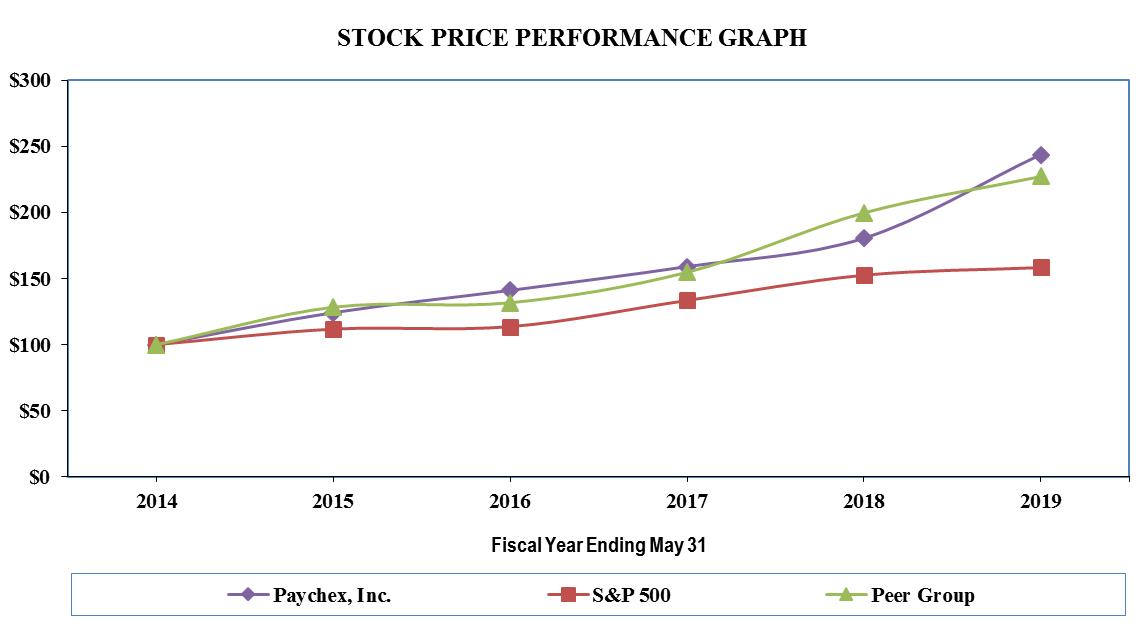
| May 31, | 2014 | 2015 | 2016 | 2017 | 2018 | 2019 | ||||||
| Paychex | $100.00 | $124.25 | $141.11 | $159.07 | $180.58 | $243.87 | ||||||
| S&P 500 | $100.00 | $111.81 | $113.72 | $133.59 | $152.81 | $158.59 | ||||||
| Peer Group | $100.00 | $128.44 | $131.81 | $154.93 | $200.03 | $227.60 |
There can be no assurance that our stock performance will continue into the future with the same or similar trends depicted in the graph above. We neither make nor endorse any predictions as to future stock performance.
Our Peer Group for fiscal 2019 is comprised of the following companies:
| Alliance Data Systems Corporation | H&R Block, Inc. | |
| Automatic Data Processing, Inc. (direct competitor) | Intuit Inc. | |
| Broadridge Financial Solutions, Inc. | Moody’s Corporation | |
| DST System, Inc. | Robert Half International Inc. | |
| The Dun & Bradstreet Corporation | TD AMERITRADE Holding Corporation | |
| Equifax, Inc. | Total Systems Services, Inc. | |
| Fiserv, Inc. | The Western Union Company | |
| Global Payments Inc. |
Item 6. Selected Financial Data
| In millions, except per share amounts | ||||||||||||||||||||
| Year ended May 31, | 2019(4) | 2018(1),(2),(3),(4) | 2017(1),(4) | 2016(5),(6) | 2015(6) | |||||||||||||||
| Service revenue | $ | 3,691.9 | $ | 3,314.2 | $ | 3,102.4 | $ | 2,905.8 | $ | 2,697.5 | ||||||||||
| Interest on funds held for clients | 80.6 | 63.5 | 50.6 | 46.1 | 42.1 | |||||||||||||||
| Total revenue | $ | 3,772.5 | $ | 3,377.7 | $ | 3,153.0 | $ | 2,951.9 | $ | 2,739.6 | ||||||||||
| Operating income | $ | 1,371.3 | $ | 1,291.5 | $ | 1,253.9 | $ | 1,146.6 | $ | 1,053.6 | ||||||||||
| Net income | $ | 1,034.4 | $ | 994.1 | $ | 826.3 | $ | 756.8 | $ | 674.9 | ||||||||||
| Basic earnings per share | $ | 2.88 | $ | 2.77 | $ | 2.30 | $ | 2.10 | $ | 1.86 | ||||||||||
| Diluted earnings per share | $ | 2.86 | $ | 2.75 | $ | 2.28 | $ | 2.09 | $ | 1.85 | ||||||||||
| Cash dividends per common share | $ | 2.30 | $ | 2.06 | $ | 1.84 | $ | 1.68 | $ | 1.52 | ||||||||||
| Purchases of property and equipment | $ | 123.8 | $ | 154.0 | $ | 94.3 | $ | 97.7 | $ | 102.8 | ||||||||||
| Cash, restricted cash, and total corporate investments | $ | 779.9 | $ | 719.7 | $ | 777.4 | $ | 793.2 | $ | 936.4 | ||||||||||
| Total assets | $ | 8,676.0 | $ | 7,915.4 | $ | 7,280.8 | $ | 6,440.8 | $ | 6,467.5 | ||||||||||
| Total debt | $ | 796.4 | $ | — | $ | — | $ | — | $ | — | ||||||||||
| Stockholders’ equity | $ | 2,619.5 | $ | 2,356.8 | $ | 2,227.2 | $ | 1,911.7 | $ | 1,785.5 | ||||||||||
| Return on stockholders’ equity | 42 | % | 44 | % | 39 | % | 40 | % | 36 | % |
| (1) | In fiscal 2019, we adopted Accounting Standards Codification (“ASC”) Topic 606, “Revenue from Contracts with Customers” (“ASC Topic 606”). As a result, amounts have been adjusted to reflect the adoption of the new standard. The adoption of ASC Topic 606 increased diluted earnings per share by $0.17 and $0.02 per diluted share for fiscal 2018 and for the fiscal year ended May 31, 2017 (“fiscal 2017”), respectively. Refer to Item 8, “Financial Statements and Supplementary Data” of this Form 10-K, for additional discussion of the impact of adopting the new standard. |
|---|
| (2) | In fiscal 2018, the enactment of the Tax Cuts and Jobs Act (the “Tax Act”) significantly impacted our net income, basic and diluted earnings per share, and return on stockholders’ equity. Refer to Item 7, “Management’s Discussion and Analysis of Financial Condition and Results of Operations,” and Item 8, “Financial Statements and Supplementary Data,” of this Form 10-K for additional discussion of the impact of the Tax Act. |
|---|
| (3) | In fiscal 2018, an additional expense and corresponding tax benefit was recognized as a result of the termination of certain license agreements. Refer to Item 7, “Management’s Discussion and Analysis of Financial Condition and Results of Operations”, and Item 8, “Financial Statements and Supplementary Data” of this Form 10-K, for additional discussion of the impact of the termination of certain license agreements. |
|---|
| (4) | In fiscal 2017, we early-adopted new accounting guidance related to employee stock-based compensation payments. As a result, a discrete tax benefit was recognized upon exercise or lapse of stock-based awards. This discrete tax benefit increased diluted earnings per share by approximately $0.02 per diluted share, $0.04 per diluted share, and $0.05 per diluted share for fiscal 2019, fiscal 2018, and fiscal 2017, respectively. |
|---|
| (5) | In the fiscal year ended May 31, 2016 (“fiscal 2016”), a net tax benefit was recorded for income derived in prior tax years from customer-facing software we produced. This net tax benefit increased diluted earnings per share by approximately $0.06 per share. |
|---|
| (6) | During fiscal 2016, we adopted new accounting guidance related to the presentation of deferred taxes within the Consolidated Balance Sheets. As a result, a reclassification of prior year deferred tax amounts was made to conform to the May 31, 2016 presentation of deferred taxes within the Consolidated Balance Sheets. In the table above, a similar reclassification was made, which impacted total assets. |
|---|
Item 7. Management’s Discussion and Analysis of Financial Condition and Results of Operations
Management’s Discussion and Analysis of Financial Condition and Results of Operations reviews the operating results of Paychex, Inc. and its wholly owned subsidiaries (“Paychex,” the “Company,” “we,” “our,” or “us”) for each of the three fiscal years ended May 31, 2019 (“fiscal 2019” or the “fiscal year”), May 31, 2018 (“fiscal 2018”), and May 31, 2017 (“fiscal 2017”), and our financial condition as of May 31, 2019. This review should be read in conjunction with the accompanying consolidated financial statements and the related Notes to Consolidated Financial Statements contained in Item 8 of this Annual Report on Form 10-K (“Form 10-K”) and the “Risk Factors” discussed in Item 1A of this Form 10-K. Forward-looking statements in this review are qualified by the cautionary statement under the heading “Cautionary Note Regarding Forward-Looking Statements Pursuant to the United States Private Securities Litigation Reform Act of 1995” contained at the beginning of Part I of this Form 10-K.
Overview
We are a leading provider of integrated human capital management (“HCM”) solutions for payroll, benefits, human resource (“HR”), and insurance services for small- to medium-sized businesses. We offer a comprehensive portfolio of HCM services and products that allow our clients to meet their diverse payroll and HR needs.
We support small-business companies through our core payroll, utilizing our proprietary, robust, software-as-a-service (“SaaS”) Paychex Flex® platform, and our SurePayroll® SaaS-based products. Mid-market companies typically have more complex payroll and benefits needs, and are serviced through our Paychex Flex Enterprise solution set, which offers an integrated suite of HCM solutions through the Paychex Flex platform, or through our legacy platform. Our SaaS solution through Paychex Flex Enterprise integrates payroll processing with HR management, employee benefits administration, time and labor management, applicant tracking, onboarding solutions, and performance and learning management.
Our portfolio of HCM and employee benefit-related services are as follows:
Management Solutions:
| · | payroll processing services; |
|---|
| · | payroll tax administration services; |
|---|
| · | employee payment services; |
|---|
| · | regulatory compliance services (new-hire reporting and garnishment processing); |
|---|
| · | HR Solutions Administrative Services Organization (“ASO”); |
|---|
| · | retirement services administration; |
|---|
| · | HR administration services, including time and attendance, benefit enrollment, recruiting, and onboarding; |
|---|
| · | other HR services and products; and |
|---|
| · | business services. Our wholly owned subsidiary, Paychex Advance LLC (“Paychex Advance”), provides a portfolio of services to the temporary staffing industry, including payroll funding (via the purchase of accounts receivable) and outsourcing services, which includes payroll processing, invoicing, and tax preparation. |
|---|
Professional Employer Organization (“PEO”) and Insurance Services:
| · | PEO services provided by our licensed subsidiaries, Paychex Business Solutions, LLC, HR Outsourcing Holdings, Inc. (“HROi”), and Oasis Outsourcing Group Holdings, L.P. (“Oasis”); and |
|---|
| · | insurance services provided by our licensed insurance agency, Paychex Insurance Agency, Inc. |
|---|
Our mission is to be the leading provider of payroll, benefits, HR, and insurance services for small and mid-sized companies by being an essential partner with America's businesses. We believe success in this mission will lead to strong long-term financial performance. Our strategy focuses on flexible, convenient service; industry-leading, integrated technology; solid sales execution; providing a comprehensive suite of value-added HCM services; continued service penetration; and engaging in strategic acquisitions.
We continue to focus on driving growth in the number of clients, revenue per client, and revenue and profits, while providing industry-leading service and technology solutions to our clients and their employees. We maintain industry-leading margins by managing our personnel costs and expenses while continuing to invest in our business, particularly in leading-edge technology. We believe these investments are critical to our success. Looking to the future, we believe that investing in our products, people, and service capabilities will position us to capitalize on opportunities for long-term growth.
Our financial results for fiscal 2019 reflect another year of continued growth across our major HCM product lines. PEO and Insurance Services revenue continued to experience strong growth of 46% for fiscal 2019 as compared with fiscal 2018. Excluding the acquisition of Oasis, PEO and Insurance Services revenue increased 19% for fiscal 2019. The impact of the acquisition of HROi on PEO and Insurance Services revenue growth for fiscal 2019 was approximately 4%. The remaining increases were driven by growth in clients and client worksite employees across our combined existing PEO business. Management Solutions revenue increased 4% for fiscal 2019 as compared with fiscal 2018, primarily driven by growth in our client base across many of our services, growth in revenue per check, which improved as a result of price increases, net of discounts, and increased revenue per client. As of May 31, 2019, including the Oasis acquisition, we served approximately 670,000 payroll and PEO clients. As of May 31, 2018, we served over 650,000 payroll and PEO clients. Client retention was over 82% of our beginning client base for the fiscal year, in line with our historic best retention rate.
Effective December 20, 2018, the Company acquired Oasis. Upon closing, Oasis became a wholly owned subsidiary of the Company. Oasis is an industry leader in providing HR outsourcing services. The purchase price was $992.2 million, net of $262.3 million in cash acquired, including $132.1 million of restricted cash. The acquisition was financed through a combination of cash on hand and the issuance of long-term private placement debt totaling $800.0 million.
Interest rates available on high-quality financial instruments have gradually increased. Our combined funds held for clients and corporate investment portfolios earned an average rate of return of 1.9% for fiscal 2019, compared to 1.5% for fiscal 2018 and 1.2% for fiscal 2017. The United States (“U.S.”) Federal Reserve raised the Federal Funds rate by a total of 75 basis points during fiscal 2019 to a range of 2.25% to 2.50% as of May 31, 2019. The Federal Funds rate was in the range of 1.50% to 1.75% as of May 31, 2018.
Highlights of our financial results for fiscal 2019, compared to fiscal 2018, are as follows:
| · | Total revenue increased 12% to $3.8 billion. |
|---|
| · | Total service revenue increased 11% to $3.7 billion. |
|---|
| o | Management Solutions revenue increased 4% to $2.9 billion. |
|---|
| o | PEO and Insurance Services revenue increased 46% to $814.2 million. Excluding the acquisition of Oasis, PEO and Insurance Services revenue increased 19%. The impact of the acquisition of HROi on PEO and Insurance Services revenue growth was approximately 4%. |
|---|
| · | Interest on funds held for clients increased 27% to $80.6 million. |
|---|
| · | Operating income increased 6% to $1.4 billion. Adjusted operating income(1) increased 4% to $1.4 billion. |
|---|
| | · | | Net income increased 4% to $1.0 billion. Adjusted net income(1) increased 11% to $1.0 bill
Showing the first 8K of 75K characters. Open the full section
Item 7A. Quantitative and Qualitative Disclosures About Market Risk
Market Risk Factors
Changes in interest rates and interest rate risk: Funds held for clients are primarily comprised of short-term funds and available-for-sale securities. Corporate investments are primarily comprised of available-for-sale securities. As a result of our investing activities, we are exposed to changes in interest rates that may materially affect our results of operations and financial position. Changes in interest rates will impact the earnings potential of future investments and will cause fluctuations in the fair value of our longer-term available-for-sale securities. We follow an investment strategy of protecting principal and optimizing liquidity. A substantial portion of our portfolios are invested in high credit quality securities with ratings of AA or higher, and A-1/P-1 ratings on short-term securities. We invest predominately in municipal bonds – including general obligation bonds; pre-refunded bonds, which are secured by a U.S. government escrow; and essential services revenue bonds – along with U.S. government agency and treasury securities and corporate bonds. We limit the amounts that can be invested in any single issuer and invest primarily in short- to intermediate-term instruments whose fair value is less sensitive to interest rate changes. We manage the available-for-sale securities to a benchmark duration of two and one-half to three and three-quarters years.
During fiscal 2019, our primary short-term investment vehicles were government agency discount notes, VRDNs, and bank demand deposit accounts. We have no exposure to high-risk or illiquid investments. We have insignificant exposure to European investments. We have not and do not utilize derivative financial instruments to manage our interest rate risk.
During fiscal 2019, the average interest rate earned on our combined funds held for clients and corporate investment portfolios was 1.9%, compared to 1.5% and 1.2% for fiscal years 2018 and 2017, respectively. When interest rates are rising, the full impact of higher interest rates will not immediately be reflected in net income due to the interaction of short- and long-term interest rate changes. During a rising interest rate environment, earnings increase from our short-term investments, and over time earnings increase from our longer-term available-for-sale securities. Earnings from the available-for-sale securities, which as of May 31, 2019 had an average duration of 2.9 years, would not reflect increases in interest rates until the investments are sold or mature and the proceeds are reinvested at higher rates.
The amortized cost and fair value of available-for-sale securities that had stated maturities as of May 31, 2019 are shown below by contractual maturity. Expected maturities can differ from contractual maturities because borrowers may have the right to prepay obligations without prepayment penalties.
| May 31, 2019 | ||||||
| Amortized | Fair | |||||
| In millions | cost | value | ||||
| Maturity date: | ||||||
| Due in one year or less | $ | 183.5 | $ | 183.4 | ||
| Due after one year through three years | 898.9 | 903.1 | ||||
| Due after three years through five years | 989.2 | 998.7 | ||||
| Due after five years | 1,529.5 | 1,535.6 | ||||
| Total | $ | 3,601.1 | $ | 3,620.8 |
VRDNs are primarily categorized as due after five years in the table above as the contractual maturities on these securities are typically 20 to 30 years. Although these securities are issued as long-term securities, they are priced and traded as short-term instruments because of the liquidity provided through the tender feature.
The Federal Reserve has periodically raised the Federal Funds rate in each of fiscal years 2019, 2018, and 2017. As of May 31, 2019, the Federal Funds rate was in the range of 2.25% to 2.50% as compared to a range of 1.50% to 1.75% as of May 31, 2018, and in the range of 0.75% to 1.00% as of May 31, 2017.
Calculating the future effects of changing interest rates involves many factors. These factors include, but are not limited to:
-
daily interest rate changes;
-
seasonal variations in investment balances;
-
actual duration of short-term and available-for-sale securities;
-
the proportion of taxable and tax-exempt investments;
-
changes in tax-exempt municipal rates versus taxable investment rates, which are not synchronized or simultaneous; and
-
financial market volatility and the resulting effect on benchmark and other indexing interest rates.
Subject to these factors and under normal financial market conditions, a 25-basis-point change in taxable interest rates generally affects our tax-exempt interest rates by approximately 17 basis points. Under normal financial market conditions, the impact to earnings from a 25-basis-point change in short-term interest rates would be approximately $3.0 million to $4.0 million, after taxes, for a twelve-month period. Such a basis point change may or may not be tied to changes in the Federal Funds rate.
Our total investment portfolio (funds held for clients and corporate investments) averaged approximately $4.8 billion for fiscal 2019. Our anticipated allocation is approximately 45% invested in short-term securities and VRDNs with an average duration of less than 30 days, and 55% invested in available-for-sale securities with an average duration of two and one-half to three and three-quarters years.
The combined funds held for clients and corporate available-for-sale securities reflected a net unrealized gain of $19.7 million as of May 31, 2019, compared with a net unrealized loss of $38.3 million as of May 31, 2018. Refer to Note G of the Notes to Consolidated Financial Statements contained in Item 8 of this Form 10-K for additional disclosures on fair value measurements.
During fiscal 2019, the net unrealized gain or loss on our investment portfolios ranged from an unrealized gain of $19.7 million to an unrealized loss of $60.7 million. During fiscal 2018, the net unrealized gain or loss on our investment portfolios ranged from an unrealized gain of $41.4 million to an unrealized loss of $54.5 million. The net unrealized gain on our investment portfolios was approximately $31.6 million as of July 17, 2019.
As of May 31, 2019 and 2018, we had $3.6 billion and $3.1 billion, respectively, invested in available-for-sale securities at fair value. The weighted-average yield-to-maturity was 2.1% and 1.9% as of May 31, 2019 and May 31, 2018, respectively. The weighted-average yield-to-maturity excludes available-for-sale securities tied to short-term interest rates such as the VRDNs. Assuming a hypothetical increase in longer-term interest rates of 25 basis points, the resulting potential decrease in fair value for our portfolio of available-for-sale securities as of May 31, 2019, would be in the range of $15.0 million to $20.0 million. Conversely, a corresponding decrease in interest rates would result in a comparable increase in fair value. This hypothetical increase or decrease in the fair value of the portfolio would be recorded as an adjustment to the portfolio’s recorded value, with an offsetting amount recorded in stockholders’ equity. These fluctuations in fair value would have no related or immediate impact on the results of operations, unless any declines in fair value were considered to be other-than-temporary and an impairment loss recognized.
Credit risk: We are exposed to credit risk in connection with these investments through the possible inability of the borrowers to meet the terms of their bonds. We regularly review our investment portfolios to determine if any investment is other-than-temporarily impaired due to changes in credit risk or other potential valuation concerns. We believe that the investments we held as of May 31, 2019 were not other-than-temporarily impaired. While $567.9 million of our available-for-sale securities had fair values that were below amortized cost, we believe that it is probable that the principal and interest will be collected in accordance with the contractual terms, and that unrealized losses of $2.7 million were due to changes in interest rates and were not due to increased credit risk or other valuation concerns. A majority of these securities in an unrealized loss position as of May 31, 2019 and 2018 held an AA rating or better. We do not intend to sell these investments until the recovery of their amortized cost basis or maturity, and further believe that it is not more-likely-than-not that we will be required to sell these investments prior to that time. Our assessment that an investment is not other-than-temporarily impaired could change in the future due to new developments or changes in our strategies or assumptions related to any particular investment.
We have some credit risk exposure in connection with our purchase of accounts receivable as a means of providing payroll funding to clients in the temporary staffing industry. This credit risk exposure is diversified amongst multiple client arrangements and all such arrangements are regularly reviewed for potential write-off. No single client is material in respect to total accounts receivable, service revenue, or results of operations.
Item 8. Financial Statements and Supplementary Data
TABLE OF CONTENTS
REPORT ON MANAGEMENT’S ASSESSMENT OF
INTERNAL CONTROL OVER FINANCIAL REPORTING
Management of Paychex, Inc. (the “Company”) is responsible for establishing and maintaining adequate internal control over financial reporting as such term is defined in Rules 13a-15(f) and 15d-15(f) under the Securities Exchange Act of 1934, as amended. The Company’s internal control over financial reporting is designed to provide reasonable assurance regarding the reliability of financial reporting and the preparation of the financial statements for external purposes in accordance with generally accepted accounting principles.
Because of its inherent limitations, internal control over financial reporting may not prevent or detect misstatements. Also, projections of any evaluation of effectiveness to future periods are subject to the risk that controls may become inadequate because of changes in conditions, or that the degree of compliance with the policies or procedures may deteriorate.
Management assessed the effectiveness of the Company’s internal control over financial reporting as of May 31, 2019. In making this assessment, management used the criteria set forth by the Committee of Sponsoring Organizations of the Treadway Commission in “Internal Control — Integrated Framework” (2013). Based on our assessment, management determined that the Company maintained effective internal control over financial reporting as of May 31, 2019.
On December 20, 2018, we completed our acquisition of Oasis Outsourcing Group Holdings, L.P. (“Oasis”). We are in the process of evaluating the existing controls and procedures of Oasis and integrating Oasis into our internal control over financial reporting. In accordance with Securities and Exchange Commission Staff guidance, permitting a company to exclude an acquired business from management’s assessment of the effectiveness of internal control over financial reporting for the year in which the acquisition is completed, we have excluded Oasis from our assessment of the effectiveness of internal control over financial reporting as of May 31, 2019. Oasis represented 8% of the Company’s total assets as of May 31, 2019 and 4% of the Company’s revenues for the year ended May 31, 2019. The scope of management’s assessment of the effectiveness of the design and operation of the Company’s disclosure controls and procedures as of May 31, 2019 includes all of the Company’s consolidated operations except for those disclosure controls and procedures of Oasis that are subsumed by internal control over financial reporting.
The Company’s independent registered public accounting firm, PricewaterhouseCoopers LLP, is appointed by the Company’s Audit Committee. PricewaterhouseCoopers LLP has audited the Consolidated Financial Statements included in this Annual Report on Form 10-K and the effectiveness of the Company's internal control over financial reporting as of May 31, 2019, and as a part of their integrated audit, has issued their report, included herein, on the effectiveness of the Company’s internal control over financial reporting.
| /s/ Martin Mucci Martin Mucci President and Chief Executive Officer | /s/ Efrain Rivera Efrain Rivera Senior Vice President, Chief Financial Officer, and Treasurer |
REPORT OF INDEPENDENT REGISTERED PUBLIC ACCOUNTING FIRM
To the Board of Directors and Shareholders of Paychex, Inc.
Opinions on the Financial Statements and Internal Control over Financial Reporting
We have audited the accompanying consolidated balance sheets of Paychex, Inc. and its subsidiaries as of May 31, 2019 and 2018, and the related consolidated statements of income and comprehensive income, of stockholders’ equity, and of cash flows for each of the three years in the period ended May 31, 2019, including the related notes and financial statement schedule listed in the accompanying index (collectively referred to as the “consolidated financial statements”). We also have audited the Company's internal control over financial reporting as of May 31, 2019, based on criteria established in Internal Control - Integrated Framework (2013) issued by the Committee of Sponsoring Organizations of the Treadway Commission (COSO).
In our opinion, the consolidated financial statements referred to above present fairly, in all material respects, the financial position of the Company as of May 31, 2019 and 2018, and the results of its operations and its cash flows for each of the three years in the period ended May 31, 2019 in conformity with accounting principles generally accepted in the United States of America. Also in our opinion, the Company maintained, in all material respects, effective internal control over financial reporting as of May 31, 2019, based on criteria established in Internal Control - Integrated Framework (2013) issued by the COSO.
Basis for Opinions
The Company's management is responsible for these consolidated financial statements, for maintaining effective internal control over financial reporting, and for its assessment of the effectiveness of internal control over financial reporting, included in the accompanying Report on Management’s Assessment of Internal Control Over Financial Reporting. Our responsibility is to express opinions on the Company’s consolidated financial statements and on the Company's internal control over financial reporting based on our audits. We are a public accounting firm registered with the Public Company Accounting Oversight Board (United States) ("PCAOB") and are required to be independent with respect to the Company in accordance with the U.S. federal securities laws and the applicable rules and regulations of the Securities and Exchange Commission and the PCAOB.
We conducted our audits in accordance with the standards of the PCAOB. Those standards require that we plan and perform the audits to obtain reasonable assurance about whether the consolidated financial statements are free of material misstatement, whether due to error or fraud, and whether effective internal control over financial reporting was maintained in all material respects.
Our audits of the consolidated financial statements included performing procedures to assess the risks of material misstatement of the consolidated financial statements, whether due to error or fraud, and performing procedures that respond to those risks. Such procedures included examining, on a test basis, evidence regarding the amounts and disclosures in the consolidated financial statements. Our audits also included evaluating the accounting principles used and significant estimates made by management, as well as evaluating the overall presentation of the consolidated financial statements. Our audit of internal control over financial reporting included obtaining an understanding of internal control over financial reporting, assessing the risk that a material weakness exists, and testing and evaluating the design and operating effectiveness of internal control based on the assessed risk. Our audits also included performing
Showing the first 8K of 170K characters. Open the full section
Item 9. Changes in and Disagreements with Accountants on Accounting and Financial Disclosure
None.
Item 9A. Controls and Procedures
Disclosure Controls and Procedures: Disclosure controls and procedures are designed with the objective of ensuring that information required to be disclosed in the Company’s reports filed under the Exchange Act, such as this report, is recorded, processed, summarized, and reported within the time periods specified in the SEC’s rules and forms. Disclosure controls and procedures are also designed with the objective of ensuring that such information is accumulated and communicated to the Company’s management, including the Company’s principal executive officer and principal financial officer, as appropriate, to allow timely decisions regarding required disclosure.
The scope of management’s assessment of the effectiveness of the design and operation of the Company’s disclosure controls and procedures as of May 31, 2019 includes all of the Company’s consolidated operations except for those disclosure controls and procedures of Oasis that are subsumed by internal control over financial reporting.
Conclusion Regarding the Effectiveness of Disclosure Controls and Procedures: As of the end of the period covered by this report, the Company carried out an evaluation, under the supervision and with the participation of the Company’s principal executive officer and principal financial officer, of the effectiveness of disclosure controls and procedures as defined in Rules 13a-15(e) and 15d-15(e) of the Exchange Act. Based on such evaluation, the Company’s principal executive officer and principal financial officer have concluded that as of May 31, 2019, the end of the period covered by this report, the Company’s disclosure controls and procedures were effective.
Changes in Internal Control Over Financial Reporting: The Company also carried out an evaluation of the internal control over financial reporting to determine whether any changes occurred during the fiscal quarter ended May 31, 2019. In connection with the Company’s adoption of ASC Topic 606 the Company has updated its control framework effective June 1, 2018 for certain new internal controls and changes to certain existing controls, including reconciliation controls, management review controls, and contract review controls. Other than these changes, there have been no changes in the Company’s internal control over financial reporting that occurred during the Company’s most recently completed fiscal quarter ended May 31, 2019, that materially affected, or are reasonably likely to materially affect, the Company’s internal control over financial reporting.
Internal Control Over Financial Reporting: The Report on Management’s Assessment of Internal Control Over Financial Reporting and the Report of Independent Registered Public Accounting Firm are included in Part II, Item 8 of this Form 10-K.
The Company is in the process of evaluating the existing controls and procedures of Oasis and integrating Oasis into its internal control over financial reporting. In accordance with SEC Staff guidance permitting a company to exclude an acquired business from management’s assessment of the effectiveness of internal control over financial reporting for the year in which the acquisition is completed, we have excluded Oasis from the Company’s assessment of the effectiveness of internal control over financial reporting as of May 31, 2019. Oasis represented 8% of the Company’s total assets as of May 31, 2019 and 4% of the Company’s revenues for the fiscal year ended May 31, 2019.
Item 9B. Other Information
None.
PART III
Item 10. Directors, Executive Officers and Corporate Governance
The following table shows the executive officers of the Company as of May 31, 2019, and information regarding their positions and business experience. Such executive officers hold principal policy-making powers at the Company.
| Name | Age | Position and business experience | ||
| Martin Mucci | 59 | Mr. Mucci has served as President and Chief Executive Officer of the Company since September 2010. Mr. Mucci joined the Company in 2002 as Senior Vice President, Operations. Prior to joining Paychex, he held senior level positions with Frontier Communications of Rochester, a telecommunications company, including President of Telephone Operations and Chief Executive Officer of Frontier Telephone of Rochester, during his 20-year career. Mr. Mucci was a director of Cbeyond, Inc. until it was purchased by Birch Communications in July 2014. He is a member of the Upstate New York Regional Advisory Board of the Federal Reserve Bank of New York and is a Trustee Emeritus of St. John Fisher College. He also serves as a director of the Company and is chairman of the Executive Committee. | ||
| Efrain Rivera | 62 | Mr. Rivera joined Paychex in June 2011 as Senior Vice President, Chief Financial Officer, and Treasurer. Prior to joining the Company, Mr. Rivera served as Vice President of Finance and Administration for Houghton College from 2009 to 2011. He previously served for over twenty years with Bausch & Lomb Incorporated, a world leader in the development, manufacture, and marketing of eye health products, most recently as Corporate Vice President and Chief Financial Officer from 2007 to 2009. | ||
| Mark A. Bottini | 58 | Mr. Bottini joined Paychex in October 2011 as Senior Vice President of Sales. From 2008 to 2011, Mr. Bottini served as Vice President of Sales for Ricoh, North America, a provider of advanced office technology and innovative document imaging products, services, and software. He assumed his most recent position with Ricoh when Ricoh acquired IKON Office Solutions, Inc. During his nearly 20 years with IKON, Mr. Bottini served in a variety of sales leadership and field management roles. | ||
| John B. Gibson | 53 | Mr. Gibson joined Paychex in May 2013 as Senior Vice President of Service. Prior to joining the Company, Mr. Gibson served as President and Chief Executive Officer for AlphaStaff, a national provider of human resource outsourcing services to small- and medium-sized businesses. Prior to joining AlphaStaff in 2010, Mr. Gibson was President of the HR Management Division of Convergys, a global leader in technology, outsourcing, and business services. From 2004 to 2007, he served as Senior Vice President of Global Operations and Client Services of Convergys. | ||
| Michael E. Gioja | 61 | Mr. Gioja was named Senior Vice President of Information Technology and Product Development in July 2011. Mr. Gioja has been with the Company since November 2008 and previously served as Senior Vice President of Information, Technology, Product Management, and Development and Vice President of Product Management. Previously, he was Chief Information Officer and Executive Vice President of Products and Services for Workstream, Inc., a provider of on-demand enterprise talent management solutions and services. |
| Name | Age | Position and business experience | ||
| Stephanie L. Schaeffer | 49 | Ms. Schaeffer was named Vice President and Chief Legal Officer in January 2006. In 2011, she was appointed Corporate Secretary. She joined Paychex in 2000 as Corporate Counsel and was promoted to Director of Legal Affairs in 2004. In her current role, she is responsible for overseeing all of the Company's legal functions, including litigation, corporate governance, and regulatory matters. | ||
| Jennifer Vossler(1) | 56 | Ms. Vossler joined the Company in May 2009 as Vice President and Controller. Prior to joining the Company, she served as Vice President and Corporate Controller, and held various executive and senior management positions during her eleven years at Bausch & Lomb Incorporated. Previously in her career, she held leadership roles with a global facilities management outsourcing company and a public accounting firm. | ||
| Laurie L. Zaucha | 54 | Ms. Zaucha joined the Company in March 2011 and was named Vice President of Human Resources and Organizational Development. Prior to joining the Company, she served as Senior Vice President of Human Resources for Paetec Holding Corp., a Fortune 1000 telecommunications company, from 2007 to 2011. From 2003 to 2007, she held various executive positions at Bausch & Lomb Incorporated. |
| (1) | On July 10, 2019, the Board appointed Ms. Vossler to Vice President and Assistant Treasurer, effective as of the same date. The Board also appointed Robert L. Schrader to Vice President and Controller, effective as of July 10, 2019. |
|---|
The additional information required by this item is set forth in the Company’s Definitive Proxy Statement for its 2019 Annual Meeting of Stockholders, anticipated to be held on or about October 17, 2019, in the sections “PROPOSAL 1: ELECTION OF DIRECTORS FOR A ONE-YEAR TERM,” “DELINQUENT SECTION 16(a) REPORTS,” “CORPORATE GOVERNANCE,” and “CODE OF BUSINESS ETHICS AND CONDUCT” and is incorporated herein by reference.
Item 11. Executive Compensation
The information required by this item is set forth in the Company’s Definitive Proxy Statement for its 2019 Annual Meeting of Stockholders, anticipated to be held on or about October 17, 2019, in the sections “COMPENSATION DISCUSSION AND ANALYSIS,” “NAMED EXECUTIVE OFFICER COMPENSATION,” “DIRECTOR COMPENSATION FOR THE FISCAL YEAR ENDED May 31, 2019,” “THE GOVERNANCE AND COMPENSATION COMMITTEE REPORT” and the sub-heading “Governance and Compensation Committee Interlocks and Insider Participation” within the section “CORPORATE GOVERNANCE” and is incorporated herein by reference.
Item 12. Security Ownership of Certain Beneficial Owners and Management and Related Stockholder Matters
The information required by this item is set forth below and in the Company’s Definitive Proxy Statement for its 2019 Annual Meeting of Stockholders, anticipated to be held on or about October 17, 2019, under the section “BENEFICIAL OWNERSHIP OF PAYCHEX COMMON STOCK,” and is incorporated herein by reference.
The Company maintains equity compensation plans in the form of stock incentive plans. Under the Paychex, Inc. 2002 Stock Incentive Plan, as amended and restated effective October 14, 2015 (the “2002 Plan”), non-qualified or incentive stock options, restricted stock, restricted stock units, performance shares, and performance stock options have been awarded to employees and the Board. The 2002 Plan was adopted on July 9, 2015 by the Board and became effective upon stockholder approval at the Company’s Annual Meeting of Stockholders held on October 14, 2015. Refer to Note F of the Notes to Consolidated Financial Statements, contained in Item 8 of this Form 10-K, for more information on the Company’s stock incentive plans.
The following table details information on securities authorized for issuance under the Company’s stock option incentive plans as of May 31, 2019:
| In millions, except per share amounts | Number of securities to be issued upon exercise of outstanding options | Weighted-average exercise price of outstanding options | Number of securities remaining available for future issuance under equity compensation plans | ||||||
| Equity compensation plans approved by security holders (1) | 6.2 | $ | 49.80 | 18.2 |
| (1) | Amounts include performance stock options granted, assuming achievement of performance goals at target. Actual amount of shares to be earned may differ from the target amount. |
|---|
Item 13. Certain Relationships and Related Transactions, and Director Independence
The information required by this item is set forth in the Company’s Definitive Proxy Statement for its 2019 Annual Meeting of Stockholders, anticipated to be held on or about October 17, 2019, under the sub-headings “Board Meetings and Committees” and “Policy on Transactions with Related Persons” within the section “CORPORATE GOVERNANCE,” and is incorporated herein by reference.
Item 14. Principal Accounting Fees and Services
The information required by this item is set forth in the Company’s Definitive Proxy Statement for its 2019 Annual Meeting of Stockholders, anticipated to be held on or about October 17, 2019, under the section “PROPOSAL 3: RATIFICATION OF SELECTION OF INDEPENDENT REGISTERED PUBLIC ACCOUNTING FIRM,” and is incorporated herein by reference.
PART IV
Item 15. Exhibits and Financial Statement Schedules
| * | 101.DEF | XBRL taxonomy extension definition linkbase document. |
|---|
| * | Exhibit filed with this report. |
| # | Management contract or compensatory plan. |
Item 16. Form 10-K Summary
None.
SIGNATURES
Pursuant to the requirements of Section 13 or 15(d) of the Securities Exchange Act of 1934, the registrant has duly caused this report to be signed on its behalf by the undersigned, thereunto duly authorized, on July 24, 2019.
PAYCHEX, INC.
By: /s/ Martin Mucci
Martin Mucci
President and Chief Executive Officer
Pursuant to the requirements of the Securities Exchange Act of 1934, this report has been signed below by the following persons on behalf of the registrant and in the capacities indicated on July 24, 2019.
/s/ Martin Mucci
Martin Mucci, President and
Chief Executive Officer, and Director
(Principal Executive Officer)
/s/ Efrain Rivera
Efrain Rivera, Senior Vice President, Chief Financial Officer, and Treasurer
(Principal Financial Officer)
/s/ Robert L. Schrader
Robert L. Schrader, Vice President and Controller
(Principal Accounting Officer)
B. Thomas Golisano*, Chairman of the Board
Thomas F. Bonadio*, Director
Joseph G. Doody*, Director
David J.S. Flaschen*, Director
Pamela A. Joseph*, Director
Joseph M. Tucci*, Director
Joseph Velli*, Director
Kara Wilson*, Director
*By: /s/ Martin Mucci
Martin Mucci, as Attorney-in-Fact