 filings.tools
Item 1. BUSINESS
26K characters. Original on sec.gov · Markdown
Item 1. BUSINESS
| --- | --- |
Packaging Corporation of America (“we,” “us,” “our,” “PCA,” or the “Company”) is the fourth largest producer of containerboard products and the third largest producer of uncoated freesheet (UFS) in North America, based on production capacity. We operate five containerboard mills, three white paper mills and 94 corrugated products manufacturing plants. We are headquartered in Lake Forest, Illinois and operate primarily in the United States.
We report in three reportable segments: Packaging, Paper and Corporate and Other. For segment financial information see Note 17, Segment Information, of the Notes to Consolidated Financial Statements in “Part II, Item 8, Financial Statements and Supplementary Data” of this Form 10-K.
On October 2, 2017, we acquired substantially all of the assets of Sacramento Container Corporation, and 100% of the membership interests of Northern Sheets, LLC and Central California Sheets, LLC for a cash purchase price of $265 million, funded with cash on hand. The acquired companies operate two full-line corrugated products operations and sheet feeders in McClellan, California and Kingsburg, California.
During the third quarter of 2017, we announced that we would discontinue production of uncoated freesheet and certain types of pressure sensitive grades of white paper at our Wallula, Washington mill in the second quarter of 2018. We will convert the No. 3 paper machine at the mill to a 400,000 ton-per-year virgin kraft linerboard machine. After the conversion, the Wallula mill will produce only containerboard.
Production and Shipments
The following table summarizes the Packaging segment's containerboard production and corrugated products shipments and the Paper segment's production.
| First Quarter | Second Quarter | Third Quarter | Fourth Quarter | Full Year | ||||||||||||||||||||||
|---|---|---|---|---|---|---|---|---|---|---|---|---|---|---|---|---|---|---|---|---|---|---|---|---|---|---|
| Containerboard Production | PCA | 2017 | 932 | 947 | 996 | 1,006 | 3,881 | |||||||||||||||||||
| (thousand tons) | 2016 | 898 | 926 | 950 | 962 | 3,736 | ||||||||||||||||||||
| 2015 | 882 | 938 | 933 | 903 | 3,656 | |||||||||||||||||||||
| Corrugated Shipments (BSF) | PCA | 2017 | 13.6 | 13.9 | 13.7 | 14.5 | 55.7 | |||||||||||||||||||
| 2016 | 12.3 | 12.7 | 13.1 | 13.2 | 51.3 | |||||||||||||||||||||
| 2015 | 11.9 | 12.4 | 12.5 | 12.1 | 48.9 | |||||||||||||||||||||
| White Paper (UFS) Production | PCA | 2017 | 273 | 289 | 278 | 278 | 1,118 | |||||||||||||||||||
| (thousand tons) | 2016 | 283 | 268 | 288 | 288 | 1,127 | ||||||||||||||||||||
| 2015 | 288 | 273 | 294 | 262 | 1,117 | |||||||||||||||||||||
| Market Pulp Production (a) | PCA | 2017 | - | - | - | - | - | |||||||||||||||||||
| (thousand tons) | 2016 | 16 | 10 | 12 | 7 | 45 | ||||||||||||||||||||
| 2015 | 27 | 23 | 25 | 23 | 98 |
| (a) | On December 1, 2016, PCA ceased production of softwood market pulp at our Wallula, Washington mill and permanently shut down the No.1 machine. |
|---|
Below is a map of our locations:
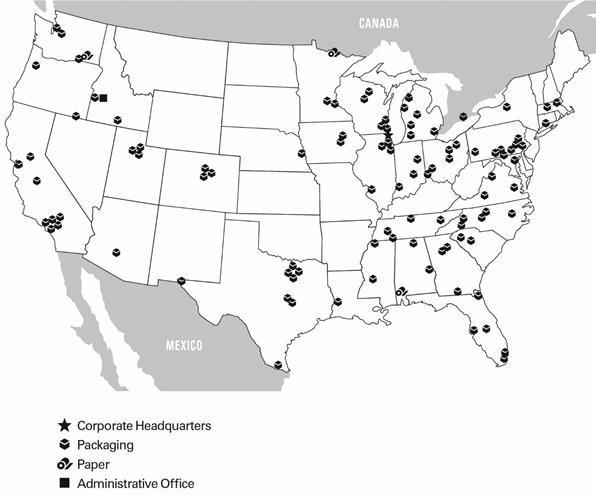
Packaging
Packaging Products
Our containerboard mills produce linerboard and semi-chemical corrugating medium, which are papers primarily used in the production of corrugated products. Our corrugated products manufacturing plants produce a wide variety of corrugated packaging products, including conventional shipping containers used to protect and transport manufactured goods, multi-color boxes and displays with strong visual appeal that help to merchandise the packaged product in retail locations, and honeycomb protective packaging. In addition, we are a large producer of packaging for meat, fresh fruit and vegetables, processed food, beverages, and other industrial and consumer products.
During the year ended December 31, 2017, our Packaging segment produced 3.9 million tons of containerboard at our mills. Our corrugated products manufacturing plants sold 55.7 billion square feet (BSF) of corrugated products. Our net sales to third parties totaled $5.3 billion in 2017.
Facilities
We currently manufacture our Packaging products at five containerboard mills, one containerboard machine (at our Wallula, Washington white paper mill), corrugated manufacturing operations, and protective packaging operations. Total annual containerboard capacity is 4,111,000 tons. The following provides more details of our operations:
Counce. Our Counce, Tennessee mill produces kraft linerboard. The mill can produce basis weights from 26 lb. to 90 lb. The mill also produces a variety of performance and specialty grades of linerboard.
DeRidder. Our DeRidder, Louisiana mill produces kraft linerboard on its No. 1 machine and linerboard and semi-chemical corrugating medium on its No. 3 machine. The mill can produce linerboard in basis weights of 26 lb. to 69 lb. and medium in basis weights of 23 lb. to 33 lb.
Valdosta. Our Valdosta, Georgia mill produces kraft linerboard. The mill can produce basis weights from 35 lb. to 96 lb.
Tomahawk. Our Tomahawk, Wisconsin mill produces semi-chemical corrugating medium. The Tomahawk mill can produce basis weights from 23 lb. to 47 lb. and a variety of performance and specialty grades of corrugating medium.
Filer City. Our Filer City, Michigan mill produces semi-chemical corrugating medium. Filer City can produce corrugating medium in basis weights from 20 lb. to 47 lb.
Wallula. Our Wallula, Washington mill primarily produces white paper, but also produces semi-chemical corrugating medium on one of its two paper machines. Wallula can produce corrugating medium in basis weights from 23 lb. to 45 lb. As described above, we are converting the No. 3 machine at the mill from white paper to kraft linerboard. After the conversion, the Wallula mill will solely produce containerboard.
We operate 94 corrugated manufacturing operations, a technical and development center, nine regional design centers, a rotogravure printing operation, and a complement of packaging supplies and distribution centers. Of the 94 manufacturing facilities, 61 operate as combining operations, commonly called corrugated plants, which manufacture corrugated sheets and finished corrugated packaging products, 32 are sheet plants, which procure combined sheets and manufacture finished corrugated packaging products, and one is a corrugated sheet-only manufacturer.
Corrugated products plants tend to be located in close proximity to customers to minimize freight costs. Each of our plants serve a market radius of approximately 150 miles. Our sheet plants are generally located in close proximity to our larger corrugated plants, which enables us to offer additional services and converting capabilities such as small volume and quick turnaround items.
Major Raw Materials Used
Fiber supply. Fiber is the largest raw material cost to manufacture containerboard. We consume both wood fiber and recycled fiber in our containerboard mills. We have no 100% recycled mills, or mills whose fiber consumption consists solely of recycled fiber. To reduce our fiber costs, we have invested in processes and equipment to ensure a high degree of fiber flexibility. Our mill system has the capability to shift a portion of its fiber consumption between softwood, hardwood, and recycled sources. All of our mills, other than the Valdosta mill, can utilize some recycled fiber in their containerboard production. Our ability to use various types of virgin and recycled fiber helps mitigate the impact of changes in the prices of various fibers. Our corrugated manufacturing operations generate recycled fiber as a by-product from the manufacturing process, which is consumed by our mills. In 2017, our usage of recycled fiber, net of internal generation, represents 17% of our containerboard production.
We procure wood fiber through leases of cutting rights, long-term supply agreements, and market purchases and believe we have adequate sources of fiber supply.
We participate in the Sustainable Forestry Initiative® (SFI), the Programme for the Endorsement of Forest Certification (PEFC), as well as the Forest Stewardship Council (FSC), and we are certified under their sourcing standards. These standards are aimed at ensuring the long-term health and conservation of forestry resources. We are committed to sourcing wood fiber through environmentally, socially, and economically sustainable practices and promoting resource and conservation stewardship ethics.
Energy supply. Energy at our packaging mills is obtained through purchased or self-generated fuels and electricity. Fuel sources include natural gas, by-products of the containerboard manufacturing and pulping process (including black liquor and wood waste), purchased wood waste, and other purchased fuels. Each of our mills self-generates process steam requirements from by-products (black liquor and wood waste), as well as from the various purchased fuels. The process steam is used throughout the production process and also to generate electricity.
In 2017, our packaging mills consumed about 63 million MMBTU’s of fuel to produce both steam and electricity. Of the 63 million MMBTU’s consumed, about 62% was from mill generated by-products and 38% was from purchased fuels. Of the 38% in purchased fuels, 61% was from natural gas, 33% was from purchased wood waste and 6% was from other purchased fuels.
Chemical supply. We consume various chemicals in the production of containerboard, including caustic soda and sulfuric acid. Most of our chemicals are purchased under contracts, which are bid or negotiated periodically.
Sales, Marketing, and Distribution
Our corrugated products are sold through our direct sales and marketing organization, independent brokers, and distribution partners. We have sales representatives and a sales manager at most of our corrugated manufacturing operations and also have corporate account managers who serve customer accounts with a national presence. Additionally, our design centers maintain an on-site dedicated graphics sales force. In addition to direct sales and marketing personnel, we utilize new product development engineers and product graphics and design specialists. These individuals are located at both the corrugated plants and the design centers. General marketing support is located at our corporate headquarters.
Our containerboard sales group is responsible for the coordination of linerboard and corrugating medium, order processing, and sales to our corrugated plants, to outside domestic customers, and to export customers. These personnel also coordinate and execute all containerboard trade agreements with other containerboard manufacturers.
Containerboard produced in our mills is shipped by rail or truck. Our corrugated products are delivered by truck due to our large number of customers and their demand for timely service. Our corrugated manufacturing operations typically serve customers within a 150-mile radius. We sometimes use third-party warehouses for short-term storage of corrugated products.
Customers
We sell corrugated products to over 18,000 customers in over 35,000 locations. About three-quarters of our corrugated products sales are to regional and local accounts, which are broadly diversified across industries and geographic locations. The remaining one-quarter of our customer base consists primarily of national accounts that have multiple locations and are served by a number of PCA plants. No single customer exceeds 10% of segment sales.
The primary end-use markets in the United States for corrugated products are shown below as reported in the 2016 Fibre Box Association annual report:
| Food, beverages, and agricultural products | 45 | % | ||
|---|---|---|---|---|
| Retail and wholesale trade | 22 | % | ||
| Miscellaneous manufacturing | 12 | % | ||
| Paper and other products | 11 | % | ||
| Chemical, plastic, and rubber products | 10 | % |
Competition
As of December 31, 2017, we were the fourth largest producer of containerboard products in the United States, according to industry sources and our own estimates. According to industry sources, corrugated products are produced by about 475 U.S. companies operating approximately 1,200 plants. The primary basis for competition for most of our packaging products includes quality, service, price, product design, and innovation. Most corrugated products are manufactured to the customer’s specifications. Corrugated producers generally sell within a 150-mile radius of their plants and compete with other corrugated producers in their local region. Competition in our corrugated products operations tends to be regional, although we also face competition from large competitors with significant national account presence.
On a national level, our primary competitors are International Paper Company, WestRock Company, Georgia-Pacific LLC, KapStone Paper and Packaging Corporation, and Pratt Industries. However, with our strategic focus on regional and local accounts, we also compete with the smaller, independent producers.
Paper
We are the third largest manufacturer of uncoated freesheet in the United States, according to industry sources and our own estimates. We manufacture and sell white papers, including both commodity and specialty papers, which may have custom or specialized features such as colors, coatings, high brightness, and recycled content. White papers consist of communication papers (cut-size office papers and printing and converting papers) and pressure sensitive papers, including release liners, which our customers use to produce labels for use in consumer and commercially-packaged products.
Facilities
We currently have three white paper mills located in the United States. Total annual white paper capacity is 990,000 tons. The following paragraphs describe our white paper mills:
Jackson. Our Jackson, Alabama mill produces both commodity and specialty papers on two paper machines.
International Falls. Our International Falls, Minnesota mill produces both commodity and specialty papers on two paper machines.
Wallula. Our Wallula, Washington mill has the ability, on one machine, to switch production between pressure sensitive papers and a variety of white paper grades. The mill also produces corrugating medium. As described above, we are converting the No. 3 machine at the mill from white paper to kraft linerboard. Upon the conversion, the Wallula mill will solely produce containerboard.
Major Raw Materials Used
Fiber supply. Fiber is the largest raw material cost in this segment. We consume wood fiber, recycled fiber, and purchased pulp. Our Jackson mill purchases recycled fiber to produce our line of recycled office papers. We purchase wood fiber through contracts and open-market purchase, and we purchase pulp from third parties pursuant to contractual agreements.
We participate in the Sustainable Forestry Initiative® (SFI) and the Forest Stewardship Council® (FSC) and are certified under the SFI sourcing standards. We procure all wood fiber for our white paper mills through our certified systems that are managed in accordance with the SFI and FSC standards. These standards are aimed at ensuring the long-term health and conservation of forestry resources.
Energy supply. We obtain energy through purchased or self-generated fuels and electricity. Fuel sources include natural gas, electricity, by-products of the manufacturing and pulping process (including black liquor and wood waste), and purchased wood waste. Each of the paper mills self-generates process steam requirements from by-products (black liquor and wood waste), as well as from the various purchased fuels. The process steam is used throughout the production process and to generate electricity.
In 2017, our white paper mills consumed about 33 million MMBTU’s of fuel to produce both steam and electricity. Of the 33 million MMBTU’s consumed, about 63% was from mill generated by-products and 37% was from purchased fuels. Of the 37% in purchased fuels, 80% was from natural gas and 20% from purchased wood waste.
Chemical supply. We consume various chemicals in the production of white papers, including starch, precipitated calcium carbonate, caustic soda, sodium chlorate, dyestuffs, and optical brighteners. Most of our chemicals are purchased under contracts, which are bid or negotiated periodically.
Sales, Marketing, and Distribution
Our white papers are sold primarily through our sales and marketing organization. We ship to customers both directly from our mills and through distribution centers and a network of outside warehouses by rail or truck. This allows us to respond quickly to customer requirements.
Customers
We have over 180 customers in approximately 500 locations. These customers include paper merchants, commercial and financial printers, envelope converters, and customers who use our pressure sensitive paper for specialty applications such as consumer and commercial product labels. We have established long-term relationships with many of our customers. Office Depot, Inc. is our largest customer in the Paper segment. We have an agreement with Office Depot in which we will supply at least 50% of Office Depot's requirements for commodity office papers through December 2018. The agreement will renew automatically through December 2019; however, there are circumstances that could cause the agreement to terminate in 2018. If this were to occur, Office Depot's purchase obligations under the agreement would phase out over two years. In 2017, our sales revenue to Office Depot represented 43% of our Paper segment sales revenue.
Competition
The markets in which our Paper segment competes are large and highly competitive. Commodity grades of white paper are globally traded, with numerous worldwide manufacturers, and as a result, these products compete primarily on the basis of price. All of our paper manufacturing facilities are located in the United States, and although we compete primarily in the domestic market, we do face competition from foreign producers. In 2016, as a result of a case brought by us and other domestic producers before United States international trade authorities, antidumping and countervailing duties at various levels were imposed on producers of uncoated freesheet papers produced in Australia, Brazil, China, Indonesia, and Portugal. These duties remain in effect. Other factors influencing competition from overseas producers include domestic and foreign demand and foreign currency exchange rates. In general, paper production does not rely on proprietary processes or formulas, except in highly specialized or custom grades.
Our largest competitors include Domtar Corporation, International Paper Company, and Georgia-Pacific LLC. We also face competition from overseas producers. Although price is the primary basis for competition in most of our paper grades, quality and service are also important competitive determinants. Our white papers compete with electronic data transmission, e-readers, electronic document storage alternatives, and paper grades we do not produce. Increasing shifts to these alternatives have had, and are likely to continue to have, an adverse effect on traditional print media and paper usage and lower demand for communication papers.
Corporate and Other
Our Corporate and Other segment includes corporate support staff services and related assets and liabilities. This segment also includes transportation assets, such as rail cars and trucks, which we use to transport some of our products from our manufacturing sites, and assets related to a 50% owned variable interest entity, Louisiana Timber Procurement Company, L.L.C. (LTP).
Employees
As of December 31, 2017, we had approximately 14,600 employees, including 4,400 salaried and 10,200 hourly employees. Approximately 65% of our hourly employees worked pursuant to collective bargaining agreements. The majority of our unionized employees are represented by the United Steel Workers (USW), the International Brotherhood of Teamsters (IBT), the International Association of Machinists (IAM), and the Association of Western Pulp and Paper Workers (AWPPW). We are currently in negotiations to renew or extend any union contracts that have recently expired or are expiring in the near future. During 2017, we experienced no work stoppages, and we believe we have satisfactory labor relations with our employees.
Environmental Matters
A discussion of the financial impact of our compliance with environmental laws is presented under the caption “Environmental Matters” in “Part II, Item 7. Management's Discussion and Analysis of Financial Condition and Results of Operations” of this Form 10-K.
Executive Officers of the Registrant
Brief statements setting forth the age at February 28, 2018, the principal occupation, employment during the past five years, the year in which such person first became an officer of PCA, and other information concerning each of our executive officers appears below.
Mark W. Kowlzan, 62, Chairman and Chief Executive Officer - Mr. Kowlzan has served as PCA's Chairman since January 2016 and as Chief Executive Officer and a director since July 2010. From 1998 through June 2010, Mr. Kowlzan led the company’s containerboard mill system, first as Vice President and General Manager and then as Senior Vice President - Containerboard. From 1996 through 1998, Mr. Kowlzan served in various senior mill-related operating positions with PCA and Tenneco Packaging, including as manager of the Counce linerboard mill. Prior to joining Tenneco Packaging, Mr. Kowlzan spent 15 years at International Paper Company, a global paper and packaging company, where he held a series of operational and managerial positions within its mill organization. Mr. Kowlzan is a member of the board of American Forest and Paper Association.
Thomas A. Hassfurther, 62, Executive Vice President - Corrugated Products - Mr. Hassfurther has served as Executive Vice President - Corrugated Products of PCA since September 2009. From February 2005 to September 2009, Mr. Hassfurther served as Senior Vice President - Sales and Marketing, Corrugated Products. Prior to this he held various senior-level management and sales positions at PCA and Tenneco Packaging. Mr. Hassfurther joined the company in 1977.
Charles J. Carter, 58, Senior Vice President - Containerboard Mill Operations - Mr. Carter has served as Senior Vice President - Containerboard Mill Operations since July 2013. Prior to this, he served as Vice President – Containerboard Mill Operations since January 2011. From March 2010 to January 2011, Mr. Carter served as PCA’s Director of Papermaking Technology. Prior to joining PCA in 2010, Mr. Carter spent 28 years with various pulp and paper companies in managerial and technical positions of increasing responsibility, most recently as Vice President and General Manager of the Calhoun, Tennessee mill of Abitibi Bowater from 2007 to 2010 and as manager of SP Newsprint’s Dublin, Georgia mill from 1999 to 2007.
Robert P. Mundy, 56, Senior Vice President and Chief Financial Officer - Mr. Mundy has served as PCA’s Senior Vice President since July 2015 and Chief Financial Officer since September 2015. He previously served as Senior Vice President and Chief Financial Officer of Verso Corporation, a leading North American supplier of coated papers to catalog and magazine publishers, from 2006 to June 2015. Verso Corporation filed for Chapter 11 bankruptcy in January 2016. Prior to that, he worked at International Paper Company, from 1983 to 2006, where he was Director of Finance of the Coated and Supercalendered Papers division from 2002 to 2006, Director of Finance Projects from 2001 to 2002, Controller of Masonite Corporation from 1999 to 2001, and Controller of the Petroleum and Minerals business from 1996 to 1999. He served in various business positions at International Paper from 1983 to 1996.
Kent A. Pflederer, 47, Senior Vice President, General Counsel and Secretary - Mr. Pflederer has served as Senior Vice President, General Counsel and Corporate Secretary since January 2013 and has led our legal department since June 2007. Prior to joining PCA, Mr. Pflederer served as Senior Counsel, Corporate and Securities, at Hospira, Inc. from 2004 to 2007 and served in the corporate and securities practice at Mayer Brown, LLP from 1996 to 2004.
Thomas W.H. Walton, 58, Senior Vice President - Sales and Marketing, Corrugated Products - Mr. Walton has served as Senior Vice President - Sales and Marketing, Corrugated Products since October 2009. Prior to this, he served as a Vice President and Area General Manager within the Corrugated Products Group since 1998. Mr. Walton joined the company in 1981 and has also held positions in production, sales, and general management.
Available Information
PCA’s internet website address is www.packagingcorp.com. Our annual reports on Form 10-K, quarterly reports on Form 10-Q, current reports on Form 8-K, and amendments to those reports filed or furnished pursuant to Section 13 or 15(d) of the Securities Exchange Act of 1934 are available free of charge through our website as soon as reasonably practicable after they are electronically filed with, or furnished to, the Securities and Exchange Commission. In addition, our Code of Ethics may be accessed in the Investor Relations section of PCA’s website. PCA’s website and the information contained or incorporated therein are not intended to be incorporated into this report.
Previous: Cover and table of contents · Next: Item 1A. RISK FACTORS