 filings.tools
Item 2. MANAGEMENT’S DISCUSSION AND ANALYSIS OF
249K characters. Original on sec.gov · Markdown
Item 2. MANAGEMENT’S DISCUSSION AND ANALYSIS OF
MANAGEMENT’S DISCUSSION AND ANALYSIS OF
FINANCIAL CONDITION AND RESULTS OF OPERATIONS
Description of Our Company
We are leading a transformation in the tobacco industry to create a smoke-free future and ultimately replace cigarettes with smoke-free products to the benefit of adults who would otherwise continue to smoke, society, the company, its shareholders and its other stakeholders. We are a leading international tobacco company engaged in the manufacture and sale of cigarettes, as well as smoke-free products, associated electronic devices and accessories, and other nicotine-containing products in markets outside the United States. In addition, versions of our Platform 1 device and consumables have received marketing authorizations from the U.S. Food and Drug Administration ("FDA") under the premarket tobacco product application ("PMTA") pathway; the FDA has also authorized the marketing of a version of our Platform 1 device and its consumables as a Modified Risk Tobacco Product ("MRTP"), finding that an exposure modification order for these products is appropriate to promote the public health. We are building a future on a new category of smoke-free products that, while not risk-free, are a much better choice than continuing to smoke. We describe the PMTA and MRTP orders in more detail in the "Business Environment" section of this Item 2. Through multidisciplinary capabilities in product development, state-of-the-art facilities and scientific substantiation, we aim to ensure that our smoke-free products meet adult consumer preferences and rigorous regulatory requirements. Our smoke-free product portfolio includes heat-not-burn products, nicotine-containing vapor products and oral nicotine products.
In the third quarter of 2021, our former Latin America & Canada segment was renamed as the Americas segment.
We currently manage our business in six geographical segments and an Other category:
-
European Union ("EU");
-
Eastern Europe ("EE");
-
Middle East & Africa ("ME&A"), which includes our international duty free business;
-
South & Southeast Asia ("S&SA");
-
East Asia & Australia ("EA&A");
-
Americas ("AMCS"); and
-
Other, which includes our third quarter 2021 acquisitions of Fertin Pharma A/S, Vectura Group plc. and OtiTopic, Inc. For further details, see Note 7. Segment Reporting and Note 17. Acquisitions.
Our cigarettes are sold in more than 175 markets, and in many of these markets they hold the number one or number two market share position. We have a wide range of premium, mid-price and low-price brands. Our portfolio comprises both international and local brands.
In addition to the manufacture and sale of cigarettes, we are engaged in the development and commercialization of reduced-risk products ("RRPs"). RRPs is the term we use to refer to products that present, are likely to present, or have the potential to present less risk of harm to smokers who switch to these products versus continuing smoking. IQOS is the leading brand in our smoke-free product portfolio. As of September 30, 2021, our smoke-free products are available for sale in 70 markets in key cities or nationwide.
We use the term net revenues to refer to our operating revenues from the sale of our products, including shipping and handling charges billed to customers, net of sales and promotion incentives, and excise taxes. Our net revenues and operating income are affected by various factors, including the volume of products we sell, the price of our products, changes in currency exchange rates and the mix of products we sell. Mix is a term used to refer to the proportionate value of premium-price brands to mid-price or low-price brands in any given market (product mix). Mix can also refer to the proportion of shipment volume in more profitable markets versus shipment volume in less profitable markets (geographic mix).
Our cost of sales consists principally of: tobacco leaf, non-tobacco raw materials, labor and manufacturing costs; shipping and handling costs; and the cost of devices produced by third-party electronics manufacturing service providers. Estimated costs associated with device warranty programs are generally provided for in cost of sales in the period the related revenues are recognized.
Our marketing, administration and research costs include the costs of marketing and selling our products, other costs generally not related to the manufacture of our products (including general corporate expenses), and costs incurred to develop new products. The most significant components of our marketing, administration and research costs are marketing and sales expenses and general and administrative expenses.
Philip Morris International Inc. is a legal entity separate and distinct from its direct and indirect subsidiaries. Accordingly, our right, and thus the right of our creditors and stockholders, to participate in any distribution of the assets or earnings of any subsidiary is subject to the prior rights of creditors of such subsidiary, except to the extent that claims of our company itself as a creditor may be recognized. As a holding company, our principal sources of funds, including funds to make payment on our debt securities, are from the receipt of dividends and repayment of debt from our subsidiaries. Our principal wholly owned and majority-owned subsidiaries currently are not limited by long-term debt or other agreements in their ability to pay cash dividends or to make other distributions that are otherwise compliant with law.
Executive Summary
The following executive summary provides the business update and significant highlights from the "Discussion and Analysis" that follows.
Consolidated Operating Results for the Nine Months Ended September 30, 2021
- Net Revenues** - Net revenues of $23.3 billion for the nine months ended September 30, 2021 increased by $2.1 billion, or 9.7%, from the comparable 2020 amount. The change in our net revenues from the comparable 2020 amount was driven by the following (variances not to scale with year-to-date results):

For the nine months ended September 30, 2021, net revenues, excluding favorable currency, increased by 6.1%, mainly reflecting: favorable volume/mix, primarily driven by higher heated tobacco unit volume (notably in the EU, particularly Germany, Hungary, Italy and Poland, as well as Japan and Russia), partly offset by lower cigarette volume (mainly in the EU Region, notably the Czech Republic, France and Germany, as well as Japan, Kuwait, North Africa, the Philippines, Russia and Ukraine, partially offset by Indonesia, PMI Duty Free, and Turkey); and a favorable pricing variance (notably driven by the Czech Republic, Germany, Japan, Kazakhstan, North Africa, the Philippines, Russia and Turkey, partly offset by Indonesia, Poland and Ukraine); partially offset by the unfavorable impact of the Saudi Arabia customs assessments of $246 million, included in "Other" and further described in the following "Diluted Earnings Per Share" discussion.
This net revenue growth reflects the continued strength of IQOS, and the recovery of the combustible business in many markets from the low base in 2020 due to the impact of COVID-19.
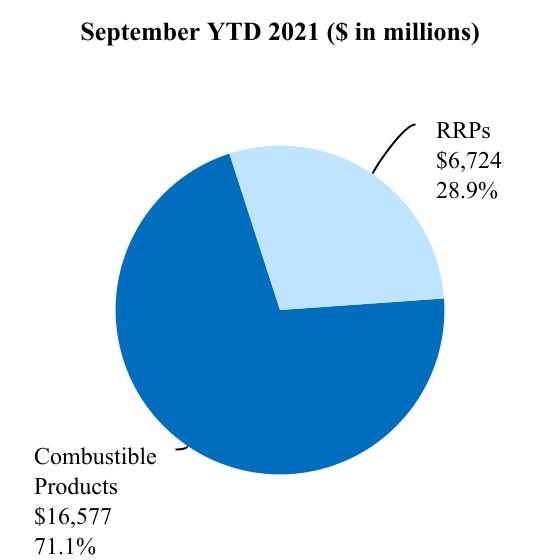
Net revenues by product category for the nine months ended September 30, 2021 and 2020 are shown below:

- Diluted Earnings Per Share - The changes in our reported diluted earnings per share (“diluted EPS”) for the nine months ended September 30, 2021, from the comparable 2020 amounts, were as follows:
| Diluted EPS | % Growth | |||||||||||||
| For the nine months ended September 30, 2020 | $ | 3.90 | ||||||||||||
| 2020 Asset impairment and exit costs | 0.04 | |||||||||||||
| 2020 Fair value adjustment for equity security investments | 0.04 | |||||||||||||
| 2020 Tax items | (0.06) | |||||||||||||
| Subtotal of 2020 items | 0.02 | |||||||||||||
| 2021 Asset impairment and exit costs | (0.09) | |||||||||||||
| 2021 Saudi Arabia customs assessments | (0.14) | |||||||||||||
| 2021 Asset acquisition cost | (0.03) | |||||||||||||
| 2021 Equity investee ownership dilution | 0.02 | |||||||||||||
| 2021 Tax items | — | |||||||||||||
| Subtotal of 2021 items | (0.24) | |||||||||||||
| Currency | 0.18 | |||||||||||||
| Interest | (0.01) | |||||||||||||
| Change in tax rate | 0.07 | |||||||||||||
| Operations | 0.56 | |||||||||||||
| For the nine months ended September 30, 2021 | $ | 4.48 | 14.9 | % |
Asset impairment and exit costs – During the nine months ended September 30, 2021, we recorded pre-tax asset impairment and exit costs of $170 million, representing $143 million net of income tax and a diluted EPS charge of $0.09 per share, related to the organizational design optimization plan, primarily in Switzerland, and the product distribution restructuring in South Korea. During the nine months ended September 30, 2020, we recorded pre-tax asset impairment and exit costs of $71 million, representing $57 million net of income tax and a diluted EPS charge of $0.04, related to the organizational design optimization plan, primarily in Switzerland. The total pre-tax charges were included in marketing, administration and research costs on the condensed consolidated statements of earnings. For further details, see Note 16. Asset Impairment and Exit Costs.
Fair Value adjustment for equity security investments – During the nine months ended September 30, 2020, we recorded an unfavorable fair value adjustment for our equity security investments of $62 million after tax (or $0.04 per share decrease in diluted EPS). The fair value adjustment for our equity security investments was included in equity investments and securities
(income)/loss, net ($78 million loss) and provision for income taxes ($16 million benefit) on the condensed consolidated statements of earnings.
Income taxes – The 2020 Tax items that increased our 2020 diluted EPS by $0.06 per share in the table above were due to final U.S. tax regulations under the Global Intangible Low-Taxed Income ("GILTI") provisions of the Internal Revenue Code for years 2018 and 2019 ($93 million). The change in the tax rate that increased our diluted EPS by $0.07 per share in the table above was primarily due to the corporate income tax rate reduction in the Philippines (enacted in the first quarter of 2021), as well as changes in earnings mix by taxing jurisdiction.
Saudi Arabia customs assessments – In June 2021, the Customs Appeal Committee in Riyadh notified our distributors in Saudi Arabia of its decisions to largely reject their challenges of the Saudi Arabia Customs General Authority assessments as described in Note 8. Contingencies. On the basis of these decisions and in line with arrangements with the distributors, we recorded a pre-tax charge of $246 million in the second quarter of 2021 (representing $215 million net of income tax and a diluted EPS charge of $0.14 per share). The pre-tax charge was recorded as a reduction of net revenues on the condensed consolidated statement of earnings for the nine months ended September 30, 2021 and was included in the Middle East & Africa segment results.
Asset acquisition cost – In August 2021, we acquired 100% of OtiTopic, Inc., a U.S. respiratory drug development company with a late-stage dry powder inhalation aspirin treatment for acute myocardial infarction. We accounted for this transaction as an asset acquisition since the acquired in-process research and development ("IPR&D") of the dry powder inhalation aspirin treatment represented substantially all of the fair value of the gross assets acquired. At the date of acquisition, we determined that the acquired IPR&D had no alternative future use. As a result, we recorded a pre-tax charge of $51 million (representing a $0.03 charge to diluted EPS) to research and development costs within marketing, administration and research costs in the condensed consolidated statements of earnings for the nine months ended September 30, 2021. For further details, see Note 17. Acquisitions.
Equity investee ownership dilution – In July 2021, our equity method investee, Medicago Inc, initiated an additional round of equity funding in which we did not participate. As a result, our share of holdings in Medicago Inc. was reduced to approximately 25% as of September 30, 2021. The ownership dilution resulted in a $0.02 favorable impact to diluted EPS and income of $38 million to Equity investments and securities (income)/loss, net in the condensed consolidated statements of earnings for the nine months ended September 30, 2021. For further details, see Note 8. Contingencies.
Currency – The favorable impact of $0.18 per share during the reporting period primarily results from the fluctuations of the U.S. dollar, especially against the Euro. This favorable currency movement has impacted our profitability across our primary revenue markets and local currency cost bases.
Operations – The increase in diluted EPS of $0.56 from our operations in the table above was due primarily to the following segments:
-
European Union: Favorable volume/mix, lower manufacturing costs and favorable pricing, partially offset by higher marketing, administration and research costs;
-
East Asia & Australia: Favorable pricing, lower manufacturing costs and favorable volume/mix, partially offset by higher marketing, administration and research costs;
-
Eastern Europe: Favorable volume/mix, lower manufacturing costs, and favorable pricing;
-
Middle East & Africa: Favorable pricing, favorable volume/mix and lower manufacturing costs, partially offset by lower fees for certain distribution rights and higher marketing, administration and research costs; and
-
Americas: Favorable pricing and lower marketing, administration and research costs, partially offset by higher manufacturing costs;
partially offset by
- South & Southeast Asia: Unfavorable volume/mix and higher marketing, administration and research costs.
Consolidated Operating Results for the Three Months Ended September 30, 2021
- Net Revenues** - Net revenues of $8.1 billion for the three months ended September 30, 2021 increased by $0.7 billion, or 9.1%, from the comparable 2020 amount. The change in our net revenues from the comparable 2020 amount was driven by the following (variances not to scale with quarterly results):

During the quarter, net revenues, excluding favorable currency, increased by 7.6%, mainly reflecting: favorable volume/mix, primarily driven by higher heated tobacco unit volume (notably in the EU, particularly Germany, Italy and Poland, as well as Japan, PMI Duty Free and Russia) and higher device volume (primarily in Japan, driven by the launch of IQOS ILUMA), partly offset by lower cigarette volume (mainly in Australia, France, Germany, Italy and the Philippines, partly offset by Indonesia, Japan, PMI Duty Free and Turkey) and unfavorable cigarette mix (mainly in Germany, Japan and Russia); and a favorable pricing variance (notably driven by Japan, the Philippines, Russia and Turkey, partly offset by Indonesia, Poland and Ukraine).
This net revenue growth reflects the continued strength of IQOS, and the recovery of the combustible business in many markets from the low base in 2020 due to the impact of COVID-19.
Net revenues by product category for the three months ended September 30, 2021 and 2020, are shown below:


- Diluted Earnings Per Share - The changes in our reported diluted EPS for the three months ended September 30, 2021, from the comparable 2020 amounts, were as follows:
| Diluted EPS | % Growth | |||||||
| For the three months ended September 30, 2020 | $ | 1.48 | ||||||
| 2020 Asset impairment and exit costs | — | |||||||
| 2020 Fair value adjustment for equity security investments | — | |||||||
| 2020 Tax items | (0.06) | |||||||
| Subtotal of 2020 items | (0.06) | |||||||
| 2021 Asset impairment and exit costs | (0.02) | |||||||
| 2021 Asset acquisition cost | (0.03) | |||||||
| 2021 Equity investee ownership dilution | 0.02 | |||||||
| 2021 Tax items | — | |||||||
| Subtotal of 2021 items | (0.03) | |||||||
| Currency | 0.04 | |||||||
| Interest | 0.01 | |||||||
| Change in tax rate | 0.04 | |||||||
| Operations | 0.07 | |||||||
| For the three months ended September 30, 2021 | $ | 1.55 | 4.7 | % |
Income Taxes – The 2020 Tax items that increased our 2020 diluted EPS by $0.06 per share in the table above were due to final U.S. tax regulations under the GILTI provisions of the Internal Revenue Code for years 2018 and 2019 ($93 million). The change in the tax rate that increased our diluted EPS by $0.04 per share in the table above was primarily due to the corporate income tax rate reduction in the Philippines (enacted in the first quarter of 2021), as well as changes in earnings mix by taxing jurisdiction.
Asset impairment and exit costs – In the third quarter of 2021, we recorded pre-tax asset impairment and exit costs of $43 million, representing $38 million net of income tax and a diluted EPS charge of $0.02 per share, related to the organizational design optimization plan, primarily in Switzerland, and the product distribution restructuring in South Korea. The total pre-tax charge was included in marketing, administration and research costs on the condensed consolidated statements of earnings. For further details, see Note 16. Asset Impairment and Exit Costs.
Asset acquisition cost – In August 2021, we acquired 100% of OtiTopic, Inc., a U.S. respiratory drug development company with a late-stage dry powder inhalation aspirin treatment for acute myocardial infarction. We accounted for this transaction as an asset acquisition since the acquired in-process research and development ("IPR&D") of the dry powder inhalation aspirin treatment represented substantially all of the fair value of the gross assets acquired. At the date of acquisition, we determined that the acquired IPR&D had no alternative future use. As a result, we recorded a pre-tax charge of $51 million (representing a $0.03 charge to diluted EPS) to research and development costs within marketing, administration and research costs in the condensed consolidated statements of earnings for the three months ended September 30, 2021. For further details, see Note 17. Acquisitions.
Equity investee ownership dilution – In July 2021, our equity method investee, Medicago Inc, initiated an additional round of equity funding in which we did not participate. As a result, our share of holdings in Medicago Inc. was reduced to approximately 25% as of September 30, 2021. The ownership dilution resulted in a $0.02 favorable impact to diluted EPS and income of $38 million to Equity investments and securities (income)/loss, net in the condensed consolidated statements of earnings for the three months ended September 30, 2021. For further details, see Note 8. Contingencies.
Currency – The favorable impact of $0.04 per share during the reporting period primarily results from the fluctuations of the U.S. dollar, especially against the Euro. This favorable currency movement has impacted our profitability across our primary revenue markets and local currency cost bases.
Operations – The increase in diluted EPS of $0.07 from our operations in the table above was due primarily to the following segments:
-
Middle East & Africa: Favorable volume/mix, favorable pricing and lower manufacturing costs, partially offset by lower fees for certain distribution rights and higher marketing, administration and research costs;
-
Eastern Europe: Favorable volume/mix, favorable pricing and lower manufacturing costs;
-
East Asia & Australia: Favorable pricing, favorable volume/mix and lower manufacturing costs, partially offset by higher marketing, administration and research costs;
-
European Union: Favorable volume/mix and lower manufacturing costs, partially offset by higher marketing, administration and research costs; and
-
Americas: Favorable pricing, partially offset by higher manufacturing costs and higher marketing, administration and research costs;
partially offset by
- South & Southeast Asia: Unfavorable volume/mix and higher manufacturing costs, partially offset by favorable pricing.
For further details, see the “Consolidated Operating Results” and “Operating Results by Business Segment” sections of the following “Discussion and Analysis.”
IQOS Device Supply
The current global semiconductor shortage is resulting in a tightness in IQOS device supply. This is affecting the availability and assortment of IQOS devices in certain markets, which is hampering the company’s ability to operate at full commercial and competitive capacity to fully meet demand. This has been reflected in lower IQOS user growth rates in the third quarter of 2021.
At this stage, supply forecasting remains volatile. PMI therefore assumes that the tight supply situation will persist into the first half of 2022 and, where necessary, the company will prioritize device replacements for existing IQOS users over device sales targeting user acquisition. PMI is also adjusting its launch timeline for IQOS ILUMA outside Japan, with additional major launches now assumed for the second half of 2022.
PMI views this as a temporary phenomenon and expects IQOS user growth to re-accelerate once shortages ease, as consumer demand remains.
Acquisitions
During the third quarter of 2021, PMI acquired the following companies:
-
Fertin Pharma A/S, a Danish company that is a leading developer and manufacturer of innovative pharmaceutical and well-being products based on oral and intra-oral delivery systems;
-
Vectura Group plc, an inhaled therapeutics company based in the United Kingdom; and
-
OtiTopic, Inc., a U.S. respiratory drug development company with a late-stage dry powder inhalation aspirin treatment for acute myocardial infarction.
For further details on these acquisitions, see Note 17. Acquisitions.
Discussion and Analysis
Consolidated Operating Results
See pages 95-104 for a discussion of our "Cautionary Factors That May Affect Future Results." Our net revenues and operating income by segment are shown in the table below:
| (in millions) | For the Nine Months Ended September 30, | For the Three Months Ended September 30, | |||||||||||||||
| 2021 | 2020 | 2021 | 2020 | ||||||||||||||
| Net revenues: | |||||||||||||||||
| European Union | $ | 9,250 | $ | 7,960 | $ | 3,192 | $ | 2,950 | |||||||||
| Eastern Europe | 2,632 | 2,470 | 941 | 899 | |||||||||||||
| Middle East & Africa | 2,306 | 2,348 | 945 | 768 | |||||||||||||
| South & Southeast Asia | 3,284 | 3,211 | 1,065 | 1,071 | |||||||||||||
| East Asia & Australia | 4,509 | 4,045 | 1,523 | 1,358 | |||||||||||||
| Americas | 1,320 | 1,216 | 456 | 400 | |||||||||||||
| Net revenues | $ | 23,301 | $ | 21,250 | $ | 8,122 | $ | 7,446 | |||||||||
| Operating income (loss): | |||||||||||||||||
| European Union | $ | 4,811 | $ | 3,924 | $ | 1,680 | $ | 1,588 | |||||||||
| Eastern Europe | 913 | 610 | 338 | 245 | |||||||||||||
| Middle East & Africa | 739 | 819 | 388 | 261 | |||||||||||||
| South & Southeast Asia | 1,208 | 1,290 | 348 | 402 | |||||||||||||
| East Asia & Australia | 2,041 | 1,792 | 631 | 637 | |||||||||||||
| Americas | 367 | 328 | 121 | 110 | |||||||||||||
| 10,079 | 8,763 | 3,506 | 3,243 | ||||||||||||||
| Other | (51) | — | (51) | — | |||||||||||||
| Operating income | $ | 10,028 | $ | 8,763 | $ | 3,455 | $ | 3,243 |
Our net revenues by product category are shown in the table below:
| PMI Net Revenues by Product Category | ||||||||||||||||||||
| (in millions) | For the Nine Months Ended September 30, | For the Three Months Ended September 30, | ||||||||||||||||||
| 2021 | 2020 | Change | 2021 | 2020 | Change | |||||||||||||||
| Combustible Products | ||||||||||||||||||||
| European Union | $ | 6,283 | $ | 6,099 | 3.0 | % | $ | 2,170 | $ | 2,244 | (3.3) | % | ||||||||
| Eastern Europe | 1,681 | 1,681 | — | % | 635 | 636 | (0.2) | % | ||||||||||||
| Middle East & Africa | 2,208 | 2,296 | (3.9) | % | 901 | 768 | 17.3 | % | ||||||||||||
| South & Southeast Asia | 3,277 | 3,211 | 2.1 | % | 1,061 | 1,071 | (0.9) | % | ||||||||||||
| East Asia & Australia | 1,850 | 1,876 | (1.4) | % | 591 | 605 | (2.2) | % | ||||||||||||
| Americas | 1,278 | 1,196 | 6.9 | % | 438 | 393 | 11.4 | % | ||||||||||||
| Total Combustible Products | $ | 16,577 | $ | 16,360 | 1.3 | % | $ | 5,796 | $ | 5,716 | 1.4 | % | ||||||||
| Reduced-Risk Products | ||||||||||||||||||||
| European Union | $ | 2,967 | $ | 1,861 | 59.5 | % | $ | 1,022 | $ | 706 | 44.7 | % | ||||||||
| Eastern Europe | 951 | 789 | 20.5 | % | 306 | 263 | 16.4 | % | ||||||||||||
| Middle East & Africa | 98 | 52 | 90.2 | % | 44 | — | — | % | ||||||||||||
| South & Southeast Asia | 7 | — | — | % | 4 | — | — | % | ||||||||||||
| East Asia & Australia | 2,659 | 2,169 | 22.6 | % | 932 | 753 | 23.7 | % | ||||||||||||
| Americas | 42 | 20 | +100% | 18 | 7 | +100% | ||||||||||||||
| Total Reduced-Risk Products | $ | 6,724 | $ | 4,890 | 37.5 | % | $ | 2,326 | $ | 1,730 | 34.5 | % | ||||||||
| Total PMI Net Revenues | $ | 23,301 | $ | 21,250 | 9.7 | % | $ | 8,122 | $ | 7,446 | 9.1 | % |
Note: Sum of product categories or Regions might not foot to total PMI due to roundings.
Items affecting the comparability of results from operations were as follows:
-
Asset impairment and exit costs – See Note 16. Asset Impairment and Exit Costs for a breakdown of these costs by segment for the nine months and three months ended September 30, 2021 and 2020.
-
Saudi Arabia customs assessments – See Note 8. Contingencies for the details of the $246 million reduction in net revenues of combustible products included in the Middle East & Africa segment for the nine months ended September 30, 2021.
-
Asset acquisition cost - See Note 17. Acquisitions for the details of the $51 million pre-tax charge associated with the asset acquisition of OtiTopic, Inc. included in Other within the operating income table above for the nine months and three months ended September 30, 2021.
Net revenues related to combustible products refer to the operating revenues generated from the sale of these products, including shipping and handling charges billed to customers, net of sales and promotion incentives, and excise taxes. These net revenue amounts consist of the sale of our cigarettes and other tobacco products combined. Other tobacco products primarily include roll-your-own and make-your-own cigarettes, pipe tobacco, cigars and cigarillos and do not include reduced-risk products.
Net revenues related to reduced-risk products refer to the operating revenues generated from the sale of these products, including shipping and handling charges billed to customers, net of sales and promotion incentives, and excise taxes. These net revenue amounts consist of the sale of our heated tobacco units, heat-not-burn devices and related accessories, and other nicotine-containing products, which primarily include our e-vapor and oral nicotine products.
PMI's heat-not-burn products include licensed KT&G heat-not-burn products.
Revenues from shipments of Platform 1 devices, heated tobacco units and accessories to Altria Group, Inc., commencing in the third quarter of 2019, for sale under license in the United States, are included in Net Revenues of the Americas segment.
References to "Cost/Other" in the Consolidated Financial Summary table of total PMI and the six geographical segments throughout this "Discussion and Analysis" reflects the currency-neutral variances of: cost of sales (excluding the volume/mix cost component); marketing, administration and research costs (including asset impairment and exit costs); and amortization of intangibles. “Cost/Other” also includes the currency-neutral net revenue variance, unrelated to volume/mix and price components, attributable to: fees for certain distribution rights billed to customers in certain markets in the ME&A Region and the Saudi Arabia customs assessment net revenue adjustment.
Our shipment volume by segment for cigarettes and heated tobacco units is shown in the table below:
| PMI Shipment Volume (Million Units) | ||||||||||||||||||||
| For the Nine Months Ended September 30, | For the Three Months Ended September 30, | |||||||||||||||||||
| 2021 | 2020 | Change | 2021 | 2020 | Change | |||||||||||||||
| Cigarettes | ||||||||||||||||||||
| European Union | 120,238 | 126,142 | (4.7) | % | 41,965 | 45,179 | (7.1) | % | ||||||||||||
| Eastern Europe | 67,771 | 70,737 | (4.2) | % | 25,020 | 25,661 | (2.5) | % | ||||||||||||
| Middle East & Africa | 93,155 | 88,087 | 5.8 | % | 35,166 | 30,903 | 13.8 | % | ||||||||||||
| South & Southeast Asia | 105,787 | 108,179 | (2.2) | % | 35,578 | 37,238 | (4.5) | % | ||||||||||||
| East Asia & Australia | 33,450 | 35,154 | (4.8) | % | 11,120 | 10,784 | 3.1 | % | ||||||||||||
| Americas | 46,092 | 45,542 | 1.2 | % | 15,994 | 15,699 | 1.9 | % | ||||||||||||
| Total Cigarettes | 466,493 | 473,841 | (1.6) | % | 164,843 | 165,464 | (0.4) | % | ||||||||||||
| Heated Tobacco Units | ||||||||||||||||||||
| European Union | 20,405 | 14,069 | 45.0 | % | 7,058 | 5,181 | 36.2 | % | ||||||||||||
| Eastern Europe | 18,594 | 14,374 | 29.4 | % | 6,119 | 4,882 | 25.3 | % | ||||||||||||
| Middle East & Africa | 1,485 | 834 | 78.1 | % | 577 | 179 | +100% | |||||||||||||
| South & Southeast Asia | 151 | 10 | +100% | 79 | 10 | +100% | ||||||||||||||
| East Asia & Australia | 28,478 | 24,799 | 14.8 | % | 9,435 | 8,601 | 9.7 | % | ||||||||||||
| Americas | 466 | 316 | 47.5 | % | 221 | 114 | 93.9 | % | ||||||||||||
| Total Heated Tobacco Units | 69,579 | 54,402 | 27.9 | % | 23,489 | 18,967 | 23.8 | % | ||||||||||||
| Cigarettes and Heated Tobacco Units | ||||||||||||||||||||
| European Union | 140,643 | 140,211 | 0.3 | % | 49,023 | 50,360 | (2.7) | % | ||||||||||||
| Eastern Europe | 86,365 | 85,111 | 1.5 | % | 31,139 | 30,543 | 2.0 | % | ||||||||||||
| Middle East & Africa | 94,640 | 88,921 | 6.4 | % | 35,743 | 31,082 | 15.0 | % | ||||||||||||
| South & Southeast Asia | 105,938 | 108,189 | (2.1) | % | 35,657 | 37,248 | (4.3) | % | ||||||||||||
| East Asia & Australia | 61,928 | 59,953 | 3.3 | % | 20,555 | 19,385 | 6.0 | % | ||||||||||||
| Americas | 46,558 | 45,858 | 1.5 | % | 16,215 | 15,813 | 2.5 | % | ||||||||||||
| Total Cigarettes and Heated Tobacco Units | 536,072 | 528,243 | 1.5 | % | 188,332 | 184,431 | 2.1 | % |
Heated tobacco units ("HTU") is the term we use to refer to heated tobacco consumables, which include our HEETS, HEETS Creations, HEETS Dimensions, HEETS Marlboro and HEETS FROM MARLBORO (defined collectively as HEETS), Marlboro Dimensions, Marlboro HeatSticks, Parliament HeatSticks and TEREA, as well as the KT&G-licensed brands, Fiit and Miix (outside of South Korea).
Market share for HTUs is defined as the total sales volume for HTUs as a percentage of the total estimated sales volume for cigarettes and HTUs.
Shipment volume of heated tobacco units to the United States is included in the heated tobacco unit shipment volume of the Americas segment.
References to total international market, defined as worldwide cigarette and heated tobacco unit volume excluding the United States, total industry, total market and market shares throughout this "Discussion and Analysis" are our estimates for tax-paid products based on the latest available data from a number of internal and external sources and may, in defined instances, exclude the People's Republic of China and/or our duty free business.
2020 and 2021 estimates for total industry volume and market share in certain geographies reflect limitations on the availability and accuracy of industry data during pandemic-related restrictions.
In-market sales ("IMS") is defined as sales to the retail channel, depending on the market and distribution model.
North Africa is defined as Algeria, Egypt, Libya, Morocco and Tunisia.
The Gulf Cooperation Council ("GCC") is defined as Bahrain, Kuwait, Oman, Qatar, Saudi Arabia and the United Arab Emirates (UAE).
Southeast Europe is defined as Albania, Bosnia & Herzegovina, Kosovo, Montenegro, North Macedonia and Serbia.
References to total industry, total market, our shipment volume and our market share performance reflect cigarettes and heated tobacco units, unless otherwise stated.
From time to time, PMI’s shipment volumes are subject to the impact of distributor inventory movements, and estimated total industry/market volumes are subject to the impact of inventory movements in various trade channels that include estimated trade inventory movements of PMI’s competitors arising from market-specific factors that significantly distort reported volume disclosures. Such factors may include changes to the manufacturing supply chain, shipment methods, consumer demand, timing of excise tax increases or other influences that may affect the timing of sales to customers. In such instances, in addition to reviewing PMI shipment volumes and certain estimated total industry/market volumes on a reported basis, management reviews these measures on an adjusted basis that excludes the impact of distributor and/or estimated trade inventory movements. Management also believes that disclosing PMI shipment volumes and estimated total industry/market volumes in such circumstances on a basis that excludes the impact of distributor and/or estimated trade inventory movements improves the comparability of performance and trends for these measures over different reporting periods.
Key market data regarding total market size, our shipments and market share are shown in the tables below:
| For the Nine Months Ended September 30, | ||||||||||||||||||||||||||||||||||||||||||||||||||||||||
| PMI Shipments (billion units) | PMI Market Share (%)****(1) | |||||||||||||||||||||||||||||||||||||||||||||||||||||||
| Market | Total Market (billion units) | Total | Cigarette | Heated Tobacco Unit | Total | Heated Tobacco Unit | ||||||||||||||||||||||||||||||||||||||||||||||||||
| 2021 | 2020 | 2021 | 2020 | 2021 | 2020 | 2021 | 2020 | 2021 | 2020 | 2021 | 2020 | |||||||||||||||||||||||||||||||||||||||||||||
| Total | 1,946.1 | 1,897.3 | 536.1 | 528.2 | 466.5 | 473.8 | 69.6 | 54.4 | 27.3 | 27.9 | 3.5 | 2.9 | ||||||||||||||||||||||||||||||||||||||||||||
| European Union | ||||||||||||||||||||||||||||||||||||||||||||||||||||||||
| France | 26.3 | 28.0 | 11.6 | 12.7 | 11.4 | 12.5 | 0.2 | 0.1 | 43.7 | 44.9 | 0.6 | 0.5 | ||||||||||||||||||||||||||||||||||||||||||||
| Germany | 56.5 | 56.4 | 21.6 | 22.0 | 20.0 | 20.8 | 1.7 | 1.2 | 38.3 | 38.9 | 3.0 | 2.1 | ||||||||||||||||||||||||||||||||||||||||||||
| Italy | 53.0 | 50.8 | 28.9 | 26.7 | 22.4 | 22.8 | 6.5 | 4.0 | 52.9 | 52.0 | 11.1 | 7.6 | ||||||||||||||||||||||||||||||||||||||||||||
| Poland | 37.2 | 35.0 | 13.9 | 13.6 | 11.7 | 12.1 | 2.2 | 1.6 | 37.4 | 38.9 | 5.9 | 4.5 | ||||||||||||||||||||||||||||||||||||||||||||
| Spain | 32.2 | 31.7 | 10.2 | 10.1 | 9.8 | 9.8 | 0.4 | 0.3 | 31.5 | 31.5 | 1.2 | 1.0 | ||||||||||||||||||||||||||||||||||||||||||||
| Eastern Europe | ||||||||||||||||||||||||||||||||||||||||||||||||||||||||
| Russia | 163.7 | 163.4 | 52.0 | 51.6 | 40.4 | 42.3 | 11.7 | 9.3 | 31.5 | 32.3 | 7.2 | 6.1 | ||||||||||||||||||||||||||||||||||||||||||||
| Middle East & Africa | ||||||||||||||||||||||||||||||||||||||||||||||||||||||||
| Saudi Arabia | 16.2 | 15.8 | 6.6 | 6.2 | 6.4 | 6.2 | 0.2 | — | 41.5 | 38.5 | 0.9 | 0.2 | ||||||||||||||||||||||||||||||||||||||||||||
| Turkey | 92.1 | 86.4 | 40.4 | 35.3 | 40.4 | 35.3 | — | — | 43.9 | 40.8 | — | — | ||||||||||||||||||||||||||||||||||||||||||||
| South & Southeast Asia | ||||||||||||||||||||||||||||||||||||||||||||||||||||||||
| Indonesia | 217.4 | 201.4 | 60.8 | 58.3 | 60.8 | 58.3 | — | — | 28.0 | 28.9 | — | — | ||||||||||||||||||||||||||||||||||||||||||||
| Philippines | 41.2 | 47.0 | 25.6 | 32.1 | 25.5 | 32.1 | 0.1 | — | 62.2 | 68.4 | 0.3 | — | ||||||||||||||||||||||||||||||||||||||||||||
| East Asia & Australia | ||||||||||||||||||||||||||||||||||||||||||||||||||||||||
| Australia | 7.1 | 8.3 | 2.3 | 2.5 | 2.3 | 2.5 | — | — | 32.4 | 29.6 | — | — | ||||||||||||||||||||||||||||||||||||||||||||
| Japan | 107.3 | 111.4 | 41.6 | 38.8 | 16.8 | 17.7 | 24.7 | 21.1 | 38.6 | 36.7 | 23.0 | 20.0 | ||||||||||||||||||||||||||||||||||||||||||||
| South Korea | 54.1 | 54.8 | 10.7 | 11.3 | 7.2 | 7.8 | 3.5 | 3.5 | 19.7 | 20.7 | 6.4 | 6.4 | ||||||||||||||||||||||||||||||||||||||||||||
| Americas | ||||||||||||||||||||||||||||||||||||||||||||||||||||||||
| Argentina | 26.1 | 24.3 | 14.6 | 14.9 | 14.6 | 14.9 | — | — | 55.8 | 61.5 | — | — | ||||||||||||||||||||||||||||||||||||||||||||
| Mexico | 22.6 | 21.9 | 14.1 | 13.6 | 14.1 | 13.6 | 0.1 | — | 62.5 | 62.0 | 0.3 | 0.2 | ||||||||||||||||||||||||||||||||||||||||||||
| (1) Market share estimates are calculated using IMS data | ||||||||||||||||||||||||||||||||||||||||||||||||||||||||
| Note: % change for Total Market and PMI shipments is computed based on millions of units. "-" indicates volume below 50 million units and market share below 0.1% |
| For the Three Months Ended September 30, | ||||||||||||||||||||||||||||||||||||||||||||||||||||||||
| PMI Shipments (billion units) | PMI Market Share (%)****(1) | |||||||||||||||||||||||||||||||||||||||||||||||||||||||
| Market | Total Market (billion units) | Total | Cigarette | Heated Tobacco Unit | Total | Heated Tobacco Unit | ||||||||||||||||||||||||||||||||||||||||||||||||||
| 2021 | 2020 | 2021 | 2020 | 2021 | 2020 | 2021 | 2020 | 2021 | 2020 | 2021 | 2020 | |||||||||||||||||||||||||||||||||||||||||||||
| Total | 679.6 | 674.3 | 188.3 | 184.4 | 164.8 | 165.5 | 23.5 | 19.0 | 28.0 | 28.0 | 3.6 | 3.0 | ||||||||||||||||||||||||||||||||||||||||||||
| European Union | ||||||||||||||||||||||||||||||||||||||||||||||||||||||||
| France | 9.0 | 9.8 | 3.7 | 4.2 | 3.6 | 4.1 | 0.1 | — | 44.0 | 45.3 | 0.6 | 0.5 | ||||||||||||||||||||||||||||||||||||||||||||
| Germany | 20.5 | 20.4 | 7.3 | 7.4 | 6.8 | 7.0 | 0.6 | 0.4 | 35.8 | 36.4 | 2.8 | 1.9 | ||||||||||||||||||||||||||||||||||||||||||||
| Italy | 19.2 | 18.8 | 9.4 | 9.7 | 7.3 | 8.2 | 2.1 | 1.5 | 52.9 | 52.1 | 10.8 | 7.8 | ||||||||||||||||||||||||||||||||||||||||||||
| Poland | 14.0 | 13.5 | 5.3 | 5.1 | 4.5 | 4.5 | 0.8 | 0.6 | 38.0 | 37.8 | 6.0 | 4.7 | ||||||||||||||||||||||||||||||||||||||||||||
| Spain | 12.1 | 11.7 | 3.4 | 3.7 | 3.2 | 3.6 | 0.1 | 0.1 | 32.1 | 32.2 | 1.1 | 0.9 | ||||||||||||||||||||||||||||||||||||||||||||
| Eastern Europe | ||||||||||||||||||||||||||||||||||||||||||||||||||||||||
| Russia | 59.3 | 59.8 | 18.8 | 18.6 | 15.0 | 15.5 | 3.8 | 3.1 | 32.0 | 31.8 | 6.9 | 5.8 | ||||||||||||||||||||||||||||||||||||||||||||
| Middle East & Africa | ||||||||||||||||||||||||||||||||||||||||||||||||||||||||
| Saudi Arabia | 5.4 | 5.5 | 2.3 | 2.4 | 2.3 | 2.4 | — | — | 40.8 | 36.9 | 1.1 | 0.4 | ||||||||||||||||||||||||||||||||||||||||||||
| Turkey | 36.1 | 32.1 | 16.0 | 13.5 | 16.0 | 13.5 | — | — | 44.2 | 42.0 | — | — | ||||||||||||||||||||||||||||||||||||||||||||
| South & Southeast Asia | ||||||||||||||||||||||||||||||||||||||||||||||||||||||||
| Indonesia | 74.3 | 70.1 | 20.8 | 19.8 | 20.8 | 19.8 | — | — | 28.0 | 28.2 | — | — | ||||||||||||||||||||||||||||||||||||||||||||
| Philippines | 14.4 | 17.5 | 8.9 | 11.7 | 8.9 | 11.7 | — | — | 61.9 | 66.8 | 0.3 | — | ||||||||||||||||||||||||||||||||||||||||||||
| East Asia & Australia | ||||||||||||||||||||||||||||||||||||||||||||||||||||||||
| Australia | 2.3 | 3.2 | 0.8 | 1.0 | 0.8 | 1.0 | — | — | 33.7 | 29.8 | — | — | ||||||||||||||||||||||||||||||||||||||||||||
| Japan | 39.7 | 40.8 | 13.6 | 11.9 | 5.4 | 4.6 | 8.2 | 7.3 | 38.3 | 36.9 | 22.9 | 20.4 | ||||||||||||||||||||||||||||||||||||||||||||
| South Korea | 19.2 | 20.2 | 3.7 | 3.9 | 2.5 | 2.7 | 1.2 | 1.2 | 19.2 | 19.5 | 6.1 | 6.0 | ||||||||||||||||||||||||||||||||||||||||||||
| Americas | ||||||||||||||||||||||||||||||||||||||||||||||||||||||||
| Argentina | 8.4 | 8.6 | 4.8 | 4.9 | 4.8 | 4.9 | — | — | 56.6 | 56.8 | — | — | ||||||||||||||||||||||||||||||||||||||||||||
| Mexico | 7.8 | 7.7 | 5.0 | 4.8 | 5.0 | 4.8 | — | — | 64.6 | 62.7 | 0.3 | 0.2 | ||||||||||||||||||||||||||||||||||||||||||||
| (1) Market share estimates are calculated using IMS data | ||||||||||||||||||||||||||||||||||||||||||||||||||||||||
| Note: % change for Total Market and PMI shipments is computed based on millions of units. "-" indicates volume below 50 million units and market share below 0.1% |
Consolidated Operating Results for the Nine Months Ended September 30, 2021
The following discussion compares our consolidated operating results for the nine months ended September 30, 2021, with the nine months ended September 30, 2020.
Our total shipment volume increased by 1.5%, driven by:
-
the EU, reflecting higher heated tobacco unit shipment volume across the Region, particularly in Germany, Hungary, Italy and Poland, partly offset by lower cigarette shipment volume, notably in the Czech Republic, France, Germany and Hungary;
-
Eastern Europe, reflecting higher heated tobacco unit shipment volume, primarily in Russia and Ukraine, partly offset by lower cigarette shipment volume, mainly in Russia and Ukraine;
-
Middle East & Africa, reflecting higher cigarette shipment volume (primarily in PMI Duty Free and Turkey, partly offset by North Africa), as well as higher heated tobacco unit shipment volume across the Region;
-
East Asia & Australia, reflecting higher heated tobacco unit shipment volume driven by Japan, partly offset by lower cigarette shipment volume, predominantly in Japan and South Korea; and
-
Americas, mainly reflecting higher cigarette shipment volume, primarily in Brazil and Mexico, partially offset by Argentina;
partly offset by
- South & Southeast Asia, primarily reflecting lower cigarette shipment volume, mainly in the Philippines, partially offset by Indonesia and Pakistan.
Impact of Inventory Movements
Excluding the net favorable impact of estimated distributor inventory movements of approximately 5.0 billion units, our total in-market sales increased by 0.5%, driven by a 23.3% increase in heated tobacco units, partly offset by a 2.1% decrease in cigarettes.
The net favorable impact of approximately 5.0 billion units reflected:
-
A net favorable impact of 2.8 billion cigarettes, mainly driven by 2020 movements in Japan, PMI Duty Free and Russia; and
-
A net favorable impact of 2.2 billion heated tobacco units, primarily driven by 2020 movements in Japan.
Our total heated tobacco unit in-market sales volume in the nine months year-to-date was 68.8 billion units.
Our cigarette shipment volume by brand and heated tobacco units shipment volume are shown in the table below:
| PMI Shipment Volume by Brand (Million Units) | |||||||||||
| Nine Months Year-to-Date | |||||||||||
| 2021 | 2020 | Change | |||||||||
| Cigarettes | |||||||||||
| Marlboro | 177,287 | 175,638 | 0.9 | % | |||||||
| L&M | 64,028 | 69,215 | (7.5) | % | |||||||
| Chesterfield | 43,021 | 39,274 | 9.5 | % | |||||||
| Philip Morris | 31,881 | 34,823 | (8.4) | % | |||||||
| Parliament | 30,535 | 25,575 | 19.4 | % | |||||||
| Sampoerna A | 27,601 | 23,801 | 16.0 | % | |||||||
| Dji Sam Soe | 16,644 | 18,344 | (9.3) | % | |||||||
| Bond Street | 12,200 | 18,481 | (34.0) | % | |||||||
| Lark | 11,851 | 12,059 | (1.7) | % | |||||||
| Next | 6,556 | 6,703 | (2.2) | % | |||||||
| Others | 44,889 | 49,928 | (10.1) | % | |||||||
| Total Cigarettes | 466,493 | 473,841 | (1.6) | % | |||||||
| Heated Tobacco Units | 69,579 | 54,402 | 27.9 | % | |||||||
| Total Cigarettes and Heated Tobacco Units | 536,072 | 528,243 | 1.5 | % |
Note: Lark includes Lark Harmony; Next includes Next Dubliss; Philip Morris includes Philip Morris/Dubliss; and Sampoerna A includes Sampoerna.
The increase in our heated tobacco unit shipment volume was mainly driven by the EU (notably Italy), Eastern Europe (notably Russia and Ukraine) and Japan.
Our cigarette shipment volume of the following brands increased:
-
Marlboro, mainly driven by Mexico, PMI Duty Free, Russia and Turkey, partly offset by France, the GCC, Japan and the Philippines;
-
Chesterfield, primarily driven by Brazil, the Philippines and Russia, partly offset by Saudi Arabia;
-
Parliament, mainly driven by Russia, Saudi Arabia and Turkey, partly offset by Japan and South Korea; and
-
Sampoerna A in Indonesia, primarily driven by premium A Mild.
Our cigarette shipment volume of the following brands decreased:
-
L&M, mainly due to Egypt, Germany, Poland, Russia and Turkey;
-
Philip Morris, primarily due to Indonesia, Italy and Russia, partly offset by Japan;
-
Dji Sam Soe in Indonesia, mainly due to Dji Sam Soe Magnum Mild;
-
Bond Street, primarily due to Kazakhstan, Russia and Ukraine;
-
Lark, mainly due to Japan;
-
Next, primarily due to Canada and Ukraine, partly offset by Russia; and
-
"Others," notably due to: mid-price Fortune (Philippines) and Sampoerna U (Indonesia); and low-price Jackpot (Philippines) and More (Philippines); partly offset by mid-price Sampoerna Hijau (Indonesia) and low-price Morven (Pakistan).
International Share of Market (excluding China and the United States)
Our total international market share (excluding China and the United States), defined as our cigarette and heated tobacco unit sales volume as a percentage of total industry cigarette and heated tobacco unit sales volume, decreased by 0.6 points to 27.3%, reflecting:
-
Total international market share for cigarettes of 23.8%, down by 1.1 points; and
-
Total international market share for heated tobacco units of 3.5%, up by 0.6 points.
Our total international cigarette sales volume as a percentage of total industry cigarette sales volume was down by 0.9 points to 24.9%, mainly reflecting lower cigarette market share and/or an unfavorable geographic mix impact, notably in Japan, the Philippines, Russia and Ukraine, partly offset by Indonesia and Turkey.
| Financial Summary | |||||||||||||||||||||||||||||||||||||||||
| Financial Summary - Nine Months Ended September 30, | Change Fav./(Unfav.) | Variance Fav./(Unfav.) | |||||||||||||||||||||||||||||||||||||||
| 2021 | 2020 | Total | Excl. Curr. | Total | Cur- rency | Acqui-sitions | Price | Vol/ Mix | Cost/ Other | ||||||||||||||||||||||||||||||||
| (in millions) | |||||||||||||||||||||||||||||||||||||||||
| Net Revenues (1) | $ | 23,301 | $ | 21,250 | 9.7 | % | 6.1 | % | $ | 2,051 | $ | 752 | $ | 2 | $ | 590 | $ | 983 | $ | (276) | |||||||||||||||||||||
| Cost of Sales | (7,223) | (6,997) | (3.2) | % | 0.5 | % | (226) | (260) | (1) | — | (329) | 364 | |||||||||||||||||||||||||||||
| Marketing, Administration and Research Costs (2) | (5,995) | (5,435) | (10.3) | % | (8.2) | % | (560) | (112) | (1) | — | — | (447) | |||||||||||||||||||||||||||||
| Amortization of Intangibles | (55) | (55) | — | % | 1.8 | % | — | (1) | — | — | — | 1 | |||||||||||||||||||||||||||||
| Operating Income | $ | 10,028 | $ | 8,763 | 14.4 | % | 10.1 | % | $ | 1,265 | $ | 379 | $ | — | $ | 590 | $ | 654 | $ | (358) |
(1) Cost/Other variance includes a $246 million reduction in net revenues in 2021 related to the Saudi Arabia customs assessments. For more details, see Note 8. Contingencies.
(2) Cost/Other variance includes charges in 2021 and 2020 of $170 million and $71 million, respectively, for asset impairment and exit costs. Cost/Other variance in 2021 also includes the pre-tax charge of $51 million associated with the asset acquisition cost of OtiTopic, Inc. For more details, see Note 16. Asset Impairment and Exit Costs and Note 17. Acquisitions.
For the nine months ended September 30, 2021, net revenues, excluding favorable currency, increased by 6.1%, mainly reflecting: favorable volume/mix, primarily driven by higher heated tobacco unit volume (notably in the EU, particularly Germany, Hungary, Italy and Poland, as well as Japan and Russia), partly offset by lower cigarette volume (mainly in the EU Region, notably the Czech Republic, France and Germany, as well as Japan, Kuwait, North Africa, the Philippines, Russia and Ukraine, partially offset by Indonesia, PMI Duty Free, and Turkey); and a favorable pricing variance (notably driven by the
Czech Republic, Germany, Japan, Kazakhstan, North Africa, the Philippines, Russia and Turkey, partly offset by Indonesia, Poland and Ukraine); partially offset by the unfavorable impact of the Saudi Arabia customs assessments of $246 million, shown in "Cost/Other". Excluding the unfavorable impact of the Saudi Arabia customs assessments of $246 million, net revenues increased by 10.8%, or 7.3% excluding favorable currency of $752 million.
The favorable currency in net revenues was due primarily to the Euro, Indonesian rupiah, Japanese yen, Mexican peso and Philippine peso, partially offset by the Russian ruble and Turkish lira.
Net revenues include $6.7 billion in 2021 and $4.9 billion in 2020 related to the sale of RRPs. For the nine months ended September 30, 2021, IQOS devices accounted for over 6% of RRP net revenues, with a step-up in the third quarter reflecting the IQOS ILUMA launch.
Operating income, excluding favorable currency, increased by 10.1%, primarily reflecting: favorable volume/mix, mainly driven by the same factors as for net revenues noted above; a favorable pricing variance; and lower manufacturing costs (driven by productivity gains related to reduced-risk and combustible products); partly offset by the unfavorable impact of the Saudi Arabia customs assessments (as noted above for net revenues); and higher marketing, administration and research costs, including higher asset impairment and exit costs (mainly related to organizational design optimization, as well as product distribution restructuring in South Korea) and asset acquisition costs related to OtiTopic, Inc.
Interest expense, net, of $482 million increased by $28 million (6.2%).
Our effective tax rate increased by 0.6 percentage points to 22.0%. We estimate that our full-year 2021 effective tax rate will be around 22%, excluding discrete tax events. For further details, see Note 9. Income Taxes.
Net earnings attributable to PMI of $7.0 billion increased by $936 million or 15.4%. This increase was due primarily to higher operating income as discussed above, partially offset by a higher effective income tax rate. Basic EPS of $4.49 increased by 15.1%. Diluted EPS of $4.48 increased by 14.9%. Excluding a favorable currency impact of $0.18, diluted EPS increased by 10.3%.
Consolidated Operating Results for the Three Months Ended September 30, 2021
The following discussion compares our consolidated operating results for the three months ended September 30, 2021, with the three months ended September 30, 2020.
Our total shipment volume increased by 2.1%, driven by:
-
Eastern Europe, reflecting higher heated tobacco unit shipment volume across the Region, primarily in Russia and Ukraine, partly offset by lower cigarette shipment volume, mainly in Russia and Ukraine;
-
Middle East & Africa, mainly reflecting higher cigarette shipment volume, primarily in PMI Duty Free and Turkey, partly offset by North Africa (particularly Egypt);
-
East Asia & Australia, reflecting higher heated tobacco unit shipment volume, primarily in Japan, and higher cigarette shipment volume, mainly in Japan, partly offset by Australia and South Korea; and
-
Americas, mainly reflecting higher cigarette shipment volume, notably in Mexico;
partly offset by
-
the EU, reflecting lower cigarette shipment volume, mainly in France, Italy and Spain, partly offset by higher heated tobacco unit shipment volume across the Region, notably in Italy; and
-
South & Southeast Asia, primarily reflecting lower cigarette shipment volume, mainly in the Philippines, partly offset by Indonesia.
Impact of Inventory Movements
Excluding the net favorable impact of estimated distributor inventory movements of approximately 2.8 billion units, our total in-market sales increased by 0.6%, driven by a 20.2% increase in heated tobacco units, partly offset by a 1.8% decrease in cigarettes.
The net favorable impact of approximately 2.8 billion units reflected:
-
A net favorable impact of 2.4 billion cigarettes, mainly driven by 2020 movements in Japan and PMI Duty Free; and
-
A net favorable impact of 0.4 billion heated tobacco units, notably reflecting 2020 movements in PMI Duty Free.
Our total heated tobacco unit in-market sales volume in the quarter was 24.6 billion units, reflecting sequential growth of 7.2% compared to the second quarter of 2021.
Our cigarette shipment volume by brand and heated tobacco units shipment volume are shown in the table below:
| PMI Shipment Volume by Brand (Million Units) | ||||||||||||||||||||||||||
| Third-Quarter | ||||||||||||||||||||||||||
| 2021 | 2020 | Change | ||||||||||||||||||||||||
| Cigarettes | ||||||||||||||||||||||||||
| Marlboro | 65,139 | 61,581 | 5.8 | % | ||||||||||||||||||||||
| L&M | 21,564 | 24,189 | (10.9) | % | ||||||||||||||||||||||
| Chesterfield | 15,994 | 13,768 | 16.2 | % | ||||||||||||||||||||||
| Philip Morris | 11,107 | 12,254 | (9.4) | % | ||||||||||||||||||||||
| Parliament | 11,556 | 9,540 | 21.1 | % | ||||||||||||||||||||||
| Sampoerna A | 9,717 | 7,999 | 21.5 | % | ||||||||||||||||||||||
| Dji Sam Soe | 5,518 | 6,372 | (13.4) | % | ||||||||||||||||||||||
| Bond Street | 3,042 | 6,441 | (52.8) | % | ||||||||||||||||||||||
| Lark | 4,070 | 3,846 | 5.8 | % | ||||||||||||||||||||||
| Next | 2,388 | 2,327 | 2.7 | % | ||||||||||||||||||||||
| Others | 14,748 | 17,147 | (14.0) | % | ||||||||||||||||||||||
| Total Cigarettes | 164,843 | 165,464 | (0.4) | % | ||||||||||||||||||||||
| Heated Tobacco Units | 23,489 | 18,967 | 23.8 | % | ||||||||||||||||||||||
| Total Cigarettes and Heated Tobacco Units | 188,332 | 184,431 | 2.1 | % |
Note: Lark includes Lark Harmony; Next includes Next Dubliss; Philip Morris includes Philip Morris/Dubliss; and Sampoerna A includes Sampoerna.
The increase in our heated tobacco unit shipment volume was mainly driven by the EU (notably Italy), Eastern Europe (notably Russia) and Japan.
Our cigarette shipment volume of the following brands increased:
-
Marlboro, mainly driven by PMI Duty Free, Russia and Turkey, partly offset by Italy and the Philippines;
-
Chesterfield, primarily driven by Russia;
-
Parliament, mainly driven by Saudi Arabia and Turkey;
-
Sampoerna A in Indonesia, primarily driven by premium A Mild;
-
Lark, mainly driven by Japan; and
-
Next, primarily driven by Russia.
Our cigarette shipment volume of the following brands decreased:
-
L&M, primarily due to Egypt, Poland, Russia, Spain, Thailand and Turkey;
-
Philip Morris, mainly due to Russia, partly offset by Japan;
-
Dji Sam Soe in Indonesia, primarily due to Dji Sam Soe Magnum Mild;
-
Bond Street, mainly due to Russia; and
-
"Others," primarily due to: mid-price Fortune (Philippines) and Sampoerna U (Indonesia).
International Share of Market (excluding China and the United States)
Our total international market share (excluding China and the United States) was flat at 28.0%, reflecting:
-
Total international market share for heated tobacco units of 3.6%, up by 0.6 points; and
-
Total international market share for cigarettes of 24.4%, down by 0.6 points.
Our total international cigarette sales volume as a percentage of total industry cigarette sales volume was down by 0.4 points to 25.6%, mainly reflecting lower cigarette market share and/or an unfavorable geographic mix impact, notably in Egypt, France, Japan, the Philippines, Russia and Ukraine, partly offset by Indonesia, PMI Duty-Free and Turkey.
| Financial Summary | |||||||||||||||||||||||||||||||||||||||||
| Financial Summary - Quarters Ended September 30, | Change Fav./(Unfav.) | Variance Fav./(Unfav.) | |||||||||||||||||||||||||||||||||||||||
| 2021 | 2020 | Total | Excl. Curr. | Total | Cur- rency | Acqui-sitions | Price | Vol/ Mix | Cost/ Other | ||||||||||||||||||||||||||||||||
| (in millions) | |||||||||||||||||||||||||||||||||||||||||
| Net Revenues | $ | 8,122 | $ | 7,446 | 9.1 | % | 7.6 | % | $ | 676 | $ | 107 | $ | 2 | $ | 158 | $ | 439 | $ | (30) | |||||||||||||||||||||
| Cost of Sales | (2,596) | (2,416) | (7.5) | % | (5.8) | % | (180) | (40) | (1) | — | (211) | 72 | |||||||||||||||||||||||||||||
| Marketing, Administration and Research Costs (1) | (2,053) | (1,769) | (16.1) | % | (15.9) | % | (284) | (2) | (1) | — | — | (281) | |||||||||||||||||||||||||||||
| Amortization of Intangibles | (18) | (18) | — | % | — | % | — | — | — | — | — | — | |||||||||||||||||||||||||||||
| Operating Income | $ | 3,455 | $ | 3,243 | 6.5 | % | 4.5 | % | $ | 212 | $ | 65 | $ | — | $ | 158 | $ | 228 | $ | (239) | |||||||||||||||||||||
(1) Cost/Other variance includes charges in 2021 of $43 million for asset impairment and exit costs. Cost/Other variance in 2021 also includes the pre-tax charge of $51 million associated with the asset acquisition cost of OtiTopic, Inc. For more details, see Note 16. Asset Impairment and Exit Costs and Note 17. Acquisitions.
During the quarter, net revenues, excluding favorable currency, increased by 7.6%, mainly reflecting: favorable volume/mix, primarily driven by higher heated tobacco unit volume (notably in the EU, particularly Germany, Italy and Poland, as well as Japan, PMI Duty Free and Russia) and higher device volume (primarily in Japan, driven by the launch of IQOS ILUMA), partly offset by lower cigarette volume (mainly in Australia, France, Germany, Italy and the Philippines, partly offset by Indonesia, Japan, PMI Duty Free and Turkey) and unfavorable cigarette mix (mainly in Germany, Japan and Russia); and a favorable pricing variance (notably driven by Japan, the Philippines, Russia and Turkey, partly offset by Indonesia, Poland and Ukraine).
The favorable currency in net revenues was due primarily to the Euro and Mexican pesos, partially offset by the Japanese yen and Turkish lira.
Net revenues include $2.3 billion in 2021 and $1.7 billion in 2020 related to the sale of RRPs.
Operating income, excluding favorable currency, increased by 4.5%, primarily reflecting: favorable volume/mix, primarily driven by higher heated tobacco unit volume, partly offset by lower cigarette volume and unfavorable cigarette mix (each mainly reflecting the same geographies as for net revenues noted above); a favorable pricing variance; and lower manufacturing costs (driven by productivity gains related to reduced-risk products); partly offset by higher marketing, administration and research costs (due mainly to investments behind reduced-risk products, asset acquisition costs related to OtiTopic, Inc. and higher asset impairment and exit costs due to organizational design optimization and product distribution restructuring in South Korea).
Interest expense, net, of $154 million decreased by $9 million (5.5)%.
Our effective tax rate increased by 1.5 percentage points to 22.4%. The effective tax rate for the three months ended September 30, 2020 was favorably impacted by a reduction of estimated U.S. federal and state income tax liabilities for years 2018 and 2019 mostly due to final regulations under the GILTI provisions of the Internal Revenue Code ($93 million), partially offset by
a decrease in deductions related to foreign-derived intangible income for the years 2018 and 2019. For further details, see Note 9. Income Taxes.
Net earnings attributable to PMI of $2.4 billion increased by $119 million or 5.2%. This increase was due primarily to higher operating income as discussed above, partially offset by a higher effective tax rate. Diluted and basic EPS of $1.55 increased by 4.7%. Excluding a favorable currency impact of $0.04, diluted EPS increased by 2.0%.
Operating Results by Business Segment
Business Environment
Taxes, Legislation, Regulation and Other Matters Regarding the Manufacture, Marketing, Sale and Use of Tobacco Products
The tobacco industry and our company face a number of challenges that may adversely affect our business, volume, results of operations, cash flows and financial position. These challenges, which are discussed below and in “Cautionary Factors That May Affect Future Results,” include:
-
regulatory restrictions on our products, including restrictions on the packaging, marketing, and sale of tobacco or other nicotine-containing products that could reduce our competitiveness, eliminate our ability to communicate with adult consumers, or even ban certain of our products;
-
fiscal challenges, such as excessive excise tax increases and discriminatory tax structures;
-
illicit trade in cigarettes and other tobacco and nicotine-containing products, including counterfeit, contraband and so-called “illicit whites”;
-
intense competition, including from non-tax paid volume by certain local manufacturers;
-
pending and threatened litigation as discussed in Note 8. Contingencies; and
-
governmental investigations.
Regulatory Restrictions: The tobacco industry operates in a highly regulated environment. The well-known risks of smoking have led regulators to impose significant restrictions and high excise taxes on cigarettes.
Much of the regulation that shapes the business environment in which we operate is driven by the World Health Organization's (the “WHO”) Framework Convention on Tobacco Control (the “FCTC”), which entered into force in 2005. The FCTC has as its main objective to establish a global agenda for tobacco regulation, with the purpose of reducing tobacco use. To date, 182 countries and the European Union are Parties to the FCTC. The treaty requires Parties to have in place various tobacco control measures and recommends others. The FCTC governing body, the Conference of the Parties (“CoP”), has also adopted non-binding guidelines and policy recommendations related to certain articles of the FCTC that go beyond the text of the treaty. In October 2018, the CoP recognized the need for more scientific assessment and improved reporting to define policy on heated tobacco products. Similar to its previous policy recommendations on e-cigarettes, the CoP invited countries to regulate, restrict or prohibit heated tobacco products, as appropriate under their national laws.
In May 2021, the WHO study group on tobacco product regulation issued its Eighth Report addressing novel and emerging nicotine and tobacco products, such as electronic nicotine delivery systems ("ENDS"), electronic non-nicotine delivery systems ("ENNDS") and heated tobacco products ("HTPs"). Although the Report presents some industry and independent research showing that heated tobacco products have the potential to reduce harm for smokers, WHO’s overall assessment is that these products are not risk-free and should be regulated in the same manner as tobacco products and in line with the FCTC provisions. The Report also recommends governments both to rely on independent research and data on the public health impact of use of heated tobacco products, and to analyze tobacco industry funded data. In August 2021, the WHO FCTC Secretariat published two reports on novel and emerging tobacco products to the ninth session of the CoP of the FCTC, one on the research and evidence on novel and emerging tobacco products, and the other on their recommended classification. According to the provisional agenda, these reports should be presented for information and that related substantive discussions should be deferred to COP10, in 2023. It is not possible to predict whether or to what extent measures recommended by the WHO's reports will be implemented as the reports are not binding to the WHO Member States.
We believe that when better alternatives to cigarettes exist, the discussion should not be whether these alternatives should be made available to the more than one billion people who smoke today, but how fast, and within what regulatory framework to maximize their adoption while minimizing unintended use. Therefore, we advocate for regulatory frameworks that recognize a significant difference on a risk continuum between combustible tobacco on the one hand and non-combustible tobacco and other nicotine-containing products on the other. Regulation should include measures that will accelerate switching to non-combustible products, for example, by allowing adult consumers who would not otherwise quit to receive truthful and non-misleading information about such products to enable them to make informed decisions and by applying uniform product standards to enable manufacturers to demonstrate the safety of these products, as well as the absence of combustion. Regulation should also include specific rules for ingredients, labeling and consumer communication, and should ensure that the public is informed about the health risks of all combustible and non-combustible tobacco and nicotine-containing products. Importantly, regulation must include measures designed to prevent initiation by youth and non-smokers. We support mandated health warnings, minimum age laws, restrictions on advertising, and public place smoking restrictions. We also support regulatory measures that help reduce illicit trade.
Certain measures are discussed in more detail below and in the Reduced-Risk Products (RRPs) section.
Fiscal Challenges: Excessive and disruptive excise, sales and other tax increases and discriminatory tax structures are expected to continue to have an adverse impact on our profitability, due to lower consumption and consumer down-trading to non-premium, discount, other low-price or low-taxed combustible tobacco products such as fine cut tobacco and illicit cigarettes. In addition, in certain jurisdictions, some of our combustible products are subject to tax structures that discriminate against premium-price products and manufactured cigarettes. We believe that such tax policies undermine public health by encouraging consumers to turn to illicit trade, and ultimately undercut government revenue objectives, disrupt the competitive environment, and encourage criminal activity. Other jurisdictions have imposed, or are seeking to impose, levies or other taxes specifically on tobacco companies, such as taxes on revenues and/or profits.
World Customs Organization Developments: In 2020, the World Customs Organization (the “WCO”) amended the harmonized system nomenclature to introduce dedicated custom codes for novel tobacco and nicotine products, including heated tobacco products, e-cigarettes and other nicotine-containing products. The amendments will be effective as of January 1, 2022. These amendments require WCO member states to transfer products from customs codes in the current nomenclature to the new one. These amendments are not expected to significantly impact current customs duty rates.
EU Tobacco Products Directive: In April 2014, the EU adopted a significantly revised EU Tobacco Products Directive (the “TPD”), which entered into force in May 2016. All member states have adopted laws transposing the TPD. The TPD sets forth a comprehensive set of regulatory requirements for tobacco products, including:
-
health warnings covering 65% of the front and back panels of cigarette packs, with an option for member states to further standardize tobacco packaging, including the introduction of plain packaging;
-
a ban on characterizing flavors in some tobacco products, with a transition period for menthol that expired in May 2020;
-
security features and tracking and tracing measures that became effective in May 2019; and
-
a framework for the regulation of novel tobacco products and e-cigarettes, including requirements for health warnings and information leaflets, a prohibition on product packaging text related to reduced risk, and the introduction of notification requirements or authorization procedures in advance of commercialization.
In May 2021, the European Commission published its first report on the application of the TPD. The report identifies significant progress made due to the implementation of the TPD and where there is still room for improvement. Most notably, it finds that the EU legislation has enhanced tobacco control, contributed to protecting the health of EU citizens by providing Member States with strong rules to address the use of tobacco products in the EU. The TPD reportedly achieved the 2% reduction target of the impact assessment with decreased smoking prevalence among youth. The report also concludes that there is scope for improvement in certain areas, such as enforcement at national level, assessment of ingredients, and a better consideration for novel and emerging products.
EU Tobacco Excise Directive: The EU Commission is preparing a legislative proposal for the revision of the 2011 EU Tobacco Excise Directive that may include definitions and tax treatment for novel tobacco and nicotine-containing products, including heated tobacco products and e-cigarettes. The proposal is expected to be finalized by the end of 2021. The adoption of the proposal will require unanimous agreement by all EU member states.
Plain Packaging and Other Packaging Restrictions: Plain packaging legislation bans the use of branding, logos and colors on packaging other than the brand name and variant that may be printed only in specified locations and in a uniform font. To date, plain packaging laws have been adopted in certain markets in all of our operating segments, including the key markets of Australia, France, Saudi Arabia and Turkey. Some countries, such as Canada, Denmark, Israel and New Zealand, adopted plain packaging regulations that apply to all tobacco products, including RRPs. Other countries are also considering plain packaging legislation.
Some countries have adopted, or are considering adopting, packaging restrictions that could have an impact similar to plain packaging. Examples of such restrictions include standardizing the shape and size of packages, prohibiting certain colors or the use of certain descriptive phrases on packaging, and requiring very large graphic health warnings that leave little space for branding.
Restrictions and Bans on the Use of Ingredients: The WHO and others in the public health community have recommended restrictions or total bans on the use of some or all ingredients in tobacco products, including menthol. Broad restrictions and ingredient bans would require us to reformulate our American blend tobacco products and could reduce our ability to differentiate these products in the market in the long term. In many countries, menthol bans would eliminate the entire category of mentholated tobacco products. The European Union banned cigarettes and roll-your-own tobacco products with characterizing flavors. Other tobacco products, including heated tobacco products, are exempted from this flavor ban. The EU Commission is required to withdraw this exemption for a particular product category if it determines that there is a substantial change of circumstances, such as a significant increase of EU-wide sales volumes in such product category. Other countries may follow the EU’s approach. Turkey banned menthol as of May 2020. Broader ingredient bans have been adopted by Brazil and Canada.
Bans on Display of Tobacco Products at Retail: In a number of our markets, including, but not limited to, Australia and Russia, governments have banned the display of tobacco products at the point of sale. Other countries are considering similar bans.
Bans and Restrictions on Advertising, Marketing, Promotions and Sponsorships: For many years, the FCTC has called for, and countries have imposed, partial or total bans on tobacco advertising, marketing, promotions and sponsorships, including bans and restrictions on advertising on radio and television, in print and on the Internet. The FCTC's non-binding guidelines recommend that governments prohibit all forms of communication with adult smokers.
Restrictions on Product Design: Some members of the public health community are calling for the further standardization of tobacco products by requiring, for example, that cigarettes have a certain minimum diameter, which would amount to a ban on slim cigarettes, or requiring the use of standardized filter and cigarette paper designs. In addition, at its meeting in November 2016, the CoP adopted non-binding guidelines recommending that countries regulate product design features that increase the attractiveness of tobacco products, such as the diameter of cigarettes and the use of flavor capsules.
Restrictions on Public Smoking and Use of Nicotine-Containing Products in Public: The pace and scope of restrictions on the use of our products have increased significantly in most of our markets. Many countries around the world have adopted, or are likely to adopt, regulations that restrict or ban smoking and use of nicotine-containing products in public and/or work places, restaurants, bars and nightclubs. Some public health groups have called for, and some countries, regional governments and municipalities have adopted or proposed, bans on smoking in outdoor places, as well as bans on smoking in cars (typically, when minors are present) and private homes.
Other Regulatory Issues: Some regulators are considering, or in some cases have adopted, regulatory measures designed to reduce the supply of tobacco products. These include regulations intended to reduce the number of retailers selling tobacco products by, for example, reducing the overall number of tobacco retail licenses available or banning the sale of tobacco products within specified distances of certain public facilities. In addition, South Africa banned the sale of tobacco products, e-cigarettes, and electronic devices that heat tobacco for several months during the COVID-19 pandemic. The ban, which was lifted on August 17, 2020, resulted in a significant increase of illicit trade of tobacco products.
In a limited number of markets, most notably Japan, we are dependent on governmental approvals that may limit our pricing flexibility.
The EU Single-Use Plastics Directive, which will require tobacco manufacturers and importers to cover the costs of public collection systems for tobacco product filters, under Extended Producer Responsibility ("EPR") schemes, entered into force on July 2, 2019. To date, some member states transposed the Directive into national legislation. We expect remaining member states to transpose the EU Single-Use Plastics Directive into national legislation including EPR schemes by January 2023. While we cannot predict the impact of this initiative on our business at this time, we are monitoring developments in this area.
Illicit Trade: Illicit tobacco trade creates a cheap and unregulated supply of tobacco products, undermines efforts to reduce smoking prevalence, especially among youth, damages legitimate businesses and intellectual property rights, stimulates organized crime, increases corruption and reduces government tax revenue. We generally estimate that, excluding China and the U.S., illicit trade may account for as much as 12% of global cigarette consumption; this includes counterfeit, contraband and the persistent problem of “illicit whites,” which are cigarettes legally produced in one jurisdiction for the sole purpose of being exported and illegally sold in another jurisdiction where they have no legitimate market. Currently, we estimate that illicit trade in the European Union accounted for approximately 8% of total cigarette consumption in 2020.
A number of jurisdictions are considering actions to prevent illicit trade. In November 2012, the FCTC adopted the Protocol to Eliminate Illicit Trade in Tobacco Products (the “Protocol”), which includes supply chain control measures, such as licensing of manufacturers and distributors, enforcement of these control measures in free trade zones, controls on duty free and Internet channels and the implementation of tracking and tracing technologies. To date, 63 Parties, including the European Union, have ratified it. The Protocol came into force in September 2018. Parties must start implementing its provisions in their national legislation. In October 2018, the first Meeting of the Parties to the Protocol decided to produce a comprehensive report on good practices for the implementation of tracking and tracing systems and to prepare a conceptual framework for global information sharing to combat illicit tobacco trade. We welcome this decision and expect that other Parties will ratify the Protocol.
We devote substantial resources to help prevent illicit trade in combustible tobacco products and RRPs. For example, we engage with governments, our business partners and other stakeholders to implement effective measures to combat illicit trade and, in some instances, pursue legal remedies to protect our intellectual property rights.
The tracking and tracing regulations for cigarettes and roll-your-own products manufactured or destined for the EU became effective on May 20, 2019. The effective date for other tobacco-containing products, including some of our RRPs such as heated tobacco units, is May 20, 2024. While we expect that this regulation will increase our operating expenses, we do not expect this increase to be significant.
In 2009, our Colombian subsidiaries entered into an Investment and Cooperation Agreement with the national and regional governments of Colombia to promote investment in, and cooperation on, anti-contraband and anti-counterfeit efforts. The agreement provides $200 million in funding over a 20-year period to address issues such as combating illegal cigarette trade and increasing the quality and quantity of locally-grown tobacco.
In May 2016, PMI launched PMI IMPACT, a global initiative that supports third-party projects dedicated to fighting illegal trade and related crimes such as corruption, organized criminal networks and money laundering. The centerpiece of PMI IMPACT is a council of external independent experts in the fields of law, anti-corruption and law enforcement. The experts are responsible for evaluating and approving funding proposals for PMI IMPACT grants. PMI has pledged $100 million to fund projects within PMI IMPACT over three funding rounds.
Reduced-Risk Products (RRPs)
Our Approach to RRPs: We recognize that smoking cigarettes causes serious diseases and that the best way to avoid the harms of smoking is never to start or to quit. Nevertheless, it is predicted that by 2025 the number of smokers will remain largely unchanged from the current estimate of 1.1 billion, despite the considerable efforts to discourage smoking.
Cigarettes burn tobacco, which produces smoke. As a result of the combustion process, the smoker inhales various toxic substances. In contrast, RRPs do not burn tobacco and therefore contain significantly lower levels of harmful and potentially harmful constituents ("HPHCs") than found in cigarette smoke.
For adult smokers who would otherwise continue to smoke, we believe that RRPs, while not risk-free, offer a much better consumer choice. Accordingly, our key strategic priorities are: to develop and commercialize products that present less risk of harm to adult smokers who switch to those products versus continued smoking; and to convince current adult smokers who would otherwise continue to smoke to switch to those products.
We recognize that this transformation from cigarettes to RRPs will take time and that the speed of transformation will depend in part upon factors beyond our control, such as the willingness of governments, regulators and other policy groups to embrace RRPs as a desired alternative to continued cigarette smoking. For as long as a significant number of adult smokers continues to smoke, responsible leadership of the category is critical. We aim to maintain our competitive position in the cigarette market through selective investment. As a leading international cigarette manufacturer, we will continue to accelerate this
transformation by using our regulatory and commercial expertise and extensive commercial and distribution infrastructure as an effective platform for the commercialization of our RRPs and communication with adult smokers and trade partners about the benefits of switching to our RRPs.
While seeking to remain competitive in the cigarette market, we are judiciously reallocating resources from cigarettes to RRPs and are streamlining our cigarette portfolio.
We have a range of RRPs in various stages of development, scientific assessment and commercialization. We conduct rigorous scientific assessments of our RRP platforms to substantiate that they reduce exposure to HPHCs and, ultimately, that these products present, are likely to present, or have the potential to present less risk of harm to adult smokers who switch to them versus continued smoking. We draw upon a team of expert scientists and engineers from a broad spectrum of scientific disciplines and our extensive learnings of adult consumer preferences to develop and assess our RRPs. Our efforts are guided by the following key objectives:
-
to develop RRPs that adult smokers who would otherwise continue to smoke find to be satisfying alternatives to smoking;
-
for those adult smokers, our goal is to offer RRPs with a scientifically substantiated risk-reduction profile that approaches as closely as possible that associated with smoking cessation;
-
to substantiate the reduction of risk for the individual adult smoker and the reduction of harm to the population as a whole, based on scientific evidence of the highest standard that is made available for scrutiny and review by external independent scientists and relevant regulatory bodies; and
-
to advocate for the development of science-based regulatory frameworks for the development and commercialization of RRPs, including the communication of scientifically substantiated information to enable adult smokers to make better consumer choices.
Our RRP Platforms: Our product development is based on the elimination of combustion via tobacco heating and other innovative systems, which we believe are the most promising path to providing a better consumer choice for those who would otherwise continue to smoke. We recognize that no single product will appeal to all adult smokers. Therefore, we are developing a portfolio of products intended to appeal to a variety of distinct adult consumer preferences.
Four PMI-developed RRP platforms are in various stages of development and commercialization readiness:
Platform 1 uses a precisely controlled heating device incorporating our IQOS HeatControl technology, into which a specially designed and proprietary tobacco unit is inserted and heated to generate an aerosol. We have conducted a series of clinical studies for this platform, the results of which were included in our submission to the U.S. Food and Drug Administration (“FDA”) described below. We completed a 6+6 month exposure response study and shared the results with the FDA in April 2020. The study showed that for the group that switched to our Platform 1 product, the eight clinical risk endpoints that were tested as co-primary endpoints in the first six-month term moved in the same direction as observed for smoking cessation after 12 months of use of this product. In addition, we completed an 18-month combined chronic toxicity and carcinogenicity study in mice, which was on-going at the time of our FDA submission. We shared the results with the FDA in August 2018. In addition to the original version of Platform 1 which relies on a heating technology using a blade, a new version of Platform 1 is now available using induction. All studies referenced above were conducted with the blade version of Platform 1. There is full comparability between the versions, therefore the data from these studies remain valid.
Platform 2 uses a pressed carbon heat source which, when ignited, generates a nicotine-containing aerosol by heating tobacco. The results of our pharmacokinetic study (that measured the nicotine pharmacokinetic profile as well as subjective effects) and of our five-day reduced exposure study indicate that this platform could be an acceptable substitute for adult smokers who seek an alternative to cigarettes. The reduced exposure study results showed a substantial reduction in relevant biomarkers of exposure to the measured HPHCs in those who switched to Platform 2 compared to those who continued to smoke cigarettes over a five-day period. The sustainability of this reduction as well as changes in clinical risk markers were assessed in a three-month reduced exposure study, which was completed in 2018.
Platform 3 provides an aerosol of nicotine salt. We have explored two routes for this platform, one with electronics and one without, and conducted nicotine pharmacokinetic studies with both versions. The results of our pharmacokinetic study related to the version without electronics indicate this product's potential as an acceptable alternative to continued cigarette smoking in terms of product satisfaction. In February 2020, we completed a one-month product use and adaptation study in adult smokers for the product variant without electronics. The results of the study indicated that while during the study period,
the adult smokers did not fully switch from smoking cigarettes to this Platform 3 product, on average, they used this product on a daily basis and significantly reduced their daily consumption of cigarettes. We are working on product modifications to enable switching by those adult smokers who are looking for better alternatives to cigarettes.
Platform 4 covers e-vapor products, which are battery-powered devices that produce an aerosol by vaporizing a nicotine-containing liquid solution. In 2020, our e-vapor products comprised devices with the "coil and wick" technology as well as our e-vapor mesh technology designed to ensure the consistency and quality of the generated aerosol compared to the products with the “coil and wick” technology. Recently, we discontinued the commercialization of devices with the “coil and wick” technology. We conducted a nicotine pharmacokinetic study with respect to products with our e-vapor mesh technology in 2017. The results of this study indicate that these products are an effective means of nicotine delivery while being a satisfying alternative for e-cigarette users. In March 2019, a six-month pre-clinical study in mice evaluating the impact of e-cigarette vapor on the risks of pulmonary and cardiovascular disease compared to cigarette smoke was completed; this study did not pertain to a specific product. The study demonstrated that e-cigarette vapors induce significantly lower biological responses associated with cardiovascular and pulmonary diseases compared with cigarette smoke.
We aim to expand our brand portfolio and market positions with additional RRPs. In addition, we are continuing to use our expertise, technology and capabilities to explore new growth opportunities beyond our current business, including products that do not contain nicotine or tobacco.
After we receive the results of our scientific studies, including those mentioned above, in accordance with standard scientific practices, we share the conclusions in scientific forums and submit them for inclusion in peer-reviewed publications.
Commercialization of RRPs: We are building a new product category and tailor our commercialization strategy to the characteristics of each specific market. We focus our commercialization efforts on consumer retail experience, guided consumer trials and customer care, and increasingly, digital communication programs and e-commerce. In order to accelerate switching to our Platform 1 products, our initial market introductions typically entail one-to-one consumer engagement (in person or by digital means) and device discounts. These initial commercialization efforts require substantial investment, which we believe will moderate over time and further benefit from the increased use of digital engagement capabilities. During the COVID-19 pandemic, we accelerated our investments in, and pivot to, digital consumer engagement.
As of September 30, 2021, PMI's smoke-free products are available for sale in 70 markets in key cities or nationwide.
In 2014, we introduced our Platform 1 product in pilot city launches in Nagoya, Japan, and in Milan, Italy. Since then, we have continuously expanded our commercialization activities.
We believe that only a very small percentage of adult smokers who convert to our Platform 1 product switch back to cigarettes.
We have integrated the production of our heated tobacco units into a number of our existing manufacturing facilities, are progressing with our plans to build manufacturing capacity for our other RRP platforms, and continue to optimize our manufacturing infrastructure.
An adequate supply chain for our RRP portfolio, including the supply of electronic devices, is important to our business. We work with four electronics manufacturing service providers for the supply of our Platform 1 and Platform 4 devices and a small number of other providers for other products in our RRP portfolio and related accessories. Due to the COVID-19 pandemic, the operations of our two main electronic manufacturing service providers were temporarily suspended at different times. Even though these suspensions did not materially affect our operations, if one or more of these service providers were significantly constrained at the same time, the supply of the devices could be disrupted. Although we work closely with these service providers on monitoring their production capability and financial health, we cannot guarantee that they will remain capable of meeting their commitments, particularly during the COVID-19 pandemic; if they will not, the commercialization of our RRPs could be adversely affected. The production of our RRP portfolio requires various metals, and we believe that there is an adequate supply of such metals in the world markets to satisfy our current and anticipated production requirements. However, some components and materials necessary for the production of our RRPs, including those for the electronic devices, are obtained from single or limited sources, and can be subject to industry-wide shortages and price fluctuations. While we were successful in maintaining adequate supply of such components and materials so far, we may not be able to secure such supply going forward, particularly during the COVID-19 pandemic; this could negatively impact the commercialization of our RRPs. For details on the impact of COVID-19 on our production and supply chain, see the "Executive Summary" section of this MD&A.
In addition, we are also exposed to a world-wide shortage of semiconductors, which continues to put constraints on our device supplies for RRPs. The overall impact of this shortage remains manageable, and we have adjusted our device assortments to limit the effect on consumer availability of our RRPs.
We discuss product warranties in more detail in Note 14. Product Warranty. The significance of warranty claims is dependent on a number of factors, including device version mix, product failure rates, logistics and service delivery costs, and warranty policies, and may increase with the number of devices sold.
Product quality may affect consumer acceptance of our RRPs.
Our commercialization efforts for the other PMI-developed RRP platforms are as follows:
-
We started commercializing an improved version of our IQOS MESH product in New Zealand, Italy, Finland, the Czech Republic, Croatia and Canada under the IQOS VEEV or VEEV brand names. We currently plan to launch this product in additional markets.
-
With respect to TEEPS, our Platform 2 product, we finalized our improvements to this product and will conduct a consumer test in the last quarter of 2021.
-
Following the consumer test conducted in 2020 and the results of the product use and adaptation study described above, we are incorporating our learnings into our plans to improve our Platform 3 product.
Due to the COVID-19 pandemic, these plans may be delayed.
RRP Regulation and Taxation: RRPs contain nicotine and are not risk-free. As we describe in more detail above, we support science-based regulation and taxation of RRPs and believe that regulation and taxation should differentiate between cigarettes and products that present, are likely to present, or have the potential to present less risk of harm to adult smokers who switch to these products versus continued smoking and should recognize a continuum of risk for tobacco and other nicotine-containing products. Regulation, as well as industry practices, should reflect the fact that youth should not consume nicotine in any form.
Some governments have banned or are seeking to ban or severely restrict emerging tobacco and nicotine-containing products such as our RRPs and communication of truthful and non-misleading information about such products.
These regulations might foreclose or unreasonably restrict adult consumer access even to products that might be shown to be a better consumer choice than continuing to smoke. During the COVID-19 pandemic, some governments have been and may continue to be temporarily unable to focus on the development of science-based regulatory frameworks for the development and commercialization of RRPs or on the enforcement or implementation of regulations that are significant to our business.
We oppose blanket bans and unreasonable restrictions of products that have the potential to present less risk of harm compared to continued smoking. By contrast, we support regulation that sets clear standards for all RRP categories and propels innovation to benefit adult smokers who would otherwise continue to smoke.
In the United States, an established regulatory framework for assessing “Modified Risk Tobacco Products” and “New Tobacco Products” exists under the jurisdiction of the FDA. We submitted to the FDA a Modified Risk Tobacco Product Application (“MRTPA”) for our Platform 1 product in December 2016, and a Premarket Tobacco Product Application (“PMTA”) for our Platform 1 product in March 2017.
On April 30, 2019, the FDA determined that a version of our Platform 1 product, namely, IQOS 2.4 and three related consumables, is appropriate for the protection of public health and authorized it for sale in the United States. The FDA’s decision followed its comprehensive assessment of our PMTA. On December 7, 2020, the FDA reached the same determination for the IQOS 3 device and authorized that version of our Platform 1 product for sale in the United States.
On July 7, 2020, the FDA determined that the available scientific evidence demonstrates that the issuance of an exposure modification order would be appropriate for the promotion of public health and authorized the marketing of a version of our Platform 1 product, namely, IQOS 2.4 and three related consumables, as a "modified risk tobacco product." The FDA authorized the marketing of this product in the U.S. with the following information:
"AVAILABLE EVIDENCE TO DATE:
-
the IQOS system heats tobacco but does not burn it.
-
this significantly reduces the production of harmful and potentially harmful chemicals.
-
scientific studies have shown that switching completely from conventional cigarettes to the IQOS system significantly reduces your body’s exposure to harmful or potentially harmful chemicals."
We must request and receive authorization from the FDA in order to continue marketing this product with the same modified exposure information after the present order expires in four years from the date of the orders.
On March 18, 2021, we submitted to the FDA a supplemental MRTPA ("sMRTPA") for IQOS 3 requesting authorization to market this version of the device as a Modified Risk Tobacco Product with reduced exposure information like IQOS 2.4. In June 2021, the FDA formally accepted and filed our sMRTPA for substantive scientific review and, already in May 2021, the FDA opened the period for the public to provide comments on our application. The public comment period, which was initially scheduled to be closed on August 2, 2021, was extended on July 20, 2021 to provide time for the public to review application materials that were not previously posted by FDA. At this time there is no deadline for public comments.
There are two types of MRTP orders the FDA may issue: a “risk modification” order or an “exposure modification” order. We had requested both types of orders for IQOS 2.4 and an initial selection of 3 consumables' variants. After review, the FDA determined that the evidence did not support issuing a "risk modification" order at this time but that it did support issuing an "exposure modification" order for the product. This determination included a finding that issuance of the exposure modification order is expected to benefit the health of the population as a whole.
We look forward to working with the FDA to provide any additional information they may require in order to market this product with reduced risk claims.
The FDA’s PMTA and MRTP orders do not mean that the agency “approved” our Platform 1 product. These authorizations are subject to strict marketing, reporting and other requirements and are not a guarantee that the product will remain authorized, particularly if there is a significant uptake in youth or non-smoker initiation. The FDA will monitor the marketing of the product.
Some states and municipalities in the U.S. have introduced severe restrictions for the sale of certain e-cigarettes and tobacco products, including those authorized by the FDA. We believe that such restrictions on FDA-authorized products will not advance public health and will unreasonably limit adult consumer access to products that are shown to be a better alternative to continued smoking.
In March 2020, we requested a clarification from the FDA regarding the applicability of its new health warning requirements to our heated tobacco units sold in the United States. In June 2021, the FDA responded to our letter and requested additional information regarding the applicability of the cigarette health warnings rule to the IQOS System and HeatSticks. Philip Morris Products S.A. is committed to providing adult consumers of tobacco products with complete, accurate and non-misleading information regarding the health risks associated with the use of the IQOS System and HeatSticks. We are currently working on a submission to share our views on the applicability of new health warnings to our products.
In the U.S., tobacco and nicotine-containing products that were not commercially marketed as of February 15, 2007 are subject to review and authorization by the FDA. Manufacturers of all non-authorized products currently on the market were required to file a PMTA with the FDA by September 9, 2020. The FDA announced on September 9, 2020 that it will prioritize enforcement against any tobacco and nicotine-containing product sold without a PMTA. On October 5, 2021, FDA published its final PMTA rule in the Federal Register, which is effective November 4, 2021. All future applications will have to comply with the requirements in the PMTA rule, which is substantially similar to the version of the final PMTA rule which was posted on Advanced Federal Register on January 19, 2021.
FDA actions may influence the regulatory approach of other governments.
On September 29, 2021, the International Trade Commission ("ITC") issued its Final Determination ("FD"), Limited Exclusion Order ("LEO") and Cease and Desist Order ("CDO"). The ITC upheld the finding of infringement in the ID and found a subsequent violation. The ITC issued a LEO prohibiting the importation of infringing tobacco heating articles and components thereof and cease and desist orders against Philip Morris USA, Inc. and Altria Client Services, LLC. The case now moves to a 60-day Presidential review period. We will appeal the patent issues at the appropriate time. Furthermore, lawsuits based on the
same patent families have been repeatedly and universally rejected in European courts and the European Patent Office. The decision has no bearing outside the United States.
Until recently, there were no countries with specific product standards for heat-not-burn products. Currently, national standards setting minimum quality and safety requirements for such products have been adopted in several countries with technical heat-not-burn specifications and/or methods for demonstrating the absence of combustion. They are mandatory in Egypt, Jordan, Saudi Arabia, Tunisia, the UAE and Uzbekistan, and voluntary in the Armenia, Costa Rica, Indonesia, Kazakhstan, Kyrgyzstan, Russia, Tajikistan, Vietnam, the U.K. and Ukraine. In Japan, a voluntary standard sets minimum safety requirements for tobacco heating devices. We expect other governments to consider similar product standards and encourage making them mandatory.
All EU member states have transposed the EU Tobacco Products Directive, including the provisions on novel tobacco products, such as heated tobacco units, and e-cigarettes. Most of the EU member states require a notification submitted six months before the intended placing on the market of such products, while some require pre-market authorizations for the introduction of such products. To date, we have filed a comprehensive dossier summarizing our scientific assessment of our Platform 1 product in over 20 member states.
In addition, in Italy, in April 2018, we submitted an application for HEETS, used with the IQOS device, requesting regulatory recognition of the reduction of toxic substances and potential risk reduction resulting from switching to this product compared to continued cigarette smoking. In January 2019, our application was not granted primarily on the grounds of insufficient data and questions of methodology. Due to the constraints of the review process, we had been unable to supplement the application with all the data we subsequently filed with the FDA and to address methodological questions during the review. We plan to submit a new application where we will clarify the concerns raised by the decision and further strengthen our application by submitting additional evidence that became available since we submitted our first application, consistent with our FDA filings. We are confident that our evidence supports our application.
On October 31, 2019, our Australian subsidiary, Philip Morris Limited (“PML”), submitted an application to the Scheduling Committee of the Therapeutic Goods Administration of Australia (“TGA”) seeking to exempt heated tobacco products from being prohibited in Australia. In August 2020, the TGA issued its decision denying the application and stating that it did not present compelling evidence to establish a public health benefit from greater access to nicotine in heated tobacco products.
To date, several governmental agencies have published their scientific findings that analyze the harm-reduction potential of certain RRPs versus continuing smoking, including:
In December 2017, at the request of the U.K. Department of Health and Public Health England, the U.K. Committee on Toxicity published its assessment of the risk of heat-not-burn products relative to cigarette smoking. This assessment included analysis of scientific data for two heat-not-burn products, one of which was our Platform 1 product. The assessment concluded that, while still harmful to health, compared with the known risks from cigarettes, heat-not-burn products are probably less harmful. Subsequently, in February 2018, Public Health England published a report stating that the available evidence suggests that heat-not-burn products may be considerably less harmful than cigarettes and more harmful than e-cigarettes.
In May 2018, the German Federal Institute for Risk Assessment (“BfR”) published a study on the Platform 1 aerosol relative to cigarette smoke using the Health Canada Intense Smoking Regimen. BfR found reductions in selected HPHCs in a range of 80-99%. This publication indicates that significant reductions in the levels of selected toxicants are likely to reduce toxicant exposure, which BfR stated might be regarded as a discrete benefit compared to combustible cigarettes.
In May 2018, the Dutch National Institute for Public Health and Environment (“RIVM”) published a factsheet on novel tobacco products that heat rather than burn tobacco, focusing on our Platform 1 product. RIVM analyzed the aerosol generated by our Platform 1 product and concluded that the use of this product, while still harmful to health, is probably less harmful than continued smoking.
In June 2018, the Korean Food and Drug Administration (“KFDA”) issued a statement on products that heat rather than burn tobacco. The KFDA tested three heat-not-burn products, one of which was our Platform 1 product. The KFDA confirmed that the levels of the nine HPHCs tested in the aerosol of these products were on average approximately 90% lower compared to those measured in the cigarette smoke of the top five cigarette brands in South Korea. However, the KFDA stated that it could not establish that the tested heat-not-burn products are less harmful than cigarettes. In October 2018, our Korean subsidiary filed a request with a local court seeking information underlying KFDA’s analysis, conclusions and public statements. In May 2020, the court ordered KFDA to produce certain records.
In August 2018, the Science & Technology Committee of the U.K. House of Commons published a report of its inquiry into e-cigarettes and heat-not-burn products. The report concluded that e-cigarettes are significantly less harmful to health than smoking tobacco. The report also observed that for those smokers who do not accept e-cigarettes, heat-not-burn products may offer a public health benefit despite their relative risk. The report called for a risk-proportionate regulatory environment for both e-cigarettes and heat-not-burn products and noted that e-cigarettes should remain the least taxed, cigarettes the most taxed, with heat-not-burn products falling between the two. The U.K. Committee on Advertising Practice announced the removal of a prohibition of health claims in the advertising of e-cigarettes in the U.K. effective November 2018.
In November 2018, the Eurasian Economic Commission (regulatory body of the Eurasian Union consisting of Armenia, Belarus, Kazakhstan, Kyrgyzstan and Russia) published the results of its commissioned study on novel nicotine-containing products, including our Platform 1 product. The study confirms significantly lower levels of HPHCs in the aerosol generated by this product compared to cigarette smoke.
In January 2019, scientific media published the results of the study of the China National Tobacco Quality Supervision and Test Centre (“CNTQST”) comparing the aerosol generated by our Platform 1 product with cigarette smoke. The CNTQST found that the former contained fewer, and lower levels of, harmful constituents than the latter and concluded that the lower temperature of heating tobacco in our Platform 1 product contributed to the difference. The CNTQST stated that the reduction in emissions of harmful constituents cannot be interpreted as a harm/risk reduction for smokers in the same proportion.
In 2020, the Superior Health Council of Belgium (“SHC”) published results of its inquiry into heat-not-burn products. The SHC concluded that heat-not-burn products, while not safe, have a more favorable toxicity profile than cigarettes. However, in light of the uncertainty of such products’ short and long-term impacts, the toxic effects of the dual use with cigarettes, and the existence of approved smoking cessation tools, the SHC recommended that current regulations for cigarettes should apply to heat-not-burn products.
The foregoing scientific findings of government agencies may not be indicative of the measures that the relevant government authorities could take in regulating our products.
We make our scientific findings publicly available for scrutiny and peer review through several channels, including our websites. From time to time, adult consumers, competitors, members of the scientific community, and others inquire into our scientific methodologies, challenge our scientific conclusions or request further study of certain aspects of our RRPs and their health effects. We are committed to a robust and open scientific debate and believe that such debate should be based on accurate and reliable scientific information. We seek to provide accurate and reliable scientific information about our RRPs; nonetheless, we may not be able to prevent third-party dissemination of false, misleading or unsubstantiated information about these products. The dissemination of scientifically unsubstantiated information or studies with a strong confirmation bias by third parties may cause confusion among adult smokers and affect their decision to switch to better alternatives to continued smoking, such as our RRPs.
To date, we have been largely successful in demonstrating to regulators that our heated tobacco units are not cigarettes due to the absence of combustion, and as such they are generally taxed either as a separate category or as other tobacco products, which typically yields more favorable tax rates than cigarettes. Although we believe that this is sensible from the public health perspective, we cannot guarantee that regulators will continue this approach.
There can be no assurance that we will succeed in our efforts to replace cigarettes with RRPs or that regulation will allow us to commercialize RRPs in all markets, to communicate about our RRPs, including making scientifically substantiated risk-reduction claims, or to treat RRPs differently from cigarettes.
Legal Challenges to RRPs: We face various administrative and legal challenges related to certain RRP activities, including allegations concerning product classification, advertising restrictions, corporate communications, product coach activities, scientific substantiation, product liability, and unfair competition. While we design our programs to comply with relevant regulations, we expect these or similar challenges to continue as we expand our efforts to commercialize RRPs and to communicate publicly. The outcomes of these matters may affect our RRP commercialization and public communication activities and performance in one or more markets.
Our RRP Business Development Initiatives: In December 2013, we established a strategic framework with Altria Group, Inc. (“Altria”) setting out terms on how the parties would collaborate to develop and commercialize e-vapor products and commercialize two of our RRPs in the U.S. In late 2018, Altria announced that it will participate in the e-vapor category only
through another e-vapor company in which Altria acquired a minority interest. In September 2019, Altria's subsidiary, Philip Morris USA Inc. (“PM USA”), began commercialization of a version of our Platform 1 product in the U.S. PM USA is responsible for the marketing of this product in the U.S. and communication of the reduced exposure information authorized by the FDA in its MRTP marketing order described above.
In January 2020, we announced an agreement with KT&G, a leading tobacco and nicotine company in South Korea, for the commercialization of KT&G’s smoke-free products outside of South Korea on an exclusive basis. For more information, see Acquisitions and Other Business Arrangements below.
Other Developments: In September 2017, we announced our support of the Foundation for a Smoke-Free World. In September 2020, our pledge agreement with the Foundation was amended. We contributed $45 million in 2020, $40 million in 2021, and expect to contribute $35 million annually from 2022 through 2029, as specified in the amended pledge agreement. To date, we contributed a total of $249.5 million. The Foundation is an independent body and is governed by its independent Board of Directors. The Foundation’s role, as set out in its corporate charter, includes funding research in the field of tobacco harm reduction, encouraging measures that reduce the harm caused by smoking, and assessing the effect of reduced cigarette consumption on the industry value chain.
Governmental Investigations
From time to time, we are subject to governmental investigations on a range of matters, including tax, customs, antitrust, advertising, and labor practices. We describe certain matters pending in South Korea and Thailand in Note 8. Contingencies.
In November 2010, a WTO panel issued its decision in a dispute relating to facts that arose from August 2006 between the Philippines and Thailand concerning a series of Thai customs and tax measures affecting cigarettes imported by PM Thailand into Thailand (see Note 8. Contingencies for additional information). The WTO panel decision, which was upheld by the WTO Appellate Body, concluded that Thailand had no basis to find that PM Thailand's declared customs values and taxes paid were too low, as alleged by the Department of Special Investigations of the government of Thailand ("DSI") in 2009. The decision also created obligations for Thailand to revise its laws, regulations, or practices affecting the customs valuation and tax treatment of future cigarette imports. Thailand agreed in September 2011 to fully comply with the decision by October 2012. The Philippines asserts that to date Thailand has not fully complied with the WTO panel decision and commenced challenges at the WTO Appellate Body. The WTO Appellate Body is not operational, and the appeals by Thailand are suspended indefinitely. In December 2020, the Philippines and Thailand agreed to pursue facilitator-assisted discussions aimed at progressing and resolving outstanding issues. It is not possible to predict any future developments in these proceedings or the outcome of these discussions.
The Public Prosecutor’s office of Rome, Italy, notified our Italian subsidiary, Philip Morris Italia S.r.l. (“PM Italia”), as well as three former or current employees and a former external consultant of PM Italia in July 2020 and March 2020, respectively, that it concluded a preliminary investigation against them for alleged contravention of anti-corruption laws and related disruption of trade freedom. The Public Prosecutor alleges that the individuals involved promised certain personal favors to government officials from January to July of 2018 in exchange for favorable treatment for PM Italia, and that PM Italia lacked appropriate organizational controls to prevent the alleged actions by the individuals. At the first trial hearing held on September 22, 2021, BAT filed a civil claim against PM Italia claiming vicarious liability for any wrongdoing of its former or current employees. BAT claims EUR 50 million in damages. The court admitted the claim as a matter of course and issued summons for PM Italia to appear as civil party in the case. The next trial hearing is scheduled for December 15, 2021. PM Italia believes the charges brought against it by the Public Prosecutor are without merit and will defend them vigorously.
Asset Impairment and Exit Costs
We discuss asset impairment and exit costs in Note 16. Asset Impairment and Exit Costs to our condensed consolidated financial statements.
Acquisitions and Other Business Arrangements
We discuss our acquisitions in Note 17. Acquisitions to our condensed consolidated financial statements.
KT&G
In January 2020, PMI announced a global collaboration agreement with the leading tobacco and nicotine company in South Korea, KT&G, to commercialize KT&G’s smoke-free products outside of the country. The agreement will run for an initial period of three years. The two companies plan for global collaboration with the intention to actively expand to cover many markets, based on commercial success. The agreement allows PMI to distribute current KT&G smoke-free products, and their evolutions, on an exclusive basis, and does not restrict PMI from distributing its own or third-party products. KT&G’s smoke-free product brand portfolio includes heat-not-burn tobacco products (e.g., LIL Mini and LIL Plus), hybrid technologies that combine heat-not-burn tobacco and e-vapor technologies (e.g., LIL HYBRID), and e-vapor products (e.g., LIL Vapor). PMI will be responsible for the commercialization of smoke-free products supplied under the agreement.
Products sold under the agreement are subject to careful assessment to ensure they meet the regulatory requirements in the markets where they are launched, as well as our standards of quality and scientific substantiation to confirm the absence of combustion and significant reductions of emissions of harmful chemicals compared to cigarettes. PMI and KT&G will seek any necessary regulatory approvals that may be required on a market-by-market basis. There are no current plans to commercialize KT&G products in the United States.
In the third quarter of 2020, we launched commercial initiatives for licensed KT&G products in select markets.
Equity Investments
We discuss our equity investments in Note 12. Related Parties - Equity Investments and Other to our condensed consolidated financial statements.
Trade Policy
We are subject to various trade restrictions imposed by the United States of America and countries in which we do business (“Trade Sanctions”), including the trade and economic sanctions administered by the U.S. Department of the Treasury's Office of Foreign Assets Control and the U.S. Department of State. It is our policy to comply fully with these Trade Sanctions.
Tobacco products are agricultural products under U.S. law and are not technological or strategic in nature. From time to time we make sales in countries subject to Trade Sanctions, either where such sanctions do not apply to our business or pursuant to exemptions or licenses.
From time to time, a subsidiary sells products to distributors that, in turn, sell those products to duty free customers that supply U.N. peacekeeping forces around the world, including those in the U.N. peacekeeping mission located in Abyei, a special administrative territory in Sudan. We do not believe that these sales, which are not subject to Trade Sanctions, and are de minimis in volume and value, present a material risk to our shareholders, our reputation or the value of our shares. We have no employees, operations or assets in Sudan.
We do not sell products in Iran, North Korea and Syria. From time to time, we explore opportunities to sell our products in one or more of these countries, as permitted by law.
We sell cigarettes in Cuba under a distribution agreement. These sales are permitted by U.S. law under a License Exception for Agricultural Commodities, issued by the United States Department of Commerce (Bureau of Industry and Security), granted to our distributor.
Certain states within the U.S. have enacted legislation permitting or requiring state pension funds to divest or abstain from future investment in stocks of companies that do business with certain countries that are sanctioned by the U.S. Because we do business in certain of these countries, these state pension funds may have divested of our stock or may not invest in our stock. We do not believe such legislation has had a material effect on the price of our shares.
PMI is also subject to various Trade Sanctions imposed by the EU and other jurisdictions ("Trade Sanctions"). We comply
fully with these Trade Sanctions.
The EU imposed new sanctions regarding the Republic of Belarus ("Belarus") on June 21, 2021, including the designation of additional EU sanctions targets (individuals and legal entities) in Belarus. On June 24, 2021, the EU council introduced additional sectoral economic sanctions aimed at specific sectors of the Belarus economy, including restrictions on the trade of goods used for the production or manufacture of tobacco products. Subsequently, six non-EU countries (Norway, Iceland, Liechtenstein, North Macedonia, Montenegro, and Albania) announced that they “aligned themselves” with the EU sanctions of June 21. On July 6, 2021, Switzerland imposed sanctions on Belarusian individuals and legal entities effective July 7, 2021. The Swiss sanctions are similar in scope to the EU sanctions of June 21, 2021.
Further, on August 9, 2021, the U.K. introduced sectoral economic sanctions similar in scope to the EU sectoral sanctions of June 24, 2021. Also on August 9, 2021, the U.S. imposed blocking sanctions on certain individuals and entities pursuant to an Executive Order adding them to OFAC’s List of Specially Designated Nationals and Blocked Persons (the "SDN List"). The Executive Order expanded the bases for the imposition of sanctions, including, among others, by authorizing the imposition by OFAC of blocking sanctions on persons operating in the tobacco sector of the Belarus economy, as well as for providing material support or assistance to any SDN.
PMI complies with all applicable laws and regulations, including sanctions, in the markets where it operates. We have taken appropriate actions in response to the latest sanctions to ensure full compliance with the relevant restrictions.
Operating Results – Three Months and Nine Months Ended September 30, 2021
The following discussion compares operating results within each of our geographical segments and Other category for the three months and nine months ended September 30, 2021, with the three months and nine months ended September 30, 2020.
Unless otherwise stated, references to total industry, total market, our shipment volume and our market share performance reflect cigarettes and heated tobacco units. Estimates for total industry volume and market share in certain geographies reflect limitations on the availability and accuracy of industry data.
European Union:
| Financial Summary - Quarters Ended September 30, | Change Fav./(Unfav.) | Variance Fav./(Unfav.) | |||||||||||||||||||||||||||||||||||||||
| 2021 | 2020 | Total | Excl. Curr. | Total | Cur- rency | Acqui-sitions | Price | Vol/ Mix | Cost/ Other | ||||||||||||||||||||||||||||||||
| (in millions) | |||||||||||||||||||||||||||||||||||||||||
| Net Revenues | $ | 3,192 | $ | 2,950 | 8.2 | % | 3.9 | % | $ | 242 | $ | 128 | $ | 2 | $ | (5) | $ | 117 | $ | — | |||||||||||||||||||||
| Operating Income | $ | 1,680 | $ | 1,588 | 5.8 | % | 0.8 | % | $ | 92 | $ | 79 | $ | — | $ | (5) | $ | 102 | $ | (84) |
For the three months ended September 30, 2021, net revenues, excluding favorable currency, increased by 3.9%, reflecting: favorable volume/mix, mainly driven by higher heated tobacco unit volume (notably in Germany, Hungary, Italy and Poland), partly offset by lower cigarette volume (notably in France, Germany and Italy) and unfavorable cigarette mix (primarily in Germany). Pricing variance was slightly unfavorable, reflecting lower pricing for reduced-risk products (notably for heated tobacco units in Poland and devices in Germany and Italy), partly offset by higher combustible pricing (notably in Germany, partially offset by Poland).
Operating income, excluding favorable currency, increased by 0.8%, primarily reflecting: favorable volume/mix, driven by the same factors as for net revenues noted above; and lower manufacturing costs; partly offset by higher marketing, administration and research costs.
| Financial Summary - Nine Months Ended September 30, | Change Fav./(Unfav.) | Variance Fav./(Unfav.) | |||||||||||||||||||||||||||||||||||||||
| 2021 | 2020 | Total | Excl. Curr. | Total | Cur- rency | Acqui-sitions | Price | Vol/ Mix | Cost/ Other | ||||||||||||||||||||||||||||||||
| (in millions) | |||||||||||||||||||||||||||||||||||||||||
| Net Revenues | $ | 9,250 | $ | 7,960 | 16.2 | % | 8.0 | % | $ | 1,290 | $ | 651 | $ | 2 | $ | 67 | $ | 570 | $ | — | |||||||||||||||||||||
| Operating Income | $ | 4,811 | $ | 3,924 | 22.6 | % | 12.1 | % | $ | 887 | $ | 413 | $ | — | $ | 67 | $ | 507 | $ | (100) |
For the nine months ended September 30, 2021, net revenues, excluding favorable currency, increased by 8.0%, reflecting: favorable volume/mix, mainly driven by higher heated tobacco unit volume (notably in Germany, Hungary, Italy and Poland), partly offset by lower cigarette volume (notably in the Czech Republic, France and Germany) and unfavorable cigarette mix (primarily in Germany and Poland); and a favorable pricing variance, driven by higher combustible pricing (mainly in Germany and Portugal, partly offset by France and Poland) and higher heated tobacco unit pricing (notably in the Czech Republic, partially offset by Poland), partly offset by lower device pricing (notably in Germany and Italy).
Operating income, excluding favorable currency, increased by 12.1%, primarily reflecting: favorable volume/mix, driven by the same factors as for net revenues noted above; lower manufacturing costs (driven by combustible and reduced-risk products); and a favorable pricing variance; partly offset by higher marketing, administration and research costs (including higher asset impairment and exit costs, mainly related to organizational design optimization).
European Union - Total Market, PMI Shipment Volume and Market Share Commentaries
Total market and market share performance are shown in the table below:
| European Union Key Data | Third-Quarter | Nine Months Year-to-Date | |||||||||||||||||||||
| Change | Change | ||||||||||||||||||||||
| 2021 | 2020 | % / pp | 2021 | 2020 | % / pp | ||||||||||||||||||
| Total Market (billion units) | 132.4 | 132.6 | (0.1) | % | 360.5 | 358.1 | 0.7 | % | |||||||||||||||
| PMI Market Share | |||||||||||||||||||||||
| Marlboro | 16.5 | % | 17.5 | % | (1.0) | 16.7 | % | 17.6 | % | (0.9) | |||||||||||||
| L&M | 5.6 | % | 6.0 | % | (0.4) | 5.7 | % | 6.3 | % | (0.6) | |||||||||||||
| Chesterfield | 5.5 | % | 5.5 | % | — | 5.5 | % | 5.6 | % | (0.1) | |||||||||||||
| Philip Morris | 2.2 | % | 2.5 | % | (0.3) | 2.2 | % | 2.5 | % | (0.3) | |||||||||||||
| HEETS | 5.3 | % | 3.9 | % | 1.4 | 5.5 | % | 3.9 | % | 1.6 | |||||||||||||
| Others | 3.1 | % | 3.0 | % | 0.1 | 3.0 | % | 3.0 | % | — | |||||||||||||
| Total European Union | 38.2 | % | 38.4 | % | (0.2) | 38.6 | % | 38.9 | % | (0.3) |
Note: HEETS includes HEETS Dimensions.
In the third quarter, the estimated total market in the EU decreased by 0.1% to 132.4 billion units, mainly due to:
-
Czech Republic, down by 9.0%, primarily reflecting the impact of excise tax-driven price increases; and
-
France, down by 8.0%, mainly reflecting the impact of excise tax-driven price increases and higher cross-border (non-domestic) purchases due to the easing of pandemic-related measures;
partly offset by
-
Poland, up by 3.4%, primarily reflecting the impact on adult smoker average daily consumption and border sales of the easing of pandemic-related measures; and
-
Romania, up by 7.1%, mainly reflecting the impact on adult smoker average daily consumption of the easing of pandemic-related measures, as well as increased in-bound travel.
For the nine months year-to-date, the estimated total market in the EU increased by 0.7% to 360.5 billion units, primarily driven by:
-
Italy, up by 4.2%, notably reflecting the impact on adult smoker average daily consumption of the easing of pandemic-related measures; and
-
Poland, up by 6.4%, primarily reflecting the impact on adult smoker average daily consumption and border sales of the easing of pandemic-related measures, as well as a lower prevalence of illicit trade;
partly offset by
-
Czech Republic, down by 10.1%, mainly reflecting the impact of excise tax-driven price increases and the impact, in the first quarter of 2021, of lower border sales due to pandemic-related lockdown measures; and
-
France, down by 6.1%, primarily reflecting the same factors as in the quarter.

In the third quarter, our total shipment volume decreased by 2.7% to 49.0 billion units, primarily due to:
-
Czech Republic, down by 9.5%, mainly reflecting the lower total market;
-
France, down by 10.8%, primarily reflecting the lower total market and a lower market share of cigarettes;
-
Italy, down by 3.1%. Excluding the net unfavorable impact of estimated distributor inventory movements, total in-market sales volume increased by 3.6%, reflecting a higher total market and a higher market share driven by heated tobacco units; and
-
Spain, down by 9.1%. Excluding the net unfavorable impact of estimated distributor inventory movements, total in-market sales volume increased by 3.0%, mainly reflecting a higher total market;
partly offset by
- Poland, up by 3.8%, mainly reflecting the higher total market.
Excluding the net unfavorable impact of estimated distributor inventory movements, our total in-market sales volume decreased by 0.5%.
For the nine months year-to-date, our total shipment volume increased by 0.3% to 140.6 billion units, primarily driven by:
- Italy, up by 8.1%, mainly reflecting the higher total market and a higher market share driven by heated tobacco units;
partly offset by
-
Czech Republic, down by 12.2%, mainly reflecting the same factor as in the quarter; and
-
France, down by 8.3%, mainly reflecting the same factors as in the quarter.
Excluding the net favorable impact of estimated distributor inventory movements, our total in-market sales volume was essentially stable.
Eastern Europe:
| Financial Summary - Quarters Ended September 30, | Change Fav./(Unfav.) | Variance Fav./(Unfav.) | |||||||||||||||||||||||||||||||||||||||
| 2021 | 2020 | Total | Excl. Curr. | Total | Cur- rency | Acqui-sitions | Price | Vol/ Mix | Cost/ Other | ||||||||||||||||||||||||||||||||
| (in millions) | |||||||||||||||||||||||||||||||||||||||||
| Net Revenues | $ | 941 | $ | 899 | 4.7 | % | 6.1 | % | $ | 42 | $ | (13) | $ | — | $ | 22 | $ | 33 | $ | — | |||||||||||||||||||||
| Operating Income | $ | 338 | $ | 245 | 38.0 | % | 25.7 | % | $ | 93 | $ | 30 | $ | — | $ | 22 | $ | 27 | $ | 14 |
For the three months ended September 30, 2021, net revenues, excluding unfavorable currency, increased by 6.1%, reflecting: favorable volume/mix, driven by higher heated tobacco unit volume (primarily in Russia and Ukraine), partly offset by unfavorable cigarette volume/mix (primarily in Russia); and a favorable pricing variance, mainly driven by higher combustible pricing (notably in Russia), partly offset by lower heated tobacco unit pricing (primarily in Ukraine, partly offset by Russia).
Operating income, excluding favorable currency, increased by 25.7%, primarily reflecting: favorable volume/mix, driven by the same factors as for net revenues noted above; a favorable pricing variance; and lower manufacturing costs (primarily related to reduced-risk products, mainly in Russia).
| Financial Summary - Nine Months Ended September 30, | Change Fav./(Unfav.) | Variance Fav./(Unfav.) | |||||||||||||||||||||||||||||||||||||||
| 2021 | 2020 | Total | Excl. Curr. | Total | Cur- rency | Acqui-sitions | Price | Vol/ Mix | Cost/ Other | ||||||||||||||||||||||||||||||||
| (in millions) | |||||||||||||||||||||||||||||||||||||||||
| Net Revenues | $ | 2,632 | $ | 2,470 | 6.6 | % | 9.6 | % | $ | 162 | $ | (74) | $ | — | $ | 68 | $ | 168 | $ | — | |||||||||||||||||||||
| Operating Income | $ | 913 | $ | 610 | 49.7 | % | 50.0 | % | $ | 303 | $ | (2) | $ | — | $ | 68 | $ | 140 | $ | 97 |
For the nine months ended September 30, 2021, net revenues, excluding unfavorable currency, increased by 9.6%, reflecting: favorable volume/mix, driven by higher heated tobacco unit volume (mainly in Russia and Ukraine), partly offset by unfavorable cigarette volume (primarily in Russia and Ukraine) and unfavorable cigarette mix (mainly in Russia); and a favorable pricing variance, mainly driven by higher combustible pricing (primarily in Kazakhstan, Russia and Ukraine), partially offset by lower device pricing (mainly in Russia) and lower heated tobacco unit pricing (primarily in Ukraine, partly offset by Russia).
Operating income, excluding unfavorable currency, increased by 50.0%, primarily reflecting: favorable volume/mix, driven by the same factors as for net revenues noted above; lower manufacturing costs (mainly related to reduced-risk products, primarily in Russia); and a favorable pricing variance.
Eastern Europe - Total Market, PMI Shipment Volume and Market Share Commentaries
In the third quarter, the estimated total market in Eastern Europe decreased, mainly due to:
-
Russia, down by 0.9%, or by 2.5% excluding the net favorable impact of estimated trade inventory movements, primarily reflecting the impact of excise tax-driven price increases and a higher prevalence of illicit trade; and
-
Ukraine, down by 9.6%, mainly reflecting the impact of excise tax-driven price increases and a higher prevalence of illicit trade.
For the nine months year-to-date, the estimated total market in Eastern Europe decreased, primarily due to:
- Ukraine, down by 9.6%, mainly reflecting the impact of excise tax-driven price increases and a higher prevalence of illicit trade.

In the third quarter, our total shipment volume increased by 2.0% to 31.1 billion units, notably driven by:
-
Russia, up by 0.7%. Excluding the net favorable impact of estimated distributor inventory movements, our in-market sales decreased by 0.3%, reflecting the lower total market, partly offset by a higher market share driven by heated tobacco units; and
-
Southeast Europe, up by 15.5%, primarily reflecting a higher total market and a higher market share, driven by heated tobacco units and cigarettes,
partly offset by
- Ukraine, down by 3.2%, mainly reflecting the lower total market, partly offset by a higher market share driven by heated tobacco units.
For the nine months year-to-date, our total shipment volume increased by 1.5% to 86.4 billion units, notably driven by:
-
Russia, up by 0.9%. Excluding the net favorable impact of estimated distributor inventory movements, PMI’s total in-market sales volume was down by 2.1%, mainly reflecting a lower market share (due to cigarettes, partly offset by heated tobacco units); and
-
Southeast Europe, up by 8.0%, primarily reflecting a higher market share (driven by heated tobacco units and cigarettes) and a higher total market;
partly offset by
- Ukraine, down by 2.0%, mainly reflecting the lower total market, partly offset by a higher market share driven by heated tobacco units.
Excluding the net favorable impact of estimated distributor inventory movements, our total in-market sales volume decreased by 0.5%.
Middle East & Africa:
| Financial Summary - Quarters Ended September 30, | Change Fav./(Unfav.) | Variance Fav./(Unfav.) | |||||||||||||||||||||||||||||||||||||||
| 2021 | 2020 | Total | Excl. Curr. | Total | Cur- rency | Acqui-sitions | Price | Vol/ Mix | Cost/ Other | ||||||||||||||||||||||||||||||||
| (in millions) | |||||||||||||||||||||||||||||||||||||||||
| Net Revenues | $ | 945 | $ | 768 | 23.0 | % | 26.6 | % | $ | 177 | $ | (27) | $ | — | $ | 64 | $ | 169 | $ | (29) | |||||||||||||||||||||
| Operating Income | $ | 388 | $ | 261 | 48.7 | % | 59.8 | % | $ | 127 | $ | (29) | $ | 64 | $ | 135 | $ | (43) |
For the three months ended September 30, 2021, net revenues, excluding unfavorable currency, increased by 26.6%, primarily reflecting: favorable volume/mix, mainly driven by higher cigarette volume (primarily in PMI Duty Free and Turkey, partly offset by North Africa), higher heated tobacco unit volume (mainly in PMI Duty Free) and favorable cigarette mix (notably in PMI Duty Free); and a favorable pricing variance, driven by combustible pricing (mainly in Turkey); partly offset by lower fees for certain distribution rights billed to customers in certain markets, shown in "Cost/Other".
Operating income, excluding unfavorable currency, increased by 59.8%, mainly reflecting: favorable volume/mix, mainly driven by the same factors as for net revenues noted above; a favorable pricing variance; and lower manufacturing costs; partly offset by lower fees for certain distribution rights, as noted above for net revenues; and higher marketing, administration and research costs.
| Financial Summary - Nine Months Ended September 30, | Change Fav./(Unfav.) | Variance Fav./(Unfav.) | |||||||||||||||||||||||||||||||||||||||
| 2021 | 2020 | Total | Excl. Curr. | Total | Cur- rency | Acqui-sitions | Price | Vol/ Mix | Cost/ Other | ||||||||||||||||||||||||||||||||
| (in millions) | |||||||||||||||||||||||||||||||||||||||||
| Net Revenues | $ | 2,306 | $ | 2,348 | (1.8) | % | 1.0 | % | $ | (42) | $ | (66) | $ | — | $ | 191 | $ | 110 | $ | (277) | |||||||||||||||||||||
| Operating Income | $ | 739 | $ | 819 | (9.8) | % | (0.7) | % | $ | (80) | $ | (74) | $ | — | $ | 191 | $ | 70 | $ | (267) |
For the nine months ended September 30, 2021, net revenues, excluding unfavorable currency, increased by 1.0%, despite the unfavorable impact of the Saudi Arabia customs assessments of $246 million, shown in "Cost/Other". Excluding the unfavorable impact of the Saudi Arabia customs assessments and unfavorable currency, net revenues increased by 11.5%, primarily reflecting: a favorable pricing variance, mainly driven by combustible pricing (mainly in Egypt and Turkey); and favorable volume/mix, primarily driven by favorable cigarette mix (mainly in PMI Duty Free, Saudi Arabia and Turkey), higher heated tobacco unit volume (mainly in Egypt, Jordan and PMI Duty Free) and higher cigarette volume (primarily in PMI Duty Free and Turkey, partly offset by Kuwait and North Africa); partially offset by lower fees for certain distribution rights billed to customers in certain markets, shown in "Cost/Other".
Operating income, excluding unfavorable currency, decreased by 0.7%, predominantly due to the unfavorable impact of the Saudi Arabia customs assessments, as noted above for net revenues. Excluding the unfavorable impact of the Saudi Arabia customs assessments and unfavorable currency, operating income increased by 29.5%, mainly reflecting: a favorable pricing variance; favorable volume/mix, driven by the same factors as for net revenues noted above; and lower manufacturing costs (primarily related to combustible products); partly offset by lower fees for certain distribution rights, as noted above for net revenues; and higher marketing, administration and research costs.
Middle East & Africa - Total Market, PMI Shipment Volume and Market Share Commentaries
In the third quarter, the estimated total market in the Middle East & Africa increased, mainly driven by:
-
International Duty Free, up by 15.4%, reflecting the impact of reduced government travel restrictions and increased passenger traffic in certain geographies; and
-
Turkey, up by 12.5%, mainly reflecting the impact on adult smoker average daily consumption of the easing of pandemic-related measures, coupled with increased in-bound tourism (particularly by Turkish expatriates);
partly offset by
- Tunisia, down by 30.1%, primarily reflecting an increased estimated prevalence of illicit trade (mainly due to market disruptions impacting product availability and the impact of price increases in July 2021).
For the nine months year-to-date, the estimated total market in the Middle East & Africa increased, mainly driven by:
-
Egypt, up by 14.3%, primarily reflecting a favorable comparison due to pandemic-related supply chain shortages for competitors' products in 2020, as well as the favorable impact of adult smoker in-switching to cigarettes (mainly in the low-tax tier) from other combustible tobacco products;
-
South Africa, up by 26.9%, mainly reflecting a favorable comparison versus the second and third quarters of 2020, in which the total market was impacted by the pandemic-related ban on all tobacco sales from March 27th through August 17th, partly offset by a higher estimated prevalence of illicit trade stemming from the ban; and
-
Turkey, up by 6.6%, primarily reflecting the same factors as for the quarter, partly offset by a higher estimated prevalence of illicit trade;
partly offset by
- International Duty Free, down by 17.2%, primarily reflecting the impact of government travel restrictions and reduced passenger traffic since the start of the pandemic in March 2020.

In the third quarter, our total shipment volume increased by 15.0% to 35.7 billion units, notably driven by:
-
PMI Duty Free, up by +100%, or by 43.8% excluding the net favorable impact of estimated distributor inventory movements, reflecting a higher market share and the higher total market; and
-
Turkey, up by 18.4%, primarily reflecting the higher total market and a higher market share, driven by adult smoker up-trading (mainly benefiting Marlboro and Parliament);
partly offset by
- Egypt, down by 12.4%, primarily reflecting a lower market share mainly due to adult smoker down-trading to products in the low-tax tier.
Excluding the net favorable impact of estimated distributor inventory movements, our total in-market sales volume increased by 8.5%.
For the nine months year-to-date, our total shipment volume increased by 6.4% to 94.6 billion units, notably driven by:
-
PMI Duty Free, up by 25.1%. Excluding the net favorable impact of estimated distributor inventory movements (principally due to cigarettes), our in-market sales volume was down by 3.6%, primarily reflecting the lower total market, partly offset by a higher market share driven by Marlboro; and
-
Turkey, up by 14.6%, mainly reflecting the same factors as in the quarter;
partly offset by
- Egypt, down by 6.5%, mainly reflecting a lower market share (due primarily to the same factor as in the quarter), partly offset by the higher total market.
South & Southeast Asia:
| Financial Summary - Quarters Ended September 30, | Change Fav./(Unfav.) | Variance Fav./(Unfav.) | |||||||||||||||||||||||||||||||||||||||
| 2021 | 2020 | Total | Excl. Curr. | Total | Cur- rency | Acqui-sitions | Price | Vol/ Mix | Cost/ Other | ||||||||||||||||||||||||||||||||
| (in millions) | |||||||||||||||||||||||||||||||||||||||||
| Net Revenues | $ | 1,065 | $ | 1,071 | (0.6) | % | (1.1) | % | $ | (6) | $ | 6 | $ | — | $ | 14 | $ | (26) | $ | — | |||||||||||||||||||||
| Operating Income | $ | 348 | $ | 402 | (13.4) | % | (14.4) | % | $ | (54) | $ | 4 | $ | — | $ | 14 | $ | (42) | $ | (30) |
For the three months ended September 30, 2021, net revenues, excluding favorable currency, decreased by 1.1%, reflecting: unfavorable volume/mix, due to lower cigarette volume (primarily in the Philippines, partly offset by Indonesia); partially offset by a favorable pricing variance, driven by combustible pricing (mainly in the Philippines, partly offset by Indonesia).
Operating income, excluding favorable currency, decreased by 14.4%, primarily reflecting: unfavorable volume/mix, due to the same factors as for net revenues noted above; and higher manufacturing costs; partly offset by a favorable pricing variance.
| Financial Summary - Nine Months Ended September 30, | Change Fav./(Unfav.) | Variance Fav./(Unfav.) | |||||||||||||||||||||||||||||||||||||||
| 2021 | 2020 | Total | Excl. Curr. | Total | Cur- rency | Acqui-sitions | Price | Vol/ Mix | Cost/ Other | ||||||||||||||||||||||||||||||||
| (in millions) | |||||||||||||||||||||||||||||||||||||||||
| Net Revenues | $ | 3,284 | $ | 3,211 | 2.3 | % | (0.9) | % | $ | 73 | $ | 102 | $ | — | $ | (4) | $ | (25) | $ | — | |||||||||||||||||||||
| Operating Income | $ | 1,208 | $ | 1,290 | (6.4) | % | (9.1) | % | $ | (82) | $ | 36 | $ | — | $ | (4) | $ | (81) | $ | (33) |
For the nine months ended September 30, 2021, net revenues, excluding favorable currency, decreased by 0.9%, reflecting: unfavorable volume/mix, mainly due to lower cigarette volume (primarily the Philippines, partly offset by India and Indonesia), partially offset by favorable cigarette mix (mainly in Indonesia and the Philippines). Pricing variance was slightly unfavorable, reflecting lower pricing for combustible products (notably in Indonesia, largely offset by the Philippines).
Operating income, excluding favorable currency, decreased by 9.1%, primarily reflecting: unfavorable volume/mix, due to the same factors as for net revenues noted above; and higher marketing, administration and research costs.
South & Southeast Asia - Total Market, PMI Shipment Volume and Market Share Commentaries
In the third quarter, the estimated total market in South & Southeast Asia increased, mainly driven by:
-
Bangladesh, up by 29.9%, primarily reflecting a favorable comparison versus the third quarter of 2020, during which pandemic-related restrictions impacted tobacco product availability;
-
India, up by 8.3%, mainly reflecting a favorable comparison versus the third quarter of 2020, during which pandemic-related restrictions impacted the movement of certain products, including tobacco;
-
Indonesia, up by 6.0%, primarily reflecting the growth of the tax-advantaged 'below tier one' segment and the impact on adult smoker consumption of the easing of pandemic-related measures compared to the prior year period; and
-
Pakistan, up by 29.3%, or by 14.1% excluding the net favorable impact of estimated trade inventory movements, notably reflecting a lower prevalence of illicit trade (partly due to pandemic-related supply disruptions for illicit products);
partly offset by:
- the Philippines, down by 17.7%, or by 8.7% excluding the net unfavorable impact of estimated trade inventory movements, primarily reflecting the impact of industry-wide price increases in the fourth quarter of 2020.
For the nine months year-to-date, the estimated total market in South & Southeast Asia increased, mainly driven by:
-
Bangladesh, up by 13.6%, primarily reflecting the same factor as in the quarter;
-
India, up by 13.8%, mainly reflecting the same factor as in the quarter;
-
Indonesia, up by 7.9%, primarily reflecting the same factors as in the quarter;
-
Pakistan, up by 18.9%, notably reflecting the same factor as in the quarter; and
-
Vietnam, up by 7.2%, mainly reflecting a lower prevalence of illicit trade due to pandemic-related supply disruptions for illicit products;
partly offset by:
- the Philippines, down by 12.3%, primarily reflecting the same factor as in the quarter.

In the third quarter, our total shipment volume decreased by 4.3% to 35.7 billion units, mainly due to:
- the Philippines, down by 23.8%, primarily reflecting the lower total market and a lower market share (mainly due to mid-price Fortune, reflecting the impact of price increases in the fourth quarter of 2020, partly offset by Marlboro);
partly offset by:
- Indonesia, up by 5.1%, primarily reflecting the higher total market.
For the nine months year-to-date, our total shipment volume decreased by 2.1% to 105.9 billion units, notably due to:
- the Philippines, down by 20.3%, mainly reflecting the same factors as in the quarter;
partly offset by:
-
Indonesia, up by 4.3%, primarily reflecting the higher total market, partly offset by a lower market share (mainly due to adult smoker down-trading to the 'below tier one' segment as a result of significantly lower retail prices, partly offset by share growth for PMI's premium and hand-rolled portfolio); and
-
Pakistan, up by 14.2%, mainly reflecting the higher total market, partly offset by a lower market share.
East Asia & Australia:
| Financial Summary - Quarters Ended September 30, | Change Fav./(Unfav.) | Variance Fav./(Unfav.) | |||||||||||||||||||||||||||||||||||||||
| 2021 | 2020 | Total | Excl. Curr. | Total | Cur- rency | Acqui-sitions | Price | Vol/ Mix | Cost/ Other | ||||||||||||||||||||||||||||||||
| (in millions) | |||||||||||||||||||||||||||||||||||||||||
| Net Revenues | $ 1,523 | $ 1,358 | 12.2 | % | 12.7 | % | $ | 165 | $ | (7) | $ | — | $ | 47 | $ | 125 | $ | — | |||||||||||||||||||||||
| Operating Income | $ 631 | $ 637 | (0.9) | % | 2.7 | % | $ | (6) | $ | (23) | $ | — | $ | 47 | $ | 3 | $ | (33) |
For the three months ended September 30, 2021, net revenues, excluding unfavorable currency, increased by 12.7%, reflecting: favorable volume/mix, mainly driven by higher heated tobacco unit volume and favorable device volume/mix (predominantly in Japan, driven by the launch of IQOS ILUMA), partly offset by unfavorable cigarette mix (primarily in Japan) and lower cigarette volume (particularly in Australia, partly offset by Japan); and a favorable pricing variance, primarily driven by higher heated tobacco, combustible and device pricing in Japan.
Operating income, excluding unfavorable currency, increased by 2.7%, mainly reflecting: a favorable pricing variance; and lower manufacturing costs (primarily related to reduced-risk products in Japan); partly offset by higher marketing, administration and research costs (notably due to the launch of IQOS ILUMA in Japan and higher asset impairment and exit costs, mainly related to product distribution restructuring in South Korea). Volume/mix was slightly favorable, notably reflecting higher heated tobacco unit and cigarette volume in Japan, largely offset by lower cigarette volume in Australia and unfavorable cigarette mix in Japan.
| Financial Summary - Nine Months Ended September 30, | Change Fav./(Unfav.) | Variance Fav./(Unfav.) | |||||||||||||||||||||||||||||||||||||||
| 2021 | 2020 | Total | Excl. Curr. | Total | Cur- rency | Acqui-sitions | Price | Vol/ Mix | Cost/ Other | ||||||||||||||||||||||||||||||||
| (in millions) | |||||||||||||||||||||||||||||||||||||||||
| Net Revenues | $ | 4,509 | $ | 4,045 | 11.5 | % | 9.0 | % | $ | 464 | $ | 101 | $ | — | $ | 240 | $ | 123 | $ | — | |||||||||||||||||||||
| Operating Income | $ | 2,041 | $ | 1,792 | 13.9 | % | 14.2 | % | $ | 249 | $ | (6) | $ | — | $ | 240 | $ | 21 | $ | (6) |
For the nine months ended September 30, 2021, net revenues, excluding favorable currency, increased by 9.0%, mainly reflecting: a favorable pricing variance, primarily driven by higher heated tobacco and combustible pricing in Japan, partly offset by lower combustible pricing in Australia; and favorable volume/mix, mainly driven by higher heated tobacco unit volume and favorable device volume/mix in Japan (driven by the launch of IQOS ILUMA), partly offset by lower cigarette volume (primarily in Australia, Japan and South Korea) and unfavorable cigarette mix (mainly in Australia and Japan).
Operating income, excluding unfavorable currency, increased by 14.2%, mainly reflecting: a favorable pricing variance; lower manufacturing costs (primarily related to reduced-risk products in Japan); and favorable volume/mix, driven by higher heated tobacco unit volume in Japan, partly offset by lower cigarette volume (primarily in Australia, Japan and South Korea), unfavorable cigarette mix (mainly in Australia and Japan) and unfavorable heated tobacco unit mix in Japan; partially offset by higher marketing, administration and research costs (notably reflecting the same factors as in the quarter).
East Asia & Australia - Total Market, PMI Shipment Volume and Market Share Commentaries
In the third quarter, the estimated total market in East Asia & Australia, excluding China, decreased, primarily due to:
-
Australia, down by 28.0%, or by 18.3% excluding the net unfavorable impact of estimated trade inventory movements, mainly reflecting the impact of the ending of the pandemic-related wage subsidy by the government, coupled with the impact of pandemic-related restrictions in the quarter;
-
Japan, down by 2.8%, primarily reflecting the impact of the October 2020 excise tax-driven price increases;
-
South Korea, down by 5.2%, or by 0.9% excluding the net unfavorable impact of estimated trade inventory movements, mainly reflecting the structural market trend; and
-
Taiwan, down by 10.8%, primarily reflecting impact of pandemic-related restrictions in the quarter.
For the nine months year-to-date, the estimated total market in East Asia & Australia, excluding China, decreased, mainly due to:
-
Australia, down by 14.5%, primarily reflecting the same factors as in the quarter;
-
Japan, down by 3.7%, mainly reflecting the same factor as in the quarter; and
-
South Korea, down by 1.4%, primarily reflecting the same factor as in the quarter, partly offset by the impact of pandemic-related subsidies on adult smoker average daily consumption.

In the third quarter, our total shipment volume increased by 6.0% to 20.6 billion units, mainly driven by:
- Japan, up by 14.6%, or by 1.0% excluding the net favorable impact of estimated distributor inventory movements, primarily reflecting a higher market share (driven by heated tobacco units), partly offset by the lower total market;
partly offset by
- South Korea, down by 5.9%, mainly reflecting the lower total market and a lower market share (due to cigarettes).
Excluding the net favorable impact of estimated distributor inventory movements, our total in-market sales volume declined by 1.7%.
For the nine months year-to-date, our total shipment volume increased by 3.3% to 61.9 billion units, mainly driven by:
- Japan, up by 7.2%, or by 1.3% excluding the net favorable impact of estimated distributor inventory movements, primarily reflecting the same factors as in the quarter;
partly offset by
- South Korea, down by 5.3%, mainly reflecting the same factors as in the quarter.
Excluding the net favorable impact of estimated distributor inventory movements, our total in-market sales volume declined by 0.6%.
Americas:
| Financial Summary - Quarters Ended September 30, | Change Fav./(Unfav.) | Variance Fav./(Unfav.) | |||||||||||||||||||||||||||||||||||||||
| 2021 | 2020 | Total | Excl. Curr. | Total | Cur- rency | Acqui-sitions | Price | Vol/ Mix | Cost/ Other | ||||||||||||||||||||||||||||||||
| (in millions) | |||||||||||||||||||||||||||||||||||||||||
| Net Revenues | $ | 456 | $ | 400 | 14.0 | % | 9.0 | % | $ | 56 | $ | 20 | $ | — | $ | 16 | $ | 21 | $ | (1) | |||||||||||||||||||||
| Operating Income | $ | 121 | $ | 110 | 10.0 | % | 6.4 | % | $ | 11 | $ | 4 | $ | — | $ | 16 | $ | 3 | $ | (12) |
For the three months ended September 30, 2021, net revenues, excluding favorable currency, increased by 9.0%, reflecting: favorable volume/mix, mainly driven by higher cigarette volume (primarily in Colombia and Mexico) and higher device volume (notably in Canada); and a favorable pricing variance driven by combustible products (notably in Argentina and Mexico).
Operating income, excluding favorable currency, increased by 6.4%, primarily reflecting: a favorable pricing variance; partly offset by higher manufacturing costs; and higher marketing, administration and research costs.
| Financial Summary - Nine Months Ended September 30, | Change Fav./(Unfav.) | Variance Fav./(Unfav.) | |||||||||||||||||||||||||||||||||||||||
| 2021 | 2020 | Total | Excl. Curr. | Total | Cur- rency | Acqui-sitions | Price | Vol/ Mix | Cost/ Other | ||||||||||||||||||||||||||||||||
| (in millions) | |||||||||||||||||||||||||||||||||||||||||
| Net Revenues | $ | 1,320 | $ | 1,216 | 8.6 | % | 5.4 | % | $ | 104 | $ | 38 | $ | — | $ | 28 | $ | 37 | $ | 1 | |||||||||||||||||||||
| Operating Income | $ | 367 | $ | 328 | 11.9 | % | 8.2 | % | $ | 39 | $ | 12 | $ | — | $ | 28 | $ | (3) | $ | 2 |
For the nine months ended September 30, 2021, net revenues, excluding favorable currency, increased by 5.4%, mainly reflecting: favorable volume/mix, primarily driven by higher cigarette volume (mainly in Brazil and Mexico) and higher device volume (notably in Canada); and a favorable pricing variance, driven by higher combustible pricing (notably in Argentina and Colombia).
Operating income, excluding favorable currency, increased by 8.2%, primarily reflecting: a favorable pricing variance; and lower marketing, administration and research costs; partly offset by higher manufacturing costs.
Americas - Total Market, PMI Shipment Volume and Market Share Commentaries
In the third quarter, the estimated total market in Americas decreased, notably due to:
-
Argentina, down by 2.1%, primarily reflecting the impact of price increases;
-
Canada, down by 12.7%, notably reflecting the impact of price increases and out-switching from cigarettes to e-vapor products;
partly offset by
- Colombia, up by 13.4%, primarily reflecting the impact on adult smoker average daily consumption of the easing of pandemic-related measures.
For the nine months year-to-date, the estimated total market in Americas increased, notably driven by:
-
Argentina, up by 7.5%, primarily reflecting a lower estimated prevalence of illicit trade and a favorable comparison related to retail out-of-stock in the second quarter of 2020 (due to temporary factory shutdowns related to the pandemic), partly offset by the impact of price increases;
-
Brazil, up by 5.4%, mainly reflecting a lower estimated prevalence of illicit trade due to: reduced price gaps with legal products and the impact of border restrictions imposed as a result of the pandemic; and
-
Mexico, up by 3.0%, primarily reflecting the impact on adult smoker average daily consumption of the easing of pandemic-related measures coupled with the impact of increased in-bound tourism;
partly offset by
- Canada, down by 8.5%, mainly reflecting the same factors as in the quarter.

In the third quarter, our total shipment volume increased by 2.5% to 16.2 billion units, notably driven by:
-
Colombia, up by 11.0%, primarily reflecting the higher total market; and
-
Mexico, up by 3.9%, mainly reflecting a higher market share driven by Marlboro.
partly offset by
- Argentina, down by 2.5%, primarily reflecting the lower total market.
For the nine months year-to-date, our total shipment volume increased by 1.5% to 46.6 billion units, primarily driven by:
-
Brazil, up by 6.4%, mainly reflecting the higher total market and a higher market share driven by Chesterfield; and
-
Mexico, up by 3.9%, primarily reflecting the higher total market and a higher market share driven by Marlboro;
partly offset by
- Argentina, down by 2.4%, mainly reflecting a lower market share (primarily due to adult smoker down-trading to ultra-low-price brands produced by local manufacturers).
Other:
As previously discussed in the Description of Our Company section of this MD&A, Other includes our third quarter 2021 acquisitions of Fertin Pharma A/S, Vectura Group plc. and OtiTopic, Inc. Business operations for the Other category are evaluated separately from the geographical segments.
Due to the timing of the Fertin Pharma and Vectura acquisitions, we did not record the immaterial results of operations from these two acquisitions in our condensed consolidated statements of earnings from the acquisition date through September 30, 2021.
For the three months and nine months ended September 30, 2021, we accounted for the OtiTopic, Inc. transaction as an asset acquisition. As a result, PMI recorded a pre-tax charge of $51 million to research and development costs within marketing, administration and research costs of the Other category. For further details, see Note 7. Segment Reporting and Note 17. Acquisitions.
Financial Review
Cash Flow Highlights


| For the Nine Months Ended September 30, | ||||||||
| (in millions) | 2021 | 2020 | ||||||
| Net cash provided by operating activities | $ | 7,935 | $ | 6,650 | ||||
| Net cash used in investing activities | (2,018) | (568) | ||||||
| Net cash used in financing activities | (8,176) | (8,031) |
Net Cash Provided by Operating Activities
During the first nine months of 2021, net cash provided by operating activities increased by $1.3 billion compared with the first nine months of 2020. Excluding favorable currency movements of $0.8 billion, net cash provided by operating activities increased by $0.5 billion, due primarily to higher net earnings, partially offset by higher working capital requirements of $0.2 billion and higher pension plan contributions.
The higher working capital requirements in the first nine months of 2021 as compared with the first nine months of 2020 were primarily due to the timing of excise tax-paid inventory movements and excise tax payments, as well as lower usage of our factoring arrangements to sell trade receivables, partially offset by more cash provided by inventories primarily due to COVID-19 pandemic related build-up of inventory levels across our supply chain in 2020. For further details on our factoring arrangements to sell trade receivables, see Note 13. Sale of Accounts Receivable.
Net Cash Used in Investing Activities
During the first nine months of 2021, net cash used in investing activities increased by $1.5 billion as compared to the first nine months of 2020. This increase was due to $1.9 billion of cash used in 2021 for our acquisitions, net of acquired cash, partially offset by favorable movements of $0.4 billion in cash collateral exchanged with financial institutions to secure derivatives designated as net investment hedges of Euro assets principally related to changes in exchange rates between the Euro and the U.S. dollar. For further detail on our 2021 acquisitions and derivatives designated as net investment hedges, see Note 17. Acquisitions and Note 5. Financial Instruments.
Capital expenditures of $0.5 billion during the first nine months of 2021 were essentially flat as compared with the first nine months of 2020. The 2021 capital expenditures were primarily related to our ongoing investments in RRPs. We expect total capital expenditures in 2021 to be approximately $0.6 billion.
Net Cash Used in Financing Activities
During the first nine months of 2021, net cash used in financing activities increased by $0.1 billion compared to the first nine months of 2020. Higher cash usage primarily reflected a dividend increase in the third quarter of 2020, share purchases under the new share repurchase program and net movements in debt, partially offset by other items.
Debt and Liquidity
We define cash and cash equivalents as short-term, highly liquid investments, readily convertible to known amounts of cash that mature within a maximum of three months and have an insignificant risk of change in value due to interest rate or credit risk changes. As a policy, we do not hold any investments in structured or equity-linked products. Our cash and cash equivalents are predominantly held with institutions that have investment-grade long-term credit rating. As part of our cash management strategy and in order to manage counterparty exposure, we also enter into reverse repurchase agreements. Such agreements are collateralized with government or corporate securities held by a custodial bank and, at maturity, cash is paid back to PMI, and the collateral is returned to the bank. For the nine months ended September 30, 2021 and the full-year 2020, the activities for such reverse repurchase agreements were not material.
We utilize long-term and short-term debt financing, including a commercial paper program that is regularly used to finance ongoing liquidity requirements, as part of our overall cash management strategy. Our ability to access the capital and credit markets as well as overall dynamics of these markets may impact borrowing costs. We expect that the combination of our long-term and short-term debt financing, the commercial paper program and the committed credit facilities, coupled with our operating cash flows, will enable us to meet our liquidity requirements.
In August 2021, we published a business transformation-linked financing framework (“Framework”), which integrates the company’s smoke-free transformation into its financing strategy. The Framework outlines the guidelines that we will follow in issuing business transformation-linked financing instruments in the debt capital and loan markets, which may include public notes offerings, private placements, loans, and other relevant financing instruments.
Credit Ratings – The cost and terms of our financing arrangements as well as our access to commercial paper markets may be affected by applicable credit ratings. At September 30, 2021, our credit ratings and outlook by major credit rating agencies were as follows:
| Short-term | Long-term | Outlook | ||||||||||||||||||
| Moody’s | P-1 | A2 | Stable | |||||||||||||||||
| Standard & Poor’s | A-1 | A | Stable | |||||||||||||||||
| Fitch | F1 | A | Stable |
Credit Facilities – On January 29, 2021, we entered into an agreement to amend and extend the term of our 364-day revolving credit facility from February 2, 2021, to February 1, 2022 in the amount of $1.8 billion.
On January 29, 2021, we entered into an agreement, effective February 10, 2021, to amend and extend the term of its $2.0 billion multi-year revolving credit facility, for an additional year covering the period February 11, 2025 to February 10, 2026.
On September 29, 2021, we entered into a new $2.5 billion multi-year revolving credit facility, expiring on September 29, 2026. This credit facility is our first financing instrument following the issuance of our Framework, and contains business transformation-linked pricing adjustments that may result in the reduction or increase in both the interest rate and commitment fee under the credit agreement if PMI achieves, or fails to achieve, certain specified targets based on its business transformation goals. The new credit facility replaced the $3.5 billion multi-year revolving credit facility, which was terminated effective September 29, 2021. We had no borrowings outstanding under the terminated facility, which was due to expire on October 1, 2022.
At September 30, 2021, our committed credit facilities were as follows:
| (in billions) | ||||||||||||||
| Type | Committed Credit Facilities | |||||||||||||
| 364-day revolving credit, expiring February 1, 2022 | $ | 1.8 | ||||||||||||
| Multi-year revolving credit, expiring February 10, 2026 | 2.0 | |||||||||||||
| Multi-year revolving credit, expiring September 29, 2026 | 2.5 | |||||||||||||
| Total facilities | $ | 6.3 | ||||||||||||
At September 30, 2021, there were no borrowings under the committed credit facilities, and the entire committed amounts were available for borrowing. Subject to market conditions, PMI currently expects to request a further extension of the terms of its 364-day revolving credit facility and its $2.0 billion multi-year revolving credit facility for an additional one-year period, in accordance with and subject to the terms and conditions of the relevant revolving credit facility agreement.
All banks participating in our committed credit facilities have an investment-grade long-term credit rating from the credit rating agencies. We continuously monitor the credit quality of our banking group, and at this time we are not aware of any potential non-performing credit provider.
These facilities do not include any credit rating triggers, material adverse change clauses or any provisions that could require us to post collateral. We expect to continue to meet our covenants.
In addition to the committed credit facilities discussed above, certain of our subsidiaries maintain short-term credit arrangements to meet their respective working capital needs. These credit arrangements, which amounted to approximately $2.4 billion at September 30, 2021 and $2.7 billion at December 31, 2020, are for the sole use of our subsidiaries. Borrowings under these arrangements and other bank loans amounted to $223 million at September 30, 2021, and $244 million at December 31, 2020.
Commercial Paper Program – We continue to have access to liquidity in the commercial paper market through programs in place in the U.S. and in Europe having an aggregate issuance capacity of $8.0 billion. At September 30, 2021 and December 31, 2020, we had no commercial paper outstanding. The average commercial paper balance outstanding during the first nine months of 2021 was $1.1 billion. The average commercial paper balance outstanding during 2020 was $1.2 billion.
Sale of Accounts Receivable – To mitigate credit risk and enhance cash and liquidity management, we sell trade receivables to unaffiliated financial institutions. These arrangements allow us to sell, on an ongoing basis, certain trade receivables without recourse. The trade receivables sold are generally short-term in nature and are removed from the condensed consolidated balance sheets. We sell trade receivables under two types of arrangements, servicing and nonservicing.
Our operating cash flows were positively impacted by the amount of the trade receivables sold and derecognized from the condensed consolidated balance sheets, which remained outstanding with the unaffiliated financial institutions. The trade receivables sold that remained outstanding under these arrangements as of September 30, 2021, and September 30, 2020 were $0.7 billion and $0.6 billion, respectively. The net proceeds received are included in cash provided by operating activities in the condensed consolidated statements of cash flows.
For further details, see Note 13. Sale of Accounts Receivable to our condensed consolidated financial statements.
Debt – Our total debt was $29.1 billion at September 30, 2021 and $31.5 billion at December 31, 2020.
On February 11, 2020, we filed a shelf registration statement with the U.S. Securities and Exchange Commission, under which we may from time to time sell debt securities and/or warrants to purchase debt securities over a three-year period.
Guarantees – At September 30, 2021, we have guarantees of our own performance, which are primarily related to excise taxes on the shipment of our products. There is no liability in the condensed consolidated financial statements associated with these guarantees. These guarantees have not had, and are not expected to have, a significant impact on PMI’s liquidity. In October 2020, we guaranteed an obligation for an equity method investee. For further details, see Note 8. Contingencies to our condensed consolidated financial statements.”
Equity and Dividends
We discuss our stock awards as of September 30, 2021 in Note 2. Stock Plans to our condensed consolidated financial statements.
During 2020 and the first six months of 2021, we did not repurchase any shares under a share repurchase program. On June 11, 2021, our Board of Directors authorized a new share repurchase program of up to $7 billion, with target spending of $5 billion to $7 billion over a three-year period. On July 22, 2021, we began repurchasing shares under this new share repurchase program. From July 22, 2021 through September 30, 2021, we repurchased 0.9 million shares of our common stock at a cost of $94 million.
Dividends paid in the first nine months of 2021 were $5.6 billion. During the third quarter of 2021, our Board of Directors approved a 4.2% increase in the quarterly dividend to $1.25 per common share. As a result, the present annualized dividend rate is $5.00 per common share.
Market Risk
Counterparty Risk - We predominantly work with financial institutions with strong short- and long-term credit ratings as assigned by Standard & Poor’s and Moody’s. These banks are also part of a defined group of relationship banks. Non-investment grade institutions are only used in certain emerging markets to the extent required by local business needs. We have a conservative approach when it comes to choosing financial counterparties and financial instruments. As such, we do not invest or hold investments in any structured or equity-linked products. The majority of our cash and cash equivalents is currently invested with maturities of less than 30 days.
We continuously monitor and assess the credit worthiness of all our counterparties.
Derivative Financial Instruments - We operate in markets outside of the United States of America, with manufacturing and sales facilities in various locations throughout the world. Consequently, we use certain financial instruments to manage our foreign currency and interest rate exposure. We use derivative financial instruments principally to reduce our exposure to market risks resulting from fluctuations in foreign exchange and interest rates by creating offsetting exposures. We are not a party to leveraged derivatives and, by policy, do not use derivative financial instruments for speculative purposes.
See Note 5. Financial Instruments to our condensed consolidated financial statements for further details on our derivative financial instruments and the related collateral arrangements.
Contingencies
See Note 8. Contingencies to our condensed consolidated financial statements for a discussion of contingencies.
Cautionary Factors That May Affect Future Results
Forward-Looking and Cautionary Statements
We may from time to time make written or oral forward-looking statements, including statements contained in filings with the SEC, in reports to stockholders and in press releases and investor webcasts. You can identify these forward-looking statements by use of words such as "strategy," "expects," "continues," "plans," "anticipates," "believes," "will," "aspires," "estimates," "intends," "projects," "aims," "goals," "targets," "forecasts" and other words of similar meaning. You can also identify them by the fact that they do not relate strictly to historical or current facts.
We cannot guarantee that any forward-looking statement will be realized, although we believe we have been prudent in our plans and assumptions. Our RRPs constitute a new product category in its early stages that is less predictable than our mature cigarette business. Achievement of future results is subject to risks, uncertainties and inaccurate assumptions. Should known or unknown risks or uncertainties materialize, or should underlying assumptions prove inaccurate, actual results could vary materially from those anticipated, estimated or projected. Investors should bear this in mind as they consider forward-looking statements and whether to invest in or remain invested in our securities. In connection with the “safe harbor” provisions of the Private Securities Litigation Reform Act of 1995, we are identifying important factors that, individually or in the aggregate, could cause actual results and outcomes to differ materially from those contained in any forward-looking statements made by us; any such statement is qualified by reference to the following cautionary statements. We elaborate on these and other risks we face throughout this document, particularly in the "Business Environment" section. You should understand that it is not possible to predict or identify all risk factors. Consequently, you should not consider the following to be a complete discussion of all potential risks or uncertainties. We do not undertake to update any forward-looking statement that we may make from time to time, except in the normal course of our public disclosure obligations.
Overall Business Risks
Consumption of tax-paid cigarettes continues to decline in many of our markets.
This decline is due to multiple factors, including increased taxes and pricing, governmental actions, the diminishing social acceptance of smoking and health concerns, competition, continuing economic and geopolitical uncertainty, and the continuing prevalence of illicit products. These factors and their potential consequences are discussed more fully below and in the "Business Environment" section.
Cigarettes are subject to substantial taxes. Significant increases in cigarette-related taxes have been proposed or enacted and are likely to continue to be proposed or enacted in numerous jurisdictions. These tax increases may disproportionately affect our profitability and make us less competitive versus certain of our competitors.
Tax regimes, including excise taxes, sales taxes and import duties, can disproportionately affect the retail price of cigarettes versus other combustible tobacco products, or disproportionately affect the relative retail price of our cigarette brands versus cigarette brands manufactured by certain of our competitors. Because our portfolio is weighted toward the premium-price cigarette category, tax regimes based on sales price can place us at a competitive disadvantage in certain markets. As a result, our volume and profitability may be adversely affected in these markets.
Increases in cigarette taxes are expected to continue to have an adverse impact on our sales of cigarettes, due to resulting lower consumption levels, a shift in sales from manufactured cigarettes to other combustible tobacco products and from the premium-price to the mid-price or low-price cigarette categories, where we may be under-represented, from local sales to legal cross-border purchases of lower price products, or to illicit products such as contraband, counterfeit and "illicit whites."
Our business faces significant governmental action aimed at increasing regulatory requirements with the goal of reducing or preventing the use of tobacco products.
Governmental actions, combined with the diminishing social acceptance of smoking and private actions to restrict smoking, have resulted in reduced industry volumes in many of our markets, and we expect that such factors will continue to reduce consumption levels and will increase down-trading and the risk of counterfeiting, contraband, "illicit whites" and legal cross-border purchases. Significant regulatory developments will continue to take place over the next few years in most of our markets, driven principally by the World Health Organization's Framework Convention on Tobacco Control (the "FCTC"). Since it came into force in 2005, the FCTC has led to increased efforts by tobacco control advocates and public health organizations to promote increasingly restrictive regulatory measures on the marketing and sale of tobacco products to adult smokers. Regulatory initiatives that have been proposed, introduced or enacted include:
| • | restrictions on or licensing of outlets permitted to sell cigarettes; |
| • | the levying of substantial and increasing tax and duty charges; |
| • | restrictions or bans on advertising, marketing and sponsorship; |
| • | the display of larger health warnings, graphic health warnings and other labeling requirements; |
| • | restrictions on packaging design, including the use of colors, and mandating plain packaging; | ||||
| • | restrictions on packaging and cigarette formats and dimensions; | ||||
| • | restrictions or bans on the display of tobacco product packaging at the point of sale and restrictions or bans on vending machines; | ||||
| • | requirements regarding testing, disclosure and performance standards for tar, nicotine, carbon monoxide and other smoke constituents; | ||||
| • | disclosure, restrictions, or bans of tobacco product ingredients, including bans on the flavors of certain tobacco products; | ||||
| • | increased restrictions on smoking and use of tobacco and nicotine-containing products in public and work places and, in some instances, in private places and outdoors; | ||||
| • | restrictions or prohibitions of novel tobacco or nicotine-containing products; | ||||
| • | elimination of duty free sales and duty free allowances for travelers; |
| • | encouraging litigation against tobacco companies; and |
| • | excluding tobacco companies from transparent public dialogue regarding public health and other policy matters. |
Our financial results could be materially affected by regulatory initiatives resulting in a significant decrease in demand for our brands. More specifically, requirements that lead to a commoditization of tobacco products or impede adult consumers' ability to convert to our RRPs, as well as any significant increase in the cost of complying with new regulatory requirements could have a material adverse effect on our financial results.
Changes in the earnings mix and changes in tax laws may result in significant variability in our effective tax rates. Our ability to receive payments from foreign subsidiaries or to repatriate royalties and dividends could be restricted by local country currency exchange controls and other regulations.
We are subject to income tax laws in the United States and numerous foreign jurisdictions. The results of the 2020 U.S. presidential and congressional elections could lead to changes in the U.S. tax system, including significant increases in the U.S. corporate income tax rate and the minimum tax rate on certain earnings of foreign subsidiaries. If ultimately enacted into law, such changes could have a material adverse impact on our effective tax rate thereby reducing our net earnings. Further changes in the tax laws of foreign jurisdictions could arise as a result of the base erosion and profit shifting project undertaken by the Organisation for Economic Co-operation and Development, which recommended changes to numerous long-standing tax principles. If implemented, such changes, as well as changes in taxing jurisdictions’ administrative interpretations, decisions, policies, or positions, could also have a material adverse impact on our effective tax rate thereby reducing our net earnings. In future periods, our ability to recover deferred tax assets could be subject to additional uncertainty as a result of such developments. Furthermore, changes in the earnings mix or applicable foreign tax laws may result in significant variability in our effective tax rates.
Because we are a U.S. holding company, our most significant source of funds is distributions from our non-U.S. subsidiaries. Certain countries in which we operate have adopted or could institute currency exchange controls and other regulations that
limit or prohibit our local subsidiaries' ability to convert local currency into U.S. dollars or to make payments outside the country. This could subject us to the risks of local currency devaluation and business disruption.
Risks Related to our International Operations
Because we have operations in numerous countries, our results may be adversely impacted by economic, regulatory and political developments, natural disasters, pandemics or conflicts.
Some of the countries in which we operate face the threat of civil unrest and can be subject to regime changes. In others, nationalization, terrorism, conflict and the threat of war may have a significant impact on the business environment. Natural disasters, pandemics, economic, political, regulatory or other developments could disrupt our supply chain, manufacturing capabilities or distribution capabilities, and our business continuity plans and other safeguards might not always be effective to fully mitigate their impact. In addition, such developments could increase costs of our materials and operations and lead to loss of property or equipment that are critical to our business in certain markets and difficulty in staffing and managing our operations, all of which could reduce our volumes, revenues and net earnings. We discuss risks associated with the COVID-19 pandemic below.
In certain markets, we are dependent on governmental approvals of various actions such as price changes, and failure to obtain such approvals could impair growth of our profitability.
In addition, despite our high ethical standards and rigorous control and compliance procedures aimed at preventing and detecting unlawful conduct, given the breadth and scope of our international operations, we may not be able to detect all potential improper or unlawful conduct by our employees and partners. Such improper or unlawful conduct (actual or alleged) could lead to litigation and regulatory action, cause damage to our reputation and that of our brands and result in substantial costs.
Our reported results could be adversely affected by unfavorable currency exchange rates, and currency devaluations could impair our competitiveness.
We conduct our business primarily in local currency and, for purposes of financial reporting, the local currency results are translated into U.S. dollars based on average exchange rates prevailing during a reporting period. During times of a strengthening U.S. dollar, our reported net revenues, operating income and EPS will be reduced because the local currency translates into fewer U.S. dollars. During periods of economic crises, such as during the ongoing COVID-19 pandemic, foreign currencies may be devalued significantly against the U.S. dollar, reducing our margins. Actions to recover margins may result in lower volume and a weaker competitive position.
Risks Related to Legal Challenges and Investigations
Litigation related to tobacco use and exposure to environmental tobacco smoke could substantially reduce our profitability and could severely impair our liquidity.
There is litigation related to tobacco products pending in certain jurisdictions in which we operate. Damages claimed in some tobacco-related litigation are significant and, in certain cases in Brazil, Canada, and Nigeria, range into the billions of U.S. dollars. We anticipate that new cases will continue to be filed. The FCTC encourages litigation against tobacco product manufacturers. It is possible that our consolidated results of operations, cash flows or financial position could be materially affected in a particular fiscal quarter or fiscal year by an unfavorable outcome or settlement of certain pending litigation. See Note 8. Contingencies to our condensed consolidated financial statements for a discussion of pending litigation and "Business Environment—Reduced-Risk Products (RRPs)—Legal Challenges to RRPs."
From time to time, we are subject to governmental investigations on a range of matters.
Investigations include allegations of contraband shipments of cigarettes, allegations of unlawful pricing activities within certain markets, allegations of underpayment of income taxes, customs duties and/or excise taxes, allegations of false and misleading usage of descriptors, allegations of unlawful advertising, and allegations of unlawful labor practices. We cannot predict the outcome of those investigations or whether additional investigations may be commenced, and it is possible that our business could be materially affected by an unfavorable outcome of pending or future investigations. See Note 8. Contingencies—Other Litigation and “Management's Discussion and Analysis of Financial Condition and Results of Operations—Operating Results by Business Segment—Business Environment—Governmental Investigations” for a description of certain governmental investigations to which we are subject.
We may be unable to adequately protect our intellectual property rights, and disputes relating to intellectual property rights could harm our business.
Our intellectual property rights are valuable assets, and their protection is important to our business. If the steps we take to protect our intellectual property rights globally, including through a combination of trademark, design, patent, trade secrets and other intellectual property rights, are inadequate, or if others infringe or misappropriate our intellectual property rights, notwithstanding legal protection, our business could be adversely impacted. Moreover, failing to manage our existing and/or future intellectual property may place us at a competitive disadvantage. Intellectual property rights of third parties may limit our ability to commercialize our products or improve product quality in one or more markets. Competitors or other third parties may claim that we infringe their intellectual property rights. Any such claims, regardless of merit, could divert management’s attention, be costly, disruptive, time-consuming and unpredictable and expose us to litigation costs and damages, and impede our ability to manufacture, commercialize and improve our products. If, as a result, we are unable to manufacture or sell our RRPs or improve their quality in one or more markets, our ability to convert adult smokers to our RRPs in such markets would be adversely affected. See Note 8. Contingencies— Other Litigation to our condensed consolidated financial statements for a description of certain intellectual property proceedings.
Risks Related to our Competitive Environment
We face intense competition, and our failure to compete effectively could have a material adverse effect on our profitability and results of operations.
We are subject to highly competitive conditions in all aspects of our business. We compete primarily on the basis of product quality, brand recognition, brand loyalty, taste, R&D, innovation, packaging, customer service, marketing, advertising and retail price and, increasingly, adult smoker willingness to convert to our RRPs. The competitive environment and our competitive position can be significantly influenced by weak economic conditions, erosion of consumer confidence, competitors' introduction of lower-price products or innovative products, higher tobacco product taxes, higher absolute prices and larger gaps between retail price categories, and product regulation that diminishes the ability to differentiate tobacco products and restricts adult consumer access to truthful and non-misleading information about our RRPs. Competitors include three large international tobacco companies, new market entrants, particularly with respect to innovative products, several regional and local tobacco companies and, in some instances, state-owned tobacco enterprises, principally in Algeria, Egypt, the PRC, Taiwan, Thailand and Vietnam. Industry consolidation and privatizations of state-owned enterprises have led to an overall increase in competitive pressures. Some competitors have different profit, volume and regulatory objectives, and some international competitors are susceptible to changes in different currency exchange rates. Certain new market entrants may alienate consumers from innovative products through inappropriate marketing campaigns, messaging and inferior product satisfaction, while not relying on scientific substantiation based on appropriate R&D protocols and standards. The growing use of digital media could increase the speed and extent of the dissemination of inaccurate and misleading information about our RRPs.
We may be unable to anticipate changes in adult consumer preferences.
Our business is subject to changes in adult consumer preferences, which may be influenced by local economic conditions.
To be successful, we must:
| • | promote brand equity successfully; | ||||
| • | anticipate and respond to new adult consumer trends; | ||||
| • | ensure that our products meet our quality standards; | ||||
| • | develop new products and markets and broaden brand portfolios; | ||||
| • | improve productivity; | ||||
| • | convince adult smokers to convert to our RRPs; | ||||
| • | ensure effective adult consumer engagement, including communication about product characteristics and usage of RRPs; | ||||
| • | provide excellent customer care; | ||||
| • | ensure adequate production capacity to meet demand for our products; and | ||||
| • | be able to protect or enhance margins through price increases. |
In periods of economic uncertainty, adult consumers may tend to purchase lower-price brands, and the volume of our premium-price and mid-price brands and our profitability could be materially adversely impacted as a result. Such down-trading trends may be reinforced by regulation that limits branding, communication and product differentiation.
Our ability to grow profitability may be limited by our inability to introduce new products, enter new markets or improve our margins through higher pricing and improvements in our brand and geographic mix.
Our profit growth may be adversely impacted if we are unable to introduce new products or enter new markets successfully, to raise prices or to improve the proportion of our sales of higher margin products and in higher margin geographies.
We may be unable to expand our brand portfolio through successful acquisitions or the development of strategic business relationships, and the intended benefits from our investments may not materialize.
One element of our growth strategy is to expand our brand portfolio and market positions through selective acquisitions and the development of strategic business relationships. Acquisition and strategic business development opportunities are limited and present risks of failing to achieve efficient and effective integration, strategic objectives and/or anticipated revenue improvements and cost savings. There is no assurance that we will be able to acquire attractive businesses or enter into strategic business relationships on favorable terms ahead of our competitors, or that such acquisitions or strategic business development relationships will be accretive to earnings or improve our competitive position. In addition, we may not have a controlling position in certain strategic investments or relationships, which could impact the extent to which the intended financial growth and other benefits from these investments or relationships may ultimately materialize.
Our ability to achieve our strategic goals may be impaired if we fail to attract, motivate and retain the best global talent and effectively align our organizational design with the goals of our transformation.
To be successful, we must continue transforming our culture and ways of working, align our talent and organizational design with our increasingly complex business needs, and innovate and transform to a consumer-centric business. We compete for talent, including in areas that are new to us, such as digital, information technology, life science and pharmaceutical, with companies in the consumer products, technology and other sectors that enjoy greater societal acceptance. As a result, we may be unable to attract, motivate and retain the best global talent with the right degree of diversity, experience and skills to achieve our strategic goals.
Risks Related to the Impact of COVID-19 on our Business
Our business, results of operations, cash flows and financial position will be adversely impacted during the continuation of the COVID-19 pandemic.
The COVID-19 pandemic has created significant societal and economic disruption, and resulted in closures of stores, factories and offices, and restrictions on manufacturing, distribution and travel, all of which have and will continue to adversely impact our business, results of operations, cash flows and financial position while the pandemic continues. Our business continuity plans and other safeguards may not be effective to mitigate the impact of the pandemic.
Currently, significant risks include our diminished ability to convert adult smokers to our RRPs, significant volume declines in our duty-free business and certain other key markets, disruptions or delays in our manufacturing and supply chain, increased currency volatility, and delays in certain cost saving, transformation and restructuring initiatives. Our business could also be adversely impacted if key personnel or a significant number of employees or business partners become unavailable due to the COVID-19 outbreak. The significant adverse impact of COVID-19 on the economic or political conditions in markets in which we operate could result in changes to the preferences of our adult consumers and lower demand for our products, particularly for our mid-price or premium-price brands. Continuation of the pandemic could disrupt our access to the credit markets or increase our borrowing costs. Governments may temporarily be unable to focus on the development of science-based regulatory frameworks for the development and commercialization of RRPs or on the enforcement or implementation of regulations that are significant to our business. In addition, messaging about the potential negative impacts of the use of our products on COVID-19 risks may lead to increasingly restrictive regulatory measures on the sale and use of our products, negatively impact demand for our products and the willingness of adult consumers to switch to our RRPs, and adversely impact our efforts to advocate for the development of science-based regulatory frameworks for the development and commercialization of RRPs.
The impact of these risks also depends on factors beyond our knowledge or control, including the duration and severity of the COVID-19 pandemic in general and specifically in the jurisdictions in which we operate, its recurrence in our key markets, actions taken to contain its spread and to mitigate its public health effects, and the ultimate economic consequences thereof.
Risks Related to Sourcing of Materials, Products and Services
Use of third-party resources may negatively impact quality and availability of our products and services, and we may be required to replace third-party contract manufacturers or service providers with our own resources.
We increasingly rely on third-party resources and their subcontractors/ suppliers to manufacture some of our products and product parts (particularly, the electronic devices and accessories) and to provide services, including to support our finance, commercialization and information technology processes. While many of these arrangements improve efficiencies and decrease our operating costs, they also diminish our direct control. Such diminished control may have an adverse effect on the quality and availability of products or services, our supply chain, and the speed and flexibility in our response to changing market conditions and adult consumer preferences, all of which may place us at a competitive disadvantage. In addition, we may be unable to renew these agreements on satisfactory terms for numerous reasons, including government regulations, and our costs may increase significantly if we must replace such third parties with our own resources.
Government mandated prices, production control programs, shifts in crops driven by economic conditions and the impact of climate change may increase the cost or reduce the quality of the tobacco and other agricultural products used to manufacture our products.
As with other agricultural commodities, the price of tobacco leaf and cloves can be influenced by imbalances in supply and demand and the impacts of natural disasters and pandemics such as COVID-19. Furthermore, crop quality may be influenced by variations in weather patterns, including those caused by climate change. Tobacco production in certain countries is subject to a variety of controls, including government mandated prices and production control programs. Changes in the patterns of demand for agricultural products could cause farmers to produce less tobacco or cloves. Any significant change in tobacco leaf and clove prices, quality and quantity could affect our profitability and our business.
Risks Related to the Success of our Reduced-Risk Products
The financial and business performance of our reduced-risk products is less predictable than our cigarette business.
Our RRPs are novel products in a new category, and the pace at which adult smokers adopt them may vary, depending on the competitive, regulatory, fiscal and cultural environment, and other factors in a specific market. There may be periods of accelerated growth and periods of slower growth for these products, the timing and drivers of which may be more difficult for us to predict versus our mature cigarette business. The impact of this lower predictability on our projected results for a specific period may be significant, particularly during the early stages of this new product category, during the COVID-19 pandemic and as a result of unpredictability due to shortage of key components in our supply chain.
We may be unsuccessful in our attempts to introduce reduced-risk products, and regulators may not permit the commercialization of these products or the communication of scientifically substantiated information and claims.
Our key strategic priorities are: to develop and commercialize products that present less risk of harm to adult smokers who switch to those products versus continued smoking; and to convince current adult smokers who would otherwise continue to smoke to switch to those RRPs. For our efforts to be successful, we must:
| • | develop RRPs that such adult smokers find acceptable alternatives to smoking; | ||||
| • | conduct rigorous scientific studies to substantiate that they reduce exposure to harmful and potentially harmful constituents in smoke and, ultimately, that these products present, are likely to present, or have the potential to present less risk of harm to adult smokers who switch to them versus continued smoking; and | ||||
| • | effectively advocate for a timely development of science-based regulatory frameworks for the development and commercialization of RRPs, including communication of scientifically substantiated information to enable adult smokers to make better consumer choices. |
We might not succeed in our efforts. If we do not succeed, but others do, or if heat-not-burn products are inequitably regulated compared to other RRP categories without regard to the totality of the scientific evidence available for such products, we may be at a competitive disadvantage. In addition, actions of some market entrants, such as the inappropriate marketing of e-vapor products to youth, as well as alleged health consequences associated with the use of certain e-vapor products, may unfavorably impact public opinion and/or mischaracterize all e-vapor products or other RRPs to consumers, regulators and policy makers without regard to the totality of scientific evidence for specific products. This may impede our efforts to advocate for the development of science-based regulatory frameworks for the development and commercialization of RRPs. We cannot predict whether regulators will permit the sale and/or marketing of RRPs with scientifically substantiated information and claims. Such restrictions could limit the success of our RRPs.
The WHO study group on tobacco product regulation ("TobReg") published their eighth report on the scientific basis of tobacco product regulation in May 2021. The report is based on a review of scientific evidence related to novel and emerging nicotine and tobacco products, such as electronic nicotine delivery systems ("ENDS"), electronic non-nicotine delivery systems ("ENNDS") and heated tobacco products ("HTPs") on a number of scientific topics. The report concludes by making a number of policy recommendations on HTPs and ENDS that, if implemented, could restrict both the availability of these products, and the access to accurate information about them. In August 2021, the WHO FCTC Secretariat published two reports to the ninth session of the CoP of the FCTC, which are not materially different from the WHO study group report.
In August 2021, the WHO Framework Convention on Tobacco Control ("WHO FCTC") published two reports related to HTPs ahead of the ninth Conference of the Party (COP9) meeting in November 2021. The reports respond to a COP8 decision (“FCTC/COP8(22”)), which requested the WHO to work with scientists, experts, and national authorities to prepare a comprehensive overview of the research and evidence on HTPs, and the FCTC Secretariat to examine the challenges posed by classification of HTPs. The first report (“FCTC/COP/9/9”) summarizes TobReg’s eighth report on the scientific basis of tobacco product regulation from May 2021, for HTPs in particular, and the second report (FCTC/COP/9/10) focuses on
challenges posed by classification of HTPs. Based on the FCTC Secretariat’s postulated definitions and terminology of smoke, and the interpretation of the TobReg report, the reports conclude that all FCTC provisions are applicable for HTPs and that HTPs should be classified for regulatory and taxation purposes in the same way as cigarettes, which, if implemented by the Parties, could significantly impact the commercialization of HTPs.
Additionally, any claims, regardless of merit, challenging our research and clinical data available to date, may impact the development of science-based regulatory frameworks for the commercialization of the RRP category and the commercialization of the RRP category in general.
Our RRPs and commercial activities for these products are designed for, and directed toward, current adult smokers and users of nicotine-containing products, and not for non-smokers or youth. We put significant effort in place to restrict access of our products to non-smokers or youth. Nevertheless, technological, regulatory and/or commercial setbacks might prevent us in succeeding the delivery of the necessary infrastructure required to fulfill our commitment of having 100% of our RRP device portfolio equipped with “Age Verification”-technology and device activation features by 2023.
If nonetheless there is a significant usage of our products or competitive products among youth or non-smokers, even in situations over which we have no control, our credibility may suffer, and our efforts to advocate for the development of science-based regulatory frameworks for the commercialization of RRPs may be significantly impacted.
Moreover, the FDA’s premarket tobacco product and modified risk tobacco product authorizations of a version of our Platform 1 product are subject to strict marketing, reporting and other requirements. Although we have received these product authorizations from the FDA, there is no guarantee that the product will remain authorized, particularly if there is a significant uptake in youth or non-smoker initiation.
We may be unsuccessful in our efforts to differentiate reduced-risk products and cigarettes with respect to taxation.
To date, we have been largely successful in demonstrating to regulators that our RRPs are not cigarettes due to the absence of combustion, and as such they are generally taxed either as a separate category or as other tobacco products, which typically yields more favorable tax rates than cigarettes. If we cease to be successful in these efforts, RRP unit margins may be adversely affected. Nevertheless, it is unpredictable whether regulators will be issuing new regulations where RRP will be equally taxed in line with other tobacco products such as ordinary cigarettes.
Risks Related to Illicit Trade
We lose revenues as a result of counterfeiting, contraband, cross-border purchases, "illicit whites," non-tax-paid volume produced by local manufacturers, and counterfeiting of our Platform 1 device and heated tobacco units.
Large quantities of counterfeit cigarettes are sold in the international market. We believe that Marlboro is the most heavily counterfeited international cigarette brand, although we cannot quantify the revenues we lose as a result of this activity. In addition, our revenues are reduced by contraband, legal cross-border purchases, "illicit whites" and non-tax-paid volume produced by local manufacturers. Our revenues and consumer satisfaction with our Platform 1 device and heated tobacco units may be adversely affected by counterfeit products that do not meet our product quality standards and scientific validation procedures.
Risks Related to Cybersecurity and Data Governance
The failure of our information systems and systems owned and operated by our business partners to function as intended or their penetration with the intent to corrupt them or our and our business partners failure to adhere to strict data governance and cybersecurity protocols and to comply with privacy laws and regulations could result in business disruption, loss of reputation, litigation and regulatory action, and loss of revenue, assets or personal or other confidential data.
We as well as our business partners use information systems to help manage business processes, collect and interpret data and communicate internally and externally with employees, suppliers, consumers, customers and others. Some of these information systems are managed by third-party service providers. We are continuously evolving our approach to business continuity planning and backups to provide appropriate business resilience, particularly in light of the increasing cyber threat landscape. Nevertheless, failure of these systems to function as intended, or penetration of these systems and systems owned and operated by our business partners by parties intent on extracting or corrupting information or otherwise disrupting business processes, could place us at a competitive disadvantage, result in a loss of revenue, assets, including our intellectual property, personal or other sensitive data, result in litigation and regulatory action, cause damage to our reputation and that of our brands and result in significant remediation and other costs. Failure to protect personal data, respect the rights of data subjects, and adhere to strict
data governance and cybersecurity protocols could subject us to substantial fines and other legal challenges under regulations such as the EU General Data Protection Regulation. As we are increasingly relying on digital platforms in our business, and as privacy laws in the jurisdictions in which we do business become more stringent, the magnitude of these risks is likely to increase.
Risks Related to the Acquisitions of Fertin Pharma and Vectura
As previously disclosed in this Form 10-Q, we have acquired Fertin Pharma and Vectura (with the Fertin Pharma acquisition and the Vectura acquisition being collectively referred to in these Risk Factors as the “Acquisitions”).
We may be unable to successfully integrate the businesses that we acquire and unable to realize the anticipated benefits from such Acquisitions.
The successful integration of the acquired businesses and their operations into those of our own and our ability to realize the benefits of the Acquisitions, are subject to a number of risks and uncertainties, many of which are not in our control. The risks and uncertainties relating to integrating the businesses acquired include, among other things: (i) the challenge of integrating complex organizations, systems, operating procedures, compliance programs, technology, networks and other assets of the businesses that we acquire, and the costs related to such integration efforts; (ii) the possibility that we are unable to gain access to differentiated proprietary technology and pharmaceutical development expertise as anticipated by these Acquisitions, and thus fail to realize our desired entry into additional smoke-free and beyond nicotine platforms; (iii) the challenge of integrating the cultures and business practices of each of Fertin Pharma and Vectura to our culture and business practices, which if not managed correctly, could lead to difficulties in retaining key management and other key employees; and (iv) the challenge of achieving a successful integration as a result of PMI's affiliation to its combustible product portfolio. In addition, even if we are able to successfully integrate, the anticipated benefits of the Acquisitions may not be realized fully, or at all, or may take longer to realize than expected. Furthermore, the success of the Acquisition also depends on the success of the research and development efforts of Fertin Pharma and Vectura, including the ability to obtain regulatory approval for new products, and the ability to commercialize or license these new products developed by them. Moreover, PMI's affiliation to its combustible product portfolio may stand in the way of introducing and growing new product categories, and may prevent PMI in being successful in developing a long-term sustainable ecosystem of products in the "Beyond Nicotine" categories.
The businesses that we acquire in the Acquisitions may have liabilities that are not known to us.
The businesses that we have acquired in the Acquisitions may have liabilities that we were unable to identify, or were unable to discover, in the course of performing our due diligence investigations during the Acquisitions thereof. We cannot assure you that the indemnification available to us under the respective acquisition agreements that we have negotiated or will negotiate, as applicable, will be sufficient in amount, scope or duration to fully offset the possible liabilities associated with the respective business or property that we will assume upon consummation of each acquisition. Any such liabilities, individually or in the aggregate, could have a material adverse effect on our business, financial condition and results of operations.
Acquisition accounting adjustments related to the Acquisitions could adversely affect our financial results.
We have accounted for the completion of the Acquisitions using the acquisition method of accounting. Differences between preliminary estimates and the final acquisition accounting may occur, and these differences could have a material impact on the consolidated financial statements and our future results of operations and financial position in combination with the businesses acquired. Furthermore, given the nature of the assets being acquired in the Acquisitions, we may not be able to avoid future impairments of those assets, which may also have a material impact on our future results of operation and financial position.
PMI, Fertin Pharma and Vectura may be subject to business uncertainties that could adversely affect our respective businesses, and adversely affect the financial results of our combined businesses.
Our success following these Acquisitions will depend in part upon our ability, and the ability of Fertin Pharma and Vectura, respectively, to maintain respective business relationships. Uncertainty about the effect of the Fertin Pharma Acquisition and the Vectura acquisition on customers, suppliers, employees and other constituencies of each of Fertin Pharma and Vectura, may have a material adverse effect on us and/or the businesses that we have acquired with the proposed Acquisitions. Customers, suppliers and others who do business with Fertin Pharma or Vectura may delay or defer business decisions, decide to terminate, modify or renegotiate their relationships, or take other actions as a result of our acquisitions of Fertin Pharma and Vectura, respectively, which could negatively affect the revenues, earnings and cash flows of our company or the businesses that we have acquired with these Acquisitions. If we are unable to maintain the business and operational relationships of Fertin Pharma
and/or Vectura, our financial position, results of operations or cash flows upon combining with these companies could be adversely affected.
Previous: Item 1. Financial Statements. · Next: Item 4. Controls and Procedures.